EP3592137B1 - Riboswitch-modulierte gentherapie für retinale erkrankungen - Google Patents
Riboswitch-modulierte gentherapie für retinale erkrankungen Download PDFInfo
- Publication number
- EP3592137B1 EP3592137B1 EP18764686.4A EP18764686A EP3592137B1 EP 3592137 B1 EP3592137 B1 EP 3592137B1 EP 18764686 A EP18764686 A EP 18764686A EP 3592137 B1 EP3592137 B1 EP 3592137B1
- Authority
- EP
- European Patent Office
- Prior art keywords
- construct
- transgene
- mirna
- seq
- ligand
- Prior art date
- Legal status (The legal status is an assumption and is not a legal conclusion. Google has not performed a legal analysis and makes no representation as to the accuracy of the status listed.)
- Active
Links
Images











Classifications
-
- C—CHEMISTRY; METALLURGY
- C12—BIOCHEMISTRY; BEER; SPIRITS; WINE; VINEGAR; MICROBIOLOGY; ENZYMOLOGY; MUTATION OR GENETIC ENGINEERING
- C12N—MICROORGANISMS OR ENZYMES; COMPOSITIONS THEREOF; PROPAGATING, PRESERVING, OR MAINTAINING MICROORGANISMS; MUTATION OR GENETIC ENGINEERING; CULTURE MEDIA
- C12N15/00—Mutation or genetic engineering; DNA or RNA concerning genetic engineering, vectors, e.g. plasmids, or their isolation, preparation or purification; Use of hosts therefor
- C12N15/09—Recombinant DNA-technology
- C12N15/11—DNA or RNA fragments; Modified forms thereof; Non-coding nucleic acids having a biological activity
- C12N15/115—Aptamers, i.e. nucleic acids binding a target molecule specifically and with high affinity without hybridising therewith ; Nucleic acids binding to non-nucleic acids, e.g. aptamers
-
- A—HUMAN NECESSITIES
- A61—MEDICAL OR VETERINARY SCIENCE; HYGIENE
- A61K—PREPARATIONS FOR MEDICAL, DENTAL OR TOILETRY PURPOSES
- A61K48/00—Medicinal preparations containing genetic material which is inserted into cells of the living body to treat genetic diseases; Gene therapy
- A61K48/005—Medicinal preparations containing genetic material which is inserted into cells of the living body to treat genetic diseases; Gene therapy characterised by an aspect of the 'active' part of the composition delivered, i.e. the nucleic acid delivered
-
- A—HUMAN NECESSITIES
- A61—MEDICAL OR VETERINARY SCIENCE; HYGIENE
- A61K—PREPARATIONS FOR MEDICAL, DENTAL OR TOILETRY PURPOSES
- A61K48/00—Medicinal preparations containing genetic material which is inserted into cells of the living body to treat genetic diseases; Gene therapy
- A61K48/0075—Medicinal preparations containing genetic material which is inserted into cells of the living body to treat genetic diseases; Gene therapy characterised by an aspect of the delivery route, e.g. oral, subcutaneous
-
- A—HUMAN NECESSITIES
- A61—MEDICAL OR VETERINARY SCIENCE; HYGIENE
- A61P—SPECIFIC THERAPEUTIC ACTIVITY OF CHEMICAL COMPOUNDS OR MEDICINAL PREPARATIONS
- A61P27/00—Drugs for disorders of the senses
- A61P27/02—Ophthalmic agents
- A61P27/06—Antiglaucoma agents or miotics
-
- C—CHEMISTRY; METALLURGY
- C12—BIOCHEMISTRY; BEER; SPIRITS; WINE; VINEGAR; MICROBIOLOGY; ENZYMOLOGY; MUTATION OR GENETIC ENGINEERING
- C12N—MICROORGANISMS OR ENZYMES; COMPOSITIONS THEREOF; PROPAGATING, PRESERVING, OR MAINTAINING MICROORGANISMS; MUTATION OR GENETIC ENGINEERING; CULTURE MEDIA
- C12N15/00—Mutation or genetic engineering; DNA or RNA concerning genetic engineering, vectors, e.g. plasmids, or their isolation, preparation or purification; Use of hosts therefor
- C12N15/09—Recombinant DNA-technology
- C12N15/63—Introduction of foreign genetic material using vectors; Vectors; Use of hosts therefor; Regulation of expression
- C12N15/67—General methods for enhancing the expression
-
- C—CHEMISTRY; METALLURGY
- C12—BIOCHEMISTRY; BEER; SPIRITS; WINE; VINEGAR; MICROBIOLOGY; ENZYMOLOGY; MUTATION OR GENETIC ENGINEERING
- C12N—MICROORGANISMS OR ENZYMES; COMPOSITIONS THEREOF; PROPAGATING, PRESERVING, OR MAINTAINING MICROORGANISMS; MUTATION OR GENETIC ENGINEERING; CULTURE MEDIA
- C12N2310/00—Structure or type of the nucleic acid
- C12N2310/10—Type of nucleic acid
- C12N2310/14—Type of nucleic acid interfering nucleic acids [NA]
- C12N2310/141—MicroRNAs, miRNAs
-
- C—CHEMISTRY; METALLURGY
- C12—BIOCHEMISTRY; BEER; SPIRITS; WINE; VINEGAR; MICROBIOLOGY; ENZYMOLOGY; MUTATION OR GENETIC ENGINEERING
- C12N—MICROORGANISMS OR ENZYMES; COMPOSITIONS THEREOF; PROPAGATING, PRESERVING, OR MAINTAINING MICROORGANISMS; MUTATION OR GENETIC ENGINEERING; CULTURE MEDIA
- C12N2310/00—Structure or type of the nucleic acid
- C12N2310/10—Type of nucleic acid
- C12N2310/16—Aptamers
-
- C—CHEMISTRY; METALLURGY
- C12—BIOCHEMISTRY; BEER; SPIRITS; WINE; VINEGAR; MICROBIOLOGY; ENZYMOLOGY; MUTATION OR GENETIC ENGINEERING
- C12N—MICROORGANISMS OR ENZYMES; COMPOSITIONS THEREOF; PROPAGATING, PRESERVING, OR MAINTAINING MICROORGANISMS; MUTATION OR GENETIC ENGINEERING; CULTURE MEDIA
- C12N2310/00—Structure or type of the nucleic acid
- C12N2310/30—Chemical structure
- C12N2310/35—Nature of the modification
- C12N2310/351—Conjugate
- C12N2310/3519—Fusion with another nucleic acid
-
- C—CHEMISTRY; METALLURGY
- C12—BIOCHEMISTRY; BEER; SPIRITS; WINE; VINEGAR; MICROBIOLOGY; ENZYMOLOGY; MUTATION OR GENETIC ENGINEERING
- C12N—MICROORGANISMS OR ENZYMES; COMPOSITIONS THEREOF; PROPAGATING, PRESERVING, OR MAINTAINING MICROORGANISMS; MUTATION OR GENETIC ENGINEERING; CULTURE MEDIA
- C12N2320/00—Applications; Uses
- C12N2320/50—Methods for regulating/modulating their activity
-
- C—CHEMISTRY; METALLURGY
- C12—BIOCHEMISTRY; BEER; SPIRITS; WINE; VINEGAR; MICROBIOLOGY; ENZYMOLOGY; MUTATION OR GENETIC ENGINEERING
- C12N—MICROORGANISMS OR ENZYMES; COMPOSITIONS THEREOF; PROPAGATING, PRESERVING, OR MAINTAINING MICROORGANISMS; MUTATION OR GENETIC ENGINEERING; CULTURE MEDIA
- C12N2750/00—MICROORGANISMS OR ENZYMES; COMPOSITIONS THEREOF; PROPAGATING, PRESERVING, OR MAINTAINING MICROORGANISMS; MUTATION OR GENETIC ENGINEERING; CULTURE MEDIA ssDNA viruses
- C12N2750/00011—Details
- C12N2750/14011—Parvoviridae
- C12N2750/14111—Dependovirus, e.g. adenoassociated viruses
- C12N2750/14141—Use of virus, viral particle or viral elements as a vector
- C12N2750/14143—Use of virus, viral particle or viral elements as a vector viral genome or elements thereof as genetic vector
-
- C—CHEMISTRY; METALLURGY
- C12—BIOCHEMISTRY; BEER; SPIRITS; WINE; VINEGAR; MICROBIOLOGY; ENZYMOLOGY; MUTATION OR GENETIC ENGINEERING
- C12N—MICROORGANISMS OR ENZYMES; COMPOSITIONS THEREOF; PROPAGATING, PRESERVING, OR MAINTAINING MICROORGANISMS; MUTATION OR GENETIC ENGINEERING; CULTURE MEDIA
- C12N2830/00—Vector systems having a special element relevant for transcription
Definitions
- AMD Age-Related Macular Degeneration
- glaucoma glaucoma
- AMD is a common eye disease among people age 50 and older.
- there is damage to the macula a small area made up of millions of light-sensing cells near the center of the retina and the part of the eye needed for sharp, central vision, and the ability to see objects that are straight ahead.
- Macular damage is caused by the formation of deposits called drusen, and in some cases, the growth of abnormal blood vessels, under the retina.
- Glaucoma is a group of diseases in which the eye's optic nerve is damaged resulting in vision loss and blindness.
- the hallmark of glaucoma is increased intraocular pressure related to build-up of fluid (aqueous humor). It some patients the disease is genetic. In other patients, inflammation in the eye is thought to be involved in glaucoma.
- AMD monthly eye injections
- Ocular gene therapies have the potential to profoundly improve the quality of life in patients with inherited retinal disease.
- Several factors make the eye an ideal organ for gene-replacement therapy.
- the eye is accessible, it is a compartmentalized, privileged site. This in turn means that immunologically the eyes are able to tolerate the introduction of foreign proteins/antigens without eliciting an inflammatory immune response.
- Clinical trials can take advantage of contralateral controls. For this reason, gene therapies for eye diseases are in development.
- rAAV adeno-associated virus
- Riboswitches are a possible alternative. Riboswitches are specific regulatory components of an mRNA molecule that bind and target small target molecules thereby regulating the expression of the riboswitch-containing mRNA's protein product in a cis-fashion. Thus, an mRNA that contains a riboswitch is directly involved in regulating its own activity, in response to the concentrations of its target molecule. Some riboswitches are "self-targeting", which means that can regulate their own expression.
- the switch includes an RNA element that can adapt to one of two mutually exclusive secondary structures. One of these structures is a signal for gene expression to be "on” and the other conformation turns the gene "off.”
- the subject of this invention are riboswitches that can turn on or off gene expression in the retina for use in ocular gene therapy.
- the present invention overcomes the aforementioned drawbacks by providing constructs and the use of such constructs in methods of regulating a transgene expression using a modified riboswitch which works by a dual mechanism of gene silencing.
- the invention provides a distinct and improved design over prior riboswitches with its dual mechanism for gene silencing, thereby allowing for better control of expression of the transgene.
- Novel modified riboswitches are described in more detail herein, including a self-targeting ligand inactivating microRNA (SLIM) switch which is an ON-type switch that mediates an increase in gene expression in the presence of the ligand.
- SLIM self-targeting ligand inactivating microRNA
- this SLIM switch can be used to intermittently switch on expression of transgene, for example, a VEGF inhibitor.
- transgene for example, a VEGF inhibitor.
- SLIM switches that can be used to treat glaucoma. Compositions and method of use of this technology are contemplated for the treatment of glaucoma, where it would be beneficial to intermittently turn off, or decrease expression of the prostaglandin in the eye of a patient.
- the present invention provides exogenous nucleic acid construct regulating expression of a transgene by modulating the mRNA of the transgene, the nucleic acid comprising:
- the present invention further provides an exogenous nucleic acid construct of the present invention for use in for use in a method of reducing at least one symptom of age-related macular degeneration in a subject in need thereof, wherein in the method of treatment:
- the present invention further provides an exogenous nucleic acid construct of the present invention for use in a method of reducing at least one symptom of glaucoma in a subject in need thereof, wherein in the method of treatment:
- the present disclosure provides modified riboswitches (e.g., modified miRNA switches) and systems containing said modified riboswitches for use in the treatment of diseases, specifically eye diseases, and more specifically AMD and glaucoma.
- the present invention aims to provide novel systems to regulate gene expression in the eye, using novel modified microRNA (riboswitches) as a regulatory tool.
- novel modified microRNA riboswitches
- Such genetic constructs, and kits or methods utilizing same may be of use in controlling gene expression, for example in the production of recombinant proteins or transgenes involved in the regulation of specific compounds, for example, prostaglandins in the eye.
- RNA-based systems offer three distinct advantages over inducible promoter systems.
- constructs are provided for use in methods of modulating expression of transgenes involved in prostaglandin F2 ⁇ synthesis in the eye to regulate intraocular pressure in glaucoma patients.
- constructs are provided for use in methods to modulate the expression of an anti-VEGF recombinant fusion protein in the eye, namely Aflibercept (Eylea) in order to prevent choroidal neovascularization (CNV).
- modified riboswitches which are ligand-controlled gene regulatory elements that allow for either switching on or off a transgene of interest in order to regulate transgene expression.
- the mechanisms by which riboswitches function include, without limitation, the ability to function as a ribozyme and cleave itself if a sufficient concentration of its ligand is present, the ability to fold the mRNA in such a way the ribosomal binding site is inaccessible and prevents translation from occurring, and/or the ability to affect the splicing of the pre-mRNA molecule.
- Embodiments comprising the modified riboswitches and constructs or cassettes containing such riboswitches are contemplated herein.
- the present invention provides exogenous nucleic acid construct for regulating expression of a transgene by modulating the mRNA of the transgene, the nucleic acid comprising:
- MicroRNAs are a class of non-coding RNAs that play key roles in the regulation of gene expression. Acting at the post-transcriptional level, microRNA (miRNA) genes are transcribed by RNA polymerase II as large primary transcripts (pri-mRNA) that are processed by a protein complex containing the RNase III enzyme Drosha, to form a precursor microRNA (pre-microRNA). In the present invention, the pri-microRNA have been designed to be processed into a pre-mRNA that can act as a silencing RNA to silence gene expression.
- miRNA microRNA
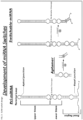
- Riboswitches are divided into two parts: an aptamer and an expression platform.
- the aptamer is a "sensor" to which a target small molecule ligand binds; the expression platform undergoes structural changes in response to the changes in the aptamer sensor. Binding of the aptamer domain causes conformational changes within the expression platform, this conformational change regulates gene expression by turning the gene off or on. This is illustrated in FIG. 1 .
- the aptamer is shown in blue; the expression platform, in red; the ligand in green. Often toxic concentrations of ligand are necessary to "flip the switch".
- the present invention provides modified riboswitches that can turn on or off gene expression in the retina for use in ocular gene therapy using non-toxic levels of ligand.
- a number of exemplary riboswitches are described herein, namely a self-targeting ligand inactivating microRNA (SLIM) embodiments.
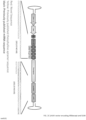
- a self-targeting ligand inactivating microRNA (SLIM) is an ON-type switch that mediates an increase in gene expression in the presence of the ligand (See, e.g., FIG. 2A and 2B ).
- Compositions using this technology and such compositions for use in methods to treat AMD and Glaucoma are provided herein. Specifically, this SLIM system can be used to intermittently switch on expression of the VEGF inhibitor. Compositions using this technology are contemplated for use in methods for the treatment of glaucoma, where it would be beneficial to intermittently turn off or lower expression of the prostaglandin in the eye of a patient are contemplated. Both are described in more detail below.
- SLIM ON-type modified riboswitch for modifying gene expression
- the present invention in one embodiment provides a self-targeting ligand inactivating microRNA (SLIM) switch which is an ON type riboswitch that can be incorporated into an expression construct to regulate expression of a transgene of interest.
- the SLIM switch (smiRNA in Fig. 2A and B ) requires the basal region of a pri-miRNA to be replaced with an aptamer that can bind to a target ligand. This sequence is cloned into either the 3'-or 5' untranslated region of an expression construct. Binding of the ligand alters the conformation of the aptamer and pri-miRNA, resulting in non-cleavage of the pri-miRNA by Drosha.
- a target miRNA sequence is cloned into either the 3' or 5' untranslated region which allows for a second level of regulation, in which the pri-miRNA when cleaved in the absence of ligand is processed into a miRNA that can bind to the target miRNA sequence and prevent transcription.
- the transgene expression is turned off when ligand is not present, and is turned on once the ligand binds to the aptamer.
- SLIM switches function by regulating gene expression at the post-transcriptional level.
- the pri-miRNA will be cleaved by Drosha from the nascent transcript. This miRNA will be processed and act as a second mechanism of gene silencing, through binding of the complementary target sites.
- the activating ligand is present, gene expression is unaltered and the gene is expressed.
- an exogenous nucleic acid construct for regulating expression of a transgene by modulating the mRNA of the transgene, the nucleic acid comprising:
- the pri-miRNA is cleaved from the transcript and binds to the at least one miRNA target sequence which silences the transgene. This is depicted in FIG. 2B .
- the at least one miRNA target sequence complementary to at least a portion of the pri-miRNA (c) discussed above is encompassed in the transgene (as depicted in the bottom figure of FIG. 2B ).
- the SLIM switch can be generated toward the transgene itself.
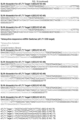
- Suitable riboswitches are described in FIGs. 18 and 19 , which also include the portion of the Eylea transgene or Flt1 transgene each riboswitch targets (e.g. SLIM switch for Eylea Target 1 (e.g., SEQ ID NO: 21, or 26 or 31) targets a portion of Eylea found in Eylea target 1 (SEQ ID NO:70), SLIM switch for Target 2 (e.g. SEQ ID NO:22, 27, 32) target Eylea Target 2 (SEQ ID NO:71) and so forth (e.g.
- SLIM switch for Eylea Target 1 e.g., SEQ ID NO: 21, or 26 or 31
- Target 2 e.g. SEQ ID NO:22, 27, 32
- SEQ ID NO:71 target Eylea Target 2
- so forth e.g.
- SLIM switch for Eylea 3 targets Eylea Target 3
- SLIM switch for Eylea 4 targets Eylea Target 4
- SLIM switch for Eylea Target 5 targets Eylea Target 5
- SLIM switch for Flt1 Target 1 targets Flt1 Target 1, etc.
- One or more SLIM switches can be combined within the exogenous expression constructs for use in the methods described herein (e.g., SLIM switch for Target 1, Target 2, Target 3, Target 4, and Target 5 of Elyea or Sflt1 can be combined in any combination for a construct to target (e.g.
- an exogenous nucleic acid construct for regulating expression of a transgene by modulating the mRNA of the transgene.
- the nucleic acid encoding: (a) a target gene of interest, (b) at least one smiRNA switch located within the untranslated region of the transgene, wherein the smiRNA switch comprises an aptamer domain capable of binding to a ligand and a pri-miRNA, wherein the smiRNA switch regulates expression of the transgene by both (1) regulation of the cleavage of the mRNA of the transgene, and (b) regulating cleavage of the pri-miRNA from the smiRNA, wherein at least a portion of the cleaved pri-miRNA binds to a portion of the transgene (as a miRNA targeting sequence) silencing the transgene expression.
- the exogenous nucleic acid construct is a AAV viral vector.
- the SLIM switch generated against Eylea or sFlt1 are used for the treatment of AMD as shown in the sequences described in FIG. 18 and 19 .
- an exogenous nucleic acid construct encodes: the SLIM switch, transgene, and at least one target miRNA sequence.
- Design of such SLIM switches is depicted in FIG. 2A .
- a suitable SLIM switch (smiRNA) encodes an aptamer domain and a pri-miRNA.
- Suitable aptamer domain is adapted from the aptamer domain of an ON-type riboswitch known in the art, and include but are not limited to, for example, L2Bulge18tc (for example, but not limited to, SEQ ID NO:12), K19 (For example, SEQ ID NO:15), L2Bulge9 (for example, SEQ ID NO:11), among others.
- Suitable aptamer domains are depicted in FIG. 3 and described in the specification below.
- An exogenous nucleic acid construct of the present invention comprises at least one smiRNA switch comprising SEQ ID NO: 1.
- smiRNA switch comprising SEQ ID NO: 1.
- Tet-SLIM SEQ ID NO: 17
- SLM switch is another SLM switch.
- FIGs. 18-23 Additional SLIM switches are depicted in FIGs. 18-23 .
- exogenous nucleic acid is foreign to (not normally found in nature in) the prokaryotic host cell, or a recombinant nucleic acid that is not normally found in the prokaryotic host cell.
- the exogenous nucleic acid sequence is a heterologous sequence comprising sequences from a number of different sources or organisms.
- exogenous also encompasses a construct that include sequences from a different species than the species the construct will be used.
- a rAAV construct of the present invention will include not only endogenous AAV sequences, but exogenous sequences from human or other sources that are not native to the AAV virus.
- nucleic acid constructs provided herein are synthetic engineered constructions containing non-naturally occurring sequences.
- transgene and "target gene of interest” are used interchangeably to refer to an exogenous gene which is to be expressed in the desired cell by use of the constructs of the present invention.
- aptamers can be designed against various ligands and incorporated into the SLIM switches by linking the aptamer to a pri-miRNA sequence (See, e.g., FIG. 2A ).
- the constructs comprise a nucleic acid sequence encoding a target gene of interest (transgene) and a SLIM switch.
- the transgene acts as the miRNA target sequence for the SLIM switch.
- the constructs further comprises the SLIM switch which also contain at least one target miRNA sequence, preferably from about 1-4 target miRNA sequences in the 3' or 5' UTR.
- FIG. 2B shows a suitable design of such construct.
- Suitable ligands are discussed more below, and specifically include ligands that are able to cross the blood retinal barrier, for example, tetracycline, theophylline and guanine.
- the construct comprises at least one target miRNA sequence.
- the construct comprises alternatively at least two, alternatively at least three, alternatively at least 4 target miRNA sequences.
- the number of target miRNA sequences added may depend on the vector used, for example, in the use of a rAAV vector, a suitably number of target miRNA include, for example, from 1-5. Adding more target sites would limit the available coding sequences as there is a limit to the size of the rAAV vectors, thus depending on the size and sequence of the transgene may also alter the number of target miRNA sequences added.
- the target miRNA sequence is encoded in SEQ ID NO: 10 (GAGAGAATCTTCTTTCTGTCTATAAAA).
- the construct contains at least three target miRNA sequence, for example, as found in SEQ ID NO: 2.
- the construct comprises a suitable transgene in which the expression of the transgene can be induced by administration of the ligand.
- the transgene may be a VEGF inhibitor, specifically a VEGF inhibitor which can be induced to be expressed in the eye for the treatment of AMD.
- a suitable VEGF inhibitor is aflibercept, which is encoded by the cDNA found in SEQ ID NO: 8.
- the aptamer domain and the pri-miRNA are encoded within SEQ ID NO:1.
- the construct contains other sequences found within constructs, for example, promoters, enhancers, WPRE elements, and the like.
- promoters for example, promoters, enhancers, WPRE elements, and the like.
- WPRE elements for example, promoters, enhancers, WPRE elements, and the like.
- One skilled in the art would be able to incorporate other known elements necessary for transgene expression from a nucleic acid construct.
- the construct is an adeno-associated virus (rAAV), a lentivirus, an adnovirus, a plasmid, a herpes simplex virus, a baculovirus, a bacteriophage, among others.
- rAAV adeno-associated virus
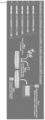
- FIG. 2 A suitable rAAV construct is demonstrated in FIG. 2 which incorporates the transgene for aflibercept, a Theo-SLIM switch and 3 miRNA target sequences, for example, the sequence encoded in SEQ ID NO:9 or SEQ ID NO: 19.
- the SLIM switch requires the basal region of a pri-miRNA to be replaced with an aptamer. This sequence is cloned into either the 3'-or 5' untranslated region of an expression cassette. Additionally, miRNA target sites that are complementary to the sequence of the mature miRNA can be included in one or multiple copies at either the 5' or 3' untranslated region of the cassette.
- SLIM Self-targeting Ligand Inactivated miRNAs switches function by regulating gene expression at the post-transcriptional level. In conditions when the activating ligand is absent, the pri-miRNA will be cleaved by drosha from the nascent transcript. This miRNA will be processed and act as the second mechanism of gene silencing, through binding of the complementary target sites. When the activating ligand is provided, gene expression is unaltered.
- each riboswitch can be included into the 3'-untranslated region of the gene of interest.
- Each riboswitch appears to have an optimal number of copies as shown in Table 1.
- multiple copies of miRNA target sites can be included in the 3' or 5' untranslated region.
- the synthetic riboswitches comprise an aptamer and an expression platform and rely on changes in the expression platform activity for regulating gene expression.
- the miRNA target sites are sequences in the therapeutic cassette (construct) that are recognized by the mature miRNA/siRNA.
- the miRNA target sites may be encompassed within the transgene.
- the cleaved and processed siRNA from the riboswitch binds to the transgene and inhibits its expression.
- the SLIM switch can be generated towards the transgene itself, with Eylea and sFlt1 for the treatment of AMD, the sequences are found in FIGS. 16-18 , 19 and 23 .
- the nucleic acid construct comprises a target gene of interest, for example, a VEGF inhibitor (e.g. Eylea (SEQ ID NO:20) or sFLT1 (SEQ ID NO:36) and at least one miRNA SLIM switch located within the untranslated region of the target gene (e.g. at least one selected from SEQ ID NO:21-35 or SEQ ID NO:37-51, respectively of the VEGF inhibitors).
- a VEGF inhibitor e.g. Eylea (SEQ ID NO:20) or sFLT1 (SEQ ID NO:36
- miRNA SLIM switch located within the untranslated region of the target gene (e.g. at least one selected from SEQ ID NO:21-35 or SEQ ID NO:37-51, respectively of the VEGF inhibitors).
- the nucleic acid construct is an rAAV vector comprising the Eylea gene (e.g. SEQ ID NO: 19).
- SEQ ID NO:19 provides a complete AAV expression vector for the expression of Eylea using a SLIM switch.
- X marks positions in which a SLIM sequence may be inserted.
- SLIM sequences that may be inserted can be found in FIG.18 , and include, but are not limited to, 6S-Folinic Acid-responsive SLIM (miRNA) switches, including, for example, SEQ ID NO: 21, 22, 23, 24, and 25 (activated by the ligand 6S-Folinic acid), Theophylline-responsive SLIM, for example, SEQ ID NO:26, 27, 28, 29 and 30 (activated by ligand theophylline), or Tetracycline-responsive SLIM, for example, SEQ ID NO:31, 32, 33, 34, and 35 (activated by ligand tetracycline).
- miRNA 6S-Folinic Acid-responsive SLIM
- Theophylline-responsive SLIM for example, SEQ ID NO:26, 27, 28, 29 and 30 (activated by ligand theophylline)
- Tetracycline-responsive SLIM for example, SEQ ID NO:31, 32, 33, 34, and 35 (activated by ligand
- SEQ ID NO:19 may incorporate 1-5 copies of SEQ ID NO:21, alternatively 1-5 copies of SEQ ID NO:22, alternatively 1-5 copies of SEQ ID NO: 23, alternatively 1-5 copies of SEQ ID NO:24, alternatively 1-5 copies of SEQ ID NO:25, alternatively 1-5 copies of SEQ ID NO:26, alternatively 1-5 copies of SEQ ID NO:27, alternatively 1-5 copies of SEQ ID NO:28, alternatively 1-5 copies of SEQ ID NO:29, alternatively 1-5 copies of SEQ ID NO:30, alternatively 1-5 copies of SEQ ID NO:31, alternatively 1-5 copies of SEQ ID NO:32, alternatively 1-5 copies of SEQ ID NO:33, alternatively 1-5 copies of SEQ ID NO:34, alternatively 1-5 copies of SEQ ID NO:35.
- the nucleic acid construct comprises a target gene of interest, for example, a VEGF inhibitor sFLT1 (SEQ ID NO:36) and at least one smiRNA SLIM switch located within the untranslated region of the target gene (e.g. at least one selected from SEQ ID NO:37-51).
- a target gene of interest for example, a VEGF inhibitor sFLT1 (SEQ ID NO:36) and at least one smiRNA SLIM switch located within the untranslated region of the target gene (e.g. at least one selected from SEQ ID NO:37-51).
- the nucleic acid construct comprises the sFLT1 gene (SEQ ID NO:36).
- sFLT1 may be inserted within a vector, for example a rAAV vector, and flanked by X which marks positions in which a SLIM sequence may be inserted.
- SLIM sequences that may be inserted can be found in FIG.18 , and include, but are not limited to, 6S-Folinic Acid-responsive SLIM (miRNA) switches, including, for example, SEQ ID NO: 37, 38, 39, 40, 41 (activated by the ligand 6S-Folinic acid), Theophylline-responsive SLIM, for example, SEQ ID NO:42, 43, 44, 45, 46 (activated by ligand theophylline), or Tetracycline-responsive SLIM, for example, SEQ ID NO:47, 48, 49, 50, and 51 (activated by ligand tetracycline).
- miRNA 6S-Folinic Acid-responsive SLIM
- Theophylline-responsive SLIM for example, SEQ ID NO:42, 43, 44, 45, 46 (activated by ligand theophylline)
- Tetracycline-responsive SLIM for example, SEQ ID NO:47, 48, 49, 50, and 51 (
- SEQ ID NO:36 may incorporate as X from 1-5 copies of SEQ ID NO:37, alternatively from 1-5 copies of SEQ ID NO:38, alternatively from 1-5 copies of SEQ ID NO:39, alternatively from 1-5 copies of SEQ ID NO:40, alternatively from 1-5 copies of SEQ ID NO:41, alternatively from 1-5 copies of SEQ ID NO:42, alternatively from 1-5 copies of SEQ ID NO:43, alternatively from 1-5 copies of SEQ ID NO:44, alternatively from 1-5 copies of SEQ ID NO:45, alternatively from 1-5 copies of SEQ ID NO:46, alternatively from 1-5 copies of SEQ ID NO:47, alternatively from 1-5 copies of SEQ ID NO:48, alternatively from 1-5 copies of SEQ ID NO:49, alternatively from 1-5 copies of SEQ ID NO:50, or alternatively from 1-5 copies of SEQ ID NO:51.
- SLIM sequences are contemplated (e.g. for example from 1-5 SLIM sequences selected from SEQ ID NO:36, 37, 38, 39, 40, and 41). Suitable, one would preferably use SLIM sequences activated by the same ligand in the construct, for example 1-5 SLIM sequences that are active by the tetracycline ligand.
- a nucleic acid construct comprises PTGS2 (SEQ ID NO:52) and PTGFR (SEQ ID NO:53) (depicted in combination in SEQ ID NO:54 as PTGS2-P2A-PTGFR).
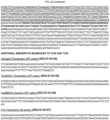
- Suitable nucleic acid construct is depicted in FIG. 23 as SEQ ID NO:81, a AAV expression vector comprising PGF2alpha biosynthesis regulatory genes (PTGS2 (SEQ ID NO:60) and PTGFR (SEQ ID NO:62) including two synthetic riboswitches TC40 (SEQ ID NO:59) and TC45 (SEQ ID NO:63).
- PTGS2 SEQ ID NO:60
- PTGFR SEQ ID NO:62
- TC40 SEQ ID NO:59
- TC45 SEQ ID NO:63
- ligands that are able to cross the blood retinal barrier are preferred.
- Suitable aptamers that can cross the blood retinal barrier include, but are not limited to, for example, tetracycline, theophylline, guanine, galactitol, progesterone, mannitol, estradiol, dopamine, quinidine, urea, digoxin, uracil, verapamil, thiourea, moxifloxacin, thymine, levofloxin, corticosterone, acetazolamide, testosterone, doxycycline, and combinations thereof.
- the ligand is selected from the group consisting of tetracycline, theophylline and guanine.
- Suitable routes of administration of the ligands include, oral administering, administering via the eye (e.g., eyedrops) and the like.
- the constructs of the present technology are particularly useful for gene therapy for the treatment of eye diseases.
- the eye is a particularly good target for this type of gene therapy for a number of reasons.
- the eye is a highly specialized organ which has evolved to transduce light stimuli into electrical signals and to relay those signals to the visual cortex. Light sensation and image formation is mediated through the activation of photoreceptor cells located in the outermost layer of the neurosensory retina, where incident light focused by the cornea and lens results in the activation of a signaling cascade and the propagation of an electrical impulse.
- the eye has many traits which make it an attractive organ for gene therapy: it is relatively immune privileged, has a small compartment size, is easily visualized and examined, and readily accessible with minimal risk to patients undergoing surgery.
- the retina (AMD) or the cornea (Glaucoma) are the primary targets for gene therapy treatments.
- Vector delivery is usually achieved through injection of a fluid suspension containing the therapeutic particles into the anatomically constrained space adjacent to the target cells.
- a rAAV.SLIM. ⁇ VEGF or rAAV.SLIM.sFLT1 vector would be most beneficial if targeted towards cells of the inner retina, including retinal ganglion cells and Müller glia, and as such would be administered via intravitreal injection.
- the rAAV.SLIM.PTGS2-P2-PTGFR vector would be most beneficial if targeted towards cells of the cornea and anterior chamber, including corneal endothelial cells, and as such would be administered via intracameral injection.
- rAAV clinical trials using rAAV for ocular gene therapy applications have been successfully completed; however, all trials to date have utilized a sub-retinal delivery approach designed to target photoreceptors.
- a current phase VII clinical trial (NCT01494805) is underway utilizing rAAV-mediated overexpression of soluble fms-like tyrosine kinase-1 (sFLT), a soluble receptor of VEGF, for the treatment of AMD.
- sFLT soluble fms-like tyrosine kinase-1
- VEGF a soluble receptor of VEGF
- the present invention provides the exogenous nucleic acid constructs of the present invention for use in methods of treating age-related macular degeneration by inhibiting, reducing or alleviating at least one symptom of AMD.
- AMD is a disease involving multiple tissue layers within the eye, including the choroid, retinal pigment epithelium and the neurosensory retina, and occurs in two forms.
- Dry AMD is a non-proliferative disease state characterized by progressive geographic atrophy of the central retina. In approximately 10-15% of patients the disease progresses to a wet form, characterized by abnormal growth of blood vessels from the choroid into the subretinal space.
- Choroidal neovascularization results primarily as a result of increased intraocular concentrations of VEGF and is the major vision-threatening symptom of AMD.
- Administration of anti-VEGF agents is known to significantly reduce the incidence of CNV and is the current gold-standard treatment AMD.
- the treatment regimen is invasive, however, requiring repetitive (e.g. monthly or bimonthly) intravitreal injection of purified recombinant anti-VEGF protein.
- the proposed rAAV.SLIM. ⁇ VEGF technology would act to significantly reduce the incidence of CNV formation in AMD patients, and consequently prevent vision loss.
- the inclusion of the SLIM technology would allow for anti-VEGF expression to be controlled through dosing of the activating ligand.
- the rAAV.SLIM. ⁇ VEGF vector technology of the present invention would act to significantly reduce the incidence of CNV formation in AMD patients, and consequently prevent vision loss.
- the inclusion of the SLIM technology would allow for anti-VEGF expression to be controlled through dosing of the activating ligand.
- the present invention provides the exogenous nucleic acid constructs of the present invention for use in methods of treating, reducing, alleviating or inhibiting at least one symptom of AMD comprising administering to the eye of a subject a construct comprising a VEGF inhibitor and a SLIM riboswitch as described herein (including, e.g. , rAAV.SLIM. ⁇ VEGF or rAAV.SLIM.sFLT1 vector), and further administering a therapeutically effective amount of the ligand.
- the SLIM riboswitch can determine which ligand is used as described in more detail herein.
- the treatment results in the reduction, alleviation or inhibition of one or more symptom of AMD, for example, a reduction or inhibition of the development of CNV.
- the exogenous nucleic construct of the present invention is provided for use in a method of treating, inhibiting or reducing at least one symptom of AMD comprises administering the construct comprising one or more ON-type riboswitch operably connected to a transgene encoding a VEGF inhibitor and administering a therapeutically effective amount of the ligand.
- the present invention provides an exogenous nucleic acid construct of the present invention for use in a method of reducing at least one symptom of age-related macular degeneration in a subject in need thereof, wherein in the method of treatment:
- An exogenous nucleic acid construct of the present invention comprises at least one smiRNA switch comprising SEQ ID NO:1 located within the untranslated region of the transgene, wherein the at least one smiRNA switch comprises an aptamer domain capable of binding to a ligand and a pri-miRNA.
- the SLIM riboswitches can be incorporated into constructs of the present invention to alter gene expression of the transgene by administration of a therapeutically effective amount of the ligand.
- therapeutically effective amount we mean an amount or dosage of the ligand that is able to alter the expression level of the transgene product in a cell.
- One skilled in the art will be able to titrate and determine a therapeutically effective amount to produce the proper response and result in a reduction of the symptoms of the desired disease to be treated.
- a therapeutically effective amount also maintains that the level of ligand is in a non-toxic dose to the subject.
- the dosage may be given daily, weekly or monthly depending on the particular requirements for expression in the subject.
- the present invention provides for the first time higher functioning genetic switches in a retinal model which can be used to regulate transgenes within the eye to treat eye diseases.
- the SLIM switches described above have the potential to have an increased dynamic range over traditional riboswitches and can be used for the treatment, inhibition or amelioration of one or more symptom of glaucoma, including high intraocular pressure.
- Prostaglandin synthesis will be regulated by orally ingesting the activating ligand.
- the dose of the activating ligand will be determined by intraocular pressure (IOP) readings of the patient through the use of a rebound tonometer.
- IOP intraocular pressure
- the present disclosure provides the exogenous nucleic acid constructs of the present invention for use in methods of treating glaucoma comprising gene therapy using an adeno-associated virus encoding the construct comprising a SLIM switch and one or more genes that regulate prostaglandin synthesis as described herein.
- the present invention provides an exogenous nucleic acid construct of the present invention for use in a a method of reducing at least one symptom of glaucoma in a subject in need thereof, wherein in the method of treatment:
- Glaucoma is typified by elevated intra-ocular pressure (IOP) leading to progressive loss of retinal ganglion cells and, ultimately severe visual impairment.
- IOP intra-ocular pressure
- Increased IOP results from an imbalance between the production of aqueous humour by the ciliary body in the eye's posterior chamber and its drainage through the trabecular meshwork in the anterior chamber.
- Glaucoma can be categorized based on whether the drainage through the trabecular meshwork is completely (closed angle) or partially (open angle) blocked. Open angle glaucoma is most common and usually presents with no symptoms other than slow progressive vision loss. Closed angle glaucoma is loss common and is considered to be a medical emergency, presenting with acute eye pain, headaches, blurred vision, excessive lacrimation nausea and vomiting.
- the exogenous nucleic acid construct of the present invention is for use in a method of reducing, inhibiting or ameliorating at least one symptom of glaucoma.
- the method comprises administering the exogenous nucleic acid construct to the eye of the subject.
- the exogenous nucleic acid construct encodes a transgene that regulates prostaglandin 2 ⁇ synthesis and at least one smiRNA riboswitch.
- the exogenous nucleic acid construct encodes:(i) a transgene that regulates prostaglandin synthesis (e.g., prostaglandin endoperoxide synthase 2 (PTGS2); (ii) a smiRNA switch located within the untranslated region of the transgene, wherein the smiRNA switch comprises at least two riboswitches flanking a pri-miRNA, each riboswitch comprising an aptamer operably linked to an expression platform, and (iii) at least one miRNA target sequence complementary to at least a portion of the pri-miRNA, wherein the transgene is incorporated into cells of the subject and express the transgene, and (b) administering a therapeutically effective amount of the ligand that is able to bind to the aptamer in order to regulate expression of the transgene within the eye to reduce, inhibit or ameliorate at least one symptom of glaucoma.
- the symptom is e.g.
- Suitable ligands include ligands that can cross the blood retinal barrier, as described herein.
- the transgene that regulates prostaglandin 2 ⁇ synthesis includes, but is not limited to, for example, PTGS2 (SEQ ID NO:52) among others.
- Other suitable transgenes are known in the art.
- kits comprising an exogenous nucleic acid construct of the present invention.
- the kits can be suitable for use in the methods described herein.
- a kit can include a rAAV vector comprising the constructs as described herein, for example, a SLIM switch containing construct.
- the kit can include a construct comprising rAAV vector encoding a VEGF inhibitor as described herein.
- the kit can include a construct comprising a rAAV vector encoding one or more genes involved in the regulation of prostaglandin synthesis as described herein.
- the kits may comprise one or more doses of the ligand to be administered after initial administration of the rAAV vector. Instructions on the timing of the dosages and proper administration methods may be provided.
- subject and patient are used interchangeably and refer to any animal (e.g., a mammal), including, but not limited to, humans, non-human primates, rodents, and the like, which is to be the recipient of a particular treatment.
- animal e.g., a mammal
- non-human primates e.g., humans, non-human primates, rodents, and the like
- subject and patient are used interchangeably herein in reference to a human subject.
- treating includes, but is not limited to, reducing, inhibiting or preventing one or more signs or symptoms associated with the disease or disorder.
- treating glaucoma include, for example, reduction in the intraocular eye pressure (e.g. the symptom of glaucoma being treated is high intraocular pressure).
- an effective amount or “therapeutically effective amount” refer to an amount sufficient to effect beneficial or desirable biological and/or clinical results.
- the expression platform is operably linked to the aptamer domain of the riboswitch, preferably structurally linked, most preferably by a nucleic acid linker. Most preferred is that the aptamer domain is linked to the expression platform by a nucleic acid sequence.
- the stem configuration of the portion of the expression platform changes configuration upon binding of a ligand, such that a change in the configuration of the stem structure results in a corresponding change in the structure of the expression platform, between a first configuration which enhances expression of the nucleic acid sequence and a second configuration which inhibits expression of the nucleic acid sequence.
- Genetic construct can include nucleic acid sequences that permit it to replicate in the host cell. Examples include, but are not limited to a plasmid, cosmid, bacteriophage, or virus that carries exogenous DNA into a cell. A genetic construct can also include additional selectable marker genes and other genetic elements known in the art. A genetic construct can preferably transduce, transform or infect a cell, thereby causing the cell to express the nucleic acids and/or proteins encoded by the vector.
- a first element is operably linked with a second element when the first element is placed in a functional relationship with functional relationship with the second element.
- a aptamer is operably linked to an expression platform when the binding of the aptamer to its ligand causes conformational changes to the expression platform which alters the function of the expression platform (for example, if the expression platform is a ribozyme, binding of the aptamer to the ligand can activate the ribozyme activity).
- operably linked DNA sequences are contiguous and, where necessary to join two protein coding regions, in the same reading frame.
- recitation of a value between 1 and 10 or between 2 and 9 also contemplates a value between 1 and 9 or between 2 and 10. Ranges identified as being "between" two values are inclusive of the end-point values. For example, recitation of a value between 1 and 10 includes the values 1 and 10.
- compositions of matter can be utilized in the context of the methods and kits, and aspects of the present disclosure that are described with respect to kits can be utilized in the context of the methods and compositions of matter.
- Example 1 Ability to regulate gene expression in vivo in the eye
- This Example demonstrates that six riboswitches respond to a ligand in cell culture and in vivo when deliver to the mouse retina.
- riboswitches (K19, Tc40x45, GuaM8HDV, L2Bulge18tc, L2Bulge9 and Theo6HDV) responded to a ligand in cell culture, and in vivo when delivered to the mouse retina using a rAAV2 vector.
- the riboswitches were evaluated in HEK293T cells to determine optimal copy number (largest dynamic range) and dose-responsiveness to its activating ligand using a dual luciferase assay.
- the ligand used were tetracycline and theophylline.
- each riboswitch cassette was injected intravitreally into C57Bl/6j mice in combination with an AAV2 control vector harboring a non-inducible mCherry reporter gene.
- mCherry and GFP fluorescence levels were quantified in vivo using a custom 'Multiline' confocal scanning laser ophthalmoscope (cSLO).
- cSLO custom 'Multiline' confocal scanning laser ophthalmoscope
- Example 2 Evaluation of optimal copy number of riboswitches and dynamic range
- Example 2A testing of known riboswitches
- This Example demonstrates the optimal number of riboswitches that can be used in a construct and the related dynamic ranges.
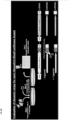
- the protocol for both assays are outlined in FIG. 8A and 8B .
- plasmids containing 0-4 copies of each riboswitch were created with the transgene as green fluorescence protein (GFP) for readout.
- GFP green fluorescence protein
- HEK293T cells were plated in a 12-well plate and on day 2 transfected with 1 ⁇ g of each plasmid DNA. On day 3, cells were observed by fluorescent microscopy (excitation 467-498 nm) and fluorescence was quantified using a plate reader (488nm excitation 520 nm emission).
- constructs containing firefly luciferase containing the optimal copy number of the riboswitch were made.
- HEK293T cells were plated on day 1, and transfected on day 2 with 1 ⁇ g of plasmid DNA. Cells were treated with 0-100 ⁇ M of the ligand corresponding to the riboswitch and the luminescence was quantified on day 3 using plate reader. Results are shown in Table 2.
- L2Bulge18tc riboswitch was one ON-type riboswitch tested.
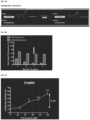
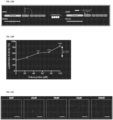
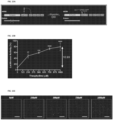
- the cells were treated with 0 ⁇ M, 25 ⁇ M, 50 ⁇ M, 75 ⁇ M, and 100 ⁇ M of tetracycline (ligand), with the fluorescent microscopy results shown in FIG. 9D .
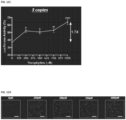
- Fluorescence was quantified and results are demonstrated in FIG. 9B , demonstrating 3 copies provides optimal dynamic range, as depicted in FIG. 9C .
- L2Bulge 9 was also tested (using activating ligand Theophylline), and the optimal copy number was determined to be 3.
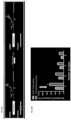
- Example 2A Experiments as described in Example 2A were also carried out using the newly designed Tet-SLIM and Theo-SLIM switches including target miRNA sequence, as depicted in FIG. 12A and 13A , respectively.
- FIG. 12B and 13B show the dynamic range for both switches, while FIG. 12C and 13C depict fluorescence as seen in the cells treated with 0-100 ⁇ M of their respective ligands.
- Both SLIM riboswitches had an increased dynamic range over similar riboswitches known in the art.
- Example 3 Mouse study using SLIM containing anti-VEGF compound
- VEGF vascular endothelial growth factor
- Aflibercept (Eylea) under control the SLIM gene-switch (named herein, rAAV.SLIM. ⁇ VEGF).
- the contralateral eye will receive an injection of buffer only to control for the effects of the surgical intervention.
- Four weeks will be allowed for incorporation of the rAAV. SLIM. ⁇ VEGF vector into cells of the retina; based on preliminary data we expect ganglion cells and Müller glia be effectively transduced. All eyes will be imaged by fluorescein angiography (FA) using a confocal scanning laser ophthalmoscope to establish the baseline integrity of the retinal and choroidal blood vessels.
- FA fluorescein angiography
- CNV Acute choroidal neovascularization
- Example 4 Treatment of AMD using rAAV.SLIM. ⁇ VEGF vector
- patients would receive a single intravitreal injection of the rAAV.SLIM. ⁇ VEGF vector suspended in a physiologically relevant buffer.
- the current treatment paradigm for AMD patients involves monthly or bimonthly intravitreal injections of anti-VEGF protein; a single-dose administration rAAV.SLIM. ⁇ VEGF would therefore represent a significantly less invasive treatment alternative.
- Intravitreal injections of anti-VEGF protein are currently performed under local anesthesia as an outpatient procedure; it is anticipated that this would also be the case for intravitreal administration of the rAAV.SLIM. ⁇ VEGF vector.
- the SLIM technology is an ON-type switch; as such anti-VEGF protein will not be expressed in the patient's eye until the activating ligand is provided. Anti-VEGF protein expression levels in the patient eye will be regulated through oral administration of the activating ligand (e.g. in tablet form).
- the SLIM technology is dose-dependent, allowing the patient/physician to precisely modulate anti-VEGF expression levels within the eye. The retinal cells targeted as part of this procedure do not divide.
- rAAV.SLIM. ⁇ VEGF vector will persist throughout the patient's lifetime. Anti-VEGF expression can therefore be induced at any time throughout the patient's lifetime by administration of the activating ligand, negating the need for repetitive intra-ocular injections.
- Eylea a recombinant fusion VEGF trap licensed by the Food and Drug Administration for the treatment of wet AMD in 2011, has been found to be highly effective at treating CNV in patients with wet AMD.
- Eylea aflibercept
- This approach has been largely successful at preventing CNV formation, it requires a monthly high-dose intravitreal injection of anti-VEGF agents throughout a patient's lifetime, resulting in a substantial financial and economic burden.
- continuous bolus administration of both Eylea and Lucentis over multiple years has been shown to accelerate the rate of retinal and choroidal atrophy. Patients are also at an increased risk for injection related complications such as endophthalmitis and cataract formation.
- PBS PBS
- CNV formation was initiated by rupturing Bruch's membrane using an infrared laser diode (see methods).
- neovascular lesion size and leakage was assessed via fluorescein angiography using cSLO imaging.
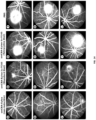
- the majority of mice ubiquitously expressing Eylea either did not develop lesions at the site of laser injury, or developed small grade 1 or 2A type lesions that leaked minimal fluorescein, even after a 5-minute period. ( FIG. 14A-C ).
- mice injected with the 'OFF-type' smCBA-Eylea-1x-TC45 vector and placed on regular diet also predominantly developed only minor lesions, though a small increase in the number of 2B lesions were observed compared to the non-inducible Eylea construct ( FIG. 14D-F ).
- Lowering Eylea expression through activation of the TC45 riboswitch greatly increased the severity of CNV lesions ( FIG. 14G-I ) to the extent that they were similar in extent to PBS-sham injected mice ( FIG. 14L-J ).
- Lesion images were graded by three blinded scientists using the grading system described by Krzystolik et al. (see methods for details). Importantly, grade distribution was significantly different for each treatment group Mice receiving a sham injection had the highest incidence of clinically significant ⁇ Grade 2B' lesions, while mice ubiquitously over-expressing Eylea (smCBA-Eylea) had the lowest incidence of ⁇ Grade 2B' lesions.
- Example 6 Self-targeting ligand inactivating miRNAs for AMD treatment in humans
- a SLIM switch requires the basal region of a pri-miRNA to be replaced with an aptamer. This sequence is cloned into either the 3'-or 5' untranslated region of an expression cassette. Additionally, miRNA target sites that are complementary to the sequence of the mature miRNA can be included in one or multiple copies at either the 5' or 3' untranslated region of the cassette.
- SLIM Self-targeting Ligand Inactivated miRNAs switches function by regulating gene expression at the post-transcriptional level. In conditions when the activating ligand is absent, the pri-miRNA will be cleaved by drosha from the nascent transcript. This miRNA will be processed and act as the second mechanism of gene silencing, through binding of the complementary target sites. When the activating ligand is provided, gene expression is unaltered.
- each riboswitch can be included into the 3'-untranslated region of the gene of interest.
- Each riboswitch appears to have an optimal number of copies as shown in Table 2.
- multiple copies of miRNA target sites can be included in the 3' or 5' untranslated region.
- patients would receive a single intravitreal injection of the rAAV.SLIM. ⁇ VEGF vector suspended in a physiologically relevant buffer.
- the current treatment paradigm for AMD patients involves monthly or bimonthly intravitreal injections of anti-VEGF protein.
- a single-dose administration rAAV.SLIM. ⁇ VEGF would therefore represent a significantly less invasive treatment alternative.
- Intravitreal injections of anti-VEGF protein are currently performed under local anaesthesia as an outpatient procedure; it is anticipated that this would also be the case for intravitreal administration of the rAAV.SLIM. ⁇ VEGF vector.
- the patient could continue to receive conventional anti-VEGF therapy during this time.
- the SLIM technology is an ON-type switch; as such anti-VEGF protein will not be expressed in the patient's eye until the activating ligand is provided.
- Anti-VEGF protein expression levels in the patient eye will be regulated through oral administration of the activating ligand (e.g. in tablet form).
- the SLIM technology is dose-dependent, allowing the patient/physician to precisely modulate anti-VEGF expression levels within the eye.
- the retinal cells targeted as part of this procedure do not divide.
- Anti-VEGF expression can therefore be induced at any time throughout the patient's lifetime by administration of the activating ligand, negating the need for repetitive intra-ocular injections.
- POAG Primary open angle glaucoma
- IOP intraocular pressure
- the gold standard clinical therapy for glaucoma is to reduce IOP through a combination of topical drug administration, and in late-stage disease, surgery.
- patient compliance with drug therapies is extremely poor ( ⁇ 20%), leading to the development of severe sight-threatening complications, even in patients diagnosed early.
- Prostaglandin analogs are administered clinically as esterified pro-drugs that are absorbed across the corneal epithelium and are hydrolyzed into their active form as they pass through the stroma and corneal endothelium before diffusing into the aqueous humor.
- Binding of soluble PGF 2 ⁇ analog to PTGFR triggers up-regulation of matrix metaloprotinase (MMP) production within the ciliary muscle that promotes remodelling of the extracellular matrix and increased uveoscleral aqueous outflow.
- MMP matrix metaloprotinase
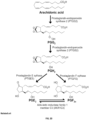
- Native PGF 2 ⁇ is enzymatically derived from aracadonic acid, which is present in the cornea at high levels, via a multistep process.
- IOP was measured by rebound tonometry before and 12 weeks following injection.
- Mice placed on diet (PGF2alpha Expression OFF) showed no decreased in intraocular pressure over the 12 week period.
- Mice on normal diet (PGF2alpha expression ON) showed a highly significant decrease in IOP, similar to when PGF2alpha is constitutively expressed (no switch).
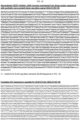
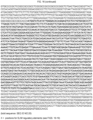
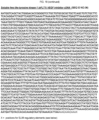
- the application includes the sequence listing through-out the specification and in the attached sequence listing statememnt. A few sequences are listed below, but are not to be considered a fully listing.
Landscapes
- Health & Medical Sciences (AREA)
- Life Sciences & Earth Sciences (AREA)
- Genetics & Genomics (AREA)
- Engineering & Computer Science (AREA)
- Chemical & Material Sciences (AREA)
- Biotechnology (AREA)
- Molecular Biology (AREA)
- Biomedical Technology (AREA)
- Bioinformatics & Cheminformatics (AREA)
- Organic Chemistry (AREA)
- General Health & Medical Sciences (AREA)
- General Engineering & Computer Science (AREA)
- Wood Science & Technology (AREA)
- Zoology (AREA)
- Animal Behavior & Ethology (AREA)
- Pharmacology & Pharmacy (AREA)
- Public Health (AREA)
- Veterinary Medicine (AREA)
- Medicinal Chemistry (AREA)
- Plant Pathology (AREA)
- Physics & Mathematics (AREA)
- Epidemiology (AREA)
- Biophysics (AREA)
- Biochemistry (AREA)
- Microbiology (AREA)
- Ophthalmology & Optometry (AREA)
- Chemical Kinetics & Catalysis (AREA)
- General Chemical & Material Sciences (AREA)
- Nuclear Medicine, Radiotherapy & Molecular Imaging (AREA)
- Medicines That Contain Protein Lipid Enzymes And Other Medicines (AREA)
- Pharmaceuticals Containing Other Organic And Inorganic Compounds (AREA)
- Medicines Containing Material From Animals Or Micro-Organisms (AREA)
- Medicinal Preparation (AREA)
Claims (15)
- Exogenes Nukleinsäurekonstrukt zum Regulieren der Expression eines Transgens durch Modulieren der mRNA des Transgens, wobei die Nukleinsäure Folgendes umfasst:(a) eine Nukleinsäuresequenz, die ein Zielgen von Interesse kodiert,(b) mindestens einen smiRNA-Schalter, umfassend SEQ ID NO: 1, angeordnet in der untranslatierten Region des Transgens, wobei der mindestens eine smiRNA-Schalter eine Aptamerdomäne umfasst, die in der Lage ist, an einen Liganden und eine pri-miRNA zu binden, und(c) mindestens eine miRNA-Zielsequenz, umfassend SEQ ID NO: 10, komplementär zu mindestens einem Abschnitt der pri-miRNA,wobei der mindestens eine smiRNA-Schalter die Expression des Transgens sowohl durch (1) Regulieren der Spaltung der mRNA des Transgens als auch durch (2) Regulieren der Spaltung der pri-miRNA aus der smiRNA reguliert, wobei mindestens ein Abschnitt der gespaltenen pri-miRNA an die mindestens eine miRNA-Zielsequenzen bindet, die die Transgenexpression stilllegen.
- Konstrukt nach Anspruch 1, wobei:(i) das Konstrukt mindestens zwei miRNA-Zielsequenzen umfasst; oder(ii) das Konstrukt drei miRNA-Zielsequenzen kodiert, wobei die mindestens drei miRNA-Zielsequenzen durch SEQ ID NO: 2 kodiert werden.
- Konstrukt nach Anspruch 1 oder 2, wobei die mindestens eine miRNA-Zielsequenz komplementär zu mindestens einem Abschnitt der pri-miRNA aus (c) ein Abschnitt des Transgens in dem Konstrukt ist, an den mindestens ein Abschnitt der gespaltenen pri-miRNA bindet.
- Konstrukt nach einem der vorhergehenden Ansprüche, wobei in Abwesenheit von Liganden die pri-miRNA aus dem Transkript gespalten wird und an die mindestens eine miRNA-Zielsequenz bindet, wobei das Binden des Abschnitts der pri-mRNA an die mindestens eine miRNA-Zielsequenz das Transgen stilllegt.
- Konstrukt nach einem der vorhergehenden Ansprüche, wobei das Binden des Liganden an die Aptamerdomäne die Konformation der smiRNA verändert, wobei die Änderung der Konformation die Fähigkeit der pri-miRNA hemmt, aus dem Transkript gespalten zu werden, und wobei das Transgen in der Lage ist, translatiert zu werden.
- Konstrukt nach einem der vorhergehenden Ansprüche, wobei:(i) das Konstrukt einen oder mehrere smiRNA-Schalter umfasst, ausgewählt aus der Gruppe bestehend aus SEQ ID NO: 21-35 und 37-51; und/oder(ii) sich die smiRNA in der 3'-UTR befindet und sich die mindestens eine miRNA-Zielsequenz in der 5'-UTR befindet.
- Konstrukt nach einem der vorhergehenden Ansprüche, wobei das Transgen einen VEGF-Hemmer kodiert; wobei optional:(i) der VEGF-Hemmer Aflibercept und durch SEQ ID NO: 8 kodiert ist; oder(ii) der VEGF-Hemmer sFLT1 kodiert durch SEQ ID NO: 36 ist.
- Konstrukt nach einem der vorhergehenden Ansprüche, wobei das Aptamer an einen Liganden bindet, der in der Lage ist, die Blut-Augen-Schranke zu überqueren;wobei optional der Ligand ausgewählt ist aus der Gruppe bestehend aus Tetracyclin, Theophyllin, Guanin, Galaktitol, Progesteron, Mannitol, Estradiol, Dopamin, Chinidin, Urea, Digoxin, Uracil, Verapamil, Thioharnstoff, Mixiflaxacin, Thymin, Levofloxin, Corticosteron, Acetazolamid, Testosteron, Doxycyclin und Kombinationen davon;wobei optional der Ligand ausgewählt ist aus der Gruppe bestehend aus Tetracyclin, Theophyllin und Guanin.
- Konstrukt nach Anspruch 1, wobei das Transgen ein Gen umfasst, das an Prostaglandinsynthese beteiligt ist, wobei optional:(i) das Transgen Prostaglandin-Endoperoxidsynthase 2 (PTGS2) umfasst, kodiert durch SEQ ID NO: 52, optional ferner umfassend PTGFR kodiert durch SEQ ID NO: 53; und/oder(ii) das Konstrukt ferner SEQ ID NO: 54 umfasst.
- Konstrukt nach einem der vorhergehenden Ansprüche, wobei das Konstrukt ein Adeno-assoziierter Virus (AAV) -Vektor ist, wobei optional die Sequenz SEQ ID NO: 81 ist.
- Exogenes Nukleinsäurekonstrukt nach einem der Ansprüche 1-7 zur Verwendung in einem Verfahren des Verringerns von mindestens einem Symptom von altersbedingter Makuladegeneration in einem Subjekt, das dessen bedarf, wobei in dem Behandlungsverfahren:(a) das exogene Nukleinsäurekonstrukt an das Auge des Subjekts verabreicht wird, wobei das exogene Nukleinsäurekonstrukt Folgendes kodiert:(i) einen Anti-VEG-Hemmer;(ii) einen smiRNA-Schalter, der sich in der untranslatierten Region befindet, wobei der smiRNA-Schalter einen Riboschalter umfasst, umfassend eine Aptamerdomäne, die in der Lage ist, an einen Liganden und eine pri-miRNA zu binden, und(b) eine therapeutisch wirksame Menge des Liganden dem Subjekt verabreicht wird, um die Expression des Anti-VEGF-Hemmers zu regulieren und mindestens ein Symptom von altersbedingter Makuladegeneration zu verringern.
- Exogenes Nukleinsäurekonstrukt zur Verwendung nach Anspruch 11, wobei:(i) das Konstrukt ein Adeno-assoziierter Virus-Vektor ist;(ii) das Transgen Aflibercept ist;(iii) der Ligand in der Lage ist, die Blut-Augen-Schranke zu überqueren; wobei optional der Ligand ausgewählt ist aus der Gruppe bestehend aus Tetracyclin, Theophyllin, Guanin, Galaktitol, Progesteron, Mannitol, Estradiol, Dopamin, Chinidin, Urea, Digoxin, Uracil, Verapamil, Thioharnstoff, Mixiflaxacin, Thymin, Levofloxin, Corticosteron, Acetazolamid, Testosteron, Doxycyclin und Kombinationen davon;(iv) das Konstrukt ein oder mehrere SLIM umfasst, ausgewählt aus der Gruppe bestehend aus SEQ ID NO: 21-35 und 37-51;(v) das Konstrukt über intrakamerale Injektion an das Auge verabreicht wird;(vi) der Ligand oral oder über Augentropfen verabreicht wird; und/oder(vii) das exogene Nukleinsäurekonstrukt eine oder mehrere miRNA-Zielsequenzen in der untranslatierten Region umfasst.
- Exogenes Nukleinsäurekonstrukt nach Anspruch 1 oder 9 zur Verwendung in einem Verfahren des Verringerns von mindestens einem Symptom von Glaukom in einem Subjekt, das dessen bedarf, wobei in dem Behandlungsverfahren:(a) das exogene Nukleinsäurekonstrukt an das Auge des Subjekts verabreicht wird, wobei das exogene Nukleinsäurekonstrukt Folgendes kodiert:(i) ein Transgen, das Prostaglandin-2-Alpha-Synthese reguliert;(ii) einen smiRNA-Schalter, der sich in der untranslatierten Region des Transgens befindet, wobei der smiRNA-Schalter mindestens zwei Riboschalter umfasst, die eine pri-miRNA flankieren, wobei jeder Riboschalter ein Aptamer umfasst, das mit einer Expressionsplattform operabel verknüpft ist,wobei das Transgen in Zellen des Subjekts integriert ist und das Transgen exprimieren, und(b) eine therapeutisch wirksame Menge eines Liganden, der in der Lage ist, an das Aptamer zu binden, um Expression des Transgens in dem Auge zu regulieren, verabreicht wird.
- Exogenes Nukleinsäurekonstrukt zur Verwendung nach Anspruch 13, wobei:(i) das mindestens eine Symptom eine Verringerung des Augeninnendrucks im Auge des Subjekts ist;(ii) das Konstrukt über intrakamerale Injektion an das Auge verabreicht wird; und/oder(iii) der Ligand in der Lage ist, die Blut-Augen-Schranke zu überqueren; wobei optional der Ligand ausgewählt ist aus der Gruppe bestehend aus Tetracyclin, Theophyllin, Guanin, Galaktitol, Progesteron, Mannitol, Estradiol, Dopamin, Chinidin, Urea, Digoxin, Uracil, Verapamil, Thioharnstoff, Mixiflaxacin, Thymin, Levofloxin, Corticosteron, Acetazolamid, Testosteron, Doxycyclin und Kombinationen davon.
- Exogenes Nukleinsäurekonstrukt zur Verwendung nach einem der Ansprüche 12(vii), 13 oder 14, wobei:(i) das exogene Nukleinsäurekonstrukt ferner (iii) mindestens eine miRNA-Zielsequenz komplementär zu mindestens einem Abschnitt der pri-miRNA umfasst; und/oder(ii) der smiRNA-Schalter TC40 (SEQ ID NO: 59), TC45 (SEQ ID NO: 63) oder eine Kombination aus beiden smiRNA-Schaltern umfasst.
Priority Applications (1)
| Application Number | Priority Date | Filing Date | Title |
|---|---|---|---|
| EP24158111.5A EP4389894A3 (de) | 2017-03-10 | 2018-03-09 | Riboswitch-modulierte gentherapie für netzhauterkrankungen |
Applications Claiming Priority (2)
| Application Number | Priority Date | Filing Date | Title |
|---|---|---|---|
| US201762469705P | 2017-03-10 | 2017-03-10 | |
| PCT/US2018/021719 WO2018165536A1 (en) | 2017-03-10 | 2018-03-09 | Riboswitch modulated gene therapy for retinal diseases |
Related Child Applications (2)
| Application Number | Title | Priority Date | Filing Date |
|---|---|---|---|
| EP24158111.5A Division-Into EP4389894A3 (de) | 2017-03-10 | 2018-03-09 | Riboswitch-modulierte gentherapie für netzhauterkrankungen |
| EP24158111.5A Division EP4389894A3 (de) | 2017-03-10 | 2018-03-09 | Riboswitch-modulierte gentherapie für netzhauterkrankungen |
Publications (3)
| Publication Number | Publication Date |
|---|---|
| EP3592137A1 EP3592137A1 (de) | 2020-01-15 |
| EP3592137A4 EP3592137A4 (de) | 2021-01-06 |
| EP3592137B1 true EP3592137B1 (de) | 2024-08-07 |
Family
ID=63447961
Family Applications (2)
| Application Number | Title | Priority Date | Filing Date |
|---|---|---|---|
| EP18764686.4A Active EP3592137B1 (de) | 2017-03-10 | 2018-03-09 | Riboswitch-modulierte gentherapie für retinale erkrankungen |
| EP24158111.5A Pending EP4389894A3 (de) | 2017-03-10 | 2018-03-09 | Riboswitch-modulierte gentherapie für netzhauterkrankungen |
Family Applications After (1)
| Application Number | Title | Priority Date | Filing Date |
|---|---|---|---|
| EP24158111.5A Pending EP4389894A3 (de) | 2017-03-10 | 2018-03-09 | Riboswitch-modulierte gentherapie für netzhauterkrankungen |
Country Status (7)
| Country | Link |
|---|---|
| US (3) | US12012602B2 (de) |
| EP (2) | EP3592137B1 (de) |
| JP (2) | JP2020509752A (de) |
| CN (1) | CN110650624A (de) |
| AU (1) | AU2018230463A1 (de) |
| CA (1) | CA3055832A1 (de) |
| WO (1) | WO2018165536A1 (de) |
Families Citing this family (5)
| Publication number | Priority date | Publication date | Assignee | Title |
|---|---|---|---|---|
| EP3592137B1 (de) * | 2017-03-10 | 2024-08-07 | The Medical College of Wisconsin, Inc. | Riboswitch-modulierte gentherapie für retinale erkrankungen |
| WO2021062096A1 (en) | 2019-09-26 | 2021-04-01 | Massachusetts Institute Of Technology | Microrna-based logic gates and uses thereof |
| EP4085143B1 (de) * | 2019-12-31 | 2025-08-13 | Swanbio Therapeutics Limited | Verbesserte aav-abcd1-konstrukte und verwendung zur behandlung oder prävention von adrenoleukodystrophie (ald) und/oder adrenomyceseuropathie (amn) |
| US20240076689A1 (en) | 2020-05-17 | 2024-03-07 | Boehringer Ingelheim International Gmbh | Viral vectors and nucleic acids for regulated gene therapy |
| WO2026039723A1 (en) * | 2024-08-15 | 2026-02-19 | The United States Of America, As Represented By The Secretary, Department Of Health And Human Services | Engineered rna devices in human t-cells to control gene expression externally |
Family Cites Families (32)
| Publication number | Priority date | Publication date | Assignee | Title |
|---|---|---|---|---|
| JP2004505647A (ja) * | 2000-08-18 | 2004-02-26 | ジヤンセル・エス・アー | 条件的阻害によるトランスジーンの発現をインビボで調節する方法 |
| CA2507036A1 (en) * | 2002-12-02 | 2004-06-17 | Genvec, Inc. | Materials and methods for treating ocular-related disorders |
| AU2012265582B2 (en) | 2004-03-26 | 2015-04-16 | Ophthotech Corporation | Combination therapy for the treatment of ocular neovascular disorders |
| HRP20171010T8 (hr) | 2004-08-23 | 2017-11-03 | Sylentis S.A.U. | Liječenje poremećaja očiju koji su karakterizirani povišenim intraokularnim pritiskom pomoću sirnk |
| JP5101288B2 (ja) * | 2004-10-05 | 2012-12-19 | カリフォルニア インスティテュート オブ テクノロジー | アプタマー調節される核酸及びその利用 |
| US20060200878A1 (en) * | 2004-12-21 | 2006-09-07 | Linda Lutfiyya | Recombinant DNA constructs and methods for controlling gene expression |
| AU2006339519A1 (en) | 2005-12-16 | 2007-09-13 | The Uab Research Foundation | Compositions and methods related to controlled gene expression using viral vectors |
| WO2007127965A1 (en) * | 2006-04-28 | 2007-11-08 | Mayo Foundation For Medical Education And Research | Treating glaucoma, cardiovascular diseases, and renal diseases |
| US20080199961A1 (en) * | 2006-08-25 | 2008-08-21 | Avi Biopharma, Inc. | ANTISENSE COMPOSITION AND METHOD FOR INHIBITION OF miRNA BIOGENESIS |
| US8158595B2 (en) | 2006-11-09 | 2012-04-17 | California Institute Of Technology | Modular aptamer-regulated ribozymes |
| EP2139909A4 (de) | 2007-03-22 | 2010-04-07 | Univ Yale Inc | Preq1-riboswitches sowie verfahren und zusammensetzungen zur verwendung von und mit preq1-riboswitches |
| CA2681634A1 (en) | 2007-03-22 | 2008-09-25 | Yale University | Methods and compositions related to riboswitches that control alternative splicing |
| SG174103A1 (en) | 2007-05-29 | 2011-09-29 | Univ Yale | Riboswitches and methods and compositions for use of and with riboswitches |
| US20120165387A1 (en) | 2007-08-28 | 2012-06-28 | Smolke Christina D | General composition framework for ligand-controlled RNA regulatory systems |
| US8865667B2 (en) | 2007-09-12 | 2014-10-21 | California Institute Of Technology | Higher-order cellular information processing devices |
| EP2421981B1 (de) | 2009-04-23 | 2013-08-14 | Neurotech USA, Inc. | Zelllinien zur produktion von prostaglandin-f2-alpha (pgf2a) und verwendungen davon |
| RU2012127772A (ru) | 2009-12-04 | 2014-01-10 | ОПКО ОФТЭЛМИКС, ЭлЭлСи | Композиции и способы для ингибирования vegf |
| SG182365A1 (en) | 2010-01-12 | 2012-08-30 | Univ Yale | Structured rna motifs and compounds and methods for their use |
| CN106074591B (zh) | 2010-03-24 | 2020-01-14 | 菲奥医药公司 | 眼部症候中的rna干扰 |
| EP2580326A1 (de) * | 2010-06-11 | 2013-04-17 | Antisense Pharma GmbH | Verfahren zur selektiven oligonukleotidmodifikation |
| ES2485899T3 (es) | 2010-06-17 | 2014-08-14 | Basf Se | Polímeros con grupos laterales sacárido y su uso |
| WO2012021554A1 (en) | 2010-08-09 | 2012-02-16 | Yale University | Cyclic di-gmp-ii riboswitches, motifs, and compounds, and methods for their use |
| DK2655621T3 (en) | 2010-12-20 | 2018-08-13 | Massachusetts Gen Hospital | Polycomb-associated non-coding RNAS |
| CN102727513B (zh) | 2011-04-15 | 2014-07-09 | 百奥迈科生物技术有限公司 | 靶向于组织因子基因的小核酸及其用途 |
| AU2014286996A1 (en) | 2013-07-12 | 2016-01-07 | Iveric Bio, Inc. | Methods for treating or preventing ophthalmological conditions |
| GB201322798D0 (en) | 2013-12-20 | 2014-02-05 | Oxford Biomedica Ltd | Production system |
| WO2015168605A1 (en) * | 2014-05-01 | 2015-11-05 | Rxi Pharmaceuticals Corporation | Methods for treatment of disorders in the front of the eye utilizing nucleic acid molecules |
| EP3246398B1 (de) | 2015-01-14 | 2021-06-16 | Kyoto University | Verfahren zur auswahl einer skelettmuskelvorläuferzellen |
| JP6960159B6 (ja) * | 2015-04-22 | 2022-06-24 | 国立大学法人京都大学 | 組織細胞の選別方法 |
| TWI833684B (zh) * | 2015-06-25 | 2024-03-01 | 美商生物細胞基因治療有限公司 | 嵌合抗原受體(car)、組合物及其使用方法 |
| WO2017042239A1 (en) | 2015-09-08 | 2017-03-16 | Sylentis Sau | siRNA and their use in methods and compositions for inhibiting the expression of the CHI3L1 gene |
| EP3592137B1 (de) * | 2017-03-10 | 2024-08-07 | The Medical College of Wisconsin, Inc. | Riboswitch-modulierte gentherapie für retinale erkrankungen |
-
2018
- 2018-03-09 EP EP18764686.4A patent/EP3592137B1/de active Active
- 2018-03-09 JP JP2019548885A patent/JP2020509752A/ja active Pending
- 2018-03-09 AU AU2018230463A patent/AU2018230463A1/en not_active Abandoned
- 2018-03-09 US US16/492,878 patent/US12012602B2/en active Active
- 2018-03-09 EP EP24158111.5A patent/EP4389894A3/de active Pending
- 2018-03-09 WO PCT/US2018/021719 patent/WO2018165536A1/en not_active Ceased
- 2018-03-09 CN CN201880030766.0A patent/CN110650624A/zh active Pending
- 2018-03-09 CA CA3055832A patent/CA3055832A1/en active Pending
-
2023
- 2023-07-26 US US18/359,665 patent/US20240158800A1/en active Pending
- 2023-09-22 JP JP2023158371A patent/JP2023179540A/ja active Pending
-
2024
- 2024-03-06 US US18/597,673 patent/US12286631B2/en active Active
Also Published As
| Publication number | Publication date |
|---|---|
| EP3592137A4 (de) | 2021-01-06 |
| US20200063137A1 (en) | 2020-02-27 |
| JP2020509752A (ja) | 2020-04-02 |
| EP4389894A3 (de) | 2024-08-28 |
| EP3592137A1 (de) | 2020-01-15 |
| WO2018165536A1 (en) | 2018-09-13 |
| CA3055832A1 (en) | 2018-09-13 |
| JP2023179540A (ja) | 2023-12-19 |
| US20240336925A1 (en) | 2024-10-10 |
| CN110650624A (zh) | 2020-01-03 |
| AU2018230463A1 (en) | 2019-09-26 |
| US12286631B2 (en) | 2025-04-29 |
| EP4389894A2 (de) | 2024-06-26 |
| US20240158800A1 (en) | 2024-05-16 |
| US12012602B2 (en) | 2024-06-18 |
Similar Documents
| Publication | Publication Date | Title |
|---|---|---|
| US12286631B2 (en) | Riboswitch modulated gene therapy for retinal diseases | |
| JP7420710B2 (ja) | 組換えaav9由来ベクターの治療有効量の網膜下送達を含む、対象の錐体視細胞において目的のポリヌクレオチドを発現させる方法 | |
| JP7097398B2 (ja) | ミオシリン(myoc)緑内障を処置するためのアデノ随伴ウイルスベクター | |
| EP2956174B1 (de) | Aav8-retinoschisin-expressionsvektor zur behandlung vom x-gebonden retinoschisis | |
| US8546349B2 (en) | siRNA targeting VEGFA and methods for treatment in vivo | |
| WO2018134168A1 (en) | Methods of expressing a polynucleotide of interest in the cone photoreceptors | |
| JP5911866B2 (ja) | 病的血管新生に関連する病気を予防し、安定させかつ/または阻害するための注射可能な医薬組成物 | |
| JP5852968B2 (ja) | 上皮膜タンパク質2(emp2)結合試薬および眼疾患治療におけるその使用 | |
| Wu et al. | Tropism and retinal transduction efficiency of adeno-associated virus serotypes in mice | |
| AU2013206951B2 (en) | Double-stranded RNA compounds to CASP2 and uses thereof | |
| HK40011959A (en) | Riboswitch modulated gene therapy for retinal diseases | |
| HK40011959B (en) | Riboswitch modulated gene therapy for retinal diseases | |
| Tuo et al. | AAV5-mediated sFLT01 gene therapy arrests retinal lesions in Ccl2−/−/Cx3cr1−/− mice | |
| TW202426652A (zh) | 編碼氧化還原酶之aav載體及其用途 | |
| JP2023507627A (ja) | Prox1移動抑制剤を有効成分として含む網膜神経退行性疾患の予防又は治療用薬学的組成物 | |
| US20240218372A1 (en) | COMPOSITION FOR TREATING DIABETIC RETINOPATHY CONTAINING scAAV2-shmTOR-SD (CRG-01) | |
| CN108721315A (zh) | 小分子核酸miR-21在治疗青光眼中的应用 | |
| US20200179392A1 (en) | Idelalisib for Treating Proliferative Vitreoretinopathy and Abnormal Intraocular Neovascularization |
Legal Events
| Date | Code | Title | Description |
|---|---|---|---|
| STAA | Information on the status of an ep patent application or granted ep patent |
Free format text: STATUS: THE INTERNATIONAL PUBLICATION HAS BEEN MADE |
|
| PUAI | Public reference made under article 153(3) epc to a published international application that has entered the european phase |
Free format text: ORIGINAL CODE: 0009012 |
|
| STAA | Information on the status of an ep patent application or granted ep patent |
Free format text: STATUS: REQUEST FOR EXAMINATION WAS MADE |
|
| 17P | Request for examination filed |
Effective date: 20191004 |
|
| AK | Designated contracting states |
Kind code of ref document: A1 Designated state(s): AL AT BE BG CH CY CZ DE DK EE ES FI FR GB GR HR HU IE IS IT LI LT LU LV MC MK MT NL NO PL PT RO RS SE SI SK SM TR |
|
| AX | Request for extension of the european patent |
Extension state: BA ME |
|
| RIN1 | Information on inventor provided before grant (corrected) |
Inventor name: REID, CHRIS A. Inventor name: LIPINSKI, DANIEL M. |
|
| DAV | Request for validation of the european patent (deleted) | ||
| DAX | Request for extension of the european patent (deleted) | ||
| REG | Reference to a national code |
Ref country code: HK Ref legal event code: DE Ref document number: 40011959 Country of ref document: HK |
|
| A4 | Supplementary search report drawn up and despatched |
Effective date: 20201208 |
|
| RIC1 | Information provided on ipc code assigned before grant |
Ipc: A61K 48/00 20060101ALI20201202BHEP Ipc: C12N 15/63 20060101ALI20201202BHEP Ipc: C12N 15/113 20100101ALI20201202BHEP Ipc: A01N 25/00 20060101ALI20201202BHEP Ipc: A01H 1/00 20060101AFI20201202BHEP |
|
| STAA | Information on the status of an ep patent application or granted ep patent |
Free format text: STATUS: EXAMINATION IS IN PROGRESS |
|
| 17Q | First examination report despatched |
Effective date: 20220922 |
|
| GRAP | Despatch of communication of intention to grant a patent |
Free format text: ORIGINAL CODE: EPIDOSNIGR1 |
|
| STAA | Information on the status of an ep patent application or granted ep patent |
Free format text: STATUS: GRANT OF PATENT IS INTENDED |
|
| INTG | Intention to grant announced |
Effective date: 20231013 |
|
| P01 | Opt-out of the competence of the unified patent court (upc) registered |
Effective date: 20240110 |
|
| GRAS | Grant fee paid |
Free format text: ORIGINAL CODE: EPIDOSNIGR3 |
|
| GRAJ | Information related to disapproval of communication of intention to grant by the applicant or resumption of examination proceedings by the epo deleted |
Free format text: ORIGINAL CODE: EPIDOSDIGR1 |
|
| GRAL | Information related to payment of fee for publishing/printing deleted |
Free format text: ORIGINAL CODE: EPIDOSDIGR3 |
|
| STAA | Information on the status of an ep patent application or granted ep patent |
Free format text: STATUS: EXAMINATION IS IN PROGRESS |
|
| GRAP | Despatch of communication of intention to grant a patent |
Free format text: ORIGINAL CODE: EPIDOSNIGR1 |
|
| GRAJ | Information related to disapproval of communication of intention to grant by the applicant or resumption of examination proceedings by the epo deleted |
Free format text: ORIGINAL CODE: EPIDOSDIGR1 |
|
| GRAP | Despatch of communication of intention to grant a patent |
Free format text: ORIGINAL CODE: EPIDOSNIGR1 |
|
| STAA | Information on the status of an ep patent application or granted ep patent |
Free format text: STATUS: GRANT OF PATENT IS INTENDED |
|
| INTG | Intention to grant announced |
Effective date: 20240318 |
|
| INTC | Intention to grant announced (deleted) | ||
| INTG | Intention to grant announced |
Effective date: 20240327 |
|
| GRAA | (expected) grant |
Free format text: ORIGINAL CODE: 0009210 |
|
| STAA | Information on the status of an ep patent application or granted ep patent |
Free format text: STATUS: THE PATENT HAS BEEN GRANTED |
|
| AK | Designated contracting states |
Kind code of ref document: B1 Designated state(s): AL AT BE BG CH CY CZ DE DK EE ES FI FR GB GR HR HU IE IS IT LI LT LU LV MC MK MT NL NO PL PT RO RS SE SI SK SM TR |
|
| REG | Reference to a national code |
Ref country code: GB Ref legal event code: FG4D |
|
| REG | Reference to a national code |
Ref country code: CH Ref legal event code: EP |
|
| REG | Reference to a national code |
Ref country code: DE Ref legal event code: R096 Ref document number: 602018072783 Country of ref document: DE |
|
| REG | Reference to a national code |
Ref country code: IE Ref legal event code: FG4D |
|
| REG | Reference to a national code |
Ref country code: LT Ref legal event code: MG9D |
|
| REG | Reference to a national code |
Ref country code: NL Ref legal event code: MP Effective date: 20240807 |
|
| PG25 | Lapsed in a contracting state [announced via postgrant information from national office to epo] |
Ref country code: NO Free format text: LAPSE BECAUSE OF FAILURE TO SUBMIT A TRANSLATION OF THE DESCRIPTION OR TO PAY THE FEE WITHIN THE PRESCRIBED TIME-LIMIT Effective date: 20241107 |
|
| REG | Reference to a national code |
Ref country code: AT Ref legal event code: MK05 Ref document number: 1709848 Country of ref document: AT Kind code of ref document: T Effective date: 20240807 |
|
| PG25 | Lapsed in a contracting state [announced via postgrant information from national office to epo] |
Ref country code: FI Free format text: LAPSE BECAUSE OF FAILURE TO SUBMIT A TRANSLATION OF THE DESCRIPTION OR TO PAY THE FEE WITHIN THE PRESCRIBED TIME-LIMIT Effective date: 20240807 Ref country code: NL Free format text: LAPSE BECAUSE OF FAILURE TO SUBMIT A TRANSLATION OF THE DESCRIPTION OR TO PAY THE FEE WITHIN THE PRESCRIBED TIME-LIMIT Effective date: 20240807 Ref country code: PL Free format text: LAPSE BECAUSE OF FAILURE TO SUBMIT A TRANSLATION OF THE DESCRIPTION OR TO PAY THE FEE WITHIN THE PRESCRIBED TIME-LIMIT Effective date: 20240807 Ref country code: GR Free format text: LAPSE BECAUSE OF FAILURE TO SUBMIT A TRANSLATION OF THE DESCRIPTION OR TO PAY THE FEE WITHIN THE PRESCRIBED TIME-LIMIT Effective date: 20241108 Ref country code: PT Free format text: LAPSE BECAUSE OF FAILURE TO SUBMIT A TRANSLATION OF THE DESCRIPTION OR TO PAY THE FEE WITHIN THE PRESCRIBED TIME-LIMIT Effective date: 20241209 |
|
| PG25 | Lapsed in a contracting state [announced via postgrant information from national office to epo] |
Ref country code: BG Free format text: LAPSE BECAUSE OF FAILURE TO SUBMIT A TRANSLATION OF THE DESCRIPTION OR TO PAY THE FEE WITHIN THE PRESCRIBED TIME-LIMIT Effective date: 20240807 |
|
| PGFP | Annual fee paid to national office [announced via postgrant information from national office to epo] |
Ref country code: FR Payment date: 20241231 Year of fee payment: 8 |
|
| PG25 | Lapsed in a contracting state [announced via postgrant information from national office to epo] |
Ref country code: LV Free format text: LAPSE BECAUSE OF FAILURE TO SUBMIT A TRANSLATION OF THE DESCRIPTION OR TO PAY THE FEE WITHIN THE PRESCRIBED TIME-LIMIT Effective date: 20240807 |
|
| PG25 | Lapsed in a contracting state [announced via postgrant information from national office to epo] |
Ref country code: AT Free format text: LAPSE BECAUSE OF FAILURE TO SUBMIT A TRANSLATION OF THE DESCRIPTION OR TO PAY THE FEE WITHIN THE PRESCRIBED TIME-LIMIT Effective date: 20240807 Ref country code: IS Free format text: LAPSE BECAUSE OF FAILURE TO SUBMIT A TRANSLATION OF THE DESCRIPTION OR TO PAY THE FEE WITHIN THE PRESCRIBED TIME-LIMIT Effective date: 20241207 |
|
| PG25 | Lapsed in a contracting state [announced via postgrant information from national office to epo] |
Ref country code: HR Free format text: LAPSE BECAUSE OF FAILURE TO SUBMIT A TRANSLATION OF THE DESCRIPTION OR TO PAY THE FEE WITHIN THE PRESCRIBED TIME-LIMIT Effective date: 20240807 |
|
| PG25 | Lapsed in a contracting state [announced via postgrant information from national office to epo] |
Ref country code: RS Free format text: LAPSE BECAUSE OF FAILURE TO SUBMIT A TRANSLATION OF THE DESCRIPTION OR TO PAY THE FEE WITHIN THE PRESCRIBED TIME-LIMIT Effective date: 20241107 Ref country code: ES Free format text: LAPSE BECAUSE OF FAILURE TO SUBMIT A TRANSLATION OF THE DESCRIPTION OR TO PAY THE FEE WITHIN THE PRESCRIBED TIME-LIMIT Effective date: 20240807 |
|
| PG25 | Lapsed in a contracting state [announced via postgrant information from national office to epo] |
Ref country code: RS Free format text: LAPSE BECAUSE OF FAILURE TO SUBMIT A TRANSLATION OF THE DESCRIPTION OR TO PAY THE FEE WITHIN THE PRESCRIBED TIME-LIMIT Effective date: 20241107 Ref country code: PT Free format text: LAPSE BECAUSE OF FAILURE TO SUBMIT A TRANSLATION OF THE DESCRIPTION OR TO PAY THE FEE WITHIN THE PRESCRIBED TIME-LIMIT Effective date: 20241209 Ref country code: PL Free format text: LAPSE BECAUSE OF FAILURE TO SUBMIT A TRANSLATION OF THE DESCRIPTION OR TO PAY THE FEE WITHIN THE PRESCRIBED TIME-LIMIT Effective date: 20240807 Ref country code: NO Free format text: LAPSE BECAUSE OF FAILURE TO SUBMIT A TRANSLATION OF THE DESCRIPTION OR TO PAY THE FEE WITHIN THE PRESCRIBED TIME-LIMIT Effective date: 20241107 Ref country code: NL Free format text: LAPSE BECAUSE OF FAILURE TO SUBMIT A TRANSLATION OF THE DESCRIPTION OR TO PAY THE FEE WITHIN THE PRESCRIBED TIME-LIMIT Effective date: 20240807 Ref country code: LV Free format text: LAPSE BECAUSE OF FAILURE TO SUBMIT A TRANSLATION OF THE DESCRIPTION OR TO PAY THE FEE WITHIN THE PRESCRIBED TIME-LIMIT Effective date: 20240807 Ref country code: IS Free format text: LAPSE BECAUSE OF FAILURE TO SUBMIT A TRANSLATION OF THE DESCRIPTION OR TO PAY THE FEE WITHIN THE PRESCRIBED TIME-LIMIT Effective date: 20241207 Ref country code: HR Free format text: LAPSE BECAUSE OF FAILURE TO SUBMIT A TRANSLATION OF THE DESCRIPTION OR TO PAY THE FEE WITHIN THE PRESCRIBED TIME-LIMIT Effective date: 20240807 Ref country code: GR Free format text: LAPSE BECAUSE OF FAILURE TO SUBMIT A TRANSLATION OF THE DESCRIPTION OR TO PAY THE FEE WITHIN THE PRESCRIBED TIME-LIMIT Effective date: 20241108 Ref country code: FI Free format text: LAPSE BECAUSE OF FAILURE TO SUBMIT A TRANSLATION OF THE DESCRIPTION OR TO PAY THE FEE WITHIN THE PRESCRIBED TIME-LIMIT Effective date: 20240807 Ref country code: ES Free format text: LAPSE BECAUSE OF FAILURE TO SUBMIT A TRANSLATION OF THE DESCRIPTION OR TO PAY THE FEE WITHIN THE PRESCRIBED TIME-LIMIT Effective date: 20240807 Ref country code: BG Free format text: LAPSE BECAUSE OF FAILURE TO SUBMIT A TRANSLATION OF THE DESCRIPTION OR TO PAY THE FEE WITHIN THE PRESCRIBED TIME-LIMIT Effective date: 20240807 Ref country code: AT Free format text: LAPSE BECAUSE OF FAILURE TO SUBMIT A TRANSLATION OF THE DESCRIPTION OR TO PAY THE FEE WITHIN THE PRESCRIBED TIME-LIMIT Effective date: 20240807 |
|
| PGFP | Annual fee paid to national office [announced via postgrant information from national office to epo] |
Ref country code: DE Payment date: 20241231 Year of fee payment: 8 |
|
| PG25 | Lapsed in a contracting state [announced via postgrant information from national office to epo] |
Ref country code: SM Free format text: LAPSE BECAUSE OF FAILURE TO SUBMIT A TRANSLATION OF THE DESCRIPTION OR TO PAY THE FEE WITHIN THE PRESCRIBED TIME-LIMIT Effective date: 20240807 Ref country code: DK Free format text: LAPSE BECAUSE OF FAILURE TO SUBMIT A TRANSLATION OF THE DESCRIPTION OR TO PAY THE FEE WITHIN THE PRESCRIBED TIME-LIMIT Effective date: 20240807 Ref country code: RO Free format text: LAPSE BECAUSE OF FAILURE TO SUBMIT A TRANSLATION OF THE DESCRIPTION OR TO PAY THE FEE WITHIN THE PRESCRIBED TIME-LIMIT Effective date: 20240807 |
|
| PG25 | Lapsed in a contracting state [announced via postgrant information from national office to epo] |
Ref country code: EE Free format text: LAPSE BECAUSE OF FAILURE TO SUBMIT A TRANSLATION OF THE DESCRIPTION OR TO PAY THE FEE WITHIN THE PRESCRIBED TIME-LIMIT Effective date: 20240807 |
|
| PG25 | Lapsed in a contracting state [announced via postgrant information from national office to epo] |
Ref country code: CZ Free format text: LAPSE BECAUSE OF FAILURE TO SUBMIT A TRANSLATION OF THE DESCRIPTION OR TO PAY THE FEE WITHIN THE PRESCRIBED TIME-LIMIT Effective date: 20240807 |
|
| PG25 | Lapsed in a contracting state [announced via postgrant information from national office to epo] |
Ref country code: SK Free format text: LAPSE BECAUSE OF FAILURE TO SUBMIT A TRANSLATION OF THE DESCRIPTION OR TO PAY THE FEE WITHIN THE PRESCRIBED TIME-LIMIT Effective date: 20240807 |
|
| PGFP | Annual fee paid to national office [announced via postgrant information from national office to epo] |
Ref country code: GB Payment date: 20250102 Year of fee payment: 8 |
|
| REG | Reference to a national code |
Ref country code: DE Ref legal event code: R097 Ref document number: 602018072783 Country of ref document: DE |
|
| PLBE | No opposition filed within time limit |
Free format text: ORIGINAL CODE: 0009261 |
|
| STAA | Information on the status of an ep patent application or granted ep patent |
Free format text: STATUS: NO OPPOSITION FILED WITHIN TIME LIMIT |
|
| 26N | No opposition filed |
Effective date: 20250508 |
|
| PG25 | Lapsed in a contracting state [announced via postgrant information from national office to epo] |
Ref country code: SE Free format text: LAPSE BECAUSE OF FAILURE TO SUBMIT A TRANSLATION OF THE DESCRIPTION OR TO PAY THE FEE WITHIN THE PRESCRIBED TIME-LIMIT Effective date: 20240807 |
|
| PG25 | Lapsed in a contracting state [announced via postgrant information from national office to epo] |
Ref country code: MC Free format text: LAPSE BECAUSE OF FAILURE TO SUBMIT A TRANSLATION OF THE DESCRIPTION OR TO PAY THE FEE WITHIN THE PRESCRIBED TIME-LIMIT Effective date: 20240807 |
|
| REG | Reference to a national code |
Ref country code: CH Ref legal event code: H13 Free format text: ST27 STATUS EVENT CODE: U-0-0-H10-H13 (AS PROVIDED BY THE NATIONAL OFFICE) Effective date: 20251023 |
|
| PG25 | Lapsed in a contracting state [announced via postgrant information from national office to epo] |
Ref country code: LU Free format text: LAPSE BECAUSE OF NON-PAYMENT OF DUE FEES Effective date: 20250309 |
|
| REG | Reference to a national code |
Ref country code: BE Ref legal event code: MM Effective date: 20250331 |
|
| PG25 | Lapsed in a contracting state [announced via postgrant information from national office to epo] |
Ref country code: BE Free format text: LAPSE BECAUSE OF NON-PAYMENT OF DUE FEES Effective date: 20250331 |
|
| PG25 | Lapsed in a contracting state [announced via postgrant information from national office to epo] |
Ref country code: CH Free format text: LAPSE BECAUSE OF NON-PAYMENT OF DUE FEES Effective date: 20250331 |
|
| PG25 | Lapsed in a contracting state [announced via postgrant information from national office to epo] |
Ref country code: IE Free format text: LAPSE BECAUSE OF NON-PAYMENT OF DUE FEES Effective date: 20250309 |
|
| PG25 | Lapsed in a contracting state [announced via postgrant information from national office to epo] |
Ref country code: IT Free format text: LAPSE BECAUSE OF FAILURE TO SUBMIT A TRANSLATION OF THE DESCRIPTION OR TO PAY THE FEE WITHIN THE PRESCRIBED TIME-LIMIT Effective date: 20240807 |