EP3587507A1 - Siebdruckfähiges titandisulfid für die anwendung in einem thermoelektrischen generator - Google Patents
Siebdruckfähiges titandisulfid für die anwendung in einem thermoelektrischen generator Download PDFInfo
- Publication number
- EP3587507A1 EP3587507A1 EP18190209.9A EP18190209A EP3587507A1 EP 3587507 A1 EP3587507 A1 EP 3587507A1 EP 18190209 A EP18190209 A EP 18190209A EP 3587507 A1 EP3587507 A1 EP 3587507A1
- Authority
- EP
- European Patent Office
- Prior art keywords
- screen printing
- printing ink
- titanium disulfide
- thermoelectric
- pedot
- Prior art date
- Legal status (The legal status is an assumption and is not a legal conclusion. Google has not performed a legal analysis and makes no representation as to the accuracy of the status listed.)
- Withdrawn
Links
- CFJRPNFOLVDFMJ-UHFFFAOYSA-N titanium disulfide Chemical compound S=[Ti]=S CFJRPNFOLVDFMJ-UHFFFAOYSA-N 0.000 title claims abstract description 48
- 238000007650 screen-printing Methods 0.000 claims abstract description 64
- ATHHXGZTWNVVOU-UHFFFAOYSA-N N-methylformamide Chemical compound CNC=O ATHHXGZTWNVVOU-UHFFFAOYSA-N 0.000 claims abstract description 32
- 150000001412 amines Chemical class 0.000 claims abstract description 18
- 238000004519 manufacturing process Methods 0.000 claims abstract description 14
- LYCAIKOWRPUZTN-UHFFFAOYSA-N Ethylene glycol Chemical compound OCCO LYCAIKOWRPUZTN-UHFFFAOYSA-N 0.000 claims description 120
- 238000000034 method Methods 0.000 claims description 50
- 239000000654 additive Substances 0.000 claims description 28
- 238000006243 chemical reaction Methods 0.000 claims description 23
- 230000000996 additive effect Effects 0.000 claims description 21
- 238000003786 synthesis reaction Methods 0.000 claims description 21
- 230000015572 biosynthetic process Effects 0.000 claims description 19
- BMVXCPBXGZKUPN-UHFFFAOYSA-N 1-hexanamine Chemical compound CCCCCCN BMVXCPBXGZKUPN-UHFFFAOYSA-N 0.000 claims description 15
- 229920003171 Poly (ethylene oxide) Polymers 0.000 claims description 13
- 229920000642 polymer Polymers 0.000 claims description 10
- 229920001609 Poly(3,4-ethylenedioxythiophene) Polymers 0.000 claims description 6
- DPBLXKKOBLCELK-UHFFFAOYSA-N pentan-1-amine Chemical compound CCCCCN DPBLXKKOBLCELK-UHFFFAOYSA-N 0.000 claims description 6
- 239000007858 starting material Substances 0.000 claims description 6
- 229920000036 polyvinylpyrrolidone Polymers 0.000 claims description 5
- 235000013855 polyvinylpyrrolidone Nutrition 0.000 claims description 5
- HQABUPZFAYXKJW-UHFFFAOYSA-N butan-1-amine Chemical compound CCCCN HQABUPZFAYXKJW-UHFFFAOYSA-N 0.000 claims description 4
- BMFVGAAISNGQNM-UHFFFAOYSA-N isopentylamine Chemical compound CC(C)CCN BMFVGAAISNGQNM-UHFFFAOYSA-N 0.000 claims description 4
- WGYKZJWCGVVSQN-UHFFFAOYSA-N propylamine Chemical compound CCCN WGYKZJWCGVVSQN-UHFFFAOYSA-N 0.000 claims description 4
- FJDUDHYHRVPMJZ-UHFFFAOYSA-N nonan-1-amine Chemical compound CCCCCCCCCN FJDUDHYHRVPMJZ-UHFFFAOYSA-N 0.000 claims description 3
- IOQPZZOEVPZRBK-UHFFFAOYSA-N octan-1-amine Chemical compound CCCCCCCCN IOQPZZOEVPZRBK-UHFFFAOYSA-N 0.000 claims description 3
- 229940100684 pentylamine Drugs 0.000 claims description 3
- 229920000151 polyglycol Polymers 0.000 claims description 3
- 239000010695 polyglycol Substances 0.000 claims description 3
- MGWAGIQQTULHGU-UHFFFAOYSA-N 2-ethylbutan-1-amine Chemical compound CCC(CC)CN MGWAGIQQTULHGU-UHFFFAOYSA-N 0.000 claims description 2
- VJROPLWGFCORRM-UHFFFAOYSA-N 2-methylbutan-1-amine Chemical compound CCC(C)CN VJROPLWGFCORRM-UHFFFAOYSA-N 0.000 claims description 2
- PLWALTDUYKDGRF-UHFFFAOYSA-N 2-phenylbutan-1-amine Chemical compound CCC(CN)C1=CC=CC=C1 PLWALTDUYKDGRF-UHFFFAOYSA-N 0.000 claims description 2
- JLAUIBFZZUVOBB-UHFFFAOYSA-N 3-methylpentan-1-amine Chemical compound CCC(C)CCN JLAUIBFZZUVOBB-UHFFFAOYSA-N 0.000 claims description 2
- WJYIASZWHGOTOU-UHFFFAOYSA-N Heptylamine Chemical compound CCCCCCCN WJYIASZWHGOTOU-UHFFFAOYSA-N 0.000 claims description 2
- 150000003973 alkyl amines Chemical class 0.000 claims description 2
- 150000001408 amides Chemical class 0.000 claims description 2
- DNIAPMSPPWPWGF-UHFFFAOYSA-N Propylene glycol Chemical compound CC(O)CO DNIAPMSPPWPWGF-UHFFFAOYSA-N 0.000 claims 3
- 229920005606 polypropylene copolymer Polymers 0.000 claims 1
- 239000000976 ink Substances 0.000 description 59
- 239000012530 fluid Substances 0.000 description 35
- 239000000463 material Substances 0.000 description 34
- 239000000203 mixture Substances 0.000 description 28
- LFQSCWFLJHTTHZ-UHFFFAOYSA-N Ethanol Chemical compound CCO LFQSCWFLJHTTHZ-UHFFFAOYSA-N 0.000 description 25
- 238000000576 coating method Methods 0.000 description 19
- 239000011521 glass Substances 0.000 description 18
- 239000002086 nanomaterial Substances 0.000 description 17
- XLYOFNOQVPJJNP-UHFFFAOYSA-N water Substances O XLYOFNOQVPJJNP-UHFFFAOYSA-N 0.000 description 17
- 238000007639 printing Methods 0.000 description 16
- 238000005406 washing Methods 0.000 description 16
- IJGRMHOSHXDMSA-UHFFFAOYSA-N Atomic nitrogen Chemical compound N#N IJGRMHOSHXDMSA-UHFFFAOYSA-N 0.000 description 14
- 239000002904 solvent Substances 0.000 description 14
- 238000003756 stirring Methods 0.000 description 14
- 239000000758 substrate Substances 0.000 description 11
- DBMJMQXJHONAFJ-UHFFFAOYSA-M Sodium laurylsulphate Chemical compound [Na+].CCCCCCCCCCCCOS([O-])(=O)=O DBMJMQXJHONAFJ-UHFFFAOYSA-M 0.000 description 10
- -1 aliphatic amines Chemical class 0.000 description 10
- DNIAPMSPPWPWGF-GSVOUGTGSA-N (R)-(-)-Propylene glycol Chemical compound C[C@@H](O)CO DNIAPMSPPWPWGF-GSVOUGTGSA-N 0.000 description 9
- GKWLILHTTGWKLQ-UHFFFAOYSA-N 2,3-dihydrothieno[3,4-b][1,4]dioxine Chemical compound O1CCOC2=CSC=C21 GKWLILHTTGWKLQ-UHFFFAOYSA-N 0.000 description 9
- 239000010408 film Substances 0.000 description 9
- 239000006228 supernatant Substances 0.000 description 9
- RBTARNINKXHZNM-UHFFFAOYSA-K iron trichloride Chemical compound Cl[Fe](Cl)Cl RBTARNINKXHZNM-UHFFFAOYSA-K 0.000 description 8
- 239000000047 product Substances 0.000 description 8
- 239000000693 micelle Substances 0.000 description 7
- 229910052757 nitrogen Inorganic materials 0.000 description 7
- 239000011541 reaction mixture Substances 0.000 description 7
- 230000035484 reaction time Effects 0.000 description 7
- 239000011877 solvent mixture Substances 0.000 description 7
- LRHPLDYGYMQRHN-UHFFFAOYSA-N N-Butanol Chemical compound CCCCO LRHPLDYGYMQRHN-UHFFFAOYSA-N 0.000 description 6
- 239000002800 charge carrier Substances 0.000 description 6
- 239000012153 distilled water Substances 0.000 description 6
- BQCADISMDOOEFD-UHFFFAOYSA-N Silver Chemical compound [Ag] BQCADISMDOOEFD-UHFFFAOYSA-N 0.000 description 5
- 238000010022 rotary screen printing Methods 0.000 description 5
- 229910052709 silver Inorganic materials 0.000 description 5
- 239000004332 silver Substances 0.000 description 5
- 238000002604 ultrasonography Methods 0.000 description 5
- 229910021578 Iron(III) chloride Inorganic materials 0.000 description 4
- AMQJEAYHLZJPGS-UHFFFAOYSA-N N-Pentanol Chemical compound CCCCCO AMQJEAYHLZJPGS-UHFFFAOYSA-N 0.000 description 4
- 239000004698 Polyethylene Substances 0.000 description 4
- 239000002202 Polyethylene glycol Substances 0.000 description 4
- 239000012080 ambient air Substances 0.000 description 4
- 239000007795 chemical reaction product Substances 0.000 description 4
- 239000011248 coating agent Substances 0.000 description 4
- 230000005611 electricity Effects 0.000 description 4
- 239000004744 fabric Substances 0.000 description 4
- 229920001223 polyethylene glycol Polymers 0.000 description 4
- 239000002244 precipitate Substances 0.000 description 4
- 238000002360 preparation method Methods 0.000 description 4
- YMWUJEATGCHHMB-UHFFFAOYSA-N Dichloromethane Chemical compound ClCCl YMWUJEATGCHHMB-UHFFFAOYSA-N 0.000 description 3
- KFZMGEQAYNKOFK-UHFFFAOYSA-N Isopropanol Chemical compound CC(C)O KFZMGEQAYNKOFK-UHFFFAOYSA-N 0.000 description 3
- OKKJLVBELUTLKV-UHFFFAOYSA-N Methanol Chemical compound OC OKKJLVBELUTLKV-UHFFFAOYSA-N 0.000 description 3
- 239000004743 Polypropylene Substances 0.000 description 3
- YXFVVABEGXRONW-UHFFFAOYSA-N Toluene Chemical compound CC1=CC=CC=C1 YXFVVABEGXRONW-UHFFFAOYSA-N 0.000 description 3
- BTANRVKWQNVYAZ-UHFFFAOYSA-N butan-2-ol Chemical compound CCC(C)O BTANRVKWQNVYAZ-UHFFFAOYSA-N 0.000 description 3
- MTHSVFCYNBDYFN-UHFFFAOYSA-N diethylene glycol Chemical compound OCCOCCO MTHSVFCYNBDYFN-UHFFFAOYSA-N 0.000 description 3
- 230000000694 effects Effects 0.000 description 3
- 239000000178 monomer Substances 0.000 description 3
- 229920000573 polyethylene Polymers 0.000 description 3
- 238000006116 polymerization reaction Methods 0.000 description 3
- 229920001155 polypropylene Polymers 0.000 description 3
- 239000001267 polyvinylpyrrolidone Substances 0.000 description 3
- 238000004886 process control Methods 0.000 description 3
- BDERNNFJNOPAEC-UHFFFAOYSA-N propan-1-ol Chemical compound CCCO BDERNNFJNOPAEC-UHFFFAOYSA-N 0.000 description 3
- 238000000746 purification Methods 0.000 description 3
- 239000000376 reactant Substances 0.000 description 3
- 239000007787 solid Substances 0.000 description 3
- 150000004763 sulfides Chemical class 0.000 description 3
- 239000000725 suspension Substances 0.000 description 3
- 229920000428 triblock copolymer Polymers 0.000 description 3
- KBPLFHHGFOOTCA-UHFFFAOYSA-N 1-Octanol Chemical compound CCCCCCCCO KBPLFHHGFOOTCA-UHFFFAOYSA-N 0.000 description 2
- BBMCTIGTTCKYKF-UHFFFAOYSA-N 1-heptanol Chemical compound CCCCCCCO BBMCTIGTTCKYKF-UHFFFAOYSA-N 0.000 description 2
- CETWDUZRCINIHU-UHFFFAOYSA-N 2-heptanol Chemical compound CCCCCC(C)O CETWDUZRCINIHU-UHFFFAOYSA-N 0.000 description 2
- NGDNVOAEIVQRFH-UHFFFAOYSA-N 2-nonanol Chemical compound CCCCCCCC(C)O NGDNVOAEIVQRFH-UHFFFAOYSA-N 0.000 description 2
- RYGMFSIKBFXOCR-UHFFFAOYSA-N Copper Chemical compound [Cu] RYGMFSIKBFXOCR-UHFFFAOYSA-N 0.000 description 2
- XTHFKEDIFFGKHM-UHFFFAOYSA-N Dimethoxyethane Chemical compound COCCOC XTHFKEDIFFGKHM-UHFFFAOYSA-N 0.000 description 2
- IAZDPXIOMUYVGZ-UHFFFAOYSA-N Dimethylsulphoxide Chemical compound CS(C)=O IAZDPXIOMUYVGZ-UHFFFAOYSA-N 0.000 description 2
- VEXZGXHMUGYJMC-UHFFFAOYSA-N Hydrochloric acid Chemical compound Cl VEXZGXHMUGYJMC-UHFFFAOYSA-N 0.000 description 2
- 239000011149 active material Substances 0.000 description 2
- 238000005119 centrifugation Methods 0.000 description 2
- 238000004140 cleaning Methods 0.000 description 2
- 229910052802 copper Inorganic materials 0.000 description 2
- 239000010949 copper Substances 0.000 description 2
- MWKFXSUHUHTGQN-UHFFFAOYSA-N decan-1-ol Chemical compound CCCCCCCCCCO MWKFXSUHUHTGQN-UHFFFAOYSA-N 0.000 description 2
- 230000007547 defect Effects 0.000 description 2
- 238000009826 distribution Methods 0.000 description 2
- 239000007789 gas Substances 0.000 description 2
- 238000010438 heat treatment Methods 0.000 description 2
- ZSIAUFGUXNUGDI-UHFFFAOYSA-N hexan-1-ol Chemical compound CCCCCCO ZSIAUFGUXNUGDI-UHFFFAOYSA-N 0.000 description 2
- QNVRIHYSUZMSGM-UHFFFAOYSA-N hexan-2-ol Chemical compound CCCCC(C)O QNVRIHYSUZMSGM-UHFFFAOYSA-N 0.000 description 2
- 239000008240 homogeneous mixture Substances 0.000 description 2
- 239000007788 liquid Substances 0.000 description 2
- 238000003760 magnetic stirring Methods 0.000 description 2
- 238000002156 mixing Methods 0.000 description 2
- ZWRUINPWMLAQRD-UHFFFAOYSA-N nonan-1-ol Chemical compound CCCCCCCCCO ZWRUINPWMLAQRD-UHFFFAOYSA-N 0.000 description 2
- SJWFXCIHNDVPSH-UHFFFAOYSA-N octan-2-ol Chemical compound CCCCCCC(C)O SJWFXCIHNDVPSH-UHFFFAOYSA-N 0.000 description 2
- JYVLIDXNZAXMDK-UHFFFAOYSA-N pentan-2-ol Chemical compound CCCC(C)O JYVLIDXNZAXMDK-UHFFFAOYSA-N 0.000 description 2
- 229920000728 polyester Polymers 0.000 description 2
- 229920000139 polyethylene terephthalate Polymers 0.000 description 2
- 239000005020 polyethylene terephthalate Substances 0.000 description 2
- 229920001451 polypropylene glycol Polymers 0.000 description 2
- 230000001681 protective effect Effects 0.000 description 2
- 239000004065 semiconductor Substances 0.000 description 2
- 238000012360 testing method Methods 0.000 description 2
- ZUHZGEOKBKGPSW-UHFFFAOYSA-N tetraglyme Chemical compound COCCOCCOCCOCCOC ZUHZGEOKBKGPSW-UHFFFAOYSA-N 0.000 description 2
- 238000009210 therapy by ultrasound Methods 0.000 description 2
- 230000007704 transition Effects 0.000 description 2
- 239000002966 varnish Substances 0.000 description 2
- 238000004804 winding Methods 0.000 description 2
- 239000005968 1-Decanol Substances 0.000 description 1
- LDMOEFOXLIZJOW-UHFFFAOYSA-N 1-dodecanesulfonic acid Chemical compound CCCCCCCCCCCCS(O)(=O)=O LDMOEFOXLIZJOW-UHFFFAOYSA-N 0.000 description 1
- YPUWDDMFYRNEFX-UHFFFAOYSA-N 1-methoxy-2-[2-(2-methoxyethoxy)ethoxy]ethane Chemical compound COCCOCCOCCOC.COCCOCCOCCOC YPUWDDMFYRNEFX-UHFFFAOYSA-N 0.000 description 1
- ARXJGSRGQADJSQ-UHFFFAOYSA-N 1-methoxypropan-2-ol Chemical compound COCC(C)O ARXJGSRGQADJSQ-UHFFFAOYSA-N 0.000 description 1
- ACUZDYFTRHEKOS-SNVBAGLBSA-N 2-Decanol Natural products CCCCCCCC[C@@H](C)O ACUZDYFTRHEKOS-SNVBAGLBSA-N 0.000 description 1
- QNVRIHYSUZMSGM-LURJTMIESA-N 2-Hexanol Natural products CCCC[C@H](C)O QNVRIHYSUZMSGM-LURJTMIESA-N 0.000 description 1
- XNWFRZJHXBZDAG-UHFFFAOYSA-N 2-METHOXYETHANOL Chemical compound COCCO XNWFRZJHXBZDAG-UHFFFAOYSA-N 0.000 description 1
- 229920002799 BoPET Polymers 0.000 description 1
- CWYNVVGOOAEACU-UHFFFAOYSA-N Fe2+ Chemical compound [Fe+2] CWYNVVGOOAEACU-UHFFFAOYSA-N 0.000 description 1
- VTLYFUHAOXGGBS-UHFFFAOYSA-N Fe3+ Chemical class [Fe+3] VTLYFUHAOXGGBS-UHFFFAOYSA-N 0.000 description 1
- 238000003109 Karl Fischer titration Methods 0.000 description 1
- FXHOOIRPVKKKFG-UHFFFAOYSA-N N,N-Dimethylacetamide Chemical compound CN(C)C(C)=O FXHOOIRPVKKKFG-UHFFFAOYSA-N 0.000 description 1
- SECXISVLQFMRJM-UHFFFAOYSA-N N-Methylpyrrolidone Chemical compound CN1CCCC1=O SECXISVLQFMRJM-UHFFFAOYSA-N 0.000 description 1
- 229920002873 Polyethylenimine Polymers 0.000 description 1
- 239000004809 Teflon Substances 0.000 description 1
- 229920006362 Teflon® Polymers 0.000 description 1
- UWHCKJMYHZGTIT-UHFFFAOYSA-N Tetraethylene glycol, Natural products OCCOCCOCCOCCO UWHCKJMYHZGTIT-UHFFFAOYSA-N 0.000 description 1
- 239000003570 air Substances 0.000 description 1
- 239000012736 aqueous medium Substances 0.000 description 1
- 238000009835 boiling Methods 0.000 description 1
- 239000006227 byproduct Substances 0.000 description 1
- 239000003153 chemical reaction reagent Substances 0.000 description 1
- 239000003795 chemical substances by application Substances 0.000 description 1
- 238000010411 cooking Methods 0.000 description 1
- 238000001816 cooling Methods 0.000 description 1
- ACUZDYFTRHEKOS-UHFFFAOYSA-N decan-2-ol Chemical compound CCCCCCCCC(C)O ACUZDYFTRHEKOS-UHFFFAOYSA-N 0.000 description 1
- SWXVUIWOUIDPGS-UHFFFAOYSA-N diacetone alcohol Chemical compound CC(=O)CC(C)(C)O SWXVUIWOUIDPGS-UHFFFAOYSA-N 0.000 description 1
- MOTZDAYCYVMXPC-UHFFFAOYSA-N dodecyl hydrogen sulfate Chemical compound CCCCCCCCCCCCOS(O)(=O)=O MOTZDAYCYVMXPC-UHFFFAOYSA-N 0.000 description 1
- 229940043264 dodecyl sulfate Drugs 0.000 description 1
- CAPAZTWTGPAFQE-UHFFFAOYSA-N ethane-1,2-diol Chemical compound OCCO.OCCO CAPAZTWTGPAFQE-UHFFFAOYSA-N 0.000 description 1
- TUEYHEWXYWCDHA-UHFFFAOYSA-N ethyl 5-methylthiadiazole-4-carboxylate Chemical compound CCOC(=O)C=1N=NSC=1C TUEYHEWXYWCDHA-UHFFFAOYSA-N 0.000 description 1
- 238000002474 experimental method Methods 0.000 description 1
- 125000000524 functional group Chemical group 0.000 description 1
- 125000003187 heptyl group Chemical group [H]C([*])([H])C([H])([H])C([H])([H])C([H])([H])C([H])([H])C([H])([H])C([H])([H])[H] 0.000 description 1
- 239000012535 impurity Substances 0.000 description 1
- 238000011835 investigation Methods 0.000 description 1
- 238000005259 measurement Methods 0.000 description 1
- 239000002609 medium Substances 0.000 description 1
- QQZOPKMRPOGIEB-UHFFFAOYSA-N n-butyl methyl ketone Natural products CCCCC(C)=O QQZOPKMRPOGIEB-UHFFFAOYSA-N 0.000 description 1
- 239000002070 nanowire Substances 0.000 description 1
- 125000001400 nonyl group Chemical group [H]C([*])([H])C([H])([H])C([H])([H])C([H])([H])C([H])([H])C([H])([H])C([H])([H])C([H])([H])C([H])([H])[H] 0.000 description 1
- 239000003960 organic solvent Substances 0.000 description 1
- 239000002245 particle Substances 0.000 description 1
- 235000011837 pasties Nutrition 0.000 description 1
- 239000002985 plastic film Substances 0.000 description 1
- 229920006255 plastic film Polymers 0.000 description 1
- 229920000083 poly(allylamine) Polymers 0.000 description 1
- 229940068918 polyethylene glycol 400 Drugs 0.000 description 1
- 239000011112 polyethylene naphthalate Substances 0.000 description 1
- 229920006389 polyphenyl polymer Polymers 0.000 description 1
- 229920000523 polyvinylpolypyrrolidone Polymers 0.000 description 1
- 239000001253 polyvinylpolypyrrolidone Substances 0.000 description 1
- 235000013809 polyvinylpolypyrrolidone Nutrition 0.000 description 1
- 239000002994 raw material Substances 0.000 description 1
- 239000013074 reference sample Substances 0.000 description 1
- 230000000717 retained effect Effects 0.000 description 1
- 238000000527 sonication Methods 0.000 description 1
- 239000004094 surface-active agent Substances 0.000 description 1
- 239000010409 thin film Substances 0.000 description 1
- ZIBGPFATKBEMQZ-UHFFFAOYSA-N triethylene glycol Chemical compound OCCOCCOCCO ZIBGPFATKBEMQZ-UHFFFAOYSA-N 0.000 description 1
- JLGLQAWTXXGVEM-UHFFFAOYSA-N triethylene glycol monomethyl ether Chemical compound COCCOCCOCCO JLGLQAWTXXGVEM-UHFFFAOYSA-N 0.000 description 1
- 239000002699 waste material Substances 0.000 description 1
- 238000005303 weighing Methods 0.000 description 1
Images

Classifications
-
- C—CHEMISTRY; METALLURGY
- C08—ORGANIC MACROMOLECULAR COMPOUNDS; THEIR PREPARATION OR CHEMICAL WORKING-UP; COMPOSITIONS BASED THEREON
- C08L—COMPOSITIONS OF MACROMOLECULAR COMPOUNDS
- C08L65/00—Compositions of macromolecular compounds obtained by reactions forming a carbon-to-carbon link in the main chain; Compositions of derivatives of such polymers
-
- C—CHEMISTRY; METALLURGY
- C08—ORGANIC MACROMOLECULAR COMPOUNDS; THEIR PREPARATION OR CHEMICAL WORKING-UP; COMPOSITIONS BASED THEREON
- C08K—Use of inorganic or non-macromolecular organic substances as compounding ingredients
- C08K3/00—Use of inorganic substances as compounding ingredients
- C08K3/30—Sulfur-, selenium- or tellurium-containing compounds
-
- C—CHEMISTRY; METALLURGY
- C08—ORGANIC MACROMOLECULAR COMPOUNDS; THEIR PREPARATION OR CHEMICAL WORKING-UP; COMPOSITIONS BASED THEREON
- C08K—Use of inorganic or non-macromolecular organic substances as compounding ingredients
- C08K5/00—Use of organic ingredients
- C08K5/16—Nitrogen-containing compounds
- C08K5/17—Amines; Quaternary ammonium compounds
-
- C—CHEMISTRY; METALLURGY
- C08—ORGANIC MACROMOLECULAR COMPOUNDS; THEIR PREPARATION OR CHEMICAL WORKING-UP; COMPOSITIONS BASED THEREON
- C08L—COMPOSITIONS OF MACROMOLECULAR COMPOUNDS
- C08L39/00—Compositions of homopolymers or copolymers of compounds having one or more unsaturated aliphatic radicals, each having only one carbon-to-carbon double bond, and at least one being terminated by a single or double bond to nitrogen or by a heterocyclic ring containing nitrogen; Compositions of derivatives of such polymers
- C08L39/04—Homopolymers or copolymers of monomers containing heterocyclic rings having nitrogen as ring member
- C08L39/06—Homopolymers or copolymers of N-vinyl-pyrrolidones
-
- C—CHEMISTRY; METALLURGY
- C08—ORGANIC MACROMOLECULAR COMPOUNDS; THEIR PREPARATION OR CHEMICAL WORKING-UP; COMPOSITIONS BASED THEREON
- C08L—COMPOSITIONS OF MACROMOLECULAR COMPOUNDS
- C08L71/00—Compositions of polyethers obtained by reactions forming an ether link in the main chain; Compositions of derivatives of such polymers
- C08L71/02—Polyalkylene oxides
-
- C—CHEMISTRY; METALLURGY
- C09—DYES; PAINTS; POLISHES; NATURAL RESINS; ADHESIVES; COMPOSITIONS NOT OTHERWISE PROVIDED FOR; APPLICATIONS OF MATERIALS NOT OTHERWISE PROVIDED FOR
- C09D—COATING COMPOSITIONS, e.g. PAINTS, VARNISHES OR LACQUERS; FILLING PASTES; CHEMICAL PAINT OR INK REMOVERS; INKS; CORRECTING FLUIDS; WOODSTAINS; PASTES OR SOLIDS FOR COLOURING OR PRINTING; USE OF MATERIALS THEREFOR
- C09D11/00—Inks
- C09D11/52—Electrically conductive inks
-
- C—CHEMISTRY; METALLURGY
- C09—DYES; PAINTS; POLISHES; NATURAL RESINS; ADHESIVES; COMPOSITIONS NOT OTHERWISE PROVIDED FOR; APPLICATIONS OF MATERIALS NOT OTHERWISE PROVIDED FOR
- C09D—COATING COMPOSITIONS, e.g. PAINTS, VARNISHES OR LACQUERS; FILLING PASTES; CHEMICAL PAINT OR INK REMOVERS; INKS; CORRECTING FLUIDS; WOODSTAINS; PASTES OR SOLIDS FOR COLOURING OR PRINTING; USE OF MATERIALS THEREFOR
- C09D165/00—Coating compositions based on macromolecular compounds obtained by reactions forming a carbon-to-carbon link in the main chain; Coating compositions based on derivatives of such polymers
-
- H—ELECTRICITY
- H01—ELECTRIC ELEMENTS
- H01B—CABLES; CONDUCTORS; INSULATORS; SELECTION OF MATERIALS FOR THEIR CONDUCTIVE, INSULATING OR DIELECTRIC PROPERTIES
- H01B1/00—Conductors or conductive bodies characterised by the conductive materials; Selection of materials as conductors
- H01B1/20—Conductive material dispersed in non-conductive organic material
-
- H—ELECTRICITY
- H10—SEMICONDUCTOR DEVICES; ELECTRIC SOLID-STATE DEVICES NOT OTHERWISE PROVIDED FOR
- H10N—ELECTRIC SOLID-STATE DEVICES NOT OTHERWISE PROVIDED FOR
- H10N10/00—Thermoelectric devices comprising a junction of dissimilar materials, i.e. devices exhibiting Seebeck or Peltier effects
- H10N10/10—Thermoelectric devices comprising a junction of dissimilar materials, i.e. devices exhibiting Seebeck or Peltier effects operating with only the Peltier or Seebeck effects
-
- H—ELECTRICITY
- H10—SEMICONDUCTOR DEVICES; ELECTRIC SOLID-STATE DEVICES NOT OTHERWISE PROVIDED FOR
- H10N—ELECTRIC SOLID-STATE DEVICES NOT OTHERWISE PROVIDED FOR
- H10N10/00—Thermoelectric devices comprising a junction of dissimilar materials, i.e. devices exhibiting Seebeck or Peltier effects
- H10N10/80—Constructional details
- H10N10/85—Thermoelectric active materials
- H10N10/856—Thermoelectric active materials comprising organic compositions
-
- C—CHEMISTRY; METALLURGY
- C08—ORGANIC MACROMOLECULAR COMPOUNDS; THEIR PREPARATION OR CHEMICAL WORKING-UP; COMPOSITIONS BASED THEREON
- C08G—MACROMOLECULAR COMPOUNDS OBTAINED OTHERWISE THAN BY REACTIONS ONLY INVOLVING UNSATURATED CARBON-TO-CARBON BONDS
- C08G2261/00—Macromolecular compounds obtained by reactions forming a carbon-to-carbon link in the main chain of the macromolecule
- C08G2261/10—Definition of the polymer structure
- C08G2261/14—Side-groups
- C08G2261/142—Side-chains containing oxygen
- C08G2261/1424—Side-chains containing oxygen containing ether groups, including alkoxy
-
- C—CHEMISTRY; METALLURGY
- C08—ORGANIC MACROMOLECULAR COMPOUNDS; THEIR PREPARATION OR CHEMICAL WORKING-UP; COMPOSITIONS BASED THEREON
- C08G—MACROMOLECULAR COMPOUNDS OBTAINED OTHERWISE THAN BY REACTIONS ONLY INVOLVING UNSATURATED CARBON-TO-CARBON BONDS
- C08G2261/00—Macromolecular compounds obtained by reactions forming a carbon-to-carbon link in the main chain of the macromolecule
- C08G2261/30—Monomer units or repeat units incorporating structural elements in the main chain
- C08G2261/32—Monomer units or repeat units incorporating structural elements in the main chain incorporating heteroaromatic structural elements in the main chain
- C08G2261/322—Monomer units or repeat units incorporating structural elements in the main chain incorporating heteroaromatic structural elements in the main chain non-condensed
- C08G2261/3223—Monomer units or repeat units incorporating structural elements in the main chain incorporating heteroaromatic structural elements in the main chain non-condensed containing one or more sulfur atoms as the only heteroatom, e.g. thiophene
-
- C—CHEMISTRY; METALLURGY
- C08—ORGANIC MACROMOLECULAR COMPOUNDS; THEIR PREPARATION OR CHEMICAL WORKING-UP; COMPOSITIONS BASED THEREON
- C08G—MACROMOLECULAR COMPOUNDS OBTAINED OTHERWISE THAN BY REACTIONS ONLY INVOLVING UNSATURATED CARBON-TO-CARBON BONDS
- C08G2261/00—Macromolecular compounds obtained by reactions forming a carbon-to-carbon link in the main chain of the macromolecule
- C08G2261/50—Physical properties
- C08G2261/51—Charge transport
- C08G2261/512—Hole transport
-
- C—CHEMISTRY; METALLURGY
- C08—ORGANIC MACROMOLECULAR COMPOUNDS; THEIR PREPARATION OR CHEMICAL WORKING-UP; COMPOSITIONS BASED THEREON
- C08G—MACROMOLECULAR COMPOUNDS OBTAINED OTHERWISE THAN BY REACTIONS ONLY INVOLVING UNSATURATED CARBON-TO-CARBON BONDS
- C08G2261/00—Macromolecular compounds obtained by reactions forming a carbon-to-carbon link in the main chain of the macromolecule
- C08G2261/50—Physical properties
- C08G2261/55—Physical properties thermoelectric
-
- C—CHEMISTRY; METALLURGY
- C08—ORGANIC MACROMOLECULAR COMPOUNDS; THEIR PREPARATION OR CHEMICAL WORKING-UP; COMPOSITIONS BASED THEREON
- C08G—MACROMOLECULAR COMPOUNDS OBTAINED OTHERWISE THAN BY REACTIONS ONLY INVOLVING UNSATURATED CARBON-TO-CARBON BONDS
- C08G2261/00—Macromolecular compounds obtained by reactions forming a carbon-to-carbon link in the main chain of the macromolecule
- C08G2261/70—Post-treatment
- C08G2261/71—Purification
- C08G2261/712—Catalyst removal
-
- C—CHEMISTRY; METALLURGY
- C08—ORGANIC MACROMOLECULAR COMPOUNDS; THEIR PREPARATION OR CHEMICAL WORKING-UP; COMPOSITIONS BASED THEREON
- C08G—MACROMOLECULAR COMPOUNDS OBTAINED OTHERWISE THAN BY REACTIONS ONLY INVOLVING UNSATURATED CARBON-TO-CARBON BONDS
- C08G2261/00—Macromolecular compounds obtained by reactions forming a carbon-to-carbon link in the main chain of the macromolecule
- C08G2261/70—Post-treatment
- C08G2261/79—Post-treatment doping
- C08G2261/792—Post-treatment doping with low-molecular weight dopants
-
- C—CHEMISTRY; METALLURGY
- C08—ORGANIC MACROMOLECULAR COMPOUNDS; THEIR PREPARATION OR CHEMICAL WORKING-UP; COMPOSITIONS BASED THEREON
- C08G—MACROMOLECULAR COMPOUNDS OBTAINED OTHERWISE THAN BY REACTIONS ONLY INVOLVING UNSATURATED CARBON-TO-CARBON BONDS
- C08G2261/00—Macromolecular compounds obtained by reactions forming a carbon-to-carbon link in the main chain of the macromolecule
- C08G2261/90—Applications
-
- C—CHEMISTRY; METALLURGY
- C08—ORGANIC MACROMOLECULAR COMPOUNDS; THEIR PREPARATION OR CHEMICAL WORKING-UP; COMPOSITIONS BASED THEREON
- C08K—Use of inorganic or non-macromolecular organic substances as compounding ingredients
- C08K3/00—Use of inorganic substances as compounding ingredients
- C08K3/30—Sulfur-, selenium- or tellurium-containing compounds
- C08K2003/3009—Sulfides
Definitions
- the invention relates to the field of thermoelectric materials.
- the invention relates to a screen printing ink and a method for producing the same, the screen printing ink having thermoelectric properties. It is suitable for rotary and sheet-to-sheet screen printing on polymer and glass substrates.
- Thermoelectric materials have the property of generating electricity from temperature differences. They can be used in a variety of ways, e.g. B. for use as an independent energy source for wireless sensors and actuators.
- thermoelectric generator blocks of thermoelectrically active materials (n-type and p-type materials) are placed between two solid supports, brought into contact with one another and exposed to a temperature difference.
- the thermoelectric generator supplies electricity.
- a p-type is understood to be a semiconducting material in which the majority charge carriers, that is to say the charge carrier species that conduct most of the current, are holes or defect electrons. In an n-type material, the majority charge carriers are electrons.
- Titanium disulfide (TiS 2 ) has thermoelectric properties, but it has not yet been possible to process it liquid. There is great interest in converting titanium disulfide into a screen printable form so as to make it available for industrial mass production processes.
- the present invention provides a screen printing ink that can be used to make a thermoelectric generator.
- the new process described here provides titanium disulfide as an n-type material in the form of a screen printing ink, in particular for the production of thermoelectric generators.
- screen printing denotes a printing process in which the printing ink is transferred with a doctor blade through a fine-mesh fabric onto the material to be printed.
- the term encompasses both the so-called sheet-to-sheet screen printing as well as the rotary screen printing as used in roll-to-roll systems.
- the invention relates to a method for the synthesis of a thermoelectric screen printing ink, titanium disulfide being provided as a starting material for the synthesis reaction.
- a basic soluble amine and N- methylformamide are provided in addition to titanium disulfide. These reactants react with each other and a screen printing ink with thermoelectric properties is created ( Scheme 1 ).
- An amine is especially "basic” if it has a pKb in the range from 2.50 to 4.50.
- An amine is particularly "soluble" when it is in organic solvents such as. B. N- methylformamide, N, N -dimethylacetamide, toluene, dichloromethane dissolves and at least a solubility of 90 g / L is achieved.
- organic solvents such as. B. N- methylformamide, N, N -dimethylacetamide, toluene, dichloromethane dissolves and at least a solubility of 90 g / L is achieved.
- the solubility in water specified as standard in the literature cannot be used because long-chain aliphatic amines, such as e.g. B. nonylamine are no longer readily soluble therein and water is not a suitable solvent for titanium disulfide.
- the viscosity of the screen-printed ink is in particular in the range from 10 7 mPas (at shear rates of 10 -3 1 / s) to 10 1 mPas (at shear rates of 10 3 1 / s), in particular in the range from 10 6 mPas (at shear rates of 10 -3 1 / s) to 10 2 mPas (at shear rates of 10 2 1 / s corresponding to a shear-thinning fluid).
- the rheological investigations were carried out on a rheometer from the manufacturer Anton Paar with the model name Physica MCR 101 with a cone-plate geometry.
- the basic soluble amine in particular a basic soluble alkylamine, can be straight-chain or branched.
- the basic, soluble amine is selected from the group consisting of propylamine, butylamine, pentylamine, hexylamine, heptylamine, octylamine, nonylamine, 2-methylbutylamine, 3-methylpentylamine, 2-phenylbutan-1-amine, iso- pentylamine and 2 -Ethyl- N -butylamine.
- reaction product can be used directly as a screen printing ink.
- the titanium disulfide is placed directly in N- methylformamide and hexylamine is added with stirring.
- the reaction is complete as soon as a fluid with the viscosity mentioned (in particular in the range of 107 mPas at shear rates of 10-3 1 / s and at 101 mPas at shear rates of 103 1 / s) has formed.
- the starting materials are combined under protective gas and / or non-dry conditions and stirred for 12 to 144 hours at room temperature.
- thermoelectric properties are determined on dry coatings of the fluid (thickness 0.5 ⁇ m to 10 ⁇ m). The optimum reaction control achieved there can also be observed using the maximum values of the electrical conductivity (e.g. 764 S / cm) and the Seebeck coefficient (e.g. -75 ⁇ V / K).
- Scheme 1 Reaction equation and process control for the production of a screen printable fluid, with a TiS 2 -hexylamine- N -methylformamide adduct as a possible product.
- a polymeric additive soluble in N- methylformamide, in particular polyethylene oxide, with a viscosity average (M v ) greater than or equal to 8,000,000 is added during the reaction described ( Scheme 2 ) or after.
- the polymeric additive should not be attacked by sulfides or the alkaline environment of the screen printing ink.
- the invention relates to the use of titanium disulfide for the production of a thermoelectric screen printing ink.
- the invention relates to a screen printing ink comprising titanium disulfide, in particular producible by the process described here. Accordingly, N- methylformamide and a basic soluble amine and optionally a polymeric additive can be used as starting materials.
- thermoelectric generator with at least one layer which has titanium disulfide.
- the invention relates to a screen printing method, comprising the step of using a screen printing ink of the type described herein.
- the process according to the invention by simply mixing the starting materials titanium disulfide, amine (e.g. hexylamine) and N- methylformamide does not require any complex ultrasound treatment. This creates the desired very viscous mixture during process control. The mixture is stirred well to ensure good mixing of the viscous mixture.
- amine e.g. hexylamine
- all reactants titanium disulfide, mesh size 100 (corresponding to an average titanium disulfide grain size of 150 ⁇ m)
- reagents are added together under protective gas in a reaction vessel and 1 to 10 days, in particular 1 to 2 days, preferably 2 days (48 hours ) stirred (Scheme 3).
- the reaction time depends on the parameters: grain or particle size distribution of the titanium disulfide, stirring speed and stirring geometry and can be easily determined.
- a highly viscous pasty liquid is formed (in particular with a viscosity of 20 Pas to 40 Pas at a shear rate of 1 l / s, which also determines the end point of the reaction. That is, as soon as its consistency and viscosity are suitable for screen printing
- the synthesis is carried out in certain embodiments with water- and oxygen-free solvents and reactants.
- Scheme 3 Sequence of reactions of titanium disulfide to produce a screen printing ink, with a TiS 2 -hexylamine- N -methylformamide adduct as a possible product.
- the addition of the additive does not reduce the thermoelectric properties.
- Scheme 4 Reaction sequence of a TiS 2 -hexylamine- N -methylformamide adduct with a polymeric additive to a TiS 2 -hexylamine- N -methylformamide-polymer adduct as a product.
- Titanium disulfide 400 mg, 2.57 mmol
- N -methylformamide 2.5 ml, 42.7 mmol
- hexylamine is added dropwise (166 ⁇ l, 1.25 mmol).
- the N- methylformamide has a water content of approx. 0.02% and the hexylamine has a water content of approx. 0.06%.
- the water content was determined using Karl Fischer titration (device: analytikjena AQUA 40.00).
- thermoelectric parameters of the coatings of this printing ink were determined to be 764 S / cm and -76 ⁇ V / K.
- the reaction is complete as soon as a viscous mixture is formed which is suitable for screen printing and can be characterized directly. Then the viscous mixture has in particular a viscosity of 20 Pas to 40 Pas at a shear rate of 1 l / s.
- coatings made of titanium disulfide were applied to glass slides. Then two silver electrodes were applied to the coating using conductive silver varnish. The resistance of the layers was measured using a multimeter and the surface resistance ( ⁇ / ⁇ ) was calculated. The layer thickness of the coatings was measured using a Dektak XT (Bruker) profilometer at any two points between the electrodes and the average value was calculated. The specific electrical conductivity was according to the formula 1 / sheet resistance ⁇ layer thickness determined from the values obtained.
- the Seebeck coefficient was measured using two Peltier elements with different temperatures. The thermal voltage and the applied temperature difference were measured by copper electrodes directly on the surface of the film on the glass slide. The Seebeck coefficient was calculated from measuring points at different temperature differences.
- Titanium disulfide 400 mg, 2.57 mmol is transferred into a reclosable screw-top glass jar equipped with magnetic sticks under a continuous stream of nitrogen. Now N -methylformamide (2.5 ml, 42.7 mmol) is added using a pipette. Hexylamine is then added dropwise (94.6 ⁇ l, 714 ⁇ mol). A slight “movement” (bronze-colored “leaflets” form on the surface) can already be observed in the glass. The screw cap glass is carefully closed under a stream of nitrogen and additionally sealed with Parafilm. The mixture is now stirred at 300 rpm for at least 1 day at room temperature.
- thermoelectric parameters of the coatings of this printing ink were determined to be 697 S / cm and -78 ⁇ V / K.
- the reaction is considered complete as soon as a viscous mixture has formed that can be characterized directly.
- the electrical conductivity and the Seebeck coefficient were determined using the methods from Example 1.
- titanium disulfide 400 mg, 2.57 mmol
- a polymer additive is also added with the weight listed (Table 1).
- N -methylformamide 2.5 ml, 42.7 mmol
- hexylamine is added dropwise (166 ⁇ l, 1.25 mmol).
- a slight “movement” (bronze-colored “leaflets” form on the surface) can already be observed in the glass.
- the screw cap glass is carefully closed under a stream of nitrogen and additionally sealed with Parafilm. The mixture is now stirred at 300 rpm for at least 1 day at room temperature.
- thermoelectric parameters of the coatings of this printing ink were determined (Table 1). The reaction is considered complete as soon as a viscous mixture has formed that can be characterized directly. The samples examined here were removed after a reaction time of 48 hours.
- the electrical conductivity and the Seebeck coefficient were determined using the methods from Example 1.
- Table 1 shows that the influence of small amounts of the polymeric additive has little effect on the thermoelectric characteristics of the titanium disulfide.
- Titanium disulfide (1 g, 9 mmol) is transferred in air into a reclosable screw cap glass fitted with magnetic sticks. Now add N -methylformamide (6.36 ml, 107 mmol) using a pipette. Hexylamine is then added dropwise (238 ⁇ l, 1.8 mmol). A slight “movement” (bronze-colored “leaflets” form on the surface) can already be observed in the glass. The mixture is now stirred at 300 rpm for at least 1 day at room temperature. After a reaction time of 47 hours, the thermoelectric parameters of the coatings of this printing ink were determined to be 630 S / cm and -120 ⁇ V / K. The reaction is considered complete as soon as a viscous mixture has formed that can be characterized directly.
- the titanium disulfide inks were prepared by the method of Example 1. Only the amine was exchanged with the homologues of hexylamine, but the molar ratios were retained. The homologous amines to hexylamine give almost the same thermoelectric properties (Table 2). However, the choice of hexylamine is significantly more economical due to the low price.
- the electrical conductivity and the Seebeck coefficient were determined using the methods from Example 1.
- Table 2 shows that the influence of various basic soluble, especially aliphatic amines on the specified thermoelectric characteristics.
- Example 6 Polymer additives to synthesized titanium disulfide fluid
- the titanium disulfide ink from Example 1 was used. Each 10 mg of the polymeric additive was dissolved in 1 ml of N- methylformamide and 10 ⁇ l was added to 1 g of titanium disulfide ink and then stirred using a spatula.
- adding additives in this area has hardly any effect on the thermoelectric properties of the titanium disulfide coatings.
- M n and M v have been explained above.
- M w is the weight average of polymers.
- Table 3 shows the influence of the addition of polymer additives for the completed reaction on various thermoelectric parameters. Only the use of the triblock copolymer polyethylene glycol-polypropylene glycol-polyethylene glycol with an M n of 14600 shows a significant increase in the specific electrical conductivity.
- the titanium disulfide fluid has been successfully used in a printed thermoelectric generator.
- the titanium disulfide screen printing ink was mixed with a toothed disk stirrer for 10 minutes until a homogeneous mixture was formed.
- the speed was 2500 rpm.
- the thermal legs were printed on a flat substrate made of polyester, in which the TiS 2 ink was pressed through the screen fabric using a rubber squeegee has been.
- the printed wet film layer thickness was approximately 105 ⁇ m.
- the printed area was approximately 15 cm x 15 cm.
- the film was transferred to a hot plate.
- the TiS 2 ink dried within about 5 minutes and gave an electrically conductive layer.
- the slide was made according to the international publication WO 2013/185903 A1 processed by winding and folding into a thermoelectric generator.
- the substrate which is an insulating layer, is printed once with a p-type and once with an n-type material in such a way that a continuous meandering coating is formed in which the p- and n-type material is known in so-called Alternate thermocouples.
- This meandering structure extends over several lines. The change between p-type and n-type material takes place in columns. After printing on the substrate, the substrate is wound up along the lines, so that a flat strip is formed in which all lines lie one above the other.
- markings are embossed on the columns, ie on the transitions between the p- and n-type materials.
- the strip is folded into an accordion-like shape to form a stack, so that the embossed markings each form the wave heads and wave troughs.
- the folded stack is then pressed into a block.
- the contact areas are located on the outside on the outermost stack layers, so that the electrical current can be tapped off later here.
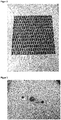
- thermoelectric generator containing titanium disulfide in combination with poly-3,4-ethylenedioxythiophene (PEDOT) based p-type material generated an output power of 24.0 ⁇ W at a temperature difference of 30 K (20 ° C cold side, 50 ° C warm side) ( Figure 2 ).
- PEDOT poly-3,4-ethylenedioxythiophene
- thermoelectric characteristics for the titanium disulfide printing ink synthesized in this way are 568 S / cm for the electrical conductivity and -85.90 ⁇ V / K for the Seebeck coefficient.
- the p-material PEDOT used has the thermoelectric characteristics 829 S / cm and 22.59 ⁇ V / K. The materials were printed overlapping. These values were determined using the methods described in Example 1.
- thermoelectric generator PEDOT can have p-type material.
- Example 8 PEDOT screen printing ink and process for their production and their use, also in combination with the n-type material titanium disulfide described here
- the invention relates to a PEDOT screen printing ink and a method for producing the same, the screen printing ink having thermoelectric properties. It is suitable for rotary and sheet-to-sheet screen printing on polymer and glass substrates.
- Thermoelectric materials have the property of generating electricity from temperature differences. They can be used in a variety of ways, e.g. B. for use as an independent energy source for wireless sensors and actuators.
- thermoelectric generator blocks of thermoelectrically active materials are placed between two solid supports, brought into contact with one another and exposed to a temperature difference.
- the thermoelectric generator supplies electricity.
- thermoelectric generators by screen printing
- suitable screen printing inks that can be produced quickly and inexpensively.
- the invention provides a method of making a screen printing ink with thermoelectric properties for the manufacture of thermoelectric generators.
- the invention further provides a p-type material that can be screen printed and used in a thermoelectric generator.
- a dried thin film of the screen printing ink according to the invention for example with a layer thickness of 0.5 to 10 ⁇ m, has thermoelectric properties, ie it can be made of Differences in temperature gain energy.
- an n-type material is also required that should also be screen-printable.
- a p-type is understood to be a semiconducting material in which the majority charge carriers, that is to say the charge carrier species that conduct most of the current, are holes or defect electrons. In an n-type material, the majority charge carriers are electrons.
- nanostructures according to the invention of poly (3,4-ethylenedioxythiophene) doped with dodecyl sulfate according to the invention described here are used as p-material.
- nanostructures here means elongated structures with a length of in particular 2 ⁇ m to 30 ⁇ m and a diameter of in particular 20 nm to 200 nm, which can be recognized, for example, with an atomic force or scanning electron microscope. Such flexible, elongated nanostructures are sometimes also referred to as “nanowires”.
- screen printing denotes a printing process in which the printing ink is printed with a doctor blade through a fine-mesh fabric onto the substrate to be printed.
- the term includes both the so-called sheet-to-sheet screen printing, as well as the rotary screen printing, as it is used in roll-to-roll systems.
- critical micelle concentration refers to the concentration of a surfactant at which micelles form.
- This part of the invention relates in one aspect to a process for making poly (3,4-ethylenedioxythiophene) (PEDOT) screen printing ink.
- PEDOT poly (3,4-ethylenedioxythiophene)
- the screen printing ink is synthesized from the monomer 3,4-ethylenedioxythiophene.
- micelles comprising or consisting of sodium dodecyl sulfate (SDS) and iron (III) chloride are provided as further starting materials.
- SDS sodium dodecyl sulfate
- III iron chloride
- the reaction is carried out in particular in the range from 20 ° C. to 70 ° C. In one embodiment of the process, the reaction is carried out in the temperature range from 20 to 24 ° C.
- the reaction time can be 72 hours ( Figure 3 ).
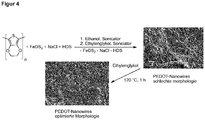
- the process scheme for synthesis is in Figure 4 shown.
- the PEDOT nanostructures obtained as a product have to be purified. Unwanted by-products of the reaction must be removed, such as excess SDS, iron (II) and iron (III) salts, dodecylsulfonic acid (HDS) and hydrochloric acid.
- the PEDOT nanostructures are first centrifuged as a synthesis product in one embodiment of the method.
- the synthesis product is mixed according to the method with at least one solvent and / or with a solvent mixture having an aliphatic alcohol, in particular ethanol, and is thus washed and optionally centrifuged.
- a solvent mixture having an aliphatic alcohol in particular ethanol
- the synthesis product or the centrifugate can then be washed with the at least one solvent, in particular with ethylene glycol, without the addition of an aliphatic alcohol.
- the at least one solvent can be selected from the group consisting of: ethylene glycol (ethane-1,2-diol), diethylene glycol, ethylene glycol monomethyl ether, ethylene glycol dimethyl ether, triethylene glycol, tetraethylene glycol, triethylene glycol monomethyl ether, triethylene glycol dimethyl ether (1,2-bis (2-methoxyethoxy) ethane), Tetraethylene glycol monomethyl ether and tetraethylene glycol dimethyl ether.
- a mixture of any number of the solvents mentioned above can also be used for washing, in particular two or three of the solvents mentioned.
- ethylene glycol as a solvent is preferred.
- the aliphatic alcohol can be selected from the group consisting of: methanol, ethanol, 1-propanol, 2-propanol, 1-butanol, 2-butanol, 1-pentanol, 2-pentanol, 1-hexanol, 2-hexanol, 1- Heptanol, 2-heptanol, 1-octanol, 2-octanol, 1-nonanol, 2-nonanol, 1-decanol and 2-decanol.
- the reaction product is treated after the first washing with at least one solvent and / or a solvent mixture comprising an aliphatic alcohol by an additional energy input, in particular by ultrasound or stirring (for example an ultrasound finger or an Ultra-Turrax stirrer) and then centrifuged.
- an additional energy input in particular by ultrasound or stirring (for example an ultrasound finger or an Ultra-Turrax stirrer) and then centrifuged.
- the step of washing with at least one solvent and / or a solvent mixture comprising an aliphatic alcohol is repeated several times. As described, centrifugation and / or energy can be introduced between the individual washing steps.
- the reaction product is first washed with a mixture of ethylene glycol and water, followed by a second washing step with pure ethylene glycol, followed by a third washing step with pure ethylene glycol.
- the washing is carried out with a mixture of the solvent mentioned and the aliphatic alcohol, in particular ethanol, in a ratio of 3: 1 to 5: 1.
- the washing is preferably carried out with an ethylene glycol: ethanol mixture in a ratio of 4: 1.
- the washing of the reaction product is not carried out with 100% ethanol.
- the PEDOT nanostructures can be heated with ethylene glycol after washing with at least one solvent and / or a solvent mixture comprising an aliphatic alcohol.
- the resulting mixture is heated in an excess, defined as PEDOT fluid to ethylene glycol, of 1: 2 to 1:10, preferably at a ratio of 1:10, of ethylene glycol.
- the excess of PEDOT fluid to ethylene glycol is in particular in the range from 1: 2 to 1:10, preferably at a ratio of 1:10.
- the mixture is heated to 70 ° C to 180 ° C, preferably to 100 ° C to 130 ° C, particularly preferably to 120 ° C (e.g. for 30 to 60 minutes).
- hot centrifugation is carried out immediately after heating (that is to say essentially at the temperature to which heating was previously carried out).
- PEDOT fluid with about 1.7% to 2.3% PEDOT nanostructure solids content, 50 ml of ethylene glycol are added and the mixture is heated. This removes impurities and improves the thermoelectric characteristics of the resulting coatings (see also Figure 1 ).
- the behavior of the fluid in rotary screen printing can be adjusted by at least one polymeric additive, which is added in one step according to one embodiment of the method.
- the additive improves or enables even distribution in the screen printing unit. This ensures that a film to be printed can be completely printed.
- the polymeric additive is characterized by a viscosity medium M v of 100,000 to 10,000,000 and should be soluble in cold or hot ethylene glycol.
- Another aspect of the invention relates to the use of poly (3,4-ethylenedioxythiophene) screen printing ink for the production of a thermoelectric generator.
- Another aspect of this part of the invention relates to a screen printing ink comprising nanostructures of poly (3,4-ethylenedioxythiophene) or a screen printing ink which can be produced by a method of the type described here.
- Another aspect of this part of the invention relates to the use of ethylene glycol, N- methylpyrrolidone, dimethyl sulfoxide, N- methylformamide, 1-methoxypropan-2-ol, 4-hydroxy-4-methylpentan-2-one, 1-butanol and / or 1 -Pentanol for the production of an ink for screen printing, especially for rotary screen printing.
- thermoelectric generator comprising at least one layer of poly (3,4-ethylenedioxythiophene) and / or comprising a layer of a screen printing ink of the type described here.
- the thermoelectric generator also has at least one layer Titanium disulfide, especially as described here.
- this part of the invention relates to a screen printing method which comprises the step of using a PEDOT screen printing ink of the type described here.
- the method according to the invention provides a highly viscous PEDOT nanostructure ink which can be screen-printed.
- the viscosity is in the range from 10 7 mPas (at shear rates of 10 -3 1 / s) to 10 1 mPas (at shear rates of 10 3 1 / s). Particularly preferably in the range from 10 6 mPas (at shear rates of 10 -3 1 / s) to 10 2 mPas (at shear rates of 10 2 1 / s corresponding to a shear-thinning non-Newtonian fluid).
- the rheological tests were carried out on a rheometer from the manufacturer Anton Paar with the model name Physica MCR 101 with a cone-plate geometry.
- the resulting fluid adheres very well to glass and plastic films, such as. B. on polyethylene terephthalate (PET) or polyethylene naphthalate (PEN).
- PET polyethylene terephthalate
- PEN polyethylene naphthalate
- the reaction sequence of PEDOT nanostructures to produce the screen-printable PEDOT fluid is shown in Figure 4 shown.
- a 500 ml beaker is loaded with FeCl 3 x 6 H 2 O (16.7 g, 61.8 mmol) and filled with 200 ml of distilled water. The mixture is stirred on a magnetic stirring plate at 500 rpm until an orange, cloudy solution has formed.
- the stirring is stopped and after one hour the supernatant can be carefully decanted off.
- the blue residue is centrifuged and the resulting supernatant is decanted off.
- the residue is cleaned up as follows.
- Ethylene glycol ethanol (4: 1, 800 ml) is added first, followed by sonication using an ultrasound sonotrode (continuous for 15 minutes), then centrifuging and decanting the supernatant.
- the resulting blue residue is heated and stirred in ethylene glycol (for example a ratio of 200 g PEDOT fluid to 2 l ethylene glycol) at 120 ° C.
- ethylene glycol for example a ratio of 200 g PEDOT fluid to 2 l ethylene glycol
- the mixture is then centrifuged hot (that is to say without first cooling the mixture) and decanted.
- the residue can be used directly as a screen printing ink in sheet-to-sheet screen printing.
- the thermoelectric characteristics of dried coatings of this fluid are 1260 S / cm and 21.8 ⁇ V / K.
- coatings from the PEDOT inks were applied to glass slides. Then two silver electrodes were applied to the coating using conductive silver varnish. The resistance of the layers was measured using a multimeter and the surface resistance ( ⁇ / ⁇ ) was calculated. The layer thickness of the coatings was measured using a DektakXT (Bruker) profilometer at any two points between the electrodes and the average value was calculated. The specific electrical conductivity was determined according to the formula 1 / (sheet resistance ⁇ layer thickness) from the values obtained.
- the Seebeck coefficient was measured using two Peltier elements with different temperatures. The thermal voltage and the applied temperature difference were measured by copper electrodes directly on the surface of the film on the glass slide. The Seebeck coefficient was calculated from measuring points at different temperature differences.
- PEDOT nanostructures with a reaction volume of 30 liters were shown.
- a 32 liter PE boiler is filled with 27 liters of distilled water.
- An overhead stirrer with an inverse Teflon propeller stirrer is immersed in the water from above until it is thoroughly mixed.
- sodium dodecyl sulfate (261 g, 8.95 mol) is added and stirred until the SDS is dissolved.
- Solution A is now added to solution B with stirring from solution B.
- a beige-flaky precipitate forms.
- 3,4-ethylenedioxythiophene (171 g, 128 ml, 12.0 mol) is added to the suspension.
- the reaction mixture is stirred at room temperature for 70 hours until a deep blue reaction mixture has formed.
- the stirring is stopped and after one hour the supernatant can be carefully decanted off.
- the blue residue is centrifuged and the resulting supernatant is decanted off. This results in 1.0 kg to 1.1 kg of raw material.
- the residue is divided into 200 g portions and each purified as follows.
- Ethylene glycol ethanol (4: 1, 800 ml) is added.
- the treatment with ultrasound is then carried out using a sonotrode (15 minutes continuously). It is then centrifuged and the supernatant decanted.
- the resulting blue residue is heated in ethylene glycol (ratio 200 g PEDOT fluid to 2 l ethylene glycol) at 120 ° C. It is then centrifuged hot and decanted. The residue is a screen printable ink.
- thermoelectric characteristics of dried coatings of this fluid are 793 S / cm and 21.2 ⁇ V / K. The measurement of these key figures is described in Example 1.
- Solution A is now added to solution B with stirring from solution B.
- a fluffy beige precipitate forms.
- 3,4-ethylenedioxythiophene (1.14 g, 849 ⁇ l, 8 mmol) is added to the suspension.
- the reaction mixture is stirred at 70 ° C for 1.5 hours until a deep blue reaction mixture has formed.
- the stirring is stopped and after one hour the supernatant can be carefully decanted off.
- the blue residue is centrifuged and the resulting supernatant is decanted off. This gives 20 g to 30 g PEDOT fluid.
- the residue is cleaned up as follows.
- Ethylene glycol ethanol (4: 1, 50 ml) is added.
- the treatment with ultrasound is then carried out using a sonotrode (15 minutes continuously). It is then centrifuged and the supernatant decanted.
- thermoelectric characteristics of the dried coatings of this fluid are 231 S / cm and 16.6 ⁇ V / K. These measured values were determined as described in Example 1.
- a positive influence of ethylene glycol on the PEDOT fluids is shown using an example with different ratios of ethylene glycol and water.
- 5 g of the PEDOT fluid synthesized from Example 2 were mixed with 20 ml of solvent mixture each, and centrifuged and decanted. This process was repeated twice. The higher the proportion of water, the more inhomogeneous the PEDOT fluid.
- Inhomogeneous PEDOT fluids result in inhomogeneous, poorly structured print images. Inhomogeneous is the qualitative observation of agglomerates in the PEDOT fluids which lead to fibrous edges of layers of these fluids after a screen printing process or doctor blade process.
- Table 1.2 Influence of the ratio of water and ethylene glycol as solvent on PEDOT fluids based on thermoelectric properties and homogeneity.
- Ethylene glycol water ratio Electrical conductivity [S / cm] Seebeck coefficient [ ⁇ V / K] observation 0: 1 685 25.9 Very inhomogeneous 1:10 685 26.1 inhomogeneous 1: 5 611 26.4 inhomogeneous 1: 2 636 25.3 Slightly inhomogeneous 1: 1 587 26.0 Slightly inhomogeneous 2: 1 567 26.6 Slightly inhomogeneous 5: 1 442 24.0 homogeneously 10: 1 497 24.8 homogeneously 1: 0 589 23.6 Very homogeneous
- Example 5.2 Different amounts of ethylene glycol in the PEDOT cooking step
- the PEDOT fluid is heated in ethylene glycol at 120 ° C for 1 hour.
- the ratio of ethylene glycol to PEDOT fluid is always 10: 1. To this amount To reduce in the future, experiments were carried out to verify the amount of ethylene glycol needed. The results of the tests are shown in the following table. 1 g of PEDOT fluid was used and the amount of ethylene glycol varied. The hot mixtures were each centrifuged hot and then characterized as doctored and dried films.
- PEDOT ethylene glycol Electrical conductivity [S / cm] Seebeck coefficient [ ⁇ V / K
- Table 2 above shows that boiling the PEDOT fluid in ethylene glycol produces a high specific electrical conductivity of the PEDOT coatings even at lower PEDOT: ethylene glycol ratios.
- the PEDOT fluid has been successfully used as a p-type material in a printed thermoelectric generator.
- thermoelectrically active screen printing ink based on PEDOT nanostructures from the specification of Example 2.2 was used in a hand-printed thermoelectric generator.
- the PEDOT ink is mixed with a toothed disk stirrer for 10 minutes until a homogeneous mixture is formed.
- the speed here is 2500 rpm.
- the thermal legs are printed on a flat substrate made of polyester, in which the PEDOT ink is pressed through the screen fabric using a rubber squeegee ,
- the printed wet film thickness is approx. 105 ⁇ m.
- the printed area is about 15 cm x 15 cm.
- the film is transferred to a hot plate.
- the PEDOT ink dries within approx. 5 minutes and results in an electrically conductive layer.
- the film can be according to the international publication WO 2013/185903 A1 processed by winding and folding into a thermoelectric generator.
- the substrate which is an insulating layer, is printed once with a p-type and once with an n-type material, so that a continuous meandering coating is formed, in which the p- and n-type material is formed in so-called thermocouples alternate.
- This meandering structure extends over several lines.
- the change between p-type and n-type material takes place in columns.
- the substrate is wound up along the lines, so that a flat strip is formed in which all lines lie one above the other. Then markings are embossed on the columns, ie on the transitions between the p-type and n-type materials.
- the strip is folded into an accordion-like shape to form a stack, so that the embossed markings each form the wave heads and wave troughs.
- the folded stack is then pressed into a block.
- the contact areas are located on the outside on the outermost stack layers, so that the electrical current can be tapped off later here.
- PEDOT is contacted with silver.
- the electrical resistance of the thermoelectric generator and the open circuit voltage at the applied Temperature difference measured. The power was then determined by dividing the square of the open circuit voltage by four times the internal resistance.
- thermoelectric characteristics for the PEDOT fluid synthesized in this way are 829 S / cm for the electrical conductivity and 22.59 ⁇ V / K for the Seebeck coefficient. These values were determined using the methods described in Example 1.2.
Landscapes
- Chemical & Material Sciences (AREA)
- Organic Chemistry (AREA)
- Chemical Kinetics & Catalysis (AREA)
- Health & Medical Sciences (AREA)
- Medicinal Chemistry (AREA)
- Polymers & Plastics (AREA)
- Life Sciences & Earth Sciences (AREA)
- Engineering & Computer Science (AREA)
- Materials Engineering (AREA)
- Wood Science & Technology (AREA)
- Physics & Mathematics (AREA)
- Dispersion Chemistry (AREA)
- Spectroscopy & Molecular Physics (AREA)
- Inks, Pencil-Leads, Or Crayons (AREA)
Abstract
Die Erfindung betrifft die Herstellung einer Siebdrucktinte. Erfindungsgemäß reagiert Titandisulfid, ein Amin undN-Methylformamid zu einer Siebdrucktinte. Die Siebdrucktinte hat thermoelektrische Eigenschaften und kann zur Herstellung eines thermoelektrischen Generators verwendet werden.
Description
- Die Erfindung betrifft das Gebiet der thermoelektrischen Materialien. Im Speziellen betrifft die Erfindung eine Siebdrucktinte und ein Verfahren zur Herstellung derselben, wobei die Siebdrucktinte thermoelektrische Eigenschaften aufweist. Sie ist geeignet für den rotativen und den sheet-to-sheet Siebdruck auf Polymer- und Glassubstraten.
- Thermoelektrische Materialien haben die Eigenschaft, aus Temperaturunterschieden Strom zu erzeugen. Sie können auf vielfältige Weise zur Anwendung kommen, z. B. für den Einsatz als unabhängige Energiequelle für drahtlosen Sensoren und Aktoren.
- Zur Herstellung eines thermoelektrischen Generators werden Blöcke von thermoelektrisch aktiven Materialien (n-Typ und p-Typ-Materialien) zwischen zwei festen Trägern platziert, miteinander in Kontakt gebracht und einer Temperaturdifferenz ausgesetzt. Dabei liefert der thermoelektrische Generator Strom.
- Als p-Typ wird ein halbleitendes Material verstanden, bei dem die Majoritätsladungsträger, also die Ladungsträgerspezies, die den größten Teil des Stroms leitet, Löcher oder Defektelektronen sind. Bei einem n-Typ Material sind die Majoritätsladungsträger Elektronen.
- Um thermoelektrische Generatoren per Siebdruck herzustellen, fehlt es an geeigneten Siebdrucktinten, die schnell und kostengünstig hergestellt werden können. Titandisulfid (TiS2) besitzt thermoelektrische Eigenschaften, kann aber bislang nicht flüssigprozessiert werden. Es besteht ein großes Interesse, Titandisulfid in eine siebdruckfähige Form zu überführen, um es so für industrielle Massenproduktionsprozesse verfügbar zu machen.
- Der vorliegenden Erfindung stellt eine Siebdrucktinte bereit, die zur Herstellung eines thermoelektrischen Generators verwendet werden kann. Das hier beschriebene neue Verfahren stellt Titandisulfid als n-Typ-Material in Form einer Siebdrucktinte, insbesondere zur Herstellung thermoelektrischer Generatoren, zur Verfügung.
- Der Begriff "Siebdruck" bezeichnet ein Druckverfahren, bei dem die Druckfarbe mit einer Rakel durch ein feinmaschiges Gewebe hindurch auf das zu bedruckende Material übertragen wird. Der Begriff umfasst sowohl den sogenannte sheet-to-sheet Siebdruck, als auch den rotativen Siebdruck, wie er in Rolle-zu-Rolle Anlagen verwendet wird.
- In einem ersten Aspekt betrifft die Erfindung ein Verfahren zur Synthese einer thermoelektrischen Siebdrucktinte, wobei Titandisulfid als Edukt für die Synthesereaktion bereitgestellt wird.
- In einer Ausführungsform des Syntheseverfahrens wird zusätzlich zu Titandisulfid ein basisches lösliches Amin und N-Methylformamid bereitgestellt. Diese Edukte reagieren miteinander und es entsteht eine Siebdrucktinte mit thermoelektrischen Eigenschaften (Schema 1).
- Ein Amin ist insbesondere "basisch", wenn es einen pKb-Wert im Bereich von 2,50 bis 4,50 hat.
- Ein Amin ist insbesondere "löslich", wenn es sich in organischen Lösungsmitteln, wie z. B. N-Methylformamid, N,N-Dimethylacetamid, Toluol, Dichlormethan löst und dabei mindestens eine Löslichkeit von 90 g/L erreicht. Die in der Literatur standardmäßig angegebene Löslichkeit in Wasser kann nicht herangezogen werden, da langkettige aliphatische Amine, wie z. B. Nonylamin darin nicht mehr leicht löslich sind und Wasser kein geeignetes Lösungsmittel für Titandisulfid darstellt.
- Die Viskosität der Siebrucktinte liegt insbesondere im Bereich von 107 mPas (bei Scherraten von 10-3 1/s) bis 101 mPas (bei Scherraten von 103 1/s), insbesondere im Bereich von 106 mPas (bei Scherraten von 10-3 1/s) bis 102 mPas (bei Scherraten von 102 1/s entsprechend einem scherverdünnendem Fluid). (Die rheologischen Untersuchungen wurden an einem Rheometer des Herstellers Anton Paar mit der Modellbezeichnung Physica MCR 101 mit einer Kegel-Platte Geometrie durchgeführt.)
- Das basische lösliche Amin, insbesondere ein basisches lösliches Alkylamin, kann geradkettig oder verzweigt sein. In einer Ausführungsform ist das basische, lösliche Amin ausgewählt aus der Gruppe bestehend aus Propylamin, Butylamin, Pentylamin, Hexylamin, Heptylamin, Octylamin, Nonylamin, 2-Methylbutylamin, 3-Methylpentylamin, 2-Phenylbutan-1-amin, iso-Pentylamin und 2-Ethyl-N-butylamin.
- Weiterhin sind nach dem erfindungsgemäßen Verfahren keine Reinigungsschritte nötig. Das Reaktionsprodukt kann unmittelbar als Siebdrucktinte eingesetzt werden.
- In einer Ausführungsform wird das Titandisulfid direkt in N-Methylformamid vorgelegt und unter Rühren wird Hexylamin zugegeben. Die Reaktionsführung ist auch in dieser Ausführungsform abgeschlossen, sobald sich ein Fluid mit der genannten Viskosität (insbesondere im Bereich von 107 mPas bei Scherraten von 10-3 1/s und bei 101 mPas bei Scherraten von 103 1/s) gebildet hat.
- In besonderen Ausführungsformen werden die Edukte unter Schutzgas und/oder nichttrockenen Bedingungen zusammengegeben und 12 bis 144 Stunden bei Raumtemperatur gerührt.
- Die thermoelektrischen Eigenschaften werden an trockenen Beschichtungen des Fluids bestimmt (Dicke 0,5 µm bis 10 µm). Hierbei ist auch das dort erreichte Optimum der Reaktionsführung anhand der Maximalwerte der elektrischen Leitfähigkeit (z. B. 764 S/cm) und des Seebeck Koeffizienten (z. B. -75 µV/K) zu beobachten.

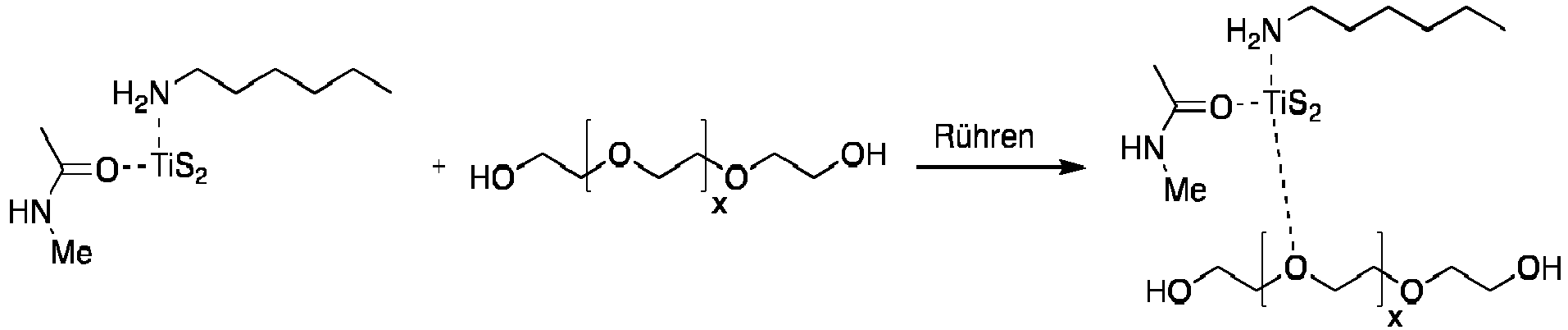
- In einer Ausführungsform erfolgt die Zugabe eines in N-Methylformamid löslichen polymeren Additivs, insbesondere von Polyethylenoxid mit einem Viskositätsmittel (Mv) von größer gleich 8.000.000 während der beschriebenen Reaktion (Schema 2) oder danach.
- Das Additiv sollte nicht durch Sulfide oder das alkalische Milieu der Siebdrucktinte angegriffen werden. In einer Ausführungsform des erfindungsgemäßen Verfahrens ist das polymere Additiv ausgewählt aus der Gruppe bestehend aus Polyglykolen, polymeren Triblock-Copolymeren nach dem Typus Polyethylenglykol-Polypropylenglykol-Polyethylenglykol oder auch Polypropylenglykol-Polyethylenglykol-Polypropylenglykol (Zahlenmittlere Molmasse (Mn) = 2000 - 15000), Amide enthaltende Polymere (wie z. B. Polyvinylpyrrolidone, Polyvinylpolypyrrolidon) und Polymeren mit funktionalen Gruppen wie Sulfide (z. B. Polyphenylsulfide) oder Amine (z. B. Polyvinylamin, Polyallylamin oder Polyethylenimin).
- In einem weiteren Aspekt betrifft die Erfindung die Verwendung von Titandisulfid zur Herstellung einer thermoelektrischen Siebdrucktinte.
- In einem weiteren Aspekt betrifft die Erfindung eine Siebdrucktinte, aufweisend Titandisulfid, insbesondere herstellbar nach dem hier beschriebenen Verfahren. Dementsprechend können N-Methylformamid und ein basisches lösliches Amin sowie optional ein polymeres Additiv als Edukte eingesetzt werden.
- In einem weiteren Aspekt betrifft die Erfindung die Verwendung eines polymeren Additivs der oben beschriebenen Art, insbesondere von Polyethylenoxid, mit einem Molekulargewicht Mv im Bereich von 100.000-10.000.000, insbesondere mit Mv >= 8.000.000 zur Herstellung einer Tinte für den rotativen Siebdruck.
- In einem weiteren Aspekt betrifft die Erfindung einen thermoelektrischen Generator mit mindestens einer Schicht, die Titandisulfid aufweist.
- In einem weiteren Aspekt betrifft die Erfindung ein Siebdruckverfahren, aufweisend den Schritt der Verwendung einer Siebdrucktinte der hierin beschriebenen Art.
- Das erfindungsgemäße Verfahren mittels einfachem Vermischen der Edukte Titandisulfid, Amin (z. B. Hexylamin) und N-Methylformamid benötigt keine aufwändige Ultraschallbehandlung. Hierbei entsteht während der Prozessführung die gewünschte sehr viskose Mischung. Die Mischung wird gut gerührt, um eine gute Vermengung des viskosen Gemisches zu gewährleisten.
- Dadurch, dass keine Aufreinigung der entstehenden Siebdrucktinte notwendig ist, entfallen kostenintensive Schritte. Dabei wird zum einen Zeit gespart und zum anderen auch Abfall vermieden.
- In einer optionalen Ausführungsform werden alle Reaktanden (Titandisulfid, Korngröße mesh 100 (entsprechend einer durchschnittlichen Titandisulfidkorngröße von 150 µm)) und Reagenzien zusammen unter Schutzgas in einem Reaktionsgefäß gegeben und 1 bis 10 Tage, insbesondere 1 bis 2 Tage, bevorzugt 2 Tage (48 Stunden) gerührt (Schema 3). Die Reaktionszeit hängt von den Paramatern: Korn- bzw. Partikelgrößenverteilung des Titandisulfids, Rührgeschwindigkeit und Rührgeometrie ab und kann leicht ermittelt werden.
- Hierbei entsteht im Laufe des Syntheseprozesses eine hochviskose pastöse Flüssigkeit (insbesondere mit einer Viskosität von 20 Pas bis 40 Pas bei einer Scherrate von 1 1/s, welche auch den Endpunkt der Reaktion bestimmt. Das heißt, sobald sich deren Konsistenz und Viskosität für den Siebdruck eignet, ist die Reaktion abgeschlossen. Die Synthese wir in bestimmten Ausführungsformen mit wasser- und sauerstofffreien Lösungsmitteln und Reaktanden durchgeführt.

- In einer Ausführungsform wird während oder nach der Synthese ein polymeres Additiv, etwa Polyethylenoxid (Mv >= 8.000.000) zugegeben (Schema 4). Die Zugabe des Additivs führt nicht zu einer Verminderung der thermoelektrischen Eigenschaften.

- Unter kontinuierlichem Stickstoffstrom wird Titandisulfid (400 mg, 2,57 mmol) in ein wiederverschließbares mit Magnetstäbchen bestücktes Schraubdeckelglas überführt. Nun wird mittels Pipette N-Methylformamid (2,5 ml, 42,7 mmol) zugegeben. Anschließend wird direkt Hexylamin zugetropft (166 µl, 1,25 mmol). Hierbei hat das N-Methylformamid einen Wassergehalt von ca. 0,02 % und das Hexylamin einen Wassergehalt von ca. 0,06 %. Der Wassergehalt wurde mittels Karl-Fischer Titration (Gerät: analytikjena AQUA 40.00) bestimmt. Nach dem Zutropfen ist schon eine leichte "Bewegung" (bronzefarbene "Blättchen" bilden sich an der Oberfläche) im Glas zu beobachten. Das Schraubdeckelglas wird unter Stickstoffstrom verschlossen und mit Parafilm zusätzlich abgedichtet. Die Mischung wird nun bei 300 U/min für mindestens 1 Tag bei Raumtemperatur gerührt. Nach einer Reaktionszeit von 47 Stunden wurden die thermoelektrischen Parameter der Beschichtungen dieser Drucktinte mit 764 S/cm und -76 µV/K bestimmt. Die Reaktion ist abgeschlossen, sobald sich eine viskose Mischung gebildet hat, die sich für den Siebdruck eignet und direkt charakterisiert werden kann. Dann hat die viskose Mischung insbesondere eine Viskosität von 20 Pas bis 40 Pas bei einer Scherrate von 1 1/s.
- Für die Ermittlung der elektrischen Leitfähigkeit wurden Beschichtungen aus den Titandisulfid auf Glasobjektträger aufgebracht. Anschließend wurden mit Hilfe von Silberleitlack zwei Silber-Elektroden auf die Beschichtung aufgetragen. Mit Hilfe eines Multimeters wurde der Widerstand der Schichten gemessen und der Flächenwiderstand (Ω/□) berechnet. Die Schichtdicke der Beschichtungen wurde über ein Dektak XT (Bruker) Profilometer an zwei beliebigen Stellen zwischen den Elektroden gemessen und der Durchschnittswert berechnet. Die spezifische elektrische Leitfähigkeit wurde entsprechend der Formel

- Der Seebeck-Koeffizient wurde mithilfe von zwei unterschiedlich temperierbaren Peltierelementen gemessen. Die Thermospannung und die anliegende Temperaturdifferenz wurde durch Kupferelektroden direkt auf der Oberfläche des Films auf dem Glasobjektträger gemessen. Aus Messpunkten bei verschiedenen Temperaturdifferenzen wurde der Seebeck-Koeffizient berechnet.
- Unter kontinuierlichem Stickstoffstrom wird Titandisulfid (400 mg, 2,57 mmol) in ein wiederverschließbares mit Magnetstäbchen bestücktes Schraubdeckelglas überführt. Nun wird mittels Pipette N-Methylformamid (2,5 ml, 42,7 mmol) zugegeben. Anschließend wird direkt Hexylamin zugetropft (94,6 µl, 714 µmol). Hierbei ist schon eine leichte "Bewegung" (Bronzefarbene "Blättchen" bilden sich an der Oberfläche) im Glas zu beobachten. Das Schraubdeckelglas wird unter Stickstoffstrom vorsichtig verschlossen und mit Parafilm zusätzlich abgedichtet. Die Mischung wird nun bei 300 U/min für mindestens 1 Tag bei Raumtemperatur gerührt. Nach einer Reaktionszeit von 47 Stunden wurden die thermoelektrischen Parameter der Beschichtungen dieser Drucktinte mit 697 S/cm und -78 µV/K bestimmt. Die Reaktion gilt als abgeschlossen, sobald sich eine viskose Mischung gebildet hat, die direkt charakterisiert werden kann.
- Die elektrische Leitfähigkeit und der Seebeck-Koeffizient wurden nach den Methoden aus Beispiel 1 bestimmt.
- Unter kontinuierlichem Stickstoffstrom wird Titandisulfid (400 mg, 2,57 mmol) in ein wiederverschließbares mit Magnetstäbchen bestücktes Schraubdeckelglas überführt und zusätzlich noch ein polymeres Additiv mit der gelisteten Einwaage hinzugefügt (Tabelle 1). Nun wird mittels Pipette N-Methylformamid (2,5 ml, 42,7 mmol) zugegeben. Anschließend wird direkt Hexylamin zugetropft (166 µl, 1,25 mmol). Hierbei ist schon eine leichte "Bewegung" (bronzefarbene "Blättchen" bilden sich an der Oberfläche) im Glas zu beobachten. Das Schraubdeckelglas wird unter Stickstoffstrom vorsichtig verschlossen und mit Parafilm zusätzlich abgedichtet. Die Mischung wird nun bei 300 U/min für mindestens 1 Tag bei Raumtemperatur gerührt. Nach einer Reaktionszeit von 48 Stunden wurden die thermoelektrischen Parameter der Beschichtungen dieser Drucktinte bestimmt (Tabelle 1). Die Reaktion gilt als abgeschlossen, sobald sich eine viskose Mischung gebildet hat, die direkt charakterisiert werden kann. Die hier untersuchten Proben wurden nach 48 Stunden Reaktionsdauer entnommen.
Tabelle 1: Synthese direkt mit polymeren Additiven Polymeres Additiv Einwaage Additiv elektrische Leitfähigkeit [S/cm] Seebeck-Koeffizient [µV/K] Polyethylenoxid 1 mg 423 -103,8 Mv = 8.000.000 Polyethylenoxid 5 mg 509 -102,7 Mv = 8.000.000 Polyethylenoxid 10 mg 557 -101,5 Mv = 8.000.000 - Die elektrische Leitfähigkeit und der Seebeck-Koeffizient wurden nach den Methoden aus Beispiel 1 bestimmt.
- Die Tabelle 1 zeigt, dass der Einfluss von geringen Mengen des polymeren Additivs geringe Auswirkungen auf die thermoelektrischen Kennzahlen des Titandisulfids hat.
- Titandisulfid (1 g, 9 mmol) wird an Luft in ein wiederverschließbares mit Magnetstäbchen bestücktes Schraubdeckelglas überführt. Nun wird mittels Pipette N-Methylformamid (6,36 ml, 107 mmol) zugegeben. Anschließend wird direkt Hexylamin zugetropft (238 µl, 1,8 mmol). Hierbei ist schon eine leichte "Bewegung" (Bronzefarbene "Blättchen" bilden sich an der Oberfläche) im Glas zu beobachten. Die Mischung wird nun bei 300 U/min für mindestens 1 Tag bei Raumtemperatur gerührt. Nach einer Reaktionszeit von 47 Stunden wurden die thermoelektrischen Parameter der Beschichtungen dieser Drucktinte mit 630 S/cm und -120 µV/K bestimmt. Die Reaktion gilt als abgeschlossen, sobald sich eine viskose Mischung gebildet hat, die direkt charakterisiert werden kann.
- Die Titandisulfid-Tinten wurden nach der Methode von Beispiel 1 hergestellt. Dabei wurde nur das Amin mit den Homologen des Hexylamins ausgetauscht, die molaren Verhältnisse jedoch beibehalten. Die homologen Amine zum Hexylamin ergeben nahezu gleiche thermoelektrische Eigenschaften (Tabelle 2). Jedoch ist die Wahl von Hexylamin aufgrund des günstigen Preises deutlich wirtschaftlicher.
Tabelle 2: Synthese von Titandisulfid Drucktinte mit homologen Aminen Homolges Amin Elektrische Leitfähigkeit [S/cm] Seebeck-Koeffizient [µV/K] Reaktionsdauer [h] Pentylamin 512 -92,9 376 Hexylamin 622 -91,4 376 Heptylamin 524 -87,9 376 Octylamin 511 -94,8 376 Nonylamin 515 -118,7 377 - Die elektrische Leitfähigkeit und der Seebeck-Koeffizient wurden nach den Methoden aus Beispiel 1 bestimmt.
- Tabelle 2 zeigt, dass der Einfluss verschiedener basischen löslichen, insbesondere aliphatischen Aminen auf die angegebenen thermoelektrischen Kennzahlen.
- Die Titandisulfid-Tinte aus Beispiel 1 wurde verwendet. Jeweils 10 mg des polymeren Additivs wurden in 1 ml N-Methylformamid gelöst und 10 µl zu 1 g Titandisulfid-Tinte gegeben und anschließend mittels Spatel verrührt. Hier wird deutlich, dass eine Additiv Zugabe in diesem Bereich kaum Auswirkung auf die thermoelektrischen Eigenschaften der Titandisulfid Beschichtungen hat.
Tabelle 3: Zugabe polymerer Additive nach durchgeführter Synthese Polymeres Additiv Elektrische Leitfähigkeit [S/cm] Seebeck-Koeffizient [µV/K] Polyethylenoxid 604 -98,4 Mv 100.000 Polyethylenoxid 620 -104 Mv 8.000 Polyethylenglykol 400 628 -95,2 Polyethylenglykol-Polypropylenglykol-Polyethylenyglykol Triblock Copolymer Mn 14600 759 -103 Polyvinylpyrrolidone Mw 160.000 620 -100,2 Polyvinylpyrrolidone Mw 60.000 681 -97,2 - (additivlose Referenzprobe) 679 -101,0 - Die elektrische Leitfähigkeit und der Seebeck-Koeffizient wurden nach den Methoden aus Beispiel 1 bestimmt. Die Bedeutung von Mn und Mv wurde obigen erläutert. Bei Mw handelt es sich um das Gewichtsmittlere von Polymeren.
- Tabelle 3 zeigt den Einfluss der Zugabe polymerer Additive zur abgeschlossenen Reaktion auf verschiedene thermoelektrischen Kennzahlen. Einzig die Verwendung des Triblock-Copolymers Polyethylenglykol-Polypropylenglykol-Polyethylenyglykol mit einem Mn von 14600 zeigt einen signifikanten Anstieg der spezifischen elektrischen Leitfähigkeit.
- Das Titandisulfid-Fluid wurde erfolgreich in einem gedruckten thermoelektrischen Generator verwendet.
- Die Titandisulfid-Siebdrucktinte wurde 10 Minuten lang mit einem Zahnscheibenrührer durchmischt, bis ein homogenes Gemisch entstand. Die Drehzahl betrug hierbei 2500 U/min. Mit Hilfe eines halbautomatischen Siebdruckgerätes und eines Flachsiebes mit einer Maschenperiodizität von 24 Maschen pro cm und einem Fadendurchmesser von 145 µm wurden die Thermoschenkel auf ein flaches Substrat aus Polyester gedruckt, in dem die TiS2-Tinte mit Hilfe eines Gummi-Rakels durch das Siebgewebe gedrückt wurde. Die aufgedruckte Nassfilm-Schichtdicke betrug hierbei ca. 105 µm. Die bedruckte Fläche betrug hierbei etwa 15 cm x 15 cm. Unmittelbar nach dem Druck wurde die Folie auf eine heiße Platte transferiert. Die TiS2-Tinte trocknete innerhalb von ca. 5 Minuten und ergab eine elektrisch leitfähige Schicht.
- Die Folie wurde entsprechend der internationalen Veröffentlichungsschrift
WO 2013/185903 A1 mittels Wickeln und Falten zu einem thermoelektrischen Generator verarbeitet. Das Substrat, bei dem es sich um eine isolierende Schicht handelt, wird derart einmal mit einem p-leitenden und einmal mit einem n-leitenden Material bedruckt, dass eine durchgehende mäanderförmige Beschichtung entsteht, in der sich p- und n-leitendes Material in sogenannten Thermopaaren abwechseln. Diese Mäanderstruktur erstreckt sich über mehrere Zeilen. Der Wechsel zwischen p- und n-leitendem Material findet spaltenweise statt. Nach dem Bedrucken des Substrats wird das Substrat entlang der Zeilen aufgewickelt, so dass ein flacher Streifen entsteht, in dem alle Zeilen übereinander liegen. Danach werden Markierungen an den Spalten, d. h. an den Übergängen zwischen den jeweils p- und n-Typ-Materialien, eingeprägt. Dann wird der Streifen ziehharmonika-förmig zu einem Stapel zusammengefaltet, so dass die eingeprägten Markierungen jeweils die Wellenköpfe und Wellentäler bilden. Anschließend wird der gefaltete Stapel zu einem Block verpresst. Die Kontaktflächen befinden sich dabei außen an den äußersten Stapelschichten, so dass hier später der elektrische Strom abgegriffen werden kann. - Der Titandisulfid enthaltende thermoelektrische Generator generierte in Kombination mit Poly-3,4-ethylendioxythiophen (PEDOT) basierten p-Typ Material eine Ausgangsleistung von 24,0 µW bei einer Temperaturdifferenz von 30 K (20 °C Kaltseite, 50 °C Warmseite) (
Figur 2 ). Für die Bestimmung der Ausgangsleistung wurde der elektrische Widerstand des thermoelektrischen Generators und die Leerlaufspannung bei der angelegten Temperaturdifferenz gemessen. Die Leistung wurde dann berechnet, indem das Quadrat der Leerlaufspannung durch den vierfachen Innenwiderstand geteilt wurde. - Die thermoelektrischen Kennzahlen für die so synthetisierte Titandisulfid-Drucktinte lauten 568 S/cm für die elektrische Leitfähigkeit und -85,90 µV/K für den Seebeck-Koeffizienten. Das verwendete p-Material PEDOT besitzt die thermoelektrischen Kennzahlen 829 S/cm und 22,59 µV/K. Die Materialien wurden überlappend gedruckt. Die Bestimmung dieser Werte erfolgte mit den in Beispiel 1 beschriebenen Methoden.
- In einer Ausführungsform kann der thermoelektrische Generator PEDOT als p-Typ Material aufweisen.
- Die Erfindung betrifft die Erfindung eine PEDOT Siebdrucktinte und ein Verfahren zur Herstellung derselben, wobei die Siebdrucktinte thermoelektrische Eigenschaften aufweist. Sie ist geeignet für den rotativen und den sheet-to-sheet Siebdruck auf Polymer- und Glassubstraten.
- Thermoelektrische Materialien haben die Eigenschaft, aus Temperaturunterschieden Strom zu erzeugen. Sie können auf vielfältige Weise zur Anwendung kommen, z. B. für den Einsatz als unabhängige Energiequelle für drahtlose Sensoren und Aktoren.
- Zur Herstellung eines thermoelektrischen Generators werden Blöcke von thermoelektrisch aktiven Materialien zwischen zwei feste Träger platziert, miteinander in Kontakt gebracht und einer Temperaturdifferenz ausgesetzt. Dabei liefert der thermoelektrische Generator Strom.
- Um thermoelektrische Generatoren per Siebdruck herzustellen, fehlt es bisher an geeigneten Siebdrucktinten, die schnell und kostengünstig hergestellt werden können.
- Die Erfindung stellt ein Verfahren bereit, um eine Siebdrucktinte mit thermoelektrischen Eigenschaften für die Herstellung von thermoelektrischen Generatoren herzustellen. Weiterhin stellt die Erfindung ein p-Typ Material bereit, das im Siebdruckverfahren abgeschieden und in einem thermoelektrischen Generator verwendet werden kann.
- Ein getrockneter dünner Film der erfindungsgemäßen Siebdrucktinte, beispielsweise mit einer Schichtdicke von 0,5 bis 10 µm, besitzt thermoelektrische Eigenschaften, d. h. er kann aus Temperaturunterschieden Energie gewinnen. Dazu wird neben der erfindungsgemäßen, p-Typ Siebdrucktinte auch ein n-Typ Material benötigt, dass ebenfalls siebdruckfähig sein sollte. Als p-Typ wird ein halbleitendes Material verstanden, bei dem die Majoritätsladungsträger, also die Ladungsträgerspezies, die den größten Teil des Stroms leitet, Löcher oder Defektelektronen sind. Bei einem n-Typ Material sind die Majoritätsladungsträger Elektronen.
- Als p-Material werden die hier beschriebenen erfindungsgemäßen Nanostrukturen von Poly(3,4-ethylendioxythiophen) dotiert mit Dodecylsulfat verwendet.
- Unter dem Begriff "Nanostrukturen" werden hier längliche Strukturen mit einer Länge von insbesondere 2 µm bis 30 µm und einem Durchmesser von insbesondere 20 nm bis 200 nm verstanden, welche sich beispielsweise mit einem Rasterkraft- oder Rasterelektronenmikroskop erkennen lassen. Bisweilen werden derartige flexible längliche Nanostrukturen auch als "Nanodrähte" bezeichnet.
- Der Begriff "Siebdruck" bezeichnet ein Druckverfahren, bei dem die Druckfarbe mit einer Rakel durch ein feinmaschiges Gewebe hindurch auf das zu bedruckende Substrat gedruckt wird. Der Begriff umfasst sowohl den sogenannten sheet-to-sheet Siebdruck, als auch den rotativen Siebdruck, wie er in Rolle-zu-Rolle Anlagen verwendet wird.
- Der Begriff "kritische Micellkonzentration" bezeichnet die Konzentration eines Tensids, bei der sich Micellen bilden.
- Dieser Teil der Erfindung betrifft in einem Aspekt ein Verfahren zur Herstellung von Poly(3,4-ethylendioxythiophen) (PEDOT) Siebdrucktinte.
- Die Synthese der Siebdrucktinte wird ausgehend vom Monomer 3,4-Ethylendioxythiophen durchgeführt. Daneben werden Micellen aufweisend oder bestehend aus Natrium-Dodecylsulfat (SDS) und Eisen(III)-Chlorid als weitere Edukte bereitgestellt. Die Reaktion wird insbesondere im Bereich von 20°C bis 70°C durchgeführt. In einer Ausführungsform des Verfahrens wird die Reaktion im Temperaturbereich von 20 bis 24 °C durchgeführt. Die Reaktionsdauer kann 72 Stunden betragen (
Figur 3 ). Das Prozessschema zur Synthese ist inFigur 4 gezeigt. - Die genannten Micellen bilden sich oberhalb der kritischen Micellkonzentration in wässrigem Medium aus Natrium-Dodecylsufat (SDS). Durch Eisen(III)-Chlorid werden diese Strukturen "fixiert" und als flockiger beiger Niederschlag gefällt. Durch Zugabe von 3,4-Ethylendioxythiophen Monomeren (EDOT) entstehen in den gefällten Micellen, durch die Anwesenheit von Eisen(III)-Chlorid, PEDOT-Nanostrukturen (Schema 1.2):

- Nach der erfolgten Reaktion von 3,4-Ethylendioxythiophen Monomeren in den Micellen aus SDS und Eisen(III)-Chlorid müssen die als Produkt erhaltenen PEDOT-Nanostrukturen aufgereinigt werden. Es müssen also unerwünschte Nebenprodukte der Reaktion entfernt werden, wie beispielsweise überschüssiges SDS, Eisen(II)- sowie Eisen(III)-Salze, Dodecylsulfonsäure (HDS) und Salzsäure.
- Zur Aufreinigung werden die PEDOT-Nanostrukturen als Syntheseprodukt in einer Ausführungsform des Verfahrens zunächst zentrifugiert.
- Das Syntheseprodukt wird als gemäß dem Verfahren mit mindestens einem Lösungsmittel und/oder mit einem Lösungsmittelgemisch aufweisend einen aliphatischen Alkohol, insbesondere Ethanol, vermengt und somit gewaschen und optional zentrifugiert.
- Anschließend kann das Syntheseprodukt bzw. das Zentrifugat mit dem mindestens einen Lösungsmittel, insbesondere mit Ethylenglykol, ohne Zusatz eines aliphatischen Alkohols gewaschen werden.
- Das mindestens eine Lösungsmittel kann ausgewählt sein aus der Gruppe bestehend aus: Ethylenglykol (Ethan-1,2-diol), Diethylenglykol, Ethylenglykolmonomethylether, Ethylenglykol dimethylether, Triethylenglykol, Tetraethylenglykol, Triethylenglykol monomethylether, Triethylenglykoldimethylether (1,2-Bis(2-methoxyethoxy)ethan),
Tetraethylenglykolmonomethylether und Tetraethylenglykoldimethylether. Ebenso kann eine Mischung einer beliebigen Anzahl der oben genannten Losungsmittel zum Waschen verwendet werden, insbesondere zwei oder drei der genannten Lösungsmittel. - Bevorzugt ist die Verwendung von Ethylenglykol als Lösungsmittel.
- Der aliphatische Alkohol kann ausgewählt sein aus der Gruppe bestehend aus: Methanol, Ethanol, 1-Propanol, 2-Propanol, 1-Butanol, 2-Butanol, 1-Pentanol, 2-Pentanol, 1-Hexanol, 2-Hexanol, 1-Heptanol, 2-Heptanol, 1-Octanol, 2-Octanol, 1-Nonanol, 2-Nonanol, 1-Decanol und 2-Decanol.
- Bevorzugt ist die Verwendung von Ethanol als aliphatischem Alkohol in dem Verfahren.
- Das Reaktionsprodukt wird in weiteren Ausführungsformen nach dem ersten Waschen mit mindestens einem Lösungsmittel und/oder einem Lösungsmittelgemisch aufweisend einen aliphatischen Alkohol durch einen zusätzlichen Energieeintrag, insbesondere durch Ultraschall oder Rühren (beispielsweise eines Ultraschallfingers oder eines Ultra-Turrax Rührers) behandelt und anschließend zentrifugiert.
- Dementsprechend kann das Verfahren in einer Ausführungsform neben dem Schritt des Waschens der erhaltenen PEDOT-Nanostrukturen mit mindestens einem Lösungsmittel und/oder einem Lösungsmittelgemisch aufweisend einen aliphatischen Alkohol die folgenden zusätzlichen Schritte umfassen:
- Zentrifugieren des erhaltenen Reaktionsgemisches, insbesondere vor einem weiteren Waschen und/oder
- Einbringen von Energie, z. B. mittels Ultraschallbehandlung oder Rühren.
- In einigen Ausführungsformen der Erfindung wird der Schritt des Waschens mit mindestens einem Lösungsmittel und/oder einem Lösungsmittelgemisch aufweisend einen aliphatischen Alkohol mehrmals wiederholt. Zwischen den einzelnen Waschschritten kann, wie beschrieben zentrifugiert werden und/oder Energie eingetragen werden.
- In einigen Ausführungsformen des Verfahrens erfolgt zunächst ein Waschen des Reaktionsproduktes mit einer Mischung aus Ethylenglykol und Wasser, gefolgt von einem zweiten Waschschritt mit reinem Ethylenglykol, gefolgt von einem dritten Waschschritt mit reinem Ethylenglykol.
- In einer Ausgestaltung des Verfahrens erfolgt das Waschen mit einem Gemisch aus dem genannten Lösungsmittel und dem aliphatischen Alkohol, insbesondere Ethanol, im Verhältnis 3:1 bis 5:1.
- In bevorzugter Weise wird das Waschen mit einem Ethylenglykol:Ethanol Gemisch im Verhältnis von 4:1 durchgeführt.
- In einer Ausführungsform des erfindungsgemäßen Verfahrens wird das Waschen des Reaktionsproduktes nicht mit 100 % Ethanol durchgeführt.
- In einem weiteren Schritt des Verfahrens können die PEDOT-Nanostrukturen nach dem Waschen mit mindestens einem Lösungsmittel und/oder einem Lösungsmittelgemisch aufweisend einen aliphatischen Alkohol mit Ethylenglykol erhitzt werden. Das sich ergebende Gemisch wird hierbei in einem Überschuss, definiert als PEDOT-Fluid zu Ethylenglykol von 1:2 bis 1:10 wobei bevorzugt bei einem Verhältnis von 1:10, von Ethylenglykol erhitzt. Der Überschuss von PEDOT-Fluid zu Ethylenglykol liegt insbesondere im Bereich von 1:2 bis 1:10, bevorzugt bei einem Verhältnis von 1:10. Das Gemisch wird auf 70 °C bis 180 °C erhitzt, bevorzugt auf 100 °C bis 130 °C, besonders bevorzugt auf 120 °C (z. B. für 30 bis 60 Minuten). Nach dem Erhitzen wird in verschiedenen Ausführungsformen unmittelbar heiß zentrifugiert (also im Wesentlichen mit der Temperatur, auf die zuvor erhitzt worden ist).
- Beispielsweise werden 5 g PEDOT-Fluid mit ca. 1,7 % bis 2,3 % PEDOT-Nanostruktur Feststoffgehalt, mit 50 ml Ethylenglykol versetzt und erhitzt wird. Dadurch werden Verunreinigungen ausgewaschen und die thermoelektrischen Kennzahlen der resultierenden Beschichtungen verbessert (s. auch
Figur 1 ). - Weiterhin kann durch mindestens ein polymeres Additiv das Verhalten des Fluids beim rotativen Siebdruck angepasst werden, das gemäß einer Ausführungsform des Verfahrens in einem Schritt hinzugegeben wird. Das Additiv verbessert bzw. ermöglicht die gleichmäßige Verteilung im Siebdruckwerk. Dadurch wird gewährleistet, dass eine zu bedruckende Folie komplett bedruckt werden kann.
- Das polymere Additiv zeichnet sich aus durch ein Viskositätsmittel Mv von 100.000 bis 10.000.000 aus und sollte in kaltem oder heißem Ethylenglykol löslich sein.
- In einer Ausführungsform des Verfahrens ist das polymere Additiv Polyvinylpyrrolidon oder Polyethylenoxid mit dem Viskositätsmittel Mv >= 8.000.000. Bevorzugt ist Polyethylenoxid mit dem Viskositätsmittel von Mv = 100.000 bis Mv = 7.000.000 oder Polyethylenoxid mit dem Viskositätsmittelvon Mv = 8.000.000.
- Ein weiterer Aspekt der Erfindung betrifft die Verwendung von Poly(3,4-ethylendioxythiophen) Siebdrucktinte zur Herstellung eines thermoelektrischen Generators.
- Ein weiterer Aspekt dieses Teils der Erfindung betrifft eine Siebdrucktinte, aufweisend Nanostrukturen von Poly(3,4-ethylendioxythiophen) bzw. eine Siebdrucktinte, die herstellbar ist durch ein Verfahren der hier beschriebenen Art.
- Ein weiterer Aspekt dieses Teils der Erfindung betrifft die Verwendung von Ethylenglykol, N-Methylpyrrolidon, Dimethylsulfoxid, N-Methylformamid, 1-Methoxypropan-2-ol, 4-Hydroxy-4-Methylpentan-2-on, 1-Butanol und/oder 1-Pentanol zur Herstellung einer Tinte für den Siebdruck, insbesondere für den rotativen Siebdruck.
- Ein weiterer Aspekt dieses Teils der Erfindung betrifft einen thermoelektrischen Generator, aufweisend mindestens eine Schicht von Poly(3,4-ethylendioxythiophen) und/oder aufweisend eine Schicht einer Siebdrucktinte der hier beschriebenen Art. Der thermoelektrische Generator weist in einer Ausführungsform auch mindestens eine Schicht aufweisend Titandisulfid auf, insbesondere wie hier beschreiben.
- In einem weiteren Aspekt betrifft dieses Teils der Erfindung ein Siebdruckverfahren, welches den Schritt der Verwendung einer PEDOT Siebdrucktinte der hier beschriebenen Art aufweist.
- Durch das erfindungsgemäße Verfahren wird eine hochviskose siebdruckfähige PEDOT-Nanostruktur-Tinte bereitgestellt. Die Viskosität liegt im Bereich von 107 mPas (bei Scherraten von 10-3 1/s) bis bei 101 mPas (bei Scherraten von 103 1/s). Besonders bevorzugt im Bereich von 106 mPas (bei Scherraten von 10-3 1/s) bis 102 mPas (bei Scherraten von 102 1/s entsprechend einem scherverdünnendem nicht-newtonschen Fluid). Die rheologischen Untersuchungen wurden an einem Rheometer des Herstellers Anton Paar mit der Modellbezeichnung Physica MCR 101 mit einer Kegel-Platte Geometrie durchgeführt.
- Bei dem erfindungsgemäßen Verfahren werden spezielle Aufreinigungsschritte verwendet. Das resultierende Fluid haftet sehr gut auf Glas und Kunststofffolien, wie z. B. auf Polyethylenterephthalat (PET) oder Polyethylennaphthalat (PEN).
- Die Reaktionsabfolge von PEDOT-Nanostrukturen zur Herstellung des siebdruckfähigen PEDOT-Fluids ist in
Figur 4 gezeigt. - Bei Raumtemperatur und Umgebungsluft wird ein 500 ml Becherglas mit FeCl3 x 6 H2O (16,7 g, 61,8 mmol) beladen und mit 200 ml destilliertem Wasser gefüllt. Die Mischung wird auf einer Magnetrührplatte bei 500 U/min gerührt, bis sich eine orangene trübe Lösung gebildet hat.
- Bei Raumtemperatur und Umgebungsluft wird ein 2 Liter Kolben mit 1,8 l destilliertem Wasser gefüllt. Unter Rühren wird Natrium-Dodecylsulfat (17,4 g, 59,7 mmol) zugefügt und gerührt, bis es gelöst ist.
- Lösung A wird nun unter Rühren von Lösung B zu Lösung B zugegeben. Dabei bildet sich ein flockiger beiger Niederschlag. Nach 20 Minuten wird zur Suspension 3,4-Ethylendioxythiophen (EDOT) (11,4 g, 8,49 ml, 80 mmol) gegeben. Die Reaktionsmischung wird bei Raumtemperatur für 70 Stunden gerührt, bis sich eine tiefblaue Reaktionsmischung gebildet hat.
- Das Rühren wird eingestellt und nach einer Stunde kann der Überstand vorsichtig abdekantiert werden. Der blaue Rückstand wird zentrifugiert und der entstehende Überstand abdekantiert. Der Rückstand wird folgendermaßen aufgereinigt.
- Erst erfolgt die Zugabe von Ethylenglykol:Ethanol (4:1, 800 ml), anschließend die Beschallung mittels Ultraschall-Sonotrode (15 Minuten kontinuierlich) danach das Zentrifugieren und Abdekantieren des Überstandes.
- Diese Schrittabfolge wird zweimal wiederholt, wobei reines Ethylenglykol (800 ml) statt dem Ethylenglykol:Ethanol-Gemisch verwendet wird.
- Der entstehende blaue Rückstand wird in Ethylenglykol (z.B. Verhältnis 200 g PEDOT-Fluid zu 2 l Ethylenglykol) bei 120 °C erhitzt und gerührt. Anschließend wird heiß (also ohne vorheriges Abkühlen des Gemisches) zentrifugiert und abdekantiert. Der Rückstand kann unmittelbar als Siebdrucktinte im sheet-to-sheet Siebdruck verwendet werden. Die thermoelektrischen Kennzahlen von getrockneten Beschichtungen dieses Fluids betragen 1260 S/cm und 21,8 µV/K.
- Für die Ermittlung der Leitfähigkeit wurden Beschichtungen aus den PEDOT-Tinten auf Glasobjektträger aufgebracht. Anschließend wurden mit Hilfe von Silberleitlack zwei Silber-Elektroden auf die Beschichtung aufgetragen. Mit Hilfe eines Multimeters wurde der Widerstand der Schichten gemessen und der Flächenwiderstand (Ω/□) berechnet. Die Schichtdicke der Beschichtungen wurde über ein DektakXT (Bruker) Profilometer an zwei beliebigen Stellen zwischen den Elektroden gemessen und der Durchschnittswert berechnet. Die spezifische elektrische Leitfähigkeit wurde entsprechend der Formel 1 / (Flächenwiderstand · Schichtdicke) aus den erhaltenen Werten bestimmt.
- Der Seebeck-Koeffizient wurde mithilfe von zwei unterschiedlich temperierbaren Peltierelementen gemessen. Die Thermospannung und die anliegende Temperaturdifferenz wurde durch Kupferelektroden direkt auf der Oberfläche des Films auf dem Glasobjektträger gemessen. Aus Messpunkten bei verschiedenen Temperaturdifferenzen wurde der Seebeck-Koeffizient berechnet.
- Weiterhin wurden PEDOT-Nanostrukturen mit einem Reaktionsvolumen von 30 Litern dargestellt.
- Bei Raumtemperatur wird ein 3 Liter Becherglas mit FeCl3 x 6 H2O (140 g, 9,26 mol) beladen und mit 3 l destilliertem Wasser gefüllt. Die Mischung wird auf einer Rührplatte bei 500 U/min gerührt bis sich eine orangene trübe Lösung gebildet hat.
- Bei Raumtemperatur und Umgebungsluft wird ein 32 Liter PE-Kessel mit 27 Liter destilliertem Wasser gefüllt. Ein Überkopf-Rührer mit einem inversen Teflon-Propeller-Rührer taucht von oben in das Wasser ein, bis eine gute Durchmischung gegeben ist. Nun wird Natrium-Dodecylsulfat (261 g, 8,95 mol) zugefügt und gerührt, bis das SDS gelöst ist.
- Lösung A wird nun unter Rühren von Lösung B zu Lösung B zugegeben. Dabei bildet sich ein beigerflockiger Niederschlag. Nach 20 Minuten wird zur Suspension 3,4-Ethylendioxythiophen (171 g, 128 ml, 12,0 mol) gegeben. Die Reaktionsmischung wird bei Raumtemperatur für 70 Stunden gerührt, bis sich eine tiefblaue Reaktionsmischung gebildet hat.
- Das Rühren wird eingestellt und nach einer Stunde kann der Überstand vorsichtig abdekantiert werden. Der blaue Rückstand wird zentrifugiert und der entstehende Überstand abdekantiert. Dies ergibt 1,0 kg bis 1,1 kg Rohmaterial. Der Rückstand wird in 200 g Portionen aufgeteilt und jeweils folgendermaßen aufgereinigt.
- Es folgt die Zugabe von Ethylenglykol:Ethanol (4:1, 800 ml). Anschließend wird die Behandlung mit Ultraschall mittels Sonotrode (15 Minuten kontinuierlich) durchgeführt. Danach wird zentrifugiert und der Überstand abdekantiert.
- Diese Schrittabfolge wird nun zweimal wiederholt, wobei reines Ethylenglykol (800 ml) statt dem Ethylenglykol:Ethanol-Gemisch verwendet wird.
- Der entstehende blaue Rückstand wird in Ethylenglykol (Verhältnis 200 g PEDOT-Fluid zu 2 l Ethylenglykol) bei 120 °C erhitzt. Anschließend wird heiß zentrifugiert und dekantiert. Der Rückstand stellt eine siebdruckfähige Siebdrucktinte dar.
- Die thermoelektrischen Kennzahlen von getrockneten Beschichtungen dieses Fluids betragen 793 S/cm und 21,2 µV/K. Die Messung dieser Kennzahlen ist in Beispiel 1 beschrieben.
- Bei Raumtemperatur wird ein 50 ml Becherglas mit FeCl3 x 6 H2O (1,67 g, 6,18 mmol) beladen und mit 20 ml destilliertem Wasser gefüllt. Die Mischung wird auf einer Magnetrührplatte bei 500 U/min gerührt bis sich eine orangene trübe Lösung gebildet hat.
- Bei Raumtemperatur und Umgebungsluft wird ein 2 Liter Kolben mit 1,8 l destilliertem Wasser gefüllt. Unter Rühren wird Natrium-Dodecylsulfat (1,74 g, 5,97 mmol) zugefügt und gerührt bis es gelöst ist und anschließend auf 70 °C erhitzt.
- Lösung A wird nun unter Rühren von Lösung B zu Lösung B zugegeben. Dabei bildet sich ein flockiger beiger Niederschlag. Nach 20 Minuten wird zur Suspension 3,4-Ethylendioxythiophen (1,14 g, 849 µl, 8 mmol) gegeben. Die Reaktionsmischung wird bei 70 °C für 1,5 Stunden gerührt, bis sich eine tiefblaue Reaktionsmischung gebildet hat.
- Das Rühren wird eingestellt und nach einer Stunde kann der Überstand vorsichtig abdekantiert werden. Der blaue Rückstand wird zentrifugiert und der entstehende Überstand abdekantiert. Dies ergibt 20 g bis 30 g PEDOT-Fluid. Der Rückstand wird folgendermaßen aufgereinigt.
- Es folgt die Zugabe von Ethylenglykol:Ethanol (4:1, 50 ml). Anschließend wird die Behandlung mit Ultraschall mittels Sonotrode (15 Minuten kontinuierlich) durchgeführt. Danach wird zentrifugiert und der Überstand abdekantiert.
- Diese Schrittabfolge wird nun dreimal wiederholt, wobei reines Ethylenglykol (50 ml) statt dem Ethylenglykol:Ethanol-Gemisch verwendet wird.
- Nach dem Waschprozess wurden 15,6 g PEDOT-Fluid gewonnen. Die thermoelektrischen Kennzahlen von den getrockneten Beschichtungen dieses Fluids betragen 231 S/cm und 16,6 µV/K. Diese Messwerte wurden wie in Beispiel 1 beschrieben ermittelt.
- Gezeigt ist ein positiver Einfluss von Ethylenglykol auf die PEDOT-Fluide anhand eines Beispiels mit verschiedenen Verhältnissen aus Ethylenglykol und Wasser. Dazu wurden jeweils 5 g des aus Beispiel 2 synthetisierte PEDOT-Fluids mit jeweils 20 ml an Lösungsmittelgemisch vermengt und zentrifugiert und dekantiert. Dieser Prozess wurde zweimal wiederholt. Je höher der Anteil an Wasser, desto inhomogener das PEDOT-Fluid. Aus inhomogenen PEDOT-Fluiden resultieren inhomogene, schlecht strukturierte Druckbilder. Unter inhomogen wird die qualitative Beobachtung von Agglomeraten in den PEDOT-Fluiden bezeichnet die zu faserigen Kanten von Schichten dieser Fluide nach einem Siebdruckprozess oder Rakelprozess führen.
- Tabelle 1.2: Einfluss des Verhältnisses von Wasser und Ethylenglykol als Lösungsmittel auf PEDOT-Fluide anhand thermoelektrischer Eigenschaften und Homogenität.
Verhältnis Ethylenglykol : Wasser Elektrische Leitfähigkeit [S/cm] Seebeck-Koeffizient [µV/K] Beobachtung 0:1 685 25,9 Sehr stark inhomogen 1:10 685 26,1 Inhomogen 1:5 611 26,4 Inhomogen 1:2 636 25,3 Leicht Inhomogen 1:1 587 26,0 Leicht Inhomogen 2:1 567 26,6 Leicht inhomogen 5:1 442 24,0 Homogen 10:1 497 24,8 Homogen 1:0 589 23,6 Sehr homogen - Im letzten Aufreinigungsschritt wird das PEDOT-Fluid in Ethylenglykol bei 120 °C für 1 Stunde erhitzt. Das Verhältnis von Ethylenglykol zu PEDOT-Fluid ist hier stets 10:1. Um diese Menge in Zukunft zu verringern, wurden Experimente durchgeführt um die Menge an benötigtem Ethylenglykol zu verifizieren. In folgender Tabelle sind die Ergebnisse der Untersuchungen dargestellt. Hierbei wurde jeweils 1 g PEDOT-Fluid verwendet und die Menge an Ethylenglykol variiert. Die heißen Mischungen wurden jeweils direkt heiß zentrifugiert und anschließend als gerakelte und getrocknete Filme charakterisiert.
- Tabelle 2.2: Auswirkungen der Verwendung von Ethylenglykol in unterschiedlichen Verhältnissen auf verschiedene PEDOT Parameter
PEDOT: Ethylenglykol Elektrische Leitfähigkeit [S/cm] Seebeck-Koeffizient [µV/K| 1:20 863 21,8 1:10 785 22,2 1:8 892 21,9 1:7 862 22,2 1:5 787 22,7 1:2 792 20,7 1:1 1019 20,8 - Die obige Tabelle 2 zeigt, dass das Kochen des PEDOT-Fluids in Ethylenglykol auch bei niedrigeren PEDOT : Ethylenglykol Verhältnissen eine hohe spezifische elektrische Leitfähigkeit der PEDOT-Beschichtungen erzeugt.
- Beispiel 6.2 - Verwendung der PEDOT-Siebdrucktinte in einem thermoelektrischen Generator
- Das PEDOT-Fluid wurde erfolgreich als p-Typ Material in einem gedruckten thermoelektrischen Generator verwendet.
- Die 130 g thermoelektrisch aktive Siebdrucktinte auf Basis von PEDOT-Nanostrukturen aus der Vorschrift von Beispiel 2.2, fand in einem handgedruckten thermoelektrischen Generator Anwendung.
- Die PEDOT-Tinte wird 10 Minuten lang mit einem Zahnscheibenrührer durchmischt, bis ein homogenes Gemisch entsteht. Die Drehzahl beträgt hierbei 2500 U/min. Mit Hilfe eines halbautomatischen Siebdruckgerätes und eines Flachsiebes mit einer Maschenperiodizität von 24 Maschen pro cm und einem Fadendurchmesser von 145 µm werden die Thermoschenkel auf ein flaches Substrat aus Polyester gedruckt, in dem die PEDOT-Tinte mit Hilfe einer Gummi-Rakel durch das Siebgewebe gedrückt wird. Die aufgedruckte Nassfilmdicke beträgt hierbei ca. 105 µm. Die bedruckte Fläche beträgt hierbei etwa 15 cm x 15 cm. Unmittelbar nach dem Druck wird die Folie auf eine heiße Platte transferiert. Die PEDOT-Tinte trocknet innerhalb von ca. 5 Minuten und ergibt eine elektrisch leitfähige Schicht.
- Die Folie kann entsprechend der internationalen Veröffentlichungsschrift
WO 2013/185903 A1 mittels Wickeln und Falten zu einem thermoelektrischen Generator verarbeitet werden. Das Substrat, bei dem es sich um eine isolierende Schicht handelt, wird einmal mit einem p-leitenden und einmal mit einem n-leitenden Material bedruckt, so dass durchgehende mäanderförmige Beschichtung entsteht, in der sich p- und n-leitendes Material in sogenannten Thermopaaren abwechseln. Diese Mäanderstruktur erstreckt sich über mehrere Zeilen. Der Wechsel zwischen p- und n-leitendem Material findet spaltenweise statt. Nach dem Bedrucken des Substrats wird das Substrat entlang der Zeilen aufgewickelt, so dass ein flacher Streifen entsteht, in dem alle Zeilen übereinander liegen. Danach werden Markierungen an den Spalten, d. h. an den Übergängen zwischen den jeweils p- und n-leitenden Materialien, eingeprägt. Dann wird der Streifen ziehharmonika-förmig zu einem Stapel zusammengefaltet, so dass die eingeprägten Markierungen jeweils die Wellenköpfe und Wellentäler bilden. Anschließend wird der gefaltete Stapel zu einem Block verpresst. Die Kontaktflächen befinden sich dabei außen an den äußersten Stapelschichten, so dass hier später der elektrische Strom abgegriffen werden kann. - Beide Materialien werden mit einem kleinen Überlapp nebeneinander gedruckt, um so eine durchgehende elektrische Kontaktierung zu gewährleisten. Als finale Kontaktierung wird PEDOT mit Silber kontaktiert.
- Der PEDOT-Nanostrukturen als p-Material enthaltende thermoelektrische Generator generierte in Kombination mit einem Titandisulfid-basierten n-Material eine Ausgangsleistung von 24,0 µW bei einer Temperaturdifferenz von 30 K (20 °C Kaltseite, 50 °C Warmseite). Für die Bestimmung der Ausgangsleistung wurde der elektrische Widerstand des thermoelektrischen Generators und die Leerlaufspannung bei der angelegten Temperaturdifferenz gemessen. Die Leistung wurde dann bestimmt, indem das Quadrat der Leerlaufspannung durch den vierfachen Innenwiderstand geteilt wurde.
- Die thermoelektrischen Kennzahlen für das so synthetisierte PEDOT-Fluid lauten 829 S/cm für die elektrische Leitfähigkeit und 22,59 µV/K für den Seebeck-Koeffizienten. Die Bestimmung dieser Werte erfolgte mit den in Beispiel 1.2 beschriebenen Methoden.
- Es zeigen:
- Figur 1
- Reaktionsabfolge von Titandisulfid zur Herstellung einer siebdruckfähigen Drucktinte.
- Figur 2
- Mit Titandisulfid als n-Material und PEODT-Nanostrukturen als p-Material bedruckte PET-Folie (24 µm).
- Figur 3
- Gewickelter und gefalteter thermoelektrischer Generator enthaltend die erfindungsrelevanten Materialien.
- Figur 4
- Die Reaktionsabfolge von PEDOT-Nanostrukturen zur Herstellung eines siebdruckfähigen PEDOT-Fluids.
Claims (13)
- Verfahren zur Synthese einer thermoelektrischen Siebdrucktinte, wobei Titandisulfid als Edukt für die Synthesereaktion bereitgestellt wird.
- Verfahren nach Anspruch 1, wobei:a) ein basisches lösliches Amin und N-Methylformamid bereitgestellt werden; undb) eine Reaktion von Titandisulfid, mit dem basischen löslichen Amin und N-Methylformamid zu einer Siebdrucktinte durchgeführt wird.
- Verfahren nach Anspruch 2, wobei das basische lösliche Amin ein basisches, lösliches Alkylamin ist, welches geradkettig oder verzweigt ist.
- Verfahren nach Anspruch 2 oder 3, wobei das basische lösliche Amin ausgewählt ist aus der Gruppe bestehend aus Propylamin, Butylamin, Pentylamin, Hexylamin, Heptylamin, Octylamin, Nonylamin, 2-Methylbutylamin, 3-Methylpentylamin, 2-Phenylbutan-1-amin, iso-Pentylamin und 2-Ethyl-N-butylamin.
- Verfahren nach Anspruch 1 bis 4, wobei die Synthese für 1 bis 5 Tage bei Raumtemperatur durchgeführt wird.
- Verfahren nach Anspruch 1 bis 5, umfassend die Zugabe eines polymeren scherverdünnenden Additivs zu der erhaltenen Siebdrucktinte.
- Verfahren nach Anspruch 6, wobei das polymeren Additiv ausgewählt ist aus der Gruppe bestehend aus Polyglykolen, polymeren Tricoblock-Copolymeren aus Propylenglykol und Ethylenglykol, Amid-enthaltenden Polymeren wie Polyvinylpyrrolidonen, insbesondere von Polyethylenoxid mit Mv >= 8.000.000.
- Verwendung von Titandisulfid zur Herstellung einer thermoelektrischen Siebdrucktinte.
- Siebdrucktinte, aufweisend Titandisulfid, insbesondere herstellbar nach einem Verfahren gemäß Anspruch 1 bis 7.
- Verwendung von Polyethylenoxid, insbesondere mit Mv >= 8.000.00, zur Herstellung einer thermoelektrischen Siebdrucktinte.
- Thermoelektrischer Generator mit mindestens einer Schicht, die Titandisulfid aufweist.
- Thermoelektrischer Generator nach Anspruch 11 mit mindestens einer Schicht, die Poly(3,4-ethylendioxythiophen) aufweist.
- Siebdruckverfahren, aufweisend den Schritt der Verwendung einer Siebdrucktinte nach Anspruch 9.
Applications Claiming Priority (2)
| Application Number | Priority Date | Filing Date | Title |
|---|---|---|---|
| EP18179067 | 2018-06-21 | ||
| EP18179061 | 2018-06-21 |
Publications (1)
| Publication Number | Publication Date |
|---|---|
| EP3587507A1 true EP3587507A1 (de) | 2020-01-01 |
Family
ID=63363958
Family Applications (2)
| Application Number | Title | Priority Date | Filing Date |
|---|---|---|---|
| EP18190210.7A Withdrawn EP3587521A1 (de) | 2018-06-21 | 2018-08-22 | Siebdrucktinte und verfahren zu deren herstellung |
| EP18190209.9A Withdrawn EP3587507A1 (de) | 2018-06-21 | 2018-08-22 | Siebdruckfähiges titandisulfid für die anwendung in einem thermoelektrischen generator |
Family Applications Before (1)
| Application Number | Title | Priority Date | Filing Date |
|---|---|---|---|
| EP18190210.7A Withdrawn EP3587521A1 (de) | 2018-06-21 | 2018-08-22 | Siebdrucktinte und verfahren zu deren herstellung |
Country Status (1)
| Country | Link |
|---|---|
| EP (2) | EP3587521A1 (de) |
Citations (7)
| Publication number | Priority date | Publication date | Assignee | Title |
|---|---|---|---|---|
| US4639391A (en) * | 1985-03-14 | 1987-01-27 | Cts Corporation | Thick film resistive paint and resistors made therefrom |
| US6316142B1 (en) * | 1999-03-31 | 2001-11-13 | Imra America, Inc. | Electrode containing a polymeric binder material, method of formation thereof and electrochemical cell |
| WO2011149991A1 (en) * | 2010-05-24 | 2011-12-01 | The Regents Of The University Of California | Inorganic nanostructure-organic polymer heterostructures useful for thermoelectric devices |
| WO2013185903A1 (de) | 2012-06-13 | 2013-12-19 | Karlsruher Institut für Technologie | Gewickelte und gefaltete thermoelektrische systems und verfahren zu deren herstellung |
| CN102569816B (zh) * | 2012-02-14 | 2014-03-12 | 中南大学 | 一种锂硫电池正极及其制备方法 |
| JP2016086027A (ja) * | 2014-10-23 | 2016-05-19 | 国立大学法人名古屋大学 | 無機有機複合熱電変換材料とその製造方法 |
| WO2016147809A1 (ja) * | 2015-03-18 | 2016-09-22 | リンテック株式会社 | 排熱回収シート |
Family Cites Families (3)
| Publication number | Priority date | Publication date | Assignee | Title |
|---|---|---|---|---|
| KR101726127B1 (ko) * | 2016-02-22 | 2017-04-12 | 한양대학교 산학협력단 | 블록 공중합체를 이용한 염료감응 태양전지용 상대전극 및 이를 포함하는 염료감응 태양전지 |
| CN106750195B (zh) * | 2016-12-30 | 2019-01-18 | 天津工业大学 | 一种3,4-乙烯二氧噻吩纳米线的制备方法 |
| CN107082873B (zh) * | 2017-05-12 | 2019-02-26 | 宁波智锐新材料有限公司 | 一种制备纳米尺寸的pedot/pss水分散液的方法 |
-
2018
- 2018-08-22 EP EP18190210.7A patent/EP3587521A1/de not_active Withdrawn
- 2018-08-22 EP EP18190209.9A patent/EP3587507A1/de not_active Withdrawn
Patent Citations (7)
| Publication number | Priority date | Publication date | Assignee | Title |
|---|---|---|---|---|
| US4639391A (en) * | 1985-03-14 | 1987-01-27 | Cts Corporation | Thick film resistive paint and resistors made therefrom |
| US6316142B1 (en) * | 1999-03-31 | 2001-11-13 | Imra America, Inc. | Electrode containing a polymeric binder material, method of formation thereof and electrochemical cell |
| WO2011149991A1 (en) * | 2010-05-24 | 2011-12-01 | The Regents Of The University Of California | Inorganic nanostructure-organic polymer heterostructures useful for thermoelectric devices |
| CN102569816B (zh) * | 2012-02-14 | 2014-03-12 | 中南大学 | 一种锂硫电池正极及其制备方法 |
| WO2013185903A1 (de) | 2012-06-13 | 2013-12-19 | Karlsruher Institut für Technologie | Gewickelte und gefaltete thermoelektrische systems und verfahren zu deren herstellung |
| JP2016086027A (ja) * | 2014-10-23 | 2016-05-19 | 国立大学法人名古屋大学 | 無機有機複合熱電変換材料とその製造方法 |
| WO2016147809A1 (ja) * | 2015-03-18 | 2016-09-22 | リンテック株式会社 | 排熱回収シート |
Non-Patent Citations (4)
| Title |
|---|
| CHUNLEI WAN ET AL: "Flexible thermoelectric foil for wearable energy harvesting", NANO ENERGY, vol. 30, 1 December 2016 (2016-12-01), pages 840 - 845, XP055571186, ISSN: 2211-2855, DOI: 10.1016/j.nanoen.2016.09.011 * |
| J. WEBER ET AL: "Coin-size coiled-up polymer foil thermoelectric power generator for wearable electronics", SENSORS AND ACTUATORS A: PHYSICAL, vol. 132, no. 1, 17 June 2006 (2006-06-17), NL, pages 325 - 330, XP055571600, ISSN: 0924-4247, DOI: 10.1016/j.sna.2006.04.054 * |
| JOHN P. LEMMON ET AL: "Preparation of nanocomposites of poly(ethylene oxide) with TiS2", SOLID STATE COMMUNICATIONS, vol. 94, no. 7, 1 May 1995 (1995-05-01), GB, pages 533 - 537, XP055571222, ISSN: 0038-1098, DOI: 10.1016/0038-1098(95)00106-9 * |
| RUOMING TIAN ET AL: "A solution-processed TiS 2 /organic hybrid superlattice film towards flexible thermoelectric devices", JOURNAL OF MATERIALS CHEMISTRY A, vol. 5, no. 2, 10 November 2016 (2016-11-10), GB, pages 564 - 570, XP055571200, ISSN: 2050-7488, DOI: 10.1039/C6TA08838D * |
Also Published As
| Publication number | Publication date |
|---|---|
| EP3587521A1 (de) | 2020-01-01 |
Similar Documents
| Publication | Publication Date | Title |
|---|---|---|
| Abutalib | Insights into the structural, optical, thermal, dielectric, and electrical properties of PMMA/PANI loaded with graphene oxide nanoparticles | |
| Lu et al. | Pure pedot: Pss hydrogels | |
| DE60216257T2 (de) | Leitfähiger organischer Dünnfilm, Verfahren zu dessen Herstellung, sowie Elektrde und elektrisches Kabel, die davon Gebrauch machen | |
| DE69108144T2 (de) | Material auf Basis eines elektrisch leitenden Polymers mit Magnetteilchen und Herstellungsverfahren. | |
| EP1706431B1 (de) | Dispersionen intrinsisch leitfähiger polymere und verfahren zu deren herstellung | |
| DE69031867T2 (de) | Sulfonierte polyanilinsalzverbindungen, ihr herstellungsverfahren und anwendungen | |
| DE69412568T2 (de) | Antistatisches mittel und verfahren zum unterdrücken von electrifizierung | |
| Chinnaiah et al. | Electrical and electrochemical characteristics of Withania somnifera leaf extract incorporation sodium alginate polymer film for energy storage applications | |
| DE102013002855A1 (de) | Formulierungen aus gewaschenen Silberdrähten und PEDOT | |
| DE112015000957B4 (de) | Silberpaste mit hervorragender Niedertemperatur-Sinterbarkeit und Verfahren zur Herstellung dieser Silberpaste | |
| DE10219121A1 (de) | Siliziumpartikel als Additive zur Verbesserung der Ladungsträgermobilität in organischen Halbleitern | |
| Ragab et al. | An insight into the influence of Ag/Se nanoparticles on the structural, optical, and electrical properties of Cs/PAM nanocomposites films as application in electrochemical devices | |
| EP2655526A2 (de) | Pickering-emulsion zur herstellung elektrisch leitfähiger beschichtungen und verfahren zur herstellung einer pickering-emulsion | |
| EP3262676A1 (de) | Raumtemperatur-verfahren zur herstellung elektrotechnischer dünnschichten, deren verwendung und so erhaltene dünnschichtheizung | |
| Nandhinilakshmi et al. | Investigation on conductivity and optical properties for blend electrolytes based on iota-carrageenan and acacia gum with ethylene glycol | |
| Sangwan et al. | Ionic liquid incorporated polyvinylpyrrolidone (PVP) doped with ammonium iodide (NH4I) doped solid polymer electrolyte for energy device | |
| BS et al. | Tailoring structural, opto-electrical and electrochemical properties of PC impregnated core-shell (PANI-NaBiO2) nanocomposites | |
| DE69123994T2 (de) | Photoleitfähige Vorrichtung bestehend aus einem organischen Polymidfilm | |
| DE202024100974U1 (de) | Ein System zur Synthese von MOFs-abgeleiteten CeO2 -Nanobars, modifizierten gC3N4 -basierten Nanokompositen für die photoelektrochemische Wasserspaltung | |
| DE3855770T2 (de) | Ferrocenderivate, diese enthaltende oberflächenaktive stoffe und verfahren zur herstellung dünner organischer filme | |
| DE3441011C2 (de) | Elektroleitfähiges organisches Polymer, enthaltend einen Elektronenakzeptor als Dotiermittel und Verfahren zu dessen Herstellung | |
| DE102015117207A1 (de) | Verfahren zur Herstellung von polythiophenhaltigen Fluiden | |
| DE69613414T2 (de) | Leitfähige Polymerzusammensetzung und Verfahren zur Herstellung derselben | |
| EP0246500B1 (de) | Schichtelemente, Verfahren zu ihrer Herstellung sowie ihre Verwendung | |
| DE102007017005B4 (de) | Elektrisch leitende Zusammensetzung, Verfahren zur Herstellung eines elektrisch leitenden Films |
Legal Events
| Date | Code | Title | Description |
|---|---|---|---|
| PUAI | Public reference made under article 153(3) epc to a published international application that has entered the european phase |
Free format text: ORIGINAL CODE: 0009012 |
|
| STAA | Information on the status of an ep patent application or granted ep patent |
Free format text: STATUS: THE APPLICATION HAS BEEN PUBLISHED |
|
| AK | Designated contracting states |
Kind code of ref document: A1 Designated state(s): AL AT BE BG CH CY CZ DE DK EE ES FI FR GB GR HR HU IE IS IT LI LT LU LV MC MK MT NL NO PL PT RO RS SE SI SK SM TR |
|
| AX | Request for extension of the european patent |
Extension state: BA ME |
|
| STAA | Information on the status of an ep patent application or granted ep patent |
Free format text: STATUS: THE APPLICATION IS DEEMED TO BE WITHDRAWN |
|
| 18D | Application deemed to be withdrawn |
Effective date: 20200702 |