EP3587352A1 - Metalloxid und lithium-ionen-batterie - Google Patents
Metalloxid und lithium-ionen-batterie Download PDFInfo
- Publication number
- EP3587352A1 EP3587352A1 EP19178731.6A EP19178731A EP3587352A1 EP 3587352 A1 EP3587352 A1 EP 3587352A1 EP 19178731 A EP19178731 A EP 19178731A EP 3587352 A1 EP3587352 A1 EP 3587352A1
- Authority
- EP
- European Patent Office
- Prior art keywords
- metal oxide
- lithium
- cobalt oxide
- precursor
- lithium cobalt
- Prior art date
- Legal status (The legal status is an assumption and is not a legal conclusion. Google has not performed a legal analysis and makes no representation as to the accuracy of the status listed.)
- Pending
Links
- 229910044991 metal oxide Inorganic materials 0.000 title claims abstract description 40
- 150000004706 metal oxides Chemical class 0.000 title claims abstract description 40
- HBBGRARXTFLTSG-UHFFFAOYSA-N Lithium ion Chemical compound [Li+] HBBGRARXTFLTSG-UHFFFAOYSA-N 0.000 title claims abstract description 30
- 229910001416 lithium ion Inorganic materials 0.000 title claims abstract description 30
- 239000000463 material Substances 0.000 claims abstract description 62
- 229910000625 lithium cobalt oxide Inorganic materials 0.000 claims abstract description 57
- BFZPBUKRYWOWDV-UHFFFAOYSA-N lithium;oxido(oxo)cobalt Chemical compound [Li+].[O-][Co]=O BFZPBUKRYWOWDV-UHFFFAOYSA-N 0.000 claims abstract description 56
- 239000002243 precursor Substances 0.000 claims abstract description 51
- 229910052757 nitrogen Inorganic materials 0.000 claims abstract description 16
- 229910052698 phosphorus Inorganic materials 0.000 claims abstract description 16
- 229910052731 fluorine Inorganic materials 0.000 claims abstract description 15
- 229910052801 chlorine Inorganic materials 0.000 claims abstract description 13
- 229910052717 sulfur Inorganic materials 0.000 claims abstract description 13
- 229910052785 arsenic Inorganic materials 0.000 claims abstract description 10
- 229910052789 astatine Inorganic materials 0.000 claims abstract description 10
- 229910052794 bromium Inorganic materials 0.000 claims abstract description 10
- 229910052711 selenium Inorganic materials 0.000 claims abstract description 10
- 238000000034 method Methods 0.000 claims description 34
- 239000010406 cathode material Substances 0.000 claims description 32
- 238000005245 sintering Methods 0.000 claims description 30
- 150000001875 compounds Chemical class 0.000 claims description 15
- 239000002131 composite material Substances 0.000 claims description 12
- 239000003792 electrolyte Substances 0.000 claims description 9
- 238000002156 mixing Methods 0.000 claims description 8
- 239000002244 precipitate Substances 0.000 claims description 8
- 239000008139 complexing agent Substances 0.000 claims description 6
- 229910013733 LiCo Inorganic materials 0.000 claims description 5
- 239000003513 alkali Substances 0.000 claims description 5
- 210000002858 crystal cell Anatomy 0.000 claims description 2
- 150000001450 anions Chemical class 0.000 abstract description 35
- 230000015572 biosynthetic process Effects 0.000 abstract description 11
- 239000002245 particle Substances 0.000 abstract description 11
- 238000003786 synthesis reaction Methods 0.000 abstract description 11
- UBEWDCMIDFGDOO-UHFFFAOYSA-N cobalt(II,III) oxide Inorganic materials [O-2].[O-2].[O-2].[O-2].[Co+2].[Co+3].[Co+3] UBEWDCMIDFGDOO-UHFFFAOYSA-N 0.000 abstract description 8
- 229910000428 cobalt oxide Inorganic materials 0.000 abstract description 5
- -1 cobalt oxide compound Chemical class 0.000 abstract description 2
- 230000000052 comparative effect Effects 0.000 description 21
- 239000000243 solution Substances 0.000 description 18
- 239000012071 phase Substances 0.000 description 15
- 230000008569 process Effects 0.000 description 15
- 238000001556 precipitation Methods 0.000 description 12
- 238000012360 testing method Methods 0.000 description 12
- 239000007791 liquid phase Substances 0.000 description 11
- WHXSMMKQMYFTQS-UHFFFAOYSA-N Lithium Chemical compound [Li] WHXSMMKQMYFTQS-UHFFFAOYSA-N 0.000 description 9
- WMFOQBRAJBCJND-UHFFFAOYSA-M Lithium hydroxide Chemical compound [Li+].[OH-] WMFOQBRAJBCJND-UHFFFAOYSA-M 0.000 description 9
- 229910052744 lithium Inorganic materials 0.000 description 9
- 239000000203 mixture Substances 0.000 description 8
- XSQUKJJJFZCRTK-UHFFFAOYSA-N Urea Chemical compound NC(N)=O XSQUKJJJFZCRTK-UHFFFAOYSA-N 0.000 description 7
- 239000004202 carbamide Substances 0.000 description 7
- 238000006243 chemical reaction Methods 0.000 description 7
- 238000009826 distribution Methods 0.000 description 7
- HEMHJVSKTPXQMS-UHFFFAOYSA-M Sodium hydroxide Chemical compound [OH-].[Na+] HEMHJVSKTPXQMS-UHFFFAOYSA-M 0.000 description 6
- 230000008901 benefit Effects 0.000 description 6
- 230000001351 cycling effect Effects 0.000 description 6
- 150000002500 ions Chemical class 0.000 description 6
- 238000003860 storage Methods 0.000 description 6
- QGZKDVFQNNGYKY-UHFFFAOYSA-N Ammonia Chemical compound N QGZKDVFQNNGYKY-UHFFFAOYSA-N 0.000 description 5
- 229910032387 LiCoO2 Inorganic materials 0.000 description 5
- NBIIXXVUZAFLBC-UHFFFAOYSA-N Phosphoric acid Chemical compound OP(O)(O)=O NBIIXXVUZAFLBC-UHFFFAOYSA-N 0.000 description 5
- 239000013078 crystal Substances 0.000 description 5
- 238000002360 preparation method Methods 0.000 description 5
- ATRRKUHOCOJYRX-UHFFFAOYSA-N Ammonium bicarbonate Chemical compound [NH4+].OC([O-])=O ATRRKUHOCOJYRX-UHFFFAOYSA-N 0.000 description 4
- 229910021583 Cobalt(III) fluoride Inorganic materials 0.000 description 4
- CDBYLPFSWZWCQE-UHFFFAOYSA-L Sodium Carbonate Chemical compound [Na+].[Na+].[O-]C([O-])=O CDBYLPFSWZWCQE-UHFFFAOYSA-L 0.000 description 4
- UIIMBOGNXHQVGW-UHFFFAOYSA-M Sodium bicarbonate Chemical compound [Na+].OC([O-])=O UIIMBOGNXHQVGW-UHFFFAOYSA-M 0.000 description 4
- 238000002441 X-ray diffraction Methods 0.000 description 4
- IVMYJDGYRUAWML-UHFFFAOYSA-N cobalt(ii) oxide Chemical compound [Co]=O IVMYJDGYRUAWML-UHFFFAOYSA-N 0.000 description 4
- WZJQNLGQTOCWDS-UHFFFAOYSA-K cobalt(iii) fluoride Chemical compound F[Co](F)F WZJQNLGQTOCWDS-UHFFFAOYSA-K 0.000 description 4
- 125000004122 cyclic group Chemical group 0.000 description 4
- 238000010586 diagram Methods 0.000 description 4
- 238000009792 diffusion process Methods 0.000 description 4
- 230000000694 effects Effects 0.000 description 4
- 238000009776 industrial production Methods 0.000 description 4
- 230000014759 maintenance of location Effects 0.000 description 4
- 238000001308 synthesis method Methods 0.000 description 4
- KCXVZYZYPLLWCC-UHFFFAOYSA-N EDTA Chemical group OC(=O)CN(CC(O)=O)CCN(CC(O)=O)CC(O)=O KCXVZYZYPLLWCC-UHFFFAOYSA-N 0.000 description 3
- 239000002253 acid Substances 0.000 description 3
- 125000004429 atom Chemical group 0.000 description 3
- 238000001354 calcination Methods 0.000 description 3
- KRKNYBCHXYNGOX-UHFFFAOYSA-N citric acid Chemical compound OC(=O)CC(O)(C(O)=O)CC(O)=O KRKNYBCHXYNGOX-UHFFFAOYSA-N 0.000 description 3
- 150000001868 cobalt Chemical class 0.000 description 3
- 230000006378 damage Effects 0.000 description 3
- 238000004146 energy storage Methods 0.000 description 3
- 230000006872 improvement Effects 0.000 description 3
- 239000000047 product Substances 0.000 description 3
- 239000002344 surface layer Substances 0.000 description 3
- 229910000013 Ammonium bicarbonate Inorganic materials 0.000 description 2
- OKTJSMMVPCPJKN-UHFFFAOYSA-N Carbon Chemical compound [C] OKTJSMMVPCPJKN-UHFFFAOYSA-N 0.000 description 2
- 239000002033 PVDF binder Substances 0.000 description 2
- 239000004698 Polyethylene Substances 0.000 description 2
- 239000006230 acetylene black Substances 0.000 description 2
- 239000013543 active substance Substances 0.000 description 2
- 229910021529 ammonia Inorganic materials 0.000 description 2
- 235000012538 ammonium bicarbonate Nutrition 0.000 description 2
- 239000001099 ammonium carbonate Substances 0.000 description 2
- 239000011230 binding agent Substances 0.000 description 2
- 239000001768 carboxy methyl cellulose Substances 0.000 description 2
- 230000008859 change Effects 0.000 description 2
- 229910017052 cobalt Inorganic materials 0.000 description 2
- 239000010941 cobalt Substances 0.000 description 2
- 229940011182 cobalt acetate Drugs 0.000 description 2
- GUTLYIVDDKVIGB-UHFFFAOYSA-N cobalt atom Chemical compound [Co] GUTLYIVDDKVIGB-UHFFFAOYSA-N 0.000 description 2
- 229910021446 cobalt carbonate Inorganic materials 0.000 description 2
- GVPFVAHMJGGAJG-UHFFFAOYSA-L cobalt dichloride Chemical compound [Cl-].[Cl-].[Co+2] GVPFVAHMJGGAJG-UHFFFAOYSA-L 0.000 description 2
- UFMZWBIQTDUYBN-UHFFFAOYSA-N cobalt dinitrate Chemical compound [Co+2].[O-][N+]([O-])=O.[O-][N+]([O-])=O UFMZWBIQTDUYBN-UHFFFAOYSA-N 0.000 description 2
- 229910001981 cobalt nitrate Inorganic materials 0.000 description 2
- 229910000152 cobalt phosphate Inorganic materials 0.000 description 2
- 229940044175 cobalt sulfate Drugs 0.000 description 2
- 229910000361 cobalt sulfate Inorganic materials 0.000 description 2
- KTVIXTQDYHMGHF-UHFFFAOYSA-L cobalt(2+) sulfate Chemical compound [Co+2].[O-]S([O-])(=O)=O KTVIXTQDYHMGHF-UHFFFAOYSA-L 0.000 description 2
- ZOTKGJBKKKVBJZ-UHFFFAOYSA-L cobalt(2+);carbonate Chemical compound [Co+2].[O-]C([O-])=O ZOTKGJBKKKVBJZ-UHFFFAOYSA-L 0.000 description 2
- ZBDSFTZNNQNSQM-UHFFFAOYSA-H cobalt(2+);diphosphate Chemical compound [Co+2].[Co+2].[Co+2].[O-]P([O-])([O-])=O.[O-]P([O-])([O-])=O ZBDSFTZNNQNSQM-UHFFFAOYSA-H 0.000 description 2
- MULYSYXKGICWJF-UHFFFAOYSA-L cobalt(2+);oxalate Chemical compound [Co+2].[O-]C(=O)C([O-])=O MULYSYXKGICWJF-UHFFFAOYSA-L 0.000 description 2
- SCNCIXKLOBXDQB-UHFFFAOYSA-K cobalt(3+);2-hydroxypropane-1,2,3-tricarboxylate Chemical compound [Co+3].[O-]C(=O)CC(O)(CC([O-])=O)C([O-])=O SCNCIXKLOBXDQB-UHFFFAOYSA-K 0.000 description 2
- QAHREYKOYSIQPH-UHFFFAOYSA-L cobalt(II) acetate Chemical compound [Co+2].CC([O-])=O.CC([O-])=O QAHREYKOYSIQPH-UHFFFAOYSA-L 0.000 description 2
- 239000006258 conductive agent Substances 0.000 description 2
- 229960001484 edetic acid Drugs 0.000 description 2
- 230000007613 environmental effect Effects 0.000 description 2
- 159000000011 group IA salts Chemical class 0.000 description 2
- XGZVUEUWXADBQD-UHFFFAOYSA-L lithium carbonate Chemical compound [Li+].[Li+].[O-]C([O-])=O XGZVUEUWXADBQD-UHFFFAOYSA-L 0.000 description 2
- 229910052808 lithium carbonate Inorganic materials 0.000 description 2
- 229910003002 lithium salt Inorganic materials 0.000 description 2
- 159000000002 lithium salts Chemical class 0.000 description 2
- 230000000877 morphologic effect Effects 0.000 description 2
- 229920000573 polyethylene Polymers 0.000 description 2
- 229920002981 polyvinylidene fluoride Polymers 0.000 description 2
- 230000001681 protective effect Effects 0.000 description 2
- 238000011160 research Methods 0.000 description 2
- 150000003839 salts Chemical class 0.000 description 2
- 238000001878 scanning electron micrograph Methods 0.000 description 2
- 229910000030 sodium bicarbonate Inorganic materials 0.000 description 2
- 235000017557 sodium bicarbonate Nutrition 0.000 description 2
- 229910000029 sodium carbonate Inorganic materials 0.000 description 2
- 238000003756 stirring Methods 0.000 description 2
- 230000002194 synthesizing effect Effects 0.000 description 2
- XLYOFNOQVPJJNP-UHFFFAOYSA-N water Substances O XLYOFNOQVPJJNP-UHFFFAOYSA-N 0.000 description 2
- NLXLAEXVIDQMFP-UHFFFAOYSA-N Ammonium chloride Substances [NH4+].[Cl-] NLXLAEXVIDQMFP-UHFFFAOYSA-N 0.000 description 1
- VHUUQVKOLVNVRT-UHFFFAOYSA-N Ammonium hydroxide Chemical compound [NH4+].[OH-] VHUUQVKOLVNVRT-UHFFFAOYSA-N 0.000 description 1
- 229920002134 Carboxymethyl cellulose Polymers 0.000 description 1
- 229910021580 Cobalt(II) chloride Inorganic materials 0.000 description 1
- RYGMFSIKBFXOCR-UHFFFAOYSA-N Copper Chemical compound [Cu] RYGMFSIKBFXOCR-UHFFFAOYSA-N 0.000 description 1
- SECXISVLQFMRJM-UHFFFAOYSA-N N-Methylpyrrolidone Chemical compound CN1CCCC1=O SECXISVLQFMRJM-UHFFFAOYSA-N 0.000 description 1
- IDSMHEZTLOUMLM-UHFFFAOYSA-N [Li].[O].[Co] Chemical class [Li].[O].[Co] IDSMHEZTLOUMLM-UHFFFAOYSA-N 0.000 description 1
- DPXJVFZANSGRMM-UHFFFAOYSA-N acetic acid;2,3,4,5,6-pentahydroxyhexanal;sodium Chemical compound [Na].CC(O)=O.OCC(O)C(O)C(O)C(O)C=O DPXJVFZANSGRMM-UHFFFAOYSA-N 0.000 description 1
- 230000006978 adaptation Effects 0.000 description 1
- 229910000147 aluminium phosphate Inorganic materials 0.000 description 1
- 235000011114 ammonium hydroxide Nutrition 0.000 description 1
- 239000007864 aqueous solution Substances 0.000 description 1
- 229910021383 artificial graphite Inorganic materials 0.000 description 1
- QVGXLLKOCUKJST-UHFFFAOYSA-N atomic oxygen Chemical compound [O] QVGXLLKOCUKJST-UHFFFAOYSA-N 0.000 description 1
- 230000009286 beneficial effect Effects 0.000 description 1
- OJIJEKBXJYRIBZ-UHFFFAOYSA-N cadmium nickel Chemical compound [Ni].[Cd] OJIJEKBXJYRIBZ-UHFFFAOYSA-N 0.000 description 1
- 238000004364 calculation method Methods 0.000 description 1
- 235000010948 carboxy methyl cellulose Nutrition 0.000 description 1
- 239000008112 carboxymethyl-cellulose Substances 0.000 description 1
- 229910001429 cobalt ion Inorganic materials 0.000 description 1
- CKFRRHLHAJZIIN-UHFFFAOYSA-N cobalt lithium Chemical compound [Li].[Co] CKFRRHLHAJZIIN-UHFFFAOYSA-N 0.000 description 1
- XLJKHNWPARRRJB-UHFFFAOYSA-N cobalt(2+) Chemical compound [Co+2] XLJKHNWPARRRJB-UHFFFAOYSA-N 0.000 description 1
- 238000007796 conventional method Methods 0.000 description 1
- 230000007797 corrosion Effects 0.000 description 1
- 238000005260 corrosion Methods 0.000 description 1
- 238000000354 decomposition reaction Methods 0.000 description 1
- 239000008367 deionised water Substances 0.000 description 1
- 229910021641 deionized water Inorganic materials 0.000 description 1
- 238000011161 development Methods 0.000 description 1
- 238000007599 discharging Methods 0.000 description 1
- 238000004090 dissolution Methods 0.000 description 1
- 239000002019 doping agent Substances 0.000 description 1
- 238000010894 electron beam technology Methods 0.000 description 1
- 238000001914 filtration Methods 0.000 description 1
- 238000010304 firing Methods 0.000 description 1
- 239000011888 foil Substances 0.000 description 1
- 239000007789 gas Substances 0.000 description 1
- 229910052739 hydrogen Inorganic materials 0.000 description 1
- 239000001257 hydrogen Substances 0.000 description 1
- 238000003384 imaging method Methods 0.000 description 1
- 238000009830 intercalation Methods 0.000 description 1
- 230000002687 intercalation Effects 0.000 description 1
- 230000037427 ion transport Effects 0.000 description 1
- 230000002427 irreversible effect Effects 0.000 description 1
- XIXADJRWDQXREU-UHFFFAOYSA-M lithium acetate Chemical compound [Li+].CC([O-])=O XIXADJRWDQXREU-UHFFFAOYSA-M 0.000 description 1
- 150000002642 lithium compounds Chemical class 0.000 description 1
- FUJCRWPEOMXPAD-UHFFFAOYSA-N lithium oxide Chemical compound [Li+].[Li+].[O-2] FUJCRWPEOMXPAD-UHFFFAOYSA-N 0.000 description 1
- 229910001947 lithium oxide Inorganic materials 0.000 description 1
- 238000004519 manufacturing process Methods 0.000 description 1
- 150000001455 metallic ions Chemical class 0.000 description 1
- 239000011259 mixed solution Substances 0.000 description 1
- 238000005457 optimization Methods 0.000 description 1
- 229910052760 oxygen Inorganic materials 0.000 description 1
- 239000001301 oxygen Substances 0.000 description 1
- 125000004430 oxygen atom Chemical group O* 0.000 description 1
- 230000000149 penetrating effect Effects 0.000 description 1
- 239000001267 polyvinylpyrrolidone Substances 0.000 description 1
- 229920000036 polyvinylpyrrolidone Polymers 0.000 description 1
- 235000013855 polyvinylpyrrolidone Nutrition 0.000 description 1
- 239000000843 powder Substances 0.000 description 1
- 238000000634 powder X-ray diffraction Methods 0.000 description 1
- 238000012545 processing Methods 0.000 description 1
- 230000005855 radiation Effects 0.000 description 1
- 239000000376 reactant Substances 0.000 description 1
- 238000001953 recrystallisation Methods 0.000 description 1
- 230000009467 reduction Effects 0.000 description 1
- 238000000926 separation method Methods 0.000 description 1
- 239000002002 slurry Substances 0.000 description 1
- 235000019812 sodium carboxymethyl cellulose Nutrition 0.000 description 1
- 229920001027 sodium carboxymethylcellulose Polymers 0.000 description 1
- 239000006104 solid solution Substances 0.000 description 1
- 239000002904 solvent Substances 0.000 description 1
- 238000012916 structural analysis Methods 0.000 description 1
- 229920003048 styrene butadiene rubber Polymers 0.000 description 1
- 239000002562 thickening agent Substances 0.000 description 1
- 238000005406 washing Methods 0.000 description 1
Images
Classifications
-
- C—CHEMISTRY; METALLURGY
- C01—INORGANIC CHEMISTRY
- C01G—COMPOUNDS CONTAINING METALS NOT COVERED BY SUBCLASSES C01D OR C01F
- C01G51/00—Compounds of cobalt
-
- H—ELECTRICITY
- H01—ELECTRIC ELEMENTS
- H01M—PROCESSES OR MEANS, e.g. BATTERIES, FOR THE DIRECT CONVERSION OF CHEMICAL ENERGY INTO ELECTRICAL ENERGY
- H01M4/00—Electrodes
- H01M4/02—Electrodes composed of, or comprising, active material
- H01M4/36—Selection of substances as active materials, active masses, active liquids
- H01M4/48—Selection of substances as active materials, active masses, active liquids of inorganic oxides or hydroxides
- H01M4/52—Selection of substances as active materials, active masses, active liquids of inorganic oxides or hydroxides of nickel, cobalt or iron
- H01M4/525—Selection of substances as active materials, active masses, active liquids of inorganic oxides or hydroxides of nickel, cobalt or iron of mixed oxides or hydroxides containing iron, cobalt or nickel for inserting or intercalating light metals, e.g. LiNiO2, LiCoO2 or LiCoOxFy
-
- C—CHEMISTRY; METALLURGY
- C01—INORGANIC CHEMISTRY
- C01G—COMPOUNDS CONTAINING METALS NOT COVERED BY SUBCLASSES C01D OR C01F
- C01G51/00—Compounds of cobalt
- C01G51/04—Oxides
-
- C—CHEMISTRY; METALLURGY
- C01—INORGANIC CHEMISTRY
- C01G—COMPOUNDS CONTAINING METALS NOT COVERED BY SUBCLASSES C01D OR C01F
- C01G51/00—Compounds of cobalt
- C01G51/40—Complex oxides containing cobalt and at least one other metal element
- C01G51/42—Complex oxides containing cobalt and at least one other metal element containing alkali metals, e.g. LiCoO2
-
- H—ELECTRICITY
- H01—ELECTRIC ELEMENTS
- H01M—PROCESSES OR MEANS, e.g. BATTERIES, FOR THE DIRECT CONVERSION OF CHEMICAL ENERGY INTO ELECTRICAL ENERGY
- H01M10/00—Secondary cells; Manufacture thereof
- H01M10/05—Accumulators with non-aqueous electrolyte
- H01M10/052—Li-accumulators
- H01M10/0525—Rocking-chair batteries, i.e. batteries with lithium insertion or intercalation in both electrodes; Lithium-ion batteries
-
- H—ELECTRICITY
- H01—ELECTRIC ELEMENTS
- H01M—PROCESSES OR MEANS, e.g. BATTERIES, FOR THE DIRECT CONVERSION OF CHEMICAL ENERGY INTO ELECTRICAL ENERGY
- H01M4/00—Electrodes
- H01M4/02—Electrodes composed of, or comprising, active material
- H01M4/36—Selection of substances as active materials, active masses, active liquids
- H01M4/362—Composites
- H01M4/364—Composites as mixtures
-
- C—CHEMISTRY; METALLURGY
- C01—INORGANIC CHEMISTRY
- C01P—INDEXING SCHEME RELATING TO STRUCTURAL AND PHYSICAL ASPECTS OF SOLID INORGANIC COMPOUNDS
- C01P2002/00—Crystal-structural characteristics
- C01P2002/50—Solid solutions
-
- C—CHEMISTRY; METALLURGY
- C01—INORGANIC CHEMISTRY
- C01P—INDEXING SCHEME RELATING TO STRUCTURAL AND PHYSICAL ASPECTS OF SOLID INORGANIC COMPOUNDS
- C01P2002/00—Crystal-structural characteristics
- C01P2002/50—Solid solutions
- C01P2002/52—Solid solutions containing elements as dopants
-
- C—CHEMISTRY; METALLURGY
- C01—INORGANIC CHEMISTRY
- C01P—INDEXING SCHEME RELATING TO STRUCTURAL AND PHYSICAL ASPECTS OF SOLID INORGANIC COMPOUNDS
- C01P2002/00—Crystal-structural characteristics
- C01P2002/70—Crystal-structural characteristics defined by measured X-ray, neutron or electron diffraction data
- C01P2002/72—Crystal-structural characteristics defined by measured X-ray, neutron or electron diffraction data by d-values or two theta-values, e.g. as X-ray diagram
-
- C—CHEMISTRY; METALLURGY
- C01—INORGANIC CHEMISTRY
- C01P—INDEXING SCHEME RELATING TO STRUCTURAL AND PHYSICAL ASPECTS OF SOLID INORGANIC COMPOUNDS
- C01P2004/00—Particle morphology
- C01P2004/01—Particle morphology depicted by an image
- C01P2004/03—Particle morphology depicted by an image obtained by SEM
-
- C—CHEMISTRY; METALLURGY
- C01—INORGANIC CHEMISTRY
- C01P—INDEXING SCHEME RELATING TO STRUCTURAL AND PHYSICAL ASPECTS OF SOLID INORGANIC COMPOUNDS
- C01P2004/00—Particle morphology
- C01P2004/51—Particles with a specific particle size distribution
-
- C—CHEMISTRY; METALLURGY
- C01—INORGANIC CHEMISTRY
- C01P—INDEXING SCHEME RELATING TO STRUCTURAL AND PHYSICAL ASPECTS OF SOLID INORGANIC COMPOUNDS
- C01P2004/00—Particle morphology
- C01P2004/60—Particles characterised by their size
- C01P2004/61—Micrometer sized, i.e. from 1-100 micrometer
-
- H—ELECTRICITY
- H01—ELECTRIC ELEMENTS
- H01M—PROCESSES OR MEANS, e.g. BATTERIES, FOR THE DIRECT CONVERSION OF CHEMICAL ENERGY INTO ELECTRICAL ENERGY
- H01M4/00—Electrodes
- H01M4/02—Electrodes composed of, or comprising, active material
- H01M2004/026—Electrodes composed of, or comprising, active material characterised by the polarity
- H01M2004/028—Positive electrodes
-
- Y—GENERAL TAGGING OF NEW TECHNOLOGICAL DEVELOPMENTS; GENERAL TAGGING OF CROSS-SECTIONAL TECHNOLOGIES SPANNING OVER SEVERAL SECTIONS OF THE IPC; TECHNICAL SUBJECTS COVERED BY FORMER USPC CROSS-REFERENCE ART COLLECTIONS [XRACs] AND DIGESTS
- Y02—TECHNOLOGIES OR APPLICATIONS FOR MITIGATION OR ADAPTATION AGAINST CLIMATE CHANGE
- Y02E—REDUCTION OF GREENHOUSE GAS [GHG] EMISSIONS, RELATED TO ENERGY GENERATION, TRANSMISSION OR DISTRIBUTION
- Y02E60/00—Enabling technologies; Technologies with a potential or indirect contribution to GHG emissions mitigation
- Y02E60/10—Energy storage using batteries
Definitions
- the present application relates to a metal oxide and a method for preparing the same, and particularly the metal oxide can be used as a precursor for synthesizing lithium cobalt oxide as a cathode material.
- the present application further relates to a lithium ion battery prepared by using the above-described lithium cobalt oxide as the cathode material.
- the battery is more suitable for the current requirement of energy storage due to its high energy density and moderate power density.
- the lithium ion battery has the advantages of high energy storage density, large power density, good safety, environmental friendliness, long service life, low self-discharge rate, wide temperature adaptation range and the like.
- the applications of large and medium-sized power tools, energy-storage power stations, electric vehicles and intelligent power grids have put forward higher requirements on the safety, energy density, power density, cycle life, price and environmental friendliness of lithium ion batteries.
- cathode material is one of the key factors of the lithium ion battery.
- a wide variety of lithium intercalation compounds can be used as cathode materials for lithium ion batteries since the development of lithium ion batteries from the 1970s.
- lithium cobalt oxide becomes the mainstream material in the field of 3C electronic products due to higher discharge voltage platforms and higher volumetric energy density.
- lithium cobalt oxide is becoming an important cathode material of the current lithium ion battery by virtue of its own advantages, the irreversible phase change and the structure collapse will occur at high voltage charge and discharge, which leads to the destruction of the layered structure of the lithium cobalt oxide; and the contact reaction occurred between the lithium cobalt oxide and the electrolyte will lead to the destruction of the surface of the particles and the phenomenon of gas production, thereby influencing the safety performance of the battery and destroying the service life of the battery.
- the lithium cobalt oxide material works under high voltage conditions, the poor thermal stability and the poor electrochemical stability of the lithium cobalt oxide material would obviously reduce the electrochemical performance and the safety performance of the battery, and thus would not meet the use demands of people for the lithium ion battery.
- the conventional doping method comprises the following steps: mixing a cobalt source, a lithium source and a dopant, and sintering at high temperature to obtain a doped lithium cobalt oxide material.
- the above doping method can only realize enrichment of the doping elements in the cobalt oxide surface layer, while the doping elements are difficult to diffuse into the bulk phase of the cobalt oxide so as to realize bulk phase doping.
- Doping of the material will directly influence the structural stability of the cathode material and further influence the electrochemical performance of the material.
- the bulk phase doping of the material is difficult to be realized by adopting a traditional process method. Therefore, it is necessary to obtain a method which is simple and easy to implement and suitable for industrial production to realize the bulk phase distribution of the doping elements.
- the present application provides a metal oxide to serve as a precursor for synthesizing a lithium cobalt oxide cathode material so as to obtain and synthesize a lithium cobalt oxide cathode material which is high voltage withstanding and has high energy density. Meanwhile, the present application further provides a method for preparing the precursor, which has the advantages of low cost, simple processing, easy control of reaction conditions and suitability for industrial production.
- the present application further provides a lithium cobalt oxide cathode material prepared from the above precursor and a lithium ion battery (such as a lithium ion secondary battery) prepared by the lithium cobalt oxide cathode material.
- the present application provides a metal oxide, the general formula of the metal oxide being Co 3 (O 1-y M y ) 4 , wherein the anion M comprises at least one of N, F, P, S, Cl, As, Se, Br, Te, I or At, and about 0 ⁇ y ⁇ about 0.2.
- a range of y is about 0.001 ⁇ y ⁇ about 0.05.
- a range of y is about 0.005 ⁇ y ⁇ about 0.03.
- the anion M comprises at least one of N, F, P, S or Cl.
- the anion M is doped in the bulk phase of the metal oxide.
- the median diameter D 50 of the metal oxide Co 3 (O 1-y M y ) 4 is in a range of about 5-30 ⁇ m.
- the metal oxide Co 3 (O 1-y M y ) 4 can be used as a precursor of lithium cobalt oxide as a cathode material for preparing a lithium ion battery.
- the present application further prepares a lithium cobalt oxide composite by using the metal oxide, the general formula of the lithium cobalt oxide composite being LiCo(O 1-y M y ) 2 , wherein the anion M comprises at least one of N, F, P, S, Cl, As, Se, Br, Te, I or At, and about 0 ⁇ y ⁇ about 0.2.
- a C-axis expansion rate in crystal cell parameters of the lithium cobalt oxide composite is about 2-6%.
- the median diameter D 50 of the lithium cobalt oxide composite is in a range of about 10-35 ⁇ m.
- a range of y is about 0.001 ⁇ y ⁇ about 0.05.
- a range of y is about 0.005 ⁇ y ⁇ about 0.03.
- the present application provides a lithium ion battery, comprising a cathode, an anode, a separator and electrolyte, wherein the cathode comprises the lithium cobalt oxide composite prepared by the metal oxide Co 3 (O 1-y M y ) 4 .
- the present application provides a method for preparing the metal oxide, comprising the following steps of: mixing and reacting a solution of a compound containing anion M, a solution of a compound containing Co and an alkali solution to obtain a precipitate material; and sintering the precipitate material at about 300°C-1100°C to obtain the metal oxide, the general formula of the metal oxide being Co 3 (O 1-y M y ) 4 , wherein the anion M comprises at least one of F, P, S, Cl, N, As, Se, Br, Te, I or At, and about 0 ⁇ y ⁇ about 0.2.
- the compound containing the anion M comprises at least one of lithium salt, cobalt salt, acid salt or alkaline salt of the anion M.
- the compound containing Co comprises at least one of cobalt chloride, cobalt acetate, cobalt sulfate, cobalt nitrate, cobalt carbonate, cobalt oxalate, cobalt citrate or cobalt phosphate.
- the alkali solution comprises at least one of ammonia carbonate, ammonium hydrogen carbonate, ammonia, sodium hydroxide, sodium carbonate or sodium hydrogen carbonate.
- a complexing agent is added and the pH value of the solution is adjusted to about 3.5-10.
- the complexing agent is ethylene diamine tetra-acetic acid.
- the precipitate material is sintered in an air atmosphere or an inert atmosphere.
- the sintering duration is about 6-12h.
- a range of y is about 0.001 ⁇ y ⁇ about 0.05.
- a range of y is about 0.005 ⁇ y ⁇ about 0.03.
- SEM Scanning Electron Microscope
- X-Ray Diffraction is mainly used for carrying out research on an internal crystal structure of a material because X-ray has a wavelength close to the interplanar spacing and has certain penetrating ability. A beam of X-ray penetrates through crystals and is diffracted, and then a diffraction pattern thereof is analyzed, such that phase identification and structural analysis can be performed thereto.
- XRD testing was performed on lithium cobalt oxide composite powder in the present application. Testing conditions were as follows: Cu K ⁇ radiation, working current of about 250mA, continuous scanning, working voltage of about 40kV, scanning range 2 ⁇ of about 10-80°, step length of about 0.02, scanning speed of about 10°/min -1 .
- the average thickness expansion rate of each group of batteries is as shown in Table 1.
- the batteries were first charged and discharged.
- the batteries were charged at a constant current of about 0.7C (i.e., a current value at which the theoretical capacity was fully discharged within about 2h) and were charged at a constant voltage until the upper limit voltage was about 4.45V.
- the batteries were discharged at a constant current of about 0.5C till the final voltage was about 3V.
- the discharge capacity of the first cycle was recorded.
- the batteries were charged and discharged for 200 cycles and the discharge capacity of the 200 th cycle was recorded.
- Cyclic capacity retention rate discharge capacity of the 200 th cycle / discharge capacity of the 1 st cycle ⁇ 100 % .
- the cyclic capacity retention rate of each group of batteries is as shown in Table 1.
- Metal oxide Co 3 (O 1-y My) 4 may be prepared through a liquid phase precipitation process and a sintering process.
- the liquid phase precipitation process was to mix a compound containing Co and a compound containing anion M in an aqueous solution and adjust technical parameters such as pH of the mixed solution, feeding speed, stirring speed and reaction temperature to enable different atoms to be simultaneously precipitated in a synthesis process and realize atom-level mixing.
- the synthesis method comprises:
- the compound containing the anion M includes but is not limited to at least one of lithium salt, cobalt salt, acid salt or alkaline salt of the anion M;
- the compound containing Co includes but is not limited to at least one of cobalt chloride, cobalt acetate, cobalt sulfate, cobalt nitrate, cobalt carbonate, cobalt oxalate, cobalt citrate or cobalt phosphate;
- the alkali solution includes but is not limited to at least one of ammonia carbonate, ammonium hydrogen carbonate, ammonia, sodium hydroxide, sodium carbonate or sodium hydrogen carbonate.
- a complexing agent may be further added at the liquid phase precipitation stage to promote uniform precipitation of particles.
- the complexing agent may be ethylene diamine tetra-acetic acid, polyvinylpyrrolidone, citric acid or the like.
- the atmosphere in the sintering step, is an air atmosphere or inert atmosphere, and the sintering duration is about 6-12h.
- Urea was added as a doping source of element N in a liquid phase precipitation synthesis process of precursors, and the doping amount of N was controlled to be about 0.1% to obtain a mixture of a doped precursor.
- the material was taken out and placed in an inert atmosphere for sintering at the temperature of about 650°C, and then was grinded to obtain the desired doped precursor material.
- soluble cobalt salt (CoCl 2 ) was dissolved in water to obtain a solution with concentration of about 1mol/L, and stirring was continuously performed.
- About 1mol/L aqueous ammonia solution was prepared and a certain amount of urea was added to the solution (enabling the content of element N in the solution to be about 0.001mol/L).
- the above two kinds of solution were added into a reaction container at a certain flow rate, with controlling the flow rate of air introduced to the solution in the reaction container in the reaction process.
- the pH value of the solution was adjusted to be about 8, and simultaneously about 500ml of about 0.5mol/L complexing agent EDTA solution was added so that the reactants could precipitate and react.
- the product was obtained and was aged, and was subjected to multiple instances of filtration and slurry washing to obtain a mixture of an anion-doped precursor.
- Embodiments 2-32 adopted the same preparation method as Embodiment 1 except for the parameters specially indicated in Embodiments 2-32.
- Doped precursor materials were prepared according to the same method as Embodiment 1, and the doping amount of N was respectively controlled to be about 0.5%, about 1.0%, about 1.5%, about 2.0%, about 2.5%, about 3.0%, about 3.5%, about 4.0%, about 4.5% and about 5.0%.
- CoF 3 was added as a doping source of element F in a liquid phase precipitation synthesis process of precursors, and the doping amount of F was controlled to be about 2% to obtain a mixture of a doped precursor.
- the material was taken out and placed in an inert atmosphere for sintering at the temperature of about 400°C, and then was grinded to obtain the desired doped precursor material.
- Doped precursor materials were prepared according to the same method as Embodiment 12, and the sintering temperature was respectively controlled to be about 450°C, about 500°C, about 550°C, about 600°C, about 650°C, about 700°C, about 750°C, about 800°C, about 850°C and about 900°C.
- H 3 PO 4 was added as a doping source of element P in a liquid phase precipitation synthesis process of precursors, and the doping amount of P was controlled to be about 0.1% to obtain a mixture of a doped precursor.
- the material was taken out and placed in an inert atmosphere for sintering at the temperature of about 650°C, and then was grinded to obtain the desired doped precursor material.
- Doped precursor materials were prepared according to the same method as Embodiment 23, and the doping amount of P was respectively controlled to be about 0.5%, about 2.0%, about 3% and about 5.0%.
- H 3 PO 4 , urea and CoF 3 were added respectively as doping sources of elements P, N and F in a liquid phase precipitation synthesis process of precursor, and the doping amount was controlled to be about 2% to obtain a mixture of doped precursors.
- the materials were taken out and placed in an inert atmosphere for sintering at the temperature of about 650°C, and then was grinded to obtain the desired doped precursor materials.
- Urea was added as a doping source of element N in a liquid phase precipitation synthesis process of precursors.
- the doping amount was controlled to be about 2% and simultaneously the median diameter D 50 of the doped precursors was controlled to further obtain lithium cobalt oxide materials with median diameter D 50 of about 6, about 16 and about 30 ⁇ m respectively.
- the present application further provides comparative examples.
- Co 3 O 4 (D 50 : 16um) was directly sintered at about 650°C in an inert atmosphere and anion doping was not performed.
- Urea was added as a doping source of element N in a liquid phase precipitation synthesis process of precursors, and the doping amount of N was controlled to be about 2%.
- the precursor product was filtered and washed, and then was directly grinded without sintering to obtain the desired doped material.
- a conventional method was used for doping anion in a synthesis process of lithium cobalt oxide. That is, the precursor Co 3 O 4 , the material containing lithium and the compound containing anion (such as H 3 PO 4 , urea and CoF 3 ) were mixed and sintered to synthesize doped lithium cobalt oxide materials.
- An anion-doped lithium cobalt oxide cathode material LiCo(O 1-y M y ) 2 could be obtained by mixing and sintering the anion-doped precursor Co 3 (O 1-y M y ) 4 and the material containing lithium.
- the material containing lithium includes but is not limited to at least one of lithium hydroxide, lithium carbonate or lithium oxide.
- the mole number of lithium ions in the material containing lithium may be about 0.95-1.2mol or about 1.0-1.05mol. The mole number within the numerical range may effectively improve capacity and life characteristics.
- the material containing lithium may be at least one of lithium carbonate, lithium hydroxide or lithium acetate.
- the calcination should be performed at the temperature of about 600°C-1000°C or about 700°C-950°C.
- the precursor Co 3 (O 1-y M y ) 4 was not completely calcined when the calcination temperature was lower than about 600°C, while the properties of the precursor and the lithium compound exposed to high temperature would change when the calcination temperature was higher than about 1000°C.
- the anion-doped precursor Co 3 (O 1-y My) 4 and lithium hydroxide were mixed according to a molar ratio of about 1.0:1.03, and sintered for about 8h at about 850°C to obtain the doped lithium cobalt oxide cathode material LiCo(O 1-y M y ) 2 .
- the anion-doped cathode material as the active substance, conductive agent acetylene black and binder polyvinylidene fluoride (PVDF) were fully stirred and uniformly mixed in an N-methylpyrrolidone solvent system according to a weight ratio of about 94:3:3. Then, the obtained mixture was coated on an Al foil, dried, and pressed to obtain a cathode electrode.
- PVDF polyvinylidene fluoride
- the artificial graphite as the active substance, conductive agent acetylene black, binder styrene butadiene rubber (SBR) and thickener sodium carboxymethyl cellulose (CMC) were fully stirred and uniformly mixed in deionized water according to a weight ratio of about 95:2:2:1. Then, the obtained mixture was coated on a Cu foil, dried, and pressed to obtain an anode electrode.
- PE polyethylene
- the cathode electrode, the separator and the anode electrode were sequentially stacked to enable the separator to be located between the cathode and anode to play a role of separation.
- the stack was wound to obtain a bare battery core.
- the bare battery core was placed in an outer package with injecting the prepared basic electrolyte and was packaged.
- Co 3 O 4 was selected as the precursor of LiCoO 2 , and a certain amount of anion was doped into the particles of Co 3 O 4 to obtain the doped precursor for lithium cobalt oxide.
- the anion may be selected on the basis of the following criteria: the anion is capable of helping to improve ion conductivity among grains and helping to improve material stability.
- Anions which meet the above requirements include but are not limited to elements such as N, F, P, S, Cl, N, As, Se, Br, Te, I or At.
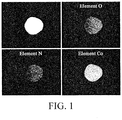
- Fig. 1 illustrates an SEM micrograph of a metal oxide obtained according to Embodiment 5.
- the left upper corner of Fig. 1 shows a distribution diagram of all elements of Co 3 (O 1-y M y ) 4
- the right upper corner shows a distribution diagram of element O
- the left lower corner shows a distribution diagram of element N
- the right lower corner shows a distribution diagram of element Co. It can be seen from the left lower corner of Fig. 1 that the doping element N was doped in the bulk phase of Co 3 O 4 .
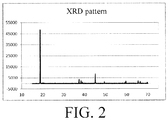
- Fig. 2 illustrates an XRD pattern of a cathode material LiCoO 2 prepared according to Embodiment 5. It can be seen from the Fig. 2 that the crystal form of the doped LiCoO 2 was maintained well. The C-axis expansion rate was measured to be about 2.0%, which indicated that element N was doped in the bulk phase of LiCoO 2 .
- the excellent electrochemical performance of doped lithium cobalt oxide cathode material is mainly attributed to: 1) in the metal oxide, a certain amount of anion M occupies the position of O, which increases the number of oxygen holes, reduces the interfacial impedance between the cathode material and electrolyte, and plays a very good relaxation effect on the decomposition of the electrolyte and corrosion of the cathode material, and as a result, the electrochemical performance of the material under high voltage is improved; 2) the anions M are distributed in the bulk phase of the precursor and the lithium cobalt oxide, which is helpful to improve the ion transport for the lithium ions among the grains and to improve the diffusion speed of lithium ions in the crystals; and 3) except being distributed in the precursor bulk phase, the anions located in the surface region of the particles form solid solutions on the surface structure of the material, which stabilizes the crystal structure of the particle surface, reduces the chance of contact between lithium cobalt oxide and electrolyte, reduces the dissolution of cobalt in the
- M may be selected from at least one of the following elements: N, F, P, S, Cl, As, Se, Br, Te, I or At.
- N, F, P, S or Cl obviously improve the stability of the material and the diffusion coefficient of lithium.
- the anion M is not limited to the above-mentioned specially designated types. As long as it is an anion that can help to improve the ion conductivity among grains and to improve the stability of the material, it falls within the protective scope of the present application.
- the doping amount of the anion is about 0.1%-20.0%. In some embodiments, the doping amount of the anion is about 0.1%-5.0%. In some embodiments, the doping amount of the anion is about 0.5%-3.0%. It should be noted that the numerical values are determined based on the mole number of oxygen atoms in the metal oxide.
- the doping process in Comparative examples 3-5 occured at the synthesis stage for lithium cobalt oxide. That is, the precursor Co 3 O 4 , the material containing lithium and the compound containing the anion (e.g., urea, phosphoric acid and CoF 3 ) were mixed and sintered.
- the precursor Co 3 O 4 the material containing lithium and the compound containing the anion (e.g., urea, phosphoric acid and CoF 3 ) were mixed and sintered.
- the sintered material has better structural stability. This is because the sintering process is accompanied by the recrystallization of the material at high temperatures, which can effectively improve the consistency of atom arrangement within the particles and improve the structural stability of the material.
- Sintering temperature is also an important factor for affecting the properties of the material. According to Embodiments 13-22, it can be seen that the higher the sintering temperature, the better the stability of the material. However, when the sintering temperature was too high, the phenomenon of over-firing occurred, which leaded to the reduction of material capacity and negatively affects the cycle performance. Nevertheless, if the temperature was too low, the improvement of the properties was not obvious because the excessive low temperature was insufficient to optimize the overall performance of the material. In some embodiments, the sintering temperature range was about 400-900°C, or about 500-800°C.
- the sintering atmosphere will also affect the properties of the coated material.
- sintering was performed in an inert atmosphere, while in Embodiments 28-30, sintering was performed in an air atmosphere. From the data in Table 1, it can be seen that the electrochemical properties of the material sintered at high temperature in the inert atmosphere are better than those sintered in the air atmosphere. This is mainly because the non-metallic ions may be oxidized at different degrees at high temperature during sintering in air, which destroys the particle structure and affects the stability of the material and the safety of the battery.
- the median diameter D 50 of the obtained metal oxide should not be too large or too small, because the median diameter of the metal oxide directly affects the median diameter of the subsequently synthesized lithium cobalt oxide.
- D 50 when D 50 is too large, the lithium ion diffusion path in the material particles is increased, which will deteriorate the ion diffusion environment and negatively affect the cycling performance.
- D 50 is too small, the small particles have large specific surface area, which will increase the contact area with the electrolyte, thereby destroying the high temperature storage performance of the material.
- Lithium cobalt oxides with a median diameter of about 6 ⁇ m, about 16 ⁇ m and about 30 ⁇ m were respectively synthesized in Embodiments 31-33, all of which exhibit excellent thermal stability and cycling performance.
- the median diameter D 50 of the metal oxide is about 5-30 ⁇ m. In some embodiments, the median diameter D 50 of LiCo(O 1-y M y ) 2 is in the range of about 10-35 ⁇ m.
- the present application has at least the following beneficial technical effects: the liquid phase precipitation method with ion level mixing and the high temperature sintering method are used to synthesize the bulk phase doped cobalt oxide precursor, which avoids the situation that elements are enriched on the surface layer rather than doping into the bulk phase of the cathode material.
- the lithium cobalt oxide cathode material prepared by the cobalt oxide precursor can effectively improve the structural stability of the material under a high voltage charging and discharging environment, and improve the cycling performance, high temperature performance and thermal performance of the cathode material.
- the preparation method in the present application is simple, easy to operate and control, and is suitable for industrial production.
- the present application provides a simple and feasible method which is suitable for industrial production to prepare the anion-doped precursor for the lithium cobalt oxide as cathode materials.
- the particle structure of the lithium cobalt oxide cathode material prepared by the precursors is stable, which can effectively improve the electrochemical performance and safety performance of the battery.
- the term "about” is used to describe and illustrate minor changes.
- the term may refer to examples where the event or situation occurs exactly as intended and to examples where the event or situation is very similar to that which was intended.
- the term may refer to a variation range of less than or equal to ⁇ 10%, for example, less than or equal to ⁇ 5%, less than or equal to ⁇ 4%, less or equal to ⁇ 3%, less or equal to ⁇ 2%, less or equal to ⁇ 1%, less or equal to ⁇ 0.5%, less or equal to ⁇ 0.1%, or less or equal to ⁇ 0.05% of the numerical value.
Landscapes
- Chemical & Material Sciences (AREA)
- Chemical Kinetics & Catalysis (AREA)
- Electrochemistry (AREA)
- General Chemical & Material Sciences (AREA)
- Engineering & Computer Science (AREA)
- Inorganic Chemistry (AREA)
- Organic Chemistry (AREA)
- Materials Engineering (AREA)
- Manufacturing & Machinery (AREA)
- Composite Materials (AREA)
- Battery Electrode And Active Subsutance (AREA)
Applications Claiming Priority (1)
| Application Number | Priority Date | Filing Date | Title |
|---|---|---|---|
| CN201810660986.3A CN108807928B (zh) | 2018-06-25 | 2018-06-25 | 一种金属氧化物及锂离子电池的合成 |
Publications (1)
| Publication Number | Publication Date |
|---|---|
| EP3587352A1 true EP3587352A1 (de) | 2020-01-01 |
Family
ID=64070800
Family Applications (1)
| Application Number | Title | Priority Date | Filing Date |
|---|---|---|---|
| EP19178731.6A Pending EP3587352A1 (de) | 2018-06-25 | 2019-06-06 | Metalloxid und lithium-ionen-batterie |
Country Status (3)
| Country | Link |
|---|---|
| US (1) | US10944106B2 (de) |
| EP (1) | EP3587352A1 (de) |
| CN (1) | CN108807928B (de) |
Families Citing this family (6)
| Publication number | Priority date | Publication date | Assignee | Title |
|---|---|---|---|---|
| CN110756211B (zh) * | 2019-09-29 | 2020-08-25 | 北京石墨烯技术研究院有限公司 | 氧电极催化剂及其制备方法和应用 |
| CN114141999A (zh) * | 2021-10-26 | 2022-03-04 | 华中科技大学 | 耐高温高电压复合钴酸锂正极材料及其制备方法和应用 |
| CN114497828B (zh) * | 2021-12-24 | 2024-08-02 | 合肥国轩高科动力能源有限公司 | 一种纺锤状Ag/Co3O4复合材料及其制备方法和在锂空气电池中的应用 |
| CN114604904B (zh) * | 2022-03-21 | 2023-06-13 | 广东邦普循环科技有限公司 | 碲掺杂钴酸锂前驱体的制备方法及其应用 |
| CN117185360A (zh) * | 2022-05-31 | 2023-12-08 | 衢州华友钴新材料有限公司 | 掺杂四氧化三钴及其制备方法和应用 |
| CN115571924B (zh) * | 2022-09-28 | 2024-05-10 | 广东邦普循环科技有限公司 | 一种铝氟共掺杂四氧化三钴及其制备方法和应用 |
Citations (3)
| Publication number | Priority date | Publication date | Assignee | Title |
|---|---|---|---|---|
| EP1981103A1 (de) * | 2007-04-04 | 2008-10-15 | Samsung SDI Co., Ltd. | Positive Elektrode und wiederaufladbare Lithiumbatterie damit |
| EP2352190A2 (de) * | 2008-11-10 | 2011-08-03 | LG Chem, Ltd. | Positives aktivmaterial mit verbesserten hochspannungseigenschaften |
| US20170062807A1 (en) * | 2011-05-31 | 2017-03-02 | Freeport Cobalt Oy | Lithium Cobalt Oxide Material |
Family Cites Families (10)
| Publication number | Priority date | Publication date | Assignee | Title |
|---|---|---|---|---|
| CN1146062C (zh) * | 1998-02-10 | 2004-04-14 | 三星电管株式会社 | 正极活性材料及其制造方法以及使用该材料的锂二次电池 |
| IL124007A (en) * | 1998-04-08 | 2001-08-26 | Univ Ramot | Long cycle-life alkali metal battery |
| WO2009065179A1 (en) * | 2007-11-23 | 2009-05-28 | The University Of Queensland | Nanosheets with band gap modification agent and method of production thereof |
| CN102456879B (zh) | 2010-10-22 | 2015-08-19 | 北京当升材料科技股份有限公司 | 一种锂离子电池正极材料前驱体及其制备方法 |
| CN104919631B (zh) * | 2012-12-14 | 2019-08-02 | 尤米科尔公司 | 涂覆有内芯材料元素与一种或多种金属氧化物的混合物的锂金属氧化物颗粒 |
| CN103441255B (zh) * | 2013-09-16 | 2017-02-01 | 宁德新能源科技有限公司 | 锂离子电池正极材料及其制备方法 |
| KR101848979B1 (ko) | 2014-10-31 | 2018-05-24 | 주식회사 엘지화학 | 전이금속 산화물 전구체, 리튬 복합 전이금속 산화물, 이를 포함하는 양극 및 이차전지 |
| CN104681810A (zh) * | 2015-01-11 | 2015-06-03 | 北京工业大学 | 锂离子电池用四氧化三钴氮掺杂碳纳米管三维复合电极材料及其制备方法 |
| CN105977475A (zh) * | 2016-07-06 | 2016-09-28 | 中国科学院宁波材料技术与工程研究所 | 一种高容量锂离子电池正极材料及其制备和应用 |
| KR102264634B1 (ko) * | 2017-09-08 | 2021-06-15 | 주식회사 엘지에너지솔루션 | 리튬 이차전지용 양극 활물질, 이의 제조 방법, 이를 포함하는 리튬 이차전지용 양극 및 리튬 이차전지 |
-
2018
- 2018-06-25 CN CN201810660986.3A patent/CN108807928B/zh active Active
- 2018-10-31 US US16/176,702 patent/US10944106B2/en active Active
-
2019
- 2019-06-06 EP EP19178731.6A patent/EP3587352A1/de active Pending
Patent Citations (3)
| Publication number | Priority date | Publication date | Assignee | Title |
|---|---|---|---|---|
| EP1981103A1 (de) * | 2007-04-04 | 2008-10-15 | Samsung SDI Co., Ltd. | Positive Elektrode und wiederaufladbare Lithiumbatterie damit |
| EP2352190A2 (de) * | 2008-11-10 | 2011-08-03 | LG Chem, Ltd. | Positives aktivmaterial mit verbesserten hochspannungseigenschaften |
| US20170062807A1 (en) * | 2011-05-31 | 2017-03-02 | Freeport Cobalt Oy | Lithium Cobalt Oxide Material |
Non-Patent Citations (3)
| Title |
|---|
| ALBERTO GASPAROTTO ET AL: "F-Doped Co 3 O 4 Photocatalysts for Sustainable H 2 Generation from Water/Ethanol", JOURNAL OF THE AMERICAN CHEMICAL SOCIETY, vol. 133, no. 48, 7 December 2011 (2011-12-07), US, pages 19362 - 19365, XP055639226, ISSN: 0002-7863, DOI: 10.1021/ja210078d * |
| MINGHAO YU ET AL: "Nitrogen-Doped Co 3 O 4 Mesoporous Nanowire Arrays as an Additive-Free Air-Cathode for Flexible Solid-State Zinc-Air Batteries", ADVANCED MATERIALS, vol. 29, no. 15, 10 February 2017 (2017-02-10), DE, pages 1602868, XP055639231, ISSN: 0935-9648, DOI: 10.1002/adma.201602868 * |
| ZHICHAO WANG ET AL: "Phosphorus-Doped Co 3 O 4 Nanowire Array: A Highly Efficient Bifunctional Electrocatalyst for Overall Water Splitting", ACS CATALYSIS, vol. 8, no. 3, 8 February 2018 (2018-02-08), US, pages 2236 - 2241, XP055639237, ISSN: 2155-5435, DOI: 10.1021/acscatal.7b03594 * |
Also Published As
| Publication number | Publication date |
|---|---|
| CN108807928A (zh) | 2018-11-13 |
| US20190393501A1 (en) | 2019-12-26 |
| CN108807928B (zh) | 2021-04-20 |
| US10944106B2 (en) | 2021-03-09 |
Similar Documents
| Publication | Publication Date | Title |
|---|---|---|
| EP4506306A1 (de) | Herstellungsverfahren für lithiumeisenmanganphosphat, anodenelektrodenmaterial und lithium-ionen-batterie | |
| EP4159897A1 (de) | Positives einzelkristall-mehrelementelektrodenmaterial und herstellungsverfahren dafür und anwendung davon | |
| US10944106B2 (en) | Metal oxide and synthesis of lithium ion battery | |
| EP4086984A1 (de) | Positivelektrodenmaterial, verfahren zu seiner herstellung sowie lithium-ionen-sekundärbatterie | |
| US11081686B2 (en) | Metal oxide and method for preparing the same | |
| KR101369658B1 (ko) | 비수전해질 이차 전지용 Li-Ni 복합 산화물 입자 분말 및 그의 제조 방법, 및 비수전해질 이차 전지 | |
| US10957903B2 (en) | Layered lithium-rich manganese-based cathode material with olivine structured LIMPO4 surface modification and preparation method thereof | |
| Li et al. | The role of yttrium content in improving electrochemical performance of layered lithium-rich cathode materials for Li-ion batteries | |
| EP2662915B1 (de) | Anodenaktivmaterial mit einem vollpartikelkonzentrationsgradienten für eine lithiumsekundärbatterie, herstellungsverfahren dafür und lithiumsekundärbatterie damit | |
| KR102447364B1 (ko) | 니켈 코발트 복합 수산화물 입자 및 그 제조 방법, 비수용성 전해질 이차 전지용 양 전극 활물질 및 그 제조 방법, 및 비수용성 전해질 이차 전지 | |
| EP4043403A1 (de) | Kobaltfreies positives elektrodenmaterial einer lithiumionenbatterie, herstellungsverfahren dafür und lithiumionenbatterie | |
| GB2617726A (en) | Lithium transition metal oxide material coated with fast ion conductor and preparation method therefor | |
| Yuan et al. | Surfactant-assisted hydrothermal synthesis of V2O5 coated LiNi1/3Co1/3Mn1/3O2 with ideal electrochemical performance | |
| EP4254553A1 (de) | Positivelektrodenaktivmaterial für lithiumsekundärbatterie, verfahren zur herstellung davon und positivelektrode und lithiumsekundärbatterie damit | |
| EP3757065A1 (de) | Metallverbundhydroxidpartikel und verfahren zur herstellung davon, positivelektrodenaktivsubstanz für sekundärbatterien mit wasserfreiem elektrolyt, verfahren zur herstellung davon und sekundärbatterie mit wasserfreiem elektrolyt | |
| EP3686159A1 (de) | Vorläufer von lithiumkobaltoxid und herstellungsverfahren dafür sowie aus dem vorläufer von lithiumkobaltoxid hergestellter lithiumkobaltoxidverbundwerkstoff | |
| EP3315638B1 (de) | Lithiumkomplexoxid für positives aktives material einer lithiumsekundärbatterie und verfahren zur herstellung davon | |
| EP3694034B1 (de) | Anodenschicht und festkörperbatterie | |
| EP3757067A1 (de) | Metallverbundhydroxidpartikel und verfahren zur herstellung davon, positivelektrodenaktivsubstanz für sekundärbatterien mit wasserfreiem elektrolyt, verfahren zur herstellung davon und sekundärbatterie mit wasserfreiem elektrolyt | |
| KR101912202B1 (ko) | 리튬 이차전지용 리튬복합 산화물 및 이의 제조 방법 | |
| KR20180015045A (ko) | 리튬 이차전지용 리튬복합 산화물 및 이의 제조 방법 | |
| CN111009654A (zh) | Mo掺杂的LiNi0.6Co0.2Mn0.2O2正极材料及其制备方法 | |
| KR20180015044A (ko) | 리튬 이차전지용 리튬복합 산화물 및 이의 제조 방법 | |
| US20250122097A1 (en) | Cathode material, preparation method thereof, and lithium-ion battery | |
| Cheng et al. | Ti modification to improve the cyclic stability of Ni-rich LiNi0. 83Co0. 11Mn0. 06O2 cathode materials by suppressing mechanical fracture |
Legal Events
| Date | Code | Title | Description |
|---|---|---|---|
| PUAI | Public reference made under article 153(3) epc to a published international application that has entered the european phase |
Free format text: ORIGINAL CODE: 0009012 |
|
| STAA | Information on the status of an ep patent application or granted ep patent |
Free format text: STATUS: THE APPLICATION HAS BEEN PUBLISHED |
|
| AK | Designated contracting states |
Kind code of ref document: A1 Designated state(s): AL AT BE BG CH CY CZ DE DK EE ES FI FR GB GR HR HU IE IS IT LI LT LU LV MC MK MT NL NO PL PT RO RS SE SI SK SM TR |
|
| AX | Request for extension of the european patent |
Extension state: BA ME |
|
| STAA | Information on the status of an ep patent application or granted ep patent |
Free format text: STATUS: REQUEST FOR EXAMINATION WAS MADE |
|
| 17P | Request for examination filed |
Effective date: 20200629 |
|
| RBV | Designated contracting states (corrected) |
Designated state(s): AL AT BE BG CH CY CZ DE DK EE ES FI FR GB GR HR HU IE IS IT LI LT LU LV MC MK MT NL NO PL PT RO RS SE SI SK SM TR |
|
| STAA | Information on the status of an ep patent application or granted ep patent |
Free format text: STATUS: EXAMINATION IS IN PROGRESS |
|
| 17Q | First examination report despatched |
Effective date: 20230801 |