EP3584006B1 - Kosmetisches oder pharmazeutisches produkt, das mikrogele aus poly(ethylenglycol-methacrylat) enthält - Google Patents
Kosmetisches oder pharmazeutisches produkt, das mikrogele aus poly(ethylenglycol-methacrylat) enthält Download PDFInfo
- Publication number
- EP3584006B1 EP3584006B1 EP19191127.0A EP19191127A EP3584006B1 EP 3584006 B1 EP3584006 B1 EP 3584006B1 EP 19191127 A EP19191127 A EP 19191127A EP 3584006 B1 EP3584006 B1 EP 3584006B1
- Authority
- EP
- European Patent Office
- Prior art keywords
- microgels
- microgel
- mol
- ethylene glycol
- cosmetic
- Prior art date
- Legal status (The legal status is an assumption and is not a legal conclusion. Google has not performed a legal analysis and makes no representation as to the accuracy of the status listed.)
- Active
Links
Images


Classifications
-
- C—CHEMISTRY; METALLURGY
- C08—ORGANIC MACROMOLECULAR COMPOUNDS; THEIR PREPARATION OR CHEMICAL WORKING-UP; COMPOSITIONS BASED THEREON
- C08F—MACROMOLECULAR COMPOUNDS OBTAINED BY REACTIONS ONLY INVOLVING CARBON-TO-CARBON UNSATURATED BONDS
- C08F220/00—Copolymers of compounds having one or more unsaturated aliphatic radicals, each having only one carbon-to-carbon double bond, and only one being terminated by only one carboxyl radical or a salt, anhydride ester, amide, imide or nitrile thereof
- C08F220/02—Monocarboxylic acids having less than ten carbon atoms; Derivatives thereof
- C08F220/10—Esters
- C08F220/26—Esters containing oxygen in addition to the carboxy oxygen
- C08F220/28—Esters containing oxygen in addition to the carboxy oxygen containing no aromatic rings in the alcohol moiety
- C08F220/282—Esters containing oxygen in addition to the carboxy oxygen containing no aromatic rings in the alcohol moiety and containing two or more oxygen atoms
-
- C—CHEMISTRY; METALLURGY
- C08—ORGANIC MACROMOLECULAR COMPOUNDS; THEIR PREPARATION OR CHEMICAL WORKING-UP; COMPOSITIONS BASED THEREON
- C08F—MACROMOLECULAR COMPOUNDS OBTAINED BY REACTIONS ONLY INVOLVING CARBON-TO-CARBON UNSATURATED BONDS
- C08F220/00—Copolymers of compounds having one or more unsaturated aliphatic radicals, each having only one carbon-to-carbon double bond, and only one being terminated by only one carboxyl radical or a salt, anhydride ester, amide, imide or nitrile thereof
- C08F220/02—Monocarboxylic acids having less than ten carbon atoms; Derivatives thereof
- C08F220/10—Esters
- C08F220/26—Esters containing oxygen in addition to the carboxy oxygen
- C08F220/28—Esters containing oxygen in addition to the carboxy oxygen containing no aromatic rings in the alcohol moiety
- C08F220/285—Esters containing oxygen in addition to the carboxy oxygen containing no aromatic rings in the alcohol moiety and containing a polyether chain in the alcohol moiety
-
- A—HUMAN NECESSITIES
- A61—MEDICAL OR VETERINARY SCIENCE; HYGIENE
- A61K—PREPARATIONS FOR MEDICAL, DENTAL OR TOILETRY PURPOSES
- A61K8/00—Cosmetics or similar toiletry preparations
- A61K8/02—Cosmetics or similar toiletry preparations characterised by special physical form
- A61K8/0216—Solid or semisolid forms
-
- A—HUMAN NECESSITIES
- A61—MEDICAL OR VETERINARY SCIENCE; HYGIENE
- A61K—PREPARATIONS FOR MEDICAL, DENTAL OR TOILETRY PURPOSES
- A61K8/00—Cosmetics or similar toiletry preparations
- A61K8/02—Cosmetics or similar toiletry preparations characterised by special physical form
- A61K8/0241—Containing particulates characterized by their shape and/or structure
-
- A—HUMAN NECESSITIES
- A61—MEDICAL OR VETERINARY SCIENCE; HYGIENE
- A61K—PREPARATIONS FOR MEDICAL, DENTAL OR TOILETRY PURPOSES
- A61K8/00—Cosmetics or similar toiletry preparations
- A61K8/02—Cosmetics or similar toiletry preparations characterised by special physical form
- A61K8/04—Dispersions; Emulsions
- A61K8/042—Gels
-
- A—HUMAN NECESSITIES
- A61—MEDICAL OR VETERINARY SCIENCE; HYGIENE
- A61K—PREPARATIONS FOR MEDICAL, DENTAL OR TOILETRY PURPOSES
- A61K8/00—Cosmetics or similar toiletry preparations
- A61K8/18—Cosmetics or similar toiletry preparations characterised by the composition
- A61K8/72—Cosmetics or similar toiletry preparations characterised by the composition containing organic macromolecular compounds
- A61K8/81—Cosmetics or similar toiletry preparations characterised by the composition containing organic macromolecular compounds obtained by reactions involving only carbon-to-carbon unsaturated bonds
- A61K8/8141—Compositions of homopolymers or copolymers of compounds having one or more unsaturated aliphatic radicals, each having only one carbon-to-carbon double bond, and at least one being terminated by only one carboxyl radical, or of salts, anhydrides, esters, amides, imides or nitriles thereof; Compositions of derivatives of such polymers
- A61K8/8152—Homopolymers or copolymers of esters, e.g. (meth)acrylic acid esters; Compositions of derivatives of such polymers
-
- A—HUMAN NECESSITIES
- A61—MEDICAL OR VETERINARY SCIENCE; HYGIENE
- A61Q—SPECIFIC USE OF COSMETICS OR SIMILAR TOILETRY PREPARATIONS
- A61Q1/00—Make-up preparations; Body powders; Preparations for removing make-up
-
- A—HUMAN NECESSITIES
- A61—MEDICAL OR VETERINARY SCIENCE; HYGIENE
- A61Q—SPECIFIC USE OF COSMETICS OR SIMILAR TOILETRY PREPARATIONS
- A61Q19/00—Preparations for care of the skin
-
- B—PERFORMING OPERATIONS; TRANSPORTING
- B01—PHYSICAL OR CHEMICAL PROCESSES OR APPARATUS IN GENERAL
- B01J—CHEMICAL OR PHYSICAL PROCESSES, e.g. CATALYSIS OR COLLOID CHEMISTRY; THEIR RELEVANT APPARATUS
- B01J13/00—Colloid chemistry, e.g. the production of colloidal materials or their solutions, not otherwise provided for; Making microcapsules or microballoons
- B01J13/0052—Preparation of gels
-
- B—PERFORMING OPERATIONS; TRANSPORTING
- B01—PHYSICAL OR CHEMICAL PROCESSES OR APPARATUS IN GENERAL
- B01J—CHEMICAL OR PHYSICAL PROCESSES, e.g. CATALYSIS OR COLLOID CHEMISTRY; THEIR RELEVANT APPARATUS
- B01J13/00—Colloid chemistry, e.g. the production of colloidal materials or their solutions, not otherwise provided for; Making microcapsules or microballoons
- B01J13/0052—Preparation of gels
- B01J13/0065—Preparation of gels containing an organic phase
-
- C—CHEMISTRY; METALLURGY
- C08—ORGANIC MACROMOLECULAR COMPOUNDS; THEIR PREPARATION OR CHEMICAL WORKING-UP; COMPOSITIONS BASED THEREON
- C08F—MACROMOLECULAR COMPOUNDS OBTAINED BY REACTIONS ONLY INVOLVING CARBON-TO-CARBON UNSATURATED BONDS
- C08F220/00—Copolymers of compounds having one or more unsaturated aliphatic radicals, each having only one carbon-to-carbon double bond, and only one being terminated by only one carboxyl radical or a salt, anhydride ester, amide, imide or nitrile thereof
- C08F220/02—Monocarboxylic acids having less than ten carbon atoms; Derivatives thereof
- C08F220/04—Acids; Metal salts or ammonium salts thereof
- C08F220/06—Acrylic acid; Methacrylic acid; Metal salts or ammonium salts thereof
-
- C—CHEMISTRY; METALLURGY
- C08—ORGANIC MACROMOLECULAR COMPOUNDS; THEIR PREPARATION OR CHEMICAL WORKING-UP; COMPOSITIONS BASED THEREON
- C08G—MACROMOLECULAR COMPOUNDS OBTAINED OTHERWISE THAN BY REACTIONS ONLY INVOLVING UNSATURATED CARBON-TO-CARBON BONDS
- C08G65/00—Macromolecular compounds obtained by reactions forming an ether link in the main chain of the macromolecule
- C08G65/34—Macromolecular compounds obtained by reactions forming an ether link in the main chain of the macromolecule from hydroxy compounds or their metallic derivatives
-
- C—CHEMISTRY; METALLURGY
- C08—ORGANIC MACROMOLECULAR COMPOUNDS; THEIR PREPARATION OR CHEMICAL WORKING-UP; COMPOSITIONS BASED THEREON
- C08G—MACROMOLECULAR COMPOUNDS OBTAINED OTHERWISE THAN BY REACTIONS ONLY INVOLVING UNSATURATED CARBON-TO-CARBON BONDS
- C08G81/00—Macromolecular compounds obtained by interreacting polymers in the absence of monomers, e.g. block polymers
- C08G81/02—Macromolecular compounds obtained by interreacting polymers in the absence of monomers, e.g. block polymers at least one of the polymers being obtained by reactions involving only carbon-to-carbon unsaturated bonds
- C08G81/024—Block or graft polymers containing sequences of polymers of C08C or C08F and of polymers of C08G
- C08G81/025—Block or graft polymers containing sequences of polymers of C08C or C08F and of polymers of C08G containing polyether sequences
-
- C—CHEMISTRY; METALLURGY
- C08—ORGANIC MACROMOLECULAR COMPOUNDS; THEIR PREPARATION OR CHEMICAL WORKING-UP; COMPOSITIONS BASED THEREON
- C08J—WORKING-UP; GENERAL PROCESSES OF COMPOUNDING; AFTER-TREATMENT NOT COVERED BY SUBCLASSES C08B, C08C, C08F, C08G or C08H
- C08J3/00—Processes of treating or compounding macromolecular substances
- C08J3/02—Making solutions, dispersions, lattices or gels by other methods than by solution, emulsion or suspension polymerisation techniques
- C08J3/03—Making solutions, dispersions, lattices or gels by other methods than by solution, emulsion or suspension polymerisation techniques in aqueous media
- C08J3/075—Macromolecular gels
-
- C—CHEMISTRY; METALLURGY
- C08—ORGANIC MACROMOLECULAR COMPOUNDS; THEIR PREPARATION OR CHEMICAL WORKING-UP; COMPOSITIONS BASED THEREON
- C08J—WORKING-UP; GENERAL PROCESSES OF COMPOUNDING; AFTER-TREATMENT NOT COVERED BY SUBCLASSES C08B, C08C, C08F, C08G or C08H
- C08J3/00—Processes of treating or compounding macromolecular substances
- C08J3/12—Powdering or granulating
- C08J3/14—Powdering or granulating by precipitation from solutions
-
- C—CHEMISTRY; METALLURGY
- C08—ORGANIC MACROMOLECULAR COMPOUNDS; THEIR PREPARATION OR CHEMICAL WORKING-UP; COMPOSITIONS BASED THEREON
- C08K—Use of inorganic or non-macromolecular organic substances as compounding ingredients
- C08K3/00—Use of inorganic substances as compounding ingredients
- C08K3/02—Elements
- C08K3/08—Metals
-
- C—CHEMISTRY; METALLURGY
- C08—ORGANIC MACROMOLECULAR COMPOUNDS; THEIR PREPARATION OR CHEMICAL WORKING-UP; COMPOSITIONS BASED THEREON
- C08K—Use of inorganic or non-macromolecular organic substances as compounding ingredients
- C08K3/00—Use of inorganic substances as compounding ingredients
- C08K3/18—Oxygen-containing compounds, e.g. metal carbonyls
- C08K3/20—Oxides; Hydroxides
- C08K3/22—Oxides; Hydroxides of metals
-
- C—CHEMISTRY; METALLURGY
- C08—ORGANIC MACROMOLECULAR COMPOUNDS; THEIR PREPARATION OR CHEMICAL WORKING-UP; COMPOSITIONS BASED THEREON
- C08K—Use of inorganic or non-macromolecular organic substances as compounding ingredients
- C08K5/00—Use of organic ingredients
- C08K5/0008—Organic ingredients according to more than one of the "one dot" groups of C08K5/01 - C08K5/59
- C08K5/0025—Crosslinking or vulcanising agents; including accelerators
-
- C—CHEMISTRY; METALLURGY
- C08—ORGANIC MACROMOLECULAR COMPOUNDS; THEIR PREPARATION OR CHEMICAL WORKING-UP; COMPOSITIONS BASED THEREON
- C08K—Use of inorganic or non-macromolecular organic substances as compounding ingredients
- C08K5/00—Use of organic ingredients
- C08K5/04—Oxygen-containing compounds
- C08K5/10—Esters; Ether-esters
- C08K5/11—Esters; Ether-esters of acyclic polycarboxylic acids
-
- C—CHEMISTRY; METALLURGY
- C08—ORGANIC MACROMOLECULAR COMPOUNDS; THEIR PREPARATION OR CHEMICAL WORKING-UP; COMPOSITIONS BASED THEREON
- C08L—COMPOSITIONS OF MACROMOLECULAR COMPOUNDS
- C08L33/00—Compositions of homopolymers or copolymers of compounds having one or more unsaturated aliphatic radicals, each having only one carbon-to-carbon double bond, and only one being terminated by only one carboxyl radical, or of salts, anhydrides, esters, amides, imides or nitriles thereof; Compositions of derivatives of such polymers
- C08L33/04—Homopolymers or copolymers of esters
- C08L33/14—Homopolymers or copolymers of esters of esters containing halogen, nitrogen, sulfur, or oxygen atoms in addition to the carboxy oxygen
-
- A—HUMAN NECESSITIES
- A61—MEDICAL OR VETERINARY SCIENCE; HYGIENE
- A61K—PREPARATIONS FOR MEDICAL, DENTAL OR TOILETRY PURPOSES
- A61K2800/00—Properties of cosmetic compositions or active ingredients thereof or formulation aids used therein and process related aspects
- A61K2800/40—Chemical, physico-chemical or functional or structural properties of particular ingredients
- A61K2800/41—Particular ingredients further characterized by their size
- A61K2800/412—Microsized, i.e. having sizes between 0.1 and 100 microns
-
- A—HUMAN NECESSITIES
- A61—MEDICAL OR VETERINARY SCIENCE; HYGIENE
- A61K—PREPARATIONS FOR MEDICAL, DENTAL OR TOILETRY PURPOSES
- A61K2800/00—Properties of cosmetic compositions or active ingredients thereof or formulation aids used therein and process related aspects
- A61K2800/40—Chemical, physico-chemical or functional or structural properties of particular ingredients
- A61K2800/47—Magnetic materials; Paramagnetic compounds
-
- A—HUMAN NECESSITIES
- A61—MEDICAL OR VETERINARY SCIENCE; HYGIENE
- A61K—PREPARATIONS FOR MEDICAL, DENTAL OR TOILETRY PURPOSES
- A61K2800/00—Properties of cosmetic compositions or active ingredients thereof or formulation aids used therein and process related aspects
- A61K2800/80—Process related aspects concerning the preparation of the cosmetic composition or the storage or application thereof
- A61K2800/88—Two- or multipart kits
- A61K2800/882—Mixing prior to application
-
- A—HUMAN NECESSITIES
- A61—MEDICAL OR VETERINARY SCIENCE; HYGIENE
- A61K—PREPARATIONS FOR MEDICAL, DENTAL OR TOILETRY PURPOSES
- A61K2800/00—Properties of cosmetic compositions or active ingredients thereof or formulation aids used therein and process related aspects
- A61K2800/80—Process related aspects concerning the preparation of the cosmetic composition or the storage or application thereof
- A61K2800/95—Involves in-situ formation or cross-linking of polymers
-
- C—CHEMISTRY; METALLURGY
- C08—ORGANIC MACROMOLECULAR COMPOUNDS; THEIR PREPARATION OR CHEMICAL WORKING-UP; COMPOSITIONS BASED THEREON
- C08F—MACROMOLECULAR COMPOUNDS OBTAINED BY REACTIONS ONLY INVOLVING CARBON-TO-CARBON UNSATURATED BONDS
- C08F220/00—Copolymers of compounds having one or more unsaturated aliphatic radicals, each having only one carbon-to-carbon double bond, and only one being terminated by only one carboxyl radical or a salt, anhydride ester, amide, imide or nitrile thereof
- C08F220/02—Monocarboxylic acids having less than ten carbon atoms; Derivatives thereof
- C08F220/10—Esters
- C08F220/26—Esters containing oxygen in addition to the carboxy oxygen
- C08F220/28—Esters containing oxygen in addition to the carboxy oxygen containing no aromatic rings in the alcohol moiety
- C08F220/281—Esters containing oxygen in addition to the carboxy oxygen containing no aromatic rings in the alcohol moiety and containing only one oxygen, e.g. furfuryl (meth)acrylate or 2-methoxyethyl (meth)acrylate
-
- C—CHEMISTRY; METALLURGY
- C08—ORGANIC MACROMOLECULAR COMPOUNDS; THEIR PREPARATION OR CHEMICAL WORKING-UP; COMPOSITIONS BASED THEREON
- C08G—MACROMOLECULAR COMPOUNDS OBTAINED OTHERWISE THAN BY REACTIONS ONLY INVOLVING UNSATURATED CARBON-TO-CARBON BONDS
- C08G2115/00—Oligomerisation
-
- C—CHEMISTRY; METALLURGY
- C08—ORGANIC MACROMOLECULAR COMPOUNDS; THEIR PREPARATION OR CHEMICAL WORKING-UP; COMPOSITIONS BASED THEREON
- C08G—MACROMOLECULAR COMPOUNDS OBTAINED OTHERWISE THAN BY REACTIONS ONLY INVOLVING UNSATURATED CARBON-TO-CARBON BONDS
- C08G2261/00—Macromolecular compounds obtained by reactions forming a carbon-to-carbon link in the main chain of the macromolecule
- C08G2261/10—Definition of the polymer structure
- C08G2261/12—Copolymers
- C08G2261/128—Copolymers graft
-
- C—CHEMISTRY; METALLURGY
- C08—ORGANIC MACROMOLECULAR COMPOUNDS; THEIR PREPARATION OR CHEMICAL WORKING-UP; COMPOSITIONS BASED THEREON
- C08G—MACROMOLECULAR COMPOUNDS OBTAINED OTHERWISE THAN BY REACTIONS ONLY INVOLVING UNSATURATED CARBON-TO-CARBON BONDS
- C08G2261/00—Macromolecular compounds obtained by reactions forming a carbon-to-carbon link in the main chain of the macromolecule
- C08G2261/10—Definition of the polymer structure
- C08G2261/14—Side-groups
- C08G2261/142—Side-chains containing oxygen
- C08G2261/1426—Side-chains containing oxygen containing carboxy groups (COOH) and/or -C(=O)O-moieties
-
- C—CHEMISTRY; METALLURGY
- C08—ORGANIC MACROMOLECULAR COMPOUNDS; THEIR PREPARATION OR CHEMICAL WORKING-UP; COMPOSITIONS BASED THEREON
- C08K—Use of inorganic or non-macromolecular organic substances as compounding ingredients
- C08K2201/00—Specific properties of additives
- C08K2201/01—Magnetic additives
Definitions
- the invention relates to poly(oligo-(ethylene glycol) methacrylate) microgels, to their process for preparation in aqueous medium and to their uses in different fields of applications such as cosmetics, pharmacy and medical diagnosis.
- microgels have the advantage of being monodisperse, pH-sensitive and thermosensitive and of being able to incorporate organic molecules or inorganic particles.
- Films prepared from colloidal solutions of these microgels not loaded with inorganic nanoparticles have very advantageous optical and electromechanical properties.
- thermosensitive microgels There are several chemistries of thermosensitive microgels. The main ones are based on poly(N-isopropylacrylamide) (PNIPAM), and more rarely poly(N-vinylcaprolactam) (PVCL) or poly(oligo-(ethylene glycol) methacrylate).
- PNIPAM poly(N-isopropylacrylamide)
- PVCL poly(N-vinylcaprolactam)
- oligo-(ethylene glycol) methacrylate poly(oligo-(ethylene glycol) methacrylate).
- thermosensitive and pH-sensitive microgel consisting of a thermosensitive core based on P(M(EO) 2 MA- co -M(EO) 5 MA) and a shell based on a mixture of poly(oligo-(ethylene glycol) methacrylate) and poly(acrylic acid) (P(M(EO) 2 MA- co -M(EO) 5 MA-co-AA)) was described by Chi, C., T. Cai, and Z. Hu, Oligo(ethyleneglycol)-Based Thermoresponsive Core-Shell Microgels. Langmuir, 2009. 25: p. 3814-3819 These microgels have a core/shell structure with a hydrophobic core and a hydrophilic shell.
- thermosensitive microgel consisting of a poly(M(EO) 2 MA) core and a poly(M(EO) 2 MA-co-M(EO) 5 MA) shell and poly(M(EO) 2 MA-co-OEGMA) nanocapsules obtained by grafting the polymer onto a sacrificial silica particle have been proposed for the delivery of active ingredient respectively by Zhou, et al., Engineering oligo(ethylene glycol)-based thermosensitive microgels for drug delivery applications. Polymer, 2010. 51: p. 3926-3933 ; and by Wang, et al., Preparation of biocompatible nanocapsules with temperature-responsive and bioreducible properties, Journal of Materials Chemistry, 2011. 21: p. 15950 .
- thermosensitive microgels or nanocomposites containing inorganic nanoparticles are poly(N-isopropylacrylamide) (PNIPAM)-based microgels. These microgels have the disadvantage of not being biocompatible.
- PNIPAM poly(N-isopropylacrylamide)
- a first approach to prepare these materials is to synthesize microgels in the presence of nanoparticles. This strategy makes it difficult to fabricate these hybrid microgels due to the complexity of the polymerization.
- the rate of incorporated nanoparticles is generally low and the microgels are polydisperse. In addition, it generally leads to a core-shell architecture in which the nanoparticles are uniformly distributed.
- a second approach consists in synthesizing, in a first step, thermosensitive microgels functionalized by ionic groups. Subsequently, the inorganic nanoparticles are incorporated by co-precipitation of the precursor salts of the nanoparticles.
- the application WO2004/081072 describes for example PNIPAM microgels having anionic sodium acrylate units (-COO - Na + ) and the in situ co-precipitation of precursor salts of various nanoparticles such as magnetic particles (Fe 3 O 4 ), gold particles (Au), and Quantum dots particles (CdTe, CdS).
- a third approach is to incorporate inorganic nanoparticles by solvent transfer. Hydrophobic inorganic nanoparticles are synthesized and dispersed in an organic phase. Thermosensitive microgels are added to the solution containing the nanoparticles and then the whole is transferred to aqueous solution, which encapsulates the nanoparticles in the microgels. This method has been patented using poly(N-isopropylacrylamide) microgels and Quantum dots (CdS) nanoparticles for photoluminescence applications ( US 7914710 ).
- a fourth and final approach is to synthesize microgels carrying ionic charges and to adsorb oppositely charged nanoparticles on the surface of the microgel.
- the preparation of poly(styrene-co-N-isopropylacrylamide) latex having cationic 2-aminoethyl methacrylate (AEMA) groups has been described in the application WO 1997/045202 .
- Negatively surface-charged ⁇ -Fe 3 O 3 magnetic nanoparticles were adsorbed onto the surface of the latexes by electrostatic interaction. The nanoparticles were then trapped into the structure by synthesis of a novel PNIPAM outer shell on the surface of the hybrid latexes.
- microgels especially thermosensitive microgels with magnetic properties, requires in some areas their preparation in the form of thin films.
- microgels previously dispersed in an aqueous phase are stabilized by repulsive charges that prevent the microgels from aggregating or sedimenting.
- the microgels must interact with each other to form microgel layers in order to form a film. Several processes had to be developed to form them.
- a first method of self-assembly of microgels on a modified surface consists in anchoring microgels to the surface of a previously treated substrate to create ionic charges on its surface.
- the microgels have ionic groups generally originating from the polymerization initiator or an ionic comonomer.
- the microgels can be anchored to the surface of a substrate by electrostatic interaction with groups of opposite charges. This technique makes it possible to deposit a thin layer of microgel on the substrate ( monolayer technique ) , but it is also possible to multiply these layers by successive surface treatments ( Layer-by-Layer technique ).
- Microgels based on poly(N-isopropylacrylamide-co-acrylic acid) or P(NIPAM -co -AA) were deposited using this technique on substrates grafted with 3-aminopropyltrimethoxysilane (APTMS) groups. After each microgel layer, a polymer with positive charges (poly(allylamine hydrochloride) PAH or poly(ethylene imine) PEI) was added onto the modified substrate to regenerate the positive charges for a pH lower than the acidity constant of the amines.
- poly(allylamine hydrochloride) PAH or poly(ethylene imine) PEI was added onto the modified substrate to regenerate the positive charges for a pH lower than the acidity constant of the amines.
- Microgel films deposited on substrate have been used for the delivery of active ingredient such as insulin for the treatment of diabetes ( Nolan, CM, MJ Serpe, and LA Lyon, Thermally Modulated Insulin Release from Microgel Thin Films. Biomacromolecules, 2004. 5(5): p. 1940-1946 ) or doxorubicin for the treatment of cancer cells ( Serpe, MJ, et al., Doxorubicin Uptake and Release from Microgel Thin Films. Biomacromolecules, 2005. 6(1): p. 408-413 ).
- active ingredient such as insulin for the treatment of diabetes ( Nolan, CM, MJ Serpe, and LA Lyon, Thermally Modulated Insulin Release from Microgel Thin Films. Biomacromolecules, 2004. 5(5): p. 1940-1946 ) or doxorubicin for the treatment of cancer cells ( Serpe, MJ, et al., Doxorubicin Uptake and Release from Microgel Thin Films. Biomacromolecule
- This technique has the advantage of controlling the parameters inherent in the development of thin microgel films (such as film thickness and microgel structuring).
- the disadvantage of this process lies in its complexity of development which requires the use of particular microgels (charged microgels) and previously treated substrates. This prevents any direct use of the microgels on any surface.
- a second method of preparing a hydrogel film encapsulating colloidal particles involves encapsulating the particles in a hydrogel to form a flexible, moist film. This method is being studied primarily for photonic applications. The idea is to combine the optical properties of assembled particles with the mechanical properties of hydrogels in the wet state. Some examples are described in the literature and mainly use poly(styrene) particles in the form of hard spheres. E. Tian et al. assembled Poly(Styrene-co-Methyl Methacrylate-co-Acrylic Acid) particles into several structured layers and encapsulated the whole in a poly(acrylamide) hydrogel ( Tian, E., et al., Colorful humidity sensitive photonic crystal hydrogel.
- H. Kim et al. assembled magnetic particles of iron oxide (Fe 3 O 4 ) coated with silicon oxide (SiO 2 ) under the effect of a magnetic field and encapsulated this assembly in a mixture of poly(ethylene glycol) diacrylate monomer and a photoinitiator.
- Photopolymerization of the mixture allows the particles to be fixed in a poly(ethylene glycol acrylate) resin.
- the magnetic particles fixed in the mass have photonic properties that can be defined by the applied magnetic field ( US 2012/0028834 ).
- This technique has the advantage of producing more flexible microgel films because they are supported by a "soft" hydrogel in solution, and not a solid support.
- the production of these particle films remains complex and different polymerization steps are necessary, which prevents any spontaneous self-assembly when using the particles directly.
- a third method of forming microgel films consists in adding reactive functions to the surface of the microgels. This functionality is provided by adding a co-monomer during the synthesis of the microgels. These reactive functions can either form covalent bonds with each other or form covalent bonds by reaction with another entity. It is then possible to form crosslinking nodes between each microgel, the whole giving a film composed of microgels chemically bonded to each other.
- This self-assembly process is studied mainly for photonic applications. The self-assembly process depends on the type of functionality added during the synthesis of the microgels. A large majority of this work has focused on the assembly of microgels based on PNIPAM.
- a first approach consists in adding poly(acrylic acid) (or PAA) within PNIPAM microgels.
- PAA poly(acrylic acid)
- the self-assembly of the microgels is done thanks to weak interactions between the carboxylic acid functions of the PAA. The sum of the interactions allows the self-assembly of the microgels and the gelling of the medium.
- a second approach consisting of creating covalent bonds has also been proposed, either by adding a crosslinker into the PNIPAM microgel solution or by polycondensation of PNIPAM-co-NMA microgels such as (NMA: N-methylol acrylamide or N-hydroxymethyl acrylamide).
- the microgels are self-assembled by simple drying of a microgel dispersion. The formation of the film requires an additional step of thermal post-polymerization of the crosslinker or thermal and acid-base catalyzed condensation of the NMA.
- microgels of oligo-(ethylene glycol) methacrylate derivative with surface polymerizable functions were cross-linked by UV photopolymerization during their assembly for photonic applications ( US 2010/0076105 ).
- filming requires a very long drying time of around a few weeks.
- the objective of the invention is to use an oligo-(ethylene glycol) methacrylate microgel which has at least one of the following advantages over prior art microgels: monodisperse; pH-sensitive; biocompatible; capable of forming hybrid microgels (or nanocomposites) by adsorption of oppositely charged nanoparticles; capable of self-assembling into several layers by a simple drying process; capable of forming a transparent film; capable of forming a cohesive and elastic film; in the form of a film, capable of generating an electrical potential by compression effect; in the form of a film, capable of diffracting light thereby generating a color.
- Microgel films have the advantage of being completely self-supporting. Since the microgels are not encapsulated or supported, during film formation the interaction between the microgels and the substrate on which they are deposited, for example the skin, is maximal. The films are obtained by simple drying at room temperature and no radical initiator is necessary. Microgels containing or not nanoparticles are capable of self-assembling into several layers to form a transparent film.
- poly(oligo-(ethylene glycol) methacrylate) microgels are polyelectrolyte materials capable of generating an electric field by mechanical action.
- the invention relates to a cosmetic or pharmaceutical product containing poly(oligo-(ethylene glycol) methacrylate) microgels having colloidal properties as well as sensitivity to variations in temperature and/or pH in water, thanks to the presence of optionally salified -COOH groups.
- microgel means a crosslinked polymer in the form of a spherical particle with a size varying from 100 nm to 500 nm in the dry state (i.e. containing less than 2% by weight of water), preferably between 350 and 450 nm, more preferably of the order of 400 nm.
- the microgel of the invention is a microhydrogel in the sense that it is capable of being obtained by a process of copolymerization in aqueous phase of several monomers.
- the microgel of the invention does not have a core/shell structure: the monomers that compose it are distributed uniformly over the entire volume of the particle, which gives it particular properties.
- the microgels may have the advantage of being monodisperse, thermosensitive, pH-sensitive and biocompatible.
- the microgels of the invention may be both thermosensitive and biocompatible, unlike the thermosensitive microgels of the prior art which are generally poly(alkylacrylamide)-based structures.
- Microgels have the originality of comprising a mixture of repeating units of branched ethylene oxide and units comprising a carboxylic acid (-COOH) or carboxylate (-COO - ) group, the content of which can be varied depending on the intended applications. These groups give microgels the property of pH sensitivity.
- M(EO) 2 MA represents for example 50 to 90 mol% of the total number of moles of the monomers
- M(EO) n MA preferably represents 10 to 50 mol% of the total number of moles of the monomers
- the molar ratio between M(EO) 2 MA and M(EO) n MA is preferably between 1:1 and 20:1, for example between 5:1 and 10:1.
- M(EO) 2 MA represents for example 80 to 90 mol% of the total number of moles of the three monomers
- M(EO) n MA preferably represents 5 to 15 mol% of the total number of moles of the monomers
- methacrylic acid preferably represents 0.1 to 10 mol% of the total number of moles of the monomers, the sum of these three contents being equal to 100%.
- the alkyl group may be methyl, ethyl or n-butyl.
- R 1 and R 2 each represent a hydrogen and R 3 and R 4 independently represent -H, -COOH, or -CH 2 -COOH.
- the crosslinking agent may be selected from the group consisting of oligo(ethylene glycol) diacrylate comprising from 1 to 10 ethylene glycol units, 1,3-Butanediol diacrylate, 1,4-Butanediol diacrylate, 1,6-Hexanediol diacrylate, Pentaerythritol diacrylate monostearate, Glycerol 1,3-diglycerolate diacrylate, Neopentyl glycol diacrylate, Poly(propylene glycol) diacrylate, 1,6-Hexanediol ethoxylate diacrylate, Trimethylolpropane benzoate diacrylate, ethylene glycol dimethacrylate, 1,3-Butanediol dimethacrylate, 1,4-Butanediol dimethacrylate, 1,6-Hexanediol dimethacrylate, glycerol dimethacrylate, N,N divinylbenzene, N,N-
- the crosslinking agent represents, for example, 1 to 5 mol% of the total number of moles of the three monomers.
- the monomers used are preferably di(ethylene glycol) methyl ether methacrylate (M(EO) 2 MA, Mn 250 g.mol -1 ), oligo(ethylene glycol) methyl ether methacrylate (M(EO) 9 MA, Mn 475 g.mol -1 ), methacrylic acid (MAA).
- M(EO) 2 MA di(ethylene glycol) methyl ether methacrylate
- Mn 250 g.mol -1 oligo(ethylene glycol) methyl ether methacrylate
- MAA methacrylic acid
- the crosslinking agent is for example oligo(ethylene glycol)diacrylate comprising 4 to 5 ethylene oxide units (OEGDA, Mn 250 g.mol -1 ).
- OEGDA ethylene glycol
- Mn 250 g.mol -1 ethylene oxide units
- the average size of a microgel can vary depending on whether it is dry or in aqueous solution: thus a microgel in the dry state can reach four times its initial size when it is placed in aqueous solution at 20°C.
- the average size of a microgel of the invention in the dry state can range from 100 to 1000 nm.
- the hydrodynamic radial distribution function of the microgels measured at an angle of 60° and at a temperature of 20°C is advantageously less than 1.1, which gives the microgels the quality of monodisperse.
- Microgels may comprise organic or inorganic particles: in this case they are commonly called hybrid microgels.
- the particles introduced preferably have a size between 1 and 150 nm, for example between 5 and 50 nm, and are called nanoparticles.
- the nanoparticles are positively charged on their surface when placed in aqueous solution so that the hybrid microgels can be prepared by simply mixing two colloidal dispersions: a first colloidal dispersion of microgels and a second colloidal dispersion of nanoparticles.
- the key parameters allowing the success of this method reside, on the one hand, in the addition of carboxylic or carboxylate groups distributed homogeneously within the microgel and, on the other hand, in the positive surface charge of the nanoparticles. All this makes it possible to encapsulate the nanoparticles within the microgel in a controlled manner, while retaining the colloidal and thermosensitive properties of the final material.
- the hybrid architecture of the microgels as well as their thermosensitive properties are demonstrated in this invention.
- the nanoparticles are pigments, dyes or sunscreens commonly used in the field of cosmetics, agri-food or pharmacy.
- thermosensitive hybrid microgels based on poly(oligo-(ethylene glycol) methacrylate) and nanoparticles can be carried out preferably by a process of mixing the two constituents in the form of colloidal dispersions.
- the nanoparticles placed in aqueous solution are likely to be positively charged on the surface when they are brought into contact with the microgels.
- the stability of the hybrid microgels is obtained by an increase in pH above the isoelectric point of the inorganic nanoparticles while preserving the encapsulation of the nanoparticles.
- This process has the advantage of being simple to implement.
- the homogeneous distribution of carboxylic acid or carboxylate groups within the microgel and the choice of positively charged nanoparticles on the surface allows the nanoparticles to be encapsulated in a controlled manner within the microgel, while retaining the colloidal and thermosensitive properties of the final material.
- the hybrid microgels of the invention can contain up to 50% by weight, in particular up to 35% by weight of nanoparticles without losing their colloidal, pH and thermosensitive properties.
- the rate of nanoparticles per hybrid microgels can be determined by thermogravimetric analysis (TGA).
- microgels described above are capable of self-assembling to form a film consisting of one or more layers of microgels, by a process of drying or evaporation of an aqueous suspension of said microgels.
- the films formed are cohesive and elastic.
- the microgels can thus be used as a film-forming agent in cosmetic compositions, so as to improve the hold of these compositions on keratin materials. After drying, the films do not re-disperse when immersed in water.
- Microgels and the films they form can generate an electric potential by compression effect (Donan effect).
- the films are prepared from microgels containing ionic sites from carboxylate functions (COO - ). These ionic sites are constrained in the structure and create polarizations within the microgel (eg polyelectrolyte microgels).
- COO - carboxylate functions
- a movement of the counter-ions contributes to creating a polarization within the film itself which generates a difference in electric potential between the surface and the mass of the film.
- the self-assembly of monodisperse microgels also allows light diffraction, thus generating a color. These photonic properties can be modulated by the very composition of the microgels.
- Monodisperse microgels can self-assemble periodically in the form of colloidal crystals. This particular self-assembly allows the diffraction of incident light and thus generates an observable color depending on the observation angle.
- This effect varies depending on the composition of the microgels: a) drying a dispersion of microgels without nanoparticles induces the formation of a completely transparent, colorless dry film that does not diffract light. While this same film diffracts light in the wet state with colors observable in solution. b) drying a dispersion of microgels containing magnetic nanoparticles (hybrid microgels) induces the formation of a transparent, colored (brown) dry film that diffracts light. Therefore, the film is brown at an observation angle of 90°C (color from the magnetic nanoparticles) and changes color in reflection at lower observation angles.
- microgels of the invention can stimulate the skin by generating an electric current and possibly deliver a biologically active molecule by compression effect.
- the biologically active molecule can be encapsulated in the microgels or be present in the product.
- the invention therefore relates to a cosmetic or pharmaceutical product consisting of or containing microgels as described above and at least one compound chosen from the group consisting of surfactants, oils, biologically active products, pigments and dyes.
- microgel although devoid of inorganic nanoparticles, can contain all kinds of ingredients or excipients used in the cosmetic and pharmaceutical fields, preferably biologically active substances.
- Microgels can be synthesized by a precipitation polymerization process, from monomers previously solubilized in aqueous solution.
- the present application describes a process for polymerization by precipitation of a poly(ethylene glycol-methacrylate) microgel as described above, comprising a step of bringing into contact in an aqueous phase in the presence of a crosslinking agent of the three monomers described above, at a temperature between 40 and 90°C.
- a surfactant such as SDS (sodium dodecyl sulfate).
- the polymerization of the monomers can be initiated by adding a water-soluble radical initiator, for example potassium persulfate (KPS) at a temperature between 40 and 90°C, preferably of the order of 70°C.
- KPS potassium persulfate
- the polymer formed is hydrophobic and precipitates in the aqueous reaction medium in the form of spherical particles; the presence of the crosslinker OEGDA during the polymerization allows the particles to be fixed in this spherical form by creating crosslinking nodes.
- Microgels have the advantage of being of homogeneous structure, because the -COOH groups and the crosslinking nodes are distributed regularly throughout their volume.
- microgel films are advantageously prepared by a drying or solvent evaporation process at 20°C, for example starting from a colloidal dispersion of monodisperse microgels at a mass concentration which can vary from 1.4 to 5 wt% in water.
- At least a first volume of solution can be left to dry until the water has completely evaporated at room temperature.
- This step can be repeated several times to obtain a film composed of several layers of monodisperse microgels and of a thickness which can vary between 350 and 450 micrometers in the dry state.
- the cosmetic product or microgels may be used in a cosmetic care or makeup process that involves applying the microgels or cosmetic product described above to the skin.
- the microgels may be used in various fields of application such as cosmetics, pharmacy and medical diagnostics.
- EXAMPLE 1 Synthesis of a microgel based on poly(oligo-(ethylene alycol) methacrylate) according to the invention
- the following monomers were used: di(ethylene glycol) methyl ether methacrylate (M(EO) 2 MA, Mn 250 g.mol -1 ), oligo(ethylene glycol) methyl ether methacrylate (M(EO) 4-5 MA still referred to as OEGMA in the following, Mn 475 g.mol -1 ), and methacrylic acid (MAA).
- the crosslinking agent was oligo(ethylene glycol) diacrylate (OEGDA, Mn 250 g.mol -1 ).
- KPS potassium persulfate
- the polymerization is then stopped by adding oxygen and allowed to cool to room temperature.
- the microgels are then separated from the reaction medium by centrifugation (10,000 rpm, 30 min) and the reaction medium is replaced with pure water (milliQ grade), the step is repeated five times.
- the final solution then consists of a colloidal dispersion of P(MEO 2 MA- co -OEGMA- co -MAA) microgels in aqueous phase, this dispersion is kept at room temperature.
- the synthesis of the microgels was characterized by kinetic monitoring of the monomers using proton nuclear magnetic resonance spectroscopy ( 1 H NMR). A complete conversion of the monomers and a homogeneous composition of the microgels with a homogeneous distribution of crosslinking nodes and methacrylic acid units were observed.
- the final yield of cross-linked microgel was analyzed by dry extract of the reaction medium and allows to determine a yield of 70% by mass of cross-linked microgel.
- the incorporated methacrylic acid rate was determined by acid-base assay of the purified microgels.
- the pH-sensitive nature of the microgels in aqueous solution as well as the incorporation of 70 mol% of the initial MAA monomer could be verified.
- microgels were observed by transmission electron microscopy (TEM) and their sizes determined by dynamic light scattering.
- TEM transmission electron microscopy
- the observed microgels are monodisperse, with a size of 400 nm in the dried state and up to 1000 nm in the wet state.
- EXAMPLE 2 Preparation of microael solutions based on poly(oliao-(ethylene alycol) methacrylate)
- 1.2 mL of a solution of microgels prepared according to Example 1 (at 15 gL -1 of microgels) is dispersed in 10 mL of a pure water solution (milliQ grade).
- the pH of the dispersion is adjusted by adding a solution of hydrochloric acid or potassium hydroxide at 0.1 mol.L -1 .
- the mixture is left under magnetic stirring until the pH stabilizes.
- the size of the microgels in solution is measured by dynamic light scattering and the solution temperature is controlled during the analysis.
- microgels are sensitive to variations in the pH of the medium, going from a size of 400 nm at pH ⁇ 5.5 to a size of 1000 nm at pH > 6.0.
- Microgels are thermosensitive and change from a swollen state at 20°C to a contracted state at higher temperatures.
- the contraction temperature is a function of pH (35°C at pH ⁇ 6.0 and 55°C at pH > 7.0).
- the volume of the microgel swollen at 20°C decreases up to 3 times compared to its initial volume when the temperature goes beyond the contraction temperature.
- microgel compositions summarized in Table 1 were used to prepare films. ⁇ b>Table 1. Monomer composition of microgels ⁇ /b> Microgels P(MEO 2 MA-co-OEGMA-co-MAA) Microgel 1 2 MEO 2 MA (mmol/L) 88.4 83.9 OEGMA (mmol/L) 9.82 9.36 MAA (mmol/L) 0 a 4.99 b OEGDA (mmol/L) 1.92 1.92 KPS (mmol/L) 0.86 0.86 Morphology of microgels a Microgel 1 contains 0 mol% MAA units; b Microgel 2 contains 3.5 mol% of MAA units incorporated into the microgel (i.e. 70% of initial MAA monomer);
- the films are prepared by a drying process presented on the Figure 3 .
- a colloidal dispersion of monodisperse microgels (of size that can vary between 500 and 1000 ⁇ m in solution) at a mass concentration of microgels varying from 1.4 to 5 wt% in water (solution 1).
- a constant volume of solution is introduced into a plastic mold and left to dry until the water has completely evaporated (Step 1 of the Figure 3 ).
- the film remaining at the bottom of the mold is then composed of several layers of monodisperse and completely dry microgels (of a size that can vary between 350 and 450 ⁇ m in the dry state).
- the film is carefully recovered and reintroduced into an aqueous solution (solution 2).
- the mass concentration in dispersion from 1.4 to 5 wt% makes it possible to vary the thickness of the swollen film (end of step 3: thickness from 200 ⁇ m to 1000 ⁇ m).
- the pH of solution 2 is varied between 5.5 and 7.5.
- thermosensitive poly(oligo-(ethylene glycol) methacrylate) microgel films Formation of thermosensitive poly(oligo-(ethylene glycol) methacrylate) microgel films.
- a volume of 5 mL of a colloidal dispersion of microgels at a mass concentration of 1.4 to 5 wt% is introduced into a plastic mold and left to dry at a temperature of 32°C (+/- 2°C). After complete evaporation of the solvent, the film is carefully recovered and then introduced into an aqueous solution and left to swell at room temperature.
- microgels form an elastic film composed of several layers of microgels (at step 2) regardless of the composition of the microgels ( microgels 1 to 2 in Table 1). Conversely, microgels lose their mechanical properties when swollen in water but do not re-disperse in solution.
- Microgels 1 and 2 the film thickness was varied from 200 to 1000 ⁇ m, the multiplication of microgel layers does not modify the “filmification” phenomenon and the films retain their elasticity in the dry state.
- microgel films have been studied. This is to demonstrate the ability of microgels to generate an electric current when pressure is exerted on these microgels. More particularly, the idea of the invention is to generate an electric current by pressing the material on the surface of a substrate. This electric potential can be generated from a material having covalently attached ionic functions (or polyelectrolyte material). Indeed, since the ionic groups are attached in the microgel, only the counterions of each carboxylate group have mobility in the microgel.
- a setup is used to highlight the mechanical-electrical properties of the films.
- an Anton Paar MCR301 rheometer is used in plane-plane geometry within which two flat and conductive electrodes based on Indium Tin Oxide or ITO ( entity 1. of the Figure 4 ) are attached on either side of the geometry.
- the lower electrode is fixed and the upper electrode is removable.
- a wet film of microgels ( entity 3. of the Figure 4 ) is deposited on the surface of the lower electrode and the upper electrode is lowered to exert a compression force F N on the film.
- a compression/relaxation program is performed to vary the force exerted on the film.
- the initial wet film thickness (denoted L 0 ) was determined and the distance between the two electrodes was gradually decreased by a distance ⁇ L by lowering the upper electrode.
- the upper and lower electrodes are connected to a converter/amplifier, in order to record the potential difference (denoted E) generated between the two electrodes throughout the program.
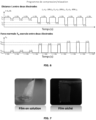
- microgel films are distinguished by their optical properties, linked to the ability of these films to diffract light. A disparity is observed depending on the composition of the films:
Landscapes
- Chemical & Material Sciences (AREA)
- Health & Medical Sciences (AREA)
- Organic Chemistry (AREA)
- Life Sciences & Earth Sciences (AREA)
- Chemical Kinetics & Catalysis (AREA)
- Medicinal Chemistry (AREA)
- Polymers & Plastics (AREA)
- Animal Behavior & Ethology (AREA)
- General Health & Medical Sciences (AREA)
- Public Health (AREA)
- Veterinary Medicine (AREA)
- Dispersion Chemistry (AREA)
- Epidemiology (AREA)
- Birds (AREA)
- Dermatology (AREA)
- Cosmetics (AREA)
- Polymerisation Methods In General (AREA)
- Addition Polymer Or Copolymer, Post-Treatments, Or Chemical Modifications (AREA)
- Medicinal Preparation (AREA)
- Colloid Chemistry (AREA)
- Compositions Of Macromolecular Compounds (AREA)
Claims (6)
- Kosmetisches oder pharmazeutisches Produkt, das Mikrogele und mindestens eine Verbindung enthält, die ausgewählt ist aus der Gruppe, bestehend aus Tensiden, Ölen, biologisch aktiven Produkten, Pigmenten und Farbstoffen, wobei die Mikrogele in Form von Teilchen sind, die durch ein Copolymerisationsverfahren in wässriger Phase der folgenden drei Monomere erlangt werden können, die gleichförmig über das gesamte Volumen der Partikel verteilt sind:- di(Ethylenglycol)methylethermethacrylat (M(EO)2MA),- ein Oligo(ethylenglycol)methylethermethacrylat (M(EO)n MA), wobei n eine ganze Zahl von 3 bis 12 ist,- ein Monomer von Formel CR1R2=CR3R4, wobei R1, R2, R3 und R4 Wasserstoff, Halogen oder eine Kohlenwasserstoffgruppierung darstellen, unter der Bedingung, dass mindestens eine der vier Gruppierungen eine Gruppierung -COOH oder -COO-M+ umfasst, sodass M+ ein Kation darstellt, inAnwesenheit eines Vernetzungsmittels,wobei die Mikrogele keine anorganischen Nanopartikel umfassen.
- Kosmetisches oder pharmazeutisches Produkt nach Anspruch 1, dadurch gekennzeichnet, dass M(EO)2MA 50 bis 90 Mol-% der Gesamtmolzahl der drei Monomere darstellt, M(EO)n MA 10 bis 50 Mol-% der Gesamtmolzahl der drei Monomere darstellt und das Monomer von Formel CR1R2=CR3R4 0,1 bis 20 Mol-% der Gesamtmolzahl der drei Monomere darstellt.
- Kosmetisches oder pharmazeutisches Produkt nach einem der vorherigen Ansprüche, dadurch gekennzeichnet, dass das Monomer von Formel CR1R2=CR3R4 Methacrylsäure ist.
- Kosmetisches oder pharmazeutisches Produkt nach einem der vorherigen Ansprüche, dadurch gekennzeichnet, dass das Vernetzungsmittel ein Oligo(ethylenglykol)diacrylat (OEGDA) ist, umfassend 1 bis 10 Ethylenglykoleinheiten.
- Kosmetisches oder pharmazeutisches Produkt nach einem der Ansprüche 1 bis 4, dadurch gekennzeichnet, dass das Verfahren einen Schritt eines Inkontaktbringens in wässriger Phase - in Anwesenheit eines Vernetzungsmittels - die drei Monomere bei einer Temperatur zwischen 40 °C und 90 °C umfasst.
- Kosmetisches oder pharmazeutisches Produkt nach einem der vorherigen Ansprüche, dadurch gekennzeichnet, dass die Mikrogele keine organischen Moleküle umfassen.
Priority Applications (2)
| Application Number | Priority Date | Filing Date | Title |
|---|---|---|---|
| ES19191127T ES3005226T3 (en) | 2015-01-06 | 2015-01-06 | Cosmetic or pharmaceutical product containing poly(ethylene glycol methacrylate) microgels |
| EP19191127.0A EP3584006B1 (de) | 2015-01-06 | 2015-01-06 | Kosmetisches oder pharmazeutisches produkt, das mikrogele aus poly(ethylenglycol-methacrylat) enthält |
Applications Claiming Priority (3)
| Application Number | Priority Date | Filing Date | Title |
|---|---|---|---|
| PCT/FR2015/050019 WO2016110615A1 (fr) | 2015-01-06 | 2015-01-06 | Microgels de poly(ethylene glycol-methacrylate), procédé de préparation et utilisations |
| EP15703307.7A EP3242743B1 (de) | 2015-01-06 | 2015-01-06 | Schmink- oder pflegeverfahren, welches poly(ethylenglykol)methacrylatmikrogele verwendet |
| EP19191127.0A EP3584006B1 (de) | 2015-01-06 | 2015-01-06 | Kosmetisches oder pharmazeutisches produkt, das mikrogele aus poly(ethylenglycol-methacrylat) enthält |
Related Parent Applications (2)
| Application Number | Title | Priority Date | Filing Date |
|---|---|---|---|
| EP15703307.7A Division EP3242743B1 (de) | 2015-01-06 | 2015-01-06 | Schmink- oder pflegeverfahren, welches poly(ethylenglykol)methacrylatmikrogele verwendet |
| EP15703307.7A Division-Into EP3242743B1 (de) | 2015-01-06 | 2015-01-06 | Schmink- oder pflegeverfahren, welches poly(ethylenglykol)methacrylatmikrogele verwendet |
Publications (2)
| Publication Number | Publication Date |
|---|---|
| EP3584006A1 EP3584006A1 (de) | 2019-12-25 |
| EP3584006B1 true EP3584006B1 (de) | 2024-10-09 |
Family
ID=52462938
Family Applications (2)
| Application Number | Title | Priority Date | Filing Date |
|---|---|---|---|
| EP15703307.7A Active EP3242743B1 (de) | 2015-01-06 | 2015-01-06 | Schmink- oder pflegeverfahren, welches poly(ethylenglykol)methacrylatmikrogele verwendet |
| EP19191127.0A Active EP3584006B1 (de) | 2015-01-06 | 2015-01-06 | Kosmetisches oder pharmazeutisches produkt, das mikrogele aus poly(ethylenglycol-methacrylat) enthält |
Family Applications Before (1)
| Application Number | Title | Priority Date | Filing Date |
|---|---|---|---|
| EP15703307.7A Active EP3242743B1 (de) | 2015-01-06 | 2015-01-06 | Schmink- oder pflegeverfahren, welches poly(ethylenglykol)methacrylatmikrogele verwendet |
Country Status (7)
| Country | Link |
|---|---|
| US (3) | US10287403B2 (de) |
| EP (2) | EP3242743B1 (de) |
| JP (1) | JP6539350B2 (de) |
| KR (2) | KR102412585B1 (de) |
| CN (1) | CN107635655B (de) |
| ES (2) | ES3005226T3 (de) |
| WO (1) | WO2016110615A1 (de) |
Families Citing this family (16)
| Publication number | Priority date | Publication date | Assignee | Title |
|---|---|---|---|---|
| EP3242743B1 (de) * | 2015-01-06 | 2019-11-06 | LvmH Recherche | Schmink- oder pflegeverfahren, welches poly(ethylenglykol)methacrylatmikrogele verwendet |
| ES2877337T3 (es) * | 2017-10-17 | 2021-11-16 | Lvmh Rech | Microgeles para la administración de sustancias orgánicas activas cosméticas |
| CN117687243A (zh) * | 2017-10-17 | 2024-03-12 | 科迪华公司 | 用于显示装置的具有高量子点浓度的油墨组合物 |
| CN109054049A (zh) * | 2018-06-19 | 2018-12-21 | 南华大学 | 一种peg类温敏水凝胶三维细胞支架及其制备方法和应用 |
| CN109449080B (zh) * | 2018-11-12 | 2021-01-26 | 京东方科技集团股份有限公司 | 胶膜及其制备方法、显示装置及胶膜的去除方法 |
| JP7475611B2 (ja) * | 2019-05-31 | 2024-04-30 | ザ ボード オブ トラスティーズ オブ ザ レランド スタンフォード ジュニア ユニバーシティー | 粘膜付着性ミクロゲル組成物およびそれを使用するための方法 |
| CN110183692A (zh) * | 2019-06-10 | 2019-08-30 | 苏州柏特瑞新材料有限公司 | 一种三维交联可溶的聚合物微凝胶及其制备方法 |
| CN110558968B (zh) * | 2019-09-05 | 2021-06-01 | 中国科学院长春应用化学研究所 | 一种微凝胶可穿戴传感器及其制备方法 |
| FR3104419B1 (fr) | 2019-12-16 | 2025-11-07 | Lvmh Rech | Composition ou dispositif médical comprenant des polymères à base d'oligo(éthylène glycol) |
| FR3104418A1 (fr) | 2019-12-16 | 2021-06-18 | Lvmh Recherche | Composition ou dispositif médical comprenant des polymères à base d'oligo(éthylène glycol) |
| CN112619620A (zh) * | 2020-12-16 | 2021-04-09 | 侯志新 | 一种Fe3O4-聚乙烯亚胺-聚丙烯酸-聚偏氟乙烯的复合吸附材料 |
| KR20240008837A (ko) | 2021-03-26 | 2024-01-19 | 위니베르시떼 드 뽀 에 데 뻬이 드 라두르 | 전도성 자극 반응 콜로이드 마이크로겔 및 그 필름 동족체: 카테콜기를 가교제 및 도핑제로 사용한 합성 및 기계-전기적 성질 |
| CN113788945A (zh) * | 2021-08-13 | 2021-12-14 | 温州医科大学 | 一种聚乙二醇二丙烯酸酯聚合物微凝胶及其制备方法和应用 |
| CN115926072A (zh) * | 2022-10-08 | 2023-04-07 | 南京师范大学 | 一种基于水相沉淀聚合法制备Fe3O4复合纳米粒子方法 |
| EP4608372A1 (de) | 2022-10-28 | 2025-09-03 | Universite De Pau Et Des Pays De L'adour | Selbstangeordnete biologisch abbaubare stimulireaktive mikrogele |
| FR3156657A1 (fr) | 2023-12-14 | 2025-06-20 | Lvmh Recherche | Dispersion aqueuse de microgels concentrée et composition cosmétique la contenant |
Family Cites Families (13)
| Publication number | Priority date | Publication date | Assignee | Title |
|---|---|---|---|---|
| FR2749082B1 (fr) | 1996-05-24 | 1998-06-26 | Bio Merieux | Particules superparamagnetiques et monodispersees |
| WO2004081072A2 (en) | 2003-03-13 | 2004-09-23 | Eugenia Kumacheva | Method of producing hybrid polymer-inorganic materials |
| JP3917979B2 (ja) * | 2004-01-30 | 2007-05-23 | ポーラ化成工業株式会社 | 被膜形成用ポリマー組成物 |
| JP4426859B2 (ja) * | 2004-02-02 | 2010-03-03 | ポーラ化成工業株式会社 | 被膜形成用ポリマー組成物 |
| WO2006037901A1 (fr) * | 2004-10-05 | 2006-04-13 | L'oreal | Kit et procede de maquillage |
| FR2876011B1 (fr) * | 2004-10-05 | 2006-12-29 | Oreal | Procede de maquillage d'un support et kit pour la mise en oeuvre de ce procede |
| DE102005034412A1 (de) * | 2005-07-22 | 2007-01-25 | Basf Ag | Ampholytisches Copolymer, dessen Herstellung und Verwendung |
| CA2630174A1 (en) | 2007-05-02 | 2008-11-02 | Mitchell Alan Winnik | Loading quantum dots into thermo-responsive microgels by reversible transfer from organic solvents to water |
| US8158005B1 (en) | 2007-11-02 | 2012-04-17 | University Of South Florida | Functional composites formed from colloidal polymer particles with photocatalytic metal oxide (MOx) nanoparticles |
| JP5656828B2 (ja) * | 2008-05-16 | 2015-01-21 | ザ・ユニバーシティ・オブ・シドニー | ポリマーミクロゲルビーズ |
| US20100076105A1 (en) * | 2008-07-18 | 2010-03-25 | University Of North Texas | Monodisperse thermo-responsive microgels of poly(ethylene glycol) analogue-based biopolymers, their manufacture, and their applications |
| WO2010120080A2 (ko) | 2009-04-14 | 2010-10-21 | 서울대학교산학협력단 | 컬러 코드화된 자성 구조물 |
| EP3242743B1 (de) * | 2015-01-06 | 2019-11-06 | LvmH Recherche | Schmink- oder pflegeverfahren, welches poly(ethylenglykol)methacrylatmikrogele verwendet |
-
2015
- 2015-01-06 EP EP15703307.7A patent/EP3242743B1/de active Active
- 2015-01-06 ES ES19191127T patent/ES3005226T3/es active Active
- 2015-01-06 KR KR1020177021491A patent/KR102412585B1/ko active Active
- 2015-01-06 EP EP19191127.0A patent/EP3584006B1/de active Active
- 2015-01-06 ES ES15703307T patent/ES2770013T3/es active Active
- 2015-01-06 JP JP2017536873A patent/JP6539350B2/ja active Active
- 2015-01-06 US US15/541,999 patent/US10287403B2/en active Active
- 2015-01-06 KR KR1020227019755A patent/KR20220085844A/ko not_active Ceased
- 2015-01-06 WO PCT/FR2015/050019 patent/WO2016110615A1/fr not_active Ceased
- 2015-01-06 CN CN201580077270.5A patent/CN107635655B/zh active Active
-
2019
- 2019-03-20 US US16/359,657 patent/US10745527B2/en active Active
-
2020
- 2020-07-13 US US16/927,616 patent/US11319390B2/en active Active
Also Published As
| Publication number | Publication date |
|---|---|
| US20200377674A1 (en) | 2020-12-03 |
| EP3242743A1 (de) | 2017-11-15 |
| ES2770013T3 (es) | 2020-06-30 |
| ES3005226T3 (en) | 2025-03-14 |
| KR102412585B1 (ko) | 2022-06-23 |
| US11319390B2 (en) | 2022-05-03 |
| JP6539350B2 (ja) | 2019-07-03 |
| US20190218349A1 (en) | 2019-07-18 |
| JP2018504491A (ja) | 2018-02-15 |
| CN107635655A (zh) | 2018-01-26 |
| WO2016110615A1 (fr) | 2016-07-14 |
| US10287403B2 (en) | 2019-05-14 |
| CN107635655B (zh) | 2022-01-04 |
| US20180002493A1 (en) | 2018-01-04 |
| EP3584006A1 (de) | 2019-12-25 |
| KR20220085844A (ko) | 2022-06-22 |
| US10745527B2 (en) | 2020-08-18 |
| KR20170141189A (ko) | 2017-12-22 |
| EP3242743B1 (de) | 2019-11-06 |
Similar Documents
| Publication | Publication Date | Title |
|---|---|---|
| EP3584006B1 (de) | Kosmetisches oder pharmazeutisches produkt, das mikrogele aus poly(ethylenglycol-methacrylat) enthält | |
| Kozlovskaya et al. | Hydrogen-bonded polymer capsules formed by layer-by-layer self-assembly | |
| FR3064193A1 (fr) | Procede de preparation de capsules avec des proprietes de retention ameliorees et capsules obtenues | |
| JP7152110B2 (ja) | 美容活性有機物質の送達のためのミクロゲル | |
| EP3600641B1 (de) | Verfahren zur herstellung von kapseln mit mindestens einer wasserlöslichen oder hydrophilen substanz und daraus hergestellte kapseln | |
| Trongsatitkul et al. | Multicore–shell PNIPAm-co-PEGMa microcapsules for cell encapsulation | |
| WO2014132012A1 (fr) | Particules de type cœur-ecorce a base de polydopamine et d'huile vegetale | |
| JP6991490B2 (ja) | ポリ(エチレングリコール)メタクリレートミクロゲル、調製方法および使用 | |
| EP1966260B1 (de) | Verfahren zur herstellung von verbundteilchen, erhaltene verbundteilchen und ihre verwendung bei einem diagnostischen test | |
| Pinkerton et al. | Gelation chemistries for the encapsulation of nanoparticles in composite gel microparticles for lung imaging and drug delivery | |
| EP3548521B1 (de) | Verfahren zur herstellung von microkapseln und micropartikeln | |
| Wang et al. | Preparation and redox-controlled reversible response of ferrocene-modified poly (allylamine hydrochloride) microcapsules | |
| FR3072300A1 (fr) | Procede de preparation de capsules sensibles au ph ou au rayonnement uv et capsules obtenues | |
| FR2981083A1 (fr) | Procede d'encapsulation d'un pigment inorganique par polymerisation en milieu organique | |
| JP2024514456A (ja) | 導電性刺激応答性コロイドマイクロゲルおよびそれらのフィルム相同体:架橋剤およびドーピング剤としてカテコール基を使用する合成、ならびに機械電気的特性 | |
| WO2021105637A1 (fr) | Microgels et leurs applications photoniques et interferentielles stimulables | |
| FR2866246A1 (fr) | Membranes catanioniques cristallisees stabilisees par des polymeres, leur procede de preparation et applications | |
| KR101193606B1 (ko) | pH 감응성 나노입자 및 생체 유사 계면활성제를 함유하는 피부투과율이 개선된 화장료 조성물 | |
| Yang et al. | Engineering protein-based lipid-binding nanovesicles via catechol-amine-derived coacervation with their underlying interfacial mechanisms | |
| CA3045215A1 (fr) | Procede de preparation de microcapsules de taille controlee comprenant une etape de photopolymerisation |
Legal Events
| Date | Code | Title | Description |
|---|---|---|---|
| PUAI | Public reference made under article 153(3) epc to a published international application that has entered the european phase |
Free format text: ORIGINAL CODE: 0009012 |
|
| STAA | Information on the status of an ep patent application or granted ep patent |
Free format text: STATUS: THE APPLICATION HAS BEEN PUBLISHED |
|
| AC | Divisional application: reference to earlier application |
Ref document number: 3242743 Country of ref document: EP Kind code of ref document: P |
|
| AK | Designated contracting states |
Kind code of ref document: A1 Designated state(s): AL AT BE BG CH CY CZ DE DK EE ES FI FR GB GR HR HU IE IS IT LI LT LU LV MC MK MT NL NO PL PT RO RS SE SI SK SM TR |
|
| STAA | Information on the status of an ep patent application or granted ep patent |
Free format text: STATUS: REQUEST FOR EXAMINATION WAS MADE |
|
| 17P | Request for examination filed |
Effective date: 20200625 |
|
| RBV | Designated contracting states (corrected) |
Designated state(s): AL AT BE BG CH CY CZ DE DK EE ES FI FR GB GR HR HU IE IS IT LI LT LU LV MC MK MT NL NO PL PT RO RS SE SI SK SM TR |
|
| STAA | Information on the status of an ep patent application or granted ep patent |
Free format text: STATUS: EXAMINATION IS IN PROGRESS |
|
| 17Q | First examination report despatched |
Effective date: 20210622 |
|
| GRAP | Despatch of communication of intention to grant a patent |
Free format text: ORIGINAL CODE: EPIDOSNIGR1 |
|
| STAA | Information on the status of an ep patent application or granted ep patent |
Free format text: STATUS: GRANT OF PATENT IS INTENDED |
|
| INTG | Intention to grant announced |
Effective date: 20240502 |
|
| RAP3 | Party data changed (applicant data changed or rights of an application transferred) |
Owner name: UNIVERSITE DE PAU ET DES PAYS DE L'ADOUR Owner name: CENTRE NATIONAL DE LA RECHERCHE SCIENTIFIQUE (C.N.R.S.) Owner name: LVMH RECHERCHE |
|
| GRAS | Grant fee paid |
Free format text: ORIGINAL CODE: EPIDOSNIGR3 |
|
| GRAA | (expected) grant |
Free format text: ORIGINAL CODE: 0009210 |
|
| STAA | Information on the status of an ep patent application or granted ep patent |
Free format text: STATUS: THE PATENT HAS BEEN GRANTED |
|
| AC | Divisional application: reference to earlier application |
Ref document number: 3242743 Country of ref document: EP Kind code of ref document: P |
|
| AK | Designated contracting states |
Kind code of ref document: B1 Designated state(s): AL AT BE BG CH CY CZ DE DK EE ES FI FR GB GR HR HU IE IS IT LI LT LU LV MC MK MT NL NO PL PT RO RS SE SI SK SM TR |
|
| REG | Reference to a national code |
Ref country code: CH Ref legal event code: EP |
|
| REG | Reference to a national code |
Ref country code: DE Ref legal event code: R096 Ref document number: 602015090121 Country of ref document: DE |
|
| REG | Reference to a national code |
Ref country code: IE Ref legal event code: FG4D Free format text: LANGUAGE OF EP DOCUMENT: FRENCH |
|
| REG | Reference to a national code |
Ref country code: LT Ref legal event code: MG9D |
|
| REG | Reference to a national code |
Ref country code: NL Ref legal event code: MP Effective date: 20241009 |
|
| REG | Reference to a national code |
Ref country code: ES Ref legal event code: FG2A Ref document number: 3005226 Country of ref document: ES Kind code of ref document: T3 Effective date: 20250314 |
|
| REG | Reference to a national code |
Ref country code: AT Ref legal event code: MK05 Ref document number: 1729979 Country of ref document: AT Kind code of ref document: T Effective date: 20241009 |
|
| PG25 | Lapsed in a contracting state [announced via postgrant information from national office to epo] |
Ref country code: NL Free format text: LAPSE BECAUSE OF FAILURE TO SUBMIT A TRANSLATION OF THE DESCRIPTION OR TO PAY THE FEE WITHIN THE PRESCRIBED TIME-LIMIT Effective date: 20241009 |
|
| PG25 | Lapsed in a contracting state [announced via postgrant information from national office to epo] |
Ref country code: NL Free format text: LAPSE BECAUSE OF FAILURE TO SUBMIT A TRANSLATION OF THE DESCRIPTION OR TO PAY THE FEE WITHIN THE PRESCRIBED TIME-LIMIT Effective date: 20241009 |
|
| PG25 | Lapsed in a contracting state [announced via postgrant information from national office to epo] |
Ref country code: HR Free format text: LAPSE BECAUSE OF FAILURE TO SUBMIT A TRANSLATION OF THE DESCRIPTION OR TO PAY THE FEE WITHIN THE PRESCRIBED TIME-LIMIT Effective date: 20241009 Ref country code: PT Free format text: LAPSE BECAUSE OF FAILURE TO SUBMIT A TRANSLATION OF THE DESCRIPTION OR TO PAY THE FEE WITHIN THE PRESCRIBED TIME-LIMIT Effective date: 20250210 Ref country code: IS Free format text: LAPSE BECAUSE OF FAILURE TO SUBMIT A TRANSLATION OF THE DESCRIPTION OR TO PAY THE FEE WITHIN THE PRESCRIBED TIME-LIMIT Effective date: 20250209 |
|
| PGFP | Annual fee paid to national office [announced via postgrant information from national office to epo] |
Ref country code: DE Payment date: 20241218 Year of fee payment: 11 |
|
| PG25 | Lapsed in a contracting state [announced via postgrant information from national office to epo] |
Ref country code: FI Free format text: LAPSE BECAUSE OF FAILURE TO SUBMIT A TRANSLATION OF THE DESCRIPTION OR TO PAY THE FEE WITHIN THE PRESCRIBED TIME-LIMIT Effective date: 20241009 |
|
| PG25 | Lapsed in a contracting state [announced via postgrant information from national office to epo] |
Ref country code: BG Free format text: LAPSE BECAUSE OF FAILURE TO SUBMIT A TRANSLATION OF THE DESCRIPTION OR TO PAY THE FEE WITHIN THE PRESCRIBED TIME-LIMIT Effective date: 20241009 |
|
| PGFP | Annual fee paid to national office [announced via postgrant information from national office to epo] |
Ref country code: ES Payment date: 20250203 Year of fee payment: 11 |
|
| PG25 | Lapsed in a contracting state [announced via postgrant information from national office to epo] |
Ref country code: NO Free format text: LAPSE BECAUSE OF FAILURE TO SUBMIT A TRANSLATION OF THE DESCRIPTION OR TO PAY THE FEE WITHIN THE PRESCRIBED TIME-LIMIT Effective date: 20250109 |
|
| PG25 | Lapsed in a contracting state [announced via postgrant information from national office to epo] |
Ref country code: LV Free format text: LAPSE BECAUSE OF FAILURE TO SUBMIT A TRANSLATION OF THE DESCRIPTION OR TO PAY THE FEE WITHIN THE PRESCRIBED TIME-LIMIT Effective date: 20241009 Ref country code: GR Free format text: LAPSE BECAUSE OF FAILURE TO SUBMIT A TRANSLATION OF THE DESCRIPTION OR TO PAY THE FEE WITHIN THE PRESCRIBED TIME-LIMIT Effective date: 20250110 Ref country code: AT Free format text: LAPSE BECAUSE OF FAILURE TO SUBMIT A TRANSLATION OF THE DESCRIPTION OR TO PAY THE FEE WITHIN THE PRESCRIBED TIME-LIMIT Effective date: 20241009 |
|
| PG25 | Lapsed in a contracting state [announced via postgrant information from national office to epo] |
Ref country code: PL Free format text: LAPSE BECAUSE OF FAILURE TO SUBMIT A TRANSLATION OF THE DESCRIPTION OR TO PAY THE FEE WITHIN THE PRESCRIBED TIME-LIMIT Effective date: 20241009 |
|
| PGFP | Annual fee paid to national office [announced via postgrant information from national office to epo] |
Ref country code: IT Payment date: 20250107 Year of fee payment: 11 |
|
| PG25 | Lapsed in a contracting state [announced via postgrant information from national office to epo] |
Ref country code: RS Free format text: LAPSE BECAUSE OF FAILURE TO SUBMIT A TRANSLATION OF THE DESCRIPTION OR TO PAY THE FEE WITHIN THE PRESCRIBED TIME-LIMIT Effective date: 20250109 |
|
| PG25 | Lapsed in a contracting state [announced via postgrant information from national office to epo] |
Ref country code: SM Free format text: LAPSE BECAUSE OF FAILURE TO SUBMIT A TRANSLATION OF THE DESCRIPTION OR TO PAY THE FEE WITHIN THE PRESCRIBED TIME-LIMIT Effective date: 20241009 |
|
| PG25 | Lapsed in a contracting state [announced via postgrant information from national office to epo] |
Ref country code: DK Free format text: LAPSE BECAUSE OF FAILURE TO SUBMIT A TRANSLATION OF THE DESCRIPTION OR TO PAY THE FEE WITHIN THE PRESCRIBED TIME-LIMIT Effective date: 20241009 |
|
| REG | Reference to a national code |
Ref country code: DE Ref legal event code: R097 Ref document number: 602015090121 Country of ref document: DE |
|
| PG25 | Lapsed in a contracting state [announced via postgrant information from national office to epo] |
Ref country code: EE Free format text: LAPSE BECAUSE OF FAILURE TO SUBMIT A TRANSLATION OF THE DESCRIPTION OR TO PAY THE FEE WITHIN THE PRESCRIBED TIME-LIMIT Effective date: 20241009 |
|
| PG25 | Lapsed in a contracting state [announced via postgrant information from national office to epo] |
Ref country code: RO Free format text: LAPSE BECAUSE OF FAILURE TO SUBMIT A TRANSLATION OF THE DESCRIPTION OR TO PAY THE FEE WITHIN THE PRESCRIBED TIME-LIMIT Effective date: 20241009 |
|
| PG25 | Lapsed in a contracting state [announced via postgrant information from national office to epo] |
Ref country code: SK Free format text: LAPSE BECAUSE OF FAILURE TO SUBMIT A TRANSLATION OF THE DESCRIPTION OR TO PAY THE FEE WITHIN THE PRESCRIBED TIME-LIMIT Effective date: 20241009 |
|
| PG25 | Lapsed in a contracting state [announced via postgrant information from national office to epo] |
Ref country code: CZ Free format text: LAPSE BECAUSE OF FAILURE TO SUBMIT A TRANSLATION OF THE DESCRIPTION OR TO PAY THE FEE WITHIN THE PRESCRIBED TIME-LIMIT Effective date: 20241009 |
|
| PLBE | No opposition filed within time limit |
Free format text: ORIGINAL CODE: 0009261 |
|
| STAA | Information on the status of an ep patent application or granted ep patent |
Free format text: STATUS: NO OPPOSITION FILED WITHIN TIME LIMIT |
|
| REG | Reference to a national code |
Ref country code: CH Ref legal event code: PL |
|
| PG25 | Lapsed in a contracting state [announced via postgrant information from national office to epo] |
Ref country code: SE Free format text: LAPSE BECAUSE OF FAILURE TO SUBMIT A TRANSLATION OF THE DESCRIPTION OR TO PAY THE FEE WITHIN THE PRESCRIBED TIME-LIMIT Effective date: 20241009 |
|
| PG25 | Lapsed in a contracting state [announced via postgrant information from national office to epo] |
Ref country code: LU Free format text: LAPSE BECAUSE OF NON-PAYMENT OF DUE FEES Effective date: 20250106 Ref country code: MC Free format text: LAPSE BECAUSE OF FAILURE TO SUBMIT A TRANSLATION OF THE DESCRIPTION OR TO PAY THE FEE WITHIN THE PRESCRIBED TIME-LIMIT Effective date: 20241009 |
|
| 26N | No opposition filed |
Effective date: 20250710 |
|
| PG25 | Lapsed in a contracting state [announced via postgrant information from national office to epo] |
Ref country code: BE Free format text: LAPSE BECAUSE OF NON-PAYMENT OF DUE FEES Effective date: 20250131 |
|
| PG25 | Lapsed in a contracting state [announced via postgrant information from national office to epo] |
Ref country code: CH Free format text: LAPSE BECAUSE OF NON-PAYMENT OF DUE FEES Effective date: 20250131 |
|
| REG | Reference to a national code |
Ref country code: BE Ref legal event code: MM Effective date: 20250131 |
|
| PGFP | Annual fee paid to national office [announced via postgrant information from national office to epo] |
Ref country code: GB Payment date: 20251219 Year of fee payment: 12 |
|
| PGFP | Annual fee paid to national office [announced via postgrant information from national office to epo] |
Ref country code: FR Payment date: 20251217 Year of fee payment: 12 |
|
| PG25 | Lapsed in a contracting state [announced via postgrant information from national office to epo] |
Ref country code: IE Free format text: LAPSE BECAUSE OF NON-PAYMENT OF DUE FEES Effective date: 20250106 |