EP3580356B1 - Verfahren zur bestimmung von interaktionen zwischen biomolekülen - Google Patents
Verfahren zur bestimmung von interaktionen zwischen biomolekülen Download PDFInfo
- Publication number
- EP3580356B1 EP3580356B1 EP18706005.8A EP18706005A EP3580356B1 EP 3580356 B1 EP3580356 B1 EP 3580356B1 EP 18706005 A EP18706005 A EP 18706005A EP 3580356 B1 EP3580356 B1 EP 3580356B1
- Authority
- EP
- European Patent Office
- Prior art keywords
- dna molecule
- oligonucleotide
- dna
- stranded
- complementary
- Prior art date
- Legal status (The legal status is an assumption and is not a legal conclusion. Google has not performed a legal analysis and makes no representation as to the accuracy of the status listed.)
- Active
Links
Images
Classifications
-
- C—CHEMISTRY; METALLURGY
- C12—BIOCHEMISTRY; BEER; SPIRITS; WINE; VINEGAR; MICROBIOLOGY; ENZYMOLOGY; MUTATION OR GENETIC ENGINEERING
- C12Q—MEASURING OR TESTING PROCESSES INVOLVING ENZYMES, NUCLEIC ACIDS OR MICROORGANISMS; COMPOSITIONS OR TEST PAPERS THEREFOR; PROCESSES OF PREPARING SUCH COMPOSITIONS; CONDITION-RESPONSIVE CONTROL IN MICROBIOLOGICAL OR ENZYMOLOGICAL PROCESSES
- C12Q1/00—Measuring or testing processes involving enzymes, nucleic acids or microorganisms; Compositions therefor; Processes of preparing such compositions
- C12Q1/68—Measuring or testing processes involving enzymes, nucleic acids or microorganisms; Compositions therefor; Processes of preparing such compositions involving nucleic acids
- C12Q1/6804—Nucleic acid analysis using immunogens
-
- C—CHEMISTRY; METALLURGY
- C12—BIOCHEMISTRY; BEER; SPIRITS; WINE; VINEGAR; MICROBIOLOGY; ENZYMOLOGY; MUTATION OR GENETIC ENGINEERING
- C12N—MICROORGANISMS OR ENZYMES; COMPOSITIONS THEREOF; PROPAGATING, PRESERVING, OR MAINTAINING MICROORGANISMS; MUTATION OR GENETIC ENGINEERING; CULTURE MEDIA
- C12N15/00—Mutation or genetic engineering; DNA or RNA concerning genetic engineering, vectors, e.g. plasmids, or their isolation, preparation or purification; Use of hosts therefor
- C12N15/09—Recombinant DNA-technology
- C12N15/10—Processes for the isolation, preparation or purification of DNA or RNA
- C12N15/1034—Isolating an individual clone by screening libraries
- C12N15/1055—Protein x Protein interaction, e.g. two hybrid selection
-
- G—PHYSICS
- G01—MEASURING; TESTING
- G01N—INVESTIGATING OR ANALYSING MATERIALS BY DETERMINING THEIR CHEMICAL OR PHYSICAL PROPERTIES
- G01N33/00—Investigating or analysing materials by specific methods not covered by groups G01N1/00 - G01N31/00
- G01N33/48—Biological material, e.g. blood, urine; Haemocytometers
- G01N33/50—Chemical analysis of biological material, e.g. blood, urine; Testing involving biospecific ligand binding methods; Immunological testing
- G01N33/68—Chemical analysis of biological material, e.g. blood, urine; Testing involving biospecific ligand binding methods; Immunological testing involving proteins, peptides or amino acids
- G01N33/6803—General methods of protein analysis not limited to specific proteins or families of proteins
- G01N33/6845—Methods of identifying protein-protein interactions in protein mixtures
-
- C—CHEMISTRY; METALLURGY
- C12—BIOCHEMISTRY; BEER; SPIRITS; WINE; VINEGAR; MICROBIOLOGY; ENZYMOLOGY; MUTATION OR GENETIC ENGINEERING
- C12Q—MEASURING OR TESTING PROCESSES INVOLVING ENZYMES, NUCLEIC ACIDS OR MICROORGANISMS; COMPOSITIONS OR TEST PAPERS THEREFOR; PROCESSES OF PREPARING SUCH COMPOSITIONS; CONDITION-RESPONSIVE CONTROL IN MICROBIOLOGICAL OR ENZYMOLOGICAL PROCESSES
- C12Q2521/00—Reaction characterised by the enzymatic activity
- C12Q2521/50—Other enzymatic activities
- C12Q2521/531—Glycosylase
-
- C—CHEMISTRY; METALLURGY
- C12—BIOCHEMISTRY; BEER; SPIRITS; WINE; VINEGAR; MICROBIOLOGY; ENZYMOLOGY; MUTATION OR GENETIC ENGINEERING
- C12Q—MEASURING OR TESTING PROCESSES INVOLVING ENZYMES, NUCLEIC ACIDS OR MICROORGANISMS; COMPOSITIONS OR TEST PAPERS THEREFOR; PROCESSES OF PREPARING SUCH COMPOSITIONS; CONDITION-RESPONSIVE CONTROL IN MICROBIOLOGICAL OR ENZYMOLOGICAL PROCESSES
- C12Q2525/00—Reactions involving modified oligonucleotides, nucleic acids, or nucleotides
- C12Q2525/10—Modifications characterised by
- C12Q2525/131—Modifications characterised by incorporating a restriction site
-
- C—CHEMISTRY; METALLURGY
- C12—BIOCHEMISTRY; BEER; SPIRITS; WINE; VINEGAR; MICROBIOLOGY; ENZYMOLOGY; MUTATION OR GENETIC ENGINEERING
- C12Q—MEASURING OR TESTING PROCESSES INVOLVING ENZYMES, NUCLEIC ACIDS OR MICROORGANISMS; COMPOSITIONS OR TEST PAPERS THEREFOR; PROCESSES OF PREPARING SUCH COMPOSITIONS; CONDITION-RESPONSIVE CONTROL IN MICROBIOLOGICAL OR ENZYMOLOGICAL PROCESSES
- C12Q2525/00—Reactions involving modified oligonucleotides, nucleic acids, or nucleotides
- C12Q2525/30—Oligonucleotides characterised by their secondary structure
- C12Q2525/301—Hairpin oligonucleotides
-
- C—CHEMISTRY; METALLURGY
- C12—BIOCHEMISTRY; BEER; SPIRITS; WINE; VINEGAR; MICROBIOLOGY; ENZYMOLOGY; MUTATION OR GENETIC ENGINEERING
- C12Q—MEASURING OR TESTING PROCESSES INVOLVING ENZYMES, NUCLEIC ACIDS OR MICROORGANISMS; COMPOSITIONS OR TEST PAPERS THEREFOR; PROCESSES OF PREPARING SUCH COMPOSITIONS; CONDITION-RESPONSIVE CONTROL IN MICROBIOLOGICAL OR ENZYMOLOGICAL PROCESSES
- C12Q2537/00—Reactions characterised by the reaction format or use of a specific feature
- C12Q2537/10—Reactions characterised by the reaction format or use of a specific feature the purpose or use of
- C12Q2537/162—Helper probe
-
- C—CHEMISTRY; METALLURGY
- C12—BIOCHEMISTRY; BEER; SPIRITS; WINE; VINEGAR; MICROBIOLOGY; ENZYMOLOGY; MUTATION OR GENETIC ENGINEERING
- C12Q—MEASURING OR TESTING PROCESSES INVOLVING ENZYMES, NUCLEIC ACIDS OR MICROORGANISMS; COMPOSITIONS OR TEST PAPERS THEREFOR; PROCESSES OF PREPARING SUCH COMPOSITIONS; CONDITION-RESPONSIVE CONTROL IN MICROBIOLOGICAL OR ENZYMOLOGICAL PROCESSES
- C12Q2563/00—Nucleic acid detection characterized by the use of physical, structural and functional properties
- C12Q2563/131—Nucleic acid detection characterized by the use of physical, structural and functional properties the label being a member of a cognate binding pair, i.e. extends to antibodies, haptens, avidin
-
- C—CHEMISTRY; METALLURGY
- C12—BIOCHEMISTRY; BEER; SPIRITS; WINE; VINEGAR; MICROBIOLOGY; ENZYMOLOGY; MUTATION OR GENETIC ENGINEERING
- C12Q—MEASURING OR TESTING PROCESSES INVOLVING ENZYMES, NUCLEIC ACIDS OR MICROORGANISMS; COMPOSITIONS OR TEST PAPERS THEREFOR; PROCESSES OF PREPARING SUCH COMPOSITIONS; CONDITION-RESPONSIVE CONTROL IN MICROBIOLOGICAL OR ENZYMOLOGICAL PROCESSES
- C12Q2563/00—Nucleic acid detection characterized by the use of physical, structural and functional properties
- C12Q2563/179—Nucleic acid detection characterized by the use of physical, structural and functional properties the label being a nucleic acid
-
- C—CHEMISTRY; METALLURGY
- C12—BIOCHEMISTRY; BEER; SPIRITS; WINE; VINEGAR; MICROBIOLOGY; ENZYMOLOGY; MUTATION OR GENETIC ENGINEERING
- C12Q—MEASURING OR TESTING PROCESSES INVOLVING ENZYMES, NUCLEIC ACIDS OR MICROORGANISMS; COMPOSITIONS OR TEST PAPERS THEREFOR; PROCESSES OF PREPARING SUCH COMPOSITIONS; CONDITION-RESPONSIVE CONTROL IN MICROBIOLOGICAL OR ENZYMOLOGICAL PROCESSES
- C12Q2565/00—Nucleic acid analysis characterised by mode or means of detection
- C12Q2565/10—Detection mode being characterised by the assay principle
- C12Q2565/101—Interaction between at least two labels
- C12Q2565/1015—Interaction between at least two labels labels being on the same oligonucleotide
-
- C—CHEMISTRY; METALLURGY
- C12—BIOCHEMISTRY; BEER; SPIRITS; WINE; VINEGAR; MICROBIOLOGY; ENZYMOLOGY; MUTATION OR GENETIC ENGINEERING
- C12Q—MEASURING OR TESTING PROCESSES INVOLVING ENZYMES, NUCLEIC ACIDS OR MICROORGANISMS; COMPOSITIONS OR TEST PAPERS THEREFOR; PROCESSES OF PREPARING SUCH COMPOSITIONS; CONDITION-RESPONSIVE CONTROL IN MICROBIOLOGICAL OR ENZYMOLOGICAL PROCESSES
- C12Q2565/00—Nucleic acid analysis characterised by mode or means of detection
- C12Q2565/20—Detection means characterised by being a gene reporter based analysis
- C12Q2565/201—Two hybrid system
Definitions
- the present invention relates to a method for determining levels of interactions between biomolecules, such as proteins, in a sample. Also, the invention refers to kits for use in the method of the invention.
- FRET Förster resonance energy transfer
- Proximity Ligation Assay (e.g. WO2009/021031 ) is based upon antibodies conjugated with oligonucleotides, called proximity probes, that template the ligation of two subsequently added circularization oligonucleotides into a circular molecule. Only if a pair of proximity probes binds adjacent epitopes the creation of a circular reporter molecule will be allowed. The oligonucleotide on one of the proximity probes will then prime a rolling circle amplification (RCA). Single proximity probes will template the ligation of a linear molecule, which cannot be amplified by RCA. Hence only proximity events, such as protein-protein interactions will be detected.
- proximity probes e.g. WO2009/021031
- Leuchowius et al (“Parallel visualization of multiple protein complexes in individual cells in tumor tissue", Molecular & Cellular Proteomics, 2013, June; 12(6): 1563-1571 ) discloses a multiplex proximity ligation assay for simultaneous visualization of multiple protein complexes in situ.
- WO2006/137932 relates to novel binding pair compositions of defined and limited stability comprising nucleic acid detection markers for homogenous and sensitive detection of analytes.
- PLA and other known proximity assays are sensitive and selective methods for detecting protein-protein interactions, it is not possible to determine how large proportion of a pool of a protein is actually involved in an interaction.
- the two method aspects described herein provide information on both interacting and free proteins.
- One of the designs provide signal amplification to detect single molecules, using DNA polymerase to amplify a DNA oligonucleotide that has received information on if proteins interact or not, while the other only are based on DNA hybridization to position fluorophores and quenchers so that they report in different colors if the proteins are free or interacting with eachother.
- the invention relates to a method for determining levels of interactions between biomolecules, such as proteins, in a sample, comprising providing a first and a second information carrying (IC) oligonucleotide, wherein the first and second IC oligonucleotide are attached, covalently or non-covalently, to a first and a second affinity reagent, such as antibodies, that have the capacity to bind to a first and a second biomolecule, wherein the first and second IC oligonucleotide each comprises at least one single-stranded stretch that is complementary to a part of another oligonucleotide, thereby, upon hybridisation of the at least one single-stranded stretch in at least one of the first and second IC oligonucleotides to its complementary part of another oligonucleotide, enabling measurement of the relative proportion of interacting and non-interacting first and second biomolecules in the sample at a single cell or single molecular level.
- IC information carrying
- affinity reagent(s) such as antibodies
- IC oligonucleotide by means of any kind of chemical binding, as long as the binding is strong enough to allow the interaction between the biomolecules to be analyzed.
- an “affinity reagent” is typically meant an antibody or a reagent comprising an antibody, even though other types of molecules can be used as long as the “affinity reagent” has the capacity to bind to the biomolecule to be analyzed and thereby fulfil the purpose of the invention.
- "Other types of molecules” could e.g. be any type of biomolecule, such as a nucleic acid molecule, a polypeptide or any other kind, having the capacity to bind to the biomolecule to be analyzed.
- IC probe an IC oligonucleotide bound to an affinity reagent.
- measure of the relative proportion interacting and non-interacting biomolecules is meant that the relative amounts of biomolecules that bind to each other and do not bind to each other can be measured, which is an important purpose of the invention.
- single cell or single molecular level is meant that the measurement of interaction and non-interaction between biomolecules can be performed for single cells or single molecules, i.e. improved read-out properties compared to prior art methods.
- the single-stranded stretch of the first and second IC oligonucleotides enables interaction (a) between the first and/or second IC oligonucleotide and an information receiving (IR) oligonucleotide, (b) between the first and/or second IC oligonucleotide and an activating oligonucleotide, or (c) directly between the first and second IC oligonucleotide.
- the single-stranded stretch must have a length that is sufficient to allow hybridisation of the single-stranded stretch to a complementary part of another oligonucleotide.
- activating oligonucleotide an oligonucleotide that upon binding to an IC oligonucleotide can cause restructuring of the intraolecular hybridization in the IC oligonucleotide, and thereby revealing a stretch of oligonucleotides complementary to another IC oligonucleotide, enabling hybridization between two different IC oligonucleotides that will result in repositioning of fluorophores and quenchers.
- oligonucleotides carrying the information on the identity of the proteins or biomolecules to be analyzed are provided.
- IC information carrier
- IR information receiver
- IR molecule Upon cleavage a short oligonucleotide tag, complementary to the IC molecule, will be incorporated into the IR molecule.
- the now re-created IR molecule can be amplified by RCA (if circular) or PCR (if linear) and the identity of the incorporated tags will be visualized by e.g. hybridization of fluorophore-labeled detection oligonucleotides, wherein the incorporation of one or two tags will provide information about the interaction between the proteins or biomolecules to be analyzed, as well as the relative amounts of free and interacting biomolecules or proteins.
- This method for molecular Boolean (MolBoolean) analysis provides a unique tool for determining the relation of free and interacting proteins, which is a requirement for mathematical modeling of signaling pathway activity.
- the method of the invention comprises the steps of:
- the IR DNA molecule can be linear or circular. It is important that the IR DNA molecule has the ability to be cut when it binds to an IC DNA molecule and it needs to be partially complementary to the IC DNA molecule.
- the IC DNA molecules must be partially complementary to the IR DNA molecule and includes additional DNA bases that will template the insertion of the complement sequence into the cleaved IR DNA molecule.
- the relative amount of a biomolecule is meant that the relative amount or occurrence of the IC DNA molecule, and its subsequent hybridisation/binding to the IR DNA molecule, is a measurement of the relative occurrence or amount of free and interacting biomolecule in the sample.
- the relative amounts of the first and the second IC DNA molecules are a relative measurement of the amount or occurrence of free and interacting first and second biomolecules, respectively, in the sample.
- condition allowing binding of complementary single-stranded stretches are meant such conditions that typically are referred to as allowing stringent hybridisation.
- a skilled person in the art would know and/or would easily find out suitable conditions for the actual hybridisation reactions.
- cleavage motif is, in the context of the present invention, meant a motif or short sequence of the DNA molecule that a restriction enzyme or the like can recognise.
- the restriction enzyme or the like recognising a cleavage motif can then bind to the site of the cleavage motif (i.e. the "cleavage motif site") and, under certain conditions, cleave, or "create a nick” to, one strand of the double-stranded DNA molecule, so that a binding site for a short reporter tag DNA molecule is created, i.e. a "reporter tag binding site".
- cleavage motifs can be used, as long as they allow cleaving only when the motif has become double-stranded.
- Preferred cleavage motifs are chosen from uracils or restriction sites.
- digestion enzyme(s) used to create nicks at the cleavage motif sites are preferably chosen from
- restriction enzymes enzymes used in DNA repair such as MutY, or engineered restriction enzymes such as Transcription activator-like effector nucleases (Talen) as along as the chosen enzyme or enzyme combination allows cleaving one DNA strand at a double stranded site.
- enzymes used in DNA repair such as MutY
- engineered restriction enzymes such as Transcription activator-like effector nucleases (Talen) as along as the chosen enzyme or enzyme combination allows cleaving one DNA strand at a double stranded site.
- Tuen Transcription activator-like effector nucleases
- the first IC DNA molecule is conjugated to a first antibody molecule being equal to or targeting the first biomolecule
- the second IC DNA molecule is conjugated to the second antibody molecule being equal to or targeting the second biomolecule
- the reporter tag DNA molecule is a short DNA molecule that is complementary to part of the IC DNA molecule.
- the reporter tag DNA sequence is created by using DNA polymerase to add nucleotides, as an alternative to provide a reporter tag DNA molecule (see step f(i) and f (ii), respectively.
- an alternative approach to transfer the sequence information to the IR molecule is to use DNA polymerases to add the nucleotides, templated by the nucleotides of the IC, to seal the gap formed by nicking the IR-IC hybrid.
- the ligation enzyme(s) can e.g. be chosen from DNA ligase, or any other alternative.
- the amplification step of the method can e.g. be performed by RCA (rolling circle amplification) for circular IR DNA molecules or PCR (polymerase chain reaction) for linear IR DNA molecules, or any other commonly used method.
- RCA rolling circle amplification
- PCR polymerase chain reaction
- the monitoring step of the method of the invention can be performed by
- a linear recreated IR DNA molecule is amplified and thereafter separated by a separation method, such as electrophoresis, especially gel electrophoresis, or chromatography, wherein separation products having different sizes indicate incorporation of different reporter tags.
- a separation method such as electrophoresis, especially gel electrophoresis, or chromatography, wherein separation products having different sizes indicate incorporation of different reporter tags.
- the identities of different reporter tags are monitored by sequencing.
- the recreated IR DNA molecule is monitored in the sample where they have been formed, such as by microscopy, or wherein the recreated IR DNA molecules are collected from the sample where they have been formed followed by sorting and analysis of single molecules, such as by microscopy.
- oligonucleotides are conjugated to antibodies, where the oligonucleotides carry the information on the identity of each antibody (information carrier (IC)).
- IC information carrier
- IR information receiver
- the now re-created circle will be amplified by RCA and the identity of the incorporated tags will be visualized by hybridization of fluorophore-labeled detection oligonucleotides. If the RCA product is generated from a circle where only one tag is incorporated it will be fluorescent in only one wavelength, but if two tags are incorporated it will be labeled with two different fluorophores.
- abasic sites are removed in order to improve the detection efficiency. This can be performed after the reporter tag molecules have been added and the first and/or second reporter tag have/has been incorporated into the IR, and the following steps are performed:
- Removing the abasic site(s) and ligating the circular molecule in this way will improve the detection efficiency for IR DNA molecules with remaining abasic (apurinic or apyrimidinic) sites after reporter tag incorporation.
- improved detection efficiency is meant that more amplification products will be generated for IR DNA molecules wherein abasic sites have been removed.
- the "digestion template” is typically an oligonucleotide having a length that is sufficient to hybridise to the IR DNA molecule, also after removal of the abasic site. Typically, the length is about 20-30 nucleotides, but variations may occur as long as the digestion template hybridises to the IR DNA molecule under conditions allowing hybridization.
- This embodiment is especially useful for situations where the motifs for cleavage in the IR DNA molecule are uracils, whereby a thymidine is added in the gap-fill process.
- a recreated IR DNA molecule is obtained, that optionally can be amplified, whereafter incorporation of the first and/or second reporter tag(s) is/are monitored.
- the invention relates to a method wherein:
- hairpin structure is meant a section of the oligonucleotide where two stretches of the sequence are complementary to each other and thereby hybridize to each other leaving a stretch of unhybridized sequence inbetween, so that the molecule in this section forms a hairpin like structure.
- the hairpins of the IC oligonucleotides are "disrupted or destabilized” means that the section of the oligonucleotide forming a hairpin is disrupted so that the hairpin is dissolved and some other structure of the oligonucleotide is formed.
- degrading one of the strands in the hairpins means that the nucleotide sequence structure of at least part of the hairpin section is dissolved.
- liberating means that the liberated stretch no longer binds to a complementary part of e.g. a hairpin structure, and instead can, at least partly, hybridize to another oligonucleotide or section of the same oligonucleotide.
- IC oligonucleotides interacting with each other means that single-stranded stretches of some part of the oligonucleotides hybridizes to each other, causing “repositioning” and/or “restructuring of positions” of the fluorophores and quenchers within the IC oligonucleotides.
- conjugates are meant a combination of affinity reagent and IC oligonucleotide, wherein the affinity reagent is covalently or non-covalently bound to the IC oligonucleotide.
- bond of conjugates is accordingly meant two IC oligonucleotides, each bound to an affinity reagent, whereby the affinity reagents may interact with each other.
- interrogate proximity is meant that the proximity and/or interaction between the affinity reagents is monitored.
- a fluorophore signal pattern is meant that fluorophore signals (e.g. one or two fluorophore signals of different wavelengths) are readable, and that this signal pattern is unique for a certain interaction/structure between the IC oligonucleotides, whereas another interaction/structure between the IC oligonucleotides has another "fluorophore signal pattern".
- This aspect is based on two, or more, oligonucleotides that are modified with fluorophores and quenchers, which are positioned so that only one fluorophore per oligonucleotide can emit light.
- These oligonucleotides can be activated, so upon proximal binding of a pair of antibodies, conjugated to such oligonucleotides, the oligonucleotides can hybridize to each other. Thereby repositioning the fluorophores and quenchers, so that the ones that previously could emit light now are quenched, and revealing a new fluorophore that can emit light (i.e. reporting on a protein-protein interaction).
- a method that solves the technical challenges of the prior art, and that offers improved read-out properties compared to prior art methods by providing information on both free and complex-bound proteins at a single cell level.
- Prior art methods used for detecting protein-protein interactions such as PLA or Y2H gives information on levels of interactions but not on levels of non-interacting proteins. It has hence not been possible to determine if differences in levels of interactions recorded is due to different expression levels of the interacting proteins or if an interaction is regulated by e.g. post-translational modifications of the protein.
- the first and the second biomolecules of the method of the invention can e.g. be proteins or polypeptides, even though other biomolecules also can be monitored, such as DNA, RNA, carbohydrates, lipids, antibodies or any other type of biomolecule.
- the sample is a biological sample, such as one or more cells, or a mixture of proteins.
- the method of the present invention may be used in many applications.
- the method is used for analysing protein-protein interactions e.g. in single cells, tissue sections, in body fluids or protein extracts.
- the present invention relates to a kit for use in the method of the first aspect of the invention, comprising
- DNA molecule(s) and enzymes to remove abasic sites are e.g. meant the digestion templates, as defiend above, as well as a suitable restriction enzyme, polymerase, and/or ligase, as discussed above in the embodiment relating to removal of abasic site(s).
- a chemical moiety to be used for conjugation is meant that the IC DNA molecules are prepared with a chemical part that in a later stage can be used for conjugation to an affinity reagent.
- Such "chemical moiety” could e.g. be chosen from biotin, streptavidin, avidin, NHS-ester, malemide, hydrazone, aldehyde, alkyne, azide, thiol, amine or any other suitable chemical moiety. The skilled person would be aware of other possible moieties.
- the invention relates to a kit for use in the method of the second aspect of the invention, comprising
- the inventors of the present invention have developed a general method for determining levels of interactions between biomolecules, such as proteins, in a sample, comprising providing a first and a second information carrying (IC) oligonucleotide, wherein the first and second IC oligonucleotide are attached, covalently or non-covalently, to a first and a second affinity reagent, such as antibodies, that have the capacity to bind to a first and a second biomolecule, wherein the first and second IC oligonucleotide, each comprises at least one single-stranded stretch that is complementary to a part of another oligonucleotide, thereby, upon hybridisation of the at least one single-stranded stretch in at least one of the first and second IC oligonucleotides to its complementary part of another oligonucleotide, enabling measurement of the relative proportion of interacting and non-interacting first and second biomolecules in the sample at a single cell or single molecular level.
- the method will be exemplified in the present description by two alternative approaches; one that uses fluorophore/quencher technology in combination with hairpin structures in the IC oligonucleotides that are designed so that only one fluorophore per IC oligonucleotide can emit light, and one that, in addition to the IC oligonucleotides, uses an IR (information-receiving) oligonucleotide that carries at least two cleavage motif sites that must become double-stranded in order to allow cleavage.
- IR information-receiving
- the inventors of the present invention designed an oligonucleotide system consisting of a single-stranded circular DNA molecule (information receiver (IR)), which carries a motive for cleavage, e.g. uracils or restriction sites.
- IR information receiver
- the oligonucleotide system was created so that the cleavage would require the sites to be double-stranded, which it only will be if it binds a complementary oligonucleotide.
- These complementary oligonucleotides (information carrier (IC)) were designed so that they consist of a hairpin structure flanked with stretches of single-stranded DNA that would be complementary to the IR circle.
- nicks created in the IR circles will facilitate a subsequently added short tag oligonucleotide complementary to part of the IC probes to invade the hairpins of the IC oligonucleotides and be ligated into the IR circle.
- gap filling can be made with a DNA-polymerase, with template from the IC probes.
- DNA ligase is added.
- Unique tags and hairpins of the IC oligonucleotides can be used to transfer information to the IR circle of which IC oligonucleotide it has bound. When an IR circle binds two different IC oligonucleotides both corresponding tags will be incorporated.
- the inventors By conjugating the IC oligonucleotides to antibodies, as in one embodiment, the inventors have created a method where the IR circles can be used to monitor if two proteins are interacting, i.e. if both tags are incorporated into the IR circle.
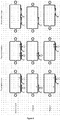
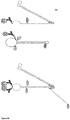
- the antibodies are chosen against the proteins one intends to study. For the proteins that are not interacting only one tag will be incorporated into the IR circle ( Figure 1 ).
- the IR circle can be cut open by either a nicking endonuclease that only cleaves one of the strands in its double stranded target.
- a nick could be created by removing a uracil base with the help of the enzyme combination UNG and EndolV.
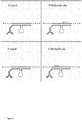
- the nicking endonucleases the inventors tested two different enzymes: Nb.BsrDl, which will make a cut on the 3' side of the hairpin (3' Nb.BsrDI), and Nt.BsmAl, which cuts on the 5' side (5' Nt.BsmAl).
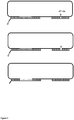
- the inventors also tested the efficiency in cleavage by incorporating the uracil base in either the 3' side or the 5' side (3'Uracil and 5'Uracil) in relation to the hairpin. ( Figure 2 ). With the help of Nupack.org, the inventors designed and analyzed all the oligonucleotide sequences to ensure correct secondary structures and hybridizations (Table 1).
- the recreated IR circles, containing the incorporated tags, can then be amplified by rolling circle amplification (RCA), primed from one of the IC probes.
- the RCA products contain several hundred complementary repeats of the IR.
- the identities of the RCA products can then be decoded by hybridization of labeled detection oligonucleotides, complementary to the parts of the RCA product where the tags have been incorporated.
- the labeling of the detection oligonucleotides could be e.g. different fluorophores, enzymes or molecules with different masses, depending upon which read-out will be used.
- Single labeled RCA product will be a result of only one incorporated tag while dual labeled RCA products will be a consequence of incorporation of two tags.
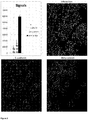
- FIG. 3 An example of how the result can look like is shown in Figure 3 .
- the inventors used 5' uracil design, conjugating the IC oligonucleotides to anti-mouse and anti-rabbit antibodies. These IC probes were tested on the MCF10 cell line labeled with a mouse antibody targeting E-cadherin and a rabbit antibody targeting ⁇ -Catenin. Complexes containing ⁇ -catenin and E-cadherin will result in RCA products detected with both Cy3 and FITC, while the non-interacting proteins gave rise to RCA products labeled with either Cy3 or FITC.
- RCA products were determined using the software CellProfiler and the different types of RCA products were pseudo-colored to visualize interaction between ⁇ -catenin and E-cadherin as well as the individual proteins, ⁇ -Catenin and E-Cadherin.
- An alternative approach to extract the information is to use an IR circle or linear IR molecule to interrogate proximity between IC probes. After ligation of tag sequences the recreated IR molecule can be amplified by PCR and separated by gel electrophoresis. Differences in size will indicate incorporation of different tags. It would also be possible to amplify single IR molecules and decode the identities of different tags by sequencing of the amplicons.
- the MolBoolean analyses can be performed in cells, in mixtures of proteins (either in bulk mixtures or separated e.g. by gel electrophoresis).
- the recreated IR molecules can either be interrogated directly in the sample where they have been formed (e.g. by microscopy, as shown in Figure 3 ) if the read-out platform supports single molecule detection, or the recreated IR molecules can be collected and single molecules can subsequently be sorted and analyzed individually.
- abasic sites (AP sites) in the IR molecule can interfere with the amplification and/or detection efficiency.
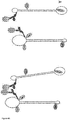
- the inventors modified the design with an alternative design version ( Figure 5 ).
- two steps were added after the step where the tags are incorporated.
- a digestion template was hybridized to the DNA circle, making the area around the AP site double stranded.
- the abasic site was thereafter removed by digestion by EndolV.
- the gap-fill was performed with T4 DNA polymerase to add the missing thymidine and with T4 ligase to close the nick by ligation.
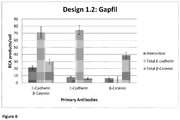
- the gap-fill design was evaluated using the previously described E-cadherin and ⁇ -catenin interaction assay ( Figure 6 ). E-cadherin and ⁇ -catenin interaction was detected together with a noticeably higher amount of total E-cadherin, which was equal to the total amount E-cadherin when only that antibody was present. Likewise, the total amount of ⁇ -catenin remains on a comparable level in both conditions where that antibody was used.
- the inventors developed an alternative approach to monitor both free and interacting proteins.
- the IC oligonucleotides that are connected to the antibodies are designed to contain hairpin structures.
- the fluorophores will be allowed to emit light only if they are separated in distance from the quenchers.
- the positioning of fluorophores and quenchers will facilitate that only one fluorophore of each such IC oligonucleotide will be allowed to emit light.
- the destabilized/activated first IC oligonucleotide will hybridize to the second IC oligonucleotide, only if they are bound to target molecules in close proximity, which will reposition the fluorophores and quenchers so that the ones that previously emitted light now are quenched and one fluorophores that was quenched in one of the IC oligonucleotide gets separated from the quencher.
- This fluorophore will only be able to emit light if a pair of IC oligonucleotides is hybridized to each other. Hence, the fluorescence of free and interacting proteins can be recorded simultaneously at different wavelengths.
- This method herein called Invader-MolBoolean is described in Figure 4 .
- the inventors designed and analyzed all the oligonucleotide sequences to ensure correct secondary structures and hybridizations (Table 1).
- the information receiving DNA circle was created by ligating two single stranded pieces (i.e. IR circle piece 1 and 2 (see Table1)), which carries motifs that will ensure proper hybridization, i.e. the two hairpin structures in the circle.
- the two oligonucleotides were mixed together at a final concentration of 1 ⁇ M in T4 Ligation buffer. Thereafter 0.02 U/ ⁇ l of T4 ligase was added in the mix and it was incubated for 2 h at 37°C followed by 48 h incubation at 4°C.
- the buffer was exchanged to 100 mM NaHPO4, 150 mM NaCl, pH 6.0 buffer by prewashed Zeba Spin Desalting Columns 7K MWCO (Thermo Scientific). Subsequently to the buffer exchange the antibody was mixed with an aldehyde modified oligonucleotide (Table 1) at an antibody:oligonucleotide ratio of 1:3. Aniline was added, at a final concentration of 10 mM, to catalyze the reaction. The antibody oligonucleotide mix was incubated with gentle agitation at room temperature, and protected from light, for 2 hours.
- the buffer were exchanged to PBS using prewashed Zeba Spin Desalting Columns 7K MWCO (Life Technologies).
- conjugates were purified from unconjugated antibody and oligonucleotide by ⁇ KTA Pure HPLC (GE Healthcare, Uppsala, Sweden) using Superdex 200 10/300 column (GE Healthcare).
- the collected fractions from the HPLC purification were concentrated to 80 ⁇ l by Amicon Ultra 10K centrifugal filter unit (Merck Millipore) according to manufacturer's instructions and validated by electrophoresis.
- the conjugates were mixed with Novex TBE-Urea Sample buffer (Life Technologies) and separated on Novex TBE-Urea Gel 10% (Life Technologies) by 180 V for 50 minutes.
- the Molboolean IC probes were mixed in blocking solution, at a final concentration of 100 ng/ml, and incubated with the cells for 60 minutes at 37 °C. The slides were then washed three times, for three minutes, in TBST.
- the Molboolean IR circle was diluted to 0.025 ⁇ M in T4 ligation buffer supplemented with 0.25 mg/ml of BSA to allow for hybridization of the circle to the IC probes while incubating it for 30 minutes at 37°C with the cells. The cells are thereafter washed twice in TBST for three minutes each and are then incubated with digestion enzymes dependent on the design at 37°C.
- the 5'Uracil design is digested by 0.1 U/ ⁇ l of Endo IV and 0.05 U/ ⁇ l UNG in 20 mM Tris-HCI (pH 7,6) buffer with 30 mM NaCl, 1mM EDTA, 100mM KCI, 1mM DTT and 0.25 mg/ml of BSA fo 45 min before washing. While, the 5' Nt.BsmAI design is incubated with 0.125 U/ ⁇ l Nt.BsmAI enzyme diluted in 1x NEBuffer Cut smart supplemented with 0.25 mg/ml BSA for 1 h.
- the cells were washed for 3 min twice in TBST and were thereafter incubated for 30 min at 37°C with Tag 1 and 2 both at 0.125 ⁇ M in the presence of 0.05 U/ ⁇ L T4 Ligase in T4 ligation buffer supplemented with 0.25mg/ml BSA. After ligation, there is another wash in TBST (2x3min).
- the gap-fill design introduces two extra steps.
- the slides were incubated with 0.05 ⁇ M of digestion template together with 0.01 U/ ⁇ l of Endo IV in 20 mM Tris-HCI (pH 7,6) buffer with 30 mM NaCl, 1 mM EDTA, 100 mM KCI, 1 mM DTT and 0.25 mg/ml of BSA for 60 min at RT.
- the slides were washed three times for 3 min in TBST.
- the slides were incubated with 0.025 U/ ⁇ l T4 DNA polymerase and 0.05 U/ ⁇ l T4 ligase in 1xT4 ligase buffer supplemented with 0.25mg/ml BSA and 0.1 mM dNTP for 30 min at RT. The cells were thereafter washed twice in TBST for 3 min each.
- a RCA reaction is performed on the newly formed circles to amplify the signal for 60 min at 37°C.
- the RCA is catalyzed by 0.5 U/ ⁇ l phi29 in the following solution: 33 mM Tris-, 10 mM Mg-acetate, 66 mM K-acetate, 0.1% Tween 20, 1 mM DTT, 7.5 ng/ml PolyA, and 0.25 mM dNTP. It was washed twice for three minutes in TBST.
- the RCA products were detected by hybridizing 0.025 ⁇ M DO1 and 2 to it in PBS supplemented with 0.0025 ⁇ g/ml salmon sperm DNA and 0.25mg/ml BSA, and the mixture also contained 0.04 mg/ml Hoechst 33342 for nuclei staining.
Landscapes
- Life Sciences & Earth Sciences (AREA)
- Health & Medical Sciences (AREA)
- Chemical & Material Sciences (AREA)
- Engineering & Computer Science (AREA)
- Organic Chemistry (AREA)
- Molecular Biology (AREA)
- Genetics & Genomics (AREA)
- Zoology (AREA)
- Wood Science & Technology (AREA)
- Bioinformatics & Cheminformatics (AREA)
- Biotechnology (AREA)
- Immunology (AREA)
- Biomedical Technology (AREA)
- Physics & Mathematics (AREA)
- General Engineering & Computer Science (AREA)
- Biochemistry (AREA)
- Microbiology (AREA)
- Biophysics (AREA)
- Analytical Chemistry (AREA)
- General Health & Medical Sciences (AREA)
- Proteomics, Peptides & Aminoacids (AREA)
- Bioinformatics & Computational Biology (AREA)
- Pathology (AREA)
- Hematology (AREA)
- Urology & Nephrology (AREA)
- Crystallography & Structural Chemistry (AREA)
- Plant Pathology (AREA)
- Cell Biology (AREA)
- Medicinal Chemistry (AREA)
- General Physics & Mathematics (AREA)
- Food Science & Technology (AREA)
- Measuring Or Testing Involving Enzymes Or Micro-Organisms (AREA)
Claims (16)
- Verfahren zur Bestimmung des Ausmaßes an Wechselwirkungen zwischen Biomolekülen, wie etwa Proteinen, in einer Probe, wobei im Rahmen desselben ein erstes und ein zweites informationstragendes (IC) Oligonukleotid bereitgestellt werden, wobei die ersten und zweiten IC-Oligonucleotide, auf kovalente oder nicht-kovalente Weise, an einem ersten und einem zweiten Affinitätsreagenz, wie etwa Antikörpern, befestigt sind, welche dazu befähigt sind, an ein erstes und ein zweites Biomolekül zu binden, wobei das erste und das zweite IC-Oligonukleotid jeweils mindestens einen einzelsträngigen Abschnitt umfassen, welcher komplementär zu einem Teilbereich entweder eines informationsempfangenden (IR) Oligonukleotids oder eines aktivierenden Oligonukleotids ist, sodass eine Hybridisierung des mindestens einen einzelsträngigen Abschnitts in mindestens einem der ersten und zweiten IC-Oligonukleotide mit seinem komplementären Teilbereich eines anderen Oligonukleotids es ermöglicht, den relativen Anteil an wechselwirkenden und nicht-wechselwirkenden ersten und zweiten Biomolekülen in der Probe auf der Ebene einer einzigen Zelle oder eines einzigen Moleküls zu messen, wobei der einzelsträngige Abschnitt der ersten und zweiten IC-Oligonukleotide Wechselwirkungen der folgenden Art ermöglicht(a) zwischen dem ersten und/oder zweiten IC-Oligonukleotid und einem informationsempfangenden (IR) Oligonukleotid, wobei das (IR)-Oligonukleotid mit mindestens zwei Spaltungsbaustein-Stellen versehen ist, die bei der Hybridisierung an ein IC-Oligonukleotid doppelsträngig werden, um eine Spaltung zu ermöglichen, oder(b) zwischen dem ersten und/oder zweiten IC-Oligonukleotid und einem aktivierenden Oligonukleotid, wobei die IC-Oligonukleotide, welche an die Antikörper gebunden sind, derart ausgelegt sind, dass sie Haarnadelstrukturen enthalten, und wobei die IC-Oligonukleotide mit Fluorophoren und Quenchern modifiziert sind, welche derart angeordnet sind, dass pro Molekül nur ein Fluorophore Licht aussenden kann, wobei die Hybridisierung zwischen dem ersten und/oder zweiten IC-Oligonukleotid und dem aktivierenden Oligonukleotid eine derartige Umstrukturierung der Positionen von Fluorophoren und Quenchern bewirkt, dass das eine signalgebende Fluorophor eine Unterscheidung zwischen wechselwirkenden und nicht-wechselwirkenden Biomolekülen ermöglicht.
- Verfahren gemäß Anspruch 1, welches die folgenden Schritte umfasst:a. Bereitstellen des einzelsträngigen informationsempfangenden (IR) DNA-Moleküls, wobei das IR-DNA-Molekül kreisförmig oder geradkettig ist, mit mindestens einem ersten und einem zweiten Spaltungsbaustein versehen ist, wobei die Spaltungsbausteine derart ausgewählt sind, dass die Spaltungsbaustein-Stellen doppelsträngig werden müssen, um eine Spaltung zu ermöglichen;b. Bereitstellen des ersten informationstragenden (IC) DNA-Moleküls, welches einen einzelsträngigen Abschnitt umfasst, der komplementär zu dem Teilbereich des IR-DNA-Moleküls ist, welches mit dem ersten Spaltungsbaustein versehen ist, wobei die Häufigkeit des ersten IC-DNA-Moleküls die Menge eines ersten Biomoleküls in der Probe widerspiegelt;c. Bereitstellen des zweiten informationstragenden (IC)-DNA-Moleküls, welches einen einzelsträngigen Abschnitt umfasst, der komplementär zu dem Teilbereich des IR-DNA-Moleküls ist, welches mit dem zweiten Spaltungsbaustein versehen ist, wobei die Häufigkeit des zweiten IC-DNA-Moleküls die Menge eines zweiten Biomoleküls in der Probe widerspiegeltd. Mischen der DNA-Moleküle der Schritte a bis c unter Bedingungen, die eine Bindung komplementärer einzelsträngiger Abschnitte ermöglichen;e. Zusetzen eines/von verdauend wirkenden Enzyms/Enzymen, um (einen) Einzelstrangbruch/Einzelstrangbrüche an der/den Spaltungsbaustein-Stelle(n) zu erzeugen, welche doppelsträngig geworden ist/sind, um auf diese Weise Folgendes zu bildeni. eine erste Reporter-tag-bindende Stelle, die eine Bindung eines ersten Reporter-tag-DNA-Moleküls oder einer solchen Sequenz ermöglichen wird, welche(s) einen einzelsträngigen Abschnitt umfasst, der komplementär zu einem Teilbereich des ersten IC-DNA-Moleküls ist, und/oderii. eine zweite Reporter-tag-bindende Stelle, die eine Bindung eines zweiten Reporter-tag-DNA-Moleküls oder einer solchen Sequenz ermöglichen wird, welche(s) einen einzelsträngigen Abschnitt umfasst, der komplementär zu einem Teilbereich des zweiten IC-DNA-Moleküls ist;f. Einfügen von Reporter-tag-DNA-Sequenzen mittels einer der folgenden Alternativen:i. Hinzufügen des ersten Reporter-tag-DNA-Moleküls und des zweiten Reporter-tag-DNA-Moleküls, wobei das erste Reporter-tag-DNA-Molekül an der ersten Reporter-tag-bindenden Stelle in das IR-DNA-Molekül eingefügt wird, wenn an der ersten Spaltungsbaustein-Stelle ein Einzelstrangbruch erzeugt wurde, und/oder das zweite Reporter-tag-DNA-Molekül an der zweiten Reporter-tag-bindenden Stelle in das IR-DNA-Molekül eingefügt wird, wenn an der zweiten Spaltungsbaustein-Stelle ein Einzelstrangbruch erzeugt wurde; oderii. Verwenden einer DNA-Polymerase und von Nukleotiden, um die erste Reporter-tag-DNA-Sequenz in das IR-DNA-Molekül einzufügen, indem die Lücke, welche komplementär zu der ersten Reporter-tag-bindenden Stelle auf dem ersten IC-Oligonukleotid ist, gefüllt wird, wenn an der ersten Spaltungsbaustein-Stelle ein Einzelstrangbruch erzeugt wurde, und/oder um die zweite Reporter-tag-DNA-Sequenz in das IR-DNA-Molekül einzufügen, indem die Lücke, welche komplementär zu der zweiten Reporter-tag-bindenden Stelle auf dem zweiten IC-Oligonukleotid ist, gefüllt wird, wenn an der zweiten Spaltungsbaustein-Stelle ein Einzelstrangbruch erzeugt wurde; und Zusetzen eines Ligationsenzyms, welches das IR-DNA-Molekül ligiert, um auf diese Weise ein wiederhergestelltes IR-DNA-Molekül bereitzustellen;g. möglicherweise Vervielfältigen des wiederhergestellten IR-DNA-Moleküls des Schrittes f;h. Überwachen des Einfügens des/der ersten und/oder zweiten Reporter-tag-Element(s)/Elemente in das wiederhergestellte IR-DNA-Molekül, anhand einer Messung der Häufigkeit des ersten und/oder zweiten Biomoleküls/Biomoleküle in der Probe und/oder der Wechselwirkung zwischen diesen.
- Verfahren gemäß Anspruch 2, wobei die Spaltungsbausteine aus Uracil-Einheiten oder Restriktionsstellen ausgewählt sind.
- Verfahren gemäß Anspruch 2 oder 3, wobei das/die verdauend wirkende(n) Enzyme(e), welche(s) dazu verwendet wird/werden, Einzelstrangbrüche an den Spaltungsbaustein-Stellen zu erzeugen, aus Folgendem ausgewählt ist/sindi. Nicking-Endonuklease 3'-Nb.Bsr.DI, welche einen 3'-seitigen Einzelstrangbruch bei einer doppelsträngigen Restriktionsstelle bewirkt,ii. Nicking-Endonuklease 5'-Nb.BsmAI, welche einen 5'-seitigen Einzelstrangbruch bei einer doppelsträngigen Restriktionsstelle bewirkt, oderiii. einer Kombination aus Uracil-DNA-Glycosylase (UDG), welche eine Uracil-Base an einer doppelsträngigen Stelle entfernt, und EndolV, welche die apyrimidinische Stelle entfernt.
- Verfahren gemäß einem beliebigen der Ansprüche 2 bis 4, wobei das Überwachen erfolgt, indema. ein erstes markiertes Detektionsoligonukleotid, das komplementär zu mindestens einem Teilbereich des ersten Reporter-tag-DNA-Moleküls ist, und ein zweites markiertes Detektionsoligonukleotid, das komplementär zu mindestens einem Teilbereich des zweiten Reporter-tag-DNA-Moleküls ist, bereitgestellt werden, undb. die ersten und zweiten markierten Detektionsoligonukleotide mit dem wiederhergestellten IR-DNA-Molekül hybridisiert werden, welches möglicherweise vervielfältigt wird.
- Verfahren gemäß einem beliebigen der Ansprüche 2 bis 5, wobei ein geradkettiges wiederhergestelltes IR-DNA-Molekül vervielfältigt und danach mittels eines Trennverfahrens wie etwa Elektrophorese oder Chromatographie aufgetrennt wird, wobei Auftrennungsprodukte, welche verschiedene Größen haben, das Einfügen verschiedenartiger Reporter-tags anzeigen.
- Verfahren gemäß einem beliebigen der Ansprüche 2 bis 6, wobei die Identitäten verschiedenartiger Reporter-tags durch Sequenzierung überwacht werden.
- Verfahren gemäß einem beliebigen der Ansprüche 2 bis 7, wobei das wiederhergestellte IR-DNA-Molekül in der Probe überwacht wird, in welcher es gebildet wurde, wie etwa mittels Mikroskopie, oder wobei das wiederhergestellte IR-DNA-Molekül ausgehend von der Probe gewonnen wird, in welcher es gebildet wurde, woraufhin die einzelnen Moleküle klassiert und untersucht werden, wie etwa mittels Mikroskopie.
- Verfahren gemäß einem beliebigen der Ansprüche 2 bis 8, zum Entfernen abasischer Stellen und Verbessern des Detektionswirkungsgrades, wobei nach dem Zusetzen der Reporter-tag-Moleküle und dem Einfügen des/der ersten und/oder zweiten Reporter-tags in das IR die folgenden Schritte durchgeführt werden:i. Hybridisieren einer Verdau-Vorlage an das IR-DNA-Molekül, sodass der Bereich rundum die verbleibende abasische Stelle doppelsträngig wird;ii. Entfernen der abasischen Stelle, indem der doppelsträngige Bereich mittels eines zweckmäßigen Restriktionsenzyms, wie etwa EndolV, verdaut wird;iii. Füllen der Lücke des verdauten Bereichs mit einer zweckmäßigen Polymerase, wie etwa T4-DNA-Polymerase, um die fehlende Base, wie etwa Thymidin, hinzuzufügen; und Ligieren des IR-DNA-Moleküls mit einer Ligase, wie etwa der T4-Ligase, um ein wiederhergestelltes IR-DNA-Molekül bereitzustellen.
- Verfahren gemäß Anspruch 1,a. wobei die ersten und zweiten IC-Oligonukleotide Haarnadelstrukturen umfassen, in welchen Fluorophore und Quencher angeordnet sind, wobei die Haarnadelstrukturen derart ausgelegt sind, dass pro Oligonukleotid nur ein Fluorophor Licht aussenden kann, und wobei jedes Fluorophor ein einzigartiges Signal hat;b. wobei die Haarnadeln in den ersten und zweiten IC-Oligonukleotiden aufgebrochen oder destabilisiert werden, indem ein aktivierendes Oligonukleotid bereitgestellt wird, das komplementär zum ersten oder zum zweiten IC-Oligonukleotid ist, um auf diese Weise derart an das erste oder das zweite IC-Oligonukleotid zu binden, dass die ersten und zweiten IC-Oligonukleotide miteinander in Wechselwirkung treten können, wodurch ein Neuanordnung von Fluorophoren und Quenchern bewirkt wird;c. wobei Paare von Konjugaten, die Affinitätsreagenzien umfassen, welche an das erste oder zweite IC-Oligonukleotid gekuppelt sind, dazu verwendet werden, die Nähe zwischen zwei Biomolekülen abzufragen, an welche die Affinitätsreagenzien binden, wobei sich ein erstes Muster von Fluorophorensignalen zeigen wird, wenn es zu einer Wechselwirkung zwischen dem ersten und zweiten Biomolekül kommt, und sich ein zweites Muster von Fluorophorensignalen zeigen wird, wenn es an Wechselwirkungen zwischen dem ersten und zweiten Biomolekül fehlt, wobei dies darauf zurückzuführen ist, dass die Oligonukleotide infolge einer Wechselwirkung zwischen dem ersten und zweiten Biomolekül, die eine Umstrukturierung der Positionen von Fluorophoren und Quenchern bewirkt, miteinander hybridisieren.
- Verfahren gemäß einem beliebigen der vorhergehenden Ansprüche, wobei es sich bei dem ersten und dem zweiten Biomolekül um Proteine oder Polypeptide handelt.
- Verfahren gemäß einem beliebigen der vorhergehenden Ansprüche, wobei es sich bei der Probe um eine biologische Probe von einer oder mehreren Zellen oder um eine Mischung von Proteinen handelt.
- Verfahren gemäß einem beliebigen der vorhergehenden Ansprüche, wobei das erste IC-DNA-Molekül mit einem ersten Antikörpermolekül konjugiert ist, welches dem ersten Biomolekül entspricht oder gegen dieses gerichtet ist, und das zweite IC-DNA-Molekül mit dem zweiten Antikörpermolekül konjugiert ist, welches dem zweiten Biomolekül entspricht oder gegen dieses gerichtet ist.
- Verfahren gemäß einem beliebigen der vorhergehenden Ansprüche, um Protein-Protein-Wechselwirkungen bei einzelnen Zellen oder einzelnen Molekülen zu untersuchen.
- Kit zur Verwendung in dem Verfahren nach einem beliebigen der Ansprüche bis 9, 11 bis 14, umfassenda. ein einzelsträngiges informationsempfangendes (IR) DNA-Molekül, das mit einem ersten und einem zweiten Spaltungsbaustein versehen ist;b. ein erstes und ein zweites informationstragendes (IC) DNA-Molekül, welches die Mengen an einem ersten und einem zweiten Biomolekül in einer Probe widerspiegelt, wobei die ersten und zweiten IC-DNA-Moleküle mit Affinitätsreagenzien konjugiert sind oder mit chemischen Gruppen versehen sind, die vom Anwender des Kits zu konjugieren sind;c. möglicherweise Enzyme zum Erzeugen von Einzelstrangbrüchen an den Spaltungsbaustein-Stellen in dem IR-DNA-Molekül;d. ein erstes und ein zweites Reporter-tag-DNA-Molekül;e. möglicherweise Reagenzien für eine Vervielfältigung eines wiederhergestellten IR-DNA-Moleküls;f. möglicherweise ein erstes und ein zweites markiertes Detektionsoligonukleotid; und g. möglicherweise (ein) DNA-Molekül(e) und Enzyme zum Entfernen abasischer Stellen.
- Kit zur Verwendung in dem Verfahren nach einem beliebigen der Ansprüche 1, 10 bis 14, umfassenda. ein erstes und ein zweites informationstragendes (IC) DNA-Molekül, das Haarnadelstrukturen umfasst, in welchen Fluorophore und Quencher angeordnet sind, wobei die Haarnadelstrukturen derart ausgelegt sind, dass pro Oligonukleotid nur ein Fluorophor Licht aussenden kann, und wobei jedes Fluorophor ein einzigartiges Signal hat, wobei es auf diese Weise dazu befähigt ist, die Mengen eines ersten und eines zweiten Biomoleküls in einer Probe widerzuspiegeln, wobei die ersten und zweiten IC-DNA-Moleküle mit einem Affinitätsreagenz konjugiert sind oder mit chemischen Gruppen versehen sind, welche von einem Anwender des Kits zu konjugieren sind; undb. ein aktivierendes Oligonukleotid, das komplementär zu dem ersten oder dem zweiten IC-DNA-Molekül ist, sodass es dazu befähigt ist, an das erste oder zweite IC-DNA-Molekül zu binden.
Applications Claiming Priority (2)
| Application Number | Priority Date | Filing Date | Title |
|---|---|---|---|
| SE1750122 | 2017-02-09 | ||
| PCT/SE2018/050121 WO2018147794A1 (en) | 2017-02-09 | 2018-02-09 | Method for determining levels of interactions between biomolecules |
Publications (2)
| Publication Number | Publication Date |
|---|---|
| EP3580356A1 EP3580356A1 (de) | 2019-12-18 |
| EP3580356B1 true EP3580356B1 (de) | 2021-03-31 |
Family
ID=61244675
Family Applications (1)
| Application Number | Title | Priority Date | Filing Date |
|---|---|---|---|
| EP18706005.8A Active EP3580356B1 (de) | 2017-02-09 | 2018-02-09 | Verfahren zur bestimmung von interaktionen zwischen biomolekülen |
Country Status (10)
| Country | Link |
|---|---|
| US (1) | US20220042069A1 (de) |
| EP (1) | EP3580356B1 (de) |
| JP (1) | JP2020511122A (de) |
| KR (1) | KR102513181B1 (de) |
| CN (1) | CN110506124B (de) |
| AU (1) | AU2018218875B2 (de) |
| CA (1) | CA3051350A1 (de) |
| ES (1) | ES2870557T3 (de) |
| SG (1) | SG11201906689SA (de) |
| WO (1) | WO2018147794A1 (de) |
Families Citing this family (3)
| Publication number | Priority date | Publication date | Assignee | Title |
|---|---|---|---|---|
| CN117136240A (zh) * | 2021-03-19 | 2023-11-28 | 巴黎科学与文学联大 | 用于选择性分析细胞或细胞器的方法 |
| GB202213956D0 (en) | 2022-09-23 | 2022-11-09 | Xu Bo | Molecular interaction detection and profiling |
| WO2025098646A1 (en) * | 2023-11-11 | 2025-05-15 | Leica Microsystems Cms Gmbh | Method for detecting analytes |
Citations (1)
| Publication number | Priority date | Publication date | Assignee | Title |
|---|---|---|---|---|
| WO2006137932A2 (en) * | 2004-11-03 | 2006-12-28 | Leucadia Technologies, Inc. | Homogeneous analyte detection |
Family Cites Families (2)
| Publication number | Priority date | Publication date | Assignee | Title |
|---|---|---|---|---|
| US20080293051A1 (en) | 2005-08-30 | 2008-11-27 | Board Of Regents, The University Of Texas System | proximity ligation assay |
| GB201401885D0 (en) * | 2014-02-04 | 2014-03-19 | Olink Ab | Proximity assay with detection based on hybridisation chain reaction (HCR) |
-
2018
- 2018-02-09 US US16/483,005 patent/US20220042069A1/en not_active Abandoned
- 2018-02-09 CN CN201880024128.8A patent/CN110506124B/zh active Active
- 2018-02-09 AU AU2018218875A patent/AU2018218875B2/en active Active
- 2018-02-09 JP JP2019543343A patent/JP2020511122A/ja active Pending
- 2018-02-09 CA CA3051350A patent/CA3051350A1/en active Pending
- 2018-02-09 WO PCT/SE2018/050121 patent/WO2018147794A1/en not_active Ceased
- 2018-02-09 SG SG11201906689SA patent/SG11201906689SA/en unknown
- 2018-02-09 KR KR1020197024821A patent/KR102513181B1/ko active Active
- 2018-02-09 EP EP18706005.8A patent/EP3580356B1/de active Active
- 2018-02-09 ES ES18706005T patent/ES2870557T3/es active Active
Patent Citations (1)
| Publication number | Priority date | Publication date | Assignee | Title |
|---|---|---|---|---|
| WO2006137932A2 (en) * | 2004-11-03 | 2006-12-28 | Leucadia Technologies, Inc. | Homogeneous analyte detection |
Also Published As
| Publication number | Publication date |
|---|---|
| JP2020511122A (ja) | 2020-04-16 |
| SG11201906689SA (en) | 2019-08-27 |
| AU2018218875B2 (en) | 2023-12-07 |
| CN110506124B (zh) | 2024-04-02 |
| CN110506124A (zh) | 2019-11-26 |
| ES2870557T3 (es) | 2021-10-27 |
| KR102513181B1 (ko) | 2023-03-23 |
| KR20190120214A (ko) | 2019-10-23 |
| WO2018147794A1 (en) | 2018-08-16 |
| AU2018218875A1 (en) | 2019-08-22 |
| EP3580356A1 (de) | 2019-12-18 |
| CA3051350A1 (en) | 2018-08-16 |
| US20220042069A1 (en) | 2022-02-10 |
Similar Documents
| Publication | Publication Date | Title |
|---|---|---|
| US7883848B2 (en) | Regulation analysis by cis reactivity, RACR | |
| US20240368682A1 (en) | Systems and methods for clonal replication and amplification of nucleic acid molecules for genomic and therapeutic applications | |
| JP6457564B2 (ja) | エキソヌクレアーゼを用いた近接伸長アッセイ | |
| US20220195498A1 (en) | Methods and compositions for analyte detection | |
| KR101041106B1 (ko) | 핵산과 단백질의 신규한 실시간 탐지방법 | |
| US9951376B2 (en) | Methods for the selection of aptamers | |
| US8211644B2 (en) | Molecular beacon-based methods for detection of targets using abscription | |
| CN121109552A (zh) | 用于邻近检测测定的对照 | |
| EP3580356B1 (de) | Verfahren zur bestimmung von interaktionen zwischen biomolekülen | |
| JP5088034B2 (ja) | 物質の検出等に有用な核酸鎖とその方法 | |
| Conze et al. | Analysis of genes, transcripts, and proteins via DNA ligation | |
| JP2003325200A (ja) | 新規高感度核酸解析法 | |
| Li et al. | Interference reduction isothermal nucleic acid amplification strategy for COVID-19 variant detection | |
| KR102672338B1 (ko) | 분할된 t7 프로모터를 이용한 중증 급성 호흡기 증후군 코로나바이러스 2 검출 및/또는 이의 돌연변이 검출용 등온 단일 반응 프로브 세트 및 이의 용도 | |
| EP4590848A1 (de) | Nachweis und profilierung molekularer wechselwirkungen | |
| HK40016108A (en) | Method for determining levels of interactions between biomolecules | |
| HK40016108B (zh) | 用於确定生物分子之间的相互作用水平的方法 | |
| JP2005528103A (ja) | 標的分子および分子相互作用を検出する方法 | |
| JP2020178681A (ja) | 核酸検出方法、及び試薬キット | |
| Karhunen | Switchable Lanthanide Luminescence for Detection of Biomolecules | |
| WO2014025001A1 (ja) | 核酸配列の切断標識方法 | |
| JP2001314190A (ja) | 転写調節因子とdnaの結合を検出するための蛍光プローブおよび転写調節因子とdnaの結合を検出する方法 |
Legal Events
| Date | Code | Title | Description |
|---|---|---|---|
| STAA | Information on the status of an ep patent application or granted ep patent |
Free format text: STATUS: UNKNOWN |
|
| STAA | Information on the status of an ep patent application or granted ep patent |
Free format text: STATUS: THE INTERNATIONAL PUBLICATION HAS BEEN MADE |
|
| PUAI | Public reference made under article 153(3) epc to a published international application that has entered the european phase |
Free format text: ORIGINAL CODE: 0009012 |
|
| STAA | Information on the status of an ep patent application or granted ep patent |
Free format text: STATUS: REQUEST FOR EXAMINATION WAS MADE |
|
| 17P | Request for examination filed |
Effective date: 20190905 |
|
| AK | Designated contracting states |
Kind code of ref document: A1 Designated state(s): AL AT BE BG CH CY CZ DE DK EE ES FI FR GB GR HR HU IE IS IT LI LT LU LV MC MK MT NL NO PL PT RO RS SE SI SK SM TR |
|
| AX | Request for extension of the european patent |
Extension state: BA ME |
|
| DAV | Request for validation of the european patent (deleted) | ||
| DAX | Request for extension of the european patent (deleted) | ||
| STAA | Information on the status of an ep patent application or granted ep patent |
Free format text: STATUS: EXAMINATION IS IN PROGRESS |
|
| 17Q | First examination report despatched |
Effective date: 20200914 |
|
| GRAP | Despatch of communication of intention to grant a patent |
Free format text: ORIGINAL CODE: EPIDOSNIGR1 |
|
| STAA | Information on the status of an ep patent application or granted ep patent |
Free format text: STATUS: GRANT OF PATENT IS INTENDED |
|
| INTG | Intention to grant announced |
Effective date: 20201102 |
|
| GRAS | Grant fee paid |
Free format text: ORIGINAL CODE: EPIDOSNIGR3 |
|
| GRAA | (expected) grant |
Free format text: ORIGINAL CODE: 0009210 |
|
| STAA | Information on the status of an ep patent application or granted ep patent |
Free format text: STATUS: THE PATENT HAS BEEN GRANTED |
|
| AK | Designated contracting states |
Kind code of ref document: B1 Designated state(s): AL AT BE BG CH CY CZ DE DK EE ES FI FR GB GR HR HU IE IS IT LI LT LU LV MC MK MT NL NO PL PT RO RS SE SI SK SM TR |
|
| REG | Reference to a national code |
Ref country code: GB Ref legal event code: FG4D Ref country code: CH Ref legal event code: EP |
|
| REG | Reference to a national code |
Ref country code: AT Ref legal event code: REF Ref document number: 1376987 Country of ref document: AT Kind code of ref document: T Effective date: 20210415 |
|
| REG | Reference to a national code |
Ref country code: DE Ref legal event code: R096 Ref document number: 602018014730 Country of ref document: DE |
|
| REG | Reference to a national code |
Ref country code: IE Ref legal event code: FG4D |
|
| REG | Reference to a national code |
Ref country code: SE Ref legal event code: TRGR |
|
| REG | Reference to a national code |
Ref country code: LT Ref legal event code: MG9D |
|
| PG25 | Lapsed in a contracting state [announced via postgrant information from national office to epo] |
Ref country code: BG Free format text: LAPSE BECAUSE OF FAILURE TO SUBMIT A TRANSLATION OF THE DESCRIPTION OR TO PAY THE FEE WITHIN THE PRESCRIBED TIME-LIMIT Effective date: 20210630 Ref country code: FI Free format text: LAPSE BECAUSE OF FAILURE TO SUBMIT A TRANSLATION OF THE DESCRIPTION OR TO PAY THE FEE WITHIN THE PRESCRIBED TIME-LIMIT Effective date: 20210331 Ref country code: HR Free format text: LAPSE BECAUSE OF FAILURE TO SUBMIT A TRANSLATION OF THE DESCRIPTION OR TO PAY THE FEE WITHIN THE PRESCRIBED TIME-LIMIT Effective date: 20210331 Ref country code: NO Free format text: LAPSE BECAUSE OF FAILURE TO SUBMIT A TRANSLATION OF THE DESCRIPTION OR TO PAY THE FEE WITHIN THE PRESCRIBED TIME-LIMIT Effective date: 20210630 |
|
| PG25 | Lapsed in a contracting state [announced via postgrant information from national office to epo] |
Ref country code: RS Free format text: LAPSE BECAUSE OF FAILURE TO SUBMIT A TRANSLATION OF THE DESCRIPTION OR TO PAY THE FEE WITHIN THE PRESCRIBED TIME-LIMIT Effective date: 20210331 Ref country code: LV Free format text: LAPSE BECAUSE OF FAILURE TO SUBMIT A TRANSLATION OF THE DESCRIPTION OR TO PAY THE FEE WITHIN THE PRESCRIBED TIME-LIMIT Effective date: 20210331 |
|
| REG | Reference to a national code |
Ref country code: NL Ref legal event code: MP Effective date: 20210331 |
|
| REG | Reference to a national code |
Ref country code: AT Ref legal event code: MK05 Ref document number: 1376987 Country of ref document: AT Kind code of ref document: T Effective date: 20210331 |
|
| REG | Reference to a national code |
Ref country code: ES Ref legal event code: FG2A Ref document number: 2870557 Country of ref document: ES Kind code of ref document: T3 Effective date: 20211027 |
|
| PG25 | Lapsed in a contracting state [announced via postgrant information from national office to epo] |
Ref country code: LT Free format text: LAPSE BECAUSE OF FAILURE TO SUBMIT A TRANSLATION OF THE DESCRIPTION OR TO PAY THE FEE WITHIN THE PRESCRIBED TIME-LIMIT Effective date: 20210331 Ref country code: EE Free format text: LAPSE BECAUSE OF FAILURE TO SUBMIT A TRANSLATION OF THE DESCRIPTION OR TO PAY THE FEE WITHIN THE PRESCRIBED TIME-LIMIT Effective date: 20210331 Ref country code: CZ Free format text: LAPSE BECAUSE OF FAILURE TO SUBMIT A TRANSLATION OF THE DESCRIPTION OR TO PAY THE FEE WITHIN THE PRESCRIBED TIME-LIMIT Effective date: 20210331 Ref country code: SM Free format text: LAPSE BECAUSE OF FAILURE TO SUBMIT A TRANSLATION OF THE DESCRIPTION OR TO PAY THE FEE WITHIN THE PRESCRIBED TIME-LIMIT Effective date: 20210331 Ref country code: NL Free format text: LAPSE BECAUSE OF FAILURE TO SUBMIT A TRANSLATION OF THE DESCRIPTION OR TO PAY THE FEE WITHIN THE PRESCRIBED TIME-LIMIT Effective date: 20210331 Ref country code: AT Free format text: LAPSE BECAUSE OF FAILURE TO SUBMIT A TRANSLATION OF THE DESCRIPTION OR TO PAY THE FEE WITHIN THE PRESCRIBED TIME-LIMIT Effective date: 20210331 |
|
| PG25 | Lapsed in a contracting state [announced via postgrant information from national office to epo] |
Ref country code: IS Free format text: LAPSE BECAUSE OF FAILURE TO SUBMIT A TRANSLATION OF THE DESCRIPTION OR TO PAY THE FEE WITHIN THE PRESCRIBED TIME-LIMIT Effective date: 20210731 Ref country code: SK Free format text: LAPSE BECAUSE OF FAILURE TO SUBMIT A TRANSLATION OF THE DESCRIPTION OR TO PAY THE FEE WITHIN THE PRESCRIBED TIME-LIMIT Effective date: 20210331 Ref country code: RO Free format text: LAPSE BECAUSE OF FAILURE TO SUBMIT A TRANSLATION OF THE DESCRIPTION OR TO PAY THE FEE WITHIN THE PRESCRIBED TIME-LIMIT Effective date: 20210331 Ref country code: PT Free format text: LAPSE BECAUSE OF FAILURE TO SUBMIT A TRANSLATION OF THE DESCRIPTION OR TO PAY THE FEE WITHIN THE PRESCRIBED TIME-LIMIT Effective date: 20210802 Ref country code: PL Free format text: LAPSE BECAUSE OF FAILURE TO SUBMIT A TRANSLATION OF THE DESCRIPTION OR TO PAY THE FEE WITHIN THE PRESCRIBED TIME-LIMIT Effective date: 20210331 |
|
| REG | Reference to a national code |
Ref country code: DE Ref legal event code: R097 Ref document number: 602018014730 Country of ref document: DE |
|
| PG25 | Lapsed in a contracting state [announced via postgrant information from national office to epo] |
Ref country code: AL Free format text: LAPSE BECAUSE OF FAILURE TO SUBMIT A TRANSLATION OF THE DESCRIPTION OR TO PAY THE FEE WITHIN THE PRESCRIBED TIME-LIMIT Effective date: 20210331 Ref country code: DK Free format text: LAPSE BECAUSE OF FAILURE TO SUBMIT A TRANSLATION OF THE DESCRIPTION OR TO PAY THE FEE WITHIN THE PRESCRIBED TIME-LIMIT Effective date: 20210331 |
|
| PLBE | No opposition filed within time limit |
Free format text: ORIGINAL CODE: 0009261 |
|
| STAA | Information on the status of an ep patent application or granted ep patent |
Free format text: STATUS: NO OPPOSITION FILED WITHIN TIME LIMIT |
|
| 26N | No opposition filed |
Effective date: 20220104 |
|
| PG25 | Lapsed in a contracting state [announced via postgrant information from national office to epo] |
Ref country code: IS Free format text: LAPSE BECAUSE OF FAILURE TO SUBMIT A TRANSLATION OF THE DESCRIPTION OR TO PAY THE FEE WITHIN THE PRESCRIBED TIME-LIMIT Effective date: 20210731 |
|
| PG25 | Lapsed in a contracting state [announced via postgrant information from national office to epo] |
Ref country code: MC Free format text: LAPSE BECAUSE OF FAILURE TO SUBMIT A TRANSLATION OF THE DESCRIPTION OR TO PAY THE FEE WITHIN THE PRESCRIBED TIME-LIMIT Effective date: 20210331 |
|
| REG | Reference to a national code |
Ref country code: CH Ref legal event code: PL |
|
| REG | Reference to a national code |
Ref country code: BE Ref legal event code: MM Effective date: 20220228 |
|
| PG25 | Lapsed in a contracting state [announced via postgrant information from national office to epo] |
Ref country code: LU Free format text: LAPSE BECAUSE OF NON-PAYMENT OF DUE FEES Effective date: 20220209 |
|
| PG25 | Lapsed in a contracting state [announced via postgrant information from national office to epo] |
Ref country code: LI Free format text: LAPSE BECAUSE OF NON-PAYMENT OF DUE FEES Effective date: 20220228 Ref country code: IE Free format text: LAPSE BECAUSE OF NON-PAYMENT OF DUE FEES Effective date: 20220209 Ref country code: CH Free format text: LAPSE BECAUSE OF NON-PAYMENT OF DUE FEES Effective date: 20220228 |
|
| PG25 | Lapsed in a contracting state [announced via postgrant information from national office to epo] |
Ref country code: BE Free format text: LAPSE BECAUSE OF NON-PAYMENT OF DUE FEES Effective date: 20220228 |
|
| P01 | Opt-out of the competence of the unified patent court (upc) registered |
Effective date: 20230620 |
|
| PG25 | Lapsed in a contracting state [announced via postgrant information from national office to epo] |
Ref country code: MK Free format text: LAPSE BECAUSE OF FAILURE TO SUBMIT A TRANSLATION OF THE DESCRIPTION OR TO PAY THE FEE WITHIN THE PRESCRIBED TIME-LIMIT Effective date: 20210331 Ref country code: CY Free format text: LAPSE BECAUSE OF FAILURE TO SUBMIT A TRANSLATION OF THE DESCRIPTION OR TO PAY THE FEE WITHIN THE PRESCRIBED TIME-LIMIT Effective date: 20210331 |
|
| PG25 | Lapsed in a contracting state [announced via postgrant information from national office to epo] |
Ref country code: HU Free format text: LAPSE BECAUSE OF FAILURE TO SUBMIT A TRANSLATION OF THE DESCRIPTION OR TO PAY THE FEE WITHIN THE PRESCRIBED TIME-LIMIT; INVALID AB INITIO Effective date: 20180209 |
|
| PG25 | Lapsed in a contracting state [announced via postgrant information from national office to epo] |
Ref country code: MT Free format text: LAPSE BECAUSE OF FAILURE TO SUBMIT A TRANSLATION OF THE DESCRIPTION OR TO PAY THE FEE WITHIN THE PRESCRIBED TIME-LIMIT Effective date: 20210331 |
|
| PG25 | Lapsed in a contracting state [announced via postgrant information from national office to epo] |
Ref country code: GR Free format text: LAPSE BECAUSE OF NON-PAYMENT OF DUE FEES Effective date: 20210331 |
|
| PG25 | Lapsed in a contracting state [announced via postgrant information from national office to epo] |
Ref country code: GR Free format text: LAPSE BECAUSE OF NON-PAYMENT OF DUE FEES Effective date: 20210331 |
|
| PGFP | Annual fee paid to national office [announced via postgrant information from national office to epo] |
Ref country code: DE Payment date: 20250220 Year of fee payment: 8 |
|
| PGFP | Annual fee paid to national office [announced via postgrant information from national office to epo] |
Ref country code: ES Payment date: 20250303 Year of fee payment: 8 |
|
| PGFP | Annual fee paid to national office [announced via postgrant information from national office to epo] |
Ref country code: SE Payment date: 20250218 Year of fee payment: 8 |
|
| PGFP | Annual fee paid to national office [announced via postgrant information from national office to epo] |
Ref country code: FR Payment date: 20250213 Year of fee payment: 8 |
|
| PGFP | Annual fee paid to national office [announced via postgrant information from national office to epo] |
Ref country code: IT Payment date: 20250218 Year of fee payment: 8 Ref country code: GB Payment date: 20250219 Year of fee payment: 8 |
|
| PG25 | Lapsed in a contracting state [announced via postgrant information from national office to epo] |
Ref country code: TR Free format text: LAPSE BECAUSE OF FAILURE TO SUBMIT A TRANSLATION OF THE DESCRIPTION OR TO PAY THE FEE WITHIN THE PRESCRIBED TIME-LIMIT Effective date: 20210331 |