EP3574469B1 - Verfahren zum bereitstellen eines kontextabhängig konfigurierten fahrzeugs - Google Patents
Verfahren zum bereitstellen eines kontextabhängig konfigurierten fahrzeugs Download PDFInfo
- Publication number
- EP3574469B1 EP3574469B1 EP18700192.0A EP18700192A EP3574469B1 EP 3574469 B1 EP3574469 B1 EP 3574469B1 EP 18700192 A EP18700192 A EP 18700192A EP 3574469 B1 EP3574469 B1 EP 3574469B1
- Authority
- EP
- European Patent Office
- Prior art keywords
- user
- vehicle
- context
- program
- control commands
- Prior art date
- Legal status (The legal status is an assumption and is not a legal conclusion. Google has not performed a legal analysis and makes no representation as to the accuracy of the status listed.)
- Active
Links
Images
Classifications
-
- G—PHYSICS
- G06—COMPUTING OR CALCULATING; COUNTING
- G06Q—INFORMATION AND COMMUNICATION TECHNOLOGY [ICT] SPECIALLY ADAPTED FOR ADMINISTRATIVE, COMMERCIAL, FINANCIAL, MANAGERIAL OR SUPERVISORY PURPOSES; SYSTEMS OR METHODS SPECIALLY ADAPTED FOR ADMINISTRATIVE, COMMERCIAL, FINANCIAL, MANAGERIAL OR SUPERVISORY PURPOSES, NOT OTHERWISE PROVIDED FOR
- G06Q30/00—Commerce
- G06Q30/06—Buying, selling or leasing transactions
- G06Q30/0601—Electronic shopping [e-shopping]
- G06Q30/0621—Electronic shopping [e-shopping] by configuring or customising goods or services
-
- G—PHYSICS
- G06—COMPUTING OR CALCULATING; COUNTING
- G06Q—INFORMATION AND COMMUNICATION TECHNOLOGY [ICT] SPECIALLY ADAPTED FOR ADMINISTRATIVE, COMMERCIAL, FINANCIAL, MANAGERIAL OR SUPERVISORY PURPOSES; SYSTEMS OR METHODS SPECIALLY ADAPTED FOR ADMINISTRATIVE, COMMERCIAL, FINANCIAL, MANAGERIAL OR SUPERVISORY PURPOSES, NOT OTHERWISE PROVIDED FOR
- G06Q10/00—Administration; Management
- G06Q10/06—Resources, workflows, human or project management; Enterprise or organisation planning; Enterprise or organisation modelling
- G06Q10/063—Operations research, analysis or management
- G06Q10/0631—Resource planning, allocation, distributing or scheduling for enterprises or organisations
-
- B—PERFORMING OPERATIONS; TRANSPORTING
- B60—VEHICLES IN GENERAL
- B60W—CONJOINT CONTROL OF VEHICLE SUB-UNITS OF DIFFERENT TYPE OR DIFFERENT FUNCTION; CONTROL SYSTEMS SPECIALLY ADAPTED FOR HYBRID VEHICLES; ROAD VEHICLE DRIVE CONTROL SYSTEMS FOR PURPOSES NOT RELATED TO THE CONTROL OF A PARTICULAR SUB-UNIT
- B60W40/00—Estimation or calculation of non-directly measurable driving parameters for road vehicle drive control systems not related to the control of a particular sub unit, e.g. by using mathematical models
- B60W40/08—Estimation or calculation of non-directly measurable driving parameters for road vehicle drive control systems not related to the control of a particular sub unit, e.g. by using mathematical models related to drivers or passengers
-
- G—PHYSICS
- G06—COMPUTING OR CALCULATING; COUNTING
- G06Q—INFORMATION AND COMMUNICATION TECHNOLOGY [ICT] SPECIALLY ADAPTED FOR ADMINISTRATIVE, COMMERCIAL, FINANCIAL, MANAGERIAL OR SUPERVISORY PURPOSES; SYSTEMS OR METHODS SPECIALLY ADAPTED FOR ADMINISTRATIVE, COMMERCIAL, FINANCIAL, MANAGERIAL OR SUPERVISORY PURPOSES, NOT OTHERWISE PROVIDED FOR
- G06Q50/00—Information and communication technology [ICT] specially adapted for implementation of business processes of specific business sectors, e.g. utilities or tourism
- G06Q50/40—Business processes related to the transportation industry
-
- B—PERFORMING OPERATIONS; TRANSPORTING
- B60—VEHICLES IN GENERAL
- B60W—CONJOINT CONTROL OF VEHICLE SUB-UNITS OF DIFFERENT TYPE OR DIFFERENT FUNCTION; CONTROL SYSTEMS SPECIALLY ADAPTED FOR HYBRID VEHICLES; ROAD VEHICLE DRIVE CONTROL SYSTEMS FOR PURPOSES NOT RELATED TO THE CONTROL OF A PARTICULAR SUB-UNIT
- B60W2540/00—Input parameters relating to occupants
- B60W2540/043—Identity of occupants
Definitions
- the presented invention relates to a method for providing a context-dependently configured vehicle and a transport system.
- car-sharing models In order to transport a person with a vehicle, so-called “car-sharing models” can be used, where the person can select and rent a vehicle on an internet platform. This requires complex selection and booking steps before the person can use a vehicle.
- the US publication US 2015 03 56 665 A1 discloses a method in which a user of a vehicle is presented with offers from a dealer on a display unit.
- the offers can be changed depending on the current position of the vehicle. Furthermore, it can be provided that a product purchased from the vehicle is manufactured or provided while the user approaches the dealer with the vehicle.
- German print EN 10 2015 212 493 A1 discloses a method for providing purchased goods in a trunk of a vehicle, in which the trunk is opened by a messenger using a code.
- the US 2015 / 339 928 A1 relates to technologies for operating a fleet of autonomous vehicles.
- An autonomous vehicle may be selected from the fleet of autonomous vehicles to perform a taxi service based in part on an availability of the autonomous vehicle and a proximity between the autonomous vehicle and the current location of the mobile device.
- the autonomous vehicle may be provided with instructions to perform the taxi service according to the request.
- a method for transporting a user in an autonomously driving vehicle configured depending on a context of the user.
- the method comprises providing a context-dependently configured autonomously driving vehicle, in which the autonomously driving vehicle is selected based on information about a user's context transmitted to a server and configured by adapting at least one component selected from the infotainment system, lighting system, scenting system, body, engine, vehicle type and vehicle design.
- a chassis and/or a body and/or a setting profile of respective interior components of the vehicle is selected based on an assignment table that assigns respective configuration parameters to respective control commands of the user, and the vehicle is configured with the selected chassis and/or the selected body and/or the selected setting profile of respective interior components of the vehicle using an automatic configuration device that is used to exchange components of the vehicle, such as its body or its drive.
- the user's context is determined based on control commands provided by the user by means of a program executed on a computing unit.
- the present invention is used in particular for providing a vehicle that is configured according to a user's context. It is provided that the user's context is determined based on control commands provided by the user using a program executed on a computing unit. This means that the user's context is determined based on control commands provided in the program or by means of the program, for example by using virtual objects viewed by the user using the program or selected objects, i.e. in a list, such as a digital shopping basket. stored virtual objects are recorded by a processing unit that executes the program. In particular, it is intended that configuration parameters that specify an exact configuration of a vehicle are assigned to the respective virtual objects.
- the configuration parameters "leather smell”, “dimmed light” and “luxurious equipment” are assigned to a virtual object "Prada handbag”.
- a vehicle intended to transport the user can be configured accordingly for the virtual object.
- a vehicle is used to transport a user depending on the user's context. This means that when the user enters a specific control command using the program provided according to the invention, a vehicle is configured to transport the user and sent to the user accordingly, for example using an autonomous driving assistant, in order to transport the user, for example, to a predetermined location specified in the program or by means of the program. It is provided that the vehicle selected to transport the user is configured depending on the user's current context, i.e. by means of respective configuration parameters determined by the user's context.
- a context of a user is to be understood as a pattern of control commands provided by means of the program executed on the computing unit provided according to the invention.
- respective control commands provided by the user by means of the program executed on the computing unit provided according to the invention can be compared with patterns of control commands specified, for example, in a table, the respective configuration parameters are matched.
- a context of a user who, for example, uses the program, such as a browser, to view sports tires for a vehicle can result from the control commands provided by the user when viewing or selecting the sports tires and can be used to select configuration parameters corresponding to the user's context for configuring a vehicle.
- control commands provided by the user for viewing or selecting the sports tires are assigned to a configuration parameter "sporty engine", so that a vehicle used to transport the user is configured with a sporty or powerful engine if a pattern of control commands corresponding to the viewing or selection of the sports tires is detected by the program or reported to the server provided according to the invention.
- information about a user's context is understood to mean information that describes a user's context, ie respective control commands provided by the user or information stored in a digital profile of the user.
- Such information can be derived from control commands provided by a user, for example by combining certain patterns of control commands into one piece of information.
- respective pieces of information can also directly include respective control commands provided by a user and/or information read from a digital profile of the user.
- the information on the user's context is transmitted to the server via a secure connection.
- the program communicates with the server via a predetermined interface, which is implemented, for example, via a secure connection.
- a predetermined interface which is implemented, for example, via a secure connection.
- any other technically suitable interface can also be used for the program to communicate with the server.
- the context of the user is determined on the basis of user data stored in a digital profile of the user.
- control commands provided by the user e.g. "clicks" made using a computer mouse or operating gestures made on a touch-sensitive surface
- information collected in a digital profile of the user is taken into account when determining the respective configuration parameters. For example, information about a user's purchasing behavior or current status can be read from the digital profile. The information read from the digital profile can be assigned to the respective configuration parameters, for example on the basis of an assignment table.
- a digital profile is understood to mean a number of files or lists in which properties and preferred setting parameters of a user for, for example, a vehicle or the program provided according to the invention are stored.
- a digital profile can be changed by a user himself and/or by a program.
- a machine learner is used to assign the respective context information of the user, i.e. respective control commands and/or profile information, to the respective configuration parameters, which, for example, assigns context information collected about a respective user to the respective configuration parameters based on training data provided by test users.
- Using a machine learner significantly reduces the maintenance effort for new or additionally available configuration parameters, since there is no need to provide fixed assignment rules.
- the vehicle is configured by means of an assignment table that assigns respective virtual objects viewed and/or selected by the user and/or respective user data from the user's digital profile to respective configuration parameters.
- An assignment of information stored in a user's digital profile and/or an assignment of control commands provided by the user or correspondingly derived information to respective configuration parameters can be specified in an assignment table.
- Such an assignment table can be updated by an administrator, such as a dealer, as required, so that For example, newly available configuration parameters can be assigned to a user’s behavior.
- the vehicle is configured by adapting at least one component from the following list of components or a combination thereof: infotainment system, lighting system, scenting system, body, engine, vehicle type and vehicle design.
- a vehicle intended for transporting a user is configured depending on information about a context, in particular a current context of the user.
- respective components of the vehicle can be switched to a state corresponding to the information about the user's context, for example via a configuration unit that is communicatively connected to the vehicle.
- respective components of the vehicle are selected depending on the information about the user's context and the vehicle is modified accordingly using the selected components.
- an interior of the vehicle is selected depending on a virtual object viewed or selected by a user using the program provided according to the invention.
- Any components of the vehicle can be modified and/or exchanged in order to configure the vehicle according to the user's context, i.e. respective information about the user's context.
- the user is provided with information corresponding to the user's context from display units and/or audio systems and/or scenting devices in the vehicle.
- the vehicle is configured depending on a direct command provided by the user by means of the program.
- the vehicle provided according to the invention is configured by means of a direct command.
- a direct command i.e. a control command that leads directly to an action, such as a configuration process of the vehicle
- the vehicle is configured according to the respective information on a user's context and is used to transport the user.
- the user can configure a vehicle by means of the direct command, which can be referred to as "1 click to physical product", for example, to transport the user to a location that can be selected, for example, within a user area of the program provided according to the invention, i.e. in the program.
- the vehicle is configured depending on information on a user's context and, for example, generates a color scheme in an interior of the vehicle that corresponds to a virtual object viewed by the user in the program and provides the user with information about the virtual object via a display unit.
- a direct command can be provided by a user using the program provided according to the invention, so that the user can, if necessary, start a configuration of a vehicle according to the method presented and can be transported using a correspondingly configured vehicle.
- a direct command enables the user, for example, to be transported to a location where the user can experience and test a real product.
- the direct command relieves the user of complex planning to organize their transport.
- an autonomously driving vehicle is configured to to drive to a location of the user and to transport the user to a location that is assigned to a current context of the user if the user activates or provides a corresponding direct command, which is offered, for example, as a control symbol on a website.
- the direct command is provided by means of a single input into the program executed on the computing unit.
- a direct command that leads directly to a configuration of a vehicle according to the respective information on a user's current context is characterized in particular by the fact that it can be activated or provided with just a single input, such as a "click" with a computer mouse or a single operating gesture on a touch-sensitive surface.
- the invention presented relates to a transport system for the context-dependent transport of a user, with a computing unit on which a program is executed, a server which is communicatively connected to the computing unit and a number of vehicles, wherein the server is configured to select a vehicle from the number of vehicles based on information on a user's context transmitted by the computing unit to the server, by adapting at least one component selected from the infotainment system, lighting system, scenting system, body, engine, vehicle type and vehicle design based on an assignment table which assigns respective configuration parameters to the respective control commands of the user, to select a chassis and/or a body with an interior tailored to the user's context and to connect the autonomously driving vehicle with the selected chassis and/or the selected body using an automatic configuration device that is used to exchange, configure and use components of the vehicle, such as its body or its drive, to transport the user, and wherein the program is configured to determine the context of the user based on control commands provided by the user by means of a program executed on a computing unit.
- the transport system presented is used in particular to carry out the presented procedure.
- the transport system comprises a fleet of vehicles that are managed and configured by a central management unit in the form of a server.
- the management unit controls a respective vehicle of the fleet directly and transmits to the respective vehicle, for example, information about an interior program to be set, which controls components arranged in the interior of a vehicle, such as display units, audio systems and fragrance generators, according to configuration parameters determined depending on information about a user's context.
- the management unit is connected to a configuration system that is used to replace components of a vehicle, such as its body or its drive.
- the administration unit and the configuration system are controlled depending on information on a context of a respective user to be transported.
- the vehicle is an autonomous vehicle and that the server is configured to use an assignment table to assign the respective configuration parameters to the respective control commands of the user. to select a chassis and/or a body and/or a setting profile of respective interior components of the vehicle and to configure the vehicle with the selected chassis and/or the selected body and/or the selected setting profile of respective interior components of the vehicle using an automatic configuration device.
- a user can be offered different experience spaces depending on their context, for example by configuring the vehicle's audio and/or video systems to provide a sound and/or color backdrop that matches the user's context.
- a sound and/or color backdrop that matches or is coordinated with a control command specified by the user using the program provided according to the invention is selected from a list, for example, and set on the vehicle.
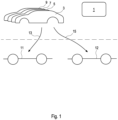
- Figure 1 shows a schematic representation of a configuration of a vehicle according to a possible embodiment of the presented method.
- a configuration system 1 is shown, by means of which a vehicle is configured according to a user's context when the user activates a corresponding direct command.
- a user's context is recorded by evaluating control commands provided by the user using a program such as a browser in the form of "clicks".
- configuration parameters are determined via an assignment table, using which the configuration system 1 configures the vehicle.
- the configuration system 1 selects a body 3, 5, 7, 9 with an interior tailored to the user's context, i.e. a so-called "hat” for the vehicle, and combines a body 3, 5, 7, 9 with a chassis 11 or 12 as indicated by arrows 13 and 15.
- the chassis 11 can be, for example, a basic mobility platform, i.e. a chassis with a predetermined basic structure.
- the chassis 12 can be an individual structure that is specially adapted to the needs of the user and is selected or configured, for example, using the assignment table. Both the chassis 11 and the chassis 12 can be combined with bodies 3, 5, 7 or 9.
- body 5 has a sporty configuration
- body 3 has a luxurious configuration
- body 7 has a puristic configuration
- body 9 has an individually configurable configuration.
- a chassis 12 is equipped with a sporty body 5 when the user orders a vehicle.
- the user can activate a control symbol that triggers a direct command.
- a user's context i.e. respective control commands recorded by the program and provided by the user, is evaluated. Based on the evaluation of the user's context, i.e. corresponding information on the user's context derived from the user's context, corresponding configuration parameters are selected.
- the vehicle is then configured according to the configuration parameters.
- the vehicle is sent to a current location of the user to pick up the user and transport him or her to, for example, a representative of a sports accessories dealer.
- the user is provided with information about a product they have selected.
- a color selection in the interior of the vehicle is adapted to a color scheme of a brand of a product selected by the user.
- the configuration parameters of the vehicle's color scheme were adapted using an assignment table that assigns the control commands provided by the user to select the product to the respective configuration parameters.
- the assignment table can also include information about which configuration parameters should be used with priority if several competing configuration parameters are identified.
Landscapes
- Business, Economics & Management (AREA)
- Engineering & Computer Science (AREA)
- Human Resources & Organizations (AREA)
- Economics (AREA)
- Strategic Management (AREA)
- Physics & Mathematics (AREA)
- General Physics & Mathematics (AREA)
- General Business, Economics & Management (AREA)
- Theoretical Computer Science (AREA)
- Marketing (AREA)
- Entrepreneurship & Innovation (AREA)
- Tourism & Hospitality (AREA)
- Development Economics (AREA)
- Finance (AREA)
- Accounting & Taxation (AREA)
- Game Theory and Decision Science (AREA)
- Operations Research (AREA)
- Health & Medical Sciences (AREA)
- Educational Administration (AREA)
- Quality & Reliability (AREA)
- Primary Health Care (AREA)
- General Health & Medical Sciences (AREA)
- Automation & Control Theory (AREA)
- Mathematical Physics (AREA)
- Transportation (AREA)
- Mechanical Engineering (AREA)
- User Interface Of Digital Computer (AREA)
- Artificial Intelligence (AREA)
- Evolutionary Computation (AREA)
- Medical Informatics (AREA)
- Aviation & Aerospace Engineering (AREA)
- Radar, Positioning & Navigation (AREA)
- Remote Sensing (AREA)
Description
- Die vorgestellte Erfindung betrifft ein Verfahren zum Bereitstellen eines kontextabhängig konfigurierten Fahrzeugs und ein Transportsystem.
- Um eine Person mit einem Fahrzeug zu transportieren, können sogenannte "Car-Sharing-Modelle" eingesetzt werden, bei denen die Person ein Fahrzeug auf einer Internetplattform auswählen und mieten kann. Dazu sind aufwendige Auswahl- und Buchungsschritte erforderlich, bevor die Person ein Fahrzeug verwenden kann.
- Weiterhin sind internetbasierte Verkaufsplattformen bekannt, auf denen sich ein Nutzer über Produkte aller Art informieren und diese ggf. erwerben kann.
- Die US-amerikanische Druckschrift
US 2015 03 56 665 A1 offenbart ein Verfahren, bei dem einem Nutzer eines Fahrzeugs auf einer Anzeigeeinheit Angebote eines Händlers dargeboten werden. Dabei können die Angebote in Abhängigkeit einer aktuellen Position des Fahrzeugs verändert werden. Weiterhin kann dabei vorgesehen sein, dass ein aus dem Fahrzeug heraus erworbenes Produkt hergestellt oder bereitgestellt wird, während der Nutzer sich mit dem Fahrzeug dem Händler nähert. - In der deutschen Druckschrift
DE 10 2015 212 493 A1 wird ein Verfahren zum Bereitstellen von gekauften Waren in einem Kofferraum eines Fahrzeugs offenbart, bei dem der Kofferraum mittels eines Codes von einem Boten geöffnet wird. - Ein Verfahren zum automatischen Bewegen eines Fahrzeugs von einem Parkplatz zu einem Verladeplatz ist in der deutschen Druckschrift
DE 10 2015 202 468 A1 offenbart. - Aus der
US 2016 / 173 568 A1 sind Verfahren und Systeme zum Kommunizieren mit einem Server eines Cloud-Systems bekannt, das zum Verwalten des Zugriffs auf ein Benutzerkonto mit einem Profil verwendet wird, das Einstellungen für ein Fahrzeug enthält. Das Rechensystem des Fahrzeugs ist dazu konfiguriert, eine oder mehrere Einstellungen für das Fahrzeug zu implementieren, wenn das Profil auf dem Fahrzeug aktiv gemacht wird. - Die
US 2015 / 339 928 A1 betrifft Technologien zum Betreiben einer Flotte von autonomen Fahrzeugen. Ein autonomes Fahrzeug kann aus der Flotte von autonomen Fahrzeugen ausgewählt werden, um einen Taxidienst teilweise basierend auf einer Verfügbarkeit des autonomen Fahrzeugs und einer Nähe zwischen dem autonomen Fahrzeug und dem aktuellen Standort der mobilen Vorrichtung durchzuführen. Dem autonomen Fahrzeug können Anweisungen bereitgestellt werden, um den Taxidienst gemäß der Anforderung auszuführen. - Vor diesem Hintergrund war es eine Aufgabe der vorliegenden Erfindung, ein Fahrzeug zum Transport eines Kunden bereitzustellen, das nach den Vorlieben des Kunden konfiguriert ist, wobei das Konfigurieren auch den Austausch physischer Komponenten des Fahrzeugs umfasst.
- Zur Lösung der voranstehend genannten Aufgabe wird ein Verfahren zum Transportieren eines Nutzers in einem abhängig von einem Kontext des Nutzers konfigurierten autonom fahrenden Fahrzeug bereitgestellt. Das Verfahren umfasst das Bereitstellen eines kontextabhängig konfigurierten autonom fahrenden Fahrzeugs, bei dem das autonom fahrende Fahrzeug anhand von an einen Server übermittelten Angaben zu einem Kontext des Nutzers ausgewählt und durch eine Anpassung mindestens einer Komponente ausgewählt aus Infotainmentsystem, Beleuchtungssystem, Beduftungssystem, Karosserie, Motorisierung, Fahrzeugtyp und Fahrzeugdesign konfiguriert wird. Dabei wird anhand einer Zuordnungstabelle, die jeweiligen Steuerbefehlen des Nutzers jeweilige Konfigurationsparameter zuordnet, ein Chassis und/oder eine Karosserie und/oder ein Einstellungsprofil jeweiliger Innenraumkomponenten des Fahrzeugs ausgewählt und das Fahrzeug mit dem ausgewählten Chassis und/oder der ausgewählten Karosserie und/oder dem ausgewählten Einstellungsprofil jeweiliger Innenraumkomponenten des Fahrzeugs unter Verwendung einer automatischen Konfigurationsvorrichtung, die dazu verwendet wird, Komponenten des Fahrzeugs, wie bspw. dessen Karosserie oder dessen Antrieb, auszutauschen, konfiguriert. Der Kontext des Nutzers wird anhand von durch den Nutzer mittels eines auf einer Recheneinheit ausgeführten Programms bereitgestellten Steuerbefehlen ermittelt. Ausgestaltungen der vorgestellten Erfindung ergeben sich aus der Beschreibung und den abhängigen Patentansprüchen.
- Die vorliegende Erfindung dient insbesondere zum Bereitstellen eines Fahrzeugs, das gemäß einem Kontext eines Nutzers konfiguriert wird. Dabei ist vorgesehen, dass der Kontext des Nutzers anhand von durch den Nutzer mittels eines auf einer Recheneinheit ausgeführten Programms bereitgestellten Steuerbefehlen ermittelt wird. Dies bedeutet, dass der Kontext des Nutzers anhand von in dem Programm bzw. mittels des Programms bereitgestellten Steuerbefehlen ermittelt wird, indem bspw. von dem Nutzer mittels des Programms betrachtete virtuelle Objekte oder ausgewählte, d. h. in einer Liste, wie bspw. einem digitalen Einkaufskorb abgelegte, virtuelle Objekte mittels einer das Programm ausführenden Recheneinheit erfasst werden. Es ist insbesondere vorgesehen, dass jeweiligen virtuellen Objekten Konfigurationsparameter zugeordnet werden, die eine exakte Konfiguration eines Fahrzeugs angeben. So kann bspw. vorgesehen sein, dass einem virtuellen Objekt "Prada Handtasche" die Konfigurationsparameter "Ledergeruch", "gedämmtes Licht" und "luxuriöse Ausstattung" zugeordnet sind. Anhand der Konfigurationsparameter kann ein zum Transport des Nutzers vorgesehenes Fahrzeug dem virtuellen Objekt entsprechend konfiguriert werden.
- Weiterhin ist vorgesehen, dass in Abhängigkeit des Kontexts des Nutzers ein Fahrzeug zum Transportieren eines Nutzers verwendet wird. Dies bedeutet, dass bei einer Eingabe eines bestimmten Steuerbefehls des Nutzers mittels des erfindungsgemäß vorgesehenen Programms, ein Fahrzeug zum Transportieren des Nutzers konfiguriert und entsprechend zu dem Nutzer bspw. unter Verwendung eines autonomen Fahrassistenten, gesendet wird, um den Nutzer bspw. zu einem in dem Programm bzw. mittels des Programms angegebenen vorgegebenen Ort zu transportieren. Dabei ist vorgesehen, dass das zum Transportieren des Nutzers gewählte Fahrzeug in Abhängigkeit des aktuellen Kontexts des Nutzers, d. h. mittels jeweiliger durch den Kontext des Nutzers ermittelter Konfigurationsparameter, konfiguriert wird.
- Unter einem Kontext eines Nutzers ist innerhalb der vorliegenden Offenbarung ein Muster an mittels des auf der erfindungsgemäß vorgesehenen Recheneinheit ausgeführten Programms bereitgestellten Steuerbefehlen zu verstehen. Dabei können jeweilige von dem Nutzer mittels des auf der erfindungsgemäß vorgesehenen Recheneinheit ausgeführten Programms bereitgestellte Steuerbefehle mit bspw. in einer Tabelle vorgegebenen Mustern an Steuerbefehlen, die jeweiligen Konfigurationsparametern zugeordnet sind, abgeglichen werden. So kann sich ein Kontext eines Nutzers, der bspw. mittels des Programms, wie bspw. einem Browser, Sportreifen für ein Fahrzeug betrachtet, durch die von dem Nutzer beim Betrachten bzw. Auswählen der Sportreifen bereitgestellten Steuerbefehle ergeben und zur Auswahl von dem Kontext des Nutzers entsprechenden Konfigurationsparametern zur Konfiguration eines Fahrzeugs verwendet werden.
- Es ist gemäß einer möglichen Ausführungsform des vorgestellten Verfahrens vorgesehen, dass die von dem Nutzer zum Betrachten bzw. Auswählen der Sportreifen bereitgestellten Steuerbefehle einem Konfigurationsparameter "sportliche Motorisierung" zugeordnet sind, so dass ein zum Transport des Nutzers eingesetztes Fahrzeug mit einer sportlichen bzw. leistungsstarken Motorisierung konfiguriert wird, wenn ein dem Betrachten bzw. Auswählen der Sportreifen entsprechendes Muster an Steuerbefehlen von dem Programm erfasst bzw. an den erfindungsgemäß vorgesehenen Server gemeldet wird.
- Unter Angaben zu einem Kontext eines Nutzers sind im Kontext der vorliegenden Erfindung Informationen zu verstehen, die einen Kontext des Nutzers, d. h. jeweilige von dem Nutzer bereitgestellte Steuerbefehle oder in einem digitalen Profil des Nutzers gespeicherte Informationen, beschreiben. Derartige Angaben können aus von einem Nutzer bereitgestellten Steuerbefehlen abgeleitet werden, indem bspw. bestimmte Muster an Steuerbefehlen zu einer Angabe zusammengefasst werden. Selbstverständlich können jeweilige Angaben auch direkt jeweilige von einem Nutzer bereitgestellte Steuerbefehle und/oder aus einem digitalen Profil des Nutzers ausgelesene Informationen umfassen.
- In einer weiteren möglichen Ausgestaltung des vorgestellten Verfahrens ist vorgesehen, dass die Angaben zu dem Kontext des Nutzers an den Server über eine sichere Verbindung übertragen werden.
- Um jeweilige mittels des erfindungsgemäß vorgesehenen Programms erfasste Steuerbefehle, die der Nutzer bereitstellt, an den erfindungsgemäß vorgesehenen Server zu übertragen, ist insbesondere vorgesehen, dass das Programm mit dem Server über eine vorgegebene Schnittstelle, die bspw. über eine gesicherte Verbindung realisiert ist, kommuniziert. Selbstverständlich kann zur Kommunikation des Programms mit dem Server auch jede weitere technisch geeignete Schnittstelle verwendet werden.
- In einer weiteren möglichen Ausgestaltung des vorgestellten Verfahrens ist vorgesehen, dass der Kontext des Nutzers anhand von in einem digitalen Profil des Nutzers gespeicherten Nutzerdaten ermittelt wird.
- Um einen Kontext eines Nutzers und, dadurch bedingt, Konfigurationsparameter zur Konfiguration eines Fahrzeugs zu bestimmen, können sowohl von dem Nutzer bereitgestellte Steuerbefehle, d. h. bspw. mittels einer Computermaus durchgeführte "Klicks" oder auf einer berührungsempfindlichen Oberfläche vorgenommene Bedienungsgesten ausgewertet werden. Weiterhin kann vorgesehen sein, dass in einem digitalen Profil des Nutzers gesammelte Informationen beim Bestimmen jeweiliger Konfigurationsparameter berücksichtigt werden. Dazu können bspw. Angaben über ein Einkaufsverhalten oder einen aktuellen Status des Nutzers aus dem digitalen Profil ausgelesen werden. Die aus dem digitalen Profil ausgelesenen Informationen können bspw. auf Grundlage einer Zuordnungstabelle jeweiligen Konfigurationsparametern zugeordnet werden. Unter einem digitalen Profil ist im Kontext der vorliegenden Patentanmeldung eine Anzahl Dateien bzw. Listen zu verstehen, in denen Eigenschaften und bevorzugte Einstellungsparameter eines Nutzers für bspw. ein Fahrzeug oder das erfindungsgemäß vorgesehene Programm gespeichert sind. Ein digitales Profil kann von einem Nutzer selbst und/oder von einem Programm verändert werden.
- Es ist ferner denkbar, dass zur Zuordnung jeweiliger Kontextinformationen des Nutzers, d. h. jeweiliger Steuerbefehle und/oder Profilinformationen, zu jeweiligen Konfigurationsparametern, ein maschineller Lerner eingesetzt wird, der bspw. anhand von mittels Testnutzern bereitgestellten Trainingsdaten über einen jeweiligen Nutzer gesammelte Kontextinformationen jeweiligen Konfigurationsparametern zuordnet. Durch die Verwendung eines maschinellen Lerners reduziert sich ein Wartungsaufwand für neue bzw. zusätzlich verfügbare Konfigurationsparameter erheblich, da auf ein Bereitstellen fester Zuordnungsregeln verzichtet werden kann.
- In einer weiteren möglichen Ausgestaltung des vorgestellten Verfahrens ist vorgesehen, dass das Fahrzeug mittels einer Zuordnungstabelle konfiguriert wird, die jeweilige von dem Nutzer betrachtete und/oder ausgewählte virtuelle Objekte und/oder jeweilige Nutzerdaten aus dem digitalen Profil des Nutzers jeweiligen Konfigurationsparametern zuordnet.
- Eine Zuordnung von in einem digitalen Profil eines Nutzers gespeicherten Informationen und/oder eine Zuordnung von durch den Nutzer bereitgestellten Steuerbefehlen bzw. entsprechend abgeleiteter Angaben, zu jeweiligen Konfigurationsparametern, kann in einer Zuordnungstabelle fest vorgegeben werden. Eine solche Zuordnungstabelle kann von einem Verwalter, wie bspw. einem Händler, bei Bedarf aktualisiert werden, so dass bspw. neu verfügbare Konfigurationsparameter einem Verhalten eines Nutzers zugeordnet werden.
- In dem vorgestellten Verfahren ist vorgesehen, dass das Fahrzeug durch eine Anpassung mindestens einer Komponente der folgenden Liste an Komponenten oder einer Kombination daraus konfiguriert wird: Infotainmentsystem, Beleuchtungssystem, Beduftungssystem, Karosserie, Motorisierung, Fahrzeugtyp und Fahrzeugdesign.
- Es ist gemäß dem vorgestellten Verfahren insbesondere vorgesehen, dass ein zum Transport eines Nutzers vorgesehenes Fahrzeug in Abhängigkeit von Angaben zu einem Kontext, insbesondere einem aktuellen Kontext des Nutzers konfiguriert wird. Dazu können jeweilige Komponenten des Fahrzeugs, bspw. über eine mit dem Fahrzeug in kommunikativer Verbindung stehende Konfigurationseinheit, in einen den Angaben zu dem Kontext des Nutzers entsprechenden Zustand geschaltet werden. Weiterhin ist denkbar, dass jeweilige Komponenten des Fahrzeugs in Abhängigkeit der Angaben zu dem Kontext des Nutzers ausgewählt werden und das Fahrzeug mittels der ausgewählten Komponenten entsprechend verändert wird. Dies bedeutet, dass bspw. eine Innenausstattung des Fahrzeugs in Abhängigkeit eines von einem Nutzer mittels des erfindungsgemäß vorgesehenen Programms betrachteten bzw. ausgewählten virtuellen Objekts ausgewählt wird. Dabei können beliebige Komponenten des Fahrzeugs verändert und/oder ausgetauscht werden, um das Fahrzeug dem Kontext des Nutzers, d. h. jeweiligen Angaben zu dem Kontext des Nutzers entsprechend zu konfigurieren. Insbesondere ist vorgesehen, dass der Nutzer mit dem Kontext des Nutzers entsprechenden Informationen aus Anzeigeeinheiten und/oder Audiosystemen und/oder Beduftungseinrichtungen des Fahrzeugs versorgt wird.
- In einer weiteren möglichen Ausgestaltung des vorgestellten Verfahrens ist vorgesehen, dass das Fahrzeug in Abhängigkeit eines von dem Nutzer mittels des Programms bereitzustellenden Direktbefehls konfiguriert wird.
- Es ist denkbar, dass das erfindungsgemäß vorgesehene Fahrzeug mittels eines Direktbefehls konfiguriert wird. Dies bedeutet, dass das Fahrzeug beim Bereitstellen eines Direktbefehls, d. h. eines Steuerbefehls, der direkt zu einer Aktion, wie bspw. einem Konfigurationsvorgang des Fahrzeugs führt, entsprechend zu jeweiligen Angaben zu einem Kontext des Nutzers konfiguriert und zum Transport des Nutzers verwendet wird. Entsprechend kann der Nutzer ein Fahrzeug mittels des Direktbefehls, der bspw. als "1 click to physical product" bezeichnet werden kann, dazu konfigurieren, den Nutzer zu einem Ort, der bspw. innerhalb einer Benutzerfläche des erfindungsgemäß vorgesehenen Programms, d. h. in dem Programm, ausgewählt werden kann, zu transportieren. Dabei ist vorgesehen, dass das Fahrzeug in Abhängigkeit von Angaben zu einem Kontext des Nutzers konfiguriert wird und bspw. ein einem von dem Nutzer in dem Programm betrachteten virtuellen Objekt entsprechendes Farbschema in einem Innenraum des Fahrzeugs generiert und dem Nutzer über eine Anzeigeeinheit Informationen über das virtuelle Objekt bereitstellt.
- Ein Direktbefehl kann von einem Nutzer mittels des erfindungsgemäß vorgesehenen Programms bereitgestellt werden, so dass der Nutzer bei Bedarf eine Konfiguration eines Fahrzeugs gemäß dem vorgestellten Verfahren starten und mittels eines entsprechend konfigurierten Fahrzeugs transportiert werden kann. Ein Direktbefehl ermöglicht dem Nutzer bspw. einen Transport zu einem Ort, an dem der Nutzer ein reales Produkt erleben und testen kann. Der Direktbefehl entlastet den Nutzer von aufwendigen Planungen zur Organisation seines Transports. Dazu ist insbesondere vorgesehen, dass ein autonom fahrendes Fahrzeug dazu konfiguriert wird, zu einem Ort des Nutzers zu fahren und den Nutzer zu einem Ort zu transportieren, der einem aktuellen Kontext des Nutzers zugeordnet ist, wenn der Nutzer einen entsprechenden Direktbefehl, der bspw. als Steuersymbol auf einer Internetseite angeboten wird, aktiviert bzw. bereitstellt.
- In einer weiteren möglichen Ausgestaltung des vorgestellten Verfahrens ist vorgesehen, dass der Direktbefehl mittels einer einzigen Eingabe in das auf der Recheneinheit ausgeführte Programm bereitgestellt wird.
- Ein Direktbefehl, der direkt zu einer Konfiguration eines Fahrzeugs gemäß jeweiligen Angaben zu einem insbesondere aktuellen Kontext eines Nutzers führt, zeichnet sich insbesondere dadurch aus, dass dieser mit lediglich einer einzigen Eingabe, wie bspw. einem "Click" mit einer Computermaus oder einer einzelnen Bediengeste auf einer berührungsempfindlichen Oberfläche zu aktivieren bzw. bereitzustellen ist.
- Ferner betrifft die vorgestellte Erfindung ein Transportsystem zum kontextabhängigen Transport eines Nutzers, mit einer Recheneinheit, auf der ein Programm ausgeführt wird, einem Server, der mit der Recheneinheit in kommunikativer Verbindung steht und einer Anzahl Fahrzeuge, wobei der Server dazu konfiguriert ist, anhand von durch die Recheneinheit an den Server übermittelten Angaben zu einem Kontext eines Nutzers ein Fahrzeugs aus der Anzahl Fahrzeuge auszuwählen, durch eine Anpassung mindestens einer Komponente ausgewählt aus Infotainmentsystem, Beleuchtungssystem, Beduftungssystem, Karosserie, Motorisierung, Fahrzeugtyp und Fahrzeugdesign anhand einer Zuordnungstabelle, die jeweiligen Steuerbefehlen des Nutzers jeweilige Konfigurationsparameter zuordnet, ein Chassis und/oder eine Karosserie mit einer auf den Kontext des Nutzers abgestimmten Innenausstattung auszuwählen und das autonom fahrende Fahrzeug mit dem ausgewählten Chassis und/oder der ausgewählten Karosserie unter Verwendung einer automatischen Konfigurationsvorrichtung, die dazu verwendet wird, Komponenten des Fahrzeugs, wie bspw. dessen Karosserie oder dessen Antrieb, auszutauschen, zu konfigurieren und zum Transport des Nutzers zu verwenden, und wobei das Programm dazu konfiguriert ist, den Kontext des Nutzers anhand von durch den Nutzer mittels eines auf einer Recheneinheit ausgeführten Programms bereitgestellten Steuerbefehlen zu ermitteln.
- Das vorgestellte Transportsystem dient insbesondere zur Durchführung des vorgestellten Verfahrens.
- Es ist insbesondere vorgesehen, dass das erfindungsgemäße Transportsystem eine Flotte an Fahrzeugen umfasst, die von einer zentralen Verwaltungseinheit in Form eines Servers verwaltet und konfiguriert werden. Die Verwaltungseinheit steuert ein jeweiliges Fahrzeug der Flotte direkt an und übermittelt dem jeweiligen Fahrzeug bspw. Informationen über ein einzustellendes Innenraumprogramm, das in einem Innenraum eines Fahrzeugs angeordnete Komponenten, wie bspw. Anzeigeeinheiten, Audiosysteme und Duftgeneratoren, gemäß in Abhängigkeit von Angaben zu einem Kontext eines Nutzers ermittelter Konfigurationsparameter steuert. Weiterhin steht die Verwaltungseinheit mit einem Konfigurationssystem in Verbindung, das dazu verwendet wird, Komponenten eines Fahrzeugs, wie bspw. dessen Karosserie oder dessen Antrieb, auszutauschen.
- Erfindungsgemäß ist vorgesehen, dass die Verwaltungseinheit und das Konfigurationssystem in Abhängigkeit von Angaben zu einem Kontext eines jeweiligen zu transportierenden Nutzers gesteuert werden.
- Es ist vorgesehen, dass das Fahrzeug ein autonom fahrendes Fahrzeug ist und der Server dazu konfiguriert ist, anhand einer Zuordnungstabelle, die jeweiligen Steuerbefehlen des Nutzers jeweilige Konfigurationsparameter zuordnet, ein Chassis und/oder eine Karosserie und/oder ein Einstellungsprofil jeweiliger Innenraumkomponenten des Fahrzeugs auszuwählen und das Fahrzeug mit dem ausgewählten Chassis und/oder der ausgewählten Karosserie und/oder dem ausgewählten Einstellungsprofil jeweiliger Innenraumkomponenten des Fahrzeugs unter Verwendung einer automatischen Konfigurationsvorrichtung zu konfigurieren.
- Mittels verschiedener Einstellungsprofile für jeweilige Innenraumkomponenten eines Fahrzeugs können einem Nutzer, je nach seinem Kontext, verschiedene Erlebnisräume angeboten werden, indem bspw. Audio- und/oder Videosysteme des Fahrzeugs dazu konfiguriert werden, eine zu dem Kontext des Nutzers passende Klang- und/oder Farbkulisse, bereitzustellen. Dies bedeutet, dass bspw. eine zu einem von dem Nutzer mittels des erfindungsgemäß vorgesehenen Programms vorgegebenen Steuerbefehl passende bzw. abgestimmte Klang- und/oder Farbkulisse aus bspw. einer Liste ausgewählt und an dem Fahrzeug eingestellt wird.
- Weitere Vorteile und Ausgestaltungen ergeben sich aus der Beschreibung und den beiliegenden Zeichnungen.
- Es versteht sich, dass die voranstehend genannten und die nachstehend noch zu erläuternden Merkmale nicht nur in der jeweils angegebenen Kombination, sondern auch in anderen Kombinationen oder in Alleinstellung verwendbar sind, ohne den Rahmen der vorliegenden Erfindung zu verlassen.
- Die Erfindung ist anhand von Ausführungsformen in den Zeichnungen schematisch dargestellt und wird unter Bezugnahme auf die Zeichnungen schematisch und ausführlich beschrieben.
-
Figur 1 zeigt eine schematische Darstellung einer Konfiguration eines Fahrzeugs gemäß einer möglichen Ausgestaltung des vorgestellten Verfahrens. - In
Figur 1 ist ein Konfigurationssystem 1 dargestellt, mittels dessen ein Fahrzeug gemäß einem Kontext eines Nutzers konfiguriert wird, wenn der Nutzer einen entsprechenden Direktbefehl aktiviert. Dies bedeutet, dass ein Kontext des Nutzers erfasst wird, indem von dem Nutzer mittels eines Programms, wie bspw. einem Browser bereitgestellte Steuerbefehle in Form von "Klicks" ausgewertet werden. Anhand der von dem Nutzer bereitgestellten Steuerbefehle werden über eine Zuordnungstabelle Konfigurationsparameter bestimmt, mittels derer das Konfigurationssystem 1 das Fahrzeug konfiguriert. Dazu wählt das Konfigurationssystem 1 eine Karosserie 3, 5, 7, 9 mit einer jeweiligen auf den Kontext des Nutzers abgestimmten Innenausstattung, d. h. einen sogenannten "Hut" für das Fahrzeug, und kombiniert eine Karosserie 3, 5, 7, 9 mit einem Chassis 11 oder 12 wie durch Pfeile 13 und 15 angedeutet. Bei dem Chassis 11 kann es sich bspw. um eine Basis-Mobilitätsplattform handeln, d. h. um ein Fahrgestell mit einer vorgegebenen Grundstruktur. Ferner kann es ich bei dem Chassis 12 um eine Individualstruktur handeln, die speziell an Bedürfnisse des Nutzers angepasst ist und bspw. anhand der Zuordnungstabelle ausgewählt bzw. konfiguriert wird. Sowohl das Chassis 11 als auch das Chassis 12 können mit Karosserien 3, 5, 7 oder 9 kombiniert werden. Dabei weist bspw. Karosserie 5 eine sportliche Ausstattung, Karosserie 3 eine luxuriöse Ausstattung, Karosserie 7 eine puristische Ausstattung und Karosserie 9 eine individuell zu konfigurierende Ausstattung auf. - Bspw. ist gemäß der Zuordnungstabelle vorgesehen, dass, wenn der Nutzer ein virtuelles Objekt, wie bspw. ein Produkt aus einer Kategorie "Sportzubehör" betrachtet und auswählt, d. h. bspw. in einer Einkaufsliste speichert, ein Chassis 12 mit einer sportlichen Karosserie 5 ausgestattet wird, wenn der Nutzer ein Fahrzeug ordert. Um das Fahrzeug zu ordern, kann der Nutzer ein Steuersymbol, das einen Direktbefehl auslöst, aktivieren. Entsprechend wird bzw. werden, nachdem der Nutzer das Steuersymbol für den Direktbefehl aktiviert hat, ein Kontext des Nutzers, d. h. jeweilige von dem Programm erfasste und von dem Nutzer bereitgestellte Steuerbefehle ausgewertet. Auf Grundlage der Auswertung des Kontexts des Nutzers, d. h. entsprechender aus dem Kontext des Nutzers abgeleiteter Angaben zu dem Kontext des Nutzers, werden entsprechende Konfigurationsparameter ausgewählt. Anschließend wird das Fahrzeug entsprechend den Konfigurationsparametern konfiguriert. Sobald das Fahrzeug konfiguriert ist, wird das Fahrzeug zu einer aktuellen Position des Nutzers gesendet, um den Nutzer abzuholen und bspw. zu einer Vertretung eines Händlers für Sportzubehör zu transportieren. Auf seinem Weg zu dem Händler wird der Nutzer mit Informationen über ein von ihm ausgewähltes Produkt versorgt. Um den Nutzer auf das von ihm ausgewählte Produkt einzustimmen, ist eine Farbwahl im Inneren des Fahrzeugs an ein Farbschema einer Marke eines von dem Nutzer ausgewählten Produkts angepasst. Dazu wurden die Konfigurationsparameter des Farbschemas des Fahrzeugs mittels einer Zuordnungstabelle, die die von dem Nutzer zur Auswahl des Produkts bereitgestellten Steuerbefehle jeweiligen Konfigurationsparametern zuordnet, angepasst. Dabei kann die Zuordnungstabelle auch Informationen darüber umfassen, welche Konfigurationsparameter priorisiert zu verwenden sind, wenn mehrere konkurrierende Konfigurationsparameter ermittelt werden.
Claims (9)
- Verfahren zum Transportieren eines Nutzers in einem abhängig von einem Kontext des Nutzers konfigurierten autonom fahrenden Fahrzeug, umfassend das Bereitstellen eines kontextabhängig konfigurierten autonom fahrenden Fahrzeugs, bei dem das autonom fahrende Fahrzeug anhand von an einen Server übermittelten Angaben zu einem Kontext des Nutzers ausgewählt und durch eine Anpassung mindestens einer Komponente ausgewählt aus Infotainmentsystem, Beleuchtungssystem, Beduftungssystem, Karosserie, Motorisierung, Fahrzeugtyp und Fahrzeugdesign konfiguriert wird, wobei anhand einer Zuordnungstabelle, die jeweiligen Steuerbefehlen des Nutzers jeweilige Konfigurationsparameter zuordnet, ein Chassis (11, 12) und/oder eine Karosserie (3, 5, 7, 9) und/oder ein Einstellungsprofiljeweiliger Innenraumkomponenten des Fahrzeugs ausgewählt und das Fahrzeug mit dem ausgewählten Chassis (11, 12) und/oder der ausgewählten Karosserie (3, 5, 7, 9) und/oder dem ausgewählten Einstellungsprofiljeweiliger Innenraumkomponenten des Fahrzeugs unter Verwendung einer automatischen Konfigurationsvorrichtung, die dazu verwendet wird, Komponenten des Fahrzeugs, wie bspw. dessen Karosserie (3, 5, 7, 9) oder dessen Antrieb, auszutauschen, konfiguriert wird, und wobei der Kontext des Nutzers anhand von durch den Nutzer mittels eines auf einer Recheneinheit ausgeführten Programms bereitgestellten Steuerbefehlen ermittelt wird.
- Verfahren nach Anspruch 1, bei dem die Angaben zu dem Kontext des Nutzers an den Server über eine sichere Verbindung übertragen werden.
- Verfahren nach Anspruch 1 oder 2, bei dem als Programm ein Internetbrowser gewählt wird und der Kontext des Nutzers anhand von durch den Nutzer in einer Liste abgelegten virtuellen Objekten ermittelt wird.
- Verfahren nach einem der voranstehenden Ansprüche, bei dem der Kontext des Nutzers anhand von in einem digitalen Profil des Nutzers gespeicherten Nutzerdaten ermittelt wird.
- Verfahren nach Anspruch 3 oder 4, bei dem das Fahrzeug mittels einer Zuordnungstabelle konfiguriert wird, die jeweilige von dem Nutzer betrachtete und/oder ausgewählte virtuelle Objekte und/oder jeweilige Nutzerdaten aus dem digitalen Profil des Nutzers jeweiligen Konfigurationsparametern zuordnet.
- Verfahren nach einem der voranstehenden Ansprüche, bei dem das Fahrzeug in Abhängigkeit eines von dem Nutzer mittels des Programms bereitzustellenden Direktbefehls konfiguriert wird.
- Verfahren nach Anspruch 6, bei dem der Direktbefehl mittels einer einzigen Eingabe in das auf der Recheneinheit ausgeführte Programm bereitgestellt wird.
- Verfahren nach einem der voranstehenden Ansprüche, bei dem als Programm ein Browser gewählt wird, auf dem eine Internetpräsenz eines Unternehmens dargestellt wird und das Fahrzeug dazu konfiguriert wird, den Nutzer von seiner aktuellen Position zu einer Vertretung des Unternehmens zu transportieren.
- Transportsystem zum kontextabhängigen Transport eines Nutzers, mit einer Recheneinheit, auf der ein Programm ausgeführt wird, einem Server (1), der mit der Recheneinheit in kommunikativer Verbindung steht und einer Anzahl Fahrzeuge, wobei der Server (1) dazu konfiguriert ist, anhand von durch die Recheneinheit an den Server (1) übermittelten Angaben zu einem Kontext eines Nutzers ein autonom fahrendes Fahrzeug aus der Anzahl Fahrzeuge auszuwählen, durch eine Anpassung mindestens einer Komponente ausgewählt aus Infotainmentsystem, Beleuchtungssystem, Beduftungssystem, Karosserie, Motorisierung, Fahrzeugtyp und Fahrzeugdesign anhand einer Zuordnungstabelle, die jeweiligen Steuerbefehlen des Nutzers jeweilige Konfigurationsparameter zuordnet, ein Chassis (11, 12) und/oder eine Karosserie (3, 5, 7, 9) und/oder ein Einstellungsprofiljeweiliger Innenraumkomponenten des Fahrzeugs auszuwählen und das Fahrzeug mit dem ausgewählten Chassis (11, 12) und/oder der ausgewählten Karosserie (3, 5, 7, 9) und/oder dem ausgewählten Einstellungsprofiljeweiliger Innenraumkomponenten des Fahrzeugs unter Verwendung einer automatischen Konfigurationsvorrichtung, die dazu verwendet wird, Komponenten des Fahrzeugs, wie bspw. dessen Karosserie (3, 5, 7, 9) oder dessen Antrieb, auszutauschen, zu konfigurieren und zum Transport des Nutzers zu verwenden, und wobei das Programm dazu konfiguriert ist, den Kontext des Nutzers anhand von durch den Nutzer mittels des auf der Recheneinheit ausgeführten Programms bereitgestellten Steuerbefehlen zu ermitteln.
Applications Claiming Priority (2)
| Application Number | Priority Date | Filing Date | Title |
|---|---|---|---|
| DE102017201130.0A DE102017201130A1 (de) | 2017-01-25 | 2017-01-25 | Verfahren zum Bereitstellen eines kontextabhängig konfigurierten Fahrzeugs |
| PCT/EP2018/050341 WO2018137915A1 (de) | 2017-01-25 | 2018-01-08 | Verfahren zum bereitstellen eines kontextabhängig konfigurierten fahrzeugs |
Publications (2)
| Publication Number | Publication Date |
|---|---|
| EP3574469A1 EP3574469A1 (de) | 2019-12-04 |
| EP3574469B1 true EP3574469B1 (de) | 2024-04-17 |
Family
ID=60953871
Family Applications (1)
| Application Number | Title | Priority Date | Filing Date |
|---|---|---|---|
| EP18700192.0A Active EP3574469B1 (de) | 2017-01-25 | 2018-01-08 | Verfahren zum bereitstellen eines kontextabhängig konfigurierten fahrzeugs |
Country Status (5)
| Country | Link |
|---|---|
| US (1) | US11373227B2 (de) |
| EP (1) | EP3574469B1 (de) |
| CN (1) | CN110214336B (de) |
| DE (1) | DE102017201130A1 (de) |
| WO (1) | WO2018137915A1 (de) |
Families Citing this family (2)
| Publication number | Priority date | Publication date | Assignee | Title |
|---|---|---|---|---|
| JP7235406B2 (ja) * | 2019-11-13 | 2023-03-08 | トヨタ自動車株式会社 | 情報処理装置、情報処理方法、およびプログラム |
| JP7133591B2 (ja) * | 2020-08-28 | 2022-09-08 | 本田技研工業株式会社 | 輸送仲介装置、輸送仲介方法、およびプログラム |
Family Cites Families (23)
| Publication number | Priority date | Publication date | Assignee | Title |
|---|---|---|---|---|
| WO2003018337A2 (en) * | 2001-08-23 | 2003-03-06 | General Motors Corporation | Vehicle body interchangeability |
| WO2003036600A1 (en) | 2001-10-22 | 2003-05-01 | Kleanthis Adamou | Communication system |
| US20040092253A1 (en) * | 2002-11-12 | 2004-05-13 | Simonds Craig John | System and method of providing personalized context information for vehicle |
| JP2004287300A (ja) | 2003-03-25 | 2004-10-14 | Hitachi Ltd | 広告データ提供方法,広告配信方法,車載広告システム |
| JP2004287976A (ja) * | 2003-03-24 | 2004-10-14 | Seiko Epson Corp | 車両オーダーシステム、車両オーダー方法、車両オーダープログラム及び記録媒体 |
| GB2438676A (en) | 2006-05-24 | 2007-12-05 | Innoverts Ltd | System for displaying images on a carrier |
| US8548819B2 (en) * | 2007-04-17 | 2013-10-01 | Ridemakerz, Llc | Method of providing a consumer profile accessible by an on-line interface and related to retail purchase of custom personalized toys |
| CN101246509A (zh) * | 2008-02-28 | 2008-08-20 | 上海交通大学 | 基于实例推理技术的轿车整车个性化配置系统 |
| JP5401044B2 (ja) * | 2008-03-10 | 2014-01-29 | 株式会社ブロードリーフ | 車両情報提供装置、およびこれを用いた車両情報提供ネットワークシステム並びに車両情報提供方法 |
| US20120130769A1 (en) | 2010-11-19 | 2012-05-24 | Gm Global Technology Operations, Inc. | Methods for conducting market research utilizing a telematics service system |
| DE102010052437A1 (de) | 2010-11-24 | 2012-05-24 | René Köhne | Informationssystem zum Informieren über ein Objekt |
| US9229905B1 (en) * | 2011-04-22 | 2016-01-05 | Angel A. Penilla | Methods and systems for defining vehicle user profiles and managing user profiles via cloud systems and applying learned settings to user profiles |
| CN102591327B (zh) * | 2012-02-27 | 2013-12-18 | 湖南大学 | 一种面向汽车车身控制开发的虚实结合测试方法 |
| US20140309849A1 (en) * | 2013-04-15 | 2014-10-16 | Flextronics Ap, Llc | Driver facts behavior information storage system |
| US20140279021A1 (en) | 2013-03-14 | 2014-09-18 | Ford Global Technologies, Llc | Ad Manager for a Vehicle Multimedia System |
| US20140310124A1 (en) * | 2013-04-16 | 2014-10-16 | Work Truck Solution | Vehicle database system and related methods |
| US10284651B2 (en) * | 2014-02-27 | 2019-05-07 | Harman International Industries, Incorporated | Data aggregation and delivery |
| US10074128B2 (en) | 2014-06-08 | 2018-09-11 | Shay C. Colson | Pre-purchase mechanism for autonomous vehicles |
| DE102015212493A1 (de) | 2014-07-25 | 2016-01-28 | Ford Global Technologies, Llc | Verfahren und Vorrichtung zur Unterstützung des Abholvorganges von Einkaufsgütern |
| DE102015202468A1 (de) | 2015-02-12 | 2016-08-18 | Robert Bosch Gmbh | Verfahren zum Betreiben eines Fahrzeugs |
| US9805605B2 (en) * | 2015-08-12 | 2017-10-31 | Madhusoodhan Ramanujam | Using autonomous vehicles in a taxi service |
| US20170285641A1 (en) * | 2016-04-01 | 2017-10-05 | GM Global Technology Operations LLC | Systems and processes for selecting contextual modes for use with autonomous, semi-autonomous, and manual-driving vehicle operations |
| US10279810B2 (en) * | 2016-12-02 | 2019-05-07 | Toyota Motor Engineering & Manufacturing North America, Inc. | Systems and methods for preemptively adjusting vehicle parameters according to predicted controls relating to a toll booth |
-
2017
- 2017-01-25 DE DE102017201130.0A patent/DE102017201130A1/de not_active Withdrawn
-
2018
- 2018-01-08 CN CN201880008405.6A patent/CN110214336B/zh active Active
- 2018-01-08 EP EP18700192.0A patent/EP3574469B1/de active Active
- 2018-01-08 US US16/479,309 patent/US11373227B2/en active Active
- 2018-01-08 WO PCT/EP2018/050341 patent/WO2018137915A1/de not_active Ceased
Non-Patent Citations (3)
| Title |
|---|
| ANONYMOUS: "Autocars and Accessories - Wikipedia", 29 July 2016 (2016-07-29), XP055910826, Retrieved from the Internet <URL:https://de.wikipedia.org/w/index.php?title=Autocars_and_Accessories&oldid=156548853#Einzelnachweise> [retrieved on 20220408] * |
| ANONYMOUS: "Rinspeed - Wikipedia", 27 February 2021 (2021-02-27), XP055910831, Retrieved from the Internet <URL:https://de.wikipedia.org/wiki/Rinspeed#cite_note-14> [retrieved on 20220408] * |
| N.N.: "Vision URBANETIC - The mobility of the future", 7 January 2020 (2020-01-07), Retrieved from the Internet <URL:https://mercedes-benz.com/en/vehicles/transporter/vision-urbanetic-the-mobility-of-the-future/> [retrieved on 20220408] * |
Also Published As
| Publication number | Publication date |
|---|---|
| CN110214336B (zh) | 2023-08-29 |
| CN110214336A (zh) | 2019-09-06 |
| WO2018137915A1 (de) | 2018-08-02 |
| US11373227B2 (en) | 2022-06-28 |
| US20190378190A1 (en) | 2019-12-12 |
| EP3574469A1 (de) | 2019-12-04 |
| DE102017201130A1 (de) | 2018-07-26 |
Similar Documents
| Publication | Publication Date | Title |
|---|---|---|
| DE102014009697B4 (de) | Verfahren zum Betreiben eines mobilen Virtual-Reality-Systems in einem Kraftfahrzeug und mobiles Virtual-Reality-System | |
| DE102020105854A1 (de) | Eingebettete fahrzeuginterne plattform zum bereitstellen von immersiven benutzererlebnissen | |
| DE102017104960A1 (de) | Beleuchtungssystem, endgerät und verfahren zum einstellen des beleuchtungssystems | |
| DE102017112310A1 (de) | Fahrerkompetenz während autonomer übergabe | |
| DE102015213362B4 (de) | Verfahren zum Erweitern einer Fahrzeugschnittstelle | |
| DE102018206653B4 (de) | Verfahren zum dynamischen Anpassen einer Bedienvorrichtung in einem Kraftfahrzeug sowie Bedienvorrichtung und Kraftfahrzeug | |
| DE102015114792A1 (de) | Kooperative Insassenerfassung | |
| EP3574469B1 (de) | Verfahren zum bereitstellen eines kontextabhängig konfigurierten fahrzeugs | |
| DE102017010110A1 (de) | Verfahren und System zum Einstellen wenigstens einer Fahrzeugeinstellung | |
| EP3416848B1 (de) | Anordnung, fortbewegungsmittel und verfahren zur unterstützung eines anwenders bei einer bedienung einer berührungsempfindlichen anzeigeeinrichtung | |
| DE102022109234A1 (de) | Benutzungshinweis auf eine Fahrzeugfunktion | |
| DE102021112787B3 (de) | Verfahren und Vorrichtung zum Überwachen der Verschmutzung von Oberflächen eines Fahrzeuges | |
| DE102016116858A1 (de) | System und Verfahren zur Übergabe eines Nutzfahrzeuges | |
| DE102019114615A1 (de) | System und verfahren zur fahrtrandomisierung und -gamifizierung | |
| DE102018106517A1 (de) | Steuerung für ein Fahrzeug mit Demonstrationsmodus | |
| DE102013007256A1 (de) | Verfahren zum personalisierten Betreiben einer graphischen Benutzeroberfläche eines Kraftwagens und Kraftwagen mit einer solchen graphischen Benutzeroberfläche | |
| DE102013004811A1 (de) | Verfahren zur Einstellung von Fahrzeugeinbauten | |
| Averianov et al. | Research results of the professional training process for mobile machines operators as a factor of improving traffic safety | |
| DE102020209546A1 (de) | Verfahren zur Unterstützung der Reinigung eines Fahrzeugs | |
| DE102015208864A1 (de) | Einstellen von Konfigurationsparametern eines Fahrzeugs | |
| DE102023109528A1 (de) | Verfahren und system zum steuern einer benutzerschnittstelle in einem fahrzeug | |
| WO2002067151A1 (de) | Konfigurator | |
| DE102013215978A1 (de) | Verfahren, Vorrichtung und Computerprogrammprodukt zur computergestützten Auswahl von Ausstattungskomponenten für ein neu zu produzierendes Fahrzeug | |
| DE102022127480A1 (de) | Verfahren zum Erzeugen einer Freischaltinformation für mehrere Personen und Servereinrichtung | |
| WO2018059832A1 (de) | System und modul zum betreiben von textildruckmaschinen |
Legal Events
| Date | Code | Title | Description |
|---|---|---|---|
| STAA | Information on the status of an ep patent application or granted ep patent |
Free format text: STATUS: UNKNOWN |
|
| STAA | Information on the status of an ep patent application or granted ep patent |
Free format text: STATUS: THE INTERNATIONAL PUBLICATION HAS BEEN MADE |
|
| PUAI | Public reference made under article 153(3) epc to a published international application that has entered the european phase |
Free format text: ORIGINAL CODE: 0009012 |
|
| STAA | Information on the status of an ep patent application or granted ep patent |
Free format text: STATUS: REQUEST FOR EXAMINATION WAS MADE |
|
| 17P | Request for examination filed |
Effective date: 20190826 |
|
| AK | Designated contracting states |
Kind code of ref document: A1 Designated state(s): AL AT BE BG CH CY CZ DE DK EE ES FI FR GB GR HR HU IE IS IT LI LT LU LV MC MK MT NL NO PL PT RO RS SE SI SK SM TR |
|
| AX | Request for extension of the european patent |
Extension state: BA ME |
|
| DAV | Request for validation of the european patent (deleted) | ||
| DAX | Request for extension of the european patent (deleted) | ||
| STAA | Information on the status of an ep patent application or granted ep patent |
Free format text: STATUS: EXAMINATION IS IN PROGRESS |
|
| 17Q | First examination report despatched |
Effective date: 20210301 |
|
| P01 | Opt-out of the competence of the unified patent court (upc) registered |
Effective date: 20230529 |
|
| REG | Reference to a national code |
Ref legal event code: R079 Ipc: G06Q0050400000 Ref country code: DE Ref legal event code: R079 Ref document number: 502018014443 Country of ref document: DE Free format text: PREVIOUS MAIN CLASS: G06Q0050300000 Ipc: G06Q0050400000 |
|
| GRAP | Despatch of communication of intention to grant a patent |
Free format text: ORIGINAL CODE: EPIDOSNIGR1 |
|
| STAA | Information on the status of an ep patent application or granted ep patent |
Free format text: STATUS: GRANT OF PATENT IS INTENDED |
|
| RIC1 | Information provided on ipc code assigned before grant |
Ipc: G06Q 10/0631 20230101ALI20240201BHEP Ipc: G06Q 50/40 20240101AFI20240201BHEP |
|
| GRAS | Grant fee paid |
Free format text: ORIGINAL CODE: EPIDOSNIGR3 |
|
| GRAA | (expected) grant |
Free format text: ORIGINAL CODE: 0009210 |
|
| STAA | Information on the status of an ep patent application or granted ep patent |
Free format text: STATUS: THE PATENT HAS BEEN GRANTED |
|
| INTG | Intention to grant announced |
Effective date: 20240219 |
|
| AK | Designated contracting states |
Kind code of ref document: B1 Designated state(s): AL AT BE BG CH CY CZ DE DK EE ES FI FR GB GR HR HU IE IS IT LI LT LU LV MC MK MT NL NO PL PT RO RS SE SI SK SM TR |
|
| REG | Reference to a national code |
Ref country code: GB Ref legal event code: FG4D Free format text: NOT ENGLISH |
|
| REG | Reference to a national code |
Ref country code: CH Ref legal event code: EP |
|
| REG | Reference to a national code |
Ref country code: IE Ref legal event code: FG4D Free format text: LANGUAGE OF EP DOCUMENT: GERMAN Ref country code: DE Ref legal event code: R096 Ref document number: 502018014443 Country of ref document: DE |
|
| REG | Reference to a national code |
Ref country code: LT Ref legal event code: MG9D |
|
| REG | Reference to a national code |
Ref country code: NL Ref legal event code: MP Effective date: 20240417 |
|
| PG25 | Lapsed in a contracting state [announced via postgrant information from national office to epo] |
Ref country code: NL Free format text: LAPSE BECAUSE OF FAILURE TO SUBMIT A TRANSLATION OF THE DESCRIPTION OR TO PAY THE FEE WITHIN THE PRESCRIBED TIME-LIMIT Effective date: 20240417 |
|
| PG25 | Lapsed in a contracting state [announced via postgrant information from national office to epo] |
Ref country code: NL Free format text: LAPSE BECAUSE OF FAILURE TO SUBMIT A TRANSLATION OF THE DESCRIPTION OR TO PAY THE FEE WITHIN THE PRESCRIBED TIME-LIMIT Effective date: 20240417 |
|
| PG25 | Lapsed in a contracting state [announced via postgrant information from national office to epo] |
Ref country code: IS Free format text: LAPSE BECAUSE OF FAILURE TO SUBMIT A TRANSLATION OF THE DESCRIPTION OR TO PAY THE FEE WITHIN THE PRESCRIBED TIME-LIMIT Effective date: 20240817 |
|
| PG25 | Lapsed in a contracting state [announced via postgrant information from national office to epo] |
Ref country code: BG Free format text: LAPSE BECAUSE OF FAILURE TO SUBMIT A TRANSLATION OF THE DESCRIPTION OR TO PAY THE FEE WITHIN THE PRESCRIBED TIME-LIMIT Effective date: 20240417 |
|
| PG25 | Lapsed in a contracting state [announced via postgrant information from national office to epo] |
Ref country code: HR Free format text: LAPSE BECAUSE OF FAILURE TO SUBMIT A TRANSLATION OF THE DESCRIPTION OR TO PAY THE FEE WITHIN THE PRESCRIBED TIME-LIMIT Effective date: 20240417 Ref country code: FI Free format text: LAPSE BECAUSE OF FAILURE TO SUBMIT A TRANSLATION OF THE DESCRIPTION OR TO PAY THE FEE WITHIN THE PRESCRIBED TIME-LIMIT Effective date: 20240417 |
|
| PG25 | Lapsed in a contracting state [announced via postgrant information from national office to epo] |
Ref country code: GR Free format text: LAPSE BECAUSE OF FAILURE TO SUBMIT A TRANSLATION OF THE DESCRIPTION OR TO PAY THE FEE WITHIN THE PRESCRIBED TIME-LIMIT Effective date: 20240718 |
|
| PG25 | Lapsed in a contracting state [announced via postgrant information from national office to epo] |
Ref country code: PT Free format text: LAPSE BECAUSE OF FAILURE TO SUBMIT A TRANSLATION OF THE DESCRIPTION OR TO PAY THE FEE WITHIN THE PRESCRIBED TIME-LIMIT Effective date: 20240819 |
|
| PG25 | Lapsed in a contracting state [announced via postgrant information from national office to epo] |
Ref country code: ES Free format text: LAPSE BECAUSE OF FAILURE TO SUBMIT A TRANSLATION OF THE DESCRIPTION OR TO PAY THE FEE WITHIN THE PRESCRIBED TIME-LIMIT Effective date: 20240417 |
|
| PG25 | Lapsed in a contracting state [announced via postgrant information from national office to epo] |
Ref country code: PL Free format text: LAPSE BECAUSE OF FAILURE TO SUBMIT A TRANSLATION OF THE DESCRIPTION OR TO PAY THE FEE WITHIN THE PRESCRIBED TIME-LIMIT Effective date: 20240417 |
|
| PG25 | Lapsed in a contracting state [announced via postgrant information from national office to epo] |
Ref country code: LV Free format text: LAPSE BECAUSE OF FAILURE TO SUBMIT A TRANSLATION OF THE DESCRIPTION OR TO PAY THE FEE WITHIN THE PRESCRIBED TIME-LIMIT Effective date: 20240417 |
|
| PG25 | Lapsed in a contracting state [announced via postgrant information from national office to epo] |
Ref country code: PT Free format text: LAPSE BECAUSE OF FAILURE TO SUBMIT A TRANSLATION OF THE DESCRIPTION OR TO PAY THE FEE WITHIN THE PRESCRIBED TIME-LIMIT Effective date: 20240819 Ref country code: PL Free format text: LAPSE BECAUSE OF FAILURE TO SUBMIT A TRANSLATION OF THE DESCRIPTION OR TO PAY THE FEE WITHIN THE PRESCRIBED TIME-LIMIT Effective date: 20240417 Ref country code: NO Free format text: LAPSE BECAUSE OF FAILURE TO SUBMIT A TRANSLATION OF THE DESCRIPTION OR TO PAY THE FEE WITHIN THE PRESCRIBED TIME-LIMIT Effective date: 20240717 Ref country code: LV Free format text: LAPSE BECAUSE OF FAILURE TO SUBMIT A TRANSLATION OF THE DESCRIPTION OR TO PAY THE FEE WITHIN THE PRESCRIBED TIME-LIMIT Effective date: 20240417 Ref country code: IS Free format text: LAPSE BECAUSE OF FAILURE TO SUBMIT A TRANSLATION OF THE DESCRIPTION OR TO PAY THE FEE WITHIN THE PRESCRIBED TIME-LIMIT Effective date: 20240817 Ref country code: HR Free format text: LAPSE BECAUSE OF FAILURE TO SUBMIT A TRANSLATION OF THE DESCRIPTION OR TO PAY THE FEE WITHIN THE PRESCRIBED TIME-LIMIT Effective date: 20240417 Ref country code: GR Free format text: LAPSE BECAUSE OF FAILURE TO SUBMIT A TRANSLATION OF THE DESCRIPTION OR TO PAY THE FEE WITHIN THE PRESCRIBED TIME-LIMIT Effective date: 20240718 Ref country code: FI Free format text: LAPSE BECAUSE OF FAILURE TO SUBMIT A TRANSLATION OF THE DESCRIPTION OR TO PAY THE FEE WITHIN THE PRESCRIBED TIME-LIMIT Effective date: 20240417 Ref country code: ES Free format text: LAPSE BECAUSE OF FAILURE TO SUBMIT A TRANSLATION OF THE DESCRIPTION OR TO PAY THE FEE WITHIN THE PRESCRIBED TIME-LIMIT Effective date: 20240417 Ref country code: BG Free format text: LAPSE BECAUSE OF FAILURE TO SUBMIT A TRANSLATION OF THE DESCRIPTION OR TO PAY THE FEE WITHIN THE PRESCRIBED TIME-LIMIT Effective date: 20240417 Ref country code: RS Free format text: LAPSE BECAUSE OF FAILURE TO SUBMIT A TRANSLATION OF THE DESCRIPTION OR TO PAY THE FEE WITHIN THE PRESCRIBED TIME-LIMIT Effective date: 20240717 |
|
| PG25 | Lapsed in a contracting state [announced via postgrant information from national office to epo] |
Ref country code: DK Free format text: LAPSE BECAUSE OF FAILURE TO SUBMIT A TRANSLATION OF THE DESCRIPTION OR TO PAY THE FEE WITHIN THE PRESCRIBED TIME-LIMIT Effective date: 20240417 |
|
| REG | Reference to a national code |
Ref country code: DE Ref legal event code: R097 Ref document number: 502018014443 Country of ref document: DE |
|
| PG25 | Lapsed in a contracting state [announced via postgrant information from national office to epo] |
Ref country code: EE Free format text: LAPSE BECAUSE OF FAILURE TO SUBMIT A TRANSLATION OF THE DESCRIPTION OR TO PAY THE FEE WITHIN THE PRESCRIBED TIME-LIMIT Effective date: 20240417 |
|
| PG25 | Lapsed in a contracting state [announced via postgrant information from national office to epo] |
Ref country code: CZ Free format text: LAPSE BECAUSE OF FAILURE TO SUBMIT A TRANSLATION OF THE DESCRIPTION OR TO PAY THE FEE WITHIN THE PRESCRIBED TIME-LIMIT Effective date: 20240417 |
|
| PG25 | Lapsed in a contracting state [announced via postgrant information from national office to epo] |
Ref country code: SK Free format text: LAPSE BECAUSE OF FAILURE TO SUBMIT A TRANSLATION OF THE DESCRIPTION OR TO PAY THE FEE WITHIN THE PRESCRIBED TIME-LIMIT Effective date: 20240417 Ref country code: RO Free format text: LAPSE BECAUSE OF FAILURE TO SUBMIT A TRANSLATION OF THE DESCRIPTION OR TO PAY THE FEE WITHIN THE PRESCRIBED TIME-LIMIT Effective date: 20240417 |
|
| PG25 | Lapsed in a contracting state [announced via postgrant information from national office to epo] |
Ref country code: SM Free format text: LAPSE BECAUSE OF FAILURE TO SUBMIT A TRANSLATION OF THE DESCRIPTION OR TO PAY THE FEE WITHIN THE PRESCRIBED TIME-LIMIT Effective date: 20240417 |
|
| PG25 | Lapsed in a contracting state [announced via postgrant information from national office to epo] |
Ref country code: SM Free format text: LAPSE BECAUSE OF FAILURE TO SUBMIT A TRANSLATION OF THE DESCRIPTION OR TO PAY THE FEE WITHIN THE PRESCRIBED TIME-LIMIT Effective date: 20240417 Ref country code: SK Free format text: LAPSE BECAUSE OF FAILURE TO SUBMIT A TRANSLATION OF THE DESCRIPTION OR TO PAY THE FEE WITHIN THE PRESCRIBED TIME-LIMIT Effective date: 20240417 Ref country code: RO Free format text: LAPSE BECAUSE OF FAILURE TO SUBMIT A TRANSLATION OF THE DESCRIPTION OR TO PAY THE FEE WITHIN THE PRESCRIBED TIME-LIMIT Effective date: 20240417 Ref country code: EE Free format text: LAPSE BECAUSE OF FAILURE TO SUBMIT A TRANSLATION OF THE DESCRIPTION OR TO PAY THE FEE WITHIN THE PRESCRIBED TIME-LIMIT Effective date: 20240417 Ref country code: DK Free format text: LAPSE BECAUSE OF FAILURE TO SUBMIT A TRANSLATION OF THE DESCRIPTION OR TO PAY THE FEE WITHIN THE PRESCRIBED TIME-LIMIT Effective date: 20240417 Ref country code: CZ Free format text: LAPSE BECAUSE OF FAILURE TO SUBMIT A TRANSLATION OF THE DESCRIPTION OR TO PAY THE FEE WITHIN THE PRESCRIBED TIME-LIMIT Effective date: 20240417 |
|
| PG25 | Lapsed in a contracting state [announced via postgrant information from national office to epo] |
Ref country code: IT Free format text: LAPSE BECAUSE OF FAILURE TO SUBMIT A TRANSLATION OF THE DESCRIPTION OR TO PAY THE FEE WITHIN THE PRESCRIBED TIME-LIMIT Effective date: 20240417 |
|
| PLBE | No opposition filed within time limit |
Free format text: ORIGINAL CODE: 0009261 |
|
| STAA | Information on the status of an ep patent application or granted ep patent |
Free format text: STATUS: NO OPPOSITION FILED WITHIN TIME LIMIT |
|
| 26N | No opposition filed |
Effective date: 20250120 |
|
| PG25 | Lapsed in a contracting state [announced via postgrant information from national office to epo] |
Ref country code: SI Free format text: LAPSE BECAUSE OF FAILURE TO SUBMIT A TRANSLATION OF THE DESCRIPTION OR TO PAY THE FEE WITHIN THE PRESCRIBED TIME-LIMIT Effective date: 20240417 |
|
| REG | Reference to a national code |
Ref country code: CH Ref legal event code: PL |
|
| PG25 | Lapsed in a contracting state [announced via postgrant information from national office to epo] |
Ref country code: SE Free format text: LAPSE BECAUSE OF FAILURE TO SUBMIT A TRANSLATION OF THE DESCRIPTION OR TO PAY THE FEE WITHIN THE PRESCRIBED TIME-LIMIT Effective date: 20240417 |
|
| PG25 | Lapsed in a contracting state [announced via postgrant information from national office to epo] |
Ref country code: LU Free format text: LAPSE BECAUSE OF NON-PAYMENT OF DUE FEES Effective date: 20250108 Ref country code: MC Free format text: LAPSE BECAUSE OF FAILURE TO SUBMIT A TRANSLATION OF THE DESCRIPTION OR TO PAY THE FEE WITHIN THE PRESCRIBED TIME-LIMIT Effective date: 20240417 |
|
| PG25 | Lapsed in a contracting state [announced via postgrant information from national office to epo] |
Ref country code: BE Free format text: LAPSE BECAUSE OF NON-PAYMENT OF DUE FEES Effective date: 20250131 |
|
| PG25 | Lapsed in a contracting state [announced via postgrant information from national office to epo] |
Ref country code: CH Free format text: LAPSE BECAUSE OF NON-PAYMENT OF DUE FEES Effective date: 20250131 |
|
| REG | Reference to a national code |
Ref country code: BE Ref legal event code: MM Effective date: 20250131 |
|
| PG25 | Lapsed in a contracting state [announced via postgrant information from national office to epo] |
Ref country code: IE Free format text: LAPSE BECAUSE OF NON-PAYMENT OF DUE FEES Effective date: 20250108 |
|
| REG | Reference to a national code |
Ref country code: AT Ref legal event code: MM01 Ref document number: 1677970 Country of ref document: AT Kind code of ref document: T Effective date: 20250108 |
|
| PGFP | Annual fee paid to national office [announced via postgrant information from national office to epo] |
Ref country code: GB Payment date: 20260122 Year of fee payment: 9 |
|
| PGFP | Annual fee paid to national office [announced via postgrant information from national office to epo] |
Ref country code: DE Payment date: 20260131 Year of fee payment: 9 |
|
| PG25 | Lapsed in a contracting state [announced via postgrant information from national office to epo] |
Ref country code: AT Free format text: LAPSE BECAUSE OF NON-PAYMENT OF DUE FEES Effective date: 20250108 |
|
| PGFP | Annual fee paid to national office [announced via postgrant information from national office to epo] |
Ref country code: FR Payment date: 20260128 Year of fee payment: 9 |