EP3565035B1 - Lithium secondary battery and manufacturing method for preparing the same - Google Patents
Lithium secondary battery and manufacturing method for preparing the same Download PDFInfo
- Publication number
- EP3565035B1 EP3565035B1 EP18832631.8A EP18832631A EP3565035B1 EP 3565035 B1 EP3565035 B1 EP 3565035B1 EP 18832631 A EP18832631 A EP 18832631A EP 3565035 B1 EP3565035 B1 EP 3565035B1
- Authority
- EP
- European Patent Office
- Prior art keywords
- negative electrode
- lithium
- capacity
- secondary battery
- lithiation
- Prior art date
- Legal status (The legal status is an assumption and is not a legal conclusion. Google has not performed a legal analysis and makes no representation as to the accuracy of the status listed.)
- Active
Links
Images

Classifications
-
- H—ELECTRICITY
- H01—ELECTRIC ELEMENTS
- H01M—PROCESSES OR MEANS, e.g. BATTERIES, FOR THE DIRECT CONVERSION OF CHEMICAL ENERGY INTO ELECTRICAL ENERGY
- H01M10/00—Secondary cells; Manufacture thereof
- H01M10/05—Accumulators with non-aqueous electrolyte
- H01M10/052—Li-accumulators
-
- H—ELECTRICITY
- H01—ELECTRIC ELEMENTS
- H01M—PROCESSES OR MEANS, e.g. BATTERIES, FOR THE DIRECT CONVERSION OF CHEMICAL ENERGY INTO ELECTRICAL ENERGY
- H01M4/00—Electrodes
- H01M4/02—Electrodes composed of, or comprising, active material
- H01M4/13—Electrodes for accumulators with non-aqueous electrolyte, e.g. for lithium-accumulators; Processes of manufacture thereof
- H01M4/139—Processes of manufacture
-
- H—ELECTRICITY
- H01—ELECTRIC ELEMENTS
- H01M—PROCESSES OR MEANS, e.g. BATTERIES, FOR THE DIRECT CONVERSION OF CHEMICAL ENERGY INTO ELECTRICAL ENERGY
- H01M4/00—Electrodes
- H01M4/02—Electrodes composed of, or comprising, active material
- H01M4/04—Processes of manufacture in general
- H01M4/0438—Processes of manufacture in general by electrochemical processing
- H01M4/0459—Electrochemical doping, intercalation, occlusion or alloying
-
- H—ELECTRICITY
- H01—ELECTRIC ELEMENTS
- H01M—PROCESSES OR MEANS, e.g. BATTERIES, FOR THE DIRECT CONVERSION OF CHEMICAL ENERGY INTO ELECTRICAL ENERGY
- H01M10/00—Secondary cells; Manufacture thereof
- H01M10/05—Accumulators with non-aqueous electrolyte
- H01M10/052—Li-accumulators
- H01M10/0525—Rocking-chair batteries, i.e. batteries with lithium insertion or intercalation in both electrodes; Lithium-ion batteries
-
- H—ELECTRICITY
- H01—ELECTRIC ELEMENTS
- H01M—PROCESSES OR MEANS, e.g. BATTERIES, FOR THE DIRECT CONVERSION OF CHEMICAL ENERGY INTO ELECTRICAL ENERGY
- H01M10/00—Secondary cells; Manufacture thereof
- H01M10/42—Methods or arrangements for servicing or maintenance of secondary cells or secondary half-cells
- H01M10/44—Methods for charging or discharging
- H01M10/446—Initial charging measures
-
- H—ELECTRICITY
- H01—ELECTRIC ELEMENTS
- H01M—PROCESSES OR MEANS, e.g. BATTERIES, FOR THE DIRECT CONVERSION OF CHEMICAL ENERGY INTO ELECTRICAL ENERGY
- H01M4/00—Electrodes
- H01M4/02—Electrodes composed of, or comprising, active material
- H01M4/04—Processes of manufacture in general
- H01M4/043—Processes of manufacture in general involving compressing or compaction
-
- H—ELECTRICITY
- H01—ELECTRIC ELEMENTS
- H01M—PROCESSES OR MEANS, e.g. BATTERIES, FOR THE DIRECT CONVERSION OF CHEMICAL ENERGY INTO ELECTRICAL ENERGY
- H01M4/00—Electrodes
- H01M4/02—Electrodes composed of, or comprising, active material
- H01M4/04—Processes of manufacture in general
- H01M4/0438—Processes of manufacture in general by electrochemical processing
- H01M4/044—Activating, forming or electrochemical attack of the supporting material
- H01M4/0445—Forming after manufacture of the electrode, e.g. first charge, cycling
-
- H—ELECTRICITY
- H01—ELECTRIC ELEMENTS
- H01M—PROCESSES OR MEANS, e.g. BATTERIES, FOR THE DIRECT CONVERSION OF CHEMICAL ENERGY INTO ELECTRICAL ENERGY
- H01M4/00—Electrodes
- H01M4/02—Electrodes composed of, or comprising, active material
- H01M4/04—Processes of manufacture in general
- H01M4/0438—Processes of manufacture in general by electrochemical processing
- H01M4/044—Activating, forming or electrochemical attack of the supporting material
- H01M4/0445—Forming after manufacture of the electrode, e.g. first charge, cycling
- H01M4/0447—Forming after manufacture of the electrode, e.g. first charge, cycling of complete cells or cells stacks
-
- H—ELECTRICITY
- H01—ELECTRIC ELEMENTS
- H01M—PROCESSES OR MEANS, e.g. BATTERIES, FOR THE DIRECT CONVERSION OF CHEMICAL ENERGY INTO ELECTRICAL ENERGY
- H01M4/00—Electrodes
- H01M4/02—Electrodes composed of, or comprising, active material
- H01M4/04—Processes of manufacture in general
- H01M4/0438—Processes of manufacture in general by electrochemical processing
- H01M4/045—Electrochemical coating; Electrochemical impregnation
-
- H—ELECTRICITY
- H01—ELECTRIC ELEMENTS
- H01M—PROCESSES OR MEANS, e.g. BATTERIES, FOR THE DIRECT CONVERSION OF CHEMICAL ENERGY INTO ELECTRICAL ENERGY
- H01M4/00—Electrodes
- H01M4/02—Electrodes composed of, or comprising, active material
- H01M4/04—Processes of manufacture in general
- H01M4/0438—Processes of manufacture in general by electrochemical processing
- H01M4/045—Electrochemical coating; Electrochemical impregnation
- H01M4/0452—Electrochemical coating; Electrochemical impregnation from solutions
-
- H—ELECTRICITY
- H01—ELECTRIC ELEMENTS
- H01M—PROCESSES OR MEANS, e.g. BATTERIES, FOR THE DIRECT CONVERSION OF CHEMICAL ENERGY INTO ELECTRICAL ENERGY
- H01M4/00—Electrodes
- H01M4/02—Electrodes composed of, or comprising, active material
- H01M4/36—Selection of substances as active materials, active masses, active liquids
- H01M4/38—Selection of substances as active materials, active masses, active liquids of elements or alloys
- H01M4/381—Alkaline or alkaline earth metals elements
- H01M4/382—Lithium
-
- H—ELECTRICITY
- H01—ELECTRIC ELEMENTS
- H01M—PROCESSES OR MEANS, e.g. BATTERIES, FOR THE DIRECT CONVERSION OF CHEMICAL ENERGY INTO ELECTRICAL ENERGY
- H01M10/00—Secondary cells; Manufacture thereof
- H01M10/42—Methods or arrangements for servicing or maintenance of secondary cells or secondary half-cells
- H01M2010/4292—Aspects relating to capacity ratio of electrodes/electrolyte or anode/cathode
-
- Y—GENERAL TAGGING OF NEW TECHNOLOGICAL DEVELOPMENTS; GENERAL TAGGING OF CROSS-SECTIONAL TECHNOLOGIES SPANNING OVER SEVERAL SECTIONS OF THE IPC; TECHNICAL SUBJECTS COVERED BY FORMER USPC CROSS-REFERENCE ART COLLECTIONS [XRACs] AND DIGESTS
- Y02—TECHNOLOGIES OR APPLICATIONS FOR MITIGATION OR ADAPTATION AGAINST CLIMATE CHANGE
- Y02E—REDUCTION OF GREENHOUSE GAS [GHG] EMISSIONS, RELATED TO ENERGY GENERATION, TRANSMISSION OR DISTRIBUTION
- Y02E60/00—Enabling technologies; Technologies with a potential or indirect contribution to GHG emissions mitigation
- Y02E60/10—Energy storage using batteries
-
- Y—GENERAL TAGGING OF NEW TECHNOLOGICAL DEVELOPMENTS; GENERAL TAGGING OF CROSS-SECTIONAL TECHNOLOGIES SPANNING OVER SEVERAL SECTIONS OF THE IPC; TECHNICAL SUBJECTS COVERED BY FORMER USPC CROSS-REFERENCE ART COLLECTIONS [XRACs] AND DIGESTS
- Y02—TECHNOLOGIES OR APPLICATIONS FOR MITIGATION OR ADAPTATION AGAINST CLIMATE CHANGE
- Y02P—CLIMATE CHANGE MITIGATION TECHNOLOGIES IN THE PRODUCTION OR PROCESSING OF GOODS
- Y02P70/00—Climate change mitigation technologies in the production process for final industrial or consumer products
- Y02P70/50—Manufacturing or production processes characterised by the final manufactured product
Definitions
- the present invention relates to a lithium secondary battery and a method of preparing the same, and more particularly, to a lithium secondary battery comprising a pre-lithiated negative electrode in which a charge capacity of the negative electrode is smaller than a charge capacity of a positive electrode due to the pre-lithiation, and a method of preparing the same.
- lithium secondary batteries having high energy density, high operating potential, long cycle life, and low self-discharging rate have been commercialized and widely used.
- Nickel-metal hydride (Ni-MH) secondary batteries have mainly been used as power sources of the electric vehicles (EVs) and hybrid electric vehicles (HEVs), but research into the use of lithium secondary batteries having high energy density, high discharge voltage, and output stability has been actively conducted, and some of the research has been commercialized.
- a lithium secondary battery includes a structure in which an electrode assembly having a porous separator disposed between a positive electrode and a negative electrode, in which electrode collectors are respectively coated with active materials, is impregnated in a non-aqueous electrolyte comprising a lithium salt.
- Charge and discharge of the lithium secondary battery is performed while a process of intercalating and deintercalating lithium ions from the positive electrode active material of the positive electrode into and out of the negative electrode active material of the negative electrode is repeated.
- lithium intercalation and deintercalation reactions in the negative electrode active material are completely reversible, but, actually, more lithium is consumed than the theoretical capacity of the negative electrode active material, and only a portion of the lithium is recovered during discharge.
- a second cycle a smaller amount of lithium ions is intercalated during charge, but most of the intercalated lithium ions are deintercalated during discharge.
- an irreversible capacity loss a difference in capacity between the first charge and discharge reactions.
- the SEI formed at an initial stage of charging may prevent a reaction of the lithium ions with the negative electrode or other materials during charge and discharge and may act as an ion tunnel that only passes the lithium ions, and thus, the SEI contributes to the improvement of cycle characteristics of the lithium secondary battery by suppressing the further electrolyte decomposition reaction.
- one of such methods comprises a method of allowing a side reaction generated during the first charge to occur in advance by performing pre-lithiation before the preparation of the lithium secondary battery.
- a reversible lithium ion source is reduced when the lithium secondary battery is repeatedly charged/discharged.
- the battery with degraded life characteristics may be recycled when supplementing the lithium source through a method of injecting an additional electrolyte solution, but it is inconvenient in that a process of making a passage for the further injection to the already completed cell and closing the passage again is necessary.
- a lithium secondary battery which comprises a separate lithium electrode capable of separately supplementing lithium during the degradation of the battery, has been proposed.
- Korean Patent Application Laid-open Publication No. 2005-0116795 discloses a secondary battery comprising an additional lithium electrode in addition to a positive electrode and a negative electrode.
- the document discloses the secondary battery in the form in which the additional lithium electrode is stacked and separated by a separator and at least one of the positive electrode and the negative electrode, and discloses a method in which a current collector of each electrode is exposed to the outside of the secondary battery through a terminal so that a lithium electrode terminal and at least one of the positive electrode terminal or the negative electrode terminal are connected to supply lithium ions to the positive electrode or the negative electrode during the degradation of the battery.
- the method has an advantage of eliminating the inconvenience, but, since the separate lithium electrode is stacked with the positive electrode and the negative electrode to configure a cell, the method is disadvantageous in that an overall thickness of the cell is increased.
- Lithium secondary batteries in which the negative electrode is pre-lithiated are disclosed in JP 2015 088450 A and in US 2016/211507 A1 .
- An aspect of the present invention provides a lithium secondary battery in which cycle characteristics are improved by addressing the degradation of life characteristics due to the reduction of lithium source while addressing initial irreversible capacity loss of the lithium secondary battery at the same time.
- Another aspect of the present invention provides a method of preparing the lithium secondary battery.
- a lithium secondary battery according to claim 1.
- a lithium secondary battery according to the present invention may exhibit excellent cycle characteristics.
- a lithium secondary battery according to the present invention comprises a positive electrode, a negative electrode, and a separator disposed between the positive electrode and the negative electrode, wherein the negative electrode is lithiated by pre-lithiation, a total capacity of a negative electrode active material of the negative electrode is larger than a total capacity of a positive electrode active material of the positive electrode, and a charge capacity of the negative electrode is smaller than a charge capacity of the positive electrode due to the pre-lithiation of the negative electrode; and wherein the negative electrode comprises electroplated lithium.
- the charge capacity of the negative electrode is smaller than the charge capacity of the positive electrode due the pre-lithiation.
- the negative electrode is lithiated through the pre-lithiation process, and excessive pre-lithiation may be performed in which an amount of lithium, which is greater than an amount of lithium to supplement an irreversible capacity loss of the negative electrode, is supplied to the negative electrode.
- the excessive pre-lithiation denotes that the amount of lithium, which is equal to or greater than the amount of lithium required to supplement the irreversible capacity of the negative electrode, is supplied to the negative electrode, and lithium-ion storage sites of the negative electrode are occupied by lithium ions supplied by the pre-lithiation according to the excessive pre-lithiation. Accordingly, since the number of sites in the negative electrode, which are capable of accepting lithium ions supplied from the positive electrode, is reduced, the charge capacity of the entire negative electrode is reduced.
- Lithium ions in an amount corresponding to a difference between the charge capacity of the positive electrode and the charge capacity of the negative electrode are not stored in the negative electrode during charge and electroplated on the negative electrode (Li-plating) to form a lithium plating layer, and thus, the negative electrode comprises electroplated lithium (Li-plating).
- the lithium electroplated on the negative electrode may continuously deposit and release lithium ions during charge and discharge of the lithium secondary battery, and thus, it may contribute as available capacity of the negative electrode. Also, the lithium electroplated on the negative electrode may function as an additional lithium source configured to supply lithium ions to the positive electrode or the negative electrode during the degradation of the lithium secondary battery. Accordingly, since the electroplated lithium may function as an additional supplementary lithium source, the lithium secondary battery may exhibit excellent cycle characteristics without supplying a separate lithium source due to the degradation of the battery.
- the negative electrode may have a lithiated capacity of 26% to 90%, particularly 40% to 80%, and more particularly 50% to 75% based on a total capacity of the negative electrode active material due to the pre-lithiation.
- a degree of lithiation of the negative electrode may be expressed by a pre-lithiation degree (%) of the negative electrode, and the pre-lithiation degree of the negative electrode may be represented by pre-lithiation capacity of the negative electrode/total capacity of the negative electrode ⁇ 100.
- the pre-lithiation degree of the negative electrode is within the above range, since the reduction of lithium ions due to the initial irreversible capacity loss of the negative electrode is effectively supplemented and the lithium remaining after the supplementation of the irreversible capacity is stored in the negative electrode to occupy the lithium storage sites of the negative electrode, an excessive reduction in the capacity of the negative electrode due to the excessive amount of the lithium electroplated on the negative electrode caused by an excessively large amount of the lithium supplied or a deterioration in safety of the battery above an appropriate level may be prevented while lithium ions moving from the positive electrode during subsequent charging of the lithium secondary battery are electroplated on the negative electrode.
- the charge capacity of the negative electrode may be 10% or more to less than 100%, particularly 20% to 90%, and more particularly 30% to 80% of the charge capacity of the positive electrode.
- the charge capacity of the negative electrode relative to the charge capacity of the positive electrode satisfies the above range, since the lithium may be electroplated on the negative electrode to an appropriate amount, the lithium may function as an additional lithium source to supplement lithium during the degradation of the lithium secondary battery and the deterioration in safety of the battery due to the excessive amount of the lithium electroplated on the negative electrode may be prevented.
- the charge capacity of the negative electrode represents capacity of sites of the negative electrode in which lithium may be filled, in addition to the sites occupied by the lithium filled in the negative electrode through the pre-lithiation.
- the charge capacity of the negative electrode and the charge capacity of the positive electrode represent values respectively corresponding to the charge capacity of the negative electrode and the charge capacity of the positive electrode when half-cells are configured by using each of the negative electrode and the positive electrode.
- the lithium secondary battery may be prepared by a method comprising: (1) performing pre-lithiation of a negative electrode in an amount greater than an irreversible capacity of the negative electrode by supplying lithium ions to the negative electrode to prepare a pre-lithiated negative electrode; and (2) disposing a separator between the pre-lithiated negative electrode and a positive electrode.
- the negative electrode may be prepared by a typical method known in the art, and, for example, the negative electrode active material and additives, such as a binder and a conductive agent, are mixed and stirred to prepare a negative electrode active material slurry, and a negative electrode collector may then be coated with the slurry, dried, and pressed to prepare the negative electrode.
- the negative electrode active material and additives such as a binder and a conductive agent
- the method of preparing the lithium secondary battery according to the present invention performs pre-lithiation in an amount greater than the irreversible capacity of the negative electrode by supplying lithium ions to the prepared negative electrode.
- the negative electrode may be lithiated by the pre-lithiation, and, specifically, the pre-lithiation may be excessive pre-lithiation in which the amount of lithium, which is greater than the amount of lithium to supplement the irreversible capacity loss of the negative electrode, is supplied to the negative electrode.
- the charge capacity of the negative electrode may be allowed to be smaller than the charge capacity of the positive electrode.
- the charge capacity of the negative electrode may be 10% or more to less than 100%, particularly 20% to 90%, and more particularly 30% to 80% of the charge capacity of the positive electrode.
- an amount of lithium corresponding to a capacity of 26% to 90%, particularly 40% to 80%, and more particularly 50% to 75% based on the total capacity of the negative electrode active material may be supplied through the pre-lithiation.
- the negative electrode may have a pre-lithiation degree of 26% to 70%, particularly 40% to 80%, and more particularly 50% to 75% through the pre-lithiation.
- the pre-lithiation may be performed by a method of pressing lithium metal on a surface of the negative electrode, a method of depositing lithium metal on the surface of the negative electrode, or a method of coating the surface of the negative electrode with a dispersion of a binder polymer and particles containing an excessive amount of lithium metal, and may be specifically performed by a process that allows lithium metal to be in contact with the negative electrode and the negative electrode and the lithium metal to be closely attached to each other by pressure.
- the pressure may be in a range of 0.1 bar to 19.6 bar, particularly 0.2 bar to 9.8 bar, and more particularly 0.5 bar to 2.0 bar ( 0.1 kgf to 20 kgf, particularly 0.2 kgf to 10 kgf, and more particularly 0.5 kgf to 2 kgf per 1.5 cm 2 ) of the lithium metal.
- deformation for example, damage to a negative electrode active material layer due to excessive pressure or a change in porosity, may not occur while the lithium may be appropriately supplied to the negative electrode, particularly, the negative electrode active material layer.
- Time for which the lithium metal is in contact with the negative electrode may be 40 minutes to 3 hours, particularly 50 minutes to 2 hours, and more particularly 50 minutes to 90 minutes.
- the contact time is within the above range, the lithium may be sufficiently supplied to the negative electrode active material layer, and, in a case in which the contact time is insufficient, the pre-lithiation may not be sufficiently performed.
- an electrode assembly is prepared by disposing a separator between the pre-lithiated negative electrode and a positive electrode.
- the positive electrode may be prepared by a typical method known in the art. For example, a binder, a conductive agent, and a dispersant, if necessary, as well as a solvent are mixed with a positive electrode active material and stirred to prepare a slurry, a metal current collector is then coated with the slurry and pressed, and the positive electrode may then be prepared by drying the coated metal current collector.
- a typical porous polymer film used as a typical separator for example, a porous polymer film prepared from a polyolefin-based polymer, such as an ethylene homopolymer, a propylene homopolymer, an ethylene/butene copolymer, an ethylene/hexene copolymer, and an ethylene/methacrylate copolymer, may be used alone or in a lamination therewith as the separator.
- a typical porous nonwoven fabric for example, a nonwoven fabric formed of high melting point glass fibers or polyethylene terephthalate fibers may be used, but the separator is not limited thereto.
- a lithium secondary battery may be prepared by injecting an electrolyte solution.
- the method of preparing the lithium secondary battery comprises a process of Li-plating on the negative electrode by charging the prepared lithium secondary battery.
- Li-plating lithium ions in the amount corresponding to the difference between the charge capacity of the positive electrode and the charge capacity of the negative electrode are not stored in the negative electrode during charge and electroplated on the negative electrode (Li-plating) to form a lithium plating layer, and thus, the negative electrode is subjected to Li-plating.
- amorphous carbon or crystalline carbon may be included, and, specifically, carbon such as non-graphitizable carbon and graphite-based carbon; a complex metal oxide such as Li u Fe 2 O 3 (0 ⁇ u ⁇ 1), Li v WO 2 (0 ⁇ v ⁇ 1), Sn x Me 1-x Me' y O z (Me: manganese (Mn), iron (Fe), lead (Pb), or germanium (Ge); Me': aluminum (Al), boron (B), phosphorus (P), silicon (Si), Groups I, II and III elements of the periodic table, or halogen; 0 ⁇ x ⁇ 1; 1 ⁇ y ⁇ 3; 1 ⁇ z ⁇ 8); a lithium metal; a lithium alloy; a silicon-based alloy; a tin-based alloy; a metal oxide such as SnO, SnO 2 , PbO, PbO 2 , Pb 2 O 3 , Pb 3 O 4 , Sb 2 O 3 , Sb
- the binder may be used for maintaining a molded article by binding negative electrode active material particles, wherein the binder is not particularly limited as long as it is a typical binder used in the preparation of the slurry for a negative electrode active material, but, for example, a non-aqueous binder, such as polyvinyl alcohol, carboxymethyl cellulose, hydroxypropylene cellulose, diacetylene cellulose, polyvinyl chloride, polyvinylpyrrolidone, polytetrafluoroethylene (PTFE), polyvinylidene fluoride (PVdF), polyethylene, or polypropylene, may be used, and at least one selected from the group consisting of an acrylonitrile-butadiene rubber, a styrene-butadiene rubber, and an acrylic rubber, which are aqueous binders, or a mixture of two or more thereof may be used.
- a non-aqueous binder such as polyvinyl alcohol, carboxymethyl cellulose, hydroxyprop
- the aqueous binder different from the non-aqueous binder, may be economical and environmentally friendly, may not be harmful to the health of workers, and may have a better binding effect than the non-aqueous binder, a ratio of the active material for the same volume may be increased. Thus, capacity of the lithium secondary battery may be increased, and the styrene-butadiene rubber may be preferably used as the aqueous binder.
- the binder may be included in an amount of 10 wt% or less, for example, 0.1 wt% to 10 wt%, based on a total weight of the slurry for a negative electrode active material.
- amount of the binder is less than 0.1 wt%, it is not desirable because an effect obtained by using the binder is insignificant, and, when the amount of the binder is greater than 10 wt%, it is not desirable because capacity per volume may be reduced due to a relative decrease in the amount of the active material caused by the increase in the amount of the binder.
- any conductive agent may be used without particular limitation so long as it has conductivity without causing adverse chemical changes in the battery, and, examples of the conductive agent may be a conductive material such as: graphite such as natural graphite or artificial graphite; a carbon black such as acetylene black, Ketjen black, channel black, furnace black, lamp black, and thermal black; conductive fibers such as carbon fibers and metal fibers; metal powder such as fluorocarbon powder, aluminum powder, and nickel powder; conductive whiskers such as zinc oxide whiskers and potassium titanate whiskers; conductive metal oxide such as titanium oxide; or polyphenylene derivatives.
- the conductive agent may be used in an amount of 1 wt% to 9 wt% based on the total weight of the slurry for a negative electrode active material.
- a negative electrode collector used in the negative electrode according to an embodiment of the present invention may have a thickness of 3 um to 500 um.
- the negative electrode collector is not particularly limited as long as it has conductivity without causing adverse chemical changes in the battery, and, for example, copper, gold, stainless steel, aluminum, nickel, titanium, fired carbon, copper or stainless steel that is surface-treated with one of carbon, nickel, titanium, silver, or the like, and an aluminum-cadmium alloy may be used. Also, microscopic irregularities may be formed on the surface of the collector to improve the adhesion of the negative electrode active material, and the negative electrode collector may be used in various shapes such as a film, a sheet, a foil, a net, a porous body, a foam body, a non-woven fabric body, and the like.
- any thickener typically used in a lithium secondary battery may be used as a thickener, and an example of the thickener may be carboxymethyl cellulose (CMC).
- CMC carboxymethyl cellulose
- the metal current collector is a metal with high conductivity, wherein the metal current collector is not particularly limited so long as it, as a metal to which the slurry of the positive electrode active material may be easily adhered, has high conductivity without causing adverse chemical changes in the battery in a voltage range of the battery, and, for example, stainless steel, aluminum, nickel, titanium, fired carbon, or aluminum or stainless steel that is surface-treated with one of carbon, nickel, titanium, silver, or the like may be used. Also, the metal current collector may have a microscopic uneven surface to improve the adhesion of the positive electrode active material.
- the current collector may be used in various shapes, such as a film, a sheet, a foil, a net, a porous body, a foam body, a non-woven fabric body, and the like, and may have a thickness of 3 um to 500 ⁇ m.
- An organic solvent such as N-methylpyrrolidone (NMP), dimethylformamide (DMF), acetone, and dimethylacetamide, or water may be used as the solvent used for forming the positive electrode. These solvents may be used alone or in a mixture of two or more thereof. An amount of the solvent used may be sufficient if the solvent may dissolve and disperse the positive electrode active material, the binder, and the conductive agent in consideration of a coating thickness of the slurry and manufacturing yield.
- NMP N-methylpyrrolidone
- DMF dimethylformamide
- acetone acetone
- dimethylacetamide dimethylacetamide
- binder polymers such as a polyvinylidene fluoride-hexafluoropropylene copolymer (PVDF-co-HFP), polyvinylidene fluoride, polyacrylonitrile, polymethylmethacrylate, polyvinyl alcohol, carboxymethyl cellulose (CMC), starch, hydroxypropyl cellulose, regenerated cellulose, polyvinylpyrrolidone, tetrafluoroethylene, polyethylene, polypropylene, an ethylene-propylene-diene monomer (EPDM), a sulfonated EPDM, a styrene-butadiene rubber (SBR), a fluorine rubber, poly acrylic acid, and a polymer having hydrogen thereof substituted with Li, Na, or Ca, or various copolymers, may be used as the binder.
- PVDF-co-HFP polyvinylidene fluoride-hexafluoropropylene copolymer
- PVDF-co-HFP poly
- Any conductive agent may be used without particular limitation so long as it has conductivity without causing adverse chemical changes in the battery, and, for example, a conductive material such as: graphite such as natural graphite or artificial graphite; a carbon black such as acetylene black, Ketjen black, channel black, furnace black, lamp black, and thermal black; conductive fibers such as carbon fibers and metal fibers; conductive tubes such as carbon nanotubes; metal powder such as fluorocarbon powder, aluminum powder, and nickel powder; conductive whiskers such as zinc oxide whiskers and potassium titanate whiskers; conductive metal oxide such as titanium oxide; or polyphenylene derivatives may be used.
- a conductive material such as: graphite such as natural graphite or artificial graphite; a carbon black such as acetylene black, Ketjen black, channel black, furnace black, lamp black, and thermal black; conductive fibers such as carbon fibers and metal fibers; conductive tubes such as carbon nanotubes; metal powder such as fluorocarbon
- An aqueous dispersant or an organic dispersant, such as N-methyl-2-pyrrolidone, may be used as the dispersant.
- a lithium salt which may be included as the electrolyte, may be used without limitation so long as it is typically used in an electrolyte for a lithium secondary battery.
- the electrolyte used in the present invention may comprise an organic liquid electrolyte, an inorganic liquid electrolyte, a solid polymer electrolyte, a gel-type polymer electrolyte, a solid inorganic electrolyte, and a molten inorganic electrolyte, which may be used in the preparation of a lithium secondary battery, but the present invention is not limited thereto.
- a shape of the lithium secondary battery of the present invention is not particularly limited, but a cylindrical type using a can, a prismatic type, a pouch type, or a coin type may be used.
- the lithium secondary battery according to the present invention may not only be used in a battery cell that is used as a power source of a small device, but may also be used as a unit cell in a medium and large sized battery module comprising a plurality of battery cells.
- the above-prepared negative electrode was wetted for 5 hours by being immersed in an electrolyte solution in which 1 M LiPF 6 was dissolved in a solvent that was prepared by mixing ethylene carbonate (EC) and diethyl carbonate (DEC) in a volume ratio of 50:50, and lithium metal was then pressed against the electrode for 60 minutes at a force of 1 kgf per 1.5 cm 2 .
- the electrode thus directly contacted was washed with dimethyl carbonate (DMC) and dried.
- DMC dimethyl carbonate
- a Li metal foil (150 um) was used as a counter electrode, a polyolefin separator was disposed between the negative electrode and the Li metal, and a coin-type half cell was then prepared by injecting an electrolyte in which 1 M LiPF 6 was dissolved in a solvent that was prepared by mixing ethylene carbonate (EC) and diethyl carbonate (DEC) in a volume ratio of 50:50.
- EC ethylene carbonate
- DEC diethyl carbonate
- the negative electrode prepared in Example 1 was wetted for 5 hours by being immersed in an electrolyte solution in which 1 M LiPF 6 was dissolved in a solvent that was prepared by mixing ethylene carbonate (EC) and diethyl carbonate (DEC) in a volume ratio of 50:50, and lithium metal was then pressed against the electrode for 90 minutes at a force of 1 kgf per 1.5 cm 2 .
- the electrode thus directly contacted was washed with dimethyl carbonate (DMC) and dried.
- DMC dimethyl carbonate
- a Li metal foil (150 um) was used as a counter electrode, a polyolefin separator was disposed between the negative electrode and the Li metal, and a coin-type half cell was then prepared by injecting an electrolyte in which 1 M LiPF 6 was dissolved in a solvent that was prepared by mixing ethylene carbonate (EC) and diethyl carbonate (DEC) in a volume ratio of 50:50.
- EC ethylene carbonate
- DEC diethyl carbonate
- a polyolefin separator was disposed between the negative electrode prepared in Example 1 and the above-prepared positive electrode, and a lithium secondary battery was then prepared by injecting an electrolyte in which 1 M LiPF 6 was dissolved in a solvent that was prepared by mixing ethylene carbonate (EC) and diethyl carbonate (DEC) in a volume ratio of 50:50.
- EC ethylene carbonate
- DEC diethyl carbonate
- a lithium secondary battery was prepared in the same manner as in Example 3 except that the negative electrode prepared in Example 2 was used as a negative electrode.
- a Li metal foil (150 um) was used as a counter electrode, a polyolefin separator was disposed between the negative electrode and the Li metal, and a coin-type half cell was then prepared by injecting an electrolyte in which 1 M LiPF 6 was dissolved in a solvent that was prepared by mixing ethylene carbonate (EC) and diethyl carbonate (DEC) in a volume ratio of 50:50.
- EC ethylene carbonate
- DEC diethyl carbonate
- the above-prepared negative electrode was wetted for 5 hours by being immersed in an electrolyte solution in which 1 M LiPF 6 was dissolved in a solvent that was prepared by mixing ethylene carbonate (EC) and diethyl carbonate (DEC) in a volume ratio of 50:50, and lithium metal was then pressed against the electrode for 30 minutes at a force of 1 kgf per 1.5 cm 2 .
- the electrode thus directly contacted was washed with dimethyl carbonate (DMC) and dried.
- DMC dimethyl carbonate
- a Li metal foil (150 um) was used as a counter electrode, a polyolefin separator was disposed between the negative electrode and the Li metal, and a coin-type half cell was then prepared by injecting an electrolyte in which 1 M LiPF 6 was dissolved in a solvent that was prepared by mixing ethylene carbonate (EC) and diethyl carbonate (DEC) in a volume ratio of 50:50.
- EC ethylene carbonate
- DEC diethyl carbonate
- a polyolefin separator was disposed between the negative electrode prepared in Comparative Example 1 and the positive electrode prepared in Example 3, and a lithium secondary battery was then prepared by injecting an electrolyte in which 1 M LiPF 6 was dissolved in a solvent that was prepared by mixing ethylene carbonate (EC) and diethyl carbonate (DEC) in a volume ratio of 50:50.
- EC ethylene carbonate
- DEC diethyl carbonate
- a lithium secondary battery was prepared in the same manner as in Comparative Example 3 except that the negative electrode prepared in Comparative Example 2 was used as a negative electrode.
- Charge/discharge reversibility test was performed on the coin-type half cells prepared in Examples 1 and 2 and Comparative Examples 1 and 2 using an electrochemical charger/discharger.
- the coin-type half cells were charged by applying a current at a current density of 0.1 C-rate to a voltage of 0.005 V (vs. Li/Li + ) during first cycle charge and discharged at the same current density to a voltage of 1.5 V (vs. Li/Li + ) during discharge.
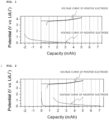
- charge capacity and discharge capacity were measured, and the results thereof are presented in FIGS. 1 to 3 .
- a Li metal foil (150 um) was used as a counter electrode, a polyolefin separator was disposed between the positive electrode prepared in Example 3 and the Li metal, and a coin-type half cell was then prepared by injecting an electrolyte in which 1 M LiPF 6 was dissolved in a solvent that was prepared by mixing ethylene carbonate (EC) and diethyl carbonate (DEC) in a volume ratio of 50:50.
- EC ethylene carbonate
- DEC diethyl carbonate
- Charge/discharge reversibility test was performed on the above-prepared coin-type half cell using an electrochemical charger/discharger.
- the coin-type half cell was charged by applying a current at a current density of 0.1 C-rate to a voltage of 4.25 V (vs. Li/Li + ) during first cycle charge and discharged at the same current density to a voltage of 3.0 V (vs. Li/Li + ) during discharge.
- charge capacity and discharge capacity were measured, and the results thereof are presented in FIGS. 1 to 3 .
- the capacity of the negative electrode of the coin-type half cell prepared in Example 1 was smaller than the capacity of the positive electrode of the above-prepared positive electrode half cell.
- the capacity of the negative electrode is smaller than the capacity of the positive electrode.
- the capacity of the negative electrode of the coin-type half cell prepared in Comparative Example 1 was larger than the capacity of the positive electrode of the above-prepared positive electrode half cell, and thus, it may be confirmed that the capacity of the negative electrode was reduced in comparison to the capacity of the positive electrode through the pre-lithiation.
- the capacity of the negative electrode of the coin-type half cell prepared in Comparative Example 2 was larger than the capacity of the positive electrode of the above-prepared positive electrode half cell even though the negative electrode was pre-lithiated, wherein, accordingly, it may be confirmed that a degree of pre-lithiation may be controlled by adjusting the contact time between the negative electrode and the lithium metal during the pre-lithiation.
- Charge/discharge reversibility test was performed on the lithium secondary batteries prepared in Examples 3 and 4 and Comparative Examples 3 and 4 using an electrochemical charger/discharger.
- the lithium secondary batteries were charged by applying a current at a current density of 0.1 C-rate to a voltage of 4.2 V (vs. Li/Li + ) during first cycle charge and discharged at the same current density to a voltage of 2.5 V (vs. Li/Li + ) during discharge.
- charge capacity and discharge capacity were measured, and the results thereof are presented in Table 1.
- the charge and discharge were repeated up to 100 cycles to measure charge capacity and discharge capacity in this case, and the results thereof are then presented in Table 1.
- Example 3 Example 4 Comparative Example 3 Comparative Example 4 Pre-lithiation degree of negative electrode (%) 50 75 0 25 Charge capacity ratio of negative electrode to positive electrode in the first cycle (%) 72 30 142 106 First cycle reversible capacity (mAh) 4.2 4.2 3.8 4.3 100 th cycle reversible capacity (mAh) 4.0 3.9 2.6 3.6
- the pre-lithiation degree (%) of the negative electrode pre-lithiation capacity of the negative electrode/capacity of the negative electrode ⁇ 100
- the charge capacity ratio of the negative electrode to the positive electrode in the first cycle (%) charge capacity of the negative electrode/charge capacity of the positive electrode ⁇ 100.
- the negative electrode of the lithium secondary battery of Example 3 had a pre-lithiation degree of 50%, and, since the charge capacity of the negative electrode was reduced in comparison to the charge capacity of the positive electrode, the charge capacity ratio of the negative electrode to the positive electrode in the first cycle was 72%.
- the lithium secondary battery of Comparative Example 3 in which the pre-lithiation of the negative electrode was not performed, had a charge capacity ratio of the negative electrode to the positive electrode in the first cycle of 142%, and the lithium secondary battery of Comparative Example 4 had a pre-lithiation degree of 25% and a charge capacity ratio of the negative electrode to the positive electrode in the first cycle of 106%.
- the lithium secondary battery of Comparative Example 3 When examining the first cycle reversible capacity, with respect to the lithium secondary battery of Comparative Example 3 in which the pre-lithiation was not performed, since irreversible capacity was not supplemented, the lithium secondary battery of Comparative Example 3 exhibited a smaller reversible capacity than the lithium secondary battery of Example 2 and the lithium secondary battery of Comparative Example 4 in which the pre-lithiation was performed.
- the lithium secondary battery of Comparative Example 3 in which the pre-lithiation was not performed, exhibited the smallest value, wherein, it was analyzed that, since the lithium secondary battery of Comparative Example 3 was not lithiated, it was discharged to the discharge end of the negative electrode, and thus, the shrinkage of SiO was increased to accelerate cycle degradation.
- Comparative Example 4 since the pre-lithiation was performed, a reduction width of the reversible capacity was smaller than that of Comparative Example 3.
- the lithium secondary battery of Example 3 since a reduction width of the reversible capacity was small even after the 100th cycle, it exhibited a high capacity retention, wherein the reason for this is considered that Li-plating on the negative electrode occurred after the charge of graphite and SiO was completed due to smaller capacity of the negative electrode than the positive electrode, the electroplated lithium first discharged before lithium, which was stored in the form of ions in the negative electrode active material of the negative electrode, during discharge and participated in the reaction to help not to consume all of the lithium ions stored in the negative electrode active material, and cycle degradation was suppressed because there was a lot of extra lithium ions in the SiO or graphite even if the electroplated lithium was all consumed during the cycle degradation.
Landscapes
- Chemical & Material Sciences (AREA)
- Engineering & Computer Science (AREA)
- Chemical Kinetics & Catalysis (AREA)
- Electrochemistry (AREA)
- General Chemical & Material Sciences (AREA)
- Manufacturing & Machinery (AREA)
- Materials Engineering (AREA)
- Secondary Cells (AREA)
- Battery Electrode And Active Subsutance (AREA)
Applications Claiming Priority (2)
| Application Number | Priority Date | Filing Date | Title |
|---|---|---|---|
| KR1020170088556A KR102268077B1 (ko) | 2017-07-12 | 2017-07-12 | 리튬 이차전지 및 이의 제조 방법 |
| PCT/KR2018/007728 WO2019013500A2 (ko) | 2017-07-12 | 2018-07-06 | 리튬 이차전지 및 이의 제조 방법 |
Publications (3)
| Publication Number | Publication Date |
|---|---|
| EP3565035A2 EP3565035A2 (en) | 2019-11-06 |
| EP3565035A4 EP3565035A4 (en) | 2020-02-05 |
| EP3565035B1 true EP3565035B1 (en) | 2023-12-13 |
Family
ID=65002302
Family Applications (1)
| Application Number | Title | Priority Date | Filing Date |
|---|---|---|---|
| EP18832631.8A Active EP3565035B1 (en) | 2017-07-12 | 2018-07-06 | Lithium secondary battery and manufacturing method for preparing the same |
Country Status (9)
| Country | Link |
|---|---|
| US (1) | US11411242B2 (pl) |
| EP (1) | EP3565035B1 (pl) |
| JP (1) | JP7062199B2 (pl) |
| KR (1) | KR102268077B1 (pl) |
| CN (1) | CN110214387B (pl) |
| ES (1) | ES2968416T3 (pl) |
| HU (1) | HUE064695T2 (pl) |
| PL (1) | PL3565035T3 (pl) |
| WO (1) | WO2019013500A2 (pl) |
Families Citing this family (17)
| Publication number | Priority date | Publication date | Assignee | Title |
|---|---|---|---|---|
| KR102586822B1 (ko) * | 2019-01-25 | 2023-10-11 | 주식회사 엘지에너지솔루션 | 이차전지용 음극의 제조방법 |
| KR102542291B1 (ko) | 2019-02-01 | 2023-06-14 | 주식회사 엘지에너지솔루션 | 이차전지용 음극의 제조방법 |
| KR20200129908A (ko) * | 2019-05-10 | 2020-11-18 | 주식회사 엘지화학 | 음극의 제조방법 |
| CN113994512B (zh) | 2019-08-26 | 2024-06-18 | 株式会社Lg新能源 | 锂二次电池及其制备方法 |
| KR102917395B1 (ko) | 2019-08-26 | 2026-01-26 | 주식회사 엘지에너지솔루션 | 리튬 이차전지 및 이의 제조 방법 |
| KR102856137B1 (ko) | 2019-09-06 | 2025-09-04 | 주식회사 엘지에너지솔루션 | 음극 전극의 전리튬-전소듐화 방법, 전리튬-전소듐화 음극, 및 이를 포함하는 리튬 이차전지 |
| KR102856170B1 (ko) | 2019-09-06 | 2025-09-04 | 주식회사 엘지에너지솔루션 | 음극 전극의 전소듐화 방법, 전소듐화 음극, 및 이를 포함하는 리튬 이차전지 |
| HUE065644T2 (hu) * | 2019-11-01 | 2024-06-28 | Lg Energy Solution Ltd | Eljárás negatív elektróda elõállítására |
| WO2021091108A1 (ko) | 2019-11-07 | 2021-05-14 | 주식회사 엘지에너지솔루션 | 리튬 이차전지의 제조방법 |
| KR102869702B1 (ko) | 2020-03-06 | 2025-10-14 | 주식회사 엘지에너지솔루션 | 신규한 이차 전지의 제조 방법 |
| KR102886639B1 (ko) * | 2020-05-18 | 2025-11-14 | 주식회사 엘지에너지솔루션 | 이차전지의 제조방법 |
| KR102816582B1 (ko) * | 2020-05-27 | 2025-06-04 | 주식회사 엘지에너지솔루션 | 리튬 이차전지의 퇴화 원인 진단 방법 |
| JP7213208B2 (ja) * | 2020-08-11 | 2023-01-26 | プライムプラネットエナジー&ソリューションズ株式会社 | 非水電解質二次電池 |
| KR102909741B1 (ko) | 2021-01-15 | 2026-01-09 | 주식회사 엘지에너지솔루션 | 이차전지의 충방전 방법 |
| JP7625331B2 (ja) * | 2021-07-09 | 2025-02-03 | エルジー エナジー ソリューション リミテッド | リチウム二次電池用負極、リチウム二次電池用負極の製造方法、および負極を含むリチウム二次電池 |
| TWI848434B (zh) * | 2022-11-11 | 2024-07-11 | 台灣中油股份有限公司 | 軟碳材料之負極的預鋰化方法及其超級電容 |
| CN119050277A (zh) * | 2024-10-29 | 2024-11-29 | 陕西晶泰新能源科技有限公司 | 一种含锂多元合金的界面层预锂化干法负极的制备方法 |
Family Cites Families (14)
| Publication number | Priority date | Publication date | Assignee | Title |
|---|---|---|---|---|
| EP1577914B1 (en) | 2002-12-26 | 2013-03-06 | Fuji Jukogyo Kabushiki Kaisha | Electrical storage device and method for manufacturing electrical storage device |
| CN103155260B (zh) | 2010-07-29 | 2016-01-20 | 日本电气株式会社 | 锂离子二次电池及其制造方法 |
| WO2012047596A2 (en) * | 2010-09-27 | 2012-04-12 | Amprius Inc. | Auxiliary electrodes for electrochemical cells containing high capacity active materials |
| US9166222B2 (en) | 2010-11-02 | 2015-10-20 | Envia Systems, Inc. | Lithium ion batteries with supplemental lithium |
| US9985326B2 (en) | 2011-02-11 | 2018-05-29 | Iucf-Hyu (Industry-University Cooperation Foundation Hanyang University) | Method for manufacturing a lithiated metal-carbon composite electrode, lithiated metal-carbon composite electrode manufactured thereby, and electrochemical device including the electrode |
| KR101594784B1 (ko) * | 2013-07-30 | 2016-02-17 | 주식회사 엘지화학 | 음극 전극의 전리튬화 방법 |
| JP6302322B2 (ja) * | 2013-09-26 | 2018-03-28 | 積水化学工業株式会社 | リチウムイオン二次電池 |
| KR102533760B1 (ko) | 2014-01-27 | 2023-05-17 | 한양대학교 산학협력단 | 리튬화된 비정질 규소산화물 전극의 제조방법, 이에 의하여 제조된 리튬화된 비정질 규소산화물 전극 및 이를 포함하는 리튬황전지 |
| CN104201320A (zh) * | 2014-09-16 | 2014-12-10 | 赵前永 | 一种为锂离子电池电极材料预锂化的方法 |
| US9837659B2 (en) * | 2014-12-22 | 2017-12-05 | GM Global Technology Operations LLC | Process for lithiating negative electrodes for lithium ion electrochemical cells |
| CN107534126B (zh) * | 2015-01-15 | 2021-08-17 | 珍拉布斯能源有限公司 | 用于高能量密度二次电池的具有复合涂层的正极活性材料及相应工艺 |
| KR101783447B1 (ko) | 2015-02-02 | 2017-10-23 | 주식회사 엘지화학 | 고용량 음극을 포함하는 이차전지 및 그 제조 방법 |
| KR20170088556A (ko) | 2016-01-25 | 2017-08-02 | 주식회사 에코해양건설 | 공기압을 이용한 잘피 이식장치 |
| KR101865381B1 (ko) * | 2016-03-28 | 2018-06-07 | 울산과학기술원 | 리튬 이차 전지 및 이의 제조방법 |
-
2017
- 2017-07-12 KR KR1020170088556A patent/KR102268077B1/ko active Active
-
2018
- 2018-07-06 CN CN201880008347.7A patent/CN110214387B/zh active Active
- 2018-07-06 EP EP18832631.8A patent/EP3565035B1/en active Active
- 2018-07-06 HU HUE18832631A patent/HUE064695T2/hu unknown
- 2018-07-06 PL PL18832631.8T patent/PL3565035T3/pl unknown
- 2018-07-06 WO PCT/KR2018/007728 patent/WO2019013500A2/ko not_active Ceased
- 2018-07-06 ES ES18832631T patent/ES2968416T3/es active Active
- 2018-07-06 US US16/483,186 patent/US11411242B2/en active Active
- 2018-07-06 JP JP2019572585A patent/JP7062199B2/ja active Active
Also Published As
| Publication number | Publication date |
|---|---|
| KR20190007296A (ko) | 2019-01-22 |
| US20200235419A1 (en) | 2020-07-23 |
| CN110214387B (zh) | 2023-03-28 |
| JP7062199B2 (ja) | 2022-05-06 |
| ES2968416T3 (es) | 2024-05-09 |
| HUE064695T2 (hu) | 2024-04-28 |
| CN110214387A (zh) | 2019-09-06 |
| WO2019013500A3 (ko) | 2019-04-11 |
| EP3565035A4 (en) | 2020-02-05 |
| US11411242B2 (en) | 2022-08-09 |
| EP3565035A2 (en) | 2019-11-06 |
| PL3565035T3 (pl) | 2024-03-11 |
| KR102268077B1 (ko) | 2021-06-23 |
| WO2019013500A2 (ko) | 2019-01-17 |
| JP2020525989A (ja) | 2020-08-27 |
Similar Documents
| Publication | Publication Date | Title |
|---|---|---|
| EP3565035B1 (en) | Lithium secondary battery and manufacturing method for preparing the same | |
| US12180088B2 (en) | Positive electrode active material for secondary battery, manufacturing method thereof, and secondary battery including same | |
| EP3660956B1 (en) | Negative electrode for lithium secondary battery and lithium secondary battery comprising the same | |
| US12113209B2 (en) | Negative electrode active material with metal dopant, and negative electrode, and lithium secondary battery including the same | |
| US11557763B2 (en) | Positive electrode active material for lithium secondary battery, method of preparing the same, and positive electrode for lithium secondary battery and lithium secondary battery which include the positive electrode active material | |
| KR102335314B1 (ko) | 리튬 이차전지용 음극, 및 이를 포함하는 리튬 이차전지 | |
| EP3522270B1 (en) | Fabrication method of cathode for secondary battery, cathode for secondary battery fabricated thereby, and lithium secondary battery comprising same cathode | |
| US11710815B2 (en) | Negative electrode for lithium secondary battery, lithium secondary battery comprising the same, and method of preparing the negative electrode | |
| CN113169320A (zh) | 锂二次电池用正极材料以及包含其的正极和锂二次电池 | |
| EP3627594B1 (en) | Positive electrode for lithium secondary battery, manufacturing method therefor, and lithium secondary battery comprising same | |
| US10734688B2 (en) | Constant-current charging and discharging method for lithium secondary battery by controlling current based on internal resistance measurement | |
| EP3653582A1 (en) | Cathode active material, method for producing same, and cathode electrode and secondary battery comprising same | |
| US11508953B2 (en) | Negative electrode for lithium secondary battery, lithium secondary battery comprising the same, and method of preparing the negative electrode | |
| EP3503257B1 (en) | Lithium secondary battery | |
| KR102563239B1 (ko) | 음극 활물질, 이를 포함하는 음극 및 리튬 이차전지 | |
| CN115004405A (zh) | 制造二次电池的方法 | |
| US12132200B2 (en) | Positive electrode for secondary battery, method of preparing the same, and lithium secondary battery including the same |
Legal Events
| Date | Code | Title | Description |
|---|---|---|---|
| STAA | Information on the status of an ep patent application or granted ep patent |
Free format text: STATUS: THE INTERNATIONAL PUBLICATION HAS BEEN MADE |
|
| PUAI | Public reference made under article 153(3) epc to a published international application that has entered the european phase |
Free format text: ORIGINAL CODE: 0009012 |
|
| STAA | Information on the status of an ep patent application or granted ep patent |
Free format text: STATUS: REQUEST FOR EXAMINATION WAS MADE |
|
| 17P | Request for examination filed |
Effective date: 20190730 |
|
| AK | Designated contracting states |
Kind code of ref document: A2 Designated state(s): AL AT BE BG CH CY CZ DE DK EE ES FI FR GB GR HR HU IE IS IT LI LT LU LV MC MK MT NL NO PL PT RO RS SE SI SK SM TR |
|
| AX | Request for extension of the european patent |
Extension state: BA ME |
|
| A4 | Supplementary search report drawn up and despatched |
Effective date: 20200109 |
|
| RIC1 | Information provided on ipc code assigned before grant |
Ipc: H01M 4/139 20100101ALI20200102BHEP Ipc: H01M 4/04 20060101AFI20200102BHEP Ipc: H01M 10/0525 20100101ALI20200102BHEP |
|
| DAV | Request for validation of the european patent (deleted) | ||
| DAX | Request for extension of the european patent (deleted) | ||
| RAP1 | Party data changed (applicant data changed or rights of an application transferred) |
Owner name: LG ENERGY SOLUTION LTD. |
|
| RAP3 | Party data changed (applicant data changed or rights of an application transferred) |
Owner name: LG ENERGY SOLUTION, LTD. |
|
| STAA | Information on the status of an ep patent application or granted ep patent |
Free format text: STATUS: EXAMINATION IS IN PROGRESS |
|
| 17Q | First examination report despatched |
Effective date: 20220825 |
|
| REG | Reference to a national code |
Ref country code: DE Ref legal event code: R079 Free format text: PREVIOUS MAIN CLASS: H01M0004139000 Ipc: H01M0004040000 Ref country code: DE Ref legal event code: R079 Ref document number: 602018062699 Country of ref document: DE Free format text: PREVIOUS MAIN CLASS: H01M0004139000 Ipc: H01M0004040000 |
|
| GRAP | Despatch of communication of intention to grant a patent |
Free format text: ORIGINAL CODE: EPIDOSNIGR1 |
|
| STAA | Information on the status of an ep patent application or granted ep patent |
Free format text: STATUS: GRANT OF PATENT IS INTENDED |
|
| RIC1 | Information provided on ipc code assigned before grant |
Ipc: H01M 4/139 20100101ALI20230719BHEP Ipc: H01M 10/0525 20100101ALI20230719BHEP Ipc: H01M 4/04 20060101AFI20230719BHEP |
|
| INTG | Intention to grant announced |
Effective date: 20230821 |
|
| GRAS | Grant fee paid |
Free format text: ORIGINAL CODE: EPIDOSNIGR3 |
|
| GRAA | (expected) grant |
Free format text: ORIGINAL CODE: 0009210 |
|
| STAA | Information on the status of an ep patent application or granted ep patent |
Free format text: STATUS: THE PATENT HAS BEEN GRANTED |
|
| AK | Designated contracting states |
Kind code of ref document: B1 Designated state(s): AL AT BE BG CH CY CZ DE DK EE ES FI FR GB GR HR HU IE IS IT LI LT LU LV MC MK MT NL NO PL PT RO RS SE SI SK SM TR |
|
| P01 | Opt-out of the competence of the unified patent court (upc) registered |
Effective date: 20231108 |
|
| REG | Reference to a national code |
Ref country code: GB Ref legal event code: FG4D |
|
| REG | Reference to a national code |
Ref country code: CH Ref legal event code: EP |
|
| REG | Reference to a national code |
Ref country code: DE Ref legal event code: R096 Ref document number: 602018062699 Country of ref document: DE |
|
| REG | Reference to a national code |
Ref country code: IE Ref legal event code: FG4D |
|
| REG | Reference to a national code |
Ref country code: SE Ref legal event code: TRGR |
|
| PG25 | Lapsed in a contracting state [announced via postgrant information from national office to epo] |
Ref country code: GR Free format text: LAPSE BECAUSE OF FAILURE TO SUBMIT A TRANSLATION OF THE DESCRIPTION OR TO PAY THE FEE WITHIN THE PRESCRIBED TIME-LIMIT Effective date: 20240314 |
|
| REG | Reference to a national code |
Ref country code: LT Ref legal event code: MG9D |
|
| PG25 | Lapsed in a contracting state [announced via postgrant information from national office to epo] |
Ref country code: LT Free format text: LAPSE BECAUSE OF FAILURE TO SUBMIT A TRANSLATION OF THE DESCRIPTION OR TO PAY THE FEE WITHIN THE PRESCRIBED TIME-LIMIT Effective date: 20231213 |
|
| REG | Reference to a national code |
Ref country code: NL Ref legal event code: MP Effective date: 20231213 |
|
| REG | Reference to a national code |
Ref country code: HU Ref legal event code: AG4A Ref document number: E064695 Country of ref document: HU |
|
| PG25 | Lapsed in a contracting state [announced via postgrant information from national office to epo] |
Ref country code: LT Free format text: LAPSE BECAUSE OF FAILURE TO SUBMIT A TRANSLATION OF THE DESCRIPTION OR TO PAY THE FEE WITHIN THE PRESCRIBED TIME-LIMIT Effective date: 20231213 Ref country code: GR Free format text: LAPSE BECAUSE OF FAILURE TO SUBMIT A TRANSLATION OF THE DESCRIPTION OR TO PAY THE FEE WITHIN THE PRESCRIBED TIME-LIMIT Effective date: 20240314 Ref country code: BG Free format text: LAPSE BECAUSE OF FAILURE TO SUBMIT A TRANSLATION OF THE DESCRIPTION OR TO PAY THE FEE WITHIN THE PRESCRIBED TIME-LIMIT Effective date: 20240313 |
|
| REG | Reference to a national code |
Ref country code: ES Ref legal event code: FG2A Ref document number: 2968416 Country of ref document: ES Kind code of ref document: T3 Effective date: 20240509 |
|
| REG | Reference to a national code |
Ref country code: AT Ref legal event code: MK05 Ref document number: 1641229 Country of ref document: AT Kind code of ref document: T Effective date: 20231213 |
|
| PG25 | Lapsed in a contracting state [announced via postgrant information from national office to epo] |
Ref country code: NL Free format text: LAPSE BECAUSE OF FAILURE TO SUBMIT A TRANSLATION OF THE DESCRIPTION OR TO PAY THE FEE WITHIN THE PRESCRIBED TIME-LIMIT Effective date: 20231213 |
|
| PG25 | Lapsed in a contracting state [announced via postgrant information from national office to epo] |
Ref country code: RS Free format text: LAPSE BECAUSE OF FAILURE TO SUBMIT A TRANSLATION OF THE DESCRIPTION OR TO PAY THE FEE WITHIN THE PRESCRIBED TIME-LIMIT Effective date: 20231213 Ref country code: NO Free format text: LAPSE BECAUSE OF FAILURE TO SUBMIT A TRANSLATION OF THE DESCRIPTION OR TO PAY THE FEE WITHIN THE PRESCRIBED TIME-LIMIT Effective date: 20240313 Ref country code: NL Free format text: LAPSE BECAUSE OF FAILURE TO SUBMIT A TRANSLATION OF THE DESCRIPTION OR TO PAY THE FEE WITHIN THE PRESCRIBED TIME-LIMIT Effective date: 20231213 Ref country code: LV Free format text: LAPSE BECAUSE OF FAILURE TO SUBMIT A TRANSLATION OF THE DESCRIPTION OR TO PAY THE FEE WITHIN THE PRESCRIBED TIME-LIMIT Effective date: 20231213 Ref country code: HR Free format text: LAPSE BECAUSE OF FAILURE TO SUBMIT A TRANSLATION OF THE DESCRIPTION OR TO PAY THE FEE WITHIN THE PRESCRIBED TIME-LIMIT Effective date: 20231213 |
|
| PG25 | Lapsed in a contracting state [announced via postgrant information from national office to epo] |
Ref country code: IS Free format text: LAPSE BECAUSE OF FAILURE TO SUBMIT A TRANSLATION OF THE DESCRIPTION OR TO PAY THE FEE WITHIN THE PRESCRIBED TIME-LIMIT Effective date: 20240413 |
|
| PG25 | Lapsed in a contracting state [announced via postgrant information from national office to epo] |
Ref country code: AT Free format text: LAPSE BECAUSE OF FAILURE TO SUBMIT A TRANSLATION OF THE DESCRIPTION OR TO PAY THE FEE WITHIN THE PRESCRIBED TIME-LIMIT Effective date: 20231213 Ref country code: CZ Free format text: LAPSE BECAUSE OF FAILURE TO SUBMIT A TRANSLATION OF THE DESCRIPTION OR TO PAY THE FEE WITHIN THE PRESCRIBED TIME-LIMIT Effective date: 20231213 |
|
| PG25 | Lapsed in a contracting state [announced via postgrant information from national office to epo] |
Ref country code: SK Free format text: LAPSE BECAUSE OF FAILURE TO SUBMIT A TRANSLATION OF THE DESCRIPTION OR TO PAY THE FEE WITHIN THE PRESCRIBED TIME-LIMIT Effective date: 20231213 |
|
| PG25 | Lapsed in a contracting state [announced via postgrant information from national office to epo] |
Ref country code: SM Free format text: LAPSE BECAUSE OF FAILURE TO SUBMIT A TRANSLATION OF THE DESCRIPTION OR TO PAY THE FEE WITHIN THE PRESCRIBED TIME-LIMIT Effective date: 20231213 Ref country code: SK Free format text: LAPSE BECAUSE OF FAILURE TO SUBMIT A TRANSLATION OF THE DESCRIPTION OR TO PAY THE FEE WITHIN THE PRESCRIBED TIME-LIMIT Effective date: 20231213 Ref country code: RO Free format text: LAPSE BECAUSE OF FAILURE TO SUBMIT A TRANSLATION OF THE DESCRIPTION OR TO PAY THE FEE WITHIN THE PRESCRIBED TIME-LIMIT Effective date: 20231213 Ref country code: IT Free format text: LAPSE BECAUSE OF FAILURE TO SUBMIT A TRANSLATION OF THE DESCRIPTION OR TO PAY THE FEE WITHIN THE PRESCRIBED TIME-LIMIT Effective date: 20231213 Ref country code: IS Free format text: LAPSE BECAUSE OF FAILURE TO SUBMIT A TRANSLATION OF THE DESCRIPTION OR TO PAY THE FEE WITHIN THE PRESCRIBED TIME-LIMIT Effective date: 20240413 Ref country code: EE Free format text: LAPSE BECAUSE OF FAILURE TO SUBMIT A TRANSLATION OF THE DESCRIPTION OR TO PAY THE FEE WITHIN THE PRESCRIBED TIME-LIMIT Effective date: 20231213 Ref country code: CZ Free format text: LAPSE BECAUSE OF FAILURE TO SUBMIT A TRANSLATION OF THE DESCRIPTION OR TO PAY THE FEE WITHIN THE PRESCRIBED TIME-LIMIT Effective date: 20231213 Ref country code: AT Free format text: LAPSE BECAUSE OF FAILURE TO SUBMIT A TRANSLATION OF THE DESCRIPTION OR TO PAY THE FEE WITHIN THE PRESCRIBED TIME-LIMIT Effective date: 20231213 |
|
| PG25 | Lapsed in a contracting state [announced via postgrant information from national office to epo] |
Ref country code: PT Free format text: LAPSE BECAUSE OF FAILURE TO SUBMIT A TRANSLATION OF THE DESCRIPTION OR TO PAY THE FEE WITHIN THE PRESCRIBED TIME-LIMIT Effective date: 20240415 |
|
| PG25 | Lapsed in a contracting state [announced via postgrant information from national office to epo] |
Ref country code: PT Free format text: LAPSE BECAUSE OF FAILURE TO SUBMIT A TRANSLATION OF THE DESCRIPTION OR TO PAY THE FEE WITHIN THE PRESCRIBED TIME-LIMIT Effective date: 20240415 |
|
| REG | Reference to a national code |
Ref country code: DE Ref legal event code: R097 Ref document number: 602018062699 Country of ref document: DE |
|
| PG25 | Lapsed in a contracting state [announced via postgrant information from national office to epo] |
Ref country code: DK Free format text: LAPSE BECAUSE OF FAILURE TO SUBMIT A TRANSLATION OF THE DESCRIPTION OR TO PAY THE FEE WITHIN THE PRESCRIBED TIME-LIMIT Effective date: 20231213 |
|
| PLBE | No opposition filed within time limit |
Free format text: ORIGINAL CODE: 0009261 |
|
| STAA | Information on the status of an ep patent application or granted ep patent |
Free format text: STATUS: NO OPPOSITION FILED WITHIN TIME LIMIT |
|
| PG25 | Lapsed in a contracting state [announced via postgrant information from national office to epo] |
Ref country code: SI Free format text: LAPSE BECAUSE OF FAILURE TO SUBMIT A TRANSLATION OF THE DESCRIPTION OR TO PAY THE FEE WITHIN THE PRESCRIBED TIME-LIMIT Effective date: 20231213 |
|
| PG25 | Lapsed in a contracting state [announced via postgrant information from national office to epo] |
Ref country code: SI Free format text: LAPSE BECAUSE OF FAILURE TO SUBMIT A TRANSLATION OF THE DESCRIPTION OR TO PAY THE FEE WITHIN THE PRESCRIBED TIME-LIMIT Effective date: 20231213 Ref country code: DK Free format text: LAPSE BECAUSE OF FAILURE TO SUBMIT A TRANSLATION OF THE DESCRIPTION OR TO PAY THE FEE WITHIN THE PRESCRIBED TIME-LIMIT Effective date: 20231213 |
|
| 26N | No opposition filed |
Effective date: 20240916 |
|
| PG25 | Lapsed in a contracting state [announced via postgrant information from national office to epo] |
Ref country code: MC Free format text: LAPSE BECAUSE OF FAILURE TO SUBMIT A TRANSLATION OF THE DESCRIPTION OR TO PAY THE FEE WITHIN THE PRESCRIBED TIME-LIMIT Effective date: 20231213 |
|
| REG | Reference to a national code |
Ref country code: CH Ref legal event code: PL |
|
| PG25 | Lapsed in a contracting state [announced via postgrant information from national office to epo] |
Ref country code: LU Free format text: LAPSE BECAUSE OF NON-PAYMENT OF DUE FEES Effective date: 20240706 |
|
| PG25 | Lapsed in a contracting state [announced via postgrant information from national office to epo] |
Ref country code: LU Free format text: LAPSE BECAUSE OF NON-PAYMENT OF DUE FEES Effective date: 20240706 |
|
| PG25 | Lapsed in a contracting state [announced via postgrant information from national office to epo] |
Ref country code: CH Free format text: LAPSE BECAUSE OF NON-PAYMENT OF DUE FEES Effective date: 20240731 Ref country code: BE Free format text: LAPSE BECAUSE OF NON-PAYMENT OF DUE FEES Effective date: 20240731 |
|
| REG | Reference to a national code |
Ref country code: BE Ref legal event code: MM Effective date: 20240731 |
|
| PGFP | Annual fee paid to national office [announced via postgrant information from national office to epo] |
Ref country code: PL Payment date: 20250625 Year of fee payment: 8 |
|
| PGFP | Annual fee paid to national office [announced via postgrant information from national office to epo] |
Ref country code: GB Payment date: 20250624 Year of fee payment: 8 |
|
| PGFP | Annual fee paid to national office [announced via postgrant information from national office to epo] |
Ref country code: FR Payment date: 20250624 Year of fee payment: 8 |
|
| PG25 | Lapsed in a contracting state [announced via postgrant information from national office to epo] |
Ref country code: IE Free format text: LAPSE BECAUSE OF NON-PAYMENT OF DUE FEES Effective date: 20240706 |
|
| PGFP | Annual fee paid to national office [announced via postgrant information from national office to epo] |
Ref country code: SE Payment date: 20250624 Year of fee payment: 8 |
|
| PGFP | Annual fee paid to national office [announced via postgrant information from national office to epo] |
Ref country code: HU Payment date: 20250721 Year of fee payment: 8 |
|
| PG25 | Lapsed in a contracting state [announced via postgrant information from national office to epo] |
Ref country code: FI Free format text: LAPSE BECAUSE OF FAILURE TO SUBMIT A TRANSLATION OF THE DESCRIPTION OR TO PAY THE FEE WITHIN THE PRESCRIBED TIME-LIMIT Effective date: 20231213 |
|
| PGFP | Annual fee paid to national office [announced via postgrant information from national office to epo] |
Ref country code: ES Payment date: 20250822 Year of fee payment: 8 |
|
| PGFP | Annual fee paid to national office [announced via postgrant information from national office to epo] |
Ref country code: DE Payment date: 20250624 Year of fee payment: 8 |
|
| PG25 | Lapsed in a contracting state [announced via postgrant information from national office to epo] |
Ref country code: CY Free format text: LAPSE BECAUSE OF FAILURE TO SUBMIT A TRANSLATION OF THE DESCRIPTION OR TO PAY THE FEE WITHIN THE PRESCRIBED TIME-LIMIT; INVALID AB INITIO Effective date: 20180706 |