EP3559657B1 - Verfahren zur identifizierung eines reagens während eines verfahrens in einem analysesystem - Google Patents
Verfahren zur identifizierung eines reagens während eines verfahrens in einem analysesystem Download PDFInfo
- Publication number
- EP3559657B1 EP3559657B1 EP17829641.4A EP17829641A EP3559657B1 EP 3559657 B1 EP3559657 B1 EP 3559657B1 EP 17829641 A EP17829641 A EP 17829641A EP 3559657 B1 EP3559657 B1 EP 3559657B1
- Authority
- EP
- European Patent Office
- Prior art keywords
- reagent
- chemical substance
- chemical
- sample
- substance
- Prior art date
- Legal status (The legal status is an assumption and is not a legal conclusion. Google has not performed a legal analysis and makes no representation as to the accuracy of the status listed.)
- Active
Links
Images

Classifications
-
- G—PHYSICS
- G01—MEASURING; TESTING
- G01N—INVESTIGATING OR ANALYSING MATERIALS BY DETERMINING THEIR CHEMICAL OR PHYSICAL PROPERTIES
- G01N30/00—Investigating or analysing materials by separation into components using adsorption, absorption or similar phenomena or using ion-exchange, e.g. chromatography or field flow fractionation
- G01N30/02—Column chromatography
- G01N30/04—Preparation or injection of sample to be analysed
- G01N30/06—Preparation
-
- G—PHYSICS
- G01—MEASURING; TESTING
- G01N—INVESTIGATING OR ANALYSING MATERIALS BY DETERMINING THEIR CHEMICAL OR PHYSICAL PROPERTIES
- G01N30/00—Investigating or analysing materials by separation into components using adsorption, absorption or similar phenomena or using ion-exchange, e.g. chromatography or field flow fractionation
- G01N30/02—Column chromatography
- G01N30/26—Conditioning of the fluid carrier; Flow patterns
- G01N30/28—Control of physical parameters of the fluid carrier
-
- G—PHYSICS
- G01—MEASURING; TESTING
- G01N—INVESTIGATING OR ANALYSING MATERIALS BY DETERMINING THEIR CHEMICAL OR PHYSICAL PROPERTIES
- G01N30/00—Investigating or analysing materials by separation into components using adsorption, absorption or similar phenomena or using ion-exchange, e.g. chromatography or field flow fractionation
- G01N30/02—Column chromatography
- G01N30/26—Conditioning of the fluid carrier; Flow patterns
- G01N30/38—Flow patterns
- G01N30/46—Flow patterns using more than one column
- G01N30/466—Flow patterns using more than one column with separation columns in parallel
-
- G—PHYSICS
- G01—MEASURING; TESTING
- G01N—INVESTIGATING OR ANALYSING MATERIALS BY DETERMINING THEIR CHEMICAL OR PHYSICAL PROPERTIES
- G01N30/00—Investigating or analysing materials by separation into components using adsorption, absorption or similar phenomena or using ion-exchange, e.g. chromatography or field flow fractionation
- G01N30/02—Column chromatography
- G01N30/62—Detectors specially adapted therefor
- G01N30/72—Mass spectrometers
- G01N30/7233—Mass spectrometers interfaced to liquid or supercritical fluid chromatograph
-
- G—PHYSICS
- G01—MEASURING; TESTING
- G01N—INVESTIGATING OR ANALYSING MATERIALS BY DETERMINING THEIR CHEMICAL OR PHYSICAL PROPERTIES
- G01N33/00—Investigating or analysing materials by specific methods not covered by groups G01N1/00 - G01N31/00
- G01N33/48—Biological material, e.g. blood, urine; Haemocytometers
- G01N33/50—Chemical analysis of biological material, e.g. blood, urine; Testing involving biospecific ligand binding methods; Immunological testing
- G01N33/58—Chemical analysis of biological material, e.g. blood, urine; Testing involving biospecific ligand binding methods; Immunological testing involving labelled substances
-
- G—PHYSICS
- G01—MEASURING; TESTING
- G01N—INVESTIGATING OR ANALYSING MATERIALS BY DETERMINING THEIR CHEMICAL OR PHYSICAL PROPERTIES
- G01N30/00—Investigating or analysing materials by separation into components using adsorption, absorption or similar phenomena or using ion-exchange, e.g. chromatography or field flow fractionation
- G01N30/02—Column chromatography
- G01N2030/022—Column chromatography characterised by the kind of separation mechanism
- G01N2030/027—Liquid chromatography
-
- G—PHYSICS
- G01—MEASURING; TESTING
- G01N—INVESTIGATING OR ANALYSING MATERIALS BY DETERMINING THEIR CHEMICAL OR PHYSICAL PROPERTIES
- G01N30/00—Investigating or analysing materials by separation into components using adsorption, absorption or similar phenomena or using ion-exchange, e.g. chromatography or field flow fractionation
- G01N30/02—Column chromatography
- G01N30/04—Preparation or injection of sample to be analysed
- G01N30/06—Preparation
- G01N2030/067—Preparation by reaction, e.g. derivatising the sample
Definitions
- a method for identifying a reagent during a process in an analysis system is disclosed.
- kits for pre-validated clinical MS applications are becoming commercially available.
- the use of mass spectrometry may not be regulatory approved for clinical diagnostics. This is mostly because of lack of standardized procedures, except for a very few analytes, and because of the still large number of user dependent factors, e.g. due to a number of manual steps that are still conducted and the diversity of hardware components that may be used and combined, and that play a role in delivering reliable and reproducible results of clinical relevance.
- sample preparation is typically a manual and tedious procedure. Protein precipitation with subsequent centrifugation is the most popular method to remove unwanted and potentially disturbing sample matrix.
- kits may in part facilitate sample preparation that can be at least in part automated. Kits are however available only for a limited number of analytes of interest and the entire process from sample preparation, to separation and detection remains complex, requiring the attendance of highly trained laboratory personnel to run highly sophisticated instruments.
- liquid chromatography coupled to tandem mass spectrometry allows to process several samples in parallel.
- the samples usually have to be prepared before being processed through the LC-MS-system.
- different types of reagents are used. At least one of these reagents is added to the sample for preparation thereof.
- Ensuring reagent identity and quality is an essential feature in automated systems for mass spectrometric analysis.
- it is in the responsibility of the user to ensure that the correct reagents are loaded onto the system, including identity and quality of the reagents and correct connection to the different flow paths.
- ensuring flow path integrity is an essential feature in highly parallelized LC systems for mass spectrometric analysis. Currently this is ensured only by timing and positioning of flow diverting valves.
- US 2016/0169902 A1 discloses a method for highly multiplexed quantitation of peptides by mass spectrometry and labeling reagent sets therefor.
- EP 2 108 957 A1 discloses compounds and methods for the isotopic/isobaric labeling and the subsequent affinity selection and analysis of proteinaceous molecules.
- WO 00/64557 A1 discloses a high-throughput liquid chromatography system.
- Embodiments of the disclosed method aim to provide an automated direct control of the reagent in an analysis system using liquid chromatography coupled to mass spectrometry by the mass spectrometric detector itself.
- the disclosed embodiments aim to provide a convenient and reliable method which, therefore, is suitable for specific analytical methods such as clinical diagnostics.
- high-throughput e.g. up to 100 samples/hour or more with random access sample preparation and LC separation can be obtained while the respective reagents may be identified throughout the complete process.
- the method can be fully automated increasing the walk-away time and decreasing the level of skills required.
- Disclosed herein is a method for identifying a reagent during a process in an analysis system, wherein the analysis system comprises a liquid chromatograph and a mass spectrometer.
- Embodiments of the disclosed method for identifying a reagent during a process in an analysis system have the features of the independent claim. Further embodiments of the invention, which may be realized in an isolated way or in any arbitrary combination, are disclosed in the dependent claims.
- the terms “have”, “comprise” or “include” or any arbitrary grammatical variations thereof are used in a non-exclusive way. Thus, these terms may both refer to a situation in which, besides the feature introduced by these terms, no further features are present in the entity described in this context and to a situation in which one or more further features are present.
- the expressions “A has B”, “A comprises B” and “A includes B” may both refer to a situation in which, besides B, no other element is present in A (i.e. a situation in which A solely and exclusively consists of B) and to a situation in which, besides B, one or more further elements are present in entity A, such as element C, elements C and D or even further elements.
- the terms "at least one”, “one or more” or similar expressions indicating that a feature or element may be present once or more than once typically will be used only once when introducing the respective feature or element.
- the expressions “at least one” or “one or more” will not be repeated, non-withstanding the fact that the respective feature or element may be present once or more than once.
- a method for identifying a reagent during a process in an analysis system disclosed.
- the analysis system comprises a liquid chromatograph and a mass spectrometer.
- the method comprises:
- analysis system encompasses any system comprising at least a liquid chromatograph and a mass spectrometer configured to obtain a measurement value.
- An analysis system is operable to determine via various chemical, biological, physical, optical or other technical procedures a parameter value of a sample or a component thereof.
- An analysis system may be operable to measure said parameter of the sample or of at least one analyte and return the obtained measurement value.
- the list of possible analysis results returned by the analyzer comprises, without limitation, concentrations of the analyte in the sample, a digital (yes or no) result indicating the existence of the analyte in the sample (corresponding to a concentration above the detection level), optical parameters, DNA or RNA sequences, data obtained from mass spectroscopy of proteins or metabolites and physical or chemical parameters of various types.
- An analysis system may comprise units assisting with the pipetting, dosing, and mixing of samples and/or reagents.
- the analysis system may comprise a reagent holding unit for holding reagents to perform the assays.
- Reagents may be arranged for example in the form of containers or cassettes containing individual reagents or group of reagents, placed in appropriate receptacles or positions within a storage compartment or conveyor. It may comprise a consumable feeding unit.
- the analysis system may comprise a process and detection system whose workflow is optimized for certain types of analysis. Examples of such analysis systems are clinical chemistry analyzers, coagulation chemistry analyzers, immunochemistry analyzers, urine analyzers, nucleic acid analyzers, used to detect the result of chemical or biological reactions or to monitor the progress of chemical or biological reactions.
- the analysis system may be designed as a clinical diagnostics system or may be part of a clinical diagnostics system.
- a "clinical diagnostics system” as used herein refers to a laboratory automated apparatus dedicated to the analysis of samples for in vitro diagnostics.
- the clinical diagnostics system may have different configurations according to the need and/or according to the desired laboratory workflow. Additional configurations may be obtained by coupling a plurality of apparatuses and/or modules together.
- a “module” is a work cell, typically smaller in size than the entire clinical diagnostics system, which has a dedicated function. This function can be analytical but can be also pre-analytical or post analytical or it can be an auxiliary function to any of the pre-analytical function, analytical function or post-analytical function.
- a module can be configured to cooperate with one or more other modules for carrying out dedicated tasks of a sample processing workflow, e.g. by performing one or more pre-analytical and/or analytical and/or post-analytical steps.
- the clinical diagnostics system can comprise one or more analytical apparatuses, designed to execute respective workflows that are optimized for certain types of analysis, e.g. clinical chemistry, immunochemistry, coagulation, hematology, liquid chromatography separation, mass spectrometry, etc.
- the clinical diagnostic system may comprise one analytical apparatus or a combination of any of such analytical apparatuses with respective workflows, where pre-analytical and/or post analytical modules may be coupled to individual analytical apparatuses or be shared by a plurality of analytical apparatuses.
- pre-analytical and/or post-analytical functions may be performed by units integrated in an analytical apparatus.
- the clinical diagnostics system can comprise functional units such as liquid handling units for pipetting and/or pumping and/or mixing of samples and/or reagents and/or system fluids, and also functional units for sorting, storing, transporting, identifying, separating, detecting.
- sample refers to a biological material suspected of containing one or more analytes of interest and whose detection, qualitative and/or quantitative, may be associated to a clinical condition.
- the sample can be derived from any biological source, such as a physiological fluid, including, blood, saliva, ocular lens fluid, cerebral spinal fluid, sweat, urine, milk, ascites fluid, mucous, synovial fluid, peritoneal fluid, amniotic fluid, tissue, cells or the like.
- the sample can be pretreated prior to use, such as preparing plasma from blood, diluting viscous fluids, lysis or the like; methods of treatment can involve filtration, centrifugation, distillation, concentration, inactivation of interfering components, and the addition of reagents.
- a sample may be used directly as obtained from the source in some cases or following a pretreatment and/or sample preparation workflow to modify the character of the sample, e.g. after adding an internal standard, after being diluted with another solution or after having being mixed with reagents e.g.
- sample is tendentially used to indicate a sample before sample preparation whereas the term “prepared sample” is used to refer to samples after sample preparation. In non-specified cases the term “sample” may generally indicate either a sample before sample preparation or a sample after sample preparation or both.
- analytes of interest are vitamin D, drugs of abuse, therapeutic drugs, hormones, and metabolites in general. The list is however not exhaustive.
- liquid chromatograph refers to an apparatus configured to be used for liquid chromatography (LC).
- LC is a separation technique in which the mobile phase is a liquid. It can be carried out either in a column or a plane.
- HPLC high performance liquid chromatography
- the sample is forced by a liquid at high pressure (the mobile phase) through a column that is packed with a stationary phase composed of irregularly or spherically shaped particles, a porous monolithic layer, or a porous membrane.
- HPLC is historically divided into two different sub-classes based on the polarity of the mobile and stationary phases.
- NPLC normal phase liquid chromatography
- RPLC reversed phase liquid chromatography
- mass spectrometer refers to an apparatus configured to be used for mass spectrometry (MS).
- MS is an analytical technique that ionizes chemical species and sorts the ions based on their mass to charge ratio. In simpler terms, a mass spectrum measures the masses within a sample. Mass spectrometry is used in many different fields and is applied to pure samples as well as complex mixtures. A mass spectrum is a plot of the ion signal as a function of the mass-to-charge ratio. These spectra are used to determine the elemental or isotopic signature of a sample, the masses of particles and of molecules, and to elucidate the chemical structures of molecules, such as peptides and other chemical compounds.
- a sample which may be solid, liquid, or gas, is ionized, for example by bombarding it with electrons. This may cause some of the sample's molecules to break into charged fragments.
- These ions are then separated according to their mass-to-charge ratio, typically by accelerating them and subjecting them to an electric or magnetic field: ions of the same mass-to-charge ratio will undergo the same amount of deflection.
- the ions are detected by a mechanism capable of detecting charged particles, such as an electron multiplier. Results are displayed as spectra of the relative abundance of detected ions as a function of the mass-to-charge ratio.
- the atoms or molecules in the sample can be identified by correlating known masses to the identified masses or through a characteristic fragmentation pattern.
- reagent refers to a substance used for treatment of a sample in order to prepare the sample for analysis, to enable a reaction to occur, or to enable detection of a physical parameter of the sample or analyte contained in the sample.
- a reagent can be a substance that is or comprises a reactant, typically a compound or agent capable e.g. of binding to or chemically transforming one or more analytes present in a sample or an unwanted matrix component of the sample.
- reactants are enzymes, enzyme substrates, conjugated dyes, protein-binding molecules, ligands, nucleic acid binding molecules, antibodies, chelating agents, promoters, inhibitors, epitopes, antigens, and the like.
- reagent is used to include any fluid that can be added to a sample including a dilution liquid, including water or other solvent or a buffer solution, or a substance that is used for disruption of specific or nonspecific binding of an analyte to a protein, binding proteins or surfaces.
- a sample may be provided for example in sample containers such as sample tubes, including primary tubes and secondary tubes, or multi-well plates, or any other sample carrying support.
- Reagents may be arranged for example in the form of containers or cassettes containing individual reagents or group of reagents and placed in appropriate receptacles or positions within a storage compartment or conveyor. Other types of reagents or system fluids may be provided in bulk containers or via a line supply.
- chemical substances refers to any chemical substance being different from the reagent to which the substance is allocated or added. Basic requirement is that the used chemical substance shows almost identical behavior during the reagent processing and chromatography than the reagent of interest as it has to follow the same workflow as the reagent. This could be achieved by using chemical isotopes or substances with similar polarity as the reagent.
- the possibility of chemical coding is a special feature which is made possible by the high multiplexing capabilities of mass spectrometric detection, which enables the detection of additional signals such as background signals at any time during the measurement provided that the concentration of the chemical substance is sufficiently high so as to be above the detection level of the mass spectrometer.
- a combination of several markers would allow unambiguously labeling of all reagents which are on the system.
- the chemical substance is spiked into the system reagent(s) during production of the specific reagent lot which are mainly HPLC eluents like water, acetonitrile, methanol and the like.
- the chemical substance is present in the LC-MS system background signals at any time during the analysis.
- the identity of the specific reagent lot can be traced back during any sample analysis to the production event and manufacturer.
- the chemical substances are present as minor, trace components in the system regents (solvents) and will be continuously infused into the analytical system such as HPLC column, trapping column, mass spectrometric ion source and the like, any unrequested enrichment of these trace components has to be avoided as this could affect the analysis system.
- the used chemicals should have specific elution and detection behavior, depending on the used chromatographic conditions.
- the chemical substance(s) is (are) present in the solvent in concentrations levels which may be easily detected by mass spectrometer without any further enrichment steps.
- Polarity conditions ensure that the chemical substance(s) is (are) not retained on the chromatographic stationary phase during the whole analysis time, for example high polar chemical substance(s) and medium polar to low polar eluent system on reversed phase material. This results in a constant signal background of the chemical substance(s) which is monitored continuously by the mass spectrometric detector and allows readout of the chemical substance(s) at any time during the analysis.
- the term "continuously identified” as used herein refers to a permanent identification within a time range from the input of the reagent into the analysis system to the discharge or removal of the reagent from the analysis system. Thus, as long as the reagent is present in the analysis system, it may be identified. This is possible, as the chemical substance causes a background signal of the mass spectrometer.
- the chemical substance may be configured to prevent retaining thereof on a stationary phase of the liquid chromatograph. Thus, it is ensured that the chemical substance follows the reagent throughout the workflow such that reagent identity is unambiguously detectable.
- the polarity and the molecular weight of the chemical substance may be adapted to the stationary phase of the liquid chromatograph such that the chemical substance is prevented from being retained on the stationary phase of the liquid chromatograph.
- the polarity of the chemical substance may be adapted by means of using a mixture of isobaric oligomers of the chemical substance.
- the used chemical substances show almost identical behavior during the reagent processing and chromatography as the reagent of interest. Thereby, identity of the reagents may be unambiguously detected.
- the molecular weight may be adapted by using homologs, derivatives or isotope labelling of the chemical substance.
- the molecular weight may be adapted in a rather simple manner.
- the liquid chromatograph may comprise a liquid chromatography separation station comprising a plurality of liquid chromatography channels, wherein the chemical substance is assigned to one of the plurality of liquid chromatography channels.
- liquid chromatograph separation station refers to an analytical apparatus or module or a unit in an analytical apparatus designed to subject the prepared samples to chromatographic separation in order for example to separate analytes of interest from matrix components, e.g. remaining matrix components after sample preparation that may still interfere with a subsequent detection, e.g. a mass spectrometry detection, and/or in order to separate analytes of interest from each other in order to enable their individual detection.
- the liquid chromatograph separation station is an intermediate analytical apparatus or module or a unit in an analytical apparatus designed to prepare a sample for mass spectrometry and/or to transfer the prepared sample to a mass spectrometer.
- the liquid chromatograph separation station is a multi-channel liquid chromatograph separation station comprising a plurality of liquid chromatography channels.
- a “liquid chromatography channel” is a fluidic line comprising at least one capillary tubing and/or liquid chromatography column comprising a stationary phase selected according to the type of sample(s) and analytes and through which a mobile phase is pumped in order to trap and/or separate and elute and/or transfer analytes of interest under selected conditions, e.g. according to their polarity or log P value, size or affinity, as generally known.
- the at least one liquid chromatography column in the at least one liquid chromatography channel may be exchangeable.
- the liquid chromatography may comprise more liquid chromatography columns than liquid chromatography channels, where a plurality of liquid chromatography columns may be interchangeably coupled to the same liquid chromatography channel.
- a capillary tubing may bypass a liquid chromatography column or may allow adjustment of dead volumes to fine-tune elution time windows.
- the liquid chromatography separation station typically further comprises also a sufficient number of pumps, e.g. binary pumps in case of conditions requiring the use of elution gradients, and several switching valves.
- pumps e.g. binary pumps in case of conditions requiring the use of elution gradients, and several switching valves.
- the mass spectrometer by detecting the chemical substance at the mass spectrometer, it may be detected whether the reagent is associated with the correct or target channel.
- a flow of the reagent through one of the channels may be tracked. Thus, it may be detected whether the reagent flows through the correct or target channel.
- the method may further comprise detecting a flow of the reagent through the channel to which the chemical substance is assigned by detecting whether an actual detection signal of the mass spectrometer includes a reagent detection signal representing the reagent and the substance detection signal. Thus, if both the reagent detection signal representing the reagent and the substance detection signal are detected, a flow of the reagent through the target channel may be detected.
- the chemical substance may be assigned to one of the plurality of liquid chromatography channels depending on the type of reagent. Thus, an effective assignment of the reagent to the channels is provided.
- the method may further comprise adding a composition of different chemical substances to the reagent, processing the reagent together with the composition of chemical substances by means of the analysis system, and identifying the reagent based on a detection of a substance detection signal pattern of the mass spectrometer including substance detection signals representing the composition of chemical substances.
- a chemical coding for the reagent is provided improving the detection quality for detecting the identity of the reagent.
- the method may further comprise providing a plurality of reagents, adding a composition of different chemical substances to each of the plurality of reagents, wherein the compositions added to the plurality of reagents are different from one another, processing the plurality of reagents together with the compositions of chemical substances by means of the analysis system, and identifying each of the plurality of reagents based on a detection of substance detection signal patterns of the mass spectrometer including substance detection signals representing the different compositions of chemical substances.
- a composition of different chemical substances allows to provide a chemical coding of the respective reagents such that the reagents may be unambiguously identified.
- the number of compositions may correspond to the number of liquid chromatography channels. Thus, to each channel a kind of signature may be assigned.
- the chemical substances may differ from one another at least by the molecular weight.
- a signature is generated by a variable composition of defined substances, which are chemically different or stable isotopes of one chemical substance, with different molecular weight, wherein the applied concentration of each species is preferably equal.
- the number of digital patterns, which are needed, is equal to the number of flow paths or channels which have to be differentiated. For example, five flow paths or channels need five different chemical codes provided by the compositions only.
- the chemical substance may be at least one element selected from the group consisting of: peptides, derivatives of peptides, peptide nucleic acids, oligonucleotides, carbohydrates, derivatives of carbohydrates and oligomers.
- peptides derivatives of peptides
- peptide nucleic acids peptide nucleic acids
- oligonucleotides carbohydrates
- carbohydrates derivatives of carbohydrates and oligomers.
- the method may further comprise generating a code by adding at least two different chemical substances to the reagent with each chemical substance having a predetermined concentration, wherein the predetermined concentration of at least one of the chemical substances is above a detection level of the mass spectrometer.
- a safe code may be generated in a rather simple manner by varying the concentration of at least two different chemical substances.
- the step of adding of at least one chemical substance to the reagent may be carried out in a factory made step.
- the identity and quality of the reagent is ensured as the reagent may not be manipulated by the user of the analysis system.
- the chemical coding of the reagent by the manufacturer allows to detect if the reagent has been manipulated or modified by the user of the analysis system.
- the disclosure further discloses and proposes a computer program including computer-executable instructions for performing the method according to the present invention in one or more of the embodiments enclosed herein when the program is executed on a computer or computer network.
- the computer program may be stored on a computer-readable data carrier.
- one, more than one or even all of the method steps as indicated above may be performed by using a computer or a computer network, preferably by using a computer script.
- the disclosure further discloses and proposes a computer program product having program code means, in order to perform the method according to the present invention in one or more of the embodiments enclosed herein when the program is executed on a computer or computer network.
- the program code means may be stored on a computer-readable data carrier.
- the disclosure discloses and proposes a data carrier having a data structure stored thereon, which, after loading into a computer or computer network, such as into a working memory or main memory of the computer or computer network, may execute the method according to one or more of the embodiments disclosed herein.
- the disclosure further proposes and discloses a computer program product with program code means stored on a machine-readable carrier, in order to perform the method according to one or more of the embodiments disclosed herein, when the program is executed on a computer or computer network.
- a computer program product refers to the program as a tradable product.
- the product may generally exist in an arbitrary format, such as in a paper format, or on a computer-readable data carrier.
- the computer program product may be distributed over a data network.
- the disclosure proposes and discloses a modulated data signal which contains instructions readable by a computer system or computer network, for performing the method according to one or more of the embodiments disclosed herein.
- one or more of the method steps or even all of the method steps of the method according to one or more of the embodiments disclosed herein may be performed by using a computer or computer network.
- any of the method steps including provision and/or manipulation of data may be performed by using a computer or computer network.
- these method steps may include any of the method steps, typically except for method steps requiring manual work, such as providing the samples and/or certain aspects of performing the actual measurements.
- the present disclosure further discloses:
- the analysis system may be a clinical diagnostic system.
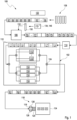
- the analysis system 100 comprises at least a liquid chromatograph 102 and a mass spectrometer 104.
- the analysis system 100 further comprises a sample preparation station 106 for the automated pre-treatment and preparation of samples 108 each comprising at least one analyte of interest.
- the liquid chromatograph 102 comprises a liquid chromatography separation station 110 comprising a plurality of liquid chromatography channels 112.
- the liquid chromatography channels 112 may differ from one another in that there are liquid chromatography channels 112 with a shorter cycle time and liquid chromatography channels 112 with a longer cycle time.
- the liquid chromatography separation station 110 may comprise a plurality of only faster liquid chromatography channels 112, or a plurality of only slower liquid chromatography channels 112.
- the analysis system 100 further comprises a sample preparation/liquid chromatography interface 114 for inputting prepared samples into any one of the liquid chromatography channels 112.
- the analysis system 100 further comprises a liquid chromatography/mass spectrometer interface 116 for connecting the liquid chromatography separation station 110 to the mass spectrometer 104.
- the liquid chromatography/mass spectrometer interface 116 comprises an ionization source 118 and an ion mobility module 120 between the ionization source 118 and the mass spectrometer 104.
- the ion mobility module 120 may be a high-field asymmetric waveform ion mobility spectrometry (FAIMS) module.
- the mass spectrometer 104 is a tandem mass spectrometer and in particular a triple quadrupole mass spectrometer, capable of multiple reaction monitoring (MRM).
- the analysis system 100 further comprises a controller 122 programmed to assign the samples 108 to pre-defined sample preparation workflows each comprising a pre-defined sequence of sample preparation steps and requiring a pre-defined time for completion depending on the analytes of interest.
- the controller 122 is further programmed to assign (reserve in advance) an liquid chromatography channel 112 for each prepared sample depending on the analytes of interest and to plan an liquid chromatography channel input sequence I1-n for inputting the prepared samples that allows analytes of interest from different liquid chromatography channels 112 to elute in a non-overlapping LC eluate output sequence E1-n based on expected elution times.
- the controller 122 is further programmed to set and initiate a sample preparation start sequence S1-n that generates a prepared sample output sequence P1-n that matches the liquid chromatography channel input sequence I1-n.
- each sample of the sample preparation start sequence S1-n, each prepared sample of the prepared sample output sequence P1-n and liquid chromatography channel input sequence I1-n, each liquid chromatography eluate of the liquid chromatography eluate output sequence E1-n is indicated in a segment of a sequence comprising non-overlapping adjacent segments, each segment representing schematically one reference period.
- Each sequence is thus a sequence of reference periods or time units, the length of which can be fixed and remains constant across the different sequences.
- Preparation of new samples in the sample preparation start sequence S1-n is started with a frequency of one sample per reference period or at intervals separated by one or more reference periods, indicated by empty segments in the sequence, in which no sample preparation is started.
- preparation of samples in the prepared sample output sequence P1-n is completed with a frequency of one prepared sample per reference period or at intervals separated by one or more reference periods, indicated by empty segments in the sequence, in which no sample preparation is completed.
- the prepared samples are inputted in the respective assigned liquid chromatography channels 112 according to the liquid chromatography channel input sequence I1-n with a frequency of one liquid chromatography channel input per reference period or at intervals separated by one or more reference periods, indicated by empty segments in the sequence, in which no liquid chromatography channel input takes place.
- liquid chromatography eluates in the liquid chromatography eluate output sequence E1-n are outputted with a frequency of one liquid chromatography eluate per reference period or at intervals separated by one or more reference periods, indicated by empty segments in the sequence, in which no liquid chromatography eluate is outputted.
- the liquid chromatography channels 112 are alternately connectable to the liquid chromatography/mass spectrometer interface 116 and the controller 122 controls a valve switching 124 according to the liquid chromatography eluate output sequence E1-n for inputting one liquid chromatography eluate at a time into the ionization source 118.
- the liquid chromatography eluates in the liquid chromatography eluate output sequence E1-n are inputted into the ionization source 118 with a frequency of one liquid chromatography eluate per reference period or at intervals separated by one or more reference periods according to the liquid chromatography eluate output sequence E1-n.
- the ionization source 118 is a double ionization source, including an ESI source 126 and an APCI source 128, where depending on the liquid chromatography eluate in the liquid chromatography eluate output sequence E1-n and on the analyte(s) of interest contained therein the controller 122 may select one of the two ionization sources 126, 128 that is most appropriate.
- the controller 122 may group together (place adjacent to each other in the sequence) samples also according to the ionization source 126, 128 so that frequent switch between ionization sources 126, 128 is prevented. Ionization source switching may be planned during one or more empty reference periods for example.
- the method comprises providing a reagent 130.
- the reagent 130 may be present in a reagent vessel 132 such as a container.
- a chemical substance 134 is added to the reagent 130 with a concentration being above a detection level of the mass spectrometer 104.
- the adding of the chemical substance 134 to the reagent 130 is carried out in a factory made step.
- the reagent container 132 may be input to the sample preparation station 106.
- the sample 108 is prepared using the reagent 130. For example, a predefined dose of the reagent 130 is dispensed into the sample 108. In any case, the reagent 130 together with the chemical substance 134 is added to the sample 108 before the sample 108 is input into the liquid chromatograph 102.
- the sample 108 is processed together with the reagent 130 and the chemical substance 134 by means of the analysis system 100.
- the thus prepared sample 108 together with the reagent 130 and the chemical substance 134 is input into the liquid chromatograph 102, passes through the liquid chromatograph 102 and is input into the mass spectrometer 104.
- the mass spectrometer 104 By means of the mass spectrometer 104, a component and/or components of the sample 108 is detected and measured.
- the reagent 130 is detected and measured by the mass spectrometer 104.
- the reagent 130 is identified based on a detection of a substance detection signal of the mass spectrometer 104 including substance detection signals representing the chemical substances 132.
- the signal of the mass spectrometer 104 not only includes the detection result corresponding to the reagent 130 but also includes signals unique to the chemical substance 134, thereby allowing to unambiguously identify the reagent 130.
- the reagent 130 is continuously identified during the process.
- the reagent 130 comprises at least one analyte of interest and the chemical substances 134 are chemical isotopes and/or have similar polarity as the analyte of interest in order to ensure that the used chemicals show almost identical behavior during the sample and reagent processing and chromatography than the analyte of interest as they have to follow the same workflow as the analyte.
- the chemical substances 134 have an identical the molecular weight.
- the chemical substance 134 is at least one element selected from the group consisting of: peptides, derivatives of peptides, peptide nucleic acids, oligonucleotides, and oligomers Further, the chemical substances are configured to prevent retaining thereof on a stationary phase of the liquid chromatograph 102. This may be realized in that the polarity and the molecular weight of the chemical substances 134 are adapted to the stationary phase of the liquid chromatograph 102 such that the chemical substances 134 are prevented from being retained on the stationary phase of the liquid chromatograph 102.
- the polarity of the chemical substances 134 is adapted by means of using a mixture of isobaric oligomers or isotopes of the chemical substances 134 and the molecular weight is adapted by using homologs, derivatives or isotope labelling of the chemical substances 134. More particularly, the polarity of the chemical substances 134 is adapted by means of using a mixture of oligomers or derivatives of the chemical substances 134.
- Each oligomer component has a labeling group 136 for molecular weight coding which is measured intact or released during a mass spectrometric process and measured by means of the mass spectrometer 104 as will be described in further detail below.
- FIG. 2 shows schematically the construction of one of the chemical substances 134.
- the chemical substances 134 comprise polar molecule groups 138 and lipophilic molecule groups 140.
- the chemical substances 134 are formed from monomeric blocks having a structure of (polar) n -(lipophil) m , wherein (polar) represents a polar molecule group 138, (lipophil) represents a lipophilic molecule group 140 and n, m are integers greater 0. More particularly, the chemical substances are formed from monomeric building blocks n*(polar) and m*(lipophil) which are polymerized randomly, wherein (polar) represents a polar molecule group 138, (lipophil) represents a lipophilic molecule group 140 and n, m are integers greater 0.
- the chemical substance 134 comprises four polar molecule groups 138 followed by four lipophilic molecule groups 140.
- each chemical substance 134 comprises an isobaric oligomer group 142 and at least one molecular weight coding group 144, wherein the isobaric oligomer group 142 and the molecular weight coding group 144 of the different chemical substances 134 differ from one another.
- the chemical substances 134 may thus be used for chemical coding of the samples.
- the number of target analytes is highly depending of the application menu on the analysis system 100.
- a prerequisite to the coding chemicals is therefore to cover the whole polarity range of the application menu. This is achieved by a composition of a complex functional entity of coding chemicals as described above.
- the monomers are designed to have identical molecular weight (isobaric building blocks), thus the overall molecular weight of this oligomeric subunit is constant independently of the ratio n/m generating an isobaric oligomer backbone.
- n and m may be random or not random depending on the desired readout of the mass spectrometer 104, molecular weight only by using selected ion monitoring or by readout of molecular weight and sequence by fragmentation pattern (daughter ion scan). Attached to this building block there is a molecular weight discriminating label.
- Function of the molecular weight coding group 144 is to enable the generation of a variety of encoding substances with different molecular weight. This is generated for example by using different amounts of stable isotopic labels or different chemical functionality within the molecular weight coding group 144.
- Function of the oligomeric building block is to generate a polarity leader in which the subunits have different chromatographic properties (logP) but have identically molecular weights.
- logP chromatographic properties
- Examples for monomers used for generation of the isobaric oligomer backbone are serin-propylether having a molecular weight of 129.16, homoserin-ethylether having a molecular weigh of 129.16 and glutamine acid having a a molecular weigh of 129.11.
- each molecular weight coding group 144 is linked to a mixture of an isobaric oligomer backbone which covers the whole chromatographic space of the application.
- the mass spectrometer 104 independently of the polarity (logP) of the analytes of interest at least on member of each chemical coding entity or chemical substance 134 will be detected by the mass spectrometer 104 in the same time window as the analyte of interest.
- the only differentiation criterion is the molecular weight (SIM readout only).
- the liquid chromatography separation station 110 comprises a plurality of liquid chromatography channels 112.
- a plurality of samples 108 and reagents 130 may be processed at the same time.
- the chemical substance 134 is assigned to one of the plurality of liquid chromatography channels 112.
- the chemical substance 134 is assigned to one of the plurality of liquid chromatography channels 112 depending on the type of reagent 130. Thereby, a flow of the reagent 130 through one of the channels 112 may be tracked.
- a flow of the reagent 130 through the channel 112 to which the chemical substance 134 is assigned may be detected by detecting whether an actual detection signal of the mass spectrometer 104 includes a reagent detection signal representing the reagent 134 and the substance detection signal. With other words, it may be detected whether the reagent 130 has passed the target or correct channel 112.
- the method may further comprise providing a plurality of reagents 130, adding a composition 146 of different chemical substances 134 to each of the plurality of reagents 130, wherein the compositions 146 added to the plurality of samples 108 are different from one another, processing the plurality of reagents 130 together with the compositions 146 of chemical substances 134 by means of the analysis system 100, and identifying each of the plurality of reagents 130 based on a detection of substance detection signal patterns of the mass spectrometer 104 including substance detection signals representing the different compositions 146 of chemical substances 134.
- the chemical substances 134 differ from one another at least by the molecular weight.
- the number of compositions 146 may correspond to the number of liquid chromatography channels 112.
- a code may be generated by adding at least two different chemical substances 134 to the reagent 130.
- each chemical substance 134 has a predetermined concentration, wherein the predetermined concentration of at least one of the chemical substances 134 is above a detection level of the mass spectrometer 104.
Landscapes
- Health & Medical Sciences (AREA)
- Life Sciences & Earth Sciences (AREA)
- Chemical & Material Sciences (AREA)
- Immunology (AREA)
- Physics & Mathematics (AREA)
- Analytical Chemistry (AREA)
- Biochemistry (AREA)
- General Health & Medical Sciences (AREA)
- General Physics & Mathematics (AREA)
- Pathology (AREA)
- Engineering & Computer Science (AREA)
- Biomedical Technology (AREA)
- Hematology (AREA)
- Molecular Biology (AREA)
- Urology & Nephrology (AREA)
- Biotechnology (AREA)
- Cell Biology (AREA)
- Microbiology (AREA)
- Food Science & Technology (AREA)
- Medicinal Chemistry (AREA)
- Other Investigation Or Analysis Of Materials By Electrical Means (AREA)
Claims (14)
- Verfahren zum Identifizieren eines Reagens (130) während eines Prozesses in einem Analysesystem (100), wobei das Analysesystem (100) einen Flüssigchromatographen (102) und ein Massenspektrometer (104) umfasst, wobei das Verfahren Folgendes umfasst:- Bereitstellen eines Reagens (130), wobei das Reagens (130) zur Behandlung einer Probe verwendet wird, um die Probe zur Analyse in dem Analysesystem (100) vorzubereiten;- Zugeben mindestens einer chemischen Substanz (134) zu dem Reagens (130) und der Probe, bevor die Probe in den Flüssigchromatographen (102) gegeben wird, wobei die mindestens eine chemische Substanz (134) eine Konzentration aufweist, die über einem Nachweisniveau des Massenspektrometers (104) liegt,- Verarbeiten der Probe und des Reagens (130) zusammen mit der chemischen Substanz (134) mittels des Analysesystems (100), wobei die Probe, das Reagens (130) und die chemische Substanz (134) den Flüssigchromatographen (102) durchlaufen und in das Massenspektrometer (104) gegeben werden, und- Identifizieren des Reagens (130) basierend auf einem Nachweis eines Substanznachweissignals des Massenspektrometers (104), das die chemische Substanz (134) darstellt, wobei das Reagens (130) innerhalb eines Zeitbereiches von der Eingabe des Reagens (130) in das Analysesystem (100) bis zur Entladung oder Entfernung des Reagens (130) aus dem Analysesystem (100) kontinuierlich identifiziert wird, indem mit dem Massenspektrometer (104) das konstante Hintergrundsignal, das von der chemischen Substanz ausgelöst wird, zu jeder Zeit während der Analyse kontinuierlich überwacht wird, um nachzuweisen, ob das Reagens (130) einen Ziel- oder korrekten Flüssigchromatographiekanal (112) des Flüssigchromatographen (102) passiert hat.
- Verfahren nach Anspruch 1, wobei die chemische Substanz (134) dafür ausgebildet ist, zu verhindern, dass sie auf einer stationären Phase des Flüssigchromatographen zurückgehalten wird.
- Verfahren nach Anspruch 2, wobei die Polarität und das Molekulargewicht der chemischen Substanz (134) so an die stationäre Phase des Flüssigchromatographen angepasst sind, dass verhindert wird, dass die chemische Substanz (134) auf der stationären Phase des Flüssigchromatographen (102) zurückgehalten wird.
- Verfahren nach Anspruch 3, wobei die Polarität der chemischen Substanz (134) mithilfe der Verwendung eines Gemisches aus isobaren Oligomeren der chemischen Substanz angepasst wird.
- Verfahren nach Anspruch 2 oder 3, wobei das Molekulargewicht unter Verwendung von Homologen, Derivaten oder Isotopenmarkierung der chemischen Substanz angepasst wird.
- Verfahren nach einem der Ansprüche 1 bis 5, wobei der Flüssigchromatograph (102) eine Flüssigchromatographietrennstation (110) umfasst, die eine Vielzahl von Flüssigchromatographiekanälen (112) umfasst, wobei die chemische Substanz (134) einem der Vielzahl von Flüssigchromatographiekanälen (112) zugeordnet wird.
- Verfahren nach Anspruch 6, wobei ein Strom des Reagens (130) durch einen der Kanäle (112) verfolgt wird.
- Verfahren nach Anspruch 7, ferner umfassend das Nachweisen eines Stromes des Reagens (130) durch den Kanal (112), dem die chemische Substanz (134) zugeordnet ist, durch Nachweisen, ob ein tatsächliches Nachweissignal des Massenspektrometers (104) ein Reagensnachweissignal, das das Reagens (130) darstellt, und das Substanznachweissignal einschließt.
- Verfahren nach einem der Ansprüche 6 bis 8, wobei die chemische Substanz (134) einem der Vielzahl von Flüssigchromatographiekanälen (112) in Abhängigkeit des Typs von Reagens (130) zugeordnet wird.
- Verfahren nach einem der Ansprüche 6 bis 9, ferner umfassend das Zugeben einer Zusammensetzung (146) aus verschiedenen chemischen Substanzen (134) zu dem Reagens (130), Verarbeiten des Reagens (130) zusammen mit der Zusammensetzung (146) aus chemischen Substanzen (134) mittels des Analysesystems (112) und Identifizieren des Reagens (130) basierend auf einem Nachweis eines Substanznachweissignalmusters des Massenspektrometers (104), das Substanznachweissignale einschließt, die die Zusammensetzung (146) aus chemischen Substanzen (134) darstellen.
- Verfahren nach Anspruch 10, ferner umfassend das Bereitstellen einer Vielzahl von Reagenzien (130), Zugeben einer Zusammensetzung (146) aus verschiedenen chemischen Substanzen (134) zu jedem der Vielzahl von Reagenzien (130), wobei die Zusammensetzungen (146), die der Vielzahl von Reagenzien (130) zugegeben werden, verschieden voneinander sind, Verarbeiten der Vielzahl von Reagenzien (130) zusammen mit den Zusammensetzungen (146) aus chemischen Substanzen (134) mittels des Analysesystems (112) und Identifizieren jedes der Vielzahl von Reagenzien (130) basierend auf einem Nachweis von Substanznachweissignalmustern des Massenspektrometers (104), die Substanznachweissignale einschließen, die die verschiedenen Zusammensetzungen aus chemischen Substanzen (134) darstellen.
- Verfahren nach Anspruch 11, wobei die Anzahl von Zusammensetzungen (146) der Anzahl von Flüssigchromatographiekanälen (112) entspricht.
- Verfahren nach einem der Ansprüche 10 bis 12, wobei sich die chemischen Substanzen (134) mindestens durch das Molekulargewicht voneinander unterschieden.
- Verfahren nach einem der Ansprüche 1 bis 13, ferner umfassend das Erzeugen eines Codes durch Zugeben von mindestens zwei verschiedenen chemischen Substanzen (134) zu dem Reagens (130), wobei jede chemische Substanz (134) eine vorbestimmte Konzentration aufweist, wobei die vorbestimmte Konzentration von mindestens einer der chemischen Substanzen (134) über einem Nachweisniveau des Massenspektrometers (104) liegt.
Applications Claiming Priority (2)
| Application Number | Priority Date | Filing Date | Title |
|---|---|---|---|
| EP16206595 | 2016-12-23 | ||
| PCT/EP2017/084027 WO2018115247A1 (en) | 2016-12-23 | 2017-12-21 | Method for identifying a reagent during a process in an analysis system |
Publications (2)
| Publication Number | Publication Date |
|---|---|
| EP3559657A1 EP3559657A1 (de) | 2019-10-30 |
| EP3559657B1 true EP3559657B1 (de) | 2025-06-18 |
Family
ID=57681401
Family Applications (1)
| Application Number | Title | Priority Date | Filing Date |
|---|---|---|---|
| EP17829641.4A Active EP3559657B1 (de) | 2016-12-23 | 2017-12-21 | Verfahren zur identifizierung eines reagens während eines verfahrens in einem analysesystem |
Country Status (5)
| Country | Link |
|---|---|
| US (1) | US12031962B2 (de) |
| EP (1) | EP3559657B1 (de) |
| JP (1) | JP7046070B2 (de) |
| CN (1) | CN110114667B (de) |
| WO (1) | WO2018115247A1 (de) |
Families Citing this family (4)
| Publication number | Priority date | Publication date | Assignee | Title |
|---|---|---|---|---|
| JP7051871B2 (ja) * | 2016-12-23 | 2022-04-11 | エフ.ホフマン-ラ ロシュ アーゲー | 分析系におけるプロセス中に試薬を同定するための方法 |
| CN116615649A (zh) * | 2020-12-22 | 2023-08-18 | 豪夫迈·罗氏有限公司 | 自动化临床诊断系统和方法 |
| CN120883051A (zh) * | 2023-04-17 | 2025-10-31 | 株式会社岛津制作所 | 液相色谱仪系统及控制方法 |
| WO2025017144A1 (en) | 2023-07-19 | 2025-01-23 | Roche Diagnostics Gmbh | Methods for determining ms reagent parameters via leachable compounds |
Family Cites Families (45)
| Publication number | Priority date | Publication date | Assignee | Title |
|---|---|---|---|---|
| JPH0430686Y2 (de) | 1985-07-10 | 1992-07-23 | ||
| US5474937A (en) * | 1993-01-25 | 1995-12-12 | Isotag, L.L.C. | Method of identifying chemicals by use of non-radioactive isotopes |
| US5882933A (en) * | 1995-06-08 | 1999-03-16 | Coulter International Corp. | Method for determination of leukocytes and hemoglobin concentration in blood |
| US6147344A (en) | 1998-10-15 | 2000-11-14 | Neogenesis, Inc | Method for identifying compounds in a chemical mixture |
| AU2986400A (en) * | 1999-02-08 | 2000-08-25 | Admetric Biochem Inc. | Chromatographic system with pre-detector eluent switching |
| ATE419911T1 (de) * | 1999-04-23 | 2009-01-15 | Advion Biosystems Inc | Parallel ausgeführte flüssigkeitschromatographievorrichtung mit hohem durchsatz |
| GB0006141D0 (en) | 2000-03-14 | 2000-05-03 | Brax Group Ltd | Mass labels |
| US7160735B2 (en) | 2000-04-28 | 2007-01-09 | Monogram Biosciences, Inc. | Tagged microparticle compositions and methods |
| SE0003566D0 (sv) | 2000-10-02 | 2000-10-02 | Amersham Pharm Biotech Ab | A method for the quantitative determination of one or more compounds |
| US7700295B2 (en) * | 2000-12-28 | 2010-04-20 | Mds Sciex | Elemental analysis of tagged biologically active materials |
| AU2003259029A1 (en) | 2002-06-04 | 2003-12-19 | The Institute For Systems Biology | Methods for high throughput and quantitative proteome analysis |
| ATE380344T1 (de) | 2002-09-12 | 2007-12-15 | Vlaams Interuniv Inst Biotech | Verfahren zum identifizieren von drug targets |
| CN1205919C (zh) | 2003-03-19 | 2005-06-15 | 湖南师范大学 | 祛斑保湿护肤剂 |
| US20060186028A1 (en) * | 2004-02-06 | 2006-08-24 | Micromass Uk Limited | Mass spectrometer |
| GB2430740B (en) | 2004-02-13 | 2009-04-08 | Waters Investments Ltd | System and method for tracking and quatitating chemical entities |
| JP4613320B2 (ja) * | 2004-03-01 | 2011-01-19 | ディーエイチ テクノロジーズ デベロップメント プライベート リミテッド | 結合特性に基づく分析物の特徴の決定 |
| ES2301118T3 (es) * | 2004-07-03 | 2008-06-16 | F. Hoffmann-La Roche Ag | Interfaz preconcentrada de acoplamiento de electromatografia capilar con electroforesis capilar de zona. |
| US7498568B2 (en) | 2005-04-29 | 2009-03-03 | Agilent Technologies, Inc. | Real-time analysis of mass spectrometry data for identifying peptidic data of interest |
| DE102005036851B3 (de) | 2005-08-04 | 2006-11-23 | Siemens Audiologische Technik Gmbh | Verfahren zum Synchronisieren von Signaltönen und entsprechende Hörgeräte |
| US8975404B2 (en) | 2006-01-24 | 2015-03-10 | Dh Technologies Development Pte. Ltd. | Labeling reagents for analyte determination and methods and compounds used in making the same |
| CN101421609A (zh) | 2006-01-24 | 2009-04-29 | 阿普里拉股份有限公司 | 与分析物测定相关的方法、混合物、试剂盒和组合物 |
| US7906341B2 (en) | 2006-06-30 | 2011-03-15 | Dh Technologies Development Pte, Ltd. | Methods, mixtures, kits and compositions pertaining to analyte determination |
| US20120269728A1 (en) | 2006-08-02 | 2012-10-25 | Antara Biosciences Inc. | Methods and compositions for detecting one or more target agents using tracking components |
| DE102006051388A1 (de) * | 2006-10-27 | 2008-05-08 | Thüringisches Institut für Textil- und Kunststoff-Forschung (TITK) e.V. | Chemische Kennzeichnung von Polymeren und Polymerzusätzen |
| EP1918714A1 (de) | 2006-11-02 | 2008-05-07 | Koninklijke Philips Electronics N.V. | Verbindungen und verfahren zur doppel-markierung von polypeptiden zum multiplexen in massenspektrometrie |
| WO2008150488A1 (en) * | 2007-06-01 | 2008-12-11 | Laboratory Corporation Of America Holdings | Methods and systems for quantification of peptides and other analytes |
| US7815803B2 (en) * | 2007-06-14 | 2010-10-19 | Roche Diagnostics Operations, Inc. | Preparation of samples for LC-MS/MS using magnetic particles |
| CN101358969A (zh) * | 2007-08-02 | 2009-02-04 | 孙东旭 | 用单一特异性捕获剂定量检测分析物的新方法 |
| JP2011504596A (ja) * | 2007-11-26 | 2011-02-10 | ウオーターズ・テクノロジーズ・コーポレイシヨン | サンプル中の分析物を定量測定する際に使用するための内部標準および方法 |
| US7884318B2 (en) | 2008-01-16 | 2011-02-08 | Metabolon, Inc. | Systems, methods, and computer-readable medium for determining composition of chemical constituents in a complex mixture |
| EP2108957A1 (de) | 2008-04-07 | 2009-10-14 | Koninklijke Philips Electronics N.V. | Verbindungen und Verfahren zur Markierung und Affinitätsauswahl von Proteinen |
| KR101081053B1 (ko) | 2008-07-18 | 2011-11-07 | 포항공과대학교 산학협력단 | 가변질량 라벨링제와 이를 이용한 아미노산 서열 및 단백질정량 동시 분석방법 |
| DE102009030395A1 (de) | 2009-06-25 | 2011-05-26 | Tecan Trading Ag | Differnziertes chromatographisches Analysenverfahren zur Kompensation von Varianzen in der signalerzeugenden Einheit bei quantifizierenden chromatographischen Analysen |
| JP5172923B2 (ja) | 2010-09-21 | 2013-03-27 | 日立オートモティブシステムズ株式会社 | 電源ユニット及び制御装置 |
| HUE055674T2 (hu) | 2010-10-29 | 2021-12-28 | Thermo Fisher Scientific Oy | Rendszerelrendezés automatizált mintaelõkészítõ és -elemzõ rendszerhez |
| JP5508236B2 (ja) * | 2010-11-24 | 2014-05-28 | シスメックス株式会社 | 検体分析装置及びコンピュータプログラム |
| JP2012159356A (ja) | 2011-01-31 | 2012-08-23 | Mochida Pharmaceut Co Ltd | 敗血症診断用組合せマーカー |
| WO2012170549A1 (en) | 2011-06-06 | 2012-12-13 | Waters Technologies Corporation | Compositions, methods, and kits for quantifying target analytes in a sample |
| JP5655758B2 (ja) * | 2011-10-17 | 2015-01-21 | 株式会社島津製作所 | 質量分析装置 |
| JP2015503753A (ja) * | 2012-01-05 | 2015-02-02 | ディーエイチ テクノロジーズ デベロップメント プライベート リミテッド | ケトステロイドとケトまたはアルデヒドを含む分析物との敏感度および特異度の強化 |
| US8940546B2 (en) | 2012-05-10 | 2015-01-27 | Thermo Finnigan Llc | Method for highly multiplexed quantitation of peptides by mass spectrometry and mass labels therefor |
| GB201308765D0 (en) | 2013-05-15 | 2013-06-26 | Electrophoretics Ltd | Mass Tag Reagents |
| JP6127849B2 (ja) * | 2013-09-11 | 2017-05-17 | 株式会社島津製作所 | 質量分析におけるサンプル識別方法と装置 |
| US10488374B2 (en) | 2014-09-02 | 2019-11-26 | Shimadzu Corporation | Preprocessing device and analysis system provided with same |
| CN105699478B (zh) * | 2016-03-21 | 2018-07-24 | 长春中医药大学 | 一种识别糖的快速方法 |
-
2017
- 2017-12-21 EP EP17829641.4A patent/EP3559657B1/de active Active
- 2017-12-21 CN CN201780079505.3A patent/CN110114667B/zh active Active
- 2017-12-21 JP JP2019534132A patent/JP7046070B2/ja active Active
- 2017-12-21 WO PCT/EP2017/084027 patent/WO2018115247A1/en not_active Ceased
-
2019
- 2019-06-12 US US16/438,797 patent/US12031962B2/en active Active
Non-Patent Citations (1)
| Title |
|---|
| GYGI S P ET AL: "QUANTITATIVE ANALYSIS OF COMPLEX PROTEIN MIXTURES USING ISOTOPE-CODED AFFINITY TAGS", NATURE BIOTECHNOLOGY, NATURE PUBLISHING GROUP US, NEW YORK, vol. 17, no. 10, 1 October 1999 (1999-10-01), pages 994 - 999, XP001010578, ISSN: 1087-0156, DOI: 10.1038/13690 * |
Also Published As
| Publication number | Publication date |
|---|---|
| CN110114667A (zh) | 2019-08-09 |
| JP2020506370A (ja) | 2020-02-27 |
| EP3559657A1 (de) | 2019-10-30 |
| JP7046070B2 (ja) | 2022-04-01 |
| WO2018115247A8 (en) | 2019-07-11 |
| US12031962B2 (en) | 2024-07-09 |
| US20190293612A1 (en) | 2019-09-26 |
| WO2018115247A1 (en) | 2018-06-28 |
| CN110114667B (zh) | 2023-07-25 |
Similar Documents
| Publication | Publication Date | Title |
|---|---|---|
| US10775355B2 (en) | Automated clinical diagnostic system and method using parallel liquid chromatography channels and sample preparation workflows | |
| US20190293615A1 (en) | Method for tracking a sample idenitity during a process in an analysis system | |
| US12031962B2 (en) | Method for identifying a reagent during a process in an analysis system | |
| US12203905B2 (en) | Method for identifying a reagent during a process in an analysis system | |
| CN114531919B (zh) | 检查分析仪系统的质谱仪的质量轴校准的有效性的技术 | |
| CN113330314A (zh) | 用于关于完整蛋白质水平的基于LC-MS的HbA1c测量的自动化样品工作流程 | |
| EP3911959B1 (de) | Hochgeschwindigkeitsprobenablauf für lc-ms-basierte hba1c-messung | |
| WO2022069392A1 (en) | A method for determining the level of vitamin d and metabolites thereof |
Legal Events
| Date | Code | Title | Description |
|---|---|---|---|
| STAA | Information on the status of an ep patent application or granted ep patent |
Free format text: STATUS: UNKNOWN |
|
| STAA | Information on the status of an ep patent application or granted ep patent |
Free format text: STATUS: THE INTERNATIONAL PUBLICATION HAS BEEN MADE |
|
| PUAI | Public reference made under article 153(3) epc to a published international application that has entered the european phase |
Free format text: ORIGINAL CODE: 0009012 |
|
| STAA | Information on the status of an ep patent application or granted ep patent |
Free format text: STATUS: REQUEST FOR EXAMINATION WAS MADE |
|
| 17P | Request for examination filed |
Effective date: 20190703 |
|
| AK | Designated contracting states |
Kind code of ref document: A1 Designated state(s): AL AT BE BG CH CY CZ DE DK EE ES FI FR GB GR HR HU IE IS IT LI LT LU LV MC MK MT NL NO PL PT RO RS SE SI SK SM TR |
|
| AX | Request for extension of the european patent |
Extension state: BA ME |
|
| DAV | Request for validation of the european patent (deleted) | ||
| DAX | Request for extension of the european patent (deleted) | ||
| STAA | Information on the status of an ep patent application or granted ep patent |
Free format text: STATUS: EXAMINATION IS IN PROGRESS |
|
| 17Q | First examination report despatched |
Effective date: 20220722 |
|
| GRAP | Despatch of communication of intention to grant a patent |
Free format text: ORIGINAL CODE: EPIDOSNIGR1 |
|
| STAA | Information on the status of an ep patent application or granted ep patent |
Free format text: STATUS: GRANT OF PATENT IS INTENDED |
|
| INTG | Intention to grant announced |
Effective date: 20250114 |
|
| GRAS | Grant fee paid |
Free format text: ORIGINAL CODE: EPIDOSNIGR3 |
|
| GRAA | (expected) grant |
Free format text: ORIGINAL CODE: 0009210 |
|
| STAA | Information on the status of an ep patent application or granted ep patent |
Free format text: STATUS: THE PATENT HAS BEEN GRANTED |
|
| P01 | Opt-out of the competence of the unified patent court (upc) registered |
Free format text: CASE NUMBER: APP_19511/2025 Effective date: 20250423 |
|
| AK | Designated contracting states |
Kind code of ref document: B1 Designated state(s): AL AT BE BG CH CY CZ DE DK EE ES FI FR GB GR HR HU IE IS IT LI LT LU LV MC MK MT NL NO PL PT RO RS SE SI SK SM TR |
|
| REG | Reference to a national code |
Ref country code: GB Ref legal event code: FG4D |
|
| REG | Reference to a national code |
Ref country code: CH Ref legal event code: EP |
|
| REG | Reference to a national code |
Ref country code: DE Ref legal event code: R096 Ref document number: 602017090040 Country of ref document: DE |
|
| REG | Reference to a national code |
Ref country code: CH Ref legal event code: EP |
|
| REG | Reference to a national code |
Ref country code: IE Ref legal event code: FG4D |
|
| PG25 | Lapsed in a contracting state [announced via postgrant information from national office to epo] |
Ref country code: FI Free format text: LAPSE BECAUSE OF FAILURE TO SUBMIT A TRANSLATION OF THE DESCRIPTION OR TO PAY THE FEE WITHIN THE PRESCRIBED TIME-LIMIT Effective date: 20250618 |
|
| REG | Reference to a national code |
Ref country code: LT Ref legal event code: MG9D |
|
| PG25 | Lapsed in a contracting state [announced via postgrant information from national office to epo] |
Ref country code: NO Free format text: LAPSE BECAUSE OF FAILURE TO SUBMIT A TRANSLATION OF THE DESCRIPTION OR TO PAY THE FEE WITHIN THE PRESCRIBED TIME-LIMIT Effective date: 20250918 Ref country code: GR Free format text: LAPSE BECAUSE OF FAILURE TO SUBMIT A TRANSLATION OF THE DESCRIPTION OR TO PAY THE FEE WITHIN THE PRESCRIBED TIME-LIMIT Effective date: 20250919 |
|
| PG25 | Lapsed in a contracting state [announced via postgrant information from national office to epo] |
Ref country code: BG Free format text: LAPSE BECAUSE OF FAILURE TO SUBMIT A TRANSLATION OF THE DESCRIPTION OR TO PAY THE FEE WITHIN THE PRESCRIBED TIME-LIMIT Effective date: 20250618 |
|
| PG25 | Lapsed in a contracting state [announced via postgrant information from national office to epo] |
Ref country code: HR Free format text: LAPSE BECAUSE OF FAILURE TO SUBMIT A TRANSLATION OF THE DESCRIPTION OR TO PAY THE FEE WITHIN THE PRESCRIBED TIME-LIMIT Effective date: 20250618 |
|
| PG25 | Lapsed in a contracting state [announced via postgrant information from national office to epo] |
Ref country code: RS Free format text: LAPSE BECAUSE OF FAILURE TO SUBMIT A TRANSLATION OF THE DESCRIPTION OR TO PAY THE FEE WITHIN THE PRESCRIBED TIME-LIMIT Effective date: 20250918 |
|
| REG | Reference to a national code |
Ref country code: NL Ref legal event code: MP Effective date: 20250618 |
|
| PG25 | Lapsed in a contracting state [announced via postgrant information from national office to epo] |
Ref country code: LV Free format text: LAPSE BECAUSE OF FAILURE TO SUBMIT A TRANSLATION OF THE DESCRIPTION OR TO PAY THE FEE WITHIN THE PRESCRIBED TIME-LIMIT Effective date: 20250618 |
|
| PG25 | Lapsed in a contracting state [announced via postgrant information from national office to epo] |
Ref country code: NL Free format text: LAPSE BECAUSE OF FAILURE TO SUBMIT A TRANSLATION OF THE DESCRIPTION OR TO PAY THE FEE WITHIN THE PRESCRIBED TIME-LIMIT Effective date: 20250618 |
|
| PG25 | Lapsed in a contracting state [announced via postgrant information from national office to epo] |
Ref country code: PT Free format text: LAPSE BECAUSE OF FAILURE TO SUBMIT A TRANSLATION OF THE DESCRIPTION OR TO PAY THE FEE WITHIN THE PRESCRIBED TIME-LIMIT Effective date: 20251020 |
|
| REG | Reference to a national code |
Ref country code: AT Ref legal event code: MK05 Ref document number: 1804604 Country of ref document: AT Kind code of ref document: T Effective date: 20250618 |