EP3557682B1 - Elektrolyt und elektrochemische vorrichtung - Google Patents
Elektrolyt und elektrochemische vorrichtung Download PDFInfo
- Publication number
- EP3557682B1 EP3557682B1 EP19166355.8A EP19166355A EP3557682B1 EP 3557682 B1 EP3557682 B1 EP 3557682B1 EP 19166355 A EP19166355 A EP 19166355A EP 3557682 B1 EP3557682 B1 EP 3557682B1
- Authority
- EP
- European Patent Office
- Prior art keywords
- group
- electrolyte
- unsubstituted
- substituted
- additive
- Prior art date
- Legal status (The legal status is an assumption and is not a legal conclusion. Google has not performed a legal analysis and makes no representation as to the accuracy of the status listed.)
- Active
Links
Images

Classifications
-
- H—ELECTRICITY
- H01—ELECTRIC ELEMENTS
- H01G—CAPACITORS; CAPACITORS, RECTIFIERS, DETECTORS, SWITCHING DEVICES, LIGHT-SENSITIVE OR TEMPERATURE-SENSITIVE DEVICES OF THE ELECTROLYTIC TYPE
- H01G11/00—Hybrid capacitors, i.e. capacitors having different positive and negative electrodes; Electric double-layer [EDL] capacitors; Processes for the manufacture thereof or of parts thereof
- H01G11/54—Electrolytes
- H01G11/58—Liquid electrolytes
- H01G11/60—Liquid electrolytes characterised by the solvent
-
- H—ELECTRICITY
- H01—ELECTRIC ELEMENTS
- H01G—CAPACITORS; CAPACITORS, RECTIFIERS, DETECTORS, SWITCHING DEVICES, LIGHT-SENSITIVE OR TEMPERATURE-SENSITIVE DEVICES OF THE ELECTROLYTIC TYPE
- H01G11/00—Hybrid capacitors, i.e. capacitors having different positive and negative electrodes; Electric double-layer [EDL] capacitors; Processes for the manufacture thereof or of parts thereof
- H01G11/54—Electrolytes
- H01G11/58—Liquid electrolytes
- H01G11/64—Liquid electrolytes characterised by additives
-
- H—ELECTRICITY
- H01—ELECTRIC ELEMENTS
- H01M—PROCESSES OR MEANS, e.g. BATTERIES, FOR THE DIRECT CONVERSION OF CHEMICAL ENERGY INTO ELECTRICAL ENERGY
- H01M10/00—Secondary cells; Manufacture thereof
- H01M10/05—Accumulators with non-aqueous electrolyte
- H01M10/052—Li-accumulators
- H01M10/0525—Rocking-chair batteries, i.e. batteries with lithium insertion or intercalation in both electrodes; Lithium-ion batteries
-
- H—ELECTRICITY
- H01—ELECTRIC ELEMENTS
- H01M—PROCESSES OR MEANS, e.g. BATTERIES, FOR THE DIRECT CONVERSION OF CHEMICAL ENERGY INTO ELECTRICAL ENERGY
- H01M10/00—Secondary cells; Manufacture thereof
- H01M10/05—Accumulators with non-aqueous electrolyte
- H01M10/056—Accumulators with non-aqueous electrolyte characterised by the materials used as electrolytes, e.g. mixed inorganic/organic electrolytes
- H01M10/0564—Accumulators with non-aqueous electrolyte characterised by the materials used as electrolytes, e.g. mixed inorganic/organic electrolytes the electrolyte being constituted of organic materials only
- H01M10/0566—Liquid materials
- H01M10/0567—Liquid materials characterised by the additives
-
- H—ELECTRICITY
- H01—ELECTRIC ELEMENTS
- H01M—PROCESSES OR MEANS, e.g. BATTERIES, FOR THE DIRECT CONVERSION OF CHEMICAL ENERGY INTO ELECTRICAL ENERGY
- H01M10/00—Secondary cells; Manufacture thereof
- H01M10/42—Methods or arrangements for servicing or maintenance of secondary cells or secondary half-cells
- H01M10/4235—Safety or regulating additives or arrangements in electrodes, separators or electrolyte
-
- H—ELECTRICITY
- H01—ELECTRIC ELEMENTS
- H01M—PROCESSES OR MEANS, e.g. BATTERIES, FOR THE DIRECT CONVERSION OF CHEMICAL ENERGY INTO ELECTRICAL ENERGY
- H01M10/00—Secondary cells; Manufacture thereof
- H01M10/05—Accumulators with non-aqueous electrolyte
- H01M10/056—Accumulators with non-aqueous electrolyte characterised by the materials used as electrolytes, e.g. mixed inorganic/organic electrolytes
- H01M10/0564—Accumulators with non-aqueous electrolyte characterised by the materials used as electrolytes, e.g. mixed inorganic/organic electrolytes the electrolyte being constituted of organic materials only
- H01M10/0566—Liquid materials
- H01M10/0569—Liquid materials characterised by the solvents
-
- H—ELECTRICITY
- H01—ELECTRIC ELEMENTS
- H01M—PROCESSES OR MEANS, e.g. BATTERIES, FOR THE DIRECT CONVERSION OF CHEMICAL ENERGY INTO ELECTRICAL ENERGY
- H01M2300/00—Electrolytes
- H01M2300/0017—Non-aqueous electrolytes
- H01M2300/0025—Organic electrolyte
-
- H—ELECTRICITY
- H01—ELECTRIC ELEMENTS
- H01M—PROCESSES OR MEANS, e.g. BATTERIES, FOR THE DIRECT CONVERSION OF CHEMICAL ENERGY INTO ELECTRICAL ENERGY
- H01M2300/00—Electrolytes
- H01M2300/0017—Non-aqueous electrolytes
- H01M2300/0025—Organic electrolyte
- H01M2300/0028—Organic electrolyte characterised by the solvent
- H01M2300/0037—Mixture of solvents
- H01M2300/004—Three solvents
-
- Y—GENERAL TAGGING OF NEW TECHNOLOGICAL DEVELOPMENTS; GENERAL TAGGING OF CROSS-SECTIONAL TECHNOLOGIES SPANNING OVER SEVERAL SECTIONS OF THE IPC; TECHNICAL SUBJECTS COVERED BY FORMER USPC CROSS-REFERENCE ART COLLECTIONS [XRACs] AND DIGESTS
- Y02—TECHNOLOGIES OR APPLICATIONS FOR MITIGATION OR ADAPTATION AGAINST CLIMATE CHANGE
- Y02E—REDUCTION OF GREENHOUSE GAS [GHG] EMISSIONS, RELATED TO ENERGY GENERATION, TRANSMISSION OR DISTRIBUTION
- Y02E60/00—Enabling technologies; Technologies with a potential or indirect contribution to GHG emissions mitigation
- Y02E60/10—Energy storage using batteries
Definitions
- the present application relates to the field of energy storage materials, and in particular to an electrolyte and anelectrochemical device.
- Lithium-ion secondary batteries are widely used in electric vehicles and consumer electronics because of their high energy density, high output power, long cycle life and small environmental pollution.
- the current demand for lithium-ion secondary batteries is: high voltage, high power, long cycle life, long storage life and excellent safety performance.
- EP3279998 (hereinafter referred to as D2) describes a non-aqueous electrolyte for lithium secondary battery comprising a cyano group-containing pyrimidine-based compound as an additive (see paragraphs 0012-0014).
- this first additive is used in combination with a second adjuvant, preferably selected from a cyclic sulfite and a sultone (see paragraphs 0043-0047).
- CN103022556 (hereinafter referred to as D3) and CN103078140 (hereinafter referred to as D4) disclose electrolyte compositions for lithium-ion secondary batteries, comprising a lithium salt dissolved in a non-aqueous solvent and an additive mixture comprising at least 1, 3-propane sultone, fluorinated ethylene carbonate and a cyano group-containing N-heterocyclic compound, such as a pyrimidine derivative (D3) or a s-triazine derivative (D4) (see examples 1, 4, 5&8-15 in D3; Examples 1-5 in D4).
- D3 pyrimidine derivative
- D4 a s-triazine derivative
- JP2001357877 (hereinafter referred to as D5) and JPH11111332 (hereinafter referred to as D6) describe non-aqueous electrolytes for lithium secondary batteries, comprising a lithium salt dissolved in an organic solvent, to which an aliphatic N-heterocyclic compound is added, such as a 1,3,5-trisubstituted hexahydro-1,3,5-triazine compound (D5) or a 1,4-disubstitued piperazine compound (D6) (see paragraphs 0021-0022 in D5; Examples 1-15 in D6).
- these documents do not disclose the substitution of the N-atoms of the heterocycles with cyanoalkyl groups, or the use of a sulfate or sulfite compound as co-additive, as presently claimed.
- the purpose of the present application is to provide an electrolyte and an electrochemical device, which can improve the cycle performance and storage performance of the electrochemical device, especially the cycle performance and storage performance of the electrochemical device under high temperature and high voltage conditions while also keeping the low temperature performance of the electrochemical device.
- the present application provides an electrolyte comprising an additive A and an additive B, wherein the additive A is present in an amount of 0.01% to 10% by mass in the electrolyte and the additive B is present in an amount of 0.1% to 10% by mass in the electrolyte.
- the additive A is selected from one or more of the compounds represented by Formula 1-1, Formula 1-2 and Formula 1-3 and the additive B is selected from one or more sulfate ester and sulfite ester.
- R 1 , R 2 , R 3 , R 4 are each independently selected from a hydrogen atom, a halogen atom, a substituted or unsubstituted C 1 -C 12 alkyl group, a substituted or unsubstituted C 1 -C 12 alkoxy group, a substituted or unsubstituted C 1 -C 12 amino group, a substituted or unsubstituted C 2 -C 12 alkenyl group, a substituted or unsubstituted C 2 -C 12 alkynyl group, a substituted or unsubstituted C 6 -C 26 aryl group, or a substituted or unsubstituted C 2 -C 12 heterocyclic group, wherein
- the present application provides an electrochemical device comprising a positive electrode plate, a negative electrode plate, a separator disposed between the positive electrode plate and the negative electrode plate, and the electrolyte according to the first aspect of the present application.
- the surface of positive active materials can be effectively passivated, the surface activity of positive active materials can be suppressed, the oxidation effect of the positive active materials on the electrolyte can be suppressed, and the storage gas production can be reduced while reducing side reactions.
- the additives also may particulate in the formulation of SEI film on negative electrode, and hinder the direct contact of the negative electrode with the electrolyte, thereby further effectively reducing the occurrence of side reactions.
- the electrolyte of the present application has a conductivity that satisfies 6 mS/cm ⁇ 10 mS/cm at 25°C so that the film forming effect of the above additives is good, and the electrolyte can be ensured to have good low-temperature performance and high-temperature performance.
- the electrolyte according to the first aspect of the present application comprises an additive A and an additive B, wherein the additive A is present in an amount of 0.01% to 10% by mass in the electrolyte and the additive B is present in an amount of 0.1% to 10% by mass in the electrolyte and wherein the electrolyte has a conductivity of 6mS/cm to 10mS/cm at 25° C.
- the additive A is selected from one or more of the compounds represented by Formula 1-1, Formula 1-2, and Formula 1-3.
- R 1 , R 2 , R 3 , R 4 are each independently selected from a hydrogen atom, a halogen atom, a substituted or unsubstituted C 1 -C 12 alkyl group, a substituted or unsubstituted C 1 -C 12 alkoxy group, a substituted or unsubstituted C 1 -C 12 amino group, a substituted or unsubstituted C 2 -C 12 alkenyl group, a substituted or unsubstituted C 2 -C 12 alkynyl group, a substituted or unsubstituted C 6 -C 26 aryl group, or a substituted or unsubstituted C 2 -C 12 heterocyclic group, wherein the substituent (in the case where
- the alkyl group, the alkenyl group, and the alkynyl group may be a chain structure or a cyclic structure, and the chain structure is further divided into a linear structure and a branched structure; and the halogen atom may be selected from one or more of a fluorine atom, a chlorine atom, and a bromine atom, preferably, a fluorine atom.
- the additive A is a nitrogen-containing six-membered heterocyclic compound with more than one cyano group in which the orphan electrons contained in the nitrogen atom of the cyano group and the 3d empty orbit of the transition metal may have strong complexation.
- the electrolyte when it is applied to the electrolyte, it can be adsorbed on the surface of positive active materials to form a layer of loose porous protective film, which can effectively passivate the surface of positive active materials, and isolate the surface of positive active material from directly contacting with the electrolyte without affecting the normal transportion of ions, thus reduce the surface activity of the positive active materials while inhibiting the oxidation effect thereof on the electrolyte, avoid a large number of side reactions on the surface of positive active materials, thereby reducing side products and reducing the gas production.
- the nitrogen-containing six-membered heterocyclic compound with more than one cyano group has a special nitrogen-containing six-membered heterocyclic structure, such that the distance between the cyano groups is closer to the distance between the transition metals on the surface of positive active materials, the complexation of the cyano group can be maximized, a larger amount of cyano groups can play the role of complexation to enhance the surface passivation effect of positive active materials.
- the special nitrogen-containing six-membered heterocyclic structure can also affect the film-formation potential of cyano groups and the film-forming effect on the surface of positive active materials etc., which further improves the electrochemical performance of the entire system, such as reducing storage gas production, improving high-temperature and high-pressure cycle performance, and the like.
- the nitrogen-containing six-membered heterocyclic compound with more than one cyano group can improve the conductivity of the electrolyte to some extent and improve the dynamic performance, so it also has a certain improvement effect on the low temperature performance.
- the additive is present in an amount of 0.01% to 10% by mass in the electrolyte. If the content of the additive A is too low, its effect on improvement of the electrolyte is not significant, and if the content of the additive A is too high, the thickness of the complex layer as formed by its absorption on the surface of positive active materials is too large, then the positive electrode impedance is greatly increased, which deteriorates the performance of the electrochemical device.
- the upper limit of the content of additive A may be selected from 10%, 9%, 8%, 7%, 6%, 5%, 4.5%, 4%, 3.5%, 3%, 2%, 1% and 0.8% by mass
- the lower limit of the content of additive A may be optionally selected from 0.01%, 0.05%, 0.1%, 0.3%, 0.5%, 0.6%, 0.8%, 0.9%, 1.0% and 1.2% by mass.
- the content of additive A may be in the range of 0.1% to 6% by mass. Further preferably, the content of additive A may be in the range of 0.1% to 3.5% by mass.
- the C 1 -C 12 alkyl group may be a chain alkyl group or a cyclic alkyl group, and the chain alkyl group may be a linear alkyl group or a branched alkyl group, and the hydrogen located on the ring of the cyclic alkyl group may be further substituted by an alkyl group.
- the lower limit of the number of carbon atoms in the C 1 -C 12 alkyl group is preferably 1, 2, 3, 4, and 5 and the upper limit is preferably 3, 4, 5, 6, 8, 10, and 12.
- a C 1 -C 10 alkyl group is used; more preferably, a C 1 -C 6 chain alkyl group or a C 3 -C 8 cyclic alkyl group is used; and still more preferably, a C 1 -C 4 chain alkyl group or a C 5 -C 7 cyclic alkyl group is used.
- C 1 -C 12 alkyl group examples include methyl, ethyl, n-propyl, isopropyl, n-butyl, isobutyl, sec-butyl, tert-butyl, n-pentyl, isopentyl, neopentyl, hexyl, 2-methyl-pentyl, 3-methyl-pentyl, 1,1,2-trimethyl-propyl, 3,3-dimethyl-butyl, heptyl, 2-heptyl, 3-heptyl, 2-methylhexyl, 3-methylhexyl, isoheptyl, octyl, nonyl and decyl.
- the above-mentioned C 1 -C 12 alkyl group contains an oxygen atom, it may be a C 1 -C 12 alkoxy group.
- a C 1 -C 10 alkoxy group is used; further preferably, a C 1 -C 6 alkoxy group is used; and still more preferably, a C 1 -C 4 alkoxy group is used.
- C 1 -C 12 alkoxy group examples include methoxy group, ethoxy group, n-propoxy group, isopropoxy group, n-butoxy group, sec-butoxy group, tert-butoxy group, n-pentyloxy group, isopentyloxy group, cyclopentyloxy group and cyclohexyloxy group.
- the C 2 -C 12 alkenyl group may be a cyclic alkenyl group or a chain alkenyl group, and the chain alkenyl group may be a linear alkenyl group or a branched alkenyl group. Further, the number of double bonds in the C 2 -C 12 alkenyl group is preferably one.
- the lower limit of the number of carbon atoms in the C 2 -C 12 alkenyl group is preferably 2, 3, 4, and 5 and the upper limit is preferably 3, 4, 5, 6, 8, 10, and 12.
- a C 2 -C 10 alkenyl group is used; further preferably, a C2-C6 alkenyl group is used; and still more preferably, a C 2 -C 5 alkenyl group is used.
- Specific examples of the C 2 -C 12 alkenyl group include vinyl, allyl, isopropenyl, pentenyl, cyclohexenyl, cycloheptenyl, and cyclooctenyl.
- the C 2 -C 12 alkynyl group may be a cyclic alkynyl group or a chain alkynyl group, and the chain alkynyl group may be a linear alkynyl group or a branched alkynyl group. Further, the number of the triple bonds in the C 2 -C 12 alkynyl groups is preferably one.
- the lower limit of the number of carbon atoms in the C 2 -C 12 alkynyl group is preferably 2, 3, 4, and 5 and the upper limit is preferably 3, 4, 5, 6, 8, 10, and 12.
- a C 2 -C 10 alkynyl group is used; further preferably, a C 2 -C 6 alkynyl group is used; and still more preferably, a C 2 -C 5 alkynyl group is used.
- Specific examples of the C 2 -C 12 alkynyl group include ethynyl, propargyl, isopropynyl, pentynyl, cyclohexynyl, cycloheptynyl, and cyclooctynyl.
- the C 1 -C 12 amino group may be selected from wherein R' and R" are selected from a C 1 -C 12 alkyl group.
- the C 6 -C 26 aryl group may be a phenyl group, a phenylalkyl group, a biphenyl group, a fused polycylcic aromatic hydrocarbyl group (for example, a naphthyl group, an anthracenyl group, a phenanthryl group), wherein the biphenyl group and the fused polycylcic aromatic hydrocarbyl group may be further substituted by alkyl or alkenyl.
- a C 6 -C 16 aryl group is used; further preferably, a C 6 -C 14 aryl group is used; and still more preferably, a C 6 -C 9 aryl group is used.
- C 6 -C 26 aryl group examples include phenyl, benzyl, biphenyl, p-methylphenyl, o-methylphenyl, m-methylphenyl, naphthyl, anthracenyl, and phenanthryl.
- the hetero atom in the C 2 -C 12 heterocyclic group may be selected from one or more of oxygen, nitrogen, sulfur, phosphorus, and boron, and the heterocyclic ring may be an aliphatic or aromatic heterocyclic ring.
- a C 2 -C 10 heterocyclic group is used; further preferably, a C 2 -C 7 heterocyclic group is used; and still more preferably, a five-membered aromatic heterocyclic ring, a six-membered aromatic heterocyclic ring, or a benzoheterocyclic ring is used.
- C 2 -C 12 heterocyclic group examples include oxiranyl, oxetanyl, thiaranyl, aziridinyl, ⁇ -propiolactone group, furanyl, thiophenyl, pyrrolyl, thiazolyl, imidazolyl, pyridinyl, pyrazinyl, pyrimidinyl, pyridazinyl, indolyl and quinolinyl.
- R 1 , R 2 and R 3 are each independently selected from a hydrogen atom, a fluorine atom, a chlorine atom, a bromine atom, a substituted or unsubstituted C 1 -C 6 linear or branched alkyl group, a substituted or unsubstituted C 5 -C 9 cyclic alkyl group, a substituted or unsubstituted C 1 -C 6 alkoxy group, a substituted or unsubstituted C 1 -C 6 amino group, a substituted or unsubstituted C 2 -C 6 alkenyl group, a substituted or unsubstituted C 2 -C 6 alkynyl group, a substituted or unsubstituted C 6 -C 12 aryl group and a substituted or unsubstituted C 2 -C 12 heterocyclic group, wherein the substituent is selected from one or more of halogen atoms.
- R 1 , R 2 and R 3 are each independently selected from a hydrogen atom, a fluorine atom, a chlorine atom, a bromine atom, a substituted or unsubstituted C 1 -C 3 linear or branched alkyl group, a substituted or unsubstituted C 5 -C 7 cyclic alkyl group, a substituted or unsubstituted C 1 -C 3 alkoxy group, a substituted or unsubstituted C 1 -C 3 amino group, a substituted or unsubstituted C 2 -C 3 alkenyl group, a substituted or unsubstituted C 2 -C 3 alkynyl group, a substituted or unsubstituted C 6 -C 8 aryl group and a substituted or unsubstituted C 2 -C 7 heterocyclic group, wherein the substituent is selected from one or more of halogen atoms.
- x is preferably selected from an integer of 0 to 6, further preferably selected from an integer of 0 to 4, more preferably from 1 or 2.
- y is preferably selected from an integer of 0 to 6, further preferably selected from an integer of 0 to 4, more preferably selected from 1 or 2.
- R 1 , R 2 and R 3 are the same group.
- R1, R2, and R3 are hydrogen atoms and it is further preferred that R 1 , R 2 and R 3 are each a hydrogen atom, or two of R 1 , R 2 and R 3 are a hydrogen atom, and the remaining one is selected from a fluorine atom, a chlorine atom, a bromine atom, a substituted or unsubstituted C 1 -C 6 linear or branched alkyl group and a substituted or unsubstituted C 1 -C 6 alkoxy group, wherein the substituent is selected from one or more of halogen atoms, preferably, the substituent is selected from a fluorine atom.
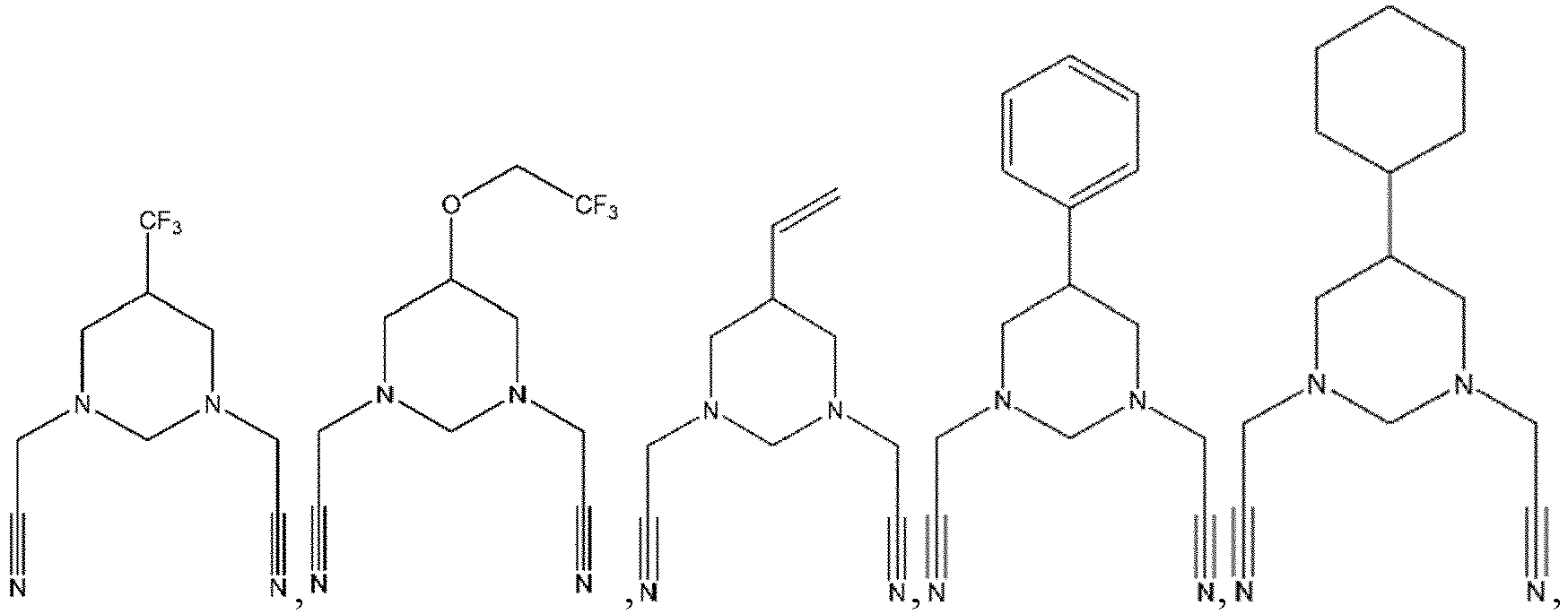
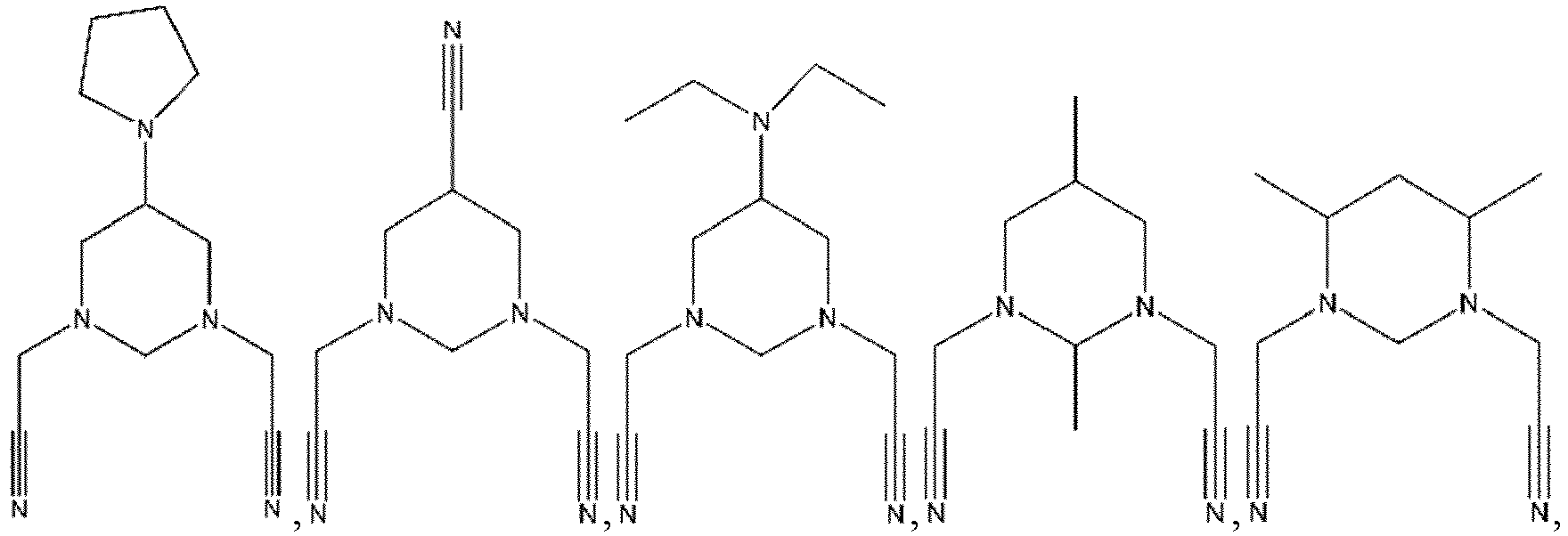
- the compound represented by Formula 1-3 may be specifically selected from one or more of the following compounds, but not limited thereto: and
- the additive B is selected from one or more of a sulfate compound and a sulfite compound.
- the additive B has a higher reduction potential, and is preferentially reduced on the surface of the negative electrode in the electrolyte to form a dense sulfur-containing SEI film, which film hinders the negative electrode from contacting with the electrolyte, and prevents the structure of the negative active materials such as graphite from being destructed due to the solvated lithium ions, thereby effectively reducing the occurrence of side reactions on the negative electrode and the destruction to the structure of the negative active materials.
- the additive B has a higher oxidation potential, has a good oxidation stability and thus does not cause side reactions on the surface of the positive electrode.
- the additive B may be present in an amount of 0.1% to 10% by mass in the electrolyte. If the content of the additive B is too low, its effect on improvement of the electrolyte is not significant, and if the content of the additive B is too high, it will form too thick film on the surface of the positive electrode which will affect the cycle capacity retention rate of the electrochemical device, and deteriorate the performance of the electrochemical device.
- the upper limit of the content of additive B may be selected from 10%, 9%, 8%, 7%, 6%, 5%, 4.5%, 4%, 3.5%, 3%, 2%, 1.5% by mass
- the lower limit of the content of additive B may be optionally selected from 0.1%, 0.25%, 0.5%, 0.6%, 0.8%, 0.9%, 1.0% and 1.2% by mass.
- the content of additive B may be in the range of 0.5% to 6% by mass. More preferably, the content of additive B may be in the range of 1% to 3% by mass.
- the sulfate compound is preferably a cyclic sulfate compound, and the cyclic sulfate compound may be selected from one or more of the compounds represented by the formula II-1.
- R 31 is selected from a substituted or unsubstituted C 1 -C 6 alkylene group and a substituted or unsubstituted C 2 -C 6 alkenylene group, wherein the substituent is selected from one or more of a halogen atom, a C 1 -C 3 alkyl group, and a C 2 -C 4 alkenyl group.
- R 31 is selected from a substituted or unsubstituted C 1 -C 4 alkylene group and a substituted or unsubstituted C 2 -C 4 alkenylene group, wherein the substituent is selected from one or more of a halogen atom, a C 1 -C 3 alkyl group, and a C 2 -C 4 alkenyl group.
- the sulfate compound may be specifically selected from one or more of the following compounds, but not limited thereto:
- the sulfate compound is selected from one or more of ethylene sulfate abbreviated as DTD, propylene sulfate abbreviated as TMS, and 4-methyl ethylene sulfate (abbreviated as PLS), with the following particular structures:
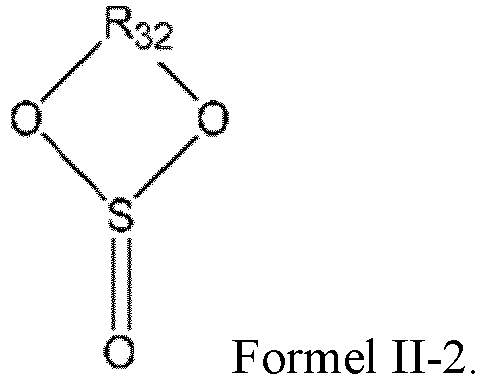
- the sulfite compound is preferably a cyclic sulfite compound, and the cyclic sulfite compound may be selected from one or more of the compounds represented by the formula II-2.
- R 32 is selected from a substituted or unsubstituted C 1 -C 6 alkylene group and a substituted or unsubstituted C 2 -C 6 alkenylene group, wherein the substituent is selected from one or more of a halogen atom, a C 1 -C 3 alkyl group, and a C 2 -C 4 alkenyl group.
- R 32 is selected from a substituted or unsubstituted C 1 -C 4 alkylene group and a substituted or unsubstituted C 2 -C 4 alkenylene group, wherein the substituent is selected from one or more of a halogen atom, a C 1 -C 3 alkyl group, and a C 2 -C 4 alkenyl group.
- the sulfite compound may be selected from one or more of ethylene sulfite abbreviated as ES, propylene sulfite abbreviated as PS, and butylene sulfite abbreviated as BS.
- the electrolyte may further include an additive C and the additive C is a sulfonate compound, which is selected from one or more of a sultone compound and a disulfonate compound.
- the additive C may participate in the formation of SEI film on the negative electrode, so that the formed SEI film can hinder the negative electrode from contacting the electrolyte, thereby effectively reducing the occurrence of the negative side reaction.
- the additive C can also form a film on the surface of positive electrode active materials (referred to as CEI film). Since the additive A mainly adsorbs the area of the surface of the positive electrode active materials where the Co atom is exposed, it cannot effectively protect the area where the Co atom is not exposed.
- the additive C will make up for the deficiency of the additive A after forming the film on the surface of the positive electrode, which can protect the positive electrode very well and further reduce the contact between the positive electrode and the electrolyte, thereby reducing the side reaction at the interface between the positive electrode and the electrolyte, and achieving the improvement of the cycle performance and decrease of the storage gas production.
- the additive C is present in an amount of 0.1% to 10% by mass in the electrolyte. If the content of the additive C is too low, its effect on improvement of the electrolyte is not significant, and if the content of the additive C is too high, it will form too thick SEI films and CEI films, and affect the cycle capacity retention rate of the electrochemical device, which deteriorates the performance of the electrochemical device.
- the upper limit of the content of additive C may be selected from 10%, 9%, 8%, 7%, 6%, 5%, 4.5%, 4%, 3.5%, 3%, 2%, 1.5% by mass
- the lower limit of the content of additive C may be optionally selected from 0.1%, 0.25%, 0.3%, 0.5%, 0.6%, 0.8%, 0.9%, 1.0% and 1.2% by mass.
- the content of additive C may be in the range of 0.5% to 6% by mass. More preferably, the content of additive C may be in the range of 1% to 3% by mass.
- the sultone compound is selected from one or more of the compounds represented by the formula III-1.
- R 21 is selected from a substituted or unsubstituted C 1 -C 6 alkylene group and a substituted or unsubstituted C 2 -C 6 alkenylene group, wherein the substituent is selected from one or more of a halogen atom, a C 1 -C 3 alkyl group, and a C 2 -C 4 alkenyl group.
- R 21 is selected from a substituted or unsubstituted C 1 -C 4 alkylene group and a substituted or unsubstituted C 2 -C 4 alkenylene group, wherein the substituent is selected from one or more of a halogen atom, a C 1 -C 3 alkyl group, and a C 2 to C 4 alkenyl group.
- the sultone compound may be specifically selected from one or more of the following compounds, but not limited thereto: and
- the sultone compound may be selected from one or more of 1,3-propane sultone abbreviated as PS and 1,3-propene sultone referred to as PES, which compounds have the following specific structures:
- R 22 , R 23 , R 24 and R 25 are each independently selected from one or more of a hydrogen atom, a halogen atom, a substituted or unsubstituted C 1 -C 10 alkyl group, and a substituted or unsubstituted C 2 -C 10 alkenyl group, wherein the substituent is selected from the group consisting of a halogen atom, a C 1 -C 3 alkyl group, and a C 2 -C 4 alkenyl group.
- R 22 , R 23 , R 24 , R 25 are each independently selected from a hydrogen atom, a halogen atom, a substituted or unsubstituted C 1 -C 4 alkyl group, a substituted or unsubstituted C 2 -C 6 alkenyl group, wherein the substituent is selected from one or more of a halogen atom, a C 1 -C 3 alkyl group and a C 2 -C 4 alkenyl group.
- the disulfonate compound may be specifically selected from one or more of the following compounds, but not limited thereto:
- the disulfonate compound may be selected from methane methylene disulfonate abbreviated as MMDS, which compound has the following specific structure:
- the C 1 -C 6 alkylene group may be a linear alkylene group or a branched alkylene group.
- the number of carbon atoms in the C 1 -C 6 alkylene group is preferably 2 or 3, and it is preferred that the upper limit is 4, 5, and 6.
- a C 1 -C 4 alkylene group is used.
- Specific examples of the C 1 -C 6 alkylene group include methylene, ethylene, propylene, isopropylidene, butylene, isobutylene, sec-butylene, pentylene, and hexylene.
- the C 2 -C 6 alkenylene group is a linear alkenylene group or a branched alkenylene group.
- the number of double bonds in the C 2 -C 6 alkenylene group is preferably one.
- the lower limit of the carbon atoms in the C 2 -C 6 alkenylene group preferably is preferably 2, 3, and 4, and it is preferred that the upper limit is 3, 4, 5, and 6.
- a C 2 ⁇ C 5 alkenylene group is used.
- Specific examples of the C 2 -C 6 alkenylene group include vinylidene, allylene, isopropenylene, butylene group, and pentenylene.
- the electrolyte may be a liquid electrolyte, a solid electrolyte, or a gel electrolyte.
- An organic solvent, an electrolyte salt, a polymer, or the like may also be included in the electrolyte.
- liquid electrolyte further includes an organic solvent and an electrolyte salt.
- the organic solvent used in the electrolyte of the embodiment of the present application comprises a cyclic carbonate and a chain carbonate, which may further improve the cycle performance and storage performance under high temperature and high voltage, and which will easily adjust conductivity of the electrolyte to an appropriate range (i.e. conductivity of 6 mS/ cm to 10 mS/cm at 25°C).
- conductivity of 6 mS/ cm to 10 mS/cm at 25°C i.e. conductivity of 6 mS/ cm to 10 mS/cm at 25°C.
- the cyclic carbonate may be selected from one or more of ethylene carbonate, propylene carbonate, 1,2-butylene carbonate, 2,3-butylene carbonate and fluoroethylene carbonate. More preferably, the cyclic carbonate may be selected from one or more of ethylene carbonate and propylene carbonate.
- the chain carbonate may be an asymmetric chain carbonate selected from one or more of ethyl methyl carbonate, methyl propyl carbonate, methyl isopropyl carbonate, methyl butyl carbonate, and ethyl propyl carbonate; and also may be a symmetric chain carbonate selected from one or more of dimethyl carbonate, diethyl carbonate, dipropyl carbonate, and dibutyl carbonate.
- the chain carbonate may also be a mixture of an asymmetric chain carbonate with a symmetric chain carbonate.
- the organic solvent may further comprise a carboxylic acid ester. That is to say, the organic solvent according to the present application may comprise a mixture of a cyclic carbonate, a chain carbonate, and a carboxylic acid ester.
- the carboxylic acid ester may be selected from one or more of methyl pivalate, ethyl pivalate, propyl pivalate, butyl pivalate, methyl butyrate, ethyl butyrate, propyl butyrate, butyl butyrate, methyl propionate, ethyl propionate, propyl propionate, butyl propionate, methyl acetate, ethyl acetate, propyl acetate and butyl acetate.
- Carboxylic acid esters have the characteristics of large dielectric constant and low viscosity, which can effectively prevent the association of lithium ions with anions in the electrolyte, and are more advantageous to cyclic carbonates and chain carbonates, in terms of ion conduction, especially at low temperature, thus the electrolyte can be guaranteed to have good ion conductivity.
- the content of the cyclic carbonate is 15% to 55% by mass, preferably 25% to 50% by mass; the content of the chain carbonate is 15% to 74% by mass, preferably 25% to 70% by mass; and the content of the carboxylic acid ester is 0.1 % to 70% by mass, preferably 5% to 50% by mass, based on the total mass of the organic solvent.
- the following lithium salt can be suitably exemplified.
- Li salt-Type I It may be "a complex salts of Lewis acid with LiF" suitably selected from one or more of LiPF 6 , LiBF 4 , LiAsF 6 , LiSbF 6 , LiPF 4 (CF 3 ) 2 , LiPF 3 (C 2 F 5 ) 3 , LiPF 3 (CF 3 ) 3 , LiPF 3 (iso-C 3 F 7 ) 3 , and LiPF 5 (iso-C 3 F 7 ), preferably from LiPF 6 , LiBF 4 , LiAsF 6 , and more preferably from LiPF 6 and LiBF 4 .
- LiPF 6 , LiBF 4 , LiAsF 6 , LiSbF 6 LiPF 4 (CF 3 ) 2 , LiPF 3 (C 2 F 5 ) 3 , LiPF 3 (CF 3 ) 3 , LiPF 3 (iso-C 3 F 7 ) 3 , and LiPF 5 (iso-C 3 F 7 ), preferably from LiPF 6 , LiBF 4 , Li
- Li salt-Type II It may be "an imine or methylated lithium salt" suitably selected from one or more of LiN(SO 2 F) 2 , LiN(SO 2 CF 3 ) 2 , LiN(SO 2 C 2 F 5 ) 2 , (CF 2 ) 2 (SO 2 ) 2 NLi (cyclic), (CF 2 ) 3 (SO 2 ) 2 NLi (cyclic), and LiC(SO 2 CF 3 ) 3 , preferably from LiN(SO 2 F) 2 , LiN(SO 2 CF 3 ) 2 or LiN(SO 2 C 2 F 5 ) 2 and more preferably from LiN(SO 2 F) 2 or LiN(SO 2 CF 3 ) 2 .
- LiSO 3 F LiCF 3 SO 3 , CH 3 SO 4 Li, C 2 H 5 SO 4 Li, C 3 H 7 SO 4 Li
- LiTFMSB lithium trifluoro ((methylsulfonyl)oxy) borate
- LiPFMSP lithium pentafluoro ((methylsulfonyl)oxy) phosphate
- Li salt-Type V It may be "a lithium salt with an oxalate ligand as anion" suitably selected from lithium bis[oxalate-O,O'] borate (LiBOB), lithium difluoro [oxalate-O, O'] borate, lithium difluorobis[oxalate-O,O'] phosphate (LiPFO) and lithium tetrafluoro [oxalate-O,O'] phosphate, more preferably from LiBOB and LiPFO.
- LiBOB lithium bis[oxalate-O,O'] borate
- LiPFO lithium difluorobis[oxalate-O,O'] phosphate
- LiPFO lithium tetrafluoro [oxalate-O,O'] phosphate
- the lithium salt is selected from one or more of LiPF 6 , LiPO 2 F 2 , Li 2 PO 3 F, LiBF 4 , LiSO 3 F, lithium trifluoro((methylsulfonyl)oxy)borate (LiTFMSB), LiN(SO 2 F) 2 , LiN(SO 2 CF 3 ) 2 , LiN(SO 2 C 2 F 5 ) 2 , lithium bis[oxalate-O,O'] borate (LiBOB), lithium difluorobis[oxalate-O,O'] phosphate (LiPFO) and lithium tetrafluoro [oxalate-O,O'] phosphate.
- LiPF 6 LiPO 2 F 2 , Li 2 PO 3 F, LiBF 4 , LiSO 3 F, lithium trifluoro((methylsulfonyl)oxy)borate
- LiN(SO 2 F) 2 LiN(SO 2 CF 3 ) 2
- LiN(SO 2 C 2 F 5 ) 2
- the lithium salt is selected from one or more of LiPF 6 , LiBF 4 , LiSO 3 F, lithium trifluoro((methylsulfonyl)oxy)borate (LiTFMSB), LiPO 2 F 2 , LiN(SO 2 CF 3 ) 2 , LiN(SO 2 F) 2 , lithium bis[oxalate-O,O'] borate (LiBOB) and lithium difluorobis[oxalate-O,O'] phosphate (LiPFO).
- the lithium salt is LiPF 6 .
- the preparation method of the electrolyte is not limited, and the electrolyte can be prepared according to the conventional method for preparing an electrolyte. For example, it can be obtained by mixing the above organic solvents and adding additives thereto.
- the electrolyte has a conductivity of 6 mS/cm to 10 mS/cm at 25°C.
- the conductivity of the electrolyte is too small, the kinetic performance of the electrolyte is poor, the low temperature performance of the electrochemical device is poor, and the large viscosity of the electrolyte also affects the adsorption-film forming effect of the additive A on the surface of the positive electrode; in the case that the conductivity of the electrolyte is too large, the thermal stability of the electrolyte is poor, and the high temperature performance of the electrochemical device is poor.
- the additive A can be synthesized by the following method.
- P-2 aqueous solution with a concentration of 30% ⁇ 40% is added dropwise to the raw material P-1 in 20 min to 60 min with stirring rapidly. After the completion of the dropwise addition, the mixture is rapidly stirred for 15 h to 30 h, and stirred at 70°C to 90°C for 3-5 h in an oil bath, to obtain colorless fuming viscous liquid intermediate I-1-1. Then K 2 CO 3 , KI and anhydrous acetonitrile are added, and the mixture is rapidly stirred into a solid-liquid mixed phase, to which raw material P-3 is quickly added at 40°C ⁇ 60°C. After stirring for 10 h to 20 h, the resulting mixture is cooled to room temperature, and purified by isolation to obtain a compound of Formula 1-1.
- Anhydrous sodium carbonate, the raw material P-4 and the raw material P-3 are mixed in absolute ethanol, and the mixture is stirred for 2 to 5 hours which is then washed with hot ethanol for several times to obtain a crude product, and then the crude product is recrystallized to obtain the compound represented by Formula 1-2.
- Anhydrous sodium carbonate, the raw material P-5 and the raw material P-3 are mixed in absolute ethanol, and the mixture is stirred for 2 to 5 hours, which is then washed with hot ethanol for several times to obtain a crude product, and then the crude product is recrystallized to obtain a compound represented by Formula 1-3.
- the electrochemical device according to the second aspect of the present application comprises a positive electrode plate, a negative electrode plate, a separator disposed between the positive electrode plate and the negative electrode plate, and an electrolyte according to the first aspect of the present application.
- the electrochemical device according to the second aspect of the present application may be a lithium-ion secondary battery, a lithium primary battery or a lithium-ion capacitor.
- the positive electrode comprises a positive active material capable of deintercalating and intercalating lithium ions
- the negative electrode comprises a negative active material capable of intercalating and deintercalating lithium ions.
- the positive active material may be selected from one or more of lithium cobalt oxide, lithium nickel oxide, lithium manganese oxide, lithium nickel manganese oxide, lithium nickel cobalt manganese oxide, lithium nickel cobalt aluminum oxide, and a compound obtained by adding other transition metals or non-transition metals to the above oxides.
- a layered lithium-containing oxide, a spinel-type lithium-containing oxide, an olivine-type lithium-containing phosphate compound, or the like can be used.
- the present application is not limited to these materials, and other conventionally known materials which can be used as a positive active material for a lithium-ion secondary battery can also be used. These positive active materials may be used alone or in combination of two or more.
- the negative active material may be soft carbon, hard carbon, artificial graphite, natural graphite, silicon, silicon oxide, silicon carbon composite, lithium titanium oxide, and metals that can form an alloy with lithium, etc.
- a carbon-based material, a silicon-based material, a tin-based material, or the like can be used.
- the lithium-ion secondary battery of the present application is not limited to these materials, and other conventionally known materials which can be used as a negative active material for a lithium-ion secondary battery can also be used. These negative active materials may be used alone or in combination of two or more.
- the negative active materials may be metal lithium or lithium alloy and the positive active materials may be a solid halide such as copper fluoride (CuF 2 ), copper chloride (CuCl 2 ), silver chloride (AgCl), or polyfluorocarbon ((CF) 4 ), a solid sulfide such as copper sulfide (CuS), iron sulfide (FeS), or iron disulfide (FeS2), a solid oxide such as manganese dioxide (MnO 2 ), copper oxide (CuO), molybdenum trioxide (MoO 3 ), vanadium pentoxide (V 2 O 5 ).
- the positive active materials may also be a solid oxyacid salt such as silver chromate (Ag 2 CrO 4 ) or lead ruthenate (Pb 2 Bi 2 O 5 ). These positive active materials may be used alone or in combination of two or more.
- the negative active material of the lithium ion capacitor is graphite, a polyacene type material, and the positive electrode active material is activated carbon.
- the specific type of the separator is not particularly limited, and may be any separator material used in the existing electrochemical device, such as polyethylene, polypropylene, polyvinylidene fluoride, and multilayer composite film thereof, but not limited to these.
- the positive electrode plate further comprises a binder and a conductive agent, which positive electrode plate is obtained by coating a positive electrode slurry containing a positive active material, a binder, and a conductive agent on the positive electrode current collector, and drying the positive electrode slurry.
- the negative electrode plate likewise comprises a binder and a conductive agent, which negative electrode plate is obtained by coating a negative electrode slurry containing a negative active material, a binder, and a conductive agent on the negative electrode current collector, and drying the negative electrode slurry.
- the charge cutoff voltage of the battery is not less than 4.2 V. That is to say, the lithium-ion secondary battery may be used in a high voltage state of not less than 4.2 V.
- the lithium-ion secondary battery can work in the range of 4.2V to 4.9V, and further preferably, the battery can work in the range of 4.3V to 4.8V.
- the high voltage state the higher the valence state of the transition metal on the surface of the positive active material, the more electrons are lost, the more empty orbits are formed, which may easily complex with the orphan electrons of the nitrogen atom in cyano group of the additive A. That is to say, the additive A can exert a corresponding protective effect to a greater extent.
- the electrochemical device is a lithium-ion secondary battery
- the application is not limited thereto.
- the reagents, materials, and instruments used are commercially available unless otherwise specified.
- the specific synthesis process of the additives A2, A8, and A13 is as follows, and other kinds of additives A can be synthesized according to a similar process.
- lithium-ion secondary batteries were prepared in the following manner.
- the lithium-ion secondary battery was first charged with a constant current of 1 C to a voltage of 4.35 V, further charged with a constant voltage of 4.35 V until the current was 0.05 C, and then discharged with a constant current of 1 C to a voltage of 3.0 V.
- Charging/discharging cycle was done in such a way.
- the discharge capacity at this time was the discharge capacity at the first cycle.
- the lithium-ion secondary battery was subjected to 200 cycles of charging/discharging test in accordance with the above method, and the discharge capacity at the 200 th cycle was detected.
- Capacity retention ratio % of lithium-ion secondary battery after 200 cycles at 25 ° C discharge capacity at the 200 th cycle / discharge capacity at the first cycle of lithium-ion secondary battery ⁇ 100 % .
- the lithium-ion secondary battery was first charged with a constant current of 1 C to a voltage of 4.35 V, further charged with a constant voltage of 4.35 V until the current was 0.05 C, and then discharged with a constant current of 1 C to a voltage of 3.0 V.
- Charging/discharging cycle was done in such a way.
- the discharge capacity at this time was the discharge capacity at the first cycle.
- the lithium-ion battery was subjected to 200 cycles of charging/discharging test in accordance with the above method, and the discharge capacity at the 200 th cycle was detected.
- Capacity retention ratio % of lithium-ion secondary battery after 200 cycles at 45 ° C discharge capacity at the 200 th cycle / discharge capacity at the first cycle of lithium-ion secondary battery ⁇ 100 % .
- the lithium-ion secondary battery was charged with a constant current of 0.5 C to a voltage of 4.35 V, and then charged with a constant voltage of 4.35 V until the current was 0.05 C. At this time, the thickness of the lithium-ion secondary battery was tested and recorded as ho. And then, the lithium-ion secondary battery was placed in an incubator at 85°C, and stored for 24 hours. Then the battery was taken out and the thickness of the lithium-ion battery was measured and recorded as h 1 .
- the thickness expansion ratio % of lithium-ion secondary baterry after storage at 85 ° C for 24 hours h 1 ⁇ h 0 / h 0 ⁇ 100 % .
- the lithium-ion secondary battery into a holding furnace, adjust the temperature of the furnace to 25°C, then charge the lithium-ion secondary battery to a voltage of 4.35V with a constant current of 0.5C, and then charge it to a current of 0.05C with a constant voltage of 4.35V.
- the lithium-ion secondary battery was fully charged.
- the fully charged lithium-ion secondary battery was discharged with a constant current of 0.5 C to a voltage of 3.0 V. This process caused the lithium-ion secondary battery to be fully discharged, and the discharge capacity during the full discharging was recorded as C 0 .
- the lithium ion secondary battery exhibited the following characteristics that the cycle capacity retention rate at 25 °C and 45 °C shows the trend of rising first and then falling, the thickness expansion rate at 85 °C for 24h has been decreasing, and the capacity retention rate at -20°C likewise shows the trend of rising first and then falling.
- the reasons are as follows.
- the additive A is a six-membered nitrogen-containing heterocyclic compound having two or more cyano groups in its molecule, and the lone pair electrons contained in the nitrogen atom of the cyano group can strongly complex with the 3d empty orbit of the transition metal on the surface the positive active materials, which isolates the direct contact between the electrolyte and the surface of the positive electrode while reducing the surface activity of the positive electrode (especially at high SOC), so that the side reaction of the positive electrode surface is greatly reduced, and the consumption of lithium ions in the side reaction is also reduced, i.e. the consumption rate of reversible lithium ions slows down greatly, and thus the cycle capacity retention rate is greatly increased.
- the additive A can also improve the conductivity of the electrolyte to a certain extent and improve the dynamic performance of the lithium-ion secondary battery, and thus the low temperature performance of the lithium ion secondary battery is also improved to a certain extend.
- the cyano group of the additive A can also complex lithium ion in addition to the surface transition metal of the positive electrode active material.
- the additive amount of the additive A is large, some of addition A will adsorb on the surface of the LCO and the remaining excess additive A will consume lithium ions, which results in a decrease in lithium ions that can be used for circulation, and also results in an increase in overall viscosity of the electrolyte, and a decrease in ionic conductivity, so that the cycle capacity retention rate of the lithium-ion secondary battery and the capacity retention rate at -20 ° C show the trend of rising first and then falling.
- the addition amount of the additive A is small, its improvement effect on the performance of the lithium-ion secondary battery is not obvious. Therefore, the addition amount of the additive A is required to be appropriate.
- the additive B is a sulfate or sulfite compound, which usually participates in the film formation of SEI film on the negative electrode, and forms a dense sulfur-containing SEI film, which film hinders the negative electrode from contacting the electrolyte, and prevents the destruction to the structure of graphite due to solvation of lithium ions, thereby effectively reducing the occurrence of side reactions on negative electrode and the destruction to the structure of graphite.
- the participation of lithium ions is usually required in the formation of the SEI film, and the formation of the SEI film is a relatively slow process, the first 100 to 200 cycles are accompanied by the formation of the SEI film.
- additive B As a negative film-forming additive, the addition of additive B will lead to more lithium ions being consumed as its amount increases, so that the cycle capacity retention rate of the lithium-ion secondary battery and the capacity retention rate at -20 °C show the trend of rising first and then falling. Therefore, the addition amount of the additive B is required to be appropriate.
- Examples 16-24 discovered the addition amount of additive C (sulfonate compound) and its effect on the lithium ion secondary battery in the case that the amount of additive A and additive B are optimal.
- the lithium ion secondary battery exhibited the following characteristics that the cycle capacity retention rate at 25 °C and 45 °C shows the trend of rising first and then falling, the thickness expansion rate at 85 °C for 24h has been decreasing, and the capacity retention rate at -20°C likewise shows the trend of rising first and then falling.
- the addition amount of additive C reaches 2%, the performances of the lithium-ion secondary battery are optimal. The reasons are as follows.
- the additive A mainly relies on the complexation of cyano groups with the Co atom in the positive electrode active materials. Therefore, the additive A cannot effectively protect the area on the surface of the positive electrode active materials where the Co atom is not exposed.
- the sulfonate compound as the additive C when reaches a certain concentration can form a dense CEI film on the surface of the positive electrode, which can more effectively protect the positive electrode and reduce the side reaction during cycle and storage processes, so that the cycle performance and storage performance of the lithium-ion secondary battery are enhanced.
- the CEI film formed on the surface of the positive electrode will also be thicker.
- the impedance of the positive electrode will also increase significantly and lithium ions may "die" in the CEI film as the CEI film thickness increases. Therefore, with the increase of the addition amount of additive C, the thickness expansion ratio of the lithium ion secondary battery at 85 °C for 24 h will be further reduced, and the cycle capacity retention rate at 25 °C and 45 °C show the trend of rising first and then falling and the capacity retention rate at -20°C likewise shows the trend of rising first and then falling. Therefore, the amount of addition of the additive C also needs an appropriate amount. Therefore, the addition amount of the additive C is also required to be appropriate.
- the conductivity of the electrolyte also affects the performance of the lithium-ion secondary battery.
- the conductivity of the electrolyte is smaller, the kinetic performance of the electrolyte is worse, and the low temperature performance of the lithium-ion secondary battery is worse.
- the viscosity of the electrolyte is larger, which will also affect the film formation effect of the six-membered nitrogen heterocycle containing more than one cyano group and the sulfonate compound and will further affect the film-forming effect of the sulfate, sulfite and sulfonate compounds on the surface of the negative electrode.
- the conductivity of the electrolyte is larger, the thermal stability of the electrolyte is worse, and the high temperature performance of the lithium-ion secondary battery is worse.
- Lithium-ion secondary batteries were further prepared by the method of the above Examples 1 to 24, and the composition of the electrolyte was as shown in Table 3.
- Table 3 Electrolyte parameters of Examples 25-41 Conductivity mS/cm Additive A Additive B Additive C Type Content Type Content Type Content Example 25 8 A2 2.0% B1 2.0% / / Example 26 8 A3 2.0% B2 2.0% / / Example 27 9 A4 2.0% B1 2.0% / / Example 28 7 A5 2.0% B2 2.0% / / Example 29 8 A6 2.0% B1 2.0% / / Example 30 7 A7 2.0% B2 2.0% / / Example 31 9 A8 2.0% B1 2.0% C1 2.0% Example 32 8 A9 2.0% B2 2.0% C1 2.0% Example 33 8 A10 2.0% B1 2.0% C2 2.0% Example 34 8 A11 2.0% B2 2.0% C1 2.0% Example 35 7 A12 2.0% B1 2.0% C2 2.0% Example 36 8 A13 2.0% B2 2.0% C2
Landscapes
- Chemical & Material Sciences (AREA)
- Engineering & Computer Science (AREA)
- Chemical Kinetics & Catalysis (AREA)
- Electrochemistry (AREA)
- Manufacturing & Machinery (AREA)
- General Chemical & Material Sciences (AREA)
- Power Engineering (AREA)
- Inorganic Chemistry (AREA)
- Physics & Mathematics (AREA)
- Condensed Matter Physics & Semiconductors (AREA)
- General Physics & Mathematics (AREA)
- Materials Engineering (AREA)
- Microelectronics & Electronic Packaging (AREA)
- Secondary Cells (AREA)
- Electric Double-Layer Capacitors Or The Like (AREA)
- Primary Cells (AREA)
Claims (10)
- Elektrolyt, umfassend ein Additiv A und ein Additiv B, wobei das Additiv A aus einer oder mehreren der Verbindungen der Formel I-1, Formel I-2, Formel I-3 ausgewählt ist;


wobei das Additiv A in einer Menge von 0,01 bis 10 Massen-% im Elektrolyten vorliegt; das Additiv B in einer Menge von 0,1 bis 10 Massen-% im Elektrolyten vorliegt. - Elektrolyt nach Anspruch 1, wobei das Additiv A in einer Menge von 0,1 bis 6 Massen-%, bevorzugt von 0,1 bis 3,5 Massen-% im Elektrolyten vorliegt und wobei das Additiv B in einer Menge von 0,5 bis 6 Massen-%, bevorzugt von 1 bis 3 Massen-% im Elektrolyten vorliegt.
- Elektrolyt nach Anspruch 1, wobei das Additiv A aus einer oder mehreren der folgenden Verbindungen ausgewählt ist:




- Elektrolyt nach Anspruch 1, wobei die Sulfatverbindung eine cyclische Sulfatverbindung ist und die cyclische Sulfatverbindung aus einer oder mehreren der durch die Formel II-1 dargestellten Verbindungen ausgewählt sein kann, R31 in Formel II-1 aus einer substituierten oder unsubstituierten C1-C6-Alkylengruppe und einer substituierten oder unsubstituierten C2-C6-Alkenylengruppe ausgewählt ist, wobei der Substituent aus einem oder mehreren von einem Halogenatom, einer C1-C3-Alkylgruppe und einer C2-C4-Alkenylgruppe ausgewählt ist; und

- Elektrolyt nach Anspruch 1, wobei der Elektrolyt ferner ein Additiv C umfasst und das Additiv C eine Sulfonatverbindung ist und das Sulfonat aus einer oder mehreren von einer Sultanonverbindung und einer Disulfonatverbindung ausgewählt ist.
- Elektrolyt nach Anspruch 5, wobei die Sultaninverbindung aus einer oder mehreren der durch die Formel III-1 dargestellten Verbindungen ausgewählt ist, R21 in Formel III-1 aus einer substituierten oder unsubstituierten C1-C6-Alkylengruppe und einer substituierten oder unsubstituierten C2-C6-Alkenylengruppe ausgewählt ist, wobei der Substituent aus einem oder mehreren von einem Halogenatom, einer C1-C3-Alkylgruppe und einer C2-C4-Alkenylgruppe ausgewählt ist; und


- Elektrolyt nach Anspruch 5, wobei das Additiv C in einer Menge von 0,1 bis 10 Massen-%, bevorzugt von 0,5 bis 6 Massen-%, ferner bevorzugt von 1 bis 3 Massen-% im Elektrolyten vorliegt
- Elektrolyt nach Anspruch 1, wobei das organische Lösungsmittel eine Mischung aus einem cyclischen Carbonat, einem Kettencarbonat und einem Carbonsäureester umfasst;
das cyclische Carbonat aus einem oder mehreren von Ethylencarbonat, Propylencarbonat, 1,2-Butylencarbonat, 2,3-Butylencarbonat und Fluorethylencarbonat ausgewählt ist; und
das Kettencarbonat aus einem oder mehreren von Ethylmethylcarbonat, Methylpropylcarbonat, Methylisopropylcarbonat, Methylbutylcarbonat, Ethylpropylcarbonat, Dimethylcarbonat, Diethylcarbonat, Dipropylcarbonat und Dibutylcarbonat ausgewählt ist; und
der Carbonsäureester aus einem oder mehreren von Methylpivalat, Ethylpivalat, Propylpivalat, Butylpivalat, Methylbutyrat, Ethylbutyrat, Propylbutyrat, Butylbutyrat, Methylpropionat, Ethylpropionat, Propylpropionat, Butylpropionat, Methylacetat, Ethylacetat, Propylacetat und Butylacetat ausgewählt ist. - Elektrolyt nach Anspruch 8, wobei bezogen auf die Gesamtmasse des organischen Lösungsmittels,
das cyclische Carbonat in einer Menge von 15 bis 55 Massen-%, bevorzugt von 25 bis 50 Massen-% vorliegt;
das Kettencarbonat in einer Menge von 15 bis 74 Massen-%, bevorzugt von 25 bis 70 Massen-% vorliegt; und
das Carbonsäureester in einer Menge von 0,1 bis 70 Massen-%, bevorzugt von 5 bis 50 Massen-% vorliegt. - Elektrochemische Vorrichtung, umfassend eine positive Elektrodenplatte, eine negative Elektrodenplatte, einen zwischen der positiven Elektrodenplatte und der negativen Elektrodenplatte angeordneten Separator und einen Elektrolyten, wobei der Elektrolyt der Elektrolyt nach einem der Ansprüche 1 bis 9 ist.
Applications Claiming Priority (1)
| Application Number | Priority Date | Filing Date | Title |
|---|---|---|---|
| CN201810361185.7A CN110391459B (zh) | 2018-04-20 | 2018-04-20 | 电解液及电化学装置 |
Publications (2)
| Publication Number | Publication Date |
|---|---|
| EP3557682A1 EP3557682A1 (de) | 2019-10-23 |
| EP3557682B1 true EP3557682B1 (de) | 2020-10-21 |
Family
ID=66041326
Family Applications (1)
| Application Number | Title | Priority Date | Filing Date |
|---|---|---|---|
| EP19166355.8A Active EP3557682B1 (de) | 2018-04-20 | 2019-03-29 | Elektrolyt und elektrochemische vorrichtung |
Country Status (4)
| Country | Link |
|---|---|
| US (1) | US10897063B2 (de) |
| EP (1) | EP3557682B1 (de) |
| JP (1) | JP6852108B2 (de) |
| CN (1) | CN110391459B (de) |
Families Citing this family (5)
| Publication number | Priority date | Publication date | Assignee | Title |
|---|---|---|---|---|
| CN109216765B (zh) * | 2017-07-05 | 2020-05-05 | 宁德时代新能源科技股份有限公司 | 一种电解液及电化学装置 |
| CN112086682A (zh) * | 2020-09-29 | 2020-12-15 | 宁德新能源科技有限公司 | 电解液、电化学装置和电子装置 |
| CN112670578B (zh) * | 2020-12-23 | 2022-11-25 | 东莞新能源科技有限公司 | 电解液、电化学装置及电子装置 |
| KR20230129746A (ko) * | 2022-03-02 | 2023-09-11 | 주식회사 엘지에너지솔루션 | 비수계 전해액 조성물 및 이를 포함하는 리튬 이차전지 |
| CN115332638B (zh) * | 2022-10-14 | 2023-03-24 | 宁德新能源科技有限公司 | 一种电解液、电化学装置和电子装置 |
Family Cites Families (12)
| Publication number | Priority date | Publication date | Assignee | Title |
|---|---|---|---|---|
| ID18173A (id) * | 1996-05-09 | 1998-03-12 | Matsushita Electric Industrial Co Ltd | Baterai sekunder elektrolit tidak berair |
| JPH11111332A (ja) * | 1997-09-30 | 1999-04-23 | Sanyo Electric Co Ltd | 非水電解質電池 |
| JP4815660B2 (ja) * | 2000-06-16 | 2011-11-16 | 三菱化学株式会社 | 非水電解液及び非水電解液二次電池 |
| JP5109213B2 (ja) * | 2001-06-26 | 2012-12-26 | 三菱化学株式会社 | 非水系電解液及びこれを用いた非水系電解液二次電池 |
| JP2010044883A (ja) * | 2008-08-08 | 2010-02-25 | Mitsui Chemicals Inc | 非水電解液及びリチウム二次電池 |
| CN103022556B (zh) * | 2013-01-05 | 2015-06-03 | 宁德新能源科技有限公司 | 锂离子电池及其电解液 |
| CN103078140B (zh) * | 2013-02-03 | 2015-04-08 | 宁德新能源科技有限公司 | 锂离子二次电池及其电解液 |
| JP6413294B2 (ja) * | 2013-03-27 | 2018-10-31 | 三菱ケミカル株式会社 | 非水系電解液、それを用いた電池 |
| KR102161266B1 (ko) * | 2013-08-30 | 2020-09-29 | 삼성전자주식회사 | 리튬 이차 전지용 전해질 및 이를 포함하는 리튬 이차 전지 |
| WO2016159702A1 (ko) * | 2015-03-31 | 2016-10-06 | 주식회사 엘지화학 | 비수 전해액 및 이를 구비한 리튬 이차전지 |
| CN105355968B (zh) * | 2015-11-24 | 2019-01-08 | 宁德新能源科技有限公司 | 电解液以及包括该电解液的锂离子电池 |
| CN105489935B (zh) * | 2016-01-11 | 2018-06-12 | 东莞新能源科技有限公司 | 电解液以及包括该电解液的锂离子电池 |
-
2018
- 2018-04-20 CN CN201810361185.7A patent/CN110391459B/zh active Active
-
2019
- 2019-03-28 JP JP2019062232A patent/JP6852108B2/ja active Active
- 2019-03-29 EP EP19166355.8A patent/EP3557682B1/de active Active
- 2019-04-02 US US16/373,032 patent/US10897063B2/en active Active
Non-Patent Citations (1)
| Title |
|---|
| None * |
Also Published As
| Publication number | Publication date |
|---|---|
| US20190326635A1 (en) | 2019-10-24 |
| JP2019192637A (ja) | 2019-10-31 |
| EP3557682A1 (de) | 2019-10-23 |
| US10897063B2 (en) | 2021-01-19 |
| CN110391459A (zh) | 2019-10-29 |
| CN110391459B (zh) | 2021-01-15 |
| JP6852108B2 (ja) | 2021-03-31 |
Similar Documents
| Publication | Publication Date | Title |
|---|---|---|
| EP3557683B1 (de) | Elektrolyt und elektrochemische vorrichtung | |
| EP3557678A1 (de) | Ektrolyt und batterie | |
| EP3787089A1 (de) | Lithiumionenbatterie und vorrichtung | |
| JP6781833B2 (ja) | 電解液及び電気化学装置 | |
| EP3557681B1 (de) | Elektrolyt und elektrochemische vorrichtung | |
| EP3557682B1 (de) | Elektrolyt und elektrochemische vorrichtung | |
| EP3514881B1 (de) | Elektrolyt und elektrochemische vorrichtung | |
| EP3783723B1 (de) | Lithiumionenbatterie und vorrichtung | |
| EP3514882B1 (de) | Elektrolytlösung für elektrochemische vorrichtung | |
| EP3796449B1 (de) | Lithiumionenbatterie und vorrichtung dieselbe umfassend | |
| EP3514880B1 (de) | Elektrolyt und elektrochemische vorrichtung | |
| EP3809508B1 (de) | Lithiumionenbatterie und vorrichtung |
Legal Events
| Date | Code | Title | Description |
|---|---|---|---|
| PUAI | Public reference made under article 153(3) epc to a published international application that has entered the european phase |
Free format text: ORIGINAL CODE: 0009012 |
|
| STAA | Information on the status of an ep patent application or granted ep patent |
Free format text: STATUS: THE APPLICATION HAS BEEN PUBLISHED |
|
| AK | Designated contracting states |
Kind code of ref document: A1 Designated state(s): AL AT BE BG CH CY CZ DE DK EE ES FI FR GB GR HR HU IE IS IT LI LT LU LV MC MK MT NL NO PL PT RO RS SE SI SK SM TR |
|
| AX | Request for extension of the european patent |
Extension state: BA ME |
|
| STAA | Information on the status of an ep patent application or granted ep patent |
Free format text: STATUS: REQUEST FOR EXAMINATION WAS MADE |
|
| 17P | Request for examination filed |
Effective date: 20200218 |
|
| RBV | Designated contracting states (corrected) |
Designated state(s): AL AT BE BG CH CY CZ DE DK EE ES FI FR GB GR HR HU IE IS IT LI LT LU LV MC MK MT NL NO PL PT RO RS SE SI SK SM TR |
|
| RIC1 | Information provided on ipc code assigned before grant |
Ipc: H01M 10/0525 20100101ALI20200520BHEP Ipc: H01M 10/0567 20100101AFI20200520BHEP Ipc: H01M 10/0569 20100101ALN20200520BHEP |
|
| GRAP | Despatch of communication of intention to grant a patent |
Free format text: ORIGINAL CODE: EPIDOSNIGR1 |
|
| STAA | Information on the status of an ep patent application or granted ep patent |
Free format text: STATUS: GRANT OF PATENT IS INTENDED |
|
| RIC1 | Information provided on ipc code assigned before grant |
Ipc: H01M 10/0569 20100101ALN20200605BHEP Ipc: H01M 10/0567 20100101AFI20200605BHEP Ipc: H01M 10/0525 20100101ALI20200605BHEP |
|
| INTG | Intention to grant announced |
Effective date: 20200629 |
|
| RIN1 | Information on inventor provided before grant (corrected) |
Inventor name: JIANG, YAO Inventor name: MIAO, LU Inventor name: LIANG, CHENGDU Inventor name: HU, CHUNHUA Inventor name: YI, TIANCHENG |
|
| GRAS | Grant fee paid |
Free format text: ORIGINAL CODE: EPIDOSNIGR3 |
|
| GRAA | (expected) grant |
Free format text: ORIGINAL CODE: 0009210 |
|
| STAA | Information on the status of an ep patent application or granted ep patent |
Free format text: STATUS: THE PATENT HAS BEEN GRANTED |
|
| AK | Designated contracting states |
Kind code of ref document: B1 Designated state(s): AL AT BE BG CH CY CZ DE DK EE ES FI FR GB GR HR HU IE IS IT LI LT LU LV MC MK MT NL NO PL PT RO RS SE SI SK SM TR |
|
| REG | Reference to a national code |
Ref country code: GB Ref legal event code: FG4D |
|
| REG | Reference to a national code |
Ref country code: CH Ref legal event code: EP |
|
| REG | Reference to a national code |
Ref country code: DE Ref legal event code: R096 Ref document number: 602019001004 Country of ref document: DE |
|
| REG | Reference to a national code |
Ref country code: IE Ref legal event code: FG4D |
|
| REG | Reference to a national code |
Ref country code: AT Ref legal event code: REF Ref document number: 1326777 Country of ref document: AT Kind code of ref document: T Effective date: 20201115 |
|
| REG | Reference to a national code |
Ref country code: AT Ref legal event code: MK05 Ref document number: 1326777 Country of ref document: AT Kind code of ref document: T Effective date: 20201021 |
|
| REG | Reference to a national code |
Ref country code: NL Ref legal event code: MP Effective date: 20201021 |
|
| PG25 | Lapsed in a contracting state [announced via postgrant information from national office to epo] |
Ref country code: GR Free format text: LAPSE BECAUSE OF FAILURE TO SUBMIT A TRANSLATION OF THE DESCRIPTION OR TO PAY THE FEE WITHIN THE PRESCRIBED TIME-LIMIT Effective date: 20210122 Ref country code: NO Free format text: LAPSE BECAUSE OF FAILURE TO SUBMIT A TRANSLATION OF THE DESCRIPTION OR TO PAY THE FEE WITHIN THE PRESCRIBED TIME-LIMIT Effective date: 20210121 Ref country code: PT Free format text: LAPSE BECAUSE OF FAILURE TO SUBMIT A TRANSLATION OF THE DESCRIPTION OR TO PAY THE FEE WITHIN THE PRESCRIBED TIME-LIMIT Effective date: 20210222 Ref country code: RS Free format text: LAPSE BECAUSE OF FAILURE TO SUBMIT A TRANSLATION OF THE DESCRIPTION OR TO PAY THE FEE WITHIN THE PRESCRIBED TIME-LIMIT Effective date: 20201021 Ref country code: FI Free format text: LAPSE BECAUSE OF FAILURE TO SUBMIT A TRANSLATION OF THE DESCRIPTION OR TO PAY THE FEE WITHIN THE PRESCRIBED TIME-LIMIT Effective date: 20201021 |
|
| REG | Reference to a national code |
Ref country code: LT Ref legal event code: MG4D |
|
| PG25 | Lapsed in a contracting state [announced via postgrant information from national office to epo] |
Ref country code: BG Free format text: LAPSE BECAUSE OF FAILURE TO SUBMIT A TRANSLATION OF THE DESCRIPTION OR TO PAY THE FEE WITHIN THE PRESCRIBED TIME-LIMIT Effective date: 20210121 Ref country code: IS Free format text: LAPSE BECAUSE OF FAILURE TO SUBMIT A TRANSLATION OF THE DESCRIPTION OR TO PAY THE FEE WITHIN THE PRESCRIBED TIME-LIMIT Effective date: 20210221 Ref country code: PL Free format text: LAPSE BECAUSE OF FAILURE TO SUBMIT A TRANSLATION OF THE DESCRIPTION OR TO PAY THE FEE WITHIN THE PRESCRIBED TIME-LIMIT Effective date: 20201021 Ref country code: LV Free format text: LAPSE BECAUSE OF FAILURE TO SUBMIT A TRANSLATION OF THE DESCRIPTION OR TO PAY THE FEE WITHIN THE PRESCRIBED TIME-LIMIT Effective date: 20201021 Ref country code: SE Free format text: LAPSE BECAUSE OF FAILURE TO SUBMIT A TRANSLATION OF THE DESCRIPTION OR TO PAY THE FEE WITHIN THE PRESCRIBED TIME-LIMIT Effective date: 20201021 Ref country code: AT Free format text: LAPSE BECAUSE OF FAILURE TO SUBMIT A TRANSLATION OF THE DESCRIPTION OR TO PAY THE FEE WITHIN THE PRESCRIBED TIME-LIMIT Effective date: 20201021 Ref country code: ES Free format text: LAPSE BECAUSE OF FAILURE TO SUBMIT A TRANSLATION OF THE DESCRIPTION OR TO PAY THE FEE WITHIN THE PRESCRIBED TIME-LIMIT Effective date: 20201021 |
|
| PG25 | Lapsed in a contracting state [announced via postgrant information from national office to epo] |
Ref country code: NL Free format text: LAPSE BECAUSE OF FAILURE TO SUBMIT A TRANSLATION OF THE DESCRIPTION OR TO PAY THE FEE WITHIN THE PRESCRIBED TIME-LIMIT Effective date: 20201021 Ref country code: HR Free format text: LAPSE BECAUSE OF FAILURE TO SUBMIT A TRANSLATION OF THE DESCRIPTION OR TO PAY THE FEE WITHIN THE PRESCRIBED TIME-LIMIT Effective date: 20201021 |
|
| REG | Reference to a national code |
Ref country code: DE Ref legal event code: R097 Ref document number: 602019001004 Country of ref document: DE |
|
| PG25 | Lapsed in a contracting state [announced via postgrant information from national office to epo] |
Ref country code: CZ Free format text: LAPSE BECAUSE OF FAILURE TO SUBMIT A TRANSLATION OF THE DESCRIPTION OR TO PAY THE FEE WITHIN THE PRESCRIBED TIME-LIMIT Effective date: 20201021 Ref country code: EE Free format text: LAPSE BECAUSE OF FAILURE TO SUBMIT A TRANSLATION OF THE DESCRIPTION OR TO PAY THE FEE WITHIN THE PRESCRIBED TIME-LIMIT Effective date: 20201021 Ref country code: SK Free format text: LAPSE BECAUSE OF FAILURE TO SUBMIT A TRANSLATION OF THE DESCRIPTION OR TO PAY THE FEE WITHIN THE PRESCRIBED TIME-LIMIT Effective date: 20201021 Ref country code: SM Free format text: LAPSE BECAUSE OF FAILURE TO SUBMIT A TRANSLATION OF THE DESCRIPTION OR TO PAY THE FEE WITHIN THE PRESCRIBED TIME-LIMIT Effective date: 20201021 Ref country code: RO Free format text: LAPSE BECAUSE OF FAILURE TO SUBMIT A TRANSLATION OF THE DESCRIPTION OR TO PAY THE FEE WITHIN THE PRESCRIBED TIME-LIMIT Effective date: 20201021 Ref country code: LT Free format text: LAPSE BECAUSE OF FAILURE TO SUBMIT A TRANSLATION OF THE DESCRIPTION OR TO PAY THE FEE WITHIN THE PRESCRIBED TIME-LIMIT Effective date: 20201021 |
|
| PLBE | No opposition filed within time limit |
Free format text: ORIGINAL CODE: 0009261 |
|
| STAA | Information on the status of an ep patent application or granted ep patent |
Free format text: STATUS: NO OPPOSITION FILED WITHIN TIME LIMIT |
|
| PG25 | Lapsed in a contracting state [announced via postgrant information from national office to epo] |
Ref country code: DK Free format text: LAPSE BECAUSE OF FAILURE TO SUBMIT A TRANSLATION OF THE DESCRIPTION OR TO PAY THE FEE WITHIN THE PRESCRIBED TIME-LIMIT Effective date: 20201021 |
|
| 26N | No opposition filed |
Effective date: 20210722 |
|
| PG25 | Lapsed in a contracting state [announced via postgrant information from national office to epo] |
Ref country code: IT Free format text: LAPSE BECAUSE OF FAILURE TO SUBMIT A TRANSLATION OF THE DESCRIPTION OR TO PAY THE FEE WITHIN THE PRESCRIBED TIME-LIMIT Effective date: 20201021 Ref country code: MC Free format text: LAPSE BECAUSE OF FAILURE TO SUBMIT A TRANSLATION OF THE DESCRIPTION OR TO PAY THE FEE WITHIN THE PRESCRIBED TIME-LIMIT Effective date: 20201021 Ref country code: AL Free format text: LAPSE BECAUSE OF FAILURE TO SUBMIT A TRANSLATION OF THE DESCRIPTION OR TO PAY THE FEE WITHIN THE PRESCRIBED TIME-LIMIT Effective date: 20201021 |
|
| PG25 | Lapsed in a contracting state [announced via postgrant information from national office to epo] |
Ref country code: SI Free format text: LAPSE BECAUSE OF FAILURE TO SUBMIT A TRANSLATION OF THE DESCRIPTION OR TO PAY THE FEE WITHIN THE PRESCRIBED TIME-LIMIT Effective date: 20201021 |
|
| REG | Reference to a national code |
Ref country code: BE Ref legal event code: MM Effective date: 20210331 |
|
| PG25 | Lapsed in a contracting state [announced via postgrant information from national office to epo] |
Ref country code: IE Free format text: LAPSE BECAUSE OF NON-PAYMENT OF DUE FEES Effective date: 20210329 Ref country code: LU Free format text: LAPSE BECAUSE OF NON-PAYMENT OF DUE FEES Effective date: 20210329 |
|
| PG25 | Lapsed in a contracting state [announced via postgrant information from national office to epo] |
Ref country code: IS Free format text: LAPSE BECAUSE OF FAILURE TO SUBMIT A TRANSLATION OF THE DESCRIPTION OR TO PAY THE FEE WITHIN THE PRESCRIBED TIME-LIMIT Effective date: 20210221 |
|
| PG25 | Lapsed in a contracting state [announced via postgrant information from national office to epo] |
Ref country code: BE Free format text: LAPSE BECAUSE OF NON-PAYMENT OF DUE FEES Effective date: 20210331 |
|
| REG | Reference to a national code |
Ref country code: CH Ref legal event code: PL |
|
| PG25 | Lapsed in a contracting state [announced via postgrant information from national office to epo] |
Ref country code: LI Free format text: LAPSE BECAUSE OF NON-PAYMENT OF DUE FEES Effective date: 20220331 Ref country code: CH Free format text: LAPSE BECAUSE OF NON-PAYMENT OF DUE FEES Effective date: 20220331 |
|
| P01 | Opt-out of the competence of the unified patent court (upc) registered |
Effective date: 20230516 |
|
| PG25 | Lapsed in a contracting state [announced via postgrant information from national office to epo] |
Ref country code: CY Free format text: LAPSE BECAUSE OF FAILURE TO SUBMIT A TRANSLATION OF THE DESCRIPTION OR TO PAY THE FEE WITHIN THE PRESCRIBED TIME-LIMIT Effective date: 20201021 |
|
| PG25 | Lapsed in a contracting state [announced via postgrant information from national office to epo] |
Ref country code: HU Free format text: LAPSE BECAUSE OF FAILURE TO SUBMIT A TRANSLATION OF THE DESCRIPTION OR TO PAY THE FEE WITHIN THE PRESCRIBED TIME-LIMIT; INVALID AB INITIO Effective date: 20190329 |
|
| PG25 | Lapsed in a contracting state [announced via postgrant information from national office to epo] |
Ref country code: MK Free format text: LAPSE BECAUSE OF FAILURE TO SUBMIT A TRANSLATION OF THE DESCRIPTION OR TO PAY THE FEE WITHIN THE PRESCRIBED TIME-LIMIT Effective date: 20201021 |
|
| REG | Reference to a national code |
Ref country code: DE Ref legal event code: R081 Ref document number: 602019001004 Country of ref document: DE Owner name: CONTEMPORARY AMPEREX TECHNOLOGY (HONG KONG) LI, HK Free format text: FORMER OWNER: CONTEMPORARY AMPEREX TECHNOLOGY CO., LTD., NINGDE CITY, FUJIAN, CN |
|
| REG | Reference to a national code |
Ref country code: GB Ref legal event code: 732E Free format text: REGISTERED BETWEEN 20240808 AND 20240814 |
|
| PG25 | Lapsed in a contracting state [announced via postgrant information from national office to epo] |
Ref country code: MT Free format text: LAPSE BECAUSE OF FAILURE TO SUBMIT A TRANSLATION OF THE DESCRIPTION OR TO PAY THE FEE WITHIN THE PRESCRIBED TIME-LIMIT Effective date: 20201021 |
|
| PGFP | Annual fee paid to national office [announced via postgrant information from national office to epo] |
Ref country code: DE Payment date: 20241231 Year of fee payment: 7 |
|
| PGFP | Annual fee paid to national office [announced via postgrant information from national office to epo] |
Ref country code: GB Payment date: 20250102 Year of fee payment: 7 |
|
| PG25 | Lapsed in a contracting state [announced via postgrant information from national office to epo] |
Ref country code: TR Free format text: LAPSE BECAUSE OF FAILURE TO SUBMIT A TRANSLATION OF THE DESCRIPTION OR TO PAY THE FEE WITHIN THE PRESCRIBED TIME-LIMIT Effective date: 20201021 |
|
| PGFP | Annual fee paid to national office [announced via postgrant information from national office to epo] |
Ref country code: FR Payment date: 20251231 Year of fee payment: 8 |