EP3554834B1 - Verfahren und vorrichtung zur wiederverwertung von verpackungsmaterial - Google Patents
Verfahren und vorrichtung zur wiederverwertung von verpackungsmaterial Download PDFInfo
- Publication number
- EP3554834B1 EP3554834B1 EP17818115.2A EP17818115A EP3554834B1 EP 3554834 B1 EP3554834 B1 EP 3554834B1 EP 17818115 A EP17818115 A EP 17818115A EP 3554834 B1 EP3554834 B1 EP 3554834B1
- Authority
- EP
- European Patent Office
- Prior art keywords
- acid
- aluminium
- separation
- alkali metal
- water
- Prior art date
- Legal status (The legal status is an assumption and is not a legal conclusion. Google has not performed a legal analysis and makes no representation as to the accuracy of the status listed.)
- Active
Links
Images


Classifications
-
- B—PERFORMING OPERATIONS; TRANSPORTING
- B09—DISPOSAL OF SOLID WASTE; RECLAMATION OF CONTAMINATED SOIL
- B09B—DISPOSAL OF SOLID WASTE NOT OTHERWISE PROVIDED FOR
- B09B3/00—Destroying solid waste or transforming solid waste into something useful or harmless
-
- B—PERFORMING OPERATIONS; TRANSPORTING
- B29—WORKING OF PLASTICS; WORKING OF SUBSTANCES IN A PLASTIC STATE IN GENERAL
- B29B—PREPARATION OR PRETREATMENT OF THE MATERIAL TO BE SHAPED; MAKING GRANULES OR PREFORMS; RECOVERY OF PLASTICS OR OTHER CONSTITUENTS OF WASTE MATERIAL CONTAINING PLASTICS
- B29B17/00—Recovery of plastics or other constituents of waste material containing plastics
- B29B17/0026—Recovery of plastics or other constituents of waste material containing plastics by agglomeration or compacting
- B29B17/0047—Compacting complete waste articles
-
- B—PERFORMING OPERATIONS; TRANSPORTING
- B29—WORKING OF PLASTICS; WORKING OF SUBSTANCES IN A PLASTIC STATE IN GENERAL
- B29B—PREPARATION OR PRETREATMENT OF THE MATERIAL TO BE SHAPED; MAKING GRANULES OR PREFORMS; RECOVERY OF PLASTICS OR OTHER CONSTITUENTS OF WASTE MATERIAL CONTAINING PLASTICS
- B29B17/00—Recovery of plastics or other constituents of waste material containing plastics
- B29B17/02—Separating plastics from other materials
-
- B—PERFORMING OPERATIONS; TRANSPORTING
- B29—WORKING OF PLASTICS; WORKING OF SUBSTANCES IN A PLASTIC STATE IN GENERAL
- B29B—PREPARATION OR PRETREATMENT OF THE MATERIAL TO BE SHAPED; MAKING GRANULES OR PREFORMS; RECOVERY OF PLASTICS OR OTHER CONSTITUENTS OF WASTE MATERIAL CONTAINING PLASTICS
- B29B17/00—Recovery of plastics or other constituents of waste material containing plastics
- B29B17/04—Disintegrating plastics, e.g. by milling
-
- B—PERFORMING OPERATIONS; TRANSPORTING
- B32—LAYERED PRODUCTS
- B32B—LAYERED PRODUCTS, i.e. PRODUCTS BUILT-UP OF STRATA OF FLAT OR NON-FLAT, e.g. CELLULAR OR HONEYCOMB, FORM
- B32B38/00—Ancillary operations in connection with laminating processes
- B32B38/0004—Cutting, tearing or severing, e.g. bursting; Cutter details
-
- B—PERFORMING OPERATIONS; TRANSPORTING
- B32—LAYERED PRODUCTS
- B32B—LAYERED PRODUCTS, i.e. PRODUCTS BUILT-UP OF STRATA OF FLAT OR NON-FLAT, e.g. CELLULAR OR HONEYCOMB, FORM
- B32B38/00—Ancillary operations in connection with laminating processes
- B32B38/10—Removing layers, or parts of layers, mechanically or chemically
-
- B—PERFORMING OPERATIONS; TRANSPORTING
- B32—LAYERED PRODUCTS
- B32B—LAYERED PRODUCTS, i.e. PRODUCTS BUILT-UP OF STRATA OF FLAT OR NON-FLAT, e.g. CELLULAR OR HONEYCOMB, FORM
- B32B38/00—Ancillary operations in connection with laminating processes
- B32B38/16—Drying; Softening; Cleaning
- B32B38/162—Cleaning
-
- B—PERFORMING OPERATIONS; TRANSPORTING
- B32—LAYERED PRODUCTS
- B32B—LAYERED PRODUCTS, i.e. PRODUCTS BUILT-UP OF STRATA OF FLAT OR NON-FLAT, e.g. CELLULAR OR HONEYCOMB, FORM
- B32B38/00—Ancillary operations in connection with laminating processes
- B32B38/16—Drying; Softening; Cleaning
- B32B38/164—Drying
-
- B—PERFORMING OPERATIONS; TRANSPORTING
- B32—LAYERED PRODUCTS
- B32B—LAYERED PRODUCTS, i.e. PRODUCTS BUILT-UP OF STRATA OF FLAT OR NON-FLAT, e.g. CELLULAR OR HONEYCOMB, FORM
- B32B43/00—Operations specially adapted for layered products and not otherwise provided for, e.g. repairing; Apparatus therefor
- B32B43/003—Cutting
-
- B—PERFORMING OPERATIONS; TRANSPORTING
- B32—LAYERED PRODUCTS
- B32B—LAYERED PRODUCTS, i.e. PRODUCTS BUILT-UP OF STRATA OF FLAT OR NON-FLAT, e.g. CELLULAR OR HONEYCOMB, FORM
- B32B43/00—Operations specially adapted for layered products and not otherwise provided for, e.g. repairing; Apparatus therefor
- B32B43/006—Delaminating
-
- C—CHEMISTRY; METALLURGY
- C08—ORGANIC MACROMOLECULAR COMPOUNDS; THEIR PREPARATION OR CHEMICAL WORKING-UP; COMPOSITIONS BASED THEREON
- C08J—WORKING-UP; GENERAL PROCESSES OF COMPOUNDING; AFTER-TREATMENT NOT COVERED BY SUBCLASSES C08B, C08C, C08F, C08G or C08H
- C08J11/00—Recovery or working-up of waste materials
-
- C—CHEMISTRY; METALLURGY
- C08—ORGANIC MACROMOLECULAR COMPOUNDS; THEIR PREPARATION OR CHEMICAL WORKING-UP; COMPOSITIONS BASED THEREON
- C08J—WORKING-UP; GENERAL PROCESSES OF COMPOUNDING; AFTER-TREATMENT NOT COVERED BY SUBCLASSES C08B, C08C, C08F, C08G or C08H
- C08J11/00—Recovery or working-up of waste materials
- C08J11/04—Recovery or working-up of waste materials of polymers
- C08J11/10—Recovery or working-up of waste materials of polymers by chemically breaking down the molecular chains of polymers or breaking of crosslinks, e.g. devulcanisation
- C08J11/16—Recovery or working-up of waste materials of polymers by chemically breaking down the molecular chains of polymers or breaking of crosslinks, e.g. devulcanisation by treatment with inorganic material
-
- C—CHEMISTRY; METALLURGY
- C08—ORGANIC MACROMOLECULAR COMPOUNDS; THEIR PREPARATION OR CHEMICAL WORKING-UP; COMPOSITIONS BASED THEREON
- C08J—WORKING-UP; GENERAL PROCESSES OF COMPOUNDING; AFTER-TREATMENT NOT COVERED BY SUBCLASSES C08B, C08C, C08F, C08G or C08H
- C08J11/00—Recovery or working-up of waste materials
- C08J11/04—Recovery or working-up of waste materials of polymers
- C08J11/10—Recovery or working-up of waste materials of polymers by chemically breaking down the molecular chains of polymers or breaking of crosslinks, e.g. devulcanisation
- C08J11/18—Recovery or working-up of waste materials of polymers by chemically breaking down the molecular chains of polymers or breaking of crosslinks, e.g. devulcanisation by treatment with organic material
-
- B—PERFORMING OPERATIONS; TRANSPORTING
- B29—WORKING OF PLASTICS; WORKING OF SUBSTANCES IN A PLASTIC STATE IN GENERAL
- B29B—PREPARATION OR PRETREATMENT OF THE MATERIAL TO BE SHAPED; MAKING GRANULES OR PREFORMS; RECOVERY OF PLASTICS OR OTHER CONSTITUENTS OF WASTE MATERIAL CONTAINING PLASTICS
- B29B17/00—Recovery of plastics or other constituents of waste material containing plastics
- B29B17/04—Disintegrating plastics, e.g. by milling
- B29B17/0412—Disintegrating plastics, e.g. by milling to large particles, e.g. beads, granules, flakes, slices
-
- B—PERFORMING OPERATIONS; TRANSPORTING
- B29—WORKING OF PLASTICS; WORKING OF SUBSTANCES IN A PLASTIC STATE IN GENERAL
- B29B—PREPARATION OR PRETREATMENT OF THE MATERIAL TO BE SHAPED; MAKING GRANULES OR PREFORMS; RECOVERY OF PLASTICS OR OTHER CONSTITUENTS OF WASTE MATERIAL CONTAINING PLASTICS
- B29B17/00—Recovery of plastics or other constituents of waste material containing plastics
- B29B17/02—Separating plastics from other materials
- B29B2017/0203—Separating plastics from plastics
-
- B—PERFORMING OPERATIONS; TRANSPORTING
- B29—WORKING OF PLASTICS; WORKING OF SUBSTANCES IN A PLASTIC STATE IN GENERAL
- B29B—PREPARATION OR PRETREATMENT OF THE MATERIAL TO BE SHAPED; MAKING GRANULES OR PREFORMS; RECOVERY OF PLASTICS OR OTHER CONSTITUENTS OF WASTE MATERIAL CONTAINING PLASTICS
- B29B17/00—Recovery of plastics or other constituents of waste material containing plastics
- B29B17/02—Separating plastics from other materials
- B29B2017/0213—Specific separating techniques
-
- B—PERFORMING OPERATIONS; TRANSPORTING
- B29—WORKING OF PLASTICS; WORKING OF SUBSTANCES IN A PLASTIC STATE IN GENERAL
- B29B—PREPARATION OR PRETREATMENT OF THE MATERIAL TO BE SHAPED; MAKING GRANULES OR PREFORMS; RECOVERY OF PLASTICS OR OTHER CONSTITUENTS OF WASTE MATERIAL CONTAINING PLASTICS
- B29B17/00—Recovery of plastics or other constituents of waste material containing plastics
- B29B17/02—Separating plastics from other materials
- B29B2017/0213—Specific separating techniques
- B29B2017/0217—Mechanical separating techniques; devices therefor
- B29B2017/0224—Screens, sieves
-
- B—PERFORMING OPERATIONS; TRANSPORTING
- B29—WORKING OF PLASTICS; WORKING OF SUBSTANCES IN A PLASTIC STATE IN GENERAL
- B29B—PREPARATION OR PRETREATMENT OF THE MATERIAL TO BE SHAPED; MAKING GRANULES OR PREFORMS; RECOVERY OF PLASTICS OR OTHER CONSTITUENTS OF WASTE MATERIAL CONTAINING PLASTICS
- B29B17/00—Recovery of plastics or other constituents of waste material containing plastics
- B29B17/02—Separating plastics from other materials
- B29B2017/0213—Specific separating techniques
- B29B2017/0217—Mechanical separating techniques; devices therefor
- B29B2017/0234—Mechanical separating techniques; devices therefor using gravity, e.g. separating by weight differences in a wind sifter
-
- B—PERFORMING OPERATIONS; TRANSPORTING
- B29—WORKING OF PLASTICS; WORKING OF SUBSTANCES IN A PLASTIC STATE IN GENERAL
- B29B—PREPARATION OR PRETREATMENT OF THE MATERIAL TO BE SHAPED; MAKING GRANULES OR PREFORMS; RECOVERY OF PLASTICS OR OTHER CONSTITUENTS OF WASTE MATERIAL CONTAINING PLASTICS
- B29B17/00—Recovery of plastics or other constituents of waste material containing plastics
- B29B17/02—Separating plastics from other materials
- B29B2017/0213—Specific separating techniques
- B29B2017/0262—Specific separating techniques using electrical caracteristics
- B29B2017/0265—Electrostatic separation
-
- B—PERFORMING OPERATIONS; TRANSPORTING
- B29—WORKING OF PLASTICS; WORKING OF SUBSTANCES IN A PLASTIC STATE IN GENERAL
- B29B—PREPARATION OR PRETREATMENT OF THE MATERIAL TO BE SHAPED; MAKING GRANULES OR PREFORMS; RECOVERY OF PLASTICS OR OTHER CONSTITUENTS OF WASTE MATERIAL CONTAINING PLASTICS
- B29B17/00—Recovery of plastics or other constituents of waste material containing plastics
- B29B17/02—Separating plastics from other materials
- B29B2017/0213—Specific separating techniques
- B29B2017/0286—Cleaning means used for separation
- B29B2017/0289—Washing the materials in liquids
-
- B—PERFORMING OPERATIONS; TRANSPORTING
- B29—WORKING OF PLASTICS; WORKING OF SUBSTANCES IN A PLASTIC STATE IN GENERAL
- B29B—PREPARATION OR PRETREATMENT OF THE MATERIAL TO BE SHAPED; MAKING GRANULES OR PREFORMS; RECOVERY OF PLASTICS OR OTHER CONSTITUENTS OF WASTE MATERIAL CONTAINING PLASTICS
- B29B17/00—Recovery of plastics or other constituents of waste material containing plastics
- B29B17/04—Disintegrating plastics, e.g. by milling
- B29B2017/0424—Specific disintegrating techniques; devices therefor
- B29B2017/0476—Cutting or tearing members, e.g. spiked or toothed cylinders or intermeshing rollers
-
- B—PERFORMING OPERATIONS; TRANSPORTING
- B29—WORKING OF PLASTICS; WORKING OF SUBSTANCES IN A PLASTIC STATE IN GENERAL
- B29K—INDEXING SCHEME ASSOCIATED WITH SUBCLASSES B29B, B29C OR B29D, RELATING TO MOULDING MATERIALS OR TO MATERIALS FOR MOULDS, REINFORCEMENTS, FILLERS OR PREFORMED PARTS, e.g. INSERTS
- B29K2023/00—Use of polyalkenes or derivatives thereof as moulding material
- B29K2023/04—Polymers of ethylene
- B29K2023/06—PE, i.e. polyethylene
- B29K2023/0608—PE, i.e. polyethylene characterised by its density
- B29K2023/0625—LLDPE, i.e. linear low density polyethylene
-
- B—PERFORMING OPERATIONS; TRANSPORTING
- B29—WORKING OF PLASTICS; WORKING OF SUBSTANCES IN A PLASTIC STATE IN GENERAL
- B29K—INDEXING SCHEME ASSOCIATED WITH SUBCLASSES B29B, B29C OR B29D, RELATING TO MOULDING MATERIALS OR TO MATERIALS FOR MOULDS, REINFORCEMENTS, FILLERS OR PREFORMED PARTS, e.g. INSERTS
- B29K2023/00—Use of polyalkenes or derivatives thereof as moulding material
- B29K2023/04—Polymers of ethylene
- B29K2023/06—PE, i.e. polyethylene
- B29K2023/0608—PE, i.e. polyethylene characterised by its density
- B29K2023/0633—LDPE, i.e. low density polyethylene
-
- B—PERFORMING OPERATIONS; TRANSPORTING
- B29—WORKING OF PLASTICS; WORKING OF SUBSTANCES IN A PLASTIC STATE IN GENERAL
- B29K—INDEXING SCHEME ASSOCIATED WITH SUBCLASSES B29B, B29C OR B29D, RELATING TO MOULDING MATERIALS OR TO MATERIALS FOR MOULDS, REINFORCEMENTS, FILLERS OR PREFORMED PARTS, e.g. INSERTS
- B29K2067/00—Use of polyesters or derivatives thereof, as moulding material
- B29K2067/003—PET, i.e. poylethylene terephthalate
-
- B—PERFORMING OPERATIONS; TRANSPORTING
- B29—WORKING OF PLASTICS; WORKING OF SUBSTANCES IN A PLASTIC STATE IN GENERAL
- B29L—INDEXING SCHEME ASSOCIATED WITH SUBCLASS B29C, RELATING TO PARTICULAR ARTICLES
- B29L2009/00—Layered products
- B29L2009/003—Layered products comprising a metal layer
-
- Y—GENERAL TAGGING OF NEW TECHNOLOGICAL DEVELOPMENTS; GENERAL TAGGING OF CROSS-SECTIONAL TECHNOLOGIES SPANNING OVER SEVERAL SECTIONS OF THE IPC; TECHNICAL SUBJECTS COVERED BY FORMER USPC CROSS-REFERENCE ART COLLECTIONS [XRACs] AND DIGESTS
- Y02—TECHNOLOGIES OR APPLICATIONS FOR MITIGATION OR ADAPTATION AGAINST CLIMATE CHANGE
- Y02W—CLIMATE CHANGE MITIGATION TECHNOLOGIES RELATED TO WASTEWATER TREATMENT OR WASTE MANAGEMENT
- Y02W30/00—Technologies for solid waste management
- Y02W30/20—Waste processing or separation
-
- Y—GENERAL TAGGING OF NEW TECHNOLOGICAL DEVELOPMENTS; GENERAL TAGGING OF CROSS-SECTIONAL TECHNOLOGIES SPANNING OVER SEVERAL SECTIONS OF THE IPC; TECHNICAL SUBJECTS COVERED BY FORMER USPC CROSS-REFERENCE ART COLLECTIONS [XRACs] AND DIGESTS
- Y02—TECHNOLOGIES OR APPLICATIONS FOR MITIGATION OR ADAPTATION AGAINST CLIMATE CHANGE
- Y02W—CLIMATE CHANGE MITIGATION TECHNOLOGIES RELATED TO WASTEWATER TREATMENT OR WASTE MANAGEMENT
- Y02W30/00—Technologies for solid waste management
- Y02W30/50—Reuse, recycling or recovery technologies
-
- Y—GENERAL TAGGING OF NEW TECHNOLOGICAL DEVELOPMENTS; GENERAL TAGGING OF CROSS-SECTIONAL TECHNOLOGIES SPANNING OVER SEVERAL SECTIONS OF THE IPC; TECHNICAL SUBJECTS COVERED BY FORMER USPC CROSS-REFERENCE ART COLLECTIONS [XRACs] AND DIGESTS
- Y02—TECHNOLOGIES OR APPLICATIONS FOR MITIGATION OR ADAPTATION AGAINST CLIMATE CHANGE
- Y02W—CLIMATE CHANGE MITIGATION TECHNOLOGIES RELATED TO WASTEWATER TREATMENT OR WASTE MANAGEMENT
- Y02W30/00—Technologies for solid waste management
- Y02W30/50—Reuse, recycling or recovery technologies
- Y02W30/52—Mechanical processing of waste for the recovery of materials, e.g. crushing, shredding, separation or disassembly
-
- Y—GENERAL TAGGING OF NEW TECHNOLOGICAL DEVELOPMENTS; GENERAL TAGGING OF CROSS-SECTIONAL TECHNOLOGIES SPANNING OVER SEVERAL SECTIONS OF THE IPC; TECHNICAL SUBJECTS COVERED BY FORMER USPC CROSS-REFERENCE ART COLLECTIONS [XRACs] AND DIGESTS
- Y02—TECHNOLOGIES OR APPLICATIONS FOR MITIGATION OR ADAPTATION AGAINST CLIMATE CHANGE
- Y02W—CLIMATE CHANGE MITIGATION TECHNOLOGIES RELATED TO WASTEWATER TREATMENT OR WASTE MANAGEMENT
- Y02W30/00—Technologies for solid waste management
- Y02W30/50—Reuse, recycling or recovery technologies
- Y02W30/62—Plastics recycling; Rubber recycling
-
- Y—GENERAL TAGGING OF NEW TECHNOLOGICAL DEVELOPMENTS; GENERAL TAGGING OF CROSS-SECTIONAL TECHNOLOGIES SPANNING OVER SEVERAL SECTIONS OF THE IPC; TECHNICAL SUBJECTS COVERED BY FORMER USPC CROSS-REFERENCE ART COLLECTIONS [XRACs] AND DIGESTS
- Y02—TECHNOLOGIES OR APPLICATIONS FOR MITIGATION OR ADAPTATION AGAINST CLIMATE CHANGE
- Y02W—CLIMATE CHANGE MITIGATION TECHNOLOGIES RELATED TO WASTEWATER TREATMENT OR WASTE MANAGEMENT
- Y02W30/00—Technologies for solid waste management
- Y02W30/50—Reuse, recycling or recovery technologies
- Y02W30/80—Packaging reuse or recycling, e.g. of multilayer packaging
-
- Y—GENERAL TAGGING OF NEW TECHNOLOGICAL DEVELOPMENTS; GENERAL TAGGING OF CROSS-SECTIONAL TECHNOLOGIES SPANNING OVER SEVERAL SECTIONS OF THE IPC; TECHNICAL SUBJECTS COVERED BY FORMER USPC CROSS-REFERENCE ART COLLECTIONS [XRACs] AND DIGESTS
- Y10—TECHNICAL SUBJECTS COVERED BY FORMER USPC
- Y10T—TECHNICAL SUBJECTS COVERED BY FORMER US CLASSIFICATION
- Y10T156/00—Adhesive bonding and miscellaneous chemical manufacture
- Y10T156/11—Methods of delaminating, per se; i.e., separating at bonding face
- Y10T156/1111—Using solvent during delaminating [e.g., water dissolving adhesive at bonding face during delamination, etc.]
-
- Y—GENERAL TAGGING OF NEW TECHNOLOGICAL DEVELOPMENTS; GENERAL TAGGING OF CROSS-SECTIONAL TECHNOLOGIES SPANNING OVER SEVERAL SECTIONS OF THE IPC; TECHNICAL SUBJECTS COVERED BY FORMER USPC CROSS-REFERENCE ART COLLECTIONS [XRACs] AND DIGESTS
- Y10—TECHNICAL SUBJECTS COVERED BY FORMER USPC
- Y10T—TECHNICAL SUBJECTS COVERED BY FORMER US CLASSIFICATION
- Y10T156/00—Adhesive bonding and miscellaneous chemical manufacture
- Y10T156/11—Methods of delaminating, per se; i.e., separating at bonding face
- Y10T156/1111—Using solvent during delaminating [e.g., water dissolving adhesive at bonding face during delamination, etc.]
- Y10T156/1116—Using specified organic delamination solvent
Definitions
- the invention comprises a separation fluid and its use, a method and an apparatus for recycling packaging material comprising a multilayer material comprising a metal layer and at least one plastic layer.
- microemulsion separation fluid for the separation of laminates or multilayer materials is known, for example, from the Applicant's patent application No. WO 2012/101189 , which teaches the separation of layers in a multilayer material from each other.
- the examples of this WO'189 disclosure are directed towards the separation of multilayer materials used in photovoltaic modules.
- WO2015/169801 A1 teaches that the recycling of multilayer packaging material like used beverage cartons can be delaminated by using a microemulsion.
- the microemulsion disclosed in WO'801 comprises water, at least one swelling agent, at least one anionic surfactant, at least one carboxylic acid and at least one of a co-surfactant or a hydrotrope.
- the inventors on that patent document teach that all of these components are necessary to obtain thermodynamically stable microemulsion and to guarantee a delamination success.
- US Patent No 5,421,526 (Tetra Laval ) teaches a method of recovering individual material components, such as metal, plastic and, where applicable, paper, from waste of laminated packaging materials comprising layers of metal, plastic and possibly paper or cardboard.
- the layers are separated from each other by treating the waste with an organic acid or a mixture of organic acids, selected from among formic acid, acetic acid, propanoic acid, butyric acid and other similar volatile organic acids.
- the method of this patent is carried out at a high temperature (80°C), above the flash point of acetic acid (ca. 60°C at 80% concentration), which not only requires a large amount of energy, but also adds a safety risk.
- the mixture used is highly aggressive because of the high concentration (80%) of acetic acid. This mixture will attack the aluminium components and lead to formation of hydrogen, as well as a loss of the amount of aluminium recovered in the process.
- European Patent Application EP 0 543 302 A1 teaches a method for separating aluminium foil from plastic foils, such as PE foils, to enable the recycling of the aluminium.
- the laminates are placed in a 20% solution of low fatty acids (e.g. acetic acid, propionic acid, formic acid, butanoic acid) and heated to 100°C for 10-20 minutes.
- the method is preferably carried out in a closed vessel to operate the liquid at and/or above its boiling point.
- an underpressure can be created as the solution is cooled.
- the industrial feasibility of this method described in EP'302 is questionable, since the whole the waste material in the form of the aluminium and plastic foils together with the solution has to be heated and cooled for every charging cycle. This can be difficult to implement fast enough with large vessels and requires vast amounts of energy.
- Chinese Patent Application CN 104744724 relates to a separation fluid for an aluminium plastic laminate and a method for carrying out the separation of aluminium layers from plastic layers by utilizing the separation fluid.
- the separation fluid is mainly prepared by mixing 40-200 parts of methanoic (formic) acid and 5-10 parts of dichloromethane and also contains 1-4 parts of a non-ionic surface-active agent.
- the separation fluid of this application is highly volatile and also contains components that are harmful to the environment.
- Chinese Patent Application No CN103131042 relates to another type of separating agent for separating aluminium-plastic multilayer material.
- This type of separating agent is prepared by mixing methanoic (formic) acid and ethanol in a volume ratio of 4:1-1:4.
- the separating method for an aluminium-plastic composite film by using the separating agent comprises the following steps: mixing the separating agent and water to obtain a separation fluid, and soaking a cleaned aluminium-plastic composite film in the separation fluid; and taking out, cleaning, centrifuging and drying.
- the aluminium-plastic separation film is soaked in the solution mixed from the separation fluid and water, aluminium and plastic in the aluminium-plastic composite film can be efficiently separated.
- temperatures between 50 - 80°C are employed. These are conditions under which the separating agent is flammable and will attack the aluminium, giving rise to safety risks and aluminium loss.
- US Patent Application No. 2002/0033475 A1 discloses a synthetic treatment composition for the recycling of long-life packaging Tetra Brik® aseptic cartons.
- the composition disclosed in this patent application comprises lactic acid, sodium acetate, cellulose enzymes, ⁇ -amylase enzymes, maltose enzymes, citric acid and activated carbon. This composition is used to separate multilayer materials comprising of paper, polyethylene and aluminium.
- a use of a separating fluid for the separation of a metal layer from a polymer layer in a multiple layer material comprises placing the multiple layer material in a vat with a separation fluid for separating the layers in the multiple layer material.
- the separation fluid comprises a mixture of water, a water-miscible C1-C4 monocarboxylic acid, a phosphoric acid as well as an alkali metal hydroxide. It will be appreciated that the water-miscible C1-C4 monocarboxylic acid and the phosphoric acid react partially with the alkali metal hydroxide to produce alkali metal phosphates and alkali metal carboxylates.
- water miscible C1-C4 monocarboxylic acids such as formic acid, acetic acid, propionic acid and butyric acid.
- formic or acetic acid are used.
- the alkali metal hydroxides include, but are not limited to, the hydroxides of lithium, sodium and potassium. In general, other hydroxides can be used if the other hydroxides do not form insoluble phosphate salts because these insoluble salts would interfere with passivation of aluminium, as taught in the method of this description.
- the separation fluid has components that are less harmful to the environment than those known, for example, from the Chinese CN '724 patent application.
- the volatility of the organic ingredients is lower, which minimizes emission of chemicals and the risk of an explosion, since the separation fluid of this document, as set out below, does not exhibit a detectable flash point.
- the method can also include the sieving/filtering of the separation fluid together with components of the multiple layer material to reclaim the components of the multiple layer material from the separation liquid, and thereafter sorting to obtain a first fraction of metal from the metal layer and a second fraction of plastic from the polymer layer.
- a third fraction of a different kind of polymer can be obtained. This enables recycling of the materials from the multiple layer material.
- the obtained polymers can be extruded, and the metal recovered in the form of metal shreds.
- the disclosure also teaches a method for recycling the polymer components and metal components from a packaging material, such as a universal beverage container.
- the apparatus comprises a vat having the separation fluid, a transportation device for transporting the multiple layer material into the vat and a sieving/filtration device for removing separated materials from the combination of the separation fluid and the packaging material.
- multilayer material used in this disclosure is intended to encompass objects comprising several layers of material.
- Non-limiting examples of the several layers of materials include objects in which the layers are laminated, bonded or glued together or one of the materials could be deposited on another of the materials.
- the multiple layer material can include a paperboard layer, as known from beverage containers, but does not need to include a paperboard layer.
- the method as described below in a non-limiting embodiment is used for the recycling of laminates in a beverage or food container. It will be appreciated, however, that the method can also find application in the recycling of other laminates used in other applications.
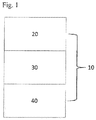
- Fig. 1 shows a non-limiting example of a laminate 10 used in an aseptic packaging.
- the laminate 10 comprises a first polymer layer 20, which is bonded to an aluminium layer 30, which is bonded in turn to a second polymer layer 40.
- Bonding agents are used between the different layers.
- Such bonding agents include, but are not limited to, ethylene/acrylic acid copolymer and/or polyurethane adhesives.
- the laminate 10 is used, in one aspect of the invention, in an aseptic packaging, such as the ones used for stand-up pouches for beverages such as fruit juice and milk as well as tomato purees and similar fluids. Similar packaging is also used for other foods, such as snack foods, as well as for cosmetics.
- one of the polymer layers is printed on one side, for example with a product description, or indeed on both sides.
- the polymer layer 20 is made of low-density polyethylene (LDPE) and the polymer layer 40 is made of polyethylene terephthalate (PET).
- the metal layer 30 is made of aluminium. This is not limiting of the invention and other polyolefins or plastics, such as polypropylene (PP), polyamides or polyesters, could be used. Similarly, the metal layer 30 could be an aluminium alloy or another metal.
- Some types of packaging comprise only a single polymer layer 20 with the metal layer 30. For example, rejects from the production may only have the single polymer layer 20 with the metal layer 30.
- Other types of packaging material comprise two polymer layers 20 and 40 made of the same polymer. The teachings of this disclosure are also applicable to these types of multilayer materials and are not restricted to the multilayer materials mentioned.
- Fig. 3 shows an overview diagram, which is an example of a recycling plant for the recycling of the multilayer laminates 10 of this disclosure. It will be appreciated that the plant shown in Fig. 3 is merely exemplary and is not limiting of the invention.
- the multilayer laminates 10 are constructed as above.
- the recycling plant includes a cutting or shredding device 300, which cuts and shreds bales 50 of the packaging material made of the multilayer laminates 10.
- the cutting or shredding device 300 is followed by a vat 310 with an agitator 320 to stir up and agitate up the contents of the vat 310.
- the vat 310 contains a separation fluid 330 and a fluid dispenser 340 for dispensing the separation fluid 330 into the vat 310.
- the materials can be sieved from the separation fluid 330 in a sieving device 350, and then the sieved materials will be washed with water in a washer 360.
- a first sorting step for separating components from the sieved materials can be conducted in wet environments, e.g. by use of float-sink-separation or centrifugation techniques, in a wet sorter 370. This results generally in two material streams.
- one of the two material streams is substantially low-density polyethylene and the other of the material streams is a mixed stream comprising a mixture of aluminium and PET.
- the two material streams can be washed in a further washing step, if necessary.
- the resulting two material streams can be dried in a drying unit 380 and subsequently purified in a dry sorting unit 390.
- the dry sorting e.g. to extract the aluminium and the PET from the mixed stream, can be done, for example, by wind-sifting or electromagnetically based techniques. It will be appreciated that the sorting (wet or dry) can also be conducted in a single device or in more than two devices, depending on requirements.
- the separation fluid 330 is recycled in a fluid recycling device 355, mostly to be cleaned of impurities by filtration and replenishing consumed chemicals.
- the washing water is also recycled to clean the washing water in a water-recycling device 365.
- the recycling includes crossflow filtration techniques, reverse osmosis and/or liquid-liquid extraction, which also allow reclaiming of at least some of the chemicals of the separation fluid 330 from the washing water.
- Fig. 2 shows an outline of the method for recycling of the laminates 10 used in the apparatus shown in Fig. 3 .
- the laminates 10 are collected together as bales 50 of packaging material.
- the laminates 10 will generally have been pressed together in the bales 50 to reduce their volume.
- the laminates 10 may have been washed to remove any food rest at a waste refuse collection and/or processing plant.
- the bales 50 are placed first into the cutting and shredding device 300 for size reduction in step 200. Batches of the cut/shred laminates 10 are then loaded into the vat 310.
- the agitator 320 mixes the laminates 10 in step 210 with the separation liquid 300 in the vat 310 to produce a mixture.
- the mixture of the laminates 10 and the separation fluid 330 is further agitated and stirred for a pre-defined treatment time, e.g. 4 hours, leading to a separation of the multilayer laminates 10 into its constituent layers, i.e. the first polymer layer 20 of LDPE, the aluminium layer 30 and the second polymer layer 40 of the PET (in non-limiting example described above).
- the effect of the separation fluid 330 is to remove the adhesive bond between the first polymer layer 20 of LDPE and/or the second polymer layer 40 and the metal layer 30 to produce metal shred from the metal layer 30 and polymer shred from the fist polymer layer 20 and the second polymer layer 40.
- a given temperature for example between 20°C and 90°C, during a treatment time of typically between 30 minutes and 300 minutes.
- the given temperature is 70°C.
- the given temperature will be between 30°C and 50°C.
- the choice of temperature and process time largely depends on the type of adhesive bonding agents to be delaminated.
- the layers being bonded together with bonding agents from ethylene/acrylic acid copolymers delaminate at around 40°C and those with bonding agents from polyurethane adhesives delaminate at around 70°C.
- the mixture of the separation fluid 330 and the separated materials, i.e. LDPE, aluminium and PET can be removed from the vat 310 and sieved in step 240 in the sieve 350 to remove the solid materials, which include the LDPE from the first polymer layer 20, the PET from the second polymer layer 40 and most of the metal shred from the metal layer 30.
- the separation fluid 330 is then recycled by the device 355. The recycling is carried out by filtration in step 245 and replenishment of consumed chemicals in step 246. The recycled fluid is then placed back into the fluid dispenser 340.
- the filtration step 245 in device 355 removes substantially all of the solid impurities from the separating fluid 330, including the metal shred, which was not sieved out previously.
- the solid material sieved out in step 240 is a mixture of the polymers and aluminium.
- This resulting material is washed in step 250 in the washer 360, and is then sorted in a wet sorting step 260 in the wet sorter 370 by means of a float-sink-separation or centrifugation technique into a light material, comprising mostly the LDPE, and a dense material, comprising mostly the aluminium and the PET.
- the light materials and the dense materials are dried separately in the steps 270 (light material) and 271 (dense material).
- the dried dense material is further sorted in step 280 in the dry sorter 390 by means of wind-sifting or electromagnetic techniques, to obtain an aluminium-rich material and a PET-rich material.
- the sorting (wet or dry) can also be conducted in one step, or in more than two steps depending on the requirements.
- the washing water needs to be treated in step 255 with the water recycling device 365 before the washing water is also reused.
- These treatments include several filtration steps, with regular and crossflow filtration techniques, reverse osmosis and/or liquid-liquid-extraction, which also allow at least some chemicals from the washing water to be reclaimed and transferred to the fluid recycling device 355 for reuse.
- the water recycling device 365 comprises a liquid-liquid-extraction unit combined with reverse osmosis.
- the LDPE-rich materials can be extruded into granules in step 290.
- the metal shreds can be pressed into pellets in step 291 for recycling.
- the PET-rich material can be compacted for shipment in step 292.
- the post treatment steps 290, 291 and 292 can be done in the devices 395, for example by extrusion or pressing machines.
- the separating fluid 330 used in the vat 310 and coming from the fluid dispenser 340 comprises a mixture of water, short-chain carboxylic acid, phosphoric acid and alkali metal hydroxide.
- the short-chained carboxylic acids are, for example, water miscible C1-C4 monocarboxylic acids, such as formic acid, acetic acid, propionic acid and butyric acid.
- the alkali metal hydroxides are lithium, sodium or potassium hydroxide.
- the water is in one aspect of the invention deionised.
- the mixture of the short-chain carboxylic acid and the water reduces the adhesive intermolecular forces between the aluminium and the adhesive layer of the multilayer material.
- the phosphoric acid and the alkali metal hydroxide are added in order to control the side reaction of aluminium dissolution, as discussed below.
- the separation fluid 330 is kept between 20°C and 90°C, and at pH values between 2 and 4.
- the actual values are chosen depending on the properties of the input laminates 10 or other multilayer materials in the packaging material.
- a low pH value favours performance of the separation, but also a side reaction which results in the dissolution of the aluminium.
- the method of this disclosure achieves a sufficiently high yield of metal from the metal layer 30 or the polymers from the first polymer layer 20 and the second polymer layer 40 within the treatment time, while keeping the dissolution of the metal layer 30 to a minimum.
- the minimal dissolution of the metal layer 30 is important for safety reasons, since dissolution of the aluminium also leads to the formation of gaseous hydrogen, which represents an explosion hazard.
- the pH value is therefore adjusted by adding alkali metal hydroxide solution to the separation fluid 330.
- the separation fluid 330 contains phosphoric acid, or alternatively salts of phosphoric acid (phosphates) in order to control the content of the dissolved aluminium in the separation fluid 330.
- the aluminium precipitates as aluminium phosphate under suitable conditions, by adjusting the pH value.
- the aluminium phosphate is a finely dispersed solid, which can be filtered out from the liquid in the step 245.
- the phosphoric acid induces a thin passivation coverage layer of aluminium phosphate on the aluminium surfaces. These surface phosphates act as an inhibitor, partially passivating the aluminium surfaces from further chemical attack. Thus, the addition of the phosphoric acid further minimizes the aluminium dissolution.
- the total reaction equation for aluminium dissolution and precipitation is: 2 Al (s) + 2 H 3 PO 4 (1) -> 2 AlPO 4 (s) + 3 H 2 (g)
- the reaction products leave the separation fluid 330 in solid form or in gaseous form.
- the phosphoric acid is consumed and has to be replenished. This replenishment happens in the recycling device 355 during the step 246, alongside the replenishment of the other chemicals.
- LDPE low-density polyethylene
- PP polypropylene
- LDPE/aluminium/LDPE which is used in packaging for granulated raw materials for the industry or in tooth paste tubes.
- compositions listed below are merely examples of suitable formulations and are not limiting of the invention (all percentages by weight):
- Glacial acetic acid 45.0% Phosphoric acid (30% solution) 3.0 % Sodium hydroxide (33% solution) 6.3 %
- compositions 1 to 3 illustrate formulations with different shot-chain carboxylic acids.
- Glacial acetic acid 45.0% Phosphoric acid (30% solution) 3.0 % Potassium hydroxide (33% solution) 6.3 %
- composition 4 illustrates a formulation with potassium hydroxide as metal hydroxide.
- Examples 1 to 5 elucidate different packaging materials which can be treated with the separation composition 1 within the scope of the present invention.
- Examples 6 to 8 illustrate the use of other compositions of the separation fluid.
- LDPE/aluminium/PET material flakes, 1 cm 2 , from beverage stand-up pouches
- separation liquid composition 1
- composition 1 Three single specimens of PP/aluminium/PET flakes (1 cm 2 , laminate sample like coffee packaging from foil and converter companies) are shaken with 20 g of separation liquid (composition 1) at 70°C. The detachment of the PP and of the PET from the aluminium is complete after 5 h.
- PE/aluminium/PET flakes (1 cm 2 , laminate sample like coffee packaging from foil and converter companies) are shaken with 20 g of separation liquid (composition 2) at 70°C. The detachment of the PE and of the PET from the aluminium is complete after 1 h.
- PE/aluminium/PET flakes (1 cm 2 , laminate sample like coffee packaging from foil and converter companies) are shaken with 20 g of separation liquid (composition 3) at 70°C. The detachment of the PE and of the PET from the aluminium is complete after 10 h.
Landscapes
- Engineering & Computer Science (AREA)
- Mechanical Engineering (AREA)
- Environmental & Geological Engineering (AREA)
- Chemical & Material Sciences (AREA)
- Chemical Kinetics & Catalysis (AREA)
- Medicinal Chemistry (AREA)
- Polymers & Plastics (AREA)
- Organic Chemistry (AREA)
- Life Sciences & Earth Sciences (AREA)
- Health & Medical Sciences (AREA)
- Sustainable Development (AREA)
- Separation, Recovery Or Treatment Of Waste Materials Containing Plastics (AREA)
- Laminated Bodies (AREA)
- Processing And Handling Of Plastics And Other Materials For Molding In General (AREA)
- Auxiliary Devices For And Details Of Packaging Control (AREA)
- Processing Of Solid Wastes (AREA)
Claims (16)
- Verwendung eines Trennfluids (330) zur Trennung von Mehrschichtsystemen (10) umfassend mindestens eine Metallschicht (30) und eine Polymerschicht (20, 40), wobei das Trennfluid (330) ein Gemisch aus Wasser, eine mit Wasser mischbare C1-C4-Monocarbonsäure, Phosphorsäure und einem Alkalimetallhydroxid umfasst.
- Verwendung nach Anspruch 1, wobei die mit Wasser mischbare C1-C4-Monocarbonsäure, die Phosphorsäure und das Alkalimetallhydroxid teilweise in Lösung zur Bildung von Alkalimetallphosphat und Alkalimetallcarboxylaten reagieren.
- Verwendung nach Anspruch 1 oder 2, wobei die mit Wasser mischbare C1-C4-Monocarbonsäure ausgewählt ist aus der Gruppe bestehend aus Ameisensäure, Essigsäure, Propionsäure oder Buttersäure.
- Verwendung nach einem der vorangegangenen Ansprüche, wobei das Alkalimetallhydroxid ausgewählt ist aus der Gruppe bestehend aus Lithiumhydroxid, Natriumhydroxid oder Kaliumhydroxid.
- Verwendung nach einem der vorstehenden Ansprüche, wobei Komponenten der Mischung 30 - 60 Gew.-% von der mit Wasser mischbaren C1-C4-Monocarbonsäure, 0,5 - 5 Gew.-% von der Phosphorsäure (30%-ige Lösung) und 2 - 8 Gew.-% vom Alkalimetallhydroxid (33%-ige Lösung) sowie 30 - 60 Gew.-% Wasser umfassen.
- Verwendung nach einem der vorstehenden Ansprüche, wobei Komponenten der Mischung 42 - 48 Gew.-% von der mit Wasser mischbaren C1-C4-Monocarbonsäure, 2 ― 4 Gew.-% von der Phosphorsäure (30%-ige Lösung) und 4 - 8 Gew.-% vom Alkalimetallhydroxid (33%-ige Lösung) sowie 45 - 50 Gew.-% Wasser umfassen.
- Verfahren zum Trennen einer Metallschicht (30) von einer Polymerschicht (20, 40) in einem Mehrschichtmaterial (10) umfassend:
Platzieren des Mehrschichtmaterials (10) in einer Wanne (310) umfassend das Trennfluid (330), wobei das Trennfluid ein Gemisch aus Wasser, einer mit Wasser mischbaren C1-C4-Monocarbonsäure, Phosphorsäure und ein Alkalimetallhydroxid umfasst. - Verfahren nach Anspruch 7, ferner umfassend mindestens eines von Sieben oder Filtern (240) des Trennfluids (330) mit Komponenten des Mehrschichtmaterials (10) und anschließendes Sortieren (260, 280), um eine erste Fraktion von Metall aus der Metallschicht (30) und eine zweite Fraktion von Kunststoff aus der Polymerschicht (20,40) zu erhalten.
- Verfahren nach Anspruch 7 oder 8, ferner umfassend das Recycling des Trennfluids (330).
- Verfahren nach Anspruch 7 bis 9, wobei die Trennung ausgeführt wird bei einer Temperatur zwischen 20°C und 90°C.
- Verfahren nach Anspruch 7 bis 10, wobei die Trennung ausgeführt wird bei einer Temperatur von 70°C.
- Verfahren nach Anspruch 7 bis 11, wobei das Trennfluid einen pH-Wert zwischen 2 und 4 aufweist.
- Verfahren nach einem der Ansprüche 7 bis 12, wobei das Mehrschichtmaterial (10) mindestens eine Aluminiumschicht und eine aus PET oder PE bestehende Polymerschicht (20, 40) umfasst.
- Verfahren nach einem der Ansprüche 7 bis 13, wobei die Metallschicht (30) aus Aluminium oder einer Legierung davon besteht.
- Verfahren nach einem der Ansprüche 7 bis 12, wobei die mindestens eine Polymerschicht (20, 40) aus einem Polyolefin hergestellt ist.
- Vorrichtung zum Recycling von aus einem Mehrschichtmaterial (10) hergestelltem Verpackungsmaterial umfassend mindestens eine Metallschicht (30) und eine Polymerschicht (20 40), wobei die Vorrichtung das Verfahren nach mindestens einem der Ansprüche 7 bis 15 verwendet, wobei die Vorrichtung eine Wanne (310) mit einem Trennfluid (330), aufweisend eine Mischung aus Wasser, einer mit Wasser mischbaren C1-C4-Monocarbonsäure, Phosphorsäure und einem Alkalimetallhydroxid;eine Transporteinrichtung zum Transport des Mehrschichtmaterials (10) in die Wanne (310); undeine Sieb-/Filtriervorrichtung (350) zum Entfernen (240) getrennter Materialien aus der Kombination des Trennfluids (330) und des Mehrschichtmaterials (10) umfasst.
Priority Applications (1)
| Application Number | Priority Date | Filing Date | Title |
|---|---|---|---|
| PL17818115T PL3554834T3 (pl) | 2016-12-15 | 2017-12-15 | Sposób i urządzenie do powtórnego wykorzystywania materiałów opakowaniowych |
Applications Claiming Priority (2)
| Application Number | Priority Date | Filing Date | Title |
|---|---|---|---|
| GB1621371.2A GB2557682A (en) | 2016-12-15 | 2016-12-15 | Method and apparatus for recycling packaging material |
| PCT/EP2017/082971 WO2018109147A2 (en) | 2016-12-15 | 2017-12-15 | Method and apparatus for recycling packaging material |
Publications (2)
| Publication Number | Publication Date |
|---|---|
| EP3554834A2 EP3554834A2 (de) | 2019-10-23 |
| EP3554834B1 true EP3554834B1 (de) | 2021-11-10 |
Family
ID=58284513
Family Applications (1)
| Application Number | Title | Priority Date | Filing Date |
|---|---|---|---|
| EP17818115.2A Active EP3554834B1 (de) | 2016-12-15 | 2017-12-15 | Verfahren und vorrichtung zur wiederverwertung von verpackungsmaterial |
Country Status (17)
| Country | Link |
|---|---|
| US (1) | US11535022B2 (de) |
| EP (1) | EP3554834B1 (de) |
| JP (1) | JP7148519B2 (de) |
| KR (1) | KR102554108B1 (de) |
| CN (1) | CN110446608B (de) |
| AU (1) | AU2017378087B2 (de) |
| BR (1) | BR112019012241B1 (de) |
| CO (1) | CO2019007371A2 (de) |
| DK (1) | DK3554834T3 (de) |
| ES (1) | ES2906105T3 (de) |
| GB (1) | GB2557682A (de) |
| MX (1) | MX2019007022A (de) |
| MY (1) | MY193033A (de) |
| PL (1) | PL3554834T3 (de) |
| PT (1) | PT3554834T (de) |
| RU (1) | RU2759556C2 (de) |
| WO (1) | WO2018109147A2 (de) |
Cited By (3)
| Publication number | Priority date | Publication date | Assignee | Title |
|---|---|---|---|---|
| EP4194499A1 (de) | 2021-12-08 | 2023-06-14 | Nexam Chemical AB | Neues recyclingverfahren für polyethylen |
| KR20230164361A (ko) * | 2022-05-25 | 2023-12-04 | 김주학 | 다층 포장재 재생을 위한 분리제 제조방법 및 이에 의하여 제조된 분리제 |
| EP4474421A1 (de) | 2023-06-07 | 2024-12-11 | Nexam Chemical AB | Verfahren zur bereitstellung einer zusammensetzung mit recyceltem polyethylen |
Families Citing this family (15)
| Publication number | Priority date | Publication date | Assignee | Title |
|---|---|---|---|---|
| GB2574260A (en) | 2018-06-01 | 2019-12-04 | saperatec GmbH | Separation fluid, method and apparatus for recycling multilayer material using a metal passivation agent |
| WO2020130780A1 (es) * | 2018-12-19 | 2020-06-25 | Omicron, Tecnologia Circular, S.L. | Proceso para la recuperación de aluminio y polietileno a partir de empaques multicapa |
| WO2021007510A1 (en) * | 2019-07-10 | 2021-01-14 | Engineered Floors LLC | Recycling of composites containing layers unsuitable for recycling |
| JP2021187869A (ja) * | 2020-05-25 | 2021-12-13 | 東洋クロス株式会社 | ポリエステルフィルム、ポリエステルフィルムの製造方法、ポリエステルペレット、およびポリエステルペレットの製造方法 |
| CN114058073A (zh) * | 2020-08-07 | 2022-02-18 | Apk股份公司 | 使用滚筒对滚筒加工步骤的基于溶剂的回收利用 |
| ES2922449A1 (es) * | 2021-03-04 | 2022-09-15 | I Boix Daniel Riera | Metodo de tratamiento de laminas complejas |
| US20240424713A1 (en) * | 2021-09-22 | 2024-12-26 | Amut S.P.A. | Process and plant for the continuous processing of flakes formed by at least two different plastic materials attached to each other |
| US20240399721A1 (en) * | 2021-09-22 | 2024-12-05 | Kuraray Co., Ltd. | Multilayer structure, and method for separating same and method for recycling same |
| DE102022104008A1 (de) * | 2022-02-21 | 2023-08-24 | Krones Aktiengesellschaft | Verfahren und Anlage zum Zerkleinern und Reinigen von Altkunststoff |
| WO2024044133A1 (en) * | 2022-08-22 | 2024-02-29 | Ohio State Innovation Foundation | Methods and systems for electrochemical polymers delamination |
| CH720640A1 (de) * | 2023-03-24 | 2024-09-30 | Alpla Werke Alwin Lehner Gmbh & Co Kg | Verfahren zum Recycling von Polyolefin-Behältern |
| LU504034B1 (en) | 2023-04-21 | 2024-10-21 | saperatec GmbH | Method and Apparatus for Recycling Waste Material |
| JPWO2024247643A1 (de) * | 2023-05-31 | 2024-12-05 | ||
| EP4474125A1 (de) * | 2023-06-09 | 2024-12-11 | Kunststoff Recycling Grünstadt GmbH | Verfahren zur herstellung eines kunststoffrecyclats |
| WO2025249468A1 (ja) * | 2024-05-29 | 2025-12-04 | 東洋アルミニウム株式会社 | アルミニウム箔積層体用分離溶液およびそれを用いたアルミニウム箔積層体の分離方法 |
Family Cites Families (27)
| Publication number | Priority date | Publication date | Assignee | Title |
|---|---|---|---|---|
| US5127958A (en) * | 1990-07-11 | 1992-07-07 | Morris Resources, Inc. | Removal of metallic coatings from polymeric substrates |
| SE468481B (sv) | 1991-05-29 | 1993-01-25 | Tetra Alfa Holdings | Saett att aatervinna enskilda bestaandsdelar fraan ett foerpackningsmaterialavfall |
| DE4137895C2 (de) | 1991-11-18 | 2000-02-10 | Johannes Kersting | Verfahren zum Abtrennen von Aluminiumfolien von Kunststoffolien, insbesondere PE-Folien |
| JP3911860B2 (ja) * | 1998-07-21 | 2007-05-09 | 東レ株式会社 | ナイロン6製品類のリサイクル方法 |
| EP1278912B1 (de) * | 1999-12-20 | 2007-05-09 | Advanced Plastics Technologies, Ltd | Hydroxy-phenoxyetherpolymere in der papierherstellung |
| US20020033475A1 (en) * | 2000-05-31 | 2002-03-21 | Bejarano Fernando Suarez | Composition and method for separation of the different layers of long life packaging |
| BR0202303C1 (pt) | 2002-06-07 | 2004-06-08 | Anderson Cr Massura | Processo para separação de filmes multicamada utilizados para embalagens |
| CN101054779B (zh) | 2006-04-14 | 2012-05-16 | 吴宸澔 | 一种废复合纸膜的再生方法 |
| JP4894377B2 (ja) * | 2006-06-29 | 2012-03-14 | 日立化成工業株式会社 | シートモールディングコンパウンドの製造方法及び繊維強化プラスチック製品の製造方法 |
| JP2010524208A (ja) * | 2007-03-31 | 2010-07-15 | アドバンスド テクノロジー マテリアルズ,インコーポレイテッド | ウエハ再生のために材料を剥離する方法 |
| CN100526373C (zh) * | 2007-04-30 | 2009-08-12 | 河北科技大学 | 铝塑复合包装分离剂及其分离回收方法 |
| JP2009108189A (ja) * | 2007-10-30 | 2009-05-21 | Sumitomo Light Metal Ind Ltd | 洗浄剤組成物、及びそれを用いた洗浄方法 |
| CN101891903B (zh) | 2009-05-20 | 2012-04-25 | 中国环境科学研究院 | 一种纸塑铝复合包装废物分离方法 |
| WO2011077450A2 (en) * | 2009-12-21 | 2011-06-30 | Ashutosh Mukhopadhyay | Process for delamination of laminated packaging |
| CN102206359B (zh) | 2010-03-31 | 2013-05-29 | 中国环境科学研究院 | 一种铝塑复合包装材料连续分离方法和装置 |
| DE102011000322A1 (de) | 2011-01-25 | 2012-07-26 | saperatec GmbH | Trennmedium, Verfahren und Anlage zum Trennen von Mehrschichtsystemen |
| CN103030126A (zh) | 2011-10-10 | 2013-04-10 | 徐州特瑞达环保科技有限公司 | 一种化成箔生产过程中产生的废磷酸液的回收方法 |
| FR2992902B1 (fr) * | 2012-07-04 | 2014-11-21 | Renault Sa | Climatiseur, notamment pour vehicule automobile |
| CN102744246B (zh) | 2012-07-25 | 2014-12-31 | 中国环境科学研究院 | 具有分离剂回收的铝塑复合包装材料卧式连续分离系统 |
| CN102773242B (zh) | 2012-07-25 | 2014-12-03 | 中国环境科学研究院 | 铝塑复合包装材料分离装置 |
| CN103131042A (zh) | 2013-03-06 | 2013-06-05 | 上海交通大学 | 一种铝塑分离剂及铝塑分离方法 |
| GB2525858A (en) * | 2014-05-05 | 2015-11-11 | saperatec GmbH | Method and apparatus for recycling packaging material |
| CN104592546B (zh) * | 2014-12-29 | 2018-04-27 | 武汉理工大学 | 一种回收废旧碳纤维/环氧树脂复合材料的方法 |
| JP2016182816A (ja) * | 2015-03-25 | 2016-10-20 | 特種東海製紙株式会社 | 積層体及びその製造方法 |
| CN104744724A (zh) | 2015-04-21 | 2015-07-01 | 戴翔辉 | 一种铝塑分离剂及利用该分离剂进行铝塑分离的方法 |
| CZ307054B6 (cs) | 2015-12-22 | 2017-12-20 | Ústav Chemických Procesů Av Čr, V. V. I. | Způsob rozdružování obalového kompozitního materiálu |
| CN106393479A (zh) | 2016-09-05 | 2017-02-15 | 漳州市陆海环保产业开发有限公司 | 一种废旧纸铝塑复合包装材料铝塑软化剂分离的工艺 |
-
2016
- 2016-12-15 GB GB1621371.2A patent/GB2557682A/en not_active Withdrawn
-
2017
- 2017-12-15 BR BR112019012241-9A patent/BR112019012241B1/pt active IP Right Grant
- 2017-12-15 RU RU2019122114A patent/RU2759556C2/ru active
- 2017-12-15 DK DK17818115.2T patent/DK3554834T3/da active
- 2017-12-15 WO PCT/EP2017/082971 patent/WO2018109147A2/en not_active Ceased
- 2017-12-15 JP JP2019531887A patent/JP7148519B2/ja active Active
- 2017-12-15 MY MYPI2019003379A patent/MY193033A/en unknown
- 2017-12-15 ES ES17818115T patent/ES2906105T3/es active Active
- 2017-12-15 AU AU2017378087A patent/AU2017378087B2/en active Active
- 2017-12-15 CN CN201780082737.4A patent/CN110446608B/zh active Active
- 2017-12-15 US US16/468,406 patent/US11535022B2/en active Active
- 2017-12-15 PL PL17818115T patent/PL3554834T3/pl unknown
- 2017-12-15 MX MX2019007022A patent/MX2019007022A/es unknown
- 2017-12-15 KR KR1020197020452A patent/KR102554108B1/ko active Active
- 2017-12-15 EP EP17818115.2A patent/EP3554834B1/de active Active
- 2017-12-15 PT PT178181152T patent/PT3554834T/pt unknown
-
2019
- 2019-07-10 CO CONC2019/0007371A patent/CO2019007371A2/es unknown
Non-Patent Citations (1)
| Title |
|---|
| None * |
Cited By (5)
| Publication number | Priority date | Publication date | Assignee | Title |
|---|---|---|---|---|
| EP4194499A1 (de) | 2021-12-08 | 2023-06-14 | Nexam Chemical AB | Neues recyclingverfahren für polyethylen |
| WO2023104820A1 (en) | 2021-12-08 | 2023-06-15 | Nexam Chemical Ab | Novel recycling process of polyethylene |
| KR20230164361A (ko) * | 2022-05-25 | 2023-12-04 | 김주학 | 다층 포장재 재생을 위한 분리제 제조방법 및 이에 의하여 제조된 분리제 |
| EP4474421A1 (de) | 2023-06-07 | 2024-12-11 | Nexam Chemical AB | Verfahren zur bereitstellung einer zusammensetzung mit recyceltem polyethylen |
| WO2024251718A1 (en) | 2023-06-07 | 2024-12-12 | Nexam Chemical Ab | Process of providing a composition comprising recycled polyethylene |
Also Published As
| Publication number | Publication date |
|---|---|
| RU2759556C2 (ru) | 2021-11-15 |
| KR20190097153A (ko) | 2019-08-20 |
| KR102554108B1 (ko) | 2023-07-12 |
| MX2019007022A (es) | 2019-11-21 |
| JP2020515655A (ja) | 2020-05-28 |
| RU2019122114A (ru) | 2021-01-15 |
| ES2906105T3 (es) | 2022-04-13 |
| US20190351663A1 (en) | 2019-11-21 |
| WO2018109147A2 (en) | 2018-06-21 |
| PT3554834T (pt) | 2022-02-14 |
| BR112019012241B1 (pt) | 2024-01-30 |
| CO2019007371A2 (es) | 2019-08-20 |
| GB2557682A (en) | 2018-06-27 |
| CN110446608A (zh) | 2019-11-12 |
| US11535022B2 (en) | 2022-12-27 |
| EP3554834A2 (de) | 2019-10-23 |
| JP7148519B2 (ja) | 2022-10-05 |
| WO2018109147A3 (en) | 2018-07-26 |
| GB201621371D0 (en) | 2017-02-01 |
| AU2017378087A1 (en) | 2019-07-04 |
| CA3047048A1 (en) | 2018-06-21 |
| MY193033A (en) | 2022-09-23 |
| PL3554834T3 (pl) | 2022-04-11 |
| CN110446608B (zh) | 2022-07-01 |
| AU2017378087B2 (en) | 2022-09-01 |
| BR112019012241A2 (pt) | 2019-11-05 |
| RU2019122114A3 (de) | 2021-01-20 |
| DK3554834T3 (da) | 2022-02-14 |
Similar Documents
| Publication | Publication Date | Title |
|---|---|---|
| US11535022B2 (en) | Method and apparatus for recycling packaging material | |
| AU2019278617B2 (en) | Separation fluid, method and apparatus for recycling multilayer material using a passivation agent | |
| EP4144786A1 (de) | Verfahren und vorrichtung zur wiederverwertung von verpackungsmaterial | |
| RS54043B1 (sr) | Postupak recikliranja plastičnih proizvoda | |
| CA3047048C (en) | Method and apparatus for recycling packaging material | |
| CN103328105A (zh) | 塑料层压材料的回收利用 | |
| US20240227245A9 (en) | Method for treating complex sheets | |
| LU504034B1 (en) | Method and Apparatus for Recycling Waste Material | |
| CN102532592A (zh) | 一种铝塑分离剂及其制备方法 | |
| BR112020024586B1 (pt) | Fluido de separação, método e aparelho para reciclar material de multicamadas usando um agente de passivação | |
| IT202300004422A1 (it) | Processo per la preparazione di un materiale multistrato di imballaggio flessibile delaminabile per trattamento in acqua |
Legal Events
| Date | Code | Title | Description |
|---|---|---|---|
| STAA | Information on the status of an ep patent application or granted ep patent |
Free format text: STATUS: UNKNOWN |
|
| STAA | Information on the status of an ep patent application or granted ep patent |
Free format text: STATUS: THE INTERNATIONAL PUBLICATION HAS BEEN MADE |
|
| PUAI | Public reference made under article 153(3) epc to a published international application that has entered the european phase |
Free format text: ORIGINAL CODE: 0009012 |
|
| STAA | Information on the status of an ep patent application or granted ep patent |
Free format text: STATUS: REQUEST FOR EXAMINATION WAS MADE |
|
| 17P | Request for examination filed |
Effective date: 20190715 |
|
| AK | Designated contracting states |
Kind code of ref document: A2 Designated state(s): AL AT BE BG CH CY CZ DE DK EE ES FI FR GB GR HR HU IE IS IT LI LT LU LV MC MK MT NL NO PL PT RO RS SE SI SK SM TR |
|
| AX | Request for extension of the european patent |
Extension state: BA ME |
|
| DAV | Request for validation of the european patent (deleted) | ||
| DAX | Request for extension of the european patent (deleted) | ||
| GRAP | Despatch of communication of intention to grant a patent |
Free format text: ORIGINAL CODE: EPIDOSNIGR1 |
|
| STAA | Information on the status of an ep patent application or granted ep patent |
Free format text: STATUS: GRANT OF PATENT IS INTENDED |
|
| INTG | Intention to grant announced |
Effective date: 20201217 |
|
| GRAJ | Information related to disapproval of communication of intention to grant by the applicant or resumption of examination proceedings by the epo deleted |
Free format text: ORIGINAL CODE: EPIDOSDIGR1 |
|
| STAA | Information on the status of an ep patent application or granted ep patent |
Free format text: STATUS: REQUEST FOR EXAMINATION WAS MADE |
|
| GRAP | Despatch of communication of intention to grant a patent |
Free format text: ORIGINAL CODE: EPIDOSNIGR1 |
|
| STAA | Information on the status of an ep patent application or granted ep patent |
Free format text: STATUS: GRANT OF PATENT IS INTENDED |
|
| INTC | Intention to grant announced (deleted) | ||
| INTG | Intention to grant announced |
Effective date: 20210602 |
|
| GRAS | Grant fee paid |
Free format text: ORIGINAL CODE: EPIDOSNIGR3 |
|
| GRAA | (expected) grant |
Free format text: ORIGINAL CODE: 0009210 |
|
| STAA | Information on the status of an ep patent application or granted ep patent |
Free format text: STATUS: THE PATENT HAS BEEN GRANTED |
|
| AK | Designated contracting states |
Kind code of ref document: B1 Designated state(s): AL AT BE BG CH CY CZ DE DK EE ES FI FR GB GR HR HU IE IS IT LI LT LU LV MC MK MT NL NO PL PT RO RS SE SI SK SM TR |
|
| REG | Reference to a national code |
Ref country code: GB Ref legal event code: FG4D |
|
| REG | Reference to a national code |
Ref country code: AT Ref legal event code: REF Ref document number: 1445713 Country of ref document: AT Kind code of ref document: T Effective date: 20211115 Ref country code: CH Ref legal event code: EP |
|
| REG | Reference to a national code |
Ref country code: DE Ref legal event code: R096 Ref document number: 602017049196 Country of ref document: DE |
|
| REG | Reference to a national code |
Ref country code: IE Ref legal event code: FG4D |
|
| REG | Reference to a national code |
Ref country code: FI Ref legal event code: FGE |
|
| REG | Reference to a national code |
Ref country code: PT Ref legal event code: SC4A Ref document number: 3554834 Country of ref document: PT Date of ref document: 20220214 Kind code of ref document: T Free format text: AVAILABILITY OF NATIONAL TRANSLATION Effective date: 20220207 Ref country code: DK Ref legal event code: T3 Effective date: 20220210 |
|
| REG | Reference to a national code |
Ref country code: NO Ref legal event code: T2 Effective date: 20211110 |
|
| REG | Reference to a national code |
Ref country code: SE Ref legal event code: TRGR |
|
| REG | Reference to a national code |
Ref country code: NL Ref legal event code: FP |
|
| RAP4 | Party data changed (patent owner data changed or rights of a patent transferred) |
Owner name: SAPERATEC GMBH |
|
| REG | Reference to a national code |
Ref country code: LT Ref legal event code: MG9D |
|
| REG | Reference to a national code |
Ref country code: ES Ref legal event code: FG2A Ref document number: 2906105 Country of ref document: ES Kind code of ref document: T3 Effective date: 20220413 |
|
| PG25 | Lapsed in a contracting state [announced via postgrant information from national office to epo] |
Ref country code: RS Free format text: LAPSE BECAUSE OF FAILURE TO SUBMIT A TRANSLATION OF THE DESCRIPTION OR TO PAY THE FEE WITHIN THE PRESCRIBED TIME-LIMIT Effective date: 20211110 Ref country code: LT Free format text: LAPSE BECAUSE OF FAILURE TO SUBMIT A TRANSLATION OF THE DESCRIPTION OR TO PAY THE FEE WITHIN THE PRESCRIBED TIME-LIMIT Effective date: 20211110 Ref country code: BG Free format text: LAPSE BECAUSE OF FAILURE TO SUBMIT A TRANSLATION OF THE DESCRIPTION OR TO PAY THE FEE WITHIN THE PRESCRIBED TIME-LIMIT Effective date: 20220210 |
|
| PG25 | Lapsed in a contracting state [announced via postgrant information from national office to epo] |
Ref country code: IS Free format text: LAPSE BECAUSE OF FAILURE TO SUBMIT A TRANSLATION OF THE DESCRIPTION OR TO PAY THE FEE WITHIN THE PRESCRIBED TIME-LIMIT Effective date: 20220310 Ref country code: LV Free format text: LAPSE BECAUSE OF FAILURE TO SUBMIT A TRANSLATION OF THE DESCRIPTION OR TO PAY THE FEE WITHIN THE PRESCRIBED TIME-LIMIT Effective date: 20211110 Ref country code: HR Free format text: LAPSE BECAUSE OF FAILURE TO SUBMIT A TRANSLATION OF THE DESCRIPTION OR TO PAY THE FEE WITHIN THE PRESCRIBED TIME-LIMIT Effective date: 20211110 Ref country code: GR Free format text: LAPSE BECAUSE OF FAILURE TO SUBMIT A TRANSLATION OF THE DESCRIPTION OR TO PAY THE FEE WITHIN THE PRESCRIBED TIME-LIMIT Effective date: 20220211 |
|
| PG25 | Lapsed in a contracting state [announced via postgrant information from national office to epo] |
Ref country code: SM Free format text: LAPSE BECAUSE OF FAILURE TO SUBMIT A TRANSLATION OF THE DESCRIPTION OR TO PAY THE FEE WITHIN THE PRESCRIBED TIME-LIMIT Effective date: 20211110 Ref country code: SK Free format text: LAPSE BECAUSE OF FAILURE TO SUBMIT A TRANSLATION OF THE DESCRIPTION OR TO PAY THE FEE WITHIN THE PRESCRIBED TIME-LIMIT Effective date: 20211110 Ref country code: RO Free format text: LAPSE BECAUSE OF FAILURE TO SUBMIT A TRANSLATION OF THE DESCRIPTION OR TO PAY THE FEE WITHIN THE PRESCRIBED TIME-LIMIT Effective date: 20211110 Ref country code: EE Free format text: LAPSE BECAUSE OF FAILURE TO SUBMIT A TRANSLATION OF THE DESCRIPTION OR TO PAY THE FEE WITHIN THE PRESCRIBED TIME-LIMIT Effective date: 20211110 |
|
| REG | Reference to a national code |
Ref country code: DE Ref legal event code: R097 Ref document number: 602017049196 Country of ref document: DE |
|
| PG25 | Lapsed in a contracting state [announced via postgrant information from national office to epo] |
Ref country code: MC Free format text: LAPSE BECAUSE OF FAILURE TO SUBMIT A TRANSLATION OF THE DESCRIPTION OR TO PAY THE FEE WITHIN THE PRESCRIBED TIME-LIMIT Effective date: 20211110 |
|
| PLBE | No opposition filed within time limit |
Free format text: ORIGINAL CODE: 0009261 |
|
| STAA | Information on the status of an ep patent application or granted ep patent |
Free format text: STATUS: NO OPPOSITION FILED WITHIN TIME LIMIT |
|
| 26N | No opposition filed |
Effective date: 20220811 |
|
| PG25 | Lapsed in a contracting state [announced via postgrant information from national office to epo] |
Ref country code: LU Free format text: LAPSE BECAUSE OF NON-PAYMENT OF DUE FEES Effective date: 20211215 Ref country code: IE Free format text: LAPSE BECAUSE OF NON-PAYMENT OF DUE FEES Effective date: 20211215 Ref country code: AL Free format text: LAPSE BECAUSE OF FAILURE TO SUBMIT A TRANSLATION OF THE DESCRIPTION OR TO PAY THE FEE WITHIN THE PRESCRIBED TIME-LIMIT Effective date: 20211110 |
|
| PG25 | Lapsed in a contracting state [announced via postgrant information from national office to epo] |
Ref country code: SI Free format text: LAPSE BECAUSE OF FAILURE TO SUBMIT A TRANSLATION OF THE DESCRIPTION OR TO PAY THE FEE WITHIN THE PRESCRIBED TIME-LIMIT Effective date: 20211110 |
|
| PG25 | Lapsed in a contracting state [announced via postgrant information from national office to epo] |
Ref country code: CY Free format text: LAPSE BECAUSE OF FAILURE TO SUBMIT A TRANSLATION OF THE DESCRIPTION OR TO PAY THE FEE WITHIN THE PRESCRIBED TIME-LIMIT Effective date: 20211110 |
|
| PG25 | Lapsed in a contracting state [announced via postgrant information from national office to epo] |
Ref country code: HU Free format text: LAPSE BECAUSE OF FAILURE TO SUBMIT A TRANSLATION OF THE DESCRIPTION OR TO PAY THE FEE WITHIN THE PRESCRIBED TIME-LIMIT; INVALID AB INITIO Effective date: 20171215 |
|
| PG25 | Lapsed in a contracting state [announced via postgrant information from national office to epo] |
Ref country code: MK Free format text: LAPSE BECAUSE OF FAILURE TO SUBMIT A TRANSLATION OF THE DESCRIPTION OR TO PAY THE FEE WITHIN THE PRESCRIBED TIME-LIMIT Effective date: 20211110 |
|
| PG25 | Lapsed in a contracting state [announced via postgrant information from national office to epo] |
Ref country code: MT Free format text: LAPSE BECAUSE OF FAILURE TO SUBMIT A TRANSLATION OF THE DESCRIPTION OR TO PAY THE FEE WITHIN THE PRESCRIBED TIME-LIMIT Effective date: 20211110 |
|
| PGFP | Annual fee paid to national office [announced via postgrant information from national office to epo] |
Ref country code: PT Payment date: 20241205 Year of fee payment: 8 |
|
| PGFP | Annual fee paid to national office [announced via postgrant information from national office to epo] |
Ref country code: NO Payment date: 20241216 Year of fee payment: 8 |
|
| PGFP | Annual fee paid to national office [announced via postgrant information from national office to epo] |
Ref country code: DK Payment date: 20241217 Year of fee payment: 8 |
|
| PGFP | Annual fee paid to national office [announced via postgrant information from national office to epo] |
Ref country code: PL Payment date: 20241205 Year of fee payment: 8 Ref country code: NL Payment date: 20241217 Year of fee payment: 8 Ref country code: BE Payment date: 20241216 Year of fee payment: 8 Ref country code: FI Payment date: 20241216 Year of fee payment: 8 |
|
| PGFP | Annual fee paid to national office [announced via postgrant information from national office to epo] |
Ref country code: GB Payment date: 20241206 Year of fee payment: 8 |
|
| PGFP | Annual fee paid to national office [announced via postgrant information from national office to epo] |
Ref country code: IT Payment date: 20241216 Year of fee payment: 8 |
|
| PGFP | Annual fee paid to national office [announced via postgrant information from national office to epo] |
Ref country code: TR Payment date: 20241209 Year of fee payment: 8 |
|
| PGFP | Annual fee paid to national office [announced via postgrant information from national office to epo] |
Ref country code: ES Payment date: 20250117 Year of fee payment: 8 |
|
| REG | Reference to a national code |
Ref country code: AT Ref legal event code: UEP Ref document number: 1445713 Country of ref document: AT Kind code of ref document: T Effective date: 20211110 |
|
| REG | Reference to a national code |
Ref country code: CH Ref legal event code: U11 Free format text: ST27 STATUS EVENT CODE: U-0-0-U10-U11 (AS PROVIDED BY THE NATIONAL OFFICE) Effective date: 20260101 |
|
| PGFP | Annual fee paid to national office [announced via postgrant information from national office to epo] |
Ref country code: DE Payment date: 20251217 Year of fee payment: 9 |
|
| PGFP | Annual fee paid to national office [announced via postgrant information from national office to epo] |
Ref country code: AT Payment date: 20251215 Year of fee payment: 9 |
|
| PGFP | Annual fee paid to national office [announced via postgrant information from national office to epo] |
Ref country code: FR Payment date: 20251218 Year of fee payment: 9 |
|
| PGFP | Annual fee paid to national office [announced via postgrant information from national office to epo] |
Ref country code: SE Payment date: 20251217 Year of fee payment: 9 |
|
| PGFP | Annual fee paid to national office [announced via postgrant information from national office to epo] |
Ref country code: CZ Payment date: 20251202 Year of fee payment: 9 |
|
| PGFP | Annual fee paid to national office [announced via postgrant information from national office to epo] |
Ref country code: CH Payment date: 20260101 Year of fee payment: 9 |