EP3553849A1 - Separator und elektrochemische vorrichtung damit - Google Patents
Separator und elektrochemische vorrichtung damit Download PDFInfo
- Publication number
- EP3553849A1 EP3553849A1 EP18875904.7A EP18875904A EP3553849A1 EP 3553849 A1 EP3553849 A1 EP 3553849A1 EP 18875904 A EP18875904 A EP 18875904A EP 3553849 A1 EP3553849 A1 EP 3553849A1
- Authority
- EP
- European Patent Office
- Prior art keywords
- phase angle
- polymer
- separator
- variation
- polymer substrate
- Prior art date
- Legal status (The legal status is an assumption and is not a legal conclusion. Google has not performed a legal analysis and makes no representation as to the accuracy of the status listed.)
- Granted
Links
Images



Classifications
-
- H—ELECTRICITY
- H01—ELECTRIC ELEMENTS
- H01M—PROCESSES OR MEANS, e.g. BATTERIES, FOR THE DIRECT CONVERSION OF CHEMICAL ENERGY INTO ELECTRICAL ENERGY
- H01M10/00—Secondary cells; Manufacture thereof
- H01M10/05—Accumulators with non-aqueous electrolyte
- H01M10/052—Li-accumulators
- H01M10/0525—Rocking-chair batteries, i.e. batteries with lithium insertion or intercalation in both electrodes; Lithium-ion batteries
-
- H—ELECTRICITY
- H01—ELECTRIC ELEMENTS
- H01G—CAPACITORS; CAPACITORS, RECTIFIERS, DETECTORS, SWITCHING DEVICES, LIGHT-SENSITIVE OR TEMPERATURE-SENSITIVE DEVICES OF THE ELECTROLYTIC TYPE
- H01G11/00—Hybrid capacitors, i.e. capacitors having different positive and negative electrodes; Electric double-layer [EDL] capacitors; Processes for the manufacture thereof or of parts thereof
- H01G11/52—Separators
-
- H—ELECTRICITY
- H01—ELECTRIC ELEMENTS
- H01M—PROCESSES OR MEANS, e.g. BATTERIES, FOR THE DIRECT CONVERSION OF CHEMICAL ENERGY INTO ELECTRICAL ENERGY
- H01M10/00—Secondary cells; Manufacture thereof
- H01M10/05—Accumulators with non-aqueous electrolyte
- H01M10/052—Li-accumulators
-
- H—ELECTRICITY
- H01—ELECTRIC ELEMENTS
- H01M—PROCESSES OR MEANS, e.g. BATTERIES, FOR THE DIRECT CONVERSION OF CHEMICAL ENERGY INTO ELECTRICAL ENERGY
- H01M50/00—Constructional details or processes of manufacture of the non-active parts of electrochemical cells other than fuel cells, e.g. hybrid cells
- H01M50/40—Separators; Membranes; Diaphragms; Spacing elements inside cells
- H01M50/409—Separators, membranes or diaphragms characterised by the material
- H01M50/411—Organic material
- H01M50/414—Synthetic resins, e.g. thermoplastics or thermosetting resins
-
- H—ELECTRICITY
- H01—ELECTRIC ELEMENTS
- H01M—PROCESSES OR MEANS, e.g. BATTERIES, FOR THE DIRECT CONVERSION OF CHEMICAL ENERGY INTO ELECTRICAL ENERGY
- H01M50/00—Constructional details or processes of manufacture of the non-active parts of electrochemical cells other than fuel cells, e.g. hybrid cells
- H01M50/40—Separators; Membranes; Diaphragms; Spacing elements inside cells
- H01M50/409—Separators, membranes or diaphragms characterised by the material
- H01M50/411—Organic material
- H01M50/414—Synthetic resins, e.g. thermoplastics or thermosetting resins
- H01M50/417—Polyolefins
-
- H—ELECTRICITY
- H01—ELECTRIC ELEMENTS
- H01M—PROCESSES OR MEANS, e.g. BATTERIES, FOR THE DIRECT CONVERSION OF CHEMICAL ENERGY INTO ELECTRICAL ENERGY
- H01M50/00—Constructional details or processes of manufacture of the non-active parts of electrochemical cells other than fuel cells, e.g. hybrid cells
- H01M50/40—Separators; Membranes; Diaphragms; Spacing elements inside cells
- H01M50/409—Separators, membranes or diaphragms characterised by the material
- H01M50/411—Organic material
- H01M50/414—Synthetic resins, e.g. thermoplastics or thermosetting resins
- H01M50/426—Fluorocarbon polymers
-
- H—ELECTRICITY
- H01—ELECTRIC ELEMENTS
- H01M—PROCESSES OR MEANS, e.g. BATTERIES, FOR THE DIRECT CONVERSION OF CHEMICAL ENERGY INTO ELECTRICAL ENERGY
- H01M50/00—Constructional details or processes of manufacture of the non-active parts of electrochemical cells other than fuel cells, e.g. hybrid cells
- H01M50/40—Separators; Membranes; Diaphragms; Spacing elements inside cells
- H01M50/409—Separators, membranes or diaphragms characterised by the material
- H01M50/431—Inorganic material
-
- H—ELECTRICITY
- H01—ELECTRIC ELEMENTS
- H01M—PROCESSES OR MEANS, e.g. BATTERIES, FOR THE DIRECT CONVERSION OF CHEMICAL ENERGY INTO ELECTRICAL ENERGY
- H01M50/00—Constructional details or processes of manufacture of the non-active parts of electrochemical cells other than fuel cells, e.g. hybrid cells
- H01M50/40—Separators; Membranes; Diaphragms; Spacing elements inside cells
- H01M50/409—Separators, membranes or diaphragms characterised by the material
- H01M50/443—Particulate material
-
- H—ELECTRICITY
- H01—ELECTRIC ELEMENTS
- H01M—PROCESSES OR MEANS, e.g. BATTERIES, FOR THE DIRECT CONVERSION OF CHEMICAL ENERGY INTO ELECTRICAL ENERGY
- H01M50/00—Constructional details or processes of manufacture of the non-active parts of electrochemical cells other than fuel cells, e.g. hybrid cells
- H01M50/40—Separators; Membranes; Diaphragms; Spacing elements inside cells
- H01M50/409—Separators, membranes or diaphragms characterised by the material
- H01M50/446—Composite material consisting of a mixture of organic and inorganic materials
-
- H—ELECTRICITY
- H01—ELECTRIC ELEMENTS
- H01M—PROCESSES OR MEANS, e.g. BATTERIES, FOR THE DIRECT CONVERSION OF CHEMICAL ENERGY INTO ELECTRICAL ENERGY
- H01M50/00—Constructional details or processes of manufacture of the non-active parts of electrochemical cells other than fuel cells, e.g. hybrid cells
- H01M50/40—Separators; Membranes; Diaphragms; Spacing elements inside cells
- H01M50/409—Separators, membranes or diaphragms characterised by the material
- H01M50/449—Separators, membranes or diaphragms characterised by the material having a layered structure
- H01M50/451—Separators, membranes or diaphragms characterised by the material having a layered structure comprising layers of only organic material and layers containing inorganic material
-
- H—ELECTRICITY
- H01—ELECTRIC ELEMENTS
- H01M—PROCESSES OR MEANS, e.g. BATTERIES, FOR THE DIRECT CONVERSION OF CHEMICAL ENERGY INTO ELECTRICAL ENERGY
- H01M50/00—Constructional details or processes of manufacture of the non-active parts of electrochemical cells other than fuel cells, e.g. hybrid cells
- H01M50/40—Separators; Membranes; Diaphragms; Spacing elements inside cells
- H01M50/409—Separators, membranes or diaphragms characterised by the material
- H01M50/449—Separators, membranes or diaphragms characterised by the material having a layered structure
- H01M50/457—Separators, membranes or diaphragms characterised by the material having a layered structure comprising three or more layers
-
- H—ELECTRICITY
- H01—ELECTRIC ELEMENTS
- H01M—PROCESSES OR MEANS, e.g. BATTERIES, FOR THE DIRECT CONVERSION OF CHEMICAL ENERGY INTO ELECTRICAL ENERGY
- H01M50/00—Constructional details or processes of manufacture of the non-active parts of electrochemical cells other than fuel cells, e.g. hybrid cells
- H01M50/40—Separators; Membranes; Diaphragms; Spacing elements inside cells
- H01M50/489—Separators, membranes, diaphragms or spacing elements inside the cells, characterised by their physical properties, e.g. swelling degree, hydrophilicity or shut down properties
-
- H—ELECTRICITY
- H01—ELECTRIC ELEMENTS
- H01M—PROCESSES OR MEANS, e.g. BATTERIES, FOR THE DIRECT CONVERSION OF CHEMICAL ENERGY INTO ELECTRICAL ENERGY
- H01M50/00—Constructional details or processes of manufacture of the non-active parts of electrochemical cells other than fuel cells, e.g. hybrid cells
- H01M50/40—Separators; Membranes; Diaphragms; Spacing elements inside cells
- H01M50/489—Separators, membranes, diaphragms or spacing elements inside the cells, characterised by their physical properties, e.g. swelling degree, hydrophilicity or shut down properties
- H01M50/491—Porosity
-
- Y—GENERAL TAGGING OF NEW TECHNOLOGICAL DEVELOPMENTS; GENERAL TAGGING OF CROSS-SECTIONAL TECHNOLOGIES SPANNING OVER SEVERAL SECTIONS OF THE IPC; TECHNICAL SUBJECTS COVERED BY FORMER USPC CROSS-REFERENCE ART COLLECTIONS [XRACs] AND DIGESTS
- Y02—TECHNOLOGIES OR APPLICATIONS FOR MITIGATION OR ADAPTATION AGAINST CLIMATE CHANGE
- Y02E—REDUCTION OF GREENHOUSE GAS [GHG] EMISSIONS, RELATED TO ENERGY GENERATION, TRANSMISSION OR DISTRIBUTION
- Y02E60/00—Enabling technologies; Technologies with a potential or indirect contribution to GHG emissions mitigation
- Y02E60/10—Energy storage using batteries
Definitions
- the present disclosure relates to a separator and an electrochemical device including the same. More particularly, the present disclosure relates to a separator which has excellent safety by reducing an ignition phenomenon upon the perforation of a battery, and an electrochemical device including the same.
- lithium secondary batteries developed in the early 1990's have been spotlighted, since they have a higher operating voltage and significantly higher energy density as compared to conventional batteries, such as Ni-MH, Ni-Cd and sulfuric acid-lead batteries using an aqueous electrolyte.
- conventional batteries such as Ni-MH, Ni-Cd and sulfuric acid-lead batteries using an aqueous electrolyte.
- a lithium ion battery has a safety problem, such as ignition or explosion, caused by the use of an organic electrolyte, and requires a complicated manufacturing process.
- a lithium ion polymer battery has improved such disadvantages of a lithium ion battery and thus has been regarded as one of the next-generation batteries.
- a lithium ion polymer battery still shows relatively lower capacity as compared to a lithium ion battery, and particularly shows insufficient discharge capacity at low temperature. Thus, there is an imminent need for improving this.
- electrochemical devices Although such electrochemical devices have been produced from many production companies, safety characteristics thereof show different signs. Evaluation and securement of safety of such electrochemical devices are very important. The most important consideration is that electrochemical devices should not damage users upon their malfunction. For this purpose, safety standards strictly control ignition and smoke emission in electrochemical devices. With regard to safety characteristics of electrochemical devices, there is great concern about explosion when an electrochemical device is overheated to cause thermal runaway or perforation of a separator.
- a polyolefin-based porous substrate used conventionally as a separator for an electrochemical device shows a severe heat shrinking behavior at a temperature of 100°C or higher due to its material property and a characteristic during its manufacturing process, including orientation, thereby causing a short-circuit between a cathode and an anode.
- the present disclosure is directed to providing a separator having excellent safety by reducing an ignition phenomenon upon the perforation of a battery.
- the present disclosure is also directed to providing an electrochemical device including the separator.
- separators according to the following embodiments.
- Phase angle 190 means the phase angle of the porous polymer substrate at 0.1 Hz and 190°C
- Phase angle 280 means the phase angle of the porous polymer substrate at 0.1 Hz and 280°C.
- Phase angle 280 means the phase angle of the porous polymer substrate at 280°C.
- the separator as defined in any one of the first to the fourth embodiments, wherein the polymer includes at least one of polyolefins and modified polyolefins.
- the separator as defined in any one of the first to the fifth embodiments, wherein the polymer has a Z average molecular weight of 700,000-2,000,000, a melt index of 0.05-4 g/10 min, and a branch content of 5-25%.
- the separator as defined in any one of the first to the sixth embodiments, which further includes a porous coating layer formed on at least one surface of the porous polymer substrate, and containing a plurality of inorganic particles and a binder polymer positioned on the whole or a part of the surface of the inorganic particles to connect the inorganic particles with each other and fix them.
- the separator as defined in the seventh embodiment, wherein the binder polymer is any one selected from the group consisting of polyvinylidene fluoride-co-hexafluoropropylene, polyvinylidene fluoride-co-trichloroethylene, polymethyl methacrylate, polybutyl acrylate, polyacrylonitrile, polyvinyl pyrrolidone, polyvinyl acetate, polyethylene-co-vinyl acetate, polyethylene oxide, polyarylate, cellulose acetate, cellulose acetate butyrate, cellulose acetate propionate, cyanoethylpullulan, cyanoethylpolyvinylalchol, cyanoethyl cellulose, cyanoethyl sucrose, pullulan, carboxymethyl cellulose, and combinations thereof.
- the binder polymer is any one selected from the group consisting of polyvinylidene fluoride-co-hexafluoropropylene, polyviny
- the separator as defined in the seventh or the eighth embodiment, wherein the inorganic particles include inorganic particles having a dielectric constant of 5 or more, inorganic particles having lithium ion transportability or a combination thereof.
- an electrochemical device including a cathode, an anode and a separator interposed between the cathode and the anode, wherein the separator is defined herein.
- the electrochemical device as defined in the tenth embodiment which is a lithium secondary battery.
- a separator for a secondary battery which has improved rheological properties, significantly reduces an ignition phenomenon occurring upon the perforation of a battery, and provides improved safety.
- the rheological properties of a porous polymer substrate is improved so that the porous polymer substrate may have solid-like properties in a viscoelastic region through a branching phenomenon even though it tends to undergo a decrease in viscosity at high temperature similarly to the conventional polymer substrate, or have solid-like properties as the temperature increases through crosslinking in a viscoelastic region even though it maintains constant viscosity at high temperature.
- a system capable of determining the rheological properties, such as dynamic viscoelasticity value, of a polymer forming a porous polymer substrate is known.
- Such a system for determining dynamic viscoelasticity allows evaluation of viscoelastic properties of solid samples, such as polymer films and sheets.
- a system for determining dynamic viscoelasticity applies deformation to tensileness, compression, bending, or vibration such as shear and detects stress response and displacement caused thereby to calculate a dynamic viscoelasticity value.
- instruments capable of determining such dynamic viscoelasticity include various instruments, such as Conventional Rheometer (TA Co. RES-GE), or the like.
- dynamic viscoelasticity values which can be derived from the results determined by using sinusoidal vibration torques include G' called elastic coefficient, elastic modulus, storage coefficient, modulus of storage or storage modulus; G" called viscosity coefficient, viscosity modulus, loss modulus, modulus of loss or loss coefficient; tangent of phase angle ( ⁇ ) and phase angle ( ⁇ ), which is a G"/G' ratio; and complex modulus which can be derived by using the above values.
- loss modulus G can be calculated from the stress response determined from the displacement 0 or can be calculated by extracting storage modulus G' and loss modulus G" by using the Fourier transformation and collecting the stress responses of multiple samples during the maintenance of each cycle.
- the periodic deformation may be deformation caused by linear reciprocation.
- the periodic deformation may be linear reciprocation-based deformation applied to a rotating polymer sample, but is not limited thereto.
- the frequency and deformation ratio of the periodic deformation may be varied depending on the type of a polymer sample to be used, type of periodic deformation applied to a polymer sample or the temperature of a polymer sample.
- the frequency of periodic deformation may be 0.01-100 Hz, 0.05-90 Hz, or 0.1-50 Hz.
- the deformation ratio of periodic deformation may be 0.1-1.5% or 0.15-1.0%, but is not limited thereto.
- the measuring unit for determining the dynamic viscoelasticity value may increase the frequency from 0.01 Hz to 100 Hz under the condition of a deformation ratio of 0.5% of the periodic deformation.
- the expression 'a variation in phase angle of 0% or more at 0.1 Hz' means that the porous polymer substrate undergoes an increase in elasticity as the temperature is increased. This suggests that the content of a crosslinked structure or the branch content in the polymer is increased.
- the variation in phase angle at 0.1 Hz may be 0-100%, 0-30%, 0-20%, 2-8%, or 2.5-7.5%.
- the expression 'a variation in phase angle of 0% or more at a storage modulus G' of the polymer of 10 5 Pa' means that the porous polymer substrate undergoes an increase in elasticity as the temperature is increased. This suggests that the content of a crosslinked structure or the branch content in the polymer is increased.
- the polymer may show a variation in phase angle at a storage modulus G' of the polymer of 10 5 Pa of 0-100%, 0-30%, 0-20%, 2-10%, or 2.5-10%.
- the expression 'a variation in viscosity of 35% or less' means that the polymer has high viscosity stability against variations in temperature, and particularly means that the polymer undergoes crosslinking more than polymer chain cleavage as the temperature is increased from 190°C to 280°C.
- the polymer may show a variation in viscosity of -50 to 35%, -20 to 35%, 10 to 35%, or 11 to 33%.
- the expression 'a variation in storage modulus G' of 35% or less' means that the polymer has high storage modulus stability against variations in temperature, and particularly means that the polymer undergoes crosslinking more than polymer chain cleavage as the temperature is increased from 190°C to 280°C.
- the polymer may show a variation in storage modulus G' of -50 to 35%, -20 to 35%, 5 to 35%, 5 to 33%, or 6 to 32.5%.
- the polymer there is no particular limitation in the polymer, as long as it shows the above-described melting properties.
- Non-limiting examples of the polymer include polyolefins, modified polyolefins, or the like, and they may be used alone or in combination.
- two or more types of polymers when two or more types are used, they may be mixed to form a porous polymer substrate, or they may form composite layers having two or more layers in which different polymers form different layers and at least one layer thereof may include two or more types of polymers.
- polyolefins may include polyethylenes, such as high density polyethylene, linear high density polyethylene, low density polyethylene and ultrahigh-molecular weight polyethylene, and polyolefinic polymers, such as polypropylene, polybutylene, polypentene, or the like. Such polyolefins may be used alone or in combination.
- the modified polyolefins may be copolymers of olefins (such as ethylene, propylene, or the like) with C2-C20 alpha-olefins.
- the alpha-olefin may be at least one selected from the group consisting of 1-butene, 1-pentene, 1-hexene, 4-methyl-1-pentene, 1-octene, 1-decene, 1-dodecene, 1-tetradecene, 1-hexadecene, 1-octadecene and 1-eicosene, or may have a structure containing at least one of a vinyl group, ketone group, ester group and an acid group in the polymer chain.
- the content of alpha-olefin may be about 0.5-10 wt%, preferably about 1-5 wt%, but is not limited thereto.
- the polyethylene may be a high-molecular weight polyethylene; polyethylene other than high-molecular weight polyethylene; or an ultrahigh-molecular weight polyethylene having a weight average molecular weight of 600,000 or more (e.g. 600,000-3,000,000).
- the ultrahigh-molecular weight polyethylene may be an ethylene homopolymer or a copolymer thereof containing a small amount of alpha-olefin.
- the alpha-olefin may have any one branch selected from a vinyl group, ketone group, methyl group, ester group and an acid group in the polymer chain, or may have two or more such branches.
- the polyethylene other than high-molecular weight polyethylene may be at least one selected from high-density polyethylene, medium-density polyethylene, branched low-density polyethylene and linear low-density polyethylene.
- the polypropylene may be propylene homopolymer or a copolymer thereof containing an alpha-olefin.
- the alpha-olefin is the same as described above.
- the polymer may be a blend of polyethylene with polypropylene, wherein polypropylene may be present in an amount of 5 wt% or less based on the total polymer.
- polyethylene and polypropylene are the same as described above.
- the porous polymer substrate may be formed of polyethylene terephthalate, polybutylene terephthalate, polyester, polyacetal, polyamide, polycarbonate, polyimide, polyetherether ketone, polyether sulfone, polyphenylene oxide, polyphenylene sulfide, or polyethylene naphthalene, alone or in combination, besides the above-mentioned polyolefins.
- the polymer forming the porous polymer substrate predetermined Z average molecular weight, melt index (MI) and branch content so that the porous polymer substrate may have the above-described improved rheological properties.
- 'melt index (MI)' has the same meaning as 'melt flow index'.
- the polymer may have a Z average molecular weight (M z ) of 700,000-2,000,000, 800,000-1,300,000, or 800,000-1,200,000.
- the polymer may have a melt index (MI) of 0.05-4 g/10 min, 0.10-3.5 g/10 min, 0.15-3.0 g/10 min, or 0.39-2.0 g/10 min.
- MI melt index
- the melt index means a flux measured when a polymer is extruded from a piston in the form of a molten thermoplastic polymer product under a specific load and temperature, and is an index indicating how the molten product flows with ease.
- the polymer may have a branch content of 5-25%, 6-20%, 8-20%, or 10-20%.
- the branch content of the polymer is a ratio of branches present in the polymer chain and may be calculated from the results of Fourier Transform-Infrared spectrometry (FT-IR) for the polymer.
- FT-IR Fourier Transform-Infrared spectrometry
- the branches of a polymer generate radicals through oxidation and function to provide sites for crosslinking by virtue of the radicals. Therefore, as the number of branch content is increased, the degree of crosslinking reactivity of the polymer is increased. Since the polymer according to an embodiment of the present disclosure satisfies the above-defined branch content, it has solid-like properties through a branching phenomenon in the viscoelastic region even though it tends to undergo a decrease in viscosity at high temperature, like the conventional polymer substrate. Otherwise, it may show solid-like properties as the temperature is increased through crosslinking in the viscoelastic region even though it has constant viscosity at high temperature.
- the polymer forming the porous polymer substrate has a melt index higher than the above-defined range even if it satisfies the above-defined range of branch content, the polymer initially surrounds the nail perforated during a nail test but flows down subsequently, and thus cannot provide an effect of preventing a short-circuit and improving stability sufficiently.
- the melt index is lower than the above-defined range, flowability is significantly low during melting. As a result, it is difficult for the polymer to surround the nail perforated during a nail test. Therefore, it is important that the polymer of the porous polymer substrate according to an embodiment of the present disclosure is controlled to satisfy all of the above-defined ranges of Z average molecular weight, melt index and branch content.
- the polymer forming the porous polymer substrate may have a Z average molecular weight of 700,000-2,000,000, 800,000-1,300,000, or 800,000-1,200,000; a melt index (MI) of 0.05-4 g/10 min, 0.10-3.5 g/10 min, 0.15-3.0 g/10 min, or 0.39-2.0 g/10 min; and a branch content of 5-25%, 6-20%, 8-20%, or 10-20%.
- MI melt index
- the porous polymer substrate has a thickness of 1-100 ⁇ m, particularly 5-50 ⁇ m.
- the pore size and porosity may be 0.01-50 ⁇ m and 10-95%, respectively.
- the separator may further include a porous coating layer formed on at least one surface of the porous polymer substrate and containing a plurality of inorganic particles and a binder polymer positioned on the whole or a part of the surface of the inorganic particles to connect the inorganic particles with each other and fix them.
- the binder polymer used for forming the porous coating layer may be one used currently for forming a porous coating layer in the art. Particularly, a polymer having a glass transition temperature (T g ) of -200 to 200°C may be used. This is because such a polymer can improve the mechanical properties, such as flexibility and elasticity, of the finally formed porous coating layer.
- T g glass transition temperature
- Such a binder polymer functions as a binder which connects and stably fixes the inorganic particles with each other, and thus contributes to prevention of degradation of mechanical properties of a separator having a porous coating layer.
- the binder polymer it is not essentially required for the binder polymer to have ion conductivity.
- a binder polymer having a dielectric constant as high as possible may be used.
- the binder polymer may have a dielectric constant ranging from 1.0 to 100 (measured at a frequency of 1 kHz), particularly 10 or more.
- the binder polymer may be characterized in that it is gelled upon the impregnation with a liquid electrolyte and thus shows a high degree of swelling.
- the binder polymer has a solubility parameter (i.e., Hildebrand solubility parameter) of 15-45 MPa 1/2 or 15-25 MPa 1/2 and 30-45 MPa 1/2 . Therefore, hydrophilic polymers having many polar groups may be used more frequently as compared to hydrophobic polymers, such as polyolefins.
- the solubility parameter is less than 15 MPa 1/2 and more than 45 MPa 1/2 , it is difficult for the binder polymer to be swelled with a conventional liquid electrolyte for a battery.
- Non-limiting examples of the binder polymer include but are not limited to: polyvinylidene fluoride-co-hexafluoropropylene, polyvinylidene fluoride-co-trichloro ethylene, polymethyl methacrylate, polybutyl acrylate, polyacrylonitrile, polyvinyl pyrrolidone, polyvinyl acetate, polyethylene-co-vinyl acetate, polyethylene oxide, polyarylate, cellulose acetate, cellulose acetate butyrate, cellulose acetate propionate, cyanoethylpullulan, cyanoethylpolyvinylalchol, cyanoethyl cellulose, cyanoethyl sucrose, pullulan and carboxymethyl cellulose.
- the weight ratio of the inorganic particles to the binder polymer may be 50:50-99:1, particularly 70:30-95:5.
- the content of the binder polymer is increased to prevent a decrease in pore size and porosity of the resultant coating layer and to solve the problem of degradation of peeling resistance of the resultant coating layer caused by a decreased content of binder polymer.
- the separator according to an embodiment of the present disclosure may further include other additives as ingredients of the porous coating layer, besides the inorganic particles and binder polymer.
- the inorganic particles may be inorganic particles having a dielectric constant of 5 or more, inorganic particles having lithium ion transportability or a combination thereof.
- Non-limiting examples of the inorganic particles having a dielectric constant of 5 or more include BaTiO 3 , Pb(Zr,Ti)O 3 (PZT), Pb 1-x La x Zr 1-y Ti y O 3 (PLZT), Pb(Mg 3 Nb 2 / 3 )O 3 PbTiO 3 (PMN-PT), hafnia (HfO 2 ), SrTiO 3 , SnO 2 , CeO 2 , MgO, NiO, CaO, ZnO, ZrO 2 , Y 2 O 3 , Al 2 O 3 , AlO(OH), Al 2 O 3 .H 2 O, TiO 2 and SiC, or a mixture of two or more of them.
- 'inorganic particles having lithium ion transportability' refers to inorganic particles containing a lithium element and transporting lithium, not storing lithium.
- Non-limiting examples of the inorganic particles having lithium ion transportability include lithium phosphate (Li 3 PO 4 ), lithium titanium phosphate (Li x Ti y (PO 4 ) 3 , 0 ⁇ x ⁇ 2, 0 ⁇ y ⁇ 3), lithium aluminum titanium phosphate (Li x Al y Ti z (PO 4 ) 3 , 0 ⁇ x ⁇ 2, 0 ⁇ y ⁇ 1, 0 ⁇ z ⁇ 3), (LiAlTiP) x O y -based glass (1 ⁇ x ⁇ 4, 0 ⁇ y ⁇ 13), such as 14Li 2 O-9Al 2 O 3 -38TiO 2 -39P 2 O 5 , lithium lanthanum titanate (Li x La y TiO 3 , 0 ⁇
- the inorganic particles may have an average particle diameter of 0.05-3 ⁇ m, particularly 0.1-2.7 ⁇ m, and more particularly 0.5-2.5 ⁇ m.
- the porous coating layer may have a thickness of 1-10 ⁇ m, particularly 1.5-6 ⁇ m.
- the porous coating layer preferably has a porosity of 35-65%, but is not limited thereto.
- the porous coating layer may be an oil-based coating layer using organic slurry based on an organic solvent or an aqueous slurry-derived aqueous coating layer using water as a solvent.
- the aqueous coating layer it is advisable in that it facilitates thin film coating and reduces the resistance of a separator.
- the separator including a porous coating layer according to an embodiment of the present disclosure may be obtained by the method descried hereinafter.
- slurry for forming a porous coating layer may be prepared by dissolving a binder polymer in a solvent, adding inorganic particles thereto, and dispersing them.
- the inorganic particles may be added after they are pulverized to a predetermined average particle diameter. Otherwise, the inorganic particles may be added to a binder polymer solution, and then pulverized and dispersed while controlling them to have a predetermined average particle diameter by using a ball milling process, or the like.
- a slot coating process includes coating a composition supplied through a slot die onto the whole surface of a substrate and is capable of controlling the thickness of a coating layer depending on the flux supplied from a metering pump.
- dip coating includes dipping a substrate into a tank containing a composition to carry out coating and is capable of controlling the thickness of a coating layer depending on the concentration of the composition and the rate of removing the substrate from the composition tank. Further, in order to control the coating thickness more precisely, it is possible to carry out post-metering through a Mayer bar or the like, after dipping.
- the porous substrate coated with the composition for forming a porous coating layer is dried by using a dryer, such as an oven, thereby forming porous coating layers on at least one surface of the porous substrate.
- the inorganic particles are bound among themselves by the binder polymer while they are packed and are in contact with each other.
- interstitial volumes are formed among the inorganic particles and the interstitial volumes become vacant spaces to form pores.
- the binder polymer attaches the inorganic particles to each other so that they may retain their binding states.
- the binder polymer connects and fixes the inorganic particles with each other.
- the pores of the porous coating layer are those formed by the interstitial volumes among the inorganic particles which become vacant spaces.
- the space may be defined by the inorganic particles facing each other substantially in a closely packed or densely packed structure of the inorganic particles.
- the electrochemical device includes a cathode, an anode and a separator interposed between the cathode and the anode, wherein the separator is the above-described separator according to an embodiment of the present disclosure.
- the electrochemical device includes any device which carries out electrochemical reaction, and particular examples thereof include all types of primary batteries, secondary batteries, fuel cells, solar cells or capacitors, such as super capacitor devices. Particularly, among the secondary batteries, lithium secondary batteries, including lithium metal secondary batteries, lithium ion secondary batteries, lithium polymer secondary batteries or lithium ion polymer batteries, are preferred.
- the two electrodes, cathode and anode, used in combination with the separator according to the present disclosure are not particularly limited, and may be obtained by allowing electrode active materials to be bound to an electrode current collector through a method generally known in the art.
- the electrode active materials non-limiting examples of a cathode active material include conventional cathode active materials that may be used for the cathodes for conventional electrochemical devices. Particularly, lithium manganese oxides, lithium cobalt oxides, lithium nickel oxides, lithium iron oxides or lithium composite oxides containing a combination thereof are used preferably.
- Non-limiting examples of an anode active material include conventional anode active materials that may be used for the anodes for conventional electrochemical devices.
- lithium-intercalating materials such as lithium metal or lithium alloys, carbon, petroleum coke, activated carbon, graphite or other carbonaceous materials
- a cathode current collector include foil made of aluminum, nickel or a combination thereof.
- an anode current collector include foil made of copper, gold, nickel, nickel alloys or a combination thereof.
- the electrolyte that may be used in the electrochemical device according to the present disclosure is a salt having a structure of A + B - , wherein A + includes an alkali metal cation such as Li + , Na + , K + or a combination thereof, and B - includes an anion such as PF 6 - , BF 4 - , Cl - , Br - , I - , ClO 4 - , AsF 6 - , CH 3 CO 2 - , CF 3 SO 3 - , N(CF 3 SO 2 ) 2 - , C(CF 2 SO 2 ) 3 - or a combination thereof, the salt being dissolved or dissociated in an organic solvent including propylene carbonate (PC), ethylene carbonate (EC), diethyl carbonate (DEC), dimethyl carbonate (DMC), dipropyl carbonate (DPC), dimethyl sulfoxide, acetonitrile, dimethoxyethane, diethoxyethane,
- Injection of the electrolyte may be carried out in an adequate step during the process for manufacturing a battery depending on the manufacturing process of a final product and properties required for a final product. In other words, injection of the electrolyte may be carried out before the assemblage of a battery or in the final step of the assemblage of a battery.
- a polymer sample was pretreated by dissolving it in 1,2,4-trichlorobenzene containing 0.0125% of BHT by using PL-SP260 at 160°C for 10 hours, and then M z (Z average molecular weight) thereof was determined by using PL-GPC220 at a temperature of 160°C.
- KPS 19 ⁇ 10 ⁇ 3 mL / g
- ⁇ ⁇ PS 0.655
- KPE 40.6 ⁇ 10 ⁇ 3 mL / g
- ⁇ ⁇ PE 0.725
- KPP 19 ⁇ 10 ⁇ 3 mL / g
- ⁇ ⁇ PP 0.725
- the melt index (MI) of a polymer particularly corresponds to a high-load melt index, and was determined according to ASTM D1238 at 190°C under a load of 21.6 kg.
- Standard samples (samples having a branch content 5%, 10%, 20% or 30%) were used to carry out calibration based on the intensity of each of the following peaks, and then the branch content of a polymer was determined based on this.
- anode mixture 97.6 parts by weight of artificial graphite and natural graphite (weight ratio 90:10) functioning as active materials, 1.2 parts by weight of styrene butadiene rubber (SBR) functioning as a binder and 1.2 parts by weight of carboxymethyl cellulose (CMC) were mixed to prepared an anode mixture.
- the anode mixture was dispersed in ion exchange water functioning as a solvent to prepare anode mixture slurry.
- the slurry was coated onto both surfaces of copper foil with a thickness of 20 ⁇ m, followed by drying and pressing, to obtain an anode.
- PVdF-HFP polyvinylidene fluoride-co-hexafluoropropylene
- the obtained slurry was coated using a dip coating method onto both surfaces of a film substrate (thickness: 9 ⁇ m) made of polyethylene (Z average molecular weight: 1,200,000, melt index: 0.4 g/10 min, branch content: 8%), and the coating thickness was controlled to about 10 ⁇ m to obtain a separator having porous coating layers on both surfaces thereof.
- LiPF 6 was dissolved to a concentration of 1.0 M to prepare a non-aqueous electrolyte.
- a separator and a secondary battery were obtained in the same manner as Example 1, except that a film substrate made of polyethylene (Z average molecular weight: 800,000, melt index: 2.0 g/10 min, branch content: 20%) were used.
- a separator and a secondary battery were obtained in the same manner as Example 1, except that a film substrate made of polyethylene (Z average molecular weight: 1,050,000, melt index: 0.39 g/10 min, branch content: 10%) were used.
- a separator and a secondary battery were obtained in the same manner as Example 1, except that a film substrate made of polyethylene (Z average molecular weight: 1,090,000, melt index: 0.41 g/10 min, branch content: 2%) were used.
- a separator and a secondary battery were obtained in the same manner as Example 1, except that a film substrate made of polyethylene (Z average molecular weight: 995,000, melt index: 1.05 g/10 min, branch content: 1%) were used.
- a separator and a secondary battery were obtained in the same manner as Example 1, except that a film substrate made of polyethylene (Z average molecular weight: 640,000, melt index: 4.25 g/10 min, branch content: 30%) were used.
- a separator and a secondary battery were obtained in the same manner as Example 1, except that a film substrate made of polyethylene (Z average molecular weight: 1,030,000, melt index: 0.65 g/10 min, branch content: 1.5%) were used.
- a separator and a secondary battery were obtained in the same manner as Example 1, except that a film substrate made of polyethylene (Z average molecular weight: 1,005,000, melt index: 0.39 g/10 min, branch content: 3%) were used.
- a separator and a secondary battery were obtained in the same manner as Example 1, except that a film substrate made of polyethylene (Z average molecular weight: 1,400,000, melt index: 0.18 g/10 min, branch content: 3%) were used.
- a separator and a secondary battery were obtained in the same manner as Example 1, except that a film substrate made of polyethylene (Z average molecular weight: 1,500,000, melt index: 0.18 g/10 min, branch content: 1%) were used.
- a separator and a secondary battery were obtained in the same manner as Example 1, except that a film substrate made of polyethylene (Z average molecular weight: 600,000, melt index: 2.3 g/10 min, branch content: 5%) were used.
- a separator and a secondary battery were obtained in the same manner as Example 1, except that a film substrate made of polyethylene (Z average molecular weight: 500,000, melt index: 2.0 g/10 min, branch content: 8%) were used.
- a separator and a secondary battery were obtained in the same manner as Example 1, except that a film substrate made of polyethylene (Z average molecular weight: 1,100,000, melt index: 5.0 g/10 min, branch content: 5%) were used.
- a separator and a secondary battery were obtained in the same manner as Example 1, except that a film substrate made of polyethylene (Z average molecular weight: 1,300,000, melt index: 6.2 g/10 min, branch content: 4%) were used.
- Each evaluation of (1) to (4) was carried out by using a rheometer (TA Co., ARES-G2) as a test machine.
- TA Co., ARES-G2 TA Co., ARES-G2
- Each of the separators according to Examples 1-3 and Comparative Examples 1-11 was loaded between 25 mm circular plates to a height of about 1 mm and tested under nitrogen atmosphere with a strain of 0.3% (linear region) at a frequency of 0.1-500 rad/s.
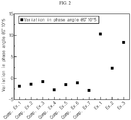
- Test results for each of the separators according to Examples 1-3 and Comparative Examples 1-11 are shown in the following Table 1.
- the test results for each of the separators according to Examples 1-3 and Comparative Examples 1-7 are shown in FIGS. 1-4 .
- [Table 1] Variation (%) in phase angle at 0.1 Hz depending on increase in temperature Variation (%) in phase angle at a storage modulus G' of 10 5 Pa Variation (%) in viscosity of polymer Variation (%) in storage modulus G' of polymer Ex. 1 7.5 10.0 11.0 6.0 Ex. 2 2.5 2.5 33.0 32.5 Ex. 3 6.3 8.5 32.5 27.5 Comp. Ex. 1 -3.0 -2.0 41.0 42.5 Comp. Ex. 2 -3.0 -1.5 43.5 46.0 Comp.
- each of the polymers forming the porous polymer substrates of the separators according to Examples 1-3 wherein each of the variations of (1)-(4) in Table 1 satisfies the above-defined range has a Z average molecular weight of 700,000-2,000,000; a melt index (MI) of 0.05-4 g/10 min; and a branch content of 5-25%.
Landscapes
- Chemical & Material Sciences (AREA)
- Chemical Kinetics & Catalysis (AREA)
- Electrochemistry (AREA)
- General Chemical & Material Sciences (AREA)
- Engineering & Computer Science (AREA)
- Inorganic Chemistry (AREA)
- Materials Engineering (AREA)
- Manufacturing & Machinery (AREA)
- Power Engineering (AREA)
- Composite Materials (AREA)
- Microelectronics & Electronic Packaging (AREA)
- Cell Separators (AREA)
- Battery Electrode And Active Subsutance (AREA)
Applications Claiming Priority (2)
| Application Number | Priority Date | Filing Date | Title |
|---|---|---|---|
| KR20170148085 | 2017-11-08 | ||
| PCT/KR2018/013571 WO2019093798A1 (ko) | 2017-11-08 | 2018-11-08 | 세퍼레이터 및 이를 포함하는 전기화학소자 |
Publications (3)
| Publication Number | Publication Date |
|---|---|
| EP3553849A1 true EP3553849A1 (de) | 2019-10-16 |
| EP3553849A4 EP3553849A4 (de) | 2019-12-04 |
| EP3553849B1 EP3553849B1 (de) | 2025-01-01 |
Family
ID=66439013
Family Applications (1)
| Application Number | Title | Priority Date | Filing Date |
|---|---|---|---|
| EP18875904.7A Active EP3553849B1 (de) | 2017-11-08 | 2018-11-08 | Separator und elektrochemische vorrichtung damit |
Country Status (7)
| Country | Link |
|---|---|
| US (1) | US11177536B2 (de) |
| EP (1) | EP3553849B1 (de) |
| KR (1) | KR102708116B1 (de) |
| CN (1) | CN110249450B (de) |
| ES (1) | ES3007565T3 (de) |
| HU (1) | HUE069916T2 (de) |
| WO (1) | WO2019093798A1 (de) |
Families Citing this family (4)
| Publication number | Priority date | Publication date | Assignee | Title |
|---|---|---|---|---|
| EP4024598A4 (de) | 2019-10-29 | 2022-12-07 | Lg Energy Solution, Ltd. | Lithiumsekundärbatterieseparator mit verbesserter haftfestigkeit auf elektrode und verbesserten widerstandseigenschaften sowie lithiumsekundärbatterie mit lithiumsekundärbatterieseparator |
| WO2022035298A1 (ko) * | 2020-08-14 | 2022-02-17 | 주식회사 엘지에너지솔루션 | 세퍼레이터 및 이를 포함하는 전기화학소자 |
| KR102926748B1 (ko) | 2020-08-21 | 2026-02-11 | 주식회사 엘지에너지솔루션 | 전극의 압연 방법 |
| KR20250152512A (ko) * | 2024-04-16 | 2025-10-23 | 주식회사 엘지화학 | 전기화학소자용 분리막 및 이를 제조하는 방법 |
Family Cites Families (26)
| Publication number | Priority date | Publication date | Assignee | Title |
|---|---|---|---|---|
| US4576993A (en) | 1978-09-20 | 1986-03-18 | Raychem Limited | Low density polyethylene polymeric compositions |
| US5240655A (en) | 1991-12-20 | 1993-08-31 | W. R. Grace & Co.-Conn. | Process of making a battery separator |
| CN1090886C (zh) | 1994-02-22 | 2002-09-11 | 松下电器产业株式会社 | 耳机 |
| JPH09259857A (ja) * | 1996-03-27 | 1997-10-03 | Sanyo Electric Co Ltd | 非水系電解液二次電池 |
| KR19990015098A (ko) | 1997-08-01 | 1999-03-05 | 한형수 | 다공성 분리막의 제조방법 |
| JP2002134091A (ja) | 2000-10-30 | 2002-05-10 | Nitto Denko Corp | 非水電解液電池用セパレータ及び非水電解液電池 |
| TW591062B (en) * | 2001-05-31 | 2004-06-11 | Asahi Kasei Corp | Fluorinated ion exchange membrane |
| JP2005071882A (ja) * | 2003-08-26 | 2005-03-17 | Matsushita Electric Ind Co Ltd | 固体高分子型燃料電池の電極電解質膜接合体の検査方法とその検査装置、固体高分子型燃料電池の単位セルの検査方法とその検査装置、および固体高分子型燃料電池の製造方法 |
| KR100775310B1 (ko) * | 2004-12-22 | 2007-11-08 | 주식회사 엘지화학 | 유/무기 복합 다공성 분리막 및 이를 이용한 전기 화학소자 |
| NZ563980A (en) | 2005-06-20 | 2011-07-29 | Siemens Water Tech Corp | Cross linking treatment of polymer membranes |
| JP5217138B2 (ja) * | 2006-09-26 | 2013-06-19 | 住友化学株式会社 | 多孔性フィルムおよび非水電解質二次電池用セパレータ |
| JP2010510370A (ja) | 2006-11-22 | 2010-04-02 | グワンジュ・インスティテュート・オブ・サイエンス・アンド・テクノロジー | 末端に架橋構造を形成するスルホン化ポリ(アリーレンエーテル)共重合体、その製造方法、及びそれを利用した高分子電解質膜 |
| KR100934529B1 (ko) | 2007-10-11 | 2009-12-29 | 광주과학기술원 | 고분자 사슬 내부에 가교구조를 가지는 술폰화된폴리(아릴렌 에테르) 공중합체, 고분자 사슬 내부 및말단에 가교구조를 가지는 술폰화된 폴리(아릴렌 에테르)공중합체 및 이를 이용하는 고분자 전해질막 |
| KR101077914B1 (ko) * | 2009-09-22 | 2011-10-31 | 한국수력원자력 주식회사 | 높은 기공도와 우수한 기계적 및 열적 특성을 가지는 리튬 이차전지용 폴리에틸렌 미세다공성 분리막 및 이의 제조방법 |
| US8653196B2 (en) | 2010-01-11 | 2014-02-18 | Dow Global Technologies, Llc | Method for preparing polyethylene with high melt strength |
| WO2014028211A1 (en) | 2012-08-16 | 2014-02-20 | Exxonmobil Chemical Patents Inc. | Long chain branched epdm compositions and processes for production thereof |
| JP6120300B2 (ja) * | 2012-10-05 | 2017-04-26 | エルジー・ケム・リミテッド | セパレータ及びそれを備える電気化学素子 |
| WO2014065331A1 (ja) * | 2012-10-25 | 2014-05-01 | 株式会社プライムポリマー | 微多孔フィルム用ポリプロピレン |
| KR101735509B1 (ko) | 2012-11-30 | 2017-05-15 | 주식회사 엘지화학 | 세퍼레이터 및 이를 구비하는 전기화학소자 |
| KR101674917B1 (ko) * | 2012-12-03 | 2016-11-10 | 주식회사 엘지화학 | 다공성 폴리올레핀 분리막의 제조방법, 다공성 폴리올레핀 분리막 및 이를 포함하는 리튬 이차전지 |
| CN103531734B (zh) * | 2013-09-22 | 2016-04-13 | 佛山市金辉高科光电材料有限公司 | 一种锂离子电池隔膜及制备方法 |
| CN107207807B (zh) | 2015-01-14 | 2020-06-16 | 埃克森美孚化学专利公司 | 生产聚合物组合物的方法 |
| KR102038670B1 (ko) | 2015-05-11 | 2019-10-30 | 주식회사 엘지화학 | 부직포 기재의 전기화학소자용 세퍼레이터 및 이를 포함한 전기화학소자 |
| KR102070371B1 (ko) * | 2015-07-10 | 2020-01-28 | 주식회사 엘지화학 | 세퍼레이터 및 이를 포함하는 전기화학소자 |
| JP6025957B1 (ja) * | 2015-11-30 | 2016-11-16 | 住友化学株式会社 | 非水電解液二次電池用セパレータ、非水電解液二次電池用積層セパレータ、非水電解液二次電池用部材、非水電解液二次電池および非水電解液二次電池用セパレータの製造方法 |
| JP6732295B2 (ja) * | 2015-12-10 | 2020-07-29 | エルジー・ケム・リミテッド | 導電材分散液およびこれを用いて製造したリチウム二次電池 |
-
2018
- 2018-11-08 HU HUE18875904A patent/HUE069916T2/hu unknown
- 2018-11-08 US US16/472,551 patent/US11177536B2/en active Active
- 2018-11-08 EP EP18875904.7A patent/EP3553849B1/de active Active
- 2018-11-08 WO PCT/KR2018/013571 patent/WO2019093798A1/ko not_active Ceased
- 2018-11-08 CN CN201880010287.2A patent/CN110249450B/zh active Active
- 2018-11-08 ES ES18875904T patent/ES3007565T3/es active Active
- 2018-11-08 KR KR1020180136940A patent/KR102708116B1/ko active Active
Also Published As
| Publication number | Publication date |
|---|---|
| WO2019093798A1 (ko) | 2019-05-16 |
| CN110249450A (zh) | 2019-09-17 |
| US11177536B2 (en) | 2021-11-16 |
| ES3007565T3 (en) | 2025-03-20 |
| HUE069916T2 (hu) | 2025-04-28 |
| EP3553849A4 (de) | 2019-12-04 |
| KR102708116B1 (ko) | 2024-09-20 |
| EP3553849B1 (de) | 2025-01-01 |
| CN110249450B (zh) | 2022-03-11 |
| US20200194761A1 (en) | 2020-06-18 |
| KR20190052651A (ko) | 2019-05-16 |
Similar Documents
| Publication | Publication Date | Title |
|---|---|---|
| US12055524B2 (en) | Method for evaluating stability of separator | |
| EP3518318B1 (de) | Trennfolie für lithiumsekundärbatterie mit klebeschicht | |
| US11699831B2 (en) | Separator and electrochemical device comprising same | |
| KR101903189B1 (ko) | 세퍼레이터, 그 제조방법 및 이를 구비한 전기화학소자 | |
| EP2328220A2 (de) | Abscheider mit poröser beschichtung, herstellungsverfahren dafür und elektrochemische vorrichtung damit | |
| EP2466678A2 (de) | Lithium-zweitbatterie | |
| EP3694020B1 (de) | Separator für eine elektrochemische vorrichtung, herstellungsverfahren dafür und elektrochemische vorrichtung damit | |
| EP3553849B1 (de) | Separator und elektrochemische vorrichtung damit | |
| KR20200050439A (ko) | 세퍼레이터 및 이를 포함하는 전기화학소자 | |
| US12237538B2 (en) | Separator for secondary battery and secondary battery including the same | |
| EP3553869B1 (de) | Elektrodenanordnung und elektrochemische vorrichtung mit der elektrodenanordnung | |
| JP7186878B2 (ja) | 多孔性分離膜及びこれを含むリチウム二次電池 | |
| US20230268615A1 (en) | Separator for electrochemical device and method for manufacturing the same | |
| EP4191778A1 (de) | Separator für sekundärbatterie und sekundärbatterie damit | |
| US12374756B2 (en) | Porous separator and electrochemical device including the same | |
| KR102806215B1 (ko) | 세퍼레이터 및 이를 포함하는 전기화학소자 | |
| US20230216145A1 (en) | Separator for lithium secondary battery, manufacturing method therefor, and separator manufactured by same | |
| EP3761401B1 (de) | Separator für elektrochemische vorrichtung und verfahren zu seiner herstellung | |
| EP4730539A1 (de) | Bindemittelzusammensetzung für separator einer elektrochemischen vorrichtung und separator einer elektrochemischen vorrichtung damit |
Legal Events
| Date | Code | Title | Description |
|---|---|---|---|
| STAA | Information on the status of an ep patent application or granted ep patent |
Free format text: STATUS: THE INTERNATIONAL PUBLICATION HAS BEEN MADE |
|
| PUAI | Public reference made under article 153(3) epc to a published international application that has entered the european phase |
Free format text: ORIGINAL CODE: 0009012 |
|
| STAA | Information on the status of an ep patent application or granted ep patent |
Free format text: STATUS: REQUEST FOR EXAMINATION WAS MADE |
|
| 17P | Request for examination filed |
Effective date: 20190708 |
|
| AK | Designated contracting states |
Kind code of ref document: A1 Designated state(s): AL AT BE BG CH CY CZ DE DK EE ES FI FR GB GR HR HU IE IS IT LI LT LU LV MC MK MT NL NO PL PT RO RS SE SI SK SM TR |
|
| AX | Request for extension of the european patent |
Extension state: BA ME |
|
| A4 | Supplementary search report drawn up and despatched |
Effective date: 20191104 |
|
| RIC1 | Information provided on ipc code assigned before grant |
Ipc: H01G 11/52 20130101ALI20191028BHEP Ipc: H01M 2/16 20060101AFI20191028BHEP Ipc: H01M 10/0525 20100101ALI20191028BHEP Ipc: H01M 10/052 20100101ALI20191028BHEP |
|
| DAV | Request for validation of the european patent (deleted) | ||
| DAX | Request for extension of the european patent (deleted) | ||
| RAP1 | Party data changed (applicant data changed or rights of an application transferred) |
Owner name: LG ENERGY SOLUTION LTD. |
|
| RAP3 | Party data changed (applicant data changed or rights of an application transferred) |
Owner name: LG ENERGY SOLUTION, LTD. |
|
| STAA | Information on the status of an ep patent application or granted ep patent |
Free format text: STATUS: EXAMINATION IS IN PROGRESS |
|
| 17Q | First examination report despatched |
Effective date: 20220425 |
|
| REG | Reference to a national code |
Ref country code: DE Ref legal event code: R079 Free format text: PREVIOUS MAIN CLASS: H01M0002160000 Ipc: H01M0050489000 Ref country code: DE Ref legal event code: R079 Ref document number: 602018078220 Country of ref document: DE Free format text: PREVIOUS MAIN CLASS: H01M0002160000 Ipc: H01M0050489000 |
|
| GRAP | Despatch of communication of intention to grant a patent |
Free format text: ORIGINAL CODE: EPIDOSNIGR1 |
|
| STAA | Information on the status of an ep patent application or granted ep patent |
Free format text: STATUS: GRANT OF PATENT IS INTENDED |
|
| RIC1 | Information provided on ipc code assigned before grant |
Ipc: H01M 50/457 20210101ALI20240620BHEP Ipc: H01M 50/451 20210101ALI20240620BHEP Ipc: H01M 50/446 20210101ALI20240620BHEP Ipc: H01M 50/426 20210101ALI20240620BHEP Ipc: H01M 50/417 20210101ALI20240620BHEP Ipc: H01M 10/0525 20100101ALI20240620BHEP Ipc: H01G 11/52 20130101ALI20240620BHEP Ipc: H01M 10/052 20100101ALI20240620BHEP Ipc: H01M 50/489 20210101AFI20240620BHEP |
|
| INTG | Intention to grant announced |
Effective date: 20240715 |
|
| GRAS | Grant fee paid |
Free format text: ORIGINAL CODE: EPIDOSNIGR3 |
|
| P01 | Opt-out of the competence of the unified patent court (upc) registered |
Free format text: CASE NUMBER: APP_51173/2024 Effective date: 20240910 |
|
| GRAA | (expected) grant |
Free format text: ORIGINAL CODE: 0009210 |
|
| STAA | Information on the status of an ep patent application or granted ep patent |
Free format text: STATUS: THE PATENT HAS BEEN GRANTED |
|
| AK | Designated contracting states |
Kind code of ref document: B1 Designated state(s): AL AT BE BG CH CY CZ DE DK EE ES FI FR GB GR HR HU IE IS IT LI LT LU LV MC MK MT NL NO PL PT RO RS SE SI SK SM TR |
|
| REG | Reference to a national code |
Ref country code: GB Ref legal event code: FG4D |
|
| REG | Reference to a national code |
Ref country code: CH Ref legal event code: EP |
|
| REG | Reference to a national code |
Ref country code: DE Ref legal event code: R096 Ref document number: 602018078220 Country of ref document: DE |
|
| REG | Reference to a national code |
Ref country code: IE Ref legal event code: FG4D |
|
| REG | Reference to a national code |
Ref country code: ES Ref legal event code: FG2A Ref document number: 3007565 Country of ref document: ES Kind code of ref document: T3 Effective date: 20250320 |
|
| REG | Reference to a national code |
Ref country code: LT Ref legal event code: MG9D |
|
| REG | Reference to a national code |
Ref country code: HU Ref legal event code: AG4A Ref document number: E069916 Country of ref document: HU |
|
| REG | Reference to a national code |
Ref country code: NL Ref legal event code: MP Effective date: 20250101 |
|
| REG | Reference to a national code |
Ref country code: AT Ref legal event code: MK05 Ref document number: 1757267 Country of ref document: AT Kind code of ref document: T Effective date: 20250101 |
|
| PG25 | Lapsed in a contracting state [announced via postgrant information from national office to epo] |
Ref country code: NL Free format text: LAPSE BECAUSE OF FAILURE TO SUBMIT A TRANSLATION OF THE DESCRIPTION OR TO PAY THE FEE WITHIN THE PRESCRIBED TIME-LIMIT Effective date: 20250101 |
|
| PG25 | Lapsed in a contracting state [announced via postgrant information from national office to epo] |
Ref country code: FI Free format text: LAPSE BECAUSE OF FAILURE TO SUBMIT A TRANSLATION OF THE DESCRIPTION OR TO PAY THE FEE WITHIN THE PRESCRIBED TIME-LIMIT Effective date: 20250101 |
|
| PG25 | Lapsed in a contracting state [announced via postgrant information from national office to epo] |
Ref country code: PL Free format text: LAPSE BECAUSE OF FAILURE TO SUBMIT A TRANSLATION OF THE DESCRIPTION OR TO PAY THE FEE WITHIN THE PRESCRIBED TIME-LIMIT Effective date: 20250101 |
|
| PG25 | Lapsed in a contracting state [announced via postgrant information from national office to epo] |
Ref country code: IS Free format text: LAPSE BECAUSE OF FAILURE TO SUBMIT A TRANSLATION OF THE DESCRIPTION OR TO PAY THE FEE WITHIN THE PRESCRIBED TIME-LIMIT Effective date: 20250501 Ref country code: NO Free format text: LAPSE BECAUSE OF FAILURE TO SUBMIT A TRANSLATION OF THE DESCRIPTION OR TO PAY THE FEE WITHIN THE PRESCRIBED TIME-LIMIT Effective date: 20250401 |
|
| PG25 | Lapsed in a contracting state [announced via postgrant information from national office to epo] |
Ref country code: HR Free format text: LAPSE BECAUSE OF FAILURE TO SUBMIT A TRANSLATION OF THE DESCRIPTION OR TO PAY THE FEE WITHIN THE PRESCRIBED TIME-LIMIT Effective date: 20250101 |
|
| PG25 | Lapsed in a contracting state [announced via postgrant information from national office to epo] |
Ref country code: LV Free format text: LAPSE BECAUSE OF FAILURE TO SUBMIT A TRANSLATION OF THE DESCRIPTION OR TO PAY THE FEE WITHIN THE PRESCRIBED TIME-LIMIT Effective date: 20250101 Ref country code: PT Free format text: LAPSE BECAUSE OF FAILURE TO SUBMIT A TRANSLATION OF THE DESCRIPTION OR TO PAY THE FEE WITHIN THE PRESCRIBED TIME-LIMIT Effective date: 20250502 |
|
| PG25 | Lapsed in a contracting state [announced via postgrant information from national office to epo] |
Ref country code: BG Free format text: LAPSE BECAUSE OF FAILURE TO SUBMIT A TRANSLATION OF THE DESCRIPTION OR TO PAY THE FEE WITHIN THE PRESCRIBED TIME-LIMIT Effective date: 20250101 Ref country code: GR Free format text: LAPSE BECAUSE OF FAILURE TO SUBMIT A TRANSLATION OF THE DESCRIPTION OR TO PAY THE FEE WITHIN THE PRESCRIBED TIME-LIMIT Effective date: 20250402 |
|
| PG25 | Lapsed in a contracting state [announced via postgrant information from national office to epo] |
Ref country code: AT Free format text: LAPSE BECAUSE OF FAILURE TO SUBMIT A TRANSLATION OF THE DESCRIPTION OR TO PAY THE FEE WITHIN THE PRESCRIBED TIME-LIMIT Effective date: 20250101 |
|
| PG25 | Lapsed in a contracting state [announced via postgrant information from national office to epo] |
Ref country code: CZ Free format text: LAPSE BECAUSE OF FAILURE TO SUBMIT A TRANSLATION OF THE DESCRIPTION OR TO PAY THE FEE WITHIN THE PRESCRIBED TIME-LIMIT Effective date: 20250101 |
|
| PG25 | Lapsed in a contracting state [announced via postgrant information from national office to epo] |
Ref country code: SE Free format text: LAPSE BECAUSE OF FAILURE TO SUBMIT A TRANSLATION OF THE DESCRIPTION OR TO PAY THE FEE WITHIN THE PRESCRIBED TIME-LIMIT Effective date: 20250101 |
|
| REG | Reference to a national code |
Ref country code: DE Ref legal event code: R097 Ref document number: 602018078220 Country of ref document: DE |
|
| PG25 | Lapsed in a contracting state [announced via postgrant information from national office to epo] |
Ref country code: SM Free format text: LAPSE BECAUSE OF FAILURE TO SUBMIT A TRANSLATION OF THE DESCRIPTION OR TO PAY THE FEE WITHIN THE PRESCRIBED TIME-LIMIT Effective date: 20250101 |
|
| PG25 | Lapsed in a contracting state [announced via postgrant information from national office to epo] |
Ref country code: DK Free format text: LAPSE BECAUSE OF FAILURE TO SUBMIT A TRANSLATION OF THE DESCRIPTION OR TO PAY THE FEE WITHIN THE PRESCRIBED TIME-LIMIT Effective date: 20250101 |
|
| PG25 | Lapsed in a contracting state [announced via postgrant information from national office to epo] |
Ref country code: IT Free format text: LAPSE BECAUSE OF FAILURE TO SUBMIT A TRANSLATION OF THE DESCRIPTION OR TO PAY THE FEE WITHIN THE PRESCRIBED TIME-LIMIT Effective date: 20250101 |
|
| PG25 | Lapsed in a contracting state [announced via postgrant information from national office to epo] |
Ref country code: EE Free format text: LAPSE BECAUSE OF FAILURE TO SUBMIT A TRANSLATION OF THE DESCRIPTION OR TO PAY THE FEE WITHIN THE PRESCRIBED TIME-LIMIT Effective date: 20250101 |
|
| PG25 | Lapsed in a contracting state [announced via postgrant information from national office to epo] |
Ref country code: RO Free format text: LAPSE BECAUSE OF FAILURE TO SUBMIT A TRANSLATION OF THE DESCRIPTION OR TO PAY THE FEE WITHIN THE PRESCRIBED TIME-LIMIT Effective date: 20250101 |
|
| PG25 | Lapsed in a contracting state [announced via postgrant information from national office to epo] |
Ref country code: SK Free format text: LAPSE BECAUSE OF FAILURE TO SUBMIT A TRANSLATION OF THE DESCRIPTION OR TO PAY THE FEE WITHIN THE PRESCRIBED TIME-LIMIT Effective date: 20250101 |
|
| PLBE | No opposition filed within time limit |
Free format text: ORIGINAL CODE: 0009261 |
|
| STAA | Information on the status of an ep patent application or granted ep patent |
Free format text: STATUS: NO OPPOSITION FILED WITHIN TIME LIMIT |
|
| 26N | No opposition filed |
Effective date: 20251002 |
|
| PGFP | Annual fee paid to national office [announced via postgrant information from national office to epo] |
Ref country code: HU Payment date: 20251127 Year of fee payment: 8 |
|
| PGFP | Annual fee paid to national office [announced via postgrant information from national office to epo] |
Ref country code: DE Payment date: 20251020 Year of fee payment: 8 |
|
| PGFP | Annual fee paid to national office [announced via postgrant information from national office to epo] |
Ref country code: GB Payment date: 20251023 Year of fee payment: 8 |
|
| PGFP | Annual fee paid to national office [announced via postgrant information from national office to epo] |
Ref country code: FR Payment date: 20251021 Year of fee payment: 8 |
|
| PGFP | Annual fee paid to national office [announced via postgrant information from national office to epo] |
Ref country code: BE Payment date: 20251020 Year of fee payment: 8 |
|
| PGFP | Annual fee paid to national office [announced via postgrant information from national office to epo] |
Ref country code: ES Payment date: 20251215 Year of fee payment: 8 |