EP3553720A1 - Produktetiketten und produktabtastvorrichtungen und -verfahren - Google Patents
Produktetiketten und produktabtastvorrichtungen und -verfahren Download PDFInfo
- Publication number
- EP3553720A1 EP3553720A1 EP19168389.5A EP19168389A EP3553720A1 EP 3553720 A1 EP3553720 A1 EP 3553720A1 EP 19168389 A EP19168389 A EP 19168389A EP 3553720 A1 EP3553720 A1 EP 3553720A1
- Authority
- EP
- European Patent Office
- Prior art keywords
- read
- information
- barcode symbol
- product
- symbol
- Prior art date
- Legal status (The legal status is an assumption and is not a legal conclusion. Google has not performed a legal analysis and makes no representation as to the accuracy of the status listed.)
- Withdrawn
Links
Images



Classifications
-
- G—PHYSICS
- G06—COMPUTING OR CALCULATING; COUNTING
- G06Q—INFORMATION AND COMMUNICATION TECHNOLOGY [ICT] SPECIALLY ADAPTED FOR ADMINISTRATIVE, COMMERCIAL, FINANCIAL, MANAGERIAL OR SUPERVISORY PURPOSES; SYSTEMS OR METHODS SPECIALLY ADAPTED FOR ADMINISTRATIVE, COMMERCIAL, FINANCIAL, MANAGERIAL OR SUPERVISORY PURPOSES, NOT OTHERWISE PROVIDED FOR
- G06Q20/00—Payment architectures, schemes or protocols
- G06Q20/08—Payment architectures
- G06Q20/20—Point-of-sale [POS] network systems
- G06Q20/208—Input by product or record sensing, e.g. weighing or scanner processing
-
- G—PHYSICS
- G06—COMPUTING OR CALCULATING; COUNTING
- G06K—GRAPHICAL DATA READING; PRESENTATION OF DATA; RECORD CARRIERS; HANDLING RECORD CARRIERS
- G06K19/00—Record carriers for use with machines and with at least a part designed to carry digital markings
- G06K19/06—Record carriers for use with machines and with at least a part designed to carry digital markings characterised by the kind of the digital marking, e.g. shape, nature, code
- G06K19/08—Record carriers for use with machines and with at least a part designed to carry digital markings characterised by the kind of the digital marking, e.g. shape, nature, code using markings of different kinds or more than one marking of the same kind in the same record carrier, e.g. one marking being sensed by optical and the other by magnetic means
- G06K19/10—Record carriers for use with machines and with at least a part designed to carry digital markings characterised by the kind of the digital marking, e.g. shape, nature, code using markings of different kinds or more than one marking of the same kind in the same record carrier, e.g. one marking being sensed by optical and the other by magnetic means at least one kind of marking being used for authentication, e.g. of credit or identity cards
- G06K19/18—Constructional details
-
- G—PHYSICS
- G06—COMPUTING OR CALCULATING; COUNTING
- G06K—GRAPHICAL DATA READING; PRESENTATION OF DATA; RECORD CARRIERS; HANDLING RECORD CARRIERS
- G06K19/00—Record carriers for use with machines and with at least a part designed to carry digital markings
- G06K19/06—Record carriers for use with machines and with at least a part designed to carry digital markings characterised by the kind of the digital marking, e.g. shape, nature, code
- G06K19/06009—Record carriers for use with machines and with at least a part designed to carry digital markings characterised by the kind of the digital marking, e.g. shape, nature, code with optically detectable marking
- G06K19/06046—Constructional details
- G06K19/06065—Constructional details the marking being at least partially represented by holographic means
-
- G—PHYSICS
- G06—COMPUTING OR CALCULATING; COUNTING
- G06K—GRAPHICAL DATA READING; PRESENTATION OF DATA; RECORD CARRIERS; HANDLING RECORD CARRIERS
- G06K19/00—Record carriers for use with machines and with at least a part designed to carry digital markings
- G06K19/06—Record carriers for use with machines and with at least a part designed to carry digital markings characterised by the kind of the digital marking, e.g. shape, nature, code
- G06K19/06009—Record carriers for use with machines and with at least a part designed to carry digital markings characterised by the kind of the digital marking, e.g. shape, nature, code with optically detectable marking
- G06K19/06046—Constructional details
- G06K19/06103—Constructional details the marking being embedded in a human recognizable image, e.g. a company logo with an embedded two-dimensional code
-
- G—PHYSICS
- G06—COMPUTING OR CALCULATING; COUNTING
- G06K—GRAPHICAL DATA READING; PRESENTATION OF DATA; RECORD CARRIERS; HANDLING RECORD CARRIERS
- G06K19/00—Record carriers for use with machines and with at least a part designed to carry digital markings
- G06K19/06—Record carriers for use with machines and with at least a part designed to carry digital markings characterised by the kind of the digital marking, e.g. shape, nature, code
- G06K19/08—Record carriers for use with machines and with at least a part designed to carry digital markings characterised by the kind of the digital marking, e.g. shape, nature, code using markings of different kinds or more than one marking of the same kind in the same record carrier, e.g. one marking being sensed by optical and the other by magnetic means
- G06K19/10—Record carriers for use with machines and with at least a part designed to carry digital markings characterised by the kind of the digital marking, e.g. shape, nature, code using markings of different kinds or more than one marking of the same kind in the same record carrier, e.g. one marking being sensed by optical and the other by magnetic means at least one kind of marking being used for authentication, e.g. of credit or identity cards
- G06K19/16—Record carriers for use with machines and with at least a part designed to carry digital markings characterised by the kind of the digital marking, e.g. shape, nature, code using markings of different kinds or more than one marking of the same kind in the same record carrier, e.g. one marking being sensed by optical and the other by magnetic means at least one kind of marking being used for authentication, e.g. of credit or identity cards the marking being a hologram or diffraction grating
-
- G—PHYSICS
- G06—COMPUTING OR CALCULATING; COUNTING
- G06K—GRAPHICAL DATA READING; PRESENTATION OF DATA; RECORD CARRIERS; HANDLING RECORD CARRIERS
- G06K7/00—Methods or arrangements for sensing record carriers, e.g. for reading patterns
- G06K7/10—Methods or arrangements for sensing record carriers, e.g. for reading patterns by electromagnetic radiation, e.g. optical sensing; by corpuscular radiation
- G06K7/10544—Methods or arrangements for sensing record carriers, e.g. for reading patterns by electromagnetic radiation, e.g. optical sensing; by corpuscular radiation by scanning of the records by radiation in the optical part of the electromagnetic spectrum
- G06K7/10712—Fixed beam scanning
- G06K7/10722—Photodetector array or CCD scanning
-
- G—PHYSICS
- G06—COMPUTING OR CALCULATING; COUNTING
- G06K—GRAPHICAL DATA READING; PRESENTATION OF DATA; RECORD CARRIERS; HANDLING RECORD CARRIERS
- G06K7/00—Methods or arrangements for sensing record carriers, e.g. for reading patterns
- G06K7/10—Methods or arrangements for sensing record carriers, e.g. for reading patterns by electromagnetic radiation, e.g. optical sensing; by corpuscular radiation
- G06K7/10544—Methods or arrangements for sensing record carriers, e.g. for reading patterns by electromagnetic radiation, e.g. optical sensing; by corpuscular radiation by scanning of the records by radiation in the optical part of the electromagnetic spectrum
- G06K7/10821—Methods or arrangements for sensing record carriers, e.g. for reading patterns by electromagnetic radiation, e.g. optical sensing; by corpuscular radiation by scanning of the records by radiation in the optical part of the electromagnetic spectrum further details of bar or optical code scanning devices
- G06K7/10861—Methods or arrangements for sensing record carriers, e.g. for reading patterns by electromagnetic radiation, e.g. optical sensing; by corpuscular radiation by scanning of the records by radiation in the optical part of the electromagnetic spectrum further details of bar or optical code scanning devices sensing of data fields affixed to objects or articles, e.g. coded labels
-
- G—PHYSICS
- G06—COMPUTING OR CALCULATING; COUNTING
- G06K—GRAPHICAL DATA READING; PRESENTATION OF DATA; RECORD CARRIERS; HANDLING RECORD CARRIERS
- G06K7/00—Methods or arrangements for sensing record carriers, e.g. for reading patterns
- G06K7/10—Methods or arrangements for sensing record carriers, e.g. for reading patterns by electromagnetic radiation, e.g. optical sensing; by corpuscular radiation
- G06K7/14—Methods or arrangements for sensing record carriers, e.g. for reading patterns by electromagnetic radiation, e.g. optical sensing; by corpuscular radiation using light without selection of wavelength, e.g. sensing reflected white light
- G06K7/1404—Methods for optical code recognition
- G06K7/1408—Methods for optical code recognition the method being specifically adapted for the type of code
- G06K7/1413—1D bar codes
-
- G—PHYSICS
- G06—COMPUTING OR CALCULATING; COUNTING
- G06K—GRAPHICAL DATA READING; PRESENTATION OF DATA; RECORD CARRIERS; HANDLING RECORD CARRIERS
- G06K7/00—Methods or arrangements for sensing record carriers, e.g. for reading patterns
- G06K7/10—Methods or arrangements for sensing record carriers, e.g. for reading patterns by electromagnetic radiation, e.g. optical sensing; by corpuscular radiation
- G06K7/14—Methods or arrangements for sensing record carriers, e.g. for reading patterns by electromagnetic radiation, e.g. optical sensing; by corpuscular radiation using light without selection of wavelength, e.g. sensing reflected white light
- G06K7/1404—Methods for optical code recognition
- G06K7/1408—Methods for optical code recognition the method being specifically adapted for the type of code
- G06K7/1434—Barcodes with supplemental or add-on codes
-
- G—PHYSICS
- G06—COMPUTING OR CALCULATING; COUNTING
- G06K—GRAPHICAL DATA READING; PRESENTATION OF DATA; RECORD CARRIERS; HANDLING RECORD CARRIERS
- G06K7/00—Methods or arrangements for sensing record carriers, e.g. for reading patterns
- G06K7/10—Methods or arrangements for sensing record carriers, e.g. for reading patterns by electromagnetic radiation, e.g. optical sensing; by corpuscular radiation
- G06K7/14—Methods or arrangements for sensing record carriers, e.g. for reading patterns by electromagnetic radiation, e.g. optical sensing; by corpuscular radiation using light without selection of wavelength, e.g. sensing reflected white light
- G06K7/1404—Methods for optical code recognition
- G06K7/1439—Methods for optical code recognition including a method step for retrieval of the optical code
-
- G—PHYSICS
- G07—CHECKING-DEVICES
- G07G—REGISTERING THE RECEIPT OF CASH, VALUABLES, OR TOKENS
- G07G1/00—Cash registers
- G07G1/0036—Checkout procedures
- G07G1/0045—Checkout procedures with a code reader for reading of an identifying code of the article to be registered, e.g. barcode reader or radio-frequency identity [RFID] reader
- G07G1/0054—Checkout procedures with a code reader for reading of an identifying code of the article to be registered, e.g. barcode reader or radio-frequency identity [RFID] reader with control of supplementary check-parameters, e.g. weight or number of articles
- G07G1/0063—Checkout procedures with a code reader for reading of an identifying code of the article to be registered, e.g. barcode reader or radio-frequency identity [RFID] reader with control of supplementary check-parameters, e.g. weight or number of articles with means for detecting the geometric dimensions of the article of which the code is read, such as its size or height, for the verification of the registration
-
- G—PHYSICS
- G06—COMPUTING OR CALCULATING; COUNTING
- G06K—GRAPHICAL DATA READING; PRESENTATION OF DATA; RECORD CARRIERS; HANDLING RECORD CARRIERS
- G06K19/00—Record carriers for use with machines and with at least a part designed to carry digital markings
- G06K19/06—Record carriers for use with machines and with at least a part designed to carry digital markings characterised by the kind of the digital marking, e.g. shape, nature, code
- G06K2019/06215—Aspects not covered by other subgroups
Definitions
- Embodiments described herein relate generally to product tags and code symbol reading devices and methods.
- a barcode is affixed to a product along with a service label including discount information or the like.
- the barcode and the service label are imaged using an image capturing element, such as a CCD (Charge Coupled Device) image sensor, and then a commodity code for the product and the discount information from the service label are read from the captured image(s).
- an image capturing element such as a CCD (Charge Coupled Device) image sensor
- Japanese Unexamined Patent Application Publication No. 2012-14528 discloses the registering of discount information, such as "half price", "10% discount” or the like, printed as text on a product label by reading such information in a captured image of the product.
- Japanese Unexamined Patent Publication No. 2017-194788 discloses a product label having a two-layer structure in which visible text indicating discount information is printed on an upper layer and encoded discount information is printed on a lower layer to be read using reflected infrared light.
- One of the objects of the present invention is to improve prior art techniques and overcome at least some of the prior art problems as for instance above illustrated.
- a product scanner apparatus comprising: an image capturing device to image an object for sale at a retail location using visible light; a first reading module configured to attempt to read a barcode symbol in a captured image from the image capturing device, the barcode symbol providing an identification of the object; a second reading module configured to attempt to read digital watermark information on a product tag affixed to the object; and a controller configured to: control the image capturing device to capture an image of the object; control the first reading module to attempt to read the barcode symbol in the image of the object; and control the second reading module to attempt to read digital watermark information on the product tag only if the first reading module successfully reads the barcode symbol, wherein the product tag includes visible discount information text printed on a surface thereof and the digital water information encodes discount information corresponding to the visible discount information text.
- the first and second reading modules use the same image from the image capturing device.
- the product scanner apparatus further comprises a timer, wherein the controller is configured to use the timer to limit the attempt of the second reading module to read the digital watermark information to a fixed length time period after the barcode symbol is successfully read.
- the product scanner apparatus further comprises a visible light emitting element, wherein the controller is further configured to control the visible light emitting element to emit visible light in conjunction with the capturing of images with the image capturing device.
- the controller is further configured to control the second reading module to attempt to read the digital watermark information only if both the barcode symbol is successfully read and a flag symbol adjacent to the barcode symbol on the object is detected by the first reading module.
- the controller is further configured to: combine the identification of the object corresponding to the barcode symbol read by the first reading module and the discount information encoded in the digital watermark information into a synthesized code, and output the synthesized code to a register apparatus.
- the product scanner apparatus further comprises a timer, wherein the controller is configured to use the timer to limit the attempt of the second reading module to read the digital watermark information to a fixed length time period after the barcode symbol is successfully read and the flag symbol detected.
- the product scanner apparatus further comprises a timer, wherein the controller is configured to use the timer to limit the attempt of the second reading module to read the digital watermark information to a fixed length time period after the barcode symbol is successfully read and the flag symbol detected.
- the controller is further configured to: combine the identification of the object corresponding to the barcode symbol read by the first reading module and the discount information encoded in the digital watermark information into a synthesized code, and output the synthesized code to a register apparatus.
- the product scanner apparatus further comprises a timer, wherein the controller is configured to use the timer to limit the attempt of the second reading module to read the digital watermark information to a fixed length time period after the barcode symbol is successfully read.
- a method of scanning products for retail sales transactions comprising: capturing an image of an object for sale at a retail location using visible light; attempting to read a barcode symbol in the captured image from the image capturing device, the barcode symbol providing an identification of the object when read; and attempting to read digital watermark information on a product tag affixed to the object only if the barcode symbol is successfully read, wherein the product tag includes visible discount information text printed on a surface thereof and the digital water information encodes discount information corresponding to the visible discount information text.
- the product tag and the barcode symbol are read from the same captured image.
- the attempting to read the digital watermark information is limited to a fixed length period after the barcode symbol is successfully read.
- the method according to the second aspect of the invention further comprises combining the identification of the object corresponding to the barcode symbol and the discount information encoded in the digital watermark information into a synthesized code; and outputting the synthesized code to a register apparatus.
- the method according to the second aspect of the invention further comprises attempting to identify a flag symbol adjacent to the barcode symbol on the object, wherein the attempting to read the digital watermark information is performed only if both the barcode symbol is successfully read and the flag symbol is detected.
- the attempting to read the digital watermark information is limited to a fixed length period after the barcode symbol is successfully read and the flag symbol is detected.
- the method according to the second aspect of the invention further comprises combining the identification of the object corresponding to the barcode symbol and the discount information encoded in the digital watermark information into a synthesized code; and outputting the synthesized code to a register apparatus.
- the method according to the second aspect of the invention further comprises combining the identification of the object corresponding to the barcode symbol and the discount information encoded in the digital watermark information into a synthesized code; and outputting the synthesized code to a register apparatus.
- a product tag to be affixed to an item for sale at a retail location, comprising: visible discount information text on a surface of the product tag; and encoded discount information corresponding to the visible discount information text, the encoded discount information being a digital watermark disposed on the surface of the product tag and readable by a product scanner apparatus using visible light.
- a discounted item for sale at a retail location comprising: a product having a barcode symbol thereon for identifying the product; and a product tag according to the third aspect of the invention affixed thereon.
- a product scanner apparatus comprises an image capturing device to image an object for sale at a retail location using visible light; a first reading module configured to attempt to read a barcode symbol in a captured image from the image capturing device, the barcode symbol providing an identification of the object; and a second reading module configured to attempt to read digital watermark information on a product tag affixed to the object.
- a controller is configured to control the image capturing device to capture an image of the object; control the first reading module to attempt to read the barcode symbol in the image of the object; and control the second reading module to attempt to read digital watermark information on the product tag only if the first reading module successfully reads the barcode symbol.
- the product tag includes visible discount information text printed on a surface thereof and the digital water information encodes discount information corresponding to the visible discount information text.
- a code symbol reading device according to a first embodiment is described below with reference to the accompanying drawings .
- the code symbol reading device according to the first embodiment can be used together with a POS (Point of Sale) terminal for checkout and settlement processing in a retail store or the like.
- POS Point of Sale
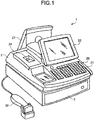
- Fig. 1 is a perspective view of an external appearance of a POS terminal 1.
- the POS terminal 1 executes registration and settlement processing on items being sold in a retail store.
- a code symbol such as a barcode affixed to a commodity
- a commodity name, a price, and other commodity information associated with the acquired commodity code are displayed.
- the acquired commodity information is stored in a RAM (Random Access Memory) or the like.
- settlement processing a total amount due in the sales transaction is displayed, a change amount due based on the amount tendered by the customer is calculated and displayed.
- a change machine issues the change due, and a receipt is issued.
- the POS terminal 1 has a main body 2 and a cash storage box 3.
- the cash storage box 3 has a drawer for storing cash, coins, , coupons, vouchers or the like, received from the customer and/or used to make change for the sales transaction.
- the main body 2 comprises an operation section 21, an operator display section 22, a customer display section 23, a printing section 24, a card reading section 25 and a code reader 30.
- the operation section 21 is a keyboard including keys such as a numeric keypad for inputting numbers, a subtotal key for declaring termination of a commodity registration process and a deposit /cash total key for declaring completion of a sales transaction.
- the operator display section 22 is a liquid crystal display or the like and displays information to an operator, such as store clerk.
- the customer display section 23 is a liquid crystal display or the like, and displays information to a customer.
- the printing section 24 issues a receipt by printing the commodity information and the settlement information on receipt paper drawn from a roll stored in the main body 2.
- the print section 24 comprises, for example, a thermal printer having a thermal transfer type print head.
- the card reading section 25 reads information from a card such as a credit card presented by the customer.
- the code reader 30 is a hand-held type scanner.
- the code reader 30 reads a code symbol affixed to the commodity.
- the code reader 30 includes a visible light emitting section 42 (refer to Fig. 3 ) which emits visible light.
- the code reader 30 is not necessarily limited to a hand-held type.
- the code reader 30 may be a so-called vertical scanner which includes an image capturing window along the height direction of a display mount or the like for a POS terminal. With a vertical scanner arrangement, the operator reads the code symbol affixed to the commodity by manually holding the commodity up to the image capturing window or the like.
- the code reader 30 is an example of a code symbol reading device.
- the code reader 30 includes a camera 43 (refer to Fig. 3 ).
- the camera 43 has a light receiving sensor composed of a CCD (Charge Coupled Device) or a CMOS (Complementary Metal Oxide Semiconductor).
- the camera 43 receives light within a visible light range, which here is considered from 380 nm to 780 nm, to capture an image.
- the code reader 30 extracts an image of the code symbol, which may be a barcode or other two-dimensional code, affixed to the commodity from the captured image. Then, the code reader 30 reads the code information from the extracted image of the code symbol.
- the code reader 30 recognizes coded information, such as a digital watermark, in the captured image of the commodity. Then, the code reader 30 decodes the coded information.
- the code reader 30 includes a decoding section 44 (refer to Fig. 3 ) .
- the decoding section 44 decodes a code symbol, such as a barcode, a digital watermark or the like into digital information and generates decoded information.
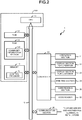
- Fig. 2 is a hardware block diagram illustrating an example of a hardware configuration of the POS terminal 1.
- the POS terminal 1 includes a CPU (Central Processing Unit) 11, a ROM (Read Only Memory) 12, a RAM (Random Access Memory) 13, a memory device 14, and the like.
- the CPU 11 is a main control portion.
- the ROM 12 stores various kinds of fixed data, various tables, and the like.
- the RAM 13 functions as a work memory in which control programs and various kinds of data can be copied or loaded when the CPU 11 performs various processing.
- the memory device 14 stores a control program P1 to be executed by the CPU 11.
- the CPU 11, the ROM 12, the RAM 13, and the memory device 14 are connected to each other via a bus 15.
- the CPU 11, the ROM 12 and the RAM 13 together constitute a control section 100, also referred to as a control unit.
- the CPU 11 loads the control program P1 from the memory device 14 along with various kinds of data from the ROM 12 on the RAM 13, and in this way, the control section 100 executes various control processing according to the instructions of control program P1.
- the RAM 13 has a commodity information section 131.
- the commodity information section 131 temporarily stores the commodity information (e.g., commodity name, commodity price, etc.) of the commodity for which the registration processing is being performed based on the commodity code acquired from the code symbol read by the code reader 30.
- the memory device 14 is a nonvolatile memory such as an HDD (Hard Disk Drive) or a flash memory that stores storage information even when a power supply thereof is turned off, and stores the control program P1 to be executed by the control section 100.
- HDD Hard Disk Drive
- flash memory that stores storage information even when a power supply thereof is turned off, and stores the control program P1 to be executed by the control section 100.
- the control section 100 is connected, via the bus 15 and a controller 16, to peripheral devices including the operation section 21, the operator display section 22, the customer display section 23, the printing section 24, the card reading section 25, and the code reader 30.
- the controller 16 receives an instruction from the control section 100 to control an operation of these peripheral devices.
- the control section 100 is connected to a communication section 26 via the bus 15.
- the communication section 26 is an interface for connecting to other POS terminals 1 installed in the retail store and/or a store server via a network connection.
- each POS terminal 1 installed in the retail store is connected to the store server via a network.
- the store server collects commodity information and the settlement information from each POS terminal 1.
- the store server may operate to transmit the collected commodity and settlement information to a headquarters server for managing information for a plurality of retail stores.
- Fig. 3 is a hardware block diagram illustrating an example of a hardware configuration of the code reader 30.
- the code reader 30 includes a CPU 31, a ROM 32, a RAM 33, a memory unit 34, and the like.
- the CPU 31 is a main control portion.
- the ROM 32 stores various kinds of fixed data, various tables, and the like.
- the RAM 33 functions as a work memory in which control programs and various kinds of data are loaded when the CPU 31 performs various processing.
- the memory unit 34 stores a control program P2 to be executed by the CPU 31.
- the CPU 31, the ROM 32, the RAM 33, and the memory unit 34 are connected to each other via a bus 35.
- the CPU 31, the ROM 32 and the RAM 33 constitute a control section 300. Specifically, the CPU 31 operates by loading the control program P2 the memory unit 34 along with various data stored in the ROM 32 on the RAM 33, and in this way, the control section 300 executes various control processing according to the instructions of the control program P2.
- the memory unit 34 is a nonvolatile memory such as an HDD (Hard Disk Drive) or a flash memory that stores storage information even when a power supply thereof is turned off, and stores the control program P2 to be executed by the control section 300.
- HDD Hard Disk Drive
- flash memory that stores storage information even when a power supply thereof is turned off
- the control section 300 is connected to peripheral devices including a display section 41, a visible light emitting section 42, the camera 43, and the decoding section 44 via the bus 35 and a controller 36.
- the controller 36 receives instructions from the control section 300 and controls the operation of these peripheral devices.
- the display section 41 displays the reading results from the code reader 30 for an operator of the POS terminal 1.
- the visible light emitting section 42 is, for example, a white LED (Light Emitting Diode) and emits visible light.
- a white LED Light Emitting Diode
- the camera 43 captures an image of a commodity M (see Fig. 4 ).
- the decoding section 44 decodes the coded information included in the code symbol in the image captured by the camera 43.
- the control section 300 is connected to a communication section 47 and a timer 48 via the bus 35.
- the communication section 47 is connected to the controller 16 (refer to Fig. 2 ) via a communication line.
- the timer 48 functions to count elapsed time.
- the timer 48 may be provided in the CPU 31 or by an operation of the CPU 31.
- Fig. 4 is a diagram illustrating an example of an appearance of the commodity M.
- Fig. 5 is a diagram illustrating a structure of a discount sticker P affixed to the commodity M.
- the discount sticker P including encoded discount information for the commodity M and a barcode B providing a commodity code for the commodity M are on an outer surface of the commodity M.
- commodity M is a product, object, or item being sold in the retail store.
- the barcode B and the discount sticker P are affixed to commodity M at positions close to each other.
- the discount sticker P contains discount information related to the commodity M as shown in Fig. 5 .
- the discount information of discount sticker P comprises visible information 50 and invisible information 52.
- the visible information 50 is useful to a customer or a store clerk to confirm contents of the discount sticker P.
- the visible information 50 is, for example, text such as "half price”, “reduced by 20 Yen", "30% discount” or the like.
- the discount sticker P is an example of a product tag.
- the invisible information 52 can be read by the code reader 30.
- the invisible information 52 is obtained by encoding information having substantially the same meaning as the visible information 50.
- the invisible information 52 is printed on the surface of the discount sticker P.
- the invisible information 52 is, for example, a set of encoded dots and generally cannot be visually noticed and/or interpreted by a customer or store clerk. Strictly speaking, the invisible information 52 in some examples may be visible to the unaided human eye; however, this "invisible" information may be presented in a manner that is not easily noticeable or recognizable as related to encoded information.
- the invisible information 52 can be a type of digital watermark used for embedding electronically generated information in an image.
- the invisible information 52 is an example of a first code symbol.
- At least some invisible information 52 is printed on the surface of the discount sticker P.
- the same invisible information 52 may be printed repeatedly on the surface of the discount sticker P.
- a well-known technology can be used to embed the encoded information as a digital watermark, and thus the detailed description of this technique is omitted.
- the barcode B includes a commodity code (e.g., a JAN (Japan Article Number) code) for specifying commodity M.
- the barcode B is an example of a second code symbol.
- a two-dimensional code such as QR code® may be affixed.
- both the barcode B and the discount sticker P will generally be contained in the image of the commodity M captured by the camera 43.
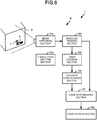
- Fig. 6 is a functional block diagram illustrating an example of functional components of the code reader 30.
- the control section 300 (refer to Fig. 3 ) of the code reader 30 executes the control program P2 to function as an image capturing section 30a, a visible light emitting section 30b, a barcode reading section 30c, a timer control section 30d, a discount code reading section 30e, a code synthesizing section 30f, and a code output section 30g as shown in Fig. 6 .
- the image capturing section 30a captures an image of the commodity M being purchased by the customer,
- the commodity M has the barcode B and the discount sticker P thereon.
- the image capturing section 30a includes the camera 43 described above (refer to Fig. 3 ) .
- the image capturing section 30a is an example of an image capturing module.
- the visible light emitting section 30b controls the visible light emitting section 42 (refer to Fig. 3 ) to emit visible light towards the barcode B and the discount sticker P of the commodity M.
- the barcode reading section 30c searches the image captured by the image capturing section 30a for the barcode B (second code symbol) . When the barcode B is found, the barcode reading section 30c decodes the barcode B to extract a commodity code.
- the barcode reading section 30c is an example of a first reading module.
- the timer control section 30d sets a period of time during which there is a search the discount sticker P after the barcode reading section 30c has found the barcode B and decoded the barcode B. Specifically, if the discount sticker P cannot be found within the period of time set by the timer control section 30d, the code reader 30 determines that a discount sticker P has not been affixed to the commodity M.
- the discount code reading section 30e reads the invisible information 52 (first code symbol) printed on the discount sticker P.
- the discount code reading section 30e is an example of a second reading module.
- the code synthesizing section 30f combines the commodity code read from the barcode B and the discount information read from the discount sticker P to obtain a synthesized code.
- the format of the synthesized code is essentially arbitrary, but the synthesized code includes at least the commodity code read from the barcode B and the discount information from the discount sticker P in some manner.
- the code synthesizing section 30f is an example of a synthesizing module. In this manner, by synthesizing the commodity code and the discount information of the commodity M into a single code format, data transmission and reception and data processing can be performed more efficiently.
- the code output section 30g outputs the synthesized code information from the code synthesizing section 30f to the control section 100 (refer to Fig. 2 ) of the POS terminal 1.
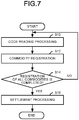
- FIG. 7 is a flowchart depicting an example of a flow of a processing performed by the POS terminal 1.
- the control section 100 of the POS terminal 1 controls the code reader 30 to execute a code reading by capturing an image of the commodity M including the barcode B and the discount sticker P and extracting the coded information from the captured image(Act S10).
- the control section 100 registers the coded information as read by the code reader 30 in the commodity information section 131 (refer to Fig. 2 ) (Act S12).
- the control section 100 determines whether registration of all commodities has been completed (Act S14) . Specifically, the control section 100 determines that registration is completed when a subtotal key for declaring termination of the commodity registration in the operation section 21 is pressed. If it is determined that registration is completed (Yes in Act S14), the flow proceeds to the processing in Act S16. On the other hand, if it is determined that registration is not completed (No in Act S14), the flow returns to the processing in Act S10 to read a code from the next commodity.
- the control section 100 next performs the settlement processing (Act S16) . Thereafter, the POS terminal 1 terminates processing.
- Fig. 8 is a flowchart depicting an example of a flow of the code reading processing performed by the code reader 30.
- the visible light emitting section 30b controls the visible light emitting section 42 to emit visible light (Act S20) .
- the image capturing section 30a controls the camera 43 to capture an image of the commodity M (Act S22).
- the barcode reading section 30c processes the image captured by the image capturing section 30a and determines whether the barcode B is read (Act S24). If it is determined that the barcode B is read (Yes in Act S24), the flow proceeds to the processing in Act S26. On the other hand, if it is determined that a barcode B is not read (No in Act S24), the flow returns to the processing in Act S20.
- the barcode reading section 30c temporarily stores the commodity code of the commodity M read from the barcode B in the RAM 33 in Act S26.
- the timer control section 30d starts the timer 48 (Act S28). Then, the timer control section 30d determines whether a preset predetermined period of time has elapsed by monitoring the timer 48 (Act S30). If it is determined that the preset predetermined period of time has elapsed (Yes in Act S30), the flow proceeds to the processing in Act S40. On the other hand, if it is determined that the preset predetermined period of time has not elapsed (No in Act S30), the flow proceeds to the processing in Act S32.
- the barcode reading section 30c reads out the commodity code temporarily stored in the RAM 33 and transmits the commodity code to the code output section 30g via the code synthesizing section 30f in Act S40. Thereafter, the process returns to the flowchart in Fig. 7 (Act S42).
- the image capturing section 30a controls the camera 43 to capture another image of the commodity M in Act S32.
- the discount code reading section 30e processes the image captured by the image capturing section 30a and determines whether a discount sticker P has been read (Act S34) . If it is determined that a discount sticker P has been read (Yes in Act S34), the flow proceeds to the processing in Act S36. On the other hand, if it is determined that the discount sticker P has not read (No in Act S34), the flow returns to the processing in Act S30.
- the image of the commodity M captured by the camera 43 generally includes both the barcode B and the discount sticker P.
- the operator of the code reader 30 may use the code reader 30 by manually positioning it over the commodity M, there are cases in which potentially only the barcode B is in the image and the discount sticker P is not even though it has been affixed to the commodity M. In this case, No is determined in Act S34. Therefore, if No is determined in Act S34, the flow returns to the processing in Act S30, and the image capturing operation is repeated until a predetermined period of time passes. During this period of time, the operator of the code reader 30 can change a position of the code reader 30 relative to the commodity M so that the discount sticker P can be imaged.
- the code synthesizing section 30f synthesizes the commodity code read from the barcode B and the discount information read from the discount sticker P to generate a synthesized code in Act S36.
- the code output section 30g outputs the synthesized code (Act S38). If no discount sticker P has been affixed to the commodity M, then only the commodity code will be output in Act S40, but the lone commodity code output in Act S40 also has a format corresponding to that of the synthesized code generated in Act S36 and output in Act S38, but with a portion thereof indicating blank or null discount information for the commodity M.
- the code symbol reading device according to the second embodiment is used together with a POS terminal 1a (see Fig. 9 ) that performs checkout and settlement processing in a store such as a retail store.
- the POS terminal 1a has substantially the same hardware configuration as that of the POS terminal 1 described in the first embodiment, but includes a code reader 60 (refer to Fig. 9 ) instead of the code reader 30 (refer to Fig. 6 ) .
- the function of the POS terminal 1a is the same as that of the POS terminal 1.
- Those hardware components and functional components of the POS terminal 1a that are the same as those of the POS terminal 1 are denoted with the same reference numerals.
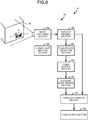
- FIG. 9 is a functional block diagram illustrating an example of functional components of the code reader included in the POS terminal 1a according to the second embodiment.
- the code reader 60 has a flag sticker detection section 60a in addition to the various functional components of the code reader 30.
- the flag sticker detection section 60a detects a flag sticker F that has been affixed to the commodity M in the image of the commodity M captured by the image capturing section 30a.
- the code reader 60 is an example of a code symbol reading device.
- the flag sticker F is affixed to the commodity M in the vicinity of the barcode B.
- the flag sticker F indicates that a discount sticker P has been affixed to the commodity M at some place.
- the flag sticker F has a specific, predetermined shape, such as a double circle, a triangle, an ellipse, or the like.
- the flag sticker detection section 60a detects the flag sticker F by carrying out an image processing for detecting the this shape in the image of the commodity M captured by the image capturing section 30a.
- the code reader 30 will attempt to detect a discount sticker P in the image captured by the camera 43 regardless of whether or not the discount sticker P has been placed on the commodity. As such, the code reader 30 will attempt to find the discount sticker P until the predetermined period of time elapse. Therefore, even for those commodities M to which no discount sticker P have been affixed, processing time for each item will be at least equal to the predetermined period of time set for the discount sticker P search.
- the code reader 60 included in the POS terminal 1a attempts to detect the discount sticker P only if the flag sticker F is detected. Since detection of the flag sticker F is simpler, a shorter time is required as compared with the case in which the discount sticker P must be detected. Therefore, according to the code reader 60, the processing time for those commodities for which no discount sticker P has been affixed can be shortened.
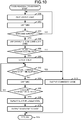
- Fig. 10 is a flowchart depicting an example of a flow of the code reading processing performed by the code reader 60 according to the second embodiment.
- the flag sticker detection section 60a detects the flag sticker F in the image of the commodity M captured by the image capturing section 30a. Then, if the flag sticker detection section 60a determines that the flag sticker F has been detected (Yes in Act S58), the flow proceeds to the processing in Act S60. On the other hand, if it is determined that the flag sticker F has not been detected (No in Act S58), the flow proceeds to the processing in Act S72.
- Act S58 the processing subsequent to Act S60 (Acts S60, S62, S64, S66, S68, S70 and S74) which is performed subsequently is substantially equivalent to those subsequent to Act S28 (Acts S28, S30, S32, S34, S36, S38 and S42) .
- a discount sticker P of a particular type is affixed to a commodity M or other object.
- information e.g., discount information
- the invisible information 52 which can be read using visible light. Therefore, it is possible to read all information on the discount sticker P using visible light, and it is possible to prevent fraudulent discount information that might result from counterfeiting or the like of standard discount stickers.
- the invisible information 52 is a digital watermark.
- a digital watermark may be difficult to counterfeit, and the information incorporated within the digital watermark may be protectively encoded.
- the image capturing section 30a captures an image of a commodity M (or other object) and the discount sticker P using visible light.
- the barcode reading section 30c reads the barcode B (including the information for identifying the commodity M (or other object). If the barcode reading section 30c reads the barcode B, the discount code reading section 30e attempts to read the invisible information 52 recorded on discount sticker P from the image.
- the invisible information 52 can, in fact, be read using visible light. However, since the invisible information 52 is encoded, it is possible to prevent counterfeiting or the like, and it is also possible to improve reading accuracy of the discount information as compared to manual entry by the operator or optical character recognition.
- the image capturing section 30a can typically capture the invisible information 52 and the barcode B in the same image. Therefore, the invisible information 52 can be easily and reliably detected.
- the code synthesizing section 30f synthesizes the reading result of the barcode reading section 30c and the reading result of the discount code reading section 30e. Therefore, it is possible to combine two different codes into one and can handle it as a single format coded data. Thus, it is possible to efficiently transmit and receive the coded data.
- the control programs P1 and P2 be stored in the memory device 14 or the memory unit 34, or may be recorded in a non-transistor computer-readable recording medium such as a CD-ROM (compact disc read-only memory), a FD (Flexible Disk), a CD-R (Compact Disc Rewritable), a DVD (Digital Versatile Disk) and the like in the form of installable or executable file.
- the control programs P1 and P2 may be stored in a computer connected to a network and downloaded via the network.
- the control programs P1 and P2 may be distributed via a network such as the Internet.
Landscapes
- Physics & Mathematics (AREA)
- Engineering & Computer Science (AREA)
- General Physics & Mathematics (AREA)
- Theoretical Computer Science (AREA)
- Electromagnetism (AREA)
- Toxicology (AREA)
- Artificial Intelligence (AREA)
- Computer Vision & Pattern Recognition (AREA)
- General Health & Medical Sciences (AREA)
- Health & Medical Sciences (AREA)
- Business, Economics & Management (AREA)
- Accounting & Taxation (AREA)
- Geometry (AREA)
- Finance (AREA)
- Strategic Management (AREA)
- General Business, Economics & Management (AREA)
- Cash Registers Or Receiving Machines (AREA)
Applications Claiming Priority (1)
| Application Number | Priority Date | Filing Date | Title |
|---|---|---|---|
| JP2018076803A JP7062498B2 (ja) | 2018-04-12 | 2018-04-12 | コードシンボル読取装置およびプログラム |
Publications (1)
| Publication Number | Publication Date |
|---|---|
| EP3553720A1 true EP3553720A1 (de) | 2019-10-16 |
Family
ID=66349267
Family Applications (1)
| Application Number | Title | Priority Date | Filing Date |
|---|---|---|---|
| EP19168389.5A Withdrawn EP3553720A1 (de) | 2018-04-12 | 2019-04-10 | Produktetiketten und produktabtastvorrichtungen und -verfahren |
Country Status (4)
| Country | Link |
|---|---|
| US (1) | US10936935B2 (de) |
| EP (1) | EP3553720A1 (de) |
| JP (1) | JP7062498B2 (de) |
| CN (1) | CN110378456B (de) |
Cited By (1)
| Publication number | Priority date | Publication date | Assignee | Title |
|---|---|---|---|---|
| EP3699852A1 (de) * | 2019-02-20 | 2020-08-26 | Toshiba TEC Kabushiki Kaisha | Vorrichtung und verfahren zum lesen von wareninformationen |
Families Citing this family (7)
| Publication number | Priority date | Publication date | Assignee | Title |
|---|---|---|---|---|
| JP7549496B2 (ja) * | 2020-09-17 | 2024-09-11 | サトーホールディングス株式会社 | 特典表示システム、特典表示方法、及びプログラム |
| JP7555857B2 (ja) * | 2021-03-10 | 2024-09-25 | 東芝テック株式会社 | 登録装置、情報処理装置、およびプログラム |
| JP7653301B2 (ja) * | 2021-05-20 | 2025-03-28 | 東芝テック株式会社 | 登録装置、情報処理装置、およびプログラム |
| JP7677833B2 (ja) * | 2021-06-08 | 2025-05-15 | 東芝テック株式会社 | 商品販売データ処理装置及びプログラム |
| JP7667009B2 (ja) | 2021-07-27 | 2025-04-22 | 東芝テック株式会社 | 販売データ処理システムおよびプログラム |
| JP7686496B2 (ja) * | 2021-08-05 | 2025-06-02 | 東芝テック株式会社 | システム |
| JP2023087920A (ja) | 2021-12-14 | 2023-06-26 | 東芝テック株式会社 | 商品処理装置及びそのプログラム |
Citations (8)
| Publication number | Priority date | Publication date | Assignee | Title |
|---|---|---|---|---|
| US20070170248A1 (en) * | 2002-02-12 | 2007-07-26 | Brundage Trent J | Authentication Methods and Systems Including Embedded Auxiliary Data |
| JP2008252482A (ja) * | 2007-03-30 | 2008-10-16 | Kyodo Printing Co Ltd | 情報表示媒体及びこの媒体の情報読み取り装置 |
| US20110147454A1 (en) * | 2009-12-22 | 2011-06-23 | Toshiba Tec Kabushiki Kaisha | Self-checkout terminal and control method therefor |
| US20110180596A1 (en) * | 2010-01-25 | 2011-07-28 | Toshiba Tec Kabushiki Kaisha | Code reading apparatus, sales registration processing apparatus, and code reading method |
| US20120000980A1 (en) * | 2010-07-01 | 2012-01-05 | Toshiba Tec Kabushiki Kaisha | Code reading apparatus and code reading method |
| US20120059704A1 (en) * | 2010-09-02 | 2012-03-08 | Toshiba Tec Kabushiki Kaisha | Product information processing apparatus and product information processing method |
| US20140246487A1 (en) * | 2013-03-04 | 2014-09-04 | Toshiba Tec Kabushiki Kaisha | Information processing apparatus and information processing method |
| JP2017194788A (ja) | 2016-04-19 | 2017-10-26 | 東芝テック株式会社 | 貼付物およびコードシンボル読取装置 |
Family Cites Families (12)
| Publication number | Priority date | Publication date | Assignee | Title |
|---|---|---|---|---|
| US20030141375A1 (en) * | 2000-03-09 | 2003-07-31 | Spectra Systems Corporation | Information bearing marking used with a digitally watermarked background |
| FR2824905B1 (fr) * | 2001-05-15 | 2003-08-29 | Thomson Csf | Gyrometre a fibre optique |
| JP2005222099A (ja) | 2004-02-03 | 2005-08-18 | Fuji Xerox Co Ltd | 画像処理装置、画像処理方法および張り札 |
| JP2006126945A (ja) | 2004-10-26 | 2006-05-18 | Seiko Instruments Inc | 成分照合プログラム、及びサーバ装置 |
| JP5030302B2 (ja) * | 2008-12-16 | 2012-09-19 | 株式会社サトー知識財産研究所 | 値下げ用台紙なしラベル連続体およびその印字貼付け方法 |
| JP2010250517A (ja) | 2009-04-15 | 2010-11-04 | Nippon Telegr & Teleph Corp <Ntt> | 地域情報提供装置および地域情報提供プログラム |
| JP5259789B2 (ja) * | 2010-08-31 | 2013-08-07 | 東芝テック株式会社 | 情報読取装置、商品販売情報処理装置、および貼付物 |
| JP5320360B2 (ja) * | 2010-09-02 | 2013-10-23 | 東芝テック株式会社 | 商品コード読取装置及びプログラム |
| JP5149950B2 (ja) * | 2010-10-28 | 2013-02-20 | 東芝テック株式会社 | 商品情報読取装置及びプログラム |
| JP5502821B2 (ja) * | 2011-08-30 | 2014-05-28 | 東芝テック株式会社 | コード読取装置、販売データ処理装置およびプログラム |
| JP5631369B2 (ja) * | 2012-01-31 | 2014-11-26 | 東芝テック株式会社 | 情報検出装置および情報検出プログラム |
| JP6300336B1 (ja) * | 2017-04-13 | 2018-03-28 | Necプラットフォームズ株式会社 | コード読取装置、方法およびプログラム |
-
2018
- 2018-04-12 JP JP2018076803A patent/JP7062498B2/ja active Active
-
2019
- 2019-04-08 US US16/377,880 patent/US10936935B2/en not_active Expired - Fee Related
- 2019-04-10 EP EP19168389.5A patent/EP3553720A1/de not_active Withdrawn
- 2019-04-12 CN CN201910293791.4A patent/CN110378456B/zh active Active
Patent Citations (9)
| Publication number | Priority date | Publication date | Assignee | Title |
|---|---|---|---|---|
| US20070170248A1 (en) * | 2002-02-12 | 2007-07-26 | Brundage Trent J | Authentication Methods and Systems Including Embedded Auxiliary Data |
| JP2008252482A (ja) * | 2007-03-30 | 2008-10-16 | Kyodo Printing Co Ltd | 情報表示媒体及びこの媒体の情報読み取り装置 |
| US20110147454A1 (en) * | 2009-12-22 | 2011-06-23 | Toshiba Tec Kabushiki Kaisha | Self-checkout terminal and control method therefor |
| US20110180596A1 (en) * | 2010-01-25 | 2011-07-28 | Toshiba Tec Kabushiki Kaisha | Code reading apparatus, sales registration processing apparatus, and code reading method |
| US20120000980A1 (en) * | 2010-07-01 | 2012-01-05 | Toshiba Tec Kabushiki Kaisha | Code reading apparatus and code reading method |
| JP2012014528A (ja) | 2010-07-01 | 2012-01-19 | Toshiba Tec Corp | コード読取装置およびプログラム |
| US20120059704A1 (en) * | 2010-09-02 | 2012-03-08 | Toshiba Tec Kabushiki Kaisha | Product information processing apparatus and product information processing method |
| US20140246487A1 (en) * | 2013-03-04 | 2014-09-04 | Toshiba Tec Kabushiki Kaisha | Information processing apparatus and information processing method |
| JP2017194788A (ja) | 2016-04-19 | 2017-10-26 | 東芝テック株式会社 | 貼付物およびコードシンボル読取装置 |
Cited By (1)
| Publication number | Priority date | Publication date | Assignee | Title |
|---|---|---|---|---|
| EP3699852A1 (de) * | 2019-02-20 | 2020-08-26 | Toshiba TEC Kabushiki Kaisha | Vorrichtung und verfahren zum lesen von wareninformationen |
Also Published As
| Publication number | Publication date |
|---|---|
| US20190318144A1 (en) | 2019-10-17 |
| US10936935B2 (en) | 2021-03-02 |
| CN110378456B (zh) | 2023-07-21 |
| CN110378456A (zh) | 2019-10-25 |
| JP2019185471A (ja) | 2019-10-24 |
| JP7062498B2 (ja) | 2022-05-06 |
Similar Documents
| Publication | Publication Date | Title |
|---|---|---|
| US10936935B2 (en) | Product tags and product scanning devices and methods | |
| US8453932B2 (en) | Commodity information reading apparatus and commodity information reading method | |
| US8424761B2 (en) | Commodity code reading apparatus and commodity code reading method | |
| US8403216B2 (en) | Code reading apparatus, sales registration processing apparatus, and code reading method | |
| US20130256395A1 (en) | System for and method of expediting self-checkout at point-of-sale stations | |
| US20130054344A1 (en) | Code reading apparatus, sales data processing apparatus and sales data processing method | |
| JP6496053B2 (ja) | 貼付物 | |
| JP4932306B2 (ja) | 商品販売データ処理装置 | |
| CN106874816A (zh) | 信息处理装置及其控制方法 | |
| US10956729B2 (en) | Data processing apparatus and method, and non-transitory computer readable medium | |
| US20180308084A1 (en) | Commodity information reading device and commodity information reading method | |
| US20120054052A1 (en) | Store system, sales registration apparatus, and control method | |
| JP5681682B2 (ja) | 情報処理装置及びプログラム | |
| US20220366414A1 (en) | Settlement processing device and reading device | |
| JP7295988B2 (ja) | コードシンボル読取装置およびプログラム | |
| US20110315764A1 (en) | Code reading apparatus and code reading method | |
| JP7844301B2 (ja) | 読取装置、およびプログラム | |
| JP2022185301A (ja) | 商品販売データ処理装置およびプログラム | |
| JP6394187B2 (ja) | 売上データ処理装置及びプログラム | |
| US12406246B2 (en) | Information processing device and method | |
| JP7854960B2 (ja) | 撮像装置およびプログラム | |
| JP6209895B2 (ja) | 精算システム、精算装置及びプログラム | |
| JP2025053957A (ja) | 商品情報登録システム、情報処理装置およびプログラム | |
| JP2025053963A (ja) | 商品情報登録システム、情報処理装置およびプログラム | |
| JP2025053949A (ja) | 商品情報登録システム、情報処理装置、商品画像認識装置および商品画像認識プログラム |
Legal Events
| Date | Code | Title | Description |
|---|---|---|---|
| PUAI | Public reference made under article 153(3) epc to a published international application that has entered the european phase |
Free format text: ORIGINAL CODE: 0009012 |
|
| STAA | Information on the status of an ep patent application or granted ep patent |
Free format text: STATUS: THE APPLICATION HAS BEEN PUBLISHED |
|
| AK | Designated contracting states |
Kind code of ref document: A1 Designated state(s): AL AT BE BG CH CY CZ DE DK EE ES FI FR GB GR HR HU IE IS IT LI LT LU LV MC MK MT NL NO PL PT RO RS SE SI SK SM TR |
|
| AX | Request for extension of the european patent |
Extension state: BA ME |
|
| STAA | Information on the status of an ep patent application or granted ep patent |
Free format text: STATUS: REQUEST FOR EXAMINATION WAS MADE |
|
| 17P | Request for examination filed |
Effective date: 20200402 |
|
| RBV | Designated contracting states (corrected) |
Designated state(s): AL AT BE BG CH CY CZ DE DK EE ES FI FR GB GR HR HU IE IS IT LI LT LU LV MC MK MT NL NO PL PT RO RS SE SI SK SM TR |
|
| STAA | Information on the status of an ep patent application or granted ep patent |
Free format text: STATUS: EXAMINATION IS IN PROGRESS |
|
| 17Q | First examination report despatched |
Effective date: 20210707 |
|
| STAA | Information on the status of an ep patent application or granted ep patent |
Free format text: STATUS: THE APPLICATION IS DEEMED TO BE WITHDRAWN |
|
| 18D | Application deemed to be withdrawn |
Effective date: 20230318 |