EP3553036B1 - Verfahren zum herstellen eines glasartikels - Google Patents
Verfahren zum herstellen eines glasartikels Download PDFInfo
- Publication number
- EP3553036B1 EP3553036B1 EP19166518.1A EP19166518A EP3553036B1 EP 3553036 B1 EP3553036 B1 EP 3553036B1 EP 19166518 A EP19166518 A EP 19166518A EP 3553036 B1 EP3553036 B1 EP 3553036B1
- Authority
- EP
- European Patent Office
- Prior art keywords
- glass
- weight
- glass article
- producing
- treatment
- Prior art date
- Legal status (The legal status is an assumption and is not a legal conclusion. Google has not performed a legal analysis and makes no representation as to the accuracy of the status listed.)
- Active
Links
Classifications
-
- A—HUMAN NECESSITIES
- A61—MEDICAL OR VETERINARY SCIENCE; HYGIENE
- A61J—CONTAINERS SPECIALLY ADAPTED FOR MEDICAL OR PHARMACEUTICAL PURPOSES; DEVICES OR METHODS SPECIALLY ADAPTED FOR BRINGING PHARMACEUTICAL PRODUCTS INTO PARTICULAR PHYSICAL OR ADMINISTERING FORMS; DEVICES FOR ADMINISTERING FOOD OR MEDICINES ORALLY; BABY COMFORTERS; DEVICES FOR RECEIVING SPITTLE
- A61J1/00—Containers specially adapted for medical or pharmaceutical purposes
- A61J1/05—Containers specially adapted for medical or pharmaceutical purposes for collecting, storing or administering blood, plasma or medical fluids ; Infusion or perfusion containers
- A61J1/06—Ampoules or carpules
- A61J1/065—Rigid ampoules, e.g. glass ampoules
-
- A—HUMAN NECESSITIES
- A61—MEDICAL OR VETERINARY SCIENCE; HYGIENE
- A61J—CONTAINERS SPECIALLY ADAPTED FOR MEDICAL OR PHARMACEUTICAL PURPOSES; DEVICES OR METHODS SPECIALLY ADAPTED FOR BRINGING PHARMACEUTICAL PRODUCTS INTO PARTICULAR PHYSICAL OR ADMINISTERING FORMS; DEVICES FOR ADMINISTERING FOOD OR MEDICINES ORALLY; BABY COMFORTERS; DEVICES FOR RECEIVING SPITTLE
- A61J1/00—Containers specially adapted for medical or pharmaceutical purposes
- A61J1/14—Details; Accessories therefor
- A61J1/1468—Containers characterised by specific material properties
-
- C—CHEMISTRY; METALLURGY
- C03—GLASS; MINERAL OR SLAG WOOL
- C03B—MANUFACTURE, SHAPING, OR SUPPLEMENTARY PROCESSES
- C03B23/00—Re-forming shaped glass
- C03B23/04—Re-forming tubes or rods
- C03B23/09—Reshaping the ends, e.g. as grooves, threads or mouths
-
- C—CHEMISTRY; METALLURGY
- C03—GLASS; MINERAL OR SLAG WOOL
- C03B—MANUFACTURE, SHAPING, OR SUPPLEMENTARY PROCESSES
- C03B25/00—Annealing glass products
- C03B25/02—Annealing glass products in a discontinuous way
-
- C—CHEMISTRY; METALLURGY
- C03—GLASS; MINERAL OR SLAG WOOL
- C03B—MANUFACTURE, SHAPING, OR SUPPLEMENTARY PROCESSES
- C03B32/00—Thermal after-treatment of glass products not provided for in groups C03B19/00, C03B25/00 - C03B31/00 or C03B37/00, e.g. crystallisation, eliminating gas inclusions or other impurities; Hot-pressing vitrified, non-porous, shaped glass products
-
- C—CHEMISTRY; METALLURGY
- C03—GLASS; MINERAL OR SLAG WOOL
- C03C—CHEMICAL COMPOSITION OF GLASSES, GLAZES OR VITREOUS ENAMELS; SURFACE TREATMENT OF GLASS; SURFACE TREATMENT OF FIBRES OR FILAMENTS MADE FROM GLASS, MINERALS OR SLAGS; JOINING GLASS TO GLASS OR OTHER MATERIALS
- C03C1/00—Ingredients generally applicable to manufacture of glasses, glazes, or vitreous enamels
- C03C1/004—Refining agents
-
- C—CHEMISTRY; METALLURGY
- C03—GLASS; MINERAL OR SLAG WOOL
- C03C—CHEMICAL COMPOSITION OF GLASSES, GLAZES OR VITREOUS ENAMELS; SURFACE TREATMENT OF GLASS; SURFACE TREATMENT OF FIBRES OR FILAMENTS MADE FROM GLASS, MINERALS OR SLAGS; JOINING GLASS TO GLASS OR OTHER MATERIALS
- C03C3/00—Glass compositions
- C03C3/04—Glass compositions containing silica
- C03C3/076—Glass compositions containing silica with 40% to 90% silica, by weight
- C03C3/078—Glass compositions containing silica with 40% to 90% silica, by weight containing an oxide of a divalent metal, e.g. an oxide of zinc
-
- C—CHEMISTRY; METALLURGY
- C03—GLASS; MINERAL OR SLAG WOOL
- C03C—CHEMICAL COMPOSITION OF GLASSES, GLAZES OR VITREOUS ENAMELS; SURFACE TREATMENT OF GLASS; SURFACE TREATMENT OF FIBRES OR FILAMENTS MADE FROM GLASS, MINERALS OR SLAGS; JOINING GLASS TO GLASS OR OTHER MATERIALS
- C03C3/00—Glass compositions
- C03C3/04—Glass compositions containing silica
- C03C3/076—Glass compositions containing silica with 40% to 90% silica, by weight
- C03C3/083—Glass compositions containing silica with 40% to 90% silica, by weight containing aluminium oxide or an iron compound
-
- C—CHEMISTRY; METALLURGY
- C03—GLASS; MINERAL OR SLAG WOOL
- C03C—CHEMICAL COMPOSITION OF GLASSES, GLAZES OR VITREOUS ENAMELS; SURFACE TREATMENT OF GLASS; SURFACE TREATMENT OF FIBRES OR FILAMENTS MADE FROM GLASS, MINERALS OR SLAGS; JOINING GLASS TO GLASS OR OTHER MATERIALS
- C03C3/00—Glass compositions
- C03C3/04—Glass compositions containing silica
- C03C3/076—Glass compositions containing silica with 40% to 90% silica, by weight
- C03C3/083—Glass compositions containing silica with 40% to 90% silica, by weight containing aluminium oxide or an iron compound
- C03C3/085—Glass compositions containing silica with 40% to 90% silica, by weight containing aluminium oxide or an iron compound containing an oxide of a divalent metal
-
- C—CHEMISTRY; METALLURGY
- C03—GLASS; MINERAL OR SLAG WOOL
- C03C—CHEMICAL COMPOSITION OF GLASSES, GLAZES OR VITREOUS ENAMELS; SURFACE TREATMENT OF GLASS; SURFACE TREATMENT OF FIBRES OR FILAMENTS MADE FROM GLASS, MINERALS OR SLAGS; JOINING GLASS TO GLASS OR OTHER MATERIALS
- C03C3/00—Glass compositions
- C03C3/04—Glass compositions containing silica
- C03C3/076—Glass compositions containing silica with 40% to 90% silica, by weight
- C03C3/089—Glass compositions containing silica with 40% to 90% silica, by weight containing boron
-
- C—CHEMISTRY; METALLURGY
- C03—GLASS; MINERAL OR SLAG WOOL
- C03C—CHEMICAL COMPOSITION OF GLASSES, GLAZES OR VITREOUS ENAMELS; SURFACE TREATMENT OF GLASS; SURFACE TREATMENT OF FIBRES OR FILAMENTS MADE FROM GLASS, MINERALS OR SLAGS; JOINING GLASS TO GLASS OR OTHER MATERIALS
- C03C3/00—Glass compositions
- C03C3/04—Glass compositions containing silica
- C03C3/076—Glass compositions containing silica with 40% to 90% silica, by weight
- C03C3/089—Glass compositions containing silica with 40% to 90% silica, by weight containing boron
- C03C3/091—Glass compositions containing silica with 40% to 90% silica, by weight containing boron containing aluminium
-
- C—CHEMISTRY; METALLURGY
- C03—GLASS; MINERAL OR SLAG WOOL
- C03C—CHEMICAL COMPOSITION OF GLASSES, GLAZES OR VITREOUS ENAMELS; SURFACE TREATMENT OF GLASS; SURFACE TREATMENT OF FIBRES OR FILAMENTS MADE FROM GLASS, MINERALS OR SLAGS; JOINING GLASS TO GLASS OR OTHER MATERIALS
- C03C3/00—Glass compositions
- C03C3/04—Glass compositions containing silica
- C03C3/076—Glass compositions containing silica with 40% to 90% silica, by weight
- C03C3/089—Glass compositions containing silica with 40% to 90% silica, by weight containing boron
- C03C3/091—Glass compositions containing silica with 40% to 90% silica, by weight containing boron containing aluminium
- C03C3/093—Glass compositions containing silica with 40% to 90% silica, by weight containing boron containing aluminium containing zinc or zirconium
-
- C—CHEMISTRY; METALLURGY
- C03—GLASS; MINERAL OR SLAG WOOL
- C03C—CHEMICAL COMPOSITION OF GLASSES, GLAZES OR VITREOUS ENAMELS; SURFACE TREATMENT OF GLASS; SURFACE TREATMENT OF FIBRES OR FILAMENTS MADE FROM GLASS, MINERALS OR SLAGS; JOINING GLASS TO GLASS OR OTHER MATERIALS
- C03C3/00—Glass compositions
- C03C3/04—Glass compositions containing silica
- C03C3/076—Glass compositions containing silica with 40% to 90% silica, by weight
- C03C3/11—Glass compositions containing silica with 40% to 90% silica, by weight containing halogen or nitrogen
-
- C—CHEMISTRY; METALLURGY
- C03—GLASS; MINERAL OR SLAG WOOL
- C03C—CHEMICAL COMPOSITION OF GLASSES, GLAZES OR VITREOUS ENAMELS; SURFACE TREATMENT OF GLASS; SURFACE TREATMENT OF FIBRES OR FILAMENTS MADE FROM GLASS, MINERALS OR SLAGS; JOINING GLASS TO GLASS OR OTHER MATERIALS
- C03C3/00—Glass compositions
- C03C3/04—Glass compositions containing silica
- C03C3/076—Glass compositions containing silica with 40% to 90% silica, by weight
- C03C3/11—Glass compositions containing silica with 40% to 90% silica, by weight containing halogen or nitrogen
- C03C3/112—Glass compositions containing silica with 40% to 90% silica, by weight containing halogen or nitrogen containing fluorine
- C03C3/115—Glass compositions containing silica with 40% to 90% silica, by weight containing halogen or nitrogen containing fluorine containing boron
- C03C3/118—Glass compositions containing silica with 40% to 90% silica, by weight containing halogen or nitrogen containing fluorine containing boron containing aluminium
-
- C—CHEMISTRY; METALLURGY
- C03—GLASS; MINERAL OR SLAG WOOL
- C03C—CHEMICAL COMPOSITION OF GLASSES, GLAZES OR VITREOUS ENAMELS; SURFACE TREATMENT OF GLASS; SURFACE TREATMENT OF FIBRES OR FILAMENTS MADE FROM GLASS, MINERALS OR SLAGS; JOINING GLASS TO GLASS OR OTHER MATERIALS
- C03C4/00—Compositions for glass with special properties
- C03C4/20—Compositions for glass with special properties for chemical resistant glass
-
- C—CHEMISTRY; METALLURGY
- C03—GLASS; MINERAL OR SLAG WOOL
- C03C—CHEMICAL COMPOSITION OF GLASSES, GLAZES OR VITREOUS ENAMELS; SURFACE TREATMENT OF GLASS; SURFACE TREATMENT OF FIBRES OR FILAMENTS MADE FROM GLASS, MINERALS OR SLAGS; JOINING GLASS TO GLASS OR OTHER MATERIALS
- C03C2203/00—Production processes
- C03C2203/50—After-treatment
- C03C2203/52—Heat-treatment
Definitions
- the present invention relates to a method for producing a glass article with high hydrolytic resistance, a glass article produced by the method and the use of a glass article produced by the method.
- Glass articles such as glass vials, can be made from a variety of types of glass.
- the present invention relates to borosilicate glasses, the named components of which are diboron trioxide (B 2 O 3 ) and silicon dioxide (SiO 2 ).
- Borosilicate glasses are in particular glasses with SiO 2 proportions between 60 and 80% by weight and B 2 O 3 proportions between 5 and 20% by weight.
- Borosilicate glasses are characterized by a very high resistance to high temperatures and chemicals (including water). This leads to a high hydrolytic resistance, which generally means a low release of alkali, i.e. a low release of alkaline earth oxides and alkali oxides (in particular Li 2 O, Na 2 O, K 2 O, MgO, CaO, BaO, SrO) to the environment becomes. Due to their low alkali emission, borosilicate glasses are usually classified as glasses of hydrolytic class 1 (also: type 1) according to ISO 719 or ISO 720.
- the alkali release of a glass or glass article can be determined using the standards DIN ISO 4802-2: 2017-02 (ISO 4802 for short) and USP 660 (glass grit) or ISO 720 (glass grit).
- ISO 4802 for short
- USP 660 glass grit
- ISO 720 glass grit
- a glass container or pipe section to be tested which is intended for the production of containers, is filled with distilled water and for 60 ⁇ 1 min in one
- the autoclave is exposed to a temperature of 121 ⁇ 1 ° C and then cooled in a controlled manner, creating a so-called extraction solution (also known as eluate).
- the extraction solution can be examined for the amount of alkali and alkaline earth metals it contains using flame atomic absorption spectrometry (F-AAS), a so-called Na 2 O equivalence (unit mg / l, milligrams per liter) being determined.
- F-AAS flame atomic absorption spectrometry
- the individual values of the alkali and alkaline earth metals are determined with the help of the F-AAS (unit mg / l, milligrams per liter), which deviates from the norm.
- ISO 4802 describes the resistance of the surface of the manufactured container, or based on ISO 4802, the surface of a pipe section that can be formed into a container, while USP 660 or ISO 720 investigates glass grit and thus the intrinsic material Resistance of the glass is determined, which is independent of influences from the processing.
- glass items made from borosilicate glasses are also used for storing medicines or other pharmaceutical substances due to their high hydrolytic resistance and high resistance to chemicals.
- a high Al 2 O 3 content of, for example, 2 to 7% by weight is responsible for the high resistance to chemicals in many borosilicate glasses.
- the use of aluminum in glasses for pharmaceutical applications is undesirable, since the aluminum can get from the glass into the pharmaceutical substance and then into the body of a person, where it can lead to health problems.
- This object is achieved by a method for producing a glass article and a glass article produced by the method.
- a glass tube made of a borosilicate glass is first used formed into a glass article with an Al 2 O 3 content of less than 1% by weight, in particular less than 0.2% by weight, and a ZrO 2 content of 2-12% by weight and with a glass transition temperature T g and then subjected to a thermal aftertreatment.
- the tube is always heated to a molten state, which is several hundred degrees Celsius above T g.
- the forming temperature is, for example, 1500 - 1600 ° C.
- the method is characterized in that during the thermal aftertreatment the glass article is exposed to a treatment temperature T B T g + 5 K for a treatment time t B 5 min and is then cooled.
- the glass article is relaxed-cooled at the end of the thermal aftertreatment.
- the relaxation cooling starts, for example, at T g + 30K with a cooling rate of 2K / min and ends at T g -30K. All other cooling rates are arbitrary, i.e. in particular the cooling rate up to T g + 30K and those from T g -30K to room temperature.
- the thermal aftertreatment can take place as part of the glass article production.
- the thermal aftertreatment including the expansion cooling can be carried out in a single furnace, in particular an in-line furnace.
- Reshaped glass containers are therefore preferably thermally aftertreated after the reshaping and relaxation-cooled at the end of this aftertreatment.
- the expansion cooling can also be carried out in a process separate from the thermal aftertreatment according to the invention.
- the glass article after being held at T B , the glass article can be cooled in an uncontrolled manner, in particular down to RT. Relaxation cooling can then take place at any point in time.
- -% in particular from 2 to 11% by weight, particularly preferably from 2 to 10% by weight and very particularly preferably from 2 to 9% by weight.
- High melting temperatures are required above 12% by weight and the melt becomes more viscous, which makes the production process more complex and energy-intensive and therefore uneconomical.
- ZrO 2 is an expensive raw material per se, so that more than 9% by weight is increasingly uneconomical and more than 12% by weight in the glass is viewed as completely uneconomical.
- the borosilicate glass used according to the invention has an Al 2 O 3 content below 1% by weight, in particular below 0.2% by weight. Even an aluminum-free borosilicate glass is preferably used, since aluminum from the glass when used for a pharmaceutical glass article can get into the body of a person and lead to damage to health.
- a glass is referred to as "aluminum-free" in the context of this document if the Al 2 O 3 content is ⁇ 0.1% by weight.
- the final cooling is preferably carried out again to room temperature T R.
- the intermediate cooling to T R can take place, since the process times increase due to the thermal aftertreatment.
- only reshaping can be carried out in a first converter and the thermal aftertreatment can be carried out in a second converter.
- the two converters are spatially and the two processes are separated from one another in time.
- the intermediate cooling to room temperature has advantages from the point of view of the flexibility of the process, it is advantageous with a view to the economics of the process not to cool the glass article to room temperature after the forming, since a subsequent renewed heating as part of the thermal aftertreatment according to the invention an additional Requires energy use. In order to improve the economy, the glass article is therefore sent to the thermal aftertreatment after reshaping without intermediate storage.
- the glass article Before the thermal aftertreatment, the glass article can thus have a temperature above or below T B or, in exceptional cases, equal to T B. If the glass article still has a temperature above T B after reshaping, it is first cooled to T B and then held at T B. If the glass article was cooled to a maximum of T R after reshaping, it has a temperature below T B before the thermal aftertreatment. At the beginning of the thermal aftertreatment, the glass article is then first heated. The hold according to the invention then takes place at T B. If the glass article already has a temperature equal to T B , the holding process can be carried out immediately.
- the effect of the thermal aftertreatment according to the invention can be improved both by increasing the treatment temperature T B and by lengthening the treatment time t B.
- the treatment temperature is preferably T B T g + 15 K, in particular T B T g + 30 K and particularly preferably T B T g + 50 K.
- the treatment time is preferably t B 15 min, in particular t B 30 min, particularly preferably t B 60 min and even more preferably t B 120 min.
- An improvement in the hydrolytic resistance occurs both with an increase in the treatment temperature and with an increase in the treatment time.
- the glass tube is preferably manufactured using the Danner, Vello or A-Zug or Down-Draw process.
- the glass tube is then shaped into a container or a glass article.
- a borosilicate glass is particularly preferably used which has the following composition: - SiO 2 60-78% by weight, - B 2 O 3 7-20% by weight, - Li 2 O 0-2% by weight, - Na 2 O 0 - 6.5% by weight, - K 2 O 2.5-12% by weight, - ZnO 0-2% by weight, - ZrO 2 2 - 12% by weight, - refining agents 0-1% by weight, - Al 2 O 3 ⁇ 1% by weight, - optionally one or more of the constituents MgO, CaO, BaO, TiO 2 , SrO with a total of ⁇ 2% by weight, and - unavoidable impurities.
- refining agents halides (especially fluorine and chlorine), cerium oxide, iron oxide, sulfate, antimony oxide, arsenic oxide and tin oxide can be added to the molten glass either individually or in combination as refining agents and are detectable in the end product within the above-mentioned levels.
- MgO, CaO, BaO, SrO, TiO 2 and unavoidable impurities can be detected in the end product within the contents specified above.
- Halides especially fluorine and chlorine, are particularly effective refining agents. If fluorine or chlorine is used for purification, a lower content is sufficient.
- the fluorine or chlorine content of the composition is then preferably 0-0.2% by weight, in particular when fluorine or chlorine is used as the only refining agent.
- the glass is preferably free of aluminum.
- a glass is considered to be aluminum-free if it contains less than 0.1% by weight of Al 2 O 3 .
- ingredients with proportions of 0.2% by weight in each case are regarded as unavoidable impurities.
- the borosilicate glass preferably has a glass transition temperature 500 ° C T g 620 ° C. At the glass transition temperature T g , the glass generally has a viscosity ( ⁇ ) at which the following applies: 12 Pa ⁇ s lg ( ⁇ ) 13 Pa ⁇ s.
- the glass article is deformed as a result of the thermal aftertreatment, it is provided in advantageous developments that the glass article is exposed to a treatment temperature T B T g +100 K. As a result, the glass article has sufficient stability during the thermal aftertreatment, so that deformation can largely be ruled out.
- the thermal aftertreatment according to the invention in which the glass article is exposed to a treatment temperature T B ⁇ T g + 5 K for a treatment time t B ⁇ 5 min and is then cooled, is preferred, the last treatment step under the influence of heat (greater than room temperature T R ) of the method for Manufacture of a glass article with high hydrolytic resistance.
- the thermal aftertreatment according to the invention is basically associated with an additional expenditure of energy. In order to limit this energy expenditure and in this way to maintain the economic viability of the method according to the invention, it is preferably provided that the glass article is exposed to the temperature T B for a treatment time t B min 360 min.
- the glass article is arranged in an oven at the beginning of the thermal aftertreatment, which is set to the treatment temperature T B , so that no additional control is required.
- the combination of the thermal aftertreatment (as described above) in an oven together with the usually downstream expansion cooling to reduce stresses in the glass container ("in-line process") that have formed in the glass container as a result of the reshaping is particularly advantageous.
- the object of the invention is also achieved by a glass article which is produced according to the method described above.
- the object of the invention is also achieved by a glass article with high hydrolytic resistance made of, apart from unavoidable impurities, aluminum-free borosilicate glass with a ZrO 2 content of 2-12% by weight with an alkali release A ⁇ 0.5 mg / l Na 2 O equivalence according to ISO 4802 or an alkali release A ⁇ 3 mg / l Na 2 O equivalence according to USP 660 (glass grit) dissolved.
- the glass article is preferably produced by the method described above.
- the glass article is preferably a glass vial, a glass vial, an ampoule, in particular a glass ampoule or a cylinder ampoule, a carpule (cartridge), a syringe body, a vial, a rod, an internally and / or externally structured Pipe-like structure or pipe or a semi-finished product for the production of one of the articles mentioned or glass grit produced according to USP 660.
- the glass article has an alkali release A reduced by 15%, preferably 40%, particularly preferably 50% compared to an untreated reference glass article of the same composition.
- the process according to the invention can reduce the respective alkali release by 15%, preferably 40%, particularly preferably 50%, with respect to individual alkali or alkaline earth oxides.
- the glass article according to the invention therefore preferably has such a reduction in relation to at least one alkali or alkaline earth oxide.
- the alkali release is preferably determined in accordance with ISO 4802-2 or USP 660 (glass grit) or ISO 720 (glass grit).
- untreated means that the reference glass article has not been subjected to the thermal aftertreatment according to the invention.
- the borosilicate glass of the glass article preferably has the following composition: - SiO 2 60-78% by weight, - B 2 O 3 7-20% by weight, - Li 2 O 0-2% by weight, - Na 2 O 0 - 6.5% by weight, - K 2 O 2.5-12% by weight, - ZnO 0-2% by weight, - ZrO 2 2 - 12% by weight, - refining agents 0-1% by weight, - Al 2 O 3 ⁇ 1% by weight, - optionally one or more of the constituents MgO, CaO, BaO, TiO 2 , SrO with a total of ⁇ 2% by weight, and - unavoidable impurities.
- the object of the invention is also achieved through the use of the glass article described above as a storage article for pharmaceutical substances, which can also be obtained by an end customer.
- the object of the invention is also achieved through the use of the glass article according to the invention in the field of medical technology, in particular through its use as a storage container for chemicals that are used in measuring devices or application devices in the field of medical technology.
- the low aluminum content of the glass article is also an advantage there.
- Table 1 working examples according to the invention (A1 to A5) and in Table 2 comparative examples not according to the invention (C1 to C5) are listed.
- the glass composition is given for each example.
- Tables 1 and 2 also contain four parameters: the coefficient of thermal expansion (CTE), the glass transition temperature (T g ), the softening point (Ew) and the processing temperature (VA).
- CTE coefficient of thermal expansion
- T g glass transition temperature
- Ew softening point
- VA processing temperature
- nb stands for not determined.
- the glass compositions of exemplary embodiments A1 to A5 do not contain any Al 2 O 3 . It is therefore an aluminum-free borosilicate glass.
- the glass of comparative example C3 is also an aluminum-free borosilicate glass.
- the glasses of comparative examples V1, V2 and V5 are also borosilicate glasses, but not aluminum-free.
- the glass of Comparative Example C4 is an aluminosilicate glass. This glass has an Al 2 O 3 content of 16.5% by weight and a ZrO 2 content of 1% by weight. This example shows that the presence of a small amount of ZrO 2 does not lead to an improvement in the release of alkali after a thermal aftertreatment.
- Tables 1 and 2 show two measurements of the alkali release for each of the examples. A first measurement was carried out on a reference article without thermal aftertreatment, and the second measurement was carried out on an article thermally aftertreated by the method according to the invention. The measurements were carried out either using USP 660 (glass grit) or ISO 720 (glass grit) or using ISO 4802, the Na 2 O equivalence being given in each case. In the case of comparative examples V2 and V4, only the release of selected oxides was determined.
- the treatment time t B , the treatment temperature T B and the difference T B -T g are listed for each example.
- the treatment time t B in the exemplary embodiments A1 to A5 is between 15 and 360 minutes.
- treatment times t B are between 5 and 32 minutes.
- the difference T B - T g was between 25 and 50 K both in the exemplary embodiments and in the comparative examples.
- the influence of the ZrO 2 content on the effectiveness of the method according to the invention is particularly visible on the basis of comparative example C3.
- the glass of this experiment is aluminum-free, but the ZrO 2 content is only 1% by weight and therefore outside the range according to the invention.
- the measurement of the release of alkali shows that in this comparative example the release of alkali increases as a result of the thermal aftertreatment according to the invention.
- the aluminum-free glasses of the exemplary embodiments A1 to A5 in Table 1 is each has a ZrO 2 content between 2 and 12% by weight and the alkali release is reduced by the thermal aftertreatment according to the invention.
- Table 3 shows results from a total of twelve test series VR1 to VR12. In the test series, between two (a, b) and six (a to f) tests were carried out. Starting from a reference article (in each case test a), tests with different treatment temperatures T B and treatment times t B were carried out.
- a glass with the following composition was used for all tests: 73.3% by weight SiO 2 ; 10.1 wt% B 2 O 3 ; 2.9 wt% Na 2 O; 6.1 wt% K 2 O; 7.4 wt% ZrO 2 ; 0.1 wt% Cl and 0.1 wt% Al 2 O 3 .
- the Al 2 O 3 content comes from impurities in the raw materials used to manufacture the glass.
- the test series VR7 was carried out according to USP 660 (glass grit) in order to investigate whether the reduction in alkali release is independent of the type of glass material (grit, pipe or container).
- the influence of the treatment temperature T B in the method according to the invention can also be seen on the basis of the test series VR5 and VR7.
- the tests VR5c and VR7b achieve a lower level of alkali release in comparison with the tests VR5b and VR7c despite a shorter treatment time t B.
- the reason for this is apparently the treatment temperature T B , which is higher in the tests VR5c and VR7b than in the tests VR5b and VR7c.
- an untreated glass tube according to USP 660 was first processed into glass grit and then subjected to the thermal aftertreatment according to the invention and the Na 2 O equivalence was determined according to USP 660 or ISO 720.
Landscapes
- Chemical & Material Sciences (AREA)
- Engineering & Computer Science (AREA)
- Materials Engineering (AREA)
- Organic Chemistry (AREA)
- Life Sciences & Earth Sciences (AREA)
- General Chemical & Material Sciences (AREA)
- Chemical Kinetics & Catalysis (AREA)
- Geochemistry & Mineralogy (AREA)
- Health & Medical Sciences (AREA)
- Pharmacology & Pharmacy (AREA)
- Animal Behavior & Ethology (AREA)
- General Health & Medical Sciences (AREA)
- Public Health (AREA)
- Veterinary Medicine (AREA)
- Hematology (AREA)
- Thermal Sciences (AREA)
- Physics & Mathematics (AREA)
- Glass Compositions (AREA)
Description
- Die vorliegende Erfindung betrifft ein Verfahren zum Herstellen eines Glasartikels mit hoher hydrolytischer Resistenz, einen durch das Verfahren hergestellten Glasartikel sowie die Verwendung eines durch das Verfahren hergestellten Glasartikels.
- Glasartikel wie beispielsweise Glasphiolen, können aus einer Vielzahl von Glassorten hergestellt werden. Die vorliegende Erfindung bezieht sich auf Borosilikatgläser, deren namensgebende Bestandteile Dibortrioxid (B2O3) und Siliziumdioxid (SiO2) sind. Als Borosilikatgläser werden insbesondere Gläser mit SiO2-Anteilen zwischen 60 und 80 Gew.-% sowie B2O3-Anteilen zwischen 5 und 20 Gew.-% bezeichnet.
- Borosilikatgläser zeichnen sich durch eine sehr hohe Beständigkeit gegenüber hohen Temperaturen und Chemikalien (einschließlich Wasser) aus. Dies führt zu einer hohen hydrolytischen Resistenz, unter der allgemein eine geringe Alkaliabgabe, also eine geringe Abgabe von Erdalkalioxiden und Alkalioxiden (insbesondere Li2O, Na2O, K2O, MgO, CaO, BaO, SrO) an die Umgebung, verstanden wird. Aufgrund ihrer geringen Alkaliabgabe werden Borosilikatgläser in der Regel als Gläser der hydrolytischen Klasse 1 (auch: Typ 1) gemäß ISO 719 bzw. ISO 720 klassifiziert.
- Die Alkaliabgabe eines Glases oder Glasartikels lässt sich mittels der Normen DIN ISO 4802-2:2017-02 (kurz ISO 4802) und USP 660 (Glasgrieß) bzw. ISO 720 (Glasgrieß) ermitteln. Bei dem Vorgehen gemäß ISO 4802 wird ein zu prüfender Glasbehälter bzw. Rohrabschnitt, der für die Herstellung von Behältern vorgesehen ist, mit destilliertem Wasser befüllt und für 60 ± 1 min in einem Autoklav einer Temperatur von 121 ± 1 °C ausgesetzt und anschließend kontrolliert abgekühlt, wodurch eine sogenannte Extraktionslösung (auch als Eluat bezeichnet) entsteht. Die Extraktionslösung kann mittels Flammen-Atomabsorptionsspektrometrie (F-AAS) auf die enthaltene Menge an Alkali- und Erdalkalimetallen untersucht werden, wobei eine sogenannte Na2O-Äquivalenz (Einheit mg/l, Milligramm pro Liter) ermittelt wird.
- Bei dem Vorgehen gemäß USP 660 (Glasgrieß) bzw. der ISO 720 (Glasgrieß) wird mittels eines normierten Mörsers Glas zu einem Glasgrieß zerstoßen bzw. zerrieben. Beide Verfahren sind als gleichwertig anzusehen. Anschließend werden 10,0 g Glasgrieß gemeinsam mit demineralisiertem Wasser in einem Autoklav auf 121 ± 1 °C erhitzt und anschließend kontrolliert abgekühlt. In die auf diese Weise behandelte Flüssigkeit (auch Eluat genannt) wird standardgemäß Methylrot gegeben. Anschließend wird die Flüssigkeit mittels Salzsäure titriert und mit einer Kontrollflüssigkeit ohne Glasgrieß verglichen. Aus dem titrierten Volumen wird schließlich die Alkaliabgabe des Glasgrießes berechnet, die ebenfalls als Na2O-Äquivalenz in mg/l angegeben werden kann. Da die standardgemäße Titration nur einen Summenwert der Alkali- und Erdalkalimetalle liefert, werden abweichend von der Norm die Einzelwerte der Alkali- und Erdalkalimetalle mit Hilfe der F-AAS ermittelt (Einheit mg/l, Milligramm pro Liter).
- Eine Vergleichbarkeit zwischen zwei Werten der beiden unterschiedlichen Messverfahren (ISO 4802 und USP 660 bzw. ISO 720) ist jedoch nicht gegeben. Es können lediglich Werte miteinander verglichen werden, die durch das gleiche Messverfahren ermittelt wurden. Die ISO 4802 beschreibt die Resistenz der Oberfläche des gefertigten Behälters, oder in Anlehnung an die ISO 4802 die Oberfläche eines Rohrabschnittes, der zu einem Behälter umgeformt werden kann, während bei der USP 660 bzw. ISO 720 Glasgrieß untersucht wird und damit die material-intrinsische Resistenz des Glases festgestellt wird, die unabhängig von Einflüssen aus der Prozessierung ist.
- Neben zahlreichen anderen Anwendungen, wie beispielsweise in der
US 2006/0120105 A1 beschrieben als Glaskörper einer Lampe, werden aus Borosilikatgläsern hergestellte Glasartikel aufgrund der hohen hydrolytischen Resistenz und der hohen Beständigkeit gegenüber Chemikalien auch für die Aufbewahrung von Medikamenten oder anderen pharmazeutischen Substanzen verwendet. Für die hohe Beständigkeit gegenüber Chemikalien ist bei vielen Borosilikatgläsern ein hoher Al2O3-Anteil von beispielsweise 2 bis 7 Gew.-% verantwortlich. Wie jedoch bereits inDE 103 37 362 A1 undDE 10 2016 218 244 B3 beschrieben wurde, ist die Verwendung von Aluminium in Gläsern für pharmazeutische Anwendungen unerwünscht, da das Aluminium aus dem Glas in die pharmazeutische Substanz und anschließend in den Körper eines Menschen gelangen kann, wo es unter Umständen zu gesundheitlichen Schäden führt. - Ziel der
DE 103 37 362 A1 und derDE 10 2016 218 244 B3 war es daher, ein aluminiumfreies Borosilikatglas zur Verfügung zu stellen, das die im Allgemeinen an Borosilikatgläser gestellten Anforderungen erfüllt. Da die Alkaliabgabe insbesondere für die Anwendung im pharmazeutischen Bereich gar nicht gering genug sein kann, besteht auch weiterhin das Interesse, aluminiumfreie Borosilikatgläser mit einer noch geringeren Alkaliabgabe zu entwickeln. - Es ist daher Aufgabe der Erfindung, die Alkaliabgabe von Artikeln aus Borosilikatgläsern zu verringern.
- Diese Aufgabe wird durch ein Verfahren zum Herstellen eines Glasartikels sowie einen durch das Verfahren hergestellten Glasartikel gelöst.
- Bei dem erfindungsgemäßen Verfahren zum Herstellen eines Glasartikels mit hoher hydrolytischer Resistenz wird zunächst ein Glasrohr aus einem Borosilikatglas mit einem Al2O3-Gehalt von unter 1 Gew.-%, insbesondere unter 0,2 Gew.-%, und einem ZrO2-Gehalt von 2-12 Gew.-% und mit einer Glasübergangstemperatur Tg zu einem Glasartikel umgeformt und anschließend einer thermischen Nachbehandlung unterzogen. Bei der Umformung wird das Rohr immer bis zum schmelzflüssigen Zustand, der mehrere hundert Grad Celsius über Tg liegt, erwärmt. Die Umformungstemperatur liegt beispielsweise bei 1500 - 1600 °C.
- Das Verfahren ist dadurch gekennzeichnet, dass der Glasartikel bei der thermischen Nachbehandlung für eine Behandlungszeit tB ≥ 5 min einer Behandlungstemperatur TB ≥ Tg + 5 K ausgesetzt ist und anschließend abgekühlt wird.
- Vorteilhafterweise wird der Glasartikel am Ende der thermischen Nachbehandlung entspannungsgekühlt. Das Entspannungskühlen startet beispielsweise bei Tg+30K mit einer Abkühlrate von 2K/min und endet bei Tg-30K. Alle anderen Abkühlraten sind beliebig, also insbesondere die Abkühlrate bis Tg+30K und jene ab Tg-30K bis Raumtemperatur.
- Idealerweise kann die thermische Nachbehandlung im Rahmen der Glasartikelproduktion erfolgen. Die thermische Nachbehandlung inklusive dem Entspannungskühlen kann in einem einzigen Ofen, insbesondere einem in-line Ofen, durchgeführt werden. Umgeformte Glasbehälter werden demnach bevorzugt nach der Umformung thermisch nachbehandelt und am Ende dieser Nachbehandlung entspannungsgekühlt.
- Alternativ kann das Entspannungskühlen auch in einem von der erfindungsgemäßen, thermischen Nachbehandlung getrennten Prozess durchgeführt werden. So kann der Glasartikel nach dem Halten auf TB beispielsweise ungesteuert abgekühlt werden, insbesondere bis auf RT. Das Entspannungskühlen kann danach zu einem beliebigen Zeitpunkt erfolgen.
- Aus dem Stand der Technik sind lediglich Wärmebehandlungen von Glasartikeln zur Spannungsreduzierung bekannt. Dabei wurde der umgeformte Glasartikel beispielsweise für wenige Sekunden einer Temperatur von Tg + 30 °C ausgesetzt. Die Erfinder haben überraschend festgestellt, dass sich durch die erfindungsgemäße thermische Nachbehandlung eine Verbesserung der hydrolytischen Resistenz, also u.a. eine geringere Alkaliabgabe und eine geringere Aluminiumabgabe, erreichen lässt. Der Grund für die verringerte Alkaliabgabe der Glasartikel nach der erfindungsgemäßen thermischen Nachbehandlung ist bisher unbekannt. Es konnte aber festgestellt werden, dass die Reduzierung der Alkaliabgabe bei Borosilikatgläsern nur dann eintritt, wenn das Glas abgesehen von unvermeidbaren Verunreinigungen einen Al2O3-Gehalt von unter 1 Gew.-% und einen ZrO2-Gehalt von 2-12 Gew.-%, insbesondere von 2 - 11 Gew.-%, besonders bevorzugt von 2 - 10 Gew.-% und ganz besonders bevorzugt von 2 - 9 Gew.-%, aufweist. Oberhalb von 12 Gew.-% sind hohe Schmelztemperaturen erforderlich und die Schmelze wird zähflüssiger, wodurch der Herstellungsprozess aufwendiger und energieintensiver wird und damit unwirtschaftlich ist. Zudem ist ZrO2 an sich ein teurer Rohstoff, sodass mehr als 9 Gew.-% zunehmend unwirtschaftlicher und mehr als 12 Gew.-% im Glas als gänzlich unwirtschaftlich angesehen werden.
- Wie beschrieben weist das erfindungsgemäß verwendete Borosilikatglas einen Al2O3-Anteil unter 1 Gew.-%, insbesondere unter 0,2 Gew.-%, auf. Bevorzugt wird sogar ein aluminiumfreies Borosilikatglas verwendet, da Aluminium aus dem Glas bei der Verwendung für einen pharmazeutischen Glasartikel in den Körper eines Menschen gelangen und zu gesundheitlichen Schäden führen kann. Als "aluminiumfrei" im Sinne dieser Schrift wird ein Glas dann bezeichnet, wenn der Al2O3-Anteil < 0,1 Gew.-% ist.
- Nach der Umformung und vor der thermischen Nachbehandlung kann der Glasartikel bis auf eine Temperatur unterhalb der Glasübergangstemperatur Tg und besonders bevorzugt auf Raumtemperatur TR = 20 ± 5 °C abgekühlt werden. Der Glasartikel wird dann anschließend wieder von Raumtemperatur TR = 20 ± 5 °C bis auf die Behandlungstemperatur TB erwärmt werden. Die abschließende Abkühlung erfolgt bevorzugt wieder bis auf Raumtemperatur TR. Auf diese Weise kann die thermische Nachbehandlung zu einem beliebigen Zeitpunkt nach dem Umformen durchgeführt werden. Die zwischenzeitliche Abkühlung auf TR kann erfolgen, da die Prozesszeiten durch die thermische Nachbehandlung ansteigen. So kann insbesondere in einem ersten Konverter nur umgeformt und in einem zweiten Konverter die thermische Nachbehandlung durchgeführt werden. Die beiden Konverter sind räumlich und die beiden Prozesse zeitlich voneinander getrennt.
- Während das zwischenzeitliche Abkühlen auf Raumtemperatur unter dem Gesichtspunkt der Flexibilität des Verfahrens Vorzüge aufweist, ist es mit Blick auf die Wirtschaftlichkeit des Verfahren vorteilhaft, den Glasartikel nach der Umformung nicht auf Raumtemperatur abzukühlen, da ein anschließendes erneutes Aufheizen im Rahmen der erfindungsgemäßen thermischen Nachbehandlung einen zusätzlichen Energieeinsatz erfordert. Zur Verbesserung der Wirtschaftlichkeit wird der Glasartikel daher nach dem Umformen ohne Zwischenlagerung der thermischen Nachbehandlung zugeführt.
- Vor der thermischen Nachbehandlung kann der Glasartikel somit eine Temperatur oberhalb oder unterhalb TB oder in Ausnahmefällen gleich TB aufweisen. Hat der Glasartikel nach der Umformung noch eine Temperatur oberhalb TB, wird er zunächst auf TB abgekühlt und anschließend auf TB gehalten. Wurde der Glasartikel nach der Umformung auf maximal TR abgekühlt, so weist er vor der thermischen Nachbehandlung eine Temperatur unterhalb TB auf. Zu Beginn der thermischen Nachbehandlung wird der Glasartikel dann zunächst erwärmt. Anschließend erfolgt das erfindungsgemäße Halten auf TB. Weist der Glasartikel bereits eine Temperatur gleich TB auf, so kann unmittelbar der Haltevorgang durchgeführt werden.
- Die Wirkung der erfindungsgemäßen thermischen Nachbehandlung lässt sich sowohl durch eine Erhöhung der Behandlungstemperatur TB als auch durch eine Verlängerung der Behandlungszeit tB verbessern. So beträgt die Behandlungstemperatur bevorzugt TB ≥ Tg + 15 K, insbesondere TB ≥ Tg + 30 K und besonders bevorzugt TB ≥ Tg + 50 K. Die Behandlungszeit beträgt bevorzugt tB ≥ 15 min, insbesondere tB ≥ 30 min, besonders bevorzugt tB ≥ 60 min und noch weiter bevorzugt tB ≥ 120 min. Eine Verbesserung der hydrolytischen Resistenz tritt sowohl mit der Erhöhung der Behandlungstemperatur als auch mit der Verlängerung der Behandlungszeit ein.
- Das Glasrohr wird bevorzugt im Danner-, Vello- oder A-Zug- bzw. Down-Draw-Verfahren hergestellt. Im Anschluss wird das Glasrohr zu einem Behälter bzw. einem Glasartikel umgeformt.
- Besonders bevorzugt wird ein Borosilikatglas verwendet, das folgende Zusammensetzung aufweist:
- SiO2 60 - 78 Gew.-%, - B2O3 7 - 20 Gew.-%, - Li2O 0 - 2 Gew.-%, - Na2O 0 - 6,5 Gew.-%, - K2O 2,5 - 12 Gew.-%, - ZnO 0 - 2 Gew.-%, - ZrO2 2 - 12 Gew.-%, - Läutermittel 0 - 1 Gew.-%, - Al2O3 < 1 Gew.-%, - optional einen oder mehrere der Bestandteile MgO, CaO, BaO, TiO2, SrO mit insgesamt < 2 Gew.-%, und - unvermeidbare Verunreinigungen. - Neben den oben genannten Bestandteilen der Zusammensetzung des Borosilikatglases ist es grundsätzlich möglich, dem Borosilikatglas weitere Bestandteile beizumengen, wenn die weiteren Bestandteile keinen negativen Einfluss auf die erfindungswesentlichen Eigenschaften des gefertigten Glasartikels, insbesondere dessen hydrolytische Resistenz, ausüben. Besonders bevorzugt sind jedoch Ausführungsformen der Erfindung, bei denen das Borosilikatglas ausschließlich aus den in der oben angegebenen Zusammensetzung aufgeführten Bestandteilen besteht.
- Als Läutermittel können Halogenide (insbesondere Fluor und Chlor), Ceroxid, Eisenoxid, Sulfat, Antimonoxid, Arsenoxid und Zinnoxid der Glasschmelze wahlweise einzeln oder in Kombination als Läutermittel zugesetzt werden und sind im Endprodukt innerhalb der oben angegebenen Gehalte nachweisbar. Optional sind MgO, CaO, BaO, SrO, TiO2 und unvermeidbare Verunreinigungen im Endprodukt innerhalb der oben angegebenen Gehalte nachweisbar.
- Halogenide, also insbesondere Fluor und Chlor, sind besonders wirksame Läutermittel. Wird Flour oder Chlor für die Läuterung eingesetzt, so ist bereits ein geringerer Gehalt ausreichend. Der Flour- oder Chlorgehalt der Zusammensetzung beträgt dann bevorzugt 0 - 0,2 Gew.-%, und zwar insbesondere dann, wenn Flour bzw. Chlor als einziges Läutermittel verwendet wird.
- Bei Al2O3 ist ein Anteil unter 1 Gew.-% akzeptabel, da auch bei solchen Anteilen nur geringe Mengen Aluminium in eine mit dem Glas in Kontakt stehende Flüssigkeit gelangt. Bevorzugt ist das Glas jedoch aluminiumfrei. Im Rahmen der vorliegenden Erfindung gilt ein Glas als aluminiumfrei, wenn es weniger als 0,1 Gew.-% Al2O3 aufweist.
- Als unvermeidbare Verunreinigungen werden insbesondere Inhaltsstoffe mit Anteilen von jeweils ≤ 0,2 Gew.-% angesehen.
- Das Borosilikatglas weist bevorzugt eine Glasübergangstemperatur 500°C ≤ Tg ≤ 620°C auf. Bei der Glasübergangstemperatur Tg weist das Glas im Allgemeinen eine Viskosität (η) auf, bei der folgendes gilt: 12 Pa • s ≤ lg(η) ≤ 13 Pa • s.
- Um zu vermeiden, dass sich der Glasartikel durch die thermische Nachbehandlung verformt, ist bei vorteilhaften Weiterbildungen vorgesehen, dass der Glasartikel einer Behandlungstemperatur TB ≤ Tg+100 K ausgesetzt ist. Dadurch weist der Glasartikel während der thermischen Nachbehandlung eine ausreichende Stabilität auf, sodass eine Verformung weitestgehend ausgeschlossen werden kann.
- Bevorzugt ist die erfindungsgemäße thermische Nachbehandlung, bei welcher der Glasartikel für eine Behandlungszeit tB ≥ 5 min einer Behandlungstemperatur TB ≥ Tg + 5 K ausgesetzt ist und anschließend abgekühlt wird, der letzte Behandlungsschritt unter Wärmeeinfluss (größer Raumtemperatur TR) des Verfahrens zum Herstellen eines Glasartikels mit hoher hydrolytischer Resistenz.
- Die erfindungsgemäße thermische Nachbehandlung ist grundsätzlich mit einem zusätzlichen Energieaufwand verbunden. Um diesen Energieaufwand zu begrenzen und auf diese Weise die Wirtschaftlichkeit des erfindungsgemäßen Verfahrens zu erhalten ist bevorzugt vorgesehen, dass der Glasartikel für eine Behandlungszeit tB ≤ 360 min der Temperatur TB ausgesetzt ist.
- Bei dem erfindungsgemäßen Verfahren kommt es besonders auf das Halten des Glasartikels während der Behandlungszeit tB auf der Behandlungstemperatur TB an. Eine Steuerung der Erwärmung oder der Abkühlung des Glasartikels erfordert zusätzliche Maßnahmen und Gerätschaften, welche die Komplexität des erfindungsgemäßen Verfahrens erhöhen und die Wirtschaftlichkeit senken würden. Bei vorteilhaften Weiterbildungen ist daher vorgesehen, dass der Glasartikel zu Beginn der thermischen Nachbehandlung in einem Ofen angeordnet wird, der auf die Behandlungstemperatur TB eingestellt ist, wodurch eine zusätzliche Steuerung entfällt. Besonders vorteilhaft ist die Kombination der thermischen Nachbehandlung (wie oben beschrieben) in einem Ofen zusammen mit der üblicherweise nachgelagerten Entspannungskühlung zur Reduzierung von Spannungen im Glasbehälter ("In-Line-Prozess"), die sich durch die Umformung im Glasbehälter gebildet haben.
- Die Aufgabe der Erfindung wird auch durch einen Glasartikel, der nach dem oben beschriebenen Verfahren hergestellt ist, gelöst.
- Darüber hinaus wird die Aufgabe der Erfindung auch durch einen Glasartikel mit hoher hydrolytischer Resistenz aus einem, von unvermeidbaren Verunreinigungen abgesehen, aluminiumfreien Borosilikatglas mit einem ZrO2-Gehalt von 2 - 12 Gew.-% mit einer Alkaliabgabe A ≤ 0,5 mg/l Na2O-Äquivalenz gemäß ISO 4802 oder einer Alkaliabgabe A ≤ 3 mg/l Na2O-Äquivalenz gemäß USP 660 (Glasgrieß) gelöst. Der Glasartikel ist bevorzugt nach dem oben beschriebenen Verfahren hergestellt.
- Der Glasartikel ist bevorzugt ein Glasfläschchen, eine Glasphiole, eine Ampulle, insbesondere eine Glasampulle oder eine Zylinderampulle, eine Karpule (Cartridge), ein Spritzenkörper, ein Vial, ein Stab, ein innen- und/oder außenstrukturiertes rohrähnliches Gebilde oder Rohr oder ein Halbzeug zur Herstellung eines der genannten Artikel oder nach USP 660 hergestellter Glasgrieß.
- Bei vorteilhaften Weiterbildungen weist der Glasartikel eine um ≥ 15 %, bevorzugt ≥ 40 %, besonders bevorzugt ≥ 50 % reduzierte Alkaliabgabe A gegenüber einem unbehandelten Referenzglasartikel gleicher Zusammensetzung auf. Ebenso kann durch das erfindungsgemäße Verfahren bezüglich einzelner Alkali- oder Erdalkalioxide eine Verringerung der jeweiligen Alkaliabgabe um ≥ 15 %, bevorzugt ≥ 40 %, besonders bevorzugt ≥ 50 % erreicht werden. Der erfindungsgemäße Glasartikel weist daher bevorzugt eine solche Verringerung bezüglich zumindest eines Alkali- oder Erdalkalioxids auf. Die Alkaliabgabe wird bevorzugt gemäß ISO 4802-2 oder USP 660 (Glasgrieß) oder ISO 720 (Glasgrieß) ermittelt. Unbehandelt bedeutet in diesem Zusammenhang, dass der Referenzglasartikel nicht der erfindungsgemäßen thermischen Nachbehandlung unterzogen wurde.
- Das Borosilikatglas des Glasartikels weist bevorzugt die folgende Zusammensetzung auf:
- SiO2 60 - 78 Gew.-%, - B2O3 7 - 20 Gew.-%, - Li2O 0 - 2 Gew.-%, - Na2O 0 - 6,5 Gew.-%, - K2O 2,5 - 12 Gew.-%, - ZnO 0 - 2 Gew.-%, - ZrO2 2 - 12 Gew.-%, - Läutermittel 0 - 1 Gew.-%, - Al2O3 < 1 Gew.-%, - optional einen oder mehrere der Bestandteile MgO, CaO, BaO, TiO2, SrO mit insgesamt < 2 Gew.-%, und - unvermeidbare Verunreinigungen. - Auch hier sind in der Zusammensetzung weitere Bestandteile grundsätzlich nicht ausgeschlossen, wenn die weiteren Bestandteile keinen negativen Einfluss auf die erfindungswesentlichen Eigenschaften des gefertigten Glasartikels, insbesondere dessen hydrolytische Resistenz, ausüben. Besonders bevorzugt sind abermals Ausführungsformen, bei denen das Borosilikatglas des Glasartikels ausschließlich aus den in der obigen Zusammensetzung aufgeführten Bestandteilen besteht.
- Die Aufgabe der Erfindung wird auch durch die Verwendung des oben beschriebenen Glasartikels als Aufbewahrungsartikel für pharmazeutische Substanzen, die auch ein Endkunde erhalten kann, gelöst.
- Ebenso wird die Aufgabe der Erfindung durch die Verwendung des erfindungsgemäßen Glasartikels im Bereich der Medizintechnik gelöst, insbesondere durch die Verwendung als Lagerungsbehälter für Chemikalien, die in Messgeräten oder Anwendungsgeräten im Bereich der Medizintechnik verwendet werden. Dort ist neben der geringen Alkaliabgabe auch der geringe Aluminiumgehalt des Glasartikels von Vorteil.

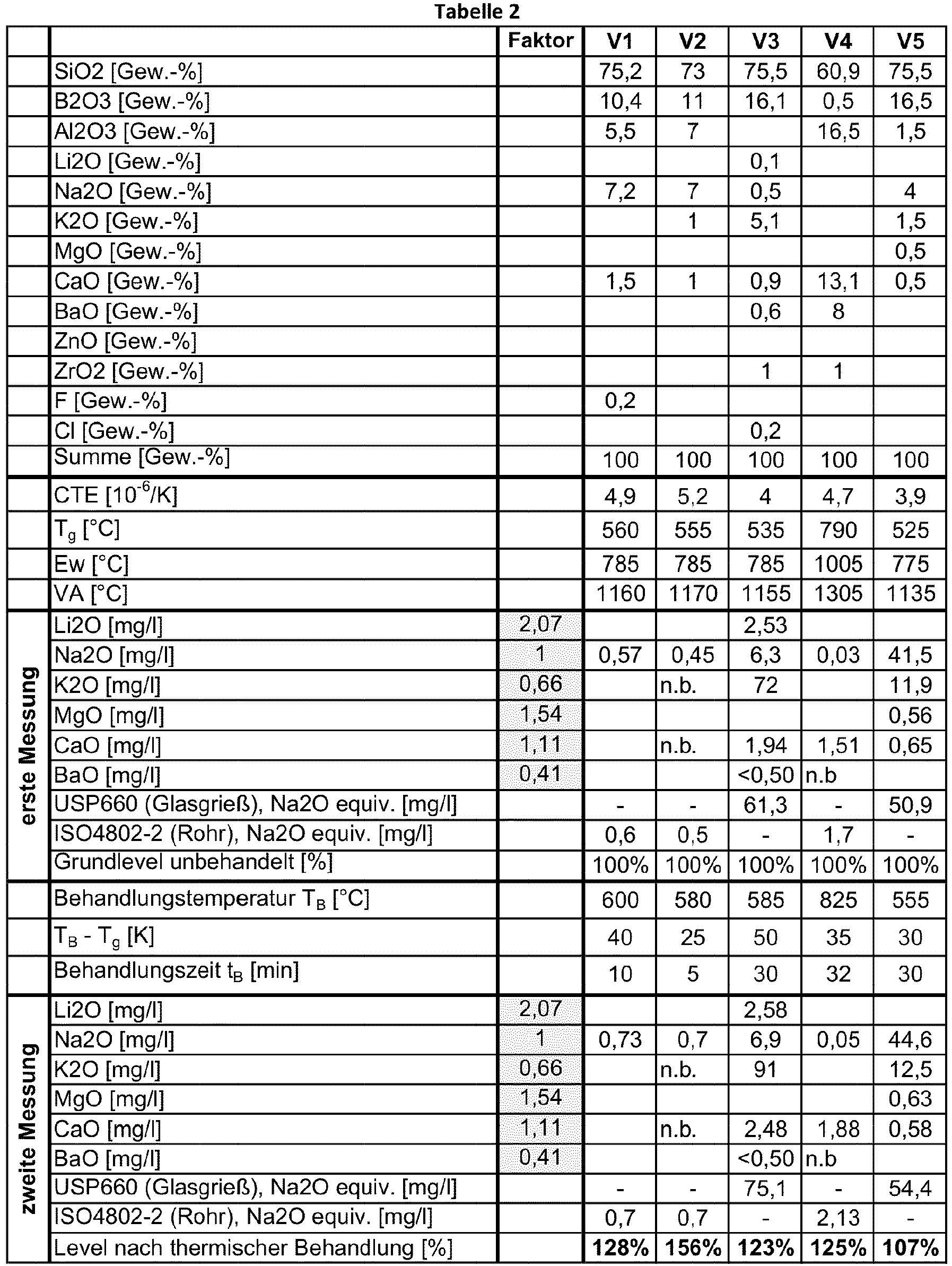
- In Tabelle 1 sind erfindungsgemäße Ausführungsbeispiele (A1 bis A5) und in Tabelle 2 nicht-erfindungsgemäße Vergleichsbeispiele (V1 bis V5) aufgeführt. Für jedes Beispiel ist die Glaszusammensetzung angegeben. Zusätzlich enthalten die Tabellen 1 und 2 vier Kennwerte: den Wärmeausdehnungskoeffizienten (CTE), die Glasübergangstemperatur (Tg), den Erweichungspunkt (Ew) sowie die Verarbeitungstemperatur (VA). In den Tabellen steht n.b. für nicht bestimmt.
- Die Glaszusammensetzungen der Ausführungsbeispiele A1 bis A5 weisen abgesehen von unvermeidbaren Verunreinigungen kein Al2O3 auf. Es handelt sich somit jeweils um ein aluminiumfreies Borosilikatglas. Das Glas des Vergleichsbeispiels V3 ist ebenfalls ein aluminiumfreies Borosilikatglas. Die Gläser der Vergleichsbeispiele V1, V2 und V5 sind ebenfalls Borosilikatgläser, jedoch keine aluminiumfreien. Bei dem Glas des Vergleichsbeispiels V4 handelt es sich um ein Aluminosilikatglas. Dieses Glas weist einen Al2O3-Gehalt von 16,5 Gew.-% und einen ZrO2-Anteil von 1 Gew.-% auf. Dieses Beispiel zeigt, dass das Vorhandensein einer geringen Menge ZrO2 nicht zu einer Verbesserung der Alkaliabgabe nach einer thermischen Nachbehandlung führt.
- Aus den Tabellen 1 und 2 gehen für jedes der Beispiele zwei Messungen der Alkaliabgabe hervor. Eine erste Messung wurde bei einem Referenzartikel ohne thermische Nachbehandlung, die zweite Messung bei einem durch das erfindungsgemäße Verfahren thermisch nachbehandelten Artikel durchgeführt. Die Messungen wurden entweder mittels USP 660 (Glasgrieß) bzw. ISO 720 (Glasgrieß) oder mittels ISO 4802 durchgeführt, wobei jeweils die Na2O-Äquivalenz angegeben ist. Bei den Vergleichsbeispielen V2 und V4 wurden nur die Abgabe ausgewählter Oxide ermittelt.
- In den Tabellen 1 und 2 sind für die Berechnung der Na2O-Äquivalenz Faktoren für die Alkali- oder Erdalkalimetalloxide Li2O, Na2O, K2O, MgO, CaO und BaO angegeben. Die Faktoren bestimmen die Gewichtung der einzelnen Bestandteile für die Berechnung der Na2O-Äquivalenz. Die Faktoren werden anhand des Molverhältnisses zwischen Na2O und dem entsprechenden Oxid bestimmt (z.B. für K2O: M(Na2O)/M(K2O) = [61,979/(2*39,098+15,999)] = 0,658). Dieser Faktor geht auch aus der DIN ISO 4802-2:2017 hervor. Bei der Berechnung der Na2O-Äquivalenz wird jeder Messwert für die sechs Bestandteile mit dem dazugehörigen Faktor multipliziert und anschließend werden die dadurch erhaltenen Werte summiert.
- Zudem sind für jedes Beispiel die Behandlungszeit tB, die Behandlungstemperatur TB sowie die Differenz TB - Tg aufgeführt. Die Behandlungszeit tB beträgt bei den Ausführungsbeispielen A1 bis A5 zwischen 15 und 360 Minuten. Bei den Vergleichsbeispielen liegen Behandlungszeiten tB zwischen 5 und 32 Minuten vor. Die Differenz TB - Tg lag sowohl bei den Ausführungsbeispielen als auch bei den Vergleichsbeispielen zwischen 25 und 50 K.
- Bei den Ausführungsbeispielen A1 bis A5 zeigt sich eine deutliche Reduzierung der Alkaliabgabe durch das erfindungsgemäße Verfahren auf bis zu 49 % des Referenzwertes des unbehandelten Ausgangsglases. Im Gegensatz dazu führt die erfindungsgemäße thermische Nachbehandlung bei den Vergleichsbeispielen V1 bis V5 sogar zu einer Erhöhung der Alkaliabgabe auf bis zu 156 % des Referenzwerts. Dies wird von den Erfindern auf das nicht oder in zu geringem Maße enthaltene ZrO2 zurückgeführt.
- Der Einfluss des ZrO2-Gehalts auf die Wirksamkeit des erfindungsgemäßen Verfahrens ist besonders anhand des Vergleichsbeispiels V3 sichtbar. Das Glas dieses Versuchs ist zwar aluminiumfrei, der ZrO2-Gehalt liegt jedoch bei nur 1 Gew.-% und damit außerhalb des erfindungsgemäßen Bereichs. Die Messung der Alkaliabgabe zeigt, dass bei diesem Vergleichsbeispiel die Alkaliabgabe durch die erfindungsgemäße thermische Nachbehandlung ansteigt. Bei den aluminiumfreien Gläsern der Ausführungsbeispiele A1 bis A5 in Tabelle 1 ist jeweils ein ZrO2-Gehalt zwischen 2 und 12 Gew.-% vorhanden und die Alkaliabgabe sinkt durch die erfindungsgemäße thermische Nachbehandlung.
Tabelle 3 Versuchsreihe AD in mm WD in mm Art TB in °C TB-Tg in K tB in min Na2O-Äquivalenz in mg/l Niveau Alkaliabgabe VR1 a 14,25 0,95 Rohr --- --- --- 0,59 100% b 14,25 0,95 Rohr 610 25 360 0,3 50% VR2 a 16 1 Rohr --- --- --- 0,67 100% b 16 1 Rohr 590 5 5 0,42 63% c 16 1 Rohr 590 5 15 0,37 56% d 16 1 Rohr 590 5 30 0,32 47% e 16 1 Rohr 590 5 120 0,3 44% f 16 1 Rohr 590 5 360 0,28 41% VR3 a 16 1 Rohr --- --- --- 0,61 100% b 16 1 Rohr 610 25 5 0,41 67% c 16 1 Rohr 610 25 15 0,38 62% d 16 1 Rohr 610 25 30 0,3 50% e 16 1 Rohr 610 25 60 0,31 50% f 16 1 Rohr 610 25 360 0,31 50% VR4 a 16 1 Rohr --- --- --- 0,6 100% b 16 1 Rohr 630 45 5 0,32 53% c 16 1 Rohr 630 45 15 0,32 53% d 16 1 Rohr 630 45 30 0,3 49% e 16 1 Rohr 630 45 120 0,27 45% f 16 1 Rohr 630 45 360 0,25 41% VR5 a 8,65 0,9 Rohr --- --- --- 1,29 100% b 8,65 0,9 Rohr 600 15 45 0,91 71% c 8,65 0,9 Rohr 650 65 30 0,71 55% VR6 a 16 1 Rohr --- --- --- 0,63 100% b 16 1 Rohr 685 100 60 0,25 39% c 16 1 Rohr 685 100 60 0,29 47% VR7 a 16 1 Glasgrieß --- --- --- 4,54 100% b 16 1 Glasgrieß 630 45 15 2,29 51% c 16 1 Glasgrieß 610 25 60 3,8 84% VR8 a 16 1 2R Fläschchen --- --- --- 3,08 100% b 16 1 2R Fläschchen 610 25 360 1,74 57% VR9 a 8,65 0,9 Karpule --- --- --- 1,02 100% b 8,65 0,9 Karpule 610 25 360 0,48 47% VR10 a 8,65 0,9 Karpule --- --- --- 1,16 100% b 8,65 0,9 Karpule 610 25 360 0,46 40% VR11 a 8,65 0,9 Karpule --- --- --- 1,08 100% b 8,65 0,9 Karpule 610 25 360 0,49 46% VR12 a 8,65 0,9 Karpule --- --- --- 1,26 100% b 8,65 0,9 Karpule 610 25 360 0,47 37% - Die Tabelle 3 zeigt Ergebnisse von insgesamt zwölf Versuchsreihen VR1 bis VR12. Bei den Versuchsreihen wurden jeweils zwischen zwei (a, b) und sechs (a bis f) Versuche durchgeführt. Dabei wurden ausgehend von einem Referenzartikel (jeweils Versuch a) Versuche mit unterschiedlichen Behandlungstemperaturen TB und Behandlungszeiten tB durchgeführt.
- Für sämtliche Versuche wurde ein Glas mit folgender Zusammensetzung verwendet: 73,3 Gew.-% SiO2; 10,1 Gew.-% B2O3; 2,9 Gew.-% Na2O; 6,1 Gew.-% K2O; 7,4 Gew.-% ZrO2; 0,1 Gew.-% Cl und 0,1 Gew.-% Al2O3. Der Al2O3-Anteil stammt aus Verunreinigungen der Rohstoffe, die zur Herstellung des Glases verwendet wurden. Das verwendete Glas hat eine Glasübergangstemperatur Tg = 585°C. Mit Ausnahme der Versuchsreihe VR7 wurden die Versuche gemäß ISO 4802 durchgeführt. Die Versuchsreihe VR7 wurde gemäß USP 660 (Glasgrieß) durchgeführt, um zu untersuchen, ob die Reduzierung der Alkaliabgabe unabhängig vom Glasmaterialtyp ist (Grieß, Rohr bzw. Behälter).
- Bei den Versuchsreihen nach ISO 4802 wurden Rohre mit insgesamt drei unterschiedlichen Rohrgeometrien verwendet. Die Rohre der Versuchsreihe VR1 wiesen einen Außendurchmesser AD = 14,25 mm und eine Wanddicke WD = 0,95 mm auf. Bei den Versuchsreihen VR2 bis VR4 und VR6 bis VR8 wurden Rohre mit AD = 16 mm und WD = 1 mm verwendet. Die Versuchsreihen VR5 sowie VR9 bis VR12 wurden anhand von Rohren mit AD = 8,65 mm und WD = 0,9 mm durchgeführt. Sämtliche Versuchsreihen zeigen die Wirksamkeit des erfindungsgemäßen Verfahrens. Das erfindungsgemäße Verfahren ist daher unabhängig von der Rohrgeometrie anwendbar.
- Ebenso verhält es sich mit der Art des Glasartikels, da Versuchsreihen der Tabelle 3 an Rohren und verschiedenen Behältern durchgeführt wurden und - wie oben erwähnt - bei sämtlichen Versuchsreihen eine Verringerung der Alkaliabgabe durch das erfindungsgemäße Verfahren eintrat.
- Anhand der Versuchsreihen VR2 bis VR4 ist zu beobachten, dass mit steigender Behandlungsdauer tB die Alkaliabgabe abnimmt. Ein Vergleich zwischen VR2 und VR4 zeigt außerdem, dass bei höherer Behandlungstemperatur TB bei gleicher Behandlungszeit tB die Reduzierung der Alkaliabgabe größer wird. Dies gilt insbesondere für kurze Behandlungszeiten.
- Der Einfluss der Behandlungstemperatur TB bei dem erfindungsgemäßen Verfahren lässt sich auch anhand der Versuchsreihen VR5 und VR7 erkennen. Die Versuche VR5c und VR7b erreichen im Vergleich mit den Versuchen VR5b und VR7c trotz einer geringeren Behandlungszeit tB ein niedrigeres Niveau der Alkaliabgabe. Der Grund hierfür liegt offenbar in der Behandlungstemperatur TB, die bei den Versuchen VR5c bzw. VR7b höher ist als bei den Versuchen VR5b bzw. VR7c. Hierbei ist anzumerken, dass bei den Versuchen VR7b und VR7c zunächst ein unbehandeltes Glasrohr gemäß USP 660 zu Glasgrieß verarbeitet und anschließend der erfindungsgemäßen thermischen Nachbehandlung unterzogen und die Na2O-Äquivalenz gemäß USP 660 bzw. ISO 720 ermittelt wurde.
Claims (13)
- Verfahren zum Herstellen eines Glasartikels mit hoher hydrolytischer Resistenz, bei dem zunächst ein Glasrohr aus einem Borosilikatglas mit einem Al2O3-Gehalt von unter 1 Gew.-% und einem ZrO2-Gehalt von 2 - 12 Gew.-% und mit einer Glasübergangstemperatur Tg zu einem Glasartikel umgeformt und anschließend einer thermischen Nachbehandlung unterzogen wird,
dadurch gekennzeichnet, dass der Glasartikel bei der thermischen Nachbehandlung für eine Behandlungszeit tB ≥ 5 min einer Behandlungstemperatur TB ≥ Tg + 5 K ausgesetzt ist und anschließend abgekühlt wird. - Verfahren zum Herstellen eines Glasartikels gemäß Anspruch 1,
dadurch gekennzeichnet, dass das Borosilikatglas die folgende Zusammensetzung aufweist:- SiO2 60 - 78 Gew.-%, - B2O3 7 - 20 Gew.-%, - Li2O 0 - 2 Gew.-%, - Na2O 0 - 6,5 Gew.-%, - K2O 2,5 - 12 Gew.-%, - ZnO 0 - 2 Gew.-%, - ZrO2 2 - 12 Gew.-%, - Läutermittel 0 - 1 Gew.-%, - Al2O3 < 1 Gew.-%, - optional einen oder mehrere der Bestandteile MgO, CaO, BaO, TiO2, SrO mit insgesamt < 2 Gew.-%, und - unvermeidbare V erunreinigungen. - Verfahren zum Herstellen eines Glasartikels gemäß Anspruch 1 oder 2,
dadurch gekennzeichnet, dass das Borosilikatglas eine Glasübergangstemperatur 500°C ≤ Tg ≤ 620°C aufweist. - Verfahren zum Herstellen eines Glasartikels gemäß einem der vorhergehenden Ansprüche,
dadurch gekennzeichnet, dass der Glasartikel am Ende der thermischen Nachbehandlung entspannungsgekühlt wird. - Verfahren zum Herstellen eines Glasartikels gemäß Anspruch 4,
dadurch gekennzeichnet, dass die thermische Nachbehandlung inklusive dem Entspannungskühlen in einem einzigen Ofen durchgeführt werden. - Verfahren zum Herstellen eines Glasartikels gemäß einem der vorhergehenden Ansprüche,
dadurch gekennzeichnet, dass der Glasartikel einer Behandlungstemperatur TB ≤ Tg+100 K ausgesetzt ist. - Verfahren zum Herstellen eines Glasartikels gemäß einem der vorhergehenden Ansprüche,
dadurch gekennzeichnet, dass der Glasartikel für eine Behandlungszeit tB ≤ 360 min der Temperatur TB ausgesetzt ist. - Verfahren zum Herstellen eines Glasartikels gemäß einem der vorhergehenden Ansprüche,
dadurch gekennzeichnet, dass der Glasartikel zu Beginn der thermischen Nachbehandlung in einem Ofen angeordnet wird, der auf die Behandlungstemperatur TB eingestellt ist. - Glasartikel aus einem Borosilikatglas mit einem Al2O3-Gehalt von unter 1 Gew.-% und einem ZrO2-Gehalt von 2-12 Gew.-% gekennzeichnet durch eine Alkaliabgabe A ≤ 0,5 mg/l Na2O-Äquivalenz gemäß ISO 4802 oder eine Alkaliabgabe A ≤ 3 mg/l Na2O-Äquivalenz gemäß USP 660 (Glasgrieß) oder ISO 720 (Glasgrieß), hergestellt nach dem Verfahren gemäß einem der Ansprüche 1 bis 8.
- Glasartikel gemäß Anspruch 9,
dadurch gekennzeichnet, dass der Glasartikel ein Glasfläschchen, eine Glasphiole, eine Ampulle, insbesondere eine Glasampulle oder eine Zylinderampulle, eine Karpule, ein Spritzenkörper, ein Vial, ein Stab, ein innen- und/oder außenstrukturiertes rohrähnliches Gebilde oder Rohr oder ein Halbzeug zur Herstellung eines der genannten Artikel oder nach USP 660 hergestellter Glasgrieß ist. - Glasartikel gemäß einem der Ansprüche 9 oder 10,
gekennzeichnet durch eine um ≥ 15 % reduzierte Alkaliabgabe A gegenüber einem unbehandelten Referenzglasartikel gleicher Zusammensetzung. - Glasartikel gemäß einem der Ansprüche 9 bis 11,
dadurch gekennzeichnet, dass das Borosilikatglas die folgende Zusammensetzung aufweist:- SiO2 60 - 78 Gew.-%, - B2O3 7 - 20 Gew.-%, - Li2O 0 - 2 Gew.-%, - Na2O 0 - 6,5 Gew.-%, - K2O 2,5 - 12 Gew.-%, - ZnO 0 - 2 Gew.-%, - ZrO2 2 - 12 Gew.-%, - Läutermittel 0 - 1 Gew.-%, - Al2O3 < 1 Gew.-%, - optional einen oder mehrere der Bestandteile MgO, CaO, BaO, TiO2, SrO mit insgesamt < 2 Gew.-%, und - unvermeidbare Verunreinigungen. - Verwendung des Glasartikels gemäß einem der Ansprüche 9 bis 12 als Aufbewahrungsartikel für pharmazeutische Substanzen oder im Bereich der Medizintechnik.
Applications Claiming Priority (1)
| Application Number | Priority Date | Filing Date | Title |
|---|---|---|---|
| DE102018205257.3A DE102018205257A1 (de) | 2018-04-09 | 2018-04-09 | Verfahren zum herstellen eines glasartikels |
Publications (2)
| Publication Number | Publication Date |
|---|---|
| EP3553036A1 EP3553036A1 (de) | 2019-10-16 |
| EP3553036B1 true EP3553036B1 (de) | 2021-06-09 |
Family
ID=66049055
Family Applications (1)
| Application Number | Title | Priority Date | Filing Date |
|---|---|---|---|
| EP19166518.1A Active EP3553036B1 (de) | 2018-04-09 | 2019-04-01 | Verfahren zum herstellen eines glasartikels |
Country Status (5)
| Country | Link |
|---|---|
| US (1) | US11453609B2 (de) |
| EP (1) | EP3553036B1 (de) |
| CN (1) | CN110357421B (de) |
| DE (1) | DE102018205257A1 (de) |
| MY (1) | MY190061A (de) |
Family Cites Families (11)
| Publication number | Priority date | Publication date | Assignee | Title |
|---|---|---|---|---|
| DE20220582U1 (de) | 2002-08-24 | 2003-11-13 | Schott Glas, 55122 Mainz | Borosilicatglas |
| DE202005004487U1 (de) * | 2004-07-12 | 2005-11-24 | Schott Ag | System zur Hintergrundbeleuchtung von Displays oder Bildschirmen |
| US9034442B2 (en) * | 2012-11-30 | 2015-05-19 | Corning Incorporated | Strengthened borosilicate glass containers with improved damage tolerance |
| DE102013207634A1 (de) | 2013-04-26 | 2014-10-30 | Schott Ag | Borosilikatglas mit verbesserter hydrolytischer Beständigkeit zur bevorzugten Verwendung im Pharmabereich |
| MX2017008716A (es) | 2014-12-31 | 2017-10-31 | Corning Inc | Metodos para el tratamiento de articulos de vidrio. |
| WO2016109697A1 (en) * | 2014-12-31 | 2016-07-07 | Corning Incorporated | Methods for thermally treating glass articles |
| FR3033143B1 (fr) | 2015-02-27 | 2017-02-24 | Michelin & Cie | Pneumatique avec bande de roulement directionnelle et bi-matiere comportant une alternance de blocs incurves |
| WO2017014066A1 (ja) * | 2015-07-17 | 2017-01-26 | 日本電気硝子株式会社 | 医薬容器用ホウケイ酸ガラス |
| DE202016005820U1 (de) * | 2016-09-22 | 2016-12-07 | Schott Ag | Aluminium-freies Borosilikatglas |
| DE102016218244B3 (de) | 2016-09-22 | 2017-08-24 | Schott Ag | Aluminium-freies Borosilikatglas |
| EP3299347B1 (de) * | 2016-09-22 | 2018-09-26 | Schott AG | Aluminium-freies borosilikatglas |
-
2018
- 2018-04-09 DE DE102018205257.3A patent/DE102018205257A1/de not_active Withdrawn
-
2019
- 2019-04-01 EP EP19166518.1A patent/EP3553036B1/de active Active
- 2019-04-03 MY MYPI2019001875A patent/MY190061A/en unknown
- 2019-04-09 CN CN201910281732.5A patent/CN110357421B/zh not_active Expired - Fee Related
- 2019-04-09 US US16/379,025 patent/US11453609B2/en active Active
Also Published As
| Publication number | Publication date |
|---|---|
| MY190061A (en) | 2022-03-24 |
| DE102018205257A1 (de) | 2019-10-10 |
| CN110357421B (zh) | 2022-08-05 |
| EP3553036A1 (de) | 2019-10-16 |
| US20190308902A1 (en) | 2019-10-10 |
| US11453609B2 (en) | 2022-09-27 |
| CN110357421A (zh) | 2019-10-22 |
Similar Documents
| Publication | Publication Date | Title |
|---|---|---|
| DE102010029975B4 (de) | Bor-armes Neutralglas mit Titan- und Zirkonoxid, Verfahren zu seiner Herstellung und Verwendungen | |
| EP3299347B1 (de) | Aluminium-freies borosilikatglas | |
| DE112018005608T5 (de) | Glas für Arzneimittelbehälter und Glasrohr für Arzneimittelbehälter | |
| DE102015214431B3 (de) | Bor-armes Zirkonium-freies Neutralglas mit optimiertem Alkaliverhältnis | |
| EP2796431A1 (de) | Borosilikatglas mit verbesserter hydrolytischer Beständigkeit zur bevorzugten Verwendung im Pharmabereich | |
| EP2844213B1 (de) | Lithiumdisilikat-apatit-glaskeramik | |
| EP2868634B1 (de) | Lithiumdisilikat-Apatit-Glaskeramik mit Übergangsmetalloxid | |
| EP0564802B1 (de) | Blei- und bariumfreies Kristallglas mit hoher Lichttransmission | |
| DE112006004277B4 (de) | Glaszusammensetzung | |
| DE10337362B4 (de) | Borosilicatglas und seine Verwendungen | |
| EP0858975B1 (de) | Sterilisierbarer Glasbehälter für medizinische Zwecke, insbesondere zur Aufbewahrung pharmazeutischer oder diagnostischer Produkte | |
| EP0992462B1 (de) | Borosilicatglas hoher chemischer Beständigkeit und dessen Verwendung | |
| DE2320720C2 (de) | Bor und Fluor freie faser- oder fadenbildende Glasmischung im System SiO&darr;2&darr;-Al&darr;2&darr;O&darr;3&darr;-CaO-MgO-TiO&darr;2&darr;-ZnO/SrO/BaO- (Alkalioxide) | |
| EP1303461A1 (de) | Borosilicatglas hoher chemischer beständigkeit und dessen verwendungen | |
| DE112017007131T5 (de) | Lithiumhaltiges Aluminiumsilicatglas mit niedriger Ausdehnung nach chemischem Vorspannen | |
| DE2621741A1 (de) | Glaeser fuer absorptionssteilkantenfilter | |
| DE112020000495T5 (de) | Glas für arzneimittelbehälter und glasrohr für arzneimittelbehälter undarzneimittelbehälter unter verwendung desselben | |
| DE2514017A1 (de) | Optisches fluorophosphat-glas mit hoher positiver anomaler teildispersion delta ny tief e zwischen + 10,0 und +21,0, relativ hoher brechzahl n tief e zwischen 1,47 und 1,54 und einer abbe- zahl ny tief e zwischen 84,1 und 51,0 | |
| EP3122691B1 (de) | Verfahren zur herstellung eines lithiumsilikat-glasrohlings und eines lithiumsilikat-glaskeramikrohlings | |
| DE2159759B2 (de) | Nb tief 2 0 tief 5 -haltige Borosilikatgläser mittlerer bis hoher Brechzahl, relativ großer Dispersion und hoher chemischer Beständigkeit, sowie Verfahren zu ihrer Herstellung | |
| DE102010002188B4 (de) | Transparente LAS-Glaskeramik hergestellt mit alternativen umweltfreundlichen Läutermitteln | |
| DE112019006477T5 (de) | Glas für Arzneimittelbehälter und Arzneimittelbehälter-Glasrohr und Arzneimittelbehälter, die selbiges verwenden | |
| DE60300906T2 (de) | Optisches Glas mit anomaler Dispersion | |
| EP2090551A1 (de) | Anti-Kratz-Beschichtung, Verfahren zu deren Herstellung und deren Verwendung | |
| EP3372567B1 (de) | Verfahren zur herstellung alkalireicher aluminosilikatgläser, alkalireiche aluminosilicatgläser und ihre verwendung |
Legal Events
| Date | Code | Title | Description |
|---|---|---|---|
| PUAI | Public reference made under article 153(3) epc to a published international application that has entered the european phase |
Free format text: ORIGINAL CODE: 0009012 |
|
| STAA | Information on the status of an ep patent application or granted ep patent |
Free format text: STATUS: REQUEST FOR EXAMINATION WAS MADE |
|
| STAA | Information on the status of an ep patent application or granted ep patent |
Free format text: STATUS: EXAMINATION IS IN PROGRESS |
|
| 17P | Request for examination filed |
Effective date: 20190401 |
|
| AK | Designated contracting states |
Kind code of ref document: A1 Designated state(s): AL AT BE BG CH CY CZ DE DK EE ES FI FR GB GR HR HU IE IS IT LI LT LU LV MC MK MT NL NO PL PT RO RS SE SI SK SM TR |
|
| AX | Request for extension of the european patent |
Extension state: BA ME |
|
| 17Q | First examination report despatched |
Effective date: 20190920 |
|
| GRAP | Despatch of communication of intention to grant a patent |
Free format text: ORIGINAL CODE: EPIDOSNIGR1 |
|
| STAA | Information on the status of an ep patent application or granted ep patent |
Free format text: STATUS: GRANT OF PATENT IS INTENDED |
|
| INTG | Intention to grant announced |
Effective date: 20210127 |
|
| GRAS | Grant fee paid |
Free format text: ORIGINAL CODE: EPIDOSNIGR3 |
|
| GRAA | (expected) grant |
Free format text: ORIGINAL CODE: 0009210 |
|
| STAA | Information on the status of an ep patent application or granted ep patent |
Free format text: STATUS: THE PATENT HAS BEEN GRANTED |
|
| AK | Designated contracting states |
Kind code of ref document: B1 Designated state(s): AL AT BE BG CH CY CZ DE DK EE ES FI FR GB GR HR HU IE IS IT LI LT LU LV MC MK MT NL NO PL PT RO RS SE SI SK SM TR |
|
| REG | Reference to a national code |
Ref country code: GB Ref legal event code: FG4D Free format text: NOT ENGLISH |
|
| REG | Reference to a national code |
Ref country code: CH Ref legal event code: EP Ref country code: AT Ref legal event code: REF Ref document number: 1400366 Country of ref document: AT Kind code of ref document: T Effective date: 20210615 |
|
| REG | Reference to a national code |
Ref country code: DE Ref legal event code: R096 Ref document number: 502019001559 Country of ref document: DE |
|
| REG | Reference to a national code |
Ref country code: IE Ref legal event code: FG4D Free format text: LANGUAGE OF EP DOCUMENT: GERMAN |
|
| REG | Reference to a national code |
Ref country code: LT Ref legal event code: MG9D |
|
| PG25 | Lapsed in a contracting state [announced via postgrant information from national office to epo] |
Ref country code: FI Free format text: LAPSE BECAUSE OF FAILURE TO SUBMIT A TRANSLATION OF THE DESCRIPTION OR TO PAY THE FEE WITHIN THE PRESCRIBED TIME-LIMIT Effective date: 20210609 Ref country code: HR Free format text: LAPSE BECAUSE OF FAILURE TO SUBMIT A TRANSLATION OF THE DESCRIPTION OR TO PAY THE FEE WITHIN THE PRESCRIBED TIME-LIMIT Effective date: 20210609 Ref country code: LT Free format text: LAPSE BECAUSE OF FAILURE TO SUBMIT A TRANSLATION OF THE DESCRIPTION OR TO PAY THE FEE WITHIN THE PRESCRIBED TIME-LIMIT Effective date: 20210609 Ref country code: BG Free format text: LAPSE BECAUSE OF FAILURE TO SUBMIT A TRANSLATION OF THE DESCRIPTION OR TO PAY THE FEE WITHIN THE PRESCRIBED TIME-LIMIT Effective date: 20210909 |
|
| REG | Reference to a national code |
Ref country code: NL Ref legal event code: MP Effective date: 20210609 |
|
| PG25 | Lapsed in a contracting state [announced via postgrant information from national office to epo] |
Ref country code: GR Free format text: LAPSE BECAUSE OF FAILURE TO SUBMIT A TRANSLATION OF THE DESCRIPTION OR TO PAY THE FEE WITHIN THE PRESCRIBED TIME-LIMIT Effective date: 20210910 Ref country code: SE Free format text: LAPSE BECAUSE OF FAILURE TO SUBMIT A TRANSLATION OF THE DESCRIPTION OR TO PAY THE FEE WITHIN THE PRESCRIBED TIME-LIMIT Effective date: 20210609 Ref country code: RS Free format text: LAPSE BECAUSE OF FAILURE TO SUBMIT A TRANSLATION OF THE DESCRIPTION OR TO PAY THE FEE WITHIN THE PRESCRIBED TIME-LIMIT Effective date: 20210609 Ref country code: LV Free format text: LAPSE BECAUSE OF FAILURE TO SUBMIT A TRANSLATION OF THE DESCRIPTION OR TO PAY THE FEE WITHIN THE PRESCRIBED TIME-LIMIT Effective date: 20210609 Ref country code: NO Free format text: LAPSE BECAUSE OF FAILURE TO SUBMIT A TRANSLATION OF THE DESCRIPTION OR TO PAY THE FEE WITHIN THE PRESCRIBED TIME-LIMIT Effective date: 20210909 |
|
| PG25 | Lapsed in a contracting state [announced via postgrant information from national office to epo] |
Ref country code: SM Free format text: LAPSE BECAUSE OF FAILURE TO SUBMIT A TRANSLATION OF THE DESCRIPTION OR TO PAY THE FEE WITHIN THE PRESCRIBED TIME-LIMIT Effective date: 20210609 Ref country code: NL Free format text: LAPSE BECAUSE OF FAILURE TO SUBMIT A TRANSLATION OF THE DESCRIPTION OR TO PAY THE FEE WITHIN THE PRESCRIBED TIME-LIMIT Effective date: 20210609 Ref country code: PT Free format text: LAPSE BECAUSE OF FAILURE TO SUBMIT A TRANSLATION OF THE DESCRIPTION OR TO PAY THE FEE WITHIN THE PRESCRIBED TIME-LIMIT Effective date: 20211011 Ref country code: RO Free format text: LAPSE BECAUSE OF FAILURE TO SUBMIT A TRANSLATION OF THE DESCRIPTION OR TO PAY THE FEE WITHIN THE PRESCRIBED TIME-LIMIT Effective date: 20210609 Ref country code: CZ Free format text: LAPSE BECAUSE OF FAILURE TO SUBMIT A TRANSLATION OF THE DESCRIPTION OR TO PAY THE FEE WITHIN THE PRESCRIBED TIME-LIMIT Effective date: 20210609 Ref country code: EE Free format text: LAPSE BECAUSE OF FAILURE TO SUBMIT A TRANSLATION OF THE DESCRIPTION OR TO PAY THE FEE WITHIN THE PRESCRIBED TIME-LIMIT Effective date: 20210609 Ref country code: ES Free format text: LAPSE BECAUSE OF FAILURE TO SUBMIT A TRANSLATION OF THE DESCRIPTION OR TO PAY THE FEE WITHIN THE PRESCRIBED TIME-LIMIT Effective date: 20210609 Ref country code: SK Free format text: LAPSE BECAUSE OF FAILURE TO SUBMIT A TRANSLATION OF THE DESCRIPTION OR TO PAY THE FEE WITHIN THE PRESCRIBED TIME-LIMIT Effective date: 20210609 |
|
| PG25 | Lapsed in a contracting state [announced via postgrant information from national office to epo] |
Ref country code: PL Free format text: LAPSE BECAUSE OF FAILURE TO SUBMIT A TRANSLATION OF THE DESCRIPTION OR TO PAY THE FEE WITHIN THE PRESCRIBED TIME-LIMIT Effective date: 20210609 |
|
| REG | Reference to a national code |
Ref country code: DE Ref legal event code: R097 Ref document number: 502019001559 Country of ref document: DE |
|
| PLBE | No opposition filed within time limit |
Free format text: ORIGINAL CODE: 0009261 |
|
| STAA | Information on the status of an ep patent application or granted ep patent |
Free format text: STATUS: NO OPPOSITION FILED WITHIN TIME LIMIT |
|
| PG25 | Lapsed in a contracting state [announced via postgrant information from national office to epo] |
Ref country code: DK Free format text: LAPSE BECAUSE OF FAILURE TO SUBMIT A TRANSLATION OF THE DESCRIPTION OR TO PAY THE FEE WITHIN THE PRESCRIBED TIME-LIMIT Effective date: 20210609 |
|
| 26N | No opposition filed |
Effective date: 20220310 |
|
| PG25 | Lapsed in a contracting state [announced via postgrant information from national office to epo] |
Ref country code: AL Free format text: LAPSE BECAUSE OF FAILURE TO SUBMIT A TRANSLATION OF THE DESCRIPTION OR TO PAY THE FEE WITHIN THE PRESCRIBED TIME-LIMIT Effective date: 20210609 |
|
| REG | Reference to a national code |
Ref country code: CH Ref legal event code: PL |
|
| PG25 | Lapsed in a contracting state [announced via postgrant information from national office to epo] |
Ref country code: MC Free format text: LAPSE BECAUSE OF FAILURE TO SUBMIT A TRANSLATION OF THE DESCRIPTION OR TO PAY THE FEE WITHIN THE PRESCRIBED TIME-LIMIT Effective date: 20210609 Ref country code: LU Free format text: LAPSE BECAUSE OF NON-PAYMENT OF DUE FEES Effective date: 20220401 Ref country code: LI Free format text: LAPSE BECAUSE OF NON-PAYMENT OF DUE FEES Effective date: 20220430 Ref country code: CH Free format text: LAPSE BECAUSE OF NON-PAYMENT OF DUE FEES Effective date: 20220430 |
|
| PG25 | Lapsed in a contracting state [announced via postgrant information from national office to epo] |
Ref country code: IE Free format text: LAPSE BECAUSE OF NON-PAYMENT OF DUE FEES Effective date: 20220401 |
|
| P01 | Opt-out of the competence of the unified patent court (upc) registered |
Effective date: 20230512 |
|
| GBPC | Gb: european patent ceased through non-payment of renewal fee |
Effective date: 20230401 |
|
| PG25 | Lapsed in a contracting state [announced via postgrant information from national office to epo] |
Ref country code: GB Free format text: LAPSE BECAUSE OF NON-PAYMENT OF DUE FEES Effective date: 20230401 |
|
| PG25 | Lapsed in a contracting state [announced via postgrant information from national office to epo] |
Ref country code: GB Free format text: LAPSE BECAUSE OF NON-PAYMENT OF DUE FEES Effective date: 20230401 |
|
| PG25 | Lapsed in a contracting state [announced via postgrant information from national office to epo] |
Ref country code: HU Free format text: LAPSE BECAUSE OF FAILURE TO SUBMIT A TRANSLATION OF THE DESCRIPTION OR TO PAY THE FEE WITHIN THE PRESCRIBED TIME-LIMIT; INVALID AB INITIO Effective date: 20190401 |
|
| PG25 | Lapsed in a contracting state [announced via postgrant information from national office to epo] |
Ref country code: MK Free format text: LAPSE BECAUSE OF FAILURE TO SUBMIT A TRANSLATION OF THE DESCRIPTION OR TO PAY THE FEE WITHIN THE PRESCRIBED TIME-LIMIT Effective date: 20210609 Ref country code: CY Free format text: LAPSE BECAUSE OF FAILURE TO SUBMIT A TRANSLATION OF THE DESCRIPTION OR TO PAY THE FEE WITHIN THE PRESCRIBED TIME-LIMIT Effective date: 20210609 |
|
| PGFP | Annual fee paid to national office [announced via postgrant information from national office to epo] |
Ref country code: DE Payment date: 20240418 Year of fee payment: 6 |
|
| PGFP | Annual fee paid to national office [announced via postgrant information from national office to epo] |
Ref country code: IT Payment date: 20240424 Year of fee payment: 6 Ref country code: FR Payment date: 20240425 Year of fee payment: 6 |
|
| PGFP | Annual fee paid to national office [announced via postgrant information from national office to epo] |
Ref country code: BE Payment date: 20240418 Year of fee payment: 6 |
|
| PG25 | Lapsed in a contracting state [announced via postgrant information from national office to epo] |
Ref country code: MT Free format text: LAPSE BECAUSE OF FAILURE TO SUBMIT A TRANSLATION OF THE DESCRIPTION OR TO PAY THE FEE WITHIN THE PRESCRIBED TIME-LIMIT Effective date: 20210609 |
|
| REG | Reference to a national code |
Ref country code: AT Ref legal event code: MM01 Ref document number: 1400366 Country of ref document: AT Kind code of ref document: T Effective date: 20240401 |
|
| PG25 | Lapsed in a contracting state [announced via postgrant information from national office to epo] |
Ref country code: AT Free format text: LAPSE BECAUSE OF NON-PAYMENT OF DUE FEES Effective date: 20240401 |
|
| REG | Reference to a national code |
Ref country code: DE Ref legal event code: R119 Ref document number: 502019001559 Country of ref document: DE |
|
| PG25 | Lapsed in a contracting state [announced via postgrant information from national office to epo] |
Ref country code: TR Free format text: LAPSE BECAUSE OF FAILURE TO SUBMIT A TRANSLATION OF THE DESCRIPTION OR TO PAY THE FEE WITHIN THE PRESCRIBED TIME-LIMIT Effective date: 20210609 |
|
| REG | Reference to a national code |
Ref country code: BE Ref legal event code: MM Effective date: 20250430 |
|
| PG25 | Lapsed in a contracting state [announced via postgrant information from national office to epo] |
Ref country code: DE Free format text: LAPSE BECAUSE OF NON-PAYMENT OF DUE FEES Effective date: 20251104 |
|
| PG25 | Lapsed in a contracting state [announced via postgrant information from national office to epo] |
Ref country code: FR Free format text: LAPSE BECAUSE OF NON-PAYMENT OF DUE FEES Effective date: 20250430 |
|
| PG25 | Lapsed in a contracting state [announced via postgrant information from national office to epo] |
Ref country code: BE Free format text: LAPSE BECAUSE OF NON-PAYMENT OF DUE FEES Effective date: 20250430 |
|
| PGFP | Annual fee paid to national office [announced via postgrant information from national office to epo] |
Ref country code: AT Payment date: 20260410 Year of fee payment: 5 |
|
| PG25 | Lapsed in a contracting state [announced via postgrant information from national office to epo] |
Ref country code: IT Free format text: LAPSE BECAUSE OF NON-PAYMENT OF DUE FEES Effective date: 20250401 |