EP3552126B1 - Systeme und verfahren zur sequenzierung von t-zell-rezeptoren und verwendungen davon - Google Patents
Systeme und verfahren zur sequenzierung von t-zell-rezeptoren und verwendungen davon Download PDFInfo
- Publication number
- EP3552126B1 EP3552126B1 EP17829775.0A EP17829775A EP3552126B1 EP 3552126 B1 EP3552126 B1 EP 3552126B1 EP 17829775 A EP17829775 A EP 17829775A EP 3552126 B1 EP3552126 B1 EP 3552126B1
- Authority
- EP
- European Patent Office
- Prior art keywords
- tcr
- sequence
- reads
- cell
- sequences
- Prior art date
- Legal status (The legal status is an assumption and is not a legal conclusion. Google has not performed a legal analysis and makes no representation as to the accuracy of the status listed.)
- Active
Links
Images



























Classifications
-
- C—CHEMISTRY; METALLURGY
- C12—BIOCHEMISTRY; BEER; SPIRITS; WINE; VINEGAR; MICROBIOLOGY; ENZYMOLOGY; MUTATION OR GENETIC ENGINEERING
- C12Q—MEASURING OR TESTING PROCESSES INVOLVING ENZYMES, NUCLEIC ACIDS OR MICROORGANISMS; COMPOSITIONS OR TEST PAPERS THEREFOR; PROCESSES OF PREPARING SUCH COMPOSITIONS; CONDITION-RESPONSIVE CONTROL IN MICROBIOLOGICAL OR ENZYMOLOGICAL PROCESSES
- C12Q1/00—Measuring or testing processes involving enzymes, nucleic acids or microorganisms; Compositions therefor; Processes of preparing such compositions
- C12Q1/68—Measuring or testing processes involving enzymes, nucleic acids or microorganisms; Compositions therefor; Processes of preparing such compositions involving nucleic acids
- C12Q1/6869—Methods for sequencing
-
- A—HUMAN NECESSITIES
- A61—MEDICAL OR VETERINARY SCIENCE; HYGIENE
- A61K—PREPARATIONS FOR MEDICAL, DENTAL OR TOILETRY PURPOSES
- A61K35/00—Medicinal preparations containing materials or reaction products thereof with undetermined constitution
- A61K35/12—Materials from mammals; Compositions comprising non-specified tissues or cells; Compositions comprising non-embryonic stem cells; Genetically modified cells
- A61K35/14—Blood; Artificial blood
- A61K35/17—Lymphocytes; B-cells; T-cells; Natural killer cells; Interferon-activated or cytokine-activated lymphocytes
-
- A—HUMAN NECESSITIES
- A61—MEDICAL OR VETERINARY SCIENCE; HYGIENE
- A61K—PREPARATIONS FOR MEDICAL, DENTAL OR TOILETRY PURPOSES
- A61K40/00—Cellular immunotherapy
- A61K40/10—Cellular immunotherapy characterised by the cell type used
- A61K40/11—T-cells, e.g. tumour infiltrating lymphocytes [TIL] or regulatory T [Treg] cells; Lymphokine-activated killer [LAK] cells
-
- A—HUMAN NECESSITIES
- A61—MEDICAL OR VETERINARY SCIENCE; HYGIENE
- A61K—PREPARATIONS FOR MEDICAL, DENTAL OR TOILETRY PURPOSES
- A61K40/00—Cellular immunotherapy
- A61K40/30—Cellular immunotherapy characterised by the recombinant expression of specific molecules in the cells of the immune system
- A61K40/32—T-cell receptors [TCR]
-
- A—HUMAN NECESSITIES
- A61—MEDICAL OR VETERINARY SCIENCE; HYGIENE
- A61K—PREPARATIONS FOR MEDICAL, DENTAL OR TOILETRY PURPOSES
- A61K40/00—Cellular immunotherapy
- A61K40/40—Cellular immunotherapy characterised by antigens that are targeted or presented by cells of the immune system
- A61K40/41—Vertebrate antigens
- A61K40/42—Cancer antigens
-
- C—CHEMISTRY; METALLURGY
- C07—ORGANIC CHEMISTRY
- C07K—PEPTIDES
- C07K16/00—Immunoglobulins [IG], e.g. monoclonal or polyclonal antibodies
- C07K16/18—Immunoglobulins [IG], e.g. monoclonal or polyclonal antibodies against material from animals or humans
- C07K16/28—Immunoglobulins [IG], e.g. monoclonal or polyclonal antibodies against material from animals or humans against receptors, cell surface antigens or cell surface determinants
- C07K16/2803—Immunoglobulins [IG], e.g. monoclonal or polyclonal antibodies against material from animals or humans against receptors, cell surface antigens or cell surface determinants against the immunoglobulin superfamily
- C07K16/2818—Immunoglobulins [IG], e.g. monoclonal or polyclonal antibodies against material from animals or humans against receptors, cell surface antigens or cell surface determinants against the immunoglobulin superfamily against CD28 or CD152
-
- C—CHEMISTRY; METALLURGY
- C07—ORGANIC CHEMISTRY
- C07K—PEPTIDES
- C07K16/00—Immunoglobulins [IG], e.g. monoclonal or polyclonal antibodies
- C07K16/18—Immunoglobulins [IG], e.g. monoclonal or polyclonal antibodies against material from animals or humans
- C07K16/28—Immunoglobulins [IG], e.g. monoclonal or polyclonal antibodies against material from animals or humans against receptors, cell surface antigens or cell surface determinants
- C07K16/2878—Immunoglobulins [IG], e.g. monoclonal or polyclonal antibodies against material from animals or humans against receptors, cell surface antigens or cell surface determinants against the NGF-receptor/TNF-receptor superfamily, e.g. CD27, CD30, CD40, CD95
-
- C—CHEMISTRY; METALLURGY
- C12—BIOCHEMISTRY; BEER; SPIRITS; WINE; VINEGAR; MICROBIOLOGY; ENZYMOLOGY; MUTATION OR GENETIC ENGINEERING
- C12Q—MEASURING OR TESTING PROCESSES INVOLVING ENZYMES, NUCLEIC ACIDS OR MICROORGANISMS; COMPOSITIONS OR TEST PAPERS THEREFOR; PROCESSES OF PREPARING SUCH COMPOSITIONS; CONDITION-RESPONSIVE CONTROL IN MICROBIOLOGICAL OR ENZYMOLOGICAL PROCESSES
- C12Q1/00—Measuring or testing processes involving enzymes, nucleic acids or microorganisms; Compositions therefor; Processes of preparing such compositions
- C12Q1/68—Measuring or testing processes involving enzymes, nucleic acids or microorganisms; Compositions therefor; Processes of preparing such compositions involving nucleic acids
- C12Q1/6876—Nucleic acid products used in the analysis of nucleic acids, e.g. primers or probes
- C12Q1/6883—Nucleic acid products used in the analysis of nucleic acids, e.g. primers or probes for diseases caused by alterations of genetic material
-
- C—CHEMISTRY; METALLURGY
- C12—BIOCHEMISTRY; BEER; SPIRITS; WINE; VINEGAR; MICROBIOLOGY; ENZYMOLOGY; MUTATION OR GENETIC ENGINEERING
- C12Q—MEASURING OR TESTING PROCESSES INVOLVING ENZYMES, NUCLEIC ACIDS OR MICROORGANISMS; COMPOSITIONS OR TEST PAPERS THEREFOR; PROCESSES OF PREPARING SUCH COMPOSITIONS; CONDITION-RESPONSIVE CONTROL IN MICROBIOLOGICAL OR ENZYMOLOGICAL PROCESSES
- C12Q1/00—Measuring or testing processes involving enzymes, nucleic acids or microorganisms; Compositions therefor; Processes of preparing such compositions
- C12Q1/68—Measuring or testing processes involving enzymes, nucleic acids or microorganisms; Compositions therefor; Processes of preparing such compositions involving nucleic acids
- C12Q1/6876—Nucleic acid products used in the analysis of nucleic acids, e.g. primers or probes
- C12Q1/6883—Nucleic acid products used in the analysis of nucleic acids, e.g. primers or probes for diseases caused by alterations of genetic material
- C12Q1/6886—Nucleic acid products used in the analysis of nucleic acids, e.g. primers or probes for diseases caused by alterations of genetic material for cancer
-
- G—PHYSICS
- G16—INFORMATION AND COMMUNICATION TECHNOLOGY [ICT] SPECIALLY ADAPTED FOR SPECIFIC APPLICATION FIELDS
- G16B—BIOINFORMATICS, i.e. INFORMATION AND COMMUNICATION TECHNOLOGY [ICT] SPECIALLY ADAPTED FOR GENETIC OR PROTEIN-RELATED DATA PROCESSING IN COMPUTATIONAL MOLECULAR BIOLOGY
- G16B20/00—ICT specially adapted for functional genomics or proteomics, e.g. genotype-phenotype associations
-
- G—PHYSICS
- G16—INFORMATION AND COMMUNICATION TECHNOLOGY [ICT] SPECIALLY ADAPTED FOR SPECIFIC APPLICATION FIELDS
- G16B—BIOINFORMATICS, i.e. INFORMATION AND COMMUNICATION TECHNOLOGY [ICT] SPECIALLY ADAPTED FOR GENETIC OR PROTEIN-RELATED DATA PROCESSING IN COMPUTATIONAL MOLECULAR BIOLOGY
- G16B20/00—ICT specially adapted for functional genomics or proteomics, e.g. genotype-phenotype associations
- G16B20/20—Allele or variant detection, e.g. single nucleotide polymorphism [SNP] detection
-
- G—PHYSICS
- G16—INFORMATION AND COMMUNICATION TECHNOLOGY [ICT] SPECIALLY ADAPTED FOR SPECIFIC APPLICATION FIELDS
- G16B—BIOINFORMATICS, i.e. INFORMATION AND COMMUNICATION TECHNOLOGY [ICT] SPECIALLY ADAPTED FOR GENETIC OR PROTEIN-RELATED DATA PROCESSING IN COMPUTATIONAL MOLECULAR BIOLOGY
- G16B20/00—ICT specially adapted for functional genomics or proteomics, e.g. genotype-phenotype associations
- G16B20/30—Detection of binding sites or motifs
-
- G—PHYSICS
- G16—INFORMATION AND COMMUNICATION TECHNOLOGY [ICT] SPECIALLY ADAPTED FOR SPECIFIC APPLICATION FIELDS
- G16B—BIOINFORMATICS, i.e. INFORMATION AND COMMUNICATION TECHNOLOGY [ICT] SPECIALLY ADAPTED FOR GENETIC OR PROTEIN-RELATED DATA PROCESSING IN COMPUTATIONAL MOLECULAR BIOLOGY
- G16B25/00—ICT specially adapted for hybridisation; ICT specially adapted for gene or protein expression
- G16B25/20—Polymerase chain reaction [PCR]; Primer or probe design; Probe optimisation
-
- G—PHYSICS
- G16—INFORMATION AND COMMUNICATION TECHNOLOGY [ICT] SPECIALLY ADAPTED FOR SPECIFIC APPLICATION FIELDS
- G16B—BIOINFORMATICS, i.e. INFORMATION AND COMMUNICATION TECHNOLOGY [ICT] SPECIALLY ADAPTED FOR GENETIC OR PROTEIN-RELATED DATA PROCESSING IN COMPUTATIONAL MOLECULAR BIOLOGY
- G16B30/00—ICT specially adapted for sequence analysis involving nucleotides or amino acids
-
- G—PHYSICS
- G16—INFORMATION AND COMMUNICATION TECHNOLOGY [ICT] SPECIALLY ADAPTED FOR SPECIFIC APPLICATION FIELDS
- G16B—BIOINFORMATICS, i.e. INFORMATION AND COMMUNICATION TECHNOLOGY [ICT] SPECIALLY ADAPTED FOR GENETIC OR PROTEIN-RELATED DATA PROCESSING IN COMPUTATIONAL MOLECULAR BIOLOGY
- G16B40/00—ICT specially adapted for biostatistics; ICT specially adapted for bioinformatics-related machine learning or data mining, e.g. knowledge discovery or pattern finding
-
- G—PHYSICS
- G16—INFORMATION AND COMMUNICATION TECHNOLOGY [ICT] SPECIALLY ADAPTED FOR SPECIFIC APPLICATION FIELDS
- G16B—BIOINFORMATICS, i.e. INFORMATION AND COMMUNICATION TECHNOLOGY [ICT] SPECIALLY ADAPTED FOR GENETIC OR PROTEIN-RELATED DATA PROCESSING IN COMPUTATIONAL MOLECULAR BIOLOGY
- G16B50/00—ICT programming tools or database systems specially adapted for bioinformatics
- G16B50/30—Data warehousing; Computing architectures
-
- A—HUMAN NECESSITIES
- A61—MEDICAL OR VETERINARY SCIENCE; HYGIENE
- A61K—PREPARATIONS FOR MEDICAL, DENTAL OR TOILETRY PURPOSES
- A61K39/00—Medicinal preparations containing antigens or antibodies
- A61K2039/505—Medicinal preparations containing antigens or antibodies comprising antibodies
-
- A—HUMAN NECESSITIES
- A61—MEDICAL OR VETERINARY SCIENCE; HYGIENE
- A61K—PREPARATIONS FOR MEDICAL, DENTAL OR TOILETRY PURPOSES
- A61K2239/00—Indexing codes associated with cellular immunotherapy of group A61K40/00
- A61K2239/46—Indexing codes associated with cellular immunotherapy of group A61K40/00 characterised by the cancer treated
- A61K2239/50—Colon
-
- C—CHEMISTRY; METALLURGY
- C12—BIOCHEMISTRY; BEER; SPIRITS; WINE; VINEGAR; MICROBIOLOGY; ENZYMOLOGY; MUTATION OR GENETIC ENGINEERING
- C12Q—MEASURING OR TESTING PROCESSES INVOLVING ENZYMES, NUCLEIC ACIDS OR MICROORGANISMS; COMPOSITIONS OR TEST PAPERS THEREFOR; PROCESSES OF PREPARING SUCH COMPOSITIONS; CONDITION-RESPONSIVE CONTROL IN MICROBIOLOGICAL OR ENZYMOLOGICAL PROCESSES
- C12Q2600/00—Oligonucleotides characterized by their use
- C12Q2600/106—Pharmacogenomics, i.e. genetic variability in individual responses to drugs and drug metabolism
-
- C—CHEMISTRY; METALLURGY
- C12—BIOCHEMISTRY; BEER; SPIRITS; WINE; VINEGAR; MICROBIOLOGY; ENZYMOLOGY; MUTATION OR GENETIC ENGINEERING
- C12Q—MEASURING OR TESTING PROCESSES INVOLVING ENZYMES, NUCLEIC ACIDS OR MICROORGANISMS; COMPOSITIONS OR TEST PAPERS THEREFOR; PROCESSES OF PREPARING SUCH COMPOSITIONS; CONDITION-RESPONSIVE CONTROL IN MICROBIOLOGICAL OR ENZYMOLOGICAL PROCESSES
- C12Q2600/00—Oligonucleotides characterized by their use
- C12Q2600/118—Prognosis of disease development
-
- C—CHEMISTRY; METALLURGY
- C12—BIOCHEMISTRY; BEER; SPIRITS; WINE; VINEGAR; MICROBIOLOGY; ENZYMOLOGY; MUTATION OR GENETIC ENGINEERING
- C12Q—MEASURING OR TESTING PROCESSES INVOLVING ENZYMES, NUCLEIC ACIDS OR MICROORGANISMS; COMPOSITIONS OR TEST PAPERS THEREFOR; PROCESSES OF PREPARING SUCH COMPOSITIONS; CONDITION-RESPONSIVE CONTROL IN MICROBIOLOGICAL OR ENZYMOLOGICAL PROCESSES
- C12Q2600/00—Oligonucleotides characterized by their use
- C12Q2600/158—Expression markers
Definitions
- the present invention is defined by the claims.
- the present disclosure relates generally to the field of bioinformatics. More particularly, the disclosure relates to systems and methods for sequencing T cell receptors (TCRs), identifying T cell clones in a population of cells and for bulk sequencing. The methods identify high-frequency T cell clones associated with tumor reactivity and patient survival.
- TCRs T cell receptors
- a combination of antibodies might synergistically enhance CD8 + T cell effector function, for example by restoring a balance of homeostatic regulators, resulting in tumor rejection and long-term responses.
- T cell clonal expansion could provide a specific gene signature indicating the molecular mechanism of combination therapy.
- Existing TCR sequence analysis techniques are unable to accurately and reliable identify TCR sequences and clonal expansion based on short read sequencing data.
- the present invention relates in a first aspect to a method for sequencing a T cell receptor (TCR), comprising: (a) sequencing short reads of less than about 100 base pairs of RNA obtained from a T cell; (b) aligning the short reads with a reference sequence, wherein the reference sequence does not contain a TCR gene sequence, thereby generating a read set comprising mapped short reads and unmapped short reads; (c) discarding mapped short reads from the read set; (d) assembling the unmapped short reads remaining in the read set into one or more long reads; (e) translating the one or more long reads into corresponding amino acid sequences; (f) fractioning TCR V region and TCR J region amino acid reference sequences into k-strings of about six amino acids, aligning the k-strings with the corresponding amino acid sequences from step (e), detecting one or more conserved TCR CDR3 residues in the k-string
- TCR T cell receptor
- the short reads are obtained from random-priming of RNA.
- the T cell is obtained from a human or mouse, and wherein the reference sequence comprises a human genome, a mouse genome, a human transcriptome, or a mouse transcriptome.
- discarding mapped short reads from the read set further comprises discarding unmapped short reads from the read set that are less than about 35 base pairs or that have a low sequence resolution.
- assembling the unmapped short reads remaining in the read set into one or more long reads comprises: aligning the one or more unmapped short reads to one or more TCR sequences from a reference database of TCR sequences; and assembling, based on the alignment, the one or more unmapped short reads into long reads.
- the method further comprises appending a TCR C region nucleic acid sequence to the TCR sequence.
- the method further comprises, prior to sequencing the short reads of less than about 100 base pairs of RNA obtained from the T cell, wherein the T cell was obtained from a subject to which an immunotherapy was administered.
- the immunotherapy comprises a monotherapy or a combination therapy
- the combination therapy comprises a costimulatory agonist and a coinhibitory antagonist.
- the method further comprises: repeating steps a-i for a first plurality of T cells of a subject collected prior to administration of a treatment; determining a number of occurrences of unique TCR sequences present in the first plurality of T cells; repeating steps a-i for a second plurality of T cells of the subject collected after the administration of the treatment; determining a number of occurrences of unique TCR sequences present in the second plurality of T cells; and determining, based on the numbers of occurrences of unique TCR sequences present in the first plurality of T cells and the second plurality of T cell, one or more unique TCR sequences that experienced clonal expansion.
- the method further comprises determining a T cell clonal expansion signature based on the one or more unique TCR sequences that experienced clonal expansion.
- the method further comprises: querying a database of T cell clonal expansion signatures and corresponding treatment responses using the T cell clonal expansion signature; determining, based on the query, the subject's likelihood of responding to the treatment.
- the method further comprises: determining the subject's response to the treatment; storing the T cell clonal expansion signature in a database; and associating the subject's response to the treatment with the T cell clonal expansion signature in the database.
- the method further comprises: determining that the TCR sequence is present in a T cell clone that expands in response to a treatment; producing one or more T cells containing the TCR sequence.
- the present invention relates in a second aspect to an apparatus comprising: one or more processors; and a memory comprising processor executable instructions that, when executed by the one or more processors, cause the apparatus to: (a) receive sequence data comprising short reads of less than about 100 base pairs of RNA obtained from a T cell; (b) align the short reads with a reference sequence, wherein the reference sequence does not contain a TCR gene sequence, thereby generating a read set comprising mapped short reads and unmapped short reads; (c) discard mapped short reads from the read set; (d) assemble the unmapped short reads remaining in the read set into one or more long reads; (e) translate the one or more long reads into corresponding amino acid sequences; (f) fraction TCR V region and TCR J region amino acid reference sequences into k-strings of about six amino acids, aligning the k-strings with the corresponding amino acid sequences from step (e), detecting one or more conserved TCR CDR3 residues in the k
- the present invention relates in a third aspect to a computer readable medium, having computer executable instructions embodied thereon, configured for performing a method comprising: (a) sequencing short reads of less than about 100 base pairs of RNA obtained from a T cell; (b) aligning the short reads with a reference sequence, wherein the reference sequence does not contain a TCR gene sequence, thereby generating a read set comprising mapped short reads and unmapped short reads; (c) discarding mapped short reads from the read set; (d) assembling the unmapped short reads remaining in the read set into one or more long reads; (e) translating the one or more long reads into corresponding amino acid sequences; (f) fractioning TCR V region and TCR J region amino acid reference sequences into k-strings of about six amino acids, aligning the k-strings with the corresponding amino acid sequences from step (e), detecting one or more conserved TCR CDR3 residues in the k-strings that map to the corresponding amino acid sequence
- Accurate measurement of clonal expansion as a result of treatment can provide a signature indicative of a subject's response to single or combination therapy.
- methods and systems that can generate one or more TCR sequences from short reads obtained from sequencing one or more T cells of a subject. The methods and systems can determine clonal expansion based on the generation of the one or more TCR sequences to provide a signature indicative of subject response and/or potential response.
- the methods and systems may take the form of an entirely hardware embodiment, or an embodiment combining software and hardware aspects.
- the methods and systems may take the form of a computer program product on a computer-readable storage medium having computer-readable program instructions (e.g., computer software) embodied in the storage medium.
- the present methods and systems may take the form of web-implemented computer software. Any suitable computer-readable storage medium may be utilized including hard disks, CD-ROMs, optical storage devices, or magnetic storage devices.
- These computer program instructions may also be stored in a computer-readable memory that can direct a computer or other programmable data processing apparatus to function in a particular manner, such that the instructions stored in the computer-readable memory produce an article of manufacture including computer-readable instructions for implementing the function specified in the flowchart block or blocks.
- the computer program instructions may also be loaded onto a computer or other programmable data processing apparatus to cause a series of operational steps to be performed on the computer or other programmable apparatus to produce a computer-implemented process such that the instructions that execute on the computer or other programmable apparatus provide steps for implementing the functions specified in the flowchart block or blocks.
- blocks of the block diagrams and flowchart illustrations support combinations of means for performing the specified functions, combinations of steps for performing the specified functions and program instruction means for performing the specified functions. It will also be understood that each block of the block diagrams and flowchart illustrations, and combinations of blocks in the block diagrams and flowchart illustrations, can be implemented by special purpose hardware-based computer systems that perform the specified functions or steps, or combinations of special purpose hardware and computer instructions.
- this detailed disclosure may refer to a given entity performing some action. It should be understood that this language may in some cases mean that a system (e.g., a computer) owned and/or controlled by the given entity is actually performing the action.
- a system e.g., a computer
- the steps of the method 100 can be performed in any order or simultaneously.
- the method 100 can comprise sequencing a nucleic acid sample to generate sequence data and/or receiving sequence data at 110.
- Sequencing the nucleic acid sample can comprise sequencing short reads of less than about 100 base pairs of RNA obtained from a T cell of a subject (e.g., single-end 75 base pair reads).
- the T cell can be obtained from a human or mouse.
- the T cell can be acquired and/or sequenced prior to, or after, administration of one or more treatments to the subject.
- the short reads can be obtained from random-priming of RNA.
- the random primers can be 4-40 nucleotides in length. In some instances, the random primers can be 4, 5, 6, 7, 8, 9, 10, 11, 12, 13, 14, 15, 16, 17, 18, 19 or 20 nucleotides in length. Sequencing the nucleic acid sample can generate sequence data that can be stored in a data structure.
- the data structure can comprise one or more nucleic acid sequences and/or a sample identifier.
- the sequence data can be obtained or received through any method.
- the sequence data can be obtained directly, by performing a sequencing process on a sample.
- the sequence data can be obtained indirectly, for example, from a third party, a database and/or a publication.
- the sequence data are received at a computer system, for example, from a data storage device or from a separate computer system.
- the sequence data can comprise bulk sequence data.
- bulk sequencing or “next generation sequencing” or “massively parallel sequencing” refers to any high throughput sequencing technology that parallelizes the DNA and/or RNA sequencing process.
- bulk sequencing methods are typically capable of producing more than one million polynucleic acid amplicons in a single assay.
- bulk sequencing “massively parallel sequencing,” and “next generation sequencing” refer only to general methods, not necessarily to the acquisition of greater than 1 million sequence tags in a single run.
- Any bulk sequencing method can be implemented in the disclosed methods and systems, such as reversible terminator chemistry (e.g., Illumina), pyrosequencing using polony emulsion droplets (e.g., Roche), ion semiconductor sequencing (IonTorrent), single molecule sequencing (e.g., Pacific Biosciences), massively parallel signature sequencing, etc.
- reversible terminator chemistry e.g., Illumina
- pyrosequencing using polony emulsion droplets e.g., Roche
- IonTorrent ion semiconductor sequencing
- single molecule sequencing e.g., Pacific Biosciences
- massively parallel signature sequencing etc.
- the sequence data can comprise a plurality of sequencing reads.
- the sequencing reads have an average read length of no more than 35, 36, 37, 38, 39, 40, 45, 50, 55, 60, 65, 70, 75, 80, 85, 90, 95, 100, 125, 150, 175, 200, 250, 300, 400, 500, 600, 700, 800, 900 or 1000 nucleotides.
- the sequencing reads have an average read length of at least 30, 31, 32, 33, 34, 35, 36, 37, 38, 39, 40, 45, 50, 55, 60, 65, 70, 75, 80, 85, 90, 95, 100, 125, 150, 175, 200 or 250 nucleotides.
- the coverage of the sequencing reads is no more than 100x, 90x, 80x, 70x, 60x, 50x, 40x, 30x or 20x. In some implementations the coverage of the sequencing reads is at least 50x, 45x, 40x, 35x, 30x, 25x, 20x, 19x, 18x, 17x, 16x, 15x, 14x, 13x, 12x, 11x or 10x.
- the sequence data can be produced by any sequencing method known in the art.
- the sequencing data are produced using chain termination sequencing, sequencing by ligation, sequencing by synthesis, pyrosequencing, ion semiconductor sequencing, single-molecule real-time sequencing, tag-based sequencing, dilute-'n'-go sequencing, and/or 454 sequencing.
- the sequence data are the result of a process whereby a nucleic acid amplification process is performed to amplify at least part of one or more genomic locus or transcript, followed by the sequencing of the resulting amplification product.
- nucleic acid amplification processes useful in the performance of methods disclosed herein include, but are not limited to, polymerase chain reaction (PCR), LATE-PCR, ligase chain reaction (LCR), strand displacement amplification (SDA), transcription mediated amplification (TMA), self-sustained sequence replication (3SR), Q ⁇ replicase based amplification, nucleic acid sequence-based amplification (NASBA), repair chain reaction (RCR), boomerang DNA amplification (BDA) and/or rolling circle amplification (RCA).
- PCR polymerase chain reaction
- LCR ligase chain reaction
- SDA strand displacement amplification
- TMA transcription mediated amplification
- TMA transcription mediated amplification
- SDA transcription mediated amplification
- SDA transcription
- the method includes the step of performing a sequencing process on a sample.
- Any sample can be used, so long as the sample contains DNA and/or RNA capable of encoding a TCR.
- the sample is from a perspective organ, cell or tissue donor.
- the sample is from a perspective organ, cell or tissue recipient.
- the source of the sample may be, for example, solid tissue, as from a fresh, frozen and/or preserved organ, tissue sample, biopsy, or aspirate; blood or any blood constituents, serum, blood; bodily fluids such as cerebral spinal fluid, amniotic fluid, peritoneal fluid or interstitial fluid, urine, saliva, stool, tears; or cells from any time in gestation or development of the subject.
- the method 100 can comprise aligning the short reads with a reference sequence at 120.
- the reference sequence can comprise a reference dataset of species-specific RNA sequences.
- the reference dataset can be stored in a data structure.
- the data structure can comprise one or more nucleic acid sequences and/or a identifiers.
- the reference sequence does not contain a TCR gene sequence (e.g., excludes reference sequences that correspond to gene loci of an adaptive immune cell receptor).
- the alignment thereby generates a read set comprised of mapped short reads and unmapped short reads.
- aligning the short reads with a reference sequence can comprise one or more techniques described in Trapnell C., et al.
- Mapped short reads can be discarded at 130.
- a resulting data structure can be generated that comprises the unmapped short reads.
- the remaining steps of the method can be performed on the unmapped short reads which are normally discarded and not subjected to further analysis in the TCR context.
- Such filtering out of mapped short reads represents a departure from state of the art TCR analysis and results in downstream improvements in both accuracy and precision.
- the method 100 can further comprise performing a quality control process on the one or more unmapped short reads.
- Performing the quality control process on the one or more unmapped short reads can comprise one or more of removing low quality nucleotides or removing very short reads.
- Removing very short reads can comprise removing any read less than 35 base pairs long.
- the method 100 can assemble the one or more unmapped short reads into one or more long reads for further processing at 140.
- assembling the one or more unmapped short reads into one or more long reads for further processing can comprise aligning the one or more unmapped short reads to one or more TCR sequences from a reference database of TCR sequences and assembling the one or more unmapped short reads into long reads (candidate TCR sequences) based on the reference database of TCR sequences.
- assembling the one or more unmapped short reads into one or more long reads for further processing can comprise assembling the one or more unmapped reads into long reads (candidate TCR sequences) without the use of a reference database of TCR sequences.
- assembling the one or more unmapped short reads into one or more long reads for further processing can comprise one or more techniques disclosed in Warren, R. L., B. H. Nelson, and R. A. Holt. 2009. Profiling model T-cell metagenomes with short reads. Bioinformatics 25: 458-464 (the iSSAKE platform).
- assembling the one or more unmapped short reads into one or more long reads for further processing can comprise aligning the one or more unmapped short reads against known, curated V genes of a desired adaptive immune cell receptor.
- the one or more unmapped short reads with best forward or reverse-complement alignment to 3' end of the V genes with unmatched nucleotides 3' of the V alignment can be labeled as seeds for de novo assembly.
- the one or more unmapped short reads fully aligning to receptor V genes or constant regions or possible junctions between J genes and constant regions can be discarded from future assembly.
- Each seed sequence can be used to nucleate an assembly. For example, a subsequence length ( k ) can begin at the longest unassembled read length. Then the 3'-most subsequence of length k can be generated ( k -mer) . If the k -mer matches the 5' end bases of one or more forward or reverse-complement read(s) r , the matching read(s) r can be used to extend the assembly (if overhanging extension nucleotides do not agree across r , a majority rule can be used to build a consensus assembly sequence(s)). If there is no match and k is greater than the minimum subsequence length specified by the user, the matching can be repeated with a new k shorter by one base.
- assembly is complete. Assembly is complete when all seed sequences and resulting assembly sequences reach maximal extension (e.g., user defined). The steps above can be repeated with new assembly sequences. The result is a read set comprising one or more long reads.
- an alternative approach for assembling the one or more unmapped short reads into one or more long reads for further processing can comprise one or more techniques disclosed in Grabherr MG, Haas BJ, Yassour M, Levin JZ, Thompson DA, Amit I, et al. Full-length transcriptome assembly from RNA-Seq data without a reference genome. Nature biotechnology. 2011;29(7):644-52 (the Trinity platform). Assembling the one or more unmapped short reads into one or more long reads for further processing can comprise a multi-step approach.
- the first step can comprise assembling the one or more unmapped short reads into unique sequences of transcripts using a greedy k -mer-based approach for transcript assembly, recovering a single (best) representative for a set of alternative variants that share k -mers (owing to alternative splicing, gene duplication or allelic variation).
- the seed can be extended in either direction by finding the highest occurring k -mer with a k - 1 overlap with the current assembly and concatenating its overhanging nucleotide to the growing assembly sequence. Once a k -mer has been used for extension, it can be removed from the dictionary. Seed extension can be repeated until the assembly cannot be further extended. Selection of most frequent k -mer and seed extension can be repeated with the next most frequent k -mer until the dictionary is exhausted.
- the second step of the multi-step approach can comprise clustering related contigs that correspond to portions of alternatively spliced transcripts or otherwise unique portions of paralogous genes.
- a de Bruijn graph can then be constructed for each cluster of related contigs, each graph reflecting the complexity of overlaps between variants.
- Contigs can be clustered if there is an overlap of k -1 nucleotides between contigs and if there is a minimal number of reads that span the junction across both contigs with a ( k -1)/2 nucleotide match on each side of the ( k -1)-mer junction. Grouping can be repeated until no further contigs can be added to any group.
- a de Bruijn graph can be constructed for each group using a word size of k -1 to represent nodes and k to define the edges connecting the nodes.
- Each edge of the de Bruijn graph can comprise the number of k -mers in the original read set that support it.
- Each read can be assigned to the group with which it shares the largest number of k-mers and the regions within each read that contribute k-mers to the group can be determined.
- the third step of the multi-step approach can comprise analyzing the paths taken by reads and read pairings in the context of the corresponding de Bruijn graph and outputting plausible transcript sequences, resolving alternatively spliced isoforms and transcripts derived from paralogous genes.
- Subsequent iteration between merging nodes and pruning edges can be implemented to identify paths that are supported by reads or read pairs and return these paths as long reads (candidate TCR sequences).
- Merging nodes can comprise merging consecutive nodes in linear paths in the de Bruijn graph to form nodes that represent longer sequences.
- Pruning edges can comprise pruning edges that represent minor deviations supported by comparatively few reads that likely correspond to sequencing errors.
- the third step can further comprise performing plausible path scoring, by identifying those paths in the de Bruijn graph that are supported by actual reads and read pairs, using a dynamic programming procedure that traverses potential paths in the graph while maintaining the reads (and pairs) that support them. Because reads and sequence fragments (paired reads) are typically much longer than k , they can resolve ambiguities and reduce the combinatorial number of paths to a much smaller number of actual transcripts, enumerated as linear sequences. The result is a read set comprising one or more long reads.
- TCR sequence assembly can be carried out using one of several platforms such as, but not limited to, the iSSAKE platform and the Trinity platform.
- Table 1 shows that the Trinity platform and the iSSAKE platform were effectively equivalent for single cell sequencing as a component of the disclosed methods and systems, but the iSSAKE platform was superior at bulk sequencing.
- the iSSAKE platform utilizes seed sequences for TCRs which can improves performance of the rpsTCR pipeline with bulk assembly. Table 1.
- the method 100 can generate one or more TCR sequences from the one or more long reads at 150.
- generating one or more TCR sequences from the one or more long reads can comprise one or more techniques disclosed in Yang, X. et al. TCRklass: a new K-string-based algorithm for human and mouse TCR repertoire characterization. J. Immunol. 194, 446-454 (2015 ).
- Generating one or more TCR sequences from the one or more long reads can comprise translating each of the one or more long reads on all six frames, comparing each translation frame to a 3-string profile of a reference variable (V) and joining (J) amino acid sequence, identifying the translation frame with a highest number of matched k-strings, determining a position of a conserved residue in the long read by determining a conserved residue support score (S cr ) for each residue in the long read from the translation frame with a highest number of matched k-strings, identifying candidate conserved residues with a highest S cr in V and J gene segments of the long read from the translation frame, and identifying a CDR3 region located between two conserved residues in the V and J gene segments as a TCR sequence.
- the method 100 can further comprise appending a TCR C region nucleic acid sequence to the TCR sequence.
- generating one or more TCR sequences from the one or more long reads can comprise translating the one or more long reads into corresponding amino acid sequences.
- TCR V region and TCR J region amino acid reference sequences can be fractioned into k-strings of about six amino acids. The k-strings can be aligned with the corresponding amino acid sequences.
- One or more conserved TCR CDR3 residues can be detected in the k-strings that map to the corresponding amino acid sequences.
- a detected level of conservation can be scored and corresponding amino acid sequences with a conservation score above a threshold conservation score can be selected.
- a candidate CDR3 region amino acid sequence can then be detected in the selected corresponding amino acid sequences.
- the nucleic acid sequence of the candidate CDR3 region amino acid sequences in the one or more long reads can be identified.
- the nucleic acid sequence of the one or more long reads upstream of the candidate CDR3 region nucleic acid sequence can be aligned with one or more TCR V gene reference sequences. A degree of alignment can be scored and long reads above a threshold alignment score can be identified as comprising a candidate TCR V gene sequence.
- the nucleic acid sequence of the one or more long reads downstream of the candidate CDR3 region nucleic acid sequence can be aligned with one or more TCR J gene reference sequences. A degree of alignment can be scored and long reads above a threshold alignment score can be identified as comprising a candidate TCR J gene sequence, thereby generating a TCR sequence.
- the method 100 can further comprise appending a TCR C region nucleic acid sequence to the TCR sequence
- the method 100 can further comprise comparing the one or more TCR sequences to a TCR sequence library of known TCR sequences and corresponding treatment responses to one or more treatments, identifying which of the one or more TCR sequences have a match in the TCR sequence library with a high corresponding treatment response, and identifying the one or more treatments to which the subject having the one or more TCR sequences is likely to respond. Once the subject has been identified as having a TCR sequence that is likely to respond to a specific treatment, the subject can be administered the specific treatment.
- the method 100 can further comprise performing the method 100 prior to, and after, administration of a treatment of a subject for a disease to assess clonal expansion.
- a first plurality of T cells of a subject can be collected prior to administration of a treatment.
- the first plurality of T cells can be sequenced and the method 100 can be performed.
- a number of occurrences of unique TCR sequences present can be determined.
- the treatment can be administered to the subject and a second plurality of T cells of the subject can be collected.
- the second plurality of T cells can be sequenced and the method 100 can be performed.
- a number of occurrences of unique TCR sequences present can be determined.
- the numbers of occurrences between the first plurality of T cells and the second plurality of T cells can then be determined.
- a specific TCR sequence can be determined to have experienced clonal expansion. In other instances, some, all, or none of the TCR sequences that experienced clonal expansion between the first plurality of T cells and the second plurality of T cells are the same TCR sequence.
- a result is a T cell clonal expansion signature.
- the T cell clonal expansion signature can comprise one or more of, a number of T cells that experienced clonal expansion, an identifier of T cells that experienced clonal expansion, an overall quantity of clonal expansion, a quantity of clonal expansion per T cell, combinations thereof, and the like.
- the subject's response to treatment can be recorded and associated with the T cell clonal expansion signature.
- the process can be repeated for a plurality of subjects, thereby generating a database of T cell clonal expansion signatures and corresponding treatment responses.
- the disclosed methods and systems can subsequently compare a T cell clonal expansion signature of a new subject to the database to ascertain a likely response to treatment(s) for the subject.
- the subject can be administered an immunotherapy prior to the collection of T cells for sequencing.
- the immunotherapy can be a monotherapy or a combination therapy.
- the immunotherapy can be the combination of a costimulatory agonist and a coinhibitory antagonist.
- T cell inhibitory receptors or receptors on a tumor cell including, but not limited to, PD1, PDL1, CTLA4, LAG3 and TIM3, can be targeted during the immunotherapy.
- the immunotherapy can comprise an antibody or antigen-binding fragment thereof that specifically binds to one or more of PD1, PDL1, CTLA4, LAG3, and TIM3.
- the subject may be administered an antibody or antigen-binding fragment thereof that specifically binds to one or more of PD1, PDL1, CTLA4, LAG3, and TIM3, or may be administered any combination of two or more such antibodies or antigen-binding fragments thereof.
- the immunotherapy comprises administering to the patient an antibody or antigen-binding fragment thereof that binds to PD1.
- the antibody or antigen-binding fragment thereof that binds to PD1 comprises at least the heavy chain variable region (HCVR) sequence of SEQ ID NO:21 and the light chain variable region (LCVR) sequence of SEQ ID NO:22.
- any of the antibodies or antigen-binding fragments thereof that bind PD1 can be any of the antibodies or antigen-binding fragments thereof described in Publication No. US 2015-0203579 .
- the antibody or antigen-binding fragment thereof that binds to PD1 comprises a HCVR having an amino acid sequence from among the sequences listed in Table 2 and a LCVR.
- the antibody or antigen-binding fragment thereof that binds to PD1 comprises a LCVR having an amino acid sequence from among the sequences listed in Table 2 and an HCVR.
- the antibody or antigen-binding fragment thereof that binds to PD1 comprises an HCVR and LCVR pair as shown in Table 2.
- antibodies that bind to PD1 can be used (or antigen-binding fragments thereof), and these include but are not limited to pembrolizumab, nivolumab, durvalumab, atezolizumab, pidilizumab, camrelizumab, PDR001, MED10680, JNJ-63723283, and MCLA-134.
- Table 2 Amino Acid Sequence Identifiers for PD1 antibodies HCVR SEQ ID NO: LCVR SEQ ID NO: HCVR SEQ ID NO: LCVR SEQ ID NO: 1 2 28 26 3 4 29 26 5 6 30 26 7 8 31 26 9 10 32 26 11 12 33 26 13 14 34 26 15 16 35 26 17 18 36 26 19 20 37 26 21 22 38 24 23 24 39 24 25 26 40 24 27 26
- the immunotherapy comprises administering to the patient an antibody or antigen-binding fragment thereof that binds to the LAG3 protein (aka CD223).
- the antibody or antigen-binding fragment thereof that binds to LAG3 comprises at least the HCVR sequence of SEQ ID NO:93 and the LCVR sequence of SEQ ID NO:94.
- the antibodies or antigen-binding fragments thereof that bind LAG3 can be any of the antibodies or antigen-binding fragments thereof described in Publication No. US 2017-0101472 .
- the antibody or antigen-binding fragment thereof that binds to LAG3 comprises a HCVR having an amino acid sequence from among the sequences listed in Table 3 and a LCVR.
- the antibody or antigen-binding fragment thereof that binds to LAG3 comprises a LCVR having an amino acid sequence from among the sequences listed in Table 3 and an HCVR.
- the antibody or antigen-binding fragment thereof that binds to LAG3 comprises an HCVR and LCVR pair as shown in Table 3.
- Other antibodies that bind to LAG3 can be used (or antigen-binding fragments thereof), and these include but are not limited to BMS-986016 and GSK2381781.
- Table 3 Amino Acid Sequence Identifiers for LAG3 antibodies HCVR SEO ID NO: LCVR SEO ID NO: HCVR SEO ID NO: LCVR SEO ID NO: 41 42 81 82 43 44 83 84 45 46 85 86 47 48 87 88 49 50 89 90 51 52 91 92 53 54 93 94 55 56 95 96 57 58 97 98 59 60 99 98 61 62 100 98 63 64 101 98 65 66 102 98 67 68 103 98 69 70 104 105 71 72 106 105 73 74 107 105 75 76 108 109 77 78 110 111 79 80
- the immunotherapy comprises administering to the patient an antibody or antigen-binding fragment thereof that binds to PDL1.
- the antibody or antigen-binding fragment thereof that binds to PDL1 comprises at least the HCVR sequence of SEQ ID NO:122 and the LCVR sequence of SEQ ID NO:123.
- the antibodies or antigen-binding fragments thereof that bind PDL1 can be any of the antibodies or antigen-binding fragments thereof described in Publication No. US 2015-0203580 .
- the antibody or antigen-binding fragment thereof that binds to PDL1 comprises a HCVR having an amino acid sequence from among the sequences listed in Table 4 and a LCVR.
- the antibody or antigen-binding fragment thereof that binds to PDL1 comprises a LCVR having an amino acid sequence from among the sequences listed in Table 4 and an HCVR.
- the antibody or antigen-binding fragment thereof that binds to PDL1 comprises an HCVR and LCVR pair as shown in Table 4.
- Other antibodies that bind to PDL1 can be used (or antigen-binding fragments thereof), and these include but are not limited to, one or more of avelumab, atezolizumab, and durvalumab.
- Table 4 Amino Acid Sequence Identifiers for PDL1 antibodies HCVR SEQ ID NO: LCVR SEQ ID NO: HCVR SEQ ID NO: LCVR SEQ ID NO: 112 113 137 138 114 115 139 140 116 117 141 142 118 119 143 144 120 121 145 146 122 123 147 146 124 125 148 146 126 127 149 146 128 129 150 146 130 131 151 146 132 133 152 146 134 133 153 146 135 136 154 146
- the immunotherapy comprises administering to the patient an antibody or antigen-binding fragment thereof that binds to CTLA4.
- the antibodies or antigen-binding fragments thereof that bind CTLA4 can be any of the antibodies or antigen-binding fragments thereof described in US Provisional Application No 62/537,753, filed on July 27, 2017 .
- the antibody or antigen-binding fragment thereof that binds to CTLA4 comprises a HCVR having an amino acid sequence from among the sequences listed in Table 5 and a LCVR.
- the antibody or antigen-binding fragment thereof that binds to CTLA4 comprises a LCVR having an amino acid sequence from among the sequences listed in Table 5 and an HCVR.
- the antibody or antigen-binding fragment thereof that binds to CTLA4 comprises an HCVR and LCVR pair as shown in Table 5.
- Other antibodies that bind to CTLA4 can be used (or antigen-binding fragments thereof), and these include but are not limited to, one or more of ipilimumab and tremelimumab, as well as any of the antibodies or antigen-binding fragments thereof disclosed in US Patent Nos. 6,984,720 ; 7,605 , 238 ; or 7,034,121 .
- Table 5 Amino Acid Sequence Identifiers for CTLA4 antibodies HCVR LCVR HCVR LCVR 155 156 187 188 157 158 189 190 159 160 191 192 161 162 193 192 163 164 195 194 165 166 197 196 167 168 199 198 169 170 201 200 171 172 203 202 173 174 205 204 175 176 207 206 177 178 209 208 179 180 211 210 181 182 213 212 183 184 215 214 185 186 217 216
- the immunotherapy comprises administering to the patient an antibody or antigen-binding fragment thereof that binds to GITR.
- the antibody or antigen-binding fragment thereof that binds to GITR comprises at least the HCVR sequence of SEQ ID NO:261 and the LCVR sequence of SEQ ID NO:259.
- any of the antibodies or antigen-binding fragments thereof that bind GITR can be any of the antibodies or antigen-binding fragments thereof described in US Application No. 15/619,068 .
- the antibody or antigen-binding fragment thereof that binds to GITR comprises a HCVR having an amino acid sequence from among the sequences listed in Table 6 and a LCVR.
- the antibody or antigen-binding fragment thereof that binds to GITR comprises a LCVR having an amino acid sequence from among the sequences listed in Table 6 and an HCVR.
- the antibody or antigen-binding fragment thereof that binds to GITR comprises an HCVR and LCVR pair as shown in Table 6.
- Other known antibodies that bind to GITR can be used (or antigen-binding fragments thereof).
- Table 6 Amino Acid Sequence Identifiers for GITR antibodies HCVR LCVR HCVR LCVR 218 219 248 249 220 221 250 251 222 223 252 253 224 225 254 255 226 227 256 257 228 229 258 259 230 231 260 259 232 233 261 259 234 235 262 259 236 237 263 259 238 239 264 259 240 241 265 259 242 243 266 259 244 245 267 259 246 247 268 259
- a TCR sequence can be identified as a sequence present in a T cell clone that expands in response to a particular treatment. These identified TCR sequences can be used for T cell therapy. For example, the identified TCR sequence can be used to produce T cells containing this particular TCR sequence. These T cells containing the identified TCR sequence can then be administered to a subject who in turn can then be treated with the particular treatment to which the TCR sequence was determined to respond. In some aspects, the T cell therapy can be administered to the same subject from which the TCR sequence was identified in order to increase the number of T cells responding to the particular treatment. In some aspects, the T cell therapy can be administered to a subject other than the one from which the TCR sequence was identified. Administering the T cell therapy to a subject other than the one from which the TCR sequence was identified gives a subject who otherwise would not necessarily have responded to the particular treatment the ability to respond to the particular treatment.
- TCR signaling can be studied in response to particular drugs for those T cells containing the identified TCR sequences.
- the TCR signaling of those receptors having a specific TCR sequence present in T cells that expand to particular treatments provides insight into tumor immune surveillance.
- Another use of the identified TCR sequences can be for determining a target for treating a tumor present in the subject with the identified TCR sequences.
- the antigen that binds the identified TCR sequence is a target for the tumor present in that subject. Once a target has been identified, treatments can then be determined.
- identification of TCR sequences in clonal expansion can be used for prognosis of both viral and bacterial infections and can be used to monitor disease progress of cancer and infectious diseases.
- the discarding of mapped short reads in step 130 contributes to an improvement in both accuracy and precision as compared to state of the art TCR analysis techniques.
- FIGs. 27-33 use negative control datasets expected to have no TCRs. These samples are all random priming RNA-Seq with reads of length 100 base pairs (bp). Five datasets are from various mouse tumor cell lines (these are shown in Table 7). Two datasets are from spleen samples of mice with Rag1/2 knocked out, which is a gene required for the formation of TCRs. Two datasets are from human cell lines, one of neural progenitor cells (NeuProgCell) and the other of myoblasts (LHCN-M2). The positive control dataset (VI-next-mouse-T cell) is a targeted TCR sequencing of a healthy B6 mouse sample with reads of 300bp in length. This dataset was manipulated to create simulated testing datasets of various sequencing depths (10 million, 50 million, 100 million, 200 million, or 500 million reads) and read lengths (50bp or 100bp).
- Another testing dataset is bulk random priming RNA-Seq with read length of 80bp of sorted T cells from mouse tumor samples.
- the corresponding positive control datasets consist of single-cell RNA-Seq with read length 75bp from the C1 Fluidigm platform of the same sorted T cells as the bulk dataset.
- FIG. 27 shows that the sensitivity of the rpsTCR pipeline is very similar to TCRklass and better than miTCR. Very few, if any, false positives are detected using the rpsTCR pipeline.
- the rpsTCR pipeline identifies no TCRs in any of the negative control datasets.
- TCRklass identifies very few and MiTCR identifies on average tens of TCRs in each dataset.
- the rpsTCR pipeline and TCRklass show comparable sensitivity of around 80% in identifying TCR CDR3s in the VI-next-mouse-T cell positive control dataset, whereas MiTCR has lower sensitivity closer to 75%.
- FIG. 18 depicts the ability of the rpsTCR pipeline to identify positive data not detected by MiTCR or TCRklass.
- TCR counts identified in the positive control VI-next dataset amongst all three methods (MiTCR, TCRklass, and the rpsTCR pipeline), with around 10% of total TCRs identified by the rpsTCR pipeline method and TCRklass and not by MiTCR.
- FIGs 28 and 30 shows CDR3 detection comparison between MiTCR, TCRklass, and the rpsTCR pipeline using random priming reads of 50bp or 100bp, respectively, of mouse T cells. The sequence of each of the top CDR3s found is listed.
- FIGs 29 and 31 shows the top CDR3s found in full VI-next dataset using 50bp or 100bp, respectively.
- the rpsTCR pipeline shows a higher sensitivity.
- FIGs 28 and 29 outline the comparison of CDR3s found in the simulated 50 base pair (bp) read length datasets formed by subsampling the VI-next positive control dataset.
- the rpsTCR pipeline implements an assembly of the short 50bp reads into longer contigs to better identify TCR sequences.
- the top CDR3s found by MiTCR in the dataset of 500 million reads (MP-50bp-500M) were not found by any method in the positive control dataset or in MP-50bp-500M by TCRklass or the rpsTCR pipeline ( FIG. 28 , left table).
- the top CDR3s found by TCRklass in MP-50bp-500M were found by the other methods in both the test dataset and the VI-next dataset ( FIG. 28 , middle table).
- the top CDR3s identified by the rpsTCR pipeline were identified in larger numbers by all methods in the VI-next dataset and partially by the other two methods in the MP-50bp-500M dataset ( FIG. 28 , right table).
- the top CDR3s found in the VI-next dataset were found most often by the rpsTCR pipeline in subsampled MP to 10-500 million reads of 50bp in length ( FIG. 29 ).
- FIGs 30 and 31 outline the comparison of CDR3s found in the simulated 100bp datasets formed by subsampling 200 million reads from the VI-next positive control dataset to compare the rpsTCR pipeline method without the assembly step to MiTCR and TCRklass.
- the top CDR3s found by MiTCR in the 500 million reads of length 100bp (MP-100bp-500M) were not found by any other method ( FIG. 30 , left table).
- the top two CDR3s found by TCRklass appear to be false positives that were not found by any of the other methods ( FIG. 30 , middle table), but the others correspond well to the top CDR3s found by the rpsTCR pipeline ( FIG. 30 , right table). All methods have comparable sensitivity at this read length in identifying the top CDR3s from the VI-next dataset ( FIG. 31 ).
- FIG. 32 shows that more than half of the CDR3s detected in single cell sequencing also can be detected in bulk RNA sequencing.
- the final comparison of the three methods involves quantifying how many of the TCRs found in single-cell data can be found in bulk RNA-Seq data from the same sample.
- the top CDR3s identified in single-cell data are mostly identified by all three methods and are identified in the bulk dataset consistently across all methods ( FIG. 32 ).
- the rpsTCR pipeline method is comparable to pre-existing methods in datasets with read length of 100bp when sequence assembly is unnecessary. However, in short read datasets where the rpsTCR pipeline implements sequence assembly, sensitivity is greatly improved relative to other methods.
- FIG. 2 depicts the CDR3 sequences determined from isolated T cells from a tumor of a tumor-implanted mouse or mouse spleen (from the same tumor-bearing mouse) (Example 1). Identical CDR3 sequences detected from 3 or more single T cells were determined to be clonally expanded T cells.
- the combination treated group (aGITR + aPD-1) had tumors displaying a diverse fraction of clonally expanded T cells by day 11 post treatment (as indicated by the number of different TCR sequences from T cells having 3 or more clones).
- the total number of T cell clones that expanded is used to determine clonal expansion after treatment.
- clonal expansion is determined by the TCR being identical at the amino acid level but the nucleic acid sequence could comprise variations. T cells isolated from spleen had not clonally expanded. Of note are same TCR CDR3 sequences detected in some PD-1 treated mice, yet those were not considered clonally expanded ( ⁇ 3 detected).
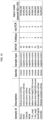
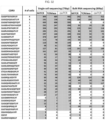
- FIG. 2 illustrates an example TCR sequence library of known TCR sequences and corresponding treatment responses to one or more treatments.
- TCR Sequence 1 through TCR Sequence 10 have clonal expansion values of 3 or more in response to treatment by a combination of aGITR and aPD1.
- a clonal expansion value represents a number of occurrences of a specific TCR sequence among multiple cells, indicating the number of times a cell has been cloned.
- TCR Sequence 11 through TCR Sequence 17 have clonal expansion values of 3 or more in response to treatment by aPD1 alone.
- TCR Sequence 18 through TCR Sequence 20 have clonal expansion values of 3 or more in response to treatment by aGITR alone.
- the identified TCR sequences can be compared to a TCR library as shown in FIG. 2 and matches determined.
- the number of matches can be indicative of potential response to a particular treatment.
- a summation of the clonal expansion values associated for matches on a per treatment basis can be used to determine which treatment is associated with a higher cumulative clonal expansion value for a subject.
- patient sequence data having TCR Sequence 1, TCR Sequence 2, TCR Sequence 13, TCR Sequence 14, TCR Sequence 15, and TCR Sequence 16 would have a cumulative clonal expansion value of 14 for aGITR and aPD1 in combination and a cumulative clonal expansion value of 16 for aPD1 alone.
- the subject is more likely to respond to aPD1 alone.
- FIG. 3 is a graphical illustration of the results contained in FIG. 2 .
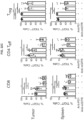
- FIG. 3 is a bar chart indicating that the percentage of expanded clones for aGITR and aPD1 in combination is 31.9% 11 days after treatment, the percentage of expanded clones for aPD1 alone is 26.7% 11 days after treatment (4.8% 8 days after treatment), and the percentage of expanded clones for aGITR alone is 20.3% 11 days after treatment.
- the results of FIG. 2 and the chart of FIG. 3 can be based off of data obtained after administering the one or more treatments to one or more subjects.
- the method 100 can further comprise administering one or more treatments to the subject.
- the method 100 can further comprise generating a TCR sequence library of TCR sequences and corresponding clonal expansion associated with the one or more treatments.
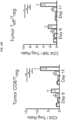
- FIG. 3 shows the significance of the number of clonally expanded T cells identified in combination treatment of tumor-bearing mice compared to single (mono-) therapy administering either anti-PD1 (aPD1) or anti-GITR (aGITR). Both anti-PD1 (aPD1) and anti-GITR (aGITR) treatments are significantly increased with respect to the percentage of expanded clones compared to tumors from mice treated wtih isotype control.
- FIG. 4 illustrates an exemplary output of one implementation of the method 100 of FIG. 1 .
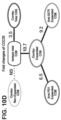
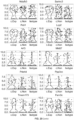
- FIG. 4 shows T cell lineage after clonal expansion.
- treatment types e.g., aGITR and aPD1 in combination, aPD1 alone, aGITR alone
- clonal expansion occurs across various cell subtypes, such as Naive, T cell memory (Tcm), T cell effector memory (Tem), T cell effector (Teff), and the like.
- FIG. 4 indicates sequences associated with specific treatments along with counts (e.g., clonal expansion values), and includes an indication of cell subtypes associated with the clonal expansion values.
- FIG. 4 depicts the profile of T cells in each set of clones.
- Each T cell clone identified by the TCR CDR3 sequence expressed was also characterized (e.g., classified by cell surface markers) as a) a effector memory cell (Tem) (Cd62L-Cd44+Gzmb+), b) an effector T cell (Teff) (Cd62L-Cd44-Gzmb+), c) a na ⁇ ve T cell (Cd62L+Cd44-Gzmb-), or d) a central memory T cell (Tcm) (Cd62L+Cd44+Gzmb-), or an otherwise unclassified cell (blank oval).
- obtaining first sequence data comprising single cell raw reads from a first cell of a subject uses a bioinformatics tool to map the first sequence data to a second sequence data comprising a plurality of non-T cell receptor transcripts to identify one or more unmapped reads in the first sequence data, and determining one or more TCR sequences from the unmapped reads.
- obtaining first sequence data comprising single cell raw reads from a first cell of a subject comprises performing random primer RNA sequencing on transcripts obtained from the first cell.
- the random primers can be 4-40 nucleotides in length.
- the random primers can be 4, 5, 6, 7, 8, 9, 10, 11, 12, 13, 14, 15, 16, 17, 18, 19 or 20 nucleotides in length.
- the subject prior to obtaining a first sequence data, the subject is administered an immunotherapy.
- the immunotherapy can be a monotherapy or a combination therapy.
- the immunotherapy can be the combination of a costimulatory agonist and a coinhibitory antagonist.
- the vector can be a viral vector or plasmid.
- viral vectors can be but are not limited to lentiviral vectors, adenoviral vectors, and adeno-associated viral vectors.
- the CDR3 sequence is a nucleic acid sequence that encodes CASSRNTEVFF (SEQ ID NO:269), CASSIGNTEVFF (SEQ ID NO:270), CASSQPGKNTEVFF (SEQ ID NO:271), CASSLGQGNNSPLYF (SEQ ID NO:272), CASSQGQGGAETLYF (SEQ ID NO:273), CASSPPMGGQLYF (SEQ ID NO:274), CASSQEGANTEVFF (SEQ ID NO:275), CASSQVQGTGNTLYF (SEQ ID NO:276), CASSQEGDGYEQYF (SEQ ID NO:277), CTSAEGGGTEVFF (SEQ ID NO:278), CASSPPGGGTEVGG (SEQ ID NO:279), CASSGTDNQDTQYF (SEQ ID NO:280), CASSPGTGGYEQYF (SEQ ID NO:281), CASSLELGFYEQYF (SEQ ID NO:
- TCR sequences with similar binding specificities can be clustered as disclosed in Gupta N.T., et al.
- Hierarchical clustering can identify B cell clones with high confidence in Ig repertoire sequencing data. J. Immunol. 198(6), 2489-2499 (2017 ).
- CDR3 regions of the TCR sequences can be clustered using single-linkage hierarchical clustering; distance between two CDR3 sequences can be defined as the absolute number of nucleotide differences between the two sequences and a threshold that, in an aspect, can be inferred from the sequence dataset as disclosed in the aforementioned reference.
- Also disclosed are recombinant cells comprising a vector comprising a nucleic acid sequence that encodes the sequence of any one of SEQ ID NOs:269-289.
- the CDR3 sequence is derived from a different cell type, cell line, or different species than the recombinant cell comprising the CDR3 sequence.
- the CDR3 sequence can be from a primary human T cell and the cell comprising the CDR3 sequence can be a T cell line derived from any other T cell than the cell from which the CDR3 sequence was derived.
- the CDR3 sequence can be from a human cell and the cell comprising the CDR3 sequence can be a non-human cell.
- the recombinant cells comprise a CDR3 sequence comprising the sequence of CASSRNTEVFF (SEQ ID NO:269), CASSIGNTEVFF (SEQ ID NO:270), CASSQPGKNTEVFF (SEQ ID NO:271), CASSLGQGNNSPLYF (SEQ ID NO:272), CASSQGQGGAETLYF (SEQ ID NO:273), CASSPPMGGQLYF (SEQ ID NO:274), CASSQEGANTEVFF (SEQ ID NO:275), CASSQVQGTGNTLYF (SEQ ID NO:276), CASSQEGDGYEQYF (SEQ ID NO:277), CTSAEGGGTEVFF (SEQ ID NO:278), CASSPPGGGTEVGG (SEQ ID NO:279), CASSGTDNQDTQYF (SEQ ID NO:280), CASSPGTGGYEQYF (SEQ ID NO:281), CASSLELGFYEQYF (SEQ ID NO:
- the disclosed methods for identifying TCR sequences from random priming RNA sequencing can be used to identify B cell receptors (BCRs) as well.
- the steps of the pipeline are nearly identical except for the following steps: 1) the negative selection step wherein identifying BCRs involves alignment of short reads to a second reference dataset comprising a plurality of species-specific non-B cell receptor RNA transcripts; 2) the assembly step wherein identifying BCRs involves assembly of the one or more unmapped short reads into one or more long reads for further processing can comprise aligning the one or more unmapped short reads to one or more BCR sequences from a reference database of BCR sequences and assembling the one or more unmapped short reads into long reads (candidate BCR sequences) based on the reference database of BCR sequences; 3) the alignment step wherein identifying BCRs involves alignment of candidate BCR sequences to a reference of BCR V and J genes along with identification of the BCR CDR3 region.
- generating one or more BCR sequences from the one or more long reads can comprise one or more techniques disclosed in Alamyar, E., et al. IMGT tools for the nucleotide analysis of immunoglobulin (IG) and t cell receptor (TR) V-(D)-J repertoires, polymorphisms, and IG mutations: IMGT/V-QUEST and IMGT/HighV-QUEST for NGS. Methods in Mol. Biol. 882, 569-604 (2012 ).
- FIG. 8 is a block diagram illustrating an exemplary operating environment for performing the disclosed methods.
- This exemplary operating environment is only an example of an operating environment and is not intended to suggest any limitation as to the scope of use or functionality of operating environment architecture. Neither should the operating environment be interpreted as having any dependency or requirement relating to any one or combination of components illustrated in the exemplary operating environment.
- the present methods and systems can be operational with numerous other general purpose or special purpose computing system environments or configurations.
- Examples of well-known computing systems, environments, and/or configurations that can be suitable for use with the systems and methods comprise, but are not limited to, personal computers, server computers, laptop devices, and multiprocessor systems. Additional examples comprise set top boxes, programmable consumer electronics, network PCs, minicomputers, mainframe computers, distributed computing environments that comprise any of the above systems or devices, and the like.
- the processing of the disclosed methods and systems can be performed by software components.
- the disclosed systems and methods can be described in the general context of computer-executable instructions, such as program modules, being executed by one or more computers or other devices.
- program modules comprise computer code, routines, programs, objects, components, data structures, etc. that perform particular tasks or implement particular abstract data types.
- the disclosed methods can also be practiced in grid-based and distributed computing environments where tasks are performed by remote processing devices that are linked through a communications network.
- program modules can be located in both local and remote computer storage media including memory storage devices.
- the components of the computer 801 can comprise, but are not limited to, one or more processors 803, a system memory 812, and a system bus 813 that couples various system components including the one or more processors 803 to the system memory 812.
- the system can utilize parallel processing. Parallel processing can be leveraged to perform the disclosed methods. For example, performance of at least a portion of one or more steps of the disclosed methods can be classified as a job. For example, the disclosed methods can be performed for a plurality of samples in parallel. The workload for each job can then be distributed across several processors.
- a software application can be used to design and run jobs to process data.
- a job can, for example, extracts data from one or more data sources, transform the data, and load it into one or more new locations (e.g., stage the data for processing in another job).
- the workload for each job can be distributed across several processors on one or more computers, called compute nodes.
- the user can modify a configuration file or otherwise interface with software configured to define multiple processing nodes. These nodes work concurrently to complete each job quickly and efficiently.
- a conductor node computer can orchestrate the work.
- Parallel processing environments can be categorized as symmetric multiprocessing (SMP) or massively parallel processing (MPP) systems. In a symmetric multiprocessing (SMP) environment, multiple processors share other hardware resources.
- SMP symmetric multiprocessing
- MPP massively parallel processing
- processors can share the same memory and disk space, but use a single operating system.
- the workload for a parallel job is then distributed across the processors in the system.
- the actual speed at which the job completes might be limited by the shared resources in the system.
- MPP massively parallel processing
- many computers can be physically housed in the same chassis.
- An MPP system can be physically dispersed.
- performance is improved because no resources must be shared among physical computers.
- computers, along with associated memory and disk resources can be added.
- a file system is commonly shared across the network. In this configuration, program files can be shared instead of installed on individual nodes in the system.
- the system bus 813 represents one or more of several possible types of bus structures, including a memory bus or memory controller, a peripheral bus, an accelerated graphics port, or local bus using any of a variety of bus architectures.
- bus architectures can comprise an Industry Standard Architecture (ISA) bus, a Micro Channel Architecture (MCA) bus, an Enhanced ISA (EISA) bus, a Video Electronics Standards Association (VESA) local bus, an Accelerated Graphics Port (AGP) bus, and a Peripheral Component Interconnects (PCI), a PCI-Express bus, a Personal Computer Memory Card Industry Association (PCMCIA), Universal Serial Bus (USB) and the like.
- ISA Industry Standard Architecture
- MCA Micro Channel Architecture
- EISA Enhanced ISA
- VESA Video Electronics Standards Association
- AGP Accelerated Graphics Port
- PCI Peripheral Component Interconnects
- PCI-Express PCI-Express
- PCMCIA Personal Computer Memory Card Industry Association
- USB Universal Serial Bus
- the bus 813, and all buses specified in this description can also be implemented over a wired or wireless network connection and each of the subsystems, including the one or more processors 803, a mass storage device 804, an operating system 805, T cell pipeline software 806, T cell pipeline data 807, a network adapter 808, the system memory 812, an Input/Output Interface 810, a display adapter 809, a display device 811, and a human machine interface 802, can be contained within one or more remote computing devices 814a,b,c at physically separate locations, connected through buses of this form, in effect implementing a fully distributed system.
- the computer 801 typically comprises a variety of computer readable media. Exemplary readable media can be any available media that is accessible by the computer 801 and comprises, for example and not meant to be limiting, both volatile and non-volatile media, removable and non-removable media.
- the system memory 812 comprises computer readable media in the form of volatile memory, such as random access memory (RAM), and/or non-volatile memory, such as read only memory (ROM).
- RAM random access memory
- ROM read only memory
- the system memory 812 typically contains data such as the T cell pipeline data 807 and/or program modules such as the operating system 805 and the T cell pipeline software 806 that are immediately accessible to and/or are presently operated on by the one or more processors 803.
- the computer 801 can also comprise other removable/non-removable, volatile/non-volatile computer storage media.
- FIG. 8 illustrates the mass storage device 804 which can provide non-volatile storage of computer code, computer readable instructions, data structures, program modules, and other data for the computer 801.
- the mass storage device 804 can be a hard disk, a removable magnetic disk, a removable optical disk, magnetic cassettes or other magnetic storage devices, flash memory cards, CD-ROM, digital versatile disks (DVD) or other optical storage, random access memories (RAM), read only memories (ROM), electrically erasable programmable read-only memory (EEPROM), and the like.
- any number of program modules can be stored on the mass storage device 804, including by way of example, the operating system 805 and the T cell pipeline software 806.
- Each of the operating system 805 and the T cell pipeline software 806 (or some combination thereof) can comprise elements of the programming and the T cell pipeline software 806.
- the T cell pipeline data 807 can also be stored on the mass storage device 804.
- the T cell pipeline data 807 can be stored in any of one or more databases known in the art. Examples of such databases comprise, DB2 ® , Microsoft ® Access, Microsoft ® SQL Server, Oracle ® , mySQL, PostgreSQL, and the like.
- the databases can be centralized or distributed across multiple systems.
- the user can enter commands and information into the computer 801 via an input device (not shown).
- input devices comprise, but are not limited to, a keyboard, pointing device (e.g ., a "mouse"), a microphone, a joystick, a scanner, tactile input devices such as gloves, and other body coverings, and the like
- pointing device e.g ., a "mouse”
- tactile input devices such as gloves, and other body coverings, and the like
- These and other input devices can be connected to the one or more processors 803 via the human machine interface 802 that is coupled to the system bus 813, but can be connected by other interface and bus structures, such as a parallel port, game port, an IEEE 1394 Port (also known as a Firewire port), a serial port, or a universal serial bus (USB).
- a parallel port e.g a "mouse”
- game port e.g., a "mouse”
- IEEE 1394 Port also known as a Firewire
- the display device 811 can also be connected to the system bus 813 via an interface, such as the display adapter 809. It is contemplated that the computer 801 can have more than one display adapter 809 and the computer 801 can have more than one display device 811.
- the display device 811 can be a monitor, an LCD (Liquid Crystal Display), or a projector.
- other output peripheral devices can comprise components such as speakers (not shown) and a printer (not shown) which can be connected to the computer 801 via the Input/Output Interface 810. Any step and/or result of the methods can be output in any form to an output device. Such output can be any form of visual representation, including, but not limited to, textual, graphical, animation, audio, tactile, and the like.
- the display device 811 and computer 801 can be part of one device, or separate devices.
- the computer 801 can operate in a networked environment using logical connections to one or more remote computing devices 814a,b,c.
- a remote computing device can be a personal computer, portable computer, smartphone, a server, a router, a network computer, a peer device or other common network node, and so on.
- Logical connections between the computer 801 and a remote computing device 814a,b,c can be made via a network 815, such as a local area network (LAN) and/or a general wide area network (WAN).
- LAN local area network
- WAN general wide area network
- the network adapter 808 can be implemented in both wired and wireless environments. Such networking environments are conventional and commonplace in dwellings, offices, enterprise-wide computer networks, intranets, and the Internet.
- T cell pipeline software 806 can be stored on or transmitted across some form of computer readable media. Any of the disclosed methods can be performed by computer readable instructions embodied on computer readable media.
- Computer readable media can be any available media that can be accessed by a computer.
- Computer readable media can comprise “computer storage media” and “communications media.”
- “Computer storage media” comprise volatile and non-volatile, removable and non-removable media implemented in any methods or technology for storage of information such as computer readable instructions, data structures, program modules, or other data.
- Exemplary computer storage media comprises, but is not limited to, RAM, ROM, EEPROM, flash memory or other memory technology, CD-ROM, digital versatile disks (DVD) or other optical storage, magnetic cassettes, magnetic tape, magnetic disk storage or other magnetic storage devices, or any other medium which can be used to store the desired information and which can be accessed by a computer.
- the methods and systems can employ Artificial Intelligence techniques such as machine learning and iterative learning.
- Artificial Intelligence techniques such as machine learning and iterative learning. Examples of such techniques include, but are not limited to, expert systems, case based reasoning, Bayesian networks, behavior based AI, neural networks, fuzzy systems, evolutionary computation (e.g. genetic algorithms), swarm intelligence (e.g. ant algorithms), and hybrid intelligent systems (e.g. Expert inference rules generated through a neural network or production rules from statistical learning).
- mice 3 ⁇ 10 5 or 5 ⁇ 10 5 MC38 cells were subcutaneously injected on the right flank of C57BL/6 or humanized GITR/GITRL double knock-in mice, respectively (day 0).
- mice On day 6 after tumor implantation, mice were grouped based on tumor size and treated by intraperitoneal injection with 5 mg kg-1 anti-GITR (DTA1) and/or anti-PD-1 (RPM1-14) Ab or isotype control IgGs (rat IgG2b, LTF-2 and rat IgG2a, 2A3) at indicated doses (Abs obtained from Bio X Cell). Antibodies were administrated again on day 13.
- DTA1 5 mg kg-1 anti-GITR
- RPM1-14 anti-PD-1
- IgGs rat IgG2b, LTF-2 and rat IgG2a, 2A3
- mice treated with combination of anti-PD-1 (aPD-1) and anti-GITR (aGITR) Ab mice remained tumor-free for over 80 days. These mice were re-challenged with 3 ⁇ 10 5 of MC38 and 2.5 ⁇ 10 5 B16F10.9 cells bilaterally. Naive mice were used as tumor implantation control.
- mice treated with either combination therapy or isotype control IgG were treated with 300 ⁇ g depleting mAbs, including anti-CD4, clone GK1.5; anti-CD8 clone 2.43 and rat IgG2b isotype (BioX Cell) and anti-CD25, clone PC61 (eBioscience); rat IgG1 isotype (HPRN, Bio X Cell) Depletion Ab were given at one day prior of tumor challenge (day -1) and twice weekly for total eight doses. The depletion efficiency was confirmed by FACS analysis of peripheral blood samples. Perpendicular tumor diameters were measured blindly 2-3 times per weeks using digital calipers (VWR, Radnor, PA).
- LIVE/DEAD staining solution (Thermo Fisher) was prepared by adding 2.5 ⁇ L ethidium homodimer-1 and 0.625 ⁇ L calcein AM (Life Technologies) to 1.25 mL C1 Cell Wash Buffer (Fluidigm) and 20 ⁇ L was loaded onto the C1 IFC. Each capture site was carefully examined under a Zeiss microscope in bright field, green fluorescent protein (GFP), and Texas Red channels for cell doublets and viability. Cell lysing, reverse transcription, and cDNA amplification were performed on the C1 Single-Cell Auto Prep IFC, as specified by the manufacturer (protocol 100-7168 E1). The SMARTer Ultra Low RNA Kit (Clontech) was used for cDNA synthesis from the single cells.
- Illumina NGS libraries were constructed using the Nextera XT DNA Sample Prep kit (Illumina), according to the manufacturer's recommendations (protocol 100-7168 E1). A total of 2,222 single cells were sequenced on Illumina NextSeq (Illumina) by multiplexed single-read run with 75 cycles. Table 8: Summary of Captured T cells.
- Raw sequence data (BCL files) from each of these cells were converted to FASTQ format via Illumina Casava 1.8.2. Reads were decoded based on their barcodes. Read quality was evaluated using FastQC (www.bioinformatics.babraham.ac.uk/projects/fastqc/).
- the disclosed methods including random-priming short-read TCR (rpsTCR) analysis, for reconstructing and extracting TCR sequences, especially TCR-CDR3 sequences from random priming short RNA sequencing reads was used. (See FIG. 1 ).
- the rpsTCR method provided paired- and single-end short reads and mapped these reads to mouse or human genomes and transcriptomes, but not to TCR gene loci and transcripts, using TopHat43 with default parameters. Thus negative selection allows for mapped reads to be discarded and unmapped reads were recycled for extraction of TCR sequences. Low quality nucleotides in the unmapped reads were trimmed (i.e., reads with length less than 35bp were filtered out using HTQC toolkit). QC passed short reads were assembled into longer reads using iSSAKE default setting. TCRklass was used to identify CDR3 sequences with Scr (conserved residue support score) set from default 1.7 to 2.
- the disclosed methods were utilized to reconstruct, extract and analyze TCR sequences using single cell sorted RNAseq data, allowing the identification of high-frequency T cell clones potentially associated with tumor reactivity and patient survival.
- the pipeline was used to profile the transcriptome of 1379 CD8 + T cells isolated from tumor-bearing mice. At the early time point (day 8), very few clones of high-frequency T cells (defined as at least 3 T cells sharing identical TCR sequences) were detected in all treatment groups ( FIG. 2 ).
- anti-PD-1 pembrolizumab
- T cell activation assay for tumor derived TCRs T cell activation assay for tumor derived TCRs.
- T cell activation assays measured by Luciferase expression in JRT3 cell lines expressing isolated TCRs comprising identified CDR3 sequences ( FIGs. 6A-6D ).
- TCR comprising CDR3 sequence isolated from an anti-GITR treated tumor T cell that was highly expanded (i.e., 10 clones identified) was expressed in a JRT3 cell line.
- the JRT3 becomes activated in the presence of tumor expressing the original antigen, MC38 ( FIG. 6A ), indicating that the transfected cell line recognizes the antigen.
- TCR Sequence Seq.17-expressing cell lines also become activated when anti-CD3/anti-CD28 stimulated ( FIG. 6B ).
- TCR Sequence Seq.12-expressing cell lines Analogous studies using TCR Sequence Seq.12-expressing cell lines (TCR CDR3 sequence was isolated from a aPD-1 stimulated T cell having a Clone size of 8). The TCR Sequence Seq.12-expressing cell line was activated in the presence of tumor expressing the original antigen ( FIG. 6C ) and was activated in the presence of anti-CD3/anti-CD28 ( FIG. 6D ).
- clonal T cells were classified as effector memory cells (Tem) (Cd62L-Cd44+Gzmb+), effector T cells (Teff) (Cd62L-Cd44-Gzmb+) (or unclassified cells, i.e.
- T cells having the expressed TCR such as naive T cells (Cd62L+Cd44-Gzmb-) or central memory T cells (Tcm) (Cd62L+Cd44+Gzmb-)).
- FIG. 5 is a Venn diagram illustrating genes preferably expressed in expanded intratumoral CD8+ T cells of aGITR+aPD1 treatment group on day 11 of treatment.
- the Venn diagram summarizes the gene signature analysis of clonal expanded/non-expanded CD8+ T cells among treatment groups.
- CD226 and PDE4D were identified as two genes shared across different comparison pairs.
- FIG. 5 indicates that two genes are preferably expressed when comparing genes expressed under treatment with aGITR and aPD1 in combination to all other treatments.
- the two genes are CD226 and Pde4d.
- the table underneath the Venn diagram provides the occurrences of each gene when comparing genes expressed under treatment with aGITR and aPD1 in combination to all other treatments.
- the disclosed method can be used to identify specific genes that play a role in immune response to tumor cells.
- CD226 is a costimulatory molecule that plays an important role in anti-tumor response.
- Expression analysis in different subsets of intratumoral CD8 + T cells (total, clonal expanded, or non-expanded) across treatment groups revealed that CD226 mRNA levels were significantly increased by combination treatment on clonal expanded T cells ( FIG. 7A ), while this difference was diluted in total and non-expanded CD8 + T cells. This observation stresses the importance of performing genome profiling on putative tumor-reactive clones (high-frequency T cell clones) to unmask critical gene changes, and also allows for identification of biomarkers that are informative about efficacious treatments that affect T cell activity.
- FIG. 7A illustrates cumulative distribution function (CDF) plots showing expression of a key regulated gene, CD226, in total, clonal expanded or non-expanded CD8 T cells.
- the clonal expanded CD8 cells show the highest expression of CD226.
- the disclosed method is useful to classify subjects that show better correlation with or expression of particular genes. These data also show the utility of the method to identify prognostic genes that inform whether expression is correlated with T cell expansion during a particular treatment, and therefore indicates likelihood of efficacy.
- CD226 significantly correlates with improved survival when analyzed from the T cells of patients with melanoma, lung squamous cell carcinoma and sarcoma ( FIG. 7B).
- FIG. 7B illustrates cumulative distribution function
- FIG. 7B illustrates TCGA data analysis of CD226 expression level and overall survival in patients with melanoma, lung squamous cell carcinoma and sarcoma.
- CD226 correlates with improved survival.
- CD226/TIGIT axis mediates durable anti-tumor responses upon PD-1 and GITR combination immunotherapy
- RNA-seq libraries prepared from over 2,000 tumor infiltrating CD8 + T cells were sequenced and found that the combination of GITR and PD-1 antibodies synergistically enhanced CD8 + T cell effector function by restoring the balance of key homeostatic regulators CD226 and TIGIT, resulting in significant survival benefit.
- anti-PD-1 treatment enhanced CD226 cell surface expression.
- PD-1 monotherapy was insufficient to overcome the inhibitory signaling mediated by TIGIT.
- Anti-GITR antibody decreased TIGIT expression on T cells.
- CD226 costimulation via CD226 is essential for anti-tumor immunity as genetic inactivation or pharmacological inhibition of CD226 reversed the tumor regression mediated by combination treatment, while inhibition of other TNF-receptor or B7 superfamily members had no effect.
- Systematic approaches unmasking the molecular pathways driving durable anti-tumor responses by rebalancing homeostatic regulators can be important to optimize combination immunotherapy.
- GITR is constitutively expressed at a high level on T reg cells and can be induced on other lymphocytes upon activation.
- DTA-1 an agonistic anti-mouse GITR Ab reduces intratumoral T reg cells and mediates Fc ⁇ R-dependent tumor rejection. Additionally, engaging GITR receptor with an agonistic Ab delivers costimulatory signals directly to effector T cells. While anti-GITR and anti-PD-1 Ab monotherapy has limited efficacy in large or poorly immunogenic tumors, combination therapy promotes long-term survival in ovarian and breast tumor models. However, the molecular mechanism underlying the synergism remains unknown.
- PD1 and GITR combination therapy was used and over 2000 tumor infiltrating CD8 + T cells in a murine MC38 colon adenocarcinoma model were genetically profiled.
- the systematic approach unmasked the molecular pathways driving durable anti-tumor responses, providing a basis by which to optimize existing combination immunotherapies, and identify new potential biomarkers to improve patient stratification and tumor sensitivity.
- MC38 mouse colon carcinoma cells and RENCA mouse renal adenocarcinoma cells were obtained from American Type Culture Collection (ATCC) and were cultured at 37°C, 5% CO 2 in DMEM media supplied with 10% FBS, 100U mL -1 penicillin and 100 ⁇ g ml -1 streptomycin, 2 mM L -glutamine, 100 ⁇ M NEAA (ThermoFisher Scientific).
- MC38- OVA- ⁇ 2 m-K b were generated by transducing MC38 tumor cells with lentiviral vector (LV) encoding a single trimer consisting of SIINFEKL peptide-spacer- ⁇ 2 microglobulin-spacer MHC class I (K b ) heavy chain. Surface expression of single trimer was confirmed with 25D-1.16 Ab (eBioscience, FIG. 21A ) .
- MC38- OVA- ⁇ 2 m-K b were maintained with selection media containing 1.25 ⁇ g ml -1 puromycin (ThermoFisher Scientific).
- MC38 tumor cells over-expressing CD155 were generated by transduction with LV encoding mouse full length CD155 and FACS sorted on the top 5% expressing cells. Expression level of CD155 was confirmed by FACS analysis ( FIG. 24C ).
- mice Six to eight week old female C57BL/6 mice were obtained from The Jackson Laboratory. CD226 -/- and TIGIT -/- mice in C57BL/6 background were generated at Regeneron using the VelociGene ® method. Briefly, EGFP (for CD226) or LacZ cDNA (for TIGIT) was inserted in-frame to the start codon, followed by a selection cassette which disrupts transcription of the gene body and results in a CD226 or TIGIT null allele. Heterozygous targeted mice were interbred to produce homozygous knockout mice for study. All animals were maintained under pathogen-free conditions and experiments were performed according to protocols approved by the Institute of Animal Care and Use Committee (IACUC) of Regeneron Pharmaceuticals, Inc.
- IACUC Institute of Animal Care and Use Committee
- mice In vivo mouse studies. For MC38 tumor studies, 3 ⁇ 10 5 MC38 cells were subcutaneously injected on the right flank of age-matched C57BL/6 mice (day 0). On day 6 after tumor implantation, mice (randomly distributed in different groups) were grouped based on tumor size and treated by intraperitoneal injection with 5 mg kg -1 anti-GITR (DTA1) and/or anti-PD-1 (RPM1-14) Ab or isotype control IgGs (rat IgG2b, LTF-2 and rat IgG2a, 2A3) at indicated doses (antibodies were obtained from Bio X Cell). Antibodies were administered again on day 13.
- DTA1 anti-GITR DTA1
- RPM1-14 anti-PD-1
- IgGs rat IgG2b, LTF-2 and rat IgG2a, 2A3
- mice treated with either combination therapy or isotype control IgG were treated with 300 ⁇ g depleting or isotype control mAbs, including anti-CD4 (clone GK1.5); anti-CD8 (clone 2.43) and rat IgG2b isotype (clone LTF-2), rat IgG1 isotype (clone HPRN, Bio X Cell) and anti-CD25 (clone PC61, eBioscience).
- Depletion Ab were given at one day prior of tumor challenge (day -1) and twice weekly for total eight doses. The depletion efficiency was confirmed by FACS analysis of peripheral blood samples ( FIG. 16C ).
- Blocking antibodies used in this study include anti-CD226 Ab (clone 10E5, rat IgG2b, eBioscience, 25 mg/kg), CD28 blocking (CTLA4-Fc, Orencia, BMS, 10 mg/kg), anti-OX40L (clone RM134L, rat IgG2b, Bio X Cell, 10 mg/kg) and anti-4-1BBL (clone TKS-1, rat IgG2a, Bio X Cell, 10 mg/kg).
- Blocking Ab were given twice weekly by i.p. injection starting 1-2 days prior to immunotherapy, for two weeks. Perpendicular tumor diameters were measured blindly 2-3 times per weeks using digital calipers (VWR, Radnor, PA).
- Flow cytometry For flow cytometry analysis of in vivo experiments, blood, spleen, thymus, lymph node and tumor were harvested on indicated days post treatment. Single cell suspensions were prepared and red blood cells were lysed using ACK Lysis buffer (ThermoFisher Scientific). Live/dead cell discrimination was performed using Live/dead fixable blue dead cell staining kit (ThermoFisher Scientific). Cells were first stained with Abs for surface markers for 20-30 min at 4°C. Intracellular staining was done using a fixation/permeabilization kit (eBioscience).
- RNA-seq analysis Single-cell sorting RNA-seq analysis.
- single cell suspensions of tumor were prepared using a mouse tumor dissociation kit (Miltenyi Biotec) and spleens were dissociated with gentle MACS Octo Dissociator. Tumors and spleens from the same treatment group were pooled and viable CD8 + T cells were sorted by FACS. FACS sorted T cells were mixed with C1 Cell Suspension Reagent (Fluidigm) before loading onto a 5- to 10- ⁇ m C1 Integrated Fluidic Circuit (IFC; Fluidigm).
- C1 Cell Suspension Reagent Fluidigm
- IFC Integrated Fluidic Circuit
- LIVE/DEAD staining solution was prepared by adding 2.5 ⁇ L ethidium homodimer-1 and 0.625 ⁇ L calcein AM (Life Technologies) to 1.25 mL C1 Cell Wash Buffer (Fluidigm) and 20 ⁇ L was loaded onto the C1 IFC. Each capture site was carefully examined under a Zeiss microscope in bright field, GFP, and Texas Red channels for cell doublets and viability. Cell lysing, reverse transcription, and cDNA amplification were performed on the C1 Single-Cell Auto Prep IFC, as specified by the manufacturer (protocol 100-7168 El). The SMARTer Ultra Low RNA Kit (Clontech) was used for cDNA synthesis from the single cells.
- Illumina NGS libraries were constructed using the Nextera XT DNA Sample Prep kit (Illumina), according to the manufacturer's recommendations (protocol 100-7168 E1). A total of 2,222 single cells were sequenced on Illumina NextSeq (Illumina) by multiplexed single-read run with 75 cycles. Raw sequence data (BCL files) were converted to FASTQ format via Illumina Casava 1.8.2. Reads were decoded based on their barcodes. Read quality was evaluated using FastQC (bioinformatics. babraham.ac.uk/projects/fastqc/).
- LUVs Large Unilamellar Vesicles
- Phospholipids 79.7% POPC + 10% POPS + 10% DGS-NTA-Ni + 0.3% Rhodamine-PE
- 1x Reaction buffer 50 mM HEPES-NaOH, pH 7.5, 150 mM NaCl, 10 mM MgCl2, 1 mM TCEP.
- LUVs were prepared by extrusion 20 times through a pair of polycarbonate filters with a pore size of 200 nm, as described previously.
- Proteins were transferred to nitrocellulose membranes using iBlotTM Dry Blotting system (ThermoFisher Scientific). The membranes were blocked with 5%BSA in Tris-buffered saline (pH 7.4) with 0.1% Tween-20, incubated with desired phosphotyrosine specific antibodies, and detected with HRP based enhanced chemiluminescence.
- anti-pY142-CD3 ⁇ (BD Biosciences #558402)
- anti-pY20 (Santa Cruz Biotechnology #sc-1624, for detection of tyrosine phosphorylated CD28 in reconstitution assays)
- anti-pY418-Src (BD Biosciences #560095, for detection of pY394-Lck)
- anti-pY505-Lck (Cell Signaling #2751)
- anti-pY315-ZAP70 (Abcam #ab60970)
- anti-pY493-ZAP70 (Cell Signaling #2704).
- Biopsies were homogenized in at least 600uLs RLTPlus, with mercaptoethanol added (Sigma Aldrich), on the Omni Shredder (Omni-Inc) for 1 minute at 22,000 RPM.
- RNA and DNA were extracted using the Qiagen Allprep DNA/RNA Mini Kit (Qiagen) according to the manufactures instructions in the " AllPrep DNA/RNA Mini Handbook" (November 2005) using the protocol on page 26 "Protocol: Simultaneous Purification of Genomic DNA and Total RNA from Animal Tissues .” The optional DNAse digestion outlined in Appendix E was used during RNA extraction.
- RNA-seq strand-specific RNA-seq libraries were prepared from 100 ng total RNA using KAPA stranded mRNA-Seq Kit (KAPA Biosystems) and the libraries with size between 400 to 600 bp were selected using Pippin system (Sage Science). Pair end 2x100 bp sequencing was done using Illumina 2500. RNA-seq reads was QCed and aligned to the reference genome and gene expression was quantitated using Array Studio (Omicsoft).
- RNA signature change in 30 genes after combination treatment was observed, which it was even more significant within the expanded CD8 T cell population ( FIG. 10A and FIG. 20 ).
- a four-way comparison was performed across all groups to identify genes specifically regulated upon combination versus monotherapy treatment ( FIG. 10B ).
- CD226 was identified as one of the two genes shared across different comparison pairs ( FIG. 10B ).
- CD226 is a costimulatory molecule that plays an important role in anti-tumor response.
- Combination and/or monotherapy treatment had no effect on bulk CD226 + tumor infiltrating or splenic CD4 + and T reg cells ( FIG. 22D ).
- Overall single-cell sorted RNA-seq and FACS phenotyping data showed that anti-PD-1 favored the expression of CD226, while anti-GITR treatment downregulated surface expression of TIGIT, synergistically restoring the homeostatic T cell function.
- CD226 blocking mAb Using a CD226 blocking mAb, it was shown that costimulatory signaling through CD226 is required for the anti-tumor immunity mediated by combination treatment ( FIG. 12A ). However, as CD226 Ab could have a potential depleting effect on subset of CD8 T cells, CD226 was genetically inactivated in C57BL/6 background mice to repeat this study ( FIG. 23A , B ). CD226 -/- mice showed no defect on T cell (CD4 + , CD8 + , T regs ) homeostasis ( FIG. 23C-E ) and responded similarly to wild-type mice to TCR activation ( FIG. 23F ).
- mice bearing MC38 tumor cells overexpressing the major ligand for CD226, CD155/PVR showed significant delay of tumor growth upon anti-PD-1 or anti-GITR or combination therapy in comparison to MC38-empty vector (MC38-EV) tumor cells or mice treated with isotype control ( FIG. 24D ).
- Immune profiling analysis of mice transplanted with MC38-CD155 confirmed sustained higher CD155 expression level on MC38-CD155 cells over M38-EV (empty vector) post-implantation ( FIG. 24E ).
- CD155 over-expression on MC38 tumor cells was associated with decreased detectable CD226 expression on CD4 + , CD8 + T and T regs cells, while it boosted T cell activation as indicated by enhanced IFN ⁇ and 4-1BB expression on intra-tumoral T cells ( FIG. 24F , 24G ). As expected, no effect was observed in the periphery.
- RNA-seq analysis was performed on tumor biopsies collected from 43 advanced cancer patients pre- and post-PD-1 targeted treatment ( FIG. 12F ).
- CD226 expression was significantly increased after two doses of anti-hPD-1 treatment in cancer patients ( FIG. 12G ).
- clinical data from The Cancer Genome Atlas (TCGA) was interrogated to examine if CD226 expression level correlates with the overall T cell activation strength and can be predictive of a better prognosis in cancer patients.
- the amino acid sequences of the V and J alleles was extracted from the IMGT database (imgt.org). Next, the CDR3 sequence were aligned with the C-terminal of the V sequence and the N-terminal of the J sequence, to create a contiguous VDJ amino acid sequence. For each V allele, the leader sequence(L) was then identified from IMGT if it is available and appended it to the C-terminal of the VDJ sequence. If the leader sequence was not available, then the most frequent leader sequence was used.
- the LVDJ amino acid sequence was then back-translated to a codon-optimized nucleotide sequence using the EMBOSS Backtranseq tool (ebi.ac.uk/Tools/st/emboss_backtranseq). Finally, the nucleotide sequences of the constant (C) regions of the TCRA/TCRB (derived from IMGT) were appended to the N-terminal of the LVDJ nucleotide sequence, and thus obtained the full LVDJC sequences for cloning.
- EMBOSS Backtranseq tool ebi.ac.uk/Tools/st/emboss_backtranseq
- a bioinformatics pipeline was developed and validated to extract, reconstruct and analyze TCR sequences using random priming RNAseq data generated from sorted single cells allowing the identification of T cell clones potentially associated with tumor reactivity and patient survival.
- a negative TCR sequence selection step was integrated and a short read assembly step in the pipeline.
- the pipeline takes paired or single-end short reads and maps these reads to human or mouse genomes and transcriptomes, but not TCR gene loci and transcripts ( FIG. 17 and Methods).
- the pipeline was applied to a library of 1,379 CD8+ single cell RNA-seq data.
- the detection rates of TCRB-CDR3 (86%), TCRA-CDR3 (78.2%) and paired TCRB and TCRA (73.1%) were comparable to the reported detection rates using targeted TCR sequencing from single T cells ( FIG. 14 ).
- Antibodies were administered 6 days post-tumor challenge when tumors were palpable ( FIG. 9A ).
- the above bioinformatics tool was used to profile the transcriptome of 1379 CD8 + T cells single cell sorted from tumor-bearing mice at day 8 and day 11 post-tumor challenge.
- day 8 very few clones of high-frequency T cells (defined as at least 3 T cells sharing identical TCR sequences) were detected in all treatment groups ( FIG. 9B ).
- the TCRs from high frequency clones (5 cells sharing the same TCR) can recognize epitopes that are presented specifically by wild type MC38 tumor cells but not by irrelevant syngeneic C57BL/6 tumor cell lines (B16F10.9 or TRAMP-C2) ( FIG. 9E showing a representative TCR clone), thus validating their specificity.
- Next-generation sequencing technology has made whole-genome and transcriptome sequencing routine and provided opportunities for detection of whole genome gene expression and extraction of TCR sequences simultaneously.
- the rpsTCR pipeline was developed for assembling and extracting TCR-CDR3 sequences from random priming short RNA sequencing reads to address this problem ( FIG. 17 ).
- the rpsTCR took paired- and single-end short reads and mapped these reads to mouse or human genomes and transcriptomes, but not TCR gene loci and transcripts using Tophat with default parameters. Mapped reads were discarded and unmapped reads were recycled for extraction of TCR sequences. Low quality nucleotides in the unmapped reads were trimmed. Then reads with length less than 35bp were filtered out using HTQC toolkit. QC passed short reads were assembled into longer reads using iSSAKE default setting. TCRklass was used to identify CDR3 sequences with Scr (conserved residue support score) set from default 1.7 to 2.
- a targeted TCR-seq data from a healthy human PBMC samples was used as a positive control to evaluate whether the extra steps introduced to the pipeline result in higher false positive or false negative rates comparing to TCRklass alone.
- Majority of unique CDR3 sequences from TCRB (64,031) or TCRA (51,448) were detected by both rpsTCR and TCRklass.
- the squared correlations between rpsTCR and TCRklass were 0.9999 and 0.9365 for TCRB-CDR3 and TCRA-CDR3, respectively ( FIG. 17 ).
- Six TCR-negative cancer or non-cancer cell lines were used as negative controls.
- rpsTCR did't detected any CDR3 sequences, while TCRklass extracted a few CDR3 sequences from some of these TCR-negative cancer cell lines ( FIG. 13 ).
- a heathy mouse PBMC sample was sequenced using both targeted TCR-seq and random priming RNA-seq approaches (200M, 2x100bp). Although the number of CDR3 sequences assembled from RNA-seq data was much smaller than that from the targeted TCR-seq approach, about 45% of the CDR3 sequences identified from RNA-seq data using rpsTCR were also observed among CDR3 sequences from targeted TCR-seq.
- the 100bp read length was cut into 50bp segments and randomly selected 200M reads.
- the top 10 CDR3 sequences ranked by targeted TCR-seq approach 8 CDR3 sequences were detected by the rpsTCR, while only 3 were detected by TCRklass.
- the rpsTCR pipeline was then applied to extracting CDR3 sequences from the single cell RNA-seq data generated from intratumoral CD8 T cells of MC38 treated with different antibodies.
- the CDR3_beta and CDR3_alpha sequence detection rates were comparable to published data ( FIG. 14 ) using targeted TCR-seq approach to detect TCR sequences from single cell sequencing of T cells.
Landscapes
- Health & Medical Sciences (AREA)
- Life Sciences & Earth Sciences (AREA)
- Chemical & Material Sciences (AREA)
- Proteomics, Peptides & Aminoacids (AREA)
- Engineering & Computer Science (AREA)
- Organic Chemistry (AREA)
- General Health & Medical Sciences (AREA)
- Immunology (AREA)
- Physics & Mathematics (AREA)
- Genetics & Genomics (AREA)
- Bioinformatics & Cheminformatics (AREA)
- Biophysics (AREA)
- Analytical Chemistry (AREA)
- Molecular Biology (AREA)
- Biotechnology (AREA)
- Zoology (AREA)
- Wood Science & Technology (AREA)
- Biochemistry (AREA)
- Medical Informatics (AREA)
- Theoretical Computer Science (AREA)
- Bioinformatics & Computational Biology (AREA)
- Evolutionary Biology (AREA)
- Spectroscopy & Molecular Physics (AREA)
- General Engineering & Computer Science (AREA)
- Microbiology (AREA)
- Pathology (AREA)
- Epidemiology (AREA)
- Public Health (AREA)
- Medicinal Chemistry (AREA)
- Animal Behavior & Ethology (AREA)
- Veterinary Medicine (AREA)
- Cell Biology (AREA)
- Hospice & Palliative Care (AREA)
- Oncology (AREA)
- Developmental Biology & Embryology (AREA)
- Biomedical Technology (AREA)
- Hematology (AREA)
- Virology (AREA)
- Pharmacology & Pharmacy (AREA)
- Bioethics (AREA)
Claims (15)
- Verfahren zur Sequenzierung eines T-Zellen-Rezeptors (TCR), umfassend:a) sequenzieren von kurzen RNA-Sequenzabschnitten aus einer T-Zelle mit weniger als etwa 100 Basenpaaren;b) alignen der kurzen Sequenzabschnitte mit einer Referenzsequenz, wobei die Referenzsequenz keine TCR-Gensequenz enthält, wodurch ein Satz von Sequenzabschnitten erzeugt wird, der kartiere kurze Sequenzabschnitte und nicht kartiere kurze Sequenzabschnitte umfasst;c) verwerfen von kartieren kurzen Sequenzabschnitten aus dem Satz von Sequenzabschnitten;d) zusammenstellen der im Satz von Sequenzabschnitten verbleibenden nicht kartieren kurzen Sequenzabschnitte in einen oder mehrere lange Sequenzabschnitte;e) translatieren des einen oder mehreren langen Sequenzabschnitte in entsprechende Aminosäuresequenzen;f) fraktionieren von TCR V-Region- und TCR J-Region-Aminosäure-Referenzsequenzen in k-Stränge von etwa sechs Aminosäuren, alignen der k-Stränge mit den entsprechenden Aminosäuresequenzen aus Schritt (e), detektieren eines oder mehrerer konservierter TCR CDR3 Reste in den k- Stränge, die auf die entsprechenden Aminosäuresequenzen kartieren, auswerten des detektierten Konservierungsgrades, und auswählen entsprechender Aminosäuresequenzen mit einem Konservierungsgrad über einem Grenzwert für den Konservierungsgrad, und detektieren einer Kandidaten-Aminosäuresequenz der CDR3-Region in den ausgewählten entsprechenden Aminosäuresequenzen;g) identifizieren der Nukleinsäuresequenz der Kandidaten CDR3 Region-Aminosäuresequenzen in den einen oder mehreren langen Sequenzabschnitten;h) alignen der Nukleinsäuresequenz der einen oder mehreren langen Sequenzabschnitte, die der Kandidaten-Nukleinsäuresequenz der CDR3-Region vorgelagert sind, mit einem oder mehreren TCR V-Gen-Referenzsequenzen, auswerten des Übereinstimmungsgrades und identifizieren langer Sequenzabschnitte, die über einem Grenzwert des Übereinstimmungsgrades liegen, als eine Kandidaten-TCR V-Gensequenz umfassend; undi) alignen der Nukleinsäuresequenz der einen oder mehreren langen Sequenzabschnitte, die der Kandidaten-Nukleinsäuresequenz der CDR3-Region nachgelagert sind, mit einem oder mehreren TCR J-Gen-Referenzsequenzen, auswerten des Übereinstimmungsgrades und identifizieren langer Sequenzabschnitte, die über einem Grenzwert des Übereinstimmungsgrades liegen, als eine Kandidaten-TCR J-Gensequenz umfassend; wodurch eine TCR-Sequenz erzeugt wird.
- Verfahren nach Anspruch 1, wobei die kurzen Sequenzabschnitte durch Random priming von RNA erhalten werden.
- Verfahren nach einem der Ansprüche 1 oder 2, wobei die T-Zelle von einem Menschen oder einer Maus erhalten ist und wobei die Referenzsequenz ein menschliches Genom, ein Maus-Genom, ein menschliches Transkriptom oder ein Maus-Transkriptom umfasst.
- Verfahren nach einem der Ansprüche 1 bis 3, wobei verwerfen von kartierten kurzen Sequenzabschnitten aus dem Satz von Sequenzabschnitten darüber hinaus verwerfen von nicht kartierten kurzen Sequenzabschnitten, die kleiner als etwa 35 Basenpaare sind oder geringe Sequenzauflösung besitzen, aus dem Satz von Sequenzabschnitten umfasst.
- Verfahren nach einem der Ansprüche 1 bis 4, wobei zusammenstellen der im Satz von Sequenzabschnitten verbleibenden nicht kartierten kurzen Sequenzabschnitte in einen oder mehrere lange Sequenzabschnitte umfasst:Alignen der einer oder mehreren nicht kartierten kurzen Sequenzabschnitte mit einer oder mehreren TCR-Sequenzen aus einer Referenzdatenbank von TCR-Sequenzen; undzusammenstellen, basierend auf dem Alignment, der einen oder mehreren kurzen Sequenzabschnitte in lange Sequenzabschnitte.
- Verfahren nach einem der Ansprüche 1 bis 5, weiterhin umfassend Anhängen einer TCR C-Region Nukleinsäuresequenz an die TCR-Sequenz.
- Verfahren nach einem der Ansprüche 1 bis 6, weiterhin umfassend, vor dem Sequenzieren von kurzen RNA-Sequenzabschnitte aus der T-Zelle mit weniger als etwa 100 Basenpaaren, verabreichen einer Immunotherapie an ein Individuum, von dem die T-Zelle erhalten wird.
- Verfahren nach Anspruch 7, wobei die Immunotherapie eine Monotherapie oder eine Kombinationstherapie umfasst, und wobei die Kombinationstherapie einen kostimulatorischen Agonisten und einen koinhibitorischen Antagonisten umfasst.
- Verfahren nach einem der Ansprüche 1 bis 8, weiterhin umfassend:Wiederholen der Schritte a-i für eine erste Vielzahl von T-Zellen eines Individuums, wobei die T-Zellen vor dem Verabreichen einer Behandlung gesammelt werden;bestimmen einer Anzahl von Vorkommen einzigartiger TCR-Sequenzen, die in der ersten Vielzahl von T-Zellen vorhanden sind;wiederholen der Schritte a-i für eine zweite Vielzahl von T-Zellen eines Individuums, wobei die T-Zellen nach dem Verabreichen der Behandlung gesammelt werden;bestimmen einer Anzahl von Vorkommen einzigartiger TCR-Sequenzen, die in der zweiten Vielzahl von T-Zellen vorhanden sind; undbestimmen, basierend auf den Anzahlen von Vorkommen einzigartiger TCR-Sequenzen, die in der ersten Vielzahl von T-Zellen und in der zweiten Vielzahl von T-Zellen vorhanden sind, eine oder mehrere einzigartige TCR-Sequenzen, die klonale Expansion erfahren haben.
- Verfahren nach Anspruch 9, weiterhin umfassend Bestimmen einer Signatur der klonalen Expansion von T-Zellen basierend auf der einen oder mehreren einzigartigen TCR-Sequenzen, die klonale Expansion erfahren haben.
- Verfahren nach Anspruch 10, weiterhin umfassend:Abfragen einer Datenbank mit klonalen Expansions-Signaturen von T-Zellen und entsprechendem Ansprechen auf die Behandlung anhand der Expansions-Signaturen von T-Zellen;bestimmen, basierend auf der Abfrage, die Wahrscheinlichkeit des Individuums auf die Behandlung anzusprechen.
- Verfahren nach einem der Ansprüche 10 oder 11, weiterhin umfassend:Bestimmung des Ansprechens des Individuums auf die Behandlung;speichern der Signatur der Expansions-Signatur von T-Zellen in einer Datenbank; undassoziieren des Ansprechens des Individuums auf die Behandlung mit der Signatur der klonalen Expansion von T-Zellen in der Datenbank.
- Verfahren nach einem der Ansprüche 1 bis 12, weiterhin umfassend:Bestimmen, dass die TCR-Sequenz in einem T-Zell-Klon vorhanden ist, der als Reaktion auf eine Behandlung expandiert;produzieren einer oder mehrerer T-Zellen, die die TCR-Sequenz enthalten;verabreichen der einer oder mehreren T-Zellen an ein Individuum; undverabreichen der Behandlung an das Individuum.
- Vorrichtung umfassend:Einen oder mehrere Prozessoren; undein Speicher, umfassend prozessorausführbare Instruktionen, die bei Ausführung durch den einen oder die mehreren Prozessoren die Vorrichtung veranlassen:a) Sequenzdaten zu empfangen, die kurze RNA-Sequenzabschnitte von einer T-Zelle mit weniger als etwa 100 Basenpaaren umfassen;b) die kurzen Sequenzabschnitte mit einer Referenzsequenz zu alignen, wobei die Referenzsequenz keine TCR-Gensequenz enthält, wodurch ein Satz von Sequenzabschnitten erzeugt wird, der kartierte kurze Sequenzabschnitte und nicht kartierte kurze Sequenzabschnitte umfasst;c) kartierte kurze Sequenzabschnitte aus dem Satz von Sequenzabschnitten zu verwerfen;d) die im Satz von Sequenzabschnitten verbleibenden nicht kartierten kurzen Sequenzabschnitte in einen oder mehrere lange Sequenzabschnitte zusammenzustellen;e) die einen oder mehreren langen Sequenzabschnitte in entsprechende Aminosäuresequenzen zu translatieren;f) TCR V-Region- und TCR J-Region-Aminosäure-Referenzsequenzen in k-Strings von etwa sechs Aminosäuren zu fraktionieren, die k-Strings mit den entsprechenden Aminosäuresequenzen aus Schritt (e) zu alignen, einen oder mehrere konservierte TCR CDR3 Reste in den k-Strings zu detektieren, die auf die entsprechenden Aminosäuresequenzen kartieren, den detektierten Konservierungsgrad zu detektieren, und entsprechende Aminosäuresequenzen mit einem Konservierungsgrad über einem Grenzwert für den Konservierungsgrad auszuwählen, und eine Kandidaten-Aminosäuresequenz der CDR3-Region in den ausgewählten entsprechenden Aminosäuresequenzen zu detektieren;g) die Nukleinsäuresequenz der Kandidaten-Aminosäuresequenzen in den einen oder mehreren langen Sequenzabschnitten zu identifizieren;h) die Nukleinsäuresequenz der einen oder mehreren langen Sequenzabschnitte, die der Kandidaten-Nukleinsäuresequenz der CDR3-Region vorgelagert sind, mit einem oder mehreren TCR V-Gen-Referenzsequenzen zu alignen, den Übereinstimmungsgrad zu bestimmen und lange Sequenzabschnitte, die über einem Grenzwert des Übereinstimmungsgrades liegen, als eine Kandidaten-TCR V-Gensequenz umfassend zu identifizieren; undi) die Nukleinsäuresequenz der einen oder mehreren langen Sequenzabschnitte, die der Kandidaten-Nukleinsäuresequenz der CDR3-Region nachgelagert sind, mit einem oder mehreren TCR J-Gen-Referenzsequenzen zu alignen, den Übereinstimmungsgrad zu bestimmen und lange Sequenzabschnitte, die über einem Grenzwert des Übereinstimmungsgrades liegen, als eine Kandidaten-TCR J-Gensequenz umfassend zu identifizieren; wodurch eine TCR-Sequenz erzeugt wird.
- Ein Computer-lesbares Medium, auf dem computerausführbare Befehle verkörpert sind, konfiguriert zur Durchführung eines Verfahrens, umfassend:a) sequenzieren von kurzen RNA-Sequenzabschnitten von einer T-Zelle mit weniger als etwa 100 Basenpaaren;b) alignen der kurzen Sequenzabschnitte mit einer Referenzsequenz, wobei die Referenzsequenz keine TCR-Gensequenz enthält, wodurch ein Satz von Sequenzabschnitten erzeugt wird, der kartierte kurze Sequenzabschnitte und nicht kartierte kurze Sequenzabschnitte umfasst;c) verwerfen von kartierten kurzen Sequenzabschnitten aus dem Satz von Sequenzabschnitten;d) zusammenstellen der im Satz von Sequenzabschnitten verbleibenden nicht kartierten kurzen Sequenzabschnitte in einen oder mehrere lange Sequenzabschnitte;e) translatieren der einen oder mehreren langen Sequenzabschnitte in entsprechende Aminosäuresequenzen;f) fraktionieren von Aminosäure-Referenzsequenzen der TCR V-Region und der TCR J-Region in k-Strings von etwa sechs Aminosäuren, alignen der k-Strings mit den entsprechenden Aminosäuresequenzen aus Schritt (e), detektieren eines oder mehrerer konservierter TCR CDR3 Reste in den k-Strings, die auf die entsprechenden Aminosäuresequenzen kartieren, bestimmen des detektierten Konservierungsgrades, und auswählen entsprechender Aminosäuresequenzen mit einem Konservierungsgrad über einem Grenzwert für den Konservierungsgrad, und detektieren einer Kandidaten-Aminosäuresequenz der CDR3-Region in den ausgewählten entsprechenden Aminosäuresequenzen;g) identifizieren der Nukleinsäuresequenz der Kandidaten-Aminosäuresequenzen in den einen oder mehreren langen Sequenzabschnitten;h) alignen der Nukleinsäuresequenz der einen oder mehreren langen Sequenzabschnitte, die der Kandidaten-Nukleinsäuresequenz der CDR3-Region vorgelagert sind, mit einem oder mehreren TCR V-Gen-Referenzsequenzen, bestimmen des Übereinstimmungsgrades und identifizieren langer Sequenzabschnitte, die über einem Grenzwert des Übereinstimmungsgrades liegen, als eine Kandidaten-TCR V-Gensequenz umfassend; undi) alignen der Nukleinsäuresequenz der einen oder mehreren langen Sequenzabschnitte, die der Kandidaten-Nukleinsäuresequenz der CDR3-Region nachgelagert sind, mit einem oder mehreren TCR J-Gen-Referenzsequenzen, bestimmen des Übereinstimmungsgrades und identifizieren langer Sequenzabschnitte, die über einem Grenzwert des Übereinstimmungsgrades liegen, als eine Kandidaten-TCR J-Gensequenz umfassend; wodurch eine TCR-Sequenz erzeugt wird.
Priority Applications (1)
| Application Number | Priority Date | Filing Date | Title |
|---|---|---|---|
| EP25175045.1A EP4600375A3 (de) | 2016-12-09 | 2017-12-11 | Systeme und verfahren zur sequenzierung von t-zell-rezeptoren und verwendungen davon |
Applications Claiming Priority (3)
| Application Number | Priority Date | Filing Date | Title |
|---|---|---|---|
| US201662432525P | 2016-12-09 | 2016-12-09 | |
| US201762508667P | 2017-05-19 | 2017-05-19 | |
| PCT/US2017/065649 WO2018107178A1 (en) | 2016-12-09 | 2017-12-11 | Systems and methods for sequencing t cell receptors and uses thereof |
Related Child Applications (1)
| Application Number | Title | Priority Date | Filing Date |
|---|---|---|---|
| EP25175045.1A Division EP4600375A3 (de) | 2016-12-09 | 2017-12-11 | Systeme und verfahren zur sequenzierung von t-zell-rezeptoren und verwendungen davon |
Publications (2)
| Publication Number | Publication Date |
|---|---|
| EP3552126A1 EP3552126A1 (de) | 2019-10-16 |
| EP3552126B1 true EP3552126B1 (de) | 2025-05-14 |
Family
ID=60991528
Family Applications (2)
| Application Number | Title | Priority Date | Filing Date |
|---|---|---|---|
| EP17829775.0A Active EP3552126B1 (de) | 2016-12-09 | 2017-12-11 | Systeme und verfahren zur sequenzierung von t-zell-rezeptoren und verwendungen davon |
| EP25175045.1A Pending EP4600375A3 (de) | 2016-12-09 | 2017-12-11 | Systeme und verfahren zur sequenzierung von t-zell-rezeptoren und verwendungen davon |
Family Applications After (1)
| Application Number | Title | Priority Date | Filing Date |
|---|---|---|---|
| EP25175045.1A Pending EP4600375A3 (de) | 2016-12-09 | 2017-12-11 | Systeme und verfahren zur sequenzierung von t-zell-rezeptoren und verwendungen davon |
Country Status (11)
| Country | Link |
|---|---|
| US (2) | US11274342B2 (de) |
| EP (2) | EP3552126B1 (de) |
| JP (1) | JP6871382B2 (de) |
| KR (1) | KR102209364B1 (de) |
| CN (2) | CN118853845A (de) |
| AU (2) | AU2017371498B2 (de) |
| CA (1) | CA3040924A1 (de) |
| FI (1) | FI3552126T3 (de) |
| IL (2) | IL317050A (de) |
| MX (2) | MX2019006734A (de) |
| WO (1) | WO2018107178A1 (de) |
Families Citing this family (18)
| Publication number | Priority date | Publication date | Assignee | Title |
|---|---|---|---|---|
| TWI756187B (zh) * | 2015-10-09 | 2022-03-01 | 美商再生元醫藥公司 | 抗lag3抗體及其用途 |
| CN110650974B (zh) | 2017-02-10 | 2024-04-19 | 瑞泽恩制药公司 | 用于免疫-pet成像的放射性标记的抗-lag3抗体 |
| TWI799432B (zh) * | 2017-07-27 | 2023-04-21 | 美商再生元醫藥公司 | 抗ctla-4抗體及其用途 |
| GB201812650D0 (en) | 2018-08-03 | 2018-09-19 | Autolus Ltd | Molecular assessment of TRBC usage |
| CA3131541A1 (en) * | 2019-02-27 | 2020-09-03 | The Council Of The Queensland Institute Of Medical Research | Cells, compositions and methods for enhancing immune function |
| CN111276252B (zh) * | 2020-01-15 | 2023-03-28 | 北京吉因加科技有限公司 | 一种肿瘤良恶性鉴别模型的构建方法及装置 |
| WO2021178814A1 (en) * | 2020-03-06 | 2021-09-10 | Regeneron Pharmaceuticals, Inc. | Anti-gitr antibodies and uses thereof |
| WO2021216787A1 (en) * | 2020-04-21 | 2021-10-28 | Regeneron Pharmaceuticals, Inc. | Methods and systems for analysis of receptor interaction |
| CN112133372B (zh) * | 2020-08-18 | 2022-06-03 | 北京臻知医学科技有限责任公司 | 抗原特异性tcr数据库的建立方法及抗原特异性tcr的评估方法 |
| JP7175068B2 (ja) * | 2020-09-08 | 2022-11-18 | 学校法人 埼玉医科大学 | 癌治療に対する応答を予測するためのバイオマーカー |
| US20240161874A1 (en) * | 2021-03-12 | 2024-05-16 | The Board Of Regents Of The University Of Texas System | Methods for reconstituting t cell selection and uses thereof |
| WO2022216795A1 (en) * | 2021-04-09 | 2022-10-13 | Abterra Biosciences, Inc. | Method for antibody identification from protein mixtures |
| JP2024528441A (ja) * | 2021-06-22 | 2024-07-30 | ザ ボード オブ リージェンツ オブ ザ ユニバーシティー オブ テキサス システム | 多重疾患診断のためのtcrレパートリーフレームワーク |
| CN114121160B (zh) * | 2021-11-25 | 2022-06-21 | 广东美格基因科技有限公司 | 一种检测样本中宏病毒组的方法和系统 |
| WO2023129936A1 (en) * | 2021-12-29 | 2023-07-06 | AiOnco, Inc. | System and method for text-based biological information processing with analysis refinement |
| EP4499877A4 (de) * | 2022-03-25 | 2026-04-08 | Freenome Holdings Inc | Tcr/bcr-profilierung für zellfreien nukleinsäurenachweis von krebs |
| KR20250089551A (ko) * | 2022-10-31 | 2025-06-18 | 리제너론 파마슈티칼스 인코포레이티드 | 입양 세포 요법과 표적 면역사이토카인을 조합하여 이용한 암 치료 방법 |
| WO2024233390A2 (en) * | 2023-05-05 | 2024-11-14 | The Children's Medical Center Corporation | Anaplastic lymphoma kinase (alk) specific t cell receptors and methods of use thereof |
Family Cites Families (16)
| Publication number | Priority date | Publication date | Assignee | Title |
|---|---|---|---|---|
| US238A (en) | 1837-06-15 | Capstan | ||
| US7605A (en) | 1850-08-27 | Method | ||
| US7605238B2 (en) | 1999-08-24 | 2009-10-20 | Medarex, Inc. | Human CTLA-4 antibodies and their uses |
| CN102766210B (zh) | 1999-08-24 | 2015-07-08 | E.R.施贵宝&圣斯有限责任公司 | 人ctla-4抗体及其应用 |
| EP1261376A1 (de) | 2000-01-27 | 2002-12-04 | Genetics Institute, LLC | Antikörper gegen ctla4(cd152), sie enthaltende konjugate und ihre verwendung |
| AU2003269991A1 (en) * | 2003-08-20 | 2005-03-10 | Applera Corporation | Polymerase compositions |
| EP1987159B2 (de) * | 2006-02-08 | 2020-08-12 | Illumina Cambridge Limited | Verfahren zur sequenzierung einer polynukleotidmatrize |
| EP2364368B1 (de) * | 2008-11-07 | 2014-01-15 | Sequenta, Inc. | Verfahren zur überwachung von krankheitszuständen mittels sequenzanalyse |
| US20100311144A1 (en) * | 2009-06-05 | 2010-12-09 | Life Technologies Corporation | Mutant dna polymerases |
| WO2011139372A1 (en) * | 2010-05-06 | 2011-11-10 | Sequenta, Inc. | Sequence analysis of complex amplicons |
| ES2729759T3 (es) * | 2012-07-12 | 2019-11-06 | Persimmune Inc | Vacunas contra el cáncer personalizadas y terapias celulares inmunitarias adoptivas |
| JP6740127B2 (ja) * | 2013-12-06 | 2020-08-12 | ザ・ブロード・インスティテュート・インコーポレイテッド | 新生物ワクチン用製剤 |
| TWI680138B (zh) | 2014-01-23 | 2019-12-21 | 美商再生元醫藥公司 | 抗pd-l1之人類抗體 |
| TWI681969B (zh) | 2014-01-23 | 2020-01-11 | 美商再生元醫藥公司 | 針對pd-1的人類抗體 |
| TWI756187B (zh) | 2015-10-09 | 2022-03-01 | 美商再生元醫藥公司 | 抗lag3抗體及其用途 |
| IL263273B2 (en) | 2016-06-10 | 2025-10-01 | Regeneron Pharma | Antibodies against GITR and their uses |
-
2017
- 2017-12-11 EP EP17829775.0A patent/EP3552126B1/de active Active
- 2017-12-11 FI FIEP17829775.0T patent/FI3552126T3/fi active
- 2017-12-11 US US15/838,203 patent/US11274342B2/en active Active
- 2017-12-11 KR KR1020197016302A patent/KR102209364B1/ko active Active
- 2017-12-11 MX MX2019006734A patent/MX2019006734A/es unknown
- 2017-12-11 IL IL317050A patent/IL317050A/en unknown
- 2017-12-11 JP JP2019531078A patent/JP6871382B2/ja active Active
- 2017-12-11 CN CN202410547949.7A patent/CN118853845A/zh active Pending
- 2017-12-11 CN CN201780075532.3A patent/CN110168105B/zh active Active
- 2017-12-11 EP EP25175045.1A patent/EP4600375A3/de active Pending
- 2017-12-11 AU AU2017371498A patent/AU2017371498B2/en active Active
- 2017-12-11 CA CA3040924A patent/CA3040924A1/en active Pending
- 2017-12-11 WO PCT/US2017/065649 patent/WO2018107178A1/en not_active Ceased
- 2017-12-11 IL IL266944A patent/IL266944B2/en unknown
-
2019
- 2019-06-07 MX MX2025012151A patent/MX2025012151A/es unknown
-
2020
- 2020-12-23 AU AU2020294229A patent/AU2020294229B2/en active Active
-
2022
- 2022-02-02 US US17/591,355 patent/US20220228208A1/en active Pending
Also Published As
| Publication number | Publication date |
|---|---|
| IL266944B1 (en) | 2024-12-01 |
| US20180201991A1 (en) | 2018-07-19 |
| US11274342B2 (en) | 2022-03-15 |
| IL317050A (en) | 2025-01-01 |
| KR20190079663A (ko) | 2019-07-05 |
| JP2020515230A (ja) | 2020-05-28 |
| FI3552126T3 (fi) | 2025-07-08 |
| AU2020294229B2 (en) | 2022-05-26 |
| MX2025012151A (es) | 2025-11-03 |
| AU2017371498A1 (en) | 2019-05-16 |
| MX2019006734A (es) | 2019-10-21 |
| EP4600375A2 (de) | 2025-08-13 |
| US20220228208A1 (en) | 2022-07-21 |
| WO2018107178A1 (en) | 2018-06-14 |
| CA3040924A1 (en) | 2018-06-14 |
| IL266944B2 (en) | 2025-04-01 |
| AU2017371498B2 (en) | 2020-10-01 |
| JP6871382B2 (ja) | 2021-05-12 |
| EP4600375A3 (de) | 2025-11-12 |
| KR102209364B1 (ko) | 2021-02-01 |
| CN110168105B (zh) | 2024-05-24 |
| EP3552126A1 (de) | 2019-10-16 |
| CN110168105A (zh) | 2019-08-23 |
| AU2020294229A1 (en) | 2021-01-21 |
| CN118853845A (zh) | 2024-10-29 |
| IL266944A (en) | 2019-07-31 |
Similar Documents
| Publication | Publication Date | Title |
|---|---|---|
| US20220228208A1 (en) | Systems and Methods for Sequencing T Cell Receptors and Uses Thereof | |
| US20220148681A1 (en) | Neoantigen identification using hotspots | |
| TWI765875B (zh) | 新抗原辨識、製造及用途 | |
| CN107206064B (zh) | 癌症对通过pd-1阻断实现的免疫疗法响应的决定因素 | |
| US20240269179A1 (en) | Neoantigens as targets for immunotherapy | |
| TW202000693A (zh) | 利用泛對偶基因(pan-allele)模型之新抗原鑑別 | |
| WO2021046466A1 (en) | Methods, compositions, and systems for profiling or predicting an immune response | |
| US20230197192A1 (en) | Selecting neoantigens for personalized cancer vaccine | |
| EP3983008A1 (de) | Neoantigenimmuntherapien | |
| US20240197878A1 (en) | Personalized allogeneic immunotherapy | |
| US20240024439A1 (en) | Administration of anti-tumor vaccines | |
| HK40015205B (en) | Systems and methods for sequencing t cell receptors and uses thereof | |
| HK40015205A (en) | Systems and methods for sequencing t cell receptors and uses thereof | |
| CN117794944A (zh) | 靶向肿瘤抗原的方法和材料 |
Legal Events
| Date | Code | Title | Description |
|---|---|---|---|
| STAA | Information on the status of an ep patent application or granted ep patent |
Free format text: STATUS: UNKNOWN |
|
| STAA | Information on the status of an ep patent application or granted ep patent |
Free format text: STATUS: THE INTERNATIONAL PUBLICATION HAS BEEN MADE |
|
| PUAI | Public reference made under article 153(3) epc to a published international application that has entered the european phase |
Free format text: ORIGINAL CODE: 0009012 |
|
| STAA | Information on the status of an ep patent application or granted ep patent |
Free format text: STATUS: REQUEST FOR EXAMINATION WAS MADE |
|
| 17P | Request for examination filed |
Effective date: 20190709 |
|
| AK | Designated contracting states |
Kind code of ref document: A1 Designated state(s): AL AT BE BG CH CY CZ DE DK EE ES FI FR GB GR HR HU IE IS IT LI LT LU LV MC MK MT NL NO PL PT RO RS SE SI SK SM TR |
|
| AX | Request for extension of the european patent |
Extension state: BA ME |
|
| DAV | Request for validation of the european patent (deleted) | ||
| DAX | Request for extension of the european patent (deleted) | ||
| STAA | Information on the status of an ep patent application or granted ep patent |
Free format text: STATUS: EXAMINATION IS IN PROGRESS |
|
| 17Q | First examination report despatched |
Effective date: 20200723 |
|
| REG | Reference to a national code |
Ref country code: HK Ref legal event code: DE Ref document number: 40015205 Country of ref document: HK |
|
| P01 | Opt-out of the competence of the unified patent court (upc) registered |
Effective date: 20230414 |
|
| REG | Reference to a national code |
Ref legal event code: R079 Ipc: C12Q0001686900 Ref country code: DE Ref legal event code: R079 Ref document number: 602017089476 Country of ref document: DE Free format text: PREVIOUS MAIN CLASS: G06F0019180000 Ipc: C12Q0001686900 |
|
| GRAP | Despatch of communication of intention to grant a patent |
Free format text: ORIGINAL CODE: EPIDOSNIGR1 |
|
| STAA | Information on the status of an ep patent application or granted ep patent |
Free format text: STATUS: GRANT OF PATENT IS INTENDED |
|
| RIC1 | Information provided on ipc code assigned before grant |
Ipc: C12Q 1/6809 20180101ALI20241120BHEP Ipc: C12Q 1/6869 20180101AFI20241120BHEP |
|
| INTG | Intention to grant announced |
Effective date: 20241206 |
|
| GRAS | Grant fee paid |
Free format text: ORIGINAL CODE: EPIDOSNIGR3 |
|
| GRAA | (expected) grant |
Free format text: ORIGINAL CODE: 0009210 |
|
| STAA | Information on the status of an ep patent application or granted ep patent |
Free format text: STATUS: THE PATENT HAS BEEN GRANTED |
|
| AK | Designated contracting states |
Kind code of ref document: B1 Designated state(s): AL AT BE BG CH CY CZ DE DK EE ES FI FR GB GR HR HU IE IS IT LI LT LU LV MC MK MT NL NO PL PT RO RS SE SI SK SM TR |
|
| REG | Reference to a national code |
Ref country code: GB Ref legal event code: FG4D |
|
| REG | Reference to a national code |
Ref country code: CH Ref legal event code: EP |
|
| REG | Reference to a national code |
Ref country code: DE Ref legal event code: R096 Ref document number: 602017089476 Country of ref document: DE |
|
| REG | Reference to a national code |
Ref country code: IE Ref legal event code: FG4D |
|
| REG | Reference to a national code |
Ref country code: FI Ref legal event code: FGE |
|
| REG | Reference to a national code |
Ref country code: NL Ref legal event code: MP Effective date: 20250514 |
|
| PG25 | Lapsed in a contracting state [announced via postgrant information from national office to epo] |
Ref country code: PT Free format text: LAPSE BECAUSE OF FAILURE TO SUBMIT A TRANSLATION OF THE DESCRIPTION OR TO PAY THE FEE WITHIN THE PRESCRIBED TIME-LIMIT Effective date: 20250915 Ref country code: ES Free format text: LAPSE BECAUSE OF FAILURE TO SUBMIT A TRANSLATION OF THE DESCRIPTION OR TO PAY THE FEE WITHIN THE PRESCRIBED TIME-LIMIT Effective date: 20250514 |
|
| REG | Reference to a national code |
Ref country code: LT Ref legal event code: MG9D |
|
| PG25 | Lapsed in a contracting state [announced via postgrant information from national office to epo] |
Ref country code: GR Free format text: LAPSE BECAUSE OF FAILURE TO SUBMIT A TRANSLATION OF THE DESCRIPTION OR TO PAY THE FEE WITHIN THE PRESCRIBED TIME-LIMIT Effective date: 20250815 Ref country code: NO Free format text: LAPSE BECAUSE OF FAILURE TO SUBMIT A TRANSLATION OF THE DESCRIPTION OR TO PAY THE FEE WITHIN THE PRESCRIBED TIME-LIMIT Effective date: 20250814 |
|
| PG25 | Lapsed in a contracting state [announced via postgrant information from national office to epo] |
Ref country code: NL Free format text: LAPSE BECAUSE OF FAILURE TO SUBMIT A TRANSLATION OF THE DESCRIPTION OR TO PAY THE FEE WITHIN THE PRESCRIBED TIME-LIMIT Effective date: 20250514 Ref country code: PL Free format text: LAPSE BECAUSE OF FAILURE TO SUBMIT A TRANSLATION OF THE DESCRIPTION OR TO PAY THE FEE WITHIN THE PRESCRIBED TIME-LIMIT Effective date: 20250514 |
|
| REG | Reference to a national code |
Ref country code: AT Ref legal event code: MK05 Ref document number: 1794832 Country of ref document: AT Kind code of ref document: T Effective date: 20250514 |
|
| PG25 | Lapsed in a contracting state [announced via postgrant information from national office to epo] |
Ref country code: BG Free format text: LAPSE BECAUSE OF FAILURE TO SUBMIT A TRANSLATION OF THE DESCRIPTION OR TO PAY THE FEE WITHIN THE PRESCRIBED TIME-LIMIT Effective date: 20250514 |
|
| PG25 | Lapsed in a contracting state [announced via postgrant information from national office to epo] |
Ref country code: HR Free format text: LAPSE BECAUSE OF FAILURE TO SUBMIT A TRANSLATION OF THE DESCRIPTION OR TO PAY THE FEE WITHIN THE PRESCRIBED TIME-LIMIT Effective date: 20250514 |
|
| PG25 | Lapsed in a contracting state [announced via postgrant information from national office to epo] |
Ref country code: AT Free format text: LAPSE BECAUSE OF FAILURE TO SUBMIT A TRANSLATION OF THE DESCRIPTION OR TO PAY THE FEE WITHIN THE PRESCRIBED TIME-LIMIT Effective date: 20250514 |
|
| PG25 | Lapsed in a contracting state [announced via postgrant information from national office to epo] |
Ref country code: RS Free format text: LAPSE BECAUSE OF FAILURE TO SUBMIT A TRANSLATION OF THE DESCRIPTION OR TO PAY THE FEE WITHIN THE PRESCRIBED TIME-LIMIT Effective date: 20250814 |
|
| PG25 | Lapsed in a contracting state [announced via postgrant information from national office to epo] |
Ref country code: IS Free format text: LAPSE BECAUSE OF FAILURE TO SUBMIT A TRANSLATION OF THE DESCRIPTION OR TO PAY THE FEE WITHIN THE PRESCRIBED TIME-LIMIT Effective date: 20250914 |
|
| PG25 | Lapsed in a contracting state [announced via postgrant information from national office to epo] |
Ref country code: LV Free format text: LAPSE BECAUSE OF FAILURE TO SUBMIT A TRANSLATION OF THE DESCRIPTION OR TO PAY THE FEE WITHIN THE PRESCRIBED TIME-LIMIT Effective date: 20250514 |
|
| PG25 | Lapsed in a contracting state [announced via postgrant information from national office to epo] |
Ref country code: SM Free format text: LAPSE BECAUSE OF FAILURE TO SUBMIT A TRANSLATION OF THE DESCRIPTION OR TO PAY THE FEE WITHIN THE PRESCRIBED TIME-LIMIT Effective date: 20250514 Ref country code: DK Free format text: LAPSE BECAUSE OF FAILURE TO SUBMIT A TRANSLATION OF THE DESCRIPTION OR TO PAY THE FEE WITHIN THE PRESCRIBED TIME-LIMIT Effective date: 20250514 |
|
| PG25 | Lapsed in a contracting state [announced via postgrant information from national office to epo] |
Ref country code: CZ Free format text: LAPSE BECAUSE OF FAILURE TO SUBMIT A TRANSLATION OF THE DESCRIPTION OR TO PAY THE FEE WITHIN THE PRESCRIBED TIME-LIMIT Effective date: 20250514 |
|
| PG25 | Lapsed in a contracting state [announced via postgrant information from national office to epo] |
Ref country code: EE Free format text: LAPSE BECAUSE OF FAILURE TO SUBMIT A TRANSLATION OF THE DESCRIPTION OR TO PAY THE FEE WITHIN THE PRESCRIBED TIME-LIMIT Effective date: 20250514 |
|
| PG25 | Lapsed in a contracting state [announced via postgrant information from national office to epo] |
Ref country code: RO Free format text: LAPSE BECAUSE OF FAILURE TO SUBMIT A TRANSLATION OF THE DESCRIPTION OR TO PAY THE FEE WITHIN THE PRESCRIBED TIME-LIMIT Effective date: 20250514 Ref country code: SK Free format text: LAPSE BECAUSE OF FAILURE TO SUBMIT A TRANSLATION OF THE DESCRIPTION OR TO PAY THE FEE WITHIN THE PRESCRIBED TIME-LIMIT Effective date: 20250514 |
|
| PG25 | Lapsed in a contracting state [announced via postgrant information from national office to epo] |
Ref country code: IT Free format text: LAPSE BECAUSE OF FAILURE TO SUBMIT A TRANSLATION OF THE DESCRIPTION OR TO PAY THE FEE WITHIN THE PRESCRIBED TIME-LIMIT Effective date: 20250514 |
|
| REG | Reference to a national code |
Ref country code: DE Ref legal event code: R097 Ref document number: 602017089476 Country of ref document: DE |
|
| PLBE | No opposition filed within time limit |
Free format text: ORIGINAL CODE: 0009261 |
|
| STAA | Information on the status of an ep patent application or granted ep patent |
Free format text: STATUS: NO OPPOSITION FILED WITHIN TIME LIMIT |
|
| REG | Reference to a national code |
Ref country code: CH Ref legal event code: L10 Free format text: ST27 STATUS EVENT CODE: U-0-0-L10-L00 (AS PROVIDED BY THE NATIONAL OFFICE) Effective date: 20260325 |
|
| 26N | No opposition filed |
Effective date: 20260217 |