EP3549072B1 - Identifying and managing equipment within an operational environment - Google Patents
Identifying and managing equipment within an operational environment Download PDFInfo
- Publication number
- EP3549072B1 EP3549072B1 EP17875656.5A EP17875656A EP3549072B1 EP 3549072 B1 EP3549072 B1 EP 3549072B1 EP 17875656 A EP17875656 A EP 17875656A EP 3549072 B1 EP3549072 B1 EP 3549072B1
- Authority
- EP
- European Patent Office
- Prior art keywords
- operational environment
- containers
- produced
- equipment
- order
- Prior art date
- Legal status (The legal status is an assumption and is not a legal conclusion. Google has not performed a legal analysis and makes no representation as to the accuracy of the status listed.)
- Active
Links
Images

Classifications
-
- G—PHYSICS
- G05—CONTROLLING; REGULATING
- G05B—CONTROL OR REGULATING SYSTEMS IN GENERAL; FUNCTIONAL ELEMENTS OF SUCH SYSTEMS; MONITORING OR TESTING ARRANGEMENTS FOR SUCH SYSTEMS OR ELEMENTS
- G05B19/00—Program-control systems
- G05B19/02—Program-control systems electric
- G05B19/418—Total factory control, i.e. centrally controlling a plurality of machines, e.g. direct or distributed numerical control [DNC], flexible manufacturing systems [FMS], integrated manufacturing systems [IMS] or computer integrated manufacturing [CIM]
- G05B19/41865—Total factory control, i.e. centrally controlling a plurality of machines, e.g. direct or distributed numerical control [DNC], flexible manufacturing systems [FMS], integrated manufacturing systems [IMS] or computer integrated manufacturing [CIM] characterised by job scheduling, process planning, material flow
-
- G—PHYSICS
- G06—COMPUTING OR CALCULATING; COUNTING
- G06Q—INFORMATION AND COMMUNICATION TECHNOLOGY [ICT] SPECIALLY ADAPTED FOR ADMINISTRATIVE, COMMERCIAL, FINANCIAL, MANAGERIAL OR SUPERVISORY PURPOSES; SYSTEMS OR METHODS SPECIALLY ADAPTED FOR ADMINISTRATIVE, COMMERCIAL, FINANCIAL, MANAGERIAL OR SUPERVISORY PURPOSES, NOT OTHERWISE PROVIDED FOR
- G06Q10/00—Administration; Management
-
- G—PHYSICS
- G05—CONTROLLING; REGULATING
- G05B—CONTROL OR REGULATING SYSTEMS IN GENERAL; FUNCTIONAL ELEMENTS OF SUCH SYSTEMS; MONITORING OR TESTING ARRANGEMENTS FOR SUCH SYSTEMS OR ELEMENTS
- G05B19/00—Program-control systems
- G05B19/02—Program-control systems electric
- G05B19/418—Total factory control, i.e. centrally controlling a plurality of machines, e.g. direct or distributed numerical control [DNC], flexible manufacturing systems [FMS], integrated manufacturing systems [IMS] or computer integrated manufacturing [CIM]
- G05B19/41805—Total factory control, i.e. centrally controlling a plurality of machines, e.g. direct or distributed numerical control [DNC], flexible manufacturing systems [FMS], integrated manufacturing systems [IMS] or computer integrated manufacturing [CIM] characterised by assembly
-
- G—PHYSICS
- G05—CONTROLLING; REGULATING
- G05B—CONTROL OR REGULATING SYSTEMS IN GENERAL; FUNCTIONAL ELEMENTS OF SUCH SYSTEMS; MONITORING OR TESTING ARRANGEMENTS FOR SUCH SYSTEMS OR ELEMENTS
- G05B19/00—Program-control systems
- G05B19/02—Program-control systems electric
- G05B19/418—Total factory control, i.e. centrally controlling a plurality of machines, e.g. direct or distributed numerical control [DNC], flexible manufacturing systems [FMS], integrated manufacturing systems [IMS] or computer integrated manufacturing [CIM]
- G05B19/4183—Total factory control, i.e. centrally controlling a plurality of machines, e.g. direct or distributed numerical control [DNC], flexible manufacturing systems [FMS], integrated manufacturing systems [IMS] or computer integrated manufacturing [CIM] characterised by data acquisition, e.g. workpiece identification
-
- G—PHYSICS
- G05—CONTROLLING; REGULATING
- G05B—CONTROL OR REGULATING SYSTEMS IN GENERAL; FUNCTIONAL ELEMENTS OF SUCH SYSTEMS; MONITORING OR TESTING ARRANGEMENTS FOR SUCH SYSTEMS OR ELEMENTS
- G05B19/00—Program-control systems
- G05B19/02—Program-control systems electric
- G05B19/418—Total factory control, i.e. centrally controlling a plurality of machines, e.g. direct or distributed numerical control [DNC], flexible manufacturing systems [FMS], integrated manufacturing systems [IMS] or computer integrated manufacturing [CIM]
- G05B19/4188—Total factory control, i.e. centrally controlling a plurality of machines, e.g. direct or distributed numerical control [DNC], flexible manufacturing systems [FMS], integrated manufacturing systems [IMS] or computer integrated manufacturing [CIM] characterised by CIM planning or realisation
-
- G—PHYSICS
- G06—COMPUTING OR CALCULATING; COUNTING
- G06Q—INFORMATION AND COMMUNICATION TECHNOLOGY [ICT] SPECIALLY ADAPTED FOR ADMINISTRATIVE, COMMERCIAL, FINANCIAL, MANAGERIAL OR SUPERVISORY PURPOSES; SYSTEMS OR METHODS SPECIALLY ADAPTED FOR ADMINISTRATIVE, COMMERCIAL, FINANCIAL, MANAGERIAL OR SUPERVISORY PURPOSES, NOT OTHERWISE PROVIDED FOR
- G06Q10/00—Administration; Management
- G06Q10/06—Resources, workflows, human or project management; Enterprise or organisation planning; Enterprise or organisation modelling
- G06Q10/063—Operations research, analysis or management
-
- G—PHYSICS
- G06—COMPUTING OR CALCULATING; COUNTING
- G06Q—INFORMATION AND COMMUNICATION TECHNOLOGY [ICT] SPECIALLY ADAPTED FOR ADMINISTRATIVE, COMMERCIAL, FINANCIAL, MANAGERIAL OR SUPERVISORY PURPOSES; SYSTEMS OR METHODS SPECIALLY ADAPTED FOR ADMINISTRATIVE, COMMERCIAL, FINANCIAL, MANAGERIAL OR SUPERVISORY PURPOSES, NOT OTHERWISE PROVIDED FOR
- G06Q10/00—Administration; Management
- G06Q10/08—Logistics, e.g. warehousing, loading or distribution; Inventory or stock management
-
- G—PHYSICS
- G05—CONTROLLING; REGULATING
- G05B—CONTROL OR REGULATING SYSTEMS IN GENERAL; FUNCTIONAL ELEMENTS OF SUCH SYSTEMS; MONITORING OR TESTING ARRANGEMENTS FOR SUCH SYSTEMS OR ELEMENTS
- G05B2219/00—Program-control systems
- G05B2219/30—Nc systems
- G05B2219/31—From computer integrated manufacturing till monitoring
- G05B2219/31001—CIM, total factory control
-
- G—PHYSICS
- G05—CONTROLLING; REGULATING
- G05B—CONTROL OR REGULATING SYSTEMS IN GENERAL; FUNCTIONAL ELEMENTS OF SUCH SYSTEMS; MONITORING OR TESTING ARRANGEMENTS FOR SUCH SYSTEMS OR ELEMENTS
- G05B2219/00—Program-control systems
- G05B2219/30—Nc systems
- G05B2219/31—From computer integrated manufacturing till monitoring
- G05B2219/31309—Identification workpiece and time limit for processing of workpiece
Definitions
- Computing systems have become ubiquitous, ranging from small embedded devices to phones and tablets to PCs and backend servers. Each of these computing systems is designed to process software code. The software allows users to perform functions, interacting with the hardware provided by the computing system.
- these computing systems may be equipped with communication components such as wireless radios or wired network controllers. These communication components allow the computing systems to transmit and receive communications from other computing systems, as well as other devices. In some cases, the communication components allow the computing system to receive feedback data from devices or other systems.
- WO 2016/053 747 A1 relates to systems and methods for receiving an order that has been gathered and is ready for packaging. After the order is received, a tracking code can be scanned. The tracking code may be associated with packaging information relating to the order's packaging attributes. A request can then be sent to a packaging system to generate a packaging template. The packaging system can then generate the requested packaging template.
- WO 2016/014 917 A1 relates to a method and system for piece-picking or piece put-away within a logistics facility.
- the system includes a central server and at least one mobile manipulation robot.
- the central server is configured to communicate with the robots to send and receive piece-picking data which includes a unique identification for each piece to be picked, a location within the logistics facility of the pieces to be picked, and a route for the robot to take within the logistics facility.
- the robots can then autonomously navigate and position themselves within the logistics facility by recognition of landmarks by at least one of a plurality of sensors.
- the sensors also provide signals related to detection, identification, and location of a piece to be picked or put-away, and processors on the robots analyze the sensor information to generate movements of a unique articulated arm and end effector on the robot to pick or put-away the piece.
- WO 2012/018859 relates to methods, computer-readable media, and systems to produce on-demand packaging.
- Packaging can be automatically produced on-demand and be sized and configured for use with a customized set of items.
- a request for multiple items is received and a packaging customization engine accesses an information store that includes information about each of the requested items.
- the information may include dimensional information about the three-dimensional size of the items.
- the packaging customization engine may use the dimensional information to simulate a model arrangement of all of the requested items, and then calculate the dimensions of a box or other package that can provide a precise fit for the items when physically arranged consistent with the model arrangement.
- Kimura et al. Mobile Dual-Arm Robot for Automated Order Picking System in Warehouse Containing Various Kinds of Products
- 2015 IEEE/SICE International Symposium on System Integration relates to a prototype of a mobile dual-arm robot and an automated order picking system including the robot for warehouses that contain various kinds of products.
- the robot can autonomously move to the front of the shelf that has a target product, fetch the product from the shelf and put the product in a carton transported by an automated guided vehicle.
- Embodiments described herein are directed to apparatuses and methods for managing and producing equipment within an operational environment.
- a method for managing and producing containers within an operational environment is implemented at a computer system that includes at least one processor.
- An organizational database structure is generated that maintains equipment information associated with at least one container that is part of the operational environment, wherein the at least one container is configured to receive packable items and wherein the organizational database structure includes information indicating which of a plurality of packable items are associated with the at least one container.
- the organizational database structure further stores physical operational environment factors indicating current conditions in the operational environment, at least one of the physical operational environment factors being based on sensor data from one or more sensors placed throughout the operational environment.
- the equipment information of the generated organizational database structure is accessed to identify one or more of the physical operational environment factors that affect which containers are to be currently produced within the operational environment.
- the one or more of the physical operational environment factors are evaluated to determine which containers are to be produced at an equipment production machine and the order to produce the containers based on the current conditions in the operational environment.
- the containers that are determined to be produced are induced into the operational environment, which includes physically creating the containers in the determined order by the equipment production machine.
- the operational environment includes one or more shelves with aisles between the one or more shelves, and one or more carts that are repositionable within the aisles.
- the containers are placed on slots of a cart in the order they are produced and the order in which the containers are produced by the equipment production machine is optimized based on feedback data including feedback data from one or more of the carts or feedback data from one or more of the shelves.
- the feedback data comprises sensor measurements of the one or more sensors used to identify which packable items are currently located in a zone of the operational environment and real-time feedback data indicating the current location of each cart within the operational environment.
- an apparatus configured to produce containers according to a determined production order.
- the apparatus includes at least one processor and an induction system configured to determine an order in which containers are produced and produce the containers for placement within an operational environment by an equipment production machine.
- the induction system generates an organizational database structure that maintains information indicating which products are associated with at least one container configured to receive packable items.
- the organizational database structure further stores physical operational environment factors indicating current conditions in the operational environment, at least one of the physical operational environment factors being based on sensor data from one or more sensors placed throughout the operational environment.
- the induction system accesses the generated organizational database structure to identify one or more of the physical operational environment factors that affect which containers are to be currently produced.
- the induction system evaluates the one or more of the physical operational environment factors to determine which containers are to be produced at the equipment production machine and the order to produce the containers based on the current conditions in the operational environment.
- the induction system induces the containers that are determined to be produced into the operational environment, including physically creating the containers in the determined order by the equipment production machine.
- the operational environment includes one or more shelves with aisles between the one or more shelves, and one or more carts that are repositionable within the aisles. The containers are placed on slots of a cart in the order they are produced.
- the order in which the containers are produced by the equipment production machine is optimized based on feedback data including feedback data from one or more of the carts or feedback data from one or more of the shelves, wherein the feedback data comprises sensor measurements of the one or more sensors used to identify which packable items are currently located in a zone of the operational environment and real-time feedback data indicating the current location of each cart within the operational environment.
- Embodiments described herein are directed to apparatuses and methods for managing and producing equipment within an operational environment.
- a method is performed that includes generating an organizational database structure that maintains information associated with equipment that is part of an operational environment.
- the organizational database structure includes information indicating which packable items are associated with the piece of equipment.
- the method further includes accessing the generated organizational database structure to identify physical operational environment factors that affect which pieces of equipment are to be currently produced within the operational environment.
- the method evaluates the identified physical operational environment factors to determine whether the specified piece of equipment is to be currently produced within the operational environment and, upon determining that the specified piece of equipment is to be currently processed within the operational environment, the specified piece of equipment is produced and provided to the operational environment.
- an apparatus for producing equipment includes a processor and an induction system configured to determine an order in which pieces of equipment are produced and then produce the pieces of equipment by performing the following: generating an organizational database structure that maintains information indicating which products are associated with a piece of equipment, accessing the generated organizational database structure to identify physical operational environment factors that affect which pieces of equipment are to be currently produced, evaluating the identified physical operational environment factors to determine whether a specified piece of equipment is to be currently produced by the induction system and, based on the evaluation, producing the specified piece of equipment for placement within an operational environment.
- Embodiments described herein may implement various types of computing systems. These computing systems are now increasingly taking a wide variety of forms. Computing systems may, for example, be mobile phones, electronic appliances, laptop computers, tablet computers, wearable devices, desktop computers, mainframes, and the like.
- the term "computing system” includes any device, system, or combination thereof that includes at least one processor, and a physical and tangible computer-readable memory capable of having thereon computer-executable instructions that are executable by the processor.
- a computing system may be distributed over a network environment and may include multiple constituent computing systems.
- a computing system typically includes at least one processing unit and memory.
- the memory may be physical system memory, which may be volatile, non-volatile, or some combination of the two.
- the term "memory” may also be used herein to refer to non-volatile mass storage such as physical storage media or physical storage devices. If the computing system is distributed, the processing, memory and/or storage capability may be distributed as well.
- executable module can refer to software objects, routines, methods, or similar computer-executable instructions that may be executed on the computing system.
- the different components, modules, engines, and services described herein may be implemented as objects or processes that execute on the computing system (e.g., as separate threads).
- a computing system may also contain communication channels that allow the computing system to communicate with other message processors over a wired or wireless network.
- Such communication channels may include hardware-based receivers, transmitters or transceivers, which are configured to receive data, transmit data or perform both.
- Embodiments described herein also include physical computer-readable media for carrying or storing computer-executable instructions and/or data structures.
- Such computer-readable media can be any available physical media that can be accessed by a general-purpose or special-purpose computing system.
- Computer storage media are physical hardware storage media that store computer-executable instructions and/or data structures.
- Physical hardware storage media include computer hardware, such as RAM, ROM, EEPROM, solid state drives (“SSDs”), flash memory, phase-change memory (“PCM”), optical disk storage, magnetic disk storage or other magnetic storage devices, or any other hardware storage device(s) which can be used to store program code in the form of computer-executable instructions or data structures, which can be accessed and executed by a general-purpose or special-purpose computing system to implement the disclosed functionality of the embodiments described herein.
- the data structures may include primitive types (e.g. character, double, floating-point), composite types (e.g. array, record, union, etc.), abstract data types (e.g. container, list, set, stack, tree, etc.), hashes, graphs or other any other types of data structures.
- Computer-executable instructions comprise instructions and data which, when executed at one or more processors, cause a general-purpose computing system, special-purpose computing system, or special-purpose processing device to perform a certain function or group of functions.
- Computer-executable instructions may be, for example, binaries, intermediate format instructions such as assembly language, or even source code.
- a computing system may include a plurality of constituent computing systems.
- program modules may be located in both local and remote memory storage devices.
- Cloud computing environments may be distributed, although this is not required. When distributed, cloud computing environments may be distributed internationally within an organization and/or have components possessed across multiple organizations.
- “cloud computing” is defined as a model for enabling on-demand network access to a shared pool of configurable computing resources (e.g., networks, servers, storage, applications, and services). The definition of “cloud computing” is not limited to any of the other numerous advantages that can be obtained from such a model when properly deployed.
- system architectures described herein can include a plurality of independent components that each contribute to the functionality of the system as a whole.
- This modularity allows for increased flexibility when approaching issues of platform scalability and, to this end, provides a variety of advantages.
- System complexity and growth can be managed more easily through the use of smaller-scale parts with limited functional scope.
- Platform fault tolerance is enhanced through the use of these loosely coupled modules.
- Individual components can be grown incrementally as business needs dictate. Modular development also translates to decreased time to market for new functionality. New functionality can be added or subtracted without impacting the core system.
- FIG. 1 illustrates a computer architecture 100 in which at least one embodiment described herein may be employed.
- the computer architecture 100 includes a computer system 101.
- the computer system 101 includes at least one processor 102 and at least some system memory 103.
- the computer system 101 may be any type of local or distributed computer system, including a cloud computer system.
- the computer system 101 includes modules for performing a variety of different functions.
- communications module 104 may be configured to communicate with other computer systems.
- the communications module 104 may include any wired or wireless communication means that can receive and/or transmit data to or from other computer systems.
- the communications module 104 may be configured to interact with databases, mobile computing devices (such as mobile phones or tablets), embedded or other types of computer systems.
- the computer system 101 further includes a data structure generator 105.
- the data structure generator 105 may be part of a database or may work in conjunction with a database to create the data structures (e.g. data store 117).
- the data structures (e.g. 106) may be generated in a manner that is specific to a given operational environment.
- the organizational database structure 106 may be specific to operational environment 111.
- the operational environment 111 may include various pieces of equipment 112 including industrial machines, operation workers, electronic and non-electronic devices, automated systems, user-operated systems, raw materials, manufactured materials, and other items.
- the pieces of equipment 112 may be configured to receive packable items 113. For instance, if the operational environment is a fulfillment center, packable items 113 may be placed into containers such as boxes for distribution to customers.
- the operational environment 111 may also include an equipment production machine 114.
- the equipment production machine 114 may be configured to take raw or premanufactured materials 115 and convert those materials into a piece of finished equipment 116. This finished equipment 116 may be the same as or different than equipment 112.
- the equipment production machine 114 is a box or container producing device.
- the equipment production machine 114 may receive raw materials and create boxes, or may receive pre-made boxes and fold them, arrange them, order them or otherwise process the boxes to make them available to operation workers or to other machines within the operational environment 111.
- the computer system 101 interfaces with the equipment production machine 114 via the communications module 104 (or, in some cases, the computer system 101 is integrated into and is part of the equipment production machine 114). As the two communicate, the computer system 101 receives information 107 about the equipment production machine 114 and/or about other equipment in the operational environment 111. This information may include environment factors 108 including the machine's current operating status, number of items produced in a given time period, maintenance data, materials data, or information regarding the packable items 113 that are currently available or regarding packable items that need to be shipped. The equipment information 107 may also include data on which pieces of equipment 112 are currently available, and which can be produced by the equipment production machine 114.
- This equipment information 107 is stored in the organizational database structure 106, along with environment factors 108.
- the environment factors are based on or at least influenced by sensor data 118 from one or more sensors 117.
- These hardware sensors 117 are placed throughout the operational environment 111, and may relay data pertaining to the current position of packable items or equipment, the current trajectory of the items or equipment (e.g. if being moved), physical characteristics of the items or equipment, etc. These characteristics or locations or trajectories may be measured by visible or invisible light sensors, weight sensors, pressure sensors, temperature sensors, cameras, acoustic sensors, inertial sensors or other types of sensors. Indeed, substantially any type of hardware sensor may be used.
- Some sensors may be placed at certain locations within the operational environment 111, for example, to measure changes in pressure, acceleration, force, strain or temperature. These sensor measurements are used to identify where a piece of equipment currently is (as evidenced by changes in pressure or weight at a certain point), what trajectory that piece of equipment is following, what the equipment currently looks like or what is currently in the equipment (using side-mounted or top-mounted cameras), which packable items are currently located in each zone, which workers are currently in a given zone (using weight or infrared sensors capable of detecting body heat), or any number of other type of feedback sensor data 118 that would be useful in determining whether to produce and/or release a given piece of equipment.
- Hardware radios including Bluetooth radios, radio-frequency identification (RFID), WiFi, Cellular, global positioning system (GPS) or other radios may be used to communicate with radios or transceivers embedded in the pieces of equipment and/or within the packable items 113.
- the radios may use signals from the embedded radios to determine current location, current trajectory, current contents, or other information about the equipment or its contents.
- These hardware radios may also be in communication with mobile electronic devices used by workers or used at workstations within the operational environment.
- Internet of Things (IOT) devices may communicate using such radios, and may be programmed to communicate information about the equipment and conveyable items to a central server and/or the conveyor control system 101.
- the IOT devices may also communicate with the various hardware sensors.
- the computer system 101 may receive a variety of inputs from hardware devices, sensors and radios to control production of equipment and to further control where the equipment is going within the operational environment 111.
- the equipment information 107 and/or the environment factors 108 may then be evaluated by the evaluator 109 of computer system 101.
- the evaluator 109 accesses the organizational database structure 106 to determine how the equipment production machine 114 is to be run. For example, based on equipment information 107 and one or more environmental factors 108 affecting the operational environment, the evaluator 109 may determine (in production determination 110) that two large-size boxes and four small-sized boxes are to be produced at the equipment production machine 114 in order to fulfill a current order.
- the evaluator may take into account which packable items 113 are needed to fulfill the order, where those items are located, how long it will take to physically access the packable items, how many operational workers are currently working, how many boxes are currently being produced or have been produced in the past and are ready for use. Many other types of information may be used in the evaluation, as will be explained further below.
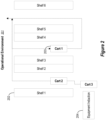
- operational environment 201 includes one or more shelves 202. These shelves may allow for the placement of carts 203 in between the shelves.
- cart 1 is currently positioned between shelves 3 and 4, while cart 2 is positioned between shelves 1 and 2.
- Each shelf may hold a plurality of different packable items (113 from Figure 1 ). As the carts are moved to different shelves, operation workers may place the packable items 113 into the boxes for fulfillment.
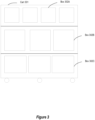
- a cart 301 may have many different boxes, some of which are different sizes.
- cart 301 may have smaller boxes such as box 302A, medium size boxes such as 302B, or larger boxes such as 302C.
- the boxes may be placed onto the carts according to the production determination 110.
- cart 3 may be loaded with a specified set of boxes, as they are produced by the equipment production machine (114 of Figure 1 ).
- the equipment production machine 114 may look at which orders are to be fulfilled and where the packable items 113 are located within the shelves 202, and produce the boxes at the point of equipment induction 204 in a manner that maximizes efficiency within the operational environment 201.
- the carts 203 are moved through the shelves until the boxes are filled and the orders are completed. Once the carts are empty of boxes, they are moved back to the induction area 204. At the induction area, empty boxes are placed on each of the slots in the cart. Once the cart is full of empty boxes, it is moved through the aisles in the operational environment in order to pick the packable items 113 from the shelves and place the items in the correct box for order fulfillment. If the cart is filled with boxes after passing only one shelf, it may go straight to the exit and back to the induction area. In some cases, the shelves may be close enough to one another that it is difficult for other carts to overtake each other. This may result in traffic jams and waiting time which leads to a longer order fulfillment time. At least some of the embodiments described herein are designed to minimize such traffic jams and optimize flow through the shelves by controlling the order in which boxes are produced at the point of induction 204.
- box induction is controlled such that a minimum number of carts occupies one aisle at the same time. Furthermore, box induction is controlled such that a shortest length or fastest route is identified through the aisles, based on which packable items 113 need to be placed in each box on the cart.
- the box induction system i.e.
- the equipment production machine 114) may access any or all of the following information in controlling the induction: a number of positions for boxes on each cart, taking box size into account, the positions of each product or packable item (including aisle number and/or bin position if bins are used to store the packable items) that are to be placed into the box, positions of each operational worker that places packable items into boxes, number of carts currently in place in the aisles, positions of each cart within the aisles, current orders that are to be fulfilled, and other information that may be used to make a proper determination of production order.
- the equipment production machine 114 may be configured to produce boxes according to box size and quantity restriction of the carts 203. As such, when the cart gets to the induction area 204, the boxes are placed onto the slots of the cart in the order they are produced. In order to reduce walking distance and traffic jams, the equipment production machine 114 may produce boxes for a complete cart for aisle 1 (between shelves 1 and 2 of Figure 2 ), and thereafter produce boxes that can be fulfilled in aisle 2, then boxes that can be fulfilled in aisle 3, etc. If a cart cannot be filled with boxes that can be filled with packable items from just one aisle, the equipment production machine 114 would next produce boxes that can be fulfilled in aisles 1 and 2. Next would be boxes that can be fulfilled in aisles 2 and 3, and so on.
- an operational worker (either human or automated) is filling a cart walking down aisle 1
- an operational worker for a second cart can walk down aisle 2 without any traffic jams.
- This may, of course, be extended to include more aisle in order to fill up a cart if needed.
- the equipment production machine 114 continues to induce boxes for the next cart starting with the last aisle for the previous cart if multiple aisles are need in order to fill up the cart.
- This optimization is performed with feedback data from a single cart or from many carts, from a single shelf of packable items or from multiple shelves, and so on. Accordingly, optimizing the order in which boxes are produced by the equipment production machine 114 is performed with a large amount of feedback data, or with just a small amount of feedback data. Still further, it should be noted, the optimizations described herein may be implemented in an operational environment that has many different sizes of carts, different sizes of shelves or aisles, different packing speeds for operational workers, or other variables that are unique to a given environment. In this manner, orders may be fulfilled in a more efficient manner, saving both time and money in the fulfillment process, increasing the productivity of operational workers, ensuring that orders are fulfilled in a timely manner and preventing wasted trips to shelves that aren't necessary.
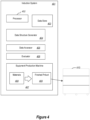
- Figure 4 illustrates an embodiment of an apparatus or system that is configured to produce equipment according to a determined production order (e.g. 110 of Figure 1 ).
- the apparatus or system includes at least one processor 402, and an induction system 401 configured to determine an order in which pieces of equipment are produced and then produce the pieces of equipment. This is done by performing the following: the data structure generator 404 generating an organizational database structure (e.g. 106 of Figure 1 ) that maintains information indicating which products are associated with a piece of equipment.
- the pieces of equipment 112 may be boxes, containers or other equipment used in fulfilling orders.
- the organizational database structure 106 may be stored in data store 403, and may include information indicating which packable items 113 are to go in which boxes.
- the organizational database structure 106 may further include information indicating which shelves hold packable items 113 that are to go in each box, and may also include information indicating which carts are to go down which aisles. All of this information (and perhaps more) may be used in determining which boxes to produce.
- the data accessor 405 of the induction system 401 accesses the generated organizational database structure to identify one or more physical operational environment factors that affect which pieces of equipment are to be currently produced.
- the physical operational environment factors may include an identified number of fulfillment operators currently working at a specified location in the operational environment, total route distance needed to fulfill an order in a given box or set of boxes in a cart, walking distance for an operator, number of carts ahead of a cart currently being filled with boxes, positions of items in the shelves, or other factors that would affect how a cart filled with boxes is fulfilled using the packable items 113 on the shelves 202.
- the evaluator 406 of the induction system 401then evaluates the identified operational environment factors to determine whether a specified piece of equipment is to be currently produced by the induction system and, based on the evaluation, the equipment production machine 407 produces the specified piece of equipment for placement within an operational environment (e.g. 201).
- the equipment production machine 407 may take raw or pre-processed materials 408 (e.g. cardboard) and fold, stamp, open or otherwise shape the cardboard into a finished box 409. This box can then be placed on a cart 410.
- the evaluator determines which boxes to produce at the equipment production machine 407, and in what order the boxes are produced, the evaluator considers a variety of different factors, each of which may be weighted according to level of importance in providing the most efficient route. For instance, production order may be continually analyzed, and feedback from this analysis may be used to determine whether one factor has more or less influence over efficiency and productivity in box production and fulfillment. If one factor or a group of factors is determined to have more influence on efficiency, that factor will be weighted higher by the evaluator 406 when identifying a production order.
- the apparatus further includes a mechanized sorting arm configured to place pieces of equipment on a routable cart according to a determined placement order.
- the mechanized arm may receive boxes as they are produced, and may place those boxes on a cart in an automated fashion.
- the mechanized sorting arm may be operated according to a determined placement order 110 and, as such, the boxes produced by the induction system are supplied to a specific cart in a specific position so that the box will be filled with items from a single shelf, or from shelves that share the same aisle, or from a minimum number of shelves or aisles if needed.
- Evaluating the physical operational environment factors to determine whether a specified box is to be currently produced by the induction system 401 may include evaluating a timing function that categorizes pieces of equipment according to a number of shelves in the operational environment that are used for fulfillment. Thus, in such embodiments, those boxes that use a large number of shelves for fulfillment are saved until a later time when the operational environment is not as busy or to a more preferred time.
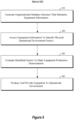
- FIG. 5 illustrates a flowchart of a method 500 for managing and producing equipment within an operational environment.
- the method 500 will now be described with frequent reference to the components and data of environment 100 of Figure 1 .
- Method 500 includes generating an organizational database structure that maintains information associated with at least one piece of equipment that is part of an operational environment, the organizational database structure including information indicating which of a plurality of packable items are associated with the piece of equipment (510).
- data structure generator 105 of computer system 101 may generate organizational database structure 106.
- This database structure may be stored in data store 117, which itself may be local or remote to computer system 101.
- the organizational database structure 106 maintains information associated with processes that are ongoing within operational environment 111. Such processes include inducing boxes into a cart transport system that moves carts among shelves to fill the boxes with packable items that are to be shipped to customers.
- the organizational database structure 106 may track which packable items 113 are associated with a given piece of equipment 112. For example, the organizational database structure 106 may store data indicating that box 1 is to have packable items A, B and C. The organizational database structure 106 may also store data indicating that packable items A and B are on shelf 1, and that item C is on shelf 2. Thus, if the shelves are arranged as shown in Figure 2 , then box 1 could be fulfilled in one trip down the aisle between shelves 1 and 2.
- One organizational database structure 106 may contain data for a plurality of boxes or carts of boxes, or a plurality of organizational database structures may be generated, one for each box and/or cart. In this manner, the data stored in the organizational database structure 106, along with other types of data described above, may be used in the determination of production order.
- the computer system 101 accesses the generated organizational database structure 106 to identify one or more physical operational environment factors 108 that affect which pieces of equipment are to be currently produced within the operational environment (520).
- These physical operational environmental factors 108 may include cart route distance through the aisles, walking distance between packable items for operational workers, number of carts ahead in line, positions of packable items in the shelves, or other factors. As mentioned above, these factors may be weighted in determining which boxes to produce (e.g. which size and shape) and in which order.
- the environmental factors may be assessed using sensor data 118 from one or more hardware sensors 117 placed throughout the operational environment 111.
- Method 500 further includes evaluating the identified physical operational environment factors 108 to determine whether the specified piece of equipment is to be currently produced within the operational environment (530) and, upon determining that the specified piece of equipment is to be currently processed within the operational environment, producing and providing the specified piece of equipment to the operational environment (540).
- the evaluator 109 thus accesses the organizational database structure 106, including the equipment information 107 and the environmental factors 108, to determine which boxes are to be produced and at which time (i.e. in production determination 110).
- the equipment production machine 114 may be configured to produce boxes of many different sizes and shapes. The differently sized and differently shaped boxes may be used to hold different sizes and shapes of packable items 113. Larger boxes may be used to hold multiple items, while smaller boxes may be used for single-item orders.
- the evaluator 109 thus determines which boxes are to be produced, and further determines the order to produce them in based on current conditions in the operational environment. These current conditions are indicated by the environment factors 108.
- the evaluator may identify which orders are to be fulfilled, where those packable items are located on the shelves of the operational environment (e.g. a fulfillment center or distribution center), which workers are available to help fulfill the order by placing the packable items in the boxes, which boxes are already on a given cart, which aisles the cart will need to go to fulfill the boxes that are on the cart, or the time-sensitive nature of a given order. Many other factors may be considered in determining which boxes to produce and when to produce them and induce them into the operational environment 111. It should be understood that while boxes have been focused on as being the equipment generated by the equipment production machine 114, many other types of equipment may be used, in addition to packaging materials.
- the operational environment 111 includes shelves with aisles between the shelves, as well as carts that are repositionable within the aisles.
- the carts are filled with boxes (as shown in Figure 3 ), and the boxes are filled with packable items 113 located in bins on the shelves (202 of Figure 2 ).
- Managing the production of equipment includes identifying a route through the fulfillment center that minimizes wait time for fulfillment.
- the cart may be arranged with boxes (produced in a specified order) so that the cart only has to go to one shelf, or to two shelves, and so on.
- the evaluator 109 receives real-time feedback data indicating the current location of each cart within the operational environment, the location of each worker, the operating condition of each equipment production machine 114, and an indication of which boxes have been put on which carts. Using this real-time feedback data, the evaluator 109 may make an informed decision on which boxes are to be produced by the equipment production machine 114 and in which order.
- the real-time feedback data allows the evaluator 109 to produce boxes in such an order that a given cart is loaded with boxes that can be fulfilled within the least number of shelves, or within the shortest route through the shelves, or using a route that avoids cart interference (based on which boxes are on those carts and which aisles they will need to travel to).
- the production of boxes can take into account cart routings that avoid bottlenecks in aisles and at stations where packable items 113 are taken from bins and placed into boxes.
- Identified routes for a given cart may be displayed so that operational workers can view the route that should be taken for that cart.
- the identified route first loads a specified cart with pieces of equipment that can be fulfilled using only one shelf, and subsequently with pieces of equipment that can be fulfilled using only two shelves.
- the identified route takes into consideration other carts that are already on the floor being fulfilled, or takes into account the timeliness for given orders. For instance, orders that need to go out overnight air would receive higher packing priority.
- the equipment production machine 114 which then physical generates the boxes or other equipment.
- the boxes may be physically created in real-time, either from cardboard or from other materials.
- the creation may include folding the boxes, sealing the boxes, labeling the boxes with company logos and/or shipping information, taping ends of the box closed, or other production steps.
- inducing a box into the operational environment 111 includes actual physical on-demand creation of the box in the order specified. Custom orders, oddly-shaped boxes, packaging for items that are temperature controlled, containers for animals or plants, as well as other constraints may be taken into account by the evaluator when determining which boxes are to be produced and in which order.
- a method is provided, implemented at a computer system (e.g. 101) that includes a processor 102.
- the method is for producing packaging materials within an operational environment, and includes the following: generating an organizational database structure 106 that maintains equipment information 107 associated with packaging materials that are to be filled with packable items 113.
- the organizational database structure 106 includes information indicating which of the packable items are associated with the packaging materials.
- the method next may include loading the generated organizational database structure 106 into memory 103 to identify production factors 108 that affect which packaging materials are to be currently produced by a packaging material production machine 114. As indicated above, these factors may include walking distance, route distance, carts ahead in line, the position of packable items in the various aisles, etc.
- the method includes determining whether the packaging materials 112 are to be currently produced by the packaging material production machine 114 and, upon determining that the packaging materials are to be currently processed by the packaging material production machine, producing the packaging material on the packaging material production machine 114.
- the packaging materials may include boxes, shipping containers or other equipment that may be produced on-demand by an equipment producing machine. When the packaging materials are produced and induced into the operational environment, a shipping label may be applied to the item, such that upon receiving its corresponding packable items, the box may be sealed and shipped.
- the load capacity of the cart may be taken into account.
- an operational environment may have many different carts, some of which may have different load capacities. Some carts may be able to hold a large number of boxes, while other carts may only be able to handle a small number of boxes. Similarly, some carts may be able to handle a large amount of weight, while others can handle only a small amount of weight.
- This information related to characteristics of the carts may be stored in the organizational database structure 106. Accordingly, the evaluator 109 may access the organizational database structure 106 and identify which carts are available and what their carrying capacity is. Then, based on the identified load capacities, the evaluator 109 may determine which packaging materials are to be currently produced by the packaging material production machine 114, and which should be held off for a later time when a larger or smaller cart is available.
Landscapes
- Engineering & Computer Science (AREA)
- Business, Economics & Management (AREA)
- General Physics & Mathematics (AREA)
- Physics & Mathematics (AREA)
- Quality & Reliability (AREA)
- Human Resources & Organizations (AREA)
- Economics (AREA)
- Strategic Management (AREA)
- Entrepreneurship & Innovation (AREA)
- Tourism & Hospitality (AREA)
- Marketing (AREA)
- General Business, Economics & Management (AREA)
- Operations Research (AREA)
- Theoretical Computer Science (AREA)
- Automation & Control Theory (AREA)
- General Engineering & Computer Science (AREA)
- Manufacturing & Machinery (AREA)
- Development Economics (AREA)
- Educational Administration (AREA)
- Game Theory and Decision Science (AREA)
- General Factory Administration (AREA)
- Management, Administration, Business Operations System, And Electronic Commerce (AREA)
- Radar Systems Or Details Thereof (AREA)
Priority Applications (1)
| Application Number | Priority Date | Filing Date | Title |
|---|---|---|---|
| EP24195438.7A EP4439427A3 (en) | 2016-12-01 | 2017-11-30 | Identifying and managing equipment within an operational environment |
Applications Claiming Priority (3)
| Application Number | Priority Date | Filing Date | Title |
|---|---|---|---|
| US201662428853P | 2016-12-01 | 2016-12-01 | |
| US15/825,461 US11092946B2 (en) | 2016-12-01 | 2017-11-29 | Identifying and managing equipment within an operational environment |
| PCT/US2017/063988 WO2018102569A1 (en) | 2016-12-01 | 2017-11-30 | Identifying and managing equipment within an operational environment |
Related Child Applications (1)
| Application Number | Title | Priority Date | Filing Date |
|---|---|---|---|
| EP24195438.7A Division EP4439427A3 (en) | 2016-12-01 | 2017-11-30 | Identifying and managing equipment within an operational environment |
Publications (3)
| Publication Number | Publication Date |
|---|---|
| EP3549072A1 EP3549072A1 (en) | 2019-10-09 |
| EP3549072A4 EP3549072A4 (en) | 2020-04-29 |
| EP3549072B1 true EP3549072B1 (en) | 2024-08-21 |
Family
ID=62242843
Family Applications (2)
| Application Number | Title | Priority Date | Filing Date |
|---|---|---|---|
| EP17875656.5A Active EP3549072B1 (en) | 2016-12-01 | 2017-11-30 | Identifying and managing equipment within an operational environment |
| EP24195438.7A Withdrawn EP4439427A3 (en) | 2016-12-01 | 2017-11-30 | Identifying and managing equipment within an operational environment |
Family Applications After (1)
| Application Number | Title | Priority Date | Filing Date |
|---|---|---|---|
| EP24195438.7A Withdrawn EP4439427A3 (en) | 2016-12-01 | 2017-11-30 | Identifying and managing equipment within an operational environment |
Country Status (10)
| Country | Link |
|---|---|
| US (2) | US11092946B2 (pl) |
| EP (2) | EP3549072B1 (pl) |
| JP (2) | JP7206195B2 (pl) |
| CN (1) | CN110249351B (pl) |
| AU (2) | AU2017368229A1 (pl) |
| CA (1) | CA3045641A1 (pl) |
| ES (1) | ES2994248T3 (pl) |
| PL (1) | PL3549072T3 (pl) |
| RU (1) | RU2758032C2 (pl) |
| WO (1) | WO2018102569A1 (pl) |
Families Citing this family (4)
| Publication number | Priority date | Publication date | Assignee | Title |
|---|---|---|---|---|
| US10922637B2 (en) | 2013-01-18 | 2021-02-16 | Packsize Llc | Tiling production of packaging materials |
| US11092946B2 (en) | 2016-12-01 | 2021-08-17 | Packsize Llc | Identifying and managing equipment within an operational environment |
| CN109255889B (zh) * | 2018-09-20 | 2021-02-23 | 广州咖宇智能科技有限公司 | 饮料售卖机产品制作控制系统的配置方法和装置 |
| EP3907672B1 (en) * | 2020-05-04 | 2026-01-14 | Siemens Aktiengesellschaft | Distributing order execution in a mom system |
Citations (1)
| Publication number | Priority date | Publication date | Assignee | Title |
|---|---|---|---|---|
| WO2012018859A1 (en) * | 2010-08-03 | 2012-02-09 | Niklas Pettersson | Creating on-demand packaging based on stored attribute data |
Family Cites Families (126)
| Publication number | Priority date | Publication date | Assignee | Title |
|---|---|---|---|---|
| DE1436005A1 (de) | 1962-06-22 | 1968-10-31 | Jagenberg Werke Ag | Vorrichtung zum Herstellen,Fuellen und Schliessen fluessigkeitsdichter Behaelter |
| US3844422A (en) | 1969-12-29 | 1974-10-29 | I Smith | Pallet loading machine |
| US3776419A (en) | 1971-09-17 | 1973-12-04 | Krafto Corp | Container and rack for presenting articles |
| US4149747A (en) | 1975-03-31 | 1979-04-17 | Rpc Corporation | Grappler spreader for closely stacking cargo containers |
| US4501106A (en) | 1982-04-26 | 1985-02-26 | Hobart Corporation | Wrapping control system for film wrapping machine |
| US4551810B1 (en) | 1982-07-28 | 1995-09-05 | Technology Inc Const | Method and apparatus for designing duct work for producing patterns for conduit sections in the designated duct work |
| US4725961A (en) | 1986-03-20 | 1988-02-16 | Gerber Garment Technology, Inc. | Method and apparatus for cutting parts from pieces of irregularly shaped and sized sheet material |
| DE3735675A1 (de) | 1987-10-22 | 1989-05-18 | Focke & Co | Verfahren und vorrichtung zum herstellen und foerdern von packungs-zuschnitten |
| IT1229879B (it) | 1989-02-14 | 1991-09-13 | Renzo Grossi | Metodo ed apparecchio per il confezionamento continuo di gruppi di contenitori o simili. |
| JP3095281B2 (ja) | 1992-03-12 | 2000-10-03 | 株式会社日立製作所 | 複数品種のライン生産支援システム |
| US5299688A (en) | 1992-03-20 | 1994-04-05 | Pro Box | Storage device and system for card collections |
| GB2280171B (en) | 1993-07-22 | 1996-12-18 | Cargo Unit Containers Ltd | Improvments in or relating to freight containers |
| JP3063516B2 (ja) | 1994-03-07 | 2000-07-12 | 凸版印刷株式会社 | 包材の材料構成選択装置 |
| GB9622712D0 (en) | 1996-10-31 | 1997-01-08 | Sca Packaging Ltd | Process for the manufacture of a packaging blank |
| US6980934B1 (en) | 1997-12-12 | 2005-12-27 | Isaac Sadovnik | Method and systems for nesting objects |
| US6119434A (en) | 1998-04-21 | 2000-09-19 | Tetra Laval Holdings & Finance, Sa | Multi-product packaging machine with bar code reader |
| JP3950237B2 (ja) | 1998-08-10 | 2007-07-25 | キヤノンシステムソリューションズ株式会社 | 製造計画作成方法及び記録媒体 |
| JP2000118504A (ja) | 1998-10-15 | 2000-04-25 | Ishida Co Ltd | 製袋充填包装システム |
| JP2000135696A (ja) | 1998-11-02 | 2000-05-16 | Mitsubishi Heavy Ind Ltd | コルゲートマシンにおけるオーダチェンジ方法 |
| US6876958B1 (en) | 1999-07-01 | 2005-04-05 | New Breed Corporations | Method and system of optimized sequencing and configuring of items for packing in a bounded region |
| US6358191B1 (en) | 1999-08-27 | 2002-03-19 | The Mead Corporation | System and method for flexible control and adjustment of a box forming machine |
| EP1269397A2 (en) | 2000-03-21 | 2003-01-02 | Accu-Sort Systems, Inc. | Large depth of field line scan camera |
| AU2001259202A1 (en) | 2000-04-28 | 2001-11-12 | Michael C. Levine | Method and system for packing a plurality of articles in a container |
| US20030136794A1 (en) | 2002-11-23 | 2003-07-24 | Munroe Chirnomas | Method and apparatus for storing articles for use with an article handling device |
| JP3549050B2 (ja) | 2000-11-06 | 2004-08-04 | 本田技研工業株式会社 | 物品収納形態の決定支援方法及び決定支援装置 |
| CN1971462A (zh) | 2000-12-05 | 2007-05-30 | 埃克森美孚石油公司 | 用于减少包装工业中提前期的方法和系统 |
| US7225040B2 (en) | 2001-11-14 | 2007-05-29 | Exxon Mobil Oil Corporation | Method and system for reducing lead-time in the packaging industry |
| US6580963B2 (en) | 2000-12-13 | 2003-06-17 | Thermwood Corporation | System and method for automatically tracking and utilizing excess material on a CNC machining system |
| US20020143669A1 (en) | 2001-01-22 | 2002-10-03 | Scheer Robert H. | Method for managing inventory within an integrated supply chain |
| US6615104B2 (en) | 2001-05-01 | 2003-09-02 | Nintendo Of America, Inc. | System and method of selecting box size |
| DE10121728A1 (de) | 2001-05-04 | 2002-11-07 | Infineon Technologies Ag | Verfahren zur hybrid-automatisierten Überwachung von Produktionsmaschinen |
| US7055350B2 (en) | 2001-09-20 | 2006-06-06 | Meadwestvaco Packaging Systems Llc | Packaging system, apparatus and method therefor |
| US7344082B2 (en) | 2002-01-02 | 2008-03-18 | Metrologic Instruments, Inc. | Automated method of and system for dimensioning objects over a conveyor belt structure by applying contouring tracing, vertice detection, corner point detection, and corner point reduction methods to two-dimensional range data maps of the space above the conveyor belt captured by an amplitude modulated laser scanning beam |
| CA2474254C (en) * | 2002-01-23 | 2016-05-17 | Meadwestvaco Corporation | Inventory management system |
| US20030200111A1 (en) | 2002-04-19 | 2003-10-23 | Salim Damji | Process for determining optimal packaging and shipping of goods |
| US6690990B1 (en) | 2002-12-02 | 2004-02-10 | CENTRE DE RECHERCHE INDUSTRIELLE DU QUéBEC | Method of optimizing a layout of selected parts to be cut |
| US20040158507A1 (en) * | 2002-12-06 | 2004-08-12 | Meek Robert B. | Inventory management and replenishment system |
| JP2004287623A (ja) | 2003-03-19 | 2004-10-14 | Ricoh Co Ltd | 生産台数決定方法、生産台数決定プログラム及び記憶媒体 |
| US20050044171A1 (en) | 2003-08-21 | 2005-02-24 | 3M Innovative Properties Company | Centralized management of packaging data having modular remote device control architecture |
| US20050065830A1 (en) | 2003-09-24 | 2005-03-24 | Xerox Corporation | System and method for the acquisition and analysis of data for print shop performance evaluation and adjustment |
| US7100811B2 (en) | 2003-11-14 | 2006-09-05 | Emsize Ab | Web guide and method |
| US20050114193A1 (en) | 2003-11-25 | 2005-05-26 | 3M Innovative Properties Company | Strategic sourcing for packaging material procurement using centralized packaging data management system |
| US7149658B2 (en) * | 2004-02-02 | 2006-12-12 | United Parcel Service Of America, Inc. | Systems and methods for transporting a product using an environmental sensor |
| US20050238465A1 (en) * | 2004-04-27 | 2005-10-27 | Razumov Sergey N | Robotic retail facility |
| US7069856B2 (en) | 2004-05-13 | 2006-07-04 | Sun Automation, Inc. | Method and apparatus for managing box-finishing machine |
| US7205897B2 (en) | 2005-03-01 | 2007-04-17 | Sap Aktiengesellschaft | Product flow based auto-ID infrastructure |
| JP2006248575A (ja) | 2005-03-11 | 2006-09-21 | Yukio Hayasaka | 品物梱包方法と品物梱包装置と品物梱包プログラム |
| US8055744B2 (en) | 2005-04-07 | 2011-11-08 | International Business Machines Corporation | Resolution of group membership for resources |
| EP1762966A1 (en) | 2005-09-07 | 2007-03-14 | Sap Ag | Methods and systems for pack-size-oriented rounding |
| WO2007102917A2 (en) | 2005-12-16 | 2007-09-13 | Meadwestvaco Packaging Systems Llc | Packaging machine with adjustable lanes |
| US7299103B1 (en) | 2006-07-12 | 2007-11-20 | Sealed Air Corporation (Us) | System and method for monitoring consumable usage in packaging machines |
| US7647752B2 (en) | 2006-07-12 | 2010-01-19 | Greg Magnell | System and method for making custom boxes for objects of random size or shape |
| US7361131B1 (en) | 2006-09-29 | 2008-04-22 | Weyerhaeuser Company | Systems and methods for processing a container blank |
| GB0701257D0 (en) | 2007-01-23 | 2007-02-28 | British American Tobacco Co | Machine, method, and system for packaging smoking products |
| JP4378655B2 (ja) | 2007-03-07 | 2009-12-09 | 株式会社ダイフク | 物品処理設備 |
| ITMI20070871A1 (it) | 2007-04-30 | 2008-11-01 | Sitma Spa | Apparecchiatura e procedimento per la realizzazione in continuo di confezioni di pile di piastrelle o simili |
| DE102007049702A1 (de) | 2007-10-17 | 2009-04-23 | Robert Bosch Gmbh | Pickerstrasse |
| EP2051189A1 (en) * | 2007-10-18 | 2009-04-22 | Siemens Aktiengesellschaft | Device for electronic identification of items |
| JP2009116780A (ja) | 2007-11-09 | 2009-05-28 | Renesas Technology Corp | 生産計画立案システムおよび生産計画立案方法 |
| US20090132319A1 (en) | 2007-11-21 | 2009-05-21 | Maxager Technology, Inc. | Method for generating an asset loading plan |
| JP2009139979A (ja) | 2007-12-03 | 2009-06-25 | Omron Corp | 生産管理システムおよびオーダ情報の割り当て方法 |
| EP2075659A1 (en) | 2007-12-31 | 2009-07-01 | Tetra Laval Holdings & Finance SA | Integrated packaging system architecture |
| US8015079B2 (en) | 2008-01-07 | 2011-09-06 | Oracle International Corporation | Pick release performance using a multi-threaded architecture to distribute the workload across multiple processors |
| US8234008B2 (en) | 2008-02-29 | 2012-07-31 | Carefusion 303, Inc. | Lidded drawer for single line item dispensing |
| RU75372U1 (ru) | 2008-03-31 | 2008-08-10 | Закрытое акционерное общество "НОТИС" | Фасовочно-упаковочная машина с устройством крепления пакетов к полосе |
| US8560461B1 (en) | 2008-03-31 | 2013-10-15 | Amazon Technologies, Inc. | Shipment splitting analyzer |
| US8915831B2 (en) | 2008-05-15 | 2014-12-23 | Xerox Corporation | System and method for automating package assembly |
| US8160992B2 (en) * | 2008-05-15 | 2012-04-17 | Xerox Corporation | System and method for selecting a package structural design |
| US7941465B2 (en) | 2008-05-15 | 2011-05-10 | Xerox Corporation | System and method for selecting a package structural design |
| JP5018641B2 (ja) | 2008-05-26 | 2012-09-05 | オムロン株式会社 | 生産管理システムおよび生産管理方法 |
| US8086344B1 (en) * | 2008-06-04 | 2011-12-27 | Amazon Technologies, Inc. | Predictive router for materials handling |
| US8682473B1 (en) * | 2008-08-26 | 2014-03-25 | Amazon Technologies, Inc. | Sort bin assignment |
| US8200367B2 (en) | 2008-09-16 | 2012-06-12 | K-Tron Technologies, Inc. | Bulk material transport system |
| US8527936B2 (en) | 2008-12-31 | 2013-09-03 | Cadence Design Systems, Inc. | Method and system for implementing graphical analysis of hierarchical coverage information using treemaps |
| US20120155972A1 (en) | 2009-10-16 | 2012-06-21 | Stephane Gauthier | Compressed Straw Material |
| EP2393743B1 (en) | 2009-02-04 | 2019-10-09 | Packsize, LLC | Infeed system |
| JP5350081B2 (ja) | 2009-02-05 | 2013-11-27 | 麒麟麦酒株式会社 | 製箱用シートの製造方法 |
| DE102009011295B4 (de) | 2009-03-02 | 2020-11-05 | Kuka Roboter Gmbh | Automatisiertes Palletieren von Paketen |
| US20100234983A1 (en) | 2009-03-12 | 2010-09-16 | Piovan Spa | Control system for granular material transport system |
| RU91933U1 (ru) | 2009-07-22 | 2010-03-10 | ОАО "Опытный завод "Паксистем" | Линия по производству гофрокартона и заготовок тары из него |
| JP5400526B2 (ja) | 2009-08-10 | 2014-01-29 | 花王株式会社 | ピッキングシステム |
| CN101719235A (zh) | 2009-11-11 | 2010-06-02 | 上海欧菲司健康管理咨询有限公司 | 产品包装物及附属射频标签回收系统 |
| JP5932661B2 (ja) | 2009-12-12 | 2016-06-08 | パックサイズ,エルエルシー | 物品の特注配列に基づく応需型包装用品の作成 |
| WO2011085175A2 (en) | 2010-01-07 | 2011-07-14 | Comau, Inc. | Modular manufacturing facility and method |
| US8732310B2 (en) * | 2010-04-22 | 2014-05-20 | International Business Machines Corporation | Policy-driven capacity management in resource provisioning environments |
| RU2573373C2 (ru) | 2010-06-29 | 2016-01-20 | ПЭКСАЙЗ ЭлЭлСи | Оптимизация производства упаковочных продуктов |
| US8839132B2 (en) | 2010-12-02 | 2014-09-16 | Tecsys, Inc. | Method and system for providing visual instructions to warehouse operators |
| US8407461B2 (en) | 2010-12-17 | 2013-03-26 | Oracle International Corporation | Plug-in system for software applications |
| US20120160905A1 (en) | 2010-12-22 | 2012-06-28 | Ashley Wilkum | Carton with opposing wave-shaped panel and squared panel and blanks for constructing same |
| JP5641338B2 (ja) | 2011-02-09 | 2014-12-17 | 株式会社ダイフク | ピッキング方法 |
| US9373098B2 (en) * | 2011-05-24 | 2016-06-21 | Intelligrated Headquarters Llc | Method and apparatus for optimized shipping strategies accounting for endpoint requirements |
| ITTO20110626A1 (it) | 2011-07-15 | 2013-01-16 | M G Automazioni Di Lorenzo Bonariv A | Macchina per la produzione di scatole di imballaggio |
| US9818070B2 (en) * | 2011-07-22 | 2017-11-14 | Packsize Llc | Tiling production of packaging materials |
| PL3067193T3 (pl) | 2011-07-22 | 2024-10-21 | Packsize Llc | Produkcja kafelkowa dla pary pudełek |
| US20130027561A1 (en) | 2011-07-29 | 2013-01-31 | Panasonic Corporation | System and method for improving site operations by detecting abnormalities |
| US8730503B2 (en) | 2011-09-19 | 2014-05-20 | Xerox Corporation | Methods and systems for balancing job assignments to machines in a production environment |
| US9230233B1 (en) * | 2011-09-28 | 2016-01-05 | Amazon Technologies, Inc. | Systems and methods for implementing specialty packaging in a materials handling facility |
| US9317037B2 (en) * | 2011-10-03 | 2016-04-19 | Vocollect, Inc. | Warehouse vehicle navigation system and method |
| US9317626B2 (en) | 2011-11-16 | 2016-04-19 | Wai Man Chan | Method and system for combinatorial layout design |
| US9656804B2 (en) | 2011-12-20 | 2017-05-23 | Hoj Engineering & Sales Co., Inc. | Warehouse management system |
| US9754238B2 (en) * | 2011-12-20 | 2017-09-05 | Hoj Engineering & Sales Co., Inc. | Warehouse management system |
| CN102521711B (zh) | 2011-12-26 | 2016-03-02 | 北京瑞风协同科技股份有限公司 | 装备质量特性的数据模型构建的控制方法及装置 |
| US10229383B2 (en) * | 2012-02-05 | 2019-03-12 | Matthews International Corporation | Perpetual batch order fulfillment |
| US20130218799A1 (en) * | 2012-02-16 | 2013-08-22 | Sebastian Lehmann | Container Selection in a Materials Handling Facility |
| US10118723B2 (en) * | 2012-03-23 | 2018-11-06 | Amazon Technologies, Inc. | Custom containers in a materials handling facility |
| US8757479B2 (en) | 2012-07-31 | 2014-06-24 | Xerox Corporation | Method and system for creating personalized packaging |
| US20140058971A1 (en) | 2012-08-21 | 2014-02-27 | Ebay Inc. | Cross-border shipping solution |
| US9009072B2 (en) * | 2012-10-04 | 2015-04-14 | Amazon Technologies, Inc. | Filling an order at an inventory pier |
| RU2667463C2 (ru) | 2013-01-18 | 2018-09-19 | ПЭКСАЙЗ ЭлЭлСи | Мозаичное производство упаковочных материалов |
| US10922637B2 (en) | 2013-01-18 | 2021-02-16 | Packsize Llc | Tiling production of packaging materials |
| US20150019282A1 (en) | 2013-07-12 | 2015-01-15 | Pan-Pro, L.L.C. | Supply Chain Systems and Methods of Use |
| US9785911B2 (en) * | 2013-07-25 | 2017-10-10 | I AM Robotics, LLC | System and method for piece-picking or put-away with a mobile manipulation robot |
| EP3030490B1 (en) | 2013-08-05 | 2018-12-19 | Packsize LLC | Packaging material as a pick item |
| US11292241B2 (en) * | 2016-05-25 | 2022-04-05 | Shay C. Colson | 3-D packaging and shipping based on aggregate data |
| EP3111390A1 (en) * | 2014-02-26 | 2017-01-04 | Sicpa Holding SA | Systems and methods for tracing items |
| US9733633B2 (en) * | 2014-04-29 | 2017-08-15 | Flextronics Ap, Llc | Method and system for order fulfillment |
| US9489655B1 (en) * | 2014-08-25 | 2016-11-08 | Amazon Technologies, Inc. | Distinguishing RFID tags using motion data |
| EP3530573B1 (en) | 2014-09-30 | 2022-08-03 | Packsize LLC | Method and computer system for utilizing a converting machine for making custom packaging templates |
| US9884719B2 (en) * | 2014-12-12 | 2018-02-06 | Symbotic, LLC | Storage and retrieval system |
| US9840347B1 (en) | 2014-12-17 | 2017-12-12 | X Development LLX | Adhering modular elements for packaging structures |
| US20160283953A1 (en) | 2015-03-26 | 2016-09-29 | International Business Machines Corporation | Demand-supply matching with a time and virtual space network |
| US10137566B2 (en) * | 2015-09-09 | 2018-11-27 | Bastian Solutions, Llc | Automated guided vehicle (AGV) with batch picking robotic arm |
| US20170200117A1 (en) * | 2016-01-07 | 2017-07-13 | Wal-Mart Stores, Inc. | Systems and methods of fulfilling product orders |
| US20170270466A1 (en) * | 2016-03-18 | 2017-09-21 | Jusda International Logistics (TAIWAN) CO.,LTD | Method and system using with automated guided vehicle |
| US11142399B2 (en) * | 2016-10-06 | 2021-10-12 | Doerfer Corporation | Automated warehouse fulfillment system and method of operation |
| US11092946B2 (en) | 2016-12-01 | 2021-08-17 | Packsize Llc | Identifying and managing equipment within an operational environment |
-
2017
- 2017-11-29 US US15/825,461 patent/US11092946B2/en active Active
- 2017-11-30 CN CN201780085453.0A patent/CN110249351B/zh active Active
- 2017-11-30 WO PCT/US2017/063988 patent/WO2018102569A1/en not_active Ceased
- 2017-11-30 CA CA3045641A patent/CA3045641A1/en active Pending
- 2017-11-30 EP EP17875656.5A patent/EP3549072B1/en active Active
- 2017-11-30 PL PL17875656.5T patent/PL3549072T3/pl unknown
- 2017-11-30 AU AU2017368229A patent/AU2017368229A1/en not_active Abandoned
- 2017-11-30 RU RU2019120017A patent/RU2758032C2/ru active
- 2017-11-30 JP JP2019529848A patent/JP7206195B2/ja active Active
- 2017-11-30 ES ES17875656T patent/ES2994248T3/es active Active
- 2017-11-30 EP EP24195438.7A patent/EP4439427A3/en not_active Withdrawn
-
2021
- 2021-07-13 US US17/374,774 patent/US12085923B2/en active Active
-
2022
- 2022-12-28 JP JP2022212250A patent/JP7432700B2/ja active Active
-
2023
- 2023-10-09 AU AU2023248047A patent/AU2023248047A1/en not_active Abandoned
Patent Citations (1)
| Publication number | Priority date | Publication date | Assignee | Title |
|---|---|---|---|---|
| WO2012018859A1 (en) * | 2010-08-03 | 2012-02-09 | Niklas Pettersson | Creating on-demand packaging based on stored attribute data |
Non-Patent Citations (2)
| Title |
|---|
| HAO ZHANG ET AL: "DoraPicker: An Autonomous Picking System for General Objects", ARXIV.ORG, CORNELL UNIVERSITY LIBRARY, 201 OLIN LIBRARY CORNELL UNIVERSITY ITHACA, NY 14853, 21 March 2016 (2016-03-21), XP080690939 * |
| KIMURA NOBUTAKA ET AL: "Mobile dual-arm robot for automated order picking system in warehouse containing various kinds of products", 2015 IEEE/SICE INTERNATIONAL SYMPOSIUM ON SYSTEM INTEGRATION (SII), IEEE, 11 December 2015 (2015-12-11), pages 332 - 338, XP032863356, DOI: 10.1109/SII.2015.7404942 * |
Also Published As
| Publication number | Publication date |
|---|---|
| JP7206195B2 (ja) | 2023-01-17 |
| CN110249351A (zh) | 2019-09-17 |
| RU2019120017A3 (pl) | 2021-02-12 |
| EP3549072A1 (en) | 2019-10-09 |
| AU2017368229A1 (en) | 2019-06-20 |
| US20210341909A1 (en) | 2021-11-04 |
| JP2020500790A (ja) | 2020-01-16 |
| CN110249351B (zh) | 2023-09-15 |
| US20180157245A1 (en) | 2018-06-07 |
| JP2023052171A (ja) | 2023-04-11 |
| JP7432700B2 (ja) | 2024-02-16 |
| PL3549072T3 (pl) | 2025-02-17 |
| AU2023248047A1 (en) | 2023-10-26 |
| CA3045641A1 (en) | 2018-06-07 |
| EP4439427A2 (en) | 2024-10-02 |
| US11092946B2 (en) | 2021-08-17 |
| WO2018102569A1 (en) | 2018-06-07 |
| ES2994248T3 (en) | 2025-01-21 |
| RU2758032C2 (ru) | 2021-10-25 |
| RU2019120017A (ru) | 2021-01-11 |
| US12085923B2 (en) | 2024-09-10 |
| EP4439427A3 (en) | 2025-01-15 |
| EP3549072A4 (en) | 2020-04-29 |
Similar Documents
| Publication | Publication Date | Title |
|---|---|---|
| US12085923B2 (en) | Identifying and managing equipment within an operational environment | |
| Custodio et al. | Flexible automated warehouse: a literature review and an innovative framework | |
| US20220048707A1 (en) | System and method for a dynamic robotic kitting line | |
| US11377304B2 (en) | Balancing load among operational system zones | |
| KR102277603B1 (ko) | 작업자 식별 및 성과 추적 | |
| JP2020527524A (ja) | 注文処理方法及び装置、サーバー及び記憶媒体 | |
| CA2816752A1 (en) | Order processing systems using picking robots | |
| US20250214779A1 (en) | Systems and methods of controlling the loading of packages in fulfilling orders | |
| US20250094190A1 (en) | Automated Operation Tracking, Verification, and Interface Updating System | |
| EP4649037A1 (en) | Warehouse execution system, devices, and method | |
| JP7666528B2 (ja) | 制御装置、制御方法及びプログラム | |
| Li et al. | Modeling of Behavior and Interaction Analysis of Autonomous Robots in Smart Logistics Environment: A Case Study on iLoabot-M |
Legal Events
| Date | Code | Title | Description |
|---|---|---|---|
| STAA | Information on the status of an ep patent application or granted ep patent |
Free format text: STATUS: THE INTERNATIONAL PUBLICATION HAS BEEN MADE |
|
| PUAI | Public reference made under article 153(3) epc to a published international application that has entered the european phase |
Free format text: ORIGINAL CODE: 0009012 |
|
| STAA | Information on the status of an ep patent application or granted ep patent |
Free format text: STATUS: REQUEST FOR EXAMINATION WAS MADE |
|
| 17P | Request for examination filed |
Effective date: 20190531 |
|
| AK | Designated contracting states |
Kind code of ref document: A1 Designated state(s): AL AT BE BG CH CY CZ DE DK EE ES FI FR GB GR HR HU IE IS IT LI LT LU LV MC MK MT NL NO PL PT RO RS SE SI SK SM TR |
|
| AX | Request for extension of the european patent |
Extension state: BA ME |
|
| DAV | Request for validation of the european patent (deleted) | ||
| DAX | Request for extension of the european patent (deleted) | ||
| A4 | Supplementary search report drawn up and despatched |
Effective date: 20200327 |
|
| RIC1 | Information provided on ipc code assigned before grant |
Ipc: G06Q 10/00 20120101AFI20200324BHEP Ipc: G06Q 10/08 20120101ALI20200324BHEP Ipc: G06Q 10/06 20120101ALI20200324BHEP |
|
| STAA | Information on the status of an ep patent application or granted ep patent |
Free format text: STATUS: EXAMINATION IS IN PROGRESS |
|
| 17Q | First examination report despatched |
Effective date: 20211223 |
|
| P01 | Opt-out of the competence of the unified patent court (upc) registered |
Effective date: 20230526 |
|
| REG | Reference to a national code |
Ref country code: DE Free format text: PREVIOUS MAIN CLASS: G06Q0010000000 Ref country code: DE Ref legal event code: R079 Ref document number: 602017084332 Country of ref document: DE Free format text: PREVIOUS MAIN CLASS: G06Q0010000000 Ipc: G06Q0010063000 |
|
| GRAP | Despatch of communication of intention to grant a patent |
Free format text: ORIGINAL CODE: EPIDOSNIGR1 |
|
| STAA | Information on the status of an ep patent application or granted ep patent |
Free format text: STATUS: GRANT OF PATENT IS INTENDED |
|
| RIC1 | Information provided on ipc code assigned before grant |
Ipc: G06Q 10/08 20120101ALI20231116BHEP Ipc: G06Q 10/063 20230101AFI20231116BHEP |
|
| INTG | Intention to grant announced |
Effective date: 20231215 |
|
| GRAJ | Information related to disapproval of communication of intention to grant by the applicant or resumption of examination proceedings by the epo deleted |
Free format text: ORIGINAL CODE: EPIDOSDIGR1 |
|
| STAA | Information on the status of an ep patent application or granted ep patent |
Free format text: STATUS: EXAMINATION IS IN PROGRESS |
|
| GRAP | Despatch of communication of intention to grant a patent |
Free format text: ORIGINAL CODE: EPIDOSNIGR1 |
|
| STAA | Information on the status of an ep patent application or granted ep patent |
Free format text: STATUS: GRANT OF PATENT IS INTENDED |
|
| INTC | Intention to grant announced (deleted) | ||
| INTG | Intention to grant announced |
Effective date: 20240313 |
|
| GRAS | Grant fee paid |
Free format text: ORIGINAL CODE: EPIDOSNIGR3 |
|
| GRAA | (expected) grant |
Free format text: ORIGINAL CODE: 0009210 |
|
| STAA | Information on the status of an ep patent application or granted ep patent |
Free format text: STATUS: THE PATENT HAS BEEN GRANTED |
|
| AK | Designated contracting states |
Kind code of ref document: B1 Designated state(s): AL AT BE BG CH CY CZ DE DK EE ES FI FR GB GR HR HU IE IS IT LI LT LU LV MC MK MT NL NO PL PT RO RS SE SI SK SM TR |
|
| REG | Reference to a national code |
Ref country code: GB Ref legal event code: FG4D |
|
| REG | Reference to a national code |
Ref country code: CH Ref legal event code: EP |
|
| REG | Reference to a national code |
Ref country code: IE Ref legal event code: FG4D |
|
| REG | Reference to a national code |
Ref country code: DE Ref legal event code: R096 Ref document number: 602017084332 Country of ref document: DE |
|
| REG | Reference to a national code |
Ref country code: LT Ref legal event code: MG9D |
|
| REG | Reference to a national code |
Ref country code: NL Ref legal event code: MP Effective date: 20240821 |
|
| PG25 | Lapsed in a contracting state [announced via postgrant information from national office to epo] |
Ref country code: NO Free format text: LAPSE BECAUSE OF FAILURE TO SUBMIT A TRANSLATION OF THE DESCRIPTION OR TO PAY THE FEE WITHIN THE PRESCRIBED TIME-LIMIT Effective date: 20241121 |
|
| REG | Reference to a national code |
Ref country code: AT Ref legal event code: MK05 Ref document number: 1716239 Country of ref document: AT Kind code of ref document: T Effective date: 20240821 |
|
| PG25 | Lapsed in a contracting state [announced via postgrant information from national office to epo] |
Ref country code: PT Free format text: LAPSE BECAUSE OF FAILURE TO SUBMIT A TRANSLATION OF THE DESCRIPTION OR TO PAY THE FEE WITHIN THE PRESCRIBED TIME-LIMIT Effective date: 20241223 Ref country code: NL Free format text: LAPSE BECAUSE OF FAILURE TO SUBMIT A TRANSLATION OF THE DESCRIPTION OR TO PAY THE FEE WITHIN THE PRESCRIBED TIME-LIMIT Effective date: 20240821 Ref country code: GR Free format text: LAPSE BECAUSE OF FAILURE TO SUBMIT A TRANSLATION OF THE DESCRIPTION OR TO PAY THE FEE WITHIN THE PRESCRIBED TIME-LIMIT Effective date: 20241122 Ref country code: FI Free format text: LAPSE BECAUSE OF FAILURE TO SUBMIT A TRANSLATION OF THE DESCRIPTION OR TO PAY THE FEE WITHIN THE PRESCRIBED TIME-LIMIT Effective date: 20240821 |
|
| PG25 | Lapsed in a contracting state [announced via postgrant information from national office to epo] |
Ref country code: BG Free format text: LAPSE BECAUSE OF FAILURE TO SUBMIT A TRANSLATION OF THE DESCRIPTION OR TO PAY THE FEE WITHIN THE PRESCRIBED TIME-LIMIT Effective date: 20240821 |
|
| PG25 | Lapsed in a contracting state [announced via postgrant information from national office to epo] |
Ref country code: LV Free format text: LAPSE BECAUSE OF FAILURE TO SUBMIT A TRANSLATION OF THE DESCRIPTION OR TO PAY THE FEE WITHIN THE PRESCRIBED TIME-LIMIT Effective date: 20240821 |
|
| REG | Reference to a national code |
Ref country code: ES Ref legal event code: FG2A Ref document number: 2994248 Country of ref document: ES Kind code of ref document: T3 Effective date: 20250121 |
|
| PG25 | Lapsed in a contracting state [announced via postgrant information from national office to epo] |
Ref country code: AT Free format text: LAPSE BECAUSE OF FAILURE TO SUBMIT A TRANSLATION OF THE DESCRIPTION OR TO PAY THE FEE WITHIN THE PRESCRIBED TIME-LIMIT Effective date: 20240821 Ref country code: IS Free format text: LAPSE BECAUSE OF FAILURE TO SUBMIT A TRANSLATION OF THE DESCRIPTION OR TO PAY THE FEE WITHIN THE PRESCRIBED TIME-LIMIT Effective date: 20241221 |
|
| PG25 | Lapsed in a contracting state [announced via postgrant information from national office to epo] |
Ref country code: HR Free format text: LAPSE BECAUSE OF FAILURE TO SUBMIT A TRANSLATION OF THE DESCRIPTION OR TO PAY THE FEE WITHIN THE PRESCRIBED TIME-LIMIT Effective date: 20240821 |
|
| PG25 | Lapsed in a contracting state [announced via postgrant information from national office to epo] |
Ref country code: RS Free format text: LAPSE BECAUSE OF FAILURE TO SUBMIT A TRANSLATION OF THE DESCRIPTION OR TO PAY THE FEE WITHIN THE PRESCRIBED TIME-LIMIT Effective date: 20241121 |
|
| PGFP | Annual fee paid to national office [announced via postgrant information from national office to epo] |
Ref country code: ES Payment date: 20241202 Year of fee payment: 8 |
|
| PG25 | Lapsed in a contracting state [announced via postgrant information from national office to epo] |
Ref country code: RS Free format text: LAPSE BECAUSE OF FAILURE TO SUBMIT A TRANSLATION OF THE DESCRIPTION OR TO PAY THE FEE WITHIN THE PRESCRIBED TIME-LIMIT Effective date: 20241121 Ref country code: PT Free format text: LAPSE BECAUSE OF FAILURE TO SUBMIT A TRANSLATION OF THE DESCRIPTION OR TO PAY THE FEE WITHIN THE PRESCRIBED TIME-LIMIT Effective date: 20241223 Ref country code: NO Free format text: LAPSE BECAUSE OF FAILURE TO SUBMIT A TRANSLATION OF THE DESCRIPTION OR TO PAY THE FEE WITHIN THE PRESCRIBED TIME-LIMIT Effective date: 20241121 Ref country code: NL Free format text: LAPSE BECAUSE OF FAILURE TO SUBMIT A TRANSLATION OF THE DESCRIPTION OR TO PAY THE FEE WITHIN THE PRESCRIBED TIME-LIMIT Effective date: 20240821 Ref country code: LV Free format text: LAPSE BECAUSE OF FAILURE TO SUBMIT A TRANSLATION OF THE DESCRIPTION OR TO PAY THE FEE WITHIN THE PRESCRIBED TIME-LIMIT Effective date: 20240821 Ref country code: IS Free format text: LAPSE BECAUSE OF FAILURE TO SUBMIT A TRANSLATION OF THE DESCRIPTION OR TO PAY THE FEE WITHIN THE PRESCRIBED TIME-LIMIT Effective date: 20241221 Ref country code: HR Free format text: LAPSE BECAUSE OF FAILURE TO SUBMIT A TRANSLATION OF THE DESCRIPTION OR TO PAY THE FEE WITHIN THE PRESCRIBED TIME-LIMIT Effective date: 20240821 Ref country code: GR Free format text: LAPSE BECAUSE OF FAILURE TO SUBMIT A TRANSLATION OF THE DESCRIPTION OR TO PAY THE FEE WITHIN THE PRESCRIBED TIME-LIMIT Effective date: 20241122 Ref country code: FI Free format text: LAPSE BECAUSE OF FAILURE TO SUBMIT A TRANSLATION OF THE DESCRIPTION OR TO PAY THE FEE WITHIN THE PRESCRIBED TIME-LIMIT Effective date: 20240821 Ref country code: BG Free format text: LAPSE BECAUSE OF FAILURE TO SUBMIT A TRANSLATION OF THE DESCRIPTION OR TO PAY THE FEE WITHIN THE PRESCRIBED TIME-LIMIT Effective date: 20240821 Ref country code: AT Free format text: LAPSE BECAUSE OF FAILURE TO SUBMIT A TRANSLATION OF THE DESCRIPTION OR TO PAY THE FEE WITHIN THE PRESCRIBED TIME-LIMIT Effective date: 20240821 |
|
| PG25 | Lapsed in a contracting state [announced via postgrant information from national office to epo] |
Ref country code: SM Free format text: LAPSE BECAUSE OF FAILURE TO SUBMIT A TRANSLATION OF THE DESCRIPTION OR TO PAY THE FEE WITHIN THE PRESCRIBED TIME-LIMIT Effective date: 20240821 Ref country code: RO Free format text: LAPSE BECAUSE OF FAILURE TO SUBMIT A TRANSLATION OF THE DESCRIPTION OR TO PAY THE FEE WITHIN THE PRESCRIBED TIME-LIMIT Effective date: 20240821 Ref country code: DK Free format text: LAPSE BECAUSE OF FAILURE TO SUBMIT A TRANSLATION OF THE DESCRIPTION OR TO PAY THE FEE WITHIN THE PRESCRIBED TIME-LIMIT Effective date: 20240821 |
|
| PG25 | Lapsed in a contracting state [announced via postgrant information from national office to epo] |
Ref country code: EE Free format text: LAPSE BECAUSE OF FAILURE TO SUBMIT A TRANSLATION OF THE DESCRIPTION OR TO PAY THE FEE WITHIN THE PRESCRIBED TIME-LIMIT Effective date: 20240821 |
|
| PG25 | Lapsed in a contracting state [announced via postgrant information from national office to epo] |
Ref country code: CZ Free format text: LAPSE BECAUSE OF FAILURE TO SUBMIT A TRANSLATION OF THE DESCRIPTION OR TO PAY THE FEE WITHIN THE PRESCRIBED TIME-LIMIT Effective date: 20240821 |
|
| PGFP | Annual fee paid to national office [announced via postgrant information from national office to epo] |
Ref country code: PL Payment date: 20241231 Year of fee payment: 8 |
|
| PG25 | Lapsed in a contracting state [announced via postgrant information from national office to epo] |
Ref country code: SK Free format text: LAPSE BECAUSE OF FAILURE TO SUBMIT A TRANSLATION OF THE DESCRIPTION OR TO PAY THE FEE WITHIN THE PRESCRIBED TIME-LIMIT Effective date: 20240821 |
|
| REG | Reference to a national code |
Ref country code: DE Ref legal event code: R097 Ref document number: 602017084332 Country of ref document: DE |
|
| PLBE | No opposition filed within time limit |
Free format text: ORIGINAL CODE: 0009261 |
|
| STAA | Information on the status of an ep patent application or granted ep patent |
Free format text: STATUS: NO OPPOSITION FILED WITHIN TIME LIMIT |
|
| REG | Reference to a national code |
Ref country code: CH Ref legal event code: PL |
|
| PG25 | Lapsed in a contracting state [announced via postgrant information from national office to epo] |
Ref country code: MC Free format text: LAPSE BECAUSE OF FAILURE TO SUBMIT A TRANSLATION OF THE DESCRIPTION OR TO PAY THE FEE WITHIN THE PRESCRIBED TIME-LIMIT Effective date: 20240821 |
|
| PG25 | Lapsed in a contracting state [announced via postgrant information from national office to epo] |
Ref country code: LU Free format text: LAPSE BECAUSE OF NON-PAYMENT OF DUE FEES Effective date: 20241130 |
|
| REG | Reference to a national code |
Ref country code: CH Ref legal event code: PL |
|
| PG25 | Lapsed in a contracting state [announced via postgrant information from national office to epo] |
Ref country code: CH Free format text: LAPSE BECAUSE OF NON-PAYMENT OF DUE FEES Effective date: 20241130 |
|
| 26N | No opposition filed |
Effective date: 20250522 |
|
| REG | Reference to a national code |
Ref country code: BE Ref legal event code: MM Effective date: 20241130 |
|
| PG25 | Lapsed in a contracting state [announced via postgrant information from national office to epo] |
Ref country code: SE Free format text: LAPSE BECAUSE OF FAILURE TO SUBMIT A TRANSLATION OF THE DESCRIPTION OR TO PAY THE FEE WITHIN THE PRESCRIBED TIME-LIMIT Effective date: 20240821 |
|
| PG25 | Lapsed in a contracting state [announced via postgrant information from national office to epo] |
Ref country code: BE Free format text: LAPSE BECAUSE OF NON-PAYMENT OF DUE FEES Effective date: 20241130 |
|
| PG25 | Lapsed in a contracting state [announced via postgrant information from national office to epo] |
Ref country code: IE Free format text: LAPSE BECAUSE OF NON-PAYMENT OF DUE FEES Effective date: 20241130 |
|
| PGFP | Annual fee paid to national office [announced via postgrant information from national office to epo] |
Ref country code: DE Payment date: 20251128 Year of fee payment: 9 |
|
| PGFP | Annual fee paid to national office [announced via postgrant information from national office to epo] |
Ref country code: GB Payment date: 20251127 Year of fee payment: 9 |
|
| PGFP | Annual fee paid to national office [announced via postgrant information from national office to epo] |
Ref country code: IT Payment date: 20251119 Year of fee payment: 9 |
|
| PGFP | Annual fee paid to national office [announced via postgrant information from national office to epo] |
Ref country code: FR Payment date: 20251125 Year of fee payment: 9 |
|
| PG25 | Lapsed in a contracting state [announced via postgrant information from national office to epo] |
Ref country code: CY Free format text: LAPSE BECAUSE OF FAILURE TO SUBMIT A TRANSLATION OF THE DESCRIPTION OR TO PAY THE FEE WITHIN THE PRESCRIBED TIME-LIMIT; INVALID AB INITIO Effective date: 20171130 |
|
| PG25 | Lapsed in a contracting state [announced via postgrant information from national office to epo] |
Ref country code: TR Free format text: LAPSE BECAUSE OF FAILURE TO SUBMIT A TRANSLATION OF THE DESCRIPTION OR TO PAY THE FEE WITHIN THE PRESCRIBED TIME-LIMIT Effective date: 20240821 |
|
| PG25 | Lapsed in a contracting state [announced via postgrant information from national office to epo] |
Ref country code: HU Free format text: LAPSE BECAUSE OF FAILURE TO SUBMIT A TRANSLATION OF THE DESCRIPTION OR TO PAY THE FEE WITHIN THE PRESCRIBED TIME-LIMIT; INVALID AB INITIO Effective date: 20171130 |
|
| PG25 | Lapsed in a contracting state [announced via postgrant information from national office to epo] |
Ref country code: SI Free format text: LAPSE BECAUSE OF FAILURE TO SUBMIT A TRANSLATION OF THE DESCRIPTION OR TO PAY THE FEE WITHIN THE PRESCRIBED TIME-LIMIT Effective date: 20240821 |
|
| PG25 | Lapsed in a contracting state [announced via postgrant information from national office to epo] |
Ref country code: LT Free format text: LAPSE BECAUSE OF FAILURE TO SUBMIT A TRANSLATION OF THE DESCRIPTION OR TO PAY THE FEE WITHIN THE PRESCRIBED TIME-LIMIT Effective date: 20240821 |