EP3545963B1 - Stabilized, sterilized collagen scaffolds with active adjuncts attached - Google Patents
Stabilized, sterilized collagen scaffolds with active adjuncts attached Download PDFInfo
- Publication number
- EP3545963B1 EP3545963B1 EP19173906.9A EP19173906A EP3545963B1 EP 3545963 B1 EP3545963 B1 EP 3545963B1 EP 19173906 A EP19173906 A EP 19173906A EP 3545963 B1 EP3545963 B1 EP 3545963B1
- Authority
- EP
- European Patent Office
- Prior art keywords
- tissue
- adjunct
- bioimplant
- biological tissue
- tissues
- Prior art date
- Legal status (The legal status is an assumption and is not a legal conclusion. Google has not performed a legal analysis and makes no representation as to the accuracy of the status listed.)
- Active
Links
Images




Classifications
-
- A—HUMAN NECESSITIES
- A61—MEDICAL OR VETERINARY SCIENCE; HYGIENE
- A61K—PREPARATIONS FOR MEDICAL, DENTAL OR TOILETRY PURPOSES
- A61K35/00—Medicinal preparations containing materials or reaction products thereof with undetermined constitution
- A61K35/12—Materials from mammals; Compositions comprising non-specified tissues or cells; Compositions comprising non-embryonic stem cells; Genetically modified cells
- A61K35/32—Bones; Osteocytes; Osteoblasts; Tendons; Tenocytes; Teeth; Odontoblasts; Cartilage; Chondrocytes; Synovial membrane
-
- A—HUMAN NECESSITIES
- A61—MEDICAL OR VETERINARY SCIENCE; HYGIENE
- A61K—PREPARATIONS FOR MEDICAL, DENTAL OR TOILETRY PURPOSES
- A61K35/00—Medicinal preparations containing materials or reaction products thereof with undetermined constitution
- A61K35/12—Materials from mammals; Compositions comprising non-specified tissues or cells; Compositions comprising non-embryonic stem cells; Genetically modified cells
- A61K35/34—Muscles; Smooth muscle cells; Heart; Cardiac stem cells; Myoblasts; Myocytes; Cardiomyocytes
-
- A—HUMAN NECESSITIES
- A61—MEDICAL OR VETERINARY SCIENCE; HYGIENE
- A61K—PREPARATIONS FOR MEDICAL, DENTAL OR TOILETRY PURPOSES
- A61K35/00—Medicinal preparations containing materials or reaction products thereof with undetermined constitution
- A61K35/12—Materials from mammals; Compositions comprising non-specified tissues or cells; Compositions comprising non-embryonic stem cells; Genetically modified cells
- A61K35/36—Skin; Hair; Nails; Sebaceous glands; Cerumen; Epidermis; Epithelial cells; Keratinocytes; Langerhans cells; Ectodermal cells
-
- A—HUMAN NECESSITIES
- A61—MEDICAL OR VETERINARY SCIENCE; HYGIENE
- A61L—METHODS OR APPARATUS FOR STERILISING MATERIALS OR OBJECTS IN GENERAL; DISINFECTION, STERILISATION OR DEODORISATION OF AIR; CHEMICAL ASPECTS OF BANDAGES, DRESSINGS, ABSORBENT PADS OR SURGICAL ARTICLES; MATERIALS FOR BANDAGES, DRESSINGS, ABSORBENT PADS OR SURGICAL ARTICLES
- A61L17/00—Materials for surgical sutures or for ligaturing blood vessels ; Materials for prostheses or catheters
- A61L17/005—Materials for surgical sutures or for ligaturing blood vessels ; Materials for prostheses or catheters containing a biologically active substance, e.g. a medicament or a biocide
-
- A—HUMAN NECESSITIES
- A61—MEDICAL OR VETERINARY SCIENCE; HYGIENE
- A61L—METHODS OR APPARATUS FOR STERILISING MATERIALS OR OBJECTS IN GENERAL; DISINFECTION, STERILISATION OR DEODORISATION OF AIR; CHEMICAL ASPECTS OF BANDAGES, DRESSINGS, ABSORBENT PADS OR SURGICAL ARTICLES; MATERIALS FOR BANDAGES, DRESSINGS, ABSORBENT PADS OR SURGICAL ARTICLES
- A61L17/00—Materials for surgical sutures or for ligaturing blood vessels ; Materials for prostheses or catheters
- A61L17/06—At least partially resorbable materials
- A61L17/08—At least partially resorbable materials of animal origin, e.g. catgut, collagen
-
- A—HUMAN NECESSITIES
- A61—MEDICAL OR VETERINARY SCIENCE; HYGIENE
- A61L—METHODS OR APPARATUS FOR STERILISING MATERIALS OR OBJECTS IN GENERAL; DISINFECTION, STERILISATION OR DEODORISATION OF AIR; CHEMICAL ASPECTS OF BANDAGES, DRESSINGS, ABSORBENT PADS OR SURGICAL ARTICLES; MATERIALS FOR BANDAGES, DRESSINGS, ABSORBENT PADS OR SURGICAL ARTICLES
- A61L27/00—Materials for grafts or prostheses or for coating grafts or prostheses
- A61L27/36—Materials for grafts or prostheses or for coating grafts or prostheses containing ingredients of undetermined constitution or reaction products thereof, e.g. transplant tissue, natural bone, extracellular matrix
- A61L27/3604—Materials for grafts or prostheses or for coating grafts or prostheses containing ingredients of undetermined constitution or reaction products thereof, e.g. transplant tissue, natural bone, extracellular matrix characterised by the human or animal origin of the biological material, e.g. hair, fascia, fish scales, silk, shellac, pericardium, pleura, renal tissue, amniotic membrane, parenchymal tissue, fetal tissue, muscle tissue, fat tissue, enamel
-
- A—HUMAN NECESSITIES
- A61—MEDICAL OR VETERINARY SCIENCE; HYGIENE
- A61L—METHODS OR APPARATUS FOR STERILISING MATERIALS OR OBJECTS IN GENERAL; DISINFECTION, STERILISATION OR DEODORISATION OF AIR; CHEMICAL ASPECTS OF BANDAGES, DRESSINGS, ABSORBENT PADS OR SURGICAL ARTICLES; MATERIALS FOR BANDAGES, DRESSINGS, ABSORBENT PADS OR SURGICAL ARTICLES
- A61L27/00—Materials for grafts or prostheses or for coating grafts or prostheses
- A61L27/36—Materials for grafts or prostheses or for coating grafts or prostheses containing ingredients of undetermined constitution or reaction products thereof, e.g. transplant tissue, natural bone, extracellular matrix
- A61L27/3683—Materials for grafts or prostheses or for coating grafts or prostheses containing ingredients of undetermined constitution or reaction products thereof, e.g. transplant tissue, natural bone, extracellular matrix subjected to a specific treatment prior to implantation, e.g. decellularising, demineralising, grinding, cellular disruption/non-collagenous protein removal, anti-calcification, crosslinking, supercritical fluid extraction, enzyme treatment
-
- A—HUMAN NECESSITIES
- A61—MEDICAL OR VETERINARY SCIENCE; HYGIENE
- A61L—METHODS OR APPARATUS FOR STERILISING MATERIALS OR OBJECTS IN GENERAL; DISINFECTION, STERILISATION OR DEODORISATION OF AIR; CHEMICAL ASPECTS OF BANDAGES, DRESSINGS, ABSORBENT PADS OR SURGICAL ARTICLES; MATERIALS FOR BANDAGES, DRESSINGS, ABSORBENT PADS OR SURGICAL ARTICLES
- A61L27/00—Materials for grafts or prostheses or for coating grafts or prostheses
- A61L27/36—Materials for grafts or prostheses or for coating grafts or prostheses containing ingredients of undetermined constitution or reaction products thereof, e.g. transplant tissue, natural bone, extracellular matrix
- A61L27/3683—Materials for grafts or prostheses or for coating grafts or prostheses containing ingredients of undetermined constitution or reaction products thereof, e.g. transplant tissue, natural bone, extracellular matrix subjected to a specific treatment prior to implantation, e.g. decellularising, demineralising, grinding, cellular disruption/non-collagenous protein removal, anti-calcification, crosslinking, supercritical fluid extraction, enzyme treatment
- A61L27/3687—Materials for grafts or prostheses or for coating grafts or prostheses containing ingredients of undetermined constitution or reaction products thereof, e.g. transplant tissue, natural bone, extracellular matrix subjected to a specific treatment prior to implantation, e.g. decellularising, demineralising, grinding, cellular disruption/non-collagenous protein removal, anti-calcification, crosslinking, supercritical fluid extraction, enzyme treatment characterised by the use of chemical agents in the treatment, e.g. specific enzymes, detergents, capping agents, crosslinkers, anticalcification agents
-
- A—HUMAN NECESSITIES
- A61—MEDICAL OR VETERINARY SCIENCE; HYGIENE
- A61L—METHODS OR APPARATUS FOR STERILISING MATERIALS OR OBJECTS IN GENERAL; DISINFECTION, STERILISATION OR DEODORISATION OF AIR; CHEMICAL ASPECTS OF BANDAGES, DRESSINGS, ABSORBENT PADS OR SURGICAL ARTICLES; MATERIALS FOR BANDAGES, DRESSINGS, ABSORBENT PADS OR SURGICAL ARTICLES
- A61L27/00—Materials for grafts or prostheses or for coating grafts or prostheses
- A61L27/50—Materials characterised by their function or physical properties, e.g. injectable or lubricating compositions, shape-memory materials, surface modified materials
- A61L27/54—Biologically active materials, e.g. therapeutic substances
-
- A—HUMAN NECESSITIES
- A61—MEDICAL OR VETERINARY SCIENCE; HYGIENE
- A61L—METHODS OR APPARATUS FOR STERILISING MATERIALS OR OBJECTS IN GENERAL; DISINFECTION, STERILISATION OR DEODORISATION OF AIR; CHEMICAL ASPECTS OF BANDAGES, DRESSINGS, ABSORBENT PADS OR SURGICAL ARTICLES; MATERIALS FOR BANDAGES, DRESSINGS, ABSORBENT PADS OR SURGICAL ARTICLES
- A61L33/00—Antithrombogenic treatment of surgical articles, e.g. sutures, catheters, prostheses, or of articles for the manipulation or conditioning of blood; Materials for such treatment
- A61L33/0005—Use of materials characterised by their function or physical properties
- A61L33/0011—Anticoagulant, e.g. heparin, platelet aggregation inhibitor, fibrinolytic agent, other than enzymes, attached to the substrate
-
- A—HUMAN NECESSITIES
- A61—MEDICAL OR VETERINARY SCIENCE; HYGIENE
- A61L—METHODS OR APPARATUS FOR STERILISING MATERIALS OR OBJECTS IN GENERAL; DISINFECTION, STERILISATION OR DEODORISATION OF AIR; CHEMICAL ASPECTS OF BANDAGES, DRESSINGS, ABSORBENT PADS OR SURGICAL ARTICLES; MATERIALS FOR BANDAGES, DRESSINGS, ABSORBENT PADS OR SURGICAL ARTICLES
- A61L33/00—Antithrombogenic treatment of surgical articles, e.g. sutures, catheters, prostheses, or of articles for the manipulation or conditioning of blood; Materials for such treatment
- A61L33/18—Use of ingredients of undetermined constitution or reaction products thereof
-
- A—HUMAN NECESSITIES
- A61—MEDICAL OR VETERINARY SCIENCE; HYGIENE
- A61P—SPECIFIC THERAPEUTIC ACTIVITY OF CHEMICAL COMPOUNDS OR MEDICINAL PREPARATIONS
- A61P43/00—Drugs for specific purposes, not provided for in groups A61P1/00-A61P41/00
-
- A—HUMAN NECESSITIES
- A61—MEDICAL OR VETERINARY SCIENCE; HYGIENE
- A61F—FILTERS IMPLANTABLE INTO BLOOD VESSELS; PROSTHESES; DEVICES PROVIDING PATENCY TO, OR PREVENTING COLLAPSING OF, TUBULAR STRUCTURES OF THE BODY, e.g. STENTS; ORTHOPAEDIC, NURSING OR CONTRACEPTIVE DEVICES; FOMENTATION; TREATMENT OR PROTECTION OF EYES OR EARS; BANDAGES, DRESSINGS OR ABSORBENT PADS; FIRST-AID KITS
- A61F2/00—Filters implantable into blood vessels; Prostheses, i.e. artificial substitutes or replacements for parts of the body; Appliances for connecting them with the body; Devices providing patency to, or preventing collapsing of, tubular structures of the body, e.g. stents
- A61F2/02—Prostheses implantable into the body
- A61F2/28—Bones
-
- A—HUMAN NECESSITIES
- A61—MEDICAL OR VETERINARY SCIENCE; HYGIENE
- A61F—FILTERS IMPLANTABLE INTO BLOOD VESSELS; PROSTHESES; DEVICES PROVIDING PATENCY TO, OR PREVENTING COLLAPSING OF, TUBULAR STRUCTURES OF THE BODY, e.g. STENTS; ORTHOPAEDIC, NURSING OR CONTRACEPTIVE DEVICES; FOMENTATION; TREATMENT OR PROTECTION OF EYES OR EARS; BANDAGES, DRESSINGS OR ABSORBENT PADS; FIRST-AID KITS
- A61F2/00—Filters implantable into blood vessels; Prostheses, i.e. artificial substitutes or replacements for parts of the body; Appliances for connecting them with the body; Devices providing patency to, or preventing collapsing of, tubular structures of the body, e.g. stents
- A61F2/02—Prostheses implantable into the body
- A61F2/30—Joints
- A61F2/30756—Cartilage endoprostheses
-
- A—HUMAN NECESSITIES
- A61—MEDICAL OR VETERINARY SCIENCE; HYGIENE
- A61F—FILTERS IMPLANTABLE INTO BLOOD VESSELS; PROSTHESES; DEVICES PROVIDING PATENCY TO, OR PREVENTING COLLAPSING OF, TUBULAR STRUCTURES OF THE BODY, e.g. STENTS; ORTHOPAEDIC, NURSING OR CONTRACEPTIVE DEVICES; FOMENTATION; TREATMENT OR PROTECTION OF EYES OR EARS; BANDAGES, DRESSINGS OR ABSORBENT PADS; FIRST-AID KITS
- A61F2/00—Filters implantable into blood vessels; Prostheses, i.e. artificial substitutes or replacements for parts of the body; Appliances for connecting them with the body; Devices providing patency to, or preventing collapsing of, tubular structures of the body, e.g. stents
- A61F2/02—Prostheses implantable into the body
- A61F2/28—Bones
- A61F2002/2817—Bone stimulation by chemical reactions or by osteogenic or biological products for enhancing ossification, e.g. by bone morphogenetic or morphogenic proteins [BMP] or by transforming growth factors [TGF]
-
- A—HUMAN NECESSITIES
- A61—MEDICAL OR VETERINARY SCIENCE; HYGIENE
- A61F—FILTERS IMPLANTABLE INTO BLOOD VESSELS; PROSTHESES; DEVICES PROVIDING PATENCY TO, OR PREVENTING COLLAPSING OF, TUBULAR STRUCTURES OF THE BODY, e.g. STENTS; ORTHOPAEDIC, NURSING OR CONTRACEPTIVE DEVICES; FOMENTATION; TREATMENT OR PROTECTION OF EYES OR EARS; BANDAGES, DRESSINGS OR ABSORBENT PADS; FIRST-AID KITS
- A61F2/00—Filters implantable into blood vessels; Prostheses, i.e. artificial substitutes or replacements for parts of the body; Appliances for connecting them with the body; Devices providing patency to, or preventing collapsing of, tubular structures of the body, e.g. stents
- A61F2/02—Prostheses implantable into the body
- A61F2/30—Joints
- A61F2002/30001—Additional features of subject-matter classified in A61F2/28, A61F2/30 and subgroups thereof
- A61F2002/30667—Features concerning an interaction with the environment or a particular use of the prosthesis
- A61F2002/30677—Means for introducing or releasing pharmaceutical products, e.g. antibiotics, into the body
-
- A—HUMAN NECESSITIES
- A61—MEDICAL OR VETERINARY SCIENCE; HYGIENE
- A61F—FILTERS IMPLANTABLE INTO BLOOD VESSELS; PROSTHESES; DEVICES PROVIDING PATENCY TO, OR PREVENTING COLLAPSING OF, TUBULAR STRUCTURES OF THE BODY, e.g. STENTS; ORTHOPAEDIC, NURSING OR CONTRACEPTIVE DEVICES; FOMENTATION; TREATMENT OR PROTECTION OF EYES OR EARS; BANDAGES, DRESSINGS OR ABSORBENT PADS; FIRST-AID KITS
- A61F2/00—Filters implantable into blood vessels; Prostheses, i.e. artificial substitutes or replacements for parts of the body; Appliances for connecting them with the body; Devices providing patency to, or preventing collapsing of, tubular structures of the body, e.g. stents
- A61F2/02—Prostheses implantable into the body
- A61F2/30—Joints
- A61F2/30756—Cartilage endoprostheses
- A61F2002/30766—Scaffolds for cartilage ingrowth and regeneration
-
- A—HUMAN NECESSITIES
- A61—MEDICAL OR VETERINARY SCIENCE; HYGIENE
- A61F—FILTERS IMPLANTABLE INTO BLOOD VESSELS; PROSTHESES; DEVICES PROVIDING PATENCY TO, OR PREVENTING COLLAPSING OF, TUBULAR STRUCTURES OF THE BODY, e.g. STENTS; ORTHOPAEDIC, NURSING OR CONTRACEPTIVE DEVICES; FOMENTATION; TREATMENT OR PROTECTION OF EYES OR EARS; BANDAGES, DRESSINGS OR ABSORBENT PADS; FIRST-AID KITS
- A61F2310/00—Prostheses classified in A61F2/28 or A61F2/30 - A61F2/44 being constructed from or coated with a particular material
- A61F2310/00005—The prosthesis being constructed from a particular material
- A61F2310/00359—Bone or bony tissue
-
- A—HUMAN NECESSITIES
- A61—MEDICAL OR VETERINARY SCIENCE; HYGIENE
- A61F—FILTERS IMPLANTABLE INTO BLOOD VESSELS; PROSTHESES; DEVICES PROVIDING PATENCY TO, OR PREVENTING COLLAPSING OF, TUBULAR STRUCTURES OF THE BODY, e.g. STENTS; ORTHOPAEDIC, NURSING OR CONTRACEPTIVE DEVICES; FOMENTATION; TREATMENT OR PROTECTION OF EYES OR EARS; BANDAGES, DRESSINGS OR ABSORBENT PADS; FIRST-AID KITS
- A61F2310/00—Prostheses classified in A61F2/28 or A61F2/30 - A61F2/44 being constructed from or coated with a particular material
- A61F2310/00005—The prosthesis being constructed from a particular material
- A61F2310/00365—Proteins; Polypeptides; Degradation products thereof
-
- A—HUMAN NECESSITIES
- A61—MEDICAL OR VETERINARY SCIENCE; HYGIENE
- A61L—METHODS OR APPARATUS FOR STERILISING MATERIALS OR OBJECTS IN GENERAL; DISINFECTION, STERILISATION OR DEODORISATION OF AIR; CHEMICAL ASPECTS OF BANDAGES, DRESSINGS, ABSORBENT PADS OR SURGICAL ARTICLES; MATERIALS FOR BANDAGES, DRESSINGS, ABSORBENT PADS OR SURGICAL ARTICLES
- A61L2300/00—Biologically active materials used in bandages, wound dressings, absorbent pads or medical devices
- A61L2300/40—Biologically active materials used in bandages, wound dressings, absorbent pads or medical devices characterised by a specific therapeutic activity or mode of action
- A61L2300/42—Anti-thrombotic agents, anticoagulants, anti-platelet agents
Definitions
- Natural tissue bioimplants are gaining acceptance as advantageous alternatives to synthetic implants in many surgical procedures. Among other advantages, bioimplants more closely resemble in size, shape and performance the biological structures that they are designed to replace than do synthetic implants. Thus bioimplants are, in many circumstances, considered the devices of choice for replacement or structural augmentation of internal tissues and organs.
- the sources of bioimplants include non-human and human donors.
- the choice of donor depends on a number of factors, including the relative sizes of the donor and recipient.
- a sheep, pig, cow or horse may serve as a donor.
- the donor and recipient may be the same.
- Immunogenic limitations are overcome by crosslinking the tissues to mask antigenic molecules in the tissue. Sterilization is generally effected by contacting the tissue with a chemical sterilizing agent.
- crosslinked and sterilized bioimplants provide many of the features of natural tissue, while avoiding to a great degree the problem of xeno-tissue rejection that is characteristic of live tissue implantation.
- bioimplants provide additional advantages over synthetic implants.
- many bioimplants permit infiltration of the recipient's own cells into the bioimplant.
- the infiltrating cells can use the bioimplant as a template or scaffold for re-constructing organ or tissue structures comprising the recipient's own cells.
- all or part of the bioimplant can be replaced by the recipient body's own cells.
- remodeling is advantageous in that it can improve the integration of the bioimplant into the implant site. Due to these advantages, it is considered advantageous to promote remodeling of bioimplant tissue.
- bioimplants can stimulate remodeling by themselves due to their natural origin and their possession of a collagen matrix that acts as a scaffold for tissue regrowth, it is sometimes considered advantageous to stimulate remodeling by administering to a bioimplant recipient one or more agents that stimulate tissue growth.
- bone morphogenic proteins BMPs
- rhBMP-2 recombinant bone morphogenic protein-2
- release of rhBMP-2 from the sponge stimulates osteoblast infiltration, proliferation and organization.
- the use of the rhBMP-2 infused collagen sponge in spinal surgery has been credited with greatly reducing the failure rate of spinal surgery.
- infusion of bioimplants is only useful where the bioimplant is absorbent, that is where soaking of the tissue in a solution containing the growth factor results in there being enough growth factor infused into the tissue to stimulate tissue growth after it has been implanted into a recipient.
- the infusion method is not considered effective for less porous bioimplant devices such as heart valves, skin grafts, tendon, bone and ligament repair tissues, etc.
- release of the growth factor is by diffusion. While diffusion can in some instances be a useful method of release, in other circumstances diffusion may result in too high an initial rate of release and thus too low a later rate of release.
- one disadvantage of diffusive release is that the effective release period may be shorter than desired, unless excess growth factor is infused into the bioimplant at the start.
- excess growth factor is infused into the bioimplant at the start.
- this may not always be feasible or even possible.
- a disadvantage arising out of this approach may be that the local concentration of growth factor may cause diffusion of the growth factor into surrounding tissue, including capillaries, veins and arteries, where it may bring about deleterious local or systemic effects. In some cases, such diffusion may even give rise to new tissue growth in an area distal to the area where new growth is desired.
- the sterilization of the bioimplant is carried out in the presence of a penetration enhancer, whereby the penetration enhancer is a C 2 -C 4 alkanol, and most particularly isopropanol.
- the chemically sterilized biological tissue is sterilized with a carbodiimide, such as EDC, in the presence of a C2 -C4 alkanol. especially isopropanol. Additionally, the chemically sterilized biological tissue is crosslinked with a carbodiimide, optionally in the presence of a bifunctional crosslinking agent.
- the biological tissue comprises processed tissue in native form, i.e. the starting tissue is not subjected to a processing step other than decellularization and/or defatting prior to conjugation of the heparin to the tissue.
- the biological tissue is selected from the group comprising decellularized crushed bone fragments, decellularized and/ or defatted bone, tendon, ligament, fascia, and combinations thereof, and/or bone-connective tissue combinations.
- the adjunct retains at least some of its native activity after it has been conjugated to the biological tissue. In some embodiments, the adjunct is adapted to be released in vivo and the adjunct, once released in vivo possesses at least some of its native activity.
- the present invention provides bioimplants.
- the bioimplants comprise biological tissues that are chemically sterilized, and have adjunct molecules covalently attached (conjugated) thereto.
- the adjunct molecule is heparin.
- Such bioimplants have notable advantages over prior art biological tissues, such as improved wound healing, tissue remodeling, tissue growth and tissue regrowth. Additionally, because the adjuncts are conjugated to the biological tissues, in some embodiments they are released at a rate that is generally less than the rate of diffusion of the adjunct from similar biological tissues wherein the adjuncts are merely infused into the biological tissues. This is especially advantageous for growth factors and other adjuncts that have activity at very low concentrations, but that are advantageously delivered over a long period of time.
- adjunct molecules which being of lower molecular weight, diffuse relatively rapidly out of tissues when they are merely infused therein.
- Covalent conjugation of the small molecules to the biological tissue permits a slower, more regulated release of the adjunct, thereby providing an effective local activity of the adjunct over a longer period of time.
- the adjunct molecules retain native activity when conjugated to the biological tissue; and in some embodiments the adjunct molecules regain native activity when released from the biological tissue.
- bioimplant refers to a device comprising a biological tissue that has been subjected to one or more process steps to render it amenable to implantation.
- the bioimplant is a chemically sterilized bioimplant having conjugated thereto at least one adjunct.
- the bioimplant is chemically sterilized with a water soluble carbodiimide, such as 1-ethyl-3-(3-dimethylaminopropyl)carbodiimide hydrochloride (EDC).
- EDC 1-ethyl-3-(3-dimethylaminopropyl)carbodiimide hydrochloride
- the biological tissue is crosslinked with a carbodiimide.
- Carbodiimide-mediated crosslinking is described in detail in U.S. Patent No. 5,733,339 and U.S. Patent Publication No. US2004253291 .
- the invention specifically excludes bioimplants comprising biological tissue that has been treated with glutaraldehyde, especially glutaraldehyde
- adjunct molecules specifically exclude growth factors and other molecules that are within the body of the bioimplant recipient at the time of implantation and become covalently bonded to the bioimplant only incidentally and only during or after implantation of the bioimplant.
- adjunct molecules specifically include molecules from within the body of the intended recipient that are isolated, purified or otherwise treated to enhance their concentration, purity, activity or a combination thereof, before being conjugated to the biological tissue outside the recipient's body.
- a direct covalent attachment between the adjunct and the biological tissue is a covalent bond formed between a side chain of the biological tissue and a side chain of the adjunct.
- the linker is a moiety, which is the residue of a multifunctional (e.g. a bifunctional) molecule capable of forming covalent bonds with side chains on both the biological tissue and the adjunct.
- an indirect covalent bond between the adjunct and the biological tissue is a covalent linkage comprising a first covalent bond between a side chain of the adjunct and a reactive group on a linking moiety and a second covalent bond between the linking moiety and a side chain of the biological tissue.
- Suitable covalent bonds are formed as amides, esters, ethers, ureas, carbamates, carbonates, anhydrides and other covalent bonds.
- Especially suitable covalent bonds are amides.
- An amide may be formed directly between an acid group on an adjunct and an amine on a protein or glycosamine of the biological tissue or between an amine on an adjunct and an acid group on a protein in the biological tissue.
- An indirect covalent attachment comprising an amide bond may be formed, for example, through a diacid linker, an amino acid linker, or a diamine linker using a conjugation agent.
- processed tissue in non-native form means tissue that has been processed in such a way that the tissue is no longer in its native form, e.g. through solubilization, reconstitution or some other process that changes its form from its native form.
- Suitable processed tissues in non-native form include solubilized or purified collagen from connective tissue, gelatin from mammals or fish or demineralized bone.
- a "composite” is a combination of two or more members of the group of native tissues, processed tissues in native form and processed tissues in non-native form.
- the adjunct retains at least some of its native activity when conjugated to the biological tissue.
- the adjunct is released in vivo or under in vitro conditions designed to imitate in vivo conditions.
- the released adjunct has at least some native activity.
- the conjugated adjunct has at least 5%, at least 10%, at least 15%, at least 20%, at least 25%, at least 30%, at least 50%, at least 60%, at least 70%, at least 80%, in particular about 5 to about 100%, about 10 to about 95%, about 15 to about 90%, or about 20 to about 80% of its native activity, either when bound to the biological tissue or when released from the biological tissue into the surrounding tissue in vivo or into an in vitro environment designed to simulate the in vivo environment.
- adjunct molecule promotes healing, remodeling, growth and/or regrowth of biological tissue.
- the methods comprise conjugating an adjunct molecule to a biological tissue and sterilizing the biological tissue.
- the conjugation and sterilization can take place in any order, or preferably simultaneously, although it is preferred that a sterilization step be the ultimate step prior to packaging the bioimplant, e.g. in a sealed polymer bag.
- the sterilization is carried out in the presence of a chemical sterilizing agent, and in the presence of a penetration enhancer.
- the sterilizing agent is a carbodiimide, in particular a water-soluble carbodiimide, such as EDC.
- the sterilizing agent is preferably used in a concentration of at least about 1 mM, especially from about 5 mM to about 100 mM, more specifically from about 15 mM to about 50 mM, and most preferably from abut 20 mM to about 40 mM.
- the sterilizing agent is accompanied by a sterilization enhancer, such as N-hydroxysuccinimide (NHS) or 2-sulfo-N-hydroxysuccinimide (Sulfo-NHS).
- a sterilization enhancer such as N-hydroxysuccinimide (NHS) or 2-sulfo-N-hydroxysuccinimide (Sulfo-NHS).
- the ratio of sterilization enhancer to sterilizing agent is in the range of about 1:100 to about 1:1, especially about 1:50 to 1:1, preferably in the range of about 1:20 to 1:1, and more preferably in the range of about 1:10 to 1:1.
- the sterilization enhancer is at a concentration of about 0.5 mM to about 30 mM, preferably about 1 mM to about 5 mM.
- a penetration enhancer is used in the sterilization process in order to enhance penetration of the sterilizing agent into the microbes to be killed.
- Suitable penetration enhancers are C2-C4 alkanols, e.g.ethanol, isopropanol, n-propanol, isobutanol, n-butanol, s-butanol, t-butanol, or combinations of any of the foregoing.
- isopropanol is especially preferred.
- preferred concentrations of penetration enhancer are about 1 % (vol/vol) to about 50% (vol/vol), especially about 5% (vol/vol) to about 40 % (vol/vol) and even more preferably about 10 %, about 15%, about 20%, about 30%, about 35% or about 40% (vol/vol).
- a particularly preferred penetration enhancer is about 20% (vol/vol) of isopropanol.
- the sterilization and conjugation are carried out simultaneously in the presence of a sterilizing agent, and preferably in the presence of a sterilization enhancer and/or a penetration enhancer.
- a sterilization enhancer and/or a penetration enhancer are considered sufficient to conjugate the adjunct to the biological tissue, sterilize the combined tissue and adjunct, and optionally crosslink the biological tissue.
- the biological tissue and adjunct are combined to form an intermediate, which is then frozen and lyophilized. The resulting lyophilized intermediate is then contacted with the sterilizing agent and optionally a sterilization enhancer and/or a penetration enhancer (with or, preferably without, a conjugating agent)
- the adjunct is conjugated to the biological tissue prior to sterilization.
- the biological tissue and adjunct are contacted with a conjugation solution to affect conjugation.
- the conjugation solution comprises a conjugating agent, such as a water soluble carbodiimide or NHS.
- the conjugation solution also optionally comprises a conjugation enhancer, such as Sulfo-NHS.
- the conjugation solution also optionally comprises a bifunctional conjugating agent, such as a lower alkane diamine, diacid or amino acid.
- the bioimplants of the invention are especially advantageous in that they promote postoperative tissue healing, remodeling, growth and/or regrowth.
- the bioimplants present on their surface or release adjuncts that directly stimulate tissue healing, remodeling, growth and/or regrowth.
- the bioimplants present on their surface or release adjuncts, which indirectly promote tissue healing, remodeling, growth and/or regrowth by inhibiting the bioactivity of one or more microbes in the vicinity of the bioimplant, thereby allowing the recipient's body to heal, remodel, grow or regrow tissue without, or with attenuated, interference from one or more microbes.
- the bioimplant releases the adjunct molecule into the vicinity of the bioimplant by cleaving, e.g. by hydrolysis (whether enzyme mediated or non-enzyme mediated), one or more covalent bonds conjugating the adjunct to the biological tissue.
- the thus cleaved covalent bonds may be amide, ester, anhydride or urea bonds, depending upon the conjugating agent used to conjugate the adjunct molecule to the biological tissue.
- the conjugating agent is a diamine
- the covalent bonds are amide bonds, which are cleaved by hydrolysis to form a free amine chain and a carboxyl group.
- the bioimplants of the invention are useful in a variety of surgical procedures.
- the bioimplants are soft tissues that may be used to augment repair, such as suturing, closure of surgical wounds, or repair or replacement of tendons, ligaments, skin, etc.
- the bioimplants are heart valves useful in the alleviation of vascular or arterial valve occlusion (stenosis) or other valve malfunction.
- the bioimplants are partially or completely demineralized bone or bone fragments useful in bone repair, bioimplantation (e.g. hip, knee or other joint implantation) or spinal fusion surgery.
- Bioimplants of the invention comprise biological tissues from natural sources
- the types of tissue that are used include tendon, ligament, fascia and bone fragments.
- soft tissues include multiple components, such as living cells and collagen.
- Collagen is fibrous proteinaceous biopolymer (scaffolding) that forms the matrix that provides structural integrity to soft tissues.
- Collagen is also the fibrous protein constituent of cartilage and bone.
- Soft tissues can be decellularized to provide a decellularized scaffolding that is made up primarily of collagen. In any case, collagen and other proteins in soft tissue have numerous functional groups that can be caused to react to form bonds with other functional groups.
- Bioimplants comprising naturally occurring biological tissues, such as tissues extracted from a human, porcine, ovine, bovine, caprine, murine, canine, feline or other source, are generally unstable if left in their natural state. Having been extracted from the living environment within the body, such tissues will soon degrade unless stabilized. Microbes that naturally occur within the biological tissues, or which infest the biological tissues after they have been excised, will soon begin to break down the biological tissue as food. Also, naturally occurring antigens on the tissue, especially on the part of the tissue that is exposed to the interstitial fluid surrounding the bioimplant, attract components of the recipient body's immune system, which gradually break down the tissue and eventually give rise to tissue rejection.
- bioimplant surface protein on the surface of the untreated (fresh) biological tissue is easily denatured, which can lead to its gradual erosion within the recipient body.
- cells within the tissue may undergo lysis (cell membrane rupture), thereby disturbing the structural integrity of the tissue and potentially exposing various antigens to the bioimplant surface.
- sterilization kills microbes associated with the biological material and in some embodiments masks antigenic sites, provides structural integrity to the bioimplant, and/or retains the bioimplant in its natural shape.
- the bioimplant is an organ or tissue derived in whole or in part from a human or an animal, or which is produced from other organic tissue, and which is to be implanted, either by itself or as part of a bioprosthesis, in a human or in an animal.
- a bioimplant can be a xenograft, an allograft or an autograft.
- the bioimplants also include bone tissue, especially bone fragments.
- crosslinking refers to the formation of links of various lengths within the tissue - that is within and/or between the molecules (especially the proteins) of the tissue, such links resulting from bond formation either (a) between two reactive moieties of the tissue, thus forming short covalent links within and between the molecules of the tissue, or (b) between reactive moieties on the tissue and a covalently bound bifunctional crosslinking agent. While crosslinking and “conjugating" are diverse events (the former forming bonds within the biological tissue, the latter forming bonds between the biological tissue and an adjunct molecule), in many instances crosslinking and conjugating may be carried out in the same process step, as discussed in more detail herein.
- the crosslinks comprise esters, such as those formed between carboxyl groups on the bifunctional reagent and hydroxyl groups in the protein or those formed between hydroxyl groups on the bifunctional reagent and carboxyl groups in the protein.
- the crosslinks comprise disulfide bonds, e.g. between thiols on the bifunctional reagent and cysteine in the protein.
- bonds are particularly advantageous as they can be easily formed using methods described herein using a coupling agent, optionally in conjunction with a coupling enhancer, as described in more detail herein.
- the crosslinking agent is 1,6-diaminohexane, 1,7-diaminoheptane, succinic acid (C 4 ), glutaric acid (C 3 ), adipic acid (C 6 ) or pimelic acid (C 7 ), or one of the anhydrides selected from: succinic, glutaric, adipic and pimelic anhydride.
- the crosslinking agent is 2,4,6-triaminobenzene, 1,4-diaminobenzene, o-phthalic acid, p -phthalic acid, 4-aminobenzoic acid and phthalic anhydride.
- Coupled agent and “coupling enhancer,” as used herein, refer to reagents that respectively promote and enhance the formation of bonds, especially amide bonds, between proteins within the bioimplant tissue or between functional groups (e.g. amines or carboxyls) on the proteins and the crosslinking agent. These bonds may be formed between a reactive amine and a reactive carboxyl (COOH or COO-) on the tissue (thus linking two such closely located reactive groups), or between a reactive amine or carboxyl on a crosslinking agent and a reactive carboxyl or amine on or within the tissue.
- reagents e.g. carbodiimides and succinimides, especially water-soluble varieties thereof.
- the coupling agent is used in a concentration between about 10 mM and 500 mM, at a concentration of 100 mM or less, especially at a concentration of between about 20 mM and 50 mM.
- the coupling enhancer is employed at a concentration of between 0.5 mM and about 50 mM, especially at a concentration of about 10 mM or less.
- the crosslinking agents, the coupling agent and the coupling enhancer as well as their reaction products are water soluble.
- all solutions used for crosslinking are filtered before use, e.g. through 0.45 ⁇ m or less filters to remove microbial contaminants, and thereby reduce the risk of contaminating the tissue during crosslinking and/or sterilization.
- Reaction conditions for the crosslinking of the biological tissue may vary, depending on the crosslinking, coupling and enhancing agents employed.
- the crosslinking process is carried out in an aqueous buffer selected from among those well known to those of ordinary skill in this art as to provide the most efficacious crosslinking reaction, while minimizing risks of calcification.
- suitable buffers include, but are not limited to, N-2-hydroxyethylpiperazine-N'-ethanesulfonic acid (HEPES) and 3-(N-morpholino)propanesulfonic acid (MOPS), and the like.
- the pH and concentration of the buffered solution can vary, again depending upon the crosslinking, coupling and enhancing agents employed.
- the buffer concentration and pH are chosen to provide the most effective crosslinking reaction while being the least harmful to the biological tissue.
- EDC as the coupling agent
- sulfo-NHS as the coupling enhancer
- the pH of the treatment solution is maintained at between about 6.0 to about 7.4.
- the reaction temperature may be between about 40°C and 0°C; e.g. between about 21°C and 25°C.
- Acceptable pH buffers for use in embodiments of the invention include the commonly known HEPES, TRIS and MOPS pH buffers.
- a fresh or adjunct conjugated biological tissue to be crosslinked according to the present invention is kept on ice until it can be rinsed several times in ice-cold 0.85% saline or some other suitable solution.
- washing or rinsing is carried out immediately after fresh biological tissue has been excised from the donor animal, or within 48 hours thereafter.
- the rinsing step may be skipped if the tissue is to be immediately crosslinked after the adjunct has been conjugated to the biological tissue. If additional storage time is needed, the rinsed tissue can be stored for not longer than for 24 hours, in an appropriate buffer at a low temperature, such as about 4°C.
- the concentration of the diamine crosslinking agent is between about 80 and about 135 millimolar, between about 90 and 130 millimolar, between about 95 and 125 millimolar, or between about 100 and 125 millimolar.
- the diamine crosslinking agent has a carbon chain length not greater than 12 carbon atoms, e.g. between 4 and 8 carbon atoms.
- the crosslinking agent is a straight chain alkane having amine groups at its respective ends, especially 1,6-hexanediamine.
- Treatment of the biological tissue is carried out by contacting the tissue with a solution, especially an aqueous solution, containing the coupling agent, the coupling enhancer and the crosslinking diamine.
- concentrations of the coupling agent, EDC, and the coupling enhancer, Sulfo-NHS are as previously discussed, e.g. between about 10 mM and about 100 mM of EDC and between about 0.5 mM and about 10 mM of sulfo-NHS.
- bioimplants of the invention are made from naturally occurring biological tissue, such as tendon, ligament, fascia, as well as bone fragments and/or defatted bone. All tissues contemplated within the scope of the invention have therein one or more proteins, such as collagen. Non-decellularized tissues also comprise other components, such as living cells, which have various cell surface proteins, such as receptors, ion channels and other proteins that have numerous functional groups that can be caused to react with various reagents to form covalent bonds.
- adjunct molecules also have one or more functional groups that can be caused to react with a reagent to form covalent bonds.
- exemplary adjunct molecules include proteins, small peptides, ribonucleic acids, deoxyribonucleic acids, polysaccharide, glycosaminoglycan (GAG)s and antibiotics.
- Each of these classes of adjunct molecules possesses members having at least one reactive group capable of forming an intermolecular covalent attachment (conjugation) between the adjunct molecules and proteins in the biological tissue.
- Such reactive groups include carboxyl groups, sulfonates, amines, ureas, carbamates, guanidyls, thiols (sulfhydryls) and hydroxyls.
- the most favorable for preparing bioimplants of the invention are considered to be carboxyl groups and amine groups, as these may be used to form in vivo labile amide groups with carboxyl on protein or bifunctional crosslinking agent.
- an amine group can be converted to a carboxyl group by reacting the amine with, for example, a diacid or diacid anhydride. Reaction of the amine with one carboxyl group of the diacid, or ring opening of the anhydride of the diacid anhydride, results in an amide bond being formed between the reagent molecule and the amine as well as a free acid group that may be caused to react with another reagent.
- a cysteine group may be transformed into a carboxylic acid reactive site by coupling a thiolalkanoic acid to the cysteine group, thereby forming a disulfide bridge between the adjunct molecule and the reagent, while at the same time providing an acid group as a functional group on the adjunct molecule.
- an adjunct molecule may have a functional group that is an ester of an acid that can be liberated by hydrolysis of the ester bond to produce a free acid, which can then be conjugated through an amine conjugating agent. This approach is especially useful where the free acid represents the active metabolite in vivo.
- the conjugation reagent comprises a coupling agent and optionally a coupling enhancer.
- the coupling agent is a carbodiimide, such as EDC.
- the coupling enhancer is NHS or Sulfo-NHS. Coupling agents and coupling enhancers are described in more detail above. Use of a coupling agents alone or in combination with coupling enhancers result in direct amide bonds between the adjunct molecules and the proteins in the biological tissue.
- the coupling reagent and the coupling enhancer disclosed herein for coupling the adjunct to the biological tissue are, in some embodiments, the same as the sterilizing agent and the sterilizing enhancer, respectively, as disclosed above.
- a preferred embodiment entails sterilization and conjugation in the same step, using a sterilizing agent as a coupling agent and optionally a sterilizing enhancer as a coupling enhancer.
- coupling is also carried out in the presence of a penetration enhancer, as disclosed above.
- the tissue and the adjunct are combined and then contacted with a sterilization solution comprising sterilizing agent and optionally sterilizing enhancer and/or penetration enhancer.
- the tissue and adjunct are combined, frozen, lyophilized and then contacted with said sterilization solution.
- the tissue is contacted with a sterilization solution comprising adjunct molecule and sterilizing agent and optionally a sterilizing enhancer and/or penetration enhancer.
- the tissue is first frozen and lyophilized and then contacted with a sterilization solution comprising adjunct molecule and sterilizing agent and optionally a sterilizing enhancer and/or penetration enhancer.
- a crosslinking agent is used.
- at least one functional group on the crosslinking agent is capable of forming a covalent bond with a functional group on the adjunct molecule.
- At least one other functional group is capable of forming a covalent bond with a functional group on the protein of the biological tissue.
- the active group on the adjunct molecule is one that readily forms a covalent bond with a functional group on the crosslinking agent.
- Exemplary active groups that may be found on adjunct molecules include carboxyl groups, sulfonates, amines, guanines, ureas, carbamates, amides, imides and thiols (e.g. cysteine groups on proteins, such as growth factor proteins).
- Especially suitable active groups include carboxyl groups and amines.
- suitable crosslinking agent functional groups include functional groups that form amide or ester bonds with at least one carboxyl group on the adjunct. Such functional groups include amines and hydroxyls.
- suitable conjugation agent functional groups include functional groups that form amide or ester bonds with at least one amine or hydroxyl on the adjunct molecule. Such functional groups include carboxyl groups and acid anhydrides.
- conjugating agents include the heterobifunctional, water soluble reagents: N-sulfosuccinimidyl(4-iodoacetyl)aminobenzoate, sulfosuccinimidyl-4-(N-maleimidomethyl)cyclohexane-1-carboxylate, sulfosuccinimidyl-4-(p-maleimidophenyl)butyrate, 3-Maleimidobenzoyl-N-hydroxysulfosuccinimide ester.
- non-water soluble bifunctional crosslinking agents such as bis-(succinimidyl)suberate, disuccinimidyl tartrate, and ethylene glycol bis-(succinimidyl succinate).
- crosslinking agents include: dimethyl-3,3'-dithiobispropionimidate, dimethyl-4,4'- dithiobisbutyrimidate, and dimethyl-6-6'-dithiobiscaproimidate.
- bifunctional crosslinking agents include diamines, diacids and amino acids, and in particular diamines, diacids and amino acids having from 4 to 12 carbons between the functional groups.
- a coupling agent such as a carbodiimide or a cyclic imide
- a coupling enhancer such as a cyclic imide, HOBt or DMAP
- sterilization and conjugation take place in the same process step, and in particular using the same reagent solution comprising sterilizing agent and optionally a sterilizing enhancer and/or a penetration enhancer.
- the sterilization solution comprises sterilizing agent and penetration enhancer and optionally a sterilizing enhancer.
- the sterilization solution comprises sterilizing agent, sterilizing enhacer and penetration enhancer.
- the sterilization solution comprises sterilizing agent, a crosslinking agent and optionally sterilizing enhancer and/or penetration enhancer.
- the present invention comprises crosslinking of biological tissue with a diamine, such as a C 4 -C 12 linear diamine having amine groups with at least about four carbons between them.
- the diamine is water soluble, although non-water soluble or slightly water soluble diamines may be used in some embodiments if a detergent, especially a non-ionic detergent, is used to aid in solubilizing the diamine.
- a detergent especially a non-ionic detergent
- Exemplary water soluble diamines contemplated within the scope of the present invention include 1,5-pentane diamine, 1,6-hexane diamine and 1,7-heptane diamine.
- the diamines form amide bonds between carboxyl groups within the biological tissue, thus linking the carboxyl groups together through an alkylene linker.
- the diacids and diacid anhydrides form amide bonds with amine (including guanine) groups in proteins within the biological tissue.
- the amine functions of the amino acids form amide bonds with proteinaceous carboxyl groups, while the carboxyl groups of the amino acids form amide bonds with amine groups in the biological tissue.
- Suitable coupling agents include EDC or N-hydroxysuccinimide (NHS), which enhance amide bond formation when used together with diamine, diacid or amino acid. It is believed that coupling enhancer EDC increases the reaction rate between an amine and a carboxyl group by forming an active intermediate, which lowers the reaction energy barrier of amide bond formation.
- EDC N-hydroxysuccinimide
- amide bond formation proceeds through an active intermediate.
- a carboxylic acid moiety in a molecule represented by R a -COOH attacks the diimide carbon, forming a relatively unstable o-acylisourea intermediate.
- Attack of the carbonyl carbon by a free set of electrons in the amine functional group of R b -NH 2 results in formation of the amide bond between R a and R b .
- a water soluble isourea which is rinsed away from the biological tissue after conjugation and/or crosslinking.
- R a represents a protein in a biological tissue and R b represents an amine-bearing adjunct.
- R a represents a protein in the biological tissue having one or more free carboxyls (COOH, or COO-), while R b represents a protein, peptide, an antibiotic, RNA or DNA having a free amine or a polysaccharide, glycosaminoglycan (GAG) or derivatized to have a free amine.
- R a represents a carboxyl or other acid group on an adjunct and R b represents a free amine (such as a lysine side chain) on a protein in the biological tissue.
- R a is a free carboxyl on a protein, a peptide, an antibiotic or a DNA, RNA or polysaccharide, glycosaminoglycan (GAG) derivatized to have a free carboxyl and R b represents a free amine on a lysine side chain in a protein in the biological tissue.
- GAG glycosaminoglycan
- the biological tissue is coupled to the adjunct via a crosslinking agent.
- the acid R a is a protein, especially a protein in the biological tissue having one or more carboxylic acid moieties (e.g. C-terminal COOH, or carboxyl groups of aspartic and/or glutamic acid residues) available for reaction.
- R a is be the residue of an acid-bearing adjunct, such as a protein, a peptide or an antibiotic; or it can be a derivatized polysaccharide, glycosaminoglycan (GAG), DNA or RNA.
- R a can also be an acidic crosslinking agent, such as a diacid, a diacid anhydride or an amino acid.
- R b is, in some embodiments, an amino crosslinking reagent, such as a diamine crosslinking agent.
- R b is, in some embodiments, a protein having exposed amine groups (e.g. N-terminal amine or side chain amines of lysine residues).
- R a represents the residue of an acid-bearing adjunct
- R b is, in some embodiments, an amine-bearing crosslinking or coupling reagent, or R b can be an amine-bearing protein.
- EDC-mediated crosslinking and conjugation are conceptually very similar, as crosslinking, conjugation or both may be carried out using a bifunctional agent (crosslinking/conjugating) capable of forming amide bonds with the desired materials.
- the crosslinking agent such as a diamine, a diacid or a diacid anhydride
- the homobifunctional linking agent is a diamine, which is used in conjunction with EDC and optionally a coupling enhancer, such as sulfo-NHS or NHS.
- the crosslinking of the biological tissue with a diamine blocks carboxylic acid groups in the tissue proteins, leaving amine groups on the tissue proteins available for conjugation to an adjunct molecule through a suitable conjugation linker.
- conjugation is carried out with a conjugating agent having at least two functional groups.
- the first functional group should be a functional group capable of reacting with the tissue protein amines to form amide bonds.
- Suitable conjugation agents include diacids, diacid anhydrides and amino acids, especially such conjugation agents having 4-12 carbons in which the two functional groups are separated by at least four carbon atoms.
- the conjugation agent is a diacid or a diacid anhydride
- the adjunct should be one that has, or has been modified to have, at least one free amine for formation of an amide bond with the conjugation agent.
- Schemes 3 and 3A depicted in FIGs. 3 and 4 , respectively, show how crosslinking followed by adjunct conjugation, is effected in a biological tissue.
- the protein Pr in the first step, the protein Pr is shown, having multiple amine moieties and at least one carboxyl moiety.
- the protein is then crosslinked by contacting it with the crosslinking agent diacid, which is a diacid (or, as may be appreciated by the person skilled in the art, a dianhydride), in the presence of a coupling agent (EDC) and a coupling enhancer (sulfo-NHS), which produces the crosslinked protein XLPr.
- the crosslinking agent diacid which is a diacid (or, as may be appreciated by the person skilled in the art, a dianhydride)
- EDC coupling agent
- sulfo-NHS coupling enhancer
- R 1 -NH 2 may be an adjunct molecule having a free amine in its native state (such as a protein or a peptide), it can also represent an adjunct molecule that has been modified to have an amine group, e.g. by reacting an carboxyl-bearing adjunct (such as a penicillin or cephalosporin) with a diamine as described above.
- the crosslinked protein XLPr is reacted (B1) with an amino acid conjugating agent aa (H 2 N-R 2 -CO2 - ), in the presence of coupling agent (EDC) and a coupling enhancer (sulfo-NHS), which produces the intermediate crosslinked protein 7.
- This intermediate 7 is then reacted (B2) with an adjunct molecule b-adj (R 3 -CO 2 - ), to form the adjunct conjugated crosslinked protein 8.
- the two reaction steps can be collapsed into a single step, as illustrated in the first reaction sequence (B) illustrated in Scheme 3A of FIG. 4 .
- crosslinking of the tissue and conjugation of the adjunct to the tissue take place in the same step. While a crosslinker may be used in such processes, in some embodiments it is considered preferably to directly conjugate the adjunct to the protein. As proteins in tissues tend to have both free carboxyl groups and free amines, it is considered possible to conjugate adjuncts having at least one carboxyl, at least one amine, or both at least one carboxyl and at least one amine as side chains.
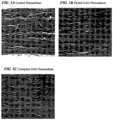
- FIGs. 5A-5C indicate attachment of GAGs across the pericardial membrane.
- FIG. 5A shows essentially no blue staining, which is consistent with no GAG being attached to the pericardium.
- FIG. 5B shows mixed blue and pink staining, which is consistent with partial GAG attachment to the pericardium.
- FIG. 5C shows nearly complete blue staining, which is indicative of complete GAG attachment to the pericardium.
Landscapes
- Health & Medical Sciences (AREA)
- Life Sciences & Earth Sciences (AREA)
- Chemical & Material Sciences (AREA)
- Engineering & Computer Science (AREA)
- General Health & Medical Sciences (AREA)
- Animal Behavior & Ethology (AREA)
- Public Health (AREA)
- Veterinary Medicine (AREA)
- Epidemiology (AREA)
- Biomedical Technology (AREA)
- Medicinal Chemistry (AREA)
- Chemical Kinetics & Catalysis (AREA)
- Cell Biology (AREA)
- Zoology (AREA)
- Dermatology (AREA)
- Molecular Biology (AREA)
- Developmental Biology & Embryology (AREA)
- Surgery (AREA)
- Transplantation (AREA)
- Oral & Maxillofacial Surgery (AREA)
- Pharmacology & Pharmacy (AREA)
- Immunology (AREA)
- Virology (AREA)
- Biotechnology (AREA)
- Vascular Medicine (AREA)
- Materials Engineering (AREA)
- Botany (AREA)
- Hematology (AREA)
- General Chemical & Material Sciences (AREA)
- Rheumatology (AREA)
- Cardiology (AREA)
- Orthopedic Medicine & Surgery (AREA)
- Urology & Nephrology (AREA)
- Nuclear Medicine, Radiotherapy & Molecular Imaging (AREA)
- Bioinformatics & Cheminformatics (AREA)
- Organic Chemistry (AREA)
- Materials For Medical Uses (AREA)
- Prostheses (AREA)
- Apparatus For Disinfection Or Sterilisation (AREA)
Applications Claiming Priority (4)
| Application Number | Priority Date | Filing Date | Title |
|---|---|---|---|
| US74354206P | 2006-03-17 | 2006-03-17 | |
| US11/686,859 US20070218038A1 (en) | 2006-03-17 | 2007-03-15 | Stabilized, sterilized collagen scaffolds with active adjuncts attached |
| EP07753351.1A EP2001521B1 (en) | 2006-03-17 | 2007-03-16 | Stabilized, sterilized collagen scaffolds with active adjuncts attached |
| PCT/US2007/006716 WO2007109180A2 (en) | 2006-03-17 | 2007-03-16 | Stabilized, sterilized collagen scaffolds with active adjuncts attached |
Related Parent Applications (2)
| Application Number | Title | Priority Date | Filing Date |
|---|---|---|---|
| EP07753351.1A Division EP2001521B1 (en) | 2006-03-17 | 2007-03-16 | Stabilized, sterilized collagen scaffolds with active adjuncts attached |
| EP07753351.1A Division-Into EP2001521B1 (en) | 2006-03-17 | 2007-03-16 | Stabilized, sterilized collagen scaffolds with active adjuncts attached |
Publications (2)
| Publication Number | Publication Date |
|---|---|
| EP3545963A1 EP3545963A1 (en) | 2019-10-02 |
| EP3545963B1 true EP3545963B1 (en) | 2025-06-25 |
Family
ID=38518079
Family Applications (2)
| Application Number | Title | Priority Date | Filing Date |
|---|---|---|---|
| EP19173906.9A Active EP3545963B1 (en) | 2006-03-17 | 2007-03-16 | Stabilized, sterilized collagen scaffolds with active adjuncts attached |
| EP07753351.1A Active EP2001521B1 (en) | 2006-03-17 | 2007-03-16 | Stabilized, sterilized collagen scaffolds with active adjuncts attached |
Family Applications After (1)
| Application Number | Title | Priority Date | Filing Date |
|---|---|---|---|
| EP07753351.1A Active EP2001521B1 (en) | 2006-03-17 | 2007-03-16 | Stabilized, sterilized collagen scaffolds with active adjuncts attached |
Country Status (7)
| Country | Link |
|---|---|
| US (3) | US20070218038A1 (https=) |
| EP (2) | EP3545963B1 (https=) |
| JP (3) | JP2009529974A (https=) |
| AU (1) | AU2007227462B2 (https=) |
| CA (1) | CA2646067C (https=) |
| ES (2) | ES3042186T3 (https=) |
| WO (1) | WO2007109180A2 (https=) |
Families Citing this family (26)
| Publication number | Priority date | Publication date | Assignee | Title |
|---|---|---|---|---|
| WO2008063839A2 (en) * | 2006-10-31 | 2008-05-29 | University Of Rochester | Targeted delivery of therapeutic agents with lyophilized matrices |
| US20090036656A1 (en) * | 2007-07-31 | 2009-02-05 | Body Organ Biomedical Corp. | Method for preparing a biomaterial |
| US20110212524A1 (en) * | 2006-12-04 | 2011-09-01 | Body Organ Biomedical Corporation | Biomaterial and preparation method thereof |
| CN101952306B (zh) * | 2008-02-21 | 2014-09-10 | 皮护神经科学协会 | Mntf肽的化妆和皮肤病制剂 |
| WO2009105760A2 (en) * | 2008-02-22 | 2009-08-27 | Musculoskeletal Transplant Foundation | Biologic matrices comprising anti-infective, methods and compositions related thereto |
| AU2009257400B2 (en) * | 2008-06-11 | 2014-05-01 | The Children's Mercy Hospital | Solutions for tissue engineering and methods of use |
| WO2011071766A2 (en) * | 2009-12-13 | 2011-06-16 | Amit Prakash Govil | Bioactive grafts and composites |
| ES2585388T5 (es) * | 2010-03-22 | 2019-08-08 | Allergan Inc | Hidrogeles reticulados de polisacárido y proteína-polisacárido para aumento de tejido blando |
| US9155607B2 (en) * | 2011-11-16 | 2015-10-13 | Purdue Research Foundation | Compositions and methods for repair or regeneration of soft tissue |
| WO2013086404A1 (en) | 2011-12-09 | 2013-06-13 | The Board Of Trustees Of The Leland Stanford Junior University | Decellularized composite tissue bioscaffolds for musculoskeletal tissue interface reconstruction and methods of production |
| GB201212771D0 (en) * | 2012-07-18 | 2012-08-29 | Northwick Park Inst For Medcal Res Ltd | Implant and method for producing an implant |
| CA2899713C (en) | 2013-03-15 | 2022-07-19 | Allosource | Cell repopulated collagen matrix for soft tissue repair and regeneration |
| EP2983718A4 (en) * | 2013-04-11 | 2016-12-07 | Univ Of Vermont And State Agricultural College | Decellularization and recellularization of whole organs |
| US9238090B1 (en) | 2014-12-24 | 2016-01-19 | Fettech, Llc | Tissue-based compositions |
| US11193110B2 (en) | 2015-01-30 | 2021-12-07 | The University Of North Carolina At Chapel Hill | Methods to generate gastrointestinal epithelial tissue constructs |
| CN107750274A (zh) | 2015-06-08 | 2018-03-02 | 康宁股份有限公司 | 用于水凝胶微载体的干燥制剂 |
| CN108697417B (zh) * | 2015-08-18 | 2022-07-05 | 科医公司 | 抗微生物伤口闭合材料,包括抗微生物缝合线,和使用所述材料闭合伤口的方法 |
| KR101710615B1 (ko) * | 2016-09-07 | 2017-02-27 | 주식회사 파마리서치프로덕트 | 생착률을 증가시킨 이식용 진피층 및 이의 제조 방법 |
| US20210052771A1 (en) * | 2018-04-06 | 2021-02-25 | The Regents Of The University Of California | Nanoparticulate mineralized collagen glycosaminoglycan scaffold with an anti-resorption factor |
| US12104149B2 (en) | 2018-05-15 | 2024-10-01 | The University Of North Carolina At Chapel Hill | Devices, systems and apparatuses for generating self-sustaining hypoxic conditions and gaseous and non-gaseous chemical gradients for in vitro cell culture |
| CA3093585A1 (en) | 2018-05-25 | 2019-11-28 | The University Of North Carolina At Chapel Hill | Formation of arrays of planar intestinal crypts possessing a stem/proliferattve cell compartment and differentiated cell zone |
| CN109833118B (zh) * | 2018-09-29 | 2020-07-07 | 四川大学 | 一种采用交联处理提高生物瓣膜稳定性的方法 |
| EP3880785A4 (en) | 2018-11-16 | 2022-08-24 | The University of North Carolina at Chapel Hill | In vitro cell culture mucus systems |
| WO2020163329A1 (en) | 2019-02-05 | 2020-08-13 | Corning Incorporated | Woven cell culture substrates |
| US11118151B2 (en) | 2019-11-05 | 2021-09-14 | Corning Incorporated | Fixed bed bioreactor and methods of using the same |
| CN114028613A (zh) * | 2021-10-21 | 2022-02-11 | 潍坊医学院 | 一种功能性骨修复复合支架、制备方法及应用 |
Family Cites Families (32)
| Publication number | Priority date | Publication date | Assignee | Title |
|---|---|---|---|---|
| NZ177159A (en) | 1974-04-20 | 1978-03-06 | Beecham Group Ltd | Clavulanic acid, salts, esters and preparation thereof from streptomyces clavuligerus: pharmaceutical compositions |
| US4529720A (en) | 1974-04-20 | 1985-07-16 | Beecham Group, P.L.C. | Antibiotic from Streptomyces clavulicerus |
| US4378224A (en) | 1980-09-19 | 1983-03-29 | Nimni Marcel E | Coating for bioprosthetic device and method of making same |
| JPS59177042A (ja) * | 1983-03-29 | 1984-10-06 | マ−セル・イ−・ニムニ | 生物学的補綴具のための皮膜及びその製造方法 |
| EP0121008A3 (en) * | 1983-03-29 | 1985-03-27 | Marcel E. Nimni | Coating for bioprosthetic device and method of making same |
| US4448718A (en) * | 1983-09-13 | 1984-05-15 | Massachusetts Institute Of Technology | Method for the preparation of collagen-glycosaminoglycan composite materials |
| CA2066660C (en) | 1989-09-15 | 2002-07-30 | Cary Reich | Method for achieving epithelialization of synthetic lenses |
| US5308641A (en) | 1993-01-19 | 1994-05-03 | Medtronic, Inc. | Biocompatibility of solid surfaces |
| US5447536A (en) * | 1994-02-17 | 1995-09-05 | Biomedical Design, Inc. | Method for fixation of biological tissue |
| JP3708567B2 (ja) * | 1994-07-20 | 2005-10-19 | 日清紡績株式会社 | 生物学的に活性な物質を固定するための方法 |
| US5733337A (en) * | 1995-04-07 | 1998-03-31 | Organogenesis, Inc. | Tissue repair fabric |
| US6048964A (en) * | 1995-12-12 | 2000-04-11 | Stryker Corporation | Compositions and therapeutic methods using morphogenic proteins and stimulatory factors |
| US6506339B1 (en) * | 1997-02-10 | 2003-01-14 | Biomedical Design, Inc. | Method of sterilization |
| DE69814070T2 (de) * | 1997-02-10 | 2003-12-18 | Biomedical Design, Inc. | Sterilisationsverfahren |
| US5891196A (en) * | 1997-04-16 | 1999-04-06 | Baxter International Inc. | Method for actively binding heparin to crosslinked biological tissues |
| US6117979A (en) * | 1997-08-18 | 2000-09-12 | Medtronic, Inc. | Process for making a bioprosthetic device and implants produced therefrom |
| CA2324958C (en) * | 1998-03-23 | 2009-12-22 | Bio-Vascular, Inc. | Pericardial tissue implants and methods of making them |
| US6521179B1 (en) | 1999-08-11 | 2003-02-18 | Biomedical Design, Inc. | Sterilization |
| KR20010038098A (ko) * | 1999-10-22 | 2001-05-15 | 박호군 | 헤파린 처리된 항석회화성 생체조직 이식물 및 이의 제조 방법 |
| US6623963B1 (en) * | 1999-12-20 | 2003-09-23 | Verigen Ag | Cellular matrix |
| AU2000231640A1 (en) | 2000-03-03 | 2001-09-12 | Rolf Siegel | Agent for the treatment of wounds |
| CA2400401A1 (en) | 2000-03-09 | 2001-09-13 | Syntacoll Ag | Novel natural polymer-based material with improved properties for use in human and veterinary medicine and the method of manufacturing such |
| WO2001066162A1 (en) | 2000-03-09 | 2001-09-13 | Syntacoll Ag | Multilayer collagen matrix for tissue reconstruction |
| US6444222B1 (en) * | 2001-05-08 | 2002-09-03 | Verigen Transplantation Services International Ag | Reinforced matrices |
| WO2003007786A2 (en) * | 2001-07-16 | 2003-01-30 | Depuy Products, Inc. | Porous delivery scaffold and method |
| ATE502660T1 (de) * | 2001-07-16 | 2011-04-15 | Depuy Products Inc | Poröses freisetzungsgerüst und verfahren |
| WO2003032735A1 (en) * | 2001-10-18 | 2003-04-24 | Lifecell Corporation | Remodeling of tissues and organs |
| ES2488766T3 (es) * | 2002-01-25 | 2014-08-28 | Biomedical Design, Inc. | Fijación resistente a la calcificación |
| US6982298B2 (en) * | 2003-01-10 | 2006-01-03 | The Cleveland Clinic Foundation | Hydroxyphenyl cross-linked macromolecular network and applications thereof |
| WO2005049105A2 (en) | 2003-11-10 | 2005-06-02 | Angiotech International Ag | Medical implants and anti-scarring agents |
| WO2005063316A1 (ja) * | 2003-12-26 | 2005-07-14 | Cardio Incorporated | 移植可能な生体材料およびその作成方法 |
| EP1796693A2 (en) * | 2004-08-26 | 2007-06-20 | Chandrashekhar P. Pathak | Implantable tissue compositions and method |
-
2007
- 2007-03-15 US US11/686,859 patent/US20070218038A1/en not_active Abandoned
- 2007-03-16 CA CA2646067A patent/CA2646067C/en active Active
- 2007-03-16 WO PCT/US2007/006716 patent/WO2007109180A2/en not_active Ceased
- 2007-03-16 ES ES19173906T patent/ES3042186T3/es active Active
- 2007-03-16 EP EP19173906.9A patent/EP3545963B1/en active Active
- 2007-03-16 JP JP2009500520A patent/JP2009529974A/ja active Pending
- 2007-03-16 ES ES07753351T patent/ES2751911T3/es active Active
- 2007-03-16 AU AU2007227462A patent/AU2007227462B2/en active Active
- 2007-03-16 EP EP07753351.1A patent/EP2001521B1/en active Active
-
2009
- 2009-01-06 US US12/349,392 patent/US9694037B2/en active Active
-
2010
- 2010-06-30 US US12/827,896 patent/US9272004B2/en active Active
-
2012
- 2012-11-26 JP JP2012257084A patent/JP2013063283A/ja not_active Withdrawn
-
2015
- 2015-11-27 JP JP2015232066A patent/JP6298437B2/ja active Active
Also Published As
| Publication number | Publication date |
|---|---|
| ES2751911T3 (es) | 2020-04-02 |
| ES3042186T3 (en) | 2025-11-19 |
| US20100266559A1 (en) | 2010-10-21 |
| JP2016064141A (ja) | 2016-04-28 |
| WO2007109180A3 (en) | 2008-10-30 |
| AU2007227462B2 (en) | 2012-08-02 |
| WO2007109180A2 (en) | 2007-09-27 |
| CA2646067C (en) | 2015-11-03 |
| EP2001521B1 (en) | 2019-07-31 |
| US9272004B2 (en) | 2016-03-01 |
| US9694037B2 (en) | 2017-07-04 |
| JP2013063283A (ja) | 2013-04-11 |
| JP2009529974A (ja) | 2009-08-27 |
| EP2001521A4 (en) | 2012-06-20 |
| JP6298437B2 (ja) | 2018-03-20 |
| CA2646067A1 (en) | 2007-09-27 |
| EP2001521A2 (en) | 2008-12-17 |
| EP3545963A1 (en) | 2019-10-02 |
| US20070218038A1 (en) | 2007-09-20 |
| US20090196898A1 (en) | 2009-08-06 |
| AU2007227462A1 (en) | 2007-09-27 |
Similar Documents
| Publication | Publication Date | Title |
|---|---|---|
| EP3545963B1 (en) | Stabilized, sterilized collagen scaffolds with active adjuncts attached | |
| ES2404033T3 (es) | Limpieza química de material biológico | |
| US8080260B2 (en) | Molecular enhancement of extracellular matrix and methods of use | |
| EP2590691B1 (en) | Method for shaping tissue matrices | |
| JP2009529974A5 (https=) | ||
| KR102149227B1 (ko) | 멸균 방법 | |
| EP2001523A2 (en) | Variably crosslinked tissue | |
| JP2009502268A (ja) | 生物型人工靭帯及びその調製方法 | |
| JP2019504708A (ja) | 酵素分解に対するコラーゲン含有組織製品の安定化方法 | |
| Devarathnam | Biocompatibility determination of acellular aortic matrix of buffalo origin | |
| AU774997B2 (en) | Chemical cleaning of biological material | |
| Kumar | Biocompatibility of cross-linked pericardium and diaphragm of caprine origin | |
| MXPA99010251A (es) | Limpieza quimica de material biologico |
Legal Events
| Date | Code | Title | Description |
|---|---|---|---|
| PUAI | Public reference made under article 153(3) epc to a published international application that has entered the european phase |
Free format text: ORIGINAL CODE: 0009012 |
|
| STAA | Information on the status of an ep patent application or granted ep patent |
Free format text: STATUS: THE APPLICATION HAS BEEN PUBLISHED |
|
| AC | Divisional application: reference to earlier application |
Ref document number: 2001521 Country of ref document: EP Kind code of ref document: P |
|
| AK | Designated contracting states |
Kind code of ref document: A1 Designated state(s): AT BE BG CH CY CZ DE DK EE ES FI FR GB GR HU IE IS IT LI LT LU LV MC MT NL PL PT RO SE SI SK TR |
|
| RIN1 | Information on inventor provided before grant (corrected) |
Inventor name: RITTER, GREGG Inventor name: SANDER, THOMAS Inventor name: NATARAJ, CHANDRASEKARAN |
|
| STAA | Information on the status of an ep patent application or granted ep patent |
Free format text: STATUS: REQUEST FOR EXAMINATION WAS MADE |
|
| 17P | Request for examination filed |
Effective date: 20200331 |
|
| RBV | Designated contracting states (corrected) |
Designated state(s): AT BE BG CH CY CZ DE DK EE ES FI FR GB GR HU IE IS IT LI LT LU LV MC MT NL PL PT RO SE SI SK TR |
|
| STAA | Information on the status of an ep patent application or granted ep patent |
Free format text: STATUS: EXAMINATION IS IN PROGRESS |
|
| 17Q | First examination report despatched |
Effective date: 20200727 |
|
| GRAP | Despatch of communication of intention to grant a patent |
Free format text: ORIGINAL CODE: EPIDOSNIGR1 |
|
| STAA | Information on the status of an ep patent application or granted ep patent |
Free format text: STATUS: GRANT OF PATENT IS INTENDED |
|
| RIC1 | Information provided on ipc code assigned before grant |
Ipc: A61P 43/00 20060101ALI20250122BHEP Ipc: A61L 17/00 20060101ALI20250122BHEP Ipc: A61L 33/18 20060101ALI20250122BHEP Ipc: A61L 33/00 20060101ALI20250122BHEP Ipc: A61L 27/54 20060101ALI20250122BHEP Ipc: A61L 27/36 20060101ALI20250122BHEP Ipc: A61L 17/08 20060101ALI20250122BHEP Ipc: A61K 35/36 20150101ALI20250122BHEP Ipc: A61K 35/34 20150101ALI20250122BHEP Ipc: A61K 35/32 20150101AFI20250122BHEP |
|
| INTG | Intention to grant announced |
Effective date: 20250131 |
|
| RIN1 | Information on inventor provided before grant (corrected) |
Inventor name: SANDER, THOMAS Inventor name: RITTER, GREGG Inventor name: NATARAJ, CHANDRASEKARAN |
|
| GRAS | Grant fee paid |
Free format text: ORIGINAL CODE: EPIDOSNIGR3 |
|
| GRAA | (expected) grant |
Free format text: ORIGINAL CODE: 0009210 |
|
| STAA | Information on the status of an ep patent application or granted ep patent |
Free format text: STATUS: THE PATENT HAS BEEN GRANTED |
|
| AC | Divisional application: reference to earlier application |
Ref document number: 2001521 Country of ref document: EP Kind code of ref document: P |
|
| AK | Designated contracting states |
Kind code of ref document: B1 Designated state(s): AT BE BG CH CY CZ DE DK EE ES FI FR GB GR HU IE IS IT LI LT LU LV MC MT NL PL PT RO SE SI SK TR |
|
| REG | Reference to a national code |
Ref country code: GB Ref legal event code: FG4D |
|
| REG | Reference to a national code |
Ref country code: CH Ref legal event code: EP |
|
| REG | Reference to a national code |
Ref country code: CH Ref legal event code: EP |
|
| REG | Reference to a national code |
Ref country code: IE Ref legal event code: FG4D |
|
| REG | Reference to a national code |
Ref country code: DE Ref legal event code: R096 Ref document number: 602007061990 Country of ref document: DE |
|
| PG25 | Lapsed in a contracting state [announced via postgrant information from national office to epo] |
Ref country code: FI Free format text: LAPSE BECAUSE OF FAILURE TO SUBMIT A TRANSLATION OF THE DESCRIPTION OR TO PAY THE FEE WITHIN THE PRESCRIBED TIME-LIMIT Effective date: 20250625 |
|
| REG | Reference to a national code |
Ref country code: LT Ref legal event code: MG9D |
|
| PG25 | Lapsed in a contracting state [announced via postgrant information from national office to epo] |
Ref country code: GR Free format text: LAPSE BECAUSE OF FAILURE TO SUBMIT A TRANSLATION OF THE DESCRIPTION OR TO PAY THE FEE WITHIN THE PRESCRIBED TIME-LIMIT Effective date: 20250926 |
|
| PG25 | Lapsed in a contracting state [announced via postgrant information from national office to epo] |
Ref country code: BG Free format text: LAPSE BECAUSE OF FAILURE TO SUBMIT A TRANSLATION OF THE DESCRIPTION OR TO PAY THE FEE WITHIN THE PRESCRIBED TIME-LIMIT Effective date: 20250625 |
|
| PG25 | Lapsed in a contracting state [announced via postgrant information from national office to epo] |
Ref country code: LV Free format text: LAPSE BECAUSE OF FAILURE TO SUBMIT A TRANSLATION OF THE DESCRIPTION OR TO PAY THE FEE WITHIN THE PRESCRIBED TIME-LIMIT Effective date: 20250625 |
|
| REG | Reference to a national code |
Ref country code: NL Ref legal event code: MP Effective date: 20250625 |
|
| PG25 | Lapsed in a contracting state [announced via postgrant information from national office to epo] |
Ref country code: NL Free format text: LAPSE BECAUSE OF FAILURE TO SUBMIT A TRANSLATION OF THE DESCRIPTION OR TO PAY THE FEE WITHIN THE PRESCRIBED TIME-LIMIT Effective date: 20250625 |
|
| REG | Reference to a national code |
Ref country code: ES Ref legal event code: FG2A Ref document number: 3042186 Country of ref document: ES Kind code of ref document: T3 Effective date: 20251119 |
|
| PG25 | Lapsed in a contracting state [announced via postgrant information from national office to epo] |
Ref country code: PT Free format text: LAPSE BECAUSE OF FAILURE TO SUBMIT A TRANSLATION OF THE DESCRIPTION OR TO PAY THE FEE WITHIN THE PRESCRIBED TIME-LIMIT Effective date: 20251027 |
|
| REG | Reference to a national code |
Ref country code: CH Ref legal event code: W10 Free format text: ST27 STATUS EVENT CODE: U-0-0-W10-W00 (AS PROVIDED BY THE NATIONAL OFFICE) Effective date: 20251210 |
|
| REG | Reference to a national code |
Ref country code: AT Ref legal event code: MK05 Ref document number: 1805771 Country of ref document: AT Kind code of ref document: T Effective date: 20250625 |
|
| RAP2 | Party data changed (patent owner data changed or rights of a patent transferred) |
Owner name: SYNOVIS LIFE TECHNOLOGIES, INC. |
|
| PG25 | Lapsed in a contracting state [announced via postgrant information from national office to epo] |
Ref country code: IS Free format text: LAPSE BECAUSE OF FAILURE TO SUBMIT A TRANSLATION OF THE DESCRIPTION OR TO PAY THE FEE WITHIN THE PRESCRIBED TIME-LIMIT Effective date: 20251025 |
|
| PG25 | Lapsed in a contracting state [announced via postgrant information from national office to epo] |
Ref country code: AT Free format text: LAPSE BECAUSE OF FAILURE TO SUBMIT A TRANSLATION OF THE DESCRIPTION OR TO PAY THE FEE WITHIN THE PRESCRIBED TIME-LIMIT Effective date: 20250625 |
|
| PG25 | Lapsed in a contracting state [announced via postgrant information from national office to epo] |
Ref country code: CZ Free format text: LAPSE BECAUSE OF FAILURE TO SUBMIT A TRANSLATION OF THE DESCRIPTION OR TO PAY THE FEE WITHIN THE PRESCRIBED TIME-LIMIT Effective date: 20250625 |
|
| PG25 | Lapsed in a contracting state [announced via postgrant information from national office to epo] |
Ref country code: PL Free format text: LAPSE BECAUSE OF FAILURE TO SUBMIT A TRANSLATION OF THE DESCRIPTION OR TO PAY THE FEE WITHIN THE PRESCRIBED TIME-LIMIT Effective date: 20250625 |
|
| PG25 | Lapsed in a contracting state [announced via postgrant information from national office to epo] |
Ref country code: EE Free format text: LAPSE BECAUSE OF FAILURE TO SUBMIT A TRANSLATION OF THE DESCRIPTION OR TO PAY THE FEE WITHIN THE PRESCRIBED TIME-LIMIT Effective date: 20250625 |
|
| PG25 | Lapsed in a contracting state [announced via postgrant information from national office to epo] |
Ref country code: SK Free format text: LAPSE BECAUSE OF FAILURE TO SUBMIT A TRANSLATION OF THE DESCRIPTION OR TO PAY THE FEE WITHIN THE PRESCRIBED TIME-LIMIT Effective date: 20250625 |
|
| PG25 | Lapsed in a contracting state [announced via postgrant information from national office to epo] |
Ref country code: DK Free format text: LAPSE BECAUSE OF FAILURE TO SUBMIT A TRANSLATION OF THE DESCRIPTION OR TO PAY THE FEE WITHIN THE PRESCRIBED TIME-LIMIT Effective date: 20250625 |
|
| PG25 | Lapsed in a contracting state [announced via postgrant information from national office to epo] |
Ref country code: IT Free format text: LAPSE BECAUSE OF FAILURE TO SUBMIT A TRANSLATION OF THE DESCRIPTION OR TO PAY THE FEE WITHIN THE PRESCRIBED TIME-LIMIT Effective date: 20250625 |
|
| PLBE | No opposition filed within time limit |
Free format text: ORIGINAL CODE: 0009261 |
|
| STAA | Information on the status of an ep patent application or granted ep patent |
Free format text: STATUS: NO OPPOSITION FILED WITHIN TIME LIMIT |