EP3543082A1 - Verfahren zum betreiben eines autonomen oder teilautonomen kraftfahrzeugs - Google Patents
Verfahren zum betreiben eines autonomen oder teilautonomen kraftfahrzeugs Download PDFInfo
- Publication number
- EP3543082A1 EP3543082A1 EP19152045.1A EP19152045A EP3543082A1 EP 3543082 A1 EP3543082 A1 EP 3543082A1 EP 19152045 A EP19152045 A EP 19152045A EP 3543082 A1 EP3543082 A1 EP 3543082A1
- Authority
- EP
- European Patent Office
- Prior art keywords
- driver
- motor vehicle
- autonomous
- request
- input device
- Prior art date
- Legal status (The legal status is an assumption and is not a legal conclusion. Google has not performed a legal analysis and makes no representation as to the accuracy of the status listed.)
- Granted
Links
Images

Classifications
-
- B—PERFORMING OPERATIONS; TRANSPORTING
- B60—VEHICLES IN GENERAL
- B60W—CONJOINT CONTROL OF VEHICLE SUB-UNITS OF DIFFERENT TYPE OR DIFFERENT FUNCTION; CONTROL SYSTEMS SPECIALLY ADAPTED FOR HYBRID VEHICLES; ROAD VEHICLE DRIVE CONTROL SYSTEMS FOR PURPOSES NOT RELATED TO THE CONTROL OF A PARTICULAR SUB-UNIT
- B60W50/00—Details of control systems for road vehicle drive control not related to the control of a particular sub-unit, e.g. process diagnostic or vehicle driver interfaces
- B60W50/08—Interaction between the driver and the control system
- B60W50/14—Means for informing the driver, warning the driver or prompting a driver intervention
-
- B—PERFORMING OPERATIONS; TRANSPORTING
- B60—VEHICLES IN GENERAL
- B60W—CONJOINT CONTROL OF VEHICLE SUB-UNITS OF DIFFERENT TYPE OR DIFFERENT FUNCTION; CONTROL SYSTEMS SPECIALLY ADAPTED FOR HYBRID VEHICLES; ROAD VEHICLE DRIVE CONTROL SYSTEMS FOR PURPOSES NOT RELATED TO THE CONTROL OF A PARTICULAR SUB-UNIT
- B60W40/00—Estimation or calculation of non-directly measurable driving parameters for road vehicle drive control systems not related to the control of a particular sub unit, e.g. by using mathematical models
- B60W40/08—Estimation or calculation of non-directly measurable driving parameters for road vehicle drive control systems not related to the control of a particular sub unit, e.g. by using mathematical models related to drivers or passengers
-
- B—PERFORMING OPERATIONS; TRANSPORTING
- B60—VEHICLES IN GENERAL
- B60W—CONJOINT CONTROL OF VEHICLE SUB-UNITS OF DIFFERENT TYPE OR DIFFERENT FUNCTION; CONTROL SYSTEMS SPECIALLY ADAPTED FOR HYBRID VEHICLES; ROAD VEHICLE DRIVE CONTROL SYSTEMS FOR PURPOSES NOT RELATED TO THE CONTROL OF A PARTICULAR SUB-UNIT
- B60W50/00—Details of control systems for road vehicle drive control not related to the control of a particular sub-unit, e.g. process diagnostic or vehicle driver interfaces
- B60W50/08—Interaction between the driver and the control system
-
- B—PERFORMING OPERATIONS; TRANSPORTING
- B60—VEHICLES IN GENERAL
- B60W—CONJOINT CONTROL OF VEHICLE SUB-UNITS OF DIFFERENT TYPE OR DIFFERENT FUNCTION; CONTROL SYSTEMS SPECIALLY ADAPTED FOR HYBRID VEHICLES; ROAD VEHICLE DRIVE CONTROL SYSTEMS FOR PURPOSES NOT RELATED TO THE CONTROL OF A PARTICULAR SUB-UNIT
- B60W50/00—Details of control systems for road vehicle drive control not related to the control of a particular sub-unit, e.g. process diagnostic or vehicle driver interfaces
- B60W50/08—Interaction between the driver and the control system
- B60W50/10—Interpretation of driver requests or demands
-
- B—PERFORMING OPERATIONS; TRANSPORTING
- B60—VEHICLES IN GENERAL
- B60W—CONJOINT CONTROL OF VEHICLE SUB-UNITS OF DIFFERENT TYPE OR DIFFERENT FUNCTION; CONTROL SYSTEMS SPECIALLY ADAPTED FOR HYBRID VEHICLES; ROAD VEHICLE DRIVE CONTROL SYSTEMS FOR PURPOSES NOT RELATED TO THE CONTROL OF A PARTICULAR SUB-UNIT
- B60W50/00—Details of control systems for road vehicle drive control not related to the control of a particular sub-unit, e.g. process diagnostic or vehicle driver interfaces
- B60W50/08—Interaction between the driver and the control system
- B60W50/14—Means for informing the driver, warning the driver or prompting a driver intervention
- B60W50/16—Tactile feedback to the driver, e.g. vibration or force feedback to the driver on the steering wheel or the accelerator pedal
-
- B—PERFORMING OPERATIONS; TRANSPORTING
- B60—VEHICLES IN GENERAL
- B60W—CONJOINT CONTROL OF VEHICLE SUB-UNITS OF DIFFERENT TYPE OR DIFFERENT FUNCTION; CONTROL SYSTEMS SPECIALLY ADAPTED FOR HYBRID VEHICLES; ROAD VEHICLE DRIVE CONTROL SYSTEMS FOR PURPOSES NOT RELATED TO THE CONTROL OF A PARTICULAR SUB-UNIT
- B60W40/00—Estimation or calculation of non-directly measurable driving parameters for road vehicle drive control systems not related to the control of a particular sub unit, e.g. by using mathematical models
- B60W40/08—Estimation or calculation of non-directly measurable driving parameters for road vehicle drive control systems not related to the control of a particular sub unit, e.g. by using mathematical models related to drivers or passengers
- B60W2040/0818—Inactivity or incapacity of driver
-
- B—PERFORMING OPERATIONS; TRANSPORTING
- B60—VEHICLES IN GENERAL
- B60W—CONJOINT CONTROL OF VEHICLE SUB-UNITS OF DIFFERENT TYPE OR DIFFERENT FUNCTION; CONTROL SYSTEMS SPECIALLY ADAPTED FOR HYBRID VEHICLES; ROAD VEHICLE DRIVE CONTROL SYSTEMS FOR PURPOSES NOT RELATED TO THE CONTROL OF A PARTICULAR SUB-UNIT
- B60W40/00—Estimation or calculation of non-directly measurable driving parameters for road vehicle drive control systems not related to the control of a particular sub unit, e.g. by using mathematical models
- B60W40/08—Estimation or calculation of non-directly measurable driving parameters for road vehicle drive control systems not related to the control of a particular sub unit, e.g. by using mathematical models related to drivers or passengers
- B60W2040/0872—Driver physiology
-
- B—PERFORMING OPERATIONS; TRANSPORTING
- B60—VEHICLES IN GENERAL
- B60W—CONJOINT CONTROL OF VEHICLE SUB-UNITS OF DIFFERENT TYPE OR DIFFERENT FUNCTION; CONTROL SYSTEMS SPECIALLY ADAPTED FOR HYBRID VEHICLES; ROAD VEHICLE DRIVE CONTROL SYSTEMS FOR PURPOSES NOT RELATED TO THE CONTROL OF A PARTICULAR SUB-UNIT
- B60W40/00—Estimation or calculation of non-directly measurable driving parameters for road vehicle drive control systems not related to the control of a particular sub unit, e.g. by using mathematical models
- B60W40/08—Estimation or calculation of non-directly measurable driving parameters for road vehicle drive control systems not related to the control of a particular sub unit, e.g. by using mathematical models related to drivers or passengers
- B60W2040/0881—Seat occupation; Driver or passenger presence
-
- B—PERFORMING OPERATIONS; TRANSPORTING
- B60—VEHICLES IN GENERAL
- B60W—CONJOINT CONTROL OF VEHICLE SUB-UNITS OF DIFFERENT TYPE OR DIFFERENT FUNCTION; CONTROL SYSTEMS SPECIALLY ADAPTED FOR HYBRID VEHICLES; ROAD VEHICLE DRIVE CONTROL SYSTEMS FOR PURPOSES NOT RELATED TO THE CONTROL OF A PARTICULAR SUB-UNIT
- B60W50/00—Details of control systems for road vehicle drive control not related to the control of a particular sub-unit, e.g. process diagnostic or vehicle driver interfaces
- B60W50/08—Interaction between the driver and the control system
- B60W50/14—Means for informing the driver, warning the driver or prompting a driver intervention
- B60W2050/143—Alarm means
-
- B—PERFORMING OPERATIONS; TRANSPORTING
- B60—VEHICLES IN GENERAL
- B60W—CONJOINT CONTROL OF VEHICLE SUB-UNITS OF DIFFERENT TYPE OR DIFFERENT FUNCTION; CONTROL SYSTEMS SPECIALLY ADAPTED FOR HYBRID VEHICLES; ROAD VEHICLE DRIVE CONTROL SYSTEMS FOR PURPOSES NOT RELATED TO THE CONTROL OF A PARTICULAR SUB-UNIT
- B60W50/00—Details of control systems for road vehicle drive control not related to the control of a particular sub-unit, e.g. process diagnostic or vehicle driver interfaces
- B60W50/08—Interaction between the driver and the control system
- B60W50/14—Means for informing the driver, warning the driver or prompting a driver intervention
- B60W2050/146—Display means
-
- B—PERFORMING OPERATIONS; TRANSPORTING
- B60—VEHICLES IN GENERAL
- B60W—CONJOINT CONTROL OF VEHICLE SUB-UNITS OF DIFFERENT TYPE OR DIFFERENT FUNCTION; CONTROL SYSTEMS SPECIALLY ADAPTED FOR HYBRID VEHICLES; ROAD VEHICLE DRIVE CONTROL SYSTEMS FOR PURPOSES NOT RELATED TO THE CONTROL OF A PARTICULAR SUB-UNIT
- B60W2520/00—Input parameters relating to overall vehicle dynamics
- B60W2520/10—Longitudinal speed
-
- B—PERFORMING OPERATIONS; TRANSPORTING
- B60—VEHICLES IN GENERAL
- B60W—CONJOINT CONTROL OF VEHICLE SUB-UNITS OF DIFFERENT TYPE OR DIFFERENT FUNCTION; CONTROL SYSTEMS SPECIALLY ADAPTED FOR HYBRID VEHICLES; ROAD VEHICLE DRIVE CONTROL SYSTEMS FOR PURPOSES NOT RELATED TO THE CONTROL OF A PARTICULAR SUB-UNIT
- B60W2540/00—Input parameters relating to occupants
- B60W2540/215—Selection or confirmation of options
-
- B—PERFORMING OPERATIONS; TRANSPORTING
- B60—VEHICLES IN GENERAL
- B60W—CONJOINT CONTROL OF VEHICLE SUB-UNITS OF DIFFERENT TYPE OR DIFFERENT FUNCTION; CONTROL SYSTEMS SPECIALLY ADAPTED FOR HYBRID VEHICLES; ROAD VEHICLE DRIVE CONTROL SYSTEMS FOR PURPOSES NOT RELATED TO THE CONTROL OF A PARTICULAR SUB-UNIT
- B60W2552/00—Input parameters relating to infrastructure
-
- B—PERFORMING OPERATIONS; TRANSPORTING
- B60—VEHICLES IN GENERAL
- B60W—CONJOINT CONTROL OF VEHICLE SUB-UNITS OF DIFFERENT TYPE OR DIFFERENT FUNCTION; CONTROL SYSTEMS SPECIALLY ADAPTED FOR HYBRID VEHICLES; ROAD VEHICLE DRIVE CONTROL SYSTEMS FOR PURPOSES NOT RELATED TO THE CONTROL OF A PARTICULAR SUB-UNIT
- B60W2552/00—Input parameters relating to infrastructure
- B60W2552/15—Road slope, i.e. the inclination of a road segment in the longitudinal direction
-
- B—PERFORMING OPERATIONS; TRANSPORTING
- B60—VEHICLES IN GENERAL
- B60W—CONJOINT CONTROL OF VEHICLE SUB-UNITS OF DIFFERENT TYPE OR DIFFERENT FUNCTION; CONTROL SYSTEMS SPECIALLY ADAPTED FOR HYBRID VEHICLES; ROAD VEHICLE DRIVE CONTROL SYSTEMS FOR PURPOSES NOT RELATED TO THE CONTROL OF A PARTICULAR SUB-UNIT
- B60W2554/00—Input parameters relating to objects
-
- B—PERFORMING OPERATIONS; TRANSPORTING
- B60—VEHICLES IN GENERAL
- B60W—CONJOINT CONTROL OF VEHICLE SUB-UNITS OF DIFFERENT TYPE OR DIFFERENT FUNCTION; CONTROL SYSTEMS SPECIALLY ADAPTED FOR HYBRID VEHICLES; ROAD VEHICLE DRIVE CONTROL SYSTEMS FOR PURPOSES NOT RELATED TO THE CONTROL OF A PARTICULAR SUB-UNIT
- B60W2554/00—Input parameters relating to objects
- B60W2554/40—Dynamic objects, e.g. animals, windblown objects
- B60W2554/406—Traffic density
-
- B—PERFORMING OPERATIONS; TRANSPORTING
- B60—VEHICLES IN GENERAL
- B60W—CONJOINT CONTROL OF VEHICLE SUB-UNITS OF DIFFERENT TYPE OR DIFFERENT FUNCTION; CONTROL SYSTEMS SPECIALLY ADAPTED FOR HYBRID VEHICLES; ROAD VEHICLE DRIVE CONTROL SYSTEMS FOR PURPOSES NOT RELATED TO THE CONTROL OF A PARTICULAR SUB-UNIT
- B60W2556/00—Input parameters relating to data
- B60W2556/45—External transmission of data to or from the vehicle
- B60W2556/50—External transmission of data to or from the vehicle of positioning data, e.g. GPS [Global Positioning System] data
Definitions
- the invention relates to a method for operating a motor vehicle, which is operable in a mode of operation with teilautonomer or autonomous vehicle guidance and in a controlled by a driver operating mode.
- a current development trend in addition to the electrification of the powertrain is the expansion of driver assistance systems.
- the systems can be expanded by sensors so far that the car can drive autonomously autonomous within certain conditions.
- a method and system that manages to alert the driver while driving.
- a method may by a sensor detect characteristics of a driver based on the detected characteristics of the driver determining whether the driver is exercising sufficient supervisory control of the vehicle and providing a series of one or more prompts. The urgency of each request is related to determining whether the driver is exercising sufficient supervisory control of the vehicle.
- the DE 10 2015 224 555 A1 relates to a method for operating a motor vehicle with a device for requesting the driver to interact.
- the motor vehicle can be operated at least in a mode of operation with partially autonomous or autonomous vehicle guidance and in an operating mode with a driver-controlled vehicle guidance.
- a driver's response to a request for interaction is reviewed. When checking the Reaction of the driver is taken into account a driver's line of sight and the driver's utterance.
- the DE 10 2013 206 212 A1 discloses a method for controlling a vehicle, wherein the vehicle may be operated in at least one autonomous vehicle management operating mode and in a driver-controlled operating mode.
- driver attention monitoring is performed to ensure that the driver may be required to take over control responsibility within a given takeover window.
- cognitively demanding tasks are set to the driver via a human-machine interface, and the driver's attention is determined from the answer to this at times, if necessary even several times.
- Known monitoring systems may, for example, be disadvantageous in that they are not or not sufficiently secure against unconscious or deliberate manipulation.
- sunglasses can make tracking a look impossible.
- consciously or unconsciously placed objects can "pretend" a hand that actuates a button with which the driver should actually actively acknowledge his or her attention.
- the invention is based on the object to provide an alternative and / or improved method, with the particular disadvantages of the prior art can be overcome.
- the method should be safer against conscious and unconscious manipulation.
- the method is suitable for operating a motor vehicle that is operable in a partially autonomous or autonomous vehicle operation mode and in an operator controlled (substantially fully) controlled mode of operation.
- the method points requesting the driver to confirm (eg, active or passive) his or her attention during operation of the motor vehicle in the partially autonomous or autonomous vehicle operation mode of operation.
- the request is repeated at random and / or changing intervals.
- the request is made when it is detected (for example by a navigation device and / or vehicle sensor system) that a preceding route section (eg programmed in the navigation device or detected by the vehicle sensor system) is essentially free of at least one predetermined route segment Road condition change and / or a predetermined driving condition change is.
- the method can thus be protected against unconscious and deliberate manipulation.
- the random and / or varying interval between successive prompts may result in the driver not leaving his driver's seat after a prompt, as he does not know when the next prompt will occur.
- the prompts were issued at always equal, predetermined intervals, so that a driver of the motor vehicle could adjust to it.
- the driver could leave the driver's seat after a request, knowing that the next call will be made again in, for example, 5 minutes.
- the method makes it possible to issue prompts, in particular in the preceding sections of track, in which no dangerous situations or only standardized or standardisable driving situations are to be expected. Especially in these sections of the driver tends to inattention and / or leaving the driver's seat.
- the random and / or changing time intervals may be within a predetermined time interval, e.g. B. between 1 min and 10 min.
- the random and / or changing time intervals may be determined, in particular calculated, taking into account location information and / or map data of a navigation device. For example, an estimated distance time between two geometric points (eg, start point and destination point) may be taken into account, e.g. B. 30 minutes.
- the time intervals and / or the time interval with respect to the distance time may be adjusted so that at least once, preferably several times, is requested within the removal time, z. At equal or uneven intervals (eg after 2 minutes, after 5 minutes and after 17 minutes).
- the changing time intervals can be predetermined or programmed and z. B. stored in a query table. It is possible that access to the query table happens at random.
- a (pre-) setting with respect to the function of requesting, the random and / or changing time intervals, the predetermined road condition changes and / or the predetermined driving condition changes can only be made by the manufacturer, is not overwritten, is not changeable, stored protected and / or changeable only with a password.
- the request can not be switched off and / or is carried out automatically when the motor vehicle is operated in the operating mode with partially autonomous or autonomous vehicle guidance.
- the requesting is carried out as a function of a speed of the motor vehicle and / or the requesting is carried out only at a predetermined speed (eg 15 km / h or more) of the motor vehicle.
- a predetermined speed eg 15 km / h or more
- an interval between the requests with an increasing speed of the motor vehicle is shortened and / or extended at a decreasing speed of the motor vehicle.
- the driver is not informed of the random and / or changing time intervals.
- the requesting when driving on the route section is carried out repeatedly, in particular at random and / or changing time intervals.
- the at least one road condition change comprises an intersection, a road bifurcation, a speed limit change, a construction site, a highway entrance, a highway exit, a lane narrowing, a track extension, and / or a downhill.
- the at least one driving condition change has a traffic jam, a traffic flow change, a traffic density change and / or a traffic accident.
- the driver of the motor vehicle may be inclined to his To reduce attention and / or to leave the driver's seat.
- the present method can be used, in particular, to counteract this faulty behavior of the driver.
- the request is issued to the driver by means of an acoustic, visual and / or haptic signal.
- the method further comprises outputting an audible, visual, and / or haptic warning signal if no confirmation of the driver occurs within a predetermined period of time (e.g., 5 to 10 seconds) after the request.
- a predetermined period of time e.g. 5 to 10 seconds
- an emergency braking of the motor vehicle takes place when, in particular repeatedly, no confirmation of the driver within a predetermined period of time (eg 5 to 10 seconds) takes place after the request.
- the confirmation by the driver on an actuation of a, in particular touch-sensitive or contactless, input device is provided.
- the input device is checked whether the input device is unactuated before requesting and / or after actuation. This can be prevented that the input device is manipulated so that it is always pressed (for example, by attaching an adhesive strip, etc.), so that the driver no longer has to confirm his attention despite being prompted and instead leave, for example, the driver's seat during the autonomous mode of operation can.
- a multiple actuation (eg, within a predetermined time interval, such as 1 second, 2 seconds, or 3 seconds, or without a predetermined time interval) is required by the input device upon request. Again, a simple manipulation can be prevented.
- the input device comprises a touch-sensitive switch, a touch-sensitive touchpad, a touch-sensitive sensor skin and / or a touch-sensitive pedal.
- the input device may be integrated in a steering wheel, a shift knob, a dashboard, a headliner, an armrest, an A-pillar, a B-pillar, etc.
- the input device has a non-contact light barrier, a non-contact laser detection unit, a non-contact ultrasonic detection unit and / or a non-contact image detection unit.
- the input device may be integrated in a steering wheel, a shift knob, a dashboard, a headliner, an armrest, an A-pillar, a B-pillar, etc.
- allowable active confirmation by the driver may require checking to see whether human body parts (for example, fingers, palms, palms, hands, arms, feet, legs, etc.) are actually being used for actuation.
- human body parts for example, fingers, palms, palms, hands, arms, feet, legs, etc.
- the input device has a temperature sensor, wherein it is checked for a permissible confirmation whether an allowable temperature, in particular a human normal body temperature (about 36.5 ° C - 37.4 ° C), is measured.
- the input device has two electrodes of a circuit to be connected by means of a body part, it being checked for a permissible confirmation as to whether a permissible resistance, in particular a normal human body resistance (eg about 500 ⁇ to 1000 ⁇ , depending on the body part ), is measured.
- the input device is accessible only from the driver's seat of the motor vehicle. This can be prevented, for example, that the driver leaves his driver's seat and, for example, takes a seat in a passenger seat or lies down in a bunk.
- the method further comprises monitoring a presence of the driver on a driver's seat of the motor vehicle during operation of the motor vehicle in the operating mode with partially autonomous or autonomous vehicle guidance (eg by means of seat sensor and / or steering wheel sensor).
- the method includes monitoring the driver's condition (eg, alertness, heartbeat, circulation, etc.) during operation of the motor vehicle in the partially autonomous or autonomous vehicle operation mode of operation.
- the terms "semi-autonomous or autonomous vehicle management mode of operation" as used herein may refer to a driving system that includes one or more autonomous elements that control vehicle movement on a road while keeping the vehicle completely autonomous (eg, no driver input or control required) or partially autonomous (eg, requiring some driver input or control for safe driving).
- Control features with limited autonomous, semi-autonomous, automated or automatic driving capability eg automated lane tracking, adaptive lane tracking, adaptive cruise control, etc.
- the invention is also directed to a motor vehicle, in particular a commercial vehicle (for example, a truck or omnibus) with a controller arranged to carry out a method as disclosed herein.
- a motor vehicle in particular a commercial vehicle (for example, a truck or omnibus) with a controller arranged to carry out a method as disclosed herein.
- control may refer to electronics and / or mechanical control, which may take over control tasks and / or regulatory tasks depending on the training. Although the term “control” is used herein, it may be convenient to include “rules” or “feedback control” as well.
- the FIG. 1 shows a method for operating a motor vehicle according to an embodiment.
- the method is used to check and maintain driver attention during a semi-autonomous or autonomous driving operation of the motor vehicle.
- the motor vehicle may be, for example, a passenger car.
- the motor vehicle is a commercial vehicle, for example a bus or a truck.
- a query S10 it is checked whether the motor vehicle is currently operated in a semi-autonomous or autonomous operating mode. The query S10 is carried out until it is detected that the motor vehicle is operated in a semi-autonomous or autonomous operating mode. If the motor vehicle is in a semi-autonomous or autonomous operating mode, a method step S12 is continued.
- step S12 the driver of the motor vehicle is requested to carry out a confirmation of his attention.
- the request can be made, for example, acoustically, visually and / or haptically.
- the request is u. a. intended to keep the driver of the motor vehicle in an active and attentive state (eg, not sleeping or not leaving the driver's seat) during a partially autonomous or autonomous operating mode of the motor vehicle.
- an active and attentive state eg, not sleeping or not leaving the driver's seat
- a very fast response time is guaranteed.
- a transfer to a present and attentive driver can be done safely.
- the request according to method step S12 is set up such that manipulation by the driver is at least considerably more difficult.
- the request may be repeated at random and / or changing intervals.
- the driver can not predict when the next request will be made.
- the driver can be prevented from getting distracted or otherwise distracted between requests from the driver's seat.
- the requests may be made repeatedly, for example, if no road condition changes and / or driving condition changes are to be expected in a preceding route section. Especially on sections on which no dangerous situations or non-standardized situations are to be expected, the driver may tend to leave the driver's seat or distract himself otherwise.
- the route section may be, for example, a programmed preceding route section in a navigation device. It can also be detected by means of the navigation device whether this route section is essentially free from at least one predetermined road condition change and / or one predetermined driving condition change. It is also possible that road condition changes and / or driving condition changes or their absence from a vehicle sensor system, for example, be detected optically (eg, optical detection of traffic signs).
- Predetermined road condition changes may include, for example, an intersection, a road fork, a speed limit change, a construction site, a motorway ramp, a motorway exit, a lane narrowing, a track extension and / or a slope.
- Predetermined driving condition changes may relate, for example, to a congestion ahead, a traffic flow change ahead, a traffic density change ahead, and / or a traffic accident ahead.
- the request is issued only at a predetermined speed, for example 15 km / h or 20 km / h.
- the driver After issuing the request, the driver has a predetermined period of time, for example 5 to 10 seconds, to actively acknowledge his attention, for example.
- a predetermined period of time for example 5 to 10 seconds
- Embodiments of such active acknowledgments are hereby incorporated by reference FIG. 2 described by way of example.
- a method step S14 it is checked whether the driver has confirmed his attention within the predetermined period of time. If the driver has confirmed his attention, the method continues with method step S10. On the other hand, if the driver has not confirmed his or her attention, the method continues with a method step S16.
- a visual, audible and / or visual warning may be issued to the driver in order to get his attention.
- the warning may, for example, have an acoustic warning tone and / or a vibration of the steering wheel or the driver's seat.
- the method may proceed to a method step S18.
- the method step S16 is not performed and the method step S18 is carried out directly after the method step S14.
- method step S18 as in method step S12, a request for confirmation of the driver's attention to the driver can be issued again.
- the subsequent query S18 as in the query S14, it can be checked whether the driver has confirmed his attention within a predetermined period of time. If there is an acknowledgment, the method continues with method step S10. On the other hand, if there is no confirmation within the given time period, further warnings or prompts can be issued.
- emergency braking of the motor vehicle can be initiated until it is at a standstill.
- a presence of the driver on the driver's seat z. B. is checked by means of a corresponding seat sensor. It is also possible that, for example, input buttons or input fields on the steering wheel or dashboard or navigation device are provided, which detects whether the driver is sitting on the driver's seat. If it is detected that the driver is moving away from the driver's seat, warnings and / or active confirmation acknowledgment of his or her attention may be issued until the presence of the driver in the driver's seat is detected and a confirmation of his attention is received.
- a condition eg, wakefulness, heartbeat, circulation, etc.
- a connection with a cardiovascular measuring device which detects the physical condition of the driver, be set up. If it is detected that the condition of the driver deviates from a normal condition, warnings and / or requests for confirmation may be issued from the driver's attention.
- the confirmation devices or input devices are designed so that manipulation by the driver is excluded as far as possible.
- an allowable active acknowledgment by the driver may require that the acknowledgment device be unactivated, that is, for example, free of any objects (tangible or intangible nature) before or during the prompting and after the confirmation.
- a device for issuing the request and the input device are formed as an integrated unit or that they are arranged separately from each other.
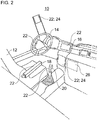
- the FIG. 2 shows an interior view of a cab 10.
- the cab 10 may be a cab of a motor vehicle, in particular a commercial vehicle (for example, trucks or buses).
- the cab 10 may include a driver's seat 12, a steering wheel 14, a dashboard 16, an armrest 18, and / or a shift knob 20.
- the input device for active confirmation of attention can be embodied, for example, as a touch-sensitive input device 22.
- the touch-sensitive input device 22 can be installed anywhere in the cab, where, for example, a continuous cable management is possible.
- the touch-sensitive input device may be formed, for example, as a push button, a pedal, a button, a switch, an input field or a sensor skin.
- the touch-sensitive input device can be arranged on the steering wheel 14, on the dashboard 16, on the armrest 18 (eg in the support surface or on the joint), on the shift knob 20 and / or on foot pedals or buttons in the footwell or bottom area of the driver's cab 10 , It is possible that existing keys are used, for example, on the steering wheel 14 or on the dashboard 16 as the touch-sensitive input device 22. It is also possible to provide the touch-sensitive input device 22 separately.
- the touch-sensitive input device 22 as a button in the steering wheel 14, for example, brand logo as a push button or existing buttons on the steering wheel 14 may be formed.
- the touch-sensitive input device 22 may also be provided, for example, as a control panel of a navigation device or information center with a touch screen in the dashboard 16.
- the steering wheel 14, the dashboard 16, the armrest 18, the shift knob 20 and / or further reachable from the driver's seat 12 areas of the cab 10 are at least partially covered with a touch-sensitive sensor skin.
- a floor mat or part of the floor mat can be covered with a sensor skin.
- the sensor skin for example, as in a known robot - Bosch APAS - be designed with sensor skin
- the two electrodes can be connected by means of a body part (eg finger).
- a check is made as to whether a permissible resistance, in particular a normal human body resistance (eg between 500 ⁇ and 1000 ⁇ ), is measured.
- the input device for active confirmation of attention for example, as a non-contact input device 24 may be formed.
- sensors can be used, which recognize the following principles of action confirmation in the form of movement: ultrasound by means of ultrasonic detection unit (similar to parking sensor), distance measurement by a laser beam by means of laser detection unit, interruption of a light barrier and / or measurement of a temperature.
- an image acquisition unit eg camera
- image evaluation unit e.g camera
- the non-contact input device 24 may, for. B. in the dashboard 16, be arranged in the headliner or a side wall. In particular, the non-contact input device may be located where no storage or easy attachment of things is possible.
- the non-contact input device 24 may expediently be installed so that a movement of a body part, for. B a hand movement (hand movement in the direction of sensor field or hand movement across the sensor field) is possible.
- a sensor field of the non-contact input device 24 may end in the air area between the driver and the dashboard.
- a laser of a laser detection unit can be adjusted so that a laser beam impinges in a range of air between the driver and cab to a defined point and this is the reference distance. If the driver the beam with a movement of a body part, for. B. a hand movement, interrupts the distance is shorter than the reference distance and recognized as a signal or active confirmation.
- a temperature sensor When measuring by temperature, a temperature sensor can be placed within reach of the driver, who measures a human body temperature for a valid confirmation of a touch.
- the sensor can be either directly visible built the measurement or indirectly hidden in the interior design, z. B. in the dashboard 16 or in the steering wheel 14, measure a reference temperature, with a thermal conductivity of the material, which is located between (eg.) Hand and sensor, is taken into account.
- a controller 26 may be provided which may perform the method as disclosed herein.
- the controller is for this purpose in particular in communication with the input devices 22, 24 and the device for outputting the request.
- the invention is not limited to the preferred embodiments described above. Rather, a variety of variants and modifications is possible, which also make use of the inventive idea and therefore fall within the scope.
- the invention also claims protection of the subject matter and the features of the subclaims independently of the claims referred to.
- the features of independent claim 1 are independently disclosed.
- the features of the subclaims are independent of all features of independent claim 1 and, for example, independent of the features relating to requesting the driver at random and / or changing time intervals and / or performing the request when it is detected that a forward stretch of track is substantially free of at least one predetermined road condition change and / or a predetermined Fahrbedingungsver selectedung is disclosed in the independent claim 1.
Landscapes
- Engineering & Computer Science (AREA)
- Automation & Control Theory (AREA)
- Transportation (AREA)
- Mechanical Engineering (AREA)
- Human Computer Interaction (AREA)
- Physics & Mathematics (AREA)
- Mathematical Physics (AREA)
- Control Of Driving Devices And Active Controlling Of Vehicle (AREA)
- Traffic Control Systems (AREA)
Abstract
Description
- Die Erfindung betrifft ein Verfahren zum Betreiben eines Kraftfahrzeugs, das in einem Betriebsmodus mit teilautonomer oder autonomer Fahrzeugführung und in einem durch einen Fahrer kontrollierten Betriebsmodus betreibbar ist.
- Ein aktueller Entwicklungstrend neben der Elektrifizierung des Antriebstrangs ist der Ausbau von Fahrerassistenzsysteme. Hierbei können die Systeme durch Sensorik soweit ausgebaut werden, dass das Auto selbstständig innerhalb gewisser Voraussetzungen autonom fahren kann.
- In Gefahrensituationen oder nicht-standardisierten Fahrsituationen, wie z. B. Stau, Baustelle, unbefestigtes Gelände (z. B. Feldweg, Grundstückseinfahrt), kann es notwendig sein, die Kontrolle über das Kraftfahrzeug aus einem teilautonomen oder autonomen Betriebsmodus wieder an den Fahrer bzw. Lenker zurückzugeben. Hierbei kann es bspw. notwendig sein, dass die Übergabe unmittelbar innerhalb eines Zeitbereichs erfolgt. Um eine erfolgreiche Übergabe zu ermöglichen, ist eine ständige Aufmerksamkeit des Fahrers des Kraftfahrzeugs auch während des autonomen Betriebsmodus notwendig. Um die Aufmerksamkeit des Fahrers während des autonomen Betriebsmodus sicherzustellen, kann diese bspw. mit technischen Mitteln überwacht werden.
- Aus der
DE 10 2012 221 090 A1 ist ein Verfahren und ein System bekannt, die die Aufmerksamkeit des Fahrers während des Fahrens managen. Ein Verfahren kann durch einen Sensor Eigenschaften eines Fahrers detektieren, auf der Grundlage der detektierten Eigenschaften des Fahrers bestimmen, ob der Fahrer eine ausreichende Überwachungssteuerung des Fahrzeugs ausübt und eine Reihe einer oder mehrerer Aufforderungen bereitstellen. Die Eindringlichkeit jeder Aufforderung hängt mit der Bestimmung zusammen, ob der Fahrer eine ausreichende Überwachungssteuerung des Fahrzeugs ausübt. - Die
DE 10 2015 224 555 A1 betrifft ein Verfahren zum Betreiben eines Kraftfahrzeugs mit einer Vorrichtung zur Aufforderung des Fahrers zur Interaktion. Das Kraftfahrzeug kann wenigstens in einem Betriebsmodus mit teilautonomer oder autonomer Fahrzeugführung und in einem Betriebsmodus mit einer durch den Fahrer kontrollierten Fahrzeugführung betrieben werden. Bei einem Betreiben der teilautonomen oder autonomen Fahrzeugführung wird eine Reaktion des Fahrers in Bezug auf eine Aufforderung zur Interaktion überprüft. Bei der Überprüfung der Reaktion des Fahrers werden eine Blickrichtung des Fahrers und eine Lautäußerung des Fahrers berücksichtigt. - Die
DE 10 2013 206 212 A1 offenbart ein Verfahren zur Steuerung eines Fahrzeugs, wobei das Fahrzeug wenigstens in einem Betriebsmodus mit autonomer Fahrzeugführung und in einem fahrerkontrollierten Betriebsmodus betrieben werden kann. In dem Betriebsmodus mit autonomer Fahrzeugführung wird eine Überwachung der Fahreraufmerksamkeit vorgenommen, um eine möglicherweise erforderlich werdende Übernahme der Kontrollverantwortung durch den Fahrer innerhalb eines vorgegebenen Übernahmezeitfensters sicherzustellen. Hierzu werden zeitweise, ggf. auch mehrfach, dem Fahrer kognitiv fordernde Aufgaben über eine Mensch-Maschine- Schnittstelle gestellt, und aus der Antwort hierauf die Fahreraufmerksamkeit bestimmt. - Bekannte Überwachungssysteme können bspw. dahingehend nachteilig sein, dass diese gegen unbewusste oder bewusste Manipulation nicht oder nicht ausreichend sicher sind. Zum Beispiel kann eine Sonnenbrille das Verfolgen einer Blickbewegung unmöglich machen. Andererseits können bewusst oder unbewusst platzierte Gegenstände eine Hand "vortäuschen", die einen Taster betätigt, mit dem der Fahrer eigentlich dessen Aufmerksamkeit aktiv bestätigen soll.
- Ferner muss mit Blick auf den Nutzfahrzeugbereich beachtet werden, dass hier höhere Lasten und auch mehr Menschen transportiert werden können. Hier ist also höhere Aufmerksamkeit notwendig als bspw. im PKW-Bereich. Z. B. kann in Gefahrensituationen eine nicht aktive Anwesenheit des Fahrers (z. B. Schlafen oder Verlassen des Sitzes) zu schweren Unfällen und zu Regressionshaftungen gegenüber dem Hersteller führen.
- Der Erfindung liegt die Aufgabe zu Grunde, ein alternatives und/oder verbessertes Verfahren zu schaffen, mit dem insbesondere Nachteile im Stand der Technik überwunden werden können. Insbesondere soll das Verfahren sicherer gegen bewusste und unbewusste Manipulation sein.
- Die Aufgabe wird gelöst durch ein Verfahren gemäß dem unabhängigen Anspruch 1. Vorteilhafte Weiterbildungen sind in den abhängigen Ansprüchen und der Beschreibung angegeben.
- Das Verfahren ist zum Betreiben eines Kraftfahrzeugs, das in einem Betriebsmodus mit teilautonomer oder autonomer Fahrzeugführung und in einem durch einen Fahrer (im Wesentlichen vollständig) kontrollierten Betriebsmodus betreibbar ist, geeignet. Das Verfahren weist ein Auffordern des Fahrers zur (z. B. aktiven oder passiven) Bestätigung von dessen Aufmerksamkeit während eines Betriebs des Kraftfahrzeugs im Betriebsmodus mit teilautonomer oder autonomer Fahrzeugführung auf. Das Auffordern wird in zufälligen und/oder sich verändernden Zeitabständen wiederholt. Alternativ oder zusätzlich wird das Auffordern durchgeführt, wenn (z. B. durch ein Navigationsgerät und/oder Fahrzeugsensorik) erfasst wird, dass ein vorausliegender (z. B. im Navigationsgerät programmierter oder von der Fahrzeugsensorik erfasster) Streckenabschnitt im Wesentlichen frei von mindestens einer vorbestimmten Straßenbedingungsveränderung und/oder einer vorbestimmten Fahrbedingungsveränderung ist.
- Das Verfahren kann somit gegen unbewusste und bewusste Manipulation gesichert sein. Beispielsweise kann der zufällige und/oder sich verändernde Zeitabstand zwischen aufeinanderfolgenden Aufforderungen dazu führen, dass der Fahrer seinen Fahrersitz nach einer Aufforderung nicht verlässt, da er nicht weiß, wann die nächste Aufforderung erfolgt. In bekannten Systemen wurden die Aufforderungen in immer gleichen, vorbestimmten Zeitabständen ausgegeben, sodass ein Fahrer des Kraftfahrzeugs sich darauf einstellen konnte. Somit konnte der Fahrer bei der herkömmlichen Technik den Fahrersitz nach einer Aufforderung verlassen, in dem Wissen, dass die nächste Aufforderung erst wieder in beispielsweise 5 Minuten erfolgt. Zusätzlich ermöglicht das Verfahren, dass insbesondere in vorausliegenden Streckenabschnitten, in denen keine Gefahrsituationen oder lediglich standardisierte oder standardisierbare Fahrsituationen zu erwarten sind, Aufforderungen ausgegeben werden. Gerade in diesen Streckenabschnitten neigt der Fahrer zur Unaufmerksamkeit und/oder zum Verlassen des Fahrersitzes.
- Insbesondere können die zufälligen und/oder sich verändernden Zeitabstände innerhalb eines vorbestimmten Zeitintervalls liegen, z. B. zwischen 1 min und 10 min.
- Es ist auch möglich, dass das zufälligen und/oder sich verändernden Zeitabstände unter Berücksichtigung von Standortinformationen und/oder Kartendaten eines Navigationsgeräts bestimmt, insbesondere berechnet, werden. Zum Beispiel kann eine geschätzte Entfernungszeit zwischen zwei geometrischen Punkten (z. B. Startpunkt und Zielpunkt) berücksichtigt werden, z. B. 30 Minuten. Zweckmäßig können die Zeitabstände und/oder das Zeitintervall bezüglich der Entfernungszeit angepasst sein, sodass zumindest einmal, vorzugsweise mehrmals, innerhalb der Entfernungszeit aufgefordert wird, z. B. in gleichen oder ungleichmäßigen Zeitabständen (z. B. nach 2 min, nach 5 min und nach 17 min).
- Zweckmäßig können die sich verändernden Zeitabstände vorbestimmt bzw. programmiert sein und z. B. in einer Abfragetabelle gespeichert sein. Es ist möglich, dass ein Zugriff auf die Abfragetabelle zufällig erfolgt.
- Es ist auch möglich, dass ein (Vor-) Einstellung hinsichtlich der Funktion des Aufforderns, der zufälligen und/oder sich verändernden Zeitabstände, der vorbestimmten Straßenbedingungsveränderungen und/oder der vorbestimmten Fahrbedingungsveränderungen nur herstellerseitig vorgenommen werden kann, nicht überschreibbar ist, nicht veränderbar ist, geschützt abgespeichert ist und/oder nur mit einem Passwort veränderbar ist.
- Es ist ferner auch möglich, dass das Auffordern nicht abschaltbar ist und/oder automatisch ausgeführt wird, wenn das Kraftfahrzeug im Betriebsmodus mit teilautonomer oder autonomer Fahrzeugführung betrieben wird.
- In einem besonders bevorzugten Ausführungsbeispiel wird das Auffordern in Abhängigkeit von einer Geschwindigkeit des Kraftfahrzeugs durchgeführt wird und/oder das Auffordern erst ab einer vorbestimmten Geschwindigkeit (z. B. 15 km/h oder mehr) des Kraftfahrzeugs durchgeführt. Alternativ oder zusätzlich wird ein Intervall zwischen den Aufforderungen mit einer zunehmenden Geschwindigkeit des Kraftfahrzeugs verkürzt und/oder bei einer abnehmenden Geschwindigkeit des Kraftfahrzeugs verlängert. Damit kann beispielsweise verhindert werden, dass ein Fahrer im Stau, in dem keine übermäßige Fahreraufmerksamkeit notwendig ist, Aufforderungen oder zu viele Aufforderungen zur Bestätigung der Aufmerksamkeit erhält.
- In einem Ausführungsbeispiel wird der Fahrer nicht über die zufälligen und/oder sich verändernden Zeitabstände informiert.
- In einem weiteren Ausführungsbeispiel wird das Auffordern beim Befahren des Streckenabschnitts wiederholt durchgeführt, insbesondere in zufälligen und/oder sich verändernden Zeitabständen.
- In einer Ausführungsform weist die mindestens eine Straßenbedingungsveränderung eine Kreuzung, eine Straßengabelung, eine Geschwindigkeitsbegrenzungsveränderung, eine Baustelle, eine Autobahnauffahrt, eine Autobahnabfahrt, eine Spurverengung, eine Spurerweiterung und/oder ein Gefälle auf. Alternativ oder zusätzlich weist die mindestens eine Fahrbedingungsveränderung einen Stau, eine Verkehrsflussveränderung, eine Verkehrsdichteveränderung und/oder einen Verkehrsunfall auf. Insbesondere wenn keine Kreuzungen, keine Baustellen, kein Stau usw. zu erwarten ist, kann der Fahrer des Kraftfahrzeugs dazu neigen, seine Aufmerksamkeit zu verringern und/oder den Fahrersitz zu verlassen. Mit dem vorliegenden Verfahren kann insbesondere diesem Fehlverhalten des Fahrers begegnet werden.
- In einer weiteren Ausführungsform wird das Auffordern mittels eines akustischen, visuellen und/oder haptischen Signals an den Fahrer ausgegeben.
- In einer Ausführungsvariante weist das Verfahren ferner ein Ausgeben eines akustischen, visuellen und/oder haptischen Warnsignals auf, wenn keine Bestätigung des Fahrers innerhalb einer vorgebebenen Zeitspanne (z.B. 5 bis 10 Sekunden) nach dem Auffordern erfolgt. Alternativ oder zusätzlich erfolgt ein Zwangsbremsen des Kraftfahrzeugs, wenn, insbesondere wiederholt, keine Bestätigung des Fahrers innerhalb einer vorgegebenen Zeitspanne (z. B. 5 bis 10 Sekunden) nach dem Auffordern erfolgt.
- In einer weiteren Ausführungsvariante weist die Bestätigung durch den Fahrer ein Betätigen einer, insbesondere berührungsempfindlichen oder berührungslosen, Eingabeeinrichtung auf.
- In einem Ausführungsbeispiel wird geprüft, ob die Eingabeeinrichtung vor dem Auffordern und/oder nach dem Betätigen unbetätigt ist. Damit kann verhindert werden, dass das Eingabegerät so manipuliert ist, dass es immer betätigt ist (zum Beispiel durch Anbringen eines Klebestreifens usw.), sodass der Fahrer seine Aufmerksamkeit trotz Aufforderung nicht mehr selbst bestätigen muss und stattdessen beispielsweise den Fahrersitz während des autonomen Betriebsmodus verlassen kann.
- In einem weiteren Ausführungsbeispiel ist ein mehrmaliges Betätigen (z. B. innerhalb eines vorbestimmten Zeitintervalls, wie 1 Sekunde, 2 Sekunden oder 3 Sekunden, oder ohne vorbestimmtes Zeitintervall) die Eingabeeinrichtung nach dem Auffordern notwendig. Auch hiermit kann eine einfache Manipulation verhindert werden.
- In einer Ausführungsform weist die Eingabeeinrichtung einen berührungsempfindlichen Schalter, ein berührungsempfindliches Tastfeld, eine berührungsempfindliche Sensorhaut und/oder ein berührungsempfindliches Pedal auf. Beispielsweise kann die Eingabeeinrichtung in einem Lenkrad, einem Schaltknauf, einem Armaturenbrett, einem Dachhimmel, einer Armlehne, einer A-Säule, einer B-Säule usw. integriert sein.
- In einer alternativen oder zusätzlichen Ausführungsform weist die Eingabeeinrichtung eine berührungslose Lichtschranke, eine berührungslose Lasererfassungseinheit, eine berührungslose Ultraschallerfassungseinheit und/oder eine berührungslose Bilderfassungseinheit auf. Beispielsweise kann die Eingabeeinrichtung in einem Lenkrad, einem Schaltknauf, einem Armaturenbrett, einem Dachhimmel, einer Armlehne, einer A-Säule, einer B-Säule usw. integriert sein.
- Zusätzlich kann eine zulässige aktive Bestätigung durch den Fahrer erfordern, dass geprüft wird, ob tatsächlich menschliche Körperteile (zum Beispiel Finger, Handballen, Handteller, Hände, Arme, Füße, Beine usw.) zur Betätigung genutzt werden.
- In einer weiteren alternativen oder zusätzlichen Ausführungsform weist die Eingabeeinrichtung einen Temperatursensor auf, wobei für eine zulässige Bestätigung geprüft wird, ob eine zulässige Temperatur, insbesondere eine menschliche Normalkörpertemperatur (ca. 36,5°C - 37,4°C), gemessen wird. Alternativ oder zusätzlich weist die Eingabeeinrichtung zwei mittels eines Körperteils zu verbindende Elektroden eines Stromkreises auf, wobei für eine zulässige Bestätigung geprüft wird, ob ein zulässiger Widerstand, insbesondere ein menschlicher Normalkörperwiderstand (z. B. ca. 500 Ω bis 1000 Ω, abhängig vom Körperteil), gemessen wird.
- In einer Ausführungsvariante ist die Eingabeeinrichtung nur vom Fahrersitz des Kraftfahrzeugs aus erreichbar. Damit kann beispielsweise verhindert werden, dass der Fahrer seinen Fahrersitz verlässt und beispielsweise auf einem Beifahrersitz Platz nimmt oder sich in eine Schlafkoje legt.
- In einer weiteren Ausführungsvariante weist das Verfahren ferner ein Überwachen einer Anwesenheit des Fahrers auf einem Fahrersitz des Kraftfahrzeugs während des Betriebs des Kraftfahrzeugs im Betriebsmodus mit teilautonomer oder autonomer Fahrzeugführung (z. B. mittels Sitzsensor und/oder Lenkradsensor) auf. Alternativ oder zusätzlich weist das Verfahren ein Überwachen eines Zustands (z. B. Wachheit, Herzschlag, Kreislauf usw.) des Fahrers während des Betriebs des Kraftfahrzeugs im Betriebsmodus mit teilautonomer oder autonomer Fahrzeugführung auf.
- Zweckmäßig können sich die hierin verwendeten Ausdrücke "Betriebsmodus mit teilautonomer oder autonomer Fahrzeugführung" auf ein Fahrsystem beziehen, das eines oder mehrere autonome Elemente enthält, die die Fahrzeugbewegung auf einer Straße steuern, wobei sie das Fahrzeug vollständig autonom (z. B. keine Fahrereingabe oder -steuerung erforderlich) oder teilweise autonom (z. B. einige Fahrereingabe oder -steuerung für das sichere Fahren erforderlich) machen. Steuermerkmale mit beschränkter Fähigkeit zum autonomen, semiautonomen, automatisierten oder automatischen Fahren (z. B. automatisierte Fahrspurverfolgung, adaptive Fahrspurverfolgung, adaptiver Tempomat usw.) können die Position und Geschwindigkeit eines Fahrzeugs in Bezug auf die Straße und auf andere Fahrzeuge und Hindernisse auf der Straße mit verringerter Fahrereingabe (z. B. mit verringerter oder ohne Fahrerlenkradbewegung oder Fahrpedal- und Bremspedalsteuerung) aufrechterhalten oder steuern.
- Die Erfindung ist auch auf ein Kraftfahrzeug, insbesondere ein Nutzfahrzeug (zum Beispiel Lastkraftwagen oder Omnibus), mit einer Steuerung, die zum Ausführen eines Verfahrens wie hierin offenbart eingerichtet ist, gerichtet.
- Der Begriff "Steuerung" kann sich auf eine Elektronik und/oder mechanische Steuerung beziehen, die je nach Ausbildung Steuerungsaufgaben und/oder Regelungsaufgaben übernehmen kann. Auch wenn hierin der Begriff "Steuern" verwendet wird, kann damit gleichsam zweckmäßig auch "Regeln" bzw. "Steuern mit Rückkopplung" umfasst sein.
- Es ist auch möglich, die Vorrichtung wie hierin offenbart für Personenkraftwagen, geländegängige Fahrzeuge usw. zu verwenden.
- Die zuvor beschriebenen bevorzugten Ausführungsformen und Merkmale der Erfindung sind beliebig miteinander kombinierbar. Weitere Einzelheiten und Vorteile der Erfindung werden im Folgenden unter Bezug auf die beigefügten Zeichnungen beschrieben. Es zeigen:
- Figur 1
- ein Ablaufdiagramm für ein beispielhaftes Verfahren zum Betreiben eines Kraftfahrzeugs gemäß der vorliegenden Offenbarung; und
- Figur 2
- eine Innenansicht eines beispielhaften Fahrerhauses eines Nutzfahrzeugs gemäß der vorliegenden Offenbarung.
- Die
Figur 1 zeigt ein Verfahren zum Betreiben eines Kraftfahrzeugs gemäß einem Ausführungsbeispiel. Das Verfahren dient zum Überprüfen und Halten einer Fahreraufmerksamkeit während eines teilautonomen oder eines autonomen Fahrbetriebs des Kraftfahrzeugs. Das Kraftfahrzeug kann beispielsweise ein Personenkraftwagen sein. Insbesondere ist das Kraftfahrzeug ein Nutzfahrzeug, zum Beispiel ein Omnibus oder ein Lastkraftwagen. - In einer Abfrage S10 wird geprüft, ob das Kraftfahrzeug aktuell in einem teilautonomen oder einem autonomen Betriebsmodus betrieben wird. Die Abfrage S10 wird so lange durchgeführt, bis erfasst wird, dass das Kraftfahrzeug in einem teilautonomen oder einem autonomen Betriebsmodus betrieben wird. Befindet sich das Kraftfahrzeug in einem teilautonomen oder einem autonomen Betriebsmodus, so wird mit einem Verfahrensschritt S12 fortgefahren.
- Im Verfahrensschritt S12 wird der Fahrer des Kraftfahrzeugs dazu aufgefordert, eine Bestätigung seiner Aufmerksamkeit durchzuführen. Die Aufforderung kann beispielsweise akustisch, visuell und/oder haptisch erfolgen.
- Die Aufforderung ist u. a. dazu gedacht, den Fahrer des Kraftfahrzeugs während eines teilautonomen oder eines autonomen Betriebsmodus des Kraftfahrzeugs in einem aktiven und aufmerksamen Zustand (z. B. nicht schlafen oder den Fahrersitz nicht verlassen) zu halten. Somit kann sichergestellt werden, dass im Notfall eine sehr schnelle Reaktionszeit gewährleistet ist. So kann in Gefahrensituationen oder nicht-standardisierten Fahrsituationen eine Übergabe an einen anwesenden und aufmerksamen Fahrer sicher erfolgen.
- Ferner ist die Aufforderung gemäß dem Verfahrensschritt S12 so eingerichtet, dass eine Manipulation durch den Fahrer zumindest deutlich erschwert ist.
- Beispielsweise kann die Aufforderung in zufälligen und/oder sich verändernden Zeitabständen wiederholt werden. Dadurch, dass der Fahrer nicht über die zufälligen und/oder sich verändernden Zeitabständen informiert wird, kann der Fahrer nicht vorhersehen, wann die nächste Aufforderung gestellt wird. So kann verhindert werden, dass sich der Fahrer zwischen den Aufforderungen vom Fahrersitz entfernt oder sich anderweitig ablenkt.
- Zusätzlich oder alternativ ist es möglich, dass die Aufforderungen beispielsweise wiederholt dann getätigt werden, wenn in einem vorausliegenden Streckenabschnitt keine Straßenbedingungsveränderungen und/oder Fahrbedingungsveränderungen zu erwarten sind. Gerade auf Streckenabschnitten, auf denen keine Gefahrsituationen oder nicht-standardisierte Situationen zu erwarten sind, kann der Fahrer dazu neigen, den Fahrersitz zu verlassen oder sich anderweitig abzulenken.
- Der Streckenabschnitt kann beispielsweise ein programmierter vorausliegender Streckenabschnitt in einem Navigationsgerät sein. Mittels des Navigationsgeräts kann auch erfasst werden, ob dieser Streckenabschnitt im Wesentlichen frei von mindestens einer vorbestimmten Straßenbedingungsveränderung und/oder einer vorbestimmten Fahrbedingungsveränderungen ist. Es ist auch möglich, dass Straßenbedingungsveränderungen und/oder Fahrbedingungsveränderungen bzw. deren Ausbleiben von einer Fahrzeugsensorik bspw. optisch erfasst werden (z. B. optische Erfassung von Verkehrsschildern). Vorbestimmte Straßenbedingungsveränderungen können beispielsweise eine Kreuzung, eine Straßengabelung, eine Geschwindigkeitsbegrenzungsveränderung, eine Baustelle, eine Autobahnauffahrt, eine Autobahnabfahrt, eine Spurverengung, eine Spurerweiterung und/oder ein Gefälle sein. Vorbestimmte Fahrbedingungsveränderungen können beispielsweise einen vorausliegenden Stau, eine vorausliegender Verkehrsflussveränderung, eine vorausliegender Verkehrsdichteveränderung und/oder einen vorausliegenden Verkehrsunfall betreffen.
- Um keine unnötigen Aufforderungen beispielsweise in einem Stau oder bei niedriger Geschwindigkeit auszugeben, kann vorgesehen sein, dass die Aufforderung nur ab einer vorbestimmten Geschwindigkeit ausgegeben werden, zum Beispiel 15 km/h oder 20 km/h.
- Nach dem Ausgeben der Aufforderung hat der Fahrer eine vorbestimmte Zeitdauer, zum Beispiel 5 bis 10 Sekunden, Zeit, um seine Aufmerksamkeit bspw. aktiv zu bestätigen. Ausführungsbeispiele für derartige aktive Bestätigungen sind hier unter Bezugnahme auf
Figur 2 beispielhaft beschrieben. - In einem Verfahrensschritt S14 wird geprüft, ob der Fahrer innerhalb der vorbestimmten Zeitdauer seine Aufmerksamkeit bestätigt hat. Hat der Fahrer seine Aufmerksamkeit bestätigt, so fährt das Verfahren mit dem Verfahrensschritt S10 fort. Hat der Fahrer hingegen seine Aufmerksamkeit nicht bestätigt, so fährt das Verfahren mit einem Verfahrensschritt S16 fort.
- Im Verfahrensschritt S16 kann eine visuelle, akustische und/oder optische Warnung an den Fahrer ausgegeben werden, um dessen Aufmerksamkeit zu erhalten. Die Warnung kann beispielsweise einen akustischer Warnton und/oder ein Vibrieren des Lenkrads oder des Fahrersitzes aufweisen. Nach der Warnung kann das Verfahren mit einem Verfahrensschritt S18 fortfahren. Es ist beispielsweise auch möglich, dass der Verfahrensschritt S16 nicht und der Verfahrensschritt S18 direkt im Anschluss an den Verfahrensschritt S14 durchgeführt wird.
- Im Verfahrensschritt S18 kann, wie im Verfahrensschritt S12, erneut eine Aufforderung zur Bestätigung der Fahreraufmerksamkeit an den Fahrer ausgegeben werden. In der nachfolgenden Abfrage S18 kann, wie in der Abfrage S14, geprüft werden, ob der Fahrer seine Aufmerksamkeit innerhalb einer vorgegebenen Zeitdauer bestätigt hat. Sofern eine Bestätigung vorliegt, fährt das Verfahren mit dem Verfahrensschritt S10 fort. Liegt hingegen keine Bestätigung innerhalb der vorgegebenen Zeitdauer vor, können weitere Warnungen oder Aufforderungen ausgegeben werden. Schlussendlich kann in einem Verfahrensschritt S22 eine Zwangsbremsung des Kraftfahrzeugs bis zum Stillstand eingeleitet werden.
- Es ist möglich, dass während des Verfahrens zusätzlich eine Anwesenheit des Fahrers auf dem Fahrersitz z. B. mittels eines entsprechenden Sitzsensors geprüft wird. Es ist auch möglich, dass beispielsweise Eingabetasten oder Eingabefelder am Lenkrad oder Armaturenbrett oder Navigationsgerät vorgesehen sind, mit denen erfasst wird, ob der Fahrer auf dem Fahrersitz sitzt. Wird erfasst, dass sich der Fahrer von dem Fahrersitz entfernt, können Warnungen und/oder Aufforderungen zur aktiven Bestätigung von dessen Aufmerksamkeit so lange ausgegeben werden, bis die Anwesenheit des Fahrers auf dem Fahrersitz erkannt und ein Bestätigung von dessen Aufmerksamkeit empfangen wurde.
- In einigen Ausführungsbeispiel besteht zusätzlich die Möglichkeit, einen Zustand (z. B. Wachheit, Herzschlag, Kreislauf usw.) des Fahrers während des Verfahrens zu überwachen. Beispielsweise kann hierzu eine Verbindung mit einem Herz-Kreislaufmessgerät, das den körperlichen Zustand des Fahrers erfasst, eingerichtet sein. Wird erfasst, dass der Zustand des Fahrers von einem Normalzustand abweicht, können Warnungen und/oder Aufforderungen zur Bestätigung von dessen Aufmerksamkeit ausgegeben werden.
- Unter Bezugnahme auf die
Figur 2 sind nachfolgend beispielhafte Möglichkeiten aufgezeigt, mit denen der Fahrer des Kraftfahrzeugs in Reaktion auf eine Aufforderung seine Aufmerksamkeit aktiv bestätigen kann. Die Bestätigungseinrichtungen bzw. Eingabeeinrichtungen sind dabei so ausgeführt, dass eine Manipulation durch den Fahrer so weit wie möglich ausgeschlossen wird. - Insbesondere kann vorgesehen sein, dass nicht nur eine einfache Bestätigung, sondern eine doppelte Bestätigung, wie zum Beispiel bei eine Doppelklick bei einer Computermaus, notwendig ist, um die Aufmerksamkeit aktiv zu bestätigen.
- Ferner kann eine zulässige aktive Bestätigung durch den Fahrer erfordern, dass die Bestätigungseinrichtung bzw. Eingabeeinrichtung vor oder während des Aufforderns sowie nach der Bestätigung unbetätigt, das heißt beispielsweise frei von irgendwelchen Objekten (materielle oder immaterielle Natur), ist.
- Es ist möglich, dass ein Gerät zur Ausgabe der Aufforderung und die Eingabeeinrichtung als integrierte Einheit ausgebildet sind oder dass diese örtlich getrennt voneinander angeordnet sind.
- Die
Figur 2 zeigt eine Innenansicht eines Fahrerhauses 10. Das Fahrerhaus 10 kann ein Fahrerhaus eines Kraftfahrzeugs, insbesondere eines Nutzfahrzeugs (zum Beispiel Lastkraftwagen oder Omnibus) sein. Das Fahrerhaus 10 kann einen Fahrersitz 12, ein Lenkrad 14, ein Armaturenbrett 16, eine Armlehne 18 und/oder einen Schaltknauf 20 aufweisen. - Die Eingabeeinrichtung zur aktiven Bestätigung der Aufmerksamkeit kann beispielsweise als berührungsempfindliche Eingabeeinrichtung 22 ausgebildet sein. Die berührungsempfindliche Eingabeeinrichtung 22 kann überall dort im Fahrerhaus eingebaut sein, wo beispielsweise eine durchgängige Kabelführung möglich ist. Die berührungsempfindliche Eingabeeinrichtung kann beispielsweise als ein Druckknopf, ein Pedal, ein Taster, ein Schalter, ein Eingabefeld oder eine Sensorhaut ausgebildet sein. Beispielsweise kann die berührungsempfindliche Eingabeeinrichtung am Lenkrad 14, am Armaturenbrett 16, an der Armlehne 18 (z. B. in der Auflagefläche oder am Gelenk), am Schaltknauf 20 und/oder an Fußpedalen oder Tastern im Fußraum bzw. Bodenbereich des Fahrerhauses 10 angeordnet sein. Es ist möglich, dass bestehende Tasten beispielsweise am Lenkrad 14 oder am Armaturenbrett 16 als die berührungsempfindliche Eingabeeinrichtung 22 verwendet werden. Ebenso ist es möglich, die berührungsempfindliche Eingabeeinrichtung 22 separat vorzusehen.
- Beispielsweise kann die berührungsempfindliche Eingabeeinrichtung 22 als Taster im Lenkrad 14, zum Beispiel Markenlogo als Druckknopf oder bestehende Knöpfe am Lenkrad 14, ausgebildet sein. Die berührungsempfindliche Eingabeeinrichtung 22 kann beispielsweise auch als Bedienfeld eines Navigationsgeräts oder Informationscenters mit Touchscreen im Armaturenbrett 16 vorgesehen sein.
- Wie erwähnt, besteht auch die Möglichkeit, dass das Lenkrad 14, das Armaturenbrett 16, die Armlehne 18, der Schaltknauf 20 und/oder weitere vom Fahrersitz 12 aus erreichbare Bereiche des Fahrerhauses 10 zumindest teilweise mit einer berührungsempfindlichen Sensorhaut überzogen sind. Auch eine Fußbodenmatte oder ein Teil der Fußbodenmatte kann mit einer Sensorhaut überzogen sein. Die Sensorhaut kann beispielsweise wie bei einem bekannten Roboter - Bosch APAS - mit Sensorhaut ausgebildet sein
Es ist auch möglich, als Eingabeeinrichtung zwei Elektroden eines Stromkreises zu verwenden. Die zwei Elektroden können mittels eines Körperteils (z. B. Finger) verbunden werden. Es findet eine Prüfung statt, ob ein zulässiger Widerstand, insbesondere ein menschlicher Normalkörperwiderstand (z. B. zwischen 500 Ω und 1000 Ω), gemessen wird. - Alternativ oder zusätzlich kann die Eingabeeinrichtung zur aktiven Bestätigung der Aufmerksamkeit beispielsweise als berührungslose Eingabeeinrichtung 24 ausgebildet sein. Bei dieser Lösung können bspw. Sensoren eingesetzt werden, die über folgende Wirkprinzipien eine Bestätigung in Form einer Bewegung erkennen: Ultraschall mittels Ultraschallerfassungseinheit (ähnlich wie Parksensor), Entfernungsmessung durch einen Laserstrahl mittels Lasererfassungseinheit, Unterbrechung einer Lichtschranke und/oder Messung einer Temperatur. Es ist auch möglich, eine Bilderfassungseinheit (z. B. Kamera) mit entsprechender Bildauswertungseinheit vorzusehen.
- Die berührungslose Eingabeeinrichtung 24 kann z. B. im Armaturenbrett 16, im Dachhimmel oder einer Seitenwand angeordnet sein. Insbesondere kann die berührungslose Eingabeeinrichtung dort angeordnet sein, wo keine Ablage oder einfache Befestigung von Sachen möglich ist.
- Die berührungslose Eingabeeinrichtung 24 kann zweckmäßig so einbaut sein, dass eine Bewegung eines Körperteils, z. B eine Handbewegung (Handbewegung in Richtung Sensorfeld oder Handbewegung quer zum Sensorfeld), möglich ist. Beispielsweise kann ein Sensorfeld der berührungslosen Eingabeeinrichtung 24 im Luftbereich zwischen Fahrer und Armaturenbrett enden.
- Bei einer Laserstrahlmessung kann ein Laser einer Lasererfassungseinheit so justiert sein, dass ein Laserstrahl in einem Luftbereich zwischen Fahrer und Fahrerhaus auf einen definierten Punkt auftrifft und dies die Referenzstrecke ist. Wenn der Fahrer den Strahl mit einer Bewegung eines Körperteils, z. B. eine Handbewegung, unterbricht, wird die Entfernung kürzer als die Referenzstrecke und als Signal bzw. aktive Bestätigung erkannt.
- Bei einer Messung mittels Temperatur kann ein Temperatursensor in Reichweite des Fahrers angeordnet werden, der für eine zulässige Bestätigung bei einer Berührung eine menschliche Körpertemperatur misst. Der Sensor kann entweder direkt sichtbar eingebaut die Messung vornehmen oder indirekt verborgen im Interiordesign, z. B. im Armaturenbrett 16 oder im Lenkrad 14, eingebaut eine Referenztemperatur messen, wobei eine Wärmeleitfähigkeit des Materials, das sich zwischen (z. B.) Hand und Sensor befindet, berücksichtigt wird.
- Es wird darauf hingewiesen, dass auch Kombinationen der beispielhaft erläuterten Eingabeeinrichtungen 22, 24 möglich sind.
- Im Fahrerhaus 10 oder an anderer Stelle des Kraftfahrzeugs kann zusätzlich eine Steuerung 26 vorgesehen sein, die das Verfahren wie hierin offenbart ausführen kann. Die Steuerung ist hierzu insbesondere in Kommunikationsverbindung mit den Eingabeeinrichtungen 22, 24 und dem Gerät zum Ausgeben der Aufforderung.
- Die Erfindung ist nicht auf die vorstehend beschriebenen bevorzugten Ausführungsbeispiele beschränkt. Vielmehr ist eine Vielzahl von Varianten und Abwandlungen möglich, die ebenfalls von dem Erfindungsgedanken Gebrauch machen und deshalb in den Schutzbereich fallen. Insbesondere beansprucht die Erfindung auch Schutz für den Gegenstand und die Merkmale der Unteransprüche unabhängig von den in Bezug genommenen Ansprüchen. Insbesondere sind die Merkmale des unabhängigen Anspruchs 1 unabhängig voneinander offenbart. Zusätzlich sind auch die Merkmale der Unteransprüche unabhängig von sämtlichen Merkmalen des unabhängigen Anspruchs 1 und beispielsweise unabhängig von den Merkmalen bezüglich des Aufforderns des Fahrers in zufälligen und/oder sich verändernden Zeitabständen und/oder des Durchführens des Aufforderns, wenn erfasst wird, dass ein vorausliegenden Streckenabschnitt im Wesentlichen frei von mindestens einer vorbestimmten Straßenbedingungsveränderung und/oder einer vorbestimmten Fahrbedingungsveränderung ist, des unabhängigen Anspruchs 1 offenbart.
-
- 10
- Fahrerhaus
- 12
- Fahrersitz
- 14
- Lenkrad
- 16
- Armaturenbrett / Armaturentafel
- 18
- Armlehne
- 20
- Schaltknauf
- 22
- Berührungsempfindliche Eingabeeinrichtung
- 24
- Berührungslose Eingabeeinrichtung
- 26
- Steuerung
Claims (15)
- Verfahren zum Betreiben eines Kraftfahrzeugs, das in einem Betriebsmodus mit teilautonomer oder autonomer Fahrzeugführung und in einem durch einen Fahrer kontrollierten Betriebsmodus betreibbar ist, aufweisend:Auffordern des Fahrers zur Bestätigung von dessen Aufmerksamkeit während eines Betriebs des Kraftfahrzeugs im Betriebsmodus mit teilautonomer oder autonomer Fahrzeugführung, wobei:das Auffordern in zufälligen und/oder sich verändernden Zeitabständen wiederholt wird; und/oderdas Auffordern durchgeführt wird, wenn erfasst wird, dass ein vorausliegender Streckenabschnitt im Wesentlichen frei von mindestens einer vorbestimmten Straßenbedingungsveränderung und/oder einer vorbestimmten Fahrbedingungsveränderung ist.
- Verfahren nach Anspruch 1, wobei:die zufälligen und/oder sich verändernden Zeitabstände innerhalb eines vorbestimmten Zeitintervalls liegen; und/oderdie zufälligen und/oder sich verändernden Zeitabstände unter Berücksichtigung von Standortinformationen und/oder Kartendaten eines Navigationsgeräts bestimmt, insbesondere berechnet, werden.
- Verfahren nach Anspruch 1 oder Anspruch 2, wobei:das Auffordern in Abhängigkeit von einer Geschwindigkeit des Kraftfahrzeugs durchgeführt wird; und/oderdas Auffordern erst ab einer vorbestimmten Geschwindigkeit des Kraftfahrzeugs durchgeführt wird; und/oderein Intervall zwischen den Aufforderungen mit einer zunehmenden Geschwindigkeit des Kraftfahrzeugs verkürzt und/oder bei einer abnehmenden Geschwindigkeit des Kraftfahrzeugs verlängert wird.
- Verfahren nach einem der vorherigen Ansprüche, wobei:der Fahrer nicht über die zufälligen und/oder sich verändernden Zeitabstände informiert wird; und/oderdas Auffordern beim Befahren des Streckenabschnitts wiederholt durchgeführt wird, insbesondere in zufälligen und/oder sich verändernden Zeitabständen.
- Verfahren nach einem der vorherigen Ansprüche, wobei:die mindestens eine vorbestimmte Straßenbedingungsveränderung eine Kreuzung, eine Straßengabelung, eine Geschwindigkeitsbegrenzungsveränderung, eine Baustelle, eine Autobahnauffahrt, eine Autobahnabfahrt, eine Spurverengung, eine Spurerweiterung und/oder ein Gefälle aufweist; und/oderdie mindestens eine vorbestimmte Fahrbedingungsveränderung einen Stau, eine Verkehrsflussveränderung, eine Verkehrsdichteveränderung und/oder einen Verkehrsunfall aufweist.
- Verfahren nach einem der vorherigen Ansprüche, wobei:das Auffordern mittels eines akustischen, visuellen und/oder haptischen Signals an den Fahrer ausgegeben wird.
- Verfahren nach einem der vorherigen Ansprüche, ferner aufweisend:Ausgeben eines akustischen, visuellen und/oder haptischen Warnsignals, wenn keine Bestätigung des Fahrers innerhalb einer vorgebebenen Zeitspanne nach dem Auffordern erfolgt; und/oderZwangsbremsen des Kraftfahrzeugs, wenn, insbesondere wiederholt, keine Bestätigung des Fahrers innerhalb einer vorgegebenen Zeitspanne nach dem Auffordern erfolgt.
- Verfahren nach einem der vorherigen Ansprüche, wobei die Bestätigung durch den Fahrer aufweist:Betätigen einer, insbesondere berührungsempfindlichen oder berührungslosen, Eingabeeinrichtung (22, 24).
- Verfahren nach Anspruch 8, wobei:geprüft wird, ob die Eingabeeinrichtung (22, 24) vor dem Auffordern und/oder nach dem Betätigen unbetätigt ist; und/oderein mehrmaliges Betätigen die Eingabeeinrichtung (22, 24) nach dem Auffordern notwendig ist.
- Verfahren nach Anspruch 8 oder Anspruch 9, wobei die Eingabeeinrichtung (22) aufweist:einen berührungsempfindlichen Schalter; und/oderein berührungsempfindliches Tastfeld; und/odereine berührungsempfindliche Sensorhaut; und/oderein berührungsempfindliches Pedal.
- Verfahren nach einem der Ansprüche 8 bis 10, wobei die Eingabeeinrichtung (24) aufweist:eine berührungslose Lichtschranke; und/odereine berührungslose Lasererfassungseinheit; und/odereine berührungslose Ultraschallerfassungseinheit und/odereine berührungslose Bilderfassungseinheit.
- Verfahren nach einem der Ansprüche 8 bis 11, wobei die Eingabeeinrichtung (22, 24) aufweist:einen Temperatursensor, wobei für eine zulässige Bestätigung geprüft wird, ob eine zulässige Temperatur, insbesondere eine menschliche Normalkörpertemperatur, gemessen wird; und/oderzwei mittels eines Körperteils zu verbindende Elektroden eines Stromkreises, wobei für eine zulässige Bestätigung geprüft wird, ob ein zulässiger Widerstand, insbesondere ein menschlicher Normalkörperwiderstand, gemessen wird.
- Verfahren nach einem der Ansprüche 8 bis 12, wobei:die Eingabeeinrichtung (22, 24) nur vom Fahrersitz (12) des Kraftfahrzeugs aus erreichbar ist.
- Verfahren nach einem der vorherigen Ansprüche, ferner aufweisend:Überwachen einer Anwesenheit des Fahrers auf einem Fahrersitz (12) des Kraftfahrzeugs während des Betriebs des Kraftfahrzeugs im Betriebsmodus mit teilautonomer oder autonomer Fahrzeugführung; und/oderÜberwachen eines Zustands des Fahrers während des Betriebs des Kraftfahrzeugs im Betriebsmodus mit teilautonomer oder autonomer Fahrzeugführung.
- Kraftfahrzeug, insbesondere Nutzfahrzeug, mit einer Steuerung (26), die zum Ausführen eines Verfahrens nach einem der vorherigen Ansprüche eingerichtet ist.
Applications Claiming Priority (1)
| Application Number | Priority Date | Filing Date | Title |
|---|---|---|---|
| DE102018106941.3A DE102018106941A1 (de) | 2018-03-23 | 2018-03-23 | Verfahren zum Betreiben eines autonomen oder teilautonomen Kraftfahrzeugs |
Publications (2)
| Publication Number | Publication Date |
|---|---|
| EP3543082A1 true EP3543082A1 (de) | 2019-09-25 |
| EP3543082B1 EP3543082B1 (de) | 2024-03-27 |
Family
ID=65200588
Family Applications (1)
| Application Number | Title | Priority Date | Filing Date |
|---|---|---|---|
| EP19152045.1A Active EP3543082B1 (de) | 2018-03-23 | 2019-01-16 | Verfahren zum betreiben eines autonomen oder teilautonomen kraftfahrzeugs |
Country Status (2)
| Country | Link |
|---|---|
| EP (1) | EP3543082B1 (de) |
| DE (1) | DE102018106941A1 (de) |
Cited By (5)
| Publication number | Priority date | Publication date | Assignee | Title |
|---|---|---|---|---|
| CN112590797A (zh) * | 2019-10-01 | 2021-04-02 | 现代自动车株式会社 | 用于监视驾驶员的装置及方法和包括该装置的系统 |
| CN113022574A (zh) * | 2019-12-06 | 2021-06-25 | 罗伯特·博世有限公司 | 用于检测交通工具中乘客异常安定的系统和方法 |
| WO2021204632A1 (de) * | 2020-04-07 | 2021-10-14 | Bayerische Motoren Werke Aktiengesellschaft | Verfahren zum betreiben eines fahrerassistenzsystems eines fahrzeugs mit fahrermoderation bei teilautomatisierten funktionen, fahrerassistenzsystem sowie fahrzeug |
| CN115330248A (zh) * | 2022-08-30 | 2022-11-11 | 长安大学 | 一种短时程汽车行驶工况等效构建方法、装置及设备 |
| US12110046B2 (en) * | 2019-12-20 | 2024-10-08 | Transportation Ip Holdings, Llc | Vehicle control system and method |
Families Citing this family (1)
| Publication number | Priority date | Publication date | Assignee | Title |
|---|---|---|---|---|
| DE102023120650A1 (de) * | 2023-08-03 | 2025-02-06 | Bayerische Motoren Werke Aktiengesellschaft | Verfahren zur erhöhung eines aufmerksamkeitslevels eines fahrers, recheneinrichtung, computerlesbares speichermedium |
Citations (4)
| Publication number | Priority date | Publication date | Assignee | Title |
|---|---|---|---|---|
| DE102012221090A1 (de) * | 2011-11-17 | 2013-05-23 | GM Global Technology Operations LLC (n.d. Ges. d. Staates Delaware) | System und Verfahren für Regelkreis-Fahreraufmerksamkeitsmanagement |
| DE102012205675A1 (de) * | 2012-04-05 | 2013-10-10 | Robert Bosch Gmbh | Verfahren und Vorrichtung zum Betreiben eines Fahrzeugs |
| DE102012213965A1 (de) * | 2012-08-07 | 2014-02-13 | Bayerische Motoren Werke Aktiengesellschaft | Verfahren zum Gewährleisten einer ausreichenden Leistungsfähigkeit eines Fahrers eines Kraftfahrzeugs beim automatisierten Fahren |
| DE102015224555A1 (de) * | 2015-12-08 | 2017-06-08 | Robert Bosch Gmbh | Verfahren zum Betreiben eines Fahrzeugs |
Family Cites Families (3)
| Publication number | Priority date | Publication date | Assignee | Title |
|---|---|---|---|---|
| DE102012020901B4 (de) * | 2012-10-24 | 2022-06-02 | Mercedes-Benz Group AG | Verfahren zum Betrieb zumindest einer Assistenzvorrichtung eines Fahrzeugs und Vorrichtung zur Durchführung des Verfahrens |
| DE102013206212A1 (de) | 2013-04-09 | 2014-10-09 | Ford Global Technologies, Llc | Verfahren zur Steuerung eines Fahrzeugs mit temporär autonomer Fahrzeugführung sowie Steuerungseinrichtung |
| DE102014208711A1 (de) * | 2014-05-09 | 2015-11-12 | Smiths Heimann Gmbh | Verfahren und Einrichtung zur Überwachung der Aufmerksamkeit einer Bedienperson |
-
2018
- 2018-03-23 DE DE102018106941.3A patent/DE102018106941A1/de active Pending
-
2019
- 2019-01-16 EP EP19152045.1A patent/EP3543082B1/de active Active
Patent Citations (4)
| Publication number | Priority date | Publication date | Assignee | Title |
|---|---|---|---|---|
| DE102012221090A1 (de) * | 2011-11-17 | 2013-05-23 | GM Global Technology Operations LLC (n.d. Ges. d. Staates Delaware) | System und Verfahren für Regelkreis-Fahreraufmerksamkeitsmanagement |
| DE102012205675A1 (de) * | 2012-04-05 | 2013-10-10 | Robert Bosch Gmbh | Verfahren und Vorrichtung zum Betreiben eines Fahrzeugs |
| DE102012213965A1 (de) * | 2012-08-07 | 2014-02-13 | Bayerische Motoren Werke Aktiengesellschaft | Verfahren zum Gewährleisten einer ausreichenden Leistungsfähigkeit eines Fahrers eines Kraftfahrzeugs beim automatisierten Fahren |
| DE102015224555A1 (de) * | 2015-12-08 | 2017-06-08 | Robert Bosch Gmbh | Verfahren zum Betreiben eines Fahrzeugs |
Cited By (7)
| Publication number | Priority date | Publication date | Assignee | Title |
|---|---|---|---|---|
| CN112590797A (zh) * | 2019-10-01 | 2021-04-02 | 现代自动车株式会社 | 用于监视驾驶员的装置及方法和包括该装置的系统 |
| CN113022574A (zh) * | 2019-12-06 | 2021-06-25 | 罗伯特·博世有限公司 | 用于检测交通工具中乘客异常安定的系统和方法 |
| US12110046B2 (en) * | 2019-12-20 | 2024-10-08 | Transportation Ip Holdings, Llc | Vehicle control system and method |
| WO2021204632A1 (de) * | 2020-04-07 | 2021-10-14 | Bayerische Motoren Werke Aktiengesellschaft | Verfahren zum betreiben eines fahrerassistenzsystems eines fahrzeugs mit fahrermoderation bei teilautomatisierten funktionen, fahrerassistenzsystem sowie fahrzeug |
| CN115362095A (zh) * | 2020-04-07 | 2022-11-18 | 宝马汽车股份有限公司 | 用于运行车辆的驾驶员辅助系统的具有针对部分自动化功能的驾驶员节制的方法、驾驶员辅助系统和车辆 |
| US12606186B2 (en) | 2020-04-07 | 2026-04-21 | Bayerische Motoren Werke Aktiengesellschaft | Method for operating a driver assistance system of a vehicle, comprising driver moderation for partially-automated functions, driver assistance system, and vehicle |
| CN115330248A (zh) * | 2022-08-30 | 2022-11-11 | 长安大学 | 一种短时程汽车行驶工况等效构建方法、装置及设备 |
Also Published As
| Publication number | Publication date |
|---|---|
| EP3543082B1 (de) | 2024-03-27 |
| DE102018106941A1 (de) | 2019-09-26 |
Similar Documents
| Publication | Publication Date | Title |
|---|---|---|
| EP3543082B1 (de) | Verfahren zum betreiben eines autonomen oder teilautonomen kraftfahrzeugs | |
| DE102017205708B4 (de) | Autonomfahrsteuerungsvorrichtung | |
| EP3691949B1 (de) | Verfahren zum betreiben eines assistenzsystems für ein kraftfahrzeug und kraftfahrzeug | |
| DE102016225606B4 (de) | Verfahren zum Betreiben einer Fahrerassistenzeinrichtung eines Kraftfahrzeugs | |
| DE102013222048B4 (de) | Verfahren und Vorrichtung zum Aktivieren oder Deaktivieren einer automatischen Fahrfunktion | |
| DE102016101577A1 (de) | Geschwindigkeitsoptimierte bewegungsbahnsteuerung für kraftfahrzeuge | |
| DE102016109146A1 (de) | Fahrzeugfahrt-Steuerungsvorrichtung | |
| DE102013224118A1 (de) | Verfahren und System zum Steuern eines Fahrzeugs | |
| EP2763879A1 (de) | Verfahren zum aktivieren eines fahrerassistenzsystems | |
| DE102014118113A1 (de) | Fahrzeugsteuerung | |
| WO2019025400A1 (de) | Vorrichtung zum verändern einer querführung eines fahrzeugs | |
| DE102017208508A1 (de) | Hands-On-Detektion mit Unterscheidung des Anliegens lediglich einer einzigen Hand und beider Hände am Lenkrad und darauf basierendes Fahrerassistenzsystem | |
| DE102018002900A1 (de) | Halteabsicht-Bestimmungsapparat und Halteabsicht-Bestimmungsverfahren | |
| DE10220782A1 (de) | Notfallsystem für Kraftfahrzeuge | |
| DE112017007082T5 (de) | Betriebsschaltunterstützungsvorrichtung und betriebsschaltunterstützungsverfahren | |
| DE102021128474A1 (de) | Verfahren zum automatisierten parken eines fahrzeugs, steuereinheit, computerprogramm und fahrzeug | |
| DE102018207675A1 (de) | Verfahren zum Umschalten zwischen unterschiedlichen Automatisierungsstufen eines Fahrzeugs | |
| DE102018107515A1 (de) | Virtueller Lenkweg | |
| WO2020002479A1 (de) | Fahrerassistenzsystem, fahrzeug, verfahren zum betreiben des fahrerassistenzsystems, computerprogramm und computerlesbares speichermedium | |
| EP2689991B1 (de) | Vorrichtung und Verfahren zum Unterstützen eines Fahrers bei Parkvorgängen | |
| DE102022211167A1 (de) | Computerimplementiertes Verfahren zum Wechseln einer Steuerfunktion eines Fahrzeuges zwischen einem Fahrer und einem wenigstens teilautomatisierten Steuerverfahren eines Fahrzeuges | |
| WO2025003067A1 (de) | Recheneinrichtung für ein assistenzsystem eines fahrzeugs zur planung eines automatisierten überholvorgangs auf einer mehrspurigen fahrbahn, assistenzsystem sowie verfahren | |
| WO2024261088A1 (de) | Recheneinrichtung für ein assistenzsystem eines fahrzeugs zur durchführung von automatisierten spurwechselmanövern mit berücksichtigung einer spurwechselintention des fahrers, assistenzsystem sowie verfahren | |
| DE602004012836T2 (de) | Warnsystem bei Verlassen der Fahrspur | |
| DE102017213205A1 (de) | Pedalsystem mit zumindest einer veränderbaren Bedeutung der Betätigung zumindest eines Pedals |
Legal Events
| Date | Code | Title | Description |
|---|---|---|---|
| PUAI | Public reference made under article 153(3) epc to a published international application that has entered the european phase |
Free format text: ORIGINAL CODE: 0009012 |
|
| STAA | Information on the status of an ep patent application or granted ep patent |
Free format text: STATUS: THE APPLICATION HAS BEEN PUBLISHED |
|
| AK | Designated contracting states |
Kind code of ref document: A1 Designated state(s): AL AT BE BG CH CY CZ DE DK EE ES FI FR GB GR HR HU IE IS IT LI LT LU LV MC MK MT NL NO PL PT RO RS SE SI SK SM TR |
|
| AX | Request for extension of the european patent |
Extension state: BA ME |
|
| STAA | Information on the status of an ep patent application or granted ep patent |
Free format text: STATUS: REQUEST FOR EXAMINATION WAS MADE |
|
| 17P | Request for examination filed |
Effective date: 20200317 |
|
| RBV | Designated contracting states (corrected) |
Designated state(s): AL AT BE BG CH CY CZ DE DK EE ES FI FR GB GR HR HU IE IS IT LI LT LU LV MC MK MT NL NO PL PT RO RS SE SI SK SM TR |
|
| GRAP | Despatch of communication of intention to grant a patent |
Free format text: ORIGINAL CODE: EPIDOSNIGR1 |
|
| STAA | Information on the status of an ep patent application or granted ep patent |
Free format text: STATUS: GRANT OF PATENT IS INTENDED |
|
| RIC1 | Information provided on ipc code assigned before grant |
Ipc: B60W 40/08 20120101ALN20230505BHEP Ipc: B60W 50/00 20060101ALN20230505BHEP Ipc: B60W 50/10 20120101ALI20230505BHEP Ipc: B60W 50/08 20120101ALI20230505BHEP Ipc: B60W 50/16 20120101ALI20230505BHEP Ipc: B60W 50/14 20120101AFI20230505BHEP |
|
| INTG | Intention to grant announced |
Effective date: 20230523 |
|
| GRAJ | Information related to disapproval of communication of intention to grant by the applicant or resumption of examination proceedings by the epo deleted |
Free format text: ORIGINAL CODE: EPIDOSDIGR1 |
|
| STAA | Information on the status of an ep patent application or granted ep patent |
Free format text: STATUS: REQUEST FOR EXAMINATION WAS MADE |
|
| INTC | Intention to grant announced (deleted) | ||
| RIC1 | Information provided on ipc code assigned before grant |
Ipc: B60W 40/08 20120101ALN20231017BHEP Ipc: B60W 50/00 20060101ALN20231017BHEP Ipc: B60W 50/10 20120101ALI20231017BHEP Ipc: B60W 50/08 20120101ALI20231017BHEP Ipc: B60W 50/16 20120101ALI20231017BHEP Ipc: B60W 50/14 20120101AFI20231017BHEP |
|
| GRAP | Despatch of communication of intention to grant a patent |
Free format text: ORIGINAL CODE: EPIDOSNIGR1 |
|
| STAA | Information on the status of an ep patent application or granted ep patent |
Free format text: STATUS: GRANT OF PATENT IS INTENDED |
|
| INTG | Intention to grant announced |
Effective date: 20231128 |
|
| GRAS | Grant fee paid |
Free format text: ORIGINAL CODE: EPIDOSNIGR3 |
|
| GRAA | (expected) grant |
Free format text: ORIGINAL CODE: 0009210 |
|
| STAA | Information on the status of an ep patent application or granted ep patent |
Free format text: STATUS: THE PATENT HAS BEEN GRANTED |
|
| AK | Designated contracting states |
Kind code of ref document: B1 Designated state(s): AL AT BE BG CH CY CZ DE DK EE ES FI FR GB GR HR HU IE IS IT LI LT LU LV MC MK MT NL NO PL PT RO RS SE SI SK SM TR |
|
| REG | Reference to a national code |
Ref country code: GB Ref legal event code: FG4D Free format text: NOT ENGLISH |
|
| REG | Reference to a national code |
Ref country code: CH Ref legal event code: EP |
|
| REG | Reference to a national code |
Ref country code: DE Ref legal event code: R096 Ref document number: 502019010875 Country of ref document: DE |
|
| REG | Reference to a national code |
Ref country code: IE Ref legal event code: FG4D Free format text: LANGUAGE OF EP DOCUMENT: GERMAN |
|
| REG | Reference to a national code |
Ref country code: SE Ref legal event code: TRGR |
|
| REG | Reference to a national code |
Ref country code: NL Ref legal event code: FP |
|
| PG25 | Lapsed in a contracting state [announced via postgrant information from national office to epo] |
Ref country code: LT Free format text: LAPSE BECAUSE OF FAILURE TO SUBMIT A TRANSLATION OF THE DESCRIPTION OR TO PAY THE FEE WITHIN THE PRESCRIBED TIME-LIMIT Effective date: 20240327 |
|
| REG | Reference to a national code |
Ref country code: LT Ref legal event code: MG9D |
|
| PG25 | Lapsed in a contracting state [announced via postgrant information from national office to epo] |
Ref country code: GR Free format text: LAPSE BECAUSE OF FAILURE TO SUBMIT A TRANSLATION OF THE DESCRIPTION OR TO PAY THE FEE WITHIN THE PRESCRIBED TIME-LIMIT Effective date: 20240628 |
|
| PG25 | Lapsed in a contracting state [announced via postgrant information from national office to epo] |
Ref country code: RS Free format text: LAPSE BECAUSE OF FAILURE TO SUBMIT A TRANSLATION OF THE DESCRIPTION OR TO PAY THE FEE WITHIN THE PRESCRIBED TIME-LIMIT Effective date: 20240627 Ref country code: HR Free format text: LAPSE BECAUSE OF FAILURE TO SUBMIT A TRANSLATION OF THE DESCRIPTION OR TO PAY THE FEE WITHIN THE PRESCRIBED TIME-LIMIT Effective date: 20240327 |
|
| PG25 | Lapsed in a contracting state [announced via postgrant information from national office to epo] |
Ref country code: RS Free format text: LAPSE BECAUSE OF FAILURE TO SUBMIT A TRANSLATION OF THE DESCRIPTION OR TO PAY THE FEE WITHIN THE PRESCRIBED TIME-LIMIT Effective date: 20240627 Ref country code: NO Free format text: LAPSE BECAUSE OF FAILURE TO SUBMIT A TRANSLATION OF THE DESCRIPTION OR TO PAY THE FEE WITHIN THE PRESCRIBED TIME-LIMIT Effective date: 20240627 Ref country code: LT Free format text: LAPSE BECAUSE OF FAILURE TO SUBMIT A TRANSLATION OF THE DESCRIPTION OR TO PAY THE FEE WITHIN THE PRESCRIBED TIME-LIMIT Effective date: 20240327 Ref country code: HR Free format text: LAPSE BECAUSE OF FAILURE TO SUBMIT A TRANSLATION OF THE DESCRIPTION OR TO PAY THE FEE WITHIN THE PRESCRIBED TIME-LIMIT Effective date: 20240327 Ref country code: GR Free format text: LAPSE BECAUSE OF FAILURE TO SUBMIT A TRANSLATION OF THE DESCRIPTION OR TO PAY THE FEE WITHIN THE PRESCRIBED TIME-LIMIT Effective date: 20240628 Ref country code: FI Free format text: LAPSE BECAUSE OF FAILURE TO SUBMIT A TRANSLATION OF THE DESCRIPTION OR TO PAY THE FEE WITHIN THE PRESCRIBED TIME-LIMIT Effective date: 20240327 Ref country code: BG Free format text: LAPSE BECAUSE OF FAILURE TO SUBMIT A TRANSLATION OF THE DESCRIPTION OR TO PAY THE FEE WITHIN THE PRESCRIBED TIME-LIMIT Effective date: 20240327 |
|
| PG25 | Lapsed in a contracting state [announced via postgrant information from national office to epo] |
Ref country code: LV Free format text: LAPSE BECAUSE OF FAILURE TO SUBMIT A TRANSLATION OF THE DESCRIPTION OR TO PAY THE FEE WITHIN THE PRESCRIBED TIME-LIMIT Effective date: 20240327 |
|
| PG25 | Lapsed in a contracting state [announced via postgrant information from national office to epo] |
Ref country code: IS Free format text: LAPSE BECAUSE OF FAILURE TO SUBMIT A TRANSLATION OF THE DESCRIPTION OR TO PAY THE FEE WITHIN THE PRESCRIBED TIME-LIMIT Effective date: 20240727 |
|
| PG25 | Lapsed in a contracting state [announced via postgrant information from national office to epo] |
Ref country code: SM Free format text: LAPSE BECAUSE OF FAILURE TO SUBMIT A TRANSLATION OF THE DESCRIPTION OR TO PAY THE FEE WITHIN THE PRESCRIBED TIME-LIMIT Effective date: 20240327 Ref country code: PT Free format text: LAPSE BECAUSE OF FAILURE TO SUBMIT A TRANSLATION OF THE DESCRIPTION OR TO PAY THE FEE WITHIN THE PRESCRIBED TIME-LIMIT Effective date: 20240729 |
|
| PG25 | Lapsed in a contracting state [announced via postgrant information from national office to epo] |
Ref country code: ES Free format text: LAPSE BECAUSE OF FAILURE TO SUBMIT A TRANSLATION OF THE DESCRIPTION OR TO PAY THE FEE WITHIN THE PRESCRIBED TIME-LIMIT Effective date: 20240327 |
|
| PG25 | Lapsed in a contracting state [announced via postgrant information from national office to epo] |
Ref country code: CZ Free format text: LAPSE BECAUSE OF FAILURE TO SUBMIT A TRANSLATION OF THE DESCRIPTION OR TO PAY THE FEE WITHIN THE PRESCRIBED TIME-LIMIT Effective date: 20240327 Ref country code: EE Free format text: LAPSE BECAUSE OF FAILURE TO SUBMIT A TRANSLATION OF THE DESCRIPTION OR TO PAY THE FEE WITHIN THE PRESCRIBED TIME-LIMIT Effective date: 20240327 |
|
| PG25 | Lapsed in a contracting state [announced via postgrant information from national office to epo] |
Ref country code: PL Free format text: LAPSE BECAUSE OF FAILURE TO SUBMIT A TRANSLATION OF THE DESCRIPTION OR TO PAY THE FEE WITHIN THE PRESCRIBED TIME-LIMIT Effective date: 20240327 |
|
| PG25 | Lapsed in a contracting state [announced via postgrant information from national office to epo] |
Ref country code: SK Free format text: LAPSE BECAUSE OF FAILURE TO SUBMIT A TRANSLATION OF THE DESCRIPTION OR TO PAY THE FEE WITHIN THE PRESCRIBED TIME-LIMIT Effective date: 20240327 |
|
| PG25 | Lapsed in a contracting state [announced via postgrant information from national office to epo] |
Ref country code: SM Free format text: LAPSE BECAUSE OF FAILURE TO SUBMIT A TRANSLATION OF THE DESCRIPTION OR TO PAY THE FEE WITHIN THE PRESCRIBED TIME-LIMIT Effective date: 20240327 Ref country code: SK Free format text: LAPSE BECAUSE OF FAILURE TO SUBMIT A TRANSLATION OF THE DESCRIPTION OR TO PAY THE FEE WITHIN THE PRESCRIBED TIME-LIMIT Effective date: 20240327 Ref country code: RO Free format text: LAPSE BECAUSE OF FAILURE TO SUBMIT A TRANSLATION OF THE DESCRIPTION OR TO PAY THE FEE WITHIN THE PRESCRIBED TIME-LIMIT Effective date: 20240327 Ref country code: PT Free format text: LAPSE BECAUSE OF FAILURE TO SUBMIT A TRANSLATION OF THE DESCRIPTION OR TO PAY THE FEE WITHIN THE PRESCRIBED TIME-LIMIT Effective date: 20240729 Ref country code: PL Free format text: LAPSE BECAUSE OF FAILURE TO SUBMIT A TRANSLATION OF THE DESCRIPTION OR TO PAY THE FEE WITHIN THE PRESCRIBED TIME-LIMIT Effective date: 20240327 Ref country code: IS Free format text: LAPSE BECAUSE OF FAILURE TO SUBMIT A TRANSLATION OF THE DESCRIPTION OR TO PAY THE FEE WITHIN THE PRESCRIBED TIME-LIMIT Effective date: 20240727 Ref country code: ES Free format text: LAPSE BECAUSE OF FAILURE TO SUBMIT A TRANSLATION OF THE DESCRIPTION OR TO PAY THE FEE WITHIN THE PRESCRIBED TIME-LIMIT Effective date: 20240327 Ref country code: EE Free format text: LAPSE BECAUSE OF FAILURE TO SUBMIT A TRANSLATION OF THE DESCRIPTION OR TO PAY THE FEE WITHIN THE PRESCRIBED TIME-LIMIT Effective date: 20240327 Ref country code: CZ Free format text: LAPSE BECAUSE OF FAILURE TO SUBMIT A TRANSLATION OF THE DESCRIPTION OR TO PAY THE FEE WITHIN THE PRESCRIBED TIME-LIMIT Effective date: 20240327 |
|
| REG | Reference to a national code |
Ref country code: DE Ref legal event code: R097 Ref document number: 502019010875 Country of ref document: DE |
|
| PG25 | Lapsed in a contracting state [announced via postgrant information from national office to epo] |
Ref country code: DK Free format text: LAPSE BECAUSE OF FAILURE TO SUBMIT A TRANSLATION OF THE DESCRIPTION OR TO PAY THE FEE WITHIN THE PRESCRIBED TIME-LIMIT Effective date: 20240327 |
|
| PG25 | Lapsed in a contracting state [announced via postgrant information from national office to epo] |
Ref country code: DK Free format text: LAPSE BECAUSE OF FAILURE TO SUBMIT A TRANSLATION OF THE DESCRIPTION OR TO PAY THE FEE WITHIN THE PRESCRIBED TIME-LIMIT Effective date: 20240327 |
|
| PLBE | No opposition filed within time limit |
Free format text: ORIGINAL CODE: 0009261 |
|
| STAA | Information on the status of an ep patent application or granted ep patent |
Free format text: STATUS: NO OPPOSITION FILED WITHIN TIME LIMIT |
|
| 26N | No opposition filed |
Effective date: 20250103 |
|
| PG25 | Lapsed in a contracting state [announced via postgrant information from national office to epo] |
Ref country code: SI Free format text: LAPSE BECAUSE OF FAILURE TO SUBMIT A TRANSLATION OF THE DESCRIPTION OR TO PAY THE FEE WITHIN THE PRESCRIBED TIME-LIMIT Effective date: 20240327 |
|
| REG | Reference to a national code |
Ref country code: CH Ref legal event code: PL |
|
| PG25 | Lapsed in a contracting state [announced via postgrant information from national office to epo] |
Ref country code: LU Free format text: LAPSE BECAUSE OF NON-PAYMENT OF DUE FEES Effective date: 20250116 Ref country code: MC Free format text: LAPSE BECAUSE OF FAILURE TO SUBMIT A TRANSLATION OF THE DESCRIPTION OR TO PAY THE FEE WITHIN THE PRESCRIBED TIME-LIMIT Effective date: 20240327 |
|
| GBPC | Gb: european patent ceased through non-payment of renewal fee |
Effective date: 20250116 |
|
| PG25 | Lapsed in a contracting state [announced via postgrant information from national office to epo] |
Ref country code: GB Free format text: LAPSE BECAUSE OF NON-PAYMENT OF DUE FEES Effective date: 20250116 Ref country code: BE Free format text: LAPSE BECAUSE OF NON-PAYMENT OF DUE FEES Effective date: 20250131 |
|
| PG25 | Lapsed in a contracting state [announced via postgrant information from national office to epo] |
Ref country code: CH Free format text: LAPSE BECAUSE OF NON-PAYMENT OF DUE FEES Effective date: 20250131 |
|
| REG | Reference to a national code |
Ref country code: BE Ref legal event code: MM Effective date: 20250131 |
|
| PG25 | Lapsed in a contracting state [announced via postgrant information from national office to epo] |
Ref country code: IE Free format text: LAPSE BECAUSE OF NON-PAYMENT OF DUE FEES Effective date: 20250116 |
|
| PGFP | Annual fee paid to national office [announced via postgrant information from national office to epo] |
Ref country code: NL Payment date: 20260122 Year of fee payment: 8 |
|
| REG | Reference to a national code |
Ref country code: AT Ref legal event code: MM01 Ref document number: 1669644 Country of ref document: AT Kind code of ref document: T Effective date: 20250116 |
|
| PGFP | Annual fee paid to national office [announced via postgrant information from national office to epo] |
Ref country code: SE Payment date: 20260126 Year of fee payment: 8 |
|
| PGFP | Annual fee paid to national office [announced via postgrant information from national office to epo] |
Ref country code: DE Payment date: 20260127 Year of fee payment: 8 |
|
| PG25 | Lapsed in a contracting state [announced via postgrant information from national office to epo] |
Ref country code: AT Free format text: LAPSE BECAUSE OF NON-PAYMENT OF DUE FEES Effective date: 20250116 |
|
| PGFP | Annual fee paid to national office [announced via postgrant information from national office to epo] |
Ref country code: IT Payment date: 20260123 Year of fee payment: 8 |
|
| PGFP | Annual fee paid to national office [announced via postgrant information from national office to epo] |
Ref country code: FR Payment date: 20260127 Year of fee payment: 8 |