EP3526306B1 - Fotochromer artikel - Google Patents
Fotochromer artikel Download PDFInfo
- Publication number
- EP3526306B1 EP3526306B1 EP18797209.6A EP18797209A EP3526306B1 EP 3526306 B1 EP3526306 B1 EP 3526306B1 EP 18797209 A EP18797209 A EP 18797209A EP 3526306 B1 EP3526306 B1 EP 3526306B1
- Authority
- EP
- European Patent Office
- Prior art keywords
- photochromic
- coating
- lens
- article
- substrate
- Prior art date
- Legal status (The legal status is an assumption and is not a legal conclusion. Google has not performed a legal analysis and makes no representation as to the accuracy of the status listed.)
- Active
Links
Images
Classifications
-
- C—CHEMISTRY; METALLURGY
- C09—DYES; PAINTS; POLISHES; NATURAL RESINS; ADHESIVES; COMPOSITIONS NOT OTHERWISE PROVIDED FOR; APPLICATIONS OF MATERIALS NOT OTHERWISE PROVIDED FOR
- C09D—COATING COMPOSITIONS, e.g. PAINTS, VARNISHES OR LACQUERS; FILLING PASTES; CHEMICAL PAINT OR INK REMOVERS; INKS; CORRECTING FLUIDS; WOODSTAINS; PASTES OR SOLIDS FOR COLOURING OR PRINTING; USE OF MATERIALS THEREFOR
- C09D5/00—Coating compositions, e.g. paints, varnishes or lacquers, characterised by their physical nature or the effects produced; Filling pastes
- C09D5/29—Coating compositions, e.g. paints, varnishes or lacquers, characterised by their physical nature or the effects produced; Filling pastes for multicolour effects
-
- C—CHEMISTRY; METALLURGY
- C08—ORGANIC MACROMOLECULAR COMPOUNDS; THEIR PREPARATION OR CHEMICAL WORKING-UP; COMPOSITIONS BASED THEREON
- C08J—WORKING-UP; GENERAL PROCESSES OF COMPOUNDING; AFTER-TREATMENT NOT COVERED BY SUBCLASSES C08B, C08C, C08F, C08G or C08H
- C08J7/00—Chemical treatment or coating of shaped articles made of macromolecular substances
- C08J7/04—Coating
- C08J7/042—Coating with two or more layers, where at least one layer of a composition contains a polymer binder
-
- C—CHEMISTRY; METALLURGY
- C08—ORGANIC MACROMOLECULAR COMPOUNDS; THEIR PREPARATION OR CHEMICAL WORKING-UP; COMPOSITIONS BASED THEREON
- C08J—WORKING-UP; GENERAL PROCESSES OF COMPOUNDING; AFTER-TREATMENT NOT COVERED BY SUBCLASSES C08B, C08C, C08F, C08G or C08H
- C08J7/00—Chemical treatment or coating of shaped articles made of macromolecular substances
- C08J7/04—Coating
- C08J7/043—Improving the adhesiveness of the coatings per se, e.g. forming primers
-
- C—CHEMISTRY; METALLURGY
- C08—ORGANIC MACROMOLECULAR COMPOUNDS; THEIR PREPARATION OR CHEMICAL WORKING-UP; COMPOSITIONS BASED THEREON
- C08J—WORKING-UP; GENERAL PROCESSES OF COMPOUNDING; AFTER-TREATMENT NOT COVERED BY SUBCLASSES C08B, C08C, C08F, C08G or C08H
- C08J7/00—Chemical treatment or coating of shaped articles made of macromolecular substances
- C08J7/04—Coating
- C08J7/046—Forming abrasion-resistant coatings; Forming surface-hardening coatings
-
- C—CHEMISTRY; METALLURGY
- C09—DYES; PAINTS; POLISHES; NATURAL RESINS; ADHESIVES; COMPOSITIONS NOT OTHERWISE PROVIDED FOR; APPLICATIONS OF MATERIALS NOT OTHERWISE PROVIDED FOR
- C09D—COATING COMPOSITIONS, e.g. PAINTS, VARNISHES OR LACQUERS; FILLING PASTES; CHEMICAL PAINT OR INK REMOVERS; INKS; CORRECTING FLUIDS; WOODSTAINS; PASTES OR SOLIDS FOR COLOURING OR PRINTING; USE OF MATERIALS THEREFOR
- C09D133/00—Coating compositions based on homopolymers or copolymers of compounds having one or more unsaturated aliphatic radicals, each having only one carbon-to-carbon double bond, and at least one being terminated by only one carboxyl radical, or of salts, anhydrides, esters, amides, imides, or nitriles thereof; Coating compositions based on derivatives of such polymers
- C09D133/04—Homopolymers or copolymers of esters
- C09D133/06—Homopolymers or copolymers of esters of esters containing only carbon, hydrogen and oxygen, the oxygen atom being present only as part of the carboxyl radical
-
- C—CHEMISTRY; METALLURGY
- C09—DYES; PAINTS; POLISHES; NATURAL RESINS; ADHESIVES; COMPOSITIONS NOT OTHERWISE PROVIDED FOR; APPLICATIONS OF MATERIALS NOT OTHERWISE PROVIDED FOR
- C09D—COATING COMPOSITIONS, e.g. PAINTS, VARNISHES OR LACQUERS; FILLING PASTES; CHEMICAL PAINT OR INK REMOVERS; INKS; CORRECTING FLUIDS; WOODSTAINS; PASTES OR SOLIDS FOR COLOURING OR PRINTING; USE OF MATERIALS THEREFOR
- C09D133/00—Coating compositions based on homopolymers or copolymers of compounds having one or more unsaturated aliphatic radicals, each having only one carbon-to-carbon double bond, and at least one being terminated by only one carboxyl radical, or of salts, anhydrides, esters, amides, imides, or nitriles thereof; Coating compositions based on derivatives of such polymers
- C09D133/24—Homopolymers or copolymers of amides or imides
-
- C—CHEMISTRY; METALLURGY
- C09—DYES; PAINTS; POLISHES; NATURAL RESINS; ADHESIVES; COMPOSITIONS NOT OTHERWISE PROVIDED FOR; APPLICATIONS OF MATERIALS NOT OTHERWISE PROVIDED FOR
- C09D—COATING COMPOSITIONS, e.g. PAINTS, VARNISHES OR LACQUERS; FILLING PASTES; CHEMICAL PAINT OR INK REMOVERS; INKS; CORRECTING FLUIDS; WOODSTAINS; PASTES OR SOLIDS FOR COLOURING OR PRINTING; USE OF MATERIALS THEREFOR
- C09D133/00—Coating compositions based on homopolymers or copolymers of compounds having one or more unsaturated aliphatic radicals, each having only one carbon-to-carbon double bond, and at least one being terminated by only one carboxyl radical, or of salts, anhydrides, esters, amides, imides, or nitriles thereof; Coating compositions based on derivatives of such polymers
- C09D133/24—Homopolymers or copolymers of amides or imides
- C09D133/26—Homopolymers or copolymers of acrylamide or methacrylamide
-
- C—CHEMISTRY; METALLURGY
- C09—DYES; PAINTS; POLISHES; NATURAL RESINS; ADHESIVES; COMPOSITIONS NOT OTHERWISE PROVIDED FOR; APPLICATIONS OF MATERIALS NOT OTHERWISE PROVIDED FOR
- C09D—COATING COMPOSITIONS, e.g. PAINTS, VARNISHES OR LACQUERS; FILLING PASTES; CHEMICAL PAINT OR INK REMOVERS; INKS; CORRECTING FLUIDS; WOODSTAINS; PASTES OR SOLIDS FOR COLOURING OR PRINTING; USE OF MATERIALS THEREFOR
- C09D153/00—Coating compositions based on block copolymers containing at least one sequence of a polymer obtained by reactions only involving carbon-to-carbon unsaturated bonds; Coating compositions based on derivatives of such polymers
-
- C—CHEMISTRY; METALLURGY
- C09—DYES; PAINTS; POLISHES; NATURAL RESINS; ADHESIVES; COMPOSITIONS NOT OTHERWISE PROVIDED FOR; APPLICATIONS OF MATERIALS NOT OTHERWISE PROVIDED FOR
- C09D—COATING COMPOSITIONS, e.g. PAINTS, VARNISHES OR LACQUERS; FILLING PASTES; CHEMICAL PAINT OR INK REMOVERS; INKS; CORRECTING FLUIDS; WOODSTAINS; PASTES OR SOLIDS FOR COLOURING OR PRINTING; USE OF MATERIALS THEREFOR
- C09D183/00—Coating compositions based on macromolecular compounds obtained by reactions forming in the main chain of the macromolecule a linkage containing silicon, with or without sulfur, nitrogen, oxygen, or carbon only; Coating compositions based on derivatives of such polymers
- C09D183/04—Polysiloxanes
-
- C—CHEMISTRY; METALLURGY
- C09—DYES; PAINTS; POLISHES; NATURAL RESINS; ADHESIVES; COMPOSITIONS NOT OTHERWISE PROVIDED FOR; APPLICATIONS OF MATERIALS NOT OTHERWISE PROVIDED FOR
- C09D—COATING COMPOSITIONS, e.g. PAINTS, VARNISHES OR LACQUERS; FILLING PASTES; CHEMICAL PAINT OR INK REMOVERS; INKS; CORRECTING FLUIDS; WOODSTAINS; PASTES OR SOLIDS FOR COLOURING OR PRINTING; USE OF MATERIALS THEREFOR
- C09D5/00—Coating compositions, e.g. paints, varnishes or lacquers, characterised by their physical nature or the effects produced; Filling pastes
- C09D5/002—Priming paints
-
- C—CHEMISTRY; METALLURGY
- C09—DYES; PAINTS; POLISHES; NATURAL RESINS; ADHESIVES; COMPOSITIONS NOT OTHERWISE PROVIDED FOR; APPLICATIONS OF MATERIALS NOT OTHERWISE PROVIDED FOR
- C09K—MATERIALS FOR MISCELLANEOUS APPLICATIONS, NOT PROVIDED FOR ELSEWHERE
- C09K9/00—Tenebrescent materials, i.e. materials for which the range of wavelengths for energy absorption is changed as a result of excitation by some form of energy
- C09K9/02—Organic tenebrescent materials
-
- G—PHYSICS
- G02—OPTICS
- G02B—OPTICAL ELEMENTS, SYSTEMS OR APPARATUS
- G02B1/00—Optical elements characterised by the material of which they are made; Optical coatings for optical elements
- G02B1/10—Optical coatings produced by application to, or surface treatment of, optical elements
- G02B1/14—Protective coatings, e.g. hard coatings
-
- G—PHYSICS
- G02—OPTICS
- G02B—OPTICAL ELEMENTS, SYSTEMS OR APPARATUS
- G02B5/00—Optical elements other than lenses
- G02B5/20—Filters
- G02B5/22—Absorbing filters
- G02B5/23—Photochromic filters
-
- G—PHYSICS
- G03—PHOTOGRAPHY; CINEMATOGRAPHY; ANALOGOUS TECHNIQUES USING WAVES OTHER THAN OPTICAL WAVES; ELECTROGRAPHY; HOLOGRAPHY
- G03C—PHOTOSENSITIVE MATERIALS FOR PHOTOGRAPHIC PURPOSES; PHOTOGRAPHIC PROCESSES, e.g. CINE, X-RAY, COLOUR, STEREO-PHOTOGRAPHIC PROCESSES; AUXILIARY PROCESSES IN PHOTOGRAPHY
- G03C1/00—Photosensitive materials
- G03C1/72—Photosensitive compositions not covered by the groups G03C1/005 - G03C1/705
- G03C1/73—Photosensitive compositions not covered by the groups G03C1/005 - G03C1/705 containing organic compounds
-
- G—PHYSICS
- G03—PHOTOGRAPHY; CINEMATOGRAPHY; ANALOGOUS TECHNIQUES USING WAVES OTHER THAN OPTICAL WAVES; ELECTROGRAPHY; HOLOGRAPHY
- G03C—PHOTOSENSITIVE MATERIALS FOR PHOTOGRAPHIC PURPOSES; PHOTOGRAPHIC PROCESSES, e.g. CINE, X-RAY, COLOUR, STEREO-PHOTOGRAPHIC PROCESSES; AUXILIARY PROCESSES IN PHOTOGRAPHY
- G03C1/00—Photosensitive materials
- G03C1/74—Applying photosensitive compositions to the base; Drying processes therefor
-
- C—CHEMISTRY; METALLURGY
- C08—ORGANIC MACROMOLECULAR COMPOUNDS; THEIR PREPARATION OR CHEMICAL WORKING-UP; COMPOSITIONS BASED THEREON
- C08J—WORKING-UP; GENERAL PROCESSES OF COMPOUNDING; AFTER-TREATMENT NOT COVERED BY SUBCLASSES C08B, C08C, C08F, C08G or C08H
- C08J2369/00—Characterised by the use of polycarbonates; Derivatives of polycarbonates
-
- C—CHEMISTRY; METALLURGY
- C08—ORGANIC MACROMOLECULAR COMPOUNDS; THEIR PREPARATION OR CHEMICAL WORKING-UP; COMPOSITIONS BASED THEREON
- C08J—WORKING-UP; GENERAL PROCESSES OF COMPOUNDING; AFTER-TREATMENT NOT COVERED BY SUBCLASSES C08B, C08C, C08F, C08G or C08H
- C08J2375/00—Characterised by the use of polyureas or polyurethanes; Derivatives of such polymers
- C08J2375/04—Polyurethanes
-
- C—CHEMISTRY; METALLURGY
- C08—ORGANIC MACROMOLECULAR COMPOUNDS; THEIR PREPARATION OR CHEMICAL WORKING-UP; COMPOSITIONS BASED THEREON
- C08J—WORKING-UP; GENERAL PROCESSES OF COMPOUNDING; AFTER-TREATMENT NOT COVERED BY SUBCLASSES C08B, C08C, C08F, C08G or C08H
- C08J2381/00—Characterised by the use of macromolecular compounds obtained by reactions forming in the main chain of the macromolecule a linkage containing sulfur with or without nitrogen, oxygen, or carbon only; Polysulfones; Derivatives of such polymers
- C08J2381/02—Polythioethers; Polythioether-ethers
-
- C—CHEMISTRY; METALLURGY
- C08—ORGANIC MACROMOLECULAR COMPOUNDS; THEIR PREPARATION OR CHEMICAL WORKING-UP; COMPOSITIONS BASED THEREON
- C08J—WORKING-UP; GENERAL PROCESSES OF COMPOUNDING; AFTER-TREATMENT NOT COVERED BY SUBCLASSES C08B, C08C, C08F, C08G or C08H
- C08J2433/00—Characterised by the use of homopolymers or copolymers of compounds having one or more unsaturated aliphatic radicals, each having only one carbon-to-carbon double bond, and only one being terminated by only one carboxyl radical, or of salts, anhydrides, esters, amides, imides, or nitriles thereof; Derivatives of such polymers
- C08J2433/04—Characterised by the use of homopolymers or copolymers of compounds having one or more unsaturated aliphatic radicals, each having only one carbon-to-carbon double bond, and only one being terminated by only one carboxyl radical, or of salts, anhydrides, esters, amides, imides, or nitriles thereof; Derivatives of such polymers esters
- C08J2433/06—Characterised by the use of homopolymers or copolymers of compounds having one or more unsaturated aliphatic radicals, each having only one carbon-to-carbon double bond, and only one being terminated by only one carboxyl radical, or of salts, anhydrides, esters, amides, imides, or nitriles thereof; Derivatives of such polymers esters of esters containing only carbon, hydrogen, and oxygen, the oxygen atom being present only as part of the carboxyl radical
-
- C—CHEMISTRY; METALLURGY
- C08—ORGANIC MACROMOLECULAR COMPOUNDS; THEIR PREPARATION OR CHEMICAL WORKING-UP; COMPOSITIONS BASED THEREON
- C08J—WORKING-UP; GENERAL PROCESSES OF COMPOUNDING; AFTER-TREATMENT NOT COVERED BY SUBCLASSES C08B, C08C, C08F, C08G or C08H
- C08J2453/00—Characterised by the use of block copolymers containing at least one sequence of a polymer obtained by reactions only involving carbon-to-carbon unsaturated bonds; Derivatives of such polymers
-
- C—CHEMISTRY; METALLURGY
- C08—ORGANIC MACROMOLECULAR COMPOUNDS; THEIR PREPARATION OR CHEMICAL WORKING-UP; COMPOSITIONS BASED THEREON
- C08J—WORKING-UP; GENERAL PROCESSES OF COMPOUNDING; AFTER-TREATMENT NOT COVERED BY SUBCLASSES C08B, C08C, C08F, C08G or C08H
- C08J2483/00—Characterised by the use of macromolecular compounds obtained by reactions forming in the main chain of the macromolecule a linkage containing silicon with or without sulfur, nitrogen, oxygen, or carbon only; Derivatives of such polymers
- C08J2483/04—Polysiloxanes
Definitions
- This disclosure relates to articles having a thermoplastic photochromic coating.
- Photochromic compounds exhibit a reversible change in color when exposed to light radiation involving ultraviolet rays, such as the ultraviolet radiation in sunlight or the light of a mercury lamp.
- Various classes of photochromic compounds have been synthesized and suggested for use in applications in which a sunlight-induced reversible color change or darkening is desired.
- the most widely described classes of photochromic compounds are oxazines, pyrans and fulgides.
- photochromic articles particularly photochromic plastic materials for optical applications
- photochromic ophthalmic plastic lenses have been investigated because of the weight advantage they offer, vis-á-vis, glass lenses.
- photochromic transparencies for vehicles, such as cars and airplanes have been of interest because of the potential safety features that such transparencies offer.
- Photochromic articles that are most useful are those in which the photochromic compounds associated with the article exhibit a high activated intensity, a high coloration rate, and an acceptable fade rate.
- photochromic coatings enables the preparation of photochromic plastic articles without the need to incorporate the photochromic compound(s) into the plastic substrate, which avoids the need to develop special optical resin materials for use with photochromic compounds. This is advantageous when the plastic, e.g., thermoplastic polycarbonate, does not have enough internal free volume for a photochromic compound incorporated into the plastic to function properly.
- the coating composition of the present invention enables preparation of photochromic articles using such plastics. Further, use of photochromic coatings results in more efficient utilization of photochromic compounds by avoiding the losses associated with more conventional transfer methods, e.g., imbibition or permeation, to produce photochromic articles.
- Acrylic photochromic coatings are well documented. However, in order to impart sufficient hardness to the article, these acrylic photochromic compositions are typically cured on to the substrate either via catalytic thermal cure or by photoinitiator-driven radiation cure to yield a cross-linked thermoset photochromic coating layer. Illustrative examples are U.S. Patent Nos. 6,060,001 ; 6,602,603 ; 7,442,734 and 8,012,596 . Often photochromic articles need to be reworked during the manufacturing process due to cosmetic or other quality defects. The rework process requires stripping of the photochromic coating with chemicals to revert to the bare substrate followed by reapplication of the photochromic coating.
- JP H06 192651 A discloses a photochromic chromene composite material covered with a thin protective film.
- MUTOH KATSUYA ET AL "Efficient coloration and decoloration reactions of fast photochromic 3H-naphthopyrans in PMMA-b-PBA block copolymer", DYES AND PIGMENTS, ELSEVIER APPLIED SCIENCE PUBLISHERS BARKING, GB, vol.
- photochromic articles comprising a substrate, a thermoplastic photochromic coating on at least one surface of the substrate, and a protective polymeric hard coating superposed over the photochromic coating are described.
- thermoplastic photochromic coating layer of the present invention comprises at least 40 parts by weight of photochromic compound(s) per 100 parts by weight of the thermoplastic polymer in the coating.
- the photochromic coating imparts sufficient hardness to the photochromic article, and yet is easily removed at room temperature by immersion in or wiping with common alcohol or ketone solvents such as, for instance, propylene glycol methyl ether or methyl ethyl ketone.
- thermoplastic photochromic coatings also demonstrate good photochromic properties, i.e., color and fade at acceptable rates, and achieve a dark enough colored state, and meet optical coating "cosmetic" standards.
- the photochromic article of the invention comprises: a substrate, a thermoplastic photochromic coating composition solidified on at least one surface of said substrate, an optional first organic adhesion promoter layer interposed between the substrate and the photochromic coating, a protective polymeric hard coating superposed over the photochromic coating, wherein the protective polymeric hard coating is a thermally curable organosilane hard coating or a radiation curable hard coating, and an optional second organic adhesion promoter layer interposed between the photochromic coating and the protective hard coating.
- the thermoplastic photochromic coating composition comprises:
- the photochromic coating comprises a thermoplastic polymer and is itself a thermoplastic coating
- the photochromic coating does not cure, so no curing agents or catalysts are needed or are used for the coating. It should be understood that because it does not cure, the thermoplastic polymer does not contain any moieties that have been cross-linked.
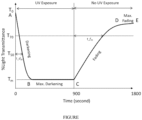
- the FIGURE shows a schematic of a typical photochromic response output.
- thermoplastic photochromic coatings that incorporate at least 40 parts by weight of photochromic compound(s) per 100 parts by weight of the thermoplastic polymer in the coating composition, i.e., the total amount of photochromic compound(s) is at least 40% by weight of the total weight of thermoplastic polymer.
- a weight ratio of photochromic compound(s) to thermoplastic polymer is at least 4:10.
- the thermoplastic photochromic coatings of the present invention comprise thermoplastic acrylic polymers having a glass transition temperature (Tg) of the polymer or at least one segment of the polymer below 55°C.
- Tg glass transition temperature
- the thermoplastic photochromic polymers of the present invention also contain no cross-linked moieties.
- thermoplastic photochromic coatings of the present invention exhibit improved photochromic performance properties when disposed on a substrate and exposed to activating light radiation.
- the photochromic coatings of the present invention can also easily be stripped with solvent and reworked.
- thermoplastic photochromic coatings of the present invention meet commercially acceptable "cosmetic" standards for optical coatings applied to optical elements, e.g., lenses.
- An article comprises: a substrate, a thermoplastic photochromic coating composition solidified on at least one surface of said substrate, an optional first organic adhesion promoter layer interposed between the substrate and the photochromic coating, a protective polymeric hard coating superposed over the photochromic coating, and an optional second organic adhesion promoter layer interposed between the photochromic coating and the protective hard coating.
- the thermoplastic photochromic coating composition comprises:
- the photochromic coating comprises a thermoplastic polymer and is itself a thermoplastic coating
- the photochromic coating does not cure, so no curing agents or catalysts are needed or are used for the coating.
- the thermoplastic photochromic coating contains no cross-linked (cured) moieties.
- thermoplastic photochromic coating composition of the present invention includes:
- Organic solvents utilized in the coating composition are those that dissolve the solid components and provide sufficient dilution for ease of application to the substrate, without chemically combining with or reacting with the coating components, and can easily be removed after coating application by air drying, vacuum drying or heating.
- the minimum amount of solvent present in the coating composition is a solvating amount, i.e., an amount which is sufficient to solubilize the solid components in the coating composition.
- Suitable types of solvents include, but are not limited to, aliphatic alcohols, alcohol ethers, alcohol esters, ketones, and alcohol ketones.
- solvents include, but are not limited to, the following: benzene, toluene, methyl ethyl ketone, methyl isobutyl ketone, acetone, ethanol, tetrahydrofurfuryl alcohol, propyl alcohol, diacetone alcohol, propylene carbonate, N-methyl pyrrolidinone, N-vinyl pyrrolidinone, N-acetyl pyrrolidinone, N-hydroxymethyl pyrrolidinone, N-butyl pyrrolidinone, N-ethyl pyrrolidinone, N-(N-octyl)pyrrolidinone, N-(N-dodecyl)pyrrolidinone, 2-methoxyethyl ether, xylene, cyclohexane, 3-methyl cyclohexanone, ethyl acetate, butyl acetate, propyl acetate, propylene glycol monomethyl
- Photochromic components utilized in the photochromic coating composition(s) of the present invention are organic photochromic compounds. Such compounds may be used individually or in combination with other complementary photochromic compounds. Organic photochromic compounds or substances containing same used in the coating compositions described herein have at least one activated absorption maximum within the range of between 380 and 780 nanometer; and may be incorporated, e.g., dissolved or dispersed, in the coating composition, and color when activated to an appropriate hue.
- photochromic metal-dithizonates e.g., mercury dithizonates, which are described in, for example, U.S. Pat. No. 3,361,706 ; fulgides and fulgimides, e.g. the 3-furyl and 3-thienyl fulgides and fulgimides, which are described in U.S. Pat. No. 4,931,220 at column 20, line 5 through column 21, line 38, and mixtures of the aforementioned suitable photochromic substances.
- photochromic metal-dithizonates e.g., mercury dithizonates
- fulgides and fulgimides e.g. the 3-furyl and 3-thienyl fulgides and fulgimides
- the photochromic coatings of the present invention comprise one photochromic compound or a mixture of photochromic compounds, as desired. Mixtures of photochromic compounds may be used to attain certain activated colors such as a near neutral gray or brown. Further discussion of neutral colors and ways to describe such colors is found in U.S. Pat. No. 5,645,767 , column 12, line 66 to column 13, line 19.
- the amount of the photochromic substances described herein to be used in the coating of the present invention is an amount sufficient to produce a photochromic effect discernible to the naked eye upon activation. Unless otherwise disclosed herein, such amount is referred to as a photochromic amount.
- the relative amounts of the aforesaid photochromic compounds used will vary and depend in part upon the relative intensities of the color of the activated species of such compounds, and the ultimate color desired. Generally, the amount of photochromic compound(s) incorporated into the coating composition will range from 2 to 30 weight percent, and most preferably, from 5 to 15 weight percent.
- the photochromic coating compositions incorporate at least 40 parts by weight of photochromic compound(s) per 100 parts by weight of the thermoplastic polymer in the coating composition, i.e., the total amount of photochromic compound(s) is at least 40% by weight, including at least 50%, including from 40-70%, including 50-70%, including 40-60%, including 50-60%, and including 60-70% by weight of the total weight of thermoplastic acrylic polymer.
- a weight ratio of photochromic compound(s) to thermoplastic polymer is at least 4:10, including at least 5:10, including from 4:10 to 7:10, including from 4:10 to 6:10, including from 5:10 to 6:10, and including from 6:10 to 7:10.
- the photochromic compound(s) described herein are incorporated into the coating composition by adding the photochromic component(s) directly to the coating composition and/or by dissolving in solvent before adding the solvent to the coating composition.
- Compatible (chemically and color-wise) tints i.e., dyes
- the particular dye selected will vary and depend on the aforesaid need and result to be achieved.
- the dye may be selected to complement the color resulting from the activated photochromic substances, e.g., to achieve a more neutral color or absorb a particular wavelength of incident light.
- the dye may be selected to provide a desired hue to the substrate and/or coated article when the photochromic substance is in an unactivated state.
- Optional ingredients that may be included in the coating composition include, but are not limited to, light stabilizers, ultraviolet light absorbers, antioxidants, surfactants, leveling agents, and tint additives.
- Additional materials may be incorporated into the coating composition with the photochromic substances, prior to, simultaneously with or subsequent to application or incorporation of the photochromic substances in the coating composition or solidified coating.
- ultraviolet light absorbers such as benzotriazoles, benzophenones, hydroxyphenyl triazines may be admixed with photochromic substances before their addition to the coating composition or such absorbers may be superposed, e.g., superimposed, as a layer between the photochromic coating and the incident light.
- stabilizers may be admixed with the photochromic substances prior to their addition to the coating composition to improve the light fatigue resistance of the photochromic substances.
- Stabilizers such as hindered amine light stabilizers (HALS), antioxidants, e.g., polyphenolic antioxidants, secondary aromatic amines, asymmetric diaryloxalamide (oxanilide) compounds and singlet oxygen quenchers, e. g., a nickel ion complex with an organic ligand, or mixtures of stabilizers are contemplated. They may be used alone or in combination.
- HALS hindered amine light stabilizers
- antioxidants e.g., polyphenolic antioxidants, secondary aromatic amines, asymmetric diaryloxalamide (oxanilide) compounds and singlet oxygen quenchers, e. g., a nickel ion complex with an organic ligand, or mixtures of stabilizers are contemplated. They may be used alone or in combination.
- Such stabilizers are described in U.S. Pat. Nos. 4,720,356 , 5,391,327 and 5,770,115 .
- UV absorbers examples include, but are not limited to, 2-hydroxy-benzophenones (BPs) (commercial examples include CHIMASSORB 81 and CHIMASSORB 90, both available from BASF of Germany); 2-(2-hydroxyphenyl)-benzotriazoles (HPBTs) (commercial examples include TINUVIN 1130, TINUVIN 384-2, TINUVIN 928, and TINUVIN 900 (all from BASF); and 2-hydroxyphenyl-s-triazines (HPTs) (commercial examples include, but are not limited to, TINUVIN 400, TINUVIN 405 (both from BASF).
- BPs 2-hydroxy-benzophenones
- HPBTs 2-(2-hydroxyphenyl)-benzotriazoles
- HPTs 2-hydroxyphenyl-s-triazines
- HALS examples include, but are not limited to, 2,2,6,6-tetramethyl piperidine and its derivatives (commercial examples include TINVUVIN144, TINUVUN123, TINUVIN 152, TINUVIN 292, all from BASF).
- Surfactants and leveling agents may be added to the coating composition.
- Some exemplary surfactants and leveling agents are polyethers (commercially available as TRITON X-100, X-405, and N-57 from Dow Chemical of Midland, Michigan), silicones (commercially available as PAINT ADDITIVE 3, PAINT ADDITIVE 29, PAINT ADDITIVE 57, FZ-77, FZ-2123, and FZ-7604 from Dow Corning of Midland, Michigan; BYK333, BYK377, BYK306 from BYK-Chemie GmbH, Germany; and COATOSIL 77 and COATOSIL 7600 from Momentive of Columbus, Ohio), fluorosurfactants (commercially available as FLUORAD FC-4430 from 3M Corporation of St. Paul, Minnesota), fluorosilicones, polyacrylates, silicone polyacrylates such as silicone hexaacrylate, and fluoro-modified polyacrylates.
- the photochromic coating compositions of the present invention are applied to substrates variously by spray coating, spin coating, flow coating, spread coating, curtain coating, dip coating, casting, or roll-coating, and other common coating techniques including conventional printing techniques, such as flexographic, lithographic, digital and screen printing.
- the coating composition is desolvated, i.e., solidified, to a sufficient degree to form a solid, tack-free layer.
- the desolvation can be achieved by ambient air drying, ambient forced air drying, vacuum drying, infrared (IR) heating between 50 °C to 100°C, convection oven heating between 40 °C to 120°C, or a combination of the above.
- the desolvated coating meets commercially acceptable "cosmetic" standards for optical coatings.
- cosmetic defects of coated lens include pits, spots, inclusions, cracks and crazing of the coating.
- the coatings prepared using the photochromic coating composition of the present invention are substantially free of cosmetic defects. Unless indicated herein, "substantially free of cosmetic defects" means at least 90% of the visible surface area of the coated lens, circumscribed from the geometric center of the coated lens surface, is free from cosmetic defects.
- the amount of the coating composition applied to at least one surface of the substrate is an amount necessary to incorporate a sufficient quantity of the organic photochromic substance(s) to produce a coating that exhibits the required change in light transmittance when the cured coating is exposed to UV radiation.
- the required change in light transmittance is at least 50% within 60 seconds, preferably within 30 seconds, of exposure to sunlight or light source simulating solar UV spectrum, when tested at ambient temperature of 20°C to 25°C.
- the fading time (t_f70) of the photochromic coating i.e., the photochromic(s) in the coating
- the applied coating has a nominal thickness within a range of from 3 to 20 micrometers, more preferably, from 3 to 15 micrometers, most preferably from 3 to 10 micrometers.
- the coating compositions of the present invention are applied to substrates, of any type such as, for example paper, glass, ceramics, wood, masonry, textiles, metals and polymeric organic materials.
- the substrate is an optically clear polymeric organic material, particularly, thermoset or thermoplastic polymeric organic materials, e.g., thermoplastic polycarbonate type polymers and copolymers and homopolymers or copolymers of a polyol(allyl carbonate) used as organic optical materials.
- polymeric organic materials that may be substrates for the coating composition of the present invention are polymers, i.e., homopolymers and copolymers, of the monomers and mixtures of monomers disclosed in U.S. Pat. No. 5,658,501 from column 15, line 28 to column 16, line 17.
- Examples of such monomers and polymers include: polyol(allyl carbonate) monomers, e.g., diethylene glycol bis(allyl carbonate), which monomer is sold under the trademark CR-39; polyol(meth)acryloyl terminated carbonate monomer; diethylene glycol dimethacrylate monomers; ethoxylated phenol methacrylate monomers; diisopropenyl benzene monomers; ethoxylated trimethylol propane triacrylate monomers; ethylene glycol bismethacrylate monomers; poly(ethylene glycol)bis methacrylate monomers; urethane acrylate monomers; poly(ethoxylated bisphenol A dimethacrylate); poly(vinyl acetate); poly(vinyl alcohol); poly(vinyl chloride); poly(vinylidene chloride); polyurethanes, polythiourethanes, thermoplastic polycarbonates, such as the carbonate-linked polymer derived from bisphenol A and phosgen
- Polymeric substrates such as, for instance, plastic optical lenses, are sometimes supplied with a protective factory hard coat applied by the manufacturer. Such factory-coated substrates are also included in the substrates applicable to the present invention.
- the protective polymeric hard coating superposed on the photochromic coating of the invention are heat (thermally) curable polymer-forming organosilane coatings, such as for instance, thermally curable CRYSTALCOAT MP, CC and TC series coatings available from SDC Technologies, Inc., or radiation curable hard coatings such as, for instance, CRYSTALCOAT UV series coatings available from SDC Technologies, Inc., which after cure shall provide acceptable cosmetics and scratch/abrasion resistance to the photochromic article.
- heat (thermally) curable polymer-forming organosilane coatings such as for instance, thermally curable CRYSTALCOAT MP, CC and TC series coatings available from SDC Technologies, Inc.
- radiation curable hard coatings such as, for instance, CRYSTALCOAT UV series coatings available from SDC Technologies, Inc.
- a protective polymeric hard coating for a photochromic eyewear lens of the protective polymeric hard coating provides sufficient abrasion resistance to the lens to achieve a Bayer Abrasion Ratio (B.R.) of at least 2, preferably at least 3, most preferably a B.R. greater than 3.5.
- B.R. Bayer Abrasion Ratio
- the photochromic article of the protective polymeric hard coating meets commercially acceptable cosmetic standards for optical coatings. Examples of cosmetic defects of coated lens include pits, spots, inclusions, flow lines, cracks, and crazing of the coating.
- the article of the protective polymeric hard coating is substantially free of cosmetic defects.
- protective polymeric hard coatings are detailed in U.S. Patent Nos. 5,958,514 , 6,001,163 , 6,342,097 , 6,346,331 , 6,348,269 , 6,538,093 , 7,001,642 , 7,014,918 , 7,018,463 , 7,097,704 , 7,105,598 .
- the protective polymeric hard coatings are prepared from compositions comprising:
- the coating compositions may further include from about 0.1 to about 50 weight percent of a mixture of hydrolysis products and partial condensates of one or more monofunctional, difunctional, and/or trifunctional silanes, based on the total solids of the composition, and/or an amount of colloidal silica or a metal oxide or combinations thereof equivalent to from about 0.1 to about 50 weight percent, based on the total solids of the composition.
- the coating compositions may also further include from 0.1 to about 15 weight percent of a suitable additives, such as blocked isocyanates, polyol adhesion promoters, tint additives, stabilizers, flow modifiers, etc. based on the total solids of the composition.
- a suitable additives such as blocked isocyanates, polyol adhesion promoters, tint additives, stabilizers, flow modifiers, etc.
- the coating compositions shall include from 0.5 to about 10 weight percent of suitable radiation curable initiators, based on the total solids of the composition.
- aqueous-organic solvent mixture While the presence of water in the aqueous-organic solvent mixture is necessary to form hydrolysis products of the silane components of the mixture, the actual amount can vary widely. Essentially enough water is needed to provide a substantially homogeneous coating mixture of hydrolysis products and partial condensates of the epoxy functional silane and the tetrafunctional silane which, when applied and cured on an article, provides a substantially transparent protective polymeric hard coating.
- the solvent constituent of the aqueous-organic solvent mixture of the coating compositions of the protective polymeric hard coating can be any solvent or combination of solvents which is compatible with the epoxy functional silane, the tetrafunctional silane and the multi-functional component.
- the solvent constituent of the aqueous-organic solvent mixture may be an alcohol, an ether, a glycol or a glycol ether, a ketone, an ester, a glycol ether acetate and mixtures thereof.
- Suitable alcohols can be represented by the formula ROH where R is an alkyl group containing from 1 to about 10 carbon atoms.
- alcohols useful in the application of this invention include methanol, ethanol, propanol, isopropanol, butanol, isobutanol, secondary butanol, tertiary butanol, cyclohexanol, pentanol, octanol, decanol, and mixtures thereof.
- Suitable ethers, glycols, and glycol ethers can be represented by the formula R 1 -(OR 2 ) x -OR 1 where x is 0, 1, 2, 3, or 4, R 1 is hydrogen or an alkyl group containing from 1 to about 10 carbon atoms and R 2 is an alkylene group containing from 1 to about 10 carbon atoms and combinations thereof.
- Suitable ethers, glycols, and glycol ethers having the above-defined formula and which may be used as the solvent constituent of the aqueous-organic solvent mixture of the coating compositions of the protective polymeric hard coating include di-n-butylether, ethylene glycol dimethyl ether, propylene glycol dimethyl ether, propylene glycol methyl ether, dipropylene glycol methyl ether, tripropylene glycol methyl ether, dipropylene glycol dimethyl ether, tripropylene glycol dimethyl ether, ethylene glycol butyl ether, diethylene glycol butyl ether, ethylene glycol dibutyl ether, ethylene glycol methyl ether, diethylene glycol ethyl ether, diethylene glycol dimethyl ether, ethylene glycol ethyl ether, ethylene glycol diethyl ether, ethylene glycol, diethylene glycol, triethylene glycol, propylene glycol, dipropylene glycol, tripropylene glyco
- ketones suitable for the aqueous-organic solvent mixture include acetone, diacetone alcohol, methyl ethyl ketone, cyclohexanone, methyl isobutyl ketone, and mixtures thereof.
- esters suitable for the aqueous-organic solvent mixture include ethyl acetate, n-propyl acetate, n-butyl acetate, and combinations thereof.
- glycol ether acetates suitable for the aqueous-organic solvent mixture include propylene glycol methyl ether acetate, dipropylene glycol methyl ether acetate, ethyl 3-ethoxypropionate, ethylene glycol ethyl ether acetate, and combinations thereof.
- the epoxy functional silane used in the formulation of the coating compositions of the protective polymeric hard coating can be any epoxy functional silane which is compatible with the tetrafunctional silane and the multifunctional component of the coating composition and which provides a coating composition which, upon curing produces a substantially transparent, abrasion resistant protective polymeric hard coating.
- such epoxy functional silanes are represented by the formula R 3 xSi(OR 4 ) 4-x where x is an integer of 1, 2 or 3, R3 is H, an alkyl group, a functionalized alkyl group, an alkylene group, an aryl group, an alkyl ether, and combinations thereof containing from 1 to about 10 carbon atoms and having at least 1 epoxy functional group, and R 4 is H, an alkyl group containing from 1 to about 5 carbon atoms, an acetyl group, a -Si(OR 5 ) 3-y R 6y group, where y is an integer of 0, 1, 2, or 3, and combinations thereof where R 5 is H, an alkyl group containing from 1 to about 5 carbon atoms, an acetyl group, or another -Si(OR 5 )3- y R 6y group and combinations thereof, and R 6 is H, an alkyl group, a functionalized alkyl group, an alkylene group, an aryl group, an alkyl
- epoxy functional silanes include glycidoxymethyltrimethoxysilane, 3-glycidoxypropyltrihydroxysilane, 3-glycidoxypropyldimethylhydroxysilane, 3-glycidoxypropyltrimethoxysilane, 3-glycidoxypropyltriethoxysilane, 3-glycidoxypropyldimethoxymethylsilane, 3-glycidoxypropyldimethylmethoxysilane, 3-glycidoxypropyltributoxysilane, 1,3-bis(glycidoxypropyl)tetramethyldisiloxane, 1,3-bis (glycidoxypropyl)tetramethoxydisiloxane, 1,3-bis(glycidoxypropyl)-1,3-dimethyl-1, 3-dimethoxydisiloxane, 2,3-epoxypropyltrimethoxysilane, 3,4-epoxybutyltrimethoxysilane, 6,
- the tetrafunctional silanes useful in the formulation of the coating compositions of the protective polymeric hard coating are represented by the formula Si(OR 7 ) 4 where R 7 is H, an alkyl group containing from 1 to about 5 carbon atoms and ethers thereof, an (OR 7 ) carboxylate, a - Si(OR 8 ) 3 group where R 8 is a H, an alkyl group containing from 1 to about 5 carbon atoms and ethers thereof, an (OR 7 ) carboxylate, or another -Si(OR 8 ) 3 group and combinations thereof.
- tetrafunctional silanes represented by the formula Si(OR 7 ) 4 are tetramethyl orthosilicate, tetraethyl orthosilicate, tetrapropyl orthosilicate, tetraisopropyl orthosilicate, tetrabutyl orthosilicate, tetraisobutyl orthosilicate, tetrakis(methoxyethoxy)silane, tetrakis(methoxypropoxy)silane, tetrakis(ethoxyethoxy)silane, tetrakis(methoxyethoxyethoxy) silane, trimethoxyethoxysilane, dimethoxydiethoxysilane, triethoxymethoxysilane, poly-(dimethoxysiloxane), poly(diethoxysiloxane), poly(dimethoxydiethoxysiloxane), tetrakis(trimethoxysilane
- R 7 and R 8 taken with oxygen (OR 7 ) and (OR 8 ) can be carboxylate groups.
- examples of tetrafunctional silanes with carboxylate functionalities are silicon tetracetate, silicon tetrapropionate and silicon tetrabutyrate.
- the multifunctional compounds which can be employed in the formulation of the coating compositions of the protective polymeric hard coating can be any multifunctional carboxylic acid, multifunctional anhydride, and combinations thereof which is compatible with the epoxy functional silane and the tetrafunctional silane of the coating compositions and which is capable of interacting with the hydrolysis products and partial condensates of the epoxy functional silane and the tetrafunctional silane to provide a coating composition which, upon curing, produces a substantially transparent, abrasion resistant protective hard coating.
- multifunctional carboxylic acids which can be employed as the multifunctional compound in the compositions of the protective polymeric hard coating include malic acid, aconitic acid (cis,trans), itaconic acid, succinic acid, malonic acid, glutaric acid, adipic acid, pimelic acid, suberic acid, azelaic acid, sebacic acid, cyclohexyl succinic acid, 1,3,5 benzene tricarboxylic acid, 1,2,4,5 benzene tetracarboxylic acid, 1,4-cyclohexanedicarboxylic acid, 1,3-cyclohexanedicarboxylic acid, 1,1-cyclohexanediacetic acid, 1,3-cyclohexanediacetic acid, 1,3,5-cyclohexanetricarboxylic acid, and unsaturated dibasic acids such as fumaric acid and maleic acid, and combinations thereof.
- malic acid aconitic acid (cis,trans), itaconic
- the coating compositions of the protective polymeric hard coating may further include from about 0.1 to about 50 weight percent, based on the weight of total solids of the coating composition, of a mixture of hydrolysis products and partial condensates of one or more monofunctional, difunctional, and/or trifunctional silanes (including the mixtures thereof).
- silanes which may be incorporated into the coating compositions of the protective polymeric hard coating have the formula R 9 xSi(OR 10 ) 4-x where x is a number of 1, 2 or 3; R 9 is H, or an alkyl group containing from 1 to about 10 carbon atoms, a functionalized alkyl group, an alkylene group, an aryl group an alkyl ether group and combinations thereof; R 10 is H, an alkyl group containing from 1 to about 10 carbon atoms, an acetyl group; and combinations thereof.
- silanes represented by the above-defined formula examples include methyltrimethoxysilane, ethyltrimethoxysilane, propyltrimethoxysilane, butyltrimethoxysilane, isobutyltrimethoxysilane, hexyltrimethoxysilane, octyltrimethoxy-silane, decyltrimethoxysilane, cyclohexyltrimethoxysilane, cyclo-hexylmethyltrimethoxysilane, 3-methacryloxypropyltrimethoxysilane, vinyltrimethoxysilane, allyltrimethoxysilane, dimethyldimethoxy-silane, 2-(3-cyclohexenyl)ethyltrimethoxysilane, 3-cyanopropyltrimethoxysilane, 3-chloropropyltrimethoxysilane, 2-chloroethyltrime
- coating compositions of the protective polymeric hard coating may further include colloidal silica.
- Colloidal silica is commercially available under a number of different tradename designations, including NALCOAG (Nalco Chemical Co., Naperville, IL); NYACOL (Nyacol Products, Inc., Ashland, MA); SNOWTEX (Nissan Chemical Industries, LTD., Tokyo, Japan); LUDOX (DuPont Company, Wilmington, Delaware); and HIGHLINK OG (Hoechst Celanese, Charlotte, NC).
- the colloidal silica is an aqueous or organic solvent dispersion of particulate silica and the various products differ principally by particle size, silica concentration, pH, presence of stabilizing ions, solvent makeup, and the like. It is understood by those skilled in the art that substantially different product properties can be obtained through the selection of different colloidal silicas.
- metal oxides may further be included in the coating compositions of the protective polymeric hard coating.
- Such additions may be made instead of, or in addition to, any colloidal silica additions.
- Metal oxides may be added to the protective coatings to provide or enhance specific properties of the cured coating, such as abrasion resistance, refractive index, anti-static, anti-reflectance, weatherability, etc. It will be recognized by those skilled in the art that similar types of considerations that apply to the colloidal silica additions will also apply more generally to the metal oxide additions.
- Examples of metal oxides which may be used in the coating compositions of the protective polymeric hard coating include silica, zirconia, ceria, tin oxide, and mixtures thereof.
- the amount of colloidal silica incorporated into the coating compositions of the protective polymeric hard coating can vary widely and will generally depend on the desired properties of the cured coating produced from the coating compositions, as well as the desired stability of the coating compositions.
- the amount of metal oxides incorporated into the coating compositions of the protective polymeric hard coating can vary widely and will generally depend on the desired properties of the cured coating produced from the coating compositions, as well as the desired stability of the coating compositions.
- colloidal silica and/or metal oxides When colloidal silica and/or metal oxides are added, it is desirable to add from about 0.1 to about 50 weight percent of solids of the colloidal silica and/or metal oxides, based on the total solids of the coating composition, to the coating compositions of the protective polymeric hard coating.
- the colloidal silica and/or metal oxides will generally have a particle size in the range of 2 to 150 millimicrons in diameter, and more desirably, a particle size in the range of from about 2 to 50 millimicrons.
- the coating compositions of the protective polymeric hard coating may further include a suitable blocked isocyanate. It is believed that the suitable blocked isocyanates can result in improved the environmental durability of the coating, resistance to adhesion failure and cracking.
- the blocked isocyanates can be provided in any suitable amount.
- the blocked isocyanates can comprise about 0.1 percent by weight to about 15 percent based on the weight of the total coating composition.
- Suitable blocked isocyanates include, but are not limited to, DESMODUR BL 3175A, DESMODUR BL3370NIPA, DESMODUR BL3175SN, DESMODUR BL3475BASN, and DESMODUR BL4265SN available from Covestro LLC; and TRIXENE BI7951, TRIXENE BI7960, TRIXENE BI7961, TRIXENE BI7963, TRIXENE BI7981, TRIXENE BI7982, TRIXENE AQUA BI200, TRIXENE AQUA BI201, and TRIXENE AQUA BI220 available from Chemtura Corp.
- the protective polymeric hard coating composition may further include polyol adhesion promoters.
- suitable polyol adhesion promoters include, but not limited to monomeric polyols such as trimethylolpropane, trimethylolethane, pentaerythritol, dipentaerythritol, hexanediols such as 1,6-hexanediol, butanediols such as 1,4-butanediol, heptanediols such as 1,7-heptanediol, octanediols such as 1,8-octanediol, and the like; and polymeric polyols including but not limited to polyether polyols, such as polyethylene glycol, polypropylene glycol, and poly(tetramethylene ether) glycol; polyester polyols such as polycaprolactone polyols; polycarbonate polyols; polyestercarbon
- the protective polymeric hard coating composition may further include tint additives.
- the tint additive includes those represented by the general formula: R 1 -(OCH 2 CH 2 ) n -O-R 2 wherein at least one of R 1 and R 2 is a silicon containing compound represented by the general formula: where R 3 is H, an alkyl group containing from about 1 to about 5 carbon atoms, or an acetyl group, and where R 4 is H, an epoxy functional group, an alkyl group, a functional alkyl group, an alkylene group, an aryl group, an alkyl ether, and combinations thereof containing from about 1 to about 10 carbon atoms, and where X is an integer from 0 to about 3 and n is a positive integer greater than 1.
- R 1 and R 2 are silicon containing compounds and even more preferably, the silicon containing compounds as represented by the general formula shown above.
- Examples of such compounds are: Bis(N-(triethoxysilylpropyl))-O,O'-polyethyleneoxide urethane; Bis(N-trimethoxysilylpropyl))-O,O'-polyethyleneoxide urethane; Bis(N-dimethylhydroxysilylpropyl))-O,O'-polyethyleneoxide urethane; Bis(N-dimethoxymethylsilylpropyl))-O,O'-polyethyleneoxide urethane; Bis(N-dimethylmethoxysilylpropyl))-O,O'-polyethyleneoxide urethane; Bis(N-dimethylethoxysilylpropyl))-O-O'-polyethyleneoxide urethane; Bis(N-tributoxysilylpropyl))-O,O'-polyethyleneoxide urethane; Bis(N-dimethoxyphenylsilylpropyl))
- the protective polymeric hard coating composition may further comprise a UV absorber, a hindered amine light stabilizer (HALS), and combinations thereof.
- suitable UV absorbers include, but are not limited to, 2-hydroxy-benzophenones (BPs) (commercial examples include CHIMASSORB 81 and CHIMASSORB 90, both available from BASF of Germany); 2-(2-hydroxyphenyl)-benzotriazoles (HPBTs) (commercial examples include TINUVIN 1130, TINUVIN 384-2, TINUVIN 928, and TINUVIN 900 (all from BASF); and 2-hydroxyphenyl-s-triazines (HPTs) (commercial examples include, but are not limited to, TINUVIN 400, TINUVIN 405 (both from BASF).
- suitable HALS that may be used in the coating compositions include, but are not limited to, 2,2,6,6-tetramethyl piperidine and its derivatives (commercial examples include TINUVIN 152, TINUVIN 29
- a catalyst is not an essential ingredient of the protective polymeric hard coating
- the addition of a catalyst can affect abrasion resistance and other properties of the coating including stability, tinting capacity, porosity, cosmetics, caustic resistance, water resistance and the like.
- the amount of catalyst used can vary widely, but when present will generally be in an amount sufficient to provide from about 0.1 to about 10 weight percent, based on the total solids of the composition.
- catalysts which may further be included in the coating compositions of the protective polymeric hard coating include (i) metal acetylacetonates, (ii) diamides, (iii) imidazoles, (iv) amines and ammonium salts, (v) organic sulfonic acids and their amine salts, (vi) alkali metal salts of carboxylic acids, (vii) alkali metal hydroxides and (viii) fluoride salts.
- examples of such catalysts include for group (i) such compounds as aluminum, zinc, iron and cobalt acetylacetonates; for group (ii) dicyandiamide; for group (iii) such compounds as 2-methylimidazole, 2-ethyl-4-methylimidazole and 1-cyanoethyl-2-propylimidazole; for group (iv), such compounds as benzyldimethylamine, and 1,2-diaminocyclohexane; for group (v), such compounds as trifluoromethanesulfonic acid; for group (vi), such compounds as sodium acetate, for group (vii), such compounds as sodium hydroxide, and potassium hydroxide; and for group (viii), tetra n-butyl ammonium fluoride, and the like.
- An effective amount of a leveling or flow control agent may further be included in the composition to more evenly spread or level the composition on the surface of the substrate and to provide substantially uniform contact with the substrate.
- the amount of the leveling or flow control agent can vary widely, but generally is an amount sufficient to provide the coating composition with from about 10 to about 5,000 ppm of the leveling or flow control agent. Any conventional, commercially available leveling or flow control agent which is compatible with the coating composition and the substrate and which is capable of leveling the coating composition on a substrate and which enhances wetting between the coating composition and the substrate may be employed.
- leveling or flow control agents which may be incorporated into the coating compositions of the protective polymeric hard coating
- polyethers commercially available as TRITON X-100, X-405, and N-57 from Dow Chemical of Midland, Michigan
- silicones commercially available as PAINT ADDITIVE 3, PAINT ADDITIVE 29, PAINT ADDITIVE 57, FZ-77, FZ-2123, and FZ-7604 from Dow Corning of Midland, Michigan
- BYK333, BYK377, BYK306 from BYK-Chemie GmbH, Germany
- COATOSIL 77 and COATOSIL 7600 from Momentive of Columbus, Ohio
- fluorosurfactants commercially available as FLUORAD FC-4430 from 3M Corporation of St. Paul, Minnesota
- fluorosilicones commercially available as FLUORAD FC-4430 from 3M Corporation of St. Paul, Minnesota
- fluorosilicones commercially available as FLUORAD FC-4430 from 3M Corporation of St. Paul, Minnesota
- coating compositions of the protective polymeric hard coating are radiation curable, suitable cationic and/or radical photoinitiators are added in an amount from about 0.5 to about 10 weight percent, based on the total solids of the composition.
- Examples of cationic photoinitiators which can be incorporated into the coating compositions of the protective polymeric coatings include aromatic onium salts of Group Va elements, such as phosphonium salts, e.g., triphenyl phenacylphosphonium hexafluorophosphate, salts of Group VIa elements, such as sulfonium salts, e.g., triphenylsulfonium tetrafluoroborate, triphenylsulfonium hexafluorophosphate and triphenylsulfonium hexafluoroantimonate, and salts of Group VIIa elements, such as iodonium salts such as diphenyliodonium chloride and diaryl iodonium hexafluoroantimonate.
- aromatic onium salts of Group Va elements such as phosphonium salts, e.g., triphenyl phenacylphosphonium hexafluorophosphate
- aromatic onium salts and their use as cationic initiators in the polymerization of epoxy compounds are described in detail in U.S. Pat. Nos. 4,058,401 ; 4,069,055 ; 4,101,513 ; and 4,161,478 .
- Other cationic initiators can also be used in addition to those referred to above; for example, the phenyldiazonium hexafluorophosphates containing alkoxy or benzyloxy radicals as substituents on the phenyl radical as described in U.S. Pat. No. 4,000,115 .
- radical photoinitiators which may further be included in the coating compositions of the protective polymeric hard coatings include benzoin; substituted benzoins such as butyl isomers of benzoin ethers; benzophenone; substituted benzophenones such as hydroxy benzophenone; 2-hydroxyethyl-N-maleimide; 2-[2-hydroxyethyl(methyl)amino]ethanol anthraquinone; thioxanthone; ⁇ , ⁇ -diethoxyacetophenone; 2,2-dimethoxy-1,2-diphenylethan-1-one; 2-hydroxy-2-methyl-1-phenyl-propan-1-one; diphenyl(2,4,6-trimethylbenzoyl)phosphine oxide, phenyl glyoxylic acid methyl ester; 1-hydroxylcyclohexyl phenyl ketone; 2-benzyl-2-dimethylamino-1-(4-morpholinophenyl)-butanone-1; 2-dimethyl
- a protective polymeric hard coating that is capable of being subsequently sputter coated or electron-beam coated with inorganic anti-reflective coatings to reduce incident visible light reflection to preferably below 5%, more preferably below 2% and most preferably below 1%.
- adhesion promoter also interchangeably referred to as a "primer” layer
- an adhesion promoter also interchangeably referred to as a "primer”
- an adhesion promoting primer layer to the surface of the photochromic coating before application of the protective polymeric hard coating.
- Any suitable adhesion promoter can be used, including any suitable organic adhesion promoter (or organic primer), to form the adhesion promoter (or primer) layer.
- Such adhesion promoter (or primer) layers may be formed from a polyurethane solution, a thermoplastic acrylic polymer solution, or mixtures thereof.
- a polyurethane dispersion-based primer can be used.
- Suitable primers are detailed in U.S. Patent No. 5,316,791 .
- suitable primers include PDR153X2, PR1165, and CP620 etc. available from SDC Technologies, Inc.
- the primer can be applied to a substrate or on top of photochromic coating and air or thermally dried, e.g., air-dried for less than about 60 min, and the coating composition can be subsequently applied and cured.
- Application of the primer can be by any of the methods used in coating technology such as, for example, spray coating, spin coating, flow coating, spread coating, curtain coating, dip coating, casting, roll-coating, or conventional printing techniques, such as flexographic, lithographic, digital and screen printing.
- the photochromic articles of the present invention comprising the substrate, the thermoplastic photochromic coating, protective polymeric hard coating, and optional adhesion promoter layer(s) or any of its component layers may be disposed on one or both opposing surfaces of the substrate.
- Table 1 depicts exemplary embodiments of the possible assembly configurations of the inventive photochromic articles of the present disclosure.
- Adhesion Promoter 1 refers to an adhesion promoter layer interposed between the substrate and the photochromic coating.
- Adhesion Promoter 2 refers to an adhesion promoter layer interposed between the photochromic coating and the protective hard coating.
- Photochromic Assembly Configuration A comprises a photochromic layer disposed on one surface of the substrate and a protective hard coating disposed over the photochromic layer
- Photochromic Assembly Configuration B although the photochromic layer is disposed on only one surface of the substrate, the protective hard coating is disposed on both opposing surfaces of the substrate.
- Configuration C both the photochromic and hard coating layers are disposed on both opposing surfaces of the substrate. Additional configurations incorporating one or both adhesion promoter layers on one or both surfaces of the substrate are depicted in Configurations D through M.
- One-sided photochromic assemblies such as Configurations A, D and H may be manufactured by spin, spray, flow, curtain, slot-die, or gravure coating methods.
- Spin, spray and flow methods are most suitable for manufacturing one-sided photochromic assemblies on cast or molded parts, for instance, optical elements such as lenses and visors.
- Curtain, slot-die and gravure coating methods are most suitable for wide format, flat substrates such as film and sheet.
- Fully two-sided photochromic assemblies such as Configurations C, G, J and M can be manufactured by the coating techniques used for one-sided assemblies by sequential or simultaneous application of the assembly layers on both opposing surfaces of the substrate.
- dip coating is the preferred method for manufacturing two-sided assemblies due to reduced cost and higher throughput.
- a combination of single side and dual side coating methods may be employed.
- the photochromic layer can be applied to the convex surface of the lens substrate using spin, spray or flow coating method followed by solidification (desolvation) of the photochromic coating to yield a photochromic coated substrate.
- the coated lens substrate can then be dip coated with the protective hard coating and the hard coating cured to yield a photochromic lens article comprising a photochromic layer on one surface of the lens and a protective hard coating on both surfaces of the lens.
- FIGURE shows a schematic of a typical photochromic response output.
- the response consists of 4 main sections:
- T 0 is the initial %Light transmittance through the photochromic specimen before UV exposure.
- T 50 0.5*T 0 , i.e. 50% of initial %Light transmittance.
- T 70 0.7*T 0 , i.e. 70% of initial %Light transmittance.
- T m is the minimum %Light transmittance attained after 15 minutes of continuous UV exposure.
- t _d 50 is the time to darken from T 0 to T 50 during UV exposure.
- t _f 70 is the time to fade from T m to T 70 after removal of UV exposure.
- thermoplastic acrylic polymer B48N 15.9g thermoplastic acrylic polymer B48N was slowly added to a beaker of 75g PM glycol ether with continuous stirring, and subsequently mixed continuously for 3 hours at room temperature.
- 9g Photochromic GO and 0.1g leveling agent BYK-377 were added with continuous stirring and subsequently mixed for an additional 2 hours at room temperature and filtered through a 6um filter.
- the resulting mixture had a photochromic compound to thermoplastic polymer ratio of 56.6%.
- Examples 2-11 and Comparative Examples C1-C3 were prepared using the method of Example 1 but with thermoplastic polymers, photochromic compounds, their corresponding quantities, and solvent quantities shown in Table 3.
- Table 3 Photochromic Coating Compositions Comparative C1 Comparative C2 Comparative C3 Example 1
- Example 2 A11 (g) 15.3 A14 (g) 16.5 A21 (g) 13.2 B48 (g) 15.9 BR117 (g) 15.3 E2044 (g) E2550 (g) D51N (g) M52N (g) M22N (g) BYK-377 0.1 0.1 0.1 0.1 0.1 Leveling Agent (g) Photochromic GO (g) 8.6 9.4 7.7 9.0 8.6 Photochromic GN (g) PM Glycol Ether (g) 76 74 79 75 76 Total (g) 100 100 100 100 100 100 100 100 100 100 100 Total Solids by weight 24% 26% 22% 25% 24% Photochromic Compound to Thermoplastic Polymer Ratio 56.2%
- thermoplastic acrylic polymers listed in Table 3 incorporated greater than 40 parts by weight of photochromic compound per 100 parts by weight of the thermoplastic polymer.
- Each photochromic coating composition from Table 3 was applied via spin-coating to individual MR-8 lenses that had been pre-washed with 10% Simple Green detergent solution in de-ionized (DI) water and dried with compressed air.
- the following spin-coating procedure was used: the photochromic coating composition was manually dispensed via a pipette onto the convex surface of the lens while spinning the lens at 600rpm for 5 seconds. The dispensing was then discontinued and the lens was spun at a speed of 800-900rpm for 20 seconds to evenly distribute the coating across the lens. The coated lens was then dried in a convection oven at 100°C for 30 minutes to desolvate (solidify) the coating.
- Photochromic GO 1g Irgacure 184 and 1g Irgacure 819 photoinitiators were added to 100g of polymerizable monomers consisting of 50g polyethylene glycol diacrylate with an average molecular weight of 575 (from Aldrich) and 50g 4-hydroxybutyl acrylate glycidyl ether (from Kowa American Corp).
- the composition was stirred and mixed at room temperature for 3 hours and filtered through a 2.5um filter.
- a CR-39 lens was etched with a mixture of 10% potassium hydroxide, 40% PM glycol ether and 40% DI water at ambient laboratory temperature ( ⁇ 23-25°C) for 15 minutes, rinsed thoroughly with city water and then DI water, dried with compressed air, and then spin-coated on the convex surface with the coating composition at a speed of 500 rpm for 5 seconds followed by a spin-off of 1000rpm for 15 seconds to evenly distribute the coating on the lens surface.
- the coated surface of the lens was cured under carbon dioxide atmosphere in a Satis Magna Spin G3 machine, equipped with a 400W/inch D-bulb, at an irradiation dosage of 2.5J/cm 2 followed by thermal cure at 120°C for 2 hours.
- Photochromic GO 1g Irgacure 184 and 1g Irgacure 819 photoinitiators were added to 100g of polymerizable monomers consisting of 50g polyethylene glycol diacrylate with an average molecular weight of 575 (from Aldrich) and 50g 4-hydroxybutyl acrylate glycidyl ether (from Kowa American Corp).
- the composition was stirred and mixed at room temperature for 3 hours and filtered through a 2.5um filter.
- a CR-39 lens was etched with a mixture of 10% potassium hydroxide, 40% PM glycol ether and 40% DI water at ambient laboratory temperature ( ⁇ 23-25°C) for 15 minutes, rinsed thoroughly with city water and then DI water, dried with compressed air, and then spin-coated on the convex surface with the coating composition at a speed of 500 rpm for 5 seconds followed by a spin-off of 1000rpm for 15 seconds to evenly distribute the coating on the lens surface.
- the coated surface of the lens was cured under carbon dioxide atmosphere in a Satis Magna Spin G3 machine, equipped with a 400W/inch D-bulb, at an irradiation dosage of 2.5J/cm 2 followed by thermal cure at 120°C for 2 hours.
- Photochromic GO 1g Irgacure 184 and 1g Irgacure 819 photoinitiators were added to 100g of polymerizable monomers consisting of 33g SR238 (from Sartomer) and 67g Ebecryl 8301R (from Allnex). The composition was stirred and mixed at room temperature for 3 hours and filtered through a 2.5um filter.
- a CR-39 lens was etched with a mixture of 10% potassium hydroxide, 40% PM glycol ether and 40% DI water at ambient laboratory temperature ( ⁇ 23-25°C) for 15 minutes, rinsed thoroughly with city water and then DI water, dried with compressed air, and then spin-coated on the convex surface with the coating composition at a speed of 500 rpm for 5 seconds followed by a spin-off of 1000rpm for 15 seconds to evenly distribute the coating on the lens surface.
- the coated surface of the lens was cured under carbon dioxide atmosphere in a Satis Magna Spin G3 machine, equipped with a 400W/inch D-bulb, at an irradiation dosage of 2.5J/cm 2 .
- Photochromic GO 1g Irgacure 184 and 1g Irgacure 819 photoinitiators were added to 100g of polymerizable monomers consisting of 33g SR238 (from Sartomer) and 67g Ebecryl 8301R (from Allnex). The composition was stirred and mixed at room temperature for 3 hours and filtered through a 2.5um filter.
- a CR-39 lens was etched with a mixture of 10% potassium hydroxide, 40% PM glycol ether and 40% DI water at ambient laboratory temperature ( ⁇ 23-25°C) for 15 minutes, rinsed thoroughly with city water and then DI water, dried with compressed air, and then spin-coated on the convex surface with the coating composition at a speed of 500 rpm for 5 seconds followed by a spin-off of 1000rpm for 15 seconds to evenly distribute the coating on the lens surface.
- the coated surface of the lens was cured under carbon dioxide atmosphere in a Satis Magna Spin G3 machine, equipped with a 400W/inch D-bulb, at an irradiation dosage of 2.5J/cm 2 .
- thermoplastic acrylic polymer M52N 15.4g thermoplastic acrylic polymer M52N was slowly added to a beaker of 75.3g PM glycol ether with continuous stirring, and subsequently mixed continuously for 3 hours at room temperature.
- 10.3g Photochromic GN was added with continuous stirring and subsequently mixed for an additional 2 hours at room temperature and filtered through a 6um filter.
- the resulting mixture had a total solids content of 24.7% and a photochromic compound to thermoplastic polymer ratio of 66.8%.
- thermoplastic acrylic polymer M52N 15g thermoplastic acrylic polymer M52N was slowly added to a beaker of 72.5g PM glycol ether with continuous stirring, and subsequently mixed continuously for 3 hours at room temperature.
- 10g Photochromic GN and 2.5g T292 stabilizer were added with continuous stirring and subsequently mixed for an additional 2 hours at room temperature and filtered through a 6um filter.
- the resulting mixture had a total solids content of 27.5% and a photochromic compound to thermoplastic polymer ratio of 66.7%.
- thermoplastic acrylic polymer M52N 15.7g thermoplastic acrylic polymer M52N was slowly added to a beaker of 73g PM glycol ether with continuous stirring, and subsequently mixed continuously for 3 hours at room temperature.
- 9.7g Photochromic GN, 1.5g T292 stabilizer and 0.1g BYK-377 leveling agent were added with continuous stirring and subsequently mixed for an additional 2 hours at room temperature and filtered through a 6um filter.
- the resulting mixture had a total solids content of 27% and a photochromic compound to thermoplastic polymer ratio of 61.8%.
- Example 15 was prepared similarly to Example 14, except 9.7g Photochromic GN was replaced with 9.7g Photochromic BN.
- Example 16 was prepared similarly to Example 13, except 2.5g T292 was replaced with 1.7g T292 and 0.8g T400.
- Example 17 was prepared similarly to Example 13, except 2.5g T292 was replaced with 0.8g T292 and 1.7g T400.
- thermoplastic acrylic polymer M52N was slowly added to a beaker of 82g PM glycol ether with continuous stirring, and subsequently mixed continuously for 3 hours at room temperature.
- 6.5g Photochromic GN, 1g T292 stabilizer and 0.05g BYK-333 leveling agent were added with continuous stirring and subsequently mixed for an additional 2 hours at room temperature and filtered through a 6um filter.
- the resulting mixture had a total solids content of 18% and a photochromic compound to thermoplastic polymer ratio of 62.2%.
- thermoplastic acrylic polymer M52N and 3.77g thermoplastic acrylic polymer BR121DA were slowly added to a beaker of a mix of 192.5g PM glycol ether and 87.5g of PM acetate with continuous stirring, and subsequently mixed continuously for 16 hours at room temperature.
- 25.2g Photochromic GN, 6.3g T292 stabilizer and 0.84g BYK-377 leveling agent were added with continuous stirring and subsequently mixed for an additional 5 hours at room temperature and filtered through a 6um filter.
- the resulting mixture had a total solids content of 20% and a photochromic compound to thermoplastic polymer ratio of 67%.
- thermoplastic acrylic polymer M52N and 3.77g thermoplastic acrylic polymer BR121DA were slowly added to a beaker of 280g PM glycol ether with continuous stirring, and subsequently mixed continuously for 16 hours at room temperature.
- 25.2g Photochromic GN, 6.3g T292 stabilizer and 0.84g BYK-377 leveling agent were added with continuous stirring and subsequently mixed for an additional 5 hours at room temperature and filtered through a 6um filter.
- the resulting mixture had a total solids content of 20% and a photochromic compound to thermoplastic polymer ratio of 67%.
- a PC lens substrate was chemically etched with 10% aqueous sodium hydroxide solution at 60°C for 10 minutes, rinsed sequentially with city and DI water, and dried with compressed air.
- a MR-8 and a CR-39 lens substrate were cleaned with 10% Simple Green detergent solution in de-ionized (DI) water, thoroughly rinsed with DI water, and dried with compressed air. Each of the cleaned lenses was coated as follows:
- the lens was mounted on a suction cup and placed in a manual spin coater. 1.5ml of the photochromic coating of Example 14 was dispensed on the geometric center of the lens via a pipette while spinning the lens at 600rpm for 5 seconds. The dispensing was then discontinued and the lens was spun at a speed of 800rpm for 20 seconds to evenly distribute the coating on the lens. The coated lens was then dried in a convection oven at 100°C for 30 minutes to desolvate and solidify the coating. The lens was air cooled to ambient temperature for 10 minutes and the thickness of the photochromic coating measured at the center of the lens. The photochromic coated lens was then washed with 10% Simple Green detergent in DI water, thoroughly rinsed with DI water, and dried with compressed air. The photochromic coated lens was dip coated with MP1179 protective hard coating at a withdrawal speed of ⁇ 1.3mm/s and 10s dwell time to yield a protective coating thickness of 2.6-2.8um after thermal cure at 110°C for 3 hours.
- the photochromic coating of Example 12 was diluted with PM glycol ether to a solids level suitable for spray coating.
- a MR-8 lens substrate was cleaned by wiping with a lint-free microfiber wipe pre-soaked in isopropyl alcohol, dried with compressed air and mounted on a turntable.
- the diluted coating of Example 12 was applied to the lens substrate as a fine mist using a Sono-tek Accumist Spray system, while rotating the lens to achieve a uniform coating layer.
- the flow rate through the spray nozzle, and turntable speed were adjusted to achieve a coating thickness of from 7 to 8 micrometer after drying the spray coated lens at 100°C for 30 minutes to desolvate and solidify the coating.
- the lens was air cooled to ambient temperature for 10 minutes and the thickness of the photochromic coating measured at the center of the lens.
- the photochromic coated lens was then washed with 10% Simple Green detergent in DI water, thoroughly rinsed with DI water, and dried with compressed air.
- the photochromic coated lens was dip coated with MP1179 protective hard coating at a withdrawal speed of ⁇ 1.3mm/s and 10s dwell time to yield a protective coating thickness of 2.6-2.8um after thermal cure at 110°C for 3 hours.
- a CR-39 and a MR-8 lens substrate were chemically etched with 10% aqueous sodium hydroxide solution at 60°C for 10 minutes, rinsed sequentially with city and DI water, and dried with compressed air.
- Each of the cleaned lenses was coated as follows:
- the lens was mounted on a suction cup and placed in a manual spin coater.
- 1.5ml of PDR153X2 primer was dispensed on the geometric center of the lens via a pipette while spinning the lens at 600rpm for 5 seconds.
- the dispensing was then discontinued and the lens spun at 2000rpm for 20 seconds to evenly distribute and spin-dry the primer.
- the spin speed was then reduced to 600rpm and 1.5ml of the photochromic coating of Example 12 was dispensed on the geometric center of the lens via a pipette while spinning the lens at 600rpm for 5 seconds.
- the dispensing was then discontinued and the lens was spun at a speed of 1000rpm for 20s seconds to evenly distribute the coating on the lens.
- the coated lens was then dried in a convection oven at 100°C for 30 minutes to desolvate and solidify the coating.
- the lens was air cooled to ambient temperature for 10 minutes.
- the photochromic coated lens was then washed with 10% Simple Green detergent in DI water, thoroughly rinsed with DI water, and dried with compressed air.
- the photochromic coated lens was dip coated with MP1179 protective hard coating at a withdrawal speed of ⁇ 1.3mm/s and 10s dwell time to yield a protective coating thickness of 2.6-2.8um after thermal cure at 110°C for 3 hours.
- Example 25 was prepared similarly to Example 24, except photochromic coating of Example 12 was replaced with the photochromic coating of Example 13.
- Example 26 was prepared similarly to Example 24, except photochromic coating of Example 12 was replaced with the photochromic coating of Example 16.
- Example 27 was prepared similarly to Example 24, except photochromic coating of Example 12 was replaced with the photochromic coating of Example 17.
- One lens substrate each of CR-39, PC, MR-7, MR-8, MR-10 and MR-174 was chemically etched with 10% aqueous sodium hydroxide solution at 60°C for 10 minutes, rinsed sequentially with city and DI water, and dried with compressed air.
- Each of the cleaned lenses was coated as follows:
- the lens was mounted on a suction cup and placed in a manual spin coater.
- 1.5ml of PDR153X2 primer was dispensed on the geometric center of the lens via a pipette while spinning the lens at 600rpm for 5 seconds.
- the dispensing was then discontinued and the lens spun at 2000rpm for 20s to evenly distribute and spin-dry the primer.
- the spin speed was then reduced to 600rpm and 1.5ml of the photochromic coating of Example 14 was dispensed on the geometric center of the lens via a pipette while spinning the lens at 600rpm for 5 seconds.
- the dispensing was then discontinued and the lens was spun at a speed of 1000rpm for 20s seconds to evenly distribute the coating on the lens.
- the coated lens was then dried at 100°C for 30 minutes in a convection oven to desolvate and solidify the coating.
- the lens was air cooled to ambient temperature for 10 minutes.
- the photochromic coated lens was then washed with 10% Simple Green detergent in DI water, thoroughly rinsed with DI water, and dried with compressed air.
- the photochromic coated lens was dip coated with MP1179 protective hard coating at a withdrawal speed of ⁇ 1.3mm/s and 10s dwell time to yield a protective coating thickness of 2.6-2.8um after thermal cure at 110°C for 3 hours.
- Example 29 was prepared similarly to Example 24, except photochromic coating of Example 12 was replaced with the photochromic coating of Example 15.
- PR1165 primer and the photochromic coating of Example 12 were each diluted with PM glycol ether to a solids level suitable for spray coating.
- a MR-8 lens substrate was cleaned by wiping with a lint-free microfiber wipe pre-soaked in isopropyl alcohol, dried with compressed air and mounted on a turntable.
- the diluted primer was applied to the lens substrate as a fine mist using a Sono-tek Accumist Spray system, while rotating the lens to achieve a uniform coating layer, and then dried in ambient air for 15 minutes.
- the diluted photochromic coating of Example 12 was applied to the lens substrate as a fine mist using a Sono-tek Accumist Spray system, while rotating the lens to achieve a uniform coating layer.
- the flow rate through the spray nozzle, and turntable speed were adjusted to achieve a photochromic coating thickness of from 7 to 8 micrometer after drying the spray coated lens at 100°C for 30 minutes to desolvate and solidify the coating.
- the lens was air cooled to ambient temperature for 10 minutes.
- the photochromic coated lens was then washed with 10% Simple Green detergent in DI water, thoroughly rinsed with DI water, and dried with compressed air.
- the photochromic coated lens was dip coated with MP1179 protective hard coating at a withdrawal speed of ⁇ 1.3mm/s and 10s dwell time to yield a protective coating thickness of 2.6-2.8um after thermal cure at 110°C for 3 hours.
- coated MR-8 lenses from Examples 24-29 were tested for photochromic performance using a Xenon arc lamp UV source. These results are presented in Table 8. Table 8 Performance of Configuration E - Examples 24-29 Example 24 Example 25 Example 26 Example 27 Example 28 Example 29 Substrate MR-8 MR-8 MR-8 MR-8 MR-8 MR-8 MR-8 MR-8 MR-8 MR-8 MR-8 MR-8 Adhesion Promoter 1 Thickness (um) 0.2 0.2 0.2 0.2 0.2 0.2 0.2 0.2 0.2 0.2 0.2 0.2 0.2 0.2 0.2 0.2 Photochromic Coating Thickness (um) 5.5 5.5 5.5 5.5 5.5 5.5 5.5 5.5 5.5 5.5 5.5 Protective Hard Coating Thickness (um) 2.7-2.8 2.7-2.8 2.7-2.8 2.7-2.8 2.7-2.8 2.7-2.8 2.7-2.8 2.7-2.8 2.7-2.8 2.7-2.8 2.7-2.8 2.7-2.8 2.7-2.8 2.7-2.8 2.7-2.8 2.7-2.8 2.7
- a CR-39 and a MR-8 lens substrate were chemically etched with 10% aqueous sodium hydroxide solution at 60°C for 10 minutes, rinsed sequentially with city and DI water, and dried with compressed air.
- Each of the cleaned lenses was dip-coated as follows:
- the clean substrate was first dip-coated into PDR153X2 primer at a withdrawal rate of 1.5mm/s and dried at room temperature for 10 min.
- the primed lens was then dip-coated into the photochromic coating of Example 18 at a withdrawal rate of 1.5mm/s followed by desolvation in a convection oven at 100°C for 30 minutes.
- the photochromic coated lens was washed with 10% Simple Green detergent in DI water, thoroughly rinsed with DI water, and dried with compressed air.
- the photochromic coated lens was dip coated with MP1179 protective hard coating at a withdrawal speed of ⁇ 1.3mm/s and 10s dwell time to yield a protective coating thickness of 2.6-2.8um after thermal cure at 110°C for 3 hours.
- a MR-8 lens substrate was chemically etched with 10% aqueous sodium hydroxide solution at 60°C for 10 minutes, rinsed sequentially with city and DI water, and dried with compressed air.
- the lens was mounted on a suction cup and placed in a manual spin coater.
- 1.5ml of PDR153X2 primer Adhesion Promoter 1
- the spin speed was reduced to 600rpm and 1.5ml of the photochromic coating of Example 12 was dispensed on the geometric center of the lens via a pipette while spinning the lens at 600rpm for 5 seconds.
- the dispensing was then discontinued and the lens was spun at a speed of 1000rpm for 20s seconds to evenly distribute the coating on the lens.
- the spin-coated lens was then dried at 100°C for 30 minutes in a convection oven to desolvate and solidify the coating.
- the lens was air cooled to ambient temperature for 10 minutes.
- the photochromic coated lens was then washed with 10% Simple Green detergent in DI water, thoroughly rinsed with DI water, and dried with compressed air.
- the photochromic coated lens was mounted on a suction cup and placed in a manual spin coater.
- Example 19 Adhesion Promoter 2
- Example 19 Adhesion Promoter 2
- the coated lens was dip coated with MP1179 protective hard coating at a withdrawal speed of ⁇ 1.3mm/s and 10s dwell time to yield a protective coating thickness of 2.6-2.8um after thermal cure at 110°C for 3 hours.
- MR-8 lens substrates were chemically etched with 10% aqueous sodium hydroxide solution at 50°C for 10 minutes, rinsed sequentially with city and DI water, and dried with compressed air.
- the cleaned lens was coated as follows:
- the cleaned MR8 lens was dip coated with PDR153X2 primer coating at a withdrawal speed of ⁇ 1.5mm/s and 10 seconds dwell time to yield a primer layer after air dry for 5 minutes followed by 10 minutes oven dry at 70°C.
- the primed lens was cooled down to ambient temperature prior to dip-coated into the photochromic coating of Example 20 at a withdrawal rate of 1.2mm/s.
- the lens was pre-dried at 70°C for 10 minutes followed by desolvation in a convection oven at 100°C for 30 minutes yielding photochromic layer thickness of 5.5-6.5 ⁇ m.
- the photochromic coated lens was dip coated with HARDCOAT 1 protective hard coating at a withdrawal speed of ⁇ 2.0mm/s and 10 seconds dwell time to yield a protective coating thickness of 2.6-2.8 ⁇ m after thermal cure at 110°C for 3 hours.
- Table 11 Performance of Configuration G - Example 33 Example 33 Substrate MR-8 Adhesion Promoter 1 Thickness (um) 0.4 Photochromic Coating Thickness (um) 6.5 Protective Hard Coating Thickness (um) 2.8-2.9 Appearance Pass Haze (%) 0.29 Cross-Hatch Adhesion % 100 UV Source: Direct Sunlight To 88.4% Darkening Rate t_ d 50 11s Tm 19.5% Fading Rate t_ f 70 110s
- compositions and corresponding methods or processes may comprise, consist of, or consist essentially of the essential elements, steps and limitations described herein, as well as any additional or optional ingredients, components, steps, or limitations described herein or otherwise useful in coating composition applications.
Landscapes
- Chemical & Material Sciences (AREA)
- Organic Chemistry (AREA)
- Engineering & Computer Science (AREA)
- Materials Engineering (AREA)
- Life Sciences & Earth Sciences (AREA)
- Wood Science & Technology (AREA)
- Physics & Mathematics (AREA)
- Chemical Kinetics & Catalysis (AREA)
- General Physics & Mathematics (AREA)
- Medicinal Chemistry (AREA)
- Polymers & Plastics (AREA)
- Health & Medical Sciences (AREA)
- Optics & Photonics (AREA)
- Paints Or Removers (AREA)
- Laminated Bodies (AREA)
- Optical Filters (AREA)
- Compositions Of Macromolecular Compounds (AREA)
- Treatments Of Macromolecular Shaped Articles (AREA)
- Non-Silver Salt Photosensitive Materials And Non-Silver Salt Photography (AREA)
- Photometry And Measurement Of Optical Pulse Characteristics (AREA)
Claims (11)
- Photochromer Artikel, Folgendes umfassend:a) ein Substrat;b) eine thermoplastische photochrome Beschichtungszusammensetzung, die auf mindestens einer Oberfläche des Substrats verfestigt ist, wobei die photochrome Beschichtungszusammensetzung Folgendes umfasst:i) ein thermoplastisches Acrylpolymer, wobei das Polymer oder mindestens ein Segment des Polymers eine Tg unter 55°C aufweist, wobei das Acrylpolymer ein ABA-Triblock- oder ein AB-Diblock-Copolymer ist und A Poly(methylmethacrylat-co-dialkylacrylamid) und B Poly(butylacrylat) ist;ii) eine photochrome Menge einer oder mehrerer organischer photochromer Verbindungen; undiii) ein nicht reaktives organisches Lösungsmittel;wobei die Gesamtmenge an organischer(n) photochromer(n) Verbindung(en) mindestens 40 Gewichtsteile pro 100 Gewichtsteile der Gesamtmenge an thermoplastischem Acrylpolymer in der Beschichtungszusammensetzung beträgt und wobei die photochrome Beschichtungszusammensetzung 5 bis 65 Gew.-% thermoplastisches Acrylpolymer und 5 bis 90 Gew.-% organisches Lösungsmittel umfasst;c) eine optionale erste organische Haftvermittlerbeschichtung, die sich zwischen dem Substrat und der photochromen Beschichtung befindet;d) eine schützende polymere Hartbeschichtung, die über der photochromen Beschichtung liegt, wobei die schützende polymere Hartbeschichtung eine thermisch härtbare Organosilan-Hartbeschichtung oder eine strahlungshärtbare Hartbeschichtung ist; unde) eine optionale zweite organische Haftvermittlerbeschichtung, die zwischen der photochromen Beschichtung und der schützenden Hartbeschichtung liegt.
- Artikel nach Anspruch 1, wobei A 1 bis 40 Molprozent Dialkylacrylamid enthält.
- Artikel nach Anspruch 2, wobei das Dialkylacrylamid N,N-Dimethacrylamid ist.
- Artikel nach einem der Ansprüche 13, wobei die Gesamtmenge der photochromen Verbindung(en) mindestens 50 Gew.-% des Gesamtgewichts des thermoplastischen Acrylpolymers beträgt.

- Artikel nach einem der Ansprüche 14, wobei die eine oder mehreren photochromen Verbindungen ausgewählt sind aus Benzopyranen, Naphthopyranen, Phenanthropyranen, Chinopyranen, indenokondensierten Naphthopyranen, Benzoxazinen, Naphthoxazinen, Spiro(indolin)pyridobenzoxazinen, Metalldithizonat, Fulgiden, Fulgimiden, deren Derivaten und Mischungen davon.

- Artikel nach einem der Ansprüche 10 5, wobei die photochrome Beschichtung eine Dicke von 3 bis 20 Mikrometern aufweist, die gemäß der Beschreibung bestimmt wird.
- Artikel nach einem der Ansprüche 10 6, wobei das Substrat Papier, Glas, Keramik, Holz, Mauerwerk, Textilien, Metall oder polymeres organisches Material umfasst.
- Artikel nach Anspruch 7, wobei das polymere organische Material ein festes transparentes Polymer ist, das ausgewählt ist aus Poly(methylmethacrylat); Poly(ethylenglykolbismethacrylat); Poly(ethoxyliertem Bisphenol-A-Dimethacrylat); thermoplastischem Polycarbonat; Poly(vinylacetat); Polyvinylbutyral; Polyurethan; Polythiourethanen; Polysulfiden; Polymeren, die aus Monomeren gebildet werden, die aus Diethylenglykolbis(allylcarbonat)-Monomeren, Diethylenglykoldimethacrylat-Monomeren, ethoxylierten Phenolmethacrylat-Monomeren, Diisopropenylbenzol-Monomeren, ethoxylierten Trimethylolpropantriacrylat-Monomeren und Mischungen davon ausgewählt sind; sowie Mischungen davon.
- Artikel nach einem der Ansprüche 18, wobei das Substrat eine Linse ist.
- Artikel nach Anspruch 9, wobei der Brechungsindex der Linse zwischen 1,48 und 1,80 liegt.
- Artikel nach einem der Ansprüche 810, wobei der Artikel eine Verdunkelungszeit, definiert durch t_d50, von 60 Sekunden oder weniger, und eine Verblassungszeit, definiert durch t_f70 von weniger als 300 Sekunden, aufweist, die gemäß der Beschreibung gemessen werden.
Applications Claiming Priority (2)
| Application Number | Priority Date | Filing Date | Title |
|---|---|---|---|
| US201762564651P | 2017-09-28 | 2017-09-28 | |
| PCT/US2018/053310 WO2019067838A1 (en) | 2017-09-28 | 2018-09-28 | PHOTOCHROMIC ARTICLE |
Publications (3)
| Publication Number | Publication Date |
|---|---|
| EP3526306A1 EP3526306A1 (de) | 2019-08-21 |
| EP3526306C0 EP3526306C0 (de) | 2025-02-26 |
| EP3526306B1 true EP3526306B1 (de) | 2025-02-26 |
Family
ID=64110015
Family Applications (1)
| Application Number | Title | Priority Date | Filing Date |
|---|---|---|---|
| EP18797209.6A Active EP3526306B1 (de) | 2017-09-28 | 2018-09-28 | Fotochromer artikel |
Country Status (10)
| Country | Link |
|---|---|
| US (1) | US11168223B2 (de) |
| EP (1) | EP3526306B1 (de) |
| JP (1) | JP6858275B2 (de) |
| KR (1) | KR102694653B1 (de) |
| CN (1) | CN110431213B (de) |
| BR (1) | BR112019025075B1 (de) |
| CA (1) | CA3049150C (de) |
| IL (1) | IL270111B2 (de) |
| TW (1) | TWI691590B (de) |
| WO (1) | WO2019067838A1 (de) |
Families Citing this family (11)
| Publication number | Priority date | Publication date | Assignee | Title |
|---|---|---|---|---|
| EP4000750A4 (de) * | 2019-07-19 | 2023-07-19 | Tokuyama Corporation | Beschichtungsverfahren |
| CN110615904B (zh) * | 2019-10-10 | 2022-09-09 | 厦门舒朗光学有限公司 | 一种光致变色板材及其制作工艺 |
| US12501954B2 (en) | 2019-10-16 | 2025-12-23 | Columbia Sportswear North America, Inc. | Multilayered multifunctional heat-management material |
| KR102324841B1 (ko) * | 2020-05-06 | 2021-11-11 | 주식회사 케미그라스 | 매트코팅이 적용된 안경렌즈 |
| EP4237232B1 (de) | 2020-10-28 | 2024-11-27 | Alcon Inc. | Verfahren zur herstellung photochromer kontaktlinsen |
| CN112724808B (zh) * | 2020-12-25 | 2022-03-15 | 上海甘田光学材料有限公司 | 光致变色涂料及其制备方法 |
| CN113025189B (zh) * | 2021-03-29 | 2022-06-10 | 光易科技(无锡)有限公司 | 一种高折射率变色镜片及其制备方法 |
| DE102021133305A1 (de) * | 2021-12-15 | 2023-06-15 | Rodenstock Gmbh | Optisches Element mit einer Sauerstoff-undurchlässigen Barriereschicht |
| KR102503721B1 (ko) * | 2022-04-25 | 2023-02-24 | 주식회사 알엠에스 | 변색렌즈용 코팅 조성물 및 이의 제조방법. |
| CN115521495A (zh) * | 2022-10-28 | 2022-12-27 | 上海康耐特光学有限公司 | 一种抗冲击光致变色树脂镜片及其制备方法 |
| WO2024220965A1 (en) * | 2023-04-21 | 2024-10-24 | The Regents Of The University Of Colorado, A Body Corporate | Photochromic and photoprotective polymer nanoparticle pigments and formulations for topical use |
Family Cites Families (56)
| Publication number | Priority date | Publication date | Assignee | Title |
|---|---|---|---|---|
| US3361706A (en) | 1964-03-06 | 1968-01-02 | American Cyanamid Co | Control of the photochromic return rate of (arylazo) thioformic arylhydrazidates |
| US3391053A (en) | 1964-10-29 | 1968-07-02 | Corning Glass Works | Flexible glass-plastic laminate |
| GB1512982A (en) | 1974-05-02 | 1978-06-01 | Gen Electric | Salts |
| US4058401A (en) | 1974-05-02 | 1977-11-15 | General Electric Company | Photocurable compositions containing group via aromatic onium salts |
| US4161478A (en) | 1974-05-02 | 1979-07-17 | General Electric Company | Photoinitiators |
| US3971872A (en) | 1974-09-30 | 1976-07-27 | American Optical Corporation | Process for the production of an abrasion resistant optical element |
| US4000115A (en) | 1975-04-18 | 1976-12-28 | American Can Company | Photopolymerization of epoxides |
| US4101513A (en) | 1977-02-02 | 1978-07-18 | Minnesota Mining And Manufacturing Company | Catalyst for condensation of hydrolyzable silanes and storage stable compositions thereof |
| US4268134A (en) | 1979-03-07 | 1981-05-19 | Corning Glass Works | Lightweight laminated photochromic lenses |
| US4720356A (en) | 1982-03-22 | 1988-01-19 | American Optical Corporation | Photochromic composition resistant to fatigue |
| US4679918A (en) | 1984-10-23 | 1987-07-14 | Ace Ronald S | Ophthalmic glass/plastic laminated lens having photochromic characteristics and assembly thereof |
| US4615947A (en) | 1985-04-29 | 1986-10-07 | General Electric Company | Acrylic primer for adhering an organopolysiloxane |
| ES2050105T3 (es) | 1987-02-13 | 1994-05-16 | Toray Industries | Articulo optico anti-reflectante y procedimiento para su fabricacion. |
| US4931220A (en) | 1987-11-24 | 1990-06-05 | Ppg Industries, Inc. | Organic photochromic pigment particulates |
| US5104692A (en) | 1990-04-20 | 1992-04-14 | Pilkington Visioncare Holdings, Inc. | Two-layer antireflective coating applied in solution |
| JPH0430512A (ja) | 1990-05-28 | 1992-02-03 | Canon Inc | ダミーウエハ |
| DE69327410T2 (de) | 1992-09-25 | 2000-05-11 | Ppg Industries Ohio, Inc. | Photochrome zusammensetzungen mit verbesserter lichtermüdungsbeständigkeit |
| JPH06192651A (ja) | 1992-12-24 | 1994-07-12 | Toray Ind Inc | フォトクロミック複合体 |
| US5316791A (en) | 1993-01-21 | 1994-05-31 | Sdc Coatings Inc. | Process for improving impact resistance of coated plastic substrates |
| US5645767A (en) | 1994-11-03 | 1997-07-08 | Transitions Optical, Inc. | Photochromic indeno-fused naphthopyrans |
| US5658501A (en) | 1995-06-14 | 1997-08-19 | Transitions Optical, Inc. | Substituted naphthopyrans |
| US5770115A (en) | 1996-04-19 | 1998-06-23 | Ppg Industries, Inc. | Photochromic naphthopyran compositions of improved fatigue resistance |
| HUP0001995A3 (en) | 1997-02-21 | 2002-02-28 | Ppg Ind Ohio Inc Cleveland | Photochromic polyurethane coatings and articles having such a coating |
| US6001163A (en) | 1997-04-17 | 1999-12-14 | Sdc Coatings, Inc. | Composition for providing an abrasion resistant coating on a substrate |
| US6268055B1 (en) | 1997-12-08 | 2001-07-31 | Ppg Industries Ohio, Inc. | Photochromic epoxy resin coating composition and articles having such a coating |
| US6348269B1 (en) | 1998-10-23 | 2002-02-19 | Sdc Coatings, Inc. | Composition for providing an abrasion resistant coating on a substrate having improved adhesion and improved resistance to crack formation |
| US6436525B1 (en) | 1998-12-11 | 2002-08-20 | Ppg Industries Ohio, Inc. | Polyanhydride photochromic coating composition and photochromic articles |
| US6060001A (en) | 1998-12-14 | 2000-05-09 | Ppg Industries Ohio, Inc. | Alkoxyacrylamide photochromic coatings compositions and photochromic articles |
| US6506488B1 (en) | 1998-12-18 | 2003-01-14 | Ppg Industries Ohio, Inc. | Aminoplast resin photochromic coating composition and photochromic articles |
| US6342097B1 (en) | 1999-04-23 | 2002-01-29 | Sdc Coatings, Inc. | Composition for providing an abrasion resistant coating on a substrate with a matched refractive index and controlled tintability |
| WO2001002449A2 (en) | 1999-07-02 | 2001-01-11 | Ppg Industries Ohio, Inc. | Poly(meth)acrylic photochromic coating |
| US6531076B2 (en) | 2000-02-04 | 2003-03-11 | Ppg Industries Ohio, Inc. | Photochromic organic resin composition |
| JP2002012666A (ja) | 2000-06-29 | 2002-01-15 | Shin Etsu Chem Co Ltd | ポリイミドシリコーン樹脂、その製造方法およびその組成物 |
| US7410691B2 (en) | 2001-12-27 | 2008-08-12 | Ppg Industries Ohio, Inc. | Photochromic optical article |
| US7452611B2 (en) * | 2001-12-27 | 2008-11-18 | Transitions Optical, Inc. | Photochromic optical article |
| ES2528653T3 (es) | 2002-05-22 | 2015-02-11 | Tokuyama Corporation | Composición fotocrómica |
| US7097704B1 (en) | 2002-09-16 | 2006-08-29 | Sdc Technologies, Inc. | Tintable abrasion resistant coating composition and methods of making and using same |
| JP4476930B2 (ja) | 2002-11-04 | 2010-06-09 | アドバンスト・ポリメリック・プロプライエタリー・リミテッド | フォトクロミック組成物および光透過性物品 |
| ES2342013T3 (es) | 2002-12-05 | 2010-06-30 | Tokuyama Corporation | Composicion de recubrimiento y articulos opticos. |
| US20060263607A1 (en) | 2003-03-10 | 2006-11-23 | Tokuyama Corporation | Photochromic multilayer body and method for producing same |
| WO2004083268A1 (ja) | 2003-03-20 | 2004-09-30 | Tokuyama Corporation | 重合硬化性組成物 |
| US7018463B2 (en) | 2003-07-24 | 2006-03-28 | Lens Technology I, Llc | Abrasion resistant coating composition |
| US7261843B2 (en) | 2004-03-04 | 2007-08-28 | Transitions Optical, Inc. | Photochromic optical article |
| US7189456B2 (en) * | 2004-03-04 | 2007-03-13 | Transitions Optical, Inc. | Photochromic optical article |
| US7811480B2 (en) * | 2004-03-04 | 2010-10-12 | Transitions Optical, Inc. | Photochromic optical article |
| CN101087862B (zh) | 2004-09-02 | 2011-10-26 | 澳大利亚聚合物有限公司 | 包含聚合物取代基的光致变色化合物及其制备方法和用途 |
| WO2006077153A2 (en) | 2005-01-20 | 2006-07-27 | Arkema France | Thermoset materials with improved impact resistance |
| US20080095933A1 (en) | 2006-10-18 | 2008-04-24 | Colton James P | Process for preparing coated optical elements |
| JP4862784B2 (ja) | 2007-08-28 | 2012-01-25 | 三菱化学株式会社 | 光学特性制御装置及び板状光学部材 |
| EP2231729B1 (de) | 2007-12-10 | 2013-05-08 | Arkema Inc. | Mit kautschuk auf acrylbasis modifizierte duroplastzusammensetzung |
| JP2013075929A (ja) | 2010-02-04 | 2013-04-25 | Tokuyama Corp | 光学物品用プライマー組成物及び光学物品 |
| WO2012149599A1 (en) | 2011-05-03 | 2012-11-08 | Advanced Polymerik Pty Ltd | Photochromic polymer |
| CN102391602B (zh) * | 2011-09-28 | 2013-03-27 | 河北工业大学 | 一种高耐热pmma树脂及其制备方法 |
| AU2012359356B2 (en) | 2011-12-26 | 2016-07-14 | Tokuyama Corporation | Photochromic composition |
| US9127153B2 (en) * | 2012-11-02 | 2015-09-08 | Henkel IP & Holding GmbH | Molding and overmolding compositions for electronic devices |
| WO2015148619A1 (en) * | 2014-03-25 | 2015-10-01 | Sabic Global Technologies B.V. | Color changing material |
-
2018
- 2018-09-26 US US16/142,862 patent/US11168223B2/en active Active
- 2018-09-28 TW TW107134266A patent/TWI691590B/zh active
- 2018-09-28 BR BR112019025075-1A patent/BR112019025075B1/pt active IP Right Grant
- 2018-09-28 EP EP18797209.6A patent/EP3526306B1/de active Active
- 2018-09-28 CN CN201880019954.3A patent/CN110431213B/zh active Active
- 2018-09-28 IL IL270111A patent/IL270111B2/en unknown
- 2018-09-28 WO PCT/US2018/053310 patent/WO2019067838A1/en not_active Ceased
- 2018-09-28 JP JP2019555746A patent/JP6858275B2/ja active Active
- 2018-09-28 KR KR1020207005060A patent/KR102694653B1/ko active Active
- 2018-09-28 CA CA3049150A patent/CA3049150C/en active Active
Non-Patent Citations (1)
| Title |
|---|
| MUTOH KATSUYA ET AL: "Efficient coloration and decoloration reactions of fast photochromic 3H-naphthopyrans in PMMA-b-PBA block copolymer", DYES AND PIGMENTS, ELSEVIER APPLIED SCIENCE PUBLISHERS BARKING, GB, vol. 137, 5 November 2016 (2016-11-05), pages 307 - 311, XP029831363, ISSN: 0143-7208, DOI: 10.1016/J.DYEPIG.2016.11.004 * |
Also Published As
| Publication number | Publication date |
|---|---|
| TWI691590B (zh) | 2020-04-21 |
| BR112019025075B1 (pt) | 2023-11-28 |
| BR112019025075A2 (pt) | 2020-06-16 |
| EP3526306A1 (de) | 2019-08-21 |
| JP2020507127A (ja) | 2020-03-05 |
| CN110431213B (zh) | 2023-05-09 |
| KR20200062172A (ko) | 2020-06-03 |
| CN110431213A (zh) | 2019-11-08 |
| EP3526306C0 (de) | 2025-02-26 |
| CA3049150A1 (en) | 2019-04-04 |
| IL270111A (de) | 2019-12-31 |
| JP6858275B2 (ja) | 2021-04-14 |
| US20190092950A1 (en) | 2019-03-28 |
| WO2019067838A1 (en) | 2019-04-04 |
| TW201920597A (zh) | 2019-06-01 |
| IL270111B2 (en) | 2023-11-01 |
| IL270111B1 (en) | 2023-07-01 |
| KR102694653B1 (ko) | 2024-08-12 |
| CA3049150C (en) | 2021-07-20 |
| US11168223B2 (en) | 2021-11-09 |
Similar Documents
| Publication | Publication Date | Title |
|---|---|---|
| US11168223B2 (en) | Photochromic article | |
| US9707592B2 (en) | Method of forming an anti-glare coating on a substrate | |
| EP1461644B1 (de) | Photochromischer optischer artikel | |
| KR102237509B1 (ko) | 김서림 방지 코팅 | |
| US20110317239A1 (en) | Coating composition and optical article | |
| KR101592611B1 (ko) | 우레탄 아크릴레이트를 가지는 실리카 함유 uv 가교성 경질코트 코팅 | |
| EP3292176B1 (de) | Uv-härtbare beschichtungszusammensetzungen für organische brillengläser | |
| EP2450193B1 (de) | Verfahren zum Einfärben von Artikeln und einfärbbare Zusammensetzungen zur Verwendung in besagtem Verfahren | |
| EP3640686A1 (de) | Grundierzusammensetzung für optische artikel und laminat | |
| EP2724185B1 (de) | Optischer gegenstand mit selbstheilenden und abriebfesten beschichtungen | |
| JP4750694B2 (ja) | プラスチックレンズ | |
| KR102057381B1 (ko) | 안경 렌즈 및 안경 | |
| CN112654657B (zh) | 储存稳定的可热固化的混杂环氧官能组合物和由其制备的透明的热固化的涂层 | |
| KR101308883B1 (ko) | 유색 투명 코팅액, 그 제조 방법 및 코팅된 기재 | |
| US20220411645A1 (en) | Radiation curable coating compositions for light filtering | |
| JP7836720B2 (ja) | フォトクロミック物品および眼鏡 | |
| WO2011055667A1 (ja) | コーティング組成物および光学物品 | |
| JP2014106516A (ja) | フォトクロミックレンズおよびその製造方法 | |
| EP4480969A1 (de) | Lichthärtbare zusammensetzung, optisches laminat, optischer artikel, linse und brille | |
| EP4717743A1 (de) | Verfahren zur herstellung einer polymerisierbaren zusammensetzung zur herstellung einer wässrigen hartbeschichtung | |
| HK1128300A (en) | Abrasion resistant coating compositions and coated articles |
Legal Events
| Date | Code | Title | Description |
|---|---|---|---|
| STAA | Information on the status of an ep patent application or granted ep patent |
Free format text: STATUS: UNKNOWN |
|
| STAA | Information on the status of an ep patent application or granted ep patent |
Free format text: STATUS: THE INTERNATIONAL PUBLICATION HAS BEEN MADE |
|
| PUAI | Public reference made under article 153(3) epc to a published international application that has entered the european phase |
Free format text: ORIGINAL CODE: 0009012 |
|
| STAA | Information on the status of an ep patent application or granted ep patent |
Free format text: STATUS: REQUEST FOR EXAMINATION WAS MADE |
|
| 17P | Request for examination filed |
Effective date: 20190513 |
|
| AK | Designated contracting states |
Kind code of ref document: A1 Designated state(s): AL AT BE BG CH CY CZ DE DK EE ES FI FR GB GR HR HU IE IS IT LI LT LU LV MC MK MT NL NO PL PT RO RS SE SI SK SM TR |
|
| AX | Request for extension of the european patent |
Extension state: BA ME |
|
| DAV | Request for validation of the european patent (deleted) | ||
| DAX | Request for extension of the european patent (deleted) | ||
| STAA | Information on the status of an ep patent application or granted ep patent |
Free format text: STATUS: EXAMINATION IS IN PROGRESS |
|
| 17Q | First examination report despatched |
Effective date: 20220315 |
|
| GRAP | Despatch of communication of intention to grant a patent |
Free format text: ORIGINAL CODE: EPIDOSNIGR1 |
|
| STAA | Information on the status of an ep patent application or granted ep patent |
Free format text: STATUS: GRANT OF PATENT IS INTENDED |
|
| INTG | Intention to grant announced |
Effective date: 20241014 |
|
| GRAS | Grant fee paid |
Free format text: ORIGINAL CODE: EPIDOSNIGR3 |
|
| GRAA | (expected) grant |
Free format text: ORIGINAL CODE: 0009210 |
|
| STAA | Information on the status of an ep patent application or granted ep patent |
Free format text: STATUS: THE PATENT HAS BEEN GRANTED |
|
| AK | Designated contracting states |
Kind code of ref document: B1 Designated state(s): AL AT BE BG CH CY CZ DE DK EE ES FI FR GB GR HR HU IE IS IT LI LT LU LV MC MK MT NL NO PL PT RO RS SE SI SK SM TR |
|
| REG | Reference to a national code |
Ref country code: GB Ref legal event code: FG4D |
|
| REG | Reference to a national code |
Ref country code: CH Ref legal event code: EP |
|
| REG | Reference to a national code |
Ref country code: DE Ref legal event code: R096 Ref document number: 602018079632 Country of ref document: DE |
|
| REG | Reference to a national code |
Ref country code: IE Ref legal event code: FG4D |
|
| U01 | Request for unitary effect filed |
Effective date: 20250226 |
|
| U07 | Unitary effect registered |
Designated state(s): AT BE BG DE DK EE FI FR IT LT LU LV MT NL PT RO SE SI Effective date: 20250304 |
|
| PG25 | Lapsed in a contracting state [announced via postgrant information from national office to epo] |
Ref country code: RS Free format text: LAPSE BECAUSE OF FAILURE TO SUBMIT A TRANSLATION OF THE DESCRIPTION OR TO PAY THE FEE WITHIN THE PRESCRIBED TIME-LIMIT Effective date: 20250526 |
|
| PG25 | Lapsed in a contracting state [announced via postgrant information from national office to epo] |
Ref country code: PL Free format text: LAPSE BECAUSE OF FAILURE TO SUBMIT A TRANSLATION OF THE DESCRIPTION OR TO PAY THE FEE WITHIN THE PRESCRIBED TIME-LIMIT Effective date: 20250226 |
|
| PG25 | Lapsed in a contracting state [announced via postgrant information from national office to epo] |
Ref country code: ES Free format text: LAPSE BECAUSE OF FAILURE TO SUBMIT A TRANSLATION OF THE DESCRIPTION OR TO PAY THE FEE WITHIN THE PRESCRIBED TIME-LIMIT Effective date: 20250226 |
|
| PG25 | Lapsed in a contracting state [announced via postgrant information from national office to epo] |
Ref country code: IS Free format text: LAPSE BECAUSE OF FAILURE TO SUBMIT A TRANSLATION OF THE DESCRIPTION OR TO PAY THE FEE WITHIN THE PRESCRIBED TIME-LIMIT Effective date: 20250626 Ref country code: NO Free format text: LAPSE BECAUSE OF FAILURE TO SUBMIT A TRANSLATION OF THE DESCRIPTION OR TO PAY THE FEE WITHIN THE PRESCRIBED TIME-LIMIT Effective date: 20250526 |
|
| PG25 | Lapsed in a contracting state [announced via postgrant information from national office to epo] |
Ref country code: HR Free format text: LAPSE BECAUSE OF FAILURE TO SUBMIT A TRANSLATION OF THE DESCRIPTION OR TO PAY THE FEE WITHIN THE PRESCRIBED TIME-LIMIT Effective date: 20250226 |
|
| PG25 | Lapsed in a contracting state [announced via postgrant information from national office to epo] |
Ref country code: GR Free format text: LAPSE BECAUSE OF FAILURE TO SUBMIT A TRANSLATION OF THE DESCRIPTION OR TO PAY THE FEE WITHIN THE PRESCRIBED TIME-LIMIT Effective date: 20250527 |
|
| PG25 | Lapsed in a contracting state [announced via postgrant information from national office to epo] |
Ref country code: SM Free format text: LAPSE BECAUSE OF FAILURE TO SUBMIT A TRANSLATION OF THE DESCRIPTION OR TO PAY THE FEE WITHIN THE PRESCRIBED TIME-LIMIT Effective date: 20250226 |
|
| PG25 | Lapsed in a contracting state [announced via postgrant information from national office to epo] |
Ref country code: CZ Free format text: LAPSE BECAUSE OF FAILURE TO SUBMIT A TRANSLATION OF THE DESCRIPTION OR TO PAY THE FEE WITHIN THE PRESCRIBED TIME-LIMIT Effective date: 20250226 |
|
| PG25 | Lapsed in a contracting state [announced via postgrant information from national office to epo] |
Ref country code: SK Free format text: LAPSE BECAUSE OF FAILURE TO SUBMIT A TRANSLATION OF THE DESCRIPTION OR TO PAY THE FEE WITHIN THE PRESCRIBED TIME-LIMIT Effective date: 20250226 |
|
| U20 | Renewal fee for the european patent with unitary effect paid |
Year of fee payment: 8 Effective date: 20250929 |
|
| PLBE | No opposition filed within time limit |
Free format text: ORIGINAL CODE: 0009261 |
|
| STAA | Information on the status of an ep patent application or granted ep patent |
Free format text: STATUS: NO OPPOSITION FILED WITHIN TIME LIMIT |
|
| REG | Reference to a national code |
Ref country code: CH Ref legal event code: L10 Free format text: ST27 STATUS EVENT CODE: U-0-0-L10-L00 (AS PROVIDED BY THE NATIONAL OFFICE) Effective date: 20260107 |
|
| 26N | No opposition filed |
Effective date: 20251127 |
|
| REG | Reference to a national code |
Ref country code: CH Ref legal event code: H13 Free format text: ST27 STATUS EVENT CODE: U-0-0-H10-H13 (AS PROVIDED BY THE NATIONAL OFFICE) Effective date: 20260425 |