EP3525617B1 - Mundpflegesystem und -verfahren - Google Patents
Mundpflegesystem und -verfahren Download PDFInfo
- Publication number
- EP3525617B1 EP3525617B1 EP17804770.0A EP17804770A EP3525617B1 EP 3525617 B1 EP3525617 B1 EP 3525617B1 EP 17804770 A EP17804770 A EP 17804770A EP 3525617 B1 EP3525617 B1 EP 3525617B1
- Authority
- EP
- European Patent Office
- Prior art keywords
- brushing
- oral
- user
- dentiture
- routine
- Prior art date
- Legal status (The legal status is an assumption and is not a legal conclusion. Google has not performed a legal analysis and makes no representation as to the accuracy of the status listed.)
- Active
Links
Images






Classifications
-
- G—PHYSICS
- G09—EDUCATION; CRYPTOGRAPHY; DISPLAY; ADVERTISING; SEALS
- G09B—EDUCATIONAL OR DEMONSTRATION APPLIANCES; APPLIANCES FOR TEACHING, OR COMMUNICATING WITH, THE BLIND, DEAF OR MUTE; MODELS; PLANETARIA; GLOBES; MAPS; DIAGRAMS
- G09B19/00—Teaching not covered by other main groups of this subclass
- G09B19/0076—Body hygiene; Dressing; Knot tying
- G09B19/0084—Dental hygiene
-
- A—HUMAN NECESSITIES
- A46—BRUSHWARE
- A46B—BRUSHES
- A46B15/00—Other brushes; Brushes with additional arrangements
-
- A—HUMAN NECESSITIES
- A46—BRUSHWARE
- A46B—BRUSHES
- A46B15/00—Other brushes; Brushes with additional arrangements
- A46B15/0002—Arrangements for enhancing monitoring or controlling the brushing process
-
- A—HUMAN NECESSITIES
- A46—BRUSHWARE
- A46B—BRUSHES
- A46B15/00—Other brushes; Brushes with additional arrangements
- A46B15/0002—Arrangements for enhancing monitoring or controlling the brushing process
- A46B15/0004—Arrangements for enhancing monitoring or controlling the brushing process with a controlling means
-
- A—HUMAN NECESSITIES
- A46—BRUSHWARE
- A46B—BRUSHES
- A46B15/00—Other brushes; Brushes with additional arrangements
- A46B15/0002—Arrangements for enhancing monitoring or controlling the brushing process
- A46B15/0004—Arrangements for enhancing monitoring or controlling the brushing process with a controlling means
- A46B15/0006—Arrangements for enhancing monitoring or controlling the brushing process with a controlling means with a controlling brush technique device, e.g. stroke movement measuring device
-
- A—HUMAN NECESSITIES
- A46—BRUSHWARE
- A46B—BRUSHES
- A46B15/00—Other brushes; Brushes with additional arrangements
- A46B15/0002—Arrangements for enhancing monitoring or controlling the brushing process
- A46B15/0004—Arrangements for enhancing monitoring or controlling the brushing process with a controlling means
- A46B15/0008—Arrangements for enhancing monitoring or controlling the brushing process with a controlling means with means for controlling duration, e.g. time of brushing
-
- A—HUMAN NECESSITIES
- A46—BRUSHWARE
- A46B—BRUSHES
- A46B15/00—Other brushes; Brushes with additional arrangements
- A46B15/0002—Arrangements for enhancing monitoring or controlling the brushing process
- A46B15/0004—Arrangements for enhancing monitoring or controlling the brushing process with a controlling means
- A46B15/0012—Arrangements for enhancing monitoring or controlling the brushing process with a controlling means with a pressure controlling device
-
- A—HUMAN NECESSITIES
- A46—BRUSHWARE
- A46B—BRUSHES
- A46B9/00—Arrangements of the bristles in the brush body
- A46B9/02—Position or arrangement of bristles in relation to surface of the brush body, e.g. inclined, in rows, in groups
- A46B9/04—Arranged like in or for toothbrushes
-
- A—HUMAN NECESSITIES
- A61—MEDICAL OR VETERINARY SCIENCE; HYGIENE
- A61C—DENTISTRY; APPARATUS OR METHODS FOR ORAL OR DENTAL HYGIENE
- A61C17/00—Devices for cleaning, polishing, rinsing or drying teeth, teeth cavities or prostheses; Saliva removers; Dental appliances for receiving spittle
- A61C17/16—Power-driven cleaning or polishing devices
- A61C17/22—Power-driven cleaning or polishing devices with brushes, cushions, cups, or the like
-
- A—HUMAN NECESSITIES
- A61—MEDICAL OR VETERINARY SCIENCE; HYGIENE
- A61C—DENTISTRY; APPARATUS OR METHODS FOR ORAL OR DENTAL HYGIENE
- A61C17/00—Devices for cleaning, polishing, rinsing or drying teeth, teeth cavities or prostheses; Saliva removers; Dental appliances for receiving spittle
- A61C17/16—Power-driven cleaning or polishing devices
- A61C17/22—Power-driven cleaning or polishing devices with brushes, cushions, cups, or the like
- A61C17/222—Brush body details, e.g. the shape thereof or connection to handle
-
- A—HUMAN NECESSITIES
- A61—MEDICAL OR VETERINARY SCIENCE; HYGIENE
- A61C—DENTISTRY; APPARATUS OR METHODS FOR ORAL OR DENTAL HYGIENE
- A61C17/00—Devices for cleaning, polishing, rinsing or drying teeth, teeth cavities or prostheses; Saliva removers; Dental appliances for receiving spittle
- A61C17/16—Power-driven cleaning or polishing devices
- A61C17/22—Power-driven cleaning or polishing devices with brushes, cushions, cups, or the like
- A61C17/225—Handles or details thereof
-
- A—HUMAN NECESSITIES
- A46—BRUSHWARE
- A46B—BRUSHES
- A46B2200/00—Brushes characterized by their functions, uses or applications
- A46B2200/10—For human or animal care
- A46B2200/1066—Toothbrush for cleaning the teeth or dentures
-
- A—HUMAN NECESSITIES
- A61—MEDICAL OR VETERINARY SCIENCE; HYGIENE
- A61C—DENTISTRY; APPARATUS OR METHODS FOR ORAL OR DENTAL HYGIENE
- A61C2204/00—Features not otherwise provided for
Definitions
- an oral care system may provide a suggested brushing routine.
- an oral care system may utilize one or more sensors to evaluate the effectiveness of a brushing session.
- These approaches for improving oral care do not consider that different users may have different oral characteristics. For example, a user may have oral sensitivity in a certain area of the mouth that affects the user's ability to brush teeth in this area.
- US 2013/177868 A1 discloses a power toothbrush comprising a drive, a capacitance touch pad array, a capacitance touch sensor, and a processor responsive to the sensor which detects a sliding position of a user's finger on the array. Depending on the position of such finger on the array the value of an operating characteristic of a drive signal for the drive of the toothbrush is controlled.
- US 2012/151697 A1 discloses a power toothbrush with different user selectable cleaning modes.
- the present invention is directed to an oral care system with the features of claim 1.
- Computer programs described herein are not limited to any particular embodiment, and may be implemented in an operating system, application program, foreground or background processes, driver, or any combination thereof.
- the computer programs may be executed on a single computer or server processor or multiple computer or server processors.
- processors described herein may be any central processing unit (CPU), microprocessor, micro-controller, computational, or programmable device or circuit configured for executing computer program instructions (e.g., code).
- Various processors may be embodied in computer and/or server hardware of any suitable type (e.g., desktop, laptop, notebook, tablets, cellular phones, etc.) and may include all the usual ancillary components necessary to form a functional data processing device including without limitation a bus, software and data storage such as volatile and non-volatile memory, input/output devices, graphical user interfaces (GUIs), removable data storage, and wired and/or wireless communication interface devices including Wi-Fi, Bluetooth, LAN, etc.
- GUIs graphical user interfaces
- Computer-executable instructions or programs e.g., software or code
- data described herein may be programmed into and tangibly embodied in a non-transitory computer-readable medium that is accessible to and retrievable by a respective processor as described herein which configures and directs the processor to perform the desired functions and processes by executing the instructions encoded in the medium.
- non-transitory “computer-readable medium” as described herein may include, without limitation, any suitable volatile or non-volatile memory including random access memory (RAM) and various types thereof, read-only memory (ROM) and various types thereof, USB flash memory, and magnetic or optical data storage devices (e.g., internal/external hard disks, floppy discs, magnetic tape CD-ROM, DVD-ROM, optical disk, ZIP TM drive, Blu-ray disk, and others), which may be written to and/or read by a processor operably connected to the medium.
- RAM random access memory
- ROM read-only memory
- USB flash memory and magnetic or optical data storage devices
- the present invention may be embodied in the form of computer-implemented processes and apparatuses such as processor-based data processing and communication systems or computer systems for practicing those processes.
- the present invention may also be embodied in the form of software or computer program code embodied in a non-transitory computer-readable storage medium, which when loaded into and executed by the data processing and communications systems or computer systems, the computer program code segments configure the processor to create specific logic circuits configured for implementing the processes.
- Fig. 1A illustrates an oral care system 101 in accordance with an example useful for understanding the present invention.
- the oral care system 101 includes a toothbrush 103 and a data processing unit 105.
- the data processing unit 105 may communicate with a server 107, for example, for purposes of storing larger amounts of data or to provide server-side processing functionality.
- the presence of the server 107 and communication between the data processing unit 105 and the server 107 are not limiting of the present invention, unless specifically set forth in a claim.
- the toothbrush 103 may be of any type that includes teeth cleaning elements suitable for cleaning teeth, and therefore is not limited to the toothbrush 103 illustrated.
- the toothbrush 103 shown in Fig. 1A generally includes a handle 111, a neck 113, and a head 115.
- the neck 113 extends between the handle 111 and the head 115 and connects the head 115 to the handle 111.
- the handle 111 provides the user with a mechanism by which the toothbrush 103 can be readily gripped and manipulated during a brushing session.
- the handle 111 may be formed of many different shapes, sizes and materials and may be formed by a variety of manufacturing methods that are well-known to those skilled in the art.
- the handle 111 extends from a proximal end 117 to a distal end 119 to form an elongated gripping portion 123 therebetween.
- the handle 111 transitions into the neck 113 at the distal end 119.
- the neck 113 generally has a smaller transverse cross-sectional area than the handle 111, the invention is not so limited.
- the neck 113 forms a transition region between the handle 111 and the head 115, with the head 115 extending from a proximal end 125 at the end of the neck 113 opposite the handle 111 to a distal end 127.
- the head 115 is normally widened relative to the neck 113, in some embodiments the head 115 can simply be a continuous extension or narrowing of the neck 113 and/or handle 111.
- the handle 111, the neck 113, and the head 115 may be formed as separate components which are operably connected at a later stage of the manufacturing process by any suitable technique known in the art, including without limitation thermal or ultrasonic welding, a tight-fit assembly, a coupling sleeve, threaded engagement, adhesion, or fasteners.
- the handle 111, the neck 113, and the head 115 of the toothbrush 103 may be formed as a single unitary structure using a molding, milling, machining, or other suitable process.
- the neck 113 may be made from a material which is more flexible than the handle 111 or the head 115, and in such embodiments, the flexibility of the neck 113 provides the head 115 with mobility with respect to the handle 111.
- the handle 111, the neck 113, and the head 115 are of a unitary or multi-piece construction (including connection techniques) is not limiting of the present invention, unless specifically set forth in a claim.
- the head 115 can have a first portion that is flexibly attached to a second portion of the head 115.
- the first portion can move with respect to the second portion to enhance the brush head's ability to reach certain portions of the dentiture of the user (the dentiture being understood as the user's set of teeth).
- the head 115 may be detachable (and replaceable) from the handle 111 and/or from the neck 113 using techniques known in the art.
- the head 115 generally includes a front surface 143, a rear surface 145 and peripheral side surfaces 147 that extend between the front and rear surfaces 143, 145.
- the front surface 143 and the rear surface 145 of the head 115 can take on a wide variety of shapes and contours, none of which are limiting of the present invention.
- the front and rear surfaces 143, 145 can be planar, contoured or combinations thereof.
- the front surface 143 of the head 115 includes at least one teeth cleaning element, shown as a plurality of bristles 149, extending therefrom for cleaning teeth surfaces.
- teeth cleaning element is used in a generic sense to refer to any structure that can be used to clean or polish the teeth through relative surface contact.
- the head 115 may include a single teeth cleaning element, and in other embodiments, the head 115 may include two or more teeth cleaning elements.
- the at least one teeth cleaning element include, without limitation, bristle tufts, filament bristles, fiber bristles, nylon bristles, spiral bristles, rubber bristles, elastomeric protrusions, flexible polymer protrusions, combinations thereof and/or structures containing such materials or combinations.
- Suitable elastomeric materials include any biocompatible resilient material suitable for uses in an oral hygiene apparatus.
- the at least one teeth cleaning element may be an elastomeric material having a hardness property in the range of A8 to A25 Shore hardness. Other materials within and outside the noted hardness range may also be used.
- the bristles 149 of the toothbrush 111 can be connected to the head 115 in any manner known in the art.
- staples/anchors, in-mold tufting (IMT) or anchor free tufting (AFT) could be used to mount the bristles 149 of the exemplary embodiment.
- AFT anchor free tufting
- a plate or membrane is secured to the brush head such as by ultrasonic welding.
- the bristles extend through the plate or membrane.
- the free ends of the bristles on one side of the plate or membrane perform the cleaning function.
- the ends of the bristles on the other side of the plate or membrane are melted together by heat to be anchored in place.
- the bristles may be mounted to tuft blocks or sections by extending through suitable openings in the tuft blocks so that the base of the bristles are mounted within or below the tuft blocks.
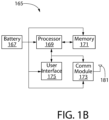
- the data processing unit 105 includes a housing 163 and electronic circuitry 165, with the housing 163 enclosing and/or supporting the various components of the electronic circuitry 165.
- the electronic circuitry 165 includes a power source, shown as a battery 167 in the exemplary embodiment. The invention is not so limited, and other types of power sources may be used.
- the electronic circuitry 165 of the data processing unit 105 also includes a processor 169 communicably coupled to a memory 171, a communication module 173, and a user interface 175.
- the electronic circuitry 165 may include other components, such as a speaker to provide audible feedback to the user, one or more buttons to receive input from the user, and one or more ports for making a wired connection between the electronic circuitry 165 and other circuitry external to the data processing unit 105.
- the data processing unit 105 may be a smartphone, a tablet computer, a laptop computer, and the like, although the invention is not so limiting.
- the electronic circuitry 165 is located within housing 163 of the data processing unit 105, this housing 163 being separate and distinct from the housing 103A of the toothbrush 103
- the electronic circuitry 165 or certain components thereof may be located within the housing 103A of the toothbrush 103.
- the memory 171 may be any appropriate type of memory or storage which enables the processor 169 to perform the desired programming, such as volatile and/or non-volatile random access memory.
- the particular type of storage used for the memory 171 is not to be limiting of the invention.
- the user interface 175 is a touch-sensitive display which accepts input from the user directly on the display surface.
- the display may be any type of light emitting display, and the display may be an LED panel.
- the display may be an LCD panel, an OLED panel, or any other type of display which is electronically controllable by the programmable processor 169 to provide visual feedback to the user.
- the user interface can comprise any device or method by which a user interacts with the data processing unit or a programmable processor.
- the user interface can utilize a non-touch-sensitive graphical user interface, buttons, a dial, a keyboard, and/or a mouse.
- a user interface can be omitted.
- oral characteristic data can be received from, or based on, data from a sensor that forms part of a brush.
- the communication module 173 may include an antenna 181 to enable wireless transmission of communication signals.
- the communication module 173 may be configured and/or programmed to communicate using a wireless technology standard such as Wi-Fi, Bluetooth ® , and the like, or it may communicate using any type of proprietary wireless transmission protocol.
- the mode of communication for which the communication module 173 is configured is not limiting of the invention unless specifically set forth in a claim.
- the communication module 173 may include a port to enable communications using wires and wired protocols, such as USB and the like.
- the communication module 173 of the data processing unit 105 may be configured and/or programmed to communicate with the server 107.
- the communication module 173 may communicate with the server 107 over any combination of public and/or private network, and the communications may be wired, wireless, or a combination of the two.
- the communication module 173 may communicate with the server 107 over the Internet using one or more types of communication protocols.
- the server 107 may be programmed with one or more application programming interfaces (APIs) which provides server-side functionality to the data processing unit 105.
- APIs application programming interfaces
- the communication module 173 may also be configured to communicate with the toothbrush 103, for example, in the receipt from the toothbrush 103 of data related to a brushing session.
- Fig. 2 is a flowchart showing a process 200 for determining a brushing routine and a brushing evaluation from an oral characteristic according to an example useful for understanding the invention.
- the exemplified process 200 may be implemented as programming for the programmable processor 169 of the data processing unit 105.
- the exemplified process 200 may be implemented as programming for the programmable processor 169 of the data processing unit 105.
- the processor 169 and other electronic circuitry 165 form part of the data processing unit, the disclosure is not so limited.
- a processor forming part of the toothbrush can carry out the steps carried out by processor 169.
- the programmable processor 169 receives oral characteristic data indicative of an oral characteristic of a user (operation 202).
- An "oral characteristic” can refer to any quality or trait of or affecting a user's oral cavity.
- Such oral characteristics can include, but are not limited to, an oral sensitivity (e.g., of the teeth, gums, or another part of the mouth), an abnormality of the dentiture (e.g., a missing tooth, a crooked tooth, an extra tooth), the presence or absence of wisdom teeth, a receding gum line, a tooth structure that traps (or tends to trap) plaque, plaque present at a first portion of the dentiture, a cavity, an erosion of one or more teeth, an oral injury or procedure (e.g., a recent tooth removal), a type of bacteria present in the mouth (including excessive bacteria or a harmful bacteria), and any indicator (physical, chemical, or otherwise) of a disease or malady (e.g., oral cancer).
- an oral sensitivity e.g
- Oral characteristic data can refer to any type of information indicative of an oral characteristic of a user, including information extracted or derived from other information or data indicative of an oral characteristic, regardless of the form of the extracted information, and combinations thereof.
- the oral characteristic data may be in the form of mathematical data, analog data, and/or digital data.
- the oral characteristic data can be data obtained from a user interface, data obtained from a sensor, or data derived from one or both of the foregoing.
- the oral characteristic is input at a user interface of a data processing unit.
- the data processing unit then generates oral characteristic data indicative of the chosen oral characteristic, which is then transmitted to a programmable processor.
- the receipt of oral characteristic data from a user interface is discussed in more detail below with respect to Figs. 3A and 3B .
- the oral characteristic data is generated using a sensor operably coupled to a programmable processor.
- the sensor can be any device or subsystem configured to detect an oral characteristic (or evidence of an oral characteristic) and generate oral characteristic data.
- the sensor can be an accelerometer, a gyroscope, a magnetometer, a pressure sensor, an optical imaging subsystem, and an oral malady detection subsystem.
- the sensor forms part of the toothbrush (e.g., an accelerometer located on a head of the toothbrush to detect motion of the brush head).
- the sensor can form part of a separate device, such as a data processing unit (e.g., a camera on the phone that can carry out optical imaging to detect a receding gum line or a cavity).
- Fig. 8-10 discuss a toothbrush 351 having electronic circuitry for collecting brushing session data.
- the one or more sensors 355 can be, for example, an accelerometer, gyroscope, magnetometer, or pressure sensor.
- the brushing session data that is detected by the sensor may include data regarding, for example, a toothbrush's position, motion, acceleration, frequency, and/or pressure against the surface of the teeth.
- the brushing session data can be indicative of numerous issues, such as avoidance of a portion of the dentiture (indicating, for example, an oral sensitivity), excessive brushing (indicating for example, a tooth structure that traps plaque or food), a unique brushing motion (indicating for example, a hidden, crooked, or missing tooth), or the presence or absence of a chemical (indicating, for example, a high bacteria content in the user's mouth).
- avoidance of a portion of the dentiture indicating, for example, an oral sensitivity
- excessive brushing indicating for example, a tooth structure that traps plaque or food
- a unique brushing motion indicating for example, a hidden, crooked, or missing tooth
- a chemical indicating, for example, a high bacteria content in the user's mouth.
- the sensors generate brushing session data indicative of brushing motion, location, and/or pressure. This data is then used to determine that the user is avoiding brushing a certain portion of the dentiture, or using only minimal pressure. This avoidance can indicate an oral sensitivity at or adjacent to that portion of the dentiture.
- a user interface upon receiving such brushing session data, can provide the user a question such as "Do you have oral sensitivity in the region indicated below," with an image of the user's dentiture and an indication of the avoided portion.
- excessive brushing of a certain portion of the dentiture can indicate a tooth structure that traps plaque or food, such as molars that tend to cause cavities, or a crooked or hidden tooth (i.e., a tooth behind another tooth and difficult to access). If the brushing session data indicates excessive brushing of a certain portion, the user interface can query the user to determine or confirm the reason.
- the senor can determine that the user is using a unique brushing motion for a portion of the dentiture.
- the user interface can query the user as to whether this motion is being carried out to clean a unique oral characteristic, such as a hidden, crooked, or missing tooth, a gap in the teeth, or another unique property of the user's dentiture. For example, a user may use a unique, vertical brushing motion to brush a hidden tooth, or may not move the brush as deeply into the oral cavity because of missing wisdom teeth or molars.
- the senor can be an oral malady detection subsystem.
- a subsystem could use chemistry to determine the presence of an abnormal property, such as high bacteria content in a user's saliva. Other properties could be indicative of a cavity, plaque, bad breath, or cancer, or another oral disease or malady.
- the senor can be an optical imaging subsystem that can identify a unique oral characteristic, such as receding gum line in a certain area, a missing or crooked tooth, an extra tooth, or a cavity.
- a unique oral characteristic such as receding gum line in a certain area, a missing or crooked tooth, an extra tooth, or a cavity.
- an imaging system can distinguish the white of a tooth and the pink of gums to determine a length of a gum line and whether there is an abnormality.
- An imaging system could similarly be used to identify a developing cavity and thus an area that warranted more brushing attention, or tooth erosion from tooth grinding that can cause sensitivity.
- the subsystem can utilize the technology of a data processing unit providing a user interface (such as the camera and processor of a smartphone), or another, separate device.
- the user is queried to confirm that the suspected oral characteristic is present. In other embodiments, this step can be omitted. Further, the sensor(s) can determine a suspected oral characteristic based on data from one brushing session or from a plurality of brushing sessions. Further, the above characteristics can alternatively be determined by querying the user, rather than by using brushing session data provided by sensors.
- a suggested brushing routine is determined based at least in part on the oral characteristic data (operation 204).
- the suggested brushing routine can be any one or more steps or instructions for brushing teeth.
- the determination of the suggested brushing routine may be achieved in any number of ways.
- the suggested brushing routine may be determined by presenting the user with a list of potential brushing routines that accord with the determined oral characteristic, and having the user select the suggested brushing routine from among the list of potential brushing routines.
- the suggested brushing routine may be determined by adjusting a standardized brushing routine based on the oral characteristic data, or by adjusting a time based on the oral characteristic data, as described below.
- the suggested brushing routine may be determined by selecting a predetermined brushing routine based on the oral characteristic data and then adjusting the predetermined brushing routine based on a user brushing history.
- the user brushing history may be based upon brushing session data collected from previous brushing sessions of the user.
- Such brushing session data may be based upon brush stroke, brushing aggressiveness, or upon any other measure of brushing effectiveness.
- such brushing session data may be saved in the memory 171 of the data processing unit 105 or in a memory of the server 107.
- one or more of the aforementioned processes for determining the suggested brushing routine may be used in combination.
- the suggested brushing routine is determined by adjusting an optimum brushing time based on the oral characteristic data to determine the brushing time for the suggested brushing routine.
- the optimum brushing time is predetermined from a standardized brushing routine.
- the standardized brushing routine may be an industry standard brushing routine in which the optimum brushing time is 2 minutes. This process can begin with the oral characteristic data being received by the data processing unit 105. Next, the data processing unit 105 determines an offset time based on the oral characteristic data. For example, if a certain portion of the dentiture is sensitive, then the offset time for this portion may be a negative number. Following the offset time determination, the target brushing time for the brushing routine is calculated.
- the programmable processor 169 of the data processing unit 105 calculates the target brushing time by retrieving an optimum time which is stored in the memory 171 and adding the determined offset time to the optimum time. The determined target brushing time can then be displayed, and the user can be instructed to begin the suggested brushing routine.
- the processor 169 of the data processing unit 105 may provide other specific instructions for the brushing routine, such as the order for brushing different sections of the user's dentiture, the length of time to brush each section, which section to start with, the brushing motions to use for each section, and the like.
- the programmable processor 169 of the data processing unit 105 can instruct the user that the brushing routine is at an end.
- the oral care system 101 can be configured to perform a brushing evaluation of a brushing session of a user.
- the brushing evaluation can be any assessment of the effectiveness of one or more brushing sessions.
- the toothbrush 103 can include sensors, and data derived from the sensors can be used to determine the motion, location, and/or pressure of the toothbrush. From this determination, the system 101 can determine how well the user brushed his or her teeth.
- the evaluation is based in part on the oral characteristic data.
- the brushing evaluation according to the invention need not be negative if the user indicated that this was a sensitive portion of the dentiture. Accordingly, the user is not penalized in his brushing evaluation for dedicating less brushing time (or applying softer pressure) to a sensitive area of his dentiture.
- the determination of the brushing evaluation is based on both oral characteristic data and brushing data from a brushing session, the brushing data being derived from a sensor forming part of the toothbrush.
- the brushing evaluation can be based on a comparison of the brushing data from the brushing session and the suggested brushing routine. For example, the brushing evaluation can be based on how well the user followed the suggested brushing routine.
- the oral characteristic data can impact an evaluation of an individual brushing session, and can also impact an evaluation of a plurality of brushing sessions.
- a recent wisdom tooth removal surgery will justify less and more gentle brushing of the molars for a few weeks, there is an expectation that eventually the brushing time and intensity will increase.
- a cumulative evaluation can reflect this. The cumulative evaluation will not penalize the user for gentle brushing immediately after the surgery, but will also expect more normal brushing to return eventually.
- the oral characteristic data is used to both determine a suggested brushing routine and determine a brushing evaluation. It is noted, however, that in other embodiments the oral characteristic data can be used to determine a suggested brushing routine but not to determine a brushing evaluation, or to determine a brushing evaluation but not to determine a suggested brushing routine.
- a suggested routine can recommend less time brushing the sensitive portion. Further, an evaluation can expect less time brushing this portion of the dentiture.
- a suggested brushing routine can dedicate additional time to this portion of the dentiture. Further, an evaluation can expect additional time brushing this portion of the dentiture.
- a suggested routine can adjust its instructions to allow adequate brushing of these unique oral characteristics, including recommending the unique brushing motion. Further, an evaluation can allow for or expect these unique brushing motions.
- Fig. 3A and 3B illustrates a data processing unit 105 having a user interface 175 for determining an oral characteristic according to one example useful for understanding the invention.
- the user interface 175 provides a question 302 and answer options 304 regarding an oral characteristic.
- the user inputs the oral characteristic through a user interface 175 that is a touch-sensitive screen, though alternative types of user interfaces can be utilized.
- the user indicates that he has sensitive teeth.
- a statement 306 is provided that is responsive to the answer 304.
- the statement 306 asks the user which portion of the user's teeth are sensitive.
- a visualization of the dentiture 310 is provided.
- the user provides a response 308 indicating that the back molars are sensitive.
- the questions, answers, statements, and responses shown are merely exemplary in nature, and any oral characteristics can be the subject of a question, answer, statement, or response on a user interface for the purposes of receiving oral characteristic data.
- a user can type an oral characteristic and be provided with options that corresponded with the typed oral characteristic.
- a series of questions, statements, or topics can be provided to the user by the user interface.
- the user interface can be used to determine several oral characteristics of the user and in varying degrees of detail.
- Fig. 4 illustrates a toothbrush 103B comprising a user interface 175B according to another example useful for understanding the invention.
- the toothbrush 103B comprises a user interface 175B and a programmable processor (not shown) similar to programmable processor 169 that forms part of data processing unit 105.
- the user interface 175B comprises buttons 303B for use in providing or selecting an oral characteristic.
- the exemplified user interface 175B further comprises a display.
- the display can provide information similar to the information displayed on the touch-sensitive display 175. For example, the display can provide information regarding a suggested brushing routine, or brushing evaluation information.
- the display can have more limited functionality.
- the display can be omitted.
- the user can indicate his oral characteristic using the buttons (or another user interface), but the determined routine or evaluation can appear elsewhere, such as on a separate data processing unit.
- the toothbrush 103B can be any type of toothbrush, including a manual toothbrush or an electric toothbrush having an electrically-powered vibratory element.
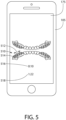
- Fig. 5 illustrates a data processing unit 105 having a user interface 175 that provides brushing instructions 510 for a brushing routine according to one example useful for understanding the invention, the instructions 510 being based in part on the oral characteristic received.
- the brushing instructions 510 comprise real-time directions for a user to follow during a brushing session.
- the instructions 510 comprise an indication 514 of a region of the dentiture to brush, an indication 512 of a brushing motion, and an indication 516 of a time remaining for brushing the specified region.
- the user interface 175 also provides an indication 518 of the total brushing time remaining in the suggested brushing routine.
- Different screens may show different instructions as the user progresses through the different stages of the brushing routine, thus coaching the user on which regions to brush, which brushing motions to use, and for how long. Certain indications or instructions can be omitted. Also, other indications or instructions can be added, such as an indication of whether to apply greater or lesser pressure or brushing intensity.
- the instructions (such as motion, region, and time) can be based at least in part on the oral characteristic of the user.
- the routine could reflect this by decreasing the brushing time suggested for this first portion of the dentiture, and/or by changing the brushing motions suggested for this portion of the dentiture.
- the routine can reflect this by increasing the brushing time for the portion of the dentiture having this tooth structure, and/or by changing the brushing motions suggested for this portion of the dentiture.
- An evaluation of the brushing session can also reflect such adjusted expectations.
- the suggested brushing routine can be determined by adjusting a preexisting brushing routine, the adjustment based at least in part on the oral characteristic data.
- the suggested brushing routine need not rely on a preexisting brushing routine.
- the brushing routine of the is provided in real-time, so that the user can follow a succession of instructions provided on the user interface 175.
- the entire routine can be provided at once, and can be provided by other means, such as an email or a text message.
- Fig. 6 illustrates a data processing unit 105 having a user interface 175 that provides an evaluation 520 of a brushing session of a user according to an example useful for understanding the invention.
- the evaluation 520 comprises a visualization 521 of the user's dentiture.
- the dentiture can be divided into different regions, each of which the user is expected to brush during the brushing session.
- Brushing session data may be collected and processed according to the different regions of the dentiture. The collection of such brushing session data is described in more detail below with respect to Figs. 8-10 .
- the visualization 521 includes an indication 522 of a region of the dentiture not properly brushed.
- the evaluation 520 further comprises a recommendation 526 that provides the user advice on how to improve his or her brushing.
- the evaluation 520 also includes a performance metric 524 that indicates how well the user performed in brushing his or her teeth during the brushing session.
- Other metrics or visualizations can be used to indicate brushing performance, such as a percentage, or a number of stars (for example, three stars out of five).
- the evaluation can be a cumulative evaluation based on a plurality of brushing sessions and oral characteristic data from those brushing sessions.
- Fig. 7 illustrates an electronic toothbrush 281 according to an example useful for understanding the invention.
- the electric toothbrush 281 includes a handle 283 and a refill head 285.
- the handle 283 and the refill head 285 are removably coupled to each other.
- the control circuit 165 of the data processing unit 105 may reside at least partially within the handle 283.
- the handle 283 may include a separate toothbrush control circuit which controls the electric toothbrush and communicates with the data processing unit 105.
- the refill head 285 includes a bristle field 287 which includes at least one elastomeric element 289 and a tongue cleaner 291 on the back side 292 of the refill head 285.
- the handle includes a motor 294 operably coupled to a shaft 295, with an eccentric mass 297 positioned at the distal end of the shaft 295.
- the motor 294, the shaft 295, and the eccentric mass 297 form an electrically-powered vibratory element.
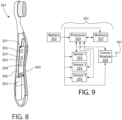
- Fig. 8 illustrates a partial sectional view of a toothbrush 341 having electronic circuitry for collecting brushing session data according to an example useful for understanding the invention.
- the handle 343 of the toothbrush 341 forms a housing for containing electronic circuitry 351 for collecting brushing session data.
- the handle 343 is a hollow structure in which a cavity 345 is formed.
- the electronic circuitry 351, which includes a power source 352, is located within the cavity.
- the electronic circuitry 351 may be used to collect and analyze brushing session data from which an evaluation of the brushing session may be made. The evaluation of the brushing session may be based at least in part upon the oral characteristic data. As discussed above, the brushing session data can also be used to determine an oral characteristic.
- Fig. 9 is a schematic of the electronic circuity 351 of the toothbrush 341 of Fig. 8 .
- the electronic circuitry 351 includes a processor 353 communicably coupled to sensors 355, a memory 357, and a communication module 359.
- the number of sensors 355 included as part of the electronic circuitry 351 depends upon the type of brushing session data to be detected and the functionality of each type of sensor employed.
- the brushing session data that is detected and collected may include data regarding position, motion, acceleration, frequency, and pressure against the surface of the teeth. Other types of brushing session data associated with a brushing session may also be detected and collected, and those listed herein are not to be limiting of the invention unless otherwise indicated in the claims.
- each sensor 355 included as part of the electronic circuitry 351 generates at least part of the brushing session data.
- brushing session data is any type of information which may be extracted or derived from a sensor or sensor signal, regardless of the form of the extracted information, for determining information about a brushing session of a user.
- brushing session data may be in the form of mathematical data (such as a formula which mathematically represents at least part of the sensor signal), analog data (such as the waveform of the sensor signal), and/or digital data (such as a representation of at least part of the sensor signal in a digital format).
- the processor 353 and the memory 357 may be omitted from the electronic circuitry 351 of the toothbrush 341.
- the sensors 355 may communicate brushing session data directly to the communication module for transmission.
- the memory 357 may be any appropriate type of memory or storage which enables the processor 353 to perform the desired programming, such as volatile and/or non-volatile random access memory, or any other type of storage.
- the particular type of storage used for the memory 357 is not to be limiting of the invention.
- the communication module 359 includes an antenna 361 to enable wireless communication.
- the communication module 359 may be configured and/or programmed to communicate using a wireless technology standard such as Wi-Fi, Bluetooth ® , and the like, or it may communicate using any type of proprietary wireless transmission protocol.
- the communication module 359 may include a port to enable communications using wires and wired protocols, such as USB and the like.
- the particular mode of communication used by the communication module is not limiting of the invention unless specifically set forth in a claim.
- Fig. 10 illustrates a toothbrush dongle 391 for collecting brushing session data.
- the toothbrush 381 includes a handle 383 and a head 385 to which a plurality of teeth cleaning elements 387 are affixed.
- the dongle 391 may be removably affixed to the proximal end 389 of the handle 383.
- the dongle 391 comprises a housing for containing electronic circuitry 393 and an associated a power source 395, which may be similar to that described above in connection with Fig. 9 .
- the brushing session data which is detected and collected by the toothbrush embodiments shown in Figs. 8-10 may include a side-to-side linear brush stroke motion, an up and down linear brush stroke motion, a circular brush stroke motion, a flicking brush stroke motion, a brush stroke rate, and a pressure of the head of the toothbrush on the teeth, amongst others.
- the brushing session data is generated during at least a portion of the brushing session.
- the brushing session data may be used to evaluate the brushing session by calculating one or more performance metrics, and the performance metric may represent brushing efficacy during one or more portions of the brushing session.
- the performance metric may express the efficacy of a brushing session, or even for portions of a brushing session, as a single number, and stored in the memory 171 of the data processing unit 105 for later use.
- the data processing device 105 may transmit the calculated performance metrics to the server 107 for storage and or additional analysis.
- the performance metrics which are stored in the memory 171 of the data processing unit 105 or on the server 107 may be used during future brushing sessions to aid in determining what brushing routine to suggest to the user.
- performance metrics may be used in combination with the oral characteristic data to help determine the target brushing time for a brushing routine.
- the performance metrics may be analyzed by machine learning processes, and the machine learning may be used to enhance future brushing routines.
- the embodiments above discuss using oral characteristic data to determine a brushing routine and/or evaluation.
- the routine or evaluation can also be based on other factors, such as predetermined brushing standards (e.g., two minutes of total brushing time and recommended brushing motions for different portions of the dentiture), physical characteristics of the brush being used by the user (e.g., soft or hard bristles, or the shape and/or size of the toothbrush head), and the user's brushing goals for a given brushing session (e.g., a quick fresh as opposed to a deep clean).
- predetermined brushing standards e.g., two minutes of total brushing time and recommended brushing motions for different portions of the dentiture
- physical characteristics of the brush being used by the user e.g., soft or hard bristles, or the shape and/or size of the toothbrush head
- the user's brushing goals for a given brushing session e.g., a quick fresh as opposed to a deep clean.
- the user can use the data processing unit while brushing his teeth to receive real-time instructions for the brushing routine.
- the brush and the data processing unit can be in communication.
- the brush can be used without the data processing unit, and/or without a processor immediately determining a brushing routine or evaluation.
- the brush can store brushing session data locally in the toothbrush, and this data can be retrieved at a later time. This stored brushing session data can subsequently be used for providing a brushing evaluation or suggested brushing routine, and/or for suggesting potential oral characteristics.
- the system can provide a brushing routine that takes into consideration the unique oral characteristics of the user.
- the brushing routine provided can reflect oral characteristics of the user, rather than providing the same standard routine regardless of the user.
- the system can provide a brushing evaluation that takes into consideration the oral characteristics of the user.
- an evaluation can be based on the user's unique oral characteristics, rather than judging the brushing session based on an unadaptable, one-size-fits-all standard. For example, if a user has a first portion of the dentiture that is sensitive and is adjacent to a receding gum line, the suggested routine can dedicate less brushing time to this first portion, and can avoid penalizing the user for spending less than a standard time brushing this portion. Alternatively, if a user still has his or her wisdom teeth, the suggested routine can dedicate more time to the back molars, and the evaluation can expect that the user's brushing motion reaches further back in the oral cavity when brushing the back molars.
- ranges are used as shorthand for describing each and every value that is within the range. Any value within the range can be selected as the terminus of the range. In the event of a conflict in a definition in the present disclosure and that of a cited reference, the present disclosure controls.
Landscapes
- Health & Medical Sciences (AREA)
- Epidemiology (AREA)
- General Health & Medical Sciences (AREA)
- Public Health (AREA)
- Life Sciences & Earth Sciences (AREA)
- Dentistry (AREA)
- Animal Behavior & Ethology (AREA)
- Veterinary Medicine (AREA)
- Engineering & Computer Science (AREA)
- Business, Economics & Management (AREA)
- Biophysics (AREA)
- Entrepreneurship & Innovation (AREA)
- Physics & Mathematics (AREA)
- Educational Administration (AREA)
- Educational Technology (AREA)
- General Physics & Mathematics (AREA)
- Theoretical Computer Science (AREA)
- Brushes (AREA)
Claims (10)
- Orales Pflegesystem (101), das Folgendes umfasst:eine Zahnbürste (341);einen Speicher (357); undeinen programmierbaren Prozessor (353);dadurch gekennzeichnet, dassder programmierbare Prozessor (353) konfiguriert ist zum:Empfangen von oralen Charakteristikdaten (202), die indikativ für eine orale Charakteristik eines Benutzers sind;Speichern von Daten zu einem Putzvorgang, die die oralen Charakteristikdaten (202) umfassen, in dem Speicher (357), um eine Benutzer-Putzhistorie zu erzeugen, die eine Vielzahl von Putzvorgängen umfasst; undBestimmen einer vorgeschlagenen Putzroutine (204) für den Benutzer, zumindest teilweise auf der Grundlage der oralen Charakteristikdaten, für mindestens einen Putzvorgang der Vielzahl von Putzvorgängen;wobei die Zahnbürste (341) mindestens einen Sensor (355) umfasst, der betriebsfähig mit dem programmierbaren Prozessor (353) gekoppelt ist, wobei der mindestens eine Sensor (355) konfiguriert ist, die oralen Charakteristikdaten zu erzeugen.
- System (101) nach einem der vorherigen Ansprüche, das ferner eine Benutzerschnittstelle (175; 175B) umfasst, die betriebsmäßig mit dem programmierbaren Prozessor (353) gekoppelt ist, wobei die Benutzerschnittstelle (175; 175B) konfiguriert ist, die vorgeschlagene Putzroutine anzuzeigen.
- System (101) nach einem der vorherigen Ansprüche, das ferner eine Benutzerschnittstelle (175; 175B) umfasst, die betriebsmäßig mit dem programmierbaren Prozessor (353) gekoppelt ist, wobei die Benutzerschnittstelle (175; 175B) konfiguriert ist, die orale Charakteristik vom Benutzer zu empfangen.
- System (101) nach Anspruch 3, wobei die Benutzerschnittstelle (175) eine berührungsempfindliche Anzeige (175) umfasst.
- System (101) nach einem der vorherigen Ansprüche, wobei das Empfangen der oralen Charakteristikdaten (202) umfasst:Präsentieren einer oder mehrerer Fragen (302) oder Aussagen (306) an einen Benutzer durch eine Benutzerschnittstelle (175; 175B), die mindestens eine orale Charakteristik des Benutzers betreffen; undEmpfangen der oralen Charakteristikdaten als Antworten (304) oder Reaktionen (308) auf die eine oder mehreren Fragen (302) oder Aussagen (306), wobei die Antworten (304) oder Reaktionen (308) von dem Benutzer unter Verwendung der Benutzerschnittstelle (175; 175B) ausgewählt sind.
- System (101) nach einem der vorherigen Ansprüche, wobei die orale Charakteristik mindestens eines der folgenden Merkmale betrifft: eine orale Empfindlichkeit, eine Anomalie des Gebisses, einen fehlenden Zahn, einen schiefen Zahn, einen zusätzlichen Zahn, einen zurückgehenden Zahnfleischsaum, eine Zahnstruktur, die Plaque einschließt, Plaque, die an einem ersten Teil des Gebisses vorhanden ist, ein Hohlraum, eine Erosion eines oder mehrerer Zähne, eine orale Verletzung oder Prozedur, eine Art von Bakterien, die im Mund vorhanden sind, und eine orale Krankheit oder Störung.
- System (101) nach einem der vorherigen Ansprüche, wobei:das orale Charakteristik in oder in der Nähe eines ersten Teils des Gebisses vorhanden ist; unddie Putzroutine auf mindestens einem der folgenden Punkte basiert oder diese einschließt:eine geänderte Soll-Putzzeit für den ersten Teil des Gebisses; undeine geänderte Erwartung der Putzbewegung für den ersten Teil des Gebisses.
- System (101) nach Anspruch 7, wobei:die orale Charakteristik eine orale Empfindlichkeit, ein zurückgehender Zahnfleischsaum oder eine Erosion eines oder mehrerer Zähne ist; unddie Putzroutine auf einer verringerten Soll-Putzzeit für den ersten Teil des Gebisses basiert oder diese einschließt.
- System (101) nach einem der vorherigen Ansprüche, wobei:die orale Charakteristik eine Zahnstruktur ist, die Plaque an einem ersten Abschnitt des Gebisses des Benutzers festhält; unddie Putzroutine auf einer erhöhten Soll-Putzzeit für den ersten Teil des Gebisses basiert oder diese einschließt.
- System (101) nach einem der vorherigen Ansprüche, wobei:der programmierbare Prozessor (353) konfiguriert ist, die vorgeschlagene Putzroutine (204) zu bestimmen; unddie vorgeschlagene Putzroutine durch Anpassen einer vorbestimmten Putzroutine zumindest teilweise basierend auf den oralen Charakteristikdaten bestimmt ist.
Applications Claiming Priority (2)
| Application Number | Priority Date | Filing Date | Title |
|---|---|---|---|
| US15/350,298 US11361672B2 (en) | 2016-11-14 | 2016-11-14 | Oral care system and method |
| PCT/US2017/061321 WO2018089899A1 (en) | 2016-11-14 | 2017-11-13 | Oral care system and method |
Publications (2)
| Publication Number | Publication Date |
|---|---|
| EP3525617A1 EP3525617A1 (de) | 2019-08-21 |
| EP3525617B1 true EP3525617B1 (de) | 2024-11-13 |
Family
ID=60473674
Family Applications (1)
| Application Number | Title | Priority Date | Filing Date |
|---|---|---|---|
| EP17804770.0A Active EP3525617B1 (de) | 2016-11-14 | 2017-11-13 | Mundpflegesystem und -verfahren |
Country Status (8)
| Country | Link |
|---|---|
| US (1) | US11361672B2 (de) |
| EP (1) | EP3525617B1 (de) |
| CN (1) | CN108066031B (de) |
| AU (1) | AU2017357848B2 (de) |
| CA (1) | CA3037412A1 (de) |
| MX (1) | MX2019005408A (de) |
| RU (1) | RU2710685C1 (de) |
| WO (1) | WO2018089899A1 (de) |
Families Citing this family (26)
| Publication number | Priority date | Publication date | Assignee | Title |
|---|---|---|---|---|
| US10835028B2 (en) | 2016-11-14 | 2020-11-17 | Colgate-Palmolive Company | Oral care system and method |
| US11361672B2 (en) * | 2016-11-14 | 2022-06-14 | Colgate-Palmolive Company | Oral care system and method |
| EP4327776A3 (de) | 2018-01-31 | 2024-05-01 | Quip NYC Inc. | Zahnbürstensystem |
| CN108606853B (zh) * | 2018-04-13 | 2020-09-08 | 深圳市力博得科技有限公司 | 基于人工智能的刷牙推荐方法、装置、设备及存储介质 |
| CN108685620A (zh) * | 2018-06-13 | 2018-10-23 | 苏州若依玫信息技术有限公司 | 一种基于智能家居的口腔健康护理装置 |
| DE102019120648B4 (de) | 2018-08-02 | 2026-02-12 | Ranir, Llc | Drucksensorsystem und Verfahren für eine elektrische Zahnbürste |
| CN109380860A (zh) * | 2018-11-09 | 2019-02-26 | 重庆仙桃前沿消费行为大数据有限公司 | 一种通过时长判断有效刷牙的智能刷牙方法及系统 |
| CN109222403A (zh) * | 2018-11-09 | 2019-01-18 | 重庆仙桃前沿消费行为大数据有限公司 | 一种智能刷牙方法及系统 |
| CN109222404A (zh) * | 2018-11-09 | 2019-01-18 | 重庆仙桃前沿消费行为大数据有限公司 | 一种通过弧长判断有效刷牙的智能刷牙方法及系统 |
| KR102446619B1 (ko) | 2019-03-19 | 2022-09-22 | 주식회사 엘지에너지솔루션 | 전고체 전지용 전해질막 및 이를 제조하는 방법 |
| EP4017404B1 (de) * | 2019-08-19 | 2025-07-16 | Oralucent, Inc. | Lichtemittierende oszillierende zahnbürste |
| EP3788985A1 (de) * | 2019-09-05 | 2021-03-10 | Koninklijke Philips N.V. | Proportionale aufteilung einer gesamtbetriebszeit eines zahnpflegeverfahrens |
| CN111383750A (zh) * | 2020-01-23 | 2020-07-07 | 亚仕科技(深圳)有限公司 | 刷牙控制方法及相关装置 |
| JP7519604B2 (ja) * | 2020-09-01 | 2024-07-22 | パナソニックIpマネジメント株式会社 | 口腔洗浄システム、及びプログラム |
| EP3987977A1 (de) * | 2020-10-20 | 2022-04-27 | Koninklijke Philips N.V. | Verfahren und systeme zur steuerung einer elektrischen zahnbürste |
| EP4247220A1 (de) * | 2020-11-19 | 2023-09-27 | Koninklijke Philips N.V. | Verschleisserkennung für ein mundpflegesystem |
| EP4014790A1 (de) * | 2020-12-15 | 2022-06-22 | Koninklijke Philips N.V. | Steuerung von elektrischer zahnbürste |
| CN112541277A (zh) * | 2020-12-25 | 2021-03-23 | 深圳市力博得科技有限公司 | 一种调节刷洗时长的数据处理方法及装置 |
| CN113288487B (zh) * | 2021-01-19 | 2024-02-13 | 阿里巴巴集团控股有限公司 | 刷牙指导方法与刷牙方法、设备、系统及存储介质 |
| EP4094721A1 (de) * | 2021-05-27 | 2022-11-30 | Koninklijke Philips N.V. | Detektion von oralen oberflächenmerkmalen |
| CN114983604A (zh) * | 2022-06-02 | 2022-09-02 | 深圳市芯中芯科技有限公司 | 一种可视化洁牙器系统及其使用方法 |
| CN120076753A (zh) * | 2022-07-04 | 2025-05-30 | 博朗有限公司 | 口腔扫描仪系统 |
| CN117598809A (zh) * | 2023-01-04 | 2024-02-27 | 广州星际悦动股份有限公司 | 口腔护理设备的控制方法、终端的显示控制方法及介质 |
| EP4399996B1 (de) * | 2023-01-12 | 2025-08-06 | Braun GmbH | Körperpflegevorrichtung mit drucksensor |
| CN117598814A (zh) * | 2023-05-12 | 2024-02-27 | 广州星际悦动股份有限公司 | 口腔状态生成方法、装置、设备及介质 |
| EP4649918A1 (de) * | 2023-11-16 | 2025-11-19 | Guangzhou Stars Pulse Co., Ltd. | Bidirektionaler motor, mundpflegeausrüstung und steuerungsverfahren dafür |
Citations (3)
| Publication number | Priority date | Publication date | Assignee | Title |
|---|---|---|---|---|
| US6536068B1 (en) * | 1999-12-29 | 2003-03-25 | Gillette Canada Company | Toothbrushing technique monitoring |
| US20090130636A1 (en) * | 2005-06-20 | 2009-05-21 | Xiusolution Co., Ltd. | Method and system for managing of oral care |
| US20140033034A1 (en) * | 2013-01-22 | 2014-01-30 | Ashtel Studios, Inc. | Apparatus for capturing brushing habits |
Family Cites Families (197)
| Publication number | Priority date | Publication date | Assignee | Title |
|---|---|---|---|---|
| US4253212A (en) * | 1979-05-29 | 1981-03-03 | Kinya Fujita | Training appliance for tooth brushing |
| US5383244A (en) * | 1993-09-13 | 1995-01-24 | Patricia Ahrens | Multi-brush denture cleaning device |
| DE4439835C1 (de) | 1994-11-08 | 1996-02-08 | Braun Ag | Zahnbürste und Verfahren zur Anzeige der Putzzeitdauer |
| WO1997001298A1 (fr) | 1995-06-28 | 1997-01-16 | Philips Electronics N.V. | Brosse a dents electrique munie de moyens pour localiser une plaque dentaire |
| US5876207A (en) | 1997-06-03 | 1999-03-02 | Gillette Canada Inc. | Pressure-sensing toothbrush |
| US5815872A (en) | 1997-08-08 | 1998-10-06 | Optiva Corporation | Pressure overload indicator system for power toothbrushes |
| BR9908774A (pt) | 1998-03-16 | 2001-10-02 | Gillette Canada | Escova de dentes, e, processo de possibilitar a uma certa escova de dentes poder ser identificada |
| DE19817273A1 (de) | 1998-04-18 | 1999-10-21 | Braun Gmbh | Verfahren zur Datenübertragung zwischen einem Elektrokleingerät und einem mit diesem verbindbaren elektrischen Zusatzgerät, sowie entsprechend ausgestattete Geräte |
| US6611780B2 (en) | 1999-06-09 | 2003-08-26 | Koninklijke Philips Electronics N.V. | System for communicating operational data between an electric toothbrush and a separate control unit |
| US6314907B1 (en) | 1999-08-02 | 2001-11-13 | Optiva | Device use indicator |
| US6685471B1 (en) | 1999-11-19 | 2004-02-03 | Matsushita Electric Industrial Co., Ltd. | Tooth brushing device with video scope |
| US6923409B2 (en) * | 2000-01-28 | 2005-08-02 | Peter Strunk | Tooth brush holder |
| JP2001212161A (ja) | 2000-01-31 | 2001-08-07 | Matsushita Electric Ind Co Ltd | ビデオスコープ付き口腔洗浄器 |
| US6453497B1 (en) | 2000-03-16 | 2002-09-24 | The Gillette Company | Oral care device |
| US6531335B1 (en) | 2000-04-28 | 2003-03-11 | Micron Technology, Inc. | Interposers including upwardly protruding dams, semiconductor device assemblies including the interposers, and methods |
| US6327734B1 (en) | 2000-04-28 | 2001-12-11 | Philips Oral Healthcare, Inc. | Force sensing system for a toothbrush |
| US6735802B1 (en) | 2000-05-09 | 2004-05-18 | Koninklijke Philips Electronics N.V. | Brushhead replacement indicator system for power toothbrushes |
| JP2001327331A (ja) | 2000-05-23 | 2001-11-27 | Matsushita Electric Works Ltd | 歯ブラシ |
| US6425295B1 (en) | 2000-08-21 | 2002-07-30 | Koninklijke Philips Electronics N.V. | Three point force sensing system for a toothbrush |
| US7249952B2 (en) * | 2000-10-03 | 2007-07-31 | President And Fellows Of Harvard College | Methods and apparatus for simulating dental procedures and for training dental students |
| JP2002181812A (ja) | 2000-12-15 | 2002-06-26 | Matsushita Electric Ind Co Ltd | 歯ブラシ型バイオセンサ |
| DE10105764A1 (de) | 2001-02-08 | 2002-09-05 | Braun Gmbh | Elektrische Zahnbürste |
| ATE397422T1 (de) | 2001-02-12 | 2008-06-15 | Koninkl Philips Electronics Nv | Schallantriebs-zahnbürste mit mehreren behältern |
| CA2439556C (en) | 2001-03-14 | 2011-07-12 | Braun Gmbh | Method and device for cleaning teeth |
| DK1733700T3 (da) | 2001-03-14 | 2010-12-06 | Braun Gmbh | Anordning til rensning af tænder |
| GB0109444D0 (en) | 2001-04-17 | 2001-06-06 | Unilever Plc | Toothbrush usage monitoring system |
| US8172574B2 (en) | 2001-04-25 | 2012-05-08 | Braun Gmbh | Indicating teeth cleaning time |
| DE10120090C1 (de) | 2001-04-25 | 2002-08-22 | Braun Gmbh | Zahnputzvorrichtung sowie Verfahren zur Angabe der Putzzeitdauer |
| JP2003093416A (ja) | 2001-09-25 | 2003-04-02 | Matsushita Electric Works Ltd | 電動歯ブラシ |
| US6739012B2 (en) | 2001-12-20 | 2004-05-25 | Koninklijke Philips Electronics N.V. | Power toothbrush with brushing pressure feedback |
| US20030115694A1 (en) | 2001-12-20 | 2003-06-26 | Koninklijke Philips Electronics N.V. | Toothbrush having a brushhead portion which contains a memory device for communicating with a microcontroller in a handle portion of the toothbrush or other device |
| DE10224043A1 (de) | 2002-05-31 | 2003-12-18 | Braun Gmbh | Verfahren und Vorrichtung zur Zahnreinigung |
| DE10255722A1 (de) | 2002-11-29 | 2004-06-17 | Braun Gmbh | Elektrische Zahnbürste |
| CN100518689C (zh) | 2002-12-18 | 2009-07-29 | 皇家飞利浦电子股份有限公司 | 用于在有限的试用期结束后授权对产品的使用的系统 |
| GB0303872D0 (en) | 2003-02-19 | 2003-03-26 | Gillette Co | Hand held appliances |
| CN100542477C (zh) | 2003-07-16 | 2009-09-23 | 皇家飞利浦电子股份有限公司 | 一种用于监视个人生理状况的便携式电子设备以及健康管理系统 |
| JP4543663B2 (ja) | 2003-11-25 | 2010-09-15 | サンスター株式会社 | 電動歯ブラシ |
| CA2548803C (en) | 2003-12-11 | 2014-06-17 | Koninklijke Philips Electronics, N.V. | Power toothbrush brushhead with fluid-directing member |
| EP1614394A3 (de) * | 2004-07-02 | 2006-11-02 | Discus Dental Impressions Inc. | Ständersystem für die Zahnheilkunde |
| US20060040246A1 (en) | 2004-08-18 | 2006-02-23 | Min Ding | Interactive Toothbrush Game |
| DE102004062150A1 (de) | 2004-12-23 | 2006-07-13 | Braun Gmbh | Auswechselbares Zubehörteil für ein Elektrokleingerät und Verfahren zum Bestimmen der Benutzungsdauer des Zubehörteils |
| US20050136384A1 (en) * | 2005-01-21 | 2005-06-23 | Jarvis Terese A. | Device and method for promoting effective oral hygiene by a child |
| JP2006235809A (ja) | 2005-02-23 | 2006-09-07 | Matsushita Electric Works Ltd | 歯科衛生商品販売促進装置 |
| JP2008532619A (ja) * | 2005-03-09 | 2008-08-21 | ザ プロクター アンド ギャンブル カンパニー | センサー反応型電動歯ブラシ及びその使用法 |
| RU2388430C2 (ru) | 2005-03-09 | 2010-05-10 | Дзе Проктер Энд Гэмбл Компани | Сенсорные реагирующие электрические зубные щётки и способы использования |
| KR100915718B1 (ko) | 2005-03-09 | 2009-09-04 | 더 프록터 앤드 갬블 캄파니 | 구강 케어 이득 제공 방법, 센서 응답식 전동 칫솔 및 센서 응답식 칫솔 |
| JP5148476B2 (ja) | 2005-03-21 | 2013-02-20 | コーニンクレッカ フィリップス エレクトロニクス エヌ ヴィ | 流体自動供給手段を有するパーソナルケア機器 |
| US8444416B2 (en) | 2005-04-26 | 2013-05-21 | Braun Gmbh | Valves for personal care devices |
| BRPI0610383A2 (pt) * | 2005-05-18 | 2010-06-15 | Biolase Tech Inc | escova de dente e sistema dentifrìcio com emissão de radiação eletromagnética |
| US20070065792A1 (en) * | 2005-09-19 | 2007-03-22 | Wanda Schubarth | Dental hygiene tutorial toy |
| DE102005045501A1 (de) | 2005-09-23 | 2007-03-29 | Braun Gmbh | Verfahren zum Einfärben von Zahnbürstenfilamenten |
| CN101277629A (zh) | 2005-10-04 | 2008-10-01 | 皇家飞利浦电子股份有限公司 | 用于个人护理器具的磁驱动磨损指示器 |
| RU2433802C2 (ru) | 2005-11-04 | 2011-11-20 | Дзе Проктер Энд Гэмбл Компани | Электрическое устройство для ухода за полостью рта |
| US20070254260A1 (en) | 2005-12-02 | 2007-11-01 | Alden Wayne S Iv | Oral care compositions, methods, devices and systems |
| US7748069B2 (en) | 2005-12-15 | 2010-07-06 | Cynthia A Dawley | Multimedia toothbrush (toothpix) |
| DE102005063196A1 (de) | 2005-12-30 | 2007-07-05 | Braun Gmbh | Applikationsstoffbehälter für Zahnbürsten und elektrische Zahnbürste |
| US7411511B2 (en) | 2006-02-07 | 2008-08-12 | The Procter & Gamble Company | Interactive packaging for development of personal hygiene habits |
| US7976388B2 (en) | 2006-03-24 | 2011-07-12 | Umagination Labs, L.P. | Oral care gaming system with electronic game |
| WO2007122491A2 (en) | 2006-04-20 | 2007-11-01 | Koninklijke Philips Electronics N.V. | System for operating modes for an electric toothbrush |
| US20070261185A1 (en) | 2006-05-11 | 2007-11-15 | Guney Ali G | Method and apparatus for providing automated instructions for maintaining oral hygiene |
| US20080028553A1 (en) * | 2006-06-13 | 2008-02-07 | Batthauer Julie A | Training toothbrush with audio |
| EP2081542B2 (de) | 2006-11-13 | 2017-09-13 | The Procter and Gamble Company | Produkte und verfahren zum offenbaren von zuständen in der mundhöhle |
| WO2008060482A2 (en) | 2006-11-15 | 2008-05-22 | The Gillette Company | Personal care products and methods |
| US20080109973A1 (en) | 2006-11-15 | 2008-05-15 | Farrell Mark E | Personal care products and methods |
| WO2008058817A1 (en) | 2006-11-16 | 2008-05-22 | Unilever Plc | Monitoring and recording consumer usage of articles |
| DE102006057492A1 (de) | 2006-12-06 | 2008-06-12 | Braun Gmbh | Adapter, Verfahren zur Datenübertragung zwischen einer Zahnbürste und einem Endgerät sowie elektrische Zahnbürste |
| KR101401831B1 (ko) | 2006-12-12 | 2014-05-29 | 오므론 헬스캐어 가부시키가이샤 | 전동 칫솔 및 그 제어방법 |
| GB0706048D0 (en) | 2007-03-28 | 2007-05-09 | Unilever Plc | A method and apparatus for generating a model of an object |
| DE102007020100A1 (de) | 2007-04-26 | 2008-10-30 | Braun Gmbh | Zahnbürste sowie Verfahren zur drahtlosen unidirektionalen Datenübertragung |
| US20090070949A1 (en) | 2007-05-31 | 2009-03-19 | The Gillette Company | Oral Care Compositions, Methods, Devices and Systems |
| MX2009012690A (es) | 2007-05-31 | 2009-12-11 | Gillette Co | Composiciones, metodos, dispositivos y sistemas para el cuidado bucal. |
| WO2009001295A1 (en) | 2007-06-25 | 2008-12-31 | Koninklijke Philips Electronics, N.V. | User interface for a power toothbrush using a physical token |
| US20090038639A1 (en) | 2007-08-10 | 2009-02-12 | Yetukuri Amoolya L | Cleaning Device with Qualitative Feedback |
| US20110076638A1 (en) | 2007-10-08 | 2011-03-31 | Koninklijke Philips Electronics N.V. | Apparatus for cleaning teeth using a variable frequency ultrasound |
| KR100947046B1 (ko) | 2007-11-19 | 2010-03-10 | 황진상 | 운동체 자세 추적 장치, 운동체 자세 추적 방법, 이를이용한 칫솔 자세 추적 장치 및 칫솔 자세 추적 방법 |
| US20090215015A1 (en) | 2008-02-21 | 2009-08-27 | Raindrop Network Ltd. | Method and Apparatus for Developing a Proper Tooth Brushing Technique |
| KR101564459B1 (ko) | 2008-02-27 | 2015-10-30 | 코닌클리케 필립스 엔.브이. | 칫솔에 대한 덴탈 위치 추적 시스템 |
| JP5359210B2 (ja) | 2008-03-14 | 2013-12-04 | オムロンヘルスケア株式会社 | 電動歯ブラシ |
| US20090241278A1 (en) | 2008-04-01 | 2009-10-01 | Marc Lemchen | Apparatus And Method For Monitoring Dental Brushing Performance With A Conventionally Manufactured Toothbrush |
| WO2009134783A1 (en) | 2008-05-02 | 2009-11-05 | The Procter & Gamble Company | Products and methods for disclosing conditions in the oral cavity |
| FI20085488A0 (fi) | 2008-05-23 | 2008-05-23 | Pump & Brush Finland Oy | Älykäs hammasharjamonitorointilaite |
| US20100024143A1 (en) | 2008-06-12 | 2010-02-04 | Dickie Robert G | Toothbrush incorporating training aid |
| EP2330966B1 (de) | 2008-08-25 | 2013-06-19 | Koninklijke Philips Electronics N.V. | System zum nachweis, zur behandlung und zur deckung von feedback über zustände der mundgesundheit |
| US8075316B2 (en) * | 2008-09-23 | 2011-12-13 | Richard Thomas Krause | Toothbrushing timer apparatus and method of using same |
| US8296686B1 (en) * | 2008-10-14 | 2012-10-23 | Handhold Adaptive, LLC | Portable prompting aid for the developmentally disabled |
| EP2184033A1 (de) | 2008-11-05 | 2010-05-12 | Braun Gmbh | Elektrische Zahnbürste sowie Bürstenkopf hierfür |
| ES2639429T3 (es) | 2008-11-20 | 2017-10-26 | Braun Gmbh | Dispositivo de higiene personal para el cuerpo |
| EP2191788A1 (de) | 2008-11-29 | 2010-06-02 | Braun Gmbh | Verfahren und Vorrichtung zur dreidimensionalen Messung eines Zahnmodells |
| JP2010172384A (ja) | 2009-01-27 | 2010-08-12 | Panasonic Electric Works Co Ltd | 口腔衛生装置 |
| EP2243442B1 (de) | 2009-04-23 | 2014-01-08 | Braun GmbH | Elektrokleingerät mit einem Anzeigeelement |
| JP2012524643A (ja) * | 2009-05-08 | 2012-10-18 | ザ ジレット カンパニー | パーソナルケアシステム、製品、及び方法 |
| EP2253359A1 (de) | 2009-05-20 | 2010-11-24 | Braun GmbH | Körperpflegegerät des persönlichen Bedarfs |
| EP2253360A1 (de) | 2009-05-20 | 2010-11-24 | Braun GmbH | Körperpflegegerät des persönlichen Bedarfs |
| US20100309302A1 (en) | 2009-06-09 | 2010-12-09 | Jiandong Yang | Apparatus and a System for Visualizing Teeth Cleaning |
| PL2445374T3 (pl) | 2009-06-26 | 2017-04-28 | The Gillette Company | Wskaźnik nacisku dla szczoteczki do zębów |
| CN102711555B (zh) | 2009-12-17 | 2015-03-25 | 荷兰联合利华有限公司 | 牙刷跟踪系统 |
| EP2515791B1 (de) | 2009-12-23 | 2020-07-01 | Koninklijke Philips N.V. | Zahnbürste mit automatischer betätigung |
| RU2552992C2 (ru) | 2009-12-23 | 2015-06-10 | Конинклейке Филипс Электроникс Н.В. | Зубная щетка с отслеживанием положения |
| CN102665600B (zh) | 2009-12-23 | 2015-09-09 | 皇家飞利浦电子股份有限公司 | 刷头内具有促动器的电动牙刷 |
| EP2515708B1 (de) | 2009-12-23 | 2013-10-02 | Koninklijke Philips N.V. | Vorrichtung zum schützen des weichgewebes vor zahnbleichmittel |
| JP5547468B2 (ja) | 2009-12-25 | 2014-07-16 | パナソニック株式会社 | 電動歯ブラシ |
| JP5526825B2 (ja) | 2010-02-02 | 2014-06-18 | オムロンヘルスケア株式会社 | 口腔ケア装置 |
| US8161792B2 (en) | 2010-03-29 | 2012-04-24 | Braun Gmbh | Method and apparatus for assessing the gentleness of brushes |
| US20110275424A1 (en) | 2010-05-07 | 2011-11-10 | Michael Schmid | Personal hygiene system |
| US20110294096A1 (en) | 2010-05-26 | 2011-12-01 | The Procter & Gamble Company | Acoustic Monitoring of Oral Care Devices |
| US8381571B2 (en) | 2010-06-17 | 2013-02-26 | Braun Gmbh | Method and apparatus for assessing the penetration of tooth cleaning elements in the gingival pocket |
| FI20105846A0 (fi) | 2010-08-11 | 2010-08-11 | Vti Technologies Oy | Hammasharjausmonitorointilaite |
| BR112013002894B1 (pt) | 2010-09-15 | 2020-12-15 | Unilever N.V. | Sistema apropriado para monitorar o uso de uma escova de dente |
| US8769758B2 (en) | 2010-09-20 | 2014-07-08 | The Gillette Company | Force sensing oral care instrument |
| BR112013005086B1 (pt) | 2010-09-20 | 2020-12-15 | The Gillette Company Llc | Escova de dentes manual |
| RU2575915C2 (ru) | 2010-09-29 | 2016-02-27 | Конинклейке Филипс Электроникс Н.В. | Резонансный приводной механизм для электрической зубной щетки, использующий действие магнитного поля |
| EP2621400B1 (de) | 2010-09-30 | 2018-09-12 | Koninklijke Philips N.V. | System zur amplitudeneinstellung bei einer mundpflegevorrichtung |
| US20120295216A1 (en) | 2011-05-20 | 2012-11-22 | Beam Technologies, Llc | Diagnostic Oral Health Care Implement and System |
| JP5796408B2 (ja) | 2011-08-24 | 2015-10-21 | オムロンヘルスケア株式会社 | 口腔ケア装置 |
| US20130071807A1 (en) | 2011-09-20 | 2013-03-21 | Alexander Franz Doll | Iontophoretic oral care devices with automatic oral care implement detection and mode selection |
| US9498312B2 (en) | 2011-09-23 | 2016-11-22 | Beam Technologies, Llc | Oral health care implement and system with proximity sensor |
| CN202270341U (zh) | 2011-09-26 | 2012-06-13 | 中山市读书郎电子有限公司 | 一种口腔护理游戏装置 |
| WO2013056071A1 (en) | 2011-10-14 | 2013-04-18 | Beam Technologies, Llc | Oral health care implement and system with oximetry sensor |
| JP6101701B2 (ja) | 2011-10-24 | 2017-03-22 | コーニンクレッカ フィリップス エヌ ヴェKoninklijke Philips N.V. | 口腔内での電動歯ブラシのブラシヘッドの振幅を判定するシステム |
| JP2012086022A (ja) | 2011-10-28 | 2012-05-10 | Procter & Gamble Co | センサー反応型電動歯ブラシ及びその使用法 |
| US20130125326A1 (en) | 2011-11-17 | 2013-05-23 | Braun Gmbh | Personal Hygiene Implement For Personal Use |
| US20130125327A1 (en) | 2011-11-17 | 2013-05-23 | Braun Gmbh | Body Care Appliance For Personal Needs |
| JP5984107B2 (ja) | 2011-12-05 | 2016-09-06 | パナソニックIpマネジメント株式会社 | リニアアクチュエータ構造体およびこれを備える口腔衛生装置 |
| EP2617319A1 (de) | 2012-01-17 | 2013-07-24 | Braun GmbH | Kopfteil und Griffteil einer Mundpflegevorrichtung |
| WO2013108212A1 (en) | 2012-01-20 | 2013-07-25 | Braun Gmbh | A personal care appliance kit |
| CN107802368A (zh) | 2012-02-07 | 2018-03-16 | 博朗有限公司 | 口腔健康检测装置 |
| KR20140110036A (ko) | 2012-02-08 | 2014-09-16 | 더 질레트 컴퍼니 | 제품 성능 및 지각 모델링을 위한 시스템 및 방법 |
| US9223903B2 (en) | 2012-04-19 | 2015-12-29 | International Business Machines Corporation | Analyzing data from a sensor-enabled device |
| US20140022061A1 (en) | 2012-07-17 | 2014-01-23 | Procter And Gamble, Inc. | Home network of connected consumer devices |
| US20140022917A1 (en) | 2012-07-17 | 2014-01-23 | Procter And Gamble, Inc. | Home network of connected consumer devices |
| US9762437B2 (en) | 2012-07-17 | 2017-09-12 | The Procter & Gamble Company | Systems and methods for networking consumer devices |
| US20140022941A1 (en) | 2012-07-17 | 2014-01-23 | The Procter & Gamble Company | Systems and methods for networking consumer devices |
| US20140023060A1 (en) | 2012-07-17 | 2014-01-23 | The Procter & Gamble Company | Systems and methods for networking consumer devices |
| US9383146B2 (en) | 2012-07-20 | 2016-07-05 | Tai-Her Yang | Heat dissipation device having lateral-spreading heat dissipating and shunting heat conductive structure |
| WO2014016718A1 (en) | 2012-07-25 | 2014-01-30 | Koninklijke Philips N.V. | Tooth cleaning device and method of operation therefor |
| JP2014023796A (ja) | 2012-07-27 | 2014-02-06 | Panasonic Corp | 口腔衛生装置 |
| WO2014021335A1 (ja) | 2012-07-30 | 2014-02-06 | 株式会社三菱ケミカルホールディングス | 検体情報検出ユニット、検体情報処理装置、電動歯ブラシ装置、電動シェーバー装置、検体情報検出装置、老齢化度評価方法、及び老齢化度評価装置 |
| JP6697880B2 (ja) | 2012-08-31 | 2020-05-27 | コーニンクレッカ フィリップス エヌ ヴェKoninklijke Philips N.V. | ホールセンサを用いた共振駆動歯ブラシのための連続的なフィードバックを提供する力センサ。 |
| US20140065588A1 (en) * | 2012-08-31 | 2014-03-06 | Ideas That Work, Llc | Toothbrush Training System |
| TR201819067T4 (tr) | 2012-09-07 | 2019-01-21 | Koninklijke Philips Nv | Bir hall etki sensörü kullanılarak bir basınç algılama yeteneğine sahip olan çınlayarak çalışan elektrikli diş fırçası. |
| WO2014049953A1 (ja) | 2012-09-28 | 2014-04-03 | パナソニック株式会社 | 行動傾向の特定方法および行動傾向の特定システム |
| US20140091001A1 (en) | 2012-10-02 | 2014-04-03 | Karen Lai-Ting CHAN | Reminder System Associated with a Consumer Product |
| US9333048B2 (en) | 2012-10-09 | 2016-05-10 | At&T Intellectual Property I, L.P. | Methods, systems, and products for monitoring health |
| WO2014097022A1 (en) | 2012-12-19 | 2014-06-26 | Koninklijke Philips N.V. | Dental cleaning implement for detecting plaque and calculus |
| EP2934291B1 (de) | 2012-12-19 | 2022-10-26 | Koninklijke Philips N.V. | Zahnärztliche vorrichtung und verfahren zur verwendung davon |
| CN104869887B (zh) | 2012-12-19 | 2018-03-23 | 皇家飞利浦有限公司 | 用于斑块检测的频域时间分辨荧光方法和系统 |
| CN104869890A (zh) | 2012-12-19 | 2015-08-26 | 皇家飞利浦有限公司 | 驱动容噪斑块检测 |
| EP2934374B1 (de) | 2012-12-19 | 2017-02-22 | Koninklijke Philips N.V. | Zahnärztliche vorrichtung mit sicherheitsvorrichtung |
| RU2654771C2 (ru) | 2012-12-21 | 2018-05-22 | Конинклейке Филипс Н.В. | Адаптивная система для изменения пользовательского процесса чистки зубов |
| EP2934296A1 (de) | 2012-12-21 | 2015-10-28 | Koninklijke Philips N.V. | Plaque-nachweis mittels einer strömungssonde |
| US9517015B2 (en) | 2012-12-21 | 2016-12-13 | Koninklijke Philips N.V. | Dental apparatus and method of utilizing the same |
| RU2657956C2 (ru) | 2012-12-28 | 2018-06-18 | Конинклейке Филипс Н.В. | Элетрическая зубная щетка с датчиком давления |
| US8972882B2 (en) | 2013-01-30 | 2015-03-03 | Orca Health, Inc. | User interfaces and systems for oral hygiene |
| US20140310900A1 (en) | 2013-03-05 | 2014-10-23 | Beam Technologies, Llc | Toothbrush and System with Sensors and User Identification |
| US20140250612A1 (en) | 2013-03-05 | 2014-09-11 | Beam Technologies, Llc | Data Transferring Powered Toothbrush |
| US10034730B2 (en) | 2013-03-11 | 2018-07-31 | Koninklijke Philips N.V. | Force sensor providing continuous feedback for a resonant drive toothbrush using a hall sensor |
| WO2014142029A1 (ja) | 2013-03-11 | 2014-09-18 | サンスター株式会社 | 電動歯ブラシ |
| US9345408B2 (en) | 2013-03-15 | 2016-05-24 | Beam Technologies, Llc | Oral screening toothbrush |
| AT514490B1 (de) | 2013-06-19 | 2015-10-15 | Benjamin Ohmer | System und Verfahren zur Bestimmung von Bewegungsmustern bei einer Zahnbehandlung |
| WO2014202438A1 (de) | 2013-06-19 | 2014-12-24 | Benjamin Ohmer | Verfahren zur bestimmung von bewegungsmustern bei einer zahnbehandlung |
| WO2014202250A1 (en) | 2013-06-19 | 2014-12-24 | Kolibree | Toothbrush system with sensors for a dental hygiene monitoring system |
| US9750586B2 (en) | 2013-07-09 | 2017-09-05 | Xiusolution Co., Ltd. | Attachable toothbrush'S posture or movement tracking device |
| RU2016104399A (ru) | 2013-07-11 | 2017-08-16 | Конинклейке Филипс Н.В. | Определение местоположения налета в способе и системе люминесценции с разрешением по времени для определения налета |
| US10172443B2 (en) | 2013-08-11 | 2019-01-08 | Yong-Jing Wang | Oral care tools and systems |
| US9811636B2 (en) | 2013-09-20 | 2017-11-07 | Beam Ip Lab Llc | Connected health care system |
| US20160242652A1 (en) | 2013-10-16 | 2016-08-25 | Koninklijke Philips N.V. | Device for dental plaque detection |
| US9220583B2 (en) | 2013-10-22 | 2015-12-29 | Plaqless Ltd | Dental care device for detection and removal of plaque |
| GB2519579B (en) | 2013-10-25 | 2017-10-11 | Pogolab Ltd | Improvements in training devices for tooth brushing |
| CN113599008B (zh) | 2013-10-25 | 2024-03-08 | 快璞纽约市公司 | 牙刷 |
| US20160296163A1 (en) | 2013-11-14 | 2016-10-13 | Mubashir A. CHAUDHRY | Method, system and apparatus for a toothbrush with smart sensors for communication with electronic devices |
| US20150157122A1 (en) | 2013-12-09 | 2015-06-11 | Meagan Lauren Prescott | Toothbrush with a Toothpaste Dispenser |
| ES2716872T3 (es) | 2013-12-12 | 2019-06-17 | Koninklijke Philips Nv | Aparato para la cavidad bucal con sistema de selección táctil variable y método de operación de este |
| MX2016007404A (es) | 2013-12-12 | 2016-08-19 | Koninklijke Philips Nv | Cepillo dental con sistema de seleccion tactil variable y su metodo de operacion. |
| WO2015092125A1 (en) | 2013-12-16 | 2015-06-25 | Brushgate Oy | Toothbrush monitoring device, apparatus and method |
| EP3082504B1 (de) | 2013-12-20 | 2018-11-28 | Koninklijke Philips N.V. | Elektrische zahnbürste mit mehreren borstenbewegungen mit erzeugung eines hörbaren tons |
| EP3086689B1 (de) | 2013-12-24 | 2017-09-20 | Braun GmbH | Positionsermittlung einer mundpflegevorrichtung |
| EP2896319B1 (de) | 2014-01-21 | 2018-04-18 | Braun GmbH | Elektrische Zahnbürste oder Elektrorasierer |
| WO2015113872A1 (en) | 2014-01-30 | 2015-08-06 | Koninklijke Philips N.V. | Reducing blockages of a plaque detection stream probe |
| CN106029003B (zh) | 2014-02-20 | 2017-11-24 | 博朗有限公司 | 口腔护理系统 |
| US20150244773A1 (en) | 2014-02-26 | 2015-08-27 | Google Inc. | Diagnosis and optimization of cloud release pipelines |
| US10842254B2 (en) | 2014-03-21 | 2020-11-24 | Koninklijke Philips N.V. | System and a method for treating a part of a body of a person |
| US9927422B2 (en) | 2014-05-13 | 2018-03-27 | The Procter & Gamble Company | Method and device for measuring dentin permeability |
| EP3027141B1 (de) | 2014-05-21 | 2017-03-15 | Koninklijke Philips N.V. | Orales pflegesystem und verfahren zu dessen betrieb |
| ES2690408T5 (en) | 2014-06-26 | 2026-02-13 | Braun Gmbh | Personal hygiene device with resonant motor |
| EP2976966A1 (de) | 2014-07-22 | 2016-01-27 | Braun GmbH | Fixierbare Vorrichtung zur Detektion der Mundhöhlenposition |
| EP2976965A1 (de) | 2014-07-22 | 2016-01-27 | Braun GmbH | Fixierbare Vorrichtung zur Detektion der Mundhöhlenposition |
| EP3174431B1 (de) | 2014-07-29 | 2020-07-08 | Benjamin Ohmer | Verfahren und system zur bestimmung von bewegungsmustern bei einer zahnbehandlung |
| WO2016020803A1 (en) | 2014-08-04 | 2016-02-11 | Sarubbo Davide | A system for checking a correct oral hygiene procedure |
| WO2016020780A1 (en) | 2014-08-05 | 2016-02-11 | Koninklijke Philips N.V. | System and method for deploying customized care routines in a consumer device |
| JP6899768B2 (ja) * | 2014-09-24 | 2021-07-07 | コーニンクレッカ フィリップス エヌ ヴェKoninklijke Philips N.V. | ブラッシング前にユーザに動機付けフィードバックを供給するシステム及び方法 |
| WO2016047793A1 (ja) | 2014-09-26 | 2016-03-31 | 歌野真理 | 歯磨き支援システム、歯ブラシアタッチメント、歯磨き支援装置及び電動式歯ブラシ |
| CN204393684U (zh) | 2014-12-05 | 2015-06-17 | 王伟 | 智能计时牙刷 |
| WO2016097907A1 (en) | 2014-12-16 | 2016-06-23 | Koninklijke Philips N.V. | Cleaning device with mechanical motion and plaque detection stream probe |
| CN204393685U (zh) | 2014-12-26 | 2015-06-17 | 肖莉颖 | 一种多功能牙刷 |
| US20170116665A1 (en) * | 2015-10-23 | 2017-04-27 | Abdulrahman Obaid ALZAHRANI | Smart oral hygiene aid |
| US11043141B2 (en) * | 2016-11-14 | 2021-06-22 | Colgate-Palmolive Company | Oral care system and method |
| US11361672B2 (en) * | 2016-11-14 | 2022-06-14 | Colgate-Palmolive Company | Oral care system and method |
-
2016
- 2016-11-14 US US15/350,298 patent/US11361672B2/en active Active
-
2017
- 2017-11-10 CN CN201711104217.7A patent/CN108066031B/zh active Active
- 2017-11-13 MX MX2019005408A patent/MX2019005408A/es unknown
- 2017-11-13 WO PCT/US2017/061321 patent/WO2018089899A1/en not_active Ceased
- 2017-11-13 AU AU2017357848A patent/AU2017357848B2/en active Active
- 2017-11-13 CA CA3037412A patent/CA3037412A1/en active Pending
- 2017-11-13 RU RU2019114351A patent/RU2710685C1/ru active
- 2017-11-13 EP EP17804770.0A patent/EP3525617B1/de active Active
Patent Citations (3)
| Publication number | Priority date | Publication date | Assignee | Title |
|---|---|---|---|---|
| US6536068B1 (en) * | 1999-12-29 | 2003-03-25 | Gillette Canada Company | Toothbrushing technique monitoring |
| US20090130636A1 (en) * | 2005-06-20 | 2009-05-21 | Xiusolution Co., Ltd. | Method and system for managing of oral care |
| US20140033034A1 (en) * | 2013-01-22 | 2014-01-30 | Ashtel Studios, Inc. | Apparatus for capturing brushing habits |
Also Published As
| Publication number | Publication date |
|---|---|
| WO2018089899A1 (en) | 2018-05-17 |
| AU2017357848B2 (en) | 2020-09-17 |
| CN108066031B (zh) | 2022-01-25 |
| CA3037412A1 (en) | 2018-05-17 |
| RU2710685C1 (ru) | 2020-01-09 |
| MX2019005408A (es) | 2019-08-05 |
| EP3525617A1 (de) | 2019-08-21 |
| US11361672B2 (en) | 2022-06-14 |
| US20180137774A1 (en) | 2018-05-17 |
| AU2017357848A1 (en) | 2019-05-30 |
| CN108066031A (zh) | 2018-05-25 |
Similar Documents
| Publication | Publication Date | Title |
|---|---|---|
| EP3525617B1 (de) | Mundpflegesystem und -verfahren | |
| US20210256871A1 (en) | Oral Care System and Method | |
| US11602216B2 (en) | Oral care system and method | |
| US20220079329A1 (en) | Oral Care System and Method | |
| US20230132413A1 (en) | Oral Care System and Method | |
| US10582764B2 (en) | Oral care system and method |
Legal Events
| Date | Code | Title | Description |
|---|---|---|---|
| STAA | Information on the status of an ep patent application or granted ep patent |
Free format text: STATUS: UNKNOWN |
|
| STAA | Information on the status of an ep patent application or granted ep patent |
Free format text: STATUS: THE INTERNATIONAL PUBLICATION HAS BEEN MADE |
|
| PUAI | Public reference made under article 153(3) epc to a published international application that has entered the european phase |
Free format text: ORIGINAL CODE: 0009012 |
|
| STAA | Information on the status of an ep patent application or granted ep patent |
Free format text: STATUS: REQUEST FOR EXAMINATION WAS MADE |
|
| 17P | Request for examination filed |
Effective date: 20190513 |
|
| AK | Designated contracting states |
Kind code of ref document: A1 Designated state(s): AL AT BE BG CH CY CZ DE DK EE ES FI FR GB GR HR HU IE IS IT LI LT LU LV MC MK MT NL NO PL PT RO RS SE SI SK SM TR |
|
| AX | Request for extension of the european patent |
Extension state: BA ME |
|
| DAV | Request for validation of the european patent (deleted) | ||
| DAX | Request for extension of the european patent (deleted) | ||
| STAA | Information on the status of an ep patent application or granted ep patent |
Free format text: STATUS: EXAMINATION IS IN PROGRESS |
|
| 17Q | First examination report despatched |
Effective date: 20200624 |
|
| GRAP | Despatch of communication of intention to grant a patent |
Free format text: ORIGINAL CODE: EPIDOSNIGR1 |
|
| STAA | Information on the status of an ep patent application or granted ep patent |
Free format text: STATUS: GRANT OF PATENT IS INTENDED |
|
| INTG | Intention to grant announced |
Effective date: 20240607 |
|
| GRAS | Grant fee paid |
Free format text: ORIGINAL CODE: EPIDOSNIGR3 |
|
| GRAA | (expected) grant |
Free format text: ORIGINAL CODE: 0009210 |
|
| STAA | Information on the status of an ep patent application or granted ep patent |
Free format text: STATUS: THE PATENT HAS BEEN GRANTED |
|
| AK | Designated contracting states |
Kind code of ref document: B1 Designated state(s): AL AT BE BG CH CY CZ DE DK EE ES FI FR GB GR HR HU IE IS IT LI LT LU LV MC MK MT NL NO PL PT RO RS SE SI SK SM TR |
|
| P01 | Opt-out of the competence of the unified patent court (upc) registered |
Free format text: CASE NUMBER: APP_54927/2024 Effective date: 20241007 |
|
| REG | Reference to a national code |
Ref country code: GB Ref legal event code: FG4D |
|
| REG | Reference to a national code |
Ref country code: CH Ref legal event code: EP |
|
| REG | Reference to a national code |
Ref country code: DE Ref legal event code: R096 Ref document number: 602017086123 Country of ref document: DE |
|
| REG | Reference to a national code |
Ref country code: IE Ref legal event code: FG4D |
|
| REG | Reference to a national code |
Ref country code: LT Ref legal event code: MG9D |
|
| REG | Reference to a national code |
Ref country code: NL Ref legal event code: MP Effective date: 20241113 |
|
| PG25 | Lapsed in a contracting state [announced via postgrant information from national office to epo] |
Ref country code: PT Free format text: LAPSE BECAUSE OF FAILURE TO SUBMIT A TRANSLATION OF THE DESCRIPTION OR TO PAY THE FEE WITHIN THE PRESCRIBED TIME-LIMIT Effective date: 20250313 Ref country code: HR Free format text: LAPSE BECAUSE OF FAILURE TO SUBMIT A TRANSLATION OF THE DESCRIPTION OR TO PAY THE FEE WITHIN THE PRESCRIBED TIME-LIMIT Effective date: 20241113 Ref country code: IS Free format text: LAPSE BECAUSE OF FAILURE TO SUBMIT A TRANSLATION OF THE DESCRIPTION OR TO PAY THE FEE WITHIN THE PRESCRIBED TIME-LIMIT Effective date: 20250313 |
|
| PG25 | Lapsed in a contracting state [announced via postgrant information from national office to epo] |
Ref country code: NL Free format text: LAPSE BECAUSE OF FAILURE TO SUBMIT A TRANSLATION OF THE DESCRIPTION OR TO PAY THE FEE WITHIN THE PRESCRIBED TIME-LIMIT Effective date: 20241113 Ref country code: FI Free format text: LAPSE BECAUSE OF FAILURE TO SUBMIT A TRANSLATION OF THE DESCRIPTION OR TO PAY THE FEE WITHIN THE PRESCRIBED TIME-LIMIT Effective date: 20241113 |
|
| REG | Reference to a national code |
Ref country code: AT Ref legal event code: MK05 Ref document number: 1740939 Country of ref document: AT Kind code of ref document: T Effective date: 20241113 |
|
| PG25 | Lapsed in a contracting state [announced via postgrant information from national office to epo] |
Ref country code: BG Free format text: LAPSE BECAUSE OF FAILURE TO SUBMIT A TRANSLATION OF THE DESCRIPTION OR TO PAY THE FEE WITHIN THE PRESCRIBED TIME-LIMIT Effective date: 20241113 |
|
| PG25 | Lapsed in a contracting state [announced via postgrant information from national office to epo] |
Ref country code: ES Free format text: LAPSE BECAUSE OF FAILURE TO SUBMIT A TRANSLATION OF THE DESCRIPTION OR TO PAY THE FEE WITHIN THE PRESCRIBED TIME-LIMIT Effective date: 20241113 |
|
| PG25 | Lapsed in a contracting state [announced via postgrant information from national office to epo] |
Ref country code: NO Free format text: LAPSE BECAUSE OF FAILURE TO SUBMIT A TRANSLATION OF THE DESCRIPTION OR TO PAY THE FEE WITHIN THE PRESCRIBED TIME-LIMIT Effective date: 20250213 |
|
| PG25 | Lapsed in a contracting state [announced via postgrant information from national office to epo] |
Ref country code: LV Free format text: LAPSE BECAUSE OF FAILURE TO SUBMIT A TRANSLATION OF THE DESCRIPTION OR TO PAY THE FEE WITHIN THE PRESCRIBED TIME-LIMIT Effective date: 20241113 Ref country code: AT Free format text: LAPSE BECAUSE OF FAILURE TO SUBMIT A TRANSLATION OF THE DESCRIPTION OR TO PAY THE FEE WITHIN THE PRESCRIBED TIME-LIMIT Effective date: 20241113 Ref country code: GR Free format text: LAPSE BECAUSE OF FAILURE TO SUBMIT A TRANSLATION OF THE DESCRIPTION OR TO PAY THE FEE WITHIN THE PRESCRIBED TIME-LIMIT Effective date: 20250214 |
|
| PG25 | Lapsed in a contracting state [announced via postgrant information from national office to epo] |
Ref country code: PL Free format text: LAPSE BECAUSE OF FAILURE TO SUBMIT A TRANSLATION OF THE DESCRIPTION OR TO PAY THE FEE WITHIN THE PRESCRIBED TIME-LIMIT Effective date: 20241113 |
|
| PG25 | Lapsed in a contracting state [announced via postgrant information from national office to epo] |
Ref country code: RS Free format text: LAPSE BECAUSE OF FAILURE TO SUBMIT A TRANSLATION OF THE DESCRIPTION OR TO PAY THE FEE WITHIN THE PRESCRIBED TIME-LIMIT Effective date: 20250213 |
|
| PG25 | Lapsed in a contracting state [announced via postgrant information from national office to epo] |
Ref country code: SM Free format text: LAPSE BECAUSE OF FAILURE TO SUBMIT A TRANSLATION OF THE DESCRIPTION OR TO PAY THE FEE WITHIN THE PRESCRIBED TIME-LIMIT Effective date: 20241113 |
|
| PG25 | Lapsed in a contracting state [announced via postgrant information from national office to epo] |
Ref country code: DK Free format text: LAPSE BECAUSE OF FAILURE TO SUBMIT A TRANSLATION OF THE DESCRIPTION OR TO PAY THE FEE WITHIN THE PRESCRIBED TIME-LIMIT Effective date: 20241113 |
|
| PG25 | Lapsed in a contracting state [announced via postgrant information from national office to epo] |
Ref country code: LU Free format text: LAPSE BECAUSE OF NON-PAYMENT OF DUE FEES Effective date: 20241113 |
|
| PG25 | Lapsed in a contracting state [announced via postgrant information from national office to epo] |
Ref country code: EE Free format text: LAPSE BECAUSE OF FAILURE TO SUBMIT A TRANSLATION OF THE DESCRIPTION OR TO PAY THE FEE WITHIN THE PRESCRIBED TIME-LIMIT Effective date: 20241113 |
|
| PG25 | Lapsed in a contracting state [announced via postgrant information from national office to epo] |
Ref country code: RO Free format text: LAPSE BECAUSE OF FAILURE TO SUBMIT A TRANSLATION OF THE DESCRIPTION OR TO PAY THE FEE WITHIN THE PRESCRIBED TIME-LIMIT Effective date: 20241113 |
|
| PG25 | Lapsed in a contracting state [announced via postgrant information from national office to epo] |
Ref country code: SK Free format text: LAPSE BECAUSE OF FAILURE TO SUBMIT A TRANSLATION OF THE DESCRIPTION OR TO PAY THE FEE WITHIN THE PRESCRIBED TIME-LIMIT Effective date: 20241113 |
|
| PG25 | Lapsed in a contracting state [announced via postgrant information from national office to epo] |
Ref country code: CZ Free format text: LAPSE BECAUSE OF FAILURE TO SUBMIT A TRANSLATION OF THE DESCRIPTION OR TO PAY THE FEE WITHIN THE PRESCRIBED TIME-LIMIT Effective date: 20241113 |
|
| PG25 | Lapsed in a contracting state [announced via postgrant information from national office to epo] |
Ref country code: IT Free format text: LAPSE BECAUSE OF FAILURE TO SUBMIT A TRANSLATION OF THE DESCRIPTION OR TO PAY THE FEE WITHIN THE PRESCRIBED TIME-LIMIT Effective date: 20241113 |
|
| REG | Reference to a national code |
Ref country code: DE Ref legal event code: R097 Ref document number: 602017086123 Country of ref document: DE |
|
| REG | Reference to a national code |
Ref country code: BE Ref legal event code: MM Effective date: 20241130 |
|
| PG25 | Lapsed in a contracting state [announced via postgrant information from national office to epo] |
Ref country code: SE Free format text: LAPSE BECAUSE OF FAILURE TO SUBMIT A TRANSLATION OF THE DESCRIPTION OR TO PAY THE FEE WITHIN THE PRESCRIBED TIME-LIMIT Effective date: 20241113 |
|
| PG25 | Lapsed in a contracting state [announced via postgrant information from national office to epo] |
Ref country code: MC Free format text: LAPSE BECAUSE OF FAILURE TO SUBMIT A TRANSLATION OF THE DESCRIPTION OR TO PAY THE FEE WITHIN THE PRESCRIBED TIME-LIMIT Effective date: 20241113 |
|
| PLBE | No opposition filed within time limit |
Free format text: ORIGINAL CODE: 0009261 |
|
| STAA | Information on the status of an ep patent application or granted ep patent |
Free format text: STATUS: NO OPPOSITION FILED WITHIN TIME LIMIT |
|
| PG25 | Lapsed in a contracting state [announced via postgrant information from national office to epo] |
Ref country code: BE Free format text: LAPSE BECAUSE OF NON-PAYMENT OF DUE FEES Effective date: 20241130 |
|
| 26N | No opposition filed |
Effective date: 20250814 |
|
| PG25 | Lapsed in a contracting state [announced via postgrant information from national office to epo] |
Ref country code: IE Free format text: LAPSE BECAUSE OF NON-PAYMENT OF DUE FEES Effective date: 20241113 |
|
| REG | Reference to a national code |
Ref country code: CH Ref legal event code: U11 Free format text: ST27 STATUS EVENT CODE: U-0-0-U10-U11 (AS PROVIDED BY THE NATIONAL OFFICE) Effective date: 20251201 |
|
| PGFP | Annual fee paid to national office [announced via postgrant information from national office to epo] |
Ref country code: DE Payment date: 20251128 Year of fee payment: 9 |
|
| PGFP | Annual fee paid to national office [announced via postgrant information from national office to epo] |
Ref country code: GB Payment date: 20251127 Year of fee payment: 9 |
|
| PGFP | Annual fee paid to national office [announced via postgrant information from national office to epo] |
Ref country code: FR Payment date: 20251125 Year of fee payment: 9 |
|
| PGFP | Annual fee paid to national office [announced via postgrant information from national office to epo] |
Ref country code: CH Payment date: 20251201 Year of fee payment: 9 |
|
| PG25 | Lapsed in a contracting state [announced via postgrant information from national office to epo] |
Ref country code: HU Free format text: LAPSE BECAUSE OF FAILURE TO SUBMIT A TRANSLATION OF THE DESCRIPTION OR TO PAY THE FEE WITHIN THE PRESCRIBED TIME-LIMIT; INVALID AB INITIO Effective date: 20171113 |
|
| PG25 | Lapsed in a contracting state [announced via postgrant information from national office to epo] |
Ref country code: CY Free format text: LAPSE BECAUSE OF FAILURE TO SUBMIT A TRANSLATION OF THE DESCRIPTION OR TO PAY THE FEE WITHIN THE PRESCRIBED TIME-LIMIT; INVALID AB INITIO Effective date: 20171113 |