EP3524595B1 - High-purity quinoline derivative and method for manufacturing same - Google Patents
High-purity quinoline derivative and method for manufacturing same Download PDFInfo
- Publication number
- EP3524595B1 EP3524595B1 EP19151846.3A EP19151846A EP3524595B1 EP 3524595 B1 EP3524595 B1 EP 3524595B1 EP 19151846 A EP19151846 A EP 19151846A EP 3524595 B1 EP3524595 B1 EP 3524595B1
- Authority
- EP
- European Patent Office
- Prior art keywords
- compound
- mass
- salt
- content
- acid
- Prior art date
- Legal status (The legal status is an assumption and is not a legal conclusion. Google has not performed a legal analysis and makes no representation as to the accuracy of the status listed.)
- Active
Links
Classifications
-
- C—CHEMISTRY; METALLURGY
- C07—ORGANIC CHEMISTRY
- C07D—HETEROCYCLIC COMPOUNDS
- C07D215/00—Heterocyclic compounds containing quinoline or hydrogenated quinoline ring systems
- C07D215/02—Heterocyclic compounds containing quinoline or hydrogenated quinoline ring systems having no bond between the ring nitrogen atom and a non-ring member or having only hydrogen atoms or carbon atoms directly attached to the ring nitrogen atom
- C07D215/16—Heterocyclic compounds containing quinoline or hydrogenated quinoline ring systems having no bond between the ring nitrogen atom and a non-ring member or having only hydrogen atoms or carbon atoms directly attached to the ring nitrogen atom with hetero atoms or with carbon atoms having three bonds to hetero atoms with at the most one bond to halogen, e.g. ester or nitrile radicals, directly attached to ring carbon atoms
- C07D215/48—Carbon atoms having three bonds to hetero atoms with at the most one bond to halogen
-
- A—HUMAN NECESSITIES
- A61—MEDICAL OR VETERINARY SCIENCE; HYGIENE
- A61P—SPECIFIC THERAPEUTIC ACTIVITY OF CHEMICAL COMPOUNDS OR MEDICINAL PREPARATIONS
- A61P35/00—Antineoplastic agents
-
- A—HUMAN NECESSITIES
- A61—MEDICAL OR VETERINARY SCIENCE; HYGIENE
- A61K—PREPARATIONS FOR MEDICAL, DENTAL OR TOILETRY PURPOSES
- A61K31/00—Medicinal preparations containing organic active ingredients
- A61K31/33—Heterocyclic compounds
- A61K31/395—Heterocyclic compounds having nitrogen as a ring hetero atom, e.g. guanethidine or rifamycins
- A61K31/435—Heterocyclic compounds having nitrogen as a ring hetero atom, e.g. guanethidine or rifamycins having six-membered rings with one nitrogen as the only ring hetero atom
- A61K31/47—Quinolines; Isoquinolines
Definitions
- the present invention relates to a quinoline derivative and a method for producing the same. More specifically, the present invention relates to a highly pure quinoline derivative and a production method for efficiently obtaining the quinoline derivative.
- Quinoline derivatives represented by compound (IV): are known to exhibit excellent antitumor activity (PTL 1).
- PTLs 1, 2, 3, 4 and 5 disclose methods for producing these quinoline derivatives.
- 4-amino-3-chlorophenol hydrochloride is reacted with 4-chloro-7-methoxy-quinoline-6-carboxamide (step A)
- phenyl chloroformate is reacted with the obtained 4-(4-amino-3-chlorophenoxy)-7-methoxy-quinoline-6-carboxamide and the resulting phenyl N- ⁇ 4-(6-carbamoyl-7-methoxy-4-quinolyl)oxy-2-chlorophenyl ⁇ carbamate is isolated (step B), and then cyclopropylamine is further reacted with the carbamate (step C) to obtain the target compound, 4-[3-chloro-4-(cyclopropylaminocarbonyl)aminophenoxy]-7-methoxy-6-quinoline-carboxamide (hereunder referred to as "compound
- the target compound (IV) is obtained by a single step from 4-chloro-7-methoxy-quinoline-6-carboxamide, with a yield of 86.3% in PTLs 2 to 4 and a yield of 91.4% in PTL 5.
- the present inventors have found that, in the case where a compound represented by formula (IV) or a salt thereof is produced by use of the production methods described PTLs 1 to 5, the product contains a compound represented by formula (I), a compound represented by formula (A-1), a compound represented by formula (C-1), and the like as impurities and that it is difficult to remove such impurities by a common purification method such as chromatography and crystallization.
- an object of the present invention is to provide a highly pure quinoline derivative with a small amount of impurities.
- Another object of the present invention is to provide a production method suitable for large-scale production in order to obtain a highly pure quinoline derivative in a high yield.
- the present invention provides the following [1] to [3]:
- a high-yield and highly pure compound (IV) can be provided.
- anhydrates, hydrates, and solvates are included by “a compound”. Also in the present specification, descriptions of "a compound (I)” and the like each mean a compound same as “a compound represented by formula (I)” and the like.
- a compound or a salt thereof refers to a compound or a salt thereof that comprises 90% by mass or more of the compound and may comprise a starting material or a byproduct that may be formed as impurities.
- a compound represented by formula (IV) or a salt thereof comprises 90% by mass or more of the compound (IV) or a salt thereof and may comprises a starting material such as a compound (I), a compound (A-1), and a byproduct such as a compound (C-1) that may be formed in each production step.
- a compound or a salt thereof in the present specification, which may comprise a byproduct and the like as impurities, has an aspect of "a composition". In the case of expressing the content of impurities such as the compound (I), the compound (A-1), and the compound (C-1) herein, the content is based on the total mass of the compound (IV) or a salt thereof.
- a pharmaceutical composition refers to a composition comprising a compound having a pharmacological effect or a salt thereof and a pharmaceutically acceptable carrier.
- An example of the compound having a pharmacological effect or a salt thereof is a compound (IV) or a salt thereof.
- a formulation means those that have been subjected to a treatment (such as sterilization and tableting) bringing them into a state in which they can be administered to a subject in need thereof, as required, relative to pharmaceutical compositions.
- a pharmaceutical is one used for therapy or prophylaxis of a disease and includes any optional forms.
- C 1-6 alkyl group as used herein means a monovalent group derived by removing any one hydrogen from a C1-6 aliphatic saturated hydrocarbon, and it is a C1-6 straight-chain or branched-chain substituent.
- Examples of C 1-6 alkyl groups include methyl, ethyl, 1-propyl, 2-propyl, 2-methyl-1-propyl, 2-methyl-2-propyl, 1-butyl, 2-butyl, 1-pentyl, 2-pentyl, 3-pentyl, 1-hexyl, 2-hexyl and 3-hexyl groups, with methyl, ethyl and 1-propyl groups being preferred.
- C 1-6 alkenyl group as used herein means a monovalent group derived by removing any one hydrogen from a C1-6 aliphatic hydrocarbon with an unsaturated bond, and it is a C1-6 straight-chain or branched-chain substituent.
- Examples of C 1-6 alkenyl groups include 2-propenyl, 2-butenyl, 2-pentenyl, 3-pentenyl, 2-hexenyl, 3-hexenyl and 4-hexenyl groups, with 2-propenyl group being preferred.
- C 6-10 aryl group refers to a C6-10 aromatic cyclic hydrocarbon group.
- Examples of C 6-10 aryl groups include phenyl, 1-naphthyl and 2-naphthyl groups, with phenyl group being preferred.
- C 7-11 aralkyl group refers to a C7-11 aralkyl group.
- Examples of C 7-11 aralkyl groups include benzyl and naphthylmethyl groups, with benzyl group being preferred.
- halogen atom refers to fluorine, chlorine, bromine or iodine atoms, and preferably a chlorine atom.
- base may refer to an inorganic base such as lithium hydroxide, sodium hydroxide, potassium hydroxide, lithium carbonate, sodium carbonate, potassium carbonate, potassium tert-butoxide, sodium tert-butoxide, sodium hydrogencarbonate, potassium hydrogencarbonate or cesium carbonate; an organometallic reagent such as butyllithium, methyllithium, lithium bistrimethylsilylamide, sodium bistrimethylsilylamide or potassium bistrimethylsilylamide; a hydride such as lithium hydride, sodium hydride or potassium hydride; a heterocyclic compound such as imidazole, pyridine, dimethylpyridine, trimethylpyridine or 4-dimethylaminopyridine; or an organic amine such as triethylamine, N,N-diisopropylethylamine or diazabicycloundecene.
- organometallic reagent such as butyllithium, methyllithium, lithium bistrimethylsilylamide, sodium bistrimethyl
- Compound (I) or a salt thereof may be an anhydrate, a hydrate or a solvate, an example of a solvate being dimethyl sulfoxide solvate.
- salts of compound (I) there are no particular restrictions on the salts of compound (I), and examples of salts of compound (I) include inorganic acid salts, organic acid salts and acidic amino acid salts.
- salts of compound (IV) include inorganic acid salts, organic acid salts and acidic amino acid salts.
- Preferred examples of inorganic acid salts include salts of hydrochloric acid, hydrobromic acid, sulfuric acid, nitric acid and phosphoric acid.
- salts of organic acids include salts of acetic acid, succinic acid, fumaric acid, maleic acid, tartaric acid, citric acid, lactic acid, stearic acid, benzoic acid, methanesulfonic acid, ethanesulfonic acid and p-toluenesulfonic acid, with methanesulfonic acid salts being preferred.
- acidic amino acid salts include salts of aspartic acid and glutamic acid.
- salts of compounds represented by formula (A-2) include salts of inorganic acids such as hydrochloric acid and hydrobromic acid.
- Production method 1 Method for producing compound (I) or it salt (step A)
- Step A is a step in which compound (A-2) or a salt thereof is reacted with compound (A-1) to obtain compound (I) or a salt thereof.
- the reaction solvent is not particularly restricted so long as it dissolves the starting material and does not interfere with the reaction, and for example, it may be dimethyl sulfoxide, N,N-dimethylformamide, N,N-dimethylacetamide, 1,3-dimethyl-2-imidazolidinone or the like, with dimethyl sulfoxide being preferred.
- Compound (A-2) or a salt thereof may be used at 1.0 to 2.0 equivalents with respect to the number of moles of compound (A-1).
- the base is not particularly restricted, and for example, it may be a base such as cesium carbonate, potassium t-butoxide or potassium hydroxide, with potassium hydroxide being preferred.
- the base may be used at 1.5 to 2.0 equivalents with respect to the number of moles of the compound (A-2) or a salt thereof used in the reaction.
- the reaction time will also, in general, differ depending on the starting materials, solvent and other reagents used in the reaction, but it is preferably 5 to 100 hours and more preferably 10 to 30 hours.
- the reaction temperature will likewise generally differ depending on the starting materials, solvent and other reagents used in the reaction, but it is preferably from room temperature to the solvent reflux temperature, more preferably 60°C to 80°C and even more preferably 65°C to 75°C.
- a water-containing organic solvent may be introduced into the reaction mixture to precipitate and isolate compound (I) or a salt thereof.
- the amount of water-containing organic solvent introduced may be a 10 to 20-fold (v/w) volume with respect to the mass of compound (A-1).
- the water-containing organic solvent used may be, for example, water/acetone (volume ratio: 50/50 to 80/20).
- the compound (I) or a salt thereof can be obtained as an anhydrate, a hydrate, or a solvate by changing drying conditions, i.e., conditions such as temperature and the degree of pressure reduction.
- Production method 2 Method for producing compound (IV) or a salt thereof (steps B and C)
- This method comprises a step in which compound (I) or a salt thereof obtained in production method 1 described above is reacted with compound (II) to obtain compound (III) (step B), and a step in which compound (III), as the activated form of compound (I), is reacted with cyclopropylamine without being isolated, to obtain compound (IV) or a salt thereof (step C).
- compound (II) is a general term referring to the reagent for conversion of compound (I) to compound (III) as its activated form, and it is compound (II-A), compound (II-B) or another activating reagent.
- the reaction solvent is not particularly restricted so long as it does not inhibit the reaction, and for example, N,N-dimethylformamide, 1-methyl-2-pyrrolidone, 1,3-dimethyl-2-imidazolidinone, dimethyl sulfoxide, tetrahydrofuran, acetonitrile or the like may be used, with N,N-dimethylformamide being preferred.
- R 1 is a C 1-6 alkyl, C 1-6 alkenyl, C 6-10 aryl or C 7-11 aralkyl group, the C 1-6 alkyl group or C 1-6 alkenyl group optionally having 1 to 3 identical or different substituents selected from the group consisting of halogen atoms and methoxy groups and the C 6-10 aryl group or C 7-11 aralkyl group optionally having 1 to 3 identical or different substituents selected from among halogen atoms, methyl, methoxy and nitro groups, and X is a halogen atom.
- the two R 1 groups in formula (II-B) may together constitute a cyclic carbonic acid ester with an alkylene group such as an ethylene group.
- Examples for compound (II-A) include methyl chloroformate, ethyl chloroformate, isopropyl chloroformate, 2-methoxyethyl chloroformate, 1-chloroethyl chloroformate, isobutyl chloroformate, 2,2,2-trichloroethyl chloroformate, propyl chloroformate, 2-chloroethyl chloroformate, phenyl chloroformate, 2-naphthyl chloroformate, benzyl chloroformate, 4-chlorophenyl chloroformate and 4-nitrophenyl chloroformate
- examples for compound (II-B) include dimethyl carbonate, diethyl carbonate, triphosgene, bis(2-chloroethyl) carbonate, diallyl carbonate, diphenyl carbonate, dibenzyl carbonate and ethylene carbonate.
- compound (II-A) or compound (II-B) dicarbonic acid esters such as di-t-butyl dicarbonate, or 1,1'-carbonyldiimidazole.
- Compound (II) is preferably phenyl chloroformate.
- Compound (II) may be used at 1.0 to 3.0 equivalents with respect to the number of moles of compound (I).
- pyridine trimethylpyridine, dimethylpyridine, potassium hydroxide, potassium carbonate, sodium hydrogencarbonate, triethylamine, N,N-diisopropylethylamine or the like may be used, with pyridine being preferred.
- the base may be used at 1.0 to 3.0 equivalents with respect to the number of moles of compound (I).
- reaction solvent preferably 0.5 to 2.0 equivalents of, more preferably 1.0 to 1.5 equivalents of, and particularly preferably 1.0 equivalent of water may be added relative to the molar number of the compound (I).
- reaction time for step B will also, in general, differ depending on the starting materials, solvent and other reagents used in the reaction, but it is preferably from 15 minutes to 24 hours.
- the reaction temperature for step B will also, in general, differ depending on the starting materials, solvent and other reagents used in the reaction, but it is preferably from -50°C to room temperature, and more preferably from -30°C to 0°C.
- step C will proceed with cyclopropylamine alone, but it will also proceed in the co-presence of both cyclopropylamine and another base.
- bases which may be tertiary amines such as triethylamine, N,N-diisopropylethylamine or tributylamine, or heterocyclic compounds such as pyridine.
- cyclopropylamine may be used at 1.0 to 5.0 equivalents with respect to the number of moles of compound (II), and other bases may be used at 1.0 to 5.0 equivalents with respect to the number of moles of compound (II).
- reaction time for step C will also, in general, differ depending on the starting materials, solvent and other reagents used in the reaction, but it is preferably from 30 minutes to 90 hours.
- reaction temperature for step C will also, in general, differ depending on the starting materials, solvent and other reagents used in the reaction, but it is preferably from -20°C to 40°C, and more preferably from 0°C to 20°C.
- the compound (IV) or a salt thereof can be precipitated and isolated by introducing a hydrous organic solvent to the reaction solution.
- the amount of the hydrous organic solvent to be introduced can be set at a volume of 10- to 20-fold amount (v/w) relative to the mass of the compound (I).
- Examples of an organic solvent that can be used as the hydrous organic solvent include, but are not particularly limited to, acetone, isopropyl acetate, ethanol, 1-propanol, 2-propanol, and N,N-dimethylformamide.
- hydrous organic solvent examples are preferably water/acetone (volume ratio 3/100 to 1/20), water/isopropyl acetate (volume ratio 1/20), and water/ethanol (volume ratio 1/1), and more preferably water/acetone (volume ratio 1/20).
- seed crystals may be added as required in the case of introducing a hydrous organic solvent.
- the compound (IV) or a salt thereof can be also precipitated and isolated by introducing water to the reaction solution after the reaction is finished.
- the obtained crystals may be rinsed using a solvent such as water or acetone to obtain compound (IV) crystals (crude product).
- the crystals (crude product) may then be crystallized using a solvent such as 1,3-dimethyl-2-imidazolidinone, N,N-dimethylformamide, dimethyl sulfoxide, 2-propanol or isopropyl acetate, for purification.
- Step D is a step in which compound (IV) obtained in step C is converted to a salt.
- the salt of compound (IV) is preferably a methanesulfonic acid salt.
- Crystals of a salt such as 4-[3-chloro-4-(cyclopropylaminocarbonyl)aminophenoxy]-7-methoxy-6-quinoline-carboxamide methanesulfonate can be produced by the method described in PTL 4.
- a methanesulfonate (the crystals (C) described in Patent Literature 4) can be produced by, after 4-[3-chloro-4-(cyclopropylaminocarbonyl)aminophenoxy]-7-methoxy-6-quinoline-carboxamide, acetic acid, and methanesulfonic acid are mixed to dissolve the 4-[3-chloro-4-(cyclopropylaminocarbonyl)aminophenoxy]-7-methoxy-6-quinoline-carboxamide, adding 1-propanol as a poor solvent and gradually cooling this solution.
- the methanesulfonate crystals (C) as seed crystals be added together with a poor solvent and that isopropyl acetate be added to facilitate precipitation.
- the methanesulfonate crystals (C) produced according to the method described in Patent Literature 4 or to the method disclosed in the present specification can be used.
- the amount of acetic acid added is not particularly limited, but preferably a 5 to 10-fold amount and more preferably a 6 to 8-fold amount relative to the mass of the compound (IV) can be used.
- the amount of methanesulfonic acid added 1.00 to 1.50 equivalents, preferably 1.05 to 1.30 equivalents, more preferably 1.05 to 1.22 equivalents, and particularly preferably 1.20 equivalents relative to the molar number of the compound (IV) can be used.
- Methanesulfonic acid can be mixed with the compound (IV) at once or in portions, and after preferably 1.00 equivalent to 1.10 equivalents and more preferably 1.05 equivalents are used, it is preferred that preferably additional 0.10 equivalents to 0.20 equivalents and more preferably additional 0.15 equivalents be used relative to the molar number of the compound (IV).
- a desired acid may be used instead of methanesulfonic acid.
- the amount of the acid added should be adjusted as appropriate by referring the amount of methanesulfonic acid added.
- the reaction temperature in the step D usually differs on starting materials, solvents, and other reagents used in the reaction, and is preferably 20 to 40°C and more preferably 25 to 35°C.
- methanol, ethanol, 1-propanol, 2-propanol and the like, preferably 1-propanol can be used.
- the amount of the poor solvent is not particularly limited, but preferably a 2 to 15-fold amount and more preferably a 8 to 10-fold amount is used relative to the mass of the compound (IV).
- the amount is not particularly limited, preferably a 2 to 10-fold amount and more preferably a 5-fold amount is used relative to the mass of the compound (IV).
- the cooling temperature is not particularly limited, but it is preferably 15 to 25°C.
- the crystals obtained by filtration are stirred in ethanol.
- the amount of ethanol to be used is not particularly limited, but preferably a 5 to 10-fold amount and more preferably a 7.5-fold amount is used relative to the mass of the compound (IV).
- the crystals obtained are stirred in ethanol preferably at 20 to 60°C for 2 to 5 hours, and preferably for 3 hours.
- the contents of the compound (A-1), the compound (I), and the compound (C-1) can be set to 60 ppm by mass or less, 350 ppm by mass or less, and 0.10% by mass or less, respectively.
- the content of the compound (I) in the methanesulfonate of the compound (IV) can be reduced to 183 ppm by mass or less by using cyclopropylamine excessively in the step C, or by performing recrystallization of the compound (IV) before the methanesulfonate of the compound (IV) is synthesized.
- the compound (A-1) is the starting material of the step A, but its solubility in organic solvents is low. Accordingly, it is difficult to remove the compound (A-1) from the compound (IV) or a salt thereof by recrystallization.
- the content of compound (A-1) in the compound (IV) or a salt thereof can be reduced by undergoing multiple stages synthetic route from the step A through the step B to the step C.
- the compound (A-1) since there is a possibility that the compound (A-1) exhibits genotoxicity, it is important to reduce the content of the compound (A-1) in the compound (IV) or a salt thereof.
- the compound (I) is the starting material of the step B, and the unreacted compound (I) remains as an impurity in the compound (III) or is formed by decomposition of the compound (III) or the compound (IV) or a salt thereof in the step B.
- the compound (I) is formed as a decomposition product of the compound (IV) and the like.
- the content of compound (I) in the compound (IV) or a salt thereof can be further reduced by using cyclopropylamine excessively in the step C, or by dividing a minimum necessary amount of methanesulfonic acid and mixing the amount with the compound (IV) when a salt of the compound (IV) is synthesized in the step D. Additionally, the content of the compound (I) in a salt of the compound (IV) can be further reduced by performing recrystallization of the compound (IV) to reduce the content of the compound (I) in the compound (IV) before the salt of the compound (IV) is synthesized.
- the compound (I) is a chemical substance posted on the Workplace Safety Site "Chemical substances on which strong mutagenicity was recognized" of the Ministry of Health, Labour and Welfare of Japan (Public Notice No. 166 of the Ministry of Health, Labour and Welfare of March 27, 2012 ), and it is important to reduce the content of the compound (I) in the compound (IV).
- the content of the compound (I) in the compound (IV) or a salt thereof is equal to or below TTC, it is preferred that the content be in the As Low As Reasonably Practicable (ALARP) level, i.e., be 350 ppm by mass or less based on the average of the measured values of production lots 1 to 8 and the upper limit of the confidence interval.
- ALARP As Low As Reasonably Practicable
- Table 1 the content of the compound (I) contained in the methanesulfonate of the compound (IV) can be reduced to 350 ppm by mass or less.
- the content of the compound (I) can be reduced to 350 ppm by mass or less by appropriately combining using potassium hydroxide as the base in the step A in the lots 5 to 8, additionally isolating the compound (I) as crystals of its anhydrate after the step A and adding water to the reaction solution in the step B in the lots 6 to 8, using cyclopropylamine excessively in the step C and carrying out recrystallization of the compound (IV) before the step D in the lots 5 to 8, and the like.
- the content of the compound (I) in the compound (IV) or a salt thereof is equal to or below TTC, it is preferred that the content be in the As Low As Reasonably Practicable (ALARP) level, i.e., be 183 ppm by mass or less based on the average of the measured value of the production lots 5 to 10 and the upper limit of the confidence interval.
- ALARP As Low As Reasonably Practicable
- the content of the compound (I) contained in the methanesulfonate of the compound (IV) can be further reduced to 183 ppm by mass or less as shown in Table 2 by appropriately combining using potassium hydroxide as the base in the step A in lots 5 to 10, additionally isolating the compound (I) as crystals of its anhydrate after the step A and adding water to the reaction solution in the step B in lots 6 to 10, using an excessive amount of cyclopropylamine in the step C and carrying out recrystallization of the compound (IV) before the step D in lots 5 to 10, and dividing methanesulfonic acid and mixing it with the compound (IV) in the step D in lots 9 to 10, and the like.
- the compound (C-1) is a byproduct formed mainly in the step B.
- formation of the compound (C-1) can be suppressed more effectively by further adding one equivalent of water to the reaction solution. It should be noted that, in the case where the compound (I) ⁇ monohydrate is used as the starting material, the formation of the compound (C-1) can be suppressed without addition of one equivalent of water.
- the content of the compound (C-1) in the compound (IV) or a salt thereof be 0.10% by mass or less in accordance with the guidelines of ICH Q3A.
- the purity of the compound (IV) or a salt thereof be 98.0% by mass or more considering the batch analysis data, stability test, and analytical variability.
- a pharmaceutical composition comprising the compound (IV) or a salt thereof and an appropriate additive as a pharmaceutically acceptable carrier is usually used.
- an appropriate additive as a pharmaceutically acceptable carrier
- an excipient a binder, a lubricant, a disintegrating agent, and the like that may be generally used in the pharmaceutical field can be used.
- these in combination as appropriate can be also used.
- Examples of the above excipient include lactose, saccharose, glucose, mannitol, pregelatinized starch, and crystalline cellulose.
- binder examples include methyl cellulose, hydroxypropyl methyl cellulose, and hydroxypropyl cellulose.
- Examples of the above lubricant include magnesium stearate, talc, polyethylene glycol, and colloidal silica.
- Examples of the above disintegrating agent include crystalline cellulose, agar, gelatin, calcium carbonate, and sodium hydrogen carbonate.
- examples of the above formulation include oral solid formulations such as tablets, powders, granules, capsules, syrups, troches, and inhalants.
- the formulations obtained by formulating the compound (IV) or a salt thereof or a pharmaceutical composition comprising the same are usually accommodated in appropriate primary packaging (a container or packet) and handled as a pharmaceutical.
- primary packaging packaging in a shape suitable for each formulation application can be used.
- the above oral solid formulation is formulated by combining the above additives as appropriate. It should be noted that coating may be applied on the surface of the oral solid formulation as required.
- the oral solid formulation can be produced in accordance with the description of, for example, WO 2006/030826 or WO 2011/021597 .
- a 5% aqueous solution (W/W) is prepared to stabilize the compound (IV) or a salt thereof, it is preferred to use a compound of which pH becomes 8 or more as a pharmaceutically acceptable carrier.
- a carbonate of an alkaline earth metal may be used as a pharmaceutically acceptable carrier.
- the primary packaging for the oral solid formulation is, for example, a glass or plastic bottle or jar.
- the plastic herein means polymers such as high-density polyethylene (HDPE).
- a drying agent such as silica gel, can be encapsulated with the above formulation.
- One embodiment of the above pharmaceutical is an HDPE bottle in which tablets or capsules comprising the compound (IV) or a salt thereof and silica gel are encapsulated.
- an example is an HDPE bottle in which about 30 capsules comprising the compound (IV) or a salt thereof and about 2 g of silica gel are encapsulated.
- Another example of the primary packaging for the oral solid formulation is blister packaging.
- An example of the blister packaging is press through packaging (PTP).
- PTP is composed of molding materials, lid materials, and the like.
- components of the above molding materials include metals such as aluminum, and plastics such as polyvinyl chloride (PVC), polyvinylidene chloride (PVDC), cyclic polyolefins, polyamides, and polypropylene (PP).
- the molding material may be a monolayer material of a single component, or may be a laminate material of a plurality of components, such as an aluminum laminate film.
- the lid material is composed of a supporting material such as aluminum or plastic, and, as required, a heat-seal agent and the like.
- An embodiment of the PTP is, for example, PTP composed of a molding material of an aluminum laminate film and a lid material of aluminum, or PTP composed of a molding material made of plastic and a lid material of aluminum.
- secondary packaging may be applied using polyethylene or aluminum as required.
- a drying agent may be used with PTP in the pillow packaging.
- PTP in which tablets or capsules comprising the compound (IV) or a salt thereof are accommodated, wherein the PTP is composed of an aluminum laminate film and aluminum.
- the above bottle or the above PTP may be accommodated with a package insert of the pharmaceutical in a box and the like, as a final packaging form.
- the compound (I) increases by 0.02% at most during storage in acceleration test, as shown in examples described below.
- Table 1 when the oral solid formulation comprising the compound (IV) or a salt thereof in which the content of the compound (I) is 350 ppm by mass or less, is stored under storage conditions of the acceleration test described below or during storage at room temperature for three years, the content of the compound (I) could be kept 0.06% by mass or less in the oral solid formulation.
- one aspect of the present disclosure is an oral solid formulation which comprises the compound (IV) or a salt thereof and a pharmaceutically acceptable carrier and in which the content of the compound (I) is 0.06% by mass or less.
- the oral solid formulation comprising the compound (IV) or a salt thereof in which the content of the compound (I) is 183 ppm by mass or less, is stored under storage conditions of the acceleration test described below or during storage at room temperature for three years, the content of compound (I) could be kept 0.04% by mass or less or 0.040% by mass or less in the oral solid formulation.
- one aspect of the present disclosure is an oral solid formulation which comprises the compound (IV) or a salt thereof and a pharmaceutically acceptable carrier and in which the content of the compound (I) is 0.04% by mass or less or 0.040% by mass or less.
- the amount used differs on symptoms, ages, and administer forms, but usually for an adult, 100 ⁇ g to 10 g is administered once a day, or used in portions several times a day.
- Example 3 4-[3-chloro-4-(cyclopropylaminocarbonyl)aminophenoxy]-7-methoxy-6-quinoline-carb oxamide methanesulfonate
- the compound (IV) obtained in Example 2 As for the precipitated crude product of the compound (IV) obtained in Example 2, the compound (IV) obtained in accordance with the production method described in Patent Literatures 1, and the precipitated crude product of the compound (IV) obtained in accordance with the production methods described in Patent Literatures 2, 3, 4, and 5, their purities were analyzed by liquid chromatography and each compared. As shown in Table 3, the content of the compound (IV) produced in Example 2 was higher than the content of the compound (IV) obtained in accordance with the production methods described in Patent Literatures 1 to 5 was higher, and the total content of impurities was lower.
- quantitation limits (lower limits) of the compound (A-1), the compound (I), and the compound (C-1) under the measurement conditions of Purity test 1 are each 0.0020% by mass (20 ppm by mass), 0.0020% by mass (20 ppm by mass), and 0.0022% by mass (22 ppm by mass).
- each retention time of the compound (A-1), the compound (I), the compound (C-1), and the compound (IV) was compared.
- the "relative retention time” shown in Table 5 means the relative retention time of the compound (A-1), the compound (I), and the compound (C-1) relative to the compound (IV). That is, the value obtained from dividing the retention time of the peak derived from each compound on the chromatogram obtained under the measurement conditions of Purity test 1 by the retention time of the peak obtained by injecting the compound (IV) was described as the "relative retention time”.
- Table 5 Compound Relative retention time Compound (I) 0.74 Compound (A-1) 0.26 Compound (C-1) 1.86
- each compound was identified by the fact that its elution time in HPLC corresponded with the elution time of the sample. It should be noted that the samples of each compound were separately synthesized and the chemical structures were each determined based on their 1 H-NMR and MS spectra.
- the content of the compound (C-1) was measured by liquid chromatography. Consequently, as shown in Table 7, the content of the compound (C-1) was 3.37% by mass in the compound (IV) obtained by the production method described in Patent Literature 1, whereas the content of the compound (C-1) decreased to 0.05% by mass or less in the compound (IV) obtained in Example 2.
- the compound (C-1) under the following measurement conditions A and the compound (A-1) and compound (I) under the following measurement conditions B were each detected.
- measurement was able to be performed with good sensitivity by an external standard method in which standard solutions prepared from those standards were used, under the following conditions. It should be noted that the purity of the methanesulfonate of the compound (IV) obtained in Example 3 was 99.3% by mass.
- the quantitation limit (lower limit) of the compound (C-1) under the above measurement conditions A in Purity test 3 is 0.01% by mass.
- the quantitation limits (lower limits) of the compound (I) and compound (A-1) are 7 ppm by mass and 12 ppm by mass respectively under the measurement conditions B.
- Capsules of 4-mg capsules and 10-mg capsules were produced by using the methanesulfonate of the compound (IV) shown in Table 1 or Table 2 and using D-mannitol, precipitated calcium carbonate, low-substituted hydroxypropyl cellulose, crystalline cellulose, hydroxypropyl cellulose, talc, and the like.
- a 4-mg capsule means a capsule comprising 4 mg of the compound (IV) in the capsule.
- the mass of the granules which is the content of the capsule is 100 mg per capsule.
- the contents of the compound (I) (% by mass) relative to the total mass of the capsule at the time of producing a capsule are shown in Table 11. [Table 11] Lot Content of the compound (I) (% by mass) 10mg Capsule 4mg Capsule 1 0.03 0.03 3 0.02 0.02 5 0.00 0.00 6 0.01 0.01 7 0.01 0.01 8 0.02 -
- the contents of the compound (I) increased by 0.02% by mass and 0.01% by mass respectively at most compared with the initial content. Additionally the content of the compound (I) in the long-term storage test for 24 month slightly increased compared with the initial content. The increase in the content of the compound (I) in the long-term storage test was smaller than the effective figure of the quantitation limit, and was specifically 0.003% by mass to 0.004% by mass.
- the measurement of the contents of the compound (I) in these capsules were performed by liquid chromatography (detection limit (lower limit): 0.0020% by mass), and the quantitation limit (lower limit) was 0.01% by mass.
Landscapes
- Chemical & Material Sciences (AREA)
- Organic Chemistry (AREA)
- Health & Medical Sciences (AREA)
- Life Sciences & Earth Sciences (AREA)
- General Health & Medical Sciences (AREA)
- Veterinary Medicine (AREA)
- Public Health (AREA)
- Pharmacology & Pharmacy (AREA)
- Medicinal Chemistry (AREA)
- Animal Behavior & Ethology (AREA)
- Chemical Kinetics & Catalysis (AREA)
- General Chemical & Material Sciences (AREA)
- Nuclear Medicine, Radiotherapy & Molecular Imaging (AREA)
- Epidemiology (AREA)
- Pharmaceuticals Containing Other Organic And Inorganic Compounds (AREA)
- Plural Heterocyclic Compounds (AREA)
- Quinoline Compounds (AREA)
- Organic Low-Molecular-Weight Compounds And Preparation Thereof (AREA)
- Nitrogen Condensed Heterocyclic Rings (AREA)
Description
- The present invention relates to a quinoline derivative and a method for producing the same. More specifically, the present invention relates to a highly pure quinoline derivative and a production method for efficiently obtaining the quinoline derivative.
- Quinoline derivatives represented by compound (IV):

- PTLs 1, 2, 3, 4 and 5 disclose methods for producing these quinoline derivatives. Specifically, in the production method of PTL 1 (such as described in Example 368), 4-amino-3-chlorophenol hydrochloride is reacted with 4-chloro-7-methoxy-quinoline-6-carboxamide (step A), phenyl chloroformate is reacted with the obtained 4-(4-amino-3-chlorophenoxy)-7-methoxy-quinoline-6-carboxamide and the resulting phenyl N-{4-(6-carbamoyl-7-methoxy-4-quinolyl)oxy-2-chlorophenyl}carbamate is isolated (step B), and then cyclopropylamine is further reacted with the carbamate (step C) to obtain the target compound, 4-[3-chloro-4-(cyclopropylaminocarbonyl)aminophenoxy]-7-methoxy-6-quinoline-carboxamide (hereunder referred to as "compound (IV)"), with a total yield of 25.5% for the three steps.
- In the production methods described in PTL 2 (Reference Example 1) and PTL 4 (Production Example 1), cyclopropylamine is reacted with phenyl N-{4-(6-carbamoyl-7-methoxy-4-quinolyl)oxy-2-chlorophenyl}carbamate to obtain compound (IV), with a yield of 80.2%.
- In the production methods described in PTL 2 (Reference Example 3), PTL 3 (Example 4), PTL 4 (Production Example 3) and PTL 5 (Example 1a), the target compound (IV) is obtained by a single step from 4-chloro-7-methoxy-quinoline-6-carboxamide, with a yield of 86.3% in PTLs 2 to 4 and a yield of 91.4% in PTL 5.
- Subsequently, the production methods described in PTLs 1 to 5 will be specifically described. The production method described in PTL 1 (Example 368 and the like) is as the following formulas.

- The reaction scheme for the production method in PTL 2 (Reference Example 1) and PTL 4 (Production Example 1) is as follows.

- The production methods in PTL 2 (Reference Example 3), PTL 3 (Example 4), PTL 4 (Production Example 3) and PTL 5 (Example 1a) have the following reaction scheme.

-
- [PTL 1]
US2004/0053908 - [PTL 2]
US2007/0004773 - [PTL 3]
US2007/0037849 - [PTL 4]
US2007/0078159 - [PTL 5]
US2007/0117842 - The present inventors have found that, in the case where a compound represented by formula (IV) or a salt thereof is produced by use of the production methods described PTLs 1 to 5, the product contains a compound represented by formula (I), a compound represented by formula (A-1), a compound represented by formula (C-1), and the like as impurities and that it is difficult to remove such impurities by a common purification method such as chromatography and crystallization.


- Thus an object of the present invention is to provide a highly pure quinoline derivative with a small amount of impurities. Another object of the present invention is to provide a production method suitable for large-scale production in order to obtain a highly pure quinoline derivative in a high yield.
- The present inventors, as a result of intensive studies in consideration of the situation described above, have found a novel method for producing the quinoline derivative described above, thereby having completed the present invention. Thus, the present invention provides the following [1] to [3]:
- [1] A methanesulfonate salt of a compound represented by formula (IV), wherein the content of a compound represented by formula (I) is 183 ppm by mass or less

- [2] The methanesulfonate salt of a compound represented by formula (IV) according to [1], wherein the content of the methanesulfonate salt of the compound represented by formula (IV) is 98.0% by mass or more.
- [3] The methanesulfonate salt of a compound represented by formula (IV) according to [1], wherein the content of the compound represented by formula (I) is determined by HPLC.
- According to the present invention, a high-yield and highly pure compound (IV) can be provided.
- The symbols and terms used throughout the present specification will now be explained.
- In the present specification, anhydrates, hydrates, and solvates are included by "a compound". Also in the present specification, descriptions of "a compound (I)" and the like each mean a compound same as "a compound represented by formula (I)" and the like.
- In the present specification, "a compound or a salt thereof" refers to a compound or a salt thereof that comprises 90% by mass or more of the compound and may comprise a starting material or a byproduct that may be formed as impurities. For example, "a compound represented by formula (IV) or a salt thereof" comprises 90% by mass or more of the compound (IV) or a salt thereof and may comprises a starting material such as a compound (I), a compound (A-1), and a byproduct such as a compound (C-1) that may be formed in each production step. Accordingly, "a compound or a salt thereof" in the present specification, which may comprise a byproduct and the like as impurities, has an aspect of "a composition". In the case of expressing the content of impurities such as the compound (I), the compound (A-1), and the compound (C-1) herein, the content is based on the total mass of the compound (IV) or a salt thereof.
- In the present specification, "a pharmaceutical composition" refers to a composition comprising a compound having a pharmacological effect or a salt thereof and a pharmaceutically acceptable carrier. An example of the compound having a pharmacological effect or a salt thereof is a compound (IV) or a salt thereof. Alternatively, "a formulation" means those that have been subjected to a treatment (such as sterilization and tableting) bringing them into a state in which they can be administered to a subject in need thereof, as required, relative to pharmaceutical compositions. Alternatively, "a pharmaceutical" is one used for therapy or prophylaxis of a disease and includes any optional forms.
- Also, the term "C1-6 alkyl group" as used herein means a monovalent group derived by removing any one hydrogen from a C1-6 aliphatic saturated hydrocarbon, and it is a C1-6 straight-chain or branched-chain substituent. Examples of C1-6 alkyl groups include methyl, ethyl, 1-propyl, 2-propyl, 2-methyl-1-propyl, 2-methyl-2-propyl, 1-butyl, 2-butyl, 1-pentyl, 2-pentyl, 3-pentyl, 1-hexyl, 2-hexyl and 3-hexyl groups, with methyl, ethyl and 1-propyl groups being preferred.
- The term "C1-6 alkenyl group" as used herein means a monovalent group derived by removing any one hydrogen from a C1-6 aliphatic hydrocarbon with an unsaturated bond, and it is a C1-6 straight-chain or branched-chain substituent. Examples of C1-6 alkenyl groups include 2-propenyl, 2-butenyl, 2-pentenyl, 3-pentenyl, 2-hexenyl, 3-hexenyl and 4-hexenyl groups, with 2-propenyl group being preferred.
- The term "C6-10 aryl group" as used herein refers to a C6-10 aromatic cyclic hydrocarbon group. Examples of C6-10 aryl groups include phenyl, 1-naphthyl and 2-naphthyl groups, with phenyl group being preferred.
- The term "C7-11 aralkyl group" as used herein refers to a C7-11 aralkyl group. Examples of C7-11 aralkyl groups include benzyl and naphthylmethyl groups, with benzyl group being preferred.
- The term "halogen atom" as used herein refers to fluorine, chlorine, bromine or iodine atoms, and preferably a chlorine atom.
- The term "base" as used herein may refer to an inorganic base such as lithium hydroxide, sodium hydroxide, potassium hydroxide, lithium carbonate, sodium carbonate, potassium carbonate, potassium tert-butoxide, sodium tert-butoxide, sodium hydrogencarbonate, potassium hydrogencarbonate or cesium carbonate; an organometallic reagent such as butyllithium, methyllithium, lithium bistrimethylsilylamide, sodium bistrimethylsilylamide or potassium bistrimethylsilylamide; a hydride such as lithium hydride, sodium hydride or potassium hydride; a heterocyclic compound such as imidazole, pyridine, dimethylpyridine, trimethylpyridine or 4-dimethylaminopyridine; or an organic amine such as triethylamine, N,N-diisopropylethylamine or diazabicycloundecene.
- Compound (I) or a salt thereof may be an anhydrate, a hydrate or a solvate, an example of a solvate being dimethyl sulfoxide solvate.
- There are no particular restrictions on the salts of compound (I), and examples of salts of compound (I) include inorganic acid salts, organic acid salts and acidic amino acid salts.
- There are also no particular restrictions on salts of compound (IV), and examples of salts of compound (IV) include inorganic acid salts, organic acid salts and acidic amino acid salts.
- Preferred examples of inorganic acid salts include salts of hydrochloric acid, hydrobromic acid, sulfuric acid, nitric acid and phosphoric acid.
- Preferred examples of salts of organic acids include salts of acetic acid, succinic acid, fumaric acid, maleic acid, tartaric acid, citric acid, lactic acid, stearic acid, benzoic acid, methanesulfonic acid, ethanesulfonic acid and p-toluenesulfonic acid, with methanesulfonic acid salts being preferred.
- Preferred examples of acidic amino acid salts include salts of aspartic acid and glutamic acid.
- There are no particular restrictions on salts of compounds represented by formula (A-2), and examples include salts of inorganic acids such as hydrochloric acid and hydrobromic acid.
- The production method underlying the invention will now be explained in greater detail.
- Production method 1: Method for producing compound (I) or it salt (step A)

- Step A is a step in which compound (A-2) or a salt thereof is reacted with compound (A-1) to obtain compound (I) or a salt thereof.
- The reaction solvent is not particularly restricted so long as it dissolves the starting material and does not interfere with the reaction, and for example, it may be dimethyl sulfoxide, N,N-dimethylformamide, N,N-dimethylacetamide, 1,3-dimethyl-2-imidazolidinone or the like, with dimethyl sulfoxide being preferred.
- Compound (A-2) or a salt thereof may be used at 1.0 to 2.0 equivalents with respect to the number of moles of compound (A-1).
- The base is not particularly restricted, and for example, it may be a base such as cesium carbonate, potassium t-butoxide or potassium hydroxide, with potassium hydroxide being preferred. The base may be used at 1.5 to 2.0 equivalents with respect to the number of moles of the compound (A-2) or a salt thereof used in the reaction.
- The reaction time will also, in general, differ depending on the starting materials, solvent and other reagents used in the reaction, but it is preferably 5 to 100 hours and more preferably 10 to 30 hours.
- The reaction temperature will likewise generally differ depending on the starting materials, solvent and other reagents used in the reaction, but it is preferably from room temperature to the solvent reflux temperature, more preferably 60°C to 80°C and even more preferably 65°C to 75°C.
- Upon completion of the reaction, a water-containing organic solvent may be introduced into the reaction mixture to precipitate and isolate compound (I) or a salt thereof. The amount of water-containing organic solvent introduced may be a 10 to 20-fold (v/w) volume with respect to the mass of compound (A-1). Also, the water-containing organic solvent used may be, for example, water/acetone (volume ratio: 50/50 to 80/20).
- The compound (I) or a salt thereof can be obtained as an anhydrate, a hydrate, or a solvate by changing drying conditions, i.e., conditions such as temperature and the degree of pressure reduction.
- Production method 2: Method for producing compound (IV) or a salt thereof (steps B and C)

- This method comprises a step in which compound (I) or a salt thereof obtained in production method 1 described above is reacted with compound (II) to obtain compound (III) (step B), and a step in which compound (III), as the activated form of compound (I), is reacted with cyclopropylamine without being isolated, to obtain compound (IV) or a salt thereof (step C). The term "compound (II)" is a general term referring to the reagent for conversion of compound (I) to compound (III) as its activated form, and it is compound (II-A), compound (II-B) or another activating reagent.
- The reaction solvent is not particularly restricted so long as it does not inhibit the reaction, and for example, N,N-dimethylformamide, 1-methyl-2-pyrrolidone, 1,3-dimethyl-2-imidazolidinone, dimethyl sulfoxide, tetrahydrofuran, acetonitrile or the like may be used, with N,N-dimethylformamide being preferred.
- In a compound represented by formula (II-A) or formula (II-B):
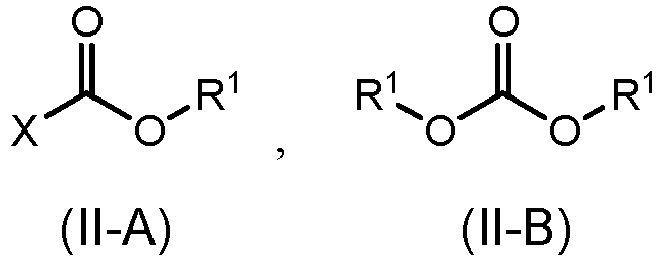
- Examples for compound (II-A) include methyl chloroformate, ethyl chloroformate, isopropyl chloroformate, 2-methoxyethyl chloroformate, 1-chloroethyl chloroformate, isobutyl chloroformate, 2,2,2-trichloroethyl chloroformate, propyl chloroformate, 2-chloroethyl chloroformate, phenyl chloroformate, 2-naphthyl chloroformate, benzyl chloroformate, 4-chlorophenyl chloroformate and 4-nitrophenyl chloroformate, and examples for compound (II-B) include dimethyl carbonate, diethyl carbonate, triphosgene, bis(2-chloroethyl) carbonate, diallyl carbonate, diphenyl carbonate, dibenzyl carbonate and ethylene carbonate. As other activated reagents there may be used instead of compound (II-A) or compound (II-B), dicarbonic acid esters such as di-t-butyl dicarbonate, or 1,1'-carbonyldiimidazole. Compound (II) is preferably phenyl chloroformate.
- Compound (II) may be used at 1.0 to 3.0 equivalents with respect to the number of moles of compound (I).
- There are no particular restrictions on the base, and for example, pyridine, trimethylpyridine, dimethylpyridine, potassium hydroxide, potassium carbonate, sodium hydrogencarbonate, triethylamine, N,N-diisopropylethylamine or the like may be used, with pyridine being preferred.
- The base may be used at 1.0 to 3.0 equivalents with respect to the number of moles of compound (I).
- To the reaction solvent, preferably 0.5 to 2.0 equivalents of, more preferably 1.0 to 1.5 equivalents of, and particularly preferably 1.0 equivalent of water may be added relative to the molar number of the compound (I).
- The reaction time for step B will also, in general, differ depending on the starting materials, solvent and other reagents used in the reaction, but it is preferably from 15 minutes to 24 hours.
- The reaction temperature for step B will also, in general, differ depending on the starting materials, solvent and other reagents used in the reaction, but it is preferably from -50°C to room temperature, and more preferably from -30°C to 0°C.
- Compound (III) is supplied to step C without isolation from the reaction mixture in step B. Cyclopropylamine is used at 1.0 to 7.2 equivalents with respect to the number of moles of compound (II).
- The reaction in step C will proceed with cyclopropylamine alone, but it will also proceed in the co-presence of both cyclopropylamine and another base. There are no particular restrictions on other bases, which may be tertiary amines such as triethylamine, N,N-diisopropylethylamine or tributylamine, or heterocyclic compounds such as pyridine. Here, cyclopropylamine may be used at 1.0 to 5.0 equivalents with respect to the number of moles of compound (II), and other bases may be used at 1.0 to 5.0 equivalents with respect to the number of moles of compound (II).
- The reaction time for step C will also, in general, differ depending on the starting materials, solvent and other reagents used in the reaction, but it is preferably from 30 minutes to 90 hours.
- The reaction temperature for step C will also, in general, differ depending on the starting materials, solvent and other reagents used in the reaction, but it is preferably from -20°C to 40°C, and more preferably from 0°C to 20°C.
- After the reaction is finished, the compound (IV) or a salt thereof can be precipitated and isolated by introducing a hydrous organic solvent to the reaction solution. The amount of the hydrous organic solvent to be introduced can be set at a volume of 10- to 20-fold amount (v/w) relative to the mass of the compound (I). Examples of an organic solvent that can be used as the hydrous organic solvent include, but are not particularly limited to, acetone, isopropyl acetate, ethanol, 1-propanol, 2-propanol, and N,N-dimethylformamide. Examples of the hydrous organic solvent are preferably water/acetone (volume ratio 3/100 to 1/20), water/isopropyl acetate (volume ratio 1/20), and water/ethanol (volume ratio 1/1), and more preferably water/acetone (volume ratio 1/20). It should be noted that seed crystals may be added as required in the case of introducing a hydrous organic solvent. Alternatively, the compound (IV) or a salt thereof can be also precipitated and isolated by introducing water to the reaction solution after the reaction is finished.
- The obtained crystals may be rinsed using a solvent such as water or acetone to obtain compound (IV) crystals (crude product). The crystals (crude product) may then be crystallized using a solvent such as 1,3-dimethyl-2-imidazolidinone, N,N-dimethylformamide, dimethyl sulfoxide, 2-propanol or isopropyl acetate, for purification.
- Step D is a step in which compound (IV) obtained in step C is converted to a salt. The salt of compound (IV) is preferably a methanesulfonic acid salt.
- Crystals of a salt such as 4-[3-chloro-4-(cyclopropylaminocarbonyl)aminophenoxy]-7-methoxy-6-quinoline-carboxamide methanesulfonate can be produced by the method described in PTL 4.
- More specifically, in the case of producing 4-[3-chloro-4-(cyclopropylaminocarbonyl)aminophenoxy]-7-methoxy-6-quinoline-carboxamide methanesulfonate, for example, a methanesulfonate (the crystals (C) described in Patent Literature 4) can be produced by, after 4-[3-chloro-4-(cyclopropylaminocarbonyl)aminophenoxy]-7-methoxy-6-quinoline-carboxamide, acetic acid, and methanesulfonic acid are mixed to dissolve the 4-[3-chloro-4-(cyclopropylaminocarbonyl)aminophenoxy]-7-methoxy-6-quinoline-carboxamide, adding 1-propanol as a poor solvent and gradually cooling this solution. It should be noted that it is preferred that the methanesulfonate crystals (C) as seed crystals be added together with a poor solvent and that isopropyl acetate be added to facilitate precipitation. As the seed crystals, the methanesulfonate crystals (C) produced according to the method described in Patent Literature 4 or to the method disclosed in the present specification can be used.
- The amount of acetic acid added is not particularly limited, but preferably a 5 to 10-fold amount and more preferably a 6 to 8-fold amount relative to the mass of the compound (IV) can be used.
- As the amount of methanesulfonic acid added, 1.00 to 1.50 equivalents, preferably 1.05 to 1.30 equivalents, more preferably 1.05 to 1.22 equivalents, and particularly preferably 1.20 equivalents relative to the molar number of the compound (IV) can be used.
- Methanesulfonic acid can be mixed with the compound (IV) at once or in portions, and after preferably 1.00 equivalent to 1.10 equivalents and more preferably 1.05 equivalents are used, it is preferred that preferably additional 0.10 equivalents to 0.20 equivalents and more preferably additional 0.15 equivalents be used relative to the molar number of the compound (IV).
- In the case where a salt of 4-[3-chloro-4-(cyclopropylaminocarbonyl)aminophenoxy]-7-methoxy-6-quinoline-carboxamide and other acid is produced, a desired acid may be used instead of methanesulfonic acid. The amount of the acid added should be adjusted as appropriate by referring the amount of methanesulfonic acid added.
- The reaction temperature in the step D usually differs on starting materials, solvents, and other reagents used in the reaction, and is preferably 20 to 40°C and more preferably 25 to 35°C.
- As the poor solvent, methanol, ethanol, 1-propanol, 2-propanol and the like, preferably 1-propanol can be used.
- The amount of the poor solvent is not particularly limited, but preferably a 2 to 15-fold amount and more preferably a 8 to 10-fold amount is used relative to the mass of the compound (IV).
- In the case where isopropyl acetate is added, the amount is not particularly limited, preferably a 2 to 10-fold amount and more preferably a 5-fold amount is used relative to the mass of the compound (IV).
- The cooling temperature is not particularly limited, but it is preferably 15 to 25°C.
- The crystals obtained by filtration are stirred in ethanol. The amount of ethanol to be used is not particularly limited, but preferably a 5 to 10-fold amount and more preferably a 7.5-fold amount is used relative to the mass of the compound (IV).
- The crystals obtained are stirred in ethanol preferably at 20 to 60°C for 2 to 5 hours, and preferably for 3 hours.
- According to the above production method, in the methanesulfonate of the compound (IV), the contents of the compound (A-1), the compound (I), and the compound (C-1) can be set to 60 ppm by mass or less, 350 ppm by mass or less, and 0.10% by mass or less, respectively.


- In particular, the content of the compound (I) in the methanesulfonate of the compound (IV) can be reduced to 183 ppm by mass or less by using cyclopropylamine excessively in the step C, or by performing recrystallization of the compound (IV) before the methanesulfonate of the compound (IV) is synthesized.
- The compound (A-1) is the starting material of the step A, but its solubility in organic solvents is low. Accordingly, it is difficult to remove the compound (A-1) from the compound (IV) or a salt thereof by recrystallization. However, in accordance with the production method underlying the present invention, the content of compound (A-1) in the compound (IV) or a salt thereof can be reduced by undergoing multiple stages synthetic route from the step A through the step B to the step C. In particular, according to the consideration of the present inventors, since there is a possibility that the compound (A-1) exhibits genotoxicity, it is important to reduce the content of the compound (A-1) in the compound (IV) or a salt thereof.
- It is preferred that the content of the compound (A-1) in the compound (IV) or a salt thereof be 60 ppm by mass or less based on Thresholds of Toxicological Concern (TTC) specified in "Guideline on the Limits of Genotoxic Impurities" issued by the European Medicines Agency.

- The compound (I) is the starting material of the step B, and the unreacted compound (I) remains as an impurity in the compound (III) or is formed by decomposition of the compound (III) or the compound (IV) or a salt thereof in the step B. In particular, when the methanesulfonate of the compound (IV) heated after dissolved in a solvent, the compound (I) is formed as a decomposition product of the compound (IV) and the like. In accordance with the production method underlying the present invention, the content of compound (I) in the compound (IV) or a salt thereof can be further reduced by using cyclopropylamine excessively in the step C, or by dividing a minimum necessary amount of methanesulfonic acid and mixing the amount with the compound (IV) when a salt of the compound (IV) is synthesized in the step D. Additionally, the content of the compound (I) in a salt of the compound (IV) can be further reduced by performing recrystallization of the compound (IV) to reduce the content of the compound (I) in the compound (IV) before the salt of the compound (IV) is synthesized. In particular, the compound (I) is a chemical substance posted on the Workplace Safety Site "Chemical substances on which strong mutagenicity was recognized" of the Ministry of Health, Labour and Welfare of Japan (Public Notice No. 166 of the Ministry of Health, Labour and Welfare of March 27, 2012), and it is important to reduce the content of the compound (I) in the compound (IV).
- Since it is difficult to constantly control the content of the compound (I) in the compound (IV) or a salt thereof to be equal to or below TTC, it is preferred that the content be in the As Low As Reasonably Practicable (ALARP) level, i.e., be 350 ppm by mass or less based on the average of the measured values of production lots 1 to 8 and the upper limit of the confidence interval. As shown in Table 1, the content of the compound (I) contained in the methanesulfonate of the compound (IV) can be reduced to 350 ppm by mass or less. In particular, the content of the compound (I) can be reduced to 350 ppm by mass or less by appropriately combining using potassium hydroxide as the base in the step A in the lots 5 to 8, additionally isolating the compound (I) as crystals of its anhydrate after the step A and adding water to the reaction solution in the step B in the lots 6 to 8, using cyclopropylamine excessively in the step C and carrying out recrystallization of the compound (IV) before the step D in the lots 5 to 8, and the like.
[Table 1] Lot Compound (I)a 1 280 2 180 3 171 4 173 5 61 6 120 7 118 8 114 Average 152.1 Standard deviation 65.3 Average + Upper limit of the confidence intervalb 348 acceptance criterion ≤350 Unit: ppm by mass
aThe quantitation limit (lower limit) is 7 ppm by mass.
bThe upper limit of the confidence interval = three times standard deviation of the batch analysis data - Since it is difficult to constantly control the content of the compound (I) in the compound (IV) or a salt thereof to be equal to or below TTC, it is preferred that the content be in the As Low As Reasonably Practicable (ALARP) level, i.e., be 183 ppm by mass or less based on the average of the measured value of the production lots 5 to 10 and the upper limit of the confidence interval. In particular, the content of the compound (I) contained in the methanesulfonate of the compound (IV) can be further reduced to 183 ppm by mass or less as shown in Table 2 by appropriately combining using potassium hydroxide as the base in the step A in lots 5 to 10, additionally isolating the compound (I) as crystals of its anhydrate after the step A and adding water to the reaction solution in the step B in lots 6 to 10, using an excessive amount of cyclopropylamine in the step C and carrying out recrystallization of the compound (IV) before the step D in lots 5 to 10, and dividing methanesulfonic acid and mixing it with the compound (IV) in the step D in lots 9 to 10, and the like.
[Table 2] Lot Compound (I)a 5 61 6 120 7 118 8 114 9 93 10 52 Average 93.0 Standard deviation 30 Average + Upper limit of the confidence intervalb 183 acceptance criterion ≤183 Unit: ppm by mass
aThe quantitation limit (lower limit) is 7 ppm by mass.
bThe upper limit of the confidence interval = three times standard deviation of the batch analysis data - The compound (C-1) is a byproduct formed mainly in the step B. In the step B, formation of the compound (C-1) can be suppressed more effectively by further adding one equivalent of water to the reaction solution. It should be noted that, in the case where the compound (I)·monohydrate is used as the starting material, the formation of the compound (C-1) can be suppressed without addition of one equivalent of water.
- It is preferred that the content of the compound (C-1) in the compound (IV) or a salt thereof be 0.10% by mass or less in accordance with the guidelines of ICH Q3A.
- It is preferred that the purity of the compound (IV) or a salt thereof be 98.0% by mass or more considering the batch analysis data, stability test, and analytical variability.
- In the case where the compound (IV) or a salt thereof is formulated, a pharmaceutical composition comprising the compound (IV) or a salt thereof and an appropriate additive as a pharmaceutically acceptable carrier is usually used. However, the above description is not intended to deny that formulation is carried out by using only the compound (IV) or a salt thereof.
- As the above additive, an excipient, a binder, a lubricant, a disintegrating agent, and the like that may be generally used in the pharmaceutical field can be used. As the above additive, these in combination as appropriate can be also used.
- Examples of the above excipient include lactose, saccharose, glucose, mannitol, pregelatinized starch, and crystalline cellulose.
- Examples of the above binder include methyl cellulose, hydroxypropyl methyl cellulose, and hydroxypropyl cellulose.
- Examples of the above lubricant include magnesium stearate, talc, polyethylene glycol, and colloidal silica.
- Examples of the above disintegrating agent include crystalline cellulose, agar, gelatin, calcium carbonate, and sodium hydrogen carbonate.
- Additionally, examples of the above formulation include oral solid formulations such as tablets, powders, granules, capsules, syrups, troches, and inhalants. The formulations obtained by formulating the compound (IV) or a salt thereof or a pharmaceutical composition comprising the same are usually accommodated in appropriate primary packaging (a container or packet) and handled as a pharmaceutical. As the primary packaging, packaging in a shape suitable for each formulation application can be used.
- The above oral solid formulation is formulated by combining the above additives as appropriate. It should be noted that coating may be applied on the surface of the oral solid formulation as required.
- The oral solid formulation can be produced in accordance with the description of, for example,
WO 2006/030826 orWO 2011/021597 . In the case where a 5% aqueous solution (W/W) is prepared to stabilize the compound (IV) or a salt thereof, it is preferred to use a compound of which pH becomes 8 or more as a pharmaceutically acceptable carrier. Alternatively, for stabilization of the compound (IV) or a salt thereof, a carbonate of an alkaline earth metal may be used as a pharmaceutically acceptable carrier. - The primary packaging for the oral solid formulation is, for example, a glass or plastic bottle or jar. The plastic herein means polymers such as high-density polyethylene (HDPE). Additionally, in the case of accommodating the oral solid formulation in a bottle, a drying agent, such as silica gel, can be encapsulated with the above formulation.
- One embodiment of the above pharmaceutical is an HDPE bottle in which tablets or capsules comprising the compound (IV) or a salt thereof and silica gel are encapsulated. Specifically, an example is an HDPE bottle in which about 30 capsules comprising the compound (IV) or a salt thereof and about 2 g of silica gel are encapsulated.
- Another example of the primary packaging for the oral solid formulation is blister packaging. An example of the blister packaging is press through packaging (PTP). The PTP is composed of molding materials, lid materials, and the like.
- Examples of components of the above molding materials include metals such as aluminum, and plastics such as polyvinyl chloride (PVC), polyvinylidene chloride (PVDC), cyclic polyolefins, polyamides, and polypropylene (PP). The molding material may be a monolayer material of a single component, or may be a laminate material of a plurality of components, such as an aluminum laminate film. The lid material is composed of a supporting material such as aluminum or plastic, and, as required, a heat-seal agent and the like.
- An embodiment of the PTP is, for example, PTP composed of a molding material of an aluminum laminate film and a lid material of aluminum, or PTP composed of a molding material made of plastic and a lid material of aluminum. To such PTP, secondary packaging (pillow packaging) may be applied using polyethylene or aluminum as required. Additionally, a drying agent may be used with PTP in the pillow packaging.
- One embodiment of the above pharmaceutical is PTP in which tablets or capsules comprising the compound (IV) or a salt thereof are accommodated, wherein the PTP is composed of an aluminum laminate film and aluminum.
- The above bottle or the above PTP may be accommodated with a package insert of the pharmaceutical in a box and the like, as a final packaging form.
- In the oral solid formulation comprising the compound (IV) or a salt thereof, the compound (I) increases by 0.02% at most during storage in acceleration test, as shown in examples described below. In other words, as shown in Table 1, when the oral solid formulation comprising the compound (IV) or a salt thereof in which the content of the compound (I) is 350 ppm by mass or less, is stored under storage conditions of the acceleration test described below or during storage at room temperature for three years, the content of the compound (I) could be kept 0.06% by mass or less in the oral solid formulation.
- Accordingly, one aspect of the present disclosure is an oral solid formulation which comprises the compound (IV) or a salt thereof and a pharmaceutically acceptable carrier and in which the content of the compound (I) is 0.06% by mass or less.
- Alternatively, as shown in Table 2, when the oral solid formulation comprising the compound (IV) or a salt thereof in which the content of the compound (I) is 183 ppm by mass or less, is stored under storage conditions of the acceleration test described below or during storage at room temperature for three years, the content of compound (I) could be kept 0.04% by mass or less or 0.040% by mass or less in the oral solid formulation.
- Accordingly, one aspect of the present disclosure is an oral solid formulation which comprises the compound (IV) or a salt thereof and a pharmaceutically acceptable carrier and in which the content of the compound (I) is 0.04% by mass or less or 0.040% by mass or less.
- In the case of using the compound (IV) or a salt thereof for production of a pharmaceutical, the amount used differs on symptoms, ages, and administer forms, but usually for an adult, 100 µg to 10 g is administered once a day, or used in portions several times a day.
- The invention will now be further explained by examples, with the understanding that the invention is not limited to these examples.
-

- A mixture of 43.5 kg of 4-amino-3-chlorophenol hydrochloride, 53.8 kg of a 48.5 w/w% potassium hydroxide aqueous solution, 44.0 kg of 4-chloro-7-methoxy-quinoline-6-carboxamide and 396 L of dimethyl sulfoxide was stirred at 70°C for 20 hours under a nitrogen atmosphere. After adding water-containing acetone (acetone: 220 L, purified water: 440 L) to the reaction mixture at 55°C, the mixture was cooled to 8°C and the deposited precipitate was filtered. The precipitate was rinsed with an aqueous acetone solution, and the obtained solid was dried under reduced pressure to obtain 59.3 kg of 4-(4-amino-3-chlorophenoxy)-7-methoxy-quinoline-6-carboxamide (yield: 93%).
-

- To a mixture of 26.0 kg of 4-(4-amino-3-chlorophenoxy)-7-methoxy-quinoline-6-carboxamide, 13.2 kg of pyridine, 1.36 kg of water and 196.0 L of N,N-dimethylformamide there was added 26.6 kg of phenyl chloroformate at -20°C under a nitrogen atmosphere, and the mixture was stirred for 3 hours. Next, 19.4 kg of cyclopropylamine was further added at 8°C and the mixture was stirred for 15 hours. After adding 13.0 L of water and 261.0 L of acetone to the reaction mixture, the deposited precipitate was filtered. The precipitate was rinsed with acetone, and the obtained solid was dried under reduced pressure to obtain 28.7 kg of a crude product of the title compound (89% yield). This was crystallized from 359.6 L of 1,3-dimethyl-2-imidazolidinone and 575.0 L of 2-propanol, to obtain 25.7 kg of compound (IV) (90% yield).
- In Examples 1 and 2, the total yield was 83% through the two steps up to obtaining the crude product of compound (IV), in terms of the starting material of compound (I), and this was a high yield compared to the yield in the production method of PTL 1 (three steps, 25.5%). Also, crystallization of compound (IV) allowed a higher purity compound (IV) to be obtained at a yield of 90%.
-
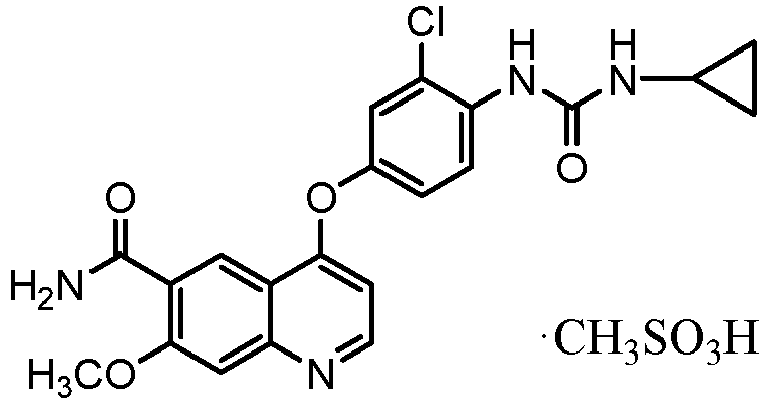
- In a mixed solution of methanesulfonic acid (5.44 kg) and acetic acid (150 L) was dissolved 4-[3-chloro-4-(cyclopropylaminocarbonyl)aminophenoxy]-7-methoxy-6-quinoline-carboxamide (23.0 kg) at 20°C to 35°C. Methanesulfonic acid (777 g) was further added, the solution was filtered at a temperature of 35°C or less, and the filter paper was washed with acetic acid (11.5 L). To the filtrate, 1-propanol (46.0 L) and seed crystals (230 g) were added at 25°C to 45°C, and 1-propanol (161 L) and isopropyl acetate (115 L) was further added dropwise at 25°C to 45°C. The mixed solution was cooled to 15°C to 25°C, and subsequently, the deposited crystals were filtered and washed with a mixed solution of 1-propanol and isopropyl acetate (1-propanol concentration: 33 v/v%). To the resulting wet crystals, ethanol (173 L) was added and stirred at 20°C to 60°C for three hours. After the crystals were collected by filtration and washed with ethanol, the crystals were dried under reduced pressure at a temperature of 80°C or less to thereby obtain 4-[3-chloro-4-(cyclopropylaminocarbonyl)aminophenoxy]-7-methoxy-6-quinoline-carboxamide methanesulfonate (27.5 kg, yield: 94%).
-
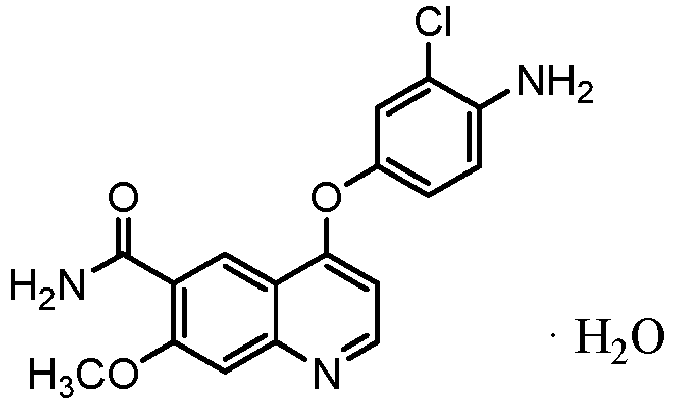
- A mixture of 4-amino-3-chlorophenol hydrochloride (593.4 g), a 48.7 w/w% potassium hydroxide aqueous solution (730.6 g), 4-chloro-7-methoxy-quinoline-6-carboxamide (600.0 g), and dimethylsulfoxide (5.4 L) was stirred under nitrogen atmosphere at 70°C for 21 hours. After 3.0 g of seed crystals was introduced into the reaction solution, hydrous acetone (acetone: 3 L, purified water: 6 L) was added at 55°C and cooled to 8°C, and the precipitated deposit was filtered. The deposit was washed with hydrous acetone, and the solid obtained using a rotary evaporator was dried at 60°C under reduced pressure to thereby obtain 4-(4-amino-3-chlorophenoxy)-7-methoxy-quinoline-6-carboxamide·monohydrate (862.7 g, yield: 94%).
-

- To a mixture of 4-(4-amino-3-chlorophenoxy)-7-methoxy-quinoline-6-carboxamide·monohydrate (800 g), pyridine (524.8 g), and N,N-dimethylformamide (8 L), phenyl chloroformate (865.6 g) was added under nitrogen atmosphere at -20°C and stirred for one hour. Additionally, cyclopropylamine (757.6 g) was added and stirred at 8°C for 18 hours. To the reaction solution, water (8 L) was added, and the precipitated deposit was filtered. The deposit was washed with hydrous N,N-dimethylformamide and ethanol, and the resulting solid was dried under reduced pressure to thereby obtain a crude product of the title compound (910 g, yield: 96%). Five hundred grams of the crude product was crystallized from 1,3-dimethyl-2-imidazolidinone (6250 mL) and 2-propanol (10 L) to thereby obtain the compound (IV) (450 g, yield: 90%).
- As for the precipitated crude product of the compound (IV) obtained in Example 2, the compound (IV) obtained in accordance with the production method described in Patent Literatures 1, and the precipitated crude product of the compound (IV) obtained in accordance with the production methods described in Patent Literatures 2, 3, 4, and 5, their purities were analyzed by liquid chromatography and each compared. As shown in Table 3, the content of the compound (IV) produced in Example 2 was higher than the content of the compound (IV) obtained in accordance with the production methods described in Patent Literatures 1 to 5 was higher, and the total content of impurities was lower.
- The results are shown in Table 3.
[Table 3] Content Production method Example 2a Production method described in Patent Literature 1b Production methods described in Patent Literatures 2, 3, 4, and 5c Area % Total impurities 0.355 5.39 1.702 Compound (IV) 99.645 94.61 98.298 % by mass Total impurities 0.17 4.5 1.3 Compound (IV) 98.5 91.9 96.3 aMeasured by use of the precipitated crude product of the compound (IV) obtained in Example 2
bMeasured by use of the compound (IV) obtained by the production method described in Patent Literature 1 (Example 368)
cMeasured by use of the precipitated crude product of the compounds (IV) obtained by the production methods described in Patent Literature 2 (Reference Example 3), Patent Literature 3 (Example 4), Patent Literature 4 (Production Example 3) and Patent Literature 5 (Example 1a) - Calculation of the area% in Table 3 was performed as follows. The peak area of the peaks derived from the sample on the chromatogram obtained under the following measurement conditions was calculated, the peak area of each peak was divided by the total to thereby take the total of the figures of the peaks corresponding to impurities as the total content of the impurities and the figure corresponding to the compound (IV) as the content of the compound (IV).
- Additionally, calculation of % by mass in Table 3 was performed as follows. First, as for the content of the compound (IV), by using a standard of the compound (IV) obtained by crystallization as an external control and comparing the peak area of the peaks each corresponding to the compound (IV) in the standard and in the sample, the content of the compound (IV) in the sample was calculated. Subsequently, in order to compensate the difference in the absorbance of each impurity per unit mass, after each impurity was identified in accordance with the procedure described in Purity test 2 and a sample of each impurity was synthesized, the absorbance (sensitivity coefficient) of each impurity was determined when the absorbance of the compound (IV) was set to 1. Then, by use of the peak areas and sensitivity coefficients of the impurities in the sample, the mass of each impurity (%) was calculated, and the total of the impurities detected to exceed 0.05% by mass was taken as the total content of impurities.
-
- Liquid chromatography measuring conditions
- Detector: Ultraviolet absorptiometer (measuring wavelength: 252 nm).
- Column: YMC-Pack ProC18 (YMC Inc.), inner diameter: 4.6 mm, length: 15 cm, filler particle diameter: 3 µm
- Column temperature: Constant temperature near 25°C
- Mobile phase: Solution A and solution B having the following compositions were eluted with the linear gradient shown in Table 2.
- Solution A: Water/acetonitrile/70% perchloric acid mixture (990:10:1, v/v/v)
- Solution B: Water/acetonitrile/70% perchloric acid mixture (100:900:1, v/v/v)
- Flow rate: 1.0 mL/min
- Injection rate: 10 µL
- Sample rack temperature: Constant temperature near 15°C
- Area measurement range: 45 minutes
- It should be noted that the quantitation limits (lower limits) of the compound (A-1), the compound (I), and the compound (C-1) under the measurement conditions of Purity test 1 are each 0.0020% by mass (20 ppm by mass), 0.0020% by mass (20 ppm by mass), and 0.0022% by mass (22 ppm by mass).
- Under the measurement conditions of Purity test 1, each retention time of the compound (A-1), the compound (I), the compound (C-1), and the compound (IV) was compared. The "relative retention time" shown in Table 5 means the relative retention time of the compound (A-1), the compound (I), and the compound (C-1) relative to the compound (IV). That is, the value obtained from dividing the retention time of the peak derived from each compound on the chromatogram obtained under the measurement conditions of Purity test 1 by the retention time of the peak obtained by injecting the compound (IV) was described as the "relative retention time".
[Table 5] Compound Relative retention time Compound (I) 0.74 Compound (A-1) 0.26 Compound (C-1) 1.86 - Under the above measurement conditions, each compound was identified by the fact that its elution time in HPLC corresponded with the elution time of the sample. It should be noted that the samples of each compound were separately synthesized and the chemical structures were each determined based on their 1H-NMR and MS spectra.
-

- 1H-NMR (600MHz, DMSO-d6) δ (ppm): 0.42 (2H,m), 0.66 (2H,m), 2.57 (1H,dtt,J=3,4,7Hz), 4.05 (3H,s), 6.58 (1H,d,J=5Hz), 7.20 (1H,d,J=3Hz), 7.25 (1H,dd,J=3,9Hz), 7.49 (1H,d,J=3Hz), 7.58 (1H,s), 7.98 (1H,s), 8.28 (1H,d,J=9Hz), 8.72 (1H,s), 8.73 (1H,d,J=5Hz).
- Subsequently, as for the compound (IV) obtained in Example 2 and the compound (IV) obtained by Patent Literatures 2, 3, 4, and 5, the content of the compound (A-1) was measured by liquid chromatography. Consequently, as shown in Table 6, the content of the compound (A-1) was 1311 ppm by mass in the compound (IV) obtained by the production methods described in Patent Literatures 2, 3, 4, and 5, whereas the content decreased to 20 ppm by mass or less in the compound (IV) obtained in Example 2.
[Table 6] Production method Example 2 Production methods described in Patent Literatures 2, 3, 4, and 5∗∗ Content of the compound (A-1) ≤ 20 ppm by mass 1311 ppm by mass ∗Each measured by use of the precipitated crude product from the reaction solution
∗∗Production methods described in Patent Literature 2 (Reference Example 3), Patent Literature 3 (Example 4), Patent Literature 4 (Production Example 3) and Patent Literature 5 (Example 1a) - As for the compound (IV) obtained in Example 2 and the compound (IV) obtained by the production method described in Patent Literature 1, the content of the compound (C-1) was measured by liquid chromatography. Consequently, as shown in Table 7, the content of the compound (C-1) was 3.37% by mass in the compound (IV) obtained by the production method described in Patent Literature 1, whereas the content of the compound (C-1) decreased to 0.05% by mass or less in the compound (IV) obtained in Example 2.
[Table 7] Production method Example 2∗ Production method described in Patent Literature 1∗∗ Content of the compound (C-1) ≤ 0.05% by mass 3.37% by mass ∗Measured by use of the precipitated crude product of the compound (IV) obtained in Example 2
∗∗Measured by use of the compound (IV) obtained by the production method described in Patent Literature 1 (Example 368) - As for the methanesulfonate of the compound (IV) obtained in Example 3, the compound (C-1) under the following measurement conditions A and the compound (A-1) and compound (I) under the following measurement conditions B were each detected. In particular, as for the compound (A-1) and compound (I), measurement was able to be performed with good sensitivity by an external standard method in which standard solutions prepared from those standards were used, under the following conditions. It should be noted that the purity of the methanesulfonate of the compound (IV) obtained in Example 3 was 99.3% by mass.
-
- Liquid chromatography measuring conditions
- Detector: Ultraviolet absorptiometer (measuring wavelength: 252 nm).
- Column: YMC-Pack ProC18 (YMC Inc.), inner diameter: 4.6 mm, length: 7.5 cm, filler particle diameter: 3 µm
- Column temperature: Constant temperature near 40°C
- Mobile phase: Solution A and solution B having the following compositions were eluted with the linear gradient shown in Table 8.
- Solution A: Water/acetonitrile/70% perchloric acid mixture (990:10:1, v/v/v)
- Solution B: Water/acetonitrile/70% perchloric acid mixture (100:900:1, v/v/v)
- Flow rate: 1.0 mL/min
- Injection rate: 10 µL
- Sample rack temperature: Constant temperature near 15°C Area measurement range: 30 minutes
- It should be noted that the quantitation limit (lower limit) of the compound (C-1) under the above measurement conditions A in Purity test 3 is 0.01% by mass.
-
- Liquid chromatography measuring conditions
- Detector: Ultraviolet absorptiometer (measuring wavelength: 252 nm).
- Column: YMC-Pack ProC18 (YMC Inc.), inner diameter: 4.6 mm, length: 7.5 cm, filler particle diameter: 3 µm
- Column temperature: Constant temperature near 40°C
- Mobile phase: Solution A and solution B having the following compositions were eluted with the linear gradient shown in Table 9.
- Solution A: Water/acetonitrile/70% perchloric acid mixture (990:10:1, v/v/v)
- Solution B: Water/acetonitrile/70% perchloric acid mixture (100:900:1, v/v/v)
- Flow rate: 1.0 mL/min
- Injection rate: 5 µL
- Sample rack temperature: Constant temperature near 15°C
- Area measurement range: 13 minutes
- It should be noted that the quantitation limits (lower limits) of the compound (I) and compound (A-1) are 7 ppm by mass and 12 ppm by mass respectively under the measurement conditions B.
- The contents of each compound obtained are shown in Table 10.
[Table 10] Impurity Content Compound (I) 52 ppm by mass Compound (A-1) 12 ppm by mass ≥ Compound (C-1) 0.05% by mass ≥ - Capsules of 4-mg capsules and 10-mg capsules were produced by using the methanesulfonate of the compound (IV) shown in Table 1 or Table 2 and using D-mannitol, precipitated calcium carbonate, low-substituted hydroxypropyl cellulose, crystalline cellulose, hydroxypropyl cellulose, talc, and the like. It should be noted that "a 4-mg capsule" means a capsule comprising 4 mg of the compound (IV) in the capsule. The mass of the granules which is the content of the capsule is 100 mg per capsule. The contents of the compound (I) (% by mass) relative to the total mass of the capsule at the time of producing a capsule (also referred to as "the initial content") are shown in Table 11.
[Table 11] Lot Content of the compound (I) (% by mass) 10mg Capsule 4mg Capsule 1 0.03 0.03 3 0.02 0.02 5 0.00 0.00 6 0.01 0.01 7 0.01 0.01 8 0.02 - - By using 4-mg and 10-mg capsules of the compound (IV) produced with the mesylate of the compound (IV) in the lot 5, 6, or 7 (the mass of the granules which is the content of the capsule is 100 mg per capsule), acceleration test (40°C/75%RH, PTP (molding material: aluminum laminate film (polyamide/aluminum/polyvinyl chloride), lid material: aluminum foil)) and long-term storage test (25°C/60%RH, PTP (molding material: aluminum laminate film (polyamide/aluminum/polyvinyl chloride), lid material: aluminum foil)) were performed.
- In the acceleration test on 4-mg and 10-mg capsules, the contents of the compound (I) increased by 0.02% by mass and 0.01% by mass respectively at most compared with the initial content. Additionally the content of the compound (I) in the long-term storage test for 24 month slightly increased compared with the initial content. The increase in the content of the compound (I) in the long-term storage test was smaller than the effective figure of the quantitation limit, and was specifically 0.003% by mass to 0.004% by mass. The measurement of the contents of the compound (I) in these capsules were performed by liquid chromatography (detection limit (lower limit): 0.0020% by mass), and the quantitation limit (lower limit) was 0.01% by mass.
| Time (min) | Proportion of solution B in mobile phase (vol%) |
| 0 | 15 |
| 35 | 40 |
| 42 | 100 |
| 45 | 100 |
| 45.01 | 15 |
| 55 | STOP |
| Time (min) | Proportion of solution B in mobile phase (vol%) |
| 0 | 5 |
| 25 | 55 |
| 30 | 100 |
| 35 | 100 |
| 35.01 | 5 |
| 45 | STOP |
| Time (min) | Proportion of solution B in mobile phase (vol%) |
| 0 | 5 |
| 15 | 35 |
| 15.01 | 100 |
| 20 | 100 |
| 20.01 | 5 |
| 30 | STOP |
Claims (3)
- A methanesulfonate salt of a compound represented by formula (IV), wherein the content of a compound represented by formula (I) is 183 ppm by mass or less

- The methanesulfonate salt of a compound represented by formula (IV) according to claim 1, wherein the content of the methanesulfonate salt of the compound represented by formula (IV) is 98.0% by mass or more.
- The methanesulfonate salt of a compound represented by formula (IV) according to claim 1, wherein the content of the compound represented by formula (I) is determined by HPLC.
Priority Applications (6)
| Application Number | Priority Date | Filing Date | Title |
|---|---|---|---|
| SI201531882T SI3524595T1 (en) | 2014-08-28 | 2015-08-26 | High-purity quinoline derivative and method for manufacturing same |
| SM20220367T SMT202200367T1 (en) | 2014-08-28 | 2015-08-26 | High-purity quinoline derivative and method for manufacturing same |
| HRP20221047TT HRP20221047T1 (en) | 2014-08-28 | 2015-08-26 | High-purity quinoline derivative and method for manufacturing same |
| EP20207489.4A EP3825305A1 (en) | 2014-08-28 | 2015-08-26 | Process for preparing lenvatinib |
| EP22180987.4A EP4089076A1 (en) | 2014-08-28 | 2015-08-26 | High-purity quinoline derivative and method for manufacturing same |
| RS20220853A RS63559B1 (en) | 2014-08-28 | 2015-08-26 | HIGH PURITY QUINOLINE DERIVATIVE AND PROCEDURE FOR ITS PRODUCTION |
Applications Claiming Priority (4)
| Application Number | Priority Date | Filing Date | Title |
|---|---|---|---|
| JP2014174062 | 2014-08-28 | ||
| JP2015034729 | 2015-02-25 | ||
| EP15836577.5A EP3187491A4 (en) | 2014-08-28 | 2015-08-26 | High-purity quinoline derivative and method for manufacturing same |
| PCT/JP2015/073946 WO2016031841A1 (en) | 2014-08-28 | 2015-08-26 | High-purity quinoline derivative and method for manufacturing same |
Related Parent Applications (1)
| Application Number | Title | Priority Date | Filing Date |
|---|---|---|---|
| EP15836577.5A Division EP3187491A4 (en) | 2014-08-28 | 2015-08-26 | High-purity quinoline derivative and method for manufacturing same |
Related Child Applications (4)
| Application Number | Title | Priority Date | Filing Date |
|---|---|---|---|
| EP22180987.4A Division EP4089076A1 (en) | 2014-08-28 | 2015-08-26 | High-purity quinoline derivative and method for manufacturing same |
| EP22180987.4A Division-Into EP4089076A1 (en) | 2014-08-28 | 2015-08-26 | High-purity quinoline derivative and method for manufacturing same |
| EP20207489.4A Division EP3825305A1 (en) | 2014-08-28 | 2015-08-26 | Process for preparing lenvatinib |
| EP20207489.4A Division-Into EP3825305A1 (en) | 2014-08-28 | 2015-08-26 | Process for preparing lenvatinib |
Publications (2)
| Publication Number | Publication Date |
|---|---|
| EP3524595A1 EP3524595A1 (en) | 2019-08-14 |
| EP3524595B1 true EP3524595B1 (en) | 2022-08-10 |
Family
ID=55399727
Family Applications (4)
| Application Number | Title | Priority Date | Filing Date |
|---|---|---|---|
| EP15836577.5A Withdrawn EP3187491A4 (en) | 2014-08-28 | 2015-08-26 | High-purity quinoline derivative and method for manufacturing same |
| EP19151846.3A Active EP3524595B1 (en) | 2014-08-28 | 2015-08-26 | High-purity quinoline derivative and method for manufacturing same |
| EP22180987.4A Pending EP4089076A1 (en) | 2014-08-28 | 2015-08-26 | High-purity quinoline derivative and method for manufacturing same |
| EP20207489.4A Pending EP3825305A1 (en) | 2014-08-28 | 2015-08-26 | Process for preparing lenvatinib |
Family Applications Before (1)
| Application Number | Title | Priority Date | Filing Date |
|---|---|---|---|
| EP15836577.5A Withdrawn EP3187491A4 (en) | 2014-08-28 | 2015-08-26 | High-purity quinoline derivative and method for manufacturing same |
Family Applications After (2)
| Application Number | Title | Priority Date | Filing Date |
|---|---|---|---|
| EP22180987.4A Pending EP4089076A1 (en) | 2014-08-28 | 2015-08-26 | High-purity quinoline derivative and method for manufacturing same |
| EP20207489.4A Pending EP3825305A1 (en) | 2014-08-28 | 2015-08-26 | Process for preparing lenvatinib |
Country Status (25)
| Country | Link |
|---|---|
| US (5) | US10259791B2 (en) |
| EP (4) | EP3187491A4 (en) |
| JP (1) | JP6659554B2 (en) |
| KR (3) | KR20230043234A (en) |
| CN (2) | CN113683564A (en) |
| AU (1) | AU2015309862C1 (en) |
| BR (1) | BR112017002827B1 (en) |
| CA (1) | CA2957005C (en) |
| CY (1) | CY1125610T1 (en) |
| DK (1) | DK3524595T3 (en) |
| ES (1) | ES2926687T3 (en) |
| HR (1) | HRP20221047T1 (en) |
| HU (1) | HUE059606T2 (en) |
| IL (2) | IL302218B2 (en) |
| JO (2) | JO3783B1 (en) |
| LT (1) | LT3524595T (en) |
| MX (3) | MX394386B (en) |
| PL (1) | PL3524595T3 (en) |
| PT (1) | PT3524595T (en) |
| RS (1) | RS63559B1 (en) |
| SG (2) | SG10202100272RA (en) |
| SI (1) | SI3524595T1 (en) |
| SM (1) | SMT202200367T1 (en) |
| TW (1) | TWI721954B (en) |
| WO (1) | WO2016031841A1 (en) |
Cited By (5)
| Publication number | Priority date | Publication date | Assignee | Title |
|---|---|---|---|---|
| US12083112B2 (en) | 2015-03-04 | 2024-09-10 | Eisai R&D Management Co., Ltd. | Combination of a PD-1 antagonist and a VEGFR/FGFR/RET tyrosine kinase inhibitor for treating cancer |
| US12220398B2 (en) | 2015-08-20 | 2025-02-11 | Eisai R&D Management Co., Ltd. | Tumor therapeutic agent |
| US12226409B2 (en) | 2017-05-16 | 2025-02-18 | Eisai R&D Management Co., Ltd. | Treatment of hepatocellular carcinoma |
| US12303505B2 (en) | 2017-02-08 | 2025-05-20 | Eisai R&D Management Co., Ltd. | Tumor-treating pharmaceutical composition |
| US12508313B2 (en) | 2009-08-19 | 2025-12-30 | Eisai R&D Management Co., Ltd. | Quinoline derivative-containing pharmaceutical composition |
Families Citing this family (22)
| Publication number | Priority date | Publication date | Assignee | Title |
|---|---|---|---|---|
| WO2012166899A2 (en) | 2011-06-03 | 2012-12-06 | Eisai R&D Management Co., Ltd. | Biomarkers for predicting and assessing responsiveness of thyroid and kidney cancer subjects to lenvatinib compounds |
| CA2957005C (en) | 2014-08-28 | 2021-10-12 | Eisai R&D Management Co., Ltd. | High-purity quinoline derivative and method for manufacturing same |
| SG11201706630UA (en) | 2015-02-25 | 2017-09-28 | Eisai R&D Man Co Ltd | Method for suppressing bitterness of quinoline derivative |
| BR112017027227B1 (en) | 2015-06-16 | 2023-12-12 | Eisai R&D Management Co., Ltd | ANTI-CANCER AGENT |
| CN105801481A (en) * | 2016-05-20 | 2016-07-27 | 湖南欧亚生物有限公司 | Lenvatinib synthesizing method |
| CN108299294A (en) * | 2017-01-11 | 2018-07-20 | 江苏恒瑞医药股份有限公司 | A kind of pleasure is cut down for the preparation method of Buddhist nun's impurity |
| CN112204011A (en) * | 2018-06-01 | 2021-01-08 | 成都苑东生物制药股份有限公司 | New crystal form of levofloxacin mesylate and preparation method thereof |
| CN111320580B (en) * | 2018-12-14 | 2022-12-20 | 江苏先声药业有限公司 | Preparation method of Lunvatinib intermediate |
| CN111377864B (en) * | 2018-12-27 | 2022-03-18 | 江苏先声药业有限公司 | Lovatinib impurity and preparation method and application thereof |
| CN109824590B (en) * | 2019-02-21 | 2022-03-22 | 扬子江药业集团有限公司 | Preparation method of Lovatinib and salt thereof |
| CN109851556A (en) * | 2019-03-18 | 2019-06-07 | 扬子江药业集团有限公司 | Logical sequence cuts down the preparation method for Buddhist nun or its mesylate drug impurity |
| CN110283122B (en) * | 2019-06-26 | 2021-05-25 | 石药集团中奇制药技术(石家庄)有限公司 | Preparation method of high-purity Lunvatinib and salt thereof |
| CN110229103A (en) * | 2019-06-27 | 2019-09-13 | 尚科生物医药(上海)有限公司 | A kind of pleasure is cut down for the preparation method of Buddhist nun's Mesylate Form B |
| CN110563644A (en) * | 2019-10-30 | 2019-12-13 | 北京赛思源生物医药技术有限公司 | Novel crystal form of Lunvatinib mesylate |
| CN113045491B (en) * | 2019-12-26 | 2024-09-06 | 罗欣药业(上海)有限公司 | Preparation method of lenvatinib and intermediate |
| WO2021217537A1 (en) * | 2020-04-30 | 2021-11-04 | 天津睿创康泰生物技术有限公司 | Crystal form of lenvatinib free base and preparation method therefor |
| CN115397416B (en) * | 2020-05-09 | 2023-12-05 | 北京睿创康泰医药研究院有限公司 | Pharmaceutical composition containing molecular level of lenvatinib, preparation method and application thereof |
| CN113999173A (en) * | 2020-07-28 | 2022-02-01 | 药源药物化学(上海)有限公司 | Preparation method of high-purity crystal |
| CN112142662B (en) * | 2020-10-27 | 2022-03-08 | 南京法恩化学有限公司 | Preparation method of lervatinib mesylate |
| KR102576608B1 (en) | 2020-12-16 | 2023-09-12 | 쌍용씨앤이 주식회사 | Hydraulic Compounds Containing Calcium Sulfo-aluminates And Methods For Maintaining The Fluidity Of Pastes, Mortar And Concrete Manufactured Therefrom |
| EP4091614B1 (en) * | 2021-03-31 | 2023-09-06 | Delta-Fly Pharma, Inc. | Method for stabilizing medicinal substance sensitive to humidity (dfp-11207), and stable preparation thereof |
| CN115322149A (en) * | 2022-08-22 | 2022-11-11 | 思科(深圳)药物研发有限公司 | Alvatinib mesylate impurity and preparation method thereof |
Citations (12)
| Publication number | Priority date | Publication date | Assignee | Title |
|---|---|---|---|---|
| WO2002032872A1 (en) | 2000-10-20 | 2002-04-25 | Eisai Co., Ltd. | Nitrogenous aromatic ring compounds |
| WO2004101526A1 (en) | 2003-04-22 | 2004-11-25 | Eisai Co., Ltd. | Polymorphous crystal of 4-(3-chloro-4-(cyclopropylaminocarbonyl)aminophenoxy)-7-methoxy-6-qunolinecarboxamide and method for preparation thereof |
| WO2005044788A1 (en) | 2003-11-11 | 2005-05-19 | Eisai Co., Ltd. | Urea derivative and process for producing the same |
| WO2005063713A1 (en) | 2003-12-25 | 2005-07-14 | Eisai Co., Ltd. | Crystal of salt of 4-(3-chloro-4-(cyclopropylaminocarbonyl)amino-phenoxy)-7-methoxy-6-quinolinecarboxamide or of solvate thereof and processes for producing these |
| WO2006030826A1 (en) | 2004-09-17 | 2006-03-23 | Eisai R & D Management Co., Ltd. | Medicinal composition |
| EP1698923A1 (en) | 2005-03-03 | 2006-09-06 | Nexans | Multi-tube fiber optic cable |
| WO2006137474A1 (en) | 2005-06-23 | 2006-12-28 | Eisai R & D Management Co., Ltd. | Amorphous salt of 4-(3-chloro-4-(cyclopropylaminocarbonyl)aminophenoxy)-7-methoxy-6-quinolinecarboxamide and process for producing the same |
| US20070004773A1 (en) | 2005-06-23 | 2007-01-04 | Eisai R&D Management Co., Ltd. | Amorphous salt of 4-(3-chiloro-4-(cycloproplylaminocarbonyl)aminophenoxy)-7-method-6-quinolinecarboxamide and process for preparing the same |
| JP2014174062A (en) | 2013-03-12 | 2014-09-22 | Jfe Engineering Corp | Corrosion diagnostic method of steel material coated with concrete |
| JP2015034729A (en) | 2013-08-08 | 2015-02-19 | エヌ・イーケムキャット株式会社 | Method for manufacturing disk electrode for electrochemical measurement |
| CN107305202A (en) | 2016-04-22 | 2017-10-31 | 北京睿创康泰医药研究院有限公司 | The HPLC methods and impurity that analysis methanesulfonic acid pleasure is cut down for Buddhist nun and its preparation impurity make the purposes of reference standard |
| EP3524595A1 (en) | 2014-08-28 | 2019-08-14 | Eisai R&D Management Co., Ltd. | High-purity quinoline derivative and method for manufacturing same |
Family Cites Families (348)
| Publication number | Priority date | Publication date | Assignee | Title |
|---|---|---|---|---|
| US3524595A (en) * | 1964-10-26 | 1970-08-18 | Kewanee Mach & Conveyor Co | Processing apparatus |
| CU22545A1 (en) | 1994-11-18 | 1999-03-31 | Centro Inmunologia Molecular | OBTAINING A CHEMICAL AND HUMANIZED ANTIBODY AGAINST THE RECEPTOR OF THE EPIDERMAL GROWTH FACTOR FOR DIAGNOSTIC AND THERAPEUTIC USE |
| GB1458148A (en) | 1974-04-19 | 1976-12-08 | Wyeth John & Brother Ltd | Carbocyclic-fused ring quinoline derivatives |
| JPS57123267A (en) | 1981-01-23 | 1982-07-31 | Kansai Paint Co Ltd | Thermosetting paint composition |
| JPS5944869U (en) | 1982-09-17 | 1984-03-24 | 近畿アルミニユ−ム工業株式会社 | Hinge with plate spacing correction tool |
| US4526988A (en) | 1983-03-10 | 1985-07-02 | Eli Lilly And Company | Difluoro antivirals and intermediate therefor |
| EP0154434B1 (en) | 1984-02-17 | 1993-01-27 | Genentech, Inc. | Human transforming growth factor and precursor or fragment thereof, cells, dna, vectors and methods for their production, compositions and products containing them, and related antibodies and diagnostic methods |
| US4582789A (en) | 1984-03-21 | 1986-04-15 | Cetus Corporation | Process for labeling nucleic acids using psoralen derivatives |
| DE8411409U1 (en) | 1984-04-11 | 1984-08-30 | Dr.-Ing. Walter Frohn-Betriebe, 8000 München | DEGASSING VALVE FOR STORAGE AND / OR TRANSPORT CONTAINERS |
| US4563417A (en) | 1984-08-31 | 1986-01-07 | Miles Laboratories, Inc. | Nucleic acid hybridization assay employing antibodies to intercalation complexes |
| DE3474040D1 (en) | 1984-11-22 | 1988-10-20 | Holsten Brauerei Ag | Beer and process for its preparation |
| DE3587500T2 (en) | 1984-12-04 | 1993-12-16 | Lilly Co Eli | Tumor treatment in mammals. |
| JPS61148115A (en) | 1984-12-21 | 1986-07-05 | Tooa Eiyoo Kk | Sustained-release preparations for poorly soluble drugs and their manufacturing method |
| JPS62168137A (en) | 1985-12-20 | 1987-07-24 | Fuji Photo Film Co Ltd | Silver halide color photographic sensitive material and its processing method |
| CH656535A5 (en) | 1986-01-24 | 1986-07-15 | Spirig Ag | Process for the production of stable pharmaceutical tablets which disintegrate rapidly in water |
| JPH07106295B2 (en) | 1986-07-22 | 1995-11-15 | エーザイ株式会社 | Humidifier |
| JPS62123193A (en) | 1986-11-13 | 1987-06-04 | Asahi Chem Ind Co Ltd | Production of cobalt compound of tetraazaannulene |
| US4743450A (en) | 1987-02-24 | 1988-05-10 | Warner-Lambert Company | Stabilized compositions |
| CA1339136C (en) | 1987-07-01 | 1997-07-29 | Sailesh Amilal Varia | Amorphous form of aztreonam |
| US5009894A (en) | 1988-03-07 | 1991-04-23 | Baker Cummins Pharmaceuticals, Inc. | Arrangement for and method of administering a pharmaceutical preparation |
| AU4128089A (en) | 1988-09-15 | 1990-03-22 | Rorer International (Overseas) Inc. | Monoclonal antibodies specific to human epidermal growth factor receptor and therapeutic methods employing same |
| US5143854A (en) | 1989-06-07 | 1992-09-01 | Affymax Technologies N.V. | Large scale photolithographic solid phase synthesis of polypeptides and receptor binding screening thereof |
| US4983615A (en) | 1989-06-28 | 1991-01-08 | Hoechst-Roussel Pharmaceuticals Inc. | Heteroarylamino- and heteroaryloxypyridinamine compounds which are useful in treating skin disorders |
| JPH0340486A (en) | 1989-07-07 | 1991-02-21 | Asahi Chem Ind Co Ltd | Printed wiring board |
| EP0408496A3 (en) | 1989-07-12 | 1992-07-01 | Ciba-Geigy Ag | Solid dosage form for pharmaceutical substances |
| JP2980326B2 (en) | 1989-08-31 | 1999-11-22 | 株式会社東芝 | Disk controller |
| US5120548A (en) | 1989-11-07 | 1992-06-09 | Merck & Co., Inc. | Swelling modulated polymeric drug delivery device |
| US5180818A (en) | 1990-03-21 | 1993-01-19 | The University Of Colorado Foundation, Inc. | Site specific cleavage of single-stranded dna |
| US5210015A (en) | 1990-08-06 | 1993-05-11 | Hoffman-La Roche Inc. | Homogeneous assay system using the nuclease activity of a nucleic acid polymerase |
| WO1992010588A1 (en) | 1990-12-06 | 1992-06-25 | Affymax Technologies N.V. | Sequencing by hybridization of a target nucleic acid to a matrix of defined oligonucleotides |
| GB9105677D0 (en) | 1991-03-19 | 1991-05-01 | Ici Plc | Heterocyclic compounds |
| US5367057A (en) | 1991-04-02 | 1994-11-22 | The Trustees Of Princeton University | Tyrosine kinase receptor flk-2 and fragments thereof |
| CA2102780C (en) | 1991-05-10 | 2007-01-09 | Alfred P. Spada | Bis mono-and bicyclic aryl and heteroaryl compounds which inhibit egf and/or pdgf receptor tyrosine kinase |
| US5710158A (en) | 1991-05-10 | 1998-01-20 | Rhone-Poulenc Rorer Pharmaceuticals Inc. | Aryl and heteroaryl quinazoline compounds which inhibit EGF and/or PDGF receptor tyrosine kinase |
| US5721237A (en) | 1991-05-10 | 1998-02-24 | Rhone-Poulenc Rorer Pharmaceuticals Inc. | Protein tyrosine kinase aryl and heteroaryl quinazoline compounds having selective inhibition of HER-2 autophosphorylation properties |
| JPH04341454A (en) | 1991-05-16 | 1992-11-27 | Canon Inc | seat storage device |
| US5750376A (en) | 1991-07-08 | 1998-05-12 | Neurospheres Holdings Ltd. | In vitro growth and proliferation of genetically modified multipotent neural stem cells and their progeny |
| US5211951A (en) | 1991-07-24 | 1993-05-18 | Merck & Co., Inc. | Process for the manufacture of bioerodible poly (orthoester)s and polyacetals |
| JPH05194259A (en) | 1991-08-30 | 1993-08-03 | Mitsubishi Kasei Corp | Anti-peptic ulcer agent |
| US5200194A (en) | 1991-12-18 | 1993-04-06 | Alza Corporation | Oral osmotic device |
| WO1993024627A1 (en) | 1992-06-03 | 1993-12-09 | Case Western Reserve University | Bandage for continuous application of biologicals |
| TW271400B (en) | 1992-07-30 | 1996-03-01 | Pfizer | |
| GB9221220D0 (en) | 1992-10-09 | 1992-11-25 | Sandoz Ag | Organic componds |
| JPH06153952A (en) | 1992-11-26 | 1994-06-03 | Nobuaki Tamamaki | Method for pretreatment for carrying out amplifying and labeling of unknown double-stranded dna molecule in trace amount |
| GB9323290D0 (en) | 1992-12-10 | 1994-01-05 | Zeneca Ltd | Quinazoline derivatives |
| JP3254219B2 (en) | 1993-01-19 | 2002-02-04 | ワーナー−ランバート・コンパニー | Stable oral CI-981 formulation and process for its preparation |
| US6027880A (en) | 1995-08-02 | 2000-02-22 | Affymetrix, Inc. | Arrays of nucleic acid probes and methods of using the same for detecting cystic fibrosis |
| US6156501A (en) | 1993-10-26 | 2000-12-05 | Affymetrix, Inc. | Arrays of modified nucleic acid probes and methods of use |
| JPH07176103A (en) | 1993-12-20 | 1995-07-14 | Canon Inc | Magneto-optical recording / reproducing system, magnetic head and magneto-optical recording medium used therefor |
| GB9326136D0 (en) | 1993-12-22 | 1994-02-23 | Erba Carlo Spa | Biologically active 3-substituted oxindole derivatives useful as anti-angiogenic agents |
| IL112249A (en) | 1994-01-25 | 2001-11-25 | Warner Lambert Co | Pharmaceutical compositions containing di and tricyclic pyrimidine derivatives for inhibiting tyrosine kinases of the epidermal growth factor receptor family and some new such compounds |
| US6811779B2 (en) | 1994-02-10 | 2004-11-02 | Imclone Systems Incorporated | Methods for reducing tumor growth with VEGF receptor antibody combined with radiation and chemotherapy |
| JP3660391B2 (en) | 1994-05-27 | 2005-06-15 | 株式会社東芝 | Manufacturing method of semiconductor device |
| JPH0848078A (en) | 1994-08-05 | 1996-02-20 | Nippon Paper Ind Co Ltd | Heat-sensitive recorder |
| GB9510757D0 (en) | 1994-09-19 | 1995-07-19 | Wellcome Found | Therapeuticaly active compounds |
| US5656454A (en) | 1994-10-04 | 1997-08-12 | President And Fellows Of Harvard College | Endothelial cell-specific enhancer |
| JP3207058B2 (en) | 1994-11-07 | 2001-09-10 | 財団法人国際超電導産業技術研究センター | Superconductor thin film and method of manufacturing the same |
| IL115256A0 (en) | 1994-11-14 | 1995-12-31 | Warner Lambert Co | 6-Aryl pyrido (2,3-d) pyrimidines and naphthyridines and their use |
| JPH08176138A (en) | 1994-12-19 | 1996-07-09 | Mercian Corp | Isocoumarin derivative |
| US5948438A (en) | 1995-01-09 | 1999-09-07 | Edward Mendell Co., Inc. | Pharmaceutical formulations having improved disintegration and/or absorptivity |
| US5658374A (en) | 1995-02-28 | 1997-08-19 | Buckman Laboratories International, Inc. | Aqueous lecithin-based release aids and methods of using the same |
| US5624937A (en) | 1995-03-02 | 1997-04-29 | Eli Lilly And Company | Chemical compounds as inhibitors of amyloid beta protein production |
| US6579314B1 (en) | 1995-03-10 | 2003-06-17 | C.R. Bard, Inc. | Covered stent with encapsulated ends |
| DE69536015D1 (en) | 1995-03-30 | 2009-12-10 | Pfizer Prod Inc | Quinazolinone derivatives |
| GB9508538D0 (en) | 1995-04-27 | 1995-06-14 | Zeneca Ltd | Quinazoline derivatives |
| EP0831829B1 (en) | 1995-06-07 | 2003-08-20 | Pfizer Inc. | Heterocyclic ring-fused pyrimidine derivatives |
| US5654005A (en) | 1995-06-07 | 1997-08-05 | Andrx Pharmaceuticals, Inc. | Controlled release formulation having a preformed passageway |
| US5880141A (en) | 1995-06-07 | 1999-03-09 | Sugen, Inc. | Benzylidene-Z-indoline compounds for the treatment of disease |
| JPH0923885A (en) | 1995-07-12 | 1997-01-28 | Dai Ichi Seiyaku Co Ltd | Gene expression library and its production |
| GB9514265D0 (en) | 1995-07-13 | 1995-09-13 | Wellcome Found | Hetrocyclic compounds |
| GB9520822D0 (en) | 1995-10-11 | 1995-12-13 | Wellcome Found | Therapeutically active compounds |
| AR004010A1 (en) | 1995-10-11 | 1998-09-30 | Glaxo Group Ltd | HETERO CYCLIC COMPOUNDS |
| US6346398B1 (en) | 1995-10-26 | 2002-02-12 | Ribozyme Pharmaceuticals, Inc. | Method and reagent for the treatment of diseases or conditions related to levels of vascular endothelial growth factor receptor |
| WO1997017329A1 (en) | 1995-11-07 | 1997-05-15 | Kirin Beer Kabushiki Kaisha | Quinoline derivatives and quinazoline derivatives inhibiting autophosphorylation of growth factor receptor originating in platelet and pharmaceutical compositions containing the same |
| US5849759A (en) | 1995-12-08 | 1998-12-15 | Berlex Laboratories, Inc. | Naphthyl-substituted benzimidazole derivatives as anti-coagulants |
| GB9604361D0 (en) | 1996-02-29 | 1996-05-01 | Pharmacia Spa | 4-Substituted pyrrolopyrimidine compounds as tyrosine kinase inhibitors |
| JPH09234074A (en) | 1996-03-04 | 1997-09-09 | Sumitomo Electric Ind Ltd | Adapter double-stranded DNA and DNA amplification method using the same |
| NZ332173A (en) | 1996-04-17 | 2000-06-23 | Du Pont Pharm Co | N-(amidinophenyl)-n'-(subst.)-3h-2,4-benzodiazepin-3-one derivatives as factor xa inhibitors |
| AU3568897A (en) | 1996-06-07 | 1998-01-05 | Eos Biotechnology, Inc. | Immobilised linear oligonucleotide arrays |
| CA2258093A1 (en) | 1996-06-28 | 1998-01-08 | Mark E. Duggan | Fibrinogen receptor antagonists |
| HRP970371A2 (en) | 1996-07-13 | 1998-08-31 | Kathryn Jane Smith | Heterocyclic compounds |
| DE69716916T2 (en) | 1996-07-13 | 2003-07-03 | Glaxo Group Ltd., Greenford | CONDENSED HETEROCYCLIC COMPOUNDS AS PROTEIN KINASE INHIBITORS |
| EA199900021A1 (en) | 1996-07-13 | 1999-08-26 | Глаксо, Груп Лимитед | BICYCLIC HETEROAROMATIC COMPOUNDS AS PROTEINTHYROSINKINASE INHIBITORS |
| JPH10147524A (en) | 1996-09-20 | 1998-06-02 | Nippon Kayaku Co Ltd | Preparation of oral and pharmaceutical preparations containing forskolin derivatives |
| AU733551B2 (en) | 1996-09-25 | 2001-05-17 | Astrazeneca Ab | Qinoline derivatives inhibiting the effect of growth factors such as VEGF |
| EP0930305B1 (en) | 1996-09-30 | 2003-05-14 | Nihon Nohyaku Co., Ltd. | 1,2,3-thiadiazole derivatives and salts thereof, disease controlling agents for agricultural and horticultural use, and method for the use thereof |
| JPH10114655A (en) | 1996-10-09 | 1998-05-06 | Kyowa Hakko Kogyo Co Ltd | Solid preparation |
| EP0837063A1 (en) | 1996-10-17 | 1998-04-22 | Pfizer Inc. | 4-Aminoquinazoline derivatives |
| CA2272705C (en) | 1996-11-27 | 2003-03-18 | Pfizer Inc. | Fused bicyclic pyrimidine derivatives |
| TW486370B (en) | 1996-12-25 | 2002-05-11 | Yamanouchi Pharma Co Ltd | Rapidly disintegrable pharmaceutical composition |
| JP2001511131A (en) | 1997-01-29 | 2001-08-07 | イーライ・リリー・アンド・カンパニー | Treatment of premenstrual discomfort |
| JP3040486U (en) | 1997-02-13 | 1997-08-19 | 有限会社ザップ | Fishing jacket |
| CO4950519A1 (en) | 1997-02-13 | 2000-09-01 | Novartis Ag | PHTHALAZINES, PHARMACEUTICAL PREPARATIONS THAT UNDERSTAND THEM AND THE PROCESS FOR THEIR PREPARATION |
| JP4495257B2 (en) | 1997-02-19 | 2010-06-30 | バーレツクス ラボラトリーズ インコーポレーテツド | N-heterocyclic derivatives as NOS inhibitors |
| US6090556A (en) | 1997-04-07 | 2000-07-18 | Japan Science & Technology Corporation | Method for quantitatively determining the expression of a gene |
| WO1998050346A2 (en) | 1997-04-18 | 1998-11-12 | Smithkline Beecham Plc | Acetamide and urea derivatives, process for their preparation and their use in the treatment of cns disorders |
| JPH10316576A (en) | 1997-05-13 | 1998-12-02 | Nissui Pharm Co Ltd | Chitosan-containing tablet |
| AU7585498A (en) | 1997-05-23 | 1998-12-11 | Bayer Corporation | Inhibition of p38 kinase activity by aryl ureas |
| EE03970B1 (en) | 1997-06-10 | 2003-02-17 | Synthon B.V. | 4-Phenylpiperidine Compound, its preparation and use, and medicament containing it |
| US6093742A (en) | 1997-06-27 | 2000-07-25 | Vertex Pharmaceuticals, Inc. | Inhibitors of p38 |
| WO1999001738A2 (en) | 1997-06-30 | 1999-01-14 | University Of Maryland, Baltimore | Heparin binding-epidermal growth factor in the diagnosis of interstitial cystitis |
| BE1011251A3 (en) | 1997-07-03 | 1999-06-01 | Ucb Sa | Pharmaceutical administrable oral, including an active substance and cyclodextrin. |
| CO4940418A1 (en) | 1997-07-18 | 2000-07-24 | Novartis Ag | MODIFICATION OF A CRYSTAL OF A DERIVATIVE OF N-PHENYL-2-PIRIMIDINAMINE, PROCESSES FOR ITS MANUFACTURE AND USE |
| JP3765918B2 (en) | 1997-11-10 | 2006-04-12 | パイオニア株式会社 | Light emitting display and driving method thereof |
| JP4194678B2 (en) | 1997-11-28 | 2008-12-10 | キリンファーマ株式会社 | Quinoline derivative and pharmaceutical composition containing the same |
| EP1049664B1 (en) | 1997-12-22 | 2005-03-16 | Bayer Pharmaceuticals Corporation | Inhibition of raf kinase using symmetrical and unsymmetrical substituted diphenyl ureas |
| ES2154253T3 (en) | 1997-12-22 | 2012-01-27 | Bayer Healthcare Llc | INHIBITION OF THE ACTIVITY OF P38 CINASA USING REPLACED HETEROCYCLIC UREAS. |
| HUP0101704A3 (en) | 1997-12-22 | 2002-12-28 | Bayer Corp Pittsburgh | Kinease substituted heterocyclic ureas with raf inhibition activity and pharmaceutical compositions containing them |
| WO1999032110A1 (en) | 1997-12-22 | 1999-07-01 | Bayer Corporation | INHIBITION OF p38 KINASE ACTIVITY USING ARYL AND HETEROARYL SUBSTITUTED HETEROCYCLIC UREAS |
| RS49779B (en) | 1998-01-12 | 2008-06-05 | Glaxo Group Limited, | BICYCLIC HETEROAROMATIC COMPOUNDS AS PROTEIN TYROSINE KINASE INHIBITORS |
| GB9800575D0 (en) | 1998-01-12 | 1998-03-11 | Glaxo Group Ltd | Heterocyclic compounds |
| PL343007A1 (en) | 1998-02-25 | 2001-07-30 | Genetics Inst | Inhibitors of phospholipase enzymes |
| DE69901938T3 (en) | 1998-03-06 | 2012-08-02 | Aptalis Pharma S.R.L. | FAST CRUMPING TABLET |
| DE19814257A1 (en) | 1998-03-31 | 1999-10-07 | Asta Medica Ag | effervescent formulations |
| JPH11322596A (en) | 1998-05-12 | 1999-11-24 | Shionogi & Co Ltd | Anticancer agent containing platinum complex and cyclic phosphate amide |
| UA60365C2 (en) | 1998-06-04 | 2003-10-15 | Пфайзер Продактс Інк. | Isothiazole derivatives, a method for preparing thereof, a pharmaceutical composition and a method for treatment of hyperproliferative disease of mammal |
| US6653341B1 (en) | 1998-06-17 | 2003-11-25 | Eisai Co., Ltd. | Methods and compositions for use in treating cancer |
| US8097648B2 (en) | 1998-06-17 | 2012-01-17 | Eisai R&D Management Co., Ltd. | Methods and compositions for use in treating cancer |
| HU227912B1 (en) | 1998-06-17 | 2012-05-29 | Eisai R & D Man Co | Halichondrin analogs and methods of their use and preparation |
| CN1406126A (en) | 1998-10-01 | 2003-03-26 | 诺瓦提斯公司 | New sustained release oral formulations |
| ES2188254T3 (en) | 1998-11-19 | 2003-06-16 | Warner Lambert Co | N- (4- (3-CHLORO-4-FLUORO-PHENYLAMINE) -7- (3-MORFOLIN-4-IL-PROPOXI) -QUIN AZOLIN-6-IL) -ACRILAMADA, AN IRREVERSIBLE THYROSINE KINASE INHIBITOR. |
| EP1140840B1 (en) | 1999-01-13 | 2006-03-22 | Bayer Pharmaceuticals Corp. | -g(v)-carboxyaryl substituted diphenyl ureas as raf kinase inhibitors |
| UA73492C2 (en) | 1999-01-19 | 2005-08-15 | Aromatic heterocyclic compounds as antiinflammatory agents | |
| CA2361057C (en) | 1999-01-22 | 2010-04-06 | Kazuo Kubo | Quinoline derivatives and quinazoline derivatives |
| UA71945C2 (en) | 1999-01-27 | 2005-01-17 | Pfizer Prod Inc | Substituted bicyclic derivatives being used as anticancer agents |
| JP3270834B2 (en) | 1999-01-27 | 2002-04-02 | ファイザー・プロダクツ・インク | Heteroaromatic bicyclic derivatives useful as anticancer agents |
| BRPI0017548B8 (en) | 1999-02-10 | 2023-05-02 | Astrazeneca Ab | COMPOUND |
| GB9904103D0 (en) | 1999-02-24 | 1999-04-14 | Zeneca Ltd | Quinoline derivatives |
| JP2000328080A (en) | 1999-03-12 | 2000-11-28 | Shin Etsu Chem Co Ltd | Low friction treatment for seat belts |
| RS49836B (en) | 1999-03-31 | 2008-08-07 | Pfizer Products Inc., | PROCEDURES AND INTERMEDIATES FOR OBTAINING ANTI-CANCIN UNITS |
| IL145941A (en) | 1999-04-28 | 2007-08-19 | Univ Texas | Compositions and methods for cancer treatment by selectively inhibiting vegf |
| AU4778500A (en) | 1999-05-20 | 2000-12-12 | Takeda Chemical Industries Ltd. | Composition containing ascorbic acid salt |
| JP4304357B2 (en) | 1999-05-24 | 2009-07-29 | 独立行政法人理化学研究所 | How to create a full-length cDNA library |
| PE20010306A1 (en) | 1999-07-02 | 2001-03-29 | Agouron Pharma | INDAZOLE COMPOUNDS AND PHARMACEUTICAL COMPOSITIONS CONTAINING THEM USEFUL FOR THE INHIBITION OF PROTEIN KINASE |
| JP2001047890A (en) | 1999-08-06 | 2001-02-20 | Toyota Motor Corp | Control device for vehicle power plant |
| US6534535B1 (en) | 1999-08-12 | 2003-03-18 | Millennium Pharmaceuticals, Inc. | Inhibitors of factor Xa |
| CO5200835A1 (en) | 1999-09-28 | 2002-09-27 | Bayer Corp | PIRIDINES AND REPLACED PIRIDACINES WITH ANGIOGENESIS INHIBITION ACTIVITY |
| UA75054C2 (en) | 1999-10-13 | 2006-03-15 | Бьорінгер Інгельхайм Фарма Гмбх & Ко. Кг | Substituted in position 6 indolinones, producing and use thereof as medicament |
| US6762180B1 (en) | 1999-10-13 | 2004-07-13 | Boehringer Ingelheim Pharma Kg | Substituted indolines which inhibit receptor tyrosine kinases |
| JP2001131071A (en) | 1999-10-29 | 2001-05-15 | Meiji Seika Kaisha Ltd | Amorphous substance and medical composition containing amorphous substance |
| CA2389751A1 (en) | 1999-11-01 | 2001-05-10 | Curagen Corporation | Differentially expressed genes involved in angiogenesis, the polypeptides encoded thereby, and methods of using the same |
| US20080241835A1 (en) | 1999-11-01 | 2008-10-02 | Genentech, Inc. | Differentially expressed genes involved in angiogenesis, the polypeptides encoded thereby, and methods of using the same |
| MXPA02004879A (en) | 1999-11-16 | 2002-08-30 | Boehringer Ingelheim Pharma | Urea derivatives as anti inflammatory agents. |
| UA75055C2 (en) | 1999-11-30 | 2006-03-15 | Пфайзер Продактс Інк. | Benzoimidazole derivatives being used as antiproliferative agent, pharmaceutical composition based thereon |
| JP5004392B2 (en) | 1999-12-22 | 2012-08-22 | スージェン, インク. | Method for regulating c-kit tyrosine protein kinase function using indolinone compounds |
| US7135466B2 (en) | 1999-12-24 | 2006-11-14 | Kirin Beer Kabushiki Kaisha | Quinoline and quinazoline derivatives and drugs containing the same |
| ES2238335T3 (en) | 1999-12-24 | 2005-09-01 | Kyowa Hakko Kogyo Co., Ltd. | CONDENSED PURINE DERIVATIVES. |
| AR034118A1 (en) | 2000-02-15 | 2004-02-04 | Sugen Inc | COMPOUNDS OF 2-INDOLINONES REPLACED WITH PROTEINQUINASE INHIBITING PIRROLS; YOUR PHARMACEUTICAL AND INTERMEDIARY SYNTHESIS COMPOSITIONS |
| JP3657203B2 (en) | 2000-04-21 | 2005-06-08 | エーザイ株式会社 | Copper chlorophyllin salt-containing liquid composition |
| CN1116047C (en) | 2000-06-05 | 2003-07-30 | 华中科技大学 | Liver-protecting functional food made from loach and preparation method thereof |
| WO2001096390A2 (en) | 2000-06-09 | 2001-12-20 | Corixa Corporation | Compositions and methods for the therapy and diagnosis of colon cancer |
| WO2002016348A1 (en) | 2000-08-09 | 2002-02-28 | Astrazeneca Ab | Antiangiogenic bicyclic derivatives |
| TWI283575B (en) | 2000-10-31 | 2007-07-11 | Eisai Co Ltd | Medicinal compositions for concomitant use as anticancer agent |
| AU2002223684A1 (en) | 2000-11-22 | 2002-06-03 | Novartis Pharma Gmbh | Combination comprising an agent decreasing vegf activity and an agent decreasing egf activity |
| AU2002232439A1 (en) | 2000-11-29 | 2002-06-11 | Glaxo Group Limited | Benzimidazole derivatives useful as tie-2 and/or vegfr-2 inhibitors |
| US6544552B2 (en) | 2001-01-11 | 2003-04-08 | Particle And Coating Technologies, Inc. | Method of producing porous tablets with improved dissolution properties |
| WO2002070751A1 (en) | 2001-03-02 | 2002-09-12 | University Of Pittsburgh Of The Commonwealth System Of Higher Education | Pcr method |
| AU2002254152A1 (en) | 2001-03-08 | 2002-09-24 | Millennium Pharmaceuticals | (homo) piperazine substituted quinolines for inhibiting the phosphorylation of kinases |
| CN1309421C (en) | 2001-04-06 | 2007-04-11 | 惠氏公司 | Antineoplastic combinations |
| EP1379545A2 (en) | 2001-04-19 | 2004-01-14 | Gesellschaft für biotechnologische Forschung mbH (GBF) | Method for producing stable, regeneratable antibody arrays |
| JP3602513B2 (en) | 2001-04-27 | 2004-12-15 | 麒麟麦酒株式会社 | Quinoline derivatives and quinazoline derivatives having an azolyl group |
| DE60208364T2 (en) | 2001-04-27 | 2006-09-28 | Kirin Beer K.K. | CHINOLINE DERIVATIVES WITH AN AZOLYL GROUP AND CHINAZOLINE DERIVATIVES |
| JP2003026576A (en) | 2001-05-09 | 2003-01-29 | Eisai Co Ltd | Medicine having improved taste |
| US6812341B1 (en) | 2001-05-11 | 2004-11-02 | Ambion, Inc. | High efficiency mRNA isolation methods and compositions |
| BR0209647A (en) | 2001-05-16 | 2004-07-27 | Novartis Ag | A combination comprising n- {5- [4- (4-methyl-piperazine-methyl) -benzoylamido] -2-methyl-phenyl} -4- (3-pyridyl) -2-pyrimidine-amine and a chemotherapeutic agent |
| WO2002096361A2 (en) | 2001-05-30 | 2002-12-05 | Sugen, Inc. | 5-aralkylsulfonyl-3- (pyrrol-2-ylmethylidene)-2-indolinone derivatives as kinase inhibitors |
| CA2454538A1 (en) | 2001-06-22 | 2003-01-03 | Kirin Beer Kabushiki Kaisha | Quinoline derivatives and quinazoline derivatives capable of inhibiting autophosphorylation of hepatocyte growth factor receptors, and pharmaceutical composition comprising the same |
| GB0117144D0 (en) | 2001-07-13 | 2001-09-05 | Glaxo Group Ltd | Process |
| US20030013208A1 (en) | 2001-07-13 | 2003-01-16 | Milagen, Inc. | Information enhanced antibody arrays |
| JP4827154B2 (en) | 2001-07-25 | 2011-11-30 | 株式会社オーイズミ | Game equipment |
| JP3088018U (en) | 2001-08-02 | 2002-08-30 | ユーエス工業株式会社 | Pipe band with rafter support bracket |
| GB0119467D0 (en) | 2001-08-09 | 2001-10-03 | Smithkline Beecham Plc | Novel compound |
| US7063946B2 (en) | 2001-09-10 | 2006-06-20 | Meso Scale Technologies, Llc. | Methods, reagents, kits and apparatus for protein function analysis |
| CA2460845A1 (en) | 2001-09-20 | 2003-03-27 | Ab Science | Use of potent, selective and non toxic c-kit inhibitors for treating interstitial cystitis |
| AU2002338807A1 (en) | 2001-09-27 | 2003-04-14 | Novartis Ag | Use of c-kit inhibitors for the treatment of myeloma |
| US20030225152A1 (en) | 2001-09-27 | 2003-12-04 | Andrews Steven W. | 3-(Arylamino)methylene-1, 3-dihydro-2h-indol-2-ones as kinase inhibitors |
| EP1435959A2 (en) | 2001-10-09 | 2004-07-14 | University of Cincinnati | Inhibitors of the egf receptor for the treatment of thyroid cancer |
| US7658924B2 (en) | 2001-10-11 | 2010-02-09 | Amgen Inc. | Angiopoietin-2 specific binding agents |
| US7521053B2 (en) | 2001-10-11 | 2009-04-21 | Amgen Inc. | Angiopoietin-2 specific binding agents |
| WO2003033472A1 (en) | 2001-10-17 | 2003-04-24 | Kirin Beer Kabushiki Kaisha | Quinoline or quinazoline derivatives inhibiting auto- phosphorylation of fibroblast growth factor receptors |
| IL161921A0 (en) | 2001-11-27 | 2005-11-20 | Wyeth Corp | 3-Cyanoquinolines as inhibitors of egf-r and her2 kinases |
| GB0201508D0 (en) | 2002-01-23 | 2002-03-13 | Novartis Ag | Organic compounds |
| US7498414B2 (en) | 2002-03-04 | 2009-03-03 | Imclone Systems Incorporated | Human antibodies specific to KDR and uses thereof |
| JP2003252737A (en) | 2002-03-04 | 2003-09-10 | Shin Etsu Chem Co Ltd | Oral composition |
| JP4542783B2 (en) | 2002-03-05 | 2010-09-15 | エーザイ・アール・アンド・ディー・マネジメント株式会社 | Antitumor agent comprising a combination of a sulfonamide-containing heterocyclic compound and an angiogenesis inhibitor |
| WO2003077842A2 (en) | 2002-03-12 | 2003-09-25 | Bristol-Myers Squibb Company | Palatable oral suspension and method |
| EP1488239A2 (en) | 2002-03-20 | 2004-12-22 | Dana-Farber Cancer Institute, Inc. | Methods and compositions for the identification, assessment, and therapy of small cell lung cancer |
| US6790852B2 (en) | 2002-04-18 | 2004-09-14 | Hoffmann-La Roche Inc. | 2-(2,6-dichlorophenyl)-diarylimidazoles |
| US7598258B2 (en) | 2002-05-01 | 2009-10-06 | Kirin Beer Kabushiki Kaisha | Quinoline derivatives and quinazoline derivatives inhibiting autophosphorylation of macrophage colony stimulating factor receptor |
| TW200406374A (en) | 2002-05-29 | 2004-05-01 | Novartis Ag | Diaryl urea derivatives useful for the treatment of protein kinase dependent diseases |
| UA77303C2 (en) | 2002-06-14 | 2006-11-15 | Pfizer | Derivatives of thienopyridines substituted by benzocondensed heteroarylamide useful as therapeutic agents, pharmaceutical compositions and methods for their use |
| AU2003251968A1 (en) | 2002-07-16 | 2004-02-02 | Children's Medical Center Corporation | A method for the modulation of angiogenesis |
| EP1523512B1 (en) | 2002-07-22 | 2019-12-25 | Aspen Aerogels Inc. | Polyimide aerogels, carbon aerogels, and metal carbide aerogels and methods of making same |
| US7169936B2 (en) | 2002-07-23 | 2007-01-30 | Boehringer Ingelheim Pharma Gmbh & Co. Kg | Indolinone derivatives substituted in the 6-position, their preparation and their use as medicaments |
| US7252976B2 (en) | 2002-08-28 | 2007-08-07 | Board Of Regents The University Of Texas System | Quantitative RT-PCR to AC133 to diagnose cancer and monitor angiogenic activity in a cell sample |
| WO2004020434A1 (en) | 2002-08-30 | 2004-03-11 | Eisai Co., Ltd. | Azaarene derivatives |
| JP2006504745A (en) | 2002-10-09 | 2006-02-09 | コーザン バイオサイエンシス インコーポレイテッド | Epo D and 5-FU / gemcitabine |
| GB0223380D0 (en) | 2002-10-09 | 2002-11-13 | Astrazeneca Ab | Combination therapy |
| JP4749660B2 (en) | 2002-10-16 | 2011-08-17 | 武田薬品工業株式会社 | Stable solid formulation |
| EP1552833B1 (en) | 2002-10-16 | 2016-12-28 | Takeda Pharmaceutical Company Limited | Process for producing an amorphous optically active isomer of lansoprazole |
| CA2500083A1 (en) | 2002-10-21 | 2004-04-29 | Warner-Lambert Company Llc | Tetrahydroquinoline derivatives as crth2 antagonists |
| EP1566379A4 (en) | 2002-10-29 | 2005-11-09 | Kirin Brewery | QUINOLINE AND QUINAZOLINE DERIVATIVES INHIBITING THE AUTOPHOSPHORYLATION OF FLT3 AND MEDICAL COMPOSITIONS CONTAINING SAME |
| DE10250711A1 (en) | 2002-10-31 | 2004-05-19 | Degussa Ag | Pharmaceutical and cosmetic preparations |
| AU2003276453A1 (en) | 2002-11-06 | 2004-06-07 | Cyclacel Limited | Pharmaceutical composition comprising a cdk inhibitor and gemcitabine |
| GB0226434D0 (en) | 2002-11-13 | 2002-12-18 | Astrazeneca Ab | Combination product |
| ITSV20020056A1 (en) | 2002-11-14 | 2004-05-15 | Alstom Transp Spa | DEVICE AND METHOD OF VERIFICATION OF LOGIC SOFTWARE MOTORS TO COMMAND RAILWAY SYSTEMS, IN PARTICULAR OF STATION SYSTEMS |
| AR042042A1 (en) | 2002-11-15 | 2005-06-08 | Sugen Inc | COMBINED ADMINISTRATION OF AN INDOLINONE WITH A CHEMOTHERAPEUTIC AGENT FOR CELL PROLIFERATION DISORDERS |
| CA2511970C (en) | 2003-01-14 | 2012-06-26 | Cytokinetics, Inc. | Urea derivatives useful in the treatment of heart failure |
| JP3581361B1 (en) | 2003-02-17 | 2004-10-27 | 株式会社脳機能研究所 | Brain activity measurement device |
| CA2514875A1 (en) | 2003-02-19 | 2004-09-02 | Biovail Laboratories International Srl | Rapid absorption selective 5-ht agonist formulations |
| RS53118B (en) | 2003-02-26 | 2014-06-30 | Sugen Inc. | AMINOHETEROARYL UNITS AS PROTEIN KINASE INHIBITORS |
| BRPI0408005A (en) | 2003-03-05 | 2006-02-14 | Celgene Corp | compound, pharmaceutical composition, methods for inhibiting angiogenesis, pde4 activity in a cell and cancer cell proliferation, for inhibiting or reducing tubulin polymerization or tubulin stability in a cell, to treat or ameliorate an inflammatory disorder, a cancer and a central nervous system disorder and to target, block or destroy tumor vasculature function and tumor vessel endothelium |
| EP1604665B1 (en) | 2003-03-10 | 2011-05-11 | Eisai R&D Management Co., Ltd. | C-kit kinase inhibitor |
| WO2004080966A1 (en) | 2003-03-14 | 2004-09-23 | Ono Pharmaceutical Co., Ltd. | Nitrogen-containing heterocyclic derivatives and drugs containing the same as the active ingredient |
| KR20050108389A (en) | 2003-03-14 | 2005-11-16 | 다이쇼 세이야꾸 가부시끼가이샤 | Monoclonal antibody and hybridoma producing the same |
| CA2521253A1 (en) | 2003-04-02 | 2004-10-14 | Pliva Istrazivanje I Razvoj D.O.O. | Pharmaceutical compositions having reduced bitter taste |
| US20050014753A1 (en) | 2003-04-04 | 2005-01-20 | Irm Llc | Novel compounds and compositions as protein kinase inhibitors |
| EP1473043A1 (en) | 2003-04-29 | 2004-11-03 | Boehringer Ingelheim Pharma GmbH & Co.KG | Pharmaceutical combination for the treatment of diseases involving cell proliferation, migration or apotosis of myeloma cells, or angiogenesis |
| US7107104B2 (en) | 2003-05-30 | 2006-09-12 | Medtronic, Inc. | Implantable cortical neural lead and method |
| JP2005008534A (en) | 2003-06-17 | 2005-01-13 | Soc De Conseils De Recherches & D'applications Scientifiques (Scras) | Anticancer agent and cancer treatment method |
| US20060167027A1 (en) | 2003-07-10 | 2006-07-27 | Wedge Stephen R | Use of the quinazoline derivative zd6474 combined with platinum compounds and optionally ionising radiation in the treatment of diseases associated with angiogenesis and/or increased vascular permeability |
| CA2535242A1 (en) | 2003-08-15 | 2005-02-24 | Ab Science | Use of c-kit inhibitors for treating type ii diabetes |
| WO2005021531A1 (en) | 2003-08-21 | 2005-03-10 | Osi Pharmaceuticals, Inc. | N-substituted benzimidazolyl c-kit inhibitors |
| US7485658B2 (en) | 2003-08-21 | 2009-02-03 | Osi Pharmaceuticals, Inc. | N-substituted pyrazolyl-amidyl-benzimidazolyl c-Kit inhibitors |
| WO2005021537A1 (en) | 2003-08-21 | 2005-03-10 | Osi Pharmaceuticals, Inc. | N-substituted pyrazolyl-amidyl-benzimidazolyl c-kit inhibitors |
| US7312243B1 (en) | 2003-08-29 | 2007-12-25 | Jay Pravda | Materials and methods for treatment of gastrointestinal disorders |
| US20080085902A1 (en) | 2003-09-23 | 2008-04-10 | Guido Bold | Combination Of A Vegf Receptor Inhibitor Or With A Chemotherapeutic Agent |
| CA2744997A1 (en) | 2003-09-26 | 2005-04-07 | Exelixis, Inc. | C-met modulators and method of use |
| KR200340552Y1 (en) | 2003-10-08 | 2004-02-11 | 주식회사 엘지화학 | Double window frame easy to install blind and security window therein |
| JP2005124034A (en) | 2003-10-20 | 2005-05-12 | Nippon Telegr & Teleph Corp <Ntt> | Line setting method that enables identification of caller and call back to caller |
| TW200529849A (en) | 2003-11-28 | 2005-09-16 | Novartis Ag | Diaryl urea derivatives in the treatment of protein kinase dependent diseases |
| US6984403B2 (en) | 2003-12-04 | 2006-01-10 | Pfizer Inc. | Azithromycin dosage forms with reduced side effects |
| WO2005056764A2 (en) | 2003-12-05 | 2005-06-23 | Compound Therapeutics, Inc. | Inhibitors of type 2 vascular endothelial growth factor receptors |
| JP4932495B2 (en) | 2004-01-23 | 2012-05-16 | アムゲン インコーポレイテッド | Compound and method of use |
| EP1719762B1 (en) | 2004-02-27 | 2012-06-27 | Eisai R&D Management Co., Ltd. | Novel pyridine derivative and pyrimidine derivative (1) |
| KR20050091462A (en) | 2004-03-12 | 2005-09-15 | 한국과학기술연구원 | Furopyrimidine compound and ddr2 tyrosine kinase activity inhibitor comprising the same |
| US7459562B2 (en) | 2004-04-23 | 2008-12-02 | Bristol-Myers Squibb Company | Monocyclic heterocycles as kinase inhibitors |
| JP2008502721A (en) | 2004-05-21 | 2008-01-31 | ノバルティス ヴァクシンズ アンド ダイアグノスティクス, インコーポレイテッド | Substituted quinoline derivatives as mitotic kinesin inhibitors |
| KR100986945B1 (en) | 2004-06-03 | 2010-10-12 | 에프. 호프만-라 로슈 아게 | Treatment with gemcitabine and EVF-inhibitors |
| CA2570501A1 (en) | 2004-06-18 | 2006-01-26 | Gergely Szakacs | Methods for the identification and use of compounds suitable for the treatment of drug resistant cancer cells |
| US20050288290A1 (en) | 2004-06-28 | 2005-12-29 | Borzilleri Robert M | Fused heterocyclic kinase inhibitors |
| US20050288521A1 (en) | 2004-06-29 | 2005-12-29 | Phytogen Life Sciences Inc. | Semi-synthetic conversion of paclitaxel to docetaxel |
| WO2006014325A2 (en) | 2004-07-02 | 2006-02-09 | Exelixis, Inc. | C-met modulators and method of use |
| US7306807B2 (en) | 2004-09-13 | 2007-12-11 | Wyeth | Hemorrhagic feline calicivirus, calicivirus vaccine and method for preventing calicivirus infection or disease |
| EP1797877A4 (en) | 2004-09-13 | 2010-12-15 | Eisai Co Ltd | Joint use of sulfonamide based compound with angiogenesis inhibitor |
| US8772269B2 (en) | 2004-09-13 | 2014-07-08 | Eisai R&D Management Co., Ltd. | Use of sulfonamide-including compounds in combination with angiogenesis inhibitors |
| US20060079494A1 (en) | 2004-09-27 | 2006-04-13 | Santi Daniel V | Specific kinase inhibitors |
| EP1806129A1 (en) | 2004-10-01 | 2007-07-11 | Eisai R&D Management Co., Ltd. | Composition containing fine particles and process for producing the same |
| BRPI0518209A (en) | 2004-10-19 | 2008-11-04 | Amgen Inc | angiopoietin-2-specific binding agents |
| CA2586420A1 (en) | 2004-11-22 | 2007-04-12 | King Pharmaceuticals Research & Development, Inc. | Enhancing treatment of cancer and hif-1 mediated disoders with adenosine a3 receptor antagonists |
| PT1701722E (en) | 2004-11-23 | 2009-12-10 | Dong Wha Pharm Co Ltd | N-hydroxy-4-{5-[4-(5-isopropyl-2-methyl-1,3-thiazol-4-yl)phenoxy¨]pentoxy}benzamidine 2 methansulfonic acid salt |
| US7652009B2 (en) | 2004-11-30 | 2010-01-26 | Amgem Inc. | Substituted heterocycles and methods of use |
| CN100341504C (en) | 2004-12-01 | 2007-10-10 | 鲁南制药集团股份有限公司 | Zolmitriptan quick-release formulation |
| JP2008523072A (en) | 2004-12-07 | 2008-07-03 | ルーカス ファーマシューティカルズ, インコーポレイテッド | Inhibitors of protein kinases |
| ES2371083T3 (en) | 2004-12-21 | 2011-12-27 | Medimmune Limited | ANTIBODIES DIRECTED AGAINST ANGIOPOYETINA-2 AND USES OF THE SAME. |
| JP2006230816A (en) | 2005-02-25 | 2006-09-07 | H & A Investment:Kk | Sandal holder |
| JPWO2006090930A1 (en) | 2005-02-28 | 2008-07-24 | エーザイ・アール・アンド・ディー・マネジメント株式会社 | New combination of sulfonamide compounds |
| WO2006090931A1 (en) | 2005-02-28 | 2006-08-31 | Eisai R & D Management Co., Ltd. | Novel concomitant use of sulfonamide compound with anti-cancer agent |
| US20080286282A1 (en) | 2005-02-28 | 2008-11-20 | Eisai R & D Management Co., Ltd. | Novel Use of Sulfonamide Compound in Combination with Angiogenesis Inhibitor |
| PL2161336T5 (en) | 2005-05-09 | 2017-10-31 | Ono Pharmaceutical Co | Human monoclonal antibodies to programmed death 1(PD-1) and methods for treating cancer using anti-PD-1 antibodies alone or in combination with other immunotherapeutics |
| CA2608733A1 (en) | 2005-05-17 | 2007-02-01 | Plexxikon, Inc. | Pyrrol (2,3-b) pyridine derivatives protein kinase inhibitors |
| SI1883397T1 (en) | 2005-05-17 | 2010-04-30 | Actelion Pharmaceuticals Ltd | Dispersible bosertan tablet |
| DK2395004T3 (en) | 2005-06-22 | 2016-03-21 | Plexxikon Inc | Pyrrolo [2,3-b] pyridine derivatives as protein kinase inhibitors |
| WO2007000347A2 (en) | 2005-06-29 | 2007-01-04 | Roselli, Patrizia | Agonistic and antagonistic peptide mimetics of the vegf alpha-helix binding region for use in therapy |
| AU2006230974C1 (en) | 2005-07-11 | 2012-02-02 | Takeda Pharma A/S | Benzimidazole formulation |
| US8101799B2 (en) | 2005-07-21 | 2012-01-24 | Ardea Biosciences | Derivatives of N-(arylamino) sulfonamides as inhibitors of MEK |
| JP2009502960A (en) | 2005-07-27 | 2009-01-29 | ザ・ボード・オブ・リージェンツ・オブ・ザ・ユニバーシティ・オブ・テキサス・システム | Combination comprising gemcitabine and tyrosine kinase inhibitor for the treatment of pancreatic cancer |
| WO2007015569A1 (en) | 2005-08-01 | 2007-02-08 | Eisai R & D Management Co., Ltd. | Method for prediction of the efficacy of vascularization inhibitor |
| EP1925676A4 (en) | 2005-08-02 | 2010-11-10 | Eisai R&D Man Co Ltd | METHOD FOR ANALYZING THE EFFECT OF A VASCULARIZATION INHIBITOR |
| PL1889836T3 (en) | 2005-08-24 | 2013-10-31 | Eisai R&D Man Co Ltd | Novel pyridine derivative and pyrimidine derivative (3) |
| EP1938842A4 (en) | 2005-09-01 | 2013-01-09 | Eisai R&D Man Co Ltd | Method for preparation of pharmaceutical composition having improved disintegradability |
| CN1308012C (en) | 2005-11-02 | 2007-04-04 | 广州中医药大学第二附属医院 | Chinese medicine composition for treating cerebral hemorrhage and its prepn |
| CN101316590B (en) | 2005-11-07 | 2011-08-03 | 卫材R&D管理有限公司 | combined use of angiogenesis inhibitor and c-kit kinase inhibitor |
| WO2007061127A1 (en) | 2005-11-22 | 2007-05-31 | Eisai R & D Management Co., Ltd. | Anti-tumor agent for multiple myeloma |
| BRPI0619424B1 (en) | 2005-12-05 | 2022-02-08 | Pfizer Products Inc | USE OF C-MET/HGFRS INHIBITORS FOR DRUG MANUFACTURING |
| AR059066A1 (en) | 2006-01-27 | 2008-03-12 | Amgen Inc | COMBINATIONS OF THE ANGIOPOYETINE INHIBITOR -2 (ANG2) AND THE VASCULAR ENDOTELIAL GROWTH FACTOR INHIBITOR (VEGF) |
| KR100728926B1 (en) | 2006-03-20 | 2007-06-15 | 삼성전자주식회사 | Portable electronic device with three axis hinge structure |
| WO2007136103A1 (en) | 2006-05-18 | 2007-11-29 | Eisai R & D Management Co., Ltd. | Antitumor agent for thyroid cancer |
| CN101454311B (en) | 2006-08-23 | 2013-03-27 | 卫材R&D管理有限公司 | Salts of phenoxypyridine derivatives and their crystals and their preparation methods |
| KR101472600B1 (en) | 2006-08-28 | 2014-12-15 | 에자이 알앤드디 매니지먼트 가부시키가이샤 | Antitumor agent for undifferentiated gastric cancer |
| US7790885B2 (en) | 2006-08-31 | 2010-09-07 | Eisai R&D Management Co., Ltd. | Process for preparing phenoxypyridine derivatives |
| KR20090048644A (en) | 2006-09-07 | 2009-05-14 | 아스트라제네카 아베 | Patient Assessment Methods for Drug Treatment Targeting the Receptor Tyrosine Kinase |
| CL2007002923A1 (en) | 2006-10-12 | 2008-06-06 | Ptc Therapeutics Inc Soc Organ | METHOD FOR THE TREATMENT, PREVENTION OR MANAGEMENT OF A DISEASE ASSOCIATED WITH A MUTATION WITHOUT SENSE SUCH AS CANCER, DIABETES OR PULMONARY DISEASE, WHICH CONSISTS IN MANAGING A PATIENT AN EFFECTIVE AMOUNT OF ACID 3- [5- (2-FLUORO-F) -[one |
| JP2009184925A (en) | 2006-11-02 | 2009-08-20 | Dai Ichi Seiyaku Co Ltd | 5-(1h-1,2,3-triazol-4-yl)-1h-pyrazole derivative |
| BRPI0806898A2 (en) | 2007-01-19 | 2015-07-14 | Ardea Biosciences Inc | Mek inhibitors |
| KR20090108086A (en) | 2007-01-19 | 2009-10-14 | 에자이 알앤드디 매니지먼트 가부시키가이샤 | Pancreatic cancer treatment composition |
| EP2119707B1 (en) | 2007-01-29 | 2015-01-14 | Eisai R&D Management Co., Ltd. | Composition for treatment of undifferentiated-type of gastric cancer |
| CA2679602A1 (en) | 2007-02-23 | 2008-08-28 | Eisai R&D Management Co., Ltd. | Pyridine or pyrimidine derivative having excellent cell growth inhibition effect and excellent anti-tumor effect on cell strain having amplification of hgfr gene |
| CA2680161A1 (en) | 2007-03-05 | 2008-09-12 | Kyowa Hakko Kirin Co., Ltd. | Pharmaceutical composition |
| EP2133095A4 (en) | 2007-03-05 | 2012-09-26 | Kyowa Hakko Kirin Co Ltd | Pharmaceutical composition |
| GB2448181B (en) | 2007-04-05 | 2011-11-09 | Ford Global Tech Llc | Vehicle headlight beam controls |
| US7807172B2 (en) | 2007-06-13 | 2010-10-05 | University Of Washington | Methods and compositions for detecting thyroglobulin in a biological sample |
| PE20090368A1 (en) | 2007-06-19 | 2009-04-28 | Boehringer Ingelheim Int | ANTI-IGF ANTIBODIES |
| BRPI0814818A2 (en) | 2007-07-09 | 2019-09-10 | Astrazeneca Ab | compound, use of a compound, methods for producing an antiproliferative effect and a inhibitor effect of mtor kinase in a warm-blooded animal, method for treating disease, and, pharmaceutical composition |
| CA2924418A1 (en) | 2007-07-30 | 2009-02-05 | Jean-Michel Vernier | Derivatives of n-(arylamino) sulfonamides including polymorphs as inhibitors of mek as well as compositions, methods of use and methods for preparing the same |
| CN101848895B (en) | 2007-11-09 | 2013-10-23 | 卫材R&D管理有限公司 | Combined use of angiogenesis inhibitory substance and antitumor platinum complex |
| JP2009132660A (en) | 2007-11-30 | 2009-06-18 | Eisai R & D Management Co Ltd | Composition for treating esophageal cancer |
| US20100324087A1 (en) | 2008-01-29 | 2010-12-23 | Eisai R&D Management Co., Ltd. | Combined use of angiogenesis inhibitor and taxane |
| GB2456907A (en) | 2008-01-30 | 2009-08-05 | Astrazeneca Ab | Method for determining subsequent VEGFR2 inhibitor therapy comprising measuring baseline VEGF level. |
| EP2259844A4 (en) | 2008-03-05 | 2012-02-01 | Vicus Therapeutics Llc | COMPOSITIONS AND METHODS FOR MUCOSITIS AND ONCOLOGY THERAPIES |
| US8044240B2 (en) | 2008-03-06 | 2011-10-25 | Ardea Biosciences Inc. | Polymorphic form of N-(S)-(3,4-difluoro-2-(2-fluoro-4-iodophenylamino)-6-methoxyphenyl)-1-(2,3-dihydroxypropyl)cyclopropane-1-sulfonamide and uses thereof |
| US8168757B2 (en) | 2008-03-12 | 2012-05-01 | Merck Sharp & Dohme Corp. | PD-1 binding proteins |
| US8808742B2 (en) | 2008-04-14 | 2014-08-19 | Ardea Biosciences, Inc. | Compositions and methods for preparing and using same |
| US8637554B2 (en) | 2008-05-07 | 2014-01-28 | The Trustees Of The University Of Pennsylvania | Methods for treating thyroid cancer |
| AU2009246263B2 (en) | 2008-05-14 | 2014-08-21 | Amgen Inc. | Combinations VEGF(R) inhibitors and hepatocyte growth factor (c-Met) inhibitors for the treatment of cancer |
| WO2009150255A2 (en) | 2008-06-13 | 2009-12-17 | Institut National De La Sante Et De La Recherche Medicale (Inserm) | Markers for predicting response and survival in anti-egfr treated patients |
| CA2729914A1 (en) | 2008-07-11 | 2010-01-14 | Novartis Ag | Combination of (a) a phosphoinositide 3-kinase inhibitor and (b) a modulator of ras/raf/mek pathway |
| CA2741087A1 (en) | 2008-10-21 | 2010-04-29 | Bayer Healthcare Llc | Identification of signature genes associated with hepatocellular carcinoma |
| WO2010086964A1 (en) | 2009-01-28 | 2010-08-05 | 株式会社 静岡カフェイン工業所 | Combination therapy for treating cancer |
| EP2461835A4 (en) | 2009-08-07 | 2013-05-15 | Wistar Inst | COMPOSITION CONTAINING JARID1B INHIBITORS AND METHODS FOR TREATING CANCER |
| BR112012003592B8 (en) | 2009-08-19 | 2021-05-25 | Eisai R&D Man Co Ltd | pharmaceutical composition containing quinoline derivative |
| EP2467491A4 (en) | 2009-08-21 | 2014-04-02 | Sinai School Medicine | METHODS OF USING CD44 FUSION PROTEINS TO TREAT CANCER |
| EP2293071A1 (en) | 2009-09-07 | 2011-03-09 | Universität Zu Köln | Biomarker for colorectal cancer |
| CA2802644C (en) | 2010-06-25 | 2017-02-21 | Eisai R & D Management Co., Ltd. | Antitumor agent using compounds having kinase inhibitory effect in combination |
| US20130225581A1 (en) | 2010-07-16 | 2013-08-29 | Kyowa Hakko Kirin Co., Ltd | Nitrogen-containing aromatic heterocyclic derivative |
| CA2804350A1 (en) | 2010-07-19 | 2012-01-26 | F. Hoffmann-La Roche Ag | Blood plasma biomarkers for bevacizumab combination therapies for treatment of breast cancer |
| EP2596359A1 (en) | 2010-07-19 | 2013-05-29 | F.Hoffmann-La Roche Ag | Method to identify a patient with an increased likelihood of responding to an anti-cancer therapy |
| CN103109189A (en) | 2010-07-19 | 2013-05-15 | 霍夫曼-拉罗奇有限公司 | Method of identifying patients with increased likelihood of responding to anticancer therapy |
| JP5963005B2 (en) | 2010-07-19 | 2016-08-03 | エフ・ホフマン−ラ・ロシュ・アクチェンゲゼルシャフト | Plasma biomarkers for bevacizumab combination therapy for the treatment of pancreatic cancer |
| WO2012019300A1 (en) | 2010-08-10 | 2012-02-16 | Siu K W Michael | Endometrial cancer biomarkers and methods of identifying and using same |
| US20120077837A1 (en) | 2010-09-24 | 2012-03-29 | Eisai R&D Management Co., Ltd. | Anti-tumor agent |
| RU2568258C2 (en) | 2011-02-28 | 2015-11-20 | Саншайн Лейк Фарма Ко., Лтд | Substituted quinoline compounds and methods of their application |
| EP2741784B1 (en) | 2011-03-02 | 2017-05-17 | Board Of Regents, The University Of Texas System | Tusc2 therapies |
| WO2012122444A1 (en) | 2011-03-10 | 2012-09-13 | Provectus Pharmaceuticals, Inc. | Combination of local and systemic immunomodulative therapies for enhanced treatment of cancer |
| WO2012131297A1 (en) | 2011-03-28 | 2012-10-04 | Jonathan Bayldon Baell | Pyrido [3',2' :4,5] thieno [3, 2-d] pyrimidin- 4 - ylamine derivatives and their therapeutical use |
| EP2700403B1 (en) | 2011-04-18 | 2015-11-25 | Eisai R&D Management Co., Ltd. | Therapeutic agent for tumor |
| WO2012154935A1 (en) | 2011-05-12 | 2012-11-15 | Eisai R&D Management Co., Ltd. | Biomarkers that are predictive of responsiveness or non-responsiveness to treatment with lenvatinib or a pharmaceutically acceptable salt thereof |
| EP2711433B1 (en) | 2011-05-17 | 2017-02-15 | Eisai R&D Management Co., Ltd. | Method for predicting effectiveness of angiogenesis inhibitor |
| WO2012166899A2 (en) | 2011-06-03 | 2012-12-06 | Eisai R&D Management Co., Ltd. | Biomarkers for predicting and assessing responsiveness of thyroid and kidney cancer subjects to lenvatinib compounds |
| EP2739358B1 (en) | 2011-08-01 | 2018-11-28 | F.Hoffmann-La Roche Ag | Methods of treating cancer using pd-1 axis binding antagonists and mek inhibitors |
| US20130071403A1 (en) | 2011-09-20 | 2013-03-21 | Vical Incorporated | Synergistic anti-tumor efficacy using alloantigen combination immunotherapy |
| AR090263A1 (en) | 2012-03-08 | 2014-10-29 | Hoffmann La Roche | COMBINED ANTIBODY THERAPY AGAINST HUMAN CSF-1R AND USES OF THE SAME |
| AU2013263076B2 (en) | 2012-05-15 | 2017-08-31 | Bristol-Myers Squibb Company | Cancer immunotherapy by disrupting PD-1/PD-L1 signaling |
| US8992915B2 (en) | 2012-05-16 | 2015-03-31 | Boehringer Ingelheim International Gmbh | Combination of CD37 antibodies with ICE |
| LT2904011T (en) | 2012-10-02 | 2017-11-10 | Bristol-Myers Squibb Company | Combination of anti-kir antibodies and anti-pd-1 antibodies to treat cancer |
| MX2015007185A (en) | 2012-12-04 | 2017-09-05 | Eisai R&D Man Co Ltd | Use of eribulin in the treatment of breast cancer. |
| WO2014113729A2 (en) | 2013-01-18 | 2014-07-24 | Foundation Mecicine, Inc. | Methods of treating cholangiocarcinoma |
| PL2963043T3 (en) | 2013-02-28 | 2018-10-31 | Eisai R&D Management Co., Ltd. | Tetrahydroimidazo[1,5-d][1,4]oxazepine derivative |
| CN105264380B (en) | 2013-05-14 | 2017-09-05 | 卫材R&D管理有限公司 | Biomarkers for predicting and evaluating responsiveness of endometrial cancer subjects to lenvatinib compounds |
| AU2014299699B2 (en) | 2013-06-26 | 2019-10-10 | Eisai R&D Management Co., Ltd. | Use of eribulin and lenvatinib as combination therapy for treatment of cancer |
| US9174998B2 (en) | 2013-12-25 | 2015-11-03 | Eisai R&D Management Co., Ltd. | (6S,9aS)-N-benzyl-6-[(4-hydroxyphenyl)methyl]-4,7-dioxo-8-({6-[3-(piperazin-1-yl)azetidin-1-yl]pyridin-2-yl}methyl)-2-(prop-2-en-1-yl)-octahydro-1H-pyrazino[2,1-c][1,2,4]triazine-1-carboxamide compound |
| CA2935423C (en) | 2014-01-24 | 2023-11-07 | Dana-Farber Cancer Institute, Inc. | Antibody molecules to pd-1 and uses thereof |
| SG10201806297VA (en) | 2014-02-04 | 2018-08-30 | Incyte Corp | Combination of a pd-1 antagonist and an ido1 inhibitor for treating cancer |
| WO2016140717A1 (en) | 2015-03-04 | 2016-09-09 | Merck Sharp & Dohme Corp. | Combination of a pd-1 antagonist and a vegfr/fgfr/ret tyrosine kinase inhibitor for treating cancer |
| BR112017027227B1 (en) | 2015-06-16 | 2023-12-12 | Eisai R&D Management Co., Ltd | ANTI-CANCER AGENT |
| MX2017015257A (en) | 2015-06-23 | 2018-02-19 | Eisai R&D Man Co Ltd | CRYSTAL OF (6S,9aS)-N-BENZYL-6-[(4-HYDROXYPHENYL)METHYL]- 4,7-DIOXO-8-({6-[3-(PIPERAZIN-1-YL)AZETIDIN-1-YL]PYRIDIN- 2-YL}METHYL)-2-(PROP-2-EN-1-YL)-OCTAHYDRO-1H-PYRAZINO[2,1-c][1, 2,4]TRIAZINE-1-CARBOXAMIDE COMPOUND. |
| US20200375975A1 (en) | 2016-04-15 | 2020-12-03 | Eisai R&D Management Co., Ltd. | Treatment of Renal Cell Carcinoma with Lenvatinib and Everolimus |
| US12303505B2 (en) | 2017-02-08 | 2025-05-20 | Eisai R&D Management Co., Ltd. | Tumor-treating pharmaceutical composition |
-
2015
- 2015-08-26 CA CA2957005A patent/CA2957005C/en active Active
- 2015-08-26 EP EP15836577.5A patent/EP3187491A4/en not_active Withdrawn
- 2015-08-26 EP EP19151846.3A patent/EP3524595B1/en active Active
- 2015-08-26 DK DK19151846.3T patent/DK3524595T3/en active
- 2015-08-26 SG SG10202100272RA patent/SG10202100272RA/en unknown
- 2015-08-26 KR KR1020237009398A patent/KR20230043234A/en not_active Ceased
- 2015-08-26 EP EP22180987.4A patent/EP4089076A1/en active Pending
- 2015-08-26 JO JOP/2015/0203A patent/JO3783B1/en active
- 2015-08-26 WO PCT/JP2015/073946 patent/WO2016031841A1/en not_active Ceased
- 2015-08-26 HU HUE19151846A patent/HUE059606T2/en unknown
- 2015-08-26 CN CN202110939882.8A patent/CN113683564A/en active Pending
- 2015-08-26 TW TW104127982A patent/TWI721954B/en active
- 2015-08-26 EP EP20207489.4A patent/EP3825305A1/en active Pending
- 2015-08-26 LT LTEP19151846.3T patent/LT3524595T/en unknown
- 2015-08-26 US US15/503,108 patent/US10259791B2/en active Active
- 2015-08-26 ES ES19151846T patent/ES2926687T3/en active Active
- 2015-08-26 KR KR1020177003226A patent/KR102329681B1/en active Active
- 2015-08-26 SG SG11201700855XA patent/SG11201700855XA/en unknown
- 2015-08-26 IL IL302218A patent/IL302218B2/en unknown
- 2015-08-26 BR BR112017002827-1A patent/BR112017002827B1/en active IP Right Grant
- 2015-08-26 MX MX2017001980A patent/MX394386B/en unknown
- 2015-08-26 KR KR1020217037538A patent/KR102512940B1/en active Active
- 2015-08-26 SM SM20220367T patent/SMT202200367T1/en unknown
- 2015-08-26 AU AU2015309862A patent/AU2015309862C1/en active Active
- 2015-08-26 HR HRP20221047TT patent/HRP20221047T1/en unknown
- 2015-08-26 PT PT191518463T patent/PT3524595T/en unknown
- 2015-08-26 JP JP2016545564A patent/JP6659554B2/en active Active
- 2015-08-26 PL PL19151846.3T patent/PL3524595T3/en unknown
- 2015-08-26 CN CN201580042365.3A patent/CN106660964B/en active Active
- 2015-08-26 SI SI201531882T patent/SI3524595T1/en unknown
- 2015-08-26 RS RS20220853A patent/RS63559B1/en unknown
-
2017
- 2017-02-05 IL IL250454A patent/IL250454B1/en unknown
- 2017-02-13 MX MX2022009300A patent/MX2022009300A/en unknown
- 2017-02-13 MX MX2022009299A patent/MX2022009299A/en unknown
-
2018
- 2018-12-21 US US16/229,805 patent/US10407393B2/en active Active
-
2019
- 2019-09-03 US US16/559,293 patent/US10822307B2/en active Active
-
2020
- 2020-09-10 JO JOJO/P/2020/0225A patent/JOP20200225B1/en active
- 2020-09-16 US US17/022,675 patent/US11186547B2/en active Active
-
2021
- 2021-10-27 US US17/511,773 patent/US20220048862A1/en active Pending
-
2022
- 2022-09-15 CY CY20221100616T patent/CY1125610T1/en unknown
Patent Citations (22)
| Publication number | Priority date | Publication date | Assignee | Title |
|---|---|---|---|---|
| US20040053908A1 (en) | 2000-10-20 | 2004-03-18 | Yasuhiro Funahashi | Nitrogen-containing aromatic derivatives |
| WO2002032872A1 (en) | 2000-10-20 | 2002-04-25 | Eisai Co., Ltd. | Nitrogenous aromatic ring compounds |
| EP1777218A1 (en) | 2000-10-20 | 2007-04-25 | Eisai R&D Management Co., Ltd. | Process for the preparation of 4-phenoxy quinoline derivatives |
| WO2004101526A1 (en) | 2003-04-22 | 2004-11-25 | Eisai Co., Ltd. | Polymorphous crystal of 4-(3-chloro-4-(cyclopropylaminocarbonyl)aminophenoxy)-7-methoxy-6-qunolinecarboxamide and method for preparation thereof |
| US20070117842A1 (en) | 2003-04-22 | 2007-05-24 | Itaru Arimoto | Polymorph of 4-[3-chloro-4-(cyclopropylaminocarbonyl)aminophenoxy]-7-methoxy-6- quinolinecarboxamide and a process for the preparation of the same |
| US20070037849A1 (en) | 2003-11-11 | 2007-02-15 | Toshihiko Naito | Urea derivative and process for producing the same |
| WO2005044788A1 (en) | 2003-11-11 | 2005-05-19 | Eisai Co., Ltd. | Urea derivative and process for producing the same |
| EP1683785A1 (en) | 2003-11-11 | 2006-07-26 | Eisai Co., Ltd. | Urea derivative and process for producing the same |
| WO2005063713A1 (en) | 2003-12-25 | 2005-07-14 | Eisai Co., Ltd. | Crystal of salt of 4-(3-chloro-4-(cyclopropylaminocarbonyl)amino-phenoxy)-7-methoxy-6-quinolinecarboxamide or of solvate thereof and processes for producing these |
| EP1698623A1 (en) | 2003-12-25 | 2006-09-06 | Eisai Co., Ltd. | Crystal of salt of 4-(3-chloro-4-(cyclopropylaminocarbonyl)amino-phenoxy)-7-methoxy-6-quinolinecarboxamide or of solvate thereof and processes for producing these |
| US20070078159A1 (en) | 2003-12-25 | 2007-04-05 | Tomohiro Matsushima | A crystalline form of the salt of 4-(3-chloro-4-(cyclopropylaminocarbonyl)amin ophenoxy)-7-methoxy-6-quinolinecarboxamide or the solvate of the salt and a process for preparing the same |
| EP1797881A1 (en) | 2004-09-17 | 2007-06-20 | Eisai R&D Management Co., Ltd. | Medicinal composition |
| WO2006030826A1 (en) | 2004-09-17 | 2006-03-23 | Eisai R & D Management Co., Ltd. | Medicinal composition |
| US20080214604A1 (en) | 2004-09-17 | 2008-09-04 | Hisao Furitsu | Medicinal Composition |
| EP1698923A1 (en) | 2005-03-03 | 2006-09-06 | Nexans | Multi-tube fiber optic cable |
| US20070004773A1 (en) | 2005-06-23 | 2007-01-04 | Eisai R&D Management Co., Ltd. | Amorphous salt of 4-(3-chiloro-4-(cycloproplylaminocarbonyl)aminophenoxy)-7-method-6-quinolinecarboxamide and process for preparing the same |
| WO2006137474A1 (en) | 2005-06-23 | 2006-12-28 | Eisai R & D Management Co., Ltd. | Amorphous salt of 4-(3-chloro-4-(cyclopropylaminocarbonyl)aminophenoxy)-7-methoxy-6-quinolinecarboxamide and process for producing the same |
| EP1894918A1 (en) | 2005-06-23 | 2008-03-05 | Eisai R&D Management Co., Ltd. | Amorphous salt of 4-(3-chloro-4-(cyclopropylaminocarbonyl)aminophenoxy)-7-methoxy-6-quinolinecarboxamide and process for producing the same |
| JP2014174062A (en) | 2013-03-12 | 2014-09-22 | Jfe Engineering Corp | Corrosion diagnostic method of steel material coated with concrete |
| JP2015034729A (en) | 2013-08-08 | 2015-02-19 | エヌ・イーケムキャット株式会社 | Method for manufacturing disk electrode for electrochemical measurement |
| EP3524595A1 (en) | 2014-08-28 | 2019-08-14 | Eisai R&D Management Co., Ltd. | High-purity quinoline derivative and method for manufacturing same |
| CN107305202A (en) | 2016-04-22 | 2017-10-31 | 北京睿创康泰医药研究院有限公司 | The HPLC methods and impurity that analysis methanesulfonic acid pleasure is cut down for Buddhist nun and its preparation impurity make the purposes of reference standard |
Non-Patent Citations (39)
| Title |
|---|
| "Crystallization of Organic Compounds An Industrial Perspective W Crystallization of Organic Compounds. An Industrial Perspective", 1 January 2009, WILEY AICHE , article TUNG HSIEN-HSIN, PAUL EDWARD L, MIDLER MICHAEL, MCCAULEY JAMES A: "Chapter 5 Critical Issues in Crystallization Practice", pages: 101 - 116, XP093147838 |
| "HANDBOOK OF PHARMACEUTICAL ANALYSIS BY HPLC", 9 February 2005, ELSEVIER ACADEMIC PRESS , article SATINDER AHUJA, MICHAEL W. DONG: "HANDBOOK OF PHARMACEUTICAL ANALYSIS BY HPLC /Passage/", pages: 2pp, 19 - 377, XP055656652 |
| "Pharmaceutical Process Development: Current Chemical and Engineering Challenges", 1 January 2011, RSC PUBLISHING, ISBN: 978-1-84973-146-1, article BLACKER JOHN, MICHAEL T. WILLIAMS: "CHAPTER 13 Materials Science: Solid Form Design and Crystallisation Process Development", pages: 286 - 316, XP093147836 |
| "Practical HPLC Method Development", 28 February 1997, JOHN WILEY & SONS, INC, Hoboken, NJ, USA, ISBN: 047100703X, article LLOYD R. SNYDER, JOSEPH J. KIRKLAND AND JOSEPH L. GLAJCH: "Chapter 7: Ionic Samples: Reversed‐Phase, Ion‐Pair, and Ion‐Exchange HPLC", pages: 292 - 349, XP009556015, DOI: 10.1002/9781118592014.ch7 |
| "VOGEL’s TEXTBOOK OF QUANTITATIVE CHEMICAL ANALYSIS FIFTH EDITION", 1 January 1989, article G H JEFFERY ET AL.,: "CHAPTER 8 - COLUMN AND THIN-LAYER LIQUID CHROMATOGRAPHY", pages: 2PP, 216 - 233, XP055715081 |
| ANONYMOUS: "Common Terminology Criteria for Adverse Events (CTCAE) Version 4.0", U.S.DEPARTMENT OF HEALTH AND HUMAN SERVICES, 28 May 2009 (2009-05-28), pages 1 - 80, XP093128217 |
| ANONYMOUS: "EISAI LAUNCHES ANTICANCER AGENT LENVIMA™ IN THE UNITED STATES FIRST COUNTRY IN THE WORLD TO GAIN ACCESS TO NEW TREATMENT OPTION", EISAI - NEWS RELEASE, 2 March 2015 (2015-03-02), XP093147840, Retrieved from the Internet <URL:https://www.eisai.com/news/news201516.html> [retrieved on 20240404] |
| ANONYMOUS: "Extreme Flexibility - X-Bridge HPLC Columns", WATERS, 1 February 2015 (2015-02-01), XP093151596, Retrieved from the Internet <URL:https://www.eisai.com/news/pdf/enews201510pdf.pdf> [retrieved on 20240415] |
| ANONYMOUS: "GUIDELINE ON THE LIMITS OF GENOTOXIC IMPURITIES", EUROPEAN MEDICINES AGENCY - EVALUATION OF MEDICINES FOR HUMAN USE; CPMP/SWP/5199/02 EMEA/CHMP/QWP/251344/2006, 28 June 2006 (2006-06-28), XP093160247, Retrieved from the Internet <URL:https://www.ema.europa.eu/en/documents/scientific-guideline/guideline-limits-genotoxic-impurities_en.pdf> |
| ANONYMOUS: "GUIDELINE ON THE LIMITS OF GENOTOXIC IMPURITIES", EUROPEAN MEDICINES AGENCY; COMMITTEE FOR MEDICINAL PRODUCTS FOR HUMAN USE (CHMP); CPMP/SWP/5199/02 EMEA/CHMP/QWP/25 1344/2006, 28 June 2006 (2006-06-28), XP093151538, [retrieved on 20240415] |
| ANONYMOUS: "ICH Harmonised Tripartite Guideline - Impurities In New Drug Substances Q3A(R2)", INTERNATIONAL CONFERENCE ON HARMONISATION OF TECHNICAL REQUIREMENTS FOR REGISTRATION OF PHARMACEUTICALS FOR HUMAN USE, 25 October 2006 (2006-10-25), XP093157689 |
| ANONYMOUS: "LENVATINIB PHASE III RESULTS SHOW SIGNIFICANT IMPROVEMENT IN PROGRESSION-FREE SURVIVAL IN PATIENTS WITH RADIOIODINE-REFRACTORY DIFFERENTIATED THYROID CANCER ", EISAI PRESS RELEASE - NO.14.30, 31 May 2014 (2014-05-31), XP093337745, Retrieved from the Internet <URL:https://www.eisai.com/news/pdf/enews201430pdf.pdf> |
| ANONYMOUS: "May 2013 EMA/CHMP/ICH/83812/2013 ICH guideline M7 on assessment and control of DNA reactive (mutagenic) impurities in pharmaceuticals to limit potential carcinogenic risk - Step 3", EUROPEAN MEDICINES AGENCY; EMA/CHM P/ICH/83812/2013, 1 May 2013 (2013-05-01), XP093157680 |
| ANONYMOUS: "OECD Environment Health and Safety Publications - Series on Testing and Assessment ", REPORT ON THE REGULATORY USES AND APPLICATIONS IN OECD MEMBER COUNTRIES OF (QUANTITATIVE) STRUCTURE-ACTIVITY RELATIONSHIP [(Q)SAR] MODELS IN THE ASSESSMENT OF NEW AND EXISTING CHEMICALS, no. 58, 15 February 2007 (2007-02-15), pages 1 - 79, XP093177420 |
| ANONYMOUS: "U.S. FDA APPROVES ANTICANCER AGENT LENVIMA TM (LENVATINIB MESYLATE) AS TREATMENT FOR RADIOACTIVE IODINE-REFRACTORY DIFFERENTIATED THYROID CANCER", EISAI NEWS RELEASE NO. 15-10, 16 February 2015 (2015-02-16), XP093151588, Retrieved from the Internet <URL:https://www.eisai.com/news/pdf/enews201510pdf.pdf> [retrieved on 20240415] |
| ANONYMOUS: "Waters Chromatography Columns and Supplies (passage)", BROCHURE 2009-2010, 1 January 2009 (2009-01-01), pages FP, 1, 2, 155 - 157, 311, 2PP, XP093177434 |
| D66 - SEARCH RESULTS AJCSD |
| D67 - SEARCH RESULTS NITE-CHRIP |
| D68 - NOTIFICATION NO. 0205-3 - 2010-02-05 |
| D68B - NOTIFICATION NO. 0205-1 2010-02-05 |
| D68D - NOTIFICATION NO. 0205-2 2010-02-05 |
| D69 - NOTIFICATION NO. 1211-4 - 2012-12-11 |
| D73 - EXPERT DECLARATION DAVID JACOBSON-KRAM |
| D73A - CURRICULUM VITAE DAVID JACOBSON-KRAM, PH.D., D.A.B.T. |
| DANHEISER RICK L.: "Organic Syntheses - Instructions for Authors", ORGANIC SYNTHESES, 1 September 2025 (2025-09-01), XP093337736 |
| EISAI INC.: "A Multicenter, Randomized, Double-Blind, Placebo-Controlled, Trial of Lenvatinib (E7080) in 131I-Refractory Differentiated Thyroid Cancer (DTC) (SELECT)", CLINICALTRIALS NCT01321554, 22 June 2023 (2023-06-22), XP093177424, Retrieved from the Internet <URL:https://clinicaltrials.gov/study/NCT01321554?cond=NCT01321554&rank=1&tab=history&a=19> |
| EISAI INC.: "A Phase 1, Open-Label, Single-Dose, Pharmacokinetic and Safety Study of E7080 (24 mg) Administered to Subjects With Mild, Moderate, and Severe Renal Impairment and to Healthy Subjects ", CLINICALTRIALS NCT02199379, 14 April 2015 (2015-04-14), XP093177429, Retrieved from the Internet <URL:https://clinicaltrials.gov/study/NCT02199379?intr=Lenvatinib&term=dose&rank=26&tab=history&a=2> |
| EISAI INC.: "A Study of E7080 in Subjects With Solid Tumor", CLINICALTRIALS NCT01268293, 22 June 2023 (2023-06-22), XP093177426, Retrieved from the Internet <URL:https://clinicaltrials.gov/study/NCT01268293?intr=Lenvatinib&studyComp=_2016-02-10&rank=2&tab=history&a=6> |
| EMA: "ICH guideline S9 on nonclinical evaluation for anticancer pharmaceuticals Step 5", EUROPEAN MEDICINES AGENCY EMA/CHMP/ICH/646107/2008, 1 May 2010 (2010-05-01), pages 1 - 10, XP093147844, Retrieved from the Internet <URL:https://www.ema.europa.eu/en/ich-s9-non-clinical-evaluation-anticancer-pharmaceuticals-scientific-guideline> [retrieved on 20240404] |
| EMEA: "ICH Topic Q 3 B (R2) Impurities in New Drug Products Step 5 NOTE FOR GUIDANCE ON IMPURITIES IN NEW DRUG PRODUCTS", EUROPEAN MEDICINES AGENCY CPMP/ICH/2738/99, 1 June 2006 (2006-06-01), pages 1 - 14, XP093147845, Retrieved from the Internet <URL:https://www.ema.europa.eu/en/ich-q3b-r2-impurities-new-drug-products-scientific-guideline> [retrieved on 20240404] |
| EMEA: "ICH Topic Q 6 A Specifications: Test Procedures and Acceptance Criteria for New Drug Substances and New Drug Products: Chemical Substances Step 5 NOTE FOR GUIDANCE SPECIFICATIONS: TEST PROCEDURES AND ACCEPTANCE CRITERIA FOR NEW DRUG SUBSTANCES AND NEW DRUG PRODUCTS: CHEMICAE SUBSTANCES", EUROPEAN MEDICINES AGENCY CPMP/ICH/3 67/96, 1 May 2000 (2000-05-01), XP093147842, [retrieved on 20240404] |
| EUROPEAN MEDICINES AGENCY EMA: "Assessment report Lenvima. International non-proprietary name: lenvatinib", EMA PROCEDURE NO. EMEA/H/C/003727/0000, 26 March 2015 (2015-03-26), pages 1 - 170, XP055910213 |
| ICH: "Impurities: Guideline for Residual Solvents Q3C(R5", ICH HARMONISED TRIPARTITE GUIDELINE, 4 February 2021 (2021-02-04), pages 1 - 29, XP093147851, Retrieved from the Internet <URL:https://database.ich.org> [retrieved on 20240404] |
| L.R. SNYDER, JOSEPH P. KIRKLAND, JOSEPH L GLAJCH: "Practical HPLC Method Development (2nd Edition)", 1 January 1997, JOHN WILEY & SONS INC., ISBN: 9781118592014, article LLOYD R. SNYDER, JOSEPH J. KIRKLAND AND JOSEPH L. GLAJCH: "Chapter 1: Getting Started", pages: 1 - 20, XP009556014, DOI: 10.1002/9781118592014.ch1 |
| MULLER, L. MAUTHE, R.J. RILEY, C.M. ANDINO, M.M. ANTONIS, D.D. BEELS, C. DEGEORGE, J. DE KNAEP, A.G.M. ELLISON, D.: "A rationale for determining, testing, and controlling specific impurities in pharmaceuticals that possess potential for genotoxicity", REGULATORY TOXICOLOGY AND PHARMACOLOGY, ACADEMIC PRESS,NEW YORK, NY,, US, vol. 44, no. 3, 1 April 2006 (2006-04-01), US , pages 198 - 211, XP005358650, ISSN: 0273-2300, DOI: 10.1016/j.yrtph.2005.12.001 |
| PILANIYA ET AL.: "Recent trends in the impurity profile of pharmaceuticals", J ADV PHARM TECHNOL RES, vol. 1, no. 3, July 2010 (2010-07-01), pages 302 - 310, XP009516872, DOI: 10.4103/0110-5558.72422 |
| PILANIYA ET AL.: "Recent trends in the impurity profile of pharmaceuticals", JOURNAL OF ADVANCED PHARMACEUTICAL TECHNOLOGY & RESEARCH : AN OFFICIAL PUBLICATION OF SOCIETY OF PHARMACEUTICAL EDUCATION & RESEARCH, MEDKNOW PUBLICATION, MUMBAI, INDIA, vol. 1, no. 3, 1 July 2010 (2010-07-01), Mumbai, India , pages 302 - 310, XP009516872, ISSN: 0976-2094, DOI: 10.4103/0110-5558.72422 |
| PILANIYA K ET AL.: "Recent trends in the impurity profile of pharmaceuticals", J ADV PHARM TECHNOL RES, vol. 1, no. 3, July 2010 (2010-07-01), pages 302 - 10, XP009516872, DOI: 10.4103/0110-5558.72422 |
| ROBERT C. SHUMAKER, JAGADEESH ALURI • JEAN FAN • GRESEL MARTINEZ • GARY A. THOMPSON • MIN REN: "Effect of Rifampicin on the Pharmacokinetics of Lenvatinib in Healthy Adults", CLINICAL DRUG INVESTIGATION, ADIS INTERNATIONAL, AUCKLAND., NZ, vol. 34, no. 9, 1 September 2014 (2014-09-01), NZ , pages 651 - 659, XP093160244, ISSN: 1173-2563, DOI: 10.1007/s40261-014-0217-y |
Cited By (5)
| Publication number | Priority date | Publication date | Assignee | Title |
|---|---|---|---|---|
| US12508313B2 (en) | 2009-08-19 | 2025-12-30 | Eisai R&D Management Co., Ltd. | Quinoline derivative-containing pharmaceutical composition |
| US12083112B2 (en) | 2015-03-04 | 2024-09-10 | Eisai R&D Management Co., Ltd. | Combination of a PD-1 antagonist and a VEGFR/FGFR/RET tyrosine kinase inhibitor for treating cancer |
| US12220398B2 (en) | 2015-08-20 | 2025-02-11 | Eisai R&D Management Co., Ltd. | Tumor therapeutic agent |
| US12303505B2 (en) | 2017-02-08 | 2025-05-20 | Eisai R&D Management Co., Ltd. | Tumor-treating pharmaceutical composition |
| US12226409B2 (en) | 2017-05-16 | 2025-02-18 | Eisai R&D Management Co., Ltd. | Treatment of hepatocellular carcinoma |
Also Published As
Similar Documents
| Publication | Publication Date | Title |
|---|---|---|
| US11186547B2 (en) | High-purity quinoline derivative and method for manufacturing same | |
| IL302338B2 (en) | ENPP1 inhibitors and their use for cancer treatment | |
| CA2669427A1 (en) | Process for the synthesis of moxifloxacin hydrochloride | |
| EP3042893B1 (en) | Novel crystalline arylalkylamine compound and method for producing same | |
| HK40082363A (en) | High-purity quinoline derivative and method for manufacturing same | |
| KR102484846B1 (en) | Processes for purifying a benzopyran derivative, a crystalline form thereof, and processes for preparing the crystalline form | |
| RU2785875C2 (en) | High-purity quinoline derivative and its production method | |
| HK1223928B (en) | Novel crystalline arylalkylamine compound and method for producing same | |
| EP3812384A1 (en) | Maleate of benzothiophene compound, crystalline form thereof and use thereof |
Legal Events
| Date | Code | Title | Description |
|---|---|---|---|
| REG | Reference to a national code |
Ref country code: HR Ref legal event code: TUEP Ref document number: P20221047T Country of ref document: HR |
|
| PUAI | Public reference made under article 153(3) epc to a published international application that has entered the european phase |
Free format text: ORIGINAL CODE: 0009012 |
|
| STAA | Information on the status of an ep patent application or granted ep patent |
Free format text: STATUS: REQUEST FOR EXAMINATION WAS MADE |
|
| 17P | Request for examination filed |
Effective date: 20190115 |
|
| AC | Divisional application: reference to earlier application |
Ref document number: 3187491 Country of ref document: EP Kind code of ref document: P |
|
| AK | Designated contracting states |
Kind code of ref document: A1 Designated state(s): AL AT BE BG CH CY CZ DE DK EE ES FI FR GB GR HR HU IE IS IT LI LT LU LV MC MK MT NL NO PL PT RO RS SE SI SK SM TR |
|
| TPAC | Observations filed by third parties |
Free format text: ORIGINAL CODE: EPIDOSNTIPA |
|
| STAA | Information on the status of an ep patent application or granted ep patent |
Free format text: STATUS: EXAMINATION IS IN PROGRESS |
|
| 17Q | First examination report despatched |
Effective date: 20200722 |
|
| GRAP | Despatch of communication of intention to grant a patent |
Free format text: ORIGINAL CODE: EPIDOSNIGR1 |
|
| STAA | Information on the status of an ep patent application or granted ep patent |
Free format text: STATUS: GRANT OF PATENT IS INTENDED |
|
| INTG | Intention to grant announced |
Effective date: 20220225 |
|
| GRAS | Grant fee paid |
Free format text: ORIGINAL CODE: EPIDOSNIGR3 |
|
| GRAA | (expected) grant |
Free format text: ORIGINAL CODE: 0009210 |
|
| STAA | Information on the status of an ep patent application or granted ep patent |
Free format text: STATUS: THE PATENT HAS BEEN GRANTED |
|
| RAP3 | Party data changed (applicant data changed or rights of an application transferred) |
Owner name: EISAI R&D MANAGEMENT CO., LTD. |
|
| AC | Divisional application: reference to earlier application |
Ref document number: 3187491 Country of ref document: EP Kind code of ref document: P |
|
| AK | Designated contracting states |
Kind code of ref document: B1 Designated state(s): AL AT BE BG CH CY CZ DE DK EE ES FI FR GB GR HR HU IE IS IT LI LT LU LV MC MK MT NL NO PL PT RO RS SE SI SK SM TR |
|
| REG | Reference to a national code |
Ref country code: AT Ref legal event code: REF Ref document number: 1510457 Country of ref document: AT Kind code of ref document: T Effective date: 20220815 Ref country code: CH Ref legal event code: EP |
|
| REG | Reference to a national code |
Ref country code: IE Ref legal event code: FG4D |
|
| REG | Reference to a national code |
Ref country code: DE Ref legal event code: R096 Ref document number: 602015080329 Country of ref document: DE |
|
| REG | Reference to a national code |
Ref country code: FI Ref legal event code: FGE |
|
| REG | Reference to a national code |
Ref country code: PT Ref legal event code: SC4A Ref document number: 3524595 Country of ref document: PT Date of ref document: 20220919 Kind code of ref document: T Free format text: AVAILABILITY OF NATIONAL TRANSLATION Effective date: 20220912 Ref country code: DK Ref legal event code: T3 Effective date: 20220915 |
|
| REG | Reference to a national code |
Ref country code: NO Ref legal event code: T2 Effective date: 20220810 |
|
| REG | Reference to a national code |
Ref country code: NL Ref legal event code: FP |
|
| REG | Reference to a national code |
Ref country code: SE Ref legal event code: TRGR |
|
| REG | Reference to a national code |
Ref country code: GR Ref legal event code: EP Ref document number: 20220401850 Country of ref document: GR Effective date: 20221010 |
|
| REG | Reference to a national code |
Ref country code: ES Ref legal event code: FG2A Ref document number: 2926687 Country of ref document: ES Kind code of ref document: T3 Effective date: 20221027 |
|
| REG | Reference to a national code |
Ref country code: HR Ref legal event code: ODRP Ref document number: P20221047T Country of ref document: HR Payment date: 20220905 Year of fee payment: 8 |
|
| REG | Reference to a national code |
Ref country code: SK Ref legal event code: T3 Ref document number: E 40443 Country of ref document: SK |
|
| REG | Reference to a national code |
Ref country code: HR Ref legal event code: T1PR Ref document number: P20221047 Country of ref document: HR |
|
| REG | Reference to a national code |
Ref country code: EE Ref legal event code: FG4A Ref document number: E022688 Country of ref document: EE Effective date: 20220906 |
|
| REG | Reference to a national code |
Ref country code: HU Ref legal event code: AG4A Ref document number: E059606 Country of ref document: HU |
|
| REG | Reference to a national code |
Ref country code: DE Ref legal event code: R026 Ref document number: 602015080329 Country of ref document: DE |
|
| PLBI | Opposition filed |
Free format text: ORIGINAL CODE: 0009260 |
|
| PLAB | Opposition data, opponent's data or that of the opponent's representative modified |
Free format text: ORIGINAL CODE: 0009299OPPO |
|
| PLBI | Opposition filed |
Free format text: ORIGINAL CODE: 0009260 |
|
| PLAX | Notice of opposition and request to file observation + time limit sent |
Free format text: ORIGINAL CODE: EPIDOSNOBS2 |
|
| 26 | Opposition filed |
Opponent name: ELKINGTON AND FIFE LLP Effective date: 20230504 |
|
| 26 | Opposition filed |
Opponent name: STADA ARZNEIMITTEL AG Effective date: 20230510 Opponent name: WELDING GMBH & CO. KG Effective date: 20230510 Opponent name: ACCORD HEALTHCARE Effective date: 20230510 Opponent name: MAIWALD GMBH Effective date: 20230510 Opponent name: AECHTER, BERND Effective date: 20230510 Opponent name: GENERICS (U.K.) LIMITED Effective date: 20230510 Opponent name: TEVA PHARMACEUTICAL INDUSTRIES LTD Effective date: 20230509 Opponent name: HANSEN, NORBERT Effective date: 20230509 |
|
| P01 | Opt-out of the competence of the unified patent court (upc) registered |
Effective date: 20230511 |
|
| R26 | Opposition filed (corrected) |
Opponent name: ELKINGTON AND FIFE LLP Effective date: 20230504 |
|
| PG25 | Lapsed in a contracting state [announced via postgrant information from national office to epo] |
Ref country code: AL Free format text: LAPSE BECAUSE OF FAILURE TO SUBMIT A TRANSLATION OF THE DESCRIPTION OR TO PAY THE FEE WITHIN THE PRESCRIBED TIME-LIMIT Effective date: 20220810 |
|
| REG | Reference to a national code |
Ref country code: HR Ref legal event code: ODRP Ref document number: P20221047 Country of ref document: HR Payment date: 20230818 Year of fee payment: 9 |
|
| PLAF | Information modified related to communication of a notice of opposition and request to file observations + time limit |
Free format text: ORIGINAL CODE: EPIDOSCOBS2 |
|
| PLBB | Reply of patent proprietor to notice(s) of opposition received |
Free format text: ORIGINAL CODE: EPIDOSNOBS3 |
|
| PLAB | Opposition data, opponent's data or that of the opponent's representative modified |
Free format text: ORIGINAL CODE: 0009299OPPO |
|
| R26 | Opposition filed (corrected) |
Opponent name: TEVA PHARMACEUTICAL INDUSTRIES LTD Effective date: 20230509 |
|
| PG25 | Lapsed in a contracting state [announced via postgrant information from national office to epo] |
Ref country code: AL Free format text: LAPSE BECAUSE OF FAILURE TO SUBMIT A TRANSLATION OF THE DESCRIPTION OR TO PAY THE FEE WITHIN THE PRESCRIBED TIME-LIMIT Effective date: 20220810 |
|
| PGRI | Patent reinstated in contracting state [announced from national office to epo] |
Ref country code: AL Effective date: 20220829 |
|
| REG | Reference to a national code |
Ref country code: HR Ref legal event code: ODRP Ref document number: P20221047 Country of ref document: HR Payment date: 20240819 Year of fee payment: 10 |
|
| PGFP | Annual fee paid to national office [announced via postgrant information from national office to epo] |
Ref country code: LU Payment date: 20250822 Year of fee payment: 11 Ref country code: NL Payment date: 20250821 Year of fee payment: 11 |
|
| PGFP | Annual fee paid to national office [announced via postgrant information from national office to epo] |
Ref country code: HU Payment date: 20250825 Year of fee payment: 11 |
|
| REG | Reference to a national code |
Ref country code: HR Ref legal event code: ODRP Ref document number: P20221047 Country of ref document: HR Payment date: 20250815 Year of fee payment: 11 |
|
| PGFP | Annual fee paid to national office [announced via postgrant information from national office to epo] |
Ref country code: SM Payment date: 20250730 Year of fee payment: 11 |
|
| PGFP | Annual fee paid to national office [announced via postgrant information from national office to epo] |
Ref country code: ES Payment date: 20250926 Year of fee payment: 11 Ref country code: PT Payment date: 20250814 Year of fee payment: 11 Ref country code: FI Payment date: 20250822 Year of fee payment: 11 |
|
| PGFP | Annual fee paid to national office [announced via postgrant information from national office to epo] |
Ref country code: LT Payment date: 20250723 Year of fee payment: 11 Ref country code: DK Payment date: 20250825 Year of fee payment: 11 Ref country code: DE Payment date: 20250820 Year of fee payment: 11 |
|
| PGFP | Annual fee paid to national office [announced via postgrant information from national office to epo] |
Ref country code: MC Payment date: 20250822 Year of fee payment: 11 Ref country code: NO Payment date: 20250826 Year of fee payment: 11 Ref country code: GR Payment date: 20250822 Year of fee payment: 11 |
|
| PGFP | Annual fee paid to national office [announced via postgrant information from national office to epo] |
Ref country code: PL Payment date: 20250819 Year of fee payment: 11 Ref country code: TR Payment date: 20250819 Year of fee payment: 11 Ref country code: IT Payment date: 20250825 Year of fee payment: 11 |
|
| PGFP | Annual fee paid to national office [announced via postgrant information from national office to epo] |
Ref country code: BG Payment date: 20250822 Year of fee payment: 11 Ref country code: BE Payment date: 20250820 Year of fee payment: 11 Ref country code: GB Payment date: 20250820 Year of fee payment: 11 |
|
| PGFP | Annual fee paid to national office [announced via postgrant information from national office to epo] |
Ref country code: HR Payment date: 20250815 Year of fee payment: 11 |
|
| PGFP | Annual fee paid to national office [announced via postgrant information from national office to epo] |
Ref country code: AL Payment date: 20250812 Year of fee payment: 11 Ref country code: FR Payment date: 20250828 Year of fee payment: 11 Ref country code: AT Payment date: 20250821 Year of fee payment: 11 |
|
| PGFP | Annual fee paid to national office [announced via postgrant information from national office to epo] |
Ref country code: MT Payment date: 20250723 Year of fee payment: 11 Ref country code: CH Payment date: 20250901 Year of fee payment: 11 Ref country code: SE Payment date: 20250820 Year of fee payment: 11 |
|
| PGFP | Annual fee paid to national office [announced via postgrant information from national office to epo] |
Ref country code: CZ Payment date: 20250818 Year of fee payment: 11 Ref country code: RS Payment date: 20250815 Year of fee payment: 11 Ref country code: IE Payment date: 20250820 Year of fee payment: 11 Ref country code: EE Payment date: 20250908 Year of fee payment: 11 |
|
| PGFP | Annual fee paid to national office [announced via postgrant information from national office to epo] |
Ref country code: RO Payment date: 20250818 Year of fee payment: 11 |
|
| PGFP | Annual fee paid to national office [announced via postgrant information from national office to epo] |
Ref country code: SK Payment date: 20250818 Year of fee payment: 11 |
|
| PGFP | Annual fee paid to national office [announced via postgrant information from national office to epo] |
Ref country code: IS Payment date: 20250812 Year of fee payment: 11 |
|
| PGFP | Annual fee paid to national office [announced via postgrant information from national office to epo] |
Ref country code: LV Payment date: 20250818 Year of fee payment: 11 |
|
| PGFP | Annual fee paid to national office [announced via postgrant information from national office to epo] |
Ref country code: SI Payment date: 20250814 Year of fee payment: 11 |
|
| PGFP | Annual fee paid to national office [announced via postgrant information from national office to epo] |
Ref country code: MK Payment date: 20250722 Year of fee payment: 11 |
|
| RDAF | Communication despatched that patent is revoked |
Free format text: ORIGINAL CODE: EPIDOSNREV1 |
|
| PGFP | Annual fee paid to national office [announced via postgrant information from national office to epo] |
Ref country code: CY Payment date: 20250806 Year of fee payment: 11 |
|
| APBP | Date of receipt of notice of appeal recorded |
Free format text: ORIGINAL CODE: EPIDOSNNOA2O |
|
| APAH | Appeal reference modified |
Free format text: ORIGINAL CODE: EPIDOSCREFNO |
|
| APAW | Appeal reference deleted |
Free format text: ORIGINAL CODE: EPIDOSDREFNO |
|
| APBQ | Date of receipt of statement of grounds of appeal recorded |
Free format text: ORIGINAL CODE: EPIDOSNNOA3O |