EP3520767B1 - Kapseln mit pigmenten und verfahren zur herstellung davon - Google Patents
Kapseln mit pigmenten und verfahren zur herstellung davon Download PDFInfo
- Publication number
- EP3520767B1 EP3520767B1 EP17856689.9A EP17856689A EP3520767B1 EP 3520767 B1 EP3520767 B1 EP 3520767B1 EP 17856689 A EP17856689 A EP 17856689A EP 3520767 B1 EP3520767 B1 EP 3520767B1
- Authority
- EP
- European Patent Office
- Prior art keywords
- pigment
- capsule
- polymer
- polymer binder
- acid
- Prior art date
- Legal status (The legal status is an assumption and is not a legal conclusion. Google has not performed a legal analysis and makes no representation as to the accuracy of the status listed.)
- Active
Links
Images



Classifications
-
- A—HUMAN NECESSITIES
- A61—MEDICAL OR VETERINARY SCIENCE; HYGIENE
- A61K—PREPARATIONS FOR MEDICAL, DENTAL OR TOILETRY PURPOSES
- A61K8/00—Cosmetics or similar toiletry preparations
- A61K8/02—Cosmetics or similar toiletry preparations characterised by special physical form
- A61K8/11—Encapsulated compositions
-
- A—HUMAN NECESSITIES
- A61—MEDICAL OR VETERINARY SCIENCE; HYGIENE
- A61K—PREPARATIONS FOR MEDICAL, DENTAL OR TOILETRY PURPOSES
- A61K8/00—Cosmetics or similar toiletry preparations
- A61K8/02—Cosmetics or similar toiletry preparations characterised by special physical form
- A61K8/04—Dispersions; Emulsions
-
- A—HUMAN NECESSITIES
- A61—MEDICAL OR VETERINARY SCIENCE; HYGIENE
- A61K—PREPARATIONS FOR MEDICAL, DENTAL OR TOILETRY PURPOSES
- A61K8/00—Cosmetics or similar toiletry preparations
- A61K8/18—Cosmetics or similar toiletry preparations characterised by the composition
- A61K8/19—Cosmetics or similar toiletry preparations characterised by the composition containing inorganic ingredients
- A61K8/25—Silicon; Compounds thereof
-
- A—HUMAN NECESSITIES
- A61—MEDICAL OR VETERINARY SCIENCE; HYGIENE
- A61K—PREPARATIONS FOR MEDICAL, DENTAL OR TOILETRY PURPOSES
- A61K8/00—Cosmetics or similar toiletry preparations
- A61K8/18—Cosmetics or similar toiletry preparations characterised by the composition
- A61K8/19—Cosmetics or similar toiletry preparations characterised by the composition containing inorganic ingredients
- A61K8/29—Titanium; Compounds thereof
-
- A—HUMAN NECESSITIES
- A61—MEDICAL OR VETERINARY SCIENCE; HYGIENE
- A61K—PREPARATIONS FOR MEDICAL, DENTAL OR TOILETRY PURPOSES
- A61K8/00—Cosmetics or similar toiletry preparations
- A61K8/18—Cosmetics or similar toiletry preparations characterised by the composition
- A61K8/30—Cosmetics or similar toiletry preparations characterised by the composition containing organic compounds
- A61K8/33—Cosmetics or similar toiletry preparations characterised by the composition containing organic compounds containing oxygen
- A61K8/34—Alcohols
- A61K8/345—Alcohols containing more than one hydroxy group
-
- A—HUMAN NECESSITIES
- A61—MEDICAL OR VETERINARY SCIENCE; HYGIENE
- A61K—PREPARATIONS FOR MEDICAL, DENTAL OR TOILETRY PURPOSES
- A61K8/00—Cosmetics or similar toiletry preparations
- A61K8/18—Cosmetics or similar toiletry preparations characterised by the composition
- A61K8/30—Cosmetics or similar toiletry preparations characterised by the composition containing organic compounds
- A61K8/33—Cosmetics or similar toiletry preparations characterised by the composition containing organic compounds containing oxygen
- A61K8/36—Carboxylic acids; Salts or anhydrides thereof
- A61K8/362—Polycarboxylic acids
-
- A—HUMAN NECESSITIES
- A61—MEDICAL OR VETERINARY SCIENCE; HYGIENE
- A61K—PREPARATIONS FOR MEDICAL, DENTAL OR TOILETRY PURPOSES
- A61K8/00—Cosmetics or similar toiletry preparations
- A61K8/18—Cosmetics or similar toiletry preparations characterised by the composition
- A61K8/72—Cosmetics or similar toiletry preparations characterised by the composition containing organic macromolecular compounds
- A61K8/81—Cosmetics or similar toiletry preparations characterised by the composition containing organic macromolecular compounds obtained by reactions involving only carbon-to-carbon unsaturated bonds
- A61K8/8141—Compositions of homopolymers or copolymers of compounds having one or more unsaturated aliphatic radicals, each having only one carbon-to-carbon double bond, and at least one being terminated by only one carboxyl radical, or of salts, anhydrides, esters, amides, imides or nitriles thereof; Compositions of derivatives of such polymers
- A61K8/8152—Homopolymers or copolymers of esters, e.g. (meth)acrylic acid esters; Compositions of derivatives of such polymers
-
- A—HUMAN NECESSITIES
- A61—MEDICAL OR VETERINARY SCIENCE; HYGIENE
- A61Q—SPECIFIC USE OF COSMETICS OR SIMILAR TOILETRY PREPARATIONS
- A61Q1/00—Make-up preparations; Body powders; Preparations for removing make-up
- A61Q1/02—Preparations containing skin colorants, e.g. pigments
- A61Q1/04—Preparations containing skin colorants, e.g. pigments for lips
- A61Q1/06—Lipsticks
-
- A—HUMAN NECESSITIES
- A61—MEDICAL OR VETERINARY SCIENCE; HYGIENE
- A61Q—SPECIFIC USE OF COSMETICS OR SIMILAR TOILETRY PREPARATIONS
- A61Q1/00—Make-up preparations; Body powders; Preparations for removing make-up
- A61Q1/02—Preparations containing skin colorants, e.g. pigments
- A61Q1/08—Preparations containing skin colorants, e.g. pigments for cheeks, e.g. rouge
-
- A—HUMAN NECESSITIES
- A61—MEDICAL OR VETERINARY SCIENCE; HYGIENE
- A61Q—SPECIFIC USE OF COSMETICS OR SIMILAR TOILETRY PREPARATIONS
- A61Q19/00—Preparations for care of the skin
-
- A—HUMAN NECESSITIES
- A61—MEDICAL OR VETERINARY SCIENCE; HYGIENE
- A61K—PREPARATIONS FOR MEDICAL, DENTAL OR TOILETRY PURPOSES
- A61K2800/00—Properties of cosmetic compositions or active ingredients thereof or formulation aids used therein and process related aspects
- A61K2800/40—Chemical, physico-chemical or functional or structural properties of particular ingredients
- A61K2800/41—Particular ingredients further characterized by their size
- A61K2800/412—Microsized, i.e. having sizes between 0.1 and 100 microns
-
- A—HUMAN NECESSITIES
- A61—MEDICAL OR VETERINARY SCIENCE; HYGIENE
- A61K—PREPARATIONS FOR MEDICAL, DENTAL OR TOILETRY PURPOSES
- A61K2800/00—Properties of cosmetic compositions or active ingredients thereof or formulation aids used therein and process related aspects
- A61K2800/40—Chemical, physico-chemical or functional or structural properties of particular ingredients
- A61K2800/42—Colour properties
- A61K2800/43—Pigments; Dyes
-
- A—HUMAN NECESSITIES
- A61—MEDICAL OR VETERINARY SCIENCE; HYGIENE
- A61K—PREPARATIONS FOR MEDICAL, DENTAL OR TOILETRY PURPOSES
- A61K2800/00—Properties of cosmetic compositions or active ingredients thereof or formulation aids used therein and process related aspects
- A61K2800/40—Chemical, physico-chemical or functional or structural properties of particular ingredients
- A61K2800/56—Compounds, absorbed onto or entrapped into a solid carrier, e.g. encapsulated perfumes, inclusion compounds, sustained release forms
-
- A—HUMAN NECESSITIES
- A61—MEDICAL OR VETERINARY SCIENCE; HYGIENE
- A61K—PREPARATIONS FOR MEDICAL, DENTAL OR TOILETRY PURPOSES
- A61K2800/00—Properties of cosmetic compositions or active ingredients thereof or formulation aids used therein and process related aspects
- A61K2800/40—Chemical, physico-chemical or functional or structural properties of particular ingredients
- A61K2800/60—Particulates further characterized by their structure or composition
- A61K2800/61—Surface treated
- A61K2800/614—By macromolecular compounds
Definitions
- the present invention relates to a capsule comprising a pigment and a method for producing the same. More specifically, the present invention relates to a capsule which comprises therein a pigment which is likely to be discolored due to external environment, and thereby can easily crack or break and cause color development when applied to the skin, while isolating the pigment from the external environment, and a method for producing the same.
- EP 2 939 653 A1 relates to microcapsules for a cosmetic composition which allow the separation of the encapsulated material from the composition.
- This document namely discloses microcapsules that comprise a core of mannitol, said core being coated with a titanium dioxide particle layer, itself being coated with a silica charged layer and further with an outer polymethacrylate layer.
- the present inventors have developed a spherical capsule structure in which silica and a pigment are mixed by using a polymer as a binder, in order that the capsule is stable at a high temperature and does not easily crack or break during the formulation process and thereby stably maintains the pigment, but when the formulation is applied to the skin, the capsule breaks and thereby causes color development.
- one aspect of the present disclosure provides a pigment capsule including a pigment, said piment capsule consisting of an interior and a barrier membrane,
- the present invention also relates to a method for producing the same.
- the capsule of the present invention can solve the problem related to instability of the other pigment against the environment by completely isolating this pigment from the external environment, and also, the capsule is stable during the formulation process, but when applied to the skin, it is easily cracked or broken by force applied while rubbing or scrubbing with a hand or a tool, thereby causing color development easily.
- the color development of the other pigment is blocked and thus the color due to this pigment does not appear in the product, but the color development occurs after the capsule is applied to the skin, which may arouse users' interests when using the product.
- the present invention provides a pigment capsule including a pigment and consisting of an interior and a barrier membrane wherein silica, a titanium dioxide pigment and another pigment are dispersed in an interior of the capsule and wherein the barrier membrane is formed by a polymer binder having a glass transition temperature of 130°C or higher and being an acrylate copolymer, and a method for producing the same.
- the pigment capsule of the present invention is characterized by having physical properties of maintaining its stability during formulation or storage of the formulated products, but being easily cracked or broken by the pressure at the moment of application to the skin.
- the pigment capsule of the present invention has an average diameter of 10 to 15 ⁇ m, preferably 10 to 12 ⁇ m, and the pigment capsule according to the present invention may be easily cracked or broken, ruptured, dissolved or disintegrated by a small pressure, that is, the pressure generally applied when pressed, rubbed, wiped or scrubbed with a hand or a tool (cotton cloth, sponge, brush, etc.).
- fumed silica (silica dimethyl silylate) is used as the silica.
- the present invention provides a capsule in which the titanium dioxide pigment, the other pigment and silica are dispersed inside thereof, and a barrier membrane from the exterior is formed by the polymer binder.
- a makeup cosmetic composition is subjected to a high temperature during the formulation process, and in particular, a composition for lip makeup such as lipstick is mainly formulated at a high temperature (for example, 95°C or higher) due to the nature of the mixing process of raw materials, and thus it is very important to secure thermal stability of the capsule. Therefore, the polymer binder in the present invention has a glass transition temperature (Tg) of 130°C or higher and is an acrylate copolymer.
- Tg glass transition temperature
- the purpose of the pigment capsule in the present invention is that discoloration of the other pigment in the capsule does not occur until the product is applied by a user, and thus, the discoloration of the other pigment should not occur due to the polymer used.
- the polymer binder used in the present invention is chosen among those that do not cause discoloration of the other pigment, while having a high glass transition temperature (130°C or higher).
- an acrylate copolymer in particular, a polymethacrylate-based copolymer, is used in the present invention, preferably acrylic acid and acrylate copolymer, more preferably acrylic acid and methacrylate copolymer, and in particular, methacrylic acid and methacrylate copolymer are used.
- the polymer binder used in the present invention could be used up to 90% by weight based on the total weight of the capsule.
- the content of the polymer binder is 5 to 20% by weight, preferably 10 to 20% by weight based on the total weight of the capsule.
- the other pigment used in the present invention is not particularly limited by its type, such as water-soluble dyes and oil-soluble dyes.
- the following other pigments may be used.
- organic dyes those having the following trade names may be mentioned:
- the other pigment such as oil-soluble dye Red 27, which exhibits a difference in color expression under humidity changes and alkaline conditions, thus having poor stability, may also be used.
- the other pigment could be used up to 90% by weight based on the total weight of the capsule.
- the content of the other pigment is 10 to 50% by weight based on the total weight of the capsule.
- the pigment capsule of the present invention contains a C 3 -C 9 trivalent carboxylic acid, said C 3 -C 9 trivalent carboxylic acid being selected from the group consisting of citric acid, iso-citric acid, aconitic acid, tricarballylic acid, and trimesic acid inside thereof.
- a C 3 -C 9 trivalent carboxylic acid being selected from the group consisting of citric acid, iso-citric acid, aconitic acid, tricarballylic acid, and trimesic acid inside thereof.
- the content of the C 3 -C 9 trivalent carboxylic acid could not be particularly limited as long as it prevents discoloration of the other pigment and thereby does not alter the exterior color of the capsule, and in particular, when formulated into a cosmetic composition for lip makeup, as long as it is suitable for the pH standard of the composition.
- the C 3 -C 9 trivalent carboxylic acid is added in an amount of 1 to 20% by weight, preferably 1 to 5% by weight based on the total weight of the capsule. When the amount is less than 1% by weight, it may be insufficient to prevent the discoloration of the other pigment, and when the amount is more than 20% by weight, the difference in the effects due to an increase in the content is insignificant.
- the present invention provides a method for producing the pigment capsule including a pigment, this pigment capsule being as disclosed above, the method including the steps of:
- the step of dissolving the polymer binder and the other pigment is characterized by dissolving each of the polymer binder and the other pigment in different solvents so that the both can be sufficiently, completely dissolved, preferably to the extent of 100%, and then mixing and using them, while preventing color development of the other pigment.
- polymer binder and the other pigment used in the present invention those described above can be used.
- an organic solvent preferably, at least one organic solvent selected from the group consisting of a C 1 -C 4 lower alcohol (for example, methanol, ethanol, isopropanol, butanol, etc.), acetone, and a mixture thereof, or a mixture of the organic solvent and water, for example, methanol, methanol/water (97:3), ethanol, ethanol/water (6:4), isopropanol, isopropanol/water (97:3), isopropanol/water (6:4), N-butanol, acetone, acetone/water (97:3), acetone/water (6:4), acetone/isopropanol (4:6) may be used, more preferably, ethanol or acetone may be used.
- a C 1 -C 4 lower alcohol for example, methanol, ethanol, isopropanol, butanol, etc.
- acetone and a mixture thereof, or a mixture of the organic solvent and water
- a chlorine-containing hydrocarbon-based organic solvent preferably chloroform, dichloromethane (DCM), and more preferably dichloromethane (DCM) may be used.
- the ratio of the solvent for dissolving the polymer binder to the solvent for dissolving the other pigment is about 3:7.
- the ratio of the solvent is less than about 3:7 (for example, 1:9, 2:8, etc .)
- the polymer binder may be precipitated
- the ratio of the solvent is greater than about 3:7, (for example, 4:6, 5:5, 9:1, etc.), discoloration of the other pigment may occur, which is not preferred.
- the C 3 -C 9 trivalent carboxylic acid preferably, citric acid, or tricarballylic acid may be added thereto.
- the pH of the capsule interior can be maintained under an acidic condition, thereby preventing discoloration of the other pigment due to contact with an alkali oil.
- the content of the C 3 -C 9 trivalent carboxylic acid which prevents discoloration of the other pigment and thereby does not alter the exterior color of the capsule, is contained in an amount of 1 to 20% by weight based on the total weight of the capsule.
- the amount is less than 1% by weight, it may be insufficient to prevent the discoloration of the other pigment, and when the amount of more than 20% by weight, the difference in the effects due to an increase in the content is insignificant.
- Spray drying may be carried out under the following conditions: Feed rate - amount of air fed to twin-fluid nozzle: 40 L/min, amount of dispersion fed: 100 g/min; Environmental conditions - temperature of dispersion (reaction solution): 25°C, spray dryer inlet temperature: 80°C, spray dryer outlet temperature: 60°C. At this time, spray drying may be performed while stirring the mixed polymer solution continuously through a stirrer.
- the pigment capsule prepared according to the present invention isolates the other pigment from the external environment and does not cause color development of the other pigment before application of the final product, for example, cosmetics, to the skin, and also, it contains titanium dioxide pigment in the pigment capsule to mask the inherent color of the other pigment, thereby rendering the color of the formulation itself to become close to colorless. That is, it causes color development when the product which is close to colorless, is applied to the skin, and thus, it is also possible to increase interest and attention during make-up.
- Red 27 Lake (20 g, 10%) was dispersed in dichloromethane (DCM, 1580 mL).
- Citric acid (10 g, 5%) was dissolved in ethanol (402 mL) heated to 60°C, and then an acrylate copolymer as a polymer binder (Eudragit ® L 100, manufactured by Evonik Degussa; 20 g, 10%) was dissolved therein.
- the volume ratio of ethanol used for dissolving the polymer binder excluding the volume of ethanol used for dissolving citric acid
- dichloromethane used for dissolving the other pigment was 3:7.
- a pigment capsule was prepared in the same manner as in Example 1, except that 40 g (20%) of acrylate copolymer was used, and 100 g (50%) of Red 27 Lake was used.
- Red 27 Lake 60 g, 30% was dispersed in dichloromethane (DCM, 1580 mL).
- Citric acid (10 g, 5%) was dissolved in ethanol (402 mL) heated to 60°C, and then an acrylate copolymer as a polymer binder (Eudragit ® L 100, manufactured by Evonik Degussa; 20 g, 10%) was dissolved therein.
- an acrylate copolymer as a polymer binder (Eudragit ® L 100, manufactured by Evonik Degussa; 20 g, 10%) was dissolved therein.
- the volume ratio of ethanol used for dissolving the polymer binder excluding the volume of ethanol used for dissolving citric acid
- dichloromethane used for dissolving the other pigment was 3:7.
- the mixed dispersion solution of citric acid and acrylate copolymer was cooled to 25°C or less and mixed with the Red 27 Lake solution. Then, silica (AEROSIL ® R972, manufactured by Evonik Degussa; 100 g, 50%) and TiO 2 (Purolan ® E 171A, manufactured by LANXESS; 10 g, 5%) were added to the mixed dispersion solution, and dispersed as follows: a dispersion vessel was introduced into an ultrasonic dispersion bath and the solution was dispersed for 30 minutes using a disperser. Then, the resultant was dried using a spray dryer (DJE-FCNM 020R, manufactured by DONGJIN TECHNOLOGY INSTITTUTE, capacity: 10 kg/hr (H 2 O basis)) and encapsulated.
- AEROSIL ® R972 manufactured by Evonik Degussa
- TiO 2 Purolan ® E 171A, manufactured by LANXESS; 10 g
- Red 27 Lake 60 g, 30% was dispersed in dichloromethane (DCM, 1580 mL).
- Citric acid (15 g, 7.5%) was dissolved in ethanol (402 mL) heated to 60°C, and then an acrylate copolymer as a polymer binder (Eudragit ® L 100, manufactured by Evonik Degussa; 30 g, 15%) was dissolved therein.
- the volume ratio of ethanol used for dissolving the polymer binder excluding the volume of ethanol used for dissolving citric acid
- dichloromethane used for dissolving the other pigment was 3:7.
- the mixed dispersion solution of citric acid and acrylate copolymer was cooled to 25°C or below and mixed with the Red 27 Lake solution. Then, silica (AEROSIL ® R972, manufactured by Evonik Degussa; 70 g, 35%) and TiO 2 (Purolan ® E 171A, manufactured by LANXESS; 25 g, 12.5%) were added to the mixed dispersion solution, and dispersed as follows: a dispersion vessel was introduced into an ultrasonic dispersion bath and the solution was dispersed for 30 minutes using a disperser. Then, the resultant was dried using a spray dryer (DJE-FCNM 020R, manufactured by DONGJIN TECHNOLOGY INSTITTUTE, capacity: 10 kg/hr (H 2 O basis)) and encapsulated.
- AEROSIL ® R972 manufactured by Evonik Degussa
- TiO 2 Purolan ® E 171A, manufactured by LANXESS; 25 g
- Red 27 Lake 40 g, 20% was dispersed in dichloromethane (DCM, 1580 mL).
- Citric acid (10 g, 5%) was dissolved in ethanol (402 mL) heated to 60°C, and then an acrylate copolymer as a polymer binder (Eudragit ® L 100, manufactured by Evonik Degussa; 30 g, 15%) was dissolved therein.
- the volume ratio of ethanol used for dissolving the polymer binder excluding the volume of ethanol used for dissolving citric acid
- dichloromethane used for dissolving the other pigment was 3:7.
- the mixed dispersion solution of citric acid and acrylate copolymer was cooled to 25°C or below and mixed with the Red 27 Lake solution. Then, silica (AEROSIL ® R972, manufactured by Evonik Degussa; 100 g, 50%) and TiO 2 (Purolan ® E 171A, manufactured by LANXESS; 20 g, 10%) were added to the mixed dispersion solution, and dispersed as follows: a dispersion vessel was introduced into an ultrasonic dispersion bath and the solution was dispersed for 30 minutes using a disperser. Then, the resultant was dried using a spray dryer (DJE-FCNM 020R, manufactured by DONGJIN TECHNOLOGY INSTITTUTE, capacity: 10 kg/hr (H 2 O basis)) and encapsulated.
- AEROSIL ® R972 manufactured by Evonik Degussa
- TiO 2 Purolan ® E 171A, manufactured by LANXESS; 20 g,
- Red 27 Lake 40 g, 20% was dispersed in dichloromethane (DCM, 1580 mL).
- Citric acid (15 g, 7.5%) was dissolved in ethanol (402 mL) heated to 60°C, and then an acrylate copolymer as a polymer binder (Eudragit ® L 100, manufactured by Evonik Degussa; 30 g, 15%) was dissolved therein.
- the volume ratio of ethanol used for dissolving the polymer binder excluding the volume of ethanol used for dissolving citric acid
- dichloromethane used for dissolving the other pigment was 3:7.
- the mixed dispersion solution of citric acid and acrylate copolymer was cooled to 25°C or below and mixed with the Red 27 Lake solution. Then, silica (AEROSIL ® R972, manufactured by Evonik Degussa; 85 g, 42.5%) and TiO 2 (Purolan ® E 171A, manufactured by LANXESS; 30g, 15%) were added to the mixed dispersion solution, and dispersed as follows: a dispersion vessel was introduced into an ultrasonic dispersion bath and the solution was dispersed for 30 minutes using a disperser. Then, the resultant was dried using a spray dryer (DJE-FCNM 020R, manufactured by DONGJIN TECHNOLOGY INSTITTUTE, capacity: 10 kg/hr (H 2 O basis)) and encapsulated.
- AEROSIL ® R972 manufactured by Evonik Degussa
- TiO 2 Purolan ® E 171A, manufactured by LANXESS; 30g, 15%
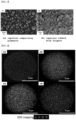
- the capsules prepared in Examples and Comparative Examples were observed under a scanning electron microscope (SEM) ( FIG. 1 ).
- FIG. 1(a) is an image showing the pigment-supported capsules.
- the spray drying method it was possible to support the pigment on the silica and to carry out encapsulation in such a manner that the polymer encapsulates the exterior thereof. Further, it was confirmed through the SEM image shown in FIG. 1 (a) that the capsules were formed as porous polymer.
- FIG. 1(b) showed the state of capsules when the capsules of Example 1 were rubbed with fingers several times, that the pigment was developed as the capsule broke.
- makeup cosmetics in particular, lip makeup cosmetics
- the capsules maintain stability at high temperatures.
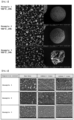
- the capsules of Examples 1 to 3 having different contents of polymer and other pigment were heat-treated in an oven at 100°C for 1 hour or 24 hours, and then the capsule state was observed under a scanning electron microscope (SEM). Observation results are shown in Table 1, FIG. 4 (1-hour heat treatment) and FIG. 5 (24-hour heat treatment).
- SEM scanning electron microscope
- the hardness (cracking or breaking) of the pigment capsules according to the present invention was confirmed by the following method.
- the capsules of Examples 1 to 3 having different contents of polymer and other pigment (polymer content of 10% + other pigment content of 10%, polymer content of 20% + other pigment content of 10%, polymer content of 20% + other pigment content of 50%, respectively) were rubbed with a hand once, 3 times or 7 times, then, it was confirmed whether or not the capsules crack or broke. The cracking or breakage of the capsules was confirmed through SEM.
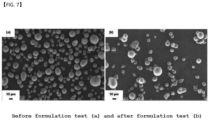
- Lipstick formulations containing the pigment capsules according to the present invention were prepared with the compositions of Table 3 below.
- Formulation (a) contains non-encapsulated Red 27
- Formulations (b) to (d) contain encapsulated Red 27.
- Formulation (b) contains 10% of Red 27 + 5% of polymer
- Formulation (c) contains 10% of Red 27 + 5% of polymer + 1% of citric acid
- Formulation (d) contains 10% of Red 27 + 5% of polymer + 5% of citric acid.
- Lipstick formulations containing the pigment capsules according to the present invention were prepared with the compositions of Table 4 below.
- Formulation (a) contains the capsule of Example 4
- Formulation (b) contains the capsule of Example 5
- Formulation (c) contains the capsule of Example 6
- Formulation (d) contains the capsule of Example 7.
- [Table 4] (unit: wt%)
- Formulation (a) Formulation (b)
- Formulation (c) Formulation (d)
- Caprylic/capric triglyceride 15.0 15.0 15.0 15.0 Red 27 0.1 - - - Capsule - 1.0 1.0 1.0
- a lipstick formulation containing no pigment (Formulation 1), a lipstick formulation containing the pigment capsule (Red 27 Lake) according to the present invention (Formulation 2), and a lipstick formulation containing a non-encapsulated Red 27 Lake (Formulation 3) were prepared with the compositions of Table 5.
- the formulation containing the encapsulated pigment according to the present invention (Formulation 2) showed an exterior color identical to that of the control lipstick containing no pigment (Formulation 1), and also showed excellent color developing ability on the skin identical to the formulation containing the non-capsulated Red 27 dye (Formulation 3).
Landscapes
- Health & Medical Sciences (AREA)
- Life Sciences & Earth Sciences (AREA)
- Veterinary Medicine (AREA)
- Animal Behavior & Ethology (AREA)
- General Health & Medical Sciences (AREA)
- Public Health (AREA)
- Birds (AREA)
- Epidemiology (AREA)
- Chemical & Material Sciences (AREA)
- Inorganic Chemistry (AREA)
- Emergency Medicine (AREA)
- Dermatology (AREA)
- Dispersion Chemistry (AREA)
- Cosmetics (AREA)
- Manufacturing Of Micro-Capsules (AREA)
Claims (8)
- Pigmentkapsel, die ein Pigment umfasst und aus einem Inneren und einer Barrieremembran besteht,wobei Siliciumdioxid, ein Titandioxidpigment und ein anderes Pigment im Inneren dispergiert sind, und die Barrieremembran von einem Polymerbindemittel gebildet wird, das eine Glasübergangstemperatur von 130 °C oder höher aufweist, das ein Acrylat-Copolymer ist,wobei im Inneren der Kapsel eine trivalente C3-C9-Carbonsäure enthalten ist,wobei das andere Pigment ein öllöslicher Farbstoff ist,wobei der Gehalt des anderen Pigments, auf das Gesamtgewicht der Kapsel bezogen, 10 bis 50 Gew.-% beträgt,wobei der Gehalt des Polymerbindemittels, auf das Gesamtgewicht der Kapsel bezogen, 5 bis 20 Gew.-% beträgt,wobei die trivalente C3-C9-Carbonsäure ausgewählt ist aus der Gruppe, bestehend aus Zitronensäure, Iso-Zitronensäure, Aconitsäure, Tricarballylsäure und Trimesinsäure, undwobei der Gehalt der trivalenten C3-C9-Carbonsäure, auf das Gesamtgewicht der Kapsel bezogen, 1 bis 20 Gew.-% beträgt.
- Pigmentkapsel nach Anspruch 1, wobei das Polymerbindemittel ein Copolymer auf Polymethacrylatbasis, vorzugsweise ein Acrylsäure- und Acrylat-Copolymer, bevorzugter ein Acrylsäure- und Methacrylat-Copolymer und insbesondere ein Methacrylsäure- und Methacrylat-Copolymer ist.
- Pigmentkapsel nach Anspruch 1, wobei der Gehalt des Polymerbindemittels, auf das Gesamtgewicht der Kapsel bezogen, 10 bis 20 Gew.-% beträgt.
- Pigmentkapsel nach Anspruch 1, wobei die Kapsel einen durchschnittlichen Durchmesser von 15 bis 25 µm aufweist.
- Verfahren zum Herstellen der Pigmentkapsel nach einem der Ansprüche 1 bis 4, wobei das Verfahren die folgenden Schritte umfasst:1) Auflösen des Polymerbindemittels und der trivalenten C3-C9-Carbonsäure in einem ersten Lösungsmittel, beziehungsweise Auflösen des anderen Pigments in einem zweiten Lösungsmittel, und dann Mischen derselben, um es dem anderen Pigment zu ermöglichen, in der Polymerbindemittellösung zu dispergieren;2) Zugeben des Siliciumdioxids und des Titandioxidpigments zu der gemischten Polymerlösung, in der das andere Pigment dispergiert ist, und Dispergieren des Gemisches;3) Sprühtrocknen der in Schritt 2) erhaltenen Lösung; und4) Erhalten von sprühgetrockneten Pigment-/Polymerbindemittel-Verbundpulverpartikeln.
- Verfahren zum Herstellen einer Pigmentkapsel nach Anspruch 5, wobei das erste Lösungsmittel mindestens ein organisches Lösungsmittel ist, ausgewählt aus der Gruppe bestehend aus einem niedrigeren C1-C4-Alkohol, Aceton und einem Gemisch davon oder einem Gemisch aus dem organischen Lösungsmittel und Wasser.
- Verfahren zum Herstellen einer Pigmentkapsel nach Anspruch 5, wobei das zweite Lösungsmittel ein chlorhaltiges Lösungsmittel auf Kohlenwasserstoffbasis ist.
- Verfahren zum Herstellen einer Pigmentkapsel nach Anspruch 5, wobei das Verhältnis des ersten Lösungsmittels, das verwendet wird, um das Polymer aufzulösen, und des zweiten Lösungsmittels, das verwendet wird, um das andere Pigment aufzulösen, 3:7 beträgt.
Applications Claiming Priority (3)
| Application Number | Priority Date | Filing Date | Title |
|---|---|---|---|
| KR20160126873 | 2016-09-30 | ||
| KR1020170123425A KR102370803B1 (ko) | 2016-09-30 | 2017-09-25 | 색소를 포함하는 캡슐, 및 이의 제조 방법 |
| PCT/KR2017/010589 WO2018062803A1 (ko) | 2016-09-30 | 2017-09-26 | 색소를 포함하는 캡슐, 및 이의 제조 방법 |
Publications (3)
| Publication Number | Publication Date |
|---|---|
| EP3520767A1 EP3520767A1 (de) | 2019-08-07 |
| EP3520767A4 EP3520767A4 (de) | 2020-05-13 |
| EP3520767B1 true EP3520767B1 (de) | 2025-07-02 |
Family
ID=61977810
Family Applications (1)
| Application Number | Title | Priority Date | Filing Date |
|---|---|---|---|
| EP17856689.9A Active EP3520767B1 (de) | 2016-09-30 | 2017-09-26 | Kapseln mit pigmenten und verfahren zur herstellung davon |
Country Status (6)
| Country | Link |
|---|---|
| US (1) | US11234910B2 (de) |
| EP (1) | EP3520767B1 (de) |
| JP (1) | JP7063889B2 (de) |
| KR (1) | KR102370803B1 (de) |
| CN (1) | CN109843247B (de) |
| TW (1) | TWI798184B (de) |
Families Citing this family (3)
| Publication number | Priority date | Publication date | Assignee | Title |
|---|---|---|---|---|
| KR102348052B1 (ko) * | 2019-03-19 | 2022-01-10 | (주)아모레퍼시픽 | 색소 담지 캡슐 조성물 |
| EP4073176B1 (de) | 2019-12-11 | 2025-08-20 | Natura & Co UK Holdings Limited | Zusammensetzungen mit erhöhter farbtonstabilität basierend auf pigmentiertem tio2, organischen pigmenten und metalloxidpartikeln |
| WO2025254745A1 (en) * | 2024-06-05 | 2025-12-11 | L'oreal | Cosmetic composition including a siloxane-treated colorant |
Family Cites Families (28)
| Publication number | Priority date | Publication date | Assignee | Title |
|---|---|---|---|---|
| JPH03293028A (ja) * | 1990-04-10 | 1991-12-24 | Pias Arise Kk | 色素内包マイクロカプセル、及びそのマイクロカプセルを配合した化粧料 |
| JP3435517B2 (ja) * | 1992-09-17 | 2003-08-11 | 麻沼総業株式会社 | 淡色系ネイルエナメルの退色防止方法 |
| US7838037B2 (en) * | 1999-11-17 | 2010-11-23 | Tagra Biotechnologies Ltd. | Method of microencapsulation |
| DE10000223A1 (de) | 2000-01-05 | 2001-07-12 | Basf Ag | Mikrokapselzubereitungen und Mikrokapseln enthaltende Wasch- und Reinigungsmittel |
| US20040242635A1 (en) * | 2001-03-30 | 2004-12-02 | Painter Rachel J. | Encapsulated dyes in cosmetic compositions |
| US6783586B2 (en) | 2001-11-01 | 2004-08-31 | E. I. Du Pont De Nemours And Company | Easy to disperse, high durability TiO2 pigment and method of making same |
| US8168170B2 (en) * | 2002-10-03 | 2012-05-01 | The Procter And Gamble Company | Compositions having an inner core and at least three surrounding layers |
| DE10306604A1 (de) * | 2003-02-18 | 2004-08-26 | Goldschmidt Ag | Kosmetische Zubereitungen mit Wirkstoffen in Mikrokapseln |
| GB2388581A (en) * | 2003-08-22 | 2003-11-19 | Danisco | Coated aqueous beads |
| DE10344660A1 (de) | 2003-09-25 | 2005-04-28 | Merck Patent Gmbh | Verkapselte Pigmente |
| JP2005225766A (ja) * | 2004-02-10 | 2005-08-25 | Noevir Co Ltd | 化粧水 |
| JP4250551B2 (ja) * | 2004-03-02 | 2009-04-08 | 三好化成株式会社 | 化粧料 |
| CA2722681C (en) * | 2008-05-09 | 2013-07-09 | Basf Se | Polymer encapsulated colourants by spray drying |
| KR100978583B1 (ko) * | 2009-09-02 | 2010-08-27 | (주)바이오제닉스 | 화장품용 색조캡슐 조성물, 이의 제조방법 및 이를 이용한 화장품 제제 |
| JP2011079804A (ja) * | 2009-10-09 | 2011-04-21 | Daito Kasei Kogyo Kk | 顔料内包マイクロカプセル及びこれを配合した化粧料 |
| KR101261784B1 (ko) * | 2010-06-16 | 2013-05-09 | 한국콜마주식회사 | 유기자외선 차단제가 담지된 기능성 pmma복합안료, 그 제조방법 및 이를 함유하는 자외선 차단용 화장료 조성물 |
| KR20130079244A (ko) * | 2011-12-26 | 2013-07-10 | 코웨이 주식회사 | 다중 코팅 이산화탄소 발생 캡슐, 이의 제조방법 및 이의 용도 |
| WO2013106996A1 (en) * | 2012-01-17 | 2013-07-25 | L'oreal | Colour changing composition in gel form |
| CN104168870B (zh) * | 2012-01-17 | 2017-04-19 | 欧莱雅 | 凝胶形式的变色组合物 |
| KR101342958B1 (ko) * | 2013-08-08 | 2013-12-18 | (주)바이오제닉스 | 수난용성 물질을 이용한 안정한 삼중층 캡슐, 이의 제조방법 및 이를 이용한 화장품 조성물 |
| CN104418972B (zh) | 2013-08-26 | 2017-04-05 | 中国科学院化学研究所 | 光子晶体胶囊颜料及其制备方法和应用 |
| WO2015044306A1 (en) | 2013-09-30 | 2015-04-02 | Dsm Ip Assets B.V. | Topical sun screen compositions titanium dioxide and silica |
| WO2015132791A1 (en) * | 2014-03-04 | 2015-09-11 | Tagra Biotechnologies Ltd. | Colorant-containing microcapsules |
| EP2939653A1 (de) * | 2014-04-30 | 2015-11-04 | L'Oréal | Zusammensetzung mit Mikrokapseln mit Partikeln mit einem hohen Nasspunkt |
| EP2939655A1 (de) * | 2014-04-30 | 2015-11-04 | L'Oréal | Zusammensetzung mit Mikrokapseln, die reflektierende Teilchen enthalten |
| CN105062134A (zh) * | 2015-08-18 | 2015-11-18 | 江西省农业科学院农产品质量安全与标准研究所 | 一种增强红曲黄色素光稳定性的方法 |
| GB201520301D0 (en) | 2015-11-18 | 2015-12-30 | Tan Safe Ltd | Sun protective compositions |
| KR102370804B1 (ko) * | 2016-09-30 | 2022-03-07 | (주)아모레퍼시픽 | 색소를 포함하는 캡슐을 함유하는 메이크업 화장료 조성물 |
-
2017
- 2017-09-25 KR KR1020170123425A patent/KR102370803B1/ko not_active Expired - Fee Related
- 2017-09-26 CN CN201780061051.7A patent/CN109843247B/zh active Active
- 2017-09-26 EP EP17856689.9A patent/EP3520767B1/de active Active
- 2017-09-26 US US16/338,392 patent/US11234910B2/en active Active
- 2017-09-26 JP JP2019516999A patent/JP7063889B2/ja active Active
- 2017-09-29 TW TW106133729A patent/TWI798184B/zh active
Non-Patent Citations (2)
| Title |
|---|
| GLENN SIME: "A Closer Look: Techniques for Obtaining Glass Transition Temperature of Polymeric Materials", 14 November 2013 (2013-11-14), XP055260861, Retrieved from the Internet <URL:https://web.archive.org/web/20131114105747/http://www.intertek.com/blog/2013-04-15-glass-transition-temperature/> [retrieved on 20160324] * |
| HIRATA T ET AL: "DSC, DTA, and TG of cellulose untreated and treated with flame-retardants", THERMOCHIMICA ACTA, ELSEVIER SCIENCE PUBLISHERS, AMSTERDAM, NL, vol. 193, 14 December 1991 (1991-12-14), pages 99 - 106, XP026575995, ISSN: 0040-6031, [retrieved on 19911214], DOI: 10.1016/0040-6031(91)80177-K * |
Also Published As
| Publication number | Publication date |
|---|---|
| CN109843247B (zh) | 2022-03-01 |
| KR102370803B1 (ko) | 2022-03-07 |
| US11234910B2 (en) | 2022-02-01 |
| JP7063889B2 (ja) | 2022-05-17 |
| TWI798184B (zh) | 2023-04-11 |
| TW201815374A (zh) | 2018-05-01 |
| US20200022888A1 (en) | 2020-01-23 |
| KR20180036561A (ko) | 2018-04-09 |
| JP2019534253A (ja) | 2019-11-28 |
| CN109843247A (zh) | 2019-06-04 |
| EP3520767A1 (de) | 2019-08-07 |
| EP3520767A4 (de) | 2020-05-13 |
Similar Documents
| Publication | Publication Date | Title |
|---|---|---|
| EP1765276B1 (de) | Bruchfeste verkapselte farbstoffe für ein natürliches hauterscheinungsbild | |
| CN105326649B (zh) | 一种变色胶囊 | |
| KR20140117256A (ko) | 흑색 안료를 포함하는 마이크로캡슐 | |
| BRPI0712252A2 (pt) | micropartìculas coloridas resistentes a vazamento | |
| US11234910B2 (en) | Capsules comprising pigments, and method for producing same | |
| JP6945809B2 (ja) | 固形粉末化粧料 | |
| CN114224747B (zh) | 改性粉体及其制备方法、包括改性粉体的化妆品 | |
| EP1758550A2 (de) | Kosmetisches präparat enthaltend ein metallpigment | |
| US10864146B2 (en) | Makeup cosmetic composition containing capsules containing pigments | |
| US10646423B2 (en) | Cosmetic product having excellent UV-blocking effect and manufacturing method thereof | |
| US8071078B2 (en) | Encapsulated colorants for natural skin appearance | |
| WO2018062932A1 (ko) | 색소를 포함하는 캡슐을 함유하는 메이크업 화장료 조성물 | |
| KR102348052B1 (ko) | 색소 담지 캡슐 조성물 | |
| JP7609597B2 (ja) | 液状一時染毛剤組成物 | |
| EP1596814B1 (de) | Partikuläre farbzusammensetzung und ihre anwendung in körperpflegeprodukten | |
| EP4162922A1 (de) | Kosmetische zusammensetzung | |
| WO2018062803A1 (ko) | 색소를 포함하는 캡슐, 및 이의 제조 방법 | |
| KR101905021B1 (ko) | 화장료용 색소 또는 기능성 성분을 함유하는 다중캡슐 및 이의 제조방법 | |
| JPS62263112A (ja) | シエラツクを壁膜材となす着色料のマイクロカプセル含有皮膚化粧料 | |
| HK40006505B (zh) | 含有包含色素的胶囊的化妆用化妆料组合物 |
Legal Events
| Date | Code | Title | Description |
|---|---|---|---|
| STAA | Information on the status of an ep patent application or granted ep patent |
Free format text: STATUS: THE INTERNATIONAL PUBLICATION HAS BEEN MADE |
|
| PUAI | Public reference made under article 153(3) epc to a published international application that has entered the european phase |
Free format text: ORIGINAL CODE: 0009012 |
|
| STAA | Information on the status of an ep patent application or granted ep patent |
Free format text: STATUS: REQUEST FOR EXAMINATION WAS MADE |
|
| 17P | Request for examination filed |
Effective date: 20190329 |
|
| AK | Designated contracting states |
Kind code of ref document: A1 Designated state(s): AL AT BE BG CH CY CZ DE DK EE ES FI FR GB GR HR HU IE IS IT LI LT LU LV MC MK MT NL NO PL PT RO RS SE SI SK SM TR |
|
| AX | Request for extension of the european patent |
Extension state: BA ME |
|
| DAV | Request for validation of the european patent (deleted) | ||
| DAX | Request for extension of the european patent (deleted) | ||
| A4 | Supplementary search report drawn up and despatched |
Effective date: 20200414 |
|
| RIC1 | Information provided on ipc code assigned before grant |
Ipc: A61K 8/25 20060101ALI20200406BHEP Ipc: A61K 8/11 20060101AFI20200406BHEP Ipc: A61K 8/29 20060101ALI20200406BHEP Ipc: A61Q 1/06 20060101ALI20200406BHEP Ipc: A61K 8/362 20060101ALI20200406BHEP Ipc: A61Q 19/00 20060101ALI20200406BHEP Ipc: A61K 8/81 20060101ALI20200406BHEP |
|
| STAA | Information on the status of an ep patent application or granted ep patent |
Free format text: STATUS: EXAMINATION IS IN PROGRESS |
|
| 17Q | First examination report despatched |
Effective date: 20211108 |
|
| GRAP | Despatch of communication of intention to grant a patent |
Free format text: ORIGINAL CODE: EPIDOSNIGR1 |
|
| STAA | Information on the status of an ep patent application or granted ep patent |
Free format text: STATUS: GRANT OF PATENT IS INTENDED |
|
| INTG | Intention to grant announced |
Effective date: 20250407 |
|
| GRAS | Grant fee paid |
Free format text: ORIGINAL CODE: EPIDOSNIGR3 |
|
| GRAA | (expected) grant |
Free format text: ORIGINAL CODE: 0009210 |
|
| STAA | Information on the status of an ep patent application or granted ep patent |
Free format text: STATUS: THE PATENT HAS BEEN GRANTED |
|
| AK | Designated contracting states |
Kind code of ref document: B1 Designated state(s): AL AT BE BG CH CY CZ DE DK EE ES FI FR GB GR HR HU IE IS IT LI LT LU LV MC MK MT NL NO PL PT RO RS SE SI SK SM TR |
|
| REG | Reference to a national code |
Ref country code: GB Ref legal event code: FG4D |
|
| REG | Reference to a national code |
Ref country code: CH Ref legal event code: EP |
|
| REG | Reference to a national code |
Ref country code: DE Ref legal event code: R096 Ref document number: 602017090347 Country of ref document: DE |
|
| REG | Reference to a national code |
Ref country code: IE Ref legal event code: FG4D |
|
| PGFP | Annual fee paid to national office [announced via postgrant information from national office to epo] |
Ref country code: GB Payment date: 20250731 Year of fee payment: 9 |
|
| PGFP | Annual fee paid to national office [announced via postgrant information from national office to epo] |
Ref country code: FR Payment date: 20250731 Year of fee payment: 9 |
|
| REG | Reference to a national code |
Ref country code: NL Ref legal event code: MP Effective date: 20250702 |
|
| PG25 | Lapsed in a contracting state [announced via postgrant information from national office to epo] |
Ref country code: PT Free format text: LAPSE BECAUSE OF FAILURE TO SUBMIT A TRANSLATION OF THE DESCRIPTION OR TO PAY THE FEE WITHIN THE PRESCRIBED TIME-LIMIT Effective date: 20251103 |
|
| PG25 | Lapsed in a contracting state [announced via postgrant information from national office to epo] |
Ref country code: NL Free format text: LAPSE BECAUSE OF FAILURE TO SUBMIT A TRANSLATION OF THE DESCRIPTION OR TO PAY THE FEE WITHIN THE PRESCRIBED TIME-LIMIT Effective date: 20250702 |
|
| REG | Reference to a national code |
Ref country code: AT Ref legal event code: MK05 Ref document number: 1808464 Country of ref document: AT Kind code of ref document: T Effective date: 20250702 |
|
| PG25 | Lapsed in a contracting state [announced via postgrant information from national office to epo] |
Ref country code: IS Free format text: LAPSE BECAUSE OF FAILURE TO SUBMIT A TRANSLATION OF THE DESCRIPTION OR TO PAY THE FEE WITHIN THE PRESCRIBED TIME-LIMIT Effective date: 20251102 |
|
| PG25 | Lapsed in a contracting state [announced via postgrant information from national office to epo] |
Ref country code: NO Free format text: LAPSE BECAUSE OF FAILURE TO SUBMIT A TRANSLATION OF THE DESCRIPTION OR TO PAY THE FEE WITHIN THE PRESCRIBED TIME-LIMIT Effective date: 20251002 |
|
| REG | Reference to a national code |
Ref country code: LT Ref legal event code: MG9D |
|
| PG25 | Lapsed in a contracting state [announced via postgrant information from national office to epo] |
Ref country code: AT Free format text: LAPSE BECAUSE OF FAILURE TO SUBMIT A TRANSLATION OF THE DESCRIPTION OR TO PAY THE FEE WITHIN THE PRESCRIBED TIME-LIMIT Effective date: 20250702 |
|
| PG25 | Lapsed in a contracting state [announced via postgrant information from national office to epo] |
Ref country code: FI Free format text: LAPSE BECAUSE OF FAILURE TO SUBMIT A TRANSLATION OF THE DESCRIPTION OR TO PAY THE FEE WITHIN THE PRESCRIBED TIME-LIMIT Effective date: 20250702 |
|
| PG25 | Lapsed in a contracting state [announced via postgrant information from national office to epo] |
Ref country code: HR Free format text: LAPSE BECAUSE OF FAILURE TO SUBMIT A TRANSLATION OF THE DESCRIPTION OR TO PAY THE FEE WITHIN THE PRESCRIBED TIME-LIMIT Effective date: 20250702 |
|
| PG25 | Lapsed in a contracting state [announced via postgrant information from national office to epo] |
Ref country code: GR Free format text: LAPSE BECAUSE OF FAILURE TO SUBMIT A TRANSLATION OF THE DESCRIPTION OR TO PAY THE FEE WITHIN THE PRESCRIBED TIME-LIMIT Effective date: 20251003 |
|
| PG25 | Lapsed in a contracting state [announced via postgrant information from national office to epo] |
Ref country code: CZ Free format text: LAPSE BECAUSE OF FAILURE TO SUBMIT A TRANSLATION OF THE DESCRIPTION OR TO PAY THE FEE WITHIN THE PRESCRIBED TIME-LIMIT Effective date: 20250702 Ref country code: SE Free format text: LAPSE BECAUSE OF FAILURE TO SUBMIT A TRANSLATION OF THE DESCRIPTION OR TO PAY THE FEE WITHIN THE PRESCRIBED TIME-LIMIT Effective date: 20250702 |
|
| PG25 | Lapsed in a contracting state [announced via postgrant information from national office to epo] |
Ref country code: LV Free format text: LAPSE BECAUSE OF FAILURE TO SUBMIT A TRANSLATION OF THE DESCRIPTION OR TO PAY THE FEE WITHIN THE PRESCRIBED TIME-LIMIT Effective date: 20250702 |
|
| PG25 | Lapsed in a contracting state [announced via postgrant information from national office to epo] |
Ref country code: PL Free format text: LAPSE BECAUSE OF FAILURE TO SUBMIT A TRANSLATION OF THE DESCRIPTION OR TO PAY THE FEE WITHIN THE PRESCRIBED TIME-LIMIT Effective date: 20250702 Ref country code: BG Free format text: LAPSE BECAUSE OF FAILURE TO SUBMIT A TRANSLATION OF THE DESCRIPTION OR TO PAY THE FEE WITHIN THE PRESCRIBED TIME-LIMIT Effective date: 20250702 |
|
| PG25 | Lapsed in a contracting state [announced via postgrant information from national office to epo] |
Ref country code: RS Free format text: LAPSE BECAUSE OF FAILURE TO SUBMIT A TRANSLATION OF THE DESCRIPTION OR TO PAY THE FEE WITHIN THE PRESCRIBED TIME-LIMIT Effective date: 20251002 |
|
| PG25 | Lapsed in a contracting state [announced via postgrant information from national office to epo] |
Ref country code: ES Free format text: LAPSE BECAUSE OF FAILURE TO SUBMIT A TRANSLATION OF THE DESCRIPTION OR TO PAY THE FEE WITHIN THE PRESCRIBED TIME-LIMIT Effective date: 20250702 |
|
| PG25 | Lapsed in a contracting state [announced via postgrant information from national office to epo] |
Ref country code: RO Free format text: LAPSE BECAUSE OF FAILURE TO SUBMIT A TRANSLATION OF THE DESCRIPTION OR TO PAY THE FEE WITHIN THE PRESCRIBED TIME-LIMIT Effective date: 20250702 |
|
| PG25 | Lapsed in a contracting state [announced via postgrant information from national office to epo] |
Ref country code: SM Free format text: LAPSE BECAUSE OF FAILURE TO SUBMIT A TRANSLATION OF THE DESCRIPTION OR TO PAY THE FEE WITHIN THE PRESCRIBED TIME-LIMIT Effective date: 20250702 |
|
| PG25 | Lapsed in a contracting state [announced via postgrant information from national office to epo] |
Ref country code: DK Free format text: LAPSE BECAUSE OF FAILURE TO SUBMIT A TRANSLATION OF THE DESCRIPTION OR TO PAY THE FEE WITHIN THE PRESCRIBED TIME-LIMIT Effective date: 20250702 |
|
| PG25 | Lapsed in a contracting state [announced via postgrant information from national office to epo] |
Ref country code: IT Free format text: LAPSE BECAUSE OF FAILURE TO SUBMIT A TRANSLATION OF THE DESCRIPTION OR TO PAY THE FEE WITHIN THE PRESCRIBED TIME-LIMIT Effective date: 20250702 |
|
| PG25 | Lapsed in a contracting state [announced via postgrant information from national office to epo] |
Ref country code: SK Free format text: LAPSE BECAUSE OF FAILURE TO SUBMIT A TRANSLATION OF THE DESCRIPTION OR TO PAY THE FEE WITHIN THE PRESCRIBED TIME-LIMIT Effective date: 20250702 Ref country code: EE Free format text: LAPSE BECAUSE OF FAILURE TO SUBMIT A TRANSLATION OF THE DESCRIPTION OR TO PAY THE FEE WITHIN THE PRESCRIBED TIME-LIMIT Effective date: 20250702 |
|
| REG | Reference to a national code |
Ref country code: CH Ref legal event code: H13 Free format text: ST27 STATUS EVENT CODE: U-0-0-H10-H13 (AS PROVIDED BY THE NATIONAL OFFICE) Effective date: 20260504 |
|
| PLBE | No opposition filed within time limit |
Free format text: ORIGINAL CODE: 0009261 |
|
| STAA | Information on the status of an ep patent application or granted ep patent |
Free format text: STATUS: NO OPPOSITION FILED WITHIN TIME LIMIT |