EP3512959B1 - Methods for performing multiplexed pcr - Google Patents
Methods for performing multiplexed pcr Download PDFInfo
- Publication number
- EP3512959B1 EP3512959B1 EP17768765.4A EP17768765A EP3512959B1 EP 3512959 B1 EP3512959 B1 EP 3512959B1 EP 17768765 A EP17768765 A EP 17768765A EP 3512959 B1 EP3512959 B1 EP 3512959B1
- Authority
- EP
- European Patent Office
- Prior art keywords
- nucleic acid
- oligonucleotide
- tag portion
- quenching
- target nucleic
- Prior art date
- Legal status (The legal status is an assumption and is not a legal conclusion. Google has not performed a legal analysis and makes no representation as to the accuracy of the status listed.)
- Active
Links
Images



Classifications
-
- C—CHEMISTRY; METALLURGY
- C12—BIOCHEMISTRY; BEER; SPIRITS; WINE; VINEGAR; MICROBIOLOGY; ENZYMOLOGY; MUTATION OR GENETIC ENGINEERING
- C12Q—MEASURING OR TESTING PROCESSES INVOLVING ENZYMES, NUCLEIC ACIDS OR MICROORGANISMS; COMPOSITIONS OR TEST PAPERS THEREFOR; PROCESSES OF PREPARING SUCH COMPOSITIONS; CONDITION-RESPONSIVE CONTROL IN MICROBIOLOGICAL OR ENZYMOLOGICAL PROCESSES
- C12Q1/00—Measuring or testing processes involving enzymes, nucleic acids or microorganisms; Compositions therefor; Processes of preparing such compositions
- C12Q1/68—Measuring or testing processes involving enzymes, nucleic acids or microorganisms; Compositions therefor; Processes of preparing such compositions involving nucleic acids
- C12Q1/6844—Nucleic acid amplification reactions
- C12Q1/686—Polymerase chain reaction [PCR]
-
- C—CHEMISTRY; METALLURGY
- C12—BIOCHEMISTRY; BEER; SPIRITS; WINE; VINEGAR; MICROBIOLOGY; ENZYMOLOGY; MUTATION OR GENETIC ENGINEERING
- C12Q—MEASURING OR TESTING PROCESSES INVOLVING ENZYMES, NUCLEIC ACIDS OR MICROORGANISMS; COMPOSITIONS OR TEST PAPERS THEREFOR; PROCESSES OF PREPARING SUCH COMPOSITIONS; CONDITION-RESPONSIVE CONTROL IN MICROBIOLOGICAL OR ENZYMOLOGICAL PROCESSES
- C12Q1/00—Measuring or testing processes involving enzymes, nucleic acids or microorganisms; Compositions therefor; Processes of preparing such compositions
- C12Q1/68—Measuring or testing processes involving enzymes, nucleic acids or microorganisms; Compositions therefor; Processes of preparing such compositions involving nucleic acids
- C12Q1/6804—Nucleic acid analysis using immunogens
-
- C—CHEMISTRY; METALLURGY
- C12—BIOCHEMISTRY; BEER; SPIRITS; WINE; VINEGAR; MICROBIOLOGY; ENZYMOLOGY; MUTATION OR GENETIC ENGINEERING
- C12Q—MEASURING OR TESTING PROCESSES INVOLVING ENZYMES, NUCLEIC ACIDS OR MICROORGANISMS; COMPOSITIONS OR TEST PAPERS THEREFOR; PROCESSES OF PREPARING SUCH COMPOSITIONS; CONDITION-RESPONSIVE CONTROL IN MICROBIOLOGICAL OR ENZYMOLOGICAL PROCESSES
- C12Q1/00—Measuring or testing processes involving enzymes, nucleic acids or microorganisms; Compositions therefor; Processes of preparing such compositions
- C12Q1/68—Measuring or testing processes involving enzymes, nucleic acids or microorganisms; Compositions therefor; Processes of preparing such compositions involving nucleic acids
- C12Q1/6811—Selection methods for production or design of target specific oligonucleotides or binding molecules
-
- C—CHEMISTRY; METALLURGY
- C12—BIOCHEMISTRY; BEER; SPIRITS; WINE; VINEGAR; MICROBIOLOGY; ENZYMOLOGY; MUTATION OR GENETIC ENGINEERING
- C12Q—MEASURING OR TESTING PROCESSES INVOLVING ENZYMES, NUCLEIC ACIDS OR MICROORGANISMS; COMPOSITIONS OR TEST PAPERS THEREFOR; PROCESSES OF PREPARING SUCH COMPOSITIONS; CONDITION-RESPONSIVE CONTROL IN MICROBIOLOGICAL OR ENZYMOLOGICAL PROCESSES
- C12Q1/00—Measuring or testing processes involving enzymes, nucleic acids or microorganisms; Compositions therefor; Processes of preparing such compositions
- C12Q1/68—Measuring or testing processes involving enzymes, nucleic acids or microorganisms; Compositions therefor; Processes of preparing such compositions involving nucleic acids
- C12Q1/6813—Hybridisation assays
- C12Q1/6816—Hybridisation assays characterised by the detection means
- C12Q1/6818—Hybridisation assays characterised by the detection means involving interaction of two or more labels, e.g. resonant energy transfer
-
- C—CHEMISTRY; METALLURGY
- C12—BIOCHEMISTRY; BEER; SPIRITS; WINE; VINEGAR; MICROBIOLOGY; ENZYMOLOGY; MUTATION OR GENETIC ENGINEERING
- C12Q—MEASURING OR TESTING PROCESSES INVOLVING ENZYMES, NUCLEIC ACIDS OR MICROORGANISMS; COMPOSITIONS OR TEST PAPERS THEREFOR; PROCESSES OF PREPARING SUCH COMPOSITIONS; CONDITION-RESPONSIVE CONTROL IN MICROBIOLOGICAL OR ENZYMOLOGICAL PROCESSES
- C12Q1/00—Measuring or testing processes involving enzymes, nucleic acids or microorganisms; Compositions therefor; Processes of preparing such compositions
- C12Q1/68—Measuring or testing processes involving enzymes, nucleic acids or microorganisms; Compositions therefor; Processes of preparing such compositions involving nucleic acids
- C12Q1/6813—Hybridisation assays
- C12Q1/6816—Hybridisation assays characterised by the detection means
- C12Q1/6823—Release of bound markers
-
- C—CHEMISTRY; METALLURGY
- C12—BIOCHEMISTRY; BEER; SPIRITS; WINE; VINEGAR; MICROBIOLOGY; ENZYMOLOGY; MUTATION OR GENETIC ENGINEERING
- C12Q—MEASURING OR TESTING PROCESSES INVOLVING ENZYMES, NUCLEIC ACIDS OR MICROORGANISMS; COMPOSITIONS OR TEST PAPERS THEREFOR; PROCESSES OF PREPARING SUCH COMPOSITIONS; CONDITION-RESPONSIVE CONTROL IN MICROBIOLOGICAL OR ENZYMOLOGICAL PROCESSES
- C12Q1/00—Measuring or testing processes involving enzymes, nucleic acids or microorganisms; Compositions therefor; Processes of preparing such compositions
- C12Q1/68—Measuring or testing processes involving enzymes, nucleic acids or microorganisms; Compositions therefor; Processes of preparing such compositions involving nucleic acids
- C12Q1/6813—Hybridisation assays
- C12Q1/6834—Enzymatic or biochemical coupling of nucleic acids to a solid phase
- C12Q1/6837—Enzymatic or biochemical coupling of nucleic acids to a solid phase using probe arrays or probe chips
-
- C—CHEMISTRY; METALLURGY
- C12—BIOCHEMISTRY; BEER; SPIRITS; WINE; VINEGAR; MICROBIOLOGY; ENZYMOLOGY; MUTATION OR GENETIC ENGINEERING
- C12Q—MEASURING OR TESTING PROCESSES INVOLVING ENZYMES, NUCLEIC ACIDS OR MICROORGANISMS; COMPOSITIONS OR TEST PAPERS THEREFOR; PROCESSES OF PREPARING SUCH COMPOSITIONS; CONDITION-RESPONSIVE CONTROL IN MICROBIOLOGICAL OR ENZYMOLOGICAL PROCESSES
- C12Q1/00—Measuring or testing processes involving enzymes, nucleic acids or microorganisms; Compositions therefor; Processes of preparing such compositions
- C12Q1/68—Measuring or testing processes involving enzymes, nucleic acids or microorganisms; Compositions therefor; Processes of preparing such compositions involving nucleic acids
- C12Q1/6876—Nucleic acid products used in the analysis of nucleic acids, e.g. primers or probes
- C12Q1/6883—Nucleic acid products used in the analysis of nucleic acids, e.g. primers or probes for diseases caused by alterations of genetic material
-
- C—CHEMISTRY; METALLURGY
- C12—BIOCHEMISTRY; BEER; SPIRITS; WINE; VINEGAR; MICROBIOLOGY; ENZYMOLOGY; MUTATION OR GENETIC ENGINEERING
- C12Q—MEASURING OR TESTING PROCESSES INVOLVING ENZYMES, NUCLEIC ACIDS OR MICROORGANISMS; COMPOSITIONS OR TEST PAPERS THEREFOR; PROCESSES OF PREPARING SUCH COMPOSITIONS; CONDITION-RESPONSIVE CONTROL IN MICROBIOLOGICAL OR ENZYMOLOGICAL PROCESSES
- C12Q2525/00—Reactions involving modified oligonucleotides, nucleic acids, or nucleotides
- C12Q2525/10—Modifications characterised by
- C12Q2525/161—Modifications characterised by incorporating target specific and non-target specific sites
-
- C—CHEMISTRY; METALLURGY
- C12—BIOCHEMISTRY; BEER; SPIRITS; WINE; VINEGAR; MICROBIOLOGY; ENZYMOLOGY; MUTATION OR GENETIC ENGINEERING
- C12Q—MEASURING OR TESTING PROCESSES INVOLVING ENZYMES, NUCLEIC ACIDS OR MICROORGANISMS; COMPOSITIONS OR TEST PAPERS THEREFOR; PROCESSES OF PREPARING SUCH COMPOSITIONS; CONDITION-RESPONSIVE CONTROL IN MICROBIOLOGICAL OR ENZYMOLOGICAL PROCESSES
- C12Q2527/00—Reactions demanding special reaction conditions
- C12Q2527/107—Temperature of melting, i.e. Tm
-
- C—CHEMISTRY; METALLURGY
- C12—BIOCHEMISTRY; BEER; SPIRITS; WINE; VINEGAR; MICROBIOLOGY; ENZYMOLOGY; MUTATION OR GENETIC ENGINEERING
- C12Q—MEASURING OR TESTING PROCESSES INVOLVING ENZYMES, NUCLEIC ACIDS OR MICROORGANISMS; COMPOSITIONS OR TEST PAPERS THEREFOR; PROCESSES OF PREPARING SUCH COMPOSITIONS; CONDITION-RESPONSIVE CONTROL IN MICROBIOLOGICAL OR ENZYMOLOGICAL PROCESSES
- C12Q2531/00—Reactions of nucleic acids characterised by
- C12Q2531/10—Reactions of nucleic acids characterised by the purpose being amplify/increase the copy number of target nucleic acid
- C12Q2531/113—PCR
-
- C—CHEMISTRY; METALLURGY
- C12—BIOCHEMISTRY; BEER; SPIRITS; WINE; VINEGAR; MICROBIOLOGY; ENZYMOLOGY; MUTATION OR GENETIC ENGINEERING
- C12Q—MEASURING OR TESTING PROCESSES INVOLVING ENZYMES, NUCLEIC ACIDS OR MICROORGANISMS; COMPOSITIONS OR TEST PAPERS THEREFOR; PROCESSES OF PREPARING SUCH COMPOSITIONS; CONDITION-RESPONSIVE CONTROL IN MICROBIOLOGICAL OR ENZYMOLOGICAL PROCESSES
- C12Q2537/00—Reactions characterised by the reaction format or use of a specific feature
- C12Q2537/10—Reactions characterised by the reaction format or use of a specific feature the purpose or use of
- C12Q2537/143—Multiplexing, i.e. use of multiple primers or probes in a single reaction, usually for simultaneously analyse of multiple analysis
-
- C—CHEMISTRY; METALLURGY
- C12—BIOCHEMISTRY; BEER; SPIRITS; WINE; VINEGAR; MICROBIOLOGY; ENZYMOLOGY; MUTATION OR GENETIC ENGINEERING
- C12Q—MEASURING OR TESTING PROCESSES INVOLVING ENZYMES, NUCLEIC ACIDS OR MICROORGANISMS; COMPOSITIONS OR TEST PAPERS THEREFOR; PROCESSES OF PREPARING SUCH COMPOSITIONS; CONDITION-RESPONSIVE CONTROL IN MICROBIOLOGICAL OR ENZYMOLOGICAL PROCESSES
- C12Q2561/00—Nucleic acid detection characterised by assay method
- C12Q2561/113—Real time assay
-
- C—CHEMISTRY; METALLURGY
- C12—BIOCHEMISTRY; BEER; SPIRITS; WINE; VINEGAR; MICROBIOLOGY; ENZYMOLOGY; MUTATION OR GENETIC ENGINEERING
- C12Q—MEASURING OR TESTING PROCESSES INVOLVING ENZYMES, NUCLEIC ACIDS OR MICROORGANISMS; COMPOSITIONS OR TEST PAPERS THEREFOR; PROCESSES OF PREPARING SUCH COMPOSITIONS; CONDITION-RESPONSIVE CONTROL IN MICROBIOLOGICAL OR ENZYMOLOGICAL PROCESSES
- C12Q2565/00—Nucleic acid analysis characterised by mode or means of detection
- C12Q2565/10—Detection mode being characterised by the assay principle
- C12Q2565/101—Interaction between at least two labels
-
- C—CHEMISTRY; METALLURGY
- C12—BIOCHEMISTRY; BEER; SPIRITS; WINE; VINEGAR; MICROBIOLOGY; ENZYMOLOGY; MUTATION OR GENETIC ENGINEERING
- C12Q—MEASURING OR TESTING PROCESSES INVOLVING ENZYMES, NUCLEIC ACIDS OR MICROORGANISMS; COMPOSITIONS OR TEST PAPERS THEREFOR; PROCESSES OF PREPARING SUCH COMPOSITIONS; CONDITION-RESPONSIVE CONTROL IN MICROBIOLOGICAL OR ENZYMOLOGICAL PROCESSES
- C12Q2600/00—Oligonucleotides characterized by their use
- C12Q2600/16—Primer sets for multiplex assays
Definitions
- the present invention relates to methods for polymerase chain reaction (PCR) particularly to methods for performing multiplexed PCR.
- PCR polymerase chain reaction
- PCR polymerase chain reaction
- a "real-time" PCR assay is able to simultaneously amplify and detect and quantify the starting amount of the target sequence.
- a typical real-time PCR protocol involves the use of a labeled probe, specific for each target sequence.
- the probe is preferably labeled with one or more fluorescent moieties, which absorb and emit light at specific wavelengths.
- the probe Upon hybridizing to the target sequence or its amplicon, the probe exhibits a detectable change in fluorescent emission as a result of probe hybridization or hydrolysis.
- PCR assay The major challenge of a PCR assay however remains the ability to analyze numerous targets in a single tube.
- the number of loci of interest increases rapidly. For example, multiple loci must be analyzed in forensic DNA profiling, pathogenic microorganism detection, multi-locus genetic disease screening and multi-gene expression studies, to name a few.
- the ability to multiplex an assay is limited by the detection instruments. Specifically, the use of multiple probes in the same reaction requires the use of distinct fluorescent labels. To simultaneously detect multiple probes, an instrument must be able to discriminate among the light signals emitted by each probe.
- the majority of current technologies on the market do not permit detection of more than four to seven separate wavelengths in the same reaction vessel. Therefore, using one uniquely-labeled probe per target, no more than four to seven separate targets can be detected in the same vessel.
- at least one target is usually a control nucleic acid. Accordingly, in practice, no more than three to six experimental targets can be detected in the same tube.
- fluorescent dyes are also limited due to the spectral width where only about six or seven dyes can be fit within the visible spectrum without significant overlap interference. Thus the ability to multiplex an assay will not keep pace with the clinical needs, unless radical changes in the amplification and detection strategy are made.
- a post-PCR melting assay An additional ability to multiplex an amplification reaction is provided by a post-PCR melting assay. See U.S. patent application Serial No. 11/474,071, filed on June 23, 2006 .
- the amplified nucleic acid is identified by its unique melting profile.
- a melting assay involves determining the melting temperature (melting point) of a double-stranded target, or a duplex between the labeled probe and the target. As described in U.S. Patent No. 5,871,908 , to determine melting temperature using a fluorescently labeled probe, a duplex between the target nucleic acid and the probe is gradually heated (or cooled) in a controlled temperature program.
- the dissociation of the duplex changes the distance between interacting fluorophores or between a fluorophore and a quencher.
- the interacting fluorophores may be conjugated to separate probe molecules, as described in U.S. Patent No. 6,174,670 .
- one fluorophore may be conjugated to a probe, while the other fluorophore may be intercalated into a nucleic acid duplex, as described in U.S. Patent No. 5,871,908 .
- the fluorophores may be conjugated to a single probe oligonucleotide. Upon the melting of the duplex, the fluorescence is quenched as the fluorophore to the quencher are brought together in the now single-stranded probe.
- the melting of the nucleic acid duplex is monitored by measuring the associated change in fluorescence.
- the change in fluorescence may be represented on a graph referred to as "melting profile.”
- melting profile a graph referred to as "melting profile.”
- different probe-target duplexes may be designed to melt (or reanneal) at different temperatures, each probe will generate a unique melting profile.
- Properly designed probes would have melting temperatures that are clearly distinguishable from those of the other probes in the same assay.
- Many existing software tools enable one to design probes for a same-tube multiplex assay with these goals in mind. For example, Visual OMPTM software (DNA Software, Inc., Ann Arbor, Mich.) enables one to determine melting temperatures of nucleic acid duplexes under various reaction conditions.
- the post-amplification melting assay is most commonly used for qualitative purposes, i.e. to identify target nucleic acids, see U.S. Patent Nos. 6,174,670 , 6,427,156 and 5,871,908 . It is known to obtain a melting peak by differentiating the melting curve function. Ririe et al. ("Product differentiation by analysis of DNA melting curves during the polymerase chain reaction," (1997) Anal. Biochem. 245:154-160 ) observed that differentiation helps resolve melting curves generated by mixtures of products. After differentiation, the melting peaks generated by each component of the mixture become easily distinguishable. It was also previously known that the post-amplification melting signal, i.e. melting peak, is higher in proportion to the amount of the nucleic acid in the sample.
- U.S. Patent No. 6,245,514 teaches a post-amplification melt assay using a duplex-intercalating dye, to generate a derivative melting peak, and then, using proprietary software, to integrate the peak.
- the integration provides information about the efficiency of amplification and relative amount of the amplified nucleic acid.
- Patent No. 8,133,701 More recently, improved methods to perform multiplexed nucleic acid target identification by using structure based oligonucleotide probe cleavage have been described in U.S. Patent Application Publication No. 2014/0272955 , U.S. 2015/0176075 , and U.S. 2015/0376681 . Further methods to detect target nucleic acid sequence from DNA or a mixture of nucleic acid by the use of a combination of "Probing and Tagging Oligonucleotide” (PTO) and “Capturing and Templating Oligonucleotide” (CTO) in a so-called PTO Cleavage and Extension assay have been described by Chun et al.
- PTO Probing and Tagging Oligonucleotide
- CTO Capturing and Templating Oligonucleotide
- the present invention provides for novel methods for nucleic acid sequence detection, particularly detection of multiple target nucleic acids wherein a PCR reaction is run until it reaches an end-point beyond the log phase of amplification, (e.g. in the plateau phase).
- the methods are performed by the use of novel oligonucleotide probes having two unique features, a non-complementary tag portion and a quenching molecule.
- the invention provides for a method for amplification and detection of a target nucleic acid in a sample comprising the steps of: (a) contacting the sample containing the target nucleic acid in a single reaction vessel with (i) one pair of oligonucleotide primers, each oligonucleotide primer capable of hybridizing to opposite strands of a subsequence of the target nucleic acid; (ii) an oligonucleotide probe that comprises an annealing portion and a tag portion, wherein the tag portion comprises a nucleotide sequence non-complementary to the target nucleic acid sequence or a non-nucleotide molecule, wherein the annealing portion comprises a nucleotide sequence at least partially complementary to the target nucleic acid sequence and hybridizes to a region of the subsequence of the target nucleic acid that is bounded by the pair of oligonucleotide primers, wherein the probe further
- the tag portion comprises a modification such that it is not capable of being extended by a nucleic acid polymerase.
- the reporter moiety is on the tag portion of the oligonucleotide probe. In another embodiment, the reporter moiety is located on the annealing portion of the oligonucleotide probe and is able to interact in a temperature-dependent manner to the quenching molecule that comprises the second quencher moiety.
- the tag portion comprises a nucleotide sequence non-complementary to the target nucleic acid sequence and the quenching molecule is an oligonucleotide comprising a nucleotide sequence at least partially complementary to the tag portion of the oligonucleotide probe and binds to the tag portion by hybridization.
- the tag portion of the oligonucleotide probe or the quenching molecule or both the tag portion and the quenching molecule contain one or more nucleotide modifications.
- the one or more nucleotide modifications is selected from the group consisting of Locked Nucleic Acid (LNA), Peptide Nucleic Acid (PNA), Bridged Nucleic Acid (BNA), 2'-O alkyl substitution, L-enantiomeric nucleotide, or combinations thereof.
- the reporter moiety is a fluorescent dye and the quencher moiety quenches a detectable signal from the fluorescent dye.
- the invention provides for a method for detecting two or more target nucleic acid sequences in a sample comprising the steps of: (a) contacting the sample suspected of containing the two or more target nucleic acid sequences in a single reaction vessel with (i) a first pair of oligonucleotide primers with nucleotide sequences that are complementary to each strand of a first target nucleic acid sequence, and a second pair of oligonucleotide primers with nucleotide sequences that are complementary to each strand of a second target nucleic acid sequence; (ii) a first oligonucleotide probe comprising a nucleotide sequence at least partially complementary to the first target nucleic acid sequence and anneals within the first target nucleic acid sequence bounded by the first pair of oligonucleotide primers, wherein the first oligonucleotide probe comprises a fluorescent moiety capable of generating a detectable signal and a first quencher
- the tag portion comprises a modification such that it is not capable of being extended by a nucleic acid polymerase.
- the tag portion is attached to the 5' terminus of the annealing portion.
- the tag portion is attached to the 3' terminus of the annealing portion.
- the tag portion is attached via a linker to a region of the annealing portion.
- the tag portion of the second oligonucleotide probe or the quenching oligonucleotide or both the tag portion and the quenching oligonucleotide contain one or more nucleotide modifications.
- the one or more nucleotide modifications is selected from the group consisting of Locked Nucleic Acid (LNA), Peptide Nucleic Acid (PNA), Bridged Nucleic Acid (BNA), 2'-O alkyl substitution, L-enantiomeric nucleotide, or combinations theoreof.
- LNA Locked Nucleic Acid
- PNA Peptide Nucleic Acid
- BNA Bridged Nucleic Acid
- 2'-O alkyl substitution L-enantiomeric nucleotide, or combinations theoreof.
- the invention provides for a method for detecting two or more target nucleic acid sequences in a sample comprising the steps of: (a) contacting the sample suspected of containing the two or more target nucleic acid sequences in a single reaction vessel with (i) a first pair of oligonucleotide primers with sequences that are complementary to each strand of a first target nucleic acid sequence, and a second pair of oligonucleotide primers with sequences that are complementary to each strand of a second target nucleic acid sequence; (ii) a first oligonucleotide probe comprising two distinct portions, a first annealing portion comprising a sequence at least partially complementary to the first target nucleic acid sequence and anneals within the first target nucleic acid sequence bounded by the first pair of oligonucleotide primers, wherein the first annealing portion comprises a first quencher moiety; and a first tag portion attached to the 5' terminus or to the
- the first tag portion and the second tag portion both comprise a modification such that both tag portions are not capable of being extended by a nucleic acid polymerase.
- the first tag portion is attached to the 3' terminus of the first annealing portion of the first oligonucleotide probe and the second tag portion is attached to the 3' terminus of the second annealing portion of the second oligonucleotide probe .
- the first tag portion is attached to the 3' terminus of the first annealing portion of the first oligonucleotide probe and the second tag portion is attached to the 5' terminus of the second annealing portion of the second oligonucleotide probe.
- the first tag portion is attached to the 3' terminus of the first annealing portion of the first oligonucleotide probe and the second tag portion is attached via a linker to a region of the second annealing portion of the second oligonucleotide probe.
- the first tag portion is attached to the 5' terminus of the first annealing portion of the first oligonucleotide probe and the second tag portion is attached to the 5' terminus of the second annealing portion of the second oligonucleotide probe.
- the first tag portion is attached to the 5' terminus of the first annealing portion of the first oligonucleotide probe and the second tag portion is attached to the 3' terminus of the second annealing portion of the second oligonucleotide probe.
- the first tag portion is attached to the 5' terminus of the first annealing portion of the first oligonucleotide probe and the second tag portion is attached via a linker to a region of the second annealing portion of the second oligonucleotide probe.
- the first tag portion is attached via a linker to a region of the first annealing portion of the first oligonucleotide probe and the second tag portion is attached to the 5' terminus of the second annealing portion of the second oligonucleotide probe.
- the first tag portion is attached via a linker to a region of the first annealing portion of the first oligonucleotide probe and the second tag portion is attached to the 3' terminus of the second annealing portion of the second oligonucleotide probe.
- the first tag portion is attached via a linker to a region of the first annealing portion of the first oligonucleotide probe and the second tag portion is attached via a linker to a region of the second annealing portion of the second oligonucleotide probe.
- any of the first tag portion of the first oligonucleotide probe or the first quenching oligonucleotide or the second tag portion of the second oligonucleotide probe or the second quenching oligonucleotide or any combinations thereof contains one or more nucleotide modifications.
- the one or more nucleotide modifications is selected from the group consisting of Locked Nucleic Acid (LNA), Peptide Nucleic Acid (PNA), Bridged Nucleic Acid (BNA), 2'-O alkyl substitution, L-enantiomeric nucleotide, or combinations thereof.
- sample includes a specimen or culture (e.g., microbiological cultures) that includes nucleic acids.
- sample is also meant to include both biological and environmental samples.
- a sample may include a specimen of synthetic origin.
- Biological samples include whole blood, serum, plasma, umbilical cord blood, chorionic villi, amniotic fluid, cerebrospinal fluid, spinal fluid, lavage fluid (e.g., bronchioalveolar, gastric, peritoneal, ductal, ear, arthroscopic), biopsy sample, urine, feces, sputum, saliva, nasal mucous, prostate fluid, semen, lymphatic fluid, bile, tears, sweat, breast milk, breast fluid, embryonic cells and fetal cells.
- the biological sample is blood, and more preferably plasma.
- blood encompasses whole blood or any fractions of blood, such as serum and plasma as conventionally defined.
- Blood plasma refers to the fraction of whole blood resulting from centrifugation of blood treated with anticoagulants.
- Blood serum refers to the watery portion of fluid remaining after a blood sample has coagulated.
- Environmental samples include environmental material such as surface matter, soil, water and industrial samples, as well as samples obtained from food and dairy processing instruments, apparatus, equipment, utensils, disposable and non-disposable items. These examples are not to be construed as limiting the sample types applicable to the present invention.
- a target includes essentially any molecule for which a detectable probe (e.g., oligonucleotide probe) or assay exists, or can be produced by one skilled in the art.
- a target may be a biomolecule, such as a nucleic acid molecule, a polypeptide, a lipid, or a carbohydrate, which is capable of binding with or otherwise coming in contact with a detectable probe (e.g., an antibody), wherein the detectable probe also comprises nucleic acids capable of being detected by methods of the invention.
- detectable probe refers to any molecule or agent capable of hybridizing or annealing to a target biomolecule of interest and allows for the specific detection of the target biomolecule as described herein.
- the target is a nucleic acid
- the detectable probe is an oligonucleotide.
- nucleic acid and “nucleic acid molecule” may be used interchangeably throughout the disclosure.
- oligonucleotides refer to oligonucleotides, oligos, polynucleotides, deoxyribonucleotide (DNA), genomic DNA, mitochondrial DNA (mtDNA), complementary DNA (cDNA), bacterial DNA, viral DNA, viral RNA, RNA, message RNA (mRNA), transfer RNA (tRNA), ribosomal RNA (rRNA), siRNA, catalytic RNA, clones, plasmids, M13, P1, cosmid, bacteria artificial chromosome (BAC), yeast artificial chromosome (YAC), amplified nucleic acid, amplicon, PCR product and other types of amplified nucleic acid, RNA/DNA hybrids and polyamide nucleic acids (PNAs), all of which can be in either single- or double-stranded form, and unless otherwise limited, would encompass known analogs of natural nucleotides that can function in a similar manner as naturally occurring nucleotides and combinations and/or mixtures thereof.
- nucleotides refers to both naturally-occurring and modified/nonnaturally-occurring nucleotides, including nucleoside tri, di, and monophosphates as well as monophosphate monomers present within polynucleic acid or oligonucleotide.
- a nucleotide may also be a ribo; 2'-deoxy; 2',3'-deoxy as well as a vast array of other nucleotide mimics that are well-known in the art.
- Mimics include chain-terminating nucleotides, such as 3'-O-methyl, halogenated base or sugar substitutions; alternative sugar structures including nonsugar, alkyl ring structures; alternative bases including inosine; deaza-modified; chi, and psi, linker-modified; mass label-modified; phosphodiester modifications or replacements including phosphorothioate, methylphosphonate, boranophosphate, amide, ester, ether; and a basic or complete internucleotide replacements, including cleavage linkages such a photocleavable nitrophenyl moieties.
- nucleotides such as 3'-O-methyl, halogenated base or sugar substitutions
- alternative sugar structures including nonsugar, alkyl ring structures
- alternative bases including inosine
- deaza-modified chi
- psi linker-modified
- mass label-modified mass label-modified
- phosphodiester modifications or replacements
- a target can come in a variety of different forms including, for example, simple or complex mixtures, or in substantially purified forms.
- a target can be part of a sample that contains other components or can be the sole or major component of the sample. Therefore, a target can be a component of a whole cell or tissue, a cell or tissue extract, a fractionated lysate thereof or a substantially purified molecule.
- a target can have either a known or unknown sequence or structure.
- amplification reaction refers to any in vitro means for multiplying the copies of a target sequence of nucleic acid.
- “Amplifying” refers to a step of submitting a solution to conditions sufficient to allow for amplification.
- Components of an amplification reaction may include, but are not limited to, e.g., primers, a polynucleotide template, polymerase, nucleotides, dNTPs and the like.
- the term “amplifying” typically refers to an "exponential” increase in target nucleic acid. However, “amplifying” as used herein can also refer to linear increases in the numbers of a select target sequence of nucleic acid, but is different than a one-time, single primer extension step.
- PCR Polymerase chain reaction
- Oligonucleotide refers to linear oligomers of natural or modified nucleosidic monomers linked by phosphodiester bonds or analogs thereof. Oligonucleotides include deoxyribonucleosides, ribonucleosides, anomeric forms thereof, peptide nucleic acids (PNAs), and the like, capable of specifically binding to a target nucleic acid. Usually monomers are linked by phosphodiester bonds or analogs thereof to form oligonucleotides ranging in size from a few monomeric units, e.g., 3-4, to several tens of monomeric units, e.g., 40-60.
- oligonucleotide is represented by a sequence of letters, such as "ATGCCTG,” it will be understood that the nucleotides are in 5'-3' order from left to right and that "A” denotes deoxyadenosine, “C” denotes deoxycytidine, “G” denotes deoxyguanosine, “T” denotes deoxythymidine, and “U” denotes the ribonucleoside, uridine, unless otherwise noted.
- oligonucleotides comprise the four natural deoxynucleotides; however, they may also comprise ribonucleosides or non-natural nucleotide analogs.
- oligonucleotide or polynucleotide substrate requirements for activity e.g., single stranded DNA, RNA/DNA duplex, or the like
- selection of appropriate composition for the oligonucleotide or polynucleotide substrates is well within the knowledge of one of ordinary skill.
- oligonucleotide primer refers to a polynucleotide sequence that hybridizes to a sequence on a target nucleic acid template and facilitates the detection of an oligonucleotide probe.
- an oligonucleotide primer serves as a point of initiation of nucleic acid synthesis.
- an oligonucleotide primer may be used to create a structure that is capable of being cleaved by a cleavage agent.
- Primers can be of a variety of lengths and are often less than 50 nucleotides in length, for example 12-25 nucleotides, in length. The length and sequences of primers for use in PCR can be designed based on principles known to those of skill in the art.
- oligonucleotide probe refers to a polynucleotide sequence capable of hybridizing or annealing to a target nucleic acid of interest and allows for the specific detection of the target nucleic acid.
- a “reporter moiety” or “reporter molecule” is a molecule that confers a detectable signal.
- the detectable phenotype can be colorimetric, fluorescent or luminescent, for example.
- a “quencher moiety” or “quencher molecule” is a molecule that is able to quench the detectable signal from the reporter moiety.
- a “mismatched nucleotide” or a “mismatch” refers to a nucleotide that is not complementary to the target sequence at that position or positions.
- An oligonucleotide probe may have at least one mismatch, but can also have 2, 3, 4, 5, 6 or 7 or more mismatched nucleotides.
- polymorphism refers to an allelic variant. Polymorphisms can include single nucleotide polymorphisms (SNP's) as well as simple sequence length polymorphisms. A polymorphism can be due to one or more nucleotide substitutions at one allele in comparison to another allele or can be due to an insertion or deletion, duplication, inversion and other alterations known to the art.
- modification refers to alterations of the oligonucleotide probe at the molecular level (e.g., base moiety, sugar moiety or phosphate backbone).
- Nucleoside modifications include, but are not limited to, the introduction of cleavage blockers or cleavage inducers, the introduction of minor groove binders, isotopic enrichment, isotopic depletion, the introduction of deuterium, and halogen modifications. Nucleoside modifications may also include moieties that increase the stringency of hybridization or increase the melting temperature of the oligonucleotide probe.
- a nucleotide molecule may be modified with an extra bridge connecting the 2' and 4' carbons resulting in locked nucleic acid (LNA) nucleotide that is resistant to cleavage by a nuclease (as described in Imanishi et al., U.S. Patent No. 6,268,490 and in Wengel et al., U.S. Patent No. 6,794,499 .
- LNA locked nucleic acid
- the compositions of the tag portion of the oligonucleotide probe and of the quenching oligonucleotide molecule are only restricted by their ability to form stable duplexes.
- oligonucleotides can therefore comprise of DNA, L-DNA, RNA, L-RNA, LNA, L-LNA, PNA(peptide nucleic acid, as described in Nielsen et al., U.S. Patent No. 5,539,082 ), BNA (bridged nucleic acid, for example, 2',4'-BNA(NC) [2'-O,4'-C-aminomethylene bridged nucleic acid] as described in Rahman et al., J. Am. Chem. Soc. 2008;130(14):4886-96 ), L-BNA etc. (where the "L-XXX" refers to the L-enantiomer of the sugar unit of the nucleic acids) or any other known variations and modifications on the nucleotide bases, sugars, or phosphodiester backbones.
- BNA bridged nucleic acid, for example, 2',4'-BNA(NC) [2'-O,4'-C-aminomethylene bridged nu
- nucleoside modifications include various 2' substitutions such as halo, alkoxy and allyloxy groups that are introduced in the sugar moiety of oligonucleotides.
- 2' -substituted-2' -deoxyadenosine polynucleotides resemble double-stranded RNA rather than DNA.
- Ikehara et al. (Nucleic Acids Res., 1978, 5, 3315 ) have shown that a 2' -fluro substituent in poly A, poly I, or poly C duplexed to its complement is significantly more stable than the ribonucleotide or deoxyribonucltoide poly duplex as determined by standard melting assays.
- telomere binding refers to the recognition, contact, and formation of a stable complex between the two molecules, together with substantially less recognition, contact, or complex formation of that molecule with other molecules.
- anneal refers to the formation of a stable complex between two molecules.
- a probe is "capable of annealing" to a nucleic acid sequence if at least one region of the probe shares substantial sequence identity with at least one region of the complement of the nucleic acid sequence.
- “Substantial sequence identity” is a sequence identity of at least about 80%, preferably at least about 85%, more preferably at least about 90%, 95% or 99%, and most preferably 100%.
- U and T often are considered the same nucleotide.
- a probe comprising the sequence ATCAGC is capable of hybridizing to a target RNA sequence comprising the sequence GCUGAU.
- cleavage agent refers to any means that is capable of cleaving an oligonucleotide probe to yield fragments, including but not limited to enzymes.
- the cleavage agent may serve solely to cleave, degrade or otherwise separate the second portion of the oligonucleotide probe or fragments thereof.
- the cleavage agent may be an enzyme.
- the cleavage agent may be natural, synthetic, unmodified or modified.
- the cleavage agent is preferably an enzyme that possesses synthetic (or polymerization) activity and nuclease activity.
- an enzyme is often a nucleic acid amplification enzyme.
- An example of a nucleic acid amplification enzyme is a nucleic acid polymerase enzyme such as Thermus aquaticus (Taq) DNA polymerase (TaqMan®) or E. coli DNA polymerase I.
- the enzyme may be naturally occurring, unmodified or modified.
- nucleic acid polymerase refers to an enzyme that catalyzes the incorporation of nucleotides into a nucleic acid.
- exemplary nucleic acid polymerases include DNA polymerases, RNA polymerases, terminal transferases, reverse transcriptases, telomerases and the like.
- thermostable DNA polymerase refers to a DNA polymerase that is stable (i.e., resists breakdown or denaturation) and retains sufficient catalytic activity when subjected to elevated temperatures for selected periods of time.
- a thermostable DNA polymerase retains sufficient activity to effect subsequent primer extension reactions, when subjected to elevated temperatures for the time necessary to denature double-stranded nucleic acids. Heating conditions necessary for nucleic acid denaturation are well known in the art and are exemplified in U.S. Pat. Nos. 4,683,202 and 4,683,195 .
- a thermostable polymerase is typically suitable for use in a temperature cycling reaction such as the polymerase chain reaction ("PCR").
- thermostable nucleic acid polymerases include Thermus aquaticus Taq DNA polymerase, Thermus sp. Z05 polymerase, Thermus flavus polymerase, Thermotoga maritima polymerases, such as TMA-25 and TMA-30 polymerases, Tth DNA polymerase, and the like.
- a “modified" polymerase refers to a polymerase in which at least one monomer differs from the reference sequence, such as a native or wild-type form of the polymerase or another modified form of the polymerase. Exemplary modifications include monomer insertions, deletions, and substitutions. Modified polymerases also include chimeric polymerases that have identifiable component sequences (e.g., structural or functional domains, etc.) derived from two or more parents. Also included within the definition of modified polymerases are those comprising chemical modifications of the reference sequence.
- modified polymerases include G46E E678G CS5 DNA polymerase, G46E L329A E678G CS5 DNA polymerase, G46E L329A D640G S671F CS5 DNA polymerase, G46E L329A D640G S671F E678G CS5 DNA polymerase, a G46E E678G CS6 DNA polymerase, Z05 DNA polymerase, ⁇ Z05 polymerase, ⁇ Z05-Gold polymerase, ⁇ Z05R polymerase, E615G Taq DNA polymerase, E678G TMA-25 polymerase, E678G TMA-30 polymerase, and the like.
- 5' to 3' nuclease activity or "5'-3' nuclease activity” refers to an activity of a nucleic acid polymerase, typically associated with the nucleic acid strand synthesis, whereby nucleotides are removed from the 5' end of nucleic acid strand, e.g., E. coli DNA polymerase I has this activity, whereas the Klenow fragment does not.
- Some enzymes that have 5' to 3' nuclease activity are 5' to 3' exonucleases. Examples of such 5' to 3' exonucleases include: Exonuclease from B.
- subtilis Phosphodiesterase from spleen, Lambda exonuclease, Exonuclease II from yeast, Exonuclease V from yeast, and Exonuclease from Neurospora crassa.
- propanediol or "propanediol spacer” refers to 1,3-Propanediol and is synonymous with Propane-1,3-diol, 1,3-Dihydroxypropane, and Trimethylene glycol.
- HOG or "HEG spacer” refers to hexaethylene glycol, which is synonymous with 3,6,9,12,15-Pentaoxaheptadecane-1,17-diol.
- nucleic acid polymerases can possess several activities, among them, a 5' to 3' nuclease activity whereby the nucleic acid polymerase can cleave mononucleotides or small oligonucleotides from an oligonucleotide annealed to its larger, complementary polynucleotide. In order for cleavage to occur efficiently, an upstream oligonucleotide must also be annealed to the same larger polynucleotide.
- the detection of a target nucleic acid utilizing the 5' to 3' nuclease activity can be performed by a "TaqMan®” or "5'-nuclease assay", as described in U.S. Pat. Nos. 5,210,015 ; 5,487,972 ; and 5,804,375 ; and Holland et al., 1988, Proc. Natl. Acad. Sci. USA 88:7276-7280 .
- labeled detection probes that hybridize within the amplified region are present during the amplification reaction. The probes are modified so as to prevent the probes from acting as primers for DNA synthesis.
- the amplification is performed using a DNA polymerase having 5' to 3' exonuclease activity.
- any probe which hybridizes to the target nucleic acid downstream from the primer being extended is degraded by the 5' to 3' exonuclease activity of the DNA polymerase.
- the synthesis of a new target strand also results in the degradation of a probe, and the accumulation of degradation product provides a measure of the synthesis of target sequences.
- any method suitable for detecting degradation product can be used in a 5' nuclease assay.
- the detection probe is labeled with two fluorescent dyes, one of which is capable of quenching the fluorescence of the other dye.
- the dyes are attached to the probe, typically with the reporter or detector dye attached to the 5' terminus and the quenching dye attached to an internal site, such that quenching occurs when the probe is in an unhybridized state and such that cleavage of the probe by the 5' to 3' exonuclease activity of the DNA polymerase occurs in between the two dyes.
- Amplification results in cleavage of the probe between the dyes with a concomitant elimination of quenching and an increase in the fluorescence observable from the initially quenched dye.
- the accumulation of degradation product is monitored by measuring the increase in reaction fluorescence.
- U.S. Pat. Nos. 5,491,063 and 5,571,673 describe alternative methods for detecting the degradation of probe which occurs concomitant with amplification.
- a 5' nuclease assay for the detection of a target nucleic acid can employ any polymerase that has a 5' to 3' exonuclease activity.
- the polymerases with 5'-nuclease activity are thermostable and thermoactive nucleic acid polymerases.
- thermostable polymerases include, but are not limited to, native and recombinant forms of polymerases from a variety of species of the eubacterial genera Thermus, Thermatoga, and Thermosipho, as well as chimeric forms thereof
- Thermus species polymerases that can be used in the methods of the invention include Thermus aquaticus (Taq) DNA polymerase, Thermus thermophilus ( Tth ) DNA polymerase, Thermus species Z05 (Z05) DNA polymerase, Thermus species sps17 (sps17), and Thermus species Z05 (e.g., described in U.S. Pat. Nos.
- Thermatoga polymerases that can be used in the methods of the invention include, for example, Thermatoga maritima DNA polymerase and Thermatoga neapolitana DNA polymerase, while an example of a Thermosipho polymerase that can be used is Thermosipho africanus DNA polymerase.
- the sequences of Thermatoga maritima and Thermosipho africanus DNA polymerases are published in International Patent Application No. PCT/US91/07035 with Publication No. WO 92/06200 .
- the sequence of Thermatoga neapolitana may be found in International Patent Publication No. WO 97/09451 .
- the amplification detection is typically concurrent with amplification (i.e., "real-time"). In some embodiments the amplification detection is quantitative, and the amplification detection is real-time. In some embodiments, the amplification detection is qualitative (e.g., end-point detection of the presence or absence of a target nucleic acid). In some embodiments, the amplification detection is subsequent to amplification. In some embodiments, the amplification detection is qualitative, and the amplification detection is subsequent to amplification, i.e. when amplification reaches an end-point beyond the log phase of amplification.
- PCR amplification and end-point detection of two or more target nucleic acid in a single reaction vessel may be performed using a standard TaqMan® oligonucleotide probe for detecting the presence of the first target and one or more novel TaqMan® oligonucleotide probes for detecting the presence of the second, third or more targets, with all the probes containing the same fluorescent label.
- the novel TaqMan® oligonucleotide probes may be used for detecting the presence of all the target nucleic acids.
- the novel probes have two distinguishing features.
- the first feature of the novel probe is that it comprises two distinct portions.
- the first portion is referred as an annealing portion and comprises a sequence that is at least partially complementary to a target nucleic acid sequence such that it is capable of being hybridized with the target sequence.
- the annealing portion also contains a quencher moiety.
- the annealing portion contains a reporter moiety such as a fluorescent dye that is capable of being quenched the quencher moiety and is separated from the quencher moiety by a nuclease susceptible cleavage site.
- the second portion of the oligonucleotide probe is referred as a tag portion.
- the tag portion is attached to the 5' terminus of the annealing portion.
- the tag portion is attached to the 3' terminus of the annealing portion. In another embodiment, the tag portion is attached anywhere between the 5' terminus and the 3' terminus of the annealing portion via a linker.
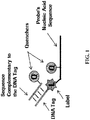
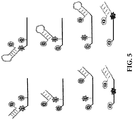
- the tag portion may comprise a nucleotide sequence that is not complementary to the target nucleic acid sequence and forms a "flap" region that is not capable of binding to the target nucleic acid (see FIG. 1 for a graphical representation of a 5' flap probe).
- the tag portion may also be comprised of non-nucleotides such as any organic moieties, or repeat units (e.g.
- the tag portion contains a reporter moiety such as a fluorescent dye that is capable of being quenched by the quencher moiety on the annealing portion.
- the annealing and tag portions of the oligonucleotide probe may optionally be separated by a non-nucleotide linker.
- This linker can be comprised of carbon, carbon and oxygen, carbon and nitrogen, or any combination of these and can be of any length.
- the linker can be comprised of a linear moiety or a cyclic moiety.
- the linker may be derived from a single unit or from multiple identical or different units separated by phosphate linkages.
- the purpose of the linker is to create a region at the junction of the annealing and tag portions of the oligonucleotide probe.
- the linker also prevents it from being extended by a nucleic acid polymerase.
- another modification on the separated tag portion renders it non-extendible by the nucleic acid polymerase.
- the second feature of the novel probe is that the tag portion binds to a quenching molecule.
- the quenching molecule may be an oligonucleotide that is fully or partially complementary to the nucleotide sequence of the tag portion and hybridizes to the tag portion.
- the quenching molecule also contains or is associated with a quencher moiety, i.e. a second quencher moiety, which is also capable of quenching the signal from the reporter moiety (e.g. fluorescent dye) on the tag portion.
- the quencher moiety on or associated with the quenching molecule (the second quencher moiety) can be the same as or different from the quencher moiety on the annealing portion (the first quencher moiety). Therefore, prior to performing PCR amplification, the reporter moiety on the tag portion is quenched by both the quencher moiety on the annealing portion of the probe and by the quencher moiety on or associated with the quenching molecule (e.g. by a quenching oligonucleotide as shown in FIG. 1 ).
- a sample suspected of containing the target nucleic acid is provided.
- the sample is then contacted inside a single reaction vessel (e.g. a single test tube or a single well in a multi-well microplate) with PCR reagents that contain both the oligonucleotide primers capable of generating amplicons of the target nucleic acid and the novel oligonucleotide probe.
- a single reaction vessel e.g. a single test tube or a single well in a multi-well microplate
- PCR amplification begins by using a nucleic acid polymerase having 5' to 3' nuclease activity such that during the extension step of each PCR cycle, the nuclease activity of the polymerase allows cleavage and separationof the tag portion from the quenching moiety on the annealing portion of the probe.
- the separatedtag portion may optionally contain a modification (such as the non-nucleotide linker) such that it is not capable of being extended by a nucleic acid polymerase.
- the signal from the reporter moiety on the separatedtag portion is measured at a first temperature, usually, the annealing and/or extension temperature, at which the quenching molecule is still bound to the tag portion. Due to the presence of the quencher moiety on or associated with the quenching molecule, the signal from the reporter moiety (e.g. a fluorescent dye) on the tag portion is still quenched. In some instances, it may be advantageous to measure the signal from the reporter moiety more than once at the first temperature and obtain an average or median signal value at the first temperature.
- a second signal reading is performed at a temperature point at which the quenching molecule is no longer bound to the tag portion.
- the quenching molecule is an oligonucleotide that has sequences complementary to the nucleotide sequence of the tag portion, this dissociation occurs at the melting temperature (T m ) of the duplex formation between the quenching oligonucleotide molecule and the tag portion.
- T m melting temperature
- the second temperature is above the T m temperature to ensure that close to 100% of the tag portion are in single-stranded form.
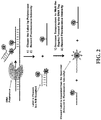
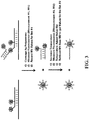
- a calculated signal value is determined by subtracting the signal (or the average or median signal value) detected at the first temperature when the quenching molecule is still bound to the tag portion from the signal (or the average or median signal value) detected at the second temperature when the quenching molecule is not bound to the tag portion (see FIG. 2 and FIG. 3 ).
- the calculated signal value may optionally be normalized for correction of signals that may be affected by temperature. For example, fluorescent signals are known to decrease at higher temperatures, and therefore, standards can be used to normalize the signal values obtained at different temperatures.
- dPCR digital PCR
- a sample is partitioned so that individual nucleic acid molecules within the sample are localized and concentrated within many separate regions.
- the quenching or isolation of individual nucleic acid molecules has been performed in micro well plates, capillaries, the dispersed phase of an emulsion, and arrays of miniaturized chambers, as well as on nucleic acid binding surfaces.
- the partitioning of the sample allows one to estimate the number of different molecules by assuming that the molecule population follows the Poisson distribution. As a result, each part will contain "0" or "1" molecules, or a negative or positive reaction, respectively.
- nucleic acids may be quantified by counting the regions that contain PCR end-product, positive reactions.
- the number of PCR amplification cycles is proportional to the starting copy number.
- dPCR is not dependent on the number of amplification cycles to determine the initial sample amount, eliminating the reliance on uncertain exponential data to quantify target nucleic acids and therefore provides absolute quantification.
- Current digital PCR approaches are achieved by either a microfluidic based approach where a reaction is partitioned into nano-wells on an array or by a droplet based approach where the reaction is separated into micro-droplets.
- PCR assays using only one reporter moiety is possible by designing oligonucleotide probes that have tag portions hybridized to their respective quenching oligonucleotide molecules at various T m temperatures.
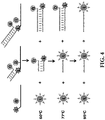
- amplification and detection of three target nucleic acid in one reaction can be achieved by using three oligonucleotide probes all labeled with the same fluorophore.
- a standard TaqMan® oligonucleotide probe may be used to detect the first target by measuring the fluorescent signal at a first temperature (usually the annealing temperature of a PCR cycle).
- a first "tagged" probe with a low T m tag-quenching oligonucleotide duplex may be used to detect the second target by measuring the calculated fluorescent value at a second temperature at or above its T m temperature and that is higher than the first temperature.
- a second "tagged" probe with a high T m tag-quenching oligonucleotide duplex may be used to detect the third target by measuring the calculated fluorescent value at a third temperature at or above its T m temperature and that is higher than the second temperature, (see FIG. 4 )
- novel probes of the present invention can be designed such that the tag portion is a nucleotide sequence and is connected to a quenching oligonucleotide to form a hairpin (i.e. a stem-loop structure).
- the "stem” portion will consist of the complementary regions between the tag portion and quenching oligonucleotide while the "loop” portion may be comprised of non-complementary nucleotides or non-nucleotides such as linkers as previously described.
- novel probes of the present invention have been described as having the reporter moiety located on the tag portion of the probes, it is also possible to position the reporter moiety on the annealing portion and place the first quencher moiety on the tag portion, as long as the reporter moiety can reversibly interact with the second quencher moiety on the quenching oligonucleotide.
- the reporter moiety is designed and positioned in the probe oligonucleotide in such a way that it is separated from the first quenching moiety on the annealing portion during the 5' nuclease (TaqMan®) assay and further designed to reversibly interact with the second quenching moiety on the quenching molecule.
- both the tag portion and the quenching molecule are comprised of nucleotide sequences.
- both the tag portion and the quenching oligonucleotide should not hybridize specifically to the target nucleic acid sequence but they should be fully or partially complementary to each other to allow hybridization at the desired temperatures. Both may include a modification at their 3' termini in order to not be extended by the nucleic acid polymerase during PCR amplification.
- Both the reporter moiety e.g.
- the fluorescent dye) on the tag portion and the quencher moiety on the quenching oligonucleotide can be located at the 5' terminus, the 3' terminus or at any position between the 5' and 3' termini but they must be located in proximity to each other when the tag portion is hybridized to the quenching oligonucleotide to allow the quenching moiety to quench the detectable signal from the reporter moiety.
- modified nucleotides can be introduced at all or some positions on either the tag portions, on the quenching oligonucleotides or on both the tag portions and the quenching oligonucleotides such that oligonucleotide length can be shortened.
- Another type of modification that may serve to prevent the unwanted binding of nucleic acid polymerase to the tag portion or to the quenching oligonucleotide would include the use of enantiomeric L-form of a nucleotide, such as L-DNA, L-RNA or L-LNA.
- the tag portion of the oligonucleotide probe and the quenching molecular are comprised of non-nucleotide molecules that reversibly interact with each other in a temperature-dependent manner.
- non-nucleotide interactions include but are not limited to protein-protein interactions, protein-peptide interactions (e.g. peptide aptamers), protein-small molecule interactions, peptide-small molecule interactions, small molecule-small molecule interactions.
- biotin and avidin or streptavidin
- the well-known interaction between biotin and avidin can be exploited by modifying either the biotin moiety (e.g. desthiobiotin) or the avidin moiety (see, Nordlund et al., J. Biol. Chem., 2003, 278 (4) 2479-2483 ) or both in order to make the interaction reversible and temperature dependent.
- the interaction between the tag portion and the quenching molecule may involve interaction between a nucleotide sequence (or nucleotide sequences) and a non-nucleotide molecule in a sequence specific manner.
- these types of interactions include but are not limited to nucleic acid aptamers, DNA binding proteins or peptides and DNA minor groove binders.
- sequence-specific DNA-binding molecules have been described in several papers (see e.g. Dervan, Science, 1986, 232, 464-471 ; White et al., Nature, 1998, 391, 468-471 ) and these methods may be used to generate interactions between the tag portion and the quenching molecule that are temperature-dependent.
- quenching moiety does not need to be contained within the quenching molecule itself but may be in a soluble form that will interact with and quench the reporter moiety only when the tag portion is bound to the quenching molecule.
- the 9FAM9 TAG oligonucleotide was incubated without a quenching oligonucleotide (QX) or with the Q0 or Q1 quenching oligonucleotide at 1:5 molar ratio.
- QX quenching oligonucleotide
- a matrix experiment was performed wherein 0, 100, or 1,000 copies of an internal control (IC) template was amplified in the presence of 0, 10, or 100 copies of HIV1-M template over 50 cycles of PCR.
- Detection of three unique targets in a single fluorescence channel using fluorescein (FAM) was achieved through a combination of TaqMan® chemistry and thermal assisted generation of signal (TAGS) using tagged probes and their respective quenching oligonucleotides.
- Endpoint fluorescence signal (average fluorescence signal for last four cycles) was measured in the FAM fluorescence channel for all three targets post TaqMan® PCR.
- Table 3 shows the sequences of the probes and quenching oligonucleotides used in this experiment.
- Each 50 ⁇ L reaction contained 3% glycerol, 60mM Tricine, 120mM potassium acetate, 400 ⁇ M each dATP, dCTP and dGTP, 800 ⁇ M dUTP, 0.3 ⁇ M of each forward primer, 0.3 ⁇ M of each reverse primer, 0.3 ⁇ M of detection probe (sequence 1-3), 0.6uM of each Q-tag (Sequence 4-5) 5.4% DMSO, 0.02% Tween 20, 43.9uM EDTA, 0.03% sodium azide, 0.2U/ ⁇ L uracil-N-glycosylase (UNG), 0.67 ⁇ M NTQ21-46A aptamer, 0.9U/ ⁇ L Z05D polymerase, and 3.3mM manganese acetate (pH 6.3).
- Amplification was done on a Roche LightCycler® 480 instrument and the reactions were subjected to the temperature profile as shown in Table 2 except 50 instead of 55 cycles were performed and data acquisition was performed only during the last four cycles (
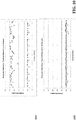
- FIGs 7-9 The results of the experiment are seen in FIGs 7-9 with endpoint absolute fluorescence plotted on the Y-axis with various samples across the X-axis. Fluorescence signal was observed at 58°C ( FIG. 7 , thermal channel 1) in the presence of IC target due to the cleavage of the conventional TaqMan® probe (IC, SEQ ID NO: 4) during repeated cycles of amplification. Additionally, fluorescence signal was observed at 80°C ( FIG.
- thermal channel 2 when the HIV1-M gag target was present due to the tagged probe (HIV-1M gag, SEQ ID NO: 5) cleavage and increased fluorescence from melting of the probe cleavage fragment from the complementary quenching oligonucleotide (Q-Tag gag, SEQ ID NO: 7). Furthermore, fluorescence signal was observed at 95°C ( FIG. 9 , thermal channel 3) when the HIV1-M ltr target was present due to cleavage of the second tagged probe (HIV-1M ltr, SEQ ID NO: 6) and increased fluorescence from melting of the probe cleavage fragment from the second complementary quenching oligonucleotide (Q-Tag ltr, SEQ ID NO: 8). Any samples with fluorescence signals below the defined fluorescence threshold signal per thermal channel (dotted lines) were considered as negative.
- Temperature corrected thermal channel 1 (58°C) fluorescence was subtracted from thermal channel 2 (80°C) fluorescence to achieve specific signal for HIV1-M gag.
- temperature corrected thermal channel 2 fluorescence was subtracted from thermal channel 3 (95°C) fluorescence to achieve specific signal for HIV1-M ltr. Therefore, it was observed that amplification of the IC target was specifically detected at 58°C (thermal channel 1), HIV1-M gag target was specifically detected at 80°C (thermal channel 2), and HIV1-M ltr target was specifically detected at 95°C (thermal channel 3).
- a first probe (TABLE 4, SEQ ID NO: 9) binds specifically to the internal control target and detects amplification at or below 58°C (thermal channel 1).
- a second probe (TABLE 4, SEQ ID NO: 10), with a 5' non-target binding tag sequence, binds specifically to HIV1-M ltr target and detects amplification in a second thermal channel defined at 83°C.
- Each 16 ⁇ L reaction contained 3% glycerol, 60mM Tricine, 120mM potassium acetate, 400 ⁇ M each dATP, dCTP and dGTP, 800 ⁇ M dUTP, 0.3 ⁇ M of each forward primer, 0.3 ⁇ M of each reverse primer, 0.3 ⁇ M of detection probe (SEQ ID NO: 9 & 10), 0.6 ⁇ M of Q-tag (SEQ ID NO: 11) 5.4% DMSO, 0.02% Tween 20, 43.9uM EDTA, 0.03% sodium azide, 0.2U/ ⁇ L uracil-N-glycosylase (UNG), 0.67 ⁇ M NTQ21-46A aptamer, 0.9U/ ⁇ L Z05D polymerase, and 3.3mM manganese acetate (pH 6.3).
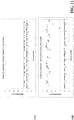
- PCR amplification was performed on a Roche LightCycler® 480 instrument. Reactions were subjected to the temperature profile as described in TABLE 2 in Example 1. Fluorescence was captured at each thermal channel prior to PCR cycling (to define baseline fluorescence) and post-PCR. Baseline subtracted fluorescence data was plotted and a threshold was defined to determine negative (no target present) versus positive (one or more targets present) wells at each thermal channel. When IC was present, fluorescence signal was observed in thermal channel 1 due to cleavage of the conventional IC probe and separation of reporter dye from quencher during repeated cycles of amplification ( FIG. 10A ). When HIV1-M ltr was present, fluorescence signal was observed in thermal channel 2 ( FIG. 11B ) due to the tagged HIV1-M
Landscapes
- Chemical & Material Sciences (AREA)
- Life Sciences & Earth Sciences (AREA)
- Organic Chemistry (AREA)
- Health & Medical Sciences (AREA)
- Proteomics, Peptides & Aminoacids (AREA)
- Zoology (AREA)
- Wood Science & Technology (AREA)
- Engineering & Computer Science (AREA)
- Analytical Chemistry (AREA)
- Immunology (AREA)
- Genetics & Genomics (AREA)
- Molecular Biology (AREA)
- General Health & Medical Sciences (AREA)
- Biochemistry (AREA)
- Bioinformatics & Cheminformatics (AREA)
- General Engineering & Computer Science (AREA)
- Biotechnology (AREA)
- Microbiology (AREA)
- Biophysics (AREA)
- Physics & Mathematics (AREA)
- Chemical Kinetics & Catalysis (AREA)
- Pathology (AREA)
- Measuring Or Testing Involving Enzymes Or Micro-Organisms (AREA)
Applications Claiming Priority (4)
| Application Number | Priority Date | Filing Date | Title |
|---|---|---|---|
| US201662395325P | 2016-09-15 | 2016-09-15 | |
| US201662435595P | 2016-12-16 | 2016-12-16 | |
| US201762536871P | 2017-07-25 | 2017-07-25 | |
| PCT/EP2017/073288 WO2018050824A1 (en) | 2016-09-15 | 2017-09-15 | Methods for performing multiplexed pcr |
Publications (2)
| Publication Number | Publication Date |
|---|---|
| EP3512959A1 EP3512959A1 (en) | 2019-07-24 |
| EP3512959B1 true EP3512959B1 (en) | 2021-08-11 |
Family
ID=59901522
Family Applications (2)
| Application Number | Title | Priority Date | Filing Date |
|---|---|---|---|
| EP17768765.4A Active EP3512959B1 (en) | 2016-09-15 | 2017-09-15 | Methods for performing multiplexed pcr |
| EP17768768.8A Active EP3512960B1 (en) | 2016-09-15 | 2017-09-15 | Methods for performing multiplexed real-time pcr |
Family Applications After (1)
| Application Number | Title | Priority Date | Filing Date |
|---|---|---|---|
| EP17768768.8A Active EP3512960B1 (en) | 2016-09-15 | 2017-09-15 | Methods for performing multiplexed real-time pcr |
Country Status (10)
| Country | Link |
|---|---|
| US (3) | US11028433B2 (enExample) |
| EP (2) | EP3512959B1 (enExample) |
| JP (2) | JP7063886B2 (enExample) |
| KR (2) | KR102468633B1 (enExample) |
| CN (5) | CN109689884A (enExample) |
| AU (2) | AU2017328613B2 (enExample) |
| CA (2) | CA3033250C (enExample) |
| DK (1) | DK3512959T3 (enExample) |
| ES (2) | ES2893411T3 (enExample) |
| WO (2) | WO2018050824A1 (enExample) |
Families Citing this family (30)
| Publication number | Priority date | Publication date | Assignee | Title |
|---|---|---|---|---|
| DK3512959T3 (da) | 2016-09-15 | 2021-10-18 | Hoffmann La Roche | Fremgangsmåder til udførelse af multipleks PCR |
| RU2665631C2 (ru) * | 2017-01-25 | 2018-09-03 | Общество с ограниченной ответственностью "Секвойя Дженетикс" | Способ специфической идентификации последовательностей днк |
| US20190093155A1 (en) * | 2017-05-25 | 2019-03-28 | Roche Molecular Systems, Inc. | Multiplex Nucleic Acid Amplification Assay |
| KR20200115552A (ko) | 2018-01-22 | 2020-10-07 | 루미넥스 코포레이션 | 별개의 용융 분석을 위한 방법 및 조성물 |
| US20190292596A1 (en) | 2018-03-21 | 2019-09-26 | Roche Molecular Systems, Inc. | Modified nucleoside phosphates with high thermal stability |
| IL277870B2 (en) | 2018-04-20 | 2025-02-01 | Seegene Inc | Method and device for identifying diverse targets of nucleic acid sequences in a sample |
| US11384376B2 (en) | 2018-05-31 | 2022-07-12 | Roche Molecular Systems, Inc. | Reagents and methods for post-synthetic modification of nucleic acids |
| SG11202101140TA (en) | 2018-08-09 | 2021-03-30 | Speedx Pty Ltd | Multiplex detection of nucleic acids |
| US11371080B2 (en) | 2018-11-30 | 2022-06-28 | Luminex Corporation | Methods and probes for performing PCR with melt analysis for increased multiplexing |
| EP3899035B1 (en) * | 2018-12-20 | 2025-04-16 | F. Hoffmann-La Roche AG | Detection of target nucleic acid by solid-phase molography |
| EP4031683A4 (en) | 2019-09-16 | 2024-01-17 | Exact Sciences Corporation | Structure and temperature-dependent flap endonuclease substrates |
| US11441167B2 (en) | 2019-11-20 | 2022-09-13 | Roche Molecular Systems, Inc. | Compositions and methods for rapid identification and phenotypic antimicrobial susceptibility testing of bacteria and fungi |
| JP7794737B2 (ja) | 2019-12-09 | 2026-01-06 | エフ. ホフマン-ラ ロシュ アーゲー | ジカチオン性蛍光色素 |
| CN111534518B (zh) * | 2020-05-18 | 2021-07-23 | 纳昂达(南京)生物科技有限公司 | 通用封闭序列及其应用 |
| CN116018414A (zh) * | 2020-06-30 | 2023-04-25 | 斯皮德斯私人有限公司 | 使用混合报告子的多重核酸检测 |
| CN112195221B (zh) * | 2020-09-13 | 2021-08-06 | 武汉纳诺德医疗科技有限公司 | 一种多温度单荧光通道多重实时荧光定量pcr仪及其检测方法 |
| EP4592401A3 (en) * | 2020-09-16 | 2025-10-29 | Bruker Spatial Biology, Inc. | Chemical compositions and methods of using the same |
| EP4267764A1 (en) | 2020-12-22 | 2023-11-01 | F. Hoffmann-La Roche AG | Methods for performing multiplexed real-time pcr with the use of large stokes shift fluorescent dyes |
| JP2024522640A (ja) * | 2021-06-25 | 2024-06-21 | エフ. ホフマン-ラ ロシュ アーゲー | 高感度で温度多重化pcrを行うための方法 |
| CA3232383C (en) | 2021-09-30 | 2026-05-12 | Gen-Probe Incorporated | Temperature-selectable fret cassette signaling |
| CN119487130A (zh) | 2022-06-28 | 2025-02-18 | 豪夫迈·罗氏有限公司 | 具有大斯托克斯位移的荧光染料 |
| EP4621068A1 (en) * | 2022-11-16 | 2025-09-24 | Seegene, Inc. | Detection of target nucleic acid by quenching-pto cleavage and extension (q-ptoce) assay |
| AR132405A1 (es) * | 2023-04-19 | 2025-06-25 | Consejo Nacional De Investigaciones Cientificas Y Tecn Conicet | Métodos y sistemas para seleccionar biomarcadores basados en metilación del adn para la detección de cáncer colorrectal |
| KR20260034624A (ko) * | 2023-05-15 | 2026-03-11 | 스피디엑스 피티와이 리미티드 | 온도 제어 프로브를 이용한 표적 검출 |
| US20250062438A1 (en) * | 2023-08-18 | 2025-02-20 | Valeo Systemes Thermiques | Heat exchanger plate for battery pack |
| KR20260035911A (ko) * | 2023-09-08 | 2026-03-13 | 주식회사 씨젠 | 3개의 프로브를 이용하여 타겟 핵산을 검출하는 방법 |
| WO2025141105A1 (en) | 2023-12-27 | 2025-07-03 | bioMérieux | Specific probes for the detection of nucleic acids, methods and uses |
| EP4606908A1 (en) * | 2024-02-21 | 2025-08-27 | Roche Diagnostics GmbH | Method of increasing the number of usable channels in multiplex pcr |
| WO2026052826A1 (en) | 2024-09-09 | 2026-03-12 | Roche Diagnostics Gmbh | Methods for producing fluorescent dyes |
| WO2026125666A1 (en) | 2024-12-11 | 2026-06-18 | Roche Molecular Systems, Inc. | Methods for detection of arthropod-borne viruses by multiplex pcr |
Family Cites Families (61)
| Publication number | Priority date | Publication date | Assignee | Title |
|---|---|---|---|---|
| US4250257A (en) * | 1978-08-24 | 1981-02-10 | Technicon Instruments Corporation | Whole blood analyses in porous media |
| US4683195A (en) | 1986-01-30 | 1987-07-28 | Cetus Corporation | Process for amplifying, detecting, and/or-cloning nucleic acid sequences |
| US4965188A (en) | 1986-08-22 | 1990-10-23 | Cetus Corporation | Process for amplifying, detecting, and/or cloning nucleic acid sequences using a thermostable enzyme |
| US4683202A (en) | 1985-03-28 | 1987-07-28 | Cetus Corporation | Process for amplifying nucleic acid sequences |
| US4889818A (en) | 1986-08-22 | 1989-12-26 | Cetus Corporation | Purified thermostable enzyme |
| US5455170A (en) | 1986-08-22 | 1995-10-03 | Hoffmann-La Roche Inc. | Mutated thermostable nucleic acid polymerase enzyme from Thermus species Z05 |
| US5618711A (en) | 1986-08-22 | 1997-04-08 | Hoffmann-La Roche Inc. | Recombinant expression vectors and purification methods for Thermus thermophilus DNA polymerase |
| US5405774A (en) | 1986-08-22 | 1995-04-11 | Hoffmann-La Roche Inc. | DNA encoding a mutated thermostable nucleic acid polymerase enzyme from thermus species sps17 |
| US5352600A (en) | 1986-08-22 | 1994-10-04 | Hoffmann-La Roche Inc. | Purified thermostable enzyme |
| US5466591A (en) | 1986-08-22 | 1995-11-14 | Hoffmann-La Roche Inc. | 5' to 3' exonuclease mutations of thermostable DNA polymerases |
| US5079352A (en) | 1986-08-22 | 1992-01-07 | Cetus Corporation | Purified thermostable enzyme |
| US5795762A (en) | 1986-08-22 | 1998-08-18 | Roche Molecular Systems, Inc. | 5' to 3' exonuclease mutations of thermostable DNA polymerases |
| US5210015A (en) | 1990-08-06 | 1993-05-11 | Hoffman-La Roche Inc. | Homogeneous assay system using the nuclease activity of a nucleic acid polymerase |
| JP2709311B2 (ja) | 1990-09-28 | 1998-02-04 | エフ.ホフマン−ラ ロシュ アクチェンゲゼルシャフト | 熱安定性dnaポリメラーゼの5→3′のエキソヌクレアーゼ突然変異 |
| US5539082A (en) | 1993-04-26 | 1996-07-23 | Nielsen; Peter E. | Peptide nucleic acids |
| DE4234086A1 (de) | 1992-02-05 | 1993-08-12 | Diagen Inst Molekularbio | Verfahren zur bestimmung von in vitro amplifizierten nukleinsaeuresequenzen |
| US5541311A (en) | 1992-12-07 | 1996-07-30 | Third Wave Technologies, Inc. | Nucleic acid encoding synthesis-deficient thermostable DNA polymerase |
| US5843691A (en) * | 1993-05-15 | 1998-12-01 | Lifescan, Inc. | Visually-readable reagent test strip |
| US5538848A (en) | 1994-11-16 | 1996-07-23 | Applied Biosystems Division, Perkin-Elmer Corp. | Method for detecting nucleic acid amplification using self-quenching fluorescence probe |
| US5491063A (en) | 1994-09-01 | 1996-02-13 | Hoffmann-La Roche Inc. | Methods for in-solution quenching of fluorescently labeled oligonucleotide probes |
| US5571673A (en) | 1994-11-23 | 1996-11-05 | Hoffmann-La Roche Inc. | Methods for in-solution quenching of fluorescently labeled oligonucleotide probes |
| AU7236296A (en) | 1995-09-08 | 1997-03-27 | Life Technologies, Inc. | Cloned dna polymerases from thermotoga and mutants thereof |
| DE69739357D1 (de) | 1996-06-04 | 2009-05-28 | Univ Utah Res Found | Überwachung der hybridisierung während pcr |
| US6427156B1 (en) | 1997-01-21 | 2002-07-30 | Xilinx, Inc. | Configurable logic block with AND gate for efficient multiplication in FPGAS |
| JP3756313B2 (ja) | 1997-03-07 | 2006-03-15 | 武 今西 | 新規ビシクロヌクレオシド及びオリゴヌクレオチド類縁体 |
| US6794499B2 (en) | 1997-09-12 | 2004-09-21 | Exiqon A/S | Oligonucleotide analogues |
| US6472156B1 (en) | 1999-08-30 | 2002-10-29 | The University Of Utah | Homogeneous multiplex hybridization analysis by color and Tm |
| US6893819B1 (en) | 2000-11-21 | 2005-05-17 | Stratagene California | Methods for detection of a nucleic acid by sequential amplification |
| US7585632B2 (en) * | 1999-10-29 | 2009-09-08 | Hologic, Inc. | Compositions and methods for the detection of a nucleic acid using a cleavage reaction |
| US7381532B2 (en) | 1999-10-29 | 2008-06-03 | Stratagene California | Compositions and methods for the detection of a nucleic acid using a cleavage reaction |
| US20050053939A1 (en) | 2001-11-09 | 2005-03-10 | Ahmed Chenna | Methods and compositions for enhancing detection in determinations employing cleavable electrophoretic tag reagents |
| EP3483599A1 (en) * | 2005-07-20 | 2019-05-15 | Ascensia Diabetes Care Holdings AG | Methods for measuring the concentration of an analyte in solution and for calibrating the measurement as well as handheld devices therefor |
| US7833716B2 (en) * | 2006-06-06 | 2010-11-16 | Gen-Probe Incorporated | Tagged oligonucleotides and their use in nucleic acid amplification methods |
| WO2008021446A2 (en) * | 2006-08-15 | 2008-02-21 | Genetag Technology, Inc. | Probe-antiprobe compositions and methods for dna or rna detection |
| EP2078189B1 (en) * | 2006-10-20 | 2012-10-10 | Clondiag GmbH | Assay devices and methods for the detection of analytes |
| US8133701B2 (en) | 2006-12-05 | 2012-03-13 | Sequenom, Inc. | Detection and quantification of biomolecules using mass spectrometry |
| US7902345B2 (en) | 2006-12-05 | 2011-03-08 | Sequenom, Inc. | Detection and quantification of biomolecules using mass spectrometry |
| EP2118310B1 (en) | 2006-12-29 | 2013-03-06 | Applied Biosystems, LLC | Systems and methods for detecting nucleic acids |
| GB0703997D0 (en) * | 2007-03-01 | 2007-04-11 | Oxitec Ltd | Methods for detecting nucleic sequences |
| US10150990B2 (en) | 2008-04-21 | 2018-12-11 | Roche Molecular Systems, Inc. | Ribonucleotide tag nucleic acid detection |
| GB0909333D0 (en) * | 2009-06-01 | 2009-07-15 | Fu Guoliang | Multiplex amplification and detection |
| US9234232B2 (en) * | 2008-07-31 | 2016-01-12 | Oxitec Limited | Multiplex amplification and detection |
| US20120252015A1 (en) * | 2011-02-18 | 2012-10-04 | Bio-Rad Laboratories | Methods and compositions for detecting genetic material |
| KR101073875B1 (ko) * | 2008-11-28 | 2011-10-14 | 한국생명공학연구원 | 대장암 진단 마커 및 이를 이용한 대장암 진단방법 |
| US8385895B2 (en) | 2008-12-18 | 2013-02-26 | Verizon Patent And Licensing Inc. | Updating an operating parameter |
| US8039215B2 (en) | 2009-03-10 | 2011-10-18 | Roche Molecular Systems, Inc. | Multiplex quantitative nucleic acid amplification and melting assay |
| KR101177320B1 (ko) * | 2010-02-26 | 2012-09-10 | 문우철 | Y형 프로브 및 이것의 변형형, 및 이를 이용한 dna 마이크로어레이, 키트 및 유전자 분석방법 |
| US8361720B2 (en) * | 2010-11-15 | 2013-01-29 | Exact Sciences Corporation | Real time cleavage assay |
| MX352460B (es) | 2011-01-11 | 2017-11-24 | Seegene Inc | Detección de secuencias de ácido nucleico objetivo mediante ensayo de escisión y extensión del pto. |
| KR20130101952A (ko) * | 2012-02-02 | 2013-09-16 | 주식회사 씨젠 | Pto 절단과 연장-의존적 혼성화를 이용한 타겟 핵산서열의 검출 |
| US10106842B2 (en) | 2013-03-15 | 2018-10-23 | Roche Molecular Systems, Inc. | Nucleic acid target identification by structure based probe cleavage |
| US9828629B2 (en) * | 2013-03-15 | 2017-11-28 | Roche Molecular Systems, Inc. | Nucleic acid target identification by structure based probe cleavage |
| EP3521452B1 (en) | 2013-06-19 | 2021-08-04 | Luminex Corporation | Real-time multiplexed hydrolysis probe assay |
| US9637791B2 (en) | 2013-12-20 | 2017-05-02 | Roche Molecular Systems, Inc. | Multiplexed nucleic acid target identification by strucutre based probe cleavage |
| WO2015147370A1 (en) | 2014-03-28 | 2015-10-01 | Seegene, Inc. | Detection of target nucleic acid sequences using different detection temperatures |
| EP3180449B1 (en) * | 2014-08-11 | 2019-10-09 | Luminex Corporation | Probes for improved melt discrimination and multiplexing in nucleic acid assays |
| WO2016093620A1 (en) | 2014-12-09 | 2016-06-16 | Seegene, Inc. | Differentiation of signals for target nucleic acid sequences |
| WO2016093619A1 (en) | 2014-12-09 | 2016-06-16 | Seegene, Inc. | Detection of target nucleic acid sequences using different detection temperatures and reference values |
| CN107109492B (zh) * | 2014-12-22 | 2021-02-26 | 阿纳帕生物技术股份公司 | 用于靶核酸多重检测的双重猝灭测定 |
| DK3512959T3 (da) | 2016-09-15 | 2021-10-18 | Hoffmann La Roche | Fremgangsmåder til udførelse af multipleks PCR |
| US10590469B2 (en) * | 2016-09-15 | 2020-03-17 | Roche Molecular Svstems, Inc. | Methods for performing multiplexed real-time PCR in a self-contained nucleic acid analysis pouch |
-
2017
- 2017-09-15 DK DK17768765.4T patent/DK3512959T3/da active
- 2017-09-15 EP EP17768765.4A patent/EP3512959B1/en active Active
- 2017-09-15 US US15/705,772 patent/US11028433B2/en active Active
- 2017-09-15 ES ES17768765T patent/ES2893411T3/es active Active
- 2017-09-15 CN CN201780056666.0A patent/CN109689884A/zh active Pending
- 2017-09-15 CN CN202610245392.0A patent/CN122279014A/zh active Pending
- 2017-09-15 US US15/705,821 patent/US11034997B2/en active Active
- 2017-09-15 EP EP17768768.8A patent/EP3512960B1/en active Active
- 2017-09-15 CN CN202610245342.2A patent/CN122146861A/zh active Pending
- 2017-09-15 WO PCT/EP2017/073288 patent/WO2018050824A1/en not_active Ceased
- 2017-09-15 AU AU2017328613A patent/AU2017328613B2/en active Active
- 2017-09-15 AU AU2017328617A patent/AU2017328617B2/en active Active
- 2017-09-15 JP JP2019514212A patent/JP7063886B2/ja active Active
- 2017-09-15 KR KR1020197007697A patent/KR102468633B1/ko active Active
- 2017-09-15 CN CN202610246629.7A patent/CN122146862A/zh active Pending
- 2017-09-15 CA CA3033250A patent/CA3033250C/en active Active
- 2017-09-15 ES ES17768768T patent/ES2933176T3/es active Active
- 2017-09-15 JP JP2019514294A patent/JP7221199B2/ja active Active
- 2017-09-15 CN CN201780056599.2A patent/CN109689889A/zh active Pending
- 2017-09-15 CA CA3036119A patent/CA3036119C/en active Active
- 2017-09-15 WO PCT/EP2017/073293 patent/WO2018050828A1/en not_active Ceased
- 2017-09-15 KR KR1020197007698A patent/KR102468174B1/ko active Active
-
2021
- 2021-05-07 US US17/314,470 patent/US11345958B2/en active Active
Non-Patent Citations (1)
| Title |
|---|
| None * |
Also Published As
Similar Documents
| Publication | Publication Date | Title |
|---|---|---|
| US11345958B2 (en) | Methods for performing multiplexed real-time PCR | |
| US12365938B2 (en) | Polynucleotide sequence detection method | |
| US11198903B2 (en) | Methods for performing multiplexed real-time PCR | |
| JP2024522640A (ja) | 高感度で温度多重化pcrを行うための方法 | |
| CN113195734B (zh) | 通过固相分子成像检测靶核酸 | |
| US20240287584A1 (en) | Methods for performing temperature multiplexed pcr with increased sensitivity | |
| US20250382664A1 (en) | Improved detection of lamp amplification products |
Legal Events
| Date | Code | Title | Description |
|---|---|---|---|
| STAA | Information on the status of an ep patent application or granted ep patent |
Free format text: STATUS: UNKNOWN |
|
| STAA | Information on the status of an ep patent application or granted ep patent |
Free format text: STATUS: THE INTERNATIONAL PUBLICATION HAS BEEN MADE |
|
| PUAI | Public reference made under article 153(3) epc to a published international application that has entered the european phase |
Free format text: ORIGINAL CODE: 0009012 |
|
| STAA | Information on the status of an ep patent application or granted ep patent |
Free format text: STATUS: REQUEST FOR EXAMINATION WAS MADE |
|
| 17P | Request for examination filed |
Effective date: 20190415 |
|
| AK | Designated contracting states |
Kind code of ref document: A1 Designated state(s): AL AT BE BG CH CY CZ DE DK EE ES FI FR GB GR HR HU IE IS IT LI LT LU LV MC MK MT NL NO PL PT RO RS SE SI SK SM TR |
|
| AX | Request for extension of the european patent |
Extension state: BA ME |
|
| DAV | Request for validation of the european patent (deleted) | ||
| DAX | Request for extension of the european patent (deleted) | ||
| GRAP | Despatch of communication of intention to grant a patent |
Free format text: ORIGINAL CODE: EPIDOSNIGR1 |
|
| STAA | Information on the status of an ep patent application or granted ep patent |
Free format text: STATUS: GRANT OF PATENT IS INTENDED |
|
| INTG | Intention to grant announced |
Effective date: 20201005 |
|
| RIN1 | Information on inventor provided before grant (corrected) |
Inventor name: KOZLOV, IGOR Inventor name: TSAN, ALISON Inventor name: GUPTA, AMAR Inventor name: SAIKI, RANDALL |
|
| GRAJ | Information related to disapproval of communication of intention to grant by the applicant or resumption of examination proceedings by the epo deleted |
Free format text: ORIGINAL CODE: EPIDOSDIGR1 |
|
| STAA | Information on the status of an ep patent application or granted ep patent |
Free format text: STATUS: REQUEST FOR EXAMINATION WAS MADE |
|
| INTC | Intention to grant announced (deleted) | ||
| GRAP | Despatch of communication of intention to grant a patent |
Free format text: ORIGINAL CODE: EPIDOSNIGR1 |
|
| STAA | Information on the status of an ep patent application or granted ep patent |
Free format text: STATUS: GRANT OF PATENT IS INTENDED |
|
| INTG | Intention to grant announced |
Effective date: 20210316 |
|
| GRAS | Grant fee paid |
Free format text: ORIGINAL CODE: EPIDOSNIGR3 |
|
| GRAA | (expected) grant |
Free format text: ORIGINAL CODE: 0009210 |
|
| STAA | Information on the status of an ep patent application or granted ep patent |
Free format text: STATUS: THE PATENT HAS BEEN GRANTED |
|
| AK | Designated contracting states |
Kind code of ref document: B1 Designated state(s): AL AT BE BG CH CY CZ DE DK EE ES FI FR GB GR HR HU IE IS IT LI LT LU LV MC MK MT NL NO PL PT RO RS SE SI SK SM TR |
|
| REG | Reference to a national code |
Ref country code: CH Ref legal event code: EP |
|
| REG | Reference to a national code |
Ref country code: DE Ref legal event code: R096 Ref document number: 602017043886 Country of ref document: DE |
|
| REG | Reference to a national code |
Ref country code: AT Ref legal event code: REF Ref document number: 1419433 Country of ref document: AT Kind code of ref document: T Effective date: 20210915 Ref country code: IE Ref legal event code: FG4D |
|
| REG | Reference to a national code |
Ref country code: DK Ref legal event code: T3 Effective date: 20211012 |
|
| REG | Reference to a national code |
Ref country code: NL Ref legal event code: FP |
|
| REG | Reference to a national code |
Ref country code: LT Ref legal event code: MG9D |
|
| REG | Reference to a national code |
Ref country code: AT Ref legal event code: MK05 Ref document number: 1419433 Country of ref document: AT Kind code of ref document: T Effective date: 20210811 |
|
| PG25 | Lapsed in a contracting state [announced via postgrant information from national office to epo] |
Ref country code: RS Free format text: LAPSE BECAUSE OF FAILURE TO SUBMIT A TRANSLATION OF THE DESCRIPTION OR TO PAY THE FEE WITHIN THE PRESCRIBED TIME-LIMIT Effective date: 20210811 Ref country code: SE Free format text: LAPSE BECAUSE OF FAILURE TO SUBMIT A TRANSLATION OF THE DESCRIPTION OR TO PAY THE FEE WITHIN THE PRESCRIBED TIME-LIMIT Effective date: 20210811 Ref country code: HR Free format text: LAPSE BECAUSE OF FAILURE TO SUBMIT A TRANSLATION OF THE DESCRIPTION OR TO PAY THE FEE WITHIN THE PRESCRIBED TIME-LIMIT Effective date: 20210811 Ref country code: LT Free format text: LAPSE BECAUSE OF FAILURE TO SUBMIT A TRANSLATION OF THE DESCRIPTION OR TO PAY THE FEE WITHIN THE PRESCRIBED TIME-LIMIT Effective date: 20210811 Ref country code: BG Free format text: LAPSE BECAUSE OF FAILURE TO SUBMIT A TRANSLATION OF THE DESCRIPTION OR TO PAY THE FEE WITHIN THE PRESCRIBED TIME-LIMIT Effective date: 20211111 Ref country code: AT Free format text: LAPSE BECAUSE OF FAILURE TO SUBMIT A TRANSLATION OF THE DESCRIPTION OR TO PAY THE FEE WITHIN THE PRESCRIBED TIME-LIMIT Effective date: 20210811 Ref country code: PT Free format text: LAPSE BECAUSE OF FAILURE TO SUBMIT A TRANSLATION OF THE DESCRIPTION OR TO PAY THE FEE WITHIN THE PRESCRIBED TIME-LIMIT Effective date: 20211213 Ref country code: NO Free format text: LAPSE BECAUSE OF FAILURE TO SUBMIT A TRANSLATION OF THE DESCRIPTION OR TO PAY THE FEE WITHIN THE PRESCRIBED TIME-LIMIT Effective date: 20211111 Ref country code: FI Free format text: LAPSE BECAUSE OF FAILURE TO SUBMIT A TRANSLATION OF THE DESCRIPTION OR TO PAY THE FEE WITHIN THE PRESCRIBED TIME-LIMIT Effective date: 20210811 |
|
| REG | Reference to a national code |
Ref country code: ES Ref legal event code: FG2A Ref document number: 2893411 Country of ref document: ES Kind code of ref document: T3 Effective date: 20220209 |
|
| PG25 | Lapsed in a contracting state [announced via postgrant information from national office to epo] |
Ref country code: PL Free format text: LAPSE BECAUSE OF FAILURE TO SUBMIT A TRANSLATION OF THE DESCRIPTION OR TO PAY THE FEE WITHIN THE PRESCRIBED TIME-LIMIT Effective date: 20210811 Ref country code: LV Free format text: LAPSE BECAUSE OF FAILURE TO SUBMIT A TRANSLATION OF THE DESCRIPTION OR TO PAY THE FEE WITHIN THE PRESCRIBED TIME-LIMIT Effective date: 20210811 Ref country code: GR Free format text: LAPSE BECAUSE OF FAILURE TO SUBMIT A TRANSLATION OF THE DESCRIPTION OR TO PAY THE FEE WITHIN THE PRESCRIBED TIME-LIMIT Effective date: 20211112 |
|
| REG | Reference to a national code |
Ref country code: DE Ref legal event code: R097 Ref document number: 602017043886 Country of ref document: DE |
|
| REG | Reference to a national code |
Ref country code: BE Ref legal event code: MM Effective date: 20210930 |
|
| PG25 | Lapsed in a contracting state [announced via postgrant information from national office to epo] |
Ref country code: SM Free format text: LAPSE BECAUSE OF FAILURE TO SUBMIT A TRANSLATION OF THE DESCRIPTION OR TO PAY THE FEE WITHIN THE PRESCRIBED TIME-LIMIT Effective date: 20210811 Ref country code: SK Free format text: LAPSE BECAUSE OF FAILURE TO SUBMIT A TRANSLATION OF THE DESCRIPTION OR TO PAY THE FEE WITHIN THE PRESCRIBED TIME-LIMIT Effective date: 20210811 Ref country code: RO Free format text: LAPSE BECAUSE OF FAILURE TO SUBMIT A TRANSLATION OF THE DESCRIPTION OR TO PAY THE FEE WITHIN THE PRESCRIBED TIME-LIMIT Effective date: 20210811 Ref country code: MC Free format text: LAPSE BECAUSE OF FAILURE TO SUBMIT A TRANSLATION OF THE DESCRIPTION OR TO PAY THE FEE WITHIN THE PRESCRIBED TIME-LIMIT Effective date: 20210811 Ref country code: EE Free format text: LAPSE BECAUSE OF FAILURE TO SUBMIT A TRANSLATION OF THE DESCRIPTION OR TO PAY THE FEE WITHIN THE PRESCRIBED TIME-LIMIT Effective date: 20210811 Ref country code: CZ Free format text: LAPSE BECAUSE OF FAILURE TO SUBMIT A TRANSLATION OF THE DESCRIPTION OR TO PAY THE FEE WITHIN THE PRESCRIBED TIME-LIMIT Effective date: 20210811 Ref country code: AL Free format text: LAPSE BECAUSE OF FAILURE TO SUBMIT A TRANSLATION OF THE DESCRIPTION OR TO PAY THE FEE WITHIN THE PRESCRIBED TIME-LIMIT Effective date: 20210811 |
|
| PLBE | No opposition filed within time limit |
Free format text: ORIGINAL CODE: 0009261 |
|
| STAA | Information on the status of an ep patent application or granted ep patent |
Free format text: STATUS: NO OPPOSITION FILED WITHIN TIME LIMIT |
|
| 26N | No opposition filed |
Effective date: 20220512 |
|
| PG25 | Lapsed in a contracting state [announced via postgrant information from national office to epo] |
Ref country code: LU Free format text: LAPSE BECAUSE OF NON-PAYMENT OF DUE FEES Effective date: 20210915 Ref country code: BE Free format text: LAPSE BECAUSE OF NON-PAYMENT OF DUE FEES Effective date: 20210930 |
|
| PG25 | Lapsed in a contracting state [announced via postgrant information from national office to epo] |
Ref country code: SI Free format text: LAPSE BECAUSE OF FAILURE TO SUBMIT A TRANSLATION OF THE DESCRIPTION OR TO PAY THE FEE WITHIN THE PRESCRIBED TIME-LIMIT Effective date: 20210811 |
|
| PG25 | Lapsed in a contracting state [announced via postgrant information from national office to epo] |
Ref country code: CY Free format text: LAPSE BECAUSE OF FAILURE TO SUBMIT A TRANSLATION OF THE DESCRIPTION OR TO PAY THE FEE WITHIN THE PRESCRIBED TIME-LIMIT Effective date: 20210811 |
|
| PG25 | Lapsed in a contracting state [announced via postgrant information from national office to epo] |
Ref country code: HU Free format text: LAPSE BECAUSE OF FAILURE TO SUBMIT A TRANSLATION OF THE DESCRIPTION OR TO PAY THE FEE WITHIN THE PRESCRIBED TIME-LIMIT; INVALID AB INITIO Effective date: 20170915 |
|
| PG25 | Lapsed in a contracting state [announced via postgrant information from national office to epo] |
Ref country code: MK Free format text: LAPSE BECAUSE OF FAILURE TO SUBMIT A TRANSLATION OF THE DESCRIPTION OR TO PAY THE FEE WITHIN THE PRESCRIBED TIME-LIMIT Effective date: 20210811 |
|
| PG25 | Lapsed in a contracting state [announced via postgrant information from national office to epo] |
Ref country code: MT Free format text: LAPSE BECAUSE OF FAILURE TO SUBMIT A TRANSLATION OF THE DESCRIPTION OR TO PAY THE FEE WITHIN THE PRESCRIBED TIME-LIMIT Effective date: 20210811 |
|
| PGFP | Annual fee paid to national office [announced via postgrant information from national office to epo] |
Ref country code: NL Payment date: 20250820 Year of fee payment: 9 |
|
| REG | Reference to a national code |
Ref country code: CH Ref legal event code: U11 Free format text: ST27 STATUS EVENT CODE: U-0-0-U10-U11 (AS PROVIDED BY THE NATIONAL OFFICE) Effective date: 20251001 |
|
| PGFP | Annual fee paid to national office [announced via postgrant information from national office to epo] |
Ref country code: DK Payment date: 20250820 Year of fee payment: 9 Ref country code: DE Payment date: 20250820 Year of fee payment: 9 |
|
| PGFP | Annual fee paid to national office [announced via postgrant information from national office to epo] |
Ref country code: IT Payment date: 20250820 Year of fee payment: 9 |
|
| PGFP | Annual fee paid to national office [announced via postgrant information from national office to epo] |
Ref country code: GB Payment date: 20250822 Year of fee payment: 9 |
|
| PGFP | Annual fee paid to national office [announced via postgrant information from national office to epo] |
Ref country code: FR Payment date: 20250820 Year of fee payment: 9 |
|
| PGFP | Annual fee paid to national office [announced via postgrant information from national office to epo] |
Ref country code: IE Payment date: 20250822 Year of fee payment: 9 |
|
| PG25 | Lapsed in a contracting state [announced via postgrant information from national office to epo] |
Ref country code: TR Free format text: LAPSE BECAUSE OF FAILURE TO SUBMIT A TRANSLATION OF THE DESCRIPTION OR TO PAY THE FEE WITHIN THE PRESCRIBED TIME-LIMIT Effective date: 20210811 |
|
| PGFP | Annual fee paid to national office [announced via postgrant information from national office to epo] |
Ref country code: CH Payment date: 20251001 Year of fee payment: 9 |
|
| PGFP | Annual fee paid to national office [announced via postgrant information from national office to epo] |
Ref country code: ES Payment date: 20251001 Year of fee payment: 9 |