EP3511552B1 - Carburateur pour le moteur à combustion interne dans un appareil de travail portatif, moteur à combustion interne doté d'un carburateur et procédé de fonctionnement d'un moteur à combustion interne - Google Patents
Carburateur pour le moteur à combustion interne dans un appareil de travail portatif, moteur à combustion interne doté d'un carburateur et procédé de fonctionnement d'un moteur à combustion interne Download PDFInfo
- Publication number
- EP3511552B1 EP3511552B1 EP19150488.5A EP19150488A EP3511552B1 EP 3511552 B1 EP3511552 B1 EP 3511552B1 EP 19150488 A EP19150488 A EP 19150488A EP 3511552 B1 EP3511552 B1 EP 3511552B1
- Authority
- EP
- European Patent Office
- Prior art keywords
- carburettor
- roller
- carburetor
- combustion engine
- control contour
- Prior art date
- Legal status (The legal status is an assumption and is not a legal conclusion. Google has not performed a legal analysis and makes no representation as to the accuracy of the status listed.)
- Active
Links
Images


Classifications
-
- F—MECHANICAL ENGINEERING; LIGHTING; HEATING; WEAPONS; BLASTING
- F02—COMBUSTION ENGINES; HOT-GAS OR COMBUSTION-PRODUCT ENGINE PLANTS
- F02M—SUPPLYING COMBUSTION ENGINES IN GENERAL WITH COMBUSTIBLE MIXTURES OR CONSTITUENTS THEREOF
- F02M1/00—Carburettors with means for facilitating engine's starting or its idling below operational temperatures
- F02M1/02—Carburettors with means for facilitating engine's starting or its idling below operational temperatures the means to facilitate starting or idling being chokes for enriching fuel-air mixture
-
- F—MECHANICAL ENGINEERING; LIGHTING; HEATING; WEAPONS; BLASTING
- F02—COMBUSTION ENGINES; HOT-GAS OR COMBUSTION-PRODUCT ENGINE PLANTS
- F02B—INTERNAL-COMBUSTION PISTON ENGINES; COMBUSTION ENGINES IN GENERAL
- F02B33/00—Engines characterised by provision of pumps for charging or scavenging
- F02B33/02—Engines with reciprocating-piston pumps; Engines with crankcase pumps
- F02B33/04—Engines with reciprocating-piston pumps; Engines with crankcase pumps with simple crankcase pumps, i.e. with the rear face of a non-stepped working piston acting as sole pumping member in co-operation with the crankcase
-
- F—MECHANICAL ENGINEERING; LIGHTING; HEATING; WEAPONS; BLASTING
- F02—COMBUSTION ENGINES; HOT-GAS OR COMBUSTION-PRODUCT ENGINE PLANTS
- F02B—INTERNAL-COMBUSTION PISTON ENGINES; COMBUSTION ENGINES IN GENERAL
- F02B63/00—Adaptations of engines for driving pumps, hand-held tools or electric generators; Portable combinations of engines with engine-driven devices
- F02B63/02—Adaptations of engines for driving pumps, hand-held tools or electric generators; Portable combinations of engines with engine-driven devices for hand-held tools
-
- F—MECHANICAL ENGINEERING; LIGHTING; HEATING; WEAPONS; BLASTING
- F02—COMBUSTION ENGINES; HOT-GAS OR COMBUSTION-PRODUCT ENGINE PLANTS
- F02D—CONTROLLING COMBUSTION ENGINES
- F02D35/00—Controlling engines, dependent on conditions exterior or interior to engines, not otherwise provided for
- F02D35/0015—Controlling engines, dependent on conditions exterior or interior to engines, not otherwise provided for using exhaust gas sensors
- F02D35/0046—Controlling fuel supply
- F02D35/0053—Controlling fuel supply by means of a carburettor
- F02D35/0084—Controlling fuel supply by means of a carburettor using two barrel carburettors
-
- F—MECHANICAL ENGINEERING; LIGHTING; HEATING; WEAPONS; BLASTING
- F02—COMBUSTION ENGINES; HOT-GAS OR COMBUSTION-PRODUCT ENGINE PLANTS
- F02D—CONTROLLING COMBUSTION ENGINES
- F02D9/00—Controlling engines by throttling air or fuel-and-air induction conduits or exhaust conduits
- F02D9/08—Throttle valves specially adapted therefor; Arrangements of such valves in conduits
- F02D9/12—Throttle valves specially adapted therefor; Arrangements of such valves in conduits having slidably-mounted valve members; having valve members movable longitudinally of conduit
- F02D9/16—Throttle valves specially adapted therefor; Arrangements of such valves in conduits having slidably-mounted valve members; having valve members movable longitudinally of conduit the members being rotatable
-
- F—MECHANICAL ENGINEERING; LIGHTING; HEATING; WEAPONS; BLASTING
- F02—COMBUSTION ENGINES; HOT-GAS OR COMBUSTION-PRODUCT ENGINE PLANTS
- F02M—SUPPLYING COMBUSTION ENGINES IN GENERAL WITH COMBUSTIBLE MIXTURES OR CONSTITUENTS THEREOF
- F02M17/00—Carburettors having pertinent characteristics not provided for in, or of interest apart from, the apparatus of preceding main groups F02M1/00 - F02M15/00
- F02M17/02—Floatless carburettors
-
- F—MECHANICAL ENGINEERING; LIGHTING; HEATING; WEAPONS; BLASTING
- F02—COMBUSTION ENGINES; HOT-GAS OR COMBUSTION-PRODUCT ENGINE PLANTS
- F02M—SUPPLYING COMBUSTION ENGINES IN GENERAL WITH COMBUSTIBLE MIXTURES OR CONSTITUENTS THEREOF
- F02M35/00—Combustion-air cleaners, air intakes, intake silencers, or induction systems specially adapted for, or arranged on, internal-combustion engines
- F02M35/10—Air intakes; Induction systems
- F02M35/1015—Air intakes; Induction systems characterised by the engine type
- F02M35/1017—Small engines, e.g. for handheld tools, or model engines; Single cylinder engines
-
- F—MECHANICAL ENGINEERING; LIGHTING; HEATING; WEAPONS; BLASTING
- F02—COMBUSTION ENGINES; HOT-GAS OR COMBUSTION-PRODUCT ENGINE PLANTS
- F02M—SUPPLYING COMBUSTION ENGINES IN GENERAL WITH COMBUSTIBLE MIXTURES OR CONSTITUENTS THEREOF
- F02M35/00—Combustion-air cleaners, air intakes, intake silencers, or induction systems specially adapted for, or arranged on, internal-combustion engines
- F02M35/10—Air intakes; Induction systems
- F02M35/1015—Air intakes; Induction systems characterised by the engine type
- F02M35/10196—Carburetted engines
-
- F—MECHANICAL ENGINEERING; LIGHTING; HEATING; WEAPONS; BLASTING
- F02—COMBUSTION ENGINES; HOT-GAS OR COMBUSTION-PRODUCT ENGINE PLANTS
- F02M—SUPPLYING COMBUSTION ENGINES IN GENERAL WITH COMBUSTIBLE MIXTURES OR CONSTITUENTS THEREOF
- F02M9/00—Carburettors having air or fuel-air mixture passage throttling valves other than of butterfly type; Carburettors having fuel-air mixing chambers of variable shape or position
- F02M9/08—Carburettors having air or fuel-air mixture passage throttling valves other than of butterfly type; Carburettors having fuel-air mixing chambers of variable shape or position having throttling valves rotatably mounted in the passage
-
- F—MECHANICAL ENGINEERING; LIGHTING; HEATING; WEAPONS; BLASTING
- F02—COMBUSTION ENGINES; HOT-GAS OR COMBUSTION-PRODUCT ENGINE PLANTS
- F02B—INTERNAL-COMBUSTION PISTON ENGINES; COMBUSTION ENGINES IN GENERAL
- F02B75/00—Other engines
- F02B75/02—Engines characterised by their cycles, e.g. six-stroke
- F02B2075/022—Engines characterised by their cycles, e.g. six-stroke having less than six strokes per cycle
- F02B2075/025—Engines characterised by their cycles, e.g. six-stroke having less than six strokes per cycle two
-
- F—MECHANICAL ENGINEERING; LIGHTING; HEATING; WEAPONS; BLASTING
- F02—COMBUSTION ENGINES; HOT-GAS OR COMBUSTION-PRODUCT ENGINE PLANTS
- F02D—CONTROLLING COMBUSTION ENGINES
- F02D2200/00—Input parameters for engine control
- F02D2200/02—Input parameters for engine control the parameters being related to the engine
- F02D2200/04—Engine intake system parameters
- F02D2200/0404—Throttle position
-
- F—MECHANICAL ENGINEERING; LIGHTING; HEATING; WEAPONS; BLASTING
- F02—COMBUSTION ENGINES; HOT-GAS OR COMBUSTION-PRODUCT ENGINE PLANTS
- F02M—SUPPLYING COMBUSTION ENGINES IN GENERAL WITH COMBUSTIBLE MIXTURES OR CONSTITUENTS THEREOF
- F02M35/00—Combustion-air cleaners, air intakes, intake silencers, or induction systems specially adapted for, or arranged on, internal-combustion engines
- F02M35/10—Air intakes; Induction systems
- F02M35/1015—Air intakes; Induction systems characterised by the engine type
- F02M35/1019—Two-stroke engines; Reverse-flow scavenged or cross scavenged engines
Definitions
- the invention relates to a carburetor for the internal combustion engine in a hand-held tool of the type specified in the preamble of claim 1, an internal combustion engine with a carburetor and a method for operating an internal combustion engine.
- a carburetor with a carburetor roller is known.
- a rotary position transmitter is arranged at one end of the carburetor roller.
- the DE 10 2013 009 668 A1 discloses an internal combustion engine having a starting device.
- the starting device comprises a guide surface that slides on a gate.
- a carburetor roller is moved in the axial direction and the free flow cross-section of an annular gap which is formed between a fuel opening and an adjusting needle held on the carburetor roller is thereby adjusted.
- the detection device comprises a control contour and a detection means that interacts with the control contour and that the control contour is formed directly on the carburetor roller.
- the arrangement of the control contour on the carburetor cylinder allows tolerances between the position of the control contour and the position of the carburetor cylinder to be minimized.
- a control contour can be introduced into the carburetor cylinder in a simple manner during the manufacture of the carburetor cylinder.
- a control contour is a contour to be mechanically scanned, for example an elevation or depression on the outer circumference of the carburetor roller.
- a control contour can be easily produced by machining the carburetor roller.
- control contour has different distances from the pivot axis of the carburetor roller in different circumferential sections of the carburetor roller, which are detected by the detection means. It is preferably provided that the detection means scans the control contour.
- the detection device is designed to generate an electrical signal.
- the signal generated by the detection device can in particular be read out in an evaluation unit and can advantageously be used to control a fuel supply device.
- the evaluation unit can be, for example, a control unit of an internal combustion engine.
- the control contour is preferably arranged directly on the carburetor roller.
- the control contour is arranged in particular on an upper side of the carburetor roller.
- the control contour is in particular formed in one piece with that part of the carburetor roller which has the at least one channel running transversely to the pivot axis. Thereby tolerances between the at least one channel and the control contour can be minimized.
- the carburetor roller is advantageously designed in several parts.
- a first part of the carburetor roller advantageously has the control contour and a second part has the at least one channel.
- the first part and the second part are advantageously firmly connected to one another, in particular by welding, gluing or the like.
- the two parts are in particular connected to one another in a materially bonded manner.
- the at least two parts of the carburetor roller can advantageously consist of different materials.
- the control contour can be formed in a part from wear-resistant material, for example a plastic
- the at least one channel can be formed in a fuel-resistant material, for example metal or another plastic.
- the two parts can be precisely positioned to one another during production before the parts are firmly connected to one another, so that small tolerances can be maintained.
- the control contour is advantageously arranged on the roller body.
- the control contour can be designed with a comparatively large distance from the pivot axis of the roller body. This minimizes tolerances when detecting the rotary position of the carburetor drum.
- the control contour is preferably arranged in the region of the roller body which has the largest diameter.
- the control contour is advantageously formed in the roller body of the carburetor roller.
- the roller body of the carburetor roller is designed in one piece in an advantageous design. In an advantageous alternative design, the roller body is made up of two parts that are firmly connected to one another.
- the control contour preferably comprises at least one depression on the circumference of the carburetor roller.
- the control contour advantageously comprises at least one depression in the circumference of the roller body of the carburetor roller.
- the control contour comprises a first depression which is assigned to the idle.
- the control contour comprises a first recess, which is assigned to idling, and a second recess, which is assigned to full load.
- the idle position can therefore be determined via the control contour.
- the idling position and the full load position can be determined particularly advantageously via the control contour.
- the partial load range that exists between the idle position and the full load position can be determined by a signal that deviates from the idle position and the full load position.
- the position of all positions of the roller body that are important for controlling the internal combustion engine can be detected via two switching states of the detection device.
- the distinction between the idle position and the full load position can be achieved by different signals in the idle position and the full load position, for example by means of different depths for the idle position and the full load position.
- the detection device detects the same signal in the idle position and the full load position, and the distinction between the idle position and the full load position is made using further information, in particular on the basis of a speed of the internal combustion engine.
- the scanning of the control contour has an advantageous effect on an operating element, for example a throttle lever, via which the operator adjusts the carburetor roller.
- an operating element for example a throttle lever
- at least one recess has a base that delimits the recess in the radial direction.
- the bottom advantageously merges into the outer circumferential surface of the carburetor roller with a slope on at least one side lying in the circumferential direction.
- the inclination of the incline is advantageously chosen so that the rotational position of the carburetor roller can be detected with sufficient accuracy, but at the same time low forces from the incline be exercised on the throttle, which are advantageously not or hardly noticed by the operator.
- the bottom delimits the depression in a radially inner direction.
- the bottom of the recess merges with the incline into a curved surface segment.
- the surface segment is advantageously curved with one or more radii around the pivot axis of the roller body.
- the radii advantageously differ from the distance between the bottom of the recess and the pivot axis, so that the surface segment and the bottom of the recess are designed with different radii.
- a further switching state of the detection device can be achieved via the curved surface segment. In particular, this allows further rotational positions of the roller body to be recorded.
- the curved surface segment can be a surface segment whose radius is smaller than that of the outer circumferential surface of the carburetor roller in order to enable the arrangement in a smaller installation space.
- the radius of the curved surface segment is greater than that of the outer circumferential surface.
- the bottom of the recess advantageously delimits the recess on the side lying radially inward relative to the pivot axis.
- the detection means rests on the control contour radially outside the control contour in relation to the pivot axis.
- the detection means is advantageously spring-loaded radially inward by a return spring with respect to the pivot axis.
- the detection device advantageously comprises a switch which is actuated as a function of the position of the detection means. At least two switching states can be detected in a simple manner via a switch. An electrical signal generated by a switch can be further processed electronically in a simple manner, in particular by an electronic control device.
- the detection means is preferably formed on a pivot lever which is mounted on the carburetor housing so as to be pivotable about a second pivot axis lying parallel to the pivot axis of the carburetor drum.
- the pivot lever is connected to ground via the return spring.
- the return spring is therefore a contact spring, via which an electrical contact to ground is established. This results in a simple structure with few components. However, it can also be provided that different spring elements are used to establish the ground contact and to preload the pivot lever into its radially inner position.
- a fuel valve is advantageously provided, via which fuel is fed into the intake duct.
- the fuel valve can be activated and the required amount of fuel can be precisely metered.
- the internal combustion engine has a control device which is connected to the detection device and the fuel valve for feeding fuel into the intake duct.
- a method for operating an internal combustion engine advantageously provides that the control device controls the amount of fuel supplied as a function of the rotational position of the carburetor drum detected by the detection device. This enables precise metering of fuel, in particular if the entire amount of fuel supplied to the intake duct is metered via a single fuel valve. Provision can advantageously be made to influence the control of the ignition of the internal combustion engine by means of the detection of at least one rotational position of the carburetor drum.
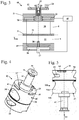
- Fig. 1 shows a brushcutter 37 as an exemplary embodiment of a hand-held tool.
- the brushcutter 37 has a housing 38 which is connected to a tool head 69 via a guide tube 39.
- a tool 40 in the exemplary embodiment a cutting knife, is mounted on the tool head 69 so as to be rotatable about an axis of rotation 44.
- the tool 40 is arranged in the housing 38, in Fig. 2 internal combustion engine 1 shown schematically.
- a starter device is provided, the starter handle 43 of which protrudes from the housing 38, as Fig. 1 shows.
- handles 41 are provided which are fixed to the guide tube 39 via a bracket.
- At least one operating element 42 for controlling the internal combustion engine 1 is arranged on one of the handles 41.
- Fig. 2 shows the structure of the internal combustion engine 1 schematically.
- the internal combustion engine 1 is a two-stroke engine working with a flushing reservoir.
- Another design of the internal combustion engine 1 for example a design as However, a four-stroke engine, in particular as a mixture-lubricated four-stroke engine, can be advantageous.
- the internal combustion engine 1 has a cylinder 2 in which a combustion chamber 3 is formed.
- the combustion chamber 3 is delimited by a piston 5 mounted to and fro in the cylinder 2, which piston drives a crankshaft 7 rotatably mounted in a crankcase 4 via a connecting rod 6.
- the internal combustion engine 1 comprises an air filter 17, via which combustion air is sucked in during operation.
- the air filter 17 is connected to an air inlet 10 and a mixture inlet 11 on the cylinder 2 via an intake duct 26. Intake combustion air and fuel / air mixture flow in a flow direction 36 through the intake channel 26.
- the intake channel 26 is separated by a partition 31 into the first supply channel 8 for air and the second supply channel 9 for mixture.
- the combustion air is drawn in through a first supply duct 8, which is provided for supplying air, to at least one air inlet 10 on the cylinder 2.
- Combustion air is also drawn in via a second supply channel 9, which is provided for supplying the fuel / air mixture, to a mixture inlet 11.
- the internal combustion engine 1 has transfer passages 13 close to the outlet and transfer passages 14 close to the inlet, which open with transfer windows 15 at the cylinder bore.
- the overflow channels 13 and 14 connect in the area of in Fig. 2
- the bottom dead center of the piston 5 shown is the interior of the crankcase 4 with the combustion chamber 3.
- the mixture inlet 11 and the air inlet 10 are controlled by the piston skirt of the piston 5.
- the internal combustion engine 1 of the embodiment is a slot-type engine.
- the mixture inlet 11 is connected to the interior of the crankcase 4 in the area of the top dead center of the piston 5.
- the air inlet 10 opens into a region of the piston 5 in which a piston pocket 12 of the piston 5 moves.
- the piston pocket 12 connects the air inlet 10 in the area of the top dead center of the piston 5 with the overflow windows 15 of the overflow channels 13 near the outlet and the overflow channels 14 remote from the outlet.
- the illustration in FIG Fig. 2 is only schematic.
- a carburetor 18 is provided for supplying fuel.
- the carburetor 18 has a carburetor roller 20.
- the carburetor roller 20 is rotatably mounted to control the amount of combustion air supplied.
- a first channel 34 is formed, which forms an air channel section, and a second channel 33, which forms a mixture channel section.
- a second channel 33 which forms a mixture channel section.
- the fuel / air mixture is sucked from the second supply channel 9 via the mixture inlet 11 into the interior of the crankcase 4.
- the piston pockets 12 connect the at least one air inlet 10 to the overflow windows 15
- fuel-free or low-fuel combustion air is sucked from the first supply duct 8 through the overflow windows 15 into the overflow ducts 13 and 14.
- the fuel / air mixture in the interior of the crankcase 4 is compressed in the interior of the crankcase 4 during the subsequent downward stroke, that is, the movement of the piston 5 from the combustion chamber 3 in the direction of the crankcase 4.
- Fig. 3 shows the structure of the carburetor 18 in detail.
- the carburetor 18 has a carburetor housing 19 which is closed by a cover 21.
- the carburetor roller 20 is mounted pivotably about a pivot axis 35.
- An actuating lever 23 is fixed to the carburetor drum 20, on which the operating element 42 ( Fig. 1 ) of the implement is effective.
- the operating element 42 is advantageously connected to an actuating pin 24 fixed on the actuating lever 23 via a Bowden cable or another transmission element. If the operator actuates the operating element 42, the carburetor drum 20 swivels in the carburetor housing 19 about the swivel axis 35.
- a fuel opening 28, which opens into the second channel 33 of the carburetor roller 20, is provided for the supply of fuel.
- the fuel opening 28 is connected to a fuel chamber 30 via a fuel valve 27.
- the fuel valve 27 is preferably designed as an electromagnetic valve and controls the entire amount of fuel supplied into the channel 33 via the fuel opening 28.
- the fuel opening 28 is advantageously the only fuel opening opening into the carburetor cylinder 20.
- the fuel valve 27 is activated by a control device 45.
- a switch 22 is provided in the exemplary embodiment, which is shown in FIG Fig. 3 is shown schematically and its structure is explained in more detail below.
- the switch 22 is connected to the control device 45.
- a control needle protrudes into the fuel opening 28 to control the amount of fuel supplied and the size of an annular gap formed between the control needle and the fuel opening changes as a function of the rotational position of the carburetor roller 20.
- the Figures 4 to 6 show the design of the carburetor roller 20 in detail.
- the carburetor roller 20 has a roller body 54 on which an outer peripheral surface 60 is formed.
- the outer circumferential surface 60 is the region of the carburetor roller 20 which has the largest diameter.
- a roller shaft 61 with a reduced diameter is advantageously fixed on the roller body 54.
- the roller body 54 is advantageously designed in one piece with the roller shaft 61.
- a multi-part design in particular a design made up of a plurality of parts that are firmly and non-detachably connected to one another, can also be advantageous.
- the roller shaft 61 has an engagement contour 75 on which the actuating lever 23 ( Fig. 2 ) must be fixed in a rotationally fixed manner.
- the roller shaft 61 and the roller body 54 are preferably of essentially cylindrical design, the pivot axis 35 forming the longitudinal center axis of the roller body 54 and the roller shaft 61. How Fig. 4 also shows, the channels 33 and 34 are formed as through openings through the roller body 54 running transversely to the pivot axis 35.
- the roller body has an upper side 25 from which the roller shaft 61 extends. The top 25 is the end face of the roller body 54 facing the roller shaft 61.
- the roller body 54 On the side of the roller body 54 which is adjacent to the roller shaft 61, the roller body 54 has a control contour 57 on its outer circumference.
- the control contour 57 is used to detect the rotational position of the carburetor cylinder 20 and actuates the switch 22 ( Fig. 3 ).
- the control contour 57 is preferably formed by at least one recess 47 or 48.
- the control contour 57 is formed by two depressions 47 and 48.
- the control contour 57 is preferably formed by two depressions 47 and 48 as well as a region of the outer circumferential surface 60 lying between the depressions 47 and 48. Instead of the outer circumferential surface 60, the area lying between the depressions 47 and 48 can also be formed by a further contour.
- the further contour is in particular a surface curved around the pivot axis 35, which extends at a different distance from the pivot axis 35 than the outer circumferential surface 60.
- the control contour 57 to extends to the top 25.
- the recesses 47 and 48 are open to the top 25.
- the control contour 57 can also be at a distance from the top 25.
- the roller body 54 has an adjusting contour 64 on the end face facing away from the roller shaft 61.
- the adjusting contour 64 can be provided in order to change the position of the carburetor roller 20 in the direction of the pivot axis 35 as a function of the rotary position of the carburetor roller 20, for example, to increase the amount of fuel supplied via a fuel opening 28 ( Fig. 3 ) to adjust the protruding needle.
- the adjusting contour 64 is of no importance, since the fuel quantity supplied via the fuel opening 28 is adjusted via the fuel valve 27.
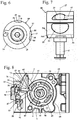
- Fig. 6 shows the design of the recesses 47 and 48 in detail.
- Both depressions 47 and 48 have a base 58 lying radially on the inside with respect to the pivot axis 35.
- the ends of the depressions 47 and 48 lying in the circumferential direction go into the FIG Fig. 6
- elevations can be provided instead of the depressions 47 and 48.
- the elevations preferably merge into the outer circumferential surface 60 with bevels.
- a groove 63 running in the circumferential direction is provided on the channel 33.
- the channel 33 is preferably a mixture channel for guiding the fuel / air mixture.
- the mixture is preferably formed in the roller body 54 by supplying fuel into the mixture channel.
- the groove 63 serves to open the mixture duct slightly even in the idling position of the carburetor drum 20.
- the roller body 54 is formed in one piece.
- a further advantageous design variant is shown schematically, in which the roller body is constructed from two parts 54a and 54b connected to one another.
- the parts 54a and 54b are advantageously firmly, in particular permanently connected to one another. However, a detachable connection of the two parts 54a and 54b, for example a screw connection, can also be advantageous.
- the part 54a is cylindrical and has the channels 33 and 34.
- the part 54a is advantageously made of media-resistant plastic or metal.
- the part 54b is designed as a flat disk and has the control contour 57.
- the part 54b is advantageously made of plastic.
- the material of the part 54b is advantageously matched to the material of the pivot lever 49 in such a way that there are low frictional forces between the control contour 57 and the pivot lever 49.
- the parts 54a and 54b are adjusted to one another in particular before the fixed, in particular materially bonded connection with one another, so that small tolerances arise between the control contour 57 and the channels 33 and 34.
- the position of the parts 54a and 54b with respect to one another can also be determined structurally, for example by means of a stop or the like.
- Fig. 8 shows the carburetor housing 19 with the carburetor roller 20 in a top view without cover 21 (see Fig. 3 ). As a result, the carburetor roller 20 and the switch 22 are visible.
- a pivot lever 49 is advantageously mounted on the carburetor housing 19 so as to be pivotable about a pivot axis 62 of the pivot lever 49.
- the pivot axis 62 of the pivot lever 49 is arranged at a distance c from the pivot axis 35 of the carburetor roller 20.
- the distance c is advantageously greater than the distance b between the outer circumferential surface 60 and the pivot axis 35 of the carburetor roller 20.
- the pivot axis 62 of the pivot lever 49 is therefore outside the roller body 20.
- the pivot axis 62 of the pivot lever 49 is preferably aligned parallel to the pivot axis 35 of the carburetor roller 20.
- the pivot lever 49 advantageously has a nose which rests on the carburetor roller 20 and which forms a detection means 56 for detecting the rotational position of the carburetor roller 20.
- the detection means 56 together with the control contour 57 forms a detection device 55 for detecting the rotational position of the carburetor drum 20.
- the pivot lever 49 can have a recess 72 adjacent to the detection means 56 which avoids contact of this region of the pivot lever 49 with the outer circumferential surface 60.
- the detection means 56 rests on the bottom 58 of the first depression 47.
- the base 58 has a distance a from the pivot axis 35 of the carburetor roller 20 which is smaller than the distance b from the outer circumferential surface 60 to the pivot axis 35 of the carburetor roller 20.
- the pivot lever 49 is pretensioned in the direction of the position of the detection means 56 which is located radially inward in relation to the pivot axis 35 of the carburetor roller 20.
- the bias of the pivot lever 49 is in Fig. 8 indicated by an arrow 71.
- the preload of the pivot lever 49 can be adjusted by a return spring 70 ( Fig. 14 ), which is part of the switch 22.
- the preload can also be applied by a spring element separate from the switch 22.
- the preload is applied in the direction of arrow 71 by a separate spring element. Due to the bias, the detection means 56 rests on the bottom 58 of the recess 47.
- a contact pin 51 which forms the switch 22 with the spring 50, is advantageously fixed on the pivot lever 49. In the switching position shown, the contact pin 51 is at a distance d from the spring 50, which is designed as a contact spring. The contact pin 51 is therefore not connected to the spring 50 in an electrically conductive manner.
- the switch 22 is open.
- the spring 50 rests against a contact 53 of a diode 52 which is connected to the control device 45.
- the contact pin 51 protrudes from the pivot lever 49 advantageously parallel to the pivot axis 35 upwards.
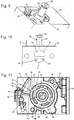
- Fig. 10 shows an embodiment of a carburetor with a carburetor roller 20 in the idle position.
- the idle position relates to the operation of the internal combustion engine 1 in idle, i.e. when the internal combustion engine 1 is running without a user accelerating, for example by means of an operating element 42 ( Fig. 1 ).
- the first feed channel 8 is completely closed in the idling position of the carburetor roller 20.
- a small flow cross section is released via the groove 63. This allows a small amount of combustion air to flow through the second supply duct 9 and fuel from the fuel opening 28 ( Fig. 2 ) take with you.
- the roller body 20 reaches the into the Figures 11 to 13 Part load position shown.
- the detection means 56 slides from the floor 58 over the incline 79 onto the outer circumferential surface 60.
- the inclination of the incline 79 adjusts the forces exerted by the pivot lever 49 on the carburetor roller 20 and thus on the operating element 42 during the transition from the idle position to the partial load position.
- the forces exerted by the pivot lever 49 on the carburetor drum 20 and thus on the operating element 42 are set during the transition from the full load position to the part load position.
- the inclination of the bevels 79 and 80 is advantageously chosen so that the forces exerted by the pivot lever 49 on the carburetor roller 20 are as small as possible.
- the detection means 56 is on a slope 79, 80, the switching state of the switch 22 is not defined.
- the bevels 79 and 80 are advantageously short in the circumferential direction.
- the recesses 47 and 48 can, as in Fig.
- the depressions 47, 48 can, however, also be designed without an incline on this side, as in FIG Fig. 8 is shown.
- the Figures 11 to 13 show the arrangement with the carburetor roller 20 in the partial load position. Like in particular the Fig. 11 and Fig. 12 show, the depressions 47 and 48 also extend in the embodiment according to FIGS Figures 11 to 13 up to the top 25.
- the part load position refers to the operation of the internal combustion engine 1 in part load, i.e. when the internal combustion engine 1 is running and a user accelerates, for example by means of an operating element 42 ( Fig. 1 ). When the operating element 42 is completely depressed, a full throttle position is present. In a partial load position, the carburetor roller 20 is between the idle position and the full throttle position. How Fig. 13 shows, the first feed channel 8 and the second feed channel 9 are partially open in the partial load position.
- the detection means 56 in the exemplary embodiment the nose of the pivot lever 49, has moved out of the first recess 47 along the slope 79 during the rotary movement of the carburetor roller 20 and is now in contact with the outer circumferential surface 60.
- the detection device 56 lies at the distance b from the pivot axis 35, that is to say it has been moved radially outward with respect to the pivot axis 35.
- the pivot lever 49 was pivoted about the pivot axis 62.
- the contact pin 51 has moved accordingly about the pivot axis 62 and is now in contact with the spring 50.
- the switch 22 formed by the contact pin 51 and the spring 50 is closed.
- the contact pin 51 is connected in an electrically conductive manner to the contact 53 of the diode 52 via the spring 50.
- the control device 45 receives a signal which indicates that the carburetor roller 20 is in a partial load position. How Fig. 13 shows, the first feed channel 8 and the second feed channel 9 are partially open in the partial load position.
- the Fig. 14 and 15th show the arrangement in full throttle position.
- the full throttle position relates to the operation of the internal combustion engine 1 at full throttle, i.e. an operating state in which the internal combustion engine 1 is running and a user accelerates and, for example, completely depresses the control element 42 ( Fig. 1 In the full throttle position, the detection means 56 rests on the bottom 58 of the second recess 48. As a result, the pivot lever 49 has pivoted back about the pivot axis 62. The pivot lever 49 is reset due to an in Fig. 14 return spring 70 shown.
- the return spring 70 is connected to the contact pin 51 in every position of the pivot lever 49.
- the ground contact is established via the return spring 70.
- the contact pin 51 is not contacted by the spring 50 in the pivoted-back position of the pivot lever 49 (corresponding to FIG Fig. 8 ).
- the switch 22 is open.
- the recesses 47 and 48 only have a bevel 79, 80 on the sides, via which the actuating means 56 comes when adjusting from the idle position to the part-load position and when adjusting from the part-load position to the full-load position.
- the wall is rounded and steep, so that the actuating means 56 on the side facing away from the other recess 47, 48 cannot emerge from the recesses 47 and 48. This is usually prevented in any case by means of corresponding stops on the carburetor roller 20, which set the idle position and the full load position.
- the recesses 47 and 48 can have a different geometry.
- the recesses 47 and 48 can, however, also have an identical geometry and can be arranged in mirror symmetry, such as Fig. 8 shows.
- one of the depressions 47, 48 can be designed deeper, longer, more rounded or angular than the other of the depressions 47, 48.
- the bevels 59, 79, 80 and / or 81 are designed differently.
- a bevel 79, 80 can be designed as a bevel
- the contour arranged at the other end of the recess 47, 48 can be designed as a sharp edge.
- the depressions 47 and 48 can, for example, alternatively or additionally have different depths. These different configurations can be used by the detection device 55 to detect the different positions.
- the different trainings can also be used in order to be able to identify unambiguous positions of the carburetor roller 20 during manufacture.
- an alternative position detection can alternatively be used for at least one switch position, for example a lever in combination with a potentiometer.
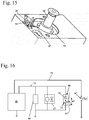
- Fig. 16 shows schematically a circuit diagram of the arrangement.
- the control device 45 is connected to a short circuit button 67 via a line 72.
- the control device 45 advantageously has a microprocessor.
- the short circuit button 67 is to be actuated by the operator and can also be designed as a switch.
- the short circuit button 67 is used to switch the ignition of the internal combustion engine 1 ( Fig. 2 ) short-circuit and thereby switch off the internal combustion engine 1.
- the control device 45 is connected via a further line 73 to a connection 66 for a diagnostic device, the fuel valve 27 as well as the diode 52 and the switch 22.
- the connection 66 for diagnosis, the fuel valve 27 and the switch 22 are advantageously connected in parallel.
- the switch 22 is opened or closed depending on the position of the control contour 57. In Fig. 16 the movement of the control contour 57 is indicated schematically by an arrow 65.
- the switch 22 is open in the idling state and in the full load state and is closed in the intermediate partial load state. It is provided that the control device 45 controls the amount of fuel supplied via the fuel valve 27 as a function of the rotational position of the carburetor drum 20 determined by the detection device 55.
- the detection device 55 is formed by the switch 22, the detection means 56, the control contour 57 and the diode 52.
- the detection means 56 when the carburetor cylinder 20 is in a rotational position between the idling position and the full load position, is not located on the outer circumferential surface 60 of the carburetor cylinder 20 on the carburetor cylinder 20, but on a curved surface whose radius around the pivot axis 35 of the carburetor roller 20 differs from that of the outer circumferential surface 60, which is therefore closer to the pivot axis 35 of the carburetor roller 20 or further away from the pivot axis 35.
Landscapes
- Engineering & Computer Science (AREA)
- Chemical & Material Sciences (AREA)
- Combustion & Propulsion (AREA)
- Mechanical Engineering (AREA)
- General Engineering & Computer Science (AREA)
- Control Of Throttle Valves Provided In The Intake System Or In The Exhaust System (AREA)
- Output Control And Ontrol Of Special Type Engine (AREA)
Claims (14)
- Carburateur pour le moteur à combustion dans un appareil de travail à main, avec un carter de carburateur (19), dans lequel dans le carter de carburateur (19) un cylindre de carburateur (20) est monté à rotation autour d'un axe de rotation (35), dans lequel le cylindre de carburateur (20) a un corps de cylindre (54), dans lequel le corps de cylindre (54) comporte au moins un canal (33, 34) s'étendant transversalement par rapport à l'axe de rotation (35), qui forme une section de canal d'admission, dans lequel un dispositif de détection (55) est prévu pour détecter au moins une position de rotation du cylindre de carburateur (20), dans lequel le dispositif de détection (55) est formé pour générer un signal électrique, caractérisé en ce que le dispositif de détection (55) comprend un contour de commande (57) et un moyen de détection (56) coopérant avec le contour de commande (57), et en ce que le contour de commande (57) est formé sur le cylindre de carburateur (20).
- Carburateur selon la revendication 1,
caractérisé en ce que le contour de commande (57) est disposé sur le corps de cylindre (54). - Carburateur selon la revendication 2,
caractérisé en ce que le contour de commande (57) est disposé dans la zone du corps de cylindre (54) qui a le plus grand diamètre. - Carburateur selon l'une des revendications 1 à 3,
caractérisé en ce que le contour de commande (57) comprend au moins un creux (47, 48) sur la circonférence du cylindre de carburateur (20). - Carburateur selon la revendication 4,
caractérisé en ce que le contour de commande (57) comprend un premier creux (47) qui est associé au ralenti et en ce que le contour de commande (57) comprend un deuxième creux (48) qui est associé à la pleine charge. - Carburateur selon la revendication 4 ou 5,
caractérisé en ce qu'au moins un creux (47, 48) a un fond (58) limitant le creux (47, 48) dans la direction radiale, qui, sur au moins un côté du creux (47, 48) situé dans la direction circonférentielle, se prolonge avec une inclinaison (59, 79, 80, 81) par la surface circonférentielle extérieure (60) du cylindre de carburateur (20) - Carburateur selon l'une des revendications 1 à 6,
caractérisé en ce que le moyen de détection (56) est appliqué contre le contour de commande (57) radialement à l'extérieur du contour de commande (57) par rapport à l'axe de pivotement (35). - Carburateur selon l'une des revendications 1 à 7,
caractérisé en ce que le moyen de détection (56) est contraint par ressort par un ressort de rappel (70) radialement vers l'intérieur par rapport à l'axe de rotation (35). - Carburateur selon l'une des revendications 1 à 8,
caractérisé en ce que le dispositif de détection (55) comprend un commutateur (22) qui est actionné en fonction de la position du moyen de détection (56). - Carburateur selon l'une des revendications 1 à 9,
caractérisé en ce que le moyen de détection (56) est formé sur un levier pivotant (49) qui est monté sur le carter de carburateur (19) en étant apte à pivoter autour d'un deuxième axe de rotation (58) situé parallèlement à l'axe de rotation (35) du cylindre de carburateur (20). - Carburateur selon la revendication 10,
caractérisé en ce que le levier pivotant (49) est relié à la masse par le ressort de rappel (70). - Carburateur selon l'une des revendications 1 à 11,
caractérisé en ce qu'il est prévu une soupape de carburant (27) par laquelle du carburant est amené dans le canal (33) du cylindre de carburateur (20). - Moteur à combustion interne avec un carburateur selon la revendication 12, dans lequel le moteur à combustion interne a un dispositif de commande (45) qui est relié au dispositif de détection (55) et à la soupape de carburant (27) pour l'amenée de carburant dans la section de canal d'admission.
- Procédé pour le fonctionnement d'un moteur à combustion interne selon la revendication 13,
dans lequel le dispositif de commande (45) commande la quantité de carburant amenée en fonction de la position de rotation du cylindre de carburateur (20) détectée par le dispositif de détection (55).
Applications Claiming Priority (1)
| Application Number | Priority Date | Filing Date | Title |
|---|---|---|---|
| DE102018000145.9A DE102018000145A1 (de) | 2018-01-10 | 2018-01-10 | Vergaser für den Verbrennungsmotor in einem handgeführten Arbeitsgerät, Verbrennungsmotor mit einem Vergaser und Verfahren zum Betrieb eines Verbrennungsmotors |
Publications (2)
| Publication Number | Publication Date |
|---|---|
| EP3511552A1 EP3511552A1 (fr) | 2019-07-17 |
| EP3511552B1 true EP3511552B1 (fr) | 2021-03-31 |
Family
ID=65033351
Family Applications (1)
| Application Number | Title | Priority Date | Filing Date |
|---|---|---|---|
| EP19150488.5A Active EP3511552B1 (fr) | 2018-01-10 | 2019-01-07 | Carburateur pour le moteur à combustion interne dans un appareil de travail portatif, moteur à combustion interne doté d'un carburateur et procédé de fonctionnement d'un moteur à combustion interne |
Country Status (4)
| Country | Link |
|---|---|
| US (1) | US10718295B2 (fr) |
| EP (1) | EP3511552B1 (fr) |
| CN (1) | CN110017221B (fr) |
| DE (1) | DE102018000145A1 (fr) |
Citations (2)
| Publication number | Priority date | Publication date | Assignee | Title |
|---|---|---|---|---|
| DE3247603A1 (de) * | 1981-12-25 | 1983-07-07 | Walbro Far East, Inc., Kawasaki | Vergaser mit drehbarer drosselklappe |
| US4909211A (en) * | 1989-05-17 | 1990-03-20 | Walbro Corporation | Barrel-type throttle valve for engine air intake |
Family Cites Families (20)
| Publication number | Priority date | Publication date | Assignee | Title |
|---|---|---|---|---|
| JP4414027B2 (ja) * | 1999-09-03 | 2010-02-10 | 本田技研工業株式会社 | エンジンの吸気装置 |
| US6439547B1 (en) * | 2001-03-05 | 2002-08-27 | Walbro Corporation | Carburetor throttle and choke control mechanism |
| JP3948948B2 (ja) * | 2001-12-06 | 2007-07-25 | 本田技研工業株式会社 | 内燃機関の点火時期制御装置 |
| JP2003278602A (ja) * | 2002-03-19 | 2003-10-02 | Alps Electric Co Ltd | 可変ベンチュリ型キャブレタ |
| EP1548252A1 (fr) * | 2002-09-11 | 2005-06-29 | Mikuni Corporation | Dispositif a organes d'etranglement multiples |
| JP4032906B2 (ja) * | 2002-09-30 | 2008-01-16 | マツダ株式会社 | 多気筒エンジンの吸気装置 |
| DE10326313A1 (de) | 2003-06-11 | 2004-12-30 | Andreas Stihl Ag & Co. Kg | Verbrennungsmotor |
| DE102006024078A1 (de) * | 2006-05-23 | 2007-11-29 | Andreas Stihl Ag & Co. Kg | Verbrennungsmotor |
| CN101344049A (zh) * | 2007-07-10 | 2009-01-14 | 创科实业有限公司 | 具有旋转运行阻气门的化油器 |
| DE102007032526A1 (de) * | 2007-07-12 | 2009-01-15 | Andreas Stihl Ag & Co. Kg | Vergaser und Verfahren zu dessen Betrieb |
| EP2268911B1 (fr) * | 2008-03-17 | 2017-01-04 | Husqvarna AB | Unite de distribution de carburant |
| DE202009000831U1 (de) * | 2009-01-22 | 2010-06-17 | Dolmar Gmbh | Vergasereinheit für ein Motorgerät |
| WO2012002859A1 (fr) * | 2010-07-01 | 2012-01-05 | Husqvarna Ab | Procédé de distribution de carburant de démarrage à un moteur à combustion interne |
| US8931458B2 (en) * | 2010-07-02 | 2015-01-13 | Apt Ip Holdings, Llc | Carburetor and methods therefor |
| CN102777284A (zh) * | 2012-07-17 | 2012-11-14 | 星月集团有限公司 | 汽油机空滤器自动风门装置 |
| DE102012025321B4 (de) * | 2012-12-22 | 2021-01-21 | Andreas Stihl Ag & Co. Kg | Vergaser für ein handgeführtes Arbeitsgerät und handgeführtes Arbeitsgerät |
| DE102013009668B4 (de) * | 2013-06-08 | 2022-01-05 | Andreas Stihl Ag & Co. Kg | Verbrennungsmotor mit einer Starteinrichtung |
| DE102015001452A1 (de) * | 2015-02-05 | 2016-08-11 | Andreas Stihl Ag & Co. Kg | Vergaser und Verfahren zum Betrieb eines Verbrennungsmotors mit einem Vergaser |
| US20190024611A1 (en) * | 2016-01-25 | 2019-01-24 | Husqvarna Ab | Internal combustion engine provided with a semi- automatic choke device |
| CN206655741U (zh) * | 2017-03-22 | 2017-11-21 | 南宁学院 | 一种双体转阀式节气门体 |
-
2018
- 2018-01-10 DE DE102018000145.9A patent/DE102018000145A1/de not_active Withdrawn
-
2019
- 2019-01-07 EP EP19150488.5A patent/EP3511552B1/fr active Active
- 2019-01-10 US US16/244,984 patent/US10718295B2/en active Active
- 2019-01-10 CN CN201910023094.7A patent/CN110017221B/zh not_active Expired - Fee Related
Patent Citations (2)
| Publication number | Priority date | Publication date | Assignee | Title |
|---|---|---|---|---|
| DE3247603A1 (de) * | 1981-12-25 | 1983-07-07 | Walbro Far East, Inc., Kawasaki | Vergaser mit drehbarer drosselklappe |
| US4909211A (en) * | 1989-05-17 | 1990-03-20 | Walbro Corporation | Barrel-type throttle valve for engine air intake |
Also Published As
| Publication number | Publication date |
|---|---|
| US20190211778A1 (en) | 2019-07-11 |
| CN110017221B (zh) | 2022-07-15 |
| CN110017221A (zh) | 2019-07-16 |
| US10718295B2 (en) | 2020-07-21 |
| EP3511552A1 (fr) | 2019-07-17 |
| DE102018000145A1 (de) | 2019-07-11 |
Similar Documents
| Publication | Publication Date | Title |
|---|---|---|
| EP2746556B1 (fr) | Carburateur pour outillage portatif et outillage portatif | |
| DE102009030593B4 (de) | Vergaser und Zweitaktmotor mit einem Vergaser | |
| EP2623752A2 (fr) | Appareil de travail manuel avec moteur à combustion interne avec limitation de vitesse de rotation réglable | |
| EP3748151B1 (fr) | Unité de formation de mélange et moteur à deux temps doté d'une unité de formation de mélange | |
| DE102007032526A1 (de) | Vergaser und Verfahren zu dessen Betrieb | |
| DE102011105159B4 (de) | Handgeführtes Arbeitsgerät | |
| DE102013009668B4 (de) | Verbrennungsmotor mit einer Starteinrichtung | |
| EP2679357B1 (fr) | Appareil de travail | |
| DE102013009669B4 (de) | Verbrennungsmotor mit einer Starteinrichtung | |
| DE102006024078A1 (de) | Verbrennungsmotor | |
| DE602005003605T2 (de) | Zündsystem für tragbare kraftangetriebene Geräte | |
| DE2500881A1 (de) | Steuerung der kraftstoffzufuhr fuer verbrennungsmotoren | |
| EP3315273B1 (fr) | Appareil de travail portatif | |
| DE10009796B4 (de) | Verbrennungsmotor mit im Luftfiltergehäuse angeordneter Chokeklappe | |
| EP1092860A2 (fr) | Carburateur et outil motorisé | |
| EP3561257B1 (fr) | Moteur à combustion interne et son procédé de fonctionnement | |
| DE69506329T2 (de) | Startsystem für eine Brennkraftmaschine | |
| EP3511552A1 (fr) | Carburateur pour le moteur à combustion interne dans un appareil de travail portatif, moteur à combustion interne doté d'un carburateur et procédé de fonctionnement d'un moteur à combustion interne | |
| DE102004063197A1 (de) | Vergaseranordnung | |
| DE10326313A1 (de) | Verbrennungsmotor | |
| EP3584435B1 (fr) | Carburateur et appareil de travail guidé à la main doté d'un moteur à combustion interne doté d'un carburateur | |
| DE4140855C2 (de) | Automatische Starterklappe | |
| DE10232341A1 (de) | Vergaser | |
| DE102020119158A1 (de) | Vergaser und Zweitaktmotor mit einem Vergaser | |
| DE3007905A1 (de) | Vergaser fuer fluessigen brennstoff |
Legal Events
| Date | Code | Title | Description |
|---|---|---|---|
| PUAI | Public reference made under article 153(3) epc to a published international application that has entered the european phase |
Free format text: ORIGINAL CODE: 0009012 |
|
| STAA | Information on the status of an ep patent application or granted ep patent |
Free format text: STATUS: THE APPLICATION HAS BEEN PUBLISHED |
|
| AK | Designated contracting states |
Kind code of ref document: A1 Designated state(s): AL AT BE BG CH CY CZ DE DK EE ES FI FR GB GR HR HU IE IS IT LI LT LU LV MC MK MT NL NO PL PT RO RS SE SI SK SM TR |
|
| AX | Request for extension of the european patent |
Extension state: BA ME |
|
| STAA | Information on the status of an ep patent application or granted ep patent |
Free format text: STATUS: REQUEST FOR EXAMINATION WAS MADE |
|
| 17P | Request for examination filed |
Effective date: 20191219 |
|
| RBV | Designated contracting states (corrected) |
Designated state(s): AL AT BE BG CH CY CZ DE DK EE ES FI FR GB GR HR HU IE IS IT LI LT LU LV MC MK MT NL NO PL PT RO RS SE SI SK SM TR |
|
| STAA | Information on the status of an ep patent application or granted ep patent |
Free format text: STATUS: EXAMINATION IS IN PROGRESS |
|
| 17Q | First examination report despatched |
Effective date: 20200317 |
|
| GRAP | Despatch of communication of intention to grant a patent |
Free format text: ORIGINAL CODE: EPIDOSNIGR1 |
|
| STAA | Information on the status of an ep patent application or granted ep patent |
Free format text: STATUS: GRANT OF PATENT IS INTENDED |
|
| INTG | Intention to grant announced |
Effective date: 20201027 |
|
| GRAS | Grant fee paid |
Free format text: ORIGINAL CODE: EPIDOSNIGR3 |
|
| GRAA | (expected) grant |
Free format text: ORIGINAL CODE: 0009210 |
|
| STAA | Information on the status of an ep patent application or granted ep patent |
Free format text: STATUS: THE PATENT HAS BEEN GRANTED |
|
| AK | Designated contracting states |
Kind code of ref document: B1 Designated state(s): AL AT BE BG CH CY CZ DE DK EE ES FI FR GB GR HR HU IE IS IT LI LT LU LV MC MK MT NL NO PL PT RO RS SE SI SK SM TR |
|
| REG | Reference to a national code |
Ref country code: GB Ref legal event code: FG4D Free format text: NOT ENGLISH Ref country code: CH Ref legal event code: EP |
|
| REG | Reference to a national code |
Ref country code: DE Ref legal event code: R096 Ref document number: 502019001066 Country of ref document: DE Ref country code: AT Ref legal event code: REF Ref document number: 1377194 Country of ref document: AT Kind code of ref document: T Effective date: 20210415 |
|
| REG | Reference to a national code |
Ref country code: IE Ref legal event code: FG4D Free format text: LANGUAGE OF EP DOCUMENT: GERMAN |
|
| REG | Reference to a national code |
Ref country code: LT Ref legal event code: MG9D |
|
| PG25 | Lapsed in a contracting state [announced via postgrant information from national office to epo] |
Ref country code: HR Free format text: LAPSE BECAUSE OF FAILURE TO SUBMIT A TRANSLATION OF THE DESCRIPTION OR TO PAY THE FEE WITHIN THE PRESCRIBED TIME-LIMIT Effective date: 20210331 Ref country code: FI Free format text: LAPSE BECAUSE OF FAILURE TO SUBMIT A TRANSLATION OF THE DESCRIPTION OR TO PAY THE FEE WITHIN THE PRESCRIBED TIME-LIMIT Effective date: 20210331 Ref country code: BG Free format text: LAPSE BECAUSE OF FAILURE TO SUBMIT A TRANSLATION OF THE DESCRIPTION OR TO PAY THE FEE WITHIN THE PRESCRIBED TIME-LIMIT Effective date: 20210630 Ref country code: NO Free format text: LAPSE BECAUSE OF FAILURE TO SUBMIT A TRANSLATION OF THE DESCRIPTION OR TO PAY THE FEE WITHIN THE PRESCRIBED TIME-LIMIT Effective date: 20210630 |
|
| PG25 | Lapsed in a contracting state [announced via postgrant information from national office to epo] |
Ref country code: SE Free format text: LAPSE BECAUSE OF FAILURE TO SUBMIT A TRANSLATION OF THE DESCRIPTION OR TO PAY THE FEE WITHIN THE PRESCRIBED TIME-LIMIT Effective date: 20210331 Ref country code: RS Free format text: LAPSE BECAUSE OF FAILURE TO SUBMIT A TRANSLATION OF THE DESCRIPTION OR TO PAY THE FEE WITHIN THE PRESCRIBED TIME-LIMIT Effective date: 20210331 Ref country code: LV Free format text: LAPSE BECAUSE OF FAILURE TO SUBMIT A TRANSLATION OF THE DESCRIPTION OR TO PAY THE FEE WITHIN THE PRESCRIBED TIME-LIMIT Effective date: 20210331 |
|
| REG | Reference to a national code |
Ref country code: NL Ref legal event code: MP Effective date: 20210331 |
|
| PG25 | Lapsed in a contracting state [announced via postgrant information from national office to epo] |
Ref country code: CZ Free format text: LAPSE BECAUSE OF FAILURE TO SUBMIT A TRANSLATION OF THE DESCRIPTION OR TO PAY THE FEE WITHIN THE PRESCRIBED TIME-LIMIT Effective date: 20210331 Ref country code: EE Free format text: LAPSE BECAUSE OF FAILURE TO SUBMIT A TRANSLATION OF THE DESCRIPTION OR TO PAY THE FEE WITHIN THE PRESCRIBED TIME-LIMIT Effective date: 20210331 Ref country code: LT Free format text: LAPSE BECAUSE OF FAILURE TO SUBMIT A TRANSLATION OF THE DESCRIPTION OR TO PAY THE FEE WITHIN THE PRESCRIBED TIME-LIMIT Effective date: 20210331 Ref country code: NL Free format text: LAPSE BECAUSE OF FAILURE TO SUBMIT A TRANSLATION OF THE DESCRIPTION OR TO PAY THE FEE WITHIN THE PRESCRIBED TIME-LIMIT Effective date: 20210331 Ref country code: SM Free format text: LAPSE BECAUSE OF FAILURE TO SUBMIT A TRANSLATION OF THE DESCRIPTION OR TO PAY THE FEE WITHIN THE PRESCRIBED TIME-LIMIT Effective date: 20210331 |
|
| PG25 | Lapsed in a contracting state [announced via postgrant information from national office to epo] |
Ref country code: IS Free format text: LAPSE BECAUSE OF FAILURE TO SUBMIT A TRANSLATION OF THE DESCRIPTION OR TO PAY THE FEE WITHIN THE PRESCRIBED TIME-LIMIT Effective date: 20210731 Ref country code: RO Free format text: LAPSE BECAUSE OF FAILURE TO SUBMIT A TRANSLATION OF THE DESCRIPTION OR TO PAY THE FEE WITHIN THE PRESCRIBED TIME-LIMIT Effective date: 20210331 Ref country code: PT Free format text: LAPSE BECAUSE OF FAILURE TO SUBMIT A TRANSLATION OF THE DESCRIPTION OR TO PAY THE FEE WITHIN THE PRESCRIBED TIME-LIMIT Effective date: 20210802 Ref country code: SK Free format text: LAPSE BECAUSE OF FAILURE TO SUBMIT A TRANSLATION OF THE DESCRIPTION OR TO PAY THE FEE WITHIN THE PRESCRIBED TIME-LIMIT Effective date: 20210331 Ref country code: PL Free format text: LAPSE BECAUSE OF FAILURE TO SUBMIT A TRANSLATION OF THE DESCRIPTION OR TO PAY THE FEE WITHIN THE PRESCRIBED TIME-LIMIT Effective date: 20210331 |
|
| REG | Reference to a national code |
Ref country code: DE Ref legal event code: R097 Ref document number: 502019001066 Country of ref document: DE |
|
| PG25 | Lapsed in a contracting state [announced via postgrant information from national office to epo] |
Ref country code: DK Free format text: LAPSE BECAUSE OF FAILURE TO SUBMIT A TRANSLATION OF THE DESCRIPTION OR TO PAY THE FEE WITHIN THE PRESCRIBED TIME-LIMIT Effective date: 20210331 Ref country code: AL Free format text: LAPSE BECAUSE OF FAILURE TO SUBMIT A TRANSLATION OF THE DESCRIPTION OR TO PAY THE FEE WITHIN THE PRESCRIBED TIME-LIMIT Effective date: 20210331 Ref country code: ES Free format text: LAPSE BECAUSE OF FAILURE TO SUBMIT A TRANSLATION OF THE DESCRIPTION OR TO PAY THE FEE WITHIN THE PRESCRIBED TIME-LIMIT Effective date: 20210331 |
|
| PLBE | No opposition filed within time limit |
Free format text: ORIGINAL CODE: 0009261 |
|
| STAA | Information on the status of an ep patent application or granted ep patent |
Free format text: STATUS: NO OPPOSITION FILED WITHIN TIME LIMIT |
|
| 26N | No opposition filed |
Effective date: 20220104 |
|
| PG25 | Lapsed in a contracting state [announced via postgrant information from national office to epo] |
Ref country code: IS Free format text: LAPSE BECAUSE OF FAILURE TO SUBMIT A TRANSLATION OF THE DESCRIPTION OR TO PAY THE FEE WITHIN THE PRESCRIBED TIME-LIMIT Effective date: 20210731 |
|
| PG25 | Lapsed in a contracting state [announced via postgrant information from national office to epo] |
Ref country code: IT Free format text: LAPSE BECAUSE OF FAILURE TO SUBMIT A TRANSLATION OF THE DESCRIPTION OR TO PAY THE FEE WITHIN THE PRESCRIBED TIME-LIMIT Effective date: 20210331 |
|
| PG25 | Lapsed in a contracting state [announced via postgrant information from national office to epo] |
Ref country code: MC Free format text: LAPSE BECAUSE OF FAILURE TO SUBMIT A TRANSLATION OF THE DESCRIPTION OR TO PAY THE FEE WITHIN THE PRESCRIBED TIME-LIMIT Effective date: 20210331 |
|
| REG | Reference to a national code |
Ref country code: CH Ref legal event code: PL |
|
| REG | Reference to a national code |
Ref country code: BE Ref legal event code: MM Effective date: 20220131 |
|
| PG25 | Lapsed in a contracting state [announced via postgrant information from national office to epo] |
Ref country code: LU Free format text: LAPSE BECAUSE OF NON-PAYMENT OF DUE FEES Effective date: 20220107 |
|
| PG25 | Lapsed in a contracting state [announced via postgrant information from national office to epo] |
Ref country code: BE Free format text: LAPSE BECAUSE OF NON-PAYMENT OF DUE FEES Effective date: 20220131 |
|
| PG25 | Lapsed in a contracting state [announced via postgrant information from national office to epo] |
Ref country code: LI Free format text: LAPSE BECAUSE OF NON-PAYMENT OF DUE FEES Effective date: 20220131 Ref country code: CH Free format text: LAPSE BECAUSE OF NON-PAYMENT OF DUE FEES Effective date: 20220131 |
|
| PG25 | Lapsed in a contracting state [announced via postgrant information from national office to epo] |
Ref country code: IE Free format text: LAPSE BECAUSE OF NON-PAYMENT OF DUE FEES Effective date: 20220107 |
|
| GBPC | Gb: european patent ceased through non-payment of renewal fee |
Effective date: 20230107 |
|
| PG25 | Lapsed in a contracting state [announced via postgrant information from national office to epo] |
Ref country code: GB Free format text: LAPSE BECAUSE OF NON-PAYMENT OF DUE FEES Effective date: 20230107 |
|
| PG25 | Lapsed in a contracting state [announced via postgrant information from national office to epo] |
Ref country code: MK Free format text: LAPSE BECAUSE OF FAILURE TO SUBMIT A TRANSLATION OF THE DESCRIPTION OR TO PAY THE FEE WITHIN THE PRESCRIBED TIME-LIMIT Effective date: 20210331 Ref country code: CY Free format text: LAPSE BECAUSE OF FAILURE TO SUBMIT A TRANSLATION OF THE DESCRIPTION OR TO PAY THE FEE WITHIN THE PRESCRIBED TIME-LIMIT Effective date: 20210331 |
|
| PG25 | Lapsed in a contracting state [announced via postgrant information from national office to epo] |
Ref country code: HU Free format text: LAPSE BECAUSE OF FAILURE TO SUBMIT A TRANSLATION OF THE DESCRIPTION OR TO PAY THE FEE WITHIN THE PRESCRIBED TIME-LIMIT; INVALID AB INITIO Effective date: 20190107 |
|
| PGFP | Annual fee paid to national office [announced via postgrant information from national office to epo] |
Ref country code: FR Payment date: 20240125 Year of fee payment: 6 |
|
| PG25 | Lapsed in a contracting state [announced via postgrant information from national office to epo] |
Ref country code: TR Free format text: LAPSE BECAUSE OF FAILURE TO SUBMIT A TRANSLATION OF THE DESCRIPTION OR TO PAY THE FEE WITHIN THE PRESCRIBED TIME-LIMIT Effective date: 20210331 |
|
| PG25 | Lapsed in a contracting state [announced via postgrant information from national office to epo] |
Ref country code: MT Free format text: LAPSE BECAUSE OF FAILURE TO SUBMIT A TRANSLATION OF THE DESCRIPTION OR TO PAY THE FEE WITHIN THE PRESCRIBED TIME-LIMIT Effective date: 20210331 |
|
| PG25 | Lapsed in a contracting state [announced via postgrant information from national office to epo] |
Ref country code: GR Free format text: LAPSE BECAUSE OF NON-PAYMENT OF DUE FEES Effective date: 20210331 |
|
| PG25 | Lapsed in a contracting state [announced via postgrant information from national office to epo] |
Ref country code: GR Free format text: LAPSE BECAUSE OF NON-PAYMENT OF DUE FEES Effective date: 20210331 |
|
| REG | Reference to a national code |
Ref country code: AT Ref legal event code: MM01 Ref document number: 1377194 Country of ref document: AT Kind code of ref document: T Effective date: 20240107 |
|
| PG25 | Lapsed in a contracting state [announced via postgrant information from national office to epo] |
Ref country code: AT Free format text: LAPSE BECAUSE OF NON-PAYMENT OF DUE FEES Effective date: 20240107 |
|
| PG25 | Lapsed in a contracting state [announced via postgrant information from national office to epo] |
Ref country code: FR Free format text: LAPSE BECAUSE OF NON-PAYMENT OF DUE FEES Effective date: 20250131 |
|
| PGFP | Annual fee paid to national office [announced via postgrant information from national office to epo] |
Ref country code: DE Payment date: 20260127 Year of fee payment: 8 |
|
| PGFP | Annual fee paid to national office [announced via postgrant information from national office to epo] |
Ref country code: AT Payment date: 20260410 Year of fee payment: 5 |