EP3507296B1 - Immunohistochemistry via hybridization chain reaction - Google Patents
Immunohistochemistry via hybridization chain reaction Download PDFInfo
- Publication number
- EP3507296B1 EP3507296B1 EP17847401.1A EP17847401A EP3507296B1 EP 3507296 B1 EP3507296 B1 EP 3507296B1 EP 17847401 A EP17847401 A EP 17847401A EP 3507296 B1 EP3507296 B1 EP 3507296B1
- Authority
- EP
- European Patent Office
- Prior art keywords
- hcr
- hairpin
- probe
- target molecule
- target
- Prior art date
- Legal status (The legal status is an assumption and is not a legal conclusion. Google has not performed a legal analysis and makes no representation as to the accuracy of the status listed.)
- Active
Links
Images











Classifications
-
- C—CHEMISTRY; METALLURGY
- C12—BIOCHEMISTRY; BEER; SPIRITS; WINE; VINEGAR; MICROBIOLOGY; ENZYMOLOGY; MUTATION OR GENETIC ENGINEERING
- C12Q—MEASURING OR TESTING PROCESSES INVOLVING ENZYMES, NUCLEIC ACIDS OR MICROORGANISMS; COMPOSITIONS OR TEST PAPERS THEREFOR; PROCESSES OF PREPARING SUCH COMPOSITIONS; CONDITION-RESPONSIVE CONTROL IN MICROBIOLOGICAL OR ENZYMOLOGICAL PROCESSES
- C12Q1/00—Measuring or testing processes involving enzymes, nucleic acids or microorganisms; Compositions therefor; Processes of preparing such compositions
- C12Q1/68—Measuring or testing processes involving enzymes, nucleic acids or microorganisms; Compositions therefor; Processes of preparing such compositions involving nucleic acids
- C12Q1/6804—Nucleic acid analysis using immunogens
-
- C—CHEMISTRY; METALLURGY
- C12—BIOCHEMISTRY; BEER; SPIRITS; WINE; VINEGAR; MICROBIOLOGY; ENZYMOLOGY; MUTATION OR GENETIC ENGINEERING
- C12Q—MEASURING OR TESTING PROCESSES INVOLVING ENZYMES, NUCLEIC ACIDS OR MICROORGANISMS; COMPOSITIONS OR TEST PAPERS THEREFOR; PROCESSES OF PREPARING SUCH COMPOSITIONS; CONDITION-RESPONSIVE CONTROL IN MICROBIOLOGICAL OR ENZYMOLOGICAL PROCESSES
- C12Q1/00—Measuring or testing processes involving enzymes, nucleic acids or microorganisms; Compositions therefor; Processes of preparing such compositions
- C12Q1/68—Measuring or testing processes involving enzymes, nucleic acids or microorganisms; Compositions therefor; Processes of preparing such compositions involving nucleic acids
- C12Q1/6813—Hybridisation assays
- C12Q1/6816—Hybridisation assays characterised by the detection means
- C12Q1/682—Signal amplification
-
- C—CHEMISTRY; METALLURGY
- C12—BIOCHEMISTRY; BEER; SPIRITS; WINE; VINEGAR; MICROBIOLOGY; ENZYMOLOGY; MUTATION OR GENETIC ENGINEERING
- C12Q—MEASURING OR TESTING PROCESSES INVOLVING ENZYMES, NUCLEIC ACIDS OR MICROORGANISMS; COMPOSITIONS OR TEST PAPERS THEREFOR; PROCESSES OF PREPARING SUCH COMPOSITIONS; CONDITION-RESPONSIVE CONTROL IN MICROBIOLOGICAL OR ENZYMOLOGICAL PROCESSES
- C12Q1/00—Measuring or testing processes involving enzymes, nucleic acids or microorganisms; Compositions therefor; Processes of preparing such compositions
- C12Q1/68—Measuring or testing processes involving enzymes, nucleic acids or microorganisms; Compositions therefor; Processes of preparing such compositions involving nucleic acids
- C12Q1/6813—Hybridisation assays
- C12Q1/6816—Hybridisation assays characterised by the detection means
- C12Q1/6825—Nucleic acid detection involving sensors
-
- G—PHYSICS
- G01—MEASURING; TESTING
- G01N—INVESTIGATING OR ANALYSING MATERIALS BY DETERMINING THEIR CHEMICAL OR PHYSICAL PROPERTIES
- G01N33/00—Investigating or analysing materials by specific methods not covered by groups G01N1/00 - G01N31/00
- G01N33/48—Biological material, e.g. blood, urine; Haemocytometers
- G01N33/50—Chemical analysis of biological material, e.g. blood, urine; Testing involving biospecific ligand binding methods; Immunological testing
- G01N33/53—Immunoassay; Biospecific binding assay; Materials therefor
- G01N33/536—Immunoassay; Biospecific binding assay; Materials therefor with immune complex formed in liquid phase
-
- G—PHYSICS
- G01—MEASURING; TESTING
- G01N—INVESTIGATING OR ANALYSING MATERIALS BY DETERMINING THEIR CHEMICAL OR PHYSICAL PROPERTIES
- G01N33/00—Investigating or analysing materials by specific methods not covered by groups G01N1/00 - G01N31/00
- G01N33/48—Biological material, e.g. blood, urine; Haemocytometers
- G01N33/50—Chemical analysis of biological material, e.g. blood, urine; Testing involving biospecific ligand binding methods; Immunological testing
- G01N33/53—Immunoassay; Biospecific binding assay; Materials therefor
- G01N33/543—Immunoassay; Biospecific binding assay; Materials therefor with an insoluble carrier for immobilising immunochemicals
- G01N33/54306—Solid-phase reaction mechanisms
-
- G—PHYSICS
- G01—MEASURING; TESTING
- G01N—INVESTIGATING OR ANALYSING MATERIALS BY DETERMINING THEIR CHEMICAL OR PHYSICAL PROPERTIES
- G01N2458/00—Labels used in chemical analysis of biological material
- G01N2458/10—Oligonucleotides as tagging agents for labelling antibodies
Definitions
- the present invention relates generally to methods of hybridization chain reaction (HCR).
- Hybridization chain reaction is a method for the triggered self-assembly of nucleic acid molecules starting from metastable hairpin monomers.
- Metastable hairpin monomers undergo a chain reaction of hybridization events to form a nicked double stranded amplification polymer when triggered by a nucleic acid initiator strand.
- the hairpin monomers store the energy to drive the polymerization process in their single stranded loops and toeholds.
- WO 2015/118029 A1 is focused on detecting two target molecules that bind together to form a complex by using two antibody probes, each one binding to each target molecule.
- each of the two antibody probes contains a structured nucleic acid region.
- a trigger molecule opens the structured nucleic acid region on the first probe, which reaches across to open the structured nucleic region on the second probe.
- an HCR initiator on the second probe is exposed, enabling HCR signal amplification.
- a method comprising providing a probe comprising a target-binding region linked to a structured nucleic acid region, wherein the structured nucleic acid region sequesters an HCR initiator.
- the method further includes adding a trigger oligo, wherein the trigger oligo binds to the structured nucleic acid region, which changes conformation to expose the initiator; and amplifying from the initiator using HCR.
- a method comprising providing: at least one target-binding moiety labeled with a modified HCR hairpin; a target molecule; a trigger oligo; and a pair of polymerizing HCR hairpins.
- the trigger oligo binds to the modified HCR hairpin and the pair of polymerizing HCR hairpins do not bind to each other or directly to the modified HCR hairpin unless the trigger oligo has first bound to the modified HCR hairpin.
- the method further includes performing HCR to produce a polymer; and detecting a signal from the polymer.
- a method comprising providing: at least one target-binding moiety labeled with a structured probe sequestering an HCR initiator; a target molecule; a trigger oligo; and at least a pair of polymerizing HCR hairpins, wherein the trigger oligo binds to the structured probe and the pair of polymerizing HCR hairpins do not bind to each other or to the sequestered HCR initiator, unless the trigger oligo has first bound to the structured probe.
- the method further includes performing HCR; and detecting a signal.
- the IHC component of the process is distinguished or separated from the HCR side of the process. This can be achieved in a number of ways, for example, by sequestering an initiator component within (or modifying it or removing it) from the antibody linked component. Thus reducing any inadvertent HCR amplification (or background HCR reactions).
- the IHC aspect can involve a primary antibody assay or a secondary antibody assay (where the modified HCR hairpin is linked to the secondary antibody, in some embodiments).
- any of the methods provided in one or more of the figures can be employed to reduce background or inadvertent triggering events.
- Hybridization Chain Reaction is a method for the triggered hybridization of nucleic acid molecules starting from metastable hairpin monomers or other metastable nucleic acid structures. See, for example, Dirks, R. and Pierce, N. Proc. Natl. Acad. Sci. USA 101(43): 15275-15278 (2004 ), and U.S. Patent Application No. 11/087,937, filed March 22, 2005 , U.S. Pat. Nos. US 8,105,778, January 31, 2012 , and 8,507,204, August 13, 2013 . HCR does not require any enzymes and can operate isothermally.
- HCR ISH involves an unstructured nucleic acid probe that carries an exposed HCR initiator or a structured nucleic acid probe that initially sequesters an HCR initiator but changes conformation to expose an HCR initiator upon binding to a nucleic acid target.
- an exposed HCR initiator will trigger polymerization of metastable HCR monomers to form an HCR amplification polymer.
- some of the present embodiments require an additional process or component before polymerization will occur.
- some embodiments provided herein add an additional step or component, such as a trigger oligo, which is used to activate a structured nucleic acid probe carried by an antibody probe.
- the structured nucleic acid probe is a hairpin probe that initially sequesters an HCR initiator that is exposed upon binding of the trigger oligo to the input domain of the hairpin probe, enabling the initiator to trigger HCR signal amplification.
- Prior techniques did not involve a trigger oligo as a part of the target detection and signal amplification cascade. With prior HCR-ISH techniques, in a first scenario, an unstructured nucleic acid probe carries an exposed HCR initiator that is accessible to trigger HCR signal amplification.
- a structured nucleic acid probe initially sequesters an HCR initiator that is then exposed when the probe selectively hybridizes to the nucleic acid target molecule, thus activating the probe so that it can trigger HCR signal amplification.
- an antibody probe carries an exposed HCR initiator that is accessible to trigger HCR signal amplification.
- the unstructured initiator oligos labeling the antibody increase the stickiness of the antibody probe, inhibiting penetration into the sample and increasing non-specific binding. Labeling the antibody probe with multiple exposed HCR initiators in order to increase the signal generated per target molecule further increases the stickiness of the antibody probe due to multivalent non-specific base-pairing between the sample and the multiple exposed HCR initiators, thus further increasing non-specific binding and reducing sample penetration.
- the use of an antibody probe carrying a hairpin probe sequestering an HCR initiator reduces non-specific binding of the antibody probe and increases the ability of the antibody probe to penetrate the sample.
- the duplex stem of the hairpin probe reduces the availability of bases to base-pair non-specifically in the sample, thus reducing non-specific binding and increasing sample penetration.
- the hairpin probe labeling the antibody is activated using a trigger oligo that binds to the hairpin probe to expose an HCR initiator, enabling subsequent HCR signal amplification.
- an antibody probe is labeled with multiple structured nucleic acid probes such that it penetrates the sample and binds selectively to the target; subsequently each structured nucleic acid probe is activated by a trigger oligo, in each case exposing an HCR initiator; subsequently each exposed HCR initiator triggers self-assembly of an HCR amplification polymer, leading to multiple HCR amplification polymers tethered to the same antibody probe, thus increasing the signal generated per target molecule.
- the nucleic acid probe attached to the antibody can be any nucleic acid that exposes an HCR initiator upon selective hybridization to the trigger oligo.
- the trigger oligo can, in turn, include a first HCR initiator, which would otherwise be washed out of the sample, but upon selective binding to the nucleic acid probe, exposes a second HCR initiator that triggers HCR signal amplification, leading to self-assembly of an HCR amplification polymer tethered to the antibody.
- an HCR amplifier comprises of two kinetically trapped nucleic acid hairpin monomers (HI and H2) that co-exist metastably in the absence of a cognate initiator strand (I1 with sequence domains 'b ⁇ -a ⁇ '; FIG. 1A ). Arrival of the initiator triggers a chain reaction in which H1 and H2 hairpin monomers sequentially nucleate and open to assemble into a long nicked double-stranded amplification polymer (Dirks and Pierce 2004). Each HCR hairpin monomer includes an input domain with an exposed single-stranded toehold and an output domain with a single-stranded toehold sequestered in the hairpin loop.
- Hybridization of the initiator to the input domain of HI opens the hairpin monomer to expose its output domain ( FIG. 1A , 'c ⁇ -b ⁇ ').
- Hybridization of this output domain to the input domain of H2 opens the hairpin monomer to expose an output domain ( FIG. 1A , 'b ⁇ -a ⁇ ') identical in sequence to the initiator.
- Regeneration of the initiator sequence provides the basis for a chain reaction of alternating H1 and H2 polymerization steps leading to formation of a nicked double-stranded polymer.
- HCR-IHC antibody probes that selectively bind protein targets carry DNA HCR initiators that trigger chain reactions in which metastable fluorophore-labeled DNA hairpins self-assemble into tethered fluorescent amplification polymers ( FIG. 1B ).
- the same IHC protocol can be used independent of the number of targets ( FIG. 1C ): in the detection stage, antibody probes for all targets bind in parallel; in the amplification stage, orthogonal HCR amplifiers carrying spectrally distinct fluorophores operate in parallel for all targets.
- HCR draws on principles from the emerging disciplines of molecular programming and dynamic nucleic acid nanotechnology to provide isothermal enzyme-free signal amplification in diverse technological settings (Zhang et al. 2013; Jung and Ellington 2014; Wang et al. 2014; Ikbal et al. 2015) and it is particularly well-suited to the demands of in situ amplification (Choi et al. 2010; Choi et al. 2014).
- HCR is programmable, providing the basis for straightforward multiplexing using orthogonal amplifiers that operate independently and carry spectrally distinct fluorophores.
- Use of a protocol independent of the number of target species is convenient for any sample, but essential for delicate samples such as sea urchin embryos that are easily damaged during serial multiplexing protocols.
- HCR hairpins do not self-assemble until they encounter a probe carrying the cognate initiator, enabling deep sample penetration prior to growth of bright amplification polymers at the site of target molecules.
- the fact that amplification polymers carry up to hundreds of fluorophores makes it possible to achieve high signal-to-background even when autofluorescence is high (e.g., in whole-mount vertebrate embryos (Choi et al. 2014; Huss et al. 2015; McLennan et al.
- HCR amplification polymers remain tethered to their initiating probes, preventing signal from diffusing away from targets.
- previously validated HCR amplifiers Choi et al. 2014 can be used for new studies without modification. In some embodiments, all that is needed to map a new target molecule is an antibody probe labeled with a structured nucleic acid probe sequestering an initiator for a previously validated HCR amplifier. In this scenario, it is not necessary to engineer a new HCR amplifier for each new target molecule.
- target binding region refers to a region in an antibody or fragment thereof that binds to a target molecule.
- structured nucleic acid molecule refers to a nucleic acid molecule that forms intramolecular base pairs, such as a hairpin probe, which contains a duplex stem comprising intramolecular base pairs.
- unstructured nucleic acid molecule refers to a nucleic acid molecule that predominantly does not form intramolecular base pairs, such that all of the bases in the molecule are predominantly available to base-pair.
- HCR initiator refers to a nucleic acid region that can trigger the polymerization of two metastable HCR hairpin monomer species to form an HCR amplification polymer.
- An exposed HCR initiator is functional and triggers polymerization of the metastable HCR hairpin monomers under polymerizing conditions.
- a sequestered HCR initiator is non-functional and does not trigger polymerization of the metastable HCR hairpins monomers under polymerizing conditions.
- a sequestered HCR initiator (hence, initially non-functional) can be exposed (hence, becoming functional) upon binding of another molecule to the sequestering molecule.
- trigger oligo refers to a nucleic acid molecule that binds to a structured nucleic acid probe carried by a target-binding probe (for example, an antibody) such that binding of the trigger oligo to the structured nucleic acid probe exposes a functional HCR initiator.
- the initiator is previously sequestered by the structured nucleic acid probe.
- the trigger oligo comprises a functional HCR initiator.
- the trigger oligo binds to the nucleic acid probe associated with the target-binding probe and thereby exposes a functional HCR initiator.
- hairpin probe refers to a nucleic acid strand that forms intramolecular base pairs to yield a duplex stem with a single-stranded toehold at one end and a single-stranded hairpin loop at the other.
- toehold refers to nucleation site of a domain comprising a nucleic acid sequence designed to initiate hybridization of the domain with a complementary nucleic acid sequence.
- the secondary structure of a monomer may be such that the toehold is exposed or sequestered.
- the secondary structure of the toehold is such that the toehold is available to hybridize to a complementary nucleic acid (the toehold is "exposed,” or “accessible”), and in other embodiments, the secondary structure of the toehold is such that the toehold is not available to hybridize to a complementary nucleic acid (the toehold is "sequestered,” or "inaccessible”).
- the toehold can be made available by some event such as, for example, the opening of the hairpin of which it is a part.
- a toehold is configured such that a complementary nucleic acid sequence can nucleate at the toehold.
- nucleation of a complementary nucleic acid sequence at an exposed toehold initiates branch migration that opens up the hairpin of a hairpin monomer.
- stem section refers to a region on a hairpin probe that hybridizes to a complementary portion of the probe ("complement to the stem section") to form a duplex stem.
- input domain refers to a region of a hairpin probe that comprises the "toehold” and “stem section”.
- output domain refers to a region of a hairpin probe that comprises the "hairpin loop” and “complement to the stem section”.
- hairpin loop refers to a single-stranded region that loops back on itself and is closed by a base pair.
- stem section refers to a region of a hairpin probe that hybridizes to a complementary portion of the same probe (“stem section”) to form a duplex stem.
- label binding site refers to a region on a HCR hairpin monomer that is complementary to the "complement to the label binding site.”
- complement to the label binding site refers to a region on a HCR hairpin monomer that is complementary to the "label binding site.”
- reporter molecule refers to a molecule that can be detected.
- HCR hairpin monomer when used without further modification, refers to a monomer that is capable of performing HCR signal amplification.
- modified HCR hairpin monomer refers to an HCR hairpin monomer with a modified input domain comprising a modified toehold sequence and a sequestered HCR initiator within its output domain, such that it is not capable of trigger HCR on its own, but exposes a functional HCR initiator upon binding of a trigger oligo to the input domain, thus enabling triggering of HCR signal amplification.
- modified input domain refers to an input domain that has a modified toehold sequence.
- modified toehold sequence refers a toehold sequence that is not a nucleation site for the complement to a standard toehold sequence.
- nucleic acid refers to DNA, RNA, 2'OMe-RNA, LNA, or any DNA analog, RNA analog, or synthetic polymer capable of base-pairing.
- a method is provided as depicted FIG. 2D .
- a probe 1000 is provided, comprising a target binding region 1030 (that can be, e.g., a primary antibody, but is not so limited in all embodiments) that is linked to a structured nucleic acid probe 1040 (that can be, e.g., a hairpin probe, but is not so limited in all embodiments) that sequesters an HCR initiator 1010.
- the structured nucleic acid probe 1040 is a hairpin probe 1020 that comprises an input domain 1070 and an output domain 1090.
- the input domain 1070 comprises a toehold 1060 and a stem section 1050.
- the output domain 1090 comprises a complement to the stem section 1080 and a hairpin loop 1100.
- the output domain 1090 comprises the HCR initiator 1010.
- the HCR initiator is the whole output domain. In some embodiments, the HCR initiator is only a portion of the output domain. Addition of a trigger oligo 1110 results in binding of the trigger oligo 1110 to the hairpin probe 1020 at the toehold 1060 and stem section 1050. This results in a conformation change of the hairpin probe 1020, which exposes the HCR initiator 1010. Exposure of the HCR initiator 1010 enables triggering of HCR signal amplification in which metastable HCR hairpin monomers self-assemble to form an HCR amplification polymer. Additional embodiments of FIG. 2D are described below.
- a method comprises providing a probe comprising a target-binding region linked to a structured nucleic acid region.
- the structured nucleic acid region sequesters an HCR initiator.
- the trigger oligo binds to the structured nucleic acid region, which changes conformation to expose the initiator.
- a method comprising providing: at least one target-binding moiety labeled with a modified HCR hairpin probe; a target molecule; a trigger oligo; and a pair of metastable HCR hairpins monomer species.
- the trigger oligo binds to the modified HCR hairpin and the pair of metastable HCR hairpin monomers do not bind directly to the modified HCR hairpin unless the trigger oligo has first bound to the modified HCR hairpin probe; performing HCR signal amplification to produce an HCR amplification polymer; and detecting a signal from the polymer. Washes can occur such that unbound probe, unbound trigger oligo, and unbound HCR hairpin monomers are each removed prior to the next step.
- a method comprising providing: at least one target-binding moiety labeled with a structured probe sequestering an HCR initiator; a target molecule; a trigger oligo; and at least a pair of metastable HCR hairpin monomer species.
- the trigger oligo binds to the structured probe and the pair of metastable HCR hairpin monomer species do not bind to the structured probe, unless the trigger oligo has first bound to the structured probe to expose the HCR initiator.
- the exposed HCR initiator then triggers HCR signal amplification, generating a detectable signal when the target molecule is present.
- the amplified signal is then detected. Washes can occur such that unbound probe, unbound trigger oligo, and unbound metastable hairpin monomers are each removed prior to the next step.
- the target-binding region comprises DNA, RNA, LNA, PNA, 2'OMe-RNA, a synthetic nucleic acid analog, amino acid, or synthetic amino acid analog.
- the target-binding region is an antibody, wherein the antibody comprises a first antibody that binds to the target molecule, and a second antibody that binds to the first antibody, wherein the structured nucleic acid region is linked to the second antibody but is not linked to the first antibody.
- the structured nucleic acid region comprises DNA, RNA, LNA, PNA, 2'OMe-RNA, or a synthetic nucleic acid analog.
- the structured nucleic acid region comprises or consists of a hairpin probe.
- the hairpin probe comprises: an input domain comprising a toehold and a stem section, and an output domain comprising a hairpin loop and a complement to the stem section, such that the exposed output domain comprises an HCR initiator.
- the hairpin probe is an HCR hairpin monomer. In some embodiments, the hairpin probe is not an HCR hairpin monomer.
- the hairpin probe comprises a modified HCR hairpin monomer with a modified input domain that has a modified toehold sequence, wherein the modified HCR hairpin monomer is configured such that its output domain is a sequestered HCR initiator that does not trigger HCR, but wherein the trigger oligo hybridizes to the modified input domain to expose the HCR initiator, triggering HCR signal amplification via self-assembly of first and second HCR hairpin monomer species.
- the hairpin probe cannot or is not configured to trigger HCR or participate within HCR signal amplification directly. Of course, with the assistance of a trigger oligo, HCR polymerization then becomes possible.
- the trigger oligo binds to the hairpin probe at a toehold and/or stem section, thereby changing the conformation of the hairpin probe to expose a functional HCR initiator.
- the trigger oligo is or comprises a first HCR initiator, such that upon binding to the input domain of the hairpin probe further comprising an output domain that is or comprises a sequestered second HCR initiator, the second HCR initiator is exposed and is thus able to trigger HCR signal amplification.
- the trigger oligo binds to the input domain, thereby exposing the output domain which is capable of triggering HCR.
- the trigger oligo comprises a nucleotide sequence.
- the trigger oligo hybridizes to the probe and thereby exposes the initiator (previously sequestered within the structured probe).
- binding comprises hybridization. In some embodiments, binding comprises selective protein-protein interaction. In some embodiments, binding comprises selective nucleic acid-protein interaction. In some embodiments, binding comprises ionic binding. In some embodiments, binding comprises covalent bonding.
- the target molecule is a protein. In some embodiments, the target molecule is a small molecule or nucleic acid. In some embodiments, the target molecule is a complex of two or more proteins, nucleic acids, and/or small molecules. In some embodiments, the target molecule comprises a nucleotide sequence. In some embodiments, the target molecule comprises an amino acid sequence. In some embodiments the target comprises a molecule or a complex of two or more molecules.
- HCR signal amplification is performed using at least a first and second set of HCR hairpin monomer. In some embodiments, HCR is performed using a first, second, third, and fourth set of HCR hairpin monomers. In some embodiments, HCR is performed using more than two sets of HCR hairpin monomers, for example, more than 10 sets of HCR hairpin monomers, more than 100 sets of HCR hairpin monomers, more than 1,000 sets of HCR hairpin monomers, more than 10,000 sets of HCR hairpin monomers, or 100,000 sets of HCR hairpin monomers. In some embodiments, the first and second set of HCR hairpin monomers each further comprise a reporter molecule.
- the first and second set of HCR hairpin monomers each further comprise a label-binding site that is configured to hybridize to a complement to the label binding site, wherein the complement to the label binding site further comprises a reporter molecule.
- the HCR monomers comprise a label-binding site.
- the reporter molecules are fluorescent molecules, non-fluorescent molecules, FRET molecules, or rare earth elements. In some embodiments, the reporter molecule comprises a quenched or FRET arrangement. In some embodiments, the reporter molecules are rare metal lanthanide complexes. In some embodiments, the reporter molecules are gold nanoparticles. In some embodiments the reporter molecules are dyes such as rhodamine, fluorescein, phycobiliproteins, acridines or cyanine compounds. In some embodiments, any reporter molecule whose presence or absence can be monitored can be employed. In some embodiments, the reporter molecule comprises a fluorescent molecule such as a fluorophore, or a colorimetric compound, that allows the resulting polymers to be visualized.
- the reporter molecule is directly observable. In some embodiments, the reporter molecule is indirectly observable. In some embodiments, the reporter molecule comprises an enzyme or is enzymatic, and/or can mediate enzymatic signaling after HCR polymerization. In some embodiments, reporting is achieved by catalyzed reporter deposition ("CARD"). In some embodiments, a label binding site on one or more of the HCR hairpin monomer species can enable binding of a complement to the label binding site, wherein the complement to the label binding site carries a reporter molecule.
- CARD catalyzed reporter deposition
- one type of reporter molecule carried by the hairpin monomers or the complement to the label binding site can mediate enzymatic signal amplification (CARD) after HCR polymerization such that a second type of reporter molecules deposited in the vicinity of HCR polymers will then be detected.
- the reporter molecule is at least one of a luminescent molecule, FRET molecules, fluorophore/quencher molecular pairs, or other detectable markers.
- the reporter molecule can allow for a secondary molecule (such as a secondary antibody) to be employed for detection of the polymerization event.
- the hairpin monomers can be labeled with reporter molecules (e.g., a fluorophore and a quencher) such that hairpin monomers are quenched but that the conformation change that occurs during HCR polymerization leads to fluorescent HCR amplification polymers.
- reporter molecules e.g., a fluorophore and a quencher
- each HCR amplifier comprises at least two types of kinetically trapped nucleic acid hairpin monomers that co-exist metastably in the absence of the initiator. In some embodiments, each HCR amplifier comprises more than two types of kinetically trapped nucleic acid hairpin monomers, for example, at least 10 kinetically trapped nucleic acid hairpin monomers, at least 100 kinetically trapped nucleic acid hairpin monomers, at least 1,000 kinetically trapped nucleic acid hairpin monomers, at least 10,000 kinetically trapped nucleic acid hairpin monomers, or at least 100,000 kinetically trapped nucleic acid hairpin monomers.
- any of the methods described herein further comprise washing away any unbound probe from a sample.
- washing away any unbound probe requires more than one wash, for example, two washes, three washes, four washes, or five washes.
- any of the washes provided herein can result in the removal of greater than 50% of any unbound probe from the sample, greater than 55%, greater than 60%, greater than 65%, greater than 70%, greater than 75%, greater than 80%, greater than 85%, greater than 90%, greater than 95%, greater than 99%, greater than 99.9%, greater than 99.99%, greater than 99.999%, or greater than 99.9999999%.
- a trigger oligo is added to the sample, after unbound probe has been washed from the sample.
- any of the methods described herein further comprise: washing the sample to remove unpolymerized HCR hairpin monomers; adding a label probe that comprises a complement to the label binding site and a reporter molecule; washing unbound label probe; and detecting a presence or absence of the reporter molecule.
- any of the embodiments provided herein further include washing away the unbound trigger oligo.
- any of the washes provided herein can result in the removal of greater than 50% of any unpolymerized HCR hairpin monomers from the sample, greater than 55%, greater than 60%, greater than 65%, greater than 70%, greater than 75%, greater than 80%, greater than 85%, greater than 90%, greater than 95%, greater than 99%, greater than 99.9%, greater than 99.99%, greater than 99.999%, or greater than 99.9999999%.
- amplifying using HCR comprises adding at least two different species of HCR hairpin monomers to the sample.
- the two different species comprise a first species comprising a first reporter molecule and a second species comprising a second reporter molecule.
- amplifying using HCR comprises adding three species, or four species, or five species, or six species, or seven species, or eight species, or nine species, or 10 species of HCR hairpin monomers to the sample. In some embodiments, amplifying using HCR comprises adding more than 10 species of HCR hairpin monomers to the sample, for example, 50 species, 100 species, 150 species, 200 species, 250 species, 300 species, 350 species, 400 species, 450 species, 500 species, 550 species, 600 species, 650 species, 700 species, 750 species, 800 species, 850 species, 900 species 950 species, or 1,000 species.
- amplifying using HCR comprises adding more than 1,000 species of HCR hairpin monomers to the sample, for example, 2,000 species, 3,000 species, 4,000 species, 5,000 species, 6,000 species, 7,000 species, 8,000 species, 9,000 species, or 10,000 species. In some embodiments, amplifying using HCR comprises adding more than 10,000 species of HCR hairpin monomers to the sample, for example, 20,000 species, 30,000 species, 40,000 species, 50,000 species, 60,000 species, 70,000 species, 80,000 species, 90,000 species, or 100,000 species. In some embodiments, amplifying provides a fluorescent amplification polymer.
- amplifying generates a detectable polymer that indicates a presence of a target molecule, wherein the target molecule is bound by the target-binding region.
- amplifying using HCR comprises added three species, four species, five species, six species, seven species, eight species, nine species, or 10 species of HCR hairpin monomers to the sample.
- amplifying using HCR comprises adding more than 10 species of HCR hairpin monomers, for example, 100 species of HCR hairpin monomers, 1,000 species of HCR hairpin monomers, 10,000 species of HCR hairpin monomers, or 100,000 species of HCR hairpin monomers.
- more than one target is assayed for at a time, wherein each probe comprises a target-binding region selective for each target to be assayed for.
- more than 10 targets are assayed for.
- more than 100 targets are assayed for at a time, wherein each probe comprises a target-binding region specific for each target to be assayed for.
- more than 1,000 targets are assayed for, for example, more than 10,000 targets are assayed for, or 100,000 targets are assayed for, wherein each probe comprises a target-binding region selective for each target to be assayed for.
- each of probe comprises a target-binding region selective for a different target molecule and further comprises a structured nucleic acid probe sequestering an HCR initiator for a different HCR amplifier, such that each structured nucleic acid probe can be activated to expose its HCR initiator by a different trigger oligo.
- two, three, four, five, six, seven, eight, nine, or 10 HCR amplifiers are used to perform signal amplification for different targets simultaneously.
- more than 10 HCR amplifiers are used to perform signal amplification for different targets simultaneously.
- more than 100 HCR amplifiers are used to perform signal amplification for different targets simultaneously.
- more than 1000 HCR amplifiers are used to perform signal amplification for different targets simultaneously. In some embodiments, more than 10,000 HCR amplifiers are used to perform signal amplification for different targets simultaneously. In some embodiments, more than 100,000 HCR amplifiers are used to perform signal amplification for different targets simultaneously.
- any of the methods described herein is an immunohistochemistry assay. In some embodiments, any of the methods described herein is an immunocytochemistry assay. In some embodiments, any of the methods described herein further comprise parallel multiplexing performed for two or more targets simultaneously, wherein the two or more target molecules are each separately bound by selective probes. In some embodiments, parallel multiplexing is performed for 10 or more targets simultaneously wherein the 10 or more target molecules are each separately bound by selective probes. In some embodiments, parallel multiplexing is performed for 100 or more targets simultaneously wherein the 100 or more target molecules are each separately bound by selective probes. In some embodiments, parallel multiplexing is performed for 1,000 or more targets simultaneously wherein the 1,000 or more target molecules are each separately bound by selective probes.
- parallel multiplexing is performed for 10,000 or more targets simultaneously wherein the 10,000 or more target molecules are each separately bound by selective probes. In some embodiments, parallel multiplexing is performed for 100,000 or more targets simultaneously wherein the 100,000 or more target molecules are each separately bound by selective probes.
- the target-binding moiety comprises a primary antibody. In some embodiments, the target-binding moiety comprises a secondary antibody. In some embodiments, in any of the methods described herein, the method comprises use of more than one target-binding moiety, for example, two target-binding moieties, three target-binding moieties, four target-binding moieties, five target-binding moieties, six target-binding moieties, seven target-binding moieties, eight target-binding moieties, nine target-binding moieties, or 10 target-binding moieties.
- more than 10 target-binding moieties are used in any of the methods described herein, for example, more than 100 target-binding moieties, more than 1,000 target binding moieties, more than 10,000 target binding moieties, or 100,000 target binding moieties.
- the modified HCR hairpin comprises a domain that is complementary (will hybridize) to a domain on the trigger oligo. In some embodiments, the modified HCR hairpin comprises a domain that is only partially complementary (will hybridize) to a domain on the trigger oligo. In some embodiments, the modified HCR hairpin does not comprise a domain that is complementary to a domain on the trigger oligo.
- the structured nucleic acid probe comprises a domain that is complementary (will hybridize) to a domain on the trigger oligo. In some embodiments, the structured nucleic acid probe comprises a domain that is partially complementary (will hybridize) to a domain on the trigger oligo. In some embodiments, the structured nucleic acid probe does not comprise a domain that is complementary to a domain on the trigger oligo.
- any of the methods described herein further comprise binding the trigger oligo to the modified HCR hairpin, wherein binding of the trigger oligo to the modified HCR hairpin results in opening of the modified HCR hairpin.
- the method further comprises binding the trigger oligo to the structured probe, wherein binding of the trigger oligo to the structured probe exposes the previously sequestered HCR initiator.
- any one or more of the following can be detected and/or assayed for: molecules, DNA molecules, RNA molecules, protein molecules, small molecules, synthetic molecules, or complexes of molecules.
- the target is more than one target, such as a complex of proteins, or a complex of a protein and a nucleic acid, etc.
- inorganic or non-organic materials can also be assayed for.
- the target is a nucleic acid molecule.
- the target is a protein.
- the target consists of at least one of: mRNA, miRNA, IncRNA, rRNA, non-coding RNA, or genomic DNA.
- the target is comprised of an amino acid sequence. In some embodiments, the target is comprised of a complex of molecules. In some embodiments, the target is at least one of: DNA, RNA, protein, or small molecule target molecules or complexes in vitro, in situ, ex vivo, or in vivo. In some embodiments, the target is a complex of molecules that is made up of at least one of: DNA, RNA, protein, or small molecule target molecules. In some embodiments the target comprises a molecule or complex in vitro, in situ, or in vivo.
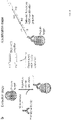
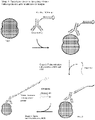
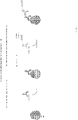
- FIG. 1A depicts further embodiments involving HCR, which are not according to the invention and are present for illustration purposes only.
- FIG. 1A shows metastable fluorescent hairpins that self-assemble into fluorescent amplification polymers upon detection of a cognate initiator.
- Initiator I1 nucleates with hairpin monomer HI via base-pairing to single-stranded toehold 'a', mediating a branch migration that opens the hairpin monomer to form complex I1•H1 containing single-stranded segment 'c ⁇ -b ⁇ '.
- This complex nucleates with hairpin monomer H2 by means of base-pairing to toehold 'c', mediating a branch migration that opens the hairpin monomer to form complex I1•H1•H2 containing single-stranded segment 'b ⁇ -a ⁇ '.
- the initiator sequence is regenerated, providing the basis for a chain reaction of alternating H1 and H2 polymerization steps.
- Stars denote fluorophores.
- Arrowhead denotes 3' end of each strand.
- FIG. 1B shows an immunohistochemistry protocol. Detection stage: antibody probes carrying HCR initiators are hybridized to protein targets and unused probes are washed from the sample.
- Amplification stage initiators trigger self-assembly of tethered fluorescent amplification polymers and unused hairpins are washed from the sample.
- FIG. 1C shows an experimental timeline. The same two-stage protocol is used independent of the number of target molecule species. For multiplexed experiments, antibody probes for different target species carry orthogonal initiators that trigger orthogonal HCR amplification cascades labeled by spectrally distinct fluorophores.
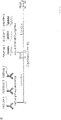
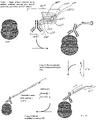
- FIGs. 2A-2B depict further embodiments involving HCR-IHC schemes that use oligo-labeled primary antibodies, which are not according to the invention and are present for illustration purposes only.
- Scheme A of FIG. 2A depicts an embodiment using a primary antibody labeled with unstructured HCR initiator.
- Stage 1 of Scheme A Target protein detection using primary antibody labeled with unstructured HCR initiator. Antibody probes are hybridized within the fixed sample and unused probes are washed away.
- Stage 2 of Scheme A Signal amplification using HCR. HCR hairpins are hybridized within the fixed sample and unused hairpins are washed away. This is a simple 2-stage scheme.
- Scheme B of FIG. 2B depicts an embodiment using primary antibody labeled with HCR hairpin.
- Scheme B instead labels the primary antibody with one or more HCR hairpins. Because each HCR hairpin contains a duplex stem, the potential for off-target base pairing of the oligo-labeled antibody probe is reduced compared to Scheme A.
- Stage 1 of Scheme B Target protein detection using primary antibody labeled with HCR hairpin. Antibody probes are hybridized within the fixed sample and unused probes are washed away.
- Stage 2 of Scheme B Probe activation using unstructured HCR initiator. Initiators are hybridized within the fixed sample and unused initiators are washed away. The HCR initiators open the HCR hairpins carried by the antibody probe, activating the hairpins by exposing an HCR initiator for subsequent triggering of HCR signal amplification in Stage 3.
- Stage 3 of Scheme B Signal amplification using HCR. HCR hairpins are hybridized within the fixed sample and unused hairpins are washed away.
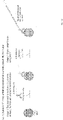
- Scheme C of FIG. 2C depicts an embodiment using a primary antibody labeled with a modified HCR hairpin, which is not according to the invention and is present for illustration purposes only.
- This embodiment reduces background by changing the toehold sequence for the input domain of the modified hairpins labeling the antibody probe, as well as the corresponding sequence in an unstructured trigger oligo that will be used to activate the modified hairpins carried by the antibody probe.
- the antibody probe can be labeled with modified versions of the HI hairpin monomer containing input domain ('e-b') instead of the input domain ('a-b') carried by a standard HI hairpin monomer.
- This modified version of HI can be activated by a trigger oligo ('b ⁇ -e ⁇ ') in Stage 2 that is not itself an HCR initiator. As a result, if the trigger oligo binds non-specifically in the sample, it will not generate amplified background in Stage 3.
- Stage 1 of Scheme C Target protein detection using primary antibody labeled with modified HCR hairpin. Antibody probes are hybridized within the fixed sample and unused probes are washed away.
- Stage 2 of Scheme C Probe activation using unstructured trigger oligo.
- the trigger oligos open the modified hairpins carried by the antibody probe, activating the modified hairpins by exposing an HCR initiator for subsequent triggering of HCR signal amplification in Stage 3.
- Stage 3 of Scheme C Signal amplification using HCR. HCR hairpins are hybridized within the fixed sample and unused hairpins are washed away.
- Scheme C Compared to Scheme B, Scheme C has the additional benefit that non-specific binding of the unstructured trigger oligo in Stage 2 does not lead to amplified background in Stage 3. Because the unstructured trigger oligo is not an HCR initiator, only the activated hairpins carried by the antibody probes are capable of triggering growth of HCR amplification polymers in Stage 3.
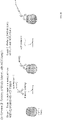
- Scheme D of FIG. 2D depicts an embodiment using a primary antibody labeled with a hairpin probe that sequesters an HCR initiator, which is not according to the invention and is present for illustration purposes only.
- the hairpin probe that labels the antibody can have domain dimensions and/or domain sequences that differ from a normal HCR hairpin.
- the toehold length of the input domain could be extended relative to that of a normal HCR hairpin to promote high-yield activation of the hairpin probes carried by the antibody probes.
- the hairpin probe labeling the antibody probe has the property that it predominantly initiates HCR if and only if it has been activated by the trigger oligo in Stage 2.
- Stage 1 of Scheme D Target protein detection using primary antibody labeled with hairpin probe that sequesters an HCR initiator. Antibody probes are hybridized within the fixed sample and unused probes are washed away.
- Stage 2 of Scheme D Hairpin probe activation using unstructured trigger oligo.
- the trigger oligos open the hairpin probes carried by the antibody probe, activating the hairpin probes by exposing an HCR initiator for subsequent triggering of HCR signal amplification in Stage 3.
- Stage 3 of Scheme D Signal amplification using HCR. HCR hairpins are hybridized within the fixed sample and unused hairpins are washed away.
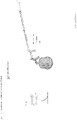
- FIGs. 3A-3D parallel the four previous schemes (A, B, C, D) of FIGs. 2A-2D ; in each case, there is one extra stage corresponding to the use of a secondary antibody to detect the primary antibody, and the oligo label has been shifted from the primary antibody to the secondary antibody.
- Scheme E of FIG. 3A depicts an embodiment using a secondary antibody labeled with unstructured HCR initiator.
- Stage 1 of Scheme E Target protein detection using unlabeled primary antibody.
- Stage 2 of Scheme E Primary antibody detection using secondary antibodies labeled with unstructured HCR initiators.
- Stage 3 of Scheme E Signal amplification using HCR.
- Scheme F of FIG. 3B depicts an embodiment of a secondary antibody labeled with HCR hairpin.
- Stage 1 of Scheme F Target protein detection using unlabeled primary antibody.
- Stage 2 of Scheme F Primary antibody detection using secondary antibodies labeled with HCR hairpins.
- Stage 3 of Scheme F Probe activation using an unstructured HCR initiator.
- Stage 4 of Scheme F Signal amplification using HCR.
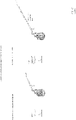
- Scheme G of FIG. 3C depicts an embodiment using a secondary antibody labeled with modified HCR hairpin.
- Stage 1 of Scheme G Target protein detection using unlabeled primary antibody.
- Stage 2 of Scheme G Primary antibody detection using secondary antibodies labeled with modified HCR hairpins.
- Stage 3 of Scheme G Probe activation using an unstructured trigger oligo.
- Stage 4 of Scheme G Signal amplification using HCR.
- Scheme H of FIG. 3D depicts an embodiment using a secondary antibody labeled with a hairpin probe that sequesters an HCR initiator.
- Stage 1 of Scheme H Target protein detection using unlabeled primary antibody.
- Stage 2 of Scheme H Primary antibody detection using secondary antibodies labeled with hairpin probes that sequester an HCR initiator.
- Stage 3 of Scheme H Hairpin probe activation using an unstructured trigger oligo.
- Stage 4 of Scheme H Signal amplification using HCR.
- a disadvantage of using a secondary antibody is the need for an extra stage in the protocol (relative to Schemes A, B, C, D of FIGs. 2A-2D ).
- the advantage of using oligo-labeled secondary antibodies is that a library of orthogonal secondary antibodies can be validated and reused for different primary antibodies. For example, consider a library of five orthogonal secondary antibodies. These could each be reused for 1000 primary antibodies that detect different target proteins.
- an advantage of using oligo-labeled primary antibodies is the ability to perform highly multiplexed experiments in which multiple target types are detected simultaneously using different primary antibodies that each bind selectively to a single target type; for example simultaneous detection of 10 target types, or 100 target types, or 1000 target types, or 10,000 target types, or 100,000 target types.
- a method is provided that is depicted in FIG. 9 .
- the method comprises a four-stage scheme: a) Stage 1: target detected using primary antibody probe carrying nucleic acid hairpin probe sequestering HCR initiator; unbound probe washed from sample. Stage 2: Unstructured trigger oligo activates hairpin probe, exposing HCR initiator; unbound trigger oligos washed from sample. Stage 3: signal amplification via polymerization of H1 and H2 hairpins, each carrying label binding site; unbound H1 and H2 hairpins washed from sample. Stage 4: label probes comprising a complement to the label binding site and additionally comprising a detectable reporter are hybridized to the amplification polymers; unbound label probes are washed from the sample.
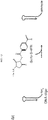
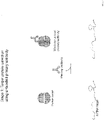
- FIGs. 4A-4C An example of an antibody-oligo conjugation scheme is shown in FIGs. 4A-4C .
- the heterobifunctional linker S-HyNiC is reacted with the amine group of lysine residues within the antibody, functionalizing the antibody with a hydrazide group.
- the oligo is synthesized with an amine group and reacted with a heterobifunctional linker S-4FB, functionalizing the oligo with an aldehyde group.
- FIG. 4C the two functionalized components are incubated together in the presence of an aniline catalyst that promotes the formation of a hydrazone bond, covalently linking the antibody and the oligo.
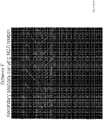
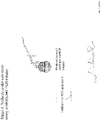
- FIG. 5 A HCR-IHC result is illustrated in FIG. 5 .
- Reduced background was observed using Scheme F (secondary antibodies carrying HCR hairpins) relative to Scheme E (secondary antibodies carrying unstructured HCR initiators), indicating that antibodies labeled with HCR hairpins are less prone to non-specific binding than antibodies labeled with unstructured HCR initiators.
- Scheme F secondary antibodies carrying HCR hairpins
- Scheme E secondary antibodies carrying unstructured HCR initiators
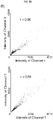
- HCR The quantitative nature of HCR is illustrated in FIGs. 6A-6B .
- target proteins were detected using primary antibodies (Stage 1).
- two batches of secondary antibodies carrying orthogonal HCR hairpins were used to detect the primary antibodies (Stage 2).
- These probes were then each activated using their orthogonal HCR initiators (Stage 3).
- HCR amplification was then performed using the two orthogonal HCR systems carrying spectrally distinct fluorophores (Stage 4), leading to redundant imaging of protein expression. If HCR signal scales linearly with primary antibody abundance, a 2-channel scatter plot of voxel intensities will reveal a linear distribution. If primary antibody binding scales linearly with target protein abundance, HCR-ISH will enable relative quantitation of protein abundance within the fixed sample.
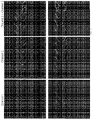
- FIG. 6A shows redundant 2-channel mapping of protein expression using two batches of secondary antibody and two orthogonal HCR amplifiers carrying spectrally distinct fluorophores.
- Row 1 Zebrafish line: wild type.
- Target protein Desmin.
- Primary antibody rabbit anti-Desmin.
- Secondary antibody donkey anti-rabbit.
- Row 2 Zebrafish line: ct-122a.
- Target protein Citrine.
- Primary antibody chicken anti-GFP (which binds selectively to Citrine protein).
- Secondary antibody goat anti-chicken.
- voxels were excluded that fell below background thresholds in both channels (excluded voxels lie in the black rectangles at the lower left corner of the correlation plots).
- the background threshold was defined as the mean plus two standard deviations for the voxels in the small white dashed square. Embryos fixed 27 hours post-fertilization. Scale bar: 50 ⁇ m.
- ISH In situ hybridization
- HCR employs nucleic acid probes carrying HCR initiators to map mRNA targets within fixed samples (Choi et al. 2010; Choi et al. 2014).
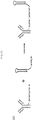
- FIG. 7 provides an example of a scheme for simultaneous HCR-IHC and HCR-ISH in a single fixed specimen. HCR signal amplification is performed for all protein and mRNA targets simultaneously.
- Stage 1 Target protein detection uses unlabeled primary antibody; unbound primary antibodies washed form the sample.
- stage 2 primary antibody detection using secondary antibody labeled with an HCR hairpin; unbound secondary antibodies washed from the sample.
- stage 3 target mRNA detection using DNA probes carrying HCR initiators; unbound DNA probes washed from the sample.
- stage 4 activation of the hairpin carried by the antibody probe using unstructured HCR initiator as a trigger oligo; unused trigger oligos washed from the sample.
- stage 5 HCR signal amplification triggered by exposed HCR initiators carried by DNA probes selectively bound to mRNA targets (from Stage 3) or triggered by exposed HCR initiators carried by antibody probes (activated by trigger oligos in Stage 4); unbound metastable HCR hairpin monomers are washed from the sample.
- This example uses HCR-IHC Scheme F as the starting point, but any of Schemes A-H can be combined with HCR-ISH similarly.
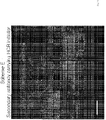
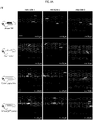
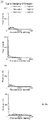
- FIG. 8A depicts 4-channel confocal microscopy images showing mapping of 2 proteins and the corresponding 2 mRNAs. One representative optical section is shown for each of 3 replicate embryos.
- FIG. 8B provides pixel intensity histograms. Signal + Background estimated from voxels within solid boundary; Background estimated from voxels within dashed boundary. Embryos were fixed 27 hours post-fertilization. Scale bar: 50 ⁇ m.
- HCR amplification is performed using a probe that comprises a target-binding region, which is linked to a structured nucleic acid region.
- the structured nucleic acid region sequesters an HCR initiator.
- the target-binding region binds selectively to the target, and then unbound probes are washed from the sample.
- Addition of a trigger oligo to the sample results in binding to the structured nucleic acid region, which results in a conformation change that exposes the HCR initiator. Exposure of the HCR initiator allows for amplification from the initiator using HCR.
- the resulting HCR amplification polymer contains a combination of fluorescent markers which can be detected and identified as corresponding to the presence of a particular target.
- HCR amplification is performed using a trigger oligo by providing at least one target-binding moiety that is labeled with a modified HCR hairpin; a target molecule; a trigger oligo; and a pair of metastable HCR hairpin monomers.
- the trigger oligo binds to the modified HCR hairpin and the pair of metastable HCR hairpin monomers do not bind directly to the modified HCR hairpin unless the trigger oligo has first bound to the modified HCR hairpin.
- HCR signal amplification is performed to produce an amplification polymer and a signal is detected from the polymer (where each of the HCR hairpin monomers that self-assemble to make the polymer include a reporter marker) to identify the target molecule.
- HCR amplification can be performed using a trigger oligo by providing (i) at least one target-binding moiety labeled with a structured probe sequestering an HCR initiator (ii) a target molecule, (iii) a trigger oligo, and (iv) at least a pair of polymerizing HCR hairpins.
- the trigger oligo binds to the structured probe.
- the pair of metastable HCR hairpin monomers do not bind to the sequestered HCR initiator.
- the trigger oligo binds to the structured probe to expose the HCR initiator, which triggers self-assembly of the fluorophore-labeled metastable HCR monomers to generate a detectable HCR amplification polymer.
- each amplification polymer will be detectable in 2 channels where the ratio of intensities in the two channels will be approximately constant independent of the length of each amplification polymer (because the number of HI hairpin monomers in each amplification polymer is either one less, equal to, or one more than the number of H2 hairpin monomers in each amplification polymer).
Landscapes
- Health & Medical Sciences (AREA)
- Chemical & Material Sciences (AREA)
- Life Sciences & Earth Sciences (AREA)
- Immunology (AREA)
- Engineering & Computer Science (AREA)
- Organic Chemistry (AREA)
- Molecular Biology (AREA)
- Analytical Chemistry (AREA)
- Zoology (AREA)
- Wood Science & Technology (AREA)
- Proteomics, Peptides & Aminoacids (AREA)
- General Health & Medical Sciences (AREA)
- Microbiology (AREA)
- Biotechnology (AREA)
- Biochemistry (AREA)
- Physics & Mathematics (AREA)
- Urology & Nephrology (AREA)
- Biomedical Technology (AREA)
- Hematology (AREA)
- Pathology (AREA)
- General Engineering & Computer Science (AREA)
- Genetics & Genomics (AREA)
- Bioinformatics & Cheminformatics (AREA)
- Biophysics (AREA)
- Cell Biology (AREA)
- Food Science & Technology (AREA)
- Medicinal Chemistry (AREA)
- General Physics & Mathematics (AREA)
- Chemical Kinetics & Catalysis (AREA)
- Measuring Or Testing Involving Enzymes Or Micro-Organisms (AREA)
- Steroid Compounds (AREA)
Applications Claiming Priority (2)
| Application Number | Priority Date | Filing Date | Title |
|---|---|---|---|
| US201662381474P | 2016-08-30 | 2016-08-30 | |
| PCT/US2017/049198 WO2018044939A1 (en) | 2016-08-30 | 2017-08-29 | Immunohistochemistry via hybridization chain reaction |
Publications (3)
| Publication Number | Publication Date |
|---|---|
| EP3507296A1 EP3507296A1 (en) | 2019-07-10 |
| EP3507296A4 EP3507296A4 (en) | 2020-03-11 |
| EP3507296B1 true EP3507296B1 (en) | 2022-10-12 |
Family
ID=61282462
Family Applications (1)
| Application Number | Title | Priority Date | Filing Date |
|---|---|---|---|
| EP17847401.1A Active EP3507296B1 (en) | 2016-08-30 | 2017-08-29 | Immunohistochemistry via hybridization chain reaction |
Country Status (6)
| Country | Link |
|---|---|
| US (1) | US10815519B2 (enExample) |
| EP (1) | EP3507296B1 (enExample) |
| AU (1) | AU2017321492A1 (enExample) |
| CA (1) | CA3034617A1 (enExample) |
| IL (1) | IL264831B (enExample) |
| WO (1) | WO2018044939A1 (enExample) |
Cited By (1)
| Publication number | Priority date | Publication date | Assignee | Title |
|---|---|---|---|---|
| US11873485B2 (en) | 2021-01-26 | 2024-01-16 | California Institute Of Technology | Allosteric conditional guide RNAs for cell-selective regulation of CRISPR/Cas |
Families Citing this family (107)
| Publication number | Priority date | Publication date | Assignee | Title |
|---|---|---|---|---|
| EP3604555B1 (en) | 2011-10-14 | 2024-12-25 | President and Fellows of Harvard College | Sequencing by structure assembly |
| ES2991004T3 (es) | 2011-12-22 | 2024-12-02 | Harvard College | Métodos para la detección de analitos |
| WO2014163886A1 (en) | 2013-03-12 | 2014-10-09 | President And Fellows Of Harvard College | Method of generating a three-dimensional nucleic acid containing matrix |
| GB201401885D0 (en) | 2014-02-04 | 2014-03-19 | Olink Ab | Proximity assay with detection based on hybridisation chain reaction (HCR) |
| WO2016007839A1 (en) | 2014-07-11 | 2016-01-14 | President And Fellows Of Harvard College | Methods for high-throughput labelling and detection of biological features in situ using microscopy |
| SG11201707515SA (en) | 2015-04-10 | 2017-10-30 | Spatial Transcriptomics Ab | Spatially distinguished, multiplex nucleic acid analysis of biological specimens |
| WO2017189525A1 (en) | 2016-04-25 | 2017-11-02 | President And Fellows Of Harvard College | Hybridization chain reaction methods for in situ molecular detection |
| EP4050112A1 (en) | 2016-06-21 | 2022-08-31 | 10X Genomics, Inc. | Nucleic acid sequencing |
| IL290679B2 (en) | 2016-07-05 | 2023-10-01 | California Inst Of Techn | Hybridization chain reaction based on a minimal initiator |
| WO2018044939A1 (en) | 2016-08-30 | 2018-03-08 | California Institute Of Technology | Immunohistochemistry via hybridization chain reaction |
| CN118853848A (zh) | 2016-08-31 | 2024-10-29 | 哈佛学院董事及会员团体 | 将生物分子的检测组合到使用荧光原位测序的单个试验的方法 |
| US11492661B2 (en) * | 2017-01-10 | 2022-11-08 | President And Fellows Of Harvard College | Multiplexed signal amplification |
| ES3029737T3 (en) | 2017-10-06 | 2025-06-25 | 10X Genomics Inc | Rna templated ligation |
| CA3083224A1 (en) * | 2017-12-08 | 2019-06-13 | California Institute Of Technology | Multiplex labeling of molecules by sequential hybridization barcoding with rapid switching and rehybridzation of probes |
| WO2019147945A1 (en) * | 2018-01-26 | 2019-08-01 | President And Fellows Of Harvard College | Proximity detection methods and compositions |
| CN108896639B (zh) * | 2018-04-25 | 2020-04-03 | 南京工业大学 | lncRNA MEG3双重检测电化学基因传感器,其制备方法与应用 |
| CN110441525A (zh) * | 2018-05-02 | 2019-11-12 | 南京大学 | 基于dna微阵列的蛋白质化学发光成像分析方法 |
| US11519033B2 (en) | 2018-08-28 | 2022-12-06 | 10X Genomics, Inc. | Method for transposase-mediated spatial tagging and analyzing genomic DNA in a biological sample |
| WO2020076976A1 (en) | 2018-10-10 | 2020-04-16 | Readcoor, Inc. | Three-dimensional spatial molecular indexing |
| GB201818742D0 (en) | 2018-11-16 | 2019-01-02 | Cartana Ab | Method for detection of RNA |
| US12529094B2 (en) | 2018-12-10 | 2026-01-20 | 10X Genomics, Inc. | Imaging system hardware |
| WO2020123317A2 (en) | 2018-12-10 | 2020-06-18 | 10X Genomics, Inc | Three-dimensional spatial analysis |
| US11926867B2 (en) | 2019-01-06 | 2024-03-12 | 10X Genomics, Inc. | Generating capture probes for spatial analysis |
| US11649485B2 (en) | 2019-01-06 | 2023-05-16 | 10X Genomics, Inc. | Generating capture probes for spatial analysis |
| CN109765387B (zh) * | 2019-02-27 | 2021-09-28 | 安徽师范大学 | 基于硫化银光热效应的生物传感器及其制备方法和应用以及NF-kB1的定量检测方法 |
| EP3976820A1 (en) | 2019-05-30 | 2022-04-06 | 10X Genomics, Inc. | Methods of detecting spatial heterogeneity of a biological sample |
| CN113906147B (zh) | 2019-05-31 | 2024-09-13 | 10X基因组学有限公司 | 检测目标核酸分子的方法 |
| US20220349005A1 (en) * | 2019-08-19 | 2022-11-03 | Northwestern University | Controlling the dna hybridization chain reaction |
| WO2021092433A2 (en) | 2019-11-08 | 2021-05-14 | 10X Genomics, Inc. | Enhancing specificity of analyte binding |
| GB201919032D0 (en) * | 2019-12-20 | 2020-02-05 | Cartana Ab | Method of detecting an analyte |
| GB201919029D0 (en) | 2019-12-20 | 2020-02-05 | Cartana Ab | Method of detecting an analyte |
| CN121022991A (zh) | 2019-12-23 | 2025-11-28 | 10X基因组学有限公司 | 使用rna模板化连接进行空间分析的方法 |
| US12241890B2 (en) | 2019-12-23 | 2025-03-04 | 10X Genomics, Inc. | Methods for generating barcoded nucleic acid molecules using fixed cells |
| EP4752521A3 (en) | 2019-12-23 | 2026-08-12 | 10X Genomics, Inc. | Reversible fixing reagents and methods of use thereof |
| US12365942B2 (en) | 2020-01-13 | 2025-07-22 | 10X Genomics, Inc. | Methods of decreasing background on a spatial array |
| US12405264B2 (en) | 2020-01-17 | 2025-09-02 | 10X Genomics, Inc. | Electrophoretic system and method for analyte capture |
| US11702693B2 (en) | 2020-01-21 | 2023-07-18 | 10X Genomics, Inc. | Methods for printing cells and generating arrays of barcoded cells |
| US11732299B2 (en) | 2020-01-21 | 2023-08-22 | 10X Genomics, Inc. | Spatial assays with perturbed cells |
| US20210230681A1 (en) | 2020-01-24 | 2021-07-29 | 10X Genomics, Inc. | Methods for spatial analysis using proximity ligation |
| EP4097251A1 (en) | 2020-01-29 | 2022-12-07 | 10X Genomics, Inc. | Compositions and methods for analyte detection |
| US12076701B2 (en) | 2020-01-31 | 2024-09-03 | 10X Genomics, Inc. | Capturing oligonucleotides in spatial transcriptomics |
| US12110541B2 (en) | 2020-02-03 | 2024-10-08 | 10X Genomics, Inc. | Methods for preparing high-resolution spatial arrays |
| US11898205B2 (en) | 2020-02-03 | 2024-02-13 | 10X Genomics, Inc. | Increasing capture efficiency of spatial assays |
| US12110548B2 (en) | 2020-02-03 | 2024-10-08 | 10X Genomics, Inc. | Bi-directional in situ analysis |
| US11732300B2 (en) | 2020-02-05 | 2023-08-22 | 10X Genomics, Inc. | Increasing efficiency of spatial analysis in a biological sample |
| US12129516B2 (en) | 2020-02-07 | 2024-10-29 | 10X Genomics, Inc. | Quantitative and automated permeabilization performance evaluation for spatial transcriptomics |
| US12281357B1 (en) | 2020-02-14 | 2025-04-22 | 10X Genomics, Inc. | In situ spatial barcoding |
| US12215379B2 (en) | 2020-02-17 | 2025-02-04 | 10X Genomics, Inc. | In situ analysis of chromatin interaction |
| WO2021168287A1 (en) | 2020-02-21 | 2021-08-26 | 10X Genomics, Inc. | Methods and compositions for integrated in situ spatial assay |
| WO2021168261A1 (en) | 2020-02-21 | 2021-08-26 | 10X Genomics, Inc. | Capturing genetic targets using a hybridization approach |
| US11891654B2 (en) | 2020-02-24 | 2024-02-06 | 10X Genomics, Inc. | Methods of making gene expression libraries |
| US12188085B2 (en) | 2020-03-05 | 2025-01-07 | 10X Genomics, Inc. | Three-dimensional spatial transcriptomics with sequencing readout |
| US20220282300A1 (en) * | 2020-03-06 | 2022-09-08 | California Institute Of Technology | Analysis of target molecules within a sample via hybridization chain reaction |
| WO2021216708A1 (en) | 2020-04-22 | 2021-10-28 | 10X Genomics, Inc. | Methods for spatial analysis using targeted rna depletion |
| ES2989052T3 (es) | 2020-05-22 | 2024-11-25 | 10X Genomics Inc | Medición espacio-temporal simultánea de la expresión génica y la actividad celular |
| EP4553168B1 (en) | 2020-05-22 | 2026-07-22 | 10X Genomics, Inc. | Spatial analysis to detect sequence variants |
| US12031177B1 (en) | 2020-06-04 | 2024-07-09 | 10X Genomics, Inc. | Methods of enhancing spatial resolution of transcripts |
| EP4421186B1 (en) | 2020-06-08 | 2025-08-13 | 10X Genomics, Inc. | Methods of determining a surgical margin and methods of use thereof |
| US12209273B2 (en) | 2020-06-12 | 2025-01-28 | 10X Genomics, Inc. | Nucleic acid assays using click chemistry bioconjugation |
| US20240279736A1 (en) | 2020-06-18 | 2024-08-22 | Resolve Biosciences Gmbh | Multiplex method for detecting different analytes and different subgroups/variations of an analyte in a sample |
| AU2021294334A1 (en) | 2020-06-25 | 2023-02-02 | 10X Genomics, Inc. | Spatial analysis of DNA methylation |
| US11981960B1 (en) | 2020-07-06 | 2024-05-14 | 10X Genomics, Inc. | Spatial analysis utilizing degradable hydrogels |
| US12209280B1 (en) | 2020-07-06 | 2025-01-28 | 10X Genomics, Inc. | Methods of identifying abundance and location of an analyte in a biological sample using second strand synthesis |
| US11761038B1 (en) | 2020-07-06 | 2023-09-19 | 10X Genomics, Inc. | Methods for identifying a location of an RNA in a biological sample |
| US12297499B2 (en) | 2020-08-17 | 2025-05-13 | 10X Genomics, Inc. | Multicomponent nucleic acid probes for sample analysis |
| US20220049303A1 (en) | 2020-08-17 | 2022-02-17 | Readcoor, Llc | Methods and systems for spatial mapping of genetic variants |
| US11981958B1 (en) | 2020-08-20 | 2024-05-14 | 10X Genomics, Inc. | Methods for spatial analysis using DNA capture |
| US11926822B1 (en) | 2020-09-23 | 2024-03-12 | 10X Genomics, Inc. | Three-dimensional spatial analysis |
| US12071667B2 (en) | 2020-11-04 | 2024-08-27 | 10X Genomics, Inc. | Sequence analysis using meta-stable nucleic acid molecules |
| US11827935B1 (en) | 2020-11-19 | 2023-11-28 | 10X Genomics, Inc. | Methods for spatial analysis using rolling circle amplification and detection probes |
| EP4012046A1 (en) | 2020-12-11 | 2022-06-15 | 10X Genomics, Inc. | Methods and compositions for multimodal in situ analysis |
| EP4729631A3 (en) | 2020-12-21 | 2026-07-22 | 10X Genomics, Inc. | Methods, compositions, and systems for capturing probes and/or barcodes |
| US12060603B2 (en) | 2021-01-19 | 2024-08-13 | 10X Genomics, Inc. | Methods for internally controlled in situ assays using padlock probes |
| GB202100760D0 (en) * | 2021-01-20 | 2021-03-03 | Qbiotix Ltd | Target-dependent polymerisation of oligonucleotides |
| US12275984B2 (en) | 2021-03-02 | 2025-04-15 | 10X Genomics, Inc. | Sequential hybridization and quenching |
| WO2022221425A1 (en) | 2021-04-14 | 2022-10-20 | 10X Genomics, Inc. | Methods of measuring mislocalization of an analyte |
| WO2022236054A1 (en) | 2021-05-06 | 2022-11-10 | 10X Genomics, Inc. | Methods for increasing resolution of spatial analysis |
| WO2022256503A1 (en) | 2021-06-03 | 2022-12-08 | 10X Genomics, Inc. | Methods, compositions, kits, and systems for enhancing analyte capture for spatial analysis |
| EP4450640B1 (en) | 2021-07-30 | 2026-03-18 | 10X Genomics, Inc. | Methods and compositions for synchronizing reactions in situ |
| US12139751B2 (en) | 2021-07-30 | 2024-11-12 | 10X Genomics, Inc. | Circularizable probes for in situ analysis |
| WO2023015192A1 (en) | 2021-08-03 | 2023-02-09 | 10X Genomics, Inc. | Nucleic acid concatemers and methods for stabilizing and/or compacting the same |
| US12460251B2 (en) | 2021-08-03 | 2025-11-04 | 10X Genomics, Inc. | Stabilization and/or compaction of nucleic acid molecules |
| US12529096B2 (en) | 2021-08-03 | 2026-01-20 | 10X Genomics, Inc. | Stabilization and/or compaction of nucleic acid structures |
| US12391984B2 (en) | 2021-08-03 | 2025-08-19 | 10X Genomics, Inc. | Compositions and methods for rolling circle amplification |
| EP4326898B1 (en) | 2021-08-16 | 2024-07-31 | 10X Genomics, Inc. | Probes comprising a split barcode region and methods of use |
| ES3011462T3 (en) | 2021-09-01 | 2025-04-07 | 10X Genomics Inc | Methods for blocking a capture probe on a spatial array |
| EP4419707A1 (en) | 2021-11-10 | 2024-08-28 | 10X Genomics, Inc. | Methods, compositions, and kits for determining the location of an analyte in a biological sample |
| CN114062672B (zh) * | 2021-11-12 | 2023-04-25 | 福州大学 | 一种检测covid-19抗体的血糖生物传感器 |
| US12735738B2 (en) | 2021-11-25 | 2026-09-15 | 10X Genomics, Inc. | Circular probes and methods for sample analysis |
| WO2023102118A2 (en) | 2021-12-01 | 2023-06-08 | 10X Genomics, Inc. | Methods, compositions, and systems for improved in situ detection of analytes and spatial analysis |
| WO2023108139A2 (en) | 2021-12-10 | 2023-06-15 | 10X Genomics, Inc. | Multi-resolution in situ decoding |
| US12674196B2 (en) | 2022-01-18 | 2026-07-07 | 10X Genomics, Inc. | Methods and compositions for improved probe specificity |
| WO2023141588A1 (en) | 2022-01-21 | 2023-07-27 | 10X Genomics, Inc. | Multiple readout signals for analyzing a sample |
| EP4490737A1 (en) | 2022-03-08 | 2025-01-15 | 10X Genomics, Inc. | In situ code design methods for minimizing optical crowding |
| US12703879B2 (en) | 2022-03-29 | 2026-08-11 | 10X Genomics, Inc. | RNase H assisted in situ rolling circle amplification |
| CN119032271A (zh) | 2022-04-01 | 2024-11-26 | 10X基因组学有限公司 | 用于靶向掩蔽自发荧光的组合物和方法 |
| US12687494B2 (en) | 2022-04-04 | 2026-07-21 | 10X Genomics, Inc. | Systems and methods for nearly isotropic optical resolution using tilted structured illumination microscopy |
| US12709771B2 (en) | 2022-04-06 | 2026-08-18 | 10X Genomics, Inc. | Methods and compositions for multiplex cell analysis |
| WO2023215603A1 (en) | 2022-05-06 | 2023-11-09 | 10X Genomics, Inc. | Methods and compositions for in situ analysis of v(d)j sequences |
| US20240084378A1 (en) | 2022-05-11 | 2024-03-14 | 10X Genomics, Inc. | Compositions and methods for in situ sequencing |
| US12716092B2 (en) | 2022-05-19 | 2026-08-25 | 10X Genomics, Inc. | Method of identifying circular RNA |
| WO2023245190A1 (en) | 2022-06-17 | 2023-12-21 | 10X Genomics, Inc. | Catalytic de-crosslinking of samples for in situ analysis |
| US12692484B2 (en) | 2022-08-12 | 2026-07-28 | 10X Genomics, Inc. | PUMA1 polymerases and uses thereof |
| WO2024040060A1 (en) | 2022-08-16 | 2024-02-22 | 10X Genomics, Inc. | Ap50 polymerases and uses thereof |
| WO2024102809A1 (en) | 2022-11-09 | 2024-05-16 | 10X Genomics, Inc. | Methods, compositions, and kits for determining the location of multiple analytes in a biological sample |
| EP4689168A1 (en) * | 2023-04-04 | 2026-02-11 | California Institute of Technology | Ultrasensitive molecular detection via hybridization chain reaction |
| WO2025029831A1 (en) | 2023-07-31 | 2025-02-06 | 10X Genomics, Inc. | Methods and systems for targeted rna cleavage and target rna-primed rolling circle amplification |
Family Cites Families (94)
| Publication number | Priority date | Publication date | Assignee | Title |
|---|---|---|---|---|
| US4714680B1 (en) | 1984-02-06 | 1995-06-27 | Univ Johns Hopkins | Human stem cells |
| US4965204A (en) | 1984-02-06 | 1990-10-23 | The Johns Hopkins University | Human stem cells and monoclonal antibodies |
| US4897355A (en) | 1985-01-07 | 1990-01-30 | Syntex (U.S.A.) Inc. | N[ω,(ω-1)-dialkyloxy]- and N-[ω,(ω-1)-dialkenyloxy]-alk-1-yl-N,N,N-tetrasubstituted ammonium lipids and uses therefor |
| EP0273085A1 (en) | 1986-12-29 | 1988-07-06 | IntraCel Corporation | A method for internalizing nucleic acids into eukaryotic cells |
| US5057410A (en) | 1988-08-05 | 1991-10-15 | Cetus Corporation | Chimeric messenger RNA detection methods |
| US5118801A (en) | 1988-09-30 | 1992-06-02 | The Public Health Research Institute | Nucleic acid process containing improved molecular switch |
| US5061620A (en) | 1990-03-30 | 1991-10-29 | Systemix, Inc. | Human hematopoietic stem cell |
| US5264618A (en) | 1990-04-19 | 1993-11-23 | Vical, Inc. | Cationic lipids for intracellular delivery of biologically active molecules |
| US5270163A (en) | 1990-06-11 | 1993-12-14 | University Research Corporation | Methods for identifying nucleic acid ligands |
| JP3256539B2 (ja) | 1990-08-28 | 2002-02-12 | エポック・ファーマシューティカルズ・インコーポレイテッド | 連結分子を介する3’―尾分子付オリゴヌクレオチドの固体支持体合成 |
| US5563256A (en) | 1991-05-29 | 1996-10-08 | Merck & Co., Inc. | Eimeria tenella 16S rDNA probes |
| US5424413A (en) | 1992-01-22 | 1995-06-13 | Gen-Probe Incorporated | Branched nucleic acid probes |
| PL172710B1 (pl) | 1992-07-02 | 1997-11-28 | Hybridon Inc | Samostabilizujacy sie oligonukleotyd PL PL |
| US5677136A (en) | 1994-11-14 | 1997-10-14 | Systemix, Inc. | Methods of obtaining compositions enriched for hematopoietic stem cells, compositions derived therefrom and methods of use thereof |
| JPH11502222A (ja) | 1995-03-23 | 1999-02-23 | キャンタブ ファーマシューティカルズ リサーチ リミティド | 遺伝子供給用ベクター |
| US6261554B1 (en) | 1995-07-25 | 2001-07-17 | Introgene B.V. | Compositions for targeted gene delivery |
| US5579793A (en) | 1995-11-15 | 1996-12-03 | Rubbermaid Health Care Products, Inc. | Foldable walker |
| ATE414793T1 (de) | 1996-01-24 | 2008-12-15 | Third Wave Tech Inc | Invasive spaltung von nukleinsäuren |
| US6361944B1 (en) | 1996-07-29 | 2002-03-26 | Nanosphere, Inc. | Nanoparticles having oligonucleotides attached thereto and uses therefor |
| US5691145A (en) | 1996-08-27 | 1997-11-25 | Becton, Dickinson And Company | Detection of nucleic acids using G-quartets |
| WO1998014617A1 (en) | 1996-10-04 | 1998-04-09 | Chronix Biomedical | Diagnostic detection of nucleic acids |
| CA2273204C (en) | 1996-11-29 | 2008-10-14 | Third Wave Technologies, Inc. | Fen-1 endonucleases, mixtures and cleavage methods |
| US6128587A (en) | 1997-01-14 | 2000-10-03 | The Regents Of The University Of California | Method and apparatus using Bayesian subfamily identification for sequence analysis |
| US5935791A (en) | 1997-09-23 | 1999-08-10 | Becton, Dickinson And Company | Detection of nucleic acids by fluorescence quenching |
| WO1999019500A1 (en) | 1997-10-10 | 1999-04-22 | The Government Of The United States Of America, Represented By The Secretary, Department Of Healt H And Human Services | Complex of biotinylated viral vector and ligand for targeted gene delivery |
| GB9721909D0 (en) | 1997-10-17 | 1997-12-17 | Cantab Pharma Res | Gene delivery vectors and their uses |
| US5989823A (en) | 1998-09-18 | 1999-11-23 | Nexstar Pharmaceuticals, Inc. | Homogeneous detection of a target through nucleic acid ligand-ligand beacon interaction |
| AU3909199A (en) | 1997-12-15 | 1999-07-05 | Nexstar Pharmaceuticals, Inc. | Homogeneous detection of a target through nucleic acid ligand-ligand beacon interaction |
| US6242246B1 (en) | 1997-12-15 | 2001-06-05 | Somalogic, Inc. | Nucleic acid ligand diagnostic Biochip |
| US6506559B1 (en) | 1997-12-23 | 2003-01-14 | Carnegie Institute Of Washington | Genetic inhibition by double-stranded RNA |
| AU3358999A (en) | 1998-03-20 | 1999-10-11 | Genzyme Corporation | Chimeric adenoviral vectors for targeted gene delivery |
| US6255469B1 (en) | 1998-05-06 | 2001-07-03 | New York University | Periodic two and three dimensional nucleic acid structures |
| US6290839B1 (en) | 1998-06-23 | 2001-09-18 | Clinical Micro Sensors, Inc. | Systems for electrophoretic transport and detection of analytes |
| ATE440963T1 (de) | 1998-07-02 | 2009-09-15 | Gen Probe Inc | Molekulare fackeln |
| US6696285B1 (en) | 1998-08-25 | 2004-02-24 | Lucent Technolgies Inc. | Nanomachines fueled by nucleic acid strand exchange |
| US6899871B2 (en) | 1998-10-01 | 2005-05-31 | University Of Southern California | Gene delivery system and methods of use |
| EP1059357A1 (en) | 1999-06-09 | 2000-12-13 | Universite Pierre Et Marie Curie Paris Vi | Replicating or semi-replicating retroviral constructs, preparation and uses for gene delivery |
| AU1804001A (en) | 1999-12-02 | 2001-06-12 | Molecular Staging, Inc. | Generation of single-strand circular dna from linear self-annealing segments |
| US20050239061A1 (en) | 2000-03-01 | 2005-10-27 | Marshall William S | Identification and use of effectors and allosteric molecules for the alteration of gene expression |
| US20040009510A1 (en) | 2000-03-06 | 2004-01-15 | Scott Seiwert | Allosteric nucleic acid sensor molecules |
| US7033758B2 (en) | 2000-06-02 | 2006-04-25 | Bayer Corporation | Highly sensitive gene detection and localization using in situ branched-DNA hybridization |
| EP1409735A4 (en) | 2001-06-25 | 2005-10-05 | Georgia Tech Res Inst | DOUBLE-RESONANCE ENERGY TRANSFER NUCLEIC PROBES |
| CA2473683A1 (en) | 2002-01-22 | 2003-07-31 | Mcmaster University | Signalling aptamer complexes |
| JP4061401B2 (ja) | 2002-03-07 | 2008-03-19 | 国立大学法人九州大学 | Dnaの自己組織化によるdnaナノケージ及びその製造方法、並びにそれを用いたdnaナノチューブ、分子キャリアー |
| US20040126773A1 (en) | 2002-05-23 | 2004-07-01 | Beske Oren E. | Assays with coded sensor particles to sense assay conditions |
| US20040043386A1 (en) | 2002-08-30 | 2004-03-04 | Todd Pray | Methods and compositions for functional ubiquitin assays |
| WO2004083434A1 (en) | 2003-03-17 | 2004-09-30 | The University Of Hong Kong | A combined adeno-associated virus and adenovirus cocktail gene delivery system for high effiency gene expression without eliciting immune response in immuno-competent subjects |
| US20050112614A1 (en) | 2003-05-15 | 2005-05-26 | California Institute Of Technology | Self-assembled circuits and circuit patterns |
| US7632641B2 (en) | 2004-03-25 | 2009-12-15 | California Institute Of Technology | Hybridization chain reaction |
| US20050233332A1 (en) | 2004-04-14 | 2005-10-20 | Collis Matthew P | Multiple fluorophore detector system |
| WO2006002167A2 (en) | 2004-06-17 | 2006-01-05 | University Of Florida Research Foudation, Inc. | Multi-acceptor molecular probes and applications thereof |
| US20060035375A1 (en) | 2004-08-16 | 2006-02-16 | Head Jonathan F | Method for selectively culturing epithelial or carcinoma cells |
| CN101031659A (zh) | 2004-09-24 | 2007-09-05 | 英詹尼斯公司 | 基因组分析 |
| JP5101288B2 (ja) | 2004-10-05 | 2012-12-19 | カリフォルニア インスティテュート オブ テクノロジー | アプタマー調節される核酸及びその利用 |
| KR101411361B1 (ko) | 2004-11-08 | 2014-06-25 | 비퍼겐 에이피에스 | 구조적 핵산에 의해 가이드되는 화학적 합성 |
| US20060234261A1 (en) | 2005-03-08 | 2006-10-19 | Pierce Niles A | Colorimetric readout of hybridization chain reaction |
| US7727721B2 (en) | 2005-03-08 | 2010-06-01 | California Institute Of Technology | Hybridization chain reaction amplification for in situ imaging |
| EP1885892A2 (en) | 2005-05-03 | 2008-02-13 | Ensemble Discovery Corporation | Turnover probes and use thereof for nucleic acid detection |
| US7842793B2 (en) | 2005-06-14 | 2010-11-30 | The California Institute Of Technology | Methods of making nucleic acid nanostructures |
| US7745594B2 (en) | 2005-07-21 | 2010-06-29 | California Institute Of Technology | Nucleic acid-based logic circuits |
| EP1931806B1 (en) | 2005-10-07 | 2011-10-05 | California Institute Of Technology | Pkr activation via hybridization chain reaction |
| GB0607866D0 (en) | 2006-04-20 | 2006-05-31 | Isis Innovation | Nanostructures |
| US9009199B2 (en) | 2006-06-06 | 2015-04-14 | Haskolinn I Reykjavik | Data mining using an index tree created by recursive projection of data points on random lines |
| WO2007147159A2 (en) | 2006-06-16 | 2007-12-21 | Cornell Research Foundation, Inc. | Functional nucleic acid ligands to fluorescent proteins |
| EP2487616B1 (en) | 2006-06-19 | 2015-07-29 | Yeda Research And Development Company Limited | Programmable iterated elongation: a method for manufacturing synthetic genes and combinatorial DNA and protein libraries |
| CN103473181B (zh) | 2007-01-26 | 2017-06-13 | 英特尔公司 | 分级式不可变内容可寻址存储器处理器 |
| US8318921B2 (en) | 2007-03-01 | 2012-11-27 | California Institute Of Technology | Triggered RNAi |
| BRPI0721664A8 (pt) | 2007-05-14 | 2019-01-22 | Univ Mexico Nac Autonoma | vm23 e vm24, dois peptídeos de escorpião que bloqueiam canais de potássio de linfócitos-t humanos(sub-tipo kv1.3) com alta seletividade e diminuem as respostas de dth invivo em ratos |
| EP2155770B1 (en) | 2007-05-16 | 2013-10-16 | California Institute of Technology | A versatile nucleic acid hairpin motif for programming biomolecular self-assembly pathways |
| US8793705B2 (en) | 2007-08-31 | 2014-07-29 | Red Hat, Inc. | Rich internet bus |
| US8497364B2 (en) | 2008-02-27 | 2013-07-30 | California Institute Of Technology | Triggered RNAi |
| US20100021904A1 (en) | 2008-05-21 | 2010-01-28 | Pierce Niles A | Shielded cross-linking probes |
| US20100021901A1 (en) | 2008-05-22 | 2010-01-28 | Peng Yin | Compositions and methods for detecting analytes |
| US8241854B2 (en) | 2008-05-22 | 2012-08-14 | California Institute Of Technology | Triggered RNAi |
| WO2009152492A1 (en) | 2008-06-13 | 2009-12-17 | University Of Connecticut | Nucleic acid materials for nonradiative energy transfer and methods of production and use |
| US8642260B2 (en) | 2008-10-21 | 2014-02-04 | The Research Foundation Of The City University Of New York | Single quantum-dot based aptameric nanosensors |
| WO2011126996A2 (en) | 2010-04-05 | 2011-10-13 | California Institute Of Technology | System and method for nucleic acid sequence design |
| US8658780B2 (en) | 2010-05-18 | 2014-02-25 | California Institute Of Technology | Triggered covalent probes for imaging and silencing genetic expression |
| US9834439B2 (en) | 2010-07-20 | 2017-12-05 | California Institute Of Technology | Biomolecular self-assembly |
| US8877438B2 (en) | 2010-07-20 | 2014-11-04 | California Institute Of Technology | Self-assembled polynucleotide structure |
| US8962241B2 (en) | 2010-07-20 | 2015-02-24 | California Institute Of Technology | Triggered molecular geometry based bioimaging probes |
| AU2011301777B2 (en) * | 2010-09-16 | 2015-07-02 | Australian Centre For Plant Functional Genomics Pty Ltd | Capture based nucleic acid detection |
| US20140107983A1 (en) | 2012-09-21 | 2014-04-17 | California Institute Of Technology | Systems and methods of designing nucleic acids that form predetermined secondary structure |
| KR20150083115A (ko) | 2012-11-06 | 2015-07-16 | 프레지던트 앤드 펠로우즈 오브 하바드 칼리지 | 리보조절인자 조성물 및 사용 방법 |
| US9856472B2 (en) | 2013-07-01 | 2018-01-02 | California Institute Of Technology | Small conditional RNAs |
| US20150154347A1 (en) | 2013-09-27 | 2015-06-04 | California Institute Of Technology | System and method for constrained multistate reaction pathway design |
| GB201401885D0 (en) * | 2014-02-04 | 2014-03-19 | Olink Ab | Proximity assay with detection based on hybridisation chain reaction (HCR) |
| WO2015153940A1 (en) | 2014-04-03 | 2015-10-08 | Massachusetts Institute Of Technology | Methods and compositions for the production of guide rna |
| WO2015168404A1 (en) | 2014-04-30 | 2015-11-05 | Massachusetts Institute Of Technology | Toehold-gated guide rna for programmable cas9 circuitry with rna input |
| US11124846B2 (en) | 2014-07-14 | 2021-09-21 | President And Fellows Of Harvard College | Compositions comprising riboregulators and methods of use thereof |
| WO2017223449A1 (en) | 2016-06-23 | 2017-12-28 | President And Fellows Of Harvard College | Conditional activation of nucleic acid-guided endonucleases |
| IL290679B2 (en) | 2016-07-05 | 2023-10-01 | California Inst Of Techn | Hybridization chain reaction based on a minimal initiator |
| WO2018044939A1 (en) | 2016-08-30 | 2018-03-08 | California Institute Of Technology | Immunohistochemistry via hybridization chain reaction |
| EP3638789A4 (en) | 2017-06-12 | 2021-03-10 | California Institute of Technology | CONDITIONAL GUIDE RNAS |
-
2017
- 2017-08-29 WO PCT/US2017/049198 patent/WO2018044939A1/en not_active Ceased
- 2017-08-29 CA CA3034617A patent/CA3034617A1/en not_active Abandoned
- 2017-08-29 IL IL264831A patent/IL264831B/en unknown
- 2017-08-29 EP EP17847401.1A patent/EP3507296B1/en active Active
- 2017-08-29 AU AU2017321492A patent/AU2017321492A1/en not_active Abandoned
- 2017-08-29 US US15/689,786 patent/US10815519B2/en active Active
Cited By (1)
| Publication number | Priority date | Publication date | Assignee | Title |
|---|---|---|---|---|
| US11873485B2 (en) | 2021-01-26 | 2024-01-16 | California Institute Of Technology | Allosteric conditional guide RNAs for cell-selective regulation of CRISPR/Cas |
Also Published As
| Publication number | Publication date |
|---|---|
| CA3034617A1 (en) | 2018-03-08 |
| EP3507296A4 (en) | 2020-03-11 |
| US20180066303A1 (en) | 2018-03-08 |
| WO2018044939A1 (en) | 2018-03-08 |
| US10815519B2 (en) | 2020-10-27 |
| IL264831B (en) | 2022-09-01 |
| EP3507296A1 (en) | 2019-07-10 |
| IL264831A (enExample) | 2019-03-31 |
| AU2017321492A1 (en) | 2019-03-14 |
Similar Documents
| Publication | Publication Date | Title |
|---|---|---|
| US10815519B2 (en) | Immunohistochemistry via hybridization chain reaction | |
| US12435359B2 (en) | Fractional initiator hybridization chain reaction | |
| US8124751B2 (en) | Hybridization chain reaction amplification for in situ imaging | |
| ES2562821T3 (es) | Método ultrasensible para la detección in situ de ácidos nucleicos | |
| WO2023154709A2 (en) | Methods for rapid, scalable, amplified nucleic acid detection in situ | |
| US20250059592A1 (en) | Suppression of non-specific signals by exonucleases in fish experiment | |
| HK40062706B (en) | Fractional initiator hybridization chain reaction | |
| HK40062706A (en) | Fractional initiator hybridization chain reaction | |
| HK40124319A (en) | Fractional initiator hybridization chain reaction | |
| HK40008988B (en) | Fractional initiator hybridization chain reaction | |
| Wu et al. | Fluorescent Molecular Beacon Nucleic Acid Probes for Biomolecular Recognition |
Legal Events
| Date | Code | Title | Description |
|---|---|---|---|
| STAA | Information on the status of an ep patent application or granted ep patent |
Free format text: STATUS: THE INTERNATIONAL PUBLICATION HAS BEEN MADE |
|
| PUAI | Public reference made under article 153(3) epc to a published international application that has entered the european phase |
Free format text: ORIGINAL CODE: 0009012 |
|
| STAA | Information on the status of an ep patent application or granted ep patent |
Free format text: STATUS: REQUEST FOR EXAMINATION WAS MADE |
|
| 17P | Request for examination filed |
Effective date: 20190215 |
|
| AK | Designated contracting states |
Kind code of ref document: A1 Designated state(s): AL AT BE BG CH CY CZ DE DK EE ES FI FR GB GR HR HU IE IS IT LI LT LU LV MC MK MT NL NO PL PT RO RS SE SI SK SM TR |
|
| AX | Request for extension of the european patent |
Extension state: BA ME |
|
| DAV | Request for validation of the european patent (deleted) | ||
| DAX | Request for extension of the european patent (deleted) | ||
| A4 | Supplementary search report drawn up and despatched |
Effective date: 20200207 |
|
| RIC1 | Information provided on ipc code assigned before grant |
Ipc: G01N 33/58 20060101ALI20200203BHEP Ipc: C12Q 1/6804 20180101ALI20200203BHEP Ipc: C07H 21/04 20060101ALI20200203BHEP Ipc: C12Q 1/682 20180101ALI20200203BHEP Ipc: C07H 21/02 20060101AFI20200203BHEP |
|
| STAA | Information on the status of an ep patent application or granted ep patent |
Free format text: STATUS: EXAMINATION IS IN PROGRESS |
|
| 17Q | First examination report despatched |
Effective date: 20201001 |
|
| REG | Reference to a national code |
Ref country code: DE Ref legal event code: R079 Ref document number: 602017062656 Country of ref document: DE Free format text: PREVIOUS MAIN CLASS: C07H0021020000 Ipc: C12Q0001680400 |
|
| GRAP | Despatch of communication of intention to grant a patent |
Free format text: ORIGINAL CODE: EPIDOSNIGR1 |
|
| STAA | Information on the status of an ep patent application or granted ep patent |
Free format text: STATUS: GRANT OF PATENT IS INTENDED |
|
| RIC1 | Information provided on ipc code assigned before grant |
Ipc: G01N 33/543 20060101ALI20220628BHEP Ipc: C12Q 1/682 20180101ALI20220628BHEP Ipc: C12Q 1/6804 20180101AFI20220628BHEP |
|
| INTG | Intention to grant announced |
Effective date: 20220715 |
|
| GRAS | Grant fee paid |
Free format text: ORIGINAL CODE: EPIDOSNIGR3 |
|
| GRAA | (expected) grant |
Free format text: ORIGINAL CODE: 0009210 |
|
| STAA | Information on the status of an ep patent application or granted ep patent |
Free format text: STATUS: THE PATENT HAS BEEN GRANTED |
|
| AK | Designated contracting states |
Kind code of ref document: B1 Designated state(s): AL AT BE BG CH CY CZ DE DK EE ES FI FR GB GR HR HU IE IS IT LI LT LU LV MC MK MT NL NO PL PT RO RS SE SI SK SM TR |
|
| REG | Reference to a national code |
Ref country code: GB Ref legal event code: FG4D |
|
| REG | Reference to a national code |
Ref country code: CH Ref legal event code: EP |
|
| REG | Reference to a national code |
Ref country code: DE Ref legal event code: R082 Ref document number: 602017062656 Country of ref document: DE Representative=s name: DEHMEL & BETTENHAUSEN PATENTANWAELTE PARTMBB, DE |
|
| REG | Reference to a national code |
Ref country code: DE Ref legal event code: R096 Ref document number: 602017062656 Country of ref document: DE |
|
| REG | Reference to a national code |
Ref country code: IE Ref legal event code: FG4D |
|
| REG | Reference to a national code |
Ref country code: AT Ref legal event code: REF Ref document number: 1524196 Country of ref document: AT Kind code of ref document: T Effective date: 20221115 |
|
| REG | Reference to a national code |
Ref country code: LT Ref legal event code: MG9D |
|
| REG | Reference to a national code |
Ref country code: NL Ref legal event code: MP Effective date: 20221012 |
|
| REG | Reference to a national code |
Ref country code: AT Ref legal event code: MK05 Ref document number: 1524196 Country of ref document: AT Kind code of ref document: T Effective date: 20221012 |
|
| PG25 | Lapsed in a contracting state [announced via postgrant information from national office to epo] |
Ref country code: NL Free format text: LAPSE BECAUSE OF FAILURE TO SUBMIT A TRANSLATION OF THE DESCRIPTION OR TO PAY THE FEE WITHIN THE PRESCRIBED TIME-LIMIT Effective date: 20221012 |
|
| PG25 | Lapsed in a contracting state [announced via postgrant information from national office to epo] |
Ref country code: SE Free format text: LAPSE BECAUSE OF FAILURE TO SUBMIT A TRANSLATION OF THE DESCRIPTION OR TO PAY THE FEE WITHIN THE PRESCRIBED TIME-LIMIT Effective date: 20221012 Ref country code: PT Free format text: LAPSE BECAUSE OF FAILURE TO SUBMIT A TRANSLATION OF THE DESCRIPTION OR TO PAY THE FEE WITHIN THE PRESCRIBED TIME-LIMIT Effective date: 20230213 Ref country code: NO Free format text: LAPSE BECAUSE OF FAILURE TO SUBMIT A TRANSLATION OF THE DESCRIPTION OR TO PAY THE FEE WITHIN THE PRESCRIBED TIME-LIMIT Effective date: 20230112 Ref country code: LT Free format text: LAPSE BECAUSE OF FAILURE TO SUBMIT A TRANSLATION OF THE DESCRIPTION OR TO PAY THE FEE WITHIN THE PRESCRIBED TIME-LIMIT Effective date: 20221012 Ref country code: FI Free format text: LAPSE BECAUSE OF FAILURE TO SUBMIT A TRANSLATION OF THE DESCRIPTION OR TO PAY THE FEE WITHIN THE PRESCRIBED TIME-LIMIT Effective date: 20221012 Ref country code: ES Free format text: LAPSE BECAUSE OF FAILURE TO SUBMIT A TRANSLATION OF THE DESCRIPTION OR TO PAY THE FEE WITHIN THE PRESCRIBED TIME-LIMIT Effective date: 20221012 Ref country code: AT Free format text: LAPSE BECAUSE OF FAILURE TO SUBMIT A TRANSLATION OF THE DESCRIPTION OR TO PAY THE FEE WITHIN THE PRESCRIBED TIME-LIMIT Effective date: 20221012 |
|
| PG25 | Lapsed in a contracting state [announced via postgrant information from national office to epo] |
Ref country code: RS Free format text: LAPSE BECAUSE OF FAILURE TO SUBMIT A TRANSLATION OF THE DESCRIPTION OR TO PAY THE FEE WITHIN THE PRESCRIBED TIME-LIMIT Effective date: 20221012 Ref country code: PL Free format text: LAPSE BECAUSE OF FAILURE TO SUBMIT A TRANSLATION OF THE DESCRIPTION OR TO PAY THE FEE WITHIN THE PRESCRIBED TIME-LIMIT Effective date: 20221012 Ref country code: LV Free format text: LAPSE BECAUSE OF FAILURE TO SUBMIT A TRANSLATION OF THE DESCRIPTION OR TO PAY THE FEE WITHIN THE PRESCRIBED TIME-LIMIT Effective date: 20221012 Ref country code: IS Free format text: LAPSE BECAUSE OF FAILURE TO SUBMIT A TRANSLATION OF THE DESCRIPTION OR TO PAY THE FEE WITHIN THE PRESCRIBED TIME-LIMIT Effective date: 20230212 Ref country code: HR Free format text: LAPSE BECAUSE OF FAILURE TO SUBMIT A TRANSLATION OF THE DESCRIPTION OR TO PAY THE FEE WITHIN THE PRESCRIBED TIME-LIMIT Effective date: 20221012 Ref country code: GR Free format text: LAPSE BECAUSE OF FAILURE TO SUBMIT A TRANSLATION OF THE DESCRIPTION OR TO PAY THE FEE WITHIN THE PRESCRIBED TIME-LIMIT Effective date: 20230113 |
|
| P01 | Opt-out of the competence of the unified patent court (upc) registered |
Effective date: 20230529 |
|
| REG | Reference to a national code |
Ref country code: DE Ref legal event code: R097 Ref document number: 602017062656 Country of ref document: DE |
|
| PG25 | Lapsed in a contracting state [announced via postgrant information from national office to epo] |
Ref country code: SM Free format text: LAPSE BECAUSE OF FAILURE TO SUBMIT A TRANSLATION OF THE DESCRIPTION OR TO PAY THE FEE WITHIN THE PRESCRIBED TIME-LIMIT Effective date: 20221012 Ref country code: RO Free format text: LAPSE BECAUSE OF FAILURE TO SUBMIT A TRANSLATION OF THE DESCRIPTION OR TO PAY THE FEE WITHIN THE PRESCRIBED TIME-LIMIT Effective date: 20221012 Ref country code: EE Free format text: LAPSE BECAUSE OF FAILURE TO SUBMIT A TRANSLATION OF THE DESCRIPTION OR TO PAY THE FEE WITHIN THE PRESCRIBED TIME-LIMIT Effective date: 20221012 Ref country code: DK Free format text: LAPSE BECAUSE OF FAILURE TO SUBMIT A TRANSLATION OF THE DESCRIPTION OR TO PAY THE FEE WITHIN THE PRESCRIBED TIME-LIMIT Effective date: 20221012 Ref country code: CZ Free format text: LAPSE BECAUSE OF FAILURE TO SUBMIT A TRANSLATION OF THE DESCRIPTION OR TO PAY THE FEE WITHIN THE PRESCRIBED TIME-LIMIT Effective date: 20221012 |
|
| PLBE | No opposition filed within time limit |
Free format text: ORIGINAL CODE: 0009261 |
|
| STAA | Information on the status of an ep patent application or granted ep patent |
Free format text: STATUS: NO OPPOSITION FILED WITHIN TIME LIMIT |
|
| PG25 | Lapsed in a contracting state [announced via postgrant information from national office to epo] |
Ref country code: SK Free format text: LAPSE BECAUSE OF FAILURE TO SUBMIT A TRANSLATION OF THE DESCRIPTION OR TO PAY THE FEE WITHIN THE PRESCRIBED TIME-LIMIT Effective date: 20221012 Ref country code: AL Free format text: LAPSE BECAUSE OF FAILURE TO SUBMIT A TRANSLATION OF THE DESCRIPTION OR TO PAY THE FEE WITHIN THE PRESCRIBED TIME-LIMIT Effective date: 20221012 |
|
| 26N | No opposition filed |
Effective date: 20230713 |
|
| PG25 | Lapsed in a contracting state [announced via postgrant information from national office to epo] |
Ref country code: SI Free format text: LAPSE BECAUSE OF FAILURE TO SUBMIT A TRANSLATION OF THE DESCRIPTION OR TO PAY THE FEE WITHIN THE PRESCRIBED TIME-LIMIT Effective date: 20221012 |
|
| PG25 | Lapsed in a contracting state [announced via postgrant information from national office to epo] |
Ref country code: MC Free format text: LAPSE BECAUSE OF FAILURE TO SUBMIT A TRANSLATION OF THE DESCRIPTION OR TO PAY THE FEE WITHIN THE PRESCRIBED TIME-LIMIT Effective date: 20221012 |
|
| PG25 | Lapsed in a contracting state [announced via postgrant information from national office to epo] |
Ref country code: MC Free format text: LAPSE BECAUSE OF FAILURE TO SUBMIT A TRANSLATION OF THE DESCRIPTION OR TO PAY THE FEE WITHIN THE PRESCRIBED TIME-LIMIT Effective date: 20221012 |
|
| PG25 | Lapsed in a contracting state [announced via postgrant information from national office to epo] |
Ref country code: LU Free format text: LAPSE BECAUSE OF NON-PAYMENT OF DUE FEES Effective date: 20230829 |
|
| PG25 | Lapsed in a contracting state [announced via postgrant information from national office to epo] |
Ref country code: LU Free format text: LAPSE BECAUSE OF NON-PAYMENT OF DUE FEES Effective date: 20230829 |
|
| REG | Reference to a national code |
Ref country code: BE Ref legal event code: MM Effective date: 20230831 |
|
| REG | Reference to a national code |
Ref country code: IE Ref legal event code: MM4A |
|
| PG25 | Lapsed in a contracting state [announced via postgrant information from national office to epo] |
Ref country code: IT Free format text: LAPSE BECAUSE OF FAILURE TO SUBMIT A TRANSLATION OF THE DESCRIPTION OR TO PAY THE FEE WITHIN THE PRESCRIBED TIME-LIMIT Effective date: 20221012 |
|
| PG25 | Lapsed in a contracting state [announced via postgrant information from national office to epo] |
Ref country code: IE Free format text: LAPSE BECAUSE OF NON-PAYMENT OF DUE FEES Effective date: 20230829 |
|
| PG25 | Lapsed in a contracting state [announced via postgrant information from national office to epo] |
Ref country code: IE Free format text: LAPSE BECAUSE OF NON-PAYMENT OF DUE FEES Effective date: 20230829 |
|
| PG25 | Lapsed in a contracting state [announced via postgrant information from national office to epo] |
Ref country code: BE Free format text: LAPSE BECAUSE OF NON-PAYMENT OF DUE FEES Effective date: 20230831 |
|
| PG25 | Lapsed in a contracting state [announced via postgrant information from national office to epo] |
Ref country code: BG Free format text: LAPSE BECAUSE OF FAILURE TO SUBMIT A TRANSLATION OF THE DESCRIPTION OR TO PAY THE FEE WITHIN THE PRESCRIBED TIME-LIMIT Effective date: 20221012 |
|
| PG25 | Lapsed in a contracting state [announced via postgrant information from national office to epo] |
Ref country code: BG Free format text: LAPSE BECAUSE OF FAILURE TO SUBMIT A TRANSLATION OF THE DESCRIPTION OR TO PAY THE FEE WITHIN THE PRESCRIBED TIME-LIMIT Effective date: 20221012 |
|
| PG25 | Lapsed in a contracting state [announced via postgrant information from national office to epo] |
Ref country code: CY Free format text: LAPSE BECAUSE OF FAILURE TO SUBMIT A TRANSLATION OF THE DESCRIPTION OR TO PAY THE FEE WITHIN THE PRESCRIBED TIME-LIMIT; INVALID AB INITIO Effective date: 20170829 |
|
| PG25 | Lapsed in a contracting state [announced via postgrant information from national office to epo] |
Ref country code: HU Free format text: LAPSE BECAUSE OF FAILURE TO SUBMIT A TRANSLATION OF THE DESCRIPTION OR TO PAY THE FEE WITHIN THE PRESCRIBED TIME-LIMIT; INVALID AB INITIO Effective date: 20170829 |
|
| PGFP | Annual fee paid to national office [announced via postgrant information from national office to epo] |
Ref country code: DE Payment date: 20250828 Year of fee payment: 9 |
|
| PGFP | Annual fee paid to national office [announced via postgrant information from national office to epo] |
Ref country code: GB Payment date: 20250829 Year of fee payment: 9 |
|
| PGFP | Annual fee paid to national office [announced via postgrant information from national office to epo] |
Ref country code: CH Payment date: 20250901 Year of fee payment: 9 |
|
| PG25 | Lapsed in a contracting state [announced via postgrant information from national office to epo] |
Ref country code: TR Free format text: LAPSE BECAUSE OF FAILURE TO SUBMIT A TRANSLATION OF THE DESCRIPTION OR TO PAY THE FEE WITHIN THE PRESCRIBED TIME-LIMIT Effective date: 20221012 |
|
| PG25 | Lapsed in a contracting state [announced via postgrant information from national office to epo] |
Ref country code: MT Free format text: LAPSE BECAUSE OF NON-PAYMENT OF DUE FEES Effective date: 20230829 |
|
| PGFP | Annual fee paid to national office [announced via postgrant information from national office to epo] |
Ref country code: FR Payment date: 20260702 Year of fee payment: 10 |
|
| REG | Reference to a national code |
Ref country code: CH Ref legal event code: U11 Free format text: ST27 STATUS EVENT CODE: U-0-0-U10-U11 (AS PROVIDED BY THE NATIONAL OFFICE) Effective date: 20260901 |