EP3504360B1 - Processes for treating aqueous compositions comprising lithium sulfate and sulfuric acid - Google Patents
Processes for treating aqueous compositions comprising lithium sulfate and sulfuric acid Download PDFInfo
- Publication number
- EP3504360B1 EP3504360B1 EP17842498.2A EP17842498A EP3504360B1 EP 3504360 B1 EP3504360 B1 EP 3504360B1 EP 17842498 A EP17842498 A EP 17842498A EP 3504360 B1 EP3504360 B1 EP 3504360B1
- Authority
- EP
- European Patent Office
- Prior art keywords
- lithium sulfate
- kpa
- concentrate
- sulfuric acid
- lithium
- Prior art date
- Legal status (The legal status is an assumption and is not a legal conclusion. Google has not performed a legal analysis and makes no representation as to the accuracy of the status listed.)
- Active
Links
Images











Classifications
-
- B—PERFORMING OPERATIONS; TRANSPORTING
- B01—PHYSICAL OR CHEMICAL PROCESSES OR APPARATUS IN GENERAL
- B01D—SEPARATION
- B01D9/00—Crystallisation
- B01D9/0018—Evaporation of components of the mixture to be separated
- B01D9/0022—Evaporation of components of the mixture to be separated by reducing pressure
-
- C—CHEMISTRY; METALLURGY
- C01—INORGANIC CHEMISTRY
- C01D—COMPOUNDS OF ALKALI METALS, i.e. LITHIUM, SODIUM, POTASSIUM, RUBIDIUM, CAESIUM, OR FRANCIUM
- C01D15/00—Lithium compounds
- C01D15/06—Sulfates; Sulfites
-
- B—PERFORMING OPERATIONS; TRANSPORTING
- B01—PHYSICAL OR CHEMICAL PROCESSES OR APPARATUS IN GENERAL
- B01D—SEPARATION
- B01D9/00—Crystallisation
- B01D9/0018—Evaporation of components of the mixture to be separated
- B01D9/0031—Evaporation of components of the mixture to be separated by heating
-
- B—PERFORMING OPERATIONS; TRANSPORTING
- B01—PHYSICAL OR CHEMICAL PROCESSES OR APPARATUS IN GENERAL
- B01D—SEPARATION
- B01D9/00—Crystallisation
- B01D9/0059—General arrangements of crystallisation plant, e.g. flow sheets
-
- C—CHEMISTRY; METALLURGY
- C25—ELECTROLYTIC OR ELECTROPHORETIC PROCESSES; APPARATUS THEREFOR
- C25B—ELECTROLYTIC OR ELECTROPHORETIC PROCESSES FOR THE PRODUCTION OF COMPOUNDS OR NON-METALS; APPARATUS THEREFOR
- C25B1/00—Electrolytic production of inorganic compounds or non-metals
- C25B1/01—Products
- C25B1/14—Alkali metal compounds
- C25B1/16—Hydroxides
-
- C—CHEMISTRY; METALLURGY
- C30—CRYSTAL GROWTH
- C30B—SINGLE-CRYSTAL GROWTH; UNIDIRECTIONAL SOLIDIFICATION OF EUTECTIC MATERIAL OR UNIDIRECTIONAL DEMIXING OF EUTECTOID MATERIAL; REFINING BY ZONE-MELTING OF MATERIAL; PRODUCTION OF A HOMOGENEOUS POLYCRYSTALLINE MATERIAL WITH DEFINED STRUCTURE; SINGLE CRYSTALS OR HOMOGENEOUS POLYCRYSTALLINE MATERIAL WITH DEFINED STRUCTURE; AFTER-TREATMENT OF SINGLE CRYSTALS OR A HOMOGENEOUS POLYCRYSTALLINE MATERIAL WITH DEFINED STRUCTURE; APPARATUS THEREFOR
- C30B29/00—Single crystals or homogeneous polycrystalline material with defined structure characterised by the material or by their shape
- C30B29/10—Inorganic compounds or compositions
- C30B29/46—Sulfur-, selenium- or tellurium-containing compounds
-
- C—CHEMISTRY; METALLURGY
- C30—CRYSTAL GROWTH
- C30B—SINGLE-CRYSTAL GROWTH; UNIDIRECTIONAL SOLIDIFICATION OF EUTECTIC MATERIAL OR UNIDIRECTIONAL DEMIXING OF EUTECTOID MATERIAL; REFINING BY ZONE-MELTING OF MATERIAL; PRODUCTION OF A HOMOGENEOUS POLYCRYSTALLINE MATERIAL WITH DEFINED STRUCTURE; SINGLE CRYSTALS OR HOMOGENEOUS POLYCRYSTALLINE MATERIAL WITH DEFINED STRUCTURE; AFTER-TREATMENT OF SINGLE CRYSTALS OR A HOMOGENEOUS POLYCRYSTALLINE MATERIAL WITH DEFINED STRUCTURE; APPARATUS THEREFOR
- C30B7/00—Single-crystal growth from solutions using solvents which are liquid at normal temperature, e.g. aqueous solutions
- C30B7/02—Single-crystal growth from solutions using solvents which are liquid at normal temperature, e.g. aqueous solutions by evaporation of the solvent
- C30B7/04—Single-crystal growth from solutions using solvents which are liquid at normal temperature, e.g. aqueous solutions by evaporation of the solvent using aqueous solvents
-
- B—PERFORMING OPERATIONS; TRANSPORTING
- B01—PHYSICAL OR CHEMICAL PROCESSES OR APPARATUS IN GENERAL
- B01D—SEPARATION
- B01D9/00—Crystallisation
- B01D9/0004—Crystallisation cooling by heat exchange
- B01D9/0013—Crystallisation cooling by heat exchange by indirect heat exchange
-
- B—PERFORMING OPERATIONS; TRANSPORTING
- B01—PHYSICAL OR CHEMICAL PROCESSES OR APPARATUS IN GENERAL
- B01D—SEPARATION
- B01D9/00—Crystallisation
- B01D9/0077—Screening for crystallisation conditions or for crystal forms
Definitions
- the present disclosure relates to processes for treating aqueous solutions comprising lithium sulfate and sulfuric acid.
- a process for treating an aqueous composition comprising lithium sulfate and sulfuric acid comprising:
- a process for treating an aqueous composition comprising lithium sulfate and sulfuric acid comprising:
- a process for treating an aqueous composition comprising lithium sulfate and sulfuric acid comprising:
- the term “comprising” and its derivatives, as used herein, are intended to be open ended terms that specify the presence of the stated features, elements, components, groups, integers, and/or steps, but do not exclude the presence of other unstated features, elements, components, groups, integers and/or steps.
- the foregoing also applies to words having similar meanings such as the terms, “including”, “having” and their derivatives.
- the term “consisting” and its derivatives, as used herein, are intended to be closed terms that specify the presence of the stated features, elements, components, groups, integers, and/or steps, but exclude the presence of other unstated features, elements, components, groups, integers and/or steps.
- electromembrane process refers, for example to a process that uses ion-exchange membrane(s) and an electric potential difference as the driving force for ionic species.
- the electromembrane process can be, for example (a membrane) electrodialysis or (a membrane) electrolysis.
- the electromembrane process can be a membrane electrolysis.
- the aqueous composition can have any suitable concentration of lithium sulfate and sulfuric acid.
- the aqueous composition comprising lithium sulfate and sulfuric acid can comprise from about 1 wt% to about 40 wt%, about 1 wt% to about 35 wt%, about 10 wt% to about 30 wt%, about 10 wt% to about 35 wt%, about 10 wt% to about 25 wt%, about 15 wt% to about 25 wt%, about 15 wt% to about 30 wt%, about 15 wt% to about 35 wt%, about 18 wt% to about 22 wt% or about 20 wt% lithium sulfate, based on the total weight of the aqueous composition.
- the aqueous composition comprising lithium sulfate and sulfuric acid can comprise from about 1 wt% to about 25 wt%, about 1 wt% to about 20 wt%, about 5 wt% to about 20 wt%, about 10 wt% to about 25 wt%, about 1 wt% to about 15 wt%, about 7 wt% to about 15 wt%, about 10 wt% to about 20 wt%, or about 12 wt% sulfuric acid, based on the total weight of the aqueous composition
- the aqueous composition comprising lithium sulfate and sulfuric acid comprises from 1 wt% to 40 wt%, 1 wt% to 35 wt%, 10 wt% to 30 wt%, 10 wt% to 35 wt%, 10 wt% to 25 wt%, 15 wt% to 25 wt%, 15 wt% to 30 wt%, 15 wt% to 35 wt%, 18 wt% to 22 wt% or 20 wt% lithium sulfate, based on the total weight of the aqueous composition.
- the aqueous composition comprising lithium sulfate and sulfuric acid can comprise from 1 wt% to 25 wt%, 1 wt% to 20 wt%, 5 wt% to 20 wt%, 10 wt% to 25 wt%, 1 wt% to 15 wt%, 7 wt% to 15 wt%, 10 wt% to 20 wt%, or 12 wt% sulfuric acid, based on the total weight of the aqueous composition.
- the aqueous composition comprising lithium sulfate and sulfuric acid can optionally further comprise other suitable sulfates such as other alkali metal sulfates e.g. sodium sulfate and/or potassium sulfate.
- the aqueous composition comprising lithium sulfate and sulfuric acid can further comprise sodium sulfate in an amount of up to about 10 wt%, for example from about 0.1 wt% to about 5 wt%, about 1 wt% to about 5 wt%, about 2 wt% to about 8 wt%, about 2 wt% to about 5 wt%, about 0.25 wt% to about 2.5 wt%, about 0.5 wt% to about 2 wt%, about 0.5 wt% to about 1.5 wt%, or about 1.3 wt%, based on the total weight of the aqueous composition.
- the aqueous composition comprising lithium sulfate and sulfuric acid can further comprise potassium sulfate in an amount of up to about 10 wt%, for example from about 0.1 wt% to about 5 wt%, about 1 wt% to about 5 wt%, about 2 wt% to about 8 wt%, about 2 wt% to about 5 wt%, about 0.25 wt% to about 2.5 wt%, about 0.5 wt% to about 2 wt%, about 0.5 wt% to about 1.5 wt%, or about 1.3 wt%, based on the total weight of the aqueous composition.
- the aqueous composition comprising lithium sulfate and sulfuric acid can further comprise sodium sulfate and/or potassium sulfate in an amount of up to about 10 wt%, for example from about 0.1 wt% to about 5 wt%, about 1 wt% to about 5 wt%, about 2 wt% to about 8 wt%, about 2 wt% to about 5 wt%, about 0.25 wt% to about 2.5 wt%, about 0.5 wt% to about 2 wt%, about 0.5 wt% to about 1.5 wt%, or about 1.3 wt%, based on the total weight of the aqueous composition.
- the aqueous composition comprising lithium sulfate and sulfuric acid further comprises sodium sulfate and/or potassium sulfate in an amount of up to 10 wt%, for example from 0.1 wt% to 5 wt%, 1 wt% to 5 wt%, 2 wt% to 8 wt%, 2 wt% to 5 wt%, 0.25 wt% to 2.5 wt%, 0.5 wt% to 2 wt%, 0.5 wt% to 1.5 wt%, or 1.3 wt%, based on the total weight of the aqueous composition
- the aqueous composition comprising lithium sulfate and sulfuric acid can be from an electromembrane process for preparing lithium hydroxide.
- Exemplary flow diagrams for two examples of such electromembrane processes are shown in Figures 1 and 2 .
- the process 10 exemplified therein is for preparing lithium hydroxide.
- a lithium-containing material 12 such as a lithium-containing ore such as ⁇ -spodumene is subjected to acid roasting and leaching steps 14 under suitable conditions to obtain an aqueous composition comprising lithium sulfate.
- the aqueous composition comprising lithium sulfate 16 can then be purified 18, for example to remove at least a portion of a metal impurity or a non-metallic impurity (for example Si and derivatives thereof) that has leached into the aqueous composition comprising lithium sulfate 16.
- purification 18 can be carried out as described in PCT Application WO 2013/159194 entitled "Processes for preparing lithium hydroxide".
- the aqueous composition comprising lithium sulfate then can be submitted to an electromembrane process 20 (such as a two-compartment monopolar or bipolar membrane electrolysis process, a three-compartment monopolar or bipolar membrane electrolysis process, or a combination of a two-compartment monopolar or bipolar membrane electrolysis process and a three-compartment monopolar or bipolar membrane electrolysis process) under suitable conditions for at least partial conversion of the lithium sulfate into lithium hydroxide 22 and to obtain an acidic lithium sulfate solution 24.
- the acidic lithium sulfate solution 24 of process 10 of Figure 1 can be the aqueous composition comprising lithium sulfate and sulfuric acid which is treated in the processes of the present disclosure.
- the process 110 exemplified therein is for preparing lithium hydroxide and is similar to the process 10 exemplified in Figure 1 .
- Several steps in the method of Figure 2 (112, 114, 116, 118, 120, 122 and 124) are similar to those found in the process of Figure 1 ( 12 , 14 , 16 , 18 , 20, 22 and 24).
- the separation step 126 such step was found to be an alternative instead of simply reusing the acidic lithium sulfate solution 124 into the acid roasting step 114 (see the dotted line between step 124 and 114).
- water is removed in order to obtain a more concentrated acidic composition 130.
- the acidic lithium sulfate solution 124 of process 110 of Figure 2 can be the aqueous composition comprising lithium sulfate and sulfuric acid which is treated in the processes of the present disclosure.
- separation step 126 can comprise a process of the present disclosure whereby a more concentrated acidic composition 130 can be obtained which can be recycled back into the acid roasting step 114 as well as crystals of lithium sulfate monohydrate 128 recovered.
- the recovered lithium sulfate monohydrate can optionally be reused in electromembrane process 120.
- the conditions for at least partial conversion of the lithium sulfate into lithium hydroxide may vary, and the selection of suitable conditions can be made by a person skilled in the art in light of their common general knowledge and with reference to the present disclosure.
- processes for preparing lithium hydroxide comprising submitting a composition comprising a lithium compound to an electromembrane process are disclosed in PCT Application WO 2014/138933 entitled “Processes for preparing lithium hydroxide”; PCT Application No. WO/2015/058288 entitled “Processes and systems for preparing lithium hydroxide”; and PCT Application WO 2013/159194 entitled “Processes for preparing lithium hydroxide”
- the processes of the present disclosure can be carried out under conditions whereby decomposition of lithium sulfate monohydrate can be inhibited, for example, decomposition of the lithium sulfate monohydrate can be at least substantially prevented.
- the conditions to obtain crystals of the lithium sulfate monohydrate and lithium sulfate-reduced solution herein disclosed comprise evaporatively crystallizing the aqueous composition comprising lithium sulfate and sulfuric acid at a temperature of less than 140°C, 130°C or 100°C.
- the evaporative crystallization herein disclosed can be carried out at a temperature of from about 40°C to 140°C , about 40°C to 130°C, about 45°C to 125°C, about 50°C to 120°C, about 50°C to 110°C, about 50°C to 100°C, about 40°C to about 95°C, about 45°C to about 85°C, about 50°C to about 85°C, about 60°C to about 90°C, about 60°C to about 95°C, about 75°C to about 85°C or about 82°C.
- the evaporative crystallization is carried out at a temperature of from 40°C to 95°C, for example 45°C to 85°C, 50°C to 85°C, 60°C to 90°C, 60°C to 95°C, 75°C to 85°C or of 82°C.
- the conditions to obtain crystals of the lithium sulfate monohydrate and lithium sulfate-reduced solution herein disclosed can further comprise evaporatively crystallizing the aqueous composition comprising lithium sulfate and sulfuric acid at a pressure that is lower than atmospheric pressure.
- the evaporative crystallization herein disclosed can be carried out at a pressure of from about 1 kPa to about 100 kPa, 1 kPa to about 90 kPa, about 1 kPa to about 75 kPa, about 1 kPa to about 50 kPa, 5 kPa to about 75 kPa, about 1 kPa to about 25 kPa, about 1 kPa to about 20 kPa, about 5 kPa to about 15 kPa, about 10 kPa to about 25 kPa, about 15 kPa to about 20 kPa or about 16 kPa.
- the evaporative crystallization can also be carried out at atmospheric pressure.
- the evaporative crystallization can be carried out at a pressure of about 95 to 105 kPa, about 98 to 105 kPa or about 98 to 104 kPa.
- the evaporative crystallization is carried out at a pressure of from 1 kPa to 75 kPa, for example 1 kPa to 50 kPa, 5 kPa to 75 kPa, 1 kPa to 25 kPa, 1 kPa to 20 kPa, 5 kPa to 15 kPa, 10 kPa to 25 kPa, 15 kPa to 20 kPa or of 16 kPa.
- the conditions to obtain crystals of the lithium sulfate monohydrate and lithium sulfate-reduced solution further comprise evaporatively crystallizing the aqueous composition comprising lithium sulfate and sulfuric acid for a time in which the lithium sulfate-reduced solution contains a concentration of sulfuric acid that is less than about 65 wt%, based on the total weight of the lithium sulfate-reduced solution.
- the evaporative crystallization can be carried out until the lithium sulfate-reduced solution has a sulfuric acid concentration of from about 30 wt% to about 65 wt%, about 30 wt% to about 50 wt%, about 40 wt% to about 65 wt%, about 40 wt% to about 50 wt%, about 45 wt% to about 65 wt%, about 45 wt% to about 60 wt%, about 50 wt% to about 65 wt%, about 45 wt% to about 55 wt%, about 40 wt% to about 60 wt%,or about 48 wt%, based on the total weight of the lithium sulfate-reduced solution.
- the evaporative crystallization is carried out until the lithium sulfate-reduced solution has a sulfuric acid concentration of less than 65 wt%, for example from 30 wt% to 65 wt%, 30 wt% to 50 wt%, 40 wt% to 65 wt%, 40 wt% to 50 wt%, 45 wt% to 65 wt%, 45 wt% to 60 wt%, 50 wt% to 65 wt%, 45 wt% to 55 wt%, 40 wt% to 60 wt%,or 48 wt%, based on the total weight of the lithium sulfate-reduced solution.
- the evaporative crystallizer can be any suitable evaporative crystallizer, the selection of which can be made by a person skilled in the art.
- the evaporative crystallization can be carried out using a single effect evaporative crystallizer.
- the evaporative crystallization can alternatively be carried out using a multiple effect evaporative crystallizer.
- the evaporative crystallization can be carried out using a vapour recompression evaporator, for example, in which vapour from one effect can be used to evaporate further vapour in either a different effect, or in the same effect by either operating an additional effect at a different pressure, or compressing the vapour and recondensing in a steam chest in the same effect.
- the process can comprise:
- the process can comprise:
- the cooling of the lithium sulfate-reduced solution and optionally the crystals of lithium sulfate monohydrate can be carried out at a temperature of from about 15°C to about 80°C, about 20°C to about 60°C, about 25°C to about 40°C, about 25°C to about 35°C or about 30°C.
- the cooling can be carried out at a pressure that is from about 1 kPa to about 100 kPa, 10 kPa to about 100 kPa, 1 kPa to about 50 kPa, 1 kPa to about 30 kPa, 1 kPa to about 20 kPa, about 0.5 kPa to about 25 kPa, about 0.5 kPa to about 20 kPa, about 1 kPa to about 10 kPa, about 1 kPa to about 5 kPa, about 0.5 kPa to about 5 kPa or about 2 kPa.
- the cooling can also be carried out at atmospheric pressure.
- the cooling can be carried out at a pressure of about 95 to 105 kPa, about 98 to 105 kPa or about 98 to 104 kPa.
- the cooling of the lithium sulfate-reduced solution is carried out at a temperature of from 15°C to 80°C, 20°C to 60°C, 25°C to 40°C, 25°C to 35°C or 30°C.
- the cooling is carried out at a pressure that is from 1 kPa to 100 kPa, 10 kPa to 100 kPa, 1 kPa to 50 kPa, 1 kPa to 30 kPa, 1 kPa to 20 kPa, 0.5 kPa to 25 kPa, 0.5 kPa to 20 kPa, 1 kPa to 10 kPa, 1 kPa to 5 kPa, 0.5 kPa to 5 kPa or 2 kPa.
- the separation can be carried out by any suitable means for liquid/solid separation, the selection of which can be made by a person skilled in the art.
- the separation can comprise gravity thickening, hydrocyclones, filtration, centrifugation or combinations thereof.
- the separation can comprise filtering a mixture of the crystals of lithium sulfate monohydrate and the lithium sulfate-reduced solution.
- the process can further comprise mechanically separating the lithium sulfate monohydrate from entrained lithium sulfate-reduced solution.
- the process can further comprise washing the crystals of the lithium sulfate monohydrate. Suitable means and conditions for mechanical separation and washing can be selected by a person skilled in the art.
- the process can further comprise concentrating the lithium sulfate-reduced solution under conditions to obtain an acidic condensate and a concentrate comprising sulfuric acid.
- the conditions to obtain the acidic condensate and the concentrate comprising sulfuric acid can comprise concentrating the lithium sulfate-reduced solution at a temperature of from about 50°C to about 250°C, about 50°C to about 200°C, about 75°C to about 200°C, about 100°C to about 250°C, about 125°C to about 250°C, about 100°C to about 200°C, about 125°C to about 225°C, about 150°C to about 250°C, about 170°C to about 225°C, about 170°C to about 200°C, about 170°C to about 190°C, about 175°C to about 195°C, about 170°C to about 180°C, about 180°C to about 190°C, about 170°C, about 180°C or about 190°C.
- concentrating the lithium sulfate-reduced solution is achieved at a temperature of from 50°C to 250°C, 50°C to 200°C, 75°C to 200°C, 100°C to 250°C, 125°C to 250°C, 100°C to 200°C, 125°C to 225°C, 150°C to 250°C, 170°C to 225°C, 170°C to 200°C, 170°C to 190°C, 175°C to 195°C, 170°C to 180°C, 180°C to 190°C, 170°C, 180°C or 190°C.
- the conditions to obtain the acidic condensate and the concentrate comprising sulfuric acid can further comprise concentrating the lithium sulfate-reduced solution at a pressure that is lower than atmospheric pressure.
- the concentrating can be carried out at a pressure that is from about 1 kPa to about 100 kPa, 10 kPa to about 100 kPa, 1 kPa to about 50 kPa, 1 kPa to about 30 kPa, 1 kPa to about 20 kPa, about 0.5 kPa to about 25 kPa, about 0.5 kPa to about 20 kPa, about 1 kPa to about 10 kPa, about 1 kPa to about 5 kPa, about 0.5 kPa to about 5 kPa or about 2 kPa.
- the concentrating can also be carried out at atmospheric pressure.
- the concentrating can be carried out at a pressure of about 95 to 105 kPa, about 98 to 105 kPa or about 98 to 104 kPa.
- the conditions to obtain the acidic condensate and the concentrate comprising sulfuric acid can further comprise concentrating the lithium sulfate-reduced solution until a total concentration of sulfuric acid, lithium sulfate and optionally sodium sulfate of greater than about 65 wt%, for example, about 65 wt% to about 99 wt%, about 85 wt% to about 98 wt%, about 75 wt% to about 95 wt%, about 90 wt% to about 98 wt%, about 80 wt% to about 98 wt%, about 90 wt% to about 97 wt%, about 91 wt% to about 95 wt% or about 96 wt% in the concentrate comprising sulfuric acid can be reached, based on the total weight of the concentrate.
- the lithium sulfate-reduced solution is concentrated until a total concentration of sulfuric acid, lithium sulfate and optionally sodium sulfate of greater than 65 wt%, for example, 65 wt% to 99 wt%, 85 wt% to 98 wt%, 75 wt% to 95 wt%, 90 wt% to 98 wt%, 80 wt% to 98 wt%, 90 wt% to 97 wt%, 91 wt% to 95 wt% or 96 wt% in the concentrate comprising sulfuric acid can be reached, based on the total weight of the concentrate.
- the concentrate comprising sulfuric acid can be recycled to an electromembrane process for preparing lithium hydroxide.
- Exemplary flow diagrams for two examples of such electromembrane processes are shown in Figures 1 and 2 and described hereinabove.
- the concentrate comprising sulfuric acid can be recycled to a process step (e.g. Figure 1 : 14 ; Figure 2 : 114) comprising leaching a lithium-containing material with the concentrate comprising sulfuric acid.
- a process step e.g. Figure 1 : 14 ; Figure 2 : 1104.
- suitable conditions for such a process step can be made by a person skilled in the art.
- processes comprising roasting a lithium-containing material with an acid are disclosed in PCT Application WO 2013/159194 entitled "Processes for preparing lithium hydroxide".
- the lithium-containing material is leached with the concentrate that can be at a temperature of about 100°C to about 170°C, about 100°C to about 160°C, about 100°C to about 150°C, less than about 170°C or less than about 160°C.
- the lithium-containing material can be a lithium-containing ore.
- the lithium-containing ore can comprise, consist essentially of or consist of ⁇ -spodumene, ⁇ -spodumene, lepidolite, pegmatite, petalite, eucryptite, amblygonite, hectorite, smectite, jadarite, a clay or mixtures thereof.
- the lithium-containing ore can comprise, consist essentially of or consist of ⁇ -spodumene, jadarite or mixtures thereof.
- the lithium-containing ore can comprise, consist essentially of or consist of ⁇ -spodumene.
- the lithium-containing ore can be ⁇ -spodumene.
- the concentrate comprising sulfuric acid can be recycled to the electromembrane process for preparing lithium hydroxide without further crystallization to obtain a further portion of crystals of lithium sulfate monohydrate.
- the process can further comprise:
- the conditions to obtain the further portion of crystals of lithium sulfate monohydrate and the lithium sulfate-reduced concentrate comprising sulfuric acid can comprise cooling the concentrate to a temperature of from about 5°C to about 170°C, about 5°C to about 150°C, about 5°C to about 130°C, about 20°C to about 130°C, about 15°C to about 130°C, about 15°C to about 50°C, about 25°C to about 75°C, about 25°C to about 35°C or about 30°C.
- the conditions to obtain the further portion of crystals lithium sulfate monohydrate and the lithium sulfate-reduced concentrate comprising sulfuric acid can comprise carrying out the cooling a pressure that is lower than atmospheric pressure.
- the cooling can be carried out at a pressure that is from about 1 kPa to about 100 kPa, 10 kPa to about 100 kPa, 1 kPa to about 50 kPa, 1 kPa to about 30 kPa, 1 kPa to about 20 kPa, about 0.5 kPa to about 25 kPa, about 0.5 kPa to about 20 kPa, about 1 kPa to about 10 kPa, about 1 kPa to about 5 kPa, about 0.5 kPa to about 5 kPa or about 2 kPa.
- the cooling can also be carried out at atmospheric pressure.
- the cooling can be carried out at a pressure of about 95 to 105 kPa, about 98 to 105 kPa or about 98 to 104 kPa.
- cooling the concentrate is carried out at a temperature of from 5°C to 170°C, 5°C to 150°C, 5°C to 130°C, 20°C to 130°C, 15°C to 130°C, 15°C to 50°C, 25°C to 75°C, 25°C to 35°C or 30°C.
- cooling the concentrate is carried out at a pressure that is from 1 kPa to 100 kPa, 10 kPa to 100 kPa, 1 kPa to 50 kPa, 1 kPa to 30 kPa, 1 kPa to 20 kPa, 0.5 kPa to 25 kPa, 0.5 kPa to 20 kPa, 1 kPa to 10 kPa, 1 kPa to 5 kPa, 0.5 kPa to 5 kPa or 2 kPa.
- the cooling can also be carried out at atmospheric pressure.
- the cooling can be carried out at a pressure of 95 to 105 kPa, 98 to 105 kPa or 98 to 104 kPa.
- the process can further comprise mechanically separating the further portion of lithium sulfate monohydrate from entrained lithium sulfate-reduced concentrate comprising sulfuric acid.
- the process can further comprise washing the crystals of the further portion of lithium sulfate monohydrate with water. Suitable means and conditions for mechanical separation and washing can be selected by a person skilled in the art.
- Example 1 Crystallization of lithium sulphate monohydrate crystals from lithium sulphate / sulphuric acid solutions
- An objective of the present example was to study at what points in an evaporation different forms of crystal, with different filtration characteristics, would be produced and to study how the system would behave under vacuum.
- An existing process to produce lithium hydroxide from spodumene includes a step in which "concentrated” sulphuric acid is reacted with ⁇ -spodumene.
- the "roasting" reaction occurs in a modest temperature pug mill (200 - 300°C) and produces a solid from which lithium sulphate can be extracted by leaching into water.
- the extent of the conversion of lithium oxide in the spodumene to sulphate has been shown to depend strongly upon the acid strength used in the roast, which may advantageously be greater than approximately 90%.
- the lithium sulphate solution from the leach is processed electrochemically in a salt splitting cell to produce lithium hydroxide and an acidic lithium sulphate solution.
- an alternative is to recycle sulphuric acid re-generated in a downstream process to the electrochemical process.
- the Examples of the present disclosure study the use of an evaporative crystallization process to recover unreacted lithium sulphate from the electrochemical process and recycle it, followed by a sulfuric acid reconcentration (SARC) process to remove water from sulphuric acid before it is recycled.
- SARC sulfuric acid reconcentration
- Criteria for the acid reconcentration are established, for example, by the need to provide a solution with less than approximately 10% water. It is also useful to understand the composition of the balance of the recycled acids, which will contain some dissolved lithium sulphate.
- Example 1 testing was, to perform some basic laboratory experiments to identify advantageous process conditions for crystallization of relatively easily recoverable lithium sulphate monohydrate crystals from lithium sulphate / sulphuric acid solutions.
- the Example 1 testing was also intended, for example, to study the boiling point rise behaviour of sulphuric acid/lithium/sodium sulphate solutions. This is advantageous to the design of both the evaporative crystallization and SARC processes.
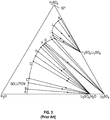
- Figure 3 shows an exemplary ternary phase diagram for the Li 2 SO 4 / H 2 SO 4 / H 2 O System at 30°C ( International Critical Tables of Numerical Data - Physics, Chemistry and Technology, Volume IV (1928) pages 353 & 391 ).
- Table 1 provides the equilibrium concentration data at 30°C for points in Figure 3 .
- the diagram in Figure 3 shows the saturation conditions at varying acid concentrations at 30°C. This data was compared to recovery results of previous testing and found to agree within 5% accuracy. While not wishing to be limited by theory, the phase diagram of Figure 3 shows that the maximum amount of lithium sulphate recovered at this temperature would be at a sulphuric acid concentration of 48 wt% (Point E). This gives the lowest solubility of lithium (10.2 wt%), while remaining in the zone where the monohydrate crystals are the stable form, which, from previous studies, has shown to provide the best separation. Higher concentrations will begin to re-dissolve the lithium and form anhydrous and subsequently bisulphate crystals. Once above a concentration of 69.4 wt% sulphuric acid, additional lithium can be recovered. However, it will be in the form of lithium bisulphate resulting in a loss of acid.
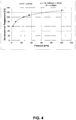
- Table 2 provides the decomposition conditions for lithium sulphate monohydrate ( International Critical Tables of Numerical Data - Physics, Chemistry and Technology, Volume VII (1930) page 303 ).
- the decomposition temperature is related to the decomposition of the crystal in solution, these parameters are thermodynamically related and one can be calculated from the other.
- the relative locations of the boiling point curve and the decomposition curve indicate whether the hydrated crystal, or the anhydrate, is likely stable in solution at a given composition and temperature. The stable crystal form may then change as the solution is cooled after evaporation. This has not previously been investigated experimentally.
- the boiling point curve is a function of sulphuric acid to lithium sulphate ratio and must be developed for a specific mixture.
- Lithium sulphate was slowly added to -50 wt% sulphuric acid at 50°C to determine the solubility at this concentration/temperature condition. This concentration was chosen to be close to conditions which can realistically be expected in the crystallizer step. The detailed procedure and results of this test can be found hereinbelow in Example 1, section IV.
- the final composition of the saturated solution at 50°C was determined to be: H 2 SO 4 43.3 wt% H 2 O 43.4 wt% Li 2 SO 4 13.3 wt%
- the lithium solubility is higher at 50°C than shown on the ternary phase diagram at 30°C of Figure 3 (13.3 wt% versus -10.9 wt%). This indicates that unlike water, at this acid concentration the solubility is positively related to temperature (solubility increases as temperature increases). The solution was then heated to 70°C and subsequently cooled to 30°C to verify this phenomenon.
- Varying concentrations of solutions were made up, based on the following lithium / sodium / sulphuric acid ratios: 19.5 wt% Li 2 SO 4 , 1.3 wt% Na 2 SO 4 , 12.2 wt% H 2 SO 4 and 67.0 wt% H 2 O; implies non-water portion of the solution to be 59.1 wt% Li 2 SO 4 , 3.9 wt% Na 2 SO 4 and 37.0 wt% H 2 SO 4 .
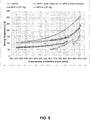
- These solutions were then slowly boiled off and the condensate collected at varying pressures. The results of these tests are summarized in this section. The detailed procedure and results of these tests can be found hereinbelow in Example 1, section V. See also Figure 5 for the boiling temperatures for each of these tests.
- BPR-1 and BPR2 The first boiling point rise test (BPR-1) investigated a range from 30 wt% to 84 wt% sulphuric acid and salts and overlapped with the second test (BPR-2) which was from 65 wt% to 96 wt%. It was split up into two tests to ensure reproducibility and achieve a greater degree of accuracy especially at the higher concentration range. Both BPR-1 and BPR-2 were performed at ambient pressure. Crystallization was first observed at 107.8°C and a composition of 14.9 wt% H 2 SO 4 and 23.9 wt% Li 2 SO 4 , which gives another saturation point for this system.
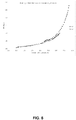
- BPR-3 The third boiling point rise test (BPR-3) investigated a range from 30 wt% to 83 wt% sulphuric acid and salts and was performed at -25" of Hg (16.7 kPa absolute). This was intended to match the boiling point rise that would be seen in an evaporative crystallization step operating under vacuum. Crystallization was first observed at 69.8°C and a composition of 14.2 wt% H 2 SO 4 and 22.7 wt% Li 2 SO 4 , another saturation point. By the time it reached a concentration of 51.5 wt% acid and salts, the mixture was a very thick slurry.
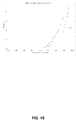
- BPR-4 The fourth boiling point rise test (BPR-4) investigated a range from 65 wt% to 96 wt% sulphuric acid and salts and was performed at -29" of Hg (3.1 kPa absolute). This was intended to match the boiling point rise that would be seen in a SARC step which operates under deep vacuum. The data set from this test was corrupted by stopping overnight part-way through the run. Although this didn't seem to have an effect on previous tests, while not wishing to be limited by theory, it is believed that the high acid concentrations in combination with the low temperatures (i.e. below decomposition temperatures) may have caused the crystals to switch structures (i.e.
- the mixture was then cooled to 30°C and the crystals were separated by filtration.
- the filtrate was then further concentrated under vacuum to a concentration of 96 wt% acid and salts in a final concentration stage.
- Test 1 For this test the evaporative crystallizer was run at the same pressure as test BPR-3 (-25" of Hg). Approximately 81 % of the salts were recovered from the simulated anolyte feed, following the initial concentration to 71 wt% acid and salts (stage 1). The crystals were needle-like and translucent, while not wishing to be limited by theory, indicating primarily the monohydrate form. An additional 2.5 to 5% of the salts were recovered following stage 2. It was not confirmed whether these crystals were in the sulphate or bisulphate form. While not wishing to be limited by theory, the expectation is that the majority will be as bisulphate, which will result in lower lithium recovery and higher acid losses. As the solution cooled, a crystallization temperature was not recorded; however it was believed to be approximately 130°C.
- Test 2 For this test, the evaporative crystallizer was run at atmospheric pressure (same as BPR-1). Depending on the assumed form of the crystals (anhydrous vs monohydrate), 76 to 89% of the salts were recovered from the simulated anolyte feed, following the initial concentration to 71 wt% acid and salts (stage 1). The crystals were a mixture of translucent/needle-like and white powdery solids, while not wishing to be limited by theory, if the visual appearance is an accurate indicator of the form, the actual recovery is most likely somewhere in between these two limits. An additional 1.3 to 2.7% of the salts were recovered following stage 2. The uncertainty in percent recovery is due to whether the crystals are in the sulphate or bisulphate form. While not wishing to be limited by theory, the expectation is that the majority will be as bisulphate, which will result in lower lithium recovery and higher acid losses.
- the settling test was performed on the concentrate from test 1 after the first concentration stage, after it had been cooled to 30°C and before filtration. The test was done by agitating the mixture in a graduated cylinder and recording the solid level over time. The crystals settled relatively quickly and reached an equilibrium level after 10 to 20 minutes. However, it was found that the solids did not compact very well and only 30 mL of filtrate was recovered by separation. This was only -22% of the filtrate, resulting in the crystals containing -50 wt% filtrate.
- the filtrate can, for example, be recovered via some mechanical means (e.g. filter, centrifuge, etc.) to avoid large acid losses. Washing may also, for example be used in the process. These stages can be considered in the context of the overall water and acid balances.
- Solid Characterization The solids recovered from each filtration step were characterized by inspection and by re-dissolving the crystals into water and measuring the pH. Although the quantitative split between sulphate and bisulphate was not obtained via this method, some useful observations were made.
- the crystals from Test 1 Stage 1 (performed at vacuum) were visually more similar to the monohydrate form than those of Test 2 Stage 1 (performed at atmospheric pressure).
- the final boiling temperature was 81.9°C, which is below the calculated decomposition temperature of 92°C at 17 kPa(a).
- the final boiling temperature was 127.2°C, which is at the calculated decomposition temperature of 127°C at 101 kPa(a).
- the minimum solubility of lithium sulphate occurs at -48 wt% H 2 SO 4 (58 wt% acid + salts), after which the crystals begin to switch to the anhydrous form and the solubility increases until the bisulphate crystals begin to form at ⁇ 62 wt% H 2 SO 4 (-80 wt% acid and salts). Therefore, to maximize the recovery of lithium sulphate the evaporative crystallizer may, for example, concentrate to about 48 wt% H 2 SO 4 in the solution. Based on the feed specification, the process may, for example, give a theoretical maximum lithium sulphate recovery of 87% (81% was measured in the lab).
- a concentration of -65 wt% H 2 SO 4 in the crystallizer may, for example be used. While this doesn't give the optimum crystal recovery, if this concentration is useful in an initial extraction process of lithium from spodumene, it would avoid additional unit operations by eliminating the SARC system.
- Concentrations higher than 65 wt% in the crystallizer are not efficiently performed in multiple effect evaporation due to the boiling point rise. While not wishing to be limited by theory, any concentration between 65 to 96 wt% would require the addition of a SARC following the crystallizer but the chosen initial and final concentrations may have a large effect on size/cost.
- the resulting solution may, for example, be in single phase and clear of any solid crystal particles.
- crystals will start to form and precipitate at an estimated temperature of 130°C. If allowed to cool to 30°C, another 2.5% of the initial amount of lithium sulfate can be recovered as lithium bisulphate; however this may, for example, result in acid losses. While not wishing to be limited by theory, it is useful from the view of complexity and cost to send the acid hot to the spodumene reactor
- a benefit of operating the crystallizer under vacuum is that it appears to help the crystals remain as monohydrates rather than decomposing into the anhydrous form and allows the minimum solubility point to be reached.
- Settling time was in the order of minutes. However, the crystals did not compact very well and had -50 wt% liquid entrainment. Therefore an additional unit operation may, for example, be used to mechanically separate the entrained liquid. Also washing of the crystals may be used to minimize lithium hydroxide addition for pH adjustment due to acid carry-over. Care is used by the skilled person to ensure that the crystals are not re-dissolved.
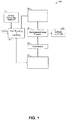
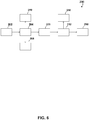
- the process 200 exemplified therein is for treating an aqueous composition comprising lithium sulfate and sulfuric acid.
- the aqueous composition comprising lithium sulfate and sulfuric acid 202 is evaporatively crystallized 204 under conditions to obtain crystals of lithium sulfate monohydrate 206 and a lithium sulfate-reduced solution (filtrate 208).
- the evaporative crystallizer 204 can be either single or multiple effect and can, for example, be operated at a pressure of about 16 kPa and a temperature (Tf) of about 82°C.
- the crystals of the lithium sulfate monohydrate 206 are optionally separated from the lithium sulfate-reduced solution 208.
- the evaporative crystallization 204 also produces a first acidic condensate 210.
- the lithium sulfate-reduced solution 208 is optionally concentrated 212 under conditions to obtain a second acidic condensate 216 and a concentrate comprising sulfuric acid 218.
- the concentrating can be carried out by a SARCTM process which is carried out at a pressure of about 2 kPa and a temperature (Tf) of about 190°C.
- the aqueous composition comprising lithium sulfate and sulfuric acid 202 can be an anolyte feed comprising, on a 100 kg basis, about 19.5 wt% Li 2 SO 4 , 1.3 wt% Na 2 SO 4 , 12.2 wt% H 2 SO 4 and 67.0 wt% H 2 O.
- about 19.7 kg of crystals of lithium sulfate monohydrate 206 can be obtained in such an example of process 200 (assuming, while not wishing to be limited by theory, an about 82% recovery and no entrainment of filtrate 208), optionally having a composition of about 94.6 wt% Li 2 SO 4 ⁇ H 2 O and about 1.3 wt% Na 2 SO 4 .
- about 26.9 kg of filtrate 208 can be obtained, optionally having a composition of about 13.1 wt% Li 2 SO 4 , 0.9 wt% Na 2 SO 4 , 45.2 wt% H 2 SO 4 and 40.8 wt% H 2 O.
- first acidic condensate 210 can be obtained which can, for example, have a pH of about 3.
- second acidic concentrate 216 can be obtained which can, for example, have a pH of about 1.
- about 16.6 kg of the concentrate comprising sulfuric acid 218 can be obtained which optionally has a composition of about 21.2 wt% Li 2 SO 4 , about 1.4 wt% Na 2 SO 4 , about 73.4 wt% H 2 SO 4 and about 4.0 wt% H 2 O.
- Figure 7 shows a ternary phase diagram which was developed in accordance with the examples of the present disclosure.
- the solubility of lithium sulfate in 50 wt% sulfuric acid was determined experimentally to be 13.29 - 13.32 wt% at 50°C.
- the behaviour of solubility with respect to temperature was tested by heating the saturated solution from 50°C to 70°C, followed by cooling to 30°C.
- 50 g of 50 wt% H 2 SO 4 was brought into a 100 mL round bottom flask (rbf) equipped with a stir bar and condenser and was heated to 50°C with a temperature-controlled water bath. Li 2 SO 4 was then added in increments until saturated (solution turned cloudy); initially three 1 g portions were added then subsequent additions were added by spatula and weighed by difference. The cloudy solution was stirred at 50°C for 1 ⁇ 2 hour to confirm the saturation point had been reached then 50 wt% H 2 SO 4 added dropwise until the solution cleared. The solution was then heated to 70°C and held at temperature for ⁇ 1 hr with stirring, followed by no stirring for 1 ⁇ 2 hr. Finally, the solution was cooled to 30°C without stirring and held at temperature for over 1 hr.
- Table 4 Solubility of Li 2 SO 4 in 50 wt% H 2 SO 4 at 50°C H 2 SO 4 concentration (wt%) 49.97 Temperature (°C) 50.0 H 2 SO 4 added (g) 51.24 - 51.38 Li 2 SO 4 added (g) 7.8728 Solubility (wt%) 13.29 - 13.32
- Table 5 Effect of temperature on Li 2 SO 4 solubility in 50 wt% H 2 SO 4 Temperature (°C) Appearance Conclusion 30 Colourless crystals form in the bottom of the beaker, with a clear and colourless supernatant Past the point of saturation 50 Cloudy/clear solution Saturated solution 70 Clear and colourless solution Saturated or below saturation
- the anhydrous lithium sulfate was a fine, white powder
- the saturation point at 50°C was observed when the solution turned cloudy.
- BPR boiling point rise
- Lithium Sulfate, anhydrous - ⁇ 98.0% was from Aldrich Chemistry, product # 62613-1 KG, lot # BCBL6287V.
- Sodium sulfate, anhydrous, granular, free-flowing, Redi-DriTM, ACS reagent, ⁇ 99% was from Sigma-Aldrich, product #798592-500g, lot # MKBV7489V. All solutions were prepared with deionized water. Sulfuric acid concentration and solution density measurements were determined using an Anton Paar DSA 5000 M Density and sound velocity meter.
- a vacuum distillation apparatus was used to concentrate the solutions that was made up of a reflux condenser with a cold finger connected to a distillation condenser. Headspace temperature was measured by a thermometer before the vapours reached the cold finger.
- the reflux condenser and distillation condenser were connected with a kontes tap.
- the cold finger could be rotated to direct condensate towards the distillate collected or back towards the concentrate.
- Cooling water for the cold finger and distillation condenser was either tap water or was from a connected circulating, temperature-controllable water bath.
- the solutions were concentrated in round bottom flasks equipped with a thermometer or thermocouple. Condensate was collected into graduated bottles with ground glass necks. The solutions were heated with electric heating mantles.
- Table 7 Compositions of synthetic anolyte solutions 1
- Composition Solution 1 Solution 2 (BPR-2) Solution 2 (BPR-4) H 2 O 70.01 35.11 35.11 H 2 SO 4 11.08 23.93 23.93 Li 2 SO 4 17.73 38.41 38.41 Na 2 SO 4 1.18 2.56 2.56 Acid + Salt Conc 2 29.99 64.89 64.89 Density (g/cm 3 ) 1.24 - - 1 Concentrations provided in wt%. 2 Refers to the overall amount of H 2 SO 4 , Li 2 SO 4 , and Na 2 SO 4 in the solutions. This was calculated based on the initial composition of the anolyte solutions.
- the solution was charged into a round bottom flask (rbf) and the flask was equipped with a thermometer or thermocouple, boiling chip or stir bar, and electric heating mantle.
- the flask was connected to distillation apparatus and brought to a boil, upon which the temperature was recorded, the timer was started and collecting the condensate was begun.
- the distillation apparatus was connected to the vacuum pump and the system was brought to the target vacuum pressure prior to heating. The water was slowly evaporated off and the time, temperature (solution and vapour) and volume of condensate accumulated was recorded. The point at which crystals began to form was also recorded.
- BPR-3 1L, 3-neck rbf 2 x 250 mL bottles for condensate Test was completed over 2 days. Boiling chip was added at the beqinninq of the test.
- BPR-4 500 mL, 3-neck rbf 250 mL bottle for condensate Test was completed over 3 days. Magnetic stirrer was used for test.
- Table 9 highlights the compositions and boiling points of the solution at their initial and final compositions.
- the full data collected can be found in Table 10 (BPR-1), Table 11 (BPR-2), Table 12 (BPR-3) and Table 13 (BPR-4).
- the graphs in Figures 8-11 show the rises in boiling points for each test ( Figure 8 : BPR-1 and BPR-2; Figure 9 : BPR-3; Figure 10 : BPR-4; Figure 11 : BPR-1 and BPR-3).
- the boiling point is the temperature measured in the solution or slurry which is denoted as the "flask temperature" in the data tables.
- Table 15 contains data relating to pH measurements of the condensate obtained from tests BPR-1 to BPR-4.
- Table 15 Condensate pH measurements Test fraction mass (g) volume (mL) density (g/mL) pH measured Appearance BPR-1 1 160.05 162 0.99 4.3 Clear, colourless BPR-1 2 237.18 238 1.00 2.3 Clear, colourless BPR-2 1 160.87 162 0.99 1.68 Clear, slightly yellow BPR-3 1 248.68 250 0.99 3.77 Clear, colourless BPR-3 2 144.52 146 0.99 2.42 Clear, colourless BPR-4 1 160.71 162 0.99 1.58 Clear, slightly yellow
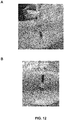
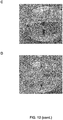
- BPR-1 The first part of the concentration was from 30-41% total acid and salts and no stir bar or boiling chips were used. The solution was clear and colourless initially and boiled smoothly. At 40.4% total acid and salts, the mixture began to bump and boiled more vigorously and crystals were observed in the concentrate. The crystals were clear, needle-like, and settled quickly to the bottom of the flask when the mixture was not agitated. The supernatant was clear and colourless. The first part of the concentration was stopped at 40.6% total acid and salts ( Figure 12A ) and cooled overnight. Additional crystals formed at room temperature with nice, crystalline structures ( Figure 12B ).
- the second part of the concentration was from 41-84% total acid and salts.
- a boiling chip was added to the concentrating flask for the second part of the test. Some of the solids that had been present at room temperature re-dissolved when the mixture reached reflux. The mixture continued to boil quite vigorously and bump even with the boiling chip. From 40.6% to 56.6%, the appearance of the concentrate was very similar except for a slight increase in the amount of solids visible (see, for example, Figure 12C which shows concentrate at 49% and Figure 12D which shows concentrate at 57%). The solids were fine, needle-like white crystals which settled as soon as the boiling stopped. The supernatant was clear and colourless. At 69.3%, a larger solids layer was visible in the concentrate as shown in Figure 12E .
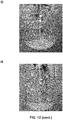
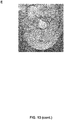
- BPR-2 The initial mixture was a thick, white slurry. The slurry was prepared using a magnetic stir plate, and the stirring was maintained for the test. The first part of the concentration was from 65-76% total acid and salts. Several hours of heating were required until the mixture reached reflux and condensate collection was started. Some of the initial solids dissolved with heating based on the visual appearance of the concentrate. However at no point did all of the solids go into solution (see, for example: Figure 13A ). During the concentration, the mixture appeared to be a white, bubbling slurry. At 71.3% the mixture began to boil and bump very vigorously, so the heating was lowered slightly.
- the hot concentrate had a layer of white solids that settled to the bottom of the flask and a clear and slightly yellow supernatant ( Figure 13B ).
- the concentration was stopped at this point and cooled overnight.
- Figure 13C the whole mixture had crystallized. There appeared to be two layers of solids. The bottom layer had finer, white solids.
- the top layer which appeared to correspond to the supernatant layer contained larger, white, needle-like crystals.
- the second part of the concentration was from 76-96% total acid and salts.
- the concentrate was heated to reflux, some of the crystals re-dissolved to form a slurry.
- the white slurry boiled mildly as it was concentrated. The appearance was quite consistent during the second part of the concentration.
- 92.7% mostly white solids were visible in the flask with a small amount of clear, yellow supernatant ( Figure 13D ).
- Figure 13D clear, yellow supernatant
- the test was stopped. The concentrate was a thick, white, bubbling slurry when hot. As the solids settled, but the mixture was still hot, a layer of slightly opaque and pale yellow supernatant was visible (see, for example: Figure 13E ).
- BPR-3 was the first test performed under vacuum.
- the cold finger and condenser were cooled using a circulation water bath set at 10°C instead of tap water which was used in the previous tests.
- the first part of the concentration was from 30-66% total acid and salts.
- the solution was clear, colourless and boiled mildly until 37.5%.
- 38.4% the first solids were observed in the solution and they settled to the bottom of the flask when boiling stopped and were needle-like crystals.
- the concentrate began to boil more vigorously.
- the receiving flask was switched at 50.1% concentration with the system being maintained at temperature and under vacuum. The amount of solids increased as the concentration proceeded.
- the supernatant was clear and colourless and the mixture boiled quite vigorously.
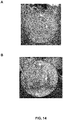
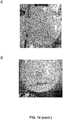
- the concentration was stopped ( Figure 14A ) and the system was brought to atmospheric pressure and cooled to room temperature ( Figure 14B ) overnight.
- the second part of the concentration was from 66.2-82.5% total acid and salts (see Figure 14C for 83% concentrate at temperature).
- the system was put under vacuum and heated to reflux before collection was started.
- the final concentrate had a layer of white solids at the bottom of the flask with a supernatant layer that appeared viscous, slightly opaque and pale yellow ( Figure 14D ).
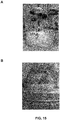
- BPR-4 The initial slurry at 65% total acid and salts was very thick and sticky; the stir bar in the flask was not able to fully mix the system. A glass stir rod was used to assist in stirring while the solution was prepared. The slurry swelled significantly to almost fill the whole flask when first put under vacuum. The solution was then brought to the target vacuum of 3 kPa slowly to allow the swelling to subside. While not wishing to be limited by theory, the swelling was likely due to degassing of the slurry ( Figure 15A ). The slurry was then brought to reflux under vacuum ( Figure 15B ) and the first part of the concentration was from 64.9-70.5% total acid and salts (see, for example 15C, showing 69% concentrate at temperature).
- the second stage of the concentration was from 70.5-88.2% total acid and salts (see: Figure 15D for 88% concentrate at temperature and Figure 15E for 88% concentrate at room temperature) .
- Figure 15D for 88% concentrate at temperature
- Figure 15E for 88% concentrate at room temperature
- the third stage of the concentration was from 88.2-96.0% total acid and salts.
- the solids appeared to fully disperse in the slurry at boiling.
- the final concentrate was a thick and opaque slurry ( Figure 15F ).
- the concentrate from BPR-1 contained crystal-like, translucent white crystals with a clear, colourless supernatant ( Figure 16A ).
- a thick slurry formed when the bottle was agitated.
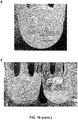
- the concentrate from BPR-2 was a thick slurry with a very thin layer of viscous supernatant right at the surface ( Figure 16B ).
- the very top layer of the solids and slurry could be scraped and mixed with the spatula ( Figure 16C ), and the majority of the solids were in a solid mass at the bottom of the flask.
- the concentrate from BPR-3 was settled into three layers.
- the top layer was a thin supernatant, the middle layer appeared to contain crystalline, white solids and the bottom layer appeared to be settled solids that were finer than the middle layer.
- Figure 16D The concentrate from BPR-4 cooled into a solid mass with no excess liquid visible.
- the solids appeared to be in two layers ( Figure 16E ).
- the solids at the top appeared to be more crystal-like and the solids at the bottom appeared to be finer and less crystalline than the top later. See also Figure 16F for a side-by-side comparison of BPR-2 (right hand rbf) and BPR-4 (left hand rbf).
- a two-stage concentration and filtration test of a synthetic anolyte solution was completed at atmospheric pressure and under vacuum. Stage one of the experiment was the concentration of a synthetic anolyte solution from 33% to 71% total acid and salts. This was completed under vacuum at 17 kPa and at atmospheric pressure. The 71% solution was cooled to 30°C and filtered. In the second stage, the resulting filtrate was concentrated further to 96% total acid and salts under a vacuum at 3 kPa for both experiments. The final concentrate was cooled to 30°C to precipitate solids and filtered.
- Lithium Sulfate, anhydrous - ⁇ 98.0% was from Aldrich Chemistry, product # 62613-1KG, lot # BCBL6287V.
- Sodium sulfate, anhydrous, granular, free-flowing, Redi-DriTM, ACS reagent, ⁇ 99% was from Sigma-Aldrich, product #798592-500g, lot # MKBV7489V. All solutions were prepared with deionized water.
- the 30°C concentrate was vacuum filtered through a 1.5 ⁇ m glass microfiber filter and the filtrate used to rinse any solids stuck to the glassware from previous steps into the filter cake. Finally, the filtrate was isolated, the filter cake rinsed thoroughly with ethanol and the crystals dried.
- stage 1 A known amount of filtrate from stage 1 was transferred into a 250 mL, 3-neck, round bottom flask.
- the flask was equipped with a thermocouple, distillation apparatus and electric heating mantle, connected to a vacuum pump and brought to 3 kPa.
- the mixture in the flask was brought to a boil and water distilled off to reach the target concentration.
- the final mass of condensate and concentrate was then recorded.
- the cooling and filtration steps of stage 2 were different in tests 1 and 2 as follows:
- Test 1 The contents of the concentrating flask were transferred to a 250 mL Erlenmeyer flask and submerged in a 30°C circulating water bath overnight. The 30°C concentrate was vacuum filtered through a 1.5 ⁇ m glass microfiber filter. A portion of the filtrate was used to rinse any solids stuck to the glassware from previous steps into one Erlenmeyer, but not combined with the filter cake. The filter cake was rinsed thoroughly with ethanol and the crystals left to dry.
- Test 2 The final concentrate was left to cool to ambient temperature with stirring. A camera equipped with a timer was used to take pictures at one minute intervals to note the temperature and appearance of concentrate while cooling. The concentrate was then left at 30°C overnight to crystallize solids. The concentrate was heated to 99°C slowly in an oil bath and observed to watch the solids re-dissolve. The concentrate was then cooled to 30°C and vacuum filtered through a 1.5 ⁇ m glass microfiber filter. The filter cake was rinsed thoroughly with ethanol and the crystals left to dry.
- Table 16 contains a summary of the conditions of the tests: Table 16: Summary of conditions for tests Test Pressure Initial BP (°C) Final BP (°C) 1 stage 1 17 kPa 60.6 81.9 1 stage 2 3 kPa 41.6 228 2 stage 1 atmospheric 104.8 127.2 2 stage 2 3 kPa 40.8 222
- Table 17 contains an overview of the composition data for test 1 stage 1.
- Table 17 Composition data for test 1 stage 1 concentration and filtration Component (g)
- Initial condensate concentrate Recovered solids Total filtrate Recovered filtrate Total 700.28 373.86 326.42 137.70 188.72 159.89 Li 2 SO 4 136.59 136.59 118.31 18.29 15.49 Na 2 SO 4 9.11 9.11 0.00 9.11 7.72 H 2 SO 4 85.40 85.40 85.40 72.36 H 2 O 469.17 373.86 95.31 19.39 75.92 64.32 Acid+ salts 231.11 231.11 112.80 95.57 Li 2 SO 4 as monohydrate 1 158.98 158.98 137.70 21.28 18.03
- Composition (wt%) Initial condensate concentrate Recovered solids Total filtrate Recovered filtrate Total 100.0% 100.0% 100.0%
- Test 1 stage 2 (3 kPa): The filtrate from stage 1 was used as the initial solution for stage 2. The test was done with 150 g of the filtrate, with the remaining recovered filtrate set aside. The final masses of the condensate and the final concentrate were measured. A mass lost was calculated as the difference between the initial filtrate and the sum of the concentrate and condensate samples. While not wishing to be limited by theory, the mass lost is likely due to condensation that remained on the walls of the distillation apparatus. The filtration step in stage 2 was difficult as the final concentrate was very viscous.
- Table 18 contains an overview of the composition data for test 1 stage 2. Table 18: data for test 1 stage 2 concentration and filtration Sample Mass (g) Initial filtrate 150.01 Condensate 56.65 Final concentrate 89.99 Mass lost 3.37 Recovered solids 7.16
- Test 2 stage 1 (atmospheric pressure): The compositions of the initial solution and final compositions were determined as in test 1.
- Table 19 contains an overview of the composition data for test 2 stage 1 concentration.
- Composition data for test 2 stage 1 concentration Component (g)
- Initial condensate concentrate Total 851.86 454.2 397.66 Li 2 SO 4 166.07 166.07 Na 2 SO 4 11.08 11.08 H 2 SO 4 101.87 101.87 H 2 O 572.84 454.2 118.64 Acid+ salts 279.02 279.02 Li 2 SO 4 as monohydrate 1 193.29 193.29
- Composition (wt%) Initial condensate concentrate Total 100.0% 100.0% 100.0% Li 2 SO 4 19.5% 0.0% 41.8% Na 2 SO 4 1.3% 0.0% 2.8% H 2 SO 4 12.0% 0.0% 25.6% H 2 O 67.2% 100.0% 29.8% Acid+ salts 32.8% 0.0% 70.2% Li 2 SO 4 as monohydrate 1 22.7% 0.0% 48.6% 1 calculated based on amount of Li
- the solids isolated by filtration were not homogenous; instead they appeared to be a mixture of translucent crystals similar to test 1, and amorphous white powdery solids.
- the composition of the solids was not determined, so the exact composition of the filtrate was also unknown. While not wishing to be limited by theory, the composition was assumed to be somewhere between if the solids were determined to be fully anhydrous Li 2 SO 4 or fully Li 2 SO 4 monohydrate. The two cases are laid out in Table 20.
- Table 20 Possible compositions of solids from test 2 filtration 1 Component (g) All Anhydrous Li 2 SO 4 All Li 2 SO 4 Monohydrate Crystals Total filtrate Crystals Total filtrate Total 157.46 240.2 157.46 240.2 Li 2 SO 4 157.46 8.61 135.29 30.78 Na 2 SO 4 0.00 11.08 0.00 11.08 H 2 SO 4 101.87 101.87 H 2 O 0.00 118.64 22.17 96.47 Acid+ salts 121.56 143.73 Li 2 SO 4 as monohydrate 1 157.46 35.83 Composition (wt%) Crystals Total filtrate Crystals Total filtrate Total 100.0% 100.0% 100.0% 100.0% 100.0% Li 2 SO 4 100.0% 3.6% 85.9% 12.8% Na 2 SO 4 0.0% 4.6% 0.0% 4.6% H 2 SO 4 0.0% 42.4% 0.0% 42.4% H 2 O 0.0% 49.4% 14.1% 40.2% Acid+ salts 0.0% 50.6% 0.0% 59.8% Li 2 SO 4 as monohydrate 1 100.0% 14.9% 1 calculated
- Test 2 stage 2 (3 kPa): As the exact composition of the filtrate from stage 1 was not known, the end point of the stage 2 concentration was based on the boiling point measured in test 1 stage 2 as the conditions and final target concentration were the same for both tests. The concentration was stopped when the boiling point reached 222°C. The volume of condensate collected at that point fell in the target range calculated based on anhydrous lithium sulfate or lithium sulfate monohydrate being removed by filtration in stage 1. Table 21 contains an overview of the calculations for amount of condensate to remove and Table 22 contains an overview of the data for test 2 stage 2 concentration.
- Table 21 Calculations for target amount of condensate to remove Initial Mass of concentrate (g) 183.44 183.44 Li 2 SO 4 species anhydrous monohydrate acid+salt content 50.6% 59.8% Target Final acid+salt content 96% 96% Mass of concentrate (g) 96.70 114.34 mass of condensate (g) 86.74 69.10
- Table 22 Data for test 2 stage 2 concentration Sample Mass (g) Initial filtrate 183.44 Condensate 71.6 Final concentrate 108.45 Mass lost 3.39
- Crystallization and solubility Two experiments were performed to test the crystallization and solubility properties of the test 2 stage 2 concentrate. Tables 24 and 25 contain an overview of the results of these experiments. Table 24: Observation of concentrate when cooled from final boiling point to 30°C Time Temperature Appearance 0 min 212°C Clear, pale yellow solution. No solids crystallized. 91 min 30°C No change in appearance. Stirring has slowed, which suggests increased viscosity of the concentrate.
- Solids characterization The solids recovered from each filtration step were characterized by inspection and by measuring the pH of the solids in solution. A solution was made up of each solid in deionized water. Table 26 contains an overview of the properties of the filtered solids. Table 26: Properties of filtered solids Test Stage Appearance Mass (g) Final vol (mL) Conc. (g/L) pH 1 1 Needle-like, translucent, white crystals 2.50 25 100 3.57 1 2 Powdery, white, chalky clumps of solids 1.00 10 100 2.64 2 1 A mix or needle-like crystals and white powdery solids 2.51 25 100 2.89 2 2 Powdery, white, chalky clumps of solids 0.50 5 100 1.84
- Table 27 contains an overview of the results of pH measurements of condensate samples.
- Table 27 pH measurements of condensate samples Condensate pH Test 1 stage 1 2.84 Test 1 stage 2 1.05 Test 2 stage 1 3.05 Test 2 stage 2 1.18
- Solids setting test The settling test was performed on the concentrate from test 1 stage 1 after it has been cooled to 30°C and before filtration. The test was done in triplicate. The concentrate was at 30°C at the beginning of the first test and all three tests were done in succession at room temperature. Table 28 contains the setting test data for test 1 concentrate.
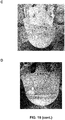
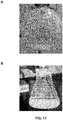
- Test 1 stage 1 The final concentrate at 70.8 wt% total acid and salts contained white crystals and had a clear, colourless supernatant layer when the solids settled ( Figure 17A ). When cooled to 30°C, the solids layer was larger and with a thin layer of supernatant ( Figure 17B ).
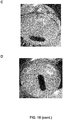
- Test 1 stage 2 The filtrate used as the initial solution for the concentration experiment was clear and colourless ( Figure 17C ).
- the final concentrate was clear, yellow/brown and contained no solids at the final boiling point.
- the concentrate was cooled in the flask, then re-heated to reflux temperature under vacuum to re-dissolve solids so that the concentrate could be transferred to an Erlenmeyer flask for crystallization. Solids formed in the concentrate when cooled to 30°C.
- the resulting slurry was very thick with solids suspended throughout ( Figure 17D ).
- the filtration was very slow and additional solids appeared to precipitate in the filtrate as the filtration proceeded.
- the filtrate was viscous and slightly yellow in colour.
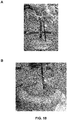
- Test 2 stage 1 The final concentrate at 70% acid and salts was a slurry with a layer of white solids that settled to the bottom of the flask with a clear and colourless supernatant ( Figure 18A ).
- the concentrate was transferred to an Erlenmeyer flask for cooling and crystallization of solids. Initially the final concentrate was allowed to cool partially, however large chunks of solids formed that could not be transferred. The concentrate had to be heated to >100°C to re-dissolve the large chunks of solids so that the concentrate could be fully transferred. The concentrate was cooled to ⁇ 75°C at ambient temperature and then cooled to 30°C in the water bath. The solution was maintained at 30°C for 2 hours and then filtered.
- Test 2 stage 2 The filtrate used as the initial solution for this experiment was clear and colourless ( Figure 18B ). It turned from colourless to yellow, but remained clear throughout the experiment. No crystallization was observed in the initial cooling of the concentrate from boiling point to 30°C. The concentrate was left at 30°C overnight, and crystals were observed in the concentrate. The crystals were translucent, very large, and the colour of the concentrate ( Figures 18C-D ). The supernatant was thick and clear. The concentrate was then left in the 30°C water bath for the day. At the end of the day, the slurry appeared creamy with finer white solids in the concentrate in addition to the initial large crystals ( Figure 18E ).
- Tables 29, 30, 31 and 32 contain additional concentration data for test 1 stage 1, test 1 stage 2, test 2 stage 1 and test 2 stage 2, respectively.
- Table 29 Test 1 stage 1 concentration data Time (min) Boiling point (°C) Head space (°C) Condensate (mL) 0 60.6 55 0 30 62.3 57 55 54 62.6 58 102.5 81 62.9 58 160 105 63.7 58 200 123 64.7 58 225 144 65.7 58 255 160 66.9 58 275 184 69.1 59 305 206 71.9 60 330 223 75.2 61 350 237 79.2 62 365 245 81.9 62.5 374
- Table 30 Test 1 stage 2 concentration data Time (min) Boiling point (°C) Head space (°C) Condensate (mL) 0 41.6 24 0 32 50.6 30 10 58 60.1 34 20 81 73.1 42 30 107 96.3 44 40 137 135.4 49 50 151 169.4 50.5 54 165 219
- Example 2 testing The objective of the Example 2 testing is to study the behaviour of sulphuric acid / lithium sulphate solutions in a test campaign in a pilot SARC system.
- the key goals of the pilot testing are to:
Landscapes
- Chemical & Material Sciences (AREA)
- Crystallography & Structural Chemistry (AREA)
- Organic Chemistry (AREA)
- Engineering & Computer Science (AREA)
- Materials Engineering (AREA)
- Chemical Kinetics & Catalysis (AREA)
- Inorganic Chemistry (AREA)
- Physics & Mathematics (AREA)
- Thermal Sciences (AREA)
- Metallurgy (AREA)
- Electrochemistry (AREA)
- Secondary Cells (AREA)
- Manufacture And Refinement Of Metals (AREA)
- Cleaning Or Drying Semiconductors (AREA)
- Compounds Of Alkaline-Earth Elements, Aluminum Or Rare-Earth Metals (AREA)
- Organic Low-Molecular-Weight Compounds And Preparation Thereof (AREA)
- Vaporization, Distillation, Condensation, Sublimation, And Cold Traps (AREA)
- Electrolytic Production Of Non-Metals, Compounds, Apparatuses Therefor (AREA)
- Inorganic Compounds Of Heavy Metals (AREA)
- Heat Treatment Of Water, Waste Water Or Sewage (AREA)
- Removal Of Specific Substances (AREA)
Priority Applications (3)
| Application Number | Priority Date | Filing Date | Title |
|---|---|---|---|
| HRP20211184TT HRP20211184T1 (hr) | 2016-08-26 | 2017-08-28 | Postupci za tretiranje vodenih sastava koji sadrže litij sulfat i sumpornu kiselinu |
| RS20210949A RS62169B1 (sr) | 2016-08-26 | 2017-08-28 | Postupci za tretiranje vodenih kompozicija koje sadrže litijum sulfat i sumpornu kiselinu |
| PL17842498T PL3504360T3 (pl) | 2016-08-26 | 2017-08-28 | Sposoby obróbki kompozycji wodnych zawierających siarczan litu i kwas siarkowy |
Applications Claiming Priority (3)
| Application Number | Priority Date | Filing Date | Title |
|---|---|---|---|
| US201662380056P | 2016-08-26 | 2016-08-26 | |
| CA2940509A CA2940509A1 (en) | 2016-08-26 | 2016-08-26 | Processes for treating aqueous compositions comprising lithium sulfate and sulfuric acid |
| PCT/CA2017/051007 WO2018035618A1 (en) | 2016-08-26 | 2017-08-28 | Processes for treating aqueous compositions comprising lithium sulfate and sulfuric acid |
Publications (3)
| Publication Number | Publication Date |
|---|---|
| EP3504360A1 EP3504360A1 (en) | 2019-07-03 |
| EP3504360A4 EP3504360A4 (en) | 2019-10-23 |
| EP3504360B1 true EP3504360B1 (en) | 2021-05-05 |
Family
ID=61246642
Family Applications (1)
| Application Number | Title | Priority Date | Filing Date |
|---|---|---|---|
| EP17842498.2A Active EP3504360B1 (en) | 2016-08-26 | 2017-08-28 | Processes for treating aqueous compositions comprising lithium sulfate and sulfuric acid |
Country Status (15)
| Country | Link |
|---|---|
| US (2) | US11083978B2 (enExample) |
| EP (1) | EP3504360B1 (enExample) |
| JP (1) | JP6825082B2 (enExample) |
| KR (1) | KR102266697B1 (enExample) |
| CN (2) | CN109891006B (enExample) |
| AU (2) | AU2017315337B2 (enExample) |
| CA (4) | CA2940509A1 (enExample) |
| CL (1) | CL2019000483A1 (enExample) |
| DK (1) | DK3504360T3 (enExample) |
| ES (1) | ES2882337T3 (enExample) |
| HR (1) | HRP20211184T1 (enExample) |
| PL (1) | PL3504360T3 (enExample) |
| PT (1) | PT3504360T (enExample) |
| RS (1) | RS62169B1 (enExample) |
| WO (1) | WO2018035618A1 (enExample) |
Families Citing this family (12)
| Publication number | Priority date | Publication date | Assignee | Title |
|---|---|---|---|---|
| RS65609B1 (sr) | 2012-05-30 | 2024-07-31 | Nemaska Lithium Inc | Postupci za dobijanje litijum karbonata |
| RS61656B1 (sr) | 2013-03-15 | 2021-04-29 | Nemaska Lithium Inc | Postupak za dobijanje litijum hidroksida |
| KR102614113B1 (ko) | 2013-10-23 | 2023-12-13 | 네마스카 리튬 인코포레이션 | 리튬 카보네이트의 제조방법 |
| CA3086843C (en) | 2014-02-24 | 2021-06-22 | Nemaska Lithium Inc. | Methods for treating lithium-containing materials |
| CA2940509A1 (en) | 2016-08-26 | 2018-02-26 | Nemaska Lithium Inc. | Processes for treating aqueous compositions comprising lithium sulfate and sulfuric acid |
| JP7194185B2 (ja) | 2017-11-22 | 2022-12-21 | ネマスカ リチウム インコーポレーテッド | 様々な金属の水酸化物および酸化物ならびにそれらの誘導体の調製プロセス |
| EP3897927A4 (en) * | 2018-12-21 | 2022-10-26 | Mangrove Water Technologies Ltd. | LI RECOVERY PROCESSES AND ON-SITE CHEMICAL PRODUCTION FOR LI RECOVERY PROCESSES |
| EP3990669A4 (en) | 2019-03-29 | 2023-05-10 | Lithium Americas Corporation | PROCESS FOR EXTRACTING LITHIUM FROM SEDIMENTARY CLAY |
| WO2020232556A1 (en) | 2019-05-22 | 2020-11-26 | Nemaska Lithium Inc. | Processes for preparing hydroxides and oxides of various metals and derivatives thereof |
| US11931701B2 (en) | 2021-08-06 | 2024-03-19 | Lithium Ark Holding B.V. | Production of lithium hydroxide and lithium carbonate |
| CN119173478A (zh) * | 2022-05-02 | 2024-12-20 | 智利化学和矿业股份有限公司 | 通过从硫酸锂精矿浸出获得高纯度硫酸锂一水合物的方法 |
| EP4491577A1 (en) | 2023-05-23 | 2025-01-15 | Lithium Ark Holding B.V. | Production of lithium hydroxide and lithium carbonate |
Family Cites Families (111)
| Publication number | Priority date | Publication date | Assignee | Title |
|---|---|---|---|---|
| CA659894A (en) | 1963-03-19 | N. Glew David | Aqueous solution treatment | |
| CA504477A (en) | 1954-07-20 | B. Ellestad Reuben | Method of extracting lithium values from spodumene ores | |
| US2331838A (en) | 1938-06-22 | 1943-10-12 | Bolidens Gruv Ab | Method of recovering lithium from minerals |
| GB530028A (en) | 1938-06-22 | 1940-12-03 | Bolidens Gruv Ab | Method of recovering lithium from minerals |
| US2516109A (en) | 1948-09-16 | 1950-07-25 | Metalloy Corp | Method of extracting lithium values from spodumene ores |
| US2793941A (en) | 1949-03-21 | 1957-05-28 | Nelson N Estes | Apparatus for growing crystals |
| US2872393A (en) | 1954-12-03 | 1959-02-03 | Olin Mathieson | Production of lithium hydroxide |
| GB841989A (en) | 1955-06-03 | 1960-07-20 | Ronald Herbert Henry Morley | Improvements in and relating to methods of extracting lithium from petalite, products of those methods and applications of those products |
| GB845511A (en) | 1956-01-03 | 1960-08-24 | Permutit Co Ltd | Improvements relating to the production of metal hydroxides |
| US3007771A (en) | 1956-11-30 | 1961-11-07 | American Potash & Chem Corp | Manufacture of lithium carbonate |
| US3214362A (en) | 1961-01-09 | 1965-10-26 | Ionics | Electrolysis of aqueous electrolyte solutions and apparatus therefor |
| US3597340A (en) | 1968-11-05 | 1971-08-03 | Lithium Corp | Recovery of lithium as lioh.h20 from aqueous chloride brines containing lithium chloride and sodium chloride |
| SU310538A1 (enExample) | 1969-08-04 | 1974-08-05 | Институт неорганической химии , электрохимии Грузинской ССР | |
| US3857920A (en) | 1971-07-29 | 1974-12-31 | Department Of Health Education | Recovery of lithium carbonate |
| US3899403A (en) | 1973-11-01 | 1975-08-12 | Hooker Chemicals Plastics Corp | Electrolytic method of making concentrated hydroxide solutions by sequential use of 3-compartment and 2-compartment electrolytic cells having separating compartment walls of particular cation-active permselective membranes |
| US3959095A (en) | 1975-01-31 | 1976-05-25 | Hooker Chemicals & Plastics Corporation | Method of operating a three compartment electrolytic cell for the production of alkali metal hydroxides |
| JPS51113108A (en) | 1975-03-28 | 1976-10-06 | Sawafuji Electric Co Ltd | Automatic voltage control system in brushless generator |
| US4036713A (en) | 1976-03-04 | 1977-07-19 | Foote Mineral Company | Process for the production of high purity lithium hydroxide |
| US4207297A (en) | 1978-03-27 | 1980-06-10 | Foote Mineral Company | Process for producing high purity lithium carbonate |
| US4287163A (en) | 1979-05-29 | 1981-09-01 | Saline Processors, Inc. | Process for recovering lithium from brine by salting out lithium sulfate monohydrate |
| US4273628A (en) | 1979-05-29 | 1981-06-16 | Diamond Shamrock Corp. | Production of chromic acid using two-compartment and three-compartment cells |
| JPS5795826A (en) | 1980-12-04 | 1982-06-14 | Rasa Kogyo Kk | Manufacture of high purity lithium salt of mineral acid |
| US4391680A (en) | 1981-12-03 | 1983-07-05 | Allied Corporation | Preparing alkali metal hydroxide by water splitting and hydrolysis |
| US4561945A (en) | 1984-07-30 | 1985-12-31 | United Technologies Corporation | Electrolysis of alkali metal salts with hydrogen depolarized anodes |
| US4723962A (en) | 1985-02-04 | 1988-02-09 | Lithium Corporation Of America | Process for recovering lithium from salt brines |
| US4999095A (en) | 1985-05-03 | 1991-03-12 | Allied-Signal Inc. | Recovery of mixed acids from mixed salts |
| US4707234A (en) | 1985-10-25 | 1987-11-17 | Toyo Soda Manufacturing Co., Ltd. | Method for separating an acid and an alkali from an aqueous solution of a salt |
| CA1272982A (en) | 1985-11-14 | 1990-08-21 | Donald Lorne Ball | Method for the recovery of lithium from solutions by electrodialysis |
| US4806215A (en) | 1988-07-27 | 1989-02-21 | Tenneco Canada Inc. | Combined process for production of chlorine dioxide and sodium hydroxide |
| DE4009410A1 (de) | 1990-03-23 | 1991-09-26 | Basf Ag | Verfahren zur elektrochemischen spaltung von alkali sulfaten |
| US5198080A (en) | 1990-06-08 | 1993-03-30 | Tenneco Canada Inc. | Electrochemical processing of aqueous solutions |
| US5129936A (en) | 1990-07-30 | 1992-07-14 | Wilson Harold W | Processes for the preparation of acid fortified paramagnetic iron sulfate salt compounds for use in the treatment of agricultural soils |
| JP2535748B2 (ja) | 1991-03-04 | 1996-09-18 | 工業技術院長 | リチウム回収方法 |
| US5098532A (en) | 1991-05-24 | 1992-03-24 | Ormiston Mining And Smelting Co. Ltd. | Process for producing sodium hydroxide and ammonium sulfate from sodium sulfate |
| SE500107C2 (sv) | 1991-06-26 | 1994-04-18 | Eka Nobel Ab | Förfarande för framställning av klordioxid |
| IT1248564B (it) | 1991-06-27 | 1995-01-19 | Permelec Spa Nora | Processo di decomposizione elettrochimica di sali neutri senza co-produzione di alogeni o di acido e cella di elettrolisi adatta per la sua realizzazione. |
| US5246551A (en) | 1992-02-11 | 1993-09-21 | Chemetics International Company Ltd. | Electrochemical methods for production of alkali metal hydroxides without the co-production of chlorine |
| SE511003C2 (sv) | 1992-03-16 | 1999-07-19 | Eka Chemicals Ab | Förfarande och apparat för framställning av svavelsyra och alkalimetallhydroxid |
| FI94063C (fi) | 1993-08-17 | 1995-07-10 | Kemira Oy | Menetelmä alkalimetalli- tai ammoniumperoksodisulfaattisuolojen ja alkalimetallihydroksidin samanaikaiseksi valmistamiseksi |
| US5830422A (en) | 1995-06-23 | 1998-11-03 | Ormiston Mining And Smelting Co. Ltd. | Method for production of sodium bicarbonate, sodium carbonate and ammonium sulfate from sodium sulfate |
| US6514640B1 (en) | 1996-04-23 | 2003-02-04 | Board Of Regents, The University Of Texas System | Cathode materials for secondary (rechargeable) lithium batteries |
| US5788943A (en) | 1996-09-05 | 1998-08-04 | The Hall Chemical Company | Battery-grade nickel hydroxide and method for its preparation |
| AU8247198A (en) | 1997-06-23 | 1999-01-04 | Pacific Lithium Limited | Lithium recovery and purification |
| BR9810227A (pt) | 1997-06-30 | 2000-08-08 | Electrosynthesis Co Inc | Processos para a produção de ácido ascórbico, de um co-produto base e de um co-produto de sal de metóxido |
| CA2242890A1 (en) | 1997-09-11 | 1999-03-11 | Takayuki Araki | Method for preparing nickel fine powder |
| US6048507A (en) | 1997-12-09 | 2000-04-11 | Limtech | Process for the purification of lithium carbonate |
| DE19809420A1 (de) | 1998-03-05 | 1999-09-09 | Basf Ag | Verfahren zur Herstellung von hochreinen Lithiumsalzen |
| EP1044927B1 (en) | 1998-06-10 | 2012-07-25 | Sakai Chemical Industry Co., Ltd. | Nickel hydroxide particles and production and use thereof |
| US6331236B1 (en) | 1998-07-21 | 2001-12-18 | Archer Daniels Midland Company | Electrodialysis of salts for producing acids and bases |
| US6547836B1 (en) | 1998-11-10 | 2003-04-15 | Sqm Salar S.A. | Process for obtaining monohydrated lithium sulfate from natural brines |
| US6627061B2 (en) | 1999-05-05 | 2003-09-30 | Archer-Daniels-Midland Company | Apparatus and process for electrodialysis of salts |
| US7390466B2 (en) | 1999-07-14 | 2008-06-24 | Chemetall Foote Corporation | Production of lithium compounds directly from lithium containing brines |
| DE19940069A1 (de) | 1999-08-24 | 2001-03-08 | Basf Ag | Verfahren zur elektrochemischen Herstellung eines Alkalimetalls aus wäßriger Lösung |
| US6747065B1 (en) | 2000-09-01 | 2004-06-08 | Chemical Products Corporation | System and method for producing high purity colloidal silica and potassium hydroxide |
| CA2319285A1 (en) | 2000-09-13 | 2002-03-13 | Hydro-Quebec | A method for neutralizing and recycling spent lithium metal polymer rechargeable batteries |
| US6375824B1 (en) | 2001-01-16 | 2002-04-23 | Airborne Industrial Minerals Inc. | Process for producing potassium hydroxide and potassium sulfate from sodium sulfate |
| RU2196735C1 (ru) | 2001-07-20 | 2003-01-20 | Закрытое акционерное общество "Экостар-Наутех" | Способ получения моногидрата гидроксида лития высокой степени чистоты из материалов, содержащих карбонат лития |
| TW511306B (en) | 2001-08-20 | 2002-11-21 | Ind Tech Res Inst | Clean process of recovering metals from waste lithium ion batteries |
| NZ520452A (en) | 2002-10-31 | 2005-03-24 | Lg Chemical Ltd | Anion containing mixed hydroxide and lithium transition metal oxide with gradient of metal composition |
| EP1651573B1 (en) | 2003-07-24 | 2014-03-19 | Veolia Water Solutions & Technologies Support | Method for treatment of acidic wastewater |
| JP4211865B2 (ja) | 2006-12-06 | 2009-01-21 | 戸田工業株式会社 | 非水電解質二次電池用Li−Ni複合酸化物粒子粉末及びその製造方法、並びに非水電解質二次電池 |
| CN104878405A (zh) | 2008-04-22 | 2015-09-02 | 罗克伍德锂公司 | 制备高纯度氢氧化锂和盐酸的方法 |
| JP5087790B2 (ja) | 2008-06-17 | 2012-12-05 | 住友金属鉱山株式会社 | アルミニウム含有水酸化ニッケル粒子の製造方法 |
| JP5251401B2 (ja) | 2008-09-29 | 2013-07-31 | 住友金属鉱山株式会社 | 非水系電解質二次電池用正極活物質及びその製造方法、並びに非水系電解質二次電池 |
| KR101433086B1 (ko) | 2008-11-17 | 2014-08-25 | 록우드 리튬 잉크 | 수용액으로부터 리튬의 회수 |
| AU2012261548B2 (en) | 2008-11-17 | 2013-02-21 | Rockwood Lithium Inc. | Recovery of lithium from aqueous solutions |
| FI121785B (fi) | 2009-03-11 | 2011-04-15 | Outotec Oyj | Menetelmä litiumbikarbonaatin puhdistamiseksi |
| AU2010341402B2 (en) | 2010-01-07 | 2014-01-30 | Tianqi Lithium Corporation | Process for the production of lithium carbonate |
| US8936770B2 (en) | 2010-01-22 | 2015-01-20 | Molycorp Minerals, Llc | Hydrometallurgical process and method for recovering metals |
| CA3172956A1 (en) | 2010-02-17 | 2011-08-25 | Terralithium Llc | Method of producing high purity lithium carbonate |
| EP3770117A1 (en) | 2010-04-23 | 2021-01-27 | TerraLithium LLC | A process for making lithium carbonate from lithium chloride |
| FI122831B (fi) | 2010-05-25 | 2012-07-31 | Outotec Oyj | Menetelmä spodumeenin käsittelemiseksi |
| WO2011156861A1 (en) | 2010-06-15 | 2011-12-22 | The University Of Queensland | Method of recovering a metal |
| US8431005B1 (en) | 2010-06-24 | 2013-04-30 | Western Lithium Corporation | Production of lithium and potassium compounds |
| US8715482B2 (en) | 2010-06-30 | 2014-05-06 | Resc Investment Llc | Electrolytic production of lithium metal |
| CN102020295B (zh) | 2010-12-22 | 2012-07-25 | 四川天齐锂业股份有限公司 | 高纯碳酸锂的制备方法 |
| HUE044184T2 (hu) | 2011-01-25 | 2019-10-28 | Univ Queensland | Javított ércfeldolgozási eljárás |
| CA2868373A1 (en) | 2011-03-24 | 2012-09-27 | New Sky Energy, Llc | Sulfate-based electrolysis processing with flexible feed control, and use to capture carbon dioxide |
| JP5316726B2 (ja) | 2011-06-07 | 2013-10-16 | 住友金属鉱山株式会社 | ニッケル複合水酸化物とその製造方法、非水系電解質二次電池用正極活物質とその製造方法、および、非水系電解質二次電池 |
| CN102408411B (zh) | 2011-09-19 | 2014-10-22 | 北京康辰药业股份有限公司 | 一种含喹啉基的羟肟酸类化合物及其制备方法、以及含有该化合物的药物组合物及其应用 |
| JP5138822B1 (ja) | 2012-02-23 | 2013-02-06 | 株式会社アストム | 高純度水酸化リチウムの製造方法 |
| AU2013237292B2 (en) | 2012-03-19 | 2015-09-10 | Metso Finland Oy | Method for recovering lithium carbonate |
| JP5406955B2 (ja) | 2012-03-22 | 2014-02-05 | 日鉄鉱業株式会社 | 炭酸リチウムを製造する方法 |
| JPWO2013153692A1 (ja) | 2012-04-13 | 2015-12-17 | 旭化成株式会社 | リチウム回収方法 |
| CA3118987C (en) * | 2012-04-23 | 2023-09-19 | Nemaska Lithium Inc. | Process for preparing lithium sulphate |
| JP5770675B2 (ja) | 2012-04-26 | 2015-08-26 | 古河機械金属株式会社 | 硫化リチウムの製造方法 |
| RS65609B1 (sr) | 2012-05-30 | 2024-07-31 | Nemaska Lithium Inc | Postupci za dobijanje litijum karbonata |
| FI124088B (fi) | 2012-06-05 | 2014-03-14 | Outotec Oyj | Menetelmä ja laitteisto puhtaan litiumpitoisen liuoksen valmistamiseksi |
| WO2014040138A1 (en) | 2012-09-14 | 2014-03-20 | The University Of Queensland | Resin scavenging of nickel and cobalt |
| CN103086405B (zh) | 2013-01-05 | 2013-12-25 | 阿坝中晟锂业有限公司 | 一种电池级碳酸锂的清洁化生产方法 |
| RS61656B1 (sr) | 2013-03-15 | 2021-04-29 | Nemaska Lithium Inc | Postupak za dobijanje litijum hidroksida |
| CN105849317B (zh) | 2013-10-23 | 2018-11-27 | 内玛斯卡锂公司 | 制备氢氧化锂的方法和系统 |
| KR102614113B1 (ko) | 2013-10-23 | 2023-12-13 | 네마스카 리튬 인코포레이션 | 리튬 카보네이트의 제조방법 |
| EP3077555A1 (en) | 2013-12-03 | 2016-10-12 | The University Of Queensland | Copper processing method |
| CA3086843C (en) | 2014-02-24 | 2021-06-22 | Nemaska Lithium Inc. | Methods for treating lithium-containing materials |
| AU2015330958B2 (en) | 2014-10-10 | 2019-11-28 | Cornish Lithium plc | Recovery process |
| KR101711854B1 (ko) | 2015-05-13 | 2017-03-03 | 재단법인 포항산업과학연구원 | 수산화리튬 및 탄산리튬의 제조 방법 |
| WO2017031595A1 (en) | 2015-08-27 | 2017-03-02 | Nemaska Lithium Inc. | Methods for treating lithium-containing materials |
| GB201602259D0 (en) | 2016-02-08 | 2016-03-23 | Bateman Advanced Technologies Ltd | Integrated Lithium production process |
| DE102016103100A1 (de) | 2016-02-23 | 2017-08-24 | Outotec (Finland) Oy | Verfahren und Vorrichtung zur thermischen Behandlung von körnigen Feststoffen |
| DE102016104738A1 (de) | 2016-03-15 | 2017-09-21 | Outotec (Finland) Oy | Verfahren und Vorrichtung zur thermischen Behandlung von körnigen Feststoffen |
| CN106315625B (zh) | 2016-08-26 | 2018-07-10 | 成都开飞高能化学工业有限公司 | 复合生产高纯单水氢氧化锂、高纯碳酸锂和电池级碳酸锂的方法 |
| CA2940509A1 (en) | 2016-08-26 | 2018-02-26 | Nemaska Lithium Inc. | Processes for treating aqueous compositions comprising lithium sulfate and sulfuric acid |
| CN106365181B (zh) | 2016-08-26 | 2018-03-09 | 成都开飞高能化学工业有限公司 | 一种利用含较高杂质富锂溶液制备电池级碳酸锂的方法 |
| US10508049B2 (en) | 2017-05-11 | 2019-12-17 | Tesla, Inc. | System for regenerating sodium hydroxide and sulfuric acid from waste water stream containing sodium and sulfate ions |
| JP2020522621A (ja) | 2017-06-08 | 2020-07-30 | アーバン マイニング プロプライエタリー リミテッド | リチウムを回収する方法 |
| CN111278998A (zh) | 2017-06-08 | 2020-06-12 | 城市采矿有限公司 | 从废锂基电池和其它进料中回收钴、锂和其它金属的方法 |
| CA3066938A1 (en) | 2017-06-14 | 2018-12-20 | Urban Mining Pty Ltd | Method for the production of cobalt and associated oxides from various feed materials |
| HRP20230198T1 (hr) | 2017-06-22 | 2023-03-31 | Metso Outotec Finland Oy | Postupak ekstrakcije litijevog spoja(eva) |
| WO2019059654A1 (ko) | 2017-09-19 | 2019-03-28 | 주식회사 엘지화학 | 이차전지용 양극 활물질 전구체, 양극 활물질 및 이를 포함하는 리튬 이차전지 |
| CN109694957B (zh) | 2019-02-26 | 2020-12-18 | 中国科学院城市环境研究所 | 一种利用离子液体萃取锂离子电池浸出液金属离子的方法 |
-
2016
- 2016-08-26 CA CA2940509A patent/CA2940509A1/en not_active Abandoned
-
2017
- 2017-08-28 CA CA3055553A patent/CA3055553C/en active Active
- 2017-08-28 CN CN201780065312.2A patent/CN109891006B/zh active Active
- 2017-08-28 RS RS20210949A patent/RS62169B1/sr unknown
- 2017-08-28 CA CA3215277A patent/CA3215277A1/en active Pending
- 2017-08-28 CA CA3034982A patent/CA3034982C/en active Active
- 2017-08-28 WO PCT/CA2017/051007 patent/WO2018035618A1/en not_active Ceased
- 2017-08-28 US US16/328,220 patent/US11083978B2/en active Active
- 2017-08-28 JP JP2019511383A patent/JP6825082B2/ja active Active
- 2017-08-28 PT PT178424982T patent/PT3504360T/pt unknown
- 2017-08-28 EP EP17842498.2A patent/EP3504360B1/en active Active
- 2017-08-28 PL PL17842498T patent/PL3504360T3/pl unknown
- 2017-08-28 DK DK17842498.2T patent/DK3504360T3/da active
- 2017-08-28 KR KR1020197008409A patent/KR102266697B1/ko active Active
- 2017-08-28 HR HRP20211184TT patent/HRP20211184T1/hr unknown
- 2017-08-28 AU AU2017315337A patent/AU2017315337B2/en active Active
- 2017-08-28 CN CN202110222710.9A patent/CN113149040A/zh active Pending
- 2017-08-28 ES ES17842498T patent/ES2882337T3/es active Active
-
2019
- 2019-02-22 CL CL2019000483A patent/CL2019000483A1/es unknown
-
2020
- 2020-10-20 AU AU2020257064A patent/AU2020257064B2/en active Active
-
2021
- 2021-08-09 US US17/397,934 patent/US20220032207A1/en active Pending
Also Published As
| Publication number | Publication date |
|---|---|
| CA3215277A1 (en) | 2018-03-01 |
| US20220032207A1 (en) | 2022-02-03 |
| ES2882337T3 (es) | 2021-12-01 |
| PL3504360T3 (pl) | 2021-11-29 |
| CN113149040A (zh) | 2021-07-23 |
| JP6825082B2 (ja) | 2021-02-03 |
| AU2017315337A1 (en) | 2019-04-11 |
| US20200376409A1 (en) | 2020-12-03 |
| CA3055553A1 (en) | 2018-03-01 |
| CN109891006A (zh) | 2019-06-14 |
| HRP20211184T1 (hr) | 2021-10-15 |
| CA3034982A1 (en) | 2018-03-01 |
| DK3504360T3 (da) | 2021-08-09 |
| AU2020257064A1 (en) | 2020-11-19 |
| EP3504360A1 (en) | 2019-07-03 |
| CA3034982C (en) | 2019-10-22 |
| WO2018035618A1 (en) | 2018-03-01 |
| KR20190055095A (ko) | 2019-05-22 |
| RS62169B1 (sr) | 2021-08-31 |
| CL2019000483A1 (es) | 2019-08-09 |
| EP3504360A4 (en) | 2019-10-23 |
| AU2017315337B2 (en) | 2020-11-05 |
| JP2019528230A (ja) | 2019-10-10 |
| US11083978B2 (en) | 2021-08-10 |
| CA2940509A1 (en) | 2018-02-26 |
| CA3055553C (en) | 2023-11-21 |
| CN109891006B (zh) | 2021-03-19 |
| PT3504360T (pt) | 2021-08-13 |
| KR102266697B1 (ko) | 2021-06-21 |
| AU2020257064B2 (en) | 2022-09-15 |
Similar Documents
| Publication | Publication Date | Title |
|---|---|---|
| EP3504360B1 (en) | Processes for treating aqueous compositions comprising lithium sulfate and sulfuric acid | |
| CA3086843C (en) | Methods for treating lithium-containing materials | |
| KR101857458B1 (ko) | 리튬 함유 재료의 처리 방법 | |
| US5676916A (en) | Process for extracting the boron content in the brine of natural or industrial salt mines | |
| Bhatti et al. | Process integration and techno-economic assessment of crystallization techniques for Na2SO4 and NaCl recovery from saline effluents | |
| JPS63170213A (ja) | ホウ素化合物の分離、回収法 | |
| JP4588045B2 (ja) | 廃液の処理方法 | |
| IL49211A (en) | Process for purifying wet process phorphoric acid | |
| US3410653A (en) | Alkali metal salt separation | |
| EP0289537B1 (en) | Process for the production of zirconium sulphate | |
| Fosu et al. | Alpha Spodumene by Chlorination Roasting and Inorganic Membrane Percrystalisation | |
| US277575A (en) | Johann k | |
| RU2613438C1 (ru) | Способ регенерации хлорида лития в химическом производстве | |
| WO1994026658A1 (en) | Solvent transfer process for dinitrogen pentoxide |
Legal Events
| Date | Code | Title | Description |
|---|---|---|---|
| STAA | Information on the status of an ep patent application or granted ep patent |
Free format text: STATUS: THE INTERNATIONAL PUBLICATION HAS BEEN MADE |
|
| PUAI | Public reference made under article 153(3) epc to a published international application that has entered the european phase |
Free format text: ORIGINAL CODE: 0009012 |
|
| STAA | Information on the status of an ep patent application or granted ep patent |
Free format text: STATUS: REQUEST FOR EXAMINATION WAS MADE |
|
| 17P | Request for examination filed |
Effective date: 20190325 |
|
| AK | Designated contracting states |
Kind code of ref document: A1 Designated state(s): AL AT BE BG CH CY CZ DE DK EE ES FI FR GB GR HR HU IE IS IT LI LT LU LV MC MK MT NL NO PL PT RO RS SE SI SK SM TR |
|
| AX | Request for extension of the european patent |
Extension state: BA ME |
|
| A4 | Supplementary search report drawn up and despatched |
Effective date: 20190924 |
|
| RIC1 | Information provided on ipc code assigned before grant |
Ipc: C01D 15/06 20060101ALI20190918BHEP Ipc: C30B 7/04 20060101AFI20190918BHEP Ipc: B01D 9/00 20060101ALI20190918BHEP |
|
| DAV | Request for validation of the european patent (deleted) | ||
| DAX | Request for extension of the european patent (deleted) | ||
| STAA | Information on the status of an ep patent application or granted ep patent |
Free format text: STATUS: EXAMINATION IS IN PROGRESS |
|
| 17Q | First examination report despatched |
Effective date: 20200507 |
|
| REG | Reference to a national code |
Ref country code: DE Ref legal event code: R079 Ref document number: 602017038317 Country of ref document: DE Free format text: PREVIOUS MAIN CLASS: C30B0007040000 Ipc: B01D0009000000 |
|
| GRAP | Despatch of communication of intention to grant a patent |
Free format text: ORIGINAL CODE: EPIDOSNIGR1 |
|
| STAA | Information on the status of an ep patent application or granted ep patent |
Free format text: STATUS: GRANT OF PATENT IS INTENDED |
|
| RIC1 | Information provided on ipc code assigned before grant |
Ipc: C01D 15/06 20060101ALI20201104BHEP Ipc: B01D 9/00 20060101AFI20201104BHEP |
|
| INTG | Intention to grant announced |
Effective date: 20201130 |
|
| GRAS | Grant fee paid |
Free format text: ORIGINAL CODE: EPIDOSNIGR3 |
|
| GRAA | (expected) grant |
Free format text: ORIGINAL CODE: 0009210 |
|
| STAA | Information on the status of an ep patent application or granted ep patent |
Free format text: STATUS: THE PATENT HAS BEEN GRANTED |
|
| AK | Designated contracting states |
Kind code of ref document: B1 Designated state(s): AL AT BE BG CH CY CZ DE DK EE ES FI FR GB GR HR HU IE IS IT LI LT LU LV MC MK MT NL NO PL PT RO RS SE SI SK SM TR |
|
| REG | Reference to a national code |
Ref country code: GB Ref legal event code: FG4D |
|
| REG | Reference to a national code |
Ref country code: CH Ref legal event code: EP |
|
| REG | Reference to a national code |
Ref country code: AT Ref legal event code: REF Ref document number: 1389076 Country of ref document: AT Kind code of ref document: T Effective date: 20210515 |
|
| REG | Reference to a national code |
Ref country code: IE Ref legal event code: FG4D |
|
| REG | Reference to a national code |
Ref country code: DE Ref legal event code: R096 Ref document number: 602017038317 Country of ref document: DE |
|
| REG | Reference to a national code |
Ref country code: HR Ref legal event code: TUEP Ref document number: P20211184T Country of ref document: HR |
|
| REG | Reference to a national code |
Ref country code: FI Ref legal event code: FGE |
|
| REG | Reference to a national code |
Ref country code: DK Ref legal event code: T3 Effective date: 20210803 |
|
| REG | Reference to a national code |
Ref country code: PT Ref legal event code: SC4A Ref document number: 3504360 Country of ref document: PT Date of ref document: 20210813 Kind code of ref document: T Free format text: AVAILABILITY OF NATIONAL TRANSLATION Effective date: 20210803 |
|
| REG | Reference to a national code |
Ref country code: SE Ref legal event code: TRGR |
|
| REG | Reference to a national code |
Ref country code: LT Ref legal event code: MG9D |
|
| REG | Reference to a national code |
Ref country code: HR Ref legal event code: ODRP Ref document number: P20211184T Country of ref document: HR Payment date: 20210823 Year of fee payment: 5 |
|
| REG | Reference to a national code |
Ref country code: HR Ref legal event code: T1PR Ref document number: P20211184 Country of ref document: HR |
|
| REG | Reference to a national code |
Ref country code: NO Ref legal event code: T2 Effective date: 20210505 |
|
| PG25 | Lapsed in a contracting state [announced via postgrant information from national office to epo] |
Ref country code: LT Free format text: LAPSE BECAUSE OF FAILURE TO SUBMIT A TRANSLATION OF THE DESCRIPTION OR TO PAY THE FEE WITHIN THE PRESCRIBED TIME-LIMIT Effective date: 20210505 Ref country code: BG Free format text: LAPSE BECAUSE OF FAILURE TO SUBMIT A TRANSLATION OF THE DESCRIPTION OR TO PAY THE FEE WITHIN THE PRESCRIBED TIME-LIMIT Effective date: 20210805 |
|
| PG25 | Lapsed in a contracting state [announced via postgrant information from national office to epo] |
Ref country code: GR Free format text: LAPSE BECAUSE OF FAILURE TO SUBMIT A TRANSLATION OF THE DESCRIPTION OR TO PAY THE FEE WITHIN THE PRESCRIBED TIME-LIMIT Effective date: 20210806 Ref country code: IS Free format text: LAPSE BECAUSE OF FAILURE TO SUBMIT A TRANSLATION OF THE DESCRIPTION OR TO PAY THE FEE WITHIN THE PRESCRIBED TIME-LIMIT Effective date: 20210905 Ref country code: LV Free format text: LAPSE BECAUSE OF FAILURE TO SUBMIT A TRANSLATION OF THE DESCRIPTION OR TO PAY THE FEE WITHIN THE PRESCRIBED TIME-LIMIT Effective date: 20210505 |
|
| REG | Reference to a national code |
Ref country code: ES Ref legal event code: FG2A Ref document number: 2882337 Country of ref document: ES Kind code of ref document: T3 Effective date: 20211201 |
|
| REG | Reference to a national code |
Ref country code: NL Ref legal event code: MP Effective date: 20210505 |
|
| PG25 | Lapsed in a contracting state [announced via postgrant information from national office to epo] |
Ref country code: NL Free format text: LAPSE BECAUSE OF FAILURE TO SUBMIT A TRANSLATION OF THE DESCRIPTION OR TO PAY THE FEE WITHIN THE PRESCRIBED TIME-LIMIT Effective date: 20210505 |
|
| PG25 | Lapsed in a contracting state [announced via postgrant information from national office to epo] |
Ref country code: CZ Free format text: LAPSE BECAUSE OF FAILURE TO SUBMIT A TRANSLATION OF THE DESCRIPTION OR TO PAY THE FEE WITHIN THE PRESCRIBED TIME-LIMIT Effective date: 20210505 Ref country code: RO Free format text: LAPSE BECAUSE OF FAILURE TO SUBMIT A TRANSLATION OF THE DESCRIPTION OR TO PAY THE FEE WITHIN THE PRESCRIBED TIME-LIMIT Effective date: 20210505 Ref country code: SM Free format text: LAPSE BECAUSE OF FAILURE TO SUBMIT A TRANSLATION OF THE DESCRIPTION OR TO PAY THE FEE WITHIN THE PRESCRIBED TIME-LIMIT Effective date: 20210505 Ref country code: SK Free format text: LAPSE BECAUSE OF FAILURE TO SUBMIT A TRANSLATION OF THE DESCRIPTION OR TO PAY THE FEE WITHIN THE PRESCRIBED TIME-LIMIT Effective date: 20210505 Ref country code: EE Free format text: LAPSE BECAUSE OF FAILURE TO SUBMIT A TRANSLATION OF THE DESCRIPTION OR TO PAY THE FEE WITHIN THE PRESCRIBED TIME-LIMIT Effective date: 20210505 |
|
| REG | Reference to a national code |
Ref country code: DE Ref legal event code: R097 Ref document number: 602017038317 Country of ref document: DE |
|
| PLBE | No opposition filed within time limit |
Free format text: ORIGINAL CODE: 0009261 |
|
| STAA | Information on the status of an ep patent application or granted ep patent |
Free format text: STATUS: NO OPPOSITION FILED WITHIN TIME LIMIT |
|
| REG | Reference to a national code |
Ref country code: CH Ref legal event code: PL |
|
| PG25 | Lapsed in a contracting state [announced via postgrant information from national office to epo] |
Ref country code: MC Free format text: LAPSE BECAUSE OF FAILURE TO SUBMIT A TRANSLATION OF THE DESCRIPTION OR TO PAY THE FEE WITHIN THE PRESCRIBED TIME-LIMIT Effective date: 20210505 |
|
| 26N | No opposition filed |
Effective date: 20220208 |
|
| PG25 | Lapsed in a contracting state [announced via postgrant information from national office to epo] |
Ref country code: LI Free format text: LAPSE BECAUSE OF NON-PAYMENT OF DUE FEES Effective date: 20210831 Ref country code: CH Free format text: LAPSE BECAUSE OF NON-PAYMENT OF DUE FEES Effective date: 20210831 |
|
| PG25 | Lapsed in a contracting state [announced via postgrant information from national office to epo] |
Ref country code: IS Free format text: LAPSE BECAUSE OF FAILURE TO SUBMIT A TRANSLATION OF THE DESCRIPTION OR TO PAY THE FEE WITHIN THE PRESCRIBED TIME-LIMIT Effective date: 20210905 Ref country code: LU Free format text: LAPSE BECAUSE OF NON-PAYMENT OF DUE FEES Effective date: 20210828 Ref country code: AL Free format text: LAPSE BECAUSE OF FAILURE TO SUBMIT A TRANSLATION OF THE DESCRIPTION OR TO PAY THE FEE WITHIN THE PRESCRIBED TIME-LIMIT Effective date: 20210505 |
|
| PG25 | Lapsed in a contracting state [announced via postgrant information from national office to epo] |
Ref country code: IE Free format text: LAPSE BECAUSE OF NON-PAYMENT OF DUE FEES Effective date: 20210828 |
|
| REG | Reference to a national code |
Ref country code: HR Ref legal event code: ODRP Ref document number: P20211184 Country of ref document: HR Payment date: 20220812 Year of fee payment: 6 |
|
| REG | Reference to a national code |
Ref country code: AT Ref legal event code: UEP Ref document number: 1389076 Country of ref document: AT Kind code of ref document: T Effective date: 20210505 |
|
| PG25 | Lapsed in a contracting state [announced via postgrant information from national office to epo] |
Ref country code: CY Free format text: LAPSE BECAUSE OF FAILURE TO SUBMIT A TRANSLATION OF THE DESCRIPTION OR TO PAY THE FEE WITHIN THE PRESCRIBED TIME-LIMIT Effective date: 20210505 |
|
| P01 | Opt-out of the competence of the unified patent court (upc) registered |
Effective date: 20230525 |
|
| PG25 | Lapsed in a contracting state [announced via postgrant information from national office to epo] |
Ref country code: HU Free format text: LAPSE BECAUSE OF FAILURE TO SUBMIT A TRANSLATION OF THE DESCRIPTION OR TO PAY THE FEE WITHIN THE PRESCRIBED TIME-LIMIT; INVALID AB INITIO Effective date: 20170828 |
|
| REG | Reference to a national code |
Ref country code: HR Ref legal event code: ODRP Ref document number: P20211184 Country of ref document: HR Payment date: 20230822 Year of fee payment: 7 |
|
| PG25 | Lapsed in a contracting state [announced via postgrant information from national office to epo] |
Ref country code: MK Free format text: LAPSE BECAUSE OF FAILURE TO SUBMIT A TRANSLATION OF THE DESCRIPTION OR TO PAY THE FEE WITHIN THE PRESCRIBED TIME-LIMIT Effective date: 20210505 |
|
| PG25 | Lapsed in a contracting state [announced via postgrant information from national office to epo] |
Ref country code: TR Free format text: LAPSE BECAUSE OF FAILURE TO SUBMIT A TRANSLATION OF THE DESCRIPTION OR TO PAY THE FEE WITHIN THE PRESCRIBED TIME-LIMIT Effective date: 20210505 |
|
| REG | Reference to a national code |
Ref country code: HR Ref legal event code: ODRP Ref document number: P20211184 Country of ref document: HR Payment date: 20240809 Year of fee payment: 8 |
|
| PG25 | Lapsed in a contracting state [announced via postgrant information from national office to epo] |
Ref country code: MT Free format text: LAPSE BECAUSE OF FAILURE TO SUBMIT A TRANSLATION OF THE DESCRIPTION OR TO PAY THE FEE WITHIN THE PRESCRIBED TIME-LIMIT Effective date: 20210505 |
|
| REG | Reference to a national code |
Ref country code: HR Ref legal event code: ODRP Ref document number: P20211184 Country of ref document: HR Payment date: 20250819 Year of fee payment: 9 |
|
| PGFP | Annual fee paid to national office [announced via postgrant information from national office to epo] |
Ref country code: FI Payment date: 20250825 Year of fee payment: 9 Ref country code: ES Payment date: 20250916 Year of fee payment: 9 Ref country code: PT Payment date: 20250821 Year of fee payment: 9 |
|
| PGFP | Annual fee paid to national office [announced via postgrant information from national office to epo] |
Ref country code: DE Payment date: 20250827 Year of fee payment: 9 Ref country code: DK Payment date: 20250825 Year of fee payment: 9 |
|
| PGFP | Annual fee paid to national office [announced via postgrant information from national office to epo] |
Ref country code: NO Payment date: 20250828 Year of fee payment: 9 |
|
| PGFP | Annual fee paid to national office [announced via postgrant information from national office to epo] |
Ref country code: IT Payment date: 20250825 Year of fee payment: 9 Ref country code: PL Payment date: 20250819 Year of fee payment: 9 |
|
| PGFP | Annual fee paid to national office [announced via postgrant information from national office to epo] |
Ref country code: BE Payment date: 20250825 Year of fee payment: 9 Ref country code: GB Payment date: 20250826 Year of fee payment: 9 |
|
| PGFP | Annual fee paid to national office [announced via postgrant information from national office to epo] |
Ref country code: HR Payment date: 20250819 Year of fee payment: 9 |
|
| PGFP | Annual fee paid to national office [announced via postgrant information from national office to epo] |
Ref country code: AT Payment date: 20250826 Year of fee payment: 9 Ref country code: FR Payment date: 20250825 Year of fee payment: 9 |
|
| PGFP | Annual fee paid to national office [announced via postgrant information from national office to epo] |
Ref country code: SE Payment date: 20250825 Year of fee payment: 9 |
|
| PGFP | Annual fee paid to national office [announced via postgrant information from national office to epo] |
Ref country code: RS Payment date: 20250819 Year of fee payment: 9 |