EP3497946B1 - Aufbau einer direkten kommunikationsverbindung mit einem fremdfahrzeug in einer umgebung eines kraftfahrzeugs - Google Patents
Aufbau einer direkten kommunikationsverbindung mit einem fremdfahrzeug in einer umgebung eines kraftfahrzeugs Download PDFInfo
- Publication number
- EP3497946B1 EP3497946B1 EP17808840.7A EP17808840A EP3497946B1 EP 3497946 B1 EP3497946 B1 EP 3497946B1 EP 17808840 A EP17808840 A EP 17808840A EP 3497946 B1 EP3497946 B1 EP 3497946B1
- Authority
- EP
- European Patent Office
- Prior art keywords
- vehicle
- party
- data
- communication
- motor vehicle
- Prior art date
- Legal status (The legal status is an assumption and is not a legal conclusion. Google has not performed a legal analysis and makes no representation as to the accuracy of the status listed.)
- Active
Links
Images

Classifications
-
- G—PHYSICS
- G01—MEASURING; TESTING
- G01S—RADIO DIRECTION-FINDING; RADIO NAVIGATION; DETERMINING DISTANCE OR VELOCITY BY USE OF RADIO WAVES; LOCATING OR PRESENCE-DETECTING BY USE OF THE REFLECTION OR RERADIATION OF RADIO WAVES; ANALOGOUS ARRANGEMENTS USING OTHER WAVES
- G01S5/00—Position-fixing by co-ordinating two or more direction or position line determinations; Position-fixing by co-ordinating two or more distance determinations
- G01S5/02—Position-fixing by co-ordinating two or more direction or position line determinations; Position-fixing by co-ordinating two or more distance determinations using radio waves
- G01S5/0284—Relative positioning
- G01S5/0289—Relative positioning of multiple transceivers, e.g. in ad hoc networks
-
- H—ELECTRICITY
- H04—ELECTRIC COMMUNICATION TECHNIQUE
- H04W—WIRELESS COMMUNICATION NETWORKS
- H04W4/00—Services specially adapted for wireless communication networks; Facilities therefor
- H04W4/30—Services specially adapted for particular environments, situations or purposes
- H04W4/40—Services specially adapted for particular environments, situations or purposes for vehicles, e.g. vehicle-to-pedestrians [V2P]
- H04W4/46—Services specially adapted for particular environments, situations or purposes for vehicles, e.g. vehicle-to-pedestrians [V2P] for vehicle-to-vehicle communication [V2V]
-
- B—PERFORMING OPERATIONS; TRANSPORTING
- B60—VEHICLES IN GENERAL
- B60K—ARRANGEMENT OR MOUNTING OF PROPULSION UNITS OR OF TRANSMISSIONS IN VEHICLES; ARRANGEMENT OR MOUNTING OF PLURAL DIVERSE PRIME-MOVERS IN VEHICLES; AUXILIARY DRIVES FOR VEHICLES; INSTRUMENTATION OR DASHBOARDS FOR VEHICLES; ARRANGEMENTS IN CONNECTION WITH COOLING, AIR INTAKE, GAS EXHAUST OR FUEL SUPPLY OF PROPULSION UNITS IN VEHICLES
- B60K35/00—Instruments specially adapted for vehicles; Arrangement of instruments in or on vehicles
- B60K35/10—Input arrangements, i.e. from user to vehicle, associated with vehicle functions or specially adapted therefor
-
- B—PERFORMING OPERATIONS; TRANSPORTING
- B60—VEHICLES IN GENERAL
- B60K—ARRANGEMENT OR MOUNTING OF PROPULSION UNITS OR OF TRANSMISSIONS IN VEHICLES; ARRANGEMENT OR MOUNTING OF PLURAL DIVERSE PRIME-MOVERS IN VEHICLES; AUXILIARY DRIVES FOR VEHICLES; INSTRUMENTATION OR DASHBOARDS FOR VEHICLES; ARRANGEMENTS IN CONNECTION WITH COOLING, AIR INTAKE, GAS EXHAUST OR FUEL SUPPLY OF PROPULSION UNITS IN VEHICLES
- B60K35/00—Instruments specially adapted for vehicles; Arrangement of instruments in or on vehicles
- B60K35/20—Output arrangements, i.e. from vehicle to user, associated with vehicle functions or specially adapted therefor
- B60K35/21—Output arrangements, i.e. from vehicle to user, associated with vehicle functions or specially adapted therefor using visual output, e.g. blinking lights or matrix displays
- B60K35/213—Virtual instruments
-
- B—PERFORMING OPERATIONS; TRANSPORTING
- B60—VEHICLES IN GENERAL
- B60K—ARRANGEMENT OR MOUNTING OF PROPULSION UNITS OR OF TRANSMISSIONS IN VEHICLES; ARRANGEMENT OR MOUNTING OF PLURAL DIVERSE PRIME-MOVERS IN VEHICLES; AUXILIARY DRIVES FOR VEHICLES; INSTRUMENTATION OR DASHBOARDS FOR VEHICLES; ARRANGEMENTS IN CONNECTION WITH COOLING, AIR INTAKE, GAS EXHAUST OR FUEL SUPPLY OF PROPULSION UNITS IN VEHICLES
- B60K35/00—Instruments specially adapted for vehicles; Arrangement of instruments in or on vehicles
- B60K35/20—Output arrangements, i.e. from vehicle to user, associated with vehicle functions or specially adapted therefor
- B60K35/21—Output arrangements, i.e. from vehicle to user, associated with vehicle functions or specially adapted therefor using visual output, e.g. blinking lights or matrix displays
- B60K35/22—Display screens
-
- B—PERFORMING OPERATIONS; TRANSPORTING
- B60—VEHICLES IN GENERAL
- B60K—ARRANGEMENT OR MOUNTING OF PROPULSION UNITS OR OF TRANSMISSIONS IN VEHICLES; ARRANGEMENT OR MOUNTING OF PLURAL DIVERSE PRIME-MOVERS IN VEHICLES; AUXILIARY DRIVES FOR VEHICLES; INSTRUMENTATION OR DASHBOARDS FOR VEHICLES; ARRANGEMENTS IN CONNECTION WITH COOLING, AIR INTAKE, GAS EXHAUST OR FUEL SUPPLY OF PROPULSION UNITS IN VEHICLES
- B60K35/00—Instruments specially adapted for vehicles; Arrangement of instruments in or on vehicles
- B60K35/20—Output arrangements, i.e. from vehicle to user, associated with vehicle functions or specially adapted therefor
- B60K35/21—Output arrangements, i.e. from vehicle to user, associated with vehicle functions or specially adapted therefor using visual output, e.g. blinking lights or matrix displays
- B60K35/23—Head-up displays [HUD]
-
- B—PERFORMING OPERATIONS; TRANSPORTING
- B60—VEHICLES IN GENERAL
- B60K—ARRANGEMENT OR MOUNTING OF PROPULSION UNITS OR OF TRANSMISSIONS IN VEHICLES; ARRANGEMENT OR MOUNTING OF PLURAL DIVERSE PRIME-MOVERS IN VEHICLES; AUXILIARY DRIVES FOR VEHICLES; INSTRUMENTATION OR DASHBOARDS FOR VEHICLES; ARRANGEMENTS IN CONNECTION WITH COOLING, AIR INTAKE, GAS EXHAUST OR FUEL SUPPLY OF PROPULSION UNITS IN VEHICLES
- B60K35/00—Instruments specially adapted for vehicles; Arrangement of instruments in or on vehicles
- B60K35/60—Instruments characterised by their location or relative disposition in or on vehicles
-
- G—PHYSICS
- G01—MEASURING; TESTING
- G01S—RADIO DIRECTION-FINDING; RADIO NAVIGATION; DETERMINING DISTANCE OR VELOCITY BY USE OF RADIO WAVES; LOCATING OR PRESENCE-DETECTING BY USE OF THE REFLECTION OR RERADIATION OF RADIO WAVES; ANALOGOUS ARRANGEMENTS USING OTHER WAVES
- G01S5/00—Position-fixing by co-ordinating two or more direction or position line determinations; Position-fixing by co-ordinating two or more distance determinations
- G01S5/0009—Transmission of position information to remote stations
- G01S5/0072—Transmission between mobile stations, e.g. anti-collision systems
-
- G—PHYSICS
- G06—COMPUTING OR CALCULATING; COUNTING
- G06V—IMAGE OR VIDEO RECOGNITION OR UNDERSTANDING
- G06V20/00—Scenes; Scene-specific elements
- G06V20/50—Context or environment of the image
- G06V20/56—Context or environment of the image exterior to a vehicle by using sensors mounted on the vehicle
-
- H—ELECTRICITY
- H04—ELECTRIC COMMUNICATION TECHNIQUE
- H04L—TRANSMISSION OF DIGITAL INFORMATION, e.g. TELEGRAPHIC COMMUNICATION
- H04L67/00—Network arrangements or protocols for supporting network services or applications
- H04L67/01—Protocols
- H04L67/12—Protocols specially adapted for proprietary or special-purpose networking environments, e.g. medical networks, sensor networks, networks in vehicles or remote metering networks
-
- H—ELECTRICITY
- H04—ELECTRIC COMMUNICATION TECHNIQUE
- H04W—WIRELESS COMMUNICATION NETWORKS
- H04W4/00—Services specially adapted for wireless communication networks; Facilities therefor
- H04W4/02—Services making use of location information
-
- B—PERFORMING OPERATIONS; TRANSPORTING
- B60—VEHICLES IN GENERAL
- B60K—ARRANGEMENT OR MOUNTING OF PROPULSION UNITS OR OF TRANSMISSIONS IN VEHICLES; ARRANGEMENT OR MOUNTING OF PLURAL DIVERSE PRIME-MOVERS IN VEHICLES; AUXILIARY DRIVES FOR VEHICLES; INSTRUMENTATION OR DASHBOARDS FOR VEHICLES; ARRANGEMENTS IN CONNECTION WITH COOLING, AIR INTAKE, GAS EXHAUST OR FUEL SUPPLY OF PROPULSION UNITS IN VEHICLES
- B60K2360/00—Indexing scheme associated with groups B60K35/00 or B60K37/00 relating to details of instruments or dashboards
- B60K2360/20—Optical features of instruments
- B60K2360/31—Virtual images
Definitions
- the invention relates to a method for establishing a communication link between a motor vehicle and another motor vehicle located in its vicinity.
- a virtual overview is created for a user of the motor vehicle, by means of which the user can select the further motor vehicle as a communication partner.
- a second aspect of the invention relates to a motor vehicle with a communication device for establishing said communication connection.
- Cell phones for example, are known from the prior art, which can be coupled to a motor vehicle and enable a communication link via the cell phone network.
- a communication link is established between a user of the mobile phone in the motor vehicle and another user of another telephone.
- An exchange of the respective telephone number is necessary for a targeted establishment of the communication connection.
- the prior art provides radio devices as communication devices, by means of which radio messages can be sent from a motor vehicle, usually a truck, which can be received by all other vehicles in an environment of the motor vehicle if they have a corresponding communication device.
- a motor vehicle usually a truck
- radio messages can be sent from a motor vehicle, usually a truck
- all other vehicles in an environment of the motor vehicle if they have a corresponding communication device.
- the targeted establishment of a communication link with only one or more selected vehicles is not possible.
- the DE 10 2004 056 724 A1 in this context discloses a method of transmitting data over a direct communication link from a motor vehicle and at least one other vehicle.
- the communication link can be encrypted using security certificates.
- the DE 10 2006 041 569 A1 provides a method by means of which the range of a communication link between a motor vehicle and another vehicle can be increased compared to a direct communication link.
- An intermediate node receives radio signals from the motor vehicle and the further vehicle and transmits them on.
- the US 2012/003 84 89 A1 shows a method which enables a user to make a spontaneous call to a nearby motor vehicle without knowing a telephone number or specific contact details based on identification features of the nearby motor vehicle which are visible to the user. For this purpose, the visible identification features are displayed to the user of the motor vehicle.
- the JP 2014 035 582 A relates to a motor vehicle communication device with an information determination unit, which determines information relating to a communication destination, and with a communication destination display device, which identifies a vehicle as the contactable communication destination based on the determined information and displays information indicating the position of the vehicle.
- the motor vehicle communication device comprises a communication connection unit which, upon selection of the displayed communication destination, establishes a communication connection with the selected communication destination.
- the US 2013/0086164 A1 discloses a method in which vehicles in the surroundings of a user are displayed on a display. The user can then initiate communication with all vehicles ("broadcast") in order to identify a specific vehicle. If the particular vehicle answers, the user can link it to a vehicle shown in the advertisement.
- configuration data are first received from the foreign vehicle.
- the third-party vehicle is another vehicle, in particular another motor vehicle.
- the configuration data can indicate a readiness of the third-party vehicle to set up the communication connection.
- the configuration data can include control data and / or protocol data which define a standard of the communication connection to be set up.
- the configuration data can be sent by a transmitting unit of the third-party vehicle and received by a receiving unit of the motor vehicle.
- the configuration data are received directly by the receiving unit of the motor vehicle, that is to say without an intermediate station, from the transmitting unit of the third-party vehicle.
- direct means in particular without an operator, for example without involving a mobile radio base station or an intermediate node.
- a relative position of the foreign vehicle relative to the motor vehicle is determined. It may be necessary to determine the relative position of the third-party vehicle in order to link the configuration data with the third-party vehicle visible to a user, in particular a driver, of the motor vehicle.
- the configuration data can be assigned to the third-party vehicle on the basis of its relative position.
- the third-party vehicle can be localized by a localization unit of the motor vehicle.
- the relative position of the third-party vehicle can be defined by a virtual coordinate system aligned with the motor vehicle.
- the relative position is defined by a distance between the motor vehicle and the third-party vehicle and an angle between a longitudinal axis of the motor vehicle and a straight line connecting the third-party vehicle and the motor vehicle.
- environmental data which is recorded by an, in particular imaging, environmental sensor system of the third-party vehicle, or a respective relative position of one
- a plurality of foreign objects in the surroundings of the motor vehicle are determined as potential relative positions of the foreign vehicle on the basis of the environmental data and the relative position of the foreign vehicle is selected from the potential relative positions on the basis of a receiving direction from which the configuration data are received and / or the configuration data.
- a virtual display is provided for the user of the motor vehicle, which indicates the third-party vehicle as a possible communication partner.
- the virtual display is provided at least in part on the basis of the relative position of the third-party vehicle and the configuration data of the third-party vehicle.
- the virtual display can be shown, for example, in the form of a text-based overview or a graphic overview, in particular in the form of a road map, in which both the motor vehicle and the third-party vehicle are preferably shown.
- the virtual display can be provided to the user by means of a display unit, for example a screen or a display system for projecting onto a windshield and / or side window of the motor vehicle, also called a head-up display, or glasses for representing virtual reality.
- a display unit for example a screen or a display system for projecting onto a windshield and / or side window of the motor vehicle, also called a head-up display, or glasses for representing virtual reality.
- the virtual display is provided in the form of an augmented reality.
- the virtual display in particular suitable symbols, can be superimposed on a real image, for example of the surroundings and in particular of the third-party vehicle. This is done in particular by means of the head-up display or the glasses for displaying the virtual reality.
- the user receives a communication command, the communication vehicle being selected as the communication partner by the communication command.
- an input device is designed to send out the communication command. Accordingly, the communication command can be received from the input device.
- the user can use the input device to select the third-party vehicle as a communication partner.
- the user can use the communication command to signal his wish to establish the communication connection with the third-party vehicle.
- the input device can be provided by an operating element, for example a push button or a rotary pushbutton switch, by a touch-sensitive screen or by a sensor system, in particular a camera, for gesture recognition.
- the communication command is received by the user by evaluating an input from the user or a gesture by the user.
- a direct communication connection is established with the communication partner that the user has selected.
- the direct communication link is established by the transmission unit and / or reception unit of the motor vehicle and the transmission unit and / or reception unit of the third-party vehicle.
- Communication data are preferably transmitted directly from the transmitting unit of the motor vehicle to the receiving unit of the third-party vehicle or vice versa.
- the communication connection is preferably established by means of the communication unit of the motor vehicle and the communication unit of the third-party vehicle. To set up the communication connection, the communication data can be sent by the motor vehicle to the third-party vehicle or received by the motor vehicle from the third-party vehicle.
- image data, text messages and / or sound data can be sent and / or received via the communication link, that is to say the communication data include image data, text messages and / or sound data.
- the communication data include image data, text messages and / or sound data.
- a voice message or a conversation can be sent and / or received as the sound data.
- the conversation is a conversation, preferably after Type of call, the user with a third-party user of the third-party vehicle.
- the communication data that is to say in particular the image data, the text messages and / or the sound data, are transmitted between the third-party vehicle and the motor vehicle via the communication link.
- the relative position of the third-party vehicle is determined using a radio signal for receiving the configuration data by trilateration and / or triangulation.
- the relative position of the third-party vehicle is determined at least in part on the basis of the radio signal. Since the radio signal is received exactly from the direction in which the third-party vehicle is located, the relative position of the third-party vehicle can be determined particularly advantageously in this way.
- the relative position of the third-party vehicle is determined in particular by receiving the radio signal by means of the receiving unit, for example an antenna, and at least one further receiving unit and by evaluating a respective amplitude and / or phase and / or transit time of the radio signal at the receiving unit and the at least one further receiving unit .
- the receiving unit and the at least one further receiving unit are preferably arranged spatially separated from one another on the motor vehicle.
- the receiving unit is arranged in a rear area of the motor vehicle and the at least one further receiving unit is arranged in a front area of the motor vehicle.
- two further receiving units can be arranged in a front area of the motor vehicle on a left and right side of the motor vehicle when viewed in the direction of travel.
- the relative position of the third-party vehicle can be determined by evaluating the respective amplitude and / or phase and / or transit time of the radio signal at the receiving units. For example, by evaluating the respective amplitude, a respective distance of the third-party vehicle from the respective receiving unit can be determined. The relative positions of the third-party vehicle can result from this through trilateration. Alternatively or additionally, a difference between the respective amplitudes can be evaluated as an amplitude difference. Alternatively or additionally, a transit time difference of the radio signal between the receiving units can be determined. The transit time difference is in particular the amount of the difference between a time at which the radio signal is detected at the receiving unit and a time at which the radio signal is received the at least one further receiving unit is detected. Alternatively or additionally, a phase, in particular a phase position, of the radio signal at the receiving unit and the at least one further receiving unit can be evaluated or compared. This allows a further specification for the relative position of the third-party vehicle to be determined.
- the respective configuration data include status data and / or vehicle data that characterize the foreign vehicle.
- the status data can, for example, describe a position of the third-party vehicle, for example a lane currently being traveled, coordinates of an absolute position of the third-party vehicle or a distance to a landmark, for example a traffic sign or an exit, a speed of the third-party vehicle or a planned route of the third-party vehicle.
- the vehicle data can, for example, describe an external appearance, in particular a color and a body shape, of the third-party vehicle.
- the status data and / or vehicle data for the further motor vehicle can be made available to the user by means of the virtual display. The user can then use the status data and / or vehicle data to select the third-party vehicle as a communication partner.
- an image of the third-party vehicle is recognized in the environmental data, which are recorded by an, in particular imaging, environmental sensor system of the motor vehicle on the basis of the configuration data.
- the environment sensor system can comprise, for example, one or more cameras, at least one radar sensor, at least one lidar sensor and / or at least one ultrasound sensor.
- An imaging environment sensor system can be a sensor system that detects an image and / or an image of an environment of the motor vehicle as part of the environment data or as the environment data.
- the image of the third-party vehicle is preferably recognized on the basis of the status data and / or vehicle data which are part of the configuration data.
- the vehicle data contain information on the color and body shape of the third-party vehicle.
- the body shape and the color of the third-party vehicle can be recognized in the environmental data, for example in a camera image.
- an image of the third-party vehicle can be recognized in the environmental data on the basis of the configuration data.
- the configuration data with a Linked environment of the motor vehicle.
- the configuration data can be assigned to the motor vehicle that is visually recognizable to the user.
- the relative position of the third-party vehicle is preferably determined with reference to the status data and / or vehicle data on the basis of the environmental data.
- the relative position of the third-party vehicle is determined on the basis of the environmental data if the image of the foreign vehicle is determined in the environmental data.
- the relative position of the third-party vehicle can be determined on the basis of the environmental data if the configuration data are linked to the environmental data.
- the accuracy of the determination of the relative position by triangulation and / or trilateration can be increased in that the relative position of foreign objects is determined by the environment sensor system and the radio signal for transmitting the configuration data is assigned to one of the foreign objects.
- a respective relative position of a plurality of foreign objects in the surroundings of the motor vehicle are determined as potential relative positions of the foreign vehicle and on the basis of a receiving direction from which the configuration data are received and / or the configuration data, in particular the status data and / or vehicle data, the relative position of the third-party vehicle is selected from the potential relative positions.
- the majority of foreign objects in the vicinity of the motor vehicle include the third-party vehicle and other vehicles.
- the respective relative positions are determined on the basis of the environmental data. This results in several potential relative positions for the third-party vehicle.
- One of these potential relative positions can be selected as the relative position of the foreign vehicle on the basis of the configuration data or on the basis of the reception direction from which the configuration data are received, in particular the reception direction of the radio signal for transmitting the configuration data.
- one of the potential relative positions is assigned to the foreign vehicle as the relative position of the foreign vehicle. This assignment can take place, for example, on the basis of the radio signal for receiving the configuration data by trilateration and / or triangulation. Alternatively or additionally, the assignment can take place with reference to the status data and / or vehicle data.
- the respective relative position of such a foreign object to which the appearance transmitted on the basis of the vehicle data applies is selected as the relative position of the foreign vehicle.
- the invention can also be applied to several third-party vehicles.
- respective configuration data from the other third-party vehicles are received and a respective relative position for the other third-party vehicles is determined.
- Additional vehicles in the vicinity of the motor vehicle are referred to as additional foreign vehicles, in particular additional vehicles that are different from the external vehicle described so far.
- the other vehicles and the third-party vehicle are referred to below as the third-party vehicles.
- the virtual display can show the third-party vehicle and the other third-party vehicles.
- the third-party vehicle and / or one or more of the further third-party vehicles can be selected as a communication partner.
- a communication command is received, by means of which the third-party vehicle and / or one or more of the third-party vehicles are selected as communication partners.
- the communication command selects several of the third-party vehicles as the communication partners.
- the user can select one or more of the third-party vehicles as communication partners for establishing a communication link in an environment in which there are other third-party vehicles in addition to the third-party vehicle. If the third-party vehicle or one of the other third-party vehicles is selected as the communication partner, the communication connection can be established with the third-party vehicle or the further third-party vehicle.
- a conference connection is set up with several communication partners.
- a conference connection multicast
- a direct communication connection is established in particular with each of the communication partners.
- a direct communication connection is also established among all communication partners.
- the motor vehicle preferably serves as the host of the conference connection, which means that each of the communication partners has communication data the other communication partner is sent or transmitted by the motor vehicle.
- a broadcast can be set up, which means that a connection is set up with all third-party vehicles.
- a second aspect of the invention relates to a motor vehicle with a communication device for establishing a communication connection of the motor vehicle with a third-party vehicle located in an environment.
- the motor vehicle comprises a receiving unit for receiving configuration data from the third-party vehicle and a transmitting unit for establishing a direct communication connection with a communication partner.
- the receiving unit and the transmitting unit can be comprised by a transmitting unit.
- the motor vehicle has a determination unit for determining a relative position of the third-party vehicle relative to the motor vehicle.
- the determination unit is designed as a computing unit which determines the determination of the relative position on the basis of the configuration data and / or on the basis of a radio signal for receiving the configuration data.
- a display unit is used to provide a virtual display that indicates the third-party vehicle as a possible communication partner for a user of the motor vehicle.
- the display unit can be designed to provide the virtual display at least partially on the basis of the determined relative position of the foreign vehicle and on the basis of the configuration data received.
- An input device is designed to receive a communication command from the user, the communication vehicle being able to be selected as the communication partner by the communication command.
- the display unit and the input device can be designed together as a touch-sensitive screen.
- the motor vehicle is set up to carry out a method according to one of the embodiments described above.
- the motor vehicle is in particular designed as a motor vehicle, preferably as a passenger car.
- the motor vehicle includes an environmental sensor system for acquiring environmental data.
- the motor vehicle is designed to recognize an image of the third-party vehicle in the environment data on the basis of the configuration data, or to determine a relative position of a plurality of foreign objects in the surroundings of the motor vehicle as potential relative positions of the foreign vehicle on the basis of the environment data and on the basis of this a receiving direction from which the configuration data are received, the relative position of the foreign vehicle is selected from the potential relative positions.
- the invention also includes further developments of the motor vehicle according to the invention which have features as have already been described in connection with the further developments of the method according to the invention. For this reason, the corresponding developments of the motor vehicle according to the invention are not described again here.
- the described components of the embodiments each represent individual features of the invention that are to be considered independently of one another, which also further develop the invention independently of one another and are therefore also to be regarded individually or in a combination other than the one shown as part of the invention. Furthermore, the described embodiments can also be supplemented by further features of the invention that have already been described.
- the Fig. 1 shows a motor vehicle 1 with a communication device 5 for establishing a communication connection 19 of the motor vehicle 1 with a foreign vehicle 30 located in an environment.
- the motor vehicle 1 has a receiving unit 12 for receiving configuration data 32 from the foreign vehicle 30.
- the motor vehicle also has a transmission unit 13 for establishing a direct communication connection 19 with the third-party vehicle 30 as a communication partner.
- the motor vehicle comprises a determination unit 18 for determining a relative position of the third-party vehicle 30 relative to the motor vehicle 1.
- the motor vehicle 1 has a display unit 14, in the present case a screen, preferably a touch-sensitive screen, for providing a virtual display 4, the virtual display 4 indicates the third-party vehicle 30 as a possible communication partner.
- the third-party vehicle 30 is at least partially specified as the possible communication partner on the basis of the configuration data and the relative position of the third-party vehicle 30.
- the virtual display 4 is provided for a user 2 of the motor vehicle 1.
- An input device 15 is designed to receive a communication command from the user 2. The communication command enables the user 2 to select the third-party vehicle 30 as the communication partner.
- the input device 15 and the display unit 14 are preferably designed as a touch-sensitive screen.
- motor vehicle 1 can have a projector 16 as display unit 14.
- the projector 16 can be designed to provide the virtual display 4 by means of a projection 17 onto a vehicle component, in particular a windshield of the motor vehicle 1.
- the present motor vehicle 1 also includes optional further receiving units 11.
- the receiving unit 12 and the transmitting unit 13 of the motor vehicle 1 are provided in the present case by a communication unit 10, in particular an antenna.
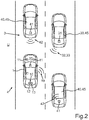
- Fig. 2 shows the surroundings of the motor vehicle 1 in a schematic bird's eye view. Posed at the same time Fig. 2 is an example of the virtual display 4.
- the motor vehicle 1 is located on a road 3 and is surrounded by the third-party vehicle 30 and further third-party vehicles 40.
- the receiving unit 12 or the communication unit of the motor vehicle 1 receives configuration data 32 from the third-party vehicle 30.
- the configuration data 32 can be sent out by a communication unit 31 of the third-party vehicle 30.
- the receiving unit 12 preferably receives the configuration data 32 directly from the communication unit 31 of the third-party vehicle 30.
- the configuration data 32 can indicate the readiness of the third-party vehicle 30 to set up or receive a direct communication link 19.
- the configuration data 32 can include a position of the third-party vehicle 30 on the road 3 and a direction of movement and a speed of the third-party vehicle 30 as status data of the vehicle 30.
- the configuration data 32 preferably comprise vehicle data which, for example, characterize an appearance of the third-party vehicle 30.
- the vehicle data contain information about a body shape and a color of the third-party vehicle 30.
- corresponding configuration data can be sent by the motor vehicle 1, in particular the communication unit 10.
- a relative position of the foreign vehicle 30 relative to the motor vehicle 1 can be determined.
- the motor vehicle 1 has further receiving units 11.
- the further reception units 11 can be designed as further communication units, which comprise a further transmission unit.
- the configuration data 32 or a radio signal 33 for transmitting the communication data 32 is received by the receiving unit 12 and in further receiving units 11.
- the configuration data 32 or the radio signal 33 can be received by the receiving unit 12 and the further receiving units 11 at different times. From the different times, there are respective transit time differences of the radio signal 33 between the receiving units 11, 12 Fig. 2 ,
- the radio signal 33 is received first in succession by the further receiving units 11 and finally by the receiving unit 12.
- the later one of the receiving units 11, 12 receives the radio signal 33, the further it is from the third-party vehicle 30 or the communication unit 31 of the third-party vehicle 30.
- the position of the third-party vehicle 30 can be determined from this using triangulation or triangulation.
- a phase and / or an amplitude of the radio signal 33 can be evaluated. For example, the amplitude of the radio signal 33 is greater, the closer the respective receiving unit 11, 12 is to the third-party vehicle 30.
- the relative position of the third-party vehicle 30 can be determined by means of an environment sensor system 20 of the motor vehicle 1.
- the environment sensor system 20 is designed in particular as a camera, as a radar sensor, as a lidar sensor or as an ultrasonic sensor.
- the environment sensor system 20 captures an, in particular pictorial, image of the environment U as environment data.
- the environmental data can be compared with the configuration data 32 and / or linked to the evaluation of the radio signal 33 by triangulation or trilateration.
- the relative data in a plurality of third-party objects 45 in the present case the third-party vehicle 30 and the further third-party vehicles 40, are used to determine the relative positions of the third-party vehicle 30 as potential relative positions.
- one of the potential relative positions can be selected or defined as the relative position of the foreign vehicle 30.
- one of the potential relative positions of the third-party vehicle 30 will be selected by the triangulation or the trilateration using the radio signal 33.
- the relative position of the third-party vehicle 30 can be selected from the potential relative positions of the third-party vehicle 30 using the configuration data, in particular the status data and / or vehicle data.
- the respective relative position of such a foreign object 45 which corresponds to the status data and / or vehicle data, is selected as the relative position of the foreign vehicle 30.
- the respective relative position of one of the foreign objects 45 which corresponds in color and body shape to the vehicle and body shape described by the vehicle data, is selected as the relative position of the foreign vehicle 30.
- it can be checked, for example, whether the status data of the foreign object 45, which can be extracted from the environment data, match the status data which are received as part of the configuration data. If the status data match, the respective relative position of the foreign object 45 can be selected as the relative position of the foreign vehicle 30.
- an image of the third-party vehicle 30 can be recognized in the environmental data.
- an image of the foreign vehicle 30 is searched for or recognized in environmental data.
- the image of the third-party vehicle in the environment data is recognized in the environment data by recognizing characteristic features, for example body shape or color, which are received as part of the vehicle data with the configuration data 32.
- a relative position of a foreign object, which is represented by the image can be determined as the relative position of the foreign vehicle 30 by the environment sensor system 20.
- Calculations and evaluations for determining the relative position of the foreign vehicle 30 are carried out in particular by the determination unit 18.
- further configuration data 42 can be received by the further third-party vehicles 40 or by their communication devices 41.
- a respective relative position of the other third-party vehicles 40 relative to the motor vehicle 1 can be determined analogously to the relative position of the third-party vehicle 30.
- the display unit 14 provides the user 2 of the motor vehicle 1 with a virtual display 4, which indicates the third-party vehicle 30 as a possible communication partner.
- the other third-party vehicles 40 can also be indicated as possible communication partners by means of the virtual display 4.
- the virtual display 4 is provided at least in part on the basis of the relative position of the third-party vehicle 30 and the configuration data 32 of the third-party vehicle 30.
- the virtual display 4 can be provided at least in part on the basis of the respective relative positions of the further third-party vehicles 40 and / or on the basis of the further communication data 42 of the further third-party vehicles 40.
- the virtual display 4 can according to Fig.
- the vehicle 1 and / or the third-party vehicle 30 and / or the further third-party vehicles 40 Show the user 2 the vehicle 1 and / or the third-party vehicle 30 and / or the further third-party vehicles 40, for example from a perspective view, from a map view or from a bird's eye view.
- the virtual display 4 can be provided in a text-based manner, the third-party vehicle 30 and / or the further third-party vehicles 40 being characterized or represented by position information such as “front”, “rear” or “right”.
- the virtual display 4 can be used to indicate to the user 2 that the third-party vehicle 30 and / or the further third-party vehicles 40 have a communication device for establishing the communication link 19 and / or are available for the establishing of the communication link 19 by the motor vehicle 1.
- the virtual display 4 is advantageously displayed in the form of an augmented reality.
- the projection 17 allows the third-party vehicle 30 and / or the further third-party vehicles 40 with a symbol or overlaid on a color and / or marked. For example, further vehicles which have a communication device for establishing the communication connection 19 can be shown in green and further vehicles which have no communication device for establishing the communication connection 19 can be shown in red.
- a communication command is received by the user 2, the third-party vehicle 30 and / or one or more of the further third-party vehicles 40 being selected as the communication partner or as the communication partners by the communication command.
- the user 2 taps on that of the third-party vehicles 30, 40, i.e. the third-party vehicle 30 and / or one or more of the further third-party vehicles 40, with which he sets up the direct Communication link 19 wishes.
- This communication command can be called "call”.
- the user 2 can point to that of the third-party vehicles 30, 40 with which he wishes to set up the direct communication link 19.
- the pointing of the user 2 can be received as a communication command by a sensor system 21 for gesture recognition, for example a camera in an interior of the motor vehicle 1.
- a sensor system 21 for gesture recognition for example a camera in an interior of the motor vehicle 1.
- the user 2 points to the image of the desired third-party vehicle 30, 40 in the virtual display 4.
- the user 2 points directly to the real foreign vehicle 30, 40, that should be selected as a communication partner.
- the direct communication connection 19 with the communication partner is established by the transmission unit 13.
- the direct communication link 19 between the motor vehicle 1 and the communication partner, for example the third-party vehicle 30, is established via Bluetooth or via WLAN.
- a range of the communication link 19 can be limited to a few 10 m, for example 10 m, 20 m, 30 m, 40 m or 50 m, since communication should only take place with a neighboring vehicle or a neighboring vehicle after next.
- the communication link 19 is opened and operated in particular via conventional protocol mechanisms known from the prior art.
- voice data or voice messages other data, for example Image data, documents, especially text documents, emails or short messages, are transmitted.
- image data from a driver observation camera or from images provided by a mobile phone coupled to the motor vehicle 1 are suitable as image data.
- a local conference circuit or conference connection can be set up.
- motor vehicle 1 can serve as a host, which distributes communication data to be transmitted between the different communication partners.
- the communication partner that is to say, for example, the third-party vehicle 30 or another user, in particular the third-party vehicle 30, can be visibly and / or audibly signaled that an incoming communication link 19 is to be set up. In particular, permission from the other user can be requested.
- the third-party vehicle 30 and / or the further third-party vehicles 40 likewise comprise a communication device analogous to the communication device 5 of the motor vehicle 1.
- the other user of the communication partner for example the third-party vehicle 30, can be shown which vehicle in the environment U wants to establish the communication connection or wants to open a conversation. Alternatively or additionally, it can be displayed in which direction the motor vehicle 1, which wants to open the call, is in the vicinity U.
- the conversation or the direct communication link 19 can be set up after confirmation by the other driver.
- the exemplary embodiment overall shows how the communication link 19 of the motor vehicle 1 can be established, for example, with the foreign vehicle 30.
- the third-party vehicle 30 can be any vehicle in the vicinity U of the motor vehicle 1 which is initially unknown to the user 2.
Landscapes
- Engineering & Computer Science (AREA)
- Transportation (AREA)
- Mechanical Engineering (AREA)
- Chemical & Material Sciences (AREA)
- Combustion & Propulsion (AREA)
- General Physics & Mathematics (AREA)
- Physics & Mathematics (AREA)
- Signal Processing (AREA)
- Computer Networks & Wireless Communication (AREA)
- Remote Sensing (AREA)
- Radar, Positioning & Navigation (AREA)
- Computing Systems (AREA)
- Health & Medical Sciences (AREA)
- General Health & Medical Sciences (AREA)
- Medical Informatics (AREA)
- Theoretical Computer Science (AREA)
- Multimedia (AREA)
- Mobile Radio Communication Systems (AREA)
- Traffic Control Systems (AREA)
Description
- Die Erfindung betrifft ein Verfahren zum Aufbau einer Kommunikationsverbindung eines Kraftfahrzeugs mit einem sich in dessen Umgebung befindlichen weiteren Kraftfahrzeug. Dabei wird für einen Nutzer des Kraftfahrzeugs eine virtuelle Übersicht erstellt, anhand derer der Nutzer das weitere Kraftfahrzeug als Kommunikationspartner auswählen kann. Ein zweiter Aspekt der Erfindung betrifft ein Kraftfahrzeug mit einer Kommunikationseinrichtung zum Aufbauen der besagten Kommunikationsverbindung.
- Aus dem Stand der Technik bekannt sind beispielsweise Mobiltelefone, welche mit einem Kraftfahrzeug gekoppelt werden können und eine Kommunikationsverbindung über das Mobilfunknetz ermöglichen. Dabei wird eine Kommunikationsverbindung zwischen einem Nutzer des Mobiltelefons in dem Kraftfahrzeug und einem weiteren Nutzer eines weiteren Telefons aufgebaut. Für einen zielgerichteten Aufbau der Kommunikationsverbindung ist zunächst ein Austausch der jeweiligen Telefonnummer nötig.
- Außerdem stellt der Stand der Technik Funkgeräte als Kommunikationseinrichtungen bereit, mittels welcher Funksprüche von einem Kraftfahrzeug, üblicherweise einem Lastkraftwagen, gesendet werden können, welche von allen weiteren Fahrzeugen in einer Umgebung des Kraftfahrzeugs empfangen werden können, wenn sie eine korrespondierende Kommunikationseinrichtung aufweisen. In diesem Fall ist der Aufbau einer direkten und offenen Kommunikationsverbindung mit beliebigen weiteren Fahrzeugen, die sich in der Umgebung des Kraftfahrzeugs befinden, möglich. Der zielgerichtete Aufbau einer Kommunikationsverbindung mit nur einem oder mehreren ausgewählten Fahrzeugen ist nicht möglich.
- Die
DE 10 2004 056 724 A1 offenbart in diesem Kontext ein Verfahren zur Übertragung von Daten über eine direkte Kommunikationsverbindung von einem Kraftfahrzeug und zumindest einem weiteren Fahrzeug. Dabei kann die Kommunikationsverbindung unter Verwendung von Sicherheitszertifikaten verschlüsselt werden. - Die
DE 10 2006 041 569 A1 stellt ein Verfahren zur Verfügung, durch welches eine Reichweite einer Kommunikationsverbindung zwischen einem Kraftfahrzeug und einem weiteren Fahrzeug gegenüber einer direkten Kommunikationsverbindung erhöht werden kann. Dabei empfängt ein Zwischenknoten Funksignale des Kraftfahrzeugs und des weiteren Fahrzeugs und sendet diese weiter. - Die
US 2012/003 84 89 A1 zeigt ein Verfahren, welches einem Nutzer einen spontanen Anruf eines nahen Kraftfahrzeugs ohne Kenntnis einer Telefonnummer oder spezifischer Kontaktdetails basierend auf Identifikationsmerkmalen des nahen Kraftfahrzeugs, welche für den Nutzer sichtbar sind, ermöglicht. Hierzu werden dem Nutzer des Kraftfahrzeugs die sichtbaren Identifikationsmerkmale angezeigt. - Die
JP 2014 035 582 A - Die
US 2013/0086164 A1 offenbart ein Verfahren, in welchem Fahrzeuge in einer Umgebung eines Nutzers diesem auf einer Anzeige dargestellt werden. Daraufhin kann der Nutzer eine Kommunikation mit allen Fahrzeugen initiieren ("broadcast"), um ein bestimmtes Fahrzeug zu identifizieren. Antwortet das bestimmte Fahrzeug, so kann der Nutzer dieses mit einem in der Anzeige dargestellten Fahrzeug verknüpfen. - Es ist Aufgabe der vorliegenden Erfindung, einem Nutzer eines Kraftfahrzeugs den Aufbau einer Kommunikationsverbindung des Kraftfahrzeugs mit einem weiteren Fahrzeug in einer Umgebung des Kraftfahrzeugs zu ermöglichen.
- Diese Aufgabe wird erfindungsgemäß gelöst durch die Gegenstände der unabhängigen Patentansprüche. Vorteilhafte Ausgestaltungsformen mit zweckmäßigen Weiterbildungen des erfindungsgemäßen Verfahrens und des erfindungsgemäßen Kraftfahrzeugs sind Gegenstand der Unteransprüche, der Beschreibung und der Figuren. Vorteilhafte Ausführungsformen des erfindungsgemäßen Verfahrens und deren Vorteile gelten analog auch für das erfindungsgemäße Kraftfahrzeug und umgekehrt.
- Im Rahmen des Verfahrens zum Aufbau einer Kommunikationsverbindung eines Kraftfahrzeugs mit einem sich in dessen Umgebung befindlichen Fremdfahrzeug werden zunächst Konfigurationsdaten aus dem Fremdfahrzeug empfangen. Bei dem Fremdfahrzeug handelt es sich um ein weiteres Fahrzeug, insbesondere um ein weiteres Kraftfahrzeug. Die Konfigurationsdaten können eine Bereitschaft des Fremdfahrzeugs zum Aufbau der Kommunikationsverbindung angeben. Alternativ oder zusätzlich können die Konfigurationsdaten Steuerdaten und/oder Protokolldaten umfassen, welche einen Standard der aufzubauenden Kommunikationsverbindung festlegen. Die Konfigurationsdaten können durch eine Sendeeinheit des Fremdfahrzeugs gesendet werden und durch eine Empfangseinheit des Kraftfahrzeugs empfangen werden. Insbesondere werden die Konfigurationsdaten durch die Empfangseinheit des Kraftfahrzeugs direkt, das bedeutet ohne Zwischenstation, aus der Sendeeinheit des Fremdfahrzeugs empfangen. Direkt bedeutet in diesem Kontext insbesondere vermittlungsfrei, beispielsweise ohne dass eine Mobilfunk-Basisstation oder ein Zwischenknoten involviert ist.
- In einem weiteren Schritt wird eine Relativposition des Fremdfahrzeugs relativ zu dem Kraftfahrzeug ermittelt. Die Ermittlung der Relativposition des Fremdfahrzeugs kann nötig sein, um die Konfigurationsdaten mit dem für einen Nutzer, insbesondere einen Fahrer, des Kraftfahrzeugs sichtbaren Fremdfahrzeug zu verknüpfen. Die Konfigurationsdaten können dem Fremdfahrzeug anhand dessen Relativposition zugeordnet werden. Hierzu kann das Fremdfahrzeug durch eine Lokalisierungseinheit des Kraftfahrzeugs lokalisiert werden. Beispielsweise kann die Relativposition des Fremdfahrzeugs durch ein an dem Kraftfahrzeug ausgerichtetes virtuelles Koordinatensystem definiert werden. Beispielsweise ist die Relativposition definiert durch einen Abstand zwischen dem Kraftfahrzeug und dem Fremdfahrzeug und einen Winkel zwischen einer Längsachse des Kraftfahrzeugs und einer das Fremdfahrzeug und das Kraftfahrzeug verbindenden Geraden.
- Bei dem Ermitteln der Relativposition des Fremdfahrzeugs wird entweder in Umgebungsdaten, die von einer, insbesondere bildgebenden, Umfeldsensorik des Kraftfahrzeugs erfasst werden, ein Abbild des Fremdfahrzeugs anhand von Fahrzeugdaten, die das Fremdfahrzeug charakterisieren und welche Teil der Konfigurationsdaten sind, erkannt oder eine jeweilige Relativposition einer Mehrzahl von Fremdobjekten in der Umgebung des Kraftfahrzeugs als potentielle Relativpositionen des Fremdfahrzeugs anhand der Umgebungsdaten ermittelt und anhand einer Empfangsrichtung, aus welcher die Konfigurationsdaten empfangen werden, und/oder der Konfigurationsdaten die Relativposition des Fremdfahrzeugs aus den potentiellen Relativpositionen ausgewählt.
- Da anhand der Konfigurationsdaten die Kommunikationsfähigkeit des Fremdfahrzeugs bekannt und außerdem die Relativposition bekannt ist, kann das Fremdfahrzeug dem Nutzer als möglicher Kommunikationspartner mitgeteilt werden. Für den Nutzer des Kraftfahrzeugs wird eine virtuelle Anzeige bereitgestellt, die das Fremdfahrzeug als möglichen Kommunikationspartner angibt. Die virtuelle Anzeige wird zumindest teilweise anhand der Relativposition des Fremdfahrzeugs und der Konfigurationsdaten des Fremdfahrzeugs bereitgestellt. Die virtuelle Anzeige kann beispielsweise in Form einer textbasierten Übersicht oder einer grafischen Übersicht, insbesondere in Form einer Straßenkarte, in welcher vorzugsweise sowohl das Kraftfahrzeug als auch das Fremdfahrzeug dargestellt sind, dargestellt werden. Die virtuelle Anzeige kann dem Nutzer mittels einer Anzeigeeinheit, beispielsweise einem Bildschirm oder einem Anzeigesystem zur Projektion auf eine Windschutzscheibe und/oder Seitenscheibe des Kraftfahrzeugs, auch Head-Up-Display genannt, oder eine Brille zur Darstellung virtueller Realität bereitgestellt werden. Insbesondere wird eine Kommunikationsfähigkeit und/oder Kommunikationsbereitschaft des Fremdfahrzeugs in der virtuellen Anzeige dargestellt. Eine besonders vorteilhafte Weiterbildung sieht vor, dass die virtuelle Anzeige in Form einer erweiterten Realität, auch augmented reality genannt, bereitgestellt wird. Im Rahmen der erweiterten Realität kann die virtuelle Anzeige, insbesondere eine geeignete Symbolik, einem realen Bild, beispielsweise der Umgebung und insbesondere des Fremdfahrzeugs, überlagert werden. Dies erfolgt insbesondere mittels des Head-Up-Displays oder der Brille zum Anzeigen der virtuellen Realität.
- In einem weiteren Schritt wird ein Kommunikationsbefehl von dem Nutzer empfangen, wobei durch den Kommunikationsbefehl das Fremdfahrzeug als Kommunikationspartner ausgewählt wird. Insbesondere ist eine Eingabevorrichtung zum Aussenden des Kommunikationsbefehls ausgebildet. Demnach kann der Kommunikationsbefehl von der Eingabevorrichtung empfangen werden. Mittels der Eingabevorrichtung kann der Nutzer das Fremdfahrzeug als Kommunikationspartner auswählen. Insbesondere kann der Nutzer mittels des Kommunikationsbefehls seinen Wunsch zum Aufbau der Kommunikationsverbindung mit dem Fremdfahrzeug signalisieren. Die Eingabevorrichtung kann durch ein Bedienelement, beispielsweise einen Taster oder einen Drehdrückschalter, durch einen berührungsempfindlichen Bildschirm oder durch eine Sensorik, insbesondere Kamera, zur Gestenerkennung bereitgestellt werden. Insbesondere wird der Kommunikationsbefehl von dem Nutzer durch Auswerten einer Eingabe des Nutzers oder einer Geste des Nutzers empfangen.
- In einem weiteren Schritt wird eine direkte Kommunikationsverbindung mit dem Kommunikationspartner, den der Nutzer ausgewählt hat, aufgebaut. Insbesondere wird die direkte Kommunikationsverbindung durch die Sendeeinheit und/oder Empfangseinheit des Kraftfahrzeugs und die Sendeeinheit und/oder Empfangseinheit des Fremdfahrzeugs aufgebaut. Wie oben bereits beschrieben bezeichnet direkt insbesondere vermittlungsfrei, in dem kein Zwischenknoten und/oder keine Mobilfunk-Basisstation involviert ist. Vorzugsweise werden Kommunikationsdaten direkt von der Sendeeinheit des Kraftfahrzeugs an die Empfangseinheit des Fremdfahrzeugs übermittelt beziehungsweise umgekehrt. Vorzugsweise wird die Kommunikationsverbindung mittels der Kommunikationseinheit des Kraftfahrzeugs und der Kommunikationseinheit des Fremdfahrzeugs aufgebaut. Zum Aufbauen der Kommunikationsverbindung können die Kommunikationsdaten durch das Kraftfahrzeug an das Fremdfahrzeug gesendet werden oder durch das Kraftfahrzeug aus dem Fremdfahrzeug empfangen werden.
- Insbesondere können über die Kommunikationsverbindung Bilddaten, Textnachrichten und/oder Tondaten gesendet und/oder empfangen werden, das heißt, die Kommunikationsdaten umfassen Bilddaten, Textnachrichten und/oder Tondaten. Beispielsweise kann als die Tondaten eine Sprachnachricht oder ein Gespräch gesendet und/oder empfangen werden. Insbesondere handelt es sich bei dem Gespräch um ein Gespräch, vorzugsweise nach Art eines Telefonats, des Nutzers mit einem Fremdnutzer des Fremdfahrzeugs. Insbesondere werden über die Kommunikationsverbindung die Kommunikationsdaten, also insbesondere die Bilddaten, die Textnachrichten und/oder die Tondaten, zwischen dem Fremdfahrzeug und dem Kraftfahrzeug übertragen.
- In einer Weiterbildung der Erfindung ist vorgesehen, dass die Relativposition des Fremdfahrzeugs anhand eines Funksignals zum Empfangen der Konfigurationsdaten durch Trilateration und/oder Triangulation ermittelt wird. Insbesondere wird die Relativposition des Fremdfahrzeugs zumindest teilweise anhand des Funksignals ermittelt. Da das Funksignal genau aus der Richtung empfangen wird, in welcher sich das Fremdfahrzeug befindet, kann die Relativposition des Fremdfahrzeugs auf diese Weise besonders vorteilhaft ermittelt werden.
- Die Relativposition des Fremdfahrzeugs wird insbesondere durch Empfangen des Funksignals mittels der Empfangseinheit, zum Beispiel eine Antenne, und zumindest einer weiteren Empfangseinheit und durch Auswerten einer jeweiligen Amplitude und/oder Phase und/oder Laufzeit des Funksignals an der Empfangseinheit und der zumindest einen weiteren Empfangseinheit ermittelt. Die Empfangseinheit und die zumindest eine weitere Empfangseinheit sind vorzugsweise räumlich voneinander getrennt an dem Kraftfahrzeug angeordnet. Beispielsweise ist die Empfangseinheit in einem Heckbereich des Kraftfahrzeugs und die zumindest eine weitere Empfangseinheit in einem Frontbereich des Kraftfahrzeugs angeordnet. In einer Weiterbildung können zwei weitere Empfangseinheiten in einem Frontbereich des Kraftfahrzeugs auf einer in Fahrtrichtung gesehen linken und rechten Seite des Kraftfahrzeugs angeordnet sein. Durch Auswerten der jeweiligen Amplitude und/oder Phase und/oder Laufzeit des Funksignals an den Empfangseinheiten kann die Relativposition des Fremdfahrzeugs ermittelt werden. Beispielsweise kann durch Auswerten der jeweiligen Amplitude eine jeweilige Entfernung des Fremdfahrzeugs von der jeweiligen Empfangseinheit ermittelt werden. Durch Trilateration können sich daraus folgend die Relativpositionen des Fremdfahrzeugs ergeben. Alternativ oder zusätzlich kann eine Differenz der jeweiligen Amplituden als Amplitudendifferenz ausgewertet werden. Alternativ oder zusätzlich kann eine Laufzeitdifferenz des Funksignals zwischen den Empfangseinheiten ermittelt werden. Die Laufzeitdifferenz ist insbesondere der Betrag der Differenz einer Zeit, zu der das Funksignal an der Empfangseinheit detektiert wird, und einer Zeit, zu der das Funksignal an der zumindest einen weiteren Empfangseinheit detektiert wird. Alternativ oder zusätzlich kann eine Phase, insbesondere eine Phasenlage, des Funksignals an der Empfangseinheit und der zumindest einen weiteren Empfangseinheit ausgewertet beziehungsweise verglichen werden. Dadurch kann eine weitere Präzisierung für die Relativposition des Fremdfahrzeugs ermittelt werden.
- In weiterer Ausgestaltung der Erfindung ist vorgesehen, dass die jeweiligen Konfigurationsdaten Zustandsdaten und/oder Fahrzeugdaten umfassen, die das Fremdfahrzeug charakterisieren. Die Zustandsdaten können beispielsweise eine Position des Fremdfahrzeugs, beispielsweise eine momentan befahrene Fahrspur, Koordinaten einer Absolutposition des Fremdfahrzeugs oder ein Abstand zu einer Landmarke, beispielsweise ein Verkehrsschild oder eine Ausfahrt, eine Geschwindigkeit des Fremdfahrzeugs oder eine geplante Route des Fremdfahrzeugs beschreiben. Die Fahrzeugdaten können beispielsweise ein äußeres Erscheinungsbild, insbesondere eine Farbe und eine Karosserieform, des Fremdfahrzeugs beschreiben. Insbesondere können die Zustandsdaten und/oder Fahrzeugdaten für das weitere Kraftfahrzeug dem Nutzer mittels der virtuellen Anzeige bereitgestellt werden. Der Nutzer kann dann anhand der Zustandsdaten und/oder Fahrzeugdaten das Fremdfahrzeug als Kommunikationspartner auswählen.
- In einer Ausführungsform der Erfindung ist vorgesehen, dass in den Umgebungsdaten, die von einer, insbesondere bildgebenden, Umfeldsensorik des Kraftfahrzeugs erfasst werden, ein Abbild des Fremdfahrzeugs anhand der Konfigurationsdaten erkannt wird. Die Umfeldsensorik kann beispielsweise eine oder mehrere Kameras, zumindest einen Radarsensor, zumindest einen Lidar-Sensor und/oder zumindest einen Ultraschallsensor umfassen. Als bildgebende Umfeldsensorik kann eine Sensorik bezeichnet werden, welche ein Bild und/oder ein Abbild einer Umgebung des Kraftfahrzeugs als Teil der Umgebungsdaten oder als die Umgebungsdaten erfasst. Vorzugsweise wird das Abbild des Fremdfahrzeugs anhand der Zustandsdaten und/oder Fahrzeugdaten, welche Teil der Konfigurationsdaten sind, erkannt. Beispielsweise enthalten die Fahrzeugdaten Angaben zu der Farbe und der Karosserieform des Fremdfahrzeugs. In diesem Beispiel kann in den Umgebungsdaten, zum Beispiel in einem Kamerabild, die Karosserieform und die Farbe des Fremdfahrzeugs erkannt werden. Allgemein kann anhand der Konfigurationsdaten kann ein Abbild des Fremdfahrzeugs in den Umgebungsdaten erkannt werden. Auf diese Weise werden die Konfigurationsdaten mit einer Umgebung des Kraftfahrzeugs verknüpft. Insbesondere können die Konfigurationsdaten dem visuell für den Nutzer erkennbaren Kraftfahrzeug zugeordnet werden.
- Vorzugsweise wird die Relativposition des Fremdfahrzeugs unter Bezugnahme auf die Zustandsdaten und/oder Fahrzeugdaten anhand der Umgebungsdaten ermittelt. Beispielsweise wird die Relativposition des Fremdfahrzeugs anhand der Umgebungsdaten ermittelt, wenn das Abbild des Fremdfahrzeugs in den Umgebungsdaten ermittelt wird. Mit anderen Worten kann die Relativposition des Fremdfahrzeugs anhand der Umgebungsdaten ermittelt werden wenn die Konfigurationsdaten mit den Umgebungsdaten verknüpft werden.
- Die Genauigkeit der Ermittlung der Relativposition durch Triangulation und/oder Trilateration kann gesteigert werden, indem die Relativposition von Fremdobjekten durch der Umfeldsensorik ermittelt wird und das Funksignal zur Übermittlung der Konfigurationsdaten einem der Fremdobjekte zugeordnet wird. In einer Ausführungsform der Erfindung ist vorgesehen, dass eine jeweilige Relativposition einer Mehrzahl von Fremdobjekten in der Umgebung des Kraftfahrzeugs als potentielle Relativpositionen des Fremdfahrzeugs ermittelt werden und anhand einer Empfangsrichtung, aus welcher die Konfigurationsdaten empfangen werden, und/oder der Konfigurationsdaten, insbesondere der Zustandsdaten und/oder Fahrzeugdaten, die Relativposition des Fremdfahrzeugs aus den potentiellen Relativpositionen ausgewählt wird. Beispielsweise umfasst die Mehrzahl von Fremdobjekten in der Umgebung des Kraftfahrzeugs das Fremdfahrzeug und weitere Fahrzeuge. Insbesondere werden die jeweiligen Relativpositionen anhand der Umgebungsdaten ermittelt. Daraus ergeben sich mehrere potentielle Relativpositionen für das Fremdfahrzeug. Eine dieser potentiellen Relativpositionen kann anhand der Konfigurationsdaten beziehungsweise anhand der Empfangsrichtung, aus welcher die Konfigurationsdaten empfangen werden, insbesondere der Empfangsrichtung des Funksignals zum Übertragen der Konfigurationsdaten, als die Relativposition des Fremdfahrzeugs ausgewählt werden. Insbesondere wird dem Fremdfahrzeug eine der potentiellen Relativpositionen als die Relativposition des Fremdfahrzeugs zugeordnet. Dieses Zuordnen kann beispielsweise anhand des Funksignals zum Empfangen der Konfigurationsdaten durch Trilateration und/oder Triangulation erfolgen. Alternativ oder zusätzlich kann das Zuordnen unter Bezugnahme auf die Zustandsdaten und/oder Fahrzeugdaten erfolgen. In einem Beispiel kann die jeweilige Relativposition eines solchen Fremdobjekts, auf welches das anhand der Fahrzeugdaten übermittelte Erscheinungsbild zutrifft, als die Relativposition des Fremdfahrzeugs ausgewählt werden.
- Natürlich kann die Erfindung auch auf mehrere Fremdfahrzeuge angewandt werden. Vorteilhafterweise werden zusätzlich zu den Konfigurationsdaten aus dem Fremdfahrzeug jeweilige Konfigurationsdaten aus den weiteren Fremdfahrzeugen empfangen und eine jeweilige Relativposition für die weiteren Fremdfahrzeuge ermittelt. Als weitere Fremdfahrzeuge werden weitere Fahrzeuge in der Umgebung des Kraftfahrzeugs bezeichnet, insbesondere weitere Fahrzeuge, die von dem bisher beschriebenen Fremdfahrzeug unterschiedlich sind. Als die Fremdfahrzeuge werden im Folgenden die weitere Fremdfahrzeuge und das Fremdfahrzeug bezeichnet. Die virtuelle Anzeige kann das Fremdfahrzeug und die weiteren Fremdfahrzeuge darstellen. Durch den Kommunikationsbefehl können das Fremdfahrzeug und/oder eines oder mehrere der weiteren Fremdfahrzeuge als Kommunikationspartner ausgewählt werden. Insbesondere wird ein Kommunikationsbefehl empfangen, durch welchen das Fremdfahrzeug und/oder eines oder mehrere der Fremdfahrzeuge als Kommunikationspartner ausgewählt werden. Beispielsweise werden durch den Kommunikationsbefehl mehrere der Fremdfahrzeuge als die Kommunikationspartner ausgewählt. Dadurch kann der Nutzer in einer Umgebung in der sich neben dem Fremdfahrzeug noch weitere Fremdfahrzeuge befinden eines oder mehrere der Fremdfahrzeuge als Kommunikationspartner für den Aufbau einer Kommunikationsverbindung auswählen. Wird das Fremdfahrzeug oder eines der weiteren Fremdfahrzeuge als der Kommunikationspartner ausgewählt, so kann der Aufbau der Kommunikationsverbindung mit dem Fremdfahrzeug oder dem weiteren Fremdfahrzeug erfolgen.
- In einer Weiterbildung der Erfindung ist vorgesehen, dass mit mehreren Kommunikationspartnern eine Konferenzverbindung aufgebaut wird. Insbesondere wenn durch den Kommunikationsbefehl zwei oder mehr Kommunikationspartner ausgewählt werden, kann eine Konferenzverbindung (Multicast) aufgebaut werden. Bei einer Konferenzverbindung wird insbesondere mit jedem der Kommunikationspartner eine direkte Kommunikationsverbindung aufgebaut. Ferner kann vorgesehen sein, dass unter allen Kommunikationspartnern ebenfalls eine direkte Kommunikationsverbindung aufgebaut wird. Vorzugsweise dient das Kraftfahrzeug als Host der Konferenzverbindung, das bedeutet, dass jedem der Kommunikationspartner Kommunikationsdaten der jeweils anderen Kommunikationspartner durch das Kraftfahrzeug gesendet beziehungsweise übermittelt werden. Alternativ oder zusätzlich kann ein Broadcast aufgebaut werden, das bedeutet, dass mit allen Fremdfahrzeugen eine Verbindung aufgebaut wird.
- Ein zweiter Aspekt der Erfindung betrifft ein Kraftfahrzeug mit einer Kommunikationseinrichtung zum Aufbauen einer Kommunikationsverbindung des Kraftfahrzeugs mit einem sich in einer Umgebung befindlichen Fremdfahrzeug. Das Kraftfahrzeug umfasst eine Empfangseinheit zum empfangen von Konfigurationsdaten aus dem Fremdfahrzeug sowie eine Sendeeinheit zum Aufbauen einer direkten Kommunikationsverbindung mit einem Kommunikationspartner. Die Empfangseinheit und die Sendeeinheit können durch eine Sendeeinheit umfasst sein. Außerdem weist das Kraftfahrzeug eine Ermittlungseinheit zum Ermitteln einer Relativposition des Fremdfahrzeugs relativ zu dem Kraftfahrzeug auf. Beispielsweise ist die Ermittlungseinheit als Recheneinheit ausgebildet, welche das Ermitteln der Relativposition anhand der Konfigurationsdaten und/oder anhand eines Funksignals zum empfangen der Konfigurationsdaten ermittelt.
- Eine Anzeigeeinheit dient zum Bereitstellen einer virtuellen Anzeige, die das Fremdfahrzeug für einen Nutzer des Kraftfahrzeugs als möglichen Kommunikationspartner angibt. Die Anzeigeeinheit kann zum Bereitstellen der virtuellen Anzeige zumindest teilweise anhand der ermittelten Relativposition des Fremdfahrzeugs und anhand der empfangenen Konfigurationsdaten ausgebildet sein. Eine Eingabevorrichtung ist zum Empfangen eines Kommunikationsbefehls von dem Nutzer ausgebildet, wobei durch den Kommunikationsbefehl das Fremdfahrzeug als der Kommunikationspartner auswählbar ist. Die Anzeigeeinheit und die Eingabevorrichtung können gemeinsam als berührungsempfindlicher Bildschirm ausgebildet sein. Das Kraftfahrzeug ist dazu eingerichtet, ein Verfahren nach einer der im vorhergehenden beschriebenen Ausführungsformen durchzuführen. Das Kraftfahrzeug ist insbesondere als Kraftwagen, vorzugsweise als Personenkraftwagen ausgeführt.
- Zusätzlich umfasst das Kraftfahrzeug eine Umfeldsensorik zum Erfassen von Umgebungsdaten. Das Kraftfahrzeug ist ausgebildet, in der Umgebungsdaten ein Abbild des Fremdfahrzeugs anhand der Konfigurationsdaten zu erkennen oder eine jeweilige Relativposition einer Mehrzahl von Fremdobjekten in der Umgebung des Kraftfahrzeugs als potentielle Relativpositionen des Fremdfahrzeugs anhand der Umgebungsdaten zu ermitteln und anhand einer Empfangsrichtung, aus welcher die Konfigurationsdaten empfangen werden, die Relativposition des Fremdfahrzeugs aus den potentiellen Relativpositionen ausgewählt wird.
- Zu der Erfindung gehören auch Weiterbildungen des erfindungsgemäßen Kraftfahrzeugs, die Merkmale aufweisen, wie sie bereits im Zusammenhang mit den Weiterbildungen des erfindungsgemäßen Verfahrens beschrieben worden sind. Aus diesem Grund sind die entsprechenden Weiterbildungen des erfindungsgemäßen Kraftfahrzeugs hier nicht noch einmal beschrieben.
- Im Folgenden sind Ausführungsbeispiele der Erfindung beschrieben. Hierzu zeigt:
-
Fig. 1 eine schematische Seitenansicht eines Kraftfahrzeugs mit einer Kommunikationseinrichtung zum Aufbauen einer Kommunikationsverbindung; und -
Fig. 2 ein Kraftfahrzeug in einer Umgebung mit einem Fremdfahrzeug, mit dem eine Kommunikationsverbindung aufgebaut wird. - Bei den im Folgenden erläuterten Ausführungsbeispielen handelt es sich um bevorzugte Ausführungsformen der Erfindung. Bei den Ausführungsbeispielen stellen die beschriebenen Komponenten der Ausführungsformen jeweils einzelne, unabhängig voneinander zu betrachtende Merkmale der Erfindung dar, welche die Erfindung jeweils auch unabhängig voneinander weiterbilden und damit auch einzeln oder in einer anderen als der gezeigten Kombination als Bestandteil der Erfindung anzusehen sind. Des Weiteren ist die beschriebenen Ausführungsformen auch durch weitere der bereits beschriebenen Merkmale der Erfindung ergänzbar.
- In den Figuren sind funktionsgleiche Elemente jeweils mit denselben Bezugszeichen versehen.
- Die
Fig. 1 zeigt ein Kraftfahrzeug 1 mit einer Kommunikationseinrichtung 5 zum Aufbauen einer Kommunikationsverbindung 19 des Kraftfahrzeugs 1 mit einem sich in einer Umgebung befindlichen Fremdfahrzeug 30. Das Kraftfahrzeug 1 weist eine Empfangseinheit 12 zum Empfangen von Konfigurationsdaten 32 aus dem Fremdfahrzeug 30 auf. Das Kraftfahrzeug weist vorliegend außerdem eine Sendeeinheit 13 zum Aufbauen einer direkten Kommunikationsverbindung 19 mit dem Fremdfahrzeug 30 als Kommunikationspartner auf. Das Kraftfahrzeug umfasst eine Ermittlungseinheit 18 zum Ermitteln einer Relativposition des Fremdfahrzeugs 30 relativ zu dem Kraftfahrzeug 1. Außerdem weist das Kraftfahrzeug 1 eine Anzeigeeinheit 14, vorliegend ein Bildschirm, vorzugsweise ein berührungsempfindlicher Bildschirm, zum Bereitstellen einer virtuellen Anzeige 4 auf, wobei die virtuelle Anzeige 4 das Fremdfahrzeug 30 als möglichen Kommunikationspartner angibt. Dabei wird das Fremdfahrzeug 30 zumindest teilweise anhand der Konfigurationsdaten und der Relativposition des Fremdfahrzeugs 30 als der mögliche Kommunikationspartner angegeben. Insbesondere wird die virtuelle Anzeige 4 für einen Nutzer 2 des Kraftfahrzeugs 1 bereitgestellt. Eine Eingabevorrichtung 15 ist zum Empfangen eines Kommunikationsbefehls von dem Nutzer 2 ausgebildet. Durch den Kommunikationsbefehl kann der Nutzer 2 das Fremdfahrzeug 30 als den Kommunikationspartner auswählen. Vorzugsweise sind die Eingabevorrichtung 15 und die Anzeigeeinheit 14 als ein berührungsempfindlicher Bildschirm ausgeführt. Alternativ oder zusätzlich kann das Kraftfahrzeug 1 einen Projektor 16 als Anzeigeeinheit 14 aufweisen. Der Projektor 16 kann zum Bereitstellen der virtuellen Anzeige 4 mittels einer Projektion 17 auf ein Fahrzeugbauteil, insbesondere eine Windschutzscheibe des Kraftfahrzeugs 1 ausgebildet sein. Das vorliegende Kraftfahrzeug 1 umfasst außerdem optionale weitere Empfangseinheiten 11. Die Empfangseinheit 12 sowie die Sendeeinheit 13 des Kraftfahrzeugs 1 sind vorliegend durch eine Kommunikationseinheit 10, insbesondere eine Antenne, bereitgestellt. -
Fig. 2 zeigt die Umgebung des Kraftfahrzeugs 1 in einer schematischen Vogelperspektive. Gleichzeitig stellteFig. 2 ein Beispiel für die virtuelle Anzeige 4 dar. Das Kraftfahrzeug 1 befindet sich einer Straße 3 und ist umgeben durch das Fremdfahrzeug 30 und weitere Fremdfahrzeuge 40. Das Fremdfahrzeug 30 und die weiteren Fremdfahrzeuge 40 beschreiben in diesem Kontext weitere Fahrzeuge in der Umgebung des Kraftfahrzeugs 1. Die Empfangseinheit 12 beziehungsweise die Kommunikationseinheit sehen des Kraftfahrzeugs 1 empfängt Konfigurationsdaten 32 aus dem Fremdfahrzeug 30. Die Konfigurationsdaten 32 können durch eine Kommunikationseinheit 31 des Fremdfahrzeugs 30 ausgesendet werden. Vorzugsweise empfängt die Empfangseinheit 12 die Konfigurationsdaten 32 direkt aus der Kommunikationseinheit 31 des Fremdfahrzeugs 30. Die Konfigurationsdaten 32 können die Bereitschaft des Fremdfahrzeugs 30 zum Aufbauen beziehungsweise Empfangen einer direkten Kommunikationsverbindung 19 mitteilen. Außerdem können die Konfigurationsdaten 32 eine Position des Fremdfahrzeugs 30 auf der Straße 3 sowie eine Bewegungsrichtung und eine Geschwindigkeit des Fremdfahrzeugs 30 als Zustandsdaten des Fahrzeugs 30 umfassen. Vorzugsweise umfassen die Konfigurationsdaten 32 Fahrzeugdaten, die beispielsweise ein Erscheinungsbild des Fremdfahrzeugs 30 charakterisieren. Beispielsweise enthalten die Fahrzeugdaten Informationen über eine Karosserieform und eine Farbe des Fremdfahrzeugs 30. Optimaler Weise können durch das Kraftfahrzeug 1, insbesondere die Kommunikationseinheit 10, korrespondierende Konfigurationsdaten gesendet werden. - Es kann eine Relativposition des Fremdfahrzeugs 30 relativ zu dem Kraftfahrzeug 1 ermittelt werden. Vorliegend weist das Kraftfahrzeug 1 weitere Empfangseinheiten 11 auf. Die weiteren Empfangseinheiten 11 können als weitere Kommunikationseinheiten ausgebildet sein, welche eine weitere Sendeeinheit umfassen. Die Konfigurationsdaten 32 beziehungsweise ein Funksignal 33 zum Übertragen der Kommunikationsdaten 32 wird von der Empfangseinheit 12 und in weiteren Empfangseinheiten 11 empfangen. Die Konfigurationsdaten 32 beziehungsweise das Funksignal 33 kann durch die Empfangseinheit 12 und die weiteren Empfangseinheiten 11 zu unterschiedlichen Zeitpunkten empfangen werden. Aus den unterschiedlichen Zeitpunkten ergeben sich jeweilige Laufzeitdifferenzen des Funksignals 33 zwischen den Empfangseinheiten 11, 12. Vorliegend, gemäß
Fig. 2 , wird das Funksignal 33 zunächst nacheinander durch die weiteren Empfangseinheiten 11 und zuletzt durch die Empfangseinheit 12 empfangen. Je später eine der Empfangseinheiten 11, 12 das Funksignal 33 empfängt, desto weiter ist diese von dem Fremdfahrzeug 30 beziehungsweise die Kommunikationseinheit 31 des Fremdfahrzeugs 30 entfernt. Daraus lässt sich anhand von Trilateration beziehungsweise Triangulation die Position des Fremdfahrzeugs 30 ermitteln. Alternativ oder zusätzlich kann eine Phase und/oder eine Amplitude des Funksignals 33 ausgewertet werden. Beispielsweise ist die Amplitude des Funksignals 33 größer, umso näher sich die jeweilige Empfangseinheit 11, 12 zu dem Fremdfahrzeug 30 befindet. - Alternativ oder zusätzlich kann die Relativposition des Fremdfahrzeugs 30 mittels einer Umfeldsensorik 20 des Kraftfahrzeugs 1 ermittelt werden. Die Umfeldsensorik 20 ist insbesondere als Kamera, als Radarsensor, als Lidar-Sensor oder als Ultraschallsensor ausgebildet. Die Umfeldsensorik 20 erfasst ein, insbesondere bildhaftes, Abbild der Umgebung U als Umgebungsdaten. Die Umgebungsdaten können mit den Konfigurationsdaten 32 und/oder mit der Auswertung des Funksignals 33 durch Triangulation beziehungsweise Trilateration verknüpft werden. Beispielsweise werden anhand der Umgebungsdaten jeweilige Relativposition in einer Mehrzahl von Fremdobjekten 45, vorliegend das Fremdfahrzeug 30 und die weiteren Fremdfahrzeuge 40, als potentielle Relativpositionen des Fremdfahrzeugs 30 ermittelt. Anhand einer Empfangsrichtung und/oder Entfernung, aus welcher die Konfigurationsdaten 32 beziehungsweise das Funksignal 33 empfangen wird, kann eine der potentiellen Relativpositionen als die Relativposition des Fremdfahrzeugs 30 ausgewählt beziehungsweise festgelegt werden. Insbesondere wird eine der potentiellen Relativpositionen des Fremdfahrzeugs 30 durch die Triangulation beziehungsweise die Trilateration anhand des Funksignals 33 ausgewählt werden.
- Alternativ oder zusätzlich kann die Relativposition des Fremdfahrzeugs 30 aus den potentiellen Relativpositionen des Fremdfahrzeugs 30 anhand der Konfigurationsdaten, insbesondere der Zustandsdaten und/oder Fahrzeugdaten, ausgewählt werden. Beispielsweise wird die jeweilige Relativposition eines solchen Fremdobjekts 45, welches mit den Zustandsdaten und/oder Fahrzeugdaten übereinstimmt, als die Relativposition des Fremdfahrzeugs 30 ausgewählt. Beispielsweise wird die jeweilige Relativposition eines der Fremdobjekte 45, welches in Farbe und Karosserieform mit der durch die Fahrzeugdaten beschriebenen Fahrzeug und Karosserieform übereinstimmt, als die Relativposition des Fremdfahrzeugs 30 ausgewählt. Alternativ oder zusätzlich kann beispielsweise überprüft werden, ob die Zustandsdaten des Fremdobjekts 45, welche aus den Umgebungsdaten extrahiert werden können, mit den Zustandsdaten, welche als Teil der Konfigurationsdaten empfangen werden, übereinstimmen. Stimmen die Zustandsdaten überein, so kann die jeweilige Relativposition des Fremdobjekts 45 als die Relativposition des Fremdfahrzeugs 30 ausgewählt werden.
- In den Umgebungsdaten kann insbesondere ein Abbild des Fremdfahrzeugs 30 erkannt werden. Beispielsweise wird in Umgebungsdaten ein Abbild des Fremdfahrzeugs 30 gesucht beziehungsweise erkannt. Insbesondere wird das Abbild des Fremdfahrzeugs in den Umgebungsdaten durch Erkennen charakteristischer Merkmale, beispielsweise Karosserieform oder Farbe, die als Teil der Fahrzeugdaten mit den Konfigurationsdaten 32 empfangen werden, in den Umgebungsdaten erkannt. Durch die Umfeldsensorik 20 kann eine Relativposition eines Fremdobjekts, welches durch das Abbild repräsentiert ist, als die Relativposition des Fremdfahrzeugs 30 ermittelt werden.
- Berechnungen und Auswertungen zum Ermitteln der Relativposition des Fremdfahrzeugs 30 werden insbesondere durch die Ermittlungseinheit 18 ausgeführt.
- Analog zu den Konfigurationsdaten 32 des Fremdfahrzeugs 30 können weitere Konfigurationsdaten 42 von den weiteren Fremdfahrzeugen 40 beziehungsweise von deren Kommunikationseinrichtungen 41 empfangen werden. Eine jeweilige Relativposition der weiteren Fremdfahrzeuge 40 relativ zu dem Kraftfahrzeug 1 kann analog zu der Relativposition des Fremdfahrzeugs 30 ermittelt werden.
- Durch die Anzeigeeinheit 14 wird dem Nutzer 2 des Kraftfahrzeugs 1 eine virtuelle Anzeige 4 bereitgestellt, die das Fremdfahrzeug 30 als möglichen Kommunikationspartner angibt. Optionaler Weise können mittels der virtuellen Anzeige 4 auch die weiteren Fremdfahrzeuge 40 als möglichen Kommunikationspartner angegeben werden. Die virtuelle Anzeige 4 wird zumindest teilweise anhand der Relativposition des Fremdfahrzeugs 30 und der Konfigurationsdaten 32 des Fremdfahrzeugs 30 bereitgestellt. Optionaler Weise kann die virtuelle Anzeige 4 zumindest teilweise anhand der jeweiligen Relativpositionen der weiteren Fremdfahrzeuge 40 und/oder anhand der weiteren Kommunikationsdaten 42 der weiteren Fremdfahrzeuge 40 bereitgestellt werden. Die virtuelle Anzeige 4 kann gemäß
Fig. 2 dem Nutzer 2 das Fahrzeug 1 und/oder das Fremdfahrzeug 30 und/oder die weiteren Fremdfahrzeuge 40 beispielsweise aus einer Perspektivansicht, aus einer Kartenansicht oder aus einer Vogelperspektive zeigen. Alternativ kann die virtuelle Anzeige 4 textbasiert bereitgestellt werden, wobei das Fremdfahrzeug 30 und/oder die weiteren Fremdfahrzeuge 40 durch Positionsangaben wie beispielsweise "vorne", "hinten" oder "rechts" charakterisiert beziehungsweise dargestellt werden. - Mittels der virtuellen Anzeige 4 kann dem Nutzer 2 angezeigt werden, dass das Fremdfahrzeug 30 und/oder die weiteren Fremdfahrzeuge 40 eine Kommunikationseinrichtung zum Aufbauen der Kommunikationsverbindung 19 aufweisen und/oder für den Aufbau der Kommunikationsverbindung 19 durch das Kraftfahrzeug 1 zur Verfügung stehen. Vorteilhafterweise wird die virtuelle Anzeige 4 in Form einer erweiterten Realität, auch augmented reality genannt, dargestellt. Dabei können durch die Projektion 17 das Fremdfahrzeug 30 und/oder die weiteren Fremdfahrzeuge 40 mit einem Symbol oder einer Farbe überlagert und/oder gekennzeichnet werden. Beispielsweise können weitere Fahrzeuge, die eine Kommunikationseinrichtung zum Aufbauen der Kommunikationsverbindung 19 aufweisen, grün dargestellt werden und weitere Fahrzeuge, die keine Kommunikationseinrichtung zum Aufbauen der Kommunikationsverbindung 19 aufweisen, rot dargestellt werden.
- Mittels der Eingabevorrichtung 15 wird ein Kommunikationsbefehl von dem Nutzer 2 empfangen, wobei durch den Kommunikationsbefehl das Fremdfahrzeug 30 und/oder eines oder mehrere der weiteren Fremdfahrzeuge 40 als der Kommunikationspartner oder als die Kommunikationspartner ausgewählt werden. Beispielsweise tippt der Nutzer 2 auf dem berührungsempfindlichen Bildschirm, der die Anzeigeeinheit 14 und die Eingabevorrichtung 15 ausbildet, auf dasjenige der Fremdfahrzeuge 30, 40, also das Fremdfahrzeug 30 und/oder eines oder mehrere der weiteren Fremdfahrzeuge 40, mit dem er den Aufbau der direkten Kommunikationsverbindung 19 wünscht. Dieser Kommunikationsbefehl kann als "anrufen" bezeichnet werden. Alternativ oder zusätzlich kann der Nutzer 2 auf dasjenige der Fremdfahrzeuge 30, 40 zeigen, mit dem er den Aufbau der direkten Kommunikationsverbindung 19 wünscht. Das Zeigen des Nutzers 2 kann durch eine Sensorik 21 zur Gestenerkennung, beispielsweise eine Kamera in einem Innenraum des Kraftfahrzeugs 1, als Kommunikationsbefehl empfangen werden. Beispielsweise zeigt der Nutzer 2 in der virtuellen Anzeige 4, die durch die Projektion 17 bereitgestellt ist, auf das Abbild des gewünschten Fremdfahrzeugs 30, 40 in der virtuellen Anzeige 4. Besonders vorteilhafter Weise zeigt der Nutzer 2 direkt auf das reale Fremdfahrzeug 30, 40, dass als Kommunikationspartner ausgewählt werden soll.
- Durch die Sendeeinheit 13 wird die direkte Kommunikationsverbindung 19 mit dem Kommunikationspartner aufgebaut. Beispielsweise wird die direkte Kommunikationsverbindung 19 zwischen dem Kraftfahrzeug 1 und dem Kommunikationspartner, beispielsweise dem Fremdfahrzeug 30, über Bluetooth oder über WLAN aufgebaut. Eine Reichweite der Kommunikationsverbindung 19 kann dabei auf wenige 10 m, beispielsweise 10 m, 20 m, 30 m, 40 m oder 50 m begrenzt sein, da eine Kommunikation nur mit einem Nachbarfahrzeug oder einem übernächsten Nachbarfahrzeug erfolgen soll. Die Eröffnung und der Betrieb der Kommunikationsverbindung 19 erfolgt insbesondere über übliche, aus dem Stand der Technik bekannte Protokollmechanismen. Dabei können neben einer reinen sprach Verbindung, insbesondere Sprachdaten oder Sprachnachrichten, auch weitere Daten, beispielsweise Bilddaten, Dokumente, insbesondere Textdokumente, E-Mails oder Kurznachrichten, übertragen werden. Als Bilddaten kommen beispielsweise Bilddaten von einer Fahrerbeobachtungskamera oder von einem mit dem Kraftfahrzeug 1 gekoppelten Mobiltelefon bereitgestellte Bilder infrage. Werden mehrere der Fremdfahrzeuge 30, 40 als Kommunikationspartner ausgewählt, so kann eine lokale Konferenzschaltung beziehungsweise Konferenzverbindung aufgebaut werden. Dabei kann insbesondere das Kraftfahrzeug 1 als Host dienen, welcher zu übertragende Kommunikationsdaten zwischen den unterschiedlichen Kommunikationspartnern verteilt. Wird aufgrund des Kommunikationsbefehls von dem Nutzer 2 die Kommunikationsverbindung 19 aufgebaut, kann dem Kommunikationspartner, also beispielsweise dem Fremdfahrzeug 30 oder einem weiteren Nutzer, insbesondere des Fremdfahrzeugs 30, sichtbar und/oder hörbar signalisiert werden, dass eine eingehende Kommunikationsverbindung 19 aufgebaut werden soll. Insbesondere kann eine Erlaubnis des weiteren Nutzers hierzu abgefragt werden. Insbesondere umfassen das Fremdfahrzeug 30 und/oder die weiteren Fremdfahrzeuge 40 ebenfalls eine Kommunikationseinrichtung analog zu der Kommunikationseinrichtung 5 des Kraftfahrzeugs 1. Dem weiteren Nutzer des Kommunikationspartners, beispielsweise des Fremdfahrzeugs 30, kann angezeigt werden, welches Fahrzeug in der Umgebung U die Kommunikationsverbindung aufbauen will beziehungsweise ein Gespräch eröffnen will. Alternativ oder zusätzlich kann angezeigt werden, in welcher Richtung sich das Kraftfahrzeug 1, welches das Gespräch eröffnen will, in der Umgebung U befindet. Insbesondere kann das Gespräch beziehungsweise die direkte Kommunikationsverbindung 19 nach einer Bestätigung durch den weiteren Fahrer aufgebaut werden.
- Durch das Ausführungsbeispiel ist insgesamt gezeigt, wie die Kommunikationsverbindung 19 des Kraftfahrzeugs 1 beispielsweise mit dem Fremdfahrzeug 30 aufgebaut werden kann. Insbesondere kann das Fremdfahrzeug 30 ein beliebiges Fahrzeug in der Umgebung U des Kraftfahrzeugs 1 sein, welches dem Nutzer 2 zunächst nicht bekannt ist.
Claims (11)
- Verfahren zum Aufbau einer Kommunikationsverbindung (19) eines Kraftfahrzeugs (1) mit einem sich in dessen Umgebung befindlichen Fremdfahrzeug (30), mit den Schritten:- Empfangen von Konfigurationsdaten (32) aus dem Fremdfahrzeug (30),- Ermitteln einer Relativposition des Fremdfahrzeugs (30) relativ zu dem Kraftfahrzeug (1), wobei- zum Ermitteln der Relativposition in Umgebungsdaten, die von einer Umfeldsensorik (20) des Kraftfahrzeugs (1) erfasst werden, ein Abbild des Fremdfahrzeugs (30) anhand von Fahrzeugdaten, die das Fremdfahrzeug charakterisieren und welche Teil der Konfigurationsdaten sind, erkannt wird oder wobei eine jeweilige Relativposition einer Mehrzahl von Fremdobjekten (45) in der Umgebung (U) des Kraftfahrzeugs (1) als potentielle Relativpositionen des Fremdfahrzeugs (30) anhand der Umgebungsdaten ermittelt werden und anhand einer Empfangsrichtung, aus welcher die Konfigurationsdaten (32) empfangen werden, die Relativposition des Fremdfahrzeugs (30) aus den potentiellen Relativpositionen ausgewählt wird,- Bereitstellen einer virtuellen Anzeige (4), die das Fremdfahrzeug (30) als möglichen Kommunikationspartner angibt, zumindest teilweise anhand der Relativposition des Fremdfahrzeugs (30) und der Konfigurationsdaten (32), für einen Nutzer des Kraftfahrzeugs (1),- Empfangen eines Kommunikationsbefehls von dem Nutzer (2), wobei durch den Kommunikationsbefehl das Fremdfahrzeug (30) als Kommunikationspartner ausgewählt wird,- Aufbauen einer direkten Kommunikationsverbindung mit dem Kommunikationspartner.
- Verfahren nach Anspruch 1,
dadurch gekennzeichnet, dass
über die Kommunikationsverbindung (19) Bilddaten, Textnachrichten und/oder Tondaten gesendet und/oder empfangen werden. - Verfahren nach einem der vorhergehenden Ansprüche,
dadurch gekennzeichnet, dass
die Relativposition des Fremdfahrzeugs (30) anhand eines Funksignals (33) zum Empfangen der Konfigurationsdaten (32) durch Trilateration ermittelt wird. - Verfahren nach Anspruch 3,
dadurch gekennzeichnet, dass
die Relativposition des Fremdfahrzeugs (30) durch Empfangen des Funksignals (33) mittels einer Empfangseinheit (12) und zumindest einer weiteren Empfangseinheit (11) und durch Auswerten einer jeweiligen Amplitude und/oder Phase und/oder Laufzeit des Funksignals (33) an der Empfangseinheit (12) und der zumindest einen weiteren Empfangseinheit (11) ermittelt wird. - Verfahren nach einem der vorhergehenden Ansprüche,
dadurch gekennzeichnet, dass
die Umgebungsdaten von einer bildgebenden Umfeldsensorik (20) des Kraftfahrzeugs (1) erfasst werden. - Verfahren nach einem der vorhergehenden Ansprüche,
dadurch gekennzeichnet, dass
die jeweiligen Konfigurationsdaten (19) Zustandsdaten und/oder Fahrzeugdaten umfassen, die das Fremdfahrzeug (30) charakterisieren. - Verfahren nach Anspruch 6,
dadurch gekennzeichnet, dass
die Relativposition des Fremdfahrzeugs (30) unter Bezugnahme auf die Zustandsdaten und/oder Fahrzeugdaten anhand der Umgebungsdaten ermittelt wird. - Verfahren nach einem der vorhergehenden Ansprüche,
dadurch gekennzeichnet, dass
anhand der Konfigurationsdaten (32) die Relativposition des Fremdfahrzeugs (30) aus den potentiellen Relativpositionen ausgewählt wird. - Verfahren nach einem der vorhergehenden Ansprüche,
dadurch gekennzeichnet, dass- zusätzlich zu den Konfigurationsdaten (32) aus dem Fremdfahrzeug (30) jeweilige Konfigurationsdaten (42) aus weiteren Fremdfahrzeugen (40) empfangen werden,- eine jeweilige Relativposition für die weiteren Fremdfahrzeuge (40) ermittelt wird,- die virtuelle Anzeige (4) das Fremdfahrzeug (30) und die weiteren Fremdfahrzeuge (40) betrifft, und- durch den Kommunikationsbefehl das Fremdfahrzeug (30) und/oder eines oder mehrere der weiteren Fremdfahrzeuge (40) als Kommunikationspartner ausgewählt werden. - Verfahren nach Anspruch 9,
dadurch gekennzeichnet, dass
mit mehreren Kommunikationspartnern eine Konferenzverbindung aufgebaut wird. - Kraftfahrzeug (1) mit einer Kommunikationseinrichtung (5) zum Aufbauen einer Kommunikationsverbindung (19) des Kraftfahrzeugs (1) mit einem sich in einer Umgebung (U) befindlichen Fremdfahrzeug (30), mit- eine Empfangseinheit (12) zum Empfangen von Konfigurationsdaten (32) aus dem Fremdfahrzeug (30),- einer Ermittlungseinheit (18) zum Ermitteln einer Relativposition des Fremdfahrzeugs (30) relativ zu dem Kraftfahrzeug (1),- einer Anzeigeeinheit (14) zum Bereitstellen einer virtuellen Anzeige (4), die das Fremdfahrzeug (30) als möglichen Kommunikationspartner angibt, zumindest teilweise anhand der Relativposition des Fremdfahrzeugs (30) und der Konfigurationsdaten (32), für einen Nutzer (2) des Kraftfahrzeugs (1),- einer Eingabevorrichtung (15) zum Empfangen eines Kommunikationsbefehls von dem Nutzer (2), wobei durch den Kommunikationsbefehl das Fremdfahrzeug (30) als der Kommunikationspartner auswählbar ist,- eine Sendeeinheit (13) zum Aufbauen einer direkten Kommunikationsverbindung (19) mit dem Kommunikationspartner, und- einer Umfeldsensorik (20) zum Erfassen von Umgebungsdaten,- wobei das Kraftfahrzeug (1) ausgebildet ist, in der Umgebungsdaten ein Abbild des Fremdfahrzeugs (30) anhand von Fahrzeugdaten, die das Fremdfahrzeug charakterisieren und welche Teil der Konfigurationsdaten sind, zu erkennen oder eine jeweilige Relativposition einer Mehrzahl von Fremdobjekten (45) in der Umgebung (U) des Kraftfahrzeugs (1) als potentielle Relativpositionen des Fremdfahrzeugs (30) anhand der Umgebungsdaten zu ermitteln und anhand einer Empfangsrichtung, aus welcher die Konfigurationsdaten (32) empfangen werden, die Relativposition des Fremdfahrzeugs (30) aus den potentiellen Relativpositionen ausgewählt wird.
Applications Claiming Priority (2)
| Application Number | Priority Date | Filing Date | Title |
|---|---|---|---|
| DE102016225746.3A DE102016225746B4 (de) | 2016-12-21 | 2016-12-21 | Aufbau einer direkten Kommunikationsverbindung mit einem Fremdfahrzeug in einer Umgebung eines Kraftfahrzeugs |
| PCT/EP2017/080211 WO2018114208A1 (de) | 2016-12-21 | 2017-11-23 | Aufbau einer direkten kommunikationsverbindung mit einem fremdfahrzeug in einer umgebung eines kraftfahrzeugs |
Publications (2)
| Publication Number | Publication Date |
|---|---|
| EP3497946A1 EP3497946A1 (de) | 2019-06-19 |
| EP3497946B1 true EP3497946B1 (de) | 2020-03-11 |
Family
ID=60574562
Family Applications (1)
| Application Number | Title | Priority Date | Filing Date |
|---|---|---|---|
| EP17808840.7A Active EP3497946B1 (de) | 2016-12-21 | 2017-11-23 | Aufbau einer direkten kommunikationsverbindung mit einem fremdfahrzeug in einer umgebung eines kraftfahrzeugs |
Country Status (5)
| Country | Link |
|---|---|
| US (1) | US11525882B2 (de) |
| EP (1) | EP3497946B1 (de) |
| CN (1) | CN110100461A (de) |
| DE (1) | DE102016225746B4 (de) |
| WO (1) | WO2018114208A1 (de) |
Families Citing this family (10)
| Publication number | Priority date | Publication date | Assignee | Title |
|---|---|---|---|---|
| DE102016225746B4 (de) | 2016-12-21 | 2020-12-24 | Audi Ag | Aufbau einer direkten Kommunikationsverbindung mit einem Fremdfahrzeug in einer Umgebung eines Kraftfahrzeugs |
| DE102019208204B4 (de) * | 2019-06-05 | 2023-03-02 | Audi Ag | Verfahren zum Betreiben einer Kommunikation zwischen mehreren Kraftfahrzeugen |
| CN110533941B (zh) * | 2019-07-09 | 2022-07-19 | 平安科技(深圳)有限公司 | 车辆交流方法、装置、电子设备及计算机介质 |
| US12528466B2 (en) * | 2019-08-27 | 2026-01-20 | Lg Electronics Inc. | Method for transmitting and receiving signal by vehicle in wireless communication system, and vehicle therefor |
| DE102020214003A1 (de) * | 2020-11-08 | 2022-05-12 | Fraunhofer-Gesellschaft zur Förderung der angewandten Forschung eingetragener Verein | Fahrzeuge und Verfahren zum Betreiben derselben unter Verwendung von dezentraler Kommunikation |
| DE102021101985A1 (de) * | 2021-01-28 | 2022-07-28 | Bayerische Motoren Werke Aktiengesellschaft | Verfahren und Vorrichtungen zum Bereitstellen von Referenzpunkten in der Umgebung eines Fahrzeugs von dem Fahrzeug an ein mobiles Endgerät |
| DE102021207860A1 (de) | 2021-07-22 | 2023-01-26 | Robert Bosch Gesellschaft mit beschränkter Haftung | Verfahren und Vorrichtung zum Bestimmen einer Position für ein Ego-Fahrzeug und Fahrzeug |
| DE102021215029B4 (de) | 2021-12-23 | 2024-09-19 | Volkswagen Aktiengesellschaft | Verfahren zum Informationsaustausch zwischen Fahrzeugen |
| DE102022102250A1 (de) | 2022-02-01 | 2023-08-03 | Bayerische Motoren Werke Aktiengesellschaft | Warnsignal eines Fahrzeugs |
| CN117173662A (zh) * | 2023-11-02 | 2023-12-05 | 安徽中科星驰自动驾驶技术有限公司 | 一种基于车队协同感知的融合多目标预测方法 |
Family Cites Families (12)
| Publication number | Priority date | Publication date | Assignee | Title |
|---|---|---|---|---|
| DE102004056724B4 (de) | 2004-11-19 | 2021-04-29 | Volkswagen Ag | Verfahren und Anordnung für ein Fahrzeug-Fahrzeug Kommunikationsnetz |
| US7561846B2 (en) | 2005-09-07 | 2009-07-14 | Gm Gobal Technology Operations, Inc. | Vehicle-to-vehicle communication |
| US20120038489A1 (en) * | 2010-08-12 | 2012-02-16 | Goldshmidt Ehud | System and method for spontaneous p2p communication between identified vehicles |
| CN201893808U (zh) | 2010-09-10 | 2011-07-06 | 上海汽车集团股份有限公司 | 基于无线网络的车辆多方位通讯系统 |
| US20130086164A1 (en) | 2011-09-30 | 2013-04-04 | Broadcom Corporation | Automobile social networking |
| DE102012003776B3 (de) | 2012-02-25 | 2013-07-25 | Volkswagen Ag | Verfahren zum Identifizieren eines Fahrzeugs bei einer Fahrzeug-zu-Fahrzeug-Kommunikation |
| JP6031294B2 (ja) * | 2012-08-07 | 2016-11-24 | 本田技研工業株式会社 | 車両用通信装置 |
| CN104185149B (zh) | 2013-05-24 | 2018-05-11 | 浙江大华技术股份有限公司 | 一种实现车载定位终端之间交互的方法及装置 |
| JP6635428B2 (ja) | 2015-05-20 | 2020-01-22 | 修一 田山 | 自動車周辺情報表示システム |
| KR101763604B1 (ko) | 2015-06-09 | 2017-08-01 | 주식회사 엠투브 | 무선 통신 시스템에서 위치 기반으로 주변 차량의 멀티미디어 데이터를 수신하는 방법 및 그 장치 |
| US9922553B2 (en) * | 2015-12-22 | 2018-03-20 | Intel Corporation | Vehicle assistance systems and methods utilizing vehicle to vehicle communications |
| DE102016225746B4 (de) | 2016-12-21 | 2020-12-24 | Audi Ag | Aufbau einer direkten Kommunikationsverbindung mit einem Fremdfahrzeug in einer Umgebung eines Kraftfahrzeugs |
-
2016
- 2016-12-21 DE DE102016225746.3A patent/DE102016225746B4/de not_active Expired - Fee Related
-
2017
- 2017-11-23 WO PCT/EP2017/080211 patent/WO2018114208A1/de not_active Ceased
- 2017-11-23 US US16/467,836 patent/US11525882B2/en active Active
- 2017-11-23 CN CN201780079112.2A patent/CN110100461A/zh active Pending
- 2017-11-23 EP EP17808840.7A patent/EP3497946B1/de active Active
Non-Patent Citations (1)
| Title |
|---|
| None * |
Also Published As
| Publication number | Publication date |
|---|---|
| US11525882B2 (en) | 2022-12-13 |
| WO2018114208A1 (de) | 2018-06-28 |
| CN110100461A (zh) | 2019-08-06 |
| US20210311159A1 (en) | 2021-10-07 |
| DE102016225746B4 (de) | 2020-12-24 |
| EP3497946A1 (de) | 2019-06-19 |
| DE102016225746A1 (de) | 2018-06-21 |
Similar Documents
| Publication | Publication Date | Title |
|---|---|---|
| EP3497946B1 (de) | Aufbau einer direkten kommunikationsverbindung mit einem fremdfahrzeug in einer umgebung eines kraftfahrzeugs | |
| DE102009051463B4 (de) | Kraftfahrzeug, externe Steuerungsvorrichtung sowie Verfahren zum Durchführen eines Ausparkvorgangs eines Kraftfahrzeugs | |
| DE102010034140A1 (de) | Verfahren zum Anzeigen von Bildern auf einer Anzeigeeinrichtung und Fahrerassistenzsystem | |
| DE102009042627B4 (de) | Verfahren und System zum Orten einer verfügbaren Ladestation für ein Fahrzeug mit einem mindestens teilweise elektrischen Antrieb und Fahrzeug-Anzeigevorrichtung | |
| EP3324385A1 (de) | Verfahren zur kommunikation zwischen einer bedienstelle, welche ein automatisch fahrendes fahrzeug extern steuert, und einem weiteren verkehrsteilnehmer sowie automatisch fahrendes fahrzeug | |
| DE102015016093A1 (de) | Einrichtung zum Verringern von Ablenkung des Fahrers über Nahbereichs- Fahrzeugkommunikation | |
| DE102015207337B4 (de) | Verfahren und Vorrichtung zur Unterhaltung mindestens eines Insassen eines Kraftfahrzeugs | |
| WO2020048718A1 (de) | Konzept zum überwachen und planen einer bewegung eines fortbewegungsmittels | |
| DE102016002703B4 (de) | Verfahren zur Kommunikation zwischen einem ersten Fahrzeug und einem zweiten Fahrzeug | |
| DE102016118967A1 (de) | Verfahren zum ferngesteuerten Manövrieren eines Kraftfahrzeugs mit einem mobilen Endgerät unter Berücksichtigung von Position und/oder Orientierung, mobiles Endgerät, Kraftfahrzeug sowie Systemen | |
| DE102020211095A1 (de) | Verfahren, Computerprogramm und Vorrichtungen zur Steuerung eines Fortbewegungsmittels | |
| EP3267700B1 (de) | Verfahren zum austausch und anzeigen von standortbezogenen informationen | |
| DE102020007163A1 (de) | Verfahren und Vorrichtung zur Kollisionsvermeidung bei automatisiert öffnenden Fahrzeugtüren | |
| DE102010033901A1 (de) | Kraftfahrzeug mit einem Display zur Darstellung veränderlicher Informationen zur Bedienung von Funktionen des Kraftfahrzeuges | |
| DE102015226723B4 (de) | Verfahren und Vorrichtung zur Kommunikation zwischen Verkehrsteilnehmern | |
| DE102019212381A1 (de) | Verfahren zur Kommunikation eines Fahrzeugs mit seiner Umgebung | |
| EP4256800B1 (de) | Verfahren und vorrichtung zum herstellen eines kommunikationskanals | |
| DE102012022717A1 (de) | Unterstützen eines Nutzers eines Kraftfahrzeugs durch eine virtuell erhöht darstellbare Sitzposition | |
| EP3999811B1 (de) | Bereitstellung und übertragung von positionsdaten einer umgebung eines kraftfahrzeugs | |
| DE102011009213A1 (de) | Kraftfahrzeug mit einer Telefonsteuerung | |
| DE102024118545A1 (de) | Kommunikationsmodul und Verfahren zur automatischen Erzeugung eines Notrufs | |
| DE102017212215B4 (de) | Bedienverfahren für ein Gerät eines Kraftfahrzeugs, Bedienvorrichtung und Kraftfahrzeug | |
| DE102024210653A1 (de) | Verfahren zur Interaktion zwischen Fahrzeugen, eine Steuerungsvorrichtung ausgebildet zur Durchführung eines solchen Verfahrens sowie ein Fahrzeug, aufweisend eine solche Steuerungsvorrichtung | |
| DE102017218928A1 (de) | Kamerasystem eines Fahrzeugs und Empfangsvorrichtung | |
| WO2024008345A1 (de) | Vorrichtung, mobilgerät und verfahren zur erstellung und anzeige eines bild-in-bilds |
Legal Events
| Date | Code | Title | Description |
|---|---|---|---|
| STAA | Information on the status of an ep patent application or granted ep patent |
Free format text: STATUS: UNKNOWN |
|
| STAA | Information on the status of an ep patent application or granted ep patent |
Free format text: STATUS: THE INTERNATIONAL PUBLICATION HAS BEEN MADE |
|
| PUAI | Public reference made under article 153(3) epc to a published international application that has entered the european phase |
Free format text: ORIGINAL CODE: 0009012 |
|
| STAA | Information on the status of an ep patent application or granted ep patent |
Free format text: STATUS: REQUEST FOR EXAMINATION WAS MADE |
|
| 17P | Request for examination filed |
Effective date: 20190314 |
|
| AK | Designated contracting states |
Kind code of ref document: A1 Designated state(s): AL AT BE BG CH CY CZ DE DK EE ES FI FR GB GR HR HU IE IS IT LI LT LU LV MC MK MT NL NO PL PT RO RS SE SI SK SM TR |
|
| AX | Request for extension of the european patent |
Extension state: BA ME |
|
| GRAP | Despatch of communication of intention to grant a patent |
Free format text: ORIGINAL CODE: EPIDOSNIGR1 |
|
| STAA | Information on the status of an ep patent application or granted ep patent |
Free format text: STATUS: GRANT OF PATENT IS INTENDED |
|
| DAV | Request for validation of the european patent (deleted) | ||
| DAX | Request for extension of the european patent (deleted) | ||
| INTG | Intention to grant announced |
Effective date: 20191115 |
|
| GRAS | Grant fee paid |
Free format text: ORIGINAL CODE: EPIDOSNIGR3 |
|
| GRAA | (expected) grant |
Free format text: ORIGINAL CODE: 0009210 |
|
| STAA | Information on the status of an ep patent application or granted ep patent |
Free format text: STATUS: THE PATENT HAS BEEN GRANTED |
|
| AK | Designated contracting states |
Kind code of ref document: B1 Designated state(s): AL AT BE BG CH CY CZ DE DK EE ES FI FR GB GR HR HU IE IS IT LI LT LU LV MC MK MT NL NO PL PT RO RS SE SI SK SM TR |
|
| REG | Reference to a national code |
Ref country code: GB Ref legal event code: FG4D Free format text: NOT ENGLISH |
|
| REG | Reference to a national code |
Ref country code: CH Ref legal event code: EP |
|
| REG | Reference to a national code |
Ref country code: AT Ref legal event code: REF Ref document number: 1244679 Country of ref document: AT Kind code of ref document: T Effective date: 20200315 |
|
| REG | Reference to a national code |
Ref country code: DE Ref legal event code: R096 Ref document number: 502017004238 Country of ref document: DE |
|
| REG | Reference to a national code |
Ref country code: IE Ref legal event code: FG4D Free format text: LANGUAGE OF EP DOCUMENT: GERMAN |
|
| PG25 | Lapsed in a contracting state [announced via postgrant information from national office to epo] |
Ref country code: NO Free format text: LAPSE BECAUSE OF FAILURE TO SUBMIT A TRANSLATION OF THE DESCRIPTION OR TO PAY THE FEE WITHIN THE PRESCRIBED TIME-LIMIT Effective date: 20200611 Ref country code: FI Free format text: LAPSE BECAUSE OF FAILURE TO SUBMIT A TRANSLATION OF THE DESCRIPTION OR TO PAY THE FEE WITHIN THE PRESCRIBED TIME-LIMIT Effective date: 20200311 Ref country code: RS Free format text: LAPSE BECAUSE OF FAILURE TO SUBMIT A TRANSLATION OF THE DESCRIPTION OR TO PAY THE FEE WITHIN THE PRESCRIBED TIME-LIMIT Effective date: 20200311 |
|
| REG | Reference to a national code |
Ref country code: NL Ref legal event code: MP Effective date: 20200311 |
|
| PG25 | Lapsed in a contracting state [announced via postgrant information from national office to epo] |
Ref country code: GR Free format text: LAPSE BECAUSE OF FAILURE TO SUBMIT A TRANSLATION OF THE DESCRIPTION OR TO PAY THE FEE WITHIN THE PRESCRIBED TIME-LIMIT Effective date: 20200612 Ref country code: BG Free format text: LAPSE BECAUSE OF FAILURE TO SUBMIT A TRANSLATION OF THE DESCRIPTION OR TO PAY THE FEE WITHIN THE PRESCRIBED TIME-LIMIT Effective date: 20200611 Ref country code: LV Free format text: LAPSE BECAUSE OF FAILURE TO SUBMIT A TRANSLATION OF THE DESCRIPTION OR TO PAY THE FEE WITHIN THE PRESCRIBED TIME-LIMIT Effective date: 20200311 Ref country code: SE Free format text: LAPSE BECAUSE OF FAILURE TO SUBMIT A TRANSLATION OF THE DESCRIPTION OR TO PAY THE FEE WITHIN THE PRESCRIBED TIME-LIMIT Effective date: 20200311 Ref country code: HR Free format text: LAPSE BECAUSE OF FAILURE TO SUBMIT A TRANSLATION OF THE DESCRIPTION OR TO PAY THE FEE WITHIN THE PRESCRIBED TIME-LIMIT Effective date: 20200311 |
|
| REG | Reference to a national code |
Ref country code: LT Ref legal event code: MG4D |
|
| PG25 | Lapsed in a contracting state [announced via postgrant information from national office to epo] |
Ref country code: NL Free format text: LAPSE BECAUSE OF FAILURE TO SUBMIT A TRANSLATION OF THE DESCRIPTION OR TO PAY THE FEE WITHIN THE PRESCRIBED TIME-LIMIT Effective date: 20200311 |
|
| PG25 | Lapsed in a contracting state [announced via postgrant information from national office to epo] |
Ref country code: PT Free format text: LAPSE BECAUSE OF FAILURE TO SUBMIT A TRANSLATION OF THE DESCRIPTION OR TO PAY THE FEE WITHIN THE PRESCRIBED TIME-LIMIT Effective date: 20200805 Ref country code: IS Free format text: LAPSE BECAUSE OF FAILURE TO SUBMIT A TRANSLATION OF THE DESCRIPTION OR TO PAY THE FEE WITHIN THE PRESCRIBED TIME-LIMIT Effective date: 20200711 Ref country code: SK Free format text: LAPSE BECAUSE OF FAILURE TO SUBMIT A TRANSLATION OF THE DESCRIPTION OR TO PAY THE FEE WITHIN THE PRESCRIBED TIME-LIMIT Effective date: 20200311 Ref country code: SM Free format text: LAPSE BECAUSE OF FAILURE TO SUBMIT A TRANSLATION OF THE DESCRIPTION OR TO PAY THE FEE WITHIN THE PRESCRIBED TIME-LIMIT Effective date: 20200311 Ref country code: EE Free format text: LAPSE BECAUSE OF FAILURE TO SUBMIT A TRANSLATION OF THE DESCRIPTION OR TO PAY THE FEE WITHIN THE PRESCRIBED TIME-LIMIT Effective date: 20200311 Ref country code: RO Free format text: LAPSE BECAUSE OF FAILURE TO SUBMIT A TRANSLATION OF THE DESCRIPTION OR TO PAY THE FEE WITHIN THE PRESCRIBED TIME-LIMIT Effective date: 20200311 Ref country code: LT Free format text: LAPSE BECAUSE OF FAILURE TO SUBMIT A TRANSLATION OF THE DESCRIPTION OR TO PAY THE FEE WITHIN THE PRESCRIBED TIME-LIMIT Effective date: 20200311 Ref country code: CZ Free format text: LAPSE BECAUSE OF FAILURE TO SUBMIT A TRANSLATION OF THE DESCRIPTION OR TO PAY THE FEE WITHIN THE PRESCRIBED TIME-LIMIT Effective date: 20200311 |
|
| REG | Reference to a national code |
Ref country code: DE Ref legal event code: R097 Ref document number: 502017004238 Country of ref document: DE |
|
| PLBE | No opposition filed within time limit |
Free format text: ORIGINAL CODE: 0009261 |
|
| STAA | Information on the status of an ep patent application or granted ep patent |
Free format text: STATUS: NO OPPOSITION FILED WITHIN TIME LIMIT |
|
| PG25 | Lapsed in a contracting state [announced via postgrant information from national office to epo] |
Ref country code: DK Free format text: LAPSE BECAUSE OF FAILURE TO SUBMIT A TRANSLATION OF THE DESCRIPTION OR TO PAY THE FEE WITHIN THE PRESCRIBED TIME-LIMIT Effective date: 20200311 Ref country code: IT Free format text: LAPSE BECAUSE OF FAILURE TO SUBMIT A TRANSLATION OF THE DESCRIPTION OR TO PAY THE FEE WITHIN THE PRESCRIBED TIME-LIMIT Effective date: 20200311 Ref country code: ES Free format text: LAPSE BECAUSE OF FAILURE TO SUBMIT A TRANSLATION OF THE DESCRIPTION OR TO PAY THE FEE WITHIN THE PRESCRIBED TIME-LIMIT Effective date: 20200311 |
|
| 26N | No opposition filed |
Effective date: 20201214 |
|
| PG25 | Lapsed in a contracting state [announced via postgrant information from national office to epo] |
Ref country code: PL Free format text: LAPSE BECAUSE OF FAILURE TO SUBMIT A TRANSLATION OF THE DESCRIPTION OR TO PAY THE FEE WITHIN THE PRESCRIBED TIME-LIMIT Effective date: 20200311 |
|
| PG25 | Lapsed in a contracting state [announced via postgrant information from national office to epo] |
Ref country code: MC Free format text: LAPSE BECAUSE OF FAILURE TO SUBMIT A TRANSLATION OF THE DESCRIPTION OR TO PAY THE FEE WITHIN THE PRESCRIBED TIME-LIMIT Effective date: 20200311 |
|
| REG | Reference to a national code |
Ref country code: CH Ref legal event code: PL |
|
| PG25 | Lapsed in a contracting state [announced via postgrant information from national office to epo] |
Ref country code: LU Free format text: LAPSE BECAUSE OF NON-PAYMENT OF DUE FEES Effective date: 20201123 |
|
| REG | Reference to a national code |
Ref country code: BE Ref legal event code: MM Effective date: 20201130 |
|
| PG25 | Lapsed in a contracting state [announced via postgrant information from national office to epo] |
Ref country code: CH Free format text: LAPSE BECAUSE OF NON-PAYMENT OF DUE FEES Effective date: 20201130 Ref country code: LI Free format text: LAPSE BECAUSE OF NON-PAYMENT OF DUE FEES Effective date: 20201130 |
|
| PG25 | Lapsed in a contracting state [announced via postgrant information from national office to epo] |
Ref country code: IE Free format text: LAPSE BECAUSE OF NON-PAYMENT OF DUE FEES Effective date: 20201123 |
|
| PG25 | Lapsed in a contracting state [announced via postgrant information from national office to epo] |
Ref country code: TR Free format text: LAPSE BECAUSE OF FAILURE TO SUBMIT A TRANSLATION OF THE DESCRIPTION OR TO PAY THE FEE WITHIN THE PRESCRIBED TIME-LIMIT Effective date: 20200311 Ref country code: MT Free format text: LAPSE BECAUSE OF FAILURE TO SUBMIT A TRANSLATION OF THE DESCRIPTION OR TO PAY THE FEE WITHIN THE PRESCRIBED TIME-LIMIT Effective date: 20200311 Ref country code: CY Free format text: LAPSE BECAUSE OF FAILURE TO SUBMIT A TRANSLATION OF THE DESCRIPTION OR TO PAY THE FEE WITHIN THE PRESCRIBED TIME-LIMIT Effective date: 20200311 |
|
| PG25 | Lapsed in a contracting state [announced via postgrant information from national office to epo] |
Ref country code: MK Free format text: LAPSE BECAUSE OF FAILURE TO SUBMIT A TRANSLATION OF THE DESCRIPTION OR TO PAY THE FEE WITHIN THE PRESCRIBED TIME-LIMIT Effective date: 20200311 Ref country code: AL Free format text: LAPSE BECAUSE OF FAILURE TO SUBMIT A TRANSLATION OF THE DESCRIPTION OR TO PAY THE FEE WITHIN THE PRESCRIBED TIME-LIMIT Effective date: 20200311 |
|
| PG25 | Lapsed in a contracting state [announced via postgrant information from national office to epo] |
Ref country code: BE Free format text: LAPSE BECAUSE OF NON-PAYMENT OF DUE FEES Effective date: 20201130 |
|
| P01 | Opt-out of the competence of the unified patent court (upc) registered |
Effective date: 20230530 |
|
| PG25 | Lapsed in a contracting state [announced via postgrant information from national office to epo] |
Ref country code: SI Free format text: LAPSE BECAUSE OF FAILURE TO SUBMIT A TRANSLATION OF THE DESCRIPTION OR TO PAY THE FEE WITHIN THE PRESCRIBED TIME-LIMIT Effective date: 20200311 |
|
| REG | Reference to a national code |
Ref country code: AT Ref legal event code: MM01 Ref document number: 1244679 Country of ref document: AT Kind code of ref document: T Effective date: 20221123 |
|
| PG25 | Lapsed in a contracting state [announced via postgrant information from national office to epo] |
Ref country code: AT Free format text: LAPSE BECAUSE OF NON-PAYMENT OF DUE FEES Effective date: 20221123 |
|
| PGFP | Annual fee paid to national office [announced via postgrant information from national office to epo] |
Ref country code: DE Payment date: 20251130 Year of fee payment: 9 |
|
| PGFP | Annual fee paid to national office [announced via postgrant information from national office to epo] |
Ref country code: GB Payment date: 20251120 Year of fee payment: 9 |
|
| PGFP | Annual fee paid to national office [announced via postgrant information from national office to epo] |
Ref country code: FR Payment date: 20251114 Year of fee payment: 9 |