EP3487728B1 - Elektrische verbindungen für elektrooptische elemente - Google Patents
Elektrische verbindungen für elektrooptische elemente Download PDFInfo
- Publication number
- EP3487728B1 EP3487728B1 EP17831747.5A EP17831747A EP3487728B1 EP 3487728 B1 EP3487728 B1 EP 3487728B1 EP 17831747 A EP17831747 A EP 17831747A EP 3487728 B1 EP3487728 B1 EP 3487728B1
- Authority
- EP
- European Patent Office
- Prior art keywords
- bezel
- conductive
- filler
- electro
- substrate
- Prior art date
- Legal status (The legal status is an assumption and is not a legal conclusion. Google has not performed a legal analysis and makes no representation as to the accuracy of the status listed.)
- Active
Links
Images


Classifications
-
- G—PHYSICS
- G02—OPTICS
- G02F—OPTICAL DEVICES OR ARRANGEMENTS FOR THE CONTROL OF LIGHT BY MODIFICATION OF THE OPTICAL PROPERTIES OF THE MEDIA OF THE ELEMENTS INVOLVED THEREIN; NON-LINEAR OPTICS; FREQUENCY-CHANGING OF LIGHT; OPTICAL LOGIC ELEMENTS; OPTICAL ANALOGUE/DIGITAL CONVERTERS
- G02F1/00—Devices or arrangements for the control of the intensity, colour, phase, polarisation or direction of light arriving from an independent light source, e.g. switching, gating or modulating; Non-linear optics
- G02F1/01—Devices or arrangements for the control of the intensity, colour, phase, polarisation or direction of light arriving from an independent light source, e.g. switching, gating or modulating; Non-linear optics for the control of the intensity, phase, polarisation or colour
- G02F1/13—Devices or arrangements for the control of the intensity, colour, phase, polarisation or direction of light arriving from an independent light source, e.g. switching, gating or modulating; Non-linear optics for the control of the intensity, phase, polarisation or colour based on liquid crystals, e.g. single liquid crystal display cells
- G02F1/133—Constructional arrangements; Operation of liquid crystal cells; Circuit arrangements
- G02F1/1333—Constructional arrangements; Manufacturing methods
- G02F1/1335—Structural association of cells with optical devices, e.g. polarisers or reflectors
- G02F1/133553—Reflecting elements
-
- B—PERFORMING OPERATIONS; TRANSPORTING
- B60—VEHICLES IN GENERAL
- B60R—VEHICLES, VEHICLE FITTINGS, OR VEHICLE PARTS, NOT OTHERWISE PROVIDED FOR
- B60R1/00—Optical viewing arrangements; Real-time viewing arrangements for drivers or passengers using optical image capturing systems, e.g. cameras or video systems specially adapted for use in or on vehicles
- B60R1/02—Rear-view mirror arrangements
- B60R1/04—Rear-view mirror arrangements mounted inside vehicle
-
- B—PERFORMING OPERATIONS; TRANSPORTING
- B60—VEHICLES IN GENERAL
- B60R—VEHICLES, VEHICLE FITTINGS, OR VEHICLE PARTS, NOT OTHERWISE PROVIDED FOR
- B60R1/00—Optical viewing arrangements; Real-time viewing arrangements for drivers or passengers using optical image capturing systems, e.g. cameras or video systems specially adapted for use in or on vehicles
- B60R1/02—Rear-view mirror arrangements
- B60R1/08—Rear-view mirror arrangements involving special optical features, e.g. avoiding blind spots, e.g. convex mirrors; Side-by-side associations of rear-view and other mirrors
- B60R1/083—Anti-glare mirrors, e.g. "day-night" mirrors
- B60R1/086—Anti-glare mirrors, e.g. "day-night" mirrors using a mirror angularly movable between a position of use and a non-glare position reflecting a dark field to the user, e.g. situated behind a transparent glass used as low-reflecting surface; Wedge-shaped mirrors
- B60R1/087—Anti-glare mirrors, e.g. "day-night" mirrors using a mirror angularly movable between a position of use and a non-glare position reflecting a dark field to the user, e.g. situated behind a transparent glass used as low-reflecting surface; Wedge-shaped mirrors with remote or automatic control means
-
- B—PERFORMING OPERATIONS; TRANSPORTING
- B60—VEHICLES IN GENERAL
- B60R—VEHICLES, VEHICLE FITTINGS, OR VEHICLE PARTS, NOT OTHERWISE PROVIDED FOR
- B60R1/00—Optical viewing arrangements; Real-time viewing arrangements for drivers or passengers using optical image capturing systems, e.g. cameras or video systems specially adapted for use in or on vehicles
- B60R1/02—Rear-view mirror arrangements
- B60R1/08—Rear-view mirror arrangements involving special optical features, e.g. avoiding blind spots, e.g. convex mirrors; Side-by-side associations of rear-view and other mirrors
- B60R1/083—Anti-glare mirrors, e.g. "day-night" mirrors
- B60R1/088—Anti-glare mirrors, e.g. "day-night" mirrors using a cell of electrically changeable optical characteristic, e.g. liquid-crystal or electrochromic mirrors
-
- B—PERFORMING OPERATIONS; TRANSPORTING
- B60—VEHICLES IN GENERAL
- B60R—VEHICLES, VEHICLE FITTINGS, OR VEHICLE PARTS, NOT OTHERWISE PROVIDED FOR
- B60R16/00—Electric or fluid circuits specially adapted for vehicles and not otherwise provided for; Arrangement of elements of electric or fluid circuits specially adapted for vehicles and not otherwise provided for
- B60R16/02—Electric or fluid circuits specially adapted for vehicles and not otherwise provided for; Arrangement of elements of electric or fluid circuits specially adapted for vehicles and not otherwise provided for electric constitutive elements
-
- B—PERFORMING OPERATIONS; TRANSPORTING
- B60—VEHICLES IN GENERAL
- B60R—VEHICLES, VEHICLE FITTINGS, OR VEHICLE PARTS, NOT OTHERWISE PROVIDED FOR
- B60R16/00—Electric or fluid circuits specially adapted for vehicles and not otherwise provided for; Arrangement of elements of electric or fluid circuits specially adapted for vehicles and not otherwise provided for
- B60R16/02—Electric or fluid circuits specially adapted for vehicles and not otherwise provided for; Arrangement of elements of electric or fluid circuits specially adapted for vehicles and not otherwise provided for electric constitutive elements
- B60R16/023—Electric or fluid circuits specially adapted for vehicles and not otherwise provided for; Arrangement of elements of electric or fluid circuits specially adapted for vehicles and not otherwise provided for electric constitutive elements for transmission of signals between vehicle parts or subsystems
-
- G—PHYSICS
- G02—OPTICS
- G02B—OPTICAL ELEMENTS, SYSTEMS OR APPARATUS
- G02B17/00—Systems with reflecting surfaces, with or without refracting elements
- G02B17/02—Catoptric systems, e.g. image erecting and reversing system
- G02B17/04—Catoptric systems, e.g. image erecting and reversing system using prisms only
-
- G—PHYSICS
- G02—OPTICS
- G02F—OPTICAL DEVICES OR ARRANGEMENTS FOR THE CONTROL OF LIGHT BY MODIFICATION OF THE OPTICAL PROPERTIES OF THE MEDIA OF THE ELEMENTS INVOLVED THEREIN; NON-LINEAR OPTICS; FREQUENCY-CHANGING OF LIGHT; OPTICAL LOGIC ELEMENTS; OPTICAL ANALOGUE/DIGITAL CONVERTERS
- G02F1/00—Devices or arrangements for the control of the intensity, colour, phase, polarisation or direction of light arriving from an independent light source, e.g. switching, gating or modulating; Non-linear optics
- G02F1/01—Devices or arrangements for the control of the intensity, colour, phase, polarisation or direction of light arriving from an independent light source, e.g. switching, gating or modulating; Non-linear optics for the control of the intensity, phase, polarisation or colour
- G02F1/13—Devices or arrangements for the control of the intensity, colour, phase, polarisation or direction of light arriving from an independent light source, e.g. switching, gating or modulating; Non-linear optics for the control of the intensity, phase, polarisation or colour based on liquid crystals, e.g. single liquid crystal display cells
- G02F1/133—Constructional arrangements; Operation of liquid crystal cells; Circuit arrangements
- G02F1/1333—Constructional arrangements; Manufacturing methods
- G02F1/1345—Conductors connecting electrodes to cell terminals
-
- G—PHYSICS
- G02—OPTICS
- G02F—OPTICAL DEVICES OR ARRANGEMENTS FOR THE CONTROL OF LIGHT BY MODIFICATION OF THE OPTICAL PROPERTIES OF THE MEDIA OF THE ELEMENTS INVOLVED THEREIN; NON-LINEAR OPTICS; FREQUENCY-CHANGING OF LIGHT; OPTICAL LOGIC ELEMENTS; OPTICAL ANALOGUE/DIGITAL CONVERTERS
- G02F1/00—Devices or arrangements for the control of the intensity, colour, phase, polarisation or direction of light arriving from an independent light source, e.g. switching, gating or modulating; Non-linear optics
- G02F1/01—Devices or arrangements for the control of the intensity, colour, phase, polarisation or direction of light arriving from an independent light source, e.g. switching, gating or modulating; Non-linear optics for the control of the intensity, phase, polarisation or colour
- G02F1/15—Devices or arrangements for the control of the intensity, colour, phase, polarisation or direction of light arriving from an independent light source, e.g. switching, gating or modulating; Non-linear optics for the control of the intensity, phase, polarisation or colour based on an electrochromic effect
- G02F1/153—Constructional details
- G02F1/157—Structural association of cells with optical devices, e.g. reflectors or illuminating devices
-
- G—PHYSICS
- G02—OPTICS
- G02F—OPTICAL DEVICES OR ARRANGEMENTS FOR THE CONTROL OF LIGHT BY MODIFICATION OF THE OPTICAL PROPERTIES OF THE MEDIA OF THE ELEMENTS INVOLVED THEREIN; NON-LINEAR OPTICS; FREQUENCY-CHANGING OF LIGHT; OPTICAL LOGIC ELEMENTS; OPTICAL ANALOGUE/DIGITAL CONVERTERS
- G02F1/00—Devices or arrangements for the control of the intensity, colour, phase, polarisation or direction of light arriving from an independent light source, e.g. switching, gating or modulating; Non-linear optics
- G02F1/01—Devices or arrangements for the control of the intensity, colour, phase, polarisation or direction of light arriving from an independent light source, e.g. switching, gating or modulating; Non-linear optics for the control of the intensity, phase, polarisation or colour
- G02F1/15—Devices or arrangements for the control of the intensity, colour, phase, polarisation or direction of light arriving from an independent light source, e.g. switching, gating or modulating; Non-linear optics for the control of the intensity, phase, polarisation or colour based on an electrochromic effect
- G02F1/153—Constructional details
- G02F1/161—Gaskets; Spacers; Sealing of cells; Filling or closing of cells
-
- H—ELECTRICITY
- H04—ELECTRIC COMMUNICATION TECHNIQUE
- H04N—PICTORIAL COMMUNICATION, e.g. TELEVISION
- H04N7/00—Television systems
- H04N7/18—Closed-circuit television [CCTV] systems, i.e. systems in which the video signal is not broadcast
-
- G—PHYSICS
- G02—OPTICS
- G02F—OPTICAL DEVICES OR ARRANGEMENTS FOR THE CONTROL OF LIGHT BY MODIFICATION OF THE OPTICAL PROPERTIES OF THE MEDIA OF THE ELEMENTS INVOLVED THEREIN; NON-LINEAR OPTICS; FREQUENCY-CHANGING OF LIGHT; OPTICAL LOGIC ELEMENTS; OPTICAL ANALOGUE/DIGITAL CONVERTERS
- G02F1/00—Devices or arrangements for the control of the intensity, colour, phase, polarisation or direction of light arriving from an independent light source, e.g. switching, gating or modulating; Non-linear optics
- G02F1/01—Devices or arrangements for the control of the intensity, colour, phase, polarisation or direction of light arriving from an independent light source, e.g. switching, gating or modulating; Non-linear optics for the control of the intensity, phase, polarisation or colour
- G02F1/15—Devices or arrangements for the control of the intensity, colour, phase, polarisation or direction of light arriving from an independent light source, e.g. switching, gating or modulating; Non-linear optics for the control of the intensity, phase, polarisation or colour based on an electrochromic effect
- G02F1/153—Constructional details
- G02F1/155—Electrodes
Definitions
- the present disclosure generally relates to a rearview mirror assembly, and more particularly, electrical connections to an electro-optic element within the rearview mirror assembly.
- US 2015/077828 A1 describes an anti-glare mirror, vehicle, and manufacturing method for the anti-glare mirror.
- US 2014/036338 A1 describes an apparatus, method, and process that includes a substantially transparent substrate having a first surface, a second surface, and edge extending around at least a portion of a perimeter of the substantially transparent substrate, wherein the edge being a laser induced channel edge having enhanced edge characteristics.
- reference numeral 10 generally designates a rearview device or rearview mirror assembly which includes a housing 14, a bezel 18 and an electro-optic element 22.
- the electro optic-element 22 includes a first substantially transparent substrate 26 defining a first surface 30 and a second surface 34.
- the second surface 34 includes a first electrically conductive layer 38.
- a second substrate 42 defines a third surface 46 and a fourth surface 50.
- the second substrate 42 also defines a hole 54 extending between the third surface 46 and the fourth surface 50.
- the third surface 46 includes a second electrically conductive layer 58.
- a primary seal 62 is disposed between the first and second substrates 26, 42.
- the primary seal 62 and the first and second substrates 26, 42 define a cavity 66 therebetween.
- a conductive bus 124 is positioned proximate the hole 54 of the second substrate 42.
- An electro-optic material 70 is disposed within the cavity 66.
- the first and second edges 26A, 42A are in direct contact with the bezel 18, as described in greater detail below.
- the first and second substrates 26, 42 may have a thickness between about 0.1 mm to about 3.0 mm, between about 0.5 mm to about 2.2 mm, or between about 0.8 mm to about 1.6 mm. In some examples, the thicknesses of the first and second substrates 26, 42 may differ from one another.
- a reflector material may be located on either the third surface 46 ( FIG. 2A ) or the fourth surface 50 of the second substrate 42, depending upon the type of electro-optic element 22.
- the electro-optic material 70 may be in a solid-state.
- a hybrid system where part of the electro-optic material 70 is solid-state and part is solution phase, is also contemplated. Solution-phase materials, because of their liquidic or flowable properties, do not rigidly bond the first and second substrates 26, 42 together like completely solid-state electro-optic material 70.
- the electro-optic material 70 may have a thickness between about 1 micron and about 1000 microns.
- design of the bezel 18 or housing 14 around the electro-optic element 22 takes into account the differences in the coefficient of thermal expansion ("CTE") of the materials used in the electro-optic element 22, as well as the bezel 18 and housing 14.
- CTE coefficient of thermal expansion
- Polymeric materials typically have a greater CTE than glass, ceramic, or metal components. This means that as the temperature of the rearview mirror assembly 10 changes, the different materials of the rearview mirror assembly 10 expand and contract at different rates. The differential expansion of the components of the rearview mirror assembly 10 may result in the generation of stresses within the assembly 10 if not properly accounted for. In the case of automotive applications, typical temperature testing takes place in a range between about -40° C to about 105° C.
- Conventional bezels are made out of strong and fairly rigid engineering plastics such as polypropylene, Acrylonitrile butadiene styrene/Polycarbonate, Acrylonitrile Styrene Acrylate, and have thermal expansion coefficients that are much larger than glasses, ceramics, and metals. This expansion difference can create hoop stress as conventional bezels shrink around glass and metal elements at cold temperatures. As a result, conventional bezels may have ribs or large gaps to accommodate the different thermal size changes between bezels/housings and mirrors.
- Exemplary low CTE polymers may include polyetherimides, filled polyetherimides, liquid crystal polymer, filled liquid crystal polymer, nylon, filled nylon, filled polycarbonate, filled acrylonitrile butadiene styrene, polyamide-imide, filled polyamide-imide, filled polyphenylene sulfide, high density polyethylene, polystyrene and other polymers having a CTE below about 50 ppm.
- the bezel 18 may include combinations of low CTE polymers as well as combinations of low CTE polymers with regular CTE polymers. Additionally, the bezel 18 may include one or more fillers configured to further reduce the CTE of the bezel 18.
- Exemplary filler materials may include glasses, metals, minerals, organic materials or ceramics which may lower the overall CTE of the polymer.
- the filler materials may be in the form of powders, flakes, and fibers.
- Exemplary fibers may include glass fibers and/or carbon fibers.
- the bezel 18 may have a volume fraction of filler material greater than about 10%, greater than about 20%, greater than about 30%, greater than about 40%, and greater than about 50%.
- the bezel 18 may include nylon with an approximately 30% by volume glass filler.
- the bezel 18 may have different local compositions of polymer or filler material in order to locally minimize the CTE of the bezel 18.
- corners or long portions at the top and bottom of the bezel 18 may include a different polymer or higher volume fraction of filler material than other portions of the bezel 18.
- the housing 14 may alternatively include the aforementioned materials described in connection with the bezel 18.
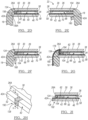
- FIGS. 2A-2I depicted are various configurations of the first and second substrates 26, 42 which have been integrally molded with the bezel 18.
- a gap between the bezel 18 and the first edge 26A of the first substrate 26 may appear unsightly by a viewer of the rearview mirror assembly 10.
- the bezel 18 may be integrally molded to the first and second substrates 26, 42 if the polymeric examples of the bezel 18 are filled with a sufficient loading of a CTE reducing filler (e.g., glass fiber or carbon fiber).
- a CTE reducing filler e.g., glass fiber or carbon fiber
- the bezel 18 may be laminated directly to the first and/or second substrates 26, 42 or the bezel 18 may be injection molded around the first and/or second substrates 26, 42 such that no gap exists or may be reduced to non-visible size (e.g., less than about 25 microns, less than about 15 microns, less than about 10 microns or less than about 5 microns).
- An exemplary method of laminating the bezel 18 to the first or second substrates 26, 42 may be accomplished via a method similar to SURFIC TM as developed by Asahi Glass Co. LTD of Chiyoda, Tokyo, Japan and/or glass insert molding performed by Yoshida Technoworks Co., Ltd. of Sumida-ku, Tokyo, Japan.
- the second edge 42A is positioned inboard, or in an inward direction, relative to the bezel 18 of the first edge 26A. Such an example may be accomplished by using a smaller dimensioned second substrate 42 relative to the first substrate 26, or through positioning of the first and second substrates 26, 42.
- the second edge 42A is positioned outboard, or in an outward direction relative to the first edge 26A. Such an example may be accomplished by using a smaller dimensioned first substrate 26 relative to the second substrate 42, or through positioning of the first and second substrates 26, 42.
- Exemplary advantages that may be achieved through such an example include a structural "lock" being formed due to the three dimensional aspect of the configuration (e.g., which may increase structural rigidity of the rearview assembly 10) and a reduced dimension bezel 18 (e.g., thinner, reduced and/or more compact) which may be aesthetically pleasing.
- the second edge 42A is positioned substantially flush, or in substantial alignment, with the first edge 26A.
- the first and second 26A, 42A can be flat and at a 90 degree angle relative to the first and fourth surfaces 30, 50 or at an angle other than 90 degrees relative to surfaces 30, 50.
- the first and second edges 26A, 42A can also be shaped such as a semicircle or pencil edge or contoured such as with a step, slot or notch.
- the texture of the first and second edges 26A, 42A can be smooth or rough depending on the edge appearance that is desired.
- one or more adhesion promoters may be included in the material of the bezel 18, in a resin base coating pre-applied to the first and second substrates 26, 42 and/or applied directly to the first and/or second substrates 26, 42.
- exemplary adhesion promoters include silane coupling agents such as Dow Corning ® Z-6121 and/or Dow Corning ® Xiameter OF S-6032 and/or solvent based organic solutions that may etch the substrates 26, 42 such as LORD Chemlok ® primers.
- adhesion promoters may be selected based at least in part on the material of the bezel 18 and the substrates 26, 42 in order to achieve a desired level of adhesion.
- the first and second edges 26A, 42A can also be coated with an elastomeric resin to help mitigate mechanical or thermal stresses that may develop in the rearview assembly 10.
- the first and second electrically conductive layers 38, 58 may each define an ablation area 104.
- the ablation area 104 of the first electrically conductive layer 38 splits the first electrically conductive layer 38 into a first portion 108 and a second portion 112.
- the ablation area 104 of the second electrically conductive layer 58 splits the second electrically conductive layer 58 into a third portion 116 and a fourth portion 120.
- the conductive bus 124 may function as a shut off for the material of the bezel 18 when the bezel 18 is formed.
- the conductive bus 124 may include a metal laden epoxy (e.g., silver epoxy), a conductive metal, a conductive polymer, or combinations thereof. In various examples, the conductive bus 124 may have a resistance of less than about 1 ohm. In the depicted example, the conductive bus 124 is positioned inboard of the first edge 26A and is in electrical communication with the first electrically conductive layer 38.
- the second substrate 42 defines one or more holes 54 extending between the third and fourth surfaces 46, 50. In other words, the fourth surface 50 may define one or more holes 54.
- the holes 54 may be circular, square, rectangular (e.g., slot like), triangular or other shapes.
- the holes 54 may have a diameter, or longest cross-sectional dimension (e.g., diameter) of between about 0.1 mm and about 10 mm.
- the holes 54 may be formed using conventional mechanical processes (e.g., drilling with a bit) or may be formed through chemical etching or laser cutting.
- An example of a hole incorporated into an electro-optic element is disclosed in US Patent No 8,864,322 entitled "SHAPED REARVIEW ASSEMBLY," assigned to Gentex Corporation.
- One or more holes 54 may be positioned or formed proximate the second edge 42A of the second substrate 42.
- One or more holes 54 may be positioned or formed in an inboard location of the second substrate 42. For example, one or more of the holes 54 may be positioned from about 0.1 mm to about 10 cm inboard from the second edge 42A.
- the filler 128 may include a metal tube (e.g., a via such as a multicore Copperset through hole plating system), conductive polymer, solder paste, a monolithic piece of metal, a thermal setting epoxy or combinations thereof. Any filler 128 may contain on its outer portion, an electrically insulating portion to isolate the electrical conductance from electrically conductive sections found on the third or fourth surfaces 46, 50. Optionally, a separate insulating member could be inserted into the hole 54 prior to the installation of the conductive filler. An insulator used in this method would be used to bring electrical conductance from the fourth surface 50 to the second surface 34.
- a metal tube e.g., a via such as a multicore Copperset through hole plating system
- conductive polymer e.g., solder paste, a monolithic piece of metal, a thermal setting epoxy or combinations thereof.
- Any filler 128 may contain on its outer portion, an electrically insulating portion to isolate the electrical conductance from electrically conductive sections
- any of the materials of the conductive bus 124 may be used as the filler 128 and any of the materials of the filler 128 may be used as the conductive bus 124.
- the filler 128 may be placed within the holes 54 at the time of assembling the electro-optic element 22 prior to formation of the bezel 18.
- the filler 128 may be flush with the third surface 46 or form a protruding connector.
- the filler 128 may be flush with the fourth surface 50 or form a protruding connector.
- the filler 128 may define a surface which is a distance of about 0.01 mm to about 0.2 mm from the third and/or fourth surfaces 46, 50.
- the filler 128 may define a surface (e.g., a filler surface) which is partially, substantially or completely parallel with the third and/or fourth surfaces 46, 50. According to various examples, the surface of the filler 128 is planar with the third and/or fourth surfaces 46, 50.
- the filler 128 may be partially or fully covered by the bezel 18.
- the filler material 128, depending on the example, may be held in place using an adhesive material (e.g., thermal or ultraviolet curing).
- the filler 128 is in electrical connection with the conductive bus 124 and the second electrically conductive layer 58 thereby providing electrical connection to both the first and second electrically conductive layers 38, 58.
- the filler 128 may cure with the conductive bus 124 to form a single continuous electrical connection.
- Use of the ablation areas 104 allows for the holes 54 to be in electrical connection with either the first and third portions 108, 116 or the second and fourth portions 112, 120 such that the electro-optic element 22 does not short out across the second electrically conductive layer 58.
- the circuit board 92 FIG. 1B
- a wire may make electrical contact with the filler 128 (e.g., inserted in the metal tube or soldered) to provide electrical connection.
- the filler 128 may be omitted and the wire electrically connected with the conductive bus 124 and/or the second electrically conductive layer 58. In yet other examples, the wire may be placed in the hole 54 and the filler 128 used to conductively secure the connection.
- the conductive bus 124 may be positioned outboard of the first edge 26A.
- the holes 54 may similarly positioned outboard of the first edge 26A and positioned below the conductive bus 124.
- a conductive coating 136 may be disposed on the first edge 26A and wrap onto the second surface 34.
- the conductive coating 136 may include at least one of a conductive ink, a vacuum deposited metal, a transparent conductor (e.g., indium tin oxide), carbon (graphene and/or graphite), a conductive metal foil, a conductive tape, a sputtered metal and combinations thereof.
- the conductive coating 136 is in electrical communication with the conductive bus 124 and the first portion 108 of the first electrically conductive layer 38. Such an example may be advantageous in that the electrical connection of the conductive bus 124 may be made after the primary seal 62 has been formed and cured.
- a conductive member 148 disposed around the second edge 42A is a conductive member 148.
- the conductive member 148 may be in electrical communication with the first electrically conductive layer 38 and may be in physical contact with the bezel 18.
- the conductive member 148 may extend from the fourth surface 50, around the second edge 42A and extend onto the third surface 46 to make electrical contact with the second electrically conductive layer 58.
- the conductive member 148 may include at least one of a conductive ink, a conductive tape, a thermoplastic polymer, a thermosetting polymer (e.g., metal filled such as a silver epoxy), a flex circuit, a conductive metal foil, a conductive tape, a metal component (e.g., a "J-clip” or an "L-clip") and combinations thereof.
- the electro-optic element 22 include the conductive bus 124, but may not without departing from the teachings provided herein. In examples not utilizing the conductive bus 124, the conductive member 148 may extend upwards to electrically and physically contact the conductive coating 136.
- the conductive member 148 may be configured to elastically deflect in a spring-like manner such that sufficient electrical connection between the conductive member 148 and the conductive coating 136 is achieved.
- the conductive member 148 may function as a shut-off for the molding of the bezel 18.
- the conductive member 148 may be formed of a "pre-preg" material which is solid at room temperature, but has not been cured yet.
- the pre-preg may be a solid resin and a solid curing agent which have been mixed to form a pliable mixture. Further, the pre-preg may be mixed with a conductive material to make the pre-preg electrically conductive.
- the pliable nature of the pre-preg may be useful in that the pre-preg may be wrapped from the fourth surface 50 to the third surface 46 at room temperature, and at elevated temperatures, the curing agent may activate to cure the pre-preg to form the conductive member 148. It will be understood that one or more components of the pre-preg may also be subject to melting without departing from the teachings provided herein. As depicted, the bezel 18 may substantially cover the conductive coating 136 and the conductive member 148.
- a conductive insert 156 may be disposed in contact with the second edge 42A of the second substrate 42.
- the electrically conductive insert 156 may be in electrical communication with at least one of the third surface 46 of the second substrate 42 and the second surface 34 of the first substrate 26.
- the conductive insert 156 may function as a shut-off during lamination and or formation of the bezel 18 to the electro-optic element 22.
- the conductive insert 156 may be a metal, conductive polymer, conductive epoxy, flex circuit or other conductive material.
- the conductive insert 156 may extend onto the third surface 46 and be in electrical communication with the second electrically conductive layer 58.
- the insert 156 may define a contact surface 156A to which the circuit board 92 ( FIG. 1B ) or other electrical connection may be coupled.
- the contact surface 156A may be flush with the fourth surface 50 of the second substrate 42.
- the conductive insert 156 and contact surface 156A may be left partially exposed (i.e., partially covered) after formation or lamination of the bezel 18, or may be buried (i.e., fully covered) such that post processing (e.g., drilling through or removing a portion of the bezel 18) is used to expose the conductive surface 156A. It will be understood that a similar process may be employed for examples where the filler 128 is covered (substantially or partially) by the bezel 18.
- the insert 156 may be one or more electromagnetic or radio frequency interference shields.
- the shields may include one or more metal components.
- the shield may be utilized to replace the conductive bus 124 ( FIG. 2A ) connecting with one or more of the first and second electrically conductive layers 38, 58. Further, the shield may extend from the bezel 18 and provide an electrical connection contact point to power the electro-optic element 22.
- the bezel 18 may define an aperture 160.
- the bezel 18 may extend onto the fourth surface 50 of the second substrate 42.
- the aperture 160 may be formed into the bezel 18 after formation of the bezel 18 (e.g., via mechanical drilling, laser ablation, etching, etc.) to expose an electrical contact point (e.g., the hole 54/filler 128 ( FIG. 1 ), the conductive member 148 ( FIG. 2C ), other electrical contacts for the electro-optic element 22).
- the aperture 160 may be filled with a conductive material (e.g., the filler 128) or be left open to allow for electrical contact (e.g., through a wire).
- the bezel 18 may include a conductive component 168 positioned within the bezel 18.
- the conductive component 168 may be co-molded (e.g., inserted during molding/lamination and have the bezel 18 formed around it) with the bezel 18 or may be added in post processing (e.g., by drilling a hole and inserting the conductive component 168 or by heating the conductive component 168 and sinking it into the material of the bezel 18).
- the conductive component 168 may be metal, a conductive polymer, a wire or other electrically conductive material.
- the conductive component 168 may be in electrical communication with a contact point on the electro-optic element 22 (e.g., the hole 54/filler 128 ( FIG. 1 ), the conductive member 148 ( FIG. 2C ), other electrical contacts for the electro-optic element 22) to power the electro-optic element 22.
- a contact point on the electro-optic element 22 e.g., the hole 54/filler 128 ( FIG. 1 ), the conductive member 148 ( FIG. 2C ), other electrical contacts for the electro-optic element 22
- the bezel 18 may include a decorative film 176.
- the decorative film 176 may be laid down in a mold prior to the formation of the bezel 18 such that the decorative film 176 is on an A-surface, or exterior of the bezel 18.
- the decorative film 176 may be used to enhance the appearance of the bezel 18 by providing a smooth surface and/or one or more decorations (e.g., metallized layer, pattern, etc.).
- a flex circuit 180 and an electrical connector 184 Positioned on a B-surface of the decorative film 176 (e.g., within the bezel 18) may be a flex circuit 180 and an electrical connector 184.
- the flex circuit 180 may additionally or alternatively be a metal foil, conductive coating, conductive polymer configured to transmit electricity and/or combinations thereof.
- the electrical connector 184 is configured to make electrical connection between the second electrically conductive layer 58 and the flex circuit 180.
- the electrical connector 184 is a spring, but may be any other electrically conductive component capable of elastic deformation.
- the elastic deformation of the electrical connector 184 ensures a secure connection with the second electrically conductive layer 58.
- Electrical connection between the electrical connector 184 and the flex circuit 180 allows for electrical communication with the electro-optic element 22 through the flex circuit 180.
- the flex circuit 180 may be combined with, or replaced by, the decorative film 176 without departing from the teachings provided herein.
- the second substrate 42 may define a notch 192 extending between the fourth surface 50 and the third surface 46.
- the notch 192 unlike the hole 54, is not completely surrounded by the second substrate 42.
- the notch 192 may be filled with the same filler 128 as the hole 54.
- the filler 128 may be in contact with the second electrically conductive layer 58 and form an electrical contact point proximate the fourth surface 50.
- the filler 128 may be flush with the third and fourth surfaces 46, 50.
- the notch 192 may be filled with a portion of the mold to prevent the polymer of the bezel 18 from flowing into the notch 192.
- the notch 192 may be prefilled with the filler 128 such that the filler 128 functions as a shut-off and the notch 192 is not filled with the polymeric material of the bezel 18 ( FIGS. 2A-2C ).
- the holes 54 may be used with examples utilizing the notch 192, the conductive coating and member 136, 148, the conductive insert 156, the aperture 160, the conductive component 168 and the decorative film 176 without departing from the teachings provided herein. Similarly, any of the examples provided may be utilized with any other example provided.
- the fourth surface 50 of the second substrate 42 may be substantially flush or flat (i.e., the filler 128, conductive bus 124, conductive coating 136, conductive member 148, conductive insert 156, flex circuit 180, and/or electrical connector 184 may be substantially flush or not extend onto the fourth surface 50).
- a flush example of the fourth surface 50 may be useful during the formation of the bezel 18.
- the fourth surface 50 may function as a surface for a mold of an injection molding machine to press against during formation of the bezel 18.
- the pressure may be provided proximate the primary seal 62.
- the molding equipment used to form the bezel 18 may apply unequal pressure which can result in damage to the electro-optic element 22.
- the mold may need to be precisely machined to account for this variation such that uniform pressure may be applied. Accordingly, by creating a flush fourth surface 50 as disclosed herein, the bezel 50 may be formed in a cost effective manner.
- the use of the present disclosure permits the formation of rearview mirror assemblies 10, and other structures having bezels 18, to include electrical components with low visibility electrical contacts.
- use of the present disclosure allows for the formation of rearview mirror assemblies 10 which have a low profile and aesthetically pleasing design.
- use of the present disclosure may allow for the reduction in the width of a concealment structure (e.g., a spectral filter, chrome ring, etc.) used to conceal the conductive bus 124, primary seal or other unsightly components located at edges of the electro-optic element 22.
- a concealment structure e.g., a spectral filter, chrome ring, etc.
- the concealment structures may not need to be as wide. Thinner concealment structures may be advantageous in reducing the time and money required to manufacture them.
- the fourth surface 50 may be made flush (i.e., flat or substantially without changes in height). A flush fourth surface 50 may allow for uniform back pressure to be applied to the electro-optic element 22 during formation of the bezel 18. Further, a flush fourth surface 50 may allow for a more uniform formation of the bezel 18 onto the fourth surface 50.
- the term "coupled” in all of its forms: couple, coupling, coupled, etc. generally means the joining of two components (electrical or mechanical) directly or indirectly to one another. Such joining may be stationary in nature or movable in nature. Such joining may be achieved with the two components (electrical or mechanical) and any additional intermediate members being integrally formed as a single unitary body with one another or with the two components. Such joining may be permanent in nature, or may be removable or releasable in nature, unless otherwise stated.
- elements shown as integrally formed may be constructed of multiple parts, or elements shown as multiple parts may be integrally formed, the operation of the interfaces may be reversed or otherwise varied, the length or width of the structures and/or members or connector or other elements of the system may be varied, and the nature or numeral of adjustment positions provided between the elements may be varied.
- the elements and/or assemblies of the system may be constructed from any of a wide variety of materials that provide sufficient strength or durability, in any of a wide variety of colors, textures, and combinations.
- Other substitutions, modifications, changes, and omissions may be made in the design, operating conditions, and arrangement of the desired and other exemplary embodiments.
- the term “about” means that amounts, sizes, formulations, parameters, and other quantities and characteristics are not and need not be exact, but may be approximate and/or larger or smaller, as desired, reflecting tolerances, conversion factors, rounding off, measurement error and the like, and other factors known to those of skill in the art.
- the term “about” is used in describing a value or an end-point of a range, the disclosure should be understood to include the specific value or end-point referred to.
- substantially is intended to note that a described feature is equal or approximately equal to a value or description.
- a “substantially planar” surface is intended to denote a surface that is planar or approximately planar.
- substantially is intended to denote that two values are equal or approximately equal.
- substantially may denote values within about 10% of each other, such as within about 5% of each other, or within about 2% of each other.
Landscapes
- Physics & Mathematics (AREA)
- Nonlinear Science (AREA)
- Engineering & Computer Science (AREA)
- General Physics & Mathematics (AREA)
- Optics & Photonics (AREA)
- Mechanical Engineering (AREA)
- Multimedia (AREA)
- Chemical & Material Sciences (AREA)
- Crystallography & Structural Chemistry (AREA)
- Mathematical Physics (AREA)
- Signal Processing (AREA)
- Electrochromic Elements, Electrophoresis, Or Variable Reflection Or Absorption Elements (AREA)
Claims (11)
- Eine Rückansichtsvorrichtung (10), die Folgendes umfasst:eine Einfassung (18); undein elektrooptisches Element (22), umfassend:ein erstes im Wesentlichen transparentes Substrat (26), das eine erste und eine zweite Oberfläche (30, 34) und eine erste Kante (26A) definiert, die sich um mindestens einen Teil eines Umfangs des ersten im Wesentlichen transparenten Substrats (26) erstreckt, wobei die zweite Oberfläche (34) eine erste elektrisch leitende Schicht (38) umfasst;ein zweites Substrat (42), das eine dritte und eine vierte Oberfläche (46, 50) definiert, und eine zweite Kante (42A), die sich um mindestens einen Teil eines Umfangs des zweiten Substrats (42) erstreckt, wobei das zweite Substrat (42) ein Loch (54) zwischen der dritten und der vierten Oberfläche (46, 50) definiert, wobei die dritte Oberfläche (46) eine zweite elektrisch leitende Schicht (58) umfasst;eine Primärdichtung (62), die zwischen dem ersten und dem zweiten Substrat (26, 42) angeordnet ist, wobei die Dichtung (62) und das erste und das zweite Substrat (26, 42) zwischen sich einen Hohlraum (66) definieren;ein elektrooptisches Material (70), das im Hohlraum (66) angeordnet ist; undeine leitende Sammelschiene (124), die in der Nähe des Lochs (54) des zweiten Substrats (42) positioniert ist;wobei sich die Einfassung (18) auf die dritte und vierte Oberfläche (46, 50) des zweiten Substrats (42) erstreckt, wobei die erste und zweite Kante (26A, 42A) in direktem Kontakt mit der Einfassung (18) stehen, und die zweite Kante (42A) außerhalb der ersten Kante (26A) positioniert ist, um eine strukturelle Verriegelung des elektrooptischen Elements (22) in der Einfassung (18) zu bilden.
- Die Rückansichtsvorrichtung (10) nach Anspruch 1, die ferner einen leitfähigen Füllstoff (128) umfasst, der im Loch (54) angeordnet ist.
- Die Rückansichtsvorrichtung (10) nach Anspruch 2, wobei der Füllstoff (128) eine Füllstoffoberfläche definiert, die im Wesentlichen planar zur vierten Oberfläche (50) ist.
- Die Rückansichtsvorrichtung (10) nach Anspruch 2 oder 3, wobei der leitfähige Füllstoff (128) mindestens eines von einem Metallrohr, einem leitfähigen Polymer, einer Lötpaste und einem monolithischen Metallstück umfasst.
- Die Rückansichtsvorrichtung (10) nach irgendeinem der Ansprüche von 2 bis 4, wobei der leitfähige Füllstoff (128) in elektrischer Verbindung mit der zweiten elektrisch leitfähigen Schicht (58) steht.
- Die Rückansichtsvorrichtung (10) nach irgendeinem der vorstehenden Ansprüche, wobei das Loch (54) einen Querschnittsdurchmesser von etwa 0,1 mm bis etwa 10 mm aufweist.
- Die Rückansichtsvorrichtung (10) nach irgendeinem der Ansprüche von 2 bis 6, wobei der Füllstoff (128) im Wesentlichen von der Einfassung (18) bedeckt ist.
- Die Rückansichtsvorrichtung (10) nach irgendeinem der Ansprüche von 2 bis 7, die ferner Folgendes umfasst:
einen Einsatz (156), der in der Einfassung (18) angeordnet ist und in elektrischer Verbindung mit dem Füllstoff (128) steht. - Die Rückansichtsvorrichtung (10) nach irgendeinem der Ansprüche von 1 bis 8, wobei die Einfassung (18) eine Öffnung (160) in der Nähe des Lochs (54) des zweiten Substrats (42) definiert, und wobei die Öffnung (160) vorzugsweise mit einer leitfähigen Komponente (168) gefüllt ist.
- Die Rückansichtsvorrichtung (10) nach irgendeinem der vorstehenden Ansprüche, wobei eine Oberfläche des leitfähigen Füllstoffs (128) im Wesentlichen parallel zur vierten Oberfläche (50) ist.
- Die Rückansichtsvorrichtung (10) nach irgendeinem der vorstehenden Ansprüche, wobei ein Abstand zwischen einer Oberfläche des leitfähigen Füllstoffs (128) und der vierten Oberfläche (50) etwa 0,01 mm bis etwa 0,2 mm beträgt.
Applications Claiming Priority (2)
| Application Number | Priority Date | Filing Date | Title |
|---|---|---|---|
| US201662363996P | 2016-07-19 | 2016-07-19 | |
| PCT/US2017/042739 WO2018017651A1 (en) | 2016-07-19 | 2017-07-19 | Electrical connections for electro-optic elements |
Publications (3)
| Publication Number | Publication Date |
|---|---|
| EP3487728A1 EP3487728A1 (de) | 2019-05-29 |
| EP3487728A4 EP3487728A4 (de) | 2019-06-26 |
| EP3487728B1 true EP3487728B1 (de) | 2025-02-26 |
Family
ID=60988400
Family Applications (1)
| Application Number | Title | Priority Date | Filing Date |
|---|---|---|---|
| EP17831747.5A Active EP3487728B1 (de) | 2016-07-19 | 2017-07-19 | Elektrische verbindungen für elektrooptische elemente |
Country Status (6)
| Country | Link |
|---|---|
| US (1) | US20180024401A1 (de) |
| EP (1) | EP3487728B1 (de) |
| JP (1) | JP6789371B2 (de) |
| KR (1) | KR102431222B1 (de) |
| CN (1) | CN109415015B (de) |
| WO (1) | WO2018017651A1 (de) |
Families Citing this family (8)
| Publication number | Priority date | Publication date | Assignee | Title |
|---|---|---|---|---|
| US10214147B2 (en) * | 2015-12-04 | 2019-02-26 | Gentex Corporation | Tight bezel-to-glass fit mirror assembly |
| PE20210282A1 (es) | 2018-06-28 | 2021-02-10 | Saint Gobain | Pelicula de multiples capas con propiedades opticas electricamente conmutables y contacto electrico mejorado |
| KR102657713B1 (ko) * | 2019-01-18 | 2024-04-16 | 삼성디스플레이 주식회사 | 표시 장치용 보호 부재, 이를 포함하는 표시 장치 및 표시 장치용 보호 부재의 제조 방법 |
| CN110471230B (zh) * | 2019-09-06 | 2021-10-08 | 南通繁华新材料科技有限公司 | 一种电致变色玻璃及其制造方法 |
| US12208736B2 (en) | 2020-01-17 | 2025-01-28 | Ningbo Mi Ruo Electronic Technology Co., Ltd | Vehicle rear-view mirror assembly |
| CN113135147A (zh) * | 2020-01-17 | 2021-07-20 | 宁波祢若电子科技有限公司 | 一种车辆后视镜组件 |
| EP4202542A4 (de) * | 2020-09-04 | 2024-12-04 | Shenzhen Guangyi Tech Co., Ltd. | Elektrochrome vorrichtung und elektronische vorrichtung |
| TWI847110B (zh) * | 2022-03-23 | 2024-07-01 | 安可光電股份有限公司 | 一種增加可視範圍的電致變色後視鏡鏡片組 |
Citations (2)
| Publication number | Priority date | Publication date | Assignee | Title |
|---|---|---|---|---|
| US6193379B1 (en) * | 2000-06-09 | 2001-02-27 | Gentex Corporation | Electrochromic assembly including at least one polymeric substrate |
| US20140036338A1 (en) * | 2012-08-01 | 2014-02-06 | Gentex Corporation | Apparatus, method, and process with laser induced channel edge |
Family Cites Families (16)
| Publication number | Priority date | Publication date | Assignee | Title |
|---|---|---|---|---|
| JPS58188603U (ja) * | 1982-06-07 | 1983-12-15 | トヨタ自動車株式会社 | 防眩ミラ− |
| JPS594501U (ja) * | 1982-07-01 | 1984-01-12 | トヨタ自動車株式会社 | 防眩ミラ− |
| US5066112A (en) * | 1989-12-21 | 1991-11-19 | Donnelly Corporation | Perimeter coated, electro-optic mirror |
| US7324261B2 (en) * | 1999-07-09 | 2008-01-29 | Gentex Corporation | Electrochromic devices with thin bezel-covered edge |
| US9134585B2 (en) * | 2002-09-30 | 2015-09-15 | Gentex Corporation | Automotive rearview mirror with capacitive switches |
| JP4979376B2 (ja) * | 2003-05-06 | 2012-07-18 | ジェンテックス コーポレイション | 車両用バックミラー要素及びこれらの要素を組み込むアセンブリ |
| US8368992B2 (en) * | 2006-03-03 | 2013-02-05 | Gentex Corporation | Electro-optical element including IMI coatings |
| MX2008011009A (es) * | 2006-03-03 | 2008-09-05 | Gentex Corp | Revestimientos de pelicula delgada mejorados, elementos electro-opticos y ensambles que incorporan estos elementos. |
| KR20080101635A (ko) * | 2007-05-18 | 2008-11-21 | 삼성전자주식회사 | 반도체 패키지, 그 제조 방법, 및 반도체 패키지를 이용한패키지 모듈 및 전자 제품 |
| US8730553B2 (en) * | 2009-04-23 | 2014-05-20 | Magna Mirrors Of America, Inc. | Frameless interior rearview mirror assembly |
| US8964278B2 (en) * | 2010-08-09 | 2015-02-24 | Gentex Corporation | Electro-optic system configured to reduce a perceived color change |
| JP5764098B2 (ja) | 2012-07-17 | 2015-08-12 | 株式会社ホンダロック | 防眩ミラー、車両および防眩ミラーの製造方法 |
| WO2014032042A1 (en) * | 2012-08-24 | 2014-02-27 | Gentex Corporation | Shaped rearview mirror assembly |
| CN104570535A (zh) * | 2013-10-24 | 2015-04-29 | 力光兴科技股份有限公司 | 电致变色汽车后视镜体结构及其制造方法 |
| CN204915475U (zh) * | 2015-06-26 | 2015-12-30 | 常州市飞拓模塑有限公司 | 车辆防眩目后视镜 |
| US9812538B2 (en) * | 2015-12-01 | 2017-11-07 | Infineon Technologies Americas Corp. | Buried bus and related method |
-
2017
- 2017-07-19 EP EP17831747.5A patent/EP3487728B1/de active Active
- 2017-07-19 CN CN201780041704.5A patent/CN109415015B/zh active Active
- 2017-07-19 US US15/653,647 patent/US20180024401A1/en not_active Abandoned
- 2017-07-19 KR KR1020197001288A patent/KR102431222B1/ko active Active
- 2017-07-19 JP JP2019502622A patent/JP6789371B2/ja active Active
- 2017-07-19 WO PCT/US2017/042739 patent/WO2018017651A1/en not_active Ceased
Patent Citations (2)
| Publication number | Priority date | Publication date | Assignee | Title |
|---|---|---|---|---|
| US6193379B1 (en) * | 2000-06-09 | 2001-02-27 | Gentex Corporation | Electrochromic assembly including at least one polymeric substrate |
| US20140036338A1 (en) * | 2012-08-01 | 2014-02-06 | Gentex Corporation | Apparatus, method, and process with laser induced channel edge |
Also Published As
| Publication number | Publication date |
|---|---|
| KR102431222B1 (ko) | 2022-08-11 |
| KR20190028704A (ko) | 2019-03-19 |
| EP3487728A4 (de) | 2019-06-26 |
| EP3487728A1 (de) | 2019-05-29 |
| JP6789371B2 (ja) | 2020-11-25 |
| CN109415015A (zh) | 2019-03-01 |
| JP2019523170A (ja) | 2019-08-22 |
| CN109415015B (zh) | 2023-01-31 |
| US20180024401A1 (en) | 2018-01-25 |
| WO2018017651A1 (en) | 2018-01-25 |
Similar Documents
| Publication | Publication Date | Title |
|---|---|---|
| EP3487728B1 (de) | Elektrische verbindungen für elektrooptische elemente | |
| EP3383704B1 (de) | Spiegelanordnung mit dichter glaseinfassungspassung | |
| EP3319837B1 (de) | Spiegelanordnung mit dichter glaseinfassungspassung | |
| US7554624B2 (en) | Electronic device with protection panel, protection panel, and method of fabricating protection panels | |
| JP4021925B2 (ja) | 電子機器表示窓の保護パネル及び保護パネルの製造方法 | |
| US20040218247A1 (en) | Electrochromic devices having no positional offset between substrates | |
| WO2002024431A1 (en) | Multi-layered structures and methods for manufacturing the multi-layered structures | |
| JP2011140181A (ja) | 光輝性樹脂成形品及びその製造方法 | |
| JP7143046B2 (ja) | 電子部品付き樹脂筐体およびその製造方法 | |
| US10824029B2 (en) | Electrical connections for electro-optic elements | |
| US20160131804A1 (en) | Display system for a communication device | |
| JP2009064692A (ja) | タッチスイッチ用中間体およびタッチスイッチ用中間体製造方法 | |
| CN101383606B (zh) | 接触式开关用中间体的制造方法 |
Legal Events
| Date | Code | Title | Description |
|---|---|---|---|
| STAA | Information on the status of an ep patent application or granted ep patent |
Free format text: STATUS: THE INTERNATIONAL PUBLICATION HAS BEEN MADE |
|
| PUAI | Public reference made under article 153(3) epc to a published international application that has entered the european phase |
Free format text: ORIGINAL CODE: 0009012 |
|
| STAA | Information on the status of an ep patent application or granted ep patent |
Free format text: STATUS: REQUEST FOR EXAMINATION WAS MADE |
|
| 17P | Request for examination filed |
Effective date: 20190218 |
|
| AK | Designated contracting states |
Kind code of ref document: A1 Designated state(s): AL AT BE BG CH CY CZ DE DK EE ES FI FR GB GR HR HU IE IS IT LI LT LU LV MC MK MT NL NO PL PT RO RS SE SI SK SM TR |
|
| AX | Request for extension of the european patent |
Extension state: BA ME |
|
| A4 | Supplementary search report drawn up and despatched |
Effective date: 20190523 |
|
| RIC1 | Information provided on ipc code assigned before grant |
Ipc: B60R 1/08 20060101ALI20190517BHEP Ipc: G02F 1/1345 20060101ALI20190517BHEP Ipc: G02F 1/153 20060101ALI20190517BHEP Ipc: B60R 1/04 20060101AFI20190517BHEP |
|
| DAV | Request for validation of the european patent (deleted) | ||
| DAX | Request for extension of the european patent (deleted) | ||
| STAA | Information on the status of an ep patent application or granted ep patent |
Free format text: STATUS: EXAMINATION IS IN PROGRESS |
|
| 17Q | First examination report despatched |
Effective date: 20201120 |
|
| P01 | Opt-out of the competence of the unified patent court (upc) registered |
Effective date: 20230503 |
|
| GRAP | Despatch of communication of intention to grant a patent |
Free format text: ORIGINAL CODE: EPIDOSNIGR1 |
|
| STAA | Information on the status of an ep patent application or granted ep patent |
Free format text: STATUS: GRANT OF PATENT IS INTENDED |
|
| RIC1 | Information provided on ipc code assigned before grant |
Ipc: G02F 1/161 20060101ALI20240926BHEP Ipc: G02F 1/155 20060101ALI20240926BHEP Ipc: G02F 1/1345 20060101ALI20240926BHEP Ipc: G02F 1/153 20060101ALI20240926BHEP Ipc: B60R 1/08 20060101ALI20240926BHEP Ipc: B60R 1/04 20060101AFI20240926BHEP |
|
| INTG | Intention to grant announced |
Effective date: 20241010 |
|
| GRAS | Grant fee paid |
Free format text: ORIGINAL CODE: EPIDOSNIGR3 |
|
| GRAA | (expected) grant |
Free format text: ORIGINAL CODE: 0009210 |
|
| STAA | Information on the status of an ep patent application or granted ep patent |
Free format text: STATUS: THE PATENT HAS BEEN GRANTED |
|
| AK | Designated contracting states |
Kind code of ref document: B1 Designated state(s): AL AT BE BG CH CY CZ DE DK EE ES FI FR GB GR HR HU IE IS IT LI LT LU LV MC MK MT NL NO PL PT RO RS SE SI SK SM TR |
|
| REG | Reference to a national code |
Ref country code: GB Ref legal event code: FG4D |
|
| REG | Reference to a national code |
Ref country code: CH Ref legal event code: EP |
|
| REG | Reference to a national code |
Ref country code: DE Ref legal event code: R096 Ref document number: 602017088034 Country of ref document: DE |
|
| REG | Reference to a national code |
Ref country code: IE Ref legal event code: FG4D |
|
| REG | Reference to a national code |
Ref country code: NL Ref legal event code: MP Effective date: 20250226 |
|
| PG25 | Lapsed in a contracting state [announced via postgrant information from national office to epo] |
Ref country code: RS Free format text: LAPSE BECAUSE OF FAILURE TO SUBMIT A TRANSLATION OF THE DESCRIPTION OR TO PAY THE FEE WITHIN THE PRESCRIBED TIME-LIMIT Effective date: 20250526 |
|
| PG25 | Lapsed in a contracting state [announced via postgrant information from national office to epo] |
Ref country code: FI Free format text: LAPSE BECAUSE OF FAILURE TO SUBMIT A TRANSLATION OF THE DESCRIPTION OR TO PAY THE FEE WITHIN THE PRESCRIBED TIME-LIMIT Effective date: 20250226 |
|
| PG25 | Lapsed in a contracting state [announced via postgrant information from national office to epo] |
Ref country code: PL Free format text: LAPSE BECAUSE OF FAILURE TO SUBMIT A TRANSLATION OF THE DESCRIPTION OR TO PAY THE FEE WITHIN THE PRESCRIBED TIME-LIMIT Effective date: 20250226 |
|
| PG25 | Lapsed in a contracting state [announced via postgrant information from national office to epo] |
Ref country code: ES Free format text: LAPSE BECAUSE OF FAILURE TO SUBMIT A TRANSLATION OF THE DESCRIPTION OR TO PAY THE FEE WITHIN THE PRESCRIBED TIME-LIMIT Effective date: 20250226 |
|
| PGFP | Annual fee paid to national office [announced via postgrant information from national office to epo] |
Ref country code: GB Payment date: 20250619 Year of fee payment: 9 |
|
| REG | Reference to a national code |
Ref country code: LT Ref legal event code: MG9D |
|
| PG25 | Lapsed in a contracting state [announced via postgrant information from national office to epo] |
Ref country code: NO Free format text: LAPSE BECAUSE OF FAILURE TO SUBMIT A TRANSLATION OF THE DESCRIPTION OR TO PAY THE FEE WITHIN THE PRESCRIBED TIME-LIMIT Effective date: 20250526 Ref country code: IS Free format text: LAPSE BECAUSE OF FAILURE TO SUBMIT A TRANSLATION OF THE DESCRIPTION OR TO PAY THE FEE WITHIN THE PRESCRIBED TIME-LIMIT Effective date: 20250626 |
|
| PG25 | Lapsed in a contracting state [announced via postgrant information from national office to epo] |
Ref country code: NL Free format text: LAPSE BECAUSE OF FAILURE TO SUBMIT A TRANSLATION OF THE DESCRIPTION OR TO PAY THE FEE WITHIN THE PRESCRIBED TIME-LIMIT Effective date: 20250226 |
|
| PG25 | Lapsed in a contracting state [announced via postgrant information from national office to epo] |
Ref country code: HR Free format text: LAPSE BECAUSE OF FAILURE TO SUBMIT A TRANSLATION OF THE DESCRIPTION OR TO PAY THE FEE WITHIN THE PRESCRIBED TIME-LIMIT Effective date: 20250226 |
|
| PG25 | Lapsed in a contracting state [announced via postgrant information from national office to epo] |
Ref country code: LV Free format text: LAPSE BECAUSE OF FAILURE TO SUBMIT A TRANSLATION OF THE DESCRIPTION OR TO PAY THE FEE WITHIN THE PRESCRIBED TIME-LIMIT Effective date: 20250226 Ref country code: PT Free format text: LAPSE BECAUSE OF FAILURE TO SUBMIT A TRANSLATION OF THE DESCRIPTION OR TO PAY THE FEE WITHIN THE PRESCRIBED TIME-LIMIT Effective date: 20250626 |
|
| PGFP | Annual fee paid to national office [announced via postgrant information from national office to epo] |
Ref country code: FR Payment date: 20250620 Year of fee payment: 9 |
|
| PG25 | Lapsed in a contracting state [announced via postgrant information from national office to epo] |
Ref country code: GR Free format text: LAPSE BECAUSE OF FAILURE TO SUBMIT A TRANSLATION OF THE DESCRIPTION OR TO PAY THE FEE WITHIN THE PRESCRIBED TIME-LIMIT Effective date: 20250527 Ref country code: BG Free format text: LAPSE BECAUSE OF FAILURE TO SUBMIT A TRANSLATION OF THE DESCRIPTION OR TO PAY THE FEE WITHIN THE PRESCRIBED TIME-LIMIT Effective date: 20250226 |
|
| REG | Reference to a national code |
Ref country code: AT Ref legal event code: MK05 Ref document number: 1770346 Country of ref document: AT Kind code of ref document: T Effective date: 20250226 |
|
| PG25 | Lapsed in a contracting state [announced via postgrant information from national office to epo] |
Ref country code: SE Free format text: LAPSE BECAUSE OF FAILURE TO SUBMIT A TRANSLATION OF THE DESCRIPTION OR TO PAY THE FEE WITHIN THE PRESCRIBED TIME-LIMIT Effective date: 20250226 |
|
| PG25 | Lapsed in a contracting state [announced via postgrant information from national office to epo] |
Ref country code: SM Free format text: LAPSE BECAUSE OF FAILURE TO SUBMIT A TRANSLATION OF THE DESCRIPTION OR TO PAY THE FEE WITHIN THE PRESCRIBED TIME-LIMIT Effective date: 20250226 |
|
| PG25 | Lapsed in a contracting state [announced via postgrant information from national office to epo] |
Ref country code: DK Free format text: LAPSE BECAUSE OF FAILURE TO SUBMIT A TRANSLATION OF THE DESCRIPTION OR TO PAY THE FEE WITHIN THE PRESCRIBED TIME-LIMIT Effective date: 20250226 |
|
| PGFP | Annual fee paid to national office [announced via postgrant information from national office to epo] |
Ref country code: DE Payment date: 20250620 Year of fee payment: 9 |
|
| PG25 | Lapsed in a contracting state [announced via postgrant information from national office to epo] |
Ref country code: IT Free format text: LAPSE BECAUSE OF FAILURE TO SUBMIT A TRANSLATION OF THE DESCRIPTION OR TO PAY THE FEE WITHIN THE PRESCRIBED TIME-LIMIT Effective date: 20250226 |
|
| PG25 | Lapsed in a contracting state [announced via postgrant information from national office to epo] |
Ref country code: AT Free format text: LAPSE BECAUSE OF FAILURE TO SUBMIT A TRANSLATION OF THE DESCRIPTION OR TO PAY THE FEE WITHIN THE PRESCRIBED TIME-LIMIT Effective date: 20250226 |
|
| PG25 | Lapsed in a contracting state [announced via postgrant information from national office to epo] |
Ref country code: EE Free format text: LAPSE BECAUSE OF FAILURE TO SUBMIT A TRANSLATION OF THE DESCRIPTION OR TO PAY THE FEE WITHIN THE PRESCRIBED TIME-LIMIT Effective date: 20250226 Ref country code: CZ Free format text: LAPSE BECAUSE OF FAILURE TO SUBMIT A TRANSLATION OF THE DESCRIPTION OR TO PAY THE FEE WITHIN THE PRESCRIBED TIME-LIMIT Effective date: 20250226 |
|
| PG25 | Lapsed in a contracting state [announced via postgrant information from national office to epo] |
Ref country code: RO Free format text: LAPSE BECAUSE OF FAILURE TO SUBMIT A TRANSLATION OF THE DESCRIPTION OR TO PAY THE FEE WITHIN THE PRESCRIBED TIME-LIMIT Effective date: 20250226 |
|
| PG25 | Lapsed in a contracting state [announced via postgrant information from national office to epo] |
Ref country code: SK Free format text: LAPSE BECAUSE OF FAILURE TO SUBMIT A TRANSLATION OF THE DESCRIPTION OR TO PAY THE FEE WITHIN THE PRESCRIBED TIME-LIMIT Effective date: 20250226 |