EP3479486B1 - Verfahren und systeme zur codierung und decodierung von ldpc-codes mit rate 7/8 - Google Patents
Verfahren und systeme zur codierung und decodierung von ldpc-codes mit rate 7/8 Download PDFInfo
- Publication number
- EP3479486B1 EP3479486B1 EP16909200.4A EP16909200A EP3479486B1 EP 3479486 B1 EP3479486 B1 EP 3479486B1 EP 16909200 A EP16909200 A EP 16909200A EP 3479486 B1 EP3479486 B1 EP 3479486B1
- Authority
- EP
- European Patent Office
- Prior art keywords
- matrix
- parity check
- rows
- submatrices
- ldpc
- Prior art date
- Legal status (The legal status is an assumption and is not a legal conclusion. Google has not performed a legal analysis and makes no representation as to the accuracy of the status listed.)
- Active
Links
Images











Classifications
-
- H—ELECTRICITY
- H03—ELECTRONIC CIRCUITRY
- H03M—CODING; DECODING; CODE CONVERSION IN GENERAL
- H03M13/00—Coding, decoding or code conversion, for error detection or error correction; Coding theory basic assumptions; Coding bounds; Error probability evaluation methods; Channel models; Simulation or testing of codes
- H03M13/03—Error detection or forward error correction by redundancy in data representation, i.e. code words containing more digits than the source words
- H03M13/05—Error detection or forward error correction by redundancy in data representation, i.e. code words containing more digits than the source words using block codes, i.e. a predetermined number of check bits joined to a predetermined number of information bits
- H03M13/11—Error detection or forward error correction by redundancy in data representation, i.e. code words containing more digits than the source words using block codes, i.e. a predetermined number of check bits joined to a predetermined number of information bits using multiple parity bits
- H03M13/1102—Codes on graphs and decoding on graphs, e.g. low-density parity check [LDPC] codes
- H03M13/1148—Structural properties of the code parity-check or generator matrix
- H03M13/116—Quasi-cyclic LDPC [QC-LDPC] codes, i.e. the parity-check matrix being composed of permutation or circulant sub-matrices
- H03M13/1168—Quasi-cyclic LDPC [QC-LDPC] codes, i.e. the parity-check matrix being composed of permutation or circulant sub-matrices wherein the sub-matrices have column and row weights greater than one, e.g. multi-diagonal sub-matrices
-
- H—ELECTRICITY
- H03—ELECTRONIC CIRCUITRY
- H03M—CODING; DECODING; CODE CONVERSION IN GENERAL
- H03M13/00—Coding, decoding or code conversion, for error detection or error correction; Coding theory basic assumptions; Coding bounds; Error probability evaluation methods; Channel models; Simulation or testing of codes
- H03M13/03—Error detection or forward error correction by redundancy in data representation, i.e. code words containing more digits than the source words
- H03M13/05—Error detection or forward error correction by redundancy in data representation, i.e. code words containing more digits than the source words using block codes, i.e. a predetermined number of check bits joined to a predetermined number of information bits
- H03M13/11—Error detection or forward error correction by redundancy in data representation, i.e. code words containing more digits than the source words using block codes, i.e. a predetermined number of check bits joined to a predetermined number of information bits using multiple parity bits
- H03M13/1102—Codes on graphs and decoding on graphs, e.g. low-density parity check [LDPC] codes
- H03M13/1148—Structural properties of the code parity-check or generator matrix
- H03M13/118—Parity check matrix structured for simplifying encoding, e.g. by having a triangular or an approximate triangular structure
-
- H—ELECTRICITY
- H03—ELECTRONIC CIRCUITRY
- H03M—CODING; DECODING; CODE CONVERSION IN GENERAL
- H03M13/00—Coding, decoding or code conversion, for error detection or error correction; Coding theory basic assumptions; Coding bounds; Error probability evaluation methods; Channel models; Simulation or testing of codes
- H03M13/03—Error detection or forward error correction by redundancy in data representation, i.e. code words containing more digits than the source words
- H03M13/05—Error detection or forward error correction by redundancy in data representation, i.e. code words containing more digits than the source words using block codes, i.e. a predetermined number of check bits joined to a predetermined number of information bits
- H03M13/11—Error detection or forward error correction by redundancy in data representation, i.e. code words containing more digits than the source words using block codes, i.e. a predetermined number of check bits joined to a predetermined number of information bits using multiple parity bits
- H03M13/1102—Codes on graphs and decoding on graphs, e.g. low-density parity check [LDPC] codes
- H03M13/1148—Structural properties of the code parity-check or generator matrix
- H03M13/1177—Regular LDPC codes with parity-check matrices wherein all rows and columns have the same row weight and column weight, respectively
-
- H—ELECTRICITY
- H03—ELECTRONIC CIRCUITRY
- H03M—CODING; DECODING; CODE CONVERSION IN GENERAL
- H03M13/00—Coding, decoding or code conversion, for error detection or error correction; Coding theory basic assumptions; Coding bounds; Error probability evaluation methods; Channel models; Simulation or testing of codes
- H03M13/03—Error detection or forward error correction by redundancy in data representation, i.e. code words containing more digits than the source words
- H03M13/05—Error detection or forward error correction by redundancy in data representation, i.e. code words containing more digits than the source words using block codes, i.e. a predetermined number of check bits joined to a predetermined number of information bits
- H03M13/11—Error detection or forward error correction by redundancy in data representation, i.e. code words containing more digits than the source words using block codes, i.e. a predetermined number of check bits joined to a predetermined number of information bits using multiple parity bits
- H03M13/1102—Codes on graphs and decoding on graphs, e.g. low-density parity check [LDPC] codes
- H03M13/1148—Structural properties of the code parity-check or generator matrix
- H03M13/118—Parity check matrix structured for simplifying encoding, e.g. by having a triangular or an approximate triangular structure
- H03M13/1185—Parity check matrix structured for simplifying encoding, e.g. by having a triangular or an approximate triangular structure wherein the parity-check matrix comprises a part with a double-diagonal
-
- H—ELECTRICITY
- H03—ELECTRONIC CIRCUITRY
- H03M—CODING; DECODING; CODE CONVERSION IN GENERAL
- H03M13/00—Coding, decoding or code conversion, for error detection or error correction; Coding theory basic assumptions; Coding bounds; Error probability evaluation methods; Channel models; Simulation or testing of codes
- H03M13/61—Aspects and characteristics of methods and arrangements for error correction or error detection, not provided for otherwise
- H03M13/615—Use of computational or mathematical techniques
- H03M13/616—Matrix operations, especially for generator matrices or check matrices, e.g. column or row permutations
-
- H—ELECTRICITY
- H03—ELECTRONIC CIRCUITRY
- H03M—CODING; DECODING; CODE CONVERSION IN GENERAL
- H03M13/00—Coding, decoding or code conversion, for error detection or error correction; Coding theory basic assumptions; Coding bounds; Error probability evaluation methods; Channel models; Simulation or testing of codes
- H03M13/63—Joint error correction and other techniques
- H03M13/635—Error control coding in combination with rate matching
-
- H—ELECTRICITY
- H03—ELECTRONIC CIRCUITRY
- H03M—CODING; DECODING; CODE CONVERSION IN GENERAL
- H03M13/00—Coding, decoding or code conversion, for error detection or error correction; Coding theory basic assumptions; Coding bounds; Error probability evaluation methods; Channel models; Simulation or testing of codes
- H03M13/63—Joint error correction and other techniques
- H03M13/635—Error control coding in combination with rate matching
- H03M13/6362—Error control coding in combination with rate matching by puncturing
- H03M13/6368—Error control coding in combination with rate matching by puncturing using rate compatible puncturing or complementary puncturing
- H03M13/6393—Rate compatible low-density parity check [LDPC] codes
-
- H—ELECTRICITY
- H03—ELECTRONIC CIRCUITRY
- H03M—CODING; DECODING; CODE CONVERSION IN GENERAL
- H03M13/00—Coding, decoding or code conversion, for error detection or error correction; Coding theory basic assumptions; Coding bounds; Error probability evaluation methods; Channel models; Simulation or testing of codes
- H03M13/65—Purpose and implementation aspects
- H03M13/6502—Reduction of hardware complexity or efficient processing
-
- H—ELECTRICITY
- H03—ELECTRONIC CIRCUITRY
- H03M—CODING; DECODING; CODE CONVERSION IN GENERAL
- H03M13/00—Coding, decoding or code conversion, for error detection or error correction; Coding theory basic assumptions; Coding bounds; Error probability evaluation methods; Channel models; Simulation or testing of codes
- H03M13/65—Purpose and implementation aspects
- H03M13/6522—Intended application, e.g. transmission or communication standard
- H03M13/6527—IEEE 802.11 [WLAN]
Definitions
- the present application relates to mobile air interface technologies, in particular to methods and systems for encoding and decoding for binary low density parity check (LDPC) codes.
- LDPC binary low density parity check
- An LDPC encoder at a transmitter is used for encoding source words to generate codewords.
- An LDPC decoder at a receiver is used for decoding the received codewords.
- LDPC codes of various rates have been adopted in the IEEE 802.11ad standard.
- the LDPC encoder includes: a code generating circuit that includes a memory storing a first parity check matrix and sums a first row which is at least one row of the first parity check matrix and a second row which is at least one of the remaining rows of the first parity check matrix to output a second parity check matrix; and an encoding circuit receiving the second parity check matrix and an information word to output an LDPC-encoded code word.
- the encoder circuitry takes advantage of a macro matrix arrangement of the LDPC parity check matrix in which a left-hand portion of the parity check matrix is arranged as an identity macro matrix, each entry of the macro matrix corresponding to a permutation matrix having zero or more circularly shifted diagonals.
- the encoder circuitry includes a cyclic multiply unit, which includes a circular shift unit for shifting a portion of the information word according to shift values stored in a shift value memory for the matrix entry, and a bitwise exclusive-OR function for combining the shifted entry with accumulated previous values for that matrix entry. Circuitry for solving parity bits for row rank deficient portions of the parity check matrix is also included in the encoder circuitry.
- the present disclosure teaches methods, devices, and systems for encoding source words and decoding codewords in a wireless network. While described below primarily with respect to 802.11ad networks, the present disclosure may also be applied to other blocking coding based systems.
- FIG. 1A illustrates a communications network 100 comprising a plurality of stations (STAs) 102 and an access point (AP) 104.
- STAs stations
- AP access point
- the network 100 may operate according to one or more communications or data standards or technologies including but not limited to IEEE 802.11 networks, fifth generation (5G) or fourth generation (4G) telecommunications networks, Long-Term Evolution (LTE), 3rd Generation Partnership Project (3GPP), Universal Mobile Telecommunications System (UMTS) and other wireless or mobile communications networks.
- the STA 102 generally can be any device capable of providing wireless communications or using the 802.11 protocol.
- the STA 102 may be a laptop, a desktop PC, PDA, access point or Wi-Fi phone, wireless transmit/receive unit (WTRU), mobile station (MS), mobile terminal, smartphone, cellular telephone, or other wireless enabled computing or mobile device.
- the STA 102 comprises a machine which has the capability to send, receive, or send and receive data in the communications network 100 but which performs primary functions other than communications.
- a machine includes an apparatus or device with means to transmit and/or receive data through the communications network 100 but such apparatus or device is not typically operated by a user for the primary purpose of communications.
- the AP 104 may comprise a base station (BS), evolved Node B (eNB), wireless router, or other network interface, which functions as a wireless transmission and/or reception point for STA 102 in the network 100.
- the AP 104 is connected to a backhaul network 110 which enables data to be exchanged between the AP 104 and other remote networks, nodes, APs, and devices (not shown).
- the AP 104 may support communications with each STA 102 by establishing uplink and downlink communications channels with each STA 102, as represented by the arrows in Figure 1A . Communications in the network 100 may be unscheduled, scheduled by the AP 104 or by a scheduling or management entity (not shown) in the network 100, or a mix of scheduled and unscheduled communications.
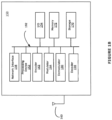
- Figure 1B illustrates an example processing system 150, which may be used to implement methods and systems described herein, such as the STA 102 or the AP 104.
- the processing system 150 may be a base station, a wireless router, a mobile device, for example, or any suitable processing system.
- Other processing systems suitable for implementing the present disclosure may be used, which may include components different from those discussed below.
- Figure 1B shows a single instance of each component, there may be multiple instances of each component in the processing system 150.
- the processing system 150 may include one or more processing devices 152, such as a processor, a microprocessor, an application-specific integrated circuit (ASIC), a field-programmable gate array (FPGA), a dedicated logic circuitry, or combinations thereof.
- the processing system 150 may also include one or more input/output (I/O) interfaces 154, which may enable interfacing with one or more appropriate input devices and/or output devices (not shown).
- I/O input/output
- One or more of the input devices and/or output devices may be included as a component of the processing system 150 or may be external to the processing system 150.
- the processing system 150 may include one or more network interfaces 158 for wired or wireless communication with a network, such as but not limited to, an intranet, the Internet, a P2P network, a WAN, LAN, a WLAN and/or a cellular or mobile communications network such as a 5G, 4G, LTE or other network as noted above.
- the network interface(s) 208 may include wired links (e.g., Ethernet cable) and/or wireless links (e.g., one or more radio frequency links) for intra-network and/or inter-network communications.
- the network interface(s) 158 may provide wireless communication via one or more transmitters or transmitting antennas, one or more receivers or receiving antennas, and various signal processing hardware and software, for example.
- a single antenna 160 is shown, which may serve as both transmitting and receiving antenna. However, in other examples there may be separate antennas for transmitting and receiving.
- the network interface(s) 158 may be configured for sending and receiving data to the backhaul network 110 or to other user devices, access points, reception points, transmission points, network nodes, gateways or relays (not shown) in the network 100.
- the processing system 150 may also include one or more storage units 170, which may include a mass storage unit such as a solid state drive, a hard disk drive, a magnetic disk drive and/or an optical disk drive.
- the processing system 150 may include one or more memories 172, which may include a volatile or non-volatile memory (e.g., a flash memory, a random access memory (RAM), and/or a read-only memory (ROM)).
- the non-transitory memory(ies) 172 may store instructions for execution by the processing device(s) 152, such as to carry out the present disclosure.
- the memory(ies) 172 may include other software instructions, such as for implementing an operating system and other applications/functions.
- one or more data sets and/or module(s) may be provided by an external memory (e.g., an external drive in wired or wireless communication with the processing system 150) or may be provided by a transitory or non-transitory computer-readable medium.
- Examples of non-transitory computer readable media include a RAM, a ROM, an erasable programmable ROM (EPROM), an electrically erasable programmable ROM (EEPROM), a flash memory, a CD-ROM, or other portable memory storage.
- the processing system 150 may include an encoder 162 for encoding source words to codewords and/or a modulator 164 for modulating codewords to symbols.
- the encoder 162 may perform encoding on source words to generate codewords in bits.
- the modulator 164 may then perform modulation on the codewords (e.g., by modulation techniques such as BPSK, QPSK, 16QAM, or 64QAM).
- instructions coded in the memory 172 may configure processing device 152 to perform the functions of the encoder 162 and/or the modulator 164, such that the encoder 162 and/or the modulator 164 may not be distinct modules of the processing system 150.
- the encoder 162 and the modulator 164 may be embodied within a transmitter module in the processing system 150.
- the transmitting antenna 160, the encoder 162, and the modulator 164 may be embodied as a transmitter component external to the processing system 150, and may simply communicate the source words from the processing system 150.
- the processing system 150 may include a demodulator 180 and a decoder 190, for processing a received signal.
- the demodulator 180 may perform demodulation on a received modulated signal (e.g., a BPSK, QPSK, 16QAM, or 64QAM signal).
- the decoder 190 may then perform appropriate decoding on the demodulated signal, in order to recover the original signal contained in the received signal.
- instructions coded in the memory 172 may configure processing device 152 to perform the functions of the demodulator 180 and/or the decoder 190, such that the demodulator 180 and/or the decoder 190 may not be distinct modules of the processing system 150.
- the demodulator 180 and the decoder 190 may be embodied within a receiver module in the processing system 150.
- the receiving antenna 160, demodulator 180 and decoder 190 may be embodied as a receiver component external to the processing system 150, and may simply communicate the signal decoded from the received signal to the processing system 150.
- bus 192 providing communication among components of the processing system 150, including the processing device(s) 152, I/O interface(s) 154, network interface(s) 158, encoder 162, modulator 164, storage unit(s) 170, memory(ies) 172, demodulator 180 and decoder 190.
- the bus 192 may be any suitable bus architecture including, for example, a memory bus, a peripheral bus or a video bus.
- Communications between the STA 102 and the AP 104 in the network 100 are implemented by encoding source words to be transmitted using low density parity check (LDPC) encoding techniques, and/or by decoding codewords received using LDPC code decoding techniques.
- LDPC low density parity check
- the encoded codewords are transmitted in a signal from the AP 104 to the STA 102 or from the STA 102 to the AP 104
- the LDPC encoding information of the transmitted signal may be included in the frame transmitted.
- the STA 102 or the AP 104 selects appropriate LDPC decoding technologies to decode the received signal.
- Figure 2A represents an example implementation of a transmitter of the STA 102 or the AP 104.
- the transmitter may include a source words segmenting module 202, a LDPC encoder 204, a bit-to-symbol mapping modulator 206, and a blocking module 208.
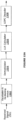
- FIG. 2B illustrates example steps of processing input information bit stream by the transmitter.
- the source words segmenting module 202 may be used to segment the input information bit streams into source words with appropriate sizes (step 222). For example, with the source words segmenting module 202, the input information bit streams may be segmented into source words with sizes of 336 bits (for 1 ⁇ 2 code rate in 802.11ad), 420 bits (for 5/8 code rate in 802.11ad), 504 bits (for 3/4 code rate in 802.11ad), 546 bits (for 13/16 code rate in 802.11ad), and 588 bits (for 7/8 code rate with codeword size of 672 bits).
- a source word of K bits may be considered as a 1 ⁇ K row vector or a one-dimensional binary 1 ⁇ K matrix.
- a 588 bits source word may be considered as a 1 ⁇ 588 rows vector or a one-dimensional binary 1X588 matrix.
- the source words then may be encoded to codewords with the LDPC encoder 204 (step 224).
- Figure 3 represents an example implementation of the LDPC encoder 204.
- the LDPC encoder 204 may include a LDPC matrix generator 302, a generator matrix module 304, a source word input interface 306, and a codewords generator 308.
- LDPC codes functionally are defined by a sparse parity-check matrix.
- An (n, k) LDPC code is a linear binary block code C with a k-dimensional subspace of ⁇ 0, 1 ⁇ n .
- H [ P ( n-k ) ⁇ k I ( n-k ) ], where P ( n-k ) ⁇ k is a binary matrix and I ( n-k ) is the identify matrix of order n-k.
- the generator matrix module 304 may generate a generator matrix G .
- the generator matrix G is a binary KxN matrix.
- the generator matrix module 304 then forwards the generated binary (KxN) generator matrix G to the codewords generator 308.
- the encoded codewords c then may be modulated to symbols at bit-to-symbol mapping modulator 206 (step 226).
- Suitable modulation techniques may be, but is not limited to, BPSK, QPSK, 16QAM, or 64QAM.
- BPSK, QPSK and 16QAM modulations are specified in 802.11ad.
- 64QAM modulation is adopted in 802.11REVmc.
- binary bits are simply mapped to be bipolar ⁇ -1, 1 ⁇ symbols.
- QPSK, 16QAM and 64QAM modulations the input encoded bit streams (codewords c in bits) are grouped into sets of 2, 4 and 6 bits, respectively.
- Each set of bits is mapped to a symbol on the corresponding constellations.
- a symbol represents 1 bit, 2 bits, 4 bits, and 6 bits, respectively.
- a plurality of the symbols may be grouped as a modulated codewords.
- the modulated codewords may include 336 symbols (for SC QPSK blocking in 802.11 ad), 168 symbols (for SC 16QAM blocking in 802.11ad), 112 symbols (for SC 64QAM blocking in 802.11ad).
- the modulated codewords may be further assembled into data blocks (BLKs) with appropriate size in the blocking module 208(step 228).
- the assembled data blocks may contain 448 symbols as specified in the 802.11ad standard.
- the transmitter in Figure 2 therefore may be used to generate the data blocks required in the 802.11ad standard.
- FIG. 4A illustrates an example single carrier (SC) frame structure of 802.11ad standard.
- the frame includes short training field (STF), channel estimation (CE) field, PHY Header, SC data blocks (BLKs) and optional automatic gain control (AGC) and TRN-R/T subfields for beam forming training.
- STF short training field
- CE channel estimation
- BLKs SC data blocks
- AGC automatic gain control
- TRN-R/T subfields for beam forming training.
- a SC frame of 802.11ad standard may include a plurality BLKs, as shown in Figures 4A and 4B .
- FIG. 4B illustrates an example construction of SC data blocks (BLKs) according to the 802.11ad standard.
- each BLK consists of 448 symbols.
- a 64 bits guard interval (GI) is used between every two adjacent BLKs to separate adjacent data blocks.
- LDPC encoded codewords are generated through operations of source words and the generator matrix G , and as the generator matrix G is derived from LDPC parity check matrix H, an LDPC parity check matrix H effects encoding source words to codewords.
- the design of the LDPC parity check matrix H may improve the performance of the code.
- the parity-check matrice H may be further partitioned into square submatrices of size ZXZ. Z is a lifting factor.
- the submatrices are either cyclic-permutations of the identity matrix, or null submatrices with all zero entries.
- a location with index i denotes the cyclic-permutation submatrix Pi obtained from the Z ⁇ Z identity matrix P 0 by cyclically shifting the columns to the right by i elements.
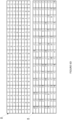
- FIGS 5A-5D illustrate the parity check matrices of four LDPC codes specified in 802.11ad with the rates of 1/2, 5/8, 3/4, and 13/16.
- each LDPC code has a common codeword length of 672 bits.
- the code rate K/N denotes that a K bits source word is encoded to an N bits codeword.
- the codeword length N is 672 bits. Therefore, for the code rates of 1/2, 5/8, 3/4, and 13/16, the sizes of the corresponding source word are 336 bits, 420 bits, 504 bits, and 546 bits, respectively.
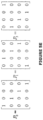
- Figure 5E illustrates an example of the cyclic permutation submatrices P 1 and P 3 obtained from the Z ⁇ Z identity matrix P 0 .
- P 1 is obtained by shifting the columns of P 0 to the right by one element
- P 3 obtained is obtained by shifting the columns of P 0 to the right by three elements.
- submatrix with the value "0" represents P 0 which is a 42 ⁇ 42 identity submatrix
- the first submatrix with the value "40" in Figure 5A is obtained by shifting the columns of P 0 to the right by 40 elements.
- any non-zero value i submatrices P i in Figures 5B-5D can also be obtained from the respective identity matrix P 0 .
- the blank entries represent Z ⁇ Z submatrices with all zero entries.
- Figures 6A-6D illustrate four LDPC codes proposed in 802.11ay with the rates of 13/16, 3/4, 5/8 and 1/2.
- the code rate K/N denotes that a K bits source word is encoded to an N bits codeword.
- the codeword length N is 1344 bits. Therefore, for the code rates of 13/16, 3/4, 5/8 and 1/2, the sizes of the corresponding source word are 1092, 1008, 840 and 672 bits, respectively.
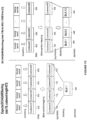
- the LDPC codes illustrated in Figures 6A-6D are generated by two-step lifting.
- the lifting matrix 602 has the same rows and columns of submatrices as the rate 13/16 base matrix 604 of 802.11ad.
- the lifting matrix 602 is proposed in the IEEE 802.11ay standardization to provide a second lifting.
- Each entry in the lifting matrix 602 has one of the three possible values "1", "0", and "-1". If a submatrix of the base matrix 604 is null, which is denoted as "-1", the corresponding entry in the lifting matrix 604 is also denoted as "-1".
- the entry at row 1, column 16 of the lifting matrix 604 corresponds to the submatrix at row 1, column 16 of the base matrix 602.
- Both the entry of the lifting matrix 604 and the submatrix of the base matrix 602 have the value of "-1".
- the lifting matrix 602 is applied to the 13/16 LDPC base matrix 604 with codeword length of 672.
- the lifting matrix 602 is applied to the 13/16 LDPC base matrix 604 with codeword length of 672.
- a submatrix having a value "V" of the base matrix 604 if the entry of the corresponding lifting matrix 602 has a value of "1”, applying the lift matrix 602 to the base matrix 604 generates 4 submatrices as follows: -1 V V -1
- the corresponding entries of the lifting matrix 602 also have the value of "-1". Applying the one entry with the value of "-1" in the lifting matrix 602 to the corresponding submatrix in the base matrix 604 generates four null submatrices.
- the LDPC codes with codeword length of 1344 may also be generated by increasing the lifting factor Z.
- the 3/4 base matrix contains 4 rows ⁇ 16 columns of submatrices, and each submatrices has a size of Z ⁇ Z (42 ⁇ 42).
- the lifting factor Z increases from 42 to 84, the 3/4 base matrix containing 4 rows ⁇ 16 columns of submatrices will become 336 rows ⁇ 1344 columns.
- 802.11ad standard does not specify LDPC codes with code rate of 7/8.
- a rate 7/8 LDPC code with codeword length of 624 is introduced in 802.11 REVmc.
- the rate 7/8 LDPC code of 802.11 REVmc is generated by puncturing the first 48 parity bits from rate 13/16 codewords based on the existing rate 13/16 LDPC code specified in 802.11ad.
- a transmitter does not transmit the punctured bits, and the receiver puts equal likelihood for 1/0 for the punctured bits.
- the sizes of a source word and a codeword of the rate 7/8 code are 546 bits and 624 bits, respectively.
- a rate 7/8 LDPC code with codeword length of 1248 is introduced in 802.11 ay.
- the rate 7/8 LDPC code of 802.11ay is generated by puncturing the first 96 parity bits from rate 13/16 LDPC code with codeword length of 1344.
- a transmitter does not transmit the punctured bits, and the receiver puts equal likelihood for 1/0 for the punctured bits.
- the sizes of a source word and a codeword of the rate 7/8 code are 1092 bits and 1248 bits, respectively.
- the sizes of the LDPC codewords have been changed from the standard 672 bits in 802.11ad to 624 bits in 802.11 REVmc, and from 1344 bits for rates 1/2, 5/8, 3/4 and 13/16 to 1248 bits for rate 7/8 in 802.11ay.
- the modulated codewords are still to be assembled into data blocks with a block size of 448 symbols in 802.11ad, or 896 symbols in 802.11ay, the blocking process that assembles the modulated codewords into data blocks has to be changed accordingly.
- These changes in assembling data blocks require additional processes to implement encoding and decoding for the 7/8 LDPC code introduced in 802.11 REVmc or the LDPC code proposed to 802.11ay.
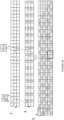
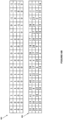
- FIG. 7A shows examples of SC QPSK blocking in 802.11ad and 802.11REVmc.
- 802.11REVmc as the first 48 parity bits have been punctured from the rate 13/16 LDPC code, each of the encoded codeword contains 624 bits, and with QPSK, one 624 bits codeword after modulation becomes one 312 symbols codeword.
- Figure 7B shows examples of SC 16QAM blocking in 802.11ad and 802.11REVmc.
- 802.11REVmc as each of the encoded codeword contains 624 bits, and with 16QAM, one 624 bits codeword after modulation becomes one 156 symbols codeword.
- Figure 7C shows examples of SC 64QAM blocking in 802.11ad and 802.11REVmc.
- 802.11ad with 64QAM, one 672 bits codeword after modulation becomes one 112 symbols codeword.
- 802.11REVmc one 624 bits codeword after modulation becomes one 104 symbols codeword.
- the blocking process becomes more complex: every 13 data blocks are constructed from 56 codewords, and each data block is constructed from five or six codewords.
- G is a K ⁇ N generator matrix.
- G may then be derived from H, namely, "T” denotes the matrix P (n-k)k transpose.
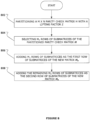
- the M ⁇ N parity check matrix H may be further partitioned into square submatrices of size Z ⁇ Z (step 802).
- the partitioned parity check matrix H contains submatrices of (M/Z) rows ⁇ (N/Z) columns. In other words, the partitioned parity check matrix H contains M/Z check nodes and N/Z variable nodes.
- the K/N rate LPDC code may be obtained by generating a new parity check matrix H n , with the lifting factor Z, from the partitioned parity check matrix H .
- Each of the remaining rows ((M/Z)-m 1 ) of submatrices of the partitioned parity check matrix H becomes one row of the new matrix H n .
- the M ⁇ 672 parity check matrix H may be further partitioned into square matrices of size 42 ⁇ 42.
- the partitioned parity check matrix H contains submatrices of (M/42) rows ⁇ (672/42) columns.
- the partitioned parity check matrix H contains M check nodes and 672 variable nodes.
- the LDPC matrix generator 302 adds m 1 rows of the submatrices of the partitioned parity check matrix H as the first submatrix row of the new matrix H n .
- the M ⁇ 1344 parity check matrix H may be further partitioned into square matrices of size 84 ⁇ 84.
- the partitioned parity check matrix H contains submatrices of (M/84) rows ⁇ (1344/84) columns. In other words, the partitioned parity check matrix H contains M check nodes and 1344 variable nodes.
- the LDPC matrix generator 302 adds m 1 rows of the submatrices of the partitioned parity check matrix H as the first submatrix row of the new matrix H n .
- the LDPC matrix generator 302 adds m 2 rows of the submatrices of the partitioned parity check matrix H as the second submatrix row of the new matrix H n .
- the M ⁇ 1344 parity check matrix H may be further partitioned into square matrices of size 42x42.
- the partitioned parity check matrix H contains submatrices of (M/42) rows ⁇ (1344/42) columns. In other words, the partitioned parity check matrix H contains M check nodes and 1344 variable nodes.
- the LDPC matrix generator 302 adds m 1 rows of the submatrices of the partitioned parity check matrix H as the first submatrix row of the new matrix H n .
- the LDPC matrix generator 302 adds m 2 rows of the submatrices of the partitioned parity check matrix H as the second submatrix row of the new matrix H n .
- the LDPC matrix generator 302 adds m 3 rows of the submatrices of the partitioned parity check matrix H as the third submatrix row of the new matrix H n . Finally, the LDPC matrix generator 302 adds up m 4 rows from the remaining rows of the submatrices of the partitioned parity check matrix H as the fourth row of submatrix of the new matrix H n .
- At least one of the submatrices of the new row contains m 1 , m 2 m 3 , or m 4 diagonals of "1", as shown in the example of Figure 11 , which will be discussed below.
- the 7/8 rate LDPC code may be obtained by selecting the first row with the second row of partitioned submatrices of the rate 13/16 LDPC parity check matrix H in 802.11ad, and adding the first row with the second row of partitioned submatrices as the first row of the new LDPC parity check matrix H n ,. The remaining third row is selected as the second row of the new LDPC parity check matrix H n .
- the new LDPC parity check matrix H n contains 2 rows ⁇ 16 columns submatrices of 42 ⁇ 42, as illustrated in Figure 9A .
- the 7/8 rate LDPC code may be obtained by selecting the first row with the second row of partitioned submatrices of the rate 13/16 LDPC parity check matrix H of codeword length of 1344, and adding the first row with the second row of partitioned submatrices as the first row of the new LDPC parity check matrix H n ,. The remaining third row is selected as the second row of the new LDPC parity check matrix H n .
- the 7/8 rate LDPC parity check matrix H n may be generated by selecting the second row of partitioned submatrices of the rate 13/16 LDPC parity check matrix H in 802.11ad as the first row of the new LDPC parity check matrix H n , and then by selecting the first row and the third row of partitioned submatrices of the rate 13/16 LDPC parity check matrix H, and adding the first row with the third row of partitioned submatrices as the second row of the new LDPC parity check matrix H n .
- the new LDPC parity check matrix H n contains 2 rows ⁇ 16 columns submatrices of 42 ⁇ 42, as illustrated in Figure 10B .
- the new LDPC parity check matrix H n contains 2 rows ⁇ 16 columns submatrices of 84 ⁇ 84.
- the LDPC matrix generator 302 may select and add any two rows of partitioned submatrices of the rate 13/16 LDPC parity check matrix H to generate one row of the new 7/8 rate LDPC parity check matrix H n .
- the LDPC matrix generator 302 may select the remaining one row of partitioned submatrices of the rate 13/16 LDPC parity check matrix H as another row of the new 7/8 rate LDPC parity check matrix H n .
- the parity check matrix of a 7/8 rate LDPC parity check matrix H n is generated by selecting the first row and the third row of partitioned submatrices of the rate 3/4 LDPC parity check matrix H of Fig. 5C , and adding the first row with the third row of partitioned submatrices as the first row of the new LDPC parity check matrix H n ,. The remaining second row and the fourth row of the partitioned submatrices are then selected and added as the second row of the new LDPC parity check matrix H n .
- a 7/8 rate LDPC parity check matrix H n may be generated by first selecting the second row and the third row of partitioned submatrices of the rate 3/4 LDPC parity check matrix H of Fig. 5C , and adding the selected second row and the third row of partitioned submatrices as the first row of the new LDPC parity check matrix H n . The remaining fist row and the fourth row of the partitioned submatrices may then be selected and added as the second row of the new LDPC parity check matrix H n .
- the generated matrix 606 H has submatrices of 6 rows ⁇ 32 columns, each submatrix has a size of a 42 ⁇ 42.
- any three rows of the submatrices of the generated 1344 code matrix 606 in Figure 6A may be added as one row of the new 7/8 rate LDPC parity check matrix H n , and the remaining three rows become the three row of the 7/8 rate LDPC matrix H n with codeword length 1344.
- any two rows of the submatrices may be selected from the six rows of the generated matrix 606 H with codeword length 1344 in Figure 6A .
- the two selected rows then may be added as one row of the new 7/8 rate LDPC parity check matrix H n .
- Another two rows may be selected from the remaining four rows of the submatrices of matrix 606 H and added as another row of the new 7/8 rate LDPC parity check matrix H n .
- the remaining two rows of matrix 606 H become the remaining two rows of the 7/8 rate LDPC matrix H n with codeword length 1344.
- the selected rows are derived from different rows of the base parity check matrix 604.
- a K/N rate LDPC parity check matrix H n and/or its corresponding generator matrix G may be pre-stored in a memory of a transmitter for encoding a source word or in a memory of a receiver for decoding a demodulated codeword.
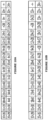
- the submatrix in Figure 9A indicated with "37+29" in parity-check matrix H n of the 7/8 code obtained by adding first row with the second row of the rate 13/16 parity-check matrix H of the LDPC in 802.11ad, or adding the second row with the third row of the rate 3/4 parity-check matrix H of the LDPC in 802.11ad, as the first row of the new LDPC parity check matrix H n .
- the submatrix indicated with "37+29” shows two diagonals of "1". The first diagonal of "1" is from columns 0-36 and then from columns 37-41, and the second diagonal of "1" is from columns 0-28 and then from columns 29-41.
- variable node degree distribution of the code remains unchanged, while the degree of the check nodes doubles, namely, there are two "1" in each row.
- degree of the check nodes doubles, namely, there are two "1" in each row.
- m 3 and m 4 rows may also be selected from the remaining submatrices of the partitioned parity check matrix H, and may also be added as a third or fourth row of the new matrix H n .
- At least one of the submatrices of the new row contains m 1 m 2 , m 3 , or m 4 diagonals of "1", if the at least one submatrix are generated by all of the m 1 m 2 , m 3 , or m 4 non-null submatrices.
- variable node degree distribution of the code remains unchanged, while the degree of the check nodes is m 1 m 2 , m 3 , or m 4 , namely, there are m 1 m 2 , m 3 , or m 4 "1"s in each row.
- eIRA enhanced irregular repeat accumulate
- the design algorithm allows, when necessary, constituent submatrices with two or more diagonals with different cyclic shifts.
- the submatrix with the value "9+24+31" contains three diagonals.
- the first row 1202 is a submatrix index and does not form part of H 1 .
- the second and third rows 1204 are the submatrices of H1 and are used to generate the LDPC matrix H.
- the matrix H1 1201 of the code has only 2 rows 1204 of submatrices of size 42 ⁇ 42,
- the variable node degree may be up to 4, for example, the first column (9+24+31)+41.
- the matrix H1 1201 of the code has only 2 rows 1204 of submatrices of size 84 ⁇ 84.
- H2 is a 168x168 full-rank matrix.
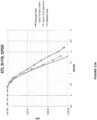
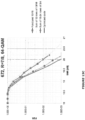
- the codewords in Figures 13A , 13B , and 13C are modulated by QPSK, 16QAM, and 64QAM, respectively.
- the 7/8 rate LDPC parity check H n generated by adding rows 1 and 3, and rows 2 and 4 of 3/4 code and optimized code by juxtaposing H1 and H2 generally yield a lower frame error rate (FER) .
- the 7/8 rate LDPC parity check H n generated by adding rows 1 and 3, and rows 2 and 4 of 3/4 code and optimized code by juxtaposing H1 and H2 require lower SNR values to achieve a given FER.
- the 7/8 rate LDPC parity check H n generated by adding rows 1 and 2 generally has a slightly higher FER.
- the codeword length of this code is 672, which is the same as that of other codes specified in 802.11ad, the implementation of blocking and de-blocking of this 7/8 rate LDPC parity check H n is unchanged while the implementation of blocking and de-blocking of the 7/8 code punctured from the 13/16 code of 802.11ad requires extra modification at the transmitter and the receiver.
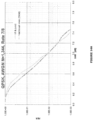
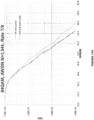
- the codewords in Figures 14A , 14B , and 14C are modulated by QPSK, 16QAM, and 64QAM, respectively.
- SNR signal noise ratio
- the 7/8 rate LDPC parity check H n generated by rows 1 and 3, and rows 2 and 4 of 3/4 code generally have a lower frame error rate (FER).
- An LDPC encoded signal may be received at a receiver of the STA 102 or AP 104.
- the receiver includes an equalization and de-blocking module 1502, a demodulator 1504, an LLR calculator 1506, and an LDPC decoder 1508.
- the LLR calculator 1506 can be a component of the demodulator 1504.
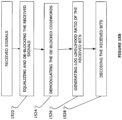
- the equalization and de-blocking module 1502 first equalizes the received signal 1501 to reduce intersymbol interference caused by the channel through which the received signal is transmitted, and then de-blocks the equalized signal to recover the codewords symbols (step 1522).
- the demodulator 1504 demodulates the de-blocked codewords symbols to codewords in bits (step 1524), for example, by BPSK, QPSK, 16QAM, or 64QAM.
- An LLR calculator 1504 may be used to generate a log likelihood ratio of the bits value of de-blocked codeword symbols (step 1526). The log likelihood ratio may be used as the input of the LDPC decoder 1508.
- the LDPC decoder 1508 may then use the LDPC matrix H n that is used in encoding the source words to decode the demodulated signal, the signal having a 1 ⁇ N row vector 5 (step 1528).
- a valid codeword c [ c 1 ,..., c n ]
- the H c T 0.
- Various algorithms are available to decode the LDPC encoded signal, for example, message passing algorithm.
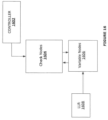
- Figure 16 is an example LDPC decoder using message passing algorithm to decode the LDPC encoded source words. Other decoding algorithm may also be used to implement the LDPC decoding.
- the LDPC decoder 1508 may include a controller 1602, a check nodes module 1604 and a variable node module 1606.
- the methods of generating the parity check matrix have been described in the encoding process.
- the codewords in bits may be decoded with the H n , for example, using the message passing algorithm (MPA) with the LLR values.
- MPA message passing algorithm
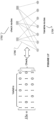
- the LDPC decoding with MPA is an iterative decoding algorithm that uses the structure of the Tanner graph, which is the graphical representation of the LPDC parity check matrix H n .
- each check node 1702 determines the value of an erased bit based on the LLR value if it is the only erased bit in its parity-check equation.
- each variable node 1704 sends a message ("extrinsic information") to each check node 1702 to which the variable node 1704 is connected.
- Each check node 1702 sends a message (“extrinsic information”) to variable nodes 1704 to which the check node 1702 is connected.
- "Extrinsic" in this context means that the information the check nodes 1702 or variable nodes 1704 already possess is not passed to that node.
- the cyclic shift structure simplifies the decoder architecture that allows to feed the parallel processors with a simple barrel shifter.
- processors are not initialized after the end of the first layer but rather they continue processing the next 16 edges of the superimposed submatrix-row. This process will repeat for m 1 times.
- the decoding complexity thus remains the same as the one of the original code, and the existing hardware architecture can be reused.
- the present disclosure provides certain example algorithms and calculations for implementing examples of the disclosed methods and systems. Although the present disclosure describes methods and processes with steps in a certain order, one or more steps of the methods and processes may be omitted or altered as appropriate. One or more steps may take place in an order other than that in which they are described, as appropriate.
- the present invention may be implemented by using hardware only, or by using software and a necessary universal hardware platform, or by a combination of hardware and software. Based on such understandings, the technical solution of the present invention may be embodied in the form of a software product.
- the software product may be stored in a non-volatile or non-transitory storage medium, which can be a compact disk read-only memory (CD-ROM), USB flash drive, or a hard disk.
- the software product includes a number of instructions that enable a computer device (personal computer, server, or network device) to execute the methods provided in the embodiments of the present invention.
Landscapes
- Physics & Mathematics (AREA)
- Mathematical Physics (AREA)
- Engineering & Computer Science (AREA)
- Probability & Statistics with Applications (AREA)
- Theoretical Computer Science (AREA)
- General Physics & Mathematics (AREA)
- Computational Mathematics (AREA)
- Mathematical Analysis (AREA)
- Mathematical Optimization (AREA)
- Pure & Applied Mathematics (AREA)
- Algebra (AREA)
- Computing Systems (AREA)
- Error Detection And Correction (AREA)
Claims (9)
- Verfahren zum Codieren eines Quellenworts, umfassend:Empfangen eines 1 × K Quellenwortreihenvektors
u ; undErzeugen (224) eines 1 × N Codewortvektorsc =u - G, wobei G eine K × N Erzeugermatrix für einen Paritätsprüfungscode mit niedriger Dichte ("Low Density Parity Check code", LDPC-Code) mit einer LDPC-Matrix Hn ist,die Matrix Hn einen Lifting-Faktor Z aufweist und wobei die Matrix Hn zwei Reihen und sechzehn Spalten von Teilmatrizen umfasst, wobei jede Teilmatrix eine Größe von Z × Z mit Z = 42 oder Z = 84 aufweist, und wobei mindestens eine Teilmatrix m1 Diagonalen von "1" aufweist, und wobei m1 = 2 ist undwobei die Matrix Hn lautet:37+35 31+19 18+41 23+22 11+40 21+41 6+39 120+6 32+28 9+18 12+17 29+3 -+28 0+- 13+- -+- 25+29 22+30 4+0 34+8 31+33 3+22 14+17 15+4 4+27 -+28 14+20 18+27 13+24 13+23 22+- 24+- wobei "-+-" die Z × Z Teilmatrix mit allen Einträgen gleich Null ist, "i+-" die Z × Z Teilmatrix ist, die durch ein zyklisches Verschieben der Spalten der Z × Z Identitätsmatrix um i Elemente nach rechts erhalten wird, "-+i" gleich "i+-" ist und "i+j" die Summe der Z × Z Teilmatrizen "i+-" und "-+j" ist, wobei i und j nicht-negative ganze Zahlen sind. - Verfahren nach Anspruch 1,
wobei der 1 × N Codewortvektor erzeugt wird, indem die Matrix Hn aus einer ersten M × N Paritätsprüfungsmatrix H erzeugt wird, wobei die Matrix Hn erzeugt wird, durch:Partitionieren (802) der ersten Paritätsprüfungsmatrix H, mit einem Lifting-Faktor von Z, wobei M = 4 Z ist, N = 16 Z ist, in quadratische Teilmatrizen der Größe Z × Z, wobei die partitionierte Paritätsprüfungsmatrix H (M/Z) Reihen und (N/Z) Spalten von Teilmatrizen enthält;Auswählen (804) von m1 Reihen aus den M/Z Reihen von Teilmatrizen der partitionierten Paritätsprüfungsmatrix H ; undHinzufügen (806) der m1 Reihen von Teilmatrizen der partitionierten Paritätsprüfungsmatrix H, um eine erste Reihe von Teilmatrizen der Matrix Hn zu erhalten. - Verfahren nach Anspruch 2, das außerdem ein Hinzufügen (808) von m2 Reihen aus den verbliebenen Reihen der Teilmatrizen der partitionierten Paritätsprüfungsmatrix H umfasst, um eine zweite Reihe von Teilmatrizen der Matrix Hn zu erhalten, und wobei m2 = 2 ist.
- Verfahren nach Anspruch 1 oder 2, wobei K = 588 ist und die Matrix Hn 84 Reihen × 672 Spalten umfasst.
- Verfahren zum Decodieren eines Codeworts, umfassend:Empfangen eines demodulierten Signals, das einen 1 × N Reihenvektor S aufweist, undDecodieren (1528) des 1 × N Reihenvektors S mit einer Paritätsprüfungsmatrix mit niedriger Dichte ("Low Density Parity Check matrix", LDPC-Matrix) Hn , die in einem Codierungsprozess verwendet wird, undErzeugen eines 1 × N Vektors
c = [c 1 ....,cn ] , um einen 1 × K Quellenwortreihenvektoru wiederherzustellen, wobeiHnc T = 0 ist, und wobeidie Matrix Hn zwei Reihen und sechzehn Spalten von Teilmatrizen umfasst, wobei die Matrix Hn einen Lifting-Faktor Z mit Z = 42 oder Z = 84 aufweist, wobei jede Teilmatrix eine Größe von Z × Z aufweist, und wobei mindestens eine Teilmatrix m1 Diagonalen von " 1" aufweist, und wobei m1 = 2 ist undwobei die Matrix Hn lautet:37+35 31+19 18+41 23+22 11+40 21+41 6+39 20+6 32+28 9+18 12+17 29+3 -+28 0+- 13+- -+- 25+29 22+30 4+0 34+8 31+33 3+22 14+17 15+4 4+27 -+28 14+20 18+27 13+24 13+23 22+- 24+- wobei "-+-" die Z × Z Teilmatrix mit allen Einträgen gleich Null ist, "i+-" die Z × Z Teilmatrix ist, die durch ein zyklisches Verschieben der Spalten der Z × Z Identitätsmatrix um i Elemente nach rechts erhalten wird, "-+i" gleich "i+-" ist und "i+j" die Summe der Z × Z Teilmatrizen "i+-" und "-+j" ist, wobei i und j nicht-negative ganze Zahlen sind. - Verfahren nach Anspruch 5, wobei der 1 × N Vektor
c = [c 1 ....,cn ] erzeugt wird, indem die Matrix Hn erzeugt wird durch:Partitionieren (802) einer ersten M × N Paritätsprüfungsmatrix H, mit einem Lifting-Faktor von Z, wobei M = 4 Z ist, N = 16 Z ist, in quadratische Teilmatrizen der Größe Z × Z, wobei die partitionierte Paritätsprüfungsmatrix H (M/Z) Reihen und (N/Z) Spalten von Teilmatrizen enthält;Auswählen (804) von m1 Reihen aus den M/Z Reihen von Teilmatrizen der partitionierten Paritätsprüfungsmatrix H ; undHinzufügen (806) der m1 Reihen von Teilmatrizen der partitionierten Paritätsprüfungsmatrix H, um eine erste Reihe von Teilmatrizen der Matrix Hn zu erhalten. - Verfahren nach Anspruch 6, das außerdem ein Hinzufügen (808) von m2 Reihen aus den verbliebenen Reihen der Teilmatrizen der partitionierten Paritätsprüfungsmatrix H umfasst, um eine zweite Reihe von Teilmatrizen der Matrix Hn zu erhalten, und wobei m2 = 2 ist.
- Verfahren nach Anspruch 6 oder 7, wobei K = 588 ist und die Matrix Hn 84 Reihen × 672 Spalten umfasst.
- System, umfassend: einen Prozessor und einen Speicher;
wobei der Speicher konfiguriert ist zum Speichern von Befehlen, die, wenn die Befehle von dem Prozessor verarbeitet werden, den Prozessor veranlassen, das Verfahren nach einem der Ansprüche 1 bis 8 durchzuführen.
Applications Claiming Priority (1)
| Application Number | Priority Date | Filing Date | Title |
|---|---|---|---|
| PCT/CN2016/090775 WO2018014272A1 (en) | 2016-07-20 | 2016-07-20 | Methods and systems for encoding and decoding for ldpc codes |
Publications (3)
| Publication Number | Publication Date |
|---|---|
| EP3479486A1 EP3479486A1 (de) | 2019-05-08 |
| EP3479486A4 EP3479486A4 (de) | 2019-07-10 |
| EP3479486B1 true EP3479486B1 (de) | 2023-05-31 |
Family
ID=60992754
Family Applications (1)
| Application Number | Title | Priority Date | Filing Date |
|---|---|---|---|
| EP16909200.4A Active EP3479486B1 (de) | 2016-07-20 | 2016-07-20 | Verfahren und systeme zur codierung und decodierung von ldpc-codes mit rate 7/8 |
Country Status (7)
| Country | Link |
|---|---|
| US (1) | US10868567B2 (de) |
| EP (1) | EP3479486B1 (de) |
| JP (1) | JP6798004B2 (de) |
| KR (1) | KR102227250B1 (de) |
| CN (1) | CN109417392B (de) |
| RU (1) | RU2716044C1 (de) |
| WO (1) | WO2018014272A1 (de) |
Families Citing this family (19)
| Publication number | Priority date | Publication date | Assignee | Title |
|---|---|---|---|---|
| JP2020515133A (ja) * | 2017-03-09 | 2020-05-21 | ホアウェイ・テクノロジーズ・カンパニー・リミテッド | 長ldpc符号用のmcs |
| JP6974493B2 (ja) | 2017-03-30 | 2021-12-01 | エルジー エレクトロニクス インコーポレイティドLg Electronics Inc. | 無線通信システムにおいてldpc符号のパリティ検査行列に基づいて符号化を行う方法及びそれを用いる端末 |
| WO2018203725A1 (en) * | 2017-05-04 | 2018-11-08 | Samsung Electronics Co., Ltd. | A method and apparatus for channel encoding and decoding in a communication or broadcasting system |
| RU2730444C1 (ru) * | 2017-06-25 | 2020-08-21 | ЭлДжи ЭЛЕКТРОНИКС ИНК. | Способ для выполнения кодирования на основе матрицы контроля по четности ldpc-кода в системе беспроводной связи и терминал с его использованием |
| US11539455B2 (en) | 2017-06-26 | 2022-12-27 | Intel Corporation | Apparatus, system and method of communicating a physical layer protocol data unit (PPDU) |
| WO2019031925A1 (ko) * | 2017-08-10 | 2019-02-14 | 삼성전자 주식회사 | 통신 또는 방송 시스템에서 채널 부호화/복호화 방법 및 장치 |
| WO2019079011A1 (en) | 2017-10-18 | 2019-04-25 | Intel IP Corporation | APPARATUS, SYSTEM AND METHOD FOR COMMUNICATING PHYSICAL LAYER PROTOCOL DATA UNIT (PPDU) |
| CN112514292B (zh) * | 2018-08-08 | 2022-03-29 | 华为技术有限公司 | 高效传输信息消息的发射装置和接收装置 |
| CN109639392B (zh) * | 2018-11-09 | 2020-03-27 | 清华大学 | 广播信道传输的空间耦合ldpc码的构造方法及系统 |
| CN110096384B (zh) * | 2019-04-23 | 2021-06-25 | 西安电子科技大学 | 高可靠航天数据及中间变量的保护方法 |
| US11177830B2 (en) | 2019-09-10 | 2021-11-16 | Samsung Electronics Co., Ltd. | Method and apparatus for data decoding in communication or broadcasting system |
| CN115336210B (zh) * | 2020-04-03 | 2025-07-15 | 华为技术有限公司 | 用于码字传输的方法和系统 |
| CN111431543B (zh) * | 2020-05-13 | 2023-08-01 | 东南大学 | 可变码长可变码率qc-ldpc译码方法及装置 |
| KR20230107872A (ko) * | 2020-10-15 | 2023-07-18 | 삼성전자주식회사 | 통신 또는 방송 시스템에서 데이터 복호화 방법 및 장치 |
| CN113114271B (zh) * | 2021-03-11 | 2025-01-28 | 苏州华兴源创科技股份有限公司 | 低密度奇偶校验编码装置和方法 |
| CN114095125B (zh) * | 2021-11-09 | 2024-07-05 | 湖南省时空基准科技有限公司 | 一种窄带数据广播的信道编码方法及设备 |
| CN115031314B (zh) * | 2022-06-01 | 2023-08-04 | 深圳市瑞尔时代科技有限公司 | 用于无人值守机房的节能控制系统 |
| WO2025053577A1 (ko) * | 2023-09-04 | 2025-03-13 | 삼성전자 주식회사 | 통신 또는 방송 시스템에서 데이터의 부호화 및 복호화 방법 및 장치 |
| WO2025053578A1 (ko) * | 2023-09-04 | 2025-03-13 | 삼성전자 주식회사 | 통신 또는 방송 시스템에서 데이터의 부호화 및 복호화 방법 및 장치 |
Citations (1)
| Publication number | Priority date | Publication date | Assignee | Title |
|---|---|---|---|---|
| US20040148560A1 (en) * | 2003-01-27 | 2004-07-29 | Texas Instruments Incorporated | Efficient encoder for low-density-parity-check codes |
Family Cites Families (21)
| Publication number | Priority date | Publication date | Assignee | Title |
|---|---|---|---|---|
| US7581157B2 (en) * | 2004-06-24 | 2009-08-25 | Lg Electronics Inc. | Method and apparatus of encoding and decoding data using low density parity check code in a wireless communication system |
| US7395490B2 (en) * | 2004-07-21 | 2008-07-01 | Qualcomm Incorporated | LDPC decoding methods and apparatus |
| US7346832B2 (en) * | 2004-07-21 | 2008-03-18 | Qualcomm Incorporated | LDPC encoding methods and apparatus |
| CN101128981B (zh) * | 2004-08-09 | 2013-03-20 | Lg电子株式会社 | 使用低密度奇偶校验矩阵的编码和解码方法 |
| RU2348103C2 (ru) * | 2004-08-10 | 2009-02-27 | Самсунг Электроникс Ко., Лтд. | Устройство и способ кодирования и декодирования блочного кода разреженного контроля четности |
| WO2006062351A1 (en) | 2004-12-08 | 2006-06-15 | Electronics And Telecommunications Research Institute | Ldpc encoder and decoder and ldpc encoding and decoding methods |
| KR100641052B1 (ko) * | 2004-12-08 | 2006-11-02 | 한국전자통신연구원 | Ldpc 부호기 및 복호기, 및 ldpc 부호화 방법 및복호화 방법 |
| US8010870B2 (en) | 2005-04-25 | 2011-08-30 | Sony Corporation | Coding apparatus and coding method |
| KR100929079B1 (ko) * | 2005-10-31 | 2009-11-30 | 삼성전자주식회사 | 저밀도 패리티 검사 부호를 사용하는 통신 시스템의 복호 장치 및 방법 |
| TW201334425A (zh) * | 2007-01-24 | 2013-08-16 | Qualcomm Inc | 可變大小之封包的低密度同位檢查編碼與解碼 |
| US8392787B2 (en) * | 2008-10-31 | 2013-03-05 | Broadcom Corporation | Selective merge and partial reuse LDPC (Low Density Parity Check) code construction for limited number of layers Belief Propagation (BP) decoding |
| CN101488761B (zh) * | 2009-02-27 | 2011-01-19 | 北京交通大学 | 一种无短环无低码重码的ldpc码构造方法 |
| JP4929342B2 (ja) * | 2009-12-15 | 2012-05-09 | インターナショナル・ビジネス・マシーンズ・コーポレーション | ノイズ分散による入力対数尤度比のスケーリングに基づくsum−product復号法(ビリーフプロパゲーション法)の計算手法 |
| US9634693B2 (en) * | 2010-08-12 | 2017-04-25 | Samsung Electronics Co., Ltd | Apparatus and method for decoding LDPC codes in a communications system |
| US8726122B2 (en) * | 2011-05-11 | 2014-05-13 | Samsung Electronics Co., Ltd. | High throughput LDPC decoder |
| US9100052B2 (en) * | 2013-02-01 | 2015-08-04 | Samsung Electronics Co., Ltd. | QC-LDPC convolutional codes enabling low power trellis-based decoders |
| KR20150005853A (ko) * | 2013-07-05 | 2015-01-15 | 삼성전자주식회사 | 송신 장치 및 그의 신호 처리 방법 |
| GB2510932B (en) * | 2013-08-27 | 2015-01-21 | Imagination Tech Ltd | An improved decoder for low-density parity-check codes |
| CN104779961B (zh) * | 2014-01-09 | 2019-02-26 | 上海数字电视国家工程研究中心有限公司 | 一种ldpc结构、码字及对应的编码器、解码器和编码方法 |
| US9276610B2 (en) * | 2014-01-27 | 2016-03-01 | Tensorcom, Inc. | Method and apparatus of a fully-pipelined layered LDPC decoder |
| US9692451B2 (en) * | 2014-09-30 | 2017-06-27 | Avago Technologies General Ip (Singapore) Pte. Ltd | Non-binary low density parity check (NB-LDPC) codes for communication systems |
-
2016
- 2016-07-20 JP JP2019502694A patent/JP6798004B2/ja active Active
- 2016-07-20 KR KR1020197004561A patent/KR102227250B1/ko active Active
- 2016-07-20 EP EP16909200.4A patent/EP3479486B1/de active Active
- 2016-07-20 WO PCT/CN2016/090775 patent/WO2018014272A1/en not_active Ceased
- 2016-07-20 RU RU2019104698A patent/RU2716044C1/ru active
- 2016-07-20 CN CN201680087431.3A patent/CN109417392B/zh active Active
-
2019
- 2019-01-18 US US16/251,373 patent/US10868567B2/en active Active
Patent Citations (1)
| Publication number | Priority date | Publication date | Assignee | Title |
|---|---|---|---|---|
| US20040148560A1 (en) * | 2003-01-27 | 2004-07-29 | Texas Instruments Incorporated | Efficient encoder for low-density-parity-check codes |
Non-Patent Citations (1)
| Title |
|---|
| ASSAF KASHER (INTEL): "SC-64-QAM-response-to-editor-comments ; 11-16-0541-00-000m-sc-64-qam-response-to-editor-comments", IEEE DRAFT; 11-16-0541-00-000M-SC-64-QAM-RESPONSE-TO-EDITOR-COMMENTS, IEEE-SA MENTOR, PISCATAWAY, NJ USA, vol. 802.11m, 17 April 2016 (2016-04-17), pages 1 - 6, XP068106702 * |
Also Published As
| Publication number | Publication date |
|---|---|
| JP2019522435A (ja) | 2019-08-08 |
| EP3479486A1 (de) | 2019-05-08 |
| CN109417392A (zh) | 2019-03-01 |
| US20190222229A1 (en) | 2019-07-18 |
| KR20190028788A (ko) | 2019-03-19 |
| RU2716044C1 (ru) | 2020-03-05 |
| US10868567B2 (en) | 2020-12-15 |
| CN109417392B (zh) | 2021-10-15 |
| JP6798004B2 (ja) | 2020-12-09 |
| KR102227250B1 (ko) | 2021-03-12 |
| WO2018014272A1 (en) | 2018-01-25 |
| EP3479486A4 (de) | 2019-07-10 |
Similar Documents
| Publication | Publication Date | Title |
|---|---|---|
| EP3479486B1 (de) | Verfahren und systeme zur codierung und decodierung von ldpc-codes mit rate 7/8 | |
| US11671115B2 (en) | High-rate long LDPC codes | |
| US12155475B2 (en) | Method and apparatus for encoding/decoding channel in communication or broadcasting system | |
| US20200083904A1 (en) | Apparatus and method for channel encoding/decoding in communication or broadcasting system | |
| EP3457574A1 (de) | Datenverarbeitungsverfahren und -vorrichtung für strukturierte ldpc-codes | |
| CN111357218B (zh) | 用于在通信或广播系统中对信道进行编码和解码的方法和设备 | |
| EP3542481B1 (de) | Vorrichtung und verfahren zur kanalcodierung/-decodierung in einem kommunikations- oder rundfunksystem | |
| EP3580865B1 (de) | Mcs für lange ldpc-codes | |
| JP7030932B2 (ja) | Ldpc符号の符号化および復号化のための方法およびシステム | |
| KR102378706B1 (ko) | 통신 또는 방송 시스템에서 채널 부호화/복호화 방법 및 장치 |
Legal Events
| Date | Code | Title | Description |
|---|---|---|---|
| STAA | Information on the status of an ep patent application or granted ep patent |
Free format text: STATUS: THE INTERNATIONAL PUBLICATION HAS BEEN MADE |
|
| PUAI | Public reference made under article 153(3) epc to a published international application that has entered the european phase |
Free format text: ORIGINAL CODE: 0009012 |
|
| STAA | Information on the status of an ep patent application or granted ep patent |
Free format text: STATUS: REQUEST FOR EXAMINATION WAS MADE |
|
| 17P | Request for examination filed |
Effective date: 20190129 |
|
| AK | Designated contracting states |
Kind code of ref document: A1 Designated state(s): AL AT BE BG CH CY CZ DE DK EE ES FI FR GB GR HR HU IE IS IT LI LT LU LV MC MK MT NL NO PL PT RO RS SE SI SK SM TR |
|
| AX | Request for extension of the european patent |
Extension state: BA ME |
|
| A4 | Supplementary search report drawn up and despatched |
Effective date: 20190607 |
|
| RIC1 | Information provided on ipc code assigned before grant |
Ipc: H03M 13/00 20060101ALI20190603BHEP Ipc: H03M 13/05 20060101ALI20190603BHEP Ipc: H03M 13/11 20060101AFI20190603BHEP |
|
| DAV | Request for validation of the european patent (deleted) | ||
| DAX | Request for extension of the european patent (deleted) | ||
| STAA | Information on the status of an ep patent application or granted ep patent |
Free format text: STATUS: EXAMINATION IS IN PROGRESS |
|
| 17Q | First examination report despatched |
Effective date: 20210401 |
|
| GRAP | Despatch of communication of intention to grant a patent |
Free format text: ORIGINAL CODE: EPIDOSNIGR1 |
|
| STAA | Information on the status of an ep patent application or granted ep patent |
Free format text: STATUS: GRANT OF PATENT IS INTENDED |
|
| INTG | Intention to grant announced |
Effective date: 20230109 |
|
| GRAS | Grant fee paid |
Free format text: ORIGINAL CODE: EPIDOSNIGR3 |
|
| GRAA | (expected) grant |
Free format text: ORIGINAL CODE: 0009210 |
|
| STAA | Information on the status of an ep patent application or granted ep patent |
Free format text: STATUS: THE PATENT HAS BEEN GRANTED |
|
| AK | Designated contracting states |
Kind code of ref document: B1 Designated state(s): AL AT BE BG CH CY CZ DE DK EE ES FI FR GB GR HR HU IE IS IT LI LT LU LV MC MK MT NL NO PL PT RO RS SE SI SK SM TR |
|
| REG | Reference to a national code |
Ref country code: GB Ref legal event code: FG4D Ref country code: CH Ref legal event code: EP |
|
| REG | Reference to a national code |
Ref country code: DE Ref legal event code: R096 Ref document number: 602016079761 Country of ref document: DE |
|
| REG | Reference to a national code |
Ref country code: AT Ref legal event code: REF Ref document number: 1571579 Country of ref document: AT Kind code of ref document: T Effective date: 20230615 |
|
| REG | Reference to a national code |
Ref country code: IE Ref legal event code: FG4D |
|
| P01 | Opt-out of the competence of the unified patent court (upc) registered |
Effective date: 20230524 |
|
| REG | Reference to a national code |
Ref country code: LT Ref legal event code: MG9D |
|
| REG | Reference to a national code |
Ref country code: NL Ref legal event code: MP Effective date: 20230531 |
|
| REG | Reference to a national code |
Ref country code: AT Ref legal event code: MK05 Ref document number: 1571579 Country of ref document: AT Kind code of ref document: T Effective date: 20230531 |
|
| PG25 | Lapsed in a contracting state [announced via postgrant information from national office to epo] |
Ref country code: SE Free format text: LAPSE BECAUSE OF FAILURE TO SUBMIT A TRANSLATION OF THE DESCRIPTION OR TO PAY THE FEE WITHIN THE PRESCRIBED TIME-LIMIT Effective date: 20230531 Ref country code: NO Free format text: LAPSE BECAUSE OF FAILURE TO SUBMIT A TRANSLATION OF THE DESCRIPTION OR TO PAY THE FEE WITHIN THE PRESCRIBED TIME-LIMIT Effective date: 20230831 Ref country code: ES Free format text: LAPSE BECAUSE OF FAILURE TO SUBMIT A TRANSLATION OF THE DESCRIPTION OR TO PAY THE FEE WITHIN THE PRESCRIBED TIME-LIMIT Effective date: 20230531 Ref country code: AT Free format text: LAPSE BECAUSE OF FAILURE TO SUBMIT A TRANSLATION OF THE DESCRIPTION OR TO PAY THE FEE WITHIN THE PRESCRIBED TIME-LIMIT Effective date: 20230531 |
|
| PG25 | Lapsed in a contracting state [announced via postgrant information from national office to epo] |
Ref country code: RS Free format text: LAPSE BECAUSE OF FAILURE TO SUBMIT A TRANSLATION OF THE DESCRIPTION OR TO PAY THE FEE WITHIN THE PRESCRIBED TIME-LIMIT Effective date: 20230531 Ref country code: PL Free format text: LAPSE BECAUSE OF FAILURE TO SUBMIT A TRANSLATION OF THE DESCRIPTION OR TO PAY THE FEE WITHIN THE PRESCRIBED TIME-LIMIT Effective date: 20230531 Ref country code: NL Free format text: LAPSE BECAUSE OF FAILURE TO SUBMIT A TRANSLATION OF THE DESCRIPTION OR TO PAY THE FEE WITHIN THE PRESCRIBED TIME-LIMIT Effective date: 20230531 Ref country code: LV Free format text: LAPSE BECAUSE OF FAILURE TO SUBMIT A TRANSLATION OF THE DESCRIPTION OR TO PAY THE FEE WITHIN THE PRESCRIBED TIME-LIMIT Effective date: 20230531 Ref country code: LT Free format text: LAPSE BECAUSE OF FAILURE TO SUBMIT A TRANSLATION OF THE DESCRIPTION OR TO PAY THE FEE WITHIN THE PRESCRIBED TIME-LIMIT Effective date: 20230531 Ref country code: IS Free format text: LAPSE BECAUSE OF FAILURE TO SUBMIT A TRANSLATION OF THE DESCRIPTION OR TO PAY THE FEE WITHIN THE PRESCRIBED TIME-LIMIT Effective date: 20230930 Ref country code: HR Free format text: LAPSE BECAUSE OF FAILURE TO SUBMIT A TRANSLATION OF THE DESCRIPTION OR TO PAY THE FEE WITHIN THE PRESCRIBED TIME-LIMIT Effective date: 20230531 Ref country code: GR Free format text: LAPSE BECAUSE OF FAILURE TO SUBMIT A TRANSLATION OF THE DESCRIPTION OR TO PAY THE FEE WITHIN THE PRESCRIBED TIME-LIMIT Effective date: 20230901 |
|
| PG25 | Lapsed in a contracting state [announced via postgrant information from national office to epo] |
Ref country code: FI Free format text: LAPSE BECAUSE OF FAILURE TO SUBMIT A TRANSLATION OF THE DESCRIPTION OR TO PAY THE FEE WITHIN THE PRESCRIBED TIME-LIMIT Effective date: 20230531 |
|
| PG25 | Lapsed in a contracting state [announced via postgrant information from national office to epo] |
Ref country code: SK Free format text: LAPSE BECAUSE OF FAILURE TO SUBMIT A TRANSLATION OF THE DESCRIPTION OR TO PAY THE FEE WITHIN THE PRESCRIBED TIME-LIMIT Effective date: 20230531 |
|
| PG25 | Lapsed in a contracting state [announced via postgrant information from national office to epo] |
Ref country code: SM Free format text: LAPSE BECAUSE OF FAILURE TO SUBMIT A TRANSLATION OF THE DESCRIPTION OR TO PAY THE FEE WITHIN THE PRESCRIBED TIME-LIMIT Effective date: 20230531 Ref country code: SK Free format text: LAPSE BECAUSE OF FAILURE TO SUBMIT A TRANSLATION OF THE DESCRIPTION OR TO PAY THE FEE WITHIN THE PRESCRIBED TIME-LIMIT Effective date: 20230531 Ref country code: RO Free format text: LAPSE BECAUSE OF FAILURE TO SUBMIT A TRANSLATION OF THE DESCRIPTION OR TO PAY THE FEE WITHIN THE PRESCRIBED TIME-LIMIT Effective date: 20230531 Ref country code: PT Free format text: LAPSE BECAUSE OF FAILURE TO SUBMIT A TRANSLATION OF THE DESCRIPTION OR TO PAY THE FEE WITHIN THE PRESCRIBED TIME-LIMIT Effective date: 20231002 Ref country code: EE Free format text: LAPSE BECAUSE OF FAILURE TO SUBMIT A TRANSLATION OF THE DESCRIPTION OR TO PAY THE FEE WITHIN THE PRESCRIBED TIME-LIMIT Effective date: 20230531 Ref country code: DK Free format text: LAPSE BECAUSE OF FAILURE TO SUBMIT A TRANSLATION OF THE DESCRIPTION OR TO PAY THE FEE WITHIN THE PRESCRIBED TIME-LIMIT Effective date: 20230531 Ref country code: CZ Free format text: LAPSE BECAUSE OF FAILURE TO SUBMIT A TRANSLATION OF THE DESCRIPTION OR TO PAY THE FEE WITHIN THE PRESCRIBED TIME-LIMIT Effective date: 20230531 |
|
| PG25 | Lapsed in a contracting state [announced via postgrant information from national office to epo] |
Ref country code: MC Free format text: LAPSE BECAUSE OF FAILURE TO SUBMIT A TRANSLATION OF THE DESCRIPTION OR TO PAY THE FEE WITHIN THE PRESCRIBED TIME-LIMIT Effective date: 20230531 |
|
| PG25 | Lapsed in a contracting state [announced via postgrant information from national office to epo] |
Ref country code: MC Free format text: LAPSE BECAUSE OF FAILURE TO SUBMIT A TRANSLATION OF THE DESCRIPTION OR TO PAY THE FEE WITHIN THE PRESCRIBED TIME-LIMIT Effective date: 20230531 |
|
| REG | Reference to a national code |
Ref country code: CH Ref legal event code: PL |
|
| REG | Reference to a national code |
Ref country code: DE Ref legal event code: R097 Ref document number: 602016079761 Country of ref document: DE |
|
| REG | Reference to a national code |
Ref country code: BE Ref legal event code: MM Effective date: 20230731 |
|
| PG25 | Lapsed in a contracting state [announced via postgrant information from national office to epo] |
Ref country code: LU Free format text: LAPSE BECAUSE OF NON-PAYMENT OF DUE FEES Effective date: 20230720 |
|
| PG25 | Lapsed in a contracting state [announced via postgrant information from national office to epo] |
Ref country code: LU Free format text: LAPSE BECAUSE OF NON-PAYMENT OF DUE FEES Effective date: 20230720 |
|
| PLBE | No opposition filed within time limit |
Free format text: ORIGINAL CODE: 0009261 |
|
| STAA | Information on the status of an ep patent application or granted ep patent |
Free format text: STATUS: NO OPPOSITION FILED WITHIN TIME LIMIT |
|
| REG | Reference to a national code |
Ref country code: IE Ref legal event code: MM4A |
|
| PG25 | Lapsed in a contracting state [announced via postgrant information from national office to epo] |
Ref country code: CH Free format text: LAPSE BECAUSE OF NON-PAYMENT OF DUE FEES Effective date: 20230731 |
|
| PG25 | Lapsed in a contracting state [announced via postgrant information from national office to epo] |
Ref country code: SI Free format text: LAPSE BECAUSE OF FAILURE TO SUBMIT A TRANSLATION OF THE DESCRIPTION OR TO PAY THE FEE WITHIN THE PRESCRIBED TIME-LIMIT Effective date: 20230531 |
|
| 26N | No opposition filed |
Effective date: 20240301 |
|
| PG25 | Lapsed in a contracting state [announced via postgrant information from national office to epo] |
Ref country code: SI Free format text: LAPSE BECAUSE OF FAILURE TO SUBMIT A TRANSLATION OF THE DESCRIPTION OR TO PAY THE FEE WITHIN THE PRESCRIBED TIME-LIMIT Effective date: 20230531 Ref country code: IT Free format text: LAPSE BECAUSE OF FAILURE TO SUBMIT A TRANSLATION OF THE DESCRIPTION OR TO PAY THE FEE WITHIN THE PRESCRIBED TIME-LIMIT Effective date: 20230531 Ref country code: BE Free format text: LAPSE BECAUSE OF NON-PAYMENT OF DUE FEES Effective date: 20230731 |
|
| PG25 | Lapsed in a contracting state [announced via postgrant information from national office to epo] |
Ref country code: IE Free format text: LAPSE BECAUSE OF NON-PAYMENT OF DUE FEES Effective date: 20230720 |
|
| PG25 | Lapsed in a contracting state [announced via postgrant information from national office to epo] |
Ref country code: IE Free format text: LAPSE BECAUSE OF NON-PAYMENT OF DUE FEES Effective date: 20230720 |
|
| PG25 | Lapsed in a contracting state [announced via postgrant information from national office to epo] |
Ref country code: BG Free format text: LAPSE BECAUSE OF FAILURE TO SUBMIT A TRANSLATION OF THE DESCRIPTION OR TO PAY THE FEE WITHIN THE PRESCRIBED TIME-LIMIT Effective date: 20230531 |
|
| PG25 | Lapsed in a contracting state [announced via postgrant information from national office to epo] |
Ref country code: BG Free format text: LAPSE BECAUSE OF FAILURE TO SUBMIT A TRANSLATION OF THE DESCRIPTION OR TO PAY THE FEE WITHIN THE PRESCRIBED TIME-LIMIT Effective date: 20230531 |
|
| PGFP | Annual fee paid to national office [announced via postgrant information from national office to epo] |
Ref country code: GB Payment date: 20250529 Year of fee payment: 10 |
|
| PGFP | Annual fee paid to national office [announced via postgrant information from national office to epo] |
Ref country code: FR Payment date: 20250610 Year of fee payment: 10 |
|
| PG25 | Lapsed in a contracting state [announced via postgrant information from national office to epo] |
Ref country code: CY Free format text: LAPSE BECAUSE OF FAILURE TO SUBMIT A TRANSLATION OF THE DESCRIPTION OR TO PAY THE FEE WITHIN THE PRESCRIBED TIME-LIMIT; INVALID AB INITIO Effective date: 20160720 |
|
| PG25 | Lapsed in a contracting state [announced via postgrant information from national office to epo] |
Ref country code: HU Free format text: LAPSE BECAUSE OF FAILURE TO SUBMIT A TRANSLATION OF THE DESCRIPTION OR TO PAY THE FEE WITHIN THE PRESCRIBED TIME-LIMIT; INVALID AB INITIO Effective date: 20160720 |
|
| PGFP | Annual fee paid to national office [announced via postgrant information from national office to epo] |
Ref country code: DE Payment date: 20250604 Year of fee payment: 10 |
|
| PG25 | Lapsed in a contracting state [announced via postgrant information from national office to epo] |
Ref country code: TR Free format text: LAPSE BECAUSE OF FAILURE TO SUBMIT A TRANSLATION OF THE DESCRIPTION OR TO PAY THE FEE WITHIN THE PRESCRIBED TIME-LIMIT Effective date: 20230531 |