EP3470452B1 - Verfahren zur herstellung von gusspolyamiden - Google Patents
Verfahren zur herstellung von gusspolyamiden Download PDFInfo
- Publication number
- EP3470452B1 EP3470452B1 EP18199581.2A EP18199581A EP3470452B1 EP 3470452 B1 EP3470452 B1 EP 3470452B1 EP 18199581 A EP18199581 A EP 18199581A EP 3470452 B1 EP3470452 B1 EP 3470452B1
- Authority
- EP
- European Patent Office
- Prior art keywords
- diisocyanate
- lactam
- catalyst
- activator
- temperatures
- Prior art date
- Legal status (The legal status is an assumption and is not a legal conclusion. Google has not performed a legal analysis and makes no representation as to the accuracy of the status listed.)
- Active
Links
- 0 *N(C(N(*)C(N1*)=O)=O)C1=O Chemical compound *N(C(N(*)C(N1*)=O)=O)C1=O 0.000 description 1
Classifications
-
- C—CHEMISTRY; METALLURGY
- C08—ORGANIC MACROMOLECULAR COMPOUNDS; THEIR PREPARATION OR CHEMICAL WORKING-UP; COMPOSITIONS BASED THEREON
- C08G—MACROMOLECULAR COMPOUNDS OBTAINED OTHERWISE THAN BY REACTIONS ONLY INVOLVING UNSATURATED CARBON-TO-CARBON BONDS
- C08G69/00—Macromolecular compounds obtained by reactions forming a carboxylic amide link in the main chain of the macromolecule
- C08G69/02—Polyamides derived from amino-carboxylic acids or from polyamines and polycarboxylic acids
- C08G69/08—Polyamides derived from amino-carboxylic acids or from polyamines and polycarboxylic acids derived from amino-carboxylic acids
- C08G69/14—Lactams
-
- C—CHEMISTRY; METALLURGY
- C08—ORGANIC MACROMOLECULAR COMPOUNDS; THEIR PREPARATION OR CHEMICAL WORKING-UP; COMPOSITIONS BASED THEREON
- C08G—MACROMOLECULAR COMPOUNDS OBTAINED OTHERWISE THAN BY REACTIONS ONLY INVOLVING UNSATURATED CARBON-TO-CARBON BONDS
- C08G69/00—Macromolecular compounds obtained by reactions forming a carboxylic amide link in the main chain of the macromolecule
- C08G69/02—Polyamides derived from amino-carboxylic acids or from polyamines and polycarboxylic acids
- C08G69/08—Polyamides derived from amino-carboxylic acids or from polyamines and polycarboxylic acids derived from amino-carboxylic acids
- C08G69/14—Lactams
- C08G69/16—Preparatory processes
-
- B—PERFORMING OPERATIONS; TRANSPORTING
- B29—WORKING OF PLASTICS; WORKING OF SUBSTANCES IN A PLASTIC STATE IN GENERAL
- B29C—SHAPING OR JOINING OF PLASTICS; SHAPING OF MATERIAL IN A PLASTIC STATE, NOT OTHERWISE PROVIDED FOR; AFTER-TREATMENT OF THE SHAPED PRODUCTS, e.g. REPAIRING
- B29C67/00—Shaping techniques not covered by groups B29C39/00 - B29C65/00, B29C70/00 or B29C73/00
- B29C67/24—Shaping techniques not covered by groups B29C39/00 - B29C65/00, B29C70/00 or B29C73/00 characterised by the choice of material
- B29C67/246—Moulding high reactive monomers or prepolymers, e.g. by reaction injection moulding [RIM], liquid injection moulding [LIM]
-
- C—CHEMISTRY; METALLURGY
- C08—ORGANIC MACROMOLECULAR COMPOUNDS; THEIR PREPARATION OR CHEMICAL WORKING-UP; COMPOSITIONS BASED THEREON
- C08G—MACROMOLECULAR COMPOUNDS OBTAINED OTHERWISE THAN BY REACTIONS ONLY INVOLVING UNSATURATED CARBON-TO-CARBON BONDS
- C08G69/00—Macromolecular compounds obtained by reactions forming a carboxylic amide link in the main chain of the macromolecule
- C08G69/02—Polyamides derived from amino-carboxylic acids or from polyamines and polycarboxylic acids
- C08G69/08—Polyamides derived from amino-carboxylic acids or from polyamines and polycarboxylic acids derived from amino-carboxylic acids
- C08G69/14—Lactams
- C08G69/16—Preparatory processes
- C08G69/18—Anionic polymerisation
-
- C—CHEMISTRY; METALLURGY
- C08—ORGANIC MACROMOLECULAR COMPOUNDS; THEIR PREPARATION OR CHEMICAL WORKING-UP; COMPOSITIONS BASED THEREON
- C08G—MACROMOLECULAR COMPOUNDS OBTAINED OTHERWISE THAN BY REACTIONS ONLY INVOLVING UNSATURATED CARBON-TO-CARBON BONDS
- C08G69/00—Macromolecular compounds obtained by reactions forming a carboxylic amide link in the main chain of the macromolecule
- C08G69/02—Polyamides derived from amino-carboxylic acids or from polyamines and polycarboxylic acids
- C08G69/08—Polyamides derived from amino-carboxylic acids or from polyamines and polycarboxylic acids derived from amino-carboxylic acids
- C08G69/14—Lactams
- C08G69/16—Preparatory processes
- C08G69/18—Anionic polymerisation
- C08G69/20—Anionic polymerisation characterised by the catalysts used
-
- B—PERFORMING OPERATIONS; TRANSPORTING
- B29—WORKING OF PLASTICS; WORKING OF SUBSTANCES IN A PLASTIC STATE IN GENERAL
- B29K—INDEXING SCHEME ASSOCIATED WITH SUBCLASSES B29B, B29C OR B29D, RELATING TO MOULDING MATERIALS OR TO MATERIALS FOR MOULDS, REINFORCEMENTS, FILLERS OR PREFORMED PARTS, e.g. INSERTS
- B29K2077/00—Use of PA, i.e. polyamides, e.g. polyesteramides or derivatives thereof, as moulding material
-
- B—PERFORMING OPERATIONS; TRANSPORTING
- B29—WORKING OF PLASTICS; WORKING OF SUBSTANCES IN A PLASTIC STATE IN GENERAL
- B29K—INDEXING SCHEME ASSOCIATED WITH SUBCLASSES B29B, B29C OR B29D, RELATING TO MOULDING MATERIALS OR TO MATERIALS FOR MOULDS, REINFORCEMENTS, FILLERS OR PREFORMED PARTS, e.g. INSERTS
- B29K2105/00—Condition, form or state of moulded material or of the material to be shaped
- B29K2105/0002—Condition, form or state of moulded material or of the material to be shaped monomers or prepolymers
Definitions
- the present invention relates to new processes for the production of cast polyamides.
- Cast polyamides are particularly high molecular weight polyamides.
- a lactam is poured into a mold together with at least one catalyst and at least one activator and then polymerized anionically in this mold.
- the starting compounds present in the form generally polymerize under the action of heat. This creates a homogeneous material that exceeds extruded polyamides in terms of crystallinity.
- Cast polyamides are suitable as thermoplastics for the manufacture of complex components. In contrast to many other thermoplastics, they do not have to be melted, but are created in just a few minutes by pressure-free anionic polymerization of a lactam in a mold at 120 to 150 ° C. All known casting processes such as static casting, rotational casting and centrifugal casting can be used.
- the end product is molded parts made of a high molecular weight, crystalline polyamide, which is characterized by low weight, high mechanical strength, very good sliding properties and excellent chemical resistance and which - since the molds are not filled under pressure - only has low internal stresses .
- Cast polyamides can be sawing, drilling, milling, grinding, welding and printing or painting; In addition to complex hollow shapes, this polymer is also used to manufacture rolls for passenger elevators and semi-finished products such as pipes, rods and plates for mechanical engineering and the automotive industry.
- the catalysts / activators are only required in small amounts, metering is difficult. Inaccurate dosing leads to large fluctuations in the product quality and thus to incorrect batches. In addition, the activator / catalyst suffers if it is brought into contact several times Air and moisture. From the point of view of industrial hygiene, too, it is therefore desirable to provide the activator and / or catalyst in a different and safer manner.
- One object of the present invention is therefore to provide a cost-effective and efficient method which does not have the disadvantages of the prior art.
- the activator is added to a lactam melt at temperatures between 70 and 120 ° C., preferably 80-100 ° C., which is homogenized, isolated, dried, packaged and stored.
- the activator is added to a lactam melt at temperatures between 70 and 120 ° C., preferably 80-100 ° C., which is homogenized, isolated, packaged and stored.
- R represents an alkylene group having 3 to 13 carbon atoms. It is preferably capro-lactam and / or lauric-lactam. These are commercially available, for example from Lanxesstechnik GmbH.
- isocyanates can be used alone or in the form of a mixture with isocyanurates, biurets, allophanates, uretdiones and / or carbodiimides.
- activators that are blocked e.g. B. with lactams, particularly preferably caprolactam, or with phenols, oximes and / or epoxides and / or solvent-based activators.
- Suitable solvents are: N-alkylpyrrolidones, such as. B. N-methylpyrrolidone and N-ethylpyrolydone, polyglycols such. B. polyglycol DME 200, dipropylene glycol DME or tetraethylene glycol DME. These are commercially available products that are available from Clariant, for example.
- Isocyanates in the context of the invention are 2,4-tolylene diisocyanate (TDI), 2,6-tolylene diisocyanate, a mixture of 2,4-tolylene diisocyanate and 2,6-tolylene diisocyanate, hexamethylene diisocyanate, cyclohexane-1,4-diisocyanate, xylylene diisocyanate, isophorone diisocyanate, 1,5-naphthalene diisocyanate, 4,4'-diphenylmethane diisocyanate, 2,4'-diphenylmethane diisocyanate, 2,2'-diphenylmethane diisocyanate, 4,4'-diphenyl-dimethyl-methane diisocyanate, 1,3-phenylene diisocyanate, 1,4-phenylene diisocyanate, dicyclohexylmethane-4,4'-diisocyanate, dicyclohex
- the aforementioned compounds are commercially available and can be obtained, for example, from Bayer MaterialScience AG.
- the biuret is a compound of the formula (VI)
- the aforementioned compounds are commercially available and can be obtained, for example, from Bayer MaterialScience AG.
- Uretdiones in the context of the invention are reaction products of at least two isocyanates with the formation of at least two dioxodiazetidine bonds:
- the production is known per se to the person skilled in the art.
- the compounds can, for example, according to the in EP 1 422 223 A1 described method are produced.
- the uretdione can be a dimer, trimer, oligomer, or polymer.
- uretdiones which have an aliphatic or cycloaliphatic radical are known per se to the person skilled in the art and corresponding monomeric uretdiones include, for example, isophorone diisocyanate, 1,4-cyclohexyl diisocyanate, 1,1-methylene-bis (4-isocyanatocyclohexane), 1,2 -Bis- (4-isocyanatononyl) -3-heptyl-4-pentyl-cyclohexane and hexamethylene-1,6-diisocyanate.
- isophorone diisocyanate and hexamethylene-1,6-diisocyanate is preferred here.
- a uretdione is used as activator, which is obtained starting from an aromatic isocyanate.
- This aromatic isocyanate preferably has 6 to 20 carbon atoms, particularly preferably 6 to 15 carbon atoms.
- Corresponding aromatic monomeric isocyanates can be selected, for example, from the group consisting of 2,4-diisocyanatotoluene, 2,6-diisocyanatotoluene, 1,5-naphthylene diisocyanate, 4,4'-methylene-diphenyl diisocyanate, 1,3-bis- (3- isocyanato-4-methylphenyl) -2,4-dioxodiazetidine, N, N'-bis (4-methyl-3-isocyanatophenyl) urea and tetramethylxylylene diisocyanate.
- aromatic isocyanates 2,4-diisocyanatotoluene, 2,6-diisocyanatotoluene and 4,4'-methylene-bis (phenyl diisocyanate) are preferred.
- 2,6-Diisocyanatotoluene and 4,4'-methylene-bis (phenyl diisocyanate) are particularly preferred.
- the aforementioned compounds are commercially available and can be obtained, for example, from Rhein Chemie Rheinau GmbH or Bayer MaterialScience AG.
- R "OOC-NHR ') monoisocyanates of the general formula R"' - NCO or with diisocyanates of the general formula OCN-A-NCO , where R '"or A is preferably an alkyl radical with 1 to 20 carbon atoms or an aryl radical with 6 to 20 carbon atoms and R' and R" independently of one another represent an alkyl radical with 1 to 20 carbon atoms or an aryl radical with 6 to 20 carbon atoms.
- the allophanates which are particularly preferred in the context of the present invention are compounds of the formula (VIII) where R IV can be the same or different within the molecule and are C 1 -C 6 -alkyl, preferably - (CH 2 ) 6 -, and R V corresponds to C 1 -C 6 -alkyl.
- carbodiimides of the formula (IX), including the corresponding oligomers and / or polymers, can also be used, polymeric carbodiimides being preferred.
- the compounds of the formula (IX) are commercially available, for example from Rhein Chemie Rheinau GmbH, or can be prepared by processes familiar to the person skilled in the art, as described, for example, in DE-A-11 30 594 or U.S. 2,840,589 or by the condensation of diisocyanates with elimination of carbon dioxide at elevated temperatures, for example at 40 ° C. to 200 ° C., in the presence of catalysts.
- Strong bases or phosphorus compounds, for example, have proven useful as catalysts.
- Phospholene oxides, phospholidines or phospholine oxides and the corresponding sulfides are preferably used.
- tertiary amines, basic metal compounds, carboxylic acid metal salts and non-basic organometallic compounds can be used as catalysts.
- the aforementioned compounds are commercially available and can be obtained, for example, from Rhein Chemie Rheinau GmbH.
- Blocked activators preferably with lactams, particularly preferably caprolactam, or activators blocked with phenols, oximes and / or epoxides
- lactams particularly preferably caprolactam
- activators blocked with phenols, oximes and / or epoxides can be prepared, for example, by reacting at least one compound of the formulas (I) to (IX) with at least one lactam, caprolactam, phenols, oxime and / or epoxy at temperatures from 80 to 100 ° C. according to the processes familiar to the person skilled in the art.
- Lactam magnesium halides preferably bromides, alkali alumino dilactamates, preferably sodium, alkali and / or alkaline earth lactamates, preferably sodium, potassium and / or magnesium, individually or in a mixture, can be used as catalysts for the purposes of the invention.
- the aforementioned catalysts are commercially available and are available, for example, from Rhein Chemie Rheinau GmbH or KatChem spol.sro.
- mixture a) and mixture b) are combined at temperatures between 80 and 160 ° C., preferably 100 and 140 ° C., for the polymerization.
- the polymerization takes place according to the processes familiar to the person skilled in the art, as described, for example, in Plastics Handbook, Vol. 3/4, Technical Thermoplastics, Hanser horrbuch, pages 413-430 .
- the mixture is preferably stirred. Mixing units such as stirred tanks can be used for this.
- further lactam and / or further catalyst and / or optionally further additives such as impact modifiers, such as polyetheramine copolymers, glass fibers, continuous glass fibers, carbon fibers, aramid fibers and / or are added to mixture a) and mixture b)
- impact modifiers such as polyetheramine copolymers, glass fibers, continuous glass fibers, carbon fibers, aramid fibers and / or are added to mixture a) and mixture b)
- Processing aids such as high molecular weight polyols, thickeners such as aerosils, UV and thermal stabilizers, conductivity improvers such as carbon black and graphite, ionic liquids, marking substances and / or colors are added.
- the mixtures a) and b) are preferably used in proportions of 1: 3 to 3: 1, particularly preferably in proportions of 1: 1.
- Common pelletizing systems as well as common flaking rollers can be used. These are available, for example, from Sandvik Holding GmbH or GMF Gouda.
- the catalyst mixture b) can be produced in concentrations of up to a maximum of 5% by weight from the respective starting materials in lactam by means of direct synthesis, such as e.g. B. in the process familiar to those skilled in the art from lactam and sodium methoxide with subsequent or simultaneous removal of the solvent by distillation.
- the process can be carried out both as a batch and in a continuous process.
- the mixtures a) and b) are isolated after preparation, optionally dried, packaged and stored.
- Packaging is understood to mean, for example, pulverization or comminution.
- the mixtures of lactam and activator and / or catalyst prepared by the process according to the invention are characterized by a high storage stability (several weeks / more than 6 weeks storage), so that it is possible to store the mixtures and transport them to the place of use before they are used can be. This makes it possible to prepare the mixture exactly for the application and thus to avoid fluctuations in the composition that arise in a mixture produced immediately before the polymerization.
- the catalyst is preferably mixed with the activator mixture, optionally together with further lactam, during the polymerization.
- the melts obtained in this way were processed at 122 ° C. ( ⁇ 2 ° C.) in an oil bath under vacuum ( ⁇ 15 mbar) for 20 minutes. After purging with nitrogen, the activator components were (Flasks A, C, E, F and G) with the catalyst component (flasks B and D) as listed in the tables below, combined in a three-necked flask, stirred briefly and transferred to the 600 ml beaker. The mold temperature (beaker) was 160 ° C.
- the temperature measurement was started. This was done using the Testo 175-T3 temperature measuring device with an IR serial interface.
- the temperature of the polymerizing lactam melt was measured and recorded every 10 seconds over a period of 15 minutes.
- the curve of the temperature of the polymerization mixture over time was measured and the point in time at which the temperature rise was at its maximum (turning point of the temperature-time curve) was determined.
- the time from combining the reaction mixtures up to the point in time of the maximum temperature rise corresponds to the pot life.
- Table 1 shows the results when using solid Batch-Ready®-caprolactam as a catalyst mixture and Batch-Ready®-caprolactam as a liquid-stored activator (90 ° C.), mixtures II), III) and IV) in comparison with the freshly prepared activator / Catalyst mixture (mixture I)) ⁇ b>
- Table 2 shows the results of the preparation of the solid batch-ready activator mixtures in comparison with the Bruggolen C 20 activator mixture from the prior art.
- Table 2 ⁇ /b> Activator Pastillability Brüggolen C 20 (comparison) very poorly pastillable 40% HDI biuret in caprolactam (comparison) not pastillable Mixture F (according to the invention) very easy to pastillate Mixture G (according to the invention) very easy to pastillate
- Table 3 shows the results when using solid batch-ready caprolactam as an activator and catalyst mixture in comparison with the prior art ⁇ b> Table 3: ⁇ /b> Examples Pot life T. (max.) [° C] Mixture of E and B (comparative example) 300 - 500 s > 190 ° C Mixture of F and D (according to the invention) 300 - 500 s > 190 ° C Mixture of G and D (according to the invention) 300 - 500 s > 190 ° C
- the process according to the invention therefore makes it possible to produce or provide activator and catalyst mixtures in a solvent-free and technically simple manner, whereby one can dispense with the costly metering of small amounts of catalysts and activators in the production process of the cast polyamide parts.
- the polymerization can always be carried out optimally and a constant quality of the cast polyamide parts can be guaranteed.
- the method is more cost-effective and more advantageous from an occupational safety point of view.
Landscapes
- Chemical & Material Sciences (AREA)
- Health & Medical Sciences (AREA)
- Chemical Kinetics & Catalysis (AREA)
- Medicinal Chemistry (AREA)
- Polymers & Plastics (AREA)
- Organic Chemistry (AREA)
- Engineering & Computer Science (AREA)
- Mechanical Engineering (AREA)
- Polyamides (AREA)
Description
- Die vorliegende Erfindung betrifft neue Verfahren zur Herstellung von Gusspolyamiden.
- Gusspolyamide sind besonders hochmolekulare Polyamide. Bei der Herstellung von Gusspolyamiden wird ein Lactam zusammen mit mindestens einem Katalysator und mindestens einem Aktivator in eine Form gegossen und dann in dieser Form anionisch polymerisiert. Die in der Form vorliegenden Ausgangsverbindungen polymerisieren dabei im Allgemeinen unter der Einwirkung von Wärme. Dabei entsteht ein homogener Werkstoff, welcher extrudierte Polyamide im Hinblick auf die Kristallinität übertrifft.
- Gusspolyamide sind als thermoplastische Kunststoffe für die Fertigung komplexer Bauteile geeignet. Sie müssen im Gegensatz zu vielen anderen Thermoplasten nicht aufgeschmolzen werden, sondern entstehen durch eine drucklose anionische Polymerisation von einem Lactam in einer Form bei 120 bis 150 °C bereits in wenigen Minuten. Dabei können alle bekannten Gießverfahren wie Standguss, Rotations- und Schleuderguss angewendet werden. Als Endprodukt erhält man jeweils Formteile aus einem hochmolekularen, kristallinen Polyamid, das sich durch ein niedriges Gewicht, eine hohe mechanische Belastbarkeit, sehr gute Gleiteigenschaften und eine hervorragende Chemikalienbeständigkeit auszeichnet und das - da die Formen nicht unter Druck gefüllt werden - nur geringe innere Spannungen aufweist. Gusspolyamide lassen sich Sägen, Bohren, Fräsen, Schleifen, Verschweißen und Bedrucken oder Lackieren; neben komplexen Hohlformen werden aus diesem Polymer beispielsweise auch Rollen für Personenaufzüge und Halbzeuge wie zum Beispiel Rohre, Stäbe und Platten für den Maschinenbau und die Automobilindustrie gefertigt.
- Die Herstellung von Gusspolyamidteilen, ausgehend von niedrig viskosen Lactamschmelzen und einem Katalysator sowie einem Aktivator durch die sogenannte aktivierte anionische Polymerisation ist an sich bekannt. Zu diesem Zweck werden üblicherweise zwei Mischungen aus Katalysator und Lactam bzw. Aktivator und Lactam in Form einer flüssigen Schmelze frisch vor der Polymerisation getrennt voneinander hergestellt, unmittelbar miteinander vermischt und anschließend in der Gussform polymerisiert siehe z.B.
DE-A 1720352 ,DE-A 1942992 ,DE-A 2559749 ,EP-A 1975191 ,EP-A 2093246 ,DE-A 4404221 sowieDE-A 2122573 . Dies soll sicherstellen, dass es im Vorfeld zu keinen unerwünschten Reaktion kommt. - Da die Katalysatoren/Aktivatoren nur in geringen Mengen benötigt werden, ist die Dosierung schwierig. Ungenaue Dosierung führt zu großen Schwankungen in der Produktqualität und somit zu Fehlchargen. Zudem leidet der Aktivator/Katalysator bei mehrfachem Inkontaktbringen mit Luft und Feuchtigkeit. Auch unter den Gesichtspunkten der Arbeitshygiene ist es daher wünschenswert, Aktivator und/oder Katalysator auf eine andere und sicherere Art bereitzustellen.
- Eine Aufgabe der vorliegenden Erfindung besteht somit darin, ein kostengünstiges und effizientes Verfahren bereitzustellen, das die Nachteile des Standes der Technik nicht aufweist.
- Überraschenderweise wurde nun gefunden, dass die Abmischungen von mindestens einem Aktivator in mindestens einem Lactam und gegebenenfalls mindestens einem Katalysator in mindestens einem Lactam unter Einhaltung bestimmter Konzentrationsgrenzen leichter oder überhaupt herstellbar, isolierbar und lagerbar sind und als sog. BATCH-READY®-Lactam in den für die Polymerisation gewünschten Konzentration eingesetzt werden können. Diese hohe Qualitätskonstanz der Batch-Ready®-Produkte ist auf die äußerst präzise Einwaage der einzelnen Rezepturbestandteile sowie der anschließenden erleichterten Dosierung des homogenisierten Mischgutes zurückzuführen. Damit entfallen die unter Qualitäts- und auch unter Arbeitsicherheitskriterien kritischen Dosierungsmaßnahmen für Kleinstmengen.
- Gegenstand der vorliegenden Erfindung ist somit ein neues Verfahren zur Herstellung von Gußpolyamiden durch Polymerisation von Lactamen in Gegenwart von mindestens einem Aktivator und mindestens einem Katalysator, wonach
- a) der Aktivator zu maximal 5 Gew.%, bevorzugt maximal 2 Gew.%, besonders bevorzugt 0,1 Gew.% bis maximal 1 Gew.%, zu einer Lactamschmelze bei Temperaturen zwischen 70 und 120 °C, bevorzugt 80 - 100 °C, gegeben, diese homogenisiert, isoliert, gegebenenfalls getrocknet, konfektioniert und gelagert wird, oder auf einem Pastillierband pastilliert oder auf einer Schuppenwalze abgeschuppt wird und
- b) der Katalysator zu maximal 5 Gew.%, bevorzugt 0,2 Gew. % bis maximal 2 Gew.% ganz besonders bevorzugt zwischen 1 und 2 Gew. %, zu einer Lactamschmelze bei Temperaturen zwischen 70 und 120 °C, bevorzugt 80 - 100 °C, gegeben, diese homogenisiert, danach auf einem Pastillierband pastilliert oder auf einer Schuppenwalze abgeschuppt wird,
- In einer Ausführungsform der Erfindung wird der Aktivator zu einer Lactamschmelze bei Temperaturen zwischen 70 und 120 °C, bevorzugt 80 - 100 °C, gegeben, diese homogenisiert, isoliert, getrocknet, konfektioniert und gelagert.
- In einer weiteren Ausführungsform der Erfindung wird der Aktivator zu einer Lactamschmelze bei Temperaturen zwischen 70 und 120 °C, bevorzugt 80 - 100 °C, gegeben, diese homogenisiert, isoliert, konfektioniert und gelagert.
- Als Lactam im Sinne der Erfindung können Verbindungen der allgemeinen Formel (I)

- Als Aktivatoren im Sinne der Erfindung können Isocyanate allein oder in Form einer Mischung mit Isocyanuraten, Biureten, Allophanaten, Uretdionen und/oder Carbodiimiden eingesetzt werden. Ebenfalls einsetzbar im Sinne der Erfindung sind Aktivatoren, die geblockt sind z. B. mit Lactamen, besonders bevorzugt Caprolactam, oder mit Phenolen, Oximen und/oder Epoxiden und/oder auch lösemittelhaltige Aktivatoren. Als Lösemittel eignen sich: N-Alkylpyrrolidone, wie z. B. N-Methylpyrrolidon und N-Ethylpyrolydon, Polyglycole wie z. B. Polyglycol DME 200, Dipropylenglycol DME oder Tetraethylenglykol DME. Dabei handelt es sich um handelsübliche Produkte, die z.B. bei der Firma Clariant erhältlich sind.
- Isocyanate im Sinne der Erfindung sind 2,4-Toluylendiisocyanat (TDI), 2,6-Toluylendiisocyanat, ein Gemisch aus 2,4-Toluylendiisocyanat und 2,6-Toluylendiisocyanat, Hexamethylendiisocyanat, Cyclohexan-1,4-diisocyanat, Xylylendiisocyanat, Isophorondiisocyanat, 1,5-Naphthalindiisocyanat, 4,4'-Diphenylmethan-diisocyanat, 2,4'-Diphenyl-methandiisocyanat, 2,2'-Diphenylmethandiisocyanat, 4,4'-Diphenyl-dimethyl-methandiisocyanat, 1,3-Phenylen-diisocyanat, 1,4-Phenylendiisocyanat, Dicyclo-hexylmethan-4,4'-diisocyanat, Dicyclohexylmethan-2,4'-diisocyanat, Dicyclohexylmethan-2,2'-diisocyanat, Methylcyclohexan-diisocyanat, Tetramethylxylylendiisocyanat, 2,6-Diisopropyl-phenylen-isocyanat und deren Gemische,. Besonders bevorzugt ist Hexamethylendiisocyanat. Die vorgenannten Verbindungen sind handelsüblich und sind beispielsweise bei der Firma Bayer MaterialScience AG erhältlich.
- Isocyanurate im Sinne der Erfindung sind Verbindungen der Formel (II)

R1, R2 und R3 vorzugsweise gleich sind. - Dabei sind die folgenden Verbindungen der Formel (III)

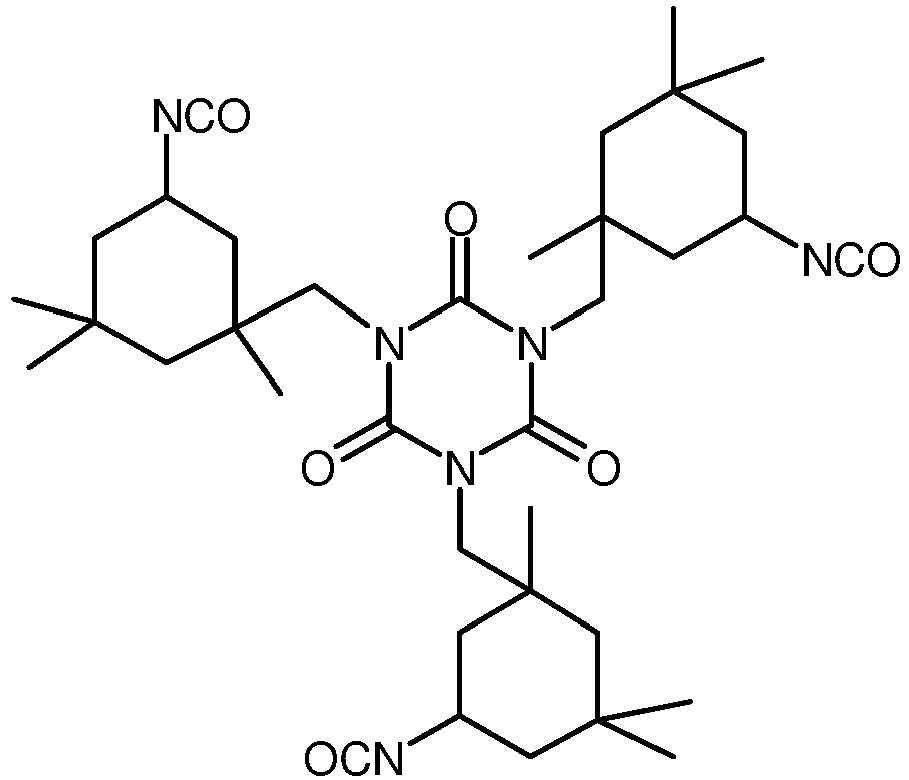
- Die vorgenannten Verbindungen sind handelsüblich und sind beispielsweise bei der Firma Bayer MaterialScience AG erhältlich.
- Biurete im Sinne der Erfindung sind beispielsweise Verbindungen der Formel (V)

R4, R5 und R6 vorzugsweise gleich sind. - In einer besonders bevorzugten Ausführungsform der Erfindung handelt es sich bei dem Biuret um eine Verbindung der Formel (VI)

- Die vorgenannten Verbindungen sind handelsüblich und sind beispielsweise bei der Firma Bayer MaterialScience AG erhältlich.
- Uretdione im Sinne der Erfindung sind Umsetzungsprodukte von mindestens zwei Isocyanaten unter der Ausbildung von mindestens zwei Dioxodiazetidin-Bindungen:

- Die Herstellung ist dem Fachmann an sich bekannt. Die Verbindungen können beispielsweise gemäß der in
EP 1 422 223 A1 beschriebenen Verfahren hergestellt werden. - Das Uretdion kann ein Dimer, Trimer, Oligomer oder Polymer sein.
- Geeignete Beispiele für Uretdione, die einen aliphatischen oder cycloaliphatischen Rest aufweisen, sind dem Fachmann an sich bekannt und entsprechende monomere Uretdione umfassen beispielsweise Isophorondiisocyanat, 1,4-Cyclohexyldiisocyanat, 1,1-Methylen-bis-(4-isocyanatocyclohexan), 1,2-Bis-(4-isocyanatononyl)-3-heptyl-4-pentyl-cyclohexan und Hexamethylen-1,6-diisocyanat. Hierbei ist die Verwendung von Isophorondiisocyanat und Hexamethylen-1,6-diisocyanat bevorzugt.
- Darüber hinaus ist es im Rahmen der vorliegenden Erfindung möglich, dass als Aktivator ein Uretdion verwendet wird, welches ausgehend von einem aromatischen Isocyanat erhalten wird. Dieses aromatische Isocyanat weist vorzugsweise 6 bis 20 Kohlenstoffatome, besonders bevorzugt 6 bis 15 Kohlenstoffatome, auf. Entsprechende aromatische monomere Isocyanate können beispielsweise ausgewählt werden aus der Gruppe, bestehend aus 2,4-Diisocyanatotoluol, 2,6-Diisocyanatotoluol, 1,5-Naphthylendiisocyanat, 4,4'-Methylen-diphenyldiisocyanat, 1,3-Bis-(3-isocyanato-4-methylphenyl)-2,4-dioxodiazetidin, N,N'-Bis-(4-methyl-3-isocyanatophenyl)-Harnstoff und Tetramethylxylylendiisocyanat. Von diesen aromatischen Isocyanaten sind 2,4-Diisocyanatotoluol, 2,6-Diisocyanatotoluol und 4,4'-Methylen-bis(phenyldiisocyanat) bevorzugt. Insbesondere bevorzugt sind 2,6-Diisocyanatotoluol und 4,4'-Methylen-bis(phenyldiisocyanat).
- Die vorgenannten Verbindungen sind handelsüblich und sind beispielsweise bei der Firma Rhein Chemie Rheinau GmbH oder die der Bayer MaterialScience AG erhältlich.
- Allophanate im Sinne der Erfindung sind Verbindungen der Formel (VII)

- Diese Verbindungen sind im Allgemeinen durch Umsetzung beliebiger urethan- und/oder harnstoffgruppenhaltiger Ausgangsverbindungen enthaltend Einheiten der allgemeinen Formel (R"OOC-NHR') mit Monoisocyanaten der allgemeinen Formel R"'-NCO oder mit Diisocyanaten der allgemeinen Formel OCN-A-NCO zugänglich, wobei R'" bzw. A bevorzugt ein Alkylrest mit 1 bis 20 Kohlenstoffatomen oder ein Arylrest mit 6 bis 20 Kohlenstoffatomen ist und R' und R" unabhängig voneinander für Alkylrest mit 1 - 20 Kohlenstoffatomen oder ein Arylrest mit 6 bis 20 Kohlenstoffatomen stehen.
- Als Monoisocyanate eignen sich beliebige aromatische, aliphatische und cycloaliphatische Monoisocyanate mit bis zu 20 Kohlenstoffatomen, wie Methylisocyanat, Isopropylisocyanat, n-Butylisocyanat, n-Hexylisocyanat, Cyclohexylisocyanat, Stearylisocyanat, die gegebenenfalls halogenierten Phenylisocyanate, 1-Naphtylisocyanat, die gegebenenfalls chlorierten oder fluorierten m-, o-, und p-Toloylisocyanate, p-Isopropylphenylisocyanat, 2,6-Diisopropylphenylisocyanat und p-Toluolsulfonyldiisocyanat.
- Als Diisocyanate eignen sich beliebige aromatische, aliphatische und cycloaliphatische Diisocyanate mit 6 bis 40 Kohlenstoffatomen, vorzugsweise 6 bis 15 Kohlenstoffatomen, wie Isophorondiisocyanat, 1,4-Cyclohexyldiisocyanat, 1,1-Methylen-bis-(isocyanatohexan), 1,2-Bis-(4-Isocyanatononyl)-3-heptyl-4-pentylcyclohexan, Hexamethylen-1,6-diisocyanat, 2,4-Diisocyanatotoluol, 2,6-Diisocyanatotoluol, 1,5-Naphthylendiisocyanat, 4,4'-Methylen-diphenyldiisocyanat, 1,3-Bis-(3-isocyanto-4-methylphenyl)-2,4-dioxodiazetidin, N,N'-Bis-(4-methyl-3-isocyanatophenyl)-Harnstoff und Tetramethylxylylendiisocyanat. Bevorzugt hiervon ist Hexamethylen-1,6-diisocyanat.
- Die im Rahmen der vorliegenden Erfindung besonders bevorzugten Allophanate sind Verbindungen der Formel (VIII)

- Entsprechende Allophanate sowie deren Herstellung sind beispielsweise in der
EP 0 000 194A1 beschrieben, dessen diesbezügliche Offenbarung in die vorliegende Erfindung unter Bezugnahme eingeschlossen wird. Die vorgenannten Verbindungen sind handelsüblich und sind beispielsweise bei der Firma Bayer MaterialScience AG erhältlich. - Carbodiimide im Sinne der Erfindung sind vorzugsweise Verbindungen der Formel (IX)
R11-(-N=C=N-R12-)m-R13 (IX),
in der
m einer ganzen Zahl von 1 bis 500 entspricht,
R12 = C1 - C18-Alkylen, C5-C18-Cycloalkylen-, Arylen und/oder C7-C18- Aralkylen,
R11 = R-NCO, R-NHCONHR9, R-NHCONR9R7 oder R-NHCOOR8 und
R13 = -NCO, -NHCONHR9, -NHCONR9R7 oder -NHCOOR8 ist,
wobei in R11 unabhängig voneinander R9 und R7 gleich oder verschieden sind und einen C1-C6-Alkyl-, C6-G10-Cycloalkyl- oder C7-C18-Aralkylrest darstellen und R8 eine der Bedeutungen von R11 hat oder einen Polyester- oder einen Polyamidrest oder -(CH2)1-(O-(CH2)k-O)g-R10 bedeutet,
mit 1 = 1-3, k= 1-3, g = 0-12 und
R10= H oder C1-C4-Alkyl. - Ebenfalls einsetzbar sind auch Gemische von Carbodiimiden der Formel (IX), inklusive der entsprechenden Oligomere und/oder Polymere, wobei polymerer Carbodiimide bevorzugt sind.
- Die Verbindungen nach Formel (IX) sind kommerziell erhältlich, z.B. bei der Firma Rhein Chemie Rheinau GmbH oder lassen sich nach den dem Fachmann geläufigen Verfahren herstellen, wie z.B. beschrieben in
DE-A-11 30 594 oderUS 2 840 589 oder durch die Kondensation von Diisocyanaten unter Abspaltung von Kohlendioxid bei erhöhten Temperaturen, z.B. bei 40 °C bis 200 °C, in Gegenwart von Katalysatoren. Als Katalysatoren haben sich z.B. starke Basen oder Phosphorverbindungen bewährt. Vorzugsweise werden Phospholenoxide, Phospholidine oder Phospholinoxide sowie die entsprechenden Sulfide verwendet. Ferner können als Katalysatoren tertiäre Amine, basisch reagierende Metallverbindungen, Carbonsäuremetallsalze und nicht basische Organometallverbindungen verwendet werden. - Die vorgenannten Verbindungen sind handelsüblich und sind beispielsweise bei der Firma Rhein Chemie Rheinau GmbH erhältlich.
- Geblockte Aktivatoren, vorzugsweise mit Lactamen, besonders bevorzugt Caprolactam, oder mit Phenolen, Oximen und/oder Epoxiden geblockte Aktivatoren sind beispielsweise herstellbar über die Umsetzung mindestens einer Verbindung der Formel (I) bis (IX) mit mindestens einem Lactam, Caprolactam, Phenolen, Oxim und/oder Epoxid bei Temperaturen von 80 bis 100°C nach den, dem Fachmann geläufigen Verfahren.
- Als Katalysatoren im Sinne der Erfindung können Lactam-Magnesium-Halogenide, bevorzugt Bromide, Alkali-Alumo Dilactamate, bevorzugt Natrium, Alkali- und/oder Erdalkalilactamate, bevorzugt Natrium, Kalium und/oder Magnesium, einzeln oder im Gemisch eingesetzt werden. Die vorgenannten Katalysatoren sind handelsüblich und sind beispielsweise bei der Firma Rhein Chemie Rheinau GmbH oder bei der Firma KatChem spol.s.r.o. erhältlich.
- In einer Ausführungsform der Erfindung werden Mischung a) und Mischung b) bei Temperaturen zwischen 80 und 160°C, vorzugsweise 100 und 140°C zur Polymerisation zusammengegeben. Die Polymerisation erfolgt nach den, dem Fachmann geläufigen Verfahren, wie z.B. beschrieben in Kunststoffhandbuch, Bd.3/4, Technische Thermoplaste, Hanser Fachbuch, Seiten 413 - 430. Dabei wird die Mischung vorzugsweise gerührt. Einsetzbar hierfür sind Mischaggregate, wie z.B. Rührkesseln.
- In einer anderen bevorzugten Ausführungsform der Erfindung erfolgt vor dem Aufschmelzen die Zugabe weiteren Lactams und/oder Katalysators.
- In einer weiteren Ausführungsform der Erfindung werden zu der Mischung a) und Mischung b) noch weiteres Lactam und/oder weiterer Katalysator und/oder gegebenenfalls weitere Additive, wie Schlagzähmodifikatoren, wie z.B. Polyetheramin-Copolymere, Glasfasern, Endlosglassfasern, Kohlefasern, Aramidfasern und/oder Verarbeitungshilfsmittel, wie z.B. hochmolekulare Polyole, Verdicker, wie z.B. Aerosile, UV- und Thermostabilisatoren, Leitfähigkeitsverbesserer, wie z.B. Russe und Graphite, ionische Flüssigkeiten, Markierungsstoffe und/oder Farben zugegeben.
- Die Mischungen a) und b) werden vorzugsweise in Mengenverhältnissen von 1:3 bis 3:1, besonders bevorzugt in Mengenverhältnissen von 1 : 1 eingesetzt.
- Die Herstellung der erfindungsmäßen Mischungen a) und b) erfolgt vorzugsweise wie folgt:
- a) Aktivatormischung
Hierfür wird mindestens ein Aktivator der Formeln I - IX zu einer Lactamschmelze bei Temperaturen zwischen 70 und 120 °C, bevorzugt 80 - 100 °C gegeben, homogenisiert und in beheizte Kessel abgefüllt oder auf einem Pastillierband pastilliert bzw. auf einem Schuppenwalze abgeschuppt. - b) Katalysatormischung
Hierfür wird mindestens ein Katalysator, wie z.B. Na-Caprolactamat oder ein hochkonzentrierter Na-Caprolactamat-Masterbatch, zu einer Lactamschmelze bei Temperaturen zwischen 70 und 120°C, bevorzugt 80 - 100°C, gegeben, homogenisiert und in beheizte Kessel abgefüllt oder auf einem Pastillierband pastilliert bzw. auf einem Schuppenwalze abgeschuppt. - Dabei sind gängige Pastilliersysteme ebenso wie gängige Schuppenwalzen einsetzbar. Diese sind z.B. erhältlich bei der Firma Sandvik Holding GmbH oder der Firma GMF Gouda.
- Alternativ dazu kann die Katalysatormischung b) in Konzentrationen bis maximal 5 Gew.% aus den jeweiligen Edukten in Lactam mittels Direktsynthese hergestellt werden, wie z. B. in den dem Fachmann geläufigen Verfahren aus Lactam und Na-Methanolat bei anschließender oder gleichzeitiger Entfernung des Lösemittels durch Destillation. Das Verfahren kann sowohl als Batch- als auch in einem Konti-Prozeß erfolgen.
- In einer Ausführungsform der vorliegenden Erfindung werden die Mischungen a) und b) nach der Herstellung isoliert, gegebenenfalls getrocknet, konfektioniert und gelagert. Unter Konfektionierung wird z.B. die Pulverisierung oder Zerkleinerung verstanden. Die nach dem erfindungsgemäßen Verfahren hergestellten Mischungen aus Lactam und Aktivator und/oder Katalysator zeichnen sich dabei durch eine hohe Lagerstabilität (mehrwöchige/ mehr als 6-wöchige Lagerung) aus, so dass es möglich ist, die Mischungen vor ihrem Einsatz gelagert und zum Einsatzort transportiert werden können. Damit ist es möglich, die Mischung exakt für den Einsatz zuzubereiten und so Schwankungen in der Zusammensetzung, die bei einer unmittelbar vor der Polymerisation hergestellten Mischungen entstehen, zu vermeiden.
- Der Rahmen der Erfindung erfasst alle oben stehenden und im Folgenden aufgeführten allgemeinen oder in Vorzugsbereichen genannten Restedefinitionen, Indizes, Parameter und Erläuterungen untereinander, also auch zwischen den jeweiligen Bereichen und Vorzugsbereichen in beliebiger Kombination.
- In den Fällen, in denen die Wirkstoffkonzentration der Mischung über der für die Polymerisation beabsichtigten Wirkstoffkonzentration kann vor der eigentlichen Polymerisation die Zugabe weiteren Lactams erfolgen.
- In den Fällen, in denen nur der Aktivator als Mischung mit dem Lactam eingesetzt wird, wird vorzugsweise der Katalysator gegebenenfalls gemeinsam mit weiterem Lactam der Aktivatormischung bei der Polymerisation zugemischt.
- Die nachfolgenden Beispiele dienen der Erläuterung der Erfindung, ohne dabei limitierend zu wirken.
-
- Caprolactam trocken (EP > 69 °C) von der Firma Lanxess Deutschland GmbH
- Aktivator Addonyl® 8108, ein Hexamethylen-Diisocyanat (HDI)-Biuret, 70% in N-Ethylpyrolidon, kommerziell erhältlich bei der Rhein Chemie Rheinau GmbH,
- Aktivator Brüggolen C20 (ca. 35 % HDI in Caprolactam), kommerziell erhältlich von der Firma Brüggemann GmbH,
- Addonyl® Kat NL von der Rhein Chemie Rheinau GmbH, ca. 18 % Natriumcaprolactamat in Caprolactam.
-
- Kolben A: 196,8 g Caprolactam und 3,2 g Addonyl® 8108, entspricht 2,2 g HDI-Biuret (Vergleichsbeispiel), unmittelbar vor der Messung zubereitet,
- Kolben B: 192 g Caprolactam und 8 g 18 % iges Na-Caprolactamat in Caprolactam als Addonyl® Kat NL (Vergleichsbeispiel), unmittelbar vor der Messung zubereitet,
- Kolben C: 197,8 g Caprolactam und 2,2 g HDI-Biuret (erfindungsgemäß), gelagert bei 90 °C über einen Zeitraum von: a) Kolben C1: 1 Woche, b) Kolben C2: 2 Wochen, c) Kolben C3: 6 Wochen.
- Kolben D: 200 g festes Batch-Ready®-Caprolactam mit einem Na-Capro-Lactamat-Gehalt von 0,8 % (erfindungsgemäß),
- Kolben E: 196,8 g Caprolactam und 3,2 g Brüggolen® C20 (Vergleichsbeispiel), unmittelbar vor der Messung zubereitet,
- Kolben F: 200 g festes Batch-Ready®-Caprolactam mit einem HDI-Biuret-Gehalt von 1,2 % (erfindungsgemäß),
- Kolben G: 200 g festes Batch-Ready®-Caprolactam mit einem HDI-Gehalt von 1,2 % (erfindungsgemäß),
- Die Kolben A bis G wurden auf 122 °C (± 2 °C) aufgeheizt.
- Die so erhaltenen Schmelzen wurden bei 122 °C (± 2 °C) in einem Ölbad unter Vakuum (<15 mbar) 20 Minuten aufbereitet. Nach Belüften mit Stickstoff wurden die Aktivator-Komponenten (Kolben A, C, E, F und G) mit der Katalysator-Komponente (Kolben B und D) wie in den nachstehenden Tabellen aufgeführt, in einen Dreihalskolben vereinigt, kurz durchgerührt und in das 600 ml Becherglas überführt. Die Formtemperatur (Becherglas) betrug 160° C.
- Unmittelbar nach dem Zusammenführen der Schmelzen in einen Dreihalskolben wurde mit der Temperaturmessung begonnen. Diese erfolgte mittels Temperaturmessgerät Testo 175-T3 mit IR-Serial Interface.
- Über einen Zeitraum von 15 Minuten wurden alle 10 Sekunden die Temperatur der polymerisierenden Lactamschmelze gemessen und protokolliert.
- Es wurde die Kurve der Temperatur der Polymerisationsmischung über die Zeit gemessen und der Zeitpunkt bestimmt, in dem der Temperaturanstieg maximal war (Wendepunkt der Temperatur-Zeitkurve). Die Zeit vom Zusammengeben der Reaktionsmischungen bis zu dem Zeitpunkt des maximalen Temperaturanstiegs entspricht der Topfzeit.
- Tabelle 1 zeigt die Ergebnisse beim Einsatz von festem Batch-Ready®-Caprolactam als Katalysatormischung und Batch-Ready® -Caprolactam als flüssig gelagertem Aktivator (90 °C), Mischungen II), III) und IV) im Vergleich zu der frisch hergestellte Aktivator/KatalysatorMischung (Mischung I))
Tabelle 1: Beispiele Topfzeit T. (max.) [°C] I) Mischung aus A und B (Vergleichsbeispiel) 300 - 500 s > 190°C II) Mischung aus C1 und D (erfindungsgemäß) 300 - 500 s > 190°C III) Mischung aus C2 und D (erfindungsgemäß) 300 - 500 s > 190°C IV) Mischung aus C3 und D (erfindungsgemäß) 300 - 500 s > 190°C - Wie aus dem Vergleich der Beispiele ersichtlich, führt die Lagerung selbst über einen Zeitraum von mindestens 6 Wochen zu keiner Beeinträchtigung der Eigenschaften.
- Tabelle 2 zeigt die Ergebnisse bei der Herstellung der festen Batch-Ready-Aktivatormischungen im Vergleich zu der Aktivatormischung Brüggolen C 20 aus dem Stand der Technik.
Tabelle 2: Aktivator Pastillierbarkeit Brüggolen C 20 (Vergleich) sehr schlecht pastillierbar 40 % HDI-Biuret in Caprolactam (Vergleich) nicht pastillierbar Mischung F (erfindungsgemäß) sehr gut pastillierbar Mischung G (erfindungsgemäß) sehr gut pastillierbar - Tabelle 3 zeigt die Ergebnisse beim Einsatz vom festem Batch-Ready-Caprolactam als Aktivator- und Katalysatormischung im Vergleich zum Stand der Technik
Tabelle 3: Beispiele Topfzeit T. (max.) [°C] Mischung aus E und B (Vergleichsbeispiel) 300 - 500 s > 190°C Mischung aus F und D (erfindungs gemäß) 300 - 500 s > 190°C Mischung aus G und D (erfindungs gemäß) 300 - 500 s > 190°C - Durch das erfindungsgemäße Verfahren ist es daher möglich, Aktivatoren- und Katalysatorenmischungen lösemittelfrei und technisch einfach herzustellen bzw. bereitzustellen, wodurch man auf eine aufwendige Dosierung von Kleinmengen an Katalysatoren und Aktivatoren im Herstellprozeß der Gußpolyamidteile verzichten kann. Durch das gezielte und präzise Einstellen der benötigten Aktivator- und Katalysatoranteile kann die Polymerisation stets optimal durchgeführt werden und eine konstante Qualität der Gußpolyamidteilen gewährleistet werden. Zudem ist das Verfahren wegen des einfacheren Handlings der benötigten Rohstoffen und der Minimierung des Personalaufwandes kostengünstiger und unter arbeitssicherheitstechnischen Gesichtpunkten vorteilhafter.
Claims (6)
- Verfahren zur Herstellung von Gusspolyamiden durch Polymerisation von Lactamen in Gegenwart von mindestens einem Aktivator ausgewählt aus der Gruppe enthaltend 2,4-Toluylendiisocyanat (TDI), 2,6-Toluylendiisocyanat, ein Gemisch aus 2,4-Toluylendiisocyanat und 2,6-Toluylendiisocyanat, Hexamethylendiisocyanat, Cyclohexan-1,4-diisocyanat, Xylylendiisocyanat, Isophorondiisocyanat, 1,5-Naphthalindiisocyanat, 4,4'-Diphenylmethan-diisocyanat, 2,4'-Diphenyl-methandiisocyanat, 2,2'-Diphenylmethandiisocyanat, 4,4'-Diphenyl-dimethyl-methandiisocyanat, 1,3-Phenylen-diisocyanat, 1,4-Phenylendiisocyanat, Dicyclo-hexylmethan-4,4'-diisocyanat, Dicyclohexylmethan-2,4'-diisocyanat, Dicyclohexylmethan-2,2'-diisocyanat, Methylcyclohexan-diisocyanat, Tetramethylxylylendiisocyanat, 2,6-Diisopropyl-phenylen-isocyanat und mindestens einem Katalysator, dadurch gekennzeichnet, dassa) der Aktivator zu maximal 5 Gew.% zu einer Lactamschmelze bei Temperaturen zwischen 70 und 120 °C, gegeben, diese homogenisiert, isoliert, gegebenenfalls getrocknet, konfektioniert und gelagert, oder auf einem Pastillierband pastilliert oder auf einer Schuppenwalze abgeschuppt wird,b) der Katalysator zu maximal 5 Gew.% zu einer Lactamschmelze bei Temperaturen zwischen 70 und 120 °C, gegeben, diese homogenisiert, danach auf einem Pastillierband pastilliert oder auf einer Schuppenwalze abgeschuppt wird,
die Schmelzen von a) und b) zusammengemischt und anschließend in der Gussform bei Temperaturen zwischen 80 und 160°C polymerisiert werden. - Verfahren nach Anspruch 1, dadurch gekennzeichnet, dass die Temperaturen in Schritt a) 80-100 °C und in Schritt b) 80-100 °C betragen.
- Verfahren zur Herstellung von Gusspolyamiden durch Polymerisation nach Anspruch 1
oder 2, dadurch gekennzeichnet, dass das Lactam der allgemeinen Formel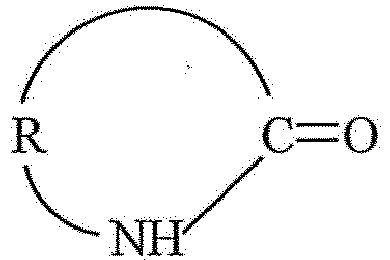
- Verfahren nach einem der Ansprüche 1 bis 3, dadurch gekennzeichnet, dass als Aktivator Hexamethylendiisocyanat eingesetzt wird.
- Verfahren nach einem der Ansprüche 1 bis 4, dadurch gekennzeichnet, dass als Katalysator mindestens ein Lactam-Magnesium-Halogenid, Alkali-Alumo-Dilactamat, Alkali- und/oder Erdalkalilactamat eingesetzt wird.
- Verfahren nach einem der Ansprüche 1 bis 5, dadurch gekennzeichnet, dass vor dem Aufschmelzen die Zugabe weiteren Lactams und/oder Katalysators erfolgt.
Priority Applications (1)
| Application Number | Priority Date | Filing Date | Title |
|---|---|---|---|
| PL18199581T PL3470452T3 (pl) | 2010-10-29 | 2011-10-25 | Sposób wytwarzania poliamidów odlewanych |
Applications Claiming Priority (2)
| Application Number | Priority Date | Filing Date | Title |
|---|---|---|---|
| EP10189435A EP2447301A1 (de) | 2010-10-29 | 2010-10-29 | Verfahren zur Herstellung von Gusspolyamiden |
| EP11186586.1A EP2447302B1 (de) | 2010-10-29 | 2011-10-25 | Verfahren zur Herstellung von Gusspolyamiden |
Related Parent Applications (2)
| Application Number | Title | Priority Date | Filing Date |
|---|---|---|---|
| EP11186586.1A Division EP2447302B1 (de) | 2010-10-29 | 2011-10-25 | Verfahren zur Herstellung von Gusspolyamiden |
| EP11186586.1A Division-Into EP2447302B1 (de) | 2010-10-29 | 2011-10-25 | Verfahren zur Herstellung von Gusspolyamiden |
Publications (2)
| Publication Number | Publication Date |
|---|---|
| EP3470452A1 EP3470452A1 (de) | 2019-04-17 |
| EP3470452B1 true EP3470452B1 (de) | 2021-05-19 |
Family
ID=43466441
Family Applications (3)
| Application Number | Title | Priority Date | Filing Date |
|---|---|---|---|
| EP10189435A Withdrawn EP2447301A1 (de) | 2010-10-29 | 2010-10-29 | Verfahren zur Herstellung von Gusspolyamiden |
| EP18199581.2A Active EP3470452B1 (de) | 2010-10-29 | 2011-10-25 | Verfahren zur herstellung von gusspolyamiden |
| EP11186586.1A Active EP2447302B1 (de) | 2010-10-29 | 2011-10-25 | Verfahren zur Herstellung von Gusspolyamiden |
Family Applications Before (1)
| Application Number | Title | Priority Date | Filing Date |
|---|---|---|---|
| EP10189435A Withdrawn EP2447301A1 (de) | 2010-10-29 | 2010-10-29 | Verfahren zur Herstellung von Gusspolyamiden |
Family Applications After (1)
| Application Number | Title | Priority Date | Filing Date |
|---|---|---|---|
| EP11186586.1A Active EP2447302B1 (de) | 2010-10-29 | 2011-10-25 | Verfahren zur Herstellung von Gusspolyamiden |
Country Status (8)
| Country | Link |
|---|---|
| US (2) | US8802809B2 (de) |
| EP (3) | EP2447301A1 (de) |
| CN (1) | CN102532525B (de) |
| ES (2) | ES2711253T3 (de) |
| HU (2) | HUE055254T2 (de) |
| PL (2) | PL2447302T3 (de) |
| RU (1) | RU2596880C2 (de) |
| TR (1) | TR201903001T4 (de) |
Families Citing this family (10)
| Publication number | Priority date | Publication date | Assignee | Title |
|---|---|---|---|---|
| EP2447301A1 (de) * | 2010-10-29 | 2012-05-02 | Rhein Chemie Rheinau GmbH | Verfahren zur Herstellung von Gusspolyamiden |
| EP2530074B1 (de) * | 2011-05-30 | 2013-10-23 | Rhein Chemie Rheinau GmbH | Neue Zusammensetzung zur Herstellung von Gusspolyamiden |
| EP2666802A1 (de) * | 2012-05-22 | 2013-11-27 | Rhein Chemie Rheinau GmbH | Gußpolyamide, Verfahren zu deren Herstellung und deren Verwendung |
| CN104428345B (zh) * | 2012-07-06 | 2018-10-12 | 朗盛德国有限责任公司 | 用于生产浇铸聚酰胺的催化剂、用于生产所述催化剂的方法及其用途 |
| DE202012013160U1 (de) | 2012-07-06 | 2015-03-11 | Rhein Chemie Rheinau Gmbh | Katalysatoren für die Herstellung von Gusspolyamid |
| US20160002402A1 (en) * | 2013-03-08 | 2016-01-07 | Nagase Chemtex Corporation | Method for manufacturing nylon 6 |
| EP2801587A1 (de) * | 2013-05-07 | 2014-11-12 | Rhein Chemie Rheinau GmbH | Zusammensetzungen, deren Herstellung und deren Verwendung zur Herstellung von Gusspolyamiden |
| CN104789298B (zh) * | 2015-03-25 | 2017-10-17 | 中国人民解放军空军油料研究所 | 一种制备航空燃料抗磨剂的方法 |
| US20190023843A9 (en) * | 2015-07-06 | 2019-01-24 | Basf Se | Method for producing a polyamide |
| JP6277575B1 (ja) * | 2017-07-03 | 2018-02-14 | 株式会社二幸技研 | アルカリ重合法によるナイロン製造方法と成型ナイロン |
Family Cites Families (21)
| Publication number | Priority date | Publication date | Assignee | Title |
|---|---|---|---|---|
| DE1130594B (de) | 1956-07-30 | 1962-05-30 | Du Pont | Verfahren zur Herstellung von gegebenenfalls modifizierten Polykondensationsprodukten mití¬N?C?N-Brueckengliedern |
| US2840589A (en) | 1957-06-14 | 1958-06-24 | Du Pont | Di(3-isocyanato-4-methylphenyl) carbodiimide |
| GB1099759A (en) | 1966-12-28 | 1968-01-17 | Du Pont | Caprolactam compositions and use thereof |
| CH479654A (de) * | 1968-03-02 | 1969-10-15 | Basf Ag | Verfahren und Vorrichtung zum Herstellen von Polyamidformkörpern |
| FR2003090A1 (de) | 1968-03-02 | 1969-11-07 | Basf Ag | |
| DE1720352B2 (de) * | 1968-03-02 | 1975-02-20 | Basf Ag, 6700 Ludwigshafen | Verfahren zur Herstellung von Formkörpern durch die aktivierte anionische Polymerisation von Lactamen |
| DE1942992A1 (de) * | 1968-11-04 | 1970-05-06 | Basf Ag | Verfahren zum Herstellen von Formkoerpern aus Polyamiden |
| DE2040188A1 (de) | 1970-08-13 | 1972-02-17 | Bayer Ag | Verfahren zur Herstellung von polymerisierbaren,bei Temperaturen von 70 bis 120 deg.C stabilen Lactam-Katalysator-Cokatalysator-Schmelzen |
| DE2122573A1 (de) | 1971-05-07 | 1972-11-09 | Farbenfabriken Bayer Ag, 5090 Leverkusen | Caprolactam-Brikettierung |
| DE2507549A1 (de) * | 1974-05-21 | 1975-12-04 | Bhnf Ag | Poly-laurinlactam, verfahren zur herstellung hoeherer poly-lactame und deren verwendung |
| DE2729990A1 (de) | 1977-07-02 | 1979-01-18 | Bayer Ag | Verfahren zur herstellung von isocyanatgruppen aufweisenden allophanaten |
| DE3923422A1 (de) | 1989-07-15 | 1991-01-24 | Bayer Ag | Lactamschmelzen mit erhoehter viskositaet und ihre verwendung |
| EP0666868B2 (de) | 1992-10-28 | 2006-06-14 | Genentech, Inc. | Verwendung von anti-VEGF Antikörpern zur Behandlung von Krebs |
| DE4404221A1 (de) | 1994-02-10 | 1995-08-17 | Bayer Ag | Verfahren zur Herstellung von Gußpolyamid mit erhöhter Steifigkeit |
| DE10254878A1 (de) | 2002-11-25 | 2004-06-03 | Bayer Ag | Herstellung uretdiongruppenhaltiger Polyisocyanate |
| EP1449865A1 (de) * | 2003-02-21 | 2004-08-25 | Koninklijke DSM N.V. | Verfahren zur Herstellung von aus der Schmelze verarbeitbarer Polyamide |
| EP1975191A1 (de) * | 2007-03-29 | 2008-10-01 | L. Brüggemann KG | Faserverstärkte anionische Polyamid-Verbundwerkstoffe für strukturelle Anwendungen und deren Herstellungsverfahren |
| DE102008000352A1 (de) * | 2008-02-20 | 2009-08-27 | Rhein Chemie Rheinau Gmbh | Gusspolyamid-Herstellung unter Verwendung spezieller Aktivatoren |
| US10538624B2 (en) | 2010-10-07 | 2020-01-21 | Basf Se | Process for producing monomer compositions and use of these for producing a polyamide molding |
| EP2447301A1 (de) * | 2010-10-29 | 2012-05-02 | Rhein Chemie Rheinau GmbH | Verfahren zur Herstellung von Gusspolyamiden |
| EP2666802A1 (de) * | 2012-05-22 | 2013-11-27 | Rhein Chemie Rheinau GmbH | Gußpolyamide, Verfahren zu deren Herstellung und deren Verwendung |
-
2010
- 2010-10-29 EP EP10189435A patent/EP2447301A1/de not_active Withdrawn
-
2011
- 2011-10-21 CN CN201110324825.5A patent/CN102532525B/zh active Active
- 2011-10-25 EP EP18199581.2A patent/EP3470452B1/de active Active
- 2011-10-25 ES ES11186586T patent/ES2711253T3/es active Active
- 2011-10-25 EP EP11186586.1A patent/EP2447302B1/de active Active
- 2011-10-25 HU HUE18199581A patent/HUE055254T2/hu unknown
- 2011-10-25 PL PL11186586T patent/PL2447302T3/pl unknown
- 2011-10-25 ES ES18199581T patent/ES2874784T3/es active Active
- 2011-10-25 PL PL18199581T patent/PL3470452T3/pl unknown
- 2011-10-25 HU HUE11186586A patent/HUE041735T2/hu unknown
- 2011-10-25 TR TR2019/03001T patent/TR201903001T4/tr unknown
- 2011-10-27 US US13/283,155 patent/US8802809B2/en active Active
- 2011-10-28 RU RU2011143586/04A patent/RU2596880C2/ru active
-
2014
- 2014-04-22 US US14/258,128 patent/US20140225032A1/en not_active Abandoned
Non-Patent Citations (1)
| Title |
|---|
| None * |
Also Published As
| Publication number | Publication date |
|---|---|
| EP3470452A1 (de) | 2019-04-17 |
| HUE041735T2 (hu) | 2019-05-28 |
| RU2011143586A (ru) | 2013-05-10 |
| CN102532525A (zh) | 2012-07-04 |
| EP2447301A1 (de) | 2012-05-02 |
| TR201903001T4 (tr) | 2019-03-21 |
| US8802809B2 (en) | 2014-08-12 |
| US20140225032A1 (en) | 2014-08-14 |
| CN102532525B (zh) | 2016-08-10 |
| US20120245320A1 (en) | 2012-09-27 |
| RU2596880C2 (ru) | 2016-09-10 |
| EP2447302A1 (de) | 2012-05-02 |
| EP2447302B1 (de) | 2018-11-28 |
| ES2711253T3 (es) | 2019-04-30 |
| ES2874784T3 (es) | 2021-11-05 |
| PL2447302T3 (pl) | 2019-05-31 |
| HUE055254T2 (hu) | 2021-11-29 |
| PL3470452T3 (pl) | 2021-11-22 |
Similar Documents
| Publication | Publication Date | Title |
|---|---|---|
| EP3470452B1 (de) | Verfahren zur herstellung von gusspolyamiden | |
| EP2093246B1 (de) | Anionische Polymerisation von Lactamen unter Verwendung spezieller Aktivatoren | |
| EP2801588B1 (de) | Zusammensetzungen, enthaltend N-Acetylcaprolactam, deren Herstellung und deren Verwendung zur Herstellung von Gusspolyamiden | |
| WO2013034499A1 (de) | Neue zusammensetzungen zur herstellung von gusspolyamiden | |
| EP2852628B1 (de) | GUßPOLYAMIDE,VERFAHREN ZU DEREN HERSTELLUNG UND DEREN VERWENDUNG | |
| DE19602684C1 (de) | Flüssiges System zur Durchführung der anionischen Lactampolymerisation | |
| EP0872508A1 (de) | Verfahren zur Herstellung eines Lagerstabilen Flüssigsystems zur Durchführung der anionischen Lactam-Polymerisation | |
| EP2520603B1 (de) | Zusammensetzung für anionische Lactampolymerisation, Verfahren zur Herstellung und Verwendung | |
| DE2230732A1 (de) | Lactampolymerisation | |
| EP2870191B1 (de) | Katalysatoren für die herstellung von gusspolyamid, verfahren zu deren herstellung und deren verwendung | |
| EP0786482B1 (de) | Flüssigsystem für die anionische Lactampolymerisation | |
| EP2567997A1 (de) | Neue Zusammensetzungen zur Herstellung von Gusspolyamiden | |
| WO2018041642A1 (de) | Verfahren zur herstellung eines polyamids mit kaliumlactamat | |
| DE19961819A1 (de) | Flüssiginitiator zur beschleunigten Durchführung der anionischen Lactampolymerisation, Verfahren zu dessen Herstellung und Verwendung | |
| EP2530074B1 (de) | Neue Zusammensetzung zur Herstellung von Gusspolyamiden | |
| DE202012013160U1 (de) | Katalysatoren für die Herstellung von Gusspolyamid | |
| DE19603304C2 (de) | Verwendung von Oxazolin-Verbindungen als Aktivator zur Auslösung der anionischen Lactampolymerisation | |
| EP3670575A1 (de) | Verfahren zur herstellung eines katalysatorsystems, katalysatorsystem, und dessen verwendung für die herstellung von gusspolyamid | |
| DE10351534A1 (de) | Verfahren zur Herstellung von Carbodiimiden |
Legal Events
| Date | Code | Title | Description |
|---|---|---|---|
| PUAI | Public reference made under article 153(3) epc to a published international application that has entered the european phase |
Free format text: ORIGINAL CODE: 0009012 |
|
| STAA | Information on the status of an ep patent application or granted ep patent |
Free format text: STATUS: THE APPLICATION HAS BEEN PUBLISHED |
|
| AC | Divisional application: reference to earlier application |
Ref document number: 2447302 Country of ref document: EP Kind code of ref document: P |
|
| AK | Designated contracting states |
Kind code of ref document: A1 Designated state(s): AL AT BE BG CH CY CZ DE DK EE ES FI FR GB GR HR HU IE IS IT LI LT LU LV MC MK MT NL NO PL PT RO RS SE SI SK SM TR |
|
| STAA | Information on the status of an ep patent application or granted ep patent |
Free format text: STATUS: REQUEST FOR EXAMINATION WAS MADE |
|
| STAA | Information on the status of an ep patent application or granted ep patent |
Free format text: STATUS: EXAMINATION IS IN PROGRESS |
|
| 17P | Request for examination filed |
Effective date: 20191017 |
|
| RBV | Designated contracting states (corrected) |
Designated state(s): AL AT BE BG CH CY CZ DE DK EE ES FI FR GB GR HR HU IE IS IT LI LT LU LV MC MK MT NL NO PL PT RO RS SE SI SK SM TR |
|
| 17Q | First examination report despatched |
Effective date: 20191114 |
|
| RAP1 | Party data changed (applicant data changed or rights of an application transferred) |
Owner name: LANXESS DEUTSCHLAND GMBH |
|
| GRAP | Despatch of communication of intention to grant a patent |
Free format text: ORIGINAL CODE: EPIDOSNIGR1 |
|
| STAA | Information on the status of an ep patent application or granted ep patent |
Free format text: STATUS: GRANT OF PATENT IS INTENDED |
|
| INTG | Intention to grant announced |
Effective date: 20210222 |
|
| GRAS | Grant fee paid |
Free format text: ORIGINAL CODE: EPIDOSNIGR3 |
|
| GRAA | (expected) grant |
Free format text: ORIGINAL CODE: 0009210 |
|
| STAA | Information on the status of an ep patent application or granted ep patent |
Free format text: STATUS: THE PATENT HAS BEEN GRANTED |
|
| AC | Divisional application: reference to earlier application |
Ref document number: 2447302 Country of ref document: EP Kind code of ref document: P |
|
| AK | Designated contracting states |
Kind code of ref document: B1 Designated state(s): AL AT BE BG CH CY CZ DE DK EE ES FI FR GB GR HR HU IE IS IT LI LT LU LV MC MK MT NL NO PL PT RO RS SE SI SK SM TR |
|
| REG | Reference to a national code |
Ref country code: GB Ref legal event code: FG4D Free format text: NOT ENGLISH |
|
| REG | Reference to a national code |
Ref country code: CH Ref legal event code: EP |
|
| REG | Reference to a national code |
Ref country code: DE Ref legal event code: R096 Ref document number: 502011017150 Country of ref document: DE |
|
| REG | Reference to a national code |
Ref country code: AT Ref legal event code: REF Ref document number: 1393915 Country of ref document: AT Kind code of ref document: T Effective date: 20210615 |
|
| REG | Reference to a national code |
Ref country code: IE Ref legal event code: FG4D Free format text: LANGUAGE OF EP DOCUMENT: GERMAN |
|
| REG | Reference to a national code |
Ref country code: RO Ref legal event code: EPE |
|
| REG | Reference to a national code |
Ref country code: NL Ref legal event code: FP |
|
| REG | Reference to a national code |
Ref country code: SE Ref legal event code: TRGR |
|
| REG | Reference to a national code |
Ref country code: LT Ref legal event code: MG9D |
|
| PG25 | Lapsed in a contracting state [announced via postgrant information from national office to epo] |
Ref country code: FI Free format text: LAPSE BECAUSE OF FAILURE TO SUBMIT A TRANSLATION OF THE DESCRIPTION OR TO PAY THE FEE WITHIN THE PRESCRIBED TIME-LIMIT Effective date: 20210519 Ref country code: LT Free format text: LAPSE BECAUSE OF FAILURE TO SUBMIT A TRANSLATION OF THE DESCRIPTION OR TO PAY THE FEE WITHIN THE PRESCRIBED TIME-LIMIT Effective date: 20210519 Ref country code: HR Free format text: LAPSE BECAUSE OF FAILURE TO SUBMIT A TRANSLATION OF THE DESCRIPTION OR TO PAY THE FEE WITHIN THE PRESCRIBED TIME-LIMIT Effective date: 20210519 Ref country code: BG Free format text: LAPSE BECAUSE OF FAILURE TO SUBMIT A TRANSLATION OF THE DESCRIPTION OR TO PAY THE FEE WITHIN THE PRESCRIBED TIME-LIMIT Effective date: 20210819 |
|
| REG | Reference to a national code |
Ref country code: ES Ref legal event code: FG2A Ref document number: 2874784 Country of ref document: ES Kind code of ref document: T3 Effective date: 20211105 |
|
| REG | Reference to a national code |
Ref country code: HU Ref legal event code: AG4A Ref document number: E055254 Country of ref document: HU |
|
| PG25 | Lapsed in a contracting state [announced via postgrant information from national office to epo] |
Ref country code: RS Free format text: LAPSE BECAUSE OF FAILURE TO SUBMIT A TRANSLATION OF THE DESCRIPTION OR TO PAY THE FEE WITHIN THE PRESCRIBED TIME-LIMIT Effective date: 20210519 Ref country code: PT Free format text: LAPSE BECAUSE OF FAILURE TO SUBMIT A TRANSLATION OF THE DESCRIPTION OR TO PAY THE FEE WITHIN THE PRESCRIBED TIME-LIMIT Effective date: 20210920 Ref country code: NO Free format text: LAPSE BECAUSE OF FAILURE TO SUBMIT A TRANSLATION OF THE DESCRIPTION OR TO PAY THE FEE WITHIN THE PRESCRIBED TIME-LIMIT Effective date: 20210819 Ref country code: LV Free format text: LAPSE BECAUSE OF FAILURE TO SUBMIT A TRANSLATION OF THE DESCRIPTION OR TO PAY THE FEE WITHIN THE PRESCRIBED TIME-LIMIT Effective date: 20210519 Ref country code: GR Free format text: LAPSE BECAUSE OF FAILURE TO SUBMIT A TRANSLATION OF THE DESCRIPTION OR TO PAY THE FEE WITHIN THE PRESCRIBED TIME-LIMIT Effective date: 20210820 Ref country code: IS Free format text: LAPSE BECAUSE OF FAILURE TO SUBMIT A TRANSLATION OF THE DESCRIPTION OR TO PAY THE FEE WITHIN THE PRESCRIBED TIME-LIMIT Effective date: 20210919 |
|
| PGFP | Annual fee paid to national office [announced via postgrant information from national office to epo] |
Ref country code: BE Payment date: 20210916 Year of fee payment: 11 |
|
| PG25 | Lapsed in a contracting state [announced via postgrant information from national office to epo] |
Ref country code: DK Free format text: LAPSE BECAUSE OF FAILURE TO SUBMIT A TRANSLATION OF THE DESCRIPTION OR TO PAY THE FEE WITHIN THE PRESCRIBED TIME-LIMIT Effective date: 20210519 Ref country code: EE Free format text: LAPSE BECAUSE OF FAILURE TO SUBMIT A TRANSLATION OF THE DESCRIPTION OR TO PAY THE FEE WITHIN THE PRESCRIBED TIME-LIMIT Effective date: 20210519 Ref country code: SM Free format text: LAPSE BECAUSE OF FAILURE TO SUBMIT A TRANSLATION OF THE DESCRIPTION OR TO PAY THE FEE WITHIN THE PRESCRIBED TIME-LIMIT Effective date: 20210519 Ref country code: SK Free format text: LAPSE BECAUSE OF FAILURE TO SUBMIT A TRANSLATION OF THE DESCRIPTION OR TO PAY THE FEE WITHIN THE PRESCRIBED TIME-LIMIT Effective date: 20210519 |
|
| PGFP | Annual fee paid to national office [announced via postgrant information from national office to epo] |
Ref country code: TR Payment date: 20211022 Year of fee payment: 11 Ref country code: CZ Payment date: 20210929 Year of fee payment: 11 Ref country code: ES Payment date: 20211110 Year of fee payment: 11 |
|
| REG | Reference to a national code |
Ref country code: DE Ref legal event code: R097 Ref document number: 502011017150 Country of ref document: DE |
|
| PLBE | No opposition filed within time limit |
Free format text: ORIGINAL CODE: 0009261 |
|
| STAA | Information on the status of an ep patent application or granted ep patent |
Free format text: STATUS: NO OPPOSITION FILED WITHIN TIME LIMIT |
|
| 26N | No opposition filed |
Effective date: 20220222 |
|
| PG25 | Lapsed in a contracting state [announced via postgrant information from national office to epo] |
Ref country code: IS Free format text: LAPSE BECAUSE OF FAILURE TO SUBMIT A TRANSLATION OF THE DESCRIPTION OR TO PAY THE FEE WITHIN THE PRESCRIBED TIME-LIMIT Effective date: 20210919 Ref country code: AL Free format text: LAPSE BECAUSE OF FAILURE TO SUBMIT A TRANSLATION OF THE DESCRIPTION OR TO PAY THE FEE WITHIN THE PRESCRIBED TIME-LIMIT Effective date: 20210519 |
|
| PG25 | Lapsed in a contracting state [announced via postgrant information from national office to epo] |
Ref country code: MC Free format text: LAPSE BECAUSE OF FAILURE TO SUBMIT A TRANSLATION OF THE DESCRIPTION OR TO PAY THE FEE WITHIN THE PRESCRIBED TIME-LIMIT Effective date: 20210519 |
|
| PG25 | Lapsed in a contracting state [announced via postgrant information from national office to epo] |
Ref country code: LU Free format text: LAPSE BECAUSE OF NON-PAYMENT OF DUE FEES Effective date: 20211025 |
|
| PGFP | Annual fee paid to national office [announced via postgrant information from national office to epo] |
Ref country code: SE Payment date: 20220912 Year of fee payment: 12 Ref country code: RO Payment date: 20220919 Year of fee payment: 12 Ref country code: NL Payment date: 20220916 Year of fee payment: 12 Ref country code: IE Payment date: 20220912 Year of fee payment: 12 Ref country code: GB Payment date: 20220901 Year of fee payment: 12 |
|
| PGFP | Annual fee paid to national office [announced via postgrant information from national office to epo] |
Ref country code: PL Payment date: 20220914 Year of fee payment: 12 Ref country code: FR Payment date: 20220908 Year of fee payment: 12 |
|
| PGFP | Annual fee paid to national office [announced via postgrant information from national office to epo] |
Ref country code: IT Payment date: 20220913 Year of fee payment: 12 |
|
| PGFP | Annual fee paid to national office [announced via postgrant information from national office to epo] |
Ref country code: HU Payment date: 20220917 Year of fee payment: 12 Ref country code: CH Payment date: 20221010 Year of fee payment: 12 |
|
| PG25 | Lapsed in a contracting state [announced via postgrant information from national office to epo] |
Ref country code: CY Free format text: LAPSE BECAUSE OF FAILURE TO SUBMIT A TRANSLATION OF THE DESCRIPTION OR TO PAY THE FEE WITHIN THE PRESCRIBED TIME-LIMIT Effective date: 20210519 |
|
| REG | Reference to a national code |
Ref country code: BE Ref legal event code: MM Effective date: 20221031 |
|
| PG25 | Lapsed in a contracting state [announced via postgrant information from national office to epo] |
Ref country code: CZ Free format text: LAPSE BECAUSE OF NON-PAYMENT OF DUE FEES Effective date: 20221025 |
|
| P01 | Opt-out of the competence of the unified patent court (upc) registered |
Effective date: 20230714 |
|
| PG25 | Lapsed in a contracting state [announced via postgrant information from national office to epo] |
Ref country code: BE Free format text: LAPSE BECAUSE OF NON-PAYMENT OF DUE FEES Effective date: 20221031 |
|
| REG | Reference to a national code |
Ref country code: ES Ref legal event code: FD2A Effective date: 20231201 |
|
| PG25 | Lapsed in a contracting state [announced via postgrant information from national office to epo] |
Ref country code: ES Free format text: LAPSE BECAUSE OF NON-PAYMENT OF DUE FEES Effective date: 20221026 |
|
| PG25 | Lapsed in a contracting state [announced via postgrant information from national office to epo] |
Ref country code: ES Free format text: LAPSE BECAUSE OF NON-PAYMENT OF DUE FEES Effective date: 20221026 |
|
| PG25 | Lapsed in a contracting state [announced via postgrant information from national office to epo] |
Ref country code: MK Free format text: LAPSE BECAUSE OF FAILURE TO SUBMIT A TRANSLATION OF THE DESCRIPTION OR TO PAY THE FEE WITHIN THE PRESCRIBED TIME-LIMIT Effective date: 20210519 |
|
| REG | Reference to a national code |
Ref country code: SE Ref legal event code: EUG |
|
| REG | Reference to a national code |
Ref country code: CH Ref legal event code: PL |
|
| REG | Reference to a national code |
Ref country code: NL Ref legal event code: MM Effective date: 20231101 |
|
| GBPC | Gb: european patent ceased through non-payment of renewal fee |
Effective date: 20231025 |
|
| PG25 | Lapsed in a contracting state [announced via postgrant information from national office to epo] |
Ref country code: GB Free format text: LAPSE BECAUSE OF NON-PAYMENT OF DUE FEES Effective date: 20231025 |
|
| PG25 | Lapsed in a contracting state [announced via postgrant information from national office to epo] |
Ref country code: NL Free format text: LAPSE BECAUSE OF NON-PAYMENT OF DUE FEES Effective date: 20231101 Ref country code: CH Free format text: LAPSE BECAUSE OF NON-PAYMENT OF DUE FEES Effective date: 20231031 |
|
| PG25 | Lapsed in a contracting state [announced via postgrant information from national office to epo] |
Ref country code: RO Free format text: LAPSE BECAUSE OF NON-PAYMENT OF DUE FEES Effective date: 20231025 Ref country code: NL Free format text: LAPSE BECAUSE OF NON-PAYMENT OF DUE FEES Effective date: 20231101 Ref country code: GB Free format text: LAPSE BECAUSE OF NON-PAYMENT OF DUE FEES Effective date: 20231025 Ref country code: FR Free format text: LAPSE BECAUSE OF NON-PAYMENT OF DUE FEES Effective date: 20231031 Ref country code: CH Free format text: LAPSE BECAUSE OF NON-PAYMENT OF DUE FEES Effective date: 20231031 |
|
| PG25 | Lapsed in a contracting state [announced via postgrant information from national office to epo] |
Ref country code: SE Free format text: LAPSE BECAUSE OF NON-PAYMENT OF DUE FEES Effective date: 20231026 Ref country code: HU Free format text: LAPSE BECAUSE OF NON-PAYMENT OF DUE FEES Effective date: 20231026 |
|
| PG25 | Lapsed in a contracting state [announced via postgrant information from national office to epo] |
Ref country code: MT Free format text: LAPSE BECAUSE OF FAILURE TO SUBMIT A TRANSLATION OF THE DESCRIPTION OR TO PAY THE FEE WITHIN THE PRESCRIBED TIME-LIMIT Effective date: 20210519 |
|
| PG25 | Lapsed in a contracting state [announced via postgrant information from national office to epo] |
Ref country code: IE Free format text: LAPSE BECAUSE OF NON-PAYMENT OF DUE FEES Effective date: 20231025 |
|
| PG25 | Lapsed in a contracting state [announced via postgrant information from national office to epo] |
Ref country code: IE Free format text: LAPSE BECAUSE OF NON-PAYMENT OF DUE FEES Effective date: 20231025 |
|
| PG25 | Lapsed in a contracting state [announced via postgrant information from national office to epo] |
Ref country code: IT Free format text: LAPSE BECAUSE OF NON-PAYMENT OF DUE FEES Effective date: 20231025 |
|
| PG25 | Lapsed in a contracting state [announced via postgrant information from national office to epo] |
Ref country code: IT Free format text: LAPSE BECAUSE OF NON-PAYMENT OF DUE FEES Effective date: 20231025 |
|
| PGFP | Annual fee paid to national office [announced via postgrant information from national office to epo] |
Ref country code: DE Payment date: 20240904 Year of fee payment: 14 |
|
| PGFP | Annual fee paid to national office [announced via postgrant information from national office to epo] |
Ref country code: AT Payment date: 20240925 Year of fee payment: 14 |
|
| PG25 | Lapsed in a contracting state [announced via postgrant information from national office to epo] |
Ref country code: PL Free format text: LAPSE BECAUSE OF NON-PAYMENT OF DUE FEES Effective date: 20231025 |