EP3463206B1 - Vasospasmusbehandlung - Google Patents
Vasospasmusbehandlung Download PDFInfo
- Publication number
- EP3463206B1 EP3463206B1 EP17733977.7A EP17733977A EP3463206B1 EP 3463206 B1 EP3463206 B1 EP 3463206B1 EP 17733977 A EP17733977 A EP 17733977A EP 3463206 B1 EP3463206 B1 EP 3463206B1
- Authority
- EP
- European Patent Office
- Prior art keywords
- stent structure
- wires
- struts
- proximal
- section
- Prior art date
- Legal status (The legal status is an assumption and is not a legal conclusion. Google has not performed a legal analysis and makes no representation as to the accuracy of the status listed.)
- Active
Links
Images


Classifications
-
- A—HUMAN NECESSITIES
- A61—MEDICAL OR VETERINARY SCIENCE; HYGIENE
- A61F—FILTERS IMPLANTABLE INTO BLOOD VESSELS; PROSTHESES; DEVICES PROVIDING PATENCY TO, OR PREVENTING COLLAPSING OF, TUBULAR STRUCTURES OF THE BODY, e.g. STENTS; ORTHOPAEDIC, NURSING OR CONTRACEPTIVE DEVICES; FOMENTATION; TREATMENT OR PROTECTION OF EYES OR EARS; BANDAGES, DRESSINGS OR ABSORBENT PADS; FIRST-AID KITS
- A61F2/00—Filters implantable into blood vessels; Prostheses, i.e. artificial substitutes or replacements for parts of the body; Appliances for connecting them with the body; Devices providing patency to, or preventing collapsing of, tubular structures of the body, e.g. stents
- A61F2/82—Devices providing patency to, or preventing collapsing of, tubular structures of the body, e.g. stents
- A61F2/86—Stents in a form characterised by the wire-like elements; Stents in the form characterised by a net-like or mesh-like structure
- A61F2/90—Stents in a form characterised by the wire-like elements; Stents in the form characterised by a net-like or mesh-like structure characterised by a net-like or mesh-like structure
- A61F2/91—Stents in a form characterised by the wire-like elements; Stents in the form characterised by a net-like or mesh-like structure characterised by a net-like or mesh-like structure made from perforated sheets or tubes, e.g. perforated by laser cuts or etched holes
-
- A—HUMAN NECESSITIES
- A61—MEDICAL OR VETERINARY SCIENCE; HYGIENE
- A61F—FILTERS IMPLANTABLE INTO BLOOD VESSELS; PROSTHESES; DEVICES PROVIDING PATENCY TO, OR PREVENTING COLLAPSING OF, TUBULAR STRUCTURES OF THE BODY, e.g. STENTS; ORTHOPAEDIC, NURSING OR CONTRACEPTIVE DEVICES; FOMENTATION; TREATMENT OR PROTECTION OF EYES OR EARS; BANDAGES, DRESSINGS OR ABSORBENT PADS; FIRST-AID KITS
- A61F2/00—Filters implantable into blood vessels; Prostheses, i.e. artificial substitutes or replacements for parts of the body; Appliances for connecting them with the body; Devices providing patency to, or preventing collapsing of, tubular structures of the body, e.g. stents
- A61F2/82—Devices providing patency to, or preventing collapsing of, tubular structures of the body, e.g. stents
- A61F2/844—Devices providing patency to, or preventing collapsing of, tubular structures of the body, e.g. stents folded prior to deployment
-
- A—HUMAN NECESSITIES
- A61—MEDICAL OR VETERINARY SCIENCE; HYGIENE
- A61F—FILTERS IMPLANTABLE INTO BLOOD VESSELS; PROSTHESES; DEVICES PROVIDING PATENCY TO, OR PREVENTING COLLAPSING OF, TUBULAR STRUCTURES OF THE BODY, e.g. STENTS; ORTHOPAEDIC, NURSING OR CONTRACEPTIVE DEVICES; FOMENTATION; TREATMENT OR PROTECTION OF EYES OR EARS; BANDAGES, DRESSINGS OR ABSORBENT PADS; FIRST-AID KITS
- A61F2/00—Filters implantable into blood vessels; Prostheses, i.e. artificial substitutes or replacements for parts of the body; Appliances for connecting them with the body; Devices providing patency to, or preventing collapsing of, tubular structures of the body, e.g. stents
- A61F2/82—Devices providing patency to, or preventing collapsing of, tubular structures of the body, e.g. stents
- A61F2/86—Stents in a form characterised by the wire-like elements; Stents in the form characterised by a net-like or mesh-like structure
- A61F2/90—Stents in a form characterised by the wire-like elements; Stents in the form characterised by a net-like or mesh-like structure characterised by a net-like or mesh-like structure
-
- A—HUMAN NECESSITIES
- A61—MEDICAL OR VETERINARY SCIENCE; HYGIENE
- A61F—FILTERS IMPLANTABLE INTO BLOOD VESSELS; PROSTHESES; DEVICES PROVIDING PATENCY TO, OR PREVENTING COLLAPSING OF, TUBULAR STRUCTURES OF THE BODY, e.g. STENTS; ORTHOPAEDIC, NURSING OR CONTRACEPTIVE DEVICES; FOMENTATION; TREATMENT OR PROTECTION OF EYES OR EARS; BANDAGES, DRESSINGS OR ABSORBENT PADS; FIRST-AID KITS
- A61F2/00—Filters implantable into blood vessels; Prostheses, i.e. artificial substitutes or replacements for parts of the body; Appliances for connecting them with the body; Devices providing patency to, or preventing collapsing of, tubular structures of the body, e.g. stents
- A61F2/95—Instruments specially adapted for placement or removal of stents or stent-grafts
-
- A—HUMAN NECESSITIES
- A61—MEDICAL OR VETERINARY SCIENCE; HYGIENE
- A61F—FILTERS IMPLANTABLE INTO BLOOD VESSELS; PROSTHESES; DEVICES PROVIDING PATENCY TO, OR PREVENTING COLLAPSING OF, TUBULAR STRUCTURES OF THE BODY, e.g. STENTS; ORTHOPAEDIC, NURSING OR CONTRACEPTIVE DEVICES; FOMENTATION; TREATMENT OR PROTECTION OF EYES OR EARS; BANDAGES, DRESSINGS OR ABSORBENT PADS; FIRST-AID KITS
- A61F2/00—Filters implantable into blood vessels; Prostheses, i.e. artificial substitutes or replacements for parts of the body; Appliances for connecting them with the body; Devices providing patency to, or preventing collapsing of, tubular structures of the body, e.g. stents
- A61F2/95—Instruments specially adapted for placement or removal of stents or stent-grafts
- A61F2/9522—Means for mounting a stent or stent-graft onto or into a placement instrument
-
- A—HUMAN NECESSITIES
- A61—MEDICAL OR VETERINARY SCIENCE; HYGIENE
- A61L—METHODS OR APPARATUS FOR STERILISING MATERIALS OR OBJECTS IN GENERAL; DISINFECTION, STERILISATION OR DEODORISATION OF AIR; CHEMICAL ASPECTS OF BANDAGES, DRESSINGS, ABSORBENT PADS OR SURGICAL ARTICLES; MATERIALS FOR BANDAGES, DRESSINGS, ABSORBENT PADS OR SURGICAL ARTICLES
- A61L31/00—Materials for other surgical articles, e.g. stents, stent-grafts, shunts, surgical drapes, guide wires, materials for adhesion prevention, occluding devices, surgical gloves, tissue fixation devices
- A61L31/14—Materials characterised by their function or physical properties, e.g. injectable or lubricating compositions, shape-memory materials, surface modified materials
- A61L31/16—Biologically active materials, e.g. therapeutic substances
-
- A—HUMAN NECESSITIES
- A61—MEDICAL OR VETERINARY SCIENCE; HYGIENE
- A61L—METHODS OR APPARATUS FOR STERILISING MATERIALS OR OBJECTS IN GENERAL; DISINFECTION, STERILISATION OR DEODORISATION OF AIR; CHEMICAL ASPECTS OF BANDAGES, DRESSINGS, ABSORBENT PADS OR SURGICAL ARTICLES; MATERIALS FOR BANDAGES, DRESSINGS, ABSORBENT PADS OR SURGICAL ARTICLES
- A61L33/00—Antithrombogenic treatment of surgical articles, e.g. sutures, catheters, prostheses, or of articles for the manipulation or conditioning of blood; Materials for such treatment
-
- A—HUMAN NECESSITIES
- A61—MEDICAL OR VETERINARY SCIENCE; HYGIENE
- A61F—FILTERS IMPLANTABLE INTO BLOOD VESSELS; PROSTHESES; DEVICES PROVIDING PATENCY TO, OR PREVENTING COLLAPSING OF, TUBULAR STRUCTURES OF THE BODY, e.g. STENTS; ORTHOPAEDIC, NURSING OR CONTRACEPTIVE DEVICES; FOMENTATION; TREATMENT OR PROTECTION OF EYES OR EARS; BANDAGES, DRESSINGS OR ABSORBENT PADS; FIRST-AID KITS
- A61F2210/00—Particular material properties of prostheses classified in groups A61F2/00 - A61F2/26 or A61F2/82 or A61F9/00 or A61F11/00 or subgroups thereof
- A61F2210/0014—Particular material properties of prostheses classified in groups A61F2/00 - A61F2/26 or A61F2/82 or A61F9/00 or A61F11/00 or subgroups thereof using shape memory or superelastic materials, e.g. nitinol
-
- A—HUMAN NECESSITIES
- A61—MEDICAL OR VETERINARY SCIENCE; HYGIENE
- A61F—FILTERS IMPLANTABLE INTO BLOOD VESSELS; PROSTHESES; DEVICES PROVIDING PATENCY TO, OR PREVENTING COLLAPSING OF, TUBULAR STRUCTURES OF THE BODY, e.g. STENTS; ORTHOPAEDIC, NURSING OR CONTRACEPTIVE DEVICES; FOMENTATION; TREATMENT OR PROTECTION OF EYES OR EARS; BANDAGES, DRESSINGS OR ABSORBENT PADS; FIRST-AID KITS
- A61F2230/00—Geometry of prostheses classified in groups A61F2/00 - A61F2/26 or A61F2/82 or A61F9/00 or A61F11/00 or subgroups thereof
- A61F2230/0002—Two-dimensional shapes, e.g. cross-sections
- A61F2230/0004—Rounded shapes, e.g. with rounded corners
- A61F2230/0006—Rounded shapes, e.g. with rounded corners circular
-
- A—HUMAN NECESSITIES
- A61—MEDICAL OR VETERINARY SCIENCE; HYGIENE
- A61F—FILTERS IMPLANTABLE INTO BLOOD VESSELS; PROSTHESES; DEVICES PROVIDING PATENCY TO, OR PREVENTING COLLAPSING OF, TUBULAR STRUCTURES OF THE BODY, e.g. STENTS; ORTHOPAEDIC, NURSING OR CONTRACEPTIVE DEVICES; FOMENTATION; TREATMENT OR PROTECTION OF EYES OR EARS; BANDAGES, DRESSINGS OR ABSORBENT PADS; FIRST-AID KITS
- A61F2230/00—Geometry of prostheses classified in groups A61F2/00 - A61F2/26 or A61F2/82 or A61F9/00 or A61F11/00 or subgroups thereof
- A61F2230/0002—Two-dimensional shapes, e.g. cross-sections
- A61F2230/0017—Angular shapes
- A61F2230/0019—Angular shapes rectangular
-
- A—HUMAN NECESSITIES
- A61—MEDICAL OR VETERINARY SCIENCE; HYGIENE
- A61F—FILTERS IMPLANTABLE INTO BLOOD VESSELS; PROSTHESES; DEVICES PROVIDING PATENCY TO, OR PREVENTING COLLAPSING OF, TUBULAR STRUCTURES OF THE BODY, e.g. STENTS; ORTHOPAEDIC, NURSING OR CONTRACEPTIVE DEVICES; FOMENTATION; TREATMENT OR PROTECTION OF EYES OR EARS; BANDAGES, DRESSINGS OR ABSORBENT PADS; FIRST-AID KITS
- A61F2230/00—Geometry of prostheses classified in groups A61F2/00 - A61F2/26 or A61F2/82 or A61F9/00 or A61F11/00 or subgroups thereof
- A61F2230/0063—Three-dimensional shapes
- A61F2230/0091—Three-dimensional shapes helically-coiled or spirally-coiled, i.e. having a 2-D spiral cross-section
-
- A—HUMAN NECESSITIES
- A61—MEDICAL OR VETERINARY SCIENCE; HYGIENE
- A61F—FILTERS IMPLANTABLE INTO BLOOD VESSELS; PROSTHESES; DEVICES PROVIDING PATENCY TO, OR PREVENTING COLLAPSING OF, TUBULAR STRUCTURES OF THE BODY, e.g. STENTS; ORTHOPAEDIC, NURSING OR CONTRACEPTIVE DEVICES; FOMENTATION; TREATMENT OR PROTECTION OF EYES OR EARS; BANDAGES, DRESSINGS OR ABSORBENT PADS; FIRST-AID KITS
- A61F2250/00—Special features of prostheses classified in groups A61F2/00 - A61F2/26 or A61F2/82 or A61F9/00 or A61F11/00 or subgroups thereof
- A61F2250/0014—Special features of prostheses classified in groups A61F2/00 - A61F2/26 or A61F2/82 or A61F9/00 or A61F11/00 or subgroups thereof having different values of a given property or geometrical feature, e.g. mechanical property or material property, at different locations within the same prosthesis
- A61F2250/0015—Special features of prostheses classified in groups A61F2/00 - A61F2/26 or A61F2/82 or A61F9/00 or A61F11/00 or subgroups thereof having different values of a given property or geometrical feature, e.g. mechanical property or material property, at different locations within the same prosthesis differing in density or specific weight
-
- A—HUMAN NECESSITIES
- A61—MEDICAL OR VETERINARY SCIENCE; HYGIENE
- A61F—FILTERS IMPLANTABLE INTO BLOOD VESSELS; PROSTHESES; DEVICES PROVIDING PATENCY TO, OR PREVENTING COLLAPSING OF, TUBULAR STRUCTURES OF THE BODY, e.g. STENTS; ORTHOPAEDIC, NURSING OR CONTRACEPTIVE DEVICES; FOMENTATION; TREATMENT OR PROTECTION OF EYES OR EARS; BANDAGES, DRESSINGS OR ABSORBENT PADS; FIRST-AID KITS
- A61F2250/00—Special features of prostheses classified in groups A61F2/00 - A61F2/26 or A61F2/82 or A61F9/00 or A61F11/00 or subgroups thereof
- A61F2250/0014—Special features of prostheses classified in groups A61F2/00 - A61F2/26 or A61F2/82 or A61F9/00 or A61F11/00 or subgroups thereof having different values of a given property or geometrical feature, e.g. mechanical property or material property, at different locations within the same prosthesis
- A61F2250/0036—Special features of prostheses classified in groups A61F2/00 - A61F2/26 or A61F2/82 or A61F9/00 or A61F11/00 or subgroups thereof having different values of a given property or geometrical feature, e.g. mechanical property or material property, at different locations within the same prosthesis differing in thickness
-
- A—HUMAN NECESSITIES
- A61—MEDICAL OR VETERINARY SCIENCE; HYGIENE
- A61F—FILTERS IMPLANTABLE INTO BLOOD VESSELS; PROSTHESES; DEVICES PROVIDING PATENCY TO, OR PREVENTING COLLAPSING OF, TUBULAR STRUCTURES OF THE BODY, e.g. STENTS; ORTHOPAEDIC, NURSING OR CONTRACEPTIVE DEVICES; FOMENTATION; TREATMENT OR PROTECTION OF EYES OR EARS; BANDAGES, DRESSINGS OR ABSORBENT PADS; FIRST-AID KITS
- A61F2250/00—Special features of prostheses classified in groups A61F2/00 - A61F2/26 or A61F2/82 or A61F9/00 or A61F11/00 or subgroups thereof
- A61F2250/0014—Special features of prostheses classified in groups A61F2/00 - A61F2/26 or A61F2/82 or A61F9/00 or A61F11/00 or subgroups thereof having different values of a given property or geometrical feature, e.g. mechanical property or material property, at different locations within the same prosthesis
- A61F2250/0039—Special features of prostheses classified in groups A61F2/00 - A61F2/26 or A61F2/82 or A61F9/00 or A61F11/00 or subgroups thereof having different values of a given property or geometrical feature, e.g. mechanical property or material property, at different locations within the same prosthesis differing in diameter
-
- A—HUMAN NECESSITIES
- A61—MEDICAL OR VETERINARY SCIENCE; HYGIENE
- A61F—FILTERS IMPLANTABLE INTO BLOOD VESSELS; PROSTHESES; DEVICES PROVIDING PATENCY TO, OR PREVENTING COLLAPSING OF, TUBULAR STRUCTURES OF THE BODY, e.g. STENTS; ORTHOPAEDIC, NURSING OR CONTRACEPTIVE DEVICES; FOMENTATION; TREATMENT OR PROTECTION OF EYES OR EARS; BANDAGES, DRESSINGS OR ABSORBENT PADS; FIRST-AID KITS
- A61F2250/00—Special features of prostheses classified in groups A61F2/00 - A61F2/26 or A61F2/82 or A61F9/00 or A61F11/00 or subgroups thereof
- A61F2250/0058—Additional features; Implant or prostheses properties not otherwise provided for
- A61F2250/0067—Means for introducing or releasing pharmaceutical products into the body
-
- A—HUMAN NECESSITIES
- A61—MEDICAL OR VETERINARY SCIENCE; HYGIENE
- A61F—FILTERS IMPLANTABLE INTO BLOOD VESSELS; PROSTHESES; DEVICES PROVIDING PATENCY TO, OR PREVENTING COLLAPSING OF, TUBULAR STRUCTURES OF THE BODY, e.g. STENTS; ORTHOPAEDIC, NURSING OR CONTRACEPTIVE DEVICES; FOMENTATION; TREATMENT OR PROTECTION OF EYES OR EARS; BANDAGES, DRESSINGS OR ABSORBENT PADS; FIRST-AID KITS
- A61F2250/00—Special features of prostheses classified in groups A61F2/00 - A61F2/26 or A61F2/82 or A61F9/00 or A61F11/00 or subgroups thereof
- A61F2250/0058—Additional features; Implant or prostheses properties not otherwise provided for
- A61F2250/0096—Markers and sensors for detecting a position or changes of a position of an implant, e.g. RF sensors, ultrasound markers
- A61F2250/0098—Markers and sensors for detecting a position or changes of a position of an implant, e.g. RF sensors, ultrasound markers radio-opaque, e.g. radio-opaque markers
-
- A—HUMAN NECESSITIES
- A61—MEDICAL OR VETERINARY SCIENCE; HYGIENE
- A61L—METHODS OR APPARATUS FOR STERILISING MATERIALS OR OBJECTS IN GENERAL; DISINFECTION, STERILISATION OR DEODORISATION OF AIR; CHEMICAL ASPECTS OF BANDAGES, DRESSINGS, ABSORBENT PADS OR SURGICAL ARTICLES; MATERIALS FOR BANDAGES, DRESSINGS, ABSORBENT PADS OR SURGICAL ARTICLES
- A61L2300/00—Biologically active materials used in bandages, wound dressings, absorbent pads or medical devices
- A61L2300/40—Biologically active materials used in bandages, wound dressings, absorbent pads or medical devices characterised by a specific therapeutic activity or mode of action
- A61L2300/42—Anti-thrombotic agents, anticoagulants, anti-platelet agents
Definitions
- the invention relates to a device with a stent structure which is intended for introduction into blood vessels of the human or animal body, wherein the stent structure has an expanded state in which it rests against the inner wall of the blood vessel and a contracted state in which it can be moved through the blood vessel within a microcatheter, wherein the stent structure is connected, preferably at its proximal end, to an introduction aid.
- vascular endoprostheses so-called stents
- Stents are often used to treat vascular constrictions and are permanently implanted at the site of the vascular constriction to keep the vessel open.
- Stents typically have a tubular structure and are either laser-cut to create a surface made of struts with openings between them, or consist of a wire mesh.
- Stents can be brought to the target site via a catheter and expanded there; in the case of self-expanding stents made of shape memory materials, this expansion and attachment to the inner wall of the vessel takes place automatically.
- stents can also be expanded using balloons onto which the stent is crimped or other mechanical methods. After final placement, only the stent itself remains at the target site; catheters, guide wires and other aids are removed from the blood vessel system.
- a vasospasm is a spasmodic narrowing of a blood vessel. This is associated with the risk that subsequent vessels will no longer be supplied with sufficient blood (ischemia), which can lead to necrosis of the tissue supplied with blood by the vessels.
- ischemia ischemia
- a vasospasm can occur a few days after a subarachnoid hemorrhage.
- a vasospasm is one of the main reasons for strokes and even deaths that occur after a rupture of an aneurysm and/or bleeding from the same or after an operation in this area.
- Vasospasm is usually treated with medication, particularly calcium channel blockers or medications that increase the NO level in the blood.
- medication particularly calcium channel blockers or medications that increase the NO level in the blood.
- An example of a calcium channel blocker is nimodipine, which is often used after subarachnoid hemorrhages to prevent vasospasms.
- medication treatment is associated with significant side effects and is also costly and time-consuming.
- the task was therefore to provide means that would allow the treatment of vasospasm in a different way.
- a device with a stent structure which is intended for introduction into blood vessels of the human or animal body, wherein the stent structure has an expanded state in which it rests against the inner wall of the blood vessel and a contracted state in which it can be moved through the blood vessel within a microcatheter, wherein the stent structure, preferably at its proximal end, is connected to an introduction aid and the stent structure is composed of individual, interconnected struts or of individual wires forming a mesh structure, wherein the device can be used to treat a vasospasm and the stent structure has a proximal, a middle and a distal section, wherein the proximal section comprises the proximal end at which the stent structure is connected to the introduction aid, and wherein the expanded stent structure exerts a substantially constant radial force over the effective length outside the proximal end, wherein the effective length defines the part of the stent structure which, in the expanded state
- stent-like structures are able to treat vasospasm.
- the stent structure does not remain permanently in the blood vessel, i.e. it is not implanted, but only inserted temporarily and removed again after a few minutes. A detachment point between the stent structure and the insertion aid is therefore not necessary.
- the stent structure is self-expanding and automatically expands after being released from the microcatheter.
- a stent structure made of a material with shape memory properties is advantageous for this purpose; the use of nickel-titanium alloys, known as nitinol, has proven particularly effective.
- polymers with shape memory properties or other alloys are also conceivable.
- the device according to the invention can be used in particular in the neurovascular area, but it can also be used in the cardiovascular or peripheral area.
- the insertion aid is typically an insertion wire, also called a guide wire.
- insertion wires are also used in a similar way for implants; however, in the case of implants that are intended to remain permanently in the vascular system, the insertion wire is connected to the implant via a detachment point, whereby the detachment point can be intended for mechanical, thermal or electrolytic detachment.
- the device according to the invention is only temporarily brought to the site of the vasospasm, where expansion of the stent structure takes place.
- the insertion aid is preferably made of stainless steel, nitinol or a cobalt-chromium alloy.
- the insertion aid or insertion wire is preferably attached to the proximal end of the stent structure radially on the outside.
- the connection between the insertion aid and the stent structure is not in the center of the stent structure, but eccentrically on or near the inner wall of the vessel. In this way, the blood flow is impeded as little as possible.
- the eccentric arrangement of the insertion aid also makes it easier to retract the device into the microcatheter.
- the introducer it is also possible to connect the introducer to the stent structure at several points, preferably to the proximal end of the stent structure.
- several connection points to the stent structure cause a slightly greater obstruction of blood flow due to the additional struts or wires running through the center of the blood vessel.
- the proximal end of the stent structure which runs towards the introducer and therefore no longer lies completely against the inner wall of the vessel and can essentially not exert any radial forces on it, can be kept shorter.
- the introducer is usually more centrally located.
- the treatment is carried out in such a way that the device according to the invention is advanced to the target location, i.e. the location of the vasospasm, within a microcatheter.
- the stent structure is then released, which then expands and adheres to the inner wall of the vessel and treats the vasospasm.
- the stent structure is left at this point for a short time, typically 1 to 10 minutes.
- the microcatheter is then moved distally again to fold in the stent structure, and the microcatheter is retracted together with the device.
- the treatment can be repeated on several consecutive days.
- proximal and distal are to be understood in such a way that when the device is inserted, parts pointing towards the treating physician are referred to as proximal and parts pointing away from the treating physician are referred to as distal.
- the device is thus typically advanced in a distal direction through a microcatheter.
- axial refers to the longitudinal axis of the device running from proximal to distal, and the term “radial” refers to planes perpendicular to this.
- medicinal treatment can also be carried out, for example with nimodipine. This can be applied in particular intra-arterially at the site of the vasospasm.
- the stent structure can be made up of individual, interconnected webs or struts. Such a stent structure can be produced by laser cutting in a generally known manner. In addition, it is advisable to electropolish the stent structure to make it smoother and more rounded and thus less traumatic. In addition, the risk of germs or other contaminants adhering is reduced.
- the stent structure can also be a mesh structure made of individual wires that form a braid.
- the wires typically run helically along the longitudinal axis, with opposing wires running over and under each other at the intersection points, so that honeycomb-shaped openings are formed between the wires.
- the total number of wires is preferably 8 to 64.
- the wires that form the mesh structure can be individual metal wires, but it is also possible to provide strands, i.e. several wires of small diameter that together form a filament and are preferably twisted together.
- a stent structure made of interconnected webs or struts which is produced in particular by laser cutting, over a mesh structure made of wires is that a stent structure made of struts is less likely to contract in length when expanded than a mesh structure.
- the length contraction should be kept as small as possible, since the stent structure subjects the surrounding vessel wall to additional stress during a length contraction. Since a vasospasm is ultimately due to stimuli exerted on the vessel, additional stress should be avoided when treating vasospasm.
- a stent structure made of interconnected struts is also advantageous because the radial force exerted by such a stent structure, with otherwise comparable construction, strut/wire density and strut/wire thickness, is higher than with a mesh structure made of wires.
- the reason for this is that the struts have a firm connection at the intersection points, whereas the wires of a mesh structure usually only run over and under each other.
- the struts or wires may have a round, oval, square or rectangular cross-section, whereby in the case of a square or rectangular cross-section, rounding of the edges is advantageous.
- the openings that form in the stent structure between the individual struts or wires should have an inscribed diameter of 0.1 to 6 mm, where the inscribed diameter is understood to be the diameter of the largest possible circle that can be placed in the opening.
- the information refers to the stent structure in the expanded state, i.e. the state that the stent structure assumes when it is not subjected to external constraints.
- Openings with an inscribed diameter of ⁇ 1 mm are preferred, i.e. a relatively coarse-meshed stent structure, since this can exert a radial force of a suitable magnitude for treating vasospasm.
- a stent structure with a diameter in the expanded state of 3 to 5 mm can have an inscribed diameter of the openings of 2 to 4.5 mm.
- the openings resulting in the stent structure should be completely closed, i.e. surrounded by struts or wires without interruptions (so-called "closed-cell design”), as this makes it easier to transport the stent structure into the microcatheter after treatment by pushing it open.
- struts or wires with a relatively large cross-section or diameter ie the use of of relatively solid struts/wires.
- a height and width of the struts/wires of 30 to 300 ⁇ m have proven to be advantageous, whereby a rectangular cross-section with rounded edges is also considered to be essentially rectangular.
- the diameter should be between 30 and 300 ⁇ m.
- the stent structure is usually open at the proximal end.
- the stent structure can also be open or closed at the distal end.
- a stent structure that is open on both sides has the advantage that blood flow is disrupted as little as possible and that an undersupply of subsequent blood vessels and the tissue supplied by them is prevented.
- a closed structure at the distal end is more atraumatic. Open means that there are no struts or wires at each end of the stent structure and that struts/wires are limited to the outer circumference of the stent structure.
- With a closed end on the other hand, there are also struts or wires in the center of the stent structure. Since there are openings between the struts or wires, even with a closed distal end this end is not completely sealed; blood can still flow through the openings.
- An antithrombogenic coating on the inside of the stent structure is useful because it remains in the blood vessel for a certain period of time and during this time the formation of a thrombus must be avoided in the blood vessel, which is already narrowed by the occurrence of vasospasm.
- a vasorelaxing coating on the outside of the stent structure is advantageous, for example with a calcium channel blocker such as nimodipine.
- an antithrombogenic coating is particularly useful on the inside of the stent structure and a vasorelaxing coating is particularly useful on the outside of the stent structure
- the antithrombogenic or vasorelaxing coating can also be applied to the entire stent structure or the struts/wires can have a corresponding coating on all sides. In this case, the coating is not limited to the inside or outside of the stent structure.
- a coating is particularly important in the areas of the stent structure that touch the inner wall of the vessel, i.e. essentially the cylindrical part of the stent structure.
- the force exerted radially outwards by the expanded stent structure on the inner wall of the vessel should be between 2 and 16 N/m, preferably between 5 and 8 N/m.
- the radial force refers to the force exerted radially per unit length, i.e. it is the relative radial force. Only the part of the stent structure that is in contact with the inner wall of the vessel and is therefore able to exert forces on it (effective length) is taken into account. Along the effective length, the stent structure must cover at least 50% of a sheath drawn around the stent structure. In contrast, the absolute radial force describes the total value of the stent structure.
- the radial force exerted by the stent structure ( C hronic O utward F orce, COF) is determined as follows using the V-block test:
- the test setup for the V-block test consists of two polymethyl methacrylate (PMMA) blocks, each with a milled and smoothly polished 90° V-groove. These V-blocks are placed on top of each other in such a way that when the blocks come into contact, a cavity with a square cross-section is created. While one of the V-blocks is fixed, the other is equipped with a force sensor.
- PMMA polymethyl methacrylate
- the COF describes the force that the stent structure exerts on the blood vessel or, in the test, the V-blocks during its self-expansion.
- the stent structure is positioned in the middle between the V-blocks within a transport tube or a microcatheter. The transport tube/microcatheter is then withdrawn and the stent structure is released. Due to its self-expanding properties, it expands and the radial force emanating from the stent structure can be measured and evaluated using the force sensor connected to one of the V-blocks.
- the radial force exerted by the stent structure in the expanded state over its length is essentially constant, i.e. in the proximal section and in the distal section the radial force corresponds to that of the middle section.
- the actual radial force in the proximal and distal sections is usually weaker than in the middle section.
- the radial force is therefore deliberately increased in the proximal and distal sections in order to create a stent structure in which the radial force in the expanded state is essentially constant over the effective length, whereby the proximal end of the stent structure, where the struts or wires typically no longer fully rest against the inner wall of the vessel, is not taken into account for the radial force.
- the proximal end therefore refers to the most proximal part of the stent structure, which is no longer part of the effective length and in which the struts/wires run towards the insertion aid.
- a typical length of this proximal end is 8 to 10 mm, i.e. the total length of the stent structure is approximately this amount longer than the effective length of the stent structure.
- the struts or wires can have a larger cross-section here than in the middle section.
- the struts/wires are thus more solid, which fully or partially compensates for the basic tendency of a stent structure to exert higher radial forces in the middle section.
- the density of the struts or wires in the proximal and distal sections can be higher than in the middle section. This measure also compensates completely or partially for the decrease in radial force towards the proximal or distal direction that can be observed with conventional stents.
- the stent structure with a slot that extends spirally over the surface of the stent structure or longitudinally along the surface of the stent structure. Individual struts or wires can span the slot in order to influence the radial force distribution.
- the diameter of the stent structure in the expanded state is typically in the range of 2 to 8 mm, preferably in the range of 4 to 6 mm.
- the total length of the stent structure in the expanded state is generally 5 to 50 mm, preferably 10 to 45 mm, more preferably 20 to 40 mm.
- the effective length, i.e. the length of the stent structure in the expanded state that actually exerts radial forces on the inner vessel wall, is usually about 8 to 10 mm shorter.
- the device it is useful for the device to have one or more radiopaque markings to enable the treating physician to visualize the device.
- the radiopaque markings can be made of platinum, palladium, platinum-iridium, tantalum, gold, tungsten or other radiopaque metals, for example.
- radiopaque coils can be attached to various points on the device.
- the stent structure in particular the struts or wires of the stent structure, with a coating made of a radiopaque material, for example a gold coating. This can have a thickness of 1 to 6 ⁇ m, for example.
- the coating with a radiopaque material does not have to cover the entire stent structure; it is particularly important in the areas of the stent structure that come into contact with the inner wall of the vessel, i.e. essentially in the cylindrical part of the stent structure. However, even when providing a radiopaque coating, it may be useful to additionally attach one or more radiopaque markers to the device, particularly at the distal end of the stent structure.
- the stent structure of the device is brought to the position of the vasospasm using the introducer and expands there, which is usually done by pulling the microcatheter in which the device is housed in a proximal direction.
- the stent structure is left at the position of the vasospasm for a few minutes, preferably 1 to 10 minutes.
- the stent structure is then removed from the blood vessel.
- the microcatheter can be advanced distally in order to fold the stent structure again and accommodate it in the microcatheter.
- the microcatheter and device can then be pulled back and removed from the blood vessel system. It makes sense to repeat the treatment described on several consecutive days in order to continue the vasospasm treatment.
- the device 1 is shown in side view.
- the device has a stent structure 2 and an insertion aid 3 in
- the stent structure 2 is laser-cut in this example and is made up of struts that form a continuous honeycomb structure.
- the insertion aid 3 is eccentric, ie connected to the stent structure 2 at its proximal end in the edge area.
- Figure 1b the device 1 is made of Figure 1a unfolded, ie the hypothetical situation that would arise if the essentially cylindrical stent structure 2 of Figure 1a would be cut open along the longitudinal axis and spread out flat.
- the insertion aid 3 is shown here only in abbreviated form.
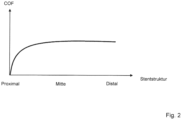
- FIG. 2 the course of the radial force (COF) along the stent structure 2 is shown. Only at the proximal end does a lower radial force act on the surrounding inner vessel wall; otherwise the radial force is constant over the entire stent structure 2.
- the decrease in the radial force at the proximal end is related to the fact that here the stent structure 2 converges to the insertion aid 3 at one point and the stent structure 2 therefore does not cover the entire circumference of the inner vessel wall.
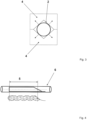
- FIG 3 a device for determining the radial force using a V-block test for the stent structure 2 is shown.
- the device for determining the radial force has 2 V-blocks 4, each of which is provided with a 90° V-groove.
- V-blocks 4 When the V-blocks 4 are placed on top of each other, a cavity with a square cross-section is created. While the lower V-block 4 is fixed, the upper V-block 4 has a force sensor to determine the radial force.
- the stent structure 2 to be tested is initially placed in the square cavity between the V-blocks 4 within a transport tube or microcatheter.
- the tube/microcatheter is then withdrawn so that the self-expanding stent structure 2 can expand to the surfaces of the V-blocks 4.
- the forces exerted by the stent structure 2 are indicated by the dashed arrows and are transmitted via the V-blocks 4 to the force sensor and evaluated.
- the relative radial force is used, ie the absolute radial force related to the effective length 5 of the stent structure 2.
- the stent structure is drawn into a transparent tube 6 with a round cross-section.
- the effective length 5 is the length in which the stent structure 2 covers at least 50% of the circumference.
- the proximal end of the stent structure 2, where it runs out towards the insertion aid, is therefore not part of the effective length 5.
- a preferred embodiment of a stent structure 2 according to the invention is shown in side view, wherein the stent structure 2 is divided into a proximal section 7, a middle section 8 and a distal section 9.
- the representation is limited to the effective length 5, ie neither the proximal end nor the insertion aid are shown.
- This is a stent structure 2 made of individual wires forming a mesh structure.
- the density of the mesh structure is increased in both the proximal section 7 and the distal section 9 compared to the middle section 8. The decrease in radial force in the proximal and distal directions that is regularly observed in uniformly constructed stent structures 2 is thus compensated by the higher density of wires.
Landscapes
- Health & Medical Sciences (AREA)
- Engineering & Computer Science (AREA)
- Biomedical Technology (AREA)
- Life Sciences & Earth Sciences (AREA)
- Veterinary Medicine (AREA)
- Public Health (AREA)
- General Health & Medical Sciences (AREA)
- Animal Behavior & Ethology (AREA)
- Heart & Thoracic Surgery (AREA)
- Vascular Medicine (AREA)
- Transplantation (AREA)
- Oral & Maxillofacial Surgery (AREA)
- Cardiology (AREA)
- Epidemiology (AREA)
- Surgery (AREA)
- Hematology (AREA)
- Chemical & Material Sciences (AREA)
- Medicinal Chemistry (AREA)
- Molecular Biology (AREA)
- Physics & Mathematics (AREA)
- Optics & Photonics (AREA)
- Media Introduction/Drainage Providing Device (AREA)
- Prostheses (AREA)
- Surgical Instruments (AREA)
Applications Claiming Priority (2)
| Application Number | Priority Date | Filing Date | Title |
|---|---|---|---|
| DE102016110199.0A DE102016110199A1 (de) | 2016-06-02 | 2016-06-02 | Vasospasmusbehandlung |
| PCT/EP2017/063302 WO2017207689A1 (de) | 2016-06-02 | 2017-06-01 | Vasospasmusbehandlung |
Publications (2)
| Publication Number | Publication Date |
|---|---|
| EP3463206A1 EP3463206A1 (de) | 2019-04-10 |
| EP3463206B1 true EP3463206B1 (de) | 2024-10-09 |
Family
ID=59253452
Family Applications (1)
| Application Number | Title | Priority Date | Filing Date |
|---|---|---|---|
| EP17733977.7A Active EP3463206B1 (de) | 2016-06-02 | 2017-06-01 | Vasospasmusbehandlung |
Country Status (13)
| Country | Link |
|---|---|
| US (1) | US11382778B2 (enExample) |
| EP (1) | EP3463206B1 (enExample) |
| JP (1) | JP7056935B2 (enExample) |
| KR (1) | KR102460929B1 (enExample) |
| CN (1) | CN109310506B (enExample) |
| AR (1) | AR108655A1 (enExample) |
| AU (1) | AU2017275732B2 (enExample) |
| BR (1) | BR112018074618A2 (enExample) |
| CA (1) | CA3025967A1 (enExample) |
| DE (1) | DE102016110199A1 (enExample) |
| ES (1) | ES3009582T3 (enExample) |
| SG (1) | SG11201810710WA (enExample) |
| WO (1) | WO2017207689A1 (enExample) |
Families Citing this family (9)
| Publication number | Priority date | Publication date | Assignee | Title |
|---|---|---|---|---|
| US12285182B2 (en) | 2018-10-10 | 2025-04-29 | Innova Vascular, Inc. | Devices and methods for removing an embolus |
| PL3941392T3 (pl) | 2019-03-20 | 2025-08-25 | inQB8 Medical Technologies, LLC | Implant do leczenia rozwarstwienia aorty |
| US20230414387A1 (en) * | 2020-09-11 | 2023-12-28 | Jmr Co., Ltd. | Stent and method for manufacturing stent |
| DE102021102458A1 (de) | 2021-01-26 | 2022-07-28 | Phenox Gmbh | Beschichtete medizinische Vorrichtungen |
| JP7675196B2 (ja) * | 2021-01-26 | 2025-05-12 | フェノックス ゲーエムベーハー | コーティングされた医療機器 |
| DE102022113422A1 (de) | 2022-05-27 | 2023-11-30 | Acandis Gmbh | Stent und Behandlungssystem mit einem solchen Stent |
| DE102022114767A1 (de) | 2022-06-13 | 2023-12-14 | Phenox Gmbh | Endovaskuläre Vorrichtung mit Führungsdraht |
| WO2024018367A1 (en) | 2022-07-22 | 2024-01-25 | Phenox Gmbh | Apparatus and method for treating vasospasm |
| CN118370599B (zh) * | 2024-06-25 | 2024-09-06 | 北京阿迈特医疗器械有限公司 | 血管支撑结构的设计方法、装置、人工血管及血管支架 |
Family Cites Families (19)
| Publication number | Priority date | Publication date | Assignee | Title |
|---|---|---|---|---|
| DE850C (de) * | 1877-09-11 | A. KOCH & F. SCHAACK in Köln | Elektromagnetische Normaluhr | |
| US5449372A (en) * | 1990-10-09 | 1995-09-12 | Scimed Lifesystems, Inc. | Temporary stent and methods for use and manufacture |
| US6258032B1 (en) * | 1997-01-29 | 2001-07-10 | William M. Hammesfahr | Method of diagnosis and treatment and related compositions and apparatus |
| JPH105343A (ja) * | 1996-06-21 | 1998-01-13 | Piolax Inc | 管状器官の治療具 |
| DE10233085B4 (de) | 2002-07-19 | 2014-02-20 | Dendron Gmbh | Stent mit Führungsdraht |
| DE10301850B4 (de) * | 2003-01-16 | 2017-05-04 | Dendron Gmbh | Stent |
| US20050131523A1 (en) | 2003-04-02 | 2005-06-16 | Mehran Bashiri | Detachable and retrievable stent assembly |
| US8628564B2 (en) | 2004-05-25 | 2014-01-14 | Covidien Lp | Methods and apparatus for luminal stenting |
| EP1604697A1 (en) * | 2004-06-09 | 2005-12-14 | J.A.C.C. GmbH | Implantable device |
| DE102007012964A1 (de) | 2007-03-06 | 2008-09-11 | Phenox Gmbh | Implantat zur Beeinflussung des Blutflusses |
| US8066757B2 (en) | 2007-10-17 | 2011-11-29 | Mindframe, Inc. | Blood flow restoration and thrombus management methods |
| US8529596B2 (en) * | 2009-07-08 | 2013-09-10 | Concentric Medical, Inc. | Vascular and bodily duct treatment devices and methods |
| US20110009941A1 (en) | 2009-07-08 | 2011-01-13 | Concentric Medical, Inc. | Vascular and bodily duct treatment devices and methods |
| US9039749B2 (en) * | 2010-10-01 | 2015-05-26 | Covidien Lp | Methods and apparatuses for flow restoration and implanting members in the human body |
| HK1203793A1 (en) | 2012-01-04 | 2015-11-06 | Rapid Medical Ltd. | Braided devices for assisting medical treatments |
| US20160081825A1 (en) | 2012-01-04 | 2016-03-24 | Rapid Medical Ltd. | Heat-treated braided intravascular devices and methods |
| PL2804548T3 (pl) * | 2012-01-17 | 2019-10-31 | Perflow Medical Ltd | Przyrząd do usuwania okluzji |
| EP3156006B1 (en) | 2012-03-16 | 2022-05-18 | Terumo Corporation | Stent and stent delivery device |
| US9808359B2 (en) * | 2015-09-30 | 2017-11-07 | Neurvana Medical, Llc | Treatment systems processes and devices addressing cerebral vasospasm/vasoconstriction |
-
2016
- 2016-06-02 DE DE102016110199.0A patent/DE102016110199A1/de active Pending
-
2017
- 2017-06-01 SG SG11201810710WA patent/SG11201810710WA/en unknown
- 2017-06-01 CN CN201780034478.8A patent/CN109310506B/zh active Active
- 2017-06-01 EP EP17733977.7A patent/EP3463206B1/de active Active
- 2017-06-01 CA CA3025967A patent/CA3025967A1/en active Pending
- 2017-06-01 AR ARP170101496A patent/AR108655A1/es active IP Right Grant
- 2017-06-01 US US16/306,500 patent/US11382778B2/en active Active
- 2017-06-01 KR KR1020187035574A patent/KR102460929B1/ko active Active
- 2017-06-01 ES ES17733977T patent/ES3009582T3/es active Active
- 2017-06-01 BR BR112018074618-5A patent/BR112018074618A2/pt not_active Application Discontinuation
- 2017-06-01 AU AU2017275732A patent/AU2017275732B2/en active Active
- 2017-06-01 WO PCT/EP2017/063302 patent/WO2017207689A1/de not_active Ceased
- 2017-06-01 JP JP2018562307A patent/JP7056935B2/ja active Active
Also Published As
| Publication number | Publication date |
|---|---|
| AU2017275732A1 (en) | 2019-01-24 |
| CN109310506B (zh) | 2022-02-08 |
| WO2017207689A1 (de) | 2017-12-07 |
| CN109310506A (zh) | 2019-02-05 |
| JP7056935B2 (ja) | 2022-04-19 |
| JP2019517300A (ja) | 2019-06-24 |
| SG11201810710WA (en) | 2019-01-30 |
| US20190110912A1 (en) | 2019-04-18 |
| BR112018074618A2 (pt) | 2019-03-06 |
| AR108655A1 (es) | 2018-09-12 |
| US11382778B2 (en) | 2022-07-12 |
| ES3009582T3 (en) | 2025-03-27 |
| KR102460929B1 (ko) | 2022-10-31 |
| CA3025967A1 (en) | 2017-12-07 |
| EP3463206A1 (de) | 2019-04-10 |
| DE102016110199A1 (de) | 2017-12-07 |
| KR20190014513A (ko) | 2019-02-12 |
| AU2017275732B2 (en) | 2022-06-30 |
Similar Documents
| Publication | Publication Date | Title |
|---|---|---|
| EP3463206B1 (de) | Vasospasmusbehandlung | |
| EP2613743B1 (de) | Implantat zur beeinflussung des blutflusses bei arteriovenösen fehlbildungen | |
| DE602004012037T2 (de) | Abdeckvorrichtung für einen Aneurysemhals | |
| EP3265038B1 (de) | Implantateinführsystem | |
| EP3209248B1 (de) | Stent zum schienen einer vene und system zum setzen eines stents | |
| DE10253634A1 (de) | Endoprothese | |
| WO2009077845A2 (de) | Stützimplantat, insbesondere stent, und implantationskatheter für das stützimplantat | |
| DE102014113836B4 (de) | Verfahren zum Herstellen eines patientenspezifischen, endovaskulären Implantats | |
| DE102018133345B4 (de) | Stent | |
| DE102014016588A1 (de) | Stentprothese | |
| EP3380018A1 (de) | Bandförmiges okklusionsmittel | |
| WO2018046592A1 (de) | Vorrichtung und verfahren zur vorbeugung und behandlung eines vasospasmus | |
| DE102013014523A1 (de) | Einführ- und Ablösesystem für Implantate | |
| EP3373871B1 (de) | Uterotubar-implantat-vorrichtung | |
| EP3630009B1 (de) | Stentgraft mit taschen | |
| WO2019174991A1 (de) | Temporärer verschluss von aneurysmenhälsen | |
| DE102010046408B4 (de) | Zuführsystem | |
| DE102014114888A1 (de) | Stent für die perkutane Vertebroplastie | |
| DE102004062296A1 (de) | Vorrichtung zum Positionieren eines Stents | |
| WO2007006286A1 (de) | Endovaskulares implantat für den verschluss eines blutgefässes | |
| EP4027910A1 (de) | Implantat zur behandlung von aneurysmen | |
| DE10301600A1 (de) | Kombination von Stents | |
| WO2021250281A1 (de) | Implantat zur behandlung von aneurysmen | |
| DE102020115600A1 (de) | Implantat zur Behandlung von Aneurysmen | |
| EP3781088B1 (de) | Vorrichtung zur einbringung von implantaten |
Legal Events
| Date | Code | Title | Description |
|---|---|---|---|
| STAA | Information on the status of an ep patent application or granted ep patent |
Free format text: STATUS: UNKNOWN |
|
| STAA | Information on the status of an ep patent application or granted ep patent |
Free format text: STATUS: THE INTERNATIONAL PUBLICATION HAS BEEN MADE |
|
| PUAI | Public reference made under article 153(3) epc to a published international application that has entered the european phase |
Free format text: ORIGINAL CODE: 0009012 |
|
| STAA | Information on the status of an ep patent application or granted ep patent |
Free format text: STATUS: REQUEST FOR EXAMINATION WAS MADE |
|
| 17P | Request for examination filed |
Effective date: 20190102 |
|
| AK | Designated contracting states |
Kind code of ref document: A1 Designated state(s): AL AT BE BG CH CY CZ DE DK EE ES FI FR GB GR HR HU IE IS IT LI LT LU LV MC MK MT NL NO PL PT RO RS SE SI SK SM TR |
|
| AX | Request for extension of the european patent |
Extension state: BA ME |
|
| DAV | Request for validation of the european patent (deleted) | ||
| DAX | Request for extension of the european patent (deleted) | ||
| RAP1 | Party data changed (applicant data changed or rights of an application transferred) |
Owner name: FEMTOS GMBH Owner name: CHARITE - UNIVERSITAETSMEDIZIN BERLIN |
|
| STAA | Information on the status of an ep patent application or granted ep patent |
Free format text: STATUS: EXAMINATION IS IN PROGRESS |
|
| 17Q | First examination report despatched |
Effective date: 20230630 |
|
| GRAP | Despatch of communication of intention to grant a patent |
Free format text: ORIGINAL CODE: EPIDOSNIGR1 |
|
| STAA | Information on the status of an ep patent application or granted ep patent |
Free format text: STATUS: GRANT OF PATENT IS INTENDED |
|
| INTG | Intention to grant announced |
Effective date: 20240603 |
|
| GRAS | Grant fee paid |
Free format text: ORIGINAL CODE: EPIDOSNIGR3 |
|
| GRAA | (expected) grant |
Free format text: ORIGINAL CODE: 0009210 |
|
| STAA | Information on the status of an ep patent application or granted ep patent |
Free format text: STATUS: THE PATENT HAS BEEN GRANTED |
|
| AK | Designated contracting states |
Kind code of ref document: B1 Designated state(s): AL AT BE BG CH CY CZ DE DK EE ES FI FR GB GR HR HU IE IS IT LI LT LU LV MC MK MT NL NO PL PT RO RS SE SI SK SM TR |
|
| REG | Reference to a national code |
Ref country code: CH Ref legal event code: EP |
|
| REG | Reference to a national code |
Ref country code: DE Ref legal event code: R096 Ref document number: 502017016472 Country of ref document: DE |
|
| REG | Reference to a national code |
Ref country code: DE Ref legal event code: R081 Ref document number: 502017016472 Country of ref document: DE Owner name: FEMTOS GMBH, DE Free format text: FORMER OWNER: ANMELDERANGABEN UNKLAR / UNVOLLSTAENDIG, 80297 MUENCHEN, DE Ref country code: DE Ref legal event code: R081 Ref document number: 502017016472 Country of ref document: DE Owner name: CHARITE - UNIVERSITAETSMEDIZIN BERLIN, KOERPER, DE Free format text: FORMER OWNER: ANMELDERANGABEN UNKLAR / UNVOLLSTAENDIG, 80297 MUENCHEN, DE |
|
| REG | Reference to a national code |
Ref country code: IE Ref legal event code: FG4D Free format text: LANGUAGE OF EP DOCUMENT: GERMAN |
|
| REG | Reference to a national code |
Ref country code: LT Ref legal event code: MG9D |
|
| REG | Reference to a national code |
Ref country code: NL Ref legal event code: MP Effective date: 20241009 |
|
| P01 | Opt-out of the competence of the unified patent court (upc) registered |
Free format text: CASE NUMBER: APP_6146/2025 Effective date: 20250205 |
|
| PG25 | Lapsed in a contracting state [announced via postgrant information from national office to epo] |
Ref country code: NL Free format text: LAPSE BECAUSE OF FAILURE TO SUBMIT A TRANSLATION OF THE DESCRIPTION OR TO PAY THE FEE WITHIN THE PRESCRIBED TIME-LIMIT Effective date: 20241009 |
|
| REG | Reference to a national code |
Ref country code: ES Ref legal event code: FG2A Ref document number: 3009582 Country of ref document: ES Kind code of ref document: T3 Effective date: 20250327 |
|
| PG25 | Lapsed in a contracting state [announced via postgrant information from national office to epo] |
Ref country code: NL Free format text: LAPSE BECAUSE OF FAILURE TO SUBMIT A TRANSLATION OF THE DESCRIPTION OR TO PAY THE FEE WITHIN THE PRESCRIBED TIME-LIMIT Effective date: 20241009 |
|
| PG25 | Lapsed in a contracting state [announced via postgrant information from national office to epo] |
Ref country code: HR Free format text: LAPSE BECAUSE OF FAILURE TO SUBMIT A TRANSLATION OF THE DESCRIPTION OR TO PAY THE FEE WITHIN THE PRESCRIBED TIME-LIMIT Effective date: 20241009 Ref country code: PT Free format text: LAPSE BECAUSE OF FAILURE TO SUBMIT A TRANSLATION OF THE DESCRIPTION OR TO PAY THE FEE WITHIN THE PRESCRIBED TIME-LIMIT Effective date: 20250210 Ref country code: IS Free format text: LAPSE BECAUSE OF FAILURE TO SUBMIT A TRANSLATION OF THE DESCRIPTION OR TO PAY THE FEE WITHIN THE PRESCRIBED TIME-LIMIT Effective date: 20250209 |
|
| PG25 | Lapsed in a contracting state [announced via postgrant information from national office to epo] |
Ref country code: FI Free format text: LAPSE BECAUSE OF FAILURE TO SUBMIT A TRANSLATION OF THE DESCRIPTION OR TO PAY THE FEE WITHIN THE PRESCRIBED TIME-LIMIT Effective date: 20241009 |
|
| PG25 | Lapsed in a contracting state [announced via postgrant information from national office to epo] |
Ref country code: BG Free format text: LAPSE BECAUSE OF FAILURE TO SUBMIT A TRANSLATION OF THE DESCRIPTION OR TO PAY THE FEE WITHIN THE PRESCRIBED TIME-LIMIT Effective date: 20241009 |
|
| PG25 | Lapsed in a contracting state [announced via postgrant information from national office to epo] |
Ref country code: NO Free format text: LAPSE BECAUSE OF FAILURE TO SUBMIT A TRANSLATION OF THE DESCRIPTION OR TO PAY THE FEE WITHIN THE PRESCRIBED TIME-LIMIT Effective date: 20250109 |
|
| PG25 | Lapsed in a contracting state [announced via postgrant information from national office to epo] |
Ref country code: LV Free format text: LAPSE BECAUSE OF FAILURE TO SUBMIT A TRANSLATION OF THE DESCRIPTION OR TO PAY THE FEE WITHIN THE PRESCRIBED TIME-LIMIT Effective date: 20241009 Ref country code: GR Free format text: LAPSE BECAUSE OF FAILURE TO SUBMIT A TRANSLATION OF THE DESCRIPTION OR TO PAY THE FEE WITHIN THE PRESCRIBED TIME-LIMIT Effective date: 20250110 |
|
| PG25 | Lapsed in a contracting state [announced via postgrant information from national office to epo] |
Ref country code: PL Free format text: LAPSE BECAUSE OF FAILURE TO SUBMIT A TRANSLATION OF THE DESCRIPTION OR TO PAY THE FEE WITHIN THE PRESCRIBED TIME-LIMIT Effective date: 20241009 |
|
| PG25 | Lapsed in a contracting state [announced via postgrant information from national office to epo] |
Ref country code: RS Free format text: LAPSE BECAUSE OF FAILURE TO SUBMIT A TRANSLATION OF THE DESCRIPTION OR TO PAY THE FEE WITHIN THE PRESCRIBED TIME-LIMIT Effective date: 20250109 |
|
| PG25 | Lapsed in a contracting state [announced via postgrant information from national office to epo] |
Ref country code: SM Free format text: LAPSE BECAUSE OF FAILURE TO SUBMIT A TRANSLATION OF THE DESCRIPTION OR TO PAY THE FEE WITHIN THE PRESCRIBED TIME-LIMIT Effective date: 20241009 |
|
| PGFP | Annual fee paid to national office [announced via postgrant information from national office to epo] |
Ref country code: DE Payment date: 20250627 Year of fee payment: 9 |
|
| PG25 | Lapsed in a contracting state [announced via postgrant information from national office to epo] |
Ref country code: DK Free format text: LAPSE BECAUSE OF FAILURE TO SUBMIT A TRANSLATION OF THE DESCRIPTION OR TO PAY THE FEE WITHIN THE PRESCRIBED TIME-LIMIT Effective date: 20241009 |
|
| PGFP | Annual fee paid to national office [announced via postgrant information from national office to epo] |
Ref country code: GB Payment date: 20250627 Year of fee payment: 9 |
|
| REG | Reference to a national code |
Ref country code: DE Ref legal event code: R097 Ref document number: 502017016472 Country of ref document: DE |
|
| PG25 | Lapsed in a contracting state [announced via postgrant information from national office to epo] |
Ref country code: EE Free format text: LAPSE BECAUSE OF FAILURE TO SUBMIT A TRANSLATION OF THE DESCRIPTION OR TO PAY THE FEE WITHIN THE PRESCRIBED TIME-LIMIT Effective date: 20241009 |
|
| PGFP | Annual fee paid to national office [announced via postgrant information from national office to epo] |
Ref country code: FR Payment date: 20250625 Year of fee payment: 9 |
|
| PG25 | Lapsed in a contracting state [announced via postgrant information from national office to epo] |
Ref country code: RO Free format text: LAPSE BECAUSE OF FAILURE TO SUBMIT A TRANSLATION OF THE DESCRIPTION OR TO PAY THE FEE WITHIN THE PRESCRIBED TIME-LIMIT Effective date: 20241009 |
|
| PG25 | Lapsed in a contracting state [announced via postgrant information from national office to epo] |
Ref country code: SK Free format text: LAPSE BECAUSE OF FAILURE TO SUBMIT A TRANSLATION OF THE DESCRIPTION OR TO PAY THE FEE WITHIN THE PRESCRIBED TIME-LIMIT Effective date: 20241009 |
|
| PG25 | Lapsed in a contracting state [announced via postgrant information from national office to epo] |
Ref country code: CZ Free format text: LAPSE BECAUSE OF FAILURE TO SUBMIT A TRANSLATION OF THE DESCRIPTION OR TO PAY THE FEE WITHIN THE PRESCRIBED TIME-LIMIT Effective date: 20241009 |
|
| PGFP | Annual fee paid to national office [announced via postgrant information from national office to epo] |
Ref country code: IE Payment date: 20250627 Year of fee payment: 9 |
|
| PLBE | No opposition filed within time limit |
Free format text: ORIGINAL CODE: 0009261 |
|
| STAA | Information on the status of an ep patent application or granted ep patent |
Free format text: STATUS: NO OPPOSITION FILED WITHIN TIME LIMIT |
|
| PG25 | Lapsed in a contracting state [announced via postgrant information from national office to epo] |
Ref country code: SE Free format text: LAPSE BECAUSE OF FAILURE TO SUBMIT A TRANSLATION OF THE DESCRIPTION OR TO PAY THE FEE WITHIN THE PRESCRIBED TIME-LIMIT Effective date: 20241009 |
|
| 26N | No opposition filed |
Effective date: 20250710 |
|
| PGFP | Annual fee paid to national office [announced via postgrant information from national office to epo] |
Ref country code: ES Payment date: 20250701 Year of fee payment: 9 |
|
| PGFP | Annual fee paid to national office [announced via postgrant information from national office to epo] |
Ref country code: IT Payment date: 20250619 Year of fee payment: 9 |
|
| PGFP | Annual fee paid to national office [announced via postgrant information from national office to epo] |
Ref country code: CH Payment date: 20250701 Year of fee payment: 9 |