EP3448990B1 - Methods for modification of target nucleic acids using a fusion molecule of guide and donor rna, fusion rna molecule and vector systems encoding the fusion rna molecule - Google Patents
Methods for modification of target nucleic acids using a fusion molecule of guide and donor rna, fusion rna molecule and vector systems encoding the fusion rna molecule Download PDFInfo
- Publication number
- EP3448990B1 EP3448990B1 EP17720040.9A EP17720040A EP3448990B1 EP 3448990 B1 EP3448990 B1 EP 3448990B1 EP 17720040 A EP17720040 A EP 17720040A EP 3448990 B1 EP3448990 B1 EP 3448990B1
- Authority
- EP
- European Patent Office
- Prior art keywords
- molecule
- nucleic acid
- dna
- target
- sequence
- Prior art date
- Legal status (The legal status is an assumption and is not a legal conclusion. Google has not performed a legal analysis and makes no representation as to the accuracy of the status listed.)
- Revoked
Links
Images








Classifications
-
- C—CHEMISTRY; METALLURGY
- C12—BIOCHEMISTRY; BEER; SPIRITS; WINE; VINEGAR; MICROBIOLOGY; ENZYMOLOGY; MUTATION OR GENETIC ENGINEERING
- C12N—MICROORGANISMS OR ENZYMES; COMPOSITIONS THEREOF; PROPAGATING, PRESERVING, OR MAINTAINING MICROORGANISMS; MUTATION OR GENETIC ENGINEERING; CULTURE MEDIA
- C12N15/00—Mutation or genetic engineering; DNA or RNA concerning genetic engineering, vectors, e.g. plasmids, or their isolation, preparation or purification; Use of hosts therefor
- C12N15/09—Recombinant DNA-technology
- C12N15/87—Introduction of foreign genetic material using processes not otherwise provided for, e.g. co-transformation
- C12N15/90—Stable introduction of foreign DNA into chromosome
- C12N15/902—Stable introduction of foreign DNA into chromosome using homologous recombination
-
- C—CHEMISTRY; METALLURGY
- C12—BIOCHEMISTRY; BEER; SPIRITS; WINE; VINEGAR; MICROBIOLOGY; ENZYMOLOGY; MUTATION OR GENETIC ENGINEERING
- C12N—MICROORGANISMS OR ENZYMES; COMPOSITIONS THEREOF; PROPAGATING, PRESERVING, OR MAINTAINING MICROORGANISMS; MUTATION OR GENETIC ENGINEERING; CULTURE MEDIA
- C12N15/00—Mutation or genetic engineering; DNA or RNA concerning genetic engineering, vectors, e.g. plasmids, or their isolation, preparation or purification; Use of hosts therefor
- C12N15/09—Recombinant DNA-technology
- C12N15/11—DNA or RNA fragments; Modified forms thereof; Non-coding nucleic acids having a biological activity
-
- C—CHEMISTRY; METALLURGY
- C12—BIOCHEMISTRY; BEER; SPIRITS; WINE; VINEGAR; MICROBIOLOGY; ENZYMOLOGY; MUTATION OR GENETIC ENGINEERING
- C12N—MICROORGANISMS OR ENZYMES; COMPOSITIONS THEREOF; PROPAGATING, PRESERVING, OR MAINTAINING MICROORGANISMS; MUTATION OR GENETIC ENGINEERING; CULTURE MEDIA
- C12N15/00—Mutation or genetic engineering; DNA or RNA concerning genetic engineering, vectors, e.g. plasmids, or their isolation, preparation or purification; Use of hosts therefor
- C12N15/09—Recombinant DNA-technology
- C12N15/10—Processes for the isolation, preparation or purification of DNA or RNA
- C12N15/102—Mutagenizing nucleic acids
-
- C—CHEMISTRY; METALLURGY
- C12—BIOCHEMISTRY; BEER; SPIRITS; WINE; VINEGAR; MICROBIOLOGY; ENZYMOLOGY; MUTATION OR GENETIC ENGINEERING
- C12N—MICROORGANISMS OR ENZYMES; COMPOSITIONS THEREOF; PROPAGATING, PRESERVING, OR MAINTAINING MICROORGANISMS; MUTATION OR GENETIC ENGINEERING; CULTURE MEDIA
- C12N15/00—Mutation or genetic engineering; DNA or RNA concerning genetic engineering, vectors, e.g. plasmids, or their isolation, preparation or purification; Use of hosts therefor
- C12N15/09—Recombinant DNA-technology
- C12N15/11—DNA or RNA fragments; Modified forms thereof; Non-coding nucleic acids having a biological activity
- C12N15/111—General methods applicable to biologically active non-coding nucleic acids
-
- C—CHEMISTRY; METALLURGY
- C12—BIOCHEMISTRY; BEER; SPIRITS; WINE; VINEGAR; MICROBIOLOGY; ENZYMOLOGY; MUTATION OR GENETIC ENGINEERING
- C12N—MICROORGANISMS OR ENZYMES; COMPOSITIONS THEREOF; PROPAGATING, PRESERVING, OR MAINTAINING MICROORGANISMS; MUTATION OR GENETIC ENGINEERING; CULTURE MEDIA
- C12N15/00—Mutation or genetic engineering; DNA or RNA concerning genetic engineering, vectors, e.g. plasmids, or their isolation, preparation or purification; Use of hosts therefor
- C12N15/09—Recombinant DNA-technology
- C12N15/11—DNA or RNA fragments; Modified forms thereof; Non-coding nucleic acids having a biological activity
- C12N15/113—Non-coding nucleic acids modulating the expression of genes, e.g. antisense oligonucleotides; Antisense DNA or RNA; Triplex- forming oligonucleotides; Catalytic nucleic acids, e.g. ribozymes; Nucleic acids used in co-suppression or gene silencing
-
- C—CHEMISTRY; METALLURGY
- C12—BIOCHEMISTRY; BEER; SPIRITS; WINE; VINEGAR; MICROBIOLOGY; ENZYMOLOGY; MUTATION OR GENETIC ENGINEERING
- C12N—MICROORGANISMS OR ENZYMES; COMPOSITIONS THEREOF; PROPAGATING, PRESERVING, OR MAINTAINING MICROORGANISMS; MUTATION OR GENETIC ENGINEERING; CULTURE MEDIA
- C12N15/00—Mutation or genetic engineering; DNA or RNA concerning genetic engineering, vectors, e.g. plasmids, or their isolation, preparation or purification; Use of hosts therefor
- C12N15/09—Recombinant DNA-technology
- C12N15/63—Introduction of foreign genetic material using vectors; Vectors; Use of hosts therefor; Regulation of expression
- C12N15/70—Vectors or expression systems specially adapted for E. coli
-
- C—CHEMISTRY; METALLURGY
- C12—BIOCHEMISTRY; BEER; SPIRITS; WINE; VINEGAR; MICROBIOLOGY; ENZYMOLOGY; MUTATION OR GENETIC ENGINEERING
- C12N—MICROORGANISMS OR ENZYMES; COMPOSITIONS THEREOF; PROPAGATING, PRESERVING, OR MAINTAINING MICROORGANISMS; MUTATION OR GENETIC ENGINEERING; CULTURE MEDIA
- C12N15/00—Mutation or genetic engineering; DNA or RNA concerning genetic engineering, vectors, e.g. plasmids, or their isolation, preparation or purification; Use of hosts therefor
- C12N15/09—Recombinant DNA-technology
- C12N15/63—Introduction of foreign genetic material using vectors; Vectors; Use of hosts therefor; Regulation of expression
- C12N15/74—Vectors or expression systems specially adapted for prokaryotic hosts other than E. coli, e.g. Lactobacillus, Micromonospora
- C12N15/75—Vectors or expression systems specially adapted for prokaryotic hosts other than E. coli, e.g. Lactobacillus, Micromonospora for Bacillus
-
- C—CHEMISTRY; METALLURGY
- C12—BIOCHEMISTRY; BEER; SPIRITS; WINE; VINEGAR; MICROBIOLOGY; ENZYMOLOGY; MUTATION OR GENETIC ENGINEERING
- C12N—MICROORGANISMS OR ENZYMES; COMPOSITIONS THEREOF; PROPAGATING, PRESERVING, OR MAINTAINING MICROORGANISMS; MUTATION OR GENETIC ENGINEERING; CULTURE MEDIA
- C12N15/00—Mutation or genetic engineering; DNA or RNA concerning genetic engineering, vectors, e.g. plasmids, or their isolation, preparation or purification; Use of hosts therefor
- C12N15/09—Recombinant DNA-technology
- C12N15/63—Introduction of foreign genetic material using vectors; Vectors; Use of hosts therefor; Regulation of expression
- C12N15/79—Vectors or expression systems specially adapted for eukaryotic hosts
- C12N15/80—Vectors or expression systems specially adapted for eukaryotic hosts for fungi
- C12N15/81—Vectors or expression systems specially adapted for eukaryotic hosts for fungi for yeasts
-
- C—CHEMISTRY; METALLURGY
- C12—BIOCHEMISTRY; BEER; SPIRITS; WINE; VINEGAR; MICROBIOLOGY; ENZYMOLOGY; MUTATION OR GENETIC ENGINEERING
- C12N—MICROORGANISMS OR ENZYMES; COMPOSITIONS THEREOF; PROPAGATING, PRESERVING, OR MAINTAINING MICROORGANISMS; MUTATION OR GENETIC ENGINEERING; CULTURE MEDIA
- C12N15/00—Mutation or genetic engineering; DNA or RNA concerning genetic engineering, vectors, e.g. plasmids, or their isolation, preparation or purification; Use of hosts therefor
- C12N15/09—Recombinant DNA-technology
- C12N15/63—Introduction of foreign genetic material using vectors; Vectors; Use of hosts therefor; Regulation of expression
- C12N15/79—Vectors or expression systems specially adapted for eukaryotic hosts
- C12N15/82—Vectors or expression systems specially adapted for eukaryotic hosts for plant cells, e.g. plant artificial chromosomes (PACs)
- C12N15/8241—Phenotypically and genetically modified plants via recombinant DNA technology
- C12N15/8261—Phenotypically and genetically modified plants via recombinant DNA technology with agronomic (input) traits, e.g. crop yield
- C12N15/8271—Phenotypically and genetically modified plants via recombinant DNA technology with agronomic (input) traits, e.g. crop yield for stress resistance, e.g. heavy metal resistance
- C12N15/8274—Phenotypically and genetically modified plants via recombinant DNA technology with agronomic (input) traits, e.g. crop yield for stress resistance, e.g. heavy metal resistance for herbicide resistance
-
- C—CHEMISTRY; METALLURGY
- C12—BIOCHEMISTRY; BEER; SPIRITS; WINE; VINEGAR; MICROBIOLOGY; ENZYMOLOGY; MUTATION OR GENETIC ENGINEERING
- C12N—MICROORGANISMS OR ENZYMES; COMPOSITIONS THEREOF; PROPAGATING, PRESERVING, OR MAINTAINING MICROORGANISMS; MUTATION OR GENETIC ENGINEERING; CULTURE MEDIA
- C12N15/00—Mutation or genetic engineering; DNA or RNA concerning genetic engineering, vectors, e.g. plasmids, or their isolation, preparation or purification; Use of hosts therefor
- C12N15/09—Recombinant DNA-technology
- C12N15/63—Introduction of foreign genetic material using vectors; Vectors; Use of hosts therefor; Regulation of expression
- C12N15/79—Vectors or expression systems specially adapted for eukaryotic hosts
- C12N15/85—Vectors or expression systems specially adapted for eukaryotic hosts for animal cells
- C12N15/8509—Vectors or expression systems specially adapted for eukaryotic hosts for animal cells for producing genetically modified animals, e.g. transgenic
-
- C—CHEMISTRY; METALLURGY
- C12—BIOCHEMISTRY; BEER; SPIRITS; WINE; VINEGAR; MICROBIOLOGY; ENZYMOLOGY; MUTATION OR GENETIC ENGINEERING
- C12N—MICROORGANISMS OR ENZYMES; COMPOSITIONS THEREOF; PROPAGATING, PRESERVING, OR MAINTAINING MICROORGANISMS; MUTATION OR GENETIC ENGINEERING; CULTURE MEDIA
- C12N15/00—Mutation or genetic engineering; DNA or RNA concerning genetic engineering, vectors, e.g. plasmids, or their isolation, preparation or purification; Use of hosts therefor
- C12N15/09—Recombinant DNA-technology
- C12N15/87—Introduction of foreign genetic material using processes not otherwise provided for, e.g. co-transformation
- C12N15/90—Stable introduction of foreign DNA into chromosome
- C12N15/902—Stable introduction of foreign DNA into chromosome using homologous recombination
- C12N15/905—Stable introduction of foreign DNA into chromosome using homologous recombination in yeast
-
- C—CHEMISTRY; METALLURGY
- C12—BIOCHEMISTRY; BEER; SPIRITS; WINE; VINEGAR; MICROBIOLOGY; ENZYMOLOGY; MUTATION OR GENETIC ENGINEERING
- C12N—MICROORGANISMS OR ENZYMES; COMPOSITIONS THEREOF; PROPAGATING, PRESERVING, OR MAINTAINING MICROORGANISMS; MUTATION OR GENETIC ENGINEERING; CULTURE MEDIA
- C12N15/00—Mutation or genetic engineering; DNA or RNA concerning genetic engineering, vectors, e.g. plasmids, or their isolation, preparation or purification; Use of hosts therefor
- C12N15/09—Recombinant DNA-technology
- C12N15/87—Introduction of foreign genetic material using processes not otherwise provided for, e.g. co-transformation
- C12N15/90—Stable introduction of foreign DNA into chromosome
- C12N15/902—Stable introduction of foreign DNA into chromosome using homologous recombination
- C12N15/907—Stable introduction of foreign DNA into chromosome using homologous recombination in mammalian cells
-
- C—CHEMISTRY; METALLURGY
- C12—BIOCHEMISTRY; BEER; SPIRITS; WINE; VINEGAR; MICROBIOLOGY; ENZYMOLOGY; MUTATION OR GENETIC ENGINEERING
- C12N—MICROORGANISMS OR ENZYMES; COMPOSITIONS THEREOF; PROPAGATING, PRESERVING, OR MAINTAINING MICROORGANISMS; MUTATION OR GENETIC ENGINEERING; CULTURE MEDIA
- C12N9/00—Enzymes; Proenzymes; Compositions thereof; Processes for preparing, activating, inhibiting, separating or purifying enzymes
- C12N9/14—Hydrolases (3)
- C12N9/16—Hydrolases (3) acting on ester bonds (3.1)
- C12N9/22—Ribonucleases [RNase]; Deoxyribonucleases [DNase]
-
- C—CHEMISTRY; METALLURGY
- C12—BIOCHEMISTRY; BEER; SPIRITS; WINE; VINEGAR; MICROBIOLOGY; ENZYMOLOGY; MUTATION OR GENETIC ENGINEERING
- C12N—MICROORGANISMS OR ENZYMES; COMPOSITIONS THEREOF; PROPAGATING, PRESERVING, OR MAINTAINING MICROORGANISMS; MUTATION OR GENETIC ENGINEERING; CULTURE MEDIA
- C12N2310/00—Structure or type of the nucleic acid
- C12N2310/10—Type of nucleic acid
- C12N2310/20—Type of nucleic acid involving clustered regularly interspaced short palindromic repeats [CRISPR]
Definitions
- FusionCRISPR can also be used for knock-ins in any organism.
- a selectable marker can be knocked in using standard introduction techniques and standard expression vehicles, including simple plasmids. This can be done to interrupt and knockout an endogenous gene while providing easy selection.
- One embodiment of the invention is a method for modification of a target nucleic acid (target NA) molecule in a cell or composition comprising the steps of
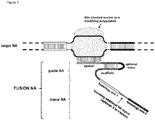
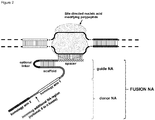
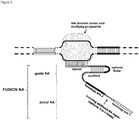
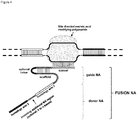
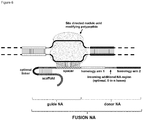
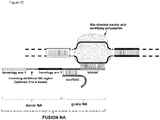
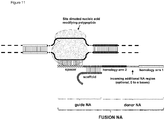
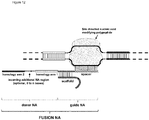
- FIG. 1 Various preferred structures of the fusion nucleic acid molecule according to the invention are depicted in figure 1 to 8 . The most preferred structure is depicted in figure 1 .
- the target nucleic acid may also be modified by deleting at least one base from the target nucleic acid.
- the sequence between homology arm 1 and homology arm 2 of the donor nucleic acid molecule would comprise a sequence complementary to the target nucleic acid molecule that lacks at least one base compared to the target nucleic acid.
- the target nucleic acid may further be modified by replacing at least one base in the target nucleic acid with one or more bases heterologous to the target nucleic acid.
- the sequence between homology arm 1 and 2 of the donor nucleic acid would comprise at least one mismatch compared to the complementary region in the target nucleic acid.
- the site directed nucleic acid modifying polypeptide may have a double-stranded nucleic acid digestion function or it may have a nickase function, cutting only one strand of a double-stranded nucleic acid molecule.
- the nucleic acid restriction or nickase capability of the site directed nucleic acid modifying polypeptide may also be inactivated and the recombinant site directed nucleic acid modifying polypeptide may be linked to other functional groups such as the DNA restriction region of Fokl or of a homing endonulcease.
- Such recombinant site directed nucleic acid modifying polypeptides are for example described in Tsai et al (2014; Nat Biotechnol. 2014 32(6):569-76 .) or Guilinger et al (2014; Nat Biotechnol. 2014 32(6):577-82 ).
- the gNA molecule comprises a spacer nucleic acid (spacer NA) molecule comprising at least 12 bases 100% complementary to the target NA molecule. Preferably it comprises at least 13 bases, at least 14 bases or at least 15 bases complementary to the target NA molecule. More preferably it comprises at least 16 bases, at least 17 bases or at least 18 bases complementary to the target NA molecule. Even more preferably it comprises at least 19 bases or at least 20 bases complementary to the target NA.
- spacer NA spacer nucleic acid
- the scaffold NA may consist of one nucleic acid molecule, which comprises two regions each comprising at least eight bases being complementary to each other, capable to hybridize and form a hairpin structure.
- the scaffold NA may consist of two nucleic acid molecules each comprising at least one region of at least eight bases complementary to each other, capable to hybridize and form a double-stranded structure. If said regions are comprising more than eight complementary bases, each region comprises at least eight bases that are complementary to at least eight bases of the other region.
- the scaffold NA consists of one molecule.
- the scaffold NA molecule is covalently linked to the spacer NA molecule.
- the scaffold NA molecule consists of two independent molecules, at least one of these molecules of the scaffold NA is covalently linked to the spacer NA molecule.
- the scaffold NA molecule comprises a further region forming a secondary structure comprising at least one hairpin, preferably at least two hairpins.
- the donor NA molecule comprises two homology arms.
- Each homology arm of the donor NA molecule comprises at least 15 bases and is at least 5%, preferably at least 10%, more preferably at least 15%, most preferably at least 20% of the size of the additional NA region spacing the homology arms.
- Homology arm 1 and 2 may have the same length or different length.
- the homology arms each comprise at least 15 bases that are 100% complementary to the same number of consecutive bases in target NA molecule.
- a homology arm is larger than 15 bases it is preferably at least 60%, preferably at least 70%, more preferably at least 75%, more preferably 80%, more preferably at least 85%, more preferably at least 90%, even more preferably at least 95%, even more preferably at least 98%, even more preferably at least 99% complementary to the target NA molecule.
- Most preferably each homology arm is 100% complementary to the target NA molecule.
- the method of the invention may be applied in cells or compositions comprising the target NA molecule.
- the method is applied to cells, wherein the cell is a microbial, animal, human or plant cell, more preferably the method is applied to yeast or plant cells.
- the methods of the invention may be applied to any plant cell, for example gymnosperm or angiosperm, preferably angiosperm, for example dicotyledonous or monocotyledonous plant cells.
- Preferred monocotyledonous plant cells are for example corn, wheat, rice, barley, sorghum, musa, sugarcane, miscanthus and brachypodium, especially preferred monocotyledonous plant cells are corn, wheat and rice.
- Preferred dicotyledonous plant cells are for example soy, rape seed, canola, linseed, cotton, potato, sugar beet, tagetes and Arabidopsis, especially preferred dicotyledonous plant cells are soy, rape seed, canola and potato.
- Gram negative bacteria include, but not limited to, E. coli, Pseudomonas, Salmonella, Campylobacter, Helicobacter, Acetobacter, Flavobacterium, Fusobacterium, Gluconobacter.
- the gram negative cell is an E. coli cell.
- the bacterial cell may be any Bacillus cell.
- Bacillus cells useful in the practice of the present invention include, but are not limited to, Bacillus alkalophilus, Bacillus amyloliquefaciens, Bacillus brevis, Bacillus circulans, Bacillus clausii, Bacillus coagulans, Bacillus firmus, Bacillus lautus, Bacillus lentus, Bacillus licheniformis, Bacillus megaterium, Bacillus pumilus, Bacillus stearothermophilus, Bacillus subtilis, and Bacillus thuringiensis cells.
- the bacterial cell is a Bacillus amyloliquefaciens, Bacillus lentus, Bacillus licheniformis, Bacillus stearothermophilus or Bacillus subtilis cell.
- the bacterial cell is a Bacillus licheniformis cell or a Bacillus subtilis cell, preferably a Bacillus subtilis cell.
- the bacterial host cell may be Lactobacillus acidophilus Lactobacillus plantarum, Lactobacillus gasseri, Lactobacillus bulgaricusk,Lactobacillus reuteri, Staphylococcus aureus, Corynebacterium, particularly the species Corynebacterium glutamicum, Corynebacterium acetoglutamicum, Corynebacterium acetoacidophilum, Corynebacterium callunae, Corynebacterium ammoniagenes, Corynebacterium thermoam-inogenes, Corynebacterium melassecola and Corynebacterium effiziens, Corynebacterium efficiens, Corynebacterium deserti, Brevibacterium flavum, Brevibacterium lactofermentum, Brevibacterium divarecatum, Pseudomonas putida, Pseudomonas syringae
- the fuRNA molecule may be introduced into the cell or composition comprising the target NA molecule as an RNA molecule or as one or more expression constructs encoding said fuRNA molecule.
- Another embodiment of the invention is a vector comprising an expression construct comprising a promoter functionally linked to a DNA molecule encoding the fuNA molecule of the invention.
- a further embodiment of the invention is a cell comprising a fuNA molecule of the invention and a nucleic acid modifying polypeptide.
- the vector under a. comprises an expression construct encoding a fuNA molecule comprising a spacerNA, scaffold NA and doNA.
- Donor NA the term “donor NA” or “doNA” means a nucleic acid comprising two homology arms each comprising at least 15 bases complementary to two different areas of at least 15 consecutive bases of the target NA, wherein said two homology arms are directly adjacent to each other or are separated by one or more additional bases.
- the two different areas of the target NA to which the homology arms are complementary may be directly adjacent to each other or may be separated by additional bases of up to 20 kb, preferably up to 10 kb, preferably up to 5 kb, more preferably up to 3 kb, more preferably up to 2,5 kb, more preferably up to 2 kb.
- a homology arm comprises more than 15 bases, it may be 100% complementary to the target NA or it may be at least 75% complementary, preferably at least 80% complementary, more preferably at least 85% complementary, more preferably at least 90% complementary, more preferably at least 95% complementary, more preferably at least 98% complementary to the target NA, wherein the homology arm comprises at least one stretch of at least 15 bases that are 100% complementary to a stretch of the same number of consecutive bases in the target NA, preferably the homology arm comprises at least one stretch of at least 18 bases that are 100% complementary to a stretch of the same number of consecutive bases in the target NA, more preferably the homology arm comprises at least one stretch of at least 20 bases that are 100% complementary to a stretch of the same number of consecutive bases in the target NA, even more preferably the homology arm comprises at least one stretch of at least 25 bases that are 100% complementary to a stretch of the same number of consecutive bases in the target NA, even more preferably the homology arm comprises at least one stretch of at least 50 bases that are 100% complementary to a stretch of the target NA
- the homology arms may be directly adjacent to each other or may be separated by a nucleic acid molecule comprising at least one base not present between the regions in the target nucleic acid complementary to the homology arms.
- Spacer NA the term "spacer nucleic acid” or “spacer NA” means a nucleic acid comprising at least 12 bases 100% complementary to the target NA.
- the spacer NA is covalently linked to a scaffold NA. If the scaffold NA is consisting of two nucleic acid molecules, the spacer is covalently linked to one molecule of a scaffold NA.
- the two complementary regions of the scaffold NA may be covalently linked to each other via a linker molecule forming a hairpin structure or may consist of two independent nucleic acid molecules.
- the guide nucleic acid or guide NA or gNA comprises a spacer nucleic acid and a scaffold nucleic acid wherein the spacer NA and the scaffold NA are covalently linked to each other.
- the scaffold NA consists of two molecules
- the spacer NA is covalently linked to one molecule of the scaffold NA whereas the other molecule of the scaffold NA molecule hybridizes to the first scaffold NA molecule.
- a guide NA molecule may consist of one nucleic acid molecule or may consist of two nucleic acid molecules.
- the guide NA consists of one molecule.
- Fusion NA the fusion nucleic acid comprises donor NA and guide NA, wherein the guide NA and the donor NA are covalently linked to each other.
- Site directed nucleic acid modifying polypeptide By “site directed nucleic acid modifying polypeptide” "nucleic acid-binding site directed nucleic acid modifying polypeptide” or “site directed polypeptide” it is meant a polypeptide that binds nucleic acids and is targeted to a specific nucleic acid sequence.
- a site-directed nucleic acid modifying polypeptide as described herein is targeted to a specific nucleic acid sequence in the target nucleic acid either by mechanism intrinsic to the polypeptide or, preferably by the nucleic acid molecule to which it is bound.
- the nucleic acid molecule bound by the polypeptide comprises a sequence that is complementary to a target sequence within the target nucleic acid, thus targeting the bound polypeptide to a specific location within the target nucleic acid (the target sequence).
- site directed nucleic acid modifying polypeptides introduce dsDNA breaks, but they may be modified to have only nicking activity or the nuclease activity may be inactivated.
- the site directed nucleic acid modifying polypeptides may be bound to a further polypeptide having an activity such as fluorescence or nuclease activity such as the nuclease activity of the Fokl polypeptide or a homing endonuclease polypeptide such as I-SceI.
- a gene may include sequences located on both the 5'- and 3'-end of the sequences which are present on the RNA transcript. These sequences are referred to as "flanking" sequences or regions (these flanking sequences are located 5' or 3' to the non-translated sequences present on the mRNA transcript).
- the 5'-flanking region may contain regulatory sequences such as promoters and enhancers which control or influence the transcription of the gene.
- the 3'-flanking region may contain sequences which direct the termination of transcription, post-transcriptional cleavage and polyadenylation.
- Complementary refers to two nucleotide sequences which comprise antiparallel nucleotide sequences capable of pairing with one another (by the base-pairing rules) upon formation of hydrogen bonds between the complementary base residues in the antiparallel nucleotide sequences.
- sequence 5'-AGT-3' is complementary to the sequence 5'-ACT-3'.
- Complementarity can be "partial” or “total.”
- Partial complementarity is where one or more nucleic acid bases are not matched according to the base pairing rules.
- Total or “complete” complementarity between nucleic acid molecules is where each and every nucleic acid base is matched with another base under the base pairing rules.
- a "complement" of a nucleic acid sequence as used herein refers to a nucleotide sequence whose nucleic acid molecules show total complementarity to the nucleic acid molecules of the nucleic acid sequence.
- Endogenous nucleotide sequence refers to a nucleotide sequence, which is present in the genome of a wild type microorganism.
- Enhanced expression “enhance” or “increase” the expression of a nucleic acid molecule in a microorganism are used equivalently herein and mean that the level of expression of a nucleic acid molecule in a microorganism is higher compared to a reference microorganism, for example a wild type.
- the terms “enhanced” or “increased” as used herein mean herein higher, preferably significantly higher expression of the nucleic acid molecule to be expressed.
- an “enhancement” or “increase” of the level of an agent such as a protein, mRNA or RNA means that the level is increased relative to a substantially identical microorganism grown under substantially identical conditions.
- “enhancement” or “increase” of the level of an agent means that the level is increased 50% or more, for example 100% or more, preferably 200% or more, more preferably 5 fold or more, even more preferably 10 fold or more, most preferably 20 fold or more for example 50 fold relative to a suitable reference microorganism.
- the enhancement or increase can be determined by methods with which the skilled worker is familiar.
- the enhancement or increase of the nucleic acid or protein quantity can be determined for example by an immunological detection of the protein.
- Expression refers to the biosynthesis of a gene product, preferably to the transcription and/or translation of a nucleotide sequence, for example an endogenous gene or a heterologous gene, in a cell.
- expression involves transcription of the structural gene into mRNA and - optionally - the subsequent translation of mRNA into one or more polypeptides. In other cases, expression may refer only to the transcription of the DNA harboring an RNA molecule.
- Foreign refers to any nucleic acid molecule (e.g., gene sequence) which is introduced into a cell by experimental manipulations and may include sequences found in that cell as long as the introduced sequence contains some modification (e.g., a point mutation, the presence of a selectable marker gene, etc.) and is therefore different relative to the naturally-occurring sequence.
- nucleic acid molecule e.g., gene sequence
- some modification e.g., a point mutation, the presence of a selectable marker gene, etc.
- Functional linkage is equivalent to the term “operable linkage” or “operably linked” and is to be understood as meaning, for example, the sequential arrangement of a regulatory element (e.g. a promoter) with a nucleic acid sequence to be expressed and, if appropriate, further regulatory elements (such as e.g., a terminator) in such a way that each of the regulatory elements can fulfill its intended function to allow, modify, facilitate or otherwise influence expression of said nucleic acid sequence.
- a regulatory element e.g. a promoter
- further regulatory elements such as e.g., a terminator
- nucleic acid sequence to be expressed recombinantly is positioned behind the sequence acting as promoter, so that the two sequences are linked covalently to each other.
- nucleic acid sequence to be transcribed is located behind the promoter in such a way that the transcription start is identical with the desired beginning of the chimeric RNA of the invention.
- sequences which, for example, act as a linker with specific cleavage sites for restriction enzymes, or as a signal peptide, may also be positioned between the two sequences.
- the insertion of sequences may also lead to the expression of fusion proteins.
- the expression construct consisting of a linkage of a regulatory region for example a promoter and nucleic acid sequence to be expressed, can exist in a vector-integrated form or can be inserted into the genome, for example by transformation.
- Gene refers to a region operably linked to appropriate regulatory sequences capable of regulating the expression of the gene product (e.g., a polypeptide or a functional RNA) in some manner.
- a gene includes untranslated regulatory regions of DNA (e.g., promoters, enhancers, repressors, etc.) preceding (up-stream) and following (downstream) the coding region (open reading frame, ORF).
- structural gene as used herein is intended to mean a DNA sequence that is transcribed into mRNA which is then translated into a sequence of amino acids characteristic of a specific polypeptide.
- Genome and genomic DNA The terms “genome” or “genomic DNA” is referring to the heritable genetic information of a host organism. Said genomic DNA comprises the DNA of the nucleoid but also the DNA of the self-replicating plasmid.
- heterologous refers to a nucleic acid molecule which is operably linked to, or is manipulated to become operably linked to, a second nucleic acid molecule to which it is not operably linked in nature, or to which it is operably linked at a different location in nature.
- a heterologous expression construct comprising a nucleic acid molecule and one or more regulatory nucleic acid molecule (such as a promoter or a transcription termination signal) linked thereto for example is a constructs originating by experimental manipulations in which either a) said nucleic acid molecule, or b) said regulatory nucleic acid molecule or c) both (i.e.
- Natural genetic environment refers to the natural genomic locus in the organism of origin, or to the presence in a genomic library.
- the natural genetic environment of the sequence of the nucleic acid molecule is preferably retained, at least in part.
- the environment flanks the nucleic acid sequence at least at one side and has a sequence of at least 50 bp, preferably at least 500 bp, especially preferably at least 1,000 bp, very especially preferably at least 5,000 bp, in length.
- a protein encoding nucleic acid molecule operably linked to a promoter which is not the native promoter of this molecule, is considered to be heterologous with respect to the promoter.
- heterologous DNA is not endogenous to or not naturally associated with the cell into which it is introduced, but has been obtained from another cell or has been synthesized.
- Heterologous DNA also includes an endogenous DNA sequence, which contains some modification, non-naturally occurring, multiple copies of an endogenous DNA sequence, or a DNA sequence which is not naturally associated with another DNA sequence physically linked thereto.
- heterologous DNA encodes RNA or proteins that are not normally produced by the cell into which it is expressed.
- Hybridization includes " any process by which a strand of nucleic acid molecule joins with a complementary strand through base pairing.” (J. Coombs (1994) Dictionary of Biotechnology, Stockton Press, New York ). Hybridization and the strength of hybridization (i.e., the strength of the association between the nucleic acid molecules) is impacted by such factors as the degree of complementarity between the nucleic acid molecules, stringency of the conditions involved, the Tm of the formed hybrid, and the G:C ratio within the nucleic acid molecules.
- Tm is used in reference to the "melting temperature.”
- the melting temperature is the temperature at which a population of double-stranded nucleic acid molecules becomes half dissociated into single strands.
- Suitable hybridization conditions are for example hybridizing under conditions equivalent to hybridization in 7% sodium dodecyl sulfate (SDS), 0.5 M NaPO4, 1 mM EDTA at 50°C with washing in 2 X SSC, 0.1% SDS at 50°C (low stringency) to a nucleic acid molecule comprising at least 50, preferably at least 100, more preferably at least 150, even more preferably at least 200, most preferably at least 250 consecutive nucleotides of the complement of a sequence.
- SDS sodium dodecyl sulfate
- hybridizing conditions are hybridization in 7% sodium dodecyl sulfate (SDS), 0.5 M NaPO4, 1 mM EDTA at 50°C with washing in 1 X SSC, 0.1% SDS at 50°C (medium stringency) or 65°C (high stringency) to a nucleic acid molecule comprising at least 50, preferably at least 100, more preferably at least 150, even more preferably at least 200, most preferably at least 250 consecutive nucleotides of a complement of a sequence.
- SDS sodium dodecyl sulfate
- 0.5 M NaPO4 0.5 M NaPO4
- 1 mM EDTA at 50°C with washing in 1 X SSC
- 0.1% SDS at 50°C (medium stringency) or 65°C (high stringency) to a nucleic acid molecule comprising at least 50, preferably at least 100, more preferably at least 150, even more preferably at least 200, most preferably at least 250 consecutive nucleotides of
- hybridization conditions are hybridization in 7% sodium dodecyl sulfate (SDS), 0.5 M NaPO4, 1 mM EDTA at 50°C with washing in 0,1X SSC, 0.1% SDS at 65°C (very high stringency) to a nucleic acid molecule comprising at least 50, preferably at least 100, more preferably at least 150, even more preferably at least 200, most preferably at least 250 consecutive nucleotides of a complement of a sequence.
- SDS sodium dodecyl sulfate
- 0.5 M NaPO4 0.5 M NaPO4
- 1 mM EDTA at 50°C with washing in 0,1X SSC
- 0.1% SDS at 65°C very high stringency
- Identity when used in respect to the comparison of two or more nucleic acid or amino acid molecules means that the sequences of said molecules share a certain degree of sequence similarity, the sequences being partially identical.
- Results of high quality are reached by using the algorithm of Needleman and Wunsch or Smith and Waterman. Therefore programs based on said algorithms are preferred.
- the comparisons of sequences can be done with the program PileUp ( J. Mol. Evolution., 25, 351 (1987 ), Higgins et al., CABIOS 5, 151 (1989 )) or preferably with the programs "Gap” and “Needle”, which are both based on the algorithms of Needleman and Wunsch (J. Mol. Biol. 48; 443 (1970 )), and "BestFit", which is based on the algorithm of Smith and Waterman (Adv. Appl. Math. 2; 482 (1981 )).
- sequence SEQ ID NO: 1 For example a sequence, which is said to have 80% identity with sequence SEQ ID NO: 1 at the nucleic acid level is understood as meaning a sequence which, upon comparison with the sequence represented by SEQ ID NO: 1 by the above program "Needle" with the above parameter set, has a 80% identity.
- identity is calculated on the complete length of the query sequence, for example SEQ ID NO: 1.
- Isolated means that a material has been removed by the hand of man and exists apart from its original, native environment and is therefore not a product of nature.
- An isolated material or molecule (such as a DNA molecule or enzyme) may exist in a purified form or may exist in a non-native environment such as, for example, in a transgenic host cell.
- a naturally occurring nucleic acid molecule or polypeptide present in a living cell is not isolated, but the same nucleic acid molecule or polypeptide, separated from some or all of the coexisting materials in the natural system, is isolated.
- nucleic acid molecules can be part of a vector and/or such nucleic acid molecules or polypeptides could be part of a composition, and would be isolated in that such a vector or composition is not part of its original environment.
- isolated when used in relation to a nucleic acid molecule, as in "an isolated nucleic acid sequence” refers to a nucleic acid sequence that is identified and separated from at least one contaminant nucleic acid molecule with which it is ordinarily associated in its natural source. Isolated nucleic acid molecule is nucleic acid molecule present in a form or setting that is different from that in which it is found in nature.
- non-isolated nucleic acid molecules are nucleic acid molecules such as DNA and RNA, which are found in the state they exist in nature.
- a given DNA sequence e.g., a gene
- RNA sequences such as a specific mRNA sequence encoding a specific protein, are found in the cell as a mixture with numerous other mRNAs, which encode a multitude of proteins.
- an isolated nucleic acid sequence comprising for example SEQ ID NO: 1 includes, by way of example, such nucleic acid sequences in cells which ordinarily contain SEQ ID NO: 1 where the nucleic acid sequence is in a genomic or plasmid location different from that of natural cells, or is otherwise flanked by a different nucleic acid sequence than that found in nature.
- the isolated nucleic acid sequence may be present in single- or double-stranded form.
- the nucleic acid sequence will contain at a minimum at least a portion of the sense or coding strand (i.e., the nucleic acid sequence may be single-stranded). Alternatively, it may contain both the sense and anti-sense strands (i.e., the nucleic acid sequence may be double-stranded).
- Non-coding refers to sequences of nucleic acid molecules that do not encode part or all of an expressed protein. Non-coding sequences include but are not limited enhancers, promoter regions, 3' untranslated regions, and 5' untranslated regions.
- nucleic acids and nucleotides refer to naturally occurring or synthetic or artificial nucleic acid or nucleotides.
- nucleic acids and “nucleotides” comprise deoxyribonucleotides or ribonucleotides or any nucleotide analogue and polymers or hybrids thereof in either single- or double-stranded, sense or antisense form.
- a particular nucleic acid sequence also implicitly encompasses conservatively modified variants thereof (e.g., degenerate codon substitutions) and complementary sequences, as well as the sequence explicitly indicated.
- nucleic acid is used inter-changeably herein with “gene”, “cDNA, “mRNA”, “oligonucleotide,” and “nucleic acid molecule”.
- Nucleotide analogues include nucleotides having modifications in the chemical structure of the base, sugar and/or phosphate, including, but not limited to, 5-position pyrimidine modifications, 8-position purine modifications, modifications at cytosine exocyclic amines, substitution of 5-bromo-uracil, and the like; and 2'-position sugar modifications, including but not limited to, sugar-modified ribonucleotides in which the 2'-OH is replaced by a group selected from H, OR, R, halo, SH, SR, NH2, NHR, NR2, or CN.
- Short hairpin RNAs also can comprise non-natural elements such as non-natural bases, e.g., ionosin and xanthine, non-natural sugars, e.g., 2'-methoxy ribose, or non-natural phosphodiester linkages, e.g., methylphosphonates, phosphorothioates and peptides.
- non-natural bases e.g., ionosin and xanthine
- non-natural sugars e.g., 2'-methoxy ribose
- non-natural phosphodiester linkages e.g., methylphosphonates, phosphorothioates and peptides.
- nucleic acid sequence refers to a single- or double-stranded polymer of deoxyribonucleotide or ribonucleotide bases read from the 5'- to the 3'-end. It includes chromosomal DNA, self-replicating plasmids, infectious polymers of DNA or RNA and DNA or RNA that performs a primarily structural role. "Nucleic acid sequence” also refers to a consecutive list of abbreviations, letters, characters or words, which represent nucleotides.
- a nucleic acid can be a "probe” which is a relatively short nucleic acid, usually less than 100 nucleotides in length.
- nucleic acid probe is from about 50 nucleotides in length to about 10 nucleotides in length.
- a "target region” of a nucleic acid is a portion of a nucleic acid that is identified to be of interest.
- a “coding region” of a nucleic acid is the portion of the nucleic acid, which is transcribed and translated in a sequence-specific manner to produce into a particular polypeptide or protein when placed under the control of appropriate regulatory sequences. The coding region is said to encode such a polypeptide or protein.
- Oligonucleotide refers to an oligomer or polymer of ribonucleic acid (RNA) or deoxyribonucleic acid (DNA) or mimetics thereof, as well as oligonucleotides having non-naturally-occurring portions which function similarly. Such modified or substituted oligonucleotides are often preferred over native forms because of desirable properties such as, for example, enhanced cellular uptake, enhanced affinity for nucleic acid target and increased stability in the presence of nucleases.
- An oligonucleotide preferably includes two or more nucleomonomers covalently coupled to each other by linkages (e.g., phosphodiesters) or substitute linkages.
- Overhang is a relatively short single-stranded nucleotide sequence on the 5'- or 3'-hydroxyl end of a double-stranded oligonucleotide molecule (also referred to as an "extension,” “protruding end,” or “sticky end”).
- Polypeptide The terms “polypeptide”, “peptide”, “oligopeptide”, “polypeptide”, “gene product”, “expression product” and “protein” are used interchangeably herein to refer to a polymer or oligomer of consecutive amino acid residues.
- Gal4 gene repair and consequent transcription activation can be monitored by cell growth on plates lacking histidine, whereas induction of the lacZ gene results in a blue color when assayed with X-gal (5-bromo-4-chloro-3-indolyl- ⁇ -D-galactopyranoside).
- the same fusion NA as above was used to repair a similar target where 20nt were removed (target 3; SEQ ID NO: 11), and as a consequence one homology arm was reduced. Fusion resulted in about 5 times more transformants than with non-fused donor and guide NA. Sequencing of the Gal4 gene in the positive clones showed that repair results exclusively from homologous recombination.
- the competent cells are alliquoted in 200 ⁇ l portions and freezed in liquid nitrogen.
- One aliquot of competent cells is added together with 0.1-0.5 ⁇ g of plasmid containing a chloramphenicol selectable marker and Cas9 expression cassette as present in pCas9
- plasmid containing a chloramphenicol selectable marker and Cas9 expression cassette as present in pCas9
- a cassette for expression of fusion RNA [ Zhao D, Yuan S, Xiong B, Sun H, Ye L, Li J, Zhang X, Bi C. (2016) Development of a fast and easy method for Escherichia coli genome editing with CRISPR/Cas9.
- Microb Cell Fact. 15(1):205 with the following FusionCRISPR sequence and RecA spacer:
- Transformation of DNA into B. subtilis ATCC 6051 is performed via electroporation.
- Preparation of electrocompetent B. subtilis ATCC 6051 cells and transformation of DNA is performed as essentially described by Xue et al ( Xue, G.-P., 1999, Journal of Microbiological Methods 34, 183-191 ) with the following modification:
- Upon transformation of DNA cells are recovered in 1ml LBSPG buffer and incubated for 60min at 37°C ( Vehmaanperä J., 1989, FEMS Microbio. Lett., 61: 165-170 ) following plating on selective LB-agar plates.
- plasmids containing the temperature- sensitive pE194 replication origin cells are recovered for 3h at 33°C.
- Plasmid DNA was isolated from Bacillus and E. coli cells by standard molecular biology methods described in ( Sambrook,J. and Russell,D.W. Molecular cloning. A laboratory manual, 3rd ed, Cold Spring Harbor Laboratory Press, Cold Spring Harbor, NY. 2001 .) or the the alkaline lysis method ( Birnboim, H. C., Doly, J. (1979). Nucleic Acids Res 7(6): 1513-1523 ). Bacillus cells were in comparison to E. coli treated with 10mg/ml lysozyme for 30min at 37°C prior to cell lysis.
- the pJOE8999 and the synthetic gene fragment Seq ID 048 provided in a standard E. coli cloning vector (pUC derivative) are cut with AvrII and XbaI following isolation of the pJOE8999 plasmid backbone and the smaller AvrII/XbaI fragment of Seq ID 048.
- the two fragments are ligated using with T4-DNA ligase (NEB) following transformation into E.coli XL1-Blue competent cells (Stratagene).
- the correct plasmid was recovered and named pCC001.
- the pJOE8999 and the synthetic gene fragment Seq ID 049 provided in a standard E. coli cloning vector are cut with AvrII and XbaI following isolation of the pJOE8999 plasmid backbone and the smaller AvrII/XbaI fragment of Seq ID 049.
- the two fragments are ligated using with T4-DNA ligase (NEB) following transformation into E. coli XL1-Blue competent cells (Stratagene).
- the correct plasmid was recovered and named pCC002.
- the 5' homology region (also referred to as HomA) and the 3' homology region (also referred to as HomB) adjacent to the amylase amyE gene of B. subtilis ATCC6051 were PCR-amplified on isolated genomic DNA with oligonucleotides Seq ID NO: 56, Seq ID NO: 57 and SeqID NO: 58, Seq ID NO: 59 respectively.
- the two homology regions HomA and HomB were fused and amplified using overlap PCR with oligonucleotides Seq ID NO: 56 and Seq ID NO: 59 to recover the HomAB PCR fragment of the homology regions of the amyE gene.
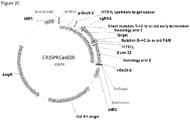
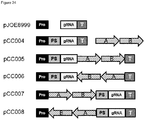
- the plasmid pCC001 was cut with Bsal following ligation of the amyE protospacer oligonucleotide duplex (SeqID NO: 50/Seq ID NO: 51) with T4-DNA ligase (NEB) as described for pCC003.
- the resulting plasmid and the PCR-fragment of the homology regions HomAB of the amyE gene were cut with Sfil following ligation with T4-DNA ligase (NEB).
- the reaction mixture was transformed into E.coli XL1-Blue competent cells (Stratagene).
- the correct plasmid containing the amyE protospacer and the HomAB of amyE in reverse orientation compared to pCC005 was recovered and named pCC006.
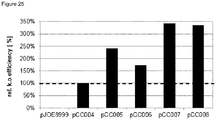
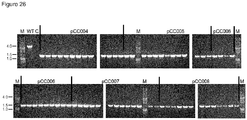
- Table 2 summarizes the amount of total clones after plasmid curing, amount of clones with inactivated amylase, the percentage of clones with inactivated amylase relative to total clones and the relative knockout efficiency with the indicated plasmids relative to pCC004 ( Figure 25 ) Table 2 Construct Subclones total Subclones Amy. neg. Subclones Amy. neg. [%] Relative to pCC004. pJOE8999 90 0 0 0 pCC004 177 42 24 100 pCC005 197 113 57 242 pCC006 192 79 41 173 pCC007 117 95 81 342 pCC008 146 116 79 335
Landscapes
- Health & Medical Sciences (AREA)
- Genetics & Genomics (AREA)
- Life Sciences & Earth Sciences (AREA)
- Engineering & Computer Science (AREA)
- Biomedical Technology (AREA)
- Chemical & Material Sciences (AREA)
- Organic Chemistry (AREA)
- Bioinformatics & Cheminformatics (AREA)
- Zoology (AREA)
- Wood Science & Technology (AREA)
- Biotechnology (AREA)
- General Engineering & Computer Science (AREA)
- Molecular Biology (AREA)
- General Health & Medical Sciences (AREA)
- Biochemistry (AREA)
- Microbiology (AREA)
- Physics & Mathematics (AREA)
- Biophysics (AREA)
- Plant Pathology (AREA)
- Mycology (AREA)
- Crystallography & Structural Chemistry (AREA)
- Cell Biology (AREA)
- Veterinary Medicine (AREA)
- Medicinal Chemistry (AREA)
- Micro-Organisms Or Cultivation Processes Thereof (AREA)
- Pharmacology & Pharmacy (AREA)
- Public Health (AREA)
- Animal Behavior & Ethology (AREA)
- Chemical Kinetics & Catalysis (AREA)
- General Chemical & Material Sciences (AREA)
- Nuclear Medicine, Radiotherapy & Molecular Imaging (AREA)
- Virology (AREA)
- Preparation Of Compounds By Using Micro-Organisms (AREA)
- Oncology (AREA)
- Communicable Diseases (AREA)
- Peptides Or Proteins (AREA)
- Epidemiology (AREA)
- Tropical Medicine & Parasitology (AREA)
- Hematology (AREA)
- Diabetes (AREA)
Priority Applications (4)
| Application Number | Priority Date | Filing Date | Title |
|---|---|---|---|
| EP22193659.4A EP4166662A1 (en) | 2016-04-29 | 2017-04-20 | Methods for modification of target nucleic acids using fused guide rna - donor molecules |
| EP22193654.5A EP4166661A1 (en) | 2016-04-29 | 2017-04-20 | Fused donor - guide nucleic acid and methods for modification of target nucleic acids |
| EP22193652.9A EP4166660A1 (en) | 2016-04-29 | 2017-04-20 | Improved methods for modification of target nucleic acids using fused guide rna - donor molecules |
| EP21162462.2A EP3868880A1 (en) | 2016-04-29 | 2017-04-20 | Improved methods for modification of target nucleic acids |
Applications Claiming Priority (4)
| Application Number | Priority Date | Filing Date | Title |
|---|---|---|---|
| EP16167773 | 2016-04-29 | ||
| EP16167774 | 2016-04-29 | ||
| EP17156018 | 2017-02-14 | ||
| PCT/EP2017/059331 WO2017186550A1 (en) | 2016-04-29 | 2017-04-20 | Improved methods for modification of target nucleic acids |
Related Child Applications (5)
| Application Number | Title | Priority Date | Filing Date |
|---|---|---|---|
| EP22193659.4A Division EP4166662A1 (en) | 2016-04-29 | 2017-04-20 | Methods for modification of target nucleic acids using fused guide rna - donor molecules |
| EP22193652.9A Division EP4166660A1 (en) | 2016-04-29 | 2017-04-20 | Improved methods for modification of target nucleic acids using fused guide rna - donor molecules |
| EP22193654.5A Division EP4166661A1 (en) | 2016-04-29 | 2017-04-20 | Fused donor - guide nucleic acid and methods for modification of target nucleic acids |
| EP21162462.2A Division-Into EP3868880A1 (en) | 2016-04-29 | 2017-04-20 | Improved methods for modification of target nucleic acids |
| EP21162462.2A Division EP3868880A1 (en) | 2016-04-29 | 2017-04-20 | Improved methods for modification of target nucleic acids |
Publications (2)
| Publication Number | Publication Date |
|---|---|
| EP3448990A1 EP3448990A1 (en) | 2019-03-06 |
| EP3448990B1 true EP3448990B1 (en) | 2021-06-09 |
Family
ID=58640844
Family Applications (5)
| Application Number | Title | Priority Date | Filing Date |
|---|---|---|---|
| EP17720040.9A Revoked EP3448990B1 (en) | 2016-04-29 | 2017-04-20 | Methods for modification of target nucleic acids using a fusion molecule of guide and donor rna, fusion rna molecule and vector systems encoding the fusion rna molecule |
| EP21162462.2A Withdrawn EP3868880A1 (en) | 2016-04-29 | 2017-04-20 | Improved methods for modification of target nucleic acids |
| EP22193659.4A Withdrawn EP4166662A1 (en) | 2016-04-29 | 2017-04-20 | Methods for modification of target nucleic acids using fused guide rna - donor molecules |
| EP22193654.5A Pending EP4166661A1 (en) | 2016-04-29 | 2017-04-20 | Fused donor - guide nucleic acid and methods for modification of target nucleic acids |
| EP22193652.9A Withdrawn EP4166660A1 (en) | 2016-04-29 | 2017-04-20 | Improved methods for modification of target nucleic acids using fused guide rna - donor molecules |
Family Applications After (4)
| Application Number | Title | Priority Date | Filing Date |
|---|---|---|---|
| EP21162462.2A Withdrawn EP3868880A1 (en) | 2016-04-29 | 2017-04-20 | Improved methods for modification of target nucleic acids |
| EP22193659.4A Withdrawn EP4166662A1 (en) | 2016-04-29 | 2017-04-20 | Methods for modification of target nucleic acids using fused guide rna - donor molecules |
| EP22193654.5A Pending EP4166661A1 (en) | 2016-04-29 | 2017-04-20 | Fused donor - guide nucleic acid and methods for modification of target nucleic acids |
| EP22193652.9A Withdrawn EP4166660A1 (en) | 2016-04-29 | 2017-04-20 | Improved methods for modification of target nucleic acids using fused guide rna - donor molecules |
Country Status (12)
| Country | Link |
|---|---|
| US (5) | US11608499B2 (OSRAM) |
| EP (5) | EP3448990B1 (OSRAM) |
| JP (2) | JP7184648B2 (OSRAM) |
| KR (3) | KR102506185B1 (OSRAM) |
| CN (1) | CN109072207B (OSRAM) |
| AU (5) | AU2017256517B2 (OSRAM) |
| CA (1) | CA3022475A1 (OSRAM) |
| CL (1) | CL2018003074A1 (OSRAM) |
| DK (1) | DK3448990T5 (OSRAM) |
| IL (1) | IL262409B2 (OSRAM) |
| MX (2) | MX388092B (OSRAM) |
| WO (1) | WO2017186550A1 (OSRAM) |
Cited By (2)
| Publication number | Priority date | Publication date | Assignee | Title |
|---|---|---|---|---|
| US12031129B2 (en) | 2018-08-28 | 2024-07-09 | Flagship Pioneering Innovations Vi, Llc | Methods and compositions for modulating a genome |
| US12037602B2 (en) | 2020-03-04 | 2024-07-16 | Flagship Pioneering Innovations Vi, Llc | Methods and compositions for modulating a genome |
Families Citing this family (53)
| Publication number | Priority date | Publication date | Assignee | Title |
|---|---|---|---|---|
| JP6261500B2 (ja) | 2011-07-22 | 2018-01-17 | プレジデント アンド フェローズ オブ ハーバード カレッジ | ヌクレアーゼ切断特異性の評価および改善 |
| US20150044192A1 (en) | 2013-08-09 | 2015-02-12 | President And Fellows Of Harvard College | Methods for identifying a target site of a cas9 nuclease |
| US9359599B2 (en) | 2013-08-22 | 2016-06-07 | President And Fellows Of Harvard College | Engineered transcription activator-like effector (TALE) domains and uses thereof |
| US9737604B2 (en) | 2013-09-06 | 2017-08-22 | President And Fellows Of Harvard College | Use of cationic lipids to deliver CAS9 |
| US9228207B2 (en) | 2013-09-06 | 2016-01-05 | President And Fellows Of Harvard College | Switchable gRNAs comprising aptamers |
| US9322037B2 (en) | 2013-09-06 | 2016-04-26 | President And Fellows Of Harvard College | Cas9-FokI fusion proteins and uses thereof |
| US9068179B1 (en) | 2013-12-12 | 2015-06-30 | President And Fellows Of Harvard College | Methods for correcting presenilin point mutations |
| US10077453B2 (en) | 2014-07-30 | 2018-09-18 | President And Fellows Of Harvard College | CAS9 proteins including ligand-dependent inteins |
| AU2015330699B2 (en) | 2014-10-10 | 2021-12-02 | Editas Medicine, Inc. | Compositions and methods for promoting homology directed repair |
| AU2015342749B2 (en) | 2014-11-07 | 2022-01-27 | Editas Medicine, Inc. | Methods for improving CRISPR/Cas-mediated genome-editing |
| WO2017053879A1 (en) | 2015-09-24 | 2017-03-30 | Editas Medicine, Inc. | Use of exonucleases to improve crispr/cas-mediated genome editing |
| EP3365356B1 (en) | 2015-10-23 | 2023-06-28 | President and Fellows of Harvard College | Nucleobase editors and uses thereof |
| EP3433363A1 (en) | 2016-03-25 | 2019-01-30 | Editas Medicine, Inc. | Genome editing systems comprising repair-modulating enzyme molecules and methods of their use |
| US11236313B2 (en) | 2016-04-13 | 2022-02-01 | Editas Medicine, Inc. | Cas9 fusion molecules, gene editing systems, and methods of use thereof |
| AU2017272623A1 (en) * | 2016-06-01 | 2018-11-29 | Kws Saat Se | Hybrid nucleic acid sequences for genome engineering |
| JP7231935B2 (ja) | 2016-08-03 | 2023-03-08 | プレジデント アンド フェローズ オブ ハーバード カレッジ | アデノシン核酸塩基編集因子およびそれらの使用 |
| EP3497214B1 (en) | 2016-08-09 | 2023-06-28 | President and Fellows of Harvard College | Programmable cas9-recombinase fusion proteins and uses thereof |
| WO2018039438A1 (en) | 2016-08-24 | 2018-03-01 | President And Fellows Of Harvard College | Incorporation of unnatural amino acids into proteins using base editing |
| EP3526320A1 (en) | 2016-10-14 | 2019-08-21 | President and Fellows of Harvard College | Aav delivery of nucleobase editors |
| WO2018071663A1 (en) * | 2016-10-14 | 2018-04-19 | Emendobio Inc. | Rna compositions for genome editing |
| EP3541945A4 (en) * | 2016-11-18 | 2020-12-09 | Genedit Inc. | COMPOSITIONS AND METHODS OF MODIFICATION OF TARGET NUCLEIC ACIDS |
| US10745677B2 (en) | 2016-12-23 | 2020-08-18 | President And Fellows Of Harvard College | Editing of CCR5 receptor gene to protect against HIV infection |
| CA3052099A1 (en) * | 2017-01-30 | 2018-08-02 | Mathias LABS | Repair template linkage to endonucleases for genome engineering |
| WO2018165504A1 (en) | 2017-03-09 | 2018-09-13 | President And Fellows Of Harvard College | Suppression of pain by gene editing |
| WO2018165631A1 (en) | 2017-03-09 | 2018-09-13 | President And Fellows Of Harvard College | Cancer vaccine |
| KR20190127797A (ko) | 2017-03-10 | 2019-11-13 | 프레지던트 앤드 펠로우즈 오브 하바드 칼리지 | 시토신에서 구아닌으로의 염기 편집제 |
| KR20240116572A (ko) | 2017-03-23 | 2024-07-29 | 프레지던트 앤드 펠로우즈 오브 하바드 칼리지 | 핵산 프로그램가능한 dna 결합 단백질을 포함하는 핵염기 편집제 |
| US11560566B2 (en) | 2017-05-12 | 2023-01-24 | President And Fellows Of Harvard College | Aptazyme-embedded guide RNAs for use with CRISPR-Cas9 in genome editing and transcriptional activation |
| EP3638317A4 (en) | 2017-06-15 | 2021-03-17 | The Regents of The University of California | TARGETED NONVIRAL DNA INSERTIONS |
| US11866726B2 (en) | 2017-07-14 | 2024-01-09 | Editas Medicine, Inc. | Systems and methods for targeted integration and genome editing and detection thereof using integrated priming sites |
| WO2019023680A1 (en) | 2017-07-28 | 2019-01-31 | President And Fellows Of Harvard College | METHODS AND COMPOSITIONS FOR EVOLUTION OF BASIC EDITORS USING PHAGE-ASSISTED CONTINUOUS EVOLUTION (PACE) |
| EP3676376B1 (en) | 2017-08-30 | 2025-01-15 | President and Fellows of Harvard College | High efficiency base editors comprising gam |
| CN111757937A (zh) | 2017-10-16 | 2020-10-09 | 布罗德研究所股份有限公司 | 腺苷碱基编辑器的用途 |
| KR102770787B1 (ko) | 2017-10-27 | 2025-02-19 | 더 리전트 오브 더 유니버시티 오브 캘리포니아 | 내인성 t 세포 수용체의 표적화된 대체 |
| WO2019118949A1 (en) | 2017-12-15 | 2019-06-20 | The Broad Institute, Inc. | Systems and methods for predicting repair outcomes in genetic engineering |
| US11268092B2 (en) | 2018-01-12 | 2022-03-08 | GenEdit, Inc. | Structure-engineered guide RNA |
| US12157760B2 (en) | 2018-05-23 | 2024-12-03 | The Broad Institute, Inc. | Base editors and uses thereof |
| US12281338B2 (en) | 2018-10-29 | 2025-04-22 | The Broad Institute, Inc. | Nucleobase editors comprising GeoCas9 and uses thereof |
| KR102298105B1 (ko) | 2019-01-08 | 2021-09-03 | 주식회사 엘지에너지솔루션 | 스웰링 게이지를 구비한 배터리 모듈 및 이를 포함하는 배터리 팩 |
| WO2020154500A1 (en) | 2019-01-23 | 2020-07-30 | The Broad Institute, Inc. | Supernegatively charged proteins and uses thereof |
| MX2021011426A (es) | 2019-03-19 | 2022-03-11 | Broad Inst Inc | Metodos y composiciones para editar secuencias de nucleótidos. |
| EP3956349A1 (en) | 2019-04-17 | 2022-02-23 | The Broad Institute, Inc. | Adenine base editors with reduced off-target effects |
| US12435330B2 (en) | 2019-10-10 | 2025-10-07 | The Broad Institute, Inc. | Methods and compositions for prime editing RNA |
| US20230212593A1 (en) | 2020-03-04 | 2023-07-06 | Basf Se | Method for the production of constitutive bacterial promoters conferring low to medium expression |
| WO2021175756A1 (en) | 2020-03-04 | 2021-09-10 | Basf Se | Shuttle vector for expression in e. coli and bacilli |
| MX2022014008A (es) | 2020-05-08 | 2023-02-09 | Broad Inst Inc | Métodos y composiciones para la edición simultánea de ambas cadenas de una secuencia de nucleótidos de doble cadena objetivo. |
| CN112111505B (zh) * | 2020-09-17 | 2022-03-15 | 江南大学 | 一种氧化葡萄糖酸杆菌中基因敲除的方法 |
| US20220389461A1 (en) * | 2021-05-26 | 2022-12-08 | Inscripta, Inc. | Crispr editing in diploid genomes |
| EP4384616A4 (en) * | 2021-08-11 | 2025-08-27 | Univ Leland Stanford Junior | HIGH-THROUGHPUT PRECISION GENOME EDITING IN HUMAN CELLS |
| PE20241173A1 (es) | 2021-10-14 | 2024-05-28 | Arsenal Biosciences Inc | Celulas inmunitarias que tienen arnhc coexpresados y sistemas de compuerta logica |
| EP4448744A2 (en) * | 2021-12-14 | 2024-10-23 | The Broad Institute, Inc. | Reprogrammable fanzor polynucleotides and uses thereof |
| TW202342744A (zh) | 2022-03-01 | 2023-11-01 | 美商巴斯夫農業解決方案種子美國有限責任公司 | Cas12a切口酶 |
| CN114774420B (zh) * | 2022-04-27 | 2023-09-22 | 扬州大学 | 一种水稻增强子及基于CRISPR/Cas9技术评估水稻增强子活性的方法 |
Citations (5)
| Publication number | Priority date | Publication date | Assignee | Title |
|---|---|---|---|---|
| US20140315985A1 (en) | 2013-03-14 | 2014-10-23 | Caribou Biosciences, Inc. | Compositions and methods of nucleic acid-targeting nucleic acids |
| WO2015191693A2 (en) | 2014-06-10 | 2015-12-17 | Massachusetts Institute Of Technology | Method for gene editing |
| WO2016065364A1 (en) | 2014-10-24 | 2016-04-28 | Life Technologies Corporation | Compositions and methods for enhancing homologous recombination |
| WO2017059241A1 (en) | 2015-10-02 | 2017-04-06 | The United States Of America, As Represented By The Secretary, Department Of Health And Human Services | Lentiviral protein delivery system for rna-guided genome editing |
| WO2017180711A1 (en) | 2016-04-13 | 2017-10-19 | Editas Medicine, Inc. | Grna fusion molecules, gene editing systems, and methods of use thereof |
Family Cites Families (14)
| Publication number | Priority date | Publication date | Assignee | Title |
|---|---|---|---|---|
| CA2178729A1 (en) | 1993-12-09 | 1995-06-15 | Eric B. Kmiec | Compounds and methods for site-directed mutations in eukaryotic cells |
| US6027945A (en) | 1997-01-21 | 2000-02-22 | Promega Corporation | Methods of isolating biological target materials using silica magnetic particles |
| US6555732B1 (en) | 1998-09-14 | 2003-04-29 | Pioneer Hi-Bred International, Inc. | Rac-like genes and methods of use |
| EP1152058A1 (en) | 2000-05-03 | 2001-11-07 | Institut Curie | Methods and compositions for effecting homologous recombination |
| EP3284833B1 (en) | 2005-08-26 | 2021-12-01 | DuPont Nutrition Biosciences ApS | Use of crispr associated genes (cas) |
| ES2767318T3 (es) | 2013-06-17 | 2020-06-17 | Broad Inst Inc | Suministro, modificación y optimización de sistemas, métodos y composiciones para generar modelos y actuar sobre enfermedades y trastornos de células posmitóticas |
| US11306328B2 (en) * | 2013-07-26 | 2022-04-19 | President And Fellows Of Harvard College | Genome engineering |
| BR112016002851B1 (pt) | 2013-08-12 | 2022-02-22 | BASF Agro B.V. | Molécula de ácido nucleico, constructo de ácido nucleico, vetor, polipeptídeo ppo, método para controlar vegetação indesejada e uso do ácido nucleico |
| WO2015092706A1 (en) | 2013-12-18 | 2015-06-25 | BASF Agro B.V. | Plants having increased tolerance to herbicides |
| US11535871B2 (en) | 2015-05-14 | 2022-12-27 | University Of Southern California | Optimized gene editing utilizing a recombinant endonuclease system |
| WO2017024047A1 (en) | 2015-08-03 | 2017-02-09 | Emendobio Inc. | Compositions and methods for increasing nuclease induced recombination rate in cells |
| US20190048340A1 (en) * | 2015-09-24 | 2019-02-14 | Crispr Therapeutics Ag | Novel family of rna-programmable endonucleases and their uses in genome editing and other applications |
| CN106811479B (zh) | 2015-11-30 | 2019-10-25 | 中国农业科学院作物科学研究所 | 利用CRISPR/Cas9系统定点修饰ALS基因获得抗除草剂水稻的系统及其应用 |
| EP3541945A4 (en) * | 2016-11-18 | 2020-12-09 | Genedit Inc. | COMPOSITIONS AND METHODS OF MODIFICATION OF TARGET NUCLEIC ACIDS |
-
2017
- 2017-04-20 DK DK17720040.9T patent/DK3448990T5/da active
- 2017-04-20 MX MX2018013256A patent/MX388092B/es unknown
- 2017-04-20 KR KR1020227006922A patent/KR102506185B1/ko active Active
- 2017-04-20 KR KR1020237007132A patent/KR20230038804A/ko not_active Ceased
- 2017-04-20 EP EP17720040.9A patent/EP3448990B1/en not_active Revoked
- 2017-04-20 CA CA3022475A patent/CA3022475A1/en active Pending
- 2017-04-20 US US16/097,300 patent/US11608499B2/en active Active
- 2017-04-20 EP EP21162462.2A patent/EP3868880A1/en not_active Withdrawn
- 2017-04-20 CN CN201780025990.6A patent/CN109072207B/zh active Active
- 2017-04-20 KR KR1020187030717A patent/KR102370675B1/ko active Active
- 2017-04-20 AU AU2017256517A patent/AU2017256517B2/en active Active
- 2017-04-20 EP EP22193659.4A patent/EP4166662A1/en not_active Withdrawn
- 2017-04-20 WO PCT/EP2017/059331 patent/WO2017186550A1/en not_active Ceased
- 2017-04-20 EP EP22193654.5A patent/EP4166661A1/en active Pending
- 2017-04-20 JP JP2018555963A patent/JP7184648B2/ja active Active
- 2017-04-20 EP EP22193652.9A patent/EP4166660A1/en not_active Withdrawn
-
2018
- 2018-10-16 IL IL262409A patent/IL262409B2/en unknown
- 2018-10-29 MX MX2021009235A patent/MX2021009235A/es unknown
- 2018-10-29 CL CL2018003074A patent/CL2018003074A1/es unknown
-
2022
- 2022-09-16 US US17/933,005 patent/US20230183686A1/en active Pending
- 2022-09-16 US US17/933,003 patent/US20230024869A1/en active Pending
- 2022-09-16 US US17/933,015 patent/US20230049124A1/en active Pending
- 2022-09-16 US US17/933,023 patent/US20230107997A1/en active Pending
- 2022-11-04 AU AU2022100157A patent/AU2022100157A4/en not_active Expired
- 2022-11-04 AU AU2022100158A patent/AU2022100158A4/en not_active Expired
- 2022-11-04 AU AU2022100155A patent/AU2022100155A4/en not_active Expired
- 2022-11-14 AU AU2022100170A patent/AU2022100170A4/en not_active Expired
- 2022-11-24 JP JP2022187824A patent/JP2023018093A/ja active Pending
Patent Citations (5)
| Publication number | Priority date | Publication date | Assignee | Title |
|---|---|---|---|---|
| US20140315985A1 (en) | 2013-03-14 | 2014-10-23 | Caribou Biosciences, Inc. | Compositions and methods of nucleic acid-targeting nucleic acids |
| WO2015191693A2 (en) | 2014-06-10 | 2015-12-17 | Massachusetts Institute Of Technology | Method for gene editing |
| WO2016065364A1 (en) | 2014-10-24 | 2016-04-28 | Life Technologies Corporation | Compositions and methods for enhancing homologous recombination |
| WO2017059241A1 (en) | 2015-10-02 | 2017-04-06 | The United States Of America, As Represented By The Secretary, Department Of Health And Human Services | Lentiviral protein delivery system for rna-guided genome editing |
| WO2017180711A1 (en) | 2016-04-13 | 2017-10-19 | Editas Medicine, Inc. | Grna fusion molecules, gene editing systems, and methods of use thereof |
Non-Patent Citations (13)
| Title |
|---|
| "Current Protocols in Molecular Biology", 15 May 2001, JOHN WILEY & SONS, INC. , US , ISSN: 1934-3639, article LUHAN YANG, JOYCE L. YANG, SUSAN BYRNE, JOSHUA PAN, GEORGE M. CHURCH: "CRISPR/Cas9-Directed Genome Editing of Cultured Cells", pages: 31.1.1 - 31.1.17, XP055295902, DOI: 10.1002/0471142727.mb3101s107 |
| "Methods in enzymology Volume 546", 1 January 2014, ACADEMIC PRESS, article ZENGRONG ZHU, FEDERICO GONZALEZ, DANWEI HUANGFU: "CHAPTER 11 The iCRISPR Platform for Rapid Genome Editing in Human Pluripotent Stem Cells ", pages: 215 - 250, XP055904598 |
| ANONYMOUS: "ProQuest™ Two-Hybrid System A sensitive method for detecting proteinprotein interactions", INVITROGEN CORPORATION USER MANUAL, 24 October 2005 (2005-10-24), pages ii-x, 1 - 106, XP055904610 |
| BONO JEREMY M., OLESNICKY EUGENIA C., MATZKIN LUCIANO M.: "Connecting genotypes, phenotypes and fitness: harnessing the power of CRISPR/Cas9 genome editing", MOLECULAR ECOLOGY., BLACKWELL SCIENCE, OXFORD., GB, vol. 24, no. 15, 1 August 2015 (2015-08-01), GB , pages 3810 - 3822, XP055904585, ISSN: 0962-1083, DOI: 10.1111/mec.13252 |
| CHOUDHURI SUPRATIM: "BIOINFORMATICS FOR BEGINNERS Genes, Genomes, Molecular Evolution, Databases and Analytical Tools", 1 January 2014, ELSEVIER INC., article "Chapter 3 Genomic Technologies", pages: 2pp, 64, XP055904604 |
| JOSEF ALTENBUCHNER: "Editing of the Bacillus subtilis Genome by the CRISPR-Cas9 System", APPLIED AND ENVIRONMENTAL MICROBIOLOGY, AMERICAN SOCIETY FOR MICROBIOLOGY, US, vol. 82, no. 17, 1 September 2016 (2016-09-01), US , pages 5421 - 5427, XP055352250, ISSN: 0099-2240, DOI: 10.1128/AEM.01453-16 |
| LI YUE, COOPER BRENDON H., LIU YUKANG, WU DIFEI, ZHANG XIAOJUN, ROHS REMO, QIN PETER Z.: "CRISPR-Cas9 Activities with Truncated 16-Nucleotide RNA Guides Are Tuned by Target Duplex Stability Beyond the RNA/DNA Hybrid", BIOCHEMISTRY, vol. 62, no. 17, 5 September 2023 (2023-09-05), pages 2541 - 2548, XP093137533, ISSN: 0006-2960, DOI: 10.1021/acs.biochem.3c00250 |
| M. JINEK, CHYLINSKI K, FONFARA I, HAUER M, DOUDNA J. A, CHARPENTIER E.: "A Programmable Dual-RNA-Guided DNA Endonuclease in Adaptive Bacterial Immunity", SCIENCE, AMERICAN ASSOCIATION FOR THE ADVANCEMENT OF SCIENCE, US, vol. 337, no. 6096, 17 August 2012 (2012-08-17), US , pages 1 - 37, XP055067747, ISSN: 0036-8075, DOI: 10.1126/science.1225829 |
| M. JINEK, K. CHYLINSKI, I. FONFARA, M. HAUER, J. A. DOUDNA, E. CHARPENTIER: "A Programmable Dual-RNA-Guided DNA Endonuclease in Adaptive Bacterial Immunity", SCIENCE, AMERICAN ASSOCIATION FOR THE ADVANCEMENT OF SCIENCE, US, vol. 337, no. 6096, 17 August 2012 (2012-08-17), US , pages 816 - 821, XP055229606, ISSN: 0036-8075, DOI: 10.1126/science.1225829 |
| PAIX ALEXANDRE, WANG YUEMENG, SMITH HAROLD E, LEE CHIH-YUNG S, CALIDAS DEEPIKA, LU TU, SMITH JARRETT, SCHMIDT HELEN, KRAUSE MICHAE: "Scalable and Versatile Genome Editing Using Linear DNAs with Microhomology to Cas9 Sites in Caenorhabditis elegans", GENETICS, vol. 198, no. 4, 1 December 2014 (2014-12-01), pages 1347 - 1356, XP055904591 |
| RAN F ANN; HSU PATRICK D; WRIGHT JASON; AGARWALA VINEETA; SCOTT DAVID A; ZHANG FENG: "Genome engineering using the CRISPR-Cas9 system", NATURE PROTOCOLS, NATURE PUBLISHING GROUP, GB, vol. 8, no. 11, 1 November 2013 (2013-11-01), GB , pages 2281 - 2308, XP009174668, ISSN: 1750-2799, DOI: 10.1038/nprot.2013.143 |
| TREVINO ALEXANDRO E; ZHANG FENG: "Genome editing using Cas9 nickases.", METHODS IN ENZYMOLOGY, ACADEM. PRESS, USA, vol. 546, 1 January 2014 (2014-01-01), USA , pages 161 - 174, XP009187160, ISSN: 1557-7988, DOI: 10.1016/B978-0-12-801185-0.00008-8 |
| YANFANG FU, JEFFRY D SANDER, DEEPAK REYON, VINCENT M CASCIO, J KEITH JOUNG: "Improving CRISPR-Cas nuclease specificity using truncated guide RNAs", NATURE BIOTECHNOLOGY, GALE GROUP INC., vol. 32, no. 3, pages 279 - 284, XP055194360, ISSN: 10870156, DOI: 10.1038/nbt.2808 |
Cited By (4)
| Publication number | Priority date | Publication date | Assignee | Title |
|---|---|---|---|---|
| US12031129B2 (en) | 2018-08-28 | 2024-07-09 | Flagship Pioneering Innovations Vi, Llc | Methods and compositions for modulating a genome |
| US12398392B2 (en) | 2018-08-28 | 2025-08-26 | Flagship Pioneering Innovations Vi, Llc | Methods and compositions for modulating a genome |
| US12037602B2 (en) | 2020-03-04 | 2024-07-16 | Flagship Pioneering Innovations Vi, Llc | Methods and compositions for modulating a genome |
| US12065669B2 (en) | 2020-03-04 | 2024-08-20 | Flagship Pioneering Innovations Vi, Llc | Methods and compositions for modulating a genome |
Also Published As
Similar Documents
| Publication | Publication Date | Title |
|---|---|---|
| AU2022100155A4 (en) | Improved methods for modification of target nucleic acids | |
| US20240409949A1 (en) | Optimized plant crispr/cpf1 systems | |
| CN107027313B (zh) | 用于多元rna引导的基因组编辑和其它rna技术的方法和组合物 | |
| EP3110945B1 (en) | Compositions and methods for site directed genomic modification | |
| JP2022106883A (ja) | Cas9ターゲッティングをガイドする配列に関する方法および組成物 | |
| US20160237451A1 (en) | Conferring resistance to geminiviruses in plants using crispr/cas systems | |
| CN111373041A (zh) | 用于基因组编辑和调节转录的crispr/cas系统和方法 | |
| WO2018108339A9 (en) | Thermostable cas9 nucleases | |
| US20230075913A1 (en) | Codon-optimized cas9 endonuclease encoding polynucleotide | |
| CN115176018A (zh) | 用于大肠杆菌和芽孢杆菌中表达的穿梭载体 | |
| CN115605597A (zh) | 用于产生赋予低至中等表达的组成型细菌启动子的方法 | |
| CA3190625A1 (en) | Increasing gene editing and site-directed integration events utilizing meiotic and germline promoters | |
| BR112018068934B1 (pt) | MÉTODO DE MODIFICAÇÃO DE MOLÉCULAS DE ÁCIDO NUCLEICO ALVO (NA ALVO) EM CÉLULAS, MOLÉCULA DE fuNA RECOMBINANTE, VETOR, SISTEMA DE VETOR, SISTEMA DE MODIFICAÇÃO DE NA ALVO EM CÉLULAS, COMPOSIÇÃO E USO DE VETOR | |
| KR20250139286A (ko) | 유연한 PAM 스펙트럼을 갖는 Mb2Cas12a 변이체 | |
| Akbudak | Applications of site-specific recombination systems in transgene expression and marker gene removal |
Legal Events
| Date | Code | Title | Description |
|---|---|---|---|
| STAA | Information on the status of an ep patent application or granted ep patent |
Free format text: STATUS: UNKNOWN |
|
| STAA | Information on the status of an ep patent application or granted ep patent |
Free format text: STATUS: THE INTERNATIONAL PUBLICATION HAS BEEN MADE |
|
| PUAI | Public reference made under article 153(3) epc to a published international application that has entered the european phase |
Free format text: ORIGINAL CODE: 0009012 |
|
| STAA | Information on the status of an ep patent application or granted ep patent |
Free format text: STATUS: REQUEST FOR EXAMINATION WAS MADE |
|
| 17P | Request for examination filed |
Effective date: 20181129 |
|
| AK | Designated contracting states |
Kind code of ref document: A1 Designated state(s): AL AT BE BG CH CY CZ DE DK EE ES FI FR GB GR HR HU IE IS IT LI LT LU LV MC MK MT NL NO PL PT RO RS SE SI SK SM TR |
|
| AX | Request for extension of the european patent |
Extension state: BA ME |
|
| DAV | Request for validation of the european patent (deleted) | ||
| DAX | Request for extension of the european patent (deleted) | ||
| GRAP | Despatch of communication of intention to grant a patent |
Free format text: ORIGINAL CODE: EPIDOSNIGR1 |
|
| STAA | Information on the status of an ep patent application or granted ep patent |
Free format text: STATUS: GRANT OF PATENT IS INTENDED |
|
| INTG | Intention to grant announced |
Effective date: 20201113 |
|
| GRAJ | Information related to disapproval of communication of intention to grant by the applicant or resumption of examination proceedings by the epo deleted |
Free format text: ORIGINAL CODE: EPIDOSDIGR1 |
|
| STAA | Information on the status of an ep patent application or granted ep patent |
Free format text: STATUS: REQUEST FOR EXAMINATION WAS MADE |
|
| GRAS | Grant fee paid |
Free format text: ORIGINAL CODE: EPIDOSNIGR3 |
|
| STAA | Information on the status of an ep patent application or granted ep patent |
Free format text: STATUS: GRANT OF PATENT IS INTENDED |
|
| GRAP | Despatch of communication of intention to grant a patent |
Free format text: ORIGINAL CODE: EPIDOSNIGR1 |
|
| INTC | Intention to grant announced (deleted) | ||
| INTG | Intention to grant announced |
Effective date: 20210330 |
|
| GRAA | (expected) grant |
Free format text: ORIGINAL CODE: 0009210 |
|
| STAA | Information on the status of an ep patent application or granted ep patent |
Free format text: STATUS: THE PATENT HAS BEEN GRANTED |
|
| AK | Designated contracting states |
Kind code of ref document: B1 Designated state(s): AL AT BE BG CH CY CZ DE DK EE ES FI FR GB GR HR HU IE IS IT LI LT LU LV MC MK MT NL NO PL PT RO RS SE SI SK SM TR |
|
| REG | Reference to a national code |
Ref country code: GB Ref legal event code: FG4D |
|
| REG | Reference to a national code |
Ref country code: AT Ref legal event code: REF Ref document number: 1400528 Country of ref document: AT Kind code of ref document: T Effective date: 20210615 Ref country code: CH Ref legal event code: EP |
|
| REG | Reference to a national code |
Ref country code: DE Ref legal event code: R096 Ref document number: 602017039979 Country of ref document: DE |
|
| REG | Reference to a national code |
Ref country code: IE Ref legal event code: FG4D |
|
| REG | Reference to a national code |
Ref country code: DK Ref legal event code: T3 Effective date: 20210824 Ref country code: FI Ref legal event code: FGE |
|
| REG | Reference to a national code |
Ref country code: LT Ref legal event code: MG9D Ref country code: DK Ref legal event code: T5 Effective date: 20210922 |
|
| PG25 | Lapsed in a contracting state [announced via postgrant information from national office to epo] |
Ref country code: LT Free format text: LAPSE BECAUSE OF FAILURE TO SUBMIT A TRANSLATION OF THE DESCRIPTION OR TO PAY THE FEE WITHIN THE PRESCRIBED TIME-LIMIT Effective date: 20210609 Ref country code: BG Free format text: LAPSE BECAUSE OF FAILURE TO SUBMIT A TRANSLATION OF THE DESCRIPTION OR TO PAY THE FEE WITHIN THE PRESCRIBED TIME-LIMIT Effective date: 20210909 Ref country code: HR Free format text: LAPSE BECAUSE OF FAILURE TO SUBMIT A TRANSLATION OF THE DESCRIPTION OR TO PAY THE FEE WITHIN THE PRESCRIBED TIME-LIMIT Effective date: 20210609 |
|
| REG | Reference to a national code |
Ref country code: AT Ref legal event code: MK05 Ref document number: 1400528 Country of ref document: AT Kind code of ref document: T Effective date: 20210609 |
|
| REG | Reference to a national code |
Ref country code: NL Ref legal event code: MP Effective date: 20210609 |
|
| PG25 | Lapsed in a contracting state [announced via postgrant information from national office to epo] |
Ref country code: LV Free format text: LAPSE BECAUSE OF FAILURE TO SUBMIT A TRANSLATION OF THE DESCRIPTION OR TO PAY THE FEE WITHIN THE PRESCRIBED TIME-LIMIT Effective date: 20210609 Ref country code: GR Free format text: LAPSE BECAUSE OF FAILURE TO SUBMIT A TRANSLATION OF THE DESCRIPTION OR TO PAY THE FEE WITHIN THE PRESCRIBED TIME-LIMIT Effective date: 20210910 Ref country code: SE Free format text: LAPSE BECAUSE OF FAILURE TO SUBMIT A TRANSLATION OF THE DESCRIPTION OR TO PAY THE FEE WITHIN THE PRESCRIBED TIME-LIMIT Effective date: 20210609 Ref country code: RS Free format text: LAPSE BECAUSE OF FAILURE TO SUBMIT A TRANSLATION OF THE DESCRIPTION OR TO PAY THE FEE WITHIN THE PRESCRIBED TIME-LIMIT Effective date: 20210609 Ref country code: NO Free format text: LAPSE BECAUSE OF FAILURE TO SUBMIT A TRANSLATION OF THE DESCRIPTION OR TO PAY THE FEE WITHIN THE PRESCRIBED TIME-LIMIT Effective date: 20210909 |
|
| PG25 | Lapsed in a contracting state [announced via postgrant information from national office to epo] |
Ref country code: ES Free format text: LAPSE BECAUSE OF FAILURE TO SUBMIT A TRANSLATION OF THE DESCRIPTION OR TO PAY THE FEE WITHIN THE PRESCRIBED TIME-LIMIT Effective date: 20210609 Ref country code: PT Free format text: LAPSE BECAUSE OF FAILURE TO SUBMIT A TRANSLATION OF THE DESCRIPTION OR TO PAY THE FEE WITHIN THE PRESCRIBED TIME-LIMIT Effective date: 20211011 Ref country code: RO Free format text: LAPSE BECAUSE OF FAILURE TO SUBMIT A TRANSLATION OF THE DESCRIPTION OR TO PAY THE FEE WITHIN THE PRESCRIBED TIME-LIMIT Effective date: 20210609 Ref country code: NL Free format text: LAPSE BECAUSE OF FAILURE TO SUBMIT A TRANSLATION OF THE DESCRIPTION OR TO PAY THE FEE WITHIN THE PRESCRIBED TIME-LIMIT Effective date: 20210609 Ref country code: EE Free format text: LAPSE BECAUSE OF FAILURE TO SUBMIT A TRANSLATION OF THE DESCRIPTION OR TO PAY THE FEE WITHIN THE PRESCRIBED TIME-LIMIT Effective date: 20210609 Ref country code: CZ Free format text: LAPSE BECAUSE OF FAILURE TO SUBMIT A TRANSLATION OF THE DESCRIPTION OR TO PAY THE FEE WITHIN THE PRESCRIBED TIME-LIMIT Effective date: 20210609 Ref country code: AT Free format text: LAPSE BECAUSE OF FAILURE TO SUBMIT A TRANSLATION OF THE DESCRIPTION OR TO PAY THE FEE WITHIN THE PRESCRIBED TIME-LIMIT Effective date: 20210609 Ref country code: SK Free format text: LAPSE BECAUSE OF FAILURE TO SUBMIT A TRANSLATION OF THE DESCRIPTION OR TO PAY THE FEE WITHIN THE PRESCRIBED TIME-LIMIT Effective date: 20210609 Ref country code: SM Free format text: LAPSE BECAUSE OF FAILURE TO SUBMIT A TRANSLATION OF THE DESCRIPTION OR TO PAY THE FEE WITHIN THE PRESCRIBED TIME-LIMIT Effective date: 20210609 |
|
| REG | Reference to a national code |
Ref country code: DE Ref legal event code: R026 Ref document number: 602017039979 Country of ref document: DE |
|
| PLBI | Opposition filed |
Free format text: ORIGINAL CODE: 0009260 |
|
| PLBP | Opposition withdrawn |
Free format text: ORIGINAL CODE: 0009264 |
|
| PG25 | Lapsed in a contracting state [announced via postgrant information from national office to epo] |
Ref country code: PL Free format text: LAPSE BECAUSE OF FAILURE TO SUBMIT A TRANSLATION OF THE DESCRIPTION OR TO PAY THE FEE WITHIN THE PRESCRIBED TIME-LIMIT Effective date: 20210609 |
|
| PLBI | Opposition filed |
Free format text: ORIGINAL CODE: 0009260 |
|
| REG | Reference to a national code |
Ref country code: FI Ref legal event code: MDE Opponent name: STRAWMAN LIMITED Ref country code: FI Ref legal event code: MDE Opponent name: COHAUSZ & FLORACK PATENT- UND RECHTSANWAELTE PARTNERSCHAFTSGESELLSCHAFT MBB |
|
| 26 | Opposition filed |
Opponent name: COHAUSZ & FLORACK PATENT- UND RECHTSANWAELTE PARTNERSCHAFTSGESELLSCHAFT MBB Effective date: 20220131 |
|
| PLAX | Notice of opposition and request to file observation + time limit sent |
Free format text: ORIGINAL CODE: EPIDOSNOBS2 |
|
| REG | Reference to a national code |
Ref country code: FI Ref legal event code: MDE Opponent name: STRAWMAN LIMITED Ref country code: FI Ref legal event code: MDE Opponent name: COHAUSZ & FLORACK PATENT- UND RECHTSANWAELTE PARTNERSCHAFTSGESELLSCHAFT MBB |
|
| 26 | Opposition filed |
Opponent name: STRAWMAN LIMITED Effective date: 20220224 |
|
| PG25 | Lapsed in a contracting state [announced via postgrant information from national office to epo] |
Ref country code: AL Free format text: LAPSE BECAUSE OF FAILURE TO SUBMIT A TRANSLATION OF THE DESCRIPTION OR TO PAY THE FEE WITHIN THE PRESCRIBED TIME-LIMIT Effective date: 20210609 |
|
| PG25 | Lapsed in a contracting state [announced via postgrant information from national office to epo] |
Ref country code: IT Free format text: LAPSE BECAUSE OF FAILURE TO SUBMIT A TRANSLATION OF THE DESCRIPTION OR TO PAY THE FEE WITHIN THE PRESCRIBED TIME-LIMIT Effective date: 20210609 |
|
| PLBB | Reply of patent proprietor to notice(s) of opposition received |
Free format text: ORIGINAL CODE: EPIDOSNOBS3 |
|
| REG | Reference to a national code |
Ref country code: CH Ref legal event code: PL |
|
| PG25 | Lapsed in a contracting state [announced via postgrant information from national office to epo] |
Ref country code: MC Free format text: LAPSE BECAUSE OF FAILURE TO SUBMIT A TRANSLATION OF THE DESCRIPTION OR TO PAY THE FEE WITHIN THE PRESCRIBED TIME-LIMIT Effective date: 20210609 Ref country code: LU Free format text: LAPSE BECAUSE OF NON-PAYMENT OF DUE FEES Effective date: 20220420 Ref country code: LI Free format text: LAPSE BECAUSE OF NON-PAYMENT OF DUE FEES Effective date: 20220430 Ref country code: CH Free format text: LAPSE BECAUSE OF NON-PAYMENT OF DUE FEES Effective date: 20220430 |
|
| PG25 | Lapsed in a contracting state [announced via postgrant information from national office to epo] |
Ref country code: IE Free format text: LAPSE BECAUSE OF NON-PAYMENT OF DUE FEES Effective date: 20220420 |
|
| PGFP | Annual fee paid to national office [announced via postgrant information from national office to epo] |
Ref country code: FR Payment date: 20230421 Year of fee payment: 7 Ref country code: DK Payment date: 20230421 Year of fee payment: 7 Ref country code: DE Payment date: 20230427 Year of fee payment: 7 |
|
| PGFP | Annual fee paid to national office [announced via postgrant information from national office to epo] |
Ref country code: FI Payment date: 20230424 Year of fee payment: 7 |
|
| PGFP | Annual fee paid to national office [announced via postgrant information from national office to epo] |
Ref country code: BE Payment date: 20230424 Year of fee payment: 7 |
|
| PGFP | Annual fee paid to national office [announced via postgrant information from national office to epo] |
Ref country code: GB Payment date: 20230418 Year of fee payment: 7 |
|
| REG | Reference to a national code |
Ref country code: DE Ref legal event code: R103 Ref document number: 602017039979 Country of ref document: DE Ref country code: DE Ref legal event code: R064 Ref document number: 602017039979 Country of ref document: DE |
|
| RDAF | Communication despatched that patent is revoked |
Free format text: ORIGINAL CODE: EPIDOSNREV1 |
|
| RDAG | Patent revoked |
Free format text: ORIGINAL CODE: 0009271 |
|
| STAA | Information on the status of an ep patent application or granted ep patent |
Free format text: STATUS: PATENT REVOKED |
|
| REG | Reference to a national code |
Ref country code: CH Ref legal event code: PL |
|
| PG25 | Lapsed in a contracting state [announced via postgrant information from national office to epo] |
Ref country code: HU Free format text: LAPSE BECAUSE OF FAILURE TO SUBMIT A TRANSLATION OF THE DESCRIPTION OR TO PAY THE FEE WITHIN THE PRESCRIBED TIME-LIMIT; INVALID AB INITIO Effective date: 20170420 |
|
| 27W | Patent revoked |
Effective date: 20231217 |
|
| GBPR | Gb: patent revoked under art. 102 of the ep convention designating the uk as contracting state |
Effective date: 20231217 |
|
| PG25 | Lapsed in a contracting state [announced via postgrant information from national office to epo] |
Ref country code: MK Free format text: LAPSE BECAUSE OF FAILURE TO SUBMIT A TRANSLATION OF THE DESCRIPTION OR TO PAY THE FEE WITHIN THE PRESCRIBED TIME-LIMIT Effective date: 20210609 Ref country code: CY Free format text: LAPSE BECAUSE OF FAILURE TO SUBMIT A TRANSLATION OF THE DESCRIPTION OR TO PAY THE FEE WITHIN THE PRESCRIBED TIME-LIMIT Effective date: 20210609 |
|
| PG25 | Lapsed in a contracting state [announced via postgrant information from national office to epo] |
Ref country code: TR Free format text: LAPSE BECAUSE OF FAILURE TO SUBMIT A TRANSLATION OF THE DESCRIPTION OR TO PAY THE FEE WITHIN THE PRESCRIBED TIME-LIMIT Effective date: 20210609 |
|
| PG25 | Lapsed in a contracting state [announced via postgrant information from national office to epo] |
Ref country code: MT Free format text: LAPSE BECAUSE OF FAILURE TO SUBMIT A TRANSLATION OF THE DESCRIPTION OR TO PAY THE FEE WITHIN THE PRESCRIBED TIME-LIMIT Effective date: 20210609 |