EP3442971B1 - Estrogen receptor modulators - Google Patents
Estrogen receptor modulators Download PDFInfo
- Publication number
- EP3442971B1 EP3442971B1 EP17776574.0A EP17776574A EP3442971B1 EP 3442971 B1 EP3442971 B1 EP 3442971B1 EP 17776574 A EP17776574 A EP 17776574A EP 3442971 B1 EP3442971 B1 EP 3442971B1
- Authority
- EP
- European Patent Office
- Prior art keywords
- alkyl
- group
- optionally substituted
- compound
- substituted
- Prior art date
- Legal status (The legal status is an assumption and is not a legal conclusion. Google has not performed a legal analysis and makes no representation as to the accuracy of the status listed.)
- Active
Links
Images
Classifications
-
- A—HUMAN NECESSITIES
- A61—MEDICAL OR VETERINARY SCIENCE; HYGIENE
- A61K—PREPARATIONS FOR MEDICAL, DENTAL OR TOILETRY PURPOSES
- A61K31/00—Medicinal preparations containing organic active ingredients
- A61K31/33—Heterocyclic compounds
- A61K31/395—Heterocyclic compounds having nitrogen as a ring hetero atom, e.g. guanethidine or rifamycins
- A61K31/435—Heterocyclic compounds having nitrogen as a ring hetero atom, e.g. guanethidine or rifamycins having six-membered rings with one nitrogen as the only ring hetero atom
- A61K31/4353—Heterocyclic compounds having nitrogen as a ring hetero atom, e.g. guanethidine or rifamycins having six-membered rings with one nitrogen as the only ring hetero atom ortho- or peri-condensed with heterocyclic ring systems
- A61K31/437—Heterocyclic compounds having nitrogen as a ring hetero atom, e.g. guanethidine or rifamycins having six-membered rings with one nitrogen as the only ring hetero atom ortho- or peri-condensed with heterocyclic ring systems the heterocyclic ring system containing a five-membered ring having nitrogen as a ring hetero atom, e.g. indolizine, beta-carboline
-
- A—HUMAN NECESSITIES
- A61—MEDICAL OR VETERINARY SCIENCE; HYGIENE
- A61K—PREPARATIONS FOR MEDICAL, DENTAL OR TOILETRY PURPOSES
- A61K31/00—Medicinal preparations containing organic active ingredients
- A61K31/33—Heterocyclic compounds
- A61K31/395—Heterocyclic compounds having nitrogen as a ring hetero atom, e.g. guanethidine or rifamycins
- A61K31/435—Heterocyclic compounds having nitrogen as a ring hetero atom, e.g. guanethidine or rifamycins having six-membered rings with one nitrogen as the only ring hetero atom
- A61K31/438—The ring being spiro-condensed with carbocyclic or heterocyclic ring systems
-
- A—HUMAN NECESSITIES
- A61—MEDICAL OR VETERINARY SCIENCE; HYGIENE
- A61P—SPECIFIC THERAPEUTIC ACTIVITY OF CHEMICAL COMPOUNDS OR MEDICINAL PREPARATIONS
- A61P35/00—Antineoplastic agents
-
- A—HUMAN NECESSITIES
- A61—MEDICAL OR VETERINARY SCIENCE; HYGIENE
- A61P—SPECIFIC THERAPEUTIC ACTIVITY OF CHEMICAL COMPOUNDS OR MEDICINAL PREPARATIONS
- A61P5/00—Drugs for disorders of the endocrine system
- A61P5/24—Drugs for disorders of the endocrine system of the sex hormones
- A61P5/30—Oestrogens
-
- C—CHEMISTRY; METALLURGY
- C07—ORGANIC CHEMISTRY
- C07B—GENERAL METHODS OF ORGANIC CHEMISTRY; APPARATUS THEREFOR
- C07B59/00—Introduction of isotopes of elements into organic compounds ; Labelled organic compounds per se
- C07B59/002—Heterocyclic compounds
-
- C—CHEMISTRY; METALLURGY
- C07—ORGANIC CHEMISTRY
- C07C—ACYCLIC OR CARBOCYCLIC COMPOUNDS
- C07C69/00—Esters of carboxylic acids; Esters of carbonic or haloformic acids
- C07C69/66—Esters of carboxylic acids having esterified carboxylic groups bound to acyclic carbon atoms and having any of the groups OH, O—metal, —CHO, keto, ether, acyloxy, groups, groups, or in the acid moiety
- C07C69/73—Esters of carboxylic acids having esterified carboxylic groups bound to acyclic carbon atoms and having any of the groups OH, O—metal, —CHO, keto, ether, acyloxy, groups, groups, or in the acid moiety of unsaturated acids
- C07C69/732—Esters of carboxylic acids having esterified carboxylic groups bound to acyclic carbon atoms and having any of the groups OH, O—metal, —CHO, keto, ether, acyloxy, groups, groups, or in the acid moiety of unsaturated acids of unsaturated hydroxy carboxylic acids
-
- C—CHEMISTRY; METALLURGY
- C07—ORGANIC CHEMISTRY
- C07C—ACYCLIC OR CARBOCYCLIC COMPOUNDS
- C07C69/00—Esters of carboxylic acids; Esters of carbonic or haloformic acids
- C07C69/66—Esters of carboxylic acids having esterified carboxylic groups bound to acyclic carbon atoms and having any of the groups OH, O—metal, —CHO, keto, ether, acyloxy, groups, groups, or in the acid moiety
- C07C69/73—Esters of carboxylic acids having esterified carboxylic groups bound to acyclic carbon atoms and having any of the groups OH, O—metal, —CHO, keto, ether, acyloxy, groups, groups, or in the acid moiety of unsaturated acids
- C07C69/738—Esters of keto-carboxylic acids or aldehydo-carboxylic acids
-
- C—CHEMISTRY; METALLURGY
- C07—ORGANIC CHEMISTRY
- C07C—ACYCLIC OR CARBOCYCLIC COMPOUNDS
- C07C69/00—Esters of carboxylic acids; Esters of carbonic or haloformic acids
- C07C69/74—Esters of carboxylic acids having an esterified carboxyl group bound to a carbon atom of a ring other than a six-membered aromatic ring
- C07C69/757—Esters of carboxylic acids having an esterified carboxyl group bound to a carbon atom of a ring other than a six-membered aromatic ring having any of the groups OH, O—metal, —CHO, keto, ether, acyloxy, groups, groups, or in the acid moiety
-
- C—CHEMISTRY; METALLURGY
- C07—ORGANIC CHEMISTRY
- C07D—HETEROCYCLIC COMPOUNDS
- C07D209/00—Heterocyclic compounds containing five-membered rings, condensed with other rings, with one nitrogen atom as the only ring hetero atom
- C07D209/02—Heterocyclic compounds containing five-membered rings, condensed with other rings, with one nitrogen atom as the only ring hetero atom condensed with one carbocyclic ring
- C07D209/04—Indoles; Hydrogenated indoles
- C07D209/10—Indoles; Hydrogenated indoles with substituted hydrocarbon radicals attached to carbon atoms of the hetero ring
-
- C—CHEMISTRY; METALLURGY
- C07—ORGANIC CHEMISTRY
- C07D—HETEROCYCLIC COMPOUNDS
- C07D209/00—Heterocyclic compounds containing five-membered rings, condensed with other rings, with one nitrogen atom as the only ring hetero atom
- C07D209/02—Heterocyclic compounds containing five-membered rings, condensed with other rings, with one nitrogen atom as the only ring hetero atom condensed with one carbocyclic ring
- C07D209/04—Indoles; Hydrogenated indoles
- C07D209/10—Indoles; Hydrogenated indoles with substituted hydrocarbon radicals attached to carbon atoms of the hetero ring
- C07D209/14—Radicals substituted by nitrogen atoms, not forming part of a nitro radical
-
- C—CHEMISTRY; METALLURGY
- C07—ORGANIC CHEMISTRY
- C07D—HETEROCYCLIC COMPOUNDS
- C07D471/00—Heterocyclic compounds containing nitrogen atoms as the only ring hetero atoms in the condensed system, at least one ring being a six-membered ring with one nitrogen atom, not provided for by groups C07D451/00 - C07D463/00
- C07D471/02—Heterocyclic compounds containing nitrogen atoms as the only ring hetero atoms in the condensed system, at least one ring being a six-membered ring with one nitrogen atom, not provided for by groups C07D451/00 - C07D463/00 in which the condensed system contains two hetero rings
- C07D471/04—Ortho-condensed systems
-
- C—CHEMISTRY; METALLURGY
- C07—ORGANIC CHEMISTRY
- C07D—HETEROCYCLIC COMPOUNDS
- C07D471/00—Heterocyclic compounds containing nitrogen atoms as the only ring hetero atoms in the condensed system, at least one ring being a six-membered ring with one nitrogen atom, not provided for by groups C07D451/00 - C07D463/00
- C07D471/12—Heterocyclic compounds containing nitrogen atoms as the only ring hetero atoms in the condensed system, at least one ring being a six-membered ring with one nitrogen atom, not provided for by groups C07D451/00 - C07D463/00 in which the condensed system contains three hetero rings
- C07D471/14—Ortho-condensed systems
-
- C—CHEMISTRY; METALLURGY
- C07—ORGANIC CHEMISTRY
- C07F—ACYCLIC, CARBOCYCLIC OR HETEROCYCLIC COMPOUNDS CONTAINING ELEMENTS OTHER THAN CARBON, HYDROGEN, HALOGEN, OXYGEN, NITROGEN, SULFUR, SELENIUM OR TELLURIUM
- C07F7/00—Compounds containing elements of Groups 4 or 14 of the Periodic Table
- C07F7/02—Silicon compounds
- C07F7/08—Compounds having one or more C—Si linkages
- C07F7/18—Compounds having one or more C—Si linkages as well as one or more C—O—Si linkages
- C07F7/1804—Compounds having Si-O-C linkages
-
- C—CHEMISTRY; METALLURGY
- C07—ORGANIC CHEMISTRY
- C07B—GENERAL METHODS OF ORGANIC CHEMISTRY; APPARATUS THEREFOR
- C07B2200/00—Indexing scheme relating to specific properties of organic compounds
- C07B2200/07—Optical isomers
-
- C—CHEMISTRY; METALLURGY
- C07—ORGANIC CHEMISTRY
- C07C—ACYCLIC OR CARBOCYCLIC COMPOUNDS
- C07C2602/00—Systems containing two condensed rings
- C07C2602/36—Systems containing two condensed rings the rings having more than two atoms in common
- C07C2602/38—Systems containing two condensed rings the rings having more than two atoms in common the bicyclo ring system containing five carbon atoms
-
- C—CHEMISTRY; METALLURGY
- C07—ORGANIC CHEMISTRY
- C07C—ACYCLIC OR CARBOCYCLIC COMPOUNDS
- C07C2603/00—Systems containing at least three condensed rings
- C07C2603/56—Ring systems containing bridged rings
- C07C2603/58—Ring systems containing bridged rings containing three rings
- C07C2603/60—Ring systems containing bridged rings containing three rings containing at least one ring with less than six members
- C07C2603/62—Ring systems containing bridged rings containing three rings containing at least one ring with less than six members containing three- or four-membered rings
Definitions
- the present application relates to compounds that are estrogen receptor alpha modulators and methods of using them to treat conditions characterized by excessive cellular proliferation, such as cancer.
- ERs estrogen receptors
- SERMs selective estrogen receptor modulators
- fulvestrant is a drug that is used for the treatment of metastatic breast cancer. It has antagonistic effects on ER-alpha and is considered a selective estrogen receptor alpha degrader (SERD).
- SESD selective estrogen receptor alpha degrader
- RAD1901 A compound known as RAD1901 has also been reported to be a SERD. See Gamer, F. et al., "RAD1901: a novel, orally bioavailable selective estrogen receptor degrader that demonstrates antitumor activity in breast cancer xenograft models" Anti-Cancer Drugs 26(9), 948-956 (2015 ). RAD1901 has the following chemical structure:
- SERDs include the compounds known as AZD9496 and GDC-0810.
- AZD9496 Optimization of a Novel Binding Motif to (E)-3-(3,5-Difluoro-4-((1R,3R)2-(2-fluoro-2-methylpropyl)-3-methyl-2,3,4,9-tetrahydro-1H-pyrido[3,4b]indol-1-yl)phenyl)acrylic Acid
- AZD9496 a Potent and Orally Bioavailable Selective Estrogen Receptor Downregulator and Antagonist
- GDC-0810 ARN-810
- SESD Selective Estrogen Receptor Degrader
- SERDs include those disclosed in WO 2008/002490 ; WO 2011/156518 ; WO 2013/090829 ; WO 2013/090836 ; WO 2013/142266 ; WO 2014/151899 ; WO 2014/191726 ; WO 2015/082990 ; and US 2014/00235660 .
- An embodiment provides a compound of Formula (I), or a pharmaceutically acceptable salt thereof, having the structure below.
- X 1 , Y 1 and Z 1 are each independently C or N, with the first proviso that at least one of X 1 , Y 1 and Z 1 is N; with the second proviso that each of X 1 , Y 1 and Z 1 is uncharged; with third proviso that two of the dotted lines indicate double bonds; and with the fourth proviso that the valencies of X 1 , Y 1 and Z 1 can be each independently satisfied by attachment to a substituent selected from H and R 12 , X 2 is O, NH or S;
- a 1 is selected from the group consisting of an optionally substituted cycloalkyl, an optionally substituted aryl, an optionally substituted heteroaryl and an optionally substituted heterocyclyl;
- An embodiment provides a pharmaceutical composition
- a pharmaceutical composition comprising an effective amount of the compound of Formula (I), or a pharmaceutically acceptable salt thereof, and a pharmaceutically acceptable carrier, diluent, excipient or combination thereof.
- An embodiment provides a compound of Formula (I), or a pharmaceutically acceptable salt thereof, or a pharmaceutical composition comprising a compound of Formula (I), for use in the treatment of a disease or condition that is estrogen receptor alpha dependent and/or estrogen receptor alpha mediated, preferably, wherein the disease or condition is selected from the group consisting of a breast cancer and a gynecological cancer; or preferably wherein the disease or condition is selected from the group consisting of breast cancer, endometrial cancer, ovarian cancer, and cervical cancer.
- the indicated “optionally substituted” or “substituted” group may be substituted with one or more group(s) individually and independently selected from alkyl, alkenyl, alkynyl, cycloalkyl, cycloalkenyl, cycloalkynyl, aryl, heteroaryl, heterocyclyl, aryl(alkyl), cycloalkyl(alkyl), heteroaryl(alkyl), heterocyclyl(alkyl), hydroxy, alkoxy, acyl, cyano, halogen, thiocarbonyl, O-carbamyl, N-carbamyl, O-thiocarbamyl, N-thiocarbamyl, C-amido, N-amido, S-sulfonamido, N-sulfonamido, C-carboxy, O-carboxy, nitro, sulfenyl, sulfinyl,
- C a to C b in which "a” and “b” are integers refer to the number of carbon atoms in a group.
- the indicated group can contain from “a” to “b", inclusive, carbon atoms.
- a “C 1 to C 4 alkyl” group refers to all alkyl groups having from 1 to 4 carbons, that is, CH 3 -, CH 3 CH 2 -, CH 3 CH 2 CH 2 -, (CH 3 ) 2 CH-, CH 3 CH 2 CH 2 CH 2 -, CH 3 CH 2 CH(CH 3 )- and (CH 3 ) 3 C-. If no "a” and "b” are designated, the broadest range described in these definitions is to be assumed.
- R groups are described as being “taken together” the R groups and the atoms they are attached to can form a cycloalkyl, cycloalkenyl, aryl, heteroaryl or heterocycle.
- R a and R b of an NR a R b group are indicated to be “taken together,” it means that they are covalently bonded to one another to form a ring:
- alkyl refers to a fully saturated aliphatic hydrocarbon group.
- the alkyl moiety may be branched or straight chain.
- branched alkyl groups include, but are not limited to, iso-propyl, sec-butyl, t-butyl and the like.
- straight chain alkyl groups include, but are not limited to, methyl, ethyl, n-propyl, n-butyl, n-pentyl, n-hexyl, n-heptyl and the like.
- the alkyl group may have 1 to 30 carbon atoms (whenever it appears herein, a numerical range such as “1 to 30" refers to each integer in the given range; e.g., "1 to 30 carbon atoms” means that the alkyl group may consist of 1 carbon atom, 2 carbon atoms, 3 carbon atoms, etc., up to and including 30 carbon atoms, although the present definition also covers the occurrence of the term "alkyl” where no numerical range is designated).
- the alkyl group may also be a medium size alkyl having 1 to 12 carbon atoms.
- the alkyl group could also be a lower alkyl having 1 to 6 carbon atoms.
- An alkyl group may be substituted or unsubstituted.
- alkenyl refers to a monovalent straight or branched chain radical of from two to twenty carbon atoms containing a carbon double bond(s) including, but not limited to, 1-propenyl, 2-propenyl, 2-methyl-1-propenyl, 1-butenyl, 2-butenyl and the like.
- An alkenyl group may be unsubstituted or substituted.
- alkynyl used herein refers to a monovalent straight or branched chain radical of from two to twenty carbon atoms containing a carbon triple bond(s) including, but not limited to, 1-propynyl, 1-butynyl, 2-butynyl and the like.
- An alkynyl group may be unsubstituted or substituted.
- cycloalkyl refers to a completely saturated (no double or triple bonds) mono- or multi- cyclic hydrocarbon ring system. When composed of two or more rings, the rings may be joined together in a fused, bridged or spiro fashion.
- fused refers to two rings which have two atoms and one bond in common.
- bridged cycloalkyl refers to compounds wherein the cycloalkyl contains a linkage of one or more atoms connecting non-adjacent atoms.
- spiro refers to two rings which have one atom in common and the two rings are not linked by a bridge.
- Cycloalkyl groups can contain 3 to 30 atoms in the ring(s), 3 to 20 atoms in the ring(s), 3 to 10 atoms in the ring(s), 3 to 8 atoms in the ring(s) or 3 to 6 atoms in the ring(s).
- a cycloalkyl group may be unsubstituted or substituted.
- Typical mono-cycloalkyl groups include, but are in no way limited to, cyclopropyl, cyclobutyl, cyclopentyl, cyclohexyl, cycloheptyl, and cyclooctyl.
- fused cycloalkyl groups are decahydronaphthalenyl, dodecahydro-1H-phenalenyl and tetradecahydroanthracenyl; examples of bridged cycloalkyl groups are bicyclo[1.1.1]pentyl, adamantanyl, and norbornanyl; and examples of spiro cycloalkyl groups include spiro[3.3]heptane and spiro[4.5]decane.
- cycloalkenyl refers to a mono- or multi- cyclic hydrocarbon ring system that contains one or more double bonds in at least one ring; although, if there is more than one, the double bonds cannot form a fully delocalized pi-electron system throughout all the rings (otherwise the group would be "aryl,” as defined herein). Cycloalkenyl groups can contain 3 to 10 atoms in the ring(s) or 3 to 8 atoms in the ring(s). When composed of two or more rings, the rings may be connected together in a fused, bridged or spiro fashion. A cycloalkenyl group may be unsubstituted or substituted.
- cycloalkynyl refers to a mono- or multi- cyclic hydrocarbon ring system that contains one or more triple bonds in at least one ring. If there is more than one triple bond, the triple bonds cannot form a fully delocalized pi-electron system throughout all the rings.
- Cycloalkynyl groups can contain 6 to 10 atoms in the ring(s) or 6 to 8 atoms in the ring(s). When composed of two or more rings, the rings may be joined together in a fused, bridged or spiro fashion.
- a cycloalkynyl group may be unsubstituted or substituted.
- aryl refers to a carbocyclic (all carbon) monocyclic or multicyclic aromatic ring system (including fused ring systems where two carbocyclic rings share a chemical bond) that has a fully delocalized pi-electron system throughout all the rings.
- the number of carbon atoms in an aryl group can vary.
- the aryl group can be a C 6 -C 14 aryl group, a C 6 -C 10 aryl group, or a C 6 aryl group.
- Examples of aryl groups include, but are not limited to, benzene, naphthalene and azulene.
- An aryl group may be substituted or unsubstituted.
- heteroaryl refers to a monocyclic or multicyclic aromatic ring system (a ring system with fully delocalized pi-electron system) that contain(s) one or more heteroatoms (for example, 1, 2 or 3 heteroatoms), that is, an element other than carbon, including but not limited to, nitrogen, oxygen and sulfur.
- the number of atoms in the ring(s) of a heteroaryl group can vary.
- the heteroaryl group can contain 4 to 14 atoms in the ring(s), 5 to 10 atoms in the ring(s) or 5 to 6 atoms in the ring(s).
- heteroaryl includes fused ring systems where two rings, such as at least one aryl ring and at least one heteroaryl ring, or at least two heteroaryl rings, share at least one chemical bond.
- heteroaryl rings include, but are not limited to, furan, furazan, thiophene, benzothiophene, phthalazine, pyrrole, oxazole, benzoxazole, 1,2,3-oxadiazole, 1,2,4-oxadiazole, thiazole, 1,2,3-thiadiazole, 1,2,4-thiadiazole, benzothiazole, imidazole, benzimidazole, indole, indazole, pyrazole, benzopyrazole, isoxazole, benzoisoxazole, isothiazole, triazole, benzotriazole, thiadiazole, tetrazole, pyridine, pyridazine, pyrimidine
- heterocyclyl or “heteroalicyclyl” refers to three-, four-, five-, six-, seven-, eight-, nine-, ten-, up to 18-membered monocyclic, bicyclic and tricyclic ring system wherein carbon atoms together with from 1 to 5 heteroatoms constitute said ring system.
- a heterocycle may optionally contain one or more unsaturated bonds situated in such a way, however, that a fully delocalized pi-electron system does not occur throughout all the rings.
- the heteroatom(s) is an element other than carbon including, but not limited to, oxygen, sulfur and nitrogen.
- a heterocycle may further contain one or more carbonyl or thiocarbonyl functionalities, so as to make the definition include oxo-systems and thio-systems such as lactams, lactones, cyclic imides, cyclic thioimides and cyclic carbamates.
- oxo-systems and thio-systems such as lactams, lactones, cyclic imides, cyclic thioimides and cyclic carbamates.
- the rings When composed of two or more rings, the rings may be joined together in a fused, bridged or spiro fashion.
- the term "fused" refers to two rings which have two atoms and one bond in common.
- bridged heterocyclyl or “bridged heteroalicyclyl” refers to compounds wherein the heterocyclyl or heteroalicyclyl contains a linkage of one or more atoms connecting non-adjacent atoms.
- spiro refers to two rings which have one atom in common and the two rings are not linked by a bridge.
- Heterocyclyl and heteroalicyclyl groups can contain 3 to 30 atoms in the ring(s), 3 to 20 atoms in the ring(s), 3 to 10 atoms in the ring(s), 3 to 8 atoms in the ring(s) or 3 to 6 atoms in the ring(s).
- heterocyclyl or heteroalicyclic groups may be unsubstituted or substituted.
- heterocyclyl or heteroalicyclyl groups include but are not limited to, 1,3-dioxin, 1,3-dioxane, 1,4-dioxane, 1,2-dioxolane, 1,3-dioxolane, 1,4-dioxolane, 1,3-oxathiane, 1,4-oxathiin, 1,3-oxathiolane, 1,3-dithiole, 1,3-dithiolane, 1,4-oxathiane, tetrahydro-1,4-thiazine, 2H-1,2-oxazine, maleimide, succinimide, barbituric acid, thiobarbituric acid, dioxopiperazine, hydantoin, dihydrouracil,
- spiro heterocyclyl groups examples include 2-azaspiro[3.3]heptane, 2-oxaspiro[3.3]heptane, 2-oxa-6-azaspiro[3.3]heptane, 2,6-diazaspiro[3.3]heptane, 2-oxaspiro[3.4]octane and 2-azaspiro [3.4] octane.
- aralkyl and aryl(alkyl) refer to an aryl group connected, as a substituent, via a lower alkylene group.
- the lower alkylene and aryl group of an aralkyl may be substituted or unsubstituted. Examples include but are not limited to benzyl, 2-phenylalkyl, 3-phenylalkyl and naphthylalkyl.
- heteroarylkyl and “heteroaryl(alkyl)” refer to a heteroaryl group connected, as a substituent, via a lower alkylene group.
- the lower alkylene and heteroaryl group of heteroaralkyl may be substituted or unsubstituted. Examples include but are not limited to 2-thienylalkyl, 3-thienylalkyl, furylalkyl, thienylalkyl, pyrrolylalkyl, pyridylalkyl, isoxazolylalkyl and imidazolylalkyl and their benzo-fused analogs.
- heteroalicyclyl(alkyl) and “heterocyclyl(alkyl)” refer to a heterocyclic or a heteroalicyclylic group connected, as a substituent, via a lower alkylene group.
- the lower alkylene and heterocyclyl of a (heteroalicyclyl)alkyl may be substituted or unsubstituted. Examples include but are not limited tetrahydro-2H-pyran-4-yl(methyl), piperidin-4-yl(ethyl), piperidin-4-yl(propyl), tetrahydro-2H-thiopyran-4-yl(methyl) and 1,3-thiazinan-4-yl(methyl).
- lower alkylene groups are straight-chained -CH 2 -tethering groups, forming bonds to connect molecular fragments via their terminal carbon atoms. Examples include but are not limited to methylene (-CH 2 -), ethylene (-CH 2 CH 2 -), propylene (-CH 2 CH 2 CH 2 -) and butylene (-CH 2 CH 2 CH 2 CH 2 -).
- a lower alkylene group can be substituted by replacing one or more hydrogen of the lower alkylene group and/or by substituting both hydrogens on the same carbon with a cycloalkyl group (e.g., ).
- hydroxy refers to a -OH group.
- alkoxy refers to the Formula -OR wherein R is an alkyl, an alkenyl, an alkynyl, a cycloalkyl, a cycloalkenyl, aryl, heteroaryl, heterocyclyl, cycloalkyl(alkyl), aryl(alkyl), heteroaryl(alkyl) or heterocyclyl(alkyl) is defined herein.
- R is an alkyl, an alkenyl, an alkynyl, a cycloalkyl, a cycloalkenyl, aryl, heteroaryl, heterocyclyl, cycloalkyl(alkyl), aryl(alkyl), heteroaryl(alkyl) or heterocyclyl(alkyl) is defined herein.
- a non-limiting list of alkoxys are methoxy, ethoxy, n-propoxy, 1-methylethoxy (isopropoxy), n-butoxy, iso-butoxy,
- acyl refers to a hydrogen, alkyl, alkenyl, alkynyl, aryl, heteroaryl, heterocyclyl, aryl(alkyl), heteroaryl(alkyl) and heterocyclyl(alkyl) connected, as substituents, via a carbonyl group. Examples include formyl, acetyl, propanoyl, benzoyl and acryl. An acyl may be substituted or unsubstituted.
- a “cyano” group refers to a "-CN” group.
- halogen atom or "halogen” as used herein, means any one of the radio-stable atoms of column 7 of the Periodic Table of the Elements, such as, fluorine, chlorine, bromine and iodine.
- a thiocarbonyl may be substituted or unsubstituted.
- An O-carbamyl may be substituted or unsubstituted.
- An N-carbamyl may be substituted or unsubstituted.
- An O-thiocarbamyl may be substituted or unsubstituted.
- An N-thiocarbamyl may be substituted or unsubstituted.
- a C-amido may be substituted or unsubstituted.
- R and R A can be independently hydrogen, an alkyl, an alkenyl, an alkynyl, a cycloalkyl, a cycloalkenyl, aryl, heteroaryl, heterocyclyl, cycloalkyl(alkyl), aryl(alkyl), heteroaryl(alkyl) or heterocyclyl(alkyl).
- An N-amido may be substituted or unsubstituted.
- S-sulfonamido refers to a "-SO 2 N(R A R B )" group in which R A and R B can be independently hydrogen, an alkyl, an alkenyl, an alkynyl, a cycloalkyl, a cycloalkenyl, aryl, heteroaryl, heterocyclyl, cycloalkyl(alkyl), aryl(alkyl), heteroaryl(alkyl) or heterocyclyl(alkyl).
- An S-sulfonamido may be substituted or unsubstituted.
- N-sulfonamido refers to a "RSO 2 N(R A )-" group in which R and R A can be independently hydrogen, an alkyl, an alkenyl, an alkynyl, a cycloalkyl, a cycloalkenyl, aryl, heteroaryl, heterocyclyl, cycloalkyl(alkyl), aryl(alkyl), heteroaryl(alkyl) or heterocyclyl(alkyl).
- R and R A can be independently hydrogen, an alkyl, an alkenyl, an alkynyl, a cycloalkyl, a cycloalkenyl, aryl, heteroaryl, heterocyclyl, cycloalkyl(alkyl), aryl(alkyl), heteroaryl(alkyl) or heterocyclyl(alkyl).
- An N-sulfonamido may be substituted or unsubstituted.
- R can be hydrogen, an alkyl, an alkenyl, an alkynyl, a cycloalkyl, a cycloalkenyl, aryl, heteroaryl, heterocyclyl, cycloalkyl(alkyl), aryl(alkyl), heteroaryl(alkyl) or heterocyclyl(alkyl), as defined herein.
- An O-carboxy may be substituted or unsubstituted.
- An ester and C-carboxy may be substituted or unsubstituted.
- a “nitro” group refers to an " -NO 2 " group.
- a “sulfenyl” group refers to an "-SR" group in which R can be hydrogen, an alkyl, an alkenyl, an alkynyl, a cycloalkyl, a cycloalkenyl, aryl, heteroaryl, heterocyclyl, cycloalkyl(alkyl), aryl(alkyl), heteroaryl(alkyl) or heterocyclyl(alkyl).
- R can be hydrogen, an alkyl, an alkenyl, an alkynyl, a cycloalkyl, a cycloalkenyl, aryl, heteroaryl, heterocyclyl, cycloalkyl(alkyl), aryl(alkyl), heteroaryl(alkyl) or heterocyclyl(alkyl).
- a sulfenyl may be substituted or unsubstituted.
- a sulfinyl may be substituted or unsubstituted.
- a “sulfonyl” group refers to an “SO 2 R" group in which R can be the same as defined with respect to sulfenyl.
- a sulfonyl may be substituted or unsubstituted.
- haloalkyl refers to an alkyl group in which one or more of the hydrogen atoms are replaced by a halogen (e.g., mono-haloalkyl, di-haloalkyl and trihaloalkyl).
- a halogen e.g., mono-haloalkyl, di-haloalkyl and trihaloalkyl.
- groups include but are not limited to, chloromethyl, fluoromethyl, difluoromethyl, trifluoromethyl, 1-chloro-2-fluoromethyl and 2-fluoroisobutyl.
- a haloalkyl may be substituted or unsubstituted.
- haloalkoxy refers to an alkoxy group in which one or more of the hydrogen atoms are replaced by a halogen (e.g., mono-haloalkoxy, di- haloalkoxy and tri- haloalkoxy).
- a halogen e.g., mono-haloalkoxy, di- haloalkoxy and tri- haloalkoxy.
- groups include but are not limited to, chloromethoxy, fluoromethoxy, difluoromethoxy, trifluoromethoxy, 1-chloro-2-fluoromethoxy and 2-fluoroisobutoxy.
- a haloalkoxy may be substituted or unsubstituted.
- amino refers to a -NH 2 group.
- a “mono-substituted amino” group refers to a "-NHR" group in which R can be an alkyl, an alkenyl, an alkynyl, a cycloalkyl, a cycloalkenyl, aryl, heteroaryl, heterocyclyl, cycloalkyl(alkyl), aryl(alkyl), heteroaryl(alkyl) or heterocyclyl(alkyl), as defined herein.
- a mono-substituted amino may be substituted or unsubstituted. Examples of mono-substituted amino groups include, but are not limited to, -NH(methyl), -NH(phenyl) and the like.
- a “di-substituted amino” group refers to a "-NR A R B " group in which R A and R B can be independently an alkyl, an alkenyl, an alkynyl, a cycloalkyl, a cycloalkenyl, aryl, heteroaryl, heterocyclyl, cycloalkyl(alkyl), aryl(alkyl), heteroaryl(alkyl) or heterocyclyl(alkyl), as defined herein.
- a di-substituted amino may be substituted or unsubstituted. Examples of di-substituted amino groups include, but are not limited to, -N(methyl) 2 , -N(phenyl)(methyl), -N(ethyl)(methyl) and the like.
- substituents there may be one or more substituents present.
- haloalkyl may include one or more of the same or different halogens.
- C 1 -C 3 alkoxyphenyl may include one or more of the same or different alkoxy groups containing one, two or three atoms.
- a radical indicates species with a single, unpaired electron such that the species containing the radical can be covalently bonded to another species.
- a radical is not necessarily a free radical. Rather, a radical indicates a specific portion of a larger molecule.
- the term "radical” can be used interchangeably with the term "group.”
- linking groups are chemical groups that are indicated as having multiple open valencies for connecting to two or more other groups.
- lower alkylene groups of the general formula -(CH 2 ) n - where n is in the range of 1 to 10 are examples of linking groups that are described elsewhere herein as connecting molecular fragments via their terminal carbon atoms.
- Other examples of linking groups include-(CH 2 ) n O-, -(CH 2 ) n NH-, -(CH 2 ) n N(C 1 -C 6 alkyl)-, and -(CH 2 ) n S-, wherein each n is 0, 1, 2, 3, 4, 5, 6, 7, 8, 9, or 10.
- n can be zero for some linking groups such as -(CH 2 ) n O-, in which case the linking group is simply -O-.
- reference herein to an asymmetrical linking group will be understood as a reference to all orientations of that group (unless stated otherwise).
- reference herein to -(CH 2 ) n O- will be understood as a reference to both -(CH 2 ) n O- and -O-(CH 2 ) n -.
- pharmaceutically acceptable salt refers to a salt of a compound that does not cause significant irritation to an organism to which it is administered and does not abrogate the biological activity and properties of the compound.
- the salt is an acid addition salt of the compound.
- Pharmaceutical salts can be obtained by reacting a compound with inorganic acids such as hydrohalic acid (e.g., hydrochloric acid or hydrobromic acid), a sulfuric acid, a nitric acid and a phosphoric acid (such as 2,3-dihydroxypropyl dihydrogen phosphate).
- Pharmaceutical salts can also be obtained by reacting a compound with an organic acid such as aliphatic or aromatic carboxylic or sulfonic acids, for example formic, acetic, succinic, lactic, malic, tartaric, citric, ascorbic, nicotinic, methanesulfonic, ethanesulfonic, p-toluensulfonic, trifluoroacetic, benzoic, salicylic, 2-oxopentanedioic, or naphthalenesulfonic acid.
- an organic acid such as aliphatic or aromatic carboxylic or sulfonic acids
- Pharmaceutical salts can also be obtained by reacting a compound with a base to form a salt such as an ammonium salt, an alkali metal salt, such as a sodium, a potassium or a lithium salt, an alkaline earth metal salt, such as a calcium or a magnesium salt, a salt of a carbonate, a salt of a bicarbonate, a salt of organic bases such as dicyclohexylamine, N-methyl-D-glucamine, tris(hydroxymethyl)methylamine, C 1 -C 7 alkylamine, cyclohexylamine, triethanolamine, ethylenediamine, and salts with amino acids such as arginine and lysine.
- a salt such as an ammonium salt, an alkali metal salt, such as a sodium, a potassium or a lithium salt, an alkaline earth metal salt, such as a calcium or a magnesium salt, a salt of a carbonate, a salt of a bicarbonate, a salt of organic bases such
- a salt is formed by protonation of a nitrogen-based group (for example, NH 2 )
- the nitrogen-based group can be associated with a positive charge (for example, NH 2 can become NH 3 ) and the positive charge can be balanced by a negatively charged counterion (such as Cl - ).
- each center may independently be of R-configuration or S-configuration or a mixture thereof.
- the compounds provided herein may be enantiomerically pure, enantiomerically enriched, racemic mixture, diastereomerically pure, diastereomerically enriched, or a stereoisomeric mixture.
- each double bond may independently be E or Z a mixture thereof.
- all tautomeric forms are also intended to be included.
- valencies are to be filled with hydrogens or isotopes thereof, e.g., hydrogen-1 (protium) and hydrogen-2 (deuterium).
- each chemical element as represented in a compound structure may include any isotope of said element.
- a hydrogen atom may be explicitly disclosed or understood to be present in the compound.
- the hydrogen atom can be any isotope of hydrogen, including but not limited to hydrogen-1 (protium) and hydrogen-2 (deuterium).
- reference herein to a compound encompasses all potential isotopic forms unless the context clearly dictates otherwise.
- the methods and combinations described herein include crystalline forms (also known as polymorphs, which include the different crystal packing arrangements of the same elemental composition of a compound), amorphous phases, salts, solvates, and hydrates.
- the compounds described herein exist in solvated forms with pharmaceutically acceptable solvents such as water, ethanol, or the like.
- the compounds described herein exist in unsolvated form.
- Solvates contain either stoichiometric or non-stoichiometric amounts of a solvent, and may be formed during the process of crystallization with pharmaceutically acceptable solvents such as water, ethanol, or the like. Hydrates are formed when the solvent is water, or alcoholates are formed when the solvent is alcohol.
- the compounds provided herein can exist in unsolvated as well as solvated forms. In general, the solvated forms are considered equivalent to the unsolvated forms for the purposes of the compounds and methods provided herein.
- Some embodiments disclosed herein relate to compounds of the Formula (I), or pharmaceutically acceptable salts thereof.
- compounds of Formula (I) are useful for ameliorating, treating and/or diagnosing a disease or condition that is estrogen receptor dependent and/or estrogen receptor mediated.
- the disease is cancer.
- the cancer is breast cancer.
- compounds of Formula (I) are selective estrogen receptor modulators (SERMs).
- compounds of Formula (I) are selective estrogen receptor degraders (SERDs). Additional details regarding various uses and methods of treatment are described elsewhere herein.
- variables X 1 , Y 1 and Z 1 in Formula (I) are each independently C or N, with the first proviso that at least one of X 1 , Y 1 and Z 1 is N; with the second proviso that each of X 1 , Y 1 and Z 1 is uncharged; with third proviso that two of the dotted lines indicate double bonds; and with the fourth proviso that the valencies of X 1 , Y 1 and Z 1 can be each independently satisfied by attachment to a substituent selected from H and R 12 .
- the variable X 2 in Formula (I) is O, NH or S.
- X 2 is O.
- R 12 is selected from the group consisting of hydrogen, halogen, an optionally substituted C 1-3 alkyl, an optionally substituted C 1-3 haloalkyl and an optionally substituted C 1-3 alkoxy. In an embodiment, R 12 is hydrogen. In another embodiment, R 12 is not hydrogen.
- variable A 1 in Formula (I) is selected from the group consisting of an optionally substituted cycloalkyl, an optionally substituted aryl, an optionally substituted heteroaryl and an optionally substituted heterocyclyl.
- a 1 is an optionally substituted aryl.
- a 1 is an optionally substituted phenyl.
- a 1 is a substituted phenyl or an unsubstituted phenyl.
- a 1 is an optionally substituted cycloalkyl.
- a 1 is an optionally substituted bicyclopentyl.
- a 1 is a substituted bicyclopentyl or an unsubstituted bicyclopentyl.
- variable R 1 in Formula (I) is an optionally substituted cycloalkyl.
- R 1 in Formula (I) is a substituted cycloalkyl.
- R 1 is substituted cycloalkyl that is substituted with one or more substituents selected from the group consisting of halogen, hydroxy, haloalkyl, an optionally substituted alkyl, an optionally substituted cycloalkyl, a substituted alkoxy, a substituted mono-substituted amine and a substituted di-substituted amine.
- R 1 is an optionally substituted cycloalkyl selected from the group consisting of unsubstituted cyclobutyl, unsubstituted difluorocyclobutyl, unsubstituted cyclopentyl and unsubstituted bicyclopentyl.
- variables R 2 and R 3 in Formula (I) are each independently selected from the group consisting of hydrogen, halogen, an optionally substituted C 1-6 alkyl and an optionally substituted C 1-6 haloalkyl.
- R 2 and R 3 together with the carbon to which R 2 and R 3 are attached form an optionally substituted cycloalkyl, an optionally substituted cycloalkenyl or an optionally substituted heterocyclyl.
- R 2 is selected from the group consisting of hydrogen, methyl, fluoromethyl and difluoromethyl.
- variables R 4 and R 5 in Formula (I) are each independently selected from the group consisting of hydrogen, halogen, an optionally substituted C 1-6 alkyl and an optionally substituted C 1-6 haloalkyl.
- R 4 and R 5 together with the carbon to which R 4 and R 5 are attached form an optionally substituted cycloalkyl, an optionally substituted cycloalkenyl or an optionally substituted heterocyclyl.
- variables R 6 , R 7 , R 8 and R 9 in Formula (I) are each independently selected from the group consisting of hydrogen, halogen, hydroxy, an optionally substituted alkyl, an optionally substituted alkoxy, an optionally substituted haloalkyl, an optionally substituted mono-substituted amine, and an optionally substituted di-substituted amine.
- R 7 is selected from the group consisting of halogen, hydroxy, and unsubstituted alkoxy.
- R 7 is selected from the group consisting of fluoro and methoxy.
- variable R 10 in Formula (I) is hydrogen, halogen, an optionally substituted alkyl, or an optionally substituted cycloalkyl.
- variable R 11 in Formula (I) is hydrogen or an optionally substituted C 1-6 alkyl.
- R 11 is an unsubstituted C 1-6 alkyl.
- R 11 is methyl, ethyl or propyl (e.g., isopropyl or n-propyl).
- variables R 1 , R 6 , R 7 , R 8 and R 10 for the compounds of Formulae (Ia), (Ib), (Ic) and (Id) are the same as described elsewhere herein.
- variable R 1 in Formulae (Ia), (Ib), (Ic) and (Id) is an optionally substituted cycloalkyl selected from the group consisting of unsubstituted cyclobutyl, unsubstituted difluorocyclobutyl, unsubstituted cyclopentyl and unsubstituted bicyclopentyl.
- variables R 6 , R 7 and R 8 in Formulae (Ia), (Ib), (Ic) and (Id) are each independently selected from the group consisting of halogen (e.g., fluoro, chloro or bromo), hydroxy, and unsubstituted alkoxy (e.g., methoxy, ethoxy or propoxy).
- the variables R 6 and R 8 in Formulae (Ia), (Ib), (Ic) and (Id) are both hydrogen.
- the variables R 6 and R 7 in Formulae (Ia), (Ib), (Ic) and (Id) are both hydrogen.
- the variables R 7 and R 8 in Formulae (Ia), (Ib), (Ic) and (Id) are both hydrogen.
- variable R 10 in Formulae (Ia), (Ib), (Ic) and (Id) is hydrogen or a C 1-6 alkyl. In an example, the variable R 10 in Formulae (Ia), (Ib), (Ic) and (Id) is not hydrogen.
- variables R 1 , R 7 and R 10 for the compounds of Formulae (Ie), (If), (Ig) and (Ih) are the same as described elsewhere herein.
- variable R 1 in Formulae (Ie), (If), (Ig) and (Ih) is an optionally substituted C 1-6 alkyl selected from the group consisting of C 4 alkyl, fluoro(C 4 alkyl), and trifluoro(C 2 alkyl).
- the variable R 1 in Formulae (Ie), (If), (Ig) and (Ih) is an optionally substituted cycloalkyl selected from the group consisting of unsubstituted cyclobutyl, unsubstituted difluorocyclobutyl, unsubstituted cyclopentyl and unsubstituted bicyclopentyl.
- variable R 7 in Formulae (Ie), (If), (Ig) and (Ih) is selected from the group consisting of halogen (e.g., fluoro, chloro or bromo), hydroxy, and unsubstituted alkoxy (e.g., methoxy, ethoxy or propoxy).
- the variable R 10 in Formulae (Ie), (If), (Ig) and (Ih) is hydrogen or a C 1-6 alkyl. In an example, the variable R 10 in Formulae (Ie), (If), (Ig) and (Ih) is not hydrogen.
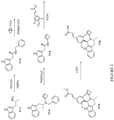
- the ring formation and coupling reaction between compounds of the general formulae (A) and (B) to form compounds of the Formula (I) as illustrated in General Scheme 1 can be carried out in a manner similar to that of the reaction between ( R )- N -(1-(1 H -indol-3-yl)propan-2-yl)-2-fluoro-2-methylpropan-1-amine and ethyl ( E )-3-(3-formylbicyclo[1.1.1]pentan-1-yl)acrylate as described in Example 1A below.
- any intermediate reaction products formed as a result of the reaction between compounds of the general formulae (A) and (B) can be readily converted to compounds of the Formula (I) by those skilled in the art in view of the detailed teaching provided herein, e.g., by appropriate adjustment of the reagents and conditions described in Example 1A for the preparation of Reference compound 1A from intermediate ethyl ( E )-3-(3-((1 R ,3 R )-2-(2-fluoro-2-methylpropyl)-3-methyl-2,3,4,9-tetrahydro-1H-pyrido[3,4-b]indol-1-yl)bicyclo[1.1.1.]pentan-1-yl)acrylate.
- one or more compounds of Formula (I), or pharmaceutically acceptable salts thereof, or a pharmaceutical composition as described herein can be used to inhibit the growth of a cell.
- the cell is identified as having an estrogen receptor that mediates a growth characteristic of the cell. Growth of a cell can be inhibited by contacting the cell with an effective amount of at least one of the compounds described herein, or pharmaceutically acceptable salts thereof, or a pharmaceutical composition as described elsewhere herein.
- Such contacting of the one or more compounds, or pharmaceutically acceptable salts thereof can take place in various ways and locations, including without limitation away from a living subject (e.g., in a laboratory, diagnostic and/or analytical setting) or in proximity to a living subject (e.g., within or on an exterior portion of an animal, e.g., a human).
- a living subject e.g., in a laboratory, diagnostic and/or analytical setting
- a living subject e.g., within or on an exterior portion of an animal, e.g., a human
- an example provides a method of treating a subject, comprising identifying a subject that is in need of treatment for a disease or condition that is estrogen receptor dependent and/or estrogen receptor mediated and administering to said subject an effective amount of one or more compounds of Formula (I), or a pharmaceutically acceptable salt thereof, or a pharmaceutical composition, as described elsewhere herein.
- Another embodiment provides one or more compounds of Formula (I), or a pharmaceutically acceptable salt thereof, or a pharmaceutical composition
- Non-limiting examples of diseases or conditions that are estrogen receptor alpha dependent and/or estrogen alpha receptor mediated and thus suitable for treatment using the compounds, compositions and methods described herein include breast cancers and gynecological cancers.
- diseases or conditions may include one or more of the following: breast cancer, endometrial cancer, ovarian cancer and cervical cancer.
- An embodiment provides one or more compounds of Formula (I), or a pharmaceutically acceptable salt thereof, or a pharmaceutical composition (as described elsewhere herein), for use in the treatment of breast cancers and gynecological cancers, including for example one or more of the following: breast cancer, endometrial cancer, ovarian cancer and cervical cancer.
- compounds of Formula (I), or a pharmaceutically acceptable salt thereof, or a pharmaceutical composition as described elsewhere herein can be administered to such subjects by a variety of methods.
- administration can be by various routes known to those skilled in the art, including without limitation oral, intravenous, intramuscular, topical, subcutaneous, systemic, and/or intraperitoneal administration to a subject in need thereof.
- treat do not necessarily mean total cure or abolition of the estrogen receptor dependent and/or estrogen receptor mediated disease or condition. Any alleviation of any undesired signs or symptoms of the disease or condition, to any extent can be considered treatment and/or therapy. Furthermore, treatment may include acts that may worsen the subject's overall feeling of well-being or appearance.
- a therapeutically effective amount of compound, salt or composition can be the amount needed to prevent, alleviate or ameliorate symptoms of the estrogen receptor dependent and/or estrogen receptor mediated disease or condition, or prolong the survival of the subject being treated This response may occur in a tissue, system, animal or human and includes alleviation of the signs or symptoms of the estrogen receptor dependent and/or estrogen receptor mediated disease or condition being treated. Determination of an effective amount is well within the capability of those skilled in the art, in view of the disclosure provided herein.
- the therapeutically effective amount of the compounds disclosed herein required as a dose will depend on the route of administration, the type of animal, including human, being treated, and the physical characteristics of the specific animal under consideration.
- the dose can be tailored to achieve a desired effect, but will depend on such factors as weight, diet, concurrent medication and other factors which those skilled in the medical arts will recognize.
- the amount of the compound of Formula (I), or a pharmaceutically acceptable salt thereof, required for use in treatment will vary not only with the particular compound or salt selected but also with the route of administration, the nature and/or symptoms of the estrogen receptor dependent and/or estrogen receptor mediated disease or condition being treated and the age and condition of the patient and will be ultimately at the discretion of the attendant physician or clinician.
- dosages may be calculated as the free base.
- a suitable dose will often be in the range of from about 0.05 mg/kg to about 10 mg/kg.
- a suitable dose may be in the range from about 0.10 mg/kg to about 7.5 mg/kg of body weight per day, such as about 0.15 mg/kg to about 5.0 mg/kg of body weight of the recipient per day, about 0.2 mg/kg to 4.0 mg/kg of body weight of the recipient per day.
- the compound may be administered in unit dosage form; for example, containing 1 to 500 mg, 10 to 100 mg or 5 to 50 mg of active ingredient per unit dosage form.
- the desired dose may conveniently be presented in a single dose or as divided doses administered at appropriate intervals, for example, as two, three, four or more sub-doses per day.
- the sub-dose itself may be further divided, e.g., into a number of discrete loosely spaced administrations.
- the useful in vivo dosage to be administered and the particular mode of administration will vary depending upon the age, weight, the severity of the affliction, and mammalian species treated, the particular compounds employed, and the specific use for which these compounds are employed.
- the determination of effective dosage levels can be accomplished by one skilled in the art using routine methods, for example, human clinical trials, in vivo studies and in vitro studies.
- useful dosages of a compound of Formula (I), or pharmaceutically acceptable salts thereof can be determined by comparing their in vitro activity, and in vivo activity in animal models. Such comparison can be done by comparison against an established drug, such as fulvestrant.
- Dosage amount and interval may be adjusted individually to provide plasma levels of the active moiety which are sufficient to maintain the modulating effects, or minimal effective concentration (MEC).
- MEC minimal effective concentration
- the MEC will vary for each compound but can be estimated from in vivo and/or in vitro data. Dosages necessary to achieve the MEC will depend on individual characteristics and route of administration. However, HPLC assays or bioassays can be used to determine plasma concentrations. Dosage intervals can also be determined using MEC value.
- Compositions should be administered using a regimen which maintains plasma levels above the MEC for 10-90% of the time, preferably between 30-90% and most preferably between 50-90%. In cases of local administration or selective uptake, the effective local concentration of the drug may not be related to plasma concentration.
- the attending physician would know how to and when to terminate, interrupt, or adjust administration due to toxicity or organ dysfunctions. Conversely, the attending physician would also know to adjust treatment to higher levels if the clinical response were not adequate (precluding toxicity).
- the magnitude of an administrated dose in the management of the disorder of interest will vary with the severity of the estrogen receptor dependent and/or estrogen receptor mediated disease or condition to be treated and to the route of administration. The severity of the estrogen receptor dependent and/or estrogen receptor mediated disease or condition may, for example, be evaluated, in part, by standard prognostic evaluation methods. Further, the dose and perhaps dose frequency, will also vary according to the age, body weight, and response of the individual patient. A program comparable to that discussed above may be used in veterinary medicine.
- the toxicology of a particular compound, or of a subset of the compounds, sharing certain chemical moieties may be established by determining in vitro toxicity towards a cell line, such as a mammalian, and preferably human, cell line. The results of such studies are often predictive of toxicity in animals, such as mammals, or more specifically, humans.
- a cell line such as a mammalian, and preferably human, cell line.
- the results of such studies are often predictive of toxicity in animals, such as mammals, or more specifically, humans.
- the toxicity of particular compounds in an animal model such as mice, rats, rabbits, dogs or monkeys, may be determined using known methods.
- the efficacy of a particular compound may be established using several recognized methods, such as in vitro methods, animal models, or human clinical trials. When selecting a model to determine efficacy, the skilled artisan can be guided by the state of the art to choose an appropriate model, dose, route of administration and/or regime.
- compositions that can include an effective amount of one or more compounds described herein (e.g., a compound of Formula (I), or a pharmaceutically acceptable salt thereof) and a pharmaceutically acceptable carrier, diluent, excipient or combination thereof.
- composition refers to a mixture of one or more compounds and/or salts disclosed herein with other chemical components, such as diluents or carriers.
- the pharmaceutical composition facilitates administration of the compound to an organism.
- Pharmaceutical compositions can also be obtained by reacting compounds with inorganic or organic acids such as hydrochloric acid, hydrobromic acid, sulfuric acid, nitric acid, phosphoric acid, methanesulfonic acid, ethanesulfonic acid, p-toluenesulfonic acid, and salicylic acid.
- Pharmaceutical compositions will generally be tailored to the specific intended route of administration.
- physiologically acceptable defines a carrier, diluent or excipient that does not abrogate the biological activity and properties of the compound nor cause appreciable damage or injury to an animal to which delivery of the composition is intended.
- a “carrier” refers to a compound that facilitates the incorporation of a compound into cells or tissues.
- DMSO dimethyl sulfoxide
- DMSO dimethyl sulfoxide
- a "diluent” refers to an ingredient in a pharmaceutical composition that lacks appreciable pharmacological activity but may be pharmaceutically necessary or desirable.
- a diluent may be used to increase the bulk of a potent drug whose mass is too small for manufacture and/or administration. It may also be a liquid for the dissolution of a drug to be administered by injection, ingestion or inhalation.
- a common form of diluent in the art is a buffered aqueous solution such as, without limitation, phosphate buffered saline that mimics the pH and isotonicity of human blood.
- an “excipient” refers to an essentially inert substance that is added to a pharmaceutical composition to provide, without limitation, bulk, consistency, stability, binding ability, lubrication, disintegrating ability etc., to the composition.
- stabilizers such as anti-oxidants and metal-chelating agents are excipients.
- the pharmaceutical composition comprises an anti-oxidant and/or a metal-chelating agent.
- a "diluent” is a type of excipient.
- compositions described herein can be administered to a human patient per se, or in pharmaceutical compositions where they are mixed with other active ingredients, as in combination therapy, or carriers, diluents, excipients or combinations thereof. Proper formulation is dependent upon the route of administration chosen. Techniques for formulation and administration of the compounds described herein are known to those skilled in the art.
- compositions disclosed herein may be manufactured in a manner that is itself known, e.g., by means of conventional mixing, dissolving, granulating, dragee-making, levigating, emulsifying, encapsulating, entrapping or tableting processes. Additionally, the active ingredients are contained in an amount effective to achieve its intended purpose. Many of the compounds used in the pharmaceutical combinations disclosed herein may be provided as salts with pharmaceutically compatible counterions.
- a compound, salt and/or composition include, but not limited to, oral, rectal, pulmonary, topical, aerosol, injection, infusion and parenteral delivery, including intramuscular, subcutaneous, intravenous, intramedullary injections, intrathecal, direct intraventricular, intraperitoneal, intranasal and intraocular injections.
- the liposomes will be targeted to and taken up selectively by the organ. For example, intranasal or pulmonary delivery to target a respiratory disease or condition may be desirable.
- compositions may, if desired, be presented in a pack or dispenser device which may contain one or more unit dosage forms containing the active ingredient.
- the pack may for example comprise metal or plastic foil, such as a blister pack.
- the pack or dispenser device may be accompanied by instructions for administration.
- the pack or dispenser may also be accompanied with a notice associated with the container in form prescribed by a governmental agency regulating the manufacture, use, or sale of pharmaceuticals, which notice is reflective of approval by the agency of the form of the drug for human or veterinary administration. Such notice, for example, may be the labeling approved by the U.S. Food and Drug Administration for prescription drugs, or the approved product insert.
- Compositions that can include a compound and/or salt described herein formulated in a compatible pharmaceutical carrier may also be prepared, placed in an appropriate container, and labeled for treatment of an indicated condition.
- the compounds of Formula (I) illustrated in Table 1 can be prepared in various ways, using techniques known to those skilled in the art as guided by the detailed teachings provided herein.
- the compounds of Formula (I) illustrated in Table 1 can be prepared in accordance with General Scheme 1 as described in the Examples below.
- the compounds of Formula (I) illustrated in Table 2 can be readily prepared in accordance with General Scheme 1 in view of the detailed teachings set forth in the Examples below.
- reaction mixture was concentrated under reduced pressure to remove methanol.
- residue was acidified with 1N HCl at 0 °C, diluted with EtOAc and washed with water.
- the combined organic layer was dried over sodium sulfate, filtered and concentrated.
- reaction mixture was concentrated under reduced pressure to remove methanol.
- residue was acidified with 1N HCl at 0 °C then diluted with EtOAc and washed with water.
- the combined organic layer was dried over sodium sulfate, filtered and concentrated.
- the pH of the aqueous solution was adjusted to 5 by addition of 2N HCl solution.
- the solution was extracted with diethyl ether (3 ⁇ 70 mL).
- the combined organic phase was dried over sodium sulfate, filtered and concentrated under reduced pressure.
- the septum was removed and the tube was sealed.
- the reaction mixture was vigorously stirred at 60 °C for 16 hours.
- the heterogeneous solution was poured into a saturated aqueous solution of NH 4 Cl (200 mL) at 0 °C.
- the sealed tube was washed carefully with ethyl acetate and water.
- the mixture was transferred to a separatory funnel and the layers were separated.
- the aqueous layers were washed with ethyl acetate (2 ⁇ 250 mL). All of the organic layers were combined, dried over sodium sulfate and concentrated under vacuum.
- the resultant material was dissolved in toluene (1 mL) which was pre-heated to 90 °C. Hexane, pre-heated to 70 °C, was slowly added. The mixture was cooled to rt and then stored at 4 °C for 12 h.
- the residue was treated with an aqueous solution of hydrogen chloride (1N) at 0°C to adjust pH to 6.
- the aqueous layer was extracted with diethyl ether (2 ⁇ 10 mL) and the combined organic layer was washed with water, dried over sodium sulfate, filtered and concentrated.
- N -1-(1 H- indol-3-yl)butan-2-yl)bicyclo[1.1.1]pentan-1-amine (0.90 g) was purified by Chiral SFC [Column: Lux Cellulose-2 (250 ⁇ 30 mm), 5 ⁇ m %CO 2 :85.0: %Co solvent:15.0% (0.5% DEA in MeOH): Total Flow: 90.0 g/min: Back Pressure: 100.0 bar: UV: 219 nm: Stack time: 4.0 min: Load/Inj: 18.0 mg: Solubility: Methanol: No of injections: 50: Instrument details: Make/Model: Thar SFC-200-005] to afford ( R )- N -(1-(1 H -indol-3-yl)butan-2-yl)blcyclo[1.1.1]pentan-1-amine (Designated as Peak 1) (160 mg, 0.63 mmol, 32.0% yield) and ( S )- N
- MCF7 was expanded and maintained in the medium (Phenol red free DMEM/F12 (Hyclone SH30272.01) NEAA (Gibco11140-050) Na-pyruvate (Gibco 11360-070) and Re-stripped Charcoal stripped FBS (Gemini 100-119)).
- the cells were adjusted to a concentration of 3,000 cells per mL in the above media, and the cells were incubated (37 °C, 5% CO 2 ). The following day a 10 point, serial dilution of compounds was added to the cells at a final concentration ranging from 10-0.000005 ⁇ M for test compounds (17 ⁇ -estradiol was used as a control).
- MCF-7 cells are plated at 0.3 million cells/mL (3mL/well) in 6-well plates in experiment media and incubated at 37 °C, 5% CO2 for 48 hours. Next day, 10 ⁇ solution of compounds are made in DMSO and added the solution to the cells to achieve a final concentration of 10 ⁇ M.
- a DMSO control is included to enable a determination of the relative efficacy of test compounds. Fulvestrant is used as a positive control for ER-alpha degradation, and 4-OH tamoxifen as a control for receptor stabilization.
- cell lysates are prepared (2X Cell lysis buffer: 100 mM Tris, pH 8, 300 mM NaCl, 2% NP40, 1% Na deoxycholate, 0.04% SDS, 2 mM EDTA) and mixed thoroughly and incubated on ice. The protein concentration is quantified using BCA kit. Protein was separated on 4%-20% NuPAGE Novex 4-12% Bis-Tris Protein Gels using 1 ⁇ MES running buffer. The gel was then transferred onto a nitrocellulose membrane. The blots were probed with antibodies against ESR1 protein (Santa Cruz, sc-8005). GAPDH protein was used as an internal control.
- MCF-7 cells are plated at 0.3 million cells/mL (3mL/well) in 6-well plates in experiment media and incubated at 37 °C, 5% CO 2 for 48 hours. Next day, 10mM solution of compounds are made in DMSO and added the solution to the cells to achieve a final concentration of 10 ⁇ M. For EC 50 determination, MCF-7 cells were incubated with 3x or 5x serial dilutions of 10mM compounds, final concentration of the compounds was from 10 ⁇ M to designed concentrations based on the potency of the compounds. A DMSO control is included to enable a determination of the relative efficacy of test compounds.
- Fulvestrant is used as a positive control for ER-alpha degradation, and 4-OH tamoxifen as a control for receptor stabilization.
- cell lysates are prepared (2X Cell lysis buffer: 100 mM Tris, pH 8, 300 mM NaCl, 2% NP40, 1% Na deoxycholate, 0.04% SDS, 2 mM EDTA) and mixed thoroughly and incubated on ice. The protein concentration is quantified using BCA kit. Protein was separated on 4% - 20% NuPAGE Novex 4 - 12% Bis-Tris Protein Gels using 1 ⁇ MES running buffer. The gel was then transferred onto a nitrocellulose membrane.
- the blots were probed with antibodies against ESR1 protein (Santa Cruz, sc-8005). GAPDH protein was used as an internal control.
- the blots were imaged on Azure C600 Imager and Band density of the western blots was quantified with Azurespot software. EC 50 is calculated with GraphpadPrism.
- the formulation for IV groups is DMSO/PEG400/150 mM glycine (pH 9) (5/10/85) and the formulation for PO groups is PEG400/PVP/Tween 80/0.5% CMC in water (9/0.5/0.5/90).
- blood samples of intravenous injection group were collected at time points of predose, 0.0833, 0.25, 0.5, 1, 2, 4, 8, 12 and 24 h; blood samples of oral group were collected at time points of predose, 0.25, 0.5, 1, 2, 4, 8, 12, and 24 h.
- Standard curve was plotted based on concentrations of the samples in a suitable range, the concentrations of test compounds in plasma samples were determined by using LC-MS/MS.
- Pharmacokinetic parameters were calculated according to drug concentration -time curve usmg a noncompartmental method by WinNonLin (Phoenix TM , version 6.1) or other similar software. TABLE 4.
Landscapes
- Chemical & Material Sciences (AREA)
- Organic Chemistry (AREA)
- Health & Medical Sciences (AREA)
- Veterinary Medicine (AREA)
- Medicinal Chemistry (AREA)
- Pharmacology & Pharmacy (AREA)
- Life Sciences & Earth Sciences (AREA)
- Animal Behavior & Ethology (AREA)
- General Health & Medical Sciences (AREA)
- Public Health (AREA)
- General Chemical & Material Sciences (AREA)
- Chemical Kinetics & Catalysis (AREA)
- Epidemiology (AREA)
- Nuclear Medicine, Radiotherapy & Molecular Imaging (AREA)
- Endocrinology (AREA)
- Bioinformatics & Cheminformatics (AREA)
- Diabetes (AREA)
- Engineering & Computer Science (AREA)
- Pharmaceuticals Containing Other Organic And Inorganic Compounds (AREA)
- Acyclic And Carbocyclic Compounds In Medicinal Compositions (AREA)
- Organic Low-Molecular-Weight Compounds And Preparation Thereof (AREA)
- Nitrogen Condensed Heterocyclic Rings (AREA)
- Steroid Compounds (AREA)
- Indole Compounds (AREA)
- Plural Heterocyclic Compounds (AREA)
Applications Claiming Priority (2)
| Application Number | Priority Date | Filing Date | Title |
|---|---|---|---|
| US201662317254P | 2016-04-01 | 2016-04-01 | |
| PCT/US2017/024809 WO2017172957A1 (en) | 2016-04-01 | 2017-03-29 | Estrogen receptor modulators |
Publications (4)
| Publication Number | Publication Date |
|---|---|
| EP3442971A1 EP3442971A1 (en) | 2019-02-20 |
| EP3442971A4 EP3442971A4 (en) | 2020-01-01 |
| EP3442971C0 EP3442971C0 (en) | 2024-09-25 |
| EP3442971B1 true EP3442971B1 (en) | 2024-09-25 |
Family
ID=59966438
Family Applications (1)
| Application Number | Title | Priority Date | Filing Date |
|---|---|---|---|
| EP17776574.0A Active EP3442971B1 (en) | 2016-04-01 | 2017-03-29 | Estrogen receptor modulators |
Country Status (15)
| Country | Link |
|---|---|
| US (5) | US20190142811A1 (enExample) |
| EP (1) | EP3442971B1 (enExample) |
| JP (2) | JP6926189B2 (enExample) |
| KR (2) | KR20220071293A (enExample) |
| CN (4) | CN112679495B (enExample) |
| AR (1) | AR108011A1 (enExample) |
| AU (3) | AU2017242027B2 (enExample) |
| CA (1) | CA3017388C (enExample) |
| ES (1) | ES2991862T3 (enExample) |
| IL (3) | IL295050A (enExample) |
| MX (2) | MX392461B (enExample) |
| RU (1) | RU2738646C2 (enExample) |
| SG (1) | SG11201807708SA (enExample) |
| TW (2) | TW202235418A (enExample) |
| WO (1) | WO2017172957A1 (enExample) |
Families Citing this family (21)
| Publication number | Priority date | Publication date | Assignee | Title |
|---|---|---|---|---|
| JP6905539B2 (ja) | 2016-02-05 | 2021-07-21 | インベンティスバイオ リミテッド ライアビリティ カンパニー | 選択的エストロゲン受容体分解剤およびその使用 |
| CN112679495B (zh) | 2016-04-01 | 2023-03-28 | 里科瑞尔姆Ip控股有限责任公司 | 雌激素受体调节剂 |
| CN107814798B (zh) * | 2016-09-14 | 2020-11-03 | 四川科伦博泰生物医药股份有限公司 | 3-取代丙烯酸类化合物及其制备方法和用途 |
| WO2018130124A1 (zh) * | 2017-01-11 | 2018-07-19 | 南京圣和药业股份有限公司 | 作为选择性雌激素受体下调剂的三环类化合物及其应用 |
| EP3665142A4 (en) | 2017-09-11 | 2021-04-28 | Recurium IP Holdings, LLC | CONTINUOUS CURRENT PROCESS FOR THE PRODUCTION OF BICYCLIC CONNECTIONS |
| JP2021503448A (ja) * | 2017-11-16 | 2021-02-12 | ノバルティス アーゲー | Lsz102及びリボシクリブを含む医薬組合せ |
| WO2020238733A1 (zh) * | 2019-05-24 | 2020-12-03 | 浙江海正药业股份有限公司 | 丙烯酸类衍生物的晶型及其制备方法和用途 |
| MX2022001149A (es) * | 2019-08-06 | 2022-04-06 | Recurium Ip Holdings Llc | Moduladores del receptor de estrógeno para el tratamiento de mutantes. |
| MX2022005139A (es) * | 2019-11-04 | 2022-06-24 | Recurium Ip Holdings Llc | Sales y formas de un modulador de receptores estrogénicos. |
| WO2021127042A1 (en) * | 2019-12-20 | 2021-06-24 | Recurium Ip Holdings, Llc | Combinations |
| AU2020407573A1 (en) * | 2019-12-20 | 2022-07-14 | Recurium Ip Holdings, Llc | Combinations |
| MX2022007627A (es) | 2019-12-20 | 2022-08-16 | Recurium Ip Holdings Llc | Combinaciones. |
| KR20220119418A (ko) * | 2019-12-20 | 2022-08-29 | 리커리엄 아이피 홀딩스, 엘엘씨 | 조합물 |
| WO2021127046A1 (en) * | 2019-12-20 | 2021-06-24 | Recurium Ip Holdings, Llc | Combinations |
| IL297448A (en) * | 2020-04-22 | 2022-12-01 | Recurium Ip Holdings Llc | Preparation of an selective estrogen receptor degrader |
| WO2021253380A1 (en) * | 2020-06-19 | 2021-12-23 | InventisBio Co., Ltd. | Oral formulations and uses thereof |
| AU2021343525A1 (en) * | 2020-09-20 | 2023-05-18 | Tactogen Inc | Advantageous tryptamine compositions for mental disorders or enhancement |
| WO2022133446A1 (en) * | 2020-12-16 | 2022-06-23 | Recurium Ip Holdings, Llc | Combinations |
| EP4267578A4 (en) * | 2020-12-23 | 2024-11-20 | Recurium IP Holdings, LLC | ESTROGEN RECEPTOR MODULATORS |
| WO2022153268A1 (en) | 2021-01-15 | 2022-07-21 | Beckley Psytech Limited | Tryptamine analogues |
| EP4366734A4 (en) * | 2021-07-08 | 2025-05-21 | Olema Pharmaceuticals, Inc. | METHODS OF TREATING DISEASES ASSOCIATED WITH ESTROGEN RECEPTOR |
Family Cites Families (46)
| Publication number | Priority date | Publication date | Assignee | Title |
|---|---|---|---|---|
| JPH09510216A (ja) | 1994-03-11 | 1997-10-14 | イーライ・リリー・アンド・カンパニー | 5−ht▲下2b▼受容体に関連する病態を治療するための方法 |
| GB9604996D0 (en) | 1996-03-08 | 1996-05-08 | Black James Foundation | Benzodiazonine derivatives |
| EP1113007A1 (en) * | 1999-12-24 | 2001-07-04 | Pfizer Inc. | Tetrahydroisoquinoline compounds as estrogen agonists/antagonists |
| EP1438310B1 (en) | 2001-10-19 | 2006-12-20 | TransTech Pharma Inc. | Beta-carbolin derivatives as ptp-inhibitors |
| US8076352B2 (en) * | 2004-03-15 | 2011-12-13 | Ptc Therapeutics, Inc. | Administration of carboline derivatives useful in the treatment of cancer and other diseases |
| JP2008508356A (ja) | 2004-08-02 | 2008-03-21 | スミスクライン ビーチャム コーポレーション | Hpv感染に有用な化合物 |
| WO2007002051A1 (en) | 2005-06-22 | 2007-01-04 | Smithkline Beecham Corporation | Carboline derivatives and their use as inhibitors of flaviviridae infections |
| WO2008002490A2 (en) | 2006-06-23 | 2008-01-03 | Radius Health, Inc. | Treatment of vasomotor symptoms with selective estrogen receptor modulators |
| CA2683444A1 (en) | 2007-04-13 | 2008-10-23 | Ptc Therapeutics, Inc. | Administration of carboline derivatives useful in the treatment of cancer and other diseases |
| DE102007028515A1 (de) | 2007-06-21 | 2008-12-24 | Merck Patent Gmbh | 6-(Pyrrolopyridinyl)-pyrimidinyl-2-amin-derivate |
| TW201028414A (en) * | 2009-01-16 | 2010-08-01 | Merck Sharp & Dohme | Oxadiazole beta carboline derivatives as antidiabetic compounds |
| WO2010107485A1 (en) | 2009-03-17 | 2010-09-23 | The Trustees Of Columbia University In The City Of New York | E3 ligase inhibitors |
| US20120202801A1 (en) * | 2009-05-27 | 2012-08-09 | Liangxian Cao | Methods for treating breast cancer |
| CN106167488A (zh) * | 2009-05-27 | 2016-11-30 | Ptc医疗公司 | 治疗癌症及非肿瘤病症的方法 |
| ES2567328T3 (es) * | 2009-07-28 | 2016-04-21 | Ono Pharmaceutical Co., Ltd. | Compuesto bicíclico y uso del mismo para fines médicos |
| KR20120125468A (ko) | 2010-01-15 | 2012-11-15 | 머크 샤프 앤드 돔 코포레이션 | 항당뇨 화합물로서 옥사디아졸 베타 카르볼린 유도체 |
| ES2822130T3 (es) * | 2010-02-11 | 2021-04-29 | Bristol Myers Squibb Co | Macrociclos como inhibidores del factor XIa |
| WO2011103487A1 (en) | 2010-02-18 | 2011-08-25 | Medivation Technologies, Inc. | Pyrido[4,3-b]indole and pyrido[3,4-b]indole derivatives and methods of use |
| PL2580210T3 (pl) | 2010-06-10 | 2017-09-29 | Seragon Pharmaceuticals, Inc. | Modulatory receptora estrogenowego i ich zastosowania |
| US9029574B2 (en) * | 2011-01-27 | 2015-05-12 | Ono Pharmaceutical Co., Ltd. | Bicyclic compound and use thereof for medical purposes |
| CN102432608B (zh) | 2011-11-01 | 2013-04-17 | 浙江大学 | 手性螺环磷酸催化合成光学活性四氢-β-咔啉衍生物的方法 |
| WO2013090829A1 (en) | 2011-12-14 | 2013-06-20 | Aragon Pharmaceuticals, Inc. | Estrogen receptor modulators and uses thereof |
| PT2797921T (pt) * | 2011-12-31 | 2017-11-14 | Beigene Ltd | Dihidrodiazepinocarbazolonas tetra ou pentacíclicas fundidas como inibidoras de parp |
| CN104220065A (zh) * | 2012-02-07 | 2014-12-17 | Eolas治疗公司 | 取代的脯氨酸/哌啶用作食欲素受体拮抗剂 |
| AU2013235499A1 (en) | 2012-03-20 | 2014-09-25 | Seragon Pharmaceuticals, Inc. | Estrogen receptor modulators and uses thereof |
| PT2872482T (pt) | 2012-07-13 | 2020-09-22 | Oncternal Therapeutics Inc | Método de tratamento de cancro de mama com modulador seletivo do recetor de andrógeno (sarm) |
| JP6364028B2 (ja) | 2013-02-19 | 2018-07-25 | ノバルティス アーゲー | 選択的エストロゲン受容体ディグレーダーとしてのベンゾチオフェン誘導体およびその組成物 |
| JP2016517420A (ja) | 2013-03-14 | 2016-06-16 | セラゴン ファーマシューティカルズ, インク. | 多環式エストロゲン受容体モジュレーター及びその使用 |
| CA2911859A1 (en) * | 2013-05-28 | 2014-12-04 | Astrazeneca Ab | Chemical compounds |
| AU2014358850A1 (en) | 2013-12-06 | 2016-06-16 | F. Hoffmann-La Roche Ag | Estrogen receptor modulator for the treatment of locally advanced or metastatic estrogen receptor positive breast cancer |
| CN104693211A (zh) | 2013-12-10 | 2015-06-10 | 南京明德新药研发股份有限公司 | 作为抗病毒剂的咪唑衍生物及其制药用途 |
| WO2015123355A1 (en) * | 2014-02-12 | 2015-08-20 | Eolas Therapeutics, Inc. | Substituted prolines / piperidines as orexin receptor antagonists |
| US9695166B2 (en) * | 2014-05-05 | 2017-07-04 | Global Blood Therapeutics, Inc. | Pyrazolopyridine pyrazolopyrimidine and related compounds |
| WO2015173329A1 (en) | 2014-05-16 | 2015-11-19 | Actelion Pharmaceuticals Ltd | Antibacterial quinazoline-4(3h)-one derivatives |
| KR102505901B1 (ko) | 2014-06-27 | 2023-03-08 | 노그라 파마 리미티드 | 아릴 수용체 조정제, 및 그의 제조 및 사용 방법 |
| KR101997592B1 (ko) | 2014-10-09 | 2019-07-08 | 광동 쫑성 파마세티컬 컴패니, 리미티드 | 히드록시퓨린계 화합물 및 이의 응용 |
| US10654809B2 (en) | 2016-06-10 | 2020-05-19 | University Of Tennessee Research Foundation | Selective androgen receptor degrader (SARD) ligands and methods of use thereof |
| JP6786520B2 (ja) | 2015-04-21 | 2020-11-18 | ジーティーエックス・インコーポレイテッド | 選択的アンドロゲン受容体分解剤(sard)リガンド及びその使用方法 |
| CA2988620A1 (en) * | 2015-06-16 | 2016-12-22 | Jiangsu Hengrui Medicine Co., Ltd. | Piperidine derivative and preparation method and pharmaceutical use thereof |
| US10519148B2 (en) | 2015-11-12 | 2019-12-31 | Zhejiang Hisun Pharmaceutical Co., Ltd. | Acrylic acid derivative, preparation method and use in medicine thereof |
| JP6905539B2 (ja) * | 2016-02-05 | 2021-07-21 | インベンティスバイオ リミテッド ライアビリティ カンパニー | 選択的エストロゲン受容体分解剤およびその使用 |
| CN112679495B (zh) | 2016-04-01 | 2023-03-28 | 里科瑞尔姆Ip控股有限责任公司 | 雌激素受体调节剂 |
| JP6956747B2 (ja) | 2016-06-10 | 2021-11-02 | ユニバーシティ オブ テネシー リサーチ ファウンデーション | 選択的アンドロゲン受容体分解剤(sard)リガンドおよびその使用方法 |
| CN109415361B (zh) * | 2016-06-29 | 2022-03-08 | 浙江海正药业股份有限公司 | 丙烯酸类衍生物及其制备方法和其在医药上的用途 |
| CN110139674B (zh) * | 2016-10-05 | 2023-05-16 | 豪夫迈·罗氏有限公司 | 制备抗体药物缀合物的方法 |
| WO2018130124A1 (zh) | 2017-01-11 | 2018-07-19 | 南京圣和药业股份有限公司 | 作为选择性雌激素受体下调剂的三环类化合物及其应用 |
-
2017
- 2017-03-29 CN CN202011582762.9A patent/CN112679495B/zh active Active
- 2017-03-29 JP JP2019503398A patent/JP6926189B2/ja active Active
- 2017-03-29 CN CN201780033815.1A patent/CN109311870B/zh active Active
- 2017-03-29 RU RU2018132037A patent/RU2738646C2/ru active
- 2017-03-29 MX MX2018011419A patent/MX392461B/es unknown
- 2017-03-29 AU AU2017242027A patent/AU2017242027B2/en active Active
- 2017-03-29 KR KR1020227016946A patent/KR20220071293A/ko not_active Ceased
- 2017-03-29 SG SG11201807708SA patent/SG11201807708SA/en unknown
- 2017-03-29 IL IL295050A patent/IL295050A/en unknown
- 2017-03-29 CA CA3017388A patent/CA3017388C/en active Active
- 2017-03-29 CN CN202011582784.5A patent/CN112745316A/zh active Pending
- 2017-03-29 WO PCT/US2017/024809 patent/WO2017172957A1/en not_active Ceased
- 2017-03-29 ES ES17776574T patent/ES2991862T3/es active Active
- 2017-03-29 CN CN202111035485.4A patent/CN113717170A/zh active Pending
- 2017-03-29 KR KR1020187030841A patent/KR102401841B1/ko active Active
- 2017-03-29 US US16/086,434 patent/US20190142811A1/en not_active Abandoned
- 2017-03-29 IL IL285318A patent/IL285318B/en unknown
- 2017-03-29 EP EP17776574.0A patent/EP3442971B1/en active Active
- 2017-03-30 TW TW110145253A patent/TW202235418A/zh unknown
- 2017-03-30 TW TW106110662A patent/TWI746535B/zh active
- 2017-03-30 AR ARP170100788A patent/AR108011A1/es unknown
-
2018
- 2018-09-06 IL IL261654A patent/IL261654B/en unknown
- 2018-09-24 MX MX2022005780A patent/MX2022005780A/es unknown
-
2020
- 2020-05-05 US US16/866,995 patent/US10959989B2/en active Active
- 2020-05-05 US US16/867,017 patent/US11065234B2/en active Active
- 2020-05-05 US US16/866,900 patent/US11065233B2/en active Active
- 2020-12-22 AU AU2020294196A patent/AU2020294196B2/en active Active
-
2021
- 2021-07-06 US US17/305,369 patent/US20210330651A1/en not_active Abandoned
- 2021-08-04 JP JP2021127863A patent/JP2021176911A/ja active Pending
-
2022
- 2022-06-09 AU AU2022204025A patent/AU2022204025A1/en not_active Abandoned
Also Published As
Similar Documents
| Publication | Publication Date | Title |
|---|---|---|
| EP3442971B1 (en) | Estrogen receptor modulators | |
| CN115038450A (zh) | 组合 | |
| AU2020407514A1 (en) | Combinations | |
| US11999728B2 (en) | Estrogen receptor modulators | |
| HK40004087B (en) | Estrogen receptor modulators | |
| HK40004087A (en) | Estrogen receptor modulators | |
| RU2845443C1 (ru) | Комбинации | |
| US20210094899A1 (en) | Acrylic acid analogs | |
| CN115103673A (zh) | 组合 | |
| CN115023228A (zh) | 组合 | |
| BR112018070161B1 (pt) | Composto ou sal farmaceuticamente aceitável do mesmo, composição farmacêutica, uso dos mesmos e método para inibir o crescimento de célula |
Legal Events
| Date | Code | Title | Description |
|---|---|---|---|
| STAA | Information on the status of an ep patent application or granted ep patent |
Free format text: STATUS: THE INTERNATIONAL PUBLICATION HAS BEEN MADE |
|
| PUAI | Public reference made under article 153(3) epc to a published international application that has entered the european phase |
Free format text: ORIGINAL CODE: 0009012 |
|
| STAA | Information on the status of an ep patent application or granted ep patent |
Free format text: STATUS: REQUEST FOR EXAMINATION WAS MADE |
|
| 17P | Request for examination filed |
Effective date: 20181001 |
|
| AK | Designated contracting states |
Kind code of ref document: A1 Designated state(s): AL AT BE BG CH CY CZ DE DK EE ES FI FR GB GR HR HU IE IS IT LI LT LU LV MC MK MT NL NO PL PT RO RS SE SI SK SM TR |
|
| AX | Request for extension of the european patent |
Extension state: BA ME |
|
| DAV | Request for validation of the european patent (deleted) | ||
| DAX | Request for extension of the european patent (deleted) | ||
| RAP1 | Party data changed (applicant data changed or rights of an application transferred) |
Owner name: RECURIUM IP HOLDINGS, LLC |
|
| A4 | Supplementary search report drawn up and despatched |
Effective date: 20191203 |
|
| RIC1 | Information provided on ipc code assigned before grant |
Ipc: C07D 209/18 20060101ALI20191127BHEP Ipc: A61K 31/437 20060101ALI20191127BHEP Ipc: C07D 209/14 20060101ALI20191127BHEP Ipc: C07C 57/04 20060101ALI20191127BHEP Ipc: A61K 31/438 20060101ALI20191127BHEP Ipc: C07F 7/18 20060101ALI20191127BHEP Ipc: C07D 471/14 20060101ALI20191127BHEP Ipc: C07D 471/04 20060101AFI20191127BHEP Ipc: C07C 61/13 20060101ALI20191127BHEP Ipc: A61P 35/00 20060101ALI20191127BHEP Ipc: A61P 5/30 20060101ALI20191127BHEP |
|
| REG | Reference to a national code |
Ref country code: HK Ref legal event code: DE Ref document number: 40004087 Country of ref document: HK |
|
| STAA | Information on the status of an ep patent application or granted ep patent |
Free format text: STATUS: EXAMINATION IS IN PROGRESS |
|
| 17Q | First examination report despatched |
Effective date: 20210406 |
|
| GRAP | Despatch of communication of intention to grant a patent |
Free format text: ORIGINAL CODE: EPIDOSNIGR1 |
|
| STAA | Information on the status of an ep patent application or granted ep patent |
Free format text: STATUS: GRANT OF PATENT IS INTENDED |
|
| RIC1 | Information provided on ipc code assigned before grant |
Ipc: C07B 59/00 20060101ALI20230522BHEP Ipc: A61P 5/30 20060101ALI20230522BHEP Ipc: A61P 35/00 20060101ALI20230522BHEP Ipc: A61K 31/438 20060101ALI20230522BHEP Ipc: A61K 31/437 20060101ALI20230522BHEP Ipc: C07D 209/14 20060101ALI20230522BHEP Ipc: C07D 209/18 20060101ALI20230522BHEP Ipc: C07C 69/757 20060101ALI20230522BHEP Ipc: C07C 69/738 20060101ALI20230522BHEP Ipc: C07C 69/732 20060101ALI20230522BHEP Ipc: C07C 57/04 20060101ALI20230522BHEP Ipc: C07F 7/18 20060101ALI20230522BHEP Ipc: C07C 61/13 20060101ALI20230522BHEP Ipc: C07D 471/14 20060101ALI20230522BHEP Ipc: C07D 471/04 20060101AFI20230522BHEP |
|
| INTG | Intention to grant announced |
Effective date: 20230623 |
|
| GRAJ | Information related to disapproval of communication of intention to grant by the applicant or resumption of examination proceedings by the epo deleted |
Free format text: ORIGINAL CODE: EPIDOSDIGR1 |
|
| STAA | Information on the status of an ep patent application or granted ep patent |
Free format text: STATUS: EXAMINATION IS IN PROGRESS |
|
| INTC | Intention to grant announced (deleted) | ||
| GRAP | Despatch of communication of intention to grant a patent |
Free format text: ORIGINAL CODE: EPIDOSNIGR1 |
|
| STAA | Information on the status of an ep patent application or granted ep patent |
Free format text: STATUS: GRANT OF PATENT IS INTENDED |
|
| INTG | Intention to grant announced |
Effective date: 20240417 |
|
| GRAS | Grant fee paid |
Free format text: ORIGINAL CODE: EPIDOSNIGR3 |
|
| GRAA | (expected) grant |
Free format text: ORIGINAL CODE: 0009210 |
|
| STAA | Information on the status of an ep patent application or granted ep patent |
Free format text: STATUS: THE PATENT HAS BEEN GRANTED |
|
| AK | Designated contracting states |
Kind code of ref document: B1 Designated state(s): AL AT BE BG CH CY CZ DE DK EE ES FI FR GB GR HR HU IE IS IT LI LT LU LV MC MK MT NL NO PL PT RO RS SE SI SK SM TR |
|
| REG | Reference to a national code |
Ref country code: GB Ref legal event code: FG4D |
|
| REG | Reference to a national code |
Ref country code: CH Ref legal event code: EP |
|
| REG | Reference to a national code |
Ref country code: DE Ref legal event code: R096 Ref document number: 602017085070 Country of ref document: DE |
|
| REG | Reference to a national code |
Ref country code: IE Ref legal event code: FG4D |
|
| U01 | Request for unitary effect filed |
Effective date: 20241023 |
|
| U07 | Unitary effect registered |
Designated state(s): AT BE BG DE DK EE FI FR IT LT LU LV MT NL PT RO SE SI Effective date: 20241105 |
|
| REG | Reference to a national code |
Ref country code: ES Ref legal event code: FG2A Ref document number: 2991862 Country of ref document: ES Kind code of ref document: T3 Effective date: 20241205 |
|
| PG25 | Lapsed in a contracting state [announced via postgrant information from national office to epo] |
Ref country code: NO Free format text: LAPSE BECAUSE OF FAILURE TO SUBMIT A TRANSLATION OF THE DESCRIPTION OR TO PAY THE FEE WITHIN THE PRESCRIBED TIME-LIMIT Effective date: 20241225 |
|
| PG25 | Lapsed in a contracting state [announced via postgrant information from national office to epo] |
Ref country code: GR Free format text: LAPSE BECAUSE OF FAILURE TO SUBMIT A TRANSLATION OF THE DESCRIPTION OR TO PAY THE FEE WITHIN THE PRESCRIBED TIME-LIMIT Effective date: 20241226 |
|
| PG25 | Lapsed in a contracting state [announced via postgrant information from national office to epo] |
Ref country code: RS Free format text: LAPSE BECAUSE OF FAILURE TO SUBMIT A TRANSLATION OF THE DESCRIPTION OR TO PAY THE FEE WITHIN THE PRESCRIBED TIME-LIMIT Effective date: 20241225 |
|
| PG25 | Lapsed in a contracting state [announced via postgrant information from national office to epo] |
Ref country code: RS Free format text: LAPSE BECAUSE OF FAILURE TO SUBMIT A TRANSLATION OF THE DESCRIPTION OR TO PAY THE FEE WITHIN THE PRESCRIBED TIME-LIMIT Effective date: 20241225 Ref country code: NO Free format text: LAPSE BECAUSE OF FAILURE TO SUBMIT A TRANSLATION OF THE DESCRIPTION OR TO PAY THE FEE WITHIN THE PRESCRIBED TIME-LIMIT Effective date: 20241225 Ref country code: GR Free format text: LAPSE BECAUSE OF FAILURE TO SUBMIT A TRANSLATION OF THE DESCRIPTION OR TO PAY THE FEE WITHIN THE PRESCRIBED TIME-LIMIT Effective date: 20241226 |
|
| U20 | Renewal fee for the european patent with unitary effect paid |
Year of fee payment: 9 Effective date: 20250205 |
|
| PG25 | Lapsed in a contracting state [announced via postgrant information from national office to epo] |
Ref country code: IS Free format text: LAPSE BECAUSE OF FAILURE TO SUBMIT A TRANSLATION OF THE DESCRIPTION OR TO PAY THE FEE WITHIN THE PRESCRIBED TIME-LIMIT Effective date: 20250125 |
|
| PG25 | Lapsed in a contracting state [announced via postgrant information from national office to epo] |
Ref country code: SM Free format text: LAPSE BECAUSE OF FAILURE TO SUBMIT A TRANSLATION OF THE DESCRIPTION OR TO PAY THE FEE WITHIN THE PRESCRIBED TIME-LIMIT Effective date: 20240925 |
|
| PG25 | Lapsed in a contracting state [announced via postgrant information from national office to epo] |
Ref country code: PL Free format text: LAPSE BECAUSE OF FAILURE TO SUBMIT A TRANSLATION OF THE DESCRIPTION OR TO PAY THE FEE WITHIN THE PRESCRIBED TIME-LIMIT Effective date: 20240925 Ref country code: CZ Free format text: LAPSE BECAUSE OF FAILURE TO SUBMIT A TRANSLATION OF THE DESCRIPTION OR TO PAY THE FEE WITHIN THE PRESCRIBED TIME-LIMIT Effective date: 20240925 |
|
| PG25 | Lapsed in a contracting state [announced via postgrant information from national office to epo] |
Ref country code: SK Free format text: LAPSE BECAUSE OF FAILURE TO SUBMIT A TRANSLATION OF THE DESCRIPTION OR TO PAY THE FEE WITHIN THE PRESCRIBED TIME-LIMIT Effective date: 20240925 |
|
| PGFP | Annual fee paid to national office [announced via postgrant information from national office to epo] |
Ref country code: GB Payment date: 20250102 Year of fee payment: 9 |
|
| PGFP | Annual fee paid to national office [announced via postgrant information from national office to epo] |
Ref country code: ES Payment date: 20250414 Year of fee payment: 9 |
|
| PLBE | No opposition filed within time limit |
Free format text: ORIGINAL CODE: 0009261 |
|
| STAA | Information on the status of an ep patent application or granted ep patent |
Free format text: STATUS: NO OPPOSITION FILED WITHIN TIME LIMIT |
|
| 26N | No opposition filed |
Effective date: 20250626 |
|
| PG25 | Lapsed in a contracting state [announced via postgrant information from national office to epo] |
Ref country code: MC Free format text: LAPSE BECAUSE OF FAILURE TO SUBMIT A TRANSLATION OF THE DESCRIPTION OR TO PAY THE FEE WITHIN THE PRESCRIBED TIME-LIMIT Effective date: 20240925 |
|
| REG | Reference to a national code |
Ref country code: CH Ref legal event code: H13 Free format text: ST27 STATUS EVENT CODE: U-0-0-H10-H13 (AS PROVIDED BY THE NATIONAL OFFICE) Effective date: 20251023 |
|
| PG25 | Lapsed in a contracting state [announced via postgrant information from national office to epo] |
Ref country code: HR Free format text: LAPSE BECAUSE OF FAILURE TO SUBMIT A TRANSLATION OF THE DESCRIPTION OR TO PAY THE FEE WITHIN THE PRESCRIBED TIME-LIMIT Effective date: 20240925 |
|
| PG25 | Lapsed in a contracting state [announced via postgrant information from national office to epo] |
Ref country code: CH Free format text: LAPSE BECAUSE OF NON-PAYMENT OF DUE FEES Effective date: 20250331 |
|
| PG25 | Lapsed in a contracting state [announced via postgrant information from national office to epo] |
Ref country code: IE Free format text: LAPSE BECAUSE OF NON-PAYMENT OF DUE FEES Effective date: 20250329 |