EP3435409A1 - Verfahren zur messung des widerstands von silizium-wafern - Google Patents
Verfahren zur messung des widerstands von silizium-wafern Download PDFInfo
- Publication number
- EP3435409A1 EP3435409A1 EP18177257.5A EP18177257A EP3435409A1 EP 3435409 A1 EP3435409 A1 EP 3435409A1 EP 18177257 A EP18177257 A EP 18177257A EP 3435409 A1 EP3435409 A1 EP 3435409A1
- Authority
- EP
- European Patent Office
- Prior art keywords
- resistivity
- concentration
- wafers
- thermal donors
- vertical
- Prior art date
- Legal status (The legal status is an assumption and is not a legal conclusion. Google has not performed a legal analysis and makes no representation as to the accuracy of the status listed.)
- Pending
Links
Images



Classifications
-
- G—PHYSICS
- G01—MEASURING; TESTING
- G01R—MEASURING ELECTRIC VARIABLES; MEASURING MAGNETIC VARIABLES
- G01R27/00—Arrangements for measuring resistance, reactance, impedance, or electric characteristics derived therefrom
- G01R27/02—Measuring real or complex resistance, reactance, impedance, or other two-pole characteristics derived therefrom, e.g. time constant
-
- H—ELECTRICITY
- H10—SEMICONDUCTOR DEVICES; ELECTRIC SOLID-STATE DEVICES NOT OTHERWISE PROVIDED FOR
- H10P—GENERIC PROCESSES OR APPARATUS FOR THE MANUFACTURE OR TREATMENT OF DEVICES COVERED BY CLASS H10
- H10P74/00—Testing or measuring during manufacture or treatment of wafers, substrates or devices
- H10P74/20—Testing or measuring during manufacture or treatment of wafers, substrates or devices characterised by the properties tested or measured, e.g. structural or electrical properties
- H10P74/207—Electrical properties, e.g. testing or measuring of resistance, deep levels or capacitance-voltage characteristics
-
- G—PHYSICS
- G01—MEASURING; TESTING
- G01N—INVESTIGATING OR ANALYSING MATERIALS BY DETERMINING THEIR CHEMICAL OR PHYSICAL PROPERTIES
- G01N27/00—Investigating or analysing materials by the use of electric, electrochemical, or magnetic means
- G01N27/02—Investigating or analysing materials by the use of electric, electrochemical, or magnetic means by investigating impedance
- G01N27/04—Investigating or analysing materials by the use of electric, electrochemical, or magnetic means by investigating impedance by investigating resistance
-
- H—ELECTRICITY
- H10—SEMICONDUCTOR DEVICES; ELECTRIC SOLID-STATE DEVICES NOT OTHERWISE PROVIDED FOR
- H10P—GENERIC PROCESSES OR APPARATUS FOR THE MANUFACTURE OR TREATMENT OF DEVICES COVERED BY CLASS H10
- H10P74/00—Testing or measuring during manufacture or treatment of wafers, substrates or devices
- H10P74/23—Testing or measuring during manufacture or treatment of wafers, substrates or devices characterised by multiple measurements, corrections, marking or sorting processes
Definitions
- This invention relates to methods for measuring resistivity of Si wafers, specifically relates to a method for measuring resistivity of silicon wafers that enables to accurately measure the resistivity of Si wafers having high resistivity and a large diameter.
- resistivity of Si wafers As for resistivity of Si wafers, the resistivity solely due to the remained dopant is obtained, after thermal donors that are generated through a thermal history at 450°C during crystal growth have been annihilated by a heat treatment at 650°C or more (Hereinafter as a donor killer heat treatment) .
- a donor killer heat treatment As is commonly known, the resistivity, however, of wafers having a high resistivity of 2 ⁇ -m or more largely varies due to thermal donors generated in the thermal history passing through 450 °C when the temperature of the furnace is lowered from a donor killer treatment temperature to room temperature.
- a patent literature JP No. 2003-240689 A proposes a method where wafers are thermally processed to annihilate thermal donors at a temperature of 650 °C or higher with a single-wafer type rapid thermal annealing (RTA) furnace and quenched to 300 °C.
- RTA rapid thermal annealing
- the above proposed method has a disadvantage of lowering workability because of the single-wafer type processing.
- a donor killer heat treatment process that is conventionally performed at a temperature of 650 °C or higher, in order to prevent lowering work efficiency, small diameter wafers such as 6 inches or less are heat-treated in a horizontal furnace and cooled in a cooling apparatus after wafer extraction, whereby generation of thermal donors during cooling process is prevented.
- wafers may have a risk of breakage due to thermal stress during heat treatment or cooling because of the large size when processed in a horizontal furnace. For this reason, a plurality of large diameter wafers is commonly heat-treated in a vertical type furnace. The wafers cannot be cooled rapidly because the vertical type furnace for donor killer processing requires elevation/lowering by a boat elevator when the wafers are extracted. This causes regeneration of thermal donors due to a thermal history at 450 °C at extraction from the furnace.
- Japanese Patent No. 4970724 proposes a technique to prevent the generation of thermal donors using a heavily carbon-doped melt at crystal growth.
- Silicon crystals may possibly be shipped if a method with doped carbon as disclosed in PL2 is employed to prevent the generation of thermal donors; when a heat treatment is performed at customers' site, the carbon in Si crystal may become an oxygen precipitation nucleus and cause to shorten the lifetime of devices made therefrom.
- the present invention is made under such a circumstance; it is an object to provide a method for measuring resistivity of Si wafers capable of measuring the resistivity solely due to a dopant accurately without lowering working efficiency, where, even for large wafers, wafers can be processed to control generation of thermal donors without breakage.
- the method for measuring resistivity of a Si wafer according to the present invention to solve the above problem is a method for measuring resistivity of a Si wafer having a predetermined resistivity and oxygen concentration, the method includes steps of:
- the step of obtaining the relational expression between the concentration of the thermal donors and the oxygen concentration contained in the wafer preferably includes the following steps of:
- the wafers to be mounted on the vertical boat are preferably mounted in such a range of mounting area along the vertical direction of the vertical boat that the wafers have the same resistivity after the donor killer treatment and extraction from the furnace.
- the extraction speed of the vertical boat from the vertical heat treatment furnace is preferably at least 100 mm/min.
- the resistivity solely due to the dopant can be obtained based on the relational expression obtained beforehand, by eliminating an influence due to the thermal donors that are regenerated by experiencing the thermal history of 450 °C during extraction from the furnace.
- the resistivity solely due to the dopant is accurately evaluated after the wafers have been heat-treated in a vertical furnace which ensures high productivity, that is high working efficiency.
- a vertical furnace is employed that is not a single-wafer type apparatus but can accommodate a plurality of Si wafers and perform thermal processing collectively.
- the method further performs a donor killer treatment where wafers are heated to a predetermined temperature to annihilate thermal donors and obtain the resistivity solely due to dopants in consideration of regenerated thermal donors.
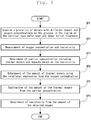
- FIG. 1 is a flowchart of steps of a preparation process in a method for measuring resistivity of Si wafers, according to the present invention
- FIG. 2 is a schematic view of a vertical furnace to be used in the method for measuring resistivity of Si wafers, according to the present invention.
- Si wafers (with a diameter of 200 mm, for example) are mounted with a substantially equal spacing on a vertical boat 1 shown in FIG. 2 that has a hundred and twenty (120) grooves for mounting, for example (Step S1 in FIG. 1 ).
- Each wafer W to be used contain the same dopant concentration and oxygen concentration.
- five or more dummy wafers DW are mounted adjacent to the upper and lower side of Si product wafers.
- the vertical boat 1 is accommodated into the vertical heat treatment furnace 2 to perform the donor killer process at 650 °C for 30 minutes in a N 2 atmosphere (Step S2 in FIG. 1 ) .
- the resistivity of each wafer W is measured after extracting the wafers W from the furnace at a speed of 100 mm/min that is a moving speed of the boat elevator. Measurement of the resistivity is carried out using a four-probe method that employs four needle electrodes (Step S3 in FIG.1 ). A region in the vertical boat 1 where the measured resistivity is found to be substantially constant is identified in a vertical position of the boat 1 (Step S4 in FIG.1 ). The identified region is called "a region of stable-resistivity grooves" in the present embodiment.
- a plurality of Si wafers W having different levels of oxygen concentration is mounted on the region of resistivity-stable grooves of the vertical boat 1 (Step S5 in FIG. 1 ), and the donor killer process is performed at a temperature of 650 °C for 30 min. in an N 2 atmosphere in the vertical heat treatment furnace 2 (Step S6 in FIG. 1 ).
- the resistivity of a first resistivity group and oxygen concentration are measured (Step S7 in FIG. 1 ).
- the measurement of the oxygen concentration is performed using an infrared absorption method, more specifically, a Fourier transform infrared spectroscopy (FT-IR) . Accordingly the resistivity of the first resistivity group is the one subjected to influences of dopants and thermal donors.
- FT-IR Fourier transform infrared spectroscopy
- a plurality of Si wafer prepared under the same condition as for steps S5 and S6 is then thermally processed in a single-wafer type rapid thermal processing (RTP) furnace at a temperature of 650 °C or higher for 30 min. in an N 2 atmosphere, and then cooled down to 300 °C at a rate of 50 °C/s or faster.
- RTP rapid thermal processing
- a donor killer process thermal donors are prevented from being regenerated and the resistivity is free from influences of the donors.
- the resistivity of a second resistivity group and oxygen concentration of the wafers are measured (Step S8 in FIG. 1 ); the resistivity is solely affected by dopants and free from influences of the thermal donors.
- the expression (1) which shows a relationship between the concentrations of regenerated thermal donors against the respective oxygen concentration, is obtained on the basis of the difference of the resistivity measured in the step S7 and measured in the step S8. Specifically, the concentration of thermal donors is obtained for the respective wafers W having different oxygen concentration levels from the difference of resistivity values measured in the step S7 and in the step S8, and the obtained concentrations are plotted to graph. That is, as shown in FIG. 6 , for example, an approximation curve (a general expression) is obtained wherein let the vertical axis be an logarithm of the concentration of thermal donors and the horizontal axis be the oxygen concentration, and then the obtained expression corresponds to the relational expression (1) .
- the resistivity and the concentration of thermal donors can be estimated by using Irvin's curve, which is a general relationship between resistivity and carrier concentration including dopant concentration and thermal donor concentration, when the influence of a dopant atom and a thermal donor to the resistivity is considered to be equivalent. Namely, this estimation can be carried out using the following expressions (2) and (3) that are standardized by SEMI Standards (SEMI-MF723); the expression (2) shows a relationship of acceptor concentration and resistivity and expression (3) shows a relationship of donor concentration and resistivity, where N A denotes Boron concentration and ⁇ denotes resistivity in expression (2), and N D denotes phosphor concentration and ⁇ denotes resistivity in expression (3).
- N A 1.330 ⁇ 10 16 / ⁇ + 1.082 ⁇ 10 17 / ⁇ 1 + 54.56 1.105
- N D 6.242 ⁇ 10 18 ⁇ 10 z / ⁇ ,
- FIG. 3 is a flowchart of steps of an operation procedure in the method for measuring resistivity of Si wafers, according to the present invention.
- product wafers W are subjected to the donor killer process (Step SP1 in FIG.3 ); the wafers having different dopant and oxygen concentration are mounted on the region of resistivity-stable grooves of the vertical boat1 and heated at 650 °C or higher for 30 min in an N 2 atmosphere in a vertical furnace.
- the wafers W are extracted from the furnace at a speed of 100 mm/min. Resistivity subjected to influences of thermal donors and concentration of oxygen of the wafers W are measured (Step SP2 in FIG.3 ), where thermal donors are regenerated due to a thermal history of 450 °C. Carrier concentration of the each wafer W is obtained from the measured resistivity based on Irvin's curve (Step SP3 in FIG. 3 ) ; the carrier concentration value includes that of thermal donors and the dopant.
- the concentration of the thermal donors of each wafer W is obtained from the measured oxygen concentration in the step SP2 using the relational expression (1) (Step SP4 in FIG. 3 ).
- carrier concentration solely due to the dopants is obtained by subtracting that of the thermal donors obtained in the step SP4 from the carrier concentration obtained in the step SP3 (Step SP5 in FIG. 3 ).
- the resistivity solely due to the dopant is available by correcting on the basis of the relational expression (1) obtained beforehand to eliminate the influence of the thermal donors that are regenerated during extraction from the furnace due to a thermal history of 450 °C, when wafers are subjected to the donor-killer process collectively in the vertical furnace.
- the resistivity solely due to the dopant is accurately evaluated after the wafers have been heat-treated in a vertical furnace which ensures high productivity, that is high working efficiency.
- the measurement method according to the present invention is not restricted by the characteristics of wafers whose resistivity is to be measured.
- the present invention is more effective because the influence of thermal donors to resistivity variation becomes more significant for high resistivity, which is 2 ⁇ -m or higher, for example.
- n-type Si wafers with a diameter of 200 mm, having oxygen concentration of 1.0x10 18 atoms/cm 3 (Old ASTM), were prepared and mounted on a vertical boat along the vertical direction at equal intervals.
- the boat was accommodated in a vertical furnace and a donor killer process was performed at a maximum temperature of 650 °C for 30 min in an N 2 atmosphere.
- wafers are extracted at a speed of 100 mm/min and the resistivity of the wafers were measured.
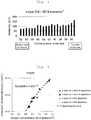
- FIG.4 A graph of resistivity of wafers after heat treatment mounted from the upper to lower regions of the boat is shown in FIG.4 , where the vertical axis is resistivity ( ⁇ -m) and the horizontal axis is position of grooves on the boat.
- FIG. 4 shows that the resistivity at the lower region of the boat is lower, and higher at the upper region of the boat, and substantially constant at the central region. It is confirmed from the above results that the experiencing time of 450 °C may presumably have an influence to resistivity of wafers, and that the central region of the boat may be defined as a resistivity-stable region.
- steps of obtaining a relational expression that relates oxygen concentration to a concentration of thermal donors were performed in EXPERIMENT 2.
- a plurality of n-type Si wafers W having different oxygen concentration levels were mounted on grooves in the resistivity-stable region of the vertical boat.
- the vertical boat was accommodated in the vertical furnace.
- the donor killer process was performed at a maximum temperature of 650 °C for 30 min in an N 2 atmosphere.
- Oxygen concentration and resistivity of the first resistivity group of the wafers were measured; the oxygen concentration and the dopant concentration converted from the resistivity are shown in a column of the vertical furnace of a table in FIG. 7 .
- a plurality of Si wafers W were subjected to a heat treatment at a maximum temperature of 650 °C for 30 min in an N 2 atmosphere in a single-wafer type RTP furnace, and cooled down to 300 °C at a cooling speed of faster than 50 °C/s. Then, oxygen concentration and resistivity of the second resistivity group of the wafers were measured; the oxygen concentration and the dopant concentration converted from the resistivity are shown in a column of RTP of the table in FIG 7 .
- a relation between the oxygen concentration and the concentration of thermal donors for each oxygen concentration level was obtained from the difference of resistivity of the first and second resistivity group corresponding to the difference of the concentration of dopant, i.e., the estimated values in the table of FIG. 7 .
- the results are plotted on a graph in FIG. 5 , where the horizontal axis denotes the oxygen concentration (/cm 3 ) and the vertical axis the concentration of thermal donors (10 18 atoms/cm 3 ).
- p-type and n-type Si wafers were mixedly mounted on grooves in the resistivity-stable region of a first vertical boat in the vertical furnace, and were subjected to a heat treatment at 650 °C or higher for 30 min, and cooled down to 300 °C and extracted at an elevator moving speed, or extraction speed, of 100 mm/min. After extraction, the concentration of thermal donors against the oxygen concentration of each wafer are plotted on a graph shown in FIG. 5 , where a cross ⁇ and a triangle ⁇ denote values for p-type and n-type wafers, respectively.
Landscapes
- Chemical & Material Sciences (AREA)
- General Physics & Mathematics (AREA)
- Physics & Mathematics (AREA)
- Electrochemistry (AREA)
- Health & Medical Sciences (AREA)
- Life Sciences & Earth Sciences (AREA)
- Analytical Chemistry (AREA)
- Biochemistry (AREA)
- General Health & Medical Sciences (AREA)
- Chemical Kinetics & Catalysis (AREA)
- Immunology (AREA)
- Pathology (AREA)
- Testing Or Measuring Of Semiconductors Or The Like (AREA)
- Crystals, And After-Treatments Of Crystals (AREA)
Applications Claiming Priority (1)
| Application Number | Priority Date | Filing Date | Title |
|---|---|---|---|
| JP2017144060A JP6878188B2 (ja) | 2017-07-26 | 2017-07-26 | シリコンウェーハの抵抗率測定方法 |
Publications (1)
| Publication Number | Publication Date |
|---|---|
| EP3435409A1 true EP3435409A1 (de) | 2019-01-30 |
Family
ID=62750760
Family Applications (1)
| Application Number | Title | Priority Date | Filing Date |
|---|---|---|---|
| EP18177257.5A Pending EP3435409A1 (de) | 2017-07-26 | 2018-06-12 | Verfahren zur messung des widerstands von silizium-wafern |
Country Status (5)
| Country | Link |
|---|---|
| EP (1) | EP3435409A1 (de) |
| JP (1) | JP6878188B2 (de) |
| KR (1) | KR102137867B1 (de) |
| CN (1) | CN109307804B (de) |
| TW (1) | TWI712792B (de) |
Cited By (1)
| Publication number | Priority date | Publication date | Assignee | Title |
|---|---|---|---|---|
| US12334403B2 (en) | 2021-08-09 | 2025-06-17 | Zing Semiconductor Corporation | Measuring method of resistivity of a wafer |
Families Citing this family (1)
| Publication number | Priority date | Publication date | Assignee | Title |
|---|---|---|---|---|
| CN113109625A (zh) * | 2021-04-07 | 2021-07-13 | 上海新昇半导体科技有限公司 | 硅片导电类型的判定方法 |
Citations (5)
| Publication number | Priority date | Publication date | Assignee | Title |
|---|---|---|---|---|
| JPH04259214A (ja) * | 1991-02-13 | 1992-09-14 | Mitsubishi Materials Corp | 熱処理炉内の温度分布の測定方法 |
| JPH0982768A (ja) * | 1995-09-19 | 1997-03-28 | Hitachi Ltd | 半導体ウエハの評価方法 |
| JP2003240689A (ja) | 2002-02-13 | 2003-08-27 | Shin Etsu Handotai Co Ltd | 半導体結晶の検査用サンプルの自動処理方法及び自動処理システム並びに半導体結晶の検査方法 |
| JP4970724B2 (ja) | 2002-07-17 | 2012-07-11 | 株式会社Sumco | 高抵抗シリコンウエーハの製造方法 |
| US20140033797A1 (en) * | 2011-04-15 | 2014-02-06 | Commissariat A L'energie Atomique Et Aux Energies Alternatives | Method for determining interstitial oxygen concentration |
Family Cites Families (12)
| Publication number | Priority date | Publication date | Assignee | Title |
|---|---|---|---|---|
| JPH0750713B2 (ja) * | 1990-09-21 | 1995-05-31 | コマツ電子金属株式会社 | 半導体ウェーハの熱処理方法 |
| JP2869300B2 (ja) * | 1992-08-07 | 1999-03-10 | 三菱マテリアル株式会社 | 半導体ウェーハの熱処理装置 |
| CN100389489C (zh) * | 2003-12-30 | 2008-05-21 | 中芯国际集成电路制造(上海)有限公司 | 利用注入晶片的注入机的低能量剂量监测 |
| CN101527273B (zh) * | 2009-04-10 | 2012-04-18 | 中国科学院光电技术研究所 | 一种半导体材料特性的测量装置 |
| JP5678846B2 (ja) * | 2011-09-08 | 2015-03-04 | 信越半導体株式会社 | シリコン単結晶中窒素濃度算出方法および抵抗シフト量算出方法 |
| CN102688859B (zh) * | 2012-06-13 | 2013-08-07 | 东莞市科隆威自动化设备有限公司 | 一种光伏检测分板机 |
| JP6045842B2 (ja) * | 2012-07-31 | 2016-12-14 | 株式会社国際電気セミコンダクターサービス | 抵抗率測定装置および方法 |
| FR2997096B1 (fr) * | 2012-10-23 | 2014-11-28 | Commissariat Energie Atomique | Procede de formation d'un lingot en silicium de resistivite uniforme |
| CN102928669A (zh) * | 2012-10-25 | 2013-02-13 | 上海宏力半导体制造有限公司 | 半导体硅片的电阻率测试方法及测试结构 |
| CN104280616B (zh) * | 2013-07-12 | 2017-03-22 | 苏州博昇科技有限公司 | 硅晶片电阻率测量装置及方法 |
| FR3009380B1 (fr) * | 2013-08-02 | 2015-07-31 | Commissariat Energie Atomique | Procede de localisation d'une plaquette dans son lingot |
| US9768056B2 (en) * | 2013-10-31 | 2017-09-19 | Sunedison Semiconductor Limited (Uen201334164H) | Method of manufacturing high resistivity SOI wafers with charge trapping layers based on terminated Si deposition |
-
2017
- 2017-07-26 JP JP2017144060A patent/JP6878188B2/ja active Active
-
2018
- 2018-06-08 TW TW107119841A patent/TWI712792B/zh active
- 2018-06-12 EP EP18177257.5A patent/EP3435409A1/de active Pending
- 2018-06-22 KR KR1020180071973A patent/KR102137867B1/ko active Active
- 2018-07-26 CN CN201810833673.3A patent/CN109307804B/zh active Active
Patent Citations (5)
| Publication number | Priority date | Publication date | Assignee | Title |
|---|---|---|---|---|
| JPH04259214A (ja) * | 1991-02-13 | 1992-09-14 | Mitsubishi Materials Corp | 熱処理炉内の温度分布の測定方法 |
| JPH0982768A (ja) * | 1995-09-19 | 1997-03-28 | Hitachi Ltd | 半導体ウエハの評価方法 |
| JP2003240689A (ja) | 2002-02-13 | 2003-08-27 | Shin Etsu Handotai Co Ltd | 半導体結晶の検査用サンプルの自動処理方法及び自動処理システム並びに半導体結晶の検査方法 |
| JP4970724B2 (ja) | 2002-07-17 | 2012-07-11 | 株式会社Sumco | 高抵抗シリコンウエーハの製造方法 |
| US20140033797A1 (en) * | 2011-04-15 | 2014-02-06 | Commissariat A L'energie Atomique Et Aux Energies Alternatives | Method for determining interstitial oxygen concentration |
Non-Patent Citations (5)
| Title |
|---|
| BROISCH JULIANE ET AL: "A New Method for the Determination of the Dopant-Related Base Resistivity Despite the Presence of Thermal Donors", IEEE JOURNAL OF PHOTOVOLTAICS, I E E E, US, vol. 5, no. 1, 1 January 2015 (2015-01-01), pages 269 - 275, XP011568518, ISSN: 2156-3381, [retrieved on 20141218], DOI: 10.1109/JPHOTOV.2014.2360339 * |
| JORDI VEIRMAN ET AL: "A Fast and Easily Implemented Method for Interstitial Oxygen Concentration Mapping Through the Activation of Thermal Donors in Silicon", ENERGY PROCEDIA, vol. 8, 20 April 2011 (2011-04-20), pages 41 - 46, XP028263041, ISSN: 1876-6102, [retrieved on 20110812], DOI: 10.1016/J.EGYPRO.2011.06.099 * |
| KAZUMI WADA: "unified model for formation kinetics of oxygen thermal donors in silicon", PHYSICAL REVIEW, B. CONDENSED MATTER, AMERICAN INSTITUTE OF PHYSICS. NEW YORK, US, vol. 30, no. 10, 15 November 1984 (1984-11-15), pages 5884 - 5895, XP002696153, ISSN: 0163-1829, DOI: 10.1103/PHYSREVB.30.5884 * |
| NIEWELT T ET AL: "Interstitial oxygen imaging from thermal donor growth-A fast photoluminescence based me", SOLAR ENERGY MATERIALS AND SOLAR CELLS, ELSEVIER SCIENCE PUBLISHERS, AMSTERDAM, NL, vol. 131, 27 May 2014 (2014-05-27), pages 117 - 123, XP029075014, ISSN: 0927-0248, DOI: 10.1016/J.SOLMAT.2014.05.011 * |
| W. WIJARANAKULA: "Formation kinetics of oxygen thermal donors in silicon", APPLIED PHYSICS LETTERS, vol. 59, no. 13, 23 September 1991 (1991-09-23), pages 1608, XP055114038, ISSN: 0003-6951, DOI: 10.1063/1.106245 * |
Cited By (1)
| Publication number | Priority date | Publication date | Assignee | Title |
|---|---|---|---|---|
| US12334403B2 (en) | 2021-08-09 | 2025-06-17 | Zing Semiconductor Corporation | Measuring method of resistivity of a wafer |
Also Published As
| Publication number | Publication date |
|---|---|
| JP6878188B2 (ja) | 2021-05-26 |
| KR102137867B1 (ko) | 2020-07-24 |
| CN109307804B (zh) | 2021-04-30 |
| TWI712792B (zh) | 2020-12-11 |
| JP2019029387A (ja) | 2019-02-21 |
| TW201910762A (zh) | 2019-03-16 |
| KR20190012098A (ko) | 2019-02-08 |
| CN109307804A (zh) | 2019-02-05 |
Similar Documents
| Publication | Publication Date | Title |
|---|---|---|
| US7344689B2 (en) | Silicon wafer for IGBT and method for producing same | |
| EP1780781A1 (de) | Prozess zur herstellung eines siliziumwafers und durch den prozess hergestellter siliziumwafer | |
| US9842779B2 (en) | Method of evaluating metal contamination in semiconductor wafer and method of manufacturing semiconductor wafer | |
| JP6083412B2 (ja) | 再結合ライフタイムの制御方法及びシリコン基板の製造方法 | |
| TWI698935B (zh) | 矽晶圓的熱施體生成行為預測方法、矽晶圓的評估方法及矽晶圓的製造方法 | |
| KR20160097200A (ko) | 실리콘 단결정 기판의 결함 농도 평가 방법 | |
| EP3435409A1 (de) | Verfahren zur messung des widerstands von silizium-wafern | |
| US20160377554A1 (en) | Quality evaluation method for silicon wafer, and silicon wafer and method of producing silicon wafer using the method | |
| EP0550750B1 (de) | Thermische behandlungsmethode für halbleiterscheiben | |
| US9748112B2 (en) | Quality evaluation method for silicon wafer, and silicon wafer and method of producing silicon wafer using the method | |
| JP7103314B2 (ja) | シリコン単結晶基板中の炭素濃度評価方法 | |
| Al-Amin et al. | Combining low-temperature gettering with phosphorus diffusion gettering for improved multicrystalline silicon | |
| JP3896919B2 (ja) | シリコンウエーハのNi汚染の評価方法 | |
| JP6333182B2 (ja) | シリコンウェーハ及びその製造方法 | |
| KR102294183B1 (ko) | 실리콘 웨이퍼 | |
| CN117219508A (zh) | 处理外延片的方法和装置以及检测外延片的方法 | |
| JP2012202798A (ja) | シリコンウェーハ中のCu濃度評価方法 | |
| JP6607525B2 (ja) | シリコン単結晶基板の酸素濃度測定方法及びシリコン単結晶基板の製造方法 | |
| JP2022181130A (ja) | シリコンウェーハのサーマルドナー挙動予測方法及びシリコンウェーハの製造方法 | |
| US20250138080A1 (en) | Evaluation method of metal contamination | |
| JP4843929B2 (ja) | GaAs結晶の熱処理方法およびGaAs結晶基板 | |
| Al‐Amin et al. | Low‐Temperature Saw Damage Gettering to Improve Minority Carrier Lifetime in Multicrystalline Silicon | |
| JP6369388B2 (ja) | シリコン単結晶基板の評価方法 | |
| CN120359599A (zh) | 测试由单晶硅制成的半导体晶圆抵抗热致位错的抵抗性的方法 | |
| JP5072185B2 (ja) | 熱処理ボートの評価方法 |
Legal Events
| Date | Code | Title | Description |
|---|---|---|---|
| PUAI | Public reference made under article 153(3) epc to a published international application that has entered the european phase |
Free format text: ORIGINAL CODE: 0009012 |
|
| STAA | Information on the status of an ep patent application or granted ep patent |
Free format text: STATUS: THE APPLICATION HAS BEEN PUBLISHED |
|
| AK | Designated contracting states |
Kind code of ref document: A1 Designated state(s): AL AT BE BG CH CY CZ DE DK EE ES FI FR GB GR HR HU IE IS IT LI LT LU LV MC MK MT NL NO PL PT RO RS SE SI SK SM TR |
|
| AX | Request for extension of the european patent |
Extension state: BA ME |
|
| STAA | Information on the status of an ep patent application or granted ep patent |
Free format text: STATUS: REQUEST FOR EXAMINATION WAS MADE |
|
| 17P | Request for examination filed |
Effective date: 20190725 |
|
| RBV | Designated contracting states (corrected) |
Designated state(s): AL AT BE BG CH CY CZ DE DK EE ES FI FR GB GR HR HU IE IS IT LI LT LU LV MC MK MT NL NO PL PT RO RS SE SI SK SM TR |
|
| STAA | Information on the status of an ep patent application or granted ep patent |
Free format text: STATUS: EXAMINATION IS IN PROGRESS |
|
| 17Q | First examination report despatched |
Effective date: 20210622 |