EP3421996A1 - Messreagenz für vernetztes fibrinabbauprodukt und messverfahren - Google Patents
Messreagenz für vernetztes fibrinabbauprodukt und messverfahren Download PDFInfo
- Publication number
- EP3421996A1 EP3421996A1 EP17756557.9A EP17756557A EP3421996A1 EP 3421996 A1 EP3421996 A1 EP 3421996A1 EP 17756557 A EP17756557 A EP 17756557A EP 3421996 A1 EP3421996 A1 EP 3421996A1
- Authority
- EP
- European Patent Office
- Prior art keywords
- acid
- xdp
- antibody
- fragment
- human
- Prior art date
- Legal status (The legal status is an assumption and is not a legal conclusion. Google has not performed a legal analysis and makes no representation as to the accuracy of the status listed.)
- Pending
Links
Images


Classifications
-
- G—PHYSICS
- G01—MEASURING; TESTING
- G01N—INVESTIGATING OR ANALYSING MATERIALS BY DETERMINING THEIR CHEMICAL OR PHYSICAL PROPERTIES
- G01N33/00—Investigating or analysing materials by specific methods not covered by groups G01N1/00 - G01N31/00
- G01N33/48—Biological material, e.g. blood, urine; Haemocytometers
- G01N33/50—Chemical analysis of biological material, e.g. blood, urine; Testing involving biospecific ligand binding methods; Immunological testing
- G01N33/68—Chemical analysis of biological material, e.g. blood, urine; Testing involving biospecific ligand binding methods; Immunological testing involving proteins, peptides or amino acids
- G01N33/6854—Immunoglobulins
-
- G—PHYSICS
- G01—MEASURING; TESTING
- G01N—INVESTIGATING OR ANALYSING MATERIALS BY DETERMINING THEIR CHEMICAL OR PHYSICAL PROPERTIES
- G01N33/00—Investigating or analysing materials by specific methods not covered by groups G01N1/00 - G01N31/00
- G01N33/48—Biological material, e.g. blood, urine; Haemocytometers
- G01N33/50—Chemical analysis of biological material, e.g. blood, urine; Testing involving biospecific ligand binding methods; Immunological testing
- G01N33/86—Chemical analysis of biological material, e.g. blood, urine; Testing involving biospecific ligand binding methods; Immunological testing involving blood coagulating time or factors, or their receptors
-
- C—CHEMISTRY; METALLURGY
- C07—ORGANIC CHEMISTRY
- C07K—PEPTIDES
- C07K16/00—Immunoglobulins [IG], e.g. monoclonal or polyclonal antibodies
- C07K16/18—Immunoglobulins [IG], e.g. monoclonal or polyclonal antibodies against material from animals or humans
- C07K16/36—Immunoglobulins [IG], e.g. monoclonal or polyclonal antibodies against material from animals or humans against blood coagulation factors
-
- G—PHYSICS
- G01—MEASURING; TESTING
- G01N—INVESTIGATING OR ANALYSING MATERIALS BY DETERMINING THEIR CHEMICAL OR PHYSICAL PROPERTIES
- G01N33/00—Investigating or analysing materials by specific methods not covered by groups G01N1/00 - G01N31/00
- G01N33/48—Biological material, e.g. blood, urine; Haemocytometers
- G01N33/50—Chemical analysis of biological material, e.g. blood, urine; Testing involving biospecific ligand binding methods; Immunological testing
- G01N33/53—Immunoassay; Biospecific binding assay; Materials therefor
-
- G—PHYSICS
- G01—MEASURING; TESTING
- G01N—INVESTIGATING OR ANALYSING MATERIALS BY DETERMINING THEIR CHEMICAL OR PHYSICAL PROPERTIES
- G01N33/00—Investigating or analysing materials by specific methods not covered by groups G01N1/00 - G01N31/00
- G01N33/48—Biological material, e.g. blood, urine; Haemocytometers
- G01N33/50—Chemical analysis of biological material, e.g. blood, urine; Testing involving biospecific ligand binding methods; Immunological testing
- G01N33/53—Immunoassay; Biospecific binding assay; Materials therefor
- G01N33/5306—Improving reaction conditions, e.g. reduction of non-specific binding, promotion of specific binding
-
- C—CHEMISTRY; METALLURGY
- C07—ORGANIC CHEMISTRY
- C07K—PEPTIDES
- C07K16/00—Immunoglobulins [IG], e.g. monoclonal or polyclonal antibodies
- C07K16/18—Immunoglobulins [IG], e.g. monoclonal or polyclonal antibodies against material from animals or humans
-
- C—CHEMISTRY; METALLURGY
- C07—ORGANIC CHEMISTRY
- C07K—PEPTIDES
- C07K2317/00—Immunoglobulins specific features
- C07K2317/30—Immunoglobulins specific features characterized by aspects of specificity or valency
- C07K2317/32—Immunoglobulins specific features characterized by aspects of specificity or valency specific for a neo-epitope on a complex, e.g. antibody-antigen or ligand-receptor
-
- C—CHEMISTRY; METALLURGY
- C07—ORGANIC CHEMISTRY
- C07K—PEPTIDES
- C07K2317/00—Immunoglobulins specific features
- C07K2317/30—Immunoglobulins specific features characterized by aspects of specificity or valency
- C07K2317/33—Crossreactivity, e.g. for species or epitope, or lack of said crossreactivity
Definitions
- the present invention relates to a measurement reagent for plasmin degradation products of cross-linked fibrin, and a measurement method for it.
- XDP cross-linked fibrin degradation products
- Patent literature 1 An antibody disclosed in Patent literature 1 is known as an antibody recognizing XDP. Since this antibody does not react with fragments other than XDP (D dimer), accurate measurement of XDP is expected. From the reactivity and the like of the antibody, it is considered that the recognition site of the antibody is present in the D domain and/or the E domain of XDP having E-D bonds, so the E-D bond is important for accurate measurement of XDP.
- the inventors conducted intensive studies, and as a result, clarified the properties of the antibody, and made it possible to carry out the measurement capable of distinguishing them. More particularly, the inventors found that the recognition site of the antibody was present in the E domain, and that the calcium concentration was important for a useful XDP measurement using the antibody.
- Calcium is an ion that plays an important role in blood coagulation, and it has been reported that there are two calcium binding sites in the D domain and one calcium binding site in the E domain. As a result of examination by the inventors, it is considered that since calcium on the fibrin polymer chelated and is not present, the structure of the fibrin polymer changes, and the reactivity also changes.
- the present invention relates to:
- the present invention enables a more accurate measurement of XDP.
- the measurement reagent and the measurement method of the present invention are characterized in that (1) an anti-XDP antibody that reacts with plasmin degradation products of cross-linked fibrin (XDP), but does not react with fibrinogen, and fragment X, fragment Y, fragment D 1 , and fragment E 3 , which are plasmin degradation products of fibrinogen, and (2) a calcium chelating agent are used, and the reaction of XDP with the anti-XDP antibody is carried out in the presence of the calcium chelating agent.
- XDP cross-linked fibrin
- cross-linked fibrin is also called “stabilized fibrin” as used herein is also called “D dimer”, “D-D dimer”, or “DD/E complex”, and means a DD/E monomer as the smallest unit, and its polymer (DD/E polymer, for example, DXD/YY, YXY/DXXD, and DXXY/YXXD).
- the anti-XDP antibody used in the present invention is a anti-XDP antibody used in the present invention.
- an antibody that recognizes a three-dimensional structure newly generated on the E domain side by the assembly of the E domain and the D domain may be exemplified.
- the anti-XDP antibody used in the present invention may be obtained by a known method. It may be a monoclonal antibody (MoAb) or a polyclonal antibody (PoAb), so long as it has the desired reactivity, but the monoclonal antibody is preferable.
- the antibody the antibody per se may be used, or an antibody fragment comprising the antigen-binding site, for example, Fab, Fab', F(ab') 2 , Fv, or the like, may be used.
- These antibody fragments may be obtained by digesting the antibody with a protease in accordance with a conventional method, and in accordance with conventional methods of protein separation and purification.
- the DD/E monomer or the DD/E polymer may be used as an antigen for preparing the anti-XDP antibody used in the present invention.
- the DD/E polymer a dimer, a trimer, a tetramer, or a pentamer may be exemplified. When it is more than a hexamer, it becomes less soluble in water.
- the antigen may be prepared from fibrinogen in accordance with a known method. Alternatively, the antigen may be obtained by purification from a human or the like, or by genetic engineering technique. Furthermore, a commercially available product may be used.
- the anti-XDP antibody used in the present invention may be obtained by confirming the reactivities against XDP; fibrinogen; plasmin degradation products of fibrinogen, i.e., fragment X, fragment Y, fragment D 1 , and fragment E 3 ; and fragment DD, fragment E 1 , and fragment E 2 obtained by dissociating the DD/E monomer, by a known immunological analysis method as shown in Examples described below.
- the reactivity to the DD/E monomer is not significantly affected by Ca 2+ ion concentration, and that the reactivity to the reconstructed D-E-D complex is significantly affected by Ca 2+ ion concentration, and is significantly reduced when the Ca 2+ ion concentration is lower than a certain value (or in the presence of a calcium chelating agent, such as EDTA).
- the major structural difference between the DD/E monomer and the reconstructed D-E-D complex is that the DD/E monomer has cross-linking between the D-D.
- the D-E-D complex does not have cross-linking between the D-D, and may be regarded as the smallest unit that characterizes, for example, fibrin polymer degradation products.
- the reactivity to the D-E-D complex is significantly affected by Ca 2+ ion concentration, even if fibrin polymer degradation products not having cross-linking between the D-D is present in a sample, the reactivity to the fibrin polymer degradation products can be significantly reduced in the presence of a calcium chelating agent, while the reactivity to the DD/E monomer is maintained, and as a result, it enables a more specific measurement of XDP.
- the measurement method of the present invention a known immunological measurement method may be used, except that the aforementioned anti-XDP antibody is used, and the reaction of XDP with the anti-XDP antibody is carried out in the presence of a calcium chelating agent.
- the measurement method may comprise the step of preparing a sample, which may contain XDP, and the anti-XDP antibody; the step of bringing the sample into contact with the anti-XDP antibody in the presence of a calcium chelating agent to form an immunological complex; and the step of analyzing the immunological complex or a signal derived from the immunological complex.
- a turbidimetric immunoassay (TIA), an enzyme immunoassay (EIA), a radioimmunoassay (RIA), a latex agglutination method, a fluorescent immunoassay, an immunochromatography, and the like, may be exemplified.
- the calcium chelating agent is a substance that forms coordinate bonds with a metal ion so as to sandwich the metal ion at the center, and a compound capable of coordinating calcium may be used in the present invention.
- calcium chelating agent which may be used in the present invention, for example, aminopolycarboxylic acid type chelating agents, aromatic or aliphatic carboxylic acid type chelating agents, amino acid type chelating agents, ether carboxylic acid type chelating agents, phosphonic acid type chelating agents, hydroxycarboxylic acid type chelating agents, polymer electrolyte (including oligomer electrolyte) type chelating agents, polyalcohols, nitrogen-containing chelating agents such as dimethylglyoxime or the like, sulfur-containing chelating agents such as thioglycolic acid or the like, or the like, may be exemplified.
- chelating agents are arbitrary.
- an acidic chelating agent it may be in the form of a free acid, or in the form of a salt, such as a sodium salt, a potassium salt, an ammonium salt, or the like.
- a salt such as a sodium salt, a potassium salt, an ammonium salt, or the like.
- it may be in the form of a hydrolyzable ester derivative thereof.
- aminopolycarboxylic acid type chelating agents for example, ethylenediamine tetraacetic acid (EDTA), ethylenediamine diacetic acid, hydroxyethylethylenediamine triacetic acid (HEDTA), dihydroxyethylethylenediaminetetraacetic acid (DHEDDA), nitrilotriacetic acid (NTA), hydroxyethyliminodiacetic acid (HIDA), ⁇ -alaninediacetic acid, cyclohexane diamine tetraacetic acid, nitrilotriacetic acid, iminodiacetic acid, N-(2-hydroxyethyl) iminodiacetic acid, diethylenetriaminepentaacetic acid, N- (2-hydroxyethyl)ethylenediaminetriacetic acid, glycol ether diamine tetraacetic acid, glutamic acid diacetic acid, aspartic acid diacetic acid, methylglycine diacetic acid, iminodisuccin
- aromatic or aliphatic carboxylic acid type chelating agents for example, glyoxylic acid, oxalic acid, malonic acid, succinic acid, glutaric acid, adipic acid, pimelic acid, sebacic acid, azelaic acid, itaconic acid, aconitic acid, pyruvic acid, gluconic acid, pyromellitic acid, benzopolycarboxylic acid, cyclopentanetetracarboxylic acid, salicylic acid, acetylsalicylic acid, hydroxybenzoic acid, aminobenzoic acid (including anthranilic acid), phthalic acid, fumaric acid, trimellitic acid, gallic acid, and hexahydrophthalic acid; and their salts and their derivatives, may be exemplified.
- amino acid type chelating agents for examples, glycine, serine, alanine, lysine, cystine, cysteine, ethionine, tyrosine, and methionine; and their salts and their derivatives, may be exemplified.
- ether carboxylic acid type chelating agents ether carboxylic acid salts such as carboxymethyl tartronic acid (CMT) and carboxymethyl oxysuccinic acid (CMOS), carboxymethyl tartronate, carboxymethyl oxysuccinate, oxydisuccinate, tartaric acid monosuccinate, and disuccinate tartrate; and their salts and derivatives, may be exemplified.
- CMT carboxymethyl tartronic acid
- CMOS carboxymethyl oxysuccinic acid
- carboxymethyl tartronate carboxymethyl oxysuccinate, oxydisuccinate, tartaric acid monosuccinate, and disuccinate tartrate
- phosphonic acid type chelating agents for example, iminodimethylphosphonic acid, alkyldiphosphonic acid, 1-hydroxyethane-1,1-diphosphonic acid, and phytic acid; and their salts and derivatives, may be exemplified.
- hydroxycarboxylic acid type chelating agents for example, malic acid, citric acid, glycolic acid, gluconic acid, heptonic acid, tartaric acid, and lactic acid; and their salts and derivatives, may be exemplified.
- polymer electrolyte (including oligomer electrolyte) type chelating agents for example, an acrylic acid polymer, a maleic anhydride polymer, an ⁇ -hydroxyacrylic acid polymer, and an itaconic acid polymer; a copolymer composed of two or more constituent monomers of these polymers; and an epoxy succinic acid polymer, may be exemplified.
- polyalcohols for example, ethylene glycol, pyrocatechol, pyrogallol, bisphenol, and tannic acid; and their derivatives, may be exemplified.
- ethylenediamine tetraacetic acid EDTA
- oxalic acid citric acid, tartaric acid, gluconic acid
- nitrilotriacetic acid NTA
- ethylenediamine diethylenetriamino pentaacetic acid
- DTPA dihydroxyethylene glycine
- triethanolamine hydroxyethylenediaminetetraacetic acid
- carboxymethyltartronic acid CMT
- carboxymethyloxysuccinic acid CMOS
- BAPTA Bicine
- CyDTA GEDTA
- HIDA IDA
- NTPO TTHA
- TPEN bipyridine
- phenanthroline porphyrin
- crown ether bipyridine
- chelating agents may be used alone, or as a combination of two or more compounds.
- the content of the chelating agent may be appropriately set in consideration of its chelating ability.
- the concentration of the calcium chelating agent in the reaction system between XDP and the anti-XDP antibody is preferably 0.01 to 30 mmol/L, more preferably 0.2 to 30 mmol/L, and still more preferably 0.2 to 2 mmol/L, at the time of the antigen-antibody reaction, in the case of EDTA, as an example.
- the lower limit of the EDTA concentration is not limited, so long as it is 0.001 mmol/L or more.
- the EDTA concentration does not have an upper limit, and it may be appropriately set for those skilled in the art, but it is preferable to set the EDTA concentration within the range not affecting the reaction of the anti-XDP antibody.
- Each lower limit and each upper limit above can be arbitrarily combined as desired.
- Calcium is an ion that plays an important role in blood coagulation, and it has been reported that there are two calcium binding sites in the D domain and one calcium binding site in the E domain. As a result of examination by the inventors, it is considered that since calcium on the fibrin polymer chelated and is not present, the structure of the fibrin polymer changes, and the reactivity also changes.
- the measurement reagent of the present invention may be configured similarly to known immunological measurement reagents, except that it comprises the anti-XDP antibody and the calcium chelating agent.
- the anti-XDP antibody and the calcium chelating agent for example, a buffer, a sensitizer, a surfactant, an inorganic salt, and the like, may be appropriately added.
- the reagent form may be a two-reagent system consisting of a first reagent and a second reagent, or a reagent form consisting of one reagent.
- the two-reagent system consisting of a first reagent and a second reagent is preferable from the viewpoint of measurement accuracy and the like, and a measurement reagent based on a latex agglutination method will be exemplified below.
- the first reagent is composed of a buffer
- the second reagent is composed of antibody-sensitized latex particles, and a sensitizer, a surfactant, an inorganic salt, and the like, may be appropriately added.
- a reagent consisting of the first reagent consisting of a buffer, a sensitizer, and an inorganic salt, and the second reagent consisting of antibody-sensitized latex particles may be exemplified.
- the calcium chelating agent may be added to either the first reagent or the second reagent, or both the first reagent and the second reagent, but it is preferable to add the calcium chelating agent to the first reagent.
- the concentration of the calcium chelating agent in the reagent varies depending on, for example, the reagent constitution, the order of addition, the volume added, and the like, but it may be appropriately determined so as to be within the above concentration range in the reaction system between XDP and the anti-XDP antibody.
- Cross-linked fibrin degradation products have a structure of (DD/E)n, wherein n DD/Es are linearly connected, wherein the DD/E is the smallest unit and n is an integer.
- XDPs (n ⁇ 2) are represented as polymeric XDP
- the polymeric XDP and DD/E were prepared, mainly in accordance with Stephanie A. Olexa and Andrei Z. Budzynski (1978), Circulation, Suppl. 58, 119 , and Olexa et al. (1979), Biochim. Biophys. Acta 576, 39-50 .
- Bovine thrombin (Mochida Pharmaceutical Co., Ltd.) and calcium chloride were added to human fibrinogen (Enzyme Research Laboratories), and the reaction was carried out at 37°C for 2 hours to convert fibrinogen into fibrin. This was centrifuged to separate fibrin from noncoagulable substances. Fibrin was floated in a Tris-HCl buffer (pH7.8) containing calcium chloride. Human plasmin (Chromogenix) was added to the suspension at 37°C. The degradation reaction was stopped by adding aprotinin to the suspension, and the suspension was passed through a lysine sepharose column to remove plasmin from the filtrate.
- the filtrate was a mixture of polymeric XDP and DD/E, of which the molecular weights are different from each other.
- the filtrate was subjected to a Sephacryl S-300 (S-300) column equilibrated with a Tris-HCl buffer (pH 7.5) containing calcium chloride (solution A), and was fractionated by molecular sieve chromatography developed with solution A.
- the obtained fractions were subjected to electrophoresis by SDS-PAGE, and Western blotting to identify and separate the polymeric XDP fraction and the DD/E fraction.
- DD/E DD fraction
- E 1+2 fraction a mixture of E 1 and E 2 : E 1+2
- the previously obtained DD/E was allowed to stand at 37°C in a 3 mol/L urea-50 mmol/L citric acid (pH 5.5) solution for 4 hours.
- This was subjected to a Sepharose CL-6B column equilibrated with a 50 mmol/L Tris-HCl buffer (pH 7.4)-28 mmol/L sodium citrate-0.1 mol/L sodium chloride solution, and was developed with the solution.
- the fractions were basically suspended in a 50 mmol/L Tris buffer (pH 8.0) containing 0.9% NaCl (hereinafter referred to as TBS).
- TBS Tris buffer
- the purity of each degradation product was confirmed by Western blotting and HPLC under reducing/non-reducing conditions, and the protein content in each fraction was determined from the molecular extinction coefficient at 280 nm ( Sakurai et Al., Journal of the Japanese Society for Laboratory Hematology, 16:128-135, 2015 ).
- a monoclonal antibody was prepared using human DD/E as an immunogen in accordance with Kohler and Milstein, Nature 256: 495-7, 1975 .
- Culture supernatants of hybridomas cloned by limiting dilution were dispensed to a 96-well microplate immobilized with an anti-mouse IgG antibody.
- the MIF-220 antibody solution was dispersed to a 96-well microplate, and it was allowed to stand at room temperature for 1 hour or more.
- the microplate was washed with a 0.1 mol/L phosphate buffer (pH 7.0) containing 0.05% polyoxyethylene (20) sorbitan monolaurate (hereinafter referred to as T-PBS), and was blocked with T-PBS containing 0.3% bovine serum albumin (BSA).
- T-PBS 0.1 mol/L phosphate buffer
- BSA bovine serum albumin
- Various antigens were dispersed to each well, and the microplate was allowed to stand at room temperature for 1 hour.
- the microplate was washed with T-PBS.
- a peroxidase-labeled anti-human fibrinogen antibody which had been diluted 5000 times with T-PBS containing 0.3% BSA, was added, and it was allowed to stand at room temperature for 1 hour. After washing with T-PBS, a TMB (3,3',5,5'-tetramethylbenzidine) reagent was added, and the signal was measured at 450 nm. It was judged that there was reactivity against an antigen whose absorbance exceeded 0.2. The results are shown in Table 1-A.
- the MIF-220 antibody reacted with XDP (polymeric XDP and DD/E), but did not react with fibrinogen and its degradation products, X, Y, D 1 , and E 3 . Further, it did not react with isolated DD and E 1+2 obtained by dissociating DD/E by urea, but reacted with a mixture of DD and E 1+2 (a reconstructed product).
- Fibrinogen polymeric XDP, DD/E, DD, E 1+2 , X, Y, D 1 , and E 3 were subjected to SDS-Polyacrylamide gel electrophoresis (PAGE), and after transferring them to a polyvinylidene fluoride (PVDF) membrane, the reactivity of the MIF-220 antibody or an anti-human fibrinogen antibody to each antigen was measured.
- PAGE SDS-Polyacrylamide gel electrophoresis
- PVDF polyvinylidene fluoride
- the MIF-220 antibody did not react with any antigen. Further, also in the Western blotting performed in the absence of SDS, the MIF-220 antibody did not react with each of the aforementioned antigens.
- Human D 1 and human E 1+2 or human E 3 suspended in TBS were mixed and reacted at 37°C for 30 minutes to reconstruct the E-D bond, and they were fractionated using a Superdex200 HR column (GE Healthcare) to compare the retention time with those of DD/E, D 1 , and E 1+2 . Further, the reactivity to the antibody was examined by ELISA. Fractions derived from other animal species were also examined in the same manner.
- the MIF-220 antibody did not react with each of D 1 , E 1+2 , and E 3 , but reacted with the mixture of D 1 and E 1+2 (reconstructed product). However, the MIF-220 antibody did not react with the mixture of D 1 and E 3 (reconstructed product).
- [Table 1-B] OD (450 nm) Fraction Abbreviation ELISA signal (OD 405 nm) Fibrinogen degradation products D 1 0.00 E 3 0.00 Fibrin degradation products DD/E 1.63 Dissociation products of DD/E E 1+2 -0.05 Reconstructed product of D and E D 1 +E 1+2 1.68 D 1 +E 3 0.01
- the mixture of human D 1 and human E 1+2 was fractionated using a Superdex200 HR column, and new peaks A and B were observed, as shown in Figure 2-A .
- the retention time of peak A was approximately consistent with that of DD/E, and the retention time of peak B was intermediate between DD/E and D 1 .
- such a new peak was not observed in the mixture of human D 1 and human E 3 , as shown in Figure 2-B .
- the MIF-220 antibody reacted with human DD/E, but did not react with bovine or ovine DD/E.
- human E 1+2 was mixed with human, bovine, or ovine D 1
- the MIF-220 antibody reacted with any mixture.
- "h” is added to human antigens
- "b” is added to bovine antigens
- "o” is added to ovine antigens.
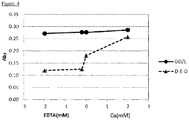
- the reactivity of human DD/E was not significantly affected by Ca 2+ concentration and EDTA concentration.
- the reactivity of the D-E-D complex was almost the same as that of DD/E at a Ca 2+ concentration of 2 mmol/L, but the reactivity of the D-E-D complex decreased significantly at a Ca 2+ concentration of less than 2 mmol/L, and the reactivity became almost blank level at an EDTA concentration of 0.2 mmol/L or more.
- the MIF-220 monoclonal antibody obtained using human DD/E as the immunogen, was an antibody that recognized a structure characteristic of XDP:(DD/E)n, because the MIF-220 antibody reacted with cross-linked fibrin degradation products XDP, but did not react with fibrinogen, and fibrinogen degradation products (X, Y, D 1 , and E 3 ).
- the reconstruction of the E-D bond was examined using human, bovine, and ovine DD/Es, human, bovine, and ovine D 1 s, and human E 1+2 . Since the D-E-D complex was formed in any combination of human, bovine, and ovine D 1 s and human E 1+2 ( Figure 2-A , Figure 3-A, and Figure 3-B ), it was confirmed that the E-D bond is not dependent on a species difference.
- the MIF-220 antibody reacted with the mixture of human E 1+2 and human, bovine, or ovine D 1 , but did not react with the bovine or ovine DD/E, it was shown that the human E region was important for the reaction of the MIF-220 antibody (Table 2). From these results, it was shown that the MIF-220 antibody was one that recognized the three-dimensional structure newly generated on the human E region by the action of thrombin and the E-D bond.
- the chelating agent can be used in two stages. For example, when citric acid or the like is used as a chelating agent required at the time of blood collection, another chelating agent different from the chelating agent used for blood collection can be used, or the same chelating agent can be used at a different concentration, at the time of the XDP measurement. In particular, it was found that the specificity of the antibody could be raised and an accurate measurement became possible by adding a chelating agent in the reagent to reduce the influence of calcium.
- DD/E is the smallest unit that constitutes XDP (d of Figure 1-B and e of Figure 1-C ), and the D-E-D complex is the smallest structure that characterizes the fibrin polymer degradation products (c of Figure 1-A ). It is considered that the antibody can be applied clinically for XDP detection by inhibiting the reactivity of the MIF-220 antibody to the D-E-D complex.
- the measurement reagent and the measurement method of the present invention can be used, for example, for measuring plasmin degradation products of cross-linked fibrin (XDP), which is useful as a diagnostic marker for disseminated intravascular coagulation (DIC).
- XDP cross-linked fibrin
- DIC disseminated intravascular coagulation
Landscapes
- Health & Medical Sciences (AREA)
- Life Sciences & Earth Sciences (AREA)
- Chemical & Material Sciences (AREA)
- Engineering & Computer Science (AREA)
- Immunology (AREA)
- Hematology (AREA)
- Molecular Biology (AREA)
- Biomedical Technology (AREA)
- Urology & Nephrology (AREA)
- Medicinal Chemistry (AREA)
- General Health & Medical Sciences (AREA)
- Biochemistry (AREA)
- Physics & Mathematics (AREA)
- Food Science & Technology (AREA)
- Microbiology (AREA)
- Analytical Chemistry (AREA)
- Cell Biology (AREA)
- Biotechnology (AREA)
- General Physics & Mathematics (AREA)
- Pathology (AREA)
- Organic Chemistry (AREA)
- Proteomics, Peptides & Aminoacids (AREA)
- Biophysics (AREA)
- Genetics & Genomics (AREA)
- Chemical Kinetics & Catalysis (AREA)
- Peptides Or Proteins (AREA)
- Measuring Or Testing Involving Enzymes Or Micro-Organisms (AREA)
- Preparation Of Compounds By Using Micro-Organisms (AREA)
- Investigating Or Analysing Biological Materials (AREA)
- Medicines Containing Antibodies Or Antigens For Use As Internal Diagnostic Agents (AREA)
Applications Claiming Priority (2)
| Application Number | Priority Date | Filing Date | Title |
|---|---|---|---|
| JP2016031407 | 2016-02-22 | ||
| PCT/JP2017/006677 WO2017146119A1 (ja) | 2016-02-22 | 2017-02-22 | 架橋化フィブリン分解産物の測定試薬および測定方法 |
Publications (2)
| Publication Number | Publication Date |
|---|---|
| EP3421996A1 true EP3421996A1 (de) | 2019-01-02 |
| EP3421996A4 EP3421996A4 (de) | 2019-10-23 |
Family
ID=59686284
Family Applications (1)
| Application Number | Title | Priority Date | Filing Date |
|---|---|---|---|
| EP17756557.9A Pending EP3421996A4 (de) | 2016-02-22 | 2017-02-22 | Messreagenz für vernetztes fibrinabbauprodukt und messverfahren |
Country Status (8)
| Country | Link |
|---|---|
| US (1) | US20190265257A1 (de) |
| EP (1) | EP3421996A4 (de) |
| JP (1) | JP6770571B2 (de) |
| KR (1) | KR102589054B1 (de) |
| CN (1) | CN108700570B (de) |
| BR (1) | BR112018017170A2 (de) |
| RU (1) | RU2742279C2 (de) |
| WO (1) | WO2017146119A1 (de) |
Families Citing this family (3)
| Publication number | Priority date | Publication date | Assignee | Title |
|---|---|---|---|---|
| JP7556226B2 (ja) * | 2019-08-21 | 2024-09-26 | 東ソー株式会社 | 凝固・線溶系関連因子の測定方法及び測定試薬 |
| CN118240085B (zh) * | 2022-10-08 | 2025-05-09 | 东莞市朋志生物科技有限公司 | 抗纤维蛋白降解产物抗体、检测纤维蛋白降解产物的试剂和试剂盒 |
| JP2025082818A (ja) * | 2023-11-17 | 2025-05-29 | ユニ ファルマ カンパニー リミテッド | 遺伝子組換え抗体、それを含むキット、およびがん診断におけるその使用 |
Family Cites Families (10)
| Publication number | Priority date | Publication date | Assignee | Title |
|---|---|---|---|---|
| JPS6379900A (ja) * | 1986-09-22 | 1988-04-09 | Yatoron:Kk | モノクロ−ナル抗体と検出方法 |
| JP2001354700A (ja) * | 2000-06-12 | 2001-12-25 | Bio Links Kk | モノクロ−ナル抗体及びヒトフィブリン分解産物の測定方法 |
| FR2813395B1 (fr) * | 2000-08-28 | 2003-01-24 | Stago Diagnostica | Methode de dosage in vitro de la fibrine soluble par generation de produits de degradation specifiques |
| US20030171573A1 (en) * | 2002-02-27 | 2003-09-11 | Nobuhiko Yui | Multivalently interactive molecular assembly, capturing agent, drug carrier, calcium chelating agent, and drug enhancer |
| JP4589756B2 (ja) * | 2005-02-25 | 2010-12-01 | シスメックス株式会社 | Dダイマー測定用キット |
| WO2006118195A1 (ja) * | 2005-04-28 | 2006-11-09 | Mitsubishi Kagaku Iatron, Inc. | 安定化フィブリンのプラスミン分解物の免疫学的分析方法 |
| WO2007013709A1 (en) * | 2005-07-29 | 2007-02-01 | Biobud Co., Ltd. | Monoclonal antibody against d-dimer and diagnosis agent for detecting d-dimer, crosslinked fibrin and its derivatives containing d-dimer by using the antibody |
| JP2012522246A (ja) * | 2009-03-30 | 2012-09-20 | エイエムディーエル インコーポレイテッド | フィブリンの及びフィブリノーゲンの分解産物の検出、及びこれに関連する産生方法、並びに癌の検出及び監視のための使用方法 |
| CN102822338A (zh) * | 2010-04-01 | 2012-12-12 | 三菱化学美迪恩斯株式会社 | 新的单克隆抗体以及d二聚体的免疫学测定方法 |
| CN101819202B (zh) * | 2010-05-06 | 2012-12-26 | 上海太阳生物技术有限公司 | D-二聚体(D-Dimer)测定试剂盒(胶乳免疫比浊法) |
-
2017
- 2017-02-22 US US16/078,153 patent/US20190265257A1/en not_active Abandoned
- 2017-02-22 CN CN201780012454.2A patent/CN108700570B/zh active Active
- 2017-02-22 BR BR112018017170A patent/BR112018017170A2/pt not_active Application Discontinuation
- 2017-02-22 JP JP2018501742A patent/JP6770571B2/ja active Active
- 2017-02-22 EP EP17756557.9A patent/EP3421996A4/de active Pending
- 2017-02-22 KR KR1020187027283A patent/KR102589054B1/ko active Active
- 2017-02-22 RU RU2018133469A patent/RU2742279C2/ru active
- 2017-02-22 WO PCT/JP2017/006677 patent/WO2017146119A1/ja not_active Ceased
Also Published As
| Publication number | Publication date |
|---|---|
| RU2018133469A (ru) | 2020-03-24 |
| EP3421996A4 (de) | 2019-10-23 |
| RU2018133469A3 (de) | 2020-03-24 |
| CN108700570B (zh) | 2022-03-11 |
| WO2017146119A1 (ja) | 2017-08-31 |
| BR112018017170A2 (pt) | 2019-01-02 |
| KR102589054B1 (ko) | 2023-10-12 |
| RU2742279C2 (ru) | 2021-02-04 |
| JP6770571B2 (ja) | 2020-10-14 |
| KR20180115307A (ko) | 2018-10-22 |
| CN108700570A (zh) | 2018-10-23 |
| JPWO2017146119A1 (ja) | 2018-12-13 |
| US20190265257A1 (en) | 2019-08-29 |
Similar Documents
| Publication | Publication Date | Title |
|---|---|---|
| Ota et al. | Elevated levels of prothrombin fragment 1+ 2 indicate high risk of thrombosis | |
| JP5860394B2 (ja) | 新規モノクローナル抗体ならびにdダイマーの免疫学的測定法 | |
| US8865425B2 (en) | Reagent and reagent kit for measurement of FDP, and measurement method | |
| EP3421996A1 (de) | Messreagenz für vernetztes fibrinabbauprodukt und messverfahren | |
| JP2918688B2 (ja) | プロトロンビン活性化ペプチド及びその分解産物に関するイムノアッセイ及びそれらに対するモノクローナル抗体 | |
| EP0690991B1 (de) | Neue antikoagulant-cofaktor aktivität | |
| US8088624B2 (en) | Method of detecting thrombosis by measuring von Willenbrand factor-cleaving protease | |
| HK40000052A (en) | Measurement reagent for crosslinked fibrin degradation product, and measurement method | |
| JP2006510896A (ja) | Xiia因子の変異体 | |
| US20030143759A1 (en) | Assays for determining anticoagulant cofactor activity | |
| WO2001001150A9 (en) | Diagnostic test for thrombotic or thromboembolic disease | |
| JPH10142226A (ja) | 動脈硬化症の測定用キット | |
| WO2025199298A1 (en) | BIOMARKER ASSAY TO MEASURE LIPOPROTEIN(a) | |
| Parquet-Gernez et al. | Assay of factor, IX antigen using an enzyme immuno assay | |
| WO1993000364A1 (en) | ASSAY FOR DETECTING FIBRINOLYSIS AND FIBRINOGENOLYSIS BASED ON COOH-TERMINAL Aα CHAIN MARKERS | |
| UA69284U (uk) | Тест-система імуноферментна для кількісного визначення d-димеру в плазмі крові людини |
Legal Events
| Date | Code | Title | Description |
|---|---|---|---|
| STAA | Information on the status of an ep patent application or granted ep patent |
Free format text: STATUS: THE INTERNATIONAL PUBLICATION HAS BEEN MADE |
|
| PUAI | Public reference made under article 153(3) epc to a published international application that has entered the european phase |
Free format text: ORIGINAL CODE: 0009012 |
|
| STAA | Information on the status of an ep patent application or granted ep patent |
Free format text: STATUS: REQUEST FOR EXAMINATION WAS MADE |
|
| 17P | Request for examination filed |
Effective date: 20180905 |
|
| AK | Designated contracting states |
Kind code of ref document: A1 Designated state(s): AL AT BE BG CH CY CZ DE DK EE ES FI FR GB GR HR HU IE IS IT LI LT LU LV MC MK MT NL NO PL PT RO RS SE SI SK SM TR |
|
| AX | Request for extension of the european patent |
Extension state: BA ME |
|
| DAV | Request for validation of the european patent (deleted) | ||
| DAX | Request for extension of the european patent (deleted) | ||
| A4 | Supplementary search report drawn up and despatched |
Effective date: 20190920 |
|
| RIC1 | Information provided on ipc code assigned before grant |
Ipc: C12Q 1/56 20060101ALI20190916BHEP Ipc: G01N 33/53 20060101AFI20190916BHEP Ipc: C07K 16/18 20060101ALI20190916BHEP |
|
| REG | Reference to a national code |
Ref country code: HK Ref legal event code: DE Ref document number: 40000052 Country of ref document: HK |
|
| STAA | Information on the status of an ep patent application or granted ep patent |
Free format text: STATUS: EXAMINATION IS IN PROGRESS |
|
| 17Q | First examination report despatched |
Effective date: 20230216 |
|
| RAP1 | Party data changed (applicant data changed or rights of an application transferred) |
Owner name: PHC CORPORATION |