EP3397712B1 - Additive manufacturing methods for adhesives and adhesive articles - Google Patents
Additive manufacturing methods for adhesives and adhesive articles Download PDFInfo
- Publication number
- EP3397712B1 EP3397712B1 EP16831871.5A EP16831871A EP3397712B1 EP 3397712 B1 EP3397712 B1 EP 3397712B1 EP 16831871 A EP16831871 A EP 16831871A EP 3397712 B1 EP3397712 B1 EP 3397712B1
- Authority
- EP
- European Patent Office
- Prior art keywords
- adhesive
- actinic radiation
- irradiation
- precursor composition
- dosage
- Prior art date
- Legal status (The legal status is an assumption and is not a legal conclusion. Google has not performed a legal analysis and makes no representation as to the accuracy of the status listed.)
- Active
Links
Images



Classifications
-
- B—PERFORMING OPERATIONS; TRANSPORTING
- B05—SPRAYING OR ATOMISING IN GENERAL; APPLYING FLUENT MATERIALS TO SURFACES, IN GENERAL
- B05D—PROCESSES FOR APPLYING FLUENT MATERIALS TO SURFACES, IN GENERAL
- B05D3/00—Pretreatment of surfaces to which liquids or other fluent materials are to be applied; After-treatment of applied coatings, e.g. intermediate treating of an applied coating preparatory to subsequent applications of liquids or other fluent materials
- B05D3/06—Pretreatment of surfaces to which liquids or other fluent materials are to be applied; After-treatment of applied coatings, e.g. intermediate treating of an applied coating preparatory to subsequent applications of liquids or other fluent materials by exposure to radiation
-
- B—PERFORMING OPERATIONS; TRANSPORTING
- B05—SPRAYING OR ATOMISING IN GENERAL; APPLYING FLUENT MATERIALS TO SURFACES, IN GENERAL
- B05D—PROCESSES FOR APPLYING FLUENT MATERIALS TO SURFACES, IN GENERAL
- B05D5/00—Processes for applying liquids or other fluent materials to surfaces to obtain special surface effects, finishes or structures
- B05D5/10—Processes for applying liquids or other fluent materials to surfaces to obtain special surface effects, finishes or structures to obtain an adhesive surface
-
- B—PERFORMING OPERATIONS; TRANSPORTING
- B29—WORKING OF PLASTICS; WORKING OF SUBSTANCES IN A PLASTIC STATE IN GENERAL
- B29C—SHAPING OR JOINING OF PLASTICS; SHAPING OF MATERIAL IN A PLASTIC STATE, NOT OTHERWISE PROVIDED FOR; AFTER-TREATMENT OF THE SHAPED PRODUCTS, e.g. REPAIRING
- B29C35/00—Heating, cooling or curing, e.g. crosslinking or vulcanising; Apparatus therefor
- B29C35/02—Heating or curing, e.g. crosslinking or vulcanizing during moulding, e.g. in a mould
- B29C35/08—Heating or curing, e.g. crosslinking or vulcanizing during moulding, e.g. in a mould by wave energy or particle radiation
- B29C35/0805—Heating or curing, e.g. crosslinking or vulcanizing during moulding, e.g. in a mould by wave energy or particle radiation using electromagnetic radiation
-
- B—PERFORMING OPERATIONS; TRANSPORTING
- B29—WORKING OF PLASTICS; WORKING OF SUBSTANCES IN A PLASTIC STATE IN GENERAL
- B29C—SHAPING OR JOINING OF PLASTICS; SHAPING OF MATERIAL IN A PLASTIC STATE, NOT OTHERWISE PROVIDED FOR; AFTER-TREATMENT OF THE SHAPED PRODUCTS, e.g. REPAIRING
- B29C64/00—Additive manufacturing, i.e. manufacturing of three-dimensional [3D] objects by additive deposition, additive agglomeration or additive layering, e.g. by 3D printing, stereolithography or selective laser sintering
- B29C64/10—Processes of additive manufacturing
- B29C64/106—Processes of additive manufacturing using only liquids or viscous materials, e.g. depositing a continuous bead of viscous material
- B29C64/112—Processes of additive manufacturing using only liquids or viscous materials, e.g. depositing a continuous bead of viscous material using individual droplets, e.g. from jetting heads
-
- B—PERFORMING OPERATIONS; TRANSPORTING
- B29—WORKING OF PLASTICS; WORKING OF SUBSTANCES IN A PLASTIC STATE IN GENERAL
- B29C—SHAPING OR JOINING OF PLASTICS; SHAPING OF MATERIAL IN A PLASTIC STATE, NOT OTHERWISE PROVIDED FOR; AFTER-TREATMENT OF THE SHAPED PRODUCTS, e.g. REPAIRING
- B29C64/00—Additive manufacturing, i.e. manufacturing of three-dimensional [3D] objects by additive deposition, additive agglomeration or additive layering, e.g. by 3D printing, stereolithography or selective laser sintering
- B29C64/20—Apparatus for additive manufacturing; Details thereof or accessories therefor
- B29C64/264—Arrangements for irradiation
-
- B—PERFORMING OPERATIONS; TRANSPORTING
- B33—ADDITIVE MANUFACTURING TECHNOLOGY
- B33Y—ADDITIVE MANUFACTURING, i.e. MANUFACTURING OF THREE-DIMENSIONAL [3D] OBJECTS BY ADDITIVE DEPOSITION, ADDITIVE AGGLOMERATION OR ADDITIVE LAYERING, e.g. BY 3D PRINTING, STEREOLITHOGRAPHY OR SELECTIVE LASER SINTERING
- B33Y10/00—Processes of additive manufacturing
-
- B—PERFORMING OPERATIONS; TRANSPORTING
- B33—ADDITIVE MANUFACTURING TECHNOLOGY
- B33Y—ADDITIVE MANUFACTURING, i.e. MANUFACTURING OF THREE-DIMENSIONAL [3D] OBJECTS BY ADDITIVE DEPOSITION, ADDITIVE AGGLOMERATION OR ADDITIVE LAYERING, e.g. BY 3D PRINTING, STEREOLITHOGRAPHY OR SELECTIVE LASER SINTERING
- B33Y30/00—Apparatus for additive manufacturing; Details thereof or accessories therefor
-
- B—PERFORMING OPERATIONS; TRANSPORTING
- B33—ADDITIVE MANUFACTURING TECHNOLOGY
- B33Y—ADDITIVE MANUFACTURING, i.e. MANUFACTURING OF THREE-DIMENSIONAL [3D] OBJECTS BY ADDITIVE DEPOSITION, ADDITIVE AGGLOMERATION OR ADDITIVE LAYERING, e.g. BY 3D PRINTING, STEREOLITHOGRAPHY OR SELECTIVE LASER SINTERING
- B33Y50/00—Data acquisition or data processing for additive manufacturing
- B33Y50/02—Data acquisition or data processing for additive manufacturing for controlling or regulating additive manufacturing processes
-
- B—PERFORMING OPERATIONS; TRANSPORTING
- B33—ADDITIVE MANUFACTURING TECHNOLOGY
- B33Y—ADDITIVE MANUFACTURING, i.e. MANUFACTURING OF THREE-DIMENSIONAL [3D] OBJECTS BY ADDITIVE DEPOSITION, ADDITIVE AGGLOMERATION OR ADDITIVE LAYERING, e.g. BY 3D PRINTING, STEREOLITHOGRAPHY OR SELECTIVE LASER SINTERING
- B33Y70/00—Materials specially adapted for additive manufacturing
-
- B—PERFORMING OPERATIONS; TRANSPORTING
- B33—ADDITIVE MANUFACTURING TECHNOLOGY
- B33Y—ADDITIVE MANUFACTURING, i.e. MANUFACTURING OF THREE-DIMENSIONAL [3D] OBJECTS BY ADDITIVE DEPOSITION, ADDITIVE AGGLOMERATION OR ADDITIVE LAYERING, e.g. BY 3D PRINTING, STEREOLITHOGRAPHY OR SELECTIVE LASER SINTERING
- B33Y80/00—Products made by additive manufacturing
-
- C—CHEMISTRY; METALLURGY
- C09—DYES; PAINTS; POLISHES; NATURAL RESINS; ADHESIVES; COMPOSITIONS NOT OTHERWISE PROVIDED FOR; APPLICATIONS OF MATERIALS NOT OTHERWISE PROVIDED FOR
- C09J—ADHESIVES; NON-MECHANICAL ASPECTS OF ADHESIVE PROCESSES IN GENERAL; ADHESIVE PROCESSES NOT PROVIDED FOR ELSEWHERE; USE OF MATERIALS AS ADHESIVES
- C09J11/00—Features of adhesives not provided for in group C09J9/00, e.g. additives
- C09J11/02—Non-macromolecular additives
- C09J11/04—Non-macromolecular additives inorganic
-
- C—CHEMISTRY; METALLURGY
- C09—DYES; PAINTS; POLISHES; NATURAL RESINS; ADHESIVES; COMPOSITIONS NOT OTHERWISE PROVIDED FOR; APPLICATIONS OF MATERIALS NOT OTHERWISE PROVIDED FOR
- C09J—ADHESIVES; NON-MECHANICAL ASPECTS OF ADHESIVE PROCESSES IN GENERAL; ADHESIVE PROCESSES NOT PROVIDED FOR ELSEWHERE; USE OF MATERIALS AS ADHESIVES
- C09J133/00—Adhesives based on homopolymers or copolymers of compounds having one or more unsaturated aliphatic radicals, each having only one carbon-to-carbon double bond, and at least one being terminated by only one carboxyl radical, or of salts, anhydrides, esters, amides, imides, or nitriles thereof; Adhesives based on derivatives of such polymers
-
- C—CHEMISTRY; METALLURGY
- C09—DYES; PAINTS; POLISHES; NATURAL RESINS; ADHESIVES; COMPOSITIONS NOT OTHERWISE PROVIDED FOR; APPLICATIONS OF MATERIALS NOT OTHERWISE PROVIDED FOR
- C09J—ADHESIVES; NON-MECHANICAL ASPECTS OF ADHESIVE PROCESSES IN GENERAL; ADHESIVE PROCESSES NOT PROVIDED FOR ELSEWHERE; USE OF MATERIALS AS ADHESIVES
- C09J4/00—Adhesives based on organic non-macromolecular compounds having at least one polymerisable carbon-to-carbon unsaturated bond ; adhesives, based on monomers of macromolecular compounds of groups C09J183/00 - C09J183/16
-
- C—CHEMISTRY; METALLURGY
- C09—DYES; PAINTS; POLISHES; NATURAL RESINS; ADHESIVES; COMPOSITIONS NOT OTHERWISE PROVIDED FOR; APPLICATIONS OF MATERIALS NOT OTHERWISE PROVIDED FOR
- C09J—ADHESIVES; NON-MECHANICAL ASPECTS OF ADHESIVE PROCESSES IN GENERAL; ADHESIVE PROCESSES NOT PROVIDED FOR ELSEWHERE; USE OF MATERIALS AS ADHESIVES
- C09J5/00—Adhesive processes in general; Adhesive processes not provided for elsewhere, e.g. relating to primers
-
- C—CHEMISTRY; METALLURGY
- C09—DYES; PAINTS; POLISHES; NATURAL RESINS; ADHESIVES; COMPOSITIONS NOT OTHERWISE PROVIDED FOR; APPLICATIONS OF MATERIALS NOT OTHERWISE PROVIDED FOR
- C09J—ADHESIVES; NON-MECHANICAL ASPECTS OF ADHESIVE PROCESSES IN GENERAL; ADHESIVE PROCESSES NOT PROVIDED FOR ELSEWHERE; USE OF MATERIALS AS ADHESIVES
- C09J7/00—Adhesives in the form of films or foils
- C09J7/20—Adhesives in the form of films or foils characterised by their carriers
-
- C—CHEMISTRY; METALLURGY
- C09—DYES; PAINTS; POLISHES; NATURAL RESINS; ADHESIVES; COMPOSITIONS NOT OTHERWISE PROVIDED FOR; APPLICATIONS OF MATERIALS NOT OTHERWISE PROVIDED FOR
- C09J—ADHESIVES; NON-MECHANICAL ASPECTS OF ADHESIVE PROCESSES IN GENERAL; ADHESIVE PROCESSES NOT PROVIDED FOR ELSEWHERE; USE OF MATERIALS AS ADHESIVES
- C09J7/00—Adhesives in the form of films or foils
- C09J7/30—Adhesives in the form of films or foils characterised by the adhesive composition
- C09J7/38—Pressure-sensitive adhesives [PSA]
- C09J7/381—Pressure-sensitive adhesives [PSA] based on macromolecular compounds obtained by reactions involving only carbon-to-carbon unsaturated bonds
- C09J7/385—Acrylic polymers
-
- C—CHEMISTRY; METALLURGY
- C09—DYES; PAINTS; POLISHES; NATURAL RESINS; ADHESIVES; COMPOSITIONS NOT OTHERWISE PROVIDED FOR; APPLICATIONS OF MATERIALS NOT OTHERWISE PROVIDED FOR
- C09J—ADHESIVES; NON-MECHANICAL ASPECTS OF ADHESIVE PROCESSES IN GENERAL; ADHESIVE PROCESSES NOT PROVIDED FOR ELSEWHERE; USE OF MATERIALS AS ADHESIVES
- C09J9/00—Adhesives characterised by their physical nature or the effects produced, e.g. glue sticks
-
- B—PERFORMING OPERATIONS; TRANSPORTING
- B29—WORKING OF PLASTICS; WORKING OF SUBSTANCES IN A PLASTIC STATE IN GENERAL
- B29C—SHAPING OR JOINING OF PLASTICS; SHAPING OF MATERIAL IN A PLASTIC STATE, NOT OTHERWISE PROVIDED FOR; AFTER-TREATMENT OF THE SHAPED PRODUCTS, e.g. REPAIRING
- B29C35/00—Heating, cooling or curing, e.g. crosslinking or vulcanising; Apparatus therefor
- B29C35/02—Heating or curing, e.g. crosslinking or vulcanizing during moulding, e.g. in a mould
- B29C35/08—Heating or curing, e.g. crosslinking or vulcanizing during moulding, e.g. in a mould by wave energy or particle radiation
- B29C35/0805—Heating or curing, e.g. crosslinking or vulcanizing during moulding, e.g. in a mould by wave energy or particle radiation using electromagnetic radiation
- B29C2035/0827—Heating or curing, e.g. crosslinking or vulcanizing during moulding, e.g. in a mould by wave energy or particle radiation using electromagnetic radiation using UV radiation
-
- B—PERFORMING OPERATIONS; TRANSPORTING
- B29—WORKING OF PLASTICS; WORKING OF SUBSTANCES IN A PLASTIC STATE IN GENERAL
- B29K—INDEXING SCHEME ASSOCIATED WITH SUBCLASSES B29B, B29C OR B29D, RELATING TO MOULDING MATERIALS OR TO MATERIALS FOR MOULDS, REINFORCEMENTS, FILLERS OR PREFORMED PARTS, e.g. INSERTS
- B29K2033/00—Use of polymers of unsaturated acids or derivatives thereof as moulding material
- B29K2033/04—Polymers of esters
-
- B—PERFORMING OPERATIONS; TRANSPORTING
- B29—WORKING OF PLASTICS; WORKING OF SUBSTANCES IN A PLASTIC STATE IN GENERAL
- B29K—INDEXING SCHEME ASSOCIATED WITH SUBCLASSES B29B, B29C OR B29D, RELATING TO MOULDING MATERIALS OR TO MATERIALS FOR MOULDS, REINFORCEMENTS, FILLERS OR PREFORMED PARTS, e.g. INSERTS
- B29K2105/00—Condition, form or state of moulded material or of the material to be shaped
- B29K2105/0097—Glues or adhesives, e.g. hot melts or thermofusible adhesives
-
- C—CHEMISTRY; METALLURGY
- C08—ORGANIC MACROMOLECULAR COMPOUNDS; THEIR PREPARATION OR CHEMICAL WORKING-UP; COMPOSITIONS BASED THEREON
- C08F—MACROMOLECULAR COMPOUNDS OBTAINED BY REACTIONS ONLY INVOLVING CARBON-TO-CARBON UNSATURATED BONDS
- C08F220/00—Copolymers of compounds having one or more unsaturated aliphatic radicals, each having only one carbon-to-carbon double bond, and only one being terminated by only one carboxyl radical or a salt, anhydride ester, amide, imide or nitrile thereof
- C08F220/02—Monocarboxylic acids having less than ten carbon atoms; Derivatives thereof
- C08F220/10—Esters
- C08F220/12—Esters of monohydric alcohols or phenols
- C08F220/16—Esters of monohydric alcohols or phenols of phenols or of alcohols containing two or more carbon atoms
- C08F220/18—Esters of monohydric alcohols or phenols of phenols or of alcohols containing two or more carbon atoms with acrylic or methacrylic acids
- C08F220/1811—C10or C11-(Meth)acrylate, e.g. isodecyl (meth)acrylate, isobornyl (meth)acrylate or 2-naphthyl (meth)acrylate
-
- C—CHEMISTRY; METALLURGY
- C09—DYES; PAINTS; POLISHES; NATURAL RESINS; ADHESIVES; COMPOSITIONS NOT OTHERWISE PROVIDED FOR; APPLICATIONS OF MATERIALS NOT OTHERWISE PROVIDED FOR
- C09J—ADHESIVES; NON-MECHANICAL ASPECTS OF ADHESIVE PROCESSES IN GENERAL; ADHESIVE PROCESSES NOT PROVIDED FOR ELSEWHERE; USE OF MATERIALS AS ADHESIVES
- C09J2301/00—Additional features of adhesives in the form of films or foils
- C09J2301/30—Additional features of adhesives in the form of films or foils characterized by the chemical, physicochemical or physical properties of the adhesive or the carrier
- C09J2301/302—Additional features of adhesives in the form of films or foils characterized by the chemical, physicochemical or physical properties of the adhesive or the carrier the adhesive being pressure-sensitive, i.e. tacky at temperatures inferior to 30°C
-
- C—CHEMISTRY; METALLURGY
- C09—DYES; PAINTS; POLISHES; NATURAL RESINS; ADHESIVES; COMPOSITIONS NOT OTHERWISE PROVIDED FOR; APPLICATIONS OF MATERIALS NOT OTHERWISE PROVIDED FOR
- C09J—ADHESIVES; NON-MECHANICAL ASPECTS OF ADHESIVE PROCESSES IN GENERAL; ADHESIVE PROCESSES NOT PROVIDED FOR ELSEWHERE; USE OF MATERIALS AS ADHESIVES
- C09J2301/00—Additional features of adhesives in the form of films or foils
- C09J2301/30—Additional features of adhesives in the form of films or foils characterized by the chemical, physicochemical or physical properties of the adhesive or the carrier
- C09J2301/304—Additional features of adhesives in the form of films or foils characterized by the chemical, physicochemical or physical properties of the adhesive or the carrier the adhesive being heat-activatable, i.e. not tacky at temperatures inferior to 30°C
-
- C—CHEMISTRY; METALLURGY
- C09—DYES; PAINTS; POLISHES; NATURAL RESINS; ADHESIVES; COMPOSITIONS NOT OTHERWISE PROVIDED FOR; APPLICATIONS OF MATERIALS NOT OTHERWISE PROVIDED FOR
- C09J—ADHESIVES; NON-MECHANICAL ASPECTS OF ADHESIVE PROCESSES IN GENERAL; ADHESIVE PROCESSES NOT PROVIDED FOR ELSEWHERE; USE OF MATERIALS AS ADHESIVES
- C09J2301/00—Additional features of adhesives in the form of films or foils
- C09J2301/40—Additional features of adhesives in the form of films or foils characterized by the presence of essential components
- C09J2301/416—Additional features of adhesives in the form of films or foils characterized by the presence of essential components use of irradiation
-
- C—CHEMISTRY; METALLURGY
- C09—DYES; PAINTS; POLISHES; NATURAL RESINS; ADHESIVES; COMPOSITIONS NOT OTHERWISE PROVIDED FOR; APPLICATIONS OF MATERIALS NOT OTHERWISE PROVIDED FOR
- C09J—ADHESIVES; NON-MECHANICAL ASPECTS OF ADHESIVE PROCESSES IN GENERAL; ADHESIVE PROCESSES NOT PROVIDED FOR ELSEWHERE; USE OF MATERIALS AS ADHESIVES
- C09J2433/00—Presence of (meth)acrylic polymer
-
- C—CHEMISTRY; METALLURGY
- C09—DYES; PAINTS; POLISHES; NATURAL RESINS; ADHESIVES; COMPOSITIONS NOT OTHERWISE PROVIDED FOR; APPLICATIONS OF MATERIALS NOT OTHERWISE PROVIDED FOR
- C09J—ADHESIVES; NON-MECHANICAL ASPECTS OF ADHESIVE PROCESSES IN GENERAL; ADHESIVE PROCESSES NOT PROVIDED FOR ELSEWHERE; USE OF MATERIALS AS ADHESIVES
- C09J2467/00—Presence of polyester
- C09J2467/005—Presence of polyester in the release coating
Definitions
- the present disclosure relates to additive manufacturing of adhesives.
- actinic radiation refers to electromagnetic radiation that can produce photochemical reactions.
- dosage means a level of exposure to actinic radiation derived from the intensity and time of the actinic radiation. For instance, at the same wavelength, the dosage is the time multiplied by the intensity of the actinic radiation.
- integral means composed of parts that together constitute a whole.
- (co)polymer is inclusive of both homopolymers containing a single monomer and copolymers containing two or more different monomers.
- (meth)acrylic or "(meth)acrylate” is inclusive of both acrylic and methacrylic (or acrylate and methacrylate). Acrylate and methacrylate monomers, oligomers, or polymers are referred to collectively herein as "acrylates”.
- aliphatic group means a saturated or unsaturated linear or branched hydrocarbon group. This term is used to encompass alkyl, alkenyl, and alkynyl groups, for example.
- alkyl group means a saturated hydrocarbon group that is linear, branched, cyclic, or combinations thereof and typically has 1 to 20 carbon atoms. In some embodiments, the alkyl group contains 1 to 18, 1 to 12, 1 to 10, 1 to 8, 1 to 6, or 1 to 4 carbon atoms. Examples of alkyl group include without limitation, methyl, ethyl, isopropyl, t-butyl, heptyl, dodecyl, octadecyl, amyl, and 2-ethylhexyl.
- alkylene group refers to a divalent alkyl group.
- alicyclic group means a cyclic hydrocarbon group having properties resembling those of aliphatic groups.
- aromatic group or “aryl group” means a mono- or polynuclear aromatic hydrocarbon group.
- pattern with respect to an adhesive refers to a design of an adhesive that defines at least one aperture in the adhesive.
- solvent refers to a substance that dissolves another substance to form a solution.
- total monomer refers to the combination of all monomers in an adhesive composition, including both in a polymerized reaction product and in optional additional materials.
- a method in a first aspect, includes obtaining an actinic radiation-polymerizable adhesive precursor composition disposed against a surface of an actinic radiation-transparent substrate and irradiating a first portion of the actinic radiation-polymerizable adhesive precursor composition through the actinic radiation-transparent substrate for a first irradiation dosage. The method further includes irradiating a second portion of the actinic radiation-polymerizable adhesive precursor composition through the actinic radiation-transparent substrate for a second irradiation dosage.
- the greater irradiation dosage the further into the actinic radiation-polymerizable adhesive precursor composition normal to the substrate surface the actinic irradiation travels.
- the first portion and the second portion are adjacent to each other and the first irradiation dosage and the second irradiation dosage are not the same, so as to provide a greater depth of cure and thus a greater adhesive thickness in the direction normal to the actinic radiation-transparent substrate surface for the portion that received a greater irradiation dosage than for the portion that received a smaller irradiation dosage, thereby forming an integral adhesive polymerized on the surface of the radiation-transparent substrate.
- the method forms an integral adhesive having a variable thickness in an axis normal to the surface of the actinic radiation-transparent substrate.
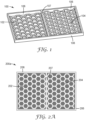
- the integral adhesive 100 includes a first array of interconnected hexagons 102, an adjacent second array of interconnected hexagons 104, and a frame 106 that has a plurality of walls surrounding each of the first array of interconnected hexagons 102 and the second array of interconnected hexagons 104.
- the frame 106 includes a frame wall 107 that separates the first array of interconnected hexagons 102 from the second array of interconnected hexagons 104.
- the integral adhesive 100 may be composed of any adhesive disclosed herein.
- An exemplary method of forming the integral adhesive 100 includes placing an actinic radiation-polymerizable adhesive precursor composition against a surface of an actinic radiation-transparent substrate and irradiating a first portion of the actinic radiation-polymerizable adhesive precursor composition through the actinic radiation-transparent substrate for a first irradiation dosage.
- the first portion may be defined by positioning an exposure image adjacent to the actinic radiation-transparent substrate, wherein the image includes a pattern provided by, for instance and without limitation, a computer controlled digital light projector (DLP), liquid crystal display (LCD), or laser scanning system; or a photomask.
- DLP computer controlled digital light projector
- LCD liquid crystal display
- laser scanning system or a photomask.
- the pattern either blocks actinic irradiation from passing through all of the regions of the exposure image except for the pattern (e.g., as with a combination of light source and photomask), or provides actinic irradiation in the shape of the pattern (e.g., as with a laser or an array of pixels).
- the exposure image includes a photomask
- the positioning of the exposure image is typically a physical positioning of the photomask adjacent to the actinic radiation-transparent substrate.
- the positioning of the exposure image is typically a positioning of the irradiation source, and the irradiation source is directed towards the actinic radiation-transparent substrate.
- an adhesive is at least partially polymerized from the actinic radiation-polymerizable adhesive precursor composition in the shape of the first portion.
- the adhesive polymerizes on the surface of the substrate and continues to polymerize in a direction normal to the substrate surface.
- the greater the irradiation dosage the further into the actinic radiation-polymerizable adhesive precursor composition (normal to the substrate surface) the actinic irradiation travels, and the thicker the resulting adhesive.
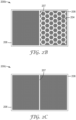
- FIG. 2A provides a top view of an exemplary first exposure image 200a employed to allow irradiation of the first portion of the actinic radiation-polymerizable adhesive precursor composition.
- the exposure image 200a includes each of the features described above with respect to the integral adhesive illustrated in FIG. 1 ; namely, a first array of interconnected hexagons 202, an adjacent second array of interconnected hexagons 204, and a frame 206 that has a plurality of walls surrounding each of the first array of interconnected hexagons 202 and the second array of interconnected hexagons 204.
- the frame 206 further includes a frame wall 207 that separates the first array of interconnected hexagons 202 from the second array of interconnected hexagons 204.
- the method further includes irradiating a second portion of the actinic radiation-polymerizable adhesive precursor composition through the actinic radiation-transparent substrate for a second irradiation dosage.
- a second exposure image is positioned adjacent to the actinic radiation-transparent substrate (e.g., as discussed above with respect to the first exposure image).
- FIG. 2B provides a top view of an exemplary second exposure image 200b employed to allow irradiation of the second portion of the actinic radiation-polymerizable adhesive precursor composition.
- the exposure image 200b includes a select portion of the features included in the first exposure image 200a; namely, the second array of interconnected hexagons 204, the frame 206 having a plurality of walls surrounding the second array of interconnected hexagons 204, and the frame wall 207. Accordingly, when the second portion of the actinic radiation-polymerizable adhesive precursor composition is irradiated through the actinic radiation-transparent substrate for a second irradiation dosage, an adhesive is at least partially polymerized from the actinic radiation-polymerizable adhesive precursor composition in the shape of the second portion.
- irradiating the second portion will result in an increase in the thickness of all of the areas of the adhesive except for the first array of hexagons 202, due to the second exposure image 200b overlapping all of the pattern of the first exposure image 200a aside from the first array of hexagons 202. This is because, following the first irradiation and the second irradiation, the first array of hexagons 202 will have been exposed to an irradiation dosage that is less than the total irradiation dosage to which the remainder of the adhesive was exposed.
- the method further includes irradiating a third portion of the actinic radiation-polymerizable adhesive precursor composition through the actinic radiation-transparent substrate for a third irradiation dosage.
- a third exposure image is positioned adjacent to the actinic radiation-transparent substrate (e.g., as discussed above with respect to the first exposure image).
- FIG. 2C provides a top view of an exemplary third exposure image 200c employed to allow irradiation of the third portion of the actinic radiation-polymerizable adhesive precursor composition.
- the exposure image 200c includes a select portion of the features included in the first exposure image 200a; namely, the frame 206 having a plurality of walls, and the frame wall 207. Accordingly, when the third portion of the actinic radiation-polymerizable adhesive precursor composition is irradiated through the actinic radiation-transparent substrate for a third irradiation dosage, an adhesive is at least partially polymerized from the actinic radiation-polymerizable adhesive precursor composition in the shape of the third portion. In this case, irradiating the third portion will result in an increase in the thickness of the frame 206 and frame wall 207, due to the third exposure image 200c overlapping the frame areas of the pattern of the first exposure image 200a and of the second exposure image 200b.
- the first frame 206 and the frame wall 207 will have been exposed to an irradiation dosage that is greater than the total irradiation dosage to which the remainder of the adhesive was exposed.
- the integral adhesive 300 is formed of the polymerized reaction product of a mixture of acrylic acid, isooctyl acrylate, 2-ethylhexyl acrylate, and IRGACURE TPO photoinitiator and 2,6 Di-tert-butyl-4-methyl-phenol, and TINOPAL OB CO, and includes a first array of interconnected hexagons 302, an adjacent second array of interconnected hexagons 304, and a frame 306 that has a plurality of walls surrounding each of the first array of interconnected hexagons 302 and the second array of interconnected hexagons 304.
- the frame 306 includes a frame wall 307 that separates the first array of interconnected hexagons 302 from the second array of interconnected hexagons 304.
- the first array of interconnected hexagons 302 have a height of 0.05 millimeters (mm);
- the second array of interconnected hexagons 304 have a height of 0.10 mm;
- the frame 306 (including the frame wall 307) has a height of 0.15 mm.
- the differences in height of the various portions of the integral adhesive 300 is accomplished using the three irradiation dosages irradiating adjacent or overlapping areas.
- the first integral adhesive 400a illustrates a height step change from a first portion 410 with a first thickness 409 to a second portion 412 with a second thickness 413.
- the step change occurs at an interface 411.
- the first portion 410 may have a thickness of 0.5 mm and the second portion 412 may have a thickness of 1.0 mm.
- the first integral adhesive 400a may be formed from an actinic radiation-polymerizable adhesive precursor composition using two different irradiation dosages, one each in the shape of the first portion 410 and of the second portion 412.
- the first integral adhesive 400a includes a major surface 408 that is integral to both the first portion 410 and the second portion 412, formed from actinic radiation-polymerizable adhesive precursor composition disposed against a surface of an actinic radiation-transparent substrate.
- the thicknesses (411 and 413) of the first portion 410 and the second portion 412 represent the distance normal to the surface of the actinic radiation-transparent substrate that the actinic radiation-polymerizable adhesive precursor composition was polymerized.
- the second integral adhesive 400b has a more subtle height change that appears to be a gradual slope, although it is made up a plurality of small step changes. More particularly, the second integral adhesive 400b includes a first portion 414 with a first thickness 415, a second portion 418 with a second thickness 419, and a third portion 416 comprising at least ten discrete portions, which in combination have a gradually increasing thickness from the end adjacent to the first portion 414 to the end adjacent to the second portion 418. In certain embodiments of the method according to the present disclosure, the second integral adhesive 400b may be formed from an actinic radiation-polymerizable adhesive precursor composition using at least twelve different irradiation dosages.
- the second integral adhesive 400b includes a major surface 417 that is integral to all of the first portion 414, the second portion 418, and the third portion 416 formed from actinic radiation-polymerizable adhesive precursor composition disposed against a surface of an actinic radiation-transparent substrate.
- the thicknesses of the various portions of the second integral adhesive 400b represent the distance normal to the surface of the actinic radiation-transparent substrate that the actinic radiation-polymerizable adhesive precursor composition was polymerized.
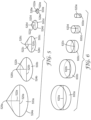
- the first integral adhesive 500a has the largest diameter 520a and peak cone height 522a
- the second integral adhesive 500b has the second largest diameter 520b and peak cone height 522b
- the third integral adhesive 500c has the third largest diameter 520c and peak cone height 522c
- the fourth integral adhesive 500d has the fourth largest diameter 520d and peak cone height 522d
- the fifth integral adhesive 500e has the fifth largest diameter 520e and peak cone height 522e.
- Each of the cone shaped integral adhesives may be formed from an actinic radiation-polymerizable adhesive precursor composition by the same method.
- each cone has a subtle height change from a base of the cone (524a-524e) that appears to be a gradual slope up to the point of the cone (526a-526e), although it is made up a plurality of small step changes.
- a plurality of circles (each having a center located in the same position) is each irradiated, in which each subsequent circle has a smaller diameter than the prior circle, resulting in the polymerization of the actinic radiation-polymerizable adhesive precursor composition in the shape of a cone.
- the thicknesses of the various portions of the cones 500a-500e represent the distance normal to the surface of the actinic radiation-transparent substrate that the actinic radiation-polymerizable adhesive precursor composition was polymerized, with the points of the cones (526a-526e) being disposed distal to the surface of the substrate.
- the first adhesive 600a has the largest diameter 620a
- the second adhesive 600b has the second largest diameter 620b
- the third adhesive 600c has the third largest diameter 620c
- the fourth adhesive 600d has the fourth largest diameter 620d
- the fifth adhesive 600e has the fifth largest diameter 620e.
- Each of the cylindrical shaped adhesives may be formed from an actinic radiation-polymerizable adhesive precursor composition by a method not according to the claimed invention.
- the plurality of cylinders having different diameters can be formed during a single irradiation of an actinic radiation-polymerizable adhesive precursor composition disposed against a surface of an actinic radiation-transparent substrate, in which a plurality of discrete circular patterns are irradiated simultaneously.
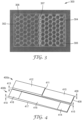
- the integral adhesive 700 includes a base layer 730 and a plurality of spaced apart ridges 734, wherein the width of the spaced apart ridges 734 decreases from one end 731 of the base layer 730 to the other end 733 of the base layer 730.
- the widths of the spaced apart ridges 734 may vary from about 550 micrometers down to about 40 micrometers.
- the integral adhesive 700 may be formed from an actinic radiation-polymerizable adhesive precursor composition using two different irradiation dosages.
- the base layer 730 of the integral adhesive 700 is integral to all of the plurality of ridges 734, and is formed from actinic radiation-polymerizable adhesive precursor composition disposed against a surface of an actinic radiation-transparent substrate during the first irradiation dosage.
- the thickness of the plurality of spaced apart ridges 734 represents the distance normal to the surface of the actinic radiation-transparent substrate that the actinic radiation-polymerizable adhesive precursor composition was polymerized in the second irradiation dosage.
- the widths of the plurality of ridges 734 is achieved based on the pattern that is irradiated during the second irradiation dosage.
- FIG. 8 an exemplary integral adhesive 800 is shown.
- a cover glass 850 for a digital device screen is also illustrated.
- the cover glass 850 includes an optically clear glass screen 851 and a black ink bezel 852 screen printed on the glass screen 851 around the perimeter of a major surface 853 of the glass screen 851.
- the bezel 852 defines a plurality of apertures 854 configured to accommodate one or more of sensors, cameras, speakers, microphones, etc.
- the integral adhesive 800 comprises an optically clear adhesive for a digital device screen.
- the integral adhesive 800 includes a base layer 840 and a spacer portion 844.
- the base layer 840 defines a plurality of apertures 842 configured to accommodate one or more of sensors, cameras, speakers, microphones, etc.
- the thickness of the spacer portion 844 represents the distance normal to the surface of the actinic radiation-transparent substrate that the actinic radiation-polymerizable adhesive precursor composition was polymerized in the second irradiation dosage.
- the integral adhesive 800 is fit to the cover glass 850 to assist in adhering the cover glass to a digital device.
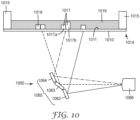
- the method further includes irradiating a second portion of the actinic radiation-polymerizable adhesive precursor composition 1016 through the actinic radiation-transparent substrate 1010 for a second irradiation dosage.
- the first portion and the second portion are adjacent to with each other and the first irradiation dosage and the second irradiation dosage are not the same.
- the method forms an integral adhesive 1017 having a variable thickness (e.g., 1017a as compared to 1017b) in an axis normal to the surface 1011 of the actinic radiation-transparent substrate 1010.
- the thickness of the integral adhesive is a fraction of the thickness of the precursor composition disposed against the surface of the substrate.
- the ratio of the thickness of the integral adhesive to the thickness of the precursor composition disposed against the surface of the substrate is 10:90, or 15:85, or 20:80, or 25:75, or 30:70, or 40:60, or 50:50, or 60:40, or 70:30, or 80:20, or 90:10.
- the methods of the present disclosure provide the capability to easily manufacture individual adhesives having a number of unique shapes due to employing adaptable actinic radiation sources, from which the bounds and dosage of the actinic radiation determine the specific shape of an individual adhesive.
- adaptable actinic radiation sources from which the bounds and dosage of the actinic radiation determine the specific shape of an individual adhesive.
- digital light projectors, laser scanning devices, and liquid crystal displays can all be controlled to change the area and intensity of the actinic radiation that causes curing of the actinic radiation-polymerizable adhesive precursor composition.
- a photomask or series of photomasks could be utilized to be more cost efficient than other irradiation sources.
- the substrate comprises a multilayer construction, for example and without limitation, a multilayer construction comprising a polymeric sheet, an adhesive layer, and a liner.
- the multilayer construction comprises a coating upon which the integral adhesive is disposed.
- the substrate is a device. Exemplary devices include an organic light-emitting diode, a sensor, or a solar device.
- the time of irradiation of the first dosage is different than the time of irradiation of the second dosage, while in other embodiments the actinic radiation intensity of the first dosage is lower than the actinic radiation intensity of the second dosage.
- the actinic radiation intensity of the first dosage is greater than the actinic radiation intensity of the second dosage, while in other embodiments the actinic radiation intensity of the first dosage is lower than the actinic radiation intensity of the second dosage.
- an integral adhesive is formed comprising a variable thickness in an axis normal to the actinic radiation-transparent substrate.
- the time of irradiation of the first dosage is shorter or longer than the time of irradiation of the second dosage.
- the actinic radiation intensity of the first dosage is lower or higher than the actinic radiation intensity of the second dosage.
- irradiating the first portion occurs before irradiating the second portion, at the same time as irradiating the second portion, or a combination thereof.
- the actinic radiation-transparent substrate is a floor of a container and the irradiation is directed through the floor from below the floor.
- a container 1014 is provided comprising side walls 1015 and floor (i.e., actinic radiation-transparent substrate) 1010.
- the actinic radiation-polymerizable adhesive precursor composition 1016 is disposed on a major surface 1011 of the floor 1010 of the container 1014, and the irradiation is directed through the floor 1010 from the irradiation source 1000 located below the floor 1010.
- FIG. 10 a container 1014 comprising side walls 1015 and floor (i.e., actinic radiation-transparent substrate) 1010.
- the actinic radiation-polymerizable adhesive precursor composition 1016 is disposed on a major surface 1011 of the floor 1010 of the container 1014, and the irradiation is directed through the floor 1010 from the irradiation source 1000 located below the floor 1010.
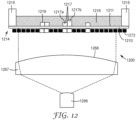
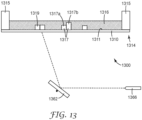
- a container 1114 is provided comprising side walls 1115 and floor (i.e., actinic radiation-transparent substrate) 1110; referring to FIG. 12 , a container 1214 is provided comprising side walls 1215 and floor (i.e., actinic radiation-transparent substrate) 1210; and referring to FIG. 13 , a container 1314 is provided comprising side walls 1315 and floor (i.e., actinic radiation-transparent substrate) 1310.
- the method further comprises removing actinic radiation-polymerizable adhesive precursor composition remaining in contact with the adhesives (e.g., the first adhesive, the second adhesive, and/or the integral adhesive, etc.).
- Removing precursor composition that has not been polymerized after the irradiating may involve the use of gravity, a gas, a vacuum, a fluid, or any combination thereof, such as pouring off at least a portion of the adhesive precursor composition remaining in contact with the adhesive after the irradiating, or blowing off at least a portion of the adhesive precursor composition using an air knife or nozzle.
- a suitable fluid for removing excess adhesive precursor composition includes a solvent. When the adhesive will be post-cured, it may be particularly desirable to remove residual precursor composition from being in contact with the adhesive, to minimize or prevent the addition of adhesive material to the desired shape and size of the adhesive upon post-curing.
- the type of adhesive that may be manufactured by the methods according to the disclosure is not particularly limited.
- the adhesive may be a pressure sensitive adhesive (PSA), a structural adhesive, a structural hybrid adhesive, a hot melt adhesive, or a combination thereof.
- PSA pressure sensitive adhesive
- the adhesive is often prepared from an actinic radiation-polymerizable adhesive precursor composition comprising an acrylate, a two-part acrylate and epoxy system, a two-part acrylate and urethane system, or a combination thereof.
- the actinic radiation-polymerizable adhesive precursor composition is a 100% polymerizable precursor composition, while in other embodiments the actinic radiation-polymerizable adhesive precursor composition comprises at least one solvent, such as for instance and without limitation C4-C12 alkanes (e.g., heptanes), alcohols (e.g., methanol, ethanol, or isopropanol), ethers, and esters.
- solvent such as for instance and without limitation C4-C12 alkanes (e.g., heptanes), alcohols (e.g., methanol, ethanol, or isopropanol), ethers, and esters.
- the acrylic polymer can be, for example, an acrylic acid ester of a non-tertiary alcohol having from 1 to 18 carbon atoms.
- the acrylic acid ester includes a carbon-to-carbon chain having 4 to 12 carbon atoms and terminates at the hydroxyl oxygen atom, the chain containing at least half of the total number of carbon atoms in the molecule.
- acrylic acid esters are polymerizable to a tacky, stretchable, and elastic adhesive.
- acrylic acid esters of nontertiary alcohols include but are not limited to 2-methylbutyl acrylate, isooctyl acrylate, lauryl acrylate, 4-methyl-2-pentyl acrylate, isoamyl acrylate, sec-butyl acrylate, n-butyl acrylate, n-hexyl acrylate, 2- ethylhexyl acrylate, n-octyl acrylate, n-decyl acrylate, isodecyl acrylate, isodecyl methacrylate, and isononyl acrylate.
- Suitable acrylic acid esters of nontertiary alcohols include, for example, 2-ethylhexyl acrylate and isooctylacrylate.
- the acrylic acid ester may be copolymerized with one or more monoethylenically unsaturated monomers that have highly polar groups.
- monoethylenically unsaturated monomer such as acrylic acid, methacrylic acid, itaconic acid, acrylamide, methacrylamide, N- substituted acrylamides (for example, N,N-dimethyl acrylamide), acrylonitrile, methacrylonitrile, hydroxyalkyl acrylates, cyanoethyl acrylate, N-vinylpyrrolidone, N-vinylcaprolactam, and maleic anhydride.
- these copolymerizable monomers are used in amounts of less than 20% by weight of the adhesive matrix such that the adhesive is tacky at ordinary room temperatures. In some cases, tackiness can be preserved at up to 50% by weight of N-vinylpyrrolidone.
- acrylate copolymers comprising at least 6% by weight acrylic acid, and in other embodiments, at least 8% by weight, or at least 10% by weight acrylic acid, each based on the total weight of the monomers in the acrylate copolymer.
- the adhesive may also include small amounts of other useful copolymerizable monoethylenically unsaturated monomers such as alkyl vinyl ethers, vinylidene chloride, styrene, and vinyltoluene.
- adhesives according to the present disclosure comprise two-part acrylate and epoxy systems.
- suitable acrylate-epoxy compositions are described in detail in U.S. Application Publication No. 2003/0236362 (Bluem et al. )
- adhesives according to the present disclosure comprise two-part acrylate and urethane systems.
- suitable acrylate-urethane compositions are described in detail in U.S. Patent No. 4,950,696 (Palazotto et al. )
- Enhancement of the cohesive strength of the adhesive may also be achieved through the use of a crosslinking agent such as 1,6-hexanediol diacrylate, with a photoactive triazine crosslinking agent such as taught in U.S. Patent Nos. 4,330,590 (Vesley ) and 4,329,384 (Vesley et al. ), or with a heat-activatable crosslinking agent such as a lower-alkoxylated amino formaldehyde condensate having C1-4 alkyl groups - for example, hexamethoxymethyl melamine or tetramethoxymethyl urea or tetrabutoxymethyl urea.
- Crosslinking may be achieved by irradiating the composition with electron beam (or "e-beam") radiation, gamma radiation, or x-ray radiation.
- Bisamide crosslinkers may be used with acrylic adhesives in solution.
- a monomer mixture may be irradiated with actinic radiation, such as for example ultraviolet (UV) rays, in the presence of a photopolymerization initiator (i.e., photoinitiators).
- actinic radiation such as for example ultraviolet (UV) rays
- photopolymerization initiator i.e., photoinitiators
- Suitable exemplary photoinitiators are those available under the trade designations IRGACURE and DAROCUR from BASF (Ludwigshafen, Germany) and include 1-hydroxycyclohexyl phenyl ketone (IRGACURE 184), 2,2-dimethoxy-1,2-diphenylethan-1-one (IRGACURE 651), bis(2,4,6-trimethylbenzoyl)phenylphosphineoxide (IRGACURE 819), 1-[4-(2-hydroxyethoxy)phenyl]-2-hydroxy-2-methyl-1-propane-1-one] (IRGACURE 2959), 2-benzyl-2-dimethylamino-1-(4-morpholinophenyl)butanone (IRGACURE 369), 2-methyl-1-[4-(methylthio)phenyl]-2-morpholinopropan-1-one] (IRGACURE 907), Oligo[2-hydroxy-2-methyl-1-[4- (1-methylvinyl)phenyl]propanone
- photoinitiators include for example and without limitation, benzyl dimethyl ketal, 2-methyl-2-hydroxypropiophenone, benzoin methyl ether, benzoin isopropyl ether, anisoin methyl ether, aromatic sulfonyl chlorides, photoactive oximes, and combinations thereof.
- a photoinitiator is typically present in an amount between about 0.01 to about 5.0 parts, or from 0.1 to 1.5 parts, per 100 parts by weight of total monomer.
- the post-cure of the adhesive is optionally initiated using a thermal initiator.
- Suitable thermal initiators include for example and without limitation, 2,2'-azobis(2,4-dimethylvaleronitrile), 2,2'-azobisoisobutyronitrile (VAZO 64, available from E.I. du Pont de Nemours Co.), 2,2'-azobis(2,4-dimethylpentanenitrile) (VAZO 52, available from E.I.
- a suitable covalent crosslinker includes bis-aziridines, for instance 1,1'-isophthaloylbis(2-methylaziridine).
- UV crosslinkers such as copolymerizable benzophenones or post-added photocrosslinkers, such as multifunctional benzophenones and triazines.
- a variety of different materials have typically been used as crosslinking agents, e.g., polyfunctional acrylates, acetophenones, benzophenones, and triazines.
- the at least one radiation-sensitive crosslinker of the actinic radiation-polymerizable adhesive precursor composition includes a co-polymerized type (II) photocrosslinker. Suitable co-polymerized type (II) photocrosslinkers for use herein will be easily identified by those skilled in the art, in the light of the present description.
- the co-polymerized type (II) photocrosslinker may be co-polymerized together with the other monomers present in the mixture used to prepare the adhesive.
- the co-polymerized type (II) photocrosslinker for use herein may be co-polymerized into a crosslinking polymer, preferably an acrylate crosslinking polymer, and distinct from the adhesive.
- crosslinking polymers for use herein may be acrylate, vinyl ester, acryl amide, alkyl acryl amide, dialkyl acryl amide or styrene (co)polymers, including in particular monomers such as e. g. alkyl (meth)acrylamide monomers, di aryl (meth)acrylamide monomers, styrenic monomers (in particular low T g styrenic monomers such as, e.g., butoxy-styrene monomers), vinyl ester monomers, and any combinations or mixtures thereof.
- the crosslinking polymer is an acrylate crosslinking polymer.
- the adhesive is optionally prepared from a monomer mixture comprising at least one linear or branched alkyl (meth)acrylate monomer, wherein the linear or branched alkyl group of the alkyl (meth)acrylate monomer preferably comprises from 1 to 24, more preferably from 4 to 20, even more preferably 6 to 15, still more preferably from 6 to 10 carbon atoms.
- the linear or branched alkyl (meth)acrylate monomer is optionally selected from the group consisting of methyl acrylate, ethyl acrylate, n-propyl acrylate, isopropyl acrylate, n-butyl acrylate, isobutyl acrylate, n-pentyl acrylate, iso-pentyl acrylate, n-hexyl acrylate, iso-hexyl acrylate, cyclohexyl acrylate, octyl acrylate, iso-octyl acrylate, 2-ethylhexyl acrylate, decyl acrylate, lauryl acrylate, 2-propylheptyl acrylate, stearyl acrylate, isobornyl acrylate, and any combinations or mixtures thereof.
- the alkyl (meth)acrylate monomer for use herein is selected from the group consisting of iso-octyl acrylate, 2-ethylhexyl acrylate, butyl acrylate, and any combinations or mixtures thereof. Still more preferably, the alkyl (meth)acrylate monomer for use herein comprises (or consists of) iso-octyl acrylate.
- a vinyl ester (co)-monomer preferably a vinyl ester of versatic acid (co)-monomer
- Suitable vinyl esters of versatic acid (co)-monomers include the commercially available monomer: Veova 10, commercially available from Momentive, Columbus, OH.
- the vinyl ester co-monomer is used in amounts ranging from 0.5 to 40 parts, from 1.0 to 30 parts, from 5 to 25 parts, from 10 to 20 parts, or even from 15 to 20 parts, by weight per 100 parts by weight of acrylate crosslinking polymer.
- a crosslinking polymer is typically present in an amount of from 0.5 to 30 parts, from 0.5 to 20 parts, from 1.0 to 10 parts, or even from 2.0 to 8.0 parts by weight per 100 parts by weight of total monomer.
- a radiation-sensitive crosslinker is typically present in an amount of at least 0.05 parts by weight per 100 parts by weight of copolymer or at least 0.10 parts by weight per 100 parts by weight of total monomer, such as from 0.06 to 1 parts, from 0.11 to 1 parts, from 0.16 to 1 parts, from 0.18 to 0.70 parts, or even from 0.20 to 0.50 parts by weight per 100 parts by weight of total monomer.
- non-photocrosslinkable (co)polymers optionally one or more non-photocrosslinkable (co)polymers are included.
- Suitable non-photocrosslinkable (co)polymer include for example and without limitation, poly(methyl methacrylate), polyvinylbutyral, polystyrene and polyacrylonitrile, and combinations thereof.
- One or more non-photocrosslinkable (co)polymers are typically present in an amount from about 0.1 to about 25 parts by weight per 100 parts by weight of total monomer.
- a multifunctional (meth)acrylate may be incorporated into the actinic radiation-polymerizable adhesive precursor composition.
- a multifunctional (meth)acrylate is particularly useful for emulsion or bulk polymerization, typically at low levels.
- Suitable multifunctional (meth)acrylates include for example without limitation, a di(meth)acrylate, tri(meth)acrylate, and tetra(meth)acrylate, such as 1,6-hexanediol di(meth)acrylate, a poly(ethylene glycol) di(meth)acrylate, polybutadiene di(meth)acrylate, a polyurethane di(meth)acrylate, propoxylated glycerin tri(meth)acrylate, and mixtures thereof.
- a di(meth)acrylate tri(meth)acrylate
- tetra(meth)acrylate such as 1,6-hexanediol di(meth)acrylate, a poly(ethylene glycol) di(meth)acrylate, polybutadiene di(meth)acrylate, a polyurethane di(meth)acrylate, propoxylated glycerin tri(meth)acrylate, and mixtures thereof.
- a multifunctional (meth)acrylate monomer When used, a multifunctional (meth)acrylate monomer is present in an amount of up to 0.05 parts or up to 0.1 parts, based on 100 parts by weight of total monomer. When used, a multifunctional (meth)acrylate monomer is present in an amount of at least 0.001 parts by weight or at least 0.005 parts, based on 100 parts by weight of total monomer. In certain embodiments, a multifunctional (meth)acrylate monomer is present in an amount of 0.001 parts to 0.1 parts, and in other embodiments 0.005 parts to 0.05 parts, based on 100 parts by weight of total monomer.
- Suitable adjuvants include for example and without limitation, a radiation-crosslinkable additive, a thickener, a particulate filler (e.g., an inorganic filler such as glass bubbles, glass beads, nanoparticles, microspheres, etc.), an antioxidant, a colorant, inhibitor, optical brightener, a scent, or combinations thereof.
- a radiation-crosslinkable additive e.g., a radiation-crosslinkable additive
- a thickener e.g., a particulate filler (e.g., an inorganic filler such as glass bubbles, glass beads, nanoparticles, microspheres, etc.), an antioxidant, a colorant, inhibitor, optical brightener, a scent, or combinations thereof.
- a radiation-crosslinkable additive e.g., a radiation-crosslinkable additive, a thickener, a particulate filler (e.g., an inorganic filler such as glass bubbles, glass beads, nanoparticles
- one or more inhibitors are optionally included in the actinic radiation-polymerizable adhesive precursor composition to limit the extent of polymerization of the precursor composition to the region of the precursor composition that is exposed to the actinic radiation.
- included microspheres are inorganic or synthetic resinous hollow microspheres.
- Inorganic hollow microspheres preferably are glass microspheres or microbubbles such as those described in U.S. Patent No. 3,365,315 .
- Organic resin microspheres are described in U.S. Patent No. 2,797,201 .
- the radiation-crosslinkable additive includes at least one bis(benzophenone).
- one or more tackifiers may be present in actinic radiation-polymerizable adhesive precursor composition.
- Suitable tackifiers typically include a terpene phenolic, rosin, rosin ester, ester of hydrogenated rosin, synthetic hydrocarbon resin, polyterpenes, aromatic-modified polyterpene resins, coumarone-indene resins, hydrocarbon resins such as alpha pinene-based resins, beta pinene-based resins, limonene-based resins, aliphatic hydrocarbon-based resins, aromatic-modified hydrocarbon-based resins, aromatic hydrocarbon resins, dicyclopentadiene-based resins, or combinations thereof.
- the tackifier is a terpene resin, a hydrocarbon resin, a rosin resin, a petroleum resin, or combination thereof.
- Suitable synthetic hydrocarbon resins include for example and without limitation, aliphatic C5 hydrocarbons, aromatic C9 hydrocarbons, partially hydrogenated versions of any of the foregoing, fully hydrogenated versions of any of the foregoing, and combinations thereof.
- tackifiers include phenol modified terpenes and rosin esters such as glycerol esters of rosin and pentaerythritol esters of rosin that are available under the trade names NUROZ, NUTAC (Newport Industries), PERMALYN, STAYBELITE, FORAL (Eastman).
- hydrocarbon resin tackifiers that typically come from C 5 and C 9 monomers by products of naphtha cracking and are available under the trade names PICCOTAC, EASTOTAC, REGALREZ, REGALITE (Eastman), ARKON (Arakawa), NORSOLENE, WINGTACK (Cray Valley), NEVTAC LX (Neville Chemical Co.), HIKOTACK, HIKOREZ (Kolon Chemical), NOVARES (Ruetgers N.V.), QUINTONE (Zeon), ESCOREZ (Exxon Mobile Chemical), NURES, and H-REZ (Newport Industries).
- the at least one tackifier is typically present in an amount greater than 10 parts per weight per 100 parts by weight of total monomer, or greater than 20 parts per weight, or greater than 30 parts per weight, or greater than 40 parts per weight per 100 parts by weight of total monomer, such as in amount from 40 parts to 70 parts by weight per 100 parts by weight of total monomer.
- the actinic radiation is provided by a digital light projector (DLP) with a light emitting diode (LED), a DLP with a lamp, a laser scanning device with a laser, a liquid crystal display (LCD) panel with a backlight, a photomask with a lamp, or a photomask with an LED.
- the lamp is selected from an incandescent lamp, a flash lamp, a low pressure mercury lamp, a medium pressure mercury lamp, and a microwave driven lamp.
- the adhesive comprises variations in index of refraction.
- observation of a cross-section of the adhesive prepared according to exemplary methods of the disclosure reveals variations in index of refraction due to corresponding variations in cure provided by the discrete LEDs, or the DLP pixels, or the laser passes, or the LCD pixels, or the greyscale of the photomask.
- a schematic is provided in FIG. 10 of a DLP with an LED or lamp
- schematics are provided in FIGS. 11a and 11b of a photomask with a lamp or LED
- a schematic is provided in FIG. 12 of an LCD panel with a backlight
- a schematic is provided in FIG. 13 of a laser scanning device with a laser.
- an irradiation source 1000 for use in exemplary methods of the present disclosure, comprising a DLP 1065 with an LED or a lamp 1066 (1066 represents either an LED or a lamp).
- the DLP 1065 includes a plurality of individually movable reflectors, such as first reflector 1062, second reflector 1063, and third reflector 1064. Each reflector is positioned at a specific angle to direct irradiation from the LED or lamp 1066 towards a predetermined location of a composition 1016 disposed on a major surface 1011 of an actinic radiation-transparent substrate 1010.
- the intensity and duration of the irradiation from the LED or lamp 1066 will impact the depth of cure (e.g., polymerization) of the composition 1016 in a direction normal to the major surface 1011 of the substrate 1010 upon formation of one or more adhesives 1017 and 1019.
- one portion 1017b of integral adhesive 1017 has a greater thickness than another portion 1017a of the same integral adhesive 1017. This may be achieved by irradiating the portion 1017b with a greater dosage than the portion 1017a is irradiated.
- adhesive 1019 has a single thickness across its width due to receiving the same dosage across its width.
- DLPs are readily adjustable (e.g., using computer controls) to change the irradiation location and dosage and thereby the shape of the resulting formed adhesives, as needed without requiring a significant equipment alteration.
- DLPs are well-known in the art, for instance and without limitation, the apparatuses described in U.S. Patent Nos. 5,658,063 (Nasserbakht ), 5,905,545 (Poradish et al. ), 6,587,159 (Dewald ), 7,164,397 (Pettitt et al. ), 7,360,905 (Davis et al. ), 8,705,133 (Lieb et al.
- Suitable DLPs are commercially available, such as from Texas Instruments (Dallas, TX). As indicated above, either an LED or a lamp may be employed with a DLP. Suitable lamps may include a flash lamp, a low pressure mercury lamp, a medium pressure mercury lamp, and/or a microwave driven lamp. The skilled practitioner can select a suitable LED or lamp light source to provide the actinic radiation required to initiate polymerization for a particular polymerizable composition, for instance, the UV LED CBT-39-UV, available from Luminus Inc. (Sunnyvale, CA).
- an irradiation source 1100 comprising at least one photomask 1170a and 1170b with an LED or a lamp 1166 (1166 represents either an LED or a lamp), for use in exemplary methods of the present disclosure.
- a lens 1167 having a convex surface 1168 is employed with the LED or lamp 1166 to diffuse the irradiation across at least a portion of the one or more photomasks 1170a and 1170b. As shown in FIG.
- a first photomask 1170a is employed to direct irradiation from the LED or lamp 1166 towards a predetermined location of a composition 1116 disposed on a major surface 1111 of an actinic radiation-transparent substrate 1110.
- the intensity and duration of the irradiation from the LED or lamp 1166 will impact the depth of cure (e.g., polymerization) of the composition 1116 in a direction normal to the major surface 1111 of the substrate 1110 upon formation of one or more adhesives 1117 and 1119.
- one portion 1117b of integral adhesive 1117 has a greater thickness than another portion 1017a of the same integral adhesive 1117. This may be achieved by employing more than one photomask. For instance, referring to FIG.
- a photomask 1170a is shown in which a plurality of portions 1171a are provided through which irradiation can be directed to cure the composition 1116.
- a second photomask 1170b is shown in which one portion 1171b is provided through which irradiation can be directed to further cure the composition 1116.
- the portion 1117b has a greater thickness than the portion 1117a due to being irradiated twice; once using the first photomask 1170a and once using the second photomask 1170b; resulting in irradiation of the portion 1117b with a greater dosage than the portion 1117a.
- adhesive 1119 has a single thickness across its width due to receiving the same dosage across its width by exposure to irradiation through just the first photomask 1170a. While the photomasks in FIGS. 11A and 11B are shown as having opaque and transparent portions, the skilled practitioner will appreciate that photomasks including greyscale may be employed to achieve gradients in cure in different locations of the composition. Suitable photomasks are commercially available, for instance, NanoSculpt Photomasks from Infinite Graphics (Minneapolis, MN). Similar to using a DLP, either an LED or a lamp may be employed with a photomask.
- an irradiation source 1200 comprising a digital photomask 1272 (e.g., a LCD with a backlight 1266), wherein the backlight comprises an LED or a lamp 1266 (1266 represents either an LED or a lamp), for use in exemplary methods of the present disclosure.
- a lens 1267 having a convex surface 1268 is employed with the backlight 1266 to diffuse the irradiation across at least a portion of the digital photomask 1272.
- the intensity and duration of the irradiation from the backlight 1266 will impact the depth of cure (e.g., polymerization) of the composition 1216 in a direction normal to the major surface 1211 of the substrate 1210 upon formation of one or more adhesives 1217 and 1219.
- one portion 1217b of integral adhesive 1217 has a greater thickness than another portion 1217a of the same integral adhesive 1217. This may be achieved by irradiating the portion 1217b with a greater dosage than the portion 1217a is irradiated.
- adhesive 1219 has a single thickness across its width due to receiving the same dosage across its width.
- a benefit of employing a digital photomask is that the individual pixels are readily adjustable (e.g., using computer controls) to change the irradiation location and dosage and thereby the shape of the resulting formed adhesives, as needed without requiring a significant equipment alteration.
- Suitable LCDs are commercially available, for instance, the LCD LQ043T1DG28, available from Sharp Corporation (Osaka, Japan).
- an irradiation source 1300 comprising a laser scanning device 1362 with a laser 1366, for use in exemplary methods of the present disclosure.
- the laser scanning device 1362 includes at least one individually movable mirror. Each mirror is positioned at a specific angle to direct irradiation from the laser 1366 towards a predetermined location of a composition 1316 disposed on a major surface 1311 of an actinic radiation-transparent substrate 1310.
- the intensity and duration of the irradiation from the laser 1366 will impact the depth of cure (e.g., polymerization) of the composition 1316 in a direction normal to the major surface 1311 of the substrate 1310 upon formation of one or more adhesives 1317 and 1319.
- one portion 1317b of integral adhesive 1317 has a greater thickness than another portion 1317a of the same integral adhesive 1317. This may be achieved by irradiating the portion 1317b with a greater dosage than the portion 1317a is irradiated.
- adhesive 1319 has a single thickness across its width due to receiving the same dosage across its width.
- Suitable laser scanning devices are commercially available, such as the JS2808 Galvanometer Scanner from Sino-Galvo (Beijing) Technology Co., LTD. (Beijing, China).
- the skilled practitioner can select a suitable laser to provide the actinic radiation required to initiate polymerization for a particular polymerizable composition, for instance, the CUBE 405-100C Diode Laser System from Coherent Inc. (Santa Clara, CA).
- any of the above irradiation sources of the present disclosure are suitable for use in each of the apparatuses of the disclosed embodiments herein. It is an advantage of these irradiation sources that they are readily configured to provide one or more predetermined dosages of irradiation at one or more predetermined locations, allowing the manufacture of adhesives having variations in size and shape, particularly in thickness normal to a substrate.
- the method further comprises transferring the formed adhesive to a second substrate.
- Suitable substrates include for example and without limitation, a glass, a polymeric material, a ceramic, or a metal.
- the substrate is often a substrate to be included in an end use of the adhesive, such as in an electronic device.
- the temperature(s) at which methods according to the present disclosure are performed is not particularly limited. For methods employing an actinic radiation-polymerizable adhesive precursor composition that is in a liquid form at room temperature (e.g., 20-25 degrees Celsius), for simplicity at least some of the various steps of the method are typically performed at room temperature. For methods employing an actinic radiation-polymerizable adhesive precursor composition that is in a solid form at room temperature, at least some of the various steps of the method may be performed at an elevated temperature above room temperature such that the actinic radiation-polymerizable adhesive precursor composition is in a liquid form.
- Elevated temperatures may be used through an entire method, or through such steps as formation of an adhesive, removal of unpolymerized actinic radiation-polymerizable adhesive precursor composition, and/or optional post-curing of the adhesive. In some embodiments, certain portions of the method are performed at different temperatures, whereas in some other embodiments, the entire method is performed at one temperature. Suitable elevated temperatures include for instance and without limitation, above 25 degrees Celsius and up to 150 degrees Celsius, up to 130 degrees Celsius, up to 110 degrees Celsius, up to 100 degrees Celsius, up to 90 degrees Celsius, up to 80 degrees Celsius, up to 70 degrees Celsius, up to 60 degrees Celsius, up to 50 degrees Celsius, or up to 40 degrees Celsius.
- the method is performed at a temperature between 20 degrees Celsius and 150 degrees Celsius, inclusive; between 30 degrees Celsius and 150 degrees Celsius, inclusive; between 25 degrees Celsius and 100 degrees Celsius, inclusive; or between 25 degrees Celsius and 70 degrees Celsius, inclusive.
- the temperature employed is typically limited only by the lowest maximum temperature at which a material used in the method (e.g., a substrate, an apparatus component, etc.) remains thermally stable.
- the adhesive is determined to be an adhesive by testing that it successfully adheres two materials together. Typically, such a test involves disposing the formed adhesive between two substrates (one or both may be polymeric, paper, glass, ceramic, or metal), lifting the article by the edges of one of the substrates, and observing whether or not the second substrate remains attached to the article.
- an adhesive article in a second aspect, includes a substrate having a major surface and an integral adhesive disposed on the major surface of the substrate.
- the adhesive has a variable thickness in an axis normal to the major surface of the substrate.
- the adhesive is prepared by a method as described in detail above with respect to the first aspect.
- the adhesive comprises variations in index of refraction as a result of the two or more irradiation dosages of the actinic radiation-polymerizable adhesive precursor composition.
- the adhesive is any of a pressure sensitive adhesive (PSA), a structural adhesive, a structural hybrid adhesive, a hot melt adhesive, or a combination thereof, as discussed above.
- PSA pressure sensitive adhesive
- the adhesive comprises an acrylate, an epoxy, or combinations thereof.
- Suitable substrates include for instance and without limitation, a polymeric material, a glass, a ceramic, or a metal.
- the substrate comprises a polymeric material selected from polyethylene terephthalate, polyethylene naphthalate, polycarbonate, polyimide, cycloolefin films, poly(methyl methacrylate), or combinations thereof.
- the substrate optionally comprises a release material, such as when the adhesive will be transferred to another material or device.
- the adhesive may be permanently attached to the substrate.
- the adhesive is advantageously disposed in a pattern on the substrate (e.g., more than one discrete adhesives and/or an adhesive that defines one or more apertures in the adhesive).
- Table 1 provides a role and a source for materials used in the Examples below: Table 1.
- Materials Function Abbreviation Description Source Monomer 1 iOA IsoOctyl Acrylate 3M, St Paul, MN Monomer 2 AA Acrylic Acid Sigma-Aldrich, St Louis, MO Monomer 3 iBOA IsoBornyl Acrylate OSAKA Organic Chemical Industry LTD, Osaka, Japan Monomer 4 SR440 IsoOctyl Acrylate Sartomer Americas, Exton, PA Monomer 5 SR420 3,3,5-Trimethyl cyclohexyl Acrylate Sartomer Americas, Exton, PA Monomer 6 MA0735 methacryl POSS (polyoctahedryl silsesquioxane) cage mixture Hybrid Plastics Inc, Hattiesburg, MS Crosslinker 1 HDDA 1,6-Hexanedioldiacrylate Sarto
- Experimental Apparatus 1 A first experimental apparatus was constructed by taking an Asiga PicoPlus39 3D printer, available from Asiga, Anaheim Hills, California, USA, and removing the build platform and the resin tray. This printer uses a digital light projector with a 405 nm LED as source of actinic radiation.
- Experimental Apparatus 2 A second experimental apparatus was constructed by taking an Asiga Pico2 3D printer, available from Asiga, Anaheim Hills, California, USA, and removing the build platform and the resin tray. This printer uses a digital light projector with a 385 nm LED as source of actinic radiation.
- a UV Intensity Analyzer Model 356, from OAI Instruments, San Jose, CA, was used to measure the intensity of the projected image at the projection plane of the printers.
- the 400 nm broad band sensor was attached to the Analyzer, and the sensor surface was centered on the rectangular test image of the printer.
- an actinic radiation intensity of 12.3 mW/cm 2 was measured, and for Experimental Apparatus 2 an intensity of 22.4 mW/cm 2 was measured.
- the thickness of the adhesive in the region corresponding to the first set of lines, circles and alphabetic characters was measured as 230 microns, while the thickness in the region corresponding to the second set of lines, circles and alphabetic characters was measured as 350 microns. These were each a fraction of the thickness of the liquid composition, which was calculated to be approximately 800 microns, disposed on the liner.
- the adhesive was touched with a finger and the features felt sticky and adhered to the finger like a pressure sensitive adhesive. It was observed that it failed cohesively and that strings of material could be pulled from the adhesive.
- a 60 ml amber glass jar was charged with 21.9 g IOA, 21.9 g IsoBornyl Acrylate (iBOA) and 12.5 g AA, 0.156 g HDDA, then 0.75 g IRGACURE TPO, 0.05 BHT and 0.1 g Benzoxazole,2,2'-(2,5-thiophenediyl)bis[5-(1,1-dimethylethyl)] (Tinopal OB CO) were added.
- the jar was sealed and rotated on a laboratory bench top roller at approximately 10 RPM for 2 hours. This was labeled Composition 2.
- a piece of release liner with rubber rectangle was prepared as in Example 1, and 1.5 ml of Composition 2 was dropped onto the release liner in the area confined by the rectangular rubber. This assembly then was placed on the optical window of the Experimental Apparatus 2, forming essentially the arrangement depicted in Fig. 10 .
- a computer model of the shape depicted in Figure 1 was loaded into the control software of the experimental apparatus 2, and the software generated three exposure images, depicted in Figure 2A , 2B and 2C .
- the image depicted in Figure 2A was projected for 2.5 seconds through the release liner into the composition.
- the image depicted in Figure 2B was projected for 2.5 seconds through the release liner into the composition, at the same location as the exposure of the Image depicted in Figure 2A .
- the image depicted in Figure 2C was projected for 2.5 seconds through the release liner into the composition, at the same location as the exposure of the image depicted in Figures 2A and 2B .
- the adhesive was left uncovered and was post cured for 10 minutes in the Asiga Flash UV post cure chamber.
- the thickness of the adhesive features was measured using a Keyence scanning laser microscope, Model VK-X200 available from Keyence Corporation, Osaka, Japan. Referring to Figure 1 , the thickness of the adhesive corresponding to the first array of interconnected hexagons 102 was measured to be 50 microns, the thickness of the adhesive corresponding to the second array of interconnected hexagons 104 was measured to be 77 microns, and the thickness of the adhesive corresponding to the frame 106 was measured to be 108 microns.
- the adhesive was touched with a finger and it felt sticky and adhered to the finger like a pressure sensitive adhesive. It was observed that the adhesive had good cohesion and did not draw strings.
- the adhesive was pressed onto a microscopy glass slide and adhered well. Then the liner was removed, the adhesive remained on the glass slide, and a piece of paper was pressed onto and adhered to the adhesive on the glass slide.
- a piece of release liner with rubber rectangle was prepared as in Example 1, and approximately 2 ml of 3M UV B-stage Adhesive 1051, a liquid dual cure (UV/heat) adhesive, was poured onto the release liner in the area confined by the rectangular rubber.
- the thickness of the layer of the 3M UV B-Stage Adhesive 1051 was calculated to be approximately 1 mm. This assembly then was placed on the optical window of the Experimental Apparatus 1, forming essentially the arrangement depicted in Fig. 10 .
- the pressure sensitive adhesive then was pressed onto a piece of 2 mm thick aluminum sheet.
- the pressure sensitive adhesive was covered with a polycarbonate plastic sheet, then cured in an oven at 110 degree Celsius for 10 minutes.
- a piece of release liner with rubber rectangle was prepared as in Example 1, and 1.5 ml of Composition 4 was dropped onto the release liner in the area confined by the rectangular rubber. This assembly then was placed on the optical window of the Experimental Apparatus 2, forming essentially the arrangement depicted in Fig. 10 .
- a computer model of the shape depicted in Figure 1 was loaded into the control software of the experimental apparatus 2, and the software generated three exposure images, depicted in Figure 2A , 2B and 2C .
- the image depicted in Figure 2A was projected for 5.0 seconds through the release liner into the composition.
- the image depicted in Figure 2B was projected for 5.0 seconds through the release liner into the composition, at the same location as the exposure of the image depicted in Figure 2A .
- the image depicted in Figure 2C was projected for 5.0 seconds through the release liner into the composition, at the same location as the exposure of the image depicted in Figures 2A and 2B .
- the adhesive was left uncovered and the heptane was allowed to evaporate for 15 minutes. Then the adhesive was post cured for 10 minutes in the Asiga Flash UV post cure chamber.
- the thickness of the adhesive features was measured using the Keyence scanning laser microscope. Referring to Figure 1 , the thickness of the adhesive corresponding to the first array of interconnected hexagons 102 was measured to be 44 microns, the thickness of the adhesive corresponding to the second array of interconnected hexagons 104 was measured to be 115 microns, and the thickness of the adhesive corresponding to the frame 106 was measured to be 155 microns.
- the adhesive was touched with a finger and it felt sticky and adhered to the finger like a pressure sensitive adhesive. It was observed that the adhesive had good cohesion and draw minimal strings.
- the adhesive was pressed onto a microscopy glass slide and adhered well. Then the liner was removed, the adhesive remained on the glass slide, and a piece of paper was pressed onto and adhered to the adhesive on the glass slide.
Landscapes
- Chemical & Material Sciences (AREA)
- Engineering & Computer Science (AREA)
- Materials Engineering (AREA)
- Organic Chemistry (AREA)
- Manufacturing & Machinery (AREA)
- Physics & Mathematics (AREA)
- Health & Medical Sciences (AREA)
- Toxicology (AREA)
- Optics & Photonics (AREA)
- Mechanical Engineering (AREA)
- Electromagnetism (AREA)
- Oral & Maxillofacial Surgery (AREA)
- Thermal Sciences (AREA)
- Chemical Kinetics & Catalysis (AREA)
- Plasma & Fusion (AREA)
- Inorganic Chemistry (AREA)
- Adhesives Or Adhesive Processes (AREA)
- Medicinal Chemistry (AREA)
- Polymers & Plastics (AREA)
- Adhesive Tapes (AREA)
Applications Claiming Priority (2)
| Application Number | Priority Date | Filing Date | Title |
|---|---|---|---|
| US201562272479P | 2015-12-29 | 2015-12-29 | |
| PCT/US2016/068465 WO2017117035A1 (en) | 2015-12-29 | 2016-12-23 | Additive manufacturing methods for adhesives and adhesive articles |
Publications (2)
| Publication Number | Publication Date |
|---|---|
| EP3397712A1 EP3397712A1 (en) | 2018-11-07 |
| EP3397712B1 true EP3397712B1 (en) | 2025-04-23 |
Family
ID=57944501
Family Applications (1)
| Application Number | Title | Priority Date | Filing Date |
|---|---|---|---|
| EP16831871.5A Active EP3397712B1 (en) | 2015-12-29 | 2016-12-23 | Additive manufacturing methods for adhesives and adhesive articles |
Country Status (8)
| Country | Link |
|---|---|
| US (2) | US11254841B2 (enExample) |
| EP (1) | EP3397712B1 (enExample) |
| JP (1) | JP6952038B2 (enExample) |
| KR (1) | KR102655948B1 (enExample) |
| CN (1) | CN108473832B (enExample) |
| BR (1) | BR112018013462A2 (enExample) |
| TW (1) | TW201739878A (enExample) |
| WO (1) | WO2017117035A1 (enExample) |
Families Citing this family (16)
| Publication number | Priority date | Publication date | Assignee | Title |
|---|---|---|---|---|
| JP6938512B2 (ja) | 2015-12-29 | 2021-09-22 | スリーエム イノベイティブ プロパティズ カンパニー | 連続的な付加製造装置 |
| CN108430649B (zh) | 2015-12-29 | 2026-05-19 | 3M创新有限公司 | 连续的添加剂制备方法 |
| WO2017127569A1 (en) | 2016-01-21 | 2017-07-27 | 3M Innovative Properties Company | Additive processing of fluoroelastomers |
| CN110831735B (zh) * | 2017-06-28 | 2021-12-14 | 3M创新有限公司 | 用于粘合剂和粘合剂制品的增材制造方法 |
| JP2019101086A (ja) * | 2017-11-29 | 2019-06-24 | シャープ株式会社 | 液晶表示パネル及び液晶表示パネルの製造方法 |
| US11453172B2 (en) * | 2018-06-22 | 2022-09-27 | 3D Systems, Inc. | 3D printing build materials and support materials comprising a phosphor |
| US10844211B2 (en) | 2018-10-01 | 2020-11-24 | Intrepid Automation | Membrane materials for photoreactive additive manufacturing |
| WO2020106808A1 (en) * | 2018-11-20 | 2020-05-28 | Avery Dennison Retail Information Services, Llc | Digitally produced label for transfer using selective laser sintering (sls) methods |
| DE102018222372A1 (de) * | 2018-12-19 | 2020-06-25 | Tesa Se | Verfahren zum Herstellen eines Klebstofffilaments und Klebstofffilament |
| US12268567B2 (en) | 2019-09-12 | 2025-04-08 | Solventum Intellectual Properties Company | Apparatus, system, method of post-curing an article, and post-cured article |
| JP6871487B1 (ja) * | 2019-10-10 | 2021-05-12 | 大倉工業株式会社 | 光硬化型樹脂フィルムの製造方法 |
| EP4225578B1 (de) | 2020-10-07 | 2025-12-10 | Lohmann GmbH & Co. KG | Geometrisch definierter haftklebriger klebefilm |
| WO2022073608A1 (de) | 2020-10-07 | 2022-04-14 | Lohmann Gmbh & Co. Kg | Geometrisch definierter haftklebriger klebefilm |
| US12128608B2 (en) | 2020-12-04 | 2024-10-29 | Stratasys, Inc. | Thermal control in a stereolithographic 3D printer |
| US11794411B2 (en) | 2020-12-04 | 2023-10-24 | Stratasys, Inc. | Part quality monitoring in a stereolithographic additive manufacturing system |
| DE102021003386A1 (de) | 2021-07-01 | 2023-01-05 | Lohmann Gmbh & Co. Kg | Klebefilm |
Citations (1)
| Publication number | Priority date | Publication date | Assignee | Title |
|---|---|---|---|---|
| WO2015152359A1 (ja) * | 2014-04-02 | 2015-10-08 | リンテック株式会社 | 粘着シート及びその製造方法 |
Family Cites Families (80)
| Publication number | Priority date | Publication date | Assignee | Title |
|---|---|---|---|---|
| US2797201A (en) | 1953-05-11 | 1957-06-25 | Standard Oil Co | Process of producing hollow particles and resulting product |
| US3365315A (en) | 1963-08-23 | 1968-01-23 | Minnesota Mining & Mfg | Glass bubbles prepared by reheating solid glass partiles |
| US4329384A (en) | 1980-02-14 | 1982-05-11 | Minnesota Mining And Manufacturing Company | Pressure-sensitive adhesive tape produced from photoactive mixture of acrylic monomers and polynuclear-chromophore-substituted halomethyl-2-triazine |
| US4330590A (en) | 1980-02-14 | 1982-05-18 | Minnesota Mining And Manufacturing Company | Photoactive mixture of acrylic monomers and chromophore-substituted halomethyl-2-triazine |
| JPS6072927A (ja) | 1983-09-30 | 1985-04-25 | Omron Tateisi Electronics Co | 高分子マイクロレンズの製造方法 |
| US4950696A (en) | 1987-08-28 | 1990-08-21 | Minnesota Mining And Manufacturing Company | Energy-induced dual curable compositions |
| US5059359A (en) * | 1988-04-18 | 1991-10-22 | 3 D Systems, Inc. | Methods and apparatus for production of three-dimensional objects by stereolithography |
| KR0178873B1 (ko) | 1988-04-18 | 1999-05-15 | 찰스 윌리엄 헐 | 스테레오리소그래픽 커얼 감소 |
| US5264278A (en) * | 1991-03-20 | 1993-11-23 | Minnesota Mining And Manufacturing Company | Radiation-curable acrylate/silicone pressure-sensitive adhesive coated tapes adherable to paint coated substrates |
| US5198524A (en) * | 1991-04-22 | 1993-03-30 | W.R. Grace & Co.-Conn. | Moisture-curing acrylate/epoxy hybrid adhesives |
| US5275914A (en) | 1992-07-31 | 1994-01-04 | Polaroid Corporation | Laminar thermal imaging medium comprising an image-forming layer and two adhesive layers |
| DE4302418A1 (de) * | 1993-01-28 | 1994-08-11 | Eos Electro Optical Syst | Verfahren und Vorrichtung zum Herstellen eines dreidimensionalen Objekts |
| KR100355857B1 (ko) | 1993-03-22 | 2003-03-31 | 미네소타 마이닝 앤드 매뉴팩춰링 캄파니 | 접착성합성체드레싱및그제조방법 |
| US5744557A (en) * | 1993-06-16 | 1998-04-28 | Minnesota Mining And Manufacturing Company | Energy-curable cyanate/ethylenically unsaturated compositions |
| US5856022A (en) * | 1994-06-15 | 1999-01-05 | Minnesota Mining And Manufacturing Company | Energy-curable cyanate/ethylenically unsaturated compositions |
| US5591527A (en) | 1994-11-02 | 1997-01-07 | Minnesota Mining And Manufacturing Company | Optical security articles and methods for making same |
| US5905545A (en) | 1995-01-27 | 1999-05-18 | Texas Instruments Incorporated | Full-color projection display system using two light modulators |
| US20010028953A1 (en) | 1998-11-16 | 2001-10-11 | 3M Innovative Properties Company | Adhesive compositions and methods of use |
| US5658063A (en) | 1995-11-02 | 1997-08-19 | Texas Instruments Incorporated | Monitorless video projection system |
| US5766277A (en) | 1996-09-20 | 1998-06-16 | Minnesota Mining And Manufacturing Company | Coated abrasive article and method of making same |
| US6254954B1 (en) | 1997-02-28 | 2001-07-03 | 3M Innovative Properties Company | Pressure-sensitive adhesive tape |
| IL132165A (en) * | 1997-04-04 | 2003-12-10 | Univ Southern California | Article, method, and apparatus for electrochemical fabrication |
| US6472451B2 (en) * | 1998-03-27 | 2002-10-29 | Dsm N.V. | Radiation curable adhesive for digital versatile disc |
| CN1303422A (zh) * | 1998-03-27 | 2001-07-11 | Dsm有限公司 | 用于数字式通用盘的可辐射固化粘合剂 |
| US6587159B1 (en) | 1998-05-29 | 2003-07-01 | Texas Instruments Incorporated | Projector for digital cinema |
| US6395124B1 (en) | 1999-07-30 | 2002-05-28 | 3M Innovative Properties Company | Method of producing a laminated structure |
| US6448337B1 (en) * | 1999-10-07 | 2002-09-10 | 3M Innovative Properties Company | Pressure sensitive adhesives possessing high load bearing capability |
| DE10008844A1 (de) * | 2000-02-25 | 2001-09-06 | Beiersdorf Ag | Verfahren zur Vernetzung von Polyacrylaten durch Elektronenstrahlen |
| US6500378B1 (en) * | 2000-07-13 | 2002-12-31 | Eom Technologies, L.L.C. | Method and apparatus for creating three-dimensional objects by cross-sectional lithography |
| US6883908B2 (en) * | 2001-01-08 | 2005-04-26 | 3M Innovative Properties Company | Methods and compositions for ink jet printing of pressure sensitive adhesive patterns or films on a wide range of substrates |
| US6467897B1 (en) * | 2001-01-08 | 2002-10-22 | 3M Innovative Properties Company | Energy curable inks and other compositions incorporating surface modified, nanometer-sized particles |
| DE10119817A1 (de) * | 2001-04-23 | 2002-10-24 | Envision Technologies Gmbh | Vorrichtung und Verfahren für die zerstörungsfreie Trennung ausgehärteter Materialschichten von einer planen Bauebene |
| CN1327293C (zh) * | 2001-07-26 | 2007-07-18 | 西巴特殊化学品控股有限公司 | 光敏性树脂组合物 |
| US6791660B1 (en) * | 2002-02-12 | 2004-09-14 | Seiko Epson Corporation | Method for manufacturing electrooptical device and apparatus for manufacturing the same, electrooptical device and electronic appliances |
| EP1375618A1 (en) * | 2002-06-19 | 2004-01-02 | 3M Innovative Properties Company | Radiation-curable, solvent-free and printable precursor of an adhesive |
| US7134875B2 (en) | 2002-06-28 | 2006-11-14 | 3M Innovative Properties Company | Processes for forming dental materials and device |
| JP2004300333A (ja) * | 2003-03-31 | 2004-10-28 | Lintec Corp | 易剥離性粘着シート、その製造法及び使用方法 |
| US7070406B2 (en) | 2003-04-29 | 2006-07-04 | Hewlett-Packard Development Company, L.P. | Apparatus for embossing a flexible substrate with a pattern carried by an optically transparent compliant media |
| US7164397B2 (en) | 2003-09-30 | 2007-01-16 | Texas Instruments Incorporated | Discrete light color processor |
| US20060115783A1 (en) * | 2004-12-01 | 2006-06-01 | Mclaren Edwin C | Apparatus and method for curing a light curable adhesive |
| TW200710570A (en) * | 2005-05-31 | 2007-03-16 | Taiyo Ink Mfg Co Ltd | Composition for forming adhesive pattern, multilayer structure obtained by using same, and method for producing such multilayer structure |
| US7360905B2 (en) | 2005-06-24 | 2008-04-22 | Texas Instruments Incorporated | Compact optical engine for very small personal projectors using LED illumination |
| US20070031791A1 (en) | 2005-08-03 | 2007-02-08 | 3M Innovative Properties Company | Scanning models for digital orthodontics |
| JP5037052B2 (ja) * | 2006-07-27 | 2012-09-26 | 株式会社クラレ | 印刷方法並びにこれを用いたカラーフィルターおよび階調マスクの製造方法 |
| US8542408B2 (en) | 2006-12-29 | 2013-09-24 | Texas Instruments Incorporated | High dynamic range display systems |
| US7770760B2 (en) * | 2007-02-12 | 2010-08-10 | Illinois Tool Works Inc. | Modular system for the delivery of hot melt adhesive or other thermoplastic materials |
| DE102007022726A1 (de) * | 2007-05-11 | 2008-11-13 | Tesa Ag | Verfahren und Vorrichtung zur lösungsmittelfreien Herstellung von Acrylathaftklebemassen |
| EP2366751A3 (en) * | 2008-08-27 | 2012-01-18 | Hitachi Chemical Co., Ltd. | Photosensitive adhesive composition, and film adhesive, adhesive sheet, adhesive pattern, semiconductor wafer with adhesive layer and semiconductor device using the photosensitive adhesive composition |
| JP6045772B2 (ja) * | 2008-08-27 | 2016-12-14 | 日立化成株式会社 | 感光性接着剤組成物、フィルム状接着剤、接着シート、接着剤パターン、接着剤層付半導体ウェハ、半導体装置、及び半導体装置の製造方法 |
| JP2010080680A (ja) | 2008-09-26 | 2010-04-08 | Bridgestone Corp | 凹凸パターンの形成方法及び凹凸パターンの製造装置 |
| US8175734B2 (en) | 2009-10-08 | 2012-05-08 | 3D M. T. P. Ltd. | Methods and system for enabling printing three-dimensional object models |
| CN102792218B (zh) | 2010-03-09 | 2016-02-03 | 3M创新有限公司 | 用于粘合显示面板的热活化光学透明粘合剂 |
| KR101190855B1 (ko) * | 2010-07-01 | 2012-10-15 | 도레이첨단소재 주식회사 | 불균일 점착력을 가지는 점착테이프와 그 제조 장치 및 제조 방법 |
| US8877115B2 (en) * | 2010-08-20 | 2014-11-04 | Xydex Pty Ltd | Apparatus and method for making an object |
| JP5724317B2 (ja) * | 2010-11-18 | 2015-05-27 | ソニー株式会社 | 3次元造形装置 |
| KR101813260B1 (ko) * | 2011-01-14 | 2018-01-02 | 삼성전자주식회사 | 패턴형성 가능한 접착 조성물, 이를 이용한 반도체 패키지, 및 이의 제조방법 |
| WO2012161220A1 (ja) * | 2011-05-26 | 2012-11-29 | コニカミノルタアドバンストレイヤー株式会社 | ウェハーレンズの製造方法、ウェハーレンズの製造装置及び光学素子 |
| SG195166A1 (en) | 2011-05-31 | 2013-12-30 | 3M Innovative Properties Co | Method for making microstructured tools having discontinuous topographies, articles produced therefrom |
| BR112013030706A2 (pt) | 2011-05-31 | 2016-12-06 | 3M Innovative Properties Co | métodos de fabricação de artigos microestruturados curados com padrão diferencialmente |
| JP5823786B2 (ja) * | 2011-09-12 | 2015-11-25 | 日東電工株式会社 | 光反応生成物シートの製造方法およびその装置 |
| US8820944B2 (en) | 2011-10-25 | 2014-09-02 | Texas Instruments Incorporated | Selectable throw ratio image projection device |
| JP2013186140A (ja) | 2012-03-05 | 2013-09-19 | Sumitomo Bakelite Co Ltd | 光導波路の製造方法、光導波路の製造装置および光導波路 |
| US20130310507A1 (en) | 2012-05-18 | 2013-11-21 | 3D Systems, Inc. | Adhesive for 3D Printing |
| CN102874003B (zh) | 2012-09-25 | 2016-01-20 | 深圳市杰瑞表面技术有限公司 | 立体图案的转印方法 |
| WO2014165265A1 (en) | 2013-03-12 | 2014-10-09 | Dudley Kurt | 3d printing using spiral buildup |
| GB2514139A (en) * | 2013-05-14 | 2014-11-19 | Aghababaie Lin & Co Ltd | Apparatus for fabrication of three dimensional objects |
| EP2803712A1 (en) | 2013-05-17 | 2014-11-19 | 3M Innovative Properties Company | Multilayer Pressure Sensitive Adhesive Assembly |
| DE102013217422A1 (de) | 2013-09-02 | 2015-03-05 | Carl Zeiss Industrielle Messtechnik Gmbh | Koordinatenmessgerät und Verfahren zur Vermessung und mindestens teilweisen Erzeugung eines Werkstücks |
| KR102348270B1 (ko) * | 2013-11-14 | 2022-01-10 | 스트럭토 피티이. 리미티드. | 적층 제조 장치 및 방법 |
| US10081130B2 (en) * | 2013-11-14 | 2018-09-25 | B9Creations, LLC | Domain-based variable exposure for additive manufacturing devices |
| WO2015149054A1 (en) | 2014-03-28 | 2015-10-01 | Ez Print, Llc | 3d print bed having permanent coating |
| US11390062B2 (en) | 2014-08-12 | 2022-07-19 | Carbon, Inc. | Three-dimensional printing with supported build plates |
| CA2917334C (en) | 2015-01-13 | 2023-03-07 | University Of Windsor | Method of reducing and optimising printed support structures in 3d printing processes |
| US9887356B2 (en) | 2015-01-23 | 2018-02-06 | The Trustees Of Princeton University | 3D printed active electronic materials and devices |
| WO2016140888A1 (en) * | 2015-03-05 | 2016-09-09 | Carbon3D, Inc. | Fabrication of three dimensional objects with variable slice thickness |
| CN107922233A (zh) | 2015-08-13 | 2018-04-17 | 康宁公司 | 增材制造工艺和制品 |
| EP3341187B1 (en) * | 2015-08-28 | 2021-06-09 | Formlabs, Inc. | Wiper for use in an additive manufacturing apparatus and additive manufacturing apparatus |
| US10744712B2 (en) * | 2015-08-28 | 2020-08-18 | Formlabs, Inc. | Techniques for fluid sensing during additive fabrication and related systems and methods |
| CN108430649B (zh) | 2015-12-29 | 2026-05-19 | 3M创新有限公司 | 连续的添加剂制备方法 |
| JP6938512B2 (ja) | 2015-12-29 | 2021-09-22 | スリーエム イノベイティブ プロパティズ カンパニー | 連続的な付加製造装置 |
-
2016
- 2016-12-23 BR BR112018013462A patent/BR112018013462A2/pt not_active Application Discontinuation
- 2016-12-23 JP JP2018534056A patent/JP6952038B2/ja active Active
- 2016-12-23 US US15/538,034 patent/US11254841B2/en active Active
- 2016-12-23 WO PCT/US2016/068465 patent/WO2017117035A1/en not_active Ceased
- 2016-12-23 EP EP16831871.5A patent/EP3397712B1/en active Active
- 2016-12-23 CN CN201680077127.0A patent/CN108473832B/zh active Active
- 2016-12-23 KR KR1020187021579A patent/KR102655948B1/ko active Active
- 2016-12-28 TW TW105143731A patent/TW201739878A/zh unknown
-
2017
- 2017-06-28 US US15/635,237 patent/US11279853B2/en active Active
Patent Citations (1)
| Publication number | Priority date | Publication date | Assignee | Title |
|---|---|---|---|---|
| WO2015152359A1 (ja) * | 2014-04-02 | 2015-10-08 | リンテック株式会社 | 粘着シート及びその製造方法 |
Also Published As
| Publication number | Publication date |
|---|---|
| BR112018013462A2 (pt) | 2018-12-04 |
| CN108473832B (zh) | 2024-03-08 |
| TW201739878A (zh) | 2017-11-16 |
| US20170291360A1 (en) | 2017-10-12 |
| KR20180099780A (ko) | 2018-09-05 |
| EP3397712A1 (en) | 2018-11-07 |
| US20180291239A1 (en) | 2018-10-11 |
| JP2019507206A (ja) | 2019-03-14 |
| JP6952038B2 (ja) | 2021-10-20 |
| WO2017117035A1 (en) | 2017-07-06 |
| US11279853B2 (en) | 2022-03-22 |
| US11254841B2 (en) | 2022-02-22 |
| KR102655948B1 (ko) | 2024-04-09 |
| CN108473832A (zh) | 2018-08-31 |
Similar Documents
| Publication | Publication Date | Title |
|---|---|---|
| US11254841B2 (en) | Additive manufacturing methods for adhesives and adhesive articles | |
| EP3397399B1 (en) | Continuous additive manufacturing methods | |
| CN103298898B (zh) | 压敏粘合剂组合物 | |
| KR101302783B1 (ko) | 백라이트 유닛의 제조 방법 | |
| CN106967370B (zh) | 色彩转换膜及其制备方法 | |
| EP3397445B1 (en) | Continuous additive manufacturing apparatus | |
| CN110831735B (zh) | 用于粘合剂和粘合剂制品的增材制造方法 | |
| KR20160097144A (ko) | 색변환 필름, 및 이를 포함하는 백라이트 유닛 및 디스플레이 장치 | |
| TWI767917B (zh) | 用於黏著劑之積層製造方法及黏著劑物品 | |
| JP6753038B2 (ja) | 光硬化性組成物 | |
| CN116057144A (zh) | 可变色粘合片 | |
| TW201833264A (zh) | 黏接劑組成物、利用該黏接劑組成物之疊層體、該疊層體之製造方法及該黏接劑組成物之用途 | |
| CN101749644A (zh) | 扩散膜及其制造方法 |
Legal Events
| Date | Code | Title | Description |
|---|---|---|---|
| STAA | Information on the status of an ep patent application or granted ep patent |
Free format text: STATUS: UNKNOWN |
|
| STAA | Information on the status of an ep patent application or granted ep patent |
Free format text: STATUS: THE INTERNATIONAL PUBLICATION HAS BEEN MADE |
|
| PUAI | Public reference made under article 153(3) epc to a published international application that has entered the european phase |
Free format text: ORIGINAL CODE: 0009012 |
|
| STAA | Information on the status of an ep patent application or granted ep patent |
Free format text: STATUS: REQUEST FOR EXAMINATION WAS MADE |
|
| 17P | Request for examination filed |
Effective date: 20180712 |
|
| AK | Designated contracting states |
Kind code of ref document: A1 Designated state(s): AL AT BE BG CH CY CZ DE DK EE ES FI FR GB GR HR HU IE IS IT LI LT LU LV MC MK MT NL NO PL PT RO RS SE SI SK SM TR |
|
| AX | Request for extension of the european patent |
Extension state: BA ME |
|
| DAV | Request for validation of the european patent (deleted) | ||
| DAX | Request for extension of the european patent (deleted) | ||
| STAA | Information on the status of an ep patent application or granted ep patent |
Free format text: STATUS: EXAMINATION IS IN PROGRESS |
|
| 17Q | First examination report despatched |
Effective date: 20200817 |
|
| GRAP | Despatch of communication of intention to grant a patent |
Free format text: ORIGINAL CODE: EPIDOSNIGR1 |
|
| STAA | Information on the status of an ep patent application or granted ep patent |
Free format text: STATUS: GRANT OF PATENT IS INTENDED |
|
| RIC1 | Information provided on ipc code assigned before grant |
Ipc: B29C 64/112 20170101ALI20241029BHEP Ipc: B33Y 70/00 20150101ALI20241029BHEP Ipc: C09J 7/20 20180101ALI20241029BHEP Ipc: C08F 220/00 20060101ALI20241029BHEP Ipc: C09J 4/00 20060101ALI20241029BHEP Ipc: C09J 133/00 20060101ALI20241029BHEP Ipc: C09J 7/00 20180101AFI20241029BHEP |
|
| INTG | Intention to grant announced |
Effective date: 20241121 |
|
| P01 | Opt-out of the competence of the unified patent court (upc) registered |
Free format text: CASE NUMBER: APP_2132/2025 Effective date: 20250113 |
|
| GRAS | Grant fee paid |
Free format text: ORIGINAL CODE: EPIDOSNIGR3 |
|
| GRAA | (expected) grant |
Free format text: ORIGINAL CODE: 0009210 |
|
| STAA | Information on the status of an ep patent application or granted ep patent |
Free format text: STATUS: THE PATENT HAS BEEN GRANTED |
|
| AK | Designated contracting states |
Kind code of ref document: B1 Designated state(s): AL AT BE BG CH CY CZ DE DK EE ES FI FR GB GR HR HU IE IS IT LI LT LU LV MC MK MT NL NO PL PT RO RS SE SI SK SM TR |
|
| REG | Reference to a national code |
Ref country code: GB Ref legal event code: FG4D |
|
| REG | Reference to a national code |
Ref country code: CH Ref legal event code: EP |
|
| REG | Reference to a national code |
Ref country code: DE Ref legal event code: R096 Ref document number: 602016092009 Country of ref document: DE |
|
| REG | Reference to a national code |
Ref country code: IE Ref legal event code: FG4D |
|
| REG | Reference to a national code |
Ref country code: NL Ref legal event code: MP Effective date: 20250423 |
|
| PG25 | Lapsed in a contracting state [announced via postgrant information from national office to epo] |
Ref country code: NL Free format text: LAPSE BECAUSE OF FAILURE TO SUBMIT A TRANSLATION OF THE DESCRIPTION OR TO PAY THE FEE WITHIN THE PRESCRIBED TIME-LIMIT Effective date: 20250423 |
|
| REG | Reference to a national code |
Ref country code: AT Ref legal event code: MK05 Ref document number: 1787769 Country of ref document: AT Kind code of ref document: T Effective date: 20250423 |
|
| PG25 | Lapsed in a contracting state [announced via postgrant information from national office to epo] |
Ref country code: PT Free format text: LAPSE BECAUSE OF FAILURE TO SUBMIT A TRANSLATION OF THE DESCRIPTION OR TO PAY THE FEE WITHIN THE PRESCRIBED TIME-LIMIT Effective date: 20250825 Ref country code: ES Free format text: LAPSE BECAUSE OF FAILURE TO SUBMIT A TRANSLATION OF THE DESCRIPTION OR TO PAY THE FEE WITHIN THE PRESCRIBED TIME-LIMIT Effective date: 20250423 Ref country code: FI Free format text: LAPSE BECAUSE OF FAILURE TO SUBMIT A TRANSLATION OF THE DESCRIPTION OR TO PAY THE FEE WITHIN THE PRESCRIBED TIME-LIMIT Effective date: 20250423 |
|
| REG | Reference to a national code |
Ref country code: LT Ref legal event code: MG9D |
|
| PG25 | Lapsed in a contracting state [announced via postgrant information from national office to epo] |
Ref country code: NO Free format text: LAPSE BECAUSE OF FAILURE TO SUBMIT A TRANSLATION OF THE DESCRIPTION OR TO PAY THE FEE WITHIN THE PRESCRIBED TIME-LIMIT Effective date: 20250723 Ref country code: GR Free format text: LAPSE BECAUSE OF FAILURE TO SUBMIT A TRANSLATION OF THE DESCRIPTION OR TO PAY THE FEE WITHIN THE PRESCRIBED TIME-LIMIT Effective date: 20250724 |
|
| PG25 | Lapsed in a contracting state [announced via postgrant information from national office to epo] |
Ref country code: PL Free format text: LAPSE BECAUSE OF FAILURE TO SUBMIT A TRANSLATION OF THE DESCRIPTION OR TO PAY THE FEE WITHIN THE PRESCRIBED TIME-LIMIT Effective date: 20250423 |
|
| PG25 | Lapsed in a contracting state [announced via postgrant information from national office to epo] |
Ref country code: BG Free format text: LAPSE BECAUSE OF FAILURE TO SUBMIT A TRANSLATION OF THE DESCRIPTION OR TO PAY THE FEE WITHIN THE PRESCRIBED TIME-LIMIT Effective date: 20250423 |
|
| PG25 | Lapsed in a contracting state [announced via postgrant information from national office to epo] |
Ref country code: HR Free format text: LAPSE BECAUSE OF FAILURE TO SUBMIT A TRANSLATION OF THE DESCRIPTION OR TO PAY THE FEE WITHIN THE PRESCRIBED TIME-LIMIT Effective date: 20250423 |
|
| PG25 | Lapsed in a contracting state [announced via postgrant information from national office to epo] |
Ref country code: AT Free format text: LAPSE BECAUSE OF FAILURE TO SUBMIT A TRANSLATION OF THE DESCRIPTION OR TO PAY THE FEE WITHIN THE PRESCRIBED TIME-LIMIT Effective date: 20250423 |
|
| PG25 | Lapsed in a contracting state [announced via postgrant information from national office to epo] |
Ref country code: RS Free format text: LAPSE BECAUSE OF FAILURE TO SUBMIT A TRANSLATION OF THE DESCRIPTION OR TO PAY THE FEE WITHIN THE PRESCRIBED TIME-LIMIT Effective date: 20250723 |
|
| PG25 | Lapsed in a contracting state [announced via postgrant information from national office to epo] |
Ref country code: IS Free format text: LAPSE BECAUSE OF FAILURE TO SUBMIT A TRANSLATION OF THE DESCRIPTION OR TO PAY THE FEE WITHIN THE PRESCRIBED TIME-LIMIT Effective date: 20250823 |
|
| PG25 | Lapsed in a contracting state [announced via postgrant information from national office to epo] |
Ref country code: LV Free format text: LAPSE BECAUSE OF FAILURE TO SUBMIT A TRANSLATION OF THE DESCRIPTION OR TO PAY THE FEE WITHIN THE PRESCRIBED TIME-LIMIT Effective date: 20250423 |
|
| PGFP | Annual fee paid to national office [announced via postgrant information from national office to epo] |
Ref country code: DE Payment date: 20251126 Year of fee payment: 10 |
|
| PG25 | Lapsed in a contracting state [announced via postgrant information from national office to epo] |
Ref country code: SM Free format text: LAPSE BECAUSE OF FAILURE TO SUBMIT A TRANSLATION OF THE DESCRIPTION OR TO PAY THE FEE WITHIN THE PRESCRIBED TIME-LIMIT Effective date: 20250423 Ref country code: DK Free format text: LAPSE BECAUSE OF FAILURE TO SUBMIT A TRANSLATION OF THE DESCRIPTION OR TO PAY THE FEE WITHIN THE PRESCRIBED TIME-LIMIT Effective date: 20250423 |
|
| PG25 | Lapsed in a contracting state [announced via postgrant information from national office to epo] |
Ref country code: CZ Free format text: LAPSE BECAUSE OF FAILURE TO SUBMIT A TRANSLATION OF THE DESCRIPTION OR TO PAY THE FEE WITHIN THE PRESCRIBED TIME-LIMIT Effective date: 20250423 |
|
| PG25 | Lapsed in a contracting state [announced via postgrant information from national office to epo] |
Ref country code: EE Free format text: LAPSE BECAUSE OF FAILURE TO SUBMIT A TRANSLATION OF THE DESCRIPTION OR TO PAY THE FEE WITHIN THE PRESCRIBED TIME-LIMIT Effective date: 20250423 |
|
| REG | Reference to a national code |
Ref country code: DE Ref legal event code: R097 Ref document number: 602016092009 Country of ref document: DE |
|
| PG25 | Lapsed in a contracting state [announced via postgrant information from national office to epo] |
Ref country code: SK Free format text: LAPSE BECAUSE OF FAILURE TO SUBMIT A TRANSLATION OF THE DESCRIPTION OR TO PAY THE FEE WITHIN THE PRESCRIBED TIME-LIMIT Effective date: 20250423 Ref country code: RO Free format text: LAPSE BECAUSE OF FAILURE TO SUBMIT A TRANSLATION OF THE DESCRIPTION OR TO PAY THE FEE WITHIN THE PRESCRIBED TIME-LIMIT Effective date: 20250423 |
|
| PG25 | Lapsed in a contracting state [announced via postgrant information from national office to epo] |
Ref country code: IT Free format text: LAPSE BECAUSE OF FAILURE TO SUBMIT A TRANSLATION OF THE DESCRIPTION OR TO PAY THE FEE WITHIN THE PRESCRIBED TIME-LIMIT Effective date: 20250423 |
|
| PLBE | No opposition filed within time limit |
Free format text: ORIGINAL CODE: 0009261 |
|
| STAA | Information on the status of an ep patent application or granted ep patent |
Free format text: STATUS: NO OPPOSITION FILED WITHIN TIME LIMIT |
|
| REG | Reference to a national code |
Ref country code: CH Ref legal event code: L10 Free format text: ST27 STATUS EVENT CODE: U-0-0-L10-L00 (AS PROVIDED BY THE NATIONAL OFFICE) Effective date: 20260304 |
|
| 26N | No opposition filed |
Effective date: 20260126 |
|
| PG25 | Lapsed in a contracting state [announced via postgrant information from national office to epo] |
Ref country code: LT Free format text: LAPSE BECAUSE OF FAILURE TO SUBMIT A TRANSLATION OF THE DESCRIPTION OR TO PAY THE FEE WITHIN THE PRESCRIBED TIME-LIMIT Effective date: 20250423 |
|
| PG25 | Lapsed in a contracting state [announced via postgrant information from national office to epo] |
Ref country code: MC Free format text: LAPSE BECAUSE OF FAILURE TO SUBMIT A TRANSLATION OF THE DESCRIPTION OR TO PAY THE FEE WITHIN THE PRESCRIBED TIME-LIMIT Effective date: 20250423 |
|
| REG | Reference to a national code |
Ref country code: CH Ref legal event code: H13 Free format text: ST27 STATUS EVENT CODE: U-0-0-H10-H13 (AS PROVIDED BY THE NATIONAL OFFICE) Effective date: 20260723 |
|
| PG25 | Lapsed in a contracting state [announced via postgrant information from national office to epo] |
Ref country code: SE Free format text: LAPSE BECAUSE OF FAILURE TO SUBMIT A TRANSLATION OF THE DESCRIPTION OR TO PAY THE FEE WITHIN THE PRESCRIBED TIME-LIMIT Effective date: 20250423 |