EP3376542B1 - Festkörperabbildungselement und verfahren zur herstellung davon - Google Patents
Festkörperabbildungselement und verfahren zur herstellung davon Download PDFInfo
- Publication number
- EP3376542B1 EP3376542B1 EP16864390.6A EP16864390A EP3376542B1 EP 3376542 B1 EP3376542 B1 EP 3376542B1 EP 16864390 A EP16864390 A EP 16864390A EP 3376542 B1 EP3376542 B1 EP 3376542B1
- Authority
- EP
- European Patent Office
- Prior art keywords
- microlenses
- solid
- state imaging
- substrate
- imaging device
- Prior art date
- Legal status (The legal status is an assumption and is not a legal conclusion. Google has not performed a legal analysis and makes no representation as to the accuracy of the status listed.)
- Active
Links
Images





Classifications
-
- G—PHYSICS
- G02—OPTICS
- G02B—OPTICAL ELEMENTS, SYSTEMS OR APPARATUS
- G02B3/00—Simple or compound lenses
-
- H—ELECTRICITY
- H10—SEMICONDUCTOR DEVICES; ELECTRIC SOLID-STATE DEVICES NOT OTHERWISE PROVIDED FOR
- H10F—INORGANIC SEMICONDUCTOR DEVICES SENSITIVE TO INFRARED RADIATION, LIGHT, ELECTROMAGNETIC RADIATION OF SHORTER WAVELENGTH OR CORPUSCULAR RADIATION
- H10F39/00—Integrated devices, or assemblies of multiple devices, comprising at least one element covered by group H10F30/00, e.g. radiation detectors comprising photodiode arrays
- H10F39/80—Constructional details of image sensors
- H10F39/806—Optical elements or arrangements associated with the image sensors
- H10F39/8063—Microlenses
-
- G—PHYSICS
- G02—OPTICS
- G02B—OPTICAL ELEMENTS, SYSTEMS OR APPARATUS
- G02B3/00—Simple or compound lenses
- G02B3/0006—Arrays
- G02B3/0012—Arrays characterised by the manufacturing method
- G02B3/0018—Reflow, i.e. characterized by the step of melting microstructures to form curved surfaces, e.g. manufacturing of moulds and surfaces for transfer etching
-
- H—ELECTRICITY
- H10—SEMICONDUCTOR DEVICES; ELECTRIC SOLID-STATE DEVICES NOT OTHERWISE PROVIDED FOR
- H10F—INORGANIC SEMICONDUCTOR DEVICES SENSITIVE TO INFRARED RADIATION, LIGHT, ELECTROMAGNETIC RADIATION OF SHORTER WAVELENGTH OR CORPUSCULAR RADIATION
- H10F39/00—Integrated devices, or assemblies of multiple devices, comprising at least one element covered by group H10F30/00, e.g. radiation detectors comprising photodiode arrays
- H10F39/011—Manufacture or treatment of image sensors covered by group H10F39/12
- H10F39/024—Manufacture or treatment of image sensors covered by group H10F39/12 of coatings or optical elements
-
- H—ELECTRICITY
- H10—SEMICONDUCTOR DEVICES; ELECTRIC SOLID-STATE DEVICES NOT OTHERWISE PROVIDED FOR
- H10F—INORGANIC SEMICONDUCTOR DEVICES SENSITIVE TO INFRARED RADIATION, LIGHT, ELECTROMAGNETIC RADIATION OF SHORTER WAVELENGTH OR CORPUSCULAR RADIATION
- H10F39/00—Integrated devices, or assemblies of multiple devices, comprising at least one element covered by group H10F30/00, e.g. radiation detectors comprising photodiode arrays
- H10F39/10—Integrated devices
- H10F39/12—Image sensors
- H10F39/18—Complementary metal-oxide-semiconductor [CMOS] image sensors; Photodiode array image sensors
- H10F39/182—Colour image sensors
-
- H—ELECTRICITY
- H10—SEMICONDUCTOR DEVICES; ELECTRIC SOLID-STATE DEVICES NOT OTHERWISE PROVIDED FOR
- H10F—INORGANIC SEMICONDUCTOR DEVICES SENSITIVE TO INFRARED RADIATION, LIGHT, ELECTROMAGNETIC RADIATION OF SHORTER WAVELENGTH OR CORPUSCULAR RADIATION
- H10F39/00—Integrated devices, or assemblies of multiple devices, comprising at least one element covered by group H10F30/00, e.g. radiation detectors comprising photodiode arrays
- H10F39/10—Integrated devices
- H10F39/12—Image sensors
- H10F39/191—Photoconductor image sensors
-
- H—ELECTRICITY
- H10—SEMICONDUCTOR DEVICES; ELECTRIC SOLID-STATE DEVICES NOT OTHERWISE PROVIDED FOR
- H10F—INORGANIC SEMICONDUCTOR DEVICES SENSITIVE TO INFRARED RADIATION, LIGHT, ELECTROMAGNETIC RADIATION OF SHORTER WAVELENGTH OR CORPUSCULAR RADIATION
- H10F39/00—Integrated devices, or assemblies of multiple devices, comprising at least one element covered by group H10F30/00, e.g. radiation detectors comprising photodiode arrays
- H10F39/80—Constructional details of image sensors
- H10F39/805—Coatings
- H10F39/8053—Colour filters
-
- H—ELECTRICITY
- H10—SEMICONDUCTOR DEVICES; ELECTRIC SOLID-STATE DEVICES NOT OTHERWISE PROVIDED FOR
- H10F—INORGANIC SEMICONDUCTOR DEVICES SENSITIVE TO INFRARED RADIATION, LIGHT, ELECTROMAGNETIC RADIATION OF SHORTER WAVELENGTH OR CORPUSCULAR RADIATION
- H10F99/00—Subject matter not provided for in other groups of this subclass
-
- G—PHYSICS
- G02—OPTICS
- G02B—OPTICAL ELEMENTS, SYSTEMS OR APPARATUS
- G02B3/00—Simple or compound lenses
- G02B2003/0093—Simple or compound lenses characterised by the shape
Definitions
- the present invention relates to a solid-state imaging device and a method of manufacturing the same.
- PTL 4 relates to solid-state image sensor manufacturing methods.
- the solid-state image sensors comprise a substrate and a plurality of microlenses formed on the substrate.
- the micro lenses can be formed in PTL 4 by a method yielding a structure such that a second convex portion is adjacent to a first convex portion via a portion, which appears as a concave portion in the schematic view shown in Fig. 3 of PTL 4.
- PTL 5 relates to an image sensor comprising at least two microlenses having different radii of curvature, and to an image sensor comprising at least a micro lens having an asymmetrical lens structure at least along one horizontal dimension.
- a method of manufacturing a solid-state imaging device requires a material constituting the microlens to be patterned a plurality of times. This requires preparation of a plurality of processing jigs such as a patterning mask, which causes a problem of high manufacturing cost.
- the present invention has been made in view of such circumstances, and aims to provide a solid-state imaging device that can be manufactured at lower cost and a method of manufacturing the same.
- the solid-state imaging device includes a substrate, a plurality of microlenses formed on one surface side of the substrate, and at least one concave lens formed at a boundary between adjacent ones of the plurality of microlenses and depressed toward the one surface of the substrate as recited in the preamble of claim 1 reflecting the teaching of PTL 4, and further has the distinguishing features as recited in the characterizing portion of claim 1.
- the method of manufacturing a solid-state imaging device includes a substrate, a plurality of microlenses formed on one surface of the substrate, and at least one concave lens formed at a boundary between adjacent ones of the plurality of microlenses and depressed toward the one surface of the substrate, the method including the step of collectively forming the microlenses and the concave lenses by a photolithography method by use of a gray-tone mask as recited in the preamble of claim 4 reflecting the teaching of PTL 4, and further has the distinguishing features as recited in the characterizing portion of claim 4.
- a solid-state imaging device can be produced at low cost.
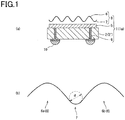
- FIG. 1 is a cross-sectional view illustrating an exemplary configuration of the solid-state imaging device according to a first embodiment. More specifically, FIG. 1(a) is a cross-sectional view illustrating an exemplary configuration of the entire solid-state imaging device according to the first embodiment, and FIG. 1(b) is an enlarged view of an exemplary configuration of the micro lens according to the first embodiment.
- a solid-state imaging device 1(1a) includes a semiconductor substrate (substrate) 2 and a lens module 8 formed on one surface (an upper surface in FIG. 1(a) ) side of the semiconductor substrate 2.
- the lens module 8 has a plurality of micro lenses 6 and a plurality of concave lenses 7 respectively arranged at a fixed interval in a longitudinal direction and a lateral direction in plan view.
- Each of the plurality of micro lenses 6 has a convex shape that protrudes from a surface (the upper surface in FIGs.
- Each of the plurality of concave lenses 7 assumes a concave shape that recesses from the surface of the lens module 8 toward one surface of the semiconductor substrate 2.
- Each of the plurality of concave lenses 7 is located at a boundary between adjacent microlenses 6 of the plurality of microlenses 6.
- a large number of photoelectric transducers are formed on one surface of the semiconductor substrate 2.
- a photodiode is illustrated as a photoelectric transducer.
- a CMOS or CCD is illustrated as a system for transferring photoelectrically converted charges.
- a color separation filter hereinafter also simply referred to as a "color filter”
- a condensing micro lens 6 are formed on one surface of the semiconductor substrate 2. The large number of photoelectric transducers are covered by the color filter 5 and the condensing microlens 6.
- one colored layer (a layer colored in one of the three colors of green (G), blue (B), and red (R)) of the color filter 5 is disposed above one photoelectric transducer, and one microlens 6 is disposed thereabove. This combination forms one pixel.
- FIG. 1(a) shows the color filter 5 and omits the photoelectric transducer underneath
- the solid-state imaging device la in the present specification includes the semiconductor substrate 2, the plurality of photoelectric transducers, the color filter 5, and the lens module 8.
- a through-hole is provided in the semiconductor substrate 2, the through-hole extending from one surface thereof to another surface (the lower surface in FIG. 1(a) ). Filling the through-hole with a conductive material or covering an inner wall thereof forms a through-hole electrode 9. On another surface of the semiconductor substrate 2, a BGA type connection bump 10 is formed.
- connection bump 10 is also referred to as an external connection pad.
- a single through-hole electrode 9 is electrically connected to a single connection bump 10.
- An electrical signal of an image information captured by the solid-state imaging device la passes through an electrode (not shown) formed on the one surface of the semiconductor substrate 2 and the through-hole electrode 9 to be guided to a rear surface of the semiconductor substrate 2 before being output to an external circuit or the like via the connection bump 10.
- a light-shielding electroless plating layer for preventing flare may be applied on a side wall of the lens module 8.
- the light-shielding electroless plating layer include a single plating layer of metal selected from nickel, chromium, cobalt, iron, copper, gold and others and an electroless plating layer of an alloy selected from combinations of nickel-iron, cobalt-iron, copper-iron, etc.
- a metal light-shielding layer having a low optical reflectance on the surface is also possible, the layer being produced by electrolessly depositing copper and other metal, followed by applying a chemical treatment or an oxidation treatment to its surface, to form a metal compound.
- a plurality of microlenses 6 and a plurality of concave lenses 7 are collectively formed by a photolithography method by use of a gray-tone mask 50, which will be described later. This point will be described in detail as an example in the present specification.
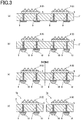
- FIGs. 2(a) to 3(d) are cross-sectional views illustrating a method of manufacturing the solid-state imaging device 1a according to Reference Example 1-1 of in the order of the manufacturing process.
- a silicon wafer 2' having a 0.75-mm thickness and a 20-cm diameter was prepared as shown in FIG. 2(a) .
- the silicon wafer 2' was a pre-separated silicon substrate.
- a photoelectric transducer, a light-shielding film, and a passivation film were formed on one surface (the upper surface in FIGs. 2 and 3 ) of the silicon wafer 2' and a flattening layer is form on a top layer by spin-coating a thermosetting acrylic resin coating solution.
- G, B, and R color filters 5 were subsequently formed on the flattening layer, each of which was formed by carrying out a photolithography method. Note that illustration of the photoelectric transducer and the flattening layer is omitted in FIG. 2(a) .
- Colorant used for a green resist was, for example, C.I. Pigment Yellow 139, C.I. Pigment Green 36, and C.I. Pigment Blue 15:6. Furthermore, a color resist to which an organic solvent such as cyclohexanone and PGMEA, a polymer varnish, a monomer, and an initiator were added was also used.
- Colorant used for a blue resist was, for example, C.I. Pigment Blue 15:6 and C.I. Pigment Violet 23. Furthermore, a color resist to which an organic solvent such as cyclohexanone and PGMEA, a polymer varnish, a monomer, and an initiator were added was also used.
- Colorant used for a red resist was C.I. Pigment Red 117, C.I. Pigment Red 48:1, and C.I. Pigment Yellow 139.
- a composition other than the colorant was similar to that of the green resist.
- the arrangement of colored pixels was a so-called Bayer arrangement, an arrangement in which a G (green) filter was provided at every other pixel and an R (red) filter and a B (blue) filter were provided on every other line between the G filters.
- a photosensitive microlens material 11 was then formed on the one surface of the silicon wafer 2' to cover the color filters 5.
- the photosensitive microlens material 11 was formed on the color filter 5 by application of a 1- ⁇ m thin styrene resin that was alkali-soluble, photosensitive, and thermally reflowable.
- Reference Example 1-1 is an example in which the lens module 8 shown in FIGs. 1(a) and 1(b) consists of photosensitive micro lens material 11.
- the photosensitive micro lens material 11 was a photosensitive transparent resin of a positive type.
- the photosensitive microlens material 11 was then exposed to light as shown in FIG. 2(c) .
- a gray-tone mask 50 a special exposure mask, was used here because a convex shape of the microlens 6 and a concave shape of a concave lens 7 were controlled by an exposure method.
- the photosensitive microlens material 11 was heat-treated at 250°C to form the micro lenses 6 after being patterned through an ultraviolet-ray (i-ray) photolithographing process by use of the gray-tone mask 50.
- the microlens 6 assumed a gentle semi-parabolic shape that was approximately 0.6 ⁇ m thick.
- the concave lens 7 that was present between adjacent microlenses 6 had a 0.3- ⁇ m concave curvature diameter d (see FIG. 1(b) ).
- the gray-tone mask 50 is a light-shielding film formed on a quartz substrate, the light-shielding film having high transmittance in a part corresponding to a thin part of a lens element to be formed. That is, a mask with a gradation of shades on the light-shielding film was used. The shading of this gradation is achieved by a partial difference of a number of small diameter dots per unit area (density), dots that are not resolved by exposure light.
- the solid-state imaging device 1a multi-layered on a silicon wafer 2' as shown in FIG. 2(d) was prepared.
- a photoresist was then applied onto a rear surface of the silicon wafer 2' described above to form an opening at a site where the through-hole electrode 9 should be formed by a standard photolithography method.
- the silicon wafer 2' was reactive-ion-etched to a predetermined depth by use of the photoresist film as a mask to form a through-hole.
- An SiO 2 -insulating film was then formed on an inner wall, a bottom, and a whole rear surface of the through-hole by a CVD method to insulate the silicon wafer 2' from a wiring layer that will be formed later.
- the insulating film was formed to be thinner at the bottom of the through-hole (a part on a front surface of the silicon wafer 2' where a pad made of a highly conductive metal such as aluminum was formed) than at a rear surface of the silicon wafer 2'.
- the silicon wafer 2' was then reactive-ion-etched once again to remove the insulating film at the bottom of the through-hole.
- a conductive film was subsequently formed by a sputtering method to bury the through-hole and form the wiring layer on the rear surface of the silicon wafer 2'.
- the through-hole electrode 9 was formed as shown in FIG. 3(a) .
- a cutting groove was then formed from a surface by use of a dicing device with a 450-meshed resin blade along an intermediate part of the solid-state imaging device la multi-faced in a matrix form.
- Each solid-state imaging device 1a was thereafter separated to produce a finished product as shown in FIG. 3(d) .
- FIG. 4(a) shows an atomic force microscope (AFM) profile of a cross section in an X direction of the microlens 6 produced in Reference Example 1-1 and an AFM profile of a cross section in an X direction of a conventional microlens, these profiles being overlapped with each other.
- FIG. 4(b) shows an AFM profile of a diagonal cross section in an XY direction of the microlens 6 produced in Reference Example 1-1 and an AFM profile of a diagonal cross section in an XY direction of a conventional microlens, these profiles being overlapped with each other.
- FIG. 4(c) shows a relation between the X direction and the XY direction in a plan view.
- valleys having V-shapes 7a and 7c which are indicated by a solid line, are formed between adjacent microlenses 6.
- concave shapes 7b and 7d are formed between adjacent micro lenses 6 in Reference Example 1-1.
- FIGs. 5(a) to 6(e) are cross-sectional views illustrating a method of manufacturing the solid-state imaging device 1a according to Reference Example 1-2 in the order of the manufacturing process.
- a silicon wafer 2' having a 0.75-mm thickness and a 20-cm diameter was prepared as shown in FIG. 5(a) .
- a description on the silicon wafer 2' will be omitted here because it is identical to the silicon wafer 2' described in Reference Example 1-1.
- an acrylic resin liquid was applied on one surface of the silicon wafer 2' to form a 1- ⁇ m thick transparent resin layer 12, before heating the transparent resin layer 12 at 180°C for 3 minutes for hardening, the acrylic resin liquid having a benzene ring that is introduced into a resin skeleton and being applied such that the liquid will cover the color filter 5.
- an alkali-soluble, photosensitive, and thermal reflowable styrene resin was applied on the hardened transparent resin layer 12 to form a photosensitive sacrificial layer 13.
- the photosensitive sacrificial layer 13 was then patterned through a photolithographing process by use of a KrF laser that uses the gray-tone mask 50 before being heat-treated at 250°C to form a lens mold 13a at a 0.1 ⁇ m thermally flowed lens pitch by on one side.
- the lens mold 13a was gently semi-parabolic and approximately 0.7 ⁇ m thick.
- a concave lens 7 that was present between adjacent lens molds 13a had a 0.2- ⁇ m concave curvature diameter d.
- the photosensitive sacrificial layer 13 was dry-etched by use of a mixed gas of fluorocarbon gases CF 4 and C 3 F 8 before a pattern of the lens mold 13a was transferred to the transparent resin layer 12, which was made of an acrylic resin, to form a microlens 6.
- the microlens 6 was approximately 0.6 ⁇ m high, being lower than the lens mold 13a.
- the dry etching process was carried out for 5 minutes.
- the microlens 6 was gently semi-parabolic and approximately 0.6 ⁇ m thick.
- the concave lens 7 that was present between adjacent microlenses 6 had a 0.2- ⁇ m concave curvature diameter d (see FIG. 1(b) ).
- using the KrF laser makes it possible to control the concave curvature diameter d in the concave lens 7 (see FIG. 1 ) within a range from 120 nm to 248 nm by virtue of a wavelength limit resolution of the KrF laser.
- the solid-state imaging device 1a multi-layered on the silicon wafer 2' was produced as shown in FIG. 6(a) .
- a through-hole was then formed as in Reference Example 1-1.
- a wiring layer was then formed as in Reference Example 1-1.
- the through-hole electrode 9 shown in FIG. 6(b) was formed.
- a solder ball was then mounted to remove residual flux as in Reference Example 1-1.
- the solid-state imaging device substrate having the connection bump 10 shown in FIG. 6(c) was produced.
- the solid-state imaging device substrate was then diced along the cutting line shown in FIG. 6(d) as in Reference Example 1-1.
- the solid-state imaging device substrate was thus separated into individual solid-state imaging devices 1a and to produce a finished product shown in FIG. 6(e) , as in Reference Example 1-1.
- solid-state imaging device 1a and the method of manufacturing the same according to the present embodiment As a reference example of the solid-state imaging device 1a and the method of manufacturing the same according to the present embodiment, a brief description will be given below on a solid-state imaging device and a method of manufacturing the same that do not have a technical characteristic possessed by the solid-state imaging device 1a and the method of manufacturing the same according to the present embodiment.
- An electrical signal of image information retrieved by the solid-state imaging device is guided to a rear surface of a silicon wafer by a conductive material that fills a through-hole formed in the silicon wafer or coats an inner wall thereof.
- the electrical signal can be output to, for example, an external circuit board through a ball grid array (BGA) connecting terminal.
- BGA ball grid array
- a camera module is produced through a process of: preparing a silicon wafer having a diameter of 20 to 30 cm, which is prepared through a glass plate formation process, and a glass plate also having a diameter of 20 to 30 cm, which is prepared through a wafer formation process, and then aligning and laminating the wafer and plate until eventually cutting the laminate into individual camera modules through a dicing process.
- the silicon wafer in the camera module measures 3 mm square; hence approximately 3500 to 4300 camera modules can be formed from a single wafer having a 20-cm diameter.
- inter-lens gap A gap between the adjacent lenses (hereinafter referred to as an "inter-lens gap”) needs to be close to zero to improve condensing efficiency on the solid-state imaging device.
- the inter-lens gap is zero, however, the adjacent microlenses are bonded together, generally making it difficult to control a shape of the inter-lens gap with one nanometer accuracy.
- incident light that enters from the inter-lens gap creates cross-talk between adjacent pixels, which may on occasions deteriorate a condensing efficiency of the microlens.
- Patent Literatures 1 to 3 A proposed solution to these problems is to form a concave lens between adjacent lenses to also collect incident light between the lenses.
- Patent Literatures 1 to 3 contain a description on forming a concave lens between microlenses while forming the microlenses by a thermal flow method or an etching method. These manufacturing methods, however, may on occasions prevent use of a highly heat-resistant microlens material because the material that constitutes the microlens (hereinafter referred to as microlens material) needs to be thermally flowable. In addition, these methods may on occasions increase manufacturing cost due to requirement of a plurality of patterning masks and other processing jigs for patterning on a base material of the microlens several times before thermal flow.
- a solid-state imaging device 1(1b) according to a second embodiment of the present invention is configured almost identically to the solid-state imaging device 1a according to the first (reference) embodiment, but is different in having a concave lens 7 whose curvature radius r is 100 nm or less.
- the configuration of the solid-state imaging device 1b according to the present embodiment will be described in detail below.
- the solid-state imaging device 1b includes a semiconductor substrate 2, a plurality of photoelectric transducers 3, a flattening layer 4, a plurality of color filters 5, and a plurality of microlenses 6.
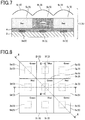
- FIG. 7 is a view taken along the arrow I-I in FIG. 8 .
- FIG. 8 for better understanding of how the plurality of photoelectric transducers 3 (3a to 3i) and the plurality of color filters 5 (5a to 5i) are arranged, other configurations in the solid-state imaging device 1b are omitted. As shown in FIG.
- the solid-state imaging device 1b is formed by a lamination of the plurality of photoelectric transducers 3, the flattening layer 4, the color filter layer constituted by the plurality of color filters 5, and the micro lens layer constituted by the plurality of microlenses 6, these components being stacked on the semiconductor substrate 2 in the stated order. Note that this configuration is identical to that of the solid-state imaging device 1a according to the first (reference) embodiment described above.
- the semiconductor substrate 2 is a substrate for mounting the photoelectric transducer 3.
- the plurality of photoelectric transducers 3 convert light incident through the microlens 6 into an electrical charge.
- the plurality of photoelectric transducers 3 are arranged in a two-dimensional square lattice pattern with the plurality of photoelectric transducers 3 being arranged in parallel in a vertical and horizontal direction of FIG. 8 .
- the example shown in FIG. 8 shows a part of the solid-state imaging device lb, where nine photoelectric transducers 3a to 3i are arranged in the square lattice pattern.
- the flattening layer 4 flattens an upper surface (a surface facing upward in FIG. 7 ) of the semiconductor substrate 2, a surface on which the microlenses 6 are mounted.
- the plurality of color filters 5 are respectively formed on the plurality of photoelectric transducers 3 via the flattening layer 4.
- the plurality of color filters 5 act to transmit light of a particular wavelength in light incident on the photoelectric transducer 3.
- the plurality of color filters 5 are arranged in the two-dimensional square lattice pattern on the semiconductor substrate 2 because they are formed corresponding to the plurality of photoelectric transducers 3 arranged in the two-dimensional square lattice pattern in a ratio of 1:1.
- the plurality of color filters 5 in the present embodiment are color filters that transmit one of three colors red (R), green (G), and blue (B), and where these colors are Bayer-arranged. For example, in the example shown in FIG.
- the color filters 5a to 5i are respectively provided in correspondence with the nine photoelectric transducers 3a to 3i.
- the color filters 5a to 5c, 5g and 5h transmit green light
- the color filters 5d and 5e transmit red light
- the color filters 5f and 5i transmit blue light.
- the plurality of microlenses 6 are respectively formed on the plurality of color filters 5.
- the plurality of microlenses 6 are each made of a resin that is usually made of, for example, an acrylic resin that is preferably transparent.
- the plurality of microlenses 6 have a parabolic surface in a cross section parallel to a thickness direction of the semiconductor substrate 2 as shown in FIG. 7 , but may have an arc-like or sinusoidal surface.
- the plurality of microfilters 6 are arranged in the two-dimensional square lattice pattern on the semiconductor substrate 2 because they are formed corresponding to the plurality of color filters 5 arranged in the two-dimensional square lattice pattern in a ratio of 1:1.
- the plurality of microlenses 6 are connected to each other on lower sides of adjacent ones.
- a valley between the plurality of microlenses 6 in a lateral cross section and a 45-degree cross section has a curvature radius of 100 nm or less.
- the term "lateral cross section” here refers to a cross section in a plane parallel to a direction of the plurality of microlenses 6 arranged in the two-dimensional square lattice pattern (the vertical or horizontal direction in FIG. 8 ) and parallel to a thickness direction of the semiconductor substrate 2 (a direction that is longitudinal relative to the drawing plane of FIG. 8 ), a cross section exemplified in FIG. 7 .
- the 45-degree cross section is a cross section in a plane parallel to a direction inclined by 45 degrees on the semiconductor substrate 2, a direction relative to the arrangement direction of the plurality of microlenses 6, and parallel to the thickness direction of the semiconductor substrate 2, a cross section shown in FIG. 9 , which is a view taken along the arrow II-II of FIG. 8 .
- the curvature radius of the valley between the plurality of microlenses 6 is a curvature radius at the lowermost point, which is the deepest point of the valley between the adjacent microlenses 6.
- the lowermost point of a valley between a microlens 6d and a microlens 6b is indicated by reference numeral 61
- the curvature radius at the lowermost point 61 is indicated by reference character r, as shown in an enlarged view in FIG. 10 .
- the light incident on the microlens 6 in a vicinity of an adjacency above the blue color (color filter 5f) is influenced by the cross-talk to be redirected to a colored transparent pixel of green (color filter 5b) having a higher refractive index than blue in the color filter layer, for example, as shown in FIG. 11 , which is a view taken along the arrow III-III in FIG. 8 .
- the curvature radius r of the valley between the adjacent microlenses 6 is 100 nm or less, i.e.
- the light incident on the microlens in the vicinity of the adjacency above the blue color mostly passes through the color filter 5f and the flattening layer 4 without being redirected into the photoelectric transducer 3 due to reduced influence of cross-talk, for example, as shown in FIG. 12 , which is also a view taken along the arrow III-III in FIG. 8 .
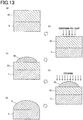
- the first step is to sequentially form a flattening layer 4 (not shown in FIG. 13 ) and a color filter layer that is constituted by a plurality of color filters 5 on a semiconductor substrate 2 (not shown in FIG. 13 ) on which a plurality of photoelectric transducers 3 (a filter formation step).
- a filter formation step three types of color filters 5 each corresponding to any one of R, G, and B are arranged and laminated on a plurality of photoelectric transducers 3 to have a predetermined pattern, for example, as shown in FIG. 8 .
- the filter formation step is followed by the step of forming a plurality of microlenses 6 on the plurality of color filters 5 (a lens formation step).
- a photosensitive transparent resin is firstly applied onto a plurality of color filters 5 with a predetermined thickness to form a transparent resin layer 62, as shown in FIG. 13(a) .
- an upper side that serves as a front surface of the transparent resin layer 62 is exposed, developed and baked by a photolithography method by use of a gray-tone mask (not shown in FIG. 13 ) to form a mold 63 for the microlenses 6.
- the mold 63 for the microlens 6 formed on a layer above the transparent resin layer 62 is transferred by a dry-etching transfer method to an identical transparent resin layer 62, as shown in FIGs. 13(d) and 13(e) .
- the mold 63 can be transferred to a layer below the transparent resin layer 62 at an identical etching rate at this time to form a single microlens layer, which makes it possible to faithfully transfer the mold 63 formed on the upper layer.
- adjusting etching conditions particularly a gas type, a gas pressure, a chamber pressure, and an applied voltage, makes it possible to form a microlens 6 with a narrower valley between adjacent microlenses 6.
- Example 2-1 will be described below.
- Example 2-1 a silicon wafer having a 0.75-mm thickness and a 20-cm diameter was used as a semiconductor substrate 2.
- a photoelectric transducer 3 was formed on an upper part of a surface of the silicon wafer, and a flattening layer 4 was formed on an uppermost layer thereof by spin-coating a thermosetting acrylic resin coating solution.
- a color filter layer constituted by tricolored color filters 5 was sequentially formed on the flattening layer 4 by a photolithography method by use of red (R), green (G), and blue (B) color resists.
- Each color filter layer was 0.5 ⁇ m to 0.8 ⁇ m in thickness.
- the pixel arrangement in the color filter layer was a so-called Bayer arrangement, an arrangement in which a G (green) filter are provided at every other pixel and an R (red) filter and a B (blue) filter were provided on every other line between the G filters.
- an alkali-soluble and photosensitive acrylic transparent resin was coated on the color filter layer with a 1.4- ⁇ m thickness before being heated at 180°C for 3 minutes for hardening.
- An acrylic transparent resin layer 62 was thus formed.
- a mold 63 for a microlens 6 was then formed on the acrylic transparent resin layer 62 by a photolithography method by use of a gray-tone mask.
- the gray-tone mask was a light-shielding film formed on a quartz substrate, a light-shielding film that had high transmittance in a part corresponding to a thin part of a microlens element to be formed and that had a gradation of shades. The shading of this gradation is achieved by a partial difference in density per unit area, a partial difference in the number of small diameter dots that are not resolved by exposure light.
- the gray-tone mask used in Example 2-1 is one that was photomasked so that the mold 63 for the microlens 6 may be parabolic. The mold 63 for the microlens 6 was thus parabolic and 0.6 ⁇ m high.
- the mold 63 for the parabolic microlens 6 was then transferred to the acrylic transparent resin layer 62 underneath by the dry-etching transfer method. At this time, the microlens 6 was dry-etched for two minutes by use of a mixed gas of fluorocarbon gases CF 4 and C 3 F 8 and noble gas Ar until it became 0.45 ⁇ m high.
- Example 2-1 Measuring a shape of the microlens 6 formed in Example 2-1 with a scanning probe microscope confirmed that the microlens 6 formed in Example 2-1 was formed to be parabolic, and a curvature radius r of a valley between adjacent microlenses 6 was 50 nm in a cross sectional direction and 24 nm in a 45-degree cross sectional direction.
- Example 2-1 which is a comparison with Example 2-1, a microlens 6 was formed by a photolithography method by use of a gray-tone mask, the microlens 6 being parabolic and a curvature radius r of the valley therebetween being 124 nm in the cross sectional direction and 74 nm in the 45-degree cross sectional direction.
- the "sensitivity" shown in Table 1 is a numerical value in a case where the sensitivity of the conventional solid-state imaging device (Comparative Example 2-1) is assumed to be 100%.
- the sensitivity of the solid-state imaging device 1b formed in Example 2-1, where the conventional solid-state imaging device is made more sensitive is 105.1% as compared with that of the conventional one.
- Example 2-2 will be described below.
- Example 2-2 a photoelectric transducer 3 was formed on an upper surface part of a silicon wafer, and a flattening layer 4 was formed on an uppermost layer thereof, as in Example 2-1.
- a color filter layer constituted by red (R), green (G), and blue (B) color filters 5 was then formed on the flattening layer 4, as also in Example 2-1.
- a mold 63 for a microlens 6 was then formed on the acrylic transparent resin layer 62 by a photolithography method by use of a gray-tone mask.
- the gray-tone mask used in Example 2-2 was one that is photomasked so that the mold 63 for the microlens 6 may be arc-shaped.
- the mold 63 for the microlens 6 was thus arc-shaped and 0.6 ⁇ m high.
- the mold 63 for the arc-shaped microlens 6 was then transferred to the acrylic transparent resin layer 62 underneath by the dry-etching transfer method, as in Example 2-1.
- Example 2-2 Measuring a shape of the microlens 6 formed in Example 2-2 with a scanning probe microscope confirmed that the microlens 6 formed in Example 2-2 was formed to be arc-shaped, and a curvature radius r of a valley between adjacent microlens 6 was 67 nm in a cross sectional direction and 35 nm in a 45-degree cross sectional direction, as shown in Table 2.
- Example 2-2 which was a comparison with Example 2-2, a microlens 6 was formed by a photolithography method by use of a gray-tone mask, the microlens 6 being arc-shaped and a curvature radius r of a valley therebetween being 158 nm in a cross sectional direction and 87 nm in a 45-degree cross sectional direction.
- the "sensitivity" shown in Table 2 is a numerical value in a case where the sensitivity of the conventional solid-state imaging device (Comparative Example 2-2) is assumed to be 100%.
- the sensitivity of the solid-state imaging device 1(b) formed in Example 2-2, where the conventional solid-state imaging device is made more sensitive is 104.7% as compared with that of the conventional one.
- Example 2-3 a photoelectric transducer 3 was formed on an upper surface part of a silicon wafer, and a flattening layer 4 was formed on an uppermost layer thereof, as in Example 2-1.
- a color filter layer constituted by red (R), green (G), and blue (B) color filters 5 was then formed on the flattening layer 4, as also in Example 2-1.
- a mold 63 for a microlens 6 was then formed on the acrylic transparent resin layer 62 by a photolithography method by use of a gray-tone mask.
- the gray-tone mask used in Example 2-3 is one that is photomasked so that the mold 63 for the microlens 6 may be sinusoidal.
- the mold 63 for the microlens 6 was thus sinusoidal and 0.6 ⁇ m high.
- the mold 63 for the sinusoidal microlens 6 was then transferred to the acrylic transparent resin layer 62 underneath by a dry-etching transfer method, as in Example 2-1.
- Example 2-3 Measuring a shape of the microlens 6 formed in Example 2-3 with a scanning probe microscope confirmed that the microlens 6 was formed to be sinusoidal, and a curvature radius r of a valley between adjacent microlens 6 was 89 nm in a cross sectional direction and 56 nm in a 45-degree cross sectional direction, as shown in Table 3.
- Example 2-3 which is a comparison with Example 2-3, a microlens 6 was formed by a photolithography method by use of a gray-tone mask, the microlens 6 being sinusoidal and a curvature radius r of a valley therebetween being 177 nm in a cross sectional direction and 99 nm in a 45-degree cross sectional direction.
- the "sensitivity” shown in Table 3 is a numerical value in a case where the sensitivity of the conventional solid-state imaging device (Comparative Example 2-3) is assumed to be 100%.
- the sensitivity of the solid-state imaging device 1 b formed in Example 2-3, where the conventional solid-state imaging device is made more sensitive is 103.9% as compared with that of the conventional one.
- [Table 3] Microlens shape Curvature radius [nm] Sensitivity Lateral cross section 45-degree cross section Example 2-3 Sinusoidal 89 56 103.9% Comparative Example 2-3 177 99 100.0%
- solid-state imaging device 1b and the method of manufacturing the same according to the present embodiment As a reference example of the solid-state imaging device 1b and the method of manufacturing the same according to the present embodiment, a brief description will be given below of a solid-state imaging device and a method of manufacturing the same that do not have a technical characteristic possessed by the solid-state imaging device 1b and the method of manufacturing the same according to the present embodiment.
- imaging devices have been widely used as more images are recorded and more content is communicated and broadcast.
- various types of imaging devices that have been proposed, an imaging device having a small, lightweight, and sophisticated solid-state imaging device incorporated are becoming common as digital cameras and digital video, solid-state imaging devices being now stably manufactured.
- the solid-state imaging device has a plurality of photoelectric transducers that receive an optical image from an object and convert incident light into an electrical signal.
- the photoelectric transducers are roughly classified into a charge coupled device (CCD) type and a complementary metal oxide semiconductor (CMOS) type.
- CMOS complementary metal oxide semiconductor
- the photoelectric transducers are also roughly classified into linear sensors (line sensors) and area sensors (surface sensors) in terms of how the photoelectric transducers are arranged, the former having photoelectric transducers arranged in a row, and the latter having photoelectric transducers arranged two-dimensionally (lengthwise and breadthwise).
- a color solid-state imaging device as a single-plate type color sensor is widely used as well, the color solid-state imaging device being capable of retrieving color information of an object with a color filtering function provided in a path of light incident on the photoelectric transducer, the color filtering function allowing light of a particular wavelength to pass through.
- a single pixel constituted by a particular colored transparent pixel is patterned in correspondence to a single photoelectric transducer and numerous patterned pixels are regularly arranged, which enables the color solid-state imaging device to collect chromatically resolved image information.
- the three-primary color system which consists of red (R), green (G), and blue (B), and the complementary color system, which consists of cyan (C), magenta (M), and yellow (Y), are common as a color of the colored transparent pixel.
- the three-primary color system in particular, is widely used.
- One of the important performance issues required of the solid-state imaging device is to improve the sensitivity to incident light.
- Increasing an amount of information on an image captured by a miniaturized solid-state imaging device requires miniaturization of a photoelectric transducer that serves as a light receiver for higher integration. Integrating photoelectric transducers more highly, however, reduces an area of each photoelectric transducer, which in turn leaves a lower area ratio available as a light receiver, so that a smaller amount of light can be taken in by the light receiver of the photoelectric transducer, resulting in deteriorated effective sensitivity.
- Proposed as a means for preventing such a miniaturized solid-state imaging device from being less sensitive is a technique for forming a microlens of a uniform shape on the photoelectric transducer to efficiently collect light to the light receiver of the photoelectric transducer, the microlens condensing light incident from an object and guiding the light to the light receiver. Condensing light with the microlens and guiding the light to the light receiver of the photoelectric transducer can increase an apparent aperture ratio of the light receiver, and in turn make the solid-state imaging device more sensitive.
- a transparent acrylic photosensitive resin that serves as a material of the microlens is selectively patterned by a photolithography method before the lens is shaped by virtue of thermal reflowability of the material.
- a lens mold is formed on a flattening layer of an acrylic transparent resin that serves as a material of the microlens by use of an alkali-soluble, photosensitive, and thermally flowable resist material by the photolithography method and thermal reflow. The shape of the lens mold is then transferred to an acrylic transparent resin layer by a dry-etching method to shape the lens (for example, JP-2014-174456 A ).
- An amount of light that can be taken into a light receiver of a photoelectric transducer from a microlens varies depending on a type and thickness of a layer disposed below the microlens; hence a solid-state imaging device configuration by use of a single microlens shape may possibly cause the device to be less sensitive.
- a large curvature radius of a valley on a lateral cross section between adjacent microlenses and on a 45-degree cross section may on occasions be significantly influenced by a phenomenon called cross-talk, a phenomenon in which a certain amount of light leaks from the valley between the microlenses to an adjacent color filter layer.
- the cross-talk here is a phenomenon in which light that should originally enter a certain color is affected by a difference in a refractive index of a pigment of each color to enter a next color. Under the influence of the cross-talk, a color with a low refractive index loses light to the next color with a higher refractive index, so that the light receiver receives a smaller amount of light, which may cause lowered sensitivity.
- a large curvature radius of the valley on the lateral cross section between the adjacent microlenses and on the 45-degree cross section produces a difference in the curvature radius of a microlens shape between a cross section and a 45-degree cross section of a substantially rectangular pixel in a plan view, which may cause aberration, possibly resulting in lowered light-condensing efficiency.
- a microlens optimally shaped according to each solid-state imaging device and having a narrowed curvature radius of a valley between microlenses can alleviate the influence of cross-talk, which leads to better sensitivity of the solid-state imaging device.
- microlenses which are both based on thermal reflow, can narrow the curvature radius of the valley between the microlenses, but have difficulty in processing the microlenses to an optimum shape.
Landscapes
- Physics & Mathematics (AREA)
- General Physics & Mathematics (AREA)
- Optics & Photonics (AREA)
- Engineering & Computer Science (AREA)
- Manufacturing & Machinery (AREA)
- Chemical & Material Sciences (AREA)
- Crystallography & Structural Chemistry (AREA)
- Solid State Image Pick-Up Elements (AREA)
- Transforming Light Signals Into Electric Signals (AREA)
- Exposure And Positioning Against Photoresist Photosensitive Materials (AREA)
- Electromagnetism (AREA)
- Multimedia (AREA)
- Signal Processing (AREA)
Claims (11)
- Festkörperabbildungsvorrichtung (1, 1a, 1b), die folgendes umfasst:ein Substrat (2);mehrere Mikrolinsen (6, 6a-6f), die auf einer Oberfläche des Substrats (2) gebildet sind; undmindestens eine Konkavlinse (7), die an einer Grenze zwischen mehreren benachbarten Mikrolinsen (6, 6a-6f) gebildet ist und in Richtung der einen Oberfläche des Substrats (2) vertieft ist,dadurch gekennzeichnet, dassdie Konkavlinsen (7) in einem zweidimensionalen Quadratgittermuster angeordnet sind unddie Konkavlinsen (7) jeweils einen Krümmungsradius (r) von 100 nm oder weniger in einem seitlichen Querschnitt parallel zu der Richtung, in der die Konkavlinsen (7) angeordnet sind, und parallel zu der Dickenrichtung des Substrats (2), und in einem 45 Grad-Querschnitt parallel zu der um 45 Grad geneigten Richtung auf dem Substrat (2) relativ zu der Richtung, in der die Konkavlinsen (7) angeordnet sind, und parallel zu der Dickenrichtung des Substrats (2) haben.
- Festkörperabbildungsvorrichtung (1, 1a, 1b) gemäß Anspruch 1, dadurch gekennzeichnet, dass sie ferner folgendes umfasst:mehrere fotoelektrische Transducer (3, 3a-3e), die auf dem Substrat (2) in einem zweidimensionalen Quadratgittermuster gebildet sind; undmehrere Farbfilter (5, 5a-5i), die jeweils auf den mehreren fotoelektrischen Transducern (3, 3a-3e) gebildet sind,wobei die mehreren Mikrolinsen (6, 6a-6f) jeweils auf den mehreren Farbfiltern (5, 5a-5i) gebildet sind undein Tal zwischen den mehreren Mikrolinsen (6, 6a-6f) einen Krümmungsradius (r) von 100 nm oder weniger in einem seitlichen Querschnitt parallel zu der Richtung, in der die mehreren Mikrolinsen (6, 6a-6f) angeordnet sind, und parallel zu der Dickenrichtung des Substrats (2) und in einem 45 Grad-Querschnitt parallel zu einer Richtung, die auf dem Substrat (2) um 45 Grad geneigt ist, relativ zu einer Richtung, in der die mehreren Mikrolinsen (6, 6a-6f) angeordnet sind, und parallel zu der Dickenrichtung des Substrats (2) haben.
- Festkörperabbildungsvorrichtung (1, 1a, 1b) gemäß einem der Ansprüche 1 und 2, dadurch gekennzeichnet, dass die mehreren Mikrolinsen (6, 6a-6f) ein beliebiges Profil von einem Bogen, einer Parabel und einer Sinuswelle in einem Querschnitt parallel zu einer Dickenrichtung des Substrats (2) einnehmen.
- Verfahren zur Herstellung einer Festkörperabbildungsvorrichtung (1, 1a, 1b), die folgendes umfasst:ein Substrat (2);mehrere Mikrolinsen (6, 6a-6f), die auf einer Oberflächenseite des Substrats (2) gebildet sind; undmindestens eine Konkavlinse (7), die an einer Grenze zwischen mehreren benachbarten Mikrolinsen (6, 6a-6f) gebildet ist und in Richtung der einen Oberfläche des Substrats (2) vertieft ist, wobei das Verfahren die Schritte umfasst, dassdie Mikrolinsen (6, 6a-6f) und die Konkavlinsen (7) gemeinsam mit einem Fotolithographieverfahren unter Verwendung einer Grautonmaske (50) gebildet werden,dadurch gekennzeichnet, dassein Tal zwischen den mehreren Mikrolinsen (6, 6a-6f) so kontrolliert wird, dass es einen Krümmungsradius (r) von 100 nm oder weniger in seitlichem Querschnitt parallel zu der Richtung, in der die mehreren Mikrolinsen (6, 6a-6f) angeordnet sind, und parallel zu der Dickenrichtung des Substrats (2) und in einem 45 Grad-Querschnitt parallel zu der auf dem Substrat (2) um 45 Grad geneigten Richtung relativ zu der Richtung, in der die mehreren Mikrolinsen (6, 6a-6f) angeordnet sind und parallel zu der Dickenrichtung des Substrats (2) hat, wenn die Form (13a) für die mehreren Mikrolinsen in dem Linsenbildungsschritt auf eine untere Schicht transferiert wird.
- Verfahren zur Herstellung einer Festkörperabbildungsvorrichtung (1, 1a, 1b) gemäß Anspruch 4, dadurch gekennzeichnet, dass es ferner den Schritt der Bildung eines fotoelektrischen Tranducers (3, 3-3e) auf einer Oberfläche des Substrats (2) vor dem Linsenbildungsschritt umfasst.
- Verfahren zur Herstellung einer Festkörperabbildungsvorrichtung (1, 1a, 1b) gemäß Anspruch 4 oder 5, dadurch gekennzeichnet, dass der Linsenbildungsschritt die folgenden Schritte einschließt:Bereitstellen eines fotoempfindlichen Mikrolinsenmaterials (11) auf einer Seite des Substrats (2); undStrukturieren des fotoempfindlichen Mikrolinsenmaterials (11) mit dem Fotolithographieverfahren unter Verwendung der Grautonmaske (50), um die Mikrolinsen (6, 6a-6f) und die Konkavlinsen (7) gemeinsam zu bilden.
- Verfahren zur Herstellung einer Festkörperabbildungsvorrichtung (1, 1a, 1b) gemäß Anspruch 4 oder 5, dadurch gekennzeichnet, dass der Linsenbildungsschritt die folgenden Schritte einschließt:Bilden einer transparenten Harzschicht (12, 62) auf einer Oberfläche des Substrats (2);Bilden einer fotoempfindlichen Opferschicht (13) auf der transparenten Harzschicht (12, 62);Strukturieren der fotoempfindlichen Opferschicht (13) mit dem Fotolithographieverfahren unter Verwendung der Grautonmaske (50), um eine Form (13a) für die Mikrolinsen zu bilden; undÄtzen der Mikrolinsenform (13a) und der transparenten Harzschicht (12, 62) von oberhalb der Form (13a) für die Mikrolinsen, um die Mikrolinsen (6, 6a-6f) und die Konkavlinsen (7) gemeinsam auf die transparente Harzschicht (12, 62) zu transferieren.
- Verfahren zur Herstellung einer Festkörperabbildungsvorrichtung (1, 1a, 1b) gemäß Anspruch 5, dadurch gekennzeichnet, dass es ferner den Schritt umfasst, dass
nach dem Schritt der Bildung des fotoelektrischen Transducers und vor dem Linsenbildungsschritt mehrere Farbfilter (5, 5a-5i) auf den mehreren fotoelektrischen Transducern (3, 3a-3e) gebildet werden, wobei
in dem Schritt der Bildung des fotoelektrischen Transducers (3, 3a-3e) die mehreren fotoelektrischen Transducer (3, 3a-3e) in einem zweidimensionalen Quadratgittermuster auf dem Substrat (2) angeordnet werden; und
die mehreren Mikrolinsen (6, 6a-6f) auf den mehreren Farbfiltern (5, 5a-5i) gebildet werden, indem eine transparente Harzschicht (12, 62) auf den mehreren Farbfiltern gebildet wird, eine Form (13a) für die mehreren Mikrolinsen auf einer oberen Schicht, die als eine Vorderseite der transparenten Harzschicht dient, mit einem Fotolithographieverfahren unter Verwendung einer Grautonmaske (50) gebildet wird, und die Form (13a) für die mehreren Mikrolinsen mit einem Trockenätz-Transferverfahren auf eine untere Schicht der transparenten Harzschicht (12, 62) transferiert wird. - Verfahren zur Herstellung einer Festkörperabbildungsvorrichtung (1, 1a, 1b) gemäß Anspruch 7 oder 8, dadurch gekennzeichnet, dass ein Profil der Form (13a) für die mehreren Mikrolinsen (6, 6a-6f) kontrolliert wird, indem die Form für die mehreren Mikrolinsen in dem Linsenbildungsschritt mit dem Fotolithographieverfahren gebildet wird.
- Verfahren zur Herstellung einer Festkörperabbildungsvorrichtung (1, 1a, 1b) gemäß mindestens einem der Ansprüche 7 bis 9, dadurch gekennzeichnet, dass in dem Linsenbildungsschritt die Oberseite der mehreren Mikrolinsen (6, 6a-6f) mit dem Fotolithographieverfahren und die Unterseite der mehreren Mikrolinsen (6, 6a-6f) mit einem Trockenätz-Transferverfahren gebildet werden.
- Verfahren zur Herstellung einer Festkörperabbildungsvorrichtung (1, 1a, 1b) gemäß mindestens einem der Ansprüche 4 bis 10, dadurch gekennzeichnet, dass zum Zeitpunkt der Ausführung des Fotolithographieverfahrens i-Strahlung oder KrF-Laser verwendet wird, wobei die i-Strahlung oder der KrF-Laser Ultraviolettlicht ist.
Applications Claiming Priority (3)
| Application Number | Priority Date | Filing Date | Title |
|---|---|---|---|
| JP2015222937 | 2015-11-13 | ||
| JP2016063186 | 2016-03-28 | ||
| PCT/JP2016/083725 WO2017082429A1 (ja) | 2015-11-13 | 2016-11-14 | 固体撮像素子及びその製造方法 |
Publications (3)
| Publication Number | Publication Date |
|---|---|
| EP3376542A1 EP3376542A1 (de) | 2018-09-19 |
| EP3376542A4 EP3376542A4 (de) | 2019-06-26 |
| EP3376542B1 true EP3376542B1 (de) | 2020-12-23 |
Family
ID=58695560
Family Applications (1)
| Application Number | Title | Priority Date | Filing Date |
|---|---|---|---|
| EP16864390.6A Active EP3376542B1 (de) | 2015-11-13 | 2016-11-14 | Festkörperabbildungselement und verfahren zur herstellung davon |
Country Status (7)
| Country | Link |
|---|---|
| US (1) | US10986293B2 (de) |
| EP (1) | EP3376542B1 (de) |
| JP (1) | JPWO2017082429A1 (de) |
| KR (1) | KR102626696B1 (de) |
| CN (1) | CN108352390B (de) |
| TW (1) | TWI734716B (de) |
| WO (1) | WO2017082429A1 (de) |
Families Citing this family (12)
| Publication number | Priority date | Publication date | Assignee | Title |
|---|---|---|---|---|
| JP6681909B2 (ja) * | 2015-09-30 | 2020-04-15 | 富士フイルム株式会社 | パターン形成方法、及び、感活性光線性又は感放射線性樹脂組成物 |
| US10714520B1 (en) * | 2017-08-04 | 2020-07-14 | Facebook Technologies, Llc | Manufacturing an on-chip microlens array |
| JP7098912B2 (ja) * | 2017-11-10 | 2022-07-12 | 凸版印刷株式会社 | 固体撮像素子及びその製造方法 |
| CN111492271B (zh) * | 2017-12-29 | 2022-06-14 | 索尼半导体解决方案公司 | 发光模块、显示装置以及制造发光模块和显示装置的方法 |
| CN109856708B (zh) * | 2018-12-30 | 2021-07-30 | 瑞声光学解决方案私人有限公司 | 镜片消光工艺 |
| JP7750094B2 (ja) * | 2019-11-20 | 2025-10-07 | Toppanホールディングス株式会社 | 固体撮像素子及びその製造方法 |
| TWI714445B (zh) * | 2020-01-22 | 2020-12-21 | 力晶積成電子製造股份有限公司 | 微透鏡結構及其製造方法 |
| FI130664B1 (fi) | 2021-05-17 | 2024-01-09 | Dispelix Oy | Menetelmä porrastetun hilan valmistamiseksi |
| CN115469437A (zh) | 2021-06-10 | 2022-12-13 | 大立光电股份有限公司 | 相机模块及电子装置 |
| CN216900993U (zh) * | 2021-06-10 | 2022-07-05 | 大立光电股份有限公司 | 相机模块、电子装置与车辆工具 |
| KR102983815B1 (ko) * | 2021-09-06 | 2026-06-26 | 삼성전자주식회사 | MPC(Mask Process Correction) 방법 및 이를 이용한 리소그래피 마스크 제조 방법 |
| WO2024182166A1 (en) * | 2023-02-27 | 2024-09-06 | Applied Materials, Inc. | Method to modify an optical device resist |
Family Cites Families (10)
| Publication number | Priority date | Publication date | Assignee | Title |
|---|---|---|---|---|
| JP2000260970A (ja) | 1999-03-12 | 2000-09-22 | Toppan Printing Co Ltd | 固体撮像素子およびその製造方法 |
| JP2000260969A (ja) | 1999-03-12 | 2000-09-22 | Toppan Printing Co Ltd | 固体撮像素子の製造方法 |
| JP2006165162A (ja) | 2004-12-06 | 2006-06-22 | Nikon Corp | 固体撮像素子 |
| JP4212605B2 (ja) * | 2006-05-12 | 2009-01-21 | シャープ株式会社 | 撮像素子および撮像素子の製造方法 |
| US20080011936A1 (en) | 2006-07-14 | 2008-01-17 | Visera Technologies Company Ltd, Roc | Imaging sensor having microlenses of different radii of curvature |
| JP2009031399A (ja) * | 2007-07-25 | 2009-02-12 | Toppan Printing Co Ltd | マイクロレンズ |
| EP2510399A4 (de) * | 2009-12-11 | 2014-01-22 | Fujifilm Corp | Schwarze härtbare zusammensetzung, lichtabschirmender farbfilter, lichtabschirmender film und verfahren zu ihrer herstellung sowie wafer-linse und festkörperabbildungsvorrichtung damit |
| JP2012099639A (ja) * | 2010-11-02 | 2012-05-24 | Toppan Printing Co Ltd | イメージセンサ及びイメージセンサの製造方法 |
| WO2014104913A1 (en) * | 2012-12-27 | 2014-07-03 | Optogan New Technologies Of Light Llc | Module with light-emitting diodes |
| JP6012692B2 (ja) * | 2014-01-27 | 2016-10-25 | キヤノン株式会社 | マイクロレンズアレイの形成方法および固体撮像装置の製造方法 |
-
2016
- 2016-11-14 KR KR1020187012804A patent/KR102626696B1/ko active Active
- 2016-11-14 WO PCT/JP2016/083725 patent/WO2017082429A1/ja not_active Ceased
- 2016-11-14 TW TW105137076A patent/TWI734716B/zh active
- 2016-11-14 EP EP16864390.6A patent/EP3376542B1/de active Active
- 2016-11-14 JP JP2017550436A patent/JPWO2017082429A1/ja active Pending
- 2016-11-14 CN CN201680065440.2A patent/CN108352390B/zh active Active
-
2018
- 2018-05-11 US US15/976,992 patent/US10986293B2/en active Active
Non-Patent Citations (1)
| Title |
|---|
| None * |
Also Published As
| Publication number | Publication date |
|---|---|
| US20180269247A1 (en) | 2018-09-20 |
| CN108352390B (zh) | 2023-01-13 |
| KR20180084768A (ko) | 2018-07-25 |
| TW201724479A (zh) | 2017-07-01 |
| US10986293B2 (en) | 2021-04-20 |
| KR102626696B1 (ko) | 2024-01-19 |
| WO2017082429A1 (ja) | 2017-05-18 |
| EP3376542A1 (de) | 2018-09-19 |
| JPWO2017082429A1 (ja) | 2018-09-06 |
| EP3376542A4 (de) | 2019-06-26 |
| TWI734716B (zh) | 2021-08-01 |
| CN108352390A (zh) | 2018-07-31 |
Similar Documents
| Publication | Publication Date | Title |
|---|---|---|
| US10986293B2 (en) | Solid-state imaging device including microlenses on a substrate and method of manufacturing the same | |
| US7683302B2 (en) | Solid-state imaging device having on-chip color filter layers and solid-state imaging device manufacturing method of the solid-state imaging device | |
| KR102316075B1 (ko) | 고체 촬상 소자 및 고체 촬상 소자의 제조 방법, 전자 기기 | |
| US7683961B2 (en) | CMOS image sensor using gradient index chip scale lenses | |
| JP5324890B2 (ja) | カメラモジュールおよびその製造方法 | |
| US7459665B2 (en) | Solid-state image sensor with transparent film on micro-lenses by which oblique light is refracted towards light receiving elements | |
| KR102684014B1 (ko) | 솔리드-스테이트 이미지 센서 | |
| JP2011171328A (ja) | 固体撮像素子およびその製造方法 | |
| US20050045805A1 (en) | Solid-state image sensor and a manufacturing method thereof | |
| JP4181487B2 (ja) | 固体撮像装置とその製造方法 | |
| US7535043B2 (en) | Solid-state image sensor, method of manufacturing the same, and camera | |
| JP2017092302A (ja) | 固体撮像素子および固体撮像素子の製造方法 | |
| JP4957564B2 (ja) | 固体撮像素子およびそれを用いた撮像装置 | |
| JP2012099639A (ja) | イメージセンサ及びイメージセンサの製造方法 | |
| JP6911353B2 (ja) | 固体撮像素子の製造方法 | |
| US7964432B2 (en) | Method of manufacturing lenses, in particular for an integrated imager | |
| JP2011165791A (ja) | 固体撮像素子およびその製造方法 | |
| JP2011165923A (ja) | カラー固体撮像素子およびその製造方法 | |
| JP2009170585A (ja) | 固体撮像装置 | |
| JP5446374B2 (ja) | 固体撮像素子及びその製造方法 | |
| JP2006216904A (ja) | カラー固体撮像素子及びその製造方法 | |
| JP2017191215A (ja) | イメージセンサの製造方法 | |
| KR100945869B1 (ko) | Cmos이미지 센서의 마이크로 렌즈 및 그 제조 방법 |
Legal Events
| Date | Code | Title | Description |
|---|---|---|---|
| STAA | Information on the status of an ep patent application or granted ep patent |
Free format text: STATUS: THE INTERNATIONAL PUBLICATION HAS BEEN MADE |
|
| PUAI | Public reference made under article 153(3) epc to a published international application that has entered the european phase |
Free format text: ORIGINAL CODE: 0009012 |
|
| STAA | Information on the status of an ep patent application or granted ep patent |
Free format text: STATUS: REQUEST FOR EXAMINATION WAS MADE |
|
| 17P | Request for examination filed |
Effective date: 20180426 |
|
| AK | Designated contracting states |
Kind code of ref document: A1 Designated state(s): AL AT BE BG CH CY CZ DE DK EE ES FI FR GB GR HR HU IE IS IT LI LT LU LV MC MK MT NL NO PL PT RO RS SE SI SK SM TR |
|
| AX | Request for extension of the european patent |
Extension state: BA ME |
|
| DAV | Request for validation of the european patent (deleted) | ||
| DAX | Request for extension of the european patent (deleted) | ||
| A4 | Supplementary search report drawn up and despatched |
Effective date: 20190523 |
|
| RIC1 | Information provided on ipc code assigned before grant |
Ipc: G02B 3/00 20060101ALI20190517BHEP Ipc: H01L 27/14 20060101AFI20190517BHEP Ipc: H04N 5/369 20110101ALI20190517BHEP |
|
| GRAJ | Information related to disapproval of communication of intention to grant by the applicant or resumption of examination proceedings by the epo deleted |
Free format text: ORIGINAL CODE: EPIDOSDIGR1 |
|
| STAA | Information on the status of an ep patent application or granted ep patent |
Free format text: STATUS: GRANT OF PATENT IS INTENDED |
|
| GRAP | Despatch of communication of intention to grant a patent |
Free format text: ORIGINAL CODE: EPIDOSNIGR1 |
|
| INTG | Intention to grant announced |
Effective date: 20200619 |
|
| GRAS | Grant fee paid |
Free format text: ORIGINAL CODE: EPIDOSNIGR3 |
|
| GRAA | (expected) grant |
Free format text: ORIGINAL CODE: 0009210 |
|
| STAA | Information on the status of an ep patent application or granted ep patent |
Free format text: STATUS: THE PATENT HAS BEEN GRANTED |
|
| AK | Designated contracting states |
Kind code of ref document: B1 Designated state(s): AL AT BE BG CH CY CZ DE DK EE ES FI FR GB GR HR HU IE IS IT LI LT LU LV MC MK MT NL NO PL PT RO RS SE SI SK SM TR |
|
| REG | Reference to a national code |
Ref country code: GB Ref legal event code: FG4D |
|
| REG | Reference to a national code |
Ref country code: DE Ref legal event code: R096 Ref document number: 602016050389 Country of ref document: DE |
|
| REG | Reference to a national code |
Ref country code: AT Ref legal event code: REF Ref document number: 1348558 Country of ref document: AT Kind code of ref document: T Effective date: 20210115 |
|
| REG | Reference to a national code |
Ref country code: IE Ref legal event code: FG4D |
|
| PG25 | Lapsed in a contracting state [announced via postgrant information from national office to epo] |
Ref country code: NO Free format text: LAPSE BECAUSE OF FAILURE TO SUBMIT A TRANSLATION OF THE DESCRIPTION OR TO PAY THE FEE WITHIN THE PRESCRIBED TIME-LIMIT Effective date: 20210323 Ref country code: RS Free format text: LAPSE BECAUSE OF FAILURE TO SUBMIT A TRANSLATION OF THE DESCRIPTION OR TO PAY THE FEE WITHIN THE PRESCRIBED TIME-LIMIT Effective date: 20201223 Ref country code: GR Free format text: LAPSE BECAUSE OF FAILURE TO SUBMIT A TRANSLATION OF THE DESCRIPTION OR TO PAY THE FEE WITHIN THE PRESCRIBED TIME-LIMIT Effective date: 20210324 Ref country code: FI Free format text: LAPSE BECAUSE OF FAILURE TO SUBMIT A TRANSLATION OF THE DESCRIPTION OR TO PAY THE FEE WITHIN THE PRESCRIBED TIME-LIMIT Effective date: 20201223 |
|
| REG | Reference to a national code |
Ref country code: AT Ref legal event code: MK05 Ref document number: 1348558 Country of ref document: AT Kind code of ref document: T Effective date: 20201223 |
|
| REG | Reference to a national code |
Ref country code: NL Ref legal event code: MP Effective date: 20201223 |
|
| PG25 | Lapsed in a contracting state [announced via postgrant information from national office to epo] |
Ref country code: SE Free format text: LAPSE BECAUSE OF FAILURE TO SUBMIT A TRANSLATION OF THE DESCRIPTION OR TO PAY THE FEE WITHIN THE PRESCRIBED TIME-LIMIT Effective date: 20201223 Ref country code: BG Free format text: LAPSE BECAUSE OF FAILURE TO SUBMIT A TRANSLATION OF THE DESCRIPTION OR TO PAY THE FEE WITHIN THE PRESCRIBED TIME-LIMIT Effective date: 20210323 Ref country code: LV Free format text: LAPSE BECAUSE OF FAILURE TO SUBMIT A TRANSLATION OF THE DESCRIPTION OR TO PAY THE FEE WITHIN THE PRESCRIBED TIME-LIMIT Effective date: 20201223 |
|
| PG25 | Lapsed in a contracting state [announced via postgrant information from national office to epo] |
Ref country code: NL Free format text: LAPSE BECAUSE OF FAILURE TO SUBMIT A TRANSLATION OF THE DESCRIPTION OR TO PAY THE FEE WITHIN THE PRESCRIBED TIME-LIMIT Effective date: 20201223 Ref country code: HR Free format text: LAPSE BECAUSE OF FAILURE TO SUBMIT A TRANSLATION OF THE DESCRIPTION OR TO PAY THE FEE WITHIN THE PRESCRIBED TIME-LIMIT Effective date: 20201223 |
|
| REG | Reference to a national code |
Ref country code: LT Ref legal event code: MG9D |
|
| PG25 | Lapsed in a contracting state [announced via postgrant information from national office to epo] |
Ref country code: RO Free format text: LAPSE BECAUSE OF FAILURE TO SUBMIT A TRANSLATION OF THE DESCRIPTION OR TO PAY THE FEE WITHIN THE PRESCRIBED TIME-LIMIT Effective date: 20201223 Ref country code: PT Free format text: LAPSE BECAUSE OF FAILURE TO SUBMIT A TRANSLATION OF THE DESCRIPTION OR TO PAY THE FEE WITHIN THE PRESCRIBED TIME-LIMIT Effective date: 20210423 Ref country code: SK Free format text: LAPSE BECAUSE OF FAILURE TO SUBMIT A TRANSLATION OF THE DESCRIPTION OR TO PAY THE FEE WITHIN THE PRESCRIBED TIME-LIMIT Effective date: 20201223 Ref country code: EE Free format text: LAPSE BECAUSE OF FAILURE TO SUBMIT A TRANSLATION OF THE DESCRIPTION OR TO PAY THE FEE WITHIN THE PRESCRIBED TIME-LIMIT Effective date: 20201223 Ref country code: CZ Free format text: LAPSE BECAUSE OF FAILURE TO SUBMIT A TRANSLATION OF THE DESCRIPTION OR TO PAY THE FEE WITHIN THE PRESCRIBED TIME-LIMIT Effective date: 20201223 Ref country code: SM Free format text: LAPSE BECAUSE OF FAILURE TO SUBMIT A TRANSLATION OF THE DESCRIPTION OR TO PAY THE FEE WITHIN THE PRESCRIBED TIME-LIMIT Effective date: 20201223 Ref country code: LT Free format text: LAPSE BECAUSE OF FAILURE TO SUBMIT A TRANSLATION OF THE DESCRIPTION OR TO PAY THE FEE WITHIN THE PRESCRIBED TIME-LIMIT Effective date: 20201223 |
|
| PG25 | Lapsed in a contracting state [announced via postgrant information from national office to epo] |
Ref country code: PL Free format text: LAPSE BECAUSE OF FAILURE TO SUBMIT A TRANSLATION OF THE DESCRIPTION OR TO PAY THE FEE WITHIN THE PRESCRIBED TIME-LIMIT Effective date: 20201223 Ref country code: AT Free format text: LAPSE BECAUSE OF FAILURE TO SUBMIT A TRANSLATION OF THE DESCRIPTION OR TO PAY THE FEE WITHIN THE PRESCRIBED TIME-LIMIT Effective date: 20201223 |
|
| REG | Reference to a national code |
Ref country code: DE Ref legal event code: R097 Ref document number: 602016050389 Country of ref document: DE |
|
| PG25 | Lapsed in a contracting state [announced via postgrant information from national office to epo] |
Ref country code: IS Free format text: LAPSE BECAUSE OF FAILURE TO SUBMIT A TRANSLATION OF THE DESCRIPTION OR TO PAY THE FEE WITHIN THE PRESCRIBED TIME-LIMIT Effective date: 20210423 |
|
| PG25 | Lapsed in a contracting state [announced via postgrant information from national office to epo] |
Ref country code: IT Free format text: LAPSE BECAUSE OF FAILURE TO SUBMIT A TRANSLATION OF THE DESCRIPTION OR TO PAY THE FEE WITHIN THE PRESCRIBED TIME-LIMIT Effective date: 20201223 Ref country code: AL Free format text: LAPSE BECAUSE OF FAILURE TO SUBMIT A TRANSLATION OF THE DESCRIPTION OR TO PAY THE FEE WITHIN THE PRESCRIBED TIME-LIMIT Effective date: 20201223 |
|
| PLBE | No opposition filed within time limit |
Free format text: ORIGINAL CODE: 0009261 |
|
| STAA | Information on the status of an ep patent application or granted ep patent |
Free format text: STATUS: NO OPPOSITION FILED WITHIN TIME LIMIT |
|
| PG25 | Lapsed in a contracting state [announced via postgrant information from national office to epo] |
Ref country code: DK Free format text: LAPSE BECAUSE OF FAILURE TO SUBMIT A TRANSLATION OF THE DESCRIPTION OR TO PAY THE FEE WITHIN THE PRESCRIBED TIME-LIMIT Effective date: 20201223 |
|
| 26N | No opposition filed |
Effective date: 20210924 |
|
| PG25 | Lapsed in a contracting state [announced via postgrant information from national office to epo] |
Ref country code: ES Free format text: LAPSE BECAUSE OF FAILURE TO SUBMIT A TRANSLATION OF THE DESCRIPTION OR TO PAY THE FEE WITHIN THE PRESCRIBED TIME-LIMIT Effective date: 20201223 |
|
| PG25 | Lapsed in a contracting state [announced via postgrant information from national office to epo] |
Ref country code: SI Free format text: LAPSE BECAUSE OF FAILURE TO SUBMIT A TRANSLATION OF THE DESCRIPTION OR TO PAY THE FEE WITHIN THE PRESCRIBED TIME-LIMIT Effective date: 20201223 |
|
| PG25 | Lapsed in a contracting state [announced via postgrant information from national office to epo] |
Ref country code: IS Free format text: LAPSE BECAUSE OF FAILURE TO SUBMIT A TRANSLATION OF THE DESCRIPTION OR TO PAY THE FEE WITHIN THE PRESCRIBED TIME-LIMIT Effective date: 20210423 |
|
| PG25 | Lapsed in a contracting state [announced via postgrant information from national office to epo] |
Ref country code: MC Free format text: LAPSE BECAUSE OF FAILURE TO SUBMIT A TRANSLATION OF THE DESCRIPTION OR TO PAY THE FEE WITHIN THE PRESCRIBED TIME-LIMIT Effective date: 20201223 |
|
| REG | Reference to a national code |
Ref country code: CH Ref legal event code: PL |
|
| GBPC | Gb: european patent ceased through non-payment of renewal fee |
Effective date: 20211114 |
|
| PG25 | Lapsed in a contracting state [announced via postgrant information from national office to epo] |
Ref country code: LU Free format text: LAPSE BECAUSE OF NON-PAYMENT OF DUE FEES Effective date: 20211114 Ref country code: BE Free format text: LAPSE BECAUSE OF NON-PAYMENT OF DUE FEES Effective date: 20211130 |
|
| REG | Reference to a national code |
Ref country code: BE Ref legal event code: MM Effective date: 20211130 |
|
| PG25 | Lapsed in a contracting state [announced via postgrant information from national office to epo] |
Ref country code: LI Free format text: LAPSE BECAUSE OF NON-PAYMENT OF DUE FEES Effective date: 20211130 Ref country code: CH Free format text: LAPSE BECAUSE OF NON-PAYMENT OF DUE FEES Effective date: 20211130 |
|
| PG25 | Lapsed in a contracting state [announced via postgrant information from national office to epo] |
Ref country code: IE Free format text: LAPSE BECAUSE OF NON-PAYMENT OF DUE FEES Effective date: 20211114 Ref country code: GB Free format text: LAPSE BECAUSE OF NON-PAYMENT OF DUE FEES Effective date: 20211114 |
|
| PG25 | Lapsed in a contracting state [announced via postgrant information from national office to epo] |
Ref country code: HU Free format text: LAPSE BECAUSE OF FAILURE TO SUBMIT A TRANSLATION OF THE DESCRIPTION OR TO PAY THE FEE WITHIN THE PRESCRIBED TIME-LIMIT; INVALID AB INITIO Effective date: 20161114 |
|
| PG25 | Lapsed in a contracting state [announced via postgrant information from national office to epo] |
Ref country code: CY Free format text: LAPSE BECAUSE OF FAILURE TO SUBMIT A TRANSLATION OF THE DESCRIPTION OR TO PAY THE FEE WITHIN THE PRESCRIBED TIME-LIMIT Effective date: 20201223 |
|
| P01 | Opt-out of the competence of the unified patent court (upc) registered |
Effective date: 20230530 |
|
| PG25 | Lapsed in a contracting state [announced via postgrant information from national office to epo] |
Ref country code: MK Free format text: LAPSE BECAUSE OF FAILURE TO SUBMIT A TRANSLATION OF THE DESCRIPTION OR TO PAY THE FEE WITHIN THE PRESCRIBED TIME-LIMIT Effective date: 20201223 |
|
| PG25 | Lapsed in a contracting state [announced via postgrant information from national office to epo] |
Ref country code: TR Free format text: LAPSE BECAUSE OF FAILURE TO SUBMIT A TRANSLATION OF THE DESCRIPTION OR TO PAY THE FEE WITHIN THE PRESCRIBED TIME-LIMIT Effective date: 20201223 |
|
| PG25 | Lapsed in a contracting state [announced via postgrant information from national office to epo] |
Ref country code: MT Free format text: LAPSE BECAUSE OF FAILURE TO SUBMIT A TRANSLATION OF THE DESCRIPTION OR TO PAY THE FEE WITHIN THE PRESCRIBED TIME-LIMIT Effective date: 20201223 |
|
| REG | Reference to a national code |
Ref country code: DE Ref legal event code: R079 Ref document number: 602016050389 Country of ref document: DE Free format text: PREVIOUS MAIN CLASS: H01L0027140000 Ipc: H10F0019500000 |
|
| PGFP | Annual fee paid to national office [announced via postgrant information from national office to epo] |
Ref country code: DE Payment date: 20241001 Year of fee payment: 9 |
|
| PGFP | Annual fee paid to national office [announced via postgrant information from national office to epo] |
Ref country code: FR Payment date: 20241001 Year of fee payment: 9 |
|
| REG | Reference to a national code |
Ref country code: DE Ref legal event code: R119 Ref document number: 602016050389 Country of ref document: DE |