EP3375499B1 - Tennisball mit einem kern mit inneren materialverschiebungslinien - Google Patents
Tennisball mit einem kern mit inneren materialverschiebungslinien Download PDFInfo
- Publication number
- EP3375499B1 EP3375499B1 EP18161844.8A EP18161844A EP3375499B1 EP 3375499 B1 EP3375499 B1 EP 3375499B1 EP 18161844 A EP18161844 A EP 18161844A EP 3375499 B1 EP3375499 B1 EP 3375499B1
- Authority
- EP
- European Patent Office
- Prior art keywords
- core
- tennis ball
- bands
- thickness
- channels
- Prior art date
- Legal status (The legal status is an assumption and is not a legal conclusion. Google has not performed a legal analysis and makes no representation as to the accuracy of the status listed.)
- Not-in-force
Links
- 239000000463 material Substances 0.000 title claims description 99
- 239000004753 textile Substances 0.000 claims description 15
- 239000010410 layer Substances 0.000 claims description 13
- 230000001788 irregular Effects 0.000 claims description 5
- 239000012790 adhesive layer Substances 0.000 claims description 3
- 239000011248 coating agent Substances 0.000 claims description 2
- 238000000576 coating method Methods 0.000 claims description 2
- 238000012360 testing method Methods 0.000 description 14
- 239000000853 adhesive Substances 0.000 description 9
- 230000001070 adhesive effect Effects 0.000 description 9
- 238000006073 displacement reaction Methods 0.000 description 4
- 238000012546 transfer Methods 0.000 description 4
- 244000043261 Hevea brasiliensis Species 0.000 description 3
- 229920003052 natural elastomer Polymers 0.000 description 3
- 229920001194 natural rubber Polymers 0.000 description 3
- 229920003051 synthetic elastomer Polymers 0.000 description 3
- 150000001875 compounds Chemical class 0.000 description 2
- 230000001419 dependent effect Effects 0.000 description 2
- 229920001971 elastomer Polymers 0.000 description 2
- 239000004744 fabric Substances 0.000 description 2
- 238000010348 incorporation Methods 0.000 description 2
- 238000005259 measurement Methods 0.000 description 2
- 239000005060 rubber Substances 0.000 description 2
- 241001199012 Usta Species 0.000 description 1
- 238000003287 bathing Methods 0.000 description 1
- 239000004927 clay Substances 0.000 description 1
- 230000006835 compression Effects 0.000 description 1
- 238000007906 compression Methods 0.000 description 1
- 230000000694 effects Effects 0.000 description 1
- 238000002474 experimental method Methods 0.000 description 1
- 239000000835 fiber Substances 0.000 description 1
- 239000004615 ingredient Substances 0.000 description 1
- 230000008520 organization Effects 0.000 description 1
- 230000000704 physical effect Effects 0.000 description 1
- 230000036316 preload Effects 0.000 description 1
- 239000000126 substance Substances 0.000 description 1
- 239000005061 synthetic rubber Substances 0.000 description 1
Images



Classifications
-
- A—HUMAN NECESSITIES
- A63—SPORTS; GAMES; AMUSEMENTS
- A63B—APPARATUS FOR PHYSICAL TRAINING, GYMNASTICS, SWIMMING, CLIMBING, OR FENCING; BALL GAMES; TRAINING EQUIPMENT
- A63B39/00—Hollow non-inflatable balls, i.e. having no valves
- A63B39/06—Special coverings
- A63B39/08—Special coverings made of two halves
-
- A—HUMAN NECESSITIES
- A63—SPORTS; GAMES; AMUSEMENTS
- A63B—APPARATUS FOR PHYSICAL TRAINING, GYMNASTICS, SWIMMING, CLIMBING, OR FENCING; BALL GAMES; TRAINING EQUIPMENT
- A63B39/00—Hollow non-inflatable balls, i.e. having no valves
-
- A—HUMAN NECESSITIES
- A63—SPORTS; GAMES; AMUSEMENTS
- A63B—APPARATUS FOR PHYSICAL TRAINING, GYMNASTICS, SWIMMING, CLIMBING, OR FENCING; BALL GAMES; TRAINING EQUIPMENT
- A63B43/00—Balls with special arrangements
- A63B43/002—Balls with special arrangements with special configuration, e.g. non-spherical
-
- A—HUMAN NECESSITIES
- A63—SPORTS; GAMES; AMUSEMENTS
- A63B—APPARATUS FOR PHYSICAL TRAINING, GYMNASTICS, SWIMMING, CLIMBING, OR FENCING; BALL GAMES; TRAINING EQUIPMENT
- A63B39/00—Hollow non-inflatable balls, i.e. having no valves
- A63B2039/003—Hollow non-inflatable balls, i.e. having no valves substantially hollow and pressureless
-
- A—HUMAN NECESSITIES
- A63—SPORTS; GAMES; AMUSEMENTS
- A63B—APPARATUS FOR PHYSICAL TRAINING, GYMNASTICS, SWIMMING, CLIMBING, OR FENCING; BALL GAMES; TRAINING EQUIPMENT
- A63B39/00—Hollow non-inflatable balls, i.e. having no valves
- A63B2039/006—Hollow non-inflatable balls, i.e. having no valves pressurised
-
- A—HUMAN NECESSITIES
- A63—SPORTS; GAMES; AMUSEMENTS
- A63B—APPARATUS FOR PHYSICAL TRAINING, GYMNASTICS, SWIMMING, CLIMBING, OR FENCING; BALL GAMES; TRAINING EQUIPMENT
- A63B2102/00—Application of clubs, bats, rackets or the like to the sporting activity ; particular sports involving the use of balls and clubs, bats, rackets, or the like
- A63B2102/02—Tennis
-
- A—HUMAN NECESSITIES
- A63—SPORTS; GAMES; AMUSEMENTS
- A63B—APPARATUS FOR PHYSICAL TRAINING, GYMNASTICS, SWIMMING, CLIMBING, OR FENCING; BALL GAMES; TRAINING EQUIPMENT
- A63B37/00—Solid balls; Rigid hollow balls; Marbles
- A63B37/02—Special cores
- A63B37/06—Elastic cores
Definitions
- Tennis balls typically include an elastomeric or rubber-like core about which two dog-bone shaped panels of felt or other textile is bonded. Many tennis balls are pressurized to enhance rebound or bounce performance.
- the example tennis balls may have customizable coefficient of restitution (COR) or rebound characteristics best suited to a tennis player's or an organization's preferences or player's skill level. For example, some tennis players may prefer a slower tennis ball or a ball that does not bounce as high or as fast. Such slower balls may be easier for a younger or lesser experienced tennis player to keep in play. Other tennis players may prefer a faster tennis ball or a ball that bounces higher.
- COR coefficient of restitution
- US 398,558 discloses an example of a tennis ball.
- US 5,558,325 discloses an example of a hollow-rubber play ball.
- EP 0,576,233 discloses an example of a stitch-less fabric covered ball.
- the example tennis balls disclosed herein facilitate customization of the COR or rebound characteristics of a tennis ball while reducing or eliminating any changes to the weight, feel, sound of impact and other characteristics of the tennis ball.
- the example tennis balls comprise material shift lines on the inner surface of the core of the tennis balls, the core being spherical and hollow and consisting of two joined semi-spherical halves, with the spherical hollow core having an interior volume with an internal pressure of less than 34.5 kPa (5 psi).
- Such material shift lines constitute regions where material forming the wall of the core has been shifted such that the remaining portions of the core wall have an altered thickness different than that of the material shift lines.
- Those remaining portions of the core wall having the altered thickness form a majority of the core wall and provide the core with its overall "effective thickness".
- Such material shift lines allow the material of the core wall to be shifted to the remaining portions to increase the effective thickness of the core or to be shifted from remaining portions to decrease the effective thickness of the core, all while maintaining the overall weight of the core and the overall size of the core.
- Providing a greater effective thickness increases COR or rebound characteristics of the tennis ball.
- Providing a smaller effective thickness also increases the COR or rebound characteristics and the stiffness or resistance to deformation of the tennis ball.
- a textile outer layer is over and about the core, being directly bonded to the entire exterior surface of the spherical hollow core, without interruption, by an adhesive layer.
- the textile outer layer comprises two panels joined by adhesively coated edges.
- material shift lines may comprise ribs or bands along and projecting from the inner surface of the core.
- the bands of material on the inner surface of the tennis ball core may allow for material from remaining portions of the core wall to be shifted to such bands, reducing the thickness of the remaining portions of the core.
- the "effective thickness" the thickness of the core wall throughout a majority of the core, may be reduced.
- this lower thickness or lower "effective thickness” throughout a majority of the tennis ball may increase the COR or rebound characteristics and increase the stiffness or resistance to deformation of the tennis ball.
- the increased "effective thickness", enhanced COR and increased stiffness may be used to enhance the performance of lower pressure or pressureless tennis balls.
- the material shift lines may comprise grooves or channels along and recessed into the inner surface of the core, and may form a plurality of regions of reduced core thickness.
- the channels on the inner surface of the tennis ball core may allow material that would otherwise fill the channels to be distributed across remaining portions of the core or core wall. Because the remaining portions of the core wall may constitute a majority of the core, the "effective thickness", the thickness of the core wall throughout a majority of the core may be increased. As noted above, the increased thickness or increased “effective thickness” throughout a majority of the tennis ball increases the COR or rebound characteristics of the tennis ball. In some implementations, the increased "effective thickness" and enhanced COR may be used to enhance the performance of lower pressure or pressureless tennis balls.
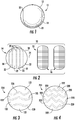
- Figures 1 and 2 illustrate an example tennis ball 10 which utilizes material shift lines to provide a customized COR and/or other ball performance characteristics.
- Figure 1 is a perspective view of tennis ball 10 while Figure 2 is an exploded view of tennis ball 10.
- tennis ball 10 comprises outer textile layer 12 and core 14.
- Outer textile layer 12 comprises at least one layer of fabric material secured over and about core 14.
- outer textile layer 12 comprises two inter-nested, ovular or stadium shaped panels 16.
- the outer textile layer 12 can comprise a pair of inter-nested dog-bone-shaped panels 16 of textile material bonded to core 14, along seams 18 in other implementations, outer textile layer 12 may be provided by panels having other shapes.
- textile layer 12 may be formed by fibers not provided in the form of panels, but which are individually joined or bonded to core 14.
- tennis ball 10 may be formed by bathing or coating core 14 in an adhesive, such as a synthetic or natural rubber adhesive.
- an adhesive such as a synthetic or natural rubber adhesive.
- the outer edges of at least one of the two stadium (or dog-bone) shaped panels 16 of textile material are also coated with an adhesive, such as a synthetic or natural rubber adhesive.
- the panels 16 are then applied over and to the core 14 with the edges of the panels 16 in abutment or close proximity, while the adhesives are in an adhesive state to form the tennis ball shown in Figure 1 .
- the adhesive is then allowed to dry or cure.
- Core 14 comprises a hollow spherical structure having a spherical wall formed from, for example, a rubber or rubber-like material.
- core 14 is formed from two semi spherical halves or half shells 18 which are molded and joined or bonded together with an adhesive, such as a natural rubber or synthetic rubber adhesive.
- the two semi-spherical halves or half shells 18 are joined in a pressure chamber so the interior of the joined halves is pressurized.
- a pressurized tennis ball 10 may have an internal pressure of approximately 69 to 103 kPa (10 to 15 psi). In other implementations, the pressure can be below 69 kPa (10 psi).
- core 14 may be formed in other manners.
- core 14 may additionally incorporate a valve that facilitates pressurization of the interior of core 14.
- the interior surface of the hollow core 14 comprises material shift lines 20 which are spaced apart by intermediate regions 22.
- Material shift lines 20 extend along the interior surface of the wall or walls of core 14 and constitute regions where the material or materials of core 14 have been shifted such that material shift lines 20 have a distinct thickness as compared to the thickness through any of regions 22 of the core 14.
- material shift lines 20 constitute regions where material has been shifted from regions 22 such that material shift lines 20 have a greater thickness as compared to regions 22. Because the thickness of regions 22 is thinner, the effective thickness of such a tennis ball would be reduced.
- material shift lines 20 may comprise projections, ridges, ribs or bands of material.
- material shift lines 20 comprise regions where material has been removed, or from which material has been shifted to regions 22, such that material shift lines 20 have a lesser thickness as compared to regions 22. Because the thickness of regions 22 is thicker, the effective thickness of such a tennis ball would be increased.
- the shift lines 20 may comprise grooves or channels recessed into the walls of core 14.
- material shift lines 20 continuously extend around the axis 24 of core 14. Each material shift line 20 extends 360° about axis 24. In the example illustrated, material shift lines 20 extend parallel to one another. In the example illustrated, material shift lines cover or extend across no greater than 5 percent of the interior circumferential surface of core 14. In other implementations, material shift lines 20 may cover other extents of the interior surface of core 14, may have other configurations, or may intermittently extend along or about the interior surface of core 14.
- the tennis ball is produced in accordance with specifications of the U.S. Tennis Association (USTA.) and the International Tennis Federation (ITF).
- U.S. Tennis Association U.S. Tennis Association
- IF International Tennis Federation
- the tennis ball can be produced in accordance with the following specifications.
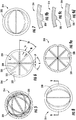
- Figures 3 and 4 illustrate cores 114 and 214 that may be utilized in place of core 14 in tennis ball 10.
- Core 114 is similar to core 14 except that core 114 comprises material shift lines 120 spaced by intermediate regions 122.
- Material shift lines 120 are similar to material shift lines 20 except that material shift lines 120 are not in the form of straight parallel lines about an axis of the core, but instead comprise wavy or sinusoidal lines.
- the wavy material shift lines 120 are illustrated as being in phase with one another, in other implementations, in other implementations, the wavy material shift lines 120 may be out of phase with one another.
- the wavy material shift lines 120 may extend perpendicular to one another or may cross one another.
- the wavy material shift lines 120 may comprise wavy spaced segments that collectively intermittently extend about the interior surface of core 114.
- Core 214 is similar to core 14 except that core 214 comprises material shift lines 220 spaced by intermediate regions 222.
- Material shift lines 220 are similar to material shift lines 20 except that material shift lines 220 are not in the form of straight parallel lines about an axis of the core, but instead comprise zigzag or jagged lines.
- the zigzag material shift lines 220 are illustrated as being in phase with one another, in other implementations, in other implementations, the zigzag material shift lines 220 may be out of phase with one another. In some implementations, the zigzag material shift lines 220 may extend perpendicular to one another or may cross one another.
- the zigzag material shift lines 220 may comprise zigzag spaced segments that collectively intermittently extend about the interior surface of core 214.
- material shift lines 120 and 220 may comprise regions of greater thickness as compared to the remaining intermediate portions 122, 222 to decrease the effective thickness of the core 114, 214 or regions of lesser thickness as compared to the remaining intermediate portions 122 and 222 to increase the effective thickness of core 114, 214.
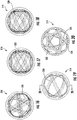
- FIGs 5-9 illustrate an example core 314 for use in tennis ball 10 in place of core 14.
- Core 314 is similar to core 14 except that core 314 is specifically illustrated as comprising material shift lines in the form of bands 320.
- Bands 320 comprise regions along the interior hollow surface 324 of core 314 that have thickness T b that is greater than the thickness T e , the "effective thickness" of core 314 corresponding to the thickness of the intermediate regions 322 spacing and extending between bands 320.
- bands 320 form a vertical pattern of bands along the interior surface 324 of core 314.
- core 314 has a diameter D of approximately 62.7 mm and the interior surface 324 has a radius R of 27.6 mm.
- bands 320 are angularly spaced from another by a spacing angle SA of 45°. In other implementations, core 314 may have other configurations and dimensions.
- bands 320 are illustrated as being pointed or generally triangular in shape ( Figure 9 ), having an angle A of 90° and a base B of 3 mm in one implementation, in other implementations, bands 320 may have other shapes and sizes.
- bands 320 may have a rectangular or square cross sectional shape ( Figure 9b ), curved or semi spherical cross-sectional shapes ( Figure 9c ), or trapezoidal or polygonal shapes ( Figure 9d ).
- the bands can have a shape that is triangular, rectangular, trapezoidal, polygonal, hemi-spherically shaped, hemi-ovular shaped, rounded, irregular or a combination thereof.
- bands 320 provide core 314 with a reduction in its effective thickness of 10%.
- FIGS 10-15 illustrate an example core 414 that may be utilized in place of core 14 as part of tennis ball 10 described above.
- Core 414 is similar to core 314 except that core 414 is specifically illustrated as comprising material shift lines in the form of bands 420.
- Bands 420 are similar to bands 320 in that bands 420 comprise regions along the interior hollow surface 424 of core 414 that have thickness that is greater than the thickness, the "effective thickness" of core 414 in the intermediate regions 422 spacing and extending between bands 420.
- Bands 420 have a different pattern within the interior of core 414. In the example illustrated, bands 420 form a trapezoidal pattern of bands along the interior surface 424 of core 414. In one implementation, bands 420 provide core 414 with a reduction in its effective thickness of 10%.
- FIGS 16-20 illustrate an example core 514 that may be utilized in place of core 14 as part of tennis ball 10 described above.
- Core 514 is similar to core 414 except that core 414 is specifically illustrated as comprising material shift lines in the form of bands 520.
- Bands 520 are similar to bands 420 in that bands 520 comprise regions along the interior hollow surface 524 of core 514 that have thickness that is greater than the thickness, the "effective thickness" of core 514 in the intermediate regions 522 spacing and extending between bands 520.
- Bands 520 are larger or wider such that bands 520 provide a further reduced effective thickness of core 514 as measured in those regions 522 between bands 520.
- Bands 520 have a different pattern within the interior of core 514. In the example illustrated, bands 520 form a trapezoidal pattern of bands along the interior surface 524 of core 514. In one implementation, bands 520 provide core 514 with a reduction in its effective thickness of 20%.
- FIG. 21-25 illustrate an example core 614 that may be utilized in place of core 14 as part of tennis ball 10 described above.
- Core 614 is similar to core 514 except that core 614 is specifically illustrated as comprising material shift lines in the form of bands 620.
- Bands 620 are similar to bands 520 in that bands 620 comprise regions along the interior hollow surface 624 of core 614 that have thickness that is greater than the thickness, the "effective thickness" of core 614 in the intermediate regions 622 spacing and extending between bands 620.
- Bands 620 have a different pattern within the interior of core 614. In the example illustrated, bands 620 form a trapezoidal pattern of bands along the interior surface 624 of core 614. In one implementation, bands 620 provide core 614 with a reduction in its effective thickness of 20%.
- bands 320, 420, 520 and 620 provided on the interior surface of the tennis ball cores may have varying thicknesses and widths to provide different degrees of reduction of the effective thickness of the core to reduce the COR of the tennis ball to various extents.
- bands can provide core with a reduction in its effective thickness of 30%, 40% or 50%.
- other amounts of effective thickness reduction of the core can be used.
- the volume decrease is to be achieved is based upon the lower "effective" half-shell or core thickness transferred to continuous "bands" extending outward from the inner surface of the core.
- the volume to be shifted is dependent upon the degree to which the "effective thickness" of the core is adjusted.
- the volume of material that may be shifted to such bands in various example tennis ball cores is illustrated as follows:
- a pressureless tennis ball may be molded using a half-shell or core that has an outer diameter of approximately 62.7 mm and an inner diameter of approximately 54.7 mm. This results in a thickness of the half-shell of approximately 4.0 mm and an overall material volume of approximately 43.36 cm .
- the above table shows the amount of volume to be transferred into the "bands" extending outward from the inner surface of the half-shell for each 10% reduction in the effective thickness of the core of a Pressureless Tennis Ball. Reducing the thickness of the core beyond 50% can negatively affect the impact durability of core.
- a pressurized tennis ball is molded using a half-shell or core that has an outer diameter of approximately 61.2 mm and an inner diameter of approximately 54.2 mm. This results in a thickness of the core of approximately 3.5 mm and an overall material volume of 36.65 cm 3 .
- Adjusting the half-shell to a lesser thickness results in the need to transfer volume to the outward extending "bands" as follows: Table 2: Volume Displacement (transferred to "bands") based upon Reduction of Effective Thickness - Standard (Pressurized) Tennis Ball Outer Diameter (mm) Inner Diameter (mm) Effective Thickness (mm) Volume Displaced (cm3) ⁇ Volume Displaced (%) Thickness Change % 61.2 54.2 3.5 0 0% -- 61.2 54.9 3.15 3.3 8.9% 10% 61.2 55.6 2.8 6.6 18.1% 20% 61.2 56.3 2.45 10.1 27.5% 30% 61.2 57.0 2.1 13.6 37.1% 40% 61.2 57.7 1.75 17.2 47.7% 50%
- the above table shows the amount of volume to be transferred into the "bands" extending outward from the inner surface of the half-shell for each 10% reduction in the effective thickness of the core of a standard (pressurized) Tennis Ball. Reducing the thickness of the core beyond 50% can negatively affect the impact durability of core.
- the "effective thickness" of the core 714, 814 and 914 can be increased by creating a thicker thickness of the shell or wall thickness of the core.
- the weight or density of the core can be maintained by defining a plurality of channels or grooves 720, 820 and 920 in the inner surface of the core 714, 814 and 914, respectively.
- the material of the core 714, 814 and 914 is shifted from the channels 720, 820 and 920 to regions 722, 822 and 922 of the core between the channels 720, 820 and 920.
- the channels 720 of core 714 are, in this example, generally V-shaped or generally triangular.
- the channels 820 and 920 are generally trapezoidal in shape.
- the channels 720 are angularly spaced from another by a spacing angle SA of 45°.
- the channels 820 are angularly spaced from another by a spacing angle SA of 60°.
- the channels 920 are arranged in a different configuration.
- the channels can be generally U-shaped, hemi-spherically shaped, hemi-ovular shaped, polygonal shaped, rounded, irregular and combinations thereof.
- channels 720 and 820 can have other configurations, in other spacing angles, other numbers, other shapes and/or other sizes.
- the volume increase based upon the thicker "effective" half-shell or core is transferred from continuous "channels" extending inward from the inner surface of the half-shell.
- the volume to be shifted is dependent upon the degree to which the "effective thickness" of the half-shell is adjusted.
- the volume of material that has to be adjusted is illustrated as follows:
- a pressureless tennis ball is molded using a half-shell that has an outer diameter of approximately 62.7 mm and an inner diameter of approximately 54.7 mm. This results in a thickness of the half-shell of approximately 4.0 mm and an overall material volume of 43.36 cm 3 .
- the above table shows the amount of volume transferred into the "channels" extending inward from the inner surface of the half-shell for each 10% increase in the effective thickness of the core of a Pressureless Tennis Ball. Increase of the thickness of the core by greater than 30% may result in a necessary removal of an unacceptable high amount of volume that would result in "channels" that are larger than could be incorporated into the half-shell.
- a tennis ball is molded using a half-shell that has an outer diameter of approximately 61.2 mm and an inner diameter of approximately 54.2 mm. This results in a thickness of the half-shell of approximately 3.5 mm and an overall material volume of 36.65 cm 3 .
- Adjusting the half-shell or core to a greater thickness results in the transfer of volume or mass from the area of the channels as follows: Table 4: Volume Displacement (transferred to "channels") based upon Increase in Effective Thickness - Standard (Pressurized) Tennis Ball Outer Diameter (mm) Inner Diameter (mm) Effective Thickness (mm) Volume Displaced (cm3) ⁇ Volume Displaced (%) Thickness Change % 61.2 54.2 3.5 0 0% -- 61.2 53.5 3.85 3.2 8.7% 10% 61.2 52.8 4.2 6.3 17.2% 20% 61.2 52.1 4.55 9.3 25.4% 30%
- the above table shows the amount of volume transferred into the "channels" extending inward from the inner surface of the half-shell for each 10% increase in the effective thickness of the core of a Standard (Pressurized) Tennis Ball. Increase of the thickness of the core by greater than 30% may result in a necessary removal of an unacceptable high amount of volume that would result in "channels" that are larger than could be incorporated into the half-shell.
- Core 514 (shown in Figures 18-20 ) was molded with a band pattern comprising a symmetrical trapezoidal band pattern resulting in a half-shell having the following properties:
- Core 714 (shown in Figure 26 ) was molded with a channel pattern comprising vertical or generally V-shaped channels resulting in a half shell having the following properties:
- Core 814 (shown in Figure 27 ) was molded with a channel pattern comprising an offset trapezoidal channel pattern resulting in a half-shell having the following properties:
- Core 914 (shown in Figure 28 ) was molded with a channel pattern comprising a symmetrical trapezoidal channel pattern resulting in a half-shell having the following properties:
- Pressureless tennis balls were molded using the tooling as defined above using a standard pressureless ball compound as follows: Pressureless Ball Compound No. Ingredient SP.GR Experiment IV Volume phr. Wt.(g) 1 NR#1 0.93 20 9.000 9.68 2 BR-01 0.91 80 36.000 39.56 3 Rigidex H5818 0.916 20 9.000 9.83 4 HiSil255 2 8 3.600 1.80 5 ZnO -active 5.6 10 4.500 0.80 6 CLAY 2.6 20 9.000 3.46 7 DPG 1.18 0.5 0.225 0.19 8 PTA 1.33 0.5 0.225 0.17 Total 159.00 71.550 65.488 Chemical mixing 1 DM 0.154 1.46 0.657 4.27 2 DPG 1.18 0.59 0.266 0.23 3 CBS 1.36 0.512 0.230 0.17 4 S-25 2.07 5.56 2.502 1.21 Total 1.054 75.205 71.357
- Pressureless tennis balls molded with continuous "bands” or “channels” incorporated in the half shell were tested and compared to a standard pressureless tennis ball formed of the same material composition.
- the adjustment of the tennis ball thickness to a thinner effective core is far easier to perform, as the volume of material that can be shifted to the "bands" that will extend outward from the half-shell is significantly greater than the amount of volume that can be shifted to "channels" that will extend inward from the inner surface of the tennis ball core.
- the degree of which the effective thickness of the core can be increased is limited as the corresponding volume would need to be incorporated as inward-extending channels. Any level of increase of the effective thickness over about 30% results in inward-extending channels that would result in core/shell thickness between the innermost portion of the inward-extending channels and the outer surface of the half-shell that would be insufficiently thick and result in impact durability issues for the molded tennis ball.
- a tennis ball may include a spherical hollow core having an inner surface comprising material shift lines, and a textile outer layer over and about the core.
- Implementations of the present invention may include one or more of the following elements.
- the material shift lines may be channels extending into the inner surface forming a plurality of regions of reduced core thickness. Portions of the spherical hollow core between the channels may have a thickness of at least 4 mm. Portions of the spherical hollow core between the channels may have a thickness of at least 4.4 mm.
- the channels may have a collective volume of at least 2 cm 3 .
- An interior volume of the spherical hollow core may be pressurized to a pressure of at least 69 kPa (10 psi) and portions of the spherical hollow core between the channels can have a thickness of at least 3.7 mm.
- An interior volume of the spherical hollow core may be pressurized to a pressure of at least 69 kPa (10 psi) and the channels can have a collective volume of at least 3 cm 3 .
- the channels may cover no greater than about 48% of a total inner surface area of the spherical hollow core. At least one of the channels may extend 360 degrees about the inner surface of the spherical hollow core.
- the channels may have a pattern selected from a group of patterns consisting of; a vertical pattern wherein the channels intersect at opposite poles; an offset pattern; and a symmetrical pattern.
- the material shift lines may include bands projecting from the inner surface forming a plurality of regions of increased core thickness. Portions of the spherical hollow core between the bands may have a thickness of no greater than 3.6 mm. Portions of the spherical hollow core between the bands may have a thickness of no greater than 3.2 mm.
- the bands may have a collective volume of at least 3 cm 3 .
- the bands may have a collective volume of at least 8 % of a total material volume of the spherical hollow core.
- An interior volume of the spherical hollow core may have an internal pressure of less than 34 kPa (5 psi) and portions of the spherical hollow core between the bands may have a thickness of less than 3.7 mm.
- An interior volume of the spherical hollow core may have an internal pressure of less than 34 kPa (5 psi) and the portions of the spherical hollow core between the bands may have a thickness of less than 3.3 mm.
- An interior volume of the spherical hollow core may have an internal pressure of less than 34 kPa (5 psi) and the bands may have a collective volume of at least 3.3 cm.
- the bands may have a collective volume of at least 8% of a total material volume of the spherical hollow core.
- the bands may cover no greater than about 51 % of a total inner surface area of the spherical hollow core. At least one of the bands may extend 360 degrees about the inner surface of the spherical hollow core.
- the bands may have a pattern selected from a group of patterns consisting of: a vertical pattern wherein the bands intersect at opposite poles; an offset pattern; and a symmetrical pattern.
- the channels or the bands may have a cross-sectional shape selected from the group consisting of generally V-shaped, generally U-shaped, hemi-spherically shaped, hemi-ovular shaped, polygonal shaped, rounded, irregular and combinations thereof.
Landscapes
- Health & Medical Sciences (AREA)
- General Health & Medical Sciences (AREA)
- Physical Education & Sports Medicine (AREA)
- Laminated Bodies (AREA)
- Compositions Of Macromolecular Compounds (AREA)
Claims (15)
- Tennisball (10), der Folgendes umfasst:einen kugelförmigen hohlen Kern (14, 314), der aus zwei verbundenen halbkugelförmigen Hälften (18) besteht, wobei der kugelförmige hohle Kern (14) ein inneres Volumen mit einem Innendruck von weniger als 34,5 kPa (5 psi) und eine Innenfläche aufweist, die Materialverschiebungslinien (20) umfasst, die Bereiche darstellen, wo Material, das die Wand des Kerns bildet, derart verschoben worden ist, dass die verbleibenden Abschnitte der Kernwand eine veränderte Dicke aufweisen, die sich von derjenigen der Materialverschiebungslinien unterscheidet,eine Klebstofflage, die eine Gesamtheit einer Außenfläche des kugelförmigen hohlen Kerns (14, 314) ohne Unterbrechung durchgehend überzieht und unmittelbar berührt, undeine textile äußere Lage (12) über dem Kern (14, 314) und um denselben, wobei die textile äußere Lage (12), durch die Klebstofflage, ohne Unterbrechung unmittelbar mit der gesamten Außenfläche des kugelförmigen hohlen Kerns (14, 314) verbunden ist, wobei die textile äußere Lage (12) Folgendes umfasst:
zwei Bahnen (16), die durch die mit Kleber beschichteten Kanten verbunden sind. - Tennisball (10) nach Anspruch 1 wobei die Materialverschiebungslinien (20) Kanäle umfassen, die sich in die Innenfläche erstrecken, wobei sie eine Vielzahl von Bereichen mit verringerter Kerndicke (22) bilden.
- Tennisball (10) nach Anspruch 2 wobei Abschnitte des kugelförmigen hohlen Kerns (14, 314) zwischen den Kanälen eine Dicke von mindestens 4 mm und vorzugsweise von mindestens 4,4 mm aufweisen.
- Tennisball (10) nach Anspruch 2 oder 3, wobei die Kanäle mindestens einen Kanal umfassen, der sich 360° um die Innenfläche des kugelförmigen hohlen Kerns (14, 314) erstreckt.
- Tennisball (10) nach einem der Ansprüche 2 bis 4, wobei die Kanäle ein Muster aufweisen, das ausgewählt ist aus einer Gruppe von Mustern, die aus Folgendem besteht: einem vertikalen Muster, wobei sich die Kanäle an entgegengesetzten Polen schneiden, einem versetzten Muster und einem symmetrischen Muster.
- Tennisball (10) nach Anspruch 1, wobei die Materialverschiebungslinien (20) Bänder (320) umfassen, die von der Innenfläche hervorragen, wobei sie eine Vielzahl von Bereichen gesteigerter Kerndicke bilden.
- Tennisball (10) nach Anspruch 6, wobei Abschnitte des kugelförmigen hohlen Kerns (14, 314) zwischen den Bändern (320) eine Dicke von nicht mehr als 3,6 mm und vorzugsweise nicht mehr als 3,2 mm aufweisen.
- Tennisball (10) nach Anspruch 6 oder 7, wobei ein inneres Volumen des kugelförmigen hohlen Kerns (14, 314) einen Innendruck von weniger als 34,5 kPa (5 psi) aufweist und wobei Abschnitte des kugelförmigen hohlen Kerns (14, 314) zwischen den Bändern (320) eine Dicke von weniger als 3,7 mm aufweisen.
- Tennisball (10) nach einem der Ansprüche 6 bis 8, wobei ein inneres Volumen des kugelförmigen hohlen Kerns (14, 314) einen Innendruck von weniger als 34,5 kPa (5 psi) aufweist und wobei die Abschnitte des kugelförmigen hohlen Kerns (14, 314) zwischen den Bändern (320) eine Dicke von weniger als 3,3 mm aufweisen.
- Tennisball (10) nach einem der Ansprüche 6 bis 9, wobei ein inneres Volumen des kugelförmigen hohlen Kerns (14, 314) einen Innendruck von weniger als 34,5 kPa (5 psi) aufweist und wobei die Bänder ein gemeinsames Volumen von mindestens 3,3 cm3 aufweisen.
- Tennisball (10) nach einem der Ansprüche 6 bis 10, wobei die Bänder (320) mindestens einen Kanal umfassen, der sich 360° um die Innenfläche des kugelförmigen hohlen Kerns (14, 314) erstreckt.
- Tennisball (10) nach Anspruch 11, wobei die Kanäle ein Muster aufweisen, das ausgewählt ist aus einer Gruppe von Mustern bestehend aus: einem vertikalen Muster, wobei sich die Bänder an entgegengesetzten Polen schneiden, einem versetzten Muster und einem symmetrischen Muster.
- Tennisball (10) nach einem der Ansprüche 2 bis 5, wobei die Kanäle eine Querschnittsform aufweisen, die ausgewählt ist aus der Gruppe, die aus im Allgemeinen V-förmig, im Allgemeinen U-förmig, halbkugelförmig, halbeiförmig, vieleckförmig, abgerundet, unregelmäßig und Kombinationen derselben besteht.
- Tennisball (10) nach einem der Ansprüche 6 bis 12, wobei die Bänder (320) eine Querschnittsform aufweisen, die ausgewählt ist aus der Gruppe, die aus im Allgemeinen dreieckig, rechteckig, trapezförmig, vieleckig, halbkugelförmig, halbeiförmig, abgerundet, unregelmäßig und Kombinationen derselben besteht.
- Tennisball (10) nach Anspruch 1, wobei die Materialverschiebungslinien (20) Kanäle umfassen, die sich in die Innenfläche erstrecken, wobei sie eine Vielzahl von Bereichen mit verringerter Kerndicke (22) bilden, und wobei die Kanäle mindestens einen einzelnen Kanal umfassen, der sich durchgehend und ohne Unterbrechung 360° um die Innenfläche des kugelförmigen hohlen Kerns (14, 314) erstreckt.
Applications Claiming Priority (1)
| Application Number | Priority Date | Filing Date | Title |
|---|---|---|---|
| US15/458,820 US10493327B2 (en) | 2017-03-14 | 2017-03-14 | Tennis ball having a core with internal material shift lines |
Publications (2)
| Publication Number | Publication Date |
|---|---|
| EP3375499A1 EP3375499A1 (de) | 2018-09-19 |
| EP3375499B1 true EP3375499B1 (de) | 2020-10-21 |
Family
ID=61655697
Family Applications (1)
| Application Number | Title | Priority Date | Filing Date |
|---|---|---|---|
| EP18161844.8A Not-in-force EP3375499B1 (de) | 2017-03-14 | 2018-03-14 | Tennisball mit einem kern mit inneren materialverschiebungslinien |
Country Status (2)
| Country | Link |
|---|---|
| US (1) | US10493327B2 (de) |
| EP (1) | EP3375499B1 (de) |
Families Citing this family (6)
| Publication number | Priority date | Publication date | Assignee | Title |
|---|---|---|---|---|
| US11951360B2 (en) | 2018-08-28 | 2024-04-09 | Wilson Sporting Goods Co. | Tennis ball |
| US10918913B2 (en) | 2018-08-28 | 2021-02-16 | Wilson Sporting Goods Co. | Tennis ball |
| US11192001B2 (en) | 2020-02-11 | 2021-12-07 | Wilson Sporting Goods Co. | Tennis ball having a thermoplastic core |
| US12599814B2 (en) | 2020-02-11 | 2026-04-14 | Wilson Sporting Goods Co. | Tennis ball having a thermoplastic core |
| US11426637B2 (en) * | 2020-02-11 | 2022-08-30 | Wilson Sporting Goods Co. | Tennis ball having a thermoplastic core |
| US11247103B2 (en) | 2020-02-11 | 2022-02-15 | Wilson Sporting Goods Co. | Tennis ball having a thermoplastic core |
Citations (3)
| Publication number | Priority date | Publication date | Assignee | Title |
|---|---|---|---|---|
| US398558A (en) * | 1889-02-26 | Uington | ||
| EP0576233A1 (de) * | 1992-06-24 | 1993-12-29 | Gencorp Inc. | Bälle und ihre Herstellung |
| US5558325A (en) * | 1993-08-05 | 1996-09-24 | Gencorp Inc. | Play balls or pressureless tennis balls |
Family Cites Families (52)
| Publication number | Priority date | Publication date | Assignee | Title |
|---|---|---|---|---|
| US902330A (en) * | 1908-07-15 | 1908-10-27 | Frank Rowley | Manufacture of tennis and similar playing-balls. |
| US1376778A (en) | 1919-08-05 | 1921-05-03 | Spalding & Bros Ag | Tennis-ball and process of making same |
| US2131756A (en) * | 1933-10-06 | 1938-10-04 | Fred T Roberts | Rubber ball |
| US2210954A (en) * | 1936-11-24 | 1940-08-13 | Albert H Bates | Method of making tennis balls |
| GB719467A (en) | 1950-08-31 | 1954-12-01 | Otto Beck | Playing balls, for instance tennis balls |
| US3065520A (en) | 1959-01-08 | 1962-11-27 | Helen C Schmidt | Tennis ball fabric |
| US3442101A (en) | 1965-04-01 | 1969-05-06 | Forsch Inst Fur Textiltechnolo | Pile fabric |
| USRE29303E (en) | 1966-02-15 | 1977-07-12 | Gaf Corporation | Tennis ball including needle punched fabric cover |
| US3396970A (en) | 1966-02-15 | 1968-08-13 | American Felt Co | Tennis ball including needle punched fabric cover |
| US3684284A (en) | 1970-09-18 | 1972-08-15 | Chas W House & Sons Inc | Pile fabric method and product |
| US3904201A (en) | 1974-04-29 | 1975-09-09 | Dana R Henry | Tennis ball |
| CH616848A5 (de) | 1974-05-18 | 1980-04-30 | Patentex Sa | |
| US4098504A (en) | 1975-10-31 | 1978-07-04 | The General Tire & Rubber Company | Tennis ball |
| SE397476B (sv) | 1976-03-03 | 1977-11-07 | Tretorn Ab | Boll bestaende av en ihalig sfer av fyllmedelshaltig gummi |
| US4300767A (en) | 1977-08-01 | 1981-11-17 | The General Tire & Rubber Company | Inflated game ball having long lasting pressure retention with decreased noise |
| ZA80393B (en) | 1979-02-17 | 1981-08-26 | Dunlop Ltd | Cellular elastomeric compositions |
| EP0022961A1 (de) * | 1979-07-19 | 1981-01-28 | Dunlop Limited | Spielball |
| US4340222A (en) | 1980-06-30 | 1982-07-20 | Wham-O Mfg. Co. | Game ball |
| US4616828A (en) * | 1985-02-01 | 1986-10-14 | Haythornthwaite James Alan | Tennis ball |
| JPH0522200Y2 (de) | 1987-05-08 | 1993-06-07 | ||
| US4853057A (en) | 1988-01-20 | 1989-08-01 | Hoffmann Allan C | Method of making tennis balls or the like |
| US4853056A (en) | 1988-01-20 | 1989-08-01 | Hoffman Allan C | Method of making tennis ball with a single core and cover bonding cure |
| US5211788A (en) | 1988-08-10 | 1993-05-18 | Song Jae M | Tennis ball and method of manufacturing the same |
| FR2638375B1 (fr) | 1988-10-14 | 1993-03-05 | Drouillat Jean Luc | Boule a jouer, notamment pour la petanque |
| JPH048374A (ja) | 1990-04-25 | 1992-01-13 | Sumitomo Rubber Ind Ltd | 無圧テニスボールの中空コア用ゴム組成物 |
| JP2764643B2 (ja) | 1990-06-01 | 1998-06-11 | 住友ゴム工業株式会社 | 無圧テニスボール |
| JP2558559B2 (ja) | 1991-05-10 | 1996-11-27 | 住友ゴム工業株式会社 | 無圧テニスボール |
| JPH053932A (ja) | 1991-06-05 | 1993-01-14 | Sumitomo Rubber Ind Ltd | テニスボール |
| US5551688A (en) | 1992-04-01 | 1996-09-03 | Wilson Sporting Goods Co. | Magnetically detectable tennis ball |
| US5413333A (en) | 1993-12-08 | 1995-05-09 | Gencorp Inc. | Colored adhesive for tennis ball seams and a tennis ball seam containing the same |
| US5593157A (en) | 1995-05-10 | 1997-01-14 | Gencorp Inc. | Long life, low air permeable pressurized articles such as play balls |
| US6106419A (en) | 1995-11-10 | 2000-08-22 | Tretorn Research And Development Limited | Ball and a method of manufacturing a ball |
| US6030304A (en) | 1996-03-12 | 2000-02-29 | Wilson Sporting Goods Co. | Pressureless tennis ball |
| US5865697A (en) * | 1997-03-24 | 1999-02-02 | Lisco, Inc. | Sports ball with improved feel |
| US5830092A (en) | 1997-12-11 | 1998-11-03 | Milliken Research Corporation | Tennis ball fabric |
| GB9813966D0 (en) | 1998-06-30 | 1998-08-26 | Milliken Ind Ltd | Textile |
| GB9820165D0 (en) | 1998-09-17 | 1998-11-11 | Milliken Ind Ltd | Non-woven fabric |
| ATE279562T1 (de) | 1999-12-24 | 2004-10-15 | Milliken Ind Ltd | Bekleidungsstoff für tennisball und verfahren zur herstellung |
| US6508732B1 (en) | 2000-07-03 | 2003-01-21 | Mildred Kinghorn Romberger | Tennis ball |
| USD668947S1 (en) | 2004-06-17 | 2012-10-16 | Gene Niksich | Merchandising package of pressureless tennis balls |
| US7611429B2 (en) | 2005-03-01 | 2009-11-03 | Primo Research, Inc. | Inflatable articles that provide long term inflation and pressure control |
| US20070178997A1 (en) * | 2006-01-31 | 2007-08-02 | Yen-Li Chang | Bladder structure of a football |
| MX2008016437A (es) | 2006-06-30 | 2009-01-23 | Huntsman Int Llc | Nueva pelota de tenis. |
| US8627859B2 (en) | 2007-06-19 | 2014-01-14 | Rebounces, Llc | Apparatus for recharging tennis balls and method |
| WO2009013617A2 (en) | 2007-07-20 | 2009-01-29 | Invista Technologies S.A.R.L. | Improved manufacture of polyurethane foam ball |
| ATE541621T1 (de) | 2007-11-26 | 2012-02-15 | Huntsman Int Llc | Neuer tennisball |
| JP2012135363A (ja) | 2010-12-24 | 2012-07-19 | Bridgestone Sports Co Ltd | テニスボール用フェルトおよびテニスボール |
| US20120298050A1 (en) | 2011-05-27 | 2012-11-29 | Luke Merritt | Coated tennis ball |
| US20130017912A1 (en) | 2011-07-11 | 2013-01-17 | Swag Company, Inc. | Removable Moisture-Resistant Ball Cover |
| US8622857B2 (en) * | 2011-08-26 | 2014-01-07 | Jack Lo | Inflatable ball with rib structure |
| US20140274504A1 (en) * | 2013-03-14 | 2014-09-18 | Russell Brands, Llc | Inflation-Independent Ball with Cover |
| US9731169B2 (en) | 2013-10-15 | 2017-08-15 | Limpet Sports Management B.V. | Ball |
-
2017
- 2017-03-14 US US15/458,820 patent/US10493327B2/en active Active
-
2018
- 2018-03-14 EP EP18161844.8A patent/EP3375499B1/de not_active Not-in-force
Patent Citations (3)
| Publication number | Priority date | Publication date | Assignee | Title |
|---|---|---|---|---|
| US398558A (en) * | 1889-02-26 | Uington | ||
| EP0576233A1 (de) * | 1992-06-24 | 1993-12-29 | Gencorp Inc. | Bälle und ihre Herstellung |
| US5558325A (en) * | 1993-08-05 | 1996-09-24 | Gencorp Inc. | Play balls or pressureless tennis balls |
Also Published As
| Publication number | Publication date |
|---|---|
| EP3375499A1 (de) | 2018-09-19 |
| US20180264327A1 (en) | 2018-09-20 |
| US10493327B2 (en) | 2019-12-03 |
Similar Documents
| Publication | Publication Date | Title |
|---|---|---|
| EP3375499A1 (de) | Tennisball mit einem kern mit inneren materialverschiebungslinien | |
| US11666793B2 (en) | Modified weight training equipment | |
| US6743123B2 (en) | Golf ball having a high moment of inertia and low driver spin rate | |
| US6293877B1 (en) | Golf ball | |
| US6695720B2 (en) | Golf ball with varying land surfaces | |
| US6398667B1 (en) | Golf ball with lattice structure | |
| EP3569294B1 (de) | Aufpumpunabhängiger ball mit hülle | |
| US20120233784A1 (en) | Multiple zone gel cushion | |
| EP3375500A1 (de) | Tennisball mit einem kern mit aerodynamischen mustern | |
| US5547197A (en) | Golf ball dimple construction | |
| EP3746191B1 (de) | Modifiziertes gewichtstrainingsgerät | |
| CA2233727A1 (en) | Three-piece wound golf ball | |
| JP2001515394A (ja) | マルチ層ゴルフボール | |
| WO1999000161A1 (en) | A protector pad | |
| EP1219326A3 (de) | Mehrteiliger, fester Golfball | |
| US20150018175A1 (en) | Fitness hoop having variable impact force | |
| US10034563B2 (en) | Portable head support | |
| JP3750712B2 (ja) | ソリッドゴルフボール | |
| US20030036445A1 (en) | Golf ball | |
| CN120550387A (zh) | 具有可变小叶形状的比赛用球 | |
| GB2259257A (en) | Playball | |
| JP4561942B2 (ja) | ゴルフボール | |
| CA3090106C (en) | Modified weight training equipment | |
| US20080207354A1 (en) | Mixed-resin mantle metal-core golf balls and methods of manufacturing same | |
| CA1209165A (en) | Floor hockey puck |
Legal Events
| Date | Code | Title | Description |
|---|---|---|---|
| PUAI | Public reference made under article 153(3) epc to a published international application that has entered the european phase |
Free format text: ORIGINAL CODE: 0009012 |
|
| STAA | Information on the status of an ep patent application or granted ep patent |
Free format text: STATUS: THE APPLICATION HAS BEEN PUBLISHED |
|
| AK | Designated contracting states |
Kind code of ref document: A1 Designated state(s): AL AT BE BG CH CY CZ DE DK EE ES FI FR GB GR HR HU IE IS IT LI LT LU LV MC MK MT NL NO PL PT RO RS SE SI SK SM TR |
|
| AX | Request for extension of the european patent |
Extension state: BA ME |
|
| STAA | Information on the status of an ep patent application or granted ep patent |
Free format text: STATUS: REQUEST FOR EXAMINATION WAS MADE |
|
| 17P | Request for examination filed |
Effective date: 20190319 |
|
| RBV | Designated contracting states (corrected) |
Designated state(s): AL AT BE BG CH CY CZ DE DK EE ES FI FR GB GR HR HU IE IS IT LI LT LU LV MC MK MT NL NO PL PT RO RS SE SI SK SM TR |
|
| STAA | Information on the status of an ep patent application or granted ep patent |
Free format text: STATUS: EXAMINATION IS IN PROGRESS |
|
| 17Q | First examination report despatched |
Effective date: 20190725 |
|
| GRAP | Despatch of communication of intention to grant a patent |
Free format text: ORIGINAL CODE: EPIDOSNIGR1 |
|
| STAA | Information on the status of an ep patent application or granted ep patent |
Free format text: STATUS: GRANT OF PATENT IS INTENDED |
|
| INTG | Intention to grant announced |
Effective date: 20200507 |
|
| GRAS | Grant fee paid |
Free format text: ORIGINAL CODE: EPIDOSNIGR3 |
|
| GRAA | (expected) grant |
Free format text: ORIGINAL CODE: 0009210 |
|
| STAA | Information on the status of an ep patent application or granted ep patent |
Free format text: STATUS: THE PATENT HAS BEEN GRANTED |
|
| AK | Designated contracting states |
Kind code of ref document: B1 Designated state(s): AL AT BE BG CH CY CZ DE DK EE ES FI FR GB GR HR HU IE IS IT LI LT LU LV MC MK MT NL NO PL PT RO RS SE SI SK SM TR |
|
| REG | Reference to a national code |
Ref country code: GB Ref legal event code: FG4D |
|
| REG | Reference to a national code |
Ref country code: CH Ref legal event code: EP |
|
| REG | Reference to a national code |
Ref country code: DE Ref legal event code: R096 Ref document number: 602018008808 Country of ref document: DE |
|
| REG | Reference to a national code |
Ref country code: IE Ref legal event code: FG4D |
|
| REG | Reference to a national code |
Ref country code: AT Ref legal event code: REF Ref document number: 1325256 Country of ref document: AT Kind code of ref document: T Effective date: 20201115 |
|
| REG | Reference to a national code |
Ref country code: AT Ref legal event code: MK05 Ref document number: 1325256 Country of ref document: AT Kind code of ref document: T Effective date: 20201021 |
|
| REG | Reference to a national code |
Ref country code: NL Ref legal event code: MP Effective date: 20201021 |
|
| PG25 | Lapsed in a contracting state [announced via postgrant information from national office to epo] |
Ref country code: FI Free format text: LAPSE BECAUSE OF FAILURE TO SUBMIT A TRANSLATION OF THE DESCRIPTION OR TO PAY THE FEE WITHIN THE PRESCRIBED TIME-LIMIT Effective date: 20201021 Ref country code: RS Free format text: LAPSE BECAUSE OF FAILURE TO SUBMIT A TRANSLATION OF THE DESCRIPTION OR TO PAY THE FEE WITHIN THE PRESCRIBED TIME-LIMIT Effective date: 20201021 Ref country code: PT Free format text: LAPSE BECAUSE OF FAILURE TO SUBMIT A TRANSLATION OF THE DESCRIPTION OR TO PAY THE FEE WITHIN THE PRESCRIBED TIME-LIMIT Effective date: 20210222 Ref country code: NO Free format text: LAPSE BECAUSE OF FAILURE TO SUBMIT A TRANSLATION OF THE DESCRIPTION OR TO PAY THE FEE WITHIN THE PRESCRIBED TIME-LIMIT Effective date: 20210121 Ref country code: GR Free format text: LAPSE BECAUSE OF FAILURE TO SUBMIT A TRANSLATION OF THE DESCRIPTION OR TO PAY THE FEE WITHIN THE PRESCRIBED TIME-LIMIT Effective date: 20210122 |
|
| REG | Reference to a national code |
Ref country code: LT Ref legal event code: MG4D |
|
| PG25 | Lapsed in a contracting state [announced via postgrant information from national office to epo] |
Ref country code: ES Free format text: LAPSE BECAUSE OF FAILURE TO SUBMIT A TRANSLATION OF THE DESCRIPTION OR TO PAY THE FEE WITHIN THE PRESCRIBED TIME-LIMIT Effective date: 20201021 Ref country code: AT Free format text: LAPSE BECAUSE OF FAILURE TO SUBMIT A TRANSLATION OF THE DESCRIPTION OR TO PAY THE FEE WITHIN THE PRESCRIBED TIME-LIMIT Effective date: 20201021 Ref country code: BG Free format text: LAPSE BECAUSE OF FAILURE TO SUBMIT A TRANSLATION OF THE DESCRIPTION OR TO PAY THE FEE WITHIN THE PRESCRIBED TIME-LIMIT Effective date: 20210121 Ref country code: LV Free format text: LAPSE BECAUSE OF FAILURE TO SUBMIT A TRANSLATION OF THE DESCRIPTION OR TO PAY THE FEE WITHIN THE PRESCRIBED TIME-LIMIT Effective date: 20201021 Ref country code: IS Free format text: LAPSE BECAUSE OF FAILURE TO SUBMIT A TRANSLATION OF THE DESCRIPTION OR TO PAY THE FEE WITHIN THE PRESCRIBED TIME-LIMIT Effective date: 20210221 Ref country code: PL Free format text: LAPSE BECAUSE OF FAILURE TO SUBMIT A TRANSLATION OF THE DESCRIPTION OR TO PAY THE FEE WITHIN THE PRESCRIBED TIME-LIMIT Effective date: 20201021 Ref country code: SE Free format text: LAPSE BECAUSE OF FAILURE TO SUBMIT A TRANSLATION OF THE DESCRIPTION OR TO PAY THE FEE WITHIN THE PRESCRIBED TIME-LIMIT Effective date: 20201021 |
|
| PG25 | Lapsed in a contracting state [announced via postgrant information from national office to epo] |
Ref country code: NL Free format text: LAPSE BECAUSE OF FAILURE TO SUBMIT A TRANSLATION OF THE DESCRIPTION OR TO PAY THE FEE WITHIN THE PRESCRIBED TIME-LIMIT Effective date: 20201021 Ref country code: HR Free format text: LAPSE BECAUSE OF FAILURE TO SUBMIT A TRANSLATION OF THE DESCRIPTION OR TO PAY THE FEE WITHIN THE PRESCRIBED TIME-LIMIT Effective date: 20201021 |
|
| REG | Reference to a national code |
Ref country code: DE Ref legal event code: R097 Ref document number: 602018008808 Country of ref document: DE |
|
| PG25 | Lapsed in a contracting state [announced via postgrant information from national office to epo] |
Ref country code: SK Free format text: LAPSE BECAUSE OF FAILURE TO SUBMIT A TRANSLATION OF THE DESCRIPTION OR TO PAY THE FEE WITHIN THE PRESCRIBED TIME-LIMIT Effective date: 20201021 Ref country code: RO Free format text: LAPSE BECAUSE OF FAILURE TO SUBMIT A TRANSLATION OF THE DESCRIPTION OR TO PAY THE FEE WITHIN THE PRESCRIBED TIME-LIMIT Effective date: 20201021 Ref country code: SM Free format text: LAPSE BECAUSE OF FAILURE TO SUBMIT A TRANSLATION OF THE DESCRIPTION OR TO PAY THE FEE WITHIN THE PRESCRIBED TIME-LIMIT Effective date: 20201021 Ref country code: CZ Free format text: LAPSE BECAUSE OF FAILURE TO SUBMIT A TRANSLATION OF THE DESCRIPTION OR TO PAY THE FEE WITHIN THE PRESCRIBED TIME-LIMIT Effective date: 20201021 Ref country code: EE Free format text: LAPSE BECAUSE OF FAILURE TO SUBMIT A TRANSLATION OF THE DESCRIPTION OR TO PAY THE FEE WITHIN THE PRESCRIBED TIME-LIMIT Effective date: 20201021 Ref country code: LT Free format text: LAPSE BECAUSE OF FAILURE TO SUBMIT A TRANSLATION OF THE DESCRIPTION OR TO PAY THE FEE WITHIN THE PRESCRIBED TIME-LIMIT Effective date: 20201021 |
|
| PLBE | No opposition filed within time limit |
Free format text: ORIGINAL CODE: 0009261 |
|
| STAA | Information on the status of an ep patent application or granted ep patent |
Free format text: STATUS: NO OPPOSITION FILED WITHIN TIME LIMIT |
|
| PG25 | Lapsed in a contracting state [announced via postgrant information from national office to epo] |
Ref country code: DK Free format text: LAPSE BECAUSE OF FAILURE TO SUBMIT A TRANSLATION OF THE DESCRIPTION OR TO PAY THE FEE WITHIN THE PRESCRIBED TIME-LIMIT Effective date: 20201021 |
|
| 26N | No opposition filed |
Effective date: 20210722 |
|
| REG | Reference to a national code |
Ref country code: DE Ref legal event code: R119 Ref document number: 602018008808 Country of ref document: DE |
|
| PG25 | Lapsed in a contracting state [announced via postgrant information from national office to epo] |
Ref country code: MC Free format text: LAPSE BECAUSE OF FAILURE TO SUBMIT A TRANSLATION OF THE DESCRIPTION OR TO PAY THE FEE WITHIN THE PRESCRIBED TIME-LIMIT Effective date: 20201021 Ref country code: IT Free format text: LAPSE BECAUSE OF FAILURE TO SUBMIT A TRANSLATION OF THE DESCRIPTION OR TO PAY THE FEE WITHIN THE PRESCRIBED TIME-LIMIT Effective date: 20201021 Ref country code: AL Free format text: LAPSE BECAUSE OF FAILURE TO SUBMIT A TRANSLATION OF THE DESCRIPTION OR TO PAY THE FEE WITHIN THE PRESCRIBED TIME-LIMIT Effective date: 20201021 |
|
| REG | Reference to a national code |
Ref country code: CH Ref legal event code: PL |
|
| PG25 | Lapsed in a contracting state [announced via postgrant information from national office to epo] |
Ref country code: SI Free format text: LAPSE BECAUSE OF FAILURE TO SUBMIT A TRANSLATION OF THE DESCRIPTION OR TO PAY THE FEE WITHIN THE PRESCRIBED TIME-LIMIT Effective date: 20201021 |
|
| REG | Reference to a national code |
Ref country code: BE Ref legal event code: MM Effective date: 20210331 |
|
| PG25 | Lapsed in a contracting state [announced via postgrant information from national office to epo] |
Ref country code: FR Free format text: LAPSE BECAUSE OF NON-PAYMENT OF DUE FEES Effective date: 20210331 Ref country code: CH Free format text: LAPSE BECAUSE OF NON-PAYMENT OF DUE FEES Effective date: 20210331 Ref country code: DE Free format text: LAPSE BECAUSE OF NON-PAYMENT OF DUE FEES Effective date: 20211001 Ref country code: IE Free format text: LAPSE BECAUSE OF NON-PAYMENT OF DUE FEES Effective date: 20210314 Ref country code: LI Free format text: LAPSE BECAUSE OF NON-PAYMENT OF DUE FEES Effective date: 20210331 Ref country code: LU Free format text: LAPSE BECAUSE OF NON-PAYMENT OF DUE FEES Effective date: 20210314 |
|
| PG25 | Lapsed in a contracting state [announced via postgrant information from national office to epo] |
Ref country code: IS Free format text: LAPSE BECAUSE OF FAILURE TO SUBMIT A TRANSLATION OF THE DESCRIPTION OR TO PAY THE FEE WITHIN THE PRESCRIBED TIME-LIMIT Effective date: 20210221 |
|
| PG25 | Lapsed in a contracting state [announced via postgrant information from national office to epo] |
Ref country code: BE Free format text: LAPSE BECAUSE OF NON-PAYMENT OF DUE FEES Effective date: 20210331 |
|
| PGFP | Annual fee paid to national office [announced via postgrant information from national office to epo] |
Ref country code: GB Payment date: 20220425 Year of fee payment: 5 |
|
| PG25 | Lapsed in a contracting state [announced via postgrant information from national office to epo] |
Ref country code: CY Free format text: LAPSE BECAUSE OF FAILURE TO SUBMIT A TRANSLATION OF THE DESCRIPTION OR TO PAY THE FEE WITHIN THE PRESCRIBED TIME-LIMIT Effective date: 20201021 |
|
| P01 | Opt-out of the competence of the unified patent court (upc) registered |
Effective date: 20230528 |
|
| PG25 | Lapsed in a contracting state [announced via postgrant information from national office to epo] |
Ref country code: HU Free format text: LAPSE BECAUSE OF FAILURE TO SUBMIT A TRANSLATION OF THE DESCRIPTION OR TO PAY THE FEE WITHIN THE PRESCRIBED TIME-LIMIT; INVALID AB INITIO Effective date: 20180314 |
|
| GBPC | Gb: european patent ceased through non-payment of renewal fee |
Effective date: 20230314 |
|
| PG25 | Lapsed in a contracting state [announced via postgrant information from national office to epo] |
Ref country code: GB Free format text: LAPSE BECAUSE OF NON-PAYMENT OF DUE FEES Effective date: 20230314 |
|
| PG25 | Lapsed in a contracting state [announced via postgrant information from national office to epo] |
Ref country code: GB Free format text: LAPSE BECAUSE OF NON-PAYMENT OF DUE FEES Effective date: 20230314 |
|
| PG25 | Lapsed in a contracting state [announced via postgrant information from national office to epo] |
Ref country code: MK Free format text: LAPSE BECAUSE OF FAILURE TO SUBMIT A TRANSLATION OF THE DESCRIPTION OR TO PAY THE FEE WITHIN THE PRESCRIBED TIME-LIMIT Effective date: 20201021 |
|
| PG25 | Lapsed in a contracting state [announced via postgrant information from national office to epo] |
Ref country code: TR Free format text: LAPSE BECAUSE OF FAILURE TO SUBMIT A TRANSLATION OF THE DESCRIPTION OR TO PAY THE FEE WITHIN THE PRESCRIBED TIME-LIMIT Effective date: 20201021 |
|
| PG25 | Lapsed in a contracting state [announced via postgrant information from national office to epo] |
Ref country code: MT Free format text: LAPSE BECAUSE OF FAILURE TO SUBMIT A TRANSLATION OF THE DESCRIPTION OR TO PAY THE FEE WITHIN THE PRESCRIBED TIME-LIMIT Effective date: 20201021 |