EP3333661A1 - Anomalieprädiktordiagnosesystem und anomalieprädiktordiagnoseverfahren - Google Patents
Anomalieprädiktordiagnosesystem und anomalieprädiktordiagnoseverfahren Download PDFInfo
- Publication number
- EP3333661A1 EP3333661A1 EP16833063.7A EP16833063A EP3333661A1 EP 3333661 A1 EP3333661 A1 EP 3333661A1 EP 16833063 A EP16833063 A EP 16833063A EP 3333661 A1 EP3333661 A1 EP 3333661A1
- Authority
- EP
- European Patent Office
- Prior art keywords
- value
- diagnosis
- cluster
- operation process
- sensor
- Prior art date
- Legal status (The legal status is an assumption and is not a legal conclusion. Google has not performed a legal analysis and makes no representation as to the accuracy of the status listed.)
- Granted
Links
Images




Classifications
-
- G—PHYSICS
- G05—CONTROLLING; REGULATING
- G05B—CONTROL OR REGULATING SYSTEMS IN GENERAL; FUNCTIONAL ELEMENTS OF SUCH SYSTEMS; MONITORING OR TESTING ARRANGEMENTS FOR SUCH SYSTEMS OR ELEMENTS
- G05B23/00—Testing or monitoring of control systems or parts thereof
- G05B23/02—Electric testing or monitoring
- G05B23/0205—Electric testing or monitoring by means of a monitoring system capable of detecting and responding to faults
- G05B23/0218—Electric testing or monitoring by means of a monitoring system capable of detecting and responding to faults characterised by the fault detection method dealing with either existing or incipient faults
- G05B23/0224—Process history based detection method, e.g. whereby history implies the availability of large amounts of data
- G05B23/024—Quantitative history assessment, e.g. mathematical relationships between available data; Functions therefor; Principal component analysis [PCA]; Partial least square [PLS]; Statistical classifiers, e.g. Bayesian networks, linear regression or correlation analysis; Neural networks
-
- G—PHYSICS
- G05—CONTROLLING; REGULATING
- G05B—CONTROL OR REGULATING SYSTEMS IN GENERAL; FUNCTIONAL ELEMENTS OF SUCH SYSTEMS; MONITORING OR TESTING ARRANGEMENTS FOR SUCH SYSTEMS OR ELEMENTS
- G05B23/00—Testing or monitoring of control systems or parts thereof
- G05B23/02—Electric testing or monitoring
-
- G—PHYSICS
- G05—CONTROLLING; REGULATING
- G05B—CONTROL OR REGULATING SYSTEMS IN GENERAL; FUNCTIONAL ELEMENTS OF SUCH SYSTEMS; MONITORING OR TESTING ARRANGEMENTS FOR SUCH SYSTEMS OR ELEMENTS
- G05B23/00—Testing or monitoring of control systems or parts thereof
- G05B23/02—Electric testing or monitoring
- G05B23/0205—Electric testing or monitoring by means of a monitoring system capable of detecting and responding to faults
- G05B23/0218—Electric testing or monitoring by means of a monitoring system capable of detecting and responding to faults characterised by the fault detection method dealing with either existing or incipient faults
- G05B23/0243—Electric testing or monitoring by means of a monitoring system capable of detecting and responding to faults characterised by the fault detection method dealing with either existing or incipient faults model based detection method, e.g. first-principles knowledge model
- G05B23/0254—Electric testing or monitoring by means of a monitoring system capable of detecting and responding to faults characterised by the fault detection method dealing with either existing or incipient faults model based detection method, e.g. first-principles knowledge model based on a quantitative model, e.g. mathematical relationships between inputs and outputs; functions: observer, Kalman filter, residual calculation, Neural Networks
-
- G—PHYSICS
- G05—CONTROLLING; REGULATING
- G05B—CONTROL OR REGULATING SYSTEMS IN GENERAL; FUNCTIONAL ELEMENTS OF SUCH SYSTEMS; MONITORING OR TESTING ARRANGEMENTS FOR SUCH SYSTEMS OR ELEMENTS
- G05B23/00—Testing or monitoring of control systems or parts thereof
- G05B23/02—Electric testing or monitoring
- G05B23/0205—Electric testing or monitoring by means of a monitoring system capable of detecting and responding to faults
- G05B23/0259—Electric testing or monitoring by means of a monitoring system capable of detecting and responding to faults characterized by the response to fault detection
- G05B23/0283—Predictive maintenance, e.g. involving the monitoring of a system and, based on the monitoring results, taking decisions on the maintenance schedule of the monitored system; Estimating remaining useful life [RUL]
-
- G—PHYSICS
- G05—CONTROLLING; REGULATING
- G05B—CONTROL OR REGULATING SYSTEMS IN GENERAL; FUNCTIONAL ELEMENTS OF SUCH SYSTEMS; MONITORING OR TESTING ARRANGEMENTS FOR SUCH SYSTEMS OR ELEMENTS
- G05B2219/00—Program-control systems
- G05B2219/30—Nc systems
- G05B2219/32—Operator till task planning
- G05B2219/32201—Build statistical model of past normal proces, compare with actual process
-
- G—PHYSICS
- G06—COMPUTING OR CALCULATING; COUNTING
- G06F—ELECTRIC DIGITAL DATA PROCESSING
- G06F2218/00—Aspects of pattern recognition specially adapted for signal processing
- G06F2218/08—Feature extraction
-
- G—PHYSICS
- G06—COMPUTING OR CALCULATING; COUNTING
- G06F—ELECTRIC DIGITAL DATA PROCESSING
- G06F2218/00—Aspects of pattern recognition specially adapted for signal processing
- G06F2218/08—Feature extraction
- G06F2218/10—Feature extraction by analysing the shape of a waveform, e.g. extracting parameters relating to peaks
Definitions
- the present invention relates to an abnormality predictor diagnosis system and the like that diagnose a mechanical facility for the presence of an abnormality predictor.
- a technique that diagnoses a mechanical facility for the presence of an abnormality predictor based on detection values of a sensor and the like installed in the mechanical facility.
- Patent Literature 1 describes an abnormality predictor diagnosis device that divides an operation schedule of a mechanical facility into multiple time slots, learns a cluster which indicates a normal range of the mechanical facility by clustering time-series data for each time slot, and diagnoses the mechanical facility for the presence of an abnormality predictor based on the cluster.
- Patent Literature 2 describes a plant monitoring device that obtains image data as learning data with 15-minute intervals, the image data indicating a temperature distribution of a plant to be monitored, learns a normal pattern of a temperature change using a neural network based on the learning data, and further identifies the presence or absence of abnormality of the plant to be monitored, based on the normal pattern.
- Patent Literature 2 As described above, a normal pattern is learned based on the image data obtained with 15-minute intervals. However, the temperature distribution of a plant to be monitored varies every moment, and when the time-series waveform is attempted to be reflected in a normal pattern accurately, the amount of computation in a neural network becomes huge. Therefore, the technique described in Patent Literature 2 also has more room for improvement in diagnostic accuracy.
- an object of the present invention to provide an abnormality predictor diagnosis system and the like capable of diagnosing a mechanical facility for the presence of an abnormality predictor with high accuracy.
- an abnormality predictor diagnosis system includes: a sensor data acquisition means that acquires sensor data including a detection value of a sensor installed in a mechanical facility in which a predetermined operation process is repeated; a learning means that, in a time-series waveform of the sensor data in a period in which the mechanical facility is known to be normal, identifies the detection value of the sensor when a predetermined time has passed since start of the operation process, identifies a value of a predetermined function when the predetermined time has passed since the start of the operation process using the predetermined function that outputs different values for respective times elapsed from the start of the operation process, and learns a normal model of the waveform based on the identified detection value and the value of the function; and a diagnosis means that, in a time-series waveform of sensor data as a diagnosis target, diagnoses the mechanical facility for presence of an abnormality predictor based on comparison of the detection value of the sensor and the value of the function when the
- an abnormality predictor diagnosis system and the like that diagnose a mechanical facility for the presence of an abnormality predictor with high accuracy.
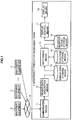
- FIG. 1 is a configuration diagram of an abnormality predictor diagnosis system 1 according to this embodiment.
- the abnormality predictor diagnosis system 1 is a system that diagnoses a mechanical facility 2 for the presence of an abnormality predictor based on sensor data including detection values of a sensor (not illustrated) installed in the mechanical facility 2.
- the above-mentioned “abnormality predictor” is a precursor to an occurrence of abnormality of the mechanical facility 2, and "abnormality predictor diagnosis” is to diagnose for the presence of an abnormality predictor.
- the mechanical facility 2 is, for instance, a chemical plant, and includes a reactor, and a device (not illustrated) that loads chemical substances to the reactor. Then, a predetermined "operation process" is repeated in the mechanical facility 2, thus predetermined chemical substances are generated in each process.
- the type of the mechanical facility 2 is not limited to this, and may be a pharmaceutical plant, a production line, a gas engine, a gas turbine, a power generation facility, a medical facility, or a communication facility.
- a sensor (not illustrated) which detects predetermined physical quantities (such as a temperature, a pressure, a flow rate, a current, a voltage) is installed.
- a physical quantity detected by the sensor is transmitted to the abnormality predictor diagnosis system 1 as sensor data via a network N.
- the sensor data also includes identification information of the mechanical facility 2, identification information of the sensor, and a signal indicating the start and end of an "operation process" which is repeated in the mechanical facility 2.
- the configuration of diagnosis of the mechanical facility 2 for the presence of an abnormality predictor based on the detection values of a sensor will be described, the sensor being one of multiple sensors installed in the mechanical facility 2 and sensitively reflecting an abnormality predictor of the mechanical facility 2.
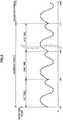
- FIG. 2 is a waveform diagram illustrating a change in the detection values of the sensor. It is to be noted that the horizontal axis of FIG. 2 indicates time and the vertical axis indicates detection value of the sensor (not illustrated) installed in the mechanical facility 2.
- the 1st time operation process is executed in the mechanical facility 2 in the time slot from time t01 to time t02, and the 2nd time operation process is executed in the time slot from time t02 to time t03. Since a predetermined operation process is repeated in this manner, when the mechanical facility 2 is normal, the detection values of the sensor in the operation processes have a similar (that is, quite analogous) waveform.
- a time-series waveform (a waveform of each operation process) of sensor data is learned as a normal model based on the sensor data obtained in a predetermined learning period (see FIG. 2 ) in which the mechanical facility 2 is known to be normal, and the presence of an abnormality predictor of the mechanical facility 2 is determined based on the normal model.
- the details of the normal model will be described later.
- the abnormality predictor diagnosis system 1 includes a communication means 11, a sensor data acquisition means 12, a sensor data storage means 13, a data mining means 14, a function storage means 15, a diagnostic result storage means 16, a display control means 17, and a display means 18.
- the communication means 11 receives information including sensor data from the mechanical facility 2 via a network N.
- a router which receives information in accordance with a communication protocol of TCP/IP can be used as the communication means 11.
- the sensor data acquisition means 12 acquires the sensor data included in the information received by the communication means 11 via the network N, and stores the acquired sensor data in the sensor data storage means 13.
- the sensor data storage means 13 stores the sensor data acquired by the sensor data acquisition means 12, for instance, as a database. It is to be noted that a magnetic disk device, an optical disk device, a semiconductor memory device and the like may be used as the sensor data storage means 13.
- the data mining means 14 learns a normal waveform of detection values (in other words, sensor data) of the sensor as a normal model by data mining that is a statistical data classification technique, and diagnoses the mechanical facility 2 for the presence of an abnormality predictor based on the normal model.
- sensor data in other words, sensor data
- the details of the data mining means 14 will be described later.
- linear functions (lines L illustrated in FIG. 4 ) which monotonously increase as time passes from the start times (times t01, t02, ... illustrated in FIG. 4 ) of the operation processes are stored.
- the linear function is used by the data mining means 14.
- the diagnostic result storage means 16 a diagnostic result of the data mining means 14 is stored.
- the diagnostic result includes identification information of the mechanical facility 2, and the presence or absence of an abnormality predictor.
- the display control means 17 outputs to the display means 18 a control signal for displaying the diagnostic result of the data mining means 14. For instance, the display control means 17 displays a diagnostic result on the display means 18 in a matrix format with a row indicating the name of each a mechanical facility 2 and a column indicating the date of diagnosis.
- the display means 18 is, for instance, a liquid crystal display, and displays a diagnostic result in accordance with the control signal inputted from the display control means 17.
- FIG. 3 is a configuration diagram of the data mining means 14 included in the abnormality predictor diagnosis system 1.
- the data mining means 14 includes a learning means 141 and a diagnosis means 142.
- the learning means 141 learns a cluster (normal model) representing a normal waveform of detection values of a sensor by clustering that is one of the statistical data classification techniques.
- the cluster is an area identified by a cluster center c (see FIG. 5 ) and a cluster radius r (see FIG. 5 ) in a multi-dimensional vector space, and is learned based on the sensor data acquired in a predetermined learning period (see FIG. 2 ).
- the learning means 141 includes a learning target data acquisition unit 141a, a value identification unit 141b, a value storage unit 141c, a cluster learning unit 141d, and a learning result storage unit 141e.
- the learning target data acquisition unit 141a acquires sensor data (that is, learning target data) which is a learning target from the sensor data storage means 13. Specifically, the learning target data acquisition unit 141a acquires sensor data for each operation process repeated in the mechanical facility 2, the sensor data being acquired in a predetermined learning period in which the mechanical facility 2 is known to be normal.
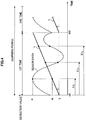
- the value identification unit 141b identifies the detection values of the sensor and the values of the linear function when the predetermined times ⁇ t 1 , ⁇ t 2 , ⁇ t 3 (see FIG. 4 ) with different lengths have passed since the start of an operation process.
- the predetermined times ⁇ t 1 , ⁇ t 2 , ⁇ t 3 are set beforehand so that an occurrence of an abnormality predictor of the mechanical facility 2 is sensitively reflected in the detection values of the sensor at the predetermined times ⁇ t 1 , ⁇ t 2 , ⁇ t 3 .
- FIG. 4 is an explanatory diagram related to detection values of a sensor, and the line L expressed by a linear function.
- each line L illustrated in FIG. 4 is a linear function that monotonously increases as time passes from the start time (time t01, time t02, ...) of an operation process.
- the value identification unit 141b (see FIG. 3 ) identifies detection value p 1 (see FIG. 4 ) of the sensor and value q 1 (see FIG. 4 ) of the line L when the predetermined time ⁇ t 1 has passed since the start of an operation process. Similarly, for other predetermined times ⁇ t 2 , ⁇ t 3 , the value identification unit 141b identifies each of the detection value of the sensor and the value of the linear function.
- the detection values and values of the linear function identified by the value identification unit 141b are stored in association with the predetermined times ⁇ t 1 , ⁇ t 2 , ⁇ t 3 . It is to be noted that when an operation process is repeated n times in the learning period, (3 ⁇ n) sets of a detection value and a value of the linear function are stored in the value storage unit 141c.
- the cluster learning unit 141d learns a cluster (normal model) indicating a normal waveform of detection values of the sensor, based on the information stored in the value storage unit 141c.
- FIG. 5 is an explanatory diagram of a cluster J learned by the cluster learning unit 141d.
- the horizontal axis ⁇ of FIG. 5 is an axis indicating a numerical value after normalization of the value of the linear function
- the vertical axis ⁇ is an axis indicating a numerical value after normalization of the detection value of the sensor.
- the waveform of the sensor data for one-time operation process is expressed by the detection values of the sensor and the values of the linear function at the predetermined times ⁇ t 1 , ⁇ t 2 , ⁇ t 3 (see FIG. 4 ).
- the sensor data is represented by two-dimensional feature vectors having components obtained by performing normalization processing on the detection values of the sensor and the values of the linear function.
- the "normalization processing” is processing that causes the detection values of the sensor and the values of the linear function to be dimensionless quantities allowing mutual comparison by dividing the values by representative values (such as an average value, a standard deviation).
- Each of ⁇ symbols (n symbols are present) illustrated in FIG. 5 indicates the sensor data when the predetermined time ⁇ t 1 , the predetermined time ⁇ t 2 , the predetermined time ⁇ t 3 (see FIG. 4 ) have passed since the start of an operation process. It is to be noted that although one cluster J is illustrated in FIG. 5 , actually, at least three clusters are generated corresponding to the predetermined times ⁇ t 1 , ⁇ t 2 , ⁇ t 3 .
- the cluster learning unit 141d (see FIG. 3 ) classifies n feature vectors indicated by ⁇ symbols into groups called clusters.
- clusters are learned by using k-means method which is non-hierarchical clustering.
- the cluster learning unit 141d first assigns a cluster to each feature vector at random, and calculates the center (the cluster center c, see FIG. 5 ) of each cluster based on the assigned data.
- the cluster center c is, for instance, the centroid of multiple feature vectors belonging to a cluster.
- the cluster learning unit 141d determines the distance between a predetermined feature vector and each cluster center c, and reassigns the feature vector to a cluster with the shortest distance.
- the cluster learning unit 141d executes such processing on all feature vectors.
- the cluster learning unit 141d completes cluster generation processing, or otherwise recalculates the cluster center c from a newly assigned cluster.
- the cluster learning unit 141d then calculates the coordinate values of the cluster center c (see FIG. 5 ), and the cluster radius r (see FIG. 5 ) for each cluster.
- the cluster radius r is, for instance, the average value of the distances between the cluster center c and the feature vectors belonging to the cluster.
- the method of calculating the cluster radius r is not limited to this. For instance, a feature vector farthest from the cluster center c among the feature vectors belonging to the cluster is identified, and the distance between the feature vector and the cluster center c may be the cluster radius r. In this manner, the cluster learning unit 141d learns a cluster that represents a normal waveform of the sensor data.
- the cluster information which is the result of learning by the cluster learning unit 141d, is stored as a database.
- the cluster information includes the cluster center c, the cluster radius r, and identification information of the mechanical facility 2.
- the diagnosis means 142 illustrated in FIG. 3 diagnoses the mechanical facility 2 for the presence of an abnormality predictor using the cluster learned by the learning means 141.
- the diagnosis means 142 includes a diagnosis target data acquisition unit 142a, a value identification unit 142b, an abnormality measure calculation unit 142c, and a diagnosis unit 142d.
- the diagnosis target data acquisition unit 142a acquires the diagnosis target sensor data (that is, the diagnosis target data) from the sensor data storage means 13. That is, the diagnosis target data acquisition unit 142a acquires sensor data in the diagnosis period (see FIG. 2 ) after the learning period, for each operation process repeated in the mechanical facility 2.
- the value identification unit 142b identifies the detection values of the sensor and the values of the linear function when the predetermined times ⁇ t 1 , ⁇ t 2 , ⁇ t 3 have passed since the start of an operation process.
- the above-mentioned predetermined times ⁇ t 1 , ⁇ t 2 , ⁇ t 3 are approximately the same as the predetermined times ⁇ t 1 , ⁇ t 2 , ⁇ t 3 used by the learning means 141.
- the abnormality measure calculation unit 142c calculates an abnormality measure u of the diagnosis target data based on each detection value of the sensor and each value of the linear function identified by the value identification unit 142b, and the cluster information (the cluster center c, the cluster radius r) stored in the learning result storage unit 141e. First, the abnormality measure calculation unit 142c performs normalization processing on the detection value and the value of the linear function identified by the value identification unit 142b to convert into a two-dimensional feature vector.
- the abnormality measure calculation unit 142c refers to the cluster information stored in the learning result storage unit 141e, and identifies a cluster, among the clusters, having a cluster center c closest to the diagnosis target data.
- the abnormality measure calculation unit 142c then calculates an abnormality measure u based on the following (Expression 1) using the distance d (see FIG. 5 ) from the cluster center c of the identified cluster to the diagnosis target data, and the cluster radius r (see FIG. 5 ).
- u d / r
- the diagnosis unit 142d diagnoses the mechanical facility 2 for the presence of an abnormality predictor based on the abnormality measure u calculated by the abnormality measure calculation unit 142c.
- the diagnosis unit 142d diagnoses the mechanical facility 2 as "abnormality predictor is not present".
- the diagnosis unit 142d stores a result of the diagnosis in the diagnostic result storage means 16 in association with the diagnosis target data.
- the diagnosis unit 142d may diagnose the mechanical facility 2 as "abnormality predictor is present".
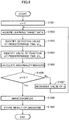
- FIG. 6 is a flowchart illustrating the processing of the abnormality predictor diagnosis system 1.
- the abnormality predictor diagnosis system 1 executes learning processing by the learning means 141 (see FIG. 3 ).
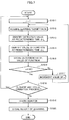
- FIG. 7 is a flowchart of the learning processing executed by the learning means 141.
- step S1011 the learning means 141 sets value n to 1.
- the value n is a natural number that, when multiple predetermined times (3 predetermined times ⁇ t 1 , ⁇ t 2 , ⁇ t 3 illustrated in FIG. 4 ) are present, is incremented (S1017) for selecting a predetermined time used for identifying the detection value of the sensor and the value of the linear function.
- step S1012 the learning means 141 acquires learning target data from the sensor data storage means 13 by the learning target data acquisition unit 141a. That is, the learning means 141 acquires sensor data in the 1st time operation process as the learning target out of the sensor data acquired in a learning period (see FIG. 2 ) in which the mechanical facility 2 is known to be in normal operation.
- step S1013 the learning means 141 identifies the detection value p 1 of the sensor when the predetermined time ⁇ t 1 has passed since the start time (the time t01 illustrated in FIG. 4 ) of an operation process, by the value identification unit 141b.
- the learning target data includes a signal indicating the start and end of an operation process. Therefore, the time t01 when the operation process is started can identified based on the signal.
- step S1015 the learning means 141 stores the detection value p 1 identified in step S1013, and the value q 1 of the linear function identified in step S1014 in the value storage unit 141c in association with the predetermined time ⁇ t 1 .
- the learning means 141 determines whether or not the value n has reached a predetermined value N.
- the predetermined value N is the number of predetermined times ⁇ t n (in this embodiment, 3 predetermined times ⁇ t 1 , ⁇ t 2 , ⁇ t 3 ) used for identifying the detection value of the sensor and the value of the linear function.
- step S1017 the learning means 141 increments the value of n, and returns to the processing in step S1012.
- the learning means 141 then identifies the detection values of the sensor and the values of the linear function similarly for other predetermined times ⁇ t 2 , ⁇ t 3 (see FIG. 4 ).
- step S1016 when the value n has reached the predetermined value N in step S1016 (Yes in S1016), the processing of the learning means 141 proceeds to step S1018.
- step S1018 the learning means 141 determines whether or not there is another operation process, for which a detection value of the sensor and a value of the linear function have not been acquired, in the learning period (see FIG. 2 ).
- step S1018 When there is another operation process in step S1018 (Yes in S1018), the processing of the learning means 141 returns to step S1011.
- the learning means 141 identifies the detection values and the values of the linear function when the predetermined times ⁇ t 1 , ⁇ t 2 , ⁇ t 3 have passed since the start of the operation process. For instance, since the 2nd time operation process is started from the time t02 illustrated in FIG. 4 , the detection values of the sensor and the values of the linear function when the predetermined times ⁇ t 1 , ⁇ t 2 , ⁇ t 3 have passed since the time t02 are identified.
- step S1019 the processing of the learning means 141 proceeds to step S1019.
- step S1019 the learning means 141 learns a cluster based on the data stored in the value storage unit 141c. That is, as described above, the learning means 141 converts each detection value of the sensor and each value of the linear function into a two-dimensional feature vector, and learns a cluster (normal model) that represents a normal waveform of the detection value of the sensor by clustering each feature vector.
- step S1020 the learning means 141 stores the result learned in step S1019 in the learning result storage unit 141e, and completes a series of learning processing (END).
- step S102 the abnormality predictor diagnosis system 1 executes diagnostic processing by the diagnosis means 142 (see FIG. 3 ).
- FIG. 8 is a flowchart of the diagnostic processing executed by the diagnosis means 142.
- step S1021 the diagnosis means 142 sets the value n to 1.
- the value n is the same as the value n described in step S1011 of FIG. 7 .
- step S1022 the diagnosis means 142 acquires the diagnosis target data from the sensor data storage means 13 by the diagnosis target data acquisition unit 142a. That is, the diagnosis means 142 acquires the sensor data of the 1st time operation process as a diagnosis target out of the sensor data acquired in the diagnosis period (see FIG. 2 ) after the learning period.
- step S1023 the diagnosis means 142 identifies the detection value of the sensor when the predetermined time ⁇ t 1 has passed since the start time of an operation process by the value identification unit 142b.
- step S1024 the diagnosis means 142 substitutes the predetermined time ⁇ t 1 into the linear function by the value identification unit 142b to identify the value of the linear function.
- step S1025 the diagnosis means 142 calculates the abnormality measure u of the diagnosis target data by the abnormality measure calculation unit 142c. That is, in step S1025, the diagnosis means 142 normalizes the detection value identified in step S1023 and the value of the linear function identified in step S1024 to generate a two-dimensional feature vector having the normalized values as the components. The diagnosis means 142 then calculates the abnormality measure u of the diagnosis target data using the (Expression 1) based on the feature vector and the cluster information stored in the learning result storage unit 141e.
- step S1026 the diagnosis means 142 determines whether or not the value n has reached a predetermined value N.
- the predetermined value N is the number of predetermined times ⁇ t n (3 in this embodiment), and is the same as the predetermined value N (see FIG. 7 ) used in the learning processing.
- the diagnosis means 142 increments the value of n, and returns to the processing in step S1022.
- step S1026 when the value n has reached the predetermined value N in step S1026 (Yes in S1026), the processing of the diagnosis means 142 proceeds to step S1028.
- step S1028 the diagnosis means 142 diagnoses the mechanical facility 2 for the presence of an abnormality predictor by the diagnosis unit 142d. Specifically, the diagnosis means 142 diagnoses the mechanical facility 2 for the presence of an abnormality predictor based on the abnormality measure u calculated in step S1025.
- step S1029 the diagnosis means 142 stores a diagnostic result in the diagnostic result storage means 16, and completes a series of diagnostic processing (END).
- the diagnosis means 142 repeats such diagnostic processing for each operation process included in the diagnosis period (see FIG. 2 ).
- the information stored in the diagnostic result storage means 16 is displayed on the display means 18 (see FIG. 1 ) by the display control means 17 (see FIG. 1 ).
- FIG. 9A is an explanatory diagram illustrating the waveform of learning target data, and line L of a linear function.
- the waveform of the detection values illustrated in FIG. 9A is the learning target data (detection values) acquired in one-time operation process included in the learning period.
- a two-dimensional feature vector is generated, which has component values obtained by normalizing the detection value p 1 of the sensor and the value q 1 of the linear function (the line L) when the predetermined time ⁇ t 1 has passed since the start of an operation process.
- feature vectors are generated for other predetermined times ⁇ t 2 , ⁇ t 3 , and feature vectors are also generated for other operation processes included in the learning period.
- the clusters J 1 , J 2 , J 3 (see FIG. 10 ) described subsequently are learned based on those feature vectors.
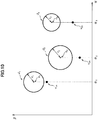
- FIG. 10 is an explanatory diagram of the clusters J 1 , J 2 , J 3 which are results of learning, and the feature vectors v 1A , v 2A , v 3A of diagnosis target data.
- the horizontal axis ⁇ of FIG. 10 indicates a numerical value after normalization of the value of the linear function
- the vertical axis ⁇ indicates a numerical value after normalization of the detection value of the sensor.
- the cluster J 1 illustrated in FIG. 10 is the cluster based on the detection value of the sensor and the value of the linear function when the predetermined time ⁇ t 1 (see FIG. 9A ) has passed since the start time of an operation process, and the cluster is represented by the cluster center c 1 and the cluster radius r 1 .
- the cluster J 2 is the cluster corresponding to the predetermined time ⁇ t 2 (see FIG. 9A )
- the cluster J 3 is the cluster corresponding to the predetermined time ⁇ t 3 (see FIG. 9A ).
- multiple clusters may be learned at a predetermined time ⁇ t n .
- FIG. 9B is an explanatory diagram illustrating the waveform of diagnosis target data, and line L of a linear function at the time of occurrence of an abnormality predictor of the mechanical facility 2.
- the maximum value and the minimum value of the detection value in one-time operation process are the same as in the learning target data (see FIG. 9A ) when the mechanical facility 2 is in normal operation, however, the waveform is different from that in a normal time.
- diagnosis is made for the presence of an abnormality predictor based on only the detection values of a sensor, and thus erroneous diagnosis may be made as "abnormality predictor is not present" based on the diagnosis target data illustrated in FIG. 9B .
- the mechanical facility 2 is diagnosed for the presence of an abnormality predictor based on whether or not a feature vector is present in a cluster, the feature vector being identified by the detection values of the sensor and the values of the linear function when the predetermined times ⁇ t 1 , ⁇ t 2 , ⁇ t 3 have passed since the start time of an operation process.
- a feature vector v 1A indicated by ⁇ symbol of FIG. 10 is generated based on the detection value p 1A and the value q 1 (value ⁇ 1 after normalization, see FIG. 10 ) of the linear function at the predetermined time ⁇ t 1 illustrated in FIG. 9B .
- the feature vector v 1A is not included in the cluster J 1 closest to the feature vector v 1A , and thus diagnosed as "abnormality predictor is present" by the diagnosis unit 142d.
- the same goes for a feature vector v 2A corresponding to the detection value and the like of the predetermined time ⁇ t 2 (see FIG. 9B ), and a feature vector v 3A corresponding to the detection value and the like of the predetermined time ⁇ t 3 (see FIG. 9B ).
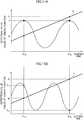
- FIG. 11A is an explanatory diagram illustrating another example of the waveform of learning target data, and line L of a linear function.
- the detection value of a sensor varies in a sine wave form in the learning period in which the mechanical facility 2 is in normal operation.
- two predetermined times ⁇ t 4 , ⁇ t 5 which provide local maximum points of the waveform of detection values, are set.
- a cluster (normal model) that represents a normal waveform of the detection values is learned based on the detection values of the sensor and the values of the linear function when the predetermined times ⁇ t 4 , ⁇ t 5 have passed since the start time of an operation process. As illustrated in FIG.
- the detection values p at the predetermined times ⁇ t 4 , ⁇ t 5 are the same, however, the values q 4 , q 5 of the linear function are significantly different (q 4 ⁇ q 5 ).
- different clusters J 4 , J 5 (see FIG. 12 ) corresponding to the predetermined times ⁇ t 4 , ⁇ t 5 are learned.
- the detection value p at the predetermined time ⁇ t 4 and the detection value p at the predetermined time ⁇ t 5 have not been distinguished in the learning processing.
- the predetermined times ⁇ t 4 , ⁇ t 5 are different, clusters can be learned in a distinguished manner.
- the learning result contributes to higher accuracy of abnormality predictor diagnosis as described later.
- FIG. 11B is an explanatory diagram illustrating the waveform of diagnosis target data, and line L of a linear function at the time of occurrence of an abnormality predictor.
- the amplitude and the maximum value, the minimum value of the waveform of the diagnosis target data are the same as in a normal time, the period of the waveform is shorter than in a normal time.
- the detection value p 5A at the predetermined time ⁇ t 5 is significantly smaller than the detection value p in a normal time.
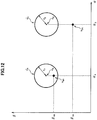
- FIG. 12 is an explanatory diagram of clusters J 4 , J 5 which are results of learning, and feature vectors v 4A , v 5A of diagnosis target data. It is to be noted that the horizontal axis ⁇ and the vertical axis ⁇ are the same as in FIG. 10 .
- the cluster J 4 illustrated in FIG. 12 is the cluster that is learned by using the detection value of the sensor, and the value of the linear function when the predetermined time ⁇ t 4 (see FIG. 11A ) has passed since the start time of an operation process.
- the cluster J 5 is the cluster based on the detection value of the sensor, and the value of the linear function when the predetermined time ⁇ t 5 (see FIG. 11A ) has passed since the start time of an operation process.
- the detection value p 5A (see FIG. 11B , value ⁇ 5A after normalization illustrated: see FIG. 12 ) at the predetermined time ⁇ t 5 is significantly smaller than the detection value p in a normal time. Therefore, the feature vector v 5A identified by the detection value and the value of the linear function at the predetermined time ⁇ t 5 is located outside the cluster J 5 in the nearest neighbor. As a result, the feature vector v 5A is diagnosed as "abnormality predictor is present" by the diagnosis unit 142d.
- the cluster with a cluster center closest to the feature vector v 5A is the cluster J 5 and not the cluster J 4 . Therefore, the abnormality measure u of the detection value p 5A at the predetermined time ⁇ t 5 can be calculated based on the cluster J 5 corresponding to the predetermined time ⁇ t 5 . Consequently, it is possible to diagnose whether or not the waveform of the detection values of the diagnosis target data is abnormal with high accuracy (in other words, the presence of an abnormality predictor of the mechanical facility 2).
- the detection values and the values of the monotonously increasing linear function when the predetermined times ⁇ t n has passed since the start time of an operation process are converted to a two-dimensional feature vector, and a normal waveform of the detection values of the sensor can be learned as a cluster based on the feature vector.
- a feature vector is similarly generated, and it is possible to diagnose whether or not the waveform is abnormal with high accuracy based on the cluster which is a result of the learning (in other words, whether or not an abnormality predictor has occurred in the mechanical facility 2).
- abnormality predictor diagnosis system 1 has been described based on the embodiments above, the present invention is not limited to these embodiments, and various modifications may be made.
- the invention is not limited to this. Specifically, the number of predetermined times ⁇ t n may be one, or may be four or greater.
- a linear function that monotonously increases as time passes is used, the invention is not limited to this.
- a linear function that monotonously decreases as time passes may be used, or a curved function that monotonously increases or monotonously decreases as time passes may be used.
- a predetermined function which outputs a different value as time passes, may be used.
- the invention is not limited to this.
- the waveform data including the detection values of the sensor and the values of the linear function at the predetermined times ⁇ t 1 , ⁇ t 2 , ⁇ t 3 are converted to a 6-dimensional feature vector by the learning means 141, and a cluster may be learned based on the feature vector obtained for each operation process.
- the waveform data including the detection values of the sensor and the values of the linear function at the predetermined times ⁇ t 1 , ⁇ t 2 , ⁇ t 3 are obtained by the diagnosis means 142, and the mechanical facility 2 may be diagnosed for the presence of an abnormality predictor based on the comparison between the waveform data and a normal model.
- the method and the like of calculating an abnormality measure u are the same as in the embodiment. Consequently, the waveform of the detection values of the sensor in one-time operation process can be expressed by a 6-dimensional feature vector, and thus an abnormality (in other words, an abnormality predictor in the mechanical facility 2) of the waveform can be diagnosed with high accuracy.
- the mechanical facility 2 is diagnosed for the presence of an abnormality predictor based on the sensor data acquired from one sensor
- the invention is not limited to this.
- the mechanical facility 2 may be diagnosed for the presence of an abnormality predictor based on the sensor data acquired from multiple sensors.
- a multi-dimensional feature vector may be generated based on the detection values of the sensors and the values of the linear function when the predetermined times have passed since the start time of an operation process. It is to be noted that the dimension number of the feature vector is (the number of sensors) + 1. A user can recognize what type of abnormality has occurred at which position of the mechanical facility 2 by using multiple sensors in this manner.
- the invention is not limited to this. Specifically, sensor data which is diagnosed as "abnormality predictor is not present" by the diagnosis unit 142d may be added to the learning target data, and the cluster center c and the cluster radius r may be recalculated (in other words, a cluster is re-learned) based on the learning target data with the addition. A cluster is re-learned in this manner, and thus information on the normal state of the mechanical facility 2 is gradually increased, and the cluster center c and the cluster radius r can be updated to more appropriate values.
- the oldest data in the existing learning target data may be excluded from the learning target.
- the cluster can be updated to follow the change, and eventually, the diagnostic accuracy for an abnormality predictor can be increased.
- the present invention is not limited to the embodiments including all the components described in each embodiment. Also, part of the components of an embodiment may be replaced by a component of another embodiment, and a component of another embodiment may be added to the components of an embodiment. Also, another component may be added to, deleted from, or may replace part of the components of each embodiment.
- part or all of the components illustrated in FIG. 1 , FIG. 3 may be implemented by hardware, for instance, by designing an integrated circuit.
- Each component described above may be implemented by software in which a processor interprets and executes a program that implements each function.
- Information such as a program, a tape, a file, which implements each function may be stored in a recording device, such as a memory, a hard disk, an SSD (Solid State Drive) or a recording medium, such as an IC card, an SD card, a DVD.
- a control line or an information line which is considered to be necessary for description is illustrated, and all the control lines or information lines are not necessarily illustrated for a product. It may be interpreted that almost all components are practically connected to each other.
Landscapes
- Physics & Mathematics (AREA)
- Engineering & Computer Science (AREA)
- General Physics & Mathematics (AREA)
- Automation & Control Theory (AREA)
- Artificial Intelligence (AREA)
- Evolutionary Computation (AREA)
- Mathematical Physics (AREA)
- Testing And Monitoring For Control Systems (AREA)
Applications Claiming Priority (2)
| Application Number | Priority Date | Filing Date | Title |
|---|---|---|---|
| JP2015155489A JP5845374B1 (ja) | 2015-08-05 | 2015-08-05 | 異常予兆診断システム及び異常予兆診断方法 |
| PCT/JP2016/072716 WO2017022784A1 (ja) | 2015-08-05 | 2016-08-03 | 異常予兆診断システム及び異常予兆診断方法 |
Publications (3)
| Publication Number | Publication Date |
|---|---|
| EP3333661A1 true EP3333661A1 (de) | 2018-06-13 |
| EP3333661A4 EP3333661A4 (de) | 2019-04-03 |
| EP3333661B1 EP3333661B1 (de) | 2021-03-31 |
Family
ID=55169184
Family Applications (1)
| Application Number | Title | Priority Date | Filing Date |
|---|---|---|---|
| EP16833063.7A Active EP3333661B1 (de) | 2015-08-05 | 2016-08-03 | Anomalieprädiktordiagnosesystem und anomalieprädiktordiagnoseverfahren |
Country Status (4)
| Country | Link |
|---|---|
| US (1) | US20180239345A1 (de) |
| EP (1) | EP3333661B1 (de) |
| JP (1) | JP5845374B1 (de) |
| WO (1) | WO2017022784A1 (de) |
Families Citing this family (20)
| Publication number | Priority date | Publication date | Assignee | Title |
|---|---|---|---|---|
| JP6426667B2 (ja) * | 2016-08-10 | 2018-11-21 | 三菱重工工作機械株式会社 | 工作機械の工具の異常検知装置及び方法 |
| US11455203B2 (en) * | 2016-09-14 | 2022-09-27 | Nec Corporation | Abnormality detection support device, abnormality detection support method, and program |
| JP2018077764A (ja) * | 2016-11-11 | 2018-05-17 | 東京エレクトロン株式会社 | 異常検知装置 |
| JP6809882B2 (ja) * | 2016-11-29 | 2021-01-06 | ファナック株式会社 | ファンの故障予測を学習する機械学習器、機械学習器を含む装置および機械学習方法 |
| US10304263B2 (en) * | 2016-12-13 | 2019-05-28 | The Boeing Company | Vehicle system prognosis device and method |
| JP6545728B2 (ja) * | 2017-01-11 | 2019-07-17 | 株式会社東芝 | 異常検知装置、異常検知方法、および異常検知プログラム |
| JP6876589B2 (ja) * | 2017-09-29 | 2021-05-26 | アンリツ株式会社 | 異常検知装置及び異常検知方法並びに異常検知プログラム |
| JP6887361B2 (ja) * | 2017-10-31 | 2021-06-16 | 三菱重工業株式会社 | 監視対象選定装置、監視対象選定方法、およびプログラム |
| JP7180985B2 (ja) * | 2018-03-01 | 2022-11-30 | 株式会社日立製作所 | 診断装置および診断方法 |
| CN112262354B (zh) * | 2018-06-15 | 2024-06-18 | 三菱电机株式会社 | 诊断装置、诊断方法及记录介质 |
| US11789437B2 (en) | 2018-07-24 | 2023-10-17 | Canon Kabushiki Kaisha | Processing apparatus and processing method for processing portion |
| CN113165134B (zh) * | 2018-12-12 | 2023-10-13 | 株式会社富士 | 异常检测装置、机床、异常检测方法及程序 |
| JP6975188B2 (ja) * | 2019-02-07 | 2021-12-01 | ファナック株式会社 | 状態判定装置及び状態判定方法 |
| JP7408366B2 (ja) | 2019-12-06 | 2024-01-05 | キヤノンメディカルシステムズ株式会社 | 機器管理装置、機器管理システム及び機器管理方法 |
| KR102739316B1 (ko) * | 2020-02-04 | 2024-12-05 | 한국전자통신연구원 | 제조 설비의 이상 감지 방법 및 장치 |
| US20230038415A1 (en) * | 2020-02-07 | 2023-02-09 | Fanuc Corporation | Diagnosis device |
| US12105507B2 (en) * | 2021-08-31 | 2024-10-01 | Rockwell Automation Technologies, Inc. | Automated diagnosis of augmented acoustic measurement in industrial environments |
| CN114325022B (zh) * | 2021-11-24 | 2024-04-12 | 浙江中控技术股份有限公司 | 一种监测ao正弦信号跳变的方法、系统、设备以及介质 |
| WO2023119486A1 (ja) * | 2021-12-22 | 2023-06-29 | Jfeスチール株式会社 | 正常ベクトル登録装置、設備異常監視システム、及び設備異常監視方法 |
| WO2023162077A1 (ja) * | 2022-02-24 | 2023-08-31 | 株式会社日立ハイテク | 診断装置及び診断方法並びに半導体製造装置システム及び半導体装置製造システム |
Family Cites Families (10)
| Publication number | Priority date | Publication date | Assignee | Title |
|---|---|---|---|---|
| JP2005090864A (ja) * | 2003-09-17 | 2005-04-07 | Toshiba Kyaria Kk | 空気調和機の点検作業支援システムおよび点検作業支援方法 |
| JP5301310B2 (ja) * | 2009-02-17 | 2013-09-25 | 株式会社日立製作所 | 異常検知方法及び異常検知システム |
| JP5099066B2 (ja) * | 2009-04-10 | 2012-12-12 | オムロン株式会社 | エネルギー監視装置およびその制御方法、ならびにエネルギー監視プログラム |
| JP5297272B2 (ja) * | 2009-06-11 | 2013-09-25 | 株式会社日立製作所 | 装置異常監視方法及びシステム |
| JP5431235B2 (ja) * | 2009-08-28 | 2014-03-05 | 株式会社日立製作所 | 設備状態監視方法およびその装置 |
| JP5363927B2 (ja) * | 2009-09-07 | 2013-12-11 | 株式会社日立製作所 | 異常検知・診断方法、異常検知・診断システム、及び異常検知・診断プログラム |
| EP2752722B1 (de) * | 2011-08-31 | 2019-11-06 | Hitachi Power Solutions Co., Ltd. | Verfahren zur überwachung eines anlagenstatus und vorrichtung dafür |
| JP5856446B2 (ja) * | 2011-11-17 | 2016-02-09 | 株式会社日立製作所 | 鉄道車両用保守システム |
| JP5480440B1 (ja) * | 2013-12-03 | 2014-04-23 | 株式会社日立パワーソリューションズ | 異常予兆診断装置及び異常予兆診断方法 |
| CN107209508B (zh) * | 2015-01-21 | 2018-08-28 | 三菱电机株式会社 | 信息处理装置及信息处理方法 |
-
2015
- 2015-08-05 JP JP2015155489A patent/JP5845374B1/ja active Active
-
2016
- 2016-08-03 US US15/750,117 patent/US20180239345A1/en not_active Abandoned
- 2016-08-03 WO PCT/JP2016/072716 patent/WO2017022784A1/ja not_active Ceased
- 2016-08-03 EP EP16833063.7A patent/EP3333661B1/de active Active
Also Published As
| Publication number | Publication date |
|---|---|
| US20180239345A1 (en) | 2018-08-23 |
| EP3333661B1 (de) | 2021-03-31 |
| JP2017033472A (ja) | 2017-02-09 |
| JP5845374B1 (ja) | 2016-01-20 |
| WO2017022784A1 (ja) | 2017-02-09 |
| EP3333661A4 (de) | 2019-04-03 |
Similar Documents
| Publication | Publication Date | Title |
|---|---|---|
| EP3333661B1 (de) | Anomalieprädiktordiagnosesystem und anomalieprädiktordiagnoseverfahren | |
| EP3333660B1 (de) | Anomalieprädiktordiagnosesystem und anomalieprädiktordiagnoseverfahren | |
| JP5946572B1 (ja) | 異常予兆診断システム及び異常予兆診断方法 | |
| JP6361175B2 (ja) | 異常診断装置及びプログラム | |
| JP5480440B1 (ja) | 異常予兆診断装置及び異常予兆診断方法 | |
| CN102282516B (zh) | 异常检测方法及异常检测系统 | |
| US11692910B2 (en) | Abnormality diagnostic device, abnormality diagnostic method, and program | |
| WO2016079972A1 (ja) | 要因分析装置、要因分析方法と記録媒体、及び、要因分析システム | |
| EP3552067A1 (de) | Verfahren und systeme zur entdeckung von prognostischen untersequenzen in zeitreihen | |
| JP5715288B1 (ja) | 動態監視装置及び動態監視方法 | |
| CN112947356B (zh) | 控制方法、控制装置、机械装备和记录介质 | |
| JP6828807B2 (ja) | データ解析装置、データ解析方法およびデータ解析プログラム | |
| US20200193325A1 (en) | Learning system, analysis system, learning method, and storage medium | |
| JP7158624B2 (ja) | 異常検知装置 | |
| US20180165894A1 (en) | Vehicle system prognosis device and method | |
| WO2013188145A1 (en) | Generalized pattern recognition for fault diagnosis in machine condition monitoring | |
| JP6915693B2 (ja) | システム分析方法、システム分析装置、および、プログラム | |
| JP6641056B1 (ja) | 機器の異常診断方法および機器の異常診断システム | |
| EP3923228B1 (de) | Verfahren, vorrichtung und programm zur datenanalyse | |
| US20210089962A1 (en) | Information processing device, information processing method, and recording medium | |
| JP2023023347A (ja) | 異常診断システム、異常診断装置、異常診断方法、及びプログラム | |
| JP2018028845A (ja) | 異常予兆検出システムおよび異常予兆検出方法 | |
| JP6710913B2 (ja) | 情報提供装置、情報提供方法、及びプログラム | |
| US12019433B2 (en) | Periodicity analysis apparatus, method and program recording medium | |
| Maleki et al. | A one-class clustering technique for novelty detection and isolation in sensor networks |
Legal Events
| Date | Code | Title | Description |
|---|---|---|---|
| STAA | Information on the status of an ep patent application or granted ep patent |
Free format text: STATUS: THE INTERNATIONAL PUBLICATION HAS BEEN MADE |
|
| PUAI | Public reference made under article 153(3) epc to a published international application that has entered the european phase |
Free format text: ORIGINAL CODE: 0009012 |
|
| STAA | Information on the status of an ep patent application or granted ep patent |
Free format text: STATUS: REQUEST FOR EXAMINATION WAS MADE |
|
| 17P | Request for examination filed |
Effective date: 20180205 |
|
| AK | Designated contracting states |
Kind code of ref document: A1 Designated state(s): AL AT BE BG CH CY CZ DE DK EE ES FI FR GB GR HR HU IE IS IT LI LT LU LV MC MK MT NL NO PL PT RO RS SE SI SK SM TR |
|
| AX | Request for extension of the european patent |
Extension state: BA ME |
|
| DAV | Request for validation of the european patent (deleted) | ||
| DAX | Request for extension of the european patent (deleted) | ||
| A4 | Supplementary search report drawn up and despatched |
Effective date: 20190304 |
|
| RIC1 | Information provided on ipc code assigned before grant |
Ipc: G05B 23/02 20060101AFI20190226BHEP |
|
| GRAP | Despatch of communication of intention to grant a patent |
Free format text: ORIGINAL CODE: EPIDOSNIGR1 |
|
| STAA | Information on the status of an ep patent application or granted ep patent |
Free format text: STATUS: GRANT OF PATENT IS INTENDED |
|
| INTG | Intention to grant announced |
Effective date: 20201208 |
|
| GRAS | Grant fee paid |
Free format text: ORIGINAL CODE: EPIDOSNIGR3 |
|
| GRAA | (expected) grant |
Free format text: ORIGINAL CODE: 0009210 |
|
| STAA | Information on the status of an ep patent application or granted ep patent |
Free format text: STATUS: THE PATENT HAS BEEN GRANTED |
|
| AK | Designated contracting states |
Kind code of ref document: B1 Designated state(s): AL AT BE BG CH CY CZ DE DK EE ES FI FR GB GR HR HU IE IS IT LI LT LU LV MC MK MT NL NO PL PT RO RS SE SI SK SM TR |
|
| REG | Reference to a national code |
Ref country code: GB Ref legal event code: FG4D Ref country code: CH Ref legal event code: EP |
|
| REG | Reference to a national code |
Ref country code: DE Ref legal event code: R096 Ref document number: 602016055375 Country of ref document: DE Ref country code: AT Ref legal event code: REF Ref document number: 1377653 Country of ref document: AT Kind code of ref document: T Effective date: 20210415 |
|
| REG | Reference to a national code |
Ref country code: IE Ref legal event code: FG4D |
|
| REG | Reference to a national code |
Ref country code: LT Ref legal event code: MG9D |
|
| PG25 | Lapsed in a contracting state [announced via postgrant information from national office to epo] |
Ref country code: NO Free format text: LAPSE BECAUSE OF FAILURE TO SUBMIT A TRANSLATION OF THE DESCRIPTION OR TO PAY THE FEE WITHIN THE PRESCRIBED TIME-LIMIT Effective date: 20210630 Ref country code: FI Free format text: LAPSE BECAUSE OF FAILURE TO SUBMIT A TRANSLATION OF THE DESCRIPTION OR TO PAY THE FEE WITHIN THE PRESCRIBED TIME-LIMIT Effective date: 20210331 Ref country code: HR Free format text: LAPSE BECAUSE OF FAILURE TO SUBMIT A TRANSLATION OF THE DESCRIPTION OR TO PAY THE FEE WITHIN THE PRESCRIBED TIME-LIMIT Effective date: 20210331 Ref country code: BG Free format text: LAPSE BECAUSE OF FAILURE TO SUBMIT A TRANSLATION OF THE DESCRIPTION OR TO PAY THE FEE WITHIN THE PRESCRIBED TIME-LIMIT Effective date: 20210630 |
|
| PG25 | Lapsed in a contracting state [announced via postgrant information from national office to epo] |
Ref country code: SE Free format text: LAPSE BECAUSE OF FAILURE TO SUBMIT A TRANSLATION OF THE DESCRIPTION OR TO PAY THE FEE WITHIN THE PRESCRIBED TIME-LIMIT Effective date: 20210331 Ref country code: RS Free format text: LAPSE BECAUSE OF FAILURE TO SUBMIT A TRANSLATION OF THE DESCRIPTION OR TO PAY THE FEE WITHIN THE PRESCRIBED TIME-LIMIT Effective date: 20210331 Ref country code: LV Free format text: LAPSE BECAUSE OF FAILURE TO SUBMIT A TRANSLATION OF THE DESCRIPTION OR TO PAY THE FEE WITHIN THE PRESCRIBED TIME-LIMIT Effective date: 20210331 |
|
| REG | Reference to a national code |
Ref country code: NL Ref legal event code: MP Effective date: 20210331 |
|
| REG | Reference to a national code |
Ref country code: AT Ref legal event code: MK05 Ref document number: 1377653 Country of ref document: AT Kind code of ref document: T Effective date: 20210331 |
|
| PG25 | Lapsed in a contracting state [announced via postgrant information from national office to epo] |
Ref country code: LT Free format text: LAPSE BECAUSE OF FAILURE TO SUBMIT A TRANSLATION OF THE DESCRIPTION OR TO PAY THE FEE WITHIN THE PRESCRIBED TIME-LIMIT Effective date: 20210331 Ref country code: EE Free format text: LAPSE BECAUSE OF FAILURE TO SUBMIT A TRANSLATION OF THE DESCRIPTION OR TO PAY THE FEE WITHIN THE PRESCRIBED TIME-LIMIT Effective date: 20210331 Ref country code: CZ Free format text: LAPSE BECAUSE OF FAILURE TO SUBMIT A TRANSLATION OF THE DESCRIPTION OR TO PAY THE FEE WITHIN THE PRESCRIBED TIME-LIMIT Effective date: 20210331 Ref country code: AT Free format text: LAPSE BECAUSE OF FAILURE TO SUBMIT A TRANSLATION OF THE DESCRIPTION OR TO PAY THE FEE WITHIN THE PRESCRIBED TIME-LIMIT Effective date: 20210331 Ref country code: NL Free format text: LAPSE BECAUSE OF FAILURE TO SUBMIT A TRANSLATION OF THE DESCRIPTION OR TO PAY THE FEE WITHIN THE PRESCRIBED TIME-LIMIT Effective date: 20210331 Ref country code: SM Free format text: LAPSE BECAUSE OF FAILURE TO SUBMIT A TRANSLATION OF THE DESCRIPTION OR TO PAY THE FEE WITHIN THE PRESCRIBED TIME-LIMIT Effective date: 20210331 |
|
| PG25 | Lapsed in a contracting state [announced via postgrant information from national office to epo] |
Ref country code: SK Free format text: LAPSE BECAUSE OF FAILURE TO SUBMIT A TRANSLATION OF THE DESCRIPTION OR TO PAY THE FEE WITHIN THE PRESCRIBED TIME-LIMIT Effective date: 20210331 Ref country code: PL Free format text: LAPSE BECAUSE OF FAILURE TO SUBMIT A TRANSLATION OF THE DESCRIPTION OR TO PAY THE FEE WITHIN THE PRESCRIBED TIME-LIMIT Effective date: 20210331 Ref country code: PT Free format text: LAPSE BECAUSE OF FAILURE TO SUBMIT A TRANSLATION OF THE DESCRIPTION OR TO PAY THE FEE WITHIN THE PRESCRIBED TIME-LIMIT Effective date: 20210802 Ref country code: RO Free format text: LAPSE BECAUSE OF FAILURE TO SUBMIT A TRANSLATION OF THE DESCRIPTION OR TO PAY THE FEE WITHIN THE PRESCRIBED TIME-LIMIT Effective date: 20210331 Ref country code: IS Free format text: LAPSE BECAUSE OF FAILURE TO SUBMIT A TRANSLATION OF THE DESCRIPTION OR TO PAY THE FEE WITHIN THE PRESCRIBED TIME-LIMIT Effective date: 20210731 |
|
| REG | Reference to a national code |
Ref country code: DE Ref legal event code: R097 Ref document number: 602016055375 Country of ref document: DE |
|
| PG25 | Lapsed in a contracting state [announced via postgrant information from national office to epo] |
Ref country code: ES Free format text: LAPSE BECAUSE OF FAILURE TO SUBMIT A TRANSLATION OF THE DESCRIPTION OR TO PAY THE FEE WITHIN THE PRESCRIBED TIME-LIMIT Effective date: 20210331 Ref country code: AL Free format text: LAPSE BECAUSE OF FAILURE TO SUBMIT A TRANSLATION OF THE DESCRIPTION OR TO PAY THE FEE WITHIN THE PRESCRIBED TIME-LIMIT Effective date: 20210331 Ref country code: DK Free format text: LAPSE BECAUSE OF FAILURE TO SUBMIT A TRANSLATION OF THE DESCRIPTION OR TO PAY THE FEE WITHIN THE PRESCRIBED TIME-LIMIT Effective date: 20210331 |
|
| PLBE | No opposition filed within time limit |
Free format text: ORIGINAL CODE: 0009261 |
|
| STAA | Information on the status of an ep patent application or granted ep patent |
Free format text: STATUS: NO OPPOSITION FILED WITHIN TIME LIMIT |
|
| 26N | No opposition filed |
Effective date: 20220104 |
|
| PG25 | Lapsed in a contracting state [announced via postgrant information from national office to epo] |
Ref country code: MC Free format text: LAPSE BECAUSE OF FAILURE TO SUBMIT A TRANSLATION OF THE DESCRIPTION OR TO PAY THE FEE WITHIN THE PRESCRIBED TIME-LIMIT Effective date: 20210331 |
|
| REG | Reference to a national code |
Ref country code: BE Ref legal event code: MM Effective date: 20210831 |
|
| GBPC | Gb: european patent ceased through non-payment of renewal fee |
Effective date: 20210803 |
|
| PG25 | Lapsed in a contracting state [announced via postgrant information from national office to epo] |
Ref country code: IS Free format text: LAPSE BECAUSE OF FAILURE TO SUBMIT A TRANSLATION OF THE DESCRIPTION OR TO PAY THE FEE WITHIN THE PRESCRIBED TIME-LIMIT Effective date: 20210731 Ref country code: LU Free format text: LAPSE BECAUSE OF NON-PAYMENT OF DUE FEES Effective date: 20210803 |
|
| PG25 | Lapsed in a contracting state [announced via postgrant information from national office to epo] |
Ref country code: IT Free format text: LAPSE BECAUSE OF FAILURE TO SUBMIT A TRANSLATION OF THE DESCRIPTION OR TO PAY THE FEE WITHIN THE PRESCRIBED TIME-LIMIT Effective date: 20210331 Ref country code: IE Free format text: LAPSE BECAUSE OF NON-PAYMENT OF DUE FEES Effective date: 20210803 Ref country code: GB Free format text: LAPSE BECAUSE OF NON-PAYMENT OF DUE FEES Effective date: 20210803 Ref country code: FR Free format text: LAPSE BECAUSE OF NON-PAYMENT OF DUE FEES Effective date: 20210831 Ref country code: BE Free format text: LAPSE BECAUSE OF NON-PAYMENT OF DUE FEES Effective date: 20210831 |
|
| PG25 | Lapsed in a contracting state [announced via postgrant information from national office to epo] |
Ref country code: HU Free format text: LAPSE BECAUSE OF FAILURE TO SUBMIT A TRANSLATION OF THE DESCRIPTION OR TO PAY THE FEE WITHIN THE PRESCRIBED TIME-LIMIT; INVALID AB INITIO Effective date: 20160803 |
|
| PG25 | Lapsed in a contracting state [announced via postgrant information from national office to epo] |
Ref country code: CY Free format text: LAPSE BECAUSE OF FAILURE TO SUBMIT A TRANSLATION OF THE DESCRIPTION OR TO PAY THE FEE WITHIN THE PRESCRIBED TIME-LIMIT Effective date: 20210331 |
|
| PG25 | Lapsed in a contracting state [announced via postgrant information from national office to epo] |
Ref country code: GR Free format text: LAPSE BECAUSE OF FAILURE TO SUBMIT A TRANSLATION OF THE DESCRIPTION OR TO PAY THE FEE WITHIN THE PRESCRIBED TIME-LIMIT Effective date: 20210331 |
|
| PG25 | Lapsed in a contracting state [announced via postgrant information from national office to epo] |
Ref country code: MK Free format text: LAPSE BECAUSE OF FAILURE TO SUBMIT A TRANSLATION OF THE DESCRIPTION OR TO PAY THE FEE WITHIN THE PRESCRIBED TIME-LIMIT Effective date: 20210331 |
|
| PG25 | Lapsed in a contracting state [announced via postgrant information from national office to epo] |
Ref country code: MT Free format text: LAPSE BECAUSE OF FAILURE TO SUBMIT A TRANSLATION OF THE DESCRIPTION OR TO PAY THE FEE WITHIN THE PRESCRIBED TIME-LIMIT Effective date: 20210331 |
|
| PGFP | Annual fee paid to national office [announced via postgrant information from national office to epo] |
Ref country code: DE Payment date: 20250702 Year of fee payment: 10 |
|
| PGFP | Annual fee paid to national office [announced via postgrant information from national office to epo] |
Ref country code: CH Payment date: 20250901 Year of fee payment: 10 |
|
| PG25 | Lapsed in a contracting state [announced via postgrant information from national office to epo] |
Ref country code: TR Free format text: LAPSE BECAUSE OF FAILURE TO SUBMIT A TRANSLATION OF THE DESCRIPTION OR TO PAY THE FEE WITHIN THE PRESCRIBED TIME-LIMIT Effective date: 20210331 |