EP3330270B1 - Pyridophenanthrolinderivat, dessen herstellung und verwendung als arzneimittel - Google Patents
Pyridophenanthrolinderivat, dessen herstellung und verwendung als arzneimittel Download PDFInfo
- Publication number
- EP3330270B1 EP3330270B1 EP16201389.0A EP16201389A EP3330270B1 EP 3330270 B1 EP3330270 B1 EP 3330270B1 EP 16201389 A EP16201389 A EP 16201389A EP 3330270 B1 EP3330270 B1 EP 3330270B1
- Authority
- EP
- European Patent Office
- Prior art keywords
- compound
- topoisomerase
- cancer
- medicinal product
- topoisomerases
- Prior art date
- Legal status (The legal status is an assumption and is not a legal conclusion. Google has not performed a legal analysis and makes no representation as to the accuracy of the status listed.)
- Active
Links
Images


Classifications
-
- C—CHEMISTRY; METALLURGY
- C07—ORGANIC CHEMISTRY
- C07D—HETEROCYCLIC COMPOUNDS
- C07D471/00—Heterocyclic compounds containing nitrogen atoms as the only ring hetero atoms in the condensed system, at least one ring being a six-membered ring with one nitrogen atom, not provided for by groups C07D451/00 - C07D463/00
- C07D471/12—Heterocyclic compounds containing nitrogen atoms as the only ring hetero atoms in the condensed system, at least one ring being a six-membered ring with one nitrogen atom, not provided for by groups C07D451/00 - C07D463/00 in which the condensed system contains three hetero rings
- C07D471/14—Ortho-condensed systems
-
- A—HUMAN NECESSITIES
- A61—MEDICAL OR VETERINARY SCIENCE; HYGIENE
- A61P—SPECIFIC THERAPEUTIC ACTIVITY OF CHEMICAL COMPOUNDS OR MEDICINAL PREPARATIONS
- A61P35/00—Antineoplastic agents
Definitions
- the invention relates to a pyridophenanthroline derivative, its production and use in medicine, in particular for the treatment of cancer.
- topoisomerases enzymes that are required for the generation of transient single and double-strand breaks to maintain the topology of DNA during transcription and replication in the context of DNA and RNA synthesis. Inhibition of topoisomerase leads to the death of cancer cells.
- a simultaneous inhibition of the two enzyme forms I and II has turned out to be particularly promising in the development of new inhibitors of human topoisomerases in cancer therapy.
- a decisive advantage is that an upregulation of one enzyme in each case by the selective inhibition of the other, as is the case with topoisomerase inhibitors currently used in therapy, can be counteracted by the equal inhibition of both forms I and II.
- Van Gijn et al. describe the effectiveness of some topoisomerase inhibitors against various types of cancer, with some compounds showing particular promise as dual topoisomerase inhibitors.
- "Intoplicin" which is effective as a dual topoisomerase inhibitor, shows high activity against breast carcinoma, ovarian carcinoma, colon carcinoma, renal cell carcinoma and non-small cell lung cancer. In clinical phase I, the substance's hepatotoxicity proved to be dose-limiting, which had lethal consequences for some patients.
- TAS-103 which is also effective as a dual topoisomerase inhibitor, shows efficacy in head and neck cancer, colon carcinoma, renal carcinoma and non-small cell lung cancer, the effectiveness is sufficient to keep the patients stable for a period of several months, a cure could not be achieved, [ van Gijn et al. "Dual topoisomerase inhibitors I/II" J. Oncol Pharm Practice, Voi 6, No 3(2000 )].
- Adjei et al. Effect on (metastatic) malignant melanomas, liver cell carcinomas and mesothelioma. In the clinical study, no cure was achieved here, but the patients were stabilized for a few months.
- Adjei et al. "A phase I and pharmacologic study of pyrazoloacridine (NSC 366140) and carboplatin in patients with advanced cancer", Investigational New Drugs 20: 297-304, 2002 .]
- De Jonge et al. describe the effectiveness of the dual topoisomerase inhibitor XR11576 against colon carcinoma, ovarian carcinoma, breast carcinoma and lung carcinoma. In in vivo xenograft studies, high activities against colon carcinoma and non-small cell lung carcinoma could be found. In clinical phase I studies, the dual topoisomerase inhibitor XR11576 was able to develop an effect on malignant melanoma, cervical carcinoma and cancer of the parotid gland, but stabilization of the disease was not shown. [ de Jonge et al.
- the object of the invention is achieved by a compound of the formula and their salts and/or solvates.
- the object is achieved by the salt of the compound 6-(2-dimethylaminoethoxy)-11-(3,4,5-trimethoxyphenyl)pyrido[3,4- c ][1,9]phenanthroline hydrochloride as a prodrug for 6-(2-dimethylaminoethoxy)-11-(3,4,5-trimethoxyphenyl)pyrido[3,4-c][1,9]phenanthroline and its salts and solvates can be used using the prodrug concepts for amines known to those skilled in the art . There should be a substitution of the tertiary amine of the side chain structure in position 6.
- the object of the invention is also achieved by a method that includes the following steps:
- reaction scheme shows the representation of the synthesis steps in a specific form that does not limit the generality:
- the compounds produced according to the invention can be used, if appropriate in combination with other active substances, together with one or more inert customary carriers and/or diluents, e.g. with corn starch, lactose, cane sugar, microcrystalline cellulose, magnesium stearate, polyvinylpyrrolidone, citric acid, tartaric acid, water, water/ Ethanol, water / glycerol, water / sorbitol, water / polyethylene glycol, water / propylene glycol, cetostearyl alcohol, carboxymethyl cellulose or fatty substances such as hard fat or suitable mixtures thereof, in conventional pharmaceutical preparations such as tablets, coated tablets, capsules, powders, suspensions, suppositories or injectable solutions incorporate.
- inert customary carriers and/or diluents e.g. with corn starch, lactose, cane sugar, microcrystalline cellulose, magnesium stearate, polyvinylpyrrolidone, citric acid
- the invention also relates to the use of the compounds and medicaments according to the invention for the treatment of conditions which can be treated by topoisomerase inhibitors. Especially those conditions where treatment with dual topoisomerase inhibitors has proven beneficial.
- the diseases that can be treated according to the invention are preferably cancer diseases.
- Such cancer diseases are to be treated particularly preferably with the compounds and medicaments according to the invention where dual topoisomerase inhibitors have already been shown to be effective.
- the cancers that can be treated according to the invention are particularly preferably selected from the group consisting of breast carcinomas, ovarian carcinomas, colon carcinomas, kidney carcinomas, head and neck tumors, small-cell and non-small-cell lung carcinomas, malignant melanomas, hepatocellular carcinomas, mesothelioma, pancreatic carcinomas, prostate cancer, breast carcinomas, cervical carcinomas and cancers of the parotid gland.
- Step 1 Synthesis of 6-amino-11-(3,4,5-trimethoxyphenyl)-11,12-dihydropyrido[3,4-c]-[1,9]phenanthroline:
- Step 2 Synthesis of 6-amino-11-(3,4,5-trimethoxyphenyl)pyrido[3,4-c][1,9]phenanthroline:
- Step 3 Synthesis of 11-(3,4,5-trimethoxyphenyl)-5,6-dihydropyrido[3,4-c][1,9]phenanthrolin-6-one:
- 3N Sulfuric acid (5 mL) is cooled to 0°C and NaNO 2 (250 mg, 36 mmol) and phosphinic acid (1 mL, 1.2 mmol, 50% by weight in H 2 O) pre-cooled to 4°C are slowly added in portions one after the other .
- a second solution consisting of 300 mg (6-amino-11-(3,4,5-trimethoxyphenyl)pyrido[3,4-c][1,9]phenanthroline in 5 mL glacial acetic acid and 2 mL water slowly becomes the first After adding a spatula tip of copper(II) sulfate, the solution mixture is stirred for one hour at 0° C.
- Step 4 Synthesis of 6-(2-dimethylaminoethoxy)-11-(3,4,5-trimethoxyphenyl)pyrido[3,4-c]-[1,9]phenanthroline hydrochloride:
- the crude product is purified by flash chromatography on silica gel (eluent: dichloromethane/methanol (10-30%)) and the resulting product is then dried in an oil pump vacuum for 24 hours.
- the product is dissolved in dry dichloromethane and gassed with HCl(g) for 5 min. The solvent is removed on a rotary evaporator and the solid obtained is dried under an oil pump vacuum for 24 hours.
- the signal from the methylene protons at C-2' is superimposed by the singlet of the methoxy group at 3.81.
- ⁇ /ppm 42.5 (2C, RHN(CH 3 ) 2 ), 54.8 (C-2 ⁇ ), 56.2 (2C, 2 x OCH 3 ), 60.4 (OCH 3 ), 61.8 (C-1'), 106.0 ( 2C), 115.3,118.0, 119.2, 124.0, 124.1, 126.0,136.1,136.5, 138.2, 139.0, 139.6, 143.8, 144.3, 147.1, 148.9, 153.7 (2C), 159.6.
- Stages 1 to 3 proceed in the same way as in example 1.
- Step 4 11-(3,4,5-Trimethoxyphenyl)-5,6-dihydropyrido[3,4- c ][1,9]phenanthrolin-6-one (300 mg, 0.73 mmol) is treated with triphenylphosphine ( 571 mg, 2.2 mmol) dissolved in 50 mL freshly dried THF. 227 mg (2.2 mmol) of dimethylaminopropanol and DIAD (445 mg, 2.2 mmol) are then added dropwise one after the other.
- the suspension is stirred at room temperature for 72 hours with exclusion of water, a clear solution gradually resulting. After the reaction has ended, the solvent is removed on a rotary evaporator and the solid obtained is dried in vacuo.
- the crude product is purified by flash chromatography on silica gel (flow agent: dichloromethane/methanol (10-30%)) and the resulting product is then dried in an oil pump vacuum for 24 hours.
- ⁇ /ppm 23.3 (C-2'), 42.2 (2C, RHN( CH 3 ) 2 ), 53.9 (C-3'), 56.5 (2C, 2 x OCH 3 ), 60.7 (OCH 3 ), 66.0 ( C-1'), 106.4 (2C), 116.9, 117.6, 122.6, 124.2, 125.0, 126.6, 135.5, 135.7, 138.7, 139.5, 140.6, 143.4, 144.1, 144.5, 146.4, 148.14 (2C), 148.104
- cm -1 3363, 2936, 2834, 1610, 1566, 1407, 1343, 1230, 1126, 1112, 830.
- Step 2 Synthesis of 11-(3-chlorophenyl)-5,6,11,12-tetrahydropyrido[3,4- c ][1,9]phenanthrolin-6-one: 300 mg (0.84 mmol) 6- Amino-11-(3-chlorophenyl)-11,12-dihydropyrido[3,4- c ][1,9]phenanthroline are reacted analogously to the instructions from step 3 for example 1. Yield: 277 mg (91%).
- Step 3 300 mg (0.83 mmol) of 11-(3-chlorophenyl)-5,6,11,12-tetrahydropyrido[3,4- c ][1,9]-phenanthrolin-6-one are prepared analogously to the procedure implemented from stage 4 for example 1.
- ⁇ /ppm 35.0 (C-12), 35.2 (C-11), 42.3, 42.4 (2C, RHN( CH 3 ) 2 ), 54.7 (C-2'), 61.4 (C-1'), 114.8, 117.6, 120.8, 125.7, 126.4, 127.1, 127.3, 130.5, 131.8, 133.4, 138.5, 140.9, 142.9, 134.3, 143.7, 145.5, 148.4, 160.0.
- cm -1 3364, 2970, 2468, 1632, 1592, 1561, 1465, 1425, 1342, 829.
- example 1 to 3 were DTP NCI-60 in vitro human tumor cell line screening" of the National Cancer Institute (NCI), Bethesda, Maryland, USA , examined. Tests were carried out against 60 different human pathogenic tumor cell lines originating from nine types of cancer (leukemia, non-small cell lung carcinoma, colon cancer, CNS cancer, melanoma, ovarian cancer, kidney cancer, prostate cancer, breast cancer). To determine the effectiveness, the tumor cells are exposed to the compounds for two days and then the inhibition of growth is determined indirectly by determining the protein biomass with sulforhodamine B (SRB). Untreated cultures serve as a reference.
- SRB protein biomass with sulforhodamine B
- the mean graph midpoint corresponds to a mean response rate of all tested human cell lines to the tested substance.
- the logarithmic result is the concentration that leads to a 50 percent growth inhibition of all cell lines in relation to untreated reference cell lines (GI 50-NCI60 ).
- Table 1 shows very strong growth-inhibiting effects of the three compounds 1 to 3 in nanomolar concentrations on average on the 60 human tumor cell lines.
- example compounds 1 to 3 significantly exceeds the growth-inhibiting properties of drugs and model compounds from the class of topoisomerase inhibitors approved for use in cancer therapy, which have also passed through the same test system.
- the compounds pyrazoloacridine (PZA) and intoplicin which are already in clinical development, are listed.
- the compounds from example 1 and example 2 show a significantly better antitumor effect.
- example compound 1 shows an extremely strong and uniform inhibition of the activity of all human topoisomerases (IC 50 ⁇ 10 ⁇ M for all three enzymes tested), which is far stronger than the activities of the model topoisomerase inhibitors etoposide and camptothecin was. Surprisingly, only example compound 1 could display these properties of a potent dual topoisomerase I/II inhibitor.
- illustration 1 shows the influence of the topoisomerase I activity using the relaxation assay.
- the relaxation assay can be used to determine the inhibition of human DNA topoisomerase I by a substance.
- Topo 1 is able to transform the supercoiled plasmid pUC18 into the relaxed form.
- the resulting different migration properties of the plasmid isoforms in an agarose gel when an electric field is applied provide a measure of the activity of the enzyme ( Nitiss et al., Topoisomerase assays, in: Enna et al., Curr. Prot. Pharmacol., 2012 ).
- a concentration-dependent inhibition of topoisomerase I activity can be seen through increasing concentrations of example compound 1 (lanes 3 to 9), which is almost complete at 10 ⁇ M, cf Lane 1 containing the overcoiled plasmid without topoisomerase I. Lane 2 represents the negative control without inhibitor. Camptothecin at a concentration of 100 ⁇ M (lane 10) served as a positive control.
- Figure 2 shows, as an example of the inhibition of topoisomerase II ⁇ activity, the influence of various pyridophenanthrolines (P8D, P16, P16 6 (corresponds to compound 3 from example 3) and P8D 6 (corresponds to compound 1 from example 1) and pyridoazacarbazole A12 on the enzyme.
- a decatenation assay was used to determine the inhibition of human topoisomerases II ( ⁇ / ⁇ ) by a substance.
- the protein is able to decatenate kinetoplast DNA (kDNA), which is present in the form of interlocking minicircles (so-called catenates), ie to split into individual minicircles.
- kDNA kinetoplast DNA
- catenates kinetoplast DNA
- these are now able to migrate in an agarose gel when an electric field is applied ( Nitiss et al., Topoisomerase assays, in: Enna et al., Curr. Prot. Pharmacol., 2012 .
- example 1 was able to achieve exemplary inhibition of topo II ⁇ both in the low (10 ⁇ M) and in the high (100 ⁇ M) concentration range.
- Figure 3 shows a very rapid occurrence of the apoptotic status of the cell (89kDa band-cleaved PARP already visible at a concentration of 1 ⁇ M of example compound 1, no initiation of apoptosis with etoposide ⁇ 100 ⁇ M after 8 hours). After 24 h, a 10 -3 -10 -2 times lower concentration of example compound 1 than etoposide is sufficient to detect the PARP cleavage product. Example compound 1 thus has an outstanding apoptotic effect.
- example compound 1 The extraordinarily strong pro-apoptotic effect of example compound 1 is also evident here, while the dual topoisomerase inhibitor PZA only develops its effect in high concentrations (100 ⁇ M).
- the compounds show physicochemical advantages that further support their excellent suitability as medicinal substances (Table 3): ⁇ u>Table 3: ⁇ /u> Physicochemical properties of example compounds 1-3 (whereby only example 1 is according to the invention) substance Solubility pH 7.4 [mM] 1 H donors 2 H acceptors logD 1 /ClogP 3 molecular molecular weight [g/mol] example 1 0.87 ⁇ 0.03 1 8th 3.70/4.08 485 example 2 nb 1 8th 3.60/4.43 499
- Example 3 5.28 ⁇ 0.09 1 5 3.60/5.13 431
- Table 3 Physicochemical properties of example compounds 1-3; 1 Determined using HPLC analysis; 2 The tertiary amine structure was considered to be protonated at pH 7.4; 3 Calculated with ChemDraw Ultra 12.0.
- MTD Maximum Tolerated Dose
- mice A total of 18 female athymic nude mice aged 7 weeks (groups 1 and 2), 8 weeks (groups 3 and 4) and 9 weeks (groups 5 and 6) were used for the in vivo study.
- study animals in groups 2, 4 and 6 received compound P8-D6 at doses of 1 mg/kg body weight, 5 mg /kg body weight and 10 mg/kg body weight on study days 0, 7 and 14, respectively 10 mL/kg body weight applied on the same days.
- the study animals were followed for a period of up to 14 days for clinical signs, behavioral changes and survival.
- Body weight was determined three times a week. It started on the day of application. The For ethical reasons, the criteria for an early termination of the study were a decrease in body weight of more than 20% from the initial weight. Animals that died during the study and all other study animals underwent necropsy at the end of the study period. Organ samples were taken from six study animals (4 animals from group 4, 1 animal from group 1, 1 animal from group 2 and one animal from group 6).
- the Figure 5 shows the results after a single intravenous application of P8D 6 in female athymic nude mice and intravenous administration of PBS as a comparison.
- the MTD study demonstrated good tolerability of P8-D6 in female athymic nude mice at a dose of 1 mg/kg body weight. Furthermore, a dose-dependent toxicity could be determined at higher concentrations via the clinical signs and the observation of the body weight, whereby the loss of the body weight and an apathy occurring in the study animals were reversible at a dose of 5 mg/kg body weight ( Fig.5 ). In addition, none of the study animals showed any acute lethal side effects.
Landscapes
- Chemical & Material Sciences (AREA)
- Organic Chemistry (AREA)
- Health & Medical Sciences (AREA)
- General Chemical & Material Sciences (AREA)
- Medicinal Chemistry (AREA)
- Nuclear Medicine, Radiotherapy & Molecular Imaging (AREA)
- Chemical Kinetics & Catalysis (AREA)
- Pharmacology & Pharmacy (AREA)
- Life Sciences & Earth Sciences (AREA)
- Animal Behavior & Ethology (AREA)
- General Health & Medical Sciences (AREA)
- Public Health (AREA)
- Veterinary Medicine (AREA)
- Pharmaceuticals Containing Other Organic And Inorganic Compounds (AREA)
- Nitrogen Condensed Heterocyclic Rings (AREA)
Description
- Die Erfindung betrifft ein Pyridophenanthrolinderivat, dessen Herstellung und Verwendung in der Medizin insbesondere zur Therapie von Krebs.
- Aus der
WO 2013/150140 A1 sind Pyridophenanthrolinderivate und ihre Herstellung bekannt. In dieser Patentfamilie wird auch erstmals die pharmakologische, insbesondere die antitumorale, Wirkung von Pyridophenanthrolinderivaten beschrieben. - Ein erfolgversprechender Weg in der Therapie von Krebs ist die Hemmung der Topoisomerasen, von Enzymen, das für die Erzeugung transienter Einzel- und Doppelstrangbrüche zum Erhalt der Topologie der DNA während der Transkription und Replikation im Rahmen der DNA- und RNA-Synthese benötigt wird. Die Hemmung der Topoisomerase führt zum Absterben der Krebszellen. Es ist dabei in der therapeutischen Anwendung die Hemmung von zwei Typen von Topoisomerasen bekannt: Typ I und Typ II. [http://www.cancer.gov/publications/dictionaries/cancer-terms?CdrID=46665]
- Als besonders vielversprechend in der Entwicklung neuer Hemmstoffe humaner Topoisomerasen in der Krebstherapie hat sich eine gleichzeitige Hemmung der beiden Enzymformen I und II herausgestellt. Ein entscheidender Vorteil besteht darin, dass einer Hochregulierung des jeweils eines Enzyms durch die selektive Hemmung des anderen, wie es bei aktuell in der Therapie eingesetzten Topoisomerasehemmem der Fall ist, durch die gleichmäßige Hemmung beider Formen I und II entgegengewirkt werden kann.
- So diskutieren Schwandt et al. die gute Wirksamkeit dualer Topoisomerasehemmer bei der Therapie des kleinzelligen Lungenkarzinoms. [Schwandt et al.: "Brief Report: Phase II Trial of Rebeccamycin Analogue, a Dual Topoisomerase I and II Inhibitor, in Relapsed "Sensitive" SmallCell Lung Cancer" Thorac Oncol. 2012 April; 7(4): 751-754, doi:10.1097/JTO.0b013e31824abca2]
- Van Gijn et al. beschreiben die Wirksamkeit einiger Topoisomerasehemmer gegen diverse Arten von Krebs, besonders vielversprechend zeigen sich einige als duale Topoisomerasehemmer wirksame Verbindungen. Das als dualer Topoisomerasehemmer wirksame "Intoplicin" zeigt eine hohe Aktivität gegen Mammakarzinome, Ovarialkarzinome, Colonkarzinome, Nierenzellkarzinome und Nicht-kleinzelligen Lungenkrebs. In klinischen Phase I erwies sich eine Hepatotoxizität der Substanz als doslimitierend, was für einige Patienten letale Konsequenzen hatte. Das ebenfalls als dualer Topoisomerasehemmer wirksame TAS-103 zeigt Wirksamkeit bei Kopf-Hals-Tumoren, Colonkarzinomen, Nierenkarzinomen und Nicht-kleinzelligem Lungenkrebs, die Wirksamkeit reicht aus um die Patienten über einen Zeitraum von einigen Monaten stabil zu halten eine Heilung konnte nicht erzielt werden, [van Gijn et al. "Dual topoisomerase inhibitors I/II" J. Oncol Pharm Practice, Voi 6, No 3(2000)].
- Der duale Topoisomerasehemmer Pyrazoloacridin (PZA, NSC 366140) zeigt nach Adjei et al. Wirkung bei (metastasierenden) malignen Melanomen, Leberzellkarzinomen und Mesotheliomen. In der klinischen Studie konnte hier keine Heilung aber eine Stabilisierung der Patienten über einige Monate erreicht werden. [Adjei et al. "A phase I and pharmacologic study of pyrazoloacridine (NSC 366140) and carboplatin in patients with advanced cancer", Investigational New Drugs 20: 297-304, 2002.]
- Nach Grem et al. kann Pyrazoloacridin (PZA) in Phase II der klinischen Studie bei Pankreaskarzinomen, Ovarialkarzinomen und Prostatakrebs in einigen Fällen zumindest zu einer partiellen Remission führen. [ Grem et al. " A Phase I Pharmacologic and Pharmacodynamic Study of Pyrazoloacridine Given as a Weekly 24-Hour Continuous Intravenous Infusion in Adult Cancer Patients" Clinical Cancer Research 2149 Vol. 8, 2149-2156, July 2002]
- De Jonge et al. beschreiben die Wirksamkeit des dualen Topoisomerasehemmer XR11576 gegen Colonkarzinome, Ovarialkarzinome, Mammakarzinome und Lungenkarzinome. In in vivo Xenograft-Studien konnten hohe Aktivitäten gegen Colonkarzinome und das nichtkleinzellige Lungenkarzinom gefunden werden. In klinischen Phase I Studien konnte der duale Topoisomerasehemmer XR11576 bei maligne Melanomen, Zervixkarzinomen und Krebserkrankungen der Ohrspeicheldrüse Wirkung entfalten, es zeigte sich eine Stabilisierung allerdings kein Rückgang der Erkrankung. [de Jonge et al. "Phase I and pharmacokinetic study of XR11576, an oral topoisomerase I and II inhibitor, administered on days 1-5 ofa 3-weekly cycle in patients with advanced solid tumours" British Journal of Cancer (2004) 91, 1459 - 1465]
- Trotz der vielversprechenden Ansätze kann noch kein dualer Hemmstoff für eine zytostatische Therapie eingesetzt werden, was einen enormen Bedarf an neuen Verbindungen aus dieser speziellen Wirkstoffklasse unterstreicht.
- Es ist daher Aufgabe der Erfindung neue Arzneimittel zur Krebstherapie zur Verfügung zu stellen.
- Des Weiteren ist es Aufgabe der Erfindung neue Verbindungen zur Hemmung der Topoisomerasen zur Verfügung zu stellen.
- Darüber hinaus ist es Aufgabe der Erfindung neue Verbindungen zur gleichzeitigen Hemmung der Topoisomerase Typ I und Topoisomerase Typ II zur Verfügung zu stellen.
- Ferner ist es Aufgabe der Erfindung ein Verfahren zur Herstellung der erfindungsgemäßen Verbindungen zur Verfügung zu stellen.
- Die Aufgabe der Erfindung wird gelöst durch eine Verbindung der Formel
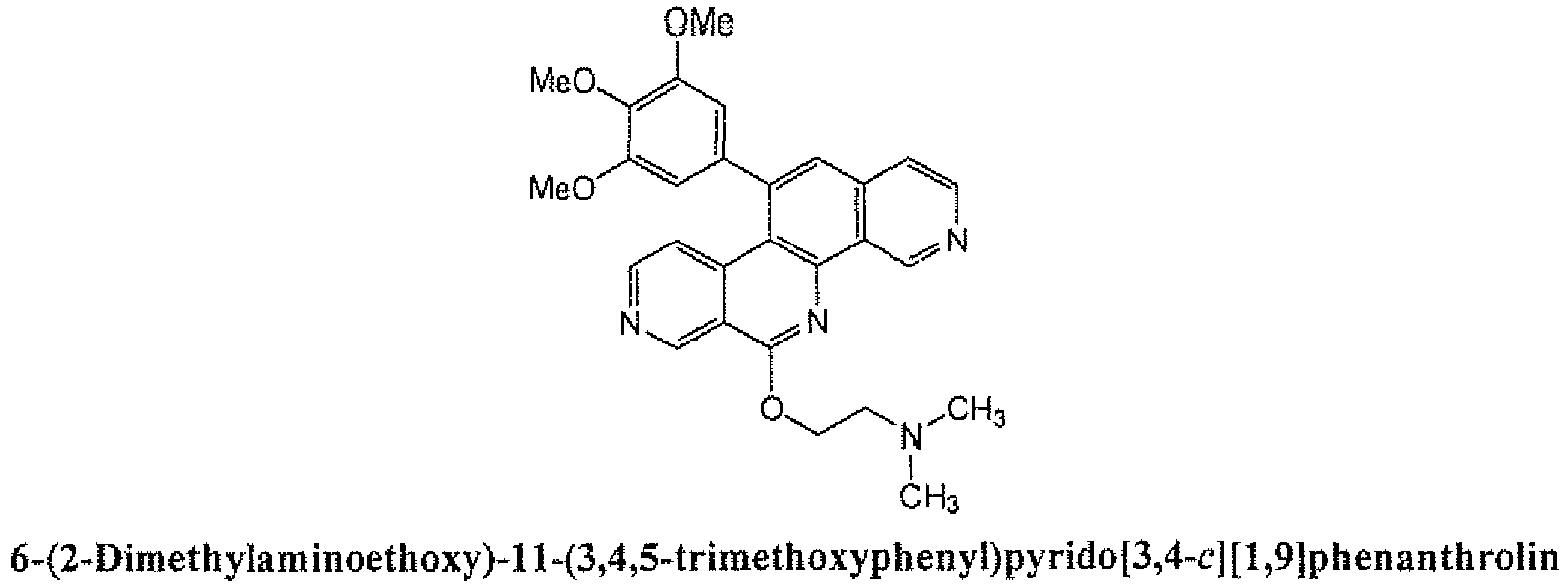
- In einer besonderen Ausführungsform wird die Aufgabe gelöst durch das Salz der Verbindung 6-(2-Dimethylaminoethoxy)-11-(3,4,5-trimethoxyphenyl)pyrido[3,4-c][1,9]-phenanthrolinhydrochlorid als Prodrug für 6-(2-Dimethylaminoethoxy)-11-(3,4,5-trimethoxyphenyl)pyrido[3,4-c][1,9]phenanthrolin, sowie dessen Salze und Solvate können die dem Fachmann bekannten Prodrugkonzepte für Amine zum Einsatz kommen. Dabei sollte eine Substitution des tertiären Amins der Seitenkettenstruktur in Position 6 erfolgen. Die geeigneten Prodrugkonzepte für eine derartige Substitution des tertiären Amins der Seitenkettenstruktur in Position 6 finden sich insbesondere in [Simplicio et al., Prodrugs for Amines, Molecules, 2008, 13: 519-547].
- Die Aufgabe der Erfindung wird ebenfalls gelöst durch ein Verfahren, dass die folgenden Schritte umfasst:
- Herstellung einer Verbindung umfassend die Schritte
- i. Umsetzung von substituierten Benzaldehyden mit 4-Methylpyridin-3-carbonitril in aprotischen, dipolaren Lösungsmitteln in Gegenwart von Basen
- ii. Dehydrierung des Produktes aus i zu einem vollständig konjugierten System, unter Einführung einer Doppelbindung in 11,12-Position
- iii. Diazotierung und anschließende Hydrolyse des semicyclischen Amidins in eine Laktam-Struktur
- iv. Veretherung des Laktims im Sinne einer Mitsunobu-Reaktion
- Das Reaktionsschema zeigt zur Erläuterung die Darstellung der Syntheseschritte in spezifischer, die Allgemeinheit nicht einschränkender Form:

- Die Erfindung betrifft auch Arzneimittel, welche das erfindungsgemäße Pyridophenanthrolinderivat enthalten. Diese Arzneimittel können dabei neben dem Phenanthrolinderivat dem Fachmann wohlbekannte pharmazeutische Hilfsstoffe enthalten wie:
- 1. Füllstoffe
- 2. Bindemittel
- 3. Fließregulierungsmittel
- 4. Sprengmittel
- 5. Schmiermittel
- 6. Magensaftresistente Überzüge und
- 7. Retardierungsmittel.
- Hierzu lassen sich die erfindungsgemäß hergestellten Verbindungen gegebenenfalls in Kombination mit anderen Wirksubstanzen, zusammen mit einem oder mehreren inerten üblichen Trägerstoffen und/oder Verdünnungsmittel, z.B. mit Maisstärke, Milchzucker, Rohrzucker, mikrokristalliner Zellulose, Magnesiumstereat, Polyvinylpyrrolidon, Zitronensäure, Weinsäure, Wasser, Wasser/Ethanol, Wasser/ Glycerin, Wasser/Sorbit, Wasser/Polyethylglycol, Wasser/Propylenglycol, Cetylstearylalkohol, Carboxymethylcellulose oder fetthaltigen Substanzen wie Hartfett oder deren geeigneten Gemischen, in üblichen galenischen Zubereitungen wie Tabletten, Dragees, Kapseln, Pulver, Suspensionen, Zäpfchen oder injizierbaren Lösungen einarbeiten.
- Die Erfindung betrifft auch die Verwendung der erfindungsgemäßen Verbindungen und Arzneimittel zur Behandlung von Leiden die durch Topoisomerasehemmer behandelt werden können. Insbesondere solche Leiden bei denen sich eine Behandlung mit dualen Topoisomerasehemmeren als vorteilhaft erwiesen hat.
- Bei den erfindungsgemäß behandelbaren Leiden handelt es sich bevorzugt um Krebserkrankungen. Besonders bevorzugt sollen mit den erfindungsgemäßen Verbindungen und Arzneimitteln solche Krebserkrankungen behandelt werden, bei denen sich duale Topoisomerasehemmer bereits als wirksam erwiesen haben.
- Besonders bevorzugt sind die erfindungsgemäß behandelbaren Krebserkrankungen ausgewählt aus der Gruppe der Mammakarzinome, Ovarialkarzinome, Colonkarzinome, Nierenkarzinome, Kopf-Hals-Tumore, kleinzelligen und nicht-kleinzelligen Lungenkarzinome, malignen Melanome, Leberzellkarzinome, Mesotheliome, Pankreaskarzinome, Prostatakrebs, Brustkarzinome, Zervixkarzinome und Krebserkrankungen der Ohrspeicheldrüse.
- Im Folgenden soll die Allgemeinheit der Lehre nicht einschränkend die Herstellung und Wirksamkeit der erfindungsgemäßen Verbindung dargestellt werden.
-

- Die Darstellung von 6-(2-Dimethylaminoethoxy)-11-(3,4,5-trimethoxyphenyl)pyrido [3,4-c][1,9]phenanthrolinhydrochlorid (Beispiel 1) verläuft über 4 Stufen.
- Eine Lösung aus 4-Methylpyridin-3-carbonitril (500 mg, 4.2 mmol) und 412 mg (2,1 mmol) 3,4,5-Trimethoxybenzaldehyd in 10 mL DMPU wird unter Stickstoffatmosphäre zu einer Lösung bestehend aus 600 mg (5,35 mmol) KOtBu in 5 mL DMPU getropft. Nach einer Reaktionszeit von 3 Stunden wird das Reaktionsgemisch auf 80 mL Eiswasser hydrolysiert. Der entstandene Niederschlag wird abgesaugt. Die Aufreinigung des Rohproduktes geschieht flashchromatographisch an Kieselgel (Fließmittel: Dichlormethan/Methanol (5-20%)). Der erhaltene Feststoff wird 24 h im Ölpumpenvakuum getrocknet. Ausbeute: 244 mg (28%).
- 200 mg (0,48 mmol) 6-Amino-11-(3,4,5-trimethoxyphenyl)-11,12-dihydropyrido[3,4-c]-[1,9]phenanthrolin werden in 5 - 10 mL DMPU gelöst und Palladium (10%) auf Aktivkohle (30 Gewichtsprozent) wird hinzugefügt. Die Suspension wird 10 min im Stickstoffstrom zum Rückfluss erhitzt. Nach dem Erkalten wird der Katalysator abfiltriert und mit 50 mL Dichlormethan nachgewaschen. Das Filtrat wird am Rotationsverdampfer eingeengt und die verbleibende Lösung auf 80 mL Eiswasser gegeben, entstehender Niederschlag wird abfiltriert. Entsteht kein Niederschlag wird mit konzentrierter Salzsäure auf pH 2 eingestellt und das DMPU mit 3 x 50 mL Dichlormethan aus der wässrigen Phase extrahiert. Im Anschluss wird die wässrige Phase mit 25-%iger wässriger
- Ammoniaklösung auf pH 9 gebracht und der entstandene Niederschlag abfiltriert. Die Aufreinigung des Rohproduktes geschieht mittels Flashchromatographie an Kieselgel (Fließmittel: Dichlormethan/Methanol (10%)). Der erhaltene Feststoff wird 24 h im Ölpumpenvakuum getrocknet. Ausbeute: 149 mg (75%).
- 3 N Schwefelsäure (5 mL) wird auf 0°C abgekühlt und langsam portionsweise nacheinander NaNO2 (250 mg, 36 mmol) und auf 4°C vorgekühlte Phosphinsäure (1 mL, 1,2 mmol, 50 Gewichtsprozent in H2O) dazugegeben. Eine zweite Lösung bestehend aus 300 mg (6-Amino-11-(3,4,5-trimethoxyphenyl)pyrido[3,4-c][1,9]phenanthrolin in 5 mL Eisessig und 2 mL Wasser wird langsam zu der ersten Lösung getropft. Nach Zugabe einer Spatelspitze Kupfer(II)sulfat wird das Lösungsgemisch eine Stunde bei 0°C gerührt und im Anschluss 24 Stunden im Kühlschrank bei 4-7°C gelagert. Danach wird die Lösung filtriert und das Filtrat mit 25%iger wässriger Ammoniaklösung auf pH 9 eingestellt, bis eine tiefblaue Färbung entsteht. Das hierbei entstehende Präzipitat wird abgesaugt, mit Wasser gewaschen (3 x 50 mL) und im Vakuum getrocknet. Die Aufreinigung des Rohproduktes erfolgt mittels Flashchromatographie an Kieselgel (Fließmittel: Dichlormethan/Methanol (5-20%)). Der erhaltene Feststoff wird 24 Stunden im Ölpumpenvakuum getrocknet. Ausbeute: 243 mg (81 %),
- 11-(3,4,5-Trimethoxyphenyl)-5,6-dihydropyrido[3,4-c][1,9]phenanthrolin-6-on (300 mg, 0,73 mmol) wird mit Triphenylphosphin (571 mg, 2,2 mmol) in 50 mL frisch getrocknetem THF gelöst. Anschließend werden nacheinander 2-Dimethylaminoethanol (196 mg, 2,2 mmol) und DIAD (445 mg, 2,2 mmol) hinzugetropft. Die Suspension wird unter Ausschluss von Wasser 72 Stunden bei Raumtemperatur gerührt, wobei sich nach und nach eine klare Lösung ergibt. Nach Beendigung der Reaktion wird das Lösungsmittel am Rotationsverdampfer entfernt und der erhaltene Feststoff im Vakuum getrocknet. Die Aufreinigung des Rohproduktes erfolgt per Flashchromatographie an Kieselgel (Fließmittel: Dichlormethan/Methanol (10-30%)) und das resultierende Produkt wird im Anschluss 24 Stunden im Ölpumpenvakuum getrocknet. Das Produkt wird in trockenem Dichlormethan gelöst und für 5 min mit HCl(g) begast. Das Lösungsmittel wird am Rotationsverdampfer entfernt und der erhaltene Feststoff 24 Stunden im Ölpumpenvakuum getrocknet.
-
Ausbeute: 274 mg (72%, gefällt als Hydrochlorid nach flashchromato-graphischer Aufreinigung, Kieselgel, CH2Cl2/MeOH (10-30%)) eines gelben Feststoffs Schmelzpunkt: 206°C - δ/ppm = 2.96 (d, 6H, RHN(CH3)2), 3.74 (s, 6H, 2 x OCH3), 3.81 (s, 5H, OCH3, H-2'), 5.33 (m, 2H, H-1'), 6.88 (s, 2H, H-2", H-6"), 7.37 (dd, 1H, H-10, 3J = 6.2 Hz, 4J = 0.8 Hz), 8.28 (s, 1H, H-12), 8.56 (d, 1H, H-1, 3J = 6.3 Hz), 8.74 (d, 1H, H-9, 3J = 6.2 Hz), 8.95 (d, 1H, H-2, 3J = 6.3 Hz), 10.08 (d, 1H, H-7, J = 0.7 Hz), 10.64 (s, 1H, H-4), 11.25 (m, 1H, RHN(CH3)2).
- Das Signal der Methylenprotonen an C-2' wird durch das Singulett der Methoxygruppe bei 3.81 überlagert.
- δ/ppm = 42.5 (2C, RHN(CH3)2), 54.8 (C-2`), 56.2 (2C, 2 x OCH3), 60.4 (OCH3), 61.8 (C-1'), 106.0 (2C), 115.3,118.0, 119.2, 124.0, 124.1, 126.0,136.1,136.5, 138.2, 139.0, 139.6, 143.8, 144.3, 147.1, 148.9, 153.7 (2C), 159.6.
- cm-1 =3399, 2946, 2467, 1639, 1606, 1578, 1453, 1412, 1338, 1111, 988,
- m/z = 485 ([M+H]+, 41%), 414 ([M-C4H9N+H]+, 100%), 243 ([M+2H]++, 44%).
-
Berechnet: C 56.62 H 5.26 N 9.43, gefunden: C 56.20 H 5.52 N 9.40. -

- Die Darstellung von 6-(3-Dimethylaminopropoxy)-11-(3,4,5-trimethoxyphenyl)pyrido[3,4-c][1,9]phenanthrolin (Beispiel 2) verläuft ebenfalls über 4 Stufen.
- Stufen 1 bis 3 verlaufen analog der Darstellung von Beispiel 1.
- Stufe 4: 11-(3,4,5-Trimethoxyphenyl)-5,6-dihydropyrido[3,4-c][1,9]phenanthrolin-6-on (300 mg, 0,73 mmol) wird mit Triphenylphosphin (571 mg, 2,2 mmol) in 50 mL frisch getrocknetem THF gelost. Anschließend werden nacheinander 227 mg (2,2 mmol) Dimethylaminopropanol und DIAD (445 mg, 2,2 mmol) hinzugetropft.
- Die Suspension wird unter Ausschluss von Wasser 72 Stunden bei Raumtemperatur gerührt, wobei sich nach und nach eine klare Lösung ergibt. Nach Beendigung der Reaktion wird das Lösungsmittel am Rotationsverdampfer entfernt und der erhaltene Feststoff im Vakuum getrocknet. Die Aufreinigung des Rohproduktes erfolgt per Flashchromatographie an Kieselgel (Fließmittel: Dichlormethan/Methanol (10-30%)) und das resultierende Produkt wird im Anschluss 24 Stunden im Ölpumpenvakuum getrocknet.
-
Ausbeute: 163 mg (55%, Flashchromatographie, Kieselgel, CH2Cl2MeOH (10-30%)) eines gelben Feststoffs Schmelzpunkt: 172°C - δ/ppm = 2.46 (m, 2H, H-2`), 2.83 (s, 6H, RHN(CH 3 )2), 3.49 (m, 2H, H-3'), 3.72 (s, 6H, 2 x OCH3), 3.78 (s, 3H, OCH3), 5.07 (t, 2H, H-1'), 6.90 (s, 2H, H-2", H-6"), 7.71 (dd, 1H, H-10, 3J = 6.6 Hz), 8.37 (s, 1H, H-12), 8.66 (d, 1H, H-1, 3 J = 6.5 Hz), 8.83 (d, 1H, H-9, 3 J = 6.6 Hz), 8.96 (d, 1H, H-2, 3J = 6.4 Hz), 10.10 (s, 1H, H-7, J = 0.7 Hz), 10.64 (s, 1H, H-4).
- δ/ppm = 23.3 (C-2'), 42.2 (2C, RHN(CH 3 )2), 53.9 (C-3'), 56.5 (2C, 2 x OCH3), 60.7 (OCH3), 66.0 (C-1'), 106.4 (2C), 116.9, 117.6, 122.6, 124.2, 125.0, 126.6, 135.5, 135.7, 138.7, 139.5, 140.6, 143.4, 144.1, 144.5, 146.4, 148.1,154.1 (2C), 160.4.
- cm-1 = 3363, 2936, 2834, 1610, 1566, 1407, 1343, 1230, 1126, 1112, 830.
- m/z = 499 ([M+H]+, 51%), 414 ([M-C5H11N+H]+, 100%), 250 ([M+2H]++, 73%).
-
- m/z berechnet für [M+H]+: 499.2345,
- m/z gefunden für [M+H]+: 499.2326.
-

- Die Darstellung von 11-(3-Chlorphenyl)-6-(2-dimethylaminoethoxy)-11,12-dihydro-pyrido[3,4-c][1,9]phenanthrolinhydrochlorid (Beispiel 3) verläuft über 3 Stufen. Stufe 1: Synthese von 6-Amino-11-(3-Chlorphenyl)-11,12-dihydropyrido[3,4-c][1,9]phenanthrolin: 3-Chlorbenzaldehyd (295 mg, 2,1 mmol) wird analog der Vorschrift aus Stufe 1 für Beispiel 1 umgesetzt. Ausbeute: 241 mg (32%).
- Stufe 2: Synthese von 11-(3-Chlorphenyl)-5,6,11,12-tetrahydropyrido[3,4-c][1,9]phenanthrolin-6-on: 300 mg (0,84 mmol) 6-Amino-11-(3-Chlorphenyl)-11,12-dihydropyrido[3,4-c][1,9]phenanthrolin werden analog der Vorschrift aus Stufe 3 für Beispiel 1 umgesetzt. Ausbeute: 277 mg (91%).
- Stufe 3: 300 mg (0,83 mmol) 11-(3-Chlorphenyl)-5,6,11,12-tetrahydropyrido[3,4-c][1,9]-phenanthrolin-6-on werden analog der Vorschrift aus Stufe 4 für Beispiel 1 umgesetzt.
-
Ausbeute: 177 mg (45%, als Hydrochlorid gefällt nach flashchromato-graphischer Aufreinigung, Kieselgel, CH2Cl2MeOH (10-30%)) eines gelben Feststoffs Schmelzpunkt: 188°C - δ/ppm = 2.93 (t, 6H, RHN(CH 3 )2), 3.62 (d, 1H, H-12a, 2 J H-12a/H-12b = 17.2 Hz), 3.75 (q, 2H, H-2', 3 J = 5.1 Hz), 3.84 (dd, 1H, H-12-b, 2 J H-12b/H-12a = 17.3 Hz, 3 J H-12b/H-11 = 7.9 Hz), 5.15 (m, 2H, H-1`), 5.32 (d, 1H, H-11, 3 J H11/H12-b= 7.8 Hz), 6.80-6.86 (m, 1H, H-6", 3 J = 7.7 Hz), 7.14 (m, 1H, H-5",3 J = 7.8 Hz), 7.18-7.23 (m, 1H, H-4",3 J = 7.8 Hz), 7.30 (m, 1H, H-2"), 7.94 (d, 1H, H-1, 3 J = 5.7 Hz), 8.05 (d, 1H, H-10, 3 J = 6.4 Hz), 8.80 (d, 1H, H-2, 3J = 5.7 Hz), 8.85 (d, 1H, H-9, 3 J = 6.3 Hz), 9.60 (s, 1H, H-4), 10.09 (s, 1H-H-7), 11.21 (m, 1H, RHN(CH3)2).
- δ/ppm = 35.0 (C-12), 35.2 (C-11), 42.3, 42.4 (2C, RHN(CH 3 )2), 54.7 (C-2'), 61.4 (C-1'), 114.8, 117.6, 120.8, 125.7, 126.4, 127.1, 127.3, 130.5, 131.8, 133.4, 138.5, 140.9, 142.9, 134.3, 143.7, 145.5, 148.4, 160.0.
- cm-1= 3364, 2970, 2468, 1632, 1592, 1561, 1465, 1425, 1342, 829.
- m/z = 433 ([M+H]+, 37Cl, 18%), 431 ([M+H]+, 35Cl, 44%), 362 ([M-C4H9N+H]+, 37Cl, 35%), 360 ([M-C4H10N+H]+, 35Cl, 100%), 343 (3%), 248 ([M-3-Chlorbenzen+H]+, 6%).
-
- m/z berechnet für [M+H]+: 431.1633,
- m/z gefunden für [M+H]+: 431.1613.
- Zur Untersuchung der pharmakologischen Eigenschaften wurden die Verbindungen Beispiel 1 bis 3 (wobei nur Beispiel 1 erfindungsgemäß ist) im "DTP NCI-60 in vitro human tumor cell line screening" des National Cancer Institute (NCI), Bethesda, Maryland, USA, untersucht. Getestet wurde gegen 60 verschiedene humanpathogene Tumorzelllinien, die neun Krebsarten entstammten (Leukämie, nichtkleinzelliges Lungenkarzinom, Dickdarmkrebs, ZNS-Krebs, Melanom, Eierstockkrebs, Nierenkrebs, Prostatakrebs, Brustkrebs). Zur Ermittlung der Wirksamkeit werden die Tumorzellen den Verbindungen über zwei Tage ausgesetzt und danach indirekt über die Bestimmung der Proteinbiomasse mit Sulforhodamin B (SRB) die Wachstumshemmung ermittelt. Unbehandelte Kulturen dienen als Referenz. Der "meangraph midpoint" (MG_MIDGI50) entspricht einer mittleren Ansprechrate aller getesteten humanen Zelllinien auf die getestete Substanz. Entlogarithmiert ergibt sich daraus die Konzentration die zu einer 50-prozentigen Wachstumshemmung aller Zelllinien bezogen auf unbehandelte Referenzzelllinien führt (GI50-NCI60). Tabelle 1 zeigt sehr starke wachstumshemmende Wirkungen der drei Verbindungen 1 bis 3 in nanomolaren Konzentrationen im Mittel auf die 60 humanen Tumorzelllinien.
- Die Wirksamkeit der Beispielverbindungen 1 bis 3 übertrifft teilweise deutlich die wachstumshemmenden Eigenschaften von in der Krebstherapie zugelassenen Arzneistoffen und Modellverbindungen aus der Klasse der Topoisomerase-Hemmstoffe, welches ebenfalls dasselbe Testsystem durchlaufen haben.
- Aus der Klasse dualer Topoisomerase I/II-Hemmstoffe sind die Verbindungen Pyrazoloacridin (PZA) und Intoplicin aufgeführt, welche sich bereits in der klinischen Entwicklung befanden. Insbesondere gegenüber den beiden bekannten Topoisomerase TIII-Hemmern Pyrazoloacridin (PZA) und Intoplicin zeigen die Verbindungen aus Beispiel 1 und Beispiel 2 eine deutlich bessere antitumorale Wirkung.
Tabelle 1: Mittlere Wachstumshemmung auf alle 60 Tumorzelllinien des DTP NCI-60 in vitro human tumor cell line screening Substanz GI50/NCI-60 [µM] Beispiel 1 0,049 Beispiel 2 0,052 Beispiel 3 0,447 Topo I-Inhibitoren Camptothecin 0,044 Topotecan 0,014 Irinotecan 0,16 Topo II-Inhibitoren Etoposide 0,99 Teniposide 0,39 Duale Topo IIII-Inhibitoren PZA 0,20 Intoplicin 0,53 - Zur Untersuchung der pharmakologischen Eigenschaften wurden die Verbindungen 1 bis 3 ebenfalls auf ihre Fähigkeit, die Aktivitäten humaner Topoisomerasen I, IIα, und IIβ zu hemmen, untersucht. Die enstsprechenden Modell-Topoisomerase-Hemmstoffe Camptothecin (Topoisomerase I) und Etoposid (Topoisomerase II) wurden als Referenzverbindungen mitgetestet. Tabelle 2 zeigt die Ergebnisse.
Tabelle 2: Hemmung humaner Topoisomerasen I, IIα, und IIβ durch Beispiel 1: Substanz GI50 (Topoisomerase I)1 GI50 (Topoisomerase IIα)2 GI50 (Topoisomerase IIβ)2 Beispiel 1 +++ +++ +++ Camptothecin + n.b. n.b. Etoposid n.b. + + +++:IC50 = 10-50 µM, +: IC50 = 50-100 µM. 1Daten aus Relaxationsassay; 2Daten aus
Dekatenierungsassay; n.b. = nicht bestimmt. - Beispielverbindung 1 (Bsp. 1) zeigt in diesen Tests eine außerordentlich starke und gleichmäßige Inhibition der Aktivität aller humanen Topoisomerasen (IC50 < 10 µM für alle drei getesteten Enzyme), die weitaus stärker als die Aktivitäten der Modell-Topoisomerase-Hemmer Etoposid und Camptothecin war. Überraschenderweise konnte nur Beispielverbindung 1 diese Eigenschaften eines potenten dualen Topoisomerase I/II Hemmstoffs aufweisen.
-
Abbildung 1 zeigt die Beeinflussung der Topoisomerase I Aktivität mit Hilfe des Relaxationsassays. Mit dem Relaxationsassay lässt sich die Inhibition humaner DNA-Topoisomerase I durch eine Substanz bestimmen. Topo 1 ist in der Lage, das superspiralisierte Plasmid pUC18 in die relaxierte Form zu überführen. Die resultierenden unterschiedlichen Wanderungseigenschaften der Plasmid-Isoformen in einem Agarose-Gel bei Anlegen eines elektrischen Feldes geben ein Maß für die Aktivität des Enzyms (Nitiss et al., Topoisomerase Assays, in: Enna et al., Curr. Prot. Pharmacol., 2012). Ersichtlich ist eine konzentrationsabhängige Hemmung der Topoisomerase I Aktivität durch steigende Konzentrationen der Beispielverbindung 1 (Lane 3 bis 9), die bei 10 µM nahezu vollständig ist, vgl. mit Lane 1, welche das überspiralisierte Plasmid ohne Topoisomerase I enthält. Lane 2 stellt die Negativkontrolle ohne Hemmstoff dar. Als Positivkontrolle diente Camptothecin in der Konzentration von 100 µM (Lane 10). -
Abbildung 2 zeigt beispielhaft für die Hemmung der Topoisomerase IIα-Aktivität den Einfluss verschiedener Pyridophenanthroline (P8D, P16, P16 6 (entspricht Verbindung 3 aus Beispiel 3) und P8D 6 (entspricht Verbindung 1 aus Beispiel 1) und des Pyridoazacarbazols A12, auf das Enzym.
- Verwendet wurde ein Dekatenierungsassay, mit dessen Hilfe sich die Inhibition humaner Topoisomerasen II (α/β) durch eine Substanz bestimmen lässt. Das Protein ist in der Lage, Kinetoplasten-DNA (kDNA), die in Form ineinander verzahnter Minizirkel (sog. Katenate) vorliegt, zu dekatenieren, d.h. in einzelne Minizirkel zu spalten. Diese sind nun im Unterschied zur ursprünglichen kDNA im Stande, in einem Agarosegel bei Anlegen eines elektrischen Feldes zu wandern (Nitiss et al., Topoisomerase Assays, in: Enna et al., Curr. Prot. Pharmacol., 2012.
- In
Abbildung 2 ist gezeigt, wie ausschließlich Beispielverbindung 1 (P8D 6) die Aktivität der Topo IIα potent zu hemmen vermochte, so dass es zu keiner Bildung entzahnter DNA-Minizirkel kam, ersichtlich an der Immobilität der Banden in den Lanes 4 und 5, verglichen mit Lane 1, die als Referenz ohne Hemmsubstanz mit aufgetragen wurde. - Lediglich Beispiel 1 konnte wider Erwarten sowohl in niedrigen (10 µM) als auch im hohen (100 µM) Konzentrationsbereich eine beispielhafte Hemmung der Topo IIα erzielen.
- Für Beispielverbindung 1 wurde darüber hinaus Untersuchungen auf apoptotische Aktivität durchgeführt. Zur Ermittlung des apoptotischen Status einer Zelle kann das Enzym-PARP (Poly-ADP Ribose Polymerase) herangezogen werden, das beim Übergang der Zelle in die Apoptose in ein 89kDa Fragment gespalten wird, und somit als Apoptose-Marker dienen kann (KAUFMANN SH et al., Cancer Research, 1993; 53:3976-3985). In
Abbildung 3 ist der Effekt verschiedener Konzentrationen von Beispiel 1 auf HeLa-Zellen im PARP-Assay dargestellt. Als Referenzverbindung wurde Etoposid gewählt und mitgetestet. -
Abbildung 3 zeigt ein sehr schnelles Auftreten des apoptotischen Status der Zelle (89kDa Bande - gespaltenes PARP bereits bei 1 µM Konzentration an Beispielverbindung 1 sichtbar, keine Einleitung der Apoptose bei Etoposid ≤ 100 µM nach 8h). Nach 24h genügt eine 10-3-10-2-fach geringere Konzentration an Beispielverbindung 1 als an Etoposid, um das PARP-Spaltprodukt nachzuweisen. Beispielverbindung 1 hat somit eine herausragende apoptotische Wirkung. - Ein weiterer PARP-Assay wurde durchgeführt, um einen direkten Vergleich der proapoptotischen Wirkungen von Beispiel. 1 (hier: P8D 6) und dem potenten und literaturbekannten dualen Topoisomerase I/II-Hemmstoff Pyrazoloacridin (PZA) zu erhalten (
Abb. 4 ). - Auch hier wird die außerordentlich starke pro-apoptotische Wirkung der Beispielverbindung 1 ersichtlich, während der duale Topoisomerasehemmer PZA erst in hohen Konzentrationen (100 µM) seine Wirkung entfaltet.
- Neben den ausgezeichneten pharmakologischen Eigenschaften zeigen die Verbindungen physikochemische Vorteile, die deren hervorragende Eignung als Arzneistoffe weiter untermauern (Tabelle 3):
Tabelle 3: Physikochemische Eigenschaften der Beispielverbindungen 1-3 (wobei nur Beispiel 1 erfindungsgemäß ist) Substanz Löslichkeit pH 7,4 [mM]1 H-Donatoren2 H-Akzeptoren logD1/ClogP3 Molekular-Molekular-gewicht [g/mol] Beispiel 1 0,87 ± 0,03 1 8 3,70/4,08 485 Beispiel 2 n.b. 1 8 3,60/4,43 499 Beispiel 3 5,28 ± 0,09 1 5 3,60/5,13 431 - Tabelle 3: Physikochemische Eigenschaften der Beispielverbindungen 1-3; 1Bestimmt mittels HPLC-Analytik; 2Die tertiäre Aminstruktur wurde bei pH 7,4 als protoniert angesehen; 3Berechnet mit ChemDraw Ultra 12.0.
- Die Löslichkeit im millimolaren Bereich sowie die Anwendbarkeit der "rule of five" (nach: LIPINSKI CA et al., Advanced Drug Delivery Reviews, 2001; 46: 3-26) prognostizieren den Beispielverbindungen 1 bis 3 eine angemessene orale Bioverfügbarkeit, die somit neben einer für Zytostatika üblichen parenteralen Applikation auch eine perorale Gabe der Verbindungen erlaubt.
- Interne Studiennummer: P14.0073. Der Tierversuch, der unter der internen Studiennummer P14.0073 durchgeführt wurde, war durch die kommunale Regierungsbehörde und der zugehörigen Ethikkommission bewilligt (Regierungspräsidium Karlsruhe, 35-9185.81/G-24/11).
- Im Rahmen einer in vivo Studie zur Bestimmung der Tolerierbarkeit von P8-D6 in weiblichen athymischen Nackmäusen wurde die Maximum Tolerated Dose (MTD) ermittelt.
- Insgesamt wurden 18 weibliche athymische Nacktmäuse in einem Alter von 7 Wochen (Gruppe 1 und 2), 8 Wochen (Gruppe 3 und 4) und 9 Wochen (Gruppe 5 und 6) für die in vivo Studie herangezogen.
- Um die Tolerierbarkeit von P8-D6 bei einer einmaligen intravenösen Applikation in die Schwanzvene zu ermitteln, erhielten die Studientiere der Gruppen 2, 4 und 6 (3 Tiere je Gruppe) die Verbindung P8-D6 in Dosen von 1 mg/kg Körpergewicht, 5 mg/kg Körpergewicht und 10 mg/kg Körpergewicht an den Studientagen 0, 7 beziehungsweise 14. Den Kontrolltieren der Gruppen 1,3 und 5 (3 Tiere je Gruppe) wurde PBS (Phosphate Buffered Saline) (pH 7,4) in einer Dosis von 10 mL/kg Körpergewicht an den jeweils selben Tagen appliziert. Die Studientiere wurden in einem Zeitraum bis zu 14 Tagen hinsichtlich klinischer Zeichen, Verhaltensänderungen und Überleben beobachtet. Die Bestimmung des Körpergewichtes erfolgte dreimal wöchentlich. Begonnen wurde am Tag der Applikation. Die Kriterien für einen frühzeitigen Abbruch der Studie beliefen sich aus ethischen Gründen auf eine Abnahme des Körpergewichtes um mehr als 20% vom Ausgangsgewicht. Während der Studie verstorbene und alle weiteren Studientiere wurden am Ende der Studienphase einer Nekropie unterzogen. Dabei wurden Organproben von sechs Studientieren entnommen (4 Tiere aus Gruppe 4, 1 Tier aus Gruppe 1, 1 Tier aus Gruppe 2 und ein Tier aus Gruppe 6).
- Die
Abbildung 5 zeigt die Ergebnisse nach einmaliger intravenöser Applikation von P8D 6 in weibliche athymischen Nacktmäuse und intravenöse Gabe von PBS als Vergleich. - Die MTD Studie zeigte eine gute Tolerierbarkeit von P8-D6 in weiblichen athymischen Nacktmäusen bei einer Dosierung von 1 mg/kg Körpergewicht. Ferner konnte über die klinischen Zeichen und die Beobachtung des Körpergewichtes eine dosisabhängige Toxizität bei höheren Konzentrationen ermittelt werden, wobei der Verlust des Körpergewichtes und eine auftretende Teilnahmslosigkeit der Studientiere bei einer Dosis von 5 mg/kg Körpergewicht reversibel waren (
Abb.5 ). Es zeigten sich außerdem bei keinem der Studientiere akute letale Begleiterscheinungen. -
-
Abbildung 1 : Relaxationsassay auf Beeinflussung der Topoisomerase I-Aktivität: 1Superspiralisiertes Plasmid pUC18, 2Topoisomerase I, 3Testkonzentrationen an Beispielverbindung 1. Einheit: µM. -
Abbildung 2 : Dekatenierungssassay auf Beeinflussung der Topoisomerase IIα-Aktivität: Lane 1 Referenz ohne Hemmsubstanz, Lane 2 und 3 (P8D), Lane 6 und 7 (P16), Lane 8 und 9 (P16 6) und Lane 10 und 11 (A12) sind Vergleiche mit ähnlichen Strukturen. Lane 4 und 5 ist Beispielverbindung 1, Lane 8 und 9 ist Beispielverbindung 3. kDNA = Kinetoplasten-DNA; Topo II = Topoisomerase IIα -
Abbildung 3 : PARP-Apoptose Assay (HeLa-Zellen).1: DMSO-Kontrolle (kein Inhibitor), 2-5: Beispiel 1 (0,1; 1; 10; 100 µM); 6-9: Etoposid (0,1; 1; 10; 100 µM). -
Abbildung 4 : PARP-Assay zum Vergleich von Beispiel 1 und dem dualen Topoisomerase I/II-Hemmstoff Pyrazoloacridin (PZA) -
Abbildung 5 : Einmalige intravenöse Applikation von Beispielverbindung 1 (P8-D6) in weibliche athymischen Nacktmäuse und intravenöse Gabe von PBS als Vergleich
Claims (10)
- Verbindung der Formel

- Verbindung nach Anspruch 1 dadurch gekennzeichnet, dass es sich um 6-(2-Dimethylaminoethoxy)-11-(3,4,5-trimethoxyphenyl)pyrido[3,4-c][1,9]-phenanthrolinhydrochlorid handelt.
- Verfahren zur Herstellung einer Verbindung nach einem der Ansprüche 1 bis 2, umfassend die Schrittei. Umsetzung von substituierten Benzaldehyden mit 4-Methylpyridin-3-carbonitril in aprotischen, dipolaren Lösungsmitteln in Gegenwart von Basenii. Dehydrierung des Produktes aus i zu einem vollständig konjugierten System, unter Einführung einer Doppelbindung in 11,1 2-Positioniii. Diazotierung und anschließende Hydrolyse des semicyclischen Amidins in eine Laktam-Strukturiv. Veretherung der Verbindung aus iii im Sinne einer Mitsunobu-Reaktion
- Arzneimittel, umfassend eine Verbindung nach einem der Ansprüche 1 bis 2.
- Verbindung nach einem der Ansprüche 1 bis 2 zur Verwendung als Arzneimittel.
- Verbindung nach einem der Ansprüche 1 bis 2 zur Verwendung in der Behandlung von Tumoren.
- Arzneimittel nach Anspruch 4 zur Verwendung in der Behandlung von Tumoren.
- Verbindung zur Verwendung nach Anspruch 6 oder Arzneimittel zur Verwendung nach Anspruch 7, wobei die Behandlung von Tumoren in der Hemmung der Topoisomerase besteht.
- Verbindung nach einem der Ansprüche 1 bis 2 oder Arzneimittel nach Anspruch 4 zur Verwendung in der Behandlung von Leiden, die mit Topoisomeraschemmern behandelbar sind.
- Verbindung oder Arzneimittel zur Verwendung nach Anspruch 8 oder 9, wobei Topoisomerase Typ I und Topoisomerase Typ II gleichzeitig gehemmt werden.
Priority Applications (3)
| Application Number | Priority Date | Filing Date | Title |
|---|---|---|---|
| EP16201389.0A EP3330270B1 (de) | 2016-11-30 | 2016-11-30 | Pyridophenanthrolinderivat, dessen herstellung und verwendung als arzneimittel |
| PCT/EP2017/080327 WO2018099814A1 (de) | 2016-11-30 | 2017-11-24 | Neue pyridophenanthrolinderivate, deren herstellung und verwendung als arzneimittel |
| US16/465,258 US11046693B2 (en) | 2016-11-30 | 2017-11-24 | Pyrido-phenanthroline derivatives, production and use thereof as medicaments |
Applications Claiming Priority (1)
| Application Number | Priority Date | Filing Date | Title |
|---|---|---|---|
| EP16201389.0A EP3330270B1 (de) | 2016-11-30 | 2016-11-30 | Pyridophenanthrolinderivat, dessen herstellung und verwendung als arzneimittel |
Publications (2)
| Publication Number | Publication Date |
|---|---|
| EP3330270A1 EP3330270A1 (de) | 2018-06-06 |
| EP3330270B1 true EP3330270B1 (de) | 2023-04-05 |
Family
ID=57442561
Family Applications (1)
| Application Number | Title | Priority Date | Filing Date |
|---|---|---|---|
| EP16201389.0A Active EP3330270B1 (de) | 2016-11-30 | 2016-11-30 | Pyridophenanthrolinderivat, dessen herstellung und verwendung als arzneimittel |
Country Status (3)
| Country | Link |
|---|---|
| US (1) | US11046693B2 (de) |
| EP (1) | EP3330270B1 (de) |
| WO (1) | WO2018099814A1 (de) |
Families Citing this family (1)
| Publication number | Priority date | Publication date | Assignee | Title |
|---|---|---|---|---|
| WO2025228339A1 (en) * | 2024-04-29 | 2025-11-06 | Shanghai Apeiron Therapeutics Company Limited | Novel prmt5 inhibitors and methods of use |
Family Cites Families (1)
| Publication number | Priority date | Publication date | Assignee | Title |
|---|---|---|---|---|
| DE102012006903B4 (de) * | 2012-04-05 | 2016-06-30 | Christian-Albrechts-Universität Zu Kiel | Neue aromatische Heterocyclen, Verfahren zu ihrer Herstellung und Arzneimittel enthaltend neue aromatische Heterocyclen |
-
2016
- 2016-11-30 EP EP16201389.0A patent/EP3330270B1/de active Active
-
2017
- 2017-11-24 WO PCT/EP2017/080327 patent/WO2018099814A1/de not_active Ceased
- 2017-11-24 US US16/465,258 patent/US11046693B2/en active Active
Also Published As
| Publication number | Publication date |
|---|---|
| WO2018099814A1 (de) | 2018-06-07 |
| EP3330270A1 (de) | 2018-06-06 |
| US11046693B2 (en) | 2021-06-29 |
| US20190292184A1 (en) | 2019-09-26 |
Similar Documents
| Publication | Publication Date | Title |
|---|---|---|
| DE69901379T2 (de) | Camptothecin-Derivate mit Antitumor-Wirkung | |
| DE69332540T2 (de) | Rapamycinderivate | |
| DE69527400T2 (de) | Wasserlösliche camptothecin-derivate, verfahren zu deren herstellung und deren verwendung als antitumor-mittel | |
| DE69033880T2 (de) | Verfahren zur herstellung von 10,11-Methylendioxy-20(RS)-Camptothecin und 10,11-Methylendioxy-20(S)-Camptothecin-Analog | |
| DE60314378T2 (de) | Kristalline polymorphe form von irinotecanhydrochlorid | |
| EP0939765A1 (de) | Glycokonjugate von modifizierten camptothecin-derivaten(a- oder b-ring-verknüpfung) | |
| DE69320052T2 (de) | Topoisomerase ii inhibitoren sowie deren therapeutische verwendung | |
| EP0217372B1 (de) | Neue polyoxygenierte Labdan-Derivate, Verfahren zu ihrer Herstellung und ihre Anwendung als Medikamente | |
| DE60225943T2 (de) | Topoisomerase-giftmittel | |
| DE2831579C3 (de) | Tetrahydropyranylether von Daunomycin und Adriamycin, Verfahren zu ihrer Herstellung, sowie diese Verbindungen enthaltende pharmazeutische Zubereitungen | |
| DE69424183T2 (de) | 6-(2-imidazolinylamino)chinolin-verbindungen als alpha-2-adrenoceptor-antagonisten | |
| DE60022095T2 (de) | Camptothecin-beta-alanin-ester mit topoisomerase i hemmung | |
| DE60012750T2 (de) | Neue xanthon derivate, deren herstellung und verwendung als arzneimittel | |
| EP3330270A1 (de) | Neue pyridophenanthrolinderivate, deren herstellung und verwendung als arzneimittel | |
| DE19637123A1 (de) | Neue Pyranosidderivate | |
| DE69031181T2 (de) | Perylenequinon (UCN-1028D) Derivate | |
| EP2834240B1 (de) | Neue pyrido[3,4-c][1,9]phenanthrolin- und 11,12-dihydropyrido[3,4-c][1,9]phenanthrolin- derivate und ihre verwendung, insbesondere, zur behandlung von krebs | |
| DE69801811T2 (de) | Alkykendiamin di- oder tri-essigsäurederivate, verfahren zu ihrer herstellung und ihre verwendung in kosmetischen zusammensetzungen | |
| DE2063996C3 (de) | Alpha-Aminoxyhydroxamsäurederivate, Verfahren zur Herstellung derselben und diese enthaltende Arzneimittel | |
| DE69819340T2 (de) | Optisch reine camptothecinanaloge, optisch reines synthese-zwischenprodukt und verfahren zu ihrer herstellung | |
| DE69515922T2 (de) | Analogen von Acronycine, Verfahren zu ihrer Herstellung und sie enthaltende pharmaceutische Zusammensetzungen | |
| EP0196330B1 (de) | Verwendung von pyrrothinderivaten | |
| DE19909979A1 (de) | Verfahren zur Herstellung von Glycokonjugaten von 20(S)-Camptothecin | |
| DE602005003315T2 (de) | BenzoÄbÜpyranoÄ3,2-hÜacridin-7-one-zimtsäurederivate, Verfahren zu deren Herstellung und pharmazeutische Zusammensetzungen diese enthaltend | |
| EP4093374B1 (de) | Komplex aus 7-deacetylforskolin und pvp |
Legal Events
| Date | Code | Title | Description |
|---|---|---|---|
| PUAI | Public reference made under article 153(3) epc to a published international application that has entered the european phase |
Free format text: ORIGINAL CODE: 0009012 |
|
| STAA | Information on the status of an ep patent application or granted ep patent |
Free format text: STATUS: THE APPLICATION HAS BEEN PUBLISHED |
|
| AK | Designated contracting states |
Kind code of ref document: A1 Designated state(s): AL AT BE BG CH CY CZ DE DK EE ES FI FR GB GR HR HU IE IS IT LI LT LU LV MC MK MT NL NO PL PT RO RS SE SI SK SM TR |
|
| AX | Request for extension of the european patent |
Extension state: BA ME |
|
| STAA | Information on the status of an ep patent application or granted ep patent |
Free format text: STATUS: REQUEST FOR EXAMINATION WAS MADE |
|
| 17P | Request for examination filed |
Effective date: 20181206 |
|
| RBV | Designated contracting states (corrected) |
Designated state(s): AL AT BE BG CH CY CZ DE DK EE ES FI FR GB GR HR HU IE IS IT LI LT LU LV MC MK MT NL NO PL PT RO RS SE SI SK SM TR |
|
| STAA | Information on the status of an ep patent application or granted ep patent |
Free format text: STATUS: EXAMINATION IS IN PROGRESS |
|
| 17Q | First examination report despatched |
Effective date: 20210629 |
|
| GRAP | Despatch of communication of intention to grant a patent |
Free format text: ORIGINAL CODE: EPIDOSNIGR1 |
|
| STAA | Information on the status of an ep patent application or granted ep patent |
Free format text: STATUS: GRANT OF PATENT IS INTENDED |
|
| INTG | Intention to grant announced |
Effective date: 20221109 |
|
| GRAS | Grant fee paid |
Free format text: ORIGINAL CODE: EPIDOSNIGR3 |
|
| GRAA | (expected) grant |
Free format text: ORIGINAL CODE: 0009210 |
|
| STAA | Information on the status of an ep patent application or granted ep patent |
Free format text: STATUS: THE PATENT HAS BEEN GRANTED |
|
| AK | Designated contracting states |
Kind code of ref document: B1 Designated state(s): AL AT BE BG CH CY CZ DE DK EE ES FI FR GB GR HR HU IE IS IT LI LT LU LV MC MK MT NL NO PL PT RO RS SE SI SK SM TR |
|
| REG | Reference to a national code |
Ref country code: GB Ref legal event code: FG4D Free format text: NOT ENGLISH |
|
| REG | Reference to a national code |
Ref country code: DE Ref legal event code: R096 Ref document number: 502016015678 Country of ref document: DE |
|
| REG | Reference to a national code |
Ref country code: CH Ref legal event code: EP |
|
| REG | Reference to a national code |
Ref country code: AT Ref legal event code: REF Ref document number: 1558190 Country of ref document: AT Kind code of ref document: T Effective date: 20230415 |
|
| REG | Reference to a national code |
Ref country code: IE Ref legal event code: FG4D Free format text: LANGUAGE OF EP DOCUMENT: GERMAN |
|
| REG | Reference to a national code |
Ref country code: LT Ref legal event code: MG9D |
|
| REG | Reference to a national code |
Ref country code: NL Ref legal event code: MP Effective date: 20230405 |
|
| PG25 | Lapsed in a contracting state [announced via postgrant information from national office to epo] |
Ref country code: NL Free format text: LAPSE BECAUSE OF FAILURE TO SUBMIT A TRANSLATION OF THE DESCRIPTION OR TO PAY THE FEE WITHIN THE PRESCRIBED TIME-LIMIT Effective date: 20230405 |
|
| PG25 | Lapsed in a contracting state [announced via postgrant information from national office to epo] |
Ref country code: SE Free format text: LAPSE BECAUSE OF FAILURE TO SUBMIT A TRANSLATION OF THE DESCRIPTION OR TO PAY THE FEE WITHIN THE PRESCRIBED TIME-LIMIT Effective date: 20230405 Ref country code: PT Free format text: LAPSE BECAUSE OF FAILURE TO SUBMIT A TRANSLATION OF THE DESCRIPTION OR TO PAY THE FEE WITHIN THE PRESCRIBED TIME-LIMIT Effective date: 20230807 Ref country code: NO Free format text: LAPSE BECAUSE OF FAILURE TO SUBMIT A TRANSLATION OF THE DESCRIPTION OR TO PAY THE FEE WITHIN THE PRESCRIBED TIME-LIMIT Effective date: 20230705 Ref country code: ES Free format text: LAPSE BECAUSE OF FAILURE TO SUBMIT A TRANSLATION OF THE DESCRIPTION OR TO PAY THE FEE WITHIN THE PRESCRIBED TIME-LIMIT Effective date: 20230405 |
|
| PG25 | Lapsed in a contracting state [announced via postgrant information from national office to epo] |
Ref country code: RS Free format text: LAPSE BECAUSE OF FAILURE TO SUBMIT A TRANSLATION OF THE DESCRIPTION OR TO PAY THE FEE WITHIN THE PRESCRIBED TIME-LIMIT Effective date: 20230405 Ref country code: PL Free format text: LAPSE BECAUSE OF FAILURE TO SUBMIT A TRANSLATION OF THE DESCRIPTION OR TO PAY THE FEE WITHIN THE PRESCRIBED TIME-LIMIT Effective date: 20230405 Ref country code: LV Free format text: LAPSE BECAUSE OF FAILURE TO SUBMIT A TRANSLATION OF THE DESCRIPTION OR TO PAY THE FEE WITHIN THE PRESCRIBED TIME-LIMIT Effective date: 20230405 Ref country code: LT Free format text: LAPSE BECAUSE OF FAILURE TO SUBMIT A TRANSLATION OF THE DESCRIPTION OR TO PAY THE FEE WITHIN THE PRESCRIBED TIME-LIMIT Effective date: 20230405 Ref country code: IS Free format text: LAPSE BECAUSE OF FAILURE TO SUBMIT A TRANSLATION OF THE DESCRIPTION OR TO PAY THE FEE WITHIN THE PRESCRIBED TIME-LIMIT Effective date: 20230805 Ref country code: HR Free format text: LAPSE BECAUSE OF FAILURE TO SUBMIT A TRANSLATION OF THE DESCRIPTION OR TO PAY THE FEE WITHIN THE PRESCRIBED TIME-LIMIT Effective date: 20230405 Ref country code: GR Free format text: LAPSE BECAUSE OF FAILURE TO SUBMIT A TRANSLATION OF THE DESCRIPTION OR TO PAY THE FEE WITHIN THE PRESCRIBED TIME-LIMIT Effective date: 20230706 Ref country code: AL Free format text: LAPSE BECAUSE OF FAILURE TO SUBMIT A TRANSLATION OF THE DESCRIPTION OR TO PAY THE FEE WITHIN THE PRESCRIBED TIME-LIMIT Effective date: 20230405 |
|
| PG25 | Lapsed in a contracting state [announced via postgrant information from national office to epo] |
Ref country code: FI Free format text: LAPSE BECAUSE OF FAILURE TO SUBMIT A TRANSLATION OF THE DESCRIPTION OR TO PAY THE FEE WITHIN THE PRESCRIBED TIME-LIMIT Effective date: 20230405 |
|
| REG | Reference to a national code |
Ref country code: DE Ref legal event code: R097 Ref document number: 502016015678 Country of ref document: DE |
|
| PG25 | Lapsed in a contracting state [announced via postgrant information from national office to epo] |
Ref country code: SK Free format text: LAPSE BECAUSE OF FAILURE TO SUBMIT A TRANSLATION OF THE DESCRIPTION OR TO PAY THE FEE WITHIN THE PRESCRIBED TIME-LIMIT Effective date: 20230405 |
|
| PG25 | Lapsed in a contracting state [announced via postgrant information from national office to epo] |
Ref country code: SM Free format text: LAPSE BECAUSE OF FAILURE TO SUBMIT A TRANSLATION OF THE DESCRIPTION OR TO PAY THE FEE WITHIN THE PRESCRIBED TIME-LIMIT Effective date: 20230405 Ref country code: SK Free format text: LAPSE BECAUSE OF FAILURE TO SUBMIT A TRANSLATION OF THE DESCRIPTION OR TO PAY THE FEE WITHIN THE PRESCRIBED TIME-LIMIT Effective date: 20230405 Ref country code: RO Free format text: LAPSE BECAUSE OF FAILURE TO SUBMIT A TRANSLATION OF THE DESCRIPTION OR TO PAY THE FEE WITHIN THE PRESCRIBED TIME-LIMIT Effective date: 20230405 Ref country code: EE Free format text: LAPSE BECAUSE OF FAILURE TO SUBMIT A TRANSLATION OF THE DESCRIPTION OR TO PAY THE FEE WITHIN THE PRESCRIBED TIME-LIMIT Effective date: 20230405 Ref country code: DK Free format text: LAPSE BECAUSE OF FAILURE TO SUBMIT A TRANSLATION OF THE DESCRIPTION OR TO PAY THE FEE WITHIN THE PRESCRIBED TIME-LIMIT Effective date: 20230405 Ref country code: CZ Free format text: LAPSE BECAUSE OF FAILURE TO SUBMIT A TRANSLATION OF THE DESCRIPTION OR TO PAY THE FEE WITHIN THE PRESCRIBED TIME-LIMIT Effective date: 20230405 |
|
| PLBE | No opposition filed within time limit |
Free format text: ORIGINAL CODE: 0009261 |
|
| STAA | Information on the status of an ep patent application or granted ep patent |
Free format text: STATUS: NO OPPOSITION FILED WITHIN TIME LIMIT |
|
| 26N | No opposition filed |
Effective date: 20240108 |
|
| PG25 | Lapsed in a contracting state [announced via postgrant information from national office to epo] |
Ref country code: SI Free format text: LAPSE BECAUSE OF FAILURE TO SUBMIT A TRANSLATION OF THE DESCRIPTION OR TO PAY THE FEE WITHIN THE PRESCRIBED TIME-LIMIT Effective date: 20230405 |
|
| PG25 | Lapsed in a contracting state [announced via postgrant information from national office to epo] |
Ref country code: SI Free format text: LAPSE BECAUSE OF FAILURE TO SUBMIT A TRANSLATION OF THE DESCRIPTION OR TO PAY THE FEE WITHIN THE PRESCRIBED TIME-LIMIT Effective date: 20230405 Ref country code: IT Free format text: LAPSE BECAUSE OF FAILURE TO SUBMIT A TRANSLATION OF THE DESCRIPTION OR TO PAY THE FEE WITHIN THE PRESCRIBED TIME-LIMIT Effective date: 20230405 |
|
| PG25 | Lapsed in a contracting state [announced via postgrant information from national office to epo] |
Ref country code: MC Free format text: LAPSE BECAUSE OF FAILURE TO SUBMIT A TRANSLATION OF THE DESCRIPTION OR TO PAY THE FEE WITHIN THE PRESCRIBED TIME-LIMIT Effective date: 20230405 |
|
| PG25 | Lapsed in a contracting state [announced via postgrant information from national office to epo] |
Ref country code: LU Free format text: LAPSE BECAUSE OF NON-PAYMENT OF DUE FEES Effective date: 20231130 |
|
| PG25 | Lapsed in a contracting state [announced via postgrant information from national office to epo] |
Ref country code: MC Free format text: LAPSE BECAUSE OF FAILURE TO SUBMIT A TRANSLATION OF THE DESCRIPTION OR TO PAY THE FEE WITHIN THE PRESCRIBED TIME-LIMIT Effective date: 20230405 Ref country code: LU Free format text: LAPSE BECAUSE OF NON-PAYMENT OF DUE FEES Effective date: 20231130 |
|
| REG | Reference to a national code |
Ref country code: BE Ref legal event code: MM Effective date: 20231130 |
|
| REG | Reference to a national code |
Ref country code: IE Ref legal event code: MM4A |
|
| PG25 | Lapsed in a contracting state [announced via postgrant information from national office to epo] |
Ref country code: IE Free format text: LAPSE BECAUSE OF NON-PAYMENT OF DUE FEES Effective date: 20231130 |
|
| PG25 | Lapsed in a contracting state [announced via postgrant information from national office to epo] |
Ref country code: BE Free format text: LAPSE BECAUSE OF NON-PAYMENT OF DUE FEES Effective date: 20231130 |
|
| PG25 | Lapsed in a contracting state [announced via postgrant information from national office to epo] |
Ref country code: IE Free format text: LAPSE BECAUSE OF NON-PAYMENT OF DUE FEES Effective date: 20231130 Ref country code: BE Free format text: LAPSE BECAUSE OF NON-PAYMENT OF DUE FEES Effective date: 20231130 |
|
| PG25 | Lapsed in a contracting state [announced via postgrant information from national office to epo] |
Ref country code: BG Free format text: LAPSE BECAUSE OF FAILURE TO SUBMIT A TRANSLATION OF THE DESCRIPTION OR TO PAY THE FEE WITHIN THE PRESCRIBED TIME-LIMIT Effective date: 20230405 |
|
| PG25 | Lapsed in a contracting state [announced via postgrant information from national office to epo] |
Ref country code: BG Free format text: LAPSE BECAUSE OF FAILURE TO SUBMIT A TRANSLATION OF THE DESCRIPTION OR TO PAY THE FEE WITHIN THE PRESCRIBED TIME-LIMIT Effective date: 20230405 |
|
| REG | Reference to a national code |
Ref country code: AT Ref legal event code: MM01 Ref document number: 1558190 Country of ref document: AT Kind code of ref document: T Effective date: 20231130 |
|
| PG25 | Lapsed in a contracting state [announced via postgrant information from national office to epo] |
Ref country code: AT Free format text: LAPSE BECAUSE OF NON-PAYMENT OF DUE FEES Effective date: 20231130 |
|
| PG25 | Lapsed in a contracting state [announced via postgrant information from national office to epo] |
Ref country code: AT Free format text: LAPSE BECAUSE OF NON-PAYMENT OF DUE FEES Effective date: 20231130 |
|
| PG25 | Lapsed in a contracting state [announced via postgrant information from national office to epo] |
Ref country code: CY Free format text: LAPSE BECAUSE OF FAILURE TO SUBMIT A TRANSLATION OF THE DESCRIPTION OR TO PAY THE FEE WITHIN THE PRESCRIBED TIME-LIMIT; INVALID AB INITIO Effective date: 20161130 |
|
| PG25 | Lapsed in a contracting state [announced via postgrant information from national office to epo] |
Ref country code: HU Free format text: LAPSE BECAUSE OF FAILURE TO SUBMIT A TRANSLATION OF THE DESCRIPTION OR TO PAY THE FEE WITHIN THE PRESCRIBED TIME-LIMIT; INVALID AB INITIO Effective date: 20161130 |
|
| REG | Reference to a national code |
Ref country code: CH Ref legal event code: U11 Free format text: ST27 STATUS EVENT CODE: U-0-0-U10-U11 (AS PROVIDED BY THE NATIONAL OFFICE) Effective date: 20251201 |
|
| PG25 | Lapsed in a contracting state [announced via postgrant information from national office to epo] |
Ref country code: TR Free format text: LAPSE BECAUSE OF FAILURE TO SUBMIT A TRANSLATION OF THE DESCRIPTION OR TO PAY THE FEE WITHIN THE PRESCRIBED TIME-LIMIT Effective date: 20230405 |
|
| PGFP | Annual fee paid to national office [announced via postgrant information from national office to epo] |
Ref country code: DE Payment date: 20251029 Year of fee payment: 10 |
|
| PGFP | Annual fee paid to national office [announced via postgrant information from national office to epo] |
Ref country code: GB Payment date: 20251016 Year of fee payment: 10 |
|
| PGFP | Annual fee paid to national office [announced via postgrant information from national office to epo] |
Ref country code: FR Payment date: 20251016 Year of fee payment: 10 |
|
| PGFP | Annual fee paid to national office [announced via postgrant information from national office to epo] |
Ref country code: CH Payment date: 20251201 Year of fee payment: 10 |