EP3328100B1 - Verfahren und vorrichtung zur befehlsübertragung basierend auf einer anzeigerichtung, intelligente vorrichtung und speichermedium - Google Patents
Verfahren und vorrichtung zur befehlsübertragung basierend auf einer anzeigerichtung, intelligente vorrichtung und speichermedium Download PDFInfo
- Publication number
- EP3328100B1 EP3328100B1 EP15899395.6A EP15899395A EP3328100B1 EP 3328100 B1 EP3328100 B1 EP 3328100B1 EP 15899395 A EP15899395 A EP 15899395A EP 3328100 B1 EP3328100 B1 EP 3328100B1
- Authority
- EP
- European Patent Office
- Prior art keywords
- smart device
- smart
- devices
- smart devices
- triangle
- Prior art date
- Legal status (The legal status is an assumption and is not a legal conclusion. Google has not performed a legal analysis and makes no representation as to the accuracy of the status listed.)
- Active
Links
Images


Classifications
-
- H—ELECTRICITY
- H04—ELECTRIC COMMUNICATION TECHNIQUE
- H04W—WIRELESS COMMUNICATION NETWORKS
- H04W4/00—Services specially adapted for wireless communication networks; Facilities therefor
- H04W4/02—Services making use of location information
- H04W4/025—Services making use of location information using location based information parameters
- H04W4/026—Services making use of location information using location based information parameters using orientation information, e.g. compass
-
- G—PHYSICS
- G01—MEASURING; TESTING
- G01S—RADIO DIRECTION-FINDING; RADIO NAVIGATION; DETERMINING DISTANCE OR VELOCITY BY USE OF RADIO WAVES; LOCATING OR PRESENCE-DETECTING BY USE OF THE REFLECTION OR RERADIATION OF RADIO WAVES; ANALOGOUS ARRANGEMENTS USING OTHER WAVES
- G01S5/00—Position-fixing by co-ordinating two or more direction or position line determinations; Position-fixing by co-ordinating two or more distance determinations
- G01S5/02—Position-fixing by co-ordinating two or more direction or position line determinations; Position-fixing by co-ordinating two or more distance determinations using radio waves
- G01S5/0284—Relative positioning
- G01S5/0289—Relative positioning of multiple transceivers, e.g. in ad hoc networks
-
- H—ELECTRICITY
- H04—ELECTRIC COMMUNICATION TECHNIQUE
- H04L—TRANSMISSION OF DIGITAL INFORMATION, e.g. TELEGRAPHIC COMMUNICATION
- H04L67/00—Network arrangements or protocols for supporting network services or applications
- H04L67/01—Protocols
- H04L67/12—Protocols specially adapted for proprietary or special-purpose networking environments, e.g. medical networks, sensor networks, networks in vehicles or remote metering networks
- H04L67/125—Protocols specially adapted for proprietary or special-purpose networking environments, e.g. medical networks, sensor networks, networks in vehicles or remote metering networks involving control of end-device applications over a network
-
- H—ELECTRICITY
- H04—ELECTRIC COMMUNICATION TECHNIQUE
- H04W—WIRELESS COMMUNICATION NETWORKS
- H04W4/00—Services specially adapted for wireless communication networks; Facilities therefor
- H04W4/02—Services making use of location information
- H04W4/021—Services related to particular areas, e.g. point of interest [POI] services, venue services or geofences
-
- H—ELECTRICITY
- H04—ELECTRIC COMMUNICATION TECHNIQUE
- H04W—WIRELESS COMMUNICATION NETWORKS
- H04W4/00—Services specially adapted for wireless communication networks; Facilities therefor
- H04W4/02—Services making use of location information
- H04W4/023—Services making use of location information using mutual or relative location information between multiple location based services [LBS] targets or of distance thresholds
-
- H—ELECTRICITY
- H04—ELECTRIC COMMUNICATION TECHNIQUE
- H04W—WIRELESS COMMUNICATION NETWORKS
- H04W4/00—Services specially adapted for wireless communication networks; Facilities therefor
- H04W4/02—Services making use of location information
- H04W4/025—Services making use of location information using location based information parameters
- H04W4/027—Services making use of location information using location based information parameters using movement velocity, acceleration information
-
- H—ELECTRICITY
- H04—ELECTRIC COMMUNICATION TECHNIQUE
- H04W—WIRELESS COMMUNICATION NETWORKS
- H04W4/00—Services specially adapted for wireless communication networks; Facilities therefor
- H04W4/80—Services using short range communication, e.g. near-field communication [NFC], radio-frequency identification [RFID] or low energy communication
-
- H—ELECTRICITY
- H04—ELECTRIC COMMUNICATION TECHNIQUE
- H04W—WIRELESS COMMUNICATION NETWORKS
- H04W4/00—Services specially adapted for wireless communication networks; Facilities therefor
- H04W4/70—Services for machine-to-machine communication [M2M] or machine type communication [MTC]
Definitions
- the invention relates to a wireless instruction automatic transmission technology, and particularly to an indication direction-based instruction transmission method and apparatus, a smart device and a storage medium.
- US2012/127012A1 discloses a method for controlling a receiving device that allows a user to control multiple devices from a single control without requiring dedicated buttons or switches.
- EP2955860A1 discloses a device selection method and apparatus, in which a home network device is selected according to a pointing direction and/or a deflection angle of a control device in a home network.
- US2005/225453A1 discloses a method for controlling a predetermined control-targeted device using three dimensional pointing by pointing a control targeted device, which a user intends to control, among a plurality of control targeted devices.
- embodiments of the invention provide an indication direction-based instruction transmission method and apparatus, a smart device and a storage medium.
- An indication direction-based instruction transmission method is provided. After a first smart device receives a first instruction, a current orientation of a set orientation on the first smart device is determined. It is detected whether there is at least one second smart device in the current orientation or not, and a first detection result is generated. When the first detection result represents that there is at least one second smart device in the current orientation, the first instruction is sent to at least one second smart device in the detected at least one second smart device to enable the at least one second smart device receiving the first instruction to execute the first instruction.
- the method may further include that a reference azimuth is set, and a virtual coordinate system is established based on the reference azimuth.
- the first smart device locates all of the second smart devices accessing a network which the first smart device currently accesses, and determines a relative position between the first smart device and each of the second smart devices accessing the network.
- a coordinate of each of the second smart devices accessing the network in the virtual coordinate system is determined based on the relative position.
- the operation that the relative position between the first smart device and each of the second smart devices accessing the network may include that distances between the first smart device and two second smart devices and a distance between the two second smart devices are calculated respectively, and a first triangle formed by the first smart device and the two second smart devices is determined.
- the first smart device is moved by a distance.
- the distances between the first smart device and the two second smart devices and the distance between the two second smart devices are recalculated, and a second triangle formed by the first smart device and the two smart devices is determined.
- a movement direction and a movement distance of the first smart device are determined, and coordinates of the two second smart devices in the virtual coordinate system are determined according to the first triangle and the second triangle.
- the method may further include that the first smart device is moved by a distance in a direction different from a first movement direction.
- the distances between the first smart device and the two second smart devices and the distance between the two second smart devices are calculated.
- a third triangle formed by the first smart device and the two second smart devices is determined.
- a movement direction and a movement distance of the first smart device before first or second movement are determined.
- the coordinates of the two second smart devices in the virtual coordinate system are determined according to the third triangle and the first triangle or the third triangle and the second triangle.
- the operation that it is detected whether there is at least one second smart device in the current orientation or not may include that the reference azimuth is determined as the set orientation of the first smart device.
- the first smart device is moved, current position information of the first smart device is determined. Coordinate information of all of the second smart devices is updated according to the current position information of the first smart device.
- An angle between each of the second smart devices and the reference azimuth is determined according to the coordinate information of all of the second smart devices.
- the second smart device with the smallest angle is determined as second smart device existing in the current orientation.
- the second smart device closest to the first smart device is determined as a second smart device existing in the current orientation.
- the second smart device closest to the first smart device is determined as a second smart device existing in the current orientation.
- the more than two second smart devices are determined as a second smart device existing in the current orientation, or information of the more than two second smart devices is returned to a user, and the second smart device selected by the user is determined as a second smart device existing in the current orientation.
- An indication direction-based instruction transmission apparatus including a receiving unit, a first determination unit, a detection unit and a sending unit.
- the receiving unit is configured to receive a first instruction.
- the first determination unit is configured to determine a current orientation of a set orientation on a first smart device.
- the detection unit is configured to detect whether there is at least one second smart device in the current orientation or not, and generate a first detection result.
- the sending unit is configured to, when the first detection result represents that there is at least one second smart device in the current orientation, send the first instruction to at least one second smart device in the detected at least one smart device to enable the at least one second smart device receiving the first instruction to execute the first instruction.
- the apparatus may further include a setting unit, an establishment unit, a positioning unit and a second determination unit.
- the setting unit may be configured to set a reference azimuth.
- the establishment unit may be configured to establish a virtual coordinate system based on the reference azimuth.
- the positioning unit may be configured to locate all of the second smart devices accessing a current network, and determine a relative position between the first smart device and each of the second smart devices accessing the network.
- the second determination unit may be configured to determine a coordinate of each of the second smart devices accessing the network in the virtual coordinate system based on the relative position.
- the positioning unit may include a first calculation subunit, a second calculation subunit and a determination subunit.
- the first calculation subunit may be configured to calculate distances between the first smart device and two second smart devices and a distance between the two second smart devices respectively, and determine a first triangle formed by the first smart device and the two second smart devices.
- the second calculation subunit may be configured to, after the first smart device is moved by a distance, calculate the distances between the first smart device and the two second smart devices and the distance between the two second smart devices, and determine a second triangle formed by the first smart device and the two second smart devices.
- the determination subunit may be configured to determine a movement direction and a movement distance of the first smart device, and determine coordinates of the two second smart devices in the virtual coordinate system according to the first triangle and the second triangle.
- the second calculation subunit may further be configured to, when the first smart device is moved by a distance to mirror the first triangle and the second triangle, after the first smart device is moved by a distance in a direction different from a first movement direction, calculate the distances between the first smart device and the two second smart devices and the distance between the two second smart devices, and determine a third triangle formed by the first smart device and the two second smart devices.
- the determination subunit may further be configured to determine a movement direction and a movement distance of the first smart device before first or second movement, and determine the coordinates of the two second smart devices in the virtual coordinate system according to the third triangle and the first triangle or the third triangle and the second triangle.
- the detection unit may further be configured to determine the reference azimuth as the set orientation of the first smart device; when the first smart device is moved, determine current position information of the first smart device, update coordinate information of all the second smart device according to the current position information of the first smart device, determine an angle between each of the second smart devices and the reference azimuth according to the coordinate information of all the second smart device, and determine the second smart device with the smallest angle as a second smart device existing in the current orientation; when more than two second smart devices have the smallest angle, determine the second smart device closest to the first smart device as a second smart device existing in the current orientation; when more than two second smart devices have the smallest angle, determine the second smart device closest to the first smart device as a second smart device existing in the current orientation; and when more than two second smart devices have the smallest angle and are closest to the first smart device, determine the more than two second smart devices as a second smart device existing in the current orientation, or return information of the more than two second smart devices to a user, and determine the second smart device
- a smart device including the abovementioned indication direction-based instruction transmission apparatus.
- a storage medium having a computer program stored therein, the computer program being configured to execute the indication direction-based instruction transmission method.
- the current orientation of the set orientation on the first smart device is determined. It is detected whether there is at least one second smart device in the current orientation or not, and the first detection result is generated.
- the first detection result represents that there is at least one second smart device in the current orientation
- the first instruction is sent to the at least one second smart device in the detected at least one second smart device to enable the at least one second smart device receiving the first instruction to execute the first instruction.
- one smart device is determined as an initiation party of a control instruction for other smart device(s).
- the control instruction is initiated to the other smart device(s) in an orientation through the orientation of the smart device, and the other smart device(s) receives and executes the control instruction.
- the user may control smart device without a special operation.
- control over many other smart devices may be completed through one smart device, thereby greatly facilitating a control operation of the user over the other smart device(s), and improving user experience.
- an operation instruction from a user is accurately sent to a target smart device based on position and direction recognition of each of smart devices according to the operation instruction and direction indication sent by operating smart devices. Then, the target smart device executes a control instruction from the user, so that the user may conveniently control each of smart devices.
- the control instruction may be sent to other smart device(s) through one smart device, thereby freely controlling the smart device(s).
- FIG. 1 is a flowchart of an indirection direction-based instruction transmission method according to an embodiment of the invention. As shown in FIG. 1 , the indication direction-based instruction transmission method of the embodiment of the invention includes the following steps.
- step 101 after a first smart device receives a first instruction, a current orientation of a set orientation on the first smart device is determined.
- the first smart device may be a smart device frequently used by a user such as a mobile phone.
- the set orientation is set on the first smart device.
- the set orientation is configured to determine whether there is a second smart device in the current orientation or not. When a certain second smart device exists, it is determined as a default that the user sends an instruction to the second smart device in the set orientation, so that other second smart devices are prevented from mistakenly receiving the operation instruction and mistakenly executing the control instruction sent by the first smart device.
- Step 102 it is detected whether there is at least one second smart device in the current orientation or not, and a first detection result is generated.
- the first smart device determines the second smart device in the set orientation to find the second smart device receiving the operation instruction.
- the user sends the operation instruction it is determined as a default that the operation instruction is sent to the second smart device at a position in the set orientation.
- step 103 when the first detection result represents that there is at least one second smart device in the current orientation, the first instruction is sent to at least one second smart device in the detected at least one smart device to enable the at least one second smart device receiving the first instruction to execute the first instruction.
- the second smart device When it is found that the second smart device is in the set orientation, it is determined as a default that the first instruction is sent to the second smart device. Then, the second smart device receives the first instruction, and the second smart device executes the first instruction.
- the method of the embodiment of the invention further includes that a reference azimuth is set, and a virtual coordinate system is established based on the reference azimuth.
- the first smart device locates all second smart devices accessing a network which the first smart device currently accesses, and determines a relative position between the first smart device and each of second smart devices accessing the network.
- a coordinate of each of second smart devices accessing the network in the virtual coordinate system is determined based on the relative position.
- the reference azimuth is set on the first smart device, and the virtual coordinate system is established on the first smart device, so that the other second smart device(s) may be conveniently positioned, and a coordinate position of each of second smart devices in the virtual coordinate system may be determined.
- the operation that the relative position between the first smart device and each of second smart devices accessing the network is determined in the embodiment of the invention includes that distances between the first smart device and two second smart devices and a distance between the two second smart devices are calculated respectively, and a first triangle formed by the first smart device and the two second smart devices is determined.
- the first smart device is moved by a distance.
- the distances between the first smart device and the two second smart devices and the distance between the two second smart devices are recalculated.
- a second triangle formed by the first smart device and the two smart devices is determined.
- the indication direction-based instruction transmission method of the embodiment of the invention further includes that the first smart device is moved by a distance in a direction different from a first movement direction, the distances between the first smart device and the two second smart devices and the distance between the two second smart devices are calculated, and a third triangle formed by the first smart device and the two second smart devices is determined; and a movement direction and a movement distance of the first smart device before first or second movement are determined, and the coordinates of the two second smart devices in the virtual coordinate system are determined according to the third triangle and the first triangle or the third triangle and the second triangle.
- the operation that whether there is at least one second smart device in the current orientation or not is detected in the embodiment of the invention includes that the reference azimuth is determined as the set orientation of the first smart device.
- the first smart device is moved, current position information of the first smart device is determined, coordinate information of all the second smart devices is updated according to the current position information of the first smart device, an angle between each of second smart devices and the reference azimuth is determined according to the coordinate information of all the second smart devices, and the second smart device with the smallest angle is determined as a second smart device existing in the current orientation; when more than two second smart devices have the smallest included angle, the second smart device closest to the first smart device is determined as a second smart device existing in the current orientation; when more than two second smart devices have the smallest included angle, the second smart device closest to the first smart device is determined as a second smart device existing in the current orientation; and when more than two second smart devices have the smallest angle and are closest to the first smart device, the more than two second smart devices
- one smart device is determined as an initiation party of a control instruction for other smart device(s), the control instruction is initiated to the other smart device(s) in an orientation through the orientation of the smart device, and the other smart device(s) receives and executes the control instruction.
- the user may control a smart device without a special operation. Control over many other smart devices may be completed through one smart device, so that a control operation of the user over the other smart device(s) is greatly facilitated, and a user experience is improved.
- All of the smart devices in the embodiments of the invention support a wireless network adopting a Round Trip Time (RTT) technology, for example, Wireless Fidelity (WiFi) and Bluetooth networks.
- RTT Round Trip Time
- each of smart devices may serve as a data transmission foundation and distance measurement and calculation and angle measurement and calculation of each of smart devices may be implemented based on the RTT technology.
- a system may accurately send the instruction according to the measurement and calculation results.
- the smart devices for example, a smart watch, a mobile phone and other smart device(s), all accesses the same network environment, for example, a WiFi or Bluetooth environment.
- a first portable smart device for example, a smart watch and a mobile phone, positions other smart device(s) in a network by virtue of RTT, including distance information and angle information.
- An angle with a reference direction is generated to determine the smart device the first portable smart device currently points to under assistance of a compass, a Global Positioning System (GPS), an electronic compass, a gyroscope or gravitational acceleration sensing equipment.
- GPS Global Positioning System
- an electronic compass for example, "play the Cinderella” is sent in a voice manner.
- a second smart device receives an operation instruction sent by a user via the first portable smart device, and parses and executes the operation instruction.
- the second smart device supports a music playing function, and the operation instruction may be "playing a certain song.”
- the second smart device receives the operation instruction, parses a song name included in the instruction, turns on a player and starts playing the corresponding song.
- an azimuth of other smart device is determined based on a sensor capable of generating an angle relative to the reference direction in a wireless RTT network or the like, for example, a compass, a GPS, an electronic compass, a gyroscope and a gravitational acceleration sensor.
- the operation instruction is sent to second electronic equipment in a set orientation of the first smart device. Then the second smart device executes the operation instruction, and the second smart device executes the operation instruction.
- the first smart device with a remote control function is only required to have the abovementioned sensor.
- the first smart device in the example may be a smart bracelet, a watch or the like, and it has a capability of calculating the azimuth of the other smart device.
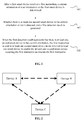
- positions of two second smart devices relative to the first smart device are determined mainly through a triangle formed by the second smart device and the first smart device.
- smart devices A, B and C form a triangle.
- distances between the smart devices AB, AC and BC may be calculated through the wireless RTT technology, and angles between the three devices may be obtained according to the distances.
- the second smart device If there is only one second smart device besides the first portable smart device sending instructions, such as a smart watch and a mobile phone in the WiFi or Bluetooth network, the second smart device is not required to be positioned, and it is considered as a default that all the instructions of the first smart device are sent to the only second smart device in the current WiFi or Bluetooth network.
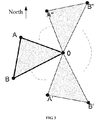
- the first smart device O may position and calibrate any two second smart devices (device A and device B) in the network and calculate distances and angles of every two of the first smart device O, the device A and the device B by virtue of a WiFi RTT function according to current positions, thereby calculating a triangle formed by the device A, the device B and the first smart device O.
- the triangle has a determined size and shape with an undetermined position, and the position may be any direction of 360 degrees of rotation about the device O.
- the first smart device O is required to change its own position and then determine the triangle formed by the first smart device O and the second smart devices A and B to implement accurate positioning of the second smart devices A and B.
- the user may be prompted to move the mobile portable smart device by a distance m along a set orientation such as the due north and wait for measurement and calculation of new positions with WiFi RTT. In such a manner, a new triangle formed by the three smart devices may be obtained, as shown in FIG. 4 .
- the determined triangle has the determined size and shape and an angle between OO' and a physical direction (i.e. the due north) may be known through positioning equipment such as the compass on the first smart device O, distances between the devices A and B and the portable smart device O and angles between the devices A and B and their orientations may be determined. That is, the device A and the device B are positioned.
- a dynamic virtual coordinate system is established by taking the portable smart device as an origin and taking a direction the smart device points to as a real axis.
- magnitudes of ⁇ , AO and BO may be measured.
- magnitudes of ⁇ , AO', BO and BO' may also be measured.
- a set orientation of the portable smart device may be overlapped with the true north of the compass during calibration and positioning.
- positions of A and B may be uniquely determined.
- OO' is parallel to AB, a condition shown in FIG. 5 may occur.
- a triangle for calibration is mirrored with the triangle for previously calculating the positions of the second smart devices A and B.
- the positions of the second smart devices A and B may not be uniquely determined.
- the user of the first smart device may be prompted to move the first smart device along another direction different from a previous movement direction by a distance n along a direction perpendicular to the previous movement direction for repositioning and recalibration, and then the physical positions of the second smart device A and the second smart device B may be uniquely determined.
- any two second smart devices and the first smart device may form an RTT triangle, so that all devices in the WiFi network may be positioned.
- a distance between smart devices may be determined through a transmitting and receiving delay of a wireless signal between smart devices or the like.
- the coordinate system is established by taking the first smart device as the origin and taking its set orientation as a real axis of the coordinate system.
- the first smart device After the coordinate system is established, the first smart device performs position calibration on the other second smart device, and records coordinates of all the second smart devices in the wireless network.
- a positioning manner for the second smart device may adopt the abovementioned manner of constructing triangles.
- the first smart device may measure distances and angles with any two devices by virtue of RTT, thereby determining its own position change. All the second smart devices in the network perform opposite movement relative to themselves (because the coordinate system always takes the first smart device as the origin), so that coordinates of all the equipment in the wireless network is updated.
- the second smart device is a static device. That is, most of the second smart devices is a device such as smart home or the like, and they are inconvenient to carry and also not required to be carried, so that it is usually inconvenient for the user to execute a short-distance operation on the smart home. Therefore, it is necessary to send a control instruction or the like to it by virtue of portable smart home, for example, the first smart device like a mobile phone.
- the portable smart device may form two triangles with the newly joining device according to any two smart devices in the network, thereby calculating a coordinate of the newly joining smart device relative to the coordinate system of the portable smart device and further positioning it.
- the coordinates of all the devices in the wireless network may also change (only the angles change), and the portable smart device may update the coordinates (angles with the real axis and the distances) of all the smart devices in the wireless network, select the device with the smallest angle as a device the portable smart device (a mobile phone and a watch) points to from the devices of which the angles (i.e.
- angle components of the coordinates of the device are smaller than 30 degrees or another threshold value (specifically set by the user), when more than one device has the smallest angle, select the device at a short distance according to the distances, and if both the angles and the distances are the same, prompt the user to move the position or angle of the portable smart device to select the device it is required to point to.
- an object the first smart device is intended to send the control instruction to is determined by virtue of the set orientation of the first smart device.
- the second smart device smaller than a set threshold angle in the set orientation of the first smart device is all determined as objects the first smart device is intended to send the control instruction to, and the set threshold angle may be 1 degree, 5 degrees, 10 degrees, 30 degrees or the like.
- the multiple second smart devices may all be determined as control instruction receiving parties, and the second smart device receiving the control instruction determines whether the control instruction sent by the user is sent to themselves or not by recognizing the received control instruction.
- a best manner is that, when there are multiple second smart devices in the set orientation, the user of the first smart device is notified to select one of them as a control instruction receiving party or determine one second smart device as the control instruction receiving party according to magnitudes of angles with the set orientation.
- dynamic coordinates of the device A and the device B i.e. the distances between each of the device A and the device B and the portable smart device and the angles between the devices and the orientation of the portable smart device, in the coordinate system of the first smart device may be solved.
- positions of the two second smart devices to be positioned are kept unchanged, and if the positions of the two second smart devices used during positioning change, although positioning may be implemented, positioning results may be deviated from practical positions.
- the second smart device Under the circumstance that there are multiple second smart devices in a house, if the second smart device is controlled through a voice, it is necessary to speak out a control object, for example, it is required to speak out that the television plays the song Cinderella through a voice instruction (it is more difficult to express if there are multiple televisions in the house) or go to the front of the corresponding second smart device and speak out the voice instruction: play the Cinderella, to it.
- the corresponding second smart device may output music to be played to the user after a series of processes of searching for a movie, preparing a cache and the like.
- the voice instruction: play the Cinderella may be input to the first smart device such as wearable equipment like a smart watch at a place far away from the second smart device, a direction of the second smart device selected for playing is pointed to, the control instruction may be sent to the second smart device, and the user may go for watching when the second smart device starts playing.
- the portable smart device points the second smart device to be controlled, and sends the control instruction to the second smart device to be controlled by an operation of clicking to send the control instruction and the like, and after receiving the control instruction, the second smart device to be controlled parses and executes the control instruction.
- the control instruction to be sent may be encrypted by virtue of identification information of the second smart device.
- the control instruction sent by the portable smart device may not be correctly parsed, and a misoperation over the control instruction may be avoided.
- the second smart device may also be accurately positioned, and the corresponding control instruction is only sent to the second smart device to be operated by virtue of a beam forming technology and the like.
- a smart device is determined as an initiation party of a control instruction for other smart device(s), the control instruction is initiated to the other smart device(s) in an orientation through the orientation of the smart device, and the other smart device(s) receives and executes the control instruction.
- the user may control a smart device without a special operation. Control over many other smart devices may be completed through one smart device, so that a control operation of the user over the other smart device(s) is greatly facilitated, and a user experience is improved.
- FIG. 7 is a structure diagram of an indication direction-based instruction transmission apparatus according to an embodiment of the invention.
- the indication direction-based instruction transmission apparatus of the embodiment of the invention includes a receiving unit 70, a first determination unit 71, a detection unit 72 and a sending unit 73.
- the receiving unit 70 is configured to receive a first instruction.
- the first determination unit 71 is configured to determine a current orientation of a set orientation on a first smart device.
- the detection unit 72 is configured to detect whether there is at least one second smart device in the current orientation or not, and generate a first detection result.
- the sending unit 73 is configured to, when the first detection result represents that there is at least one second smart device in the current orientation, send the first instruction to at least one second smart device in the detected at least one smart device to enable the at least one second smart device receiving the first instruction to execute the first instruction.
- the first instruction may be a voice instruction, and may also be a non-voice operation instruction input by a user through the first smart device.
- the first smart device is a portable smart device, for example, a smart watch and a mobile phone, convenient for the user to carry.
- the user may output the operation instruction to the second smart device through the first smart device.
- the indication direction-based instruction transmission apparatus of the embodiment of the invention further includes a setting unit (not shown in the figure), an establishment unit (not shown in the figure), a positioning unit (not shown in the figure) and a second determination unit (not shown in the figure).
- the setting unit is configured to set a reference azimuth.
- the establishment unit is configured to establish a virtual coordinate system based on the reference azimuth.
- the positioning unit is configured to position all second smart devices accessing a current network, and determine a relative position between the first smart device and each of the second smart devices accessing the network.
- the second determination unit is configured to determine a coordinate of each of the second smart devices accessing the network in the virtual coordinate system based on the relative position.
- the positioning unit of the embodiment of the invention includes a first calculation subunit (not shown in the figure), a second calculation subunit (not shown in the figure) and a determination subunit (not shown in the figure).
- the first calculation subunit is configured to calculate distances between the first smart device and two second smart devices and a distance between the two second smart devices respectively, and determine a first triangle formed by the first smart device and the two second smart devices.
- the second calculation subunit is configured to, after the first smart device is moved by a distance, calculate the distances between the first smart device and the two second smart devices and the distance between the two second smart devices, and determine a second triangle formed by the first smart device and the two smart devices.
- the determination subunit is configured to determine a movement direction and a movement distance of the first smart device, and determine coordinates of the two second smart devices in the virtual coordinate system according to the first triangle and the second triangle.
- the second calculation subunit is further configured to, when the first smart device is moved by a distance to mirror the first triangle and the second triangle, after the first smart device is moved by a distance in a direction different from a first movement direction, calculate the distances between the first smart device and the two second smart devices and the distance between the two second smart devices, and determine a third triangle formed by the first smart device and the two second smart device.
- the determination subunit is further configured to determine a movement direction and a movement distance of the first smart device before first or second movement, and determine the coordinates of the two second smart devices in the virtual coordinate system according to the third triangle and the first triangle or the third triangle and the second triangle.
- the detection unit 72 is further configured to determine the reference azimuth as the set orientation of the first smart device; when the first smart device is moved, determine current position information of the first smart device, update coordinate information of all the second smart devices according to the current position information of the first smart device, determine an angle between each of second smart devices and the reference azimuth according to the coordinate information of all the second smart devices, and determine the second smart device with the smallest angle as a second smart device existing in the current orientation; when more than two second smart devices have the smallest included angle, determine the second smart device closest to the first smart device as a second smart device existing in the current orientation; when more than two second smart devices have the smallest included angle, determine the second smart device closest to the first smart device as a second smart device existing in the current orientation; and when more than two second smart devices have the smallest angle and are closest to the first smart device, determine the more than two second smart devices as second smart devices existing in the current orientation, or return information of the more than two second smart devices to a user, and determine the second smart device with the smallest angle
- each processing unit in the indication direction-based instruction transmission apparatus shown in FIG. 6 may be understood with reference to the related descriptions about the indication direction-based instruction transmission method.
- the function of each unit in the indication direction-based instruction transmission apparatus shown in FIG. 6 may be realized through a program running on a processor, and may also be realized through a specific logic circuit.
- one smart device is determined as an initiation party of a control instruction for other smart device(s), the control instruction is initiated to the other smart device(s) in an orientation through the orientation of the smart device, and the other smart device(s) receives and executes the control instruction.
- the user may control a smart device without a special operation. Control over many other smart devices may be completed through one smart device, so that a control operation of the user over the other smart device(s) is greatly facilitated, and a user experience is improved.
- An embodiment of the invention further records a smart device, which includes the abovementioned indication direction-based instruction transmission apparatuses.
- An embodiment of the invention further records a storage medium having a computer program stored therein, the computer program being configured to execute the indication direction-based instruction transmission method of each embodiment.
- the abovementioned units described as separate parts may or may not be physically separated, and parts displayed as units may or may not be physical units, and namely may be located in the same place, or may also be distributed to multiple network units. Part or all of the units may be selected to achieve the purpose of the solutions of the invention according to a practical requirement.
- each function unit in each embodiment of the invention may be integrated into a processing unit, each unit may also exist independently, and two or more than two unit may also be integrated into a unit.
- the abovementioned integrated unit may be implemented in a hardware form, and may also be implemented in form of hardware and software function unit.
- the current orientation of the set orientation on the first smart device is determined. It is detected whether there is at least one second smart device in the current orientation or not, and the first detection result is generated.
- the first instruction is sent to the at least one second smart device in the detected at least one smart device to enable the at least one second smart device receiving the first instruction to execute the first instruction.
- one smart device is determined as an initiation party of a control instruction for other smart device(s), the control instruction is initiated to the other smart device(s) in an orientation through the orientation of the smart device, and the other smart device(s) receives and executes the control instruction.
- the user may control a smart device without a special operation. Control over many other smart devices may be completed through one smart device, thereby greatly facilitating a control operation of the user over the other smart device(s) and improving user experience.
Landscapes
- Engineering & Computer Science (AREA)
- Computer Networks & Wireless Communication (AREA)
- Signal Processing (AREA)
- Health & Medical Sciences (AREA)
- Computing Systems (AREA)
- General Health & Medical Sciences (AREA)
- Medical Informatics (AREA)
- Physics & Mathematics (AREA)
- General Physics & Mathematics (AREA)
- Radar, Positioning & Navigation (AREA)
- Remote Sensing (AREA)
- User Interface Of Digital Computer (AREA)
- Telephone Function (AREA)
- Mobile Radio Communication Systems (AREA)
- Selective Calling Equipment (AREA)
Claims (10)
- Angaberichtung-basiertes Anweisungsübertragungsverfahren, umfassend:nach dem Empfangen einer ersten Anweisung durch eine erste intelligente Vorrichtung, Bestimmen einer gegenwärtigen Orientierung einer eingestellten Orientierung auf der ersten intelligenten Vorrichtung (101);Einstellen eines Referenz-Richtungswinkels und Erstellen eines virtuellen Koordinatensystems auf der Basis des Referenz-Richtungswinkels;Lokalisieren, durch die erste intelligente Vorrichtung, von allen zweiten intelligenten Vorrichtungen, die auf ein Netzwerk zugreifen, auf das die erste intelligente Vorrichtung gegenwärtig zugreift, und Bestimmen einer relativen Position zwischen der ersten intelligenten Vorrichtung und jeder der zweiten intelligenten Vorrichtungen, die auf das Netzwerk zugreifen, wobei das Bestimmen der relativen Position zwischen der ersten intelligenten Vorrichtung und jeder der zweiten intelligenten Vorrichtungen, die auf das Netzwerk zugreifen, umfasst:jeweils Berechnen von Distanzen zwischen der ersten intelligenten Vorrichtung und zwei zweiten intelligenten Vorrichtungen und einer Distanz zwischen den zwei zweiten intelligenten Vorrichtungen, und Bestimmen eines ersten Dreiecks, das durch die erste intelligente Vorrichtung und die zwei zweiten intelligenten Vorrichtungen gebildet wird;Bewegen der ersten intelligenten Vorrichtung um eine Distanz, erneut Berechnen der Distanzen zwischen der ersten intelligenten Vorrichtung und den zwei zweiten intelligenten Vorrichtungen und der Distanz zwischen den zwei zweiten intelligenten Vorrichtungen, und Bestimmen eines zweiten Dreiecks, das durch die erste intelligente Vorrichtung und die zwei intelligenten Vorrichtungen gebildet wird; undBestimmen einer Bewegungsrichtung und einer Bewegungsdistanz der ersten intelligenten Vorrichtung und Bestimmen von Koordinaten der zwei zweiten intelligenten Vorrichtungen in dem virtuellen Koordinatensystem gemäß dem ersten Dreieck und dem zweiten Dreieck;Erfassen, ob mindestens eine zweite intelligente Vorrichtung in der gegenwärtigen Orientierung vorliegt oder nicht, und Erzeugen eines ersten Erfassungsergebnisses (102); undwenn das erste Erfassungsergebnis darstellt, dass mindestens eine zweite intelligente Vorrichtung in der gegenwärtigen Orientierung vorliegt, Senden der ersten Anweisung zu der erfassten mindestens einen zweiten intelligenten Vorrichtung, so dass die mindestens eine zweite intelligente Vorrichtung, welche die erste Anweisung empfängt, in die Lage versetzt wird, die erste Anweisung auszuführen (103).
- Verfahren nach Anspruch 1, das vor dem Erfassen, ob mindestens eine zweite intelligente Vorrichtung in der gegenwärtigen Orientierung vorliegt oder nicht, ferner umfasst:
Bestimmen einer Koordinate von jeder der zweiten intelligenten Vorrichtungen, die auf das Netzwerk zugreifen, in dem virtuellen Koordinatensystem auf der Basis der relativen Position. - Verfahren nach Anspruch 1, das, wenn die erste intelligente Vorrichtung um eine Distanz bewegt wird, um das erste Dreieck und das zweite Dreieck zu spiegeln, ferner umfasst:Bewegen der ersten intelligenten Vorrichtung um eine Distanz in eine Richtung, die von einer ersten Bewegungsrichtung verschieden ist, Berechnen der Distanzen zwischen der ersten intelligenten Vorrichtung und den zwei zweiten intelligenten Vorrichtungen und der Distanz zwischen den zwei zweiten intelligenten Vorrichtungen, und Bestimmen eines dritten Dreiecks, das durch die erste intelligente Vorrichtung und die zwei zweiten intelligenten Vorrichtungen gebildet wird; undBestimmen einer Bewegungsrichtung und einer Bewegungsdistanz der ersten intelligenten Vorrichtung vor der ersten oder zweiten Bewegung, und Bestimmen der Koordinaten der zwei zweiten intelligenten Vorrichtungen in dem virtuellen Koordinatensystem gemäß dem dritten Dreieck und dem ersten Dreieck oder dem dritten Dreieck und dem zweiten Dreieck.
- Verfahren nach Anspruch 2, bei dem das Erfassen, ob mindestens eine zweite intelligente Vorrichtung in der gegenwärtigen Orientierung vorliegt oder nicht, umfasst:Bestimmen des Referenz-Richtungswinkels als die eingestellte Orientierung der ersten intelligenten Vorrichtung;wenn die erste intelligente Vorrichtung bewegt wird, Bestimmen von Informationen über die gegenwärtige Position der ersten intelligenten Vorrichtung, Aktualisieren von Koordinateninformationen aller zweiten intelligenten Vorrichtungen gemäß der Informationen über die gegenwärtige Position der ersten intelligenten Vorrichtung, Bestimmen eines Winkels zwischen jeder der zweiten intelligenten Vorrichtungen und dem Referenz-Richtungswinkel gemäß den Koordinateninformationen aller zweiten intelligenten Vorrichtungen, und Bestimmen der zweiten intelligenten Vorrichtung mit dem kleinsten Winkel als eine zweite intelligente Vorrichtung, die in der gegenwärtigen Orientierung vorliegt; wenn mehr als zwei zweite intelligente Vorrichtungen den kleinsten Winkel aufweisen, Bestimmen der zweiten intelligenten Vorrichtung, die der ersten intelligenten Vorrichtung am nächsten liegt, als eine zweite intelligente Vorrichtung, die in der gegenwärtigen Orientierung vorliegt; und wenn mehr als zwei zweite intelligente Vorrichtungen den kleinsten Winkel aufweisen und der ersten intelligenten Vorrichtung am nächsten liegen, Bestimmen der mehr als zwei zweiten intelligenten Vorrichtungen als zweite intelligente Vorrichtungen, die in der gegenwärtigen Orientierung vorliegen, oder Rückführen von Informationen über die mehr als zwei zweiten intelligenten Vorrichtungen zu einem Nutzer, und Bestimmen der zweiten intelligenten Vorrichtung, die durch den Nutzer ausgewählt wird, als eine zweite intelligente Vorrichtung, die in der gegenwärtigen Orientierung vorliegt.
- Angaberichtung-basierte Anweisungsübertragungsvorrichtung, umfassend:eine Empfangseinheit, eine erste Bestimmungseinheit (71), eine Einstelleinheit, eine Erstellungseinheit, eine Positionierungseinheit, eine Erfassungseinheit (72) und eine Sendeeinheit (73), wobeidie Empfangseinheit zum Empfangen einer ersten Anweisung ausgebildet ist;die erste Bestimmungseinheit (71) zum Bestimmen einer gegenwärtigen Orientierung einer eingestellten Orientierung auf einer ersten intelligenten Vorrichtung ausgebildet ist;die Einstelleinheit zum Einstellen eines Referenz-Richtungswinkels ausgebildet ist;die Erstellungseinheit zum Erstellen eines virtuellen Koordinatensystems auf der Basis des Referenz-Richtungswinkels ausgebildet ist;die Positionierungseinheit zum Lokalisieren von allen zweiten intelligenten Vorrichtungen, die auf ein gegenwärtiges Netzwerk zugreifen, und Bestimmen einer relativen Position zwischen der ersten intelligenten Vorrichtung und jeder der zweiten intelligenten Vorrichtungen, die auf das Netzwerk zugreifen, ausgebildet ist, wobei die Positionierungseinheit umfasst: eine erste Berechnungsteileinheit, eine zweite Berechnungsteileinheit und eine Bestimmungsteileinheit, wobeidie erste Berechnungsteileinheit zum jeweiligen Berechnen von Distanzen zwischen der ersten intelligenten Vorrichtung und zwei zweiten intelligenten Vorrichtungen und einer Distanz zwischen den zwei zweiten intelligenten Vorrichtungen, und zum Bestimmen eines ersten Dreiecks, das durch die erste intelligente Vorrichtung und die zwei zweiten intelligenten Vorrichtungen gebildet wird, ausgebildet ist;die zweite Berechnungsteileinheit, nach dem Bewegen der ersten intelligenten Vorrichtung um eine Distanz, zum Berechnen der Distanzen zwischen der ersten intelligenten Vorrichtung und den zwei zweiten intelligenten Vorrichtungen und der Distanz zwischen den zwei zweiten intelligenten Vorrichtungen, und zum Bestimmen eines zweiten Dreiecks, das durch die erste intelligente Vorrichtung und die zwei intelligenten Vorrichtungen gebildet wird, ausgebildet ist; unddie Bestimmungsteileinheit zum Bestimmen einer Bewegungsrichtung und einer Bewegungsdistanz der ersten intelligenten Vorrichtung und zum Bestimmen von Koordinaten der zwei zweiten intelligenten Vorrichtungen in dem virtuellen Koordinatensystem gemäß dem ersten Dreieck und dem zweiten Dreieck ausgebildet ist;die Erfassungseinheit (72) zum Erfassen, ob mindestens eine zweite intelligente Vorrichtung in der gegenwärtigen Orientierung vorliegt oder nicht, und zum Erzeugen eines ersten Erfassungsergebnisses ausgebildet ist; unddie Sendeeinheit (73), wenn das erste Erfassungsergebnis darstellt, dass mindestens eine zweite intelligente Vorrichtung in der gegenwärtigen Orientierung vorliegt, zum Senden der ersten Anweisung zu der erfassten mindestens einen zweiten intelligenten Vorrichtung ausgebildet ist, so dass die mindestens eine zweite intelligente Vorrichtung, welche die erste Anweisung empfängt, in die Lage versetzt wird, die erste Anweisung auszuführen.
- Vorrichtung nach Anspruch 5, ferner umfassend: eine zweite Bestimmungseinheit, die zum Bestimmen einer Koordinate von jeder der zweiten intelligenten Vorrichtungen, die auf das Netzwerk zugreifen, in dem virtuellen Koordinatensystem auf der Basis der relativen Position ausgebildet ist.
- Vorrichtung nach Anspruch 5, bei dem die zweite Berechnungsteileinheit, wenn die erste intelligente Vorrichtung um eine Distanz bewegt wird, um das erste Dreieck und das zweite Dreieck zu spiegeln, ferner, nachdem die erste intelligente Vorrichtung um eine Distanz in eine Richtung, die von einer ersten Bewegungsrichtung verschieden ist, bewegt worden ist, zum Berechnen der Distanzen zwischen der ersten intelligenten Vorrichtung und den zwei zweiten intelligenten Vorrichtungen und der Distanz zwischen den zweiten intelligenten Vorrichtungen, und zum Bestimmen eines dritten Dreiecks, das durch die erste intelligente Vorrichtung und die zwei zweiten intelligenten Vorrichtungen gebildet wird, ausgebildet ist; und
die Bestimmungsteileinheit ferner zum Bestimmen einer Bewegungsrichtung und einer Bewegungsdistanz der ersten intelligenten Vorrichtung vor der ersten oder zweiten Bewegung, und Bestimmen der Koordinaten der zwei zweiten intelligenten Vorrichtungen in dem virtuellen Koordinatensystem gemäß dem dritten Dreieck und dem ersten Dreieck oder dem dritten Dreieck und dem zweiten Dreieck ausgebildet ist. - Vorrichtung nach Anspruch 6, bei dem die Erfassungseinheit (72) ferner ausgebildet ist zum:Bestimmen des Referenz-Richtungswinkels als die eingestellte Orientierung der ersten intelligenten Vorrichtung;wenn die erste intelligente Vorrichtung bewegt wird, Bestimmen von Informationen über die gegenwärtige Position der ersten intelligenten Vorrichtung, Aktualisieren von Koordinateninformationen aller zweiten intelligenten Vorrichtungen gemäß der Informationen über die gegenwärtige Position der ersten intelligenten Vorrichtung, Bestimmen eines Winkels zwischen jeder der zweiten intelligenten Vorrichtungen und dem Referenz-Richtungswinkel gemäß den Koordinateninformationen aller zweiten intelligenten Vorrichtungen, und Bestimmen der zweiten intelligenten Vorrichtung mit dem kleinsten Winkel als eine zweite intelligente Vorrichtung, die in der gegenwärtigen Orientierung vorliegt; wenn mehr als zwei zweite intelligente Vorrichtungen den kleinsten Winkel aufweisen, Bestimmen der zweiten intelligenten Vorrichtung, die der ersten intelligenten Vorrichtung am nächsten liegt, als eine zweite intelligente Vorrichtung, die in der gegenwärtigen Orientierung vorliegt; und wenn mehr als zwei zweite intelligente Vorrichtungen den kleinsten Winkel aufweisen und der ersten intelligenten Vorrichtung am nächsten liegen, Bestimmen der mehr als zwei zweiten intelligenten Vorrichtungen als zweite intelligente Vorrichtungen, die in der gegenwärtigen Orientierung vorliegen, oder Rückführen von Informationen über die mehr als zwei zweiten intelligenten Vorrichtungen zu einem Nutzer, und Bestimmen der zweiten intelligenten Vorrichtung, die durch den Nutzer ausgewählt wird, als eine zweite intelligente Vorrichtung, die in der gegenwärtigen Orientierung vorliegt.
- Speichermedium mit einem darin gespeicherten Computerprogramm, wobei das Computerprogramm so ausgebildet ist, dass es das Angaberichtung-basierte Anweisungsübertragungsverfahren nach einem der Ansprüche 1 bis 4 ausführt.
- System, das eine erste intelligente Vorrichtung und eine zweite intelligente Vorrichtung umfasst, wobei die erste intelligente Vorrichtung die Vorrichtung nach einem der Ansprüche 5 bis 8 umfasst.
Applications Claiming Priority (2)
| Application Number | Priority Date | Filing Date | Title |
|---|---|---|---|
| CN201510444359.2A CN106713598B (zh) | 2015-07-24 | 2015-07-24 | 基于指示方向的指令传输方法及装置、智能设备 |
| PCT/CN2015/088522 WO2017016043A1 (zh) | 2015-07-24 | 2015-08-31 | 基于指示方向的指令传输方法及装置、智能设备、存储介质 |
Publications (3)
| Publication Number | Publication Date |
|---|---|
| EP3328100A4 EP3328100A4 (de) | 2018-05-30 |
| EP3328100A1 EP3328100A1 (de) | 2018-05-30 |
| EP3328100B1 true EP3328100B1 (de) | 2019-10-23 |
Family
ID=57885665
Family Applications (1)
| Application Number | Title | Priority Date | Filing Date |
|---|---|---|---|
| EP15899395.6A Active EP3328100B1 (de) | 2015-07-24 | 2015-08-31 | Verfahren und vorrichtung zur befehlsübertragung basierend auf einer anzeigerichtung, intelligente vorrichtung und speichermedium |
Country Status (4)
| Country | Link |
|---|---|
| US (1) | US10356560B2 (de) |
| EP (1) | EP3328100B1 (de) |
| CN (1) | CN106713598B (de) |
| WO (1) | WO2017016043A1 (de) |
Families Citing this family (12)
| Publication number | Priority date | Publication date | Assignee | Title |
|---|---|---|---|---|
| US10163336B1 (en) | 2017-07-28 | 2018-12-25 | Dish Network L.L.C. | Universal remote control of devices based on orientation of remote |
| US10620721B2 (en) | 2018-01-29 | 2020-04-14 | Google Llc | Position-based location indication and device control |
| CN109029456B (zh) * | 2018-07-17 | 2020-10-16 | 成都精位科技有限公司 | 基于虚拟坐标的定位方法及装置 |
| CN110557741B (zh) | 2019-08-05 | 2021-08-13 | 华为技术有限公司 | 终端交互的方法及终端 |
| CN114982314B (zh) * | 2020-01-02 | 2025-03-18 | 上海诺基亚贝尔股份有限公司 | 对目标设备进行定位 |
| CN113242349B (zh) * | 2020-01-22 | 2022-08-26 | 华为技术有限公司 | 一种数据传输方法、电子设备及存储介质 |
| CN112019895B (zh) * | 2020-08-13 | 2023-04-18 | 北京小米移动软件有限公司 | 功能操作控制方法、功能操作控制装置及存储介质 |
| CN112860827B (zh) * | 2021-01-15 | 2024-04-30 | 北京小米移动软件有限公司 | 设备间交互控制方法、设备间交互控制装置及存储介质 |
| CN115113532B (zh) * | 2021-03-18 | 2025-03-07 | 云米互联科技(广东)有限公司 | 基于智能家电设备的设备监测方法及装置 |
| CN113839843B (zh) * | 2021-11-25 | 2022-03-29 | 深圳中科德能科技有限公司 | 智能设备的发现方法、装置、介质及区块链系统 |
| CN115499422B (zh) * | 2022-08-05 | 2025-07-18 | 北京拓疆者智能科技有限公司 | 基于远程控制指令的多设备串行通信方法及系统 |
| CN117311269B (zh) * | 2023-10-10 | 2025-01-07 | 果栗智造(上海)技术股份有限公司 | 一种插补加工方法、装置、加工输送系统及存储介质 |
Family Cites Families (10)
| Publication number | Priority date | Publication date | Assignee | Title |
|---|---|---|---|---|
| KR100913881B1 (ko) * | 2002-12-18 | 2009-08-26 | 삼성전자주식회사 | 휴대통신단말기의 위치정보 제공시스템 및 방법 |
| KR100580648B1 (ko) * | 2004-04-10 | 2006-05-16 | 삼성전자주식회사 | 3차원 포인팅 기기 제어 방법 및 장치 |
| US8886541B2 (en) * | 2010-02-04 | 2014-11-11 | Sony Corporation | Remote controller with position actuatated voice transmission |
| US20120127012A1 (en) * | 2010-11-24 | 2012-05-24 | Samsung Electronics Co., Ltd. | Determining user intent from position and orientation information |
| US9620087B2 (en) * | 2012-03-02 | 2017-04-11 | Realtek Semiconductor Corp. | Multimedia interaction system and related computer program product capable of avoiding unexpected interaction behavior |
| CN103095943B (zh) * | 2013-01-18 | 2016-04-27 | 浙江吉利汽车研究院有限公司杭州分公司 | 利用智能手机控制车载电子设备的方法及系统 |
| EP2955860B1 (de) | 2014-04-22 | 2018-06-27 | Huawei Device (Dongguan) Co., Ltd. | Datenauswahlverfahren und -vorrichtung |
| CN104301868A (zh) * | 2014-10-10 | 2015-01-21 | 西北工业大学 | 基于帧往返和到达时间测距技术的高精度室内定位方法 |
| CN104460330A (zh) * | 2014-11-04 | 2015-03-25 | 宁波工程学院 | 一种基于室内定位与电子罗盘的增强现实与远程控制方法 |
| CN104635505A (zh) * | 2015-01-19 | 2015-05-20 | 赵树乔 | 一种与室内智能设备的交互方法 |
-
2015
- 2015-07-24 CN CN201510444359.2A patent/CN106713598B/zh active Active
- 2015-08-31 US US15/744,858 patent/US10356560B2/en active Active
- 2015-08-31 WO PCT/CN2015/088522 patent/WO2017016043A1/zh not_active Ceased
- 2015-08-31 EP EP15899395.6A patent/EP3328100B1/de active Active
Non-Patent Citations (1)
| Title |
|---|
| None * |
Also Published As
| Publication number | Publication date |
|---|---|
| US10356560B2 (en) | 2019-07-16 |
| WO2017016043A1 (zh) | 2017-02-02 |
| CN106713598A (zh) | 2017-05-24 |
| CN106713598B (zh) | 2020-02-21 |
| US20180270617A1 (en) | 2018-09-20 |
| EP3328100A4 (de) | 2018-05-30 |
| EP3328100A1 (de) | 2018-05-30 |
Similar Documents
| Publication | Publication Date | Title |
|---|---|---|
| EP3328100B1 (de) | Verfahren und vorrichtung zur befehlsübertragung basierend auf einer anzeigerichtung, intelligente vorrichtung und speichermedium | |
| US8246467B2 (en) | Interactive gaming with co-located, networked direction and location aware devices | |
| US10922956B2 (en) | Device and method for controlling a plurality of targeted devices | |
| JP6400863B1 (ja) | 建物内部における器械および他のオブジェクトをポインティング、アクセス、および制御するための直観的方法 | |
| US9779734B2 (en) | Speech recognition system and method for recognizing a command to control a target | |
| EP2557433A1 (de) | Innenraumpositionierung mit RAKE-Empfängern | |
| US12353643B2 (en) | Low profile pointing device sensor fusion | |
| CN106034286B (zh) | 室内物品的定位方法及装置 | |
| JP2018535410A (ja) | 3次元空間検出システム、測位方法及びシステム | |
| US20130337849A1 (en) | Mobile device position detection | |
| JP6204073B2 (ja) | 無線タグ捜索方法およびその装置 | |
| JP2013003742A (ja) | データ送信操作機器、および、データ送信制御方法 | |
| US20120117249A1 (en) | Mobile device and control method thereof | |
| CN106714079B (zh) | 定位推播服务系统、使用者行动装置及定位推播服务方法 | |
| CN116668939B (zh) | 定位方法、寻物方法、装置、存储介质及电子设备 | |
| WO2016187817A1 (zh) | 移动终端的控制方法、装置及系统 | |
| WO2023202141A1 (zh) | 一种显示方法、控制设备及计算机存储介质 | |
| KR20170083124A (ko) | 블루투스 저 에너지를 이용한 위치 계산 | |
| CN108036795B (zh) | 路径获取方法、装置及移动终端 | |
| TWI598612B (zh) | 媒合系統與媒合方法 | |
| CN104569916B (zh) | 一种室内定位方法、定位装置和客户端 | |
| CN111757261B (zh) | 一种确定室内位置的方法及终端设备 | |
| US20220044353A1 (en) | System and method for reducing jitter when providing an indication for a relative direction of another device | |
| JP2017142255A (ja) | 無線タグ捜索方法およびその装置 | |
| CN121276491A (zh) | 寻物方法、电子设备及相关装置 |
Legal Events
| Date | Code | Title | Description |
|---|---|---|---|
| STAA | Information on the status of an ep patent application or granted ep patent |
Free format text: STATUS: THE INTERNATIONAL PUBLICATION HAS BEEN MADE |
|
| PUAI | Public reference made under article 153(3) epc to a published international application that has entered the european phase |
Free format text: ORIGINAL CODE: 0009012 |
|
| STAA | Information on the status of an ep patent application or granted ep patent |
Free format text: STATUS: REQUEST FOR EXAMINATION WAS MADE |
|
| 17P | Request for examination filed |
Effective date: 20180126 |
|
| A4 | Supplementary search report drawn up and despatched |
Effective date: 20180417 |
|
| AK | Designated contracting states |
Kind code of ref document: A1 Designated state(s): AL AT BE BG CH CY CZ DE DK EE ES FI FR GB GR HR HU IE IS IT LI LT LU LV MC MK MT NL NO PL PT RO RS SE SI SK SM TR |
|
| AX | Request for extension of the european patent |
Extension state: BA ME |
|
| DAV | Request for validation of the european patent (deleted) | ||
| DAX | Request for extension of the european patent (deleted) | ||
| GRAP | Despatch of communication of intention to grant a patent |
Free format text: ORIGINAL CODE: EPIDOSNIGR1 |
|
| STAA | Information on the status of an ep patent application or granted ep patent |
Free format text: STATUS: GRANT OF PATENT IS INTENDED |
|
| RIC1 | Information provided on ipc code assigned before grant |
Ipc: H04W 4/02 20180101AFI20190430BHEP Ipc: H04L 29/08 20060101ALN20190430BHEP Ipc: H04W 4/80 20180101ALN20190430BHEP Ipc: H04W 4/70 20180101ALN20190430BHEP |
|
| INTG | Intention to grant announced |
Effective date: 20190516 |
|
| GRAS | Grant fee paid |
Free format text: ORIGINAL CODE: EPIDOSNIGR3 |
|
| GRAA | (expected) grant |
Free format text: ORIGINAL CODE: 0009210 |
|
| STAA | Information on the status of an ep patent application or granted ep patent |
Free format text: STATUS: THE PATENT HAS BEEN GRANTED |
|
| AK | Designated contracting states |
Kind code of ref document: B1 Designated state(s): AL AT BE BG CH CY CZ DE DK EE ES FI FR GB GR HR HU IE IS IT LI LT LU LV MC MK MT NL NO PL PT RO RS SE SI SK SM TR |
|
| REG | Reference to a national code |
Ref country code: GB Ref legal event code: FG4D |
|
| REG | Reference to a national code |
Ref country code: CH Ref legal event code: EP |
|
| REG | Reference to a national code |
Ref country code: IE Ref legal event code: FG4D |
|
| REG | Reference to a national code |
Ref country code: DE Ref legal event code: R096 Ref document number: 602015040543 Country of ref document: DE |
|
| REG | Reference to a national code |
Ref country code: AT Ref legal event code: REF Ref document number: 1195052 Country of ref document: AT Kind code of ref document: T Effective date: 20191115 |
|
| REG | Reference to a national code |
Ref country code: NL Ref legal event code: MP Effective date: 20191023 |
|
| REG | Reference to a national code |
Ref country code: LT Ref legal event code: MG4D |
|
| PG25 | Lapsed in a contracting state [announced via postgrant information from national office to epo] |
Ref country code: NL Free format text: LAPSE BECAUSE OF FAILURE TO SUBMIT A TRANSLATION OF THE DESCRIPTION OR TO PAY THE FEE WITHIN THE PRESCRIBED TIME-LIMIT Effective date: 20191023 Ref country code: GR Free format text: LAPSE BECAUSE OF FAILURE TO SUBMIT A TRANSLATION OF THE DESCRIPTION OR TO PAY THE FEE WITHIN THE PRESCRIBED TIME-LIMIT Effective date: 20200124 Ref country code: PL Free format text: LAPSE BECAUSE OF FAILURE TO SUBMIT A TRANSLATION OF THE DESCRIPTION OR TO PAY THE FEE WITHIN THE PRESCRIBED TIME-LIMIT Effective date: 20191023 Ref country code: NO Free format text: LAPSE BECAUSE OF FAILURE TO SUBMIT A TRANSLATION OF THE DESCRIPTION OR TO PAY THE FEE WITHIN THE PRESCRIBED TIME-LIMIT Effective date: 20200123 Ref country code: SE Free format text: LAPSE BECAUSE OF FAILURE TO SUBMIT A TRANSLATION OF THE DESCRIPTION OR TO PAY THE FEE WITHIN THE PRESCRIBED TIME-LIMIT Effective date: 20191023 Ref country code: LV Free format text: LAPSE BECAUSE OF FAILURE TO SUBMIT A TRANSLATION OF THE DESCRIPTION OR TO PAY THE FEE WITHIN THE PRESCRIBED TIME-LIMIT Effective date: 20191023 Ref country code: PT Free format text: LAPSE BECAUSE OF FAILURE TO SUBMIT A TRANSLATION OF THE DESCRIPTION OR TO PAY THE FEE WITHIN THE PRESCRIBED TIME-LIMIT Effective date: 20200224 Ref country code: BG Free format text: LAPSE BECAUSE OF FAILURE TO SUBMIT A TRANSLATION OF THE DESCRIPTION OR TO PAY THE FEE WITHIN THE PRESCRIBED TIME-LIMIT Effective date: 20200123 Ref country code: FI Free format text: LAPSE BECAUSE OF FAILURE TO SUBMIT A TRANSLATION OF THE DESCRIPTION OR TO PAY THE FEE WITHIN THE PRESCRIBED TIME-LIMIT Effective date: 20191023 Ref country code: LT Free format text: LAPSE BECAUSE OF FAILURE TO SUBMIT A TRANSLATION OF THE DESCRIPTION OR TO PAY THE FEE WITHIN THE PRESCRIBED TIME-LIMIT Effective date: 20191023 |
|
| PG25 | Lapsed in a contracting state [announced via postgrant information from national office to epo] |
Ref country code: RS Free format text: LAPSE BECAUSE OF FAILURE TO SUBMIT A TRANSLATION OF THE DESCRIPTION OR TO PAY THE FEE WITHIN THE PRESCRIBED TIME-LIMIT Effective date: 20191023 Ref country code: IS Free format text: LAPSE BECAUSE OF FAILURE TO SUBMIT A TRANSLATION OF THE DESCRIPTION OR TO PAY THE FEE WITHIN THE PRESCRIBED TIME-LIMIT Effective date: 20200224 Ref country code: HR Free format text: LAPSE BECAUSE OF FAILURE TO SUBMIT A TRANSLATION OF THE DESCRIPTION OR TO PAY THE FEE WITHIN THE PRESCRIBED TIME-LIMIT Effective date: 20191023 |
|
| PG25 | Lapsed in a contracting state [announced via postgrant information from national office to epo] |
Ref country code: AL Free format text: LAPSE BECAUSE OF FAILURE TO SUBMIT A TRANSLATION OF THE DESCRIPTION OR TO PAY THE FEE WITHIN THE PRESCRIBED TIME-LIMIT Effective date: 20191023 |
|
| REG | Reference to a national code |
Ref country code: DE Ref legal event code: R097 Ref document number: 602015040543 Country of ref document: DE |
|
| PG2D | Information on lapse in contracting state deleted |
Ref country code: IS |
|
| PG25 | Lapsed in a contracting state [announced via postgrant information from national office to epo] |
Ref country code: RO Free format text: LAPSE BECAUSE OF FAILURE TO SUBMIT A TRANSLATION OF THE DESCRIPTION OR TO PAY THE FEE WITHIN THE PRESCRIBED TIME-LIMIT Effective date: 20191023 Ref country code: CZ Free format text: LAPSE BECAUSE OF FAILURE TO SUBMIT A TRANSLATION OF THE DESCRIPTION OR TO PAY THE FEE WITHIN THE PRESCRIBED TIME-LIMIT Effective date: 20191023 Ref country code: EE Free format text: LAPSE BECAUSE OF FAILURE TO SUBMIT A TRANSLATION OF THE DESCRIPTION OR TO PAY THE FEE WITHIN THE PRESCRIBED TIME-LIMIT Effective date: 20191023 Ref country code: DK Free format text: LAPSE BECAUSE OF FAILURE TO SUBMIT A TRANSLATION OF THE DESCRIPTION OR TO PAY THE FEE WITHIN THE PRESCRIBED TIME-LIMIT Effective date: 20191023 Ref country code: ES Free format text: LAPSE BECAUSE OF FAILURE TO SUBMIT A TRANSLATION OF THE DESCRIPTION OR TO PAY THE FEE WITHIN THE PRESCRIBED TIME-LIMIT Effective date: 20191023 Ref country code: IS Free format text: LAPSE BECAUSE OF FAILURE TO SUBMIT A TRANSLATION OF THE DESCRIPTION OR TO PAY THE FEE WITHIN THE PRESCRIBED TIME-LIMIT Effective date: 20200223 |
|
| REG | Reference to a national code |
Ref country code: AT Ref legal event code: MK05 Ref document number: 1195052 Country of ref document: AT Kind code of ref document: T Effective date: 20191023 |
|
| PLBE | No opposition filed within time limit |
Free format text: ORIGINAL CODE: 0009261 |
|
| STAA | Information on the status of an ep patent application or granted ep patent |
Free format text: STATUS: NO OPPOSITION FILED WITHIN TIME LIMIT |
|
| PG25 | Lapsed in a contracting state [announced via postgrant information from national office to epo] |
Ref country code: SK Free format text: LAPSE BECAUSE OF FAILURE TO SUBMIT A TRANSLATION OF THE DESCRIPTION OR TO PAY THE FEE WITHIN THE PRESCRIBED TIME-LIMIT Effective date: 20191023 Ref country code: IT Free format text: LAPSE BECAUSE OF FAILURE TO SUBMIT A TRANSLATION OF THE DESCRIPTION OR TO PAY THE FEE WITHIN THE PRESCRIBED TIME-LIMIT Effective date: 20191023 Ref country code: SM Free format text: LAPSE BECAUSE OF FAILURE TO SUBMIT A TRANSLATION OF THE DESCRIPTION OR TO PAY THE FEE WITHIN THE PRESCRIBED TIME-LIMIT Effective date: 20191023 |
|
| 26N | No opposition filed |
Effective date: 20200724 |
|
| PG25 | Lapsed in a contracting state [announced via postgrant information from national office to epo] |
Ref country code: AT Free format text: LAPSE BECAUSE OF FAILURE TO SUBMIT A TRANSLATION OF THE DESCRIPTION OR TO PAY THE FEE WITHIN THE PRESCRIBED TIME-LIMIT Effective date: 20191023 Ref country code: SI Free format text: LAPSE BECAUSE OF FAILURE TO SUBMIT A TRANSLATION OF THE DESCRIPTION OR TO PAY THE FEE WITHIN THE PRESCRIBED TIME-LIMIT Effective date: 20191023 |
|
| PG25 | Lapsed in a contracting state [announced via postgrant information from national office to epo] |
Ref country code: MC Free format text: LAPSE BECAUSE OF FAILURE TO SUBMIT A TRANSLATION OF THE DESCRIPTION OR TO PAY THE FEE WITHIN THE PRESCRIBED TIME-LIMIT Effective date: 20191023 |
|
| REG | Reference to a national code |
Ref country code: CH Ref legal event code: PL |
|
| PG25 | Lapsed in a contracting state [announced via postgrant information from national office to epo] |
Ref country code: CH Free format text: LAPSE BECAUSE OF NON-PAYMENT OF DUE FEES Effective date: 20200831 Ref country code: LI Free format text: LAPSE BECAUSE OF NON-PAYMENT OF DUE FEES Effective date: 20200831 Ref country code: LU Free format text: LAPSE BECAUSE OF NON-PAYMENT OF DUE FEES Effective date: 20200831 |
|
| REG | Reference to a national code |
Ref country code: BE Ref legal event code: MM Effective date: 20200831 |
|
| PG25 | Lapsed in a contracting state [announced via postgrant information from national office to epo] |
Ref country code: BE Free format text: LAPSE BECAUSE OF NON-PAYMENT OF DUE FEES Effective date: 20200831 Ref country code: IE Free format text: LAPSE BECAUSE OF NON-PAYMENT OF DUE FEES Effective date: 20200831 |
|
| PG25 | Lapsed in a contracting state [announced via postgrant information from national office to epo] |
Ref country code: TR Free format text: LAPSE BECAUSE OF FAILURE TO SUBMIT A TRANSLATION OF THE DESCRIPTION OR TO PAY THE FEE WITHIN THE PRESCRIBED TIME-LIMIT Effective date: 20191023 Ref country code: MT Free format text: LAPSE BECAUSE OF FAILURE TO SUBMIT A TRANSLATION OF THE DESCRIPTION OR TO PAY THE FEE WITHIN THE PRESCRIBED TIME-LIMIT Effective date: 20191023 Ref country code: CY Free format text: LAPSE BECAUSE OF FAILURE TO SUBMIT A TRANSLATION OF THE DESCRIPTION OR TO PAY THE FEE WITHIN THE PRESCRIBED TIME-LIMIT Effective date: 20191023 |
|
| PG25 | Lapsed in a contracting state [announced via postgrant information from national office to epo] |
Ref country code: MK Free format text: LAPSE BECAUSE OF FAILURE TO SUBMIT A TRANSLATION OF THE DESCRIPTION OR TO PAY THE FEE WITHIN THE PRESCRIBED TIME-LIMIT Effective date: 20191023 |
|
| PGFP | Annual fee paid to national office [announced via postgrant information from national office to epo] |
Ref country code: DE Payment date: 20250702 Year of fee payment: 11 |
|
| PGFP | Annual fee paid to national office [announced via postgrant information from national office to epo] |
Ref country code: GB Payment date: 20250703 Year of fee payment: 11 |
|
| PGFP | Annual fee paid to national office [announced via postgrant information from national office to epo] |
Ref country code: FR Payment date: 20250703 Year of fee payment: 11 |