EP3305898B1 - Method for selecting odor-controlling substance - Google Patents
Method for selecting odor-controlling substance Download PDFInfo
- Publication number
- EP3305898B1 EP3305898B1 EP16803223.3A EP16803223A EP3305898B1 EP 3305898 B1 EP3305898 B1 EP 3305898B1 EP 16803223 A EP16803223 A EP 16803223A EP 3305898 B1 EP3305898 B1 EP 3305898B1
- Authority
- EP
- European Patent Office
- Prior art keywords
- odor
- olfactory receptor
- substance
- target
- olfactory
- Prior art date
- Legal status (The legal status is an assumption and is not a legal conclusion. Google has not performed a legal analysis and makes no representation as to the accuracy of the status listed.)
- Active
Links
Images



Classifications
-
- C—CHEMISTRY; METALLURGY
- C07—ORGANIC CHEMISTRY
- C07K—PEPTIDES
- C07K14/00—Peptides having more than 20 amino acids; Gastrins; Somatostatins; Melanotropins; Derivatives thereof
- C07K14/435—Peptides having more than 20 amino acids; Gastrins; Somatostatins; Melanotropins; Derivatives thereof from animals; from humans
- C07K14/705—Receptors; Cell surface antigens; Cell surface determinants
- C07K14/70571—Receptors; Cell surface antigens; Cell surface determinants for neuromediators, e.g. serotonin receptor, dopamine receptor
-
- A—HUMAN NECESSITIES
- A61—MEDICAL OR VETERINARY SCIENCE; HYGIENE
- A61B—DIAGNOSIS; SURGERY; IDENTIFICATION
- A61B5/00—Measuring for diagnostic purposes; Identification of persons
- A61B5/40—Detecting, measuring or recording for evaluating the nervous system
- A61B5/4005—Detecting, measuring or recording for evaluating the nervous system for evaluating the sensory system
- A61B5/4011—Evaluating olfaction, i.e. sense of smell
-
- C—CHEMISTRY; METALLURGY
- C07—ORGANIC CHEMISTRY
- C07K—PEPTIDES
- C07K14/00—Peptides having more than 20 amino acids; Gastrins; Somatostatins; Melanotropins; Derivatives thereof
- C07K14/435—Peptides having more than 20 amino acids; Gastrins; Somatostatins; Melanotropins; Derivatives thereof from animals; from humans
- C07K14/705—Receptors; Cell surface antigens; Cell surface determinants
-
- G—PHYSICS
- G01—MEASURING; TESTING
- G01N—INVESTIGATING OR ANALYSING MATERIALS BY DETERMINING THEIR CHEMICAL OR PHYSICAL PROPERTIES
- G01N33/00—Investigating or analysing materials by specific methods not covered by groups G01N1/00 - G01N31/00
- G01N33/48—Biological material, e.g. blood, urine; Haemocytometers
- G01N33/50—Chemical analysis of biological material, e.g. blood, urine; Testing involving biospecific ligand binding methods; Immunological testing
- G01N33/53—Immunoassay; Biospecific binding assay; Materials therefor
-
- G—PHYSICS
- G01—MEASURING; TESTING
- G01N—INVESTIGATING OR ANALYSING MATERIALS BY DETERMINING THEIR CHEMICAL OR PHYSICAL PROPERTIES
- G01N33/00—Investigating or analysing materials by specific methods not covered by groups G01N1/00 - G01N31/00
- G01N33/48—Biological material, e.g. blood, urine; Haemocytometers
- G01N33/50—Chemical analysis of biological material, e.g. blood, urine; Testing involving biospecific ligand binding methods; Immunological testing
- G01N33/53—Immunoassay; Biospecific binding assay; Materials therefor
- G01N33/566—Immunoassay; Biospecific binding assay; Materials therefor using specific carrier or receptor proteins as ligand binding reagents where possible specific carrier or receptor proteins are classified with their target compounds
-
- G—PHYSICS
- G01—MEASURING; TESTING
- G01N—INVESTIGATING OR ANALYSING MATERIALS BY DETERMINING THEIR CHEMICAL OR PHYSICAL PROPERTIES
- G01N2500/00—Screening for compounds of potential therapeutic value
- G01N2500/10—Screening for compounds of potential therapeutic value involving cells
Definitions
- the present invention relates to a method for suppressing an odor on the basis of a mechanism for olfactory adaptation.
- an odorous substance is recognized by an olfactory receptor of an olfactory neuron present in olfactory epithelium spread in the deepest portion of a nasal cavity.
- An odor molecule taken into the nasal cavity works on and activates the olfactory receptor (OR), and a signal from the olfactory sensory neuron caused by the activated olfactory receptor is transmitted to the central nervous system, and thus, an odor is perceived.
- OR olfactory receptor
- a signal from the olfactory sensory neuron caused by the activated olfactory receptor is transmitted to the central nervous system, and thus, an odor is perceived.
- a human it is presumed that there are 400 or more genes encoding olfactory receptors. It is regarded that the odor quality perceived by a human from a specific odorous substance is determined depending on which combination of 400 or more olfactory receptors is activated.
- sensuous deodorization As a method for reducing discomfort against an offensive odor, chemical deodorization utilizing a neutralization reaction, physical deodorization of adsorbing an offensive odorous substance to a porous surface or the like, or sensuous deodorization utilizing a different odorous substance may be employed.
- the sensuous deodorization include (1) a method in which another odorous substance is introduced into an environment of an offensive odor to be smelled together with the offensive odor (masking), and (2) a method in which olfactory sensitivity of a human to an offensive odor is lowered by causing another odorous substance to be smelled before smelling the offensive odor (cross-adaptation).
- the method of the sensuous deodorization (2) is a method on the basis of a physiological phenomenon of the olfactory cross-adaptation.
- the olfactory cross-adaptation is defined as a reduction in sensitivity to an odorant due to habituation to a different odorant following habituation to an odorant. In other words, when one is caused to get used to an odor not offensive, he/she gets used to an offensive odor and hence his/her perception is suppressed.
- Patent Literature 2 describes an odor-suppressing method based on the cross-adaptation in which the olfactory sensitivity to an underarm odor component is lowered by causing one to continuously smell a substance having an odor which has a chemical structure very similar to that of a causative component of the underarm odor but is weak or not discomfort.
- Patent Literature 3 describes a method for evaluating, based on the cross-adaptation, odor similarity between a natural flavor and an imitation flavor imitating the natural flavor.
- Patent Literature 3 it is presumed that stronger cross-adaptation is induced as two flavor compositions have odors with more similar odor quality and that the influence of the adaptation is expressed as change in cerebral blood flow, and the similarity of the two flavors is evaluated by using the change in cerebral blood flow as an index.
- the lowering of odor sensitivity through the cross-adaptation can be caused not only at the level of olfactory receptors but also through various mechanisms at the level of olfactory neurons, at the level of neural networks and the like.
- Various hypotheses have been formed as the mechanism of the olfactory cross-adaptation.
- the cross-adaptation is regarded to occur in a neuron present in a high-order brain region. Specifically, it is regarded as a mechanism in which the neuron present in the higher-order brain region, where information from peripheral olfactory neurons is integrated to read the nature of an odor, loses its sensitivity so as not to continuously make unnecessary response to odor information remaining without changing.
- the cross-adaptation is regarded to occur at the level of olfactory receptors of peripheral olfactory neurons.
- an olfactory receptor for a given odorous substance is desensitized as a result of precedently responding to another substance, and hence does not transmit a signal with respect to the odorous substance to which the receptor is exposed afterward.
- the former hypothesis is difficult to verify because it is still unknown by which high-order brain neural network the odor information is processed.
- the latter hypothesis is also difficult to verify because of the large number of olfactory receptors, which is said to be 400 or more, and complexity of their combinations in the recognition of odorous substances.
- Non Patent Literature 3 reports that odorous substances accepted by one rat olfactory receptor had similar odor quality, and that the odorous substances induced the cross-adaptation in a human. In general, however, one odorous substance is recognized by a large number of olfactory receptors having different selectivity.
- Patent Literature 4 discloses methods for selecting a substance suppressing an odor, wherein the selected substance inhibits olfactory receptors. However, the selected substance does not activate the olfactory receptor(s) responding to the targeted odor.
- Cross-adapting agents have also been disclosed, identified either based on their structure similarity to the targeted (mal)odor (Patent Literature 5) or discovered randomly by testing compounds (Patent Literature 6) but not as being able to activate the olfactory receptor(s) responding to the targeted (mal)odor.
- the present invention provides a method for selecting a substance inducing cross-adaptation of or suppressing a target odor, comprising:
- the present invention provides a method for selecting a substance inducing cross-adaptation of or suppressing a target odor, comprising:
- olfactory receptor polypeptide refers to an olfactory receptor or a polypeptide having a function equivalent to the olfactory receptor
- polypeptide having a function equivalent to the olfactory receptor refers to a polypeptide which can be expressed on a cell membrane similarly to the olfactory receptor, is activated through binding to an odor molecule, and has, when activated, a function to increase an intracellular cAMP amount by activating adenylate cyclase in conjugation with intracellular G ⁇ s or G ⁇ olf.
- odor cross-adaptation (or olfactory cross-adaptation) relating to a target odor refers to a phenomenon in which olfactory sensitivity to a causative substance of the target odor is lowered or changed by causing an odor of a substance different from the causative substance of the target odor to be precedently accepted and thereby habituated to the odor.
- the present inventors have revealed that the "odor cross-adaptation” is a phenomenon based on an olfactory receptor agonism.
- an olfactory receptor for the causative substance of the target odor responds to a causative substance of a different odor priorly to responding to the causative substance of the target odor, and thereafter the response is adapted, and hence, merely low response can be made even if exposed to the causative substance of the target odor afterward, and as a result, the intensity of the target odor recognized by an individual is lowered or altered.
- a substance such as an olfactory receptor agonist, activating response of an olfactory receptor to a causative substance of the target odor can be used.
- nucleotide sequence or amino acid sequence identity is calculated by the Lipman-Person method ( Science, 1985, 227: 1435-41 ). Specifically, the calculation is carried out by performing analysis using homology analysis (search homology) program of gene information processing software, Genetyx-Win (Ver. 5.1.1; Software Development Co., Ltd.) with the unit size to compare (ktup) set to 2.
- identity of at least 80% in an amino acid sequence or a nucleotide sequence refers to an identity of 80% or more, preferably 85% or more, more preferably 90% or more, further preferably 95% or more, further more preferably 98% or more and still further preferably 99% or more.
- the present invention provides a method for selecting an odorous substance pair inducing the cross-adaptation with response of an olfactory receptor used as an index. Besides, the present invention provides a method for selecting, with activation of an olfactory receptor to a causative substance of a given odor used as an index, a substance suppressing the odor based on the cross-adaptation.
- a substance capable of selectively deodorizing a target odor based on the cross-adaptation can be efficiently selected.
- the present inventors have successfully verified, for the first time, involvement in the odor cross-adaptation at the level of olfactory receptors by utilizing a simple odor-olfactory receptor model in which high relevance between odor perception and specific olfactory receptor response is suggested, such as between a musk perfume and an olfactory receptor OR5AN1, or between guaiacol (2-methoxyphenol) and an olfactory receptor OR10G4.
- a simple odor-olfactory receptor model in which high relevance between odor perception and specific olfactory receptor response is suggested, such as between a musk perfume and an olfactory receptor OR5AN1, or between guaiacol (2-methoxyphenol) and an olfactory receptor OR10G4.
- a simple odor-olfactory receptor model in which high relevance between odor perception and specific olfactory receptor response is suggested, such as between a musk perfume and an olfactory receptor OR5AN1, or
- the present inventors have confirmed that this principle is universal as a result of experiments further made on another odor-olfactory receptor model (using p-cresol and OR9Q2). Based on these, the present inventors have found that cross-adaptation of various odors can be examined by constructing another odor-olfactory receptor model by screening olfactory receptors with respect to the responsiveness to odorous substances.
- the present invention provides a method for screening or identifying a substance inducing cross-adaptation of a target odor and a substance suppressing the target odor by the cross-adaptation.
- the present invention provides a method for selecting a substance inducing cross-adaptation of a target odor, comprising:
- the present invention provides a method for selecting a substance suppressing a target odor, comprising:
- the present invention provides a method for selecting a substance inducing cross-adaptation of a target odor, comprising:
- the present invention provides a method for selecting a substance suppressing a target odor, comprising:
- the above-described methods of the present invention are applicable to all olfactory receptor polypeptides involved in odor information transmission and all odors recognized thereby.
- the above-described methods of the present invention can be methods performed in vitro or ex vivo.
- at least one or more olfactory receptor polypeptides having responsiveness to a causative substance of a target odor are first prepared.
- the at least one or more olfactory receptor polypeptides responding to the causative substance of the target odor used in the present invention can be obtained by searching a population of olfactory receptor polypeptides to identify one responding to the causative substance of the target odor in the searched population.
- the "olfactory receptor for the causative substance of the target odor" to be identified need not be all olfactory receptors having accepting ability for the causative substance of the target odor, but may be a receptor playing a significant role in recognition of the target odor, in other words, a receptor capable of responding to the causative substance of the target odor at a comparatively low concentration, or a receptor having comparatively high responsiveness to the causative substance of the odor at a given concentration.
- the dependency on the concentration of the odor causative substance of the response of a cell expressing a receptor is obtained, and one having a comparatively low concentration effect (EC50) calculated as a result may be identified as the "olfactory receptor for the causative substance of the target odor".
- the "olfactory receptor for the causative substance of the target odor" to be identified may be a receptor having higher binding capacity such as one having a low dissociation constant.
- the olfactory receptor polypeptide having the responsiveness to the causative substance of the target odor can be identified, as described in Example 1 below, by monitoring response of various olfactory receptor polypeptides in accordance with a method described in Reference Examples 1 to 2, and screening an olfactory receptor polypeptide having responsiveness to the causative substance of the target odor.
- the olfactory receptor polypeptide used in the methods of the present invention may be an olfactory receptor polypeptide derived from a mammal.
- the olfactory receptor polypeptide derived from a mammal include olfactory receptor polypeptides derived from the primates such as a human and a chimpanzee or derived from rodents such as a mouse and a rat, and more preferable examples include 400 or more olfactory receptors of a human and polypeptides having equivalent functions to the receptors.
- GenBank www.ncbi.nlm.nih.gov.
- the population of olfactory receptor polypeptides to be searched as described above may be derived from a single mammalian species, or may include olfactory receptor polypeptides derived from two or more different mammalian species.
- the population of olfactory receptor polypeptides to be searched preferably include either a human, mouse or rat olfactory receptors or polypeptides having an amino acid sequence identity of at least 80% to any of the olfactory receptors and having an equivalent function to the olfactory receptor, and more preferably include either human olfactory receptors or polypeptides having an amino acid sequence identity of at least 80% to any of the olfactory receptors and having an equivalent function to the olfactory receptor.
- the olfactory receptor polypeptide can be used in an arbitrary form as long as the responsiveness to the causative substance of the target odor is not lost.
- the olfactory receptor polypeptide can be used, for example, in the form of: a tissue or a cell naturally expressing the olfactory receptor polypeptide such as an olfactory receptor or an olfactory cell isolated from a living body, or a culture thereof; an olfactory cell membrane carrying the olfactory receptor polypeptide thereon; a recombinant cell genetically engineered to express the olfactory receptor polypeptide or a culture thereof; a membrane of the recombinant cell having the olfactory receptor polypeptide; or an artificial lipid bilayer membrane having the olfactory receptor polypeptide. All of these forms are embraced in the scope of the olfactory receptor polypeptide used in the present invention.
- the olfactory receptor polypeptide can be a cell naturally expressing the olfactory receptor polypeptide such as an olfactory cell of a mammal, a recombinant cell genetically engineered to express the olfactory receptor polypeptide, or a culture of any of these.
- a preferable example includes a recombinant human cell genetically engineered to express a human olfactory receptor polypeptide.
- the recombinant cell can be produced by transforming a cell by using a vector in which a gene encoding the olfactory receptor polypeptide has been incorporated.
- the olfactory receptor polypeptide can be expressed by directly introducing a transcriptional product of the gene into a cell.
- a gene encoding RTP receptor-transporting protein
- a gene encoding RTP1S is introduced into a cell together with the gene encoding the olfactory receptor polypeptide.
- RTP1S is introduced into a cell together with the gene encoding the olfactory receptor polypeptide.
- An example of the RTP1S includes human RTP1S.
- the human RTP1S refers to a protein registered in GenBank under the accession number GI:50234917.
- the type of the target odor is not particularly limited, and embraces all odors including not only generally known offensive or unpleasant odors (such as a body odor, an underarm odor, a mouth odor, a fecal odor, a urine odor, a tobacco odor, a fusty odor, a musty odor, a putrid odor, a garbage odor, a sewage odor, a duct odor and an exhaust gas odor) but also odors derived from food or perfumery substances and odors derived from other substances (such as cosmetics, pharmaceuticals, detergents and daily necessities).
- offensive or unpleasant odors such as a body odor, an underarm odor, a mouth odor, a fecal odor, a urine odor, a tobacco odor, a fusty odor, a musty odor, a putrid odor, a garbage odor, a sewage odor, a duct odor and an exhaust gas
- the causative substance of the target odor may be any substance as long as it works on an olfactory receptor to cause the target odor to be perceived.
- the causative substance may be a natural substance or a substance artificially synthesized by a chemical or biological method, or may be a compound, a composition or a mixture.
- the causative substance is preferably a volatile substance.
- causative substance examples include muscone corresponding to a causative substance of a musk odor, guaiacol corresponding to a causative substance of a tobacco odor, p-cresol corresponding to a causative substance of a urine odor, 4-methyl-3-hexenoic acid corresponding to a causative substance of a musty odor, 3-mercapto-3-methylhexanol, 3-hydroxy-3-methylhexanoic acid and 3-methyl-2-hexenoic acid corresponding to causative substances of an underarm odor, diosmin and 2-methylisoborneol corresponding to causative substances of a fusty odor, skatole and indole corresponding to causative substance of a fecal odor or a mouth odor, nonanoic acid, hexanoic acid and isovaleric acid corresponding to causative substances of a body odor, volatile sulfur compounds corresponding causative substances of offensive a
- the causative substance of the target odor is added to the olfactory receptor polypeptide, and the response to the causative substance is measured.
- the measurement may be performed by any arbitrary method known, in the art, as a method for measuring response of an olfactory receptor, such as measurement of an intracellular cAMP amount.
- an olfactory receptor having been activated by an odor molecule, activates adenylate cyclase in conjugation with intracellular G ⁇ s to increase an intracellular cAMP amount. Accordingly, when the intracellular cAMP amount obtained after the addition of the causative substance is used as an index, the response of the olfactory receptor polypeptide to the causative substance can be measured.
- Examples of a method for measuring the cAMP amount include the ELISA method and reporter gene assay.
- Another example of the method for measuring the response of an olfactory receptor polypeptide includes a calcium imaging method.
- Still another example includes measurement by an electrophysiological method.
- electrophysiological measurement for example, a cell (such as a xenopus oocyte) in which an olfactory receptor polypeptide is co-expressed with another ion channel is produced, and the activity of the ion channel on this cell is measured by a patch-clamp method, a two-electrode voltage clamp method or the like, and thus, the response of the olfactory receptor polypeptide is measured.
- an olfactory receptor polypeptide responding to the causative substance of the target odor is identified.
- the evaluation of the responsiveness can be performed by comparing the response of the olfactory receptor polypeptide to which the causative substance has been added (a test group) with that of a control group.
- control group examples include the olfactory receptor polypeptide to which the causative substance in a different concentration has been added, the olfactory receptor polypeptide to which the causative substance has not been added, the olfactory receptor polypeptide to which a control substance has been added, the olfactory receptor polypeptide before adding the causative substance, and a cell in which the olfactory receptor polypeptide has not been expressed.
- Another example of the control group includes another olfactory receptor polypeptide having no responsiveness or low responsiveness to the causative substance.
- the olfactory receptor polypeptide When the response of the test group is increased as compared with that of the control group, the olfactory receptor polypeptide is identified to respond to the causative substance of the target odor.
- the response of the olfactory receptor polypeptide of the test group is increased, as compared with that of the control group, preferably by 200% or more, more preferably by 300% or more, and further preferably by 400% or more, the olfactory receptor polypeptide is identified to respond to the causative substance of the target odor.
- the response of the olfactory receptor polypeptide of the test group is increased statistically significantly as compared with that of the control group, the olfactory receptor polypeptide is identified to respond to the causative substance of the target odor.
- the response may be measured in a similar manner with the causative substance of the target odor added in a different concentration to the identified olfactory receptor polypeptide. If the response is increased dependently on the concentration of the causative substance, it can be confirmed that the olfactory receptor polypeptide has responsiveness to the causative substance of the target odor.
- one of the olfactory receptor polypeptides having comparatively high responsiveness to the causative substance can be further selected from these.
- one, two, three or more olfactory receptor polypeptides having higher responsiveness to the causative substance of the target odor can be selected, and one having the highest responsiveness can be further selected.
- an olfactory receptor polypeptide having the lowest responsiveness to the causative substance of the target odor may be eliminated from selection, or two or more having a lower responsiveness may be further eliminated from the selection.
- the one or more olfactory receptor polypeptides to be “selected” have responsiveness of 200% or more, preferably 300% or more, and more preferably 400% or more as compared with each of the olfactory receptor polypeptides to be "eliminated” from the selection.
- the response sensitivity of the olfactory receptor polypeptide to the causative substance of the target odor can be evaluated using an index of EC50, a response threshold value or the like, so as to select an olfactory receptor polypeptide having high sensitivity.
- an olfactory receptor polypeptide having high sensitivity and high responsiveness can be selected.
- an olfactory receptor polypeptide When expressed on a cultured cell or the like, an olfactory receptor polypeptide shows different basal activity depending on the type thereof. Therefore, when the response is compared among olfactory receptor polypeptides, a response value of each olfactory receptor polypeptide is normalized, so that the comparison among the olfactory receptor polypeptides can be preferably performed based on the thus obtained normalized values.
- Examples of a normalization method include a method in which in a cell expressing one olfactory receptor, a relative value of a signal obtained in response to odor stimulation is obtained on the assumption that a signal value obtained without the odor stimulation is 1, and a method in which in a cell expressing one olfactory receptor, a signal value obtained without odor stimulation is subtracted from a signal value obtained in response to the odor stimulation.
- an olfactory receptor polypeptide having the responsiveness to the causative substance of the target odor can be identified.
- at least one olfactory receptor polypeptide having the responsiveness to the causative substance of the target odor is prepared.
- An example of the at least one or more olfactory receptor polypeptides provided in the methods of the present invention includes at least one selected from the group consisting of a human, mouse or rat olfactory receptor having responsiveness to the causative substance of the target odor, and a polypeptide having an amino acid sequence identity of at least 80% to the olfactory receptor and having responsiveness to the causative substance of the target odor.
- a more preferable example includes at least one selected from the group consisting of a human olfactory receptor having responsiveness to the causative substance of the target odor, and a polypeptide having an amino acid sequence identity of at least 80% to the human olfactory receptor and having responsiveness to the causative substance of the target odor.
- a still more preferable example includes at least one selected from the group consisting of an olfactory receptor having highest responsiveness in a group of human olfactory receptors having responsiveness to the causative substance of the target odor, and a polypeptide having an amino acid sequence identity of at least 80% to the olfactory receptor and having responsiveness to the causative substance of the target odor.
- a still more preferable example includes at least one selected from the group consisting of an olfactory receptor having highest sensitivity and highest responsiveness in a group of human olfactory receptors having responsiveness to the causative substance of the target odor, and a polypeptide having an amino acid sequence identity of at least 80% to the olfactory receptor and having responsiveness to the causative substance of the target odor.
- the olfactory receptor polypeptide(s) provided in the methods of the present invention may be at least one having the responsiveness to the causative substance of the target odor, and may be a combination of any two or more of these.
- the odor causative substance is a musk perfume
- an olfactory receptor polypeptide to be used is at least one selected from the group consisting of OR5AN1 (SEQ ID NO: 2) and a polypeptide having an amino acid sequence identity of at least 80% to the amino acid sequence as set forth in SEQ ID NO: 2 and having responsiveness to the musk perfume (see Figure 1 ).
- the target odor is, for example, an odor of guaiacol (2-methoxyphenol) in the methods of the present invention
- the odor causative substance is guaiacol
- an olfactory receptor polypeptide to be used is at least one selected from the group consisting of OR10G4 (SEQ ID NO: 4) and a polypeptide having an amino acid sequence identity of at least 80% to the amino acid sequence as set forth in SEQ ID NO: 4 and having responsiveness to guaiacol (see Figure 1 ).
- the guaiacol is known as a principal causative substance of a tobacco odor ( JP-A-2006-321943 ). Accordingly, in one embodiment of the methods of the present invention, the target odor is a tobacco odor, and an olfactory receptor polypeptide to be used is at least one selected from the group consisting of the OR10G4 (SEQ ID NO: 4), that is, a guaiacol receptor, and a polypeptide having an amino acid sequence identity of at least 80% to the amino acid sequence as set forth in SEQ ID NO: 4 and having responsiveness to a tobacco odor causative substance, preferably the guaiacol.
- OR10G4 SEQ ID NO: 4
- the target odor is a urine odor.
- JP-A-2009-132770 describes that a component having the highest contribution to a urine odor generated from scattered and dried urine or a diaper left after use is p-cresol, and that a urine odor can be reproduced by a composition containing p-cresol and another phenol compound having 6 to 10 carbon atoms.
- International Publication No. WO 2009/037861 describes that when ⁇ -glucuronidase produced by a bacteria works on urine, p-cresol or another component is increased in the urine, resulting in remarkably increasing the intensity of the urine odor.
- examples of a "urine odor causative substance" of the present invention include ⁇ -glucuronidase treated urine or an extract thereof, and p-cresol.
- examples of the ⁇ -glucuronidase treated urine include urine having been treated by adding ⁇ -glucuronidase thereto, and urine affected by ⁇ -glucuronidase produced by a bacteria present in the urine.
- Such a treated urine or an extract thereof comprises p-cresol.
- OR9Q2 As an olfactory receptor recognizing p-cresol corresponding to the urine odor causative substance, OR9Q2 has been found (see Figures 1 and 2 ).
- the OR9Q2 is a polypeptide registered in GenBank under the accession number GI:284413710 and consisting of an amino acid sequence as set forth in SEQ ID NO: 6.
- an olfactory receptor polypeptide to be used is preferably at least one selected from the group consisting of the OR9Q2 (SEQ ID NO: 6) and a polypeptide having an amino acid sequence identity of at least 80% to the amino acid sequence as set forth in SEQ ID NO: 6 and having responsiveness to a urine odor causative substance, preferably p-cresol.
- test substance is added to the olfactory receptor polypeptide having the responsiveness to the causative substance of the target odor.
- the test substance used in the methods of the present invention is not particularly limited as long as it is a substance desired to be used as a substance inducing the cross-adaptation of the target odor or as a substance suppressing the target odor.
- the test substance may be a natural substance or a substance artificially synthesized by a chemical or biological method or the like, or may be a compound, a composition or a mixture. It is noted that the test substance is a substance different from the causative substance of the target odor.
- the test substance is preferably a volatile substance having a different odor from the target odor.
- the test substance is preferably a perfume having a different odor from the target odor.
- the response of the olfactory receptor polypeptide to the test substance is measured.
- the measurement may be performed in accordance with the method described above with respect to the measurement of the response of an olfactory receptor polypeptide to the causative substance of the target odor.
- the receptor activating effect of the test substance is evaluated to identify a test substance inducing the cross-adaptation of the target odor.
- the evaluation of the effect of the test substance can be performed by comparing the response of the olfactory receptor to which the test substance has been added (the test group) with that of a control group.
- control group examples include the olfactory receptor polypeptide to which the test substance in a different concentration has been added, the olfactory receptor polypeptide to which the test substance has not been added, the olfactory receptor polypeptide to which a control substance has been added, the olfactory receptor polypeptide before adding the test substance, and a cell in which the olfactory receptor polypeptide has not been expressed.
- control group includes another olfactory receptor polypeptide having no responsiveness or low responsiveness to the test substance.
- the test substance can be evaluated to be a substance activating the response of the olfactory receptor polypeptide.
- the effect of a test substance on the response of an olfactory receptor polypeptide can be evaluated by comparing the response of the olfactory receptor polypeptide between a group in which the test substance has been added and a group in which it has not been added, between a group in which the test substance has been added and a group in which a control substance has been added, between before and after adding the test substance, or between a group in which the olfactory receptor polypeptide has been expressed and a group in which it has not been expressed.
- test substance If the response of the olfactory receptor polypeptide has been induced by the addition of a test substance, the test substance is evaluated to be a substance activating the response of the olfactory receptor polypeptide to the causative substance of the target odor.
- the test substance when the response of the olfactory receptor polypeptide of the group in which the test substance has been added is increased, as compared with that of the control group, preferably by 200% or more, more preferably by 300% or more, and further preferably by 400% or more, the test substance is evaluated to be a substance activating the response of the olfactory receptor polypeptide.
- the test substance when the response of the olfactory receptor polypeptide of the group in which the test substance has been added is increased statistically significantly as compared with that of the control group, the test substance can be evaluated to be a substance activating the response of the olfactory receptor polypeptide.
- the test substance activating the response of the olfactory receptor polypeptide to the causative substance of the target odor obtained as described above is selected as a substance inducing the cross-adaptation of the target odor.
- the olfactory receptor recognizing the target odor is activated in the presence of the test substance, and is subsequently lowered in the responsiveness due to the adaptation, and hence, loses the responsiveness to the causative substance of the target odor added afterward.
- the cross-adaptation of the target odor is induced by the test substance.
- the test substance activating the response of the olfactory receptor polypeptide to the causative substance of the target odor obtained as described above is selected as a substance suppressing the target odor.
- the test substance is a substance capable of suppressing the target odor by inducing the cross-adaptation of the target odor.
- the test substance selected as described above may be subjected to a sensory test, if necessary, to further estimate level of cross-adaptation or extent of target odor suppression thereof.
- the sensory test can be performed in accordance with an estimation procedure for a deodorant usually employed in the art, and considering that the test substance is a cross-adaptation inducer substance, the order of applying the test substance and the causative substance of the target odor to an estimator is preferably adjusted.
- an estimator has been precedently adapted to an odor of a candidate test substance selected as described above by smelling the odor. Subsequently, the estimator smells the target odor to estimate the intensity of the odor.
- a test substance estimated, as a result of the sensory test, to lower the intensity of the target odor is selected as a substance inducing the cross-adaptation of the target odor, or a substance suppressing the target odor.
- a substance selected by the methods of the present invention is a substance capable of suppressing the target odor on the basis of the cross-adaptation.
- One embodiment of usage of the substance suppressing the target odor obtained by the methods of the present invention is as follows: First, a subject desired to suppress the target odor is caused to smell the substance suppressing the target odor before exposing the subject to the target odor. Alternatively, the substance suppressing the target odor is applied to the subject so that an odor of the substance can be stronger than the target odor. As a result, since olfactory sensitivity to the target odor of the subject is thus lowered, he/she perceives that the target odor is weak or does not perceive the target odor even when exposed to the target odor.
- Examples of the application of the substance suppressing the target odor obtained by the present invention include, but are not limited to: placement of the substance in front of or in a toilet; a method in which a person in charge of excretion care in a hospital ward or aged care facilities is caused to carry the substance with him/her or exposed to the substance before the care; a paper diaper or a sanitary napkin containing the substance; clothes, cloth products and fabrics such as underwear, underclothes and linens containing the substance; laundry detergents and softeners containing the substance; cosmetics, detergents, external preparations such as deodorants, pharmaceuticals and food containing the substance; and application to a manufacturing line for products having the target odor or an environment where the target odor is generated.
- genes respectively encoding 370 human olfactory receptors shown in Tables 1-1 and 1-2 and genes respectively encoding the human olfactory receptors OR5AN1, OR10G4 and OR9Q2 were cloned. Each of the genes was cloned by the PCR using human genomic DNA female (G1521: Promega) as a template.
- Each gene amplified by the PCR was incorporated into a pENTR vector (Invitrogen) in accordance with the instruction, and was recombined to NotI and AscI sites produced downstream from a Flag-Rho tag sequence on a pME18S vector by using NotI and AscI sites present on the pENTR vector.
- pENTR vector Invitrogen
- a gene encoding human RTP1S was incorporated into the EcoRI and XhoI sites of the pME18S vector.
- Example 1 HEK293 cells on which the 370 human olfactory receptors were respectively expressed were produced.
- a reaction solution having a composition shown in Table 2 was prepared and allowed to stand still in a clean bench for 15 minutes, and the resultant was added by 4.4 ⁇ L per well in a 384-well plate (BioCoat).
- the HEK293 cells (20 x 10 4 cells/cm 2 ) were seeded by 40 ⁇ L per well, and the resultant was cultured for 24 hours in an incubator kept at 37°C and 5% CO 2 .
- DMEM (4.5g/l Glucose) with L-Gln and Sodium Pyruvate, liquid (Nacalai Tesque, Inc.) 2.2 ⁇ L TE (pH8.0: 10mMTris-HCl, 1mM EDTA, Nippon Gene Co., Ltd.) 2.2 ⁇ L Human Olfactory Receptor Gene (incorporated into pME18S vector having Flag-Rho tag added at N-terminal) 0.029 ⁇ g pGL4.29 (fluc2P-CRE-hygro, Promega) 0.022 ⁇ g pGL4.75 (hRluc-CMV, Promega) 0.0012 ⁇ g pME18S human RTP1S vector 0.012 ⁇ g lipofectamine 2000 (Invitrogen) or PEI-MAX (Polyscience) 0.16 ⁇ L
- Example 2 and Examples 2 and 3 HEK293 cells in which the human olfactory receptor OR5AN1, OR10G4, OR9Q2 or OR1A1 was expressed were produced.
- a reaction solution having a composition shown in Table 3 was prepared and allowed to stand still in a clean bench for 15 minutes, and the resultant was added by 10 ⁇ L per well in a 96-well plate (BioCoat).
- the HEK293 cells (3 x 10 5 cells/cm 2 ) were seeded by 90 ⁇ L per well, and the resultant was cultured for 24 hours in an incubator kept at 37°C and 5% CO 2 .
- DMEM ((4.5g/l Glucose) with L-Gln and Sodium Pyruvate, liquid, Nacalai Tescqhe, Inc.) 10 ⁇ L Human Olfactory Receptor Gene (any of OR5AN1, OR10G4, OR9Q2 and OR1A1) (incorporated into pME18S vector having Flag-Rho tag added at N-terminal) 0.075 ⁇ g pGL4.29 (fluc2P-CRE-hygro, Promega) 0.03 ⁇ g pGL4.75 (hRluc-CMV, Promega) 0.03 ⁇ g pME18S human RTP1S vector 0.03 ⁇ g lipofectamine 2000 (Invitrogen) or PEI-MAX (Polyscience) 0.41 ⁇ L
- the olfactory receptor expressed on the HEK293 cells increases the intracellular cAMP amount by activating adenylate cyclase in conjugation with intracellular G ⁇ s.
- luciferase reporter gene assay for monitoring the increase of the intracellular cAMP amount as a luminescence value derived from a firefly luciferase gene (fluc2P-CRE-hygro) was employed.
- a fused Renilla luciferase (hRluc-CMV) gene was simultaneously transferred downstream of the CMV promoter, so as to be used as an internal standard for correcting the gene transfer efficiency or an error in the number of cells.
- Dual-Glo(TM) Luciferase Assay System (Promega) was used, and the measurement was performed in accordance with the operation instruction of the product. Under each of various stimulation conditions, a value fLuc/hRluc obtained by dividing a firefly luciferase-derived luminescence value by a Renilla luciferase-derived luminescence value was calculated. A value obtained by dividing a value fLuc/hRluc induced by stimulation with an odorous substance by a value fLuc/hRluc of a cell not stimulated with the odorous substance was obtained as fold increase, which was used as an index of the response intensity. A dose-response curve was analyzed using Graph Pad Prism.
- the medium was removed from each of the cultures of the olfactory receptor expressing cells produced according to Reference Example 1, and an odorous substance (muscone, guaiacol or p-cresol) was added thereto.
- a DMEM medium Nacalai containing muscone or guaiacol was added to a 384-well plate containing the culture by 30 ⁇ L per well (to a final concentration of muscone of 100 ⁇ M and of guaiacol of 1 mM).
- a CD293 medium (Invitrogen) containing p-cresol was added to a 96-well plate containing the culture by 75 ⁇ L per well (to a final concentration of 1 mM).
- the resultant cells were cultured in a CO 2 incubator for 2.5 to 3 hours to sufficiently express the luciferase gene in the cells, and the response intensity (fold increase) of each olfactory receptor to each odorous substance was measured by the luciferase assay by the method described in Reference Example 2.
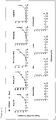
- the results are illustrated in Figure 1 .
- the ordinate indicates the relative intensity of the response of the respective receptor expressing cells to the odor stimulation assuming that the response intensity obtained without the odor stimulation was 1.
- receptors having the highest responsiveness to muscone, guaiacol and p-cresol, the OR5AN1, the OR10G4 and the OR9Q2 were respectively identified.
- the medium was removed from each culture of the olfactory receptor expressing cells produced in accordance with Reference Example 1, and 75 ⁇ L of a solution containing an odorous substance prepared in a DMEM medium (Nacalai Tesque, Inc.) to be 0.3 ⁇ M to 100 ⁇ M was added thereto.
- the resultant cells were cultured in a CO 2 incubator for 3 to 4 hours to sufficiently express the luciferase gene in the cells, and the luciferase assay was performed by the method described in Reference Example 2 to measure the response intensity (fold increase) of the olfactory receptor to the odorous substance.
- the OR5AN1 is an olfactory receptor responding to a musk perfume.
- Nine substances were applied to the OR5AN1, and as a result, not only muscone but also Musk xylol, Muscenone delta, Globanone and Exaltolide (R) were found to be substances activating the response.
- the OR5AN1 responded to these substances concentration-dependently ( Figure 3 ). Such response was not found in the cells (Mock) in which the OR5AN1 was not expressed, and hence depends on the OR5AN1.
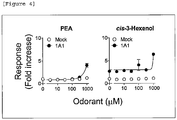
- Ambrettolide, phenyl ethyl alcohol (PEA), Lyral (R) and Cis-3-hexenol did not induce the response of the OR5AN1.
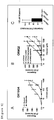
- OR10G4 had responsiveness to guaiacol and ethyl vanillin ( Figure 5A ).
- the OR9Q2 was found to have responsiveness to p-cresol, that is, a urine odor causative substance, as illustrated in Figure 2 , and was also found to have responsiveness to p-cresyl acetate, p-cresyl isobutyrate and p-methyl quinoline ( Figure 5B ). On the other hand, it was found that both the OR10G4 and the OR9Q2 do not have responsiveness to muscone ( Figure 5C ).
- the cross-adaptation effect induced by the odorous substance evaluated in Example 2 was estimated by a sensory test.
- a glass bottle No. 11, manufactured by Hakuyo Glass Co., Ltd., capacity: 110 mL
- a target odorous substance to be used as a target sample.
- muscone As the target odorous substance, muscone, guaiacol or p-cresol was used.
- muscone As the muscone, a cotton ball soaked with 1 mg of muscone was used.
- As the guaiacol and p-cresol 1 mL of a mineral oil (Sigma-Aldrich) solution in a concentration of 10 ppm was used.
- a glass bottle was charged with a test substance to be used as a test sample.
- a test sample 5 mg of an ethyl vanillin powder, or 1 mL of a mineral oil (Sigma-Aldrich) solution of p-cresyl acetate, p-cresyl isobutyrate or p-methyl quinoline prepared to a concentration of 1,000 ppm was used.
- the sensory test was performed by a single blind method by five to eight panelists.
- the target sample was first presented to each panelist, who was caused to replay on the odor intensity.
- the test sample was presented for 2 minutes or until the odor could not be perceived. Thereafter, the target sample was presented again, and the panelist was caused to replay on the odor intensity.
- This series of operations was defined as one set, and the sensory test was carried out with four sets per day per panelist set as the upper limit. A recess of at least 10 minutes or more was provided between the sets.
- the panelist was caused to plot the estimated intensity of the target odor on a straight line of 9.5 cm with both ends respectively provided with criteria "No odor” and "Strong odor”.
- a distance (A) between the position of the target odor intensity plotted in the initial estimate and the end of "No odor”, and a distance (B) between the position of the target odor intensity plotted in the second estimate and the end of "No odor” were obtained, so as to calculate percentage odor intensity of the initial estimate [B/A*100 - 100].
- this value is smaller, the intensity of the target odor perceived in the second estimate is suppressed stronger as compared with that in the initial estimate, namely, stronger cross-adaptation is induced. If this value is - 100%, it means that the target odor was not perceived at all in the second estimate.
- Ambrettolide has an odor with similar nature to muscone, it did not induce the cross-adaptation. This suggests that the odor cross-adaptation is induced in a region on a peripheral side beyond the high-order brain region where the nature of an odor is recognized, and the principle of the present invention that the odor cross-adaptation is accountable at the level of olfactory receptors is thus supported.
- the olfactory receptor having the highest responsiveness to the odor of guaiacol is the OR10G4 ( Figure 1 ).
- the cross-adaptation of the odor of guaiacol is induced by ethyl vanillin which activates the OR10G4 ( Figure 6B ).
- the cross-adaptation of the odor of guaiacol is not induced by muscone which does not activate the OR10G4, and the cross-adaptation of ethyl vanillin is not induced by muscone.
- the present invention provides a novel method for identifying an odorous substance capable of suppressing a target odor based on the cross-adaptation using activation of response of an olfactory receptor as an index.
Landscapes
- Health & Medical Sciences (AREA)
- Life Sciences & Earth Sciences (AREA)
- Chemical & Material Sciences (AREA)
- Engineering & Computer Science (AREA)
- Immunology (AREA)
- Molecular Biology (AREA)
- Biomedical Technology (AREA)
- General Health & Medical Sciences (AREA)
- Organic Chemistry (AREA)
- Hematology (AREA)
- Urology & Nephrology (AREA)
- Cell Biology (AREA)
- Medicinal Chemistry (AREA)
- Biochemistry (AREA)
- Biophysics (AREA)
- Physics & Mathematics (AREA)
- Pathology (AREA)
- Neurology (AREA)
- General Physics & Mathematics (AREA)
- Analytical Chemistry (AREA)
- Toxicology (AREA)
- Zoology (AREA)
- Gastroenterology & Hepatology (AREA)
- Food Science & Technology (AREA)
- Genetics & Genomics (AREA)
- Proteomics, Peptides & Aminoacids (AREA)
- Microbiology (AREA)
- Biotechnology (AREA)
- Neurosurgery (AREA)
- Physiology (AREA)
- Heart & Thoracic Surgery (AREA)
- Medical Informatics (AREA)
- Surgery (AREA)
- Animal Behavior & Ethology (AREA)
- Public Health (AREA)
- Veterinary Medicine (AREA)
- Peptides Or Proteins (AREA)
- Investigating Or Analysing Biological Materials (AREA)
- Measuring Or Testing Involving Enzymes Or Micro-Organisms (AREA)
Applications Claiming Priority (3)
| Application Number | Priority Date | Filing Date | Title |
|---|---|---|---|
| JP2015110390 | 2015-05-29 | ||
| JP2016096146A JP6114439B2 (ja) | 2015-05-29 | 2016-05-12 | 匂い抑制物質の選択方法 |
| PCT/JP2016/065656 WO2016194788A1 (ja) | 2015-05-29 | 2016-05-27 | 匂い抑制物質の選択方法 |
Publications (3)
| Publication Number | Publication Date |
|---|---|
| EP3305898A1 EP3305898A1 (en) | 2018-04-11 |
| EP3305898A4 EP3305898A4 (en) | 2018-11-14 |
| EP3305898B1 true EP3305898B1 (en) | 2020-08-26 |
Family
ID=57748063
Family Applications (1)
| Application Number | Title | Priority Date | Filing Date |
|---|---|---|---|
| EP16803223.3A Active EP3305898B1 (en) | 2015-05-29 | 2016-05-27 | Method for selecting odor-controlling substance |
Country Status (3)
| Country | Link |
|---|---|
| US (1) | US10738101B2 (enExample) |
| EP (1) | EP3305898B1 (enExample) |
| JP (1) | JP6114439B2 (enExample) |
Families Citing this family (18)
| Publication number | Priority date | Publication date | Assignee | Title |
|---|---|---|---|---|
| JP6886893B2 (ja) * | 2017-08-23 | 2021-06-16 | 花王株式会社 | 嗅覚受容体の応答測定方法 |
| JP7197298B2 (ja) * | 2018-07-17 | 2022-12-27 | 花王株式会社 | メチルメルカプタン臭抑制剤の評価及び/又は選択方法 |
| JP7385999B2 (ja) * | 2019-05-24 | 2023-11-24 | 株式会社 資生堂 | パーソナルケア組成物および悪臭抑制方法 |
| KR20230012487A (ko) * | 2020-05-18 | 2023-01-26 | 다카사고 고료 고교 가부시키가이샤 | 향료 조성물 및 음식품 |
| WO2022270481A1 (ja) | 2021-06-22 | 2022-12-29 | 花王株式会社 | 嗅覚受容体の発現方法及び応答測定方法 |
| JPWO2023013792A1 (enExample) * | 2021-08-06 | 2023-02-09 | ||
| CN113506596B (zh) * | 2021-09-08 | 2022-11-15 | 汉王科技股份有限公司 | 嗅觉受体筛选、模型训练、酒类产品鉴定的方法与装置 |
| JP2023084473A (ja) * | 2021-12-07 | 2023-06-19 | 花王株式会社 | フェノール化合物を原因とするにおいの抑制剤の評価及び/又は選択方法 |
| JP2023084478A (ja) * | 2021-12-07 | 2023-06-19 | 花王株式会社 | アルデヒドを原因とするにおいの抑制剤の評価及び/又は選択方法 |
| JP7863414B2 (ja) * | 2021-12-07 | 2026-05-21 | 花王株式会社 | カルボン酸を原因とするにおいの抑制剤の評価及び/又は選択方法 |
| JP2023138229A (ja) * | 2022-03-17 | 2023-10-02 | 花王株式会社 | ムスク様の匂いを呈する香料素材の評価又は選択方法 |
| CN115902128B (zh) * | 2023-02-08 | 2023-06-06 | 汉王科技股份有限公司 | 嗅觉受体在识别4-乙基愈创木酚中的用途和检测4-乙基愈创木酚的方法 |
| CN117741160B (zh) * | 2023-12-21 | 2024-07-12 | 汉王科技股份有限公司 | 嗅觉受体在识别乙醇中的用途和检测乙醇的方法 |
| WO2025262041A1 (en) * | 2024-06-18 | 2025-12-26 | Firmenich Sa | Methods of determining susceptibility of olfactory receptor ligands to adaptation |
| CN118501118B (zh) * | 2024-07-16 | 2024-10-29 | 汉王科技股份有限公司 | 一种基于细胞的生物荧光能量共振转移检测系统及应用 |
| CN119601088B (zh) * | 2024-11-18 | 2025-10-10 | 中国检验检疫科学研究院 | 一种马铃薯甲虫嗅觉受体基因筛选方法 |
| WO2026125256A1 (en) * | 2024-12-09 | 2026-06-18 | Firmenich Sa | Methods of identifying compounds that reduce malodorous aromas |
| CN121208276B (zh) * | 2025-12-01 | 2026-03-06 | 同济大学 | 基于嗅觉受体和气味分子间作用筛选臭味抑制剂的方法 |
Family Cites Families (10)
| Publication number | Priority date | Publication date | Assignee | Title |
|---|---|---|---|---|
| JPS53121471A (en) | 1977-03-31 | 1978-10-23 | Nippon Chemical Ind | Automatic position matching device |
| US7056948B2 (en) * | 2000-06-23 | 2006-06-06 | Monell Chemical Senses Center | Use of odor reducing and cross-adapting agents to reduce animal waste malodors |
| US7763238B2 (en) * | 2002-01-16 | 2010-07-27 | Monell Chemical Senses Center | Olfactory adaptation and cross-adapting agents to reduce the perception of body odors |
| JP2005053887A (ja) * | 2003-08-07 | 2005-03-03 | Kao Corp | 体臭に対する嗅覚の感度を低下させる方法 |
| JP4966790B2 (ja) | 2007-05-09 | 2012-07-04 | 長谷川香料株式会社 | 香料の評価方法 |
| WO2012029922A1 (ja) * | 2010-09-03 | 2012-03-08 | 花王株式会社 | 悪臭抑制剤の探索方法、悪臭抑制剤、及び悪臭抑制方法 |
| JP5646255B2 (ja) | 2010-09-03 | 2014-12-24 | 花王株式会社 | 悪臭抑制剤 |
| JP5593271B2 (ja) | 2011-06-06 | 2014-09-17 | 花王株式会社 | 悪臭抑制剤の探索方法 |
| JP6104058B2 (ja) * | 2013-06-03 | 2017-03-29 | 花王株式会社 | カビ臭抑制剤の探索方法 |
| JP6243698B2 (ja) * | 2013-10-22 | 2017-12-06 | 花王株式会社 | フラネオールによるにおいの抑制剤 |
-
2016
- 2016-05-12 JP JP2016096146A patent/JP6114439B2/ja active Active
- 2016-05-27 US US15/576,514 patent/US10738101B2/en active Active
- 2016-05-27 EP EP16803223.3A patent/EP3305898B1/en active Active
Non-Patent Citations (1)
| Title |
|---|
| None * |
Also Published As
| Publication number | Publication date |
|---|---|
| EP3305898A4 (en) | 2018-11-14 |
| US20180127482A1 (en) | 2018-05-10 |
| JP6114439B2 (ja) | 2017-04-12 |
| JP2016224039A (ja) | 2016-12-28 |
| EP3305898A1 (en) | 2018-04-11 |
| US10738101B2 (en) | 2020-08-11 |
Similar Documents
| Publication | Publication Date | Title |
|---|---|---|
| US10738101B2 (en) | Method for selecting odor-controlling substance | |
| EP2718718B1 (en) | Method for identifying a malodor inhibitor | |
| JP6434661B2 (ja) | 匂い制御物質の選択方法 | |
| US9526680B2 (en) | Method for searching for malodor control agent, malodor control agent, and malodor control method | |
| JP6588715B2 (ja) | 尿臭抑制剤の探索方法 | |
| WO2016194788A1 (ja) | 匂い抑制物質の選択方法 | |
| JP7197298B2 (ja) | メチルメルカプタン臭抑制剤の評価及び/又は選択方法 | |
| Ferrero et al. | A juvenile mouse pheromone inhibits sexual behaviour through the vomeronasal system | |
| JP6276555B2 (ja) | フラネオールによるにおいの抑制剤の探索方法 | |
| JP7776818B2 (ja) | アルデヒド臭の抑制剤の探索方法 | |
| JP7214486B2 (ja) | 猫尿臭抑制剤の探索方法 | |
| EP3312289B1 (en) | Method for evaluating and selecting agent for suppressing odors of sulfide compounds | |
| WO2016204211A1 (ja) | スルフィド化合物の臭いの抑制剤の評価又は選択方法 | |
| JP7383453B2 (ja) | インドール臭抑制剤の選択方法 | |
| JP6422665B2 (ja) | 腋臭抑制剤の探索方法 | |
| JP6831674B2 (ja) | 尿臭抑制剤 | |
| JP7158192B2 (ja) | メチルメルカプタン臭抑制剤 | |
| JP2022083535A (ja) | インドール臭抑制剤 | |
| EP3311807B1 (en) | Agent for suppressing odors of polysulfide compounds | |
| WO2017090518A1 (ja) | 尿臭抑制剤 |
Legal Events
| Date | Code | Title | Description |
|---|---|---|---|
| STAA | Information on the status of an ep patent application or granted ep patent |
Free format text: STATUS: THE INTERNATIONAL PUBLICATION HAS BEEN MADE |
|
| PUAI | Public reference made under article 153(3) epc to a published international application that has entered the european phase |
Free format text: ORIGINAL CODE: 0009012 |
|
| STAA | Information on the status of an ep patent application or granted ep patent |
Free format text: STATUS: REQUEST FOR EXAMINATION WAS MADE |
|
| 17P | Request for examination filed |
Effective date: 20171129 |
|
| AK | Designated contracting states |
Kind code of ref document: A1 Designated state(s): AL AT BE BG CH CY CZ DE DK EE ES FI FR GB GR HR HU IE IS IT LI LT LU LV MC MK MT NL NO PL PT RO RS SE SI SK SM TR |
|
| AX | Request for extension of the european patent |
Extension state: BA ME |
|
| DAV | Request for validation of the european patent (deleted) | ||
| DAX | Request for extension of the european patent (deleted) | ||
| A4 | Supplementary search report drawn up and despatched |
Effective date: 20181011 |
|
| RIC1 | Information provided on ipc code assigned before grant |
Ipc: G01N 33/53 20060101ALI20181005BHEP Ipc: A61B 5/00 20060101ALI20181005BHEP Ipc: G01N 33/566 20060101ALI20181005BHEP Ipc: G01N 33/15 20060101ALI20181005BHEP Ipc: C12Q 1/06 20060101ALI20181005BHEP Ipc: C07K 14/705 20060101ALI20181005BHEP Ipc: C12N 15/09 20060101AFI20181005BHEP |
|
| STAA | Information on the status of an ep patent application or granted ep patent |
Free format text: STATUS: EXAMINATION IS IN PROGRESS |
|
| 17Q | First examination report despatched |
Effective date: 20190424 |
|
| GRAP | Despatch of communication of intention to grant a patent |
Free format text: ORIGINAL CODE: EPIDOSNIGR1 |
|
| STAA | Information on the status of an ep patent application or granted ep patent |
Free format text: STATUS: GRANT OF PATENT IS INTENDED |
|
| INTG | Intention to grant announced |
Effective date: 20200225 |
|
| GRAJ | Information related to disapproval of communication of intention to grant by the applicant or resumption of examination proceedings by the epo deleted |
Free format text: ORIGINAL CODE: EPIDOSDIGR1 |
|
| STAA | Information on the status of an ep patent application or granted ep patent |
Free format text: STATUS: EXAMINATION IS IN PROGRESS |
|
| GRAR | Information related to intention to grant a patent recorded |
Free format text: ORIGINAL CODE: EPIDOSNIGR71 |
|
| GRAS | Grant fee paid |
Free format text: ORIGINAL CODE: EPIDOSNIGR3 |
|
| STAA | Information on the status of an ep patent application or granted ep patent |
Free format text: STATUS: GRANT OF PATENT IS INTENDED |
|
| GRAA | (expected) grant |
Free format text: ORIGINAL CODE: 0009210 |
|
| STAA | Information on the status of an ep patent application or granted ep patent |
Free format text: STATUS: THE PATENT HAS BEEN GRANTED |
|
| INTC | Intention to grant announced (deleted) | ||
| INTG | Intention to grant announced |
Effective date: 20200716 |
|
| AK | Designated contracting states |
Kind code of ref document: B1 Designated state(s): AL AT BE BG CH CY CZ DE DK EE ES FI FR GB GR HR HU IE IS IT LI LT LU LV MC MK MT NL NO PL PT RO RS SE SI SK SM TR |
|
| REG | Reference to a national code |
Ref country code: GB Ref legal event code: FG4D |
|
| REG | Reference to a national code |
Ref country code: CH Ref legal event code: EP |
|
| REG | Reference to a national code |
Ref country code: AT Ref legal event code: REF Ref document number: 1306407 Country of ref document: AT Kind code of ref document: T Effective date: 20200915 |
|
| REG | Reference to a national code |
Ref country code: IE Ref legal event code: FG4D |
|
| REG | Reference to a national code |
Ref country code: DE Ref legal event code: R096 Ref document number: 602016042835 Country of ref document: DE |
|
| REG | Reference to a national code |
Ref country code: LT Ref legal event code: MG4D |
|
| PG25 | Lapsed in a contracting state [announced via postgrant information from national office to epo] |
Ref country code: FI Free format text: LAPSE BECAUSE OF FAILURE TO SUBMIT A TRANSLATION OF THE DESCRIPTION OR TO PAY THE FEE WITHIN THE PRESCRIBED TIME-LIMIT Effective date: 20200826 Ref country code: NO Free format text: LAPSE BECAUSE OF FAILURE TO SUBMIT A TRANSLATION OF THE DESCRIPTION OR TO PAY THE FEE WITHIN THE PRESCRIBED TIME-LIMIT Effective date: 20201126 Ref country code: GR Free format text: LAPSE BECAUSE OF FAILURE TO SUBMIT A TRANSLATION OF THE DESCRIPTION OR TO PAY THE FEE WITHIN THE PRESCRIBED TIME-LIMIT Effective date: 20201127 Ref country code: SE Free format text: LAPSE BECAUSE OF FAILURE TO SUBMIT A TRANSLATION OF THE DESCRIPTION OR TO PAY THE FEE WITHIN THE PRESCRIBED TIME-LIMIT Effective date: 20200826 Ref country code: BG Free format text: LAPSE BECAUSE OF FAILURE TO SUBMIT A TRANSLATION OF THE DESCRIPTION OR TO PAY THE FEE WITHIN THE PRESCRIBED TIME-LIMIT Effective date: 20201126 Ref country code: HR Free format text: LAPSE BECAUSE OF FAILURE TO SUBMIT A TRANSLATION OF THE DESCRIPTION OR TO PAY THE FEE WITHIN THE PRESCRIBED TIME-LIMIT Effective date: 20200826 Ref country code: LT Free format text: LAPSE BECAUSE OF FAILURE TO SUBMIT A TRANSLATION OF THE DESCRIPTION OR TO PAY THE FEE WITHIN THE PRESCRIBED TIME-LIMIT Effective date: 20200826 Ref country code: PT Free format text: LAPSE BECAUSE OF FAILURE TO SUBMIT A TRANSLATION OF THE DESCRIPTION OR TO PAY THE FEE WITHIN THE PRESCRIBED TIME-LIMIT Effective date: 20201228 |
|
| REG | Reference to a national code |
Ref country code: NL Ref legal event code: MP Effective date: 20200826 |
|
| REG | Reference to a national code |
Ref country code: AT Ref legal event code: MK05 Ref document number: 1306407 Country of ref document: AT Kind code of ref document: T Effective date: 20200826 |
|
| PG25 | Lapsed in a contracting state [announced via postgrant information from national office to epo] |
Ref country code: RS Free format text: LAPSE BECAUSE OF FAILURE TO SUBMIT A TRANSLATION OF THE DESCRIPTION OR TO PAY THE FEE WITHIN THE PRESCRIBED TIME-LIMIT Effective date: 20200826 Ref country code: LV Free format text: LAPSE BECAUSE OF FAILURE TO SUBMIT A TRANSLATION OF THE DESCRIPTION OR TO PAY THE FEE WITHIN THE PRESCRIBED TIME-LIMIT Effective date: 20200826 Ref country code: PL Free format text: LAPSE BECAUSE OF FAILURE TO SUBMIT A TRANSLATION OF THE DESCRIPTION OR TO PAY THE FEE WITHIN THE PRESCRIBED TIME-LIMIT Effective date: 20200826 Ref country code: NL Free format text: LAPSE BECAUSE OF FAILURE TO SUBMIT A TRANSLATION OF THE DESCRIPTION OR TO PAY THE FEE WITHIN THE PRESCRIBED TIME-LIMIT Effective date: 20200826 Ref country code: IS Free format text: LAPSE BECAUSE OF FAILURE TO SUBMIT A TRANSLATION OF THE DESCRIPTION OR TO PAY THE FEE WITHIN THE PRESCRIBED TIME-LIMIT Effective date: 20201226 |
|
| PG25 | Lapsed in a contracting state [announced via postgrant information from national office to epo] |
Ref country code: EE Free format text: LAPSE BECAUSE OF FAILURE TO SUBMIT A TRANSLATION OF THE DESCRIPTION OR TO PAY THE FEE WITHIN THE PRESCRIBED TIME-LIMIT Effective date: 20200826 Ref country code: SM Free format text: LAPSE BECAUSE OF FAILURE TO SUBMIT A TRANSLATION OF THE DESCRIPTION OR TO PAY THE FEE WITHIN THE PRESCRIBED TIME-LIMIT Effective date: 20200826 Ref country code: RO Free format text: LAPSE BECAUSE OF FAILURE TO SUBMIT A TRANSLATION OF THE DESCRIPTION OR TO PAY THE FEE WITHIN THE PRESCRIBED TIME-LIMIT Effective date: 20200826 Ref country code: DK Free format text: LAPSE BECAUSE OF FAILURE TO SUBMIT A TRANSLATION OF THE DESCRIPTION OR TO PAY THE FEE WITHIN THE PRESCRIBED TIME-LIMIT Effective date: 20200826 Ref country code: CZ Free format text: LAPSE BECAUSE OF FAILURE TO SUBMIT A TRANSLATION OF THE DESCRIPTION OR TO PAY THE FEE WITHIN THE PRESCRIBED TIME-LIMIT Effective date: 20200826 |
|
| REG | Reference to a national code |
Ref country code: DE Ref legal event code: R097 Ref document number: 602016042835 Country of ref document: DE |
|
| PG25 | Lapsed in a contracting state [announced via postgrant information from national office to epo] |
Ref country code: AT Free format text: LAPSE BECAUSE OF FAILURE TO SUBMIT A TRANSLATION OF THE DESCRIPTION OR TO PAY THE FEE WITHIN THE PRESCRIBED TIME-LIMIT Effective date: 20200826 Ref country code: AL Free format text: LAPSE BECAUSE OF FAILURE TO SUBMIT A TRANSLATION OF THE DESCRIPTION OR TO PAY THE FEE WITHIN THE PRESCRIBED TIME-LIMIT Effective date: 20200826 Ref country code: ES Free format text: LAPSE BECAUSE OF FAILURE TO SUBMIT A TRANSLATION OF THE DESCRIPTION OR TO PAY THE FEE WITHIN THE PRESCRIBED TIME-LIMIT Effective date: 20200826 |
|
| PG25 | Lapsed in a contracting state [announced via postgrant information from national office to epo] |
Ref country code: SK Free format text: LAPSE BECAUSE OF FAILURE TO SUBMIT A TRANSLATION OF THE DESCRIPTION OR TO PAY THE FEE WITHIN THE PRESCRIBED TIME-LIMIT Effective date: 20200826 |
|
| PLBE | No opposition filed within time limit |
Free format text: ORIGINAL CODE: 0009261 |
|
| STAA | Information on the status of an ep patent application or granted ep patent |
Free format text: STATUS: NO OPPOSITION FILED WITHIN TIME LIMIT |
|
| PG25 | Lapsed in a contracting state [announced via postgrant information from national office to epo] |
Ref country code: IT Free format text: LAPSE BECAUSE OF FAILURE TO SUBMIT A TRANSLATION OF THE DESCRIPTION OR TO PAY THE FEE WITHIN THE PRESCRIBED TIME-LIMIT Effective date: 20200826 |
|
| 26N | No opposition filed |
Effective date: 20210527 |
|
| PG25 | Lapsed in a contracting state [announced via postgrant information from national office to epo] |
Ref country code: SI Free format text: LAPSE BECAUSE OF FAILURE TO SUBMIT A TRANSLATION OF THE DESCRIPTION OR TO PAY THE FEE WITHIN THE PRESCRIBED TIME-LIMIT Effective date: 20200826 |
|
| REG | Reference to a national code |
Ref country code: CH Ref legal event code: PL |
|
| GBPC | Gb: european patent ceased through non-payment of renewal fee |
Effective date: 20210527 |
|
| PG25 | Lapsed in a contracting state [announced via postgrant information from national office to epo] |
Ref country code: LI Free format text: LAPSE BECAUSE OF NON-PAYMENT OF DUE FEES Effective date: 20210531 Ref country code: LU Free format text: LAPSE BECAUSE OF NON-PAYMENT OF DUE FEES Effective date: 20210527 Ref country code: MC Free format text: LAPSE BECAUSE OF FAILURE TO SUBMIT A TRANSLATION OF THE DESCRIPTION OR TO PAY THE FEE WITHIN THE PRESCRIBED TIME-LIMIT Effective date: 20200826 Ref country code: CH Free format text: LAPSE BECAUSE OF NON-PAYMENT OF DUE FEES Effective date: 20210531 |
|
| PG25 | Lapsed in a contracting state [announced via postgrant information from national office to epo] |
Ref country code: IE Free format text: LAPSE BECAUSE OF NON-PAYMENT OF DUE FEES Effective date: 20210527 Ref country code: GB Free format text: LAPSE BECAUSE OF NON-PAYMENT OF DUE FEES Effective date: 20210527 |
|
| PG25 | Lapsed in a contracting state [announced via postgrant information from national office to epo] |
Ref country code: FR Free format text: LAPSE BECAUSE OF NON-PAYMENT OF DUE FEES Effective date: 20210531 |
|
| P01 | Opt-out of the competence of the unified patent court (upc) registered |
Effective date: 20230522 |
|
| PG25 | Lapsed in a contracting state [announced via postgrant information from national office to epo] |
Ref country code: CY Free format text: LAPSE BECAUSE OF FAILURE TO SUBMIT A TRANSLATION OF THE DESCRIPTION OR TO PAY THE FEE WITHIN THE PRESCRIBED TIME-LIMIT Effective date: 20200826 |
|
| PG25 | Lapsed in a contracting state [announced via postgrant information from national office to epo] |
Ref country code: HU Free format text: LAPSE BECAUSE OF FAILURE TO SUBMIT A TRANSLATION OF THE DESCRIPTION OR TO PAY THE FEE WITHIN THE PRESCRIBED TIME-LIMIT; INVALID AB INITIO Effective date: 20160527 |
|
| PG25 | Lapsed in a contracting state [announced via postgrant information from national office to epo] |
Ref country code: MK Free format text: LAPSE BECAUSE OF FAILURE TO SUBMIT A TRANSLATION OF THE DESCRIPTION OR TO PAY THE FEE WITHIN THE PRESCRIBED TIME-LIMIT Effective date: 20200826 |
|
| PG25 | Lapsed in a contracting state [announced via postgrant information from national office to epo] |
Ref country code: TR Free format text: LAPSE BECAUSE OF FAILURE TO SUBMIT A TRANSLATION OF THE DESCRIPTION OR TO PAY THE FEE WITHIN THE PRESCRIBED TIME-LIMIT Effective date: 20200826 |
|
| PG25 | Lapsed in a contracting state [announced via postgrant information from national office to epo] |
Ref country code: MT Free format text: LAPSE BECAUSE OF FAILURE TO SUBMIT A TRANSLATION OF THE DESCRIPTION OR TO PAY THE FEE WITHIN THE PRESCRIBED TIME-LIMIT Effective date: 20200826 |
|
| PGFP | Annual fee paid to national office [announced via postgrant information from national office to epo] |
Ref country code: DE Payment date: 20260402 Year of fee payment: 11 |
|
| PGFP | Annual fee paid to national office [announced via postgrant information from national office to epo] |
Ref country code: BE Payment date: 20260402 Year of fee payment: 11 |