EP3303697B1 - Poly alpha-1,3-glucan fibrids and uses thereof and processes to make poly alpha-1,3-glucan fibrids - Google Patents
Poly alpha-1,3-glucan fibrids and uses thereof and processes to make poly alpha-1,3-glucan fibrids Download PDFInfo
- Publication number
- EP3303697B1 EP3303697B1 EP16727267.3A EP16727267A EP3303697B1 EP 3303697 B1 EP3303697 B1 EP 3303697B1 EP 16727267 A EP16727267 A EP 16727267A EP 3303697 B1 EP3303697 B1 EP 3303697B1
- Authority
- EP
- European Patent Office
- Prior art keywords
- fibrids
- glucan
- poly alpha
- paper
- alpha
- Prior art date
- Legal status (The legal status is an assumption and is not a legal conclusion. Google has not performed a legal analysis and makes no representation as to the accuracy of the status listed.)
- Active
Links
Images


Classifications
-
- D—TEXTILES; PAPER
- D21—PAPER-MAKING; PRODUCTION OF CELLULOSE
- D21H—PULP COMPOSITIONS; PREPARATION THEREOF NOT COVERED BY SUBCLASSES D21C OR D21D; IMPREGNATING OR COATING OF PAPER; TREATMENT OF FINISHED PAPER NOT COVERED BY CLASS B31 OR SUBCLASS D21G; PAPER NOT OTHERWISE PROVIDED FOR
- D21H13/00—Pulp or paper, comprising synthetic cellulose or non-cellulose fibres or web-forming material
- D21H13/10—Organic non-cellulose fibres
- D21H13/28—Organic non-cellulose fibres from natural polymers
- D21H13/30—Non-cellulose polysaccharides
-
- C—CHEMISTRY; METALLURGY
- C08—ORGANIC MACROMOLECULAR COMPOUNDS; THEIR PREPARATION OR CHEMICAL WORKING-UP; COMPOSITIONS BASED THEREON
- C08B—POLYSACCHARIDES; DERIVATIVES THEREOF
- C08B37/00—Preparation of polysaccharides not provided for in groups C08B1/00 - C08B35/00; Derivatives thereof
- C08B37/0003—General processes for their isolation or fractionation, e.g. purification or extraction from biomass
-
- C—CHEMISTRY; METALLURGY
- C08—ORGANIC MACROMOLECULAR COMPOUNDS; THEIR PREPARATION OR CHEMICAL WORKING-UP; COMPOSITIONS BASED THEREON
- C08B—POLYSACCHARIDES; DERIVATIVES THEREOF
- C08B37/00—Preparation of polysaccharides not provided for in groups C08B1/00 - C08B35/00; Derivatives thereof
- C08B37/0006—Homoglycans, i.e. polysaccharides having a main chain consisting of one single sugar, e.g. colominic acid
- C08B37/0009—Homoglycans, i.e. polysaccharides having a main chain consisting of one single sugar, e.g. colominic acid alpha-D-Glucans, e.g. polydextrose, alternan, glycogen; (alpha-1,4)(alpha-1,6)-D-Glucans; (alpha-1,3)(alpha-1,4)-D-Glucans, e.g. isolichenan or nigeran; (alpha-1,4)-D-Glucans; (alpha-1,3)-D-Glucans, e.g. pseudonigeran; Derivatives thereof
-
- C—CHEMISTRY; METALLURGY
- C08—ORGANIC MACROMOLECULAR COMPOUNDS; THEIR PREPARATION OR CHEMICAL WORKING-UP; COMPOSITIONS BASED THEREON
- C08L—COMPOSITIONS OF MACROMOLECULAR COMPOUNDS
- C08L5/00—Compositions of polysaccharides or of their derivatives not provided for in groups C08L1/00 or C08L3/00
-
- C—CHEMISTRY; METALLURGY
- C09—DYES; PAINTS; POLISHES; NATURAL RESINS; ADHESIVES; COMPOSITIONS NOT OTHERWISE PROVIDED FOR; APPLICATIONS OF MATERIALS NOT OTHERWISE PROVIDED FOR
- C09K—MATERIALS FOR MISCELLANEOUS APPLICATIONS, NOT PROVIDED FOR ELSEWHERE
- C09K8/00—Compositions for drilling of boreholes or wells; Compositions for treating boreholes or wells, e.g. for completion or for remedial operations
- C09K8/58—Compositions for enhanced recovery methods for obtaining hydrocarbons, i.e. for improving the mobility of the oil, e.g. displacing fluids
- C09K8/588—Compositions for enhanced recovery methods for obtaining hydrocarbons, i.e. for improving the mobility of the oil, e.g. displacing fluids characterised by the use of specific polymers
-
- C—CHEMISTRY; METALLURGY
- C12—BIOCHEMISTRY; BEER; SPIRITS; WINE; VINEGAR; MICROBIOLOGY; ENZYMOLOGY; MUTATION OR GENETIC ENGINEERING
- C12P—FERMENTATION OR ENZYME-USING PROCESSES TO SYNTHESISE A DESIRED CHEMICAL COMPOUND OR COMPOSITION OR TO SEPARATE OPTICAL ISOMERS FROM A RACEMIC MIXTURE
- C12P19/00—Preparation of compounds containing saccharide radicals
- C12P19/04—Polysaccharides, i.e. compounds containing more than five saccharide radicals attached to each other by glycosidic bonds
-
- C—CHEMISTRY; METALLURGY
- C12—BIOCHEMISTRY; BEER; SPIRITS; WINE; VINEGAR; MICROBIOLOGY; ENZYMOLOGY; MUTATION OR GENETIC ENGINEERING
- C12P—FERMENTATION OR ENZYME-USING PROCESSES TO SYNTHESISE A DESIRED CHEMICAL COMPOUND OR COMPOSITION OR TO SEPARATE OPTICAL ISOMERS FROM A RACEMIC MIXTURE
- C12P19/00—Preparation of compounds containing saccharide radicals
- C12P19/18—Preparation of compounds containing saccharide radicals produced by the action of a glycosyl transferase, e.g. alpha-, beta- or gamma-cyclodextrins
-
- D—TEXTILES; PAPER
- D21—PAPER-MAKING; PRODUCTION OF CELLULOSE
- D21H—PULP COMPOSITIONS; PREPARATION THEREOF NOT COVERED BY SUBCLASSES D21C OR D21D; IMPREGNATING OR COATING OF PAPER; TREATMENT OF FINISHED PAPER NOT COVERED BY CLASS B31 OR SUBCLASS D21G; PAPER NOT OTHERWISE PROVIDED FOR
- D21H13/00—Pulp or paper, comprising synthetic cellulose or non-cellulose fibres or web-forming material
- D21H13/10—Organic non-cellulose fibres
- D21H13/20—Organic non-cellulose fibres from macromolecular compounds obtained otherwise than by reactions only involving carbon-to-carbon unsaturated bonds
-
- D—TEXTILES; PAPER
- D21—PAPER-MAKING; PRODUCTION OF CELLULOSE
- D21H—PULP COMPOSITIONS; PREPARATION THEREOF NOT COVERED BY SUBCLASSES D21C OR D21D; IMPREGNATING OR COATING OF PAPER; TREATMENT OF FINISHED PAPER NOT COVERED BY CLASS B31 OR SUBCLASS D21G; PAPER NOT OTHERWISE PROVIDED FOR
- D21H27/00—Special paper not otherwise provided for, e.g. made by multi-step processes
- D21H27/10—Packing paper
-
- H—ELECTRICITY
- H01—ELECTRIC ELEMENTS
- H01B—CABLES; CONDUCTORS; INSULATORS; SELECTION OF MATERIALS FOR THEIR CONDUCTIVE, INSULATING OR DIELECTRIC PROPERTIES
- H01B3/00—Insulators or insulating bodies characterised by the insulating materials; Selection of materials for their insulating or dielectric properties
- H01B3/18—Insulators or insulating bodies characterised by the insulating materials; Selection of materials for their insulating or dielectric properties mainly consisting of organic substances
- H01B3/48—Insulators or insulating bodies characterised by the insulating materials; Selection of materials for their insulating or dielectric properties mainly consisting of organic substances fibrous materials
- H01B3/52—Insulators or insulating bodies characterised by the insulating materials; Selection of materials for their insulating or dielectric properties mainly consisting of organic substances fibrous materials wood; paper; press board
-
- C—CHEMISTRY; METALLURGY
- C09—DYES; PAINTS; POLISHES; NATURAL RESINS; ADHESIVES; COMPOSITIONS NOT OTHERWISE PROVIDED FOR; APPLICATIONS OF MATERIALS NOT OTHERWISE PROVIDED FOR
- C09K—MATERIALS FOR MISCELLANEOUS APPLICATIONS, NOT PROVIDED FOR ELSEWHERE
- C09K2208/00—Aspects relating to compositions of drilling or well treatment fluids
- C09K2208/08—Fiber-containing well treatment fluids
Definitions
- This invention is in the field of polysaccharide fibrids. Specifically, this invention pertains to novel poly alpha-1,3-glucan fibrids, compositions containing them, and processes to produce such fibrids.
- polysaccharides that are biodegradable, and that can be made economically from renewable resource-based feedstocks.
- One such polysaccharide is poly alpha-1,3-glucan, a glucan polymer characterized by having alpha-1,3-glycosidic linkages.
- This polymer has been isolated by contacting an aqueous solution of sucrose with a glucosyltransferase enzyme isolated from Streptococcus salivarius ( Simpson et al., Microbiology 141:1451-1460, 1995 ). Films prepared from poly alpha-1,3-glucan tolerate temperatures up to 150°C and provide an advantage over polymers obtained from beta-1,4-linked polysaccharides ( Ogawa et al., Fiber Differentiation Methods 47:353-362, 1980 ).
- U.S. Patent 7,000,000 disclosed the preparation of a polysaccharide fiber comprising hexose units, wherein at least 50% of the hexose units within the polymer were linked via alpha-1,3-glycosidic linkages using an S. salivarius gtfJ enzyme.
- This enzyme utilizes sucrose as a substrate in a polymerization reaction producing poly alpha-1,3-glucan and fructose as end-products (Simpson et al., 1995).
- U.S. Patent No. 6,284,479 issued to Nichols on September 4, 2001 , discloses methods of making/coating paper, utilizing "non-fibrillated" glucans produced by glucosytransferases B, C or D enzyme of the species Streptococcus mutans, instead of modified starches.
- the term "glucan” is defined therein as a glucose polymer having linkages that are predominantly (1,3), (1,6) with branch points occurring at (1,3,6). Minor linkages at (1,2) and (1,4).
- U.S. Patent No. 6,127,602 issued to Nichols on October 3, 2000 discloses transgenic plant cells containing a DNA from Streptococcus mutans, and encoding the glucosyltransferase B enzyme or an enzymatically active fragment thereof. It is disclosed that the "non-fibrillated" glucan produced from this enzyme is functionally similar to modified starch used in paper manufacture. It was also noted that the glucans also exhibited similar physical properties to thermoplastic molecules used in the coating step during paper manufacture.
- Nanofibers are made that are dispersed and carried in a flux of liquid. It also described how controlling the polymer and antisolvent concentrations allows formation of nanofibers with uniform diameter in the nanoscale range.
- glucan polymer can be used in a variety of applications, the ability to dissolve the polymer is very important.
- fillers can be used in the paper-making industry.
- One of the most common and least expensive filler is calcium carbonate.
- a drawback with the use of large amounts of calcium carbonate is that with increasing amounts, the mechanical strength of the paper decreases and the recyclability of highly filled paper also decreases. Therefore, there exists a need for a filler that can help to increase paper strength with increasing amounts of filler and retain good recyclability with the increased filler amounts.
- fibrids comprising poly alpha-1,3-glucan are disclosed.
- the fibrids have a fibrous shape with an average length of between 10 ⁇ m and 10 mm and width of between 200 nm and 200 ⁇ m.
- a process for making fibrids comprising precipitating poly alpha-1,3- glucan under shear in a non-solvent to produce a suspension comprising fibrids is disclosed.
- This process can be used to alter at least one of (i) viscosity of the suspension containing the fibrids, (ii) size of the fibrids, or (iii) shape of the fibrids by controlling at least one process parameter wherein the process parameter is dope concentration, type of mixer, mixing speed, pH of precipitation bath, rate of addition of solvent in which poly alpha-(1,3)-glucan is dissolved, amount of non-solvent used, duration of mixing, rate of neutralization, and/or concentration of neutralizer.
- the process parameter is dope concentration, type of mixer, mixing speed, pH of precipitation bath, rate of addition of solvent in which poly alpha-(1,3)-glucan is dissolved, amount of non-solvent used, duration of mixing, rate of neutralization, and/or concentration of neutralizer.
- the fibrid-containing suspension of step (b) can be filtered to isolate the fibrids and, optionally, the fibrids can be dried.
- the process can include at least one of the following:
- a paper comprising:
- This paper can be in the form of a packaging material, or an insulating material.
- Also disclosed is a process for making a paper of poly alpha-1,3-glucan fibrids and, optionally, wood pulp comprising:
- This process can further comprise: (c) calendering the paper.
- viscosity modifiers and emulsifiers comprising poly alpha-1,3-glucan fibrids of the invention are disclosed. Use of these fibrids in personal care, food or enhanced oil recovery applications are still another embodiment of the invention.
- invention or “disclosed invention” is not meant to be limiting, but applies generally to any of the inventions defined in the claims or described herein. These terms are used interchangeably herein.
- colloidal dispersion refers to a heterogeneous system having a dispersed phase and a dispersion medium, i.e., microscopically dispersed insoluble particles are suspended throughout another substance.
- the stability of a colloidal system is defined by particles remaining suspended in solution at equilibrium.
- a dispersed phase comprising very small particles dispersed in a continuous liquid medium can be collectively referred to as a sol.
- the particles are too tiny to be seen with the unaided eye (typically 10 nm to 100 ⁇ m or even 200 ⁇ m), but are larger than single atoms and ordinary single molecules.
- An example of a colloidal dispersion in water is a hydrocolloid.
- suspension refers to the state of a substance when its particles are mixed with but undissolved in a fluid or solid.
- poly alpha-1,3-glucan is a polymer comprising glucose monomeric units linked together by glycosidic linkages, wherein at least 50% of the glycosidic linkages are alpha-1,3-glycosidic linkages.
- Poly alpha-1,3-glucan is a type of polysaccharide. The structure of poly alpha-1,3-glucan can be illustrated as follows:
- Poly alpha-1,3-glucan can be prepared using chemical methods. Alternatively, it can be prepared by extracting it from various organisms, such as fungi, that produce poly alpha-1,3-glucan. Alternatively, still, poly alpha-1,3-glucan can be enzymatically produced from sucrose using one or more glucosyltransferase (gtf) enzymes (e.g., gtfJ), such as described in U.S. Patent No. 7,000,000 , and U.S. Patent Appl. Publ. Nos. 2013/0244288 and 2013/0244287 (all of which are incorporated herein by reference), for example.
- gtf glucosyltransferase
- poly alpha-1,3-1,6-glucan alpha-1,3-1,6-glucan polymer
- poly (alpha-1,3)(alpha-1,6) glucan” are used interchangeably herein (note that the order of the linkage denotations “1,3" and “1,6” in these terms is of no moment).
- Poly alpha-1,3-1,6-glucan herein is a polymer comprising glucose monomeric units linked together by glycosidic linkages (i.e., glucosidic linkages), wherein at least 30% of the glycosidic linkages are alpha-1,3-glycosidic linkages, and at least 30% of the glycosidic linkages are alpha-1,6-glycosidic linkages.
- Poly alpha-1,3-1,6-glucan is a type of polysaccharide containing a mixed glycosidic linkage content.
- poly alpha-1,3-1,6-glucan in certain embodiments herein excludes "alternan," which is a glucan containing alpha-1,3 linkages and alpha-1,6 linkages that consecutively alternate with each other ( U.S. Pat. No. 5702942 , U.S. Pat. Appl. Publ. No. 2006/0127328 ).
- Alpha-1,3 and alpha-1,6 linkages that "consecutively alternate" with each other can be visually represented by ...G-1,3-G-1,6-G-1,3-G-1,6-G-1,3-G-1,6-G-1,3-G-..., for example, where G represents glucose.
- poly alpha-1,3-glucan has less than 50%, 40%, 30%, 20%, 10%, 5%, 4%, 3%, 2%, 1%, or 0% (or any integer value between 0% and 50%) of glycosidic linkages that are not alpha-1,3.
- glycosidic linkage and “glycosidic bond” are used interchangeably herein and refer to the type of covalent bond that joins a carbohydrate (sugar) molecule to another group such as another carbohydrate.
- alpha-1,3-glycosidic linkage refers to the type of covalent bond that joins alpha-D-glucose molecules to each other through carbons 1 and 3 on adjacent alpha-D-glucose rings. This linkage is illustrated in the poly alpha-1,3-glucan structure provided above.
- alpha-D-glucose will be referred to as "glucose”.
- poly alpha-1,3-glucan slurry refers to an aqueous mixture comprising the components of a glucosyltransferase enzymatic reaction such as poly alpha-1,3-glucan, sucrose, one or more glucosyltransferase enzymes, glucose and fructose.
- poly alpha-1,3-glucan wet cake herein refers to poly alpha-1,3-glucan that has been separated from a slurry and washed with water or an aqueous solution. Poly alpha-1,3-glucan is not dried when preparing a wet cake.
- viscosity refers to the measure of the extent to which a fluid or an aqueous composition such as a hydrocolloid resists a force tending to cause it to flow.
- Various units of viscosity that can be used herein include centipoise (cPs) and Pascal-second (Pa ⁇ s).
- a centipoise is one one-hundredth of a poise; one poise is equal to 0.100 kg ⁇ m -1 ⁇ s -1 .
- viscosity modifier and “viscosity-modifying agent” as used herein refer to anything that can alter/modify the viscosity of a fluid or aqueous composition.
- shear thinning behavior refers to a decrease in the viscosity of the colloidal dispersion as shear rate increases.
- shear thickening behavior refers to an increase in the viscosity of the colloidal dispersion as shear rate increases.
- Shear rate herein refers to the rate at which a progressive shearing deformation is applied to the colloidal dispersion. A shearing deformation can be applied rotationally.
- the "molecular weight" of the poly alpha-1,3-glucan and poly alpha-1,3-glucan compounds herein can be represented as number-average molecular weight (M n ) or as weight-average molecular weight (M w ).
- M n number-average molecular weight
- M w weight-average molecular weight
- molecular weight can be represented as Daltons, grams/mole, DPw (weight average degree of polymerization), or DPn (number average degree of polymerization).
- DPw weight average degree of polymerization
- DPn number average degree of polymerization
- DPn number average degree of polymerization
- Various means are known in the art for calculating these molecular weight measurements, such as high-pressure liquid chromatography (HPLC), size exclusion chromatography (SEC), or gel permeation chromatography (GPC).
- percent by volume percent by volume
- volume percent percent by volume
- vol % percent by volume
- v/v % percent by volume
- Percent by weight refers to the percentage of a material on a mass basis as it is comprised in a composition, mixture or solution.
- Viscosity can be measured with the colloidal dispersion at any temperature between 3°C to 110°C (or any integer between 3 and 110°C). Alternatively, viscosity can be measured at a temperature between 4°C to 30°C, or 20°C to 25°C. Viscosity can be measured at atmospheric pressure (about 760 torr) or any other higher or lower pressure.
- VIs Viscosity Index
- the viscosity of a colloidal dispersion disclosed herein can be measured using a viscometer or rheometer, or using any other means known in the art. It would be understood by those skilled in the art that a rheometer can be used to measure the viscosity of those hydrocolloids and aqueous solutions of the invention that exhibit shear thinning behavior or shear thickening behavior (i.e., liquids with viscosities that vary with flow conditions).
- the viscosity of such embodiments can be measured at a rotational shear rate of 10 to 1000 rpm (revolutions per minute) (or any integer between 10 and 1000 rpm), for example.
- viscosity can be measured at a rotational shear rate of 10, 60, 150, 250, or 600 rpm.
- viscosity modifier and “viscosity index improver” can be used interchangeably herein.
- the terms refer to polymeric molecules that are sensitive to temperature. Such viscosity modifiers can be added to influence the viscosity-temperature relationship of a fluid.
- the pH of a colloidal dispersion disclosed herein can be between 2.0 to 12.0.
- pH can be 2.0, 3.0, 4.0, 5.0, 6.0, 7.0, 8.0, 9.0, 10.0, 11.0, 12.0; or between 4.0 to 8.0; or between 3.0 and 11.0.
- the viscosity of the colloidal dispersion does not largely fluctuate at a pH between 3.0 and 11.0.
- a poly alpha-1,3-glucan compound disclosed herein can be present in a colloidal dispersion at a weight percentage (wt%) of at least 0.01%, 0.05%, 0.1%, 0.2%, 0.3%, 0.4%, 0.5%, 0.6%, 0.7%, 0.8%, 0.9%, 1.0%, 1.2%, 1.4%, 1.6%, 1.8%, 2.0%, 2.5%, 3.0%, 3.5%, 4.0%, 4.5%, 5%, 6%, 7%, 8%, 9%, 10%, 11%, 12%, 13%, 14% or 15%.
- wt% weight percentage of at least 0.01%, 0.05%, 0.1%, 0.2%, 0.3%, 0.4%, 0.5%, 0.6%, 0.7%, 0.8%, 0.9%, 1.0%, 1.2%, 1.4%, 1.6%, 1.8%, 2.0%, 2.5%, 3.0%, 3.5%, 4.0%, 4.5%, 5%, 6%, 7%, 8%, 9%, 10%, 11%, 12%, 13%, 14% or 15%.
- the term “fibrids”, as used herein, means nongranular, fibrous or film-like particles with at least one of their three dimensions being of minor magnitude relative to the largest dimension.
- the poly alpha-1,3-glucan can have a fiber-like and/or a sheet-like structure with a relatively large surface area when compared to a fiber.
- the surface area can be in the range of 5 to 50 meter 2 /gram of material, with the largest dimension particle size of about 10 to 1000 micrometers and the smallest dimension size, length or thickness of 0.05 to 0.25 micrometers, resulting in an aspect ratio of largest to smallest dimension of 40 to 20,000.
- the terms “fibrids”, “poly alpha-1,3-glucan fibrids” and “fibrillated glucan” are used interchangeably herein.
- fibrids can be prepared by precipitation of a solution of polymeric material such as poly alpha-1,3-glucan using a non-solvent under shear, preferably, high shear.
- non-solvent means that it is a poor solvent for the polymeric material, for example, the polymeric material has a solubility of less than 5 wt% in the solvent. In other embodiments, the polymeric material can have a solubility of less than 4, 3, 2, 1 or 0.5 wt% in the solvent.
- suitable non-solvents for the poly alpha-1,3-glucan include, for example, methanol, ethanol, isopropanol, acetone, aqueous acidic solution, water, etc.
- the process for making the fibrids comprises:
- Fibrids of the invention can be made by the addition of a poly alpha-1,3-glucan solution into a precipitating bath of liquid ("non-solvent").
- a poly alpha-1,3-glucan solution into a precipitating bath of liquid ("non-solvent").
- the addition of the poly alpha-1,3-glucan solution into the precipitating bath can be accomplished using any standards methods known to those skilled in the art. For example, direct injection can be used.
- the stream of polymer solution is subjected to shearing forces and turbulence causing the fibrids to precipitate in the form of a suspension by using a non-solvent (i.e., a liquid that has a solubility for the poly alpha-1,3-glucan of less than 5 wt%), in other words, that is immiscible with poly alpha-1,3-glucan.
- a non-solvent i.e., a liquid that has a solubility for the poly alpha-1,3-glucan of less than 5 wt%), in other words, that is immiscible with poly alpha-1,3-glucan.
- the precipitating bath can comprise acid or alkali aqueous solution or alcohol.
- dope refers to solution containing polymer.
- a dope can be prepared by mixing polymer into a solvent.
- dope concentration refers to the amount of polymer mixed into the solvent.
- the fibrids can be isolated by filtering the suspension.
- the isolated fibrids can be washed with water and/or dried. It is believed that it is possible to resuspend the dried fibrids either by adding a component such as carboxymethyl cellulose and the like or by functionalizing the fibrids by adding certain groups that would facilitate resuspension in a liquid.
- Types of solvent for the poly alpha-1,3-glucan that can be used to practice the process of the invention include, but are not limited to, an aqueous basic solution containing components such as sodium hydroxide, potassium hydroxide, lithium hydroxide, lithium chloride/DMAC, DMSO/lithium chloride, etc.
- the solvent for the poly alpha-1,3-glucan should be miscible with the liquid used for the precipitation bath.
- Any type of mixer can be used to practice the invention.
- a Waring blender can be used. The mixing speed and the duration of mixing can be adjusted as desired.
- the pH of the precipitation bath can be adjusted from acidic to neutral to basic depending upon the solvent chosen in which to mix the poly alpha-1,3-glucan.
- the amount of non-solvent as well as the rate at which the solution of poly alpha-1,3-glucan is added to the non-solvent can also be varied.
- the rate of neutralization and amount of neutralizer used can also be adjusted.
- neutralization means the process of making a solution neutral by adding a base to an acidic solution or adding acid to a basic solution.
- neutralizer means any agent that increases the pH of an acidic solution or decreases the pH of a basic solution.
- Fibrids disclosed herein can be used in a variety of applications such as paper making/coating (particularly in the wet end of the paper making process), and can be used as a viscosity modifier in making formulations for a variety of applications.
- applications include, but are not limited to, laundry applications, personal care applications, food, e.g., food emulsification, in the oil and gas industry and in making composites.
- Personal care products may be in the form of, for example, lotions, creams, pastes, balms, ointments, pomades, gels, liquids, combinations of these and the like.
- makeup lipstick, mascara, rouge, foundation, blush, eyeliner, lip liner, lip gloss, other cosmetics, sunscreen, sun block, nail polish, mousse, hair spray, styling gel, nail conditioner, bath gel, shower gel, body wash, face wash, shampoo, hair conditioner (leave-in or rinse out), cream rinse, hair dye, hair coloring product, hair shine product, hair serum, hair anti-frizz product, hair split-end repair product, lip balm, skin conditioner, cold cream, moisturizer, body spray, soap, body scrub, exfoliant, astringent, scuffing lotion, depilatory, permanent waving solution, antidandruff formulation, antiperspirant composition, deodorant, shaving product, pre-shaving product, after-shaving product, cleanser, skin gel, rinse, dentifrice composition, toothpaste,
- Food emulsifiers act as an interface between various components of food, for example, water and oil. While preparing food, immiscible components of food are combined. It can be difficult to produce a stable emulsion when both oil and water components are present in the foodstuff. Each component of food (carbohydrate, protein, oil and fat, water, air, etc.) has its own properties which are sometimes immiscible to one another just like oil and water. To make the two components compatible, emulsifiers are often used.
- emulsifiers can be used in industry, including use in foods, pharmaceuticals, cosmetics and pigments.
- a surfactant-type emulsifier is used wherein the emulisifier is a molecule with a lipophilic portion and hydrophilic portion in one moecule.
- the lipophilic end of the emulsifier surrounds droplets of the oil component stabilizing the oil in the aqueous phase.
- a naturally ocurring emulsion is milk, which is a complex mixture of fat suspended in an aqueous solution.
- Other types of emulsifiers stabilize the mixture of oil and water by increasing the viscosity of the aqueous component. Fibrids of poly alpha-1,3-glucan can help to stabilize water and oil compositions by increasing the viscosity of the aqueous components.
- poly alpha-1,3-glucan fibrids of the invention may have applicability in the oil and gas industry where increased viscosity is desired.
- fibrids may have usefulness in enhanced oil recovery.
- EOR enhanced oil recovery is the implementation of various techniques for increasing the amount of crude oil that can be extracted from an oil field. EOR is also called improved oil discovery or tertiary recovery.
- EOR EOR
- gas injection which uses gases such as natural gas, nitrogen or carbon dioxide
- thermal injection which involves the introduction of heat
- chemical injection which can involve the use of long-chained molecules such as polymers, to increase the effectiveness of waterfloods, accounts for about one percent of EOR production in the United States.
- Injection of a dilute solution of polymer, which may or may not be water soluble, to increase the viscosity of the injected water can increase the amount of oil recovered in some formations.
- Paper can be made from the poly alpha-1,3-glucan fibrids disclosed herein by mixing the fibrids with wood pulp.
- the resulting paper disclosed herein can be formed on equipment of any scale, from laboratory screens to commercial-sized papermaking machinery, including such commonly used machines as Fourdrinier or inclined wire paper machines.
- a typical process involves making a dispersion of fibrids and the pulp in an aqueous liquid, draining the liquid from the dispersion to yield a wet composition and drying the wet paper composition.
- the concentration of fibrids and pulp in the dispersion can range from 0.01 to 3.0 weight percent based on the total weight of the dispersion.
- the fibrids of this invention can be used to coat paper.
- a paper coated with a 100% fibrid coating should have improved barrier properties such as a low oxygen transmission rate and barrier to oil.
- a pigmented formulation comprising at least one pigment and fibrids of the invention can be used to coat or color the surface of a paper. Relative amounts of each component can be determined by one skilled in the art.
- the aqueous liquid of the dispersion is generally water, but may include various other components such as pH-adjusting components, forming aids, surfactants, defoamers and the like.
- the aqueous liquid is usually drained from the dispersion by moving the dispersion onto a screen or other perforated support, retaining the dispersed solids and then passing the liquid to yield a wet paper composition.
- the wet composition once formed on the support, is usually further dewatered by vacuum or other pressure forces and further dried by evaporating the remaining liquid.
- the paper can be, optionally, calendered.
- Calendering is a finishing process used on cloth, paper or plastic film. Calendering is used to smooth, coat or thin a material. In paper manufacturing, it produces a smooth, uniform surface more suitable for writing and many printing processes. It also can increase the density and strength of the paper.
- the paper is calendered in the nip between metal-metal, metal-composite, or composite-composite rolls. Also, several nips in the raw can be used, as for example, in the super calender. Alternatively, the paper can be compressed in a platen press at a pressure, temperature, and time that are optimal for a particular composition and final application. Calendering paper in this manner also decreases the porosity of the formed paper.
- the paper can also include inorganic particles and representative particles include titanium dioxide, calcium carbonate, mica, vermiculite, and the like; the addition of these particles can impart properties such as improved printability, appearance, thermal conductivity, dimensional stability, and the like to the paper and the final structures.
- the paper of this invention can be used as a packaging material, electrical insulation and in other applications where improved barrier properties and enhanced mechanical performance are desired.
- fibrids comprising poly alpha-1,3-glucan are disclosed.
- the fibrids have a fibrous shape with an average length of between 10 ⁇ m and 10 mm and width of between 200 nm and 200 ⁇ m.
- a process for making fibrids comprising precipitating poly alpha-1,3- glucan under shear in a non-solvent to produce a suspension comprising fibrids is disclosed.
- This process can be used to alter at least one of (i) viscosity of the suspension containing the fibrids, (ii) size of the fibrids, or (iii) shape of the fibrids by controlling at least one process parameter wherein the process parameter is the dope concentration, the type of mixer, the mixing speed, the pH of precipitation bath, the rate of addition of solvent in which poly alpha-(1,3)-glucan is dissolved, the amount of non-solvent used, the duration of mixing, the rate of neutralization, and/or the concentration of neutralizer.
- the process parameter is the dope concentration, the type of mixer, the mixing speed, the pH of precipitation bath, the rate of addition of solvent in which poly alpha-(1,3)-glucan is dissolved, the amount of non-solvent used, the duration of mixing, the rate of neutralization, and/or the concentration of neutralizer.
- This paper can be in the form of a packaging material, or an insulating material.
- Also disclosed is a process for making a paper of poly alpha-1,3-glucan fibrids and, optionally, wood pulp comprising:
- This process can further comprise: (c) calendering the paper.
- viscosity modifiers and emulsifiers comprising poly alpha-1,3-glucan fibrids of the invention are disclosed. Use of these fibrids in personal care, food or enhanced oil recovery applications are another embodiment of the invention.
- Viscosity was measured by a Brookfield DV3T Rheometer equipped with a recirculating bath to control temperature (20 °C) and a YULA15-E(Z) spindle. The shear rate was increased using a gradient program which increased from 0.01-250 rpm and then shear rate was increased by 7.05 (1/s) every 20 seconds.
- pH was measured by VWR® sympHonyTM H10P.
- Fibrid dimensions were measured using HiRes Fiber Quality Analyzer (OpTest Equipment, Inc., Ontario, Canada) in accordance with TAPPI T271 and ISO 16065.
- Fibrid particle size were measured as a water dispersion by static light scattering using a Malvern Mastersizer 2000
- CSF Canadian Standard Freeness
- Gurley Air Resistance of papers was measured in accordance with TAPPI T460 and reported in seconds/ 100 ml.
- U.S. Patent No. 7,000,000 disclosed a polysaccharide fiber comprising hexose units wherein at least 50% of the hexose units within the polymer were linked via alpha-1,3-glycosidic linkages using a Streptococcus salivarius gtfJ enzyme.
- This enzyme utilizes sucrose as a substrate in a polymerization reaction producing poly alpha-1,3-glucan and fructose as end-products.
- a slurry of poly alpha-1,3-glucan was prepared from an aqueous solution (0.5 L) containing Streptococcus salivarius gtfJ enzyme (100 unit/L) described in U.S. Patent Appl. Publ. No. 2013/0244288 , which is incorporated herein by reference in its entirety, sucrose (100 g/L) obtained from OmniPur Sucrose (EM8550), potassium phosphate buffer (10 mM) obtained from Sigma Aldrich, and FERMASURE®, an antimicrobial agent, (100 ppm) obtained from DuPont adjusted to pH 5.5.
- the resulting enzyme reaction solution was maintained at 20-25°C for 24 hours.
- a slurry was formed since the poly alpha-1,3-glucan synthesized in the reaction was aqueous insoluble.
- the poly alpha-1,3-glucan solids produced in the reaction were collected using a Buchner funnel fitted with a 325-mesh screen over 40 micrometer filter paper, forming the wet cake which contained about 60-80 wt% water.
- the poly alpha-1,3-glucan wet cake was then dried to make the dry poly alpha-1,3-glucan solid.
- Examples 1 a and 1b were made from the poly alpha-1,3-glucan wet cake described above. Two dispersions were prepared with 10 wt% and 6 wt% poly alpha-1,3-glucan, Example 1a and 1b, respectively.
- the dope for Example 1a was prepared from 120 g of a 25 wt% poly alpha-1,3-glucan wet cake, 81 g of 10 wt% NaOH and 99 g of water.
- the dope for Example 1b was prepared from 72 g 25 wt% poly alpha-1,3-glucan wet cake, 84.6 g of 10 wt% NaOH and 143.4 g of water. The two dopes were then used to make poly alpha-1,3-glucan fibrids.
- Example A A dispersion containing 5.5 g of fibrids (on dry polymer base) (Sample A) and a dispersion containing 2.4 g of fibrids (on dry polymer based) sample (Sample B) were combined with 2 g unbleached wood pulp dispersion mixed for 3 minutes in a blender.
- the final slurry was poured into a 21 x 21 cm handsheet mold, additional water was added for total volume of 8 liters, and a wet-laid sheet or paper was formed.
- the fibrids had good retention during the paper making process (despite no retention aid was used).
- the as-made paper was easily detached from the forming wire and mass balance on the dry paper revealed that glucan was retained on the final product.
- Sample B provided a yield paper weight of 3.82.
- a control sample having 100% cellulose was measured to be 1.85 (some of the loss relative to the loaded 2 grams is caused by moisture in the initial measured mass), hence, the paper has 1.97 grams of glucan (the expected mass from 40 grams dope loading is 2.4). With respect to material loss during sample preparation, it can be concluded that fibrillation dramatically allows glucan retention in the paper making process compared to a process that used the as made glucan or the dried form.
- paper made with glucan fibrids showed a decrease in paper porosity/ increase in resistance to air flow.
- Sample A (5.6 gram paper, 1.85 unbleached pulp, 3.75 grams of glucan) gave Gurley air resistance of 29 seconds/ 100 ml.
- Sample B gave Gurley air resistance of 41 seconds/ 100 ml. of 3 minutes and 33 seconds.
- just wood pulp paper made from the pulp had Gurley air resistance in 2-4 seconds /100 ml range.
- glucan powder Thirteen wt% dry glucan powder was dissolved in 3.5 wt% sodium hydroxide.
- the dissolved glucan was prepared in the following manner: 26 grams of glucan was mixed in 113 grams of water and mixed for 2 minutes in a lab high speed blender (Waring commercial). Next, 61 grams of 10 wt% NaOH solution was slowly added while mixing rpm was adjusted to have effective recirculation and the solution is allowed to mix for a total of 3 minutes. The dope was collected within falcon tubes. In a clean blender, 200 grams of D.I. water and 2 grams of sulfuric acid were mixed and the quench solution allowed to mix at 70% of total mixer power (power input was regulated by connecting the blender to a Variac).
- This example used a dope prepared using similar procedures as described in Example 1. A dope was poured into a Waring high speed blender containing isopropanol as precipitation solution.
- This example used a dope prepared using similar procedures as described in Example1 to make fibrids.
- a basic quench 200 ml of pH 10 solution
- the quench solution was allowed to mix at 70% of total mixer power (power input is regulated by connecting the blender to a Variac).
- the previously prepared dope was slowly poured (20 grams of dope in one minute) in the agitated pH 10 solution.
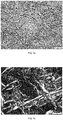
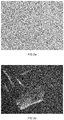
- a thick slurry was created with fibrid structure easily visualized in an optical microscope.
- Figures 2a and 2b show microscopy images of the same spot of the fibrid.
- Figure 2a shows fibrids in transmission mode (white scale bar is 50 microns).
- Figure 2b is the same spot under cross polarized imaging.
- the bright nature of the fibrids under cross polarizers show that there is a preferential alignment of glucan molecules along the fibrid long axis.
- the second quench created ribbon-like structure.
- Paper formation with colloidal dispersion of glucan gave major glucan loss in the process. For example, when 64 grams of wet glucan ( ⁇ 16 grams on dry polymer basis) was formed in a paper with 2 grams of wood pulp, the final basis weight of the formed paper was at most 2.2 grams. Hence, most of the glucan was lost. Even when some glucan was retained on the formed paper (as assessed by the slight increase in basis weight of the formed paper), the porosity did not decrease significantly (1.5 seconds on a 300 cc basis for control paper,3.5 seconds on 300 cc basis for a paper that had ⁇ 10% of glucan CD retained).
- Figure 3 shows the viscosity vs. shear rate products. Dispersion rheology was measured using a Brookfield rheometer at 20° C. The viscosity was measured by a Couette device (ULA).
- Figure 4 shows an image from optical microscopy (phase contrast mode) of the spherical colloidal dispersion. Of particular interest is that most of the formed structures (that can be resolved by an optical microscope) are not elongated.
- Figure 5 shows the results from a static light scattering which measures average aggregate size (measured with Malvern Mastersizer 2000). D10, D50 and D90 of this sample were 4.6, 9.6 and 21.9 microns, respectively.
- composition was prepared by dissolving glucan powder: 191 grams of 10% wt% NaOH, 75 grams of polymer and 234 grams of water. The solution was than precipitated in water using a high shear rotor stator (Ultra Turrax). The solution was adjusted for pH with 10% sulfuric acid until sodium hydroxide was neutralized. Eucalyptus kraft pulp (25.8 % solid) was used to make lab sheets mixed with the glucan dispersion. A retention aid was also used to improve the retention of fine particles (polyethyleneimine "Polymin HM", BASF) at 200 ppm relative to pulp mass.
- a 12 wt% glucan polymer was dissolved in 4.2 wt% NaOH (relative to total dope mass) and was mixed. In half of the sample (250 grams of solution) was added 11 grams of 60% 3-chloro-2-hydroxypropyl-trimethylammonium chloride in water. The solution containing 3-chloro-2-hydroxypropyl-trimethylammonium chloride was mixed for few more minutes to allow homogeneous dispersion of the reagent and left static overnight for the reaction to complete. Next, 230 grams of the dissolved polymer was then quenched in 2 liters of water (see example 6 for specific equipment used) and neutralized with 100 grams, 10wt% sulfuric acid solution.
- Sample A reference material with no 3-chloro-2-hydroxypropyl-trimethylammonium chloride
- Sample B 6.6 grams of 3-chloro-2-hydroxypropyl-trimethylammonium chloride and 30 grams of glucan polymer.
- Figure 7 represents a characterization of the two samples. Note how the two samples have comparable particle size distribution. However, the two samples have distinctively different surface charge. Specifically, sample A has very low zeta potential with no-distinct isoelectric point. Sample B has an order of magnitude higher zeta potential and a clear cross over from positive to negative values for the zeta potential. This indicates that sample B has a positive surface charge while sample A has a mostly neutral surface charge. Excess water from Sample A was easily filtered by using a cellulose-paper filter ( ⁇ tens of minutes). Using the same set-up and filter, excess water could not be removed from sample B by vacuum filtration after 24 hours. This indicates the affinity of sample B to cellulose surface, a particularly desired feature in paper making to improve fine cellulose flocculation and overall paper strength improvement.
Landscapes
- Chemical & Material Sciences (AREA)
- Life Sciences & Earth Sciences (AREA)
- Organic Chemistry (AREA)
- Health & Medical Sciences (AREA)
- Chemical Kinetics & Catalysis (AREA)
- Engineering & Computer Science (AREA)
- Medicinal Chemistry (AREA)
- Polymers & Plastics (AREA)
- General Health & Medical Sciences (AREA)
- Biochemistry (AREA)
- Wood Science & Technology (AREA)
- Materials Engineering (AREA)
- Molecular Biology (AREA)
- Zoology (AREA)
- Bioinformatics & Cheminformatics (AREA)
- General Chemical & Material Sciences (AREA)
- Microbiology (AREA)
- Genetics & Genomics (AREA)
- General Engineering & Computer Science (AREA)
- Biotechnology (AREA)
- Physics & Mathematics (AREA)
- Spectroscopy & Molecular Physics (AREA)
- General Life Sciences & Earth Sciences (AREA)
- Oil, Petroleum & Natural Gas (AREA)
- Sustainable Development (AREA)
- Paper (AREA)
- Polysaccharides And Polysaccharide Derivatives (AREA)
- Compositions Of Macromolecular Compounds (AREA)
- Artificial Filaments (AREA)
- Cosmetics (AREA)
Priority Applications (4)
| Application Number | Priority Date | Filing Date | Title |
|---|---|---|---|
| DK19171563.0T DK3540122T3 (da) | 2015-06-01 | 2016-05-19 | Poly alpha-1,3-glucanfibrider og anvendelser deraf og fremgangsmåder til fremstilling af poly alpha-1,3-glucanfibrider |
| HRP20191813TT HRP20191813T1 (hr) | 2015-06-01 | 2016-05-19 | Fibridi poli alfa-1,3-glukana i njihove uporabe i postupci za pripremu fibrida poli alfa-1,3-glukana |
| SI201630445T SI3303697T1 (sl) | 2015-06-01 | 2016-05-19 | Fibridi poli ALFA-1,3-glukana in njegove uporabe ter postopki za izdelavo fibridov poli ALFA-1,3-glukana |
| EP19171563.0A EP3540122B1 (en) | 2015-06-01 | 2016-05-19 | Poly alpha-1,3-glucan fibrids and uses thereof and processes to make poly alpha-1,3-glucan fibrids |
Applications Claiming Priority (2)
| Application Number | Priority Date | Filing Date | Title |
|---|---|---|---|
| US201562169086P | 2015-06-01 | 2015-06-01 | |
| PCT/US2016/033249 WO2016196022A1 (en) | 2015-06-01 | 2016-05-19 | Poly alpha-1,3-glucan fibrids and uses thereof and processes to make poly alpha-1,3-glucan fibrids |
Related Child Applications (2)
| Application Number | Title | Priority Date | Filing Date |
|---|---|---|---|
| EP19171563.0A Division-Into EP3540122B1 (en) | 2015-06-01 | 2016-05-19 | Poly alpha-1,3-glucan fibrids and uses thereof and processes to make poly alpha-1,3-glucan fibrids |
| EP19171563.0A Division EP3540122B1 (en) | 2015-06-01 | 2016-05-19 | Poly alpha-1,3-glucan fibrids and uses thereof and processes to make poly alpha-1,3-glucan fibrids |
Publications (2)
| Publication Number | Publication Date |
|---|---|
| EP3303697A1 EP3303697A1 (en) | 2018-04-11 |
| EP3303697B1 true EP3303697B1 (en) | 2019-07-31 |
Family
ID=56101796
Family Applications (2)
| Application Number | Title | Priority Date | Filing Date |
|---|---|---|---|
| EP16727267.3A Active EP3303697B1 (en) | 2015-06-01 | 2016-05-19 | Poly alpha-1,3-glucan fibrids and uses thereof and processes to make poly alpha-1,3-glucan fibrids |
| EP19171563.0A Active EP3540122B1 (en) | 2015-06-01 | 2016-05-19 | Poly alpha-1,3-glucan fibrids and uses thereof and processes to make poly alpha-1,3-glucan fibrids |
Family Applications After (1)
| Application Number | Title | Priority Date | Filing Date |
|---|---|---|---|
| EP19171563.0A Active EP3540122B1 (en) | 2015-06-01 | 2016-05-19 | Poly alpha-1,3-glucan fibrids and uses thereof and processes to make poly alpha-1,3-glucan fibrids |
Country Status (13)
| Country | Link |
|---|---|
| US (2) | US11118312B2 (enExample) |
| EP (2) | EP3303697B1 (enExample) |
| JP (1) | JP6956013B2 (enExample) |
| KR (1) | KR102886899B1 (enExample) |
| CN (1) | CN108124456B (enExample) |
| AU (2) | AU2016270307B2 (enExample) |
| BR (1) | BR112017025808B1 (enExample) |
| CA (1) | CA2985685C (enExample) |
| DK (1) | DK3540122T3 (enExample) |
| ES (1) | ES2827832T3 (enExample) |
| HR (2) | HRP20191813T1 (enExample) |
| SI (1) | SI3303697T1 (enExample) |
| WO (1) | WO2016196022A1 (enExample) |
Cited By (1)
| Publication number | Priority date | Publication date | Assignee | Title |
|---|---|---|---|---|
| US11118312B2 (en) | 2015-06-01 | 2021-09-14 | Nutrition & Biosciences USA 4, Inc. | Poly alpha-1,3-glucan fibrids and uses thereof and processes to make poly alpha-1,3-glucan fibrids |
Families Citing this family (27)
| Publication number | Priority date | Publication date | Assignee | Title |
|---|---|---|---|---|
| BR112016013684A2 (pt) * | 2013-12-16 | 2017-08-08 | Du Pont | Solução aquosa ou hidrocoloide, método para aumentar a viscosidade de uma composição e método para o tratamento de um material |
| AU2015369929B2 (en) | 2014-12-22 | 2020-08-20 | Nutrition & Biosciences USA 4, Inc. | Polymeric blend containing poly alpha-1,3-glucan |
| CN107995923B (zh) | 2015-06-01 | 2021-11-02 | 营养与生物科学美国4公司 | 包含聚α-1,3-葡聚糖的胶体分散体的结构化的液体组合物 |
| KR102746152B1 (ko) | 2015-10-26 | 2024-12-26 | 뉴트리션 앤드 바이오사이언시스 유에스에이 4, 인크. | 수불용성 알파-(1,3-글루칸) 조성물 |
| KR102745257B1 (ko) | 2015-10-26 | 2024-12-23 | 뉴트리션 앤드 바이오사이언시스 유에스에이 4, 인크. | 종이용 다당류 코팅 |
| JP2019504932A (ja) | 2015-11-13 | 2019-02-21 | イー・アイ・デュポン・ドウ・ヌムール・アンド・カンパニーE.I.Du Pont De Nemours And Company | 洗濯ケアおよび織物ケアにおいて使用するためのグルカン繊維組成物 |
| WO2017083226A1 (en) | 2015-11-13 | 2017-05-18 | E. I. Du Pont De Nemours And Company | Glucan fiber compositions for use in laundry care and fabric care |
| JP7045313B2 (ja) | 2015-11-13 | 2022-03-31 | ニュートリション・アンド・バイオサイエンシーズ・ユーエスエー・フォー,インコーポレイテッド | 洗濯ケアおよび織物ケアにおいて使用するためのグルカン繊維組成物 |
| US10895028B2 (en) | 2015-12-14 | 2021-01-19 | Dupont Industrial Biosciences Usa, Llc | Nonwoven glucan webs |
| EP3494173B1 (en) | 2016-10-28 | 2021-06-23 | Nutrition & Biosciences USA 4, Inc. | Rubber compositions comprising polysaccharides |
| JP2020506279A (ja) | 2016-11-16 | 2020-02-27 | デュポン・インダストリアル・バイオサイエンシーズ・ユーエスエイ・エルエルシー | 多糖を含む成形物品 |
| CN109983067B (zh) | 2016-11-16 | 2022-11-15 | 营养与生物科学美国4公司 | 纤维素/多糖复合材料 |
| KR20190111060A (ko) | 2017-01-24 | 2019-10-01 | 이 아이 듀폰 디 네모아 앤드 캄파니 | 다당류를 이용한 침전된 탄산칼슘의 제조 방법 |
| EP3609949A1 (en) | 2017-06-30 | 2020-02-19 | DuPont Industrial Biosciences USA, LLC | Polysaccharide-elastomer masterbatch compositions |
| JP2020533498A (ja) * | 2017-09-13 | 2020-11-19 | デュポン・インダストリアル・バイオサイエンシーズ・ユーエスエイ・エルエルシー | 多糖を含む不織ウェブ |
| WO2021092228A1 (en) | 2019-11-06 | 2021-05-14 | Nutrition & Biosciences USA 4, Inc. | Highly crystalline alpha-1,3-glucan |
| BR112022024705A2 (pt) | 2020-06-04 | 2023-02-28 | Nutrition & Biosciences Usa 4 Inc | Composição, método para produzir um composto de éter ou éster de copolímero de enxerto, método de floculação e método de absorção |
| WO2022235655A1 (en) | 2021-05-04 | 2022-11-10 | Nutrition & Biosciences USA 4, Inc. | Compositions comprising insoluble alpha-glucan |
| JP2024525685A (ja) | 2021-07-13 | 2024-07-12 | ニュートリション・アンド・バイオサイエンシーズ・ユーエスエー・フォー,インコーポレイテッド | カチオン性グルカンエステル誘導体 |
| EP4426362A1 (en) | 2021-11-05 | 2024-09-11 | Nutrition & Biosciences USA 4, Inc. | Glucan derivatives for microbial control |
| EP4463519A1 (en) | 2022-01-12 | 2024-11-20 | Nutrition & Biosciences USA 4, Inc. | Coating compositions comprising rubber and insoluble alpha-glucan |
| CA3246295A1 (en) | 2022-03-21 | 2023-09-28 | Nutrition & Biosciences Usa 4 Inc | COMPOSITIONS CONTAINING AN INSOLUBLE ALPHA-GLUCANE |
| WO2024015769A1 (en) | 2022-07-11 | 2024-01-18 | Nutrition & Biosciences USA 4, Inc. | Amphiphilic glucan ester derivatives |
| WO2024252066A1 (en) | 2023-06-07 | 2024-12-12 | Kemira Oyj | Strength agent for paper, board, or the like |
| WO2024261404A1 (en) * | 2023-06-21 | 2024-12-26 | Kemira Oyj | Method for flocculating solid particles and use of high shear treatment |
| WO2025012510A1 (en) | 2023-07-12 | 2025-01-16 | Kemira Oyj | Method for producing alpha-1,3-glucan fibrids based additive, alpha-1,3-glucan fibrids based additive and uses thereof |
| CN117536008A (zh) * | 2023-11-08 | 2024-02-09 | 赣州龙邦材料科技有限公司 | 一种纸膜复合结构芳纶蜂窝纸的制备方法 |
Family Cites Families (51)
| Publication number | Priority date | Publication date | Assignee | Title |
|---|---|---|---|---|
| US2708617A (en) * | 1951-05-12 | 1955-05-17 | Du Pont | Formation of films and filament directly from polymer intermediates |
| NL246230A (enExample) | 1958-12-09 | |||
| FI89526C (fi) | 1988-11-29 | 1993-10-11 | Chemiefaser Lenzing Ag | Svaorantaendbara, hoegtemperaturbestaendiga pappersartade material baserade pao termostabila polymerer |
| JPH03167102A (ja) * | 1989-11-24 | 1991-07-19 | Harima Chem Inc | 抗菌剤 |
| US5702942A (en) | 1994-08-02 | 1997-12-30 | The United States Of America As Represented By The Secretary Of Agriculture | Microorganism strains that produce a high proportion of alternan to dextran |
| US6284479B1 (en) | 1995-06-07 | 2001-09-04 | Pioneer Hi-Bred International, Inc. | Substitutes for modified starch and latexes in paper manufacture |
| US6127602A (en) | 1995-06-07 | 2000-10-03 | Pioneer Hi-Bred International, Inc. | Plant cells and plants transformed with streptococcus mutans genes encoding wild-type or mutant glucosyltransferase D enzymes |
| EP0824106A3 (de) | 1996-08-12 | 1998-04-22 | Lenzing Aktiengesellschaft | Cellulosepartikel |
| EP0824105A3 (de) | 1996-08-12 | 1998-04-22 | Lenzing Aktiengesellschaft | Celulosepartikel |
| EP0824107A3 (de) | 1996-08-12 | 1998-04-22 | Lenzing Aktiengesellschaft | Cellulosepartikel |
| US6261679B1 (en) * | 1998-05-22 | 2001-07-17 | Kimberly-Clark Worldwide, Inc. | Fibrous absorbent material and methods of making the same |
| AU2509700A (en) * | 1999-01-25 | 2000-08-07 | E.I. Du Pont De Nemours And Company | Polysaccharide fibers |
| US7524645B2 (en) | 2004-12-14 | 2009-04-28 | Centre National De La Recherche Scientifique (Cnrs) | Fully active alternansucrases partially deleted in its carboxy-terminal and amino-terminal domains and mutants thereof |
| CA2692301C (en) | 2007-07-05 | 2017-06-27 | Basf Se | Preparation of aqueous slurries of finely divided fillers and their use for the production of papers having a high filler content and high dry strength |
| AT505904B1 (de) * | 2007-09-21 | 2009-05-15 | Chemiefaser Lenzing Ag | Cellulosesuspension und verfahren zu deren herstellung |
| FI121890B (fi) | 2009-06-08 | 2011-05-31 | Upm Kymmene Corp | Uudentyyppinen paperi ja menetelmä sen valmistamiseksi |
| AT509289B1 (de) | 2009-12-28 | 2014-06-15 | Chemiefaser Lenzing Ag | Funktionalisierter cellulosischer formkörper und verfahren zu seiner herstellung |
| US9080195B2 (en) | 2011-09-09 | 2015-07-14 | E I Du Pont De Nemours And Company | High titer production of poly (α 1,3 glucan) |
| US8642757B2 (en) | 2011-09-09 | 2014-02-04 | E I Du Pont De Nemours And Company | High titer production of highly linear poly (α 1,3 glucan) |
| SG11201401290UA (en) * | 2011-10-05 | 2014-05-29 | Du Pont | Novel composition for preparing polysaccharide fibers |
| US9334584B2 (en) * | 2011-12-21 | 2016-05-10 | E I Du Pont De Nemours And Company | Process for preparing polysaccharide fibers from aqueous alkali metal hydroxide solution |
| US9365955B2 (en) * | 2011-12-30 | 2016-06-14 | Ei Du Pont De Nemours And Company | Fiber composition comprising 1,3-glucan and a method of preparing same |
| US9034092B2 (en) * | 2012-05-24 | 2015-05-19 | E I Du Pont De Nemours And Company | Composition for preparing polysaccharide fibers |
| AT514137A1 (de) * | 2013-04-05 | 2014-10-15 | Lenzing Akiengesellschaft | Polysaccharidfaser und Verfahren zu ihrer Herstellung |
| AT514136A1 (de) * | 2013-04-05 | 2014-10-15 | Lenzing Akiengesellschaft | Polysaccharidfaser mit erhöhtem Fibrillationsvermögen und Verfahren zu ihrer Herstellung |
| AT514476A1 (de) * | 2013-06-17 | 2015-01-15 | Lenzing Akiengesellschaft | Polysaccharidfaser und Verfahren zu ihrer Herstellung |
| AT514475B1 (de) * | 2013-06-17 | 2016-11-15 | Chemiefaser Lenzing Ag | Polysaccharidfaser und Verfahren zu ihrer Herstellung |
| AT514474B1 (de) * | 2013-06-18 | 2016-02-15 | Chemiefaser Lenzing Ag | Polysaccharidfaser und Verfahren zu ihrer Herstellung |
| US9169506B2 (en) * | 2013-09-05 | 2015-10-27 | E I Du Pont De Nemours And Company | Process for producing alpha-1,3-glucan polymer with reduced molecular weight |
| AT515174B1 (de) | 2013-10-15 | 2019-05-15 | Chemiefaser Lenzing Ag | Cellulosesuspension, Verfahren zu ihrer Herstellung und Verwendung |
| US20150126730A1 (en) * | 2013-11-07 | 2015-05-07 | E I Du Pont De Nemours And Company | Novel composition for preparing polysaccharide fibers |
| BR112016013684A2 (pt) * | 2013-12-16 | 2017-08-08 | Du Pont | Solução aquosa ou hidrocoloide, método para aumentar a viscosidade de uma composição e método para o tratamento de um material |
| ES2835703T3 (es) * | 2013-12-18 | 2021-06-23 | Nutrition & Biosciences Usa 4 Inc | Eteres de poli alfa-1,3-glucano catiónicos |
| EP3105256A1 (en) * | 2014-02-14 | 2016-12-21 | E. I. du Pont de Nemours and Company | Poly-alpha-1,3-1,6-glucans for viscosity modification |
| AU2015223025B2 (en) * | 2014-02-27 | 2018-09-20 | Nutrition & Biosciences USA 4, Inc. | Enzymatic hydrolysis of disaccharides and oligosaccharides using alpha-glucosidase enzymes |
| WO2015183724A1 (en) * | 2014-05-29 | 2015-12-03 | E. I. Du Pont De Nemours And Company | Enzymatic synthesis of soluble glucan fiber |
| AT518612B1 (de) * | 2015-02-06 | 2019-03-15 | Chemiefaser Lenzing Ag | Polysaccharid-Suspension, Verfahren zu ihrer Herstellung und ihre Verwendung |
| US9644322B2 (en) | 2015-02-06 | 2017-05-09 | E I Du Pont De Nemours And Company | Solid articles from poly alpha-1,3-glucan and wood pulp |
| CA2985685C (en) * | 2015-06-01 | 2023-09-19 | E. I. Du Pont De Nemours And Company | Poly alpha-1,3-glucan fibrids and uses thereof and processes to make poly alpha-1,3-glucan fibrids |
| CN107995923B (zh) * | 2015-06-01 | 2021-11-02 | 营养与生物科学美国4公司 | 包含聚α-1,3-葡聚糖的胶体分散体的结构化的液体组合物 |
| WO2017079595A1 (en) * | 2015-11-05 | 2017-05-11 | E. I. Du Pont De Nemours And Company | Dextran-poly alpha-1,3-glucan graft copolymers and synthesis methods thereof |
| WO2017083226A1 (en) * | 2015-11-13 | 2017-05-18 | E. I. Du Pont De Nemours And Company | Glucan fiber compositions for use in laundry care and fabric care |
| CN109983067B (zh) * | 2016-11-16 | 2022-11-15 | 营养与生物科学美国4公司 | 纤维素/多糖复合材料 |
| JP2020506279A (ja) * | 2016-11-16 | 2020-02-27 | デュポン・インダストリアル・バイオサイエンシーズ・ユーエスエイ・エルエルシー | 多糖を含む成形物品 |
| MX2019006868A (es) * | 2016-12-16 | 2019-09-23 | Du Pont | Derivados de polisacáridos anfifílicos y composiciones que los comprenden. |
| KR20190111060A (ko) * | 2017-01-24 | 2019-10-01 | 이 아이 듀폰 디 네모아 앤드 캄파니 | 다당류를 이용한 침전된 탄산칼슘의 제조 방법 |
| CN110546169A (zh) * | 2017-04-25 | 2019-12-06 | 纳幕尔杜邦公司 | 具有氧气阻隔特性的多糖涂料 |
| EP3609949A1 (en) * | 2017-06-30 | 2020-02-19 | DuPont Industrial Biosciences USA, LLC | Polysaccharide-elastomer masterbatch compositions |
| JP2020533498A (ja) * | 2017-09-13 | 2020-11-19 | デュポン・インダストリアル・バイオサイエンシーズ・ユーエスエイ・エルエルシー | 多糖を含む不織ウェブ |
| EP3870616B1 (en) * | 2018-10-25 | 2023-10-11 | DuPont Industrial Biosciences USA, LLC | Alpha-1,3-glucan graft copolymers |
| WO2021092228A1 (en) * | 2019-11-06 | 2021-05-14 | Nutrition & Biosciences USA 4, Inc. | Highly crystalline alpha-1,3-glucan |
-
2016
- 2016-05-19 CA CA2985685A patent/CA2985685C/en active Active
- 2016-05-19 KR KR1020177036975A patent/KR102886899B1/ko active Active
- 2016-05-19 AU AU2016270307A patent/AU2016270307B2/en active Active
- 2016-05-19 ES ES19171563T patent/ES2827832T3/es active Active
- 2016-05-19 WO PCT/US2016/033249 patent/WO2016196022A1/en not_active Ceased
- 2016-05-19 EP EP16727267.3A patent/EP3303697B1/en active Active
- 2016-05-19 HR HRP20191813TT patent/HRP20191813T1/hr unknown
- 2016-05-19 EP EP19171563.0A patent/EP3540122B1/en active Active
- 2016-05-19 US US15/572,257 patent/US11118312B2/en active Active
- 2016-05-19 CN CN201680032183.2A patent/CN108124456B/zh active Active
- 2016-05-19 DK DK19171563.0T patent/DK3540122T3/da active
- 2016-05-19 BR BR112017025808-0A patent/BR112017025808B1/pt active IP Right Grant
- 2016-05-19 JP JP2017562351A patent/JP6956013B2/ja active Active
- 2016-05-19 SI SI201630445T patent/SI3303697T1/sl unknown
-
2019
- 2019-08-12 AU AU2019216602A patent/AU2019216602B2/en active Active
-
2020
- 2020-10-30 HR HRP20201760TT patent/HRP20201760T1/hr unknown
-
2021
- 2021-09-10 US US17/471,194 patent/US11821140B2/en active Active
Non-Patent Citations (1)
| Title |
|---|
| None * |
Cited By (1)
| Publication number | Priority date | Publication date | Assignee | Title |
|---|---|---|---|---|
| US11118312B2 (en) | 2015-06-01 | 2021-09-14 | Nutrition & Biosciences USA 4, Inc. | Poly alpha-1,3-glucan fibrids and uses thereof and processes to make poly alpha-1,3-glucan fibrids |
Also Published As
| Publication number | Publication date |
|---|---|
| AU2019216602A1 (en) | 2019-08-29 |
| DK3540122T3 (da) | 2020-11-09 |
| US11821140B2 (en) | 2023-11-21 |
| CN108124456B (zh) | 2021-11-23 |
| SI3303697T1 (sl) | 2020-02-28 |
| AU2016270307B2 (en) | 2020-10-29 |
| WO2016196022A1 (en) | 2016-12-08 |
| AU2019216602B2 (en) | 2021-02-25 |
| KR20180014741A (ko) | 2018-02-09 |
| US11118312B2 (en) | 2021-09-14 |
| CA2985685A1 (en) | 2016-12-08 |
| EP3303697A1 (en) | 2018-04-11 |
| KR102886899B1 (ko) | 2025-11-17 |
| EP3540122B1 (en) | 2020-08-12 |
| HRP20201760T1 (hr) | 2021-03-19 |
| BR112017025808A2 (en) | 2018-08-07 |
| EP3540122A1 (en) | 2019-09-18 |
| BR112017025808B1 (pt) | 2023-04-11 |
| HRP20191813T1 (hr) | 2019-12-27 |
| ES2827832T3 (es) | 2021-05-24 |
| US20180119357A1 (en) | 2018-05-03 |
| CA2985685C (en) | 2023-09-19 |
| US20220136173A1 (en) | 2022-05-05 |
| JP2018516316A (ja) | 2018-06-21 |
| AU2016270307A1 (en) | 2017-11-23 |
| JP6956013B2 (ja) | 2021-10-27 |
| CN108124456A (zh) | 2018-06-05 |
Similar Documents
| Publication | Publication Date | Title |
|---|---|---|
| US11821140B2 (en) | Poly alpha-1,3-glucan fibrids and uses thereof and processes to make poly alpha-1,3-glucan fibrids | |
| US12202962B2 (en) | Polysaccharide suspension, method for its preparation, and use thereof | |
| US11193005B2 (en) | Cellulose/polysaccharide composites | |
| FI127526B (en) | Method for producing nanofibrillar cellulose | |
| EP3390458B1 (en) | Bimodal cellulose composition | |
| WO2016075370A1 (en) | Cationic parenchymal cellulose | |
| Chen | Flocculation kinetics of precipitated calcium carbonate induced by functional nanocellulose |
Legal Events
| Date | Code | Title | Description |
|---|---|---|---|
| STAA | Information on the status of an ep patent application or granted ep patent |
Free format text: STATUS: THE INTERNATIONAL PUBLICATION HAS BEEN MADE |
|
| PUAI | Public reference made under article 153(3) epc to a published international application that has entered the european phase |
Free format text: ORIGINAL CODE: 0009012 |
|
| STAA | Information on the status of an ep patent application or granted ep patent |
Free format text: STATUS: REQUEST FOR EXAMINATION WAS MADE |
|
| 17P | Request for examination filed |
Effective date: 20171116 |
|
| AK | Designated contracting states |
Kind code of ref document: A1 Designated state(s): AL AT BE BG CH CY CZ DE DK EE ES FI FR GB GR HR HU IE IS IT LI LT LU LV MC MK MT NL NO PL PT RO RS SE SI SK SM TR |
|
| AX | Request for extension of the european patent |
Extension state: BA ME |
|
| DAV | Request for validation of the european patent (deleted) | ||
| DAX | Request for extension of the european patent (deleted) | ||
| GRAP | Despatch of communication of intention to grant a patent |
Free format text: ORIGINAL CODE: EPIDOSNIGR1 |
|
| STAA | Information on the status of an ep patent application or granted ep patent |
Free format text: STATUS: GRANT OF PATENT IS INTENDED |
|
| INTG | Intention to grant announced |
Effective date: 20190131 |
|
| GRAJ | Information related to disapproval of communication of intention to grant by the applicant or resumption of examination proceedings by the epo deleted |
Free format text: ORIGINAL CODE: EPIDOSDIGR1 |
|
| STAA | Information on the status of an ep patent application or granted ep patent |
Free format text: STATUS: REQUEST FOR EXAMINATION WAS MADE |
|
| GRAR | Information related to intention to grant a patent recorded |
Free format text: ORIGINAL CODE: EPIDOSNIGR71 |
|
| GRAS | Grant fee paid |
Free format text: ORIGINAL CODE: EPIDOSNIGR3 |
|
| STAA | Information on the status of an ep patent application or granted ep patent |
Free format text: STATUS: GRANT OF PATENT IS INTENDED |
|
| GRAA | (expected) grant |
Free format text: ORIGINAL CODE: 0009210 |
|
| STAA | Information on the status of an ep patent application or granted ep patent |
Free format text: STATUS: THE PATENT HAS BEEN GRANTED |
|
| INTC | Intention to grant announced (deleted) | ||
| RIN1 | Information on inventor provided before grant (corrected) |
Inventor name: LEVIT, MIKHAIL, R. Inventor name: BEHABTU, NATNAEL Inventor name: PAULLIN, JAYME, L. |
|
| INTG | Intention to grant announced |
Effective date: 20190618 |
|
| AK | Designated contracting states |
Kind code of ref document: B1 Designated state(s): AL AT BE BG CH CY CZ DE DK EE ES FI FR GB GR HR HU IE IS IT LI LT LU LV MC MK MT NL NO PL PT RO RS SE SI SK SM TR |
|
| REG | Reference to a national code |
Ref country code: CH Ref legal event code: EP Ref country code: GB Ref legal event code: FG4D |
|
| REG | Reference to a national code |
Ref country code: AT Ref legal event code: REF Ref document number: 1161007 Country of ref document: AT Kind code of ref document: T Effective date: 20190815 |
|
| REG | Reference to a national code |
Ref country code: IE Ref legal event code: FG4D |
|
| REG | Reference to a national code |
Ref country code: DE Ref legal event code: R096 Ref document number: 602016017716 Country of ref document: DE |
|
| REG | Reference to a national code |
Ref country code: HR Ref legal event code: TUEP Ref document number: P20191813 Country of ref document: HR |
|
| REG | Reference to a national code |
Ref country code: SE Ref legal event code: TRGR |
|
| REG | Reference to a national code |
Ref country code: NO Ref legal event code: T2 Effective date: 20190731 |
|
| REG | Reference to a national code |
Ref country code: NL Ref legal event code: MP Effective date: 20190731 |
|
| REG | Reference to a national code |
Ref country code: LT Ref legal event code: MG4D |
|
| REG | Reference to a national code |
Ref country code: HR Ref legal event code: T1PR Ref document number: P20191813 Country of ref document: HR |
|
| PG25 | Lapsed in a contracting state [announced via postgrant information from national office to epo] |
Ref country code: NL Free format text: LAPSE BECAUSE OF FAILURE TO SUBMIT A TRANSLATION OF THE DESCRIPTION OR TO PAY THE FEE WITHIN THE PRESCRIBED TIME-LIMIT Effective date: 20190731 Ref country code: BG Free format text: LAPSE BECAUSE OF FAILURE TO SUBMIT A TRANSLATION OF THE DESCRIPTION OR TO PAY THE FEE WITHIN THE PRESCRIBED TIME-LIMIT Effective date: 20191031 Ref country code: PT Free format text: LAPSE BECAUSE OF FAILURE TO SUBMIT A TRANSLATION OF THE DESCRIPTION OR TO PAY THE FEE WITHIN THE PRESCRIBED TIME-LIMIT Effective date: 20191202 Ref country code: LT Free format text: LAPSE BECAUSE OF FAILURE TO SUBMIT A TRANSLATION OF THE DESCRIPTION OR TO PAY THE FEE WITHIN THE PRESCRIBED TIME-LIMIT Effective date: 20190731 |
|
| PG25 | Lapsed in a contracting state [announced via postgrant information from national office to epo] |
Ref country code: AL Free format text: LAPSE BECAUSE OF FAILURE TO SUBMIT A TRANSLATION OF THE DESCRIPTION OR TO PAY THE FEE WITHIN THE PRESCRIBED TIME-LIMIT Effective date: 20190731 Ref country code: GR Free format text: LAPSE BECAUSE OF FAILURE TO SUBMIT A TRANSLATION OF THE DESCRIPTION OR TO PAY THE FEE WITHIN THE PRESCRIBED TIME-LIMIT Effective date: 20191101 Ref country code: ES Free format text: LAPSE BECAUSE OF FAILURE TO SUBMIT A TRANSLATION OF THE DESCRIPTION OR TO PAY THE FEE WITHIN THE PRESCRIBED TIME-LIMIT Effective date: 20190731 Ref country code: LV Free format text: LAPSE BECAUSE OF FAILURE TO SUBMIT A TRANSLATION OF THE DESCRIPTION OR TO PAY THE FEE WITHIN THE PRESCRIBED TIME-LIMIT Effective date: 20190731 Ref country code: RS Free format text: LAPSE BECAUSE OF FAILURE TO SUBMIT A TRANSLATION OF THE DESCRIPTION OR TO PAY THE FEE WITHIN THE PRESCRIBED TIME-LIMIT Effective date: 20190731 Ref country code: IS Free format text: LAPSE BECAUSE OF FAILURE TO SUBMIT A TRANSLATION OF THE DESCRIPTION OR TO PAY THE FEE WITHIN THE PRESCRIBED TIME-LIMIT Effective date: 20191130 |
|
| PG25 | Lapsed in a contracting state [announced via postgrant information from national office to epo] |
Ref country code: TR Free format text: LAPSE BECAUSE OF FAILURE TO SUBMIT A TRANSLATION OF THE DESCRIPTION OR TO PAY THE FEE WITHIN THE PRESCRIBED TIME-LIMIT Effective date: 20190731 |
|
| PG25 | Lapsed in a contracting state [announced via postgrant information from national office to epo] |
Ref country code: DK Free format text: LAPSE BECAUSE OF FAILURE TO SUBMIT A TRANSLATION OF THE DESCRIPTION OR TO PAY THE FEE WITHIN THE PRESCRIBED TIME-LIMIT Effective date: 20190731 Ref country code: EE Free format text: LAPSE BECAUSE OF FAILURE TO SUBMIT A TRANSLATION OF THE DESCRIPTION OR TO PAY THE FEE WITHIN THE PRESCRIBED TIME-LIMIT Effective date: 20190731 Ref country code: PL Free format text: LAPSE BECAUSE OF FAILURE TO SUBMIT A TRANSLATION OF THE DESCRIPTION OR TO PAY THE FEE WITHIN THE PRESCRIBED TIME-LIMIT Effective date: 20190731 Ref country code: RO Free format text: LAPSE BECAUSE OF FAILURE TO SUBMIT A TRANSLATION OF THE DESCRIPTION OR TO PAY THE FEE WITHIN THE PRESCRIBED TIME-LIMIT Effective date: 20190731 |
|
| PG25 | Lapsed in a contracting state [announced via postgrant information from national office to epo] |
Ref country code: IS Free format text: LAPSE BECAUSE OF FAILURE TO SUBMIT A TRANSLATION OF THE DESCRIPTION OR TO PAY THE FEE WITHIN THE PRESCRIBED TIME-LIMIT Effective date: 20200224 Ref country code: CZ Free format text: LAPSE BECAUSE OF FAILURE TO SUBMIT A TRANSLATION OF THE DESCRIPTION OR TO PAY THE FEE WITHIN THE PRESCRIBED TIME-LIMIT Effective date: 20190731 Ref country code: SK Free format text: LAPSE BECAUSE OF FAILURE TO SUBMIT A TRANSLATION OF THE DESCRIPTION OR TO PAY THE FEE WITHIN THE PRESCRIBED TIME-LIMIT Effective date: 20190731 Ref country code: SM Free format text: LAPSE BECAUSE OF FAILURE TO SUBMIT A TRANSLATION OF THE DESCRIPTION OR TO PAY THE FEE WITHIN THE PRESCRIBED TIME-LIMIT Effective date: 20190731 |
|
| REG | Reference to a national code |
Ref country code: HR Ref legal event code: ODRP Ref document number: P20191813 Country of ref document: HR Payment date: 20200427 Year of fee payment: 5 |
|
| REG | Reference to a national code |
Ref country code: DE Ref legal event code: R097 Ref document number: 602016017716 Country of ref document: DE |
|
| PLBE | No opposition filed within time limit |
Free format text: ORIGINAL CODE: 0009261 |
|
| STAA | Information on the status of an ep patent application or granted ep patent |
Free format text: STATUS: NO OPPOSITION FILED WITHIN TIME LIMIT |
|
| PG2D | Information on lapse in contracting state deleted |
Ref country code: IS |
|
| PG25 | Lapsed in a contracting state [announced via postgrant information from national office to epo] |
Ref country code: IS Free format text: LAPSE BECAUSE OF FAILURE TO SUBMIT A TRANSLATION OF THE DESCRIPTION OR TO PAY THE FEE WITHIN THE PRESCRIBED TIME-LIMIT Effective date: 20191030 |
|
| PGFP | Annual fee paid to national office [announced via postgrant information from national office to epo] |
Ref country code: FI Payment date: 20200511 Year of fee payment: 5 Ref country code: NO Payment date: 20200511 Year of fee payment: 5 |
|
| 26N | No opposition filed |
Effective date: 20200603 |
|
| PGFP | Annual fee paid to national office [announced via postgrant information from national office to epo] |
Ref country code: SE Payment date: 20200512 Year of fee payment: 5 |
|
| REG | Reference to a national code |
Ref country code: FI Ref legal event code: PCE Owner name: NUTRITION & BIOSCIENCES USA 4, INC. |
|
| PG25 | Lapsed in a contracting state [announced via postgrant information from national office to epo] |
Ref country code: LI Free format text: LAPSE BECAUSE OF NON-PAYMENT OF DUE FEES Effective date: 20200531 Ref country code: CH Free format text: LAPSE BECAUSE OF NON-PAYMENT OF DUE FEES Effective date: 20200531 Ref country code: MC Free format text: LAPSE BECAUSE OF FAILURE TO SUBMIT A TRANSLATION OF THE DESCRIPTION OR TO PAY THE FEE WITHIN THE PRESCRIBED TIME-LIMIT Effective date: 20190731 |
|
| REG | Reference to a national code |
Ref country code: DE Ref legal event code: R081 Ref document number: 602016017716 Country of ref document: DE Owner name: NUTRITION & BIOSCIENCES USA 4, LLC, ROCHESTER, US Free format text: FORMER OWNER: E.I. DU PONT DE NEMOURS AND COMPANY, WILMINGTON, DEL., US Ref country code: DE Ref legal event code: R081 Ref document number: 602016017716 Country of ref document: DE Owner name: NUTRITION & BIOSCIENCES USA 4, INC., ROCHESTER, US Free format text: FORMER OWNER: E.I. DU PONT DE NEMOURS AND COMPANY, WILMINGTON, DEL., US |
|
| REG | Reference to a national code |
Ref country code: BE Ref legal event code: MM Effective date: 20200531 |
|
| GBPC | Gb: european patent ceased through non-payment of renewal fee |
Effective date: 20200519 |
|
| PG25 | Lapsed in a contracting state [announced via postgrant information from national office to epo] |
Ref country code: LU Free format text: LAPSE BECAUSE OF NON-PAYMENT OF DUE FEES Effective date: 20200519 |
|
| REG | Reference to a national code |
Ref country code: AT Ref legal event code: PC Ref document number: 1161007 Country of ref document: AT Kind code of ref document: T Owner name: NUTRITION & BIOSCIENCES USA 4, INC., Effective date: 20210305 |
|
| PG25 | Lapsed in a contracting state [announced via postgrant information from national office to epo] |
Ref country code: IE Free format text: LAPSE BECAUSE OF NON-PAYMENT OF DUE FEES Effective date: 20200519 Ref country code: GB Free format text: LAPSE BECAUSE OF NON-PAYMENT OF DUE FEES Effective date: 20200519 |
|
| REG | Reference to a national code |
Ref country code: DE Ref legal event code: R082 Ref document number: 602016017716 Country of ref document: DE Representative=s name: FLEISCHER, ENGELS & PARTNER MBB, PATENTANWAELT, DE Ref country code: DE Ref legal event code: R081 Ref document number: 602016017716 Country of ref document: DE Owner name: NUTRITION & BIOSCIENCES USA 4, INC., ROCHESTER, US Free format text: FORMER OWNER: NUTRITION & BIOSCIENCES USA 4, LLC, ROCHESTER, NY, US |
|
| REG | Reference to a national code |
Ref country code: HR Ref legal event code: ODRP Ref document number: P20191813 Country of ref document: HR Payment date: 20210519 Year of fee payment: 6 |
|
| PG25 | Lapsed in a contracting state [announced via postgrant information from national office to epo] |
Ref country code: BE Free format text: LAPSE BECAUSE OF NON-PAYMENT OF DUE FEES Effective date: 20200531 |
|
| REG | Reference to a national code |
Ref country code: SI Ref legal event code: SP73 Owner name: NUTRITION & BIOSCIENCES USA 4, INC.; US Effective date: 20210407 |
|
| REG | Reference to a national code |
Ref country code: NO Ref legal event code: CHAD Owner name: NUTRITION & BIOSCIENCES USA 4, US Ref country code: NO Ref legal event code: CREP |
|
| PGFP | Annual fee paid to national office [announced via postgrant information from national office to epo] |
Ref country code: HR Payment date: 20210519 Year of fee payment: 6 |
|
| PGFP | Annual fee paid to national office [announced via postgrant information from national office to epo] |
Ref country code: SI Payment date: 20210415 Year of fee payment: 6 |
|
| REG | Reference to a national code |
Ref country code: FI Ref legal event code: MAE |
|
| REG | Reference to a national code |
Ref country code: NO Ref legal event code: MMEP |
|
| REG | Reference to a national code |
Ref country code: SE Ref legal event code: EUG |
|
| PG25 | Lapsed in a contracting state [announced via postgrant information from national office to epo] |
Ref country code: SE Free format text: LAPSE BECAUSE OF NON-PAYMENT OF DUE FEES Effective date: 20210520 Ref country code: NO Free format text: LAPSE BECAUSE OF NON-PAYMENT OF DUE FEES Effective date: 20210531 Ref country code: FI Free format text: LAPSE BECAUSE OF NON-PAYMENT OF DUE FEES Effective date: 20210519 |
|
| PG25 | Lapsed in a contracting state [announced via postgrant information from national office to epo] |
Ref country code: MT Free format text: LAPSE BECAUSE OF FAILURE TO SUBMIT A TRANSLATION OF THE DESCRIPTION OR TO PAY THE FEE WITHIN THE PRESCRIBED TIME-LIMIT Effective date: 20190731 Ref country code: CY Free format text: LAPSE BECAUSE OF FAILURE TO SUBMIT A TRANSLATION OF THE DESCRIPTION OR TO PAY THE FEE WITHIN THE PRESCRIBED TIME-LIMIT Effective date: 20190731 |
|
| PG25 | Lapsed in a contracting state [announced via postgrant information from national office to epo] |
Ref country code: MK Free format text: LAPSE BECAUSE OF FAILURE TO SUBMIT A TRANSLATION OF THE DESCRIPTION OR TO PAY THE FEE WITHIN THE PRESCRIBED TIME-LIMIT Effective date: 20190731 |
|
| REG | Reference to a national code |
Ref country code: AT Ref legal event code: MM01 Ref document number: 1161007 Country of ref document: AT Kind code of ref document: T Effective date: 20210519 |
|
| PG25 | Lapsed in a contracting state [announced via postgrant information from national office to epo] |
Ref country code: AT Free format text: LAPSE BECAUSE OF NON-PAYMENT OF DUE FEES Effective date: 20210519 |
|
| REG | Reference to a national code |
Ref country code: HR Ref legal event code: PBON Ref document number: P20191813 Country of ref document: HR Effective date: 20220519 |
|
| PG25 | Lapsed in a contracting state [announced via postgrant information from national office to epo] |
Ref country code: SI Free format text: LAPSE BECAUSE OF NON-PAYMENT OF DUE FEES Effective date: 20220520 Ref country code: HR Free format text: LAPSE BECAUSE OF NON-PAYMENT OF DUE FEES Effective date: 20220519 |
|
| REG | Reference to a national code |
Ref country code: AT Ref legal event code: UEP Ref document number: 1161007 Country of ref document: AT Kind code of ref document: T Effective date: 20190731 |
|
| PGFP | Annual fee paid to national office [announced via postgrant information from national office to epo] |
Ref country code: DE Payment date: 20250402 Year of fee payment: 10 |
|
| PGFP | Annual fee paid to national office [announced via postgrant information from national office to epo] |
Ref country code: IT Payment date: 20250422 Year of fee payment: 10 |
|
| PGFP | Annual fee paid to national office [announced via postgrant information from national office to epo] |
Ref country code: FR Payment date: 20250401 Year of fee payment: 10 |