EP3296258B1 - Verfahren zur behandlung von phosphathaltigen aschen aus abfallverbrennungsanlagen durch nasschemischen aufschluss zur gewinnung von aluminium-, kalzium-, phosphor- und stickstoffverbindungen - Google Patents
Verfahren zur behandlung von phosphathaltigen aschen aus abfallverbrennungsanlagen durch nasschemischen aufschluss zur gewinnung von aluminium-, kalzium-, phosphor- und stickstoffverbindungen Download PDFInfo
- Publication number
- EP3296258B1 EP3296258B1 EP17198604.5A EP17198604A EP3296258B1 EP 3296258 B1 EP3296258 B1 EP 3296258B1 EP 17198604 A EP17198604 A EP 17198604A EP 3296258 B1 EP3296258 B1 EP 3296258B1
- Authority
- EP
- European Patent Office
- Prior art keywords
- calcium
- acid
- phosphate
- filtrate
- phosphoric acid
- Prior art date
- Legal status (The legal status is an assumption and is not a legal conclusion. Google has not performed a legal analysis and makes no representation as to the accuracy of the status listed.)
- Active
Links
Images

Classifications
-
- C—CHEMISTRY; METALLURGY
- C01—INORGANIC CHEMISTRY
- C01F—COMPOUNDS OF THE METALS BERYLLIUM, MAGNESIUM, ALUMINIUM, CALCIUM, STRONTIUM, BARIUM, RADIUM, THORIUM, OR OF THE RARE-EARTH METALS
- C01F11/00—Compounds of calcium, strontium, or barium
- C01F11/46—Sulfates
-
- C—CHEMISTRY; METALLURGY
- C01—INORGANIC CHEMISTRY
- C01B—NON-METALLIC ELEMENTS; COMPOUNDS THEREOF; METALLOIDS OR COMPOUNDS THEREOF NOT COVERED BY SUBCLASS C01C
- C01B25/00—Phosphorus; Compounds thereof
- C01B25/16—Oxyacids of phosphorus; Salts thereof
- C01B25/26—Phosphates
- C01B25/32—Phosphates of magnesium, calcium, strontium, or barium
-
- C—CHEMISTRY; METALLURGY
- C01—INORGANIC CHEMISTRY
- C01B—NON-METALLIC ELEMENTS; COMPOUNDS THEREOF; METALLOIDS OR COMPOUNDS THEREOF NOT COVERED BY SUBCLASS C01C
- C01B25/00—Phosphorus; Compounds thereof
- C01B25/16—Oxyacids of phosphorus; Salts thereof
- C01B25/26—Phosphates
- C01B25/32—Phosphates of magnesium, calcium, strontium, or barium
- C01B25/322—Preparation by neutralisation of orthophosphoric acid
-
- C—CHEMISTRY; METALLURGY
- C01—INORGANIC CHEMISTRY
- C01B—NON-METALLIC ELEMENTS; COMPOUNDS THEREOF; METALLOIDS OR COMPOUNDS THEREOF NOT COVERED BY SUBCLASS C01C
- C01B25/00—Phosphorus; Compounds thereof
- C01B25/16—Oxyacids of phosphorus; Salts thereof
- C01B25/26—Phosphates
- C01B25/36—Aluminium phosphates
-
- C—CHEMISTRY; METALLURGY
- C01—INORGANIC CHEMISTRY
- C01F—COMPOUNDS OF THE METALS BERYLLIUM, MAGNESIUM, ALUMINIUM, CALCIUM, STRONTIUM, BARIUM, RADIUM, THORIUM, OR OF THE RARE-EARTH METALS
- C01F11/00—Compounds of calcium, strontium, or barium
- C01F11/36—Nitrates
-
- C—CHEMISTRY; METALLURGY
- C01—INORGANIC CHEMISTRY
- C01F—COMPOUNDS OF THE METALS BERYLLIUM, MAGNESIUM, ALUMINIUM, CALCIUM, STRONTIUM, BARIUM, RADIUM, THORIUM, OR OF THE RARE-EARTH METALS
- C01F11/00—Compounds of calcium, strontium, or barium
- C01F11/36—Nitrates
- C01F11/38—Preparation with nitric acid or nitrogen oxides
-
- C—CHEMISTRY; METALLURGY
- C05—FERTILISERS; MANUFACTURE THEREOF
- C05B—PHOSPHATIC FERTILISERS
- C05B11/00—Fertilisers produced by wet-treating or leaching raw materials either with acids in such amounts and concentrations as to yield solutions followed by neutralisation, or with alkaline lyes
- C05B11/04—Fertilisers produced by wet-treating or leaching raw materials either with acids in such amounts and concentrations as to yield solutions followed by neutralisation, or with alkaline lyes using mineral acid
- C05B11/06—Fertilisers produced by wet-treating or leaching raw materials either with acids in such amounts and concentrations as to yield solutions followed by neutralisation, or with alkaline lyes using mineral acid using nitric acid (nitrophosphates)
Definitions
- the invention relates to a method for the treatment of phosphate-containing waste, in particular phosphate-containing ashes from waste incineration plants, by wet chemical digestion for the extraction of aluminum, calcium, phosphorus and nitrogen compounds, at least including the extraction (production) of calcium sulfate (Ca (SO 4 ) and especially for the optional production of phosphoric acid (H 3 PO 4 ).
- Rock phosphates are required for the production of fertilizers. In order to be able to replace the finite rock phosphates, it is generally known that the recovery of phosphorus or phosphates from waste and sewage is sought in European industrialized countries (see patent DE 10 2012 015 065 B3 ). This is also indicated because the rock phosphates are increasingly contaminated with heavy metals such as cadmium and uranium and this contamination can be found in the fertilizers and in the groundwater.
- a major phosphate resource in Europe is wastewater from municipal and industrial sewage treatment plants.
- Around 50,000 Mg (t) of phosphorus per year ends up in the wastewater in Germany and is largely precipitated as metal salts with the help of precipitants such as iron or aluminum salts and separated with the sewage sludge.
- the phosphate-containing sewage sludge is mostly incinerated today and the resulting ash is dumped or otherwise "misappropriated" (eg road construction, backfilling), because the phosphorus it contains is not recovered - with a few exceptions in test facilities
- EP 2 602 013 discloses a method for the recovery of phosphorus compounds from sewage sludge ash.
- the industrial recovery of phosphorus from waste is also possible.
- An essential prerequisite for this is that the phosphorus-containing residues have a sufficiently high phosphorus concentration and a low level of contamination and that essentially the currently The rock phosphates used, if possible without harmful uranium and cadmium impurities.
- Phosphates are obtained from rock phosphate (rock, with a phosphorus content of approx. 30% P 2 O 5 ) by acid digestion with preferably sulfuric acid, whereby phosphoric acid and / or calcium phosphate fertilizer is produced (so-called "superphosphate").
- the ashes from incinerated sewage sludge or animal waste such as animal meal contain up to 35% by weight of P 2 O 5 , but also up to 25% by weight of iron, aluminum or calcium oxide, depending on the precipitant. This high metal oxide content, which can be up to ten times higher than in rock phosphate, considerably restricts the use of sewage sludge ash as an alternative rock phosphate in industrial processes.
- the special value of ashes is based on their content of P 2 O 5 , CaO and Al 2 O 3 .
- the invention described here describes an optionally multi-stage process with which higher-quality phosphates such as or phosphoric acid as well as calcium sulfate (gypsum) and possibly also aluminum hydroxophosphate can be obtained from ash.
- higher-quality phosphates such as or phosphoric acid as well as calcium sulfate (gypsum) and possibly also aluminum hydroxophosphate can be obtained from ash.
- the inventive method is based on converting the valuable substances from the ash by fractional dissolution in mineral acids and by adding suitable reactants into different products, in particular into products from the group calcium phosphate (Ca 3 (PO 4 ) 2 ), calcium sulfate (CaSO 4 ), and Aluminum hydroxophosphate (Al (OH) 3 x AlPO 4 ), the process at least including the recovery of calcium sulfate (CaSO4) and is particularly suitable for the optional production of phosphoric acid (H 3 PO 4 ).
- CaSO 4 calcium sulfate
- H 2 SO 4 sulfuric acid
- the calcium sulfate precipitate (gypsum) is filtered, drained and washed with water in a known manner. This acidic wash water is preferably also returned to the first process stage as dilution water.
- the dehydrated gypsum can be further processed in further process steps outside the process chain described here, for example by calcination to anhydrite or by chemical conversion according to the patent DE 196 11 454 A1 .
- the concentration of phosphoric acid is increased further and further by dissolving more and more phosphate from the ash and could be increased to a concentration of over 30% H 3 PO 4 , if not above all the also dissolved aluminum ions would disturb.
- the Al concentration in the digestion acid can rise to over 5%, so that marketing is no longer possible.
- This problem is solved in a third stage , in that aluminum ions are precipitated as aluminum hydroxophosphate by adding preferably calcium oxide.
- aluminum hydroxophosphate precipitation is surprisingly even by adding small amounts of hydroxyl ions with only a slight increase in the inherently strongly acidic pH value from pH approx. 1 to 1.5 to pH approx. 2.0 to 2 , 5 possible.
- This is preferably achieved by adding calcium oxide (CaO), but also by adding calcium hydroxide, calcium carbonate, calcium silicate (sand-lime brick), sodium hydroxide or soda waterglass.
- the aluminum hydroxophosphate precipitate is removed by filtration according to the state of the art, e.g. separated or obtained with a decanter, a vacuum belt filter or a filter press.
- the purified phosphoric acid (or in principle also nitrous phosphoric acid) can be recycled and used according to the invention in the first stage for dissolving ingredients from the ash.
- nitrous phosphoric acid in the fourth stage the nitrous phosphoric acid is neutralized with limestone (calcium carbonate) or quicklime (calcium oxide) and the precipitate is evaporated so that a mixture of calcium phosphate and calcium nitrate is formed.
- 2H 3 PO 4 + 2HNO 3 + 2CaO Ca (NO 3 ) 2 + Ca (H 2 PO 4 ) 2 + 2H 2 O
- This mixed product is a preferred NP fertilizer.
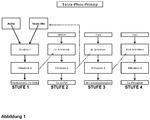
- the Figure 2 shows the process steps in an overview.
- the valuable substances calcium nitrate (CaNO 3 ), calcium phosphate (Ca 3 (PO 4 ) 2 ), calcium sulphate (CaSO 4 ), and calcium sulphate (CaSO 4 ) can be used in a single process from solids containing phosphate, e.g. ash Aluminum hydroxophosphate ((Al (OH) 3 x AlPO 4 ) can be obtained.
- levels 2 and 3 can also be skipped, so that level 4 can be carried out directly after level 1.
- time sequence can be varied, e.g. after stage 1 stage 3 and then stages 2 and then 4 can be carried out.
- the resulting phosphoric acid (H 3 PO 4 ) is recycled after stage 2 and after stage 3 for use in the Treatment of the ash in stage 1.
- This recycling of the Al- and Ca-depleted acid enables an enormous cost reduction because less fresh acid is required to dissolve the ash.
- At least 10% of the filtrate / supernatant are recycled for use in step a), particularly preferably at least 20%, even more preferably 20% to 80%, and most preferably 40% to 60%, based on the total amount of filtrate obtained.
- phosphoric acid (H 3 PO 4 ) is also formed in processes according to the invention, so that the process according to the invention is a process for the (optional) production of phosphoric acid (H 3 PO 4 ), and corresponding embodiments are part of the present invention.
- the phosphate-containing ash is obtained by incineration of sewage sludge, biodegradable waste, biowaste and / or animal waste.
- the phosphate-containing ash is obtained by incinerating sewage sludge, biodegradable waste, biowaste and / or animal waste in a waste incineration plant.
- precipitate in the context of the invention denotes the elimination of a dissolved substance as a solid from a solution, usually triggered by the addition of suitable substances (precipitants).
- suitable substances precipitants
- the term encompasses any completely or partially insoluble precipitate in the form of flakes, droplets or crystalline material, in any microcrystalline, crystalline or amorphous form.
- precipitate expressly includes any further processing, modification, refining, etc., of the precipitates obtained in the process according to the invention into powders, powders, dusts, bulk goods, granular materials, grits, etc.
- calcium phosphate in the context of the invention includes Ca 3 (PO 4 ) 2 ), CaHPO4 and Ca (H 2 PO 4 ) 2 .
- Ash in the context of the invention relates to any solid residue from the incineration of organic material, for example sewage sludge, biodegradable waste, biowaste and / or animal waste, Slaughterhouse waste, e.g. animal meal.
- Ash consists mainly of oxides and (bi) carbonates of various metals, e.g. B. Al 2 O 3 , CaO, Fe 2 O 3 , MgO, MnO, P 2 O 5 , P 4 O 10 , K 2 O, SiO 2 , Na 2 CO 3 , NaHCO 3 , etc.
- phosphate- containing ash in the context of the invention relates to ashes, as defined herein, which contain at least one phosphate, as defined herein.
- phosphates in the context of the invention relates on the one hand to P 2 O 5 and P 4 O 10 . Furthermore, the term “phosphates” relates to the salts and esters of orthophosphoric acid (H 3 PO 4 ), and expressly also includes the condensates (polymers) of orthophosphoric acid and their esters.
- phosphates relates to metallic salts of phosphoric acid with the general formula X (Y) m (PO 4 ) n, where X and optionally Y, is a metal selected from the group consisting of aluminum, beryllium, bismuth, lead, Cadmium, chromium, iron, gallium, indium, potassium, cobalt, copper, magnesium, manganese, molybdenum, sodium, nickel, osmium, palladium, rhodium, ruthenium, strontium, titanium, vanadium, tungsten, zinc, tin.
- X and optionally Y is a metal selected from the group consisting of aluminum, beryllium, bismuth, lead, Cadmium, chromium, iron, gallium, indium, potassium, cobalt, copper, magnesium, manganese, molybdenum, sodium, nickel, osmium, palladium, rhodium, ruthenium, strontium, titanium, vanadium,
- waste incineration plants in the context of the invention relates to all plants, devices and the like which are suitable for incinerating the atmospherically combustible parts of any type of waste.
- sewage sludge in the context of the invention relates to any suspension of finely divided particles of a solid substance in a liquid.
- the liquid in which the particles are suspended is waste water as defined herein.
- wastewater within the meaning of the invention relates to all liquids of an aqueous nature, and / or organic nature, or mixtures thereof, which are not drinking water quality within the meaning of the Drinking Water Ordinance (TrinkwV) and / or national and / or international drinking water standards (e.g. the DIN 2000 in Germany).
- wastewater also includes all wastewater in accordance with Section 54 (1) of the Water Management Act (WHG).
- the wastewater within the meaning of the invention is water that has been contaminated through use or has changed its properties or its composition.
- the term "wastewater” in the sense of the invention includes the water changed in its properties through domestic, commercial, agricultural or other use and the water that runs off with it in dry weather (dirty water) as well as that collected from precipitation from the area of built-up or paved areas runoff water (rainwater).
- Dirty water is domestic wastewater from toilets (faecal or black water), sanitary facilities, kitchens and washing machines (washing or gray water) as well as wastewater from companies that discharge into the public sewer system (commercial or industrial wastewater). Heated water from cooling systems also counts as wastewater. Wastewater that occurs in the most varied of cleaning and treatment techniques in water treatment plants is part of the wastewater for the purposes of the invention.
- the sewage sludge is present as primary sludge, raw sludge, excess sludge, as treated and / or stabilized sewage sludge (aerobic / anaerobic).
- biowaste in the context of the invention relates to all organic waste of animal or vegetable origin that occurs in a household or business and can be broken down by microorganisms, organisms living in the soil or enzymes. These include, for example, leftover food and lawn clippings. Biowaste is usually collected separately in the so-called biowaste bin and treated separately through composting and fermentation. The resulting compost and digestate are often returned to the environment, for example in horticulture and agriculture.
- biowaste includes both waste according to the definition of the EU Waste Framework Directive, garden and park waste, as well as food and kitchen waste (from households, restaurants, catering, retail and processing in the food industry).
- biodegradable waste in the sense of the invention includes not only bio-waste as defined herein, but also all organic waste of animal or plant origin from agriculture and forestry that can be broken down by microorganisms, living organisms or enzymes.
- this term includes all organic waste of animal or vegetable origin from agriculture and forestry which also contains at least one of the following biodegradable substances selected from the list consisting of wood, paper and cardboard.
- animal waste within the meaning of the invention includes animal bodies of dead, dead or stillborn large animals or pets - or parts thereof - as well as slaughterhouse waste, spoiled food of animal origin, and animal by-products such as milk, eggs, confiscates, but also intestinal contents and liquid manure, and all others Products, products.
- animal waste within the meaning of the invention includes meat and animal by-products from domestic animals, wild animals or farm animals that have been killed or perished for reasons of illness, in particular animal corpses contaminated with TSE and animals and contaminated with chemicals or prohibited substances Laboratory animals. Also included are meat and by-products with the risk of other non-communicable diseases.
- the incineration of sewage sludge, biodegradable waste, biowaste and / or animal waste takes place in a waste incineration plant at 600 ° to 1200 ° C, preferably at 800 ° to 900 ° C.
- the solids (ash) react with nitric acid.
- the solids (ash) react with phosphoric acid.
- the solids (ash) are reacted with a mineral acid mixture of phosphoric acid and nitric acid and does not contain any hydrohalic acids.
- the mineral acid mixture does not contain hydrochloric acid.
- the mineral acid mixture is present in a concentration of 5% by weight to 50% by weight, preferably 10% by weight to 30% by weight, in aqueous dilution.
- the phosphate-containing ash is mixed with the mineral acid mixture in a reactor, the proportion of ash being 5% by weight to 50% by weight, preferably 20% by weight to 30% by weight, based on the dilute mineral acid.
- the mineral acid mixture contains at least phosphoric and nitric acid.
- the mineral acid mixture also contains sulfuric acid in addition to phosphoric and nitric acid.
- the reaction time between acid and ash is 2 to 300 minutes, preferably 10 to 60 minutes.
- the reaction temperature is 20 ° C to 90 ° C, preferably 60 to 80 ° C.
- the acid-insoluble part of the solids is separated off by mechanical filtration and / or dewatering processes.
- the acid-insoluble part of the solids is separated out with dewatering units (e.g. vacuum belt filter, chamber filter press, membrane filter press, belt filter press, centrifuge).
- dewatering units e.g. vacuum belt filter, chamber filter press, membrane filter press, belt filter press, centrifuge.
- the acid-insoluble part of the solids is separated off with a vacuum belt filter.
- the residue in the filter units is washed with water and the wash water is returned to the first process stage.
- sulfuric acid is added in a dilution of 10 to 98% by weight, preferably 40 to 80% by weight
- the sulfuric acid is added in a molar ratio that corresponds to the dissolved calcium concentration of 0.5 Ca to 1.5 SO 4 (sulfate), preferably 1.0 Ca to 1.0 SO 4 ( Sulfate).
- sulfuric acid is added in a stirred reactor.
- the residence time in the stirred reactor after the addition of the sulfuric acid is 5 to 60 minutes, preferably 10 to 30 minutes.
- the reaction temperature (precipitation of calcium sulfate after addition of sulfuric acid) in the stirred reactor is from 20 ° to 90 ° C., preferably from 60 ° to 90 ° C.
- the calcium sulfate precipitate is deposited by mechanical filtration and / or dewatering processes.
- the calcium sulphate precipitate is separated off with dewatering units (e.g. vacuum belt filter, chamber filter press, membrane filter press, belt filter press, centrifuge).
- dewatering units e.g. vacuum belt filter, chamber filter press, membrane filter press, belt filter press, centrifuge.
- the calcium sulfate precipitate is separated off with a vacuum belt filter.
- the residue in the filter units is washed with water and the washing water is returned to the first process stage.
- the filtrate obtained (dilute mineral acid mixture) is at least partially reused to break down the solids.
- the proportion of the return of the filtrate is at least 10%, preferably at least 20%, even more preferably 20% to 80%, and most preferably 40% to 60%, based on the total amount of filtrate obtained.
- the filtrate or the supernatant containing phosphoric acid (H 3 PO 4 ), optionally obtained after deposition of Fe silicate and / or calcium sulfate and / or aluminum hydroxophosphate, is obtained by evaporation to an acid content of 30% by weight 70% by weight, preferably 40% by weight to 60% by weight, concentrated.
- calcium oxide or calcium carbonate is added to the filtrate or supernatant containing phosphoric acid (H 3 PO 4 ), optionally obtained after separation of Fe silicate and / or calcium sulfate and / or aluminum hydroxophosphate, in a stirred reactor with formation of calcium precipitates.
- H 3 PO 4 phosphoric acid
- the solid suspension is evaporated or spray-dried by supplying heat to such an extent that a solid with a residual moisture content of 0% by weight to 25% by weight, preferably from 2% by weight to 10% by weight, is obtained % By weight arises.
- the precipitate or precipitates is or are completely or partially insoluble precipitate in the form of flakes, droplets or crystalline material, in any microcrystalline, crystalline or amorphous form.
- the precipitate or the precipitates are further processed, modified, refined etc. to powders, powders, dusts, bulk goods, granular materials, grits etc.
- the entire process is exemplarily described by the following test sequence, which explains the method according to the invention without reproducing it exactly:
- the starting material is ash from a sewage sludge incineration plant.
- the main components were analyzed as follows: Weight% P2O5 25.0 Wt% CaO 17.5 Wt% Fe2O3 26.9 Weight% Al2O3 6.7 Weight% SiO2 19.5
- 100g of ashes are treated with 300g of dilute acid in a beaker.
- the dilute acid consists of: 70% by weight water; 15% by weight HNO 3 and 15% by weight H 3 PO 4 .
- stage 2 and stage 3 These problems, which are particularly severe with higher Al concentrations in the sewage sludge ashes (which can amount to over 20% Al 2 O 3 ), are solved by a multi-stage process in stage 2 and stage 3 as follows:
- the filter cake (122g wet weight) from the described 1st stage (the ash dissolution process) is washed with 100g hot water (70-90 ° C).
- white calcium sulfate precipitates in accordance with the reaction described above.
- the precipitate was filtered through a vacuum suction filter (with filter). 280 g of filtrate and 43 g of gypsum wet filter cake were obtained.
- the filtrate was analyzed.
- the recipe for the 1st stage is now as follows: 100g of ash are treated with 300g of diluted acid in a beaker.
- the diluted acid consists of: 270g recycled material and 20g HNO 3 .
- the suspension is stirred for 30 minutes at 40 ° C. and then filtered through a vacuum suction filter (with filter).
- the filter cake is then weighed and then dried at 100 ° C.
- Filter cake wet 130g
- Filter cake dried 75g
- the precipitate is in another attempt according to patent DE 10 2012 015 065 B3 2013-07-18 further treated and converted to sodium aluminate solution and a calcium phosphate precipitate.
- the process steps described here can be used variably depending on the concentration of Ca and Al ions in the digestion acid (or the corresponding oxide concentrations in the ash).
- the essence of the invention is that the combination of the process steps enables economical process management and, above all, low-aluminum end products are obtained.
- the purified HNO 3 —H 3 PO 4 acid is preferably neutralized with CaO to a pH value of 6 and concentrated by evaporation of water, for example by spray drying.
- a double salt is created from calcium nitrate and calcium phosphate.
- a salt with the following composition could be produced: 19.5% by weight P2O5; 28.5 wt% CaO; 24.3 wt% NO3; 0.8 wt.% Al2O3, 0.6 wt.% Fe2O3.
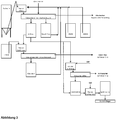
- FIG. 3 shows the various process flows in the scheme.
Landscapes
- Chemical & Material Sciences (AREA)
- Organic Chemistry (AREA)
- Inorganic Chemistry (AREA)
- Life Sciences & Earth Sciences (AREA)
- Geology (AREA)
- Fertilizers (AREA)
- Processing Of Solid Wastes (AREA)
- Removal Of Specific Substances (AREA)
- Chemical Kinetics & Catalysis (AREA)
- Engineering & Computer Science (AREA)
- Environmental & Geological Engineering (AREA)
Priority Applications (4)
| Application Number | Priority Date | Filing Date | Title |
|---|---|---|---|
| SI201431779T SI3296258T1 (sl) | 2013-11-06 | 2014-05-20 | Postopek obdelave pepela, ki vsebuje fosfat iz sežigalnic odpadkov s pomočjo mokro kemijske razgradnje za pridobivanje aluminijevih, kalcijevih, fosforjevih in dušikovih spojin |
| RS20210219A RS61462B1 (sr) | 2013-11-06 | 2014-05-20 | Postupak za tretman pepela iz postrojenja za spaljivanje otpada koji sadrže fosfate vlažnim hemijskim razlaganjem u svrhu dobijanja jedinjenja aluminijuma, kalcijuma, fosfora i azota |
| PL17198604T PL3296258T3 (pl) | 2013-11-06 | 2014-05-20 | Sposób obróbki popiołów zawierających fosforany ze spalarni odpadów przez rozkład chemiczny na mokro do odzyskania związków glinu, wapnia, fosforu i azotu |
| HRP20210313TT HRP20210313T1 (hr) | 2013-11-06 | 2021-02-24 | Postupak za obradu pepela koji sadrži fosfat iz postrojenja za spaljivanje otpada mokro-kemijskim raspadanjem radi oporabe spojeva aluminija, kalcija, fosfora i dušika |
Applications Claiming Priority (3)
| Application Number | Priority Date | Filing Date | Title |
|---|---|---|---|
| DE201310018650 DE102013018650B3 (de) | 2013-11-06 | 2013-11-06 | Verfahren zur Behandlung von phosphathaltigen Aschen aus Abfallverbrennungsanlagen durch nasschemischen Aufschluss zur Gewinnung von Aluminium-, Kalzium-, Phosphor- und Stickstoffverbindungen |
| EP14726081.4A EP3066048B1 (de) | 2013-11-06 | 2014-05-20 | Verfahren zur behandlung von phosphathaltigen aschen aus abfallverbrennungsanlagen durch nasschemischen aufschluss zur gewinnung von aluminium-, kalzium-, phosphor- und stickstoffverbindungen |
| PCT/EP2014/001361 WO2015067328A1 (de) | 2013-11-06 | 2014-05-20 | Verfahren zur behandlung von phosphathaltigen aschen aus abfallverbrennungsanlagen durch nasschemischen aufschluss zur gewinnung von aluminium-, kalzium-, phosphor- und stickstoffverbindungen |
Related Parent Applications (2)
| Application Number | Title | Priority Date | Filing Date |
|---|---|---|---|
| EP14726081.4A Division-Into EP3066048B1 (de) | 2013-11-06 | 2014-05-20 | Verfahren zur behandlung von phosphathaltigen aschen aus abfallverbrennungsanlagen durch nasschemischen aufschluss zur gewinnung von aluminium-, kalzium-, phosphor- und stickstoffverbindungen |
| EP14726081.4A Division EP3066048B1 (de) | 2013-11-06 | 2014-05-20 | Verfahren zur behandlung von phosphathaltigen aschen aus abfallverbrennungsanlagen durch nasschemischen aufschluss zur gewinnung von aluminium-, kalzium-, phosphor- und stickstoffverbindungen |
Publications (2)
| Publication Number | Publication Date |
|---|---|
| EP3296258A1 EP3296258A1 (de) | 2018-03-21 |
| EP3296258B1 true EP3296258B1 (de) | 2020-12-02 |
Family
ID=50792408
Family Applications (3)
| Application Number | Title | Priority Date | Filing Date |
|---|---|---|---|
| EP20163260.1A Pending EP3699141A3 (de) | 2013-11-06 | 2014-05-20 | Verfahren zur behandlung von phosphathaltigen aschen aus abfallverbrennungsanlagen durch nasschemischen aufschluss zur gewinnung von aluminium-, kalzium-, phosphor- und stickstoffverbindungen |
| EP17198604.5A Active EP3296258B1 (de) | 2013-11-06 | 2014-05-20 | Verfahren zur behandlung von phosphathaltigen aschen aus abfallverbrennungsanlagen durch nasschemischen aufschluss zur gewinnung von aluminium-, kalzium-, phosphor- und stickstoffverbindungen |
| EP14726081.4A Active EP3066048B1 (de) | 2013-11-06 | 2014-05-20 | Verfahren zur behandlung von phosphathaltigen aschen aus abfallverbrennungsanlagen durch nasschemischen aufschluss zur gewinnung von aluminium-, kalzium-, phosphor- und stickstoffverbindungen |
Family Applications Before (1)
| Application Number | Title | Priority Date | Filing Date |
|---|---|---|---|
| EP20163260.1A Pending EP3699141A3 (de) | 2013-11-06 | 2014-05-20 | Verfahren zur behandlung von phosphathaltigen aschen aus abfallverbrennungsanlagen durch nasschemischen aufschluss zur gewinnung von aluminium-, kalzium-, phosphor- und stickstoffverbindungen |
Family Applications After (1)
| Application Number | Title | Priority Date | Filing Date |
|---|---|---|---|
| EP14726081.4A Active EP3066048B1 (de) | 2013-11-06 | 2014-05-20 | Verfahren zur behandlung von phosphathaltigen aschen aus abfallverbrennungsanlagen durch nasschemischen aufschluss zur gewinnung von aluminium-, kalzium-, phosphor- und stickstoffverbindungen |
Country Status (17)
| Country | Link |
|---|---|
| US (1) | US10392260B2 (pl) |
| EP (3) | EP3699141A3 (pl) |
| AU (2) | AU2014345950A1 (pl) |
| CA (1) | CA2929639C (pl) |
| CY (1) | CY1123931T1 (pl) |
| DE (2) | DE102013018650B3 (pl) |
| DK (1) | DK3296258T3 (pl) |
| EA (1) | EA035648B1 (pl) |
| ES (1) | ES2856883T3 (pl) |
| HR (1) | HRP20210313T1 (pl) |
| HU (1) | HUE053015T2 (pl) |
| LT (1) | LT3296258T (pl) |
| PL (1) | PL3296258T3 (pl) |
| PT (1) | PT3296258T (pl) |
| RS (1) | RS61462B1 (pl) |
| SI (1) | SI3296258T1 (pl) |
| WO (1) | WO2015067328A1 (pl) |
Families Citing this family (23)
| Publication number | Priority date | Publication date | Assignee | Title |
|---|---|---|---|---|
| EP3084301B2 (fr) | 2013-12-20 | 2024-01-03 | Prayon | Procédé de traitement de cendres issues de l'incinération de déchets |
| AU2015349594B2 (en) * | 2014-11-17 | 2019-03-21 | Parkway Process Technologies Pty Ltd | Method for the processing of potassium containing materials |
| DE102015014160A1 (de) | 2015-10-24 | 2017-04-27 | MAS GbR (vertretungsberechtigter Gesellschafter: Michael Schaaf, 04178 Leipzig) | Schlackenbehandlung |
| EP3383828A1 (en) | 2015-12-03 | 2018-10-10 | Power Minerals Limited | Process for making granules and agglomerates from powders |
| WO2017137538A1 (en) * | 2016-02-12 | 2017-08-17 | Power Minerals Limited | Process for making granules and agglomerates from mineral powders |
| DE102016010861A1 (de) | 2016-09-07 | 2018-03-08 | Patrick Herr | Verfahren und Vorrichtung zur Rückgewinnung von Phosphor aus phosphorhaltiger Klärschlammasche |
| DE102016122869B4 (de) | 2016-11-28 | 2018-07-05 | Chemische Fabrik Budenheim Kg | Gesamtverfahren zur Aufbereitung von biologischen Abfällen |
| CN107055586A (zh) * | 2016-12-30 | 2017-08-18 | 宁夏东吴农化有限公司 | 一种硫酸钙的制备方法 |
| EP3434647B1 (en) * | 2017-07-25 | 2021-09-08 | Borealis Agrolinz Melamine GmbH | A process for obtaining calcium nitrate crystals |
| EP3495323B1 (en) * | 2017-12-07 | 2020-09-09 | Borealis Agrolinz Melamine GmbH | A process for obtaining a soluble phosphate fraction from phosphate containing ash |
| PL235097B1 (pl) * | 2018-01-10 | 2020-05-18 | Dr Green Spolka Z Ograniczona Odpowiedzialnoscia | Sposób wytwarzania rozpuszczalnego nawozu |
| US11834382B2 (en) * | 2018-02-01 | 2023-12-05 | Pontes Pabuli Gmbh | Pedosphere-improving granulate, method for producing same, and use thereof |
| DE102018004741A1 (de) | 2018-06-14 | 2019-12-19 | Fritz Curtius | Quench Kühler für phosphorhaltige Gase |
| DE202018004398U1 (de) | 2018-09-21 | 2018-12-11 | Fritz Curtius | Heizvorrichtung für fließfähige Feststoffe |
| DE102019000162A1 (de) | 2019-01-10 | 2020-07-16 | Fritz Curtius | Heißdampf Erzeuger für Destillate aus feuchtem Material |
| DE202019000127U1 (de) | 2019-01-10 | 2019-04-11 | Fritz Curtius | Heißdampf Erzeuger für Destillate aus feuchtem Material |
| CN113511924B (zh) * | 2020-04-09 | 2022-10-11 | 国家能源投资集团有限责任公司 | 液体硅钙肥及其制备方法和应用 |
| DE102021000786A1 (de) | 2021-02-16 | 2022-08-18 | Remondis Aqua Gmbh & Co. Kg | Verfahren zur kombinierten Rückgewinnung von Phosphat und Stickstoff aus Klärschlamm und gegebenenfalls biologischen Abfällen |
| EP4291534A1 (de) | 2021-02-15 | 2023-12-20 | Remondis Aqua GmbH & Co. KG | Verfahren zur kombinierten rückgewinnung von phosphat und stickstoff aus klärschlamm und gegebenenfalls biologischen abfällen |
| EP4201880A1 (en) | 2021-12-24 | 2023-06-28 | Prayon | Process for producing a phosphate containing product from a phosphate source |
| CN116040596A (zh) * | 2022-01-09 | 2023-05-02 | 四川大学 | 硝酸法湿法磷酸综合利用的方法 |
| CN114933497B (zh) * | 2022-06-08 | 2023-02-10 | 四川大学 | 一种利用剩余污泥焚烧灰制备n-p复合肥的方法 |
| DE102023100413A1 (de) | 2023-01-10 | 2024-07-11 | Remondis Aqua Gmbh & Co. Kg | Verfahren zur Gewinnung und Aufreinigung von Phosphorsäure aus Asche |
Citations (3)
| Publication number | Priority date | Publication date | Assignee | Title |
|---|---|---|---|---|
| US4029743A (en) | 1975-12-24 | 1977-06-14 | Hauge Douglas O | Phosphoric acid manufacture |
| WO2011067321A1 (fr) | 2009-12-02 | 2011-06-09 | Prayon Technologies | Procede de production d'acide phosphorique |
| JP4972584B2 (ja) | 2008-03-04 | 2012-07-11 | メタウォーター株式会社 | リン抽出液の回収方法 |
Family Cites Families (11)
| Publication number | Priority date | Publication date | Assignee | Title |
|---|---|---|---|---|
| US418259A (en) * | 1889-12-31 | Camille emile desire winssinger | ||
| DE875951C (de) * | 1941-09-25 | 1953-05-07 | Der Niederlaendische Staat | Verfahren zur Herstellung und getrennten Gewinnung von Mono- bzw. Dicalciumphosphat und Calciumnitrat aus Rohphosphat und Salpetersaeure |
| US2524174A (en) * | 1945-06-12 | 1950-10-03 | Directie Staatsmijnen Nl | Treatment of impure calcium nitrate |
| GB665257A (en) | 1949-02-10 | 1952-01-16 | Azote Office Nat Ind | Method of treating calcium nitrates resulting from the solubilization of lime phosphates with nitric acid |
| GB799490A (en) * | 1954-04-21 | 1958-08-06 | Int Minerals & Chem Corp | Improvements in or relating to a method of producing dicalcium phosphate |
| MX173389B (es) | 1990-11-28 | 1994-02-25 | Fosfatos Ind S A De C V | Proceso para la fabricacion directa de ortofosfatos a partir de fosfatos de calcio impuros |
| DE19611454A1 (de) | 1996-03-22 | 1997-09-25 | Rethmann Lippewerk Recycling G | Mineralischer Füllstoff und Baustoff-Additiv auf Basis von Calciumaluminiumsulfat und deren Herstellung und Verwendung |
| DE102009014884B4 (de) * | 2009-03-25 | 2014-11-06 | Ingeborg Klose | Verfahren zur Eliminierung von Schadstoffen aus Klärschlamm und Verfahren zur Herstellung von Phosphaten und phosphathaltigen Verbindungen |
| DE102010034042B4 (de) * | 2010-05-05 | 2013-01-17 | Axel Bruckert | Verfahren zur Herstellung von Phosphat- und Mehrnährstoff-Düngemitteln |
| EP2602013B1 (de) * | 2011-12-06 | 2014-08-06 | BSH Umweltservice AG | Phosphorrückgewinnung aus phosphorhaltigen Produkten, insbesondere aus Klärschlammasche |
| DE102012015065B3 (de) | 2012-07-31 | 2013-07-18 | Remondis Aqua Gmbh & Co. Kg | Einstufiges Verfahren in einem Reaktor zur Umwandlung von Aluminiumphosphat in Kalziumphosphat |
-
2013
- 2013-11-06 DE DE201310018650 patent/DE102013018650B3/de active Active
-
2014
- 2014-05-20 ES ES17198604T patent/ES2856883T3/es active Active
- 2014-05-20 LT LTEP17198604.5T patent/LT3296258T/lt unknown
- 2014-05-20 AU AU2014345950A patent/AU2014345950A1/en not_active Abandoned
- 2014-05-20 DE DE112014002767.7T patent/DE112014002767A5/de active Pending
- 2014-05-20 PL PL17198604T patent/PL3296258T3/pl unknown
- 2014-05-20 SI SI201431779T patent/SI3296258T1/sl unknown
- 2014-05-20 DK DK17198604.5T patent/DK3296258T3/da active
- 2014-05-20 CA CA2929639A patent/CA2929639C/en active Active
- 2014-05-20 EP EP20163260.1A patent/EP3699141A3/de active Pending
- 2014-05-20 PT PT171986045T patent/PT3296258T/pt unknown
- 2014-05-20 WO PCT/EP2014/001361 patent/WO2015067328A1/de not_active Ceased
- 2014-05-20 US US15/034,819 patent/US10392260B2/en active Active
- 2014-05-20 EA EA201690927A patent/EA035648B1/ru unknown
- 2014-05-20 EP EP17198604.5A patent/EP3296258B1/de active Active
- 2014-05-20 EP EP14726081.4A patent/EP3066048B1/de active Active
- 2014-05-20 RS RS20210219A patent/RS61462B1/sr unknown
- 2014-05-20 HU HUE17198604A patent/HUE053015T2/hu unknown
-
2018
- 2018-06-29 AU AU2018204744A patent/AU2018204744B2/en active Active
-
2021
- 2021-02-24 HR HRP20210313TT patent/HRP20210313T1/hr unknown
- 2021-03-01 CY CY20211100170T patent/CY1123931T1/el unknown
Patent Citations (3)
| Publication number | Priority date | Publication date | Assignee | Title |
|---|---|---|---|---|
| US4029743A (en) | 1975-12-24 | 1977-06-14 | Hauge Douglas O | Phosphoric acid manufacture |
| JP4972584B2 (ja) | 2008-03-04 | 2012-07-11 | メタウォーター株式会社 | リン抽出液の回収方法 |
| WO2011067321A1 (fr) | 2009-12-02 | 2011-06-09 | Prayon Technologies | Procede de production d'acide phosphorique |
Non-Patent Citations (2)
| Title |
|---|
| "Phosphoric Acid. Vol 17 Part 1", 1 January 1967, MARCEL DEKKER, article SLACK A. V.: "Table 17", pages: 152 - 153, XP093112856 |
| "Thermal Utilisation of Sewage Sludge in Poland", KOWALSKI, XP093076690 |
Also Published As
| Publication number | Publication date |
|---|---|
| CA2929639A1 (en) | 2015-05-14 |
| EP3066048B1 (de) | 2020-11-04 |
| SI3296258T1 (sl) | 2021-04-30 |
| EA201690927A1 (ru) | 2017-01-30 |
| DE102013018650B3 (de) | 2014-09-18 |
| AU2018204744B2 (en) | 2020-02-06 |
| DE112014002767A5 (de) | 2016-03-03 |
| US20160257574A1 (en) | 2016-09-08 |
| PL3296258T3 (pl) | 2021-05-31 |
| HRP20210313T1 (hr) | 2021-04-16 |
| AU2018204744A1 (en) | 2018-07-19 |
| US10392260B2 (en) | 2019-08-27 |
| LT3296258T (lt) | 2021-05-10 |
| WO2015067328A1 (de) | 2015-05-14 |
| ES2856883T3 (es) | 2021-09-28 |
| EP3699141A2 (de) | 2020-08-26 |
| CA2929639C (en) | 2021-10-19 |
| RS61462B1 (sr) | 2021-03-31 |
| EA035648B1 (ru) | 2020-07-21 |
| CY1123931T1 (el) | 2022-05-27 |
| EP3066048A1 (de) | 2016-09-14 |
| AU2014345950A1 (en) | 2016-06-09 |
| DK3296258T3 (da) | 2021-03-08 |
| EP3699141A3 (de) | 2020-10-28 |
| HUE053015T2 (hu) | 2021-06-28 |
| PT3296258T (pt) | 2021-03-03 |
| EP3296258A1 (de) | 2018-03-21 |
Similar Documents
| Publication | Publication Date | Title |
|---|---|---|
| EP3296258B1 (de) | Verfahren zur behandlung von phosphathaltigen aschen aus abfallverbrennungsanlagen durch nasschemischen aufschluss zur gewinnung von aluminium-, kalzium-, phosphor- und stickstoffverbindungen | |
| EP3137418B1 (de) | Verfahren zur reinigung von roh-phosphorsäure (z.b. mga-säure) durch zugabe von aschen aus abfall-verbrennungsanlagen umfassend die gewinnung von reiner phosphorsäure, kalziumsulfat, wasserlöslichen kalziumhydrogenphosphaten und metallsalz-lösung | |
| DE102013018652B4 (de) | Verfahren zur Behandlung von phosphathaltigen Feststoffen durch nasschemischen Aufschluss zur Gewinnung von Aluminium-, Kalzium-, Phosphor- und Stickstoffverbindungen | |
| EP2602013B1 (de) | Phosphorrückgewinnung aus phosphorhaltigen Produkten, insbesondere aus Klärschlammasche | |
| DE102016122869B4 (de) | Gesamtverfahren zur Aufbereitung von biologischen Abfällen | |
| DE102021000786A1 (de) | Verfahren zur kombinierten Rückgewinnung von Phosphat und Stickstoff aus Klärschlamm und gegebenenfalls biologischen Abfällen | |
| DE2118850A1 (de) | Verfahren zur Verwertung von Abfallprodukten | |
| EP4291534A1 (de) | Verfahren zur kombinierten rückgewinnung von phosphat und stickstoff aus klärschlamm und gegebenenfalls biologischen abfällen | |
| WO2026013112A1 (de) | Verbessertes verfahren zur gewinnung und aufreinigung von phosphorsäure aus asche | |
| EP4649053A1 (de) | Verfahren zur gewinnung und aufreinigung von phosphorsäure aus asche | |
| DE102022109322A1 (de) | Verfahren zur Gewinnung eines phosphathaltigen Produkts | |
| EP1661875A1 (de) | Verfahren zur Herstellung eines phosphorhaltigen Düngemittels aus Tiermehl | |
| DE2812274A1 (de) | Organische, phosphor enthaltende stickstoff-langzeitduengemittel sowie verfahren zu deren herstellung |
Legal Events
| Date | Code | Title | Description |
|---|---|---|---|
| PUAI | Public reference made under article 153(3) epc to a published international application that has entered the european phase |
Free format text: ORIGINAL CODE: 0009012 |
|
| STAA | Information on the status of an ep patent application or granted ep patent |
Free format text: STATUS: THE APPLICATION HAS BEEN PUBLISHED |
|
| AC | Divisional application: reference to earlier application |
Ref document number: 3066048 Country of ref document: EP Kind code of ref document: P |
|
| AK | Designated contracting states |
Kind code of ref document: A1 Designated state(s): AL AT BE BG CH CY CZ DE DK EE ES FI FR GB GR HR HU IE IS IT LI LT LU LV MC MK MT NL NO PL PT RO RS SE SI SK SM TR |
|
| AX | Request for extension of the european patent |
Extension state: BA ME |
|
| STAA | Information on the status of an ep patent application or granted ep patent |
Free format text: STATUS: REQUEST FOR EXAMINATION WAS MADE |
|
| 17P | Request for examination filed |
Effective date: 20180720 |
|
| RBV | Designated contracting states (corrected) |
Designated state(s): AL AT BE BG CH CY CZ DE DK EE ES FI FR GB GR HR HU IE IS IT LI LT LU LV MC MK MT NL NO PL PT RO RS SE SI SK SM TR |
|
| STAA | Information on the status of an ep patent application or granted ep patent |
Free format text: STATUS: EXAMINATION IS IN PROGRESS |
|
| 17Q | First examination report despatched |
Effective date: 20200115 |
|
| GRAP | Despatch of communication of intention to grant a patent |
Free format text: ORIGINAL CODE: EPIDOSNIGR1 |
|
| STAA | Information on the status of an ep patent application or granted ep patent |
Free format text: STATUS: GRANT OF PATENT IS INTENDED |
|
| RIC1 | Information provided on ipc code assigned before grant |
Ipc: C01F 11/38 20060101ALN20200527BHEP Ipc: C01B 25/36 20060101ALI20200527BHEP Ipc: C01F 11/36 20060101ALI20200527BHEP Ipc: C01B 25/32 20060101AFI20200527BHEP Ipc: C05B 11/06 20060101ALN20200527BHEP Ipc: C01F 11/46 20060101ALI20200527BHEP |
|
| RIC1 | Information provided on ipc code assigned before grant |
Ipc: C01F 11/36 20060101ALI20200602BHEP Ipc: C01B 25/32 20060101AFI20200602BHEP Ipc: C01B 25/36 20060101ALI20200602BHEP Ipc: C05B 11/06 20060101ALN20200602BHEP Ipc: C01F 11/38 20060101ALN20200602BHEP Ipc: C01F 11/46 20060101ALI20200602BHEP |
|
| INTG | Intention to grant announced |
Effective date: 20200624 |
|
| GRAJ | Information related to disapproval of communication of intention to grant by the applicant or resumption of examination proceedings by the epo deleted |
Free format text: ORIGINAL CODE: EPIDOSDIGR1 |
|
| STAA | Information on the status of an ep patent application or granted ep patent |
Free format text: STATUS: EXAMINATION IS IN PROGRESS |
|
| INTC | Intention to grant announced (deleted) | ||
| GRAR | Information related to intention to grant a patent recorded |
Free format text: ORIGINAL CODE: EPIDOSNIGR71 |
|
| GRAS | Grant fee paid |
Free format text: ORIGINAL CODE: EPIDOSNIGR3 |
|
| RIC1 | Information provided on ipc code assigned before grant |
Ipc: C01B 25/36 20060101ALI20200910BHEP Ipc: C01F 11/38 20060101ALN20200910BHEP Ipc: C01B 25/32 20060101AFI20200910BHEP Ipc: C01F 11/36 20060101ALI20200910BHEP Ipc: C05B 11/06 20060101ALN20200910BHEP Ipc: C01F 11/46 20060101ALI20200910BHEP |
|
| STAA | Information on the status of an ep patent application or granted ep patent |
Free format text: STATUS: GRANT OF PATENT IS INTENDED |
|
| GRAA | (expected) grant |
Free format text: ORIGINAL CODE: 0009210 |
|
| STAA | Information on the status of an ep patent application or granted ep patent |
Free format text: STATUS: THE PATENT HAS BEEN GRANTED |
|
| INTG | Intention to grant announced |
Effective date: 20201014 |
|
| AC | Divisional application: reference to earlier application |
Ref document number: 3066048 Country of ref document: EP Kind code of ref document: P |
|
| AK | Designated contracting states |
Kind code of ref document: B1 Designated state(s): AL AT BE BG CH CY CZ DE DK EE ES FI FR GB GR HR HU IE IS IT LI LT LU LV MC MK MT NL NO PL PT RO RS SE SI SK SM TR |
|
| REG | Reference to a national code |
Ref country code: GB Ref legal event code: FG4D Free format text: NOT ENGLISH |
|
| REG | Reference to a national code |
Ref country code: AT Ref legal event code: REF Ref document number: 1340724 Country of ref document: AT Kind code of ref document: T Effective date: 20201215 Ref country code: CH Ref legal event code: EP |
|
| REG | Reference to a national code |
Ref country code: DE Ref legal event code: R096 Ref document number: 502014015079 Country of ref document: DE |
|
| REG | Reference to a national code |
Ref country code: IE Ref legal event code: FG4D Free format text: LANGUAGE OF EP DOCUMENT: GERMAN |
|
| REG | Reference to a national code |
Ref country code: HR Ref legal event code: TUEP Ref document number: P20210313 Country of ref document: HR |
|
| REG | Reference to a national code |
Ref country code: RO Ref legal event code: EPE |
|
| REG | Reference to a national code |
Ref country code: CH Ref legal event code: NV Representative=s name: PATENTBUERO PAUL ROSENICH AG BUERO- UND GEWERB, LI |
|
| REG | Reference to a national code |
Ref country code: FI Ref legal event code: FGE |
|
| REG | Reference to a national code |
Ref country code: PT Ref legal event code: SC4A Ref document number: 3296258 Country of ref document: PT Date of ref document: 20210303 Kind code of ref document: T Free format text: AVAILABILITY OF NATIONAL TRANSLATION Effective date: 20210223 |
|
| REG | Reference to a national code |
Ref country code: DK Ref legal event code: T3 Effective date: 20210301 |
|
| REG | Reference to a national code |
Ref country code: SE Ref legal event code: TRGR |
|
| REG | Reference to a national code |
Ref country code: NL Ref legal event code: FP |
|
| REG | Reference to a national code |
Ref country code: SK Ref legal event code: T3 Ref document number: E 36606 Country of ref document: SK |
|
| REG | Reference to a national code |
Ref country code: EE Ref legal event code: FG4A Ref document number: E020421 Country of ref document: EE Effective date: 20210222 |
|
| REG | Reference to a national code |
Ref country code: HR Ref legal event code: T1PR Ref document number: P20210313 Country of ref document: HR |
|
| REG | Reference to a national code |
Ref country code: GR Ref legal event code: EP Ref document number: 20210400545 Country of ref document: GR Effective date: 20210416 |
|
| REG | Reference to a national code |
Ref country code: NO Ref legal event code: T2 Effective date: 20201202 |
|
| REG | Reference to a national code |
Ref country code: HR Ref legal event code: ODRP Ref document number: P20210313 Country of ref document: HR Payment date: 20210512 Year of fee payment: 8 |
|
| REG | Reference to a national code |
Ref country code: HU Ref legal event code: AG4A Ref document number: E053015 Country of ref document: HU |
|
| PG25 | Lapsed in a contracting state [announced via postgrant information from national office to epo] |
Ref country code: SM Free format text: LAPSE BECAUSE OF FAILURE TO SUBMIT A TRANSLATION OF THE DESCRIPTION OR TO PAY THE FEE WITHIN THE PRESCRIBED TIME-LIMIT Effective date: 20201202 |
|
| REG | Reference to a national code |
Ref country code: DE Ref legal event code: R026 Ref document number: 502014015079 Country of ref document: DE |
|
| PLBI | Opposition filed |
Free format text: ORIGINAL CODE: 0009260 |
|
| PLAX | Notice of opposition and request to file observation + time limit sent |
Free format text: ORIGINAL CODE: EPIDOSNOBS2 |
|
| REG | Reference to a national code |
Ref country code: ES Ref legal event code: FG2A Ref document number: 2856883 Country of ref document: ES Kind code of ref document: T3 Effective date: 20210928 |
|
| REG | Reference to a national code |
Ref country code: FI Ref legal event code: MDE Opponent name: PRAYON |
|
| 26 | Opposition filed |
Opponent name: PRAYON Effective date: 20210902 |
|
| PLAF | Information modified related to communication of a notice of opposition and request to file observations + time limit |
Free format text: ORIGINAL CODE: EPIDOSCOBS2 |
|
| PG25 | Lapsed in a contracting state [announced via postgrant information from national office to epo] |
Ref country code: MC Free format text: LAPSE BECAUSE OF FAILURE TO SUBMIT A TRANSLATION OF THE DESCRIPTION OR TO PAY THE FEE WITHIN THE PRESCRIBED TIME-LIMIT Effective date: 20201202 |
|
| PLBB | Reply of patent proprietor to notice(s) of opposition received |
Free format text: ORIGINAL CODE: EPIDOSNOBS3 |
|
| REG | Reference to a national code |
Ref country code: HR Ref legal event code: ODRP Ref document number: P20210313 Country of ref document: HR Payment date: 20220510 Year of fee payment: 9 |
|
| REG | Reference to a national code |
Ref country code: HR Ref legal event code: ODRP Ref document number: P20210313 Country of ref document: HR Payment date: 20230510 Year of fee payment: 10 |
|
| P01 | Opt-out of the competence of the unified patent court (upc) registered |
Effective date: 20230516 |
|
| APAH | Appeal reference modified |
Free format text: ORIGINAL CODE: EPIDOSCREFNO |
|
| APAW | Appeal reference deleted |
Free format text: ORIGINAL CODE: EPIDOSDREFNO |
|
| APBP | Date of receipt of notice of appeal recorded |
Free format text: ORIGINAL CODE: EPIDOSNNOA2O |
|
| REG | Reference to a national code |
Ref country code: HR Ref legal event code: ODRP Ref document number: P20210313 Country of ref document: HR Payment date: 20240514 Year of fee payment: 11 |
|
| APBQ | Date of receipt of statement of grounds of appeal recorded |
Free format text: ORIGINAL CODE: EPIDOSNNOA3O |
|
| APBQ | Date of receipt of statement of grounds of appeal recorded |
Free format text: ORIGINAL CODE: EPIDOSNNOA3O |
|
| PG25 | Lapsed in a contracting state [announced via postgrant information from national office to epo] |
Ref country code: MT Free format text: LAPSE BECAUSE OF FAILURE TO SUBMIT A TRANSLATION OF THE DESCRIPTION OR TO PAY THE FEE WITHIN THE PRESCRIBED TIME-LIMIT Effective date: 20201202 |
|
| PGFP | Annual fee paid to national office [announced via postgrant information from national office to epo] |
Ref country code: CY Payment date: 20240509 Year of fee payment: 11 |
|
| REG | Reference to a national code |
Ref country code: HR Ref legal event code: ODRP Ref document number: P20210313 Country of ref document: HR Payment date: 20250512 Year of fee payment: 12 |
|
| PGFP | Annual fee paid to national office [announced via postgrant information from national office to epo] |
Ref country code: NL Payment date: 20250522 Year of fee payment: 12 |
|
| PGFP | Annual fee paid to national office [announced via postgrant information from national office to epo] |
Ref country code: FI Payment date: 20250520 Year of fee payment: 12 |
|
| PGFP | Annual fee paid to national office [announced via postgrant information from national office to epo] |
Ref country code: PL Payment date: 20250509 Year of fee payment: 12 Ref country code: DE Payment date: 20250519 Year of fee payment: 12 |
|
| PGFP | Annual fee paid to national office [announced via postgrant information from national office to epo] |
Ref country code: ES Payment date: 20250616 Year of fee payment: 12 Ref country code: DK Payment date: 20250521 Year of fee payment: 12 Ref country code: GB Payment date: 20250522 Year of fee payment: 12 |
|
| PGFP | Annual fee paid to national office [announced via postgrant information from national office to epo] |
Ref country code: LT Payment date: 20250507 Year of fee payment: 12 |
|
| PGFP | Annual fee paid to national office [announced via postgrant information from national office to epo] |
Ref country code: IS Payment date: 20250520 Year of fee payment: 12 Ref country code: RS Payment date: 20250508 Year of fee payment: 12 Ref country code: NO Payment date: 20250520 Year of fee payment: 12 |
|
| PGFP | Annual fee paid to national office [announced via postgrant information from national office to epo] |
Ref country code: LU Payment date: 20250520 Year of fee payment: 12 Ref country code: BE Payment date: 20250520 Year of fee payment: 12 Ref country code: IT Payment date: 20250530 Year of fee payment: 12 Ref country code: AL Payment date: 20250526 Year of fee payment: 12 |
|
| PGFP | Annual fee paid to national office [announced via postgrant information from national office to epo] |
Ref country code: HR Payment date: 20250512 Year of fee payment: 12 |
|
| PGFP | Annual fee paid to national office [announced via postgrant information from national office to epo] |
Ref country code: PT Payment date: 20250507 Year of fee payment: 12 Ref country code: LV Payment date: 20250522 Year of fee payment: 12 |
|
| PGFP | Annual fee paid to national office [announced via postgrant information from national office to epo] |
Ref country code: EE Payment date: 20250526 Year of fee payment: 12 Ref country code: HU Payment date: 20250514 Year of fee payment: 12 Ref country code: FR Payment date: 20250523 Year of fee payment: 12 |
|
| PGFP | Annual fee paid to national office [announced via postgrant information from national office to epo] |
Ref country code: GR Payment date: 20250519 Year of fee payment: 12 Ref country code: BG Payment date: 20250516 Year of fee payment: 12 |
|
| PGFP | Annual fee paid to national office [announced via postgrant information from national office to epo] |
Ref country code: CH Payment date: 20250601 Year of fee payment: 12 |
|
| PGFP | Annual fee paid to national office [announced via postgrant information from national office to epo] |
Ref country code: AT Payment date: 20250519 Year of fee payment: 12 Ref country code: RO Payment date: 20250519 Year of fee payment: 12 |
|
| PGFP | Annual fee paid to national office [announced via postgrant information from national office to epo] |
Ref country code: TR Payment date: 20250514 Year of fee payment: 12 Ref country code: SK Payment date: 20250513 Year of fee payment: 12 |
|
| PGFP | Annual fee paid to national office [announced via postgrant information from national office to epo] |
Ref country code: CZ Payment date: 20250507 Year of fee payment: 12 |
|
| PGFP | Annual fee paid to national office [announced via postgrant information from national office to epo] |
Ref country code: IE Payment date: 20250522 Year of fee payment: 12 |
|
| PGFP | Annual fee paid to national office [announced via postgrant information from national office to epo] |
Ref country code: SI Payment date: 20250512 Year of fee payment: 12 Ref country code: SE Payment date: 20250522 Year of fee payment: 12 |
|
| PGFP | Annual fee paid to national office [announced via postgrant information from national office to epo] |
Ref country code: MK Payment date: 20250509 Year of fee payment: 12 |
|
| APBU | Appeal procedure closed |
Free format text: ORIGINAL CODE: EPIDOSNNOA9O |