EP3296258B1 - Verfahren zur behandlung von phosphathaltigen aschen aus abfallverbrennungsanlagen durch nasschemischen aufschluss zur gewinnung von aluminium-, kalzium-, phosphor- und stickstoffverbindungen - Google Patents
Verfahren zur behandlung von phosphathaltigen aschen aus abfallverbrennungsanlagen durch nasschemischen aufschluss zur gewinnung von aluminium-, kalzium-, phosphor- und stickstoffverbindungen Download PDFInfo
- Publication number
- EP3296258B1 EP3296258B1 EP17198604.5A EP17198604A EP3296258B1 EP 3296258 B1 EP3296258 B1 EP 3296258B1 EP 17198604 A EP17198604 A EP 17198604A EP 3296258 B1 EP3296258 B1 EP 3296258B1
- Authority
- EP
- European Patent Office
- Prior art keywords
- calcium
- acid
- phosphate
- filtrate
- phosphoric acid
- Prior art date
- Legal status (The legal status is an assumption and is not a legal conclusion. Google has not performed a legal analysis and makes no representation as to the accuracy of the status listed.)
- Active
Links
Images

Classifications
-
- C—CHEMISTRY; METALLURGY
- C01—INORGANIC CHEMISTRY
- C01F—COMPOUNDS OF THE METALS BERYLLIUM, MAGNESIUM, ALUMINIUM, CALCIUM, STRONTIUM, BARIUM, RADIUM, THORIUM, OR OF THE RARE-EARTH METALS
- C01F11/00—Compounds of calcium, strontium, or barium
- C01F11/46—Sulfates
-
- C—CHEMISTRY; METALLURGY
- C01—INORGANIC CHEMISTRY
- C01B—NON-METALLIC ELEMENTS; COMPOUNDS THEREOF; METALLOIDS OR COMPOUNDS THEREOF NOT COVERED BY SUBCLASS C01C
- C01B25/00—Phosphorus; Compounds thereof
- C01B25/16—Oxyacids of phosphorus; Salts thereof
- C01B25/26—Phosphates
- C01B25/32—Phosphates of magnesium, calcium, strontium, or barium
-
- C—CHEMISTRY; METALLURGY
- C01—INORGANIC CHEMISTRY
- C01B—NON-METALLIC ELEMENTS; COMPOUNDS THEREOF; METALLOIDS OR COMPOUNDS THEREOF NOT COVERED BY SUBCLASS C01C
- C01B25/00—Phosphorus; Compounds thereof
- C01B25/16—Oxyacids of phosphorus; Salts thereof
- C01B25/26—Phosphates
- C01B25/32—Phosphates of magnesium, calcium, strontium, or barium
- C01B25/322—Preparation by neutralisation of orthophosphoric acid
-
- C—CHEMISTRY; METALLURGY
- C01—INORGANIC CHEMISTRY
- C01B—NON-METALLIC ELEMENTS; COMPOUNDS THEREOF; METALLOIDS OR COMPOUNDS THEREOF NOT COVERED BY SUBCLASS C01C
- C01B25/00—Phosphorus; Compounds thereof
- C01B25/16—Oxyacids of phosphorus; Salts thereof
- C01B25/26—Phosphates
- C01B25/36—Aluminium phosphates
-
- C—CHEMISTRY; METALLURGY
- C01—INORGANIC CHEMISTRY
- C01F—COMPOUNDS OF THE METALS BERYLLIUM, MAGNESIUM, ALUMINIUM, CALCIUM, STRONTIUM, BARIUM, RADIUM, THORIUM, OR OF THE RARE-EARTH METALS
- C01F11/00—Compounds of calcium, strontium, or barium
- C01F11/36—Nitrates
-
- C—CHEMISTRY; METALLURGY
- C01—INORGANIC CHEMISTRY
- C01F—COMPOUNDS OF THE METALS BERYLLIUM, MAGNESIUM, ALUMINIUM, CALCIUM, STRONTIUM, BARIUM, RADIUM, THORIUM, OR OF THE RARE-EARTH METALS
- C01F11/00—Compounds of calcium, strontium, or barium
- C01F11/36—Nitrates
- C01F11/38—Preparation with nitric acid or nitrogen oxides
-
- C—CHEMISTRY; METALLURGY
- C05—FERTILISERS; MANUFACTURE THEREOF
- C05B—PHOSPHATIC FERTILISERS
- C05B11/00—Fertilisers produced by wet-treating or leaching raw materials either with acids in such amounts and concentrations as to yield solutions followed by neutralisation, or with alkaline lyes
- C05B11/04—Fertilisers produced by wet-treating or leaching raw materials either with acids in such amounts and concentrations as to yield solutions followed by neutralisation, or with alkaline lyes using mineral acid
- C05B11/06—Fertilisers produced by wet-treating or leaching raw materials either with acids in such amounts and concentrations as to yield solutions followed by neutralisation, or with alkaline lyes using mineral acid using nitric acid (nitrophosphates)
Definitions
- the invention relates to a method for the treatment of phosphate-containing waste, in particular phosphate-containing ashes from waste incineration plants, by wet chemical digestion for the extraction of aluminum, calcium, phosphorus and nitrogen compounds, at least including the extraction (production) of calcium sulfate (Ca (SO 4 ) and especially for the optional production of phosphoric acid (H 3 PO 4 ).
- Rock phosphates are required for the production of fertilizers. In order to be able to replace the finite rock phosphates, it is generally known that the recovery of phosphorus or phosphates from waste and sewage is sought in European industrialized countries (see patent DE 10 2012 015 065 B3 ). This is also indicated because the rock phosphates are increasingly contaminated with heavy metals such as cadmium and uranium and this contamination can be found in the fertilizers and in the groundwater.
- a major phosphate resource in Europe is wastewater from municipal and industrial sewage treatment plants.
- Around 50,000 Mg (t) of phosphorus per year ends up in the wastewater in Germany and is largely precipitated as metal salts with the help of precipitants such as iron or aluminum salts and separated with the sewage sludge.
- the phosphate-containing sewage sludge is mostly incinerated today and the resulting ash is dumped or otherwise "misappropriated" (eg road construction, backfilling), because the phosphorus it contains is not recovered - with a few exceptions in test facilities
- EP 2 602 013 discloses a method for the recovery of phosphorus compounds from sewage sludge ash.
- the industrial recovery of phosphorus from waste is also possible.
- An essential prerequisite for this is that the phosphorus-containing residues have a sufficiently high phosphorus concentration and a low level of contamination and that essentially the currently The rock phosphates used, if possible without harmful uranium and cadmium impurities.
- Phosphates are obtained from rock phosphate (rock, with a phosphorus content of approx. 30% P 2 O 5 ) by acid digestion with preferably sulfuric acid, whereby phosphoric acid and / or calcium phosphate fertilizer is produced (so-called "superphosphate").
- the ashes from incinerated sewage sludge or animal waste such as animal meal contain up to 35% by weight of P 2 O 5 , but also up to 25% by weight of iron, aluminum or calcium oxide, depending on the precipitant. This high metal oxide content, which can be up to ten times higher than in rock phosphate, considerably restricts the use of sewage sludge ash as an alternative rock phosphate in industrial processes.
- the special value of ashes is based on their content of P 2 O 5 , CaO and Al 2 O 3 .
- the invention described here describes an optionally multi-stage process with which higher-quality phosphates such as or phosphoric acid as well as calcium sulfate (gypsum) and possibly also aluminum hydroxophosphate can be obtained from ash.
- higher-quality phosphates such as or phosphoric acid as well as calcium sulfate (gypsum) and possibly also aluminum hydroxophosphate can be obtained from ash.
- the inventive method is based on converting the valuable substances from the ash by fractional dissolution in mineral acids and by adding suitable reactants into different products, in particular into products from the group calcium phosphate (Ca 3 (PO 4 ) 2 ), calcium sulfate (CaSO 4 ), and Aluminum hydroxophosphate (Al (OH) 3 x AlPO 4 ), the process at least including the recovery of calcium sulfate (CaSO4) and is particularly suitable for the optional production of phosphoric acid (H 3 PO 4 ).
- CaSO 4 calcium sulfate
- H 2 SO 4 sulfuric acid
- the calcium sulfate precipitate (gypsum) is filtered, drained and washed with water in a known manner. This acidic wash water is preferably also returned to the first process stage as dilution water.
- the dehydrated gypsum can be further processed in further process steps outside the process chain described here, for example by calcination to anhydrite or by chemical conversion according to the patent DE 196 11 454 A1 .
- the concentration of phosphoric acid is increased further and further by dissolving more and more phosphate from the ash and could be increased to a concentration of over 30% H 3 PO 4 , if not above all the also dissolved aluminum ions would disturb.
- the Al concentration in the digestion acid can rise to over 5%, so that marketing is no longer possible.
- This problem is solved in a third stage , in that aluminum ions are precipitated as aluminum hydroxophosphate by adding preferably calcium oxide.
- aluminum hydroxophosphate precipitation is surprisingly even by adding small amounts of hydroxyl ions with only a slight increase in the inherently strongly acidic pH value from pH approx. 1 to 1.5 to pH approx. 2.0 to 2 , 5 possible.
- This is preferably achieved by adding calcium oxide (CaO), but also by adding calcium hydroxide, calcium carbonate, calcium silicate (sand-lime brick), sodium hydroxide or soda waterglass.
- the aluminum hydroxophosphate precipitate is removed by filtration according to the state of the art, e.g. separated or obtained with a decanter, a vacuum belt filter or a filter press.
- the purified phosphoric acid (or in principle also nitrous phosphoric acid) can be recycled and used according to the invention in the first stage for dissolving ingredients from the ash.
- nitrous phosphoric acid in the fourth stage the nitrous phosphoric acid is neutralized with limestone (calcium carbonate) or quicklime (calcium oxide) and the precipitate is evaporated so that a mixture of calcium phosphate and calcium nitrate is formed.
- 2H 3 PO 4 + 2HNO 3 + 2CaO Ca (NO 3 ) 2 + Ca (H 2 PO 4 ) 2 + 2H 2 O
- This mixed product is a preferred NP fertilizer.
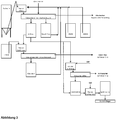
- the Figure 2 shows the process steps in an overview.
- the valuable substances calcium nitrate (CaNO 3 ), calcium phosphate (Ca 3 (PO 4 ) 2 ), calcium sulphate (CaSO 4 ), and calcium sulphate (CaSO 4 ) can be used in a single process from solids containing phosphate, e.g. ash Aluminum hydroxophosphate ((Al (OH) 3 x AlPO 4 ) can be obtained.
- levels 2 and 3 can also be skipped, so that level 4 can be carried out directly after level 1.
- time sequence can be varied, e.g. after stage 1 stage 3 and then stages 2 and then 4 can be carried out.
- the resulting phosphoric acid (H 3 PO 4 ) is recycled after stage 2 and after stage 3 for use in the Treatment of the ash in stage 1.
- This recycling of the Al- and Ca-depleted acid enables an enormous cost reduction because less fresh acid is required to dissolve the ash.
- At least 10% of the filtrate / supernatant are recycled for use in step a), particularly preferably at least 20%, even more preferably 20% to 80%, and most preferably 40% to 60%, based on the total amount of filtrate obtained.
- phosphoric acid (H 3 PO 4 ) is also formed in processes according to the invention, so that the process according to the invention is a process for the (optional) production of phosphoric acid (H 3 PO 4 ), and corresponding embodiments are part of the present invention.
- the phosphate-containing ash is obtained by incineration of sewage sludge, biodegradable waste, biowaste and / or animal waste.
- the phosphate-containing ash is obtained by incinerating sewage sludge, biodegradable waste, biowaste and / or animal waste in a waste incineration plant.
- precipitate in the context of the invention denotes the elimination of a dissolved substance as a solid from a solution, usually triggered by the addition of suitable substances (precipitants).
- suitable substances precipitants
- the term encompasses any completely or partially insoluble precipitate in the form of flakes, droplets or crystalline material, in any microcrystalline, crystalline or amorphous form.
- precipitate expressly includes any further processing, modification, refining, etc., of the precipitates obtained in the process according to the invention into powders, powders, dusts, bulk goods, granular materials, grits, etc.
- calcium phosphate in the context of the invention includes Ca 3 (PO 4 ) 2 ), CaHPO4 and Ca (H 2 PO 4 ) 2 .
- Ash in the context of the invention relates to any solid residue from the incineration of organic material, for example sewage sludge, biodegradable waste, biowaste and / or animal waste, Slaughterhouse waste, e.g. animal meal.
- Ash consists mainly of oxides and (bi) carbonates of various metals, e.g. B. Al 2 O 3 , CaO, Fe 2 O 3 , MgO, MnO, P 2 O 5 , P 4 O 10 , K 2 O, SiO 2 , Na 2 CO 3 , NaHCO 3 , etc.
- phosphate- containing ash in the context of the invention relates to ashes, as defined herein, which contain at least one phosphate, as defined herein.
- phosphates in the context of the invention relates on the one hand to P 2 O 5 and P 4 O 10 . Furthermore, the term “phosphates” relates to the salts and esters of orthophosphoric acid (H 3 PO 4 ), and expressly also includes the condensates (polymers) of orthophosphoric acid and their esters.
- phosphates relates to metallic salts of phosphoric acid with the general formula X (Y) m (PO 4 ) n, where X and optionally Y, is a metal selected from the group consisting of aluminum, beryllium, bismuth, lead, Cadmium, chromium, iron, gallium, indium, potassium, cobalt, copper, magnesium, manganese, molybdenum, sodium, nickel, osmium, palladium, rhodium, ruthenium, strontium, titanium, vanadium, tungsten, zinc, tin.
- X and optionally Y is a metal selected from the group consisting of aluminum, beryllium, bismuth, lead, Cadmium, chromium, iron, gallium, indium, potassium, cobalt, copper, magnesium, manganese, molybdenum, sodium, nickel, osmium, palladium, rhodium, ruthenium, strontium, titanium, vanadium,
- waste incineration plants in the context of the invention relates to all plants, devices and the like which are suitable for incinerating the atmospherically combustible parts of any type of waste.
- sewage sludge in the context of the invention relates to any suspension of finely divided particles of a solid substance in a liquid.
- the liquid in which the particles are suspended is waste water as defined herein.
- wastewater within the meaning of the invention relates to all liquids of an aqueous nature, and / or organic nature, or mixtures thereof, which are not drinking water quality within the meaning of the Drinking Water Ordinance (TrinkwV) and / or national and / or international drinking water standards (e.g. the DIN 2000 in Germany).
- wastewater also includes all wastewater in accordance with Section 54 (1) of the Water Management Act (WHG).
- the wastewater within the meaning of the invention is water that has been contaminated through use or has changed its properties or its composition.
- the term "wastewater” in the sense of the invention includes the water changed in its properties through domestic, commercial, agricultural or other use and the water that runs off with it in dry weather (dirty water) as well as that collected from precipitation from the area of built-up or paved areas runoff water (rainwater).
- Dirty water is domestic wastewater from toilets (faecal or black water), sanitary facilities, kitchens and washing machines (washing or gray water) as well as wastewater from companies that discharge into the public sewer system (commercial or industrial wastewater). Heated water from cooling systems also counts as wastewater. Wastewater that occurs in the most varied of cleaning and treatment techniques in water treatment plants is part of the wastewater for the purposes of the invention.
- the sewage sludge is present as primary sludge, raw sludge, excess sludge, as treated and / or stabilized sewage sludge (aerobic / anaerobic).
- biowaste in the context of the invention relates to all organic waste of animal or vegetable origin that occurs in a household or business and can be broken down by microorganisms, organisms living in the soil or enzymes. These include, for example, leftover food and lawn clippings. Biowaste is usually collected separately in the so-called biowaste bin and treated separately through composting and fermentation. The resulting compost and digestate are often returned to the environment, for example in horticulture and agriculture.
- biowaste includes both waste according to the definition of the EU Waste Framework Directive, garden and park waste, as well as food and kitchen waste (from households, restaurants, catering, retail and processing in the food industry).
- biodegradable waste in the sense of the invention includes not only bio-waste as defined herein, but also all organic waste of animal or plant origin from agriculture and forestry that can be broken down by microorganisms, living organisms or enzymes.
- this term includes all organic waste of animal or vegetable origin from agriculture and forestry which also contains at least one of the following biodegradable substances selected from the list consisting of wood, paper and cardboard.
- animal waste within the meaning of the invention includes animal bodies of dead, dead or stillborn large animals or pets - or parts thereof - as well as slaughterhouse waste, spoiled food of animal origin, and animal by-products such as milk, eggs, confiscates, but also intestinal contents and liquid manure, and all others Products, products.
- animal waste within the meaning of the invention includes meat and animal by-products from domestic animals, wild animals or farm animals that have been killed or perished for reasons of illness, in particular animal corpses contaminated with TSE and animals and contaminated with chemicals or prohibited substances Laboratory animals. Also included are meat and by-products with the risk of other non-communicable diseases.
- the incineration of sewage sludge, biodegradable waste, biowaste and / or animal waste takes place in a waste incineration plant at 600 ° to 1200 ° C, preferably at 800 ° to 900 ° C.
- the solids (ash) react with nitric acid.
- the solids (ash) react with phosphoric acid.
- the solids (ash) are reacted with a mineral acid mixture of phosphoric acid and nitric acid and does not contain any hydrohalic acids.
- the mineral acid mixture does not contain hydrochloric acid.
- the mineral acid mixture is present in a concentration of 5% by weight to 50% by weight, preferably 10% by weight to 30% by weight, in aqueous dilution.
- the phosphate-containing ash is mixed with the mineral acid mixture in a reactor, the proportion of ash being 5% by weight to 50% by weight, preferably 20% by weight to 30% by weight, based on the dilute mineral acid.
- the mineral acid mixture contains at least phosphoric and nitric acid.
- the mineral acid mixture also contains sulfuric acid in addition to phosphoric and nitric acid.
- the reaction time between acid and ash is 2 to 300 minutes, preferably 10 to 60 minutes.
- the reaction temperature is 20 ° C to 90 ° C, preferably 60 to 80 ° C.
- the acid-insoluble part of the solids is separated off by mechanical filtration and / or dewatering processes.
- the acid-insoluble part of the solids is separated out with dewatering units (e.g. vacuum belt filter, chamber filter press, membrane filter press, belt filter press, centrifuge).
- dewatering units e.g. vacuum belt filter, chamber filter press, membrane filter press, belt filter press, centrifuge.
- the acid-insoluble part of the solids is separated off with a vacuum belt filter.
- the residue in the filter units is washed with water and the wash water is returned to the first process stage.
- sulfuric acid is added in a dilution of 10 to 98% by weight, preferably 40 to 80% by weight
- the sulfuric acid is added in a molar ratio that corresponds to the dissolved calcium concentration of 0.5 Ca to 1.5 SO 4 (sulfate), preferably 1.0 Ca to 1.0 SO 4 ( Sulfate).
- sulfuric acid is added in a stirred reactor.
- the residence time in the stirred reactor after the addition of the sulfuric acid is 5 to 60 minutes, preferably 10 to 30 minutes.
- the reaction temperature (precipitation of calcium sulfate after addition of sulfuric acid) in the stirred reactor is from 20 ° to 90 ° C., preferably from 60 ° to 90 ° C.
- the calcium sulfate precipitate is deposited by mechanical filtration and / or dewatering processes.
- the calcium sulphate precipitate is separated off with dewatering units (e.g. vacuum belt filter, chamber filter press, membrane filter press, belt filter press, centrifuge).
- dewatering units e.g. vacuum belt filter, chamber filter press, membrane filter press, belt filter press, centrifuge.
- the calcium sulfate precipitate is separated off with a vacuum belt filter.
- the residue in the filter units is washed with water and the washing water is returned to the first process stage.
- the filtrate obtained (dilute mineral acid mixture) is at least partially reused to break down the solids.
- the proportion of the return of the filtrate is at least 10%, preferably at least 20%, even more preferably 20% to 80%, and most preferably 40% to 60%, based on the total amount of filtrate obtained.
- the filtrate or the supernatant containing phosphoric acid (H 3 PO 4 ), optionally obtained after deposition of Fe silicate and / or calcium sulfate and / or aluminum hydroxophosphate, is obtained by evaporation to an acid content of 30% by weight 70% by weight, preferably 40% by weight to 60% by weight, concentrated.
- calcium oxide or calcium carbonate is added to the filtrate or supernatant containing phosphoric acid (H 3 PO 4 ), optionally obtained after separation of Fe silicate and / or calcium sulfate and / or aluminum hydroxophosphate, in a stirred reactor with formation of calcium precipitates.
- H 3 PO 4 phosphoric acid
- the solid suspension is evaporated or spray-dried by supplying heat to such an extent that a solid with a residual moisture content of 0% by weight to 25% by weight, preferably from 2% by weight to 10% by weight, is obtained % By weight arises.
- the precipitate or precipitates is or are completely or partially insoluble precipitate in the form of flakes, droplets or crystalline material, in any microcrystalline, crystalline or amorphous form.
- the precipitate or the precipitates are further processed, modified, refined etc. to powders, powders, dusts, bulk goods, granular materials, grits etc.
- the entire process is exemplarily described by the following test sequence, which explains the method according to the invention without reproducing it exactly:
- the starting material is ash from a sewage sludge incineration plant.
- the main components were analyzed as follows: Weight% P2O5 25.0 Wt% CaO 17.5 Wt% Fe2O3 26.9 Weight% Al2O3 6.7 Weight% SiO2 19.5
- 100g of ashes are treated with 300g of dilute acid in a beaker.
- the dilute acid consists of: 70% by weight water; 15% by weight HNO 3 and 15% by weight H 3 PO 4 .
- stage 2 and stage 3 These problems, which are particularly severe with higher Al concentrations in the sewage sludge ashes (which can amount to over 20% Al 2 O 3 ), are solved by a multi-stage process in stage 2 and stage 3 as follows:
- the filter cake (122g wet weight) from the described 1st stage (the ash dissolution process) is washed with 100g hot water (70-90 ° C).
- white calcium sulfate precipitates in accordance with the reaction described above.
- the precipitate was filtered through a vacuum suction filter (with filter). 280 g of filtrate and 43 g of gypsum wet filter cake were obtained.
- the filtrate was analyzed.
- the recipe for the 1st stage is now as follows: 100g of ash are treated with 300g of diluted acid in a beaker.
- the diluted acid consists of: 270g recycled material and 20g HNO 3 .
- the suspension is stirred for 30 minutes at 40 ° C. and then filtered through a vacuum suction filter (with filter).
- the filter cake is then weighed and then dried at 100 ° C.
- Filter cake wet 130g
- Filter cake dried 75g
- the precipitate is in another attempt according to patent DE 10 2012 015 065 B3 2013-07-18 further treated and converted to sodium aluminate solution and a calcium phosphate precipitate.
- the process steps described here can be used variably depending on the concentration of Ca and Al ions in the digestion acid (or the corresponding oxide concentrations in the ash).
- the essence of the invention is that the combination of the process steps enables economical process management and, above all, low-aluminum end products are obtained.
- the purified HNO 3 —H 3 PO 4 acid is preferably neutralized with CaO to a pH value of 6 and concentrated by evaporation of water, for example by spray drying.
- a double salt is created from calcium nitrate and calcium phosphate.
- a salt with the following composition could be produced: 19.5% by weight P2O5; 28.5 wt% CaO; 24.3 wt% NO3; 0.8 wt.% Al2O3, 0.6 wt.% Fe2O3.
- FIG. 3 shows the various process flows in the scheme.
Landscapes
- Chemical & Material Sciences (AREA)
- Organic Chemistry (AREA)
- Inorganic Chemistry (AREA)
- Life Sciences & Earth Sciences (AREA)
- Geology (AREA)
- Processing Of Solid Wastes (AREA)
- Fertilizers (AREA)
- Removal Of Specific Substances (AREA)
- Chemical Kinetics & Catalysis (AREA)
- Engineering & Computer Science (AREA)
- Environmental & Geological Engineering (AREA)
Description
- Die Erfindung betrifft ein Verfahren zur Behandlung von phosphathaltigen Abfällen, insbesondere phosphathaltigen Aschen aus Abfall-Verbrennungsanlagen, durch nasschemischen Aufschluss zur Gewinnung von Aluminium-, Kalzium-, Phosphor- und Stickstoffverbindungen, mindestens umfassend die Gewinnung (Erzeugung) von Kalziumsulfat (Ca(SO4) und insbesondere zur optionalen Herstellung von Phosphorsäure (H3PO4).
- Zur Herstellung von Düngemittel werden Rohphosphate benötigt. Um die endlichen Rohphosphate ersetzen zu können, ist allgemein bekannt, dass die Rückgewinnung von Phosphor bzw. Phosphaten aus Abfällen und Abwässern in den europäischen Industrieländern angestrebt wird (Siehe Patent
DE 10 2012 015 065 B3 ). Dies ist auch deswegen angezeigt, weil die Rohphosphate zunehmend mit Schwermetallen wie Cadmium und Uran verunreinigt sind und sich diese Verunreinigung in den Düngemitteln und im Grundwasser wiederfinden. - Eine wesentliche Phosphat-Ressource in Europa ist das Abwasser aus kommunalen und industriellen Kläranlagen. Allein etwa 50.000 Mg (t) Phosphor gelangen pro Jahr in Deutschland ins Abwasser und werden zum allergrößten Teil mit Hilfe von Fällungsmitteln wie Eisen- oder Aluminiumsalzen als Metallsalze ausgefällt und mit dem Klärschlamm abgeschieden. Die phosphathaltigen Klärschlämme werden heute zumeist verbrannt und die dabei entstehende Asche deponiert oder anderweitig "veruntreut" (z.B. Straßenbau, Bergeversatz), denn der darin enthaltene Phosphor wird - bis auf wenige Ausnahmen in Versuchsanlagen - nicht zurückgewonnen
EP 2 602 013 offenbart ein Verfahren zur Rückgewinnung von Phosphorverbindungen aus Klärschlammaschen. - Ähnlich wie bei anderen industriellen Recycling-Prozessen wie beispielsweise der Rückgewinnung von Eisen aus Schrott, der Rückgewinnung von Papier aus Altpapier, der Rückgewinnung von Kupfer und anderen Metallen aus Elektrogeräten, ist auch eine industrielle Rückgewinnung von Phosphor aus Abfällen möglich. Eine wesentliche Voraussetzung dazu ist, dass die phosphorhaltigen Rückstände eine ausreichend hohe Phosphorkonzentration und eine geringe Verunreinigung aufweisen und im Wesentlichen den z.Zt. verwendeten Rohphosphaten entsprechen, möglichst ohne schädliche Uran- und Cadmium-Verunreinigungen.
- Phosphate werden aus Rohphosphat (Rock, mit einem Phosphoranteil von ca. 30% P2O5) durch Säure-Aufschluss mit vorzugsweise Schwefelsäure gewonnen, wobei Phosphorsäure und / oder Kalziumphosphat-Dünger entsteht (so genanntes "Superphosphat"). Die Aschen von verbrannten Klärschlämmen oder tierischen Abfällen wie Tiermehl, enthalten bis zu 35 Gew.% P2O5, allerdings, je nach Fällungsmittel, auch bis zu 25 Gew.% Eisen-, Aluminium- oder Kalziumoxid. Dieser hohe Metalloxidgehalt, der bis zu zehnfach höher sein kann als im Rohphosphat, schränkt die Verwendung von Klärschlammaschen als alternatives Rohphosphat in industriellen Prozessen erheblich ein. Eine Problemlösung wird mit dem Patent
DE 10 2012 015 065 B3 aufgezeigt, wobei bei der Abwasserreinigung Phosphate durch Aluminiumsalze gebunden und anschließend zu Kalziumphosphat umgewandelt werden, damit bei anschließender Verbrennung des Klärschlammes die zurückbleibende Asche vorzugsweise Kalziumphosphat enthält, und möglichst wenig Aluminium- und Eisen-Verbindungen. Die Kalziumphosphatreiche Asche ist geeignet, als Rohphosphat zur Herstellung von Düngemitteln eingesetzt zu werden, allerdings immer in Kombination mit begleitenden Verunreinigungen aus der Asche. - Aschen, die aus der Verbrennung von Klärschlämmen, Bioabfällen, biologisch abbaubaren Abfällen, tierischen Abfällen etc. wie Tiermehl entstehen, enthalten verschiedene Wertstoffe. Die folgende Tabelle zeigt die Hauptbestandteile (als Oxide gerechnet) und den Wertstoffgehalt von einigen Aschen, die bei der Verbrennung von Klärschlamm entstehen:
Asche A Asche B Asche C % Fe2O3 21,9 3,1 11,9 % Al2O3 9,3 21,5 12,4 % CaO 15,2 14,5 11,4 % P2O5 21,0 23,0 20,5 % SiO2 18,2 27,0 23,0 - Die besondere Wertigkeit von Aschen ist in ihrem Gehalt an P2O5, CaO und Al2O3 begründet.
- Momentan ist es nicht möglich die verschiedenen Wertstoffe in solchen Aschen effizient und kostengünstig als vermarktungsfähige Produkte zurückzugewinnen. Die hier beschriebene Erfindung beschreibt ein optional mehrstufiges Verfahren, mit dem aus Aschen höherwertige Phosphate wie oder Phosphorsäure sowie Kalziumsulfat (Gips) und evtl. auch Aluminiumhydroxophosphat gewonnen werden können.
- Das erfindungsmäße Verfahren beruht darauf, die Wertstoffe aus der Asche durch fraktioniertes Lösen in Mineralsäuren und durch Zugabe geeigneter Reaktanten in unterschiedliche Produkte umzuwandeln, insbesondere in Produkte aus der Gruppe Kalziumphosphat (Ca3(PO4)2), Kalziumsulfat (CaSO4), und Aluminiumhydroxophosphat (Al(OH)3 x AlPO4), das Verfahren mindestens umfassend die Gewinnung von Kalziumsulfat (CaSO4) und ist insbesondere zur optionalen Herstellung von Phosphorsäure (H3PO4) geeignet.
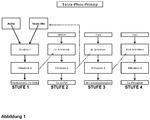
- Eine Erläuterung des Verfahrens ist in
Abbildung 1 schematisch wiedergegeben. - Bei Lösen der Wertstoffe aus phosphathaltigen Aschen in Stufe 1 wird ausdrücklich keine Salzsäure oder eine andere Halogenwasserstoffsäure verwendet, wie es heute teilweise Stand der Technik ist.
- Wenn Aschen mit Salzsäure behandelt werden, lösen sich Eisen- Aluminium und Kalziumsalze, vorzugsweise deren Phosphate. Aus der gemeinsamen Aufschlusslösung können zwar unterschiedliche Fraktionen an Aluminiumverbindungen und oder Kalziumphosphat gewonnen werden, der Nachteil ist jedoch die Chlorid-Komponente, die, weil alle infrage kommenden Chloride leicht löslich sind, letztlich als Abwasser den Prozess verlassen oder nur sehr aufwändig, z.B. durch Eindampfung, zurückgewonnen werden können.
- Dieser gravierende Nachteil wird durch die Erfindung in einem (optional) mehrstufigen Verfahren eindrucksvoll gelöst, in dem in der ersten Stufe zur Behandlung der Asche (dem Löseprozess in Säure) nicht verdünnte Salzsäure, sondern verdünnte Phosphorsäure verwendet wird. Die Salze dieser Säuren, wie Kalziumphosphat, sind im Vergleich zu beispielsweise Natrium- oder Kalziumchlorid, erheblich höherwertiger, so dass durch Fäll- und Eindampfprozesse die Salze, vor allem Kalziumphosphat , gewonnen werden können und durch deren Vermarktung - vor allem als Düngemittel der gesamte Recyclingprozess wirtschaftlich wird.
- Die erste Stufe ist in einer allgemeinen Ausführungsform im Wesentlichen auch mit folgenden Gleichungen zu beschreiben:
Ca3(PO4)2 + 6HNO3 = 3Ca(NO3)2 + 2H3PO4
AlPO4 + 3HNO3 = Al(NO3)3 + H3PO4
- Aus den Feststoffen, z.B. der Asche, lösen sich vor allem Ca- und Al-Ionen, während Fe-Ionen nur in geringen Mengen in Lösung gehen und mit den ebenfalls kaum löslichen Silikaten (SiO2) im Rückstand verbleiben. Die unlöslichen Bestandteile werden nach dem Stand der Technik durch Filtration von der sauren Aufschlusslösung abgetrennt, z.B. mit einem Dekanter, einem Vakuumbandfilter oder einer Filterpresse. Bevorzugt wird, um die Verluste zu reduzieren, der Rückstand in den Filteraggregaten mit Wasser gewaschen und das Waschwasser als Verdünnungswasser für die Aufschlusssäure in die erste Prozessstufe zurückgeführt.
- Im Anschluss an Stufe 1 kann durch Zugabe von Schwefelsäure (H2SO4) zum resultierenden Filtrat oder Überstand nach Stufe 1 nun Kalziumsulfat (CaSO4; Gips) präzipitiert werden. Dies erfolgt in der sauren, filtrierten Aufschlusslösung in der zweiten Stufe nach insbesondere der zweiten untenstehenden chemischen Gleichung

- Um den Bedarf an Salpetersäure zu reduzieren und den Prozess wirtschaftlicher zu gestalten, ist ein wichtiger Schritt des mehrstufigen Verfahrens die Rückgewinnung von Salpeter- bzw. insbesondere Phosphorsäure. Somit ist eine fast vollständige Rückgewinnung der Salpeter- bzw. Phosphorsäure möglich, wenn im stöchiometrischen Verhältnis zum Kalziumgehalt verdünnte Schwefelsäure dosiert wird, wobei die Fällung zu Kalziumsulfat (Gips) völlig überraschenderweise auch bei einem pH-Wert von unter 1 möglich ist. In der Summe der beiden Schritte ergibt sich folgende chemische Gleichung:

- Das Kalziumsulfat-Präzipitat (Gips) wird in bekannter Weise filtriert, entwässert und mit Wasser gewaschen. Bevorzugt wird auch dieses saure Waschwasser als Verdünnungswasser in die erste Prozessstufe zurückgeführt. Der entwässerte Gips kann in weiteren Prozessschritten außerhalb der hier beschriebenen Verfahrenskette weiterverarbeitet werden, z.B. durch Calcinierung zu Anhydrit oder durch chemische Umsetzung nach Patent
DE 196 11 454 A1 . - Durch mehrfache Kreislaufführung wird auf diese Weise durch immer weiteres Auflösen von Phosphat aus der Asche, die Konzentration an Phosphorsäure immer weiter erhöht und könnte auf eine Konzentration von über 30% H3PO4 hochgeschraubt werden, wenn nicht vor allem die ebenfalls mitgelösten Aluminium-Ionen stören würden. Je nach Al2O3 -Gehalt der Asche, kann die Al-Konzentration in der Aufschlusssäure auf über 5% steigen, so dass eine Vermarktung nicht mehr möglich ist. Dieses Problem wird in einer dritten Stufe gelöst, indem Aluminium-Ionen durch Zugabe von vorzugsweise Kalziumoxid als Aluminium-hydroxophosphat ausgefällt werden.
- Wegen der hohen Salzkonzentration in der Aufschlusssäure ist die Aluminiumhydroxophosphatfällung überraschenderweise bereits durch Zugabe geringer Mengen an Hydroxyl-Ionen bei einer nur geringen Erhöhung des an sich stark sauren pH-Wertes von pH ca 1 bis 1,5 auf pH ca. 2,0 bis 2,5 möglich. Vorzugsweise wird dies durch Zugabe von Kalziumoxid (CaO), aber auch durch Zugabe von Kalziumhydroxid, Kalziumcarbonat, Kalziumsilikat (Kalksandstein) Natriumhydroxid oder Natronwasserglas erreicht. Der Niederschlag aus Aluminiumhydroxophosphat wird durch Filtration nach dem Stand der Technik, z.B. mit einem Dekanter, einem Vakuumbandfilter oder einer Filterpresse abgetrennt bzw. gewonnen.
- Der Prozess der dritten Stufe lässt sich mit folgender Gleichung beschreiben:

- Während Ca-Phosphat und Ca-Nitrat in Lösung bleiben, fallen die Al-Salze bereits bei pH-Werten von ca. 2 als Präzipitat aus.
- Nach der Abtrennung (Abreicherung) von Ca- und Al-Ionen in den Prozessstufen zwei und drei ist eine nur noch gering verunreinigte Phosphorsäure bzw. salpetrige Phosphorsäure entstanden. Diese kann durch Eindampfung konzentriert werden und als Phosphorsäure oder salpetrige Phosphorsäure zur Herstellung von Düngemittel zum Einsatz kommen, wobei mit dieser Säure mineralische Rohphosphate aufgeschlossen werden können, was Stand der Technik ist.
- Weiterhin kann die gereinigte Phosphorsäure (bzw. im Prinzip auch salpetrige Phosphorsäure) zurückgeführt werden und erfindungsgemäß in der ersten Stufe zur Lösung von Inhaltsstoffen aus der Asche, verwendet werden.
- In einer allgemeinen Variante des Verfahrens, bei der salpetrige Phosphorsäure entsteht, wird in der vierten Stufe die salpetrige Phosphorsäure mit Kalkstein (Kalziumcarbonat) oder Branntkalk (Kalziumoxid) neutralisiert und das Präzipitat eingedampft, so dass eine Mischung aus Kalziumphosphat und Kalziumnitrat entsteht.
2H3PO4 + 2HNO3 + 2CaO = Ca(NO3)2 + Ca(H2PO4)2 + 2H2O
- Dieses Mischprodukt ist ein bevorzugter NP-Dünger.
- Die
Abbildung 2 zeigt die Prozessschritte in einer Übersicht. - Werden alle vier Sufen 1-4 nacheinander durchgeführt, so können in einem einzigen Verfahren aus phosphathaltigen Feststoffen, z.B. Aschen, gleichzeitig die Wertstoffe Kalziumnitrat (CaNO3), Kalziumphosphat (Ca3(PO4)2), Kalziumsulfat (CaSO4), und Aluminiumhydroxophosphat ((Al(OH)3 x AlPO4) gewonnen werden.
- Es ist ersichtlich, dass keinesfalls alle vier Stufen des Verfahrens zwingend durchgeführt werden müssen. Ebenso ist es möglich beispielsweise nur Kalziumphosphat und Kalziumsulfat (Gips) zu gewinnen (Stufen 1, 2, 4). Alternativ können nur Stufen 1, 3 und 4 durchgeführt werden.
- Interessanterweise können auch die Stufen 2 und 3 übersprungen werden, so dass Stufe 4 direkt im Anschluss an Stufe 1 durchgeführt werden kann.
- Weiterhin kann die zeitliche Abfolge variiert werden, indem z.B. nach Stufe 1 die Stufe 3 und dann Stufen 2 und anschließend 4 durchgeführt werden.
- Wie oben ausführlich beschrieben, wird die entstandene Phosphorsäure (H3PO4) nach Stufe 2 und nach Stufe 3 wieder zurückgeführt werden zur Verwendung in der Behandlung der Asche in Stufe 1. Diese Rückführung der Al- und Ca-abgereicherten Säure ermöglicht eine enorme Kostenreduzierung, weil zum Auflösen von Asche weniger Frischsäure benötigt wird.
- Die vorliegende Erfindung betrifft ein Verfahren zur Gewinnung (Erzeugung) von Präzipitaten ausgewählt aus der Gruppe aus Kalziumnitrat (CaNO3), Kalziumphosphat (Ca3(PO4)2), Kalziumsulfat (CaSO4), und Aluminiumhydroxophosphat (Al(OH)3 x AlPO4); aus phosphathaltigen Aschen aus Abfallverbrennungsanlagen und zur optionalen Herstellung von Phosphorsäure (H3PO4), das Verfahren mindestens umfassend die Gewinnung (Erzeugung) von Kalziumsulfat (CaSO4), dadurch gekennzeichet, dass
- a) die Feststoffe (Asche) mit Salpetersäure oder Phosphorsäure oder einem Mineralsäuregemisch der beiden Säuren reagiert werden,
- b) der säureunlösliche Teil der Feststoffe abgeschieden wird,
- c) durch Zugabe von Schwefelsäure zum Filtrat oder Überstand ein pH Wert <1 eingestellt wird, und Kalziumsulfat-Präzipitat gewonnen und abgeschieden wird, und
- d) das Filtrat oder der Überstand zumindest teilweise zurückgeführt wird zur Verwendung in Schritt a),
- e) optional das Filtrat oder der Überstand konzentriert wird, bevorzugt durch Eindampfung, zur Gewinnung von Phosphorsäure oder salpetriger Phosphorsäure (HNO3/H3PO4),
- f) optional durch Zugabe von Kalziumoxid oder Kalziumcarbonat zum Filtrat oder zum Überstand Kalziumphosphat-Präzipitat und Kalziumnitrat-Präzipitat gewonnen und abgeschieden wird.
- In einer bevorzugten Ausführungsform der Erfindung werden mindestens 10% des Filtrats/Überstandes zur Verwendung in Schritt a) zurückgeführt, besonders bevorzugt mindestens 20% ,noch mehr bevorzugt 20% bis 80%, und am meisten bevorzugt 40% bis 60%, bezogen auf die gesamte erhaltene Filtratmenge.
- Wie ausführlich hierin beschrieben entsteht in Verfahren gemäß der Erfindung auch Phosphorsäure (H3PO4), so dass das erfindungsgemäße Verfahren ein Verfahren zur (optionalen) Herstellung von Phosphorsäure (H3PO4) ist, und entsprechende Ausführungsformen sind Teil der vorliegenden Erfindung.
- In bevorzugten Ausführungsformen derErfindung, wird die phosphathaltige Asche durch Verbrennung von Klärschlämmen, biologisch abbaubaren Abfällen, Bioabfällen und/oder Tierabfällen erhalten.
- In bevorzugten Ausführungsformen der Erfindung, wird die phosphathaltige Asche durch Verbrennung von Klärschlämmen, biologisch abbaubaren Abfällen, Bioabfällen und/oder Tierabfällen in einer Abfall-Verbrennungsanlagen erhalten.
- Der Begriff "Präzipitat" im Sinne der Erfindung bezeichnet das Ausscheiden eines gelösten Stoffes als Feststoff aus einer Lösung, üblicherweise ausgelöst durch Zusätze von geeigneten Substanzen (Fällungsmittel). Insbesondere umfasst der Begriff jeglichen vollständig oder teilweise unlöslichen Niederschlag in Form von Flocken, Tröpfchen oder kristallinem Material, in jeglicher mikrokristallinen, kristallinen oder amorphen Form. Der Begriff "Präzipitat" schliesst ausdrücklich jegliche weitere Verarbeitung, Modifikation, Raffinierung etc., der im erfindungsgemäßen Verfahren erhaltenen Präzipitate zu Pulvern, Pudern, Stäuben, Schüttgut, Granulären Materialien, Grieß etc. ein.
- Der Begriff "Kalziumphosphat" im Sinne der Erfindung umfasst Ca3(PO4)2), CaHPO4 und Ca(H2PO4)2.
- Der Begriff "Asche" im Sinne der Erfindung bezieht sich auf jeglichen festen Rückstand aus der Verbrennung organischen Materials, beispielsweise von Klärschlamm, biologisch abbaubaren Abfällen, Bioabfällen und/oder Tierabfällen, Schlachtabfällen, z.B. Tiermehl. Asche besteht vor allem aus Oxiden und (Bi-)Karbonaten diverser Metalle, z. B. Al2O3, CaO, Fe2O3, MgO, MnO, P2O5, P4O10, K2O, SiO2, Na2CO3, NaHCO3, etc.
- Der Begriff "phosphathaltige Asche" im Sinne der Erfindung bezieht sich auf Aschen, wie hierein definiert, die mindestens ein Phosphat, wie hierin definiert, enthalten.
- Der Begriff "Phosphate" im Sinne der Erfindung bezieht sich zum einen auf P2O5 und P4O10. Weiterhin betrifft der Begriff "Phosphate" die Salze und Ester der Orthophosphorsäure (H3PO4), und schließt ausdrücklich auch die Kondensate (Polymere) der Orthophosphorsäure und ihre Ester ein. Insbesondere betrifft der Begriff "Phosphate" metallische Salze der Phosphorsäure mit der allgemeinen Formel X(Y)m(PO4)n, wobei X und wahlweise Y, ein Metall ist, ausgewählt aus der Gruppe bestehend aus Aluminium, Beryllium, Bismut, Blei, Kadmium, Chrom, Eisen, Gallium, Indium, Kalium, Kobalt, Kupfer, Magnesium, Mangan, Molybdän, Natrium, Nickel, Osmium, Palladium, Rhodium, Ruthenium, Strontium, Titan, Vanadium, Wolfram, Zink, Zinn.
- Der Begriff "Abfall-Verbrennungsanlagen" im Sinne der Erfindung bezieht sich auf sämtliche Anlagen, Einrichtungen und dergleichen, die zur Verbrennung der atmosphärisch brennbaren Anteile von jeglicher Art von Abfall geeignet sind.
- Der Begriff "Klärschlamm" im Sinne der Erfindung bezieht sich auf jede Suspension fein verteilter Teilchen einer festen Substanz in einer Flüssigkeit.
- In einer bevorzugten Ausführungsform ist die Flüssigkeit, in der die Teilchen suspendiert sind, ein Abwasser wie hierin definiert.
- Der Begriff "Abwasser" im Sinne der Erfindung bezieht sich auf sämtliche Flüsssigkeiten wässriger Natur, und/oder organischer Natur, oder Mischungen daraus, die nicht Trinkwasserqualität im Sinne der Trinkwasserverordnung (TrinkwV) und/oder von nationalen und/oder internationalen Trinkwassernormen (z.B. der DIN 2000 in Deutschland) haben. Der Begriff Abwasser umfasst weiterhin alle Abwässer gemäß § 54 Abs. 1 Wasserhaushaltsgesetz (WHG).
- In einer bevorzugten Ausführungsform handelt es sich bei dem Abwasser im Sinne der Erfindung um durch Gebrauch verunreinigtes bzw. in seinen Eigenschaften oder seiner Zusammensetzung verändertes Wasser. Weiterhin umfasst der Begriff "Abwasser" im Sinne der Erfindung das durch häuslichen, gewerblichen, landwirtschaftlichen oder sonstigen Gebrauch in seinen Eigenschaften veränderte Wasser und das bei Trockenwetter damit zusammen abfließende Wasser (Schmutzwasser) sowie das von Niederschlägen aus dem Bereich von bebauten oder befestigten Flächen gesammelt abfließende Wasser (Niederschlagswasser). Die aus Anlagen zum Behandeln, Lagern und Ablagern von Abfällen austretenden und gesammelten Flüssigkeiten gelten ebenfalls als Schmutzwasser. Schmutzwasser sind häusliche Abwasser aus Toiletten (Fäkal- oder Schwarzwasser), Sanitäreinrichtungen, Küchen und Waschmaschinen (Wasch- oder Grauwasser) sowie Abwasser aus Betrieben, die in die öffentliche Kanalisation ableiten (gewerbliches oder industrielles Abwasser). Auch aufgeheiztes Wasser aus Kühlanlagen zählt als Abwasser. Abwässer, die bei den verschiedensten Reinigungs- und Behandlungstechniken von Wasseraufbereitungsanlagen anfallen, gehören zu den Abwässern im Sinne der Erfindung.
- In einer besonders bevorzugten Ausführungsform liegt der Klärschlamm als Primärschlamm, Rohschlamm, Überschussschlamm, als behandelter und/oder stablisierter Klärschlamm (aerob/anaerob) vor.
- Der Begriff "Bioabfall" im Sinne der Erfindung bezieht sich auf sämtliche organischen Abfälle tierischer oder pflanzlicher Herkunft, die in einem Haushalt oder Betrieb anfallen und durch Mikroorganismen, bodenlebende Lebewesen oder Enzyme abgebaut werden können. Dazu zählen zum Beispiel Essenreste und Rasenschnitt. Bioabfälle werden in der Regel über die sogenannte Biotonne separat erfasst und gesondert durch Kompostierung und Gärung behandelt. Der dabei entstehende Kompost und das Gärgut werden der Umwelt häufig wieder zugeführt, unter anderem im Gartenbau und in der Landwirtschaft. Der Begriff Bioabfall umfasst dabei sowohl Abfälle gemäß der Begriffsbestimmung der EU-Abfallrahmenrichtlinie Garten- und Parkabfälle sowie Nahrungs- und Küchenabfälle (aus Haushalten, Gaststätten, Cateringgewerbe, Einzelhandel und Verarbeitungen im Nahrungsmittelgewerbe).
- Der Begriff "biologisch abbaubare Abfälle" im Sinne der Erfindung umfasst neben Bioabfällen wie hierin definiert, weiterhin auch sämtliche organischen Abfälle tierischer oder pflanzlicher Herkunft aus Land- und Forstwirtschaft, die durch Mikroorganismen, bodenlebende Lebewesen oder Enzyme abgebaut werden können. Insbesondere umfasst dieser Begriff sämtliche organischen Abfälle tierischer oder pflanzlicher Herkunft aus Land- und Forstwirtschaft die weiterhin mindestens einen der folgenden biologisch abbaubare Stoffe ausgewählt aus der Liste bestehend aus Holz, Papier und Pappe enthalten.
- Der Begriff "Tierabfälle" im Sinne der Erfindung umfasst Tierkörper verendeter, toter oder totgeborener Groß- oder Haustiere - oder Teile davon - sowie Schlachtabfälle, verdorbene Lebensmittel tierischer Herkunft, und Tiernebenprodukte wie Milch, Eier, Konfiskate aber auch Darminhalt und Gülle, sowie sämtliche weiteren Produkte, Erzeugnisse.
- Insbesondere umfasst der Begriff "Tierabfälle" im Sinne der Erfindung Fleisch und tierische Nebenprodukte von Haustieren, Wildtieren oder Nutztieren, die aus Krankheitsgründen getötet wurden oder verendeten, insbesondere TSE verseuchte Tierleichen sowie mit Chemikalien oder verbotenen Stoffen kontaminierte Tiere und Versuchstiere. Weiterhin umfasst sind Fleisch und Nebenprodukte mit dem Risiko anderer, nicht übertragbarer Krankheiten.
- Der Begriff "Tierabfälle" im Sinne der Erfindung umfasst ausserdem getötete, also nicht geschlachtete Tiere, tierische Nebenprodukte (beispielsweise Milch), und jegliche Tierprodukte mit Rückständen von Medikamenten. Ebenfalls ausdrücklich umfasst sind sämtliche Abfälle und Nebenprodukte aus Schlachtbetrieben, Küchen- und Speiseabfälle, für den menschlichen Verzehr nicht mehr geeignete Lebensmittel tierischen Ursprungs, Rohmilch, frischer Fisch oder frische Fischnebenprodukte. Insbesondere sind umfasst:
- Küchen- und Speiseabfälle jeglicher Art,
- Fische oder andere Meerestiere, sowie Fischabfälle jeglicher Art,
- Ehemalige tierische Lebensmittel, die aus anderen, nicht gesundheitsschädlichen Folgen, z.B. Verpackungsmängeln, für den menschlichen Verzehr nicht mehr bestimmt sind,
- Schlachtkörperteile,
- Rohmilch,
- Schalen, Brütereinebenprodukte und Knickeiernebenprodukte,
- Haare, Pelze, Hörner usw.,
- Tierische Abfälle aus der Lebensmittelindustrie,
- Häute, Hufe und Hörner, Schweineborsten und Federn von Tieren,
- überlagertes Fleisch,
- minderwertiges Fleisch,
- Fleisch von Tieren unter erheblicher Stressbelastung,
- Blut von Tieren (nicht von Wiederkäuern), die nach einer Untersuchung in einem Schlachthof geschlachtet wurden,
- Tierische Schlachtkörperteile und Nebenprodukte, die bei der Herstellung von für den menschlichen Verzehr bestimmten Erzeugnissen angefallen sind, entfettete Knochen und Grieben, sowie Tiermehl.
- In bevorzugten Ausführungsformen der Erfindung, erfolgt die Verbrennung von Klärschlamm, biologisch abbaubaren Abfällen, Bioabfällen und/oder Tierabfälle in einer Abfall-Verbrennungsanlagen bei 600° bis 1.200 °C erfolgt, vorzugsweise bei 800° bis 900°C.
- In bevorzugten Ausführungsformen der Erfindung, erfolgt die Reaktion der Feststoffe (Asche) mit Salpetersäure.
- In bevorzugten Ausführungsformen der Erfindung, erfolgt die Reaktion der Feststoffe (Asche) mit Phosphorsäure.
- In bevorzugten Ausführungsformen der Erfindung, erfolgt die Reaktion der Feststoffe (Asche) mit einem Mineralsäuregemisch aus Phosphorsäure und Salpetersäure und enthält keine Halogenwasserstoffsäuren. Insbesondere enthält das Mineralsäuregemisch nicht Salzsäure.
- In bevorzugten Ausführungsformen der Erfindung, liegt das Mineralsäuregemisch in einer Konzentration von 5 Gew.% bis 50 Gew.%, vorzugsweise 10 Gew.% bis 30 Gew.% in wässriger Verdünnung vor.
- In bevorzugten Ausführungsformen der Erfindung, wird die phosphathaltige Asche in einem Reaktor mit dem Mineralsäuregemisch versetzt, wobei der Anteil an Asche 5 Gew.% bis 50 Gew.%, vorzugsweise 20 Gew.% bis 30 Gew.% bezogen auf die verdünnte Mineralsäure beträgt.
- In bevorzugten Ausführungsformen der Erfindung, enthält das Mineralsäuregemisch mindestens Phosphor- und Salpetersäure.
- In bevorzugten Ausführungsformen der Erfindung, enthält das Mineralsäuregemisch zusätzlich zu Phosphor- und Salpetersäure auch Schwefelsäure.
- In bevorzugten Ausführungsformen der Erfindung, beträgt die Reaktionszeit zwischen Säure und Asche 2 bis 300 Minuten, vorzugsweise 10 bis 60 Minuten.
- In bevorzugten Ausführungsformen der Erfindung, beträgt die Reaktionstemperatur 20°C bis 90°C, vorzugsweise 60 bis 80°C.
- In bevorzugten Ausführungsformen der Erfindung, wird der säureunlösliche Teil der Feststoffe durch mechanische Filtrations- und/oder Entwässerungsverfahren abgeschieden.
- In bevorzugten Ausführungsformen der Erfindung, erfolgt die Abscheidung des säureunlöslichen Teils der Feststoffe mit Entwässerungsaggregaten (z.B. Vakuumbandfilter, Kammerfilterpresse, Membran-Filterpresse, Siebbandpresse, Zentrifuge).
- In bevorzugten Ausführungsformen der Erfindung, erfolgt die Abscheidung des säureunlöslichen Teils der Feststoffe mit einem Vakuumbandfilter.
- In bevorzugten Ausführungsformen der Erfindung, wird nach Abscheidung des säureunlöslichen Teils der Feststoffe der Rückstand in den Filteraggregaten mit Wasser gewaschen und das Waschwasser in die erste Prozessstufe zurückgeführt.
- In bevorzugten Ausführungsformen der Erfindung, erfolgt die Zugabe von Schwefelsäure in einer Verdünnung von 10 bis 98 Gew.%, vorzugsweise 40 bis 80 Gew. %
- In bevorzugten Ausführungsformen der Erfindung, wird die Schwefelsäure in einem Mol-Verhältnis zugegeben wird, das der gelösten Kalzium-Konzentration von 0,5 Ca zu 1,5 SO4 (Sulfat), vorzugsweise 1,0 Ca zu 1,0 SO4 (Sulfat) entspricht.
- In bevorzugten Ausführungsformen der Erfindung, erfolgt die Zugabe von Schwefelsäure in einem Rührreaktor.
- In bevorzugten Ausführungsformen der Erfindung, beträgt die Verweilzeit im Rührreaktor nach Zugabe der Schwefelsäure 5 bis 60 Minuten, vorzugsweise 10 bis 30 Minuten.
- In bevorzugten Ausführungsformen der Erfindung, beträgt die Reaktionstemperatur (Ausfällung von Kalziumsulfat nach Zugabe von Schwefelsäure) im Rühreaktor 20° bis 90°C, vorzugsweise 60° bis 90°C.
- In bevorzugten Ausführungsformen der Erfindung, wird das Kalziumsulfat-Präzipitat durch mechanische Filtrations- und/oder Entwässerungsverfahren abgeschieden.
- In bevorzugten Ausführungsformen der Erfindung, erfolgt die Abscheidung das Kalziumsulfat-Präzipitats mit Entwässerungsaggregaten (z.B. Vakuumbandfilter, Kammerfilterpresse, Membran-Filterpresse, Siebbandpresse, Zentrifuge).
- In bevorzugten Ausführungsformen der Erfindung, erfolgt die Abscheidung das Kalziumsulfat-Präzipitats mit einem Vakuumbandfilter.
- In bevorzugten Ausführungsformen der Erfindung, wird nach Abscheidung des Kalziumsulfat-Präzipitats der Rückstand in den Filteraggregaten mit Wasser gewaschen und das Waschwasser in die erste Prozessstufe zurückgeführt.
- In bevorzugten Ausführungsformen der Erfindung, wird nach Abscheidung des Kalziumsulfat-Präzipitates das gewonnene Filtrat (verdünntes Mineralsäuregemisch) zumindest teilweise wieder zum Aufschluss der Feststoffe verwendet.
- In bevorzugten Ausführungsformen der Erfindung, beträgt der Anteil der Rückführung des Filtrates mindestens 10%, bevorzugt mindestens 20%, noch mehr bevorzugt 20% bis 80%, und am meisten bevorzugt 40% bis 60%, bezogen auf die gesamte erhaltene Filtratmenge.
- In bevorzugten Ausführungsformen der Erfindung, wird das Filtrat oder der Überstand enthaltend Phosphorsäure (H3PO4), wahlweise erhalten nach Abscheidung von Fe-Silikat und/oder Kalziumsulfat, und/oder Aluminiumhydroxophosphat, durch Eindampfung auf einen Säuregehalt von 30 Gew.% bis 70 Gew.%, vorzugsweise 40 Gew.% bis 60 Gew.% konzentriert.
- In bevorzugten Ausführungsformen der Erfindung, wird im Filtrat oder Überstand, enthaltend Phosphorsäure (H3PO4), wahlweise erhalten nach Abscheidung von Fe-Silikat und/oder Kalziumsulfat, und/oder Aluminiumhydroxophosphat, durch die Zugabe von Kalziumoxid oder Kalziumcarbonat unter Bildung von Kalzium-Präzipitaten, der pH-Wert auf 4 bis 12, vorzugsweise 6 bis 9 eingestellt.
- In bevorzugten Ausführungsformen der Erfindung, erfolgt die Zugabe von Kalziumoxid oder Kalziumcarbonat zum Filtrat oder Überstand, enthaltend Phosphorsäure (H3PO4), wahlweise erhalten nach Abscheidung von Fe-Silikat und/oder Kalziumsulfat, und/oder Aluminiumhydroxophosphat, in einem Rührreaktor unter Bildung von Kalzium-Präzipitaten.
- In bevorzugten Ausführungsformen der Erfindung, wird nach der Bildung von Kalzium-Präzipitaten die Feststoffsuspension durch Wärmezuführung soweit eingedampft oder sprühgetrocknet wird, dass ein Feststoff mit einer Restfeuchte von 0 Gew.% bis 25% Gew.%, vorzugsweise von 2 Gew.% bis 10 Gew.% entsteht.
- In bevorzugten Ausführungsformen der Erfindung, liegt das Präzipitat bzw. die Präzipitate als vollständig oder teilweise unlöslicher Niederschlag in Form von Flocken, Tröpfchen oder kristallinem Material, in jeglicher mikrokristallinen, kristallinen oder amorphen Form, vor.
- In bevorzugten Ausführungsformen der Erfindung, wird das Präzipitat bzw. die Präzipitate weiterverarbeitet, modifiziert, raffiniert etc. zu Pulvern, Pudern, Stäuben, Schüttgut, granulären Materialien, Grieß etc.
- Der gesamte Prozess wird beispielhaft durch den folgenden Versuchsablauf beschrieben, der das erfindungsgemäße Verfahren erläutert, ohne es exakt wiederzugeben:
Ausgangsmaterial ist eine Asche aus einer Klärschlammverbrennungsanlage. Die wesentlichen Bestandteile wurden wie folgt analysiert:Gew. % P2O5 25,0 Gew. % CaO 17,5 Gew. % Fe2O3 26,9 Gew. % Al2O3 6,7 Gew. % SiO2 19,5 - 100g Asche werden in einem Becherglas mit 300g verdünnter Säure behandelt.
- Die verdünnte Säure besteht aus: 70 Gew. % Wasser; 15 Gew. % HNO3 und 15 Gew. % H3PO4. Die Suspension wird 30 Minuten bei 40°C gerührt und anschließend über eine Vakuum-Nutsche (mit Filter) filtriert. Der Filterkuchen wird anschließend gewogen und danach bei 100°C getrocknet.
Filterkuchen nass = 122g
Filterkuchen getrocknet = 72g - Daraus errechnet sich, dass sich aus 100g Asche 72g in Säure nicht gelöst haben, 28g (= 28%) sind säurelöslich. Insgesamt wurde 275g Filtrat zurückgewogen und anschließend analysiert. Den Analysenresultaten in der folgenden Tabelle wurden theoretische Werte gegenübergestellt, die sich ergeben, wenn sich die wesentlichen Asche-Inhalte zu 100% (im Filtrat und Naßanteil des Filterkuchens) gelöst hätten:
(100%) (ist) säurelöslich Gew. % P2O5 17,78* 13,68 88,7% Gew. % CaO 5,37 4,80 89,4% Gew. % Fe2O3 8,25 0,47 5,7% Gew. % Al2O3 2,06 1,56 75,7% Gew. % SiO2 5,98 0,02 0,3% *7,69% P2O5 resultieren aus der Asche, 10,09% P2O5 aus der zugegebenen Phosphorsäure. - Die Resultate verdeutlichen, dass hohe Rücklöseraten von Phosphat, Kalzium und Aluminium erreicht werden, während Eisen nur gering gelöst wird und Silizium als SiO2 erwartungsgemäß fast unlöslich ist. Die Konzentration an H3PO4 hat sich von zuvor 15 Gew. % auf nun 13,68 x 1,37 = 18,7 Gew. % erhöht (1,37 = Faktor zur Umrechnung von P2O5 auf H3PO4). Durch Eindampfen um den Faktor 2 erhält man eine Säure mit 37,4% H3PO4 und 30% HNO3. Diese Säure kann zur Herstellung von Düngemitteln verwendet werden oder ist mit CaO zu neutralisiert und dann einzudampfen, wobei ein Doppelsalz von Ca(NO3)2 * Ca(H2PO4)2 entsteht.
- Dieses Verfahren hat den Nachteil, dass einerseits erhebliche Mengen an Salpeter- und Phosphorsäure benötigt werden, andererseits Verunreinigungen von Eisen- und Aluminium-Salzen die Produktqualität verschlechtert. Der Prozess wäre wirtschaftlich grenzwertig und die Wertschöpfung der Endprodukte stark einschränkt.
- Diese Probleme, die vor allem mit höheren Al-Konzentrationen in den Klärschlammaschen (die bis über 20% Al2O3 betragen können) massiv sind, werden durch einen mehrstufigen Prozess in Stufe 2 und Stufe 3 wie folgt gelöst:
Der Filterkuchen (122g Naßgewicht) aus der beschriebenen 1. Stufe (dem Asche-Lösungsprozess) wird mit 100g Heißwasser (70-90°C) gewaschen. Das gewonnene Waschfiltrat wird gemeinsam mit 200g Filtrat der 1. Stufe (Dünnsäure) mit 25g Schwefelsäure (48 Gew. %ig) in einem Becherglas vermischt (Gesamtgewicht = 100 + 200 + 25 = 325g). Nach wenigen Minuten fällt entsprechend der oben beschriebenen Reaktion weißes Kalziumsulfat aus. Nach 30 Minuten wurde das Präzipitat über eine Vakuum-Nutsche (mit Filter) filtriert. Es wurden 280g Filtrat und 43g Gips-Naß-Filterkuchen gewonnen. Das Filtrat wurde analysiert. - Den Analysenresultaten in der folgenden Tabelle werden Werte gegenübergestellt, die sich aus einem Parallelversuch ergeben, bei dem Filtrat der 1. Stufe plus Waschwasser in den oben genannten Verhältnissen analysiert worden sind:
Filtrat+WW nach Ca-Fällung pH-Wert 1,9 0,9 Gew. % P2O5 9,58 9,43 Gew. % CaO 3,70 1,45 Gew. % Fe2O3 0,32 0,33 Gew. % Al2O3 0,98 1,01 - Die Daten verdeutlichen, dass der Ca-Gehalt reduziert ist, gleichzeitig auch der pH-Wert, weil sich zusätzliche H-Ionen bilden konnten. Das saure Filtrat der 2. Stufe kann nun beim Auflösen der Asche genutzt werden, wobei nun auf die Dosierung von H3PO4 vollständig verzichtet werden kann, weil sich ständig neue Phosphorsäure aus der phosphathaltigen Asche bildet. Diese Stufe ist im mehrstufigen Verfahren besonders hervorzuheben, weil durch Verwendung der Schwefelsäure insgesamt die Säurekosten reduziert werden (Schwefelsäure ist gemäß ihrer Effizienz die preisgünstigste Säure), und weil zusätzlich Gips gewonnen wird.
- Mit dem rezyklierten Filtrat (kalziumarme Dünnsäure) ist die Rezeptur der 1. Stufe nun wie folgt: 100g Asche werden in einem Becherglas mit 300g verdünnter Säure behandelt. Die verdünnte Säure besteht aus: 270g Rezyklat und 20g HNO3. Die Suspension wird 30 Minuten bei 40°C gerührt und anschließend über eine Vakuum-Nutsche (mit Filter) filtriert. Der Filterkuchen wird anschließend gewogen und danach bei 100°C getrocknet.
Filterkuchen nass = 130g
Filterkuchen getrocknet = 75g - Daraus errechnet sich, dass sich aus 100g Asche 75g in Säure nicht gelöst haben, d.h. 25g (= 25%) sind säurelöslich. Insgesamt wurde 258g Filtrat (Dünnsäure) zurückgewogen und anschließend analysiert. Die Analysenresultate entsprechen im Wesentlichen den Resultaten der 1. Startstufe, lediglich der CaO-Gehalt war mit 5,8% CaO etwas höher (weil noch zusätzliches Kalzium über das Rezyklat eingetragen wurde), während der Al2O3-Gehalt von 1,5 auf 2,6% weiter angestiegen ist. In einer 3. Stufe wird nun durch Zugabe geringer Mengen an Kalziumoxid die Aluminiumkonzentration in der Dünnsäure reduziert. Dazu wird 150g Dünnsäure bei Raumtemperatur mit 1g CaO vermischt. Es bildete sich ein Präzipitat, das nach 15 Minuten über eine Vakuum-Nutsche (mit Filter) filtriert wurde. Es wurden 123g Filtrat und 25g Naß-Filterkuchen gewonnen. Das Filtrat wurde analysiert.
- Den Analysenresultaten in der folgenden Tabelle werden Werte gegenübergestellt, die sich aus einem Parallelversuch ergeben, bei dem die Dünnsäure vor der Zugabe von CaO analysiert worden ist.
Dünnsäure nach Al-Fällung pH-Wert 0,9 2,2 Gew. % P2O5 9,35 8,95 Gew. % CaO 5,84 6,42 Gew. % Fe2O3 0,54 0,48 Gew. % Al2O3 2,61 0,84 - Durch geringfügige Erhöhung des pH-Wertes bildete sich ein Al-PO4-Präzipitat, was an den erniedrigten Werten für P2O5, und Al2O3 zu sehen ist. Ganz bewusst werden durch die Fällung die Werte nur geringfügig reduziert, denn es soll lediglich eine zu starke Anreicherung an Al-Ionen verhindert werden. Das mit Wasser gewaschene und getrocknete Präzipitat wurde wie folgt analysiert:
Gew. % P2O5 31,3 Gew. % CaO 1,1 Gew. % Fe2O3 3,5 Gew. % Al2O3 56,1 - Das Präzipitat ist in einem weiteren Versuch gemäß Patent
DE 10 2012 015 065 B3 2013.07.18 weiterbehandelt worden und zu Natriumaluminat-Lösung und einem Kalziumphosphat-Präzipitat umgewandelt worden. - Die hier beschriebenen Prozessschritte sind je nach Konzentration von Ca- und Al-Ionen in der Aufschlusssäure (bzw. den entsprechenden Oxidkonzentrationen in der Asche) variabel anzuwenden. Das Wesen der Erfindung besteht darin, dass durch Kombination der Prozessschritte eine wirtschaftliche Prozessführung ermöglich wird und vor allem aluminiumarme Endprodukte erhalten werden.
- Die gereinigte HNO3-H3PO4-Säure wird vorzugsweise mit CaO auf einen pH-Wert von 6 neutralisiert und durch Wasserverdampfung konzentriert, z.B. durch Sprühtrocknung. Es entsteht ein Doppelsalz aus Kalziumnitrat und Kalziumphosphat. gemäß der Erfindung konnte ein Salz mit folgender Zusammensetzung erzeugt werden: 19.5 Gew.% P2O5; 28,5 Gew.% CaO; 24,3 Gew.% NO3; 0,8 Gew.% Al2O3, 0,6 Gew.% Fe2O3.
-
Abbildung 3 zeigt die verschiedenen Prozessabläufe im Schema.
Claims (7)
- Verfahren zur Gewinnung von Präzipitaten ausgewählt aus der Gruppe aus Kalziumnitrat, Kalziumphosphat, Kalziumsulfat und Aluminiumhydroxophosphat; aus phosphathaltigen Aschen aus Abfallverbrennungsanlagen und zur optionalen Herstellung von Phosphorsäure, das Verfahren mindestens umfassend die Gewinnung von Kalziumsulfat, dadurch gekennzeichnet, dassa) die Feststoffe/Aschen mit Salpetersäure oder Phosphorsäure oder einem Mineralsäuregemisch der beiden Säuren reagiert werden,b) der säureunlösliche Teil der Feststoffe abgeschieden wird,c) durch Zugabe von Schwefelsäure zum Filtrat oder Überstand ein pH Wert <1 eingestellt wird, und Kalziumsulfat-Präzipitat gewonnen und abgeschieden wird, undd) das Filtrat oder der Überstand zumindest teilweise zurückgeführt wird zur Verwendung in Schritt a),e) optional das Filtrat oder der Überstand konzentriert wird, bevorzugt durch Eindampfung, zur Gewinnung von Phosphorsäure oder salpetriger Phosphorsäure,f) optional durch Zugabe von Kalziumoxid oder Kalziumcarbonat zum Filtrat oder zum Überstand Kalziumphosphat-Präzipitat und Kalziumnitrat-Präzipitat gewonnen und abgeschieden wird.
- Verfahren nach Anspruch 1, dadurch gekennzeichnet, dass die Schritte a), b), c), d) und e) durchgeführt werden.
- Verfahren nach Anspruch 1, dadurch gekennzeichnet, dass die Schritte a), b), c), d) und f) durchgeführt werden.
- Verfahren nach Ansprüchen 1, 2 und 3, dadurch gekennzeichnet, dass, im Schritt d) mindestens 10% des Filtrats/Überstandes zur Verwendung in Schritt a) zurückgeführt wird, bevorzugt mindestens 20%, mehr bevorzugt 20% bis 80%, und noch mehr bevorzugt 40% bis 60%, bezogen auf die gesamte erhaltene Filtratmenge.
- Verfahren nach Ansprüchen 1 bis 4, dadurch gekennzeichnet, dass es sich um ein Verfahren zur Herstellung von Phosphorsäure handelt.
- Verfahren nach Ansprüchen 1 bis 5, dadurch gekennzeichnet, dass die phosphathaltige Asche durch Verbrennung von phosphathaltigen Klärschlämmen, biologisch abbaubaren Abfällen, Bioabfällen und/oder Tierabfällen in einer Abfall-Verbrennungsanlage erhalten wird.
- Verfahren nach Ansprüchen 1 bis 6, dadurch gekennzeichnet, dass die Reaktion der phosphathaltigen Aschen in Schritt (a) mit Phosphorsäure erfolgt.
Priority Applications (4)
| Application Number | Priority Date | Filing Date | Title |
|---|---|---|---|
| SI201431779T SI3296258T1 (sl) | 2013-11-06 | 2014-05-20 | Postopek obdelave pepela, ki vsebuje fosfat iz sežigalnic odpadkov s pomočjo mokro kemijske razgradnje za pridobivanje aluminijevih, kalcijevih, fosforjevih in dušikovih spojin |
| RS20210219A RS61462B1 (sr) | 2013-11-06 | 2014-05-20 | Postupak za tretman pepela iz postrojenja za spaljivanje otpada koji sadrže fosfate vlažnim hemijskim razlaganjem u svrhu dobijanja jedinjenja aluminijuma, kalcijuma, fosfora i azota |
| PL17198604T PL3296258T3 (pl) | 2013-11-06 | 2014-05-20 | Sposób obróbki popiołów zawierających fosforany ze spalarni odpadów przez rozkład chemiczny na mokro do odzyskania związków glinu, wapnia, fosforu i azotu |
| HRP20210313TT HRP20210313T1 (hr) | 2013-11-06 | 2021-02-24 | Postupak za obradu pepela koji sadrži fosfat iz postrojenja za spaljivanje otpada mokro-kemijskim raspadanjem radi oporabe spojeva aluminija, kalcija, fosfora i dušika |
Applications Claiming Priority (3)
| Application Number | Priority Date | Filing Date | Title |
|---|---|---|---|
| DE201310018650 DE102013018650B3 (de) | 2013-11-06 | 2013-11-06 | Verfahren zur Behandlung von phosphathaltigen Aschen aus Abfallverbrennungsanlagen durch nasschemischen Aufschluss zur Gewinnung von Aluminium-, Kalzium-, Phosphor- und Stickstoffverbindungen |
| EP14726081.4A EP3066048B1 (de) | 2013-11-06 | 2014-05-20 | Verfahren zur behandlung von phosphathaltigen aschen aus abfallverbrennungsanlagen durch nasschemischen aufschluss zur gewinnung von aluminium-, kalzium-, phosphor- und stickstoffverbindungen |
| PCT/EP2014/001361 WO2015067328A1 (de) | 2013-11-06 | 2014-05-20 | Verfahren zur behandlung von phosphathaltigen aschen aus abfallverbrennungsanlagen durch nasschemischen aufschluss zur gewinnung von aluminium-, kalzium-, phosphor- und stickstoffverbindungen |
Related Parent Applications (2)
| Application Number | Title | Priority Date | Filing Date |
|---|---|---|---|
| EP14726081.4A Division EP3066048B1 (de) | 2013-11-06 | 2014-05-20 | Verfahren zur behandlung von phosphathaltigen aschen aus abfallverbrennungsanlagen durch nasschemischen aufschluss zur gewinnung von aluminium-, kalzium-, phosphor- und stickstoffverbindungen |
| EP14726081.4A Division-Into EP3066048B1 (de) | 2013-11-06 | 2014-05-20 | Verfahren zur behandlung von phosphathaltigen aschen aus abfallverbrennungsanlagen durch nasschemischen aufschluss zur gewinnung von aluminium-, kalzium-, phosphor- und stickstoffverbindungen |
Publications (3)
| Publication Number | Publication Date |
|---|---|
| EP3296258A1 EP3296258A1 (de) | 2018-03-21 |
| EP3296258B1 true EP3296258B1 (de) | 2020-12-02 |
| EP3296258B2 EP3296258B2 (de) | 2026-05-06 |
Family
ID=50792408
Family Applications (3)
| Application Number | Title | Priority Date | Filing Date |
|---|---|---|---|
| EP20163260.1A Pending EP3699141A3 (de) | 2013-11-06 | 2014-05-20 | Verfahren zur behandlung von phosphathaltigen aschen aus abfallverbrennungsanlagen durch nasschemischen aufschluss zur gewinnung von aluminium-, kalzium-, phosphor- und stickstoffverbindungen |
| EP14726081.4A Active EP3066048B1 (de) | 2013-11-06 | 2014-05-20 | Verfahren zur behandlung von phosphathaltigen aschen aus abfallverbrennungsanlagen durch nasschemischen aufschluss zur gewinnung von aluminium-, kalzium-, phosphor- und stickstoffverbindungen |
| EP17198604.5A Active EP3296258B2 (de) | 2013-11-06 | 2014-05-20 | Verfahren zur behandlung von phosphathaltigen aschen aus abfallverbrennungsanlagen durch nasschemischen aufschluss zur gewinnung von aluminium-, kalzium-, phosphor- und stickstoffverbindungen |
Family Applications Before (2)
| Application Number | Title | Priority Date | Filing Date |
|---|---|---|---|
| EP20163260.1A Pending EP3699141A3 (de) | 2013-11-06 | 2014-05-20 | Verfahren zur behandlung von phosphathaltigen aschen aus abfallverbrennungsanlagen durch nasschemischen aufschluss zur gewinnung von aluminium-, kalzium-, phosphor- und stickstoffverbindungen |
| EP14726081.4A Active EP3066048B1 (de) | 2013-11-06 | 2014-05-20 | Verfahren zur behandlung von phosphathaltigen aschen aus abfallverbrennungsanlagen durch nasschemischen aufschluss zur gewinnung von aluminium-, kalzium-, phosphor- und stickstoffverbindungen |
Country Status (17)
| Country | Link |
|---|---|
| US (1) | US10392260B2 (de) |
| EP (3) | EP3699141A3 (de) |
| AU (2) | AU2014345950A1 (de) |
| CA (1) | CA2929639C (de) |
| CY (1) | CY1123931T1 (de) |
| DE (2) | DE102013018650B3 (de) |
| DK (1) | DK3296258T3 (de) |
| EA (1) | EA035648B1 (de) |
| ES (1) | ES2856883T3 (de) |
| HR (1) | HRP20210313T1 (de) |
| HU (1) | HUE053015T2 (de) |
| LT (1) | LT3296258T (de) |
| PL (1) | PL3296258T3 (de) |
| PT (1) | PT3296258T (de) |
| RS (1) | RS61462B1 (de) |
| SI (1) | SI3296258T1 (de) |
| WO (1) | WO2015067328A1 (de) |
Families Citing this family (25)
| Publication number | Priority date | Publication date | Assignee | Title |
|---|---|---|---|---|
| DK3084301T3 (en) | 2013-12-20 | 2018-05-22 | Ecophos S A | PROCEDURE FOR TREATING ASHES FROM THE WASTE CONSUMPTION |
| US9914646B2 (en) * | 2014-11-17 | 2018-03-13 | K-Max Pty Ltd. | Method for the processing of potassium containing materials |
| DE102015014160A1 (de) | 2015-10-24 | 2017-04-27 | MAS GbR (vertretungsberechtigter Gesellschafter: Michael Schaaf, 04178 Leipzig) | Schlackenbehandlung |
| WO2017093570A1 (en) | 2015-12-03 | 2017-06-08 | Power Minerals Limited | Process for making granules and agglomerates from powders |
| WO2017137538A1 (en) * | 2016-02-12 | 2017-08-17 | Power Minerals Limited | Process for making granules and agglomerates from mineral powders |
| DE102016010861A1 (de) | 2016-09-07 | 2018-03-08 | Patrick Herr | Verfahren und Vorrichtung zur Rückgewinnung von Phosphor aus phosphorhaltiger Klärschlammasche |
| DE102016122869B4 (de) | 2016-11-28 | 2018-07-05 | Chemische Fabrik Budenheim Kg | Gesamtverfahren zur Aufbereitung von biologischen Abfällen |
| CN107055586A (zh) * | 2016-12-30 | 2017-08-18 | 宁夏东吴农化有限公司 | 一种硫酸钙的制备方法 |
| EP3434647B1 (de) * | 2017-07-25 | 2021-09-08 | Borealis Agrolinz Melamine GmbH | Verfahren zur herstellung von calciumnitratkristallen |
| EP3495323B1 (de) * | 2017-12-07 | 2020-09-09 | Borealis Agrolinz Melamine GmbH | Verfahren zur herstellung einer löslichen phosphatfraktion aus phosphathaltiger asche |
| PL235097B1 (pl) * | 2018-01-10 | 2020-05-18 | Dr Green Spolka Z Ograniczona Odpowiedzialnoscia | Sposób wytwarzania rozpuszczalnego nawozu |
| CN111683912B (zh) * | 2018-02-01 | 2023-03-28 | 庞特帕布利有限责任公司 | 改良土壤圈的颗粒、制造方法和用途 |
| DE102018004741A1 (de) | 2018-06-14 | 2019-12-19 | Fritz Curtius | Quench Kühler für phosphorhaltige Gase |
| DE202018004398U1 (de) | 2018-09-21 | 2018-12-11 | Fritz Curtius | Heizvorrichtung für fließfähige Feststoffe |
| DE102019000162A1 (de) | 2019-01-10 | 2020-07-16 | Fritz Curtius | Heißdampf Erzeuger für Destillate aus feuchtem Material |
| DE202019000127U1 (de) | 2019-01-10 | 2019-04-11 | Fritz Curtius | Heißdampf Erzeuger für Destillate aus feuchtem Material |
| CN113511924B (zh) * | 2020-04-09 | 2022-10-11 | 国家能源投资集团有限责任公司 | 液体硅钙肥及其制备方法和应用 |
| JP7851320B2 (ja) | 2021-02-15 | 2026-04-24 | レモンディス アクア ゲーエムベーハ アンド シーオー.ケージー | 下水汚泥及び場合によっては生物由来廃棄物からリン酸塩と窒素を組み合わせて回収する方法 |
| DE102021000786A1 (de) | 2021-02-16 | 2022-08-18 | Remondis Aqua Gmbh & Co. Kg | Verfahren zur kombinierten Rückgewinnung von Phosphat und Stickstoff aus Klärschlamm und gegebenenfalls biologischen Abfällen |
| US12612656B2 (en) | 2021-11-30 | 2026-04-28 | Nautilus Subsidiary, Inc. | Particle-based isolation of proteins and other analytes |
| EP4201880A1 (de) | 2021-12-24 | 2023-06-28 | Prayon | Verfahren zur herstellung eines phosphathaltigen produktes aus einer phosphatquelle |
| CN116040596A (zh) * | 2022-01-09 | 2023-05-02 | 四川大学 | 硝酸法湿法磷酸综合利用的方法 |
| CN114933497B (zh) * | 2022-06-08 | 2023-02-10 | 四川大学 | 一种利用剩余污泥焚烧灰制备n-p复合肥的方法 |
| DE102023100413A1 (de) | 2023-01-10 | 2024-07-11 | Remondis Aqua Gmbh & Co. Kg | Verfahren zur Gewinnung und Aufreinigung von Phosphorsäure aus Asche |
| DE102024119483A1 (de) | 2024-07-09 | 2026-01-15 | Remondis Aqua Gmbh & Co. Kg | Verbessertes Verfahren zur Gewinnung und Aufreinigung von Phosphorsäure aus Asche |
Citations (3)
| Publication number | Priority date | Publication date | Assignee | Title |
|---|---|---|---|---|
| US4029743A (en) | 1975-12-24 | 1977-06-14 | Hauge Douglas O | Phosphoric acid manufacture |
| WO2011067321A1 (fr) | 2009-12-02 | 2011-06-09 | Prayon Technologies | Procede de production d'acide phosphorique |
| JP4972584B2 (ja) | 2008-03-04 | 2012-07-11 | メタウォーター株式会社 | リン抽出液の回収方法 |
Family Cites Families (13)
| Publication number | Priority date | Publication date | Assignee | Title |
|---|---|---|---|---|
| US418259A (en) * | 1889-12-31 | Camille emile desire winssinger | ||
| DE875951C (de) * | 1941-09-25 | 1953-05-07 | Der Niederlaendische Staat | Verfahren zur Herstellung und getrennten Gewinnung von Mono- bzw. Dicalciumphosphat und Calciumnitrat aus Rohphosphat und Salpetersaeure |
| US2524174A (en) * | 1945-06-12 | 1950-10-03 | Directie Staatsmijnen Nl | Treatment of impure calcium nitrate |
| GB665257A (en) * | 1949-02-10 | 1952-01-16 | Azote Office Nat Ind | Method of treating calcium nitrates resulting from the solubilization of lime phosphates with nitric acid |
| GB799490A (en) * | 1954-04-21 | 1958-08-06 | Int Minerals & Chem Corp | Improvements in or relating to a method of producing dicalcium phosphate |
| US4393032A (en) † | 1982-01-12 | 1983-07-12 | Pennzoil Company | Production of phosphoric acid and additional products from phosphate ore |
| MX173389B (es) † | 1990-11-28 | 1994-02-25 | Fosfatos Ind S A De C V | Proceso para la fabricacion directa de ortofosfatos a partir de fosfatos de calcio impuros |
| DE19611454A1 (de) | 1996-03-22 | 1997-09-25 | Rethmann Lippewerk Recycling G | Mineralischer Füllstoff und Baustoff-Additiv auf Basis von Calciumaluminiumsulfat und deren Herstellung und Verwendung |
| DE102009014884B4 (de) * | 2009-03-25 | 2014-11-06 | Ingeborg Klose | Verfahren zur Eliminierung von Schadstoffen aus Klärschlamm und Verfahren zur Herstellung von Phosphaten und phosphathaltigen Verbindungen |
| DE102010034042B4 (de) * | 2010-05-05 | 2013-01-17 | Axel Bruckert | Verfahren zur Herstellung von Phosphat- und Mehrnährstoff-Düngemitteln |
| EP2602013B1 (de) * | 2011-12-06 | 2014-08-06 | BSH Umweltservice AG | Phosphorrückgewinnung aus phosphorhaltigen Produkten, insbesondere aus Klärschlammasche |
| DE102012015065B3 (de) | 2012-07-31 | 2013-07-18 | Remondis Aqua Gmbh & Co. Kg | Einstufiges Verfahren in einem Reaktor zur Umwandlung von Aluminiumphosphat in Kalziumphosphat |
| DE102016010861A1 (de) † | 2016-09-07 | 2018-03-08 | Patrick Herr | Verfahren und Vorrichtung zur Rückgewinnung von Phosphor aus phosphorhaltiger Klärschlammasche |
-
2013
- 2013-11-06 DE DE201310018650 patent/DE102013018650B3/de active Active
-
2014
- 2014-05-20 DK DK17198604.5T patent/DK3296258T3/da active
- 2014-05-20 RS RS20210219A patent/RS61462B1/sr unknown
- 2014-05-20 CA CA2929639A patent/CA2929639C/en active Active
- 2014-05-20 EP EP20163260.1A patent/EP3699141A3/de active Pending
- 2014-05-20 DE DE112014002767.7T patent/DE112014002767A5/de active Pending
- 2014-05-20 WO PCT/EP2014/001361 patent/WO2015067328A1/de not_active Ceased
- 2014-05-20 ES ES17198604T patent/ES2856883T3/es active Active
- 2014-05-20 US US15/034,819 patent/US10392260B2/en active Active
- 2014-05-20 EP EP14726081.4A patent/EP3066048B1/de active Active
- 2014-05-20 HU HUE17198604A patent/HUE053015T2/hu unknown
- 2014-05-20 AU AU2014345950A patent/AU2014345950A1/en not_active Abandoned
- 2014-05-20 LT LTEP17198604.5T patent/LT3296258T/lt unknown
- 2014-05-20 PL PL17198604T patent/PL3296258T3/pl unknown
- 2014-05-20 PT PT171986045T patent/PT3296258T/pt unknown
- 2014-05-20 EP EP17198604.5A patent/EP3296258B2/de active Active
- 2014-05-20 EA EA201690927A patent/EA035648B1/ru unknown
- 2014-05-20 SI SI201431779T patent/SI3296258T1/sl unknown
-
2018
- 2018-06-29 AU AU2018204744A patent/AU2018204744B2/en active Active
-
2021
- 2021-02-24 HR HRP20210313TT patent/HRP20210313T1/hr unknown
- 2021-03-01 CY CY20211100170T patent/CY1123931T1/el unknown
Patent Citations (3)
| Publication number | Priority date | Publication date | Assignee | Title |
|---|---|---|---|---|
| US4029743A (en) | 1975-12-24 | 1977-06-14 | Hauge Douglas O | Phosphoric acid manufacture |
| JP4972584B2 (ja) | 2008-03-04 | 2012-07-11 | メタウォーター株式会社 | リン抽出液の回収方法 |
| WO2011067321A1 (fr) | 2009-12-02 | 2011-06-09 | Prayon Technologies | Procede de production d'acide phosphorique |
Non-Patent Citations (2)
| Title |
|---|
| "Phosphoric Acid. Vol 17 Part 1", 1 January 1967, MARCEL DEKKER, article SLACK A. V.: "Table 17", pages: 152 - 153, XP093112856 |
| "Thermal Utilisation of Sewage Sludge in Poland", KOWALSKI, XP093076690 |
Also Published As
| Publication number | Publication date |
|---|---|
| EA201690927A1 (ru) | 2017-01-30 |
| EP3699141A3 (de) | 2020-10-28 |
| HUE053015T2 (hu) | 2021-06-28 |
| EA035648B1 (ru) | 2020-07-21 |
| LT3296258T (lt) | 2021-05-10 |
| AU2018204744B2 (en) | 2020-02-06 |
| DE112014002767A5 (de) | 2016-03-03 |
| DK3296258T3 (da) | 2021-03-08 |
| EP3296258B2 (de) | 2026-05-06 |
| EP3066048B1 (de) | 2020-11-04 |
| PT3296258T (pt) | 2021-03-03 |
| AU2014345950A1 (en) | 2016-06-09 |
| HRP20210313T1 (hr) | 2021-04-16 |
| WO2015067328A1 (de) | 2015-05-14 |
| EP3066048A1 (de) | 2016-09-14 |
| SI3296258T1 (sl) | 2021-04-30 |
| AU2018204744A1 (en) | 2018-07-19 |
| PL3296258T3 (pl) | 2021-05-31 |
| EP3296258A1 (de) | 2018-03-21 |
| US10392260B2 (en) | 2019-08-27 |
| EP3699141A2 (de) | 2020-08-26 |
| CY1123931T1 (el) | 2022-05-27 |
| CA2929639A1 (en) | 2015-05-14 |
| US20160257574A1 (en) | 2016-09-08 |
| RS61462B1 (sr) | 2021-03-31 |
| CA2929639C (en) | 2021-10-19 |
| ES2856883T3 (es) | 2021-09-28 |
| DE102013018650B3 (de) | 2014-09-18 |
Similar Documents
| Publication | Publication Date | Title |
|---|---|---|
| EP3066048B1 (de) | Verfahren zur behandlung von phosphathaltigen aschen aus abfallverbrennungsanlagen durch nasschemischen aufschluss zur gewinnung von aluminium-, kalzium-, phosphor- und stickstoffverbindungen | |
| EP3137418B1 (de) | Verfahren zur reinigung von roh-phosphorsäure (z.b. mga-säure) durch zugabe von aschen aus abfall-verbrennungsanlagen umfassend die gewinnung von reiner phosphorsäure, kalziumsulfat, wasserlöslichen kalziumhydrogenphosphaten und metallsalz-lösung | |
| DE102013018652B4 (de) | Verfahren zur Behandlung von phosphathaltigen Feststoffen durch nasschemischen Aufschluss zur Gewinnung von Aluminium-, Kalzium-, Phosphor- und Stickstoffverbindungen | |
| EP2602013B1 (de) | Phosphorrückgewinnung aus phosphorhaltigen Produkten, insbesondere aus Klärschlammasche | |
| DE102016122869B4 (de) | Gesamtverfahren zur Aufbereitung von biologischen Abfällen | |
| DE102021000786A1 (de) | Verfahren zur kombinierten Rückgewinnung von Phosphat und Stickstoff aus Klärschlamm und gegebenenfalls biologischen Abfällen | |
| WO2024149781A1 (de) | Verfahren zur gewinnung und aufreinigung von phosphorsäure aus asche | |
| DE102012015065B3 (de) | Einstufiges Verfahren in einem Reaktor zur Umwandlung von Aluminiumphosphat in Kalziumphosphat | |
| WO2022171252A1 (de) | Verfahren zur kombinierten rückgewinnung von phosphat und stickstoff aus klärschlamm und gegebenenfalls biologischen abfällen | |
| WO2026013112A1 (de) | Verbessertes verfahren zur gewinnung und aufreinigung von phosphorsäure aus asche | |
| DE102022109322A1 (de) | Verfahren zur Gewinnung eines phosphathaltigen Produkts | |
| EP1661875A1 (de) | Verfahren zur Herstellung eines phosphorhaltigen Düngemittels aus Tiermehl | |
| DE2812274A1 (de) | Organische, phosphor enthaltende stickstoff-langzeitduengemittel sowie verfahren zu deren herstellung |
Legal Events
| Date | Code | Title | Description |
|---|---|---|---|
| PUAI | Public reference made under article 153(3) epc to a published international application that has entered the european phase |
Free format text: ORIGINAL CODE: 0009012 |
|
| STAA | Information on the status of an ep patent application or granted ep patent |
Free format text: STATUS: THE APPLICATION HAS BEEN PUBLISHED |
|
| AC | Divisional application: reference to earlier application |
Ref document number: 3066048 Country of ref document: EP Kind code of ref document: P |
|
| AK | Designated contracting states |
Kind code of ref document: A1 Designated state(s): AL AT BE BG CH CY CZ DE DK EE ES FI FR GB GR HR HU IE IS IT LI LT LU LV MC MK MT NL NO PL PT RO RS SE SI SK SM TR |
|
| AX | Request for extension of the european patent |
Extension state: BA ME |
|
| STAA | Information on the status of an ep patent application or granted ep patent |
Free format text: STATUS: REQUEST FOR EXAMINATION WAS MADE |
|
| 17P | Request for examination filed |
Effective date: 20180720 |
|
| RBV | Designated contracting states (corrected) |
Designated state(s): AL AT BE BG CH CY CZ DE DK EE ES FI FR GB GR HR HU IE IS IT LI LT LU LV MC MK MT NL NO PL PT RO RS SE SI SK SM TR |
|
| STAA | Information on the status of an ep patent application or granted ep patent |
Free format text: STATUS: EXAMINATION IS IN PROGRESS |
|
| 17Q | First examination report despatched |
Effective date: 20200115 |
|
| GRAP | Despatch of communication of intention to grant a patent |
Free format text: ORIGINAL CODE: EPIDOSNIGR1 |
|
| STAA | Information on the status of an ep patent application or granted ep patent |
Free format text: STATUS: GRANT OF PATENT IS INTENDED |
|
| RIC1 | Information provided on ipc code assigned before grant |
Ipc: C01F 11/38 20060101ALN20200527BHEP Ipc: C01B 25/36 20060101ALI20200527BHEP Ipc: C01F 11/36 20060101ALI20200527BHEP Ipc: C01B 25/32 20060101AFI20200527BHEP Ipc: C05B 11/06 20060101ALN20200527BHEP Ipc: C01F 11/46 20060101ALI20200527BHEP |
|
| RIC1 | Information provided on ipc code assigned before grant |
Ipc: C01F 11/36 20060101ALI20200602BHEP Ipc: C01B 25/32 20060101AFI20200602BHEP Ipc: C01B 25/36 20060101ALI20200602BHEP Ipc: C05B 11/06 20060101ALN20200602BHEP Ipc: C01F 11/38 20060101ALN20200602BHEP Ipc: C01F 11/46 20060101ALI20200602BHEP |
|
| INTG | Intention to grant announced |
Effective date: 20200624 |
|
| GRAJ | Information related to disapproval of communication of intention to grant by the applicant or resumption of examination proceedings by the epo deleted |
Free format text: ORIGINAL CODE: EPIDOSDIGR1 |
|
| STAA | Information on the status of an ep patent application or granted ep patent |
Free format text: STATUS: EXAMINATION IS IN PROGRESS |
|
| INTC | Intention to grant announced (deleted) | ||
| GRAR | Information related to intention to grant a patent recorded |
Free format text: ORIGINAL CODE: EPIDOSNIGR71 |
|
| GRAS | Grant fee paid |
Free format text: ORIGINAL CODE: EPIDOSNIGR3 |
|
| RIC1 | Information provided on ipc code assigned before grant |
Ipc: C01B 25/36 20060101ALI20200910BHEP Ipc: C01F 11/38 20060101ALN20200910BHEP Ipc: C01B 25/32 20060101AFI20200910BHEP Ipc: C01F 11/36 20060101ALI20200910BHEP Ipc: C05B 11/06 20060101ALN20200910BHEP Ipc: C01F 11/46 20060101ALI20200910BHEP |
|
| STAA | Information on the status of an ep patent application or granted ep patent |
Free format text: STATUS: GRANT OF PATENT IS INTENDED |
|
| GRAA | (expected) grant |
Free format text: ORIGINAL CODE: 0009210 |
|
| STAA | Information on the status of an ep patent application or granted ep patent |
Free format text: STATUS: THE PATENT HAS BEEN GRANTED |
|
| INTG | Intention to grant announced |
Effective date: 20201014 |
|
| AC | Divisional application: reference to earlier application |
Ref document number: 3066048 Country of ref document: EP Kind code of ref document: P |
|
| AK | Designated contracting states |
Kind code of ref document: B1 Designated state(s): AL AT BE BG CH CY CZ DE DK EE ES FI FR GB GR HR HU IE IS IT LI LT LU LV MC MK MT NL NO PL PT RO RS SE SI SK SM TR |
|
| REG | Reference to a national code |
Ref country code: GB Ref legal event code: FG4D Free format text: NOT ENGLISH |
|
| REG | Reference to a national code |
Ref country code: AT Ref legal event code: REF Ref document number: 1340724 Country of ref document: AT Kind code of ref document: T Effective date: 20201215 Ref country code: CH Ref legal event code: EP |
|
| REG | Reference to a national code |
Ref country code: DE Ref legal event code: R096 Ref document number: 502014015079 Country of ref document: DE |
|
| REG | Reference to a national code |
Ref country code: IE Ref legal event code: FG4D Free format text: LANGUAGE OF EP DOCUMENT: GERMAN |
|
| REG | Reference to a national code |
Ref country code: HR Ref legal event code: TUEP Ref document number: P20210313 Country of ref document: HR |
|
| REG | Reference to a national code |
Ref country code: RO Ref legal event code: EPE |
|
| REG | Reference to a national code |
Ref country code: CH Ref legal event code: NV Representative=s name: PATENTBUERO PAUL ROSENICH AG BUERO- UND GEWERB, LI |
|
| REG | Reference to a national code |
Ref country code: FI Ref legal event code: FGE |
|
| REG | Reference to a national code |
Ref country code: PT Ref legal event code: SC4A Ref document number: 3296258 Country of ref document: PT Date of ref document: 20210303 Kind code of ref document: T Free format text: AVAILABILITY OF NATIONAL TRANSLATION Effective date: 20210223 |
|
| REG | Reference to a national code |
Ref country code: DK Ref legal event code: T3 Effective date: 20210301 |
|
| REG | Reference to a national code |
Ref country code: SE Ref legal event code: TRGR |
|
| REG | Reference to a national code |
Ref country code: NL Ref legal event code: FP |
|
| REG | Reference to a national code |
Ref country code: SK Ref legal event code: T3 Ref document number: E 36606 Country of ref document: SK |
|
| REG | Reference to a national code |
Ref country code: EE Ref legal event code: FG4A Ref document number: E020421 Country of ref document: EE Effective date: 20210222 |
|
| REG | Reference to a national code |
Ref country code: HR Ref legal event code: T1PR Ref document number: P20210313 Country of ref document: HR |
|
| REG | Reference to a national code |
Ref country code: GR Ref legal event code: EP Ref document number: 20210400545 Country of ref document: GR Effective date: 20210416 |
|
| REG | Reference to a national code |
Ref country code: NO Ref legal event code: T2 Effective date: 20201202 |
|
| REG | Reference to a national code |
Ref country code: HR Ref legal event code: ODRP Ref document number: P20210313 Country of ref document: HR Payment date: 20210512 Year of fee payment: 8 |
|
| REG | Reference to a national code |
Ref country code: HU Ref legal event code: AG4A Ref document number: E053015 Country of ref document: HU |
|
| PG25 | Lapsed in a contracting state [announced via postgrant information from national office to epo] |
Ref country code: SM Free format text: LAPSE BECAUSE OF FAILURE TO SUBMIT A TRANSLATION OF THE DESCRIPTION OR TO PAY THE FEE WITHIN THE PRESCRIBED TIME-LIMIT Effective date: 20201202 |
|
| REG | Reference to a national code |
Ref country code: DE Ref legal event code: R026 Ref document number: 502014015079 Country of ref document: DE |
|
| PLBI | Opposition filed |
Free format text: ORIGINAL CODE: 0009260 |
|
| PLAX | Notice of opposition and request to file observation + time limit sent |
Free format text: ORIGINAL CODE: EPIDOSNOBS2 |
|
| REG | Reference to a national code |
Ref country code: ES Ref legal event code: FG2A Ref document number: 2856883 Country of ref document: ES Kind code of ref document: T3 Effective date: 20210928 |
|
| REG | Reference to a national code |
Ref country code: FI Ref legal event code: MDE Opponent name: PRAYON |
|
| 26 | Opposition filed |
Opponent name: PRAYON Effective date: 20210902 |
|
| PLAF | Information modified related to communication of a notice of opposition and request to file observations + time limit |
Free format text: ORIGINAL CODE: EPIDOSCOBS2 |
|
| PG25 | Lapsed in a contracting state [announced via postgrant information from national office to epo] |
Ref country code: MC Free format text: LAPSE BECAUSE OF FAILURE TO SUBMIT A TRANSLATION OF THE DESCRIPTION OR TO PAY THE FEE WITHIN THE PRESCRIBED TIME-LIMIT Effective date: 20201202 |
|
| PLBB | Reply of patent proprietor to notice(s) of opposition received |
Free format text: ORIGINAL CODE: EPIDOSNOBS3 |
|
| REG | Reference to a national code |
Ref country code: HR Ref legal event code: ODRP Ref document number: P20210313 Country of ref document: HR Payment date: 20220510 Year of fee payment: 9 |
|
| REG | Reference to a national code |
Ref country code: HR Ref legal event code: ODRP Ref document number: P20210313 Country of ref document: HR Payment date: 20230510 Year of fee payment: 10 |
|
| P01 | Opt-out of the competence of the unified patent court (upc) registered |
Effective date: 20230516 |
|
| APAH | Appeal reference modified |
Free format text: ORIGINAL CODE: EPIDOSCREFNO |
|
| APAW | Appeal reference deleted |
Free format text: ORIGINAL CODE: EPIDOSDREFNO |
|
| APBP | Date of receipt of notice of appeal recorded |
Free format text: ORIGINAL CODE: EPIDOSNNOA2O |
|
| REG | Reference to a national code |
Ref country code: HR Ref legal event code: ODRP Ref document number: P20210313 Country of ref document: HR Payment date: 20240514 Year of fee payment: 11 |
|
| APBQ | Date of receipt of statement of grounds of appeal recorded |
Free format text: ORIGINAL CODE: EPIDOSNNOA3O |
|
| APBQ | Date of receipt of statement of grounds of appeal recorded |
Free format text: ORIGINAL CODE: EPIDOSNNOA3O |
|
| PG25 | Lapsed in a contracting state [announced via postgrant information from national office to epo] |
Ref country code: MT Free format text: LAPSE BECAUSE OF FAILURE TO SUBMIT A TRANSLATION OF THE DESCRIPTION OR TO PAY THE FEE WITHIN THE PRESCRIBED TIME-LIMIT Effective date: 20201202 |
|
| REG | Reference to a national code |
Ref country code: HR Ref legal event code: ODRP Ref document number: P20210313 Country of ref document: HR Payment date: 20250512 Year of fee payment: 12 |
|
| PGFP | Annual fee paid to national office [announced via postgrant information from national office to epo] |
Ref country code: NL Payment date: 20250522 Year of fee payment: 12 |
|
| PGFP | Annual fee paid to national office [announced via postgrant information from national office to epo] |
Ref country code: FI Payment date: 20250520 Year of fee payment: 12 |
|
| PGFP | Annual fee paid to national office [announced via postgrant information from national office to epo] |
Ref country code: PL Payment date: 20250509 Year of fee payment: 12 Ref country code: DE Payment date: 20250519 Year of fee payment: 12 |
|
| PGFP | Annual fee paid to national office [announced via postgrant information from national office to epo] |
Ref country code: ES Payment date: 20250616 Year of fee payment: 12 Ref country code: DK Payment date: 20250521 Year of fee payment: 12 Ref country code: GB Payment date: 20250522 Year of fee payment: 12 |
|
| PGFP | Annual fee paid to national office [announced via postgrant information from national office to epo] |
Ref country code: LT Payment date: 20250507 Year of fee payment: 12 |
|
| PGFP | Annual fee paid to national office [announced via postgrant information from national office to epo] |
Ref country code: IS Payment date: 20250520 Year of fee payment: 12 Ref country code: RS Payment date: 20250508 Year of fee payment: 12 Ref country code: NO Payment date: 20250520 Year of fee payment: 12 |
|
| PGFP | Annual fee paid to national office [announced via postgrant information from national office to epo] |
Ref country code: LU Payment date: 20250520 Year of fee payment: 12 Ref country code: BE Payment date: 20250520 Year of fee payment: 12 Ref country code: IT Payment date: 20250530 Year of fee payment: 12 Ref country code: AL Payment date: 20250526 Year of fee payment: 12 |
|
| PGFP | Annual fee paid to national office [announced via postgrant information from national office to epo] |
Ref country code: HR Payment date: 20250512 Year of fee payment: 12 |
|
| PGFP | Annual fee paid to national office [announced via postgrant information from national office to epo] |
Ref country code: PT Payment date: 20250507 Year of fee payment: 12 Ref country code: LV Payment date: 20250522 Year of fee payment: 12 |
|
| PGFP | Annual fee paid to national office [announced via postgrant information from national office to epo] |
Ref country code: EE Payment date: 20250526 Year of fee payment: 12 Ref country code: HU Payment date: 20250514 Year of fee payment: 12 Ref country code: FR Payment date: 20250523 Year of fee payment: 12 |
|
| PGFP | Annual fee paid to national office [announced via postgrant information from national office to epo] |
Ref country code: GR Payment date: 20250519 Year of fee payment: 12 Ref country code: BG Payment date: 20250516 Year of fee payment: 12 |
|
| PGFP | Annual fee paid to national office [announced via postgrant information from national office to epo] |
Ref country code: CH Payment date: 20250601 Year of fee payment: 12 |
|
| PGFP | Annual fee paid to national office [announced via postgrant information from national office to epo] |
Ref country code: AT Payment date: 20250519 Year of fee payment: 12 Ref country code: RO Payment date: 20250519 Year of fee payment: 12 |
|
| PGFP | Annual fee paid to national office [announced via postgrant information from national office to epo] |
Ref country code: TR Payment date: 20250514 Year of fee payment: 12 Ref country code: SK Payment date: 20250513 Year of fee payment: 12 |
|
| PGFP | Annual fee paid to national office [announced via postgrant information from national office to epo] |
Ref country code: CZ Payment date: 20250507 Year of fee payment: 12 |
|
| PGFP | Annual fee paid to national office [announced via postgrant information from national office to epo] |
Ref country code: IE Payment date: 20250522 Year of fee payment: 12 |
|
| PGFP | Annual fee paid to national office [announced via postgrant information from national office to epo] |
Ref country code: SI Payment date: 20250512 Year of fee payment: 12 Ref country code: SE Payment date: 20250522 Year of fee payment: 12 |
|
| PGFP | Annual fee paid to national office [announced via postgrant information from national office to epo] |
Ref country code: MK Payment date: 20250509 Year of fee payment: 12 |
|
| APBU | Appeal procedure closed |
Free format text: ORIGINAL CODE: EPIDOSNNOA9O |
|
| PGFP | Annual fee paid to national office [announced via postgrant information from national office to epo] |
Ref country code: CY Payment date: 20250509 Year of fee payment: 12 |
|
| PUAH | Patent maintained in amended form |
Free format text: ORIGINAL CODE: 0009272 |
|
| STAA | Information on the status of an ep patent application or granted ep patent |
Free format text: STATUS: PATENT MAINTAINED AS AMENDED |
|
| REG | Reference to a national code |
Ref country code: CH Ref legal event code: M12 Free format text: ST27 STATUS EVENT CODE: U-0-0-M10-M12 (AS PROVIDED BY THE NATIONAL OFFICE) Effective date: 20260409 |
|
| 27A | Patent maintained in amended form |
Effective date: 20260506 |
|
| AK | Designated contracting states |
Kind code of ref document: B2 Designated state(s): AL AT BE BG CH CY CZ DE DK EE ES FI FR GB GR HR HU IE IS IT LI LT LU LV MC MK MT NL NO PL PT RO RS SE SI SK SM TR |
|
| REG | Reference to a national code |
Ref country code: DE Ref legal event code: R102 Ref document number: 502014015079 Country of ref document: DE |