EP3291574A1 - Earhole-wearable sound collection device, signal processing device, and sound collection method - Google Patents
Earhole-wearable sound collection device, signal processing device, and sound collection method Download PDFInfo
- Publication number
- EP3291574A1 EP3291574A1 EP17194727.8A EP17194727A EP3291574A1 EP 3291574 A1 EP3291574 A1 EP 3291574A1 EP 17194727 A EP17194727 A EP 17194727A EP 3291574 A1 EP3291574 A1 EP 3291574A1
- Authority
- EP
- European Patent Office
- Prior art keywords
- sound collection
- earhole
- unit
- microphone
- attachment unit
- Prior art date
- Legal status (The legal status is an assumption and is not a legal conclusion. Google has not performed a legal analysis and makes no representation as to the accuracy of the status listed.)
- Withdrawn
Links
Images





Classifications
-
- H—ELECTRICITY
- H04—ELECTRIC COMMUNICATION TECHNIQUE
- H04R—LOUDSPEAKERS, MICROPHONES, GRAMOPHONE PICK-UPS OR LIKE ACOUSTIC ELECTROMECHANICAL TRANSDUCERS; DEAF-AID SETS; PUBLIC ADDRESS SYSTEMS
- H04R1/00—Details of transducers, loudspeakers or microphones
- H04R1/20—Arrangements for obtaining desired frequency or directional characteristics
- H04R1/32—Arrangements for obtaining desired frequency or directional characteristics for obtaining desired directional characteristic only
- H04R1/40—Arrangements for obtaining desired frequency or directional characteristics for obtaining desired directional characteristic only by combining a number of identical transducers
- H04R1/406—Arrangements for obtaining desired frequency or directional characteristics for obtaining desired directional characteristic only by combining a number of identical transducers microphones
-
- G—PHYSICS
- G10—MUSICAL INSTRUMENTS; ACOUSTICS
- G10L—SPEECH ANALYSIS TECHNIQUES OR SPEECH SYNTHESIS; SPEECH RECOGNITION; SPEECH OR VOICE PROCESSING TECHNIQUES; SPEECH OR AUDIO CODING OR DECODING
- G10L21/00—Speech or voice signal processing techniques to produce another audible or non-audible signal, e.g. visual or tactile, in order to modify its quality or its intelligibility
- G10L21/02—Speech enhancement, e.g. noise reduction or echo cancellation
- G10L21/0208—Noise filtering
- G10L21/0216—Noise filtering characterised by the method used for estimating noise
- G10L21/0232—Processing in the frequency domain
-
- G—PHYSICS
- G10—MUSICAL INSTRUMENTS; ACOUSTICS
- G10L—SPEECH ANALYSIS TECHNIQUES OR SPEECH SYNTHESIS; SPEECH RECOGNITION; SPEECH OR VOICE PROCESSING TECHNIQUES; SPEECH OR AUDIO CODING OR DECODING
- G10L25/00—Speech or voice analysis techniques not restricted to a single one of groups G10L15/00 - G10L21/00
- G10L25/78—Detection of presence or absence of voice signals
- G10L25/84—Detection of presence or absence of voice signals for discriminating voice from noise
-
- H—ELECTRICITY
- H04—ELECTRIC COMMUNICATION TECHNIQUE
- H04R—LOUDSPEAKERS, MICROPHONES, GRAMOPHONE PICK-UPS OR LIKE ACOUSTIC ELECTROMECHANICAL TRANSDUCERS; DEAF-AID SETS; PUBLIC ADDRESS SYSTEMS
- H04R1/00—Details of transducers, loudspeakers or microphones
- H04R1/10—Earpieces; Attachments therefor ; Earphones; Monophonic headphones
-
- H—ELECTRICITY
- H04—ELECTRIC COMMUNICATION TECHNIQUE
- H04R—LOUDSPEAKERS, MICROPHONES, GRAMOPHONE PICK-UPS OR LIKE ACOUSTIC ELECTROMECHANICAL TRANSDUCERS; DEAF-AID SETS; PUBLIC ADDRESS SYSTEMS
- H04R1/00—Details of transducers, loudspeakers or microphones
- H04R1/10—Earpieces; Attachments therefor ; Earphones; Monophonic headphones
- H04R1/1016—Earpieces of the intra-aural type
-
- H—ELECTRICITY
- H04—ELECTRIC COMMUNICATION TECHNIQUE
- H04R—LOUDSPEAKERS, MICROPHONES, GRAMOPHONE PICK-UPS OR LIKE ACOUSTIC ELECTROMECHANICAL TRANSDUCERS; DEAF-AID SETS; PUBLIC ADDRESS SYSTEMS
- H04R1/00—Details of transducers, loudspeakers or microphones
- H04R1/10—Earpieces; Attachments therefor ; Earphones; Monophonic headphones
- H04R1/1058—Manufacture or assembly
- H04R1/1075—Mountings of transducers in earphones or headphones
-
- H—ELECTRICITY
- H04—ELECTRIC COMMUNICATION TECHNIQUE
- H04R—LOUDSPEAKERS, MICROPHONES, GRAMOPHONE PICK-UPS OR LIKE ACOUSTIC ELECTROMECHANICAL TRANSDUCERS; DEAF-AID SETS; PUBLIC ADDRESS SYSTEMS
- H04R3/00—Circuits for transducers, loudspeakers or microphones
- H04R3/005—Circuits for transducers, loudspeakers or microphones for combining the signals of two or more microphones
-
- H—ELECTRICITY
- H04—ELECTRIC COMMUNICATION TECHNIQUE
- H04R—LOUDSPEAKERS, MICROPHONES, GRAMOPHONE PICK-UPS OR LIKE ACOUSTIC ELECTROMECHANICAL TRANSDUCERS; DEAF-AID SETS; PUBLIC ADDRESS SYSTEMS
- H04R3/00—Circuits for transducers, loudspeakers or microphones
- H04R3/04—Circuits for transducers, loudspeakers or microphones for correcting frequency response
-
- H—ELECTRICITY
- H04—ELECTRIC COMMUNICATION TECHNIQUE
- H04R—LOUDSPEAKERS, MICROPHONES, GRAMOPHONE PICK-UPS OR LIKE ACOUSTIC ELECTROMECHANICAL TRANSDUCERS; DEAF-AID SETS; PUBLIC ADDRESS SYSTEMS
- H04R11/00—Transducers of moving-armature or moving-core type
- H04R11/02—Loudspeakers
-
- H—ELECTRICITY
- H04—ELECTRIC COMMUNICATION TECHNIQUE
- H04R—LOUDSPEAKERS, MICROPHONES, GRAMOPHONE PICK-UPS OR LIKE ACOUSTIC ELECTROMECHANICAL TRANSDUCERS; DEAF-AID SETS; PUBLIC ADDRESS SYSTEMS
- H04R2201/00—Details of transducers, loudspeakers or microphones covered by H04R1/00 but not provided for in any of its subgroups
- H04R2201/003—Mems transducers or their use
-
- H—ELECTRICITY
- H04—ELECTRIC COMMUNICATION TECHNIQUE
- H04R—LOUDSPEAKERS, MICROPHONES, GRAMOPHONE PICK-UPS OR LIKE ACOUSTIC ELECTROMECHANICAL TRANSDUCERS; DEAF-AID SETS; PUBLIC ADDRESS SYSTEMS
- H04R2225/00—Details of deaf aids covered by H04R25/00, not provided for in any of its subgroups
- H04R2225/43—Signal processing in hearing aids to enhance the speech intelligibility
-
- H—ELECTRICITY
- H04—ELECTRIC COMMUNICATION TECHNIQUE
- H04R—LOUDSPEAKERS, MICROPHONES, GRAMOPHONE PICK-UPS OR LIKE ACOUSTIC ELECTROMECHANICAL TRANSDUCERS; DEAF-AID SETS; PUBLIC ADDRESS SYSTEMS
- H04R2410/00—Microphones
- H04R2410/03—Reduction of intrinsic noise in microphones
-
- H—ELECTRICITY
- H04—ELECTRIC COMMUNICATION TECHNIQUE
- H04R—LOUDSPEAKERS, MICROPHONES, GRAMOPHONE PICK-UPS OR LIKE ACOUSTIC ELECTROMECHANICAL TRANSDUCERS; DEAF-AID SETS; PUBLIC ADDRESS SYSTEMS
- H04R2430/00—Signal processing covered by H04R, not provided for in its groups
- H04R2430/20—Processing of the output signals of the acoustic transducers of an array for obtaining a desired directivity characteristic
- H04R2430/23—Direction finding using a sum-delay beam-former
-
- H—ELECTRICITY
- H04—ELECTRIC COMMUNICATION TECHNIQUE
- H04R—LOUDSPEAKERS, MICROPHONES, GRAMOPHONE PICK-UPS OR LIKE ACOUSTIC ELECTROMECHANICAL TRANSDUCERS; DEAF-AID SETS; PUBLIC ADDRESS SYSTEMS
- H04R25/00—Deaf-aid sets, i.e. electro-acoustic or electro-mechanical hearing aids; Electric tinnitus maskers providing an auditory perception
- H04R25/40—Arrangements for obtaining a desired directivity characteristic
- H04R25/407—Circuits for combining signals of a plurality of transducers
Definitions
- the present technique relates to an earhole-wearable sound collection device that includes an attachment unit designed to have at least a portion to be inserted into an earhole portion, a signal processing device that performs signal processing on a sound collection signal generated by an internal microphone located in the attached unit, and a sound collection method.
- Patent Document 1 Japanese Patent Publication No. 4, 352, 932
- an earpiece microphone an earphone integrated with a microphone that enables hearing of received speech voice and collection of emitted speech voice is employed.
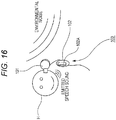
- Fig. 16 shows an example of a general earpiece microphone that is currently spread (hereinafter referred to as the conventional earpiece microphone 100).
- an earphone unit 101 for listening to received speech voice and a microphone 102A for collecting emitted speech voice are provided separately from each other.
- the earphone unit 101 is designed to be wearable in an ear of a wearer H, and includes a speaker for outputting received speech voice.
- an on-cord housing 102 is formed on the cord for transmitting signals to the earphone unit 101, and the microphone 102A is formed in this on-cord housing 102.
- the microphone 102A for collecting emitted speech voice is exposed to the outside. That is, the microphone 102A is in direct contact with extraneous noise (environmental noise).
- the conventional earpiece microphone 100 a relatively large amount of ambient noise is collected together with emitted speech voice, and the S/N ratio (signal-to-noise ratio) of emitted speech signals tends to become lower. As a result, it becomes difficult for the person at the other end of the line to hear the speech voice emitted from the wearer H.
- the noise reduction process involving nonlinear processing on the frequency axis according to the above mentioned SS method or the like normally has a problem of sound quality degradation after the processing.
- the present technique has been developed in view of the above problems, and aims to realize sound collection with a high S/N ratio by reducing noise influence without the noise reduction process.
- an earhole-wearable sound collection device has the following structure.
- the earhole-wearable sound collection device includes an attachment unit that is designed so that at least part of the attachment unit can be inserted into an earhole portion, and is designed to form a substantially sealed internal space therein when attached to the earhole portion, the internal space connecting to an ear canal.
- the earhole-wearable sound collection device also includes an internal microphone that is located in the internal space of the attachment unit, and collects speech voice that is emitted by the wearer and propagates through the ear canal when the attachment unit is attached to the earhole portion.
- the earhole-wearable sound collection device also includes either a low-frequency extraction filter unit that performs a filtering process on a sound collection signal from the internal microphone to extract a low-frequency component, or an equalizing unit that performs an equalizing process of a high-frequency emphasizing type on the sound collection signal from the internal microphone.
- a microphone (the internal microphone) that collects emitted speech voice is located in a space that is substantially sealed off from outside and connects to an ear canal of the wearer (the speaker). As the microphone is located in a space sealed off from outside, influence of noise can be effectively reduced. As emitted speech voice that propagates through an ear canal of the wearer is collected, the emitted speech voice can be collected at a higher S/N ratio than that in a case where a conventional earpiece microphone ( Fig. 16 ) is employed to collect speech voice that is emitted from the wearer and propagates in the external air.
- the low-frequency extraction filter unit extracts the low-frequency component of a sound collection signal generated by the internal microphone.
- the emitted speech voice component is dominant over the extraneous noise component particularly in the low-frequency band of the sound collection signal. Accordingly, with the above described filter unit, the S/N ratio of emitted speech voice collection signals can be further improved.
- the equalizing unit is employed according to the present technique.
- muffled voice to be generated when emitted speech voice propagating through an ear canal is collected is reduced, and the sound quality of emitted speech voice collection signals can be improved.
- emitted speech voice can be collected at a higher S/N ratio than that with a conventional earpiece microphone that collects emitted speech voice propagating through the external air.
- the noise reduction process for sound collection signals is unnecessary.
- an increase in the signal processing resource can be prevented, and advantages can be achieved in terms of production cost and power consumption.
- Fig. 1 is a diagram for explaining the structure of an attachment unit 1 included in a sound collection system as an embodiment according to the present technique.
- a of Fig. 1 is a perspective view of the attachment unit 1
- B of Fig. 1 is a cross-sectional view showing the relations between an ear canal HA and an earhole portion HB of the wearer H and the attachment unit 1 when the attachment unit 1 is attached to an ear of the wearer (the speaker) H.
- the attachment unit 1 has an internal microphone 1B provided therein to collect speech voice of the wearer (the speaker) H.
- the internal microphone 1B may be a MEMS (Micro Electro Mechanical Systems) microphone, with the installation space being taken into account.
- MEMS Micro Electro Mechanical Systems
- the external shape of the attachment unit 1 is designed so that at least part of the attachment unit 1 can be inserted into an earhole portion of the wearer H, and accordingly, the attachment unit 1 can be attached to an ear of the wearer H.
- the attachment unit 1 in this case includes an earhole insertion portion 1A having such a shape that can be inserted into the earhole portion HB of the wearer H, and the earhole insertion portion 1A is inserted into the earhole portion HB, so that the attachment unit 1 is attached to the ear of the wearer H.
- the attachment unit 1 is designed so that an internal space 1V connecting to the ear canal HA of the wearer H is formed as shown in B of Fig. 1 when the attachment unit 1 is attached to the wearer H.
- the earhole insertion portion 1A of the attachment unit 1 is covered with a material having elasticity in its surface portion like the earhole insertion portion of a canal-type earphone portion, so that contact with the earhole portion HB is achieved at the time of attachment.
- the above described internal space 1V becomes a space that is substantially sealed off from the outside.
- the internal microphone 1B is provided in this internal space 1V.
- Fig. 2 is a diagram schematically showing collection of speech voice by the sound collection system of an embodiment including the attachment unit 1.
- the sound collection system of this embodiment is based on the premise that collection of speech voice is performed while the attachment unit 1 is attached to an ear of the wearer H.
- the vibrations accompanying the speaking are transmitted to the ear canal HA from the vocal cords of the wearer H via bones and the skin (as indicated by an arrow with a dashed line).
- the internal space 1V of the attachment unit 1 having the internal microphone 1B provided therein connects to the ear canal HA, while being substantially sealed off from the outside. Accordingly, the speech voice obtained via the ear canal HA of the wearer H as described above can be collected by the internal microphone 1B.
- the sound insulation should be strong enough to cover at least the band of noise to be restrained, and, in that sense, completely hermetic sealing is not required.
- speech voice can be collected at a higher S/N ratio than that with the conventional earpiece microphone 100.
- the sealability is relatively high as in a case with a conventional canal-type earphone, for example, gain (response) in the ear canal HA becomes greater in lower bands than in a normal free space. Therefore, the sound collection signal generated by the internal microphone 1B has relatively high response characteristics in lower bands.
- transmitted speech voice based on the sound collection signal generated by the internal microphone 1B is muffled in the lower bands, and is difficult for the person at the other end of the line to hear.
- a signal processing means as an equalizer (EQ) as shown in A of Fig. 3 .
- a collection sound signal generated by the internal microphone 1B is amplified by the microphone amplifier 10, and an equalizing process (a characteristics correction process) is then performed by an equalizer 11.
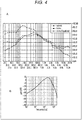
- Fig. 4 is a diagram for explaining specific frequency characteristics to be set in the equalizer 11.
- a of Fig. 4 shows the frequency characteristics of a sound collection signal obtained when a predetermined example conversation was collected by a microphone located outside the attachment unit 1 in a noise-free environment (the set of ⁇ marks and a dashed line), in contrast with the frequency characteristics of a sound collection signal obtained when the same example conversation was collected by the internal microphone 1B in the internal space 1V connecting to the ear canal HA in a noise-free environment (the set of ⁇ marks and a dot-and-dash line).
- the frequency characteristics shown in this drawing are temporally averaged on the frequency axis.
- the diaphragm of the internal microphone 1B has greater vibrations than those of the outside as a non-sealed environment when low-frequency acoustic waves and vibrations are caused in the ear canal HA by speaking. As a result, a higher microphone output voltage than that of the microphone located outside is obtained in the lower bands.
- the sound collection signal generated by the internal microphone 1B ( ⁇ & the dot-and-dash line) is actually higher in the lower bands than the sound collection signal generated by the microphone located outside (A & the dashed line).
- the speech voice transmitted to the person at the other end of the line is muffled, and becomes unclear and low. As a result, it might become difficult for the person at the other end to hear.
- the frequency characteristics of the sound collection signal generated by the internal microphone 1B are corrected to achieve a more natural frequency characteristics balance. In this manner, the clarity of the transmitted speech voice to be heard by the person at the other end is increased.
- the frequency characteristics of the sound collection signal generated by the internal microphone 1B need to approximate the frequency characteristics of the sound collection signal generated by the microphone located outside.
- a filter (or the equalizer 11) expressed by the transfer function shown in B of Fig. 4 is prepared, and the frequency characteristics of the sound collection signal of the internal microphone 1B are corrected by the filter. That is, the sound collection signal frequency characteristics of the internal microphone 1B are corrected by the equalizer 11 having high-frequency emphasizing (low-frequency suppressing) filter characteristics as shown in B of Fig. 4 .
- the set of ⁇ marks and a solid line indicates the frequency characteristics of the sound collection signal of the internal microphone 1B after correction performed by the equalizer 11 having the filter characteristics shown in B of Fig. 4 .
- the sound collection signal generated by the internal microphone 1B approximates the sound collection signal generated by the microphone located outside, and a more natural frequency characteristics balance is maintained.
- a noise gate processing unit 12 performs a noise gate process on the sound collection signal that has been generated by the internal microphone 1B and has passed through the microphone amplifier 10
- the equalizer 11 performs the characteristics correction on the sound collection signal.
- a compressor 13 then performs a compressor process on the sound collection signal transmitted via the equalizer 11.
- the noise gate processing unit 12 lowers the output signal level (or closes the gate) when the input signal level becomes equal to or lower than a certain level, and returns the output signal level to the original level (or opens the gate) when the input signal level becomes higher than the certain level.
- parameters such as the rate of attenuation of the output level, the open/close envelope of the gate, and the frequency bands to which the gate reacts, are appropriately set so that the clarity of speech voice will increase.
- the compressor 13 performs a process to adjust the temporal amplitude of the input sound collection signal.
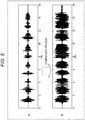
- FIG. 5 A of Fig. 5 shows the temporal waveform of a sound collection signal prior to the compressor process, and B of Fig. 5 shows the temporal waveform of the sound collection signal after the compressor process.
- the compressor process is performed to correct the waveform of the sound collection signal on the temporal axis.
- speech voice reaches the diaphragm of the internal microphone 1B via the ear canal HA by virtue of vibrations of the body such as flesh and bones of the wearer H, as described above.
- the speech voice has a certain level of nonlinearity, unlike speech voice that propagates through the external air.
- the difference in speech voice volume that varies depending on the voice volume at the time of speaking might become larger than that in a case where sound collection is performed through normal propagation in the external air, and, if not corrected, the collected voice might become difficult to hear.
- the difference in voice volume is larger between each two emitted sound groups.
- the compressor 13 then adjusts the temporal amplitude of the sound collection signal generated by the internal microphone 1B as shown in B of Fig. 5 . That is, the difference in emitted speech voice volume is reduced.
- the emitted speech voice becomes easier to hear, and sound quality is improved.
- the various kinds of signal processing on sound collection signals may be performed by an analog electrical circuit, or may be performed by digital signal processing via an ADC (A/D converter).
- ADC A/D converter
- sound collection via the ear canal HA as described above with reference to Fig. 2 is performed to achieve a higher S/N ratio from sound collection signals than in a case with the conventional earpiece microphone 100.
- a filtering process is performed on a sound collection signal generated by an internal microphone 1B, to extract the low-frequency component of the sound collection signal.
- the emitted speech voice component is dominant over the external noise component in the sound collection signal at lower frequencies.
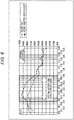
- Fig. 6 is a diagram for explaining this aspect, and shows the frequency characteristics of sound collection signals generated by the internal microphone 1B, including the frequency characteristics of a speech voice non-emitted portion in a normal noise environment (the set of ⁇ marks and a dashed line: noise only) and the frequency characteristics of a speech voice emitted portion (the set of ⁇ marks and a solid line: noise and emitted speech voice).
- the level of the signal generated in the case where noise and emitted speech voice were collected (the marks and the solid line) is higher than the level of the signal generated in the case where only noise was collected (the ⁇ marks and the dashed line) particularly at low frequencies. That is, in a case where emitted speech voice collection via the ear canal HA is performed with the internal microphone 1B, the emitted speech voice is dominant over the external noise particularly in the low-frequency band of the sound collection signal (shown as the internal microphone voice dominant band in the drawing). This is because the low-frequency gain of the sound collection component via the ear canal HA becomes larger as shown in A of Fig. 4 while the noise component is reduced particularly at low frequencies by virtue of the sealing and sound insulating functions derived from the structure of the attachment unit 1.
- the S/N ratio of emitted speech voice collection signals can be further improved by performing a filtering process on sound collection signals generated by the internal microphone 1B as described above, and extracting the low-frequency components of the sound collection signals (the components in the voice dominant band of the internal microphone 1B).
- Fig. 7 is a diagram showing an example configuration of a sound collection system as an embodiment (hereinafter referred to as the first embodiment) to further improve the S/N ratio through the above described low-frequency component filtering process.
- the sound collection system as the first embodiment is designed to include an attachment unit 1 and a signal processing unit 2.
- a speaker 1S for outputting received speech voice, as well as the internal microphone 1B, is provided in the internal space 1V of the attachment unit 1 in this case.
- the speaker 1S is of a BA (balanced armature) type, with its installation space being taken into account.
- the signal processing unit 2 includes not only a microphone amplifier 10, an equalizer 11, a noise gate processing unit 12, and a compressor 13, which have been described above, but also a LPF (low-pass filter) 14 and an amplifier 15.
- the LPF 14 is located between the microphone amplifier 10 and the noise gate processing unit 12, so as to perform a low-pass filtering process on a sound collection signal that has been generated by the internal microphone 1B and passed through the microphone amplifier 10.
- the cutoff frequency of the LPF 14 is appropriately set so as to extract the components in the "internal microphone voice dominant band" shown in Fig. 5 .
- a sound collection signal that has been generated by the internal microphone 1B and has passed through the compressor 13 is output as a transmitted speech signal to the outside of the signal processing unit 2 as shown in the drawing.
- a received speech signal is supplied to the signal processing unit 2 from the outside.
- the amplifier 15 amplifies the received speech signal, and drives the speaker 1S in the attachment unit 1 based on the amplified received speech signal. As a result, received speech voice in accordance with the received speech signal is output from the speaker 1S.
- the S/N ratio of emitted speech voice collection signals is secured by virtue of the (passive) sound insulating properties of the housing of the attachment unit 1 against environmental noise.
- the components in the speech voice dominant band are extracted by performing a low-pass filtering process on sound collection signals generated by the internal microphone 1B. Accordingly, the S/N ratio of emitted speech voice collection signals can be further improved.
- an effect to make hearing of received speech voice easier for the wearer H can be achieved by virtue of the sound insulating properties of the attachment unit 1.
- a specific configuration of the sound collection system of this embodiment including the signal processing unit 2 that realizes the above described filtering process for extracting speech voice dominant band components and the various kinds of signal processing (from the equalizer 11 to the compressor 13) for sound quality improvement may be of an "integrated type" having the signal processing unit 2 provided in the attachment unit 1, or of a “separated type” having the signal processing unit 2 provided outside the attachment unit 1.
- Fig. 8 is a diagram showing example configurations of the "integrated type" and the "separated type”.
- the configuration of the "integrated type" shown in A of Fig. 8 has the signal processing unit 2 provided in the housing of the attachment unit 1.
- a transmitted speech signal (or a sound collection signal that has been generated by the internal microphone 1B and has been subjected to the various kinds of signal processing by the signal processing unit 2) is transmitted from the attachment unit 1 to an external device 50 (an information processing device such as a smartphone). Meanwhile, a received speech signal is transmitted from the external device 50 to the attachment unit 1.
- the signal processing unit 2 is installed in the external device 50.
- a sound collection signal generated by the internal microphone 1 (the transmitted speech voice collection signal in the drawing) is transmitted from the attachment unit 1 to the external device 50.
- a received speech signal (the received speech voice output signal in the drawing) amplified by the amplifier 15 in the signal processing unit 2 is transmitted from the external device 50 to the attachment unit 1 (the speaker 1S).
- Fig. 9 is a diagram for explaining the configuration of a sound collection system as a second embodiment.
- the S/N ratio of emitted speech voice collection signals is to be further improved by a beam forming process using signals generated by collecting sound at both the right and left channels, and received speech voice is to be heard by both ears of the wearer H.
- a channel will be also referred to as "ch”.
- This embodiment is based on the premise that a received speech signal is normally monaural. Therefore, in the second embodiment, a system for both ears to hear the monaural received voice is suggested.
- the sound collection system of the second embodiment differs from the sound collection system of the first embodiment shown in Fig. 7 in that an attachment unit 3 is added, and a signal processing unit 20 is provided in place of the signal processing unit 2.
- the attachment unit 3 is to be attached to the ear on the opposite side from the ear to which the attachment unit 1 is attached.
- the attachment unit 3 is designed so that at least part of the attachment unit 3 can be inserted into an earhole portion HB of the wearer H, and accordingly, the attachment unit 3 can be attached to an ear of the wearer H.
- the attachment unit 3 also includes an earhole insertion portion 3A having such a shape that can be inserted into the earhole portion HB of the wearer H, and the earhole insertion portion 3A is inserted into the earhole portion HB, so that the attachment unit 3 is attached to the ear of the wearer H.
- the attachment unit 3 is also designed so that an internal space 3V connecting to the ear canal HA of the wearer H is formed when the attachment unit 3 is attached to the wearer H.
- the earhole insertion portion 3A is covered with a material having elasticity in its surface portion so that contact with the earhole portion HB is achieved at the time of attachment.
- An internal microphone 3B is provided in the internal space 3V of the attachment unit 3 as shown in the drawing.
- the internal microphone 3B is also a MEMS microphone.
- a speaker 3S is also provided in the internal space 3V of the attachment unit 3.
- the speaker S3 is also of the BA (balanced armature) type.
- the speaker 3S is driven based on a received speech signal amplified by an amplifier 15 provided in the signal processing unit 20.
- the output of the amplifier 15 is also supplied to the speaker 1S on the side of the attachment unit 1 as in the first embodiment, and, as a result, the received speech voice based on the received speech signal is output from both the side of the attachment unit 1 and the side of the attachment unit 3.
- the side of the attachment unit 1 is the Lch side
- the side of the attachment unit 2 is the Rch side
- the signal processing unit 20 differs from the signal processing unit 2 of the first embodiment in that a microphone amplifier 21 and a LPF 22 for the Rch side, and a beam forming unit 23 are added.
- the microphone amplifier 21 amplifies a sound collection signal generated by the internal microphone 3B on the side of the attachment unit 3.
- the LPF 22 uses the same cutoff frequency as that of the SPF 14, the LPF 22 performs a low-pass filtering process to extract the low-pass component as the above described speech voice dominant band from the sound collection signal generated by the internal microphone 3B. In this case, the LPF 22 performs a low-pass filtering process on the sound collection signal that has been generated by the internal microphone 3B and has been amplified by the microphone amplifier 21.
- the LPF 22 also improves the S/N ratio of sound collection signals generated by the internal microphone 3B.
- the beam forming unit 23 receives a sound collection signal (a Lch-side sound collection signal) that has been generated by the internal microphone 1B and has passed through the LPF 14 located on the Lch side, and a sound collection signal (a Rch-side sound collection signal) that has been generated by the internal microphone 3B and has passed through the LPF 22 located on the Rch side. The beam forming unit 23 then performs a beam forming process.
- a sound collection signal a Lch-side sound collection signal
- Rch-side sound collection signal a sound collection signal that has been generated by the internal microphone 3B and has passed through the LPF 22 located on the Rch side.
- the simplest specific example of the beam forming process using the Lch and Rch sound collection signals may be a process in which the Lch side sound collection signal is added to the Rch side sound collection signal.
- the internal microphone 1B that performs emitted speech voice collection on the Lch side and the internal microphone 3B that performs emitted speech voice collection on the Rch side are located at the same distance from the mouth (the vocal cords) of the wearer H as the source of the emitted speech voice. Accordingly, the sound coming from the direction of the source of the emitted speech voice (via the ear canal HA) can be efficiently extracted by adding the sound collection signals at the beam forming unit 23, and the sound coming from the other directions (noise components) can be suppressed. That is, the S/N ratio of emitted speech voice collection signals can be further improved.
- Specific example techniques that can be used in the beam forming process include not only the above described adding operation but also a technique of determining voice components coming from the direction of the sound source based on a result of sound analysis conducted on sound collection signals, and extracting only the voice components from the direction of the sound source based on the determination result.
- a process of determining dominant components in the sound collection signals may be performed as a specific process in the sound analysis.
- voice components coming from the direction of the sound source should be emphasized, and voice components coming from the other directions should be suppressed.
- a sound collection signal subjected to the beam forming process by the beam forming unit 23 is output as an emitted speech signal to the outside of the signal processing unit 20 via the noise gate processing unit 12, the equalizer 11, and the compressor 13.
- an improvement effect of the (passive) sound insulating properties of the housings of the attachment units 1 and 3, and an improvement effect of extraction of the emitted speech voice dominant area components by the LPFs 14 and 22 are achieved as an effect to improve the S/N ratio of emitted speech voice collection signals. Furthermore, a S/N ratio improvement effect can be achieved by a noise component reduction performed by the beam forming unit 23.
- a sound insulating effect is also achieved by the attachment unit 3. Accordingly, sound insulating effects can be achieved at both ears of the wearer H. As a result, hearing of received speech voice can be made easier than in the first embodiment.
- the signal processing for further improving the S/N ratio of emitted speech voice collection signals may be a noise reduction process according to a SS (Spectrum Subtraction) method, for example, as well as the aforementioned beam forming process.
- SS Spectrum Subtraction
- Reference Document 1 Japanese Patent Application Laid-Open No. 2010-11117
- the signal processing unit 20 can be provided in one of the attachment units 1 and 3. In that case, a sound collection signal generated by the internal microphone in the other attachment unit is input to the attachment unit in which the signal processing unit 20 is provided, and a received speech signal amplified by the amplifier 15 is input from the attachment unit to the other attachment unit.
- only the components (23, 12, 11, and 13) that come after the beam forming unit 23 may be provided in one of the attachment units 1 and 3 (in other words, only the microphone amplifier 21 and the LPF 22 among the components constituting the signal processing unit are provided in the attachment unit 3).
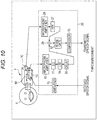
- Fig. 10 is a diagram showing the configuration of a sound collection system as a third embodiment.
- the sound collection system of the third embodiment differs from the sound collection system of the first embodiment in that an external microphone 1C is added to the attachment unit 1, and a signal processing unit 25 is provided in place of the signal processing unit 2.
- the external microphone 1C is a microphone that is installed to collect sound generated outside the housing of the attachment unit 1.
- the external microphone 1C is installed so that the sound collection port thereof is located on the surface of the housing of the attachment unit 1.
- the external microphone 1C is also a MEMS microphone, like the internal microphone 1B.
- the external microphone 1C is installed so as to collect sound that is generated outside the housing of the attachment unit 1, and the sound collection port thereof is not necessarily in direct contact with the outside of the housing of the attachment unit 1.
- the signal processing unit 25 differs from the signal processing unit 2 in further including a microphone amplifier 26, a HPF (high-pass filter) 27, a delay circuit ("DELAY" in the drawing) 28, and an adder 29.
- the microphone amplifier 26 amplifies a sound collection signal generated by the external microphone 1C.
- the HPF 27 performs a high-pass filtering process on a sound collection signal that has been generated by the external microphone 1C and has been amplified by the microphone amplifier 26.
- the delay circuit 28 is provided in the signal processing system (between the microphone amplifier 10 and the adder 29) for sound collection signals generated by the internal microphone 1B, and delays each sound collection signal generated by the internal microphone 1B by a predetermined amount of time.
- the delay circuit 28 is provided between the LPF 14 and the adder 29, and delays a sound collection signal that has been generated by the internal microphone 1B and has passed through the LPF 14 by the predetermined amount of time.
- the adder 29 is provided so as to add a sound collection signal that has been generated by the internal microphone 1B and has been subjected to a low-pass filtering process by the LPF 14, to a sound collection signal that has been generated by the external microphone 1C and has been subjected to a high-pass filtering process by the HPF 27.
- the adder 29 in this case is provided in the position where an output signal from the delay circuit 28 is added to an output signal from the HPF 27.
- the combined signal generated by the adder 29 passes through the noise gate processing unit 12 and the compressor 13, and is then output as an emitted speech signal to the outside of the signal processing unit 25.
- the equalizer or the equalizing filter for suppressing an increase in the low-frequency band (muffled sound) due to sound collection performed by the internal microphone 1B through the ear canal HA should function only for the side of sound collection signals generated by the internal microphone 1B, and is located in an earlier stage than the adder 29 (or in an earlier stage than the combination with an output of the HPF 27).
- the equalizer 11 in this example is located between the microphone amplifier 10 and the LPF 14, and is designed to perform an equalizing process on a sound collection signal that has been generated by the internal microphone 1B and has been amplified by the microphone amplifier 10.
- the external microphone 1C is provided for the attachment unit 1, and a signal generated by performing a high-pass filtering process of the HPF 27 on a sound collection signal generated by the external microphone 1C is added, by the adder 29, to a sound collection signal that has been generated by the internal microphone 1B and has passed through the LPF 14.
- the external microphone 1C collects speech voice emitted from the mouth of the wearer H through the outside (the external air). At the same time, the external microphone 1C collects environmental noise.
- the HPF 27 performs a high-pass filtering process on a sound collection signal generated by the external microphone 1C, because the emitted speech voice component in the sound collection signal generated by the external microphone 1C is dominant over the noise component at mid and high frequencies (in the mid- and high-frequency bands), which is the opposite of the case with a sound collection signal generated by the internal microphone 1B.
- Fig. 11 is a diagram for explaining this aspect.
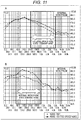
- a of Fig. 11 shows the frequency characteristics of sound collection signals generated by the external microphone 1C, including the frequency characteristics of a speech voice non-emitted portion in a normal noise environment (the set of ⁇ marks and a dashed line: noise only) and the frequency characteristics of a speech voice emitted portion (the set of ⁇ marks and a solid line: noise and emitted speech voice).
- B of Fig. 11 shows the frequency characteristics of sound collection signals generated by the internal microphone 1B, including the frequency characteristics of a speech voice non-emitted portion in a normal noise environment (the set of ⁇ marks and a dashed line: noise only) and the frequency characteristics of a speech voice emitted portion (the set of ⁇ marks and a solid line: noise and emitted speech voice), which are the same as those shown in Fig. 6 .
- a of Fig. 11 is the result of a case where the same voice sequence as that in the case of B of Fig. 11 ( Fig. 6 ) was emitted.
- the level of the signal generated in the case where only noise was collected is substantially the same as the level of the signal generated in the case where noise and emitted speech voice were collected (the ⁇ marks and the solid line) at low frequencies.
- the level of the signal generated in the case where noise and emitted speech voice were collected is higher than the level of the signal generated in the case where only noise was collected.
- the low-frequency component of actual noise such as noise in the cabin of an airplane (the ⁇ marks and the dashed line) is normally very large, and the level of the noise tends to become lower at high frequencies. Therefore, in sound collection by the external microphone 1C, emitted speech voice components tend to be dominant over noise components at mid and high frequencies.
- the mid- and high-frequency components in speech voice emitted by the wearer H can be extracted at a relatively high S/N ratio by performing a high-pass filtering process on a sound collection signal of the external microphone 1C in the above described configuration as the third embodiment.
- the adder 29 adds a sound collection signal that has passed through the HPF 27, to a sound collection signal that has passed through the LPF 14. That is, the band in which emitted speech voice is dominant is selected for each of the output signals from the external and internal sound collection microphones, and the components in the selected bands are combined.
- usable information not only in the low-frequency band but also in the mid- and high-frequency bands of emitted speech voice can be added as an emitted speech voice collection signal, and as a result, the person at the other end of the line can hear emitted speech voice with higher sound quality.
- cutoff frequency of the HPF 27 is appropriately set so that the components in the mid- and high-frequency voice dominant bands shown in A of Fig. 11 can be extracted.
- the delay circuit 28 is provided to delay a sound collection signal generated by the internal microphone 1B with respect to a sound collection signal generated by the external microphone 1C. This delay is intended to eliminate the difference in emitted speech voice arrival time due to the difference in installation position between the internal microphone 1B and the external microphone 1C.
- a delay time equivalent to the time difference between the arrival time of emitted speech voice of the wearer H to the internal microphone 1B and the arrival time of the emitted speech voice to the external microphone 1C is set in the delay circuit 28. Accordingly, it is possible to suppress sound quality degradation that might occur in a case where the distance between the internal microphone 1B and the external microphone 1C is relatively long, and the above mentioned difference in arrival time is relatively large.
- a delay time of approximately 30 ⁇ sec should be set, with the speed of sound being approximately 340 m/sec.
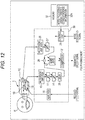
- Fig. 12 is a diagram showing the configuration of a sound collection system as a fourth embodiment.
- the processing properties of each signal processing unit to improve the S/N ratio and sound quality are made variable, and switching of the processing characteristics is enabled where necessary, so as to realize an appropriate improvement process that reflects an extraneous noise state and an intention of a user (the wearer H), for example.
- the fourth embodiment to be described below with reference to Fig. 12 is to switch processing characteristics of the respective components in accordance with a user operation.
- the sound collection system in this case differs from the above described sound collection system of the third embodiment ( Fig. 10 ) in that a signal processing unit 30 is provided in place of the signal processing unit 25. Also, a memory 32 is newly added.
- the signal processing unit 30 differs from the signal processing unit 25 in that the processing characteristics of the equalizer 11, the LPF 14, the HPF 27, the noise gate processing unit 12, and the compressor 13 are made variable.
- the above components having variable processing characteristics will be referred to as an equalizer 11', a LPF 14', a HPF 27', a noise gate processing unit 12', and a compressor 13', as shown in the drawing.
- a control unit 31 is further provided in the signal processing unit 30.
- the control unit 31 controls switching of the processing characteristics of the equalizer 11', the LPF 14', the HPF 27', the noise gate processing unit 12', and the compressor 13'.
- a mode designation signal is input from outside to the control unit 31 in this case.
- This mode designation signal serves as a signal indicating the type of a processing mode that is selected in accordance with a user operation.
- the memory 32 is a storage device that can be read by the control unit 31.
- the memory 32 stores mode-processing characteristics correspondence information 32A in which the information about the respective modes to be designated by the mode designation signal is associated with the information about the processing characteristics (hereinafter referred to as the processing characteristics information) to be set in the respective components (the equalizer 11', the LPF 14', the HPF 27', the noise gate processing unit 12', and the compressor 13') that have the processing characteristics varying with the modes.
- the parameter information required for changing the processing characteristics of the respective components is stored as the processing characteristics information.
- the control unit 31 reads the processing characteristics information in accordance with the characteristics indicated by the mode designation signal, and changes the processing characteristics of the respective components having the processing characteristics that can vary with the processing characteristics information.
- the S/N ratio and sound quality can be improved in an appropriate processing mode that reflects an intension of the user in accordance with the extraneous noise state or the like.
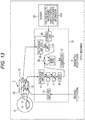
- Fig. 13 is a diagram showing the configuration of a sound collection system as the fifth embodiment.
- processing characteristics are automatically switched based on a result of a sound analysis on the extraneous noise state, regardless of user operations.
- the sound collection system of the fifth embodiment differs from the sound collection system of the fourth embodiment in that a signal processing unit 35 is provided in place of the signal processing unit 30, and the memory 32 stores analysis results-processing characteristics correspondence information 32B, instead of the mode-processing characteristics correspondence information 32A.
- the signal processing unit 35 differs from the signal processing unit 30 of the fourth embodiment in that a control unit 36 is provided in place of the control unit 31.
- the control unit 36 performs a sound analysis process on extraneous noise based on a sound collection signal generated by the external microphone 1C, and switches the processing characteristics of the equalizer 11', the LPF 14', the HPF 27', the noise gate processing unit 12', and the compressor 13' based on a result of the analysis and the information contents of the analysis results-processing characteristics correspondence information 32B.
- a sound collection signal that has been generated by the external microphone 1C and has not yet been input to the microphone amplifier 26 is input to the control unit 36.
- the information indicating the results that can be obtained as the results (equivalent to the types of noise states) of the analysis conducted by the control unit 36 is associated with the processing characteristics information indicating the processing characteristics to be set in the respective components having the processing characteristics that can vary with the results of the analysis.
- control unit 36 Based on a result of the analysis on extraneous noise, the control unit 36 reads the corresponding processing characteristics information from the analysis results-processing characteristics correspondence information 32B, and changes the processing characteristics of the respective components having the variable processing characteristics in accordance with the read processing characteristics information.
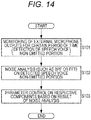
- Fig. 14 is a flowchart showing the specific procedures in a process to be performed by the control unit 36.
- step S101 in Fig. 14 external microphone outputs are monitored for a certain period of time. Specifically, by this monitoring process, a speech voice non-emitted portion (a speech voice non-emitted period) is detected from a sound collection signal generated by the external microphone 1C.
- a speech voice non-emitted portion is detected by monitoring microphone outputs for a certain period of time and extracting a low-level period among them as the speech voice non-emitted portion.
- step S102 a noise analysis is conducted on the detected speech voice non-emitted portion. Specifically, a frequency analysis is conducted on the portion of the sound collection signal detected as the speech voice non-emitted portion by the processing in step S101.
- the frequency analysis in step S102 can be realized by using a BPF (band-pass filter), FFT (fast Fourier transform), or the like.
- step S102 parameter control is performed in step S103 on the respective components based on a result of the noise analysis. Specifically, the processing characteristics of the respective components having variable processing characteristics as described above are switched based on the result of the noise analysis conducted in step S102 and the information contents of the analysis results-processing characteristics correspondence information 32B in the memory 32.
- emitted speech voice can be collected appropriately at a high S/N ratio and with high sound quality, even if the type of noise changes in the surroundings of the user.
- Fig. 15 is a diagram showing the configuration of a sound collection system as a sixth embodiment.
- the sixth embodiment relates to a combination of a S/N and sound quality improvement technique using an external microphone and a HPF as described above in the third embodiment, and a S/N and sound quality improvement technique using a beam forming process as described above in the second embodiment.
- the side of the attachment unit 1 corresponds to the Lch side
- the side of the attachment unit 3 corresponds to the Rch side, as in the second embodiment.
- the sound collection system of the sixth embodiment differs from the sound collection system of the second embodiment in that an external microphone 1C is added to the attachment unit 1, an external microphone 3C is added to the attachment unit 3, and a signal processing unit 40 is provided in the place of the signal processing unit 20.
- the external microphone 3C is installed so as to directly collect sound that is generated outside the housing in the same manner as on the side of the attachment unit 1.
- the external microphone 3C is also a MEMS microphone.
- the configuration of the Lch side of the signal processing unit 40 is the same as that of the signal processing unit 25 of the third embodiment. Specifically, a microphone amplifier 10, an equalizer 11, a LPF 14, and a delay circuit 28 are provided for sound collection signals generated by the internal microphone 1B, and a microphone amplifier 26 and a HPF 27 are provided for sound collection signals generated by the external microphone 1C. An adder 29 then adds sound collection signals transmitted via the respective components.
- the Rch side has the same configuration as the above described configuration of the Lch side. Specifically, a microphone amplifier 21, an equalizer 43, a LPF 22, and a delay circuit 44 are provided for sound collection signals generated by the internal microphone 3B, and a microphone amplifier 41 and a HPF 42 are provided for sound collection signals generated by the external microphone 3C. An adder 45 then adds sound collection signals transmitted via the respective components.
- the filter characteristics of the equalizer 43, the cutoff frequency of the HPF 42, and the delay time of the delay circuit 44 provided on the Rch side may be basically the same as those of the equalizer 11, the HPF 27, and the delay circuit 28, respectively, as long as the attachment unit 1 and the attachment unit 3 have symmetrical configurations.
- An amplifier 15 is also provided in the signal processing unit 40.
- a monaural received speech signal amplified by the amplifier 15 is supplied to both a speaker 1S and a speaker 3S, as in the second embodiment.
- a beam forming unit 23 a noise gate processing unit 12, and a compressor 13 are provided in the signal processing unit 40, as in the second embodiment.
- the beam forming unit 23 in this case performs a beam forming process based on a Lch-side sound collection signal obtained by the adder 29 and a Rch-side sound collection signal obtained by the adder 45.
- a LPF and a HPF are used for extracting the voice dominant band components of respective sound collection signals generated by an internal microphone and an external microphone in the above descriptions.
- a band-limiting filter such as a BPF may be used for the extraction.
- a low-frequency extraction filter unit for extracting the voice dominant band components of sound collection signals generated by an internal microphone, and an equalizing unit for reducing muffled sound are both employed.
- an equalizing unit for reducing muffled sound is employed.
- at least one of those two units should be employed.
- a sound collection system is used for telephone calls.
- the present technique can be suitably applied to a system for recording collected speech signals.
- the beam forming unit 23 may be excluded from the configuration shown in Fig. 15 , for example, and the output of the adder 29 and the output of the adder 45 may be output independently of each other, for example.
- a noise gate processing unit 12 and a compressor 13 may be provided for each of the output of the adder 29 and the output of the adder 45, so that sound quality is further improved for each of the Lch transmitted speech signal and the Rch transmitted speech signal.
- the speakers 1S and 3S are of the BA type, but speakers of a dynamic type or a capacitor type may be used instead.
- the internal microphones 1B and 3B and the external microphones 1C and 3C are not particularly limited to certain types, either.
- the present technique can also be embodied in the following structures.
Landscapes
- Engineering & Computer Science (AREA)
- Physics & Mathematics (AREA)
- Acoustics & Sound (AREA)
- Signal Processing (AREA)
- Health & Medical Sciences (AREA)
- Otolaryngology (AREA)
- Human Computer Interaction (AREA)
- Computational Linguistics (AREA)
- Multimedia (AREA)
- Audiology, Speech & Language Pathology (AREA)
- Manufacturing & Machinery (AREA)
- General Health & Medical Sciences (AREA)
- Quality & Reliability (AREA)
- Circuit For Audible Band Transducer (AREA)
- Details Of Audible-Bandwidth Transducers (AREA)
- Headphones And Earphones (AREA)
- Soundproofing, Sound Blocking, And Sound Damping (AREA)
Applications Claiming Priority (2)
| Application Number | Priority Date | Filing Date | Title |
|---|---|---|---|
| JP2011268782A JP6069830B2 (ja) | 2011-12-08 | 2011-12-08 | 耳孔装着型収音装置、信号処理装置、収音方法 |
| EP12854783.3A EP2790416B1 (en) | 2011-12-08 | 2012-11-30 | Earhole attachment-type sound pickup device, signal processing device, and sound pickup method |
Related Parent Applications (2)
| Application Number | Title | Priority Date | Filing Date |
|---|---|---|---|
| EP12854783.3A Division-Into EP2790416B1 (en) | 2011-12-08 | 2012-11-30 | Earhole attachment-type sound pickup device, signal processing device, and sound pickup method |
| EP12854783.3A Division EP2790416B1 (en) | 2011-12-08 | 2012-11-30 | Earhole attachment-type sound pickup device, signal processing device, and sound pickup method |
Publications (1)
| Publication Number | Publication Date |
|---|---|
| EP3291574A1 true EP3291574A1 (en) | 2018-03-07 |
Family
ID=48574178
Family Applications (2)
| Application Number | Title | Priority Date | Filing Date |
|---|---|---|---|
| EP17194727.8A Withdrawn EP3291574A1 (en) | 2011-12-08 | 2012-11-30 | Earhole-wearable sound collection device, signal processing device, and sound collection method |
| EP12854783.3A Not-in-force EP2790416B1 (en) | 2011-12-08 | 2012-11-30 | Earhole attachment-type sound pickup device, signal processing device, and sound pickup method |
Family Applications After (1)
| Application Number | Title | Priority Date | Filing Date |
|---|---|---|---|
| EP12854783.3A Not-in-force EP2790416B1 (en) | 2011-12-08 | 2012-11-30 | Earhole attachment-type sound pickup device, signal processing device, and sound pickup method |
Country Status (5)
| Country | Link |
|---|---|
| US (5) | US9237392B2 (enExample) |
| EP (2) | EP3291574A1 (enExample) |
| JP (1) | JP6069830B2 (enExample) |
| CN (1) | CN103959813B (enExample) |
| WO (1) | WO2013084810A1 (enExample) |
Families Citing this family (30)
| Publication number | Priority date | Publication date | Assignee | Title |
|---|---|---|---|---|
| US11291456B2 (en) | 2007-07-12 | 2022-04-05 | Staton Techiya, Llc | Expandable sealing devices and methods |
| US8600067B2 (en) | 2008-09-19 | 2013-12-03 | Personics Holdings Inc. | Acoustic sealing analysis system |
| JP2012517865A (ja) | 2009-02-13 | 2012-08-09 | パーソニクス ホールディングス インコーポレイテッド | 耳栓およびポンピングシステム |
| JP5919686B2 (ja) | 2011-08-31 | 2016-05-18 | ソニー株式会社 | 音響再生装置 |
| JP6019553B2 (ja) | 2011-08-31 | 2016-11-02 | ソニー株式会社 | イヤホン装置 |
| US10070211B2 (en) * | 2013-06-28 | 2018-09-04 | Kopin Corporation | Digital voice processing method and system for headset computer |
| TWI563856B (en) * | 2014-02-27 | 2016-12-21 | Merry Electronics Co Ltd | Mobile device and corresponding noise-canceling earphone |
| CN105100985B (zh) * | 2014-05-07 | 2019-01-18 | 钰太芯微电子科技(上海)有限公司 | 多个麦克风共享同一模拟总线的耳机装置 |
| KR102475869B1 (ko) * | 2014-10-01 | 2022-12-08 | 삼성전자주식회사 | 잡음이 포함된 오디오 신호를 처리하는 방법 및 장치 |
| US9905216B2 (en) * | 2015-03-13 | 2018-02-27 | Bose Corporation | Voice sensing using multiple microphones |
| CN106454567A (zh) * | 2015-08-10 | 2017-02-22 | 固昌通讯股份有限公司 | 耳机麦克风 |
| KR101731714B1 (ko) * | 2015-08-13 | 2017-04-28 | 중소기업은행 | 음질 개선을 위한 방법 및 헤드셋 |
| CN105516854A (zh) * | 2015-11-24 | 2016-04-20 | 宁波柏人艾电子有限公司 | 一种音箱的信号处理电路 |
| EP3188507A1 (en) * | 2015-12-30 | 2017-07-05 | GN Resound A/S | A head-wearable hearing device |
| US10586552B2 (en) | 2016-02-25 | 2020-03-10 | Dolby Laboratories Licensing Corporation | Capture and extraction of own voice signal |
| JP6094844B1 (ja) * | 2016-03-14 | 2017-03-15 | 合同会社ディメンションワークス | 音響再生装置、音響再生方法、及びプログラム |
| WO2017197156A1 (en) * | 2016-05-11 | 2017-11-16 | Ossic Corporation | Systems and methods of calibrating earphones |
| WO2018163423A1 (ja) * | 2017-03-10 | 2018-09-13 | ヤマハ株式会社 | ヘッドフォン |
| CN108574459B (zh) * | 2017-03-14 | 2022-04-01 | 南京理工大学 | 一种高效时域宽带波束形成电路及方法 |
| US10483931B2 (en) * | 2017-03-23 | 2019-11-19 | Yamaha Corporation | Audio device, speaker device, and audio signal processing method |
| EP3422736B1 (en) * | 2017-06-30 | 2020-07-29 | GN Audio A/S | Pop noise reduction in headsets having multiple microphones |
| DE102018204687B3 (de) * | 2018-03-27 | 2019-06-13 | Infineon Technologies Ag | MEMS Mikrofonmodul |
| US10516934B1 (en) * | 2018-09-26 | 2019-12-24 | Amazon Technologies, Inc. | Beamforming using an in-ear audio device |
| CN110164425A (zh) * | 2019-05-29 | 2019-08-23 | 北京声智科技有限公司 | 一种降噪方法、装置及可实现降噪的设备 |
| US20210287674A1 (en) * | 2020-03-16 | 2021-09-16 | Knowles Electronics, Llc | Voice recognition for imposter rejection in wearable devices |
| JP7567212B2 (ja) * | 2020-05-29 | 2024-10-16 | 株式会社Jvcケンウッド | 音声入力装置及び入力音声処理方法 |
| US20240257828A1 (en) * | 2021-05-31 | 2024-08-01 | Sony Group Corporation | Signal processing apparatus, signal processing method, and program |
| CN113542960B (zh) * | 2021-07-13 | 2023-07-14 | RealMe重庆移动通信有限公司 | 音频信号处理方法、系统、装置、电子设备和存储介质 |
| CN115942190A (zh) * | 2021-10-05 | 2023-04-07 | 深圳市美格信测控技术有限公司 | 基于仿真头架装置的模拟耳道内出声的enc降噪方法及系统 |
| JP7715222B1 (ja) | 2024-02-07 | 2025-07-30 | 沖電気工業株式会社 | 収音装置、収音プログラム及び収音方法 |
Citations (6)
| Publication number | Priority date | Publication date | Assignee | Title |
|---|---|---|---|---|
| WO2007147049A2 (en) * | 2006-06-14 | 2007-12-21 | Think-A-Move, Ltd. | Ear sensor assembly for speech processing |
| WO2008137870A1 (en) * | 2007-05-04 | 2008-11-13 | Personics Holdings Inc. | Method and device for acoustic management control of multiple microphones |
| EP2088802A1 (en) * | 2008-02-07 | 2009-08-12 | Oticon A/S | Method of estimating weighting function of audio signals in a hearing aid |
| US20090220096A1 (en) * | 2007-11-27 | 2009-09-03 | Personics Holdings, Inc | Method and Device to Maintain Audio Content Level Reproduction |
| JP4352932B2 (ja) | 2004-02-26 | 2009-10-28 | ソニー株式会社 | マイクロホン装置 |
| JP2010011117A (ja) | 2008-06-27 | 2010-01-14 | Sony Corp | ノイズ低減音声再生装置およびノイズ低減音声再生方法 |
Family Cites Families (33)
| Publication number | Priority date | Publication date | Assignee | Title |
|---|---|---|---|---|
| US3270146A (en) * | 1963-03-14 | 1966-08-30 | Motorola Inc | Hearing aid |
| DE7918029U1 (de) * | 1979-06-22 | 1980-12-04 | Siemens Ag, 1000 Berlin Und 8000 Muenchen | Kleinhoergeraet |
| US4471490A (en) * | 1983-02-16 | 1984-09-11 | Gaspare Bellafiore | Hearing aid |
| US4611887A (en) | 1983-02-24 | 1986-09-16 | Amp Incorporated | Fiber optic connector assembly and wall outlet thereof |
| US4622440A (en) * | 1984-04-11 | 1986-11-11 | In Tech Systems Corp. | Differential hearing aid with programmable frequency response |
| US5225836A (en) * | 1988-03-23 | 1993-07-06 | Central Institute For The Deaf | Electronic filters, repeated signal charge conversion apparatus, hearing aids and methods |
| JPH05333899A (ja) | 1992-05-29 | 1993-12-17 | Fujitsu Ten Ltd | 音声入力装置、音声認識装置および警報発生装置 |
| JP2835009B2 (ja) | 1995-02-03 | 1998-12-14 | 岩崎通信機株式会社 | 骨導気導複合型イヤーマイクロホン装置 |
| JPH08223677A (ja) | 1995-02-15 | 1996-08-30 | Nippon Telegr & Teleph Corp <Ntt> | 送話器 |
| AU740473B2 (en) * | 1997-04-16 | 2001-11-08 | Emma Mixed Signal C.V. | Apparatus for and method of programming a digital hearing aid |
| US6240192B1 (en) * | 1997-04-16 | 2001-05-29 | Dspfactory Ltd. | Apparatus for and method of filtering in an digital hearing aid, including an application specific integrated circuit and a programmable digital signal processor |
| US6236731B1 (en) * | 1997-04-16 | 2001-05-22 | Dspfactory Ltd. | Filterbank structure and method for filtering and separating an information signal into different bands, particularly for audio signal in hearing aids |
| US5991419A (en) * | 1997-04-29 | 1999-11-23 | Beltone Electronics Corporation | Bilateral signal processing prosthesis |
| US6295364B1 (en) * | 1998-03-30 | 2001-09-25 | Digisonix, Llc | Simplified communication system |
| US6353671B1 (en) * | 1998-02-05 | 2002-03-05 | Bioinstco Corp. | Signal processing circuit and method for increasing speech intelligibility |
| JP2000261534A (ja) * | 1999-03-10 | 2000-09-22 | Nippon Telegr & Teleph Corp <Ntt> | 送受話器 |
| JP4772262B2 (ja) | 2000-06-05 | 2011-09-14 | フーバー ウント ズーナー アーゲー | 光学的プラグコネクタの組立のための方法,この方法を実施するための装置及びこのような方法における使用のためのプラグコネクタ |
| JP2002125298A (ja) | 2000-10-13 | 2002-04-26 | Yamaha Corp | マイク装置およびイヤホンマイク装置 |
| DE10110258C1 (de) * | 2001-03-02 | 2002-08-29 | Siemens Audiologische Technik | Verfahren zum Betrieb eines Hörhilfegerätes oder Hörgerätesystems sowie Hörhilfegerät oder Hörgerätesystem |
| US6504848B1 (en) | 2001-06-13 | 2003-01-07 | Interdigital Communications Corporation | Binary-tree method and system for multiplexing scheduling |
| JP2003264883A (ja) * | 2002-03-08 | 2003-09-19 | Denso Corp | 音声処理装置および音声処理方法 |
| WO2003076997A1 (de) | 2002-03-14 | 2003-09-18 | Huber + Suhner Ag | Faseroptisches steckverbindersystem |
| US7290941B2 (en) | 2003-12-23 | 2007-11-06 | Amphenol Corporation | Modular fiber optic connector system |
| US7936890B2 (en) * | 2006-03-28 | 2011-05-03 | Oticon A/S | System and method for generating auditory spatial cues |
| JP4678349B2 (ja) | 2006-08-31 | 2011-04-27 | ヤマハ株式会社 | 通話判定装置 |
| EP2095678A1 (en) * | 2006-11-24 | 2009-09-02 | Rasmussen Digital APS | Signal processing using spatial filter |
| JP4928922B2 (ja) * | 2006-12-01 | 2012-05-09 | 株式会社東芝 | 情報処理装置、およびプログラム |
| JP2009141698A (ja) * | 2007-12-06 | 2009-06-25 | Rohm Co Ltd | ヘッドセット |
| US20090147982A1 (en) | 2007-12-06 | 2009-06-11 | Rohm Co., Ltd. | Headphone set and headphone cable |
| JP2010147982A (ja) * | 2008-12-22 | 2010-07-01 | Hosiden Corp | リモコン付きステレオイヤホンマイク |
| JP5499633B2 (ja) | 2009-10-28 | 2014-05-21 | ソニー株式会社 | 再生装置、ヘッドホン及び再生方法 |
| US8515109B2 (en) * | 2009-11-19 | 2013-08-20 | Gn Resound A/S | Hearing aid with beamforming capability |
| US8594353B2 (en) * | 2010-09-22 | 2013-11-26 | Gn Resound A/S | Hearing aid with occlusion suppression and subsonic energy control |
-
2011
- 2011-12-08 JP JP2011268782A patent/JP6069830B2/ja not_active Expired - Fee Related
-
2012
- 2012-11-30 WO PCT/JP2012/081054 patent/WO2013084810A1/ja not_active Ceased
- 2012-11-30 EP EP17194727.8A patent/EP3291574A1/en not_active Withdrawn
- 2012-11-30 CN CN201280058984.8A patent/CN103959813B/zh not_active Expired - Fee Related
- 2012-11-30 EP EP12854783.3A patent/EP2790416B1/en not_active Not-in-force
- 2012-11-30 US US14/360,948 patent/US9237392B2/en not_active Expired - Fee Related
-
2016
- 2016-01-11 US US14/992,906 patent/US9918162B2/en active Active
-
2018
- 2018-01-30 US US15/883,667 patent/US11070910B2/en active Active
-
2021
- 2021-06-04 US US17/303,673 patent/US11765497B2/en active Active
-
2023
- 2023-08-08 US US18/446,275 patent/US12501208B2/en active Active
Patent Citations (6)
| Publication number | Priority date | Publication date | Assignee | Title |
|---|---|---|---|---|
| JP4352932B2 (ja) | 2004-02-26 | 2009-10-28 | ソニー株式会社 | マイクロホン装置 |
| WO2007147049A2 (en) * | 2006-06-14 | 2007-12-21 | Think-A-Move, Ltd. | Ear sensor assembly for speech processing |
| WO2008137870A1 (en) * | 2007-05-04 | 2008-11-13 | Personics Holdings Inc. | Method and device for acoustic management control of multiple microphones |
| US20090220096A1 (en) * | 2007-11-27 | 2009-09-03 | Personics Holdings, Inc | Method and Device to Maintain Audio Content Level Reproduction |
| EP2088802A1 (en) * | 2008-02-07 | 2009-08-12 | Oticon A/S | Method of estimating weighting function of audio signals in a hearing aid |
| JP2010011117A (ja) | 2008-06-27 | 2010-01-14 | Sony Corp | ノイズ低減音声再生装置およびノイズ低減音声再生方法 |
Also Published As
| Publication number | Publication date |
|---|---|
| CN103959813A (zh) | 2014-07-30 |
| US11070910B2 (en) | 2021-07-20 |
| US20230388703A1 (en) | 2023-11-30 |
| US20220103936A1 (en) | 2022-03-31 |
| US20160127825A1 (en) | 2016-05-05 |
| US11765497B2 (en) | 2023-09-19 |
| US9918162B2 (en) | 2018-03-13 |
| JP6069830B2 (ja) | 2017-02-01 |
| US12501208B2 (en) | 2025-12-16 |
| EP2790416B1 (en) | 2017-11-15 |
| EP2790416A1 (en) | 2014-10-15 |
| EP2790416A4 (en) | 2015-07-29 |
| WO2013084810A1 (ja) | 2013-06-13 |
| US20140321688A1 (en) | 2014-10-30 |
| CN103959813B (zh) | 2018-11-16 |
| JP2013121106A (ja) | 2013-06-17 |
| US9237392B2 (en) | 2016-01-12 |
| US20180176681A1 (en) | 2018-06-21 |
Similar Documents
| Publication | Publication Date | Title |
|---|---|---|
| US12501208B2 (en) | Earhole-wearable sound collection device, signal processing device, and sound collection method | |
| US9361902B2 (en) | Earhole-wearable sound collection device, signal processing device, and sound collection method | |
| JP6315046B2 (ja) | 耳孔装着型収音装置、信号処理装置、収音方法 | |
| JP6017825B2 (ja) | 特に「ハンズフリー」電話システム向けの近接音声信号を雑音除去するための手段を有するマイクロホンとイヤホンの組合せ型のオーディオ・ヘッドセット | |
| US9094749B2 (en) | Head-mounted sound capture device | |
| US9949048B2 (en) | Controlling own-voice experience of talker with occluded ear | |
| US8675884B2 (en) | Method and a system for processing signals | |
| US9491542B2 (en) | Automatic sound pass-through method and system for earphones | |
| US20160086594A1 (en) | Noise reduction audio reproducing device and noise reduction audio reproducing methods | |
| US9398366B2 (en) | Handset and headset | |
| CN107396223B (zh) | 耳机上行降噪方法 | |
| JP6197930B2 (ja) | 耳孔装着型収音装置、信号処理装置、収音方法 | |
| CN109729463A (zh) | 用于脖戴式语音交互耳机的声麦骨麦复合收音装置 |
Legal Events
| Date | Code | Title | Description |
|---|---|---|---|
| PUAI | Public reference made under article 153(3) epc to a published international application that has entered the european phase |
Free format text: ORIGINAL CODE: 0009012 |
|
| 17P | Request for examination filed |
Effective date: 20171004 |
|
| AC | Divisional application: reference to earlier application |
Ref document number: 2790416 Country of ref document: EP Kind code of ref document: P |
|
| AK | Designated contracting states |
Kind code of ref document: A1 Designated state(s): AL AT BE BG CH CY CZ DE DK EE ES FI FR GB GR HR HU IE IS IT LI LT LU LV MC MK MT NL NO PL PT RO RS SE SI SK SM TR |
|
| RIC1 | Information provided on ipc code assigned before grant |
Ipc: H04R 1/40 20060101ALI20190730BHEP Ipc: H04R 3/00 20060101ALI20190730BHEP Ipc: G10L 21/0232 20130101ALN20190730BHEP Ipc: H04R 3/04 20060101ALI20190730BHEP Ipc: G10L 25/84 20130101ALN20190730BHEP Ipc: H04R 11/02 20060101ALN20190730BHEP Ipc: H04R 25/00 20060101ALN20190730BHEP Ipc: H04R 1/10 20060101AFI20190730BHEP |
|
| 17Q | First examination report despatched |
Effective date: 20190930 |
|
| STAA | Information on the status of an ep patent application or granted ep patent |
Free format text: STATUS: THE APPLICATION IS DEEMED TO BE WITHDRAWN |
|
| 18D | Application deemed to be withdrawn |
Effective date: 20201120 |