EP3290531A1 - Séquençage d'acide nucléique assisté par particules - Google Patents
Séquençage d'acide nucléique assisté par particules Download PDFInfo
- Publication number
- EP3290531A1 EP3290531A1 EP17194710.4A EP17194710A EP3290531A1 EP 3290531 A1 EP3290531 A1 EP 3290531A1 EP 17194710 A EP17194710 A EP 17194710A EP 3290531 A1 EP3290531 A1 EP 3290531A1
- Authority
- EP
- European Patent Office
- Prior art keywords
- nucleic acid
- target nucleic
- particles
- probes
- sequence
- Prior art date
- Legal status (The legal status is an assumption and is not a legal conclusion. Google has not performed a legal analysis and makes no representation as to the accuracy of the status listed.)
- Granted
Links
Images
Classifications
-
- C—CHEMISTRY; METALLURGY
- C12—BIOCHEMISTRY; BEER; SPIRITS; WINE; VINEGAR; MICROBIOLOGY; ENZYMOLOGY; MUTATION OR GENETIC ENGINEERING
- C12Q—MEASURING OR TESTING PROCESSES INVOLVING ENZYMES, NUCLEIC ACIDS OR MICROORGANISMS; COMPOSITIONS OR TEST PAPERS THEREFOR; PROCESSES OF PREPARING SUCH COMPOSITIONS; CONDITION-RESPONSIVE CONTROL IN MICROBIOLOGICAL OR ENZYMOLOGICAL PROCESSES
- C12Q1/00—Measuring or testing processes involving enzymes, nucleic acids or microorganisms; Compositions therefor; Processes of preparing such compositions
- C12Q1/68—Measuring or testing processes involving enzymes, nucleic acids or microorganisms; Compositions therefor; Processes of preparing such compositions involving nucleic acids
- C12Q1/6809—Methods for determination or identification of nucleic acids involving differential detection
-
- B—PERFORMING OPERATIONS; TRANSPORTING
- B01—PHYSICAL OR CHEMICAL PROCESSES OR APPARATUS IN GENERAL
- B01L—CHEMICAL OR PHYSICAL LABORATORY APPARATUS FOR GENERAL USE
- B01L3/00—Containers or dishes for laboratory use, e.g. laboratory glassware; Droppers
- B01L3/50—Containers for the purpose of retaining a material to be analysed, e.g. test tubes
- B01L3/502—Containers for the purpose of retaining a material to be analysed, e.g. test tubes with fluid transport, e.g. in multi-compartment structures
- B01L3/5027—Containers for the purpose of retaining a material to be analysed, e.g. test tubes with fluid transport, e.g. in multi-compartment structures by integrated microfluidic structures, i.e. dimensions of channels and chambers are such that surface tension forces are important, e.g. lab-on-a-chip
- B01L3/502761—Containers for the purpose of retaining a material to be analysed, e.g. test tubes with fluid transport, e.g. in multi-compartment structures by integrated microfluidic structures, i.e. dimensions of channels and chambers are such that surface tension forces are important, e.g. lab-on-a-chip specially adapted for handling suspended solids or molecules independently from the bulk fluid flow, e.g. for trapping or sorting beads or physically stretching molecules
-
- C—CHEMISTRY; METALLURGY
- C12—BIOCHEMISTRY; BEER; SPIRITS; WINE; VINEGAR; MICROBIOLOGY; ENZYMOLOGY; MUTATION OR GENETIC ENGINEERING
- C12Q—MEASURING OR TESTING PROCESSES INVOLVING ENZYMES, NUCLEIC ACIDS OR MICROORGANISMS; COMPOSITIONS OR TEST PAPERS THEREFOR; PROCESSES OF PREPARING SUCH COMPOSITIONS; CONDITION-RESPONSIVE CONTROL IN MICROBIOLOGICAL OR ENZYMOLOGICAL PROCESSES
- C12Q1/00—Measuring or testing processes involving enzymes, nucleic acids or microorganisms; Compositions therefor; Processes of preparing such compositions
- C12Q1/68—Measuring or testing processes involving enzymes, nucleic acids or microorganisms; Compositions therefor; Processes of preparing such compositions involving nucleic acids
- C12Q1/6813—Hybridisation assays
- C12Q1/6834—Enzymatic or biochemical coupling of nucleic acids to a solid phase
-
- C—CHEMISTRY; METALLURGY
- C12—BIOCHEMISTRY; BEER; SPIRITS; WINE; VINEGAR; MICROBIOLOGY; ENZYMOLOGY; MUTATION OR GENETIC ENGINEERING
- C12Q—MEASURING OR TESTING PROCESSES INVOLVING ENZYMES, NUCLEIC ACIDS OR MICROORGANISMS; COMPOSITIONS OR TEST PAPERS THEREFOR; PROCESSES OF PREPARING SUCH COMPOSITIONS; CONDITION-RESPONSIVE CONTROL IN MICROBIOLOGICAL OR ENZYMOLOGICAL PROCESSES
- C12Q1/00—Measuring or testing processes involving enzymes, nucleic acids or microorganisms; Compositions therefor; Processes of preparing such compositions
- C12Q1/68—Measuring or testing processes involving enzymes, nucleic acids or microorganisms; Compositions therefor; Processes of preparing such compositions involving nucleic acids
- C12Q1/6869—Methods for sequencing
-
- C—CHEMISTRY; METALLURGY
- C12—BIOCHEMISTRY; BEER; SPIRITS; WINE; VINEGAR; MICROBIOLOGY; ENZYMOLOGY; MUTATION OR GENETIC ENGINEERING
- C12Q—MEASURING OR TESTING PROCESSES INVOLVING ENZYMES, NUCLEIC ACIDS OR MICROORGANISMS; COMPOSITIONS OR TEST PAPERS THEREFOR; PROCESSES OF PREPARING SUCH COMPOSITIONS; CONDITION-RESPONSIVE CONTROL IN MICROBIOLOGICAL OR ENZYMOLOGICAL PROCESSES
- C12Q1/00—Measuring or testing processes involving enzymes, nucleic acids or microorganisms; Compositions therefor; Processes of preparing such compositions
- C12Q1/68—Measuring or testing processes involving enzymes, nucleic acids or microorganisms; Compositions therefor; Processes of preparing such compositions involving nucleic acids
- C12Q1/6869—Methods for sequencing
- C12Q1/6874—Methods for sequencing involving nucleic acid arrays, e.g. sequencing by hybridisation
-
- B—PERFORMING OPERATIONS; TRANSPORTING
- B01—PHYSICAL OR CHEMICAL PROCESSES OR APPARATUS IN GENERAL
- B01L—CHEMICAL OR PHYSICAL LABORATORY APPARATUS FOR GENERAL USE
- B01L2200/00—Solutions for specific problems relating to chemical or physical laboratory apparatus
- B01L2200/10—Integrating sample preparation and analysis in single entity, e.g. lab-on-a-chip concept
Definitions
- compositions according to a first set of embodiments, includes a plurality of particles, at least some of which have nucleic acid probes fastened thereto.
- the plurality of particles contains at least 120 unique nucleic acid probe sequences, such that each of the particles contains only one of the nucleic acid probe sequences and is associated with an identification entity.
- the droplet then can contain some or all of the members of particle library 30 and the target nucleic acids.
- the hybridization process and analysis can proceed as described herein.
- the target nucleic acid for which sequence information is desired may be any suitable nucleic acid.
- the target nucleic acid may be a nucleic acid that encodes a biological entity, such as a protein, an enzyme, an antibody, a receptor, a ribozyme, a ribosome, or the like, and/or a portion thereof.
- the target nucleic acid may be a regulatory sequence or a non-coding sequence, for instance, a small interfering RNA, a microRNA, a small hairpin RNA, or the like.
- target nucleic acids include ribonucleic acid (RNA), deoxyribonucleic acid (DNA), or mixtures or copolymers thereof, which may be isolated from natural sources, recombinantly produced, artificially synthesized, etc.
- the nucleic acid may be isolated from a cell or a virus, synthesized using traditional chemical synthesis, synthesized using polymerase chain reaction (PCR) technology, or the like.
- the signaling entity may include, but is not limited to, a fluorescent dye, a chemiluminescent entity, a radioactive label, an isotope such as a non-radioactive isotope or an isotope detectable by mass spectrometry (e.g., an electrophore mass label (EML)), a ligand which can serve as a specific binding partner to a labeled antibody, an enzyme, an antibody which can serve as a specific binding partner for a labeled ligand, an antigen, a group having a specific reactivity, and/or an electrochemically detectable moieties.
- fluorescent signaling entities include fluorescein, rhodamine, or hexachlorofluorescein. Those of ordinary skill in the art will be aware of other fluorescent entities that are readily commercially available. Yet other examples of signaling entities are discussed in detail herein.
- the target nucleic acid may not have a covalently attached signaling entity.
- binding of the target nucleic acid to a nucleic acid probe fastened to a particle may be determined using other techniques known to those in the art.
- a signaling entity that detects a double-stranded nucleic acid may be used.
- an intercalating signaling entity may be used to determine hybridization between a nucleic acid probe and a target nucleic acid.
- the fluorscence of fluorescent intercalators can change upon intercalation of a nucleic acid. Generally, intercalation occurs more readily in a double-stranded nucleic acid rather than a single-stranded nucleic acid.
- the intercalator may be attached to the nucleic acid probe and/or the target nucleic acid by a linker of sufficient length to allow intercalation of the intercalator.
- a linker of sufficient length to allow intercalation of the intercalator.
- a signaling entity that detects double-stranded nucleic acids a fluorescently-labeled double-stranded nucleic acid binding protein may be used. Such a protein may accumulate on the double-stranded nucleic acids on a particle, thus increasing the fluorescence associated with the particle.
- the target nucleic acid may be recognized (hybridized) by one or more nucleic acid probes that can be fastened to a particle.
- Nucleic acid probes can be used in various embodiments to determine certain sequences within a target nucleic acid. Often, short portions of the target nucleic acid can be associated with a nucleic acid probe, for instance, a sequence of less than 20 residues, less than 15 residues, less than 10 residues, less than 9 residues, less than 8 residues, less than 7 residues, less than 6 residues, less than 5 residues, less than 4 residues, etc.
- nucleic acid probe sequences within the nucleic acid probe may be contiguous, or the sequence may be noncontiguous. For instance, there may be universal residues or gaps present within the probe sequence. Additionally, secondary structures such as hairpins, loops, etc. may be present in some cases, which may be used to create a noncontiguous sequence.
- a nucleic acid probe may have a first and second region that are at least substantially complementary to a contiguous sequence of the target nucleic acid and are separated by a third region that is not complementary to the contiguous sequence of the target nucleic acid. The nucleic acid probe may hybridize to the target nucleic acid such that the third region forms a hairpin, thereby allowing the first and second regions to hybridize to the contiguous target nucleic acid sequence in a noncontiguous fashion.
- a nucleic acid probe need not hybridize completely with a target nucleic acid.
- the hybridization of two nucleic acids and/or nucleic acid analogs can be affected by a variety of factors, and the strength of hybridization of particular residues within a given duplex can be different.
- a first sequence that is "substantially complementary" to a second sequence is one in which at least 75% of the first and second sequences are complementary (e.g., through Watson-Crick complementary pairing) and/or the sequences have a maximum of 1 or 2 base mismatches.
- the two sequences may be at least 80%, 85%, 90%, or 100% complementary.
- the library may comprise at least 30%, at least 50%, at least 80%, at least 85%, at least 90%, or at least 95% of all possible sequences having a certain length or lengths.
- the nucleic acid probe can contain a universal residue, which may be able to engage in a residue-pairing relationship with more than one natural nucleotide, and in some cases, with all of the natural nucleotides.
- a universal base or universal residue e.g., "N"
- N refers to a base that, when incorporated into a polymeric structure in the form of a nucleobase (e.g., a nucleotide or a PNA) does not significantly discriminate between bases on a complementary polymeric structure having nucleobases.
- a universal base can hybridize to more than one nucleotide selected from A, T, C, and G.
- Universal residues will be known to those or ordinary skill in the art.
- Non-limiting examples of universal residues include deoxyinosine, 3-nitropyrrole, 4-nitroindole, 6-nitroindole, 5-nitroindole, 6-methyl-7-azaindole, pyrrollpyrizine, imidizopyridine, isocarbostyril, propynyl-7-azaindole, propynylisocarbostyril, allenyl-7-azaindole, 8-aza-7-deaza-2'-deoxyguanosine, 8-aza-7-deaza-2'-deoxyadenosine, 2'-deoxycytidine, 2'-deoxyuridine, 2'-deoxyadenosine, 2'-deoxyguanosine, 7-deaza-2'-deoxyinosine, 2'-aza-2'-deoxyinosine, 3'-nitroazole, 4'-nitroindole, 5'-nitroindole
- the linker may be of sufficient length such that at least two nucleic acid probes can hybridize to a target nucleic acid.
- materials and methods for attaching a nucleic acid to a particle are available commercially from a variety of sources, such as Luminex Corp. which sells xMAP® COOH Development Microspheres.
- the particle may comprise any suitable material to which nucleic acid probes can be immobilized.
- the particle may be polymeric.
- polymeric materials include non-degradable materials such as polystyrene and degradable materials such as polylactide.
- the particle may comprise an inorganic material.
- the particle may be a quantum dot such as cadmium selenide, a metal such as gold, a ceramic such as glass, etc.
- the particle may be gel, for example a hydrogel (e.g. agarose, polyacrylamide, etc.).
- At least one identification entity is associated with a particle (and in some cases, the particle itself acts as the identification entity).
- An "identification entity" as used herein, is a species that is or includes a component that can be determined in some fashion.
- the identification entity may be identified when contained within a particle or bound to the surface of the particle.
- Non-limiting examples include identification entities detectable by fluorescence, chemiluminescence, radioactivity, or the like. Specific examples include, but are not limited to, fluorescent molecules or particles, dyes, radioisotopes, quantum dots, etc.
- the identification entities can be used to distinguish between different particles, e.g., different particles containing different nucleic acid probes.
- Identification entities may be distinguished using any suitable method, e.g., color, fluorscence, absorption, intensity, size, charge, radioactivity, mass, or the like.
- a plurality of distinguishable identification entities are the Luminex FlexMAP Microsphere particles commercially available from Luminex Corp. Beads or particles such as these may be distinguished, according to one embodiment, by the use of two or more dyes or other compounds that can be independently varied within each bead or particle. Therefore, a plurality of distinguishable particles may be used as a plurality of identification entities, according to certain embodiments.
- particles comprising polystyrene and one or more dyes may be used as identification entities.
- a particle may be provided that comprises at least a first and a second nucleic acid probe selected from a first group and a second group of nucleic acid probes, respectively.
- the nucleic acid probes each comprise a sequence of nucleic acid residues attached to a signaling entity, as discussed more herein.
- the particle can be contacted with a target nucleic acid using any suitable method, as discussed herein.
- the nucleic acids can be exposed to a ligase which can ligate the first and second nucleic acids together if the complementary sequence is found on the target nucleic acid.
- the ligase can be incorporated in a fluidic droplet containing the target nucleic acid and the particle, or simply in a solution such that it can interact with the particle and nucleic acid.
- the probes will be ligated together, and this ligation can be detected.
- the sequence of the target nucleic acid may be determined, e.g., using SBH or similar techniques, such as those discussed below.
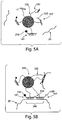
- FIG. 5 A non-limiting example of a ligation method of the present invention is illustrated in FIG. 5 .
- target nucleic acid 20 is exposed to a first nucleic acid probe 161 comprising a first signaling entity 210 and a second nucleic acid probe 162 comprising a second signaling entity 220 attached to a particle 230 through a linker 235.
- the first and second nucleic acid probes may hybridize with the target nucleic acid adjacent to each other as shown in FIG. 5B , and as indicated by 240.
- Target nucleic acid 20 comprising the first 161 and second 162 nucleic acid probes may then be exposed to a ligase and ligated together to form a nucleic acid oligomer.
- the first and the second nucleic acid probes do not hybridize adjacent to each other on the target nucleic acid.
- the target nucleic acid comprising the first and second nucleic acid probes upon exposure of the target nucleic acid comprising the first and second nucleic acid probes to a ligase, no substantial ligation of the nucleic acid probes will occur.
- one or both of the nucleic acid probes will not hybridize to the target nucleic acid (e.g., the sequence is not substantially complimentary), and no ligation will occur between the first nucleic acid probe and the second nucleic acid probe.
- the first and the second nucleic acid probes can associate with the target nucleic acid, e.g., if the target nucleic acid and the nucleic acid probes have substantial complementarity.
- the nucleic acid probes may be joined together (e.g., via ligation with the ligase), which can be used (as discussed herein) to determine the association with the nucleic acid probe.
- the first nucleic acid probe and the second nucleic acid probe will associate (e.g., hybridize) with the target nucleic acid in positions adjacent to each other (e.g., the sequence of the first nucleic acid is substantially complimentary with the target nucleic acid and the sequence of the second nucleic acid is substantially complimentary with the target nucleic acid adjacent to the sequence which is substantially complimentary with the first nucleic acid probe).
- ligation of the first and the second nucleic acid probes can occur due to the presence of the ligase.
- no ligation can occur.
- the first and the second nucleic acid may have sequences which are substantially complimentary with the target nucleic acid but the sequences are not adjacent to each other (e.g., one or more residues may be present in the target nucleic acid probe between the sequence complimentary to the first and the second nucleic acid probes).
- ligation methods such as described above for sequencing a target nucleic acid.
- such methods may allow the formation of relatively large sequencing libraries from smaller libraries. This can reduce and time to and/or cost of the (e.g., cost of reagents) synthesis of the library.
- the ligation method can comprise enhanced signals, in some embodiments, as compared to non-ligation methods, since ligation increases probe length, which in turn can increase the binding energy.
- such methods may increase single base pair specificity, thereby increasing the accuracy of the sequencing process. This is because shorter nucleic acid probes may have higher single-base pair specificity as compared to a longer nucleic acid probes.
- the first group of nucleic acid probes and/or the second group of nucleic acid probe may comprise at least a portion of all of the sequences of a selected length, or a subset thereof.
- the first group of nucleic acid probes may comprise at least one of each of a portion of all probes with 3 nucleic acid residues (optionally further containing universal residues), as discussed herein.
- the first group of nucleic acid probes and the second group of nucleic acid probes may or may not be substantially similar.
- the first group of nucleic acid probes comprise substantially the same probes as the second group of nucleic acid probes.
- the first group and the second group of nucleic acid probes comprises all possible sequences of a particular length, e.g., 3-mers, 4-mers, 5-mers, 6-mers, 7-mers, 8-mers, 9-mers, 10-mers, or the like.
- the first group and the second group of nucleic acid probes may be substantially similar or different.
- the first group and the second group of nucleic acids may be substantially similar if the first group and the second group comprises at least a portion of all possible 3-mers, but may differ in that they comprise differing signaling entities or the signaling entity is located at differing positions (e.g., 3'-end vs. 5'-end).
- the first group of distinguishable identification elements and the second group of distinguishable identification elements may be the substantially similar or different.
- nucleic acid residues may also be present in some cases, in addition to A, G, C, and T.
- at least some of the nucleic acid probes may additionally comprise at least one universal residue.
- a 3-mer comprising additional universal residues may have the sequence UUUXXX wherein U is a universal residue and XXX is either one of A, G, C, or T (e.g., the 3-mer).
- the first group of nucleic acid probes may be capable of ligating only on the 3' end of the nucleic acid probe and the second group of nucleic acid probes may be capable of ligating on the 5' end, such the only one end of each of the first nucleic acid probe and the second nucleic acid probe may ligate with each other. Therefore, the probes need to hybridize to the target nucleic acid in the correct order in order for ligation to occur. That is, the probes must hybridize to the target nucleic acid such that the 3' end of the first probe and the 5' end of the second probe are adjacent to each other and the probes are capable of being ligated.
- the probes may not be capable of binding (e.g., if the 5' end of the first probe and the 3' end of the second probe comprise an entity (e.g., signaling entity, etc.) that prevents hybridization at that end).
- entity e.g., signaling entity, etc.
- the ligation of the first and the second nucleic acid probes may be determined, for example, by a change in a signaling entity associated with at least one of the nucleic acid probes. If the first and the second nucleic acid probes are complementary or substantially complementary in adjacent positions to the target nucleic acid, then the first and the second nucleic acid probes (including a signaling entity) associates with the target nucleic acid and participate in a ligation reaction as discussed above. Accordingly, by determining the signaling entity of the ligated nucleic acid probes, a portion of the sequence of the target nucleic acid may be determined, based on both the sequences of the nucleic acid probes.
- each nucleic acid probe from the first group comprises a first signaling entity 210 and each nucleic acid probe from the second group comprises a second signaling entity 220, as shown in FIGS. 5A and 5B .
- the ligation of a first and a second nucleic acid probe may be determined by determining the first and/or second signaling entity.
- a particle may have fastened to the surface a first nucleic acid probe 161 containing a first signaling entity 210 and a second nucleic probe 162 containing a second signaling entity 220, the sequence of the first nucleic acid probe being different from the sequence of the second nucleic acid probe.
- the first and second signaling entities may interact in a determinable manner if placed within a suitable distance from each other.
- a signaling entity may be a quencher or enhancer.
- the quencher or enhancer may be any entity able to affect the signaling entity in some fashion, e.g., by respectively inhibiting or facilitating determination of the signaling entity.
- the proximity of a fluorescent signaling entity and a quencher within a nucleic acid probe may be such that the quencher is able to partially or completely inhibit fluoresence of the signaling entity, while an enhancer may be able to enhance the fluorescence of a fluorescent signaling entity when the enhancer is positioned proximate the signaling entity.
- the quencher or enhancer may also be located anywhere in the nucleic acid probe, for example, attached to the 3' end of the nucleic acid sequence.
- quenchers include tetramethylrhodamine and dihydrocyclopyrroloindole tripeptide.
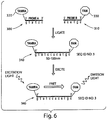
- a first and second signaling entities may be two different fluorescent molecules that can produce a FRET signal if placed within a suitable distance from each other.
- the two signaling entities may be TAMRA (tetramethyl-6-carboxyrhodamine) and FAM (6-carboxyfluorescein), as shown in FIG. 6 , which illustrates one example.
- a quencher (or similarly, an enhancer) can be used within a signaling entity in a nucleic acid probe as follows.
- a nucleic acid probe associated with a target nucleic acid may be removed or dissociated from the target nucleic acid by the action of certain enzymes or other species, for instance, polymerases such as Taq polymerases.
- polymerases such as Taq polymerases.
- a polymerase may cause degradation of the nucleic acid sequence within the nucleic acid probe to occur, which may cause release of the signaling entity and/or the quencher or enchancer and hence, the quencher or enchancer may no longer be proximate to or at least substantially affect the signaling entity.
- a polymerase such as Taq polymerase may be provided to a fluidic droplet comprising a nucleic acid probe and a target nucleic acid.
- the polymerase may be provided to the fluidic droplet using any suitable technique, as discussed herein.
- two 3-mer nucleic acid probes are complimentary, hybridize adjacently, and in the correct order, they may be ligated, forming a new 6-mer (3-mers are used as an illustrative example; other lengths may also be used in some cases, e.g. 4-mers, 5-mers, 6-mers, 7-mers, or the like).
- Ligation covalently bonds together the two 3-mer probes forming a more tightly bound 6-mer. Before ligation, the binding energies of the probes are merely that of the 3-mers, which is generally too small to be detected at room temperature. After ligation, the two 3-mers become a 6-mer, and thus can hybridize. Ligation of the probes thus relies on the highly specific but transient binding of the short probes to produce a tightly bound combined probe.
- a 3-mer nucleic acid probe may be simulated using a longer nucleic acid probe containing one or more universal residues.
- a 3-mer comprising additional universal residues may have the sequence UUUXXX wherein U is a universal residue and XXX is either one of A, G, C, or T (e.g., the 3-mer).
- the nucleic acid probe acts as a 3-mer in that it recognizes any nucleic acid having a sequence complementary to the XXX portion of the nucleic acid probe, as the UUU portion of the nucleic acid probe will bind to any sequence.
- such a nucleic acid probe may act as a 3-mer nucleic acid probe (i.e., having the specificity of a 3-mer probe), although it may exhibit the binding affinity of a 6-mer sequence.
- the actual length of the nucleic acid probe may be longer due to the presence of universal residues, which may be present at any location within the nucleic acid probe.
- the nucleic acid probes may be used to form a library of nucleic acid probes.
- the library may include a plurality of such nucleic acid probe sequences, for example, organized by attachment to particles.
- a library may comprise a plurality of particles, the particles being identifiable (e.g., using identification entities) and having unique nucleic acid probes on each of the particles such that each particle contains only one type of nucleic acid probe, but many identical copies of that probe.
- the library may contain sequences that have roughly the same number of residues, for example, around 4 residues, around 5 residues, around 6 residues, around 7 residues, etc.
- the library of nucleic acid probes may be prepared using any suitable technique, and may be produced using manual techniques or automated, e.g., using a robotic apparatus.
- a library of nucleic acid probes having varying sequences may be selected such that at least some of the probes will contain sequences complementary or substantially complementary to the target nucleic acid sequence.
- a probe library may be prepared that comprises a collection of particles, some or all of which contain an identification entity and a plurality of nucleic acid probes fastened to the surface of the particles.
- a probe library can be prepared that includes a collection of fluorescent particles, each of which can be identified by an identification entity associated with each particle, and each of which has a plurality of nucleic acid probes having essentially identical sequences fastened to the surface of each respective particle.
- the identification entity of a particle is associated with a unique nucleic acid probe sequence in some cases.
- a first particle may be distinguished from a second particle using a first identification entity associated with the first particle and a second identification entity associated with the second particle, where the first and second identification entities are distinguishable in some fashion.
- the plurality of particles contains at least one unique nucleic acid probe, at least 2 unique nucleic acid probes, at least 5 unique nucleic acid probes, at least 10 unique nucleic acid probes, at least 50 unique nucleic acid probes, least 100 unique nucleic acid probes, at least 120 unique nucleic acid probes, at least 200 unique nucleic acid probes, at least 500 unique nucleic acid probes, at least 1,000 unique nucleic acid probes, at least 4,000 unique nucleic acid probes, at least 16,000 unique nucleic acid probes, at least 65,000 unique nucleic acid probes, etc.
- the plurality of particles contains at least 101 unique nucleic acid probes.
- the nucleic acid probes may contain 4-mer nucleic acid probes, 5-mer nucleic acid probes, 6-mer nucleic acid probes, etc. Modifications such as including LNAs, universal bases, gaps, and random sequences in the nucleic acid probes may be used, as described in more detail herein, to optimize the nucleic acid probes. Additionally, some or all of the nucleic acid probes may have at least one signaling entity attached thereto.
- the sequence of a target nucleic acid may be determined by determining the association (or the non-association) of the target nucleic acid to one of a plurality of distinguishable particles having attached nucleic acid probes.
- the target nucleic acid may be bound to the nucleic acid probe when they form a relatively stable duplex by hydrogen bonding under experimental conditions. Relatively stable hydrogen bonding may be formed due to Watson-Crick complementarity (e.g., A matches T, but not G or C G matches C, but not A or T) and/or other effects such as GC wobble, or other associations caused by locked nucleic acids or universal bases, as discussed herein.
- suitable methods for determining the sequence of a target nucleic acid include sequencing by hybridization techniques that are known to those of ordinary skill in the art.
- the sequence of the target nucleic acid may be determined, based on binding of the particles, using sequencing by hybridization (SBH) algorithms or other known techniques. For example, once particles binding the target nucleic acid have been identified, the nucleic acid probes associated with each of the binding particles can also be identified, and the sequences of these nucleic acid probes (or their complements) can then be used to reconstruct the sequence of the target nucleic acid, using techniques known to those of ordinary skill in the art, such as sequencing by hybridization.
- SBH sequencing by hybridization
- SBH Sequencing by hybridization
- SBH uses a set of nucleic acid probes of defined sequence to probe for complementary sequences on a longer target strand of a target nucleic acid.
- the defined sequences which hybridize to the target can then be aligned using computer algorithms to construct the sequence of the target nucleic acid.
- a target nucleic acid may associate with a certain set of nucleic acid probes fastened to particles, leading to a characteristic "hybridization" pattern.
- Each positive association (or hybridization) event in a given sample provides information about the target nucleic acid.
- the target nucleic acid may be sequenced without determination of exactly where any particular nucleic acid probe associates with the target nucleic acid. Algorithms and software have been developed for target nucleic acid reconstruction, based on the hybridization pattern, and are known to those skilled in the art.
- analysis of a hybridization pattern may provide a "fingerprint" labeling of the target nucleic acid sequence, without specifically determining the target nucleic acid sequence itself.
- the pattern of hybridization may also be manually or computer analyzed.
- any suitable determination method can be used to determine the identification entities and/or the signaling entities, depending on the application. As mentioned, the determination may occur using techniques such as radioactivity, fluorescence, phosphorescence, light scattering, light absorption, fluorescence polarization, or the like. Many detectors that operate using such principles are commercially available. The detector may be used to determine at least one of the signaling entities and/or identification entities that may be present, and in some cases, more than one detector may be used.
- the particles flow past a detector single file.
- the droplet may be deformed such that the particles contained within the droplet pass the detector single file.
- a droplet may be deformed by passing it through a channel that has a constriction such that the cross-sectional area of the constriction is smaller than the cross-sectional area of the droplet when the droplet is in free solution.
- the droplet is deformed such that substantially all of the signaling entities and/or identification entities are arranged single file within the droplet.
- the signaling entities and/or identification entities may be arranged within a channel such that no line drawn from a first wall of the channel, normal to the first wall, to a second wall of the channel intersects more than one particle.
- the detection may be parallelized, i.e., a number of signaling entities and/or identification entities may be simultaneously determined within one channel and/or within a plurality of channels.
- a timing device may be used to synchronize detection of the parallel paths.
- parallelized detection is the use of a camera positioned so as to be able to image more than one channel, e.g., simultaneously.
- the camera may be, for example, a linescan camera, a 2D CCD camera, or the like. Additional devices and methods suitable for use in the present invention can be found in U.S. Application Serial No. 61/008,862 entitled "Systems and Methods for Nucleic Acid Sequencing," filed December 21, 2007, and U.S. Application Serial No.
- At least one mercury arc lamp may illuminate a selected number of channels and multiple cameras (which may each have an individual filter) may be used to capture a particular color spectrum. The images may be captured sequentially, or simultaneously, e.g., so that the location of each droplet is the same in all camera images.
- a plurality of particles may be determined at a single time.
- the detector may need to determine the boundaries of adjacent particles such that only one signal is determined per particle.
- the following methods and/or systems employing a light source to create particle glare may be advantageous when determining a plurality of particles which are collected in a contained area.
- particles may be determined by determining a signal of a position relative to a reference spot. That is, each particle may be related to a references spot and a determination of the signal of a particle may be determined by relation to the reference spot.
- Production of a reference spot may be accomplished, for example, by shining a light on the surface of the particles such that glare is produced for each particle. This may allow for the detector to determine a relative location for each particle, and thereby determine a signal each particle, as described more herein.
- a second light source e.g., a lamp, an LED array
- the second light source may be shone at an angle (e.g., a non-orthogonal angle) to the particles being determined (e.g., being visualized under a microscope). Due to the orientation of the light and the spherical shape of the particles, scattered light may be captured by the lens of the camera and a relatively concentrated and bright glare on the image of each particle is produce (e.g., a particle glare) that is easily visible and distinguishable from the background signal. Thus, a substantially focused glare may be produced by the particle due to the scattering of light within the particle.
- Images of the plurality of particles may be captured by a detector or an imager, such as a CCD camera.
- the CCD cameras may comprise filters that only allow for light in a narrow spectrum to pass to the camera (e.g., red light, green light, etc.) such that specified fluorescent images may be obtained.
- the capture of images may or may not be synchronized.
- software identification of the location of the particles may be completed using simple methods.
- the particle glare can be used as a reference point as the particle glare generally appears consistently in regards to both direction and distance from the center of each particle. Depending on the set-up of the oblique lighting, the particle glares can be placed offset from the center of the particle and allowing for the same image frame for both particle identification and data acquisition.
- At least one image may be processed by using a simple intensity threshold programs to determine the particle glares on each particle.
- the software can compute, or human input may be used, to determine the angle and/or the distance between a particle glare and the center of the particle.
- the angle and/or distance between a particle glare and the center of the particle may be recorded a single time.
- the techniques discussed herein can be used to sequence relatively long nucleic acids. For example, many smaller target nucleic acid sequences may be determined, and the sequences can be assembled to reveal the complete sequence for the original larger target nucleic acid. Such techniques may be useful for sequencing the genome of an organism, for example.
- a large target nucleic acid e.g., a gene, chromosome, genome, etc.
- the 3 billion base-pair human genome target may be broken into approximately 1000 base-pair target nucleic acids using a variety of techniques known in the art (e.g. sonication).
- the target nucleic acids may be injected into a microfluidic device or other system where they can be sequenced, as discussed above.
- a target nucleic acid can be encapsulated in a fluidic droplet.
- a target nucleic acid in a droplet can be amplified using a technique such as PCR and labeled using techniques described herein.
- the resulting emulsion comprises a collection of droplets, and at least some of the droplets may contain many copies of a unique target nucleic acid sequence.
- fluids are given its ordinary meaning, i.e., a substance that tends to flow and to conform to the outline of its container.
- fluids are materials that are unable to withstand a static shear stress, and when a shear stress is applied, the fluid experiences a continuing and permanent distortion.
- the fluid may have, in some cases, any suitable viscosity that permits at least some flow of the fluid.
- Non-limiting examples of fluids include liquids and gases, but may also include free-flowing solid particles, viscoelastic fluids, and the like.
- a “droplet,” as used herein, is an isolated portion of a first fluid that is completely surrounded by a second fluid. It is to be noted that a droplet is not necessarily spherical, but may assume other shapes as well, for example, depending on the external environment. In one embodiment, the droplet has a minimum cross-sectional dimension that is substantially equal to the largest dimension of the channel perpendicular to fluid flow in which the droplet is located. The diameter of a droplet, in a non-spherical droplet, is the diameter of a perfect mathematical sphere having the same volume as the non-spherical droplet.
- the fluidic droplets may be created using any suitable technique, such as those disclosed in U.S. Patent Application Serial No.
- the fluidic droplets may be polydisperse (e.g., having a range of different sizes), or in some cases, the fluidic droplets may be monodisperse or substantially monodisperse, e.g., having a homogenous distribution of diameters, for instance, such that no more than about 10%, about 5%, about 3%, about 1 %, about 0.03%, or about 0.01% of the droplets have an average diameter greater than about 10%, about 5%, about 3%, about 1%, about 0.03%, or about 0.01% of the average diameter.
- the "average diameter" of a population of droplets is the arithmetic average of the diameters of the droplets. Those of ordinary skill in the art will be able to determine the average diameter of a population of droplets, for example, using laser light scattering or other known techniques. As non-limiting examples, the average diameter of a droplet may be less than about 1 mm, less than about 500 micrometers, less than about 200 micrometers, less than about 100 micrometers, less than about 75 micrometers, less than about 50 micrometers, less than about 25 micrometers, less than about 10 micrometers, or less than about 5 micrometers.
- the average diameter of the droplet may also be at least about 1 micrometer, at least about 2 micrometers, at least about 3 micrometers, at least about 5 micrometers, at least about 10 micrometers, at least about 15 micrometers, or at least about 20 micrometers in certain cases.
- droplets containing the nucleic acids can be produced in parallel.
- a microfluidic device may be used to allow for parallel creation of a library of droplets containing target nucleic acids.
- a microfluidic drop maker may be replicated many times on a single chip, and each drop maker may be used to droplets containing target nucleic acids.
- Non-limiting examples of techniques of producing droplets of fluid surrounded by a liquid are described in U.S. Patent Application Serial No. 11/024,228, filed December 28, 2004 , entitled “Method and Apparatus for Fluid Dispersion," published as U.S. Patent Application Publication No. 2005/0172476 on August 11, 2005 ; U.S. Patent Application Serial No.
- an electric charge may be created on a fluid surrounded by a liquid, which may cause the fluid to separate into individual droplets within the liquid.
- microfluidic refers to a device, apparatus or system including at least one fluid channel having a cross-sectional dimension of less than 1 mm, and a ratio of length to largest cross-sectional dimension perpendicular to the channel of at least 3:1.
- a "microfluidic channel,” as used herein, is a channel meeting these criteria.
- Microfluidic systems may be provided that are able to cause two or more droplets to fuse or coalesce into one droplet, for example, in cases where the two or more droplets ordinarily are unable to fuse or coalesce, for example due to composition, surface tension, droplet size, etc. as known to those of ordinary skill in the art.
- the fluidic droplets may be fused together using any suitable technique, for example, as discussed in U.S. Patent Application Serial No. 11/246,911, filed October 7,2005 , entitled “Formation and Control of Fluidic Species," by Link, et al ., published as U.S. Patent Application Publication No. 2006/0163385 on July 27,2006 ; or U.S. Patent Application Serial No.
- Electrical charges may be imparted onto droplets through the use of Taylor cones, or through any other suitable techniques. For instance, an electric field may be imposed on a reactor containing the droplets, the droplets may be passed through a capacitor, a chemical reaction may occur to cause the droplets to become charged, flowing the droplets over a region with opposite wetting properties, etc.
- two or more droplets may be fused, manipulated and/or coalesced using Couette shear cells, shaken emulsions, and/or membrane emulsification.
- two or more droplets may be fused, manipulated and/or coalesced into one droplet using electric and/or magnetic fields, e.g., from one or more field-generating components contained within a substrate.
- electric and/or magnetic fields e.g., from one or more field-generating components contained within a substrate.
- the "cross-sectional dimension" of the channel is measured perpendicular to the direction of fluid flow.
- Most fluid channels in components of the invention have maximum cross-sectional dimensions less than 2 mm, and in some cases, less than 1 mm.
- all fluid channels containing embodiments of the invention are microfluidic or have a largest cross sectional dimension of no more than 2 mm or 1 mm.
- the fluid channels may be formed in part by a single component (e.g. an etched substrate or molded unit).
- larger channels, tubes, chambers, reservoirs, etc. can be used to store fluids in bulk and to deliver fluids to components of the invention.
- the maximum cross-sectional dimension of the channel(s) containing embodiments of the invention are less than 500 microns, less than 200 microns, less than 100 microns, less than 50 microns, or less than 25 microns.
- a “channel,” as used herein, means a feature on or in an article (substrate) that at least partially directs the flow of a fluid.
- the channel can have any cross-sectional shape (circular, oval, triangular, irregular, square or rectangular, or the like) and can be covered or uncovered. In embodiments where it is completely covered, at least one portion of the channel can have a cross-section that is completely enclosed, or the entire channel may be completely enclosed along its entire length with the exception of its inlet(s) and outlet(s).
- a channel may also have an aspect ratio (length to average cross sectional dimension) of at least 2:1, more typically at least 3:1, 5:1, or 10:1 or more.
- the dimensions of the channel may also be chosen, for example, to allow a certain volumetric or linear flowrate of fluid in the channel.
- the number of channels and the shape of the channels can be varied by any method known to those of ordinary skill in the art. In some cases, more than one channel or capillary may be used. For example, two or more channels may be used, where they are positioned inside each other, positioned adjacent to each other, positioned to intersect with each other, etc.
- kits may be provided, containing one or more of the above compositions.
- a "kit,” as used herein, typically defines a package or an assembly including one or more of the compositions of the invention, and/or other compositions associated with the invention, for example, as previously described.
- Each of the compositions of the kit may be provided in liquid form (e.g., in solution), in solid form (e.g., a dried powder), etc.
- a kit of the invention may, in some cases, include instructions in any form that are provided in connection with the compositions of the invention in such a manner that one of ordinary skill in the art would recognize that the instructions are to be associated with the compositions of the invention.
- the instructions may include instructions for the use, modification, mixing, diluting, preserving, administering, assembly, storage, packaging, and/or preparation of the compositions and/or other compositions associated with the kit.
- the instructions may be provided in any form recognizable by one of ordinary skill in the art as a suitable vehicle for containing such instructions, for example, written or published, verbal, audible (e.g., telephonic), digital, optical, visual (e.g., videotape, DVD, etc.) or electronic communications (including Internet or web-based communications), provided in any manner.
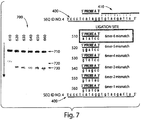
- nucleic acid probe sequences 5'- A TATCC-3' 510; 5'-G G ATCC-3' 520; 5'-GT C TCC-3' 530; 5'-GTA G CC-3' 540; 5'-GTAT A C-3' 550; and 5'-GTATC A -3' 560 were separately mixed with target 400, probe 410, and ligase and incubated for 30 min at room temperature.
- Each reaction contained 20 microliters of IX ligase buffer, 400 Units of T4 DNA ligase, 100 nM of a nucleic acid probe selected from nucleic acid probes 500-560, 200 nM of target 400, 100 nm of probe 410, and 1 mg/mL BSA. Following incubation, 20 microliters of a stop solution were added to quench the reaction. The stop solution contained 50 mM EDTA, 85% v/v formamide, and 0.005% bromophenol blue. The reactions were analyzed by denaturing polyacrylamide gel electrophoresis (PAGE) at 350 volts for 1 hour, stained with 1X SYBR Gold in TBE buffer, and visualized with UV light.
- PAGE denaturing polyacrylamide gel electrophoresis
- Probes 510 through 560 each have a single base pair mismatch with the target sequence 3'-ATAGG-5' as indicated by the underlined base above. In this system, each of probes 510 through 560 would be ligated to probe 410 if a stable duplex is formed.
- lane 610 depicts the separation of a ligation reaction with probes 410 and 510
- lane 620 depicts the separation of a ligation reaction with probes 410 and 520
- lane 630 depicts the separation of a ligation reaction with probes 410 and 530
- lane 640 depicts the separation of a ligation reaction with probes 410 and 540
- lane 650 depicts the separation of a ligation reaction with probes 410 and 550
- lane 660 depicts the separation of a ligation reaction with probes 410 and 560.
- Position 710 indicates the position of target 400
- position 720 indicates the position of ligation products of nucleic acid probes 510-560 and probe 410
- position 730 indicates the position of non-ligated probe 410.
- the amount of free ligation product greatly outweighed the amount of free probe 410 indicating that ligation of a 6-mer with a terminal mismatch occurred with relatively high efficiency but that some non-ligated probe 410 remained.
- Lane 620 shows a small amount of ligation product
- lanes 630 though 660 show that essentially no ligation occurred between probes 530 through 560 and probe 410, thereby demonstrating the ability of the probes in this particular example to discern nucleic acid probes containing a single mismatch from a nucleic acid containing no mismatches.
- a reference to "A and/or B", when used in conjunction with open-ended language such as “comprising” can refer, in one embodiment, to A only (optionally including elements other than B); in another embodiment, to B only (optionally including elements other than A); in yet another embodiment, to both A and B (optionally including other elements); etc.
- the phrase "at least one,” in reference to a list of one or more elements, should be understood to mean at least one element selected from any one or more of the elements in the list of elements, but not necessarily including at least one of each and every element specifically listed within the list of elements and not excluding any combinations of elements in the list of elements.
- This definition also allows that elements may optionally be present other than the elements specifically identified within the list of elements to which the phrase "at least one" refers, whether related or unrelated to those elements specifically identified.
- At least one of A and B can refer, in one embodiment, to at least one, optionally including more than one, A, with no B present (and optionally including elements other than B); in another embodiment, to at least one, optionally including more than one, B, with no A present (and optionally including elements other than A); in yet another embodiment, to at least one, optionally including more than one, A, and at least one, optionally including more than one, B (and optionally including other elements); etc.
- the current disclosure contains, inter alia, the following items:
Landscapes
- Chemical & Material Sciences (AREA)
- Life Sciences & Earth Sciences (AREA)
- Organic Chemistry (AREA)
- Proteomics, Peptides & Aminoacids (AREA)
- Health & Medical Sciences (AREA)
- Engineering & Computer Science (AREA)
- Zoology (AREA)
- Wood Science & Technology (AREA)
- Analytical Chemistry (AREA)
- Physics & Mathematics (AREA)
- General Health & Medical Sciences (AREA)
- Biochemistry (AREA)
- Biotechnology (AREA)
- Microbiology (AREA)
- Immunology (AREA)
- Biophysics (AREA)
- Bioinformatics & Cheminformatics (AREA)
- General Engineering & Computer Science (AREA)
- Molecular Biology (AREA)
- Genetics & Genomics (AREA)
- Fluid Mechanics (AREA)
- Dispersion Chemistry (AREA)
- Hematology (AREA)
- Clinical Laboratory Science (AREA)
- Chemical Kinetics & Catalysis (AREA)
- Measuring Or Testing Involving Enzymes Or Micro-Organisms (AREA)
Priority Applications (1)
| Application Number | Priority Date | Filing Date | Title |
|---|---|---|---|
| EP19183247.6A EP3587594B1 (fr) | 2008-12-19 | 2009-12-18 | Séquençage d'acide nucléique assisté par particules |
Applications Claiming Priority (4)
| Application Number | Priority Date | Filing Date | Title |
|---|---|---|---|
| US13920708P | 2008-12-19 | 2008-12-19 | |
| EP16197694.9A EP3150724A1 (fr) | 2008-12-19 | 2009-12-18 | Séquençage d'acide nucléique assisté par particules |
| EP09804166.8A EP2373812B1 (fr) | 2008-12-19 | 2009-12-18 | Séquençage d'acides nucléiques aidé par particules |
| PCT/US2009/006649 WO2010080134A1 (fr) | 2008-12-19 | 2009-12-18 | Séquençage d'acide nucléique assisté par particules |
Related Parent Applications (2)
| Application Number | Title | Priority Date | Filing Date |
|---|---|---|---|
| EP09804166.8A Division EP2373812B1 (fr) | 2008-12-19 | 2009-12-18 | Séquençage d'acides nucléiques aidé par particules |
| EP16197694.9A Division EP3150724A1 (fr) | 2008-12-19 | 2009-12-18 | Séquençage d'acide nucléique assisté par particules |
Related Child Applications (1)
| Application Number | Title | Priority Date | Filing Date |
|---|---|---|---|
| EP19183247.6A Division EP3587594B1 (fr) | 2008-12-19 | 2009-12-18 | Séquençage d'acide nucléique assisté par particules |
Publications (2)
| Publication Number | Publication Date |
|---|---|
| EP3290531A1 true EP3290531A1 (fr) | 2018-03-07 |
| EP3290531B1 EP3290531B1 (fr) | 2019-07-24 |
Family
ID=41697698
Family Applications (4)
| Application Number | Title | Priority Date | Filing Date |
|---|---|---|---|
| EP17194710.4A Active EP3290531B1 (fr) | 2008-12-19 | 2009-12-18 | Séquençage d'acide nucléique assisté par particules |
| EP19183247.6A Active EP3587594B1 (fr) | 2008-12-19 | 2009-12-18 | Séquençage d'acide nucléique assisté par particules |
| EP16197694.9A Withdrawn EP3150724A1 (fr) | 2008-12-19 | 2009-12-18 | Séquençage d'acide nucléique assisté par particules |
| EP09804166.8A Active EP2373812B1 (fr) | 2008-12-19 | 2009-12-18 | Séquençage d'acides nucléiques aidé par particules |
Family Applications After (3)
| Application Number | Title | Priority Date | Filing Date |
|---|---|---|---|
| EP19183247.6A Active EP3587594B1 (fr) | 2008-12-19 | 2009-12-18 | Séquençage d'acide nucléique assisté par particules |
| EP16197694.9A Withdrawn EP3150724A1 (fr) | 2008-12-19 | 2009-12-18 | Séquençage d'acide nucléique assisté par particules |
| EP09804166.8A Active EP2373812B1 (fr) | 2008-12-19 | 2009-12-18 | Séquençage d'acides nucléiques aidé par particules |
Country Status (3)
| Country | Link |
|---|---|
| US (3) | US8748094B2 (fr) |
| EP (4) | EP3290531B1 (fr) |
| WO (1) | WO2010080134A1 (fr) |
Families Citing this family (124)
| Publication number | Priority date | Publication date | Assignee | Title |
|---|---|---|---|---|
| GB0307403D0 (en) | 2003-03-31 | 2003-05-07 | Medical Res Council | Selection by compartmentalised screening |
| GB0307428D0 (en) * | 2003-03-31 | 2003-05-07 | Medical Res Council | Compartmentalised combinatorial chemistry |
| US20060078893A1 (en) | 2004-10-12 | 2006-04-13 | Medical Research Council | Compartmentalised combinatorial chemistry by microfluidic control |
| US20050221339A1 (en) * | 2004-03-31 | 2005-10-06 | Medical Research Council Harvard University | Compartmentalised screening by microfluidic control |
| US7968287B2 (en) | 2004-10-08 | 2011-06-28 | Medical Research Council Harvard University | In vitro evolution in microfluidic systems |
| WO2007081385A2 (fr) | 2006-01-11 | 2007-07-19 | Raindance Technologies, Inc. | Dispositifs microfluidiques et leurs procédés d'utilisation dans la formation et le contrôle de nanoréacteurs |
| WO2007133710A2 (fr) | 2006-05-11 | 2007-11-22 | Raindance Technologies, Inc. | Dispositifs microfluidiques et leurs procédés d'utilisation |
| US9562837B2 (en) | 2006-05-11 | 2017-02-07 | Raindance Technologies, Inc. | Systems for handling microfludic droplets |
| US9012390B2 (en) | 2006-08-07 | 2015-04-21 | Raindance Technologies, Inc. | Fluorocarbon emulsion stabilizing surfactants |
| WO2008097559A2 (fr) | 2007-02-06 | 2008-08-14 | Brandeis University | Manipulation de fluides et de réactions dans des systèmes microfluidiques |
| WO2008109176A2 (fr) * | 2007-03-07 | 2008-09-12 | President And Fellows Of Harvard College | Dosages et autres réactions comprenant des gouttelettes |
| WO2008130623A1 (fr) | 2007-04-19 | 2008-10-30 | Brandeis University | Manipulation de fluides, composants fluidiques et réactions dans des systèmes microfluidiques |
| JP5738597B2 (ja) | 2007-12-21 | 2015-06-24 | プレジデント アンド フェローズ オブ ハーバード カレッジ | 核酸の配列決定のためのシステムおよび方法 |
| US12038438B2 (en) | 2008-07-18 | 2024-07-16 | Bio-Rad Laboratories, Inc. | Enzyme quantification |
| EP4047367A1 (fr) | 2008-07-18 | 2022-08-24 | Bio-Rad Laboratories, Inc. | Procedé de détection d'analytes cibles au moyens des bibliothèques de gouttelettes |
| US20110218123A1 (en) | 2008-09-19 | 2011-09-08 | President And Fellows Of Harvard College | Creation of libraries of droplets and related species |
| EP3290531B1 (fr) | 2008-12-19 | 2019-07-24 | President and Fellows of Harvard College | Séquençage d'acide nucléique assisté par particules |
| WO2010111231A1 (fr) | 2009-03-23 | 2010-09-30 | Raindance Technologies, Inc. | Manipulation de gouttelettes microfluidiques |
| US10520500B2 (en) | 2009-10-09 | 2019-12-31 | Abdeslam El Harrak | Labelled silica-based nanomaterial with enhanced properties and uses thereof |
| EP2493619B1 (fr) | 2009-10-27 | 2018-12-19 | President and Fellows of Harvard College | Techniques de création de gouttelettes |
| EP2517025B1 (fr) | 2009-12-23 | 2019-11-27 | Bio-Rad Laboratories, Inc. | Procédés pour réduire l'échange de molécules entre des gouttelettes |
| US10351905B2 (en) | 2010-02-12 | 2019-07-16 | Bio-Rad Laboratories, Inc. | Digital analyte analysis |
| EP4435111A1 (fr) | 2010-02-12 | 2024-09-25 | Bio-Rad Laboratories, Inc. | Analyse numérique d'analyte |
| US9399797B2 (en) | 2010-02-12 | 2016-07-26 | Raindance Technologies, Inc. | Digital analyte analysis |
| US9366632B2 (en) | 2010-02-12 | 2016-06-14 | Raindance Technologies, Inc. | Digital analyte analysis |
| WO2012045012A2 (fr) | 2010-09-30 | 2012-04-05 | Raindance Technologies, Inc. | Dosages sandwich dans des gouttelettes |
| JP6096672B2 (ja) | 2010-12-07 | 2017-03-15 | ヌビオ,インコーポレイテッド | 検出体、プローブ、および阻害剤を用いた核酸標的検出 |
| US20120167410A1 (en) | 2010-12-21 | 2012-07-05 | Basf Se | Spray drying techniques |
| EP3859011A1 (fr) | 2011-02-11 | 2021-08-04 | Bio-Rad Laboratories, Inc. | Procédés permettant de former des gouttelettes mélangées |
| WO2012112804A1 (fr) | 2011-02-18 | 2012-08-23 | Raindance Technoligies, Inc. | Compositions et méthodes de marquage moléculaire |
| SG193436A1 (en) | 2011-03-30 | 2013-10-30 | Gnubio Inc | Injection of multiple volumes into or out of droplets |
| JP5986623B2 (ja) | 2011-03-31 | 2016-09-06 | ヌビオ,インコーポレイテッド | スケーラブルなスペクトル検出および計測 |
| EP3056573B1 (fr) | 2011-03-31 | 2018-09-26 | Bio-Rad Laboratories, Inc. | Gestion de variation dans des mesures d'intensité spectroscopique par l'utilisation d'un composant de référence |
| US8841071B2 (en) | 2011-06-02 | 2014-09-23 | Raindance Technologies, Inc. | Sample multiplexing |
| EP2714970B1 (fr) | 2011-06-02 | 2017-04-19 | Raindance Technologies, Inc. | Quantification d'enzyme |
| US8658430B2 (en) | 2011-07-20 | 2014-02-25 | Raindance Technologies, Inc. | Manipulating droplet size |
| EP2766498B1 (fr) | 2011-10-14 | 2019-06-19 | President and Fellows of Harvard College | Séquençage par assemblage structurel |
| ES2991004T3 (es) | 2011-12-22 | 2024-12-02 | Harvard College | Métodos para la detección de analitos |
| EP2794928B1 (fr) | 2011-12-22 | 2019-02-20 | President and Fellows of Harvard College | Compositions et procédés pour la détection d'analytes |
| EP2823064B1 (fr) | 2012-03-05 | 2019-02-06 | President and Fellows of Harvard College | Procédés pour le séquençage épigénétique |
| US9914967B2 (en) | 2012-06-05 | 2018-03-13 | President And Fellows Of Harvard College | Spatial sequencing of nucleic acids using DNA origami probes |
| US10273541B2 (en) | 2012-08-14 | 2019-04-30 | 10X Genomics, Inc. | Methods and systems for processing polynucleotides |
| CN114891871A (zh) | 2012-08-14 | 2022-08-12 | 10X基因组学有限公司 | 微胶囊组合物及方法 |
| US11591637B2 (en) | 2012-08-14 | 2023-02-28 | 10X Genomics, Inc. | Compositions and methods for sample processing |
| US10323279B2 (en) | 2012-08-14 | 2019-06-18 | 10X Genomics, Inc. | Methods and systems for processing polynucleotides |
| US10221442B2 (en) | 2012-08-14 | 2019-03-05 | 10X Genomics, Inc. | Compositions and methods for sample processing |
| US9701998B2 (en) | 2012-12-14 | 2017-07-11 | 10X Genomics, Inc. | Methods and systems for processing polynucleotides |
| US10584381B2 (en) | 2012-08-14 | 2020-03-10 | 10X Genomics, Inc. | Methods and systems for processing polynucleotides |
| US10752949B2 (en) | 2012-08-14 | 2020-08-25 | 10X Genomics, Inc. | Methods and systems for processing polynucleotides |
| US9951386B2 (en) | 2014-06-26 | 2018-04-24 | 10X Genomics, Inc. | Methods and systems for processing polynucleotides |
| CN104781386B (zh) | 2012-09-12 | 2018-04-06 | 基纽拜奥股份有限公司 | 用于进行试验的集成微流体系统、方法和试剂盒 |
| GB201217772D0 (en) * | 2012-10-04 | 2012-11-14 | Base4 Innovation Ltd | Sequencing method |
| EP3567116A1 (fr) | 2012-12-14 | 2019-11-13 | 10X Genomics, Inc. | Procédés et systèmes de traitement de polynucléotides |
| US10533221B2 (en) | 2012-12-14 | 2020-01-14 | 10X Genomics, Inc. | Methods and systems for processing polynucleotides |
| WO2014117088A1 (fr) | 2013-01-25 | 2014-07-31 | Gnubio, Inc. | Système et procédé pour réaliser un gonflage de gouttelettes |
| KR20230003659A (ko) | 2013-02-08 | 2023-01-06 | 10엑스 제노믹스, 인크. | 폴리뉴클레오티드 바코드 생성 |
| US10138509B2 (en) | 2013-03-12 | 2018-11-27 | President And Fellows Of Harvard College | Method for generating a three-dimensional nucleic acid containing matrix |
| CN105431553B (zh) | 2013-05-29 | 2020-02-07 | 生物辐射实验室股份有限公司 | 用于在基于乳液的微流体中测序的系统和方法 |
| EP3004813A4 (fr) | 2013-05-29 | 2016-12-21 | Gnubio Inc | Système optique de mesure discret, rapide et bon marché |
| EP3603679B1 (fr) | 2013-06-04 | 2022-08-10 | President and Fellows of Harvard College | Régulation transcriptionnelle guidée par arn |
| CN105765055A (zh) | 2013-08-27 | 2016-07-13 | 基纽拜奥股份有限公司 | 微流体装置和其使用方法 |
| US10395758B2 (en) | 2013-08-30 | 2019-08-27 | 10X Genomics, Inc. | Sequencing methods |
| WO2015048798A1 (fr) | 2013-09-30 | 2015-04-02 | Gnubio, Inc. | Dispositif de cartouche microfluidique, et procédés d'utilisation et d'assemblage |
| US11901041B2 (en) | 2013-10-04 | 2024-02-13 | Bio-Rad Laboratories, Inc. | Digital analysis of nucleic acid modification |
| WO2015069634A1 (fr) | 2013-11-08 | 2015-05-14 | President And Fellows Of Harvard College | Microparticules, procédés pour leur préparation et leur utilisation |
| WO2015081102A1 (fr) | 2013-11-27 | 2015-06-04 | Gnubio, Inc. | Conditionnement de gouttelettes microfluidiques |
| US9944977B2 (en) | 2013-12-12 | 2018-04-17 | Raindance Technologies, Inc. | Distinguishing rare variations in a nucleic acid sequence from a sample |
| US9824068B2 (en) | 2013-12-16 | 2017-11-21 | 10X Genomics, Inc. | Methods and apparatus for sorting data |
| WO2015103367A1 (fr) | 2013-12-31 | 2015-07-09 | Raindance Technologies, Inc. | Système et procédé de détection d'une espèce d'arn |
| US9694361B2 (en) | 2014-04-10 | 2017-07-04 | 10X Genomics, Inc. | Fluidic devices, systems, and methods for encapsulating and partitioning reagents, and applications of same |
| EP3134536B1 (fr) | 2014-04-21 | 2019-12-18 | President and Fellows of Harvard College | Systèmes et procédés permettant de marquer des acides nucléiques avec un code à barres |
| KR20170026383A (ko) | 2014-06-26 | 2017-03-08 | 10엑스 제노믹스, 인크. | 핵산 서열의 분석 |
| EP4235677A3 (fr) | 2014-06-26 | 2023-11-22 | 10X Genomics, Inc. | Procédés et systèmes pour l'assemblage de séquences d'acide nucléique |
| EP4574974A3 (fr) | 2014-06-26 | 2025-10-08 | 10x Genomics, Inc. | Procédés d'analyse d'acides nucléiques à partir de cellules individuelles ou de populations cellulaires |
| US12312640B2 (en) | 2014-06-26 | 2025-05-27 | 10X Genomics, Inc. | Analysis of nucleic acid sequences |
| EP3160649B1 (fr) | 2014-06-30 | 2019-12-11 | Bio-Rad Laboratories, Inc. | Pcr activé par contact thermique flottant |
| WO2016007839A1 (fr) | 2014-07-11 | 2016-01-14 | President And Fellows Of Harvard College | Méthodes de marquage et de détection à haut rendement de caractéristiques biologiques in situ à l'aide de microscopie |
| JP2017532042A (ja) | 2014-10-29 | 2017-11-02 | 10エックス ゲノミクス,インコーポレイテッド | 標的化核酸配列決定のための方法及び組成物 |
| US9975122B2 (en) | 2014-11-05 | 2018-05-22 | 10X Genomics, Inc. | Instrument systems for integrated sample processing |
| AU2016207023B2 (en) | 2015-01-12 | 2019-12-05 | 10X Genomics, Inc. | Processes and systems for preparing nucleic acid sequencing libraries and libraries prepared using same |
| CA2968417A1 (fr) | 2015-01-13 | 2016-07-21 | 10X Genomics, Inc. | Systemes et procedes de visualisation d'informations de variation structurelle et de phasage |
| SG11201705996PA (en) | 2015-02-09 | 2017-09-28 | 10X Genomics Inc | Systems and methods for determining structural variation and phasing using variant call data |
| AU2016222719B2 (en) | 2015-02-24 | 2022-03-31 | 10X Genomics, Inc. | Methods for targeted nucleic acid sequence coverage |
| EP4286516A3 (fr) | 2015-02-24 | 2024-03-06 | 10X Genomics, Inc. | Procédés et systèmes de traitement de cloisonnement |
| CN116064731A (zh) | 2015-03-13 | 2023-05-05 | 哈佛学院院长及董事 | 使用扩增测定细胞 |
| CN107614684A (zh) | 2015-04-17 | 2018-01-19 | 哈佛学院院长及董事 | 用于基因测序和其它应用的条形编码系统及方法 |
| CN114350752B (zh) | 2015-07-17 | 2025-02-25 | 布鲁克空间生物学公司 | 在横切面组织的用户定义区域中的基因表达的同时定量 |
| US10647981B1 (en) | 2015-09-08 | 2020-05-12 | Bio-Rad Laboratories, Inc. | Nucleic acid library generation methods and compositions |
| US11123297B2 (en) | 2015-10-13 | 2021-09-21 | President And Fellows Of Harvard College | Systems and methods for making and using gel microspheres |
| DE102015014049A1 (de) * | 2015-10-30 | 2017-05-04 | Audi Ag | Steuergeräte-Update im Kraftfahrzeug |
| CN108474022A (zh) | 2015-11-03 | 2018-08-31 | 哈佛学院董事及会员团体 | 用于包含三维核酸的基质容积成像的设备和方法 |
| KR102723865B1 (ko) | 2015-12-04 | 2024-10-29 | 10엑스 제노믹스, 인크. | 핵산 분석을 위한 방법 및 조성물 |
| JP6735348B2 (ja) | 2016-02-11 | 2020-08-05 | 10エックス ジェノミクス, インコーポレイテッド | 全ゲノム配列データのデノボアセンブリのためのシステム、方法及び媒体 |
| WO2017184707A1 (fr) | 2016-04-19 | 2017-10-26 | President And Fellows Of Harvard College | Systèmes et procédés basés sur l'immobilisation en vue de l'analyse génétique et à d'autres applications |
| AU2017257624B2 (en) | 2016-04-25 | 2023-05-25 | President And Fellows Of Harvard College | Hybridization chain reaction methods for in situ molecular detection |
| WO2017197343A2 (fr) | 2016-05-12 | 2017-11-16 | 10X Genomics, Inc. | Filtres microfluidiques sur puce |
| WO2017197338A1 (fr) | 2016-05-13 | 2017-11-16 | 10X Genomics, Inc. | Systèmes microfluidiques et procédés d'utilisation |
| EP4582805A3 (fr) | 2016-08-31 | 2025-10-08 | President And Fellows Of Harvard College | Procédés de génération de bibliothèques de séquences d'acides nucléiques pour la détection par séquençage fluorescent in situ |
| GB2569252A (en) | 2016-08-31 | 2019-06-12 | Harvard College | Methods of combining the detection of biomolecules into a single assay using fluorescent in situ sequencing |
| WO2018067789A1 (fr) * | 2016-10-07 | 2018-04-12 | President And Fellows Of Harvard College | Dispositif d'affichage en hydrogel |
| AU2017361521B2 (en) | 2016-11-21 | 2020-08-27 | Bruker Spatial Biology, Inc. | Chemical compositions and methods of using same |
| US10550429B2 (en) | 2016-12-22 | 2020-02-04 | 10X Genomics, Inc. | Methods and systems for processing polynucleotides |
| US10815525B2 (en) | 2016-12-22 | 2020-10-27 | 10X Genomics, Inc. | Methods and systems for processing polynucleotides |
| US10011872B1 (en) | 2016-12-22 | 2018-07-03 | 10X Genomics, Inc. | Methods and systems for processing polynucleotides |
| EP4310183B1 (fr) | 2017-01-30 | 2025-07-09 | 10X Genomics, Inc. | Procédés et systèmes de codage à barres de cellules uniques à base de gouttelettes |
| US12264411B2 (en) | 2017-01-30 | 2025-04-01 | 10X Genomics, Inc. | Methods and systems for analysis |
| CA3019250A1 (fr) | 2017-04-14 | 2019-10-13 | President And Fellows Of Harvard College | Methodes de generation de reseau microfilamenteux derive de cellule |
| WO2018213774A1 (fr) | 2017-05-19 | 2018-11-22 | 10X Genomics, Inc. | Systèmes et procédés d'analyse d'ensembles de données |
| US10844372B2 (en) | 2017-05-26 | 2020-11-24 | 10X Genomics, Inc. | Single cell analysis of transposase accessible chromatin |
| CN116064732A (zh) | 2017-05-26 | 2023-05-05 | 10X基因组学有限公司 | 转座酶可接近性染色质的单细胞分析 |
| FR3072097B1 (fr) * | 2017-10-05 | 2021-10-22 | Centre Nat Rech Scient | Procede de detection de molecules d'acides nucleiques par hyperthermie magnetique et ensemble permettant une telle detection |
| EP3625361A1 (fr) | 2017-11-15 | 2020-03-25 | 10X Genomics, Inc. | Perles de gel fonctionnalisées |
| WO2019099908A1 (fr) | 2017-11-17 | 2019-05-23 | 10X Genomics, Inc. | Procédés et systèmes pour associer des propriétés physiques et génétiques de particules biologiques |
| WO2019126466A1 (fr) * | 2017-12-22 | 2019-06-27 | Rootpath Genomics, Inc. | Compositions et méthodes pour code à barres |
| EP3775271B1 (fr) | 2018-04-06 | 2025-03-12 | 10X Genomics, Inc. | Systèmes et procédés de contrôle de qualité dans un traitement de cellules uniques |
| KR102893736B1 (ko) | 2018-05-14 | 2025-11-28 | 브루커 스페이셜 바이올로지, 인크. | 화학 조성물 및 이의 사용 방법 |
| CN112770776B (zh) | 2018-07-30 | 2025-08-19 | 瑞德库尔有限责任公司 | 用于样品处理或分析的方法和系统 |
| CN116298309B (zh) | 2018-08-13 | 2024-04-02 | 根路径基因组学公司 | 成对的二分免疫受体多核苷酸的高通量克隆及其应用 |
| WO2020076976A1 (fr) | 2018-10-10 | 2020-04-16 | Readcoor, Inc. | Indexation moléculaire spatiale tridimensionnelle |
| TWI725686B (zh) | 2018-12-26 | 2021-04-21 | 財團法人工業技術研究院 | 用於產生液珠的管狀結構及液珠產生方法 |
| MX2021012207A (es) | 2019-04-05 | 2021-12-10 | Rootpath Genomics Inc | Composiciones y métodos para ensamblaje de genes del receptor de linfocitos t. |
| WO2021155063A1 (fr) | 2020-01-29 | 2021-08-05 | Readcoor, Llc | Compositions et procédés pour la détection d'analytes |
| EP4104179B1 (fr) | 2020-02-13 | 2026-01-28 | 10X Genomics, Inc. | Systèmes et méthodes de visualisation interactive conjointe de l'expression génique et de l'accessibilité aux chromatines d'adn |
| US20220049303A1 (en) | 2020-08-17 | 2022-02-17 | Readcoor, Llc | Methods and systems for spatial mapping of genetic variants |
Citations (17)
| Publication number | Priority date | Publication date | Assignee | Title |
|---|---|---|---|---|
| US5202231A (en) | 1987-04-01 | 1993-04-13 | Drmanac Radoje T | Method of sequencing of genomes by hybridization of oligonucleotide probes |
| WO1996041011A1 (fr) * | 1995-06-07 | 1996-12-19 | Lynx Therapeutics, Inc. | Marqueurs oligonuclotidiques servant a trier et a identifier |
| US5695940A (en) * | 1987-04-01 | 1997-12-09 | Hyseq, Inc. | Method of sequencing by hybridization of oligonucleotide probes |
| WO1999009217A1 (fr) * | 1997-08-15 | 1999-02-25 | Hyseq, Inc. | Procedes et compositions de detection ou de quantification d'especes d'acides nucleiques |
| WO2001014589A2 (fr) * | 1999-08-20 | 2001-03-01 | Luminex Corporation | Technologie des reseaux liquides |
| US20010044109A1 (en) * | 1995-11-30 | 2001-11-22 | Pharmaseq, Inc. | Method of determining the sequence of nucleic acids employing solid-phase particles carrying transponders |
| WO2002086148A1 (fr) * | 2001-04-18 | 2002-10-31 | Ambrigen, Llc | Systeme d'essai base sur les particules |
| US20030108897A1 (en) * | 1997-01-16 | 2003-06-12 | Drmanac Radoje T. | Methods and compositions for detection or quantification of nucleic acid species |
| US20050172476A1 (en) | 2002-06-28 | 2005-08-11 | President And Fellows Of Havard College | Method and apparatus for fluid dispersion |
| US20060020371A1 (en) | 2004-04-13 | 2006-01-26 | President And Fellows Of Harvard College | Methods and apparatus for manipulation and/or detection of biological samples and other objects |
| US20060163385A1 (en) | 2003-04-10 | 2006-07-27 | Link Darren R | Formation and control of fluidic species |
| WO2006078841A1 (fr) | 2005-01-21 | 2006-07-27 | President And Fellows Of Harvard College | Systemes et procedes de formation de gouttelettes fluidiques encapsulees dans des particules telles que des particules colloidales |
| WO2006096571A2 (fr) | 2005-03-04 | 2006-09-14 | President And Fellows Of Harvard College | Procede et dispositif permettant de former des emulsions multiples |
| US20070000342A1 (en) | 2005-06-16 | 2007-01-04 | Keisuke Kazuno | Ball screw |
| US20070003442A1 (en) | 2003-08-27 | 2007-01-04 | President And Fellows Of Harvard College | Electronic control of fluidic species |
| US20070054119A1 (en) | 2005-03-04 | 2007-03-08 | Piotr Garstecki | Systems and methods of forming particles |
| WO2008102057A1 (fr) * | 2007-02-21 | 2008-08-28 | Valtion Teknillinen Tutkimuskeskus | Procédé et trousse d'essai pour déterminer les quantités de séquences cibles et de variations nucléotidiques dans celles-ci |
Family Cites Families (128)
| Publication number | Priority date | Publication date | Assignee | Title |
|---|---|---|---|---|
| US2422804A (en) | 1946-01-26 | 1947-06-24 | Walter H Schroeder | Kite |
| US4916070A (en) | 1986-04-14 | 1990-04-10 | The General Hospital Corporation | Fibrin-specific antibodies and method of screening for the antibodies |
| US5149625A (en) | 1987-08-11 | 1992-09-22 | President And Fellows Of Harvard College | Multiplex analysis of DNA |
| WO1993019205A1 (fr) | 1992-03-19 | 1993-09-30 | The Regents Of The University Of California | Procede de marquage a plusieurs etiquettes permettant d'effectuer le sequencage de l'adn |
| US5512131A (en) | 1993-10-04 | 1996-04-30 | President And Fellows Of Harvard College | Formation of microstamped patterns on surfaces and derivative articles |
| US20030044777A1 (en) | 1993-10-28 | 2003-03-06 | Kenneth L. Beattie | Flowthrough devices for multiple discrete binding reactions |
| US5834252A (en) | 1995-04-18 | 1998-11-10 | Glaxo Group Limited | End-complementary polymerase reaction |
| EP0812434B1 (fr) | 1995-03-01 | 2013-09-18 | President and Fellows of Harvard College | Procede d'impression par microcontact sur des surfaces et articles obtenus par ce procede |
| CZ392697A3 (cs) | 1995-06-07 | 1998-06-17 | Lynx Therapeutics, Inc. | Oligonukleotidové značky pro stanovení druhu a identifikaci |
| US5851769A (en) | 1995-09-27 | 1998-12-22 | The Regents Of The University Of California | Quantitative DNA fiber mapping |
| US5736330A (en) | 1995-10-11 | 1998-04-07 | Luminex Corporation | Method and compositions for flow cytometric determination of DNA sequences |
| US6001571A (en) | 1995-11-30 | 1999-12-14 | Mandecki; Wlodek | Multiplex assay for nucleic acids employing transponders |
| US6051377A (en) | 1995-11-30 | 2000-04-18 | Pharmaseq, Inc. | Multiplex assay for nucleic acids employing transponders |
| US6355198B1 (en) | 1996-03-15 | 2002-03-12 | President And Fellows Of Harvard College | Method of forming articles including waveguides via capillary micromolding and microtransfer molding |
| US20050042625A1 (en) | 1997-01-15 | 2005-02-24 | Xzillion Gmbh & Co. | Mass label linked hybridisation probes |
| US6297006B1 (en) | 1997-01-16 | 2001-10-02 | Hyseq, Inc. | Methods for sequencing repetitive sequences and for determining the order of sequence subfragments |
| US6391622B1 (en) | 1997-04-04 | 2002-05-21 | Caliper Technologies Corp. | Closed-loop biochemical analyzers |
| US6143496A (en) | 1997-04-17 | 2000-11-07 | Cytonix Corporation | Method of sampling, amplifying and quantifying segment of nucleic acid, polymerase chain reaction assembly having nanoliter-sized sample chambers, and method of filling assembly |
| JP4294740B2 (ja) | 1997-05-23 | 2009-07-15 | ソレクサ・インコーポレイテッド | 分析物の系列的プロセシングのためのシステムおよび装置 |
| US20040241759A1 (en) | 1997-06-16 | 2004-12-02 | Eileen Tozer | High throughput screening of libraries |
| ATE358177T1 (de) | 1997-07-07 | 2007-04-15 | Medical Res Council | Ein in vitro sortierverfahren |
| GB9714716D0 (en) | 1997-07-11 | 1997-09-17 | Brax Genomics Ltd | Characterising nucleic acids |
| WO1999014368A2 (fr) | 1997-09-15 | 1999-03-25 | Whitehead Institute For Biomedical Research | Procede et appareil pour le traitement d'un echantillon d'analyte biomoleculaire au moyen d'un dispositif microfabrique |
| US20020092767A1 (en) | 1997-09-19 | 2002-07-18 | Aclara Biosciences, Inc. | Multiple array microfluidic device units |
| WO1999018438A1 (fr) | 1997-10-02 | 1999-04-15 | Aclara Biosciences, Inc. | Analyses capillaires impliquant la separation d'especes libres et liees |
| US6485944B1 (en) | 1997-10-10 | 2002-11-26 | President And Fellows Of Harvard College | Replica amplification of nucleic acid arrays |
| US6511803B1 (en) | 1997-10-10 | 2003-01-28 | President And Fellows Of Harvard College | Replica amplification of nucleic acid arrays |
| JP2001519538A (ja) | 1997-10-10 | 2001-10-23 | プレジデント・アンド・フェローズ・オブ・ハーバード・カレッジ | 核酸アレイのレプリカ増幅 |
| US6632526B1 (en) | 1997-10-14 | 2003-10-14 | Luminex Corporation | Precision fluorescently dyed particles and methods of making and using same |
| EP1036332B1 (fr) | 1997-12-04 | 2005-07-13 | Amersham Biosciences UK Limited | Procede pour dosages multiples |
| EP1079967A4 (fr) | 1998-04-13 | 2003-07-23 | Luminex Corp | Marquage liquide a l'aide de microparticules fluorescentes |
| WO2000008212A1 (fr) | 1998-08-07 | 2000-02-17 | Cellay, Llc | Microgouttelettes de gel utilisees en analyse genetique |
| US6489096B1 (en) * | 1998-10-15 | 2002-12-03 | Princeton University | Quantitative analysis of hybridization patterns and intensities in oligonucleotide arrays |
| WO2000026412A1 (fr) | 1998-11-02 | 2000-05-11 | Kenneth Loren Beattie | Analyse d'acides nucleiques par hybridation en tandem ciblee sur des sequences |
| GB9900298D0 (en) | 1999-01-07 | 1999-02-24 | Medical Res Council | Optical sorting method |
| US6635419B1 (en) | 1999-02-16 | 2003-10-21 | Applera Corporation | Polynucleotide sequencing method |
| ATE508200T1 (de) | 1999-02-23 | 2011-05-15 | Caliper Life Sciences Inc | Sequenzierung durch inkorporation |
| JP2003527075A (ja) * | 1999-03-25 | 2003-09-16 | ハイセック,インコーポレーテッド | ハイブリダイゼーションによる配列分析のための、溶液ベースの方法 |
| US6908737B2 (en) | 1999-04-15 | 2005-06-21 | Vitra Bioscience, Inc. | Systems and methods of conducting multiplexed experiments |
| US6399952B1 (en) | 1999-05-12 | 2002-06-04 | Aclara Biosciences, Inc. | Multiplexed fluorescent detection in microfluidic devices |
| US6524456B1 (en) | 1999-08-12 | 2003-02-25 | Ut-Battelle, Llc | Microfluidic devices for the controlled manipulation of small volumes |
| US6982146B1 (en) | 1999-08-30 | 2006-01-03 | The United States Of America As Represented By The Department Of Health And Human Services | High speed parallel molecular nucleic acid sequencing |
| EP1276904B1 (fr) * | 2000-03-22 | 2013-08-28 | Life Technologies Corporation | Procedes d'utilisation de nanocristaux semi-conducteurs dans des tests d'acides nucleiques a base de billes |
| US6800298B1 (en) | 2000-05-11 | 2004-10-05 | Clemson University | Biological lubricant composition and method of applying lubricant composition |
| US6645432B1 (en) | 2000-05-25 | 2003-11-11 | President & Fellows Of Harvard College | Microfluidic systems including three-dimensionally arrayed channel networks |
| US6632606B1 (en) | 2000-06-12 | 2003-10-14 | Aclara Biosciences, Inc. | Methods for single nucleotide polymorphism detection |
| AU7299301A (en) | 2000-06-21 | 2002-01-02 | Bioarray Solutions Ltd | Multianalyte molecular analysis using application-specific random particle arrays |
| US7294503B2 (en) | 2000-09-15 | 2007-11-13 | California Institute Of Technology | Microfabricated crossflow devices and methods |
| EP1364052A2 (fr) | 2000-10-10 | 2003-11-26 | Diversa Corporation | Criblage a haut rendement ou de type capillaire destine a identifier une bio-activite ou une biomolecule |
| EP1721658B2 (fr) | 2001-02-23 | 2020-08-05 | Japan Science and Technology Agency | Procédé et appareil pour la production de micro-capsules |
| WO2002097122A1 (fr) | 2001-05-26 | 2002-12-05 | One Cell Systems, Inc. | Secretion de proteines par des cellules encapsulees |
| US6613523B2 (en) | 2001-06-29 | 2003-09-02 | Agilent Technologies, Inc. | Method of DNA sequencing using cleavable tags |
| US6767731B2 (en) * | 2001-08-27 | 2004-07-27 | Intel Corporation | Electron induced fluorescent method for nucleic acid sequencing |
| WO2003038558A2 (fr) | 2001-10-30 | 2003-05-08 | Nanomics Biosystems Pty, Ltd. | Dispositif et procedes de synthese dirigee de bibliotheques chimiques |
| US20030099954A1 (en) * | 2001-11-26 | 2003-05-29 | Stefan Miltenyi | Apparatus and method for modification of magnetically immobilized biomolecules |
| EP1459075B1 (fr) * | 2001-12-21 | 2006-07-05 | PamGene B.V. | Normalisation de donnees de jeux ordonnes d'echantillons basee sur l'hybridation avec une reference interne |
| WO2003057010A2 (fr) | 2002-01-04 | 2003-07-17 | Board Of Regents, The University Of Texas System | Mecanisme microfluidique de synthese d'oligonucleotides a traitement de gouttelettes |
| US7901939B2 (en) | 2002-05-09 | 2011-03-08 | University Of Chicago | Method for performing crystallization and reactions in pressure-driven fluid plugs |
| EP1508044B1 (fr) | 2002-05-09 | 2010-09-01 | The University of Chicago | Dispositif et procede de transport et de reaction par bouchons entraines par pression |
| IL151660A0 (en) | 2002-09-09 | 2003-04-10 | Univ Ben Gurion | Method for isolating and culturing unculturable microorganisms |
| DE602004026033D1 (de) | 2003-01-29 | 2010-04-29 | 454 Corp | Zweiendige sequenzierung |
| US7041481B2 (en) | 2003-03-14 | 2006-05-09 | The Regents Of The University Of California | Chemical amplification based on fluid partitioning |
| GB0307403D0 (en) | 2003-03-31 | 2003-05-07 | Medical Res Council | Selection by compartmentalised screening |
| GB0307428D0 (en) | 2003-03-31 | 2003-05-07 | Medical Res Council | Compartmentalised combinatorial chemistry |
| US20060078893A1 (en) | 2004-10-12 | 2006-04-13 | Medical Research Council | Compartmentalised combinatorial chemistry by microfluidic control |
| US20060275915A1 (en) | 2003-05-16 | 2006-12-07 | Global Technologies (Nz) Ltd. | Method and apparatus for mixing sample and reagent in a suspension fluid |
| DE112004001376D2 (de) | 2003-05-19 | 2006-04-13 | Knoell Hans Forschung Ev | Vorrichtung und Verfahren zur Strukturierung von Flüssigkeiten und zum zudosieren von Reaktionsflüssigkeiten zu in Separationsmedium eingebetteten Flüssigkeitskompartimenten |
| JP3875653B2 (ja) | 2003-06-05 | 2007-01-31 | 正昭 川橋 | 小滴の状態計測装置、及び状態計測方法 |
| US8048627B2 (en) | 2003-07-05 | 2011-11-01 | The Johns Hopkins University | Method and compositions for detection and enumeration of genetic variations |
| US8796030B2 (en) * | 2003-07-12 | 2014-08-05 | Parallel Synthesis Technologies, Inc. | Methods for optically encoding an object with upconverting materials and compositions used therein |
| EP1691792A4 (fr) | 2003-11-24 | 2008-05-28 | Yeda Res & Dev | Compositions et procedes de tri i in vitro /i de banques moleculaires et cellulaires |
| US20050181379A1 (en) | 2004-02-18 | 2005-08-18 | Intel Corporation | Method and device for isolating and positioning single nucleic acid molecules |
| CA2557841A1 (fr) | 2004-02-27 | 2005-09-09 | President And Fellows Of Harvard College | Sequencage in situ en fluorescence de billes par la technologie polony |
| US20050221339A1 (en) | 2004-03-31 | 2005-10-06 | Medical Research Council Harvard University | Compartmentalised screening by microfluidic control |
| US7799553B2 (en) | 2004-06-01 | 2010-09-21 | The Regents Of The University Of California | Microfabricated integrated DNA analysis system |
| US7892731B2 (en) | 2004-10-01 | 2011-02-22 | Radix Biosolutions, Ltd. | System and method for inhibiting the decryption of a nucleic acid probe sequence used for the detection of a specific nucleic acid |
| US7968287B2 (en) | 2004-10-08 | 2011-06-28 | Medical Research Council Harvard University | In vitro evolution in microfluidic systems |
| WO2007001448A2 (fr) | 2004-11-04 | 2007-01-04 | Massachusetts Institute Of Technology | Particules polymeres revetues a diffusion regulee comme vecteurs efficaces d'administration par voie orale de produits biopharmaceutiques |
| US20080004436A1 (en) | 2004-11-15 | 2008-01-03 | Yeda Research And Development Co. Ltd. At The Weizmann Institute Of Science | Directed Evolution and Selection Using in Vitro Compartmentalization |
| KR101544351B1 (ko) * | 2005-02-18 | 2015-08-13 | 캐논 유.에스. 라이프 사이언시즈, 인크. | 유기체의 게놈 dna를 확인하기 위한 장치 및 방법 |
| JP2006289250A (ja) | 2005-04-08 | 2006-10-26 | Kao Corp | マイクロミキサー及びそれを用いた流体混合方法 |
| US8828209B2 (en) | 2005-06-22 | 2014-09-09 | The Research Foundation For The State University Of New York | Massively parallel 2-dimensional capillary electrophoresis |
| WO2007024840A2 (fr) | 2005-08-22 | 2007-03-01 | Critical Therapeutics, Inc. | Methode de quantification d'acides nucleiques |
| US7932037B2 (en) | 2007-12-05 | 2011-04-26 | Perkinelmer Health Sciences, Inc. | DNA assays using amplicon probes on encoded particles |
| WO2007081385A2 (fr) | 2006-01-11 | 2007-07-19 | Raindance Technologies, Inc. | Dispositifs microfluidiques et leurs procédés d'utilisation dans la formation et le contrôle de nanoréacteurs |
| WO2007087312A2 (fr) | 2006-01-23 | 2007-08-02 | Population Genetics Technologies Ltd. | Décompte moléculaire |
| WO2007089541A2 (fr) | 2006-01-27 | 2007-08-09 | President And Fellows Of Harvard College | Coalescence de gouttelettes fluidiques |
| JP4921829B2 (ja) | 2006-03-30 | 2012-04-25 | 株式会社東芝 | 微粒子の製造装置、乳化剤保持部、微粒子の製造方法および分子膜の製造方法 |
| US20090181864A1 (en) | 2006-03-31 | 2009-07-16 | Nam Trung Nguyen | Active control for droplet-based microfluidics |
| AU2007237909A1 (en) | 2006-04-19 | 2007-10-25 | Applied Biosystems, Llc. | Reagents, methods, and libraries for gel-free bead-based sequencing |
| JP4774517B2 (ja) | 2006-04-28 | 2011-09-14 | 国立大学法人埼玉大学 | 粒子計測装置および方法 |
| US7811603B2 (en) | 2006-05-09 | 2010-10-12 | The Regents Of The University Of California | Microfluidic device for forming monodisperse lipoplexes |
| WO2007133710A2 (fr) | 2006-05-11 | 2007-11-22 | Raindance Technologies, Inc. | Dispositifs microfluidiques et leurs procédés d'utilisation |
| EP2030011B1 (fr) | 2006-05-22 | 2017-02-01 | Nanostring Technologies, Inc. | Système et procédés pour analyser des nanoreporteurs |
| WO2007140015A2 (fr) | 2006-05-26 | 2007-12-06 | Althea Technologies, Inc | Analyse biochimique de cellules partagées |
| FR2901717A1 (fr) | 2006-05-30 | 2007-12-07 | Centre Nat Rech Scient | Procede de traitement de gouttes dans un circuit microfluidique. |
| AU2007261445B2 (en) | 2006-06-19 | 2013-04-18 | The Johns Hopkins University | Single-molecule PCR on microparticles in water-in-oil emulsions |
| US9012390B2 (en) | 2006-08-07 | 2015-04-21 | Raindance Technologies, Inc. | Fluorocarbon emulsion stabilizing surfactants |
| US8841116B2 (en) * | 2006-10-25 | 2014-09-23 | The Regents Of The University Of California | Inline-injection microdevice and microfabricated integrated DNA analysis system using same |
| WO2008061193A2 (fr) | 2006-11-15 | 2008-05-22 | Biospherex Llc | Séquençage multiétiquette et analyse écogénomique |
| US8338166B2 (en) | 2007-01-04 | 2012-12-25 | Lawrence Livermore National Security, Llc | Sorting, amplification, detection, and identification of nucleic acid subsequences in a complex mixture |
| US20080176768A1 (en) | 2007-01-23 | 2008-07-24 | Honeywell Honeywell International | Hydrogel microarray with embedded metal nanoparticles |
| WO2008109176A2 (fr) | 2007-03-07 | 2008-09-12 | President And Fellows Of Harvard College | Dosages et autres réactions comprenant des gouttelettes |
| EP2136786B8 (fr) | 2007-03-28 | 2012-11-14 | President and Fellows of Harvard College | Dispositif de formation de gouttelettes |
| US20100130369A1 (en) | 2007-04-23 | 2010-05-27 | Advanced Liquid Logic, Inc. | Bead-Based Multiplexed Analytical Methods and Instrumentation |
| US20100255556A1 (en) | 2007-06-29 | 2010-10-07 | President And Fellows Of Harvard College | Methods and apparatus for manipulation of fluidic species |
| US20090068170A1 (en) | 2007-07-13 | 2009-03-12 | President And Fellows Of Harvard College | Droplet-based selection |
| JP5738597B2 (ja) | 2007-12-21 | 2015-06-24 | プレジデント アンド フェローズ オブ ハーバード カレッジ | 核酸の配列決定のためのシステムおよび方法 |
| JP5468271B2 (ja) | 2008-02-08 | 2014-04-09 | 花王株式会社 | 微粒子分散液の製造方法 |
| EP4047367A1 (fr) | 2008-07-18 | 2022-08-24 | Bio-Rad Laboratories, Inc. | Procedé de détection d'analytes cibles au moyens des bibliothèques de gouttelettes |
| US20110218123A1 (en) | 2008-09-19 | 2011-09-08 | President And Fellows Of Harvard College | Creation of libraries of droplets and related species |
| US9156010B2 (en) | 2008-09-23 | 2015-10-13 | Bio-Rad Laboratories, Inc. | Droplet-based assay system |
| EP3290531B1 (fr) | 2008-12-19 | 2019-07-24 | President and Fellows of Harvard College | Séquençage d'acide nucléique assisté par particules |
| CA2766795C (fr) | 2009-06-26 | 2017-10-03 | President And Fellows Of Harvard College | Injection de fluide |
| EP2493619B1 (fr) | 2009-10-27 | 2018-12-19 | President and Fellows of Harvard College | Techniques de création de gouttelettes |
| WO2011056872A2 (fr) | 2009-11-03 | 2011-05-12 | Gen9, Inc. | Procédés et dispositifs microfluidiques pour la manipulation de gouttelettes dans un ensemble polynucléotidique haute fidélité |
| US8835358B2 (en) | 2009-12-15 | 2014-09-16 | Cellular Research, Inc. | Digital counting of individual molecules by stochastic attachment of diverse labels |
| EP2517025B1 (fr) | 2009-12-23 | 2019-11-27 | Bio-Rad Laboratories, Inc. | Procédés pour réduire l'échange de molécules entre des gouttelettes |
| JP2013524171A (ja) | 2010-03-25 | 2013-06-17 | クァンタライフ・インコーポレーテッド | 液滴ベースのアッセイのための液滴の発生 |
| US9064712B2 (en) | 2010-08-12 | 2015-06-23 | Freescale Semiconductor Inc. | Monolithic microwave integrated circuit |
| US9902950B2 (en) | 2010-10-08 | 2018-02-27 | President And Fellows Of Harvard College | High-throughput single cell barcoding |
| WO2012112804A1 (fr) | 2011-02-18 | 2012-08-23 | Raindance Technoligies, Inc. | Compositions et méthodes de marquage moléculaire |
| HK1199745A1 (en) | 2011-09-09 | 2015-07-17 | The Board Of Trustees Of The Leland Stanford Junior University | Methods for obtaining a sequence |
| WO2013177220A1 (fr) | 2012-05-21 | 2013-11-28 | The Scripps Research Institute | Procédés de préparation d'un échantillon |
| CN114891871A (zh) | 2012-08-14 | 2022-08-12 | 10X基因组学有限公司 | 微胶囊组合物及方法 |
| US20150005200A1 (en) | 2012-08-14 | 2015-01-01 | 10X Technologies, Inc. | Compositions and methods for sample processing |
| US20140378349A1 (en) | 2012-08-14 | 2014-12-25 | 10X Technologies, Inc. | Compositions and methods for sample processing |
| KR20230003659A (ko) | 2013-02-08 | 2023-01-06 | 10엑스 제노믹스, 인크. | 폴리뉴클레오티드 바코드 생성 |
-
2009
- 2009-12-18 EP EP17194710.4A patent/EP3290531B1/fr active Active
- 2009-12-18 WO PCT/US2009/006649 patent/WO2010080134A1/fr not_active Ceased
- 2009-12-18 EP EP19183247.6A patent/EP3587594B1/fr active Active
- 2009-12-18 EP EP16197694.9A patent/EP3150724A1/fr not_active Withdrawn
- 2009-12-18 EP EP09804166.8A patent/EP2373812B1/fr active Active
- 2009-12-18 US US13/139,326 patent/US8748094B2/en active Active
-
2014
- 2014-04-28 US US14/262,895 patent/US20140303039A1/en not_active Abandoned
-
2017
- 2017-02-08 US US15/427,511 patent/US10457977B2/en active Active
Patent Citations (17)
| Publication number | Priority date | Publication date | Assignee | Title |
|---|---|---|---|---|
| US5202231A (en) | 1987-04-01 | 1993-04-13 | Drmanac Radoje T | Method of sequencing of genomes by hybridization of oligonucleotide probes |
| US5695940A (en) * | 1987-04-01 | 1997-12-09 | Hyseq, Inc. | Method of sequencing by hybridization of oligonucleotide probes |
| WO1996041011A1 (fr) * | 1995-06-07 | 1996-12-19 | Lynx Therapeutics, Inc. | Marqueurs oligonuclotidiques servant a trier et a identifier |
| US20010044109A1 (en) * | 1995-11-30 | 2001-11-22 | Pharmaseq, Inc. | Method of determining the sequence of nucleic acids employing solid-phase particles carrying transponders |
| US20030108897A1 (en) * | 1997-01-16 | 2003-06-12 | Drmanac Radoje T. | Methods and compositions for detection or quantification of nucleic acid species |
| WO1999009217A1 (fr) * | 1997-08-15 | 1999-02-25 | Hyseq, Inc. | Procedes et compositions de detection ou de quantification d'especes d'acides nucleiques |
| WO2001014589A2 (fr) * | 1999-08-20 | 2001-03-01 | Luminex Corporation | Technologie des reseaux liquides |
| WO2002086148A1 (fr) * | 2001-04-18 | 2002-10-31 | Ambrigen, Llc | Systeme d'essai base sur les particules |
| US20050172476A1 (en) | 2002-06-28 | 2005-08-11 | President And Fellows Of Havard College | Method and apparatus for fluid dispersion |
| US20060163385A1 (en) | 2003-04-10 | 2006-07-27 | Link Darren R | Formation and control of fluidic species |
| US20070003442A1 (en) | 2003-08-27 | 2007-01-04 | President And Fellows Of Harvard College | Electronic control of fluidic species |
| US20060020371A1 (en) | 2004-04-13 | 2006-01-26 | President And Fellows Of Harvard College | Methods and apparatus for manipulation and/or detection of biological samples and other objects |
| WO2006078841A1 (fr) | 2005-01-21 | 2006-07-27 | President And Fellows Of Harvard College | Systemes et procedes de formation de gouttelettes fluidiques encapsulees dans des particules telles que des particules colloidales |
| WO2006096571A2 (fr) | 2005-03-04 | 2006-09-14 | President And Fellows Of Harvard College | Procede et dispositif permettant de former des emulsions multiples |
| US20070054119A1 (en) | 2005-03-04 | 2007-03-08 | Piotr Garstecki | Systems and methods of forming particles |
| US20070000342A1 (en) | 2005-06-16 | 2007-01-04 | Keisuke Kazuno | Ball screw |
| WO2008102057A1 (fr) * | 2007-02-21 | 2008-08-28 | Valtion Teknillinen Tutkimuskeskus | Procédé et trousse d'essai pour déterminer les quantités de séquences cibles et de variations nucléotidiques dans celles-ci |
Non-Patent Citations (1)
| Title |
|---|
| MIRZABEKOV A D: "DNA SEQUENCING BY HYBRIDIZATION -A MEGASEQUENCING METHOD AND A DIAGNOSTIC TOOL?", TRENDS IN BIOTECHNOLOGY, ELSEVIER PUBLICATIONS, CAMBRIDGE, GB, vol. 12, no. 1, 1 January 1994 (1994-01-01), pages 27 - 32, XP000670232, ISSN: 0167-7799 * |
Also Published As
| Publication number | Publication date |
|---|---|
| EP3587594B1 (fr) | 2022-04-13 |
| EP3587594A1 (fr) | 2020-01-01 |
| US10457977B2 (en) | 2019-10-29 |
| EP2373812B1 (fr) | 2016-11-09 |
| US20170183715A1 (en) | 2017-06-29 |
| WO2010080134A1 (fr) | 2010-07-15 |
| EP3290531B1 (fr) | 2019-07-24 |
| EP3150724A1 (fr) | 2017-04-05 |
| EP2373812A1 (fr) | 2011-10-12 |
| US20120015822A1 (en) | 2012-01-19 |
| US20140303039A1 (en) | 2014-10-09 |
| US8748094B2 (en) | 2014-06-10 |
Similar Documents
| Publication | Publication Date | Title |
|---|---|---|
| US10457977B2 (en) | Particle-assisted nucleic acid sequencing | |
| US10633701B2 (en) | Systems and methods for nucleic acid sequencing | |
| US12461094B2 (en) | Compositions and methods for molecular labeling | |
| ES2430853T3 (es) | Análisis miniaturizado de alto rendimiento de ácidos nucleicos | |
| JP5453132B2 (ja) | ハイスループット核酸分析のためのビーズ | |
| US9422602B2 (en) | Methods and compositions for determining nucleic acid degradation | |
| JP2010537643A (ja) | 代替的な核酸配列決定法 | |
| EP4058597B1 (fr) | Systèmes, procédés et compositions pour générer des informations multi-omiques à partir de cellules uniques | |
| CN107532205A (zh) | 模板的表面连环化 | |
| US12290813B2 (en) | Apparatus and method for fast digital detection | |
| US20100298170A1 (en) | Methods and systems for introducing functional polynucleotides into a target polynucleotide | |
| WO2024151940A1 (fr) | Détermination d'acide nucléique numérique hautement multiplexée à l'aide d'une température de fusion | |
| HK1149298B (en) | Methods for nucleic acid sequencing |
Legal Events
| Date | Code | Title | Description |
|---|---|---|---|
| PUAI | Public reference made under article 153(3) epc to a published international application that has entered the european phase |
Free format text: ORIGINAL CODE: 0009012 |
|
| STAA | Information on the status of an ep patent application or granted ep patent |
Free format text: STATUS: REQUEST FOR EXAMINATION WAS MADE |
|
| 17P | Request for examination filed |
Effective date: 20171004 |
|
| AC | Divisional application: reference to earlier application |
Ref document number: 3150724 Country of ref document: EP Kind code of ref document: P Ref document number: 2373812 Country of ref document: EP Kind code of ref document: P |
|
| AK | Designated contracting states |
Kind code of ref document: A1 Designated state(s): AT BE BG CH CY CZ DE DK EE ES FI FR GB GR HR HU IE IS IT LI LT LU LV MC MK MT NL NO PL PT RO SE SI SK SM TR |
|
| AX | Request for extension of the european patent |
Extension state: AL BA RS |
|
| RIN1 | Information on inventor provided before grant (corrected) |
Inventor name: ABATE, ADAM R. Inventor name: WEITZ, DAVID A. |
|
| REG | Reference to a national code |
Ref country code: DE Ref legal event code: R079 Ref document number: 602009059271 Country of ref document: DE Free format text: PREVIOUS MAIN CLASS: C12Q0001680000 Ipc: C12Q0001686900 |
|
| RIC1 | Information provided on ipc code assigned before grant |
Ipc: C12Q 1/6869 20180101AFI20181210BHEP |
|
| GRAP | Despatch of communication of intention to grant a patent |
Free format text: ORIGINAL CODE: EPIDOSNIGR1 |
|
| STAA | Information on the status of an ep patent application or granted ep patent |
Free format text: STATUS: GRANT OF PATENT IS INTENDED |
|
| INTG | Intention to grant announced |
Effective date: 20190130 |
|
| GRAJ | Information related to disapproval of communication of intention to grant by the applicant or resumption of examination proceedings by the epo deleted |
Free format text: ORIGINAL CODE: EPIDOSDIGR1 |
|
| STAA | Information on the status of an ep patent application or granted ep patent |
Free format text: STATUS: REQUEST FOR EXAMINATION WAS MADE |
|
| GRAR | Information related to intention to grant a patent recorded |
Free format text: ORIGINAL CODE: EPIDOSNIGR71 |
|
| GRAS | Grant fee paid |
Free format text: ORIGINAL CODE: EPIDOSNIGR3 |
|
| STAA | Information on the status of an ep patent application or granted ep patent |
Free format text: STATUS: GRANT OF PATENT IS INTENDED |
|
| GRAA | (expected) grant |
Free format text: ORIGINAL CODE: 0009210 |
|
| STAA | Information on the status of an ep patent application or granted ep patent |
Free format text: STATUS: THE PATENT HAS BEEN GRANTED |
|
| INTC | Intention to grant announced (deleted) | ||
| AC | Divisional application: reference to earlier application |
Ref document number: 2373812 Country of ref document: EP Kind code of ref document: P Ref document number: 3150724 Country of ref document: EP Kind code of ref document: P |
|
| AK | Designated contracting states |
Kind code of ref document: B1 Designated state(s): AT BE BG CH CY CZ DE DK EE ES FI FR GB GR HR HU IE IS IT LI LT LU LV MC MK MT NL NO PL PT RO SE SI SK SM TR |
|
| INTG | Intention to grant announced |
Effective date: 20190618 |
|
| REG | Reference to a national code |
Ref country code: GB Ref legal event code: FG4D |
|
| REG | Reference to a national code |
Ref country code: CH Ref legal event code: EP |
|
| REG | Reference to a national code |
Ref country code: DE Ref legal event code: R096 Ref document number: 602009059271 Country of ref document: DE |
|
| REG | Reference to a national code |
Ref country code: AT Ref legal event code: REF Ref document number: 1158250 Country of ref document: AT Kind code of ref document: T Effective date: 20190815 |
|
| REG | Reference to a national code |
Ref country code: IE Ref legal event code: FG4D |
|
| REG | Reference to a national code |
Ref country code: NL Ref legal event code: MP Effective date: 20190724 |
|
| REG | Reference to a national code |
Ref country code: LT Ref legal event code: MG4D |
|
| REG | Reference to a national code |
Ref country code: AT Ref legal event code: MK05 Ref document number: 1158250 Country of ref document: AT Kind code of ref document: T Effective date: 20190724 |
|
| PG25 | Lapsed in a contracting state [announced via postgrant information from national office to epo] |
Ref country code: AT Free format text: LAPSE BECAUSE OF FAILURE TO SUBMIT A TRANSLATION OF THE DESCRIPTION OR TO PAY THE FEE WITHIN THE PRESCRIBED TIME-LIMIT Effective date: 20190724 Ref country code: HR Free format text: LAPSE BECAUSE OF FAILURE TO SUBMIT A TRANSLATION OF THE DESCRIPTION OR TO PAY THE FEE WITHIN THE PRESCRIBED TIME-LIMIT Effective date: 20190724 Ref country code: BG Free format text: LAPSE BECAUSE OF FAILURE TO SUBMIT A TRANSLATION OF THE DESCRIPTION OR TO PAY THE FEE WITHIN THE PRESCRIBED TIME-LIMIT Effective date: 20191024 Ref country code: PT Free format text: LAPSE BECAUSE OF FAILURE TO SUBMIT A TRANSLATION OF THE DESCRIPTION OR TO PAY THE FEE WITHIN THE PRESCRIBED TIME-LIMIT Effective date: 20191125 Ref country code: NL Free format text: LAPSE BECAUSE OF FAILURE TO SUBMIT A TRANSLATION OF THE DESCRIPTION OR TO PAY THE FEE WITHIN THE PRESCRIBED TIME-LIMIT Effective date: 20190724 Ref country code: SE Free format text: LAPSE BECAUSE OF FAILURE TO SUBMIT A TRANSLATION OF THE DESCRIPTION OR TO PAY THE FEE WITHIN THE PRESCRIBED TIME-LIMIT Effective date: 20190724 Ref country code: FI Free format text: LAPSE BECAUSE OF FAILURE TO SUBMIT A TRANSLATION OF THE DESCRIPTION OR TO PAY THE FEE WITHIN THE PRESCRIBED TIME-LIMIT Effective date: 20190724 Ref country code: NO Free format text: LAPSE BECAUSE OF FAILURE TO SUBMIT A TRANSLATION OF THE DESCRIPTION OR TO PAY THE FEE WITHIN THE PRESCRIBED TIME-LIMIT Effective date: 20191024 Ref country code: LT Free format text: LAPSE BECAUSE OF FAILURE TO SUBMIT A TRANSLATION OF THE DESCRIPTION OR TO PAY THE FEE WITHIN THE PRESCRIBED TIME-LIMIT Effective date: 20190724 |
|
| PG25 | Lapsed in a contracting state [announced via postgrant information from national office to epo] |
Ref country code: GR Free format text: LAPSE BECAUSE OF FAILURE TO SUBMIT A TRANSLATION OF THE DESCRIPTION OR TO PAY THE FEE WITHIN THE PRESCRIBED TIME-LIMIT Effective date: 20191025 Ref country code: IS Free format text: LAPSE BECAUSE OF FAILURE TO SUBMIT A TRANSLATION OF THE DESCRIPTION OR TO PAY THE FEE WITHIN THE PRESCRIBED TIME-LIMIT Effective date: 20191124 Ref country code: LV Free format text: LAPSE BECAUSE OF FAILURE TO SUBMIT A TRANSLATION OF THE DESCRIPTION OR TO PAY THE FEE WITHIN THE PRESCRIBED TIME-LIMIT Effective date: 20190724 Ref country code: ES Free format text: LAPSE BECAUSE OF FAILURE TO SUBMIT A TRANSLATION OF THE DESCRIPTION OR TO PAY THE FEE WITHIN THE PRESCRIBED TIME-LIMIT Effective date: 20190724 |
|
| PG25 | Lapsed in a contracting state [announced via postgrant information from national office to epo] |
Ref country code: TR Free format text: LAPSE BECAUSE OF FAILURE TO SUBMIT A TRANSLATION OF THE DESCRIPTION OR TO PAY THE FEE WITHIN THE PRESCRIBED TIME-LIMIT Effective date: 20190724 |
|
| PG25 | Lapsed in a contracting state [announced via postgrant information from national office to epo] |
Ref country code: DK Free format text: LAPSE BECAUSE OF FAILURE TO SUBMIT A TRANSLATION OF THE DESCRIPTION OR TO PAY THE FEE WITHIN THE PRESCRIBED TIME-LIMIT Effective date: 20190724 Ref country code: PL Free format text: LAPSE BECAUSE OF FAILURE TO SUBMIT A TRANSLATION OF THE DESCRIPTION OR TO PAY THE FEE WITHIN THE PRESCRIBED TIME-LIMIT Effective date: 20190724 Ref country code: RO Free format text: LAPSE BECAUSE OF FAILURE TO SUBMIT A TRANSLATION OF THE DESCRIPTION OR TO PAY THE FEE WITHIN THE PRESCRIBED TIME-LIMIT Effective date: 20190724 Ref country code: IT Free format text: LAPSE BECAUSE OF FAILURE TO SUBMIT A TRANSLATION OF THE DESCRIPTION OR TO PAY THE FEE WITHIN THE PRESCRIBED TIME-LIMIT Effective date: 20190724 Ref country code: EE Free format text: LAPSE BECAUSE OF FAILURE TO SUBMIT A TRANSLATION OF THE DESCRIPTION OR TO PAY THE FEE WITHIN THE PRESCRIBED TIME-LIMIT Effective date: 20190724 |
|
| PG25 | Lapsed in a contracting state [announced via postgrant information from national office to epo] |
Ref country code: IS Free format text: LAPSE BECAUSE OF FAILURE TO SUBMIT A TRANSLATION OF THE DESCRIPTION OR TO PAY THE FEE WITHIN THE PRESCRIBED TIME-LIMIT Effective date: 20200224 Ref country code: SM Free format text: LAPSE BECAUSE OF FAILURE TO SUBMIT A TRANSLATION OF THE DESCRIPTION OR TO PAY THE FEE WITHIN THE PRESCRIBED TIME-LIMIT Effective date: 20190724 Ref country code: CZ Free format text: LAPSE BECAUSE OF FAILURE TO SUBMIT A TRANSLATION OF THE DESCRIPTION OR TO PAY THE FEE WITHIN THE PRESCRIBED TIME-LIMIT Effective date: 20190724 Ref country code: SK Free format text: LAPSE BECAUSE OF FAILURE TO SUBMIT A TRANSLATION OF THE DESCRIPTION OR TO PAY THE FEE WITHIN THE PRESCRIBED TIME-LIMIT Effective date: 20190724 |
|
| REG | Reference to a national code |
Ref country code: DE Ref legal event code: R097 Ref document number: 602009059271 Country of ref document: DE |
|
| PLBE | No opposition filed within time limit |
Free format text: ORIGINAL CODE: 0009261 |
|
| STAA | Information on the status of an ep patent application or granted ep patent |
Free format text: STATUS: NO OPPOSITION FILED WITHIN TIME LIMIT |
|
| PG2D | Information on lapse in contracting state deleted |
Ref country code: IS |
|
| REG | Reference to a national code |
Ref country code: CH Ref legal event code: PL |
|
| 26N | No opposition filed |
Effective date: 20200603 |
|
| REG | Reference to a national code |
Ref country code: BE Ref legal event code: MM Effective date: 20191231 |
|
| PG25 | Lapsed in a contracting state [announced via postgrant information from national office to epo] |
Ref country code: MC Free format text: LAPSE BECAUSE OF FAILURE TO SUBMIT A TRANSLATION OF THE DESCRIPTION OR TO PAY THE FEE WITHIN THE PRESCRIBED TIME-LIMIT Effective date: 20190724 Ref country code: SI Free format text: LAPSE BECAUSE OF FAILURE TO SUBMIT A TRANSLATION OF THE DESCRIPTION OR TO PAY THE FEE WITHIN THE PRESCRIBED TIME-LIMIT Effective date: 20190724 |
|
| PG25 | Lapsed in a contracting state [announced via postgrant information from national office to epo] |
Ref country code: LU Free format text: LAPSE BECAUSE OF NON-PAYMENT OF DUE FEES Effective date: 20191218 Ref country code: IE Free format text: LAPSE BECAUSE OF NON-PAYMENT OF DUE FEES Effective date: 20191218 |
|
| PG25 | Lapsed in a contracting state [announced via postgrant information from national office to epo] |
Ref country code: LI Free format text: LAPSE BECAUSE OF NON-PAYMENT OF DUE FEES Effective date: 20191231 Ref country code: BE Free format text: LAPSE BECAUSE OF NON-PAYMENT OF DUE FEES Effective date: 20191231 Ref country code: CH Free format text: LAPSE BECAUSE OF NON-PAYMENT OF DUE FEES Effective date: 20191231 |
|
| PG25 | Lapsed in a contracting state [announced via postgrant information from national office to epo] |
Ref country code: CY Free format text: LAPSE BECAUSE OF FAILURE TO SUBMIT A TRANSLATION OF THE DESCRIPTION OR TO PAY THE FEE WITHIN THE PRESCRIBED TIME-LIMIT Effective date: 20190724 |
|
| PG25 | Lapsed in a contracting state [announced via postgrant information from national office to epo] |
Ref country code: MT Free format text: LAPSE BECAUSE OF FAILURE TO SUBMIT A TRANSLATION OF THE DESCRIPTION OR TO PAY THE FEE WITHIN THE PRESCRIBED TIME-LIMIT Effective date: 20190724 Ref country code: HU Free format text: LAPSE BECAUSE OF FAILURE TO SUBMIT A TRANSLATION OF THE DESCRIPTION OR TO PAY THE FEE WITHIN THE PRESCRIBED TIME-LIMIT; INVALID AB INITIO Effective date: 20091218 |
|
| PG25 | Lapsed in a contracting state [announced via postgrant information from national office to epo] |
Ref country code: MK Free format text: LAPSE BECAUSE OF FAILURE TO SUBMIT A TRANSLATION OF THE DESCRIPTION OR TO PAY THE FEE WITHIN THE PRESCRIBED TIME-LIMIT Effective date: 20190724 |
|
| P01 | Opt-out of the competence of the unified patent court (upc) registered |
Effective date: 20230505 |
|
| PGFP | Annual fee paid to national office [announced via postgrant information from national office to epo] |
Ref country code: GB Payment date: 20251229 Year of fee payment: 17 |
|
| PGFP | Annual fee paid to national office [announced via postgrant information from national office to epo] |
Ref country code: FR Payment date: 20251226 Year of fee payment: 17 |
|
| PGFP | Annual fee paid to national office [announced via postgrant information from national office to epo] |
Ref country code: DE Payment date: 20251229 Year of fee payment: 17 |