EP3256581B1 - Improved dry matrix for embedding viable escherichia coli, method of making same and use thereof - Google Patents
Improved dry matrix for embedding viable escherichia coli, method of making same and use thereof Download PDFInfo
- Publication number
- EP3256581B1 EP3256581B1 EP16748521.8A EP16748521A EP3256581B1 EP 3256581 B1 EP3256581 B1 EP 3256581B1 EP 16748521 A EP16748521 A EP 16748521A EP 3256581 B1 EP3256581 B1 EP 3256581B1
- Authority
- EP
- European Patent Office
- Prior art keywords
- beads
- preservation solution
- drying
- dry
- cfu
- Prior art date
- Legal status (The legal status is an assumption and is not a legal conclusion. Google has not performed a legal analysis and makes no representation as to the accuracy of the status listed.)
- Active
Links
Images





Classifications
-
- C—CHEMISTRY; METALLURGY
- C12—BIOCHEMISTRY; BEER; SPIRITS; WINE; VINEGAR; MICROBIOLOGY; ENZYMOLOGY; MUTATION OR GENETIC ENGINEERING
- C12N—MICROORGANISMS OR ENZYMES; COMPOSITIONS THEREOF; PROPAGATING, PRESERVING, OR MAINTAINING MICROORGANISMS; MUTATION OR GENETIC ENGINEERING; CULTURE MEDIA
- C12N1/00—Microorganisms; Compositions thereof; Processes of propagating, maintaining or preserving microorganisms or compositions thereof; Processes of preparing or isolating a composition containing a microorganism; Culture media therefor
- C12N1/20—Bacteria; Culture media therefor
-
- A—HUMAN NECESSITIES
- A23—FOODS OR FOODSTUFFS; TREATMENT THEREOF, NOT COVERED BY OTHER CLASSES
- A23K—FODDER
- A23K10/00—Animal feeding-stuffs
- A23K10/10—Animal feeding-stuffs obtained by microbiological or biochemical processes
- A23K10/16—Addition of microorganisms or extracts thereof, e.g. single-cell proteins, to feeding-stuff compositions
-
- A—HUMAN NECESSITIES
- A23—FOODS OR FOODSTUFFS; TREATMENT THEREOF, NOT COVERED BY OTHER CLASSES
- A23K—FODDER
- A23K20/00—Accessory food factors for animal feeding-stuffs
- A23K20/10—Organic substances
-
- C—CHEMISTRY; METALLURGY
- C08—ORGANIC MACROMOLECULAR COMPOUNDS; THEIR PREPARATION OR CHEMICAL WORKING-UP; COMPOSITIONS BASED THEREON
- C08K—Use of inorganic or non-macromolecular organic substances as compounding ingredients
- C08K11/00—Use of ingredients of unknown constitution, e.g. undefined reaction products
-
- C—CHEMISTRY; METALLURGY
- C08—ORGANIC MACROMOLECULAR COMPOUNDS; THEIR PREPARATION OR CHEMICAL WORKING-UP; COMPOSITIONS BASED THEREON
- C08K—Use of inorganic or non-macromolecular organic substances as compounding ingredients
- C08K5/00—Use of organic ingredients
- C08K5/04—Oxygen-containing compounds
- C08K5/15—Heterocyclic compounds having oxygen in the ring
- C08K5/151—Heterocyclic compounds having oxygen in the ring having one oxygen atom in the ring
- C08K5/1545—Six-membered rings
-
- C—CHEMISTRY; METALLURGY
- C08—ORGANIC MACROMOLECULAR COMPOUNDS; THEIR PREPARATION OR CHEMICAL WORKING-UP; COMPOSITIONS BASED THEREON
- C08L—COMPOSITIONS OF MACROMOLECULAR COMPOUNDS
- C08L3/00—Compositions of starch, amylose or amylopectin or of their derivatives or degradation products
- C08L3/02—Starch; Degradation products thereof, e.g. dextrin
-
- C—CHEMISTRY; METALLURGY
- C08—ORGANIC MACROMOLECULAR COMPOUNDS; THEIR PREPARATION OR CHEMICAL WORKING-UP; COMPOSITIONS BASED THEREON
- C08L—COMPOSITIONS OF MACROMOLECULAR COMPOUNDS
- C08L5/00—Compositions of polysaccharides or of their derivatives not provided for in groups C08L1/00 or C08L3/00
- C08L5/02—Dextran; Derivatives thereof
-
- C—CHEMISTRY; METALLURGY
- C08—ORGANIC MACROMOLECULAR COMPOUNDS; THEIR PREPARATION OR CHEMICAL WORKING-UP; COMPOSITIONS BASED THEREON
- C08L—COMPOSITIONS OF MACROMOLECULAR COMPOUNDS
- C08L5/00—Compositions of polysaccharides or of their derivatives not provided for in groups C08L1/00 or C08L3/00
- C08L5/04—Alginic acid; Derivatives thereof
-
- C—CHEMISTRY; METALLURGY
- C12—BIOCHEMISTRY; BEER; SPIRITS; WINE; VINEGAR; MICROBIOLOGY; ENZYMOLOGY; MUTATION OR GENETIC ENGINEERING
- C12N—MICROORGANISMS OR ENZYMES; COMPOSITIONS THEREOF; PROPAGATING, PRESERVING, OR MAINTAINING MICROORGANISMS; MUTATION OR GENETIC ENGINEERING; CULTURE MEDIA
- C12N1/00—Microorganisms; Compositions thereof; Processes of propagating, maintaining or preserving microorganisms or compositions thereof; Processes of preparing or isolating a composition containing a microorganism; Culture media therefor
- C12N1/04—Preserving or maintaining viable microorganisms
-
- C—CHEMISTRY; METALLURGY
- C12—BIOCHEMISTRY; BEER; SPIRITS; WINE; VINEGAR; MICROBIOLOGY; ENZYMOLOGY; MUTATION OR GENETIC ENGINEERING
- C12N—MICROORGANISMS OR ENZYMES; COMPOSITIONS THEREOF; PROPAGATING, PRESERVING, OR MAINTAINING MICROORGANISMS; MUTATION OR GENETIC ENGINEERING; CULTURE MEDIA
- C12N1/00—Microorganisms; Compositions thereof; Processes of propagating, maintaining or preserving microorganisms or compositions thereof; Processes of preparing or isolating a composition containing a microorganism; Culture media therefor
- C12N1/20—Bacteria; Culture media therefor
- C12N1/205—Bacterial isolates
-
- C—CHEMISTRY; METALLURGY
- C12—BIOCHEMISTRY; BEER; SPIRITS; WINE; VINEGAR; MICROBIOLOGY; ENZYMOLOGY; MUTATION OR GENETIC ENGINEERING
- C12N—MICROORGANISMS OR ENZYMES; COMPOSITIONS THEREOF; PROPAGATING, PRESERVING, OR MAINTAINING MICROORGANISMS; MUTATION OR GENETIC ENGINEERING; CULTURE MEDIA
- C12N11/00—Carrier-bound or immobilised enzymes; Carrier-bound or immobilised microbial cells; Preparation thereof
- C12N11/02—Enzymes or microbial cells immobilised on or in an organic carrier
- C12N11/10—Enzymes or microbial cells immobilised on or in an organic carrier the carrier being a carbohydrate
-
- C—CHEMISTRY; METALLURGY
- C12—BIOCHEMISTRY; BEER; SPIRITS; WINE; VINEGAR; MICROBIOLOGY; ENZYMOLOGY; MUTATION OR GENETIC ENGINEERING
- C12R—INDEXING SCHEME ASSOCIATED WITH SUBCLASSES C12C - C12Q, RELATING TO MICROORGANISMS
- C12R2001/00—Microorganisms ; Processes using microorganisms
- C12R2001/01—Bacteria or Actinomycetales ; using bacteria or Actinomycetales
- C12R2001/185—Escherichia
- C12R2001/19—Escherichia coli
-
- Y—GENERAL TAGGING OF NEW TECHNOLOGICAL DEVELOPMENTS; GENERAL TAGGING OF CROSS-SECTIONAL TECHNOLOGIES SPANNING OVER SEVERAL SECTIONS OF THE IPC; TECHNICAL SUBJECTS COVERED BY FORMER USPC CROSS-REFERENCE ART COLLECTIONS [XRACs] AND DIGESTS
- Y02—TECHNOLOGIES OR APPLICATIONS FOR MITIGATION OR ADAPTATION AGAINST CLIMATE CHANGE
- Y02A—TECHNOLOGIES FOR ADAPTATION TO CLIMATE CHANGE
- Y02A50/00—TECHNOLOGIES FOR ADAPTATION TO CLIMATE CHANGE in human health protection, e.g. against extreme weather
- Y02A50/30—Against vector-borne diseases, e.g. mosquito-borne, fly-borne, tick-borne or waterborne diseases whose impact is exacerbated by climate change
Definitions
- This application generally relates to the field of improved dry matrices for embedding viable E. coli, method of making same and use thereof.
- Bacterial spores are dormant life forms which can exist in a desiccated and dehydrated state indefinitely. For humans, bacterial spores are available either as over-the-counter prophylactics for mild gastrointestinal disorders, such as diarrhea, or as health foods or nutritional supplements. In the agricultural industry, bacterial spores are also receiving increasing attention as potential alternatives to antibiotics as growth promoters ( Hong et al., FEMS Microbiology Reviews, 2005,29: 813-835 ). Escherichia coli (E. coli) are, however non-spore-forming, and as such, are less resistant to desiccation and/or dehydration conditions than spore-forming bacteria. In many applications, it is nevertheless necessary to preserve and store E. coli bacteria in a form that affords sufficient viability and/or sufficient bacterial bioactivity for a given purpose.
- Freeze-drying also named lyophilisation
- Freeze-drying is often used for preservation and storage of bacteria because of the low temperature exposure during drying ( Rhodes, Exploitation of microorganisms ed. Jones, DG, 1993, p. 411-439, London: Chapman & Hall ).
- it has the undesirable characteristics of significantly reducing viability as well as being time and energy-intensive.
- Protective agents have been proposed, but the protection afforded by a given additive during freeze-drying varies with the species of micro-organism ( Font de Valdez et al., Cryobiology, 1983, 20: 560-566 ).
- Air drying such as with desiccation has also been used for preservation and storage of bacteria. While vacuum drying is a similar process as freeze-drying, it takes place at 0° - 40° C. for 30 min to a few hours. The advantages of this process are that the product is not frozen, so the energy consumption and the related economic impact are reduced. In the product point of view, the freezing damage is avoided. However, desiccation at low or ambient temperature is slow, requires extra precautions to avoid contamination, and often yields unsatisfactory viability ( Lievense et al., Adv Biochem Eng Biotechnol., 1994, 51:71-89 ).
- Encapsulating bacteria in hydrocolloid-forming polysaccharide matrix such as Calcium-alginate (Ca-alginate) beads
- hydrocolloid-forming polysaccharide matrix such as Calcium-alginate (Ca-alginate) beads
- Ca-alginate Calcium-alginate
- a suitable preservative formulation typically contain active ingredients in a suitable carrier and additives that aid in the stabilization and protection of the microbial cells during storage, transport and at the target zone.
- Mannitol has been described as an effective preservative formulation component for Ca-alginate encapsulated bacteria during freeze-drying as it affords high bacterial viability up to 10 weeks under room temperature and water activity (a w ) of less than 0.2 ( Efiuvwevwere et al., Appl. Microbiol. Biotechnol., 1999, 51:100-104 ).
- a synergistic mixture of trehalose and a sugar alcohol has also been described as an effective preservative formulation component for air-dried Ca-alginate encapsulated bacteria, where trehalose is used instead of sucrose for its significantly higher glass transition temperature, i.e ., 110° C. vs. only 65° C., respectively ( U.S.
- a synergistic mixture of carboxylic acid salts and hydrolyzed proteins has also been described as an effective preservative formulation component for freeze-dried Ca-alginate encapsulated bacteria ( U.S. 2013/0,296,165 ). In both cases, the synergistic mixture affords an enhanced glassy structure without the need for foaming or boiling under vacuum to facilitate effective drying.
- the present disclosure relates broadly to a viable Escherichia coli (E. coli) embedded in a matrix, wherein said matrix has a water activity (a w ) of ⁇ 0.3, and wherein said matrix comprises a first polysaccharide which is a hydrocolloid-forming polysaccharide, a second polysaccharide which is different from the first polysaccharide, and a disaccharide which includes sucrose, trehalose, or a combination thereof.
- E. coli viable Escherichia coli
- said matrix has a water activity (a w ) of ⁇ 0.3
- said matrix comprises a first polysaccharide which is a hydrocolloid-forming polysaccharide, a second polysaccharide which is different from the first polysaccharide, and a disaccharide which includes sucrose, trehalose, or a combination thereof.
- the present disclosure also relates broadly to a composition for forming a matrix, said composition comprising a first polysaccharide which is a hydrocolloid-forming polysaccharide, a second polysaccharide which is different from the first polysaccharide, and a disaccharide which includes sucrose, trehalose, or a combination thereof, and an Escherichia coli (E. coli).
- a first polysaccharide which is a hydrocolloid-forming polysaccharide
- a second polysaccharide which is different from the first polysaccharide
- a disaccharide which includes sucrose, trehalose, or a combination thereof
- E. coli Escherichia coli
- the present disclosure also relates broadly to a method for providing a particulate comprising viable Escherichia coli (E. coli).
- the present disclosure also relates broadly to a matrix comprising viable Escherichia coli (E. coli), wherein said matrix has a water activity (a w ) of ⁇ 0.3, and wherein said matrix comprises a first polysaccharide which is a hydrocolloid-forming polysaccharide, a second polysaccharide which is different from the first polysaccharide, and a disaccharide which includes sucrose, trehalose, or a combination thereof.
- E. coli viable Escherichia coli
- E. coli bacteria are viable bacteria, in other words, while the bacteria embedded in a dry matrix can be considered as being in a non-active state, these bacteria can be restored to an active state upon exposing the matrix to moisture.
- the herein described E. coli bacteria comprise any recombinant or wild E. coli strain, or any mixtures thereof.
- the E. coli is a non-pathogenic strain.
- the non-pathogenic E. coli strain is the strain deposited at the International Depository Authority of Canada (IDAC) on January 21, 2005 under accession number IDAC 210105-01, or the strain deposited at the International Depositary Authority of Canada (IDAC) on June 20th 2013 and attributed accession number 200613-01, or a combination thereof.
- the herein described matrix comprises a hydrocolloid-forming polysaccharide.
- Several polysaccharides are suitable for use as described herein, alone or in any combination thereof.
- High amylose starch is a polysaccharide capable of forming firm gel after hydrating the starch granules in boiling water, dispersing the granules with the aid of high shear mixer and then cooling the solution to about 0-10° C.
- the firmness and strength of the gel depend on the concentration of the starch in the solution, with a maximal workable concentration of up to 10% w/v.
- the sliced starch gel matrix is also capable of retaining the live bacteria in the preservation mixture, and since it is mostly non-digestible by intestinal or gastric juices, the bacteria are protected from gastric destruction while within the starch matrix.
- the controlled release mechanism is provided by the fact that high amylose starch is readily digestible by the gut microflora at which time the delivered live bacteria are then released in their intact form.
- Pectin is another suitable polysaccharide that performs very similar to high amylose starch. Pectin has an additional advantage since the strength of the pectin gel matrix can be further increased by the addition of divalent cations such as Ca 2+ that forms bridges between carboxyl groups of the sugar polymers.
- Alginate is another suitable polysaccharide that can form a firm gel matrix by cross-linking with divalent cations.
- the alginate can be hardened into a firm gel matrix by internally cross-linking the alginate polysaccharides with a dication, e.g. Ca 2+ , for example by extruding the alginate in the form of thin threads, strings, or substantially spherical beads into a Ca 2+ bath.
- the alginate hardens upon interaction with Ca 2+ .
- An alternative method of preparation of the matrix is to spray atomize the mixture into a bath containing Ca 2+ .
- the hydrocolloid-forming polysaccharide is present in the matrix in percent by weight of total dry matter at a value of from 0.1% to 20%. In one embodiment, the hydrocolloid-forming polysaccharide is present in the matrix in percent by weight of total dry matter at a value of from 0.1% to 19%, or from 0.1% to 18%, or from 0.1% to 17%, or from 0.1% to 16%, or from 0.1% to 15%, or from 0.1% to 14%, or from 0.1% to 13%, or from 0.1% to 12%, or from 1% to 12%, including any value therein.
- the herein described matrix further comprises a disaccharide and a polysaccharide.
- the present disclosure discloses several concentrations and proportions suitable for inclusion in the matrix.
- a suitable ratio of disaccharide / polysaccharide in wt.%/wt.% is of less than 10 or more preferably of less than 5.
- the ratio of disaccharide / polysaccharide in wt.%/wt.% is of about 1.
- the disaccharide is present in the matrix in percent by weight of total dry matter at a value of from 0.1% to 90%, or from 0.1% to 75%, or from 0.1% to 50%, or from 0.1% to 35%, or from 0.1% to 20%, or from 0.1% to 15%, or from 0.1% to 10%, including any value therein.
- the disaccharide includes sucrose.
- the disaccharide includes trehalose.
- the polysaccharide includes maltodextrine.
- the polysaccharide includes dextran.
- the dextran has a molecular weight between 20 and 70 kDa.
- the matrix further includes a salt of L-glutamic acid.
- the salt is a sodium salt of L-glutamic acid.
- the herein described matrix has a water activity ("a w ”) which is of 0.04 ⁇ a w ⁇ 0.3, for example 0.04 ⁇ a w ⁇ 2.5, 0.04 ⁇ a w ⁇ 2.0, 0.04 ⁇ a w ⁇ 1.5, and the like.
- Water activity or "a w " in the context of the present disclosure, refers to the availability of water and represents the energy status of the water in a system. Water activity may be measured according to materials and procedures known in the art, for example, using an Aqualab Water Activity Meter 4TE (Decagon Devices, Inc., U.S.A.).
- compositions for forming a matrix comprising a first hydrocolloid-forming polysaccharide, a second polysaccharide which is different from the first polysaccharide, and a disaccharide which includes sucrose, trehalose, or a combination thereof and an Escherichia coli (E. coli).
- E. coli viable Escherichia coli
- the method comprising providing particles comprising a first hydrocolloid-forming polysaccharide, a second polysaccharide which is different from the first polysaccharide, and a disaccharide which includes sucrose, trehalose, or a combination thereof and E.coli and drying said particles to water water activity (a w ) ⁇ 0.3.
- the viable E. coli sustains an a w fold reduction in the particles of at least 0.4, or at least 0.5, or at least 0.6, or at least 0.7.
- bacterial viability was assessed by measuring the number of colony-forming units (CFU) according to protocols known in the art.
- Table 1 preservation solution Polysaccharide Disaccharide salt of L-glutamic acid Ratio polysaccharide / disaccharide / salt of organic acid S0 x 1 x x N/A 2 S1 dextran 40 sucrose yes 5:7:1 S2 dextran 40 (5 wt%) x x N/A S3 x Sucrose (7 wt%) x N/A S4 dextran 40 trehalose yes 5:7:1 S5 dextran 20 sucrose yes 5:7:1 S6 dextran 70 sucrose yes 5:7:1 S7 maltodextrine sucrose yes 5:7:1 S8 dextran 40 sucrose yes 10:1:1 S9 dextran 40 sucrose yes 1:10:1 S10 dextran 40 (different manufacturer) sucrose yes 5:7:1 S11 x sucrose yes 7:1 S12 dextran 70 trehalose yes 5:7:1 S13 dextran 40 sucrose
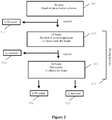
- an E. coli strain was cultivated in a first step 100 on Tryptic Soy Agar of non-animal origin. Six (6) isolated colonies were then used to cultivate the E. coli strain in a second step 200 for 2 hours at 37° C and agitation at 200 rpm in 30 mL of Tryptic Soy Broth (TSB) of non-animal origin (for 1L of TSB: 20 g of Soy Peptone A3 SC -(Organotechnie), 2.5 g anhydrous dextrose USP -(J.T. Baker), 5 g sodium chloride USP - (J.T. Baker), and 2.5 g dibasic potassium phosphate USP -(Fisher Chemical)).
- TAB Tryptic Soy Broth
- the resulting Culture 1 was diluted by a factor of 10 in TSB and was then used to cultivate the E. coli strain in a third step 300 for 2 hours at 37° C and agitation at 200 rpm in 100 mL of TSB of non-animal origin.
- the resulting Culture 2 was diluted by a factor of 10 in TSB and was then used to cultivate the E. coli strain in a fourth step 400 for 5 hours at 37° C and agitation at 200 rpm in 1 L of TSB of non-animal origin.
- the resulting Culture 3 was then used to embed E. coli in matrix. Variations and refinements to the culture protocol herein described are possible and will become apparent to persons skilled in the art in light of the present teachings.
- the non-pathogenic E. coli may also be cultivated in anaerobic conditions according to protocols known in the art ( Son & Taylor, Curr. Protoc. Microbiol., 2012, 27:5A.4.1 - 5A.4.9 ).
- the non-pathogenic E. coli strain deposited at the International Depository Authority of Canada (IDAC) on January 21, 2005 under accession number IDAC 210105-01 may be selected.
- BactoTM peptone (1.5 g, BD, Mississauga, Canada) was mixed with 1.5 L of heated water to obtain a mixture.
- Alginate (30 g Grindsted®, DuPontTM Danisco®, Mississauga, Canada) was slowly added to the mixture while mixing with a magnetic bar at 360 rpm. Complete solubilisation of alginate was obtained in about 3 h to obtain a 2% alginate (m/v) solution. The solution including the magnetic bar was then autoclaved under standard conditions. Variations and refinements to the matrix preparation protocol herein described are possible and will become apparent to persons skilled in the art in light of the present teachings.
- the following was added, in order and while mixing with the magnetic bar, to the autoclaved matrix solution to obtain a slurry: 1 L of TSB of non-animal origin and, with reference to Figure 1 , 0.5 L of the resulting Culture 3 of E. coli in 1 L of TSB of non-animal origin.
- the slurry was extruded into a polymerization bath (300 mM CaCl 2 , 0.1 wt./v. % BactoTM tryptone, 0.1 wt./v. % BactoTM peptone, and 0.05 wt./v.
- a preservation solution S1 the beads with embedded E. coli in the matrix were placed in a preservation solution S1, a preservation solution S2, a preservation solution S3 or a preservation solution S4 with gentle stirring for about 20 minutes.
- a determination of total CFU 550 was performed after soaking in the preservation solution.
- a second step 600 the beads were then placed on a tray dryer in an air dryer at room temperature for about 24 h to obtain semi-dry beads.
- a measurement of water activity a w 650 was performed on the semi-dry beads using an Aqualab Water Activity Meter 4TE (Decagon Devices, Inc., U.S.A.).
- the drying process 800 includes at least two steps: a step 600 which includes placing beads in an air dryer for 24 hours at room temperature and to obtain semi-dry beads and a step 700 which includes placing the semi-dry beads in a desiccator for 64 hours to obtain dry beads.
- a determination of total CFU 750 and a measurement of water a w 760 were performed on the dry beads. Dry beads having a water activity a w of ⁇ 0.3 were obtained.
- a w fold reduction 650 ⁇ 760 650
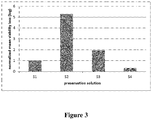
- Example 1 A compilation of the results of Example 1 is set forth in Tables 2 and 3. These results demonstrate that the elements of preservation solution S4 provided a significant effect to the viability of the E. coli embedded in the dried matrix and its resistance to the drying process 700.
- Table 2 Sample step 550 step 750 average CFU average CFU average CFU loss (log 10 ) Normalized CFU loss (log 10 ) S1 3 x 10 11 ⁇ 9 x 10 10 1.4 x 10 11 ⁇ 4.3 x 10 9 0.32 ⁇ 0.14 1 S2 2.3 x 10 11 ⁇ 5.5 x 10 10 5.4 x 10 9 ⁇ 2.7 x 10 9 1.66 ⁇ 0.3 5.18 S3 2.6 x 10 11 ⁇ 4.9 x 10 10 7.4 x 10 10 ⁇ 4.3 x 10 10 0.61 ⁇ 0.32 1.90 S4 3.1 x 10 11 ⁇ 7 x 10 10 2.5 x 10 11 ⁇ 9.7 x 10 10 0.11 ⁇ 0.08 0.34
- Table 3 Sample step 650 step 760 average
- Protocol for incorporating dried matrix into a feed for example in the form of a feed additive are known in the art.
- An illustrative example of doing such can be done, e.g., by incorporating 500 g to 1000 g of dried matrix beads into a ton of feed.
- the feed can also include inactivated yeast product in suitable amounts.
- the dried matrix beads comprising the embedded E. coli are mixed in a homogenization tank with all other ingredients.
- the mixture is continuously mixed during the pelleting process.
- the mixed material is then pumped towards an extruder. Steam is then applied on the mixed material that is about to enter the extruder (i.e., hence, the temperature of the mixture increases at this stage).
- Suitable pressure is then applied on the mixture during its passage inside the extruder (pressure and temperature increase, point where highest temperature reached, around 75°C).
- the formed pellets are then expelled out of the extruder into a cooling tank (rapid temperature drops to 30-40°C followed by another cool down, to reach ambient temperature).
- Pelleted feed including the feed additive matrix comprising embedded E. coli
- can then be stored, for example in bags / containers. Variations and refinements to the pelleting protocol herein described are possible and will become apparent to persons skilled in the art in light of the present teachings.
- a preservation solution S1 For each preservation solution the drying and testing was performed at least in triplicates.
- a preservation solution S5 For each preservation solution the drying and testing was performed at least in triplicates.
- a preservation solution S5 For each preservation solution the drying and testing was performed at least in triplicates.
- a preservation solution S5 For each preservation solution the drying and testing was performed at least in triplicates.
- a preservation solution S5 For each preservation solution the drying and testing was performed at least in triplicates.
- a preservation solution S5 For each preservation solution the drying and testing was performed at least in triplicates.
- a determination of total CFU 550 was performed after soaking in the preservation solution.
- a second step 600 the beads were then placed on a tray dryer in an air dryer at room temperature for about 24 h to obtain semi-dry beads.
- a measurement of water activity a w 650 was performed on the semi-dry beads using an Aqualab Water Activity Meter 4TE (Decagon Devices, Inc., U.S.A.).
- the drying process 800 includes at least two steps: a step 600 which includes placing beads in an air dryer for 24 hours at room temperature and to obtain semi-dry beads and a step 700 which includes placing the semi-dry beads in a desiccator for 64 hours to obtain dry beads.
- a determination of total CFU 750 and a measurement of water a w 760 were performed on the dry beads. Dry beads having a water activity a w of ⁇ 0.3 were obtained.
- Example 2 A compilation of the results of Example 2 is set forth in Tables 4 and 5. These results demonstrate that the elements of preservation solution S7 provided a significant protective effect to the viability of the E. coli embedded in the dried matrix and its resistance to the drying process 700.
- Table 4 Sample step 550 step 750 average CFU average CFU average CFU loss (log 10 ) Normalized CFU loss (log 10 ) S1 3.3 x 10 11 ⁇ 9.2 x 10 10 1.8 x 10 11 ⁇ 2.7 x 10 10 0.26 ⁇ 0.07 1 S5 3.5 x 10 11 ⁇ 7.7 x 10 10 2.6 x 10 11 ⁇ 6 x 10 10 0.13 ⁇ 0.17 0.5 S6 3.1 x 10 11 ⁇ 5.8 x 10 10 2.8 x 10 11 ⁇ 1.7 x 10 11 0.10 ⁇ 0.29 0.38 S7 3.4 x 10 11 ⁇ 3.7 x 10 10 2.7 x 10 11 ⁇ 1 x 10 10 0.10 ⁇ 0.06 0.38 Table 5 Sample step 650 step 760
- a preservation solution S1 For each preservation solution the drying and testing was performed at least in triplicates.
- a preservation solution S0 For each preservation solution the drying and testing was performed at least in triplicates.
- a determination of total CFU 550 was performed after soaking in the preservation solution.
- a second step 600 the beads were then placed on a tray dryer in an air dryer at room temperature for about 24 h to obtain semi-dry beads.
- a measurement of water activity a w 650 was performed on the semi-dry beads using an Aqualab Water Activity Meter 4TE (Decagon Devices, Inc., U.S.A.).
- the drying process 800 includes at least two steps: a step 600 which includes placing beads in an air dryer for 24 hours at room temperature and to obtain semi-dry beads and a step 700 which includes placing the semi-dry beads in a desiccator for 64 hours to obtain dry beads.
- a determination of total CFU 750 and a measurement of water a w 760 were performed on the dry beads. Dry beads having a water activity a w of ⁇ 0.3 were obtained.
- Example 3 A compilation of the results of Example 3 is set forth in Tables 6 and 7.
- Table 6 Sample step 550 step 750 average CFU average CFU average CFU loss (log 10 ) Normalized CFU loss (log 10 ) S1 2.2 x 10 11 ⁇ 2.9 x 10 10 1.7 x 10 11 ⁇ 9.3 x 10 9 0.11 ⁇ 0.05 1 S0 1.9 x 10 11 ⁇ 2 x 10 10 1.5 x 10 6 ⁇ 1.5 x 10 6 5.28 ⁇ 0.53 47.7 S8 2.8 x 10 11 ⁇ 4.6 x 10 10 5.9 x 10 10 + 2.3 x 10 10 0.70 ⁇ 0.15 6.28 S9 2.4 x 10 11 ⁇ 5.4 x 10 10 1.5 x 10 11 ⁇ 1.5 x 10 10 0.18 ⁇ 0.04 1.64
- Sample step 650 step 760 average a w average a w a w fold reduction S1 0.453 ⁇ 0.010 0.241 ⁇ 0.005 0.47 S0 0.331 ⁇
- a preservation solution S1 For each preservation solution the drying and testing was performed at least in triplicates.
- a preservation solution S10 For each preservation solution the drying and testing was performed at least in triplicates.
- a determination of total CFU 550 was performed after soaking in the preservation solution.
- a second step 600 the beads were then placed on a tray dryer in an air dryer at room temperature for about 24 h to obtain semi-dry beads.
- a measurement of water activity a w 650 was performed on the semi-dry beads using an Aqualab Water Activity Meter 4TE (Decagon Devices, Inc., U.S.A.).
- the drying process 800 includes at least two steps: a step 600 which includes placing beads in an air dryer for 24 hours at room temperature and to obtain semi-dry beads and a step 700 which includes placing the semi-dry beads in a desiccator for 64 hours to obtain dry beads.
- a determination of total CFU 750 and a measurement of water a w 760 were performed on the dry beads. Dry beads having a water activity a w of ⁇ 0.3 were obtained.
- Example 4 A compilation of the results of Example 4 is set forth in Tables 8 and 9.
- Table 8 Sample step 550 step 750 average CFU average CFU average CFU loss (log 10 ) Normalized CFU loss (log 10 ) S1 3.7 x 10 11 ⁇ 5.2 x 10 10 2.8 x 10 11 ⁇ 4.46 x 10 10 0.12 ⁇ 0.01 1 S10 4 x 10 11 ⁇ 1 x 10 11 3.3 x 10 11 ⁇ 3.11 x 10 10 0.07 ⁇ 0.12 0.58 S11 3.3 x 10 11 ⁇ 3.9 x 10 10 1.9 x 10 11 ⁇ 1.77 x 10 10 0.24 ⁇ 0.03 1.91 S12 4 x 10 11 ⁇ 2.9 x 10 10 5.3 x 10 11 ⁇ 9.27 x 10 10 -0.12 ⁇ 0.08 -0.94 Table 9 Sample step 650 step 760 average a w average a w a w fold reduction S1 0.475 ⁇ 0.023 0.123 ⁇ 0.007 0.74 S10
- a preservation solution S1 For each preservation solution the drying and testing was performed at least in triplicates.
- a preservation solution S1 For each preservation solution the drying and testing was performed at least in triplicates.
- a preservation solution S13 For each preservation solution the drying and testing was performed at least in triplicates.
- a preservation solution S14 In a first step 500 beads prepared as in Example 1 were placed in either a preservation solution S1, a preservation solution S13, a preservation solution S14 or a preservation solution S15 with gentle stirring for about 20 minutes. In each case, a determination of total CFU 550 was performed after soaking in the preservation solution.
- a second step 600 the beads were then placed on a tray dryer in an air dryer at room temperature for about 24 h to obtain semi-dry beads.
- a measurement of water activity a w 650 was performed on the semi-dry beads using an Aqualab Water Activity Meter 4TE (Decagon Devices, Inc., U.S.A.).
- the drying process 800 includes at least two steps: a step 600 which includes placing beads in an air dryer for 24 hours at room temperature and to obtain semi-dry beads and a step 700 which includes placing the semi-dry beads in a desiccator for 64 hours to obtain dry beads.
- a determination of total CFU 750 and a measurement of water a w 760 were performed on the dry beads. Dry beads having a water activity a w of ⁇ 0.3 were obtained.
- Example 5 A compilation of the results of Example 5 is set forth in Tables 10 and 11.
- Table 10 Sample step 550 step 750 average CFU average CFU average CFU loss (log 10 ) Normalized CFU loss (log 10 ) S1 4.1 x 10 11 ⁇ 3.8 x 10 10 2.7 x 10 11 ⁇ 3.44 x 10 10 0.18 ⁇ 0.10 1 S13 3.8 x 10 11 ⁇ 4.2 x 10 10 2.6 x 10 11 ⁇ 2.7 x 10 10 0.15 ⁇ 0.02 0.85 S14 3.8 x 10 11 ⁇ 6.1 x 10 10 2.2 x 10 11 ⁇ 3.55 x 10 10 0.24 ⁇ 0.08 1.35 S15 4.4 x 10 11 ⁇ 1.5 x 10 10 3.8 x 10 11 ⁇ 6.37 x 10 10 0.06 ⁇ 0.07 0.35 Table 11 Sample step 650 step 760 average a w average a w a w fold reduction S1 0.501 ⁇ 0.041 0.177 ⁇ 0.008 0.65 S13 0.562
- a preservation solution S1 For each preservation solution the drying and testing was performed at least in triplicates.
- a preservation solution S1 For each preservation solution the drying and testing was performed at least in triplicates.
- a preservation solution S16 In each case, a preservation solution S16, a preservation solution S17 or a preservation solution S18 with gentle stirring for about 20 minutes.
- a determination of total CFU 550 was performed after soaking in the preservation solution.
- the beads were then placed on a tray dryer in an air dryer at room temperature for about 24 h to obtain semi-dry beads.
- a measurement of water activity a w 650 was performed on the semi-dry beads using an Aqualab Water Activity Meter 4TE (Decagon Devices, Inc., U.S.A.).
- the drying process 800 includes at least two steps: a step 600 which includes placing beads in an air dryer for 24 hours at room temperature and to obtain semi-dry beads and a step 700 which includes placing the semi-dry beads in a desiccator for 64 hours to obtain dry beads.
- a determination of total CFU 750 and a measurement of water a w 760 were performed on the dry beads. Dry beads having a water activity a w of ⁇ 0.3 were obtained.
- Example 6 A compilation of the results of Example 6 is set forth in Tables 12 and 13.
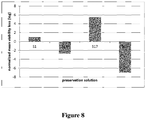
- Table 12 Sample step 550 step 750 average CFU average CFU average CFU loss (log 10 ) Normalized CFU loss (log 10 ) S1 3.3 x 10 11 ⁇ 3.4 x 10 10 3.1 x 10 11 ⁇ 4.92 x 10 10 0.03 ⁇ 0.07 1 S16 3.6 x 10 11 ⁇ 4.1 x 10 10 4.4 x 10 11 ⁇ 9.91 x 10 10 -0.07 ⁇ 0.11 -2.68 S17 3.2 x 10 11 ⁇ 4.5 x 10 10 2.3 x 10 11 ⁇ 5.05 x 10 10 0.15 ⁇ 0.05 5.57 S18 2.7 x 10 11 ⁇ 3.9 x 10 10 4.2 x 10 11 ⁇ 4.76 x 10 10 -0.19 ⁇ 0.06 -6.98 Table 13 Sample step 650 step 760 average a w average a w a w fold reduction S1 0.734 ⁇ 0.164 0.155 ⁇ 0.00
- a preservation solution S1 or a preservation solution S19 were placed in either a preservation solution S1 or a preservation solution S19 with gentle stirring for about 20 minutes.
- a determination of total CFU 550 was performed after soaking in the preservation solution.
- the beads were then placed on a tray dryer in an air dryer at room temperature for about 24 h to obtain semi-dry beads.
- a measurement of water activity a w 650 was performed on the semi-dry beads using an Aqualab Water Activity Meter 4TE (Decagon Devices, Inc., U.S.A.).
- the drying process 800 includes at least two steps: a step 600 which includes placing beads in an air dryer for 24 hours at room temperature and to obtain semi-dry beads and a step 700 which includes placing the semi-dry beads in a desiccator for 64 hours to obtain dry beads.
- a determination of total CFU 750 and a measurement of water a w 760 were performed on the dry beads. Dry beads having a water activity a w of ⁇ 0.3 were obtained.
- Example 7 A compilation of the results of Example 7 is set forth in Tables 14 and 15.
- Table 14 Sample step 550 step 750 average CFU average CFU average CFU loss (log 10 ) Normalized CFU loss (log 10 ) S1 3.5 x 10 11 ⁇ 4.4x 10 8 3.2 x 10 11 ⁇ 4.13 x 10 10 0.03 ⁇ 0.05 1 S19 3.3 x 10 11 ⁇ 2.6 x 10 10 2.4 x 10 11 ⁇ 2.06 x 10 10 0.13 ⁇ 0.06 3.83
- Sample step 650 step 760 average a w average a w a w fold reduction S1 0.660 ⁇ 0.200 0.158 ⁇ 0.026 0.76 S19 0.561 ⁇ 0.085 0.129 ⁇ 0.010 0.77
- Example 2 For each preservation solution the drying and testing was performed at least in triplicates. Beads prepared as in Example 1 were placed in a preservation solution S1, a preservation solution S2, a preservation solution S3 and a preservation solution S4 with gentle stirring for about 20 minutes. The beads were then placed on a tray dryer in an air dryer at room temperature for about 24 h to obtain semi-dry beads. The semi-dry beads were then placed in a desiccator for about 64 h, in which dry and filtered air was blown. Dry beads having a water activity a w of ⁇ 0.3 were obtained.
- strain viability was tested over a period of four (4) weeks under storage conditions at 4°C by measuring the CFU/g of the dried beads. The tests were performed at least in triplicates and one standard deviation was calculated.
- Example 8 The results of Example 8 are shown in Table 16 where all the preservation solutions tested afforded feed additive strain stability during 4 weeks when stored at 4°C. Table 16 Preservation solution Difference CFU/g after 4 weeks (log) S1 0.2 S2 0.1 S3 0.1 S4 0
- Example 2 For each preservation solution the drying and testing was performed at least in triplicates. Beads prepared as in Example 1 were placed in a preservation solution S1, a preservation solution S5, a preservation solution S6 and a preservation solution S7 with gentle stirring for about 20 minutes. The beads were then placed on a tray dryer in an air dryer at room temperature for about 24 h to obtain semi-dry beads. The semi-dry beads were then placed in a desiccator for about 64 h, in which dry and filtered air was blown. Dry beads having a water activity a w of ⁇ 0.3 were obtained.
- strain viability was tested over a period of four (4) weeks under storage conditions at 4°C by measuring the CFU/g of the dried beads. The tests were performed at least in triplicates and one standard deviation was calculated.
- Example 9 The results of Example 9 are shown in Table 17 and all the preservation solutions tested afforded feed additive strain stability during 4 weeks when stored at 4°C. Table 17 Preservation solution Difference CFU/g after 4 weeks (log) S1 0.2 S5 0.1 S6 0 S7 0.1
- Example 1 For each preservation solution the drying and testing was performed at least in triplicates. Beads prepared as in Example 1 were placed in either a preservation solution S1, a preservation solution S0, a preservation solution S8 and a preservation solution S9 with gentle stirring for about 20 minutes. The beads were then placed on a tray dryer in an air dryer at room temperature for about 24 h to obtain semi-dry beads. The semi-dry beads were then placed in a desiccator for about 64 h, in which dry and filtered air was blown. Dry beads having a water activity a w of ⁇ 0.3 were obtained.
- strain viability was tested over a period of four (4) weeks under storage conditions at 4°C by measuring the CFU/g of the dried beads. The tests were performed at least in triplicates and one standard deviation was calculated.
- Example 10 The results of Example 10 are shown in Table 18 and all the preservation solutions tested afforded feed additive strain stability during 4 weeks when stored at 4°C. Table 18 Preservation solution Difference CFU/g after 4 weeks (log) S1 0 S0 2.4 S8 0.1 S9 0
- Example 2 For each preservation solution the drying and testing was performed at least in triplicates. Beads prepared as in Example 1 were placed in either a preservation solution S1, a preservation solution S10, a preservation solution S11 and a preservation solution S12 with gentle stirring for about 20 minutes. The beads were then placed on a tray dryer in an air dryer at room temperature for about 24 h to obtain semi-dry beads. The semi-dry beads were then placed in a desiccator for about 64 h, in which dry and filtered air was blown. Dry beads having a water activity a w of ⁇ 0.3 were obtained.
- strain viability was tested over a period of four (4) weeks under storage conditions at 4°C by measuring the CFU/g of the dried beads. The tests were performed at least in triplicates and one standard deviation was calculated.
- Example 11 The results of Example 11 are shown in Table 19 and all the preservation solutions tested afforded feed additive strain stability during 4 weeks when stored at 4°C. Table 19 Preservation solution Difference CFU/g after 4 weeks (log) S1 0.1 S10 0.1 S11 0.4 S12 0.2
- Example 2 For each preservation solution the drying and testing was performed at least in triplicates. Beads prepared as in Example 1 were placed in either a preservation solution S1, a preservation solution S13, a preservation solution S14 and a preservation solution S15 with gentle stirring for about 20 minutes. The beads were then placed on a tray dryer in an air dryer at room temperature for about 24 h to obtain semi-dry beads. The semi-dry beads were then placed in a desiccator for about 64 h, in which dry and filtered air was blown. Dry beads having a water activity a w of ⁇ 0.3 were obtained.
- strain viability was tested over a period of four (4) weeks under storage conditions at 4°C by measuring the CFU/g of the dried beads. The tests were performed at least in triplicates and one standard deviation was calculated.
- Example 12 The results of Example 12 are shown in Table 20 and all the preservation solutions tested afforded feed additive strain stability during 4 weeks when stored at 4°C. Table 20 Preservation solution Difference CFU/g after 4 weeks (log) S1 0 S13 0 S14 0.1 S15 0.1
- Example 2 For each preservation solution the drying and testing was performed at least in triplicates. Beads prepared as in Example 1 were placed in either a preservation solution S1, a preservation solution S16, a preservation solution S17 and a preservation solution S18 with gentle stirring for about 20 minutes. The beads were then placed on a tray dryer in an air dryer at room temperature for about 24 h to obtain semi-dry beads. The semi-dry beads were then placed in a desiccator for about 64 h, in which dry and filtered air was blown. Dry beads having a water activity a w of ⁇ 0.3 were obtained.
- strain viability was tested over a period of four (4) weeks under storage conditions at 4°C by measuring the CFU/g of the dried beads. The tests were performed at least in triplicates and one standard deviation was calculated.
- Example 13 The results of Example 13 are shown in Table 21 and all the preservation solutions tested afforded feed additive strain stability during 4 weeks when stored at 4°C.
- Table 21 Preservation solution Difference CFU/g after 4 weeks (log) S1 0 S16 0 S17 0 S18 0.1
- Example 1 For each preservation solution the drying and testing was performed at least in triplicates. Beads prepared as in Example 1 were placed in either a preservation solution S1 and a preservation solution S19 with gentle stirring for about 20 minutes. The beads were then placed on a tray dryer in an air dryer at room temperature for about 24 h to obtain semi-dry beads. The semi-dry beads were then placed in a desiccator for about 64 h, in which dry and filtered air was blown. Dry beads having a water activity a w of ⁇ 0.3 were obtained.
- strain viability was tested over a period of four (4) weeks under storage conditions at 4°C by measuring the CFU/g of the dried beads. The tests were performed at least in triplicates and one standard deviation was calculated.
- a matrix comprising embedded viable E. coli as described herein was capable of preserving viability of sufficient bacteria CFU over a given period of time, e.g. 4 weeks, for a commercial use thereof.
- the matrix was successfully incorporated into a pelleted animal feed such that the animal feed could be stored / transported / handled and eventually administered to an animal while retaining sufficient viable CFU / g of animal feed to provide the beneficial effect normally associated with the bacteria.
- the terms “around”, “about” or “approximately” shall generally mean within the error margin generally accepted in the art. Hence, numerical quantities given herein generally include such error margin such that the terms “around”, “about” or “approximately” can be inferred if not expressly stated.
Landscapes
- Chemical & Material Sciences (AREA)
- Health & Medical Sciences (AREA)
- Life Sciences & Earth Sciences (AREA)
- Organic Chemistry (AREA)
- Engineering & Computer Science (AREA)
- Zoology (AREA)
- Medicinal Chemistry (AREA)
- Bioinformatics & Cheminformatics (AREA)
- Genetics & Genomics (AREA)
- Wood Science & Technology (AREA)
- Polymers & Plastics (AREA)
- Biotechnology (AREA)
- Chemical Kinetics & Catalysis (AREA)
- Microbiology (AREA)
- Biomedical Technology (AREA)
- Biochemistry (AREA)
- General Engineering & Computer Science (AREA)
- General Health & Medical Sciences (AREA)
- Virology (AREA)
- Tropical Medicine & Parasitology (AREA)
- Molecular Biology (AREA)
- Animal Husbandry (AREA)
- Food Science & Technology (AREA)
- Physiology (AREA)
- Micro-Organisms Or Cultivation Processes Thereof (AREA)
- Agricultural Chemicals And Associated Chemicals (AREA)
- Compositions Of Macromolecular Compounds (AREA)
- Immobilizing And Processing Of Enzymes And Microorganisms (AREA)
- Polysaccharides And Polysaccharide Derivatives (AREA)
- Jellies, Jams, And Syrups (AREA)
- Food Preservation Except Freezing, Refrigeration, And Drying (AREA)
- Cosmetics (AREA)
- Printing Plates And Materials Therefor (AREA)
- Measuring Or Testing Involving Enzymes Or Micro-Organisms (AREA)
- Medicinal Preparation (AREA)
- Detergent Compositions (AREA)
Applications Claiming Priority (2)
| Application Number | Priority Date | Filing Date | Title |
|---|---|---|---|
| US201562114829P | 2015-02-11 | 2015-02-11 | |
| PCT/CA2016/050129 WO2016127260A1 (en) | 2015-02-11 | 2016-02-11 | Improved dry matrix for embedding viable escherichia coli, method of making same and use thereof |
Publications (3)
| Publication Number | Publication Date |
|---|---|
| EP3256581A1 EP3256581A1 (en) | 2017-12-20 |
| EP3256581A4 EP3256581A4 (en) | 2018-08-01 |
| EP3256581B1 true EP3256581B1 (en) | 2020-09-09 |
Family
ID=56614014
Family Applications (1)
| Application Number | Title | Priority Date | Filing Date |
|---|---|---|---|
| EP16748521.8A Active EP3256581B1 (en) | 2015-02-11 | 2016-02-11 | Improved dry matrix for embedding viable escherichia coli, method of making same and use thereof |
Country Status (13)
| Country | Link |
|---|---|
| US (4) | US20180030400A1 (enExample) |
| EP (1) | EP3256581B1 (enExample) |
| JP (1) | JP6731416B2 (enExample) |
| KR (1) | KR102567744B1 (enExample) |
| CN (1) | CN107250354B (enExample) |
| BR (1) | BR112017017147B1 (enExample) |
| CA (1) | CA2976289A1 (enExample) |
| ES (1) | ES2822957T3 (enExample) |
| MX (1) | MX384826B (enExample) |
| PH (1) | PH12017501463A1 (enExample) |
| PT (1) | PT3256581T (enExample) |
| RU (1) | RU2722036C2 (enExample) |
| WO (1) | WO2016127260A1 (enExample) |
Families Citing this family (1)
| Publication number | Priority date | Publication date | Assignee | Title |
|---|---|---|---|---|
| CA3027896C (en) * | 2016-06-14 | 2021-07-13 | Prevtec Microbia Inc. | Animal feed pellets including a feed additive, method of making and of using same |
Family Cites Families (17)
| Publication number | Priority date | Publication date | Assignee | Title |
|---|---|---|---|---|
| US5389532A (en) * | 1988-07-07 | 1995-02-14 | Champagne Moet & Chandon | Process of producing a dehydrated polysaccharide gel containing microorganisms for preparing fermented drinks |
| DE19539574A1 (de) * | 1995-10-25 | 1997-04-30 | Boehringer Mannheim Gmbh | Zubereitungen und Verfahren zur Stabilisierung biologischer Materialien mittels Trocknungsverfahren ohne Einfrieren |
| GB9815634D0 (en) * | 1998-07-17 | 1998-09-16 | Mars Uk Ltd | Animal food composition |
| KR20060109452A (ko) * | 2003-10-02 | 2006-10-20 | 더 바이오 밸런스 코포레이션 | 건조 바이오치료 조성물, 용도, 그 투여 장치 및 투여 방법 |
| CN1913787B (zh) * | 2004-02-03 | 2014-11-26 | 增值研究合伙有限公司 | 在动物中促进生长的活体细菌的应用 |
| WO2007079147A2 (en) * | 2005-12-28 | 2007-07-12 | Advanced Bionutrition Corporation | A delivery vehicle for probiotic bacteria comprising a dry matrix of polysaccharides, saccharides and polyols in a glass form and methods of making same |
| US8277798B2 (en) * | 2006-05-10 | 2012-10-02 | Institut National De La Recherche Agronomique | Use of cells containing a specific DNA molecule as cytopathic agents to inhibit the proliferation of cells |
| US20090041727A1 (en) * | 2007-08-08 | 2009-02-12 | Conjugon, Inc. | Compositions and Methods for Microbe Storage and Delivery |
| AU2009307161A1 (en) * | 2008-10-22 | 2010-04-29 | De Staat Der Nederlanden, Vert. Door De Minister Van Vws | Preservation mixture and use thereof |
| SG176253A1 (en) * | 2009-05-26 | 2011-12-29 | Advanced Bionutrition Corp | Stable dry powder composition comprising biologically active microorganisms and/or bioactive materials and methods of making |
| US9504750B2 (en) | 2010-01-28 | 2016-11-29 | Advanced Bionutrition Corporation | Stabilizing composition for biological materials |
| NZ601017A (en) * | 2010-01-28 | 2014-07-25 | Advanced Bionutrition Corp | Dry glassy composition comprising a bioactive material |
| CL2011001984A1 (es) * | 2010-08-13 | 2012-06-29 | Advanced Bionutrition Corp | Composicion seca estabilizadora para material biologico que comprende carbohidrato, proteinas hidrolizadas de animal o de planta y un componente de acido carboxilico; metodo de preparacion; y formulacion de entrega oral que comprende la composicion seca estabilizadora. |
| BR112014023234B1 (pt) * | 2012-03-23 | 2020-12-08 | Advanced Bionutrition Corporation | composição de estabilização seca em um estado vítreo amorfo para um material bioativo, método para produzir a referida composição e produtos preparados com a mesma |
| KR102171028B1 (ko) * | 2012-07-20 | 2020-10-28 | 프레브테크 마이크로비아 인코포레이티드 | 비 병원성 f18 대장균 균주 및 이의 용도 |
| KR20150012445A (ko) * | 2013-07-25 | 2015-02-04 | 한국식품연구원 | 마늘 파쇄물 및 유산균이 포집되어 있는 알지네이트 비드를 포함하는, 생존율이 증진된 식품 발효용 미생물 첨가제 조성물 및 이의 제조방법 |
| KR20150012449A (ko) * | 2013-07-25 | 2015-02-04 | 한국식품연구원 | 동결보호제로서 콩가루를 이용하는 생존율이 증진된 식품 발효용 미생물 첨가제 조성물 및 이의 제조방법 |
-
2016
- 2016-02-11 MX MX2017010371A patent/MX384826B/es unknown
- 2016-02-11 CA CA2976289A patent/CA2976289A1/en active Pending
- 2016-02-11 WO PCT/CA2016/050129 patent/WO2016127260A1/en not_active Ceased
- 2016-02-11 BR BR112017017147-3A patent/BR112017017147B1/pt not_active IP Right Cessation
- 2016-02-11 RU RU2017131520A patent/RU2722036C2/ru active
- 2016-02-11 ES ES16748521T patent/ES2822957T3/es active Active
- 2016-02-11 US US15/550,453 patent/US20180030400A1/en not_active Abandoned
- 2016-02-11 JP JP2017542178A patent/JP6731416B2/ja not_active Expired - Fee Related
- 2016-02-11 PT PT167485218T patent/PT3256581T/pt unknown
- 2016-02-11 KR KR1020177022939A patent/KR102567744B1/ko active Active
- 2016-02-11 EP EP16748521.8A patent/EP3256581B1/en active Active
- 2016-02-11 CN CN201680010024.2A patent/CN107250354B/zh not_active Expired - Fee Related
-
2017
- 2017-08-14 PH PH12017501463A patent/PH12017501463A1/en unknown
-
2019
- 2019-12-17 US US16/717,411 patent/US20200199520A1/en not_active Abandoned
-
2020
- 2020-04-16 US US16/850,919 patent/US20200239829A1/en not_active Abandoned
-
2023
- 2023-11-17 US US18/512,167 patent/US20240240135A1/en not_active Abandoned
Non-Patent Citations (1)
| Title |
|---|
| None * |
Also Published As
| Publication number | Publication date |
|---|---|
| MX384826B (es) | 2025-03-14 |
| BR112017017147B1 (pt) | 2024-02-20 |
| RU2017131520A3 (enExample) | 2019-06-19 |
| KR20170110631A (ko) | 2017-10-11 |
| CA2976289A1 (en) | 2016-08-18 |
| PH12017501463A1 (en) | 2018-01-15 |
| CN107250354B (zh) | 2021-04-23 |
| US20200239829A1 (en) | 2020-07-30 |
| MX2017010371A (es) | 2017-12-15 |
| WO2016127260A1 (en) | 2016-08-18 |
| HK1247239A1 (en) | 2018-09-21 |
| US20180030400A1 (en) | 2018-02-01 |
| CN107250354A (zh) | 2017-10-13 |
| US20200199520A1 (en) | 2020-06-25 |
| JP2018506976A (ja) | 2018-03-15 |
| US20240240135A1 (en) | 2024-07-18 |
| JP6731416B2 (ja) | 2020-07-29 |
| PT3256581T (pt) | 2020-10-09 |
| EP3256581A4 (en) | 2018-08-01 |
| EP3256581A1 (en) | 2017-12-20 |
| BR112017017147A2 (pt) | 2018-04-03 |
| RU2017131520A (ru) | 2019-03-12 |
| RU2722036C2 (ru) | 2020-05-26 |
| KR102567744B1 (ko) | 2023-08-18 |
| ES2822957T3 (es) | 2021-05-05 |
Similar Documents
| Publication | Publication Date | Title |
|---|---|---|
| US9737578B2 (en) | Delivery vehicle for probiotic bacteria comprising a dry matrix of polysaccharides, saccharides and polyols in a glass form and methods of making same | |
| US8968721B2 (en) | Delivery vehicle for probiotic bacteria comprising a dry matrix of polysaccharides, saccharides and polyols in a glass form and methods of making same | |
| JP2012527898A5 (enExample) | ||
| US20240240135A1 (en) | Dry matrix for embedding viable escherichia coli, method of making same and use thereof | |
| JP2022172101A (ja) | 飼料添加物を含む動物飼料ペレット、その製造および使用方法 | |
| Mingmongkolchai et al. | In vitro evaluation of candidate Bacillus spp. for animal feed | |
| HK1247239B (en) | Improved dry matrix for embedding viable escherichia coli, method of making same and use thereof | |
| EP1213347A1 (en) | A method for preserving cells by processing the same into dry products | |
| Ibarguren et al. | Anti-Listeria monocytogenes activity of enterocins microencapsulated by ionic gelation | |
| Chiu et al. | Abelmoschus esculentus (L.) Moench polysaccharide enhances the resistance of Bifidobacterium longum MYL16 to freeze-drying and artificially digestive processes | |
| EP3524051A1 (en) | Matricial microencapsulation compositions | |
| CN117736872A (zh) | 冻干保护剂和菌粉制剂及其制备方法和应用 | |
| Moumnassi et al. | Applied Food Research |
Legal Events
| Date | Code | Title | Description |
|---|---|---|---|
| STAA | Information on the status of an ep patent application or granted ep patent |
Free format text: STATUS: THE INTERNATIONAL PUBLICATION HAS BEEN MADE |
|
| PUAI | Public reference made under article 153(3) epc to a published international application that has entered the european phase |
Free format text: ORIGINAL CODE: 0009012 |
|
| STAA | Information on the status of an ep patent application or granted ep patent |
Free format text: STATUS: REQUEST FOR EXAMINATION WAS MADE |
|
| 17P | Request for examination filed |
Effective date: 20170822 |
|
| AK | Designated contracting states |
Kind code of ref document: A1 Designated state(s): AL AT BE BG CH CY CZ DE DK EE ES FI FR GB GR HR HU IE IS IT LI LT LU LV MC MK MT NL NO PL PT RO RS SE SI SK SM TR |
|
| AX | Request for extension of the european patent |
Extension state: BA ME |
|
| DAV | Request for validation of the european patent (deleted) | ||
| REG | Reference to a national code |
Ref country code: DE Ref legal event code: R079 Ref document number: 602016043706 Country of ref document: DE Free format text: PREVIOUS MAIN CLASS: C12N0011100000 Ipc: C12N0001040000 |
|
| A4 | Supplementary search report drawn up and despatched |
Effective date: 20180704 |
|
| RIC1 | Information provided on ipc code assigned before grant |
Ipc: C12N 1/20 20060101ALI20180628BHEP Ipc: C12N 11/10 20060101ALI20180628BHEP Ipc: C12N 1/04 20060101AFI20180628BHEP |
|
| REG | Reference to a national code |
Ref country code: HK Ref legal event code: DE Ref document number: 1247239 Country of ref document: HK |
|
| STAA | Information on the status of an ep patent application or granted ep patent |
Free format text: STATUS: EXAMINATION IS IN PROGRESS |
|
| 17Q | First examination report despatched |
Effective date: 20190628 |
|
| GRAP | Despatch of communication of intention to grant a patent |
Free format text: ORIGINAL CODE: EPIDOSNIGR1 |
|
| STAA | Information on the status of an ep patent application or granted ep patent |
Free format text: STATUS: GRANT OF PATENT IS INTENDED |
|
| INTG | Intention to grant announced |
Effective date: 20200420 |
|
| GRAS | Grant fee paid |
Free format text: ORIGINAL CODE: EPIDOSNIGR3 |
|
| GRAA | (expected) grant |
Free format text: ORIGINAL CODE: 0009210 |
|
| STAA | Information on the status of an ep patent application or granted ep patent |
Free format text: STATUS: THE PATENT HAS BEEN GRANTED |
|
| RAP1 | Party data changed (applicant data changed or rights of an application transferred) |
Owner name: ELANCO CANADA LIMITED |
|
| AK | Designated contracting states |
Kind code of ref document: B1 Designated state(s): AL AT BE BG CH CY CZ DE DK EE ES FI FR GB GR HR HU IE IS IT LI LT LU LV MC MK MT NL NO PL PT RO RS SE SI SK SM TR |
|
| AX | Request for extension of the european patent |
Extension state: BA ME |
|
| REG | Reference to a national code |
Ref country code: GB Ref legal event code: FG4D |
|
| REG | Reference to a national code |
Ref country code: AT Ref legal event code: REF Ref document number: 1311599 Country of ref document: AT Kind code of ref document: T Effective date: 20200915 Ref country code: CH Ref legal event code: EP |
|
| REG | Reference to a national code |
Ref country code: DE Ref legal event code: R096 Ref document number: 602016043706 Country of ref document: DE |
|
| REG | Reference to a national code |
Ref country code: IE Ref legal event code: FG4D |
|
| REG | Reference to a national code |
Ref country code: DK Ref legal event code: T3 Effective date: 20200930 |
|
| REG | Reference to a national code |
Ref country code: PT Ref legal event code: SC4A Ref document number: 3256581 Country of ref document: PT Date of ref document: 20201009 Kind code of ref document: T Free format text: AVAILABILITY OF NATIONAL TRANSLATION Effective date: 20201002 |
|
| REG | Reference to a national code |
Ref country code: NL Ref legal event code: FP |
|
| REG | Reference to a national code |
Ref country code: LT Ref legal event code: MG4D |
|
| PG25 | Lapsed in a contracting state [announced via postgrant information from national office to epo] |
Ref country code: HR Free format text: LAPSE BECAUSE OF FAILURE TO SUBMIT A TRANSLATION OF THE DESCRIPTION OR TO PAY THE FEE WITHIN THE PRESCRIBED TIME-LIMIT Effective date: 20200909 Ref country code: SE Free format text: LAPSE BECAUSE OF FAILURE TO SUBMIT A TRANSLATION OF THE DESCRIPTION OR TO PAY THE FEE WITHIN THE PRESCRIBED TIME-LIMIT Effective date: 20200909 Ref country code: BG Free format text: LAPSE BECAUSE OF FAILURE TO SUBMIT A TRANSLATION OF THE DESCRIPTION OR TO PAY THE FEE WITHIN THE PRESCRIBED TIME-LIMIT Effective date: 20201209 Ref country code: NO Free format text: LAPSE BECAUSE OF FAILURE TO SUBMIT A TRANSLATION OF THE DESCRIPTION OR TO PAY THE FEE WITHIN THE PRESCRIBED TIME-LIMIT Effective date: 20201209 Ref country code: FI Free format text: LAPSE BECAUSE OF FAILURE TO SUBMIT A TRANSLATION OF THE DESCRIPTION OR TO PAY THE FEE WITHIN THE PRESCRIBED TIME-LIMIT Effective date: 20200909 Ref country code: LT Free format text: LAPSE BECAUSE OF FAILURE TO SUBMIT A TRANSLATION OF THE DESCRIPTION OR TO PAY THE FEE WITHIN THE PRESCRIBED TIME-LIMIT Effective date: 20200909 Ref country code: GR Free format text: LAPSE BECAUSE OF FAILURE TO SUBMIT A TRANSLATION OF THE DESCRIPTION OR TO PAY THE FEE WITHIN THE PRESCRIBED TIME-LIMIT Effective date: 20201210 |
|
| REG | Reference to a national code |
Ref country code: AT Ref legal event code: MK05 Ref document number: 1311599 Country of ref document: AT Kind code of ref document: T Effective date: 20200909 |
|
| PG25 | Lapsed in a contracting state [announced via postgrant information from national office to epo] |
Ref country code: LV Free format text: LAPSE BECAUSE OF FAILURE TO SUBMIT A TRANSLATION OF THE DESCRIPTION OR TO PAY THE FEE WITHIN THE PRESCRIBED TIME-LIMIT Effective date: 20200909 Ref country code: RS Free format text: LAPSE BECAUSE OF FAILURE TO SUBMIT A TRANSLATION OF THE DESCRIPTION OR TO PAY THE FEE WITHIN THE PRESCRIBED TIME-LIMIT Effective date: 20200909 |
|
| PG25 | Lapsed in a contracting state [announced via postgrant information from national office to epo] |
Ref country code: EE Free format text: LAPSE BECAUSE OF FAILURE TO SUBMIT A TRANSLATION OF THE DESCRIPTION OR TO PAY THE FEE WITHIN THE PRESCRIBED TIME-LIMIT Effective date: 20200909 Ref country code: CZ Free format text: LAPSE BECAUSE OF FAILURE TO SUBMIT A TRANSLATION OF THE DESCRIPTION OR TO PAY THE FEE WITHIN THE PRESCRIBED TIME-LIMIT Effective date: 20200909 Ref country code: SM Free format text: LAPSE BECAUSE OF FAILURE TO SUBMIT A TRANSLATION OF THE DESCRIPTION OR TO PAY THE FEE WITHIN THE PRESCRIBED TIME-LIMIT Effective date: 20200909 Ref country code: RO Free format text: LAPSE BECAUSE OF FAILURE TO SUBMIT A TRANSLATION OF THE DESCRIPTION OR TO PAY THE FEE WITHIN THE PRESCRIBED TIME-LIMIT Effective date: 20200909 |
|
| REG | Reference to a national code |
Ref country code: ES Ref legal event code: FG2A Ref document number: 2822957 Country of ref document: ES Kind code of ref document: T3 Effective date: 20210505 |
|
| PG25 | Lapsed in a contracting state [announced via postgrant information from national office to epo] |
Ref country code: AL Free format text: LAPSE BECAUSE OF FAILURE TO SUBMIT A TRANSLATION OF THE DESCRIPTION OR TO PAY THE FEE WITHIN THE PRESCRIBED TIME-LIMIT Effective date: 20200909 Ref country code: AT Free format text: LAPSE BECAUSE OF FAILURE TO SUBMIT A TRANSLATION OF THE DESCRIPTION OR TO PAY THE FEE WITHIN THE PRESCRIBED TIME-LIMIT Effective date: 20200909 Ref country code: IS Free format text: LAPSE BECAUSE OF FAILURE TO SUBMIT A TRANSLATION OF THE DESCRIPTION OR TO PAY THE FEE WITHIN THE PRESCRIBED TIME-LIMIT Effective date: 20210109 |
|
| REG | Reference to a national code |
Ref country code: DE Ref legal event code: R097 Ref document number: 602016043706 Country of ref document: DE |
|
| PG25 | Lapsed in a contracting state [announced via postgrant information from national office to epo] |
Ref country code: SK Free format text: LAPSE BECAUSE OF FAILURE TO SUBMIT A TRANSLATION OF THE DESCRIPTION OR TO PAY THE FEE WITHIN THE PRESCRIBED TIME-LIMIT Effective date: 20200909 |
|
| PLBE | No opposition filed within time limit |
Free format text: ORIGINAL CODE: 0009261 |
|
| STAA | Information on the status of an ep patent application or granted ep patent |
Free format text: STATUS: NO OPPOSITION FILED WITHIN TIME LIMIT |
|
| 26N | No opposition filed |
Effective date: 20210610 |
|
| PG25 | Lapsed in a contracting state [announced via postgrant information from national office to epo] |
Ref country code: SI Free format text: LAPSE BECAUSE OF FAILURE TO SUBMIT A TRANSLATION OF THE DESCRIPTION OR TO PAY THE FEE WITHIN THE PRESCRIBED TIME-LIMIT Effective date: 20200909 |
|
| PG25 | Lapsed in a contracting state [announced via postgrant information from national office to epo] |
Ref country code: MC Free format text: LAPSE BECAUSE OF FAILURE TO SUBMIT A TRANSLATION OF THE DESCRIPTION OR TO PAY THE FEE WITHIN THE PRESCRIBED TIME-LIMIT Effective date: 20200909 |
|
| PG25 | Lapsed in a contracting state [announced via postgrant information from national office to epo] |
Ref country code: LU Free format text: LAPSE BECAUSE OF NON-PAYMENT OF DUE FEES Effective date: 20210211 |
|
| P01 | Opt-out of the competence of the unified patent court (upc) registered |
Effective date: 20230512 |
|
| PG25 | Lapsed in a contracting state [announced via postgrant information from national office to epo] |
Ref country code: CY Free format text: LAPSE BECAUSE OF FAILURE TO SUBMIT A TRANSLATION OF THE DESCRIPTION OR TO PAY THE FEE WITHIN THE PRESCRIBED TIME-LIMIT Effective date: 20200909 |
|
| PG25 | Lapsed in a contracting state [announced via postgrant information from national office to epo] |
Ref country code: HU Free format text: LAPSE BECAUSE OF FAILURE TO SUBMIT A TRANSLATION OF THE DESCRIPTION OR TO PAY THE FEE WITHIN THE PRESCRIBED TIME-LIMIT; INVALID AB INITIO Effective date: 20160211 |
|
| PGFP | Annual fee paid to national office [announced via postgrant information from national office to epo] |
Ref country code: ES Payment date: 20240307 Year of fee payment: 9 |
|
| PG25 | Lapsed in a contracting state [announced via postgrant information from national office to epo] |
Ref country code: MK Free format text: LAPSE BECAUSE OF FAILURE TO SUBMIT A TRANSLATION OF THE DESCRIPTION OR TO PAY THE FEE WITHIN THE PRESCRIBED TIME-LIMIT Effective date: 20200909 |
|
| PGFP | Annual fee paid to national office [announced via postgrant information from national office to epo] |
Ref country code: DE Payment date: 20240116 Year of fee payment: 9 Ref country code: PT Payment date: 20240209 Year of fee payment: 9 Ref country code: CH Payment date: 20240301 Year of fee payment: 9 |
|
| PGFP | Annual fee paid to national office [announced via postgrant information from national office to epo] |
Ref country code: PL Payment date: 20240117 Year of fee payment: 9 Ref country code: FR Payment date: 20240123 Year of fee payment: 9 Ref country code: DK Payment date: 20240214 Year of fee payment: 9 Ref country code: BE Payment date: 20240119 Year of fee payment: 9 |
|
| PG25 | Lapsed in a contracting state [announced via postgrant information from national office to epo] |
Ref country code: TR Free format text: LAPSE BECAUSE OF FAILURE TO SUBMIT A TRANSLATION OF THE DESCRIPTION OR TO PAY THE FEE WITHIN THE PRESCRIBED TIME-LIMIT Effective date: 20200909 |
|
| REG | Reference to a national code |
Ref country code: NL Ref legal event code: PD Owner name: EVAH NUTRITION INC.; CA Free format text: DETAILS ASSIGNMENT: CHANGE OF OWNER(S), ASSIGNMENT; FORMER OWNER NAME: EVAH CORP. Effective date: 20240802 |
|
| REG | Reference to a national code |
Ref country code: BE Ref legal event code: PD Owner name: EVAH NUTRITION INC.; CA Free format text: DETAILS ASSIGNMENT: CHANGE OF OWNER(S), ASSIGNMENT; FORMER OWNER NAME: EVAH CORP. Effective date: 20240724 |
|
| PG25 | Lapsed in a contracting state [announced via postgrant information from national office to epo] |
Ref country code: MT Free format text: LAPSE BECAUSE OF FAILURE TO SUBMIT A TRANSLATION OF THE DESCRIPTION OR TO PAY THE FEE WITHIN THE PRESCRIBED TIME-LIMIT Effective date: 20200909 |
|
| PGFP | Annual fee paid to national office [announced via postgrant information from national office to epo] |
Ref country code: NL Payment date: 20250115 Year of fee payment: 10 |
|
| PGFP | Annual fee paid to national office [announced via postgrant information from national office to epo] |
Ref country code: IE Payment date: 20250109 Year of fee payment: 10 |
|
| PGFP | Annual fee paid to national office [announced via postgrant information from national office to epo] |
Ref country code: IT Payment date: 20250110 Year of fee payment: 10 Ref country code: GB Payment date: 20250109 Year of fee payment: 10 |
|
| REG | Reference to a national code |
Ref country code: DE Ref legal event code: R119 Ref document number: 602016043706 Country of ref document: DE |
|
| REG | Reference to a national code |
Ref country code: DK Ref legal event code: EBP Effective date: 20250228 |
|
| REG | Reference to a national code |
Ref country code: CH Ref legal event code: PL |
|
| PG25 | Lapsed in a contracting state [announced via postgrant information from national office to epo] |
Ref country code: PT Free format text: LAPSE BECAUSE OF NON-PAYMENT OF DUE FEES Effective date: 20250811 |
|
| PG25 | Lapsed in a contracting state [announced via postgrant information from national office to epo] |
Ref country code: CH Free format text: LAPSE BECAUSE OF NON-PAYMENT OF DUE FEES Effective date: 20250228 |
|
| REG | Reference to a national code |
Ref country code: BE Ref legal event code: MM Effective date: 20250228 |
|
| PG25 | Lapsed in a contracting state [announced via postgrant information from national office to epo] |
Ref country code: DE Free format text: LAPSE BECAUSE OF NON-PAYMENT OF DUE FEES Effective date: 20250902 |
|
| PG25 | Lapsed in a contracting state [announced via postgrant information from national office to epo] |
Ref country code: DK Free format text: LAPSE BECAUSE OF NON-PAYMENT OF DUE FEES Effective date: 20250228 |
|
| PG25 | Lapsed in a contracting state [announced via postgrant information from national office to epo] |
Ref country code: FR Free format text: LAPSE BECAUSE OF NON-PAYMENT OF DUE FEES Effective date: 20250228 |
|
| PG25 | Lapsed in a contracting state [announced via postgrant information from national office to epo] |
Ref country code: BE Free format text: LAPSE BECAUSE OF NON-PAYMENT OF DUE FEES Effective date: 20250228 |
|
| REG | Reference to a national code |
Ref country code: ES Ref legal event code: FD2A Effective date: 20260327 |
|
| PG25 | Lapsed in a contracting state [announced via postgrant information from national office to epo] |
Ref country code: ES Free format text: LAPSE BECAUSE OF NON-PAYMENT OF DUE FEES Effective date: 20250212 |
|
| PG25 | Lapsed in a contracting state [announced via postgrant information from national office to epo] |
Ref country code: PL Free format text: LAPSE BECAUSE OF NON-PAYMENT OF DUE FEES Effective date: 20250211 |