EP3255099A1 - Reifen - Google Patents
Reifen Download PDFInfo
- Publication number
- EP3255099A1 EP3255099A1 EP16746703.4A EP16746703A EP3255099A1 EP 3255099 A1 EP3255099 A1 EP 3255099A1 EP 16746703 A EP16746703 A EP 16746703A EP 3255099 A1 EP3255099 A1 EP 3255099A1
- Authority
- EP
- European Patent Office
- Prior art keywords
- tire
- resinous material
- reinforcing cord
- polypropylene
- resin
- Prior art date
- Legal status (The legal status is an assumption and is not a legal conclusion. Google has not performed a legal analysis and makes no representation as to the accuracy of the status listed.)
- Granted
Links
Images

Classifications
-
- C—CHEMISTRY; METALLURGY
- C08—ORGANIC MACROMOLECULAR COMPOUNDS; THEIR PREPARATION OR CHEMICAL WORKING-UP; COMPOSITIONS BASED THEREON
- C08L—COMPOSITIONS OF MACROMOLECULAR COMPOUNDS
- C08L23/00—Compositions of homopolymers or copolymers of unsaturated aliphatic hydrocarbons having only one carbon-to-carbon double bond; Compositions of derivatives of such polymers
- C08L23/02—Compositions of homopolymers or copolymers of unsaturated aliphatic hydrocarbons having only one carbon-to-carbon double bond; Compositions of derivatives of such polymers not modified by chemical after-treatment
- C08L23/10—Homopolymers or copolymers of propene
- C08L23/12—Polypropene
-
- B—PERFORMING OPERATIONS; TRANSPORTING
- B60—VEHICLES IN GENERAL
- B60C—VEHICLE TYRES; TYRE INFLATION; TYRE CHANGING; CONNECTING VALVES TO INFLATABLE ELASTIC BODIES IN GENERAL; DEVICES OR ARRANGEMENTS RELATED TO TYRES
- B60C5/00—Inflatable pneumatic tyres or inner tubes
- B60C5/12—Inflatable pneumatic tyres or inner tubes without separate inflatable inserts, e.g. tubeless tyres with transverse section open to the rim
- B60C5/16—Sealing means between beads and rims, e.g. bands
-
- B—PERFORMING OPERATIONS; TRANSPORTING
- B60—VEHICLES IN GENERAL
- B60C—VEHICLE TYRES; TYRE INFLATION; TYRE CHANGING; CONNECTING VALVES TO INFLATABLE ELASTIC BODIES IN GENERAL; DEVICES OR ARRANGEMENTS RELATED TO TYRES
- B60C1/00—Tyres characterised by the chemical composition or the physical arrangement or mixture of the composition
-
- B—PERFORMING OPERATIONS; TRANSPORTING
- B60—VEHICLES IN GENERAL
- B60C—VEHICLE TYRES; TYRE INFLATION; TYRE CHANGING; CONNECTING VALVES TO INFLATABLE ELASTIC BODIES IN GENERAL; DEVICES OR ARRANGEMENTS RELATED TO TYRES
- B60C5/00—Inflatable pneumatic tyres or inner tubes
- B60C5/01—Inflatable pneumatic tyres or inner tubes without substantial cord reinforcement, e.g. cordless tyres, cast tyres
-
- Y—GENERAL TAGGING OF NEW TECHNOLOGICAL DEVELOPMENTS; GENERAL TAGGING OF CROSS-SECTIONAL TECHNOLOGIES SPANNING OVER SEVERAL SECTIONS OF THE IPC; TECHNICAL SUBJECTS COVERED BY FORMER USPC CROSS-REFERENCE ART COLLECTIONS [XRACs] AND DIGESTS
- Y02—TECHNOLOGIES OR APPLICATIONS FOR MITIGATION OR ADAPTATION AGAINST CLIMATE CHANGE
- Y02P—CLIMATE CHANGE MITIGATION TECHNOLOGIES IN THE PRODUCTION OR PROCESSING OF GOODS
- Y02P20/00—Technologies relating to chemical industry
- Y02P20/141—Feedstock
Definitions
- the present invention relates to a tire to be fitted to a rim and, in particular, to a tire in which at least a portion of a tire frame (tire case) includes a resinous material.
- pneumatic tires constructed from rubber, organic fiber materials, steel members, and the like have been used in vehicles such as passenger cars.
- general rubber materials that are used for conventional pneumatic tires there are no problems in terms of heat resistance and the like.
- the process for manufacturing a tire usually includes plural steps, for example, kneading, sheeting, molding, and vulcanization, and therefore, improvement in productivity has been required.
- thermoplastic resinous materials have a lot of advantages from the viewpoint of improvement in productivity, such as by enabling injection molding.
- thermoplastic polymer material a tire in which a polyolefin-based thermoplastic elastomer is used as the thermoplastic polymer material has been proposed in JP-A No. 2012-046031 .
- Tires in which a thermoplastic resinous material is used, are easily produced and are inexpensive, compared with conventional tires made of rubber. On the other hand, when a tire is manufactured by using a resinous material, it is required to exhibit performance which is comparable to that of a conventional rubber tire together with realizing the high productivity and the low cost.
- a tire in which a thermoplastic polymer material is used is requested to ensure excellent fittability onto a rim such that the tire can be fitted onto a rim and such that the air in the inner part does not leak when the tire is fitted onto a rim.
- a property to suppress deformation of the tire itself at the time of traveling (resistance to deformation during traveling) is also requested thereto.
- the invention has been made based on the above circumstances, and an object of the invention is to provide a tire which is formed using a resinous material including polypropylene and has excellent fittability onto a rim as well as excellent resistance to deformation during traveling.
- a tire comprising a circular tire frame comprising a resinous material, the resinous material comprising at least polypropylene and having a pentad ratio of from 88.2% to 93.4%.
- a tire may be provided which is formed using a resinous material and has excellent fittability onto a rim as well as excellent resistance to deformation during traveling.
- the tire of the invention has a circular tire frame including a resinous material, namely, formed by using at least a resinous material.
- the resinous material includes at least polypropylene, and a pentad ratio of the resinous material is from 88.2% to 93.4%.
- polypropylene refers to homopolypropylene or random polypropylene, that is, a homopolymer of propylene or a copolymer of propylene and another monomer.
- a homopolypropylene is herein defined as a polymer in which the proportion of propylene in monomers synthesized to form the polymer is 98% by mol or more
- a random polypropylene is herein defined as a polymer in which the proportion of propylene in monomers synthesized to form the polymer is less than 98% by mol.
- a tire in which a resinous material is used is requested to exhibit performance which is comparable to that of a conventional rubber tire, such as an excellent fittability onto a rim such that leakage of internal air at the time of rim fitting is inhibited.
- a non-deforming property during traveling is requested, since occurrence of deformation in a tire frame itself when a load is continuously applied thereto by way of travelling means inferior running property, and leakage of internal air may occur when the deformation further progresses.
- the resinous material forming the tire frame includes at least polypropylene, and the pentad ratio of the resinous material is controlled within the above-described range. It is considered that the creep property of the tire frame can be reduced while obtaining an appropriate tensile elastic modulus as a tire frame when the pentad ratio of the resinous material is in the above-described range.
- the resinous material in the invention has a pentad ratio of from 88.2% to 93.4%.
- the pentad ratio exceeds the upper limit, the tensile elastic modulus of the tire frame cannot be controlled to be in an appropriate range, and as a result, the rim fitting cannot be performed favorably and internal air leakage also occurs.
- the pentad ratio is less than the lower limit value, the creep property of the tire frame cannot be reduced, and as a result, deformation resistance during traveling cannot be obtained. When the deformation of a tire frame itself progresses further, internal air leakage occurs.
- the pentad ratio is preferably from 88.2% to 91.7%, and more preferably from 88.2% to 89.0%.
- a quaternary carbon formed in a main chain by polymerization is an asymmetric carbon atom. Therefore, the arrangement of a side chain methyl group (-CH 3 ) bonded to this asymmetric carbon atom has orientation, and stereoregularity occurs depending on whether the side chain methyl groups at adjacent asymmetric carbon atoms are on a same side or different sides.
- the probability that side chain methyl groups of five consecutive asymmetric carbon atoms (pentad) in a structure of a main chain of polypropylene are on a same side is referred to as a pentad ratio.
- the pentad ratio of the resinous material in the invention can be measured by the following method.
- the measurement conditions were 123°C, a tetrachloroethane heavy solvent was used as a solvent, and as for the peak, the ratio of mmmm was calculated from each peak height of mmmm, mmmr, rmmr, mmrr, mmrm, rmrr, mrmr, rrrr, rrrm, and mrrm.
- a method of controlling the pentad ratio of a resinous material within the above-described range is not particularly limited, and a method of adjusting the pentad ratio by mixing two or more kinds of resins is preferable. More specifically, it is preferable to mix polypropylene as a first resin and a second resin different from the first resin.
- examples of the resin different from the first resin include: a resin other than polypropylene, that is, a resin polymerized from a monomer other than propylene; and a polypropylene (a homopolypropylene or a random polypropylene) which is a resin different in stereoregularity from the first resin.
- the asymmetric carbon atom of polypropylene in the main chain has a side chain methyl group, and since the arrangement thereof has orientation, stereoregularity appears.
- Polypropylene having a structure in which side chain methyl groups bonded to this asymmetric carbon atom are regularly and continuously arranged on the same side is called isotactic polypropylene.
- one having a pentad ratio of 94.5% or more is defined as isotactic polypropylene.
- atactic polypropylene polypropylene having a random arrangement of side chain methyl groups and having no regularity is referred to as atactic polypropylene.
- one having a pentad ratio of less than 94.5% is defined as atactic polypropylene.
- examples of the second resin different from the first resin include: a resin polymerized from a monomer other than propylene; homopolypropylene (atactic polypropylene) having a pentad ratio of less than 94.5%; and random polypropylene having a pentad ratio of less than 94.5%.
- the tire according to the invention has a tire frame including a resinous material (that is, formed using at least a resinous material), and the resinous material includes at least polypropylene.
- the resinous material may contain a thermoplastic resin other than polypropylene and other arbitrary components (additives), and a content of polypropylene with respect to the total amount of the resinous material is preferably 80% by mass or more, and more preferably from 90% by mass to 100% by mass.
- Resin as used herein is a concept including a thermoplastic resin and a thermosetting resin, but not including natural rubber.
- polypropylene examples include homopolypropylene (a homopolymer of propylene) and random polypropylene (a copolymer of propylene and another monomer).
- polypropylene homopolypropylene examples include polypropylene having different stereoregularity, and specific examples thereof include isotactic polypropylene and atactic polypropylene.
- Examples of the random polypropylene include a copolymer of propylene and another monomer. Examples thereof further include those having different pentad ratios in polypropylene chains in the main chain, and specific examples thereof include those having a pentad ratio of 94.5% or more and those having a pentad ratio of less than 94.5%.
- Examples of other monomers include ethylene, butene, and octene.
- Polypropylene is preferably homopolypropylene, and more preferably isotactic polypropylene, among the above.
- Examples of the isotactic polypropylene include PRIME POLYPRO E-105GM, J-700GP, E-200GP, and Y-400GP manufactured by Prime Polymer Co., Ltd., PL400A and PL500A manufactured by SunAllomer Ltd., and NOVATEC (registered trademark) EA9 and MA3 manufactured by Japan Polypropylene Corporation.
- atactic polypropylene examples include TAFSELEN (registered trademark) H3002, T1712, and X1102 manufactured by Sumitomo Chemical Co., Ltd. and L-MODU (registered trademark) S400, S600, and S901 manufactured by Idemitsu Kosan Co., Ltd.
- a weight average molecular weight of the polypropylene is preferably from 50,000 to 3,000,000, more preferably from 50,000 to 2,500,000, and still more preferably from 800,000 to 2,000,000.
- the resinous material has sufficient mechanical properties and excellent processability.
- the weight average molecular weight of the polypropylene can be measured by gel permeation chromatography (GPC), and for example, GPC (gel permeation chromatography) such as "HLC-8321GPC/HT" manufactured by Tosoh Corporation can be used.
- GPC gel permeation chromatography
- the isotactic polypropylene, the atactic polypropylene, and the random polypropylene can be synthesized by copolymerization by a known method.
- the pentad ratio of the resinous material it is preferable to adjust the pentad ratio by mixing two or more resins. More specifically, it is preferable to mix a first resin which is polypropylene and a second resin which is different from the first resin.
- homopolypropylene is preferably used, and isotactic polypropylene is particularly preferably used.
- isotactic polypropylene include those described above.
- a content of the isotactic polypropylene in the resinous material is preferably in a range of from 50% by mass to 70% by mass, more preferably in a range of from 55% by mass to 65% by mass, and still more preferably in a range of from 55% by mass to 60% by mass.
- homopolypropylene is preferably used, and atactic polypropylene is particularly preferably used.
- atactic polypropylene include those described above.
- a content of the atactic polypropylene in the resinous material is preferably in a range of from 30% by mass to 50% by mass, more preferably in a range of from 35% by mass to 45% by mass, and still more preferably in a range of from 40% by mass to 45% by mass.
- the resinous material of the invention it is more preferable to use isotactic polypropylene of homopolypropylene as the first resin, and atactic polypropylene of homopolypropylene as the second resin.
- both of the content of the isotactic polypropylene and the content of the atactic polypropyleneare are also in the above-described ranges respectively.
- the pentad ratio of the resinous material can be more easily controlled within the above-described range.
- the second resin is not limited to polypropylene, and other resins described below may be used. Further, the following other resins may be separately used in addition to the first resin and the second resin.
- the resinous material of the invention may further contain an additional resin which is different from polypropylene.
- the additional resin include a thermoplastic resin and a thermoplastic elastomer, examples of which including a polyamide resin, a polyurethane resin, a polyester resin, a polyolefin resin, a polystyrene resin, a thermoplastic polyamide-based elastomer, a thermoplastic polyurethane-based elastomer, a thermoplastic polyester-based elastomer, and a thermoplastic styerene-based elastomer.
- the resinous material of the invention may further contain one or more of various additives.
- the additive include a rubber, a filler (for example, silica, calcium carbonate, or clay), an aging inhibitor, an oil, a plasticizer, a colorant, a weather-proofing agent, or a reinforcing material.
- a content of the additives in the resinous material is not particularly limited, and the additives can be appropriately used, as long as the effects of the invention are not impaired.
- the content of the resin component in the resinous material is preferably 50% by mass or higher, and more preferably 90% by mass or higher, with respect to the total amount of the resinous material.
- the content of the resin component in the resinous material indicates the residue obtained by subtracting the total content of the additives from the total amount of the resinous material.
- a tensile elastic modulus in the invention means one that is measured in accordance with JIS K7113:1995.
- the tensile elastic modulus of the resinous material is preferably in a range of from 140 MPa to 570 MPa, more preferably in a range of from 160 MPa to 500 MPa, and further preferably in a range of from 180 MPa to 300 MPa.
- the tensile elastic modulus of 140 MPa or more may enable to favorably maintain a shape of the tire frame.
- the tensile elastic modulus of 570 MPa or less may enable to favorably perform rim fitting and inhibit internal air leakage.
- An amount of creep means one that is measured three hours after starting of a test which accords with JIS K7115:1995 using a JIS No.3 dumbbell specimen under the conditions of 65 mm of a distance between both grips, 40 kN and 90°C.
- the amount of creep of the resinous material is preferably 50 mm or smaller, more preferably 30 mm or smaller, still more preferably 5 mm or smaller, and the nearer to 0 mm the amount of creep is the further preferable it is.
- the amount of creep of 50 mm or smaller enables to suppress deformation of the tire frame itself, particularly deformation of a side of a tire, even when a load is continuously applied to the tire by traveling. As a result thereof, leakage of air which may occur with such a deformation is suppressed
- the tensile elastic modulus and the amount of creep are physical properties of the resinous material, namely, physical properties of a tire frame including the resinous material. Accordingly, when the tire frame includes a resinous material including optional resinous composition in addition to polypropylene or when the tire frame includes a resinous material including an additive, the tensile elastic modulus and the amount of creep indicate physical properties of the resinous material including all such components.
- a melting temperature of the resinous material is normally from 80°C to 200°C, and is preferably from approximately 100°C to approximately 200°C from the viewpoint of manufacturability of the tire.
- the bonding section thereof can be heated to a temperature of being equal to or higher than a melting temperature of a resinous material for forming the tire frame by using, as the resinous material, one that has a melting temperature of from 100°C to 200°C in this manner.
- the heating temperature is preferably a temperature that is from 10°C to 150°C higher, and is more preferably a temperature from 10°C to 100°C higher, than the melting temperature (or softening temperature) of the resinous material forming the tire frame pieces.
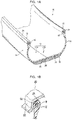
- FIG. 1A is a perspective view illustrating a cross-section of a part of a tire according to one embodiment of the invention.
- Fig. 1B is a cross-sectional view of a bead portion fitted to a rim.
- the tire 10 according to this embodiment has substantially the same cross-sectional shape as those of conventional general rubber pneumatic tires.
- the tire 10 includes a tire case 17 (tire frame) composed of: a pair of bead portions 12 each contacting with a bead seat 21 and a rim flange 22 of a rim 20 shown in Fig. 1B ; side portions 14 that extend from the bead portions 12 toward the outer side in the tire radial direction; and a crown portion 16 (outer peripheral portion) that connect the outer end in the tire radial direction of one side portion 14 and the outer end in the tire radial direction of the other side portion 14.
- the tire case 17 of the present embodiment may employ, as the resinous material, one that includes at least polypropylene and a pentad ratio of that is from 88.2% to 93.4%.
- the tire case 17 of the present embodiment is formed with a single resinous material; however, the configuration of the invention is not limited thereto, and, similarly to ordinary conventional rubber-made pneumatic tires, thermoplastic resinous materials with different characteristics may be employed for each of the sections of the tire case 17 (such as the side portions 14, the crown portion 16 and the bead portions 12).
- the tire case 17 may be reinforced by a reinforcing material by embedding the reinforcing material (such as fibers, cord, nonwoven fabric, or woven fabric of a polymer material or metal) in the tire case 17 (for example, in the bead portions 12, the side portions 14, the crown portion 16, and the like).
- the tire case 17 is formed by bonding a pair of tire case half parts (tire frame pieces) 17A including a resinous material to each other.
- the tire case half parts 17A is formed by placing circular tire case half parts 17A that have the same shape and that are obtained by molding one bead portion 12, one side portion 14, and a half-width of the crown portion 16 as an integral body by injection molding or the like, to face each other, and bonding the half parts to each other at the tire equatorial plane portion.
- the tire case 17 is not limited to that obtained by bonding two members, and may be formed by bonding three or more members.
- Each tire case half part 17A including the resinous material can be molded by, for example, vacuum molding, pressure molding, injection molding, or melt casting. Accordingly, when compared with a conventional case in which the tire case is molded from rubber, it is not necessary to perform vulcanization, as a result of which the production process can remarkably be simplified, and the molding time can be saved.
- the tire case half parts 17A have a symmetric shape, that is, one tire case half part 17A and the other tire case half part 17A have the same shape; therefore, there is an advantage in that the tire case half parts 17A can be molded using only one type of mold.
- an annular bead core 18 formed of a steel cord is embedded in each bead portion 12, similarly to conventional general pneumatic tire.
- the invention is not limited to this configuration; the bead core 18 may be omitted as long as the rigidity of the bead portions 12 is ensured and there is no problem in fitting to the rim 20.
- the bead core may be formed of an organic fiber cord, a resin-coated organic fiber cord, a hard resin, or the like.
- a material having higher sealing properties than those of the resinous material forming a part or an entire of the tire case 17 is provided on a part of the bead portion 12 that contacts the rim 20 or at least on a part of the bead portion 12 that contacts the rim flange 22 of the rim 20.
- an annular sealing layer 24 consisting of a rubber is provided.
- the sealing layer 24 may also be provided in a part in which the tire case 17 (the bead portion 12) and the bead seat 21 contact each other.
- a material softer than the resinous material that forms the tire case 17 may be used as the material having higher sealing properties than those of the resinous material that forms the tire case 17.
- thermoplastic resins thermoplastic elastomers
- thermoplastic resins include resins such as a polyurethane-based resin, a polyolefin-based resin, a polystyrene-based thermoplastic resin, and a polyester resin, and a blend of any of these resins with a rubber or an elastomer.
- Thermoplastic elastomers can also be used, and examples thereof include a polyester-based thermoplastic elastomer, a polyurethane-based thermoplastic elastomer, a polystyrene-based thermoplastic elastomer, and a polyolefin-based thermoplastic elastomer, and any combination of these elastomers and a blend of any of these elastomers with a rubber.
- a reinforcing cord 26 having higher rigidity than that of the resinous material forming the tire case 17 is wound in the circumferential direction of the tire case 17.
- the reinforcing cord 26 is helically wound to form a reinforcing cord layer 28 in a state in which at least a part of the reinforcing cord 26 is embedded in the crown portion 16 in a cross-sectional view taken along the axial direction of the tire case 17.
- a crown 30 formed of a material, such as rubber, having higher wear resistance than that of the resinous material forming the tire case 17 is disposed on the outer circumference side in the tire radial direction of the reinforcing cord layer 28.
- Fig. 2 is a cross-sectional view taken along the tire rotation axis, which illustrates a state in which the reinforcing cord is embedded in the crown portion of the tire case of the tire according to Embodiment 1.
- the reinforcing cord 26 is helically wound in a state in which at least a part of the reinforcing cord 26 is embedded in the crown portion 16 in a cross-sectional view taken along the axial direction of the tire case 17, and, together with a part of the outer circumferential portion of the tire case 17, forms the reinforcing cord layer 28 specified by the dotted lines in Fig. 2 .
- the part of the reinforcing cord 26 that is embedded in the crown portion 16 is in close contact with the resinous material forming the crown portion 16 (the tire case 17).
- a monofilament (single filament) of a metal fiber, an organic fiber, or the like, or a multifilament (stranded filament) in which fibers are stranded, such as a steel cord composed of steel fibers, may be used as the reinforcing cord 26.
- a steel cord is used as the reinforcing cord 26.
- the embedding depth L in Fig. 2 represents the depth of embedding of the reinforcing cord 26 in the tire case 17 (the crown portion 16) in the tire rotation axis direction.
- the depth of embedding L of the reinforcing cord 26 in the crown portion 16 is preferably equal to or greater than 1/5 of the diameter D of the reinforcing cord 26, and more preferably more than 1/2 of the diameter D of the reinforcing cord 26. It is most preferable that the entire reinforcing cord 26 be embedded in the crown portion 16.
- the depth of embedding L of the reinforcing cord 26 is more than 1/2 of the diameter D of the reinforcing cord 26, the reinforcing cord 26 is difficult to drop off from the embedded portion due to the dimensions of the reinforcing cord 26.
- the reinforcing cord layer 28 corresponds to a belt disposed on the outer circumferential surface of a carcass of a conventional rubber pneumatic tire.
- the crown 30 is disposed on the outer circumferential side in the tire radial direction of the reinforcing cord layer 28. It is preferable that the same kind of rubber as that used for conventional rubber pneumatic tires is used as the rubber used for the crown 30. It is also possible to use, instead of the crown 30, a crown formed of another kind of resinous material which has higher wear resistance than that of the resinous material forming the tire case 17. In the crown 30, a crown pattern composed of plural grooves is formed on the contact surface that comes into contact with a road surface, similarly to conventional rubber pneumatic tires.
- tire case half parts are formed by using the resinous material of the invention. It is preferable to form the tire case by injection molding. Next, tire case half parts supported by thin metal support rings are arranged to face each other. Subsequently, a mold for bonding, which is not shown in the drawings, is placed so as to contact the outer circumferential surface of a portion at which the tire case half parts are contacted with each other.
- the mold for bonding is configured to pressurize a region at or around the bonding section (the contact portion) of the tire case half parts 17A with a predetermined pressure.
- the region at or around the bonding section of the tire case half parts is pressurized at a temperature equal to or higher than the melting temperature (or the softening temperature) of the resinous material that forms the tire case.
- the bonding section of the tire case half parts is heated and pressurized by the mold for bonding, the bonding section is melted, and the tire case half parts are fused with each other, as a result of which the members are integrated to form the tire case 17.
- the bonding section of the tire case half parts is heated using the mold for bonding in the present embodiment, the invention is not limited to this configuration.
- heating of the bonding section may be carried out using, for example, a separately-provided high-frequency heater, or the tire case half parts may be bonded by softening or melting the bonding section, in advance, via application of hot air, irradiation of infrared rays or the like, and pressurizing the bonding section using the mold for bonding.
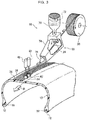
- Fig. 3 is an explanatory diagram explaining an operation of embedding the reinforcing cord in the crown portion of the tire case using a cord heating device and rollers.
- Fig. 3 is an explanatory diagram explaining an operation of embedding the reinforcing cord in the crown portion of the tire case using a cord heating device and rollers.
- a cord feeding apparatus 56 includes a reel 58 on which a reinforcing cord 26 is wound, a cord heating device 59 disposed at the downstream side in the cord feeding direction of the reel 58, a first roller 60 disposed at the downstream side in the reinforcing cord 26 feeding direction, a first cylinder unit 62 for moving the first roller 60 in directions in which the first roller comes into contact with and get away from the outer circumferential surface of the tire, a second roller 64 disposed at the downstream side in the reinforcing cord 26 feeding direction of the first roller 60, and a second cylinder unit 66 for moving the second roller 64 in directions in which the first roller comes into contact with and get away from the outer circumferential surface of the tire.
- the second roller 64 can be used as a cooling roller formed of metal.
- the surface of the first roller 60 or the second roller 64 is coated with a fluororesin (TEFLON (registered trademark) in the present embodiment) with a view to suppressing adhesion of the melted or softened resinous material.
- TEFLON registered trademark
- the cord feeding apparatus 56 is configured to have two rollers of the first roller 60 and the second roller 64 in the present embodiment, the invention is not limited to this configuration, and the cord feeding apparatus may be configured to have only one of these rollers (that is, a single roller).
- the cord heating device 59 includes a heater 70 and a fan 72 that generate hot air.
- the cord heating device 59 includes a heating box 74 into which hot air is supplied and in which the reinforcing cord 26 passes through the inside space thereof, and an discharge port 76 through which the heated reinforcing cord 26 is discharged.
- the temperature of the heater 70 of the cord heating device 59 is increased, and the air around the heater 70 heated by the heater 70 is sent to the heating box 74 by an air current generated by the rotation of the fan 72.
- the reinforcing cord 26 drawn out from the reel 58 is fed to the inside of the heating box 74 of which the inner space is heated with hot air, whereby the reinforcing cord 26 is heated (for example, to increase the temperature of the reinforcing cord 26 to be about 100°C to about 200°C).
- the heated reinforcing cord 26 passes through the discharge port 76, and is helically wound, with a constant tension, around the outer circumferential surface of the crown portion 16 of the tire case 17 rotating in the direction of arrow R in Fig.
- the resinous material at the contact portion is melted or softened, and at least a part of the heated reinforcing cord 26 is embedded in the outer circumferential surface of the crown portion 16.
- the resinous material and the reinforcing cord 26 get into a state in which no space is left between the resinous material and the reinforcing cord 26, that is, in a tightly-contacted state. Accordingly, the incorporation of air into the portion in which the reinforcing cord 26 is embedded is suppressed.
- the melting or softening of the resinous material in the portion contacting the reinforcing cord 26 is promoted.
- embedding of the reinforcing cord 26 in the outer circumferential surface of the crown portion 16 is facilitated, and the incorporation of air can effectively be suppressed.
- the depth L of embedding of the reinforcing cord 26 can be adjusted by the heating temperature for the reinforcing cord 26, the tension applied to the reinforcing cord 26, the pressure applied from the first roller 60, etc.
- the depth L of embedding of the reinforcing cord 26 is set to be equal to or greater than 1/5 of the diameter D of the reinforcing cord 26.
- the depth L of embedding of the reinforcing cord 26 is more preferably more than 1/2 of the diameter D, and it is still more preferable that the entire reinforcing cord 26 is embedded.
- a reinforcing cord layer 28 is formed on the outer circumference side of the crown portion 16 of the tire case 17 by winding the heated reinforcing cord 26 on the outer circumferential surface of the crown portion 16 such that the heated reinforcing cord 26 is embedded in the outer circumferential surface of the crown portion 16.
- a belt-shaped vulcanized crown 30 is wound on the outer circumferential surface of the tire case 17 for one revolution, and the crown 30 is bonded to the outer circumferential surface of the tire case 17 using, for example, an adhesive.
- precured crown known thus far for use in retreaded tires may be used as the crown 30.
- This step is a step similar to a step of bonding a precured crown to the outer circumferential surface of a casing of a retreaded tire.
- a tire 10 can be completed by bonding a sealing layer 24 formed of a vulcanized rubber to the bead portion 12 of the tire case 17 using, for example, an adhesive.
- a part or an entire of the tire case 17 includes a resinous material which includes at least polypropylene and a pentad ratio of which is from 88.2 % to 93.4 %, both favorable fittability onto a rim and favorable deformation resistance can be achieved.
- the tire 10 has a simpler structure as compared with conventional tires made of rubber, and is hence lighter in weight. Accordingly, the tire 10 of the present embodiment has high friction resistance and high durability. Moreover, since the tire case 17 can be produced by injection molding, the productivity is also extremely excellent.
- the reinforcing cord 26 having a higher stiffness than the resinous material is wound in a spiral shape in the circumferential direction on the outer circumferential surface of the crown portion 16 in the tire case 17, a part or an entire of which including the resinous material. Accordingly, the puncture resistance, the cutting resistance and the stiffness of the tire 10 in the circumferential direction are improved. Meanwhile, the improvement of the stiffness of the tire 10 in the circumferential direction prevents the creeping in the tire case 17 including the resinous material.
- the reinforcing cord 26 can be made to more tightly contact the tire case 17 and fixed to the tire case 17 since the difference in hardness between the tire case 17 and the reinforcing cord layer 28 can be made smaller than that in a case in which the reinforcing cord 26 is fixed using a cushion rubber. Accordingly, the incorporation of air mentioned above can effectively be prevented, and the movement of the reinforcing cord member at the time of traveling can effectively be suppressed.
- the reinforcing cord 26 is a steel cord
- the reinforcing cord 26 can easily be separated from the resinous material by heating and recovered at the time of disposing of the tire, and, therefore, there is an advantage from the viewpoint of recyclability of the tire 10.
- the resinous material has a lower loss factor (tan ⁇ ) compared with vulcanized rubbers
- inclusion of a large amount of the resinous material in the reinforcing cord layer 28 makes it possible to enhance the rolling properties of the tire.
- the resinous material has advantages in terms of high in-plane shear stiffness, excellent steering stability at the time of traveling with the tire, and excellent wear resistance.
- the depth L of embedding of the reinforcing cord 26 is equal to or greater than 1/5 of the diameter D as illustrated in Fig. 2 , incorporation of air during manufacturing is effectively suppressed, and the movement of the reinforcing cord 26 due to input power or the like while travelling is further suppressed.
- the crown 30 that contacts a road surface is formed of a rubber material having higher wear resistance than that of the resinous material forming a part or an entire of the tire case 17, the wear resistance of the tire 10 is improved.
- the tire case 17 is strongly fixed to the rim 20, i.e., the tire 10 is strongly fixed to the rim 20, similarly to conventional rubber pneumatic tires.
- a sealing layer 24 which is formed of a rubber material having higher sealing properties than those of the resinous material forming a part or an entire of the tire case 17, on a part of the bead portion 12 that contacts the rim 20, the fittability onto a rim between the tire 10 and the rim 20 can be further enhanced.
- the invention is not limited to this configuration.
- a hot air generating device may be used, instead of heating the reinforcing cord 26, to heat the outer circumferential surface of the crown portion 16 in which the reinforcing cord 26 is to be embedded, and the reinforcing cord 26 may thereafter be embedded in the crown portion 16.
- the heat source of the cord heating device 59 includes the heater and the fan in Embodiment 1, the invention is not limited to this configuration, and a configuration in which the reinforcing cord 26 is directly heated by radiation heat (for example, infrared rays) may be adopted.
- radiation heat for example, infrared rays
- Embodiment 1 a configuration in which a region at which the resinous material with the reinforcing cord 26 embedded therein is melted or softened is forcibly cooled with the second roller 64 formed of metal is adopted in Embodiment 1, the invention is not limited to this configuration.
- a configuration in which cold air is directly applied to the region at which the resinous material is melted or softened, to forcibly cool and solidify the region at which the resinous material is melted or softened may also be adopted.
- Embodiment 1 a configuration in which the reinforcing cord 26 is heated is adopted in Embodiment 1, a configuration in which the outer circumference of the reinforcing cord 26 is coated with the same resinous material as that of the tire case 17, for example, may be adopted.
- incorporation of air can effectively be suppressed at the time of embedding the reinforcing cord in the crown portion 16.
- the tire 10 of Embodiment 1 is a so-called tubeless tire, in which an air chamber is formed between the tire 10 and the rim 20 when the bead portion 12 is fitted onto the rim 20.
- the invention is not limited to this configuration, and the tire may have a complete tube form.
- the tire of the invention may have a mode in which a reinforcing cord member is used, the cord member being covered with a resinous material, as shown in the second embodiment (Fig. 4 and Fig. 5) of JP-A No. 2012-046030 .
- Resinous materials were respectively obtained by mixing components to form the composition listed in Tables 1 and 2. Each resinous material was pelletized and injection molded under a molding temperature of 230°C to obtain a sample piece. The measurements set forth below were performed by using samples punched from the sample piece.
- a tire with a tire size of 165/45 R16 was prepared and made to travel on a drum at 150 km/h.
- a tire which traveled for 5 minutes or more was evaluated as grade A, while a tire which exhibited a sidewall bulge or air leaking due to the sidewall bulge was evaluated as grade B.
- tires were formed, with reference to Embodiment 1 described above (tire shown in Figs. 1A and 1B ). Subsequently, the tire was fitted onto a rim. The tire which can be fitted onto a rim and in which air sealing property was assured is evaluated as "A”, and the tire that cannot be fitted onto a rim with assuring air sealing property is evaluated as "B".
Landscapes
- Engineering & Computer Science (AREA)
- Mechanical Engineering (AREA)
- Chemical & Material Sciences (AREA)
- Health & Medical Sciences (AREA)
- Chemical Kinetics & Catalysis (AREA)
- Medicinal Chemistry (AREA)
- Polymers & Plastics (AREA)
- Organic Chemistry (AREA)
- Tires In General (AREA)
- Compositions Of Macromolecular Compounds (AREA)
Applications Claiming Priority (2)
| Application Number | Priority Date | Filing Date | Title |
|---|---|---|---|
| JP2015020548A JP6021964B2 (ja) | 2015-02-04 | 2015-02-04 | タイヤ |
| PCT/JP2016/053426 WO2016125872A1 (ja) | 2015-02-04 | 2016-02-04 | タイヤ |
Publications (3)
| Publication Number | Publication Date |
|---|---|
| EP3255099A1 true EP3255099A1 (de) | 2017-12-13 |
| EP3255099A4 EP3255099A4 (de) | 2018-03-07 |
| EP3255099B1 EP3255099B1 (de) | 2018-12-19 |
Family
ID=56564211
Family Applications (1)
| Application Number | Title | Priority Date | Filing Date |
|---|---|---|---|
| EP16746703.4A Not-in-force EP3255099B1 (de) | 2015-02-04 | 2016-02-04 | Reifen |
Country Status (5)
| Country | Link |
|---|---|
| US (1) | US20180015784A1 (de) |
| EP (1) | EP3255099B1 (de) |
| JP (1) | JP6021964B2 (de) |
| CN (1) | CN107207805A (de) |
| WO (1) | WO2016125872A1 (de) |
Families Citing this family (2)
| Publication number | Priority date | Publication date | Assignee | Title |
|---|---|---|---|---|
| US10442922B2 (en) | 2015-02-04 | 2019-10-15 | Bridgestone Corporation | Tire |
| JP6197081B1 (ja) * | 2016-07-19 | 2017-09-13 | 京楽産業.株式会社 | 遊技機 |
Family Cites Families (14)
| Publication number | Priority date | Publication date | Assignee | Title |
|---|---|---|---|---|
| JPS57151402A (en) * | 1981-03-13 | 1982-09-18 | Bridgestone Corp | Pneumatic tyre |
| JPS591550A (ja) * | 1982-06-29 | 1984-01-06 | Bridgestone Corp | 耐亀裂成長性の改良されたゴム組成物 |
| EP0690458A3 (de) * | 1994-06-27 | 1997-01-29 | Mitsubishi Cable Ind Ltd | Isolierende Zusammensetzung und daraus hergestellter Formkörper |
| JP3381814B2 (ja) * | 1994-07-12 | 2003-03-04 | 出光石油化学株式会社 | ポリプロピレン系樹脂組成物及びそれを用いたフィルム |
| JP2865598B2 (ja) * | 1995-10-02 | 1999-03-08 | 横浜ゴム株式会社 | 熱可塑性エラストマー組成物 |
| CN1258564C (zh) * | 2000-12-22 | 2006-06-07 | 三星综合化学株式会社 | 用于车轮外胎的聚烯烃树脂组合物 |
| US7439312B2 (en) * | 2002-10-24 | 2008-10-21 | Exxonmobil Chemical Patents Inc. | Branched crystalline polypropylene |
| JP2011168740A (ja) * | 2010-02-22 | 2011-09-01 | Yokohama Rubber Co Ltd:The | ゴム組成物、高減衰積層体用ゴム組成物およびタイヤ用ゴム組成物 |
| JP5619527B2 (ja) * | 2010-08-25 | 2014-11-05 | 株式会社ブリヂストン | タイヤ |
| KR101843217B1 (ko) * | 2010-12-30 | 2018-03-28 | 다우 글로벌 테크놀로지스 엘엘씨 | 열가소성 가황 조성물, 이의 제조 방법 및 이로부터 제조된 물품 |
| JP5823721B2 (ja) * | 2011-04-13 | 2015-11-25 | 株式会社ブリヂストン | ゴム組成物及びそれを用いたタイヤ |
| US9884515B2 (en) * | 2013-02-28 | 2018-02-06 | Bridgestone Corporation | Tire |
| US9745455B2 (en) * | 2013-07-31 | 2017-08-29 | Toray Plastics (America), Inc. | Biaxially oriented matte polypropylene film |
| US10442922B2 (en) * | 2015-02-04 | 2019-10-15 | Bridgestone Corporation | Tire |
-
2015
- 2015-02-04 JP JP2015020548A patent/JP6021964B2/ja not_active Expired - Fee Related
-
2016
- 2016-02-04 US US15/546,317 patent/US20180015784A1/en not_active Abandoned
- 2016-02-04 WO PCT/JP2016/053426 patent/WO2016125872A1/ja not_active Ceased
- 2016-02-04 EP EP16746703.4A patent/EP3255099B1/de not_active Not-in-force
- 2016-02-04 CN CN201680008229.7A patent/CN107207805A/zh active Pending
Also Published As
| Publication number | Publication date |
|---|---|
| US20180015784A1 (en) | 2018-01-18 |
| EP3255099B1 (de) | 2018-12-19 |
| WO2016125872A1 (ja) | 2016-08-11 |
| JP6021964B2 (ja) | 2016-11-09 |
| EP3255099A4 (de) | 2018-03-07 |
| JP2016141779A (ja) | 2016-08-08 |
| CN107207805A (zh) | 2017-09-26 |
Similar Documents
| Publication | Publication Date | Title |
|---|---|---|
| EP2962869B1 (de) | Reifen | |
| JP2012521320A (ja) | タイヤトレッドブロック組成物 | |
| EP3255097B1 (de) | Reifen | |
| CN1715041A (zh) | 非充气轮胎及其制造方法 | |
| EP3315320B1 (de) | Reifen und verfahren zur herstellung eines reifens | |
| CN104144800B (zh) | 轮胎 | |
| JP2018090131A (ja) | 空気入りタイヤ | |
| CN108136832B (zh) | 轮胎 | |
| EP3255099B1 (de) | Reifen | |
| JP6335193B2 (ja) | タイヤオーバーレイ組成物 | |
| JP4275210B2 (ja) | ラジアルタイヤ | |
| EP3345964B1 (de) | Reifen | |
| EP3354686B1 (de) | Reifen | |
| JP4064638B2 (ja) | 空気入りタイヤ | |
| JP5557466B2 (ja) | ゴム組成物、加硫ゴム及びタイヤ | |
| JP5390107B2 (ja) | タイヤ用ゴム組成物、加硫ゴム及びタイヤ | |
| JP2018177169A (ja) | タイヤ |
Legal Events
| Date | Code | Title | Description |
|---|---|---|---|
| STAA | Information on the status of an ep patent application or granted ep patent |
Free format text: STATUS: THE INTERNATIONAL PUBLICATION HAS BEEN MADE |
|
| PUAI | Public reference made under article 153(3) epc to a published international application that has entered the european phase |
Free format text: ORIGINAL CODE: 0009012 |
|
| STAA | Information on the status of an ep patent application or granted ep patent |
Free format text: STATUS: REQUEST FOR EXAMINATION WAS MADE |
|
| 17P | Request for examination filed |
Effective date: 20170725 |
|
| AK | Designated contracting states |
Kind code of ref document: A1 Designated state(s): AL AT BE BG CH CY CZ DE DK EE ES FI FR GB GR HR HU IE IS IT LI LT LU LV MC MK MT NL NO PL PT RO RS SE SI SK SM TR |
|
| AX | Request for extension of the european patent |
Extension state: BA ME |
|
| A4 | Supplementary search report drawn up and despatched |
Effective date: 20180207 |
|
| RIC1 | Information provided on ipc code assigned before grant |
Ipc: B60C 1/00 20060101ALI20180201BHEP Ipc: B60C 5/01 20060101ALI20180201BHEP Ipc: C08L 23/12 20060101AFI20180201BHEP |
|
| DAV | Request for validation of the european patent (deleted) | ||
| DAX | Request for extension of the european patent (deleted) | ||
| GRAP | Despatch of communication of intention to grant a patent |
Free format text: ORIGINAL CODE: EPIDOSNIGR1 |
|
| STAA | Information on the status of an ep patent application or granted ep patent |
Free format text: STATUS: GRANT OF PATENT IS INTENDED |
|
| INTG | Intention to grant announced |
Effective date: 20180830 |
|
| GRAS | Grant fee paid |
Free format text: ORIGINAL CODE: EPIDOSNIGR3 |
|
| GRAA | (expected) grant |
Free format text: ORIGINAL CODE: 0009210 |
|
| STAA | Information on the status of an ep patent application or granted ep patent |
Free format text: STATUS: THE PATENT HAS BEEN GRANTED |
|
| AK | Designated contracting states |
Kind code of ref document: B1 Designated state(s): AL AT BE BG CH CY CZ DE DK EE ES FI FR GB GR HR HU IE IS IT LI LT LU LV MC MK MT NL NO PL PT RO RS SE SI SK SM TR |
|
| REG | Reference to a national code |
Ref country code: GB Ref legal event code: FG4D |
|
| REG | Reference to a national code |
Ref country code: CH Ref legal event code: EP |
|
| REG | Reference to a national code |
Ref country code: IE Ref legal event code: FG4D |
|
| REG | Reference to a national code |
Ref country code: DE Ref legal event code: R096 Ref document number: 602016008509 Country of ref document: DE |
|
| REG | Reference to a national code |
Ref country code: AT Ref legal event code: REF Ref document number: 1078639 Country of ref document: AT Kind code of ref document: T Effective date: 20190115 |
|
| REG | Reference to a national code |
Ref country code: NL Ref legal event code: MP Effective date: 20181219 |
|
| PG25 | Lapsed in a contracting state [announced via postgrant information from national office to epo] |
Ref country code: LT Free format text: LAPSE BECAUSE OF FAILURE TO SUBMIT A TRANSLATION OF THE DESCRIPTION OR TO PAY THE FEE WITHIN THE PRESCRIBED TIME-LIMIT Effective date: 20181219 Ref country code: NO Free format text: LAPSE BECAUSE OF FAILURE TO SUBMIT A TRANSLATION OF THE DESCRIPTION OR TO PAY THE FEE WITHIN THE PRESCRIBED TIME-LIMIT Effective date: 20190319 Ref country code: BG Free format text: LAPSE BECAUSE OF FAILURE TO SUBMIT A TRANSLATION OF THE DESCRIPTION OR TO PAY THE FEE WITHIN THE PRESCRIBED TIME-LIMIT Effective date: 20190319 Ref country code: HR Free format text: LAPSE BECAUSE OF FAILURE TO SUBMIT A TRANSLATION OF THE DESCRIPTION OR TO PAY THE FEE WITHIN THE PRESCRIBED TIME-LIMIT Effective date: 20181219 Ref country code: LV Free format text: LAPSE BECAUSE OF FAILURE TO SUBMIT A TRANSLATION OF THE DESCRIPTION OR TO PAY THE FEE WITHIN THE PRESCRIBED TIME-LIMIT Effective date: 20181219 Ref country code: FI Free format text: LAPSE BECAUSE OF FAILURE TO SUBMIT A TRANSLATION OF THE DESCRIPTION OR TO PAY THE FEE WITHIN THE PRESCRIBED TIME-LIMIT Effective date: 20181219 |
|
| REG | Reference to a national code |
Ref country code: LT Ref legal event code: MG4D |
|
| REG | Reference to a national code |
Ref country code: AT Ref legal event code: MK05 Ref document number: 1078639 Country of ref document: AT Kind code of ref document: T Effective date: 20181219 |
|
| PG25 | Lapsed in a contracting state [announced via postgrant information from national office to epo] |
Ref country code: SE Free format text: LAPSE BECAUSE OF FAILURE TO SUBMIT A TRANSLATION OF THE DESCRIPTION OR TO PAY THE FEE WITHIN THE PRESCRIBED TIME-LIMIT Effective date: 20181219 Ref country code: AL Free format text: LAPSE BECAUSE OF FAILURE TO SUBMIT A TRANSLATION OF THE DESCRIPTION OR TO PAY THE FEE WITHIN THE PRESCRIBED TIME-LIMIT Effective date: 20181219 Ref country code: RS Free format text: LAPSE BECAUSE OF FAILURE TO SUBMIT A TRANSLATION OF THE DESCRIPTION OR TO PAY THE FEE WITHIN THE PRESCRIBED TIME-LIMIT Effective date: 20181219 Ref country code: GR Free format text: LAPSE BECAUSE OF FAILURE TO SUBMIT A TRANSLATION OF THE DESCRIPTION OR TO PAY THE FEE WITHIN THE PRESCRIBED TIME-LIMIT Effective date: 20190320 |
|
| PG25 | Lapsed in a contracting state [announced via postgrant information from national office to epo] |
Ref country code: NL Free format text: LAPSE BECAUSE OF FAILURE TO SUBMIT A TRANSLATION OF THE DESCRIPTION OR TO PAY THE FEE WITHIN THE PRESCRIBED TIME-LIMIT Effective date: 20181219 |
|
| PG25 | Lapsed in a contracting state [announced via postgrant information from national office to epo] |
Ref country code: PT Free format text: LAPSE BECAUSE OF FAILURE TO SUBMIT A TRANSLATION OF THE DESCRIPTION OR TO PAY THE FEE WITHIN THE PRESCRIBED TIME-LIMIT Effective date: 20190419 Ref country code: IT Free format text: LAPSE BECAUSE OF FAILURE TO SUBMIT A TRANSLATION OF THE DESCRIPTION OR TO PAY THE FEE WITHIN THE PRESCRIBED TIME-LIMIT Effective date: 20181219 Ref country code: PL Free format text: LAPSE BECAUSE OF FAILURE TO SUBMIT A TRANSLATION OF THE DESCRIPTION OR TO PAY THE FEE WITHIN THE PRESCRIBED TIME-LIMIT Effective date: 20181219 Ref country code: CZ Free format text: LAPSE BECAUSE OF FAILURE TO SUBMIT A TRANSLATION OF THE DESCRIPTION OR TO PAY THE FEE WITHIN THE PRESCRIBED TIME-LIMIT Effective date: 20181219 Ref country code: ES Free format text: LAPSE BECAUSE OF FAILURE TO SUBMIT A TRANSLATION OF THE DESCRIPTION OR TO PAY THE FEE WITHIN THE PRESCRIBED TIME-LIMIT Effective date: 20181219 |
|
| PG25 | Lapsed in a contracting state [announced via postgrant information from national office to epo] |
Ref country code: SM Free format text: LAPSE BECAUSE OF FAILURE TO SUBMIT A TRANSLATION OF THE DESCRIPTION OR TO PAY THE FEE WITHIN THE PRESCRIBED TIME-LIMIT Effective date: 20181219 Ref country code: SK Free format text: LAPSE BECAUSE OF FAILURE TO SUBMIT A TRANSLATION OF THE DESCRIPTION OR TO PAY THE FEE WITHIN THE PRESCRIBED TIME-LIMIT Effective date: 20181219 Ref country code: RO Free format text: LAPSE BECAUSE OF FAILURE TO SUBMIT A TRANSLATION OF THE DESCRIPTION OR TO PAY THE FEE WITHIN THE PRESCRIBED TIME-LIMIT Effective date: 20181219 Ref country code: IS Free format text: LAPSE BECAUSE OF FAILURE TO SUBMIT A TRANSLATION OF THE DESCRIPTION OR TO PAY THE FEE WITHIN THE PRESCRIBED TIME-LIMIT Effective date: 20190419 Ref country code: EE Free format text: LAPSE BECAUSE OF FAILURE TO SUBMIT A TRANSLATION OF THE DESCRIPTION OR TO PAY THE FEE WITHIN THE PRESCRIBED TIME-LIMIT Effective date: 20181219 |
|
| REG | Reference to a national code |
Ref country code: DE Ref legal event code: R097 Ref document number: 602016008509 Country of ref document: DE |
|
| REG | Reference to a national code |
Ref country code: CH Ref legal event code: PL |
|
| PLBE | No opposition filed within time limit |
Free format text: ORIGINAL CODE: 0009261 |
|
| STAA | Information on the status of an ep patent application or granted ep patent |
Free format text: STATUS: NO OPPOSITION FILED WITHIN TIME LIMIT |
|
| PG25 | Lapsed in a contracting state [announced via postgrant information from national office to epo] |
Ref country code: AT Free format text: LAPSE BECAUSE OF FAILURE TO SUBMIT A TRANSLATION OF THE DESCRIPTION OR TO PAY THE FEE WITHIN THE PRESCRIBED TIME-LIMIT Effective date: 20181219 Ref country code: DK Free format text: LAPSE BECAUSE OF FAILURE TO SUBMIT A TRANSLATION OF THE DESCRIPTION OR TO PAY THE FEE WITHIN THE PRESCRIBED TIME-LIMIT Effective date: 20181219 Ref country code: LU Free format text: LAPSE BECAUSE OF NON-PAYMENT OF DUE FEES Effective date: 20190204 Ref country code: MC Free format text: LAPSE BECAUSE OF FAILURE TO SUBMIT A TRANSLATION OF THE DESCRIPTION OR TO PAY THE FEE WITHIN THE PRESCRIBED TIME-LIMIT Effective date: 20181219 |
|
| REG | Reference to a national code |
Ref country code: BE Ref legal event code: MM Effective date: 20190228 |
|
| 26N | No opposition filed |
Effective date: 20190920 |
|
| REG | Reference to a national code |
Ref country code: IE Ref legal event code: MM4A |
|
| PG25 | Lapsed in a contracting state [announced via postgrant information from national office to epo] |
Ref country code: LI Free format text: LAPSE BECAUSE OF NON-PAYMENT OF DUE FEES Effective date: 20190228 Ref country code: CH Free format text: LAPSE BECAUSE OF NON-PAYMENT OF DUE FEES Effective date: 20190228 |
|
| PG25 | Lapsed in a contracting state [announced via postgrant information from national office to epo] |
Ref country code: IE Free format text: LAPSE BECAUSE OF NON-PAYMENT OF DUE FEES Effective date: 20190204 |
|
| PG25 | Lapsed in a contracting state [announced via postgrant information from national office to epo] |
Ref country code: SI Free format text: LAPSE BECAUSE OF FAILURE TO SUBMIT A TRANSLATION OF THE DESCRIPTION OR TO PAY THE FEE WITHIN THE PRESCRIBED TIME-LIMIT Effective date: 20181219 Ref country code: BE Free format text: LAPSE BECAUSE OF NON-PAYMENT OF DUE FEES Effective date: 20190228 |
|
| PG25 | Lapsed in a contracting state [announced via postgrant information from national office to epo] |
Ref country code: TR Free format text: LAPSE BECAUSE OF FAILURE TO SUBMIT A TRANSLATION OF THE DESCRIPTION OR TO PAY THE FEE WITHIN THE PRESCRIBED TIME-LIMIT Effective date: 20181219 |
|
| PG25 | Lapsed in a contracting state [announced via postgrant information from national office to epo] |
Ref country code: MT Free format text: LAPSE BECAUSE OF NON-PAYMENT OF DUE FEES Effective date: 20190204 |
|
| GBPC | Gb: european patent ceased through non-payment of renewal fee |
Effective date: 20200204 |
|
| PG25 | Lapsed in a contracting state [announced via postgrant information from national office to epo] |
Ref country code: GB Free format text: LAPSE BECAUSE OF NON-PAYMENT OF DUE FEES Effective date: 20200204 |
|
| PG25 | Lapsed in a contracting state [announced via postgrant information from national office to epo] |
Ref country code: CY Free format text: LAPSE BECAUSE OF FAILURE TO SUBMIT A TRANSLATION OF THE DESCRIPTION OR TO PAY THE FEE WITHIN THE PRESCRIBED TIME-LIMIT Effective date: 20181219 |
|
| PG25 | Lapsed in a contracting state [announced via postgrant information from national office to epo] |
Ref country code: HU Free format text: LAPSE BECAUSE OF FAILURE TO SUBMIT A TRANSLATION OF THE DESCRIPTION OR TO PAY THE FEE WITHIN THE PRESCRIBED TIME-LIMIT; INVALID AB INITIO Effective date: 20160204 |
|
| PG25 | Lapsed in a contracting state [announced via postgrant information from national office to epo] |
Ref country code: MK Free format text: LAPSE BECAUSE OF FAILURE TO SUBMIT A TRANSLATION OF THE DESCRIPTION OR TO PAY THE FEE WITHIN THE PRESCRIBED TIME-LIMIT Effective date: 20181219 |
|
| PGFP | Annual fee paid to national office [announced via postgrant information from national office to epo] |
Ref country code: FR Payment date: 20230221 Year of fee payment: 8 |
|
| PGFP | Annual fee paid to national office [announced via postgrant information from national office to epo] |
Ref country code: DE Payment date: 20230216 Year of fee payment: 8 |
|
| P01 | Opt-out of the competence of the unified patent court (upc) registered |
Effective date: 20230531 |
|
| REG | Reference to a national code |
Ref country code: DE Ref legal event code: R119 Ref document number: 602016008509 Country of ref document: DE |
|
| PG25 | Lapsed in a contracting state [announced via postgrant information from national office to epo] |
Ref country code: DE Free format text: LAPSE BECAUSE OF NON-PAYMENT OF DUE FEES Effective date: 20240903 |
|
| PG25 | Lapsed in a contracting state [announced via postgrant information from national office to epo] |
Ref country code: FR Free format text: LAPSE BECAUSE OF NON-PAYMENT OF DUE FEES Effective date: 20240229 |
|
| PG25 | Lapsed in a contracting state [announced via postgrant information from national office to epo] |
Ref country code: FR Free format text: LAPSE BECAUSE OF NON-PAYMENT OF DUE FEES Effective date: 20240229 Ref country code: DE Free format text: LAPSE BECAUSE OF NON-PAYMENT OF DUE FEES Effective date: 20240903 |