EP3247196B1 - Apparatus and method for planting plant cuttings - Google Patents
Apparatus and method for planting plant cuttings Download PDFInfo
- Publication number
- EP3247196B1 EP3247196B1 EP16700971.1A EP16700971A EP3247196B1 EP 3247196 B1 EP3247196 B1 EP 3247196B1 EP 16700971 A EP16700971 A EP 16700971A EP 3247196 B1 EP3247196 B1 EP 3247196B1
- Authority
- EP
- European Patent Office
- Prior art keywords
- pick
- cuttings
- cutting
- plant head
- plant
- Prior art date
- Legal status (The legal status is an assumption and is not a legal conclusion. Google has not performed a legal analysis and makes no representation as to the accuracy of the status listed.)
- Active
Links
Images




Classifications
-
- A—HUMAN NECESSITIES
- A01—AGRICULTURE; FORESTRY; ANIMAL HUSBANDRY; HUNTING; TRAPPING; FISHING
- A01G—HORTICULTURE; CULTIVATION OF VEGETABLES, FLOWERS, RICE, FRUIT, VINES, HOPS OR SEAWEED; FORESTRY; WATERING
- A01G9/00—Cultivation in receptacles, forcing-frames or greenhouses; Edging for beds, lawn or the like
- A01G9/08—Devices for filling-up flower-pots or pots for seedlings; Devices for setting plants or seeds in pots
- A01G9/083—Devices for setting plants in pots
-
- A—HUMAN NECESSITIES
- A01—AGRICULTURE; FORESTRY; ANIMAL HUSBANDRY; HUNTING; TRAPPING; FISHING
- A01G—HORTICULTURE; CULTIVATION OF VEGETABLES, FLOWERS, RICE, FRUIT, VINES, HOPS OR SEAWEED; FORESTRY; WATERING
- A01G2/00—Vegetative propagation
- A01G2/10—Vegetative propagation by means of cuttings
-
- A—HUMAN NECESSITIES
- A01—AGRICULTURE; FORESTRY; ANIMAL HUSBANDRY; HUNTING; TRAPPING; FISHING
- A01G—HORTICULTURE; CULTIVATION OF VEGETABLES, FLOWERS, RICE, FRUIT, VINES, HOPS OR SEAWEED; FORESTRY; WATERING
- A01G9/00—Cultivation in receptacles, forcing-frames or greenhouses; Edging for beds, lawn or the like
- A01G9/08—Devices for filling-up flower-pots or pots for seedlings; Devices for setting plants or seeds in pots
- A01G9/086—Devices for repotting
Definitions
- the invention relates to an apparatus for picking and planting cuttings of plants in a cultivation medium.
- the invention further relates to a method of picking and planting cuttings of plants in a cultivation medium as well as to a computer readable medium having computer readable instructions stored thereon for performing, when executed by a processor, such a method.
- the invention also relates to a pick-and-plant head for picking and planting cuttings in a cultivation medium.
- the invention relates to an apparatus for picking and planting cuttings of plants in a cultivation medium comprising such pick-and-plant head.
- US5911631A discusses an apparatus and method for transplanting seedling from a first ray to a second tray.
- Such a device is complex, requiring a plurality of conveyor belts with turntables to orient and gather cuttings for placement.
- the required positioning of the various components requires a large volume of factory space, both horizontally and vertically. The latter in particular can make operator access difficult.
- the coordinated timing of the large number of supply conveyer belts, the rotating grab-arm, and the final product conveyer is highly sensitive and logistically fragile.
- the apparatus includes a pick and place tool on a robot arm, for picking cuttings from the conveyor belt and placing them into pots.
- the pick and place tool includes a number of vacuum/suction-cup pick-up means, each for picking up and retaining a cutting from the conveyor belt. The cuttings are initially picked in a horizontal orientation, and after a number of intermediate steps are translated into a vertical orientation with the cut surface downward for planting into a pot.
- the tool furthermore comprises an array of elongate fingers opposing and aligned with the suction cups. These are utilized to create indentations in the cultivation medium of the pots prior to the cuttings being brought into their final orientation and planted.
- the apparatus and method can lead to cutting placement having insufficient uniformity.
- the sequential picking of adjacent cuttings may cause the orientation of the picked cuttings with respect to the tool to change due to interaction with each other, in particular during the picking process.
- some cuttings are placed into the pots with an orientation different from the predetermined orientation, which results in a poorly placed cutting.
- the pick and place tool may suffer reduced accuracy, a need for greater control, motion and rotation steps, in order to use the indentation fingers.
- European patent publication EP1829446 describes an assembly for placing cuttings in plant plugs in which individual cuttings are gripped by one of the arms of a rotating device by means of low-pressure. The cuttings are then transferred to a belt provided with grippers. This transfer movement takes place continually and in a rotating manner.
- the assembly described in EP1829446 has several disadvantages.
- the throughput of the assembly is sensitive to logistics failure.
- the cuttings need to be supplied individually with a spacing between subsequent cuttings, with very narrow tolerances. For example, if the subsequent cuttings are supplied too close together, either one of the cuttings is not processed, or the rotating speed of the rotating device should be adapted, i.e. increased, to allow pick up of both cuttings.
- the first option would decrease the throughput, whereas the second option complicates control of the rotating device.
- International publication WO2012/101132 describes a method and apparatus for gathering and placing cuttings of plants in a cultivation medium to achieve a predetermined planting pattern.
- a number of cuttings are haphazardly distributed upon a generally horizontal conveyer, after which a pattern recognition camera system is used to identify a plurality of individual cuttings from the group, which are suitable to be gathered.
- a pick up tool is directed to pick up the identified cuttings, its angular orientation in the horizontal place at each pick up being controlled such that the gathered cuttings are horizontally aligned with their cut stems in a single direction.
- the gathered cuttings are transferred from the pick up tool into a horizontal cutting holding unit.
- the cutting holding unit rotates to a vertical orientation with the stems downward and descends to place the cuttings within a cultivation medium.
- the planting system and the pick-up tool are separate entities.
- Such a method and apparatus offers effective and efficient planting of cuttings, particularly at high capacity throughputs. However, in some circumstances, and for some plant cutting types, such a device may not be optimal.
- the present invention is concerned with addressing one or more the above concerns, and with providing further useful devices and methods for planting cuttings, while at the same time maintaining high levels of effectiveness and efficiency.
- an aspect of the invention provides a pick-and-plant head for planting plant cuttings in a cultivation medium comprising: a grasper comprising opposed grasping surfaces for grasping a portion of a cutting between them; and an abutment comprising an abutment surface for abutting a cutting, wherein the grasper and abutment are moveable relative to one another and are arranged so that during release of a cutting from the grasper, the abutment passes between the opposed grasping surfaces, and the cutting is abutted by the abutment.
- a pick-and-plant head is a tool-head that carries out both picking and planting of a cutting.
- Use of a pick-and-plant head is advantageous because during the planting process a cutting is subjected only once to a grasping and release action by the planting apparatus. This limits the number of handlings a cutting undergoes. This can be advantageous in avoiding damage to cuttings (especially for relatively soft plant material) and in avoiding excessive machine complexity required to maintain correct planting orientation of the cuttings when planting.
- a grasper offers excellent orientation control of a cutting, both during pick up, as well as during planting.
- the abutment of the pick-and-plant head preferably comprises a ram having a distal end, wherein a distal end-face of the ram is the abutment surface for the cutting.
- a ram can be of various shapes, but is preferably a wedge or a rod.
- the distal cutting abutment surface, or the end face can have any form suitable for abutting a cutting's body or stem. For example, it may be planar or it may be concave, ribbed, or contoured to generally match an abutted surface of a cutting.
- a distal end of the ram has a wedge-shape. This advantageously forms a wedge surface for insertion between the opposed grasping surfaces to force these apart for simple release of a grasped cutting from therebetween.
- the wedge-shaped ram has a truncated, or angled distal end-face.
- the distal end face is preferably substantially horizontal when the pick-and-plant head is in a horizontal pick-up orientation.
- a horizontal pick-up orientation is that orientation of the pick-and-plant head when it is arranged or positioned to pick or grasp a cutting from a substantially horizontal pick-up surface.
- the end face of the truncated ram is preferably substantially parallel with the planar pick-up surface in the pick-up orientation.
- the grasper of the pick-and-plant head is preferably provided with at least one elongate member, and one of the two opposed grasping surfaces is formed by an inner surface of the elongate member.
- the grasper comprises two opposed, elongate members, the two opposed grasping surfaces being provided on the opposed elongate members.
- the grasping surfaces may be inner surfaces of each of the distal ends of the elongate opposed members. Such a configuration may resemble pincers, tongs, tweezers or forceps.
- the grasper may preferably comprise opposed fingers with substantially flat, distal gripping surfaces.
- the opposed fingers may be pivoted at a proximal end, or may be held movably in relation to one another for effecting gripping and releasing motions in another manner, such as by movement laterally toward and away from one another.
- Such a grasper offers excellent orientation control of a cutting, both during pick up, as well as during planting.
- the form of the grasper with elongate members offers the particular advantage that a relatively large portion of the cutting stem can be grasped along at least a part of the elongate member. This provides for an additionally secure grip on the cutting, aiding in accurate orientation for pick-up and planting. This is particularly the case in which the grasper has the form of tongs, forceps, pincers or tweezers
- Each elongate member is preferably a strip, is preferably resiliently flexible, and is preferably formed of plastics or metal, most preferably spring steel, stainless steel or aluminium. A degree of resilient flex within the elongate strip allows for a firm grip upon the cutting without application of excessive force that might damage the stem. The force applied by the grasper upon a cutting can be controlled by pneumatics.
- the ram is positioned between the elongate members, and the ram and members are moveable relative to one another for axial reciprocation of the ram between the opposed gripping surfaces. As the ram advances, or is inserted between the opposed elongate members, it forces them apart, releasing a cutting held therebetween.
- the pick-and-plant head is further preferably provided with a grasper that is pivotable in a vertical plane. This is such that the head can collect a cutting in a horizontal orientation and rotate it into a substantially vertical orientation ready for planting. Vertical rotations of about 90° are most preferred, but other rotations are possible, for example, from 80° to 100°, depending upon circumstances and cutting type.
- a pick-and-plant head for planting plant cuttings in a cultivation medium
- a grasper comprising opposed elongate members with grasping surfaces for grasping a portion of a cutting between them; wherein the grasper is angled from horizontal by from 10° to 80°, preferably from 20° to 70°, and most preferably from 30° to 60°, when the pick-and-plant head is in a pick-up orientation.
- the elongate members are preferably straight, doglegged or L-shaped
- a pick-and-plant head for planting plant cuttings in a cultivation medium comprising: a grasper comprising opposed grasping surfaces for grasping a portion of a cutting between them; and a spacer arranged to space the grasper from a horizontal cuttings supply surface during a pick up operation.
- the spacer may be positioned adjacent the opposed grasping surfaces. It may also be arranged to space the grasper about 0.1mm or more above the supply surface during a pick-up operation, preferably about 0.15mm or more, and more preferably about 0.2mm or more.
- the spacer is preferably oriented adjacent distal ends of elongate grasping members. Most preferably the spacer has the form of an inverse U and the distal ends of the elongate members are positioned therein when in the pick-up position.
- a robotic arm provided with any of the pick-and-plant heads as substantially described herein.
- an apparatus for planting cuttings of plants in a cultivation medium comprising:
- the supply surface is preferably substantially horizontal. This aids in a stable dispersion of the cuttings over the supply surface because the cuttings remain stably immobile unless purposefully agitated for dispersion.
- the apparatus may be configured such that the pick-up tool picks up identified cuttings at a predetermined distance from a cutting end to be planted in the cultivation medium depending upon data from one or more images obtained with the camera system.
- the apparatus is provided with any of the pick-and-plant heads as described above.
- the cuttings supply system comprises a moveable surface for supporting the supplied cuttings.
- the moveable surface preferably comprises the substantially horizontal supply surface. Use of a moveable surface may aid in spreading the cuttings, and so aid in identification and pick-up of individual cuttings among the plurality of cuttings.
- the moveable surface may be moveable in dependence on one or more images obtained via the camera system.
- a movement program may be executed for controlling movement of the moveable surface.
- Movement of the surface may be used to haphazardly distribute or disperse the cuttings over the horizontal supply surface. Vibrating, shaking, pulsating, jabbing, wave imparting, and irregular motions may be used to disperse the cuttings.
- Vibrating, shaking, pulsating, jabbing, wave imparting, and irregular motions may be used to disperse the cuttings.
- a method of planting plant cuttings in a cultivation medium comprising: providing a scattered plurality of cuttings upon a substantially horizontal supply surface of a cuttings supply system; identifying by way of pattern recognition, at least one cutting amongst the plurality of cuttings as suitable for individual pick up; picking said identified cutting from the supply surface in a substantially horizontal orientation, with a pick-and-plant head on a robotic arm; rotating the picked cutting into a substantially vertical orientation with a plantable end of the cutting facing downward, with the pick-and-plant head; and planting the substantially vertical cutting into a cultivation medium, with the pick-and-plant head; wherein the pick-and-plant head is in accordance with the claims.
- a further embodiment of the method includes the step of agitating the horizontal supply surface to disperse or re-disperse cuttings thereon.
- the cuttings supply system comprises a conveyor belt, and the conveyor belt comprises the substantially horizontal supply surface.
- identified cuttings are grasped at a predetermined distance from a plantable end of the cutting, in dependence on one or more images obtained with the camera system.
- the cuttings supply system includes an irregularly moveable surface comprising the supply surface, and wherein providing cuttings includes controlling the irregularly moveable surface to disperse or re-disperse cuttings upon the supply surface.
- the apparatus for placing cuttings of plants in a cultivation medium may comprise a computer system comprising a processor with peripherals to enable operation of a method of planting cuttings as described above.
- the processor may be connected with one or more memory units which are arranged for storing instructions and data, one or more reading units, one or more input devices, such as a keyboard, touch screen, or mouse, and one or more output devices, for example a monitor.
- a network Input/Output (I/O) device may be provided for a connection to the networks.
- the processor may comprise several processing units functioning in parallel or controlled by one main processor, that may be located remotely from one another, possibly distributed over the local area network, as is known to persons skilled in the art.
- the functionality of the present invention may be accomplished by a combination of hardware and software components.
- Hardware components either analogue or digital, may be present within the processor or may be present as separate circuits which are interfaced with the processor.
- software components that are executable by the processor may be present in a memory region of the processor.
- Embodiments of the method may be stored on a computer readable medium, for example a DVD or USB-stick, for performing, when executed by the processor within the cutting placement apparatus, embodiments of a method placing cuttings of plants in a cultivation medium.
- the stored data may take the form of a computer program, which computer program is programmed to implement an embodiment of the method when executed by the computer system after loading the computer program from the computer readable medium into the computer system.
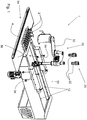
- FIG. 1 shows an apparatus 1 for planing cuttings of plants in a cultivation medium.
- the plant cuttings may be cuttings of any sort, and may include cuttings having a stem and one or more leaves, further referred to as stem cuttings, cuttings predominantly consisting of leaves, further referred to as leaf cuttings, as well as cuttings having a tuber or root, further referred to as tuber or root cuttings.
- stem cuttings include, but are not limited to, cuttings of chrysanthemum, Christmas star, boxwood, flamingo flower ('anthurium'), and panda plant ('kalanchoe').
- leaf cuttings include, but are not limited to, cuttings of crab cactuses, and conifer.
- tuber or root cuttings include, but are not limited to cuttings of cranesbill ('geranium').
- the apparatus 1 comprises a cuttings supply system 10 for supplying a plurality of cuttings 2.
- the cuttings supply system 10 may comprise a cuttings inlet for supply of cuttings 2 to the cuttings supply system 10.
- the cuttings 2 may be placed onto the cuttings supply system 10 via an opening, either manually by a human operator or automatically, for example via a conveyor belt.
- the cuttings supply system 10 takes the form of a container having side walls 12 and a cuttings supply surface 14.
- the cuttings supply surface 14 supports the cuttings.
- the shown cuttings supply surface 14 is horizontal, and this provides for a stable distribution of the cuttings over the surface. Supply surfaces angled slightly from horizontal are possible and may still provide a stable distribution, but are not preferred.
- the side walls 12 ensure that the cuttings are kept within the container. A container occupies little space, which makes the apparatus 1 compact. Additionally, movement and/or instalment of the apparatus 1 may be easy as well.
- the cuttings supply surface 14 may be, at least partially, moveable.
- the cuttings supply surface 14 may be mechanically agitated or excited to haphazardly distribute or disperse the cuttings over the horizontal supply surface. Such movements may include vibrating, shaking, pulsating, jabbing, wave impartation, and irregular motions.
- cuttings 2 are provided to the cuttings supply surface 14 in a bulk or mass by a human operator or by a conveyor belt. The cuttings supply surface 14 is then agitated or excited as discussed above so that the individual cuttings 2 are disentangled from the delivered bulk or mass of cuttings 2 and are spread out over the cuttings supply surface 14.
- Disentanglement and disbursement of the cuttings 2 is advantageous in aiding pick-up of individual cuttings 2 from the cuttings supply surface 14 as discussed in further detail below.
- the cuttings supply surface 14 preferably comprises a flexible, sheet of material held under tension. Examples of such materials are found in conveyor belt systems for transporting cuttings. A flexible sheet of material is susceptible to prodding and shaking to give the discussed distribution movements.
- the cuttings supply surface 14 may be implemented as a conveyor belt upon which cuttings are conveyed toward a pick-up zone, within which a pick-and-plant tool 30 can pick.
- the apparatus further comprises a camera system 20 for identifying individual cuttings 2 among the plurality of cuttings provided by the supply system 10 that are suitable for individual pick up.
- the camera system 20 comprises one or more cameras 22. Based on images obtained with the one or more cameras 22, cuttings that are suitable for individual pick up are identified using pattern recognition techniques. For example, in the case of stem cuttings, the camera system 20 may be arranged to identify individual stems based on the recognition of a pattern corresponding to an individual stem of a stem cutting lying on the cuttings supply surface 14.
- the images provided by the camera system 20 may be any type of suitable image including 2-dimensional images and 3-dimensional images. In the case of 3-dimensional imaging, the camera system 20 generally includes more than one camera 22.
- the apparatus further comprises a pick-and-plant tool 30.
- the pick-and-plant tool 30 is communicatively coupled to the camera system 20.
- the pick-and-plant tool 30 is arranged for picking up cuttings 2 identified by the camera system 20 from among the plurality of cuttings 2, and planting the picked cuttings 2 directly into a plant cultivation medium 4.
- the shown pick-and-plant tool 30 is provided with a robot arm 32 and a pick-and-plant head 34.
- the pick-and-plant head is discussed in more detail in relation to figures 2 to 7 .
- the robot arm 32 is preferably provided with a number of degrees of freedom to position and orient the pick-and-plant head for pick up, transport, and planting of picked-up cuttings into the cultivation medium 4.
- a robot arm 32 having 4 degrees of freedom is provided, i.e. 3 rotation axes, where one axis is arranged to allow transfer along the axis (preferably in a direction substantially perpendicular to the bottom surface of the cuttings supply system) is sufficient.
- a more sophisticated robot arm 32 is provided, for example a robot arm 32 capable of picking up cuttings in a variety of three-dimensional (3D) orientations using 3D-images. These more sophisticated robot arms 32 may be arranged to operate with 6 degrees of freedom.
- the robot arm 32 is programmed to move the pick-and-plant head 34 to a selected cutting 2 on the cuttings supply surface 14 of the cuttings supply system 10, and to position the pick-and-plant head 34 into a suitable orientation to grasp, i.e. pick, a cutting 2.
- the cutting position for example using Cartesian-coordinates, as will be understood by a person skilled in the art
- the orientation of the cutting are obtained using images from the camera system 20 in combination with pattern recognition.
- the robot arm 32 is programmed to move the pick-and-plant head 34 along with the grasped cutting 2 to planting coordinates within a plant cultivation medium 4, where the cutting is then planted into the medium.
- the specific details of the action of the pick-and-plant head 34 is discussed in greater detail in relation to figures 2 to 8j .
- the apparatus 1 may further comprise a cultivation medium supply unit 54 for supplying the cultivation medium.
- the cultivation medium may be provided in a predefined format, for example in the form of soil cubes with suitable dimensions (e.g. length x width x height of 40 mm x 40 mm x 30 mm), or in plant pots.
- the cultivation medium may be any medium suitable for cultivating cuttings. Examples of suitable cultivation media include but are not limited to a soil block, a soil cube, rock wool, and flower soil.
- the cultivation medium supply unit 54 preferably takes the form of a conveyor belt 56.
- the conveyor belt 56 is readily aligned with the pick-and-plant tool 30.
- An indentation unit may be provided to pre-indent the cultivation medium to create recesses in which the cuttings may be placed by the pick-and-plant tool 30.
- Such an indentation unit is arranged for indenting the cultivation medium before planting i.e. it makes holes of suitable size and shape to accommodate a cutting to be planted, at the planting location.
- the use of an indentation unit can offer safe insertion of cuttings 2 into the cultivation medium 4. For example, when a cutting 2 is inserted into a preformed indentation rather than a closed surface of medium 4, it is not subjected to forces associated with shunting cultivation medium. The planting of cuttings can thus be done with less force, which reduces the risk of damaging the cuttings during planting.
- an additional process step and equipment requirement can be disadvantageous, and according to some advantageous embodiments of the invention an indentation unit is not provided.
- the indentation unit may be arranged to indent the cultivation medium before the pick-and-plant head 34 plants the cuttings therein.
- the cultivation medium 4 may be prepared with indentations by a separate apparatus upstream in the process. In both cases the robot arm 32 of the pick-and-plant tool 30 is programmed to bring the pick-and-plant head 34 to the location of the indentations when planting a cutting.
- no indentation unit is provided. Rather the pick-and-plant head 34 simultaneously indents the cultivation medium while planting a cutting 2.
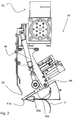
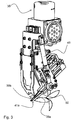
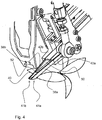
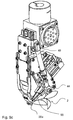
- FIGS. 2 to 4 show views of an embodiment of a pick-and-plant head 34 for attachment to a robot arm 32 via a connector 35.
- the pick-and-plant head 34 is provided with a grasper 36 arranged for picking up a cutting 2.
- the shown grasper is particularly suitable for grasping the stem of a stem cutting 2.
- Stem cuttings typically include a stem portion with an end that serves as a basis for roots to be formed, and a leaf portion arranged for developing plant elements such as leaves, buds and flowers.
- the grasper 36 comprises two opposed elongate members 38a, 38b.
- the elongate members 38a, 38b are generally blade shaped strips, and extend from a proximal end to a distal end.
- a single elongate member 38a is shown in figure 5a .
- the elongate members 38a, 38b are adjoined to the body of the pick-and-plant tool 34 at their proximal ends and converge with one another toward their distal ends so as to form forceps or pincers for grasping a cutting 2.
- Each elongate member 38a, 38b is provided on an inner surface of its distal end with a grasping surface 40 for grasping the stem of the cutting 2.
- the grasping surface as shown is substantially flat, but may be contoured or ribbed to aid in grasping the stem of the cutting 2.
- the elongate members 38a, 38b are preferably resiliently flexible transverse to the grasping direction. Such resilient flex allows for a firm grasp of the stem of the cutting, while at the same time avoiding an excessively forceful clamping that might damage a cutting 2. Forming the elongate members from resiliently flexible plastics or metals can achieve this flex.
- the elongate members 38a, 38b preferably comprise spring steel, stainless steel, aluminium, or aluminium alloys in this respect.
- the elongate members 38a, 38b are movable transversely toward and away from one another. This is achievable by opposing movement of the attachment blocks 42a, 42b to which the elongate members 38a, 38b are respectively joined at their proximal ends. By movement of the attachment blocks 42a, 42b toward one another, the grasping surfaces 40 are brought together and grasp upon the stem of cutting 2. It will be clear to the skilled reader that the elongate members 38a, 38b could be brought together by other movements. For example, the elongate members 38a, 38b could be hinged to one another at a distal position, and pivoted toward and away from one another for grasping and releasing respectively.
- the grasper 36 of the pick-and-plant head 34 is pivotable about an axis 44 such that it can translate from a generally horizontal pick-up position as shown in figures 2 to 5 , to a substantially vertical planting position shown in figures 8d to 8g .
- the elongate members 38a, 38b are arranged to grasp a cutting 2 that is in a substantially horizontal orientation upon the cuttings supply surface 14.
- the elongate members 38a, 38b are arranged to hold a cutting substantially vertically with its cut or rooting end downward, in order to insert, and so plant, the cutting 2 into the cultivation medium 4.
- the orientation of the cuttings is a substantially vertical orientation with the stem portion facing downwards.
- the cutting is rotated about 90° to bring the cutting from a horizontal position to a vertical position for planting.
- the rotation may also, for example, be from 80° to 100°, depending upon circumstances and cutting type.
- pivoting of the pick-and-plant head 34 about axis 44 is achieved by way of an extensible and retractable pneumatic arm 48.
- the grasper 36 is preferably angled compared to the cuttings 2. That is, in the pick-up position, the grasper is angled from horizontal by an angle alpha. Angle alpha is preferably 10° to 80°, preferably from 15° to 70°, and most preferably from 25° to 60°, when the gripper head is in the pick-up orientation. In figure 2 angle alpha is about 30°. Providing the grasper 36 at an angle allows for the horizontal cutting to be firmly grasped at its cut or root end, while avoiding damage to any leaves present at the top of the cutting.
- the angled grasper 36 once rotated into the vertical planting position, offers vertical support to the cutting 2, that is, along the stem axis, so that upon insertion into the cultivation medium 4 the elongate members 38a, 38b are able to form a scaffold about the stem supporting it and avoiding damage thereto upon insertion.
- the apparatus may be provided with an apparatus for pre-indenting the cultivation medium 4.
- the grasper 36 of the pick-and-plant head 34 is such that no advance indentation of the cultivation medium 4 is required. This is at least partially achieved through the parallel support offered by the elongate members 38a, 38b.
- this reduces or overcomes the need to pre-indent the cultivation medium with cavities to accept cuttings. This reduces the number of steps needed to complete planting since no additional indentation step is required. It also reduces complexity in alignment, because the indentation is made simultaneously with placement of the cutting, meaning there is no requirement to detect indentation positions with a camera system, or to accurately align either the pick-and-plant head with indentations, or to align indentations in relation to the other components of the system. In addition, such direct insertion may provide a snugger contact of the cultivation medium about the cutting stem, than is achieved by pre-indentation.
- pre-indentation may create indents with a too great a diameter for a particular cutting, taking into account that a standard indentation size is used which is large enough for expected stem sizes and accuracy tolerances in placement.
- a snugger fit within the cultivation medium can provide improved rooting and nutrient uptake for a cutting, as well as physical orientation.
- a cutting 2 is grasped by the elongate members 38a, 38b close to its cut or root surface.
- the distal ends of the elongate members 38a, 38b are then at least partially inserted into the cultivation medium 4 along with the cut or root end of the cutting 2 at the planting stage.
- the tips of the elongate members 38a, 38b in this manner buttress the stem and provide the rigidity to push aside cultivation medium 4, in effect simultaneously indenting the cultivation medium and planting.
- the distal ends of the elongate members 38a, 38b are provided with truncated or angled end faces 41a, 41b such that these are substantially parallel with the cuttings supply surface 14 when the pick-and-plant head 34 is in the pick-up configuration.
- the end faces 41a, 41b are thus preferably substantially horizontal when the pick-and-plant head 34 is in a horizontal pick-up configuration. This provides an extended grip area upon the cutting 2 as well as a generally blunt, low damage interface with the cuttings supply surface 14.
- the pick-and-plant tool 30 may use one or more images obtained with the camera system 20 to determine at what position a specific individual cutting should be picked up to enable suitable placement in the planting unit. Determining the desired position of pick-up can be done by analysis using pattern recognition algorithms known to those skilled in the art.
- the pick-and-plant head 34 may also be provided with a ram 50.
- the functioning of the shown ram 50 will be more fully discussed in relation to figures 8a-j below.
- Fig. 6 shows the ram 50 in greater detail.
- a function of the ram 50 is to abut the body of the cutting 2 at the stage of planting when the elongate members 38a, 38b, are withdrawn from, or release, the cutting 2.
- the cutting abuts against the distal end face 52 of the ram 50 during its release from the pick-and-plant head 34 into the cultivation medium 4. In this manner the cutting 2 is secured in place in the desired planting orientation, while allowing simple release from the grasper 36.
- the end face of the ram 50 is preferably angled or truncated similarly to the elongate members 38a, 38b.
- the surface of the ram end face 52 can have any form suitable for abutting a cutting body. For example, it may be planar, as illustrated, or it may be concave, ribbed, or contoured to generally match an abutted surface of a cutting 2.
- the illustrated ram 50 may function to force apart elongate members 38a, 38b during a planting step.
- the ram 50 is in this respect positioned between the elongate members 38a, 38b, and the elongate members 38a, 38b can be forced apart either by retraction over the ram 50, or by forward insertion of the ram 50 therebetween.
- the ram 50 is generally wedge shaped, being the inverse of the inner surfaces of the elongate members 38a, 38b. Other forms achieving the same function can be contemplated, such as a rod-shaped ram.
- the pick-and-plant tool 30 is programmed to assume that the cuttings supply surface 14 is at substantially the same vertical level throughout the supply system 10. However, to ensure that local deviations from such average level do not jeopardize the performance of the pick-and-plant head 34, a surface detection sensor may be provided. In such case, the grasper 36 of the pick-and-plant head 34 may be activated for grasping upon detection of the surface.
- a spacer 46 is provided, which abuts the surface of the cutting supply surface 14 ahead of the distal ends of elongate members 38a, 38b.
- the spacer 46 has a lower surface that is preferably at least 0.1mm lower than the lowest point of the elongate members 38a, 38b when the pick-and-plant head 34 is in the pick-up position shown in figure 5 . This aids in preventing the distal tips of the elongate members 38a, 38b from coming into contact with the cuttings supply surface 14, and as such can help to reduce abrasion of the supply surface 14 that might otherwise result from scraping of the tips of the elongate members 38a, 38b across it as they are brought toward one another during grasping.
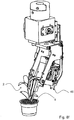
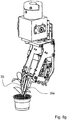
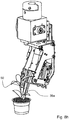
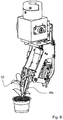
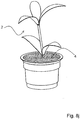
- FIGS. 8a-8j a number of different orientations of the pick-and-plant head 34 during the picking and planting process are shown to illustrate a method of picking and planting a cutting 2.
- the pick-and-plant head 34 is carried upon the distal end of a robot arm 32 which transports the pick-and-plant head 34 between picking and planting positions, and vice versa.
- the robot arm 32 moves the pick-and-plant head 34 towards an identified single cutting on the basis of information obtained with the camera system 20.
- the elongate members 38a, 38b of the grasper are in an open state, i.e. when the elongate members 38a, 38b are open to accept a cutting therebetween.
- FIGS. 4 , 8a and 8b show the grasper in an open state.
- the robot arm 32 brings the pick-and-plant head 34 into the region of a selected cutting 2 in an orientation ready for picking it, that is, with the distal ends of the elongate members 38a, 38b aligned with and facing in the direction of the cut end of the cutting 2.
- the pick-and-plant head 34 is positioned with a suitable portion of the cutting 2 between the grasping surfaces 40.
- the selected portion of the shown stem cutting 2 is close to or at the cut end of the stem.
- the attachment blocks 42 and thus also the elongate members 38a, 38b as a consequence, are moved toward one another, for example by pneumatics.
- the grasping surfaces 40 come to bear upon the stem of the cutting so that it is securely grasped.
- the robot arm 32 then moves the pick-and-plant head 34 along with the grasped cutting 2 away from the cuttings supply surface into an open volume where the grasper 36 is rotated 90° about axis 44 translating the cutting 2 from a generally horizontal orientation to a generally vertical orientation with its cut end disposed downwardly ready for insertion into a cultivation medium 4, as shown in FIG. 8d .
- the robot arm simultaneously, or thereafter, positions the pick-and-plant head at pre-planting coordinates above a plant cultivation medium 4, figure 8e .
- the pick-and-plant head descends to plant the cutting 2 within the cultivation medium 4.
- the distal ends of the elongate members 38a, 38b also penetrate the cultivation medium and so support the cutting 2 against insertion forces that might otherwise damage it.
- the ram 50 is advanced toward the cutting 2 to abut with its end face 52 against it, securing the cutting within the cultivation medium 4.
- the elongate members 38a, 38b are proximally retracted. As they retract their inner surfaces engage with the wedged ram 50 such that the elongate members are forced laterally apart to release the cutting 2 from the grasper 36.
- the pick-and-plant tool 30 may be arranged for simultaneous picking and planting of a plurality of cuttings 2 in a cultivation medium 4.
- the pick-and-plant head 34 is provided with a plurality of graspers, each for grasping a single cutting 2, whereby a number of cuttings can be collected and then simultaneously planted in the plant cultivation medium 4.
Landscapes
- Life Sciences & Earth Sciences (AREA)
- Environmental Sciences (AREA)
- Botany (AREA)
- Developmental Biology & Embryology (AREA)
- Harvesting Machines For Specific Crops (AREA)
- Engineering & Computer Science (AREA)
- Transplanting Machines (AREA)
- Robotics (AREA)
- Mechanical Engineering (AREA)
- Cultivation Receptacles Or Flower-Pots, Or Pots For Seedlings (AREA)
- Pretreatment Of Seeds And Plants (AREA)
Applications Claiming Priority (2)
| Application Number | Priority Date | Filing Date | Title |
|---|---|---|---|
| NL2014155A NL2014155B3 (en) | 2015-01-19 | 2015-01-19 | Apparatus and method for planting plant cuttings. |
| PCT/EP2016/050897 WO2016116402A1 (en) | 2015-01-19 | 2016-01-18 | Apparatus and method for planting plant cuttings |
Publications (2)
| Publication Number | Publication Date |
|---|---|
| EP3247196A1 EP3247196A1 (en) | 2017-11-29 |
| EP3247196B1 true EP3247196B1 (en) | 2019-04-24 |
Family
ID=52774470
Family Applications (1)
| Application Number | Title | Priority Date | Filing Date |
|---|---|---|---|
| EP16700971.1A Active EP3247196B1 (en) | 2015-01-19 | 2016-01-18 | Apparatus and method for planting plant cuttings |
Country Status (8)
| Country | Link |
|---|---|
| US (2) | US11684022B2 (da) |
| EP (1) | EP3247196B1 (da) |
| BR (1) | BR112017015398B1 (da) |
| CA (1) | CA2974242C (da) |
| DK (1) | DK3247196T3 (da) |
| NL (1) | NL2014155B3 (da) |
| PT (1) | PT3247196T (da) |
| WO (1) | WO2016116402A1 (da) |
Families Citing this family (16)
| Publication number | Priority date | Publication date | Assignee | Title |
|---|---|---|---|---|
| DE102016010618A1 (de) | 2016-08-03 | 2018-02-08 | Bock Bio Science Gmbh | Vorrichtung und Verfahren zum Vermehren von Pflanzen |
| EP3772883A1 (en) | 2018-04-06 | 2021-02-17 | IG Specials B.V. | Apparatus and method for transplanting seedlings |
| WO2020102830A1 (en) * | 2018-11-14 | 2020-05-22 | Bartrom Michael | Automated farm with robots working on plants |
| CN111492831A (zh) * | 2019-01-11 | 2020-08-07 | 洪锦民 | 远程栽种植物的方法及系统、农具、计算机程序产品 |
| DE102019113516A1 (de) * | 2019-05-21 | 2020-11-26 | Pilzkulturen Wesjohann GbR ( vertretungsber. Gesellsch. Erich Wesjohann, Dirk Wesjohann, Jan Wesjohann, Anne Wesjohann, 49429 Visbek) | System zur Kultivierung und Ernte von Pilzen |
| EP3828828A1 (en) | 2019-11-28 | 2021-06-02 | Robovision | Improved physical object handling based on deep learning |
| CN114867342B (zh) * | 2019-12-27 | 2023-05-02 | 株式会社Elm | 嫁接装置 |
| EP4161259A1 (en) | 2020-06-07 | 2023-04-12 | Comestaag LLC | Shelf-life extender compositions for live plant items and methods, kits, and coated live plant items relating thereto |
| CA3246867A1 (en) * | 2022-03-28 | 2023-10-05 | Simulare Medical Inc. | SIMULATOR FOR THE PRACTICE OF SURGERY FOR BILATERAL Cleft Lip and Palatine |
| US12520771B2 (en) | 2022-12-23 | 2026-01-13 | P&G Ip Gmbh | Method and system for producing, without the help of a substrate, a plurality of rooted cuttings from a plurality of unrooted cuttings |
| NL2036276B1 (nl) * | 2023-06-09 | 2024-12-19 | Tuinbouw Technisch Atelier Tta B V | Inrichting, systeem en werkwijzen voor het verwerken van plantenstekken |
| WO2024253533A1 (en) * | 2023-06-09 | 2024-12-12 | Tuinbouw Technisch Atelier (Tta) B.V. | Device, system and methods for processing plant cuttings |
| EP4727339A2 (en) * | 2023-06-13 | 2026-04-22 | IG Specials B.V. | System and methods for processing plant material |
| TWI897230B (zh) * | 2024-02-05 | 2025-09-11 | 余敏守 | 夾鉗偵測裝置 |
| CN118451936B (zh) * | 2024-05-20 | 2024-12-17 | 合肥专注绣球旅游有限公司 | 一种木绣球扦插培育用枝条处理和扦插装置及方法 |
| CN120476876B (zh) * | 2025-07-01 | 2025-11-14 | 中国科学院东北地理与农业生态研究所 | 一种湿地空心菜种植设备 |
Family Cites Families (35)
| Publication number | Priority date | Publication date | Assignee | Title |
|---|---|---|---|---|
| NO125028B (da) * | 1970-07-01 | 1972-07-10 | Erik Jensen | |
| US4106414A (en) * | 1976-09-20 | 1978-08-15 | Carl Vastag | Seed planter and planting valve therefor |
| NL8601765A (nl) * | 1986-07-07 | 1988-02-01 | Visser S Gravendeel Holding | Verspeeninrichting en -werkwijze. |
| US4843982A (en) * | 1987-08-19 | 1989-07-04 | Nagy Szakaly Joseph | Seed embedding implement |
| NL190977C (nl) * | 1988-08-31 | 1994-12-01 | Visser S Gravendeel Holding | Inrichting voor het aangrijpen en loslaten van kluiten met planten. |
| GB8915025D0 (en) | 1989-06-30 | 1989-08-23 | British Res Agricult Eng | Gripping and manipulating device and handling method |
| DE69114685T2 (de) | 1990-09-07 | 1996-07-04 | Forbio Ltd | Automatisches zerteilungssystem für pflanzen. |
| US5215550A (en) * | 1991-07-10 | 1993-06-01 | Sylvester M. Tesch, Jr. | Seedling array transplanter |
| FR2685852B1 (fr) * | 1992-01-07 | 1999-02-19 | Gerplant Automation | Dispositif de prehension et de transfert de plants en mottes. |
| US5431116A (en) * | 1993-10-26 | 1995-07-11 | New Century Technology Corporation | Pneumatic transplanter |
| US5860372A (en) * | 1995-02-21 | 1999-01-19 | Bouldin & Lawson, Inc. | Seedling transplanter with planting fingers |
| US5557881A (en) * | 1995-02-21 | 1996-09-24 | Bouldin; Floyd | Seedling transplanter |
| DE19522368C2 (de) | 1995-06-20 | 1997-04-30 | Schubert Gerhard Gmbh | Picker-Straße |
| AT402085B (de) * | 1995-07-03 | 1997-01-27 | Opferkuch Bau Gmbh | Roboter zum ziegelsetzen für ein aufgehendes mauerwerk |
| FR2738988B1 (fr) * | 1995-09-21 | 1997-11-28 | D Exploit Agricole Etablisseme | Machine automatique permettant de realiser le depotage et rempotage de plants et dispositif permettant la manutention desdits plants utilisables sur une telle machine |
| US5911631A (en) * | 1996-09-23 | 1999-06-15 | Bouldin & Lawson, Inc. | Seedling transplanter with easily detachable gripper |
| US6212821B1 (en) * | 1999-05-10 | 2001-04-10 | Kieran L. Adam | Automatic plant selector |
| NL1012417C2 (nl) | 1999-06-23 | 2000-12-28 | Hazendonk Beheer B V Ab | Werkwijze en inrichting voor het bewerken of verwerken van objecten. |
| US7984583B2 (en) * | 2001-01-24 | 2011-07-26 | Tagawa Greenhouse Enterprises, Llc | Plant punch methods and apparatus |
| NL1018278C2 (nl) | 2001-06-13 | 2002-12-16 | Hazendonk Techniek B V Ab | Steksteekinrichting voor het steken van stekken. |
| WO2003022034A1 (en) | 2001-09-07 | 2003-03-20 | Gartneriet Pkm Aps | Pick and place robot |
| EP1648214B1 (en) * | 2003-07-29 | 2018-05-02 | AutoPlanter LLC | Automated planter |
| NL1031300C2 (nl) | 2006-03-03 | 2007-09-04 | Provice B V | Samenstel voor het in plantpluggen plaatsen van stekken. |
| JP4350102B2 (ja) | 2006-03-30 | 2009-10-21 | 株式会社クボタ | 乗用型田植機 |
| NL2000898C2 (nl) * | 2007-10-03 | 2009-04-06 | William Van Der Burg | Inrichting voor het in een pot plaatsen van een gewas. |
| NL1036276C2 (nl) * | 2008-12-03 | 2010-06-07 | Visser S Gravendeel Holding | Inrichting voor het bevatten van plantmateriaal en systeem voor verwerking daarvan. |
| NL1036440C2 (nl) * | 2009-01-21 | 2010-07-22 | Visser S Gravendeel Holding | Tray voor planten. |
| NL2004951C2 (nl) * | 2010-06-23 | 2011-12-27 | Visser S Gravendeel Holding | Systeem en werkwijze voor het overzetten en verenkelen van plantmateriaal in een houder, houder voor plantmateriaal, gebruik van een houder voor plantmateriaal. |
| US20120017507A1 (en) * | 2010-07-21 | 2012-01-26 | Cognisense Labs, Inc. | Automated organic polarized object organization |
| US8504204B2 (en) * | 2010-07-22 | 2013-08-06 | Cognisense Labs, Inc. | Automated positioning of an organic polarized object |
| US8363905B2 (en) * | 2010-07-21 | 2013-01-29 | Cognisense Labs, Inc. | Automated image analysis of an organic polarized object |
| DK2742796T3 (da) * | 2011-01-24 | 2015-10-12 | Ig Specials B V | Stiklingsholdeenhed til plantning af stiklinger og fremgangsmåde til at placere stiklinger af planter i et dyrkningsmedium |
| JP5818532B2 (ja) | 2011-06-23 | 2015-11-18 | 株式会社クボタ | 田植機 |
| US8605149B2 (en) * | 2011-07-19 | 2013-12-10 | Ball Horticultural Company | Seed classification using spectral analysis to determine existence of a seed structure |
| NL2008856C2 (en) | 2012-05-22 | 2013-11-25 | Iso Groep Machb B V | Apparatus and method for seperating objects. |
-
2015
- 2015-01-19 NL NL2014155A patent/NL2014155B3/en active IP Right Maintenance
-
2016
- 2016-01-18 CA CA2974242A patent/CA2974242C/en active Active
- 2016-01-18 WO PCT/EP2016/050897 patent/WO2016116402A1/en not_active Ceased
- 2016-01-18 US US15/544,264 patent/US11684022B2/en active Active
- 2016-01-18 EP EP16700971.1A patent/EP3247196B1/en active Active
- 2016-01-18 DK DK16700971.1T patent/DK3247196T3/da active
- 2016-01-18 PT PT16700971T patent/PT3247196T/pt unknown
- 2016-01-18 BR BR112017015398-0A patent/BR112017015398B1/pt active IP Right Grant
-
2023
- 2023-05-24 US US18/201,263 patent/US12302810B2/en active Active
Non-Patent Citations (1)
| Title |
|---|
| None * |
Also Published As
| Publication number | Publication date |
|---|---|
| DK3247196T3 (da) | 2019-07-29 |
| BR112017015398A2 (pt) | 2018-01-16 |
| NL2014155A (en) | 2016-09-26 |
| NL2014155B1 (en) | 2017-01-05 |
| CA2974242C (en) | 2021-12-07 |
| PT3247196T (pt) | 2019-08-01 |
| EP3247196A1 (en) | 2017-11-29 |
| BR112017015398B1 (pt) | 2021-11-16 |
| US12302810B2 (en) | 2025-05-20 |
| US11684022B2 (en) | 2023-06-27 |
| NL2014155B3 (en) | 2024-04-11 |
| CA2974242A1 (en) | 2016-07-28 |
| US20230371445A1 (en) | 2023-11-23 |
| US20180007842A1 (en) | 2018-01-11 |
| WO2016116402A1 (en) | 2016-07-28 |
Similar Documents
| Publication | Publication Date | Title |
|---|---|---|
| US12302810B2 (en) | Apparatus and method for planting plant cuttings | |
| EP3552479B1 (en) | Apparatus and method for placing plant bulbs | |
| EP2742796B1 (en) | Cutting holding unit for planting cuttings and method of placing cuttings of plants in a cultivation medium | |
| EP3501264A2 (en) | System, method and apparatus for processing seedlings | |
| NL2022385B1 (en) | Apparatus and Method for Placing Bulbs | |
| NL1038540C2 (en) | Apparatus and method for placing plant cuttings. | |
| Kurata | Automated systems for organogenesis | |
| NL2006878C2 (en) | Cutting holding unit for planting cuttings in a cultivation medium. | |
| WO1992001369A1 (en) | Cutting and/or manoeuvring apparatus and methods | |
| WO2025132689A9 (en) | System and method for grafting plant stems | |
| JP2003134943A (ja) | 挿苗機 |
Legal Events
| Date | Code | Title | Description |
|---|---|---|---|
| STAA | Information on the status of an ep patent application or granted ep patent |
Free format text: STATUS: THE INTERNATIONAL PUBLICATION HAS BEEN MADE |
|
| PUAI | Public reference made under article 153(3) epc to a published international application that has entered the european phase |
Free format text: ORIGINAL CODE: 0009012 |
|
| STAA | Information on the status of an ep patent application or granted ep patent |
Free format text: STATUS: REQUEST FOR EXAMINATION WAS MADE |
|
| 17P | Request for examination filed |
Effective date: 20170816 |
|
| AK | Designated contracting states |
Kind code of ref document: A1 Designated state(s): AL AT BE BG CH CY CZ DE DK EE ES FI FR GB GR HR HU IE IS IT LI LT LU LV MC MK MT NL NO PL PT RO RS SE SI SK SM TR |
|
| AX | Request for extension of the european patent |
Extension state: BA ME |
|
| DAV | Request for validation of the european patent (deleted) | ||
| DAX | Request for extension of the european patent (deleted) | ||
| REG | Reference to a national code |
Ref country code: DE Ref legal event code: R079 Ref document number: 602016012820 Country of ref document: DE Free format text: PREVIOUS MAIN CLASS: A01G0009080000 Ipc: B25J0009000000 |
|
| GRAP | Despatch of communication of intention to grant a patent |
Free format text: ORIGINAL CODE: EPIDOSNIGR1 |
|
| STAA | Information on the status of an ep patent application or granted ep patent |
Free format text: STATUS: GRANT OF PATENT IS INTENDED |
|
| RIC1 | Information provided on ipc code assigned before grant |
Ipc: B25J 9/16 20060101ALI20181008BHEP Ipc: A01G 9/08 20060101ALI20181008BHEP Ipc: B25J 9/00 20060101AFI20181008BHEP |
|
| INTG | Intention to grant announced |
Effective date: 20181030 |
|
| GRAS | Grant fee paid |
Free format text: ORIGINAL CODE: EPIDOSNIGR3 |
|
| GRAA | (expected) grant |
Free format text: ORIGINAL CODE: 0009210 |
|
| STAA | Information on the status of an ep patent application or granted ep patent |
Free format text: STATUS: THE PATENT HAS BEEN GRANTED |
|
| AK | Designated contracting states |
Kind code of ref document: B1 Designated state(s): AL AT BE BG CH CY CZ DE DK EE ES FI FR GB GR HR HU IE IS IT LI LT LU LV MC MK MT NL NO PL PT RO RS SE SI SK SM TR |
|
| REG | Reference to a national code |
Ref country code: GB Ref legal event code: FG4D |
|
| REG | Reference to a national code |
Ref country code: CH Ref legal event code: EP |
|
| REG | Reference to a national code |
Ref country code: AT Ref legal event code: REF Ref document number: 1123584 Country of ref document: AT Kind code of ref document: T Effective date: 20190515 Ref country code: IE Ref legal event code: FG4D |
|
| REG | Reference to a national code |
Ref country code: DE Ref legal event code: R096 Ref document number: 602016012820 Country of ref document: DE |
|
| REG | Reference to a national code |
Ref country code: DK Ref legal event code: T3 Effective date: 20190725 |
|
| REG | Reference to a national code |
Ref country code: DE Ref legal event code: R082 Ref document number: 602016012820 Country of ref document: DE Representative=s name: HOYNG ROKH MONEGIER LLP, NL Ref country code: DE Ref legal event code: R082 Ref document number: 602016012820 Country of ref document: DE Representative=s name: HOYNG ROKH MONEGIER B.V., NL |
|
| REG | Reference to a national code |
Ref country code: PT Ref legal event code: SC4A Ref document number: 3247196 Country of ref document: PT Date of ref document: 20190801 Kind code of ref document: T Free format text: AVAILABILITY OF NATIONAL TRANSLATION Effective date: 20190722 |
|
| REG | Reference to a national code |
Ref country code: NL Ref legal event code: FP |
|
| REG | Reference to a national code |
Ref country code: SE Ref legal event code: TRGR |
|
| REG | Reference to a national code |
Ref country code: LT Ref legal event code: MG4D |
|
| REG | Reference to a national code |
Ref country code: NO Ref legal event code: T2 Effective date: 20190424 |
|
| PG25 | Lapsed in a contracting state [announced via postgrant information from national office to epo] |
Ref country code: ES Free format text: LAPSE BECAUSE OF FAILURE TO SUBMIT A TRANSLATION OF THE DESCRIPTION OR TO PAY THE FEE WITHIN THE PRESCRIBED TIME-LIMIT Effective date: 20190424 Ref country code: AL Free format text: LAPSE BECAUSE OF FAILURE TO SUBMIT A TRANSLATION OF THE DESCRIPTION OR TO PAY THE FEE WITHIN THE PRESCRIBED TIME-LIMIT Effective date: 20190424 Ref country code: LT Free format text: LAPSE BECAUSE OF FAILURE TO SUBMIT A TRANSLATION OF THE DESCRIPTION OR TO PAY THE FEE WITHIN THE PRESCRIBED TIME-LIMIT Effective date: 20190424 Ref country code: HR Free format text: LAPSE BECAUSE OF FAILURE TO SUBMIT A TRANSLATION OF THE DESCRIPTION OR TO PAY THE FEE WITHIN THE PRESCRIBED TIME-LIMIT Effective date: 20190424 |
|
| PG25 | Lapsed in a contracting state [announced via postgrant information from national office to epo] |
Ref country code: RS Free format text: LAPSE BECAUSE OF FAILURE TO SUBMIT A TRANSLATION OF THE DESCRIPTION OR TO PAY THE FEE WITHIN THE PRESCRIBED TIME-LIMIT Effective date: 20190424 Ref country code: GR Free format text: LAPSE BECAUSE OF FAILURE TO SUBMIT A TRANSLATION OF THE DESCRIPTION OR TO PAY THE FEE WITHIN THE PRESCRIBED TIME-LIMIT Effective date: 20190725 Ref country code: PL Free format text: LAPSE BECAUSE OF FAILURE TO SUBMIT A TRANSLATION OF THE DESCRIPTION OR TO PAY THE FEE WITHIN THE PRESCRIBED TIME-LIMIT Effective date: 20190424 Ref country code: LV Free format text: LAPSE BECAUSE OF FAILURE TO SUBMIT A TRANSLATION OF THE DESCRIPTION OR TO PAY THE FEE WITHIN THE PRESCRIBED TIME-LIMIT Effective date: 20190424 Ref country code: BG Free format text: LAPSE BECAUSE OF FAILURE TO SUBMIT A TRANSLATION OF THE DESCRIPTION OR TO PAY THE FEE WITHIN THE PRESCRIBED TIME-LIMIT Effective date: 20190724 |
|
| REG | Reference to a national code |
Ref country code: AT Ref legal event code: MK05 Ref document number: 1123584 Country of ref document: AT Kind code of ref document: T Effective date: 20190424 |
|
| PG25 | Lapsed in a contracting state [announced via postgrant information from national office to epo] |
Ref country code: IS Free format text: LAPSE BECAUSE OF FAILURE TO SUBMIT A TRANSLATION OF THE DESCRIPTION OR TO PAY THE FEE WITHIN THE PRESCRIBED TIME-LIMIT Effective date: 20190824 |
|
| REG | Reference to a national code |
Ref country code: DE Ref legal event code: R097 Ref document number: 602016012820 Country of ref document: DE |
|
| PG25 | Lapsed in a contracting state [announced via postgrant information from national office to epo] |
Ref country code: AT Free format text: LAPSE BECAUSE OF FAILURE TO SUBMIT A TRANSLATION OF THE DESCRIPTION OR TO PAY THE FEE WITHIN THE PRESCRIBED TIME-LIMIT Effective date: 20190424 Ref country code: SK Free format text: LAPSE BECAUSE OF FAILURE TO SUBMIT A TRANSLATION OF THE DESCRIPTION OR TO PAY THE FEE WITHIN THE PRESCRIBED TIME-LIMIT Effective date: 20190424 Ref country code: RO Free format text: LAPSE BECAUSE OF FAILURE TO SUBMIT A TRANSLATION OF THE DESCRIPTION OR TO PAY THE FEE WITHIN THE PRESCRIBED TIME-LIMIT Effective date: 20190424 Ref country code: CZ Free format text: LAPSE BECAUSE OF FAILURE TO SUBMIT A TRANSLATION OF THE DESCRIPTION OR TO PAY THE FEE WITHIN THE PRESCRIBED TIME-LIMIT Effective date: 20190424 Ref country code: EE Free format text: LAPSE BECAUSE OF FAILURE TO SUBMIT A TRANSLATION OF THE DESCRIPTION OR TO PAY THE FEE WITHIN THE PRESCRIBED TIME-LIMIT Effective date: 20190424 |
|
| PG25 | Lapsed in a contracting state [announced via postgrant information from national office to epo] |
Ref country code: SM Free format text: LAPSE BECAUSE OF FAILURE TO SUBMIT A TRANSLATION OF THE DESCRIPTION OR TO PAY THE FEE WITHIN THE PRESCRIBED TIME-LIMIT Effective date: 20190424 Ref country code: IT Free format text: LAPSE BECAUSE OF FAILURE TO SUBMIT A TRANSLATION OF THE DESCRIPTION OR TO PAY THE FEE WITHIN THE PRESCRIBED TIME-LIMIT Effective date: 20190424 |
|
| PLBE | No opposition filed within time limit |
Free format text: ORIGINAL CODE: 0009261 |
|
| STAA | Information on the status of an ep patent application or granted ep patent |
Free format text: STATUS: NO OPPOSITION FILED WITHIN TIME LIMIT |
|
| PG25 | Lapsed in a contracting state [announced via postgrant information from national office to epo] |
Ref country code: TR Free format text: LAPSE BECAUSE OF FAILURE TO SUBMIT A TRANSLATION OF THE DESCRIPTION OR TO PAY THE FEE WITHIN THE PRESCRIBED TIME-LIMIT Effective date: 20190424 |
|
| 26N | No opposition filed |
Effective date: 20200127 |
|
| PG25 | Lapsed in a contracting state [announced via postgrant information from national office to epo] |
Ref country code: SI Free format text: LAPSE BECAUSE OF FAILURE TO SUBMIT A TRANSLATION OF THE DESCRIPTION OR TO PAY THE FEE WITHIN THE PRESCRIBED TIME-LIMIT Effective date: 20190424 |
|
| PG25 | Lapsed in a contracting state [announced via postgrant information from national office to epo] |
Ref country code: MC Free format text: LAPSE BECAUSE OF FAILURE TO SUBMIT A TRANSLATION OF THE DESCRIPTION OR TO PAY THE FEE WITHIN THE PRESCRIBED TIME-LIMIT Effective date: 20190424 |
|
| REG | Reference to a national code |
Ref country code: CH Ref legal event code: PL |
|
| PG25 | Lapsed in a contracting state [announced via postgrant information from national office to epo] |
Ref country code: LU Free format text: LAPSE BECAUSE OF NON-PAYMENT OF DUE FEES Effective date: 20200118 |
|
| PG25 | Lapsed in a contracting state [announced via postgrant information from national office to epo] |
Ref country code: CH Free format text: LAPSE BECAUSE OF NON-PAYMENT OF DUE FEES Effective date: 20200131 Ref country code: LI Free format text: LAPSE BECAUSE OF NON-PAYMENT OF DUE FEES Effective date: 20200131 |
|
| PG25 | Lapsed in a contracting state [announced via postgrant information from national office to epo] |
Ref country code: IE Free format text: LAPSE BECAUSE OF NON-PAYMENT OF DUE FEES Effective date: 20200118 |
|
| PG25 | Lapsed in a contracting state [announced via postgrant information from national office to epo] |
Ref country code: MT Free format text: LAPSE BECAUSE OF FAILURE TO SUBMIT A TRANSLATION OF THE DESCRIPTION OR TO PAY THE FEE WITHIN THE PRESCRIBED TIME-LIMIT Effective date: 20190424 Ref country code: CY Free format text: LAPSE BECAUSE OF FAILURE TO SUBMIT A TRANSLATION OF THE DESCRIPTION OR TO PAY THE FEE WITHIN THE PRESCRIBED TIME-LIMIT Effective date: 20190424 |
|
| PG25 | Lapsed in a contracting state [announced via postgrant information from national office to epo] |
Ref country code: MK Free format text: LAPSE BECAUSE OF FAILURE TO SUBMIT A TRANSLATION OF THE DESCRIPTION OR TO PAY THE FEE WITHIN THE PRESCRIBED TIME-LIMIT Effective date: 20190424 |
|
| P01 | Opt-out of the competence of the unified patent court (upc) registered |
Effective date: 20230518 |
|
| P04 | Withdrawal of opt-out of the competence of the unified patent court (upc) registered |
Free format text: CASE NUMBER: APP_31239/2025 Effective date: 20250627 |
|
| PGFP | Annual fee paid to national office [announced via postgrant information from national office to epo] |
Ref country code: NL Payment date: 20260126 Year of fee payment: 11 |
|
| PGFP | Annual fee paid to national office [announced via postgrant information from national office to epo] |
Ref country code: SE Payment date: 20260127 Year of fee payment: 11 |
|
| PGFP | Annual fee paid to national office [announced via postgrant information from national office to epo] |
Ref country code: GB Payment date: 20260127 Year of fee payment: 11 |
|
| PGFP | Annual fee paid to national office [announced via postgrant information from national office to epo] |
Ref country code: DE Payment date: 20260128 Year of fee payment: 11 Ref country code: DK Payment date: 20260126 Year of fee payment: 11 Ref country code: NO Payment date: 20260128 Year of fee payment: 11 |
|
| PGFP | Annual fee paid to national office [announced via postgrant information from national office to epo] |
Ref country code: FI Payment date: 20260126 Year of fee payment: 11 Ref country code: BE Payment date: 20260127 Year of fee payment: 11 |
|
| PGFP | Annual fee paid to national office [announced via postgrant information from national office to epo] |
Ref country code: FR Payment date: 20260126 Year of fee payment: 11 |
|
| PGFP | Annual fee paid to national office [announced via postgrant information from national office to epo] |
Ref country code: PT Payment date: 20260120 Year of fee payment: 11 |