EP3246277A1 - Abstapelvorrichtung für schalen - Google Patents
Abstapelvorrichtung für schalen Download PDFInfo
- Publication number
- EP3246277A1 EP3246277A1 EP16170142.0A EP16170142A EP3246277A1 EP 3246277 A1 EP3246277 A1 EP 3246277A1 EP 16170142 A EP16170142 A EP 16170142A EP 3246277 A1 EP3246277 A1 EP 3246277A1
- Authority
- EP
- European Patent Office
- Prior art keywords
- destacker
- screws
- shell
- tray
- helix
- Prior art date
- Legal status (The legal status is an assumption and is not a legal conclusion. Google has not performed a legal analysis and makes no representation as to the accuracy of the status listed.)
- Granted
Links
Images




Classifications
-
- B—PERFORMING OPERATIONS; TRANSPORTING
- B65—CONVEYING; PACKING; STORING; HANDLING THIN OR FILAMENTARY MATERIAL
- B65G—TRANSPORT OR STORAGE DEVICES, e.g. CONVEYORS FOR LOADING OR TIPPING, SHOP CONVEYOR SYSTEMS OR PNEUMATIC TUBE CONVEYORS
- B65G59/00—De-stacking of articles
- B65G59/06—De-stacking from the bottom of the stack
- B65G59/061—De-stacking from the bottom of the stack articles being separated substantially along the axis of the stack
- B65G59/066—De-stacking from the bottom of the stack articles being separated substantially along the axis of the stack by means of rotary devices or endless elements
-
- B—PERFORMING OPERATIONS; TRANSPORTING
- B65—CONVEYING; PACKING; STORING; HANDLING THIN OR FILAMENTARY MATERIAL
- B65G—TRANSPORT OR STORAGE DEVICES, e.g. CONVEYORS FOR LOADING OR TIPPING, SHOP CONVEYOR SYSTEMS OR PNEUMATIC TUBE CONVEYORS
- B65G59/00—De-stacking of articles
- B65G59/10—De-stacking nested articles
- B65G59/107—De-stacking nested articles by means of rotary devices or endless elements
- B65G59/108—De-stacking nested articles by means of rotary devices or endless elements the axis of rotation being substantially parallel to the axis of the stack
-
- B—PERFORMING OPERATIONS; TRANSPORTING
- B65—CONVEYING; PACKING; STORING; HANDLING THIN OR FILAMENTARY MATERIAL
- B65G—TRANSPORT OR STORAGE DEVICES, e.g. CONVEYORS FOR LOADING OR TIPPING, SHOP CONVEYOR SYSTEMS OR PNEUMATIC TUBE CONVEYORS
- B65G35/00—Mechanical conveyors not otherwise provided for
- B65G35/04—Mechanical conveyors not otherwise provided for comprising a flexible load carrier, e.g. a belt, which is wound up at one end and paid out at the other
-
- B—PERFORMING OPERATIONS; TRANSPORTING
- B65—CONVEYING; PACKING; STORING; HANDLING THIN OR FILAMENTARY MATERIAL
- B65G—TRANSPORT OR STORAGE DEVICES, e.g. CONVEYORS FOR LOADING OR TIPPING, SHOP CONVEYOR SYSTEMS OR PNEUMATIC TUBE CONVEYORS
- B65G59/00—De-stacking of articles
- B65G59/10—De-stacking nested articles
- B65G59/107—De-stacking nested articles by means of rotary devices or endless elements
-
- B—PERFORMING OPERATIONS; TRANSPORTING
- B65—CONVEYING; PACKING; STORING; HANDLING THIN OR FILAMENTARY MATERIAL
- B65G—TRANSPORT OR STORAGE DEVICES, e.g. CONVEYORS FOR LOADING OR TIPPING, SHOP CONVEYOR SYSTEMS OR PNEUMATIC TUBE CONVEYORS
- B65G59/00—De-stacking of articles
- B65G59/06—De-stacking from the bottom of the stack
- B65G59/067—De-stacking from the bottom of the stack articles being separated substantially perpendicularly to the axis of the stack
- B65G59/068—De-stacking from the bottom of the stack articles being separated substantially perpendicularly to the axis of the stack by means of endless elements
-
- B—PERFORMING OPERATIONS; TRANSPORTING
- B65—CONVEYING; PACKING; STORING; HANDLING THIN OR FILAMENTARY MATERIAL
- B65G—TRANSPORT OR STORAGE DEVICES, e.g. CONVEYORS FOR LOADING OR TIPPING, SHOP CONVEYOR SYSTEMS OR PNEUMATIC TUBE CONVEYORS
- B65G59/00—De-stacking of articles
- B65G59/10—De-stacking nested articles
-
- B—PERFORMING OPERATIONS; TRANSPORTING
- B65—CONVEYING; PACKING; STORING; HANDLING THIN OR FILAMENTARY MATERIAL
- B65H—HANDLING THIN OR FILAMENTARY MATERIAL, e.g. SHEETS, WEBS, CABLES
- B65H3/00—Separating articles from piles
- B65H3/08—Separating articles from piles using pneumatic force
- B65H3/0808—Suction grippers
- B65H3/0883—Construction of suction grippers or their holding devices
Definitions
- the invention relates to a stacking device for packaging trays according to claim 1.
- the EP 1685047 A1 discloses a stacker with four destacker screws, each located at a corner relative to the stack of containers. Based on the sides of the container stack guide elements are provided on all sides.
- a disadvantage of this design is the structurally high cost of four driven destacker screws, and the arrangement of the four destacker screws do not allow handling small containers or no series of closely spaced container stack.
- the object of the invention is to provide a simplified stacking suitable even for small trays.
- the stacking device comprises destacker screws for separating and destacking trays of a tray stack, each destacking screw having a helix designed as a helical recess.
- the invention is characterized in that two destacking screws, which have a same direction of rotation and a same winding direction, are provided for a common stack of trays. This makes it possible to handle a series of a plurality of juxtaposed tray trays, which have only a small distance from one another, since the destacker screws are provided in two opposite rows and in each case centrally to the stack of stacks to be destacked. This also allows unstacking of much smaller shells over the prior art stacking apparatus, where four destacking screws are provided at each of the four corners of the tray stack.
- the two destacker screws are preferably arranged such that the shell is detectable on two opposite side surfaces and can be transported downwards.
- the helix of both destacker screws has a contact height which is at least essentially (ie, apart from a deviation from Max. 5 - 10%) corresponds to a flange height of the shell flange in order to be able to hold and unstack the shells in a particularly positive manner.
- the contact height (or synonym: the vertical contact distance) of the helices is defined as follows.
- Each helix is a helically shaped recess in the outer wall of a destacker screw.
- this helical recess has an approximately rectangular cross-section, which is bounded by substantially horizontal upper and lower sides, an inner side parallel to the axis of rotation of the destamping screw and also parallel, open outer side.
- the upper side of the helical recess merges at an upper outer edge into the usually cylindrical outer wall of the destacker screw, corresponding to the underside at a lower outer edge.
- this virtual tangential plane perpendicular to the radius of the destamping screw has a first intersection with the lower outer edge of the helix in the rising direction of the helix in the descending direction of the helix a second point of intersection with the upper outer edge of the helix.
- the contact height (or synonymously the vertical contact distance) is defined as the distance of these two intersections projected onto the axial direction of the destacker screw.
- the helix has a constant vertical contact distance (contact height) between an upper side and a lower side of the helix, so that the shell is guided at four points.
- a first side of the shell flange rests against an upper surface of the helix of the first destacker screw and the second side of the shell flange opposite the first side engages an upper surface of the helix of the second destamping screw.
- the first side of the shell flange abuts a lower surface of the helix of the first destacker screw and the second side of the shell flange opposite the first side engages a lower surface of the helix of the second destacker screw.
- the spatially diagonally arranged four guide points ensure a horizontal forced guidance of the shell when separating or when transporting a single shell down.
- the contact height of the helix corresponds to the flange height of the shell in order to be able to execute the positive guidance by means of positive locking.
- the destacker screws are preferably configured to guide one side of the shell flange, each having a point of contact with the outside edge of the top and bottom of its helix, such that when singulated by the two destacker screws disposed on opposite shell flange sides, a four-point spatial guide results; that the position of the shell is determined by the position of the helix of the two destacker screws.
- At least two guide devices are disposed on the two opposite sides of the tray which are not gripped by the two destacker screws, the two guide devices being vertically aligned and configured to deliver a tray which has already been singulated and down the destacker screws to lead.
- the guide devices are preferably at least 5 mm further vertically downwards than the end of the spiral of the destacker screws to ensure safe guidance only by the guide devices themselves without the destacker screws.
- further guide devices can be provided on the shell flange sides of the shell in order to further improve the guiding behavior of the shell during the process of singulation.
- FIG. 1 shows a stacking device 1 according to the invention, which is configured to drop prefabricated trays 2 individually on a transport unit 3 to supply the tray 2, also referred to as a tray, subsequently to a filling station or loading station of a packaging machine.
- the stacking device 1 has vertical guides 4 to receive a stack of trays 11.
- Two destacking screws 5 acting on the shells 2 are driven by a common motor 6, preferably by a servomotor.
- the two destacking screws 5 are each by means of a transmission 8 for each destacker screw 5 is mounted on a common transmission shaft 7 and slidable along this transmission shaft 7 to be adaptable to different tray sizes.
- FIG. 2 shows a perspective view of the two destacker screws 5a and 5b, both of which have the same direction of rotation D, namely here in a clockwise direction.
- Each destacker screw 5a, 5b has a helix 12, which is formed as a helical recess.
- the winding direction W of the helix is the same for both destacker screws 5a, 5b in order to transport the shell 2 downwards.
- the winding direction W is defined by the downward tilt in a clockwise direction D.
- the shell 2 is received by the destacker screws 5a, 5b respectively on opposite sides of a shell flange 13 of the shell 2 in the coil 12.
- the coil 12 has an upper side 14 and a lower side 15, and in each case an upper outer edge 16 and a lower outer edge 17.
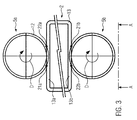
- FIG. 3 shows a plan view of the denester screws 5a, 5b, wherein between the dabber screw 5a shown in the dotted line drawing above and the drawings below with a dash-dot line illustrated destamping screw 5b, the shell 2 is taken from the coil 12 of both destacking screws 5a, 5b and is moved into the drawing plane by a rotation in the direction of rotation D of the destacker screws 5a, 5b.
- the shell 2 stands with its peripheral shell flange 13, each with two points of contact at the outer edges 16, 17 of the top 14 and the bottom 15 of the respective coil 12 of the destacker screws 5a, 5b, as in FIG. 2 shown, in contact.
- the uppermost bowl side 13a of the shell 2 which is arranged at the top, contacts the underside 15 of the first destacking screw 5a at the outer edge 17 at a first contact point 21a on the left and the upper side 14 of the first destacking screw 5a at the outer edge 16 at a second, drawing right Contact point 22a.
- FIG. 4 the four contact points 21a, 22a, 21b and 22b in a view A - A of FIG. 3 shown again, the destacker screws 5a, 5b are each shown with only one coil section.
- the helix 12 of the first destacker screw 5a is shown in the dotted line illustration and the helix 12 of the second destacker screw 5b is shown with a dashed-dotted line for better clarity.
- Rotation D of the destacker screws 5a, 5b leads to a movement of the shell 2 in the direction of the arrow downwards.
- the shell 2 is held securely at its flange 13 at the outer edges 16, 17 of the top 14 and the bottom 15 of both coils 12, that is, at four points, and guided down.
- guide devices 23 are provided (see FIG. Fig. 5 ). With a change in slope of the coil 12, the shell 2 is until the exit of the coil 12 at the lower end of the destacker screws 5a, 5b process reliable.
- FIG. 4 also shows the flange height 20 of the shell flange 13 and the contact height 10 of both coils 12, the contact height 10 corresponding to the flange height 20 of the shell 2.
- the contact height ie the vertical contact distance
- FIG. 3 is the shell 2 with its shell flange 13a on the inside of the coil 12 of the destamping screw 5a.
- a virtual tangential plane is accordingly clamped, which is on the one hand parallel to the axis of rotation of the destacker screw 5a and on the other hand contains the outer edge of the shell flange section 13a when the shell flange bears against the inside of the coil 12.
- FIG. 5 shows a plan view of the unstacking device 1 with vertically oriented guide devices 23 in the form of round rods on those sides of the shell flange 13, which are not in contact with the destacker screws (5a, 5b).
- Other guide devices 24 on the other shell flange sides 13a, 13b are conceivable.
Landscapes
- Engineering & Computer Science (AREA)
- Mechanical Engineering (AREA)
- Containers Having Bodies Formed In One Piece (AREA)
- Warehouses Or Storage Devices (AREA)
- Sheets, Magazines, And Separation Thereof (AREA)
Abstract
Description
- Die Erfindung bezieht sich auf eine Abstapelvorrichtung für Verpackungs-Schalen gemäß dem Anspruch 1.
- Die
EP 1685047 A1 offenbart eine Abstapelvorrichtung mit vier Entstaplerschrauben, die jeweils an einer Ecke bezogen auf den Behälterstapel angeordnet sind. Bezogen auf die Seiten des Behälterstapels sind allseitig Führungselemente vorgesehen. Nachteilig an dieser Ausführung ist der konstruktiv hohe Aufwand von vier angetriebenen Entstaplerschrauben, und die Anordnung der vier Entstaplerschrauben erlauben keine Handhabung kleiner Behälter bzw. keine Reihe von nahe beieinander liegenden Behälterstapel. - Aufgabe der Erfindung ist es, eine vereinfachte Abstapelvorrichtung geeignet auch für kleine Schalen bereitzustellen.
- Diese Aufgabe wird gelöst durch eine Abstapelvorrichtung mit den Merkmalen des Anspruchs 1. Vorteilhafte Weiterbildungen der Erfindung sind in den Unteransprüchen angegeben.
- Die erfindungsgemäße Abstapelvorrichtung umfasst Entstaplerschrauben zum Vereinzeln und Abstapeln von Schalen eines Schalenstapels, wobei jede Entstaplerschraube eine als helixförmige Aussparung ausgebildete Wendel aufweist. Die Erfindung zeichnet sich dadurch aus, dass zwei Entstaplerschrauben, die eine gleiche Drehrichtung und eine gleiche Windungsrichtung aufweisen, für einen gemeinsamen Schalenstapel vorgesehen sind. Dies ermöglicht eine Handhabung einer Reihe von mehreren nebeneinander angeordneten Traystapeln, die nur einen geringen Abstand zueinander aufweisen, da die Entstaplerschrauben in zwei gegenüberliegenden Reihen und jeweils mittig zum zu entstapelnden Schalenstapel vorgesehen sind. Dies ermöglicht auch ein Entstapeln von sehr viel kleineren Schalen gegenüber der Abstapelvorrichtung gemäß dem Stand der Technik, bei der jeweils vier Entstaplerschrauben an den vier Ecken des Schalenstapels vorgesehen sind.
- Dabei sind die zwei Entstaplerschrauben vorzugsweise derart angeordnet, dass die Schale an zwei gegenüberliegenden Seitenflächen erfassbar und nach unten transportierbar ist.
- In einer besonders vorteilhaften Ausführung weist die Wendel beider Entstaplerschrauben eine Kontakthöhe auf, die zumindest im Wesentlichen (d.h. bis auf eine Abweichung von max. 5 - 10%) einer Flanschhöhe des Schalenflansches entspricht, um die Schalen besonders sicher formschlüssig halten und entstapeln zu können.
- Die Kontakthöhe (oder synonym: der vertikale Kontaktabstand) der Wendeln ist wie folgt definiert. Jede Wendel ist eine helixförmig verlaufende Aussparung in der Außenwand einer Entstaplerschraube. An jedem Punkt hat diese helixförmige Aussparung einen etwa rechteckigen Querschnitt, der begrenzt ist von im Wesentlichen horizontalen Ober- und Unterseiten, einer parallel zur Drehachse der Entstaplerschraube verlaufenden Innenseite und einer ebenfalls dazu parallelen, offenen Außenseite. Die Oberseite der helixförmigen Aussparung geht an einer oberen Außenkante in die in der Regel zylindrische Außenwand der Entstaplerschraube über, die Unterseite entsprechend an einer unteren Außenkante. Legt man nun eine virtuelle Tangentialebene an die Innenseite der helixförmigen Aussparung der Wendel an, so hat diese virtuelle, senkrecht zum Radius der Entstaplerschraube stehende Tangentialebene in der ansteigenden Richtung der Wendel einen ersten Schnittpunkt mit der unteren Außenkante der Wendel, in der abfallenden Richtung der Wendel einen zweiten Schnittpunkt mit der oberen Außenkante der Wendel. Die Kontakthöhe (oder synonym der vertikale Kontaktabstand) ist definiert als der Abstand dieser beiden Schnittpunkte projiziert auf die Axialrichtung der Entstaplerschraube. In einer besonders vorteilhaften Ausführung weist die Wendel einen konstanten vertikalen Kontaktabstand (Kontakthöhe) zwischen einer Oberseite und einer Unterseite der Wendel auf, sodass die Schale an vier Punkten geführt wird. Dabei liegt eine erste Seite des Schalenflansches an einer oberen Fläche der Wendel der ersten Entstaplerschraube und die gegenüber der ersten Seite liegende zweite Seite des Schalenflansches an einer oberen Fläche der Wendel der zweiten Entstaplerschraube an. Ebenso liegt die erste Seite des Schalenflansches an einer unteren Fläche der Wendel der ersten Entstaplerschraube und die gegenüber der ersten Seite liegende zweite Seite des Schalenflansches an einer unteren Fläche der Wendel der zweiten Entstaplerschraube an. Die so räumlich diagonal angeordneten vier Führungspunkte sorgen für eine horizontale Zwangsführung der Schale beim Vereinzeln bzw. beim Transport einer einzelnen Schale nach unten. Die Kontakthöhe der Wendel entspricht der Flanschhöhe der Schale, um die Zwangsführung mittels Formschluss ausführen zu können.
- Die Entstaplerschrauben sind bevorzugt dazu konfiguriert, jeweils eine Seite des Schalenflansches mit jeweils einem Berührpunkt mit der Außenkante der Oberseite und der Unterseite ihrer Wendel zu führen, so dass bei der Vereinzelung mittels der zwei an gegenüberliegenden Schalenflanschseiten angeordnete Entstaplerschrauben eine räumliche Vierpunkt-Führung dazu führt, dass die Lage der Schale durch die Lage der Wendel der zwei Entstaplerschrauben festlegt ist.
- Vorzugsweise sind wenigstens zwei Führungsvorrichtungen an den zwei gegenüberliegenden Seiten der Schale angeordnet, die nicht von den zwei Entstaplerschrauben ergriffen werden, wobei die zwei Führungsvorrichtungen vertikal ausgerichtet sind und derart ausgestaltet bzw. dazu konfiguriert sind, eine bereits vereinzelte und die Entstaplerschrauben nach unten verlassende Schale zu führen. Dies führt zu einer exakten Auftreffposition der Schale mit ihrem Schalenboden auf eine unter ihr befindliche Transporteinrichtung, da die Schale auch noch ohne Kontakt mit den Entstaplerschrauben an wenigstens zwei Seiten der Schale geführt ist und die verbleibende Höhe vertikal fallend vollzieht, womit höchstens minimale Abweichungen von der gewünschten Auftreffposition erreicht werden.
- Die Führungsvorrichtungen stehen dabei vorzugsweise um wenigstens 5 mm weiter vertikal nach unten vor als das Ende der Wendel der Entstaplerschrauben, um eine sichere Führung nur durch die Führungsvorrichtungen selbst ohne die Entstaplerschrauben zu gewährleisten.
- Dabei können weitere Führungsvorrichtungen an den Schalenflanschseiten der Schale vorgesehen sein, um das Führungsverhalten der Schale während des Vorganges der Vereinzelung weiter zu verbessern.
- Im Folgenden wird ein vorteilhaftes Ausführungsbeispiel der Erfindung anhand einer Zeichnung näher dargestellt. Im Einzelnen zeigen:
- Fig. 1
- eine schematische Ansicht einer erfindungsgemäßen Abstapelvorrichtung,
- Fig. 2
- eine perspektivische Ansicht der Entstaplerschrauben,
- Fig. 3
- eine Draufsicht auf die Entstaplerschrauben,
- Fig. 4
- eine schematische Schnittansicht A - A und
- Fig. 5
- eine weitere Draufsicht auf die Entstaplerschrauben.
-
Figur 1 zeigt eine erfindungsgemäße Abstapelvorrichtung 1, die dazu konfiguriert ist, um vorgefertigte Schalen 2 einzeln auf eine Transporteinheit 3 fallen zu lassen, um die Schale 2, auch als Tray bezeichnet, anschließend einer Füllstation oder Einlegestation einer Verpackungsmaschine zuzuführen. Die Abstapelvorrichtung 1 weist Vertikalführungen 4 auf, um einen Schalenstapel 11 aufzunehmen. Zwei an den Schalen 2 angreifende Entstaplerschrauben 5 werden von einem gemeinsamen Motor 6, vorzugsweise von einem Servomotor, angetrieben. Die zwei Entstaplerschrauben 5 sind mittels jeweils eines Getriebes 8 für jede Entstaplerschraube 5 auf einer gemeinsamen Getriebewelle 7 angebracht und entlang dieser Getriebewelle 7 verschiebbar, um an unterschiedliche Traygrößen anpassbar zu sein. -
Figur 2 zeigt eine perspektivische Ansicht der zwei Entstaplerschrauben 5a und 5b, die beide die gleiche Drehrichtung D, nämlich hier im Uhrzeigersinn, aufweisen. Jede Entstaplerschraube 5a, 5b weist eine Wendel 12 auf, die als helixförmige Aussparung ausgebildet ist. Die Windungsrichtung W der Wendel ist bei beiden Entstaplerschrauben 5a, 5b gleich, um die Schale 2 nach unten zu transportieren. Die Windungsrichtung W ist definiert durch die Neigung nach unten bei einer Drehrichtung D im Uhrzeigersinn. Die Schale 2 wird von den Entstaplerschrauben 5a, 5b jeweils an gegenüberliegenden Seiten eines Schalenflansches 13 der Schale 2 in der Wendel 12 aufgenommen. Die Wendel 12 weist eine Oberseite 14 und eine Unterseite 15, sowie jeweils eine obere Außenkante 16 und eine untere Außenkante 17 auf. -
Figur 3 zeigt eine Draufsicht auf die Entstaplerschrauben 5a, 5b, wobei zwischen der zeichnerisch oben in gepunkteter Liniendarstellung dargestellten Entstaplerschraube 5a und der zeichnerisch unten mit einer Strich-Punkt-Linie dargestellten Entstaplerschraube 5b die Schale 2 von der Wendel 12 beider Entstaplerschrauben 5a, 5b aufgenommen ist und durch eine Drehung in der Drehrichtung D der Entstaplerschrauben 5a, 5b in die Zeichenebene hinein bewegt wird. Die Schale 2 steht mit ihrem umlaufenden Schalenflansch 13 mit jeweils zwei Berührpunkten an den Außenkanten 16, 17 der Oberseite 14 und der Unterseite 15 der jeweiligen Wendel 12 der Entstaplerschrauben 5a, 5b, wie inFigur 2 gezeigt, in Kontakt. - Die zeichnerisch oben angeordnete erste Schalenflanschseite 13a der Schale 2 berührt die Unterseite 15 der ersten Entstaplerschraube 5a an der Außenkante 17 an einem ersten, zeichnerisch links gelegenen Kontaktpunkt 21a und die Oberseite 14 der ersten Entstaplerschraube 5a an der Außenkante 16 an einem zweiten, zeichnerisch rechts gelegenen Kontaktpunkt 22a. Analog dazu berührt die zeichnerisch unten angeordnete zweite Schalenflanschseite 13b der Schale 2 die Unterseite 15 der zweiten Entstaplerschraube 5b an der Außenkante 17 an einem ersten, zeichnerisch rechts gelegenen Kontaktpunkt 21 b und die Oberseite 14 der zweiten Entstaplerschraube 5b an der Außenkante 16 an einem zweiten, zeichnerisch links gelegenen Kontaktpunkt 22b.
- In
Figur 4 werden die vier Kontaktpunkte 21a, 22a, 21b und 22b in einer Ansicht A - A derFigur 3 nochmals dargestellt, wobei die Entstaplerschrauben 5a, 5b jeweils mit nur einem Wendelabschnitt dargestellt sind. Die Wendel 12 der ersten Entstaplerschraube 5a ist in der gepunkteten Liniendarstellung und die Wendel 12 der zweiten Entstaplerschraube 5b mit einer Strich-Punkt-Linie zur besseren Übersichtlichkeit dargestellt. Die inFigur 3 gezeigte Drehung D der Entstaplerschrauben 5a, 5b führt zu einer Bewegung der Schale 2 in Pfeilrichtung nach unten. Dabei wird die Schale 2 an ihrem Flansch 13 jeweils an den Außenkanten 16, 17 der Oberseite 14 und der Unterseite 15 beider Wendeln 12, also an vier Punkten, sicher gehalten und nach unten geführt. Es liegt ein diagonal bzw. über Kreuz gelegener Formschluss vor. - Um eine Verdrehung der Schale 2 weiter zu verhindern, sind Führungsvorrichtungen 23 vorgesehen (s.
Fig. 5 ). Bei einer Steigungsänderung der Wendel 12 ist die Schale 2 bis zum Verlassen der Wendel 12 am unteren Ende der Entstaplerschrauben 5a, 5b prozesssicher geführt. -
Figur 4 zeigt auch die Flanschhöhe 20 des Schalenflansches 13 und die Kontakthöhe10 beider Wendeln 12, wobei die Kontakthöhe 10 der Flanschhöhe 20 der Schale 2 entspricht. Außerdem wird aus dem Zusammenspiel derFiguren 3 und4 ersichtlich, wie die Kontakthöhe (d.h. der vertikale Kontaktabstand) definiert ist. InFigur 3 liegt die Schale 2 mit ihrem Schalenflanschabschnitt 13a an der Innenseite der Wendel 12 der Entstaplerschraube 5a an. Eine virtuelle Tangentialebene wird demnach aufgespannt, die einerseits parallel zur Drehachse der Entstaplerschraube 5a ist und andererseits die Außenkante des Schalenflanschabschnitts 13a enthält, wenn der Schalenflansch an der Innenseite der Wendel 12 anliegt. - Wie in den
Figuren 3 und4 gezeigt, ergeben sich zwei Schnittpunkte dieser Tangentialebene mit der Wendel 12, nämlich zum Einen ein Schnittpunkt 21a mit der Außenkante des ansteigenden Bereichs der Wendel 12 (d.h. in Drehrichtung D der Entstaplerschraube, ausgehend vom Schnittpunkt der Wendel-Innenseite mit der virtuellen Tangentialebene), zum Anderen ein weiterer Schnittpunkt 22a mit der Außenkante 16 des abfallenden Teils der Wendel (d.h. entgegen der Drehrichtung D der Entstaplerschraube, ausgehend vom Schnittpunkt der Wendel-Innenseite mit der virtuellen Tangentialebene). Der vertikale Abstand zwischen diesen beiden Kontaktpunkten, also projiziert auf die Richtung der Drehachse der Entstaplerschraube 5a (s.Figur 4 ) ist die Kontakthöhe. InFigur 4 ist zu sehen, dass diese im Wesentlichen der Flanschhöhe 20 der Schale 2 entspricht. -
Figur 5 zeigt eine Draufsicht auf die Entstapelvorrichtung 1 mit vertikal ausgerichteten Führungsvorrichtungen 23 in Form von Rundstangen an denjenigen Seiten des Schalenflansches 13, die nicht mit den Entstaplerschrauben (5a, 5b) in Kontakt stehen. Denkbar sind weitere Führungsvorrichtungen 24 an den anderen Schalenflanschseiten 13a, 13b.
Claims (8)
- Schalenabstapelvorrichtung (1), umfassend Entstaplerschrauben (5a, 5b) zum Vereinzeln und Abstapeln von Schalen (2) eines Schalenstapels (11), wobei jede Entstaplerschraube (5a, 5b) eine als helixförmige Aussparung ausgebildete Wendel (12) aufweist, dadurch gekennzeichnet, dass zwei Entstaplerschrauben (5a, 5b), die eine gleiche Drehrichtung (D) und eine gleiche Windungsrichtung (W) aufweisen, einem gemeinsamen Schalenstapel (11) zugeordnet sind.
- Schalenabstapelvorrichtung nach Anspruch 1, dadurch gekennzeichnet, dass die zwei Entstaplerschrauben (5a, 5b) derart angeordnet sind, dass die Schale (2) an zwei gegenüberliegenden Seiten (13a, 13) eines Schalenflansches (13) erfassbar und nach unten transportierbar ist.
- Schalenabstapelvorrichtung nach einem der vorangehenden Ansprüche, dadurch gekennzeichnet, dass die Wendel (12) beider Entstaplerschrauben (5a, 5b) eine Kontakthöhe (10) aufweisen, die einer Flanschhöhe (20) des Schalenflansches (13) zumindest im Wesentlichen entspricht.
- Schalenabstapelvorrichtung nach einem der vorangehenden Ansprüche, dadurch gekennzeichnet, dass die Kontakthöhe (10) der Wendel (12) derart gestaltet ist, dass der Schalenflansch (13) der Schale (2) zwischen jeweils einer Außenkante (16, 17) der Oberseite (14) und der Unterseite (15) der Wendel (12) führbar ist.
- Schalenabstapelvorrichtung nach einem der vorangehenden Ansprüche, dadurch gekennzeichnet, dass die Entstaplerschrauben (5a, 5b) dazu konfiguriert sind, jeweils eine Seite des Schalenflansches (13) mit jeweils einem Berührpunkt (22a, 22b) mit der Außenkante (16, 17) der Oberseite (14) ihrer Wendel (12) und einem weiteren Berührpunkt (21a, 21b) mit der Unterseite (15) ihrer Wendel (12) zu führen.
- Schalenabstapelvorrichtung nach einem der vorangehenden Ansprüche, dadurch gekennzeichnet, dass wenigstens zwei Führungsvorrichtungen (23) an denjenigen zwei gegenüberliegenden Seiten der Schale (2) angeordnet sind, die nicht von den zwei Entstaplerschrauben (5a, 5b) ergriffen werden, wobei die zwei Führungsvorrichtungen (23) vertikal ausgerichtet sind und dazu konfiguriert sind, eine bereits vereinzelte und die Entstaplerschrauben (5a, 5b) nach unten verlassene Schale (2) zu führen.
- Schalenabstapelvorrichtung nach Anspruch 6, dadurch gekennzeichnet, dass die zwei Führungsvorrichtungen (23) um wenigstens 5 mm weiter vertikal nach unten stehen als das untere Ende der Wendel (12) der Entstaplerschrauben (5a, 5b).
- Schalenabstapelvorrichtung nach Anspruch 6 oder 7, dadurch gekennzeichnet, dass weitere Führungsvorrichtungen (24) an den von den Entstaplerschrauben (5a, 5b) erfassten Schalenflanschseiten (13a, 13b) der Schale (2) vorgesehen sind.
Priority Applications (3)
| Application Number | Priority Date | Filing Date | Title |
|---|---|---|---|
| EP16170142.0A EP3246277B1 (de) | 2016-05-18 | 2016-05-18 | Abstapelvorrichtung für schalen |
| DK16170142.0T DK3246277T3 (da) | 2016-05-18 | 2016-05-18 | Afstablerindretning til bakker |
| US15/595,736 US20170334668A1 (en) | 2016-05-18 | 2017-05-15 | Destacker for trays |
Applications Claiming Priority (1)
| Application Number | Priority Date | Filing Date | Title |
|---|---|---|---|
| EP16170142.0A EP3246277B1 (de) | 2016-05-18 | 2016-05-18 | Abstapelvorrichtung für schalen |
Publications (2)
| Publication Number | Publication Date |
|---|---|
| EP3246277A1 true EP3246277A1 (de) | 2017-11-22 |
| EP3246277B1 EP3246277B1 (de) | 2021-01-27 |
Family
ID=56068703
Family Applications (1)
| Application Number | Title | Priority Date | Filing Date |
|---|---|---|---|
| EP16170142.0A Active EP3246277B1 (de) | 2016-05-18 | 2016-05-18 | Abstapelvorrichtung für schalen |
Country Status (3)
| Country | Link |
|---|---|
| US (1) | US20170334668A1 (de) |
| EP (1) | EP3246277B1 (de) |
| DK (1) | DK3246277T3 (de) |
Cited By (4)
| Publication number | Priority date | Publication date | Assignee | Title |
|---|---|---|---|---|
| CN109132577A (zh) * | 2018-08-20 | 2019-01-04 | 南通通机股份有限公司 | 一种新型塑料托盒自动分离系统 |
| DE102018100498A1 (de) | 2018-01-11 | 2019-07-11 | Multivac Sepp Haggenmüller Se & Co. Kg | Abstapelvorrichtung für schalen |
| EP3539912A1 (de) * | 2018-03-16 | 2019-09-18 | MULTIVAC Sepp Haggenmüller SE & Co. KG | Verfahren und vorrichtung zum sanften absetzen von schalen |
| CN112693682A (zh) * | 2020-12-30 | 2021-04-23 | 浙江翔鹰中央厨房设备有限公司 | 一种自动分盒机 |
Families Citing this family (7)
| Publication number | Priority date | Publication date | Assignee | Title |
|---|---|---|---|---|
| CN108382868A (zh) * | 2018-02-05 | 2018-08-10 | 无锡鼎加弘思饮品科技有限公司 | 自动落杯组件及其落杯工艺方法 |
| CN108792640A (zh) * | 2018-07-26 | 2018-11-13 | 安徽海思达机器人有限公司 | 一种快餐盒取料装置 |
| CN111837531A (zh) * | 2020-07-30 | 2020-10-30 | 浙江博仁工贸有限公司 | 播种机的叠加育秧盘自动落盘机构 |
| US12187554B2 (en) | 2020-11-04 | 2025-01-07 | Js Stål Aps | Destacker unit and system for destacking of objects |
| CN112850041A (zh) * | 2021-01-06 | 2021-05-28 | 浙江凯佳塑业有限公司 | 一种基于一次性杯子生产加工用防偏移设备 |
| CN113815952B (zh) * | 2021-10-07 | 2025-05-16 | 东莞市欧尚自动化设备科技有限公司 | 一种高速分盒机 |
| CN119706391A (zh) * | 2024-12-28 | 2025-03-28 | 无锡同联机电工程有限公司 | 一种装盒生产线上的螺旋拆垛装置及拆垛方法 |
Citations (6)
| Publication number | Priority date | Publication date | Assignee | Title |
|---|---|---|---|---|
| US4048915A (en) * | 1976-04-07 | 1977-09-20 | Condes Corporation | Method and apparatus for denesting cartons |
| NL8005412A (nl) * | 1980-09-30 | 1982-04-16 | Visser S Tech Handelsondernemi | Inrichting voor het een voor een afnemen van voorwerpen uit een stapel. |
| US5788116A (en) * | 1996-05-07 | 1998-08-04 | Fmv Machine Works, Inc. | Adjustable tray dispenser |
| NL1025393C1 (nl) * | 2004-02-03 | 2005-08-08 | Dirk Theo Hiddink | Tray-schaal-of bakjes ontnester, bedoeld voor het verenkelen van stapels. |
| EP1685047A1 (de) | 2003-11-10 | 2006-08-02 | Jysk Konstruktionsteknik A/S | Vorrichtung zur ausgabe von gestapelten objekten, verfahren zur ausgabe gestapelter objekte und eine ausgabevorrichtung umfassendes system |
| WO2009150755A1 (ja) * | 2008-06-13 | 2009-12-17 | 株式会社高井製作所 | 積載パックからのパック取り出し装置及びこの装置を使用した豆腐類のパック詰め方法 |
-
2016
- 2016-05-18 DK DK16170142.0T patent/DK3246277T3/da active
- 2016-05-18 EP EP16170142.0A patent/EP3246277B1/de active Active
-
2017
- 2017-05-15 US US15/595,736 patent/US20170334668A1/en not_active Abandoned
Patent Citations (6)
| Publication number | Priority date | Publication date | Assignee | Title |
|---|---|---|---|---|
| US4048915A (en) * | 1976-04-07 | 1977-09-20 | Condes Corporation | Method and apparatus for denesting cartons |
| NL8005412A (nl) * | 1980-09-30 | 1982-04-16 | Visser S Tech Handelsondernemi | Inrichting voor het een voor een afnemen van voorwerpen uit een stapel. |
| US5788116A (en) * | 1996-05-07 | 1998-08-04 | Fmv Machine Works, Inc. | Adjustable tray dispenser |
| EP1685047A1 (de) | 2003-11-10 | 2006-08-02 | Jysk Konstruktionsteknik A/S | Vorrichtung zur ausgabe von gestapelten objekten, verfahren zur ausgabe gestapelter objekte und eine ausgabevorrichtung umfassendes system |
| NL1025393C1 (nl) * | 2004-02-03 | 2005-08-08 | Dirk Theo Hiddink | Tray-schaal-of bakjes ontnester, bedoeld voor het verenkelen van stapels. |
| WO2009150755A1 (ja) * | 2008-06-13 | 2009-12-17 | 株式会社高井製作所 | 積載パックからのパック取り出し装置及びこの装置を使用した豆腐類のパック詰め方法 |
Cited By (8)
| Publication number | Priority date | Publication date | Assignee | Title |
|---|---|---|---|---|
| DE102018100498A1 (de) | 2018-01-11 | 2019-07-11 | Multivac Sepp Haggenmüller Se & Co. Kg | Abstapelvorrichtung für schalen |
| EP3539912A1 (de) * | 2018-03-16 | 2019-09-18 | MULTIVAC Sepp Haggenmüller SE & Co. KG | Verfahren und vorrichtung zum sanften absetzen von schalen |
| DE102018204018A1 (de) * | 2018-03-16 | 2019-09-19 | Multivac Sepp Haggenmüller Se & Co. Kg | Verfahren und vorrichtung zum sanften absetzen von schalen |
| US11001457B2 (en) | 2018-03-16 | 2021-05-11 | Multivac Sepp Haggenmüller Se & Co. Kg | Method and apparatus for gently depositing trays |
| CN109132577A (zh) * | 2018-08-20 | 2019-01-04 | 南通通机股份有限公司 | 一种新型塑料托盒自动分离系统 |
| WO2020037740A1 (zh) * | 2018-08-20 | 2020-02-27 | 南通通机股份有限公司 | 一种新型塑料托盒自动分离系统 |
| CN112693682A (zh) * | 2020-12-30 | 2021-04-23 | 浙江翔鹰中央厨房设备有限公司 | 一种自动分盒机 |
| CN112693682B (zh) * | 2020-12-30 | 2022-05-17 | 浙江翔鹰中央厨房设备有限公司 | 一种自动分盒机 |
Also Published As
| Publication number | Publication date |
|---|---|
| DK3246277T3 (da) | 2021-04-19 |
| US20170334668A1 (en) | 2017-11-23 |
| EP3246277B1 (de) | 2021-01-27 |
Similar Documents
| Publication | Publication Date | Title |
|---|---|---|
| EP3246277B1 (de) | Abstapelvorrichtung für schalen | |
| EP3363752B1 (de) | Entstapelvorrichtung mit rotierender schalenentlastung | |
| EP2585375B1 (de) | Vorrichtung zum transport von einem mit offenen eierverpackungen gebildeten stapel, sowie eine vereinzelungsvorrichtung für die eierverpackungen und eine stapelvorrichtung für die entleerten eierverpackungen | |
| EP2637808A1 (de) | Fördereinrichtung zum fördern von werkstücken | |
| DE102020134010B3 (de) | Freies glasverpacken | |
| DE1947307A1 (de) | Verfahren und Vorrichtung zur gemeinsamen Verpackung einer Gruppe von Gegenstaenden,insbesondere von Behaeltern | |
| EP4601976A1 (de) | Vorrichtung zur förderung und vereinzelung von werkstücken | |
| WO2015121207A1 (de) | Vorrichtung zum lagern von filamentspulen | |
| DE102021131446B4 (de) | Stapelentpacker und Verfahren zu dessen Betrieb | |
| DE10356536A1 (de) | Entnahme- und Ablagevorrichtung | |
| DE3726450C1 (en) | Device for loading saggers with ceramic material or for unloading the ceramic material from the saggers | |
| EP0771748B1 (de) | Vorrichtung zum ausgerichteten Zuführen und Auflockern von Stapeln flacher Gegenstände | |
| EP0634334B1 (de) | Lagerbehälter mit Führungselementen | |
| DE19711464C2 (de) | Verfahren zum Stapeln von Transportkisten und Transportkistenstapellager | |
| DE19503957C1 (de) | Wendevorrichtung für auf Horden geführte Käsestücke | |
| EP3024767A1 (de) | Adapterpalette für stapelvorrichtung | |
| EP1440923B1 (de) | Anordnung und Verfahren zum sortierten Abstapeln von in Form und/oder Grösse unterschiedlicher Lagen aus blattförmigen Materialien | |
| EP1634815A1 (de) | Drehstapelbehälter | |
| DE2211494A1 (de) | Blattzuführvorrichtung | |
| EP4410696B1 (de) | Behälter und stapel von behältern | |
| EP2684823B1 (de) | Vorrichtung zur Bildung und Weitergabe von Blisterstapeln | |
| DE102016113573B4 (de) | Vorrichtung zum Stapeln/Entstapeln von Warenträgern | |
| DE1206295B (de) | Vorrichtung zum schrittweisen Foerdern von Stapeln flacher Gegenstaende | |
| DE3529219A1 (de) | Verfahren zur niveaugleichen stapelung von erzeugnissen ohne eigene steifigkeit auf mehrere stapel | |
| WO2017077099A1 (de) | Vorrichtung und verfahren zum ausleiten von objekten mit nicht-rotationssymmetrischer standfläche |
Legal Events
| Date | Code | Title | Description |
|---|---|---|---|
| PUAI | Public reference made under article 153(3) epc to a published international application that has entered the european phase |
Free format text: ORIGINAL CODE: 0009012 |
|
| STAA | Information on the status of an ep patent application or granted ep patent |
Free format text: STATUS: THE APPLICATION HAS BEEN PUBLISHED |
|
| AK | Designated contracting states |
Kind code of ref document: A1 Designated state(s): AL AT BE BG CH CY CZ DE DK EE ES FI FR GB GR HR HU IE IS IT LI LT LU LV MC MK MT NL NO PL PT RO RS SE SI SK SM TR |
|
| AX | Request for extension of the european patent |
Extension state: BA ME |
|
| STAA | Information on the status of an ep patent application or granted ep patent |
Free format text: STATUS: REQUEST FOR EXAMINATION WAS MADE |
|
| 17P | Request for examination filed |
Effective date: 20180315 |
|
| RBV | Designated contracting states (corrected) |
Designated state(s): AL AT BE BG CH CY CZ DE DK EE ES FI FR GB GR HR HU IE IS IT LI LT LU LV MC MK MT NL NO PL PT RO RS SE SI SK SM TR |
|
| GRAP | Despatch of communication of intention to grant a patent |
Free format text: ORIGINAL CODE: EPIDOSNIGR1 |
|
| STAA | Information on the status of an ep patent application or granted ep patent |
Free format text: STATUS: GRANT OF PATENT IS INTENDED |
|
| INTG | Intention to grant announced |
Effective date: 20200902 |
|
| GRAS | Grant fee paid |
Free format text: ORIGINAL CODE: EPIDOSNIGR3 |
|
| GRAA | (expected) grant |
Free format text: ORIGINAL CODE: 0009210 |
|
| STAA | Information on the status of an ep patent application or granted ep patent |
Free format text: STATUS: THE PATENT HAS BEEN GRANTED |
|
| AK | Designated contracting states |
Kind code of ref document: B1 Designated state(s): AL AT BE BG CH CY CZ DE DK EE ES FI FR GB GR HR HU IE IS IT LI LT LU LV MC MK MT NL NO PL PT RO RS SE SI SK SM TR |
|
| REG | Reference to a national code |
Ref country code: GB Ref legal event code: FG4D Free format text: NOT ENGLISH |
|
| REG | Reference to a national code |
Ref country code: CH Ref legal event code: EP |
|
| REG | Reference to a national code |
Ref country code: AT Ref legal event code: REF Ref document number: 1358182 Country of ref document: AT Kind code of ref document: T Effective date: 20210215 |
|
| REG | Reference to a national code |
Ref country code: IE Ref legal event code: FG4D Free format text: LANGUAGE OF EP DOCUMENT: GERMAN |
|
| REG | Reference to a national code |
Ref country code: DE Ref legal event code: R096 Ref document number: 502016012286 Country of ref document: DE |
|
| REG | Reference to a national code |
Ref country code: NL Ref legal event code: FP |
|
| REG | Reference to a national code |
Ref country code: DK Ref legal event code: T3 Effective date: 20210415 |
|
| REG | Reference to a national code |
Ref country code: LT Ref legal event code: MG9D |
|
| PG25 | Lapsed in a contracting state [announced via postgrant information from national office to epo] |
Ref country code: BG Free format text: LAPSE BECAUSE OF FAILURE TO SUBMIT A TRANSLATION OF THE DESCRIPTION OR TO PAY THE FEE WITHIN THE PRESCRIBED TIME-LIMIT Effective date: 20210427 Ref country code: FI Free format text: LAPSE BECAUSE OF FAILURE TO SUBMIT A TRANSLATION OF THE DESCRIPTION OR TO PAY THE FEE WITHIN THE PRESCRIBED TIME-LIMIT Effective date: 20210127 Ref country code: HR Free format text: LAPSE BECAUSE OF FAILURE TO SUBMIT A TRANSLATION OF THE DESCRIPTION OR TO PAY THE FEE WITHIN THE PRESCRIBED TIME-LIMIT Effective date: 20210127 Ref country code: GR Free format text: LAPSE BECAUSE OF FAILURE TO SUBMIT A TRANSLATION OF THE DESCRIPTION OR TO PAY THE FEE WITHIN THE PRESCRIBED TIME-LIMIT Effective date: 20210428 Ref country code: LT Free format text: LAPSE BECAUSE OF FAILURE TO SUBMIT A TRANSLATION OF THE DESCRIPTION OR TO PAY THE FEE WITHIN THE PRESCRIBED TIME-LIMIT Effective date: 20210127 Ref country code: NO Free format text: LAPSE BECAUSE OF FAILURE TO SUBMIT A TRANSLATION OF THE DESCRIPTION OR TO PAY THE FEE WITHIN THE PRESCRIBED TIME-LIMIT Effective date: 20210427 Ref country code: PT Free format text: LAPSE BECAUSE OF FAILURE TO SUBMIT A TRANSLATION OF THE DESCRIPTION OR TO PAY THE FEE WITHIN THE PRESCRIBED TIME-LIMIT Effective date: 20210527 |
|
| PG25 | Lapsed in a contracting state [announced via postgrant information from national office to epo] |
Ref country code: SE Free format text: LAPSE BECAUSE OF FAILURE TO SUBMIT A TRANSLATION OF THE DESCRIPTION OR TO PAY THE FEE WITHIN THE PRESCRIBED TIME-LIMIT Effective date: 20210127 Ref country code: PL Free format text: LAPSE BECAUSE OF FAILURE TO SUBMIT A TRANSLATION OF THE DESCRIPTION OR TO PAY THE FEE WITHIN THE PRESCRIBED TIME-LIMIT Effective date: 20210127 Ref country code: RS Free format text: LAPSE BECAUSE OF FAILURE TO SUBMIT A TRANSLATION OF THE DESCRIPTION OR TO PAY THE FEE WITHIN THE PRESCRIBED TIME-LIMIT Effective date: 20210127 Ref country code: LV Free format text: LAPSE BECAUSE OF FAILURE TO SUBMIT A TRANSLATION OF THE DESCRIPTION OR TO PAY THE FEE WITHIN THE PRESCRIBED TIME-LIMIT Effective date: 20210127 |
|
| PG25 | Lapsed in a contracting state [announced via postgrant information from national office to epo] |
Ref country code: IS Free format text: LAPSE BECAUSE OF FAILURE TO SUBMIT A TRANSLATION OF THE DESCRIPTION OR TO PAY THE FEE WITHIN THE PRESCRIBED TIME-LIMIT Effective date: 20210527 |
|
| REG | Reference to a national code |
Ref country code: DE Ref legal event code: R097 Ref document number: 502016012286 Country of ref document: DE |
|
| PG25 | Lapsed in a contracting state [announced via postgrant information from national office to epo] |
Ref country code: SM Free format text: LAPSE BECAUSE OF FAILURE TO SUBMIT A TRANSLATION OF THE DESCRIPTION OR TO PAY THE FEE WITHIN THE PRESCRIBED TIME-LIMIT Effective date: 20210127 Ref country code: EE Free format text: LAPSE BECAUSE OF FAILURE TO SUBMIT A TRANSLATION OF THE DESCRIPTION OR TO PAY THE FEE WITHIN THE PRESCRIBED TIME-LIMIT Effective date: 20210127 Ref country code: CZ Free format text: LAPSE BECAUSE OF FAILURE TO SUBMIT A TRANSLATION OF THE DESCRIPTION OR TO PAY THE FEE WITHIN THE PRESCRIBED TIME-LIMIT Effective date: 20210127 |
|
| PG25 | Lapsed in a contracting state [announced via postgrant information from national office to epo] |
Ref country code: SK Free format text: LAPSE BECAUSE OF FAILURE TO SUBMIT A TRANSLATION OF THE DESCRIPTION OR TO PAY THE FEE WITHIN THE PRESCRIBED TIME-LIMIT Effective date: 20210127 Ref country code: RO Free format text: LAPSE BECAUSE OF FAILURE TO SUBMIT A TRANSLATION OF THE DESCRIPTION OR TO PAY THE FEE WITHIN THE PRESCRIBED TIME-LIMIT Effective date: 20210127 |
|
| PLBE | No opposition filed within time limit |
Free format text: ORIGINAL CODE: 0009261 |
|
| STAA | Information on the status of an ep patent application or granted ep patent |
Free format text: STATUS: NO OPPOSITION FILED WITHIN TIME LIMIT |
|
| REG | Reference to a national code |
Ref country code: CH Ref legal event code: PL |
|
| 26N | No opposition filed |
Effective date: 20211028 |
|
| PG25 | Lapsed in a contracting state [announced via postgrant information from national office to epo] |
Ref country code: ES Free format text: LAPSE BECAUSE OF FAILURE TO SUBMIT A TRANSLATION OF THE DESCRIPTION OR TO PAY THE FEE WITHIN THE PRESCRIBED TIME-LIMIT Effective date: 20210127 Ref country code: AL Free format text: LAPSE BECAUSE OF FAILURE TO SUBMIT A TRANSLATION OF THE DESCRIPTION OR TO PAY THE FEE WITHIN THE PRESCRIBED TIME-LIMIT Effective date: 20210127 Ref country code: CH Free format text: LAPSE BECAUSE OF NON-PAYMENT OF DUE FEES Effective date: 20210531 Ref country code: MC Free format text: LAPSE BECAUSE OF FAILURE TO SUBMIT A TRANSLATION OF THE DESCRIPTION OR TO PAY THE FEE WITHIN THE PRESCRIBED TIME-LIMIT Effective date: 20210127 Ref country code: LI Free format text: LAPSE BECAUSE OF NON-PAYMENT OF DUE FEES Effective date: 20210531 Ref country code: LU Free format text: LAPSE BECAUSE OF NON-PAYMENT OF DUE FEES Effective date: 20210518 |
|
| REG | Reference to a national code |
Ref country code: BE Ref legal event code: MM Effective date: 20210531 |
|
| PG25 | Lapsed in a contracting state [announced via postgrant information from national office to epo] |
Ref country code: SI Free format text: LAPSE BECAUSE OF FAILURE TO SUBMIT A TRANSLATION OF THE DESCRIPTION OR TO PAY THE FEE WITHIN THE PRESCRIBED TIME-LIMIT Effective date: 20210127 |
|
| PG25 | Lapsed in a contracting state [announced via postgrant information from national office to epo] |
Ref country code: IE Free format text: LAPSE BECAUSE OF NON-PAYMENT OF DUE FEES Effective date: 20210518 |
|
| PG25 | Lapsed in a contracting state [announced via postgrant information from national office to epo] |
Ref country code: IS Free format text: LAPSE BECAUSE OF FAILURE TO SUBMIT A TRANSLATION OF THE DESCRIPTION OR TO PAY THE FEE WITHIN THE PRESCRIBED TIME-LIMIT Effective date: 20210527 |
|
| PG25 | Lapsed in a contracting state [announced via postgrant information from national office to epo] |
Ref country code: BE Free format text: LAPSE BECAUSE OF NON-PAYMENT OF DUE FEES Effective date: 20210531 |
|
| PG25 | Lapsed in a contracting state [announced via postgrant information from national office to epo] |
Ref country code: HU Free format text: LAPSE BECAUSE OF FAILURE TO SUBMIT A TRANSLATION OF THE DESCRIPTION OR TO PAY THE FEE WITHIN THE PRESCRIBED TIME-LIMIT; INVALID AB INITIO Effective date: 20160518 |
|
| PG25 | Lapsed in a contracting state [announced via postgrant information from national office to epo] |
Ref country code: CY Free format text: LAPSE BECAUSE OF FAILURE TO SUBMIT A TRANSLATION OF THE DESCRIPTION OR TO PAY THE FEE WITHIN THE PRESCRIBED TIME-LIMIT Effective date: 20210127 |
|
| P01 | Opt-out of the competence of the unified patent court (upc) registered |
Effective date: 20230801 |
|
| PG25 | Lapsed in a contracting state [announced via postgrant information from national office to epo] |
Ref country code: MK Free format text: LAPSE BECAUSE OF FAILURE TO SUBMIT A TRANSLATION OF THE DESCRIPTION OR TO PAY THE FEE WITHIN THE PRESCRIBED TIME-LIMIT Effective date: 20210127 |
|
| PG25 | Lapsed in a contracting state [announced via postgrant information from national office to epo] |
Ref country code: TR Free format text: LAPSE BECAUSE OF FAILURE TO SUBMIT A TRANSLATION OF THE DESCRIPTION OR TO PAY THE FEE WITHIN THE PRESCRIBED TIME-LIMIT Effective date: 20210127 |
|
| PG25 | Lapsed in a contracting state [announced via postgrant information from national office to epo] |
Ref country code: MT Free format text: LAPSE BECAUSE OF FAILURE TO SUBMIT A TRANSLATION OF THE DESCRIPTION OR TO PAY THE FEE WITHIN THE PRESCRIBED TIME-LIMIT Effective date: 20210127 |
|
| PGFP | Annual fee paid to national office [announced via postgrant information from national office to epo] |
Ref country code: NL Payment date: 20250522 Year of fee payment: 10 |
|
| PGFP | Annual fee paid to national office [announced via postgrant information from national office to epo] |
Ref country code: DE Payment date: 20250519 Year of fee payment: 10 |
|
| PGFP | Annual fee paid to national office [announced via postgrant information from national office to epo] |
Ref country code: GB Payment date: 20250522 Year of fee payment: 10 Ref country code: DK Payment date: 20250521 Year of fee payment: 10 |
|
| PGFP | Annual fee paid to national office [announced via postgrant information from national office to epo] |
Ref country code: IT Payment date: 20250530 Year of fee payment: 10 |
|
| PGFP | Annual fee paid to national office [announced via postgrant information from national office to epo] |
Ref country code: FR Payment date: 20250521 Year of fee payment: 10 |
|
| PGFP | Annual fee paid to national office [announced via postgrant information from national office to epo] |
Ref country code: AT Payment date: 20250519 Year of fee payment: 10 |